There is a striking contrast between the poetry
of Browning and the poetry of Wordsworth; and
this comes naturally from the difference between
the two men in genius, temperament and life. I
want to trace carefully and perhaps more clearly
some of the lines of that difference. I do not propose
to ask which of them ranks higher as poet.
That seems to me a futile question. The contrast
in kind interests me more than the comparison of
degree. And this contrast, I think, can best be
felt and understood through a closer knowledge of
the central theme of each of the two poets.
Wordsworth is a poet of recovered joy. He brings
consolation and refreshment to the heart,—consolation
which is passive strength, refreshment
which is peaceful energy. His poetry is addressed
not to crowds, but to men standing alone, and feeling
their loneliness most deeply when the crowd
presses most tumultuously about them. He speaks
to us one by one, distracted by the very excess of
life, separated from humanity by the multitude of
men, dazzled by the shifting variety of hues into
which the eternal light is broken by the prism of
the world,—one by one he accosts us, and leads us
gently back, if we will follow him, into a more tranquil
region and a serener air. There we find the
repose of “a heart at leisure from itself.” There
we feel the unity of man and nature, and of both
in God. There we catch sight of those eternal stars
of truth whose shining, though sometimes hidden,
is never dimmed by the cloud-confusions of morality.
Such is the mission of Wordsworth to the
age. Matthew Arnold has described it with profound
beauty.
“He found us when the age had bound
Our souls in its benumbing round,
He spoke, and loosed our heart in tears.
He laid us as we lay at birth
On the cool flowery lap of earth,
Smiles broke from us and we had ease,
The hills were round us, and the breeze
Went o’er the sun-lit fields again:
Our foreheads felt the wind and rain.
Our youth returned; for there was shed
On spirits that had long been dead,
Spirits dried up and closely furled,
The freshness of the early world.”
But precious as such a service is and ever must
be, it does not fill the whole need of man’s heart.
There are times and moods in which it seems pale
and ineffectual. The very contrast between its
serenity, its assurance, its disembodied passion, its
radiant asceticism, and the mixed lights, the broken
music, the fluctuating faith, the confused conflict
of actual life, seems like a discouragement. It calls
us to go into a retreat, that we may find ourselves
and renew our power to live. But there are natures
which do not easily adapt themselves to a retreat,—natures
which crave stimulus more than consolation,
and look for a solution of life’s problem that can be
worked out while they are in motion. They do not
wish, perhaps they are not able, to withdraw themselves
from active life even for the sake of seeing
it more clearly.
Wordsworth’s world seems to them too bare, too
still, too monotonous. The rugged and unpopulous
mountains, the lonely lakes, the secluded vales, do
not attract them as much as the fertile plain with
its luxuriant vegetation, the whirling city, the
crowded highways of trade and pleasure. Simplicity
is strange to them; complexity is their native
element. They want music, but they want it
to go with them in the march, the parade, the festal
procession. The poet for them must be in the world,
though he need not be altogether of it. He must
speak of the rich and varied life of man as one who
knows its artificial as well as its natural elements,—palaces
as well as cottages, courts as well as sheep-folds.
Art and politics and literature and science
and churchmanship and society,—all must be familiar
to him, material to his art, significant to his
interpretation. His message must be modern and
militant. He must not disregard doubt and rebellion
and discord, but take them into his poetry and transform
them. He must front
“The cloud of mortal destiny,”
and make the most of the light that breaks through
it. Such a poet is Robert Browning; and his poetry
is the direct answer to at least one side of the modern
Zeitgeist, restless, curious, self-conscious, energetic,
the active, questioning spirit.
Browning’s poetic work-time covered a period of
about fifty-six years, (1833-1889,) and during this
time he published over thirty volumes of verse,
containing more than two hundred and thirty poems,
the longest, The Ring and the Book, extending to
nearly twenty-one thousand lines. It was an immense
output, greater I think, in mass, than that of
almost any other English poet except Shakespeare.
The mere fact of such productiveness is worth noting,
because it is a proof of the activity of the poet’s
mind, and also because it may throw some light
upon certain peculiarities in the quality of his work.
Browning not only wrote much himself, he was
also the cause of much writing in others. Commentaries,
guide-books, handbooks, and expositions
have grown up around his poetry so fast that the
vines almost hide the trellis. The Browning Literature
now demands not merely a shelf, but a whole
case to itself in the library. It has come to such a
pass that one must choose between reading the
books that Browning wrote and the books that
other people have written about Browning. Life
is too short for both.
A reason, if not a justification, for this growth
of a locksmith literature about his work is undoubtedly
to be found in what Mr. Augustine Birrell
calls “The Alleged Obscurity of Mr. Browning’s
Poetry.” The adjective in this happy title indicates
one of the points in the voluminous discussion.
Does the difficulty in understanding Browning lie
in him, or in his readers? Is it an accidental defect
of his style, or a valuable element of his art,
or an inherent profundity of his subject that makes
him hard to read? Or does the trouble reside altogether
in the imagination of certain readers, or perhaps
in their lack of it? This question was debated
so seriously as to become at times almost personal
and threaten the unity of households if not the peace
of nations. Browning himself was accustomed to
tell the story of a young man who could not read
his poetry, falling deeply in love with a young
woman who would hardly read anything else. She
made it a condition of her favour that her lover
should learn to love her poet, and therefore set the
marriage day at a point beyond the time when the
bridegroom could present himself before her with
convincing evidence that he had perused the works
of Browning down to the last line. Such was the
strength of love that the condition was triumphantly
fulfilled. The poet used to tell with humourous
satisfaction that he assisted in person at the wedding
of these two lovers whose happiness he had
unconsciously delayed and accomplished.
But an incident like this does not contribute much
to the settlement of the controversy which it illustrates.
Love is a notorious miracle-worker. The
question of Browning’s obscurity is still debatable;
and whatever may be said on one side or the other,
one fact must be recognized: it is not yet quite clear
whether his poetry is clear or not.
To this fact I would trace the rise and flourishing
of Browning Societies in considerable abundance,
during the late Victorian Era, especially near Boston.
The enterprise of reading and understanding
Browning presented itself as an affair too large and
difficult for the intellectual capital of any private
person. Corporations were formed, stock companies
of intelligence were promoted, for the purpose of
working the field of his poetry. The task which
daunted the solitary individual was courageously
undertaken by phalanxes and cheerfully pursued in
fellowship. Thus the obscurity, alleged or actual, of
the poet’s writing, having been at first a hindrance,
afterward became an advertisement to his fame.
The charm of the enigma, the fascination of solving
riddles, the pleasure of understanding something
which other people at least professed to be unable to
understand, entered distinctly into the growth of his
popularity. A Browning cult, a Browning propaganda,
came into being and toiled tremendously.
One result of the work of these clubs and societies
is already evident: they have done much to remove
the cause which called them into being. It is generally
recognized that a considerable part of Browning’s
poetry is not really so difficult after all. It
can be read and enjoyed by any one whose mind
is in working order. Those innocent and stupid
Victorians were wrong about it. We alert and sagacious
George-the-Fifthians need some tougher
poetry to try our mettle. So I suppose the Browning
Societies, having fulfilled their function, will
gradually fade away,—or perhaps transfer their
attention to some of those later writers who have
put obscurity on a scientific basis and raised impenetrability
to a fine art. Meantime I question
whether all the claims which were made on behalf
of Browning in the period of propaganda will be
allowed at their face value. For example, that The
Ring and the Book is “the greatest work of creative
imagination that has appeared since the time of
Shakespeare,”[10] and that A Grammarian’s Funeral
is “the most powerful ode in English, the mightiest
tribute ever paid to a man,”[11] and that Browning’s
“style as it stands is God-made, not Browning-made,”[12]
appear even now like drafts on glory which
must be discounted before they are paid. Nor does
it seem probable that the general proposition which
was sometimes advanced by extreme Browningites,
(and others,) to the effect that all great poetry ought
to be hard to read, and that a poem which is easy
cannot be great, will stand the test of time. Milton’s
Comus, Gray’s Elegy, Wordsworth’s Ode on
the Intimations of Immortality, Shelley’s Skylark,
Keats’ Grecian Urn, and Tennyson’s Guinevere cannot
be reduced to the rank of minor verse by such
a formula.
And yet it must be said that the very extravagance
of the claims which were made for Browning,
the audacity of enthusiasm which he inspired in his
expositors, is a proof of the reality and the potency
of his influence. Men are not kindled where there
is no fire. Men do not keep on guessing riddles
unless the answers have some interest and value.
A stock company cannot create a prophet out of
straw. Browning must have had something important
to say to the age, and he must have succeeded
in saying it in a way which was suitable,
in spite of its defects, to convey his message, else
we may be sure his age never would have listened
to him, even by select companies, nor discussed
him, even in a partisan temper, nor felt his influence,
even at second-hand.
What was it, then, that he had to say, and how
did he say it? What was the theme of his poetry,
what the method by which he found it, what the
manner in which he treated it, and what the central
element of his disposition by which the development
of his genius was impelled and guided? These
are the questions,—questions of fact rather than of
theory,—that particularly interest me in regard to
Browning. And I hope it may be possible to consider
them from a somewhat fresh point of view,
and without entering into disturbing and unprofitable
comparisons of rank with Shakespeare and the
other poets.
But there is no reason why the answers to these
questions should be concealed until the end of the
chapter. It may be better to state them now, in
order that we may be able to test them as we go on,
and judge whether they are justified and how far
they need to be qualified. There is a particular
reason for taking this course, in the fact that
Browning changed very little in the process of
growth. There were alterations in his style, but
there was no real alteration in the man, nor in his
poetry. His first theme was his last theme.
His early manner of treatment was his latest
manner of treatment. What he said at the beginning
he said again at the end. With the greatest
possible variety of titles he had but one main
topic; with the widest imaginable range of subjects,
he used chiefly one method and reached but
one conclusion; with a nature of almost unlimited
breadth he was always under control of one central
impulse and loyal to one central quality.
Let me try, then, to condense the general impression
into a paragraph and take up the particulars
afterwards, point by point.
The clew to Browning’s mind, it seems to me, is
vivid and inexhaustible curiosity, dominated by a
strangely steady optimism. His topic is not the
soul, in the abstract, but souls in the concrete.
His chosen method is that of spiritual drama, and
for the most part, monodrama. His manner is the
intense, subtle, passionate style of psychological
realism. His message, uttered through the lips of
a hundred imaginary characters, but always with
his own accent,—his message is “the Glory of the
Imperfect.”
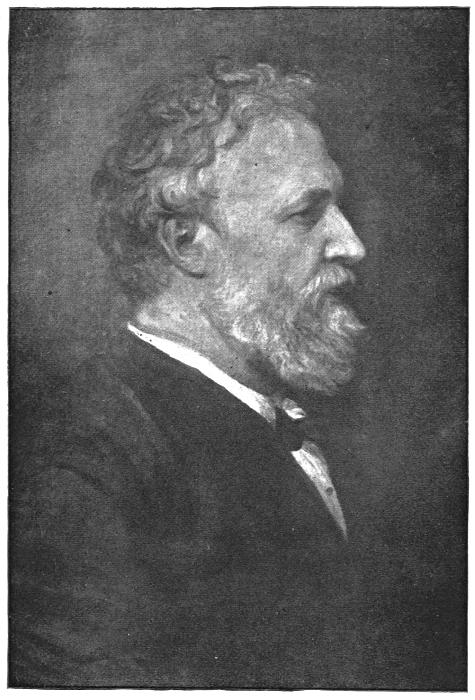
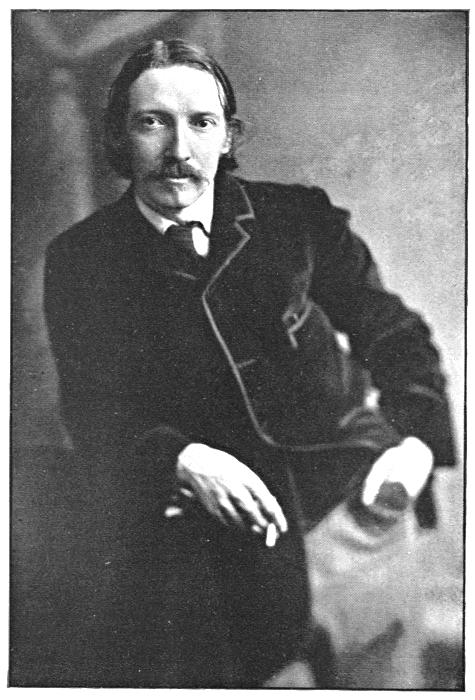
ROBERT BROWNING.
Painted by G. F. Watts.
From a photograph, copyright by Hollyer, London.
The best criticisms of the poets have usually come
from other poets, and often in the form of verse.
Landor wrote of Browning,
“Since Chaucer was alive and hale
No man hath walked along our roads with step
So active, so inquiring eye, or tongue
So varied in discourse.”
This is a thumb-nail sketch of Browning’s personality,—not
complete, but very lifelike. And when
we add to it Landor’s prose saying that “his is the
surest foot since Chaucer’s, that has waked the
echoes from the difficult places of poetry and of life”
we have a sufficiently plain clew to the unfolding
of Browning’s genius. Unwearying activity, intense
curiosity, variety of expression, and a predominant
interest in the difficult places of poetry and of life,—these
were the striking characteristics of his mind.
In his heart a native optimism, an unconquerable
hopefulness, was the ruling factor. But of that I
shall not speak until later, when we come to consider
his message. For the present we are looking
simply for the mainspring of his immense intellectual
energy.
When I say that the clew to Browning’s mind is
to be found in his curiosity, I do not mean inquisitiveness,
but a very much larger and nobler quality,
for which we have no good word in English,—something
which corresponds with the German Wissbegier,
as distinguished from Neugier: an ardent
desire to know things as they are, to penetrate as
many as possible of the secrets of actual life. This,
it seems to me, is the key to Browning’s intellectual
disposition. He puts it into words in his first poem
Pauline, where he makes the nameless hero speak
of his life as linked to
“a principle of restlessness
Which would be all, have, see, know, taste, feel, all—
This is myself; and I should thus have been
Though gifted lower than the meanest soul.”
Paracelsus is only an expansion of this theme in
the biography of a soul. In Fra Lippo Lippi the
painter says:
“God made it all!
For what? Do you feel thankful, ay or no,
For this fair town’s face, yonder river’s line,
The mountain round it and the sky above,
Much more the figures of man, woman, child,
These are the frame to? What’s it all about?
To be passed over, despised? Or dwelt upon,
Wondered at? oh, this last of course!—you say.
But why not do as well as say, paint these
Just as they are, careless what comes of it?
God’s works—paint any one and count it crime
To let a truth slip.
... This world’s no blot for us,
Nor blank; it means intensely and means good:
To find its meaning is my meat and drink.”
No poet was ever more interested in life than
Browning, and whatever else may be said of his
poetry it must be admitted that it is very interesting.
He touches all sides of human activity and
peers into the secret places of knowledge. He enters
into the life of musicians in Abt Vogler, Master
Hugues of Saxe-Gotha, A Toccata of Galuppi’s, and
Charles Avison; into the life of painters in Andrea
del Sarto, Pictor Ignotus, Fra Lippo Lippi, Old Pictures
in Florence, Gerard de Lairesse, Pacchiarotto
and How He Worked in Distemper, and Francis
Furini; into the life of scholars in A Grammarian’s
Funeral and Fust and his Friends; into the
life of politicians in Prince Hohenstiel-Schwangau
and George Bubb Dodington; into the life of ecclesiastics
in the Soliloquy of the Spanish Cloister, Bishop
Blougram’s Apology, The Bishop orders his Tomb
at Saint Praxed’s Church, and The Ring and the Book;
and he makes excursions into all kinds of byways
and crooked corners of life in such poems as
Mr. Sludge, the Medium, Porphyria’s Lover, Mesmerism,
Johannes Agricola in Meditation, Pietro of
Abano, Ned Bratts, Jochanan Hakkadosh, and so
forth.
Merely to read a list of such titles is to have evidence
of Browning’s insatiable curiosity. It is evident
also that he has a fondness for out-of-the-way
places. He wants to know, even more than he wants
to enjoy. If Wordsworth is the poet of the common
life, Browning is the poet of the uncommon life.
Extraordinary situations and eccentric characters
attract him. Even when he is looking at some familiar
scene, at some commonplace character, his
effort is to discover something that shall prove that
it is not familiar, not commonplace,—a singular
detail, a striking feature, a mark of individuality.
This gives him more pleasure than any distant
vision of an abstraction or a general law.
“All that I know
Of a certain star
Is, it can throw
(Like the angled spar)
Now a dart of red,
Now a dart of blue;
Till my friends have said
They would fain see, too,
My star that dartles the red and the blue!
Then it stops like a bird; like a flower hangs furled;
They must solace themselves with the Saturn above it.
What matter to me if their star is a world?
Mine has opened its soul to me, therefore I love it.”
One consequence of this penetrating, personal
quality of mind is that Browning’s pages teem with
portraits of men and women, which are like sculptures
and paintings of the Renaissance. They are
more individual than they are typical. There is a
peculiarity about each one of them which almost
makes us forget to ask whether they have any general
relation and value. The presentations are so
sharp and vivid that their representative quality is
lost.
If Wordsworth is the Millet of poetry, Browning
is the Holbein or the Denner. He never misses the
mole, the wrinkle, the twist of the eyebrow, which
makes the face stand out alone, the sudden touch of
self-revelation which individualizes the character.
Thus we find in Browning’s poetry few types of
humanity, but plenty of men.
Yet he seldom, if ever, allows us to forget the
background of society. His figures are far more
individual than Wordsworth’s, but far less solitary.
Behind each of them we feel the world out of which
they have come and to which they belong. There
is a sense of crowded life surging through his poetry.
The city, with all that it means, is not often completely
out of view. “Shelley’s characters,” says a
thoughtful essayist, “are creatures of wave and
sky; Wordsworth’s of green English fields; Browning’s
move in the house, the palace, the street.”[13]
In many of them, even when they are soliloquizing,
there is a curious consciousness of opposition, of
conflict. They seem to be defending themselves
against unseen adversaries, justifying their course
against the judgment of absent critics. Thus Bishop
Blougram while he talks over the walnuts and the
wine to Mr. Gigadibs, the sceptical hack-writer,
has a worldful of religious conservatives and radicals
in his eye and makes his half-cynical, wholly militant,
apology for agnostic orthodoxy to them. The
old huntsman, in The Flight of the Duchess, is maintaining
the honour of his fugitive mistress against
the dried-up, stiff, conventional society from which
she has eloped with the Gypsies. Andrea del Sarto,
looking at the soulless fatal beauty of his Lucrezia,
and meditating on the splendid failure of his art,
cries out to Rafael and Michelangelo and all his
compeers to understand and judge him.
Even when Browning writes of romantic love,
(one of his two favourite subjects), he almost always
heightens its effect by putting it in relief against the
ignorance, the indifference, the busyness, or the
hostility of the great world. In Cristina and Evelyn
Hope half the charm of the passion lies in the feeling
that it means everything to the lover though no
one else in the world may know of its existence.
Porphyria’s Lover, in a fit of madness, kills his mistress
to keep her from going back to the world which
would divide them. The sweet searching melody
of In a Gondola plays itself athwart a sullen distant
accompaniment of Venetian tyranny and ends with
a swift stroke of vengeance from the secret Three.
Take, for an example of Browning’s way of enhancing
love by contrast, that most exquisite and
subtle lyric called Love Among the Ruins.
“Where the quiet-coloured end of evening smiles
Miles and miles
On the solitary pastures where our sheep
Half asleep
Tinkle homeward through the twilight, stay or stop
As they crop—
Was the site once of a city great and gay
(So they say)
Of our country’s very capital, its prince
Ages since
Held his court in, gathered councils, wielding far
Peace or war.
And I know, while thus the quiet-coloured eve
Smiles to leave
To their folding, all our many-tinkling fleece
In such peace,
And the slopes and rills in undistinguished gray
Melt away—
That a girl with eager eyes and yellow hair
Waits me there
In the turret whence the charioteers caught soul
For the goal,
When the king looked, where she looks now, breathless, dumb
Till I come.
In one year they sent a million fighters forth
South and North,
And they built their gods a brazen pillar high
As the sky,
Yet reserved a thousand chariots in full force—
Gold of course.
Oh heart! Oh blood that freezes, blood that burns!
Earth’s returns
For whole centuries of folly, noise and sin!
Shut them in,
With their triumphs and their glories and the rest!
Love is best.”
“Love is best!” That is one of the cardinal
points of Browning’s creed. He repeats it in a hundred
ways: tragically in A Blot in the ’Scutcheon;
sentimentally in A Lover’s Quarrel, Two in the Campagna,
The Last Ride Together; heroically in Colombe’s
Birthday; in the form of a paradox in The
Statue and the Bust; as a personal experience in
By the Fireside, One Word More, and at the end of
the prelude to The Ring and the Book.
“For life, with all it yields of joy and woe
And hope and fear, ...
Is just our chance o’ the prize of learning love.”
But it must be confessed that he does not often
say it as clearly, as quietly, as beautifully as in Love
Among the Ruins. For his chosen method is dramatic
and his natural manner is psychological. So
ardently does he follow this method, so entirely
does he give himself up to this manner that his style
“is subdued
To what it works in, like the dyer’s hand.”
In the dedicatory note to Sordello, written in 1863,
he says “My stress lay in the incidents in the development
of a soul; little else is worth study.”
He felt intensely
“How the world is made for each of us!
How all we perceive and know in it
Tends to some moment’s product thus,
When a soul declares itself—to wit,
By its fruit, the thing it does!”
In One Word More he describes his own poetry with
keen insight:
“Love, you saw me gather men and women,
Live or dead or fashioned by my fancy,
Enter each and all and use their service,
Speak from every mouth,—the speech a poem.”
It is a mistake to say that Browning is a metaphysical
poet: he is a psychological poet. His interest
does not lie in the abstract problems of time
and space, mind and matter, divinity and humanity.
It lies in the concrete problems of opportunity
and crisis, flesh and spirit, man the individual and
God the person. He is an anatomist of souls.
“Take the least man of all mankind, as I;
Look at his head and heart, find how and why
He differs from his fellows utterly.”
[14]
But his way of finding out this personal equation
is not by observation and reflection. It is by throwing
himself into the character and making it reveal
itself by intricate self-analysis or by impulsive action.
What his poetry lacks is the temperate zone.
He has the arctic circle of intellect and the tropics
of passion. But he seldom enters the intermediate
region of sentiment, reflection, sympathy, equable
and prolonged feeling. Therefore it is that few of
his poems have the power of “sinking inward from
thought to thought” as Wordsworth’s do. They
surprise us, rouse us, stimulate us, more than they
rest us. He does not penetrate with a mild and
steady light through the portals of the human heart,
making them transparent. He flings them wide
open suddenly, and often the gates creak on their
hinges. He is forever tying Gordian knots in the
skein of human life and cutting them with the sword
of swift action or intense passion. His psychological
curiosity creates the difficulties, his intuitive optimism
solves them.
The results of this preoccupation with such subjects
and of this manner of dealing with them may
be recognized very easily in Browning’s work.
First of all they turned him aside from becoming
a great Nature-poet, though he was well fitted to
be one. It is not that he loves Nature’s slow and
solemn pageant less, but that he loves man’s quick
and varied drama more. His landscapes are like
scenery for the stage. They accompany the unfolding
of the plot and change with it, but they do
not influence it. His observation is as keen, as accurate
as Wordsworth’s or Tennyson’s, but it is
less steady, less patient, less familiar. It is the observation
of one who passes through the country
but does not stay to grow intimate with it. The
forms of nature do not print themselves on his mind;
they flash vividly before him, and come and go.
Usually it is some intense human feeling that makes
the details of the landscape stand out so sharply.
In Pippa Passes, it is in the ecstasy of love that
Ottima and Sebald notice
“The garden’s silence: even the single bee
Persisting in his toil, suddenly stopped,
And where he hid you only could surmise
By some campanula chalice set a-swing.”
It is the sense of guilty passion that makes the
lightning-flashes, burning through the pine-forest,
seem like dagger-strokes,—
“As if God’s messenger through the closed wood screen
Plunged and re-plunged his weapon at a venture,
Feeling for guilty thee and me.”
In Home Thoughts from Abroad, it is the exile’s deep
homesickness that brings the quick, delicate vision
before his eyes:
“Oh, to be in England
Now that April’s there,
And whoever wakes in England
Sees, some morning, unaware,
That the lowest boughs and the brush-wood sheaf
Round the elm-tree bole are in tiny leaf,
While the chaffinch sings on the orchard bough
In England—now!”
But Browning’s touches of nature are not always
as happy as this. Often he crowds the details too
closely, and fails to blend them with the ground of
the picture, so that the tonality is destroyed and
the effect is distracting. The foreground is too
vivid: the aerial perspective vanishes. There is
an impressionism that obscures the reality. As
Amiel says: “Under pretense that we want to study
it more in detail, we pulverize the statue.”
Browning is at his best as a Nature-poet in sky-scapes,
like the description of daybreak in Pippa
Passes, the lunar rainbow in Christmas Eve, and the
Northern Lights in Easter Day; and also in a kind
of work which might be called symbolic landscape,
where the imaginative vision of nature is made to
represent a human experience. A striking example
of this work is the scenery of Childe Roland, reflecting
as in a glass the grotesque horrors of spiritual
desolation. There is a passage in Sordello which
makes a fertile landscape, sketched in a few swift
lines, the symbol of Sordello’s luxuriant nature;
and another in Norbert’s speech, in In a Balcony,
which uses the calm self-abandonment of the world
in the tranquil evening light as the type of the sincerity
of the heart giving itself up to love. But
perhaps as good an illustration as we can find of
Browning’s quality as a Nature-poet, is a little bit
of mystery called Meeting at Night.
“The gray sea and the long black land;
And the yellow half-moon, large and low;
And the startled little waves that leap
In fiery ringlets from their sleep,
As I gain the cove with pushing prow,
And quench its speed in the slushy sand.
Then a mile of warm sea-scented beach;
Three fields to cross till a farm appears;
A tap at the pane, the quick sharp scratch
And the blue spirt of a lighted match,
And a voice less loud, through its joys and fears,
Than the two hearts beating each to each!”
This is the landscape of the drama.
A second result of Browning’s preoccupation
with dramatic psychology is the close concentration
and “alleged obscurity” of his style. Here again
I evade the critical question whether the obscurity
is real, or whether it is only a natural and admirable
profundity to which an indolent reviewer has given
a bad name. That is a question which Posterity
must answer. But for us the fact remains that
some of his poetry is hard to read; it demands close
attention and strenuous effort; and when we find
a piece of it that goes very easily, like The Pied
Piper of Hamelin, How They brought the Good News
from Ghent to Aix, Hervé Riel, or the stirring Cavalier
Tunes, we are conscious of missing the sense of strain
which we have learned to associate with the reading
of Browning.
One reason for this is the predominance of
curiosity over harmony in his disposition. He tries
to express the inexpressible, to write the unwritable.
As Dr. Johnson said of Cowley, he has the
habit “of pursuing his thoughts to the last ramifications,
by which he loses the grandeur of generality.”
Another reason is the fluency, the fertility,
the haste of his genius, and his reluctance, or inability,
to put the brakes on his own productiveness.
It seems probable that if Browning had been able
to write more slowly and carefully he might have
written with more lucidity. There was a time when
he made a point of turning off a poem a day. It
is doubtful whether the story of The Ring and the
Book gains in clearness by being told by eleven different
persons, all of them inclined to volubility.
Yet Browning’s poetry is not verbose. It is singularly
condensed in the matter of language. He seems
to have made his most arduous effort in this direction.
After Paracelsus had been published and
pronounced “unintelligible,” he was inclined to
think that there might be some fault of too great
terseness in the style. But a letter from Miss Caroline
Fox was shown to him, in which that lady, (then
very young,) took the opposite view and asked
“doth he know that Wordsworth will devote a fortnight
or more to the discovery of the single word
that is the one fit for his sonnet.” Browning appears
to have been impressed by this criticism;
but he set himself to work upon it, not so much by
way of selecting words as by way of compressing
them. He put Sordello into a world where many of
the parts of speech are lacking and all are crowded.
He learned to pack the largest, possible amount of
meaning into the smallest possible space, as a hasty
traveller packs his portmanteau. Many small articles
are crushed and crumpled out of shape. He
adopted a system of elisions for the sake of brevity,
and loved, as C. S. Calverley said,
“to dock the smaller parts of speech
As we curtail th’ already curtailed cur.”
At the same time he seldom could resist the temptation
to put in another thought, another simile, another
illustration, although the poem might be already
quite full. He called out, like the conductor
of a street-car, “Move up in front: room for one
more!” He had little tautology of expression, but
much of conception. A good critic says “Browning
condenses by the phrase, elaborates by the
volume.”[15]
One consequence of this system of writing is that
a great deal of Browning’s poetry lends itself admirably
to translation,—into English. The number
of prose paraphrases of his poems is great, and
so constantly increasing that it seems as if there
must be a real demand for them. But Coleridge,
speaking of the qualities of a true poetic style, remarked:
“Whatever lines can be translated into
other words of the same language without diminution
of their significance, either in sense, or in association,
or in any other feeling, are so far vicious in
their diction.”
Another very notable thing in Browning’s poetry
is his fertility and fluency of rhyme. He is probably
the most rapid, ingenious, and unwearying rhymer
among the English poets. There is a story that
once, in company with Tennyson, he was challenged
to produce a rhyme for “rhinoceros,” and almost
instantly accomplished the task with a verse in
which the unwieldy quadruped kept time and tune
with the phrase “he can toss Eros.”[16] There are
other tours de force almost as extraordinary in his
serious poems. Who but Browning would have
thought of rhyming “syntax” with “tin-tacks,” or
“spare-rib” with “Carib,” (Flight of Duchess) or
“Fra Angelico’s” with “bellicose,” or “Ghirlandajo”
with “heigh-ho,” (Old Pictures in Florence) or
“expansive explosive” with “O Danaides, O Sieve!”
(Master Hugues). Rhyme, with most poets, acts as
a restraint, a brake upon speech. But with Browning
it is the other way. His rhymes are like wild,
frolicsome horses, leaping over the fences and carrying
him into the widest digressions. Many a couplet,
many a stanza would not have been written but
for the impulse of a daring, suggestive rhyme.
Join to this love of somewhat reckless rhyming,
his deep and powerful sense of humour, and you
have the secret of his fondness for the grotesque.
His poetry abounds in strange contrasts, sudden
changes of mood, incongruous comparisons, and
odd presentations of well-known subjects. Sometimes
the whole poem is written in this manner.
The Soliloquy in a Spanish Cloister, Sibrandus Schafnaburgensis,
and Caliban upon Setebos, are poetic
gargoyles. Sometimes he begins seriously enough,
as in the poem on Keats, and closes with a bit of
fantastic irony:
“Hobbs hints blue,—straight he turtle eats:
Nobbs prints blue,—claret crowns his cup:
Nokes outdares Stokes in azure feats—
Both gorge. Who fished the murex up?
What porridge had John Keats?”
Sometimes the poem opens grotesquely, like Christmas
Eve, and rises swiftly to a wonderful height of
pure beauty and solemnity, dropping back into a
grotesque at the end. But all this play of fancy
must not be confused with the spirit of mockery or
of levity. It is often characteristic of the most serious
and earnest natures; it arises in fact from the
restlessness of mind in the contemplation of evil,
or from the perception of life’s difficulties and perplexities.
Shakespeare was profoundly right in introducing
the element of the grotesque into Hamlet,
his most thoughtful tragedy. Browning is never
really anything else but a serious thinker, passionately
curious to solve the riddle of existence. Like
his own Sordello he
“Gave to familiar things a face grotesque,
Only, pursuing through the mad burlesque,
A grave regard.”
We may sum up, then, what we have to say of
Browning’s method and manner by recognizing
that they belong together and have a mutual fitness
and inevitableness. We may wish that he had attained
to more lucidity and harmony of expression,
but we should probably have had some difficulty
in telling him precisely how to do it, and he would
have been likely to reply with good humour as he
did to Tennyson, “The people must take me as
they find me.” If he had been less ardent in looking
for subjects for his poetry, he might have given
more care to the form of his poems. If he had cut
fewer blocks, he might have finished more statues.
The immortality of much of his work may be discounted
by its want of perfect art,—the only true
preservative of man’s handiwork. But the immortality
of his genius is secure. He may not be ranked
finally among the great masters of the art of poetry.
But he certainly will endure as a mine for poets.
They may stamp the coins more clearly and fashion
the ornaments more delicately. But the gold is
his. He was the prospector,—the first dramatic
psychologist of modern life. The very imperfections
of his work, in all its splendid richness and
bewildering complexity, bear witness to his favourite
doctrine that life itself is more interesting than
art, and more glorious, because it is not yet perfect.
“The Glory of the Imperfect,”—that is a phrase
which I read in a pamphlet by that fine old Grecian
and noble Christian philosopher, George Herbert
Palmer, many years ago. It seems to me to express
the central meaning of Browning’s poetry.
He is the poet of aspiration and endeavour; the
prophet of a divine discontent. All things are precious
to him, not in themselves, but as their defects
are realized, as man uses them, and presses through
them, towards something higher and better. Hope
is man’s power: and the things hoped for must be
as yet unseen. Struggle is man’s life; and the purpose
of life is not merely education, but a kind of
progressive creation of the soul.
“Man partly is and wholly hopes to be.”
The world presents itself to him, as the Germans
say, Im Werden. It is a world of potencies, working
itself out. Existence is not the mere fact of being,
but the vital process of becoming. The glory of
man lies in his power to realize this process in his
mind and to fling himself into it with all his will.
If he tries to satisfy himself with things as they are,
like the world-wedded soul in Easter Eve, he fails.
If he tries to crowd the infinite into the finite, like
Paracelsus, he fails. He must make his dissatisfaction
his strength. He must accept the limitations
of his life, not in the sense of submitting to
them, but as Jacob wrestled with the angel, in order
to win, through conflict, a new power, a larger blessing.
His ardent desires and longings and aspirations,
yes, even his defeats and disappointments and
failures, are the stuff out of which his immortal
destiny is weaving itself. The one thing that life
requires of him is to act with ardour, to go forward
resolutely, to “burn his way through the world”;
and the great lesson which it teaches him is this:
“But thou shalt painfully attain to joy
While hope and love and fear shall keep thee man.”
Browning was very much needed in the Nineteenth
Century as the antidote, or perhaps it would
be more just to say, as the complement to Carlyle.
For Carlyle’s prophecy, with all its moral earnestness,
its virility, its indomitable courage, had in it
a ground-tone of despair. It was the battle-cry of
a forlorn hope. Man must hate shams intensely,
must seek reality passionately, must do his duty
desperately; but he can never tell why. The reason
of things is inscrutable: the eternal Power that
rules things is unknowable. Carlyle, said Mazzini,
“has a constant disposition to crush the human by
comparing him with God.” But Browning has an
unconquerable disposition to elevate the human by
joining him to God. The power that animates and
governs the world is Divine; man cannot escape
from it nor overcome it. But the love that stirs
in man’s heart is also Divine; and if man will follow
it, it shall lead him to that height where he
shall see that Power is Love.
“I have faith such end shall be:
From the first Power was—I knew.
Life has made clear to me
That, strive but for closer view,
Love were as plain to see.
When see? When there dawns a day
If not on the homely earth,
Then yonder, worlds away,
Where the strange and new have birth
And Power comes full in play.”
[17]
Browning’s optimism is fundamental. Originally
a matter of temperament, perhaps, as it is expressed
in At the Mermaid,—
“I find earth not gray, but rosy,
Heaven not grim but fair of hue.
Do I stoop? I pluck a posy,
Do I stand and stare? All’s blue——”
primarily the spontaneous tone of a healthy, happy
nature, it became the chosen key-note of all his
music, and he works it out through a hundred harmonies
and discords. He is “sure of goodness as
of life.” He does not ask “How came good into
the world?” For that, after all, is the pessimistic
question; it assumes that the ground of things is
evil and the good is the breaking of the rule. He
asks instead “How came evil into the world?” That
is the optimistic question; as long as a man puts
it in that form he is an optimist at heart; he takes
it for granted that good is the native element and
evil is the intruder; there must be a solution of the
problem whether he can find it or not; the rule
must be superior to, and triumphant over, the exception;
the meaning and purpose of evil must somehow, some
time, be proved subordinate to good.
That is Browning’s position:
“My own hope is, a sun will pierce
The thickest cloud earth ever stretched;
That, after Last, returns the First,
Though a wide compass round be fetched;
That what began best, can’t end worst,
Nor what God blessed once prove accurst.”
The way in which he justifies this position is characteristic
of the man. His optimism is far less defensive
than it is militant. He never wavers from his intuitive
conviction that “the world means
good.” He follows this instinct as a soldier follows
his banner, into whatever difficulties and conflicts
it may lead him, and fights his way out, now with
the weapons of philosophy, now with the bare
sword of faith.
It might seem at first as if it were unfair to attempt
any estimate of the philosophic and religious
teaching of a poet like Browning, whose method
we have already recognized as dramatic. Can we
ascribe to the poet himself the opinions which he
puts into the mouths of his characters? Can we
hold him responsible for the sentiments which are
expressed by the actors on his stage?
Certainly this objection must be admitted as a
restraint in the interpretation of his poetry. We
are not to take all that his characters say, literally
and directly, as his own belief, any more than we
are to read the speeches of Satan, and Eliphaz, and
Bildad, and Zophar, in the Book of Job, as utterances
of the spirit of inspiration. But just as that
great dramatic Scripture, dealing with the problems
of evil and suffering and sovereignty, does contain
a doctrine and convey a lesson, so the poetry of
Browning, taken as a whole, utters a distinct and
positive prophetic message.
In the first place, many of the poems are evidently
subjective, written without disguise in the
first person. Among these we may consider My
Star; By the Fireside; One Word More; the Epilogues
to Dramatis Personæ and Pachiarrotto and Ferishtah’s
Fancies; the introduction and the close of
The Ring and the Book; Christmas Eve and Easter
Day; the ending of the poem called Gold Hair,
and of A Death in the Desert, and of Bishop Blougram’s
Apology; Prospice and Reverie. In the second
place we must remember Goethe’s dictum:
“Every author in some degree, pourtrays himself in
his works, even be it against his will.” Even when
Browning is writing dramatically, he cannot conceal
his sympathy. The masks are thin. His eyes
shine through. “His own personality,” says Mr.
Stedman, “is manifest in the speech and movement
of almost every character of each piece. His spirit
is infused as if by metempsychosis, within them all,
and forces each to assume a strange Pentecostal
tone, which we discover to be that of the poet himself.”
Thus it is not impossible, nor even difficult,
to reach a fair estimate of his ethical and religious
teaching and discover its principal elements.
1. First among these I would put a great confidence
in God. Browning is the most theological
of modern poets. The epithet which was applied
to Spinoza might well be transferred to him. He
is a “God-intoxicated” man. But in a very different
sense, for whereas the philosopher felt God as
an idea, the poet feels Him intensely as a person.
The song which he puts into the lips of the unconscious
heroine in Pippa Passes,—
“God’s in his heaven
All’s right with the world,——”
is the recurrent theme of his poetry. He cries with
Paracelsus,
“God thou art Love, I build my faith on that.”
Even when his music is broken and interrupted by
discords, when it seems to dissolve and fade away
as all human work, in its outward form, dissolves
and fades, he turns, as Abt Vogler turns from his
silent organ, to God;
“Therefore to whom turn I but to thee, the ineffable Name?
Builder and maker, thou, of houses not made with hands!
What, have fear of change from thee who art ever the same?
Doubt that thy power can fill the heart that thy power expands?”
In Rabbi Ben Ezra he takes up the ancient figure
of the potter and the clay and uses it to express
his boundless trust in God.
The characteristic mark of Browning’s view of
God is that it is always taken from the side of humanity.
The Perfect Glory is the correlative of
the glory of the imperfect. The Divine Love is
the answer to the human longing. God is, because
man needs Him. From this point of view it almost
seems, as a brilliant essayist has said, as if “In
Browning, God is adjective to man.”[18]
But it may be said in answer, that, at least for
man, this is the only point of view that is accessible.
We can never leave our own needs behind us, however
high we may try to climb. Certainly if we
succeed in forgetting them for a moment, in that
very moment we have passed out of the region of
poetry, which is the impassioned interpretation of
man’s heart.
2. The second element of power in Browning’s
poetry is that he sees in the personal Christ the
very revelation of God that man’s heart most needs
and welcomes. Nowhere else in all the range of
modern poetry has this vision been expressed with
such spiritual ardour, with such poignant joy. We
must turn back to the pages of Isaiah to find anything
to equal the Messianic rapture of the minstrel
in Saul.
“He who did most shall bear most: the strongest shall stand the most weak.
’Tis the weakness in strength that I cry for! my flesh that I seek
In the Godhead! I seek and I find it. O Saul, it shall be,
A Face like my face that receives thee; a man like to me,
Thou shalt love and be loved by, forever: a Hand like this hand
Shall throw open the gates of new life to thee! see the Christ stand!”
We must look into the Christ-filled letters of St.
Paul to find the attractions of the Crucified One
uttered as powerfully as they are in the Epistle of
Karshish.
“The very God! think Abib; dost thou think?
So, the All-great, were the All-Loving too—
So, through the thunder comes a human voice
Saying, ‘O heart I made, a heart beats here!
Face, my hands fashioned, see it in myself!
Thou hast no power, nor mayest conceive of mine,
But love I gave thee, with myself to love,
And thou must love me who have died for thee!’”
It is idle to assert that these are only dramatic
presentations of the Christian faith. No poet could
have imagined such utterances without feeling their
significance; and the piercing splendour of their
expression discloses his sympathy. He reveals it
yet more unmistakably in Christmas Eve, (strophe
XVII) and in Easter Day, (strophe XXX.) In the
Epilogue to Dramatis Personæ it flashes out clearly.
The second speaker, as Renan, has bewailed the
vanishing of the face of Christ from the sorrowful
vision of the race. The third speaker, the poet
himself, answers:
“That one Face, far from vanish, rather grows,
Or decomposes but to recompose
Become my universe that feels and knows!”
“That face,” said Browning to a friend, “that face
is the face of Christ: that is how I feel Him.”
Surely this is the religious message that the world
most needs to-day. More and more everything in
Christianity hangs upon the truth of the Incarnation.
The alternative declares itself. Either no
God whom we can know and love at all, or God
personally manifest in Christ!
3. The third religious element in Browning’s
poetry is his faith that this life is a probation, a discipline
for the future. He says, again and again,
“I count life just a stuff
To try the soul’s strength on, educe the man.”
The glory of the imperfect lies in the power of progress,
“man’s distinctive mark.” And progress comes
by conflict; conflict with falsehood and ignorance,—
“Living here means nescience simply; ’tis next life that helps to learn—”
and conflict with evil,—
“Why comes temptation but for man to meet,
And master and make crouch beneath his foot,
And so be pedestalled in triumph?”
The poet is always calling us to be glad we are engaged
in such a noble strife.
“Rejoice we are allied
To that which doth provide
And not partake, effect and not receive!
A spark disturbs our clod;
Nearer we hold of God
Who gives, than of his tribes that take, I must believe.
Then welcome each rebuff
That turns earth’s smoothness rough,
Each sting that bids nor sit nor stand but go!
Be our joys three-parts pain!
Strive and hold cheap the strain;
Learn, nor account the pang; dare, never grudge the throe!”
Now this is fine doctrine, lofty, strenuous, stimulating.
It appeals to the will, which is man’s central
power. It proclaims the truth that virtue must be
active in its essence though it may also be passive
in its education, positive in its spirit and negative
only by contrast.
But it is in the working out of this doctrine into
an ethical system that Browning enters upon dangerous
ground, and arrives at results which seem to
obscure the clearness, and to threaten the stability
of the moral order, by which alone, if the world’s
greatest teachers have been right, the ultimate good
of humanity can be attained. Here, it seems to
me, his teaching, especially in its latter utterances,
is often confused, turbulent, misleading. His light
is mixed with darkness. He seems almost to say
that it matters little which way we go, provided
only we go.
He overlooks the deep truth that there is an activity
of the soul in self-restraint as well as in self-assertion.
It takes as much courage to dare not to
do evil as it does to dare to do good. The hero is
sometimes the man who stands still. Virtue is
noblest when it is joined to virility. But virility
alone is not virtue nor does it always lead to moral
victory. Sometimes it leads straight towards moral
paralysis, death, extinction. Browning fails to see
this, because his method is dramatic and because
he dramatizes through himself. He puts himself
into this or the other character, and works himself
out through it, preserving still in himself, though
all unconsciously, the soul of something good. Thus
he does not touch that peculiar deadening of spiritual
power which is one result of the unrestrained
following of impulse and passion. It is this defect
in his vision of life that leads to the dubious and
interrogatory moral of such a poem as The Statue
and the Bust.
Browning values the individual so much that he
lays all his emphasis upon the development of
stronger passions and aspirations, the unfolding of
a more vivid and intense personality, and has comparatively
little stress to lay upon the larger thought
of the progress of mankind in harmony and order.
Indeed he poetizes so vigorously against the conventional
judgments of society that he often seems
to set himself against the moral sentiments on which
those conventional judgments, however warped,
ultimately rest. “Over and over again in Browning’s
poetry,” says a penetrating critic, “we meet
with this insistence on the value of moments of
high excitement, of intense living, of full experience
of pleasure, even though such moments be of the
essence of evil and fruitful in all dark consequences.”
Take for example his treatment of love. He is
right in saying “Love is best.” But is he right in
admitting, even by inference, that love has a right
to take its own way of realizing itself? Can love
be at its best unless it is obedient to law? Does it
not make its truest music when it keeps its place
in the harmony of purity and peace and good living?
Surely the wild and reckless view of love as
its own law which seems to glimmer through the
unconsumed smoke of Browning’s later poems,
such as Fifine at the Fair, The Inn Album, and Red
Cotton Nightcap Country, needs correction by a true
flash of insight like that which we find in two lines
of One Word More:
“Dante, who loved well because he hated,
Hated wickedness that hinders loving.”
Browning was at times misled by a perilous philosophy
into a position where the vital distinction
between good and evil dissolved away in a cloud
of unreality. In Ferishtah’s Fancies and Parleyings
with Certain People of Importance, any one who has
the patience to read them will find himself in a nebulous
moral world. The supposed necessity of showing
that evil is always a means to good tempts to
the assertion that it has no other reality. Perhaps
it is altogether an illusion, needed to sting us into
conflict, but really non-existent. Perhaps it is only
the shadow cast by the good,—or “the silence implying
sound.” Perhaps it is good in disguise, not
yet developed from the crawling worm into the
creature with wings. After this fashion the whimsical
dervish Ferishtah strews his beans upon the
table.
“This bean was white, this—black,
Set by itself,—but see if good and bad
Each following other in companionship,
Black have not grown less black and white less white,
Till blackish seems but dun, and whitish,—gray,
And the whole line turns—well, or black to thee
Or white alike to me—no matter which.”
Certainly if this were the essence of Browning’s
poetry the best safeguard against its falsehood would
be its own weakness. Such a message, if this were
all, could never attract many hearers, nor inspire
those whom it attracted. Effort, struggle, noble
conflict would be impossible in a world where there
were no moral certainties or realities, but all men
felt that they were playing at a stupid game like the
Caucus race in Alice in Wonderland, where everything
went round in a circle and every runner received
a prize.
But in fact these elements of weakness in Browning’s
work, as it seems to me, do not belong to his
true poetry. They are expressed, generally, in his
most obfuscated style, and at a prohibitory length.
They are embodied in poems which no one is likely
to read for fun, and few are capable of learning by
heart.
But when we go back to his best work we find
another spirit, we hear another message. Clear,
resonant, trumpet-like his voice calls to us proclaiming
the glorious possibilities of this imperfect
life. Only do not despair; only do not sink down
into conventionality, indifference, mockery, cynicism;
only rise and hope and go forward out of the
house of bondage into the land of liberty. True,
the prophecy is not complete. But it is inspiring.
He does not teach us how to live. But he does tell
us to live,—with courage, with love to man, with
trust in God,—and he bids us find life glorious,
because it is still imperfect and therefore full of
promise.