INSOLVENT DEBTORS—"GRAB LAW."—When
a debtor is insolvent there are several
things that he may do. In the first place he may
do nothing. He may let his creditors try to get any
money out of him if they can, and in general let the
creditors take the laboring oar. Where there is no
bankruptcy law prevailing, either State or Federal—and
that was the situation in many of the States of
the Union prior to the passage of the present National
bankruptcy law—a debtor might get along
that way for a long time. That is one thing he
might do.
COMPOSITION WITH CREDITORS.—The
second thing the debtor may conceivably do is to try
to make a composition with his creditors. Though
it is the law that receiving a smaller sum will not discharge
a liquidated and undisputed debt for a larger
amount, even if it is so agreed, an exception is made
in the case of a composition where a number of creditors
agree that each of them will take a smaller sum
for his claim. The debtor may try to get his creditors
to do that, and occasionally he succeeds.
GENERAL ASSIGNMENTS.—A third thing
which he may do is to make a general assignment of
all his property to trustees in trust to pay his creditors
ratably. Such an assignment is not valid in
Massachusetts, though in most States it would be, if
free from fraudulent incidents. In Massachusetts it
would not prevent his creditors, or any one of them,
from attaching his property just as if it had not been
assigned, but if creditors assent to the assignment
then, to the extent of their claims, the assignment
becomes valid. In other States the assent of creditors
is presumed if the assignment is not fraudulent,
and therefore without any actual assent the situation
is the same as in Massachusetts after assent of all
the creditors.
FRAUDULENT INCIDENTS IN GENERAL
ASSIGNMENTS.—In every State a general assignment
under certain circumstances will be regarded as
fraudulent against creditors. Such a conveyance may
be treated as void by the creditors, and the property
conveyed seized by them as if the debtor had made
no conveyance. Some of these incidents which may
make a general assignment fraudulent may be noted.
If the assignor was solvent when the conveyance was
made, the transaction is fraudulent, for if he has sufficient
assets to pay his debts, the only object the assignment
can have is to prevent them from being
paid at once, and compel the creditors to wait until
the assignees under the deed realize upon the property,
that the debtor holds, at better advantage than
if a forced sale were made at once. If the assignees
are given unlimited power to continue business it is
also fraudulent, since the business would in effect be
carried on at the risk of the debtor. The debtor being
insolvent will lose nothing if the business proves
unprofitable whereas if profitable there may be a surplus
after the payment of the debts. A provision
authorizing continuance of business so far as is necessary
to dispose of property on hand, or to work
up raw material on hand, is generally upheld. A provision
authorizing sales upon credit is often, though
not uniformly, held fraudulent, since it permits the
assignees to defer the settlement of the estate. The
most important provisions likely to be attacked as
fraudulent, however, are provisions in regard to preferences.
Aside from bankruptcy statutes, it is lawful
for a debtor who has insufficient means to pay all of
his creditors, to pay some in full, though this results
in the total exclusion of others. Accordingly a general
assignment of a debtor's property on a trust, that
the assignees shall pay in full certain named creditors
and pay the remaining creditors ratably out of the
residue, has generally been upheld though statutes in
some States have altered the law in this respect. A
kind of preference which is generally deemed fraudulent,
however, is one which is made conditional on
the creditors giving the debtor a discharge. A general
assignment, unlike a bankruptcy law, or a composition,
does not free the debtor from liability for
so much of his debt as remains unpaid. Debtors have
sometimes sought to avoid this result by making a
general assignment of their property in trust for
ratable distribution among such creditors as should
give the debtor a full release and discharge of all
claims. Such a provision, attempting, as it does, to
impose as a condition of a creditor's sharing, that he
should take his share in full satisfaction of his claim,
is almost universally held to make a general assignment
fraudulent. Under the bankruptcy law, a general
assignment may within four months be set aside
by bankruptcy proceedings; but a creditor who has
once assented to a general assignment cannot thereafter
join in a bankruptcy petition against that debtor.
BANKRUPTCY.—The fourth and most important
way, however, now, of settling the estates of insolvent
persons is provided by statute. The Federal
Constitution gives Congress power to pass uniform
laws on the subject of bankruptcy throughout the
United States, and the Supreme Court has held that
when the Federal Government has not taken advantage
of this privilege given by the Constitution, States
have power themselves to enact bankruptcy laws. In
some States there were such laws, but in many there
were not. The Federal law now supersedes all State
laws on the subject. It was passed in 1898, and under
that law the debtor may either become a bankrupt by
his own voluntary petition, or his creditors may petition
him into bankruptcy if he commits what is called
an "act of bankruptcy." This is true, at least, if the
debtor is an individual, or is a moneyed business or
commercial corporation (except railroads, insurance
companies, and banking corporations). When corporations
of the excepted class become insolvent, their
affairs are settled by still a fifth method—receivership.
A special privilege, also, is given to wage earners and
farmers. They may, if they choose, become voluntary
bankrupts, but are not liable to involuntary proceedings.
PETITIONS IN BANKRUPTCY.—Suppose a
debtor wishes to become bankrupt himself. He files
a petition in the United States District Court, which
is the court of bankruptcy jurisdiction, and is immediately
adjudicated a bankrupt. If his creditors want
to make him a bankrupt it is necessary that three of
them, having claims amounting to not less than $500
in the aggregate, should join, unless there are less
than twelve creditors in all. In that event one creditor
only may petition. This petition must set forth
(1) the creditors' claims, (2) the fact that the debtor
has committed an act of bankruptcy, and (3) the fact
that he owes debts aggregating $1,000 or more. However
slight his indebtedness, if he cannot pay it, a man
may be a voluntary bankrupt, but he must owe at
least $1,000 to be liable to involuntary proceedings.
ACTS OF BANKRUPTCY—FRAUDULENT
CONVEYANCES.—Now what are the acts of bankruptcy
which render a debtor liable to a petition by
his creditors? In the first place a fraudulent conveyance
is an act of bankruptcy. Reference to a fraudulent
conveyance by general assignment has been
made; but there are many kinds of fraudulent conveyances.
If a debtor who is insolvent, or who is
made insolvent through a gift made by himself, should
give away a portion of his property, that would be a
fraudulent conveyance, irrespective of the debtor's
intent, because the necessary effect of the gift would
be to hinder, delay and defraud his creditors. It would
be a fraudulent conveyance for a debtor to seek to
conceal his property from his creditors by putting it
in the hands of some kind friend to hold for him until
his creditors should cease to be so troublesome as at
the present time. It would be a fraudulent conveyance
for a man who is pressed by creditors to turn
himself into a corporation for business purposes, and
assign all his property to that corporation. This
transfer to a corporation, even though done openly,
would necessarily hinder and delay his creditors.
PREFERENCES.—As has already been said,
paying one creditor to the exclusion of others is not
a fraudulent conveyance, but it is a preference, and a
preference is a second act of bankruptcy. Either for
the debtor to give a preference himself or to allow a
creditor to get a preference, by legal proceedings, is
an act of bankruptcy. Any transfer made by an insolvent
debtor, to pay or to secure in whole or in part
a previously existing debt, is a preference.
GENERAL ASSIGNMENTS.—A general assignment,
whether fraudulent or not, is an act of
bankruptcy. The consequence is, therefore, that if a
debtor makes a general assignment, his creditors have
the choice of letting it stand and having the estate
settled under the general assignment, or of setting it
aside and having bankruptcy proceedings.
RECEIVERSHIPS.—Still another act of bankruptcy
is the appointment of a receiver on account
of insolvency. There, also, the creditors virtually
have an option of letting the receivership stand and
having the receiver take charge of the distribution
of the assets, or of petitioning the debtor into bankruptcy
and having the bankruptcy court take charge.
ADMISSION OF INABILITY TO PAY
DEBTS.—One further act of bankruptcy is an admission
by the debtor of his inability to pay his debts
and his willingness to be adjudicated a bankrupt. An
act of bankruptcy can form the basis of a petition
only within four months after its commission.
INSOLVENT DEBTORS USUALLY COMMIT
ACTS OF BANKRUPTCY.—Now an insolvent
debtor cannot very well avoid committing one of
these acts of bankruptcy. He can avoid making a
fraudulent conveyance, but he will find it pretty hard
to avoid making a preference. He need not, it is true,
pay any of his debts, and it is not a preference to pay
money out for present consideration, or to transfer
property for present consideration, as to make a mortgage
for a new loan; but it will be hard for him to
prevent creditors from getting a preference by legal
proceedings, at least if the debtor has any assets at
all; for if the debtor does not pay any of his creditors,
some of his creditors will sue him, get execution, and
endeavor to levy it on the debtor's property.
PROCEDURE AFTER ADJUDICATION.—If
a debtor has once been adjudicated a bankrupt, it
makes no difference whether it was on a voluntary
petition or an involuntary petition; the matter goes
on in both cases the same way. The first thing, after
the adjudication, is, that the referee, a sort of subordinate
judge, requires the bankrupt to submit schedules
of his assets and of his creditors. The debtor is
induced to make these schedules as complete as possible,
for the following reasons: if the schedule of
assets is knowingly incomplete, the debtor is committing
a crime and is likely to be shut up in jail. If
the schedule of his creditors is incomplete, any creditor
who is left out or whose address is so incorrectly
given that the creditor does not get notice of the proceedings
in time to prove his claim, is not affected
by the discharge; and as the debtor wants a discharge
from as many debts as possible, he, of course, will
make his schedule of creditors as complete as possible.
From this schedule of creditors, the referee sends
notices out to all the creditors to meet and choose the
trustee. The creditors meet and choose a trustee,
who then endeavors to collect the assets of the estate,
and under the direction of the court, pays dividends
from the assets to the creditors.
PROPERTY WHICH THE TRUSTEE GETS.—The
question may be asked: "What property does
the trustee get?" He gets all tangible property that
the debtor could transfer at the moment of his bankruptcy.
He gets intangible property, patents, trademarks,
copyrights, seats on the stock exchange, and
good-will of a business, with the exception that the
debtor still retains the right to carry on his old business
himself, in the future, in his own name. The
trustee gets rights of action of the bankrupt, except
personal rights of action, as they are called. These
consist of rights of action for personal injuries, as
for assault, or for personal injury by negligence. A
right of action for breach of promise of marriage also
would not pass to the trustee in bankruptcy. Not
only does a trustee get this tangible and intangible
property, but he gets also a right to recover any property
fraudulently conveyed by the bankrupt, which
is not in the hands of a bona fide purchaser, even if
the fraudulent conveyance was made years before,
provided the statute of limitations has not completely
run against it. Any preference, also made within
four months before the filing of the petition in bankruptcy,
may be recovered from the preferred creditor,
if he had reasonable cause to believe, when he received
it, that he was getting a preference, but
not otherwise. The trustee in bankruptcy gets the
debtor's life insurance policies, except in so far as
they are made exempt by statute. Life-insurance
policies, in favor of a beneficiary other than the insured
himself, are exempt, though if the premiums
were paid by the debtor while insolvent, the premiums
so paid within the past six years may be recovered,
and the beneficiary would in effect have to
pay those premiums back in order to hold the policy.
Even if the policy runs to the insured himself, in his
own name, he has the privilege, under the bankruptcy
act, to redeem it from the trustee in bankruptcy by
paying its cash surrender value. Property acquired
by the bankrupt, after the beginning of bankruptcy
proceedings, does not pass to the trustee. The bankrupt's
property passes free of attachment or judgment
liens, secured by creditors within four months
prior to the beginning of bankruptcy proceedings.
This has no bearing on a case, where, prior to bankruptcy,
money has been actually collected by legal
proceedings, but only to cases of seizure under legal
proceedings which are still pending at the time the
petition is filed. If a debtor becomes bankrupt, within
four months after his property is attached, the attachment
is dissolved. If the debtor does not become
bankrupt until after four months, the attachment is
a valid lien on the property attached, and so far as
the property is sufficient to pay the creditor, he can
collect his claim from it, even though the debtor becomes
bankrupt before the creditor finally gets judgment
and collects his claim.
PROOF OF CLAIMS.—The trustee collects all
this property and tries to reduce it to cash, as fast as
he can, and while this is going on, creditors will also
be proving their claims. It is only claims which exist
at the time of filing the petition which are provable,
but the debts need not be due at the time of the bankruptcy;
it is only essential that they shall be in existence.
Interest is added or rebated, as the case
may be, to the date of filing the petition. That is, if
you have a non-interest-bearing note falling due July
1, and the debtor becomes bankrupt May 1, the face
of the note will be proved less a rebate of two months'
interest to May 1, because the present value of the
note on May 1 is what is provable. On the other
hand, if the note had been due on April 1, interest
would be added up to the date of filing the petition,
and if the note was an interest-bearing note, of course
the interest would be provable up to May 1, even if
the note did not fall due until July 1 or later. Debts,
arising subsequently to the date of filing the petition,
must be enforced against the bankrupt's assets acquired
after his bankruptcy. Claims for tort are not
provable, that is, claims for injuries to person or property
not arising out of contact. But a judgment for
tort, obtained before the filing of the petition, is provable.
There has been a good deal of trouble in regard
to what are called contingent claims. The commonest
instance is the indorser's liability on a note which
is not yet due when the indorser becomes bankrupt.
At the time of filing the petition, the indorser's liability
is contingent on the possibility that the maker may
not pay the note at maturity, and that notice of dishonor
will be given to the indorser. Creditors, who
have received a preference, cannot prove claims unless
they have surrendered, within four months of the
bankruptcy, any preference which they have received
with reasonable cause to believe that it was a preference.
Secured creditors can realize on their security
and then prove for the balance of their claims. A
few claims are given priority over others and paid in
full before any dividend to other creditors. The most
important claims of this sort are the wages of workmen,
clerks or servants earned within three months
of the bankruptcy and not exceeding the sum of
$300.
LEASES.—Leases belonging to the bankrupt
pass to the trustee in bankruptcy, if he wants them,
but the trustee in bankruptcy need not take any kind
of property which seems more burdensome than beneficial
to him, and as a trustee would have to pay, the
rent under a lease in full, if he took it, he frequently
will prefer to abandon it. The landlord can prove for
rent, which is already accrued, but he cannot prove
for rent which has not already accrued, even though
part of the period for which the rent is claimed has
elapsed, unless there is a special covenant in the lease.
If the trustee in bankruptcy assumed the lease, then,
of course, the landlord would look to the trustee for
the rest of the term. If the trustee did not assume
the lease, the landlord would have his option of doing
either of two things: he could leave the bankrupt in
the premises and have a right of action against him
for the rent, from time to time, as it accrued, or he
could eject the tenant; but if he ejected the tenant
he could not hold him for rent. Generally he would
eject a bankrupt tenant rather than let him stay.
SET-OFF.—Set-off may be made by a debtor of
the estate who also has a claim against the estate. He
does not have to prove his claim, taking a dividend
on it and then paying, in full, the debt which he owes
to the estate. He may set one off against the other,
but he is not allowed to acquire claims for the purpose
of set-off within four months prior to bankruptcy.
Otherwise, one owing money to an insolvent
debtor, could buy up at a discount claims against the
debtor, equal in amount to his indebtedness to the
bankrupt.
EXAMINATION AND DISCHARGE OF
BANKRUPT.—The bankrupt may be examined by
any creditor with a view to the disclosure of his assets.
This is a most important right. Finally, if
in every respect, he obeys the bankruptcy law, the
debtor gets a discharge. Grounds for refusing him
a discharge are, that he has made a fraudulent conveyance;
that he has obtained credit by false representation;
that he has failed to keep books of account
for the purpose of concealing his financial condition;
that he has committed an offence punishable by the
bankruptcy law, as making a false oath or refusal to
disclose his property or to submit to examination;
and finally a debtor who has already been discharged
in bankruptcy within the previous six years cannot,
as a voluntary bankrupt, again obtain a discharge.
These are reasons for refusing a discharge altogether,
but even though a discharge is granted, certain liabilities
are not discharged. Claims for obtaining property
by false pretences, or for false representations,
are not discharged. Claims for defalcation or embezzlement,
as a public officer or as a fiduciary, and
claims for wilful and malicious injury to the property
of another, are not discharged. Nor are taxes or
claims for alimony or for the support of a wife or dependent
children.
COMPOSITION IN BANKRUPTCY.—At
common law it was necessary to have the consent of
all a debtor's creditors in order to make the composition
operative as against all of them. In bankruptcy
there is a special provision for composition, and with
the approval of the court, a composition may be declared
binding, not only as against those who have
assented to it, but as against all creditors having
provable claims, if a majority in number and amount
of the creditors, taking part in the bankruptcy proceedings,
assent to the discharge.
INSURANCE.—Insurance is a contract whereby,
for an agreed premium, one party undertakes to
compensate the other for loss on a specified subject
from specified perils. Policies of insurance are as
various as the contracts which they cover. In 1779,
Lloyd's adopted a standard form of marine policy,
which, with some changes, is in practically universal
use in the British world. A standard form of fire
policy has been adopted by many of the fire insurance
companies in the United States.
POLICY PROVISIONS.—Certain terms occur
frequently in insurance law, with which one should
be familiar. A valued policy is one upon which a
definite valuation is put, by agreement of both parties,
on the subject matter of the insurance written on the
policy; for example, a policy "insuring the S.S. George
Washington, valued at $1,000,000." An open policy,
on the other hand, is one in which a definite sum is
written on the face of the policy, but instead of agreeing
as to the value of the property insured, indicates
the limit of recovery in case of the destruction of the
property. Floating policies are such as cover articles
which cannot be designated with certainty, as for example,
a constantly changing stock of goods. In life
insurance there are many kinds of policies. Probably
the most common is the regular life, under which the
insured pays certain fixed premiums throughout life,
and the beneficiary receives the amount of the policy
only upon the death of the insured. Life insurance
policies in which the investment feature is prominent,
are generally called endowment policies, and they require
the insured to pay a certain premium, annually,
for a certain number of years. If the insured dies
before premium payments cease, under the terms of
the policy, the beneficiary receives the full amount
of the policy. If the insured lives beyond the stated
period, he is entitled to receive the amount written
on the face of the policy or he may be allowed to receive
a paid-up policy for some specified sum. A
policy of reinsurance is simply a contract made by
one insurance company with another, whereby the
first reinsures with the second some individual risk
which it has itself accepted and insured.
ELEMENTS OF CONTRACT.—In order that
the contract of insurance shall be valid, it must possess
all the essential elements of the ordinary contract.
Although there is a certain element of chance
in an insurance contract, it is always held that it is
not in the nature of a gambling contract. A peculiar
feature of this contract is that it is one of the utmost
good faith, and requires that each party shall disclose
to the other all material facts in his knowledge that
may affect the making of the contract.
INSURABLE INTEREST.—An essential element
in the law of insurance is that of insurable interest.
By this term we mean that interest of the insured,
which is exposed to injury by reason of the
peril insured against. Such interest does not necessarily
need to be a legal right, but only such as to
justify a reasonable expectation of financial benefit,
which will be derived by the continued existence of
the person or property insured. While it is difficult to
define accurately an insurable interest in property,
Section 2546 of the California Civil Code defines it
thus: "Every interest in property, or any relation
thereto, or liability in respect thereof, of such a nature
that a contemplated peril might directly damnify the
insurer, is an insurable interest." In life insurance,
an insurable interest is requisite, but this interest, if
existing at the time the policy is issued, is sufficient,
although such interest subsequently terminates. Every
person has an insurable interest in his own life,
or he may procure insurance on the life of another,
when so related to that other, either by reason of
blood, marriage, or commerce, that he has well-grounded
expectation of deriving benefit from that
other's life, or suffering detriment through its termination.
It is well settled that a creditor has an insurable
interest in the life of his debtor. The courts
are not clear as to just how much this interest is, but
it will not be allowed to greatly exceed the sum of the
debt. The relationship between the insured and the
insurer is governed, to a very large extent, by the law
of agency.
SURETYSHIP AND GUARANTY.—Suretyship
has been defined as an accessory agreement by
which one binds himself for another who is already
bound. A surety is a person who is liable to perform
any act, that his principal is bound to perform, in
the event that his principal fails to perform as agreed.
Where there is more than one surety, the parties are
known as co-sureties. The distinction between the
contract of suretyship and that of guaranty is not altogether
clear, and frequently not observed by the
courts. So far as the distinction can be defined, we
may say that if the parties undertake to pay money,
or to do some other agreed act, in case the principal
fails to perform his part, then they are sureties. On
the other hand, if they assume performance, only in
the event that the principal is unable to perform, then
they are guarantors. The principles which apply to
both, are, in many respects, similar. The terms used
by the parties are not necessarily conclusive as to
whether it is a suretyship or guaranty relationship.
For example, in the case of Saint v. Wheeler, etc.,
Mfg. Co., 95 Ala. 362, where a contract was under
seal by which the parties "guarantee," along with one
of their number, to pay absolutely and irrespective of
solvency or insolvency, all damages which might result,
etc., it was held that the contract was one of
suretyship, and not of guaranty, although they had
used the express term "guarantee" in the language of
the contract.
QUALIFICATION OF A SURETY.—A surety
may be distinguished from an indorser in that the
undertaking of the surety is absolute, whereas that of
the indorser is conditional. The Negotiable Instruments
Act provides that a general indorser "engages
that on due presentment, it (the instrument) shall
be accepted or paid, or both, as the case may be, according
to its tenor, and that if it be dishonored, and
the necessary proceedings on dishonor be duly taken,
he will pay the amount thereof to the holder, or to
any subsequent indorser who may be compelled to
pay it." Hence, if an indorser is not notified, or if
the instrument is not protested, if that is necessary,
he is discharged.
PRINCIPAL AND SURETY.—Ordinarily, the
relationship of principal and surety is entered into
under the terms of a contract, the chief object of
which is the creation of the relationship. As a general
rule, any person who is capable of making a contract
may be surety. Formerly, it was sometimes said that
an infant was absolutely unqualified to make a contract
of this kind, but now his contracts of suretyship
are held to be voidable, the same as his other
contracts. In some states a married woman is still
prevented by statute from becoming a surety for her
husband. Like ordinary contracts, a contract of suretyship
must be supported by sufficient consideration.
It is ordinarily a collateral engagement to pay a debt
of another, and hence, comes under the section of the
Statute of Frauds which requires a contract to answer
for the "debt, default, or miscarriage of another,"
to be in writing.
SURETYSHIP LIABILITY.—The general extent
of the suretyship liability is measured by the
contract of the principal, which he guarantees. If
no cause of action can be maintained against the principal
on the contract, it follows necessarily that the
surety is not liable. The tendency of the courts is to
favor the surety. His obligation is ordinarily assumed
without any pecuniary compensation, and it is accordingly
said that his liability is "strictissimi juris,"
(strictly construed by the law). A surety has the
right, then, to insist upon the very letter of his contract,
and if there is a reasonable doubt as to whether
his contract requires the doing of certain acts or not,
that doubt should be resolved by the court in favor of
the surety. Consequently, a surety will not ordinarily
be held liable for any default of the principal,
which occurred prior to the surety's contract to be
such. The death of the surety does not necessarily
terminate his liability, and his personal representatives
will be responsible for the carrying out of his
contract, especially where the contract reads that the
surety "binds his heirs, executors and administrators."
SURETY'S OBLIGATION UNDER NEW
CONTRACT.—It frequently happens that the principal's
contract is not completed, and a renewal is
necessary. The question arises whether the surety's
obligations are continued under the new contract, the
same as under the old. The principle which the courts
apply is that if the renewal amounts to an entirely
new contract, then the surety's obligation is at an end.
But if the renewal is simply a part of the original
contract, and does not call for any new contract, his
obligation continues under such renewal. As the contract
between the principal and surety is of a more
or less confidential character, the law requires, as we
have mentioned in insurance, the exercise of the utmost
good faith on the part of the principal. Hence,
if a surety, before entering into his contract, applies
to the principal for information about any material
matter pertaining to the contract, the principal is
bound to give full information as to every fact within
his knowledge, and if he does anything to deceive the
surety, he vitiates the contract. Another application
of the same principle is found in the rule that the
principal must not do any act injurious to the surety
or inconsistent with his rights. Consequently, if the
principal makes any arrangement with his principal
debtor, by which the risk of the surety is materially
increased, or the terms of the contract are altered or
varied or the time of payment is extended, the surety
in any of these cases would be released from any liability
unless he is consulted and gives his assent to
such changes in his contract. It is necessary that the
new contract, which the principal makes, be a valid
contract in order to release the surety. Hence, if the
principal makes a contract extending the time of the
payment on the obligation six months, and that is
all there is to the contract, such extension agreement
would be invalid because of lack of consideration, and
the surety in such case would not be discharged from
his liability under the old contract. If the obligation
which the surety undertakes to pay is a promissory
note, an agreement by the principal to extend the
time of payment, would not, of itself, release the
surety, there being no consideration. A part payment
made by the maker, before the note was due, for
which an extension of time to pay the remainder is
granted, would be binding, because such part payment,
before a note is due, constitutes good consideration
for an agreement to extend the time to pay the
balance, and consequently the surety is discharged.
NEGLIGENCE OF THE CREDITOR.—It is
generally true that the creditor is under no obligation
to be diligent in the pursuit of the debtor. Consequently,
a mere negligence of the creditor, to sue or
otherwise attempt to collect a claim against his debtor,
although there is a surety for the creditor, does
not relieve the surety of his liability. Mere delay,
then, in proceeding against the principal debtor, does
not release the surety, unless there is between the
creditor and principal debtor a valid and binding
agreement, under which a delay does prejudice the
surety.
DISCHARGE OF SURETY.—A surety is discharged
by the payment or performance, by the principal,
of the condition in the agreement. It is even
held that the surety is discharged if a tender of payment
has been made to the principal, after the debt
is due, and it is refused by him. In such a case, the
tender amounts practically to a payment of the debt
and a new loan creating a new contract. It sometimes
occurs that the creditor has collateral security for the
payment of the debt, or secures control of money or
property of the debtor and which he may lawfully
apply to the debtor's obligations under certain circumstances.
The principal may voluntarily surrender
or dispose of these securities. In such a case, the
surety is discharged from liability to the extent of
the value of the securities disposed of or surrendered.
Of course, the surety is not discharged where the
principal takes additional securities, or if some securities
are given up and sufficient are retained by the
principal to pay the debt, the surety is not relieved
and cannot complain, for the reason that he has not
been injured.
RIGHTS OF SURETY.—It is a well established
rule of law that where the surety is obliged to make
good on his contract he is entitled to relief, the law implying
a promise on the part of the principal to reimburse
the surety for any damages which he suffers.
Of course, this assumes that the surety was legally
bound to pay the debt. If he pays it because it is a
moral obligation or for any other reason which the
law does not recognize as legally binding, he is not
able to compel the principal to reimburse him.
RIGHT OF CONTRIBUTION.—One of the
peculiar remedies, which the courts of equity have
developed, is that of contribution. This right is frequently
used in the law of suretyship. When one of
two or more sureties, for the same obligation, has
paid more than his share of the debt, he is entitled
to be reimbursed for the excess by his co-sureties.
This right is known as the right of contribution. As
has been said before, a surety, if he pays when he
is not legally bound to do so, must stand the loss himself;
and the same is true where he is one of several
co-sureties. Thus, if one co-surety pays a debt, which
is barred by the statute of limitations, he would not,
in that case, be entitled to contribution from his other
co-sureties.
SURETY COMPANIES.—Surety companies
conduct such a large business at the present time that
a word should be said about them in connection with
this topic. The surety company is a corporation, and
its powers are, of course, defined by its charter, and
the laws of the State in which it is incorporated. In
general, surety companies are authorized to guarantee
performance of contracts and to execute bonds and
undertakings required by the courts. One tendency
is noticeable in recent years. The kind of suretyship,
we have been referring to, is generally that in which
the surety is an individual, who undertakes his
task for no consideration, and for that reason, as we
have said, the courts construe the contract of suretyship
strictly in favor of the surety. More and more,
now, the practice of the individual becoming a surety
is decreasing, and in his place the surety companies
offer their services in a more satisfactory manner, under
modern business conditions, but with the striking
difference, that the surety company offers its services
only for pay, which will net the company a profit.
Hence, the rule that the contract should be construed
strictly in favor of the surety does not fit the case of
the surety company which is paid for its services. In
the case of the American Surety Co. v. Paulu, 170 U. S.
133, and in many other cases, the rule is laid down,
that the contract will be construed against the surety
company and in favor of the indemnity which the
obligee has reasonable grounds to expect. So, it has
been held that a surety company will not be relieved
on its contract, by an extension of time to the principal,
and that there is no presumption that the surety
was injured by the extension unless the injury is
actually proved.
PATENTS.—The policy of encouraging monopolies,
while generally frowned upon, finds two exceptions
in the law of patents and copyrights. Consequently,
the Federal Constitution gives the exclusive
right to Congress to "promote the progress of
science and useful arts by securing for limited times,
to authors and inventors, the exclusive right to their
respective writings and discoveries." The patent office
is located in Washington, and here the Commissioner
of Patents has his official office, and applications
for all patents are made through him, and he
is authorized to establish regulations for the granting
and issuance of patents. The duration of a patent
right depends, of course, upon the statute. At
the present time, the period is seventeen years, and at
the end of that time, the person holding the patent
must yield up his monopoly and all that pertains to it.
A patent is in the nature of a contract, and the United
States Supreme Court has said "The true rule of construction
in respect to patents and specifications, and
the doings generally of inventors, is to apply plain
and ordinary principles to them, as we have endeavored
to on this occasion, and not, in this most meta-physical
branch of modern law, to yield up to subtleties
and technicalities, unsuited to the subject, and
not in keeping with the liberal spirit of the age, and
likely to prove ruinous to a class of the community
so inconsiderate and unskilled in business as men of
genius and inventors usually are." A distinction is
usually made between pioneer patents, and patents
which are merely improvements on one already issued.
The former are always given a liberal interpretation,
while the latter should be strictly construed.
ELEMENT OF NOVELTY.—It is the element
of novelty which gives rise to the right to a patent.
It is not possible to discuss in this limited space, the
countless decisions upon this point. A thing may
be novel and entitled to a patent, although very old.
Some lost art of the Egyptians is re-discovered by
an American. Although the idea is several thousand
years old, to all practical purposes it is new, and the
inventor would be entitled to a patent. Like any
other property, an inventor's right may be lost by
abandonment. Thus, where an inventor taught a
large number of people, with no suggestion that the
thing was an experiment, and received pay for his
instruction, the court held that this constituted an
abandonment of his claim, and he was not entitled
to a patent.
INFRINGEMENTS.—A suit may be maintained
by the owner of a patent against one who infringes,
and as this is a matter under the United
States laws, all patent suits are tried in the Federal
courts. A patent right is personal property, and upon
the death of the owner, goes to his personal representative.
Patent rights, like other personal property,
may be assigned and sold.
SALE OF PATENTED ARTICLES.—In recent
years, many cases have arisen over the question
whether the manufacturers of patented articles are entitled
to impose conditions respecting the use of their
manufactured articles by purchasers. Early cases
seem to support the view that, as the theory of a patent
was that of a monopoly, these conditions would be
upheld even after the patented articles came into the
hands of a purchaser. Decisions of the United States
Supreme Court, however, have tended the other way.
So, attaching a notice to a patented article, stating
that the article is licensed for sale and use at a specified
price, and that the purchase is an acceptance of
these conditions, and that in the case of a violation
of this restriction, all rights revert back to the patentee,
cannot convert an otherwise apparently unqualified
sale into a mere license to use the invention. In
Bauer v. O'Donnell, 229 U. S. 1, the Supreme Court
said: "The right to vend conferred by the patent
law has been exercised, and the added restriction is
beyond the protection and purpose of the act. This
being so, the case is brought within that line of cases
in which this court, from the beginning, has held
that a patentee, who has parted with a patented machine,
by passing title to a purchaser, has placed the
article beyond the limits of the monopoly secured
by the patent act."
COPYRIGHTS.—A copyright is the exclusive
privilege of printing, or otherwise multiplying, publishing
and selling copies of literary or artistic productions.
The nature of a copyright is thus defined
by the United States Supreme Court, in the case
of Caliga v. Newspaper Co., 215 U. S. 158: "Statutory
copyright is not to be confounded with the
common law right. At common law, the exclusive
right to copy existed in the author until he permitted
a general publication. Thus, when a book was published
in print, the owner's common law right was
lost. At common law, an author had a property in
his manuscript, and might have an action against
any one who undertook to publish it without authority.
The statute created a new property right, giving
to the author, after publication, the exclusive
right to multiply copies for a limited period. This
statutory right is obtained in a certain way, and by
the performance of certain acts which the statute
points out. That is, the author having complied with
the statute, and given up his common law right of
exclusive duplication, prior to general publication, obtained
by the method pointed out in the statute an
exclusive right to multiply copies and publish the
same for the term of years named in the statute. Congress
did not sanction an existing right; it created a
new one."
PROPERTY RIGHT IN IDEAS.—The doctrine
that a person has a property right in his ideas
has never been recognized, either by common law
or by statute. To illustrate: If A, in the course of
a conversation with B, gives his idea of what would
be a brilliant thought to work up into a detective
story, and B, possessing some literary ability, takes
the idea and writes a successful detective story, he is
entitled to the profits secured from the sale of the
book, and there is nothing that A can do about it.
The idea which A handed to B has been put by B
into such form that it is practicable to allow B to
copyright it, and protect his property right in the
story. There is no practical way to protect a mere
idea.
EFFECT OF COPYRIGHT STATUTES.—One
must bear in mind the effect of copyright statutes
on common law rights. At common law, an
author has a property in his manuscript, and may
obtain redress for any attempt to deprive him of it,
and the copyright act provides that nothing in the
act shall limit the right of the author, at common
law, or in equity, to prevent the copying, publication
or use of an unpublished work, without his consent
and it gives him the right to damages should this
be done. At common law, the author of any literary
composition had an absolute property right in his
production, and he could not be deprived of it so
long as it remained unpublished. Interesting questions
have arisen in regard to the nature of the property
rights in letters. The question as to the rights
of the sender and the recipient are frequently troublesome.
The rights of the writer consist in the power
to make or restrain a publication by the recipient,
but he cannot prevent a transfer. The rights of the
recipient are those of unqualified title in the material
on which they are written. He has the right to keep
them, to read them, and show them to a limited
circle of friends, somewhat in the same way as a
family picture album might be used.
PROPERTY RIGHT IN INFORMATION
OR NEWS.—Another interesting question is as to
whether there can be any property right in information
or news which has been collected at great expense
by the Associated Press or some similar organization.
The most important case on this question
is that of the International News Co. v. the Associated
Press, 248 U. S. 215. The Associated Press, organized
in New York, is a corporation created for the
purpose of collecting news and distributing it to
about 950 newspapers at an annual expense of about
$3,500,000. The International News Service was a
corporation organized in New Jersey to collect and
sell news to a chain of newspapers. The complaint
was made by the Associated Press that the International
News Service was engaged in pirating its news
in three ways: (1) By bribing employees of newspapers,
published by complainant's members, to furnish
Associated Press news to defendant, before publication,
for transmission by telegraph and telephone
to defendant's clients, for publication by them; second,
by inducing Associated Press members to violate
its by-laws and permit defendant to obtain news before
publication; and, third, copying news from early
editions of complainant's newspapers, and selling it,
either bodily or after rewriting it, to defendant's customers.
The court held that news should be regarded
as quasi-property, and that it was unfair competition
in business for the International News Service
to take from newspapers, which are members
of the Associated Press, news furnished by it, and refused
to modify the injunction issued by the District
Court restraining any taking or using of the Associated
Press news, either bodily or in substance, from
bulletins issued by the Associated Press, or any of
its members, or from editions of its newspapers,
until its commercial value to the complainant and all
of its members had passed away.
APPLICATION FOR COPYRIGHT.—The
formality of securing a copyright is comparatively
simple. The register of copyrights, in the library of
Congress at Washington, furnishes a blank which
the applicant fills out and returns, giving the required
information, and on or before the first day of publication,
the applicant must send two copies of the
copyrighted book to the library of Congress. The
copyright is good for twenty-eight years, with a right
to renewal. The works for which copyrights may be
secured may be classified as: (a) Books, including
composite and cyclopedic books, directories, gazetteers,
and other compilations; (b) periodicals, including
newspapers; (c) lectures, sermons, and addresses,
prepared for oral delivery; (d) dramatic or dramatic-musical
compositions; (e) musical compositions; (f)
maps; (g) works of art, models or designs for works
of art; (h) reproductions of a work of art; (i) drawings
or plastic works of scientific or technical character;
(j) photographs; (k) prints and pictorial records.
There are certain things, which, while technically
they are under the classification we have given,
are not subject of copyright. The opinions handed
down by the judges of all of our courts, although
they are in the form which would ordinarily permit
copyright, are not subject of copyright because of the
general principle of law that a judge receives a stated
annual salary and cannot, therefore, have any pecuniary
interests in the fruits of his judicial labors. This
does not mean, however, that the opinions of the
United States Supreme Court, for example, are not to
be found in a copyrighted book. The Supreme Court
Reporter, which is one of the systems of reporters
published by the West Publishing Co. as a purely
commercial enterprise, is copyrighted by that company.
This is because of the fact that the editorial
staff of the West Publishing Co. prepares a syllabus
for each opinion, an exhaustive index in each volume,
and a table of cases, and all of this matter arranged
by that company, is subject to copyright, and they
have the right to use the opinions of the Supreme
Court the same as any other publisher would have.
Again, a copyright might be refused on the grounds
that the book on which the copyright was sought
was an immoral or obscene writing, and therefore not
entitled to protection of the copyright law. The word
"Copyrighted" accompanied by the name of the copyright
proprietor should appear on the page opposite
the title page, or if the article copyrighted is a picture,
the act provides that the device, accompanied
by the initials or the symbol of the copyright proprietor,
shall appear on the article.
SUBJECTS OF COPYRIGHT.—In the classification
we have just given, mention is made of lectures,
sermons, etc., as being the subject of copyright.
It is held, however, that a lecture, delivered orally to
a class of students, is not published to the extent that
the instructor loses his right to it, although the students
may be allowed to make notes for their own
use. In the same way, the artist does not lose his
common law copyright by an exhibition of his pictures
in his studio or in a public gallery where they
are placed for sale. Similarly the public presentation
of a dramatic production does not deprive the owner
of his rights in it. The reason for this is that at
common law the public performance of a play does
not mean an abandonment to the public generally.
TRADE MARKS AND TRADE NAMES.—A
trade mark or trade name is a mark or symbol which
the tradesman puts upon his goods, so that they may
be identified and known by the public generally. A
trade name differs from a trade mark in that it is descriptive
of the manufacturer himself, and involves the
individuality of the maker. Statutes will be found
covering the registration of trade marks and trade
names, but the protection which the law affords the
owner of these is not confined to a statute alone. It
is generally held that a trade mark, subject to some
qualifications, arises without the aid of any statute.
SUBJECT MATTER OF TRADE MARK OR
TRADE NAME.—The question as to what is the
subject-matter of a trade mark or a trade name, can
only be determined by a careful reading of the cases.
A trade mark may consist of a name, a symbol, a letter,
some arbitrary form, or a newly-coined word.
Pictures of animals, coats of arms, and the like, are
frequently used. No trade mark can be obtained by
the mere use of a color or generally a geographical
term, nor can a trade mark be obtained from the form
of a package in which goods are packed, and generally,
mere letters and numbers cannot form a trade
mark, although the arbitrary combination of numbers,
such as "Babbitt's 1776" may be a valid trade
mark.
NAMES NOT VALID TRADE MARKS.—Generic
names, and merely names of articles, are not
valid trade marks, as "Extract of Wheat," and "New
York Cough Remedy." A trade name of a firm, a
corporate name, or the name of a publication, although
they are not strictly trade marks, are, nevertheless,
of the same nature as a trade mark, and will
be protected in the same manner.
UNFAIR COMPETITION.—The most common
way in which trade marks and trade names become
the subject of litigation, is in connection with
unfair competition. By this term we mean, ordinarily,
the imitation by one person, for the purpose of deceiving
another, of the name, device, or symbol used
by a business rival. The courts act in such cases
upon the theory that the public should be protected,
and should not have other goods pawned off on it
in place of something else which a person thinks he
is getting. This matter of unfair competition is the
subject of much litigation in the courts, and one or
two illustrations will show how the question arises.
For example: In an English case, decided in 1897, the
plaintiff had manufactured and sold a relish which
was made under a secret recipe and was sold under
the name "Yorkshire Relish." The defendant then
put a sauce on the market resembling it, and sold it
under the name of "Yorkshire Sauce." The court
held that the plaintiff was entitled to an injunction.
In the case of the International Silver Co. v. the Rogers
Co., 66 N. J. Equity 119, the court enjoined the use
of the word "Rogers" in the corporate title of the
William H. Rogers Corporation, on the ground that
its use was a part of the proceedings by which the
public were deceived. In this case a manufacturer
of silverware, in Plainfield, N. J., was attempting to
trade upon the reputation of the "1847" brand of plated
silver made by the Rogers Company of Connecticut,
which company was at the time of the action,
a constituent part of the International Silver Co.
The Connecticut Company had built up a large and
good reputation by a long period of sales of its silverware
to the public under its trade devices, and the
use of its business name. The New Jersey Company
was simply attempting to trade on that reputation,
which is almost always the case in unfair competition.
CONFLICT OF LAW.—Although we have referred
to the uniform legislation in the various topics
of commercial law which we have been considering,
there is still much in the subject of conflict of law
which concerns the student of commercial law. International
law is commonly divided into two
branches, public and private. Public is that which
regulates the political intercourse of nations with
each other; private, that which regulates the comity
of States in giving effect in one to the municipal laws
of another relating to private persons. Conflict of
law is one division of the broader subject of international
law and is frequently called private international
law. In the sense in which we are now using
the term, the various States of the Union are considered
as foreign to each other. The problems embraced
in this topic and their bearing on commercial law may
be more fully appreciated if we take a simple illustration.
A stock broker with offices in New York City
seeks to sell the stock of a new oil mining company
to a purchaser in Indiana. The sale is one which is
not allowed by the Indiana "blue sky" law. New
York has no such law. The sale is effected by
means of circulars and correspondence between
the New York broker and the Indiana purchaser.
Is this transaction to be governed by the law of
Indiana or of New York? Its validity will depend
upon our answer to that question and this
is the type of question one has to answer on the
subject of conflict of law. With approximately forty
different "blue sky" laws in the country at present,
and the great number of stock transactions carried
on between the States, the importance of this topic
may be appreciated. Again, even where we have a
uniform act as, for example, the Uniform Negotiable
Instruments Act, there are still differences in the law
in some States. Each statute must be interpreted by
the courts, and although the judges are sincere in
their efforts, it can not be expected that we will always
have a uniform interpretation of the same act
by the courts in each and every jurisdiction of the
United States.
FUNDAMENTAL PRINCIPLES.—There are
several fundamental principles we should keep in
mind before we turn to the specific branches of commercial
law as affected by our topic. The term comity
is one of common use in conflict of law and is defined
as the recognition which one nation or State allows
within its territory to the legislative, executive, or
judicial acts of another nation or state. Comity is not
a matter of right, but a courtesy, and one country may
exercise its right and prohibit citizens of other countries
from suing in its courts. Of course the various
States of the United States are not as completely free
in this matter as separate countries, because of the
provision in the Federal Constitution guaranteeing
to the citizens of each State all the privileges and immunities
of citizens in the several States. There are
still many questions which are not affected by the
Federal Constitution. For example, a suit is brought
in New Jersey upon a contract of suretyship made in
New York by a wife for her husband. There is a
statute in New Jersey prohibiting a married woman
from doing this. New York has no such statute.
Shall the New Jersey court enforce the contract which
the parties made in New York but which they could
not have made in New Jersey? Under the principle
of comity a New Jersey court has held valid such a
contract. Again, it is entirely conceivable that a person
living in Turkey might make a binding contract
to marry three women at the same time. Suppose the
Turk before the time for performing the contract arrives,
comes to New York and then refuses to marry
the three women. Could they sue him for a breach
of contract in the New York court? Clearly not. Here
they would be asking the New York court to enforce
a contract which while admittedly valid, when made
in Turkey, is decidedly against the public policy of
any monogamous country. Comity being a courtesy,
not a right, would not require a New York court to
recognize the Turkish contract. In our illustration
of the wife acting as surety, no question of public
policy was involved and hence there was no impropriety
in New Jersey recognizing as valid her contract,
although such a contract could not have been
made within the State of New Jersey.
CONFLICT OF LAW AS RELATING TO
THE STATUS OF PROPERTY.—As we have
pointed out heretofore, property is divided into real
property and personal property. Reference should
be made to the distinctions between these two kinds
of property as described in a preceding chapter. Suppose
A dies intestate in Texas owning real property
in New York. The law relating to the descent of real
property is different in Texas from that in New York.
A's heirs wish to know by which law this New York
real estate will be governed. It is almost universally
recognized that all matters concerning the title and
disposition of real property are determined by what
is known as the lex loci rei sitae, that is, the law of
the place where the property is situated. Accordingly
the heirs in Texas would be governed by the law of
the State of New York and, similarly, if A had also
owned property in Illinois, that property would be
governed by the Illinois law. Suppose, also, A had
owned $50,000 worth of stock in various corporations
and he kept one-half of this stock in his safe deposit
box in Galveston and the other half in New York
City. While the dominion of a State over personal
property within its borders is complete, nevertheless
by virtue of the principles of comity, the rule has been
recognized almost from time immemorial that personal
property is governed by the law of the domicile
of the decedent at the time of his death. Hence A's
stocks (and bonds for that matter) would be divided
according to the law of Texas whether they were in
his safe deposit box in Galveston, New York City, or
Chicago. It follows, when no rights of creditors intervene,
that the law of the domicile of the testator
will control in regard to his will of personal property,
and the law of the place where the real property is situate
will control in regard to it.
CONFLICT OF LAW AS RELATING TO
CONTRACTS.—It is a general principle of contract
law that the construction and validity of a contract
is governed by the lex loci contractus, the law of the
place where the contract is made. When the contract
is made in one jurisdiction and is to be performed in
another, the question becomes more difficult. The
Supreme Court of the United States, in Scudder v.
Union Nat. Bank, 91 U. S. 406, has laid down the following
rules in reference to the law governing contracts
in cases in which the place of making and the
place of performance are not the same. "1. Matters
bearing upon the execution, interpretation and validity
are determined by the law of the place where the
contract is made; 2. Matters connected with the performance
are regulated by the law of the place where
the contract by its terms is to be performed; 3. Matters
relating to procedure depend upon the law of the
forum (i. e., the court where the case is heard)." These
three general rules have been adopted and applied by
many jurisdictions in a long line of cases involving
every conceivable kind of contract. But perhaps it is
even more generally stated, when the contract is to be
performed in a place other than the place where it is
made, that the law of the place where the contract is
to be performed will determine the validity, nature, obligation
and effect of the contract, or, in other words,
in case of conflict the lex loci solutionis (the law of
the place of performance) will prevail over the lex
loci contractus. Although these statements at first
seem somewhat contradictory, we may always apply
another rule which is a sound test for the determination
of the proper law to be applied. We may properly
say that the intention of the parties should control
and it is generally agreed that the law of the
place where the contract is made is, prima facie, that
which the parties intended to govern the contract,
and in the absence of a contrary intention ought to
control. It frequently happens that a contract made
in one State is sued upon in the courts of another
State. The law governing the procedure in the trial
of this case will be the law of the forum, that is of the
State where the case is tried, regardless of what the
law may be on the same matter in the State where
the contract was made. There may be, for example,
a peculiar rule as to a wife's being able to testify on
the contract in question. This rule will be enforced
by the court although no such rule existed in the State
where the contract was made. There is no great
hardship in the application of such principles because
the courts of the State where the contract was made
are open to the parties, and if they wish to avail
themselves of the services of a court in a different
jurisdiction they must take it as they find it with its
rules of procedure.
ILLUSTRATION.—There is another type of
contract which involves the question of conflict of
law to which attention should be called. The facts
in the case of Fonesca v. Cunard Steamship Company
153 Mass. 553, illustrate this point. A passenger on
one of the steamships of the Cunard Steamship Company
bought a ticket in Liverpool for Boston and on
the ticket was a clause providing that the steamship
company should not be liable for any damage to a passenger's
baggage during transit, regardless of
whether the steamship company was negligent in
handling the baggage. When the passenger arrived
in Boston, and her trunk was delivered, it was found
that the contents had been damaged by sea water due
to the steamboat company negligently leaving a porthole
open. The passenger sued, and the Massachusetts
court held there could be no recovery for the
damage, for, although such a clause exempting a carrier
for his negligence was not valid under the Massachusetts
law (and in fact the law of practically all
American jurisdictions), nevertheless, since the law
of England permits such a clause, and this was an
English contract, the ticket having been bought in
Liverpool, the passenger was bound by the terms
of her contract. There are many kinds of contracts
of transportation of baggage, of passengers
and of telegraph messages, involving the carrying out
of such contracts in many different States. Not all
of the decisions in the various States of this country
are harmonious. We must expect to find many such
problems in business and the answer is often one that
requires most careful study on the part of a lawyer.
CONFLICT OF LAW AS RELATING TO
NEGOTIABLE PAPER.—There is not so large a
field for questions of conflict of law to come up in
negotiable paper as in some of the other topics we
have been considering. Forty-seven States have now
passed the Uniform Negotiable Instrument Law. But,
as we have pointed out, the interpretation of this law
in the various States is not invariably uniform. Suppose
a promissory note has six indorsers. Every indorsement
is governed by the law of the State where
it was made, and should there be a different law in this
matter, we would at once have a question in conflict
of law. Again, in determining the negotiability of a
document made in one place and payable in another,
we have a further question in conflict of law. The
authorities do not agree here although perhaps we
may say the majority hold that the law of place or
payment controls. These problems will be considered
in the text-book on Negotiable Instruments.
CONFLICT OF LAW AS RELATING TO
INTEREST AND USURY.—We find a variety of
usury laws throughout the United States. Some few
States allow the lender to charge any rate of interest.
Others allow a fixed rate, usually 6%, and provide
that the lender forfeits both principal and interest if
he charges more. Still others allow a fixed rate and
provide that interest only is forfeited if a higher rate
is charged. It is easy to see that a contract made in
one State may be sued upon in another State and the
usury laws of the two States may be entirely different.
We may say as a general rule that usury laws do
not offend any principles of public policy. There is
nothing wrong in asking a New York court, where
the legal rate of interest is 6%, to enforce a contract
made in a State where a higher rate is allowed. On
the other hand, no New York court would allow citizens
of New York simply to date a contract Boston,
Massachusetts, and provide for a 10% interest rate,
thereby hoping to evade the New York Usury law,
when, except for the date on the contract, it was in
reality wholly a New York contract.

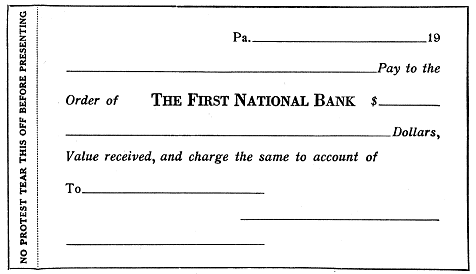 Before the words "pay to" the time when the draft is due should be inserted—as "at sight"
or "30 days after date"
Before the words "pay to" the time when the draft is due should be inserted—as "at sight"
or "30 days after date"