Coming then to the question of the subject-matter of the Codex, I feel
that little is in order beyond a simple analytical description of the
different pages, rather than any attempt at an interpretation. The road
of general deductions from superficial resemblances between unknown
elements and the details of other known things from other times and
places, is strewn by the wrecks of too many theories to be attractive
traveling. I am firmly convinced of the greatness and importance of the
study we have before us, and the exalted civilization which produced it;
but I do not know how to interpret these monuments. Indeed the very
persistence with which the interpretation (which will certainly be
self-evident and everywhere applicable when it does finally come) still
eludes us, is a sufficient proof that we have not yet found the right
road. When we do, great doorways to the past of mankind will open of
themselves, and we will know more of human life and evolution than we
now guess. Until then we can only describe, classify, and try to get rid
of some of the mechanical impedimenta of the search.
What we have of the Perez Codex is manifestly but a fragment; the extent
of it originally we have no means of even guessing. It is fortunate
however that what we have gives several practically complete chapters or
portions of the work. Taking first the side of the MS. paged 2 to 12, we
find the entire side covered by a series of pictures with text, all
identical in arrangement. The few remaining traces on page 12 show its
likeness to the others, for we see in their proper places parts of the
Tun-glyph on which the figures on the upper section are seated; of the
Cimi, Tun and Cauac glyphs just as in pages 11-c-2, 6 and 8; also of the
columns of glyphs to the left, and traces of the headdress. As will
appear further, at least two more pages are required to complete this
series, and it is as good a supposition as any other that they were
those which would be numbered 1 and 13—that is, one before page 2 and
one after page 12. For convenience of reference the divisions of these
pages may be lettered from a to e; a being given to the upper
portion, b to the left columns of glyphs, e to the large middle
picture, and c and d to the text divisions above and below this.
Taking up first the central figures, section e, we find in each a
standing figure, with ceremonial headdress of varying character,
offering a dragon’s head (a universal symbol of wisdom) to another
figure, seated on a cushioned dais, the side of which bears various
“constellation” signs. The latter in turn extends his hands, either
holding some object, or else in a simple gesture. The standing figures
are all almost completely preserved; the seated ones unfortunately
largely or wholly obliterated. In front of the standing ministrant is a
vase of offerings, usually a triple Kan figure, and in two cases with
knives. In the upper part of the picture, facing in every case but one
towards the ministrant, is a bird figure, different on each page, and
having in two cases a human head. On each page is an Ahau sign with red
numeral, all of them together forming a series which (starting on the
supposed page 1 with 4 Ahau) gives the succession 4, 2, 13, 11, 9, 7, 5,
3, 1, 12, 10, 8, 6; in other words the numbers of thirteen consecutive
katuns. The Ahau numerals 13, 11, 9, on pages 3, 4 and 5, are entirely
distinct, and enough traces appear on other pages to establish this as a
katun series beyond question. If this chapter includes just a round of
numbers it would of course be complete in 13 pages. The chapter may be
historical in contents, but the presence of this numeral Ahau-series
clearly relates these pages to successive katuns in some way, whatever
other bearings they may have. The ten pages thus in some way definitely
have to do with the lapse of 72,000 days, or not quite 200 solar years,
and the extension of the series to a full cycle of 20 katuns is quite
likely. The background of this section e is red on each alternate
page.
Returning now to section a, we find on each page three figures, nearly
all of persons or animals, seated on a large base  practically identical with the tun-glyph. Fourteen of the backgrounds to
these figures are red. Above each figure there seems to have been at
least six glyphs, of which but very few are left. Above these is a space
entirely erased. In the center of the section on each page is a column
containing at least two Ahaus with red numerals. The numerals of the
upper row exceed those of the lower by 6; each row decreases from page
to page by 4. The erased margins of the MS. do not afford space for
another picture besides the three, on either side, but they do just give
room for another Ahau-column on the left of each page. If this second
Ahau-column existed, we have again the katun-series repeated in each row
across. If it did not exist, the series (reading from the supposed page
1) of 13, 9, 5, etc., and 7, 3, 12, etc., decreasing by 4’s, give the
numbers of successive tuns. Once again the question of whether a simple
number-round of thirteen terms, or a full round of twenty terms, whether
tuns or katuns, was originally displayed on the Codex, must be left
undetermined. It is further to be noted that faint but exact traces of a
third Ahau, on a higher line, appear on page 5, as well as some doubtful
traces on page 8. No definite relationship between the pictures of this
section a and those of section e is apparent.
practically identical with the tun-glyph. Fourteen of the backgrounds to
these figures are red. Above each figure there seems to have been at
least six glyphs, of which but very few are left. Above these is a space
entirely erased. In the center of the section on each page is a column
containing at least two Ahaus with red numerals. The numerals of the
upper row exceed those of the lower by 6; each row decreases from page
to page by 4. The erased margins of the MS. do not afford space for
another picture besides the three, on either side, but they do just give
room for another Ahau-column on the left of each page. If this second
Ahau-column existed, we have again the katun-series repeated in each row
across. If it did not exist, the series (reading from the supposed page
1) of 13, 9, 5, etc., and 7, 3, 12, etc., decreasing by 4’s, give the
numbers of successive tuns. Once again the question of whether a simple
number-round of thirteen terms, or a full round of twenty terms, whether
tuns or katuns, was originally displayed on the Codex, must be left
undetermined. It is further to be noted that faint but exact traces of a
third Ahau, on a higher line, appear on page 5, as well as some doubtful
traces on page 8. No definite relationship between the pictures of this
section a and those of section e is apparent.
Section b is made up of 45 or more glyphs in three columns. The first
column is almost totally erased on every page, and I have disregarded it
both in assigning reference numbers and in the type cards. The other two
columns I have numbered in double column sequence downwards; but this
can be regarded as solely for convenience’ sake. The glyph  which is three times repeated at the beginning of page 2, and recurs in
parallel position repeated two to five times on each page, is the most
common glyph in the whole Codex. It is identifiable probably 38 times,
including twice at the top of the erased first column on page 4. It
heads the second column several times on every page, except 7, which is
too erased for any determination, and page 3, where a slight variation
in what is left of the postfix at b-3 forbade its insertion under the
rules I have given limiting restorations. I suspect that this glyph
should be repeated at 3-b-9 and 11-b-9, for the following reason. In
positions b-6, b-8 or b-10 of each page occurs a certain face-glyph
which is three times repeated at the beginning of page 2, and recurs in
parallel position repeated two to five times on each page, is the most
common glyph in the whole Codex. It is identifiable probably 38 times,
including twice at the top of the erased first column on page 4. It
heads the second column several times on every page, except 7, which is
too erased for any determination, and page 3, where a slight variation
in what is left of the postfix at b-3 forbade its insertion under the
rules I have given limiting restorations. I suspect that this glyph
should be repeated at 3-b-9 and 11-b-9, for the following reason. In
positions b-6, b-8 or b-10 of each page occurs a certain face-glyph
 that is found nowhere else in either the Perez, Dresden or
Tro.-Cort. codices. If the initial glyph is repeated at 3-b-9 and 11-b-9
as suggested, then (with a slight variation on page 4) this series of
repetitions of the initial glyph will in each case be closed by the
face-glyph in question.
that is found nowhere else in either the Perez, Dresden or
Tro.-Cort. codices. If the initial glyph is repeated at 3-b-9 and 11-b-9
as suggested, then (with a slight variation on page 4) this series of
repetitions of the initial glyph will in each case be closed by the
face-glyph in question.
A marked feature of section b is the occurrence, near the bottom of
each page, of a Cauac-sign, with or without the  wing-postfix, and with prefixed and superfixed
  numerals,
exactly as is so common in connexion with the Chuen-sign on the
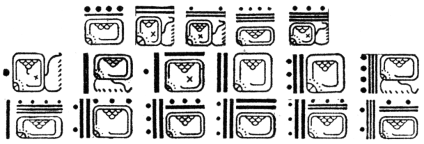
Inscriptions. This Cauac-sign is usually accompanied by an Ahau and a
Tun, each with numerals that are for the most part erased. This
combination suggests distance-numbers and dates, somewhat as on the
Inscriptions; in this case the double-numbered Cauacs would stand for so
many uinals plus so many days. The following combinations, besides the
one above, are also found:
numerals,
exactly as is so common in connexion with the Chuen-sign on the
Inscriptions. This Cauac-sign is usually accompanied by an Ahau and a
Tun, each with numerals that are for the most part erased. This
combination suggests distance-numbers and dates, somewhat as on the
Inscriptions; in this case the double-numbered Cauacs would stand for so
many uinals plus so many days. The following combinations, besides the
one above, are also found:
Section c consists of 16 glyphs in two rows, above the central
picture. Glyphs 15 and 16 on each page are erased. The chief general
characteristic is the frequent repetition of the Cimi-compound,
 ; the repetition on each page of a Cauac-sign with single or
double numerals as in section b; and of Tun-compounds, with
; the repetition on each page of a Cauac-sign with single or
double numerals as in section b; and of Tun-compounds, with
 subfix and with varying prefixes (frequently faces), as
especially see page 5.
subfix and with varying prefixes (frequently faces), as
especially see page 5.
Section d is a triple row of glyphs, originally 21 in some instances,
but with many now erased. I am able to establish few general
characteristics for this section, save again the frequency of the
Cimi-compound as in section c, of various Tun-compounds, and of the
two glyphs  and
and  With the exception of
10-b-4, the face with the tau-eye occurs only in this section d and on
pages 15 to 18. This glyph is exceedingly common both in Dres. and
Tro.-Cort, the form in which it appears at 3-d-4, 6,
With the exception of
10-b-4, the face with the tau-eye occurs only in this section d and on
pages 15 to 18. This glyph is exceedingly common both in Dres. and
Tro.-Cort, the form in which it appears at 3-d-4, 6,  occurring (including its secondary compounds) no less than 126 times in
Dres. and 33 times in Tro.-Cort.
occurring (including its secondary compounds) no less than 126 times in
Dres. and 33 times in Tro.-Cort.
Beneath section d are the remains of red numerals and of heads and
headdresses of figures which are now too much erased to give any basis
for comment.
A most marked feature of the Codex is the very large number of
Tun-compounds, a feature confined exclusively, with one exception, to
the present pages 2 to 11, and pages 23, 24. A classified list shows 28
compounds of this glyph,  20 of these showing the subfix,
and combined with a face or other prefix. The connexion of this fact
with the Tun-bases of section a, and with the katun-rounds shown by
the Ahau-series above referred to, is manifest.
20 of these showing the subfix,
and combined with a face or other prefix. The connexion of this fact
with the Tun-bases of section a, and with the katun-rounds shown by
the Ahau-series above referred to, is manifest.
To sum up the general characteristics of this side of the MS., and
without attempting to interpret any separate glyphs, we find the
following data:
The Cimi-compound  and its sub-compound
  occurs
25 times.
occurs
25 times.
The numeral-compounded Cauac occurs 20 times.
The glyph  occurs 13 times on this side and once on page 23.
The Chuen-compound  occurs 19 times and probably
oftener—once only on the other side of the MS.
occurs 19 times and probably
oftener—once only on the other side of the MS.
The various Tun-glyphs occur 45 times, on the two sides.
The face-glyph  occurs 10 times.
The Kan-Ymix glyph  occurs 10 times.
The glyph  occurs 37 times on this side and, with a prefix
and a changed postfix, once on page 24.
occurs 37 times on this side and, with a prefix
and a changed postfix, once on page 24.
With the exceptions noted, none of the above glyphs occur at all on the
reverse side of the MS.
There are finally 19 different Yax ( ) compounds, occurring
in all 25 times, 16 of them on this side of the MS.
) compounds, occurring
in all 25 times, 16 of them on this side of the MS.
With three exceptions the above glyphs are the only ones that are
repeated in the Codex with any marked frequency. The three exceptions
are the face with tau-eye, already  mentioned, and the two
glyphs occurring as an initial
mentioned, and the two
glyphs occurring as an initial 
 pair twelve times on pages
15 to 18, sections a, b, c.
pair twelve times on pages
15 to 18, sections a, b, c.
Of month signs used as such I am only 
 satisfied of 12
Cumhu, at 18-b-4 and of 16 Zac, at 4-c-7. The glyph
satisfied of 12
Cumhu, at 18-b-4 and of 16 Zac, at 4-c-7. The glyph  at
7-c-2 may also be 1 Yaxkin.
at
7-c-2 may also be 1 Yaxkin.
The only cardinal point sign is that of the West,  occurring
at 4-b-14 and again at 16-a-6.
occurring
at 4-b-14 and again at 16-a-6.
There are besides these numeral Cauacs, 15 other Cauac  compounds, occurring in all 17 times on this side, and twice on pages
23, 24.
compounds, occurring in all 17 times on this side, and twice on pages
23, 24.
Upon turning over the Codex, we find that whereas on the side we have
been considering the scribe limited himself to the conventional red
numerals and backgrounds, with here and there a touch of brown, upon
this other side we have a wealth of color united with a harmony of
composition and structure that marks a very high degree of artistic
skill. It is not alone the accuracy of the drawing and the writing, such
as we have noted in connexion with the study of the glyphs, but the
whole manuscript as it lies open before us shows that sense of
proportion, that ability to unify without seeming effort a multitude of
details into a perfectly balanced whole, which is the positive mark of
developed and genuine culture. When we remember the exceeding difficulty
of combining primary colors into a brilliancy that is not garish, and
the equal difficulty of achieving artistic mastery in a conventional
treatment of forms, we are simply forced to recognize that we have here
the evidence of an advanced school of art with full rights of
independent citizenship. If the figures look strange and sometimes
distorted, we must remember that our whole training has been in the
realistic school, by which we are prone to judge all others, but by
which they must not be judged. We have no more right to weigh these
compositions in the scales of our art motifs than we have to weigh Greek
rhythm of quantity or Saxon of alliteration against our weights by which
we measure rhythm of rhyme and stress. In fact it is impossible for us
even to judge concerning the true harmonic effect of these other
measures, and it may well be doubted whether the very soul itself of our
meter is not empty and tinny as compared with these others—quality for
quality.
There is one great broad line that divides the nations and civilizations
of the earth, past and present, in all their arts of expression. We may
call it that of the ideographic as against the literal. It controls the
inner form of language and of languages; it manifests in the passage of
thought from man to man; it determines whether the writing of the people
shall be hieroglyphic or alphabetic; it gives both life and form to the
ideals of their art. It is a distinction that was clearly recognized by
Wilhelm von Humboldt, when he laid down that the incorporative
characteristic essential to all the American languages is the result of
the exaltation of the imaginative over the ratiocinative elements of
mind.
The time has passed when we think that the absence of our perspective
drawing in Japanese pictures is due to the fact that these “children of
nature” never happened to recognize that a thing looks smaller in
proportion to its distance, so that they ought to come to us to learn.
We have come, in some measure if not yet fully, to recognize that
whereas we show a thing to the eye, these other peoples suggest a
thought to the mind, by their pictures. And we should remember, and
remember always, that while our modern art having won its technical and
artistic skill within the past few hundred years, is now beginning to
emancipate itself from the materialism of the eye by efforts towards the
“impressionist” methods, these ancient peoples had long since arrived at
the ability to convey “impressions” through the medium of harmonious
compositions of the most rigid conventional elements—an artistic
achievement which those who know its difficulties can alone begin to
appreciate.
It may be quite easily forgiven to one trained with Western, modern
eyes, who at first sight of these monuments, in total ignorance of their
meanings, sees them as strange or grotesque. But when, as their
strangeness wears away, one comes to see the unfailing accuracy with
which the glyphs are drawn, one’s opinion of their makers has to change.
And when, with this familiarity gained, one advances to an appreciation
of the work in its bearings as a whole, one has to acknowledge himself
facing the production of craftsmen who had the inheritance of not only
generations, but ages of training. Such a combination of complete
mastery in composition, perfect control of definite and fixed forms, and
hand technique, can grow up from barbarism in no few hundred years. I
would hesitate to think it could even come in a few thousands, unless
they were years of greater settledness and peaceful civilization than
our two thousand years of disturbed and warring European Christendom
have yet had an example of to show us. It is easy enough in the absence
of definite historical records, and in our general ignorance of human
evolution, to theorize and speculate about it all; but the commonly
accepted picture in our minds of a few savage wandering tribes settling
and growing up in this country some several hundred or a thousand years
after the Christian era, simply will not fit in with the fact of their
ability to produce such works a few hundred years later. Had we nothing
but the Perez Codex and Stela P at Copan, the merits of their execution
alone, weighed simply in comparison with observed history elsewhere,
would prove that we have to do not with the traces of an ephemeral, but
with the remains of a wide-spread, settled race and civilization, worthy
to be ranked with or beyond even such as the Roman, in its endurance,
development and influence in the world, and the beginnings of whose
culture are still totally unknown. As to the Codex before us, we can
only imagine what the beauty, especially of the pages we now come to
discuss, must have been when the whole was fresh and perfect.
The second side of the Codex has to be treated in four divisions or
chapters, the first of which includes pages 15 to 18. For numerical
reasons which will appear, this chapter must probably have begun,
however, at least one page further to the left.
These four pages are laid out with three main divisions, upper, middle
and lower. Too much of the upper section is erased for any comment other
than that its arrangement seems to have been parallel in all respects
with the middle section. This latter shows three subsections, the
backgrounds in some cases being red,24-* containing each a picture
(probably of a god or a human figure in every instance), surmounted by a
black and a red numeral and by six glyphs, in double column. This gives
12 subsections for the four pages, which we may refer to respectively as
15-a, b, c, etc. Of the initial pairs of glyphs in each subsection
many are complete, and no section is left without the correct traces of
the corresponding glyph for one or other of the positions; so that
although 5 of the 24 glyphs are totally erased, we may safely restore
them all. Other features of the comparative use and frequency of the
glyphs on these pages have already been given.
At the top of each picture is found a black and a red numeral. These
form the consecutive black “counters” or interval numbers, and the
corresponding red day numbers of subdivided tonalamatls, so common in
Dres. and Tro.-Cort. It is customary to find these tonalamatls divided
into fifths or fourths, 52 or 65 days respectively—four or five
trecenas. At the 53rd or 66th day the initial red number is again
reached, and the calculation is (by hypothesis) repeated, starting again
at the left with a new day-sign below the first. Such a column is seen
in the lower part of page 17, where we find 6 Oc, Ik, Ix; these are to
be completed by restoring below an erased Cimi and Ezanab, completing
the 260 days and bringing us around again to 6 Oc. The total of all the
black “counters” in any series must always be some multiple of 13,
usually 52 or 65, as stated. And since each “counter” is the interval
between its adjoining red numbers, wherever a red and a black number are
given, the other red number, whether before or after, can always be
filled in.
No traces of this initial column appear for the series in the middle
division, and several of the numerals are also erased. Two obscurities
must be cleared up before trying to fill out the series. On page 16
right is a partly erased black numeral, which from the traces may be
either 10 or 11. Taking it as 10, we have 13 plus 10 equals an erased
red 10; plus 5 (on page 17) equals the red 2 below the 5. This verifies
so far. But we next find—plus 5 equals 8, which is of course incorrect.
An inspection of the MS. and the photographs reveals a reddish spot (or
perhaps even three such spots) in the extreme upper right corner of
the picture space, 17-a, and also a dark spot under the black 5 in
17-b. It is possible that the separated red dots (one doubtful) are to
be read together as 3; or that the red dots under the 5 are to be
disregarded in the count (just as is the red 8 on the next page, 18-a),
and the red number for 17-a found in the upper right, above the seated
figure. If the red number in 17-a is 3, the two numbers in 16-c must be
11. Or it may be assumed that the spot under the 5 in 17-b belongs to
it, making 6 instead of 5, which figures out. The final result is the
same, as we have either 10 and 6, or 11 and 5, in these two places, and
either reaches properly the clear red 8 in 17-b.
In 18-a we find black 26, with a small red 8 below, and a large red 13
in the usual place at the side. The red 8 will have to be disregarded,
as not part of the series, which requires 13, and nothing else.
We may now possibly set down the series as follows, using small figures
above the the line for the black counters, and putting in
parentheses all numbers restored:
(6)39(6)(2)5761311(11)53585(13)26131010, or else
(6)39(6)(2)5761310(10)52685(13)26131010
This leaves us the black number at the beginning, in 15-a, and both
numbers at the end, 18-c, still not filled in. Adding together all the
counters we get 82, plus at least the two missing black numbers, one at
each end. If the total were 104, we might expect it to have been
comprised within the four subsections 15-a to 18-a. But 104 is not a
tonalamatl fraction. 130 days, although a tonalamatl half, is an unknown
division, and would hardly get into the space. If we begin the series in
the upper division of the page (as occurs in Dres.) and come around to
the middle division, the probabilities would require that it displayed a
full series of 260 days, and again also that it began to the left of
page 15. The probabilities of this series as it is, therefore, indicate
at least a page 14 to the left, arranged like the other four, and
forming one chapter with them.
We have now to deal with the puzzling numeral columns, in alternating
colors, found to the left of each subsection of the upper and middle
divisions—24 columns in all. These have been referred to at some length
in the preliminary discussion of the colors, and there is little more
that can be said. As there said, the entire reason for alternating the
colors can not be certainly assumed. Alternation of color occurs not
only where it is needed to distinguish bars, but also where we have only
lines of dots, which are of course self-separating. And to say that it
is only for artistic purposes is a mere begging of the question. Only
four or five of these columns are complete, and a footing of the numbers
in each gives us varying amounts from 113 to 153, and tells us nothing.
On the parts that are left we six times have a Chuen  with a
black number apparently belonging to it (perhaps a multiplier), and also
once a double Chuen, as in Tro.-Cort. The use of the red kal-sign, or
20, is frequent.
with a
black number apparently belonging to it (perhaps a multiplier), and also
once a double Chuen, as in Tro.-Cort. The use of the red kal-sign, or
20, is frequent.
The lower division of these pages was also subdivided, into four
sections on each, which we may refer to as d, e, f, g. Each
contains a picture, with black and red numerals as above, surmounted by
four glyphs only. The pictures are all quite incomplete; neither is
there anything to add to what has been already said of the glyphs.
In the middle of page 17 one tonalamatl ends, with a red 6, and another
begins, also with 6. The second starts with the day 6 Oc, is divided
into fifths, and the initial column must have been in full: 6 Oc, Ik,
Ix, Cimi, Ezanab. The restoration of the series gives: 6222(15 in
two stages)(4)10146. This however only gives a total of 51 for
the black counters. There is space to the right for another section, but
whatever may have been written there has entirely disappeared. The last
three numbers 146 seem unmistakable, the  especially so.
If we regard the last 6 as an error for 5, and then restore 16 in
section 18-g, it would give the necessary 52. This is the one passage in
the Codex where I can see no way but to assume a mistake in the writing;
for 1 plus 4 does not equal 6, and unless for some entirely unknown
reason the error is clear.
especially so.
If we regard the last 6 as an error for 5, and then restore 16 in
section 18-g, it would give the necessary 52. This is the one passage in
the Codex where I can see no way but to assume a mistake in the writing;
for 1 plus 4 does not equal 6, and unless for some entirely unknown
reason the error is clear.
The preceding tonalamatl may have been divided either into 52- or 65-day
periods. If the period was 52, it must have begun with an initial column
on page 15, right side. In this event it would be restored as follows:
(initial 6)(19 in two stages)(12)65712(12 in two stages)(11)86,
giving 52. In this case a third tonalamatl must have begun somewhere to
the left, and ended on the erased right side of page 15.
A different restoration would carry the initial column back to the
extreme edge of page 15, when we would have this:
(initial 6)(2)(8)8311(1)(11 in two stages)(12)65712(12 two stages)(11)86
giving 65.
To choose between these two would be mere guessing.
The well-known pages 19 and 20 come next. Together they make four
compartments, up and down the full length of the pages, two with red and
two with black backgrounds. Each is, or rather was, preceded by a column
of 13 “year-bearers.” The left column on each page I have restored,
although no traces of it are left. But apart from its manifest
necessity, as part of the series, if the width of the red ground on page
20 (see the photographs) is measured, it will be found to be just the
correct proportion, and part of the straight left edge of the red can
still be seen, just left of the rod in the hand of the mummy-figure, and
leaving just room for the Ezanab column. In the colored plates I have
only shown 12 instead of 13 day-signs in each column, but a measurement
of the space above and below shows that the missing four are to be
placed at the top and not at the bottom. These two pages therefore have
application in some way to 52 solar years, beginning with 1 Lamat and
ending with 13 Akbal (Votan).
These “year-bearers” are those of the Tzental instead of the Yucatecan
system, as described by Landa, and on these two pages rests, so far as
regards known subject-matter, the assignment of the Codex Perez to the
Palenque rather than to the northern Maya district. It is thus to be
considered with the Inscriptions of that region, and with the Dresden
Codex.28-* And in accord with what is known of the state of the
different parts of the country at the time of the Conquest, and of the
history of the break-up and extinction of the Maya empire, it must be
assigned the greater antiquity on that account.
It is probable that pages 19 and 20 had no text passages.
Pages 21 and 22 again, judging from the coloring and the arrangement,
seem to form a pair. Each had on the upper part probably five rows of
glyphs, some 70 in all, of which only 10 or 12 are at all recognizable.
Contrary to all the pages hitherto discussed, it may be that these
glyphs are to be read from right to left. The faces in these all look
to the right, and the customary prefixes are all on the right. In
classifying these glyphs, therefore, they must be all reversed.
The greater part of page 21 is framed in and divided up by green bands,
evidently for water, two branches of which, after crossing a
constellation band near the bottom, end one in falling torrents, the
other in a circle surrounding a kin-sign,  , the sun, and
itself surrounded by four dragon’s heads, all figured in the midst of
the torrents. Below this symbol is the open mouth of a dragon, towards
which is looking and pointing a black-faced figure, of the god D, the
Ancient of Days, described by Schellhas as the moon and night god. To
the left of the torrents is a figure, nearly erased, but with the
wristlets characteristic of the god of death, and holding in the hand a
torch. The glyph
, the sun, and
itself surrounded by four dragon’s heads, all figured in the midst of
the torrents. Below this symbol is the open mouth of a dragon, towards
which is looking and pointing a black-faced figure, of the god D, the
Ancient of Days, described by Schellhas as the moon and night god. To
the left of the torrents is a figure, nearly erased, but with the
wristlets characteristic of the god of death, and holding in the hand a
torch. The glyph  occurs written in the torrents, at the
left side.
occurs written in the torrents, at the
left side.
The green bands divide the middle of the page into six compartments
containing, so far as not totally erased, 65 day-signs, in columns of
five. All my efforts to relate these signs either to each other or to
any other series in the codices, have so far been fruitless. The upper
seven columns have each a black numeral beneath, running from right to
left, 1 2 3 3 5 6 and the dot of another 6.
Each of the columns of five day-signs forms a closed circuit returning
into itself. In the upper row the 1st and 6th columns show successive
days 8 apart in order; columns 2, 3, 4, 5 and 7 are 16 apart in order.
The 1st in the lower row is at intervals of 8, the 2nd and 5th at
intervals of 16. The 3rd column is, with the 4th, an exception, the
intervals being successively 8, 4, 4, 8, 16. That this is probably not a
scribal error is shown by the fact that the same series, though
beginning with different days, occurs in both columns. The 6th and
possible 7th columns of the lower part are indeterminable.
We thus have three rounds of 5 times 8, or 40 days; seven rounds of 5
times 16, or 80 days; two irregular rounds of 40 days. These are not
such columns as could form the beginning of a series of tonalamatl
fifths, in which the successive days come 12 apart. So that this section
must be left unexplained.29-*
At the right of page 21 begins a solid red background which probably
extended right across page 22. Two standing spotted green figures appear
on page 21; seven seated figures, one green spotted, on page 22.
Page 22 is crossed by a winding dragon whose body is covered by the
“constellation band.” A narrow green band also winds across the page,
inclosing two of the upper figures. Below the dragon and this green band
are seen, seated above the open mouths of two erect dragons, two figures
in conversation, each bearing various insignia of the death god. A very
curious cartouche outline, partly erased, at the lower right, incloses
what seems to be 13 Ahau, 3, 6, the right hand dot of the 3 being
erased.
On pages 23 and 24 the brilliant backgrounds of the preceding pages
disappear, and we have two pages, to be read together, of glyphs,
day-signs and small figures, finely and sparingly illuminated with the
usual four colors. The body of the dragon is apparently continuous from
page 21, and crosses these pages entirely with the constellation band,
displayed along its full length.
The upper part of these two pages contained originally 91 glyphs,
perhaps to be read from right to left, the same as 21 and 22. The
faces look to the right, the usual prefixes and the few numerals are
also on the right of their respective compounds. Many of the glyphs are
the same as those on pages 2 to 11, reversed right for left. Glyph
23-a-11 should be specially noted. At first sight the numeral prefix, 6,
appears to belong, postfixed, to glyph 23-a-17. But on investigation we
find the same compound, a yax-chuen with  prefix, also at
21-a-8 and 24-a-26, in each case with the 6 attached. The
prefix, also at
21-a-8 and 24-a-26, in each case with the 6 attached. The  affix just below this number 6 is also plainly a prefix to glyph
23-a-12; so that glyph 23-a-ll must be read
affix just below this number 6 is also plainly a prefix to glyph
23-a-12; so that glyph 23-a-ll must be read  and include the
6 as prefix. At 24-a-26,
and include the
6 as prefix. At 24-a-26,  the same glyph is written left to
right.
the same glyph is written left to
right.
There are also a few other glyphs on these pages which cannot be
regarded as right to left. Such for instance, as  at
23-a-19 and 24-a-17. In this glyph the affix
at
23-a-19 and 24-a-17. In this glyph the affix  at the side is
properly a prefix (perhaps the possessive), and I do not recall any
instance of its use as a postfix. In the affixes, the superfix and
prefix positions may as a general rule be regarded as wholly identical;
also the subfix and postfix positions. But also as a general rule the
two pairs are I believe not to be interchanged, any more than we
interchange prefixes and endings in English; this rule is not universal
for all affixes, as some seem able to go anywhere, but it is one I have
always regarded in my glyph classifying. As to
at the side is
properly a prefix (perhaps the possessive), and I do not recall any
instance of its use as a postfix. In the affixes, the superfix and
prefix positions may as a general rule be regarded as wholly identical;
also the subfix and postfix positions. But also as a general rule the
two pairs are I believe not to be interchanged, any more than we
interchange prefixes and endings in English; this rule is not universal
for all affixes, as some seem able to go anywhere, but it is one I have
always regarded in my glyph classifying. As to  it is to be
noted that this is a symmetrical glyph and as there can be no doubt that
these glyphs were equally legible to the Maya reader written in either
direction, it may well be regarded as unimportant, and not to be rated
even as an error.
it is to be
noted that this is a symmetrical glyph and as there can be no doubt that
these glyphs were equally legible to the Maya reader written in either
direction, it may well be regarded as unimportant, and not to be rated
even as an error.  is a still stronger similar case. Here
the wing
is a still stronger similar case. Here
the wing  affix to the right is certainly a postfix, the
superfix is in the usual left to right order,
affix to the right is certainly a postfix, the
superfix is in the usual left to right order,  and the main
element written left to right, as in all its other instances. And
and the main
element written left to right, as in all its other instances. And
 is again in point.
The face-tun compounds on these pages, and also on the opposite side
of the manuscript, should be particularly noted.
Below the constellation band, inscribed on a wavy green band (the waters
of space?) are seven repetitions of  or the sun glyph
 within the shields.31-* Between each appeared probably
two black 8’s. The sun-shields are about to be seized by different
animals, dragon, tortoise, bird, etc., a seeming evident suggestion of
either an eclipse, or the passage of the sun into some zodiacal sign.
Another series of seven sun-shields, on the green band, separated by
numeral 8’s, and attacked by animals and a skeleton, crosses the lower
part of the pages.
within the shields.31-* Between each appeared probably
two black 8’s. The sun-shields are about to be seized by different
animals, dragon, tortoise, bird, etc., a seeming evident suggestion of
either an eclipse, or the passage of the sun into some zodiacal sign.
Another series of seven sun-shields, on the green band, separated by
numeral 8’s, and attacked by animals and a skeleton, crosses the lower
part of the pages.
Between these two bands we find a series of columns of five day-signs
each preceded by red numerals. Allowing for the space erased I have
restored the last column to the right, and part of the preceding. This
gives 12 columns only, whereas at least 13 are required. There may have
been a 12th column to the left of page 23, where there is just the
proper space for this,32-* leaving the dragon’s body to curve above
the column so as to pass to page 22. The series may have continued on
across page 25; 13 columns on pages 23, 24, and 7 more filling page 25,
would make a full cycle of 20 columns. And in this connexion it should
be noted that the dragon’s body with constellation band goes almost to
the edge of page 24 with no sign of ending or turning, such as might be
expected if the chapter ends here. And if the constellation dragon
continues over page 25, the column series may well have done the same.
Before discussing this series it will be of advantage to review what the
Codex gives us on the question of reading left to right or right to
left.
First, in both the Dresden and Tro.-Cort. the glyph faces look to the
left; and, as shown by the calculations, reading is from left to right,
with a very few possible exceptions, such as the tables on Dres. 24, 64,
69, etc.
In the Perez, as shown by the tonalamatls on 15 to 18, the 52
year-bearers on 19 and 20, and the katun-series on 2 to 12, the general
direction of the reading is also left to right.
Above or below each of the red number columns of these pages 23, 24, is
to be found a blue number. These numbers make a katun-series, starting
with 4, decreasing by 2, if we read it left to right. It is not, to be
sure, accompanied by the customary Ahau-sign,  , but, taken
in connexion with the marked parallelism of the glyphs, face-tun glyphs
and also others, on these two pages with those on pages 2 to 11, already
discussed, the possibility that a katun-series is a part of this
subject-matter must be considered.
, but, taken
in connexion with the marked parallelism of the glyphs, face-tun glyphs
and also others, on these two pages with those on pages 2 to 11, already
discussed, the possibility that a katun-series is a part of this
subject-matter must be considered.
On the other hand, the glyphs in the upper part of all four pages 21 to
24 face to the right, and, as already set out in detail, are practically
all written in reverse position as regards their prefixes, etc. And so
also does the Eb-glyph in the day-columns we are now considering face to
the right. These columns, unlike those on page 21, which include all of
the 20 day-signs, only include 5 of the day-signs: Kan, Lamat, Eb, Cib
and Ahau; Eb being the only non-symmetrical one of these.
We have thus quite strong evidence, especially as provided by the
position of the prefixes, for a right to left reading, opposed by the
direction of this katun-number series—if it be one. In Egyptian
writing, of course, the direction of the reading changes with the facing
of the figures.
To return now to the columns themselves, all the day-signs in any one
column have each the same red numeral, so that we have: 8 Cib, 8 Ahau, 8
Kan, 8 Lamat, 8 Eb; and so on. The red numerals to each column also
decrease by 2 towards the right, pari passu with the blue numerals. If
we read each column downwards, it will form a closed circuit or round,
returning into itself, with intervals of 104 days, from 8 Cib to 8 Ahau,
etc., and again from 8 Eb back to 8 Cib. But if we next try to go to the
next column, the series breaks, for from 8 Eb to 6 Lamat is only 76
days. We get a like break whether we read upward or downward, or right
to left. Taking the columns separately then, the entire series (whether
made up of 13, 20 or any other number of columns) cannot be made to read
in one regular series, with a constant interval between the successive
days of the whole.
But, if we restore two columns, making 13 columns, and then read
horizontally across, either right to left, or left to right, one line
after another, the first day of the second line follows the last of the
first, and after going through the whole 65 terms, we return again from
the last of the last line to the first of the first—always with a
constant interval. In other words, this section could be written around
a wheel. If we read left to right, the distance from (10 Kan) to 8 Cib,
etc., is 232 days; 232×65=15,080. Or if from right to left,33-* the
interval from (12 Lamat) to 1 Cib, etc., is 28 days; 28×13 = 364, ×5 =
1820. That both of these products are multiples of 260 is a truism, and
cannot in any way require us to see a tonalamatl reckoning as the basis
of this passage. Nor is each separate day-column a tonalamatl in fifths,
as so often found.
Finally, if we should assume that the series went on across page 25, to
a full katun-round of 20 terms, the circuit would be broken; line 2
would not regularly follow line 1, and so on. The probabilities then, as
derived from the succession of the days, seem almost conclusive that
this is a section of 65 terms, to be read horizontally, in whichever
direction. And then, since the subdivision of 15,080 days (or 1820, if
read right to left) into 65 terms, necessarily gives us successive
day-numbers decreasing (or increasing) by 2, the likeness to the
katun-series may be only apparent—a simple truism. Or, on the other
hand, in view of the glyph similarities (a point which I think should
always be given close attention), there may be some relation to the
katun-series—all in spite of the right-left or left-right difficulties.
What part the blue34-* number series plays, I cannot say. Dr.
Seler,34-† suggests that they are “corrections,” to set each term
ahead 20 days. This states a fact, but does not give any explanation.
Each blue number is 6 less than its red column, and 7 Kan is of course
20 days later than 13 Kan.



 glyph here as
on all the other pages, but the slight variation in the lines left of
glyph 3-b-3 forbade it.
glyph here as
on all the other pages, but the slight variation in the lines left of
glyph 3-b-3 forbade it.


 five separate and distinct faces; one a wholly human face,
the others with various other definite characteristics, the most
frequent and prominent of which are the monkey-like face and mouth we
see in the
five separate and distinct faces; one a wholly human face,
the others with various other definite characteristics, the most
frequent and prominent of which are the monkey-like face and mouth we
see in the  glyph for the north, and a sort of bird’s
plumage covering the back of the head. These two are separate, are never
combined, and must be classified rigidly apart. We have therefore three
elements, the monkey face, the plumage covering (if we may call it so),
and the banded headdress. It is obvious that while the monkey face may
be specific of the North, the bands are not specific at all, but
general.
glyph for the north, and a sort of bird’s
plumage covering the back of the head. These two are separate, are never
combined, and must be classified rigidly apart. We have therefore three
elements, the monkey face, the plumage covering (if we may call it so),
and the banded headdress. It is obvious that while the monkey face may
be specific of the North, the bands are not specific at all, but
general. and the others
 and so on. A comparison of the compounds shows that these
must be the same. The regular variations between the three manuscripts
and variations of abbreviation, when well evidenced, may be eliminated.
and so on. A comparison of the compounds shows that these
must be the same. The regular variations between the three manuscripts
and variations of abbreviation, when well evidenced, may be eliminated.


 it has probably a different
meaning entirely—perhaps that of sleep.
it has probably a different
meaning entirely—perhaps that of sleep.
 , for instance, conveys to those using it
primarily the idea of Heaven, or the spoken word T’ien. It is
necessarily both, in a sense; it would not be written language
otherwise. And it is equally true that the letter-combination Heaven
is in a way as much to us a picture of the idea as of the sound; but the
difference of procedure is radical. The glyph is related to the idea
directly, the spelled word only through the formal combination of
symbols for single vocal speech-elements, meaningless when separate. The
relation of spoken sound to glyph is wholly adventitious; the relation
of the idea to the spelled word is equally adventitious. The ascent, if
we so call it, of written speech from the ideographic to the alphabetic,
is the descent of the thought further into material forms.
, for instance, conveys to those using it
primarily the idea of Heaven, or the spoken word T’ien. It is
necessarily both, in a sense; it would not be written language
otherwise. And it is equally true that the letter-combination Heaven
is in a way as much to us a picture of the idea as of the sound; but the
difference of procedure is radical. The glyph is related to the idea
directly, the spelled word only through the formal combination of
symbols for single vocal speech-elements, meaningless when separate. The
relation of spoken sound to glyph is wholly adventitious; the relation
of the idea to the spelled word is equally adventitious. The ascent, if
we so call it, of written speech from the ideographic to the alphabetic,
is the descent of the thought further into material forms.