The monetary system of England is the ideal
philosophy of political economists, who, in the conviction
that "nothing exists," think it no "matter"
to found a variety of hypotheses to give tangibility
to the intangible, substance to accident, and reality
to the abstract; in short, to personify "nothing."
These intangible tangibilities bear various names,
such as Consols, Bank Stock, Indian Stock, Long
Annuities, Exchequer Bills, &c. The aggregate of
these 0 0 0 0 0 noughts are, by a peculiar process
of national arithmetic, made to amount to Stock
or Funds.
[158]
Stocks or Funds are the true substantials.
In the golden ages of the world, cattle, corn, and
merchandise were the medium of exchange among
nations; but as men grew more enlightened, they
agreed to represent these things by pieces of conventional
metal. This at last becoming scarce,
the world would have fallen into a state of hapless
and irrecoverable ruin, but for the idea of a fictitious
representation of a representation, of a non-existent
which might have been.
Funds are therefore the to kalon, the absolute,
the logos, the never-to-be-apprehended, the inscrutable,
the supreme totality of "emptiness," the
absolute cause, the absolute effect, the absolute
concurrence of national faith; in short, the commercial
"ideal" which all men worship, in its
temples of the Bank and Stock Exchange.
Stocks are the "heaven of this religion," an agreeable
hallucination, by which a variety of insane persons,
called Stockholders or Fundholders, are permitted
to roam at large under the conviction that
they possess wealth. The public are compelled
to believe in these fictitious representations,
which are the foundation of the "imaginative
system" in fiscal affairs, of the Bill and Credit
[159]
system in commerce, and of the National
Debt.
In England there is nothing truly national but
this debt, or dead weight, which is the mighty
pendulum which makes the national clock "go
upon tick." It is the true foundation of political
economy and of social faith or trust; "'pon tick"
is the basis of the wealth and happiness of our
country, which it makes the envy of the world and
the glory of surrounding nations.
To be in debt argues credit, and credit respectability,
and respectability means, and means resolve
themselves into the Funds; here they merge into
the blessed obscurity of "nothingness," and being
absorbed by the same media, pass for a "something"
which is far more formidable than "anything."
Thus private wealth moves in a circle
continually, making the round O from 0 (nothing)
to 0 (nothing.)
Joint Stock.—Joint Stock Companies are so
called from the projectors being generally "black
legs," and their victims "raw Jemmies." The
object of such companies is to give honesty the
[160]
"cross buttock," to have a "shind eye" with
capital, and to end in an "offal" bankruptcy.
From a consideration of the immediately preceding
rules, and assuming as a fact the spiritual
and ethereal nature of stock or capital, it is therefore
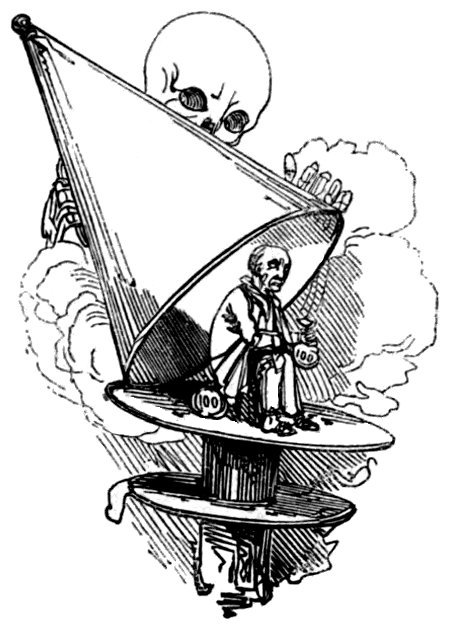
proposed to found a Joint-Stock Company of
unlimited capital, to be called the Boreal Pneumatic
Joint-Stock Company, for "raising the wind,"
and making "darkness visible," or the National
"Puff" Company.
Raising the wind has been the great problem
of all financial operations. It is of far more
importance than "raising the dead." The "wind"
is a conventional term for the "needful." It is
called wind because it is raised by various "Puffs."
There are various kinds of Puff; the Puff
National, the Puff Medical, the Puff Legal, the
Puff Literary, the "Puff Theatrical," and the
Puff Scholastic.
My Lords and Gentlemen,—The flourishing
state of my empire having filled me with the most
intense satisfaction, I have called you together to
[161]
inform you that we are the envy of the world and
glory of surrounding nations, and that everything
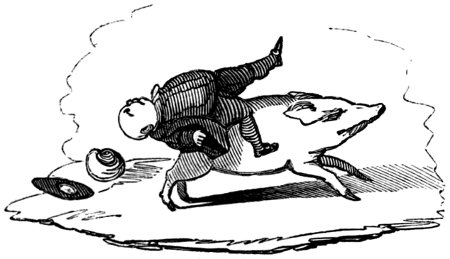
is so plentiful that pigs run about the streets
ready roasted, with carving knives and forks stuck
in their backs, crying, "Eat me, eat me!"
I continue to receive from foreign powers the
most friendly intercourse, and an assurance that
they have unanimously agreed to sink their own
national interests in a regard for my welfare; and
in this I am certain there is no "gammon."
The Commercial and Mercantile interests are
in such a state of convalescent perfection, and
gold is so plentiful, that I have ordered a commission
to consider of the propriety of paving
with it the various thoroughfares of the metropolis,
in lieu of Blockheads.
Owing to a great improvement in Benevolent
affairs, it is with pleasure I have to inform you
that the Public Societies have given up their
vested rights, dues, peculations, and pickings,
for the benefit of the poor, (should there be any
such,) and will henceforth "preach without
Profit."
Owing also to the general distribution of wealth
among all classes, I have been enabled to divest
[162]
physic of its fees, and law of its charges; and both
these professions will for henceforth be conducted
"free gratis" and "for nothing."
Gentlemen of the House of Commons,—Through
the practice of the most rigid economy in
every branch of my establishment, I have directed
to be laid before you an account of the sums paid
into the Exchequer, being the surplus of my revenue;
and I have further to inform you that taxation
being no longer necessary, the expense of a house
of commons may be dispensed with, and the large
sums usually paid in "bribery at elections," I
trust will be left to fructify in the pockets of the
members.
This constitutional determination on my part,
for the benefit of my people, has arisen from my
being called, by Divine Providence, to a sense of
my true estate of a State pauper, which has led
me to reduce my dietary and that of my household
to that of the Poor-Law Unions, and to
introduce teatotality into every department; and I
have great gratification in being able to announce,
that as I have now lost "having a shadow" to my
royal personality, I may myself be shortly expected
[163]
to evaporize, and the expense of a monarchy may
be saved for the future.
My Lords and Gentlemen,—With and by the
advice of my Privy Council, I have determined
upon putting into execution the hydrostatic paradox,
or cold water cure, in and upon that part of
my dominions called Ireland; and a commission
consisting of the Lords Spiritual and Temporal
has been issued for laying that "flower of the earth
and gem of the sea" "under water" for the space
of one month, as the best method of extinguishing
the torch of discord, the fire of malevolence, and
the smoke of sedition, and of allaying all ferment
upon Atlantic if not upon pacific principles.
I rely confidently upon the wisdom of my
Parliament to enable me to carry out my beneficent
intentions of subjecting all my people to
"live upon air," as the symbol of true freedom, and
as the most liberal and inexpensive method of
obviating the evils which have hitherto surrounded
my throne and government; and I would submit
to your serious consideration the expediency of
establishing a training school at Exeter Hall, for
teaching wind instruments to all my subjects, and
[164]
for the arrangement of airs corresponding to the
various meals, feasts, and dishes of every day life;
and I indulge the anticipation that the substitution
of oxygen for oxen, and gas for Gastronomy, will
be conducive to the health, wealth, and prosperity
of my empire.
UNIVERSAL
School-Master's Manufacturing Company,
AND NORMAL SCHOOL.
CAPITAL—SPEC.
PATRON.
His Royal Highness Hoke Poke Whangee Fum.
King of the Cannibal Islands.
PRESIDENT.
Samuel Slick, Esq. of Slickville.
VICE-PRESIDENTS.
- John Sheppard, Esq.
- The Hon. Mr. Pickwick.
- Tim Bobbin, Esq.
- James Crow, Esq.
- Samuel Weller, Esq.
- William Black, Esq. alias "Black Billy."
COMMITTEE.
- Daniel Dunce, Esq.
- George Greenhorn.
- Samuel Spooney.
- Darby Dollerhead, Esq.
- Francis Flat.
- Stephen Stutters.
This Company is established in consequence of
the lamented deficiency in the scholastic profession;
[166]
and its object is to manufacture schoolmasters of
a very superior character, at a cheap rate, from
various "refuse" articles of all trades and professions—technically,
the "unfit" or good-for-nothing.
In consequence of a profound investigation of
the science of education, it has been discovered
that those who are unable to conduct any other
business, are the best adapted to "teach the
young idea how to shoot;" and therefore cast-off
cobblers, tailors, teachers, and drapers, shop-boys
and errand-boys, will be received into the establishment
at the rate of a guinea a-week; where,
by the aid of educational galvanism, their misdirected
faculties will be sublimed, their ideas
topsiturvied, their moral and intellectual nature
turned inside out, their understandings new
vamped, soled, and welted, and their minds infused
with a succedaneum of intellectual electricity,
which shall evaporate itself in the mixed mathematics,
pedagogicks, whackbackics, pancakeatics,
tickletobyatics, and all other scholastic sciences.
Candidates must bring personal recommendations,
of a squint, a slouch, a leer, a game leg, a
hump back, or any other accomplishments. Should
[167]
they be unfortunately destitute of these, they may
produce testimonials of fitness from their washerwomen;
but those who do not indulge in the
luxury of a clean shirt may be recommended by
the teacher of any Social sect to which they may
belong. These certificates must certify them to
be bumble headed, addle-pated, numbsculled, good
for nothing else; that they wear dickeys and are
donkeys.
Upon entering the Institution the seminants
will be forced to forget everything they ever
knew, by a machine invented by Mr. Combe for
"Razing out the errors of the brain," and which
has been used with the happiest effects at the
Glasgow Normal Establishment.—A perfect Tabla
Rasa being thus produced in vacuo, on Locke's
principle, the professors will commence teaching
their pupils to know a great A from a bull's
foot, how many beans make five, and other
branches of the pure mathematics.
As all the seminants will be naturals, Natural
Philosophy will be a principal object of study, and
the mechanical system of Dr. Lardner will be the
text-book. History will be imparted through the
renowned histories of "Jack the Giant Killer,"
[168]
"Jack and the Bean Stalk," "The Ogre and his
Seven-leagued Boots," and the "Newgate Calendar,"
under the superintendence of John Ketch,
Esq.; Morality and Esthenics through the medium
of "Ovid's Art of Love," "Basia," and "Little's
Poems;" while the Principles of Science will be
imparted through the "Boxiana," by Professor
Cribb, assisted by the celebrated Scotch terrier,
"Fudge."
Religion being in the highest degree essential,
it cannot be dispensed with without endangering
the safety of the Company. But as there are
so many different sects of religionists, and so many
differences in the sects, it is proposed to teach
religion by machinery, on the comprehensive accommodation
principle of expediency, by means of
one of Cobbett's cast-iron Independent parsons,
which, being constructed upon the profoundest
principles of neutrality, will satisfy all parties, by
teaching every religion at the same time, and
none in particular: thus Atheism and Methodism
may shake hands together, Mahommedanism and
Calvinism embrace, and Buddhism and every
other schism kiss each other in the true spirit of
Christian liberality and equality.
[169]
Degrees will be granted to those pupils who may
distinguish themselves in flagellation, or a dexterous
use of the cat or tawse, or by proficiency in the
evolutions of cane, strap, or ruler; the degree
of P.W., Professed Walloper, being equal to
that of A.M.
(Signed)
The Right Rev. Rob. Tailor,
The Right Hon. P. Cleave,
The Very Rev. Rob. Carlisle,
Simon Squeers,
Secretary.
We are requested to announce that the new
Novel, called the "Bloody-minded Costermonger,
or the Donkey's Apotheosis," having
experienced a sale unprecedented in the annals of
Literature, a new edition is in preparation, worked
[170]
by steam apparatus, to supply the astounding
demand, and will be issued on Saturday next.
"This extraordinary work is creating a sensation
the most intense, as it completely daguerreotypes
nature, penetrates the feelings like the
electric shock, macadamises the heart, and cuts the
soul to shivers."—The Censor.
New Novel by "Snivie." Written seven
months after his decease, by the aid of the galvanic
apparatus.—It having come to the ears of
an experimental philosopher, La Fontaine, that
this great author was no more, and it being
justly surmised that a very large amount of Novel
matter must remain in his system, La Fontaine
undertook the task of extracting it by means of
the mesmeric process, and has succeeded with
wonderful effect. In performing his numerous
experiments the flashes of wit were so intense as
to overpower the anxious publisher, who, in the
intensity of his admiration, has paid so large a
sum for the copyright as to be enabled to add to
the character of the work by charging double.
It is with the most astounding rapture that the
Manager of the Theatre Royal, Drury Lane, has
to announce that the new tragedy of "Chandos
the Briber, or the Independent Potwalloper," which
met with the most transcendent success on its
first representation, has been recharged by the
Author with pathetic scenes and tender situations,
abounding with the most overpowering sentiment
and overwhelming pathos. The Manager regrets
that the cascades of tears which fell from the
boxes and gallery during the last representation
should have inconvenienced the "critics in the
pit," and begs to inform them that, for the future,
they shall not sit ankle deep in the "briny flood,"
he having, at a prodigious expense, and by the aid
of a distinguished engineer, succeeded in forming a
grand branch aqueduct, which will receive through
the floor of the house "Nature's gentle droppings,"
and, by an appropriate channel, transmit them to
the back of the stage to a grand reservoir. Thus,
the last scene of the tragedy, which represents the
[172]
bombardment of Stow House by Norfolk dumplings,
will be represented on "real salt water;"
the said salt water being an accumulation of the
tears shed at the preceding scenes of the tragedy.
N. B. It is particularly requested that ladies or
gentlemen in the boxes will refrain from wringing
out their pocket handkerchiefs over the pit, and
that those in the front ranks will discontinue the
practice of "hoisting umbrellas," which must
obviously obstruct a view of the stage.
Reform your Tailor's Bills.—Clothes saved
and Tailors annihilated. "In puris naturalibus."
"Where there is no sin there should be no shame."—Cool
contrivance for warm weather, the fig-leaf
apron, the oldest garment upon record, or the sacred
tunic. This unique and perfect introduction, formed
of the common dock, having been patronised by
the highest authority, will be supplied to all who
value cool comfort and free motion of the limbs, at
a guinea each. To the religiously-disposed it is
[173]
particularly eligible, being the original antique of
Adam and Eve, our first parents, the pattern of
which was found in the archives of Strawberry
Hill. It comes half way to the knee, hangs
simply and elegantly before and behind, and may
be had of various colours to suit the complexion.
It cannot fail to display the fine form of the
limbs, and imparts a degree of interest to the whole
person not to be found in common pantaloons,
and has the advantage of being adapted to both
sexes. Observe,
97 SMOCK ALLEY, SHOREDITCH. 97
N. B. An inferior tunic of cabbage-leaves,
half a guinea.
The lamentable neglect of public worship, which
characterises the present generation, being such as
[174]
to call for the most rigorous methods, and it
having been discovered that fine and imprisonment
are insufficient to make the people "religiously
disposed," it is in contemplation to found a Society
or Company which, reprobating the principle of
coercion as unconstitutional in its means, futile in
its ends, shall, by the mild suavity of enticement,
induce the lower classes of this country to seek,
on the Sabbath-day, in preference to all other
places, the Conventicle.
But to do this effectually it will require a sum
of considerable magnitude, which it is proposed to
raise by "sequestration shares," comprising the
amount of 20 millions sterling. The proceeds to
be applied to the objects in view; namely, the
establishment of cook-shops and dining-rooms in
union with the various dissenting places of worship,
to be free, gratis, and for nothing; and it is fondly
anticipated that the savoury scents of the roast, and
the boiled, the fried and the stewed, and the relish
of pies and puddings, will be more efficacious in
inducing the poor to attend to their religious
duties than the red-hot denunciations formerly
employed.
It is a fact too clearly established by the concurrent
[175]
testimony of ages, that those who are bred to
the chapel expect the chapel to be bread to them;
and it is only fair that the poor and needy should
stand in a congenial relative situation.
Subscribers are therefore earnestly solicited in
aid of this great national object, as one of the
best means to put a stop to the spread of infidelity,
to destroy Socialism, to promote the practice of
true piety, and thus add to the safety and security
of the nation.
Names and Subscriptions are to be sent,
addressed to Mr. Cullum Hordly, Gorgon-office,
Fleet-street, London.
"Comic Arithmetic is the best work ever
issued from the press; it is not only multum in
parvo, but a rara avis in terra—a splendid ebullition
[176]
of wit; and the diamond gems of humour which
lie in its depths, sparkle with merriment as the
stream of the Author's feelings glitters over it,
rendering the sensations intense, heart-thrilling,
and side-shaking."—Defunct Gazette.
"Comic Arithmetic.—If we wonder that
the human mind could have conceived such a
project, what must be our astonishment to find all
its beatific visions realized, in such abundant corruscations
of wit and drollery, which irradiate
every page! It is equal in intellectual splendour
to that mental Claude's, Robert Montflummery's
poem, "The Last of the Gewgaws," and resembles
Vauxhall on a gala night, or the illuminations of
St. Peter at the Zollicogical Gardens."—Imaginary
Review.
"Comic Arithmetic is a specific for the
doldrums and a cure for the heart-ache; has been
known to perform a perfect cure on dyspeptic
patients at a single sitting; it is an anodyne for
the gout, an assuager of rheumatism; it may be
called an electrical merry-thought, or the galvanism
of witticism; which, by convulsing with laughter,
[177]
would shake out a legion of blue devils in the
twinkling of a bed-post."—Embryo Magazine.
VALETE AC PLAUDITE.
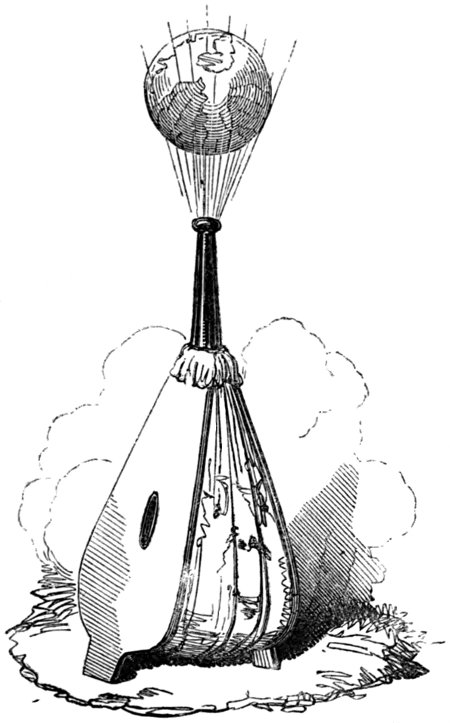
THE WORLD IS KEPT UP BY PUFF.
R. CLAY, PRINTER, BREAD STREET HILL, LONDON.
[178]
NEW EDITIONS OF POPULAR WORKS.
WILLIAM BECKFORD, ESQ.
ITALY;
WITH SKETCHES OF SPAIN AND PORTUGAL, AND AN EXCURSION TO
THE MONASTERIES OF ALCOBACA AND BATALHA.
By William Beckford, Esq. Author of "Vathek." Embellished with a fine Portrait of
Mr. Beckford, from the original painting by Sir Joshua Reynolds. Price 6s. neatly
bound.
WASHINGTON IRVING, ESQ.
ASTORIA.
By Washington Irving. With Portrait. Price 6s. neatly bound.
W. H. MAXWELL, ESQ.
WILD SPORTS OF THE WEST.
By W. H. Maxwell, Esq. Author of "Stories of Waterloo," &c. With Fifteen Engravings.
Price 6s. neatly bound.
MRS. TROLLOPE.
DOMESTIC MANNERS OF THE AMERICANS.
By Mrs. Trollope. With Fifteen Engravings (including a Portrait of
Mrs. Trollope). Price 6s. neatly bound.
CAPT. CHAMIER, R.N.
THE LIFE OF A SAILOR.
By Capt. Chamier. With Engravings. Price 6s. neatly bound.
REV. G. R. GLEIG.
TRADITIONS OF CHELSEA HOSPITAL.
By the Rev. G. R. Gleig. With Portrait of the Author. Price 6s. neatly bound.
[179]NEW WORKS OF WIT AND HUMOUR
I.
In Two Vols. 8vo. with numerous Illustrations by Leech,
THE INGOLDSBY LEGENDS;
OR, MIRTH AND MARVELS.
BY THOMAS INGOLDSBY, ESQ.
*** Either series may be had separately, in One Volume, price 10s. 6d.
II.
In One Volume, post 8vo. with upwards of Eighty Illustrations by Leech, price 10s. 6d.
THE WASSAIL BOWL.
BY ALBERT SMITH, ESQ.
III.
In Two Volumes, post 8vo. with One Hundred and Fifty Illustrations, price 18s.
CROWQUILL'S COMIC SKETCHES;
OR, THE PHANTASMAGORIA OF FUN.
IV.
In post 8vo. with upwards of Fifty characteristic Illustrations by Leech, price 8s.
THE COMIC ENGLISH GRAMMAR.
By the Author of "The Comic Latin Grammar."
V.
In Two Volumes, post 8vo. with numerous Illustrations by Leech, &c. including several
fac-similes of rare and unique old Prints, price 21s.
MERRIE ENGLAND IN THE OLDEN TIME;
OR,
Peregrinations with Uncle Tim and Mr. Bosky, of Little Britain, Drysalter
BY GEORGE DANIEL.
VI.
In One Volume, post 8vo. with numerous Illustrations by Leech, price 10s. 6d.
THE PORCELAIN TOWER;
OR, NINE STORIES OF CHINA.
BY T. H. SEALY.
RICHARD BENTLEY, NEW BURLINGTON STREET.
*** TO BE HAD ALSO OF ALL BOOKSELLERS.
[180]
Now in course of publication, in neatly bound pocket volumes, price Six Shillings each,
printed and embellished with Engravings uniformly with the "Waverley Novels," to
which they are suitable companions,
The Standard Novels and Romances.
THIS COLLECTION NOW CONTAINS
- Vol.
- 1. The Pilot, by Cooper.
- 2. Caleb Williams, by Godwin.
- 3. The Spy, by Cooper.
- 4. Thaddeus of Warsaw, by Miss Jane Porter.
- 5. St. Leon, by Godwin.
- 6. Last of the Mohicans, by Cooper.
- 7 and 8. The Scottish Chiefs, by
Miss Jane Porter.
- 9. Frankenstein, by Mrs. Shelley; and
Ghost Seer, Vol. I. by Schiller.
- 10. Edgar Huntly, by Brockden Brown;
and Conclusion of Ghost Seer.
- 11. Hungarian Brothers, by Miss A. M.
Porter.
- 12 and 13. Canterbury Tales, by the
Misses Lee.
- 14. The Pioneers, by Cooper.
- 15. Self Control, by Mrs. Brunton.
- 16. Discipline, by Mrs. Brunton.
- 17. The Prairie, by Cooper.
- 18 and 19. The Pastor's Fire-side, by
Miss Jane Porter.
- 20. Lionel Lincoln, by Cooper.
- 21. Lawrie Todd, by Galt.
- 22. Fleetwood, by Godwin.
- 23. Sense & Sensibility, by Miss Austen.
- 24. Corinne, by Madame de Stael.
- 25. Emma, by Miss Austen.
- 26. Simple Story, and Nature and Art,
by Mrs. Inchbald.
- 27. Mansfield Park, by Miss Austen.
- 28. Northanger Abbey, and Persuasion,
by Miss Austen.
- 29. The Smuggler, by Banim.
- 30. Pride and Prejudice, by Miss Austen.
- 31. Stories of Waterloo, by Maxwell.
- 32. The Hunchback of Notre Dame, by
Victor Hugo.
- 33. The Borderers, by Cooper.
- 34. Eugene Aram, by Bulwer.
- 35. Maxwell, by Theodore Hook.
- 36. Water Witch, by Cooper.
- 37. Mothers & Daughters, by Mrs. Gore.
- 38. The Bravo, by Cooper.
- 39. The Heiress of Bruges, by Grattan.
- 40. Red Rover, by Cooper.
- 41. Vathek, by Beckford; Castle of
Otranto, by Horace Walpole; and
Bravo of Venice, by M. G. Lewis.
- 42. The Country Curate, by Gleig.
- 43. The Betrothed, by Manzoni.
- 44. Hajji Baba, by Morier.
- 45. Hajji Baba in England, by Morier.
- 46. The Parson's Daughter, by Theodore
Hook.
- 47. Paul Clifford, by Bulwer.
- 48. The Younger Son, by Capt. Trelawny.
- 49. The Alhambra, by Washington Irving;
The Last of the Abencerrages, by
Chateaubriand; and The Involuntary
Prophet, by Horace Smith.
- 50. The Headsman, by Cooper.
- 51 and 52. Anastasius, by Hope.
- 53. Darnley, by James.
- 54. Zohrab, by Morier.
- 55. Heidenmauer, by Cooper.
- 56. De L'Orme, by James.
- 57. Headlong Hall, Nightmare Abbey,
Maid Marian, and Crotchet Castle,
by Peacock.
- 58. Trevelyan, by the Author of "A Marriage
in High Life."
- 59. Philip-Augustus, by James.
- 60. Rookwood, by Ainsworth.
- 61. Henry Masterton, by James.
- 62. Peter Simple, by Marryat.
- 63. Jacob Faithful, by Marryat.
- 64. Japhet in search of a Father, by
Marryat.
- 65. King's Own, by Marryat.
- 66. Mr. Midshipman Easy, by Marryat.
- 67. Newton Forster, by Marryat.
- 68. The Pacha of many Tales, by Marryat.
- 69. Rattlin the Reefer.
- 70. Captain Blake; or, My Life, by
Maxwell.
- 71. Helen, by Miss Edgeworth.
- 72. The Last Days of Pompeii, by Bulwer.
- 73. The Bivouac, by Maxwell.
- 74. Precaution, by Cooper.
- 75. Jack Brag, by Theodore Hook.
- 76. Rory O'More, by Lover.
- 77. Ben Brace, by Capt. Chamier.
- 78. The Vicar of Wrexhill, by Mrs.
Trollope.
- 79. The Buccaneer, by Mrs. S. C. Hall.
- 80. Tylney Hall, by Thomas Hood.
- 81. The Widow Barnaby, by Mrs. Trollope.
- 82. The Soldier of Lyons, by Mrs. Gore.
- 83. Marriage, by the Author of "The Inheritance,"
and "Destiny."
- 84. The Inheritance.
- 85. Destiny.
- 86. Gilbert Gurney, by Theodore Hook.
- 87. The Widow and the Marquess, by
Theodore Hook.
- 88. All in the Wrong; or, Births,
Deaths, and Marriages, by Theodore
Hook.
- 89. Homeward Bound, by Cooper.
- 90. The Pathfinder, by Cooper.
- 91. The Deerslayer, by Cooper.
The New Volume, just published, comprises
JACQUELINE OF HOLLAND,
AN HISTORICAL TALE,
By THOMAS COLLEY GRATTAN, Esq. Author of "The Heiress of Bruges," &c.
*** Any Volume may be had separately, and of all Booksellers.
FOOTNOTES:
Transcriber's Corrections:
| page | original text | correction |
| 42 | "titavating" | "titivating" |
| 100 | repecting | respecting |
| 142 | gingens. | gignens. |
| 154 | 2,500 widowers without families.
2,500 widowers with families. | 2,500 widowers. |
| 168 | Cobbet's | Cobbett's |