COMETS AND METEORS.
A descriptive treatise on Comets and Meteors
may properly be preceded by a brief general view
of the planetary system to which these bodies are
related, and by which their motions, in direction
and extent, are largely influenced.
The Solar System consists of the sun, together
with the planets, comets, and meteors which revolve
around it as the centre of their motions. The sun
is the great controlling orb of this system, and the
source of light and heat to its various members.
Its magnitude is one million three hundred thousand
times greater than that of the earth, and it
contains more than seven hundred times as much
matter as all the planets put together.
Mercury is the nearest planet to the sun; its
mean distance being about 35,400,000 miles. Its
diameter is 3000 miles, and it completes its orbital
revolution in 88 days.
Venus, the next member of the system, is sometimes
our morning and sometimes our evening star.
Its magnitude is almost exactly the same as that of
the earth. It revolves round the sun in 225 days.
The earth is the third planet from the sun in
the order of distance; the radius of its orbit being
about 92,000,000 miles. It is attended by one satellite,—the
moon,—the diameter of which is 2160
miles.
Mars is the first planet exterior to the earth's
orbit. It is considerably smaller than the earth,
and has no satellite. It revolves round the sun in
687 days.
The Asteroids.—Since the commencement of the
present century a remarkable zone of telescopic
planets has been discovered immediately exterior to
the orbit of Mars. These bodies are extremely
small; some of them probably containing less matter
than the largest mountains on the earth's surface.
131 members of the group are known at
present, and the number is annually increasing.
Jupiter, the first planet exterior to the asteroids,
is nearly 500,000,000 miles from the sun, and revolves
round it in a little less than 12 years. This
planet is 86,000 miles in diameter, and contains
more than twice as much matter as all the other
planets, primary and secondary, put together. Jupiter
is attended by four moons or satellites.
Saturn is the sixth of the principal planets in the
order of distance. Its orbit is about 400,000,000
miles beyond that of Jupiter. This planet is attended
by eight satellites, and is surrounded by
three broad flat rings. Saturn is 73,000 miles in
diameter, and its mass or quantity of matter is more
than that of all the other planets except Jupiter.
Uranus is at double the distance of Saturn, or
nineteen times that of the earth. Its diameter is
about 34,000 miles, and its period of revolution 84
years. It is attended by at least four satellites.
Neptune is the most remote known member of
the system; its distance being 2,800,000,000 miles.
It is somewhat larger than Uranus; has certainly
one satellite, and probably several more. Its period
is about 165 years. A cannon-ball flying outward
from the sun at the uniform velocity of 500 miles
per hour would not reach the orbit of Neptune in
less than 639 years.
These planets all move round the sun in the same
direction,—from west to east. Their motions are
nearly circular, and also nearly in the same plane.
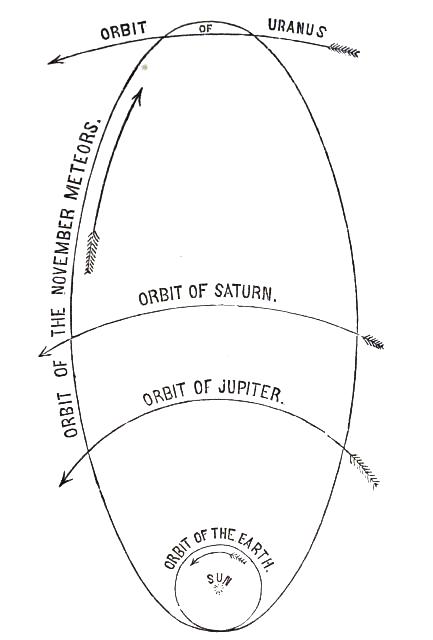
Their orbits, except that of Neptune, are represented
in the frontispiece. It is proper to remark,
however, that all representations of the solar system
by maps and planetariums must give an exceedingly
erroneous view either of the magnitudes or distances
of its various members. If the earth, for
instance, be denoted by a ball half an inch in diameter,
the diameter of the sun, according to the
same scale (16,000 miles to the inch), will be between
four and five feet; that of the earth's orbit, about
1000 feet; while that of Neptune's orbit will be
nearly six miles. To give an accurate representation
of the solar system at a single view is therefore
plainly impracticable.
The Zodiacal Light.—This term was first applied
by Dominic Cassini, in 1683, to a faint nebulous
aurora, somewhat resembling the milky way, apparently
of a conical or lenticular form, having its
base toward the sun and its axis nearly in the direction
of the ecliptic. The most favorable time for
observing it is when its axis is most nearly perpendicular
to the horizon. This, in our latitudes, occurs
in March, for the evening, and in October, for
the morning. The angular distance of its vertex
from the sun is frequently seventy or eighty degrees,
while sometimes, though rarely (except within
the tropics), it exceeds even one hundred degrees.
It was noticed in the latter part of the 16th century
by Tycho Brahe. The first accurate description of
the phenomenon was given, however, by Cassini.
This astronomer supposed the appearance to be produced
by the blended light of innumerable bodies
too small to be separately observed,—a theory still
very generally accepted. In other words, the zodiacal
light is probably a swarm of infinitesimal
planets; the greater part of the cluster being interior
to Mercury's orbit.
The distances between the different members of
our planetary system, vast as they may seem, sink
into insignificance when compared with the intervals
which separate us from the so-called fixed stars.
Alpha Centauri, the nearest of those twinkling luminaries,
is 7000 times more distant than Neptune
from the sun. Even light itself, which moves
185,000 miles in a second, is more than three years
in traversing the mighty interval.
The term comet—which signifies literally a hairy
star—may be applied to all bodies that revolve about
the sun in very eccentric orbits. The sudden appearance,
vast dimensions, and extraordinary aspect
of these celestial wanderers, together with their rapid
and continually varying motions, have never failed
to excite the attention and wonder of all observers.
Nor is it surprising that in former times, when the
nature of their orbits was wholly unknown, they
should have been looked upon as omens of impending
evil, or messengers of an angry Deity. Even
now, although modern science has reduced their
motions to the domain of law, determined approximately
their orbits, and assigned in a number of
instances their periods, the interest awakened by
their appearance is in some respects still unabated.
The special points of dissimilarity between planets
and comets are the following:—The former are
dense, and, so far as we know, solid bodies; the
latter are many thousand times rarer than the earth's
atmosphere. The planets all move from west to
east; many comets revolve in the opposite direction.
The planetary orbits are but slightly inclined to the
plane of the ecliptic; those of comets may have any
inclination whatever. The planets are observed in
all parts of their orbits; comets, only in those parts
nearest the sun.
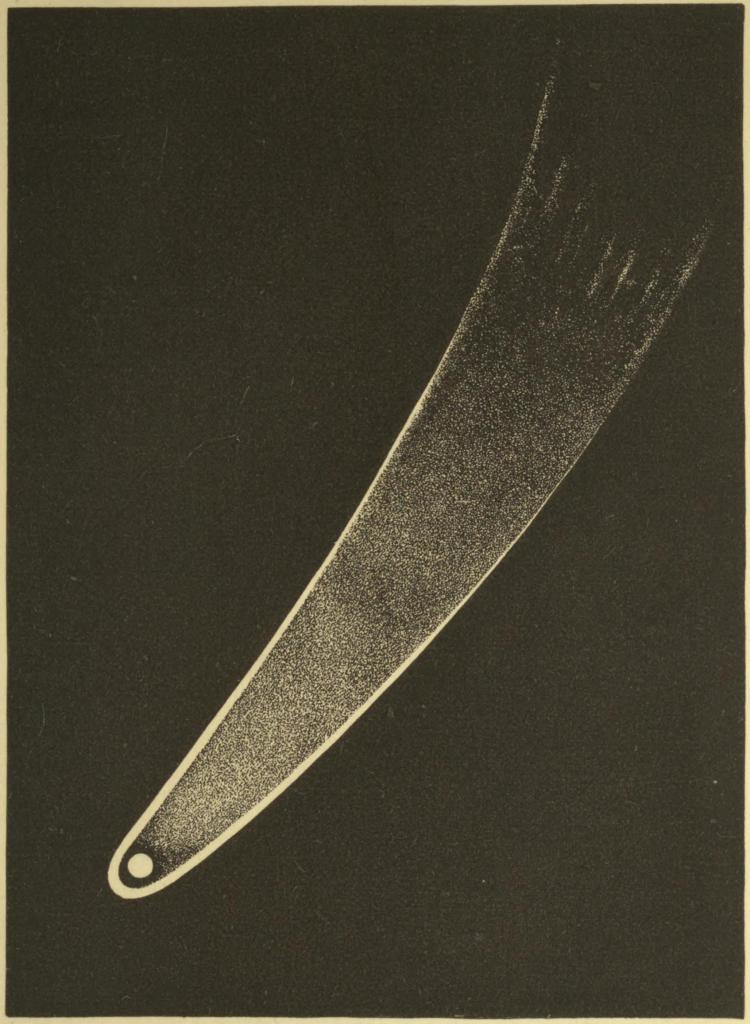
The larger comets are attended by a tail, or train
of varying dimensions, extending generally in a
direction opposite to that of the sun. The more
condensed part, from which the tail proceeds, is
called the nucleus; and the nebulous envelope immediately
surrounding the nucleus is sometimes termed
the coma. These different parts are seen in Fig. 2,
which represents the great comet of 1811.
Fig. 2.
 The Great Comet of 1811.
Page 11.
Zeno, Democritus, and other Greek philosophers
held that comets were produced by the collection of
several stars into clusters. Aristotle taught that
they were formed by exhalations, which, rising from
the earth's surface, ignited in the upper regions of
the atmosphere. This hypothesis, through the great
influence of its author, was generally received for
almost two thousand years. Juster views, however,
were entertained by the celebrated Seneca, who
maintained that comets ought to be ranked among
the permanent works of nature, and that their disappearance
was not an extinction, but simply a
passing beyond the reach of our vision. The observations
of Tycho Brahe first established the fact
that comets move through the planetary spaces far
beyond the limits of our atmosphere. The illustrious
Dane, however, supposed them to move in circular
orbits. Kepler, on the other hand, was no less in
error in considering their paths to be rectilinear.
James Bernoulli supposed comets to be the satellites
of a very remote planet, invisible on account
of its great distance,—such satellites being seen only
in the parts of their orbits nearest the earth. Still
more extravagant was the hypothesis of Descartes,
who held that they were originally fixed stars, which,
having gradually lost their light, could no longer
retain their positions, but were involved in the vortices
of the neighboring stars, when such as were
thus brought within the sphere of the sun's illuminating
power again became visible.
Comets visible in the daytime.
Comets of extraordinary brilliancy have sometimes
been seen during the daytime. At least
thirteen authentic instances of this phenomenon
have been recorded in history. The first was the
comet which appeared about the year 43 B.C., just
after the assassination of Julius Cæsar. The Romans
called it the Julium Sidus, and regarded it as a celestial
chariot sent to convey the soul of Cæsar to the
skies. It was seen two or three hours before sunset,
and continued visible for eight successive days. The
great comet of 1106, described as an object of terrific
splendor, was seen simultaneously with the sun,
and in close proximity to it. Dr. Halley supposed
this and the Julian comet to have been previous
visits of the great comet of 1680. In the year 1402
two comets appeared,—one about the middle of
February, the other in June,—both of which were
visible while the sun was above the horizon. One
was of such magnitude and brilliancy that the
nucleus and even the tail could be seen at midday.
The comet of 1472, one of the most splendid recorded
in history, was visible in full daylight, when
nearest the earth, on the 21st of January. This
comet, according to Laugier, moves very nearly in
the plane of the ecliptic, its inclination being less
than two degrees. Its least distance from our globe
was only 3,300,000 miles. The comet of 1532, supposed
by some to be identical with that of 1661, was
also visible in full sunshine. The apparent magnitude
of its nucleus was three times greater than that
of Jupiter. The comet of 1577 was seen with the
naked eye by Tycho Brahe before sunset. It was
by observations on this body that Aristotle's doctrine
in regard to the origin, nature, and distance
of comets was proved to be erroneous. It was
simultaneously observed by Tycho at Oranienberg,
and Thaddeus Hagecius at Prague; the points of
observation being more than 400 miles apart, and
nearly on the same meridian. The comet was found
to have no sensible diurnal parallax; in other words,
its apparent place in the heavens was the same to
each observer, which could not have been the case
had the comet been less distant than the moon. The
comet which passed its perihelion on the 8th of November,
1618, was distinctly seen by Marsilius when
the sun was above the horizon. The great comet
of 1744 was seen without the aid of a glass at one
o'clock in the afternoon,—only five hours after its
perihelion passage. The diameter of this body was
nearly equal to that of Jupiter. It had six tails, the
greatest length of which was about 30,000,000 miles,
or nearly one-third of the distance of the earth from
the sun. The spaces between the tails were as dark
as the rest of the heavens, while the tails themselves
were bordered with a luminous edging of great
beauty.
The great comet of 1843 was distinctly visible to
the naked eye, at noon, on the 28th of February.
It appeared as a brilliant body, within less than two
degrees from the sun. This comet passed its perihelion
on the 27th of February, at which time its
distance from the sun's surface was only about one-fourth
of the moon's distance from the earth. This
is the nearest approach to the sun ever made by any
known comet. The velocity of the body in perihelion
was about 1,280,000 miles an hour, or nearly
nineteen times that of the earth in its orbit. The
apparent length of its tail was sixty-five degrees, and
its true length 150,000,000 miles. The first comet
of 1847, discovered by Mr. Hind, was also seen near
the sun on the day of its perihelion passage. That
discovered by Klinkerfues on the 10th of June, 1853,
and which passed its perihelion on the 1st of September,
was seen at Olmutz in the daytime, August
31, when only twelve degrees from the sun. After
passing its perihelion, it was again observed, at noon,
on the 2d, 3d, and 4th of September. Finally, the
great comet of 1861 was seen before sunset, on
Monday evening, July 1, by Rev. Henry W. Ballantine,
of Bloomington, Indiana. It was again detected
on the following evening just as the sun was
in the horizon.
Besides the thirteen comets which we have enumerated,
at least four others have been seen in
the daytime; all, however, under peculiar circumstances.
Seneca relates that during a great solar
eclipse, 63 years before our era, a large comet was
observed not far from the sun. "Philostorgius
says that on the 19th of July, A.D. 418, when
the sun was eclipsed and stars were visible, a great
comet, in the form of a cone, was discovered near
that luminary, and was afterwards observed during
the nights."[2] The comet which passed its perihelion
on the 18th of November, 1826, was observed
by both Gambart and Flaugergues to transit the
solar disk,—the least distance of the nucleus from
the sun's surface being about 2,000,000 miles. The
second comet of 1819 and the comet of 1823 are
both known in like manner to have passed between
the sun and the earth. Unfortunately, however,
the transits were not observed.
A few cometary orbits are hyperbolas, more
ellipses, and a still greater number parabolas.
Comets moving in ellipses remain permanently
within the limits of solar influence. Others, however,
visit our system but once, and then pass off to
wander indefinitely in the sidereal spaces.
Comets of known periodicity.
I. Halley's Comet.
As comets are subject to great changes of appearance,
one can never be identified by any description
of its magnitude, brilliancy, etc., at the time of a
previous return. This can be done only by a comparison
of orbits. If, for example, we find the elements
of an orbit very nearly corresponding in every
particular with those of a former comet, there is a
degree of probability, amounting almost to certainty,
that the two are identical. Sir Isaac Newton,
in his Principia, published shortly after the appearance
of the comet of 1682, explained how the periods
of those mysterious visitors might thus be ascertained,
thus directing the attention of astronomers
to the subject. Dr. Halley soon after undertook a
thorough discussion of all the recorded cometary
observations within his reach. In the course of his
investigations he discovered that the path of the
comet observed by Kepler in 1607 coincided almost
exactly with that of the one which passed its perihelion
in 1682. Hence he concluded that they were
the same. He found also that the comet of 1531,
whose course had been particularly observed by
Apian, moved in the same path. The interval
between the consecutive appearances being nearly
76 years, Halley announced this as the time of
the comet's revolution, and boldly predicted its
return in 1758 or 1759. The law of universal gravitation
had at this time just been discovered and
announced. But although its application to the
determination of planetary and cometary perturbations
had not been developed, Halley was well aware
that the attractive influence of Jupiter and Saturn
might accelerate or retard the motion of the comet,
so as to produce a considerable variation in its period.
During the interval from 1682 to 1759, the application
of the higher mathematics to problems in physical
astronomy had been studied with eminent success.
The disturbing effect of the two large planets,
Jupiter and Saturn, was computed with almost
incredible labor by Clairaut, Lalande, and Madame
Lepaute. The result as announced by Clairaut to
the Academy of Sciences in November, 1758, was
that the period must be 618 days longer than that
immediately preceding, and that the comet accordingly
would pass its perihelion about the 13th of
April, 1759. It was stated, however, that, being
pressed for want of time, they had neglected certain
quantities which might somewhat affect the result.
The comet, in fact, passed its perihelion in March,
within less than a month of the predicted time.
When it is considered that the attraction of the
earth was not taken into the account, and that
Uranus, whose influence must have been sensible,
had not then been discovered, this must certainly
be regarded as a remarkable approximation.
But during the next interval of 76 years the theory
of planetary perturbations had been more perfectly
developed. The masses of Jupiter and Saturn had
been determined with greater accuracy, and Uranus
had been added to the known members of the planetary
system. A nearer approximation to the exact
time of the comet's perihelion passage in 1835 was
therefore to be expected. Prizes were offered by
two of the learned societies of Europe—the Academy
of Sciences at Turin, and the French Institute—for
the most perfect discussion of its motions. That of
the former was awarded to Damoiseau,—that of the
latter to Pontecoulant. The times assigned by these
distinguished mathematicians for the comet's perihelion
passage were very nearly the same, and differed
but a few days from the true time. Had the
present received mass of Jupiter been used in the
calculations, Pontecoulant, it is believed, would not
have been in error as much as 24 hours. It may be
proper to remark that, during the entire period from
1759 to 1835, the position of Neptune was such that
it could produce no considerable effect on the motion
of the comet.
This interesting object will again return about
1911.
The visit of 1531 was the earliest that Halley succeeded
in determining with any degree of certainty.
Peter Apian, by whom it was at that time observed,
was the first European to ascertain the fact that, as
a general thing, the tails of comets are turned from
the sun.[3] To confirm this discovery, he carefully
followed the body in its progress through the constellations.
By means of his recorded observations
Halley was enabled to identify this comet with that
of 1607 and 1682. The great comet of 1456 he conjectured
to be the same, from the date of its appearance.
Pingré subsequently confirmed this suspicion
by a careful examination of the few trustworthy
records that could be collected from the writers of
that period.
From the earlier descriptions of this comet we
infer that its brilliancy is gradually diminishing. In
1456 its tail, which was slightly curved like a sword
or sabre, extended two-thirds of the distance from the
horizon to the zenith. The appearance of such an
object, in a grossly superstitious age, excited throughout
Europe the utmost consternation. The Moslems
had just taken Constantinople, and were threatening
to advance westward into Europe. Pope Calixtus
III., regarding the comet as confederate with
the Turk, ordered prayers to be offered three times
a day for deliverance from both. The alarm, however,
was of short duration. Within ten days of its
appearance the comet reached its perihelion. Receding
from the sun, the sword-like form began to
diminish in brilliancy and extent; and finally, to the
great relief of Europe, it entirely disappeared.
The perihelion passage of 1456 was, until recently,
the earliest known. It was shown by Laugier, however,
in 1843, that among the notices of comets extracted
by Edward Biot from the Chinese records,
were observations of a body in 1378, which was undoubtedly
the comet of Halley. Further researches
among these annals enabled the same astronomer to
recognize two ancient returns, one in 760, the other
in 451. Still more recently the distinguished English
astronomer, Mr. Hind, has traced back the returns
to the year 11 B.C. He remarks, however,
that previous to that epoch, "the Chinese descriptions
of comets are too vague to aid us in tracing
any more ancient appearances," and that "European
writers of these remote times render us no assistance."
Let us now inquire whether the comet had
probably made any former approach to the sun in
an orbit nearly identical with the present. It is
well known that the modern period of this body is
considerably less than the ancient. Thus, the mean
period since A.D. 1456 has been 75.88 years; while
from 11 B.C. to 1456 A.D. it was 77.27 years. In determining
the approximate dates of former returns,
the ancient period should evidently be employed.
Now, it is a remarkable fact that of more than 70
comets,[4] or objects supposed to be comets, whose
appearance was recorded during the six centuries
immediately preceding the year 11 B.C., but one—that
of 166 B.C.—was observed at a date corresponding
nearly to that of a former return of Halley's
comet. Of this object it is merely recorded that "a
torch was seen in the heavens." Whether this was
a comet or some other phenomenon, it is impossible
to determine. But as the comet of Halley was
more brilliant in ancient than in modern times, it
seems highly improbable that seven consecutive returns
of so conspicuous an object should have been
unrecorded, especially as twelve comets per century[5]
were observed during the same period. It would
appear, therefore, that the perihelion passage of
11 B.C. was in fact the first ever made by the comet,
or at least the first in an orbit nearly the same as
the present.
The motion of Halley's comet is retrograde. The
point of its nearest approach to the sun is situated
within the orbit of Venus. Its greatest distance
from the centre of the system is nearly twice that
of Uranus, or 36 times that of the earth. The
comet is, consequently, subject to great changes of
temperature. When nearest the sun its light and
heat are almost four times greater than the earth's;
when most remote, they are 1200 times less. In
the former position, the sun would appear much
larger than to us; in the latter, his apparent diameter
would not greatly exceed that of Jupiter, as
viewed from the earth. It would be difficult to conjecture
what the consequences might be, were our
planet transported to either of these extremes of
the cometary path. In the perihelion, the waters
of the ocean would undoubtedly be reduced to a
state of vapor; in the aphelion, they would be
solidified by congelation.
II. Encke's Comet.
It was formerly supposed that all comets have
their aphelia far beyond the limits of the planetary
system. In 1818, however, a small comet was discovered
by Pons, the orbit of which was subsequently
found to be wholly interior to that of Jupiter.
Its elements were presented by Bouvard, in
1819, to the Board of Longitude at Paris. The
form and position of the orbit were immediately
found to correspond with those of a comet observed
by several astronomers in 1805. The different appearances
were consequently regarded as returns of
the same body. Its elliptic orbit was calculated by
Encke, who found its period to be only about three
years and four months. Its perihelion is within the
orbit of Mercury; its aphelion, between the asteroids
and the orbit of Jupiter.
Encke's comet is invisible to the naked eye, except
in very favorable circumstances; it has no tail;
its motion, like that of the planets, is from west
to east; and its orbit is inclined about 13° to the
ecliptic.
A comparison of the successive periods of this
interesting object has led to the discovery that its
time of revolution is gradually diminishing; a fact
regarded by Encke and other astronomers as indicating
the existence of an ethereal medium.
III. Biela's Comet.
The discovery of Encke's comet of short period
was followed, in 1826, by that of another, whose
revolution is completed in about six years and eight
months. It was observed on the 27th of February,
by M. Biela, an Austrian officer; accordingly it
has since been known as Biela's comet. On computing
its elements and comparing them with those
of former comets, it was found to have been observed
in 1772 and 1805. Damoiseau having calculated
the dimensions of the comet's elliptic path
and the time of its return, announced as the result
of his computations the remarkable fact that the
orbits of the earth and comet intersect each other,
and that the comet would cross the earth's path on
the 29th of October, 1832. This produced no little
alarm among the uneducated, especially in France.
Even some journalists are said to have predicted
the destruction of our globe by a collision with the
comet. When the latter, however, passed the point
of intersection at the predicted time, the earth was
at a distance of 50,000,000 miles.
At the return of 1845-6, Biela's comet exhibited
a most remarkable appearance. Instead of a single
comet, it appeared as two distinct bodies moving
together side by side, at a distance from each other
somewhat less than that of the moon from the earth.
Astronomers, anxious to determine whether the
cometary fragments had continued separate during
an entire revolution, awaited the next return with
no ordinary interest. The two bodies appeared at
the predicted time (September, 1852); their distance
apart having increased to 1,250,000 miles. In 1859
the comet, on account of its proximity to the sun,
entirely escaped detection. At the return in 1865-6
the position of the object was quite favorable for
observation, yet the search of astronomers was
again unsuccessful. In 1872 the body escaped detection
both in Europe and America. One fragment
was seen, however, at Madras, India, on the
mornings of the 2d and 3d of December,—several
weeks after its perihelion passage. The comet's
non-appearance in 1866 and its greatly diminished
magnitude in 1872 leave no room to doubt its progressive
dissolution. This subject will again be referred
to in discussing the phenomena of meteoric
showers.
IV. Faye's Comet.
On the 22d of November, 1843, M. Faye, of the
Paris Observatory, discovered a comet, which was
shown by Dr. Goldschmidt to revolve in an elliptic
orbit, the perihelion of which is exterior to the
orbit of Mars, and the aphelion immediately beyond
that of Jupiter. The eccentricity is, therefore,
less than that of any other comet previously discovered.
Its period is about 7 years and 5 months.
It is possible that a comet moving in a parabola
or hyperbola, with the sun in the focus, may be
thrown into an elliptic orbit by the disturbing influence
of Jupiter or one of the other large planets.
The celebrated Leverrier undertook to determine
whether the comet of Faye had in this manner
been recently fixed as a permanent member of the
solar system. He found that it could not have been
so introduced since 1747, and, consequently, that it
must have completed at least thirteen revolutions
before its discovery.
This comet has been observed at each return
from 1843 to the present time.
V. De Vico's Comet.
On the 22d of August, 1844, De Vico, of Rome,
discovered a comet whose orbit is included between
those of the earth and Jupiter. Its period is 1996
days, or about 5½ years. This body, from some
cause,—perhaps a gradual dissolution,—has not
been observed at any subsequent return.
VI. Brorsen's Comet.
On the 26th of February, 1846, Mr. Brorsen, of
Kiel, discovered a faint comet, the mean distance
and period of which are almost identical with those
of De Vico's. This comet was not observed during
the perihelion passage of 1851, on account of its
unfavorable position with respect to the sun. It
has, however, been subsequently detected.
VII. D'Arrest's Comet.
Dr. D'Arrest discovered a comet on the 27th of
June, 1851, which was soon found to move in an
elliptic orbit, with a period of about 6½ years. It
entirely escaped observation, both in Europe and
America, during its perihelion passage in 1857. It
was observed, however, at the Cape of Good Hope.
Its invisibility in 1864 was due to its unfavorable
position. At its return in 1870, it was first seen on
the 31st of August, by Dr. Winnecke, of Carlsruhe.
VIII. Tuttle's Comet.
A faint telescopic comet was discovered at the
Observatory of Harvard College, on the evening of
January 4, 1858, by Mr. H. P. Tuttle. The same
body was independently found one week later by
Dr. Bruhns, of Berlin. From observations made
at Cambridge, Massachusetts, and Ann Arbor,
Michigan, its elements were soon computed by different
astronomers; the result in each case coinciding
so closely with the elements of the second
comet of 1790, as to place its identity wholly beyond
doubt. Its period is nearly 13 years and 8 months.
It had returned, therefore, without detection, in the
years 1803, 1817, 1831, and 1844. On its approach
to perihelion in 1871, it was first detected by M.
Borelly, of Marseilles.
IX. Winnecke's Comet.
The second comet of 1858 was discovered on the
8th of March, by Dr. Winnecke, of Bonn. This
proved to be identical with the third comet of 1819,
whose period was computed by Encke to be about
5½ years. It had therefore returned unperceived
no less than six times between 1819 and 1858. At
its return in 1863 it again escaped detection. The
perihelion passage of 1869 was made on the 30th of
June. The comet was seen as early as April 13,
and, after passing the sun, as late as October 11.
"Schönfeld states that in part of April and May it
appeared to have not one, but several, centres of
condensation, and Vogel says that, in the beginning
of June, it had a much greater resemblance to a
star-cluster than to a nebula." This phenomenon,
it may be remarked, bore a striking resemblance to
the appearances observed in the comets of 389,
1618, and 1661.
X. Tempel's Comet.
On the 19th of December, 1865, M. Tempel, of
Marseilles, discovered a small comet, which continued
visible four weeks, passing its perihelion January
11, 1866. Dr. Oppolzer, of Vienna, after a
careful determination of its elements, announced
the interesting fact that its orbit very nearly intersects
those of the earth and Uranus; the perihelion
being situated immediately within the former, and
the aphelion a short distance exterior to the latter.
The period, according to the same astronomer, is
33 years and 65 days. The identity of this comet
with that of 1366 was suggested by Professor H. A.
Newton soon after its appearance,—a suggestion
which subsequent research has strongly corroborated.
It is also highly probable that the comet
observed in China, September 29, 1133, was a former
return of the same body. In 1366 it was conspicuous
to the naked eye, while in 1866 it was
wholly invisible without a telescope,—a fact indicative
of its gradual dissolution. The connection of
this comet with the meteors of November 14 will
be elsewhere considered.
XI. The Second Comet of 1867.
Another comet of short period was discovered by
M. Tempel on the 3d of April, 1867. Its orbit is
the least eccentric of all known comets: the perihelion
being exterior to the orbit of Mars; the
aphelion interior to that of Jupiter. Its motion is
direct, and it completes a revolution in 5 years and
8 months.
I. The Group whose periods are nearly equal to that of
Uranus.
Since the commencement of the present century
five comets have been discovered, which form, with
Halley's, an interesting and remarkable group.
The first of these was detected by Pons, on the 20th
of July, 1812; the second by Olbers, on the 6th of
March, 1815; the third by De Vico, on the 28th of
February, 1846; the fourth by Brorsen, on the 20th
of July, 1847; and the last by Westphal, on the
27th of June, 1852. The periods of these bodies
are all nearly equal, ranging from 68 to 76 years;
their eccentricities are not greatly different; the
motions of all, except that of Halley's, are direct;
and the distances of their aphelia are somewhat
greater than Neptune's distance from the sun. Of
this group, the comets of 1812 and 1846 seem
worthy of special notice. The former became visible
to the naked eye shortly after its discovery, and
each continued visible about ten weeks. Their
elements are as follows:
| Perihelion Passage. | Long. of Perih'n. | Long. of A. Node. | Incl. | Peri'n Dist. | Eccentricity. | Period. | Direction. | Computer. |
| 1812, Sept. 15d. 7h. | 92° 51´ | 253° 33´ | 73° 57´ | 0.7771 | 0.94454 | 70.68y | D | Encke. |
| 1846, Mar. 5d. 12h. | 90° 31´ | 77° 37´ | 85° 6´ | 0.6637 | 0.96224 | 73.715 | D | Peirce. |
The wonderful similarity of these elements, except
in the longitude of the ascending node, is at once
apparent. It will also be noticed that the longitude
of the descending node of the latter is very nearly
coincident with that of the ascending node of the
former. These remarkable coincidences are presented
to the eye in the following diagram, where
the dotted ellipse represents the orbit of the comet
of 1812, and the continuous curve that of the comet
of 1846.
Fig. 3.
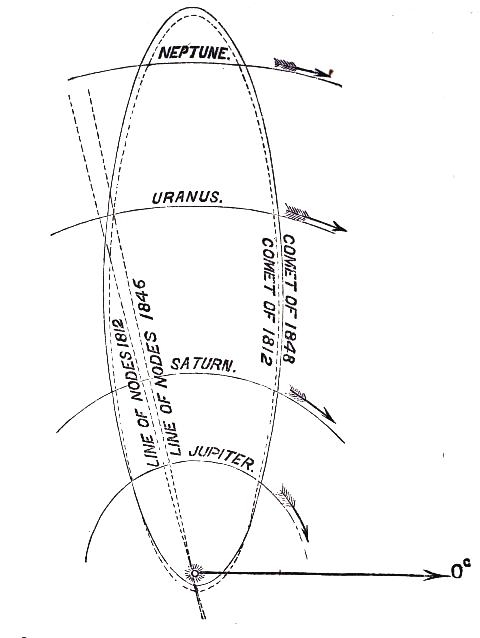
It is infinitely improbable that these coincidences
should be accidental; they point undoubtedly to a
common origin of the two bodies.
According to the theory now generally accepted,
comets enter the solar system ab extra, move in
parabolas or hyperbolas around the sun, and, if undisturbed
by the planets, pass off beyond the limits
of the sun's attraction, to be seen no more. If in
their motion, however, they approach very near any
of the larger planets, their direction is changed by
planetary perturbation,—their orbits being sometimes
transformed into ellipses. The new orbits of
such bodies would pass very nearly through the
points at which their greatest perturbation occurred;
and accordingly we find that the aphelia of a large
proportion of the periodic comets are near the orbits
of the major planets. "I admit," says M. Hoek,
"that the orbits of comets are by nature parabolas
or hyperbolas, and that in the cases when elliptical
orbits are met with, these are occasioned by planetary
attractions, or derive their character from the
uncertainty of our observations. To allow the contrary
would be to admit some comets as permanent
members of our planetary system, to which they
ought to have belonged since its origin, and so to
assert the simultaneous birth of that system and of
these comets. As for me, I attribute to these a
primitive wandering character. Traveling through
space, they move from one star to another in order
to leave it again, provided they do not meet any
obstacle that may force them to remain in its
vicinity. Such an obstacle was Jupiter, in the
neighborhood of our sun, for the comets of Lexell
and Brorsen, and probably for the greater part of
periodical comets; the other part of which may be
indebted for their elliptical orbits to the attractions
of Saturn and the remaining planets.
"Generally, then, comets come to us from some
star or other. The attraction of our sun modifies
their orbit, as had been done already by each star
through whose sphere of attraction they had passed.
We can put the question if they come as single
bodies or united in systems."
The conclusion of this astronomer's interesting
discussion is that—
"There are systems of comets in space that are broken
up by the attraction of our sun, and whose members attain,
as isolated bodies, the vicinity of the earth during a course
of several years."[6]
In the researches here referred to, it is shown by
Professor Hoek that the comets of 1860 III., 1863 I.,
and 1863 IV. formed a group in space previous to
their entrance into our system. The same fact has
also been demonstrated in regard to other comets
which need not here be specified. Now, the comets
of 1812 and 1846 IV. have their aphelia near the
orbit of Neptune, and hence the original parabolas
in which they moved were probably transformed
into ellipses by the perturbations of that planet.
Before entering the solar domain, they were doubtless
members of a cometary system. Passing
Neptune near the same time, and at some distance
from each other, their different relative positions
with regard to the disturbing body may account
for the slight differences in the elements of their
orbits.
Comets of the Jovian Group.
Besides the eight comets enumerated in Chapter
II. whose aphelia are in the vicinity of Jupiter's orbit,
five others have been observed which belong apparently
to the same cluster. These are the comets
of 1585, 1743 I., 1766 II., 1783, and 1819 IV. "The
fact that these comets have not been re-observed on
their successive returns through perihelion may be
explained either by the difficulty of observing them,
owing to their unfavorable positions, and to the
circumstances of observers not expecting their reappearance,
their periodic character not being then
suspected, or because they may have been thrown
by the disturbing action of the larger planets into
orbits such as to keep them continually out of the
range of view of terrestrial observers."[7]
Lexell's comet of 1770 is the most remarkable
instance known of the change produced in the
orbits of these bodies by planetary attraction. This
comet passed so near Jupiter in 1779 that the attraction
of the latter was 200 times greater than that of
the sun. The consequence was that the comet,
whose mean distance corresponded to a period of
5½ years, was thrown into an orbit so entirely different
that it has never since been visible.
Peters' Comet.
A telescopic comet was discovered by Dr. Peters
on the 26th of June, 1846, which continued to be
observed till the 21st of July. Its period, according
to the discoverer, is about 13 years, and its aphelion,
like that of Tuttle's comet, is in the vicinity of
Saturn's orbit. It was expected to return in 1859,
and again in 1872, but each time escaped detection,
owing probably to the fact that its position was unfavorable
for observation.
Stephan's Comet (1867 I.).
In January, 1867, M. Stephan, of Marseilles, discovered
a new comet, the elements of which, after
two months' observations, were computed by Mr.
G. M. Searle, of Cambridge, Massachusetts. The
perihelion of this body is near the orbit of Mars; its
aphelion near that of Uranus,—the least distance of
the orbits being about 2,000,000 miles. The present
form of the cometary path is doubtless due to the
disturbing action of Uranus. The comet completes
its revolution in 33.62 years; consequently (as has
been pointed out by Mr. J. R. Hind) five of its
periods are almost exactly equal to two periods of
Uranus. The next approximate appulse of the two
bodies will occur in 1985, when the form of the
comet's orbit may be sensibly modified.
Elliptic Comets whose Aphelia are at a much
Greater Distance than Neptune's Orbit.
In October, 1097, a comet was seen both in Europe
and China, which was noted for the fact of its
having two distinct tails, making with each other
an angle of about 40°. From a discussion of the
Chinese observations (which extended through a
longer period than the European), Laugier concluded
that this body is identical with the third
comet of 1840, which was discovered by Galle on
the 6th of March. If, therefore, it has made no
intermediate return without being observed, it must
have a period of about 743 years. It is also highly
probable, from the similarity of elements, that the
comet which passed its perihelion on the 5th of June,
1845, was a reappearance of the comet of 1596,—the
period of revolution being 249 years. The elements
of the great comet of 1843 are somewhat uncertain.
There is a probability, however, of the identity of
this body with the comet of 1668. This would make
the period 175 years. The third comet of 1862 is
especially interesting from its connection with the
August meteors. Its period, according to Dr. Oppolzer,
is 121½ years.
The Great Comet of 1858
was one of the most remarkable in the nineteenth
century. It was discovered on the 2d of June, by
Donati, of Florence, and first became visible to the
naked eye about the last of August. The comet
attained its greatest brilliancy about the 10th of
October, when its distance from the earth was
50,000,000 miles. The length of its tail somewhat
exceeded this distance. If, therefore, the comet had
been at that time directly between the sun and the
earth, the latter must have been enveloped for a
number of hours in the cometic matter.
The observations of this comet during a period of
five months enabled astronomers to determine the
elements of its orbit within small limits of error. It
completes a revolution, according to Newcomb, in
1854 years, in an orbit somewhat more eccentric
than that of Halley's comet. It will not return
before the 38th century, and will only reach its
aphelion about the year 2800. Its motion per second
when nearest the sun is 36 miles; when most remote,
only 234 yards.
It remains to describe some of the most remarkable
comets of which we have any record, but of
which we have no means of determining with certainty
whether they move in ellipses, parabolas, or
hyperbolas.
In the year 466 B.C., a large comet appeared simultaneously
with the famous fall of meteoric stones
near Ægospotamos. The former was supposed
by the ancients to have had some agency in producing
the latter phenomenon. Another of extraordinary
magnitude appeared in the year 373 B.C.
This comet was so bright as to throw shadows, and
its tail extended one-third of the distance from the
horizon to the zenith. The years 156, 136, 130, and
48, before our era, were also signalized by the appearance
of very large comets. The apparent magnitude
of the first of these is said to have equaled
that of the sun itself; while its light was sufficient
to diminish sensibly the darkness of the night.
The second is said to have filled a fourth part of
the celestial hemisphere. The comet of 130 B.C.,
sometimes called the comet of Mithridates, because
of its appearance about the time of his birth, is said
to have rivaled the sun in splendor.
In A.D. 178 a large comet was visible during a
period of nearly three months. Its nucleus had a
remarkably red or fiery appearance, and the greatest
length of its tail exceeded 60°. The most brilliant
comets of the sixth century were probably
those of 531 and 582. The train of the latter, as
seen in the west soon after sunset, presented the
appearance of a distant conflagration.
Great comets appeared in the years 975, 1264,
and 1556. Of these, the comet of 1264 had the
greatest apparent magnitude. It was first seen
early in July, and attained its greatest brilliancy in
the latter part of August, when its tail was 100° in
length. It disappeared on the 3d of October, about
the time of the death of Pope Urban IV., of which
event the comet, in consequence of this coincidence,
was considered the precursor. These comets, on
account of the similarity of their elements, were
believed by many astronomers to be the same, and
to have a period of about 300 years. In the case of
identity, however, another reappearance should
have occurred soon after the middle of the nineteenth
century. As no such return was observed, we may
conclude that the comets were not the same, and
that their periods are wholly unknown.
The comet discovered on the 10th of November,
1618, was one of the largest in modern times; its
tail having attained the extraordinary length of
104°. The comet of 1652, so carefully observed by
Hevelius, almost equaled the moon in apparent
magnitude. It shone, however, with a lurid, dismal
light. The tail of the comet of 1680 was 90° in
length. This body is also remarkable for its near
approach to the sun; its least distance from the
solar surface having been only 147,000 miles. It
will always be especially memorable, however, for
having furnished Newton the data by means of
which he first showed that comets in their orbital
motions are governed by the same principle that
regulates the planetary revolutions.
Of all the comets which appeared during the eighteenth
century, that which passed its perihelion on the
7th of October, 1769, had the greatest apparent magnitude.
It was discovered by Messier on the 8th of
August, and continued to be observed till the 1st of
December. On the 11th of September the length
of its tail was 97°. The comet discovered on the
26th of March, 1811, is in some respects the most
remarkable on record. It was observed during a
period of 16 months and 22 days,—the longest
period of visibility known. On account of its situation
with respect to the earth, the apparent length
of its tail was much less than that of some other
comets; its true length, however, was at one time
120,000,000 miles; and Sir William Herschel found
that on the 12th of October the greatest circular
section of the tail was 15,000,000 miles in diameter.
The same astronomer found the diameter of the
head of the comet to be 127,000 miles, and that of
the envelope at least 643,000. As a general thing,
the length of a comet-train increases very rapidly
as the body approaches the sun. But the perihelion
distance of the comet of 1811 was considerably
greater than the distance of the earth from the
sun; while its nearest approach to the earth was
110,000,000 miles. Its true magnitude, therefore,
has probably not been surpassed by any other observed;
and had its perihelion been very near the
sun, it must have exhibited an appearance of terrific
grandeur. This comet has an elliptic orbit, and its
period, according to Argelander, is 3065 years.
The great comet of 1861 was discovered on the
13th of May, by Mr. John Tebbut, Jr., of New
South Wales. In this country, as well as in Europe,
it was first generally observed on the evening
of June 30,—19 days after its perihelion passage.
Sir John Herschel, who observed it in Kent, England,
remarks that it far exceeded in brilliancy any
comets he had ever seen, not excepting those of
1811 and 1858. According to Father Secchi, of the
Collegio Romano, the length of its tail was 118°.
This, with a single exception,[8] is the greatest on
record. The computed orbit is elliptical; the
period, 419 years.
The cosmical masses from which comets are derived
seem to traverse in great numbers the interstellar
spaces. In consequence of the sun's progressive
motion, these nebulous bodies are sometimes
drawn toward the centre of our system. If,
in this approach, they are not disturbed by any of
the large planets, they again recede in parabolas or
hyperbolas. When, however, as must sometimes
be the case, they pass near Jupiter, Saturn, Uranus,
or Neptune, their orbits may be transformed into
elongated ellipses. The periodicity of many comets
may thus be accounted for.
In the present chapter it is proposed to consider
the probable consequences of the sun's motion
through regions of space in which cometary matter
is widely diffused; to compare our theoretical deductions
with observed phenomena; and thus refer
to their physical cause a variety of facts which have
hitherto received no satisfactory explanation.[9]
1. As comets, at least in many instances, owe
their periodicity to the disturbing action of the
major planets, and as this planetary influence is
sometimes sufficient, especially in the case of Jupiter
and Saturn, to change the direction of cometary
motion, the great majority of periodic comets should
move in the same direction with the planets. Now,
of the comets known to be elliptical, 70 per cent.
have direct motion. In this respect, therefore, theory
and observation are in striking harmony.
2. When the relative positions of a comet and
the disturbing planet are such as to give the transformed
orbit of the former a small perihelion distance,
the comet must return to the point at which
it received its greatest perturbation; in other words,
to the orbit of the planet. The aphelia of the comets
of short period ought therefore to be found, for the
most part, in the vicinity of the orbits of the major planets.
This, as already shown in Chapters II. and III., is
strikingly the case. The actual distances of these
aphelia, however, as compared with the respective
distances of Jupiter, Saturn, Uranus and Neptune,
are presented at one view in the following tables:
I. Comets whose Aphelion Distances are nearly Equal to 5.20,
the Radius of Jupiter's Orbit.
| Comets. | Aph. Dist. |
| 1. Encke's | 4.09 |
| 2. 1819 IV | 4.81 |
| 3. De Vico's | 5.02 |
| 4. Pigott's (1783) | 5.28 |
| 5. 1867 II | 5.29 |
| 6. 1743 I | 5.32 |
| 7. 1766 II | 5.47 |
| 8. 1819 III | 5.55 |
| 9. Brorsen's | 5.64 |
| 10. D'Arrest's | 5.75 |
| 11. Faye's | 5.93 |
| 12. Bicla's | 6.19 |
II. Comets whose Aphelion Distances are nearly Equal to 9.54,
the Radius of Saturn's Orbit.
| Comets. | Aph. Dist. |
| 1. Peters' (1846 VI.) | 9.45 |
| 2. Tuttle's (1858 I.) | 10.42 |
III. Comets whose Aphelion Distances are nearly Equal to 19.18,
the Radius of Uranus's Orbit.
| Comets. | Aph. Dist. |
| 1. 1867 I | 19.28 |
| 2. November meteors | 19.65 |
| 3. 1866 I | 19.92 |
IV. Comets whose Aphelion Distances are nearly Equal to 30.04,
the Radius of Neptune's Orbit.
| Comets. | Aph. Dist. |
| 1. Westphal's (1852 IV.) | 31.97 |
| 2. Pons' (1812) | 33.41 |
| 3. Olbers' (1815) | 34.05 |
| 4. De Vico's (1846 IV.) | 34.35 |
| 5. Brorsen's (1847 V.) | 35.07 |
| 6. Halley's[10] | 35.37 |
The coincidences here pointed out (some of which
have been noticed by others) appear, then, to be
necessary consequences of the motion of the solar
system through spaces occupied by meteoric nebulæ.
Hence the observed facts receive an obvious explanation.
In regard to comets of long period we have only
to remark that, for anything we know to the contrary,
there may be causes of perturbation far exterior
to the orbit of Neptune.
3. From what we observe in regard to the larger
bodies of the universe—a clustering tendency being
everywhere apparent,—it seems highly improbable
that cometic matter should be uniformly distributed
in the sidereal spaces. We would expect, on the
contrary, to find it collected in groups or clusters.
This view is also in remarkable harmony with the
facts of observation. In 150 years, from 1600 to
1750, 16 comets were visible to the naked eye; of
which 8 appeared in the 25 years from 1664 to 1689.
Again, during 60 years, from 1750 to 1810, only 5
comets were visible to the naked eye, while in
the next 50 years there were double that number.
The probable cause of such variations is sufficiently
obvious. As the sun in its progressive
motion approaches a cometary group, the latter is
drawn toward the centre of our system; the nearer
members with greater velocity than the more remote.
Those of the same cluster would enter the
solar domain at periods not very distant from each
other; the forms of their orbits depending upon
their original relative positions with reference to
the sun's course, and also on planetary perturbations.
It is evident also that the passage of the
solar system through a region of space comparatively
destitute of cometic clusters would be indicated
by a corresponding paucity of comets.
4. The line of apsides of a large proportion of
comets will be approximately coincident with the
solar orbit. The point towards which the sun is
moving is in longitude about 260°. The quadrants
bisected by this point and that directly opposite
extend from 215° to 305°, and from 35° to 125°.
The number of cometary perihelia found in these
quadrants up to July, 1868 (periodic comets being
counted but once) was 159, or 62 per cent.; in the
other two quadrants, 98, or 38 per cent.
This tendency of the perihelia to crowd together
in two opposite regions has been noticed by different
writers.
5. Comets whose positions before entering our
system were very remote from the solar orbit must
have overtaken the sun in its progressive motion;
hence their perihelia must fall, for the most part, in
the vicinity of the point towards which the sun is
moving; and they must in general have very small
perihelion distances. Now, what are the observed
facts in regard to the longitudes of the perihelia of
the comets which have approached within the least
distance of the sun's surface? But three have had a
perihelion distance less than 0.01. All these, it will
be seen by the following table, have their perihelia
in close proximity to the point referred to:
I. Comets whose Perihelion Distances are Less than 0.01.
| Perihelion Passage. | Per. Dist. | Long. of Per. |
| 1. 1668, Feb. | 28d. | 13h. | 0.0047 | 277° | 2´ |
| 2. 1680, Dec. | 17 | 23 | 0.0062 | 262 | 49 |
| 3. 1843, Feb. | 27 | 9 | 0.0055 | 278 | 39 |
In Table II. all but the last have their perihelia in
the same quadrant.
II. Comets whose Perihelion Distances are Greater than
0.01 and Less than 0.05.
| Perihelion Passage. | Per. Dist. | Long. of Per. |
| 1. 1689, Nov | 29d. | 4h. | 0.0189 | 269° | 41´ |
| 2. 1816, March | 1 | 8 | 0.0485 | 267 | 35 |
| 3. 1826, Nov | 18 | 9 | 0.0268 | 315 | 31 |
| 4. 1847, March | 30 | 6 | 0.0425 | 276 | 2 |
| 5. 1865, Jan | 14 | 7 | 0.0260 | 141 | 15 |
The perihelion of the first comet in Table III. is
remote from the direction of the sun's motion; that
of the second is distant but 14°, and of the third
21°.
III. Comets whose Perihelion Distances are Greater
than 0.05 and Less than 0.1.
| Perihelion Passage. | Per. Dist. | Long. of Per. |
| 1. 1593, July | 18d. | 13h. | 0.0891 | 176° | 19´ |
| 2. 1780, Sept. | 30 | 22 | 0.0963 | 246 | 35 |
| 3. 1821, March | 21 | 12 | 0.0918 | 239 | 29 |
With greater perihelion distances the tendency of
the perihelia to crowd together round the point indicated
is less distinctly marked.
6. Few comets of small perihelion distance should
have their perihelia in the vicinity of longitude 80°,
the point opposite that towards which the sun is
moving. Accordingly we find, by examining a
table of cometary elements, that with a perihelion
distance less than 0.1 there is not a single perihelion
between 35° and 125°; between 0.1 and 0.2 but 3;
and between 0.2 and 0.3 only 1.
The fact that in several instances meteoric streams
move in orbits identical with those of certain comets
was first established by the researches of Signor
Schiaparelli. The theory, however, of an intimate
relationship between comets and meteors was advocated
by the writer as long since as 1861,[11]—several
years previous to the publication of Schiaparelli's
memoirs. In the essay here referred to it was
maintained—
1. That meteors and meteoric rings "are the débris
of ancient but now disintegrated comets whose matter
has become distributed around their orbits."
2. That the separation of Biela's comet as it approached
the sun in December, 1845, was but one
in a series of similar processes which would probably
continue until the individual fragments would
become invisible.
3. That certain luminous meteors have entered
the solar system from the interstellar spaces.[12]
4. That the orbits of some meteors and periodic
comets have been transformed into ellipses by planetary
perturbation; and
5. That numerous facts—some observed in ancient
and some in modern times—have been decidedly
indicative of cometary disintegration.
What was thus proposed as theory has been since
confirmed as undoubted facts. When the hypothesis
was originally advanced, the data required for
its mathematical demonstration were entirely wanting.
The evidence, however, by which it was sustained
was sufficient to give it a high degree of
probability.
The existence of a divellent force by which comets
near their perihelia have been separated into parts
is clearly shown by the following facts. Whether
this force, as suggested by Schiaparelli, is simply the
unequal attraction of the sun on different parts of
the nebulous mass, or whether, in accordance with
the views of other astronomers, it is to be regarded
as a cosmical force of repulsion, is a question left for
future discussion.
Historical Facts.
1. Seneca informs us that Ephoras, a Greek writer
of the fourth century before Christ had recorded the
singular fact of a comet's separation into two distinct
parts.[13] This statement was deemed incredible by
the Roman philosopher, inasmuch as the occurrence
was then without a parallel. More recent observations
of similar phenomena leave no room to question
the historian's veracity.
2. The head of the great comet of A.D. 389, according
to the writers of that period, was "composed
of several small stars." (Hind's "Comets," p. 103.)
3. On June 27, A.D. 416, two comets appeared in
the constellation Hercules, and pursued nearly the
same apparent path. Probably at a former epoch
the pair had constituted a single comet.[14]
4. On August 4, 813, "a comet was seen which
resembled two moons joined together." They subsequently
separated, the fragments assuming different
forms.[15]
5. The Chinese annals record the appearance of
three comets—one large and two smaller ones—at
the same time, in the year 896 of our era. "They
traveled together for three days. The little ones
disappeared first, and then the large one."[16] The
bodies were probably fragments of a large comet
which, on approaching the sun, had been separated
into parts a short time previous to the date of their
discovery.
6. The third comet of 1618.—The great comet of
1618 exhibited decided symptoms of disintegration.
When first observed (on November 30), its appearance
was that of a lucid and nearly spherical mass.
On the eighth day the process of division was distinctly
noticed, and on the 20th of December it
resembled a cluster of small stars.[17]
7. The comet of 1661.—The elements of the comets
of 1532 and 1661 have a remarkable resemblance,
and previous to the year 1790 astronomers regarded
the bodies as identical. The similarity of the elements
is seen at a glance in the following table:
| Comet of 1532. | Comet of 1661. |
| Longitude of perihelion | 111° | 48´ | 115° | 16´ |
| Longitude of ascending node | 87 | 23 | 81 | 54 |
| Inclination | 32 | 36 | 33 | 1 |
| Perihelion distance | 0.5192 | 0.4427 |
| Motion | Direct. | Direct. |
The elements of the former are by Olbers; those
of the latter by Mechain. The return of the comet
about 1790, though generally expected, was looked
for in vain. As a possible explanation of this fact,
it is interesting to recur to an almost forgotten statement
of Hevelius. This astronomer observed in the
comet of 1661 an apparent breaking up of the body
into separate fragments.[18] The case may be analogous
to that of Biela's comet.
8. The identity of the comets of 1866 and 1366,
first suggested by Professor H. A. Newton, is now
unquestioned. The existence then of a meteoric
swarm, moving in the same track, is not the only
evidence of the original comet's partial dissolution.
The comet of 1866 was invisible to the naked eye;
that of 1366, seen under nearly similar circumstances,
was a conspicuous object. The statement
of the Chinese historian that "it appeared nearly as
large as a tow measure,"[19] though somewhat indefinite,
certainly justifies the conclusion that its magnitude
has greatly diminished during the last 500
years. The meteors moving in the same orbit are
doubtless the products of this gradual separation.
9. The repartition of Biela's comet in 1845, as
well as the non-appearance of the two fragments in
1865 and 1872,[20] were referred to in a previous
chapter.
The comet of Halley, if we may credit the descriptions
given by ancient writers, has been decreasing
in brilliancy from age to age. The same is true in
regard to several others believed to be periodic. The
comet of A.D. 1097 had a tail 50° long. At its return,
in March, 1840, the length of its tail was only 5°.
The third comet of 1790 and the first of 1825 are
supposed, from the similarity of their elements,
to be identical. Each perihelion passage occurred
in May, yet the tail at the former appearance was
4° in length, at the latter but 2½°. Other instances
might be specified of this apparent gradual dissolution.
It would seem, indeed, extremely improbable
that the particles driven off from comets in
their approach to the sun, forming tails extending
millions of miles from the principal mass, should
again be collected around the same nuclei.
The fact, then, that meteors move in the same
orbits with comets is but a consequence of that disruptive
process so clearly indicated by the phenomena
described. In this view of the subject,
comets—even such as move in elliptic orbits—are
not to be regarded as permanent members of the
solar system. Their débris becomes gradually scattered
around the orbit. Some parts of the nebulous
ring will be more disturbed than others by planetary
perturbation. Portions of such streams as
nearly intersect the earth's path sometimes penetrate
the atmosphere. Their rapid motion renders
them luminous. If very minute, they are burnt up
or dissipated without leaving any solid deposit; we
then have the phenomena of shooting-stars. When,
however, as is sometimes the case, they contain a
considerable quantity of solid matter, they reach
the earth's surface as meteoric stones.
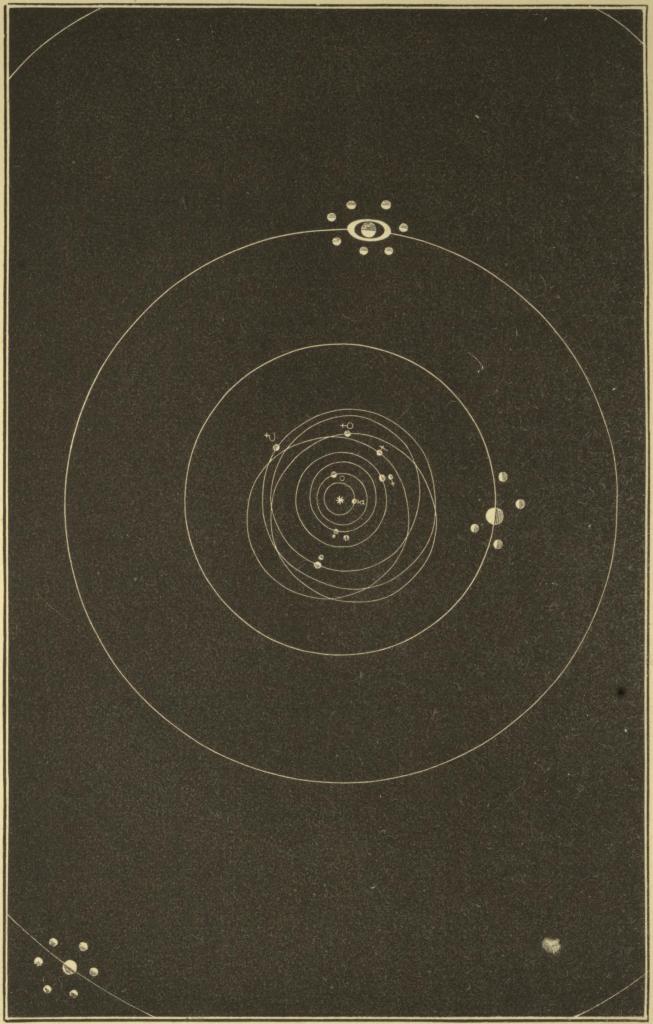 The Solar System.