COME HITHER
COME HITHER
A
COLLECTION
OF RHYMES
AND POEMS
FOR THE
YOUNG OF
ALL AGES
MADE BY
WALTER DE LA MARE
AND EMBELLISHED
BY
ALEC BUCKELS
CONSTABLE & CO
LONDON BOMBAY SYDNEY
MCMXXIII.
PRINTED IN GREAT BRITAIN BY ROBERT MACLEHOSE AND CO. LTD.
THE UNIVERSITY PRESS, GLASGOW
TO
LAURA COLTMAN
IN LOVE AND
GRATITUDE
TABLE OF CONTENTS
| PAGE | |
|---|---|
| The Story of this Book | vii |
| Morning and May | 1 |
| Mother, Home, and Sweetheart | 19 |
| Feasts: Fairs: Beggars: Gipsies | 63 |
| Beasts of the Field: Fowls of the Air | 87 |
| Ouph: Elphin: Fay | 117 |
| Summer: Greenwood: Solitude | 135 |
| War | 165 |
| Dance, Music and Bells | 195 |
| Autumn Leaves: Winter Snow | 217 |
| "Like Stars upon some Gloomy Grove" | 249 |
| Far | 289 |
| "Lily Bright and Shine-a" | 343 |
| "Echo then shall again Tell her I follow" |
371 |
| Old Tales and Balladry | 413 |
| Evening and Dream | 447 |
| The Garden | 479 |
| About and Roundabout | 495 |
| Acknowledgments | 671 |
| Index of Authors | 677 |
| Index of Poems | 683 |
THE STORY OF THIS BOOK
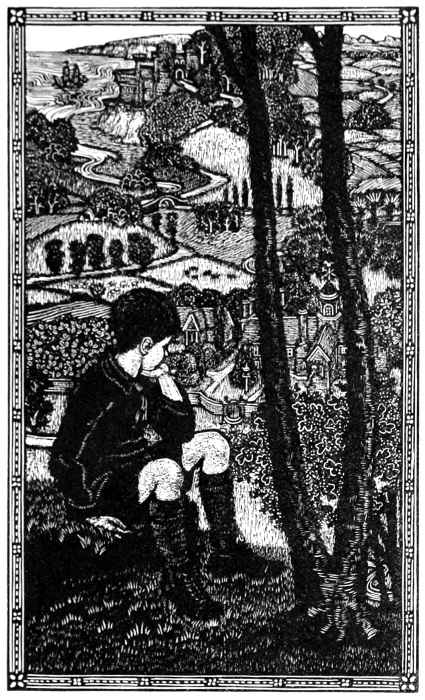
In my rovings and ramblings as a boy I had often skirted the old stone house in the hollow. But my first clear remembrance of it is of a hot summer's day. I had climbed to the crest of a hill till then unknown to me, and stood there, hot and breathless in the bright slippery grass, looking down on its grey walls and chimneys as if out of a dream. And as if out of a dream already familiar to me.
My real intention in setting out from home that morning had been to get to a place called East Dene. My mother had often spoken to me of East Dene—of its trees and waters and green pastures, and the rare birds and flowers to be found there. Ages ago, she had told me, an ancestor of our family had dwelt in this place. But she smiled a little strangely when I asked her to take me there. "All in good time, my dear," she whispered into my ear, "all in very good time! Just follow your small nose." What kind of time, I wondered, was very good time. And follow my nose—how far? Such reflections indeed only made me the more anxious to be gone.
Early that morning, then, I had started out when the dew was still sparkling, and the night mists had but just lifted. But my young legs soon tired of the steep, boulder-strown hills, the chalky ravines, and burning sun, and having, as I say, come into view of the house in the valley, I went no further. Instead, I sat down on the hot turf—the sweet smell of thyme in the air, a few harebells nodding around me—and stared, down and down.
After that first visit, scarcely a week passed but that I found myself on this hill again. The remembrance of the house stayed in my mind; would keep returning to me, like a bird to its nest. Sometimes even in the middle of the night I would wake up and lie unable to sleep again for thinking of it—seeing it in my head; solemn, secret, strange.
There is a little flickering lizard called the Chameleon which, they say, changes its colour according to the place where it happens to be. So with this house. It was never the same for two hours together. I have seen it gathered close up in its hollow in the livid and coppery gloom of storm; crouched like a hare in winter under a mask of snow; dark and silent beneath the changing sparkle of the stars; and like a palace out of an Arabian tale in the milky radiance of the moon. Thrae was the name inscribed on its gateway, but in letters so faint and faded as to be almost illegible.
In a sense I was, I suppose, a trespasser in this Thrae; until at least I became acquainted with Miss Taroone, the lady who lived in it. For I made pretty free with her valley, paddled and fished in its stream, and now and then helped myself to a windfall in her green bird-haunted orchards, where grew a particularly sharp and bright-rinded apple of which I have never heard the name. As custom gave me confidence, I ventured nearer and nearer to the house and would sometimes take a rest squatting on a manger in the big empty barn, looking out into the sunshine. The wings of the flies shone like glass in its shafts of light, and the robins whistled under its timber roof so shrill as almost to deafen one's ears.
Few strangers passed that way. Now and then I saw in the distance what might have been a beggar. To judge from his bundle he must have done pretty well at the house. Once, as I turned out of a little wood of birches, I met a dreadful-faced man in the lane who lifted up his hand at sight of me, and with white glaring eyes, uttered a horrible imprecation. He was chewing some fruit stolen out of the orchard, and at the very sight of him I ran like Wat himself.
Once, too, as my head looked over the hill-crest, there stood an old carriage and a drowsy horse drawn up beside the porch—with its slender wooden pillars and a kind of tray above, on which rambled winter jasmine, tufts of self-sown weeds and Traveller's Joy. I edged near enough to see there was a crown emblazoned on the panel of the carriage door. Nobody sat inside, and the coachman asleep on the box made me feel more solitary and inquisitive than ever.
Yet in its time the old house must have seen plenty of company. Friends of later years have spoken to me of it. Indeed, not far distant from Thrae as the crow flies, there was a crossing of high roads, so that any traveller from elsewhere not in haste could turn aside and examine the place if he cared for its looks and was in need of a night's lodging. Yet I do not think many such travellers—if they were men merely of the Town—can have chosen to lift that knocker or to set ringing that bell. To any one already lost and benighted its looks must have been forbidding.
Well, as I say, again and again, my lessons done, morning or evening would find me either on the grass slopes above Thrae, or actually in its valley. If I was tired, I would watch from a good distance off its small dark windows in their stone embrasures, and up above them the round greenish tower or turret over which a winged weather-vane twirled with the wind. I might watch: but the only person that I ever actually observed at the windows was an old maid with flaps to her cap, who would sometimes shake a duster out into the air as if for a signal to someone up in the hills.
Apart from her, I had occasionally seen Miss Taroone herself in the overgrown garden, with her immense shears, or with her trencher of bread-crumbs and other provender, feeding the birds. And I once stole near enough under a hedge to watch this sight. They hopped and pecked in a multitude beneath her hands, tits and robins, starlings and blackbirds, and other much wilder and rarer birds, as if they had no need here for wings, or were under an enchantment more powerful than that of mere crumbs of bread. The meal done, the platter empty, Miss Taroone would clap her hands, and off they would fly with a skirring of wings, with shrill cries and snatches of song to their haunts.
She seemed to mind no weather; standing bare-headed in heavy rain or scorching sunlight. And I confess the sight of her never failed to alarm me. But I made up my mind always to keep my wits about me and my eyes open; and never to be caught trespassing.
Then one day, as I slid down from the roof of the barn from amid the branches of a chestnut tree, green with its spiky balls of fruit, I found Miss Taroone standing there in the entry, looking out on me as if out of a frame, or like a stone figure in the niche of a church. She made no stir herself, but her eyes did. Clear cold eyes of the colour of pebbly water, in which I seemed to be of no more importance than a boat floating on the sea. I could neither speak nor run away. I could only gawk at her, my pockets bulging with the unripe chestnuts I had pilfered, and a handsome slit in one leg of my breeches.
She asked me what I did there; my name; why I was not at school; where I lived; and did I eat the chestnuts. It appeared she had more often seen me—I suppose from her windows—than I had seen her. She made no movement, never even smiled while I stammered out answers to her questions, but merely kept her eyes steadily fixed on me, while her own lips just opened enough to let the words out of her mouth. She listened to me with a severe face, and said, "Well, if you are happy to be here with the rest, so much the better."
It was a relief when she turned away, bidding me follow her—and a foolish figure I must have cut as I clattered after her across the cobbled yard under the old red-brick arch and so through the porch and into the house.
When I was sat down in one of the shaded rooms within the house, she summoned the tall gaunt old maid with the cap-flaps I had seen at the windows, and bade her bring me some fruit and a dish of cream. Miss Taroone watched me while I ate it. And uncommonly good it was, though I would rather have been enjoying it alone. From the way she looked at me it might have been supposed it was a bird or a small animal that was sitting up at her table. The last spoonful finished, she asked me yet more questions and appeared to be not displeased with my rambling answers, for she invited me to come again and watched me take up my cap and retire.
This was the first time I was ever in Miss Taroone's house—within its solid walls I mean; and what a multitude of rooms, with their coffers and presses and cabinets, containing I knew not what treasures and wonders! But Thrae was not Miss Taroone's only house, for more than once she spoke of another—named Sure Vine, as if of a family mansion and estate, very ancient and magnificent. When, thinking of my mother, I myself ventured a question about East Dene, her green-grey eyes oddly settled on mine a moment, but she made no answer. I noticed this particularly.
Soon I was almost as free and familiar in Miss Taroone's old house as in my own father's. Yet I cannot say that she was ever anything else than curt with me in her manner. It was a long time before I became accustomed to the still, secret way she had of looking at me. I liked best being in her company when she appeared, as was usually so, not to be aware that she was not alone. She had again asked me my name "for a sign" as she said, "to know you by"; though she always afterwards addressed me as Simon. Certainly in those days I was "simple" enough.
My next friend was the woman whom I had seen shaking her duster out of the upper windows. She, I discovered, was called Linnet Sara Queek or Quek or Cuec or Cueque, I don't know how to spell it. She was an exceedingly curious woman and looked as if she had never been any different, though, of course, she must once have been young and have grown up. She was bony, awkward, and angular, and when you spoke to her, she turned on you with a look that was at the same time vacant and piercing. At first she greeted me sourly, but soon became friendlier, and would allow me to sit in her huge kitchen with her parrot, her sleek tabby cat, and perhaps a dainty or two out of her larder.
She was continually muttering—though I could never quite catch what she said; never idle; and though slow and awkward in her movements, she did a vast deal of work. With small short-sighted eyes fixed on her mortar she would stand pounding and pounding; or stewing and seething things in pots—strange-looking roots and fruits and fungi. Her pantry was crammed with pans, jars, bottles, and phials, all labelled in her queer handwriting. An extraordinary place—especially when the sunbeams of evening struck into it from a high window in its white-washed wall.
Linnet she might be called, but her voice was no bird's, unless the crow's; and you would have guessed at once, at sight of her standing in front of the vast open hearth, stooping a little, her long gaunt arms beside her, that her other name was Sara. But she could tell curious and rambling stories (as true as she could make them); and many of them were about the old days in Thrae, older days in Sure Vine, and about Miss Taroone, in whose service she had been since she was a small child.
She told me, too, some specially good tales—as good as Grimm—about some villages she knew of called the Ten Laps; and gave me a custard when I asked for more. I once mentioned East Dene to her, too, and she said there was a short cut to it (though it seemed to me a long way about) through the quarry, by the pits, and that way round. "And then you come to a Wall," she said, staring at me. "And you climb over."
"Did you?" said I, laughing; and at that she was huffed.
Boy though I was, it occurred to me that in this immense house there must be a great deal more work than Sara could manage unaided. Something gave me the fancy that other hands must lend their help; but if any maids actually came in to Thrae from East Dene, or from elsewhere, they must have come and gone very late, or early. It seemed bad manners to be too curious. On the other hand, I rarely saw much of the back parts of the house.
I have sometimes wondered if Thrae had not once in fact lain within the borders of East Dene, and that being so, if Miss Taroone, like myself, was unaware of it. It may have been merely pride that closed her lips, for one day, she showed me, with a curious smile, how Thrae's architect, centuries before, had planned its site. She herself led me from room to room; and she talked as she had never talked before.
Its southernmost window looked on a valley, beyond which on clear still days was visible the sea, and perhaps a brig or a schooner on its surface—placid blue as turquoise. Sheer against its easternmost window the sun mounted to his summer solstice from in between a cleft of the hills—like a large topaz between the forks of a catapult. On one side of this cleft valley was a windmill, its sails lanking up into the sky, and sometimes spinning in the wind with an audible faint clatter. Who owned the mill and what he ground I never heard.
Northwards, through a round bull's-eye window you could see, past a maze of coppices and hills, and in the distance, the cock of a cathedral spire. And to the west stood a wood of yew, its pool partially greened over, grey with willows, and the haunt of rare birds. On the one side of this pool spread exceedingly calm meadows; and on the other, in a hollow, the graveyard lay. The stones and bones in it were all apparently of Miss Taroone's kinsfolk. At least Linnet Sara told me so. Nor was she mournful about it. She seemed to have nobody to care for but her mistress; working for love, whatever her wages might be.
It is an odd thing to say, but though I usually tried to avoid meeting Miss Taroone, and was a little afraid of her, there was a most curious happiness at times in being in her company. She never once asked me about my character, never warned me of anything, never said "You must"; and yet I knew well that if in stupidity or carelessness I did anything in her house which she did not approve of, my punishment would come.
She once told me, "Simon, you have, I see, the beginnings of a bad feverish cold. It is because you were stupid enough yesterday to stand with the sweat on your face talking to me in a draught. It will probably be severe." And so it was.
She never said anything affectionate; she never lost her temper. I never saw her show any pity or meanness or revenge. "Well, Simon," she would say, "Good morning"; or "Good evening" (as the case might be); "you are always welcome. Have a good look about you. Don't waste your time here. Even when all is said, you will not see too much of me and mine. But don't believe everything you may hear in the kitchen. Linnet Sara is a good servant, but still a groper."
Not the least notion of what she meant occurred to me. But I peacocked about for a while as if she had paid me a compliment. An evening or two afterwards, and soon after sunset, I found her sitting in her westward window. Perhaps because rain was coming, the crouching head-stones under the hill looked to be furlongs nearer. "Sleeping, waking; waking, sleeping, Simon;" she said, "sing while you can." Like a little owl I fixed sober eyes on the yew-wood, but again I hadn't any inkling of what she meant.
She would sit patiently listening to me as long as I cared to unbosom myself to her. Her calm, severe, and yet, I think, beautiful face is clear in my memory. It resembles a little the figure in Albrecht Dürer's picture of a woman sitting beneath the wall of a house, with a hound couched beside her, an inclined ladder, the rain-bowed sea in the distance, and a bat—a tablet of magic numbers and a pent-housed bell over her head.
Sometimes I would be questioned at home about my solitary wanderings, but I never mentioned Miss Taroone's name, and spoke of her house a little deceitfully, since I did not confess how much I loved being in it.
One evening—and it was already growing late—Miss Taroone, after steadily gazing into my eyes for a few moments, asked me if I liked pictures. I professed that I did, though I had never spent much time in looking at the queer portraits and charts and mementoes that hung thick and closely on her own walls. "Well," she replied, "if you like pictures I must first tell you about Nahum."
I could not at first make head or tail of Mr. Nahum. Even now I am uncertain whether he was Miss Taroone's brother or her nephew or a cousin many times removed; or whether perhaps she was really and truly Mrs. Taroone and he her only son; or she still Miss Taroone and he an adopted one. I am not sure even whether or not she had much love for him, though she appeared to speak of him with pride. What I do know is that Miss Taroone had nurtured him from his cradle, and had taught him all the knowledge that was not already his by right of birth.
Before he was come even to be my own age, she told me, Nahum Taroone had loved "exploring." As a boy he had ranged over the countryside for miles around. I never dared ask her if he had sat on Linnet Sara's "Wall"! He had scrawled plans and charts and maps, marking on them all his wanderings. And not only the roads, paths, chaces, and tracks, the springs and streams, but the rarer birds' nesting-places and the rarer wild flowers, the eatable or poisonous fruits, trees, animal lairs, withies for whips, clay for modelling, elder shoots for pitch pipes, pebbles for his catapult, flint arrows, and everything of that kind. He was a night-boy too; could guide himself by the stars, was a walking almanac of the moon; and could decoy owls and nightjars, and find any fox's or badger's earth he was after, even in a dense mist.
I came to know Mr. Nahum pretty well—so far at any rate as one can know anybody from hearsay—before Miss Taroone referred to the pictures again. And I became curious about him, and hoped to see this strange traveller, and frequently hung about Thrae in mere chance of that.
Strangely enough, by the looks on her face and the tones of her voice, Miss Taroone was inclined to mock a little at Mr. Nahum because of his restlessness. She didn't seem to approve of his leaving her so much—though she herself had come from Sure Vine. Her keys would jangle at her chatelaine as if they said, "Ours secrets enough." And she would stand listening, and mute, as if in expectation of voices or a footfall. Then as secretly as I could, I would get away.
All old memories resemble a dream. And so too do these of Miss Taroone and Thrae. When I was most busy and happy and engrossed in it, it seemed to be a house which might at any moment vanish before your eyes, showing itself to be but the outer shell or hiding place of an abode still more enchanting.
This sounds nonsensical. But if you have ever sat and watched a Transformation Scene in a pantomime, did you suppose, just before the harlequin slapped with his wand on what looked like a plain brick-and-mortar wall, that it would instantly after dissolve into a radiant coloured scene of trees and fountains and hidden beings—growing lovelier in their own showing as the splendour spread and their haunts were revealed? Well, so at times I used to feel in Thrae.
At last, one late evening in early summer, beckoning me with her finger, Miss Taroone lit a candle in an old brass stick and bade me follow her down a long narrow corridor and up a steep winding stone staircase. "You have heard, Simon, of Mr. Nahum's round room; now you shall see it."
On the wider step at the top, before a squat oak door, she stayed, lifted her candle, and looked at me. "You will remember," she said, "that what I am about to admit you into is Mr. Nahum's room; not mine. You may look at the pictures, you may examine anything that interests you, you may compose yourself to the view. But replace what you look at, have a care in your handling, do nothing out of idle curiosity, and come away when you are tired. Remember that Mr. Nahum may be returning at any hour. He would be pleased to find you here. But hasten away out of his room the very instant you feel you have no right, lot or pleasure to be in it. Hasten away, I mean, so that you may return to it with a better mind and courage."
She laid two fingers on my shoulder, cast another look into my face under her candle, turned the key in the lock, gently thrust me beyond the door, shut it: and left me to my own devices.
What first I noticed, being for awhile a little alarmed at this strange proceeding, was the evening light that poured in on the room from the encircling windows. Below, by walking some little distance from room to room, corridor to corridor, you could get (as I have said) a single narrow view out north, south, east or west. Here, you could stand in the middle, and turning slowly like a top on your heels, could watch float by one after the other, hill and windmill, ocean, distant city, dark yew-wood.
The crooning of doves was audible on the roof, swallows were coursing in the placid and rosy air, the whole world seemed to be turning softly out of the day's sunshine, stretching long dark shadows across hill and valley as if in delight to be on the verge of rest and slumber again, now that the heats of full summer were so near.
But I believe my first thought was—What a boiling hot and glaring place to sit in in the middle of the morning. And then I noticed that heavy curtains hung on either side each rounded window, for shade, concealment and solitude. As soon, however, as my eyes were accustomed to the dazzle, I spent little time upon the great view, but immediately peered about me at what was in this curious chamber.
Never have I seen in any room—and this was none so large—such a hugger-mugger of strange objects—odd-shaped coloured shells, fragments of quartz, thunderbolts and fossils; skins of brilliant birds; outlandish shoes; heads, faces, masks of stone, wood, glass, wax, and metal; pots, images, glass shapes, and what not; lanterns and bells; bits of harness and ornament and weapons. There were, besides, two or three ships of different rigs in glass cases, and one in a green bottle; peculiar tools, little machines; silent clocks, instruments of music, skulls and bones of beasts, frowsy bunches of linen or silk queerly marked, and a mummied cat (I think). And partly concealed, as I twisted my head, there, dangling in an alcove, I caught sight of a full-length skeleton, one hollow eye-hole concealed by a curtain looped to the floor from the ceiling.
I just cast my glance round on all these objects without of course seeing them one by one. The air was clear as water in the evening light, a little dust had fallen; all was in order, though at that first hasty glance there seemed none. Last, but not least, there was row on row of painted pictures. Wherever there was space on the walls free of books, this round tower room was hung with them as close as their frames and nails allowed. There I stood, hearing faintly the birds, conscious of the pouring sunlight, the only live creature amidst this departed traveller's treasures and possessions.
I was so much taken aback by it all, so mystified by Miss Taroone's ways, so cold at sight of the harmless bones above me, and felt so suddenly out of my familiars, that without a moment's hesitation I turned about, flung open the door and went helter skelter clattering down the stairs—out of the glare into the gloom.
There was no sign of Miss Taroone as I crossed through the house and sneaked off hastily through the garden. And not until the barn had shut me out from the lower windows behind me did I look back at the upper ones of Mr. Nahum's tower. Until that moment I did not know how frightened I had been. Yet why, or at what, I cannot even now decide.
But I soon overcame this folly. Miss Taroone made no inquiry how I had fared on this first visit to Mr. Nahum's fortress. As I have said, she seldom asked questions—except with her eyes, expressions, and hands. But some time afterwards, and after two or three spells of exploration, I myself began to talk to her of the strange things up there.
"I have looked at a good many, Miss Taroone. But the pictures! Some of them are of places I believe I know. I wish I could be a traveller and see what the others are of. Did Mr. Nahum paint them all himself?"
Miss Taroone was sitting bolt upright in a high-backed chair, her eyes and face very intent, as always happened when Mr. Nahum's name was mentioned.
"I know very little about them, Simon. When Nahum was younger he used to make pictures of Thrae, and of the woods and valleys hereabouts. There are boxfulls put away. Others are pictures brought back from foreign parts, but many of them, as I believe," she turned her face and looked into a shadowy corner of the room, "are pictures of nothing on earth. He has his two worlds. Take your time. Some day you too, I dare say, will go off on your travels. Remember that, like Nahum, you are as old as the hills which neither spend nor waste time, but dwell in it for ages, as if it were light or sunshine. Some day perhaps Nahum will shake himself free of Thrae altogether. I don't know, myself, Simon. This house is enough for me, and what I remember of Sure Vine, compared with which Thrae is but the smallest of bubbles in a large glass."
I do not profess to have understood one half of what Miss Taroone meant in these remarks. It was in English and yet in a hidden tongue.
But by this time I had grown to be bolder in her company, and pounced on this:—"What, please Miss Taroone, do you mean by the 'two worlds'? Or shall I ask downstairs?" I added the latter question because now and then in the past Miss Taroone had bidden me go down to Linnet Sara for my answers. She now appeared at first not to have heard it.
"Now I must say to you, Simon," she replied at last, folding her hands on her knee, "wherever you may be in that body of yours, you feel you look out of it, do you not?"
I nodded. "Yes, Miss Taroone."
"Now think, then, of Mr. Nahum's round room; where is that?"
"Up there," said I, pointing up a rambling finger.
"Ah!" cried Miss Taroone, "so it may be. But even if to-morrow you are thousands of miles distant from here on the other side of this great Ball, or in its bowels, or flying free—you will still carry a picture of it, will you not? And that will be within you?"
"Yes, in my mind, Miss Taroone?" I answered rather sheepishly.
"In your mind," she echoed me, but not as if she were particularly pleased at the fact. "Well, many of the pictures I take it in Mr. Nahum's round tower are of that world. His MIND. I have never examined them. My duties are elsewhere. Your duty is to keep your senses, heart and courage and to go where you are called. And in black strange places you will at times lose yourself and find yourself, Simon. Now Mr. Nahum is calling. Don't think of me too much. I have great faith in him. Sit up there with him then. Share your eyes with his pictures. And having seen them, compare them if you will. Say, This is this, and that is that. And make of all that he has exactly what use you can."
With this counsel in my head I once more groped my way up the corkscrew stone staircase, and once more passed on from picture to picture; in my engrossment actually knocking my head against the dangling foot-bones of Mr. Nahum's treasured and now unalarming skeleton.
The pictures were of all kinds and sizes—in water colour, in chalks, and in oil. Some I liked for their vivid colours and deep shadows, and some I did not like at all. Nor could I always be sure even what they were intended to represent. Many of them completely perplexed me. A few of them seemed to me to be absurd; some made me stupidly ashamed; and one or two of them terrified me. But I went on examining them when I felt inclined, and a week or so after, as I was lifting out one of them into the sunshine, by chance it twisted on its cord and disclosed its wooden back.
And there, pasted on to it, was a scrap of yellowing paper with the letters Blake, followed by a number—CXLVII, in Roman figures. As with this one, so with the others. Each had its name and a number.
And even as I stood pondering what this might mean, my eyes rested on a lower shelf of one of Mr. Nahum's cases of books—book-cases which I have forgotten to say stood all round the lower part of the room. I had already discovered that many of these books were the writings of travellers in every part of the globe. One whole book-case consisted of what Mr. Nahum appeared to call Kitchen Work. But the one on a lower shelf which had now taken my attention was new to me—an enormous, thick, home-made-looking volume covered in a greenish shagreen or shark-skin.
Scrawled in ungainly capitals on the strip of vellum pasted to the back of this book was its title: Theotherworlde. Would you believe it?—at first I was stupid enough to suppose this title was one word, a word in a strange tongue, which I pronounced to myself as best I could, Theeothaworldie—saying the TH as in thimble. And that is what, merely for old sake's sake, I have continued to call the book in my mind to this day!
I glanced out of the window. The upper boughs of the yew-wood and the stones this side of it among the bright green grasses were impurpled by the reflected sunlight. Nothing there but motionless shadows. I stood looking vacantly out for a moment or two; then stooped and lugged out the ponderous fusty old volume on to the floor and raised its clumsy cover.
To my surprise and pleasure, I found, that attached within was the drawing of a boy of about my own age, but dressed like a traveller, whose face faintly resembled a portrait I had noticed on the walls downstairs, though this child had wings painted to his shoulders and there was a half circle of stars around his head. Beneath this portrait in the book, in small letters, was scrawled in a faded handwriting, Nahum Tarune. This, then, was Mr. Nahum when he was a boy. It pleased me to find that he was no better a speller than myself. He had not even got his own name right! I liked his face. He looked out from under his stars at me, full in the eyes.
Next—after I had searched his looks and clothes and what he carried pretty closely—I turned over a few of the stiff leaves and found more of his writing with a big VII scrawled on the top. On page one of this book you will find the writing. I should have been a stupider boy even than I was if I had not at once turned over the pictures till I came to that with VII on the label on the back of it. This picture was of a Maze outlined in gaudy colours which faded towards the middle—a sort of oasis in which grew a tree. Fabulous-looking animals and creatures with wings sprawled around its margins. After repeated attempts I found to my disappointment that your only way out of the oasis and the maze was, after long groping, by the way you went in. Underneath it was written "This is the key." And above it in green letters stood this:—Behold upon the mountains the feet of him that bringeth good tidings, that publisheth peace!
It was unfortunate that so little more of daylight was now left dying in the sky that evening; for as yet I had not the confidence to kindle the wax candles that stood in their brass sticks in the round tower. It was high time for me to be getting home. In my haste to be off I nearly collided with Miss Taroone, who happened to be standing in the dusklight looking out from under her porch. Too much excited even to beg her pardon, I blurted out: "Miss Taroone, I have found out what the pictures are of. It's a Book. Theeothaworldie. Mr. Nahum's portrait's in it, but they've put wings to him; and it's all in his writing—rhymes."
She looked down at me, though I could not quite see her face.
"Then, good-night to you, Simon; and happy dreams," she said, in her unfriendly voice.
"I like the round room better and better," I replied as heartily as I could. "That picture of Mr. Nahum—and there are lots more, I think—is a little bit like an uncle of mine who died in Russia; my Uncle John."
"John's as good a name, I suppose, as any other, Simon," said Miss Taroone. She stood looking out on the dusky country scene. "There's a heavy dew tonight, and the owls are busy."
They were indeed. Their screechings sounded on all sides of me as I ran off homewards, chanting over to myself the words that had somehow stuck in my memory.
Well, at last I began to read in Mr. Nahum's book—I won't say page by page, but as the fancy took me. It consisted chiefly of rhymes and poems, and some of them had pictured capitals and were decorated in clear bright colours like the pages of the old books illuminated by monks centuries ago. Apart from the poems were here and there pieces of prose. These, I found, always had some bearing on the poems, and, like them, many of them were queerly spelt. Occasionally Mr. Nahum had jotted down his own thoughts in the margin. But the pictures were my first concern.
Sometimes I went off to them from the book in order to find the particular one I wanted. And sometimes the other way round: I would have a good long stare at a picture, then single out the proper rhyme in the book. Often, either in one way or the other, I failed. For there were far fewer pictures than there were pages in the book, and for scores of pages I found no picture at all. It seemed Mr. Nahum had made paintings only of those he liked best.
The book itself, I found, was the first of three, the other two being similar to itself but much thicker and heavier. Into these I dipped occasionally, but found that the rhymes in them interested me less or were less easily understandable. Even some of those in the first book were a little beyond my wits at the time. But experience seems to be like the shining of a bright lantern. It suddenly makes clear in the mind what was already there perhaps, but dim. And often though I immediately liked what I read, long years were to go by before I really understood it, made it my own. There would come a moment, something would happen; and I would say to myself:—"Oh, that, then, is what that meant!"
Before going any further I must confess that I was exceedingly slow over Mr. Nahum's writings. Even over Volume I. When first I opened its pages I had had a poor liking for poetry because of a sort of contempt for it. "Poetry!" I would scoff to myself, and would shut up the covers of any such book with a kind of yawn inside me. Some of it had come my way in lesson books. This I could gabble off like a parrot, and with as much understanding; and I had just begun to grind out a little Latin verse for my father.
But I had never troubled to think about it; to share my Self with it; to examine it in order to see whether or not it was true; or to ask why it was written in this one way and in no other way. But apart from this, there were many old rhymes in Mr. Nahum's book—nursery things—which I had known since I knew anything. And I still have an old childish love for rhymes and jingles like them.
But what about the others? I began to ponder. After being so many hours alone in Mr. Nahum's room, among his secret belongings, I almost felt his presence there. When your mind is sunk in study, it is as if you were in a dream. But you cannot tell where, or in whose company, you may wake out of a dream. I remember one sultry afternoon being startled out of my wits by a sudden clap of thunder. I looked up, to find the whole room black, zigzag, and strange, and for a moment I fancied Mr. Nahum was actually there behind me; and not a friendly Mr. Nahum.
That is mere fancy; though in other ways he became so real to me at last that I would do things as if he had asked me to do them. For this reason, I think, I persevered with his book, swallowing some of the poems as if they were physic, simply because he had written them there. But the more I read, the more I came to enjoy them for their own sakes. Not all of them, of course. But I did see this, that like a carpenter who makes a table, a man who has written a poem has written it like that on purpose.
With this thought in my head I tried one day to alter the words of one or two of the simple and easy poems; or to put the words in a different order. And I found by so doing that you not only altered the sound of the poem, but that even the slightest alteration in the sound a little changed the sense. Either you lost something of the tune and runningness; or the words did not clash right; or you blurred the picture the words gave you; or some half-hidden meaning vanished away. I don't mean that every poem is perfect; but only that when I changed them it was almost always very much for the worse. I was very slow in all this; but, still, I went on. No. III, I remember, was the old nursery jingle, "Old King Cole":—
Now, suppose, instead of these four lines of the rhyme you put:—
By so doing you have actually added two extra fiddlers; and yet somehow you have taken away some of the old three's music. Or you may put:—
'Cole the First was now a monarch advanced in age, and of a convivial temperament. On any festive occasion he would bid his retainers bring him his goblet and smoking materials, and would command his musicians to entertain him on their violins: which they did.'
Well, all the facts are there and many more words, but scarcely a trace of my old King Cole, and not a single tweedle-eedle of the fiddling. Would anyone trouble to learn that by heart?
Now underneath this rhyme Mr. Nahum had written a sort of historical account of King Cole, a good deal of it in German and other languages. All I could make out of it was this: if ever a King Cole inhabited the world, he probably had another name; that he lived too far back in history for anyone to make sure when he had lived or that he had lived at all; and that his "pipe" and "bowl" probably stand for objects much more mysterious and far less common.
Having the rhyme quite free to myself, I didn't mind reading this; but if ever I have to give up either, I shall keep the rhyme.
Having discovered, then, that every poem must have been written as it was written, on purpose, I took a little more pains with those I cared for least. In some even then I could not quite piece out the meaning; in others I could not easily catch the beat and rhythm and tune. But I learned to read them very slowly, so as fully and quietly to fill up the time allowed for each line and to listen to its music, and to see and hear all that the words were saying.
Then, too, what Miss Taroone had said came back to my mind. Even when Mr. Nahum's poems were about real things and places and people, they were still only of places and people the words made for me in my mind. I must, that is, myself imagine all they told. And I found that the mention in a poem even of quite common and familiar things—such as a star, or a buttercup, or a beetle—did not bring into the mind quite the same kind of images of them as the things and creatures themselves do in the naked eye.
This was one of the earliest poems in Mr. Nahum's book. I had often, of course, seen the shadows of evening—every grass-blade or pebble casts its own; but these words not only called them vividly into my mind, but set shadows there (shadows across the sky) that I had never really seen at all—with my own eyes I mean. I discovered afterwards, also, that shadows are only the absence of light, though light is needed to make them visible. Just the same, again, with the sailors in the same poem:
They are plain and common words, but their order here is the poem's only, and the effect they had on me, and still have, is different from the effect of any other words on the same subject. Though, too, like Mr. Nahum, I have now seen something of the world (have been seasick and nearly drowned) I have never forgotten those imaginary sailors, or that imaginary sea; can still hear the waves lapping against that (unmentioned) ship's thin wooden walls, as if I myself were sleeping there, down below.
So what I then read has remained a clear and single remembrance, as if I myself had seen it in a world made different, or in a kind of vision or dream. And I think Mr. Nahum had chosen such poems in Volume I. as carried away the imagination like that; either into the past, or into another mind, or into the all-but-forgotten; at times as if into another world. And this kind has been my choice in this book.
Not that his picture to a particular poem was always the picture I should have made of it. Take for example another nursery jingle in his book:
Mr. Nahum's corresponding picture was not of Babylon or of a candle, or of a traveller at all, but of a stone tomb, On its thick upper slab he had drawn-in an old earthen lamp, with a serpent for handle—its wick alight, and shining up on a small owl perched in the lower branches of the thick tree above.
That is one of the pleasures of reading—you may make any picture out of the words you can and will; and a poem may have as many different meanings as there are different minds.
There I would sit, then, and Mr. Nahum's book made of "one little room an everywhere." And though I was naturally rather stupid and dense, I did in time realise that "rare poems ask rare friends," and that even the simplest ones may have secrets which will need a pretty close searching out.
Of course I could not copy out all of the poems even in Theeothaworldie, Volume I., and I took very few from Volumes II. and III. I chose what I liked best—those that, when I read them, never failed to carry me away, as if on a Magic Carpet, or in Seven League Boots, into a region of their own. When the nightingale sings, other birds, it is said, will sit and listen to him: and I remember very well hearing a nightingale so singing on a spray in a dewy hedge, and there were many small birds perched mute and quiet near. The cock crows at midnight; and for miles around his kinsmen answer. The fowler whistles his decoy for the wild duck to come. So certain rhymes and poems affected my mind when I was young, and continue to do so now that I am old.
To these (and the few bits of prose) which I chose from Mr. Nahum, I added others afterwards, and they are in this book too. All of them are in English; a few from over the ocean: but how very few they all are by comparison with the multitudes even of their own kind. And there are the whole world's languages besides! Even of my own favourites not all have found a place. There was not room enough. I have left out others also that may be found easily elsewhere. I am afraid, too, there may be many mistakes in my copying, though I have tried to be careful.
Miss Taroone knew that I was making use of Mr. Nahum's book; though she never questioned me about it. I came and went in her house at last like a rabbit in a warren, a mouse in a mousery. The hours I spent in those far-gone days in Mr. Nahum's round room! At times I wearied of it, and hated his books, and even wished I had never so much as set eyes on Thrae at all.
But after such sour moments, a gossip and an apple with Linnet Sara in her kitchen, or a scamper home, or a bathe under the hazels in the stream whose source, I believe, is in the hills beyond East Dene, would set me to rights again. For sheer joy of return I could scarcely breathe for a while after remounting the stone staircase, re-entering Mr. Nahum's room, and closing the door behind me.
From above his broad scrawled pages I would lift my eyes to his windows and stare as if out of one dream into another. How strange from across the sky was the gentle scented breeze blowing in on my cheek, softly stirring the dried kingfisher skin that hung from its beam; how near understanding then the tongues of the wild birds; how close the painted scene—as though I were but a picture too, and this my frame.
But there came a day that was to remove me out of the neighbourhood of Miss Taroone's Thrae into a different kind of living altogether. I was to be sent to school. After a hot debate with myself, and why I scarcely know, I asked my father's permission to spend the night at Miss Taroone's. He gave me a steady look and said, Yes.
I found Miss Taroone seated on the steps of her porch, and now that I look back at her then, she curiously reminds me—though she was ages older—of a picture you will find in the second stanza of poem No. 233 in this book. Standing before her—it was already getting towards dark—I said I was come to bid her goodbye; and might I spend the night in Mr. Nahum's round room. She raised her eyes on me, luminous and mysterious as the sky itself, even though in the dusk.
"You may say, goodbye, Simon," she replied; "but unless I myself am much mistaken in you, your feet will not carry you out of all thought of me; and some day they will return to me whether you will or not."
Inside I was already in a flutter at thought of the hours to come, and I was accustomed to her strange speeches, though this struck on my mind more coldly than usual. I made a little jerk forwards; "I must thank you, please Miss Taroone, for having been so kind to me," I gulped in an awkward voice. "And I hope," I added, as she made no answer, "I hope I haven't been much of a bother—coming like this, I mean?"
"None, Simon;" was her sole reply. The hand that I had begun to hold out, went back into my pocket, and feeling extremely uncomfortable I half turned away.
"Why, who knows?—" said the solemn voice, "Mr. Nahum may at this very moment be riding home. Have a candle alight."
"Thank you, Miss Taroone. Thank you very much indeed."
With that I turned about and hastened across the darkening garden into the house. My candlestick and matches stood ready on the old oak bench at the foot of the tower. I lit up, and began to climb the cold steps. My heart in my mouth, I hesitated at the hob-nailed door; but managed at last to turn the key in the lock.
With two taller candles kindled, and its curtains drawn over the western window, I at once began to copy out the last few things I wanted for mine in Volume I. But there were two minds in me as midnight drew on, almost two selves, the one busy with pen and ink, the other stealthily listening to every faintest sound in my eyrie, a swift glance now and then up at the darkened glass only setting me more sharply to work. I had never before sat in so enormous a silence; the scratching of my pen its only tongue.
Steadily burned my candles; no sound of hoofs, no owl-cry, no knocking disturbed my peace; the nightingales had long since journeyed South. What I had hoped for, expected, dreaded in this long vigil, I cannot recall; all that I remember of it is that I began to shiver a little at last, partly because my young nerves were on the stretch, and partly because the small hours grew chill. In the very middle of the night there came to my ear what seemed a distant talking or gabbling. It may have been fancy; it may have been Linnet Sara. What certainly was fancy is the notion that, as I started up out of an instant's drowse, a stooping shape had swiftly withdrawn itself from me. But this was merely the shadow of a dream.
I returned at last from the heavy sleep I had fallen into, my forehead resting on the backs of my hands, and they flat on the huge open volume, my whole body stiff with cold, and the first clear grey of daybreak in the East. And suddenly, as my awakened eyes stared dully about them in that thin light—the old windows, the strange outlandish objects, the clustering pictures, the countless books, my own ugly writing on my paper—an indescribable despair and anxiety—almost terror even—seized upon me at the rushing thought of my own ignorance; of how little I knew, of how unimportant I was. And, again and again, my ignorance. Then I thought of Miss Taroone, of Mr. Nahum, of the life before me, and everything yet to do. And a sullen misery swept up in me at these reflections. And once more I wished from the bottom of my heart that I had never come to this house.
But gradually the light broadened. And with it, confidence began to return. The things around me that had seemed strange and hostile became familiar again. I stood up and stretched myself and, I think, muttered a prayer.
To this day I see the marvellous countryside of that morning with its hills and low thick mists and woodlands stretched like a painted scene beneath the windows—and that finger of light from the risen Sun presently piercing across the dark air, and as if by a miracle causing birds and water to awake and sing and shine.
With a kind of grief that was yet rapture in my mind, I stood looking out over the cold lichen-crusted shingled roof of Thrae—towards the East and towards those far horizons. Yet again the apprehension (that was almost a hope) drew over me that at any moment wall and chimney-shaft might thin softly away, and the Transformation Scene begin. I was but just awake: and so too was the world itself, and ever is. And somewhere—Wall or no Wall—was my mother's East Dene....
In a while I crept softly downstairs, let myself out, and ran off into the morning. Having climbed the hill from which I had first stared down upon Thrae, I stopped for a moment to recover my breath, and looked back. I looked back.
The gilding sun-rays beat low upon the house in the valley. All was still, wondrous, calm. For a moment my heart misgave me at this farewell. The next, in sheer excitement—the cold sweet air, the height, the morning, a few keen beckoning stars—I broke into a kind of Indian war-dance in the thin dewy grass, and then, with a last wave of my hand, like Mr. Nahum himself, I set off at a sharp walk on the journey that has not yet come to an end.
MORNING AND MAY
THIS IS THE KEY — A NEW YEAR CAROL — HEY! NOW THE DAY DAWNS — THE SLUGGARD — HARK, HARK, THE LARK — THE LARK NOW LEAVES HIS WATERY NEST — EARLY MORN — GOOD-MORROW — THE QUESTION — THE FRESH AIR — WEATHERS — GREEN RAIN — SONG ON MAY MORNING — SISTER, AWAKE! — HERE WE COME A-PIPING — AS WE DANCE ROUND — OLD MAY SONG — SONG OF THE MAYERS — AND AS FOR ME — THE SPRING — SPRING, THE SWEET SPRING — A MAY DAY — EASTER — PLEASURE IT IS
MOTHER, HOME AND SWEETHEART
I SING OF A MAIDEN — LULLABY — THE LITTLE BLACK BOY — THE ECHOING GREEN — IF I HAD BUT TWO LITTLE WINGS — I REMEMBER — MIDNIGHT ON THE GREAT WESTERN — THE RUNAWAY — ON EASTNOR KNOLL — "HOME NO MORE HOME TO ME" — DALYAUNCE — CHRISTMAS AT SEA — TWILIGHT — "HOW'S MY BOY?" — CAM' YE BY? — MY BOY TAMMY — ROSY APPLE, LEMON, OR PEAR — IN PRAISE OF ISABEL PENNELL — MY SWEET SWEETING — SWEET STAY-AT-HOME — WAITING — THE SICK CHILD — STILLNESS — LINES ON RECEIVING HIS MOTHER'S PICTURE — THE CHIMNEY SWEEPER — BONNIE GEORGE CAMPBELL — THE ORPHAN'S SONG — THE FIRST GRIEF — THE POPLAR FIELD — FAREWELL — "YE BANKS AND BRAES O' BONNIE DOON" — TO A RIVER IN THE SOUTH — THE DESERTED HOUSE — AN OLD WOMAN OF THE ROADS — A DESERTED HOME — UNDER THE WOODS — "BLOWS THE WIND TO-DAY" — THE TWA BROTHERS — THE DEAD KNIGHT — SHEATH AND KNIFE — I HAVE A YOUNG SISTER — ANNABEL LEE — THE SHELL
[Infans is now called Wanton.]
[Mundus goes out leaving Wanton alone.]
FEASTS : FAIRS : BEGGARS : GIPSIES :
LONDON BRIDGE — HOLY THURSDAY — THE MAYORS — THE FINE OLD ENGLISH GENTLEMAN — BRING US IN GOOD ALE — THE VISION OF MAC CONGLINNE — STOOL-BALL — MILKING PAILS — THE PEDLAR'S SONG — FINE KNACKS FOR LADIES — OH! DEAR! — SLEDBURN FAIR — WIDDECOMBE FAIR — GIPSIES — THE IDLERS — THE WRAGGLE TAGGLE GIPSIES — WHERE DO THE GIPSIES COME FROM? — BEGGARS — "WEEP, WEEP, YE WOODMEN!" — MY HANDSOME GILDEROY
BEASTS OF THE FIELD FOWLS OF THE AIR.
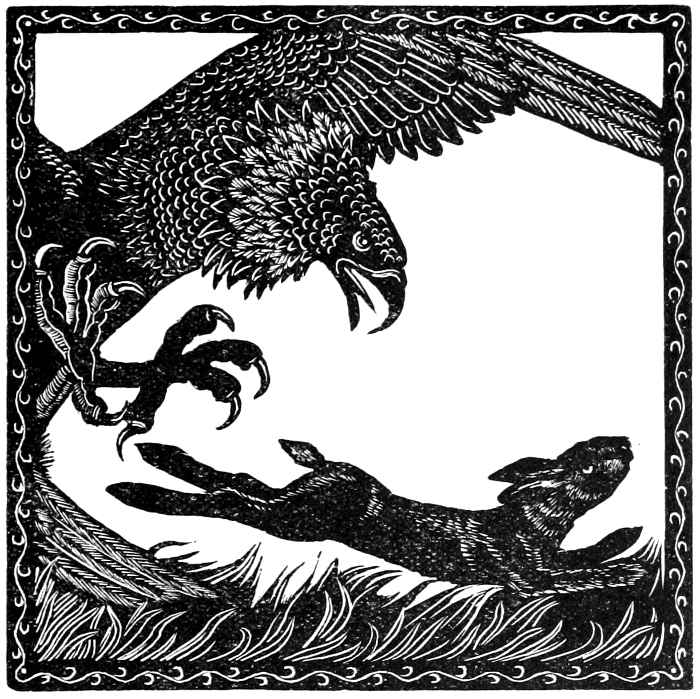
BINGO — THE IRISH HARPER AND HIS DOG — POOR OLD HORSE — AY ME, ALAS, HEIGH HO! — THE FLY — BÊTE HUMAINE — THE LAMB — THE SALE OF THE PET LAMB — A CHILD'S PET — THE SNARE — THE MONK AND HIS PET CAT — THE TYGER — THE NYMPH COMPLAINING FOR THE DEATH OF HER FAWN — OF ALL THE BIRDS — THE DEAD SPARROW — ON A LITTLE BIRD — ADLESTROP — THE REVERIE OF POOR SUSAN — THE THRUSH'S SONG — SWEET SUFFOLK OWL — WHO? WHO? — WHEN CATS RUN HOME — ONCE — THE WATER-OUSEL — L'OISEAU BLEU — I HAD A DOVE — PHILOMEL — A SPARROW-HAWK — THE EAGLE — THE TWA CORBIES — IN THE WILDERNESS — STUPIDITY STREET — COME WARY ONE — UPON THE LARK AND THE FOWLER — THE BIRDS — TWO PEWITS — TO A WATERFOWL — MIDNIGHT
ELPHIN : OUPH : FAY.
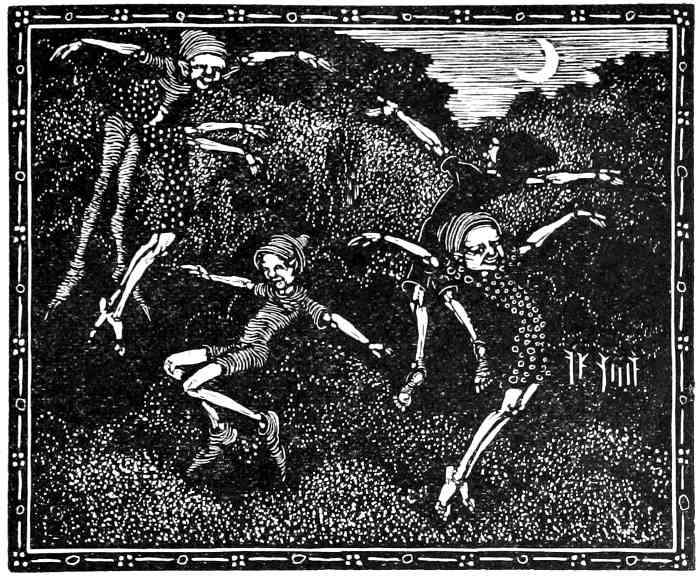
COME UNTO THESE YELLOW SANDS — THE ELVES' DANCE — BY THE MOON — FOR A MOCKING VOICE — WHERE THE BEE SUCKS — ECHO — THE SPLENDOUR FALLS — THE FAIRIES — OVERHEARD ON A SALTMARSH — THE FAIRY THORN — THE QUEEN OF ELFLAND — LA BELLE DAME SANS MERCI — SABRINA — NOW THE HUNGRY LION ROARS — THE FAIRIES FEAST
SUMMER : GREENWOOD SOLITUDE.
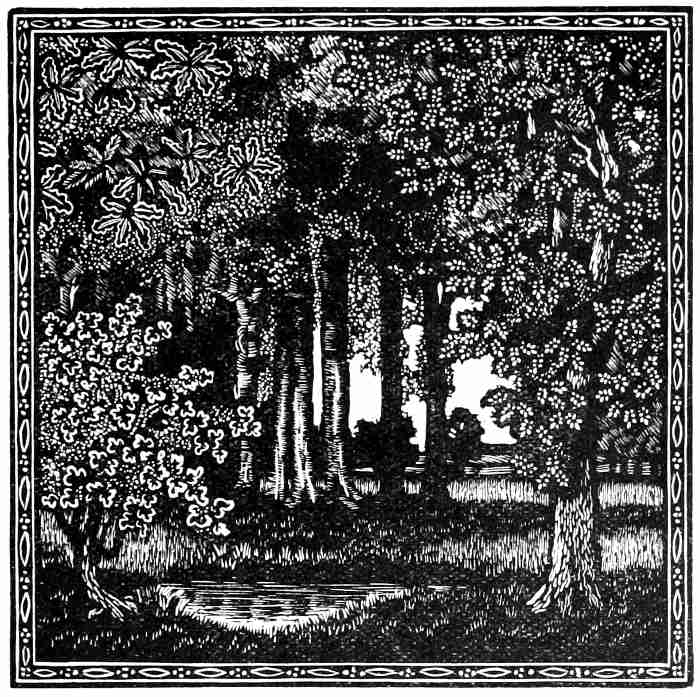
THE HUNT IS UP — THE CHEERFUL HORN — JOHN PEEL — THE SCHOOLBOY — A BOY'S SONG — MARKET DAY — UNDER THE GREENWOOD TREE — IN SUMMER — LUBBER BREEZE — A SUMMER'S DAY — LEISURE — THE HAPPY COUNTRYMAN — "O FOR A BOOKE" — GREEN BROOM — THE TWELVE OXEN — LAVENDER'S BLUE — THE GARDEN — CHERRY-RIPE — CHERRY-RIPE — SONG — THE MYSTERY — THE ROSE — SONG — THE BOWER OF BLISS — SMALL FOUNTAINS — THE INVITATION, TO JANE — THE RECOLLECTION — THE GOAT PATHS — UNDER A WILTSHIRE APPLE TREE — WONDER — SONG — THE BOOK — TETHY'S FESTIVAL
(The "daintie Paradise of the Enchauntresse" whereinto the Palmer brought Sir Guyon.)
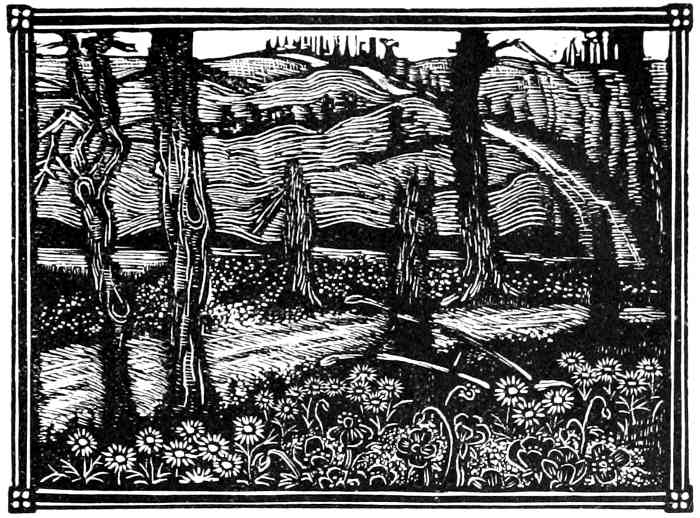
WAR — A WAR SONG TO ENGLISHMEN — FOR SOLDIERS — BATTLE-HYMN OF THE REPUBLIC — "I HEARD A SOLDIER" — THE DUG-OUT — NOCTURNE — THE DEAD — THE END — THE CROWNS — CORONACH [91] — THE CHILDREN'S BELLS — MEN WHO MARCH AWAY — BUDMOUTH DEARS — TRAFALGAR — MESSMATES — SONG FOR ALL SEAS, ALL SHIPS — HOHENLINDEN — HAME, HAME, HAME — DARK ROSALEEN — MY LUVE'S IN GERMANY — A WEARY LOT IS THINE — CHARLIE HE'S MY DARLING — THE FAREWELL — THE FLOWERS OF THE FOREST — "AS I WAS GOING" — OF THE GREAT AND FAMOUS — A LAMENTATION — WHAT IF SOME LITTLE PAIN THE PASSAGE HAVE — HENRY BEFORE AGINCOURT: October 25, 1415 — ALEXANDER THE GREAT — THE MYRTLE BUSH GREW SHADY — THE FORT OF RATHANGAN
Ever to be honoured Knight, Sir Francis Drake, and of my little-little selfe.
DANCE, MUSIC AND BELLS.
A PIPER — THE LITTLE DANCERS — TWO NUT TREES — WHEN THE GREEN WOODS LAUGH — FA LA LA — IT WAS A LOVER — HEY, NONNY NO! — TARANTELLA — "I LOVED A LASS" — GREEN GRASS — THE LINCOLNSHIRE POACHER — THE MEN OF GOTHAM — EARLY MORNING MEADOW SONG — DABBLING IN THE DEW — BONNY LASSIE O! — THE MAD MAID'S SONG — TELL ME WHERE IS FANCIE BRED — MUSIC — THE BELLS OF SHANDON — UPON A RING OF BELLS — THE BELFRY — IL PENSEROSO — CHIMES — CITIES DROWNED — THE BELL-MAN
i
ii
Comparison
AUTUMN LEAVES : WINTER SNOW.
TO MEADOWS — THE COTTAGER TO HER INFANT — TO AUTUMN — THE SOLITARY REAPER — "THE HEAVING ROSES OF THE HEDGE ARE STIRRED" — AUTUMN — "WHEN THAT I WAS AND A LITTLE TINY BOY" — SONG — FALL, LEAVES, FALL — THE SANDS OF DEE — BREAK, BREAK, BREAK — ODE TO THE WEST WIND — THAT WIND — A FROSTY NIGHT — IN A DREAR-NIGHTED DECEMBER — A SONG OF WINTER — COLD BLOWS THE WIND — SKATING — LONDON SNOW — FOR SNOW — VELVET SHOES — LUCY GRAY — GONE WERE BUT THE WINTER COLD — A CHILD'S WINTER EVENING — A CAROL FOR SAINT STEPHEN'S DAY — THE BURNING BABE — THE HOLLY AND THE IVY — WELCOME YULE! — NAY, IVY, NAY — TU-WHIT TO-WHO — BLOW, BLOW, THOU WINTER WIND
A Dirge
I
II
III
IV
V
"LIKE STARS UPON SOME GLOOMY GROVE"
SPRING QUIET — A WIDOW BIRD — ECHO'S LAMENT FOR NARCISSUS — THIS LIFE — SWEET CONTENT — OH, SWEET CONTENT — RARELY, RARELY, COMEST THOU — BIRTHRIGHT — O SORROW! — WHEN THE LAMP IS SHATTERED — ONCE — UPON THE IMAGE OF DEATH — ADIEU! FAREWELL EARTH'S BLISS! — MESSAGES — DOUBTS — HARK — A LYKE-WAKE DIRGE — HE IS THE LONELY GREATNESS — "O SING UNTO MY ROUNDELAY" — FEAR NO MORE — A LAND DIRGE — THE GRAVE OF LOVE — THE BURIAL — ON THE TOMBS IN WESTMINSTER ABBEY — A FUNERALL SONG — ON JOHN DONNE'S BOOK OF POEMS — O, LIFT ONE THOUGHT — ELEGY — UPON A CHILD THAT DIED — THE TURNSTILE — THE EXEQUY — "I FOUND HER OUT THERE" — I NEVER SHALL LOVE THE SNOW AGAIN — THE COMFORTERS — THE CHILDLESS FATHER — "LYDIA IS GONE THIS MANY A YEAR" — REMEMBRANCE — SONG — "WHERE SHALL THE LOVER REST" — REMEMBER — READEN OV A HEAD-STWONE — GOLDEN SLUMBERS — MATER DOLOROSA — WEEP YOU NO MORE — FAERY SONG — THE WORLD OF LIGHT — SILENT IS THE HOUSE — THE MISTRESS OF VISION
(Lamenting Syr Phillip Sidney)
To the Memory of an unfortunate Lady.
FAR
TOM O' BEDLAM — THE NIGHT-PIECE — MY PLAID AWA' — BUCKEE BENE — WHAT'S IN THERE? — THE WEE WEE MAN — I SAW A PEACOCK — GIRAFFE AND TREE — THE WATER LADY — THE SONG OF WANDERING AENGUS — THE WAY THROUGH THE WOODS — THE FALLOW DEER AT THE LONELY HOUSE — DEER — THE TWO SWANS — THE EARL OF MAR'S DAUGHTER — THE BROOMFIELD HILL — THE CHANGELING — THE HOST OF THE AIR — THE LOVE-TALKER — MARIANA — KEITH OF RAVELSTON — UNWELCOME — ON YES TOR — THE WITCHES' SONG — THE RAVEN — THE WITCH'S BALLAD — ANNAN WATER — SONG — DEADMAN'S DIRGE — BOATS AT NIGHT — A VOICE SINGS — THE WANDERING SPECTRE — LUCIFER IN STARLIGHT — THERE WAS A KNIGHT — THE FALSE KNIGHT UPON THE ROAD — CHRISTABEL — THE FRUIT PLUCKER — THE HAUNTED PALACE — THE HOUSE OF RICHESSE — THE OLD CITY — THE TWO SPIRITS
(A Fairy Tale)
neighbouring the gate of Hell into which Mammon led the elfin knight
"LILY BRIGHT AND SHINE-A"
SILLY SWEETHEART — HERE COMES A LUSTY WOOER — THREE KNIGHTS FROM SPAIN — THE WHUMMIL BORE — HEY, WULLY WINE — DOWN IN YONDER MEADOW — QUOTH JOHN TO JOAN — MY MISTRESS IS AS FAIR AS FINE — DIAPHENIA — AEGLAMOUR'S LAMENT — MY TRUE-LOVE HATH MY HEART — A BIRTHDAY — LIFE OF LIFE — A SONNET OF THE MOON — THE OUTLAW OF LOCH LENE — O WHAT IF THE FOWLER — WHITHER AWAY? — BONNY BARBARA ALLAN — PROUD MAISIE — A LEAVE TAKING — THE UNQUIET GRAVE — A LAMENT: 1547 — I DIED TRUE — SONG — IT WAS THE TIME OF ROSES — AULD ROBIN GRAY — THE LAWLANDS O' HOLLAND — THE CHURCHYARD ON THE SANDS — ROSE AYLMER — TO HELEN — "THERE IS A LADY SWEET AND KIND" — "LOVE NOT ME FOR COMELY GRACE" — NOW WOLDE — EGYPT'S MIGHT IS TUMBLED DOWN — DREAM LOVE — AT COMMON DAWN
"Voice in the Air, singing"
"ECHO THEN SHALL AGAIN TELL HER I FOLLOW." — GLYCINE'S SONG — THE CRYSTAL CABINET — THE CHASE — TONY O! — ROMANCE — HALLO MY FANCY — SONNET — ON FIRST LOOKING INTO CHAPMAN'S HOMER — "TO SEA" — BERMUDAS — THE OLD SHIPS — THE RIME OF THE ANCIENT MARINER — THE CHILD AND THE MARINER — THE PARROTS — OZYMANDIAS OF EGYPT — ST. ANTHONY'S TOWNSHIP — SILENCE — KUBLA KHAN — LOST LOVE — ECSTASY — THE SEA OF DEATH — THE FROZEN OCEAN — THE END OF THE WORLD
In Seven Parts
Argument: How a Ship having passed the Line is driven by storms to the cold Country towards the South Pole; and how from thence she made her course to the Tropical Latitude of the great Pacific Ocean; and of the strange things that befell; and in what manner the Ancient Mariner came back to his own Country.
Part I
Part II
Part III
Part IV
Part V
Part VI
Part VII
OLD TALES AND BALLADRY
FLANNAN ISLE — THE GOLDEN VANITY — BROWN ROBYN — ONE FRIDAY MORN — THE SHIP — THE MOON-CHILD — THE MERMAID — QUO' THE TWEED — SIR PATRICK SPENCE — ALLISON GROSS — SIR HUGH, OR, THE JEW'S DAUGHTER — EDWARD — THE LAIRD O' LOGIE — FAIR ANNIE — HELEN OF KIRCONNELL — THE BONNIE BOWER — WEEP NO MORE — THE TWA SISTERS — SWEET WILLIAM AND MAY MARGARET — THE WIFE OF USHER'S WELL
The Lament of the Border Widow
EVENING AND DREAM
DREAM-PEDLARY — THE EVENING SUN — TO THE EVENING STAR — TO DAISIES, NOT TO SHUT SO SOON — OF THE GOING DOWN OF THE SUN — VIRTUE — NIGHT — NURSE'S SONG — THE EVENING PRIMROSE — "TIME, YOU OLD GIPSY MAN" — AFTERWARDS — STEPPING WESTWARD — FOLDING THE FLOCKS — TO THE NIGHT — LIGHT THE LAMPS UP, LAMPLIGHTER! — WILL YOU COME? — COME! — HYMN TO DIANA — THE CLOUDS HAVE LEFT THE SKY — WITH HOW SAD STEPS — IN DISPRAISE OF THE MOON — THE WANING MOON — WE'LL GO NO MORE A-ROVING — SONG OF THE NIGHT AT DAYBREAK — THE NIGHT WILL NEVER STAY — LINES FOR A BED AT KELMSCOTT MANOR — ROCK, BALL, FIDDLE — BEFORE SLEEPING — ON A QUIET CONSCIENCE — SONG — THE EVE OF SAINT MARK — LAID IN MY QUIET BED — AT NIGHT — ECHO — THE SHADOW OF NIGHT — OUT IN THE DARK — NOCTURNE — THE ANGEL — "ANGEL SPIRITS OF SLEEP" — A DREAM — THE LAND OF DREAMS
(For a Lamplighter, a Grandmother, the Angel Gabriel, and Any Number of Others)
THE GARDEN
I KNOW A LITTLE GARDEN-CLOSE — FOLLOW — UP-HILL — LOVE — A ROYAL GUEST — EVE — EVE — ADAM — THE SEVEN VIRGINS — LULLY, LULLAY — BALME — MY MASTER HATH A GARDEN — THIS IS THE KEY
ABOUT AND ROUND ABOUT
ABOUT AND ROUNDABOUT — 1 . " This is the Key. " — 3 . — 4 . " I passed by his Garden. " — 6 . " The Merchant bows " (line 7) — 9 . " Like a Child, Half in Tenderness and Mirth. " — 13 . " Comes dancing from the East. " — 14 . " Us Idle Wenches. " — 17. Old May Song . — 19. — 20 . " Brave Prick-Song " — 21 . " Cuckoo, jug, jug, pu we, to witta woo! " — 22 . " The Jealous Trout. " — " And Birds had drawn their Valentines. " (line 4) — " Joan Strokes a Sillabub or Twain. " — 23 . " The Sun arising. " — 24 . " And Thank Him Then " — 25 . " I Sing of a Maiden. " — 29 . " Sleep Stays Not, Though a Monarch Bids. " (line 11). — 30 . — " Those Flowers made of Light. " (line 12) — 32 . — 35 . — 40 . — 41 . " Rosy Apple, Lemon, or Pear. " — 42 . " In Praise. " — 43 . " Pygsnye " — 44 . " A Worm's Light. " (line 10) — 50 . " But Never Cam' He. " — 51 . " The Orphan. " — 53 . — " The Perishing Pleasures of Man. " (line 18) — 60 . — " A Stoat. " (stanza 5) — 61 . " The Howes of the Silent Vanished Races " — 62 . The Twa Brothers — 64 . — 66 . " Her High-born Kinsman. " — 68 . " London Bridge. " — 70 . "This City." — 71 . "He opened House to All." (line 22) — 72 . " And bring us in Good Ale " — 73 . — 74 . " Pigeon Holes, Stool-ball, Barley-break. " — 75 . " Mary's gone a-milking. " — 76 . " Cypresse black as ere was Crow. " — 78 . Fairing. (line 5) — 80 . " Widdecombe Fair. " — 83 . " There were Three Gipsies " — 84 . " Whatever they find they take it. " (line 21) — 86 . — 87 . " Gilderoy. " — 88 . " And his name was Little Bingo. " — 90 . " Poor old Horse. " — 91 . " Ay me, Alas. " — 92 . " O Happy Fly. " — 93 . " Lo, the Bright Air Alive With Dragonflies. " — 95 . " The Sale of the Pet Lamb. " — 98 . — 99 . " On What Wings Dare He Aspire. " — 100 . — 101 -2. — 102 . " He Would Chirp. " — " Loving Redbreasts. " (line 31) — 105 . "' Tis a Note of Enchantment. " — 107 . " Like a Lady Bright. " — 109 . " The White Owl. " — 111 . " Her small Soul. " (line 23) — 112 . " It caught His Image " — 114 . " King Pandion he is dead. " — 115 . " A Sparhawk Proud " — 120 . " Come Wary One. " — 126 . " Come unto these Yellow Sands. " — 128 . " Shee carries Me above the Skie. " — 129 . "Who Calls? " — 133 . " For Fear of Little Men. " — 135 . — " No Rowan in her Hair. " — 136 . " True Thomas. " — 138 . " Sabrina. " — 139 . — " I am sent with Broome before. " — 140 . " Awm. 'Who feasts tonight?' " — " All in Their Watchet Cloaks. " (line 15) — 141 . A Hunt's-up — 143 . " With his Coat so gray. " — " D'ye ken that a Fox with his last Breath cursed them all as he died in the Morning. " — 148 . " A Fulle Fayre Tyme. " — 149 . " Lubber Breeze. " — 150 . " The Ample Heaven. " — " The Time sa Tranquil is and Still. " (line 13) — 153 . " O for a Booke. " — 155 . " With Hey! with How! with Hoy. " — 156 . " Lavender's blue ." — 159 . " There is a Garden in her Face. " — 160 . " What is there hid in the Heart of a Rose? " — 163 . " These Flowers, as in their causes, sleep. " (line 4) — " The Phoenix builds her Spicy Nest. " (line 18) — 164 . " The Bower of Bliss. " — 170 . — 172 . " But silly we. " (line 9) — 175 . " For Soldiers " — " Ye Buds of Brutus Land " — " Soldiers are Prest " (stanza I) — " Your Queen. " — 176 . " The Battle-Hymn. " — 177 . — 180 . — 184 . — 185 . " We be the King's Men. " — 186 . Budmouth Dears — 187 . " Trafalgar " — 189 . " Brave Sailors. " — 192 . " Dark Rosaleen. " — 197 . — 199 . — 200 . " For Hally Now is Dead. " — 202 . " Henry Before Agincourt. " — 203 . " Alexander the Great. " — 205 . " And the Kings Asleep. " — 207 . " Dance Sedately " — 209 . — 210 . Fa la La. — 211 . " The Onely Pretty Ring Time. " — 212 . — 213 . " And the Fleas That Tease in the High Pyrenees. " — 214 . " I Loved a Lass. " — 218 . " And St. John's Bell Rings for Matins. " — 219 . " O It's Dabbling in the Dew Makes the Milkmaids Fair! " — 223 . " Music, When Soft Voices Die, Vibrates in The Memory. " — 224 . " A Bell in Moscow. " (stanza 4) — 225 . — 232 . — 233 . " To Autumn. " — 237 . " A Foolish Thing. " — " Our Play is done " — 245 . " Ah! would 'twere so. " — 246 . " No Crane talks. " (line 16) — 249 . — 251 — 253 . " The Wild Woods. " — 255 . — 257 . — 258 . " Welcome Twelfth Day " — 259 . — 260 . " When Isicles hang by the Wall. " — 264 . " Woe weeps out Her Division when She sings. " — 265 . " Is like a Bubble. " — 266 . " O, Sweet Content. " — " Art Thou poor ... Art Thou rich. " — 269 . " Lord Rameses of Egypt sighed. " — 272 . " These Strong and Fair.... " — 273 . — 274 . " Adieu! farewell Earth's Bliss. " — 275 . " I who loved with all my life Love with all my death. " — Who's at my Window? — The Call. — 277 . " Hark! now everything is still. " — " 'Tis now full tide 'tween Night and Day. " (line 17) — 278 . — 279 . — 281 . " Fear no more. " — 284 . " All the Flowers. " — 285 . — 286 . " Sidney, O Sidney is dead. " — 287 . " His Picture in a Sheet. " — " Living to Eternity. " — 288 . " Do Thou the same. " — 290 . " A pretty Bud. " — 291 . " A-left asleep. " — 293 . " Sunk Lyonesse. " — 299 . " Sing no sad Songs for Me. " — 302 . " Readen ov a Head-Stwone. " — 303 . " Care is heavy. " — 304 . " Mother, never mourn. " — 310 . Tom o' Bedlam. — 314 . " What's in there. " — 316 . — 319 . " It Had Become a Glimmering Girl. " — 321 . " One Without. " — 325 . " Broome, Broome on Hill ." — 326 . " The Changeling. " — 329 . " Mariana. " — 332 . " Yes Tor. " — 333 . " To heare the Mandrake grone. " (stanza 2) — " Hemlock, Henbane, Adders-tongue. " (line 10) — 334 . " The Raven. " — 335 . " A thousand darling Imps. " (stanza 19) — " Bell and Whip and Horse's Tail " (stanza 22) — 336 . " The Water Kelpy " (stanza 8) — 341 . " The Wandering Spectre. " — 343 . " And Clootie's waur nor a Woman was. " (stanza 19) — Meet-on-the-road . — Answers. — 344 . " The Fause Knicht. " — The Strange Visitor. — 345 . " Christabel. " — " A Toothless Mastiff Bitch. " — 347 . " Once a fair and stately Palace. " — 350 . " Sweet Whispers are heard by the Traveller. " (stanza 6) — 352 . " My a Dildin. " — 352a. " We are come to court. " — 355 . " And feed Her wi' new Milk and Bread. " — 357 . Quoth John to Joan. — 358 . Milk-White Fingers, Cherry Nose. — 359 . " Or the Bees their careful King. " — 360 . " And here, and here. " — 362 . " My Heart is gladder than all these. " — 363 . — 364 . " A Sonnet of the Moon. " — " The Pale Queen. " — 368 . " It was in and about the Martinmas time. " — 371 . " I Never Had but One True Love, in Cold Grave She was Lain. " — 372 . " A Lament. " — 380 . To Helen. — 381 . " There is a Lady. " — " Till I die. " — 383 . " It is not so. " — 385 . — 387 . — 389 . — 391 . " Chimborazo, Cotopaxi. " — 392 . " Hallo my fancy. " — 393 . " Columbus's doom-burdened caravels. " (line 13) — 395 . " To Sea, to Sea. " — " Caved Tritons' azure Day " (line 12) — 396 . " Jewels more rich than Ormus shows. " (line 20) — " Apples " (line 23) — 397 . " That talkative bald-headed Seaman came. " (line 23) — 398 . — 399 . " He Told of Waves. " (line 28) — 400 . " Parrots of Shrilly Green " — 402 . " The March of Time. " (line 2) — 403 . " The Wild Hyaena. " (line 11) — 404 . " In Xanadu Did Kubla Khan. " — " A Sunless Sea. " — 406 . " One held a Shell unto his Shell-like Ear. " (line 6) — 407 . " Like Solemn Apparitions Lulled Sublime To Everlasting Rest. " (line 11) — 411 . " The Golden Vanity. " — 412 . — 415 . " A Seal My Father Was. " — 418 . " Sir Patrick Spence. " — " Late, Late Yestreen. " (stanza 7) — 419 . " Allison Gross. " — 420 . " Sir Hugh. " — 421 . " Edward. " — 422 . " I will sing. " — 423 . " Fair Annie. " — 425 . " But think na' ye my Heart was sair? " (line 21) — 427 . The Twa Sisters. — 428 . " Sweet William and May Margaret. " — 429 . " That birk Grew fair eneugh. " (stanza 6) — 433 . " A spangle here. " — 434 . — 437 . — 440 . " Afterwards. " — 441 . " With such a Sky. " — 442 . " Shepherds all, and Maidens fair, Fold your Flocks. " — 444 . " The children are going to bed. " — 449 . " That busy Archer. " (line 4) — " Are Beauties there as proud as here they be. " (line 11) — 450 . " She hath no Air. " (line 5) — 455 . " Right good is rest. " — 457 . Before Sleeping. — 459 . — 460 . The Legend of St. Mark. — " Doves of Siam, Lima mice, And legless birds of Paradise. " (p. 470.) — " At Venice ...." (p. 471) — 466 . " Low in the South the 'cross'. " — 469 . " Once a Dream did weave a Shade. " — 470 . " Awake, Awake! " — 473 . " Does the Road wind Up-hill all the Way. " — 477 . — " Death is the Fruit. " — " The kind Hart's Tears were falling. " (stanza 7) — 483 . " This is the Key. "
In Mr. Nahum's The Other Worlde, as I have said on page xxx, there were many passages written about and roundabout the poems contained in it. Some of these I copied out. With others that I have added since, they appear in the following pages. If the reader prefer poems and poems only in such a collection as this, would he of his kindness and courtesy ignore everything else? Otherwise, will he please forgive any blunders he may discover?
This jingle (like Nos. 15, 16 and others) is one of hundreds of nursery and dandling rhymes which I found in Mr. Nahum's book. Compared with more formal poems they are like wild flowers—pimpernel, eyebright, thyme, woodruff, and others even tinier, even quieter, but having their own private and complete little beauty if looked at closely. Who made them, how old they are; nobody knows. But when Noah's Ark stranded on the slopes of Mount Ararat, maybe a blossoming weed or two was nodding at the open third-storey window out of which over the waters of the flood the dove had followed the raven, and there, rejoicing in the sunshine and the green, sat Japheth's wife dandling little Magog on her lap, and crooning him some such lullaby.
On the one side is printed the old Scots, and on the other the best I can do to put it into the English of our own time. According to the dictionary the thistle-cock that cries shame on the sleepers still drowsing in their beds is the corn-bunting— a cousin of the yellow-hammer. He has a small harsh monotonous voice as if for the very purpose. Whereas the nightingale might seem to cry, "Nay, nay: it is in dreams you wander. Happy ones! Sleep on; sleep on."
Whatever fate befell the Sluggard, I should like to have taken a walk in his garden, among those branching thistles, green thorns and briers. Maybe he sailed off at last to the Isle of Nightmare, or to the land where it is always afternoon, or was wrecked in Yawning Gap. He must, at any rate, have had an even heavier head than Dr. Watts supposed if he never so much as lifted it from his pillow to brood awhile on that still, verdurous scene. And the birds!
Indeed, to lie, between sleep and wake, when daybreak is brightening of an April or a May morning, and so listen to the far-away singing of a thrush or to the whistling of a robin or a wren is to seem to be transported back into the garden of Eden. Dreamers, too, may call themselves travellers.
Mr. Nahum's picture to this rhyme was of a man in rags looking into a small round mirror or looking-glass, but at what you couldn't see.
—(as do the happy to the New Moon, for luck), for his merchandise is being wafted over the sea under the guidance of the Seaman's, or Ship, or Lode, or Pole Star. It shines in the constellation of the Little Bear, and "is the cheefe marke whereby mariners governe their course in saylings by nyghte." To find the "marke," look towards the north some cloudless night for the constellation of Seven Stars called the Plough or the Dipper or Charles's Wain (or Waggon), which "enclyneth his ravisshinge courses abouten the soverein heighte of the worlde" day and night throughout the year. Its hinder stars (Dubhe and Merak) are named "the pointers," because if you follow the line of them with the eye into the empty skies, the next brightish star it will alight on is the Seaman's Star. Close beside the second of the seven is a mere speck of a star. And that is called by country people Jack-by-the-middle-horse. On this same star looked Shakespeare—as did the 1st Carrier in his Henry IV.: "Heigh-ho, an't be not foure by the day, He be hanged. Charles' waine is over the near Chimney, and yet our horse not packt"; and as did his 2nd Gentleman in Othello:
Faintly shimmering, too, in the northern heavens is that other numerous starry cluster, known the world over as Seven—to us as the Seven Sisters or the Pleiades. A strange seven; for only six stars are now clearly visible to the naked eye, one having vanished, it would seem, within human memory. When? where?—none can tell. They play in light as close together as dewdrops in a cobweb hung from thorn to thorn. Nearby, on winter's cold breast burns the most marvellous of the constellations—the huntsman Orion, with his Rigel and Bellatrix and Betelgeuse; his dog Sirius at his heels. "Seek him that maketh the Seven Stars and Orion, and turneth the shadow of death into the morning, and maketh the day dark with night...."
At a first reading, perhaps, this line will not appear to flow so smoothly as the rest. But linger an instant on the word child, and you will have revealed to yourself one of Shelley's, and indeed one of every poet's loveliest devices with words—to let the music of his verse accord with its meaning, and at the same time to please and charm the ear with a slight variation from the regular beat and accent of the metre. So, too, in the middle lines of the next stanza. This variation, which is called rhythm, is the very proof of its writer's sincerity. For if the sound of his verse (or of his voice) rings false, he cannot have completely realised what he was writing or saying. When a man says what he means, he says it as if he meant it. The tune of what he says sounds right. When a man does not mean what he says, he finds it all but impossible to say it as if he did. The tune goes wrong.
Just so with reading. So from a gay and tiny Compendious English Grammar of 1780 I have borrowed these four brief wholesome rules for reading:
(1) ... Observe well the pauses, accents and emphases; and never stop but where the sense will admit of it.
(2) Humour your voice a little, according to the subject....
(3) Do not read too fast, lest [in lip or mind] you get a habit of stammering; adding or omitting words; and be sure that your understanding keep pace with your tongue.
(4) In reading Verse, pronounce every word just as if it were prose, observing the stops with great exactness, and giving each word its proper accent; and if it be not harmonious, the Poet, and not the Reader, is to blame."
Better, perhaps, be sure of your ear before you blame the poet. But in general, if these rules are followed, there can be little danger of reading like a parrot, or like a small boy in his first breeches at a Dame's school. To think while one reads; that is the main thing: so as not to be, as Sidney says,—just
I found a story about this dancing in Mrs. Wright's Rustic Speech and Folklore. It is the story of a woman who lived in a district called Hockley, in the parish of Broseley. She said that she had heard of such "dancing" but did not believe it to be true, "till on Easter morning last, I got up early, and then I saw the sun dance, and dance, and dance, three times, and I called to my husband and said, 'Rowland, Rowland, get up and see the sun dance!' I used," she said, "not to believe it, but now I can never doubt more." The neighbours agreed with her that the sun did dance on Easter morning, and that some of them had seen it. "Seeing," goes the old proverb, "is believing"—which is true no less of the "inward eye." I once tried to comfort a very little boy who was unhappy because there was a Bear under his bed. Candle in hand, I talked and talked, and proved that there wasn't a real bear for miles and miles around, not at any rate until we reached the Zoo, and there—black, brown, sloth, spectacled, grizzly and polar alike—all of them, poor creatures, were cabined, cribbed and shut up in barred cages. He listened, tears still shining in his eyes, his small face sharp and clear. "Why certainly, certainly not," I ended, "there can't be a real bear for miles around!" He smiled as if pitying me. "Ah yes, Daddie," he answered with a die-away sob, "but, you see, you's talking of real bears, and mine wasn't real."
This, like No. 2, and the next song must be as old as the dew-ponds on the Downs. They were wont to be sung, I have read, by five or six men, with a fiddle, or flute, or clarionet accompaniment. When I was a boy I can remember one First of May seeing a Jack-in-the-Green in the street—a man in a kind of wicker cage hung about with flowers and leaves—with Maid Marian. Friar Tuck and the rest, dancing and singing beside him. A great friend of mine, when she was a little girl of eight, was so frightened at sight of this leafy prancing creature on her way to school that she turned about and ran for a mile without stopping.
There is far too little of Geoffrey Chaucer's—that most lovable, shrewd, compassionate, and natural of poets—in this book. There was much more of him, I noticed, in Mr. Nahum's Tome II. At first sight his words look a little strange; but not for long; and if every dotted letter is made a syllable of, his rhythm will flow like water over bright green waterweed.
It is a curious, though little thing, that while, among the one hundred and seventy varieties of flowers Shakespeare mentions, he has no less than fifty-seven several references to the rose, twenty-one to the green grass, eighteen to violets, and even to the serviceable but rank nettle a round dozen, he has but a scant five to Chaucer's beloved daisy. Flowers, it is true, as says Canon Ellacombe (who collected all such references into his delight-full book, Plant-lore and Garden-craft of Shakespeare), never sweeten the Plays for their own sake alone, and there are no foxgloves, snowdrops or forget-me-nots in them at all. Still, had he loved daisies as children do, he could hardly have resisted them even for "their own sake alone." Is not bairnwort another name for the daisy?
"A yellow cup, it hath," says Pliny, "and the same is crowned, as it were with a garland, consisting of five and fifty little leaves, set round about it in manner of fine pales. These be flowers of the meadow, and most of such are of no use at all." No use at all, none—except only to make skylark of every heart whose owner has eyes in his head for a daisy's simple looks, its marvellous making, and the sheer happiness of their multitudes wide open in the sun or round-headed and adrowse in the evening twilight.
Chaucer's picture portrait is well known. So is that in his own words in the Canterbury Tales. But here is another, less familiar, by Robert Greene—of "Sir Jeffery Chaucer," as he calls him. Water chamlet is a rich coloured silken plush, and a whittell is a knife:
—which means, I gather, that while the nightingale was—even into the dusk of dawn—yet singing her "air" or "descant," the lark joined in as if reading her notes from the daybreak stars pricking the sky.
Four birds, I suppose, have part in this: cuckoo, nightingale (yoog, yoog), green-finch (?) and owl.
So advises Master Will. Lauson in the Secrets of Angling, which was published in 1653; the ingredients (or ingrediments as I used to say when I was a child) of his "gum of life" being Cocculus Juliæ, Assafoetida, Honey, and Wheat-flour. The "that which kills the oak," I suppose, is ivy. But it looks as if there may have been a wink in his eye—to welcome the green in his reader's.
Here, on the same theme, are a few lines from a poem by Mr. Robert Bridges:
And these are by J. Wolcot:
A less common and more skilful sport than fly, hook and bait, or even "tickling" can afford is to share their watery chaos with the fish, and catch them with the hands. This needs rare skill and cunning and—a disguise! "For dyeing of your hairs," says Isaac Walton in The Compleat Angler, "do it thus: Take a pint of strong ale, half a pound of soot, and a little quantity of the juice of walnut-tree leaves, and an equal quantity of alum; put these together, into a pot, pan, or pipkin, and boil them half an hour; and having so done, let it cool; and being cold, put your hair into it, and there let it lie; it will turn your hair to be a kind of water or glass-colour or greenish; and the longer you let it lie, the deeper coloured it will be. You might be taught to make many other colours, but it is to little purpose; for doubtless the water-colour or glass-coloured hair is the most choice and the most useful for an angler, but let it not be too green."
First thing in the early morning, if you go out on St. Valentine's Day, which is the 14th day of February, you will meet, if you meet anybody, your soon-to-be-loved one. So too the birds. In my young days, folks sent the daintiest pictures to their sweethearts on this day. Mr. Nahum had a drawer half full of them—with a few locks of hair and some withered flowers. And one or two of these Valentines were of beaten gold, with images of lovely things upon them, as if from another planet.
"This morning came up to my wife's bedside, I being up dressing myself, little Will Mercer to be her Valentine; and brought her name writ upon blue paper in gold letters, done by himself, very pretty...." Mr. Samuel Pepys's Diary.
If you would make a Lemon Sillabub (as advised by Mrs. Charlotte Mason, "a Professed Housekeeper, who from about 1740 had upwards of Thirty Years experience in Families of the First Fashion") take "a Pint of cream, a pint of white wine, the rind of two lemons grated, and the juice. Sugar to the taste. Let it stand some time; mill or whip it. Lay the froth on a sieve; put the remainder into glasses. Lay on the froth." Mr. Nahum must have had a fancy for Cookery Books; there were dozens of them in his tower room. Indeed, the next best thing to eating a good dish is to read how it is made; and somehow the old "cookbook" writers learned to write a most excellent and appetising English. Here is another recipe from Delightes for Ladies, of 1608—a dainty that would eat uncommonly well with a sillabub:—"To make a marchpane.—Take two poundes of almonds being blanched, and dryed in a sieve over the fire, beate them in a stone mortar, and when they bee small mixe them with two pounde of sugar beeing finely beaten, adding two or three spoonefuls of rosewater, and that will keep your almonds from oiling: when your paste is beaten fine, drive it thin with a rowling pin, and so lay it on a bottom of wafers, then raise up a little edge on the side, and so bake it, then yce it with rosewater and sugar, then put it in the oven again, and when you see your yce is risen up and drie, then take it out of the oven and garnish it with pretie conceipts, as birdes and beasts being cast out of standing moldes. Sticke long comfits upright in it, cast biskets and carrowaies in it, and so serve it; guild it before you serve it: you may also print of this marchpane paste in your molds for banqueting dishes. And of this paste our comfit makers at this day make their letters, knots, armes, escutcheons, beasts, birds, and other fancies." Also pygmy castles and suchlike, for dessert, which the guests would demolish with sugar-plums.
"Good thou, save mee a piece of Marchpane, and as thou lovest me, let the Porter let in Susan Grindstone and Nell...."
Romeo and Juliet
"What other fire could be a better image of the fire which is there, than the fire which is here? Or what other earth than this, of the earth which is there?" So said Plotinus, and "I know," said Blake, "that this world is a world of imagination and vision. I see everything I paint in this world, but everybody does not see alike. To the eye of a miser a guinea is far more beautiful than the sun, and a bag worn with the use of money has more beautiful proportions than a vine filled with grapes. The tree which moves some to tears of joy is in the eyes of others only a green thing which stands in the way.... Some scarce see Nature at all. But to the eyes of the man of imagination, Nature is Imagination itself. As a man is, so he sees. As the eye is formed, such are its powers. You certainly mistake, when you say that the visions of fancy are not to be found in this world. To me this world is all one continued vision." ... Indeed, when Blake was a child, he saw on Peckham Rye a tree, full, not of birds, but of angels; and his poems show how marvellously clear were the eyes with which he looked at the things of Nature.
In the year 1872, an old lady might have been seen driving across the Rye in her silvery carriage; and she came to where, under a flowering tree, sat a small boy—the locks of hair upon his head like sheaves of cowslips, his eyes like speedwells, and he in very bright clothes. And he was a-laughing up into the tree. She stopped her carriage and said to him almost as if she were more angry than happy, "What are you laughing at, child?" And he said, "At the sparrows, ma'am." "Mere sparrows!" says she, "but why?" "Because they were saying," says he, "here comes across the Rye a blind old horse, a blind old coachman, and a blind old woman." "But I am not blind," says she. "Nor are they not 'mere sparrows'," said the child. And at that the old lady was looking out of her carriage at no child, but at a small bush, in bud, of gorse.
—as does Robert Herrick's child, in his "Grace":
A paddock is a frog or a toad, it seems. To either small cold hand there are four cold fingers and a thumb; and in old times, says Halliwell, our ancestors had distinct names for each of the five toes and for each of the five fingers. The fingers were called thumb, toucher, longman, leche-man, little-man: leche-man being the ring-finger, because in that "there is a sinew very tender and small that reaches to the heart." In Essex they used to call them (and still may)—Tom Thumbkin, Bess Bumpkin, Long Linkin, Bill Wilkin, and Little Dick. In Scotland: Thumbkin, Lickpot, Langman, Berrybarn and Pirlie Winkie.
And here are some more from Dr. Courtenay Dunn's Natural History of the Child—a book which is graced with as handsome a frontispiece as ever I've seen:
| Thumb | - Tommy Tomkins | or Bill Milker. |
| Forefinger | - Billy Wilkins | " Tom Thumper. |
| Third finger | - Long Larum | " Long lazy. |
| Fourth finger | - Betsy Bedlam | " Cherry Bumper. |
| Little finger | - Little Bob | " Tippity, Tippity-Town-end. |
Toes:
| Big toe | - Tom Barker | or Toe Tipe. |
| Toe 2 | - Long Rachel | " Penny Wipe. |
| Toe 3 | - Minnie Wilkin | " Tommy Tistle. |
| Toe 4 | - Milly Larkin | " Billy Whistle. |
| Little toe | - Little Dick | " Tripping-go. |
So (if you wish) you can secretly name not only your fingers, toes, rooms, chairs and tables, etc., but also the stars in their courses, the trees in your orchard, and have your own privy countersign for the flowers you like best. "Give a dog a bad name, and hang him," says the old proverb. Give anything a good name, and it is yours for ever. There is the tale of the unhappy gardener in the Isle of Rumm who without ill intention called a snapdragon an antirrhinum. And there arose out of the hillside a Monster named Zobj—but I haven't the space for the rest. The gardener of course meant well; but when he heard the Voice counting his last moments, not in common English, but in what Wensleydale Knitters still remember of the Norse—Yahn, Jyahn, Tether, Mether, Mumph, Hither, Lither, Auver, Dauver, Die—well, he died before he was due, so to speak.
While we are on this subject, here is a Face Rhyme:
This is another:
The next three are foot rhymes, very soothing at times to fractious babies. The first is common in London, etc.:
The second comes from the Isle of Wight:
And this is from Scotland:
And last; here is a dance-babbie-on-knee (or This-is-the-way) rhyme; also from Scotland:
And no doubt came to the conclusion expressed in the sixth stanza of Robert Herrick's Ternary of Littles, upon a Pipkin of Jelly sent to a Lady:
And the fact that this or any other poem is printed at this end of the book instead of at the other does not mean that I am any the less thankful to have it or that Mr. Nahum left it out of his.
Only the spelling of this lovely and ancient little carol has been slightly changed.
For many years I read this poem as if the accents in the first line of each stanza fell on the first and third word—the two "I's." It was stupid of me, for clearly the accent should fall (lightly) on the second syllable of the "remembers." Apart from the accents or stresses in a line of verse, there is the rise and fall of the voice, a kind of tune in the saying of it. If the right tune is not caught, then the difference is as much as if one sniffed a wallflower and it smelt like African mimosa. And to me, as to hundreds of thousands of Englishmen, this poem is as familiar, long-endeared and refreshing as wallflower, Sweet William, or Old Man. This is the second or third time I have made remarks about the rhythm, lilt or tune of a poem; and it won't be the last. May I be forgiven, for as Chaucer wrote to his small son Louis when he was sharing with him his love of astronomy: "Soothly me seemeth betre to writen unto a child twice a good sentence, then he forget it ones." As for his elders, even thrice may be short commons.
Hold up a flower between eye and sun, or even candle-flame, and it seems little but its own waxen hue and colour. Moonlight is too pale; the petals remain opaque. In the moon's light, indeed, blueness is scarcely distinguishable from shadowiness; red darkens but yellow pales, and the fairest flowers of all wake in her beams—jasmine, convolvulus, evening-primrose—as if they not only shared her radiance but returned a glowwormlike fuminess of their own.
Once, long before I came to Thrae, having plucked for my mother a few convolvulus flowers, I remember when I was just about to give them into her hand I discovered that the beautiful cups of delight had enwreathed themselves together, and had returned as it were to the bud, never to reopen. I was but a child, and this odd little disappointment was so extreme that I burst out crying.
See just above, No. 30: and for proof of the curious obedience of words to any bidden rhythm it is interesting to compare this poem with its next neighbours. Mr. Frost's colt is called "a little Morgan," because he was of a famous breed of horses of that name which are the pride of the State of Vermont.
Only a single copy of the old play, Mundus et Infans, from which this fragment is taken, is known to be in existence. It was printed by Wynkyn de Worde in 1522; and was written roundabout 1500.
The lines need a slow reading to get the run and lilt of them: and even at that they jog and creak like an old farm-cart. But the boy, Dalyaunce, if one takes a little pains, will come gradually out of them as clear to the eye as if you had met him in the street to-day, on his way to "schole" for yet another "docking."
Clothes, houses, customs, food a little, thoughts a little, knowledge, too—all change as the years and centuries go by, but Dalyaunce under a thousand names lives on. It never occurred to me when I was young to think that the children in Rome talked Latin at their games, and that Solomon and Caesar, Prester John and the Grand Khan knew in their young days what it means to be homesick and none too easy to sit down. Yet there are knucklebones and dolls in London that the infant subjects of the Pharaohs played with, and at Stratford Grammar School, for all to see, is Shakespeare's school desk. As for Dalyaunce, "dockings" are not nowadays so harsh as once they were.
In proof of this, there is a passage from a book, telling of his own life as a small boy, written by Guibert de Nogent. He is speaking of his childhood, about the year when William the Conqueror landed at Hastings:
'So, after a few of the evening hours had been passed in that study, during which I had been beaten even beyond my deserts, I came and sat at my mother's knees. She, according to her wont, asked whether I had been beaten that day; and I, unwilling to betray my master, denied it; whereupon, whether I would or no, she threw back my inner garment (such as men call shirt), and found my little ribs black with the strokes of the osier, and rising everywhere into weals. Then, grieving in her inmost bowels at this punishment so excessive for my tender years, troubled and boiling with anger, and with brimming eyes, she cried, "Never now shalt thou become a clerk, nor shalt thou be thus tortured again to learn thy letters!" Whereupon, gazing upon her with all the seriousness that I could call to my face, I replied, "Nay, even though I should die under the rod, I will not desist from learning my letters and becoming a clerk!"'
Still, there were more merciful schoolmasters than Guibert de Nogent's, even in days harsh as his; as this further extract from Mr. G. G. Coulton's enticing Medieval Garner shows:
'One day, when a certain Abbot, much reputed for his piety, spake with Anselm concerning divers points of Monastic Religion, and conversed among other things of the boys that were brought up in the cloister, he added: "What, pray, can we do with them? They are perverse and incorrigible; day and night we cease not to chastise them, yet they grow daily worse and worse."
Whereat Anselm marvelled, and said, "Ye cease not to beat them? And when they are grown to manhood, of what sort are they then?" "They are dull and brutish," said the other.
Then said Anselm, "With what good profit do ye expend your substance in nurturing human beings till they become brute beasts?... But I prithee tell me, for God's sake, wherefore ye are so set against them? Are they not human, sharing in the same nature as yourselves? Would ye wish to be so handled as ye handle them? Ye will say, 'Yes, if we were as they are.' So be it, then; yet is there no way but that of stripes and scourges for shaping them to good? Did ye ever see a goldsmith shape his gold or silver plate into a fair image by blows alone? I trow not. What then? That he may give the plate its proper shape, he will first press it gently and tap it with his tools; then again he will more softly raise it with discreet pressure from below, and caress it into shape. So ye also, if ye would see your boys adorned with fair manners, ye should not only beat them down with stripes, but also raise their spirits and support them with fatherly kindness and pity'...."
There was an old woodcut, hanging on Mr. Nahum's wall in his tower room, showing a boy in the middle ages being whipped in a kind of machine (something like a roasting-jack), and a schoolmaster standing by, nicely smiling, in a gown. When Coleridge was a bluecoat boy at Christ's Hospital with Charles Lamb, he seems to have had a headmaster of this kind: "'Boy!' I remember Bowyer saying to me once when I was crying the first day after my return after the holidays,—'Boy! the school is your father! Boy! the school is your mother! Boy! the school is your brother! the school is your sister! the school is your first cousin, and your second cousin, and all the rest of your relations! Let's have no more crying.' ...
"Mrs. Bowyer was no comforter, either. Val. Le Grice and I were once going to be flogged for some domestic misdeed, and Bowyer was thundering away at us, by way of prologue, when Mrs. B. looked in and said, 'Flog them soundly, sir, I beg!' This saved us. Bowyer was so nettled at the interruption that he growled out, 'Away, woman, away!' and we were let off."
Coleridge tells of yet another schoolmaster, whose name, like Bowyer and birch, also began with a B.: "Busby was the father of the English public school system. He was headmaster of Westminster through the reign of Charles I., the Civil War, the Protectorate, the reign of Charles II., and the Revolution of 1688. Under him Westminster became the first school in the kingdom. When Charles II. visited the school, Busby stalked before the King with his hat upon his head, whilst his most sacred majesty meekly followed him. In private Busby explained that his conduct was due to the fact that he could not allow, for discipline's sake, the boys to imagine there could be a greater man than himself alive." Quite rightly, of course.
There is, too, the story of the little Lion that went to school to the Bear. Being, though of royal blood, a good deal of a dunce, Master Lion bore many sound cuffings from Dr. Bruin on the road to learning, and found it hot and dusty. After such administrations, he would sometimes sit in the sun under a window, learning his task and brooding on a day when he would return to the school and revenge himself upon the Doctor for having treated him so sore. But Master Lion was all this time growing up, and so many were the cares of State when he had left his books and become a Prince and Heir Apparent, that for a time he had no thought for his old school. Being, however, in the Royal Gardens one sunny morning, and seeing bees busy about their hive, he remembered an old saying on the sweetness of knowledge and wisdom, and this once more reminded him of his old Master. Bidding his servants sling upon a rod half a dozen of the hives, he set out to visit Dr. Bruin. The hives were taken into his study, and the bees, being unused to flitting within walls out of the sunshine, angrily sang and droned about the head of the old schoolmaster as he sat at his desk. Their stings were of little account against his thick hide, but their molestation was a fret, and he presently cried aloud, "Would that the Prince had kept his gifts to himself!" The Prince, who was standing outside the door, listening and smiling to himself, thereupon cried out: "Ah! Dr. Bruin, when I was under your charge, you often heavily smit and cuffed me with those long-clawed paws of yours. Now I am older, and have learned how sweet and worthy is the knowledge they instilled. This too will be your experience. My bees may fret and buzz and sting a little now, but you will think of me more kindly when you shall be tasting their rich honey in the Winter that is soon upon us." And Dr. Bruin, peering out at the Prince from amid the cloud of the bees, when he heard him thus call Tit for Tat, he couldn't help but laugh.
And last—to return to Coleridge once more, who, in the bad old days, so far as food goes, never "had a belly full" at Christ's Hospital, and whose appetite was only "damped, never satisfied,"—here is one of his earliest letters (to his elder brother George), which may have an (indirect) reference to Dr. Bowyer's birch:
Dear Brother,—You will excuse me for reminding you that, as our holidays commence next week, and I shall go out a good deal, a good pair of breeches will be no inconsiderable accession to my appearance. For though my present pair are excellent for the purpose of drawing mathematical figures on them, and though a walking thought, sonnet or epigram would appear in them in very splendid type, yet they are not altogether so well adapted for a female eye—not to mention that I should have the charge of vanity brought against me for wearing a looking-glass. I hope you have got rid of your cold—and I am
Your affectionate brother,
Samuel Taylor Coleridge
This too should go to the lilt of its music, as then the accents would come clearly. I think, in the reading of it, there should be four stressed syllables to the first, second and fifth lines in each stanza: " Whâr hae ye bêen a' day, mŷ boy Tâmmy"; and "The wêe thing gie's her hând, and says, There, gâng and ask my Mâmmy." A line of verse like this resembles a piece of elastic; if you leave it very slack you will get no music out of it at all; stretch it a little too far, it snaps.
This little jingle and Nos. 15, 16, 68, 75, etc., are Singing Game Rhymes, of which scores have been collected from the mouths of children near and far from all over the Kingdom, and are now to be found in print in Lady Gomme's two stout engrossing volumes entitled Traditional Games. In these more than seven hundred games are described, including Rakes and Roans, Rockety Row, Sally Go Round the Moon, Shuttlefeather, Spannims, Tods and Lambs, Whigmeleerie, Allicomgreenaie, Bob-Cherry, Oranges and Lemons, Cherry Pit, Thumble-bones, Lady on Yandor Hill, Hechefragy, and Snail Creep.
A good many of these games have singing rhymes to them. And the words of them vary in different places. For the children in each of twenty or more villages and towns may have their own particular version of the same rhyme. As for the original from which all such versions must once have come—that may be centuries old. Like the Nursery Rhymes, they were most of them in the world ages before our great-great-great-grand-dams were babies in their cradles. The noble game of Hop Scotch, for instance, Lady Gomme tells us, was in favour before the year I.
The most mysterious rhymes of all are said to refer to ancient tribal customs, rites and ceremonies—betrothals, harvest-homes, sowings, reapings, well-blessings, dirges, divinations, battles, hunting, and exorcisings—before even London was else than a few hovels by its river's side. Rhymes such as these having been passed on from age to age and from one piping throat to another, have grown worn and battered of course, and become queerly changed in their words.
These from Mr. Nahum's book have their own differences too. He seems to have liked best those that make a picture, or sound uncommonly sweet and so carry the fancy away. Any little fytte or jingle or jargon of words that manages that is like a charm or a talisman, and to make new ones is as hard as to spin silk out of straw, or to turn beech leaves into fairy money. When one thinks, too, of the myriad young voices that generation after generation have carolled these rhymes into the evening air, and now are still—well, it's a thought no less sorrowful for being strange, and no less strange for the fact that our own voices too will some day be as silent.
The loveliest and gayest song of praise and sweetness to a "young thing" I have ever seen.
"Ielofler"—gelofer, gelofre, gillofre, gelevor, gillyvor, gillofer, jerefloure, gerraflour—all these are ways of spelling Gillyflower, gelofre coming nearest to its original French: giroflée—meaning spiced like the clove. There were of old, I find, three kinds of gillyflowers: the clove, the stock and the wall. It was the first of these kinds that was meant in the earlier writers by the small clove carnation (or Coronation, because it was made into chaplets or garlands). Its Greek name was dianthus (the flower divine); and its twin-sister is the Pink, so called because its edges are, as it were, picked out, jagged, notched, scalloped. Country names for it are Sweet John, Pagiants, Blunket and Sops-in-Wine, for it spices what it floats in, and used to be candied for a sweetmeat. Blossoming in July, the Gillyflower suggests July-flower, and if Julia is one's sweetheart, it may also be a Julie-flower. So one name may carry many echoes. It has been truly described as a gimp and gallant flower, and, says Parkinson, who wrote Paradisus Terrestris, it was the chiefest of account in Tudor gardens. By 1700 indeed there were 360 kinds and four classes of clove gillyflower—the Flake, the Bizarre, the Piquette or picotee (picotée or pricketed), and the Painted Lady, the last now gone. Its ancestor, the dianthus, seems to have crossed the Channel with the Normans, for it flourishes on the battlements of Falaise, the Conqueror's birthplace, and crowns the walls of many a Norman Castle—Dover, Ludlow, Rochester, Deal—to this day.
must be Piggie's eye, or, from an old word, Twinkle-eye, just as we nowadays call a child or loved-one Goosikins or Pussikins, or Lambkin Pie, or Bunch-of-Roses, or Chickabiddy, or Come-kiss-me-quick. Minion means anything small, minikin, delicate, dainty, darling. Look close, for example, at the brown-green florets of a stalk of mignonette.
Many years ago I had the curious pleasure of reading a little book—and one in small print too (Alice Meynell's lovely Flower of the Mind)—by English glowworm light. The worm was lifting its green beam in the grasses of a cliff by the sea, and shone the clearer the while because it was during an eclipse of the moon. But see No. 93.
"Haw" is an old English word meaning (?) blue or braw, and bayberry is the all-spice tree; so this sad one's yellow hair had for comb an uncommonly charming thing. In another version the comb is of "new silver," and in a third it is a red river kame, which, thinks Mr. Child, may be a corruption of red ivory. But give me (for such hair) the bayberry kind, and let it be haw.
"The first sense of sorrow I ever knew," wrote Richard Steele, "was upon the death of my father, at which time I was not quite five years of age; but was rather amazed at what all the house meant than possessed with a real understanding why nobody was willing to play with me. I remember I went into the room where his body lay, and my mother sat weeping alone by it. I had my battledore in my hand, and fell a-beating the coffin, and calling, papa; for, I know not how, I had some slight idea that he was locked up there. My mother catched me in her arms, and transported beyond all patience of the silent grief she was before in, she almost smothered me in her embraces; and told me in a flood of tears, 'Papa could not hear me, and would play with me no more, for they were going to put him under ground, whence he could never come to us again.'"
The first and third stanzas of this poem were (and are) my particular favourites, and especially the second line in each. Such poems are like wayside pools, or little well-springs of water. It does not matter how many wayfarers come thither to quench their thirst, there is abundance for all.
"But you mustn't imagine," said the old old Harper, "that I harp sad memories on my harp-strings because, being an ancient I am envious of my youth. Far from it. My only grief is that even if mine were the Harp that hung in Tara, I could not express the joy it is to be of years an hundred, and to remember that once I was nought—and all in the same bar."
And for yet another look behind, I cannot leave out this little rhyme from William Allingham, who made one of the happiest of all anthologies, "Nightingale Valley":
Or, last, this lovely scrap from the Scots—all distance and longing for home:
Edward Thomas, who wrote this poem, knew by heart most of the villages, streams, high roads, by-roads, hills, forests, woods and dales of the southern counties of England, and came so to know them by the best of all methods. He walked through them on his feet; and, when so inclined, sat down by the wayside or leaned over a farm or field gate and gazed and mused and day-dreamed. Here is another poem of his:
Not, of course, to find a blossom on furze or gorse as soon as any sun is in the year's sky, is the rare feat; and if in your wanderings over the hills and far away you should chance on secret hidden-away Pyrgo or Childerditch, sweet with its fragrance, then enquire for the beautiful, happy young Lady of the Manor. As a matter of fact, the scent of the furze-blossom is not exactly sweet, but nutlike and aromatic. This is what Edward Thomas's friend, W. H. Hudson, the great naturalist, wrote about it: "The gorse is most fragrant at noon, when the sun shines brightest and hottest. At such an hour when I approach a thicket of furze, the wind blowing from it, I am always tempted to cast myself down on the grass to lie for an hour drinking in the odour. The effect is to make me languid; to wish to lie till I sleep and live again in dreams in another world, in a vast open-air cathedral where a great festival of ceremony is perpetually in progress, and acolytes, in scores and hundreds with beautiful bright faces, in flame yellow and orange surplices, are ever and ever coming toward me, swinging their censers until I am ready to swoon in that heavenly incense!" ...
It is the gentle custom of gamekeepers to slaughter at sight (though not for food) the little preying beasts and birds of the woodlands—owls, hawks, crows, jays, stoats, weasels, and such like. They then nail up their carcases to a shed side, or to a barn door, or on a field-gate, leaving them to rot in the wind for a warning to their live mates—just as in the old days the precarious English kings spiked the heads of traitors on the turrets of the Tower. Foxes you "hunt" to death.
are, I suppose, the mounds, barrows, tumuli or Fairie Hills, some of them round, some of them long, some of them chambered, beneath which the ancient races of Britain, centuries before the coming of the Saxons and the Danes, buried their dead. So once slept the mummied Pharaohs beneath their enormous Pyramids. Age hangs densely over these solitary mounds, as over the Dolmens and Cromlechs—Stonehenge, the Whispering Knights—and the single gigantic Menhirs—the Tingle Stone, the Whittle Stone, the Bair-down-Man and the demoniac Hoar Stone.
These were utterly ancient and unintelligible marvels even when the monk Ranulph Higden wrote his Polychronicon in 1352: The second wonder, he says, is at Stonehenge beside Salisbury. There great stones marvellously huge, be a-reared up on high, as it were gates, so that there seemeth gates to be set up upon other gates. Nevertheless it is not clearly known nor perceived how and to what end they be so a-reared up, and "so wonderlych yhonged." And yet, they are but as falling apple-blossom compared with the age of the world and the antiquity of the Universe:
—and here is as romantic and tragic a tale of two friends:
Biggit and theekit means builded and thatched; and the twelfth line is "to bask beneath the sun."
A tragic tale is hidden, rather than told, in this old Scottish ballad. It resembles a half ruinous house in a desolate country, dense green with briar and bramble, echoing with wild voices—its memories gone. Mr. Nahum's picture for it was of a figure in a woman's bright clothes and scarlet hood, but with what looked to me like the head of his own skeleton deep within the hood. And on a stone nearby sat a little winged boy.
... And there was a wind in the night as they fared onward, a wind in the mid-air, playing from out the clouds. And presently after, the twain descended into the valley, the one traveller's foot stumbling as he went, against the writhen roots that jutted from between the stones of the path they followed. And it seemed that the voice of one unseen cried, Lo! And the traveller looked up from out of the valley of his journey, and, behold, a wan moon gleamed between the ravelled clouds; and the face of his companion showed for that instant clear against the sky in the shadow of its cloak. And it was the face of a nobleman; renowned for his patience; courteous and cold; whose name is Death....
This is yet another singing-game rhyme. When London was nothing but a cluster of beehive huts in the hill clearings of the great Forest of Middlesex above the marshes and the Thames, there can have been no bridge. There may have been a bridge, it seems, in A.D. 44, eighty-seven years after the death of Caesar; and for centuries there was certainly a ferry, Audery the Shipwight being one of its ferrymen, his oars the shape of shovels, and his boat like a young moon on her back.
The rhyme appears to refer to the wooden bridge built in 994 at Southwark, which was destroyed in 1008 by King Olaf, the Saint of Norway, to whose glory four London churches are dedicated. Olaf had become the ally of Ethelred (the Unready), and to defeat the Danes who had captured the city he first screened his fighting ships with frameworks of osier for the protection of his men, who then rowed them up to the Bridge against the tide. They wapped and bound huge ropes or hawsers round its timber piers, swept down with the slack with the tide, and so brought the Bridge to ruin.
The first stone bridge, in building from 1196 to 1208, was partially destroyed by fire four years afterwards. A picture of the entrancing re-built Bridge of Elizabeth's time, with its chapel, its many-storied gabled houses, its haberdashers', goldsmiths' and booksellers' shops, its cut-waters or starlings and many narrow arches, its gate-house with the spiked heads atop, its drawbridge and pillory, and that strange timber mansion, with not a nail in its wood, called Nonesuch, where perhaps lived the Lord Mayor—all this may be gloated over in any old seventeenth-century map of London. (John Visscher's of 1616 shows a windmill in the Strand!) So narrow were those high arches, and so vehemently flowed the tides beneath them, that even at ebb it was dangerous for a novice to shoot them in a boat. But between Windsor and Gravesend it is said there were forty thousand watermen and wherrymen in Shakespeare's day, yelling "Eastward Ho!", or "Westward Ho!" for passengers. The Bridge was the glory of London; as the Thames it spanned was its main thoroughfare. Fire was its chief enemy; the Great Fire in 1616 and that in 1633, after which it long continued to be used though dark, dismal and dangerous. The present monster of granite, over which the people of London stream to and fro throughout the day, like ants at the flighting, was built thirty yards west of the old one and began to span the river in 1832.
The subject being good victuals, here is the "Bill of Fare at the Christening of Mr. Constable's Child, Rector of Cockley Cley, in Norfolk, January 2, 1682."
"A whole hog's head souc'd with carrots in the mouth, and pendants in the ears, with guilded oranges thick sett.
2 Oxs cheekes stewed with 6 marrow bones.
A leg of Veal larded with 6 pullets.
A leg of Mutton with 6 rabbits.
A chine of bief, chine of venison, chine of mutton, chine of veal, chine of pork, supported by 4 men.
A Venison Pasty.
A great minced pye, with 12 small ones about it.
A gelt fat turkey with 6 capons.
A bustard with 6 pluver.
A pheasant with 6 woodcock.
A great dish of tarts made all of sweetmeats.
A Westphalia hamm with 6 tongues.
A Jowle of Sturgeon.
A great chargr of all sorts of sweetmeats with wine, and all sorts of liquors answerable."
And here is another from that inexhaustible Tom Tiddler's ground, Rustic Speech and Folklore for the "funeral meats" of a farmer who died near Whitby in 1760: "Besides what was distributed to 1,000 poor people who had 6d. each in money, there was consumed
- 110 dozen penny loaves,
- 9 large hams,
- 8 legs of veal,
- 20 stone of beef,
- 16 stone of mutton,
- 15 stone of Cheshire cheese, and
- 30 ankers of ale."
For me the "great dish of tarts," the "guilded oranges" and "the great charger of sweetmeats"! But after all, fine fat feasts such as these are but a Town Mouse's crumb of Wedding Cake compared to Mac Conglinnes' Vision in No. 73, which is from the Gaelic of 1100/1200 a.d., as translated by Kuno Meyer. Bragget, line 33, appears to have been a concoction or decoction of ale, honey, sugar and spice, of which last ambrosial ingredients (according to the old rhyme) are made little girls.
really good ale, that is, before beer was made "so mortal small," 133 years before tea-leaves came from China (to be boiled and the decoction stored in a barrel); 140 before the first coffee-house in London; and even, one might be tempted to add, before milk came from the cow, for as late as 1512 the two young sons of the fifth earl of Northumberland, Lord Percy aged eleven (who afterwards loved Anne Boleyn), and his younger brother, Maister Thomas Percy, were allowed for "braikfaste" even on "Fysch," or fast Days: "Half a Loif of houshold Brede, a Manchet, a Dysch of Butter, a Pece of Saltfish, a Dysch of Sproits or iii White Herrynge," and a Potell of Bere, i.e. two quarts or Eight mugfuls.
"Hores," or heres, means hairs—cow's or dairymaid's. Butter is less hairy nowadays, though on the other hand we have margarine.
I thought perhaps "Godes good" referred to a "podinge" for Saturdays—a hodge-podge of the scraps and pieces left over through the week; but I find it is really an old phrase for yeast.
"I' sooth a Feast of Fats" (from the Irish of the twelfth century) like that dream of the rats in the "Pied Piper of Hamelin" as they scuttled to their doom in the cold Weser. For a feast of sweets there is Porphyrio's in the "Eve of St. Agnes:
For a banquet of enchantment there is Lamia's, and of magical fruits, poor Laura's in "Goblin Market"; Romeo too went feasting with the Capulets—but only his eyes; so too Macbeth, but his eyes betrayed him. Bottom in his ass's ears asked only for a munch of your good dry oats, a handfull of pease, and a bottle of hay, then fell asleep before even Queen Titania could magick them up for him. As for the poor Babes, blackberries and dewberries were their last supper. These are but a few of scores of banqueting delights in poetry—but to include them all would need such a larder as Jack peeped into when he sat supping in the Giant's kitchen.
This fragment is a patchwork of the half-forgotten. "Pigeon holes" was a ball-game, played on the green, with wooden arches and little chambers as in a dovecot—a kind of open-air bagatelle. "Stool-ball" was popular with Nancies and Franceses on Shrove Tuesday. Barley-break was in Scotland a kind of "I spy," played in a stackyard, and in England a sort of "French and English," in three marked spaces or compartments, the middle one of which was called hell. And here—while we are on the subject of old and gallant pastimes—is a brief exposition of our noble and National Game of Cricket in its early days. It comes from a book with the queer title, "A Nosegay for the Trouble of Culling; or, Sports of Childhood":
"Cricket is a game universally played in England, not by boys only, for men of all ranks pique themselves on playing it with skill. In Mary-le-bone parish there is a celebrated cricket ground much frequented by noblemen and gentlemen.
The wicket consists of two pieces of wood fixed upright and kept together by another piece which is laid across the top and is called a bail; if either of these pieces of wood be thrown down by the ball the person so hitting them becomes the winner.
The ball used in this game is stuffed exceedingly hard. Many windows and valuable looking-glasses have been broken by playing cricket in a room."
It was in a cricket match in the summer of 1775, when no less than three "balls" had rolled in between a Mr. Small's two stumps without stirring the bail, that it was decided to add stump iii.
As for "tansy" (line 5), here is a recipe for it (to go with the sillabub on p. 506): "Take 15 eggs, and 6 of the whites; beat them very well; then put in some sugar, and a little sack; beat them again, and put about a pint or a little more of cream; then beat them again; then put in the juice of spinage or of primrose leaves to make it green. Then put in some more sugar, if it be not sweet enough; then beat it again a little, and so let it stand till you fry it, when the first course is in. Then fry it with a little sweet butter. It must be stirred and fryed very tender. When it is fryed enough, then put it in a dish, and strew some sugar upon it, and serve it in."
And, according to Sir Thomas Overbury (who dipped his pen in nectar as well as ink), "A Fair and Happy Milk-maid," is "a country wench, that is so far from making herself beautiful by art, that one look of hers is able to put all facephysic out of countenance....
"She doth not, with lying long abed, spoil both her complexion and conditions, ... she rises, therefore, with chanticleer, her dame's cock, and at night makes the lamb her curfew. In milking a cow, and straining the teats through her fingers, it seems that so sweet a milk-press makes the milk the whiter or sweeter; for never came almond glove or aromatic ointment on her palm to taint it. The golden ears of corn fall and kiss her feet when she reaps them, as if they wish to be bound and led prisoners by the same hand that felled them. Her breath is her own which scents all the year long of June, like a new made haycock. She makes her hand hard with labour, and her heart soft with pity: and when winter evenings fall early (sitting at her merry wheel), she sings a defiance to the giddy wheel of fortune. She doth all things with so sweet a grace, it seems ignorance will not suffer her to do ill, being her mind is to do well.... She dares go alone and unfold sheep in the night, and fears no manner of ill, because she means none: yet to say truth, she is never alone, for she is still accompanied with old songs, honest thoughts, and prayers, but short ones....
"Thus lives she, and all her care is she may die in the springtime, to have store of flowers stuck upon her winding-sheet."
Cypresse (according to a memorandum from one of Mr. Nahum's books) is the fine cobweblike stuff we now call crape. Peaking-stickes, or poking-sticks, were gophering irons for frilling out linen, flounces, etc., etc., and not, as one might guess, curling tongs (since a pointed beard, and the V of hair on the forehead, used to be called peaks). A quoife or coif is a lady's head-dress, such as is still worn by nuns; while as for "maskes for faces," fine ladies in Shakespeare's day customarily wore them (as old pictures show) when they went to see his plays. Masks were useful too in disguising the faces of his players, when—as was the custom in the London theatres up to 1629—boys took women's parts; and in the streets eyes gleamed out of the holes in them, worn then for keeping the skin fair, untanned, and unfreckled, as Julia says of herself in Shakespeare's Two Gentlemen of Verona:
In this—the earliest known letter of Shelley's—he too asks for a fairing—the kickshaws and gewgaws sold in the booths of a fair—and a toothsome one; though I haven't yet been able to discover what he meant by "hunting nuts":
(Horsham).
Monday, July 18, 1803.
Dear Kate,
We have proposed a day at the pond next Wednesday; and if you will come to-morrow morning I would be much obliged to you; and if you could any how bring Tom over to stay all night, I would thank you. We are to have a cold dinner over at the pond, and come home to eat a bit of roast chicken and peas at about nine o'clock. Mama depends upon your bringing Tom over to-morrow, and if you don't we shall be very much disappointed.
Tell the bearer not to forget to bring me a fairing—which is some ginger-bread, sweetmeat, hunting-nuts, and a pocket book. Now I end.
I am not,
Your obedient servant,
P. B. Shelley
Even before Mr. Nahum's tower-room, I loved the "bonny brown hair" of this poem. Was it squirrel brown, or chestnut, or hazelnut, or autumn-beech, or heather-brown, or walnut, or old hay colour, or undappled-fawn, or dark lichen, or velvet brown, or marigold or pansy or wallflower-brown—or yet another?—every one of which would look charming beneath the rim of a round blue-ribanded "little straw hat."
To an eye looking down, the steeple of Widdecombe Church rises in the midst of Dartmoor like a lovely needle of ivory; and hidden beneath the turf around it lie, waiting, the bones of Tom Pearse, Bill Brewer ... Old Uncle Tom Cobley and all.
—and they were of England (Somerset), though to judge from this old ballad they may have padded it down from the Highlands:
There was a small black cobbled-up book entitled Glamourie in a red leather case in Thrae, but, alas, it was in a writing I could not easily decipher. On the fly-leaf was scrawled "H.B.", and beneath it was the following:
And if not; why not? I had never seen this scrap of jingle until Mr. Ralph Hodgson gave it me. And the following version of an old game rhyme (with its rare "wood") first met my eye by the kindness of another friend, Mrs. Lyon:
This lament for matchless Robin Hood, who should shine in a far better place than between "Beggars" and "Gilderoy," is the only rhyme about him in this collection. The fact is, try as I might, I could not make up my mind which I liked best of his old greenwood ballads in Mr. Nahum's book. The oldest and best were all in formidable spelling, the most of them were long, and maybe I was at last a little lazy. They are all to be found in Professor Child. And if leaving out the merry outlaw will persuade anyone to get and read English and Scottish Ballads, I shall have omitted him to good purpose.
A pretty song about a monstrously ugly scoundrel, though handsome of feature. Gilderoy was a highwayman, sparing for his prey neither man nor woman, and if there were "roses" on his shoes, they were blood-red. At last fifty armed avengers surrounded his house at night and set on. He killed eight of them before he was captured; which, if true, was bonnie fighting. Nevertheless, such a villain he was that he was hanged, without trial, on a gibbet thirty feet high, and the bones of him (despite the last stanza of the ballad) dangled in chains forty feet above Leith Walk in Edinburgh for fifty years afterwards.
In bounding health, it is said, a dog's nose and a woman's elbow are always cold. The reason for which is explained in a legend (referred to in Mrs. Wright's Rustic Speech and Folk Lore). It seems that in the midst of its forty days' riding on the Flood, the Ark one black night sprung a little leak. Father Noah having forgotten to bring his carpenter's bag on board, was at his wits' end to plug the hole in its timbers. In the beam of his rushlight he looked and he looked and he looked; and still the water came rilling in and in. His dog, Shafet, was of course standing by, head on one side, carefully watching his master. And Noah, by good chance, at last casting his eye in his direction, seized the faithful creature and, thrusting his nose into the leak, for a while stopped the flow. But Noah, a merciful man, and partial to animals, quickly perceived that in a few minutes poor Shafet would perish of suffocation, and as, by this time, his wife had descended into the fo'c'sle to see what he was about, he released his dog's nose, and, instead of it, stuffed in her charming elbow. Q.E.D.
But not all dogs are as ready—as Launce in The Two Gentlemen of Verona knew:
"Launce: 'Nay, 'twill bee this howre ere I have done weeping. All the kinde of the Launces, have this very fault: I have received my proportion, like the prodigious Sonne, and am going with Sir Protheus to the Imperialls Court: I thinke Crab my dog, be the sowrest natured dogge that lives: My Mother weeping: my Father wayling: my Sister crying: our Maid howling: our Catte wringing her hands, and all our house in a great perplexitie, yet did not this cruell-hearted Curre shedde one teare: he is a stone, a very pibble stone, and has no more pitty in him then a dogge!"
Messalina's monkey was, I should fancy, of the kind called a marmoset, "blacke and greene." "Their agilitie and manner of doing is admirable, for that they seeme to have reason and discourse to go upon trees, wherein they seeme to imitate birds." There are so few of these far fair cousins of ours in poetry that I cannot forbear adding a note of Mr. Nahum's from Sir John Maundeville's Travels.
" ... From that City, (that is to say Cassay—the City of Heaven), men go by Water, solacing and disporting themselves, till they come to an Abbey of Monks—that is fast by—that be good religious men after their Faith and Law. In that Abbey is a great Garden and a fair, where be many Trees of diverse manner of Fruits. And in this Garden, is a little Hill, full of delectable Trees. In that Hill and in that Garden be many divers Beasts, as of Apes, Marmosets, Baboons, and many other divers Beasts. And every day, when the Monks of this Abbey have eaten, the Almoner has the remnants carried forth into the Garden, and he smiteth on the Garden Gate with a Clicket of Silver that he holdeth in his hand, and anon all the Beasts of the Hill and of divers places of the Garden, come out, a 3000 or a 4000 of them; they approach as if they were poor men come a-begging; and the Almoner's servants give them the remnants, in fair Vessels of Silver, clean over gilt. And when they have eaten, the Monk smiteth eftsoons on the Garden Gate with the Clicket; and then anon all the Beasts return again to their places that they came from. And they say that these Beasts be Souls of worthy men, that resemble in likeness the Beasts that be fair: and therefore they give them meat for the love of God."
And here is another of these creatures—"a sleepy fly that rubs its hands," in Mr. Hardy's words—William Blake's:
But the Happy Fly is nowadays gone so dismally out of favour that it would perhaps be prudent to draw attention from him to Lovelace's "Grasshopper":
There is an old dialect children's rhyme about these lightlike shimmering stingless insects:
And here is yet another rhyme on the Firefly (from Du Bartas), which I have borrowed (with other passages as curious) from a mine of such things, Animal Lore of Shakespeare's Time, by Miss Emma Phipson:
"There is a kind of little animal of the size of prawnes," says Champlain of these tiny winged things, "which fly by night, and make such light in the air that one would say that they were so many little candles. If a man had three or four of these little creatures, which are not larger than a filbert, he could read as well at night as with a wax light."
"The Pet Lamb" by William Wordsworth is certainly of a more delicate light and colour and music than this poem. But it is much better known. And there is a secret something in the words of Mary Howitt's that wins one at once to love the writer of it.
This is another translation by Kuno Meyer from the ancient Irish—just the bare bones, that is, of a poem that in its original tongue must have been many times more musical with rhyme and gentle echo and cadence; for the craft of Gaelic verse was an exceedingly delicate one.
I like it for the sake of its cat, its monk, and its age, but chiefly because it reminds me of my own faraway days at Thrae—brooding up there in solitude and silence over Mr. Nahum's books.
As for "white Pangur" and his kind, "it is needlesse," says Topsell, "to spend any time about [Puss's] loving nature to man, how she flattereth by rubbing her skinne against ones legges, how she whurleth with her voyce, having as many tunes as turnes; for she hath one voice to beg and to complain, another to testifie her delight and pleasure, another among her own kind by flattring, by hissing, by spitting, insomuch as some have thought that they have a peculiar intelligible language among themselves." So also John de Trevisa, in 1387: "The catte is a beaste of uncerten heare (hair) and colour; for some catte is white, some rede, some blacke, some skewed (piebald) and speckled in the fete and in the face and in the eares. He is a beste in youth, swyfte, plyaunte, and mery, and lepeth and reseth (rusheth) on all thynge that is tofore him; and is led by a strawe and playeth therwith. He is a right hevy beast in aege, and ful slepy, and lyeth slily in wait for myce. And he maketh a ruthefull noyse and gastfull, whan one proffreth to fyghte with another, and he falleth on his owne fete whan he falleth out of hye places."
The writings of the ancient Egyptians show that, far from detesting to wet his paws, he would then swim in pursuit of fish. They painted a cat for the sound "miaou" in their hieroglyphics; gazed into his changing moon-like eyes and revered him; and embalmed him when dead.
Having borrowed him from Egypt, the Romans brought him to Britain (though we already had a wilding of our own, Felis Catus'), with the ass, the goat, the rabbit, the peacock, not to speak of the cherry, the walnut, the crocus, the tulip, the leek, the cucumber, etc. The Monk's Pangur, then, came of a long lineage.
So valuable were cats in Wales in the eleventh century (two or three hundred years after Pangur), that their price was fixed by law: for a blind kitten a penny; for a kitten with its eyes open, twopence; for a cat of one mouse, fourpence, and so on. And to kill one of the Prince's granary cats meant payment of a fine of as much wheat as would cover up its body when suspended by its tail. In Scotland there has long been a complete Clan of Cats—apart from the witches. As for the Cheshire Cat, he grins, I imagine, not because he has nine lives, is said to be melancholy, may look at a king, and has nothing to do with Catgut, Cat's cradle, and Cat-i'-the-pan, but because he has read in a dictionary that Dick Whittington sailed off to the Isle of Rats, not with a Cat, but with acat or achat, meaning goods for trading—Coals! Long may he grin! How but one country Gib or Tom may befriend the brightfaced Heartsease (so sturdy a little dear that it will bloom at burning noonday in a gravel path) Charles Darwin tells in his "Origin of Species," p. 57.
His "loving nature" to creatures other than man and the heartsease is referred to in the following old Scots nursery rhyme:
The verb dare (I gather from Webster) was once used only in the past tense, the preterite; for "dare he" therefore in this poem we should now write dared he.
Andrew Marvell has three rare charms—his poetry is wholly his own; it is as delightful as the sound of his name; and the face in his portrait is as enchanting as either.
The Phillip of these two poems is, I suppose, the hedge-sparrow or dunnock, that gentle and happy little cousin of the warblers—as light and lovely in voice as they are on the wing. As everyone knows, a bullfinch can be taught to whistle like a baker's boy, and will become so jealous of his mistress that he will hiss and ruff with rage at every stranger. Jackdaws and magpies, too, will become friends to a friend. But a lady whom I have the happiness to know has a nightingale that was hatched in captivity, and so has never shared either the delights or the dangers of the wild. So easy is he in her company that he will perch on her pen-tip as she sits at table, and sing as if out of a garden in Damascus.
" ... As she (St. Douceline) sat at meat, if anyone brought her a flower, a bird, a fruit, or any other thing that gave her pleasure, then she fell straightway into an ecstasy, and was caught up to Him Who had made these fair creatures.... One day she heard a lonely sparrow sing, whereupon she said to her companions, 'How lonely is the song of that bird!' and in the twinkling of an eye she was in an ecstasy, drawn up to God by the bird's voice...."
The above is from A Medieval Garner, and this, from a Note to "A Saint's Tragedy," by Margaret L. Woods: When the blessed Elizabeth "had been ill twelve days and more, one of her maids sitting by her bed heard in her throat a very sweet sound, ... and saying, 'Oh, my mistress, how sweetly thou didst sing!' she answered, 'I tell thee, I heard a little bird between me and the wall sing merrily; who with his sweet song so stirred me up that I could not but sing myself.'"
It was a note of enchantment such as this that haunted the memory of Edward Thomas when he was writing his poem called The Unknown Bird. I give only a few lines, but the rest of the beautiful thing may be found in his Poems:
"They say," says Ophelia, "they say the owle was a Baker's daughter. Lord, we know what we are, but know not what we may be. God be at your Table." And thus runs the story:
Our Saviour being footsore, weary and hungry one darkening evening, went into a baker's shop and asked for bread. The oven being then hot and all prepared for the baking, the mistress of the shop cut off a good-sized piece of the risen dough to bake for him. At this her fair, greedy daughter, who sate watching what was forward from a little window, upbraided her mother for this wasting of profit on such an outcast; and taking the platter out of her hands, she chopped the piece of dough into half, and half, and half again. Nevertheless when this mean small lump was put into the oven, it presently began miraculously to rise and swell until it exceeded a full quartern of wheaten bread. In alarm at this strange sight the daughter—her round blue eyes largely eyeing the stranger in the dim light—turned on her mother, and cried out: "O Mother, Mother, Heugh, heugh, heugh." "As thou hast spoken," said our Saviour, "so be thou: child of the Night." Whereupon, the poor creature, feathered and in the likeness of an owl, fled forth into the dark towards the woodside.
Smallest of all shrill souls among the English birds is the wren, but she has a remote relative that dwells in the dark and enormous forests of South America, the Humming Bird, and simply for their own sakes I cannot resist borrowing two more fragments from Miss Phipson's Animal Lore. The first comes out of Purchas's Pilgrimes, and was written by Antonia Galvano of New Spain:
"There be certaine small birds named vicmalim, their bil is small and long. They live of the dew, and the juyce of flowers and roses. Their feathers bee small and of divers colours. They be greatly esteemed to worke gold with. They die or sleepe every yeere in the moneth of October, sitting upon a little bough in a warme and close place: they revive or wake againe in the moneth of April after that the flowers be sprung, and therefore they call them the revived birds—Vicmalim."
The second is Gonzalo Ferdinando de Oviedo's—his very name a string of gems:
" ... I have seene that one of these birds with her nest put into a paire of gold weights [scales] altogether, hath waide no more then a tomini, which are in poise 24 graines, with the feathers, without the which she would have waied somewhat less. And doubtlesse, when I consider the finenesse of the clawes and feete of these birds, I know not whereunto I may better liken them then to the little birds which the lymners of bookes are accustomed to paint on the margent of church bookes, and other bookes of divine service. Their feathers are of manie faire colours, as golden, yellow, and greene, beside other variable colours. Their beake is verie long for the proportion of their bodies, and as fine and subtile as a sowing needle. They are verie hardy, so that when they see a man clime the tree where they have their nests, they fly at his face, and strike him in the eyes, comming, going, and returning with such swiftnesse, that no man should lightly beleeve it that had not seene it...."
And Shelley:
Anyone so happy as to be able to remember Mary Coleridge as a friend, will agree that to have seen her eyes is to have seen her own pool and Shelley's lake, imaging such lovely flitting halcyons.
A wild and dreadful legend is hidden here—of a King who wronged his Queen and her sister, daughters of Pandion, and how they avenged themselves upon him, sacrificing his son to their hatred. That Queen, goes this old tale, became a nightingale, her sister a swallow (crimson still dying the feathers of her throat), the evil king a hoopoe, and the firstborn was raised to life again a pheasant.
—a little bird but of a noble family. Listen, at least, to Auceps, the Faulkner or Falconer, in "The Compleat Angler." [I have inserted a few full stops in a sentence that has none] " ... And first, for the Element that I use to trade in, which is the Air, an Element of more worth than weight, an Element that doubtless exceeds both the Earth and Water; for though I sometimes deal in both; yet the Air is most properly mine, I and my Hawks use that most, and it yields us most recreation. It stops not the high soaring of my noble generous Falcon; in it she ascends to such an height, as the dull eyes of beasts and fish are not able to reach to; their bodies are too gross for such high elevations. In the Air my troops of Hawks soar up on high, and when they are lost in the sight of men, then they attend upon and converse with the gods, therefore I think my Eagle is so justly styled, Joves servant in Ordinary. And that very Falcon, that I am now going to see, deserves no meaner a title, for she usually in her flight endangers her self, (like the son of Daedalus), to have her wings scorched by the Suns heat, she flyes so near it. But her mettle makes her careless of danger, for she then heeds nothing, but makes her nimble Pinions cut the fluid air, and so makes her high way over the steepest mountains and deepest rivers, and in her glorious carere looks with contempt upon those high Steeples and magnificent Palaces which we adore and wonder at; from which height I can make her to descend by a word from my mouth (which she both knows and obeys), to accept of meat from my hand, to own me for her Master, to go home with me, and be willing the next day to afford me the like recreation...."
When I was a child of eight or nine I had a kind of passion for sparrows, and used to set traps for them; but even if I succeeded in taking one alive, which was not always, I could never persuade it to live in a cage above a day or two, however much I pampered it. It drooped and died. Then, like a young crocodile, I occasionally shed tears. One fine morning, I remember, I visited a distant trap and, as usual, all but stopped breathing at discovering that it was "down." Very cautiously edging in my fingers towards the captive, I was startled out of my wits by a sudden prodigious skirring of wings, and lo and behold, I had caught—and lost—a starling. He fled away twenty yards or so, and perched on a hillock. I see him now, his feathers glistening in the sun, and his sharp head turned towards me, his eyes looking back at me, as if foe at foe. And that reminds me of the Griffons—the guardians of the mines of the one-eyed Arimaspians.
" ... From that land go men toward the land of Bacharie, where be full evil folk and full cruel.... In that country be many griffounes, more plentiful than in any other country. Some men say that they have the body upward as an eagle, and beneath as a lion; and truly they say sooth that they be of that shape. But a griffoun hath the body more great, and is more strong, than eight lions, of such lions as be on this side of the world; and larger and stronger than an hundred eagles, such as we have amongst us. For a griffoun there will bear flying to his nest a great horse, if he may find him handy, or two oxen yoked together, as they go at the plough. For he hath his talons so long and so broad and great upon his feet, as though they were homes of great oxen, or of bugles (bullocks), or of kine; so that men make cups of them, to drink out of. And of their ribs, and the quills of their wings, men make bows full strong, to shoot with arrows and bow-bolts...."
But a griffoun is only a gigantic starling, so to speak; and it's a pity mine and I were enemies. "If a sparrow come before my window," wrote John Keats in one of his letters, "I take part in its existence, and pick about the gravel." Brick-traps are little help in this.
The men who wrote these words, truly and solemnly meant them. They are not mere pretty flowers of the fancy, but the tough piercing roots of the tree of life that grew within their minds.
This poem and many others I copied out of Mr. Nahum's book in their original spelling. At first I found the reading of some of them very troublesome. It was like looking at a dried-up flower or beetle. But there the things were; and after a good deal of trouble I not only began to read them more easily, but grew to like them thus for their own sake. First, because this was as they were actually written, before our English printers agreed to spell alike; and next, because the old words with their look of age became a pleasure to me in themselves. It was like watching the dried-up flower or beetle actually and as if by a magic of the mind coming to life. Besides, many of Shakespeare's small poems were already known to me. It touched them with newness to see them (though indeed he never so saw them), as they appeared (seven years after his death), in the pages of the famous folio volume of his Plays that was printed in 1623 by Isaac Jaggard and Edward Blount.
Not only that; for it is curious too to see how in the old days English was constantly changing—its faded words falling like dead leaves from a tree, and new ones appearing. In a book which William Caxton printed as far back even as 1490, he says: "And certainly our language now used varieth far from that which was used and spoken when I was born. For we Englishmen be born under the domination of the moon, which is never steadfast but ever wavering, waxing one season and waneth and decreaseth another season." So in our own day words, like human beings, come into the world and pass away: and many gradually change their meanings.
For if the spelling of a word alters its effect on the eye, it must also affect the mind of the reader; and I must confess that "my lovynge deare," looks to me to tell of somebody more lovable even than "my loving dear." And what about shoogar-plummes, cleere greye eies, the murrkie fogghe, the moones enravysshynge?
And what about—
Not that I have always kept to the old spellings. I have followed my fancy; and if anyone would like to see an old poem in its first looks that is here printed in our own way, all he need do is to go back to the book in which it first appeared.
"Terrestrial devils," says Robert Burton, "are those Lares, Genii, Fauns, Satyrs, Wood-nymphs, Foliots, Fairies, Robin Goodfellows, Trulli, etc., which as they are most conversant with men, so they do them most harm.... These are they that dance on heaths and greens ... and leave that green circle, which we commonly find in plain fields, which others hold to proceed from a meteor falling, or some accidental rankness of the ground, so nature sports herself; they are sometimes seen by old women and children.... Paracelsus reckons up many places in Germany, where they do usually walk in little coats, some two feet long. A bigger kind there is of them called with us hobgoblins, and Robin Goodfellows, that would in those superstitious times grind corn for a mess of milk, cut wood, or do any manner of drudgery work. They would mend old irons in those Aeolian isles of Lipari, in former ages, and have been often seen and heard.... Dithmarus Bleskenius, in his description of Iceland, reports for a certainty, that almost in every family they have yet some such familiar spirits.... Another sort of these there are, which frequent forlorn houses.... They will make strange noises in the night, howl sometimes pitifully, and then laugh again, cause great flame and sudden lights, fling stones, rattle chains, shave men, open doors and shut them, fling down platters, stools, chests, sometimes appear in the likeness of hares, crows, black dogs, etc." ...
So too with Hazel Dorn, in the following poem by Mr. Bernard Sleigh, who has most kindly allowed me to print it here for the first time.
In the small hours of Beltane or May Day, vast fires have been wont to be kindled on the hills of the Highlands—a custom old as the Druids. Mr. Gilbert Sheldon tells me that as lately as 1899 he saw the hills round Glengariff ablaze with them. They must be set aflame with what is called need-fire. And need-fire is made by nine men twisting a wimble of wood in a balk of oak until the friction makes sparks fly. With these they ignite dry agaric, a fungus that grows on birch-trees, and soon the blaze is reddening the countryside under the night-sky. Need-fire in a window-nook or carried in a lantern is—like iron—an invincible defence against witches and witchcraft. Beltane cakes—to be eaten whilst squatting on the hills, or dancing and watching the fire—are made out of a caudle of eggs, butter, oatmeal and milk.
So potent is the flower or berry or wood of the rowan or witchwood or quicken or whicken-tree or mountain ash against the wiles of the elf-folk, that dairymaids use it for cream-stirrers and cowherds for a switch.
There are four copies in handwriting—two of them written about 1450—of a rhymed romance telling how Thomas in his youth, while dreaming daydreams under the Eildon Tree, was met and greeted by the Queen of fair Elfland. The ballad on p. 127 has been passed on from mouth to mouth.
Up to our own grandmothers' day, at least, this Thomas Rhymour of Ercildoune—a village nor far distant from where the Leader joins the Tweed—was famous as a Wise One and a Seer (a See-er—with the inward eye). He lived seven centuries ago, between 1210 and 1297. Years after he had returned from Elfland—as the ballad tells—while he sat feasting in his Castle, news was brought to him that a hart and a hind, having issued out of the forest, were to be seen stepping fair and softly down the stony street of the town, to the marvel of the people. At this, Thomas at once rose from among his guests; left the table; made down to the street; followed after these strange summoners: and was seen again no more.
"Ilka tett," line 7, means every twist or plait; a "fairlie," stanza II, is a wonder, mystery, marvel; and the "coat" in the last stanza, being of "even cloth," was finer than the finest napless damask.
So, too, Young Tamlane, when a boy "just turned of nine," was carried off by the Elfin Queen:
He seems to have been an outlandish and unhuman creature—if this next rhyme tells of him truly (gait, meaning road; pin, (?) knife; coft, bought; moss, peat-bog; and boonmost—you can guess):
This song is from "Comus," a masque written by Milton for the entertainment of the Earl of Bridgewater, lord lieutenant of Wales, at Ludlow Castle in 1634. That Castle's Hall is now open to the sky—"the lightning shines there; snow burdens the ivy." From a neighbouring room the two princes, Edward V. and his brother, went to their dark death in the Tower. Below the ruinous Castle flow together the Terne and the Corve, on their way to the great Severn—of which Sabrina, the daughter of Estrildis, is the Nymph, she having been drowned in its waters by Guendolen, the jealous queen of Locrine the son of Brut. Estrildis herself, the daughter of King Humber, "so farre excelled in bewtie, that none was then lightly found unto her comparable, for her skin was so whyte that scarcely the fynest kind of Ivorie that might be found, nor the snowe lately fallen downe from the Elament, nor the Lylles did passe the same."
Milton's poems—Lycidas, for instance—frequently resemble bunches of keys, each one of them fitting the lock of some ancient myth or legend. In the lines I have omitted from No. 138 are many such locks awaiting the reader—a reference to the following tale of Glaucus, for example:
There is a secret herb which, if nibbled by fish already gasping to death in our air, gives them the power and cunning to slip back through the grasses into their waters again. Of this herb Glaucus tasted, and instantly his eyes dazzled in desire to share their green transparent deeps. Whereupon the laughing divinities of the rivers gave him sea-green hair, sleeking the stream, fins and a fish's tail, and feasted him merrily. His story is told by Keats in the third book of his Endymion, while Leucothea's, another reference, is to be found in the fifth of the Odyssey. As for the Sirens, here is the counsel Circe gave Ulysses, the while his seamen lay asleep the night after they had returned in safety from Pluto's dismal mansions:
These Songs are from the last act of "A Midsummer Night's Dream"—the Duke and his guests are retired, and now sleep far from Life's Play; and Puck and the fairies are abroad in his palace.
But when the Puritans came in, it seems, the fairies fled away. And Richard Corbet bewailed their exile:
For times change, and with them changes the direction of man's imagination. He turns his questing thoughts now this way, now that; and though our learned dictionaries may maintain that fairy rings are but brighter circles in green grass formed by "certain fungi, especially marasmius oreades"—who knows?—
After all, Geoffrey Chaucer, even in his distant day, lamented that England was bereft of the Silent Folk. Whisper, and they will return—bringing with them Prince Oberon, who "is of heyght but of III fote, and crokyd shulderyd.... And yf ye speke to hym, ye are lost for ever."
Another mere fragment—from p. 182 of Mr. C. M. Doughty's Play, entitled The Cliffs. For the complete "feast" bestowed on the world by this great traveller and poet, the reader must seek out not only this volume, but his Arabia Deserta, and his Dawn in Britain.
was in old days the Tally-ho blared at daybreak to rouse the chase.
These are two of the seven stanzas of a song richly larded with Shakesperean allusions, to be found in The Diary of Master William Silence.
In his book on English Poesy, Puttenham, who was born about 1520, says that a poet of the name of Gray won the esteem of Henry VIII. and the Duke of Somerset for "making certeine merry ballades, whereof one chiefly was, 'the hunte is up, the hunte is up." Henry VIII., moreover, was himself a versifier, and a musician, though, as I have read, a dull one. Here is the first stanza of one of his poems:
which, with another equally surprising in sentiment, may be found in full in that casket of antiquities, "Early English Lyrics, chosen by E. K. Chambers and F. Sidgwick."
"'Hearken, Reynard, to my words,' (went on the King of Beasts). 'To-day you shall answer with your life for these sins you have committed.' ... 'But nay, my lord,' (sighed the fox), 'I am innocent of all these things. Your Majesty is great and mighty; I meagre and weak. If it is the King's pleasure to kill me, I must die, for whether justly or unjustly, I am your servant; my only strength is in your justice and mercy. To these I appeal, as none has yet appealed in vain. Yea, if it be your Majesty's will that I shall die, then do I accept it humbly. I say no more. But yet I cannot think it a worthy thing for so great a King to wreak his vengeance upon a subject so small.'"
What wonder May was welcome in medieval days—after the long winters and the black cold nights when roads were all but impassable, and men, "despisinge schetes" and nightgear, went to their naked beds with nought but the stars or a dip for candle and maybe their own bones and a scatter of straw for warmth. Is not "Loud sing Cuckoo!" our oldest song?
I suppose, is the prevalent wind in Lubberland or Cocaigne, where "the pigs run about ready roasted, and cry, Come eat me!"
And here is a picture of another land of mill, that once long ago sang to its waters, and dreamed above its image in the weir:
Nor—says John Bunyan:
On the other hand;
So much for the reader, but the writer, too, may fall under discouragement. Listen to Colum Cille, an Irish scribe of the eleventh century, in yet another translation from the Gaelic:
But to come back to the reader in his shadie nooke:
As for "the streete cryes all about": according to London Lickpenny, among the street-cries in the fifteenth century were: Hot Pease! Hot Fine Oatcakes! Whitings maids, Whitings! Have you any old boots? Buy a mat! New Brooms, green brooms! with a general hullabaloo of What d'ye lack? and now and again a bawling of Clubs! to summon the tag, rag, and bobtail to a row.
Of singing cries, we may still hear in the sunny summer London streets such sweet and doleful strains as Won't you buy my sweet blooming lavender: Sixteen branches a penny! and in the dusks of November the muffin-man's bell. Besides these, we have Rag-a'-bone! Milk-o! Any scissors to grind? Clo' props! Water-creeses! and, as I remember years ago,
In Rustic Speech and Folk Lore Mrs. Wright gives the decoys with which the country people all over England beguile their beasts and poultry into "shippon, sty, or pen"; or holla them on their way, but much, I have found, depends on him who hollas!
For Cows: Coop! Cush, cush!—while the milkmaid calls—Hoaf! Hobe! Mull! Proo! Proochy! Prut!
For Calves: Moddie! Mog, mog, mog! Pui-ho! Sook, sook!
For Sheep: Co-hobe! Ovey!
For Pigs: Check-check! Cheat! Dack, dack! Giss! or Gissy! Lix! Ric-sic! Shug, shug, shug! Tantassa, tantassa pig, tow a row, a row! Tig, tig, tig!
For Turkeys: Cobbler! Peet, peet, peet! Pen! Pur, pur, pur!
For Geese: Fly-laig! Gag, gag, gag! Ob-ee! White-hoddy!
For Ducks: Bid, bid, bid! Diddle! Dill, dill! Wid! Wheetie!
For Pigeons: Pees! Pod!
And for Rabbits: Map!
"Yea, and I do vow unto thee," said the voice of the beautiful virgin speaking out of the rock; "Call unto them but in their own names and language, and the strong and delicate creatures of the countries of the mind will flock into the living field of thy vision, and above the waters will befall the secret singing of birds, and thou shalt be a pilgrim. Mark how intense a shadow dwells upon this stone! Therein too lurk marvels to be seen." The voice ceased, and I heard nothing but the tapping of a fragment of dry lichen which in the draught of the hot air caused by the burning sunlight stirred between rock and sand. And I cried, "O unfortunate one, I thirst!"
"A poor thing," as Audrey says, but homely and melodious and once somebody's own: such a somebody as inscribed on the walls of Burford Church:
Thomas Campion was "borne upon Ash Weddensday being the twelft day of February. An. Rg. Eliz. nono"—1567. He had one sister, Rose. He was educated at Peterhouse, Cambridge, and this was his yearly allowance of clothes: A gowne, a cap, a hat, ii dubletes, ii payres of hose, iiii payres of netherstockes, vi payre of shoes, ii shirts, and two bandes. He was allowed also one quire of paper every quarter; and half a pound of candles every fortnight from Michaelmas to Lady Day. He studied law, may for a time have fought as a soldier in France, and became a physician. He died on March 1, 1620, and was buried on the same day at St. Dunstan's in the West, Fleet Street, the entry in the register under that date being: "Thomas Campion, doctor of Phisicke, was buried."
I have taken these particulars from Mr. S. P. Vivian's edition of his poems, because it is pleasant to share even this little of what is known of a man who is not only a rare and true poet—though for two centuries a forgotten one—but also because he was one of the chief song-writers in the great age of English Music. Like all good craftsmen, he did his work "well, surely, cleanly, workmanly, substantially, curiously, and sufficiently," as did the glaziers of King's College Chapel, which is distant but a kingfisher's flight over a strip of lovely water from his own serene Peterhouse. It seems a little curious that being himself a lover of music he should have at first disliked rhymes in verse, though he lived to write such delicate rhymed poems as this.
In the preface to his Book of Ayres, he tells the secret of his craft: "In these English Ayres," he says, "I have chiefely aymed to couple my Words and Notes lovingly together, which will be much for him to doe that hath not power over both."
There is a legend in Sir John Mandeville's Travels, which in our spelling runs thus: "Bethlehem is a little city, long and narrow and well walled, and on each side enclosed with good ditches. It was wont to be called Ephrata.... And toward the east end of the city is a full fair church and a gracious, and it hath many towers, pinnacles, and corners, full strong, and curiously made; and within that church be forty-four pillars of marble, massive and fair.
"And between the city and the church is the field Floridus, that is to say, the 'Field of Flowers'; it being so named for this reason: A fair maiden was blamed with wrong and slandered ... for which cause she was demned to death and to be burnt in that place, to the which she was led. And, as the fire began to crackle about her, she made her prayers to our Lord,—that, as assuredly as she was not guilty of that sin, He would help her and make it to be known to all men, of His merciful grace. And when she had thus said, she entered into the fire, and anon was the fire quenched and out; and the brands that were burning became red rose-trees, and the brands that were not kindled became white rose-trees, full of roses. And these were the first rose-trees and roses, both white and red, that ever any man saw; and thus was this maiden saved by the grace of God. And therefore is that field clept the field of God, Floridus, for it is full of roses."
—while, also, flowers may themselves be the causes of poems, as, in a degree, a dewdrop in a buttercup is of the buttercup's causing. There the rhodora, or rhododendron:
And here anemone and cyclamen—in an enchanting little poem of but the day before yesterday:
The Phoenix, in faith rather than by sight, is thus described by Pliny: "She is as big as an eagle, in colour yellow, and bright as gold, namely all about the neck, the rest of the bodie a deepe red purple; the taile azure blue, intermingled with feathers among of rose carnation colour: and the head bravely adorned with a crest and pennache finely wrought, having a tuft and plume thereupon right faire and goodly to be seene."
Her life is but three hundred and nine years less in duration than that of the many-centuried patriarch Methuselah. When the lassitude of age begins to creep upon her, she wings across sea and land to the sole Arabian Tree. There she builds a nest of aromatic twigs, cassia and frankincense, and enkindling it with her own dying ardour she is consumed to ashes. And yet—while still they are of a heat beyond the tempering of the sun that shines down on them from the heavens, they magically stir, take body and awaken; and she rearises to life renewed, in her gold, her rose carnation, her purple and azure blue.
This and No. 348 are but the merest fragments of the Faerie Queene; but they show of what an echoing mutable music are its words. And were ever light and colour so living, natural and crystal clear? Reading this verse, hearing its sounds and seeing its sights in the imagination, you cannot think Thomas Nash was too fantastical when he wrote: "Poetry is the Honey of all Flowers, the Quintessence of all Sciences, the Marrow of Art and the very Phrase of Angels." Indeed, as Spenser's epitaph in Westminster Abbey says of him, he was the Prince of Poets of his time, whose divine spirit needs no other witness than the works which he left behind him. And poet of poets he has always remained. John Keats, when he was a boy, used to sit in a little summerhouse at Enfield with his schoolfellow Cowden Clarke, simply drinking in this verse, and laying up store of purest English for his own brief life's matchless work. So, too, Abraham Cowley:
"How this love (for poetry) came to be produced in me so early is a hard question. I believe I can tell the particular little chance that filled my head first with such chimes of verse as have never since left ringing there. For I remember when I began to read, and to take some pleasure in it, there was wont to lie in my mother's parlour (I know not by what accident, for she herself never in her life read any book but of devotion), but there was wont to lie Spenser's works; this I happened to fall upon, and was infinitely delighted with the stories of the knights and giants and monsters and brave houses which I found everywhere there (though my understanding had little to do with all this); and by degrees with the tinkling of the rhyme and dance of the numbers, so that I think I had read him all over before I was twelve years old...."
The poems of Robert Herrick and of Thomas Campion though known well in their own day remained for many years practically unread and forgotten. Thomas Traherne's (who died in 1674) had an even more curious fate, for they were discovered in manuscript and by chance on a bookstall so lately as 1896, and were first taken to be the work of Henry Vaughan. Here is a passage in prose from Centuries of Meditation, by the same writer, repeating this reverie of his childhood in other words: "The corn was orient and immortal wheat which never should be reaped nor was ever sown. I thought it had stood from everlasting to everlasting. The dust and stones of the street were as precious as gold; the gates were at first the end of the world. The green trees when I saw them first through one of the gates transported and ravished me; their sweetness and unusual beauty made my heart to leap, and almost mad with ecstasy, they were such strange and wonderful things. The men! oh, what venerable and reverend creatures did the aged seem! Immortal cherubims! And young men glittering and sparkling angels! and maids strange seraphic pieces of life and beauty! Boys and girls tumbling in the street were moving jewels: I knew not that they were born or should die. But all things abided eternally as they were in their proper places. Eternity was manifest in the light of the day, and something infinite behind everything appeared, which talked with my expectation and moved my desire...."
This poem, I think carries with it the thought that in study of that great book, that fair volume, called the World, there is no full stop, no limit, pause, conclusion. Like bees, with their nectar and honeycomb, man stores up his knowledge and experience in books. These and his houses outlast him; the things he makes; and here and there a famous or happy or tragic name is for a while remembered. Else, we have our Spring and Summer—and dark cold skies enough, many of us—then vanish away, seeming but restless phantoms in Time's enormous dream. So far at least as this world is concerned. And generations of men—as of the grasses and flowers—follow one upon the other.
And yet, "But silly we" is true of most of us and of most of our time on earth. As Coventry Patmore says:
Or again, in the words of Sir John Davies—long since dead:
from an old book entitled, "A Posie of Gilloflowers, eche differing from other in Colour and Odour, yet all sweete." There were pretty and sonorous names for collections of poems in the days of Humfrey Gifford (of whom nothing is known but that he made this Posie)—such as Wits Commonwealth; The Banket of Sapience; The Paradise of Dainty Devices; A Gorgeous Gallery of Gallant Inventions; and A Handfull of Pleasant Delights.
sons of those, that is, who, according to the ancient myth were descended from Brut or Brute, the Trojan, the conqueror of Albion and its giants, the founder of London, after whom the land is named Britain.
that is, seized by the King's men, the press-gangs, and carried away by force to fight in the wars.
"To the Most High, Mightie and Magnificent Empresse Renowmed for Pietie, Vertue, and all Gratious Government Elizabeth by the Grace of God Queene of England Fraunce and Ireland and of Virginia." So runs Spenser's dedication of "The Faerie Queene," while in "The Shepheardes Calender" for April, are the lines:
In "A Midsummer Night's Dream," Oberon tells Puck how he saw that "Faire Vestall" in danger of Love's sharp arrows—and "The Imperiall Votresse passèd on In maiden meditation, fancy free." But Shakespeare, if actually invited to Court, it is said, "was in paine."
The writer of this magnificent Battle-Hymn died in 1910, at the age of ninety-one. If Henry Carey, who wrote our own "National Anthem," had realised how much and how often his fellow countrymen were to be fated to use his words, he would perhaps have taken a little more trouble with them (as much, at any rate, as Shelley and Flecker took in their versions of it), and would have found a pleasanter rhyme than "over us" for "glorious," and than "voice" for "cause." If, on the other hand, he had read the following Grace which Ben Jonson made at the moment's call before King James, he might perhaps have refrained from rhyming altogether, and so, by sheer modesty, would have missed being immortalized:
"The king," says John Aubrey, "was mighty enquisitive to know who this Raph was. Ben told him 'twas the drawer at the Swanne taverne, by Charing-crosse, who drew him good Canarie. For this drollery his majestie gave Ben an hundred poundes....
"To those," it is said, "who have resided a long time by the falls of Niagara, the lowest whisper is distinctly audible." Their hearing accustoms itself to that unending and enormous roar, and becomes more exquisite. This is untrue of those whose finer sense is lulled by the roar of war: they become deafened, and cannot hear the voice of the one soldier—of which human "ones" every army is composed. And so war may poison even when its intention and its cause are honour and faith. In this particular poem (No. 177), the soldier is one of those who fought in the Transvaal in the years 1899-1901.
Rupert Brooke, Wilfred Owen, Edward Thomas, Julian Grenfell, Charles Sorley, Francis Ledwidge, Alan Seeger, Joyce Kilmer—these are the names of but a few of the men, none of them old, many of them in the heyday of their gifts and genius, who besides proving themselves soldiers in the Great War had also proved themselves poets. Within his powers, every true poet lives in his country's service. These in that service died.
" ... Old stairs wind upwards to a long corridor, the distant ends of which are unseen. A few candles gutter in the draughts. The shadows leap. The place is so still that I can hear the antique timbers talking. But something is without which is not the noise of the wind. I listen, and hear it again, the darkness throbbing; the badly adjusted horizon of outer night thudding on the earth—the incessant guns of the great war.
And I come, for this night at least, to my room. On the wall is a tiny silver Christ on a crucifix; and above that the portrait of a child, who fixes me in the surprise of innocence, questioning and loveable, the very look of warm April and timid but confiding light. I sleep with the knowledge of that over me, an assurance greater than that of all the guns of all the hosts. It is a promise. I may wake to the earth I used to know in the morning."
H. M. Tomlinson
The reader may speculate how it is that while room has been found here for this entrancing rhyme, none has been made for Macaulay's longer Lays, Browning's Cavalier Songs, and a host of poems equally gallant and spirited. Perhaps he will forgive their absence if he will consider what is said on page xxxiii, and if he will also remember that every chooser must make his choice.
There is, too, the story of the Woodcutter's son. This fuzzheaded boy, called Dick or Dickon, while playing on his elder pipe the tune of "Over the Hills" one dappled sunshine morning in the woods, fortuning to squinny his eye sidelong over his pipe, perceived a crooked and dwarf old man to be standing beside him where before was only a solitary bearded thistle. This old man, the twist of whose countenance showed him to be one with an ear for woodland music, invited the Woodcutter's son to descend with him into the orchards of the Gnomes—and to help himself. This he did, and marvellously he fared. On turning out his pockets that night—the next day being a Sunday—his Mother found (apart from the wondrous smouldering heap of fruits, amethyst, emerald, rubies and the topaz, which he had given her) two or three strange unpolished stones, and these also from the Old Man's orchards. And she climbed up with her candle, he being abed, and asked him why he had burdened himself with such things of little seeming value, when he might have carried off their weight in diamonds big as dumplings. "Well, you see, mother dear," he drowsily replied, "I chose of the best and brightest till my eyes dazzled; and then there was a bird that called, Dick! Dick! Dick! Dick! and those magic pebbles were among her eggs."
The Song of Soldiers from Act I., Scene I., Part i. of that mighty play, The Dynasts. "The time is a fine day in March, 1805. A highway crosses the ridge, which is near the sea, and the south coast is seen bounding the landscape below, the open Channel extending beyond."
—from The Dynasts, Act II., Scene I., Part iii.—the song sung in Camp on the Plain of Vittoria by Sergeant Young (of Sturminster Newton) of the Fifteenth (King's) Hussars on the eve of the longest day in the year 1813 and of Wellington's victory.
—from The Dynasts, Act V., Scene VII., Part i. Boatmen and burghers with their pipes and mugs are sitting on settles round the fire in the taproom of the Old Rooms Inn at Weymouth. The body of Nelson on board his battered Victory has lately been brought to England to be sepulchred in St. Paul's. And this is the Song the Second Boatman sings.
The "Nothe," line 8, is the promontory that divides for Weymouth, where lived Nelson's Captain Hardy, its harbour or back-sea on the north, and the Portland Roads, its front-sea on the south "Roads," meaning protected seas where ships may ride at anchor. On this tempestuous and fateful night, October 21, 1805, the breakers were sweeping clean across the spit of land called the Narrows. On the further side runs for a round ten miles that enormous wall of pebbles—Chesil Beach, whose stones the tides sort out so precisely—the least in size towards Lyme Regis—that a coast-man can tell even in a thick mist where he has landed on the beach, merely by measuring them with his eye. About ten miles up this water swim in Spring the swans of the Swannery of Abbotsbury with their cygnets, each mother-bird striving to decoy as many strange young ones into her train as she can. So deals a proud and powerful nation with the lesser kingdoms of the earth.
About four years and a half before Trafalgar, on April 2nd, 1801, Nelson and Parker had won the Battle of the Baltic—as Thomas Campbell (who was then twenty-four), in his well-known poem tells:
So accustomed, indeed, are we mere landsmen to the exploits of the Navy on the High Seas that we easily forget it was once to our forefathers a novelty and a wonder—such a wonder as might be compared with the fabulous Castles in Spain or the Gardens of Babylon, as the old nameless poet of the following lines recounts:
And here is one of them—come home to his sweetheart, and she (until stanza 6) not recognizing him:
To get any rhythm into this doggerel is like persuading a donkey to gallop. And yet how clearly one sees the dark night, the disguised sailor and his sweetheart talking together on the river strand, and the ships on its bosom in the gloom; while the wistful, deceitful tale he tells her is as old as Romance. Once get cantering, too; how pleasing is the motion!
From his childhood, which was spent in a little shop in Dublin, Mangan had a dark and troubled life. But always a passionate love for his country, Ireland—his Dark Rosaleen—burned on in his imagination as it is revealed in the wild and haunting music of this poem.
There are so many words in this poem strange to an English ear that it seems better to explain them here so as not to interrupt the actual reading of it too much. After all, the little that is not plain speaks in its music, and that is a very large part of what we call its "meaning." For the meaning of a poem is all the interest, thought, pictures, music, and happiness that we can get out of it—it is all that it does to us.
Stanza (1) "loaning" is a green path in the fields, and "ilka" means every; "wede" means faded or vanished. (2) "bught" is a sheepfold; "scorning" I suppose means cracking jokes at one another; "dowie" means sad and drooping; "daffing" and "gabbing" is larking and gossiping; a "leglin" is a milkpail. (3) "hairst" means harvest; "bandsters, "sheaf-binders"; "lyart" is faded with age; "runkled" wrinkled; "fleeching" is wheedling or coaxing or flirting. (4) "swankies" means the blithe lads of stanza 2; "bogle" means goblin or bogey—an evening game like "I spy," I should think. (5) "Dool and wae" means sorrow or grief and woe.
Robert Hayman, a Merchant of Bristol at the age of twenty-five, was a nephew of Sir Walter Raleigh's. He became Governor of a Plantation called The British Hope in Newfoundland. In 1628 he settled in Guiana (of whose gilded and barbaric Amazonian princesses his uncle tells in Hakluyt's Voyages). He made his will in 1633, and nothing more was afterwards heard of him—at least by the people of Bristol.
Poetry shines out of his stumbling verses like the setting sun through a thicket of thorns. Their "Totnes" is an uncommonly old town, mainly consisting of that "long street" where, when a boy, he met "godly Drake." At its East-Gate is the Brutus-stone—for here Brut of Troy is said first to have trodden English soil, having landed from the Dart. Twenty miles distant to westward of the town lies on its rivers Plymouth—the Spaniards' wasps' nest—its Drake in stone now gazing out to sea from its Hoe. Twenty miles to the east on the coast is Hayes Barton, where Raleigh was born about 1552. And seven miles down the Dart is the village of Greenway, the home of his half-brother Sir Humphrey Gilbert, the discoverer of Newfoundland, who was in that year a boy of about sixteen. Here amid-stream juts up the Anchor Rock upon which, runs the story, the discoverer of tobacco and of the potato used to sit and smoke his pipe. In 1587 Gilbert and Raleigh sailed together in search of the as yet Unfoundland, but on that voyage in vain.
Hally was Henry, Prince of Wales, the eldest son of James I., Queen Elizabeth's godson, and a beloved patron of the arts and poetry to whom Sir Walter Raleigh looked for happy favours. He was little of body and quick of spirit, and, like Alexander, delighted "to witch the World with noble horsemanship." He died when he was nineteen. In Windsor Castle may be seen a suit of armour made for this young prince when he was a boy—a suit which for grace and craftsmanship is said to be one of the most beautiful things of its kind in the world.
Here, again, the verse of this ancient fragment jolts, jars, and moves cumbrously as a cannon over rocky ground. But how wide and moving a picture it presents, and how noble is its utterance.
This is the translation of another ancient Irish poem made by Kuno Meyer. Plutarch wrote Alexander's Life (comparing him with Julius Caesar), in which the young prince is pictured as if by Velasquez. Here are a few words from the translation of this life which Sir Thomas North made from the French of Amiot:
"The ambition and desire he (Alexander) had of honour showed a certain greatness of mind and noble courage, passing his years.... For when he was asked one day (because he was swift of foot) whether he would assay to run for victory at the Olympian Games, 'I could be content' (said he), 'so I might run with Kings'." When, too, "they brought him news that his Father had taken some famous city, or had won some great battle, he was nothing glad to hear it, but would say to his playfellows: 'Sirs, my Father will have all: I shall have nothing left me to conquer with you that shall be ought worth' ..."
... Not a stone-cast from the summit of the hill where all snow was now parched and evaporated away, stood a cairn of boulders and thereon sate three Eagles whose eyes surveyed the kingdoms of the world, its seas and Man's lost possessions. And the Eagle that was eastwards of the three, a little rimpled her wings and cried: "Where now? where now?" And the Eagle that shook upon her plumes the dazzle of the dying sun stretched out her corded neck and yelped: "Man! Man!" And the midmost Eagle stooped low its golden head and champed between its talons with its beak upon the boulder: "The Earth founders," she mewed. And a stillness was upon the hill as though of a myriad watching eyes.
—and here are two old rhymes for the dancing to. One for a Morris Dance:
And this for a Flower Dance:
And yet another for one's Lonesome Low:
The "dochter" is of course daughter, "nit" is nut, and "slae" sloe.
Pause an instant on the fifth word in the third stanza and you can actually hear the birds laughing—yaffle, blackcap, bullfinch and jay, and the droning and the whistling and the whir-r-r.
Scattered through this volume are many songs, a few of them—both words and music—exceedingly ancient. Mr. Nahum had a cofferful of old hand-written music (square crotchets and quavers and handsome clefs); and many outlandish instruments were hung up in the dust and silence in one of his cupboards. I remember some small living thing set a string jangling when for the first time the door admitted me to a sight of their queer shapes and appearances. In an old book of 1548, The Complaynt of Scotland, there is a list of names, not only of old folk-tales such as "The tayl of the wolfe of the varldes end"; and "The tayl of the giantes that eit quyk men," but of songs and dances for long in common love and knowledge even in those old times. Here are a few of the songs:
And here some Dances:
- All Christian Men's Dance.
- Long Flat Foot of Garioch.
- The Lamb's Wind.
- Leaves Green.
- The Bace of Voragon.
- The Loch of Slene.
- The Bee.
- Shake a Trot, and
- The Vod and the Val.
The tunes to these were played at that day on four kinds of bagpipe (including a drone bagpipe), a trump, a recorder, a "fiddell," and a "quhissil"—which is the pleasantest way of spelling whistle I have yet seen. The melodies and words of most of them are, apparently, all now clean forgotten.
"Fa la la" (No. 210) is of a different kind, being one of hundreds of madrigals, "ayres" and ballets of which both the words and the music were written in England in the first twenty years or so of the seventeenth century. There is, of course, a hoard of learning that one may study on this English music—William Byrd's, John Dowland's, Thomas Ford's, Thomas Campion's, John Bartlet's, Philip Rosseter's, Robert Ayres' and others—which in its own day was as famous in the countries of Europe as English poetry is now. It was the coming of foreign music and musicians to England—the Italians and Handel and Mendelssohn—that put it ungratefully out of mind. To-day its dust has at last been brushed away. The Madrigals are being printed and sung again, and Dr. Fellowes has lately published a volume containing the words of hundreds of such lively, nimble and heart-entrancing rhymes—intended by their writers to carry with them a double charm—not only their own verbal melody, grace and beauty, but also their music's.
My own knowledge is scanty indeed, but I gather that a madrigal is intended to be sung, unaccompanied with instruments, by voices only—three to five, six, or seven, it may be, and men's and women's or boys', coursing, echoing, interweaving, responding and rilling together like the countless runnels and wavelets of a brook over its stones, or a wood full of singing birds at evening. An Ayre is different. It is for the voice—singing its melody to the accompaniment of lute, viol or virginal, as a nightingale may sing at dusk above the murmur of a softly-brawling brook. A Ballet, the most ancient of all three, went hand in hand and foot to foot with a dance.
All I wish to make clear is that the printed words of Nos. 210 and 212, for instance, can give only a fraction of the pleasure their poets intended, who in writing had always the singing voice and often the twangling string in mind. Their very age to my fancy gives them an enticing strangeness, grace, and freshness. For in their company the imagination returns to the days when first they rang out in the taverns and parlours and palaces and streets of a London that from every steeple and tower was within sight of green fields; a noble city of but about three hundred thousand people (including children) wherein you might any day find William Shakespeare, Ben Johnson, Chapman and the rest talking together in its taverns, the Mermaid or the Triple Tun, while that ill-fortuned traveller and statesman, Sir Walter Raleigh, fallen upon evil days, sat mewed up in the Tower of London, engrossed in his History of the World.
None the less there are human beings who remain deaf to the magic both of words and music—that, like the deaf adder, stop their ears: "I know very well," wrote Sir William Temple, "that many who pretend to be wise by the forms of being grave, are apt to despise both poetry and music as toys and trifles too light for the use or entertainment of serious men. But whoever find themselves wholly insensible to these charms, would I think do well to keep their own counsel, for ... while this world lasts, I doubt most but the pleasure and requests of these two entertainments will do so too; and happy those that content themselves with these, or any other so easy and so innocent; and do not trouble the world or other men, because they cannot be quiet themselves, though nobody hurts them!
"When all is done, human life is at the greatest and the best but like a froward child, that must be played with and humoured a little to keep it quiet till it falls asleep, and then the care is over."
There might be an instant's check or faltering at the eighth line, but make it "when the Winds Blow and the Seas Flow"—the great flood of air and water banking up as it were into the words as does the Atlantic in a gale at the Spring Equinox—and all's well.
"The flee is a lyttell worme, and greveth men mooste; and scapeth and voideth peril with lepynge and not with runnynge, and wexeth slowe and fayleth in colde tyme, and in somer tyme it wexeth quiver and swyft; and spareth not kynges."
George Wither, says Aubrey, could make verses as fast as he could write them. So, too, could Shakespeare. "What he thought," said his editors, "he uttered with that easinesse that we have scarse received from him a blot in his papers."
Still:—"So, So-a! fair and softly!" said the old Shropshire farmer to Job his plough-horse when he kicked up his heels as if to break into a gallop; "So, So-a! When thou'rt a racer, my dear, or born a high-blood Arab, there'll be time enough for that. Some goes their best slow."
If the lass's "fives" in the fourth stanza (of 214) were the fives of to-day she must have had a quite comfortable foot, a size or two larger, at any rate, than the bride's in Sir John Suckling's Ballad upon a Wedding:
June 24 is not only the birthday of St. John the Baptist, but also the year's Sun Day, for about this day, following through the night but a little way beneath the horizon, he rises at dawn furthest North of East in his annual journey (see p. xiv). As once on May-day so it was then formerly the custom, all England over, to set bonfires blazing on the hilltops, around which the country people danced and sang. The dairy-maid who had the breath, and was fleet enough of foot to ring around, between dusk and daybreak, nine such merry bonfires before they were burnt out, assured her heart of a happy marriage within the year.
The words in this poem are spelt as they are spoken in the County of Dorset. "Rathe" means early; and "below" beneath. There is a half-secret rhyme in each fourth line.
Of this I saw the picture in Thrae. It was named Czar Kolokol, and, when cast, was of the weight of about twenty-six hundred heavy men. It now stands clapperless on the ground with a breach in its metal side. Through this breach the people go into its silence to pray.
This "Country Rhime," with Nos. 121 and 434, is taken from A Book for Boys and Girls, written by John Bunyan. It came out into the world on May 12th, 1686, two years before Bunyan died on Snow Hill in London; and two years after the publication of the Second Part of The Pilgrim's Progress, "wherein is set forth the manner of the setting out of Christian's Wife and Children, their dangerous journey, and safe arrival at the Desired Country."
When Bunyan was young he loved ringing the bells with the ringers in the steeple of the village church of Elstow, where he was born, and where his grandfather, Thomas Bonyon, was "a common baker of human bread."
All these "Homely rhimes" are followed in this particular Book for Boys and Girls by comparisons", as here: first the bells; then a lesson about them. They are parables. But in Mr. Nahum's copying, many of the lessons were omitted; perhaps because he preferred to think out his own. Not that the poetry that is intended to teach, to praise virtue, and to instil wisdom in the heart and mind of its readers is any the less poetry for this reason. Nevertheless, every beautiful thing in this world—the hyssop in the wall and the cedar of Lebanon, Solomon in all his glory and the ring on his finger, carries with it joy and wonder of the life that is ours, and gratitude to the Maker of all. And poets who, when writing, are too intent upon teaching, are apt to forfeit their rarest poetry.
Dorothy was William Wordsworth's only sister and his friend Coleridge's close friend. What she squandered on these two poets—her self, her talk, her imagination, her love—only they could tell. "She gave me eyes, she gave me ears," once wrote her brother; she shared his visionary happiness. With Coleridge she used to walk and talk so nearly and dearly that again and again in her Journal she uses all but the very words—that "thin gray cloud," the line on Spring, or on the one red leaf, for instance—which are so magically his own in Christabel (No. 345).
I read this—perhaps the loveliest of John Keats's odes, many times before I realised that the whole of it is addressed to the musing apparition or phantasm of Autumn whom in its second stanza he describes as if she were in image there before him. This, perhaps, was partly because the poem is usually printed with a full stop after "clammy cells," and partly because of my own stupidity.
Thomas Hood, in his scarcely less beautiful Ode, sees Autumn first as an old man:
And later, in his fourth stanza:
"Far to fetch" it certainly is; but here is a little counsel to this end from the old Irish Instructions of King Cormac (of the ninth century). Of Carbery I know no more, but doubtless there is much to hear:
"O Cormac, grandson of Conn," said Carbery, "what is the worst for the body of man?"
"Not hard to tell," said Cormac. "Sitting too long, lying too long, long standing, lifting heavy things, exerting oneself beyond one's strength, running too much, leaping too much, frequent falls, sleeping with one's leg over the bed-rail, gazing at glowing embers, wax, biestings [very new milk], new ale, bull-flesh, curdles, dry food, bog-water, rising too early, cold, sun, hunger, drinking too much, eating too much, sleeping too much, sinning too much, grief, running up a height, shouting against the wind, drying oneself by a fire, summer-dew, winter-dew, beating ashes, swimming on a full stomach, sleeping on one's back, foolish romping." ...
"O Cormac, grandson of Conn," said Carbery, "I desire to know how I shall behave among the wise and the foolish, among friends and strangers, among the old and the young, among the innocent and the wicked."
"Not hard to tell," said Cormac.
But what the exact total of all these "too's" may be is a riddle only the Higher Mathematics can solve.
—after which, in Elizabeth's day, "the characters (one or more) were wont to kneel down upon the stage and to offer a solemn prayer for the sovereign, or other patron":
"My tongue is wearie; when my Legs are too, I will bid you good night; and so kneele down before you: But (indeed) to pray for the Queene."
Henry IV.
So also, according to travellers, talk, argue in parliament, camp, and keep watch the wandering tribes of the gaudy-dyed Baboons.
If this poem is read softly, pausingly, without haste, the very words will seem like snowflakes themselves, floating into the mind; and then, the beauty and the wonder.
Here again, as in music, there are rests in the second, fourth and fifth lines of each stanza. Is there any magic to compare with that still solemn unearthly radiance when the world is masked with snow; and the very sparkling of the mind is like hoar-frost on the bark of a tree.
Allan Cunningham's in Scotland, and these—Mr. Robert Frost's—in Vermont U.S.A.:
There may be a few small verbal puzzles in this fifteenth-century carol—otherwise as clear, sharp and shining as a winter moon.
Kechoun is kitchen, and Stephen (who waited on the King at bed and board) stepped out of it into the hall, "boar's head on hand." Kyst, means cast; eylet, aileth; wod is mad. So too brede, I fancy. When the roasted capon or cock crowed in its dish, Herod, in wrath and fear cried on his torturers, "by two and all by one" to rise up and kill.
In later times a clay or earthenware box made all of a piece, with a slit in it, was carried by apprentices through the streets on St. Stephen's day, for money. And never a Catholic missionary once sailed for the Indies, Barbary, or the Islands of the Anthropophagites, but a box was hung by the priests in the church for alms against his return. From the former old custom comes our "Boxing Day."
In the Isle of Man, however, the Christmas Box was called the Wren Box, and for this reason: There dwelt of old a Lorelei, siren or sea-elf, in the emerald green creeks and caves of a solitary precipitous island. She was as lovely as she was cruel, and her shrill sweet voice rose amid the roaring and soughing of the waves in her steep rocky habitation as shines a poisonous flower in the dark of a forest. Thus she would at daybreak enchant to their doom sailors following their craft on the sea. Leaning to listen to this music creeping by them on the waters, they drew in to her haunts. Of their bones were coral made; while she lived on; sang on. She was hunted down at last in her sea-grottoes by those who, like Ulysses, had stopped their ears against her incantations. Brought finally to bay, her beauty and bright hair suddenly dwindled and dimmed, and she escaped in the shape of—Jenny Wren. Alas, for Jenny Wren! condemned ever after for the woes of this siren to be pursued with sticks and stones by young loons, cullions and Jerry Sneaks, on every St. Stephen's Day. As goes the rhyme:
and a sinister company they look, especially "milder"!
and here is a rhyme (entitled Jolagiafir) for a memory-game they used to play in old times on Twelfth Night after the bean or silver-penny had been discovered in the Twelfth Cake, and the Wassail Bowl has gone round with the Mince Pies.
And so on to—
And here is a recipe for Lamb's Wool, with which to fill "the Bowl": Take "the pulpe of rosted apples, in number four or five according to the greatnesse of the apples (especially the pome water), and mix it heartily in a wine quart of faire water"—or old ale—"with a due and fair lacing of nutmegs, sugar and ginger"—until the company can wait no longer.
And here's another "Twelve"; from Scotland:
It looks as if this carol—of Henry VI.'s reign—was once a singing game: On the one side in the blaze of the Yule Log the Holly men with gilded and garlanded pole; and on the other Ivy with her maidens; each side taunting the other, and maybe tugging for prisoners. "Ivy-girls," too, used to be burned by companies of boys, and Holly-boys by girls—all yawping and jodelling at the sport.
"Poppynguy" may perhaps be the jay, but it would be pleasanter company for the lark, if here it means the green woodpecker. His other names are rain-bird, hew-hole, wood-sprite, woodweele, woodspeek and yaffle, the very sound of which is like the echo of his own laughter in the sunny green tops of the wood.
There is a peculiar magic (which may perhaps be less apparent to the Greenlanders) in icicles. Nor are its effects unknown to the four-footed. In certain remote regions of Siberia there is said to be a little animal called the Iccė-vulff (or Ice-wolf). He has prick-ears, is a fierce feeder, and wears a coat so wondrous close and dense that three or four of our English moles' skins laid one atop the other would yet fall short of its match. But he seldom attains to a ripe age, and for this reason. As soon as he is freed from his dam's snow-burrow, he hastes off to the dwellings of the men of those parts, snuffing their dried seal-steaks and blubber, being a most incorrigible thief and a very wary. And such is his craft that he mocks at gins, traps and pitfalls. But he has a habit which is often to his undoing. It is in this wise: The heat of these hovels is apt to melt a little the snow upon them, its water trickling and coursing softly down till long, keen icicles are formed, upon which, whether hungry or fed, taking up his station in a plumb line beneath them, he will squat and gloat for an hour together, having a marvellous greedy pleasure in clear glasslike colours. Hearing his breathing or faint snuffing, any human who wakes within will of a sudden violently shake the wall between. This dislodges the pendent icicles, and the squatting Iccė-vulff is pierced to his death as with a sword.
Winter indeed makes crystal even of ink. It has the power of enchanting every imagination; and particularly Coleridge's:
This means, I think, that she adds her own grieved cadences to the melody, as may one, among many voices, singing in harmony.
This rainbow "bubble"—like Shelley's "many-coloured dome of glass" in his Adonais—seems, before our very eyes, to be floating up into the empty blue heavens, until it smalls into a bead of gold, and vanishes. It brings to memory—though I am uncertain of the first line—an epitaph in the church at Zennor, a village clustered above the Atlantic on the dreamlike coast of Cornwall—an epitaph cut in fine lettering into its slate slab, while at each corner of the slab Cherubs' heads puff out their round cheeks, representing the winds of the world:
The subject being riches, here from Hugh Rhodes, is a nourishing crumb or two of advice. Cautions the poem is called, and it may be found in the Book of Nurture:
And, to make trebly sure:
Three false sisters: "Perhaps," "May be," "I dare say."
Three timid brothers: "Hush!" "Stop!" "Listen!"
The most ancient poem I know of consists of such a sigh. It comes from an Egyptian tomb, was composed about 5000 years ago, and might have been written by some melancholy soul at his sick-room window yesterday afternoon. For, after all, these ancients whose mummies are now a mere wonder for the curious, all lived, as Raleigh says, "in the same newness of time which we call 'old time.'"
And here is another poem by William Barnes which I have ventured to spell not as it appears in its original dialect, but in the usual way:
I remember actually coming upon this poem (in Mr. Nahum's second book), and how I twisted my head and looked up at the quiet dark-socketed skull in its alcove in the turret room. It had no alarm for me then, though I can recall cold moments of dread or confusion, when I was a boy, at the thought of death. Then—or was it some time after?—I turned the page and found the following poem by Thomas Campion, and, in Mr. Nahum's writing, this scrawl at the foot of it: "Yes, but the vision first."
" ... Yet suffer us, O Lord, not to repine, whether in the morning, at noon, or at midnight, that is to say, in our cradle, in our youth, or old age, we go to take our long sleep; but let us make this reckoning of our years, that if we can live no longer, that is unto us our old age; for he that liveth so long as thou appointest him (though he die in the pride of his beauty) dieth an old man...."
This solemn dirge was written in "time of pestilence,"—such a time as Daniel Defoe tells of in his "Journal of the Plague Year." The Elizabethan poets brooded endlessly on the mystery of death. A music haunts their words like that of muffled bells, as in John Fletcher's poem:
And in William Davenant's:
And this reminds me of an epitaph I chanced on in the graveyard at Manorbier whose ruinous castle towers above the green turf of its narrow ocean inlet, as if it were keeping a long tryst with the clocked church tower on the height:
And then there are these two unforgettable fragments, the one from the Scots of John Wedderburn (1542), and the other of a century before, its authorship unknown:
Of the Lyke-wake Dirge is known neither the age nor the author. The body from which the "saule" or spirit within is fled away lies in its shroud, and the dirge tells of that spirit's journey. Its word "sleet," says Mr. Sidgwick, means either salt, for it was the custom to place in a wooden platter beside the dead, earth and salt for emblems, the one of corruption, the other of the immortal; or, as some suppose, "sleet" should be fleet, meaning embers or water or house-room. "Whinnies" means gorse. To explain the full meaning of Bridge of Dread would need many pages—but does not much of that meaning haunt in the very music and solemnity of the words?
Next this poem in Mr. Nahum's book was "Lead, Kindly Light," and there was a strange picture for it hanging in the round tower—the picture of a small becalmed ship, clumsy of rig and low in the water which was smooth and green as glass. In the midst of the ship there was piled high what might be taken for a vast heap of oranges, their fair reddish colour blazing in the rays of the sun that was about to plunge out of the greenish sky below the line of the west. But what even more particularly attracted my eye at the time was that ship's figurehead—a curious head and shoulders as if with wings, and of a kind of far beauty or wonder entirely past me to describe. Many years afterwards I read that this poem was written by John Henry Newman (one who even in his young days at Oxford was "never less alone than when alone"), when his mind was perplexed and unhappy, and he himself had time to ponder awhile, because the boat in which he was sailing to England had been for some days becalmed off the coast of Spain.
" ... But those which perfume the air most delightfully, not passed by as the rest, but being trodden upon and crushed, are three—that is, burnet, wild thyme, and watermints. Therefore you are to set whole alleys of them, to have the pleasure when you walk or tread."
An Essay on Gardens, Francis Bacon
The very names indeed of the aromatic herbs seem to "perfume the air"—bergamot, lavender, meadowsweet, costmary, southernwood, woodruff, balm, germander. And flowers even though dead remain sweet in their dust, as every bowl of potpourri proclaims. To have "a repository of odours" always with them, when streets were foul and pestilence was a peril, gentle-people would in old times carry fresh nosegays or pomanders. The pomanders were of many kinds; an orange stuffed with cloves, etc., for the hand; or—for pocket or chatelaine—some little curiously-devised receptacle of silver containing tiny phials of precious essences—possibly no bigger than a plum. Or they might be compounded of rare ingredients: "Your only way to make a good pomander is this. Take an ounce of the purest garden mould, cleansed and steeped seven days in change of motherless rose water. Then take the best labdanum, benjoin, both storaxes, ambergris, civet, and musk. Incorporate them together, and work them into what form you please. This, if your breath be not too valiant, will make you smell as sweet as any lady's dog."
I have pondered over the thirteenth and eighteenth lines of this poem, but am not yet certain of all that they were intended to convey. But what scope for the imagination is in it! The next epitaph is by Stephen Hawes, whose Passetyme of Pleasure or History of Graunde Amoure, and La Bel Pucel, was printed by Wynkyn de Worde in 1509:
And the lines following are said to have been found between the pages of Sir Walter Raleigh's Bible in the Gate House at Westminster, having been written by him, it is surmised, during the night before he—an ageing man of sixty-six—was beheaded:
"Sir Philip Sydney, Knight," says John Aubrey, "was the most accomplished courtier of his time. He was not only of an excellent witt, but extremely beautiful; he much resembled his sister. He was a person of great courage. Among others Mr. Edmund Spenser made his addresse to him, and brought his Faery Queen. Sir Philip was busy at his study, and his servant delivered Mr. Spenser's booke to his master, who layd it by, thinking it might be such kind of stuffe as he was frequently troubled with. When Sir Philip perused it, he was so exceedingly delighted with it, that he was extremely sorry he was gonne, and where to send for him he knew not. After much enquiry he learned his lodgeing, and sent for him, and mightily caressed him.... From this time there was a great friendship between them, to his dying day.... His body was putt in a leaden coffin (which after the firing of Paule's, I myself sawe), and with wonderfull greate state was carried to St. Paule's church, when he was buried in our Ladie's Chapell. There solempnized this funerall all the nobility and great officers of Court."
Here is part of a letter written to him, by his father, Sir Henry Sidney, in 1566, when Philip was a boy at Shrewsbury School:
Son Philip.... Above all things, tell no untruth. No, not in trifles. The custom of it is nought: and let it not satisfy you that, for a time, the hearers take it for a truth; yet after it will be known as it is, to your shame. For there cannot be a greater reproach to a gentleman, than to be accounted a liar.... Remember, my son! the noble blood you are descended of by your mother's side: and think that only by virtuous life and good action you may be an ornament to that illustrious family; otherwise, through vice and sloth, you may be counted labes generis, "a spot of your kin," one of the greatest curses that can happen to man.
This next fragment is from a letter written on October 18, 1580, by Sir Philip Sidney himself to his younger brother Robert (then seventeen). This Robert six years afterwards fought with him at Zutphen. He grew up a gallant gentleman, was created Earl of Leicester, and in his leisure wrote words to fit the music of John Dowland—afterwards lutenist to Charles I.
My Dear Brother,
For the money you have received, assure yourself (for it is true), there is nothing I spend so pleaseth me; as that which is for you. If ever I have ability, you shall find it so: if not, yet shall not any brother living be better beloved than you, of me.... Look to your diet, sweet Robin! and hold your heart in courage and virtue. Truly, great part of my comfort is in you!.... Be careful of yourself, and I shall never have cares.... I write this to you as one, that for myself have given over the delight in the world; but wish to you as much, if not more, than to myself.... God bless you, sweet Boy! and accomplish the joyful hope I conceive of you.... Lord how I have babbled! Once again, farewell, dearest Brother!
Your most loving and careful brother,
Philip Sidney
And here in a few words is a fleeting glimpse of this renowned man as he appeared amidst the splendour and magnificence of the Tournament, during the Anjou Fetes in London, in 1581, five years before his death:
"Then proceeded Master Philip Sidney, in very sumptuous manner with armour part blue and the rest gilt and engraven.... He had four pages that rode on his four spare horses" (richly caparisoned in gold and pearls and feathers of silver) "who had cassock hats and Venetian hose all of cloth of silver laid with gold lace and hats of the same with gold bands and white feathers: and each one a pair of white buskins." ... There followed him in as rich and splendid array his gentlemen, yeomen, and trumpeters.
Of John Donne's Book of Poems there was nothing in Mr. Nahum's first volume, much in the others. But what I then read of them I little understood. It is a poetry that awaits the mind as the body grows older, and when we have ourselves learned the experience of life with which it is concerned. Not that the simplest poetry will then lose anything of its grace and truth and beauty—far rather it shines the more clearly, since age needs it the more.
"His Picture in a sheet" refers to a drawing (prefixed to Donne's Poems') of his stone effigy. This shows him draped with a shroud, and may now be seen in St. Paul's Cathedral, of which he was the dean, and in whose pulpit a few days before his death he preached his last valedictory or farewell sermon.
Sir Thomas More was such a man. On Monday, July 5th, 1535, the night before he was beheaded, he wrote ("with a cole") this letter of farewell to his daughter Margaret Roper. He had seen her for the last time when she openly met and kissed him in the midst of his enemies and of the throngs on Tower Wharf, as he came from Judgment:
"Oure Lorde Blesse you good daughter, & youre good husbande, & youre lyttle boye, & all yours, & all my children, & all my Godde chyldren and all oure frendes.... I cumber you good Margaret much, but I would be sory, if it should be any longer than to morow. For it is saint Thomas even, & the utas of saint Peter: & therfore to morow long I to go to God: it were a day verye mete & convenient for me. I never liked your maner toward me better, than whan you kissed me laste: for I love when doughterly love, and deere charitye, hath no leysure to loke to worldlye curtesy. Farewell my dere chylde, & pray for me & I shall for you & all youre frendes, that we maye merilye mete in heaven...."
So too Walter Savage Landor:
"To die young," in William Drummond's words, "is to do that soon, and in some fewer days, which once thou must do; it is but the giving over of a game, that after never so many hazards must be lost."
There is a legend—recorded in an ancient monastic chronicle—that in the days of Arthur there stretched between Land's End and the Scillies a country of castles, of fair towns, and landscapes, named Lyonesse. When the tumult of the last great Arthurian battle was over, there befell a cataclysm of nature, and in a night of tempest this whole region was engulfed beneath the seas.
What truth is in this legend no certain history relates. But when the vast Atlantic breakers begin to lull after storm, to lie listening in the watches of the night is to hear, it would seem, deep-sunken belfries of bells sounding in the waters, and siren-like lamentations. I have myself heard this, and fantasy though it may be, if the ear is once beguiled into its deceit, the bells clash and chime on and on in the imagination, mingled with the enormous lully of the surges, until at last, one falls asleep.
—and here is another such happy and tender word of farewell—but from one unknown:
This poem, again, is spelt as the words would be pronounced by the country people of Dorset, the country in which William Barnes was born and lived nearly all his long life. Their way of speech is slower than in common English, and the words, especially those with the two dots, or diaeresis, over them, should be lingered over a little in pronouncing them.
Londoners have a way of being scornfully amused at country speech—in their ignorance that it is older and far more beautiful than their own clipped and nasal manner of talking. But half an hour with the great Dialect Dictionary will prove how inexhaustibly rich the English language once was and still is in words made, used, and loved by folk unlearned in books, but with keen and lively eyes in their heads, quick to see the delight and livingness of a thing, and with the wits to give it a name fitting it as close as a skin.
"It was my own mother (wrote Thomas Cantimpratanus about 1260) who told me the story which I am about to relate. My grandmother had a firstborn son of most excellent promise, comely beyond the wont of children, at whose death she mourned ... with a grief that could not be consoled, until one day, as she went by the way, she saw in her vision a band of youths moving onwards, as it seemed to her, with exceeding great joy; and she, remembering her son and weeping that she saw him not in this joyful band, suddenly beheld him trailing weary footsteps after the rest. Then with a grievous cry the mother asked: 'How comes it, my son, that thou goest alone, lagging thus behind the rest?' Then he opened the side of his cloak and showed her a heavy water-pot, saying: 'Behold, dear mother, the tears which thou hast vainly shed for me, through the weight whereof I must needs linger behind the rest! Thou therefore shalt turn thy tears to God: then only shall I be freed from the burden wherewith I am now grieved.'"
But not all dreamers are so rebuked or so comforted. St. Augustine, a loving son, pined in vain:
"If the dead could come in dreams," he wrote, "my pious mother would no night fail to visit me. Far be the thought that she should, by a happier life, have been made so cruel that, when aught vexes my heart, she should not even console in a dream the son whom she loved with an only love."
This poem has been at hide-and-seek with the world for many years past. Mr. Frank Sidgwick has now played Seek, however, and has tracked it down in the British Museum in a manuscript, No. 24665, inscribed "Giles Earle—his book, 1615." In this manuscript the poem consists of eight stanzas of ten lines each, with a chorus of five lines. The version in this book is only of twenty-five lines, as they were arranged by Mrs. Meynell in her beautiful Anthology, The Flower of the Mind. Here are the chief differences which Mr. Sidgwick has very kindly allowed me to collect from his account of his search:
Line 1, "moon" is morn. Line 2, "lovely" is lonely, "marrow" is morrow. Line 10, "rounded" is wounded. Line 16, "a heart" is a host. And line 21, "with" is by. It is a happy exercise of the wits to choose between them and to find reasons for one's choice. When and by whom the poem was written is not yet known. It remains a shining jewel in the crown of the most modest of all men of genius, Mr. Anon.
This far-carrying rhyme belongs to the ancient and famous game of Dump. "He who speaks first in it," says Dr. Gregor, "or laughs first, or lets his teeth be seen, gets nine nips, nine nobs, nine double douncornes, an' a gueed blow on the back o' the head."
The faht and fahr, I suppose, are the pleasant Scots way of saying what and where.
So may the omission of a few commas effect a wonder in the imagination. To the imagination indeed there is nothing absurd in, "I saw the sun at twelve o'clock at night"—for one can actually see in the "little nowhere of the mind" both burning sun and black night together: as once in a dream I myself was enchanted by three moons in the sky, shining in their silver above waters as wide as those of Milton's curfew. So, too, even mere day-by-day objects will take on themselves a strangeness and beauty never seen or "marked" before, if (like Marcus Aurelius and his loaf of bread) we will only "glut" the eye on them. "I see a rose," said an old woman on her deathbed, "but if, in childhood and youth, I had seen it closer, what a rose on the threshold it had been!"
Here is another old nursery "nonsense" rhyme that makes almost as lively pictures in the mind:
"The Tuatha De Danaan—the divine Children of Danu which forgotten centuries ago invaded Ireland—can take all shapes, and those that are in the waters take often the shape of fish. A woman of Burren, in Galway, says, 'There are more of them in the sea than on the land ...,' and another Galway woman says, 'Surely those things are in the sea as well as on land. My father was out fishing one night off Tyrone. And something came beside the boat that had eyes shining like candles. And then a wave came in, and a storm rose all in a minute, and whatever was in the wave, the weight of it had like to sink the boat. And then they saw that it was a woman in the sea that had the shining eyes. So my father went to the priest, and he bid him always to take a drop of holy water and a pinch of salt out in the boat with him, and nothing could harm him.'"
W. B. Yeats
The story is of how a bright lady comes to keep her tryst with a knight-at-arms in the golden broom of Hive Hill. She finds him under a charm, an enchantment, asleep; and having left her ring on his finger for proof of her coming, she steals away. Presently after he awakes—her presence gone. To leave a quiet and happy room vacant at night is sometimes to have this experience, as it were, reversed. There comes a feeling that you being gone, gentler visitants may enter and share its solitude—while its earthly occupant sleeps overhead, and one by one the stars sink to their setting.
It is difficult to read this poem slowly and intently enough if one is to experience to the full the living things and sights and sounds that by its words are charmed into the mind—the hushed solitude, the desolation. Take even, of all there is, but the "peering mouse" in the sixth stanza—his sharp nose sniffing the air beneath the small wooden arch of his dark-glimmering mousery, where miche and shriek and gambol his fellows behind the mouldering wainscot. Or stay for a moment looking down on the "marsh mosses" in the third stanza—of a green as lively as a fairy's mantle in the sunlight, gilding the waters of the blackened sluice. So piece by piece the words of the poem build up in the imagination this solitary house with its forsaken Mariana, whom Tennyson himself had seen in the dream conferred on him by another poet, Shakespeare, in Measure for Measure:
Turn your back on Okehampton and break out due South into the wilds of Dartmoor, and there, "summering" together "beneath the empty skies," lie titanic Yes Tor and High Willes, rearing their bare vast shapes 700 yards into the air.
Of the dangerous plant Mandrake ("its root in something the shape and appearance of a man") is concocted Mandragora, one of the "drowsy syrups." "The leaves and fruit be also dangerous, for they cause deadly sleep, and peevish drowsiness." The fruit is "of the bigness of a reasonable pippin, and as yellow as gold when it is thoroughly ripe": fair without, ashes within. It is said that the mandrake's screams, when it is dragged out of the ground, will send the hearer mad. So the gatherer should first seal his ears, then tie the plant to a dog's tail and hike him on to haul it out of its haunt! "Avicenna the Arabian physician asserts that a Jew at Metz had a mandragore with a human head, and the legs and body of a cock, which lived five weeks, and was fed on lavender and earthworms, and, when dead, was preserved in spirits." Even up to the nineteenth century dreaders or wishers of witchcraft were wont to carry these monstrous little Erdmannikens in bosom or pocket for an amulet or charm.
The "Basilisk," old books maintain, is a fabulous beast whose icy glare freezes the gazer, and is mortal. Approach her then with a mirror; and courage be your guide!
Hemlock is that tall, dim-spotted plant of a sad green colour, and of a scent "strong, heady and bad," which is "very cold and dangerous," especially when "digged in the dark."
Clammy henbane is woolly-leafed, with hollow dark-eyed flowers of a purple-veined dingy yellow. "It lusts to grow in rancid soil, To 'stil its deadly oil."
Moonwort is the meek-looking little flowering fern that has the power to break locks, and to make any horse that chances to tread upon it cast his shoes.
The livid-flowered, cherry like-fruited dwale, enoron, or nightshade is the most "daungerous" plant in England. While leopard's bane—though it bears a bright-yellow daisy-like flower, and witches are said to fear sun-colour—is venomous to animals.
I am uncertain of adder's tongue, for the fern of this name cures sore eyes; and cuckoo-pint which is also so called, is "a remedy for poison and the plague"!
Of these six insidious plants only one is openly mentioned by Shakespeare, and they appear to have few country names, unlike, for example, the purple orchis, "which has so many," says Nicholas Culpeper, "that they would fill a sheet of paper": long-purples, dead-men's fingers, crake-feet, giddy-gandy, neat-legs, geese and goslings, and gander-gooses, being a few choice specimens.
"Seventeen or eighteen years ago," wrote Coleridge in 1817, "an artist of some celebrity was so pleased with this doggerel that he amused himself with the thought of making a Child's Picture Book of it; but he could not hit on a picture for the four lines beginning, 'Many Autumns, many Springs.' I suggested a Round-about with four seats, and the four seasons, as children, with Time for the shew-man."
"Aeriel spirits," says Robert Burton, "are such as keep quarter most part in the air, cause many tempests, thunder, and lightnings, tear oaks, fire steeples, houses, strike men and beasts, make it rain stones, ... wool, frogs, etc., counterfeit armies in the air, strange noises, swords, etc."
Nothing vexed Linnet Sara more than to be asked if there were any such darling imps or spectres or ghosts or blackamoors in Thrae. All such to her were nothing but idle fiddle-faddle. But Reginald Scot, who wrote The Discoverie of Witchcraft (1584), had another kind of kitchen company when he was young.
" ... Our mothers maide," he says, of his childhood, "so terrified us with ... bull beggers, spirits, witches, urchens, elves, hags, fairies, satyrs, pans, faunes, sylens, kit with the cansticke, tritons, centaurs, dwarfes, giants, imps, calcars, conjurors, nymphes, changlings, Incubus, Robin goodfellowe, the spoorne, the mare, the man in the oke, the hellwaine, the fierdrake, the puckle, Tom thombe, hob gobblin, Tom tumbler, boneles, and such other bugs, that we were afraid of our own shadowes: in so much as some never feare the divill, but in a dark night; ..."
There seems to be no mention here of the salamander—a creature at least as rarely seen by mortal eyes as the puckle or firedrake.
"When I was about five years old," says Benvenuto Cellini, "my father happened to be in a basement-chamber of our house, where they had been washing, and where a good fire of oak logs was still burning; he had a viol in his hand and was playing and singing alone beside the fire. The weather was very cold. Happening to look into the fire, he espied in the middle of the most burning flames a little creature like a lizard, which was sporting in the core of the intensest coals. Becoming aware of what the thing was, he had my sister and me called, and pointing it out to us children, gave me a great box on the ears, which caused me to cry with all my might. Then he pacified me by saying, 'My dear little boy, I am not striking you for anything that you have done, but only to make you remember that the lizard you see in the fire is a salamander, a creature which has never been seen before by any of whom we have credible information.' So saying he gave me some pieces of money, and kissed me."
—such in old days was the Witch's vile punishment if she escaped drowning: to be whipped, tied to a horse's tail, and rung through the crowded streets.
"Agramie," I suppose, is agrimony, which, if worn by the wary, will enable the wearer to detect witches. Their eyes too will betray them, for there you will find no tiny image of yourself reflected as in the eyes of the honest. And if you would be rid of their company, pluck a sprig of scarlet pimpernel, and repeat this charm:
"Say this fifteen dayes together, twice a day, morning earlye fasting, and in the evening full."
Indeed, at last, whatever the peril, a quiet heart and heaven's courage, are charm enough:
is a fiend that haunts in rivers and desolate waters. It is of horse-shape, and the sound of its neighings is a boding of death to the traveller.
"Thus did the evil creatures often press me hard, but, as was meet, I served them well with my war-sword; they had no joyous fill by eating me, wicked destroyers, sitting round their feast nigh the bottom of the sea; but in the morning, wounded by the sword, slain by the dagger, they lay up along the sea-strand, so that they could never more hinder seafarers on their course in the deep channel.
Light came from the east, the bright beacon of the Lord; the waves were stilled, and I could descry the sea-headlands, those wind-swept walls."
Beowulf, translated by C. B. Tinker
"'And what is the sea?' asked Will.
'The sea!' cried the miller. 'Lord help us all, it is the greatest thing God made! That is where all the water in the world runs down into a great salt lake. There it lies, as flat as my hand and as innocent-like as a child; but they do say when the wind blows it gets up into water-mountains bigger than any of ours, and swallows down great ships bigger than our mill, and makes such a roaring that you can hear it miles away upon the land. There are great fish in it five times bigger than a bull, and one old serpent as long as our river and as old as all the world, with whiskers like a man, and a crown of silver on her head.'"
Robert Louis Stevenson
" ... The usewall Method for a curious Person to get a transient Sight of this otherwise invisible Crew of Subterraneans, ... is to put his left Foot under the Wizard's right Foot, and the Seer's Hand is put on the Inquirer's Head, who is to look over the Wizard's right Shoulder ... then will he see a Multitude of Wights, like furious hardie Men, flocking to him haistily from all Quarters, as thick as Atoms in the Air.... Thes thorow Fear strick him breathless and speechless."
So says "Mr. Robert Kirk, Minister at Aberfoill," in his Secret Commonwealth of 1691.
Of these invisible wights the womenkind "are said to Spin very fine, to Dy, to Tossue, and Embroyder, but whether only curious Cob-webs, impalpable Rainbows ... I leave to conjecture."
A strip or patch of wild weedy uncropped ground (like the Sluggard's garden) that in England is called No Man's Land, the Scots country folk call Clootie's Croft (or Clootie's little field). They hand it over by name, as it were, to the Fiend, hoping that he may rest content with its harvest of nettle and bramble and burr, and not range elsewhere. It is an old belief that if, like Christian, the wayfarer meets Apollyon straddling across his path, he may have to withstand him not only with sword and staff, but with his wits. Just so, too, in old times, sovereign princes would test strangers with dark questions and riddles. In this ballad the Fiend disguised as a knight comes wooing at a Widow's door, in the next he is abroad on the high road. Jennifer and the wee boy kept up their hearts, their wits about them, their eyes open, and "had the last word"; which, says Mr. Sidgwick, is a mighty powerful charm against evil spirits—as against Witches are the herbs vervain, dill, basil, hyssop, periwinkle and rue. Iron, too; the cross, and running water.
Here is another such encounter from The White Wallet—packed with poems new and old. You can almost hear the voices of the two speakers standing together in the quiet and dust of the morning road:
And here, for titbits and bonnes bouches, are Seven Ancient Riddles from Popular Rhymes—in case:
i.
ii.
iii.
iv.
v.
vi.
vii.
i. 1¾ cakes each; since, if Mr. Piper marries, his wife will be Mr. and Mrs. Fiddler's dear daughter-in-law. ii. Smoke; iii. Ice; iv. A Star; v. The poor soul in the coffin was by trade a dyer; vi. Snuff (!); vii. A Chimney (in Days of Yore).
Such visitants, it would appear, have marvellous power even over faces or shapes in stone:
Wrang-gaites must mean widdershins, left to right, West to East, the opposite to deiseal (deshal)—to the right, Sunwards.
Here is another such visitor—one who considerately intrudes not all at once but little by little, bone by bone:
I have included only these few stanzas of this familiar magical poem because a book is but one book, and to print everything as lovely or almost as lovely would need many.
In reading it, as Coleridge explained, all that is necessary to ensure its lilt and cadence is to remember that every line, however few or many its words or syllables, has four accents, and that these fall in accord with the meaning of the lines as one reads them with clear eyes, attentive ear, and understanding. In his tale of Genevieve there is yet another false and lovely Fiend:
Here is a description of one with teeth—a dog seldom seen now. It is taken from a German book on husbandry, translated by Barnaby Goodge, and is quoted in Animal Lore:
"First the mastie that keepeth the house: for this purpose you must provide you such a one, as hath a large and a mightie body, a great and a shrill voyce, that both with his barking he may discover, and with his sight dismay the theefe, yea, being not seene, with the horror of his voice put him to flight; his stature must neither be long nor short, but well set, his head great, his eyes sharpe, and fiery, ... his countenance like a lion, his brest great and shaghayrd, his shoulders broad, his legges bigge, his tayle short, his feet very great; his disposition must neither be too gentle, nor too curst, that he neither fawne upon a theefe, nor flee (fly) upon his friends; very waking, no gadder abroad, not lavish of his mouth, barking without cause. Neither maketh it any matter though he be not swift: for he is but to fight at home, and to give warning of the enemie." And his name is little Bingo!
The radiant palace of this poem is indeed far away—the other side of dream and night. Its monstrous word, Porphyrogene, means a prince, a child-Royal, one born in the chamber of some Eastern palace walled with rare porphyry.
This, 353, 355 and 356 are four more Singing-Game Rhymes, worn down into almost nonsensical jingle by multitudinous tongues in long long usage. (See No. 41, page 36).
And—since in my humble opinion it is not easy to get too much of this kind of good thing—here is another:
And here is a Bride of Elizabeth's day whom I chanced on in that packed and inexhaustible book, Shakespeare's England. When "buskit braw," she must have been as lovely to see as a hawthorn in May or a wax candle in a silver shrine:
"The bride being attired in a gown of sheeps russet, and a kirtle of fine worsted, her head attired with a billiment of gold, and her hair as yellow as gold hanging down behind her, which was curiously combed and pleated, according to the manner in those days: she was led to church between two sweet boys, with bride-laces and rosemary tied about their silken sleeves.... Then was there a fair bride-cup of silver and gilt carried before her wherein was a goodly branch of rosemary, gilded very fair, hung about with silken ribands of all colours: next was there a noise of musicians, that played all the way before her: after her came all the chiefest maidens of the country, some bearing great bride-cakes, and some garlands of wheat, finely gilded, and so she passed to the Church."
As for the silken ribands they may have been of Drakes colour or Ladies blush or Gozelinge colour or Marigold or Isabel or Peas porridge tawny or Popingay blew or Lusty gallant, but they were certainly not Judas colour, Devil in the hedge, or Dead Spaniard.
This old song, which was set to music in the reign of Henry VIII., comes (like Dallyaunce of No. 35), out of a Morality Play, Lusty Juventus, the author of which is said to be one "R. Wever," whose body has now for many a century been slumbering on in its cocoon.
This is the only poem I have ever seen in which the midmost feature of a pretty face is compared to a cherry. And yet a frosty morning must have given many a dainty nose that fair bright coral colour.
So too, Bob Cherry, in these lines To His Lady:
In old times the "Governor" of a Bee Hive was sometimes referred to as the King and sometimes as the Queen. The choice depended in part on which kind of monarch was on the throne. There is an entrancing story of the middle ages, told by Mr. Tickner Edwardes in his book on the Honey Bee.
"A certaine simple woman, on finding that her bees were storing little honey for her and were perishing of "the murraine," stole one of the holy wafers from the priest, and for miraculous remedy concealed it in one of her hives. "Whereupon the Murraine ceased and the Honie abounded. The Woman, therefore lifting up the hive at the due time to take out the Honie, saw there (most strange to be seene) a Chappell built by the Bees, with an altar to it, the wals adorned by marvellous skill of architecture, with windowes conveniently set in their places: also a doore and a steeple with bells. And the Host being laid upon the altar, the Bees making a sweet noise, flew around it." Apart from "the singing masons building roofs of gold," the gluttonous drones, the sentries, wax-makers, bread-kneaders, nurses, etc., there are the Queen's Ladies-in-waiting. "For difference from the rest they beare for their crest a tuft or tossell, in some coloured yellow, in some murrey, in manner of a plume; whereof some turne downward like an Ostrich-feather, others stand upright like a Hern-top." But for truths even stranger than fantasy regarding bees and their kind, go to Henri Fabre.
The word screen (line 4) means, I think, "Hide and shelter those smiles away that in their beauty seem to burn in the air": for all beauty resembles radiance in its influence on the mind. And this recalls to memory Southwell's poem, The Burning Babe, No. 256.
The closer one looks at and examines a fine sonnet—its way of rhyming, its rise, poise, flight and fall, the ease and exactitude with which what is said in it fills its mould or form—the more, I was going to say, one should hesitate before attempting to write another. This particular sonnet (like No. 361), is of the English or Shakespearean kind, and is so lovely a thing that only a close attention would notice the carelessness of its rhymes. No. 342 is an example of the form which our sixteenth century poets borrowed from Italy. Comparison of them shows that, as with the old Chinese ginger jars, so in poetry: not only is the syrup delightful, but even the pot may be interesting.
Coleridge wrote few sonnets, and this is his explanation of the length one must be: "It is confined to fourteen lines, because as some particular number is necessary, and that particular number must be a small one, it may as well be fourteen as any other number. When no reason can be adduced against a thing, Custom is a sufficient reason for it."
When I read this last remark for the first time it was as if my mind had been startled into attention as one's body is when it collides with a stranger in the street. There is a wide wisdom in it. How many natural, human and delightful things there are in this world indeed for which Custom is a sufficient reason: Children, for instance, daisies in the grass, skylarks in the clouds, dreams in sleep, rhymes, gay clothes, friendship, laughter.
There is the apparition of a lovely face in the Moon—proud and mute—to be discovered by careful eyes usually on the extreme right of the disc, her own eyes gazing towards the left.
This old Scottish song was a favourite of Oliver Goldsmith's in his childhood. "The music of the finest singer," he said, "is dissonance to what I felt when our old dairy-maid sung me into tears with Johnny Armstrong's Last Good-night, or The Cruelty of Barbara Allen.
As with the Scottish ballads so with this last poem—it is the brevity and bareness with which the story is told and is not told that sets it apart. Without one express word to prove it so, we know that Sir John had always loved the proud Barbara even though he had spoken lightly of her, and that she too had always loved him, though she refuses the word that would have saved his life.
Yet another tragic and sorrowful poem of which, to some fancies, there may be too many in this book already. Well, here is the story of the beautiful Princess Uillanita: She cared only for flowers white and colourless as dew in the first light of day, or as laundered linen blanching on a hedge of thorn. And she came one still evening, when she was in search of what she could not find, to a valley wherein a forest gloomed above a deep but placid river. Within the forest, refreshed by the mists of the river, grew none but flowers blue and dark and purple, and such was the young Princess's hatred of them that she covered her eyes with her hands, fled on, and so lost her way.
In the middle of the night and long after she had wept herself to sleep, the wailing of a nocturnal bird pierced into her dreams, and she woke to find one solitary star of the colourlessness of Vega shining alone in radiance in the space of sky betwixt the branches above her head. Its thin ray silvered down—spearlike in its straightness—and of a beam easily sufficing to irradiate a tiny clustering flower which stood scarcely visible in the moss at her hand's side, and was drenching the air with its fragrance. It was a flower utterly strange to her, whiter than hoarfrost, fairer than foam.
The enravished Princess gazed spellbound. "Why," whispered she to herself, in the quiet of the dark gigantic forest; "if I had not wept at the flowers of this sombre forest, if I had not lost my way, if I had not been moved in my sleep to awaken, I never should have seen this crystal thing; that is lovelier than I deemed Paradise itself could bring to bloom." And she kissed the thin-spun petals, and happily fell again asleep.
Only two stanzas out of six, and these, maybe, a little difficult in the old Scots:
Who "the wayworn wanderer" is, I am uncertain; but apart from its rare music, how long a journey awaits the imagination in this poem, and how closely inwoven is its thought. Yet it is said to have been written when Poe was in his early 'teens.
Mr. Nahum's picture for this poem was of a little winged boy at evening, his quiver of arrows on his back, his bow the perch of a nightingale, and himself lying fast asleep under a hawthorn bush in full flower—a narrow green sun-dappled river near-by, rosy clouds and birds in the air, and strange snow-peaked hills afar.
In this poem, as in all Christina Rossetti's work, there is a rhythm and poise, a serpentining of music, so delicate that on clumsy lips it will vanish as rapidly as the bloom from a plum. Indeed, each stanza is like a branch (with its twigs) of a wild damson-tree, its wavering line broken and beautified with bud, flower and leaf. And certainly as fresh an air, and as clear a light, stirs and dwells in the poem as on the tree itself in April.
This is from Part II., Act II., Scene i. of "Zapolya." Glycine sings unseen in a cavern—her voice comforting her lover wandering forlorn by night "in a savage wood."
In medieval days it seems that a traveller here and there, happily supposing the world to be a floating island of indiscoverable dimensions, hung in the wilds of space, and not knowing that it was merely an "oblate spheroid," would journey clean round it and so come back, to his amazement, to the place from which he started. Here is such an experience from Sir John Mandeville, in his own words: "It was told that a certain worthy man departed some time from our Country for to go search the World.... He passed India and the Isles beyond it, where are more than 5000 Isles, and so long and for so many seasons he went by Sea and Land, and so environed the World, that he came at last to an Isle whereon he heard spoken his own language—a calling of oxen in the Plough—such Words in fact as men were wont to speak to Beasts in his own country. Whereof he greatly marvelled, knowing not how that might be." For there—as if it were a ghost or spectre—there was the chimney of his own house smoking up into the clear morning air! And what did he do, maybe? He stared; he sighed; he grew pale; he shuddered: and—he turned back!
For the first sight of this poem I most gratefully thank my friend Mr. Ivor Gurney, though no doubt it was in Mr. Nahum's Book somewhere, and I was too indolent at the time to copy it out. The poem was written by William Cleland while he was still at St. Andrews. All else I know of him is that he was born about 1661, and fell at Dunkeld in 1689. There is nothing in English to my knowledge that resembles it. Erra Pater (stanza 4) was the name given to a busy astrologer and almanac-concocter, William Lilly, of the time. King Phalaris's monstrous bull was of brass: he perished in it.
By "the tapers" (stanza 2) is meant, I fancy, those phosphor-like fires that gather on the yard-arms of ships at sea when the air is electric with tempest. Sir Humphrey Gilbert's sailors were fearful at sight of this apparition, and of a monster, too, that appeared swimming in the waves beside their frigate, the Squirrel, a little before she and her riding lights disappeared for ever.
" ... Men which all their life time had occupied the Sea, never saw more outragious Seas. We had also upon our maine yard, an apparition of a little fire by night, which seamen doe call Castor and Pollux. But we had onely one, which they take an evill signe of more tempest.... The same Monday night, about twelve of the clocke ... suddenly her lights were out ... and withall our watch cryed, the Generall was cast away, which was too true. For in that moment, the Frigat was devoured and swallowed up of the Sea ..."
As for Cupid (stanza 5), he is said to be the slyest archer that ever shot arrow—and a dangerous child either to entertain (as the poem proves that begins as follows):
or—as yet another poem shows—to take as a scholar:
And last, the pelican (in stanza 7). She was supposed in old days to be "the lovingest bird that is," since at need she would pierce her breast with her bill to feed her young ones. The plaintive singing of the dying swan I have never heard, except in Tennyson's words:
" ... The next day, Thursday, October 11, 1492, was destined to be for ever memorable in the history of the world.... The people on the Santa Maria saw some petrels and a green branch in the water; the Pinta saw a reed and two small sticks carved with iron, and one or two other pieces of reeds and grasses that had been grown on shore, as well as a small board. Most wonderful of all, the people of the Nina saw 'a little branch full of dog roses';.... The day drew to its close; and after nightfall, according to their custom, the crews of the ships repeated the Salve Regina. Afterwards the Admiral addressed the people and sailors of his ship, 'very merry and pleasant,'.... The moon was in its third quarter, and did not rise until eleven o'clock. The first part of the night was dark, and there was only a faint starlight into which the anxious eyes of the look-out men peered from the forecastles of the three ships. At ten o'clock Columbus was walking on the poop of his vessel, when he suddenly saw a light right ahead. The light seemed to rise and fall as though it were a candle or a lantern held in some one's hand and waved up and down. The Admiral called Pedro Gutierrez to him and asked him whether he saw anything; and he also saw the light. Then he sent for Rodrigo Sanchez and asked him if he saw the light; but he did not.... Dawn came at last, flooding the sky with lemon and saffron and scarlet and orange, until at last the pure gold of the sun glittered on the water. And when it rose it showed the sea-weary mariners an island lying in the blue sea ahead of them: the island of Guanahani; San Salvador....
Christopher Columbus, Filson Young
—Dark-fated Clarence in King Richard III. dreamt of that "azure day":
Mr. Nahum's picture to this was of a man clothed in rags that must once have been rich and pompous. He sits, in the picture, gnawing his nails upon a heap of what appears to be precious stones and lumps of gold. All around him stretch the sands of the seashore, and there is a little harbour with a decayed quay, its river-mouth silted up with ooze and flotsam, so that nothing but a row-boat could find entrance there. An immense sun burns in the sky; and, though a thread of fresh water flows nearby, the man among the jewels seems to be tormented with thirst. For Ormus, or Hormuz, on its narrow island of wild-coloured rocks, date-palms, parrots and many birds, was once the rich mart and treasure-house between Persia and India—spices, pearls, ivory, gold, precious stones, and, in particular, the diamond, being its merchandise. In 1507 the Portuguese Conqueror Alfonso Albuquerque stole it from its dark princes. In 1622 Shah Abbas the Great razed it to the ground. To-day it is but a waste, inhabited by a few fishermen and diggers, its only commodities—that once were gems—salt and sulphur; while still in the height of its Summer blows Julot, Harmatan, Il Sirocco, the Flame-Wind, so deadly in its breath that the troops of an army of 1600 horsemen and 6000 foot, says Marco Polo, marching to punish the city for neglecting to pay tribute to the King of Kîrman, and camping overnight without its walls, were baked next noon as dry as pumice, and not a voice among them to tell the tale, though their bodily shape and colour seemed to appearance unchanged. To protect themselves against this Julot, the citizens of Ormus would build huts of sheltering osier-work over the water, and in the heat of the morning would stand immersed in its coolness up to the chin.
—these are pineapples, the "price" of the next line meaning excellence. "Ambergris" (line 28), is a rare and costly stuff which, as its name tells, resembles grey amber. It has a wondrously sweet smell, was once used in cooking, and is disgorged by the whale that supplies the world with the comforting ointment of childhood called Spermaceti.
In Shakespeare's day, Marvell's "remote Bermudas" were known as the "Isle of Divels"—because of the nocturnal yellings, cries and yelpings that were reported to haunt them. English sailors, wrecked and cast away on Great Bermuda in 1709, however, brought home in their boats of cedar-wood the news that this wild music was caused (at least in part) by descendants of the hogs that had been left there by the long-gone Spaniard, Juan Bermudez and his men! They told, too, that it was an island fair and commodious, of a gentle climate, and a sweet-smelling air; and Shakespeare almost certainly had its enchantments in mind when he wrote of Ariel, Caliban and Miranda. Was not Ariel in Prospero's more solitary days called up at midnight "to fetch dewe from the still-vext Bermoothes"?
To the Puritan voyagers of Andrew Marvell's poem the Islands were as welcome and angelic as the Hesperides. And no poet could better tell of them than he. For in Marvell's verse dwells a curious happiness, like sunshine on a pool of water-lilies. Yet he, too, like other dreamers, was a man of affairs, and of endless industry and zeal. He was thrice Member of Parliament for his birthplace, Kingston-on-Hull, and, with Milton, was one of Oliver Cromwell's Latin Secretaries. John Aubrey describes him as "of a middling stature, pretty strong sett, roundish face, cherry-cheek't, hazell eie, brown hair. He was in his conversation very modest, and of very few words. And though he loved wine, he would never drink heartilie in company, and was wont to say, that, he would not play the good fellow in any man's company in whose hands he would not trust his life.... He lies interred under the pewes in the south side of St. Giles' church-in-the-fields, under the window wherein is painted in glass a red lyon...." And there George Chapman, William Shirley, and Lord Herbert of Cherbury share his rest.
The prose "argument" to the "Ancient Mariner," which is almost as rare a piece of reading as the Rime itself, has been omitted. But here is a fragment of it relating to the passage on pages 390-4: "...The Wedding-Guest feareth that a Spirit is talking to him; but the ancient Mariner assureth him of his bodily life, and proceedeth to relate his horrible penance. He despiseth the creatures of the calm, and envieth that they should live, and so many lie dead. But the curse liveth for him in the eye of the dead men. In his loneliness and fixedness he yearneth towards the journeying Moon, and the stars that still sojourn, yet still move onward; and every where the blue sky belongs to them, and is their appointed rest, and their native country and their own natural homes, which they enter unannounced, as lords that are certainly expected and yet there is a silent joy at their arrival.
"By the light of the Moon he beholdeth God's creatures of the great calm—their beauty and their happiness. He blesseth them in his heart. The spell begins to break. By grace of the holy Mother, the ancient Mariner is refreshed with rain. He heareth sounds and seeth strange sights and commotions in the sky and the element. The bodies of the ship's crew are inspired and inspirited, and the ship moves on; but not by the souls of the men, nor by dæmons of earth or middle air, but by a blessed troop of angelic spirits, sent down by the invocation of the guardian saint...."
"Daemons of earth or middle air" have been told of also by land travellers—by Friar Odoric, for example, in the account of his journey through Cathay during the years 1316-1330:
"Another great and terrible thing I saw. For, as I went through a certain valley which lieth by the River of Delights, I saw therein many dead corpses lying. And I heard also therein sundry kinds of music, but chiefly nakers, which were marvellously played upon. And so great was the noise thereof that very great fear came upon me. Now, this valley is seven or eight miles long; and if any unbeliever enter therein he quitteth it never again, but perisheth incontinently. Yet I hesitated not to go in that I might see once for all what the matter was. And when I had gone in I saw there, as I have said, such numbers of corpses as no one without seeing it could deem credible. And at one side of the valley, in the very rock, I beheld as it were the face of a man very great and terrible, so very terrible indeed that for my exceeding great fear my spirit seemed to die in me. Wherefore I made the sign of the cross, and began continually to repeat VERBUM CARO FACTUM, but I dared not at all to come nigh that face, but kept at seven or eight paces from it. And so I came at length to the other end of the valley, and there I ascended a hill of sand and looked around me. But nothing could I descry, only I still heard those nakers to play which were played so marvellously. And when I got to the top of that hill I found there a great quantity of silver heaped up as it had been fishes' scales, and some of this I put into my bosom. But as I cared nought for it, and was at the same time in fear lest it should be a snare to hinder my escape, I cast it all down again to the ground. And so by God's grace I came forth scathless. Then all the Saracens, when they heard of this, showed me great worship, saying that I was a baptised and holy man. But those who had perished in that valley they said belonged to the devil."
So, too, does the Ship's Captain in yet such another ore-loaden poem of the marvellous, "The Sale of St. Thomas," by Lascelles Abercrombie, telling how the saint in terror of the unknown would turn back from his mission, is rebuked by his Master, and sold by him for twenty pieces of silver to the Captain of a slant-sailed vessel bound for the barbarous Indies. Here is but a fragment of the poem:
—this gaudy and longevous bird, that seems to contain all the wisdom of Solomon and more than the craft of Cleopatra in his eye, perched first upon England many centuries ago. Skelton speaks of him:
And so, too, John Maplet, a "naturalist" who in 1567 wrote A Greene Forest:
"The Parret hath all hir whole bodie greene, saving that onely about hir necke she hath a Coller or Chaine naturally wrought like to Sinople or Vermelon. Indie hath of this kinde such as will counterfaite redily a mans speach: what wordes they heare, those commonly they pronounce. There have bene found of these that have saluted Emperours...."
But which Emperors, and when and to what end he does not relate. A parrot of price indeed would be she that had held converse with "Ozymandias, king of kings."
They are like strings of precious stones, rosaries, these Tudor laments, one image following another, and however sad in colour, all making beauty:
In old times it was believed that if a hungry hyaena or jaccatray—who cannot wry his neck "because his backbone stretches itself out to the head"—dreams, he dreams so vividly that he calls into his sleeping brain a vision of the beasts he covets for prey. And this vision is so lifelike that he howls out of his sleep in mockery of the beasts—and thus decoys them to his den! He is a nocturnal scavenger, haunting graveyards, and "when" says Lyly, he "speaketh lyke a man," he "deviseth most mischief."
"Now, this lord (the Great Caan)," says Friar Odoric in his Cathay, "passeth the summer at a certain place which is called SANDU, situated towards the north, and the coolest habitation in the world. But in the winter season he abideth in Cambalech. And when he will ride from the one place to the other this is the order thereof. He hath four armies of horsemen, one of which goeth a day's march in front of him, one at each side, and one a day's march in rear, so that he goeth always as it were, in the middle of a cross. And marching thus, each army hath its route laid down for it day by day, and findeth at its halts all necessary provender. But his own immediate company hath its order of march thus. The king travelleth in a two-wheeled carriage, in which is formed a very goodly chamber, all of lign-aloes and gold, and covered over with great and fine skins, and set with many precious stones. And the carriage is drawn by four elephants, well broken in and harnessed, and also by four splendid horses, richly caparisoned. And alongside go four barons, who are called CUTHE, keeping watch and ward over the chariot that no hurt come to the king. Moreover, he carrieth with him in his chariot twelve gerfalcons; so that even as he sits therein upon his chair of state or other seat, if he sees any birds pass he lets fly his hawks at them. And none may dare to approach within a stone's throw of the carriage, unless those whose duty brings them there. And thus it is that the king travelleth."
Our English eyes, loving light, weary a little of the short cold days in our country, when the sun makes "winter arches." Sadder still would be our state in the regions told of by Marco Polo in the following passage:
"Beyond the most distant part of the territory of the Tartars, ... there is another region [thick set with dark impenetrable woods] which extends to the utmost bounds of the north, and is called the Region of Darkness, because during most part of the winter months the sun is invisible, and the atmosphere is obscured to the same degree as that in which we find it just about the dawn of day, when we may be said to see and not to see. The men of this country are well made and tall, but of a very pallid complexion. They are not united under the government of a king or prince, and they live without any established laws or usages, in the manner of the brute creation. Their intellects also are dull, and they have an air of stupidity. The Tartars often proceed on plundering expeditions against these people, to rob them of their cattle and goods. For this purpose they avail themselves of those months in which the darkness prevails, in order that their approach may be unobserved; but, being unable to ascertain the direction in which they should return homeward with their booty, they provide against the chance of going astray by riding mares that have young foals at the time, which latter they suffer to accompany the dams as far as the confines of their own territory, but leave them, under proper care, at the commencement of the gloomy region. When their works of darkness have been accomplished, and they are desirous of revisiting the region of light, they lay the bridles on the necks of their mares, and suffer them freely to take their own course. Guided by maternal instinct, they make their way directly to the spot where they had quitted their foals; and by these means the riders are enabled to regain in safety the places of their residence."
This is a patchwork of stanzas from three versions of the old ballad. In one version the "Golden Vanity" is said to be the " Sweet Trinity," and to have been built by Sir Walter Raleigh in the Netherlands. According to yet another, the Cabin-boy, after threatening to sink the "Goulden Vanitie" as he had "sunk the French gallee," is taken on board and the Captain and merchant adventurers proved "far better than their word." But if stanza 12 is any witness, this seems unlikely. Can one not actually see the cold faces mocking down upon the water?
To an eye and ear new to them, these old Scottish ballads may seem a little difficult and forbidding. But read on, and their enchantment has no match—the very strangeness of the words, the rare music, the colour and light and clearness and vehemence, and, besides these, a wildness and ancientness like that of an old folk-tune which seems to carry with its burden as many lost memories as an old churchyard has gravestones. The stories they tell are world wide. How they came into that world (for of some of them there are as many as twenty to thirty different versions), how they have fared in their long journey, and even when and by whom they were made, are still questions on which even scholars are not yet agreed.
"Kevels" in line 5 of "Brown Robyn," means lots, and recalls a far older story:
"Now the word of the Lord came unto Jonah the son of Amittai, saying, Arise, go to Nineveh, that great city, and cry against it; for their wickedness is come up before me. But Jonah rose up to flee unto Tarshish from the presence of the Lord, and went down to Joppa; and he found a ship going to Tarshish, so he paid the fare thereof, and went down into it, to go with them unto Tarshish from the presence of the Lord. But the Lord sent out a great wind into the sea, and there was a mighty tempest in the sea, so that the ship was like to be broken. Then the mariners were afraid, and cried every man unto his god, and cast forth the wares that were in the ship into the sea, to lighten it of them. But Jonah was gone down into the sides of the ship; and he lay, and was fast asleep.... And they said every one to his fellow, Come, and let us cast lots, that we may know for whose cause this evil is upon us. So they cast lots, and the lot fell upon Jonah.... Then said they unto him, What shall we do unto thee, that the sea may be calm unto us? for the sea wrought, and was tempestuous. And he said unto them, Take me up, and cast me forth into the sea; so shall the sea be calm upon you: for I know that for my sake this great tempest is upon you.... So they took up Jonah, and cast him forth into the sea; and the sea ceased from her raging."
Notes of music for the enticement of seals, with other beautiful old Gaelic airs and poems and tales, will be found in Journals 23/5 of The Folk-Song Society, collected by Mr. Martin Freeman.
The longer version of the ballad into which the genius of Sir Walter Scott wove a few new stanzas is the better known. But this, I think, is the best. Indeed, the secret art of this naked and lovely poetry seems nowadays to be lost: its marvel is how much it tells by means of the little it says.
With money in his pocket and bewaring of glass, the Man of Superstitions bows low and seven times to the new moon. If he sees a dim cindrous light filling in the circle of which this crescent is the edge, he "looks out for squalls"—the new moon has "the auld moone in hir arme." That light is the earth-shine. The sun illumines the earth; the earth like a looking-glass reflects his radiance upon the moon; and she thus melancholily returns it; whereas the silver blaze on her eastern edge is light direct: eyes looking upward thence into her black skies are lit with her prodigious mornings.
Here I have changed only two words of the original.
If this ballad tells of a fact, then the young Sir Hugh was beguiled out of his life by the dark beautiful Jewess in the year 1255. The story comes from a monastery, and it is historically certain that the wealthiest Jews of Lincoln were in this year crucified on this charge. True or false, what a clear, pellucid picture the ballad builds up in the imagination—the ancient town; the boys at their game; the narrow, gabled, cobbled streets; the evening gold on roof and wall; night; lamentation; and the clanging of the bells.
The spelling of this ballad usually begins "Why dois your brand sae dripp wie bluid," and so on. This spelling Professor Child thought "affectedly antique." But since, as he says, mere antiquated "spelling will not make an old ballad, so it will not unmake one." And "Edward" in any guise is "one of the noblest" of the popular ballads. Here it is, then, in our own spelling for proof.
The king in the third line is James the Sixth of Scotland and the First of England—the king, according to the old waggery, "who never said a foolish thing and never did a wise one." But see Green. The "wanton laird of young Logie" is John Wemyss who plotted against him with the Earl of Bothwell in 1592. His bold, crafty and merry young wife, May Margaret, says Mr. Sidgwick, had one of these four delectable maiden names—Vinstar, Weiksterne, Twynstoun, or Twinslace. It is dubious which.
All ladies in those old days carried knives at their girdles. The one in stanza 8 was clearly a wedding gift. And to judge from the ballads, doughty uses they sometimes put them to.
In the margins of Mr. Nahum's copy of this ballad, two exquisite damosels were painted in green, blue and amethyst on gold (as in a monk's work), and between their fingers hung a linen napkin seemingly broidered with pearls and in the midst of it a sleeping dove. Whatever he may have meant by this, I confess that at first reading I fell in love with both these ladies. My feelings for the "noble knight" who ransomed fair Annie, then wearied of her, were different. It was strange to find a noble knight so hard a gentleman, not so much because he wearied of her (since to weary of one so true, intelligent and tender was even more of a punishment than a misfortune) but most particularly, with regard to his craving for "gowd and gear." He reminds me of a similar piece of humanity described in three short stanzas which were found by Mr. Macmath written on the fly-leaf of a little volume printed at Edinburgh about 1670, and which I found in Child's Ballads:
Hecht (line 6) means vowed; haughs are water-meadows; and to be twined o' one's marrow, is to be separated from one's loved one.
Here is another ballad—"The Water o Wearie's Well,"—of a similar pattern. But in this the drowner of the King's daughters himself finds a "watery grave":
The strangest feature of these ballads is that the stories they tell, the customs, beliefs, lore they refer to, may be found scattered up and down all over the world. In Russia, for one small instance, the birk or birch tree is honoured in this fashion: A little before Whitsuntide, says Sir James Fraser in The Golden Bough, the young women, with dancing and feasting, cut down a living birch-tree, deck it with bright clothes or hang it with ribbons; then set it up as an honoured guest in one of the village houses. On Whit Sunday itself they fling it, finery and all, into a stream for a charm.
And now for England: "Thirty years ago," says Mrs. Wright, "it was still customary in some west-Midland districts to decorate village churches on Whit Sunday with sprigs of birch stuck in holes bored in the tops of the pews. I can remember this being done by an old village clerk in Herefordshire, but when he was gathered to his fathers in the same profession, the custom died with him." How happy must he have been then—as happy as for that one evening was the Wife of Usher's Well herself—to lift his eyes upon a silver birch brushing with its green tresses the very gates of Paradise!
If the daisies are not to shut their eyes until Julia shut hers, should they not most assuredly wait also until "dear love Isabella," shut hers? She was the bosom friend and aunt of Marjorie Fleming, Sir Walter Scott's little friend, who was born in 1803, and who, having written her few tim-tam-tot little rhymes, died in 1811. And here is Isabel:
Bunyan's "Comparison" for this poem runs thus:
From the "Songs of Innocence"; and this is from the "Songs of Experience":
For to grow old and look back on one's childhood, though in much it is a happy thing, may be also a thing full of dread and regret. The old poets never wearied of bidding youth gather its roses, seize its fleeting moments. But not all roses are fresh and fragrant in the keeping, and "lilies that fester smell far worse than weeds."
Every fine poem says much in little. It packs into the fewest possible words—by means of their sound, their sense, and their companionship—a wide or rare experience. So, in particular, with such a poem as this. It tells of a man thinking of the day when he shall have bidden goodbye to a world whose every live and lovely thing—Spring, hawk, evening, wintry skies—he has dearly loved. And if what it tells of is to be seen as clearly and truly as if it were before one's very eyes, it must be read intently—all one's imagination alert to gather up the full virtue of the words, and to picture in the mind each fleeting and living object in turn.
As I write these lines I cannot refrain from suggesting how thankful we should be to be living in a day when three great poets, who have been long in the world, are adding to the riches of English poetry—Thomas Hardy, Charles Doughty, and the Poet Laureate, Robert Bridges. It is but a little while, too, since the death of that exquisite writer, and lover of all things true and beautiful, Alice Meynell, and of W. H. Hudson, who was no less a poet because he wrote not in verse but in prose.
To compare the great things of one age with the great things of another is an exceedingly difficult task (and to pit poet against poet, or imagination against imagination, an exceedingly stupid one). But that in Elizabeth's day England was indeed a "nest of singing birds" may be realised by the fact that when Shakespeare was finishing his last play, The Tempest, in the Spring, apparently, of 1611—when, that is, he himself was aged 47 (and his Queen had been eight years dead), Sir Walter Raleigh was 59, Anthony Munday 58, Samuel Daniel 49, Michael Drayton 48, Thomas Campion 44, Thomas Dekker (?) 41, John Donne and Ben Jonson were 38, John Fletcher was 32, Francis Beaumont 27, William Drummond 26, John Ford 25, William Browne and Robert Herrick 20, Francis Quarles 19, George Herbert 18, Thomas Carew (?) 16, James Shirley 15, and John Milton (and Sir John Suckling) were 2. It was seven years before the birth of Richard Lovelace and Abraham Cowley, ten before Marvell's, and eleven before Vaughan's. Edmund Spenser had been twelve years dead, Sir Philip Sidney twenty-five—and Chaucer 211.
Two hundred and fifty years afterwards—in 1861—another great queen was on the Throne, Victoria. It was the year in which the Prince Consort died, and Edward, Prince of Wales, came of age. Nor was England's garden silent then: for in that year William Barnes and Cardinal Newman were 60, Edward Fitzgerald and Tennyson were 52, Robert Browning 49, Charles Kingsley 42, Matthew Arnold 39, Coventry Patmore 38, William Allingham 37, Dante Gabriel Rossetti and George Meredith were 33, Christina Rossetti was 31, William Morris 27, Algernon Swinburne 24, Mr. Thomas Hardy was 21, Mr. Robert Bridges 17, Robert Louis Stevenson 11, and Francis Thompson was 2. Other great writers, in English, then alive were Carlyle, Thackeray, Dickens, Ruskin, Darwin and Huxley; Emerson, Hawthorne, Longfellow and Walt Whitman. So the strange flame of genius fitfully burns in this world. And 1611 knew as little of 1861 as 1861 knew of 2111. (But would that 1923 could leave to the future one-tenth part of such a legacy as did 1611—the English Bible!)
But to return to Shakespeare. He was born in April 1564. About 1591 he wrote the first of his plays, Love's Labour's Lost. By 1611 he had finished the last of them; 34 in all as they appear in the first Folio, 37 as they now appear in the Canon. And apart from these, his Poems. There followed a strange silence. On the 25th of March, 1616, "in perfect health and memory (God be praised!)," he made his will. On St. George's Day, 1616, he died. To reflect for a moment on that brief lifetime, on that twenty years' work which is now a perennial fountain of happiness, light and wisdom to the whole world, is to marvel indeed. The life-giving secret of this supreme genius none can tell. We know not even our own. But there is a story told by Thomas Campbell: "It was predicted of a young man lately belonging to one of our universities, that he would certainly become a prodigy because he read sixteen hours a day. 'Ah, but,' said somebody, 'how many hours a day does he think?' It might have been added, 'How many hours does he feel?'" So of Shakespeare. As, then, said his old friends and fellow-players, John Heminge and Henry Condell in their Preface to the Folio: "Reade him, therefore; and againe, and againe: And if then you doe not like him, surely you are in some manifest danger...."
These lines and the stanzas that follow them in the Elegy in a Country Churchyard are as familiar as any in English, and may be found in almost every collection of poems. Here, "a figure on paper"—from a letter to a friend written by the author of them, Thomas Gray, on November 19, 1764, is a description—not of evening after the setting of the sun— but of a sun-rise as vivid as if one's own naked eye had watched its "Levee":
I must not close my letter without giving you one principal event of my history; which was, that (in the course of my late tour) I set out one morning before five o'clock, the moon shining through a dark and misty autumnal air, and got to the sea-coast time enough to be at the Sun's Levee. I saw the clouds and dark vapours open gradually to right and left, rolling over one another in great smoky wreathes, and the tide (as it flowed gently in upon the sands) first whitening, then slightly tinged with gold and blue; and all at once a little line of unsufferable brightness that (before I can write these five words) was grown to half an orb, and now to a whole one, too glorious to be distinctly seen. It is very odd it makes no figure on paper; yet I shall remember it, as long as the sun, or at least as long as I endure. I wonder whether anybody ever saw it before? I hardly believe it."
So each day, one remembers, the sun rises, indeed is rising always above some watchful eye's horizon, and we come so to expect its rising, and so to be assured of it, as though it were no less certain than that twice two are four. But, in fact, it is only just certain enough to prevent night from being a dreadful apprehension, and life from becoming a mere routine. As Coleridge says in his Table Talk:
"Suppose Adam watching the sun sinking under the western horizon for the first time; he is seized with gloom and terror, relieved by scarce a ray of hope that he shall ever see the glorious light again. The next evening, when it declines, his hopes are stronger, but still mixed with fear; and even at the end of a thousand years, all that a man can feel is a hope and an expectation so strong as to preclude anxiety."
This for the littlest ones, the cradle-creatures. But for the rest:
And if you should want actually to bring that Moon to earth, this is how Quince managed it in A Midsummer Night's Dream:
The Rehearsal.
The Play.
And here is a stanza from a very old poem about that same "man in the Moone":
which means, I gather, that
the Man in the Moon stands up there stark and still in her silver, carrying his thornbush on his pitchfork. It's a marvel he doesn't slide down; he's shuddering and shaking at the thought of it. When the frost sharpens, he'll be frozen to his marrow. The prickles stick out to tear his clothes; but nobody in the world has seen him sit down, or knows apart from his thornbush what he has on.
... The palace of her father the King, was on that side the Moon no mortal sees, and of such an enchantment was her cold beauty that on earth none resembles it. Yet all her flattery and pride was but to win the idolatrous love of far-travelling Princes, or even of wanderers of common blood; for the sake of that love and admiration only. And many perished in those rock-bound deserts and parched and icy lunar wildernesses on account of this proud damsel; before a strange fate befell her....
Here, too, is a fragment (from a thirteenth century MS.), to be found in A Medieval Garner:
"What shall we say of the ladies when they come to feasts? Each marks well the other's head; they wear bosses like horned beasts, and if any have no horns, she is a laughing stock for the rest. Their arms go merrily when they come into the room; they display their kerchiefs of silk and cambric, set on their buttons of coral and amber, and cease not their babble so long as they are in the bower.... But however well their attire be fashioned, when the feast is come, it pleases them nought; so great is their envy now and so high grows their pride, that the bailiff's daughter counterfeits the lady.'"
—and that being so:
".... There will be no sounds on the moon.... Even a meteor shattering itself to a violent end against the surface of the moon would make no noise. Nor would it herald its coming by glowing into a 'shooting star,' as it would on entering the earth's atmosphere. There will be no floating dust, no scent, no twilight, no blue sky, no twinkling of the stars. The sky will be always black and the stars will be clearly visible by day as by night. The sun's wonderful corona, which no man on earth, even by seizing every opportunity during eclipses, can hope to see for more than two hours in all, in a long lifetime, will be visible all day. So will the great red flames of the sun.... There will be no life (since) for fourteen days there is continuous night, when the temperature must sink away down towards the absolute cold of space. This will be followed without an instant of twilight by full daylight. For another fourteen days the sun's rays will bear straight down, with no diffusion or absorption of their heat, or light, on the way...."
This is a matter-of-fact fragment out of "The Outline of Science," edited by Professor J. Arthur Thompson; but it would not be easy to say exactly how in its magical effect on the mind it differs from poetry. Indeed, there can hardly be a quicker journey to the comprehension of scientific fact than by way of the imagination. Moonless mountainous Hesper, the Evening Star, is an even lovelier thing to watch shining in the fading rose and green of sunset when we realise that at her most radiant—a radiance that casts an earthly shadow even—it is but a slim crescent of the planet that we see, a planet, too, almost sister in magnitude to the earth, but whose briefer year is of an ardour that might be happiness to fiery sprite and salamander, but would be unendurable to watery creatures like ourselves. Nor could language be used more scientifically (concisely, pregnantly and exactly), than in the words moving, human, mask, in the following sonnet by John Keats—a sonnet written in mortal illness and in immortal sorrowfulness:
I have pieced this rhyme together from well-known versions and fragments. But the Angels?—
"And after that, I sawe iiij Angels stande on the iiij corners of the erth holdynge the foure wyndes of the erth, that the wyndes shuld not blowe on the erth, nether on the see, nether on eny tree."
The Revelation of S. John the Divine (1539).
"And I beheld, and I heard the voice of many angels round about the throne and the beasts and the elders: and the number of them was ten thousand times ten thousand, and thousands of thousands."
The Same (1611).
Of these Angels, having their fitting place among the hierarchies—Seraphim, Cherubim, Thrones; Dominations, Virtues, Powers; Principalities, Archangels, Angels—no names are given. But Michael and Gabriel are archangels named in the Bible, and in the Apocrypha and elsewhere, Raphael, Zadkiel, Uriel, Chamuel, Jophiel. These too; steadfast or fallen: Samael, Semalion, Abdiel and gigantic Sandalphon, Rahab, Prince of the Sea; Ridia, Prince of the Rain; Yurkemi, Prince of the Hail; Af of Anger; Abaddona of Destruction; Lailah of Night. And in Paradise Lost:
Then speak together Gabriel, Uzziel, Ithuriel, Zephon. And last—not the most distant from mortal love—strangely-angelled Poe's shrill-tongued Israfel:
In paint and wood and words and stone Man has for centuries made pictures and images for symbols of angelic might and beauty. But what does he know of these Beings in themselves?—"That there are distinct orders of Angels, assuredly I believe, but what they are I cannot tell.... They are creatures that have not so much of a body as flesh is, as froth is, as a vapour is, as a sigh is; and yet with a touch they shall moulder a rock into less atoms than the sand that it stands upon, and a millstone into smaller flour than it grinds. They are creatures made, and yet not a minute older than when they were first made, if they were made before all measures of time begun; nor, if they were made in the beginning of time, and be now six thousand years old, have they one wrinkle of age in their face, one sob of weariness in their lungs. They are primogeniti Dei, God's eldest sons...."
John Donne
This is the Song sung by his guardian Angel to a young sleeping Prince who has been cheated of his inheritance. It was printed by Charles Lamb in his English Dramatic Poets, from a Tragedy entitled The Conspiracy, written by Henry Killigrew when he was seventeen.
The relics of this Saint, who for his miracles was thought to be a sorcerer, and was murdered by a mob, were interred in Alexandria. Hundreds of years afterwards these relics were coveted by the Venetians by reason of the story that the Saint had once visited their city and had heard speak to him an angel: Pax tibi, Marce. Hic requiescet corpus tuum. At length two Venetian merchants, having persuaded the Alexandrians that the sacred bones lay in danger of the raiding Saracens, travelled back with them to their own city, where they were reinterred with solemn ceremony in St. Mark's. This church was afterwards burned to the ground, and the relics were lost. A century passed; a wondrously beautiful church had arisen from the ashes of the old, and during the ceremony held in the faith that it would be revealed where they lay hid, suddenly a light shone forth from one of the great piers, there was a sound of falling masonry, and, lo, the body of the Saint, with arm outstretched, as if at finger's touch he had revealed his secret resting-place.
What particular kinds of doves and mice Keats had in mind here I cannot yet discover. But, according to Topsell, mice are of these kinds: the short, small, fearful, peaceable, ridiculous, rustik, or country mouse, the urbane or citty mouse, the greedy, wary, unhappy, harmefull, black, obscene, little, whiner, biter, and earthly mouse. Mice, too, he says, are "sometimes blackish, sometimes white, sometimes yellow, sometimes broune and sometimes ashe colour. There are white mice amonge the people of Savoy, and Dolphin in France, called alaubroges, which the inhabitants of the country do beleev that they feede upon snow." Then, again, "the field mouse, the farie, with a long snout; and the sleeper, that is of a dun colour and will run on the edge of a sword and sleep on the point."
What Topsell meant by "whiner" I am uncertain, but it may be he refers to the mouse that sings. That is a habit quite distinct from the common squeaking, shrilling and shrieking. It resembles the slow low trill of a very distant and sleepy canary, but sweeter and more domestic, and is as pleasant a thing to hear behind a wainscot, as it is to watch the creatures gambolling. Why women are apt to fear these tiny beasts is a mystery. But whatever mischief their ravagings may cause, may I never live under a roof wherein (Cat or no Cat) there is no inch of house-room for Mistress Mouse!
The fable that the Bird of Paradise is "legless" was set abroad by travellers who had seen in old days its exquisite dismembered carcase prepared for merchandise. It is hard to explain that Man, capable of imagining a bird "whose fixed abode is the region of the air," sustaining itself "solely on dew," can also slaughter it and tie it up in bundles for feminine finery. But so it is.
So Keats left—unfinished—this, one of the happiest of his poems. There are others in this volume: but not the Eve of St. Agnes, or Hyperion, or the odes, to a Nightingale, on a Grecian Urn, or the strange On Melancholy. Nor are any of his Letters here—as full a revelation of the powers and understanding of that rare mind, as the poems are of his imagination.
We peoples of the Northern hemisphere, from the Chinese and Chaldaeans until this last flitting hour have the joy of so many brilliant and neighbouring stars in our night sky that for us it is now full of stories, and thronged with constellations of our own fantasy and naming. The Chair of Cassiopeia, for instance, is but a feigned passing picture. Nevertheless, how pleasant it is to recognise it set zigzag in the night. For this reason the peoples of the Southern hemisphere, with their Crown and Net, their Phoenix and Peacock, hold dear the Southern Cross. It marks their very home.
And, once more, let me repeat what Miss Taroone said to me: Learn the common names of every thing you see, Simon; and especially of those that please you most to remember: then give them names also of your own making and choosing—if you can. Mr. Nahum has thousands upon thousands of words and names in his mind and yet he often fails to understand what I say to him. Nor does he always remember that though every snail is a snail and a Hoddydoddy, and every toad is a toad and a Joey, and every centipede is a centipede and a Maggie-monyfeet, each is just as much only its own self as you, Simon, are You.
"I thank God for my happy dreams," wrote Sir Thomas Browne in the Religio Medici, "as I do for my good rest.... And surely it is not a melancholy conceit [or fancy] to think we are all asleep in this world, and that the conceits of this life are as mere dreams to those of the next as the phantasms of the night to the conceits of the day. There is an equal delusion in both, and the one doth but seem to be the emblem or picture of the other; we are somewhat more than ourselves in our sleeps, and the slumber of the body seems to be but the waking of the soul...."
Not so Babylon:
This poem for its full beauty must be read very slowly. Eve in long memory is musing within herself, hardly able to utter the words, because of her grief and sorrow, and of the heavy sighs between them.
And so—like the mediaeval traveller who had made a complete circuit of the world without knowing it—we have come back to the place which we started from. "The Elephant," says Topsell, in his Historie of Foure-footed Beastes, "is delighted above measure with sweet savours, ointments, and smelling flowers, for which cause their Keeper will in the summer time lead them into the meadows of flowers, where they of themselves will by the quickness of their smelling, choose out and gather the sweetest flowers, and put them into a basket if their Keeper have any....
(Having sought) out water (wherewith) to wash themselves, (they will) of their own accord return back again to the basket of flowers, which, if they find not, they will bray and call for them. Afterward, being led into their stable, they will not eat meat until they take off their flowers and dress the brims of their manger therewith, and likewise strew their room or standing place, pleasing themselves with their meat, because of the savour of the flowers stuck about their cratch." Mr. Nahum himself, it seems to me, might have written that. What was his Other Worlde but such "a Basket of Flowers": the forthshowing in formal beauty—in this world's soil, and beneath ministering rain, sunshine and dew—of the imaginations of men? Even Miss Taroone could have uttered a secret word or two in the great ear of the Elephants at their cratch: and were there not in her garden at Thrae flowers beyond telling?—William Blake's:
And so, Farewell.
AND SO FAREWELL
ACKNOWLEDGMENTS
For the use of copyright poems in this volume I have to thank—and most gratefully I do so—the following authors and publishers:—Mr. Martin Armstrong (and Mr. Martin Seeker); Mr. Lascelles Abercrombie (and Mr. John Lane); Mr. Edmund Blunden (and Mr. Cobden Sanderson); Mr. H. H. Bashford (Messrs. Harrap & Company and Messrs. Houghton, Mifflin, & Company); Mrs. Bunston de Bary; Mr. Laurence Binyon (and Messrs. Elkin Matthews); Mr. Hilaire Belloc (and Messrs. Duckworth & Company); Mr. Robert Bridges (and Mr. John Murray); Mr. Gordon Bottomley; Mr. Padraic Colum (Messrs. Maunsell & Roberts Ltd., and Messrs. the Macmillan Company); Mr. William H. Davies (Mr. Jonathan Cape and Mr. Alfred A. Knopf); the executors of the late Lord de Tabley; Mr. C. M. Doughty; Mr. Edward L. Davison (and Messrs. G. Bell & Sons); Mr. Charles Dalmon (and Messrs. Methuen & Company); Mr. John Drinkwater (Messrs. Sidgwick & Jackson, and Messrs. Houghton, Mifflin & Company); Mr. Vivian Locke Ellis; Mr. Robert Frost (and Messrs. Harcourt, Brace & Company); Mr. John Freeman; Miss Eleanor Farjeon (Messrs. Selwyn & Blount, Messrs. J. M. Dent & Sons, and Messrs. E. P. Dutton & Company); Mrs. Furse (and Messrs. Constable & Company); Mr. Robert Graves; the Viscountess Grey; Mr. Edmund Gosse; Mr. Wilfrid Gibson (Messrs. Elkin Mathews, and Messrs. Macmillan & Company); Mr. Crosbie Garstin (and Messrs. Sidgwick & Jackson); Mr. Thomas Hardy (and Messrs. Macmillan & Company); Mr. Ralph Hodgson (and Messrs. Macmillan & Company); Miss Gwen John; Mr. Rudyard Kipling (Messrs. Macmillan & Company, and Messrs. Doubleday, Page & Company); Mr. Sidney Royse Lysaght (and Messrs. Macmillan & Company); Mr. Harold Monro; Mr. John Masefield; Mrs. Manning-Sanders (and Messrs. the Hogarth Tress); Mr. T. Sturge Moore (and Mr. Grant Richards); Miss Charlotte Mew (Mr. Harold Monro and Messrs. the Macmillan Company); Miss Viola Meynell; Sir Henry Newbolt; Mr. Alfred Noyes (and Messrs. William Blackwood & Sons); Mr. Seumas O'Sullivan (Messrs. Maunsell & Roberts); Mr. Conal O'Riordan; Mr. F. J. Patmore; Miss Madeleine Caron Rock; Miss Lizette Woodworth Reese (and Mr. Thomas B. Mosher); Mr. James Stephens (Messrs. Maunsell & Roberts and Messrs, the Macmillan Company); Mr. Siegfried Sassoon; Miss Edith Sitwell (and Mr. B. H. Blackwell); Mr. Edward Shanks (and Messrs. Collins, Sons & Company); Mr. J. C. Squire (and Messrs. Hodder & Stoughton); Mrs. Katharine Tynan Hinkson; Mr. Herbert Trench; Mr. Walter J. Turner (and Messrs. Sidgwick & Jackson); Miss Elinor Wylie (and Messrs. Harcourt, Brace & Company); Mr. Francis Brett Young (and Messrs. W. Collins, Sons & Company); Mr. W. B. Yeats (Messrs. T. Fisher Unwin and Messrs. the Macmillan Company).
It is, too, a happy privilege to have been permitted to include poems by Mrs. Webb, Mr. Eric Batterham, Mr. Gilbert Sheldon, Mr. Bernard Sleigh, Miss Elizabeth Ramal, and Mr. Colin Francis which have not hitherto appeared in any other published collection.
My most grateful thanks are due also to Mr. Edward Marsh (Messrs. Sidgwick & Jackson and Messrs. Dodd, Mead & Company) for two poems by Rupert Brooke; to Mr. Clement Shorter for six poems by Emily Bronte, and a poem by Dora Sigerson Shorter; to Sir Henry Newbolt for seven poems by Mary Coleridge; to Mr. Cobden-Sanderson for three poems by John Clare; to Mr. John Murray and to the executors of Canon Dixon for two poems; to Mrs. Flecker (and Mr. Martin Seeker) for two poems by James Elroy Flecker; to Lady Gomme for rhymes from "Traditional Games"; to the Viscountess Grey for poems from "The White Wallet"; to Miss Antonie Meyer (and Messrs. Constable & Company) for six translations by Kuno Meyer; to Mrs. Meynell herself and to Mr. Wilfrid Meynell (and Messrs. Burns & Oates) for three poems; to Mr. William Meredith and to Messrs. Constable & Company for two poems by George Meredith; to Mrs. Sharp for one poem by "Fiona Macleod" (William Sharp); to Miss Morris, Mr. S. C. Cockerill (and Messrs. Longmans, Green & Company) for two poems by William Morris; to Mrs. Owen for a poem by Wilfred Owen; to Mrs. C. Patmore (and Messrs. G. Bell & Sons, Ltd.) for two poems by Coventry Patmore; to Messrs. Macmillan & Company for eight poems by Christina Rossetti; to Mr. Lloyd Osbourne (Messrs. Chatto & Windus and Messrs. Charles Scribner's Sons) for four poems by Robert Louis Stevenson; to Mr. William Heinemann for a poem by Algernon Charles Swinburne; to Miss E. Margaret Courtney Boyd for a poem by William Bell Scott; to Mrs. Thomas (and Messrs. Selwyn & Blount) for seven poems by Edward Thomas; to Mr. Wilfrid Meynell (and Messrs. Burns & Oates) for three poems by Francis Thompson; to Messrs. P. J. and A. E. Dobell for quotations from the writings of Thomas Traherne.
For permission to use prose extracts, etc., which for the most part have already been referred to on pages 497-668. I am gratefully indebted to Dr. Blackman for his translation on Page 593; to Mr. Basil Blackwell for first grateful sight of Bunyan's "Book for Boys and Girls"; to Mrs. Child Sargent, Mr. George Lyman Kittredge and Messrs. George G. Harrap & Company for selections from "English and Scottish Popular Ballads"; to Mr. G. G. Coulton; to Dr. Courtenay Dunn and to Messrs. Sampson Low, Marston & Company; to Messrs. J. M. Dent & Sons for a quotation from "A Hind in Richmond Park" by W. H. Hudson; to Mr. Tickner Edwardes (and Messrs. Methuen & Company); to Lady Gomme; to Messrs. Longman for a quotation from "The Diary of Master William Silence"; to Miss Emma Phipson (and Messrs. Kegan Paul, Trench, Trubner & Company); to Mr. H. M. Tomlinson; to Professor J. Arthur Thompson (and Messrs. George Newnes); to Mrs. Wright; to Mr. W. B. Yeats; and to Mr. Filson Young. Also to the Clarendon Press, and to the Hakluyt Society.
And I would ask forgiveness of any one whose rights I may have inadvertently overlooked.
For generous help, counsel and kindness, in the preparation of this book it is a happiness to express my gratitude to many friends—to Miss Naomi Royde Smith, Mr. Martin Freeman, Mr. J. W. Haines, Mr. Gilbert Sheldon, Mr. Frank Morley, Mr. Forrest Reid, and to Mr. James MacLehose; and, last, to my niece, Miss Lucy Rowley, to whom it owes more than words can say.
INDEXES
INDEX OF AUTHORS
[Poems by writers whose names are unknown will be found marked with an asterisk in the Index of Poems. In the following Index the names of writers still living are similarly denoted.]
- *Abercrombie, Lascelles, 154, 636
- Allingham, William (1824-1889), 122, 520
- *Armstrong, Martin 102
- Aubrey, John (1626-1697), 568, 601
- Augustine, St. (d. 604), 606
- Barnes, William (1801-1886), 272, 280, 282, 461, 540, 581, 594
- Barnfield, Richard (1574-1627), 107
- *Bashford, H. H., 80
- *Batterham, Eric N., 259
- Beaumont, Francis (1584-1616), 269, 599
- Beddoes, Thomas Lovell (1803-1849), 380, 449, 624
- *Belloc, Hilaire, 200
- Best, Charles (fl. 1602), 354
- *Binyon, Laurence, 197, 212
- Blake, William (1757-1827), 22, 23, 42, 66, 66, 93, 98, 112, 140, 161, 167, 198, 373, 450, 452, 453, 475, 476, 477, 507, 535, 545, 652, 666, 668
- Blunden, Edmund, 79
- *Bottomley, Gordon, 410
- Breton, Nicholas (1545?-1626?), 146
- *Bridges, Robert, 234, 274, 462, 475, 504
- Brontë, Emily (1818-1848), 225, 229, 277, 284, 449, 454
- Brooke, Rupert (1887-1915), 172, 263
- Browne, Sir Thomas (1605-1682), 665
- Browne, William (1591-1643?), 151, 604
- Bryant, William Cullen (1794-1878), 113
- Buckhurst, Lord (1536-1608), 115
- Bunyan, John (1628-1688), 111, 211, 451, 558, 582, 652
- Burns, Robert (1759-1796), 50, 187
- Burton, Robert (1577-1640), 548, 613
- Byron, Lord (1788-1824), 464
- Callanan, Jeremiah John (1795-1829), 354
- Campbell, Thomas (1777-1844), 89, 180, 571
- Campion, Thomas (1567-1619), 150, 189, 482, 595, 628
- Carbery, Ethna (d. 1902), 313
- Carew, Thomas (1595?-1639?), 152
- Cartwright, William (1611-1643), 101
- Cellini, Benvenuto (1500-1571), 613
- Chapman, George (1559?-1634), 635
- Charles I. (1600-1649), 467
- Chatterton, Thomas (1752-1770), 266
- Chaucer, Geoffrey (1340?-1400), 14, 511, 544
- Clare, John (1793-1864), 78, 207, 517
- Cleland, William (1661?-1689), 376
- Coleridge, Mary (1861-1907), 52, 106, 192, 318, 355, 367, 463
- Coleridge, Samuel Taylor (1772-1834), 24, 270, 331, 335, 337, 373, 383, 405, 514, 516, 548, 611, 620, 625, 638
- *Colum, Padraic, 52
- Constable, Henry (1562-1613), 351
- Corbet, Richard (1582-1635), 553
- Cornish, William (fl. 1510), 17
- Cowley, Abraham (1618-1667), 564
- Cowper, William (1731-1800), 41, 49
- Cunningham, Allan (1784-1842), 181, 239
- *Dalmon, Charles, 205, 355
- Daniel, Samuel (1562-1619), 162
- Darley, George (1795-1846), 643
- Davenant, Sir William (1606-1668), 6, 596
- *Davidson, Edward L., 172
- *Davies, William H., 7, 38, 95, 145, 254, 402
- Davies, Sir John (1569-1626), 566
- Davison, Francis (fl. 1602), 81
- *De Bary, Anna Bunston, 159
- Dekker, Thomas (1570?-1641?), 253, 281
- De Tabley, Lord (1835-1895), 364
- Dixon, Richard Watson (1833-1900), 222, 224
- Dobell, Sydney (1824-1874), 33, 44, 316
- Donne, John (1573-1631), 628, 663
- *Doughty, Charles M., 132
- Drayton, Michael (1563-1631), 548, 557
- *Drinkwater, John, 256, 298
- Drummond, William (1585-1649), 162, 252, 585
- Dunbar, William (1465?-1530?), 525
- Farjeon, Eleanor, 120, 175, 236, 459, 465
- Ferguson, Sir Samuel (1810-1886), 125
- Flecker, James Elroy (1884-1915), 40, 382
- Fleming, Margaret (1803-1811), 652
- Fletcher, John (1579-1625), 360, 440, 457, 596, 599, 661
- *Francis, Colin, 375
- *Freeman, John, 39, 173
- *Frost, Robert, 26, 587
- *Furse, Margaret Cecilia, 563
- *Garstin, Crosbie, 474
- *Gibson, Wilfrid, 403, 415
- Gifford, Humphrey (fl. 1580), 168
- Goldsmith, Oliver (1728-1774), 626
- Googe, Barnabe (1540-1594), 91
- *Gosse, Edmund, 318
- Graves, John Woodcock (1795-1886), 139
- *Graves, Robert, 109, 230, 407
- Gray, Thomas (1716-1771), 655
- Greene, Robert (1560-1592), 503
- *Grey, Viscountess, 121
- Hamilton, John (1761-1814), 233
- *Hardy, Thomas, 10, 26, 175, 176, 177, 273, 298, 455, 570
- Hawes, Stephen (d. 1523?), 600
- Hayman, Robert (d. 1631?), 189
- Hemans, Felicia (1793-1835), 48
- Herbert, George (1593-1633), 16, 451, 483
- Herrick, Robert (1591-1674), 150, 208, 215, 219, 271, 292, 450, 507, 510, 651
- Heywood, Thomas (d. 1650?), 7
- *Hodgson, Ralph, 110, 151, 454, 485
- Hogg, James (1770-1835), 141
- Hood, Thomas (1799-1845), 25, 295, 299, 361, 405, 583
- Howe, Julia Ward (1819-1910), 170
- Howitt, Mary (1799-1888), 94
- Hudson, W. H. (1862-1923), 521
- Hume, Alexander (1560?-1609), 144
- Keats, John (1795-1821), 107, 129, 220, 231, 256, 283, 380, 468, 527, 545, 660
- Killigrew, Henry (1613-1700), 467
- King, Henry (1592-1669), 273
- Kingsley, Charles (1819-1875), 225, 656
- *Kipling, Rudyard, 297
- Kirk, Robert (1641?-1692), 615
- Landor, Walter Savage (1775-1864), 365, 597, 604
- Lindsay, Lady Anne (1750-1825), 362
- Longfellow, Henry Wadsworth (1807-1882), 32, 533
- Lovelace, Sir Richard (1618-1658), 535
- Lydgate, John (1370?-1451?), 191, 503
- Lyly, John (1554?-1606), 15
- *Lysaght, Sidney Royse, 53
- MacGillivray, W. (1796-1852), 104
- Macleod, Fiona (William Sharp) (1855-1905), 423
- Macneill, Hector (1746-1818), 35
- Mahony, Francis ("Father Prout") (1804-1866), 210
- Mangan, James Clarence (1803-1849), 181
- *Manning-Sanders, Ruth, 111, 340
- Maplet, John (d. 1592), 639
- Marriot, John (1780-1825), 270
- Marvell, Andrew (1621-1678), 98, 149, 381
- *Masefield, John, 27, 56
- Mandeville, Sir John (d. 1372), 534, 561, 629
- Meredith, George (1828-1909), 332, 638
- *Mew, Charlotte, 309
- Meyer, Kuno (Tr.), 70, 97, 193, 205, 231, 585, 667
- Meynell, Alice (d. 1923) 214, 464, 472
- Meynell, Viola, 409
- Milton, John (1608-1674), 11, 130, 213, 632
- *Monro, Harold, 9, 124
- Montgomerie, Alexander (1556?-1610?), 4
- *Moore, T. Sturge, 144
- More, Sir Thomas (1478-1535), 603
- Morris, William (1834-1896), 465, 481
- Munday, Anthony (1553-1633), 81
- Nash, Thomas (1567-1601), 15, 261
- *Newbolt, Sir Henry, 51, 178, 214
- North, Sir Thomas (1535?-1601), 574
- *Noyes, Alfred, 151
- Odoric, Friar (1286-1331), 636, 641
- O'Keefe, John (1747-1833), 579
- *O'Riordan, Conal, 605
- *O'Sullivan, Seumas, 197
- Overbury, Sir Thomas (1581-1613), 529
- Owen, Wilfred (1893-1918), 173
- Patmore, Coventry (1823-1896), 473, 566
- *Patmore, F. J., 541
- Peacock, Thomas Love (1785-1866), 205, 268, 552
- Pepys, Samuel (1633-1703), 505
- Poe, Edgar Allan (1809-1849), 59, 320, 338, 365, 662
- Pope, Alexander (1688-1744), 271
- Plotinus (205?-270?), 507
- Polo, Marco (1254-1323), 642
- Raleigh, Sir Walter (1552?-1618), 600
- *Ramal, Elizabeth, 608
- Ramsay, Allan (1686-1758), 623
- Ravenscroft, Thomas (1592?-1635?), 120
- *Reese, Lizette Woodworth, 277
- Rhodes, Hugh (fl. 1555), 592
- *Rock, Madeline Caron, 265
- Rossetti, Christina (1830-1894), 251, 279, 280, 352, 368, 472, 483, 487
- Rossetti, Dante Gabriel (1828-1882), 643
- Rowlands, Richard (1565-1630?), 22
- Rowley, William (1585?-1642?), 374
- *Sassoon, Siegfried, 171
- Scott, Reginald (1538?-1599), 613
- Scott, Alexander (1525?-1584?), 360
- Scott, Sir Walter (1771-1832), 174, 185, 279, 330, 357
- Scott, William Bell (1811-1890), 324
- Shakespeare, William (1564-1616), 6, 74, 119, 121, 131, 143, 199, 209, 224, 246, 247, 267, 361, 499, 505, 506, 510, 522, 530, 533, 540, 553, 554, 579, 585, 610, 633, 643, 650, 655, 657, 662, 667
- *Shanks, Edward, 331
- Sharp, William (Fiona Macleod) (1855-1905), 423
- *Sheldon, Gilbert, 404
- Shelley, Percy Bysshe (1792-1822), 8, 155, 156, 209, 223, 227, 252, 254, 258, 341, 353, 404, 458, 464, 530, 542, 546, 621
- Shorter, Dora Sigerson (d. 1918), 275
- Sidney, Sir Philip (1554-1586), 352, 463, 500, 597, 601, 602
- *Sitwell, Edith, 198
- Skelton, John (1460?-1529), 37
- *Sleigh, Bernard, 549
- Southwell, Robert (1561?-1595), 242, 259
- Spenser, Edmund (1552?-1599), 153, 190, 339, 491, 567
- *Squire, J. C., 379, 422
- Steele, Sir Richard (1672-1729), 519
- *Stephens, James, 61, 96, 157
- Stevenson, Robert Louis (1850-1894), 28, 31, 40, 54, 615
- Suckling, Sir John (1609-1642), 580
- Surrey, Earl of (1517?-1547), 472
- Swinburne, Algernon Charles (1837-1909), 358
- Temple, Sir William (1628-1699), 578
- Tennyson, Alfred, Lord (1809-1892), 105, 108, 122, 226, 314, 582, 630
- Thomas, Edward (1878-1917), 53, 102, 113, 460, 474, 521, 557
- Thomas the Rhymer (1220?-1297?), 550
- Thompson, Francis (1859-1907), 262, 285, 637
- Thomson, James (1700-1748), 665
- *Tomlinson, H. M., 569
- Topsell (d. 1638?), 537
- Traherne, Thomas (1636?-1674), 160, 564
- Trench, Herbert (1865-1923), 171
- Trevisa, John de (1326-1412), 537
- Turberville, George (1540?-1610?), 584
- *Turner, Walter J., 295, 375, 408
- *Tynan, Katharine, 49
- Walton, Izaac (1593-1683), 505, 543
- Watts, Isaac (1674-1748), 5
- *Webb, Mary, 10, 106, 141
- Webster, John (1610-1682), 264, 267, 268
- Wedderburn, John (1500?-1556), 597
- Whitman, Walt (1819-1892), 179
- Wither, George (1588-1667), 202
- *Woods, Margaret L., 539
- Wordsworth, Dorothy (1771-1855), 220
- Wordsworth, William (1770-1850), 103, 221, 234, 237, 276, 456, 655
- Wotton, Sir Henry (1568-1639), 16
- *Wright, Elizabeth M., 532, 559
- *Wylie, Elinor, 236
INDEX OF POEMS — FOOTNOTES:
[An asterisk denotes that the name of the author of the poem is unknown.]
| TEXT | NOTES | |
|---|---|---|
| *Adam lay i-bowndyn | 489 | |
| Adieu! farewell earth's bliss! | 261 | 596 |
| *A dis, a dis, a green grass | 203 | |
| After the blast of lightning from the east | 173 | |
| Afterwards | 455 | |
| Ah! County Guy, the hour is nigh | 330 | |
| Ah! sad wer we as we did peäce | 272 | 604 |
| Ah, what avails the sceptred race? | 365 | |
| Alas, the moon should ever beam | 295 | |
| Alice, dear, what ails you? | 230 | |
| A little lonely child am I | 423 | 645 |
| A little Saint best fits a little Shrine | 510 | |
| *All in this pleasant evening, together come are we | 12 | 501 |
| All looks be pale, hearts cold as stone | 189 | 574 |
| All my stars forsake me | 464 | |
| All the flowers of the spring | 268 | 599 |
| *All under the leaves and the leaves of life | 489 | |
| Amo, amas | 579 | |
| *An' Charlie he's my darling | 186 | |
| Ancient Mariner, The Rime of the | 383 | |
| And as for me, thogh that I can but lyte | 14 | 502 |
| And in the midst of all, a fountaine stood | 153 | 564 |
| And like a dying lady, lean and pale | 464 | |
| And now all nature seemed in love | 16 | 504 |
| And then I pressed the shell | 61 | |
| And there were spring-faced cherubs that did sleep | 408 | 643 |
| Angel spirits of sleep | 475 | |
| Annabel Lee | 59 | |
| *Annan Water's wading deep | 329 | 614 |
| A piper in the streets to-day | 197 | |
| Are they shadows that we see? | 162 | |
| A Rose, as fair as ever saw the North | 151 | |
| Art thou gone in haste? | 374 | 629 |
| Art thou poor, yet hast thou golden slumbers? | 253 | |
| As I in hoary winter's night | 242 | |
| As it fell upon a day | 107 | 543 |
| *As I walked out one night | 571 | |
| *As I was going by Charing Cross | 188 | |
| *As I was walking all alane | 109 | |
| *As I was wa'king all alone | 293 | |
| As I wer readen ov a stwone | 280 | 605 |
| Ask me no more | 152 | 562 |
| *A sparhawk proud did hold in wicked jail | 108 | 543 |
| A sunny shaft did I behold | 373 | 628 |
| *As we dance round a-ring-a-ring | 12 | |
| At common dawn there is a voice of bird | 369 | |
| At the corner of Wood Street | 103 | 540 |
| Auld Robin Gray | 362 | |
| Autumn | 223 | |
| *A vision that appeared to me | 70 | 527 |
| Awake, awake, my little Boy! | 477 | 605 |
| A weary lot is thine, fair maid | 185 | |
| A widow bird sat mourning for her love | 252 | |
| *A wife was sitting at her reel ae night | 618 | |
| *Ay me, alas, heigh ho, heigh ho! | 91 | 534 |
| Before my face the picture hangs | 259 | 594 |
| Behold her, single in the field | 221 | |
| Bells have wide mouths and tongues | 211 | 582 |
| Beneath our feet, the shuddering bogs | 318 | 610 |
| Bermudas | 381 | |
| Best and brightest, come away! | 155 | |
| Be thou at peace this night | 172 | |
| *Bingo | 89 | |
| Birds, The | 112 | |
| Blow, blow, thou winter winde | 247 | |
| Blows the wind to-day | 54 | 522 |
| *Bonny Barbara Allan | 356 | |
| Break, break, break | 226 | |
| Brief, on a flying night | 214 | |
| Bright star, would I were stedfast | 660 | |
| *Bring us in good ale | 69 | |
| *Bring us in no browne bred | 69 | 526 |
| *Brown Robyn | 420 | |
| *Buckee, Buckee, biddy Bene | 292 | |
| Burning Babe, The | 242 | |
| By Saint Mary, my lady | 37 | 518 |
| By the Moone we sport and play | 120 | 547 |
| Call for the robin-redbreast and the wren | 267 | |
| Call me no more, O gentle stream | 51 | |
| *Cam' ye by the salmon fishers? | 35 | |
| Cauld blows the wind frae north to south | 233 | |
| Changeling, The | 309 | |
| Cherrie Ripe, Ripe, Ripe, I cry | 150 | |
| Cherry and pear are white | 173 | |
| Child and the Mariner, The | 402 | |
| Chimney Sweeper, The | 42 | |
| Christabel | 335 | |
| Christmas at Sea | 31 | |
| Christ of His gentleness | 109 | |
| Cities drowned in olden time | 214 | |
| Close thine eyes and sleep secure | 467 | |
| *Cold cold! | 231 | 586 |
| Cold in the earth | 277 | |
| Come, Sleep | 605 | |
| *Come to me, grief, for ever | 269 | 601 |
| Come to me in the silence of the night | 472 | |
| Come unto these yellow sands | 119 | 546 |
| Come wary one, come slender feet | 111 | 544 |
| Coronach, The | 174 | |
| Crystal Cabinet, The | 373 | |
| *Dalyaunce | 28 | |
| Dark is the stair, and humid the old walls | 212 | |
| Dear, dear, dear | 104 | |
| Dear God, through Thy all-powerful hand | 605 | |
| Death stands above me | 597 | |
| Departe, departe, departe | 360 | 627 |
| Dew sate on Julia's haire | 651 | |
| Diaphenia, like the daffadowndilly | 351 | 624 |
| Does the road wind up-hill all the way? | 483 | 666 |
| *Down in yonder meadow | 349 | |
| *Down in yon garden | 647 | |
| Do you remember an Inn | 200 | 580 |
| Dreams, The Land of | 477 | |
| D'ye ken John Peel with his coat so gray? | 139 | 556 |
| Eagle, The | 108 | |
| *Earl of Mar's Daughter, The | 307 | |
| Easter | 16 | |
| *Edward | 430 | |
| Egypt's might is tumbled down | 367 | |
| Encinctured with a twine of leaves | 337 | |
| *English Gentleman, The | 67 | |
| Eve of Saint Mark, The | 468 | |
| Even such is Time | 600 | |
| Eve, with her basket | 485 | |
| *Faht's in there? | 293 | 607 |
| *Fair Annie | 434 | |
| Fairies | 122 | |
| Fairies Feast, The | 132 | |
| Fall, leaves, fall; die, flowers, away | 225 | |
| Feare no more the heate o' th' Sun | 267 | 599 |
| *Fine knacks for ladies! | 74 | |
| Flowers of the Forest, The | 188 | |
| Follow thy fair sun, unhappy shadow | 482 | |
| *Four and twenty bonny boys | 428 | 646 |
| *Four men stood by the grave of a man | 191 | 574 |
| From noise of Scare-fires rest ye free | 215 | |
| Full fathom five | 643 | |
| Gane were but the winter cauld | 239 | 587 |
| Garden, The | 149 | |
| *Garden, The | 492 | |
| Get up, our Anna dear, from the weary spinning | 125 | 549 |
| *Gilderoy was a bonnie boy | 82 | 532 |
| Golden slumbers kiss your eyes | 281 | 605 |
| *Golden Vanity, The | 418 | |
| Gone were but the Winter | 251 | |
| Good-Morrow to the Day so fair | 208 | |
| *Green Broom | 147 | |
| Hallo my Fancy | 376 | |
| Hame, hame, hame, hame, fain wad I be | 181 | |
| Hark! now everything is still | 264 | 597 |
| Haunted Palace, The | 338 | |
| Hay, nou the day dauis | 4 | 497 |
| Hearke, hearke, the Larke at Heaven's gate sings | 6 | |
| Hear, sweet spirit, hear the spell | 331 | |
| He came and took me by the hand | 151 | |
| He clasps the crag with crooked hands | 108 | |
| He gave us all a good-bye cheerily | 178 | |
| He is gone on the mountain | 174 | |
| He is the lonely greatness of the world | 265 | 598 |
| *Helen of Kirkconnell | 438 | |
| Helen, thy beauty is to me | 365 | 627 |
| Here a little child I stand | 507 | |
| *Here comes a lusty wooer | 346 | 622 |
| Here lies a little bird | 102 | |
| Here lies sweet Isabell | 652 | |
| Here she lies, a pretty bud | 271 | 604 |
| Here she was wont to go, and here, and here! | 352 | 624 |
| *Here we bring new water | 4 | |
| *Here we come a piping | 11 | |
| Here where the fields lie lonely and untended | 53 | |
| Her Eyes the Glow-worme lend thee | 292 | |
| He sees them pass | 259 | 594 |
| *He that lies at the stock | 466 | |
| *Hey, nonny no! | 200 | 580 |
| *Hey! now the day dawns | 4 | 497 |
| *Hey, Wully wine, and How, Wully wine | 348 | 623 |
| *Hie upon Hielands | 43 | 519 |
| His eyes are quickened so with grief | 407 | |
| His stature was not very tall | 503 | |
| Hohenlinden | 180 | |
| Holy Thursday | 66 | |
| Home, home, from the horizon far and clear | 472 | |
| Home no more home to me, whither must I wander? | 28 | |
| Ho, sailor of the sea! | 33 | |
| How like an Angel came I down! | 160 | 454 |
| How lovely is the sound of oars at night | 331 | |
| How many times do I love thee, dear? | 624 | |
| How see you Echo? | 121 | |
| How should I your true love know | 361 | |
| How strange it is to wake and watch | 473 | |
| How sweet I roamed from field to field! | 161 | |
| *Hugh, Sir | 428 | |
| *I and my white Pangur | 97 | 536 |
| I'd a dream to-night | 282 | 606 |
| *I'd oft heard tell of this Sledburn fair | 75 | |
| I dreamed that, as I wandered by the way | 8 | 499 |
| I dreamt a Dream! what can it mean? | 475 | |
| I dug, beneath the cypress shade | 268 | |
| If I had but two little wings | 24 | 510 |
| If I should ever by chance grow rich | 521 | |
| I found her out there | 273 | 604 |
| If souls should only shine as bright | 594 | |
| If there were dreams to sell | 449 | |
| I got me flowers to straw thy way | 16 | 506 |
| I had a dove and the sweet dove died | 107 | |
| I had a little bird | 44 | 519 |
| *I had a little nut tree | 198 | |
| *I have a yong suster | 58 | |
| I have beene all day looking after | 319 | 610 |
| I have seen old ships sail like swans asleep | 382 | 635 |
| *I have twelfe oxen that be faire and brown | 148 | 559 |
| I hear a sudden cry of pain! | 96 | |
| I heard a soldier sing some trifle | 171 | 568 |
| I know a little garden-close | 481 | |
| I know that all beneath the moon decays | 585 | |
| *I'll sing you a good old song | 67 | 525 |
| I Loved a lass, a fair one | 202 | 580 |
| I love to rise in a summer morn | 140 | |
| I met a traveller from an antique land | 404 | |
| I met the Love-Talker one eve in the glen | 313 | |
| Immortal Imogen crowned queen above | 299 | |
| In a drear-nighted December | 231 | 585 |
| I never shall love the snow again | 274 | |
| In May, when sea-winds pierced our solitudes | 562 | |
| In melancholic fancy | 376 | 629 |
| In somer when the shawes be sheyne | 143 | 556 |
| In the greenest of our valleys | 338 | 621 |
| In the third-class seat sat the journeying-boy | 26 | |
| In the wild October night-time | 177 | 570 |
| Into the scented woods we'll go | 10 | |
| Invitation to Jane, The | 155 | |
| In Xanadu did Kubla Khan | 405 | 641 |
| I remember, I remember | 25 | 511 |
| Irish harper and his dog, The | 89 | |
| I saw a frieze on whitest marble drawn | 408 | 643 |
| *I saw a peacock with a fiery tail | 294 | 607 |
| I saw with open eyes | 110 | |
| I see in his last preached and printed Booke | 270 | 602 |
| *I sing of a maiden | 21 | 510 |
| *It fell upon a Wodensday | 420 | 644 |
| It is an ancient Mariner | 383 | 635 |
| It was a' for our rightfu' king | 187 | |
| *It was a jolly bed in sooth | 501 | |
| It was a Lover and his lasse | 199 | 579 |
| *It was in and about the Martinmas time | 356 | 626 |
| *It was intill a pleasant time | 307 | |
| It was many and many a year ago | 59 | 523 |
| It was not in the winter | 361 | |
| I've heard them lilting at our ewe-milking | 188 | 573 |
| I went out to the hazel wood | 296 | 608 |
| *I will sing, if ye will hearken | 432 | 646 |
| *I wish I were where Helen lies | 438 | |
| I would not be the Moon, the sickly thing | 463 | 659 |
| Jarring the air with rumour cool | 154 | |
| John Peel | 139 | |
| Keith of Ravelston | 316 | |
| Kubla Khan | 405 | |
| La Belle Dame sans Merci | 129 | |
| Laid in my quiet bed, in study as I were | 472 | |
| *Laird of Logie, The | 432 | |
| *Lavender's blue, dilly dilly, lavender's green | 148 | 560 |
| Lawne as white as driven Snow | 74 | 529 |
| Lay a garland on my hearse | 360 | |
| Leave Taking, A | 358 | |
| Leave me, O Love | 597 | |
| Let us go hence, my songs | 358 | |
| Let us walk in the white snow | 236 | 587 |
| Life of Life | 353 | 625 |
| Light the lamps up, Lamplighter | 459 | 657 |
| Little Black Boy, The | 22 | |
| Little Fly | 535 | |
| Little Lamb, who made thee? | 93 | |
| *London Bridge is broken down | 65 | 524 |
| London Snow | 234 | |
| Lonely, save for a few faint stars, the sky | 197 | 575 |
| Long ago I went to Rome | 563 | |
| Look how the pale Queen of the silent night | 354 | 625 |
| Lord Rameses of Egypt sighed | 256 | 593 |
| Love bade me welcome; yet my soul drew back | 483 | |
| *Love me not for comely grace | 366 | |
| Lucy Gray | 237 | |
| *Lully, lullay, lully, lullay | 491 | |
| Lydia is gone this many a year | 277 | |
| *Lyke-Wake Dirge, A | 264 | |
| Mad Maid's Song, The | 208 | |
| Mariana | 314 | |
| *Mary's gone a milking | 71 | 529 |
| *Matthew, Mark, Luke, and John | 466 | 661 |
| *May Song | 12 | |
| *Mermaid, The | 423 | |
| Messmates | 178 | |
| Midnight was come, when every vital thing | 115 | |
| Mine eyes have seen the glory | 170 | 567 |
| Mortality, behold and fear! | 269 | 600 |
| Most souls, 'tis true, but peep out once an age | 271 | |
| Much have I travelled in the realms of gold | 380 | |
| Music, when soft voices die | 209 | 582 |
| *My clothing was once of the linsey woolsey fine | 90 | 533 |
| *My hand is weary with writing | 558 | |
| My heart is like a singing bird | 352 | 624 |
| *My love he built me a bonnie bower | 439 | 647 |
| My love lies in the gates of foam | 364 | |
| *My Luve's in Germany | 184 | |
| My master hath a garden | 492 | |
| *My mistress frowns when she should play | 199 | 576 |
| *My mistress is as fair as fine | 351 | |
| My mother bore me in the southern wild | 22 | |
| *My plaid awa', my plaid awa' | 292 | |
| My true-love hath my heart, and I have his | 352 | |
| *Nay, Ivy, nay | 245 | 590 |
| Night-Piece, The | 292 | |
| *Not full twelve years | 596 | |
| Not soon shall I forget | 49 | |
| *Now milkmaids' pails are deckt with flowers | 71 | 528 |
| Now some may drink old vintage wine | 205 | 581 |
| Now the bright morning Star, Dayes harbinger | 11 | 500 |
| Now the hungry Lyon rores | 131 | 553 |
| *Now wolde I faine some merthės make | 366 | 628 |
| Nurse's Song, The | 453 | |
| Nymph Complaining, The | 98 | |
| Nymph, nymph, what are your beads? | 124 | |
| *O Allison Gross, that lives in yon towr | 426 | 646 |
| *O Bessie Bell and Mary Gray | 523 | |
| Ode to the West Wind | 227 | |
| O'Driscoll drove with a song | 312 | |
| *Of all the birds that I do know | 100 | 538 |
| *O for a Booke and a shadie nooke | 147 | 558 |
| Of this fair volume which we World do name | 162 | 565 |
| Oft I had heard of Lucy Gray | 237 | |
| Oh! call my brother back to me | 48 | |
| *Oh! dear! what can the matter be? | 75 | 530 |
| Oh! poverty is a weary thing | 94 | 536 |
| Oh, sweet content | 254 | |
| Oh the falling Snow! | 236 | |
| *Oh, where are you going to, my pretty little dear? | 206 | 581 |
| O, I hae come from far away | 324 | 613 |
| Old Ships, The | 382 | |
| O many a day have I made good ale in the glen | 354 | |
| O Mary, go and call the cattle home | 225 | |
| O Mother, lay your hand on my brow | 40 | |
| O my dark Rosaleen | 181 | 572 |
| On a starred night Prince Lucifer uprose | 332 | |
| Once a dream did weave a shade | 476 | 665 |
| *Once I was a monarch's daughter | 105 | |
| Once musing as I sat | 91 | 535 |
| Once upon a midnight dreary | 320 | 611 |
| Once when the sun of the year was beginning to fall | 26 | 512 |
| *One Friday morn when we set sail | 421 | |
| *One king's daughter said to anither | 57 | 523 |
| One without looks in to-night | 298 | 608 |
| On first looking into Chapman's Homer | 380 | |
| On Linden, when the sun was low | 180 | |
| *On the first day of Christmas | 589 | |
| On the green banks of Shannon | 89 | |
| O sing unto my roundelay | 266 | |
| O Sorrow | 256 | |
| O that those lips had language! | 41 | |
| O the evening's for the fair, bonny lassie O! | 207 | |
| O Thou, who plumed with strong desire | 341 | 621 |
| O, to have a little house | 52 | |
| Our King and Queen the Lord God Blesse | 568 | |
| Our King went up upon a hill high | 191 | 574 |
| Out in the dark over the snow | 474 | |
| Over the bleak and barren snow | 375 | |
| *O whare are ye gaun? | 334 | 618 |
| O, what can ail thee, knight at arms | 129 | |
| O what if the fowler my blackbird has taken? | 355 | |
| *O wha will shoe my bonny foot? | 519 | |
| *O where were ye, my milk-white steed | 309 | 609 |
| O, wild West Wind, thou breath of Autumn's being | 227 | |
| Oh yes, my dear | 565 | |
| Pack, clouds, away, and welcome day! | 7 | |
| Pedlar's Song, The | 74 | |
| Pleasure it is | 17 | 507 |
| *Poacher, The Lincolnshire | 204 | |
| *Poor old Horse | 90 | |
| Prayer unsaid, and Mass unsung | 330 | |
| Prepare, prepare the iron helm of War | 167 | |
| Proud Maisie is in the wood | 357 | |
| Queen and huntress, chaste and fair | 462 | |
| *Queen of Elfland, The | 127 | |
| Question, The | 8 | |
| *Quo' the Tweed to the Till | 425 | |
| *Quoth John to Joan | 350 | 623 |
| Rarely, rarely, comest thou | 254 | |
| Raven, The | 320 | |
| Recollection, The | 156 | |
| Remember me when I am gone away | 280 | |
| *Remember us poor Mayers all | 13 | |
| Reverie of Poor Susan, The | 103 | |
| Rich in the waning light she sat | 39 | |
| Riding through Ruwu swamp, about sunrise | 92 | 536 |
| Rosaleen, Dark | 181 | |
| Rose Aylmer | 365 | |
| *Rosy apple, lemon, or pear | 36 | 516 |
| *Round about, round about | 119 | |
| Sabrina fair | 130 | 551 |
| Sands of Dee, The | 225 | |
| Schoolboy, The | 140 | |
| Seamen, three! What men be ye? | 205 | |
| Season of mists and mellow fruitfulness | 220 | 583 |
| Secret was the garden | 285 | |
| *Seven lang years I hae served the King | 347 | |
| *Seynt Stevene was a clerk | 240 | 587 |
| Shed no tear—O shed no tear! | 283 | |
| *She is so proper and so pure | 38 | 518 |
| Shepherds all, and Maidens fair | 457 | 655 |
| Shut not so soon; the dull-eyed night | 450 | 651 |
| Shy in their herding dwell the fallow deer | 298 | |
| Sick Child, The | 40 | |
| Silent are the woods | 27 | |
| Silent is the house, all are laid asleep | 284 | |
| *Silly Sweetheart, say not nay | 345 | |
| *Sir Patrick Spence | 425 | |
| *Sister, awake! close not your eyes | 11 | 501 |
| *Skip it and trip it | 575 | |
| Sleep on, my Love, in thy cold bed | 273 | |
| Slow, slow, fresh fount, keep time with my salt tears | 252 | 592 |
| Sluggard, The | 5 | |
| Soldiers, For | 168 | |
| Solitary Reaper, The | 221 | |
| Some folks as can afford | 159 | |
| Somewhere, somewhen I've seen | 403 | 639 |
| Sorrow | 256 | |
| So through the darkness and the cold we flew | 234 | |
| So, we'll go no more a-roving | 464 | |
| Sparrow, The Dead | 101 | |
| Spring, the sweet Spring, is the year's pleasant king | 15 | 503 |
| Stepping Westward | 456 | |
| Stop, Christian passer-by! | 270 | 604 |
| Stupidity Street | 110 | |
| Swans, The Two | 299 | |
| Sweet bird that shunn'st the noise of folly | 213 | |
| Sweet Content | 253 | |
| Sweet day, so cool, so calm, so bright | 451 | |
| Sweet Stay-at-Home, sweet Well-content | 38 | 518 |
| Sweet Suffolk Owl, so trimly dight | 104 | 540 |
| *Sweet William and May Margaret | 443 | |
| Swiftly walk o'er the western wave | 458 | |
| Tell me not of joy | 101 | 538 |
| Tell me where is fancie bred | 209 | |
| That houses forme within was rude and strong | 339 | |
| That wind, I used to hear it swelling | 229 | |
| The aïr to gi'e your cheäks a hue | 581 | |
| The ample heaven of fabrik sure | 144 | 557 |
| *The cheerful arn he blaws in the marn | 138 | |
| The cleanly rush of the mountain air | 56 | |
| The clouds have left the sky | 462 | |
| The crooked paths go every way | 157 | |
| The days are cold, the nights are long | 220 | 583 |
| The Door of Death | 666 | |
| The Dragon that our Seas did raise his Crest | 189 | 573 |
| The evening sun was sinking down | 449 | |
| The feathers of the willow | 224 | |
| *The fort over against the oak-wood | 193 | 575 |
| The four sails of the mill | 144 | 556 |
| The fresh air moves like water round a boat | 9 | |
| The gipsies lit their fires by the chalk-pit gate anew | 79 | |
| The heaving roses of the hedge are stirred | 222 | |
| *The Holly and the Ivy | 243 | 589 |
| The hunt is up, the hunt is up | 137 | 555 |
| The King of China's daughter | 198 | |
| *The king sits in Dumferling toune | 425 | 645 |
| *The king's young dochter | 576 | |
| The lake lay blue below the hill | 106 | 542 |
| The lark now leaves his watery nest | 6 | 498 |
| *The love that I hae chosen | 363 | |
| The maiden caught me in the wild | 373 | |
| The man of life upright | 595 | |
| *The miller's mill-dog lay at the mill-door | 89 | 533 |
| *The moon's my constant mistress | 291 | 606 |
| The murmur of the mourning ghost | 316 | |
| The myrtle bush grew shady | 192 | |
| The night will never stay | 465 | |
| The poplars are felled; farewell to the shade | 49 | 520 |
| *There came a bird out o a bush | 649 | |
| *There came a ghost to Margret's door | 443 | 650 |
| *There cam' Seven Egyptians on a day | 531 | |
| The red flame flowers bloom and die | 474 | 664 |
| There grew a goodly tree him faire beside | 491 | |
| There is a Garden in her face | 150 | 561 |
| *There is a Lady sweet and kind | 366 | 628 |
| There is a silence where hath been no sound | 405 | 641 |
| *The reivers they stole Fair Annie | 434 | 646 |
| *There lived a wife at Usher's Well | 445 | 651 |
| There's no smoke in the chimney | 52 | |
| *There was a gallant ship and a gallant ship was she | 418 | 644 |
| *There was a knicht riding frae the east | 333 | 615 |
| There was an Indian, who had known no change | 379 | 631 |
| *There was an old man lived out in the wood | 147 | |
| There was no song nor shout of joy | 422 | |
| *There were three gipsies a-come to my door | 79 | 531 |
| *There were twa brethren in the north | 55 | 523 |
| *There were twa sisters sat in a bowr | 441 | 649 |
| The sea would flow no longer | 409 | |
| These hearts were woven of human joys and cares | 172 | 568 |
| The sheets were frozen hard | 31 | |
| The smothering dark engulfs relentlessly | 239 | |
| The snow falls deep; the forest lies alone | 78 | |
| The snow had fallen many nights and days | 410 | |
| The splendour falls on castle walls | 122 | |
| The sun descending in the west | 452 | |
| The Sun does arise | 23 | |
| The trees of the elder lands | 404 | 640 |
| The twilight is sad and cloudy | 32 | |
| The wanton Troopers riding by | 98 | 538 |
| The warm sun is failing, the bleak wind is wailing | 223 | |
| *The wind doth blow to-day, my love | 359 | 626 |
| The wind's on the wold | 465 | 660 |
| They are all gone into the world of light! | 283 | |
| They shut the road through the woods | 297 | |
| They stole her from the well | 549 | |
| *This ae nighte, this ae nighte | 264 | 598 |
| This city and this country | 66 | 525 |
| *This is the Key of the Kingdom | 3 | 497 667 |
| This is the weather the cuckoo likes | 10 | |
| This Life, which seems so fair | 252 | 592 |
| This sailor knows of wondrous lands afar | 402 | 638 |
| Thou Fair-haired Angel of the Evening | 450 | |
| Though three men dwell on Flannan Isle | 415 | |
| Thou hast come from the old city | 340 | |
| Thou simple Bird what mak'st thou here to play? | 111 | |
| Time, you old gipsy man | 454 | |
| 'Tis the middle of night | 335 | 620 |
| 'Tis the voice of a sluggard; I heard him complain | 5 | 498 |
| To-day a rude brief recitative | 179 | 571 |
| Toll no bell for me, dear Father, dear Mother | 309 | 609 |
| *Tom o' Bedlam | 291 | |
| *Tom Pearse, Tom Pearse, lend me your gray mare | 76 | 531 |
| To sea, to sea! The calm is o'er | 380 | 632 |
| *To yon fause stream | 423 | |
| Trafalgar | 177 | |
| *True Thomas lay oer yond grassy bank | 127 | 550 |
| Turnstile, The | 272 | |
| *Twa Corbies, The | 109 | |
| *Twa Sisters, The | 441 | |
| 'Twas on a Holy Thursday | 66 | |
| Two Swans, The | 299 | |
| Tyger! Tyger! burning bright | 98 | 538 |
| Underneath an old oak tree | 611 | |
| Under the after-sunset sky | 113 | |
| Under the greenewood tree | 143 | |
| Upon a dark ball spun in Time | 295 | |
| Upon a Sabbath-day it fell | 468 | 663 |
| Upon my lap my sovereign sits | 22 | |
| Up the airy mountain | 122 | 548 |
| Up, Timothy, up with your staff and away! | 276 | |
| *Wae's me, wae's me | 332 | 615 |
| Wake, all the dead! | 596 | |
| War Song, A | 167 | |
| Was it the sound of a footfall I heard? | 608 | |
| Waterfowl, To a | 113 | |
| Water Lady, The | 295 | |
| *We are three Brethren come from Spain | 346 | |
| We be the King's men, hale and hearty | 175 | 570 |
| Weep no more, nor sigh, nor groan | 440 | |
| Weep, weep, ye woodmen! | 81 | 532 |
| Weep you no more, sad fountain | 282 | |
| *Wee Wee Man, The | 293 | |
| *Welcome, fayre chylde, what is thy name? | 28 | 512 |
| We wandered to the Pine Forest | 156 | |
| We were young, we were merry | 318 | |
| Whar hae ye been a' day, my boy Tammy? | 35 | 516 |
| What bird so sings, yet so does wail? | 15 | 503 |
| What, hast thou run thy Race? Art going down? | 451 | 652 |
| What if some little paine the passage have | 190 | |
| What is there hid in the heart of a rose | 151 | 561 |
| What is this life if, full of care | 145 | |
| What noise of viols is so sweet | 81 | |
| What shall I your true-love tell | 262 | 596 |
| What wondrous life is this I lead! | 149 | |
| What, you are stepping westward? | 456 | 655 |
| When cats run home and light is come | 105 | 541 |
| When I am dead, my dearest | 279 | 605 |
| When I crept over the hill, broken with tears | 275 | |
| When I did wake this morn from sleep | 7 | |
| When I sailed out of Baltimore | 95 | |
| When Isicles hang by the wall | 246 | 591 |
| *When I was bound apprentice | 204 | |
| When I was but thirteen or so | 375 | 629 |
| When men were all asleep the snow came flying | 234 | 586 |
| When my mother died I was very young | 42 | |
| When night is o'er the wood | 541 | |
| When once the sun sinks in the west | 454 | |
| When she sleeps | 263 | |
| When that I was and a little tinie boy | 224 | 584 |
| When the cock begins to crow | 553 | |
| When the green woods laugh with the voice of joy | 198 | 576 |
| When the lamp is shattered | 258 | |
| When the Present has latched its postern | 455 | 653 |
| When these old woods were young | 53 | 521 |
| When the sheep are in the fauld | 362 | |
| When the voices of children are heard on the green | 453 | 652 |
| When the words rustle no more | 40 | |
| When we lay where Budmouth Beach is | 176 | 570 |
| Where are you going, Master mine? | 355 | |
| Where are your Oranges? | 175 | 569 |
| Where do the gipsies come from? | 80 | 532 |
| Where on the wrinkled stream the willows lean | 106 | 542 |
| Where shall the lover rest | 279 | |
| Where the Bee sucks, there suck I | 121 | |
| Where the pools are bright and deep | 141 | |
| Where the remote Bermudas ride | 381 | 633 |
| Where thou dwellest, in what Grove | 112 | |
| While I sit at the door | 487 | 666 |
| While Morpheus thus does gently lay | 467 | 663 |
| Whither, midst falling dew? | 113 | |
| Who calls? Who calls? Who? | 120 | 548 |
| Who can live in heart so glad | 146 | |
| Who feasts tonight? | 132 | 554 |
| Who'll walk the fields with us to town? | 141 | |
| *Who's at my window? | 597 | |
| Whose Woods these are I think I know | 587 | |
| *Who—Who—the bride will be? | 105 | |
| *Why does your brand so drop wi' blood | 430 | 646 |
| Why do you lie with your legs ungainly huddled | 171 | |
| *Widdecombe Fair | 76 | |
| *Wife of Usher's Well, The | 445 | |
| Will you come? | 460 | |
| Witch's Ballad, The | 324 | |
| With blackest moss the flower-plots | 314 | 609 |
| With deep affection and recollection | 210 | 582 |
| With how sad steps, O Moon | 463 | |
| *Wolcum be thu, hevene kyng | 244 | 589 |
| World of Light, The | 283 | |
| *Wraggle Taggle Gipsies, The | 79 | |
| Wull ye come in eärly Spring | 461 | |
| Ye banks and braes o' bonnie Doon | 50 | |
| Ye buds of Brutus' land, courageous youths | 168 | 566 |
| Ye have been fresh and green | 219 | |
| Yes, I remember Adlestrop | 102 | |
| *Yet if His Majesty our sovereign lord | 484 | |
| Young Love lies sleeping | 368 | 628 |
PRINTED IN GREAT BRITAIN BY ROBERT MACLEHOSE AND CO. LTD.
THE UNIVERSITY PRESS, GLASGOW
[1] Hedgehogs
[2] Starling
[3] Know but little
[4] Give
[5] Birds
[6] Such
[7] Sorrow
[8] Run quickly, hasten away
[9] Float
[10] Whips, mills, or beats
[11] Refresh; make sweet
[12] Truly, in sooth
[13] Mateless and matchless
[14] Chose
[15] Keep
[16] Young
[17] Call
[18] Heedlessness
[19] Natural
[20] Nimbly
[21] Stick out
[22] Squiggle
[23] Toy or trap
[24] More
[25] Make grimaces
[26] Falsehood
[27] Learning
[28] Yea, sirs
[29] Air, tune, stave
[30] Willow rind
[31] Pears
[32] Feast or fast
[33] Gown or coat-tail
[34] Where
[35] Going
[36] Who's
[37] From
[38] Dale or hollow
[39] Knoll or hillock
[40] Goods and chattels
[41] If
[42] Clothes
[43] Sweet-smelling
[44] Cat-mint
[45] Gillyflower
[46] Empty
[47] Weeping
[48] Every
[49] Stole
[50] Had been
[51] Wrestle
[52] If
[53] Must not
[54] Dare not
[55] Dug. delved
[56] Her death-throes
[57] Bran
[58] Hairs
[59] Yeast
[60] Duck's
[61] Bracken
[62] To
[63] Such two
[64] Scarce
[65] Makes
[66] If
[67] Safely
[68] Lustily
[69] Cave!
[70] Pretty dear
[71] Green-walled ditch
[72] Thatch: mend
[73] Briar: wild-wood
[74] Distaff
[75] When the woods are fresh and fair
[76] It
[77] Small birds'
[78] Polished
[79] Which soon
[80] O'er meadow, moor and stream
[81] Herbs, wild flowers
[82] Stir
[83] A bank between ploughlands
[84] More
[85] Preens
[86] Stay
[87] Might
[88] This
[89] Risk, hazard, dare.
[90] Dainty; luxurious.
[91] Dirge, lament
[92] Vast hill-hollow
[93] Danger or defeat
[94] When the half-muffled City Bells rang in commemoration of the Bell-Ringers who fell in the war, the bells of St. Clement Danes could not take part owing to a defect in the framework.
[95] For a moment
[96] Game
[97] Cowering
[98] Glen
[99] Wee bit lassikin
[100] No linnets
[101] Freezing
[102] Worse
[103] Burn
[104] Him
[105] Together
[106] Loved
[107] Are here
[108] Custom
[109] Chilblain
[110] Forester
[111] Them
[112] Hast thou
[113] Cries
[114] Skim
[115] Apples
[116] Once
[117] Locks
[118] Skin
[119] Set
[120] Grow
[121] Elf
[122] Made one
[123] May
[124] Where's
[125] Dove
[126] Trappings
[127] Make
[128] Hold
[129] Bought
[130] The green margin of a river
[131] Wild and lively
[132] Furious
[133] Carousers
[134] Brawling
[135] Cobbler
[136] Spellbound
[137] Chose
[138] Witching
[139] Dust: reek
[140] Road
[141] Nearest
[142] Dove
[143] Asked
[144] Ere
[145] Bold
[146] Than
[147] Worse
[148] Why, sure
[149] Peat for school fire
[150] Who owns
[151] Vessel, ship
[152] Bands
[153] Ere
[154] Slowly, softly
[155] Cows
[156] Husband
[157] Weep
[158] Much
[159] Praises
[160] Good reason why
[161] More
[162] Pool
[163] Leaping
[164] Crooked, awry
[165] Spell
[166] Charmed and cozened
[167] Laughed
[168] Foul
[169] Right loth
[170] Wet
[171] But long ere
[172] If
[173] Hand-bag
[174] Birch-wood
[175] The young wife
[176] Skirts of bright green
[177] Must not
[178] This
[179] High
[180] Hair-comb
[181] Save
[182] The one
[183] Raiders
[184] Gold and silver
[185] Alone
[186] To the gate is gone
[187] Halls
[188] If
[189] One
[190] The twain
[191] Makes her weep
[192] Such lament
[193] Shall not lose
[194] Seized his all
[195] More
[196] Everything
[197] Within
[198] And dashed her backwards into the waves
[199] And I'll make
[200] You shall have
[201] It parted me and my world's mate
[202] Great
[203] If you will stand
[204] Every
[205] Likewise
[206] Visions
[207] Canopy over dais
[208] Mate
[209] Bed
[210] Told
[211] First and foremost
[212] Cap-nets of silk or of gold
[213] Bird
Transcriber's Note:
1. All original spelling has been retained.
2. Possible printing and spelling errors have been silently corrected.
3. Words in hyphenated and non-hyphenated forms have been retained.