“My daughter thinks you know a man and his
wife of the name of Blumpitty.”
“Yes, ma’am,” said the giant, pulling off
his broad hat.
“Do you know where they are to be
found?”
“I just now left Blumpitty up in the Stevens House
bar.”
“In the bar! The man drinks?”
“Oh, no, not to say drinks,” said the cheerful one,
smiling broadly.
“What’s he doing in the bar then?”
“Just talkin’ to the boys.”
“Then will you go right away and ask him—”
“There’s Harry!” Hildegarde was making signals.
“Well, you’re not much good at finding people,” his
mother greeted him. “But we’ve got Blumpitty.”
“Oh, how d’you do,” said Harry, prepared to accept
the giant in this rôle. Hildegarde explained, and
the final move in the mission was committed to her
brother. The ladies were to go home and trust Harry to
“bring Blumpitty along.” They were reassured when
they saw the giant disposed to accompany the expedition.
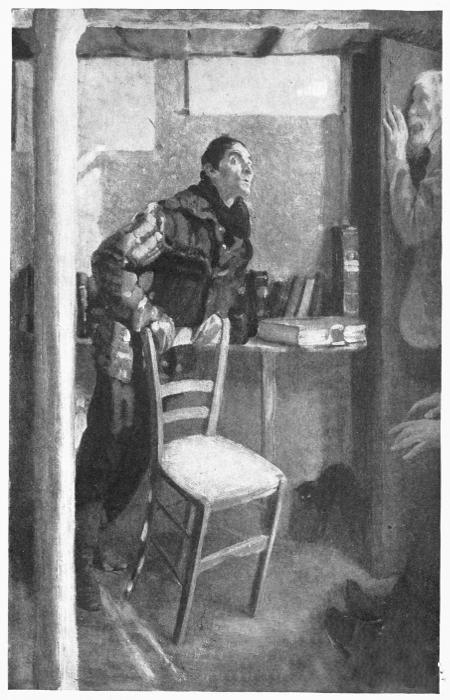
Within an hour, there was Blumpitty haled before
Mrs. Mar, like a criminal before his judge.
“Well!” Mrs. Mar glanced from her son to the clock.
“And you wouldn’t have found him even at this hour
but for Hildegarde and me.” Harry’s answer to this
(and to Hildegarde’s, “Remember, we must speak low,
Mr. Dorn’s room is just above”) was to whisper, as if
divulging some tremendous secret, “Mr. Blumpitty.”
Then, still more significantly, “My mother.” My
mother fastened her bright eyes upon the stranger who
had obliged her by responding to her call. Plainly she
was not prepossessed. The giant had either been wrong,
and Blumpitty did drink (in which case Mrs. Mar was
wasting her time), or else the man naturally looked
“logy”—a fatal way of looking.
“Please sit down, Mr. Blumpitty,” said Hildegarde,
speaking very low. Mr. Blumpitty, more than ever with
the air of a mute at a funeral, deposited himself on the
extreme edge of a chair.
“You see,” said Harry, by way of breaking the chill of
his mother’s reception, “you see, Mr. Blumpitty wasn’t
on any hotel register.”
“Why weren’t you?” demanded Mrs. Mar, as though
this were a damning charge.
“No room anywhere,” said Blumpitty sadly.
“Oh, I hope you found a place to sleep in—” began
Hildegarde.
“Wa-al, yes, after huntin’ around two whole days.”
“Two days!” says Mrs. Mar, ready to nail him for a
liar at the start, and so save time. “There’s a night in
the middle of two days.”
“Ya-as. We wished they wusn’t.”
“Where did you sleep?”
“Didn’t sleep much.”
“Where did you stay?”
“In the station.”
“Station!” Visions of his being “run in” assailed
Mrs. Mar. “What station?”
“The G. N. W.,” he said indistinctly.
“The Great North Western Railroad Station,” Harry
translated, with a reassuring look at the man.
“You slept in the waiting-room?”
“Some of us slept.”
“Oh, dear, I hope you’ve got nice quarters at last?”
said Hildegarde.
“Wa-al, we got three rooms. But,” gloomier than
ever, “we got to pay for ’em.”
“What do you want of three?” demanded Mrs. Mar.
“Three ain’t too many fur twenty-eight people.”
“Twenty-eight! What are you doing with so many?”
“Takin’ ’em to Nome.” Had the destination been the
nether regions, he couldn’t have said it more as one who
had left hope behind.
“Bless my soul!” said Mrs. Mar, with a vision of the
crowded train she’d come by, and the yet more crowded
streets she’d hunted through for this same Blumpitty.
“What are they all going to do there?”
Blumpitty smiled a faint world-weary smile. “They
kind o’ think they’d jest natchrully like to get a share
o’ this gold that’s layin’ around up there.”
“Oh, you’re a prospecting party.”
“I guess we’ll do some lookin’ around.”
“Twenty-eight of you!” exclaimed Hildegarde under
her breath. “In three rooms!”
The man nodded slowly, and his yellow-gray eyes
seemed to have a vision of them. “Layin’ in rows,” he
said sadly.
“How dreadful!” breathed Hildegarde. In truth it
had a morgue-like sound.
“No—o,” he drawled. “No—o. Me and Mrs. Blumpitty,
we do kind o’ miss it, not havin’ any winder. It’s
only a closet though,” he said, as if not wishing to hurt
the feelings of anything so small and unpretentious.
“And the rest of our people are all right. Some parties
have had to mix up, but I been able to get a room for
the men, and”—he spoke with a weary pride—“and
one for the ladies.”
“Ladies in your party!” exclaimed Harry.
“Ya-as. Five, not countin’ Mrs. Blumpitty.”
“What kind?” demanded Mrs. Mar, at the same moment
as Harry asked, “What are they going to do up
there?”
“Oh, they’re all right,” said Blumpitty, thinking he
answered both. “Miss Leroy Schermerhorn’s goin’ to
keep the books, and be secretary and business woman to
the Company.”
“What company?” says Mrs. Mar.
“Blumpitty & Co.,” says Mr. Blumpitty.
“Bless my soul!” says Mrs. Mar.
“Remember Mr. Dorn,” whispered Hildegarde.
“Do I understand your wife is going along—” Mrs.
Mar began on a lower note.
“Yes, oh, yes. I couldn’t do it without Mrs. Blumpitty.”
“Where does she come in?”
“Everywhere. Little bit o’ woman, so high. You’ve
seen her.” He turned to Hildegarde. She nodded,
smiling. “Don’t weigh more’n ninety-six pounds.
Worth twenty or’nary size people.”
“What does she do up there?”
“Everything. Keeps it all together.” He looked
round with a melancholy wistfulness, as if he felt keenly
the need of Mrs. Blumpitty to keep the present situation
together.
“And the other women?” said Mrs. Mar.
“Well, Mrs. Tillinghast is the wife of the baker.”
“What baker?”
“The Company’s.”
“Blumpitty & Co.’s?”
“Yes, ma’am. Then there’s Miss Cremer. She’s a
tailor—goes along to keep us mended up till our clo’es
get wore out. Then she’ll make us noo things. Mrs.
Blumpitty had to do it all last year. Pretty heavy fur
a little woman no bigger’n—”
“The baker’s wife and the tailoress, that makes two
besides Mrs. Blumpitty.”
“Yes, ma’am. An’ there’s Miss Estelle Maris. Very
nice young lady. She says she can cook.” He sighed,
and then recovered himself. “Even if she can’t, Mrs.
Blumpitty can. Yes”—he allowed a pale eye to wander
toward Miss Mar—“we got very nice ladies along, and
I mean ’em all to have claims.”
Mrs. Mar glinted at him, as much as to say, “Oh,
that’s the bait—poor wretches!”
“It’ll be very nice for them,” said Hildegarde a little
hurriedly.
“How do you expect them to get claims?” asked Mrs.
Mar with severity.
“The Company’s got some valyerble property up on
Glaysher Crick.”
“What company has?”
“Blumpitty & Co.”
“And are they giving claims away?”
He looked at Mrs. Mar, quite unruffled by her tone.
“The Company’s got more’n it can work. And the
Company knows where there’s good property nobody’s
taken up yet.”
“Who’s in the Company?”
“Me and Mrs. Blumpitty, and her folks, and my folks,
and most of our party.”
“Oh, just a family affair,” said Mrs. Mar, with a
slighting intonation.
“Very few besides jest ourselves. We didn’t want a
lot of outsiders.”
From Harry’s covert smile you gathered this was a
new view of the way to float a mining company. “Why
don’t you?”
“We seen what happens too often,” said Blumpitty
warily.
“What does happen?” asked Mrs. Mar.
“The people that’s the first to locate ain’t often the
ones that gets the benefit.”
“Why don’t they?”
“They get froze out. I mean to hold on to the bulk
o’ the stock myself jest as long’s ever I can. Keep
things in my own hands.” He looked anxious.
“Not let other people take up the stock, you mean?”
inquired Harry, smiling openly now.
“It’s the only way,” said Mr. Blumpitty, and then,
as though to change a dangerous topic, “We got a nice
party.” He looked toward Hildegarde. “Pretty near
all the perfessions. We got a smart young lawyer and
two practical miners. We got a nengineer an’ a noospaper
man. An’ we got a nex-motor man—used to drive
a ’Frisco street car, and a very bright feller. Ya-as, we
got a carpenter, too, an’ three doctors an’ a boat-builder
an’ a dentist. We got pretty near everything.”
“How long were you up there before?” asked Mrs.
Mar, still feeling her way with this queer character, who,
with his wife, might after all be decent fellow-passengers
for Hildegarde.
“We was in two summers an’ one winter.”
“Your wife, too?”
“Oh, yes, she kep’ us alive. If y’ wus to see her y’
wouldn’t think she looked like she—”
The discreet Jap servant opened the door, and seemed
to whisper, “Mis’ Bumble Bee.”
“Oh, how do you do?” Hildegarde went quickly forward
and shook hands with a tiny, weather-beaten
woman.
“I heard on the water front you wus askin’ for me,”
said the new-comer, looking very shy and embarrassed.
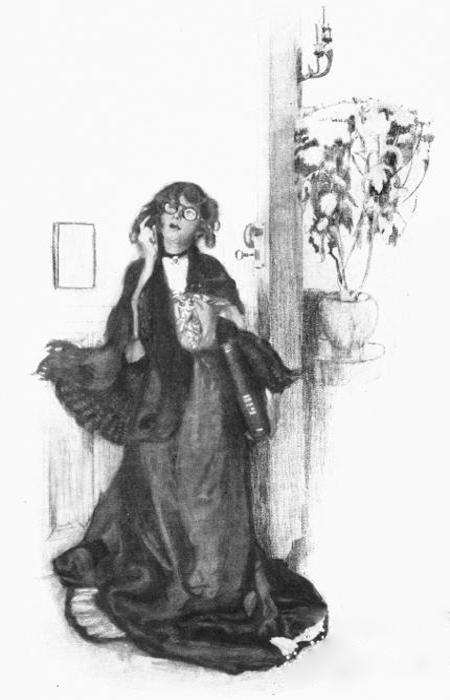
“Oh!” Mrs. Mar was on her feet. “Is this Mrs.
Blumpitty?” Before that little person knew what had
happened, she was on the other side of the room, shrinking
into the extreme corner of a big, red satin sofa—not
unlike some sort of insect hiding in the heart of a poppy.
But it was idle trying to escape from Mrs. Mar. She
prodded her prisoner with pointed questions, and there
was no manner of doubt but “Mis’ Bumble Bee” was
intensely frightened. But she must have come out of
the ordeal uncommon well, for the catechist rose at the
end of a quarter of an hour (breaking in upon Harry’s
glib exposition of the huge difficulty in these days of
floating a gold mining scheme). “Your wife and I have
been arranging things,” said Mrs. Mar, with a suddenness
that made Blumpitty blink. “My daughter must
go on your ship.”
“But, mama—”
“Mrs. Blumpitty says she will look after you on
board.”
“Yes,” agreed the rusty wife, a little breathless.
“And if she doesn’t find her father just at first she can
stay with us, can’t she?”
Blumpitty, thus appealed to, said, “Ya-as,” so entirely
without enthusiasm, that his wife added, “He said
to me after we’d talked with your daughter, ‘It’s a pity
she ain’t goin’ on the Los Angeles. We could ’a’ helped
her.’”
“Well, she is going on the Los Angeles.”
“No, mama, the Congress.”
“Don’t be pig-headed, Hildegarde. Why should you
insist on the Congress when here are Mr. and Mrs. Blumpitty
ready to look after you on the Los Angeles?”
“I don’t exactly insist, but I’ve paid $125—”
“You can change your ticket, if that’s all, can’t she?”
Mrs. Blumpitty appealed to the repository of wisdom on
the edge of the chair.
“Oh, ya-as,” said Mr. Blumpitty.
“Why are you so sure?” said Hildegarde. “Is it because
the Congress is so much the better boat, as your
big, tall friend said?”
“He ain’t right about that, though he’s a mighty
smart feller. Been to Harvard College,” he said, for
Mrs. Mar’s benefit. Then, as one adducing a destiny
higher still, “The Los Angeles has been a Manila transport.”
“But why does everybody seem to want to go in the
Congress?”
“Sails four days earlier,” said Blumpitty unmoved.
“But”—he glanced, or no, Blumpitty never glanced;
with apparent difficulty he rolled his pale eye heavily
over to Mrs. Mar—“settin’ out’s one thing, gettin’ in’s
another. ’Tain’t likely the Congress’ll see Nome ’fore
we do.”
“Anyhow, what are four days compared to—?” Mrs.
Mar turned briskly upon her daughter. “Mrs. Blumpitty
is going to see that you have all the necessary
things, and if you’re sick she’s going to look after
you.”
As Mrs. Blumpitty did not instantly corroborate this
result of the fifteen minutes in the red satin corner,
“You promised me that,” said Mrs. Mar, with a suddenness
that sounded less like maternal solicitude than
truculence, “and I promised you shouldn’t be a loser
by it.”
“Yes—oh, yes, ma’am, I’ll do all I said.” Merely
looking at Mrs. Mar seemed to galvanize Mrs. Blumpitty
into heroic mastery of her shyness. She clasped her thin
hands in their gray cotton gloves tightly together, and
felt herself called upon instantly to prove her present
knowledge and prospective usefulness.
“H-have y’ got a boy’s rubber coat, comin’ to the
knees?” she inquired of the younger lady.
“No,” said Hildegarde. “Ought I—?”
“Yes, you must have that, mustn’t she?”
“Ya-as.”
“And waterproof boots?”
“I’ve got them.”
“With asbestos soles?”
“Oh, I don’t know.”
“They’re the best.”
“Get them,” commanded Mrs. Mar.
“And one thing you can’t do without is a blue denim
prospecting dress.”
“I think I have something that would do, though I
don’t expect to go—”
“Has your dress got knickerbockers and skirt to the
knee?” She saw Miss Mar and her mother exchange
glances, but she felt instinctively the elder lady would
see the reasonableness of the provision.
“No,” said the young lady, “my skirts are ankle-length.”
“Oughtn’t to be a hairbreadth below the knee,” said
Mrs. Blumpitty, with more firmness than she had yet
shown.
“No skirt at all is best,” observed Mr. Blumpitty
dryly.
“What!” said Harry Mar, whom every one had forgotten.
“Jest full knickerbockers,” said Blumpitty, without
so much as looking at the objector.
“Oh, that won’t be necessary for me,” said Miss Mar.
“’Twill, if you want to go prospectin’.” Valiantly
Blumpitty supported his wife’s view. “You can’t wear
a skirt on the trail.”
“I don’t think I shall go on the trail,” said the pusillanimous
Hildegarde, “unless my father—”
“Better be ready,” said Blumpitty.
“What else do you advise?” said Mrs. Mar, glancing
at the clock.
“She ought to have a sou’wester, don’t you think?”
says Mrs. Blumpitty to Mr. Blumpitty.
“Ya—as, and a tarpaulin to lie on in the swamp.”
“Well,” said Mrs. Mar, “nobody can accuse you two
of over-coloring the delights of life up there.”
“It’s a splendid place, Alaska is, if you go with the
right things,” said Mrs. Blumpitty.
“And if you come away with the right things,” supplemented
Mrs. Mar.
“Oh, she must bring back a claim, mustn’t she?”
Mrs. Blumpitty appealed to her husband.
Harry and his mother exchanged looks.
“Well, never mind about that,” said Mrs. Mar. “But
if you see after my daughter and do what you said, you
won’t be losers by it.”
“No, indeed,” said Harry, with emphasis.
“Mrs. Blumpitty,” quoted Mrs. Mar, “Mrs. Blumpitty
says she’ll see that Hildegarde is properly cooked
for up there, and she’ll even get her washing done.”
“Oh, yes, I can do that myself. I’m used to it.”
“You don’t look very strong,” said Hildegarde.
“I wasn’t before I went to Alaska,” she answered
proudly.
“Ya—as,” agreed her husband. “Always terrible
sickly till she went up there. Ruth’s jest the same.”
“Who’s Ruth?” demanded Mrs. Mar.
“That’s my niece,” said Mrs. Blumpitty.
“You had her along last year?”
“Yes, and she’s comin’ again. She wouldn’t miss
comin’ fur anything. Ruth’s twenty-five,” Mrs. Blumpitty
explained to Miss Mar. “Reel nice girl. Been a
nurse. You’ll like Ruth.”
It was as if the “reel nice” Ruth finally settled things.
“Give Harry your Congress ticket, Hildegarde, and
he’ll see about changing it. Even if he can’t, I’ve made
up my mind you must go on Mrs. Blumpitty’s ship.
Don’t let the grass grow, Harry, we must catch the night
train home.”
When Harry had ceased to cultivate grass in Jacob
Dorn’s parlor, the Blumpittys seemed to think their
audience, too, was at an end. They stood close together
and muttered embarrassed leave-taking.
“Wait till my son gets back,” interrupted Mrs. Mar.
“He oughtn’t to be more than twenty minutes. There
are one or two things I’d like to know.” The fact did
not elude Mrs. Mar that when she had headed off their
escape, Mrs. Blumpitty had taken refuge in the chair
nearest her husband, and was edging it as close to him as
she could conveniently get—for protection, it would
appear. And Blumpitty himself, as feebly he resumed
his perch, looked more than ever depressed and vague.
Mrs. Mar needed no reminder that few husbands and
wives are as communicative together as either may be
apart. “Hildegarde,” she said, “take Mrs. Blumpitty
up to your room and see how much of your outfit’s
right. Show her your list and take notes of what she
tells you.”
Having cleared the deck, Mrs. Mar by a cross fire of
questions drew forth a story, no—queer fragments,
rather, of the history of the Blumpittys’ fight for existence
during sixteen months spent in a tent upon the icy
tundra, with a few Esquimau neighbors and no white
soul for many a mile. Mrs. Mar forgot to look at the
clock, even grew strangely friendly with Blumpitty, in
her absorption in so congenial an occupation as drawing
out and clarifying an inarticulate, rather muddled male.
Finally, “The papers,” quoted Mrs. Mar, “the papers
say that all the claims are staked.”
Without the smallest emphasis, “I know that ain’t
so,” said the man dully.
“How do you know?”
“I been there.” Mrs. Mar digested this. “I know,”
Blumpitty went on, “a place where no white man but
me and one other has set foot—rich in gold.”
“Where’s that other man?”
“Under the tundra ’long o’ the gold.”
She tried not to betray her interest. She even succeeded.
“And that’s the place you’re going up now to
work?”
“No, ma’am, I ain’t talked to folks about that place.”
Mrs. Mar waited to hear why.
But Blumpitty seemed to have no intention of enlightening
her. “The property we’re goin’ to work this
summer is the nineteen claims belongin’ to Blumpitty
& Co., up on Glaysher Crick. They’re already located,
an’ recorded, an’ surveyed, an’ a year’s assessment
work done.”
“How much have people put into this company of
yours?”
“Right smart,” he said cryptically. “What with
my folks and my wife’s folks an’ our party—had to give
them a look in—only fair. But we’re goin’ to keep it
among ourselves ’s much as possible. They ain’t any of
us rich, not now, but”—he smiled a pale, pale smile all
to himself, that seemed to say the future was beyond
peradventure golden. “We all been workin’ people,” he
said, grave again as ever. “But we’ve all saved a little
somethin’.”
“And you’re putting your savings into this?”
“Every cent. We know $250 put into Blumpitty &
Co.’s this spring’ll be a thousand ’fore long.” Instead
of rejoicing, he sighed. “We’ve worked mighty hard,
but we got our chance now.” He rested on the thought
a moment. “They’s a fortune fur us up on Glaysher
Crick—’nough fur us all.” His pale eyes seemed inadvertently
to take in Mrs. Mar.
That lady presented her most baffling surface. Absolutely
nothing you could take hold of. Whether her
aspect discouraged Mr. Blumpitty or not, certainly he
seemed to have no more conversation.
Mrs. Mar was obliged herself to break the silence.
“So you’re pretty well satisfied, anyhow.”
“Ya-as,” he said, “if only I can keep out o’ the hands
o’ the fy-nance-eers.”
“What’s to prevent you?”
“Oh, I guess it’s all right”—but his look was dubious.
“I got a good many mouths to feed an’ a lot o’ developin’
to do.”
“You mean you haven’t got enough capital.” She
felt she had caught him. She was both disappointed and
rather relieved.
“I got some capital, like I told you. An’ I could get
plenty more if I wasn’t so afraid o’—” He paused, and
seemed to envisage afresh some subtle and merciless
foe. Mrs. Mar’s sharp eyes pecked him all over. If they
had left a mark wherever they had been, Blumpitty
would have presented no surface the size of a cent that
was not pitted as with virulent smallpox. It might well
have inspired confidence that he bore up as well as he
did.
“What is it you’re ‘afraid’ of?” demanded Mrs. Mar.
“Losin’ personal control. But I’m all right s’ long ’s
I keep hold o’ fifty-one per cent. o’ the stock.”
“Why fifty-one per cent.?” She must understand this.
“So’s to have the decidin’ vote. So’s I can do the
directin’ myself. Watch it”—his pale eyes brooded—“an’
manage it, an’ make a reel success of it.” You got
the impression that the scheme was bound up not only
with his fortune but with his pride. “If I’m at the
head o’ the thing I can see that the ’riginal investors
don’t get froze out by the fy-nance-eers.”
“Well, haven’t you kept fifty-one per cent. of the
stock?”
“Yes, I got more’n that now. Blumpitty & Co.’s
only jest started.”
Mrs. Mar had a moment’s thrill out of the sensation of
being there “at the start.” But she sternly repressed
any glimmer of betrayal. “I suppose,” she said, with an
intention of irony, “that you’re ready to let in a few
more private subscribers?”
“I’m in favor o’ lettin’ in one or two.” He fell into
thought undisturbed by Mrs. Mar’s silent pursuit, pecking
here, pecking there. “I wus thinkin’ I’d like your
daughter to have somethin’.”
“Oh, my daughter’s putting all she has into her
trip.”
But Mr. Blumpitty was doing some more thinking.
Gravely he brought out the result. “It ain’t many
young ladies would want to take that journey jest to
nurse their fathers.”
Mrs. Mar looked at him coldly. “She hasn’t got anything
to invest in gold mines.” And then she was sorry
she had admitted this. If the man thought of Miss Mar—or,
say Mrs. Mar—as a probable investor, it might
make a difference.
But apparently quite unchilled, Mr. Blumpitty was
drawling, “Wa-al, if she comes with us, I could very
likely help her to locate a claim of her own.”
Even that handsome offer seemed not to “fetch”
Mrs. Mar.
And still he was not daunted. “I said to Mrs. Blumpitty,
‘That’s the kind o’ young lady I’d like to
help.’”
No sort of direct acknowledgment out of the young
lady’s mother. But presently, “Just at this juncture
I want to give my daughter all I can spare, or I
wouldn’t mind putting something into your company
myself.”
You might think he heard only the end of the sentence.
“It’s a good investment,” he said.
“It’s quite possible that later—” Mrs. Mar threw
in, feeling herself very diplomatic. “Just at present
the only funds I have in hand are what my eldest son
has sent to supplement his sister’s.”
“Ya-as, I wus thinking,” said Blumpitty, as though
in complete agreement, “when she buys her stuff at
Baumgarten’s she’d better get it through me, and then
she’ll pay only wholesale rates. That’ll be a savin’. I
could save her freight charges, too.”
“Isn’t she getting wholesale rates anyhow?”
“No. They won’t make no difference fur a little six
weeks’ order for one person. I’m gettin’ food and camp
outfit fur twenty-eight people fur two years. They
make a reduction fur that.”
It seemed reasonable; and really, these simple people
were disposed to be very serviceable.
She thought of Trenn’s brotherly letter of good-by
and his handsome contribution of $300, reposing at that
instant in the yellow bag that hung at her belt. Well,
suppose she used “the money for Hildegarde” in a
double sense. Suppose she got some stock in Hildegarde’s
name. It was all my eye about Blumpitty’s
wanting to help “that kind of young lady” just because
she—fudge! Mrs. Mar was “from Missouri!” But it
very probably would help the girl with her new friends
that they should look upon her as financially interested
in their enterprise—should think of her obliged and
grateful family as a probable source of further revenue.
Odd if it were Mrs. Mar after all who should be the cause
of the Mar family’s profiting by the gold discovery at
Nome. But she would do nothing upon impulse.
“I think I could send you two or three hundred before
you sail,” she said.
Mr. Blumpitty looked on the floor, and made no manner
of response.
“How would that do?” and she repeated the offer.
“I can’t promise they’ll be any o’ the margin left by
the time we sail.”
“Why can’t you?”
“Wa-al, I got to keep fifty-one per cent. fur myself.”
She’d heard all that. “How much a share is your
stock?”
“It’s only $25 now. But I guess it won’t ever be as
low again. This time next year—” He felt for his
watch. When he saw what time it was this year, slowly
he pulled his slack figure together and stood up.
“You’re going to wait—” began Mrs. Mar.
“I promised t’ meet a man about now.”
“Somebody who wants to join your company?” said
Mrs. Mar, with a pang.
“I guess so.”
“I could take twelve shares to start with, only—”
“I guess y’ better talk it over with y’ son.” Blumpitty
had stooped and was feeling under the chair for his
hat.
“It isn’t that,” said Mrs. Mar a little sharply, for the
idea of taking counsel with her son appealed to her much
less now that Blumpitty recommended it. “But I’m not
sure I won’t have to buy a second ticket for my daughter.”
“No danger o’ that.”
“And how do I know there’s a good berth left on
your steamer?”
“I got twenty-eight first-class accommodations. The
young lady can have the pick o’ them.” He seemed to
be coming slowly toward Mrs. Mar with a motion of
offering his hand, whether to reassure her as to the
solemnity of his given word on the subject of the berth,
or in mere good-by.
She arrested him with her eye. “If I get my daughter
these twelve shares”—Mrs. Mar’s hand was on the
yellow bag—“I do it on my own responsibility. I shall
not consult my sons.”
“Wa-al, it’s a good chance,” he admitted, but in the
tone of one not disposed to deny that “all flesh is grass.”
“I’d like your daughter to have her share. They ain’t
many young ladies would want to take that journey jest
to—”
“You’d better make out a receipt for those twelve
shares straight away, before anybody comes in and interrupts.”
Mrs. Mar opened the yellow bag.
Blumpitty looked vaguely at the floor. “I don’t know
as I got any blanks along.”
“Blanks! I don’t want any blanks.”
“Certificate forms.”
“Oh—well, look and see,” she said peremptorily, with
her glance at the clock.
Out of his breast pocket Blumpitty slowly took some
papers. “Only a dirty one,” he said sadly.
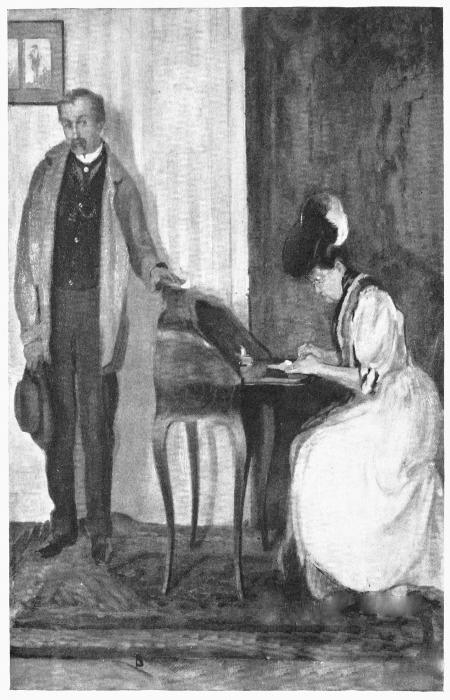
“Well, fill it out. There’s pen and ink on that
table.” She was counting bills on her lap.
Blumpitty stood vaguely looking round in a lost sort
of way, just as though time weren’t priceless and
Harry’s return at any moment likely to complicate, if
not checkmate, “the deal.”
“Here.” Mrs. Mar jumped up and put a chair in
front of the little writing-table. Then smartly she
tapped the silver-topped ink-bottle, as though she
doubted his having the sense to know what it was unless
she made some sort of demonstration in its neighborhood.
She even illustrated the fact that the lid lifted up.
Slowly Blumpitty had come over to the spindle-legged
table, and now sat in a heap in front of it, looking into
the ink. Mrs. Mar whisked a pen out of the rack and
pushed it into Blumpitty’s slow fingers. “And here in
this envelop is $300.” She took it out and counted it
over, under his dull eyes. “But I’ll keep it till Harry
comes back and says it’s all right about the ticket. We
can just exchange envelops without saying anything
further. Understand?” She felt a well-nigh irresistible
impulse to shake Blumpitty, but instead of doing that,
there she was signing a paper, after taking care to read
it twice, in spite of the pressure of time. And now,
although she still held both this document and the three
hundred dollars in her own hands, she was conscious of
qualms.
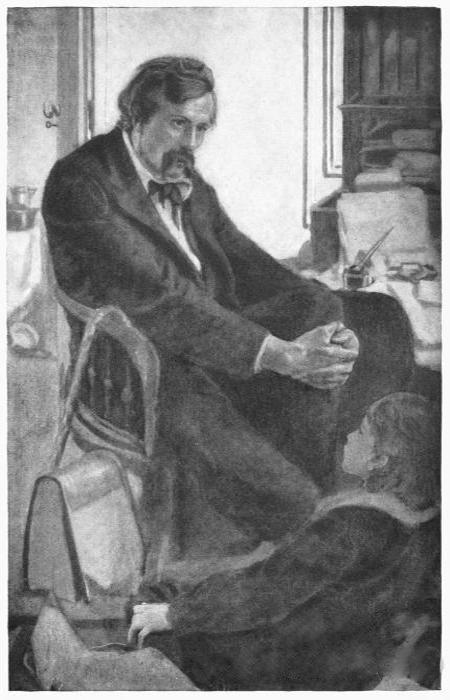
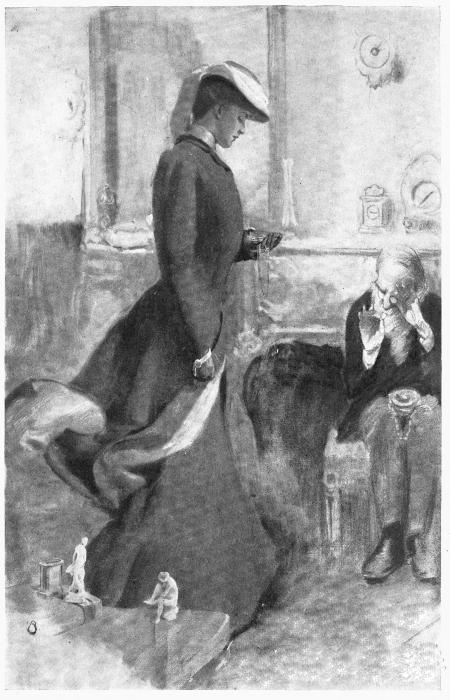
Hildegarde’s mother and Mr. Blumpitty
“I suppose you’ll be sinking a deal of good hard
money in that creek of yours this summer, whether you
get any out or not.”
“They’s plenty of work there,” he said, foggier than
ever, “but I got more’n that to do this summer.”
“What do you mean?”
He looked at her with that curious sort of vagueness
that gives one an impression of hearing a man talk in
his sleep. You feel it would be unfair to hold him quite
responsible. “When I’ve got the work started all right
on Glaysher, I got to take two or three people I c’n trust
an’ go up to a place northwest o’ Nome.”
“What place?”
“Polaris.”
“What do you want to go there for, when you’ve got
nineteen claims to look after on Glacier—”
“Them nineteen claims is valyerble property, and
Blumpitty & Co.’s goin’ to pay handsome dividends.
This time next year—”
“Well, what do you want more than that?”
He paused, and then in that same somnambulist tone,
“I wusn’t lookin’ fur it,” he said, “I jest tumbled on
it.”
“What?”
“A great big thing up by Polaris. Bigger’n anything
Blumpitty & Co. have got on Glaysher. Bigger’n anything
any company’s got anywhere.”
Impossible to think a man boastful or even over-sanguine,
who spoke so wearily, with yellow-gray face so
unlit, with air and attitude so joyless. “It’ll make millionaires
of a good many people.”
There was silence in Jacob Dorn’s parlor. Mrs. Mar
had refused to credit a story of this sort once before.
Her unbelief had not only cost her a great fortune; it
had cost her happiness. She sat in silence, reflecting.
But she gave no sign.
“People have got so’s they don’t take much stock in
any feller’s talkin’ ’bout the Mother Lode. I don’t
blame ’em myself.”
“It turns out as stupid sometimes to be too skeptical
as to be too credulous,” quoth Mrs. Mar.
Mr. Blumpitty did not applaud the sentiment. He
looked sadly at the lady and then, as though the effort to
hold up his eyelids were too great, he rested his heavy
eyes on the silver rim of the ink-pot. “Everybody knows
they must be a Mother Lode some’ers around up there.”
“Why must there?”
“Wa-al, I don’t know,” said Blumpitty impartially.
“P’raps the gold come down from Heaven.”
“Don’t talk nonsense.”
“Well, if it don’t come from Heaven, the gold they’re
findin’ at Nome an’ in the Klondike, and the noo camps—all
the loose placer gold o’ the North,” he reflected,
“if it ain’t come down from Heaven, it’s been washed
an’ weathered and glayshered out o’ some reef or range,
or great natchrul store-house.”
“Yes. I’ve read about that.”
He nodded faintly. “Ya-as, that’s what they all
say. Every man believes in a Mother Lode. But what
no man likes to believe is that another man’s found
her.”
Again silence.
Vivid description would have failed to picture for this
particular auditor what Blumpitty’s slow and clumsy
words conveyed as though by chance. So little did he
play the game in the usual way that Mrs. Mar felt the
satisfaction of the discoverer in getting at the story
through barriers and in despite of veils.
In the silence, up above—in Jacob Dorn’s sick chamber—some
one was heard opening the window.
“And you think,” Mrs. Mar spoke very low, “you
think you know where the Mother Lode is?”
“Pretty near every miner in the Northwest thinks he
knows.”
“You mean you are sure?”
“I’m forty-eight,” said Blumpitty mournfully.
“It’s twenty years since I liked sayin’ I was sure.”
“But” (he was the sort of man that needed reassuring)
“you’ve got good ground for believing—” She
waited.
“Last fall”—he looked round the red satin room as
though for possible haunts of eavesdroppers, and then
he further interrupted himself—“you mustn’t think
I found it myself,” he said modestly. “I got a tip—a
straight tip.”
“From the man that’s dead.”
“Ya-as. Leastways, they said he hadn’t more’n a
few days to live. Ya-as, dyin’ up there at Polaris!
Everybody in the camp knoo he’d struck it rich. Nobody
could find out where.”
“How did they know he’d struck—”
“Becuz he wus so secret about everything. Where
he’d come from. Where he wus goin’ if he got well,
and most of all”—Blumpitty looked round and sunk his
low voice—“where he got his nuggets and dust from.”
“Oh, he had nuggets—”
“Yes, nuggets and dust, too. Good and plenty.”
“He showed it to you?”
“No. He wus terrible secret about it. Terrible
afraid somebody’d rob him. Kind o’ sick you know
about it.” Slowly Blumpitty tapped his yellow-gray
forehead. “But he allowed he’d found something
worth while an’ he never let his bundle o’ dust out o’
sight. Day an’ night he kep’ it jest under his hand.
Everybody nosin’ around, tryin’ to be friends with him.
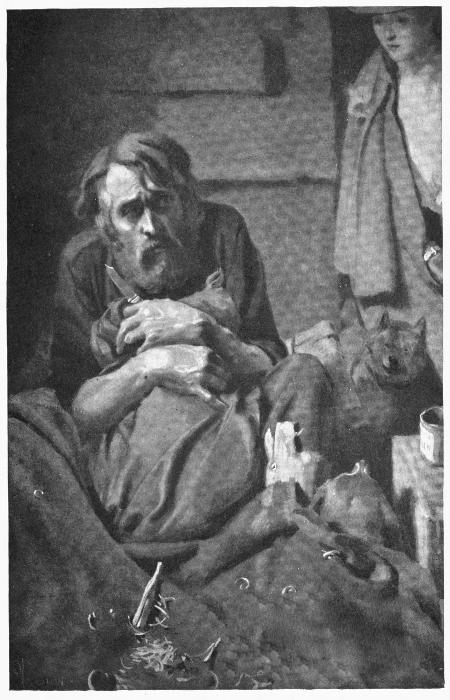
One day I wus passin’, an’ his dawg went fur me. I
picked up a stone. ‘Don’t y’ do it,’ he calls out o’ the
sod cabin, where he wus layin’ with the door open.
‘Don’t y’ do nothin’ to that dawg,’ he says. I explained
the dawg wus doin’ things to me. ‘Come in here,’ he
said, ‘an’ she won’t touch you.’ So I did, an’ we talked
a while.”
“Well?”
“He asked me kind o’ sarcastic, was I ‘lookin’ fur the
Mother Lode?’ I said I guessed I wusn’t no different
from other men, except that I wusn’t hangin’ round a
sick man fur to get his secrets out o’ him. ‘No,’ he said,
‘I ain’t never seen you hangin’ round.’ An’ then he
told me.”
“What?”
“I says, ‘I’m figurin’ on findin’ the Mother Lode up
in them hills yonder.’ ‘That’s right,’ he said, an’ his
eyes wus kind o’ wild an’ glassy. ‘Up over yonder?’ I
said. ‘Yes,’ says he; ‘up North. That’s where the
Mother Lode is.’ An’ I think from what he said, he’d
called his discovery-claim ‘The Lode Star.’”
“What made you think—”
“Course he wus kind o’ queer—out of his head, y’
know, fur he called it the ‘Mother Lode Star.’ An’ he
wus terrible secret about it. All the time gettin’ away
from the subject and talkin’ about the dawg.”
“Well—”
“Wa-al, they wusn’t more’n half a dozen people at
Polaris then, an’ nobody’d found anything to make a
boom out of. But they all hung on. And they made
presents to that feller, took him grub regillar. An’
other folks kep’ comin’ jest becuz that man wus there.
An’ they all knoo he’d struck it rich. An’ they all
knoo he wus dyin’. That was what they wus waitin’
for. I didn’t wait, even them few days they said he
had to live. The snow wus beginning t’ fly an’ I had
to go back to Glaysher and get Mrs. Blumpitty an’ our
party out before navigation closed. But I said to myself,
‘I’ll risk it—fur the Mother Lode!’ An’ I did.
Went up over the hills to the north, in a bee line from
that cabin o’ his till I come ter—” Blumpitty’s voice
dropped still lower and he hesitated, while, like one who
scarce dares move lest he break some spell, slowly he
looked round, and seemed to forget how to turn back.
He remained so, sitting awry, listening.
“It’s only some one moving about in Mr. Dorn’s
room overhead. You found the Mother Lode?”
He found he was able to twist himself back by dint of
drawing out his watch. “When I get t’ thinkin’ about
it I clean forget the time.” He stood up. “I guess I
got t’ be goin’.”
Footsteps and low subdued voices in the hall. Hildegarde
had seen her brother from an upper window, and
had come down with Mrs. Blumpitty to let Harry in.
There would be no trouble in selling “Berth 21” for
the third time.
Mrs. Mar, about to hand an envelop to Mr. Blumpitty,
wondered to herself, “How much of a fool am I? Well,
I haven’t done fool-things all along the line, like most
people. If I must commit foolishness before I die,
I’ll do it all in a lump and be done with it.” Whereupon
she handed Mr. Blumpitty the envelop. He
seemed to be giving Harry his address. Mrs. Blumpitty
was making an appointment to meet Miss Mar “at ten
o’clock to-morrow, at Baumgarten’s.”
For the third time Mrs. Mar was reading through a
paper she held in her hand. When she came to the ill-written
signature, “How do you spell your name?” she
demanded of Mr. Blumpitty.
“B-l-u-m-p-i-t-t-y,” said the gentleman mournfully.
“Humph,” said Mrs. Mar, head on one side and eyes
fixed so critically on the name that Mrs. Blumpitty
hastened to the defense. “It’s French,” says she.
“French!” echoes Mrs. Mar. “How do you make
that out?”
“Well, that’s what his grandmother always told him.
She said it was originally Blank Peed.” Wherewith,
having vindicated the family, she shook hands and led
the way out. Harry was opening the outside door for
them. No one spoke above a whisper, on account of
Mr. Dorn.
“Good-by, Mr. Blumpitty.”
“Good-by, ma’am.”
“Look here”—Mrs. Mar detained him for a last aside—“you’ve
got twenty-eight people to see after, and a
company to manage, and nineteen claims to develop,
why can’t you be content with that?”
He looked at her. “Would you be?” he asked simply.
Her face told tales. “You mean”—she hesitated—“if
I’d got on the track of the Mother Lode?”
“Jest so,” said Blumpitty, and slowly he followed his
wife out of the Great Importer’s house.