Larger versions of most illustrations may be seen by right-clicking them
and selecting an option to view them separately, or by double-tapping and/or
stretching them.
NUMBER 1
Rank and file in combat:
What they’re doing
How they do it
★
UNCLASSIFIED
XXXXXXXXXXXXDISSEMINATION OF RESTRICTED MATTER.—The
information contained in restricted documents and the essential characteristics of
restricted material may be given to any person known to be in the service of the United
States and to persons of undoubted loyalty and discretion who are cooperating in Government
work, but will not be communicated to the public or to the press except by
authorized military public relations agencies. (See also par. 18b, AR 380-5, 28 Sep 1942.)
The purpose of “Combat Lessons” is to give to our
officers and enlisted men the benefit of the battle
experiences of others. To be of maximum benefit
these lessons must be disseminated without delay.
They do not necessarily represent the carefully considered
views of the War Department; they do, however,
reflect the actual experiences of combat and,
therefore, merit careful reading. For this reason
also no single issue can cover many of the phases of
combat; lessons will be drawn from the reports as
they are received from the theaters of operation and
quickly disseminated so that others may apply them.
The suggestions which are made or implied are not
intended to change the tactical doctrine by which our
Army has been trained but rather to elaborate
thereon. Much of the subject matter has been covered
in training literature, but the comments show
that shortcomings continue to manifest themselves
on the battlefield.
The paramount combat lesson learned from every
operation is the vital importance of leadership. Our
equipment, our supply, and, above all, our men, are
splendid. Aggressive and determined leadership is
the priceless factor which inspires a command and
upon which all success in battle depends. It is responsible
for success or failure.
SECTION I INFANTRY — BATTLE LEADERSHIP — SICILY—ITALY—ATTU — NIGHT ATTACK — KNOCKING OUT PILLBOXES — INDIVIDUAL INITIATIVE — ACTION ON ATTU — THE SOUTH PACIFIC — SECURITY IN THE JUNGLE — JUNGLE NOTES — SCOUTING AND PATROLLING — INFANTRY WEAPONS — IN JUNGLE WARFARE — IN SICILY — AT SALERNO — INFANTRY-ARTILLERY TEAM — INFANTRY-TANK TEAM — RANGER TRAINING — SECTION II FIELD ARTILLERY — ARTILLERY IN THE JUNGLE — IDEAS FROM ITALY — SECTION III MISCELLANEOUS — SECTION IV NOTES ON THE NIPS — SECTION V HINTS ON THE HEINIE
Prepared from Combat Reports and
published by direction of the Chief of
Staff by Operations Division in collaboration
with other Divisions of the
War Department General Staff, Army
Ground Forces, Army Air Forces, and
Army Service Forces.
Again and again reports from the battlefields
confirm the importance of leadership in every grade,
whether it be Corporal or Colonel. Other combat
lessons are important; the exercise of leadership in
battle is vital. Leadership has often been defined in
theory. Here are some instances of its application or
its absence on the battlefield. These are but a few
examples; there are many others.
★
Junior Officer in BattleCaptain William T. Gordon,
Infantry, Sicily: “Since November 8, I have had
seventeen officers in my company, and I am the only
one who started out with it who is left in the fight.
In Tunisia, from troops pinned down in the dark,
I have heard enlisted men call out such things as
‘Where is an officer to lead us?’—‘We don’t want to
lie here—we want to attack—where is an officer?’...
In each case an officer or officers have risen to
the occasion, but this nevertheless shows beyond
anything else the demand for battle leadership.
“A company officer must build a legend about
himself. He must take calculated risks. He must,
on the other hand, do what he expects his men to do:
he must always dig in; always take cover. His men
must know that when he ducks they must duck; on
the other hand, they must not believe that when the
officer ducks they must run away. The officer must
come through every barrage and bombing with a
sheepish grin and a wry remark. Masterly understatement
of hardship and danger endured plus a
grin always pays dividends.
Hate Your Enemy! “Our men do not ordinarily
hate. They must hate. They are better soldiers
when they hate. They must not fraternize with
prisoners—must not give them cigarettes and food
the moment they are taken. Hate can be taught
men by meticulous example. The Rangers are so
taught.”
★
Leaders in FrontStaff Sergeant Richard E. Deland,
Infantry, Sicily: “We want our Captain out front;
we don’t care much about the position of our battalion
commander.”
Keep Them Moving! Operation Report, Seventh
Army, Sicily: “During an attack officers and non-commissioned
officers must never allow men to lie
prone and passive under enemy fire. They must
be required to move forward if this is at all possible.
If movement is absolutely impossible, have the troops
at least open fire. The act of firing induces self-confidence
in attacking troops. The familiar expression
‘Dig or Die’ has been greatly overworked.
Attacking troops must not be allowed to dig in until
they have secured their final objective. If they dig
in when momentarily stopped by enemy fire, it will
take dynamite to blast them from their holes and
resume the advance.”
★
NCO Leadership Staff Sergeant Robert J. Kemp,
Platoon Sergeant, Infantry, Sicily: “NCO leadership
is important. Leaders, NCO’s, and officers
should be taken to an OP for terrain instruction and
study before an attack. This has been possible in
my outfit about one-fourth of the time. We have
what is called an ‘Orders Group,’ which consists of
that group of officers and NCO’s that must be assembled
for instruction before any tactical move.”
★
Keep Your Mission in Mind! Lieutenant Colonel
E. B. Thayer, Field Artillery, Observer With Fifth
Army, Italy: “Difficulty was experienced in making
patrol leaders realize the importance of bringing back
information by a specified hour, in time to be of
value. Patrols often returned, after encountering
resistance, without accomplishing their mission.
Sending them back to accomplish their mission, despite
their fatigue, seemed to be the most effective
solution to the training problem involved, although
the information required often arrived too late.”
★
Lieutenant Colonel T. F. Bogart, Infantry, Observer
With Fifth Army, Italy: “Greater emphasis
must be placed on inculcating in junior officers and
NCO’s the will to accomplish assigned missions despite
opposition. A few accounts of patrol actions
illustrate this point:
“(1) A reconnaissance patrol consisting of a platoon
was sent out at about 1900 one evening to determine
the strength if any of the Germans in two
small towns, the first about two miles away and the
second about three miles farther on. The patrol
reached the outskirts of the first town and met an
Italian who told them there were no Germans in
the town and then started to lead the patrol into
town. A few hundred yards farther a German
machine gun opened up, the Italian disappeared,
three of the patrol were killed, and the others dispersed.
They drifted back to our battalion during
the night, and it was not until nearly daylight that
the practically valueless report of the action was
received. Not the slightest conception of the
strength in the first town was obtained and no information
of the second town. It was necessary to
send out another patrol with the same mission.
“(2) A patrol was sent out with the mission of
determining the condition of a road, especially
bridges, over a three-mile stretch to the front. When
this patrol had covered about a mile it ran into a
motorized German patrol. Two of the Americans
were killed, and the platoon leader claimed six Germans.
The patrol leader forgot his mission, returned
to the battalion CP with the remainder of
his patrol, and had to be sent out again with a great
loss in time in getting the information desired.
“(3) On several occasions patrols were sent out
on reconnaissance missions with instructions to get
certain information by a specific time. The hour
would pass and sometimes several others without a
word from the patrol. Sometimes it was due to
difficulties encountered, sometimes to mistakes in
computation of time and space factors, but in all
cases there was no good reason why some information
did not get back by the specified time.”
COMMENT: The failure of patrols in these instances
stems from a lack of appreciation on the
part of NCO’s and junior officers of their missions.
In patrol actions, as in the operations of larger
units, the mission must be kept uppermost in the
minds of all ranks, and no action should be undertaken
which does not contribute directly to the
accomplishment of that mission. Conversely, no
incidental or inadvertent contact with the enemy
should deter or divert patrols from the complete
accomplishment of their missions, to include compliance
with all instructions given, where humanly
possible.
★
Team Up! Captain William T. Gordon, Infantry,
Sicily: “I have found that men in position must
fight in pairs; an order that 50 per cent stay awake
is thus easily enforced; it bolsters morale and nerves.
Rally Point “In every company attack order a
reserve force must be prescribed; I always do even
though sometimes this force consists only of myself
and my First Sergeant. Often a soldier who a moment
before has run away is converted into a fighter
by leadership. A reserve force gives him a rallying
point.”
★
Fear is Normal Colonel George Taylor, Infantry,
Sicily: “Fear of being afraid is the greatest obstacle
for the new man in battle to overcome. There is no
reason for shame in being afraid. Men who have
had excellent battle records freely admit they are
scared stiff in battle. The important thing is that
every soldier must be taught all he needs to know so
well that battlefield thinking is reduced to a minimum;
automatic, disciplined reactions to battlefield
problems must be the rule.
“In battle the worst element is mental and
nervous exhaustion. There is no real rest under fire.
The ability to withstand fire is more important than
all the knowledge in the world.”
Surprise Saves Lives Major John R. Patterson, Infantry,
Sicily: “The mission of our battalion after
landing south of Gela in Sicily was to capture the
airport at Biscari. The battalion used the silent
night attack. The three rifle companies were in line
with the heavy-weapons company in reserve. To
reach its line of departure, the battalion crossed two
precipitous ridges using two control lines, then
climbed the cliff at the airport to the line of departure.
All this was done silently under cover of
darkness.
“The attack was started with a hand grenade.
We didn’t fire until the Germans counterattacked.
We went in with bayonets and hand grenades and
caught some of the Germans undressed and dressing.
The MK IV tanks fired their guns but wouldn’t close
on us. The enemy knew their men were all about, so
fired their machine guns and rifles mainly into the
air.
“The first counterattack came in two hours, and
there was one about each hour thereafter until 1600.
They had all emplacements wired and fixed with
trip-wire booby traps. We removed the traps and
used the emplacements during counterattacks.
“We found a line of airplane bombs wired to
blow up the area; we de-activated them. A German
plane landed just as we were ready to leave the
line of departure. Later, one of our men grenaded it.
“The battalion took no transportation. I had
with me the S-3, one runner, and one 511 radio.A
The wire came up thirty minutes later, but was not
necessary.
A A twenty-pound, battery-operated, short-range
transmitter-receiver.
“I estimate the enemy had a reinforced battalion.
His tanks and self-propelled’s came up later.
Some of the enemy were air personnel, and there
were about eleven AA guns set up for antipersonnel
use.
“Our attack lasted thirty minutes. We had no
casualties during the attack; two were killed during
the counterattacks.”
★
Hand-to-Hand Fighting Captain Jarrold, Infantry:
“At Biscari Airport I used my trench knife twice.
One of my men got three with his bayonet. He shot
one, then another tried to grab his bayonet. He got
this one with the bayonet. That got him started, so
he got three in all before it was over.
Small Arms Against Armor “We found that caliber
.30 AP pierces enemy armored half-tracks at close
ranges.”
★
Platoon Action Lieutenant Hollerich, Infantry:
“Company A, moving forward in darkness to participate
in the Biscari Airport fight, ran right into
the enemy position. Before the fight started, my
platoon crossed the road just above a culvert and
reached the south edge of the airport, but I was
ordered to take it back to a position just east of the
culvert. I wish I could have stayed where I was
because it was a perfect place from which to envelop
the resistance in front of my company.
“When the enemy machine guns opened up we
threw grenades. The machine guns pulled back out
of grenade fire. Then NCO’s and Browning Automatic
Riflemen went up over the embankment,
through and beyond the initial enemy positions.
Eventually we had a base of fire of about twenty
men including the BAR’s.
“During the enemy counterattacks we did pretty
well with other fire, too. Lead was flying fast and
furiously at twenty to thirty yards. We fire at
flashes. In this kind of firing you learn to fire and
roll to one side or they’ll soon get you.”
“One of the corporals sneaked up on a dug-in
vehicle and got it with an ’03 rifle grenade at 25
yards.
“The ‘bazooka’ man of my platoon heard ‘Tanks
to the right,’ went around a bend in the road, and
fired at about 35 yards. He got the first of a pair
of vehicles. A German officer tried to capture him
with a pistol, but he gave the officer an uppercut and
then killed him with his helmet. I don’t know how
the other vehicle was knocked out, but one of the
BAR men got its driver.
COMMENT: In these accounts of a successful
night attack by a small unit the application of
the following principles is worthy of note:
a. Close control during the approach by the
use of control lines adjusted to difficult terrain
features.
b. Designation of a Line of Departure as
close to the objective as possible and after all major
terrain obstacles had been passed. This is essential
to assure proper organization of the unit immediately
prior to the assault.
c. Attainment of the vital element of surprise
(Germans caught undressed and dressing,
airplanes landing on the field).
d. Use of the bayonet and hand grenades
with no weapon firing permitted. It may often
be advisable to prohibit the loading of rifles.
e. Use of frontal attack only. Any attempt
at envelopment tends to cause disorder and confusion.
Note that one platoon which had advanced
ahead of the general line was pulled back
to conform.
f. A definite and limited objective—capture of
an airfield, in this case—in which the entire front
could be covered by manpower rather than fire-power.
These are the major elements of a successful
night attack brought out in the foregoing account.
Others not mentioned but which were undoubtedly
contributing factors in this operation are:
Careful planning in minute detail.
Precise, specific orders.
Careful arrangements for maintenance of
direction.
Thorough daylight reconnaissance by as
many of the leaders as possible.
Use of compact columns in the approach
formation until the Line of Departure is reached.
Colonel Rogers, Infantry, Sicily: “The neutralization
and reduction of concrete pillboxes played
an important part in the Sicilian campaign. In the
initial landing phases alone, this regiment cleaned
out over thirty of these pillboxes. They were located
all over the place as we went inland.
“They were cleverly constructed and elaborately
camouflaged. Many were covered with
brush, grass, straw, or other natural stuff. Others
had cane houses built over them to represent peasant
outbuildings or huts. All those we encountered in
and about villages and towns were covered over with
some kind of house to conceal them. Most of these
were cane or wood shacks, though some were actually
covered with plaster or stucco to represent real
houses. Many had dummy houses built right over
the pillbox, and windows arranged to give full freedom
of fire from the embrasures of the pillbox inside
the shell of the building. In the open country a
number were also built with hay ricks and straw
stacks over them, all very natural and innocent
looking.
“Reduction of these often proved very simple,
and in many cases the enemy simply dug his
own grave in his efforts at camouflage. When we
learned not to be surprised by them and recognized
them for what they were, we developed a very simple
method of dealing with the ones concealed by straw,
hay, cane, and other inflammable material. We
dosed them freely with white phosphorus, especially
from the attached chemical mortars, and this did the
work to perfection. We set the camouflage on fire,
blinded the gunners inside, and choked them with
the phosphorus and the smoke from the burning hay,
straw, and other material. The fire and heat, too,
made the interiors untenable, and the occupants
would become terrified and come out and surrender
in a bunch.
“In one place near Licata there were several
of these straw- and hay-covered pillboxes, also some
concealed with cane huts, arranged at key positions
in country covered with wheat fields and terraced
grain plantings. We simply set a first-class prairie
fire with our white phosphorus, and burned out a
position over 2,500 yards long. We waited until the
wind was right and let them have it. Every pillbox
was burned out. The more difficult pillboxes that
wouldn’t burn we attacked with massed fire from
mortars of all types, AT guns, and heavy machine
guns. In the case of very tough ones that were reinforced,
we used ‘bazooka’ rockets and at times sent
men up close under heavy covering fire and knocked
them out with bangalore torpedoes.”
COMMENT: The use of fire is, of course, dependent
on favorable weather conditions. Careful coordination
is also necessary to insure that the
resulting smoke does not interfere with the operations
and observation of adjacent units.
The following cases of individual initiative and
heroism during the Salerno landing were reported
by the —th Infantry:
“Sergeant Manuel Gonzales, upon landing, discovered
the position of a German ‘88’ in the sand
dunes near the beach. This gun was firing on the
assault boats as they landed. The Sergeant crept
around the position under machine-gun fire which
set his pack on fire, and despite the hand grenades
being thrown at him. He then calmly tossed several
hand grenades into the gun emplacement, killing the
crew and blowing up their ammunition.
“Near PaestumSergeant John Y. McGill
jumped on an enemy tank and dropped a hand grenade
into the open turret, killing all the crew.
“Private Clayton I. Tallman, on Hill 424, observed
that the enemy was attempting an envelopment
of the left flank of his company. Taking up a
better position, he killed an enemy machine-gun crew
with three carefully aimed shots. In a few minutes
he repeated the same action when another enemy machine-gun
crew appeared. He alone protected the
left flank of the company until the rest of the platoon
arrived.
“Private Burrell B. Reitch discovered that he
and a group of five men had been cut off from his
company. He immediately organized them in a defensive
position on a small knoll. They repulsed
three rushes by the enemy, who were attempting to
establish machine-gun positions on the flank. Private
Reitch was completely in command of the situation,
giving fire orders and shouting encouragement.
“Staff Sergeant Quillian H. McMitchen was shot
in the chest and shoulder before his assault boat
reached the shore. When the boat beached, the
landing ramp stuck and would not drop. The Sergeant,
despite his wounds, kicked the ramp loose and
then led his section ashore, continuing to direct their
operations until he received a fatal shot from enemy
gun fire.
“Our men steadily moved ahead in the face of the
intense fire and cleared the beach as soon as possible.
Lieutenant Carey, soon after reaching the shore, was
fired upon by three Germans armed with machine
pistols. He returned the fire, but his carbine jammed
after killing one of his adversaries. He then grasped
his weapon as a club and advancing in the face of
their fire clubbed the second. He then physically
tackled, subdued, and disarmed the third German,
taking him prisoner.”
COMMENT: The ability of the individual soldier
to grasp the implications of the situation and take
the necessary action should be fully exploited.
The results of combat are the fruits of the combined
efforts of individuals. Every soldier should
be indoctrinated with the idea that his individual
action may be the decisive factor in the final result.
Operations report, Regimental Combat Team:
“To fight the Japs in this country our troops must
stick to the high ground and not only outflank but
‘out-altitude’ the enemy.
“Continuous movement is necessary to keep the
spark in an attack. If a machine gun covers one
point, then a group not at that point must continue
to advance. When fire is shifted, the original group
must move. If even a platoon is entirely halted by
the fire of enemy guns, then the commitment of additional
troops results, whereas by proper coordination
some portion of the platoon can be kept moving
and the force committed kept to a minimum.
“The tendency of lower commanders to commit
reserves too early must be curbed.
“Security cannot be overemphasized. Any
movement or group on the battlefield, even in rear
areas, is subject to enemy action. In this connection,
consideration must be given to the protection of
medical installations. At present these are left unprotected,
without even individual arms for their
personnel. In the event of any enemy penetration
through our front-line positions it is practically certain
that these installations will be hit.
“Aggressive patrolling, particularly to maintain
active contact, is of vital importance and can mean
the difference between defeat and victory. However,
mere numbers of patrols will not solve the problem.
Special training in patrolling and organizing patrols
must be initiated. Commanders must plan to have
reasonably fresh men available for night contact.
It is vital to organize patrol activity carefully to insure
that all lines are familiar with the routes of
returning patrols so that the danger of mistaken
identity in the darkness will be minimized.”
★
Lieutenant General Simon B. Buckner, Commanding
General, Alaskan Department: “It was
apparent that the enemy was particularly vulnerable
to attack by units of our infantry which pushed
forward vigorously while the enemy was held down
by artillery fire. Those units which had learned to
advance closely behind their own artillery supporting
fire had the greatest success.
“The Japs do not like our coordinated artillery
fire nor do they like our attacks with the bayonet.
When under fire from small arms they stay down
in their holes and are easily approached. When attacking
small groups of foxholes, our troops were able
to keep the Japs down by fire from rifles and the
Browning Automatic Rifle while some of our men
approached and dropped hand grenades into their
holes. This was our favorite mop-up method.
“When about to be run out of a position, the Japs
seemed to feel it necessary to counterattack. These
attacks were not well coordinated and were welcomed
by our troops, who were able then to shoot down the
enemy in great numbers. These Jap counterattacks
were of a suicidal character and were pressed home
regardless of losses until practically all of the counterattacking
troops were exterminated.
“The enemy may believe that, in such terrain,
he can hold up the advance of an entire battalion
with three men and a light machine gun. In fact,
however, he is critically vulnerable to intelligent action
by officers and men who understand the necessity
for immediate maneuver against small parties
of the enemy seeking to hold them up. The fact
was that small maneuvering patrols easily disposed
of machine-gun positions on reverse slopes behind
mountain spurs, whereas any tendency to lie down
and call for artillery support would have resulted
only in tremendous wastage of artillery fire in attempting
to seek out targets which, in fact, were inaccessible
to artillery fire.
“The Attu action likewise indicated that standard
Japanese infiltration tactics can be offset by
a system of ‘anti-termite’ patrols organized behind
our lines, protecting our artillery, command posts,
and supply lines. Wherever troops know that these
friendly patrols are behind them, fire in their rear
will mean to them simply that our patrols are exterminating
the infiltrating Japs. This feeling was
well expressed by General Nathan Bedford Forrest
[Confederate cavalry commander, Civil War], when
one of his staff officers approached him in great excitement
and said, ‘General, the enemy is in our
rear.’ Forrest calmly replied: ‘If they’re in our’n, we
must be in their’n.’”
In Bivouac Report of Commanding General, 43d
Division, New Georgia Campaign: “Security in
bivouac was a big problem in this New Georgia operation.
The Japs conducted harassing raids against
our bivouac areas with some success for a period of
about a week. Our initial plan had been adopted on
the advice of other units experienced in jungle warfare.
It called for complete immobility at night,
with grenades and bayonets as the only defense
weapons. Gun crews were directed to fire only in
the event of a major attack. However, we found
that small parties of Japs were able to filter into the
battle areas and cause some casualties without being
seriously opposed.
“This situation was effectively corrected by using
a close perimeter defense. Men occupying these
perimeter lines were ordered to fire at known targets.
Machine guns were so laid that final protective lines
covered the perimeter. The nature of the terrain
and the type of night tactics employed by the Japanese
made the establishment of outposts for security
purposes inadvisable as visibility was limited to a few
feet from any given outpost. Two men occupied
each foxhole, one remaining awake and alert to all
activity in his vicinity. Within the perimeter,
machetes were used from the foxholes against any
enemy raiders who were able to penetrate. This
system effectively discouraged night raids.
On the March “March security adhered to established
doctrine except that distances between the
elements of the column were greatly reduced. Extremely
limited visibility and the difficulty of moving
through the jungle off the trails nearly always prevented
close-in security detachments.”
★
Aggressive Action, Flexible Plans Report of 43d
Division, New Georgia: “Aggressive action is necessary.
Never relax the pressure. Maneuver of
small units at the risk of temporary loss of communications
is important. Plans and orders must
be so flexible as to permit prompt maneuver change.
Feeding the Troops “The serving of any hot meals
in jungle fighting is often impracticable. A hot
drink or hot soup serves the same purpose and is
much more within the realm of possibility.
“An issue of two canteens per man relieves the
water problem a lot in jungle operations.”
★
Counterintelligence First Marine Division, Guadalcanal:
“Due to the amount of vital information we
had taken from captured Japanese message centers
we decided at once that we wouldn’t make the same
mistake. Command post installations were usually
in the foxhole of the unit commander. Papers of
possible value to the enemy were destroyed or sent
to the rear.”
Patrolling in the Jungle An officer with considerable
experience in jungle patrolling gives this advice:
“Patrols are most likely to give away their
presence in an area by their footprints.
“Shine from the smallest metal surface, such as
a belt buckle, or a watch, must be avoided. A
luminous watch constitutes a real danger.
“A white skin is most conspicuous, and the
practice of some patrol members marching stripped
to the waist is inviting trouble.
“Dark clothing is essential.
“Any noise, such as talking, coughing, spitting,
etc., has to be treated as the greatest of all dangers.
“A man on patrol must learn to move silently,
making every possible use of natural cover.”
★
Don’t Forget the “Where”! Colonel Liversedge,
U. S. Marine Corps, New Georgia: In many cases
patrol leaders were able to report what they saw, but
not where it was seen. In general, such information
was valueless as locations could not be plotted on a
map or aerial photo. This should be emphasized in
training programs and is worth a special directive.”
★
——or the “What”! Seventh Army Report, Sicily:
“Men must be taught to recognize what they see
when they are scanning the landscape. Unless
properly trained they will not recognize enemy gun
emplacements, strong points, and machine-gun
nests.”
★
Patrol Tips Staff Sergeant Richard E. Deland, Infantry,
Sicily: “I was not taught to observe properly
nor how to use the message blank.
“Position and camouflage are more important
than I learned in the States. In training bear down
on cover and concealment; bear down on the avoidance
of the blundering approach, on patrols, on fire
and maneuver—which are equally important.
“Battles move slowly; patrols can’t dash about.
“My battalion, instead of using ‘Scouts Out,’ used
a full squad in wedge formation to do the job.”
★
Size of Patrols Lieutenant Colonel W. A. Walker,
Tank Destroyer Battalion Commander, Tunisia:
“Many men were lost in Tunisia by using squad
patrols. The Germans used stronger patrols and just
gobbled them up. A patrol should be either a sneak
patrol, small enough to escape detection, or a combat
patrol, large enough to fight its way out of difficulty.
Never allow one man to go out alone.
Say It With Pictures! “The value of hasty sketches
illustrating reconnaissance reports was proved many
times during this campaign, but it is difficult to get
such sketches out of untrained personnel. All
reconnaisance personnel should receive sketching
training.”
The following comments on the use and effectiveness
of infantry weapons in jungle warfare appear
in the report of the 43d Division on the Munda
Campaign—New Georgia:
Basic Weapons “The M1 rifle is doubtless the best
all-around weapon possessed by our troops. Its serviceability
under existing campaign conditions is excellent.
Ammunition supply was adequate, since the
rifle was normally fired only at observed targets.
The Japs possessed a number of our M1 rifles, apparently
considering them a superior weapon to their
own.
“The fragmentation grenade was used frequently
against suspected areas of heavy jungle
growth and on some occasions for the destruction of
booby traps around perimeter defenses. Its effect
when used as a booby trap is questionable because
of the long fuze time. The Japs used our grenades
extensively in their night harassing raids against our
bivouacs. Rifle grenades were used on some occasions
with success against enemy pillboxes.
“In spite of its handicap of sounding like a Jap
.25-caliber light machine gun, the Thompson sub-machine
gun proved very satisfactory for specialized
personnel such as linemen, artillery forward observers,
vehicle drivers, and reconnaissance personnel.
Its limited range made it especially useful in
combat in rear areas.
“The Browning auto rifle gave excellent service.
This weapon has high jungle mobility and provides
excellent fire power for the short-range targets frequently
encountered. It has been used many times to
reinforce the final protective lines at night, to establish
trail blocks, to cover patrol advances, and to
destroy snipers.
“The light machine gun proved very effective in
the night security of bivouacs. At other times, it was
used to cover the advance of attacking echelons by
placing heavy fire in the direction of suspected pillboxes.
Since fields of fire and visibility were so
limited the effectiveness of such support was questionable.
“We did not use the heavy machine gun to any
extent in the attack in the jungle. This was mainly
due to its weight and to its heavy ammunition supply
requirements. It was used primarily for the defense
of beachheads and water passageways, also to some
extent in the defense of regimental and battalion
command posts.
“The 60mm mortar was not effective against
enemy pillboxes, although it unquestionably contributed
by its demoralizing effect on the enemy. After
we reached the outer taxiways of the airfield, we had
excellent visibility from ideally situated OP’s, and the
disorganized enemy presented many profitable targets
for this weapon. The exceptional accuracy of the
weapon made it very valuable in close support, and
its use during the assault on the revetments and shell
craters atMunda FieldandKokengolo Hillis
credited with saving many lives.
“The 81mm mortar proved to be one of the most
important single weapons contributing to the success
of this offensive. Because of the difficulty of supply
only two mortars were taken forward with each
heavy-weapons company, the balance of the personnel
being used as ammunition carriers. Troops frequently
remarked that if given the choice of rations
or 81mm mortar ammunition, they would gladly take
the latter.
“While the 37mm AT gun is admittedly a
weapon of opportunity in jungle warfare, there were
two occasions on which it served us handsomely. The
Nips had a field piece located where it could interdict
our beachhead at Laiana. Scouts located the gun,
but our mortar fire couldn’t silence it. We disassembled
a 37mm gun and carried it forward under cover
of the dense foliage. The gun was then assembled
under cover and moved rapidly to a point in the open
from where it could command the target. Three accurately
aimed rounds destroyed the gun and killed
its crew.
“On another occasion we picked up an enemy occupied
pillbox about 600 yards from one of our OP’s.
The 37mm gun was manhandled to a position on the
forward slope in only partial concealment. It placed
accurate and intense fire on the pillbox and completely
destroyed it.
“The value of the 37mm gun was also proved
by two episodes when the enemy attempted to make
night landings. First, one enemy barge was fired on
as it neared a landing on Bomboe Peninsula. Both
HE and AP ammunition were used, and the barge
was heard to limp away, sputtering badly. On another
night a group of Japs approached the north
coast of Sagekarasas Island in an assault boat.
Antitank gunners held their fire until the boat was
nearly ashore, then fired several rounds of canister.
The boat was seen to sink and several bodies floated
ashore the next day.
4.2″ Chemical Mortar “The 4.2-inch chemical
mortar company was placed under the control of the
Division Artillery and the fires of the chemical mortars
coordinated with artillery fires. These mortars, employing
a 25-pound high-explosive shell, were used
successfully with the artillery in firing preparations
prior to an attack and in firing prearranged fires such
as area barrages to block enemy routes and to disrupt
barge traffic near Western Sagekarasas Island.
One prisoner stated that the mortar barrages were
more feared by them than artillery. The only criticism
of the weapon is that the shell has no delayed
fuze; consequently, a great many tree bursts result
from its use.”
★
Advance Guard Captain Reed, Infantry: “We have
had considerable success in using a platoon of
heavy machine guns with each advance or assault
company. You need this increase of fire power right
up there in front. With the advance guard we put
a platoon of machine guns right up in the forward
support. We also put a section of 37mm AT guns
right behind the advance party. The remaining section
of AT guns is placed behind the support of the
advance guard. We place the 57mm’s and the cannon
company in the center of the main body.”
★
Pyrotechnics Staff Sergeant Robert J. Kemp, Infantry:
“We want lots of pyrotechnics for use in
all kinds of situations to include bedeviling the enemy.
Sometimes Jerry puts on a pyrotechnic show that just
scares hell out of us; it would work on him too.”
★
Miscellaneous Comment Various Small Infantry
Unit Commanders: “81mm mortar: A perfect
weapon. I like to use the alternate traversing
method.
“60mm mortar: We kept them right up in front
and used them often.
“Bazooka: We have had no trouble with our
bazookas. Have gotten several tanks with them.
“37mm AT gun: Very mobile. It’s artillery;
good against anything—vehicles, pillboxes, personnel,
houses. Gets in faster than the mortar. If I
had to throw away any heavy weapons, the ‘37’
would be the last to go.
“75mm self-propelled cannon: Excellent for coordinated
attack—perfect. Too vulnerable to get
very close initially.”
★
The “Bazooka” Worked Operations report, —th
Infantry: “Several tank attacks occurred which the
Infantry fought off with their ‘bazookas.’ It became
more and more apparent that this was really an
effective weapon. During this one day it destroyed
seven enemy tanks.”
COMMENT: Numerous reports indicate the effectiveness
of the “Bazooka” when used by trained
personnel. It has been used successfully against
pillboxes, machine-gun nests, and personnel.
Artillery “Close” Support Lieutenant Colonel
McCormick, Field Artillery, New Georgia: “Our infantry,
finding themselves with a mobile enemy on
three sides and a swamp on the fourth, called for
defensive fires. A horseshoe of concentration fires
was laid down around them. Infantry commanders
stated their willingness to accept responsibility for
any casualties resulting from these fires, which were
adjusted so close to the defensive positions that fragments
were received within the perimeter. The fires
were continued throughout the night with no casualties
to friendly troops. This fire was credited with
probably saving the force from disaster. For some
time ‘Concentration 110’ became a by-word with all
infantrymen.”
★
——and How It Worked Report of Operations,
Munda Campaign, New Georgia: “The best cure for
the whistle-blowing, howling night attack was a
closely adjusted system of night fires placed around
our troops. The all-night firing of single batteries
and sometimes a single gun discouraged these attacks.
What few were attempted after this system
was inaugurated were quickly stopped by short bursts
of fire at maximum rate in the vicinity of the unit
being attacked and along the front of adjacent units.”
Massed Fires Lieutenant Colonel James, Infantry,
Sicily: “Our division artillery was never
out of support for more than five minutes throughout
the whole campaign. We’ve got a wonderful set of
battalions in our division
artillery, and we have
worked so closely together
that they are as much a
part of our outfit as our
own battalions. They
keep right up on our heels
all the time, and that is
just what we have got to
have. I don’t know what
we could have done without them. They leapfrogged
their batteries continually and went into
some of the damndest positions I have ever seen,
and delivered the goods. We just can’t praise them
too much. They were always right there when you
needed them.
“In one place where we just couldn’t get forward
because the Heinies were on superior ground and had
us pinned down with rifle, machine-gun, and mortar
fire, the division artillery massed nine batteries on
them and plastered them with 1,500 rounds in less
than thirty minutes. We then walked through that
position without a scratch, and the German dead
were all over the place.”
Opportunity Lost Captain Putnam, Infantry,
Sicily: “The infantry should be given practical
training in cooperation with tanks. I don’t mean the
armored infantry—they’re part of the armored division
and work with them all the time. I mean ordinary
infantry like us. I know our regiment didn’t
have any training with tanks in preparation for combat.
At Branieri we just didn’t know how to work
with the attached tank unit. When our tanks came
up to support us after we had broken up the German
attack, we did not follow up the tanks properly as
they went forward. Had we done so we could have
cleaned out almost a battalion of Germans. We had
not been trained to work with tanks, and we remained
in position after they went forward. If we
had known how to go forward with them we could
have done a much better job and could have gotten
all of the Germans’ vehicles and matériel. After this
experience, we strongly recommend that all infantry
be given practical training in cooperation with tanks
in action. Get the infantrymen used to tanks and
how to fight together with them.”
Lesson Learned First Marine Division, Guadalcanal:
“The initial assault by our five tanks across
the field east of our 3d Battalion lines at the ‘Battle
of Bloody Ridge’ on Guadalcanal was entirely successful.
They caused much havoc among the enemy
and returned unharmed. Within an hour, they
attacked again over the same terrain. Meanwhile,
the Japs had had time to move 37mm AT guns into
position along the edge of the woods at the eastern
side of the field. These guns knocked out three of
our tanks during the second assault. It thus proved
extremely unwise to launch a second attack over the
same route and terrain. This is especially true if
there is sufficient elapsed time for the enemy to move
AT guns into position.”
★
Infantry-Tank Attack Lieutenant Colonel Perkins,
Tank Battalion Commander, Italy: “Shortly after
landing at Salerno we attacked a hill south of the
town of Oliveto. The attack was up a winding road.
The medium tanks moved down into the bottoms
at the foot of the hill into a covered position and
covered the light tanks as they went up. As the
light tanks went up the hill both the lights and
mediums fired on the enemy infantry. When they
spotted enemy soldiers going into buildings the
mediums took care of the buildings, leaving the light
tanks to take care of the infantry and the machine
guns. Both the lights and mediums stayed until
the infantry took over.
“The ‘rush-to-battle’ idea is wrong. Here we
creep up. Each tank should overwatch another
tank; each section should overwatch another section;
each platoon another platoon.”
Buddy System Lieutenant Colonel William O.
Darby, Commanding Officer of Rangers, Italy: “In
our work we use the ‘Buddy’ system—the men always
work in pairs. They live in pairs, eat in pairs, do
guard in pairs—even do KP in pairs. Confidence in
each other is developed. They can pick their own
buddy from within their platoon.
Realism “In our training we never do anything
without battle noises and effects. We always use live
ammunition. We use mines, barbed wire, and protective
bands of machine-gun fire extensively. If the
problem is to capture a machine-gun nest, there is
always a machine-gun nest there with a machine gun
firing in a fixed direction. The men very quickly get
accustomed to having live ammunition flying around
them.
“Captured Italian and German machine guns
and machine pistols are used by the ‘enemy’ in our
problems. Our men quickly learn to distinguish
between the fire of our own weapons and that of
enemy weapons. Also the ‘enemy’ makes constant
use of flares.
“We always carry our normal load of ammunition
with weapons loaded. If a man knows his
weapon is loaded he will be more careful in handling
it. Accidental discharge of a weapon automatically
means a fine and immediate reduction to the grade
of private. In our work, we must take drastic measures
to guard against accidental discharge of weapons.
We learned our lesson in Tunisia, where the
accidental discharge of a rifle queered a raid and
caused a 24-hour delay in operations. [See comment
on this subject following “Night Attack.”]
Recognition “We use colored flashlights with the
light dimmed down for recognition purposes in night
work. Different colors are used, and we usually have
a certain light signal for recognition; for instance,
‘A’——which would be a dot, dash. It gives a man
great comfort and confidence when working at night,
especially in towns, to receive a recognition signal
when he needs one.
Formations “We use a column formation for approach
and assault movement at night. From experience,
I believe it is the best formation to use at night.
We do not attempt to use prominent terrain features
to keep direction. We use pacing, compass bearing,
and stars. Usually in advancing to attack at night we
halt to check position every 1,000 yards. We start
moving again by radio signal over the SCR 536B or
by runner.
“It is necessary to arrange for collecting your
men together again after the raid is over. To do
this I have men stationed along a line through which
men will pass at intervals in their withdrawal. The
sentinels on this line stop and collect the men into
groups as they withdraw.
Cooking I prefer to have men cook their own meals
with their mess kits. We did not have kitchens in
Sicily, and we have been here a month without them.
Even though the kitchens are available I always have
men individually cook at least one meal a day.
Physical Conditioning “One of our best means of
physical conditioning is speed marching, finally
reaching a point where we march ten miles at a rate
of six miles an hour. To keep in condition we use
calisthenics and a daily five-mile speed march.
Discipline “Disciplinary drills are all important.
We have a retreat formation daily, conditions permitting.
At this formation men are inspected and
some manual of arms performed, followed by retreat.
Every Sunday morning there is a review, followed
by inspection in ranks, and then inspection of camp
or quarters. We have at least four periods a week of
close-order drill and manual of arms, and one period
every week is devoted to military courtesy.
“Infractions of discipline, military courtesy, and
uniform regulations are dealt with quickly and severely.
The officers must bear down on these things.
The Army in general has not stressed strict discipline
enough. Without it you are lost.”
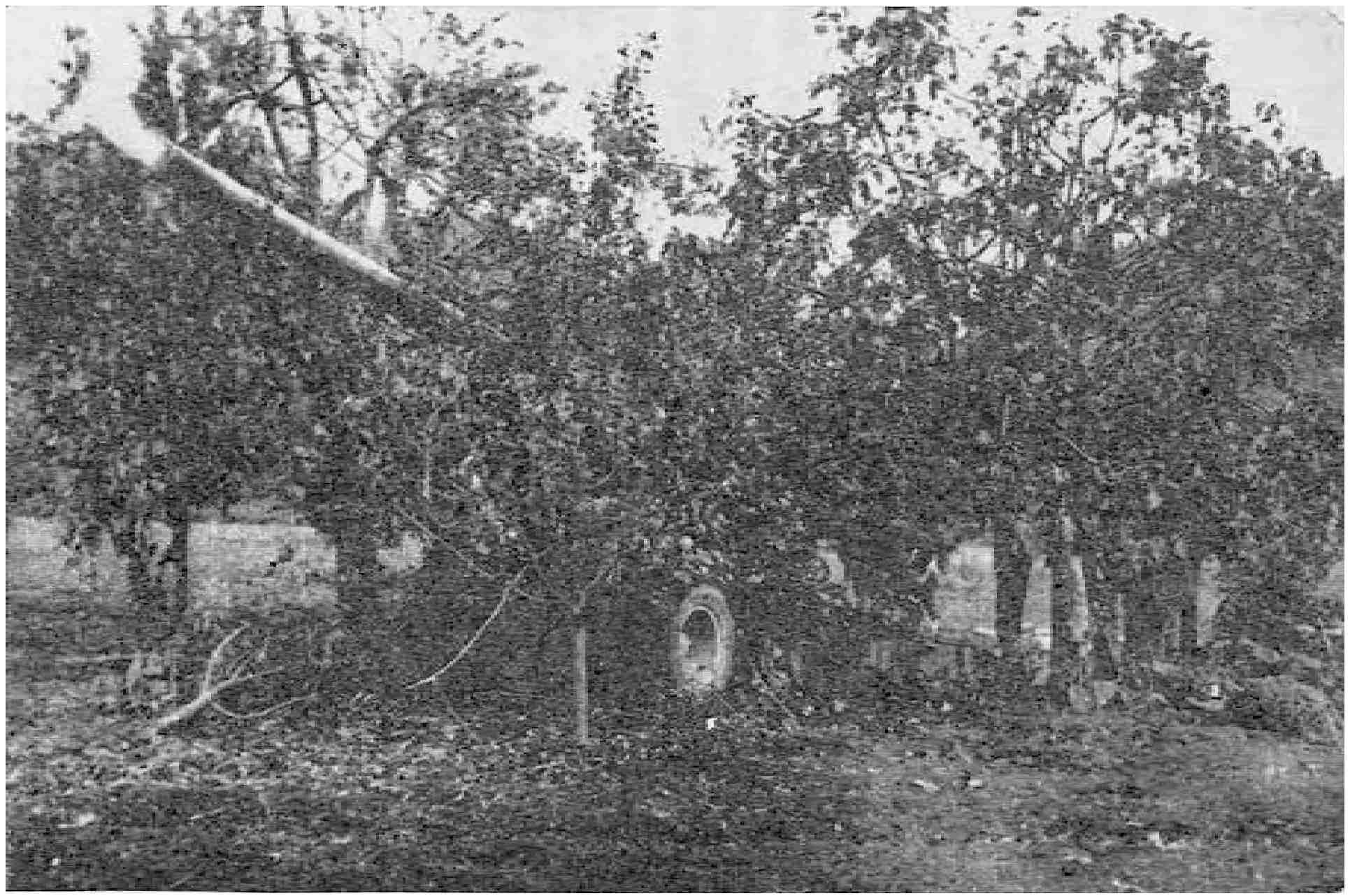
PHOTOGRAPH BY U. S. SIGNAL CORPS
“Long Tom” in Action
Antipersonnel Fire Report of Operations, Arundel
Island: “It was apparent that the Japs were concentrating
their forces on Stima Peninsula....
The area was divided by coordinates and assigned to
various artillery and mortar elements. Heavy fires
were placed on them throughout the night.
During the advance down the peninsula the next day
numerous enemy dead were noted, verifying the effectiveness
of the previous night’s concentrations.”
★
Dealing with Tree Snipers Report of Operations,
43d Division, New Georgia: “We effectively cured
the Jap of his liking for sniping from trees by the
command, ‘Fire Mission. All Battalions.
Fuze Quick. Three Volleys.’ The quick fuze resulted
in bursts in the tree tops. After a week of this treatment
the Jap sniper moved from the trees to the
ground.
Adjustment of Fire “All close support adjustments
were made by ‘sound and fragment’ method until the
latter part of the campaign, when ground observation
was obtained. Forward observers were always in the
most forward position possible—in some cases in advance
of the lines. Adjustments were time-consuming,
starting at a range surely over friendly troops
and working gradually closer to our front lines.
Some smoke was used but not very successfully in the
jungle. Tree tops were not used for observation because
of the limited view and the fact that our troops
were suspicious of all activity in trees. Prisoners of
war inquired about our ‘automatic artillery.’
Morale Effect “The incessant firing of our artillery
during the six-week period produced contrasting effects
on the nerves of our own troops and on those
of the enemy. Our infantry often stated that having
those rounds continually landing in front of them
was one of their best morale builders, especially at
night. In the Jap, on the other hand, it produced
severe cases of war neurosis. He couldn’t sleep at
night because he never knew when or where the next
round was going to land. He couldn’t sleep in the
daytime because when our infantry wasn’t attacking
him our artillery was giving him hell.
“The following statements made by prisoners are
interesting:
“‘Between Bibilo Hill and the airport we
had many guns of all sizes before this campaign,
but now many of them are gone—knocked
out by artillery. It has completely
demoralized many units, reduced many units in
strength, and has made many men go crazy.
We were awakened at night by the slightest
noise, because of the bad state of nerves. At
night three men stayed in one foxhole; two
smoked while one slept. During the day we also
tried to get some sleep by alternating, but the
continual artillery fire kept us on edge and we
got no rest.’
“‘Even in the two-story dugouts many
men were killed just by concussion. A direct
hit would kill all the men inside.’
“‘The artillery is the one thing that is universally
feared by all our ground troops. It continues
over such long periods of time and the
rounds come so fast.’
“‘Except for the artillery we could continue
our defense.’”
★
Ammunition and Fuzes First Marine Division,
Guadalcanal: “The super-quick fuze is more effective
than the delay fuze against troops in wide areas, particularly
in the cocoanut groves of the tropics. A
report from prisoners indicated that in one unit of
approximately 100 men, all but six were casualties
as a result of one artillery concentration. The
37mm canister proved to be a devastating type of
ammunition.
Disposition “In jungle warfare the artillery of the
defensive set-up should not be placed too close to the
infantry line. The added range thus obtained is of
no value unless observation of the terrain permits its
use, which will very seldom be the case. Artillery too
close to the infantry is not only needlessly exposed,
but is actually less effective because of the limits imposed
by minimum-range considerations, and, in the
case of 105mm howitzers, because of the impossibility
of using high-angle fire at ranges less than 2,000
yards.
Liaison “The liaison officers with infantry regiment
should be officers with as much experience as possible,
preferably of the rank of captain or above. When
possible, either the artillery battalion commander or
his executive officer should be sent to the infantry
regimental CP at first sign of enemy activity.”
Reinforcing Fire Lieutenant Colonel R. D. Funk,
Field Artillery, Battalion Commander: “If I can
spare the radios I am going to send one to the artillery
battalion that reinforces me the next time we are in
direct support. Then when one of our observers calls
in a fire mission we can simply tell the radio at the
other battalion to take the mission direct from
the observer. This will eliminate a relay through
our Fire Direction Center and speed things up
considerably.
Transportation “We keep only seven 2½-ton
trucks with each howitzer battery. The three spares
stay in the Service Battery ready to replace damaged
ones in any howitzer battery. This also allows the
maintenance section to have vehicles available for
6,000-mile checks. When one is finished they send
it out to replace another that is due for check.
Fire Direction Center “We are using two ¾-ton
trucks for the CP section of Headquarters Battery.
Each has a tent and a fire direction group. When
we move the CP we send out one truck with the S-3.
He takes over the operation of the Fire Direction
Center when he gets set up, and the rear CP can
then close down and move.”
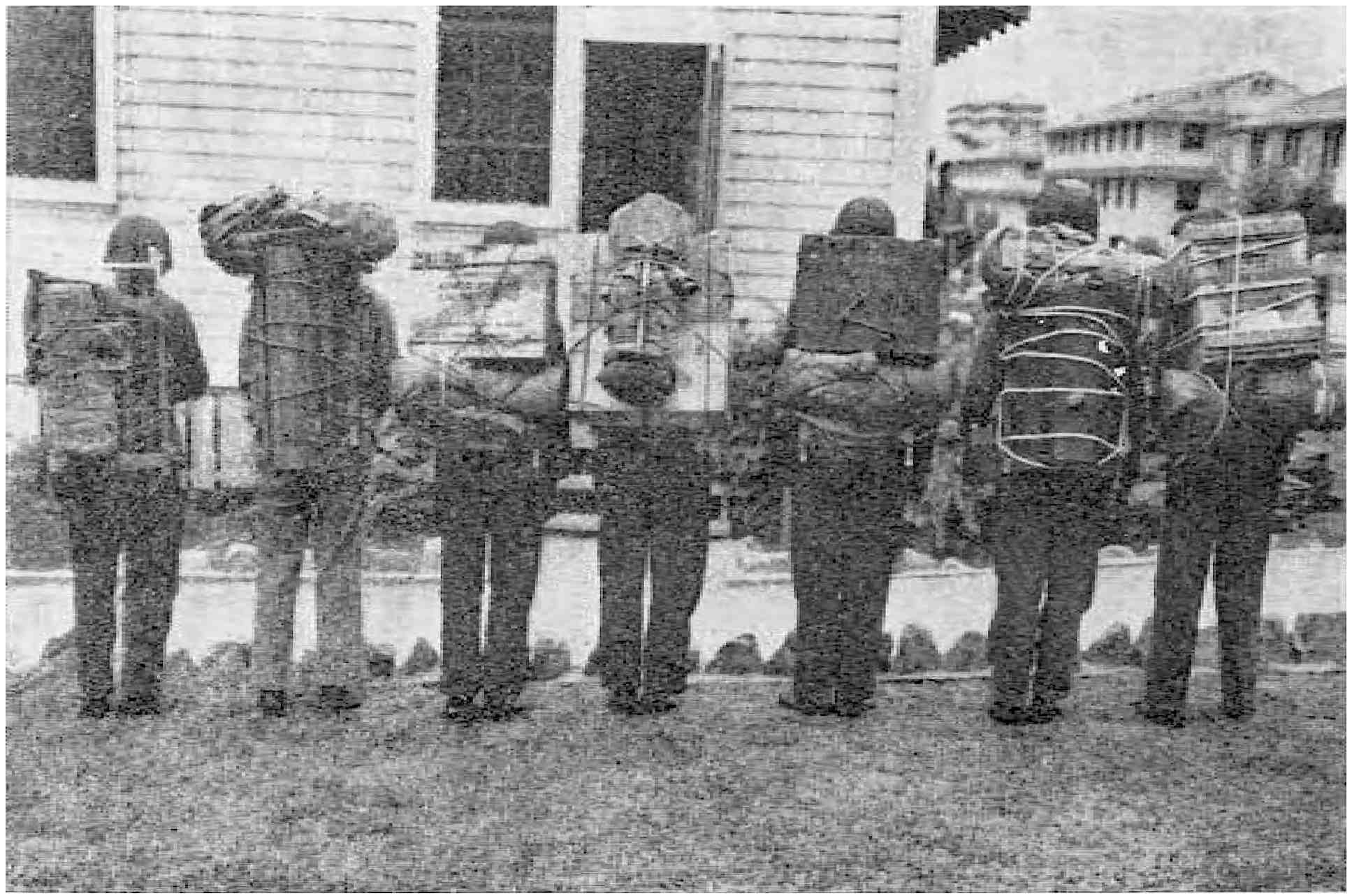
PHOTOGRAPH BY U. S. ARMY SIGNAL CORPS
Uses of the Pack Board
Pack Boards for Observers “We use pack boardsC
for forward observers and liaison parties. They are
a wonderful help in hilly or mountainous country
when these parties have to leave their vehicles and
hoof it. Two for each party adds up to six per howitzer
battery and six in Battalion Headquarters
Battery.”
C Rectangular frames with canvas centers to which supplies or
gear may be lashed and carried as a pack. See illustration.
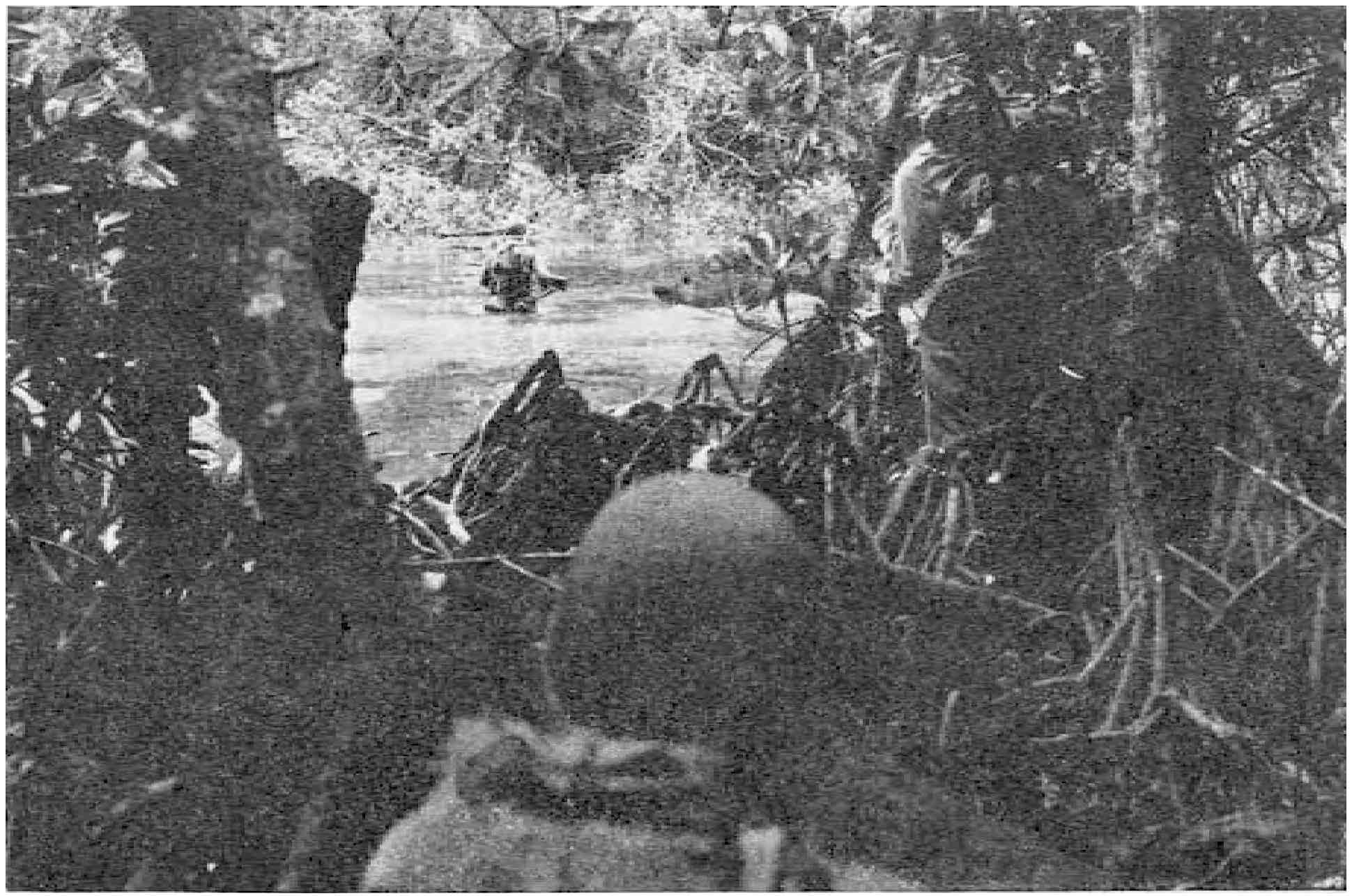
PHOTOGRAPH BY U. S. ARMY SIGNAL CORPS
Patrol of the 25th Division, New Georgia Campaign
Booby Traps Seventh Army Report, Sicily: “A
German Luger pistol was ‘booby trapped’ on a table.
A new replacement picked it up. Two were killed
and fourteen wounded in the resulting explosion.”
★
First Division Report, Tunisia: “A Luger pistol
was found lying on the ground. An American
infantry lieutenant carefully tied a long cord to it
and then, getting into a hole, pulled it to him and
put it in his pocket. Later in the day while examining
the pistol he attempted to remove the magazine.
The explosion killed the lieutenant and two
other men and wounded six soldiers.”
★
Timeliness of Orders Major Kinney, Infantry,
Sicily: “Our chief difficulty throughout the campaign
was the lack of time given for the execution of
orders. Frequently we received operations orders
which did not allow enough time for proper preparation
and execution. At San Fratello, we received
an order after 11 PM to attack at 6 AM the next
morning. The battalions were in assembly areas
some five or six miles from the line of departure.
The terrain over which they had to move to get in
position in the dark was the roughest, most rugged
mountain country you could imagine, and all the
ammunition, weapons, and supplies had to be taken
by hand and by mule pack. Although it might seem
that from 11 PM to 6 AM was sufficient time, the
actual conditions were such that it was less than half
enough, because of the terrain, darkness, and transport
difficulties. Also, the men had just completed
marches over mountain trails of nine to fourteen
miles and were not fresh for the new movement.”
★
Maps Seventh Army Report, Sicily: “Instill in all
personnel an appreciation of the value of maps. The
supply of maps will never be adequate to the demand.
Training in the care and preservation of maps is as
important as training in the care and preservation of
matériel.
AA Fire “It was found necessary to issue instructions
that ground troops, with the exception of AA
units, would not fire at airplanes unless the planes
attacked them or were close enough to be identified
beyond a possible doubt.”
Security 1st Division G-2 Report, Sicily: “Interrogation
report of a captured German pilot includes
the following: ‘About the end of June, 1943, German
air crews were shown a report and given a lecture on
the tactical and technical details of the P-47 Thunderbolt,
alleged to be based upon the statements
made by a captured U. S. Army Air Force captain.’”
COMMENT: The moral of this story is obvious.
Hammer home the necessity for saying absolutely
nothing but, “My name is ...; my
rank is ...; my serial number is ....”
★
Strafing Aircraft Fifth Army Report, Salerno:
“During landing operations at Salerno, many members
of the —th Division would stand up to fire their
rifles, carbines, and even pistols at strafing and bombing
German aircraft. This resulted in many unnecessary
casualties.”
COMMENT: Personnel not assigned to a definite
AA mission should disperse and take cover,
firing their individual weapons from such cover at
attacking aircraft only, and even then only when
these come within the effective ranges of their
weapons.
★
“Gas!” Colonel M. E. Barker, Chemical Warfare
Service, Salerno: “On the third day of the operation
we had a big gas scare. A German airplane came in
and released two or three radio-controlled bombs,
which gave off considerable smoke when released and
while on the way down. Several men on the beaches
saw this smoke and concluded that an air gas attack
was being started. At the same time some vehicles
climbing the sand dunes from the beach to the de-waterproofing
area had become so hot that their
gas-indicator paint turned red. The two incidents
together convinced everybody on the beach that a
gas attack was being launched. By this time, of
course, there were plenty of battlefield smells, including
that always-present smell of rotting animal
and human flesh. The gas alarm ran up and down
the beaches and the roads inland.
“There was no panic. Everybody simply put
on his gas mask and carried on. The MP’s stopped
all personnel going into the area who didn’t have
gas masks. Those individuals who had ‘misplaced’
their gas masks were really troubled for a while.
Both Colonel Guild and I investigated and then gave
the ‘all clear’ signal. I think we would have carried
on in exactly the same way without much loss of
time or efficiency if gas had actually been present.”
★
Counterattack Foiled Lieutenant Colonel Taylor,
Infantry, Italy: “We had just relieved the —th
Infantry after it had had numerous casualties from
an enemy tank attack against our beachhead at
Salerno. We were occupying a defensive, wired-in
position. The Germans counterattacked with tanks,
but because we were occupying a different position
from that used by the preceding unit the enemy first
started across our front, apparently believing that
we were in the old position. So it was duck soup.
We knocked out eight tanks with our 37’s, 57’s, TD’s,
and tanks.”
★
Room for Improvement The following comments,
indicating weaknesses which must be corrected, were
made by the Commanding General, —th Division,
Italy: “Sometimes units failed to dispose themselves
properly for all-around defense when halted on
an objective or when placed in a position for defense.
“In the attack, riflemen frequently failed to provide
fire that would cover the movement of adjacent
units, merely because they were not able to ‘pin-point’
definitely the location of the enemy rifle and
machine-gun elements firing on our troops.
“Some small unit commanders selected positions
apparently with cover and concealment as the primary
objective rather than positions from which
effective fire could be brought to bear on the enemy.
“Due to the enormous division frontage in the
second phase of the landing at Salernosome commanders
attempted to stretch their units excessively,
and as a result permitted faulty dispositions.”
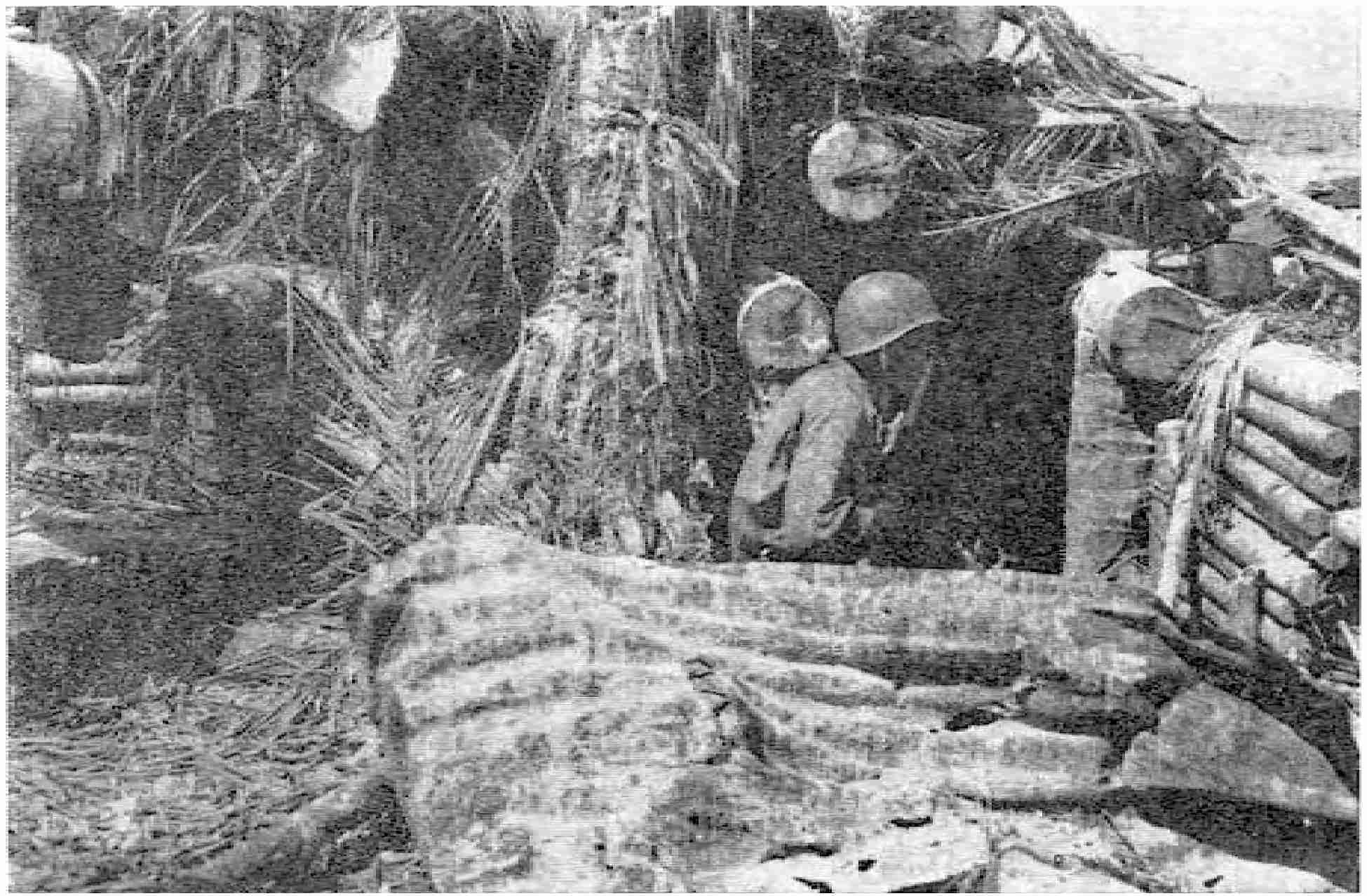
PHOTOGRAPH BY U. S. ARMY SIGNAL CORPS
Japanese Pillbox
Japanese Pillboxes Lieutenant Colonel McCormick,
Field Artillery, New Georgia: “In most cases
pillboxes were built in two decks to permit the occupants
to drop through a trap door during heavy
shelling. They were used for heavy-weapons firing
and had communication trenches which concealed
light machine guns protecting the pillboxes. All were
mutually supporting and very well concealed.”
★
Superman Myth Exploded Operations Report, 43d
Division, New Georgia: “Our troops here came to
regard the Superman stories about the Japanese as
ridiculous. The Jap is tricky but not so tricky as
many have been led to believe. He is not nearly so
ingenious or adaptable as the average American, and
the truth of the matter is he’s afraid of us, of our
artillery, and of our sea and air power. Our troops
must learn this and never forget it.
Jap Trap “We soon learned that the Japanese permitted
small leading elements of the column to
proceed past their effectively camouflaged fortifications
and would not open fire until our main body
came along.”
Defensive Action Operation Report, 43d Division,
Arundel Island: “Our first contact with the enemy
was made by patrols, which encountered small groups
of Japs equipped with automatic weapons. Their
resistance consisted of a fluid delaying action and,
during the early phases, could not be effectively fixed.
After a short skirmish the Japs would withdraw several
hundred yards and re-establish their temporary
defense. The denseness of the jungle made such a
defense quite effective in delaying our progress.”
★
Vine Entanglements Colonel Liversedge, U. S.
Marine Corps, New Georgia: “The Japanese used
a prickly native vine for entanglements. The vines
were interwoven and used to protect defensive positions
in lieu of barbed wire. Results were effective
and impeded attack. Vines had to be cut before
progress could be made.
“Our own troops should be instructed in the use
of these vines as a means of improvisation when wire
is not available.”
Reverse Slope Tactics Second Lieutenant S. W.
Malkin, Infantry, Platoon Leader, Sicily: “Enemy
machine guns, mortars, and automatic rifles were
located on the reverse side of the hills so as to catch
our advancing infantry as they came over the skyline.”
★
Don’t Gawk! Private George Scott, Infantry,
Sicily: “Several times German planes pretended
that they were involved in a dog-fight to secure the
attention of the ground troops. Then they swooped
down in a strafing run.”
★
Traps and Mines Private First Class Edward
Borycz, Infantry, Sicily: “The enemy abandoned
his tanks with motor running. When we tried to stop
the motors they blew up.
“The Germans would put a mine in a road with
another mine a sufficient depth under it so that it
would not be seen if the top mine were removed.
For a while our sappers did not run the mine detector
over the area again where the first mine had been
found. But after the dirt became packed down sufficiently
by traffic, the second mine would go off.”
★
Minor Tactics Staff Sergeants Richard E. Deland
and Robert J. Kemp, Infantry, Sicily: “Never let
an apparently lone machine gun suck you into a trap.
The Germans will usually not fire on the individual
but will wait, watch where he goes, and get a whole
flock.
“Germans always approach their positions from
the end and under cover so as not to give them away.
“In the counterattack the Jerry machine gun is
always well forward. German weapons are faster
but are less accurate than ours; they scare you more
than they hurt you. The German 81mm mortar is
the worst goat-grabber; it gives you no notice when
it is coming in.
“Germans use tanks to maneuver and fire from
a distance in attack. When the going gets hot they
pull the tanks in and, after a minute, bring them out
again.”
Typical Attack and Withdrawal Lieutenant Colonel
P. H. Perkins, Tank Battalion Commander,
Italy: “The standard German attack here consists
of three or four tanks in line in the lead. They are
followed by infantry in trucks at four to five hundred
yards. The rest of the tanks follow the infantry.
When fire is drawn the infantry dismounts. The
leading tanks mill about, fire, and withdraw. We
have never seen the reserve tanks committed.
“In their withdrawals the Germans use tanks to
good advantage. They do not have to contend with
mines and blown bridges. Their tanks fire a few
shots and withdraw, then move up again, fire a few
more shots and withdraw, and so on.”
★
Rearguard Action Lieutenant Colonel Taylor, Infantry,
Battalion Commander, Italy: “My experience
has been that we first meet two armored vehicles
which open fire for a few minutes with everything
they have on the first man of ours they see; they
then withdraw rapidly down the road.
“Next we hit their outpost, which, I estimate,
consists of about two squads. This outpost, protecting
the road, has groups on the sides of the mountains
on the flanks. It takes four to six hours to
drive this outpost in due to its fine observation over
us and the difficulties of maneuver.”
COMMENT: It should be remembered that this
is the experience of one battalion commander in
one theater.
U. S. GOVERNMENT PRINTING OFFICE: 1944
Transcriber’s Notes
Punctuation, hyphenation, and spelling were made
consistent when a predominant preference was found
in the original book; otherwise they were not changed.
Simple typographical errors were corrected; unbalanced
quotation marks were remedied when the change was
obvious, and otherwise left unbalanced.
Illustrations in this eBook have been positioned
between paragraphs and outside quotations. In versions
of this eBook that support hyperlinks, the page
references in the List of Illustrations lead to the
corresponding illustrations.
On the Title page, “XXXXXXXXXXXX” indicates text
that was blotted out.
The “G. C. Marshall” illustration at the end of
the Introduction is the General’s signature.