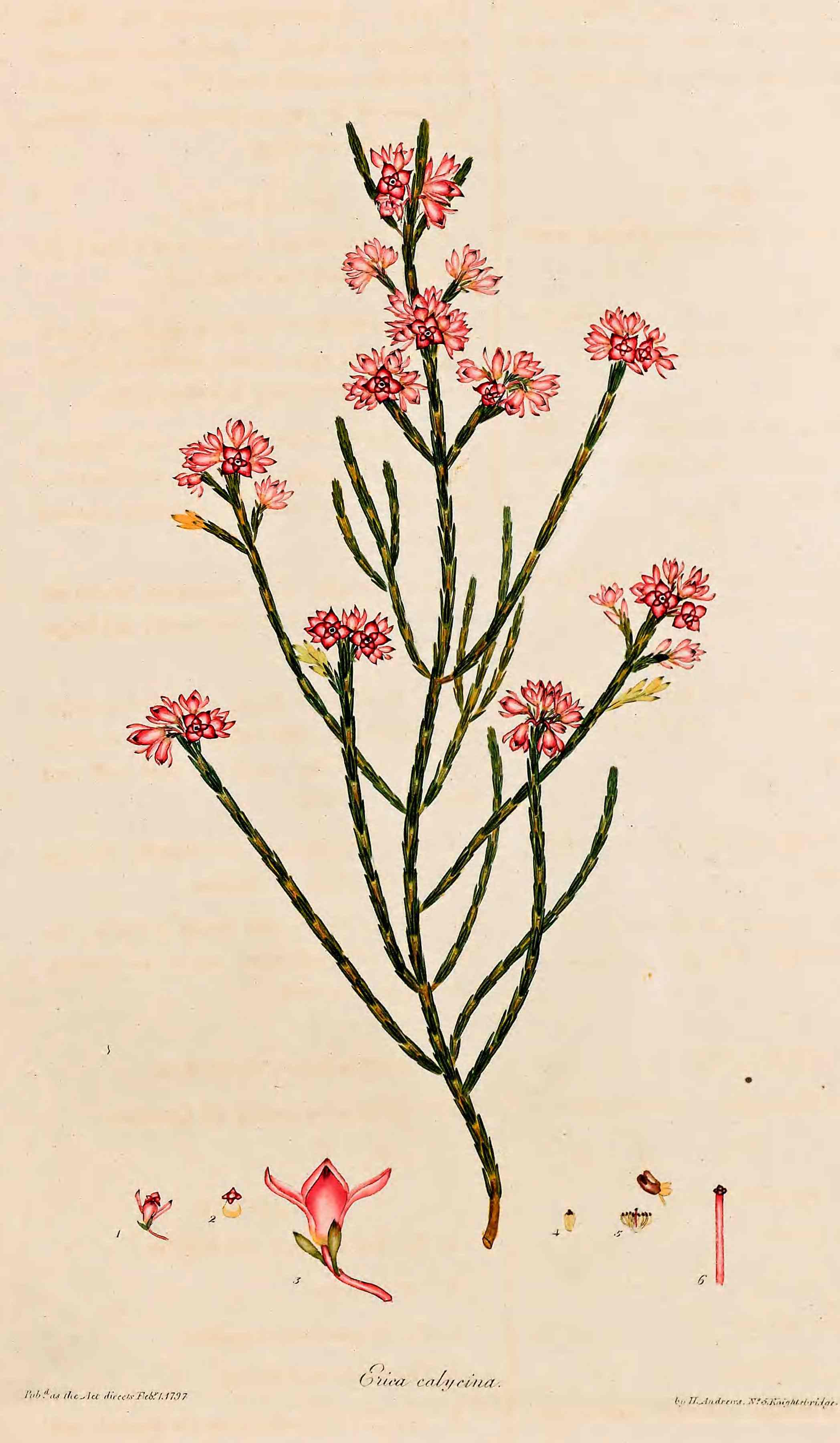
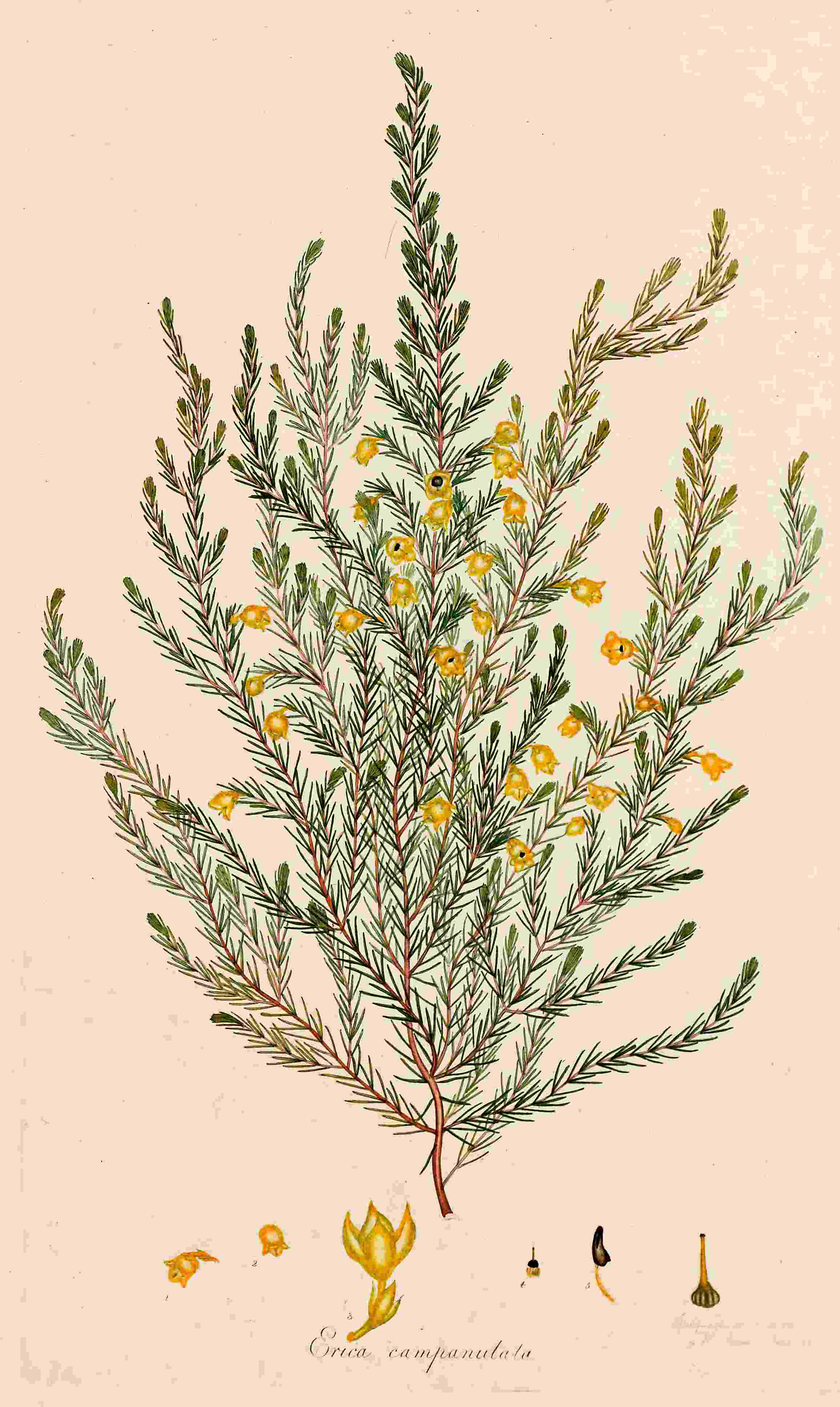
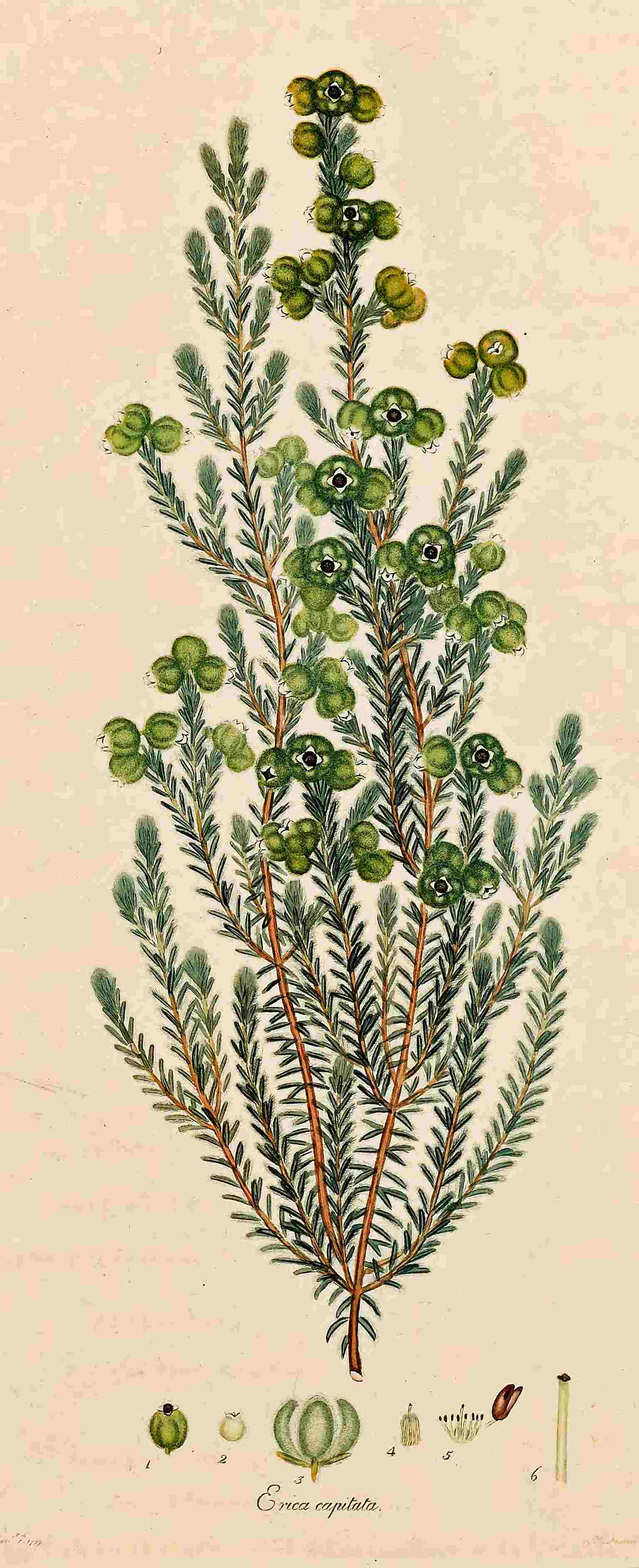
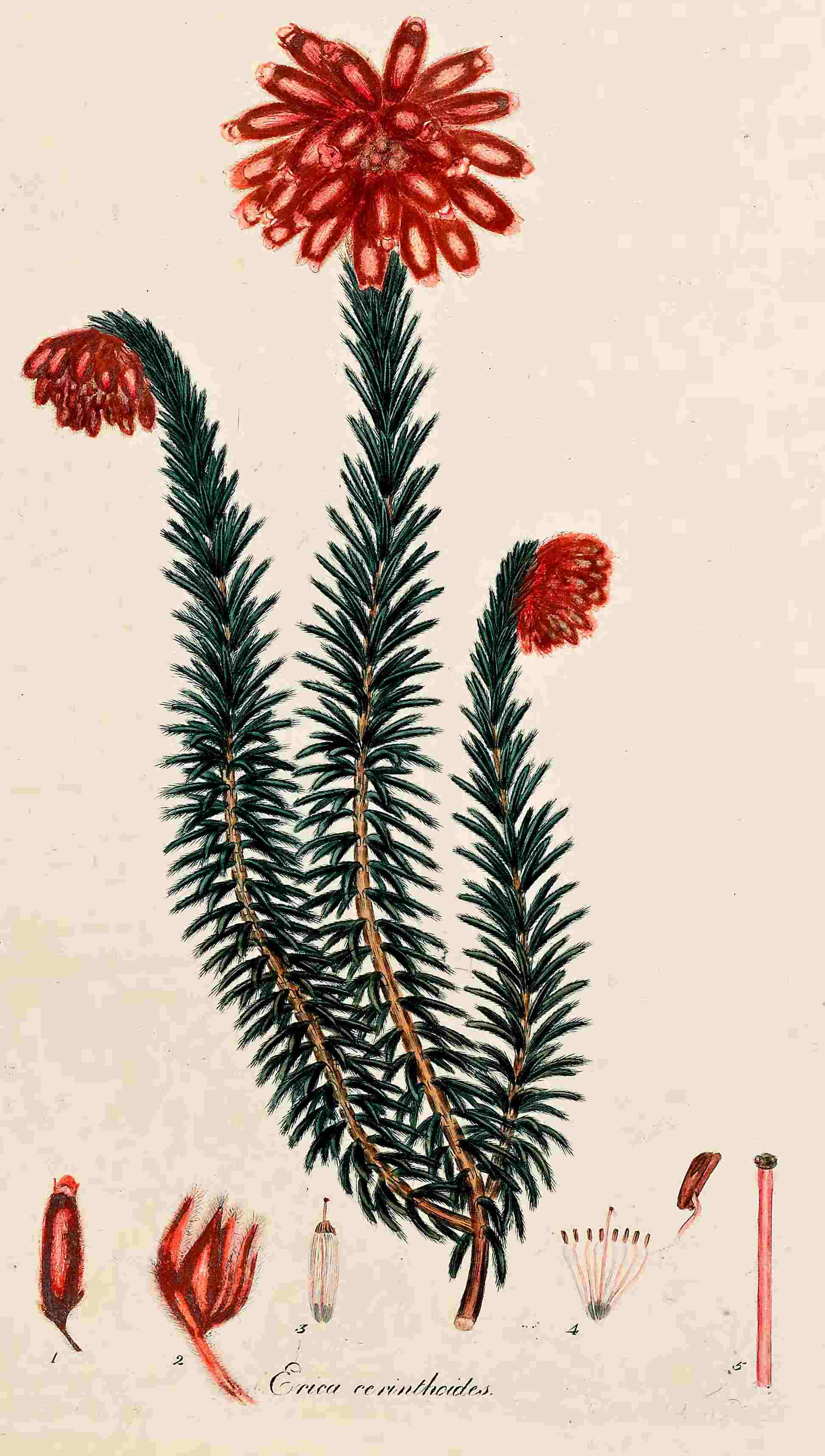
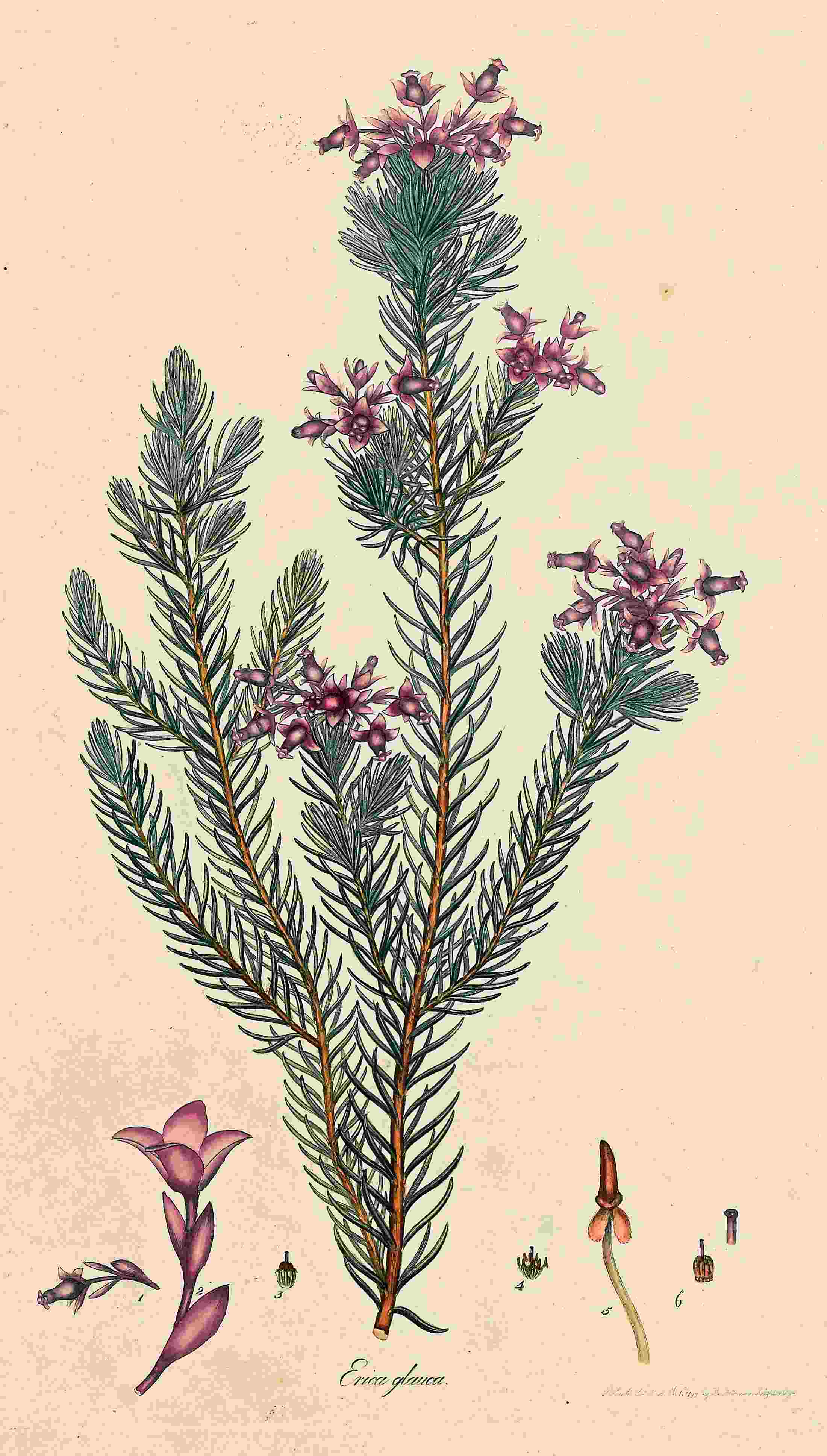
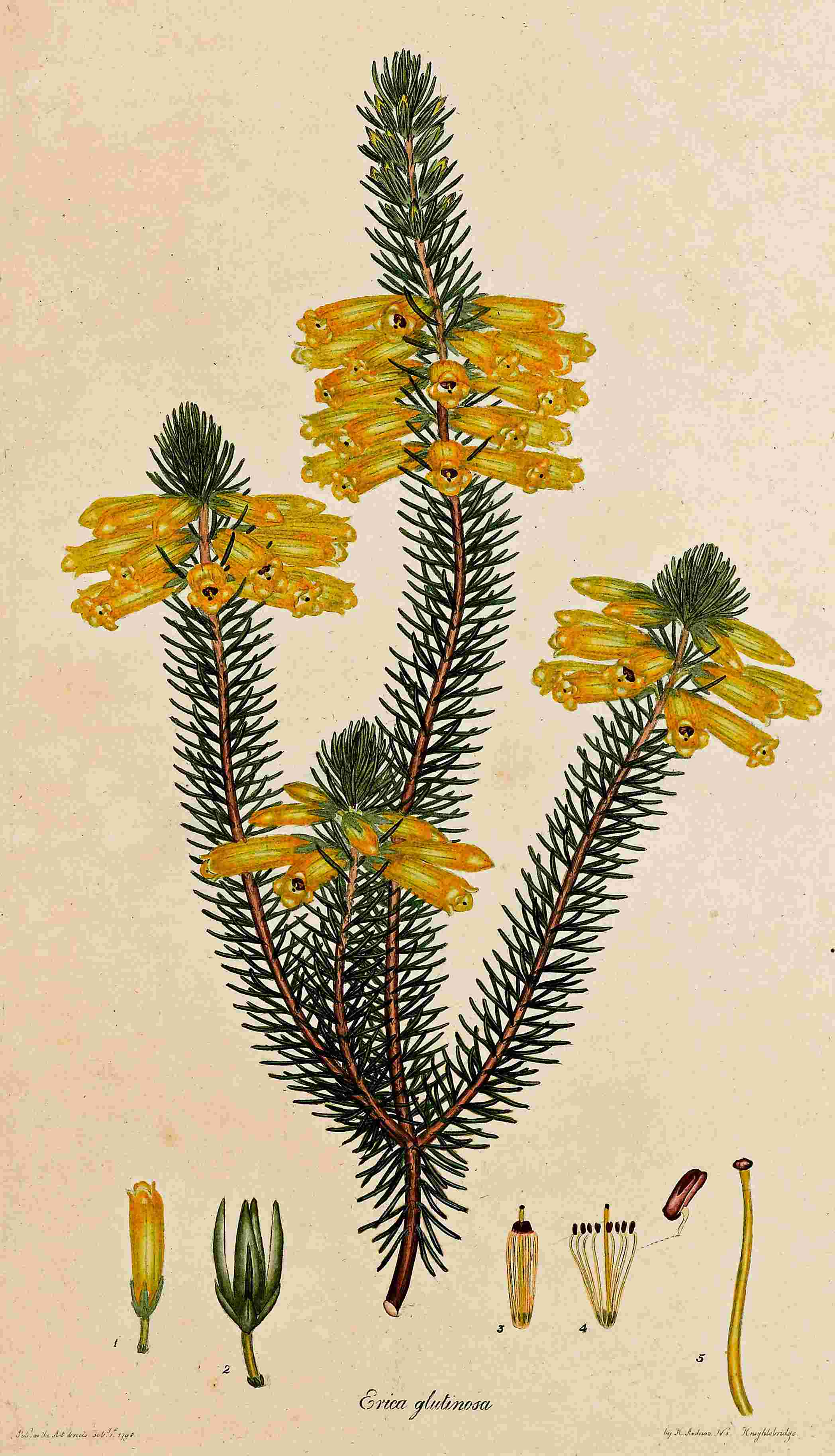
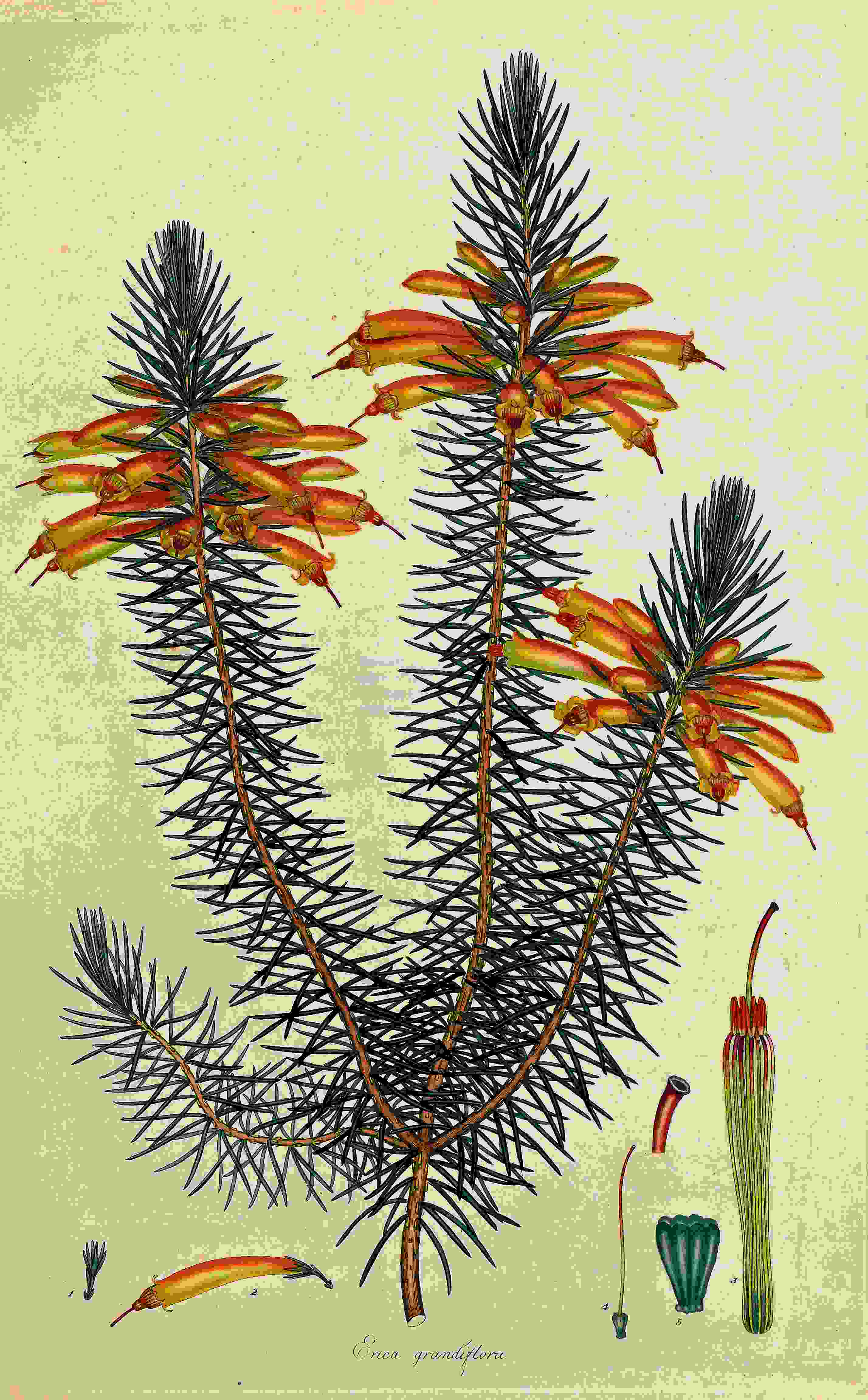
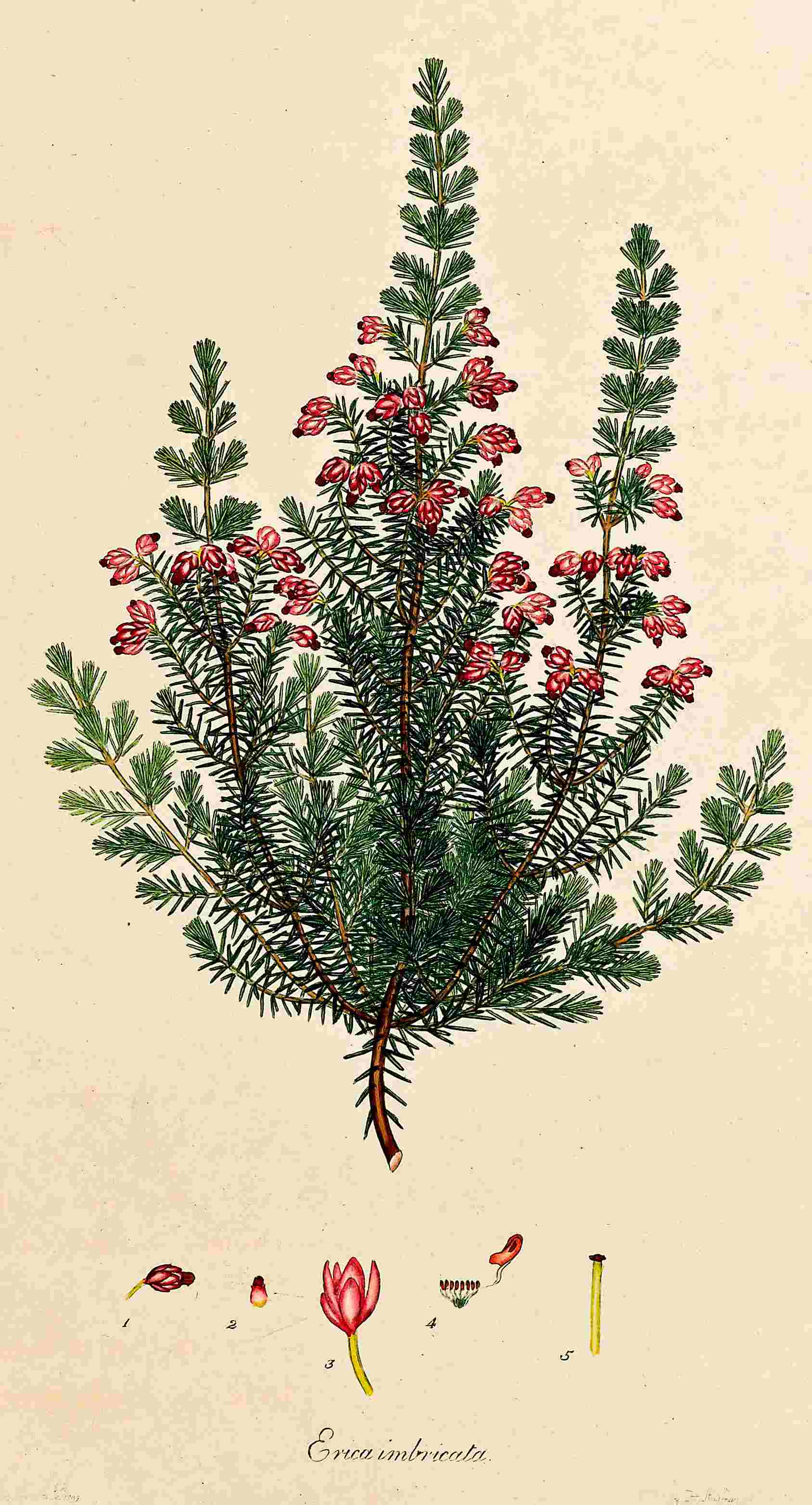
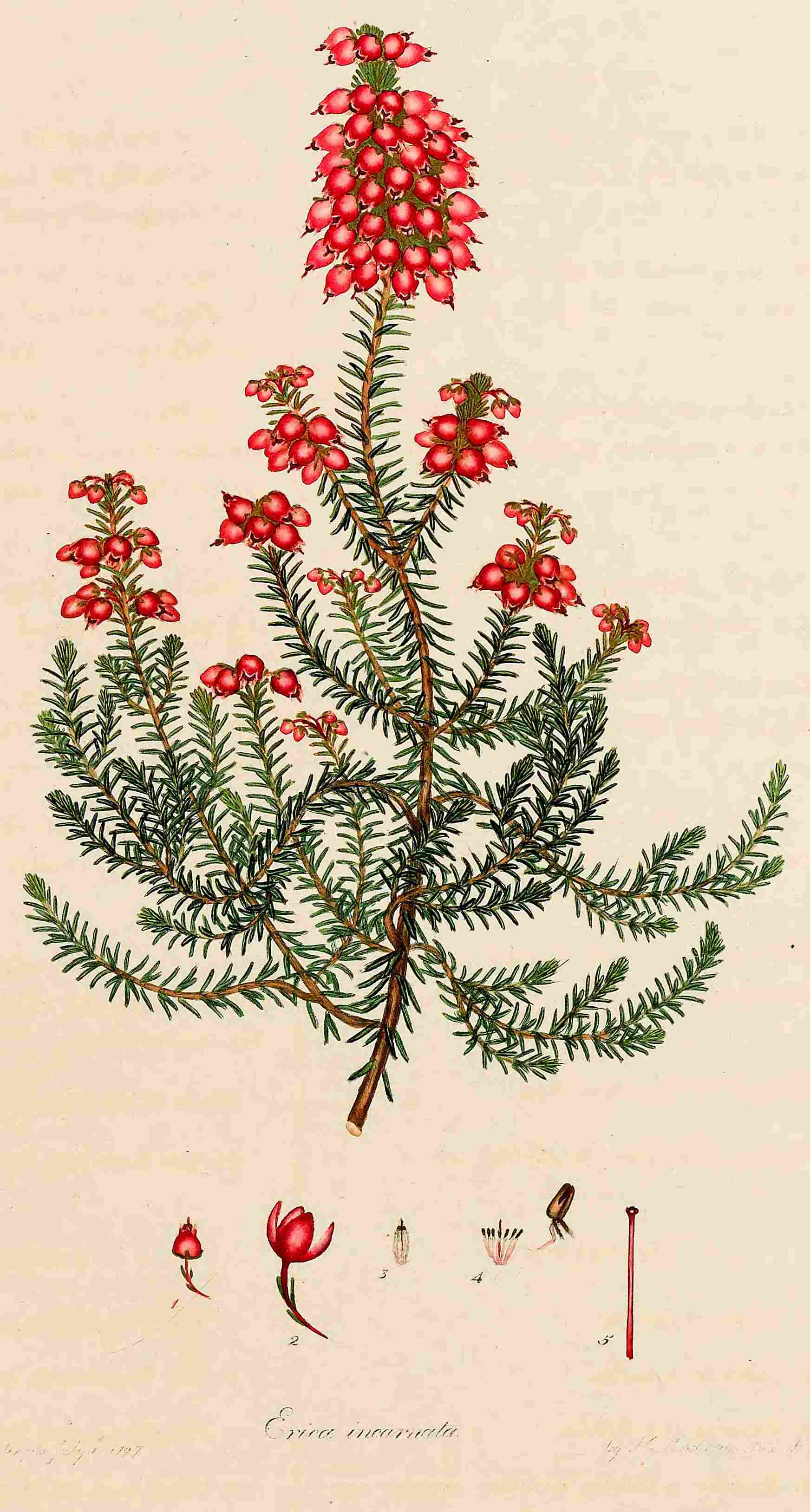
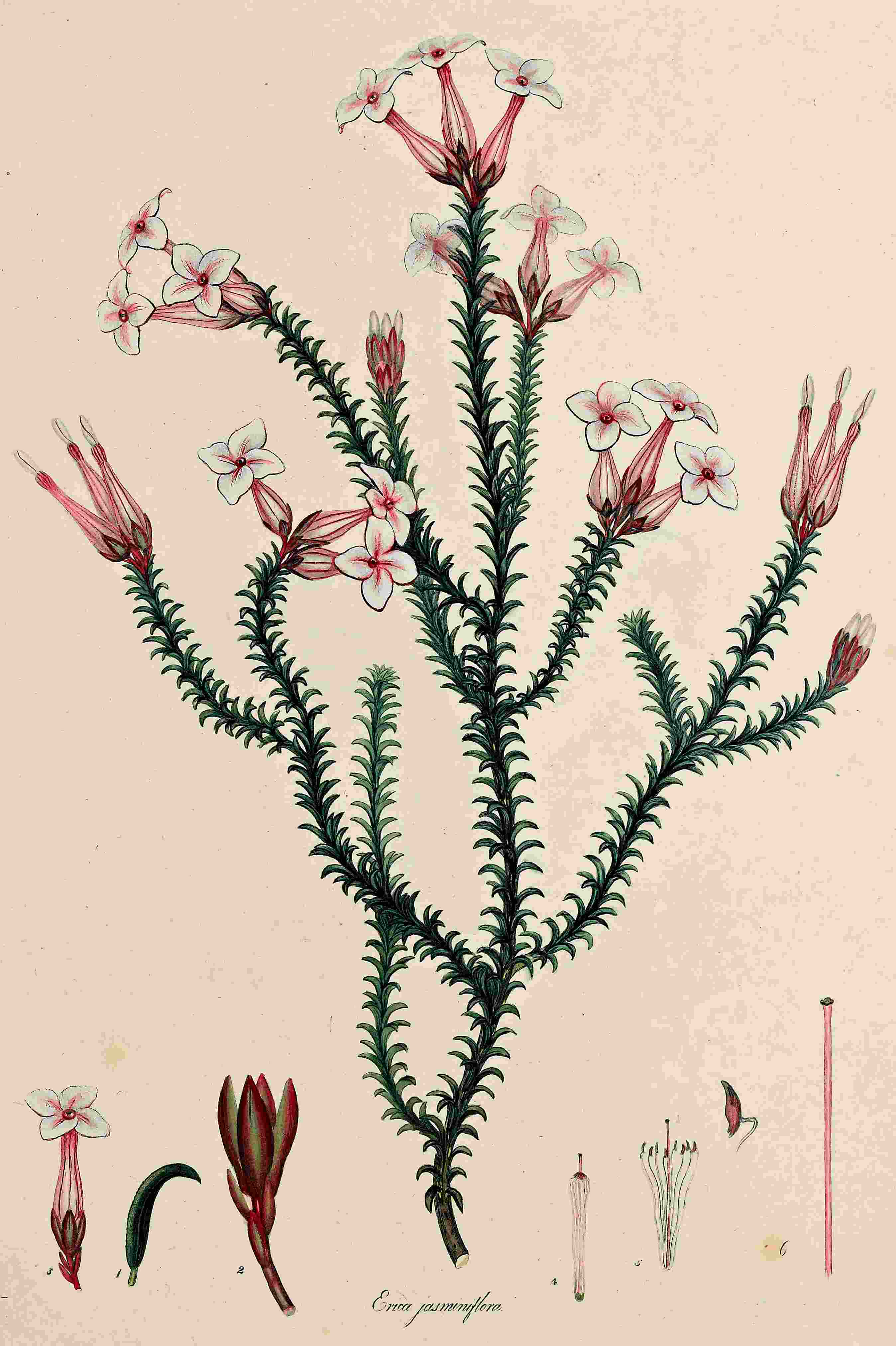
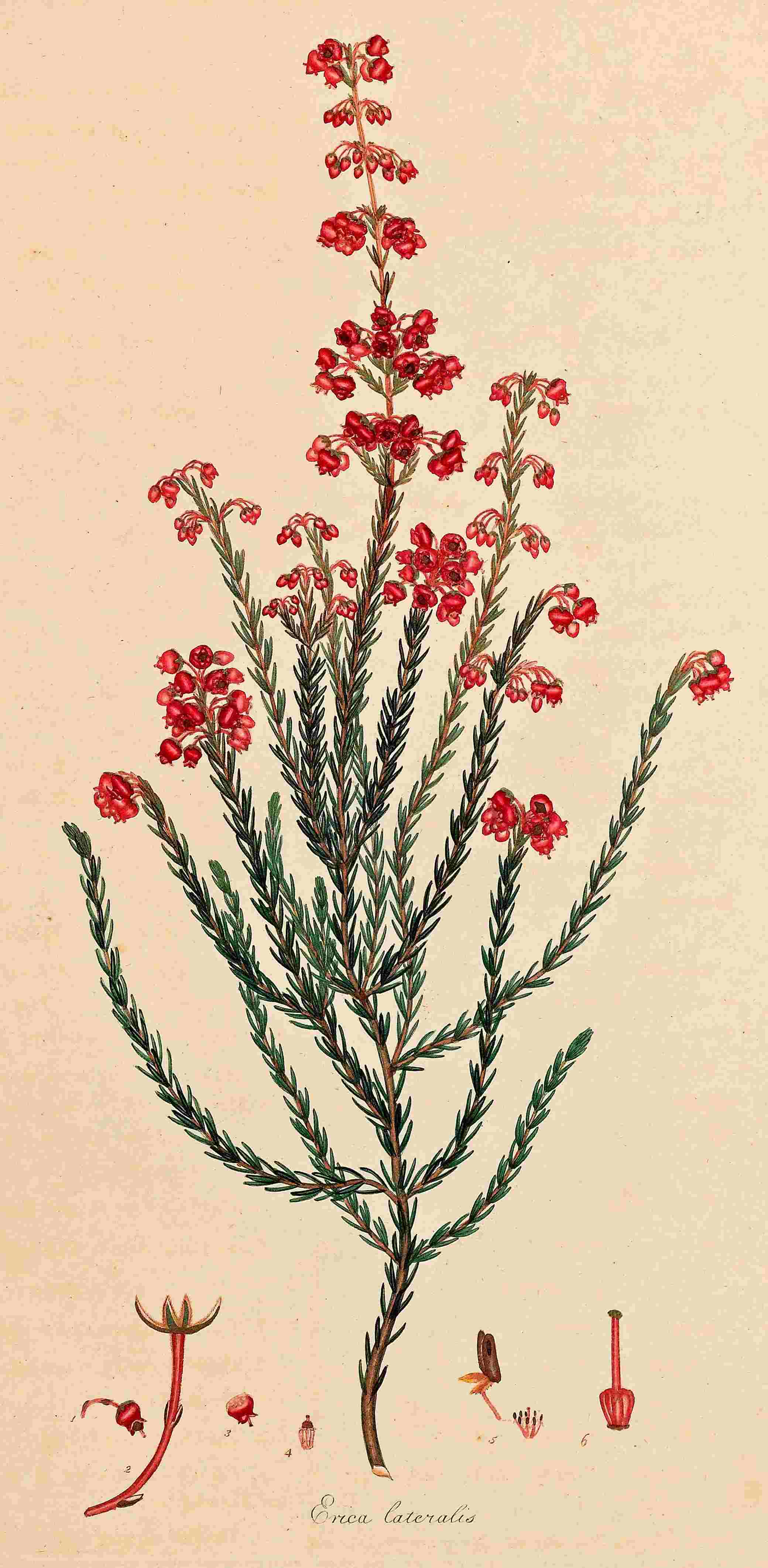
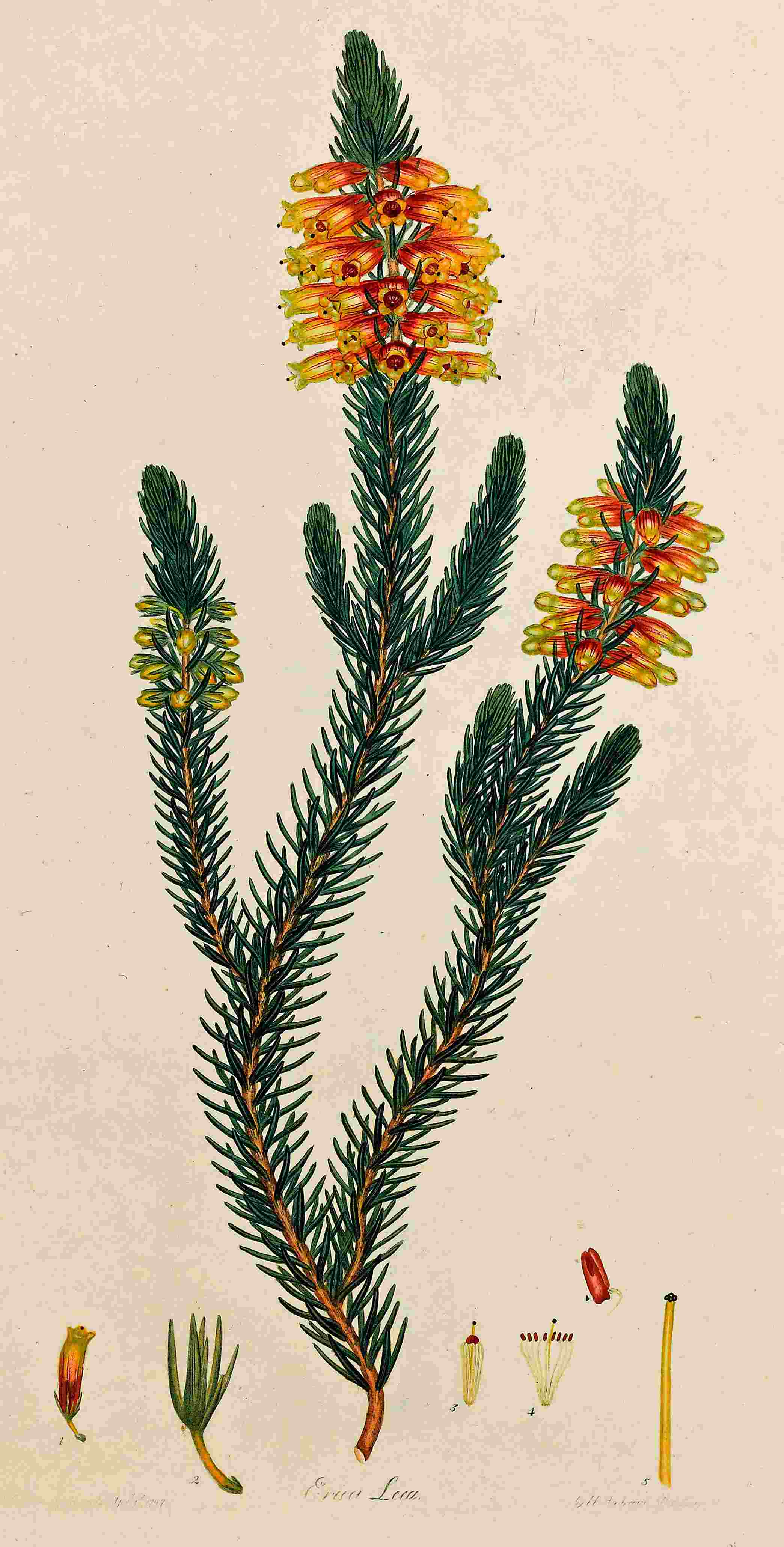
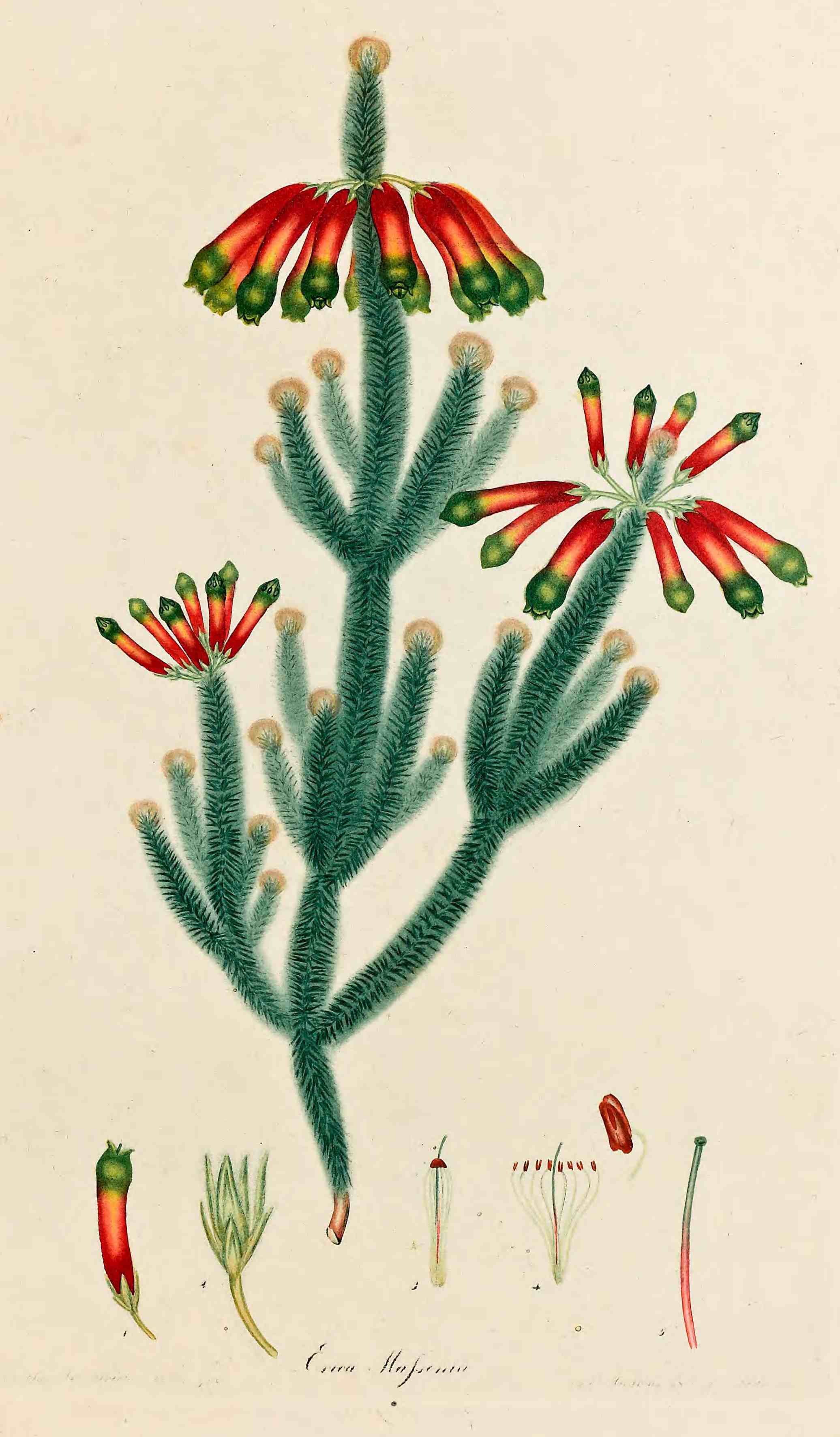
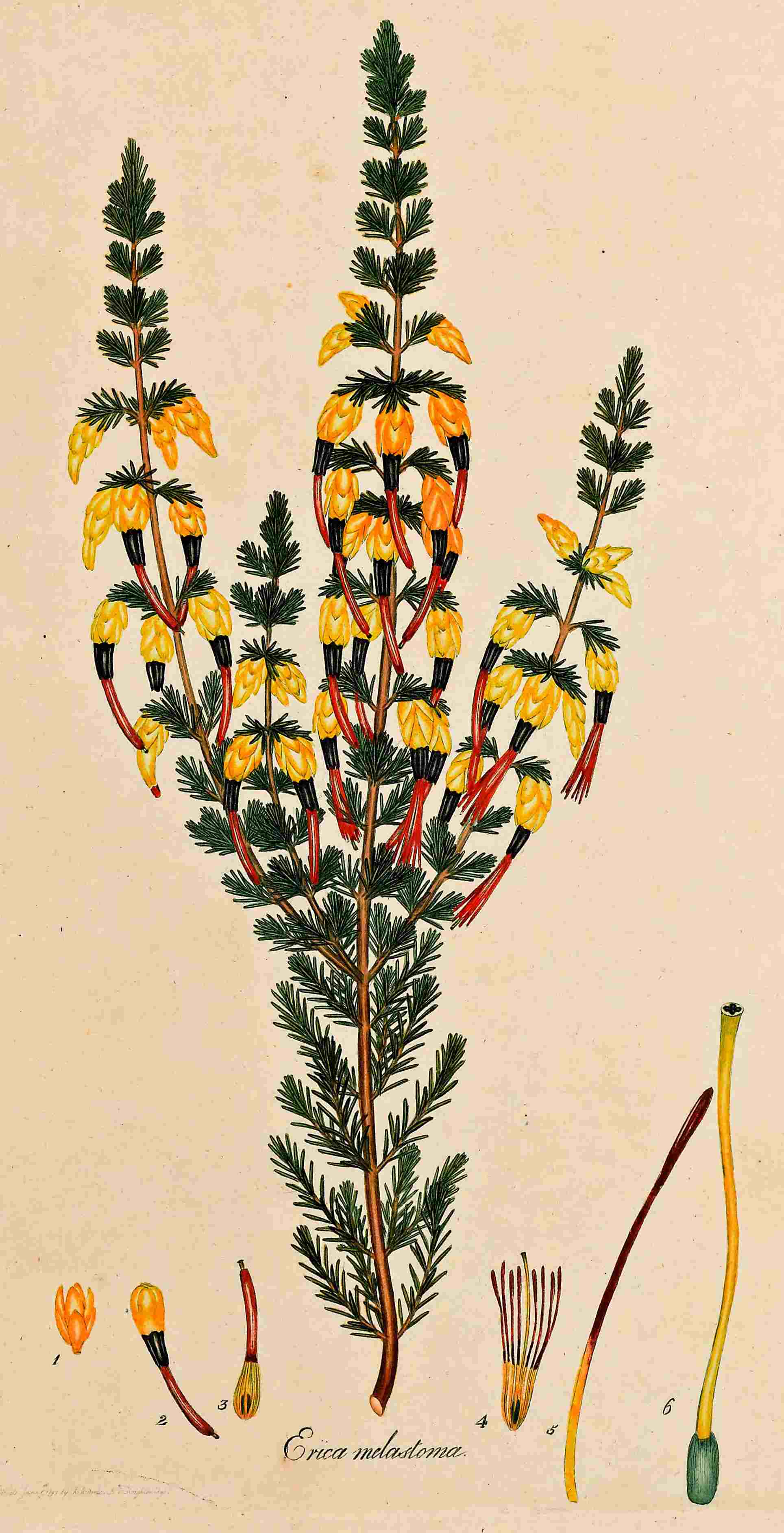
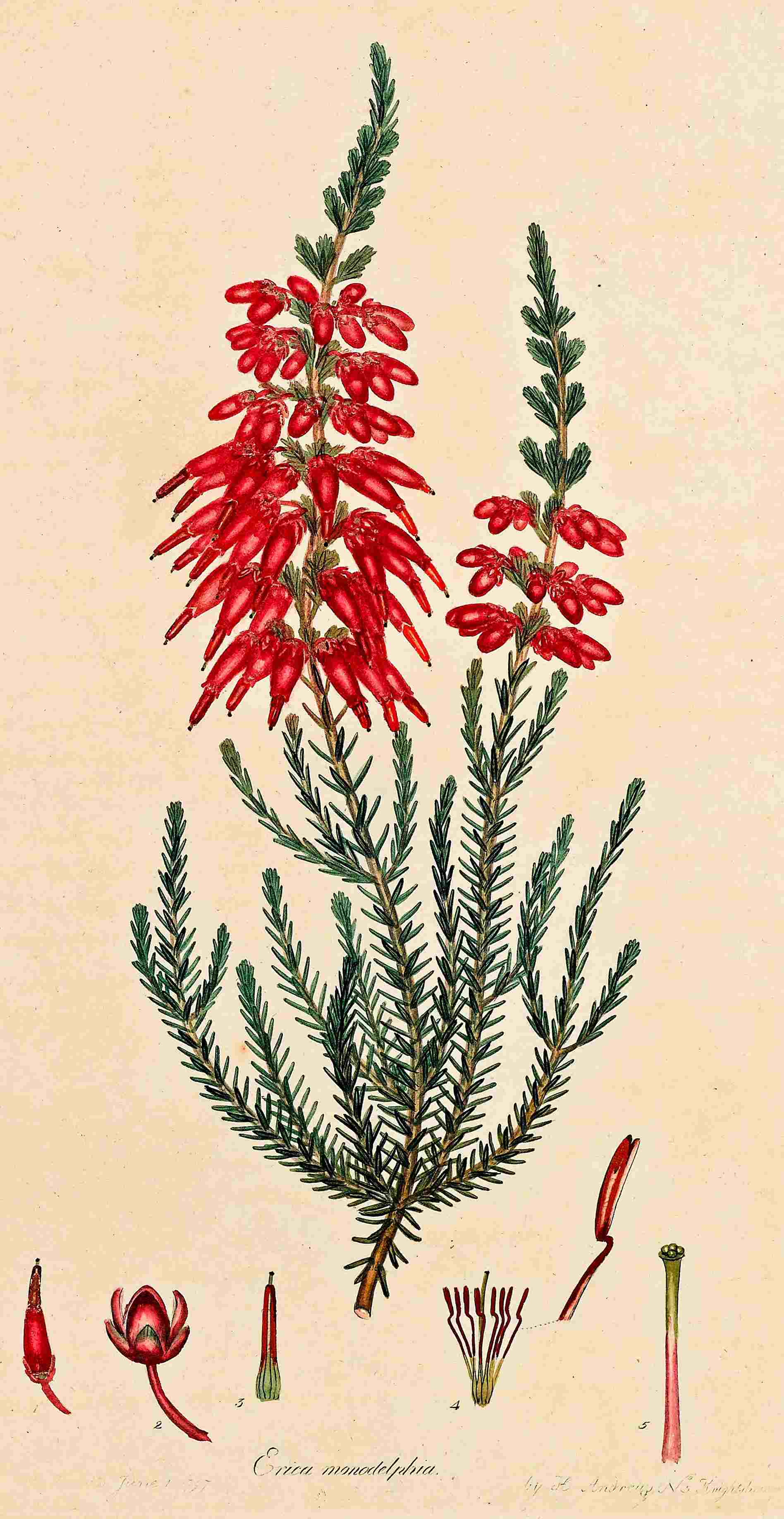
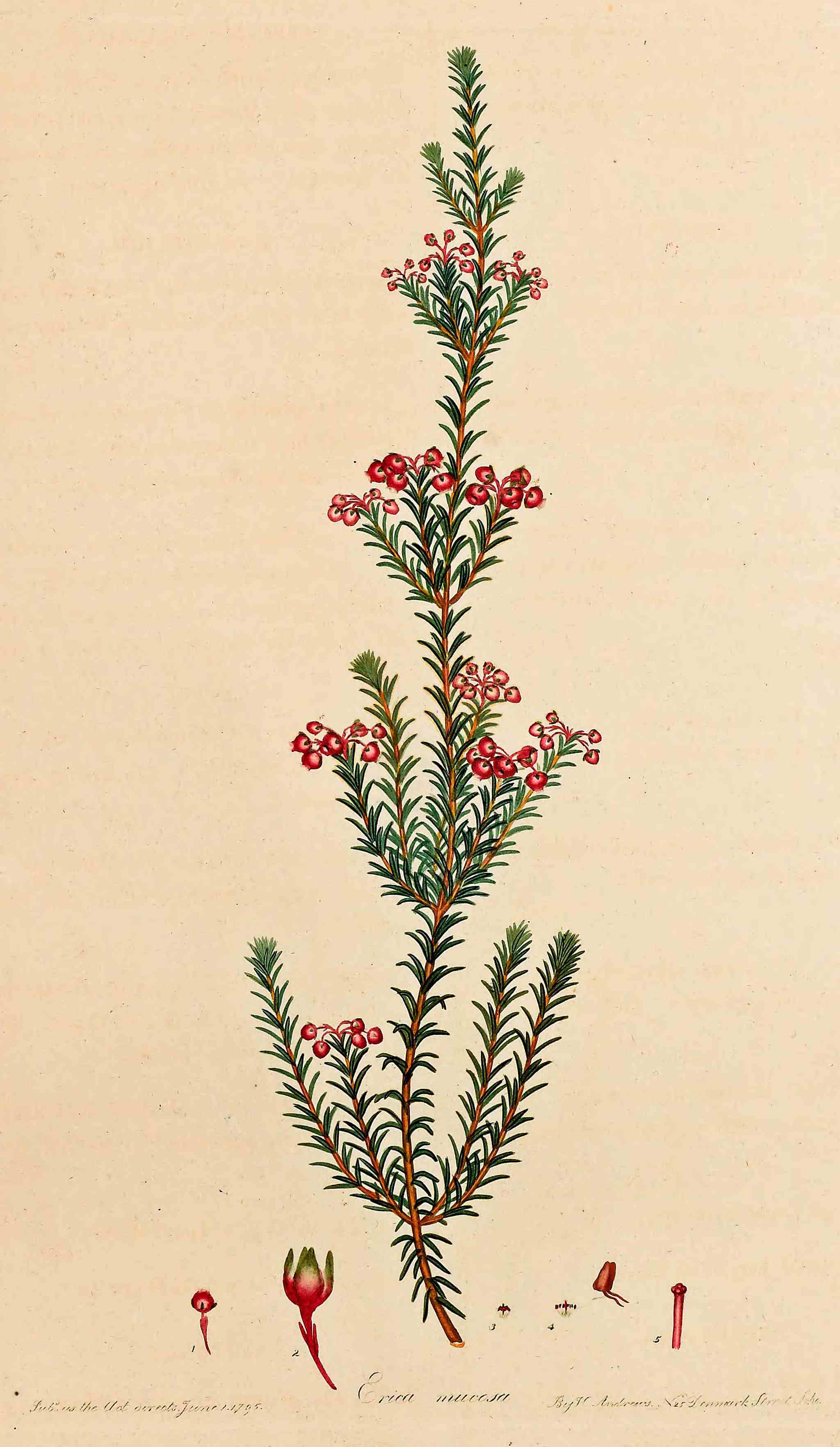
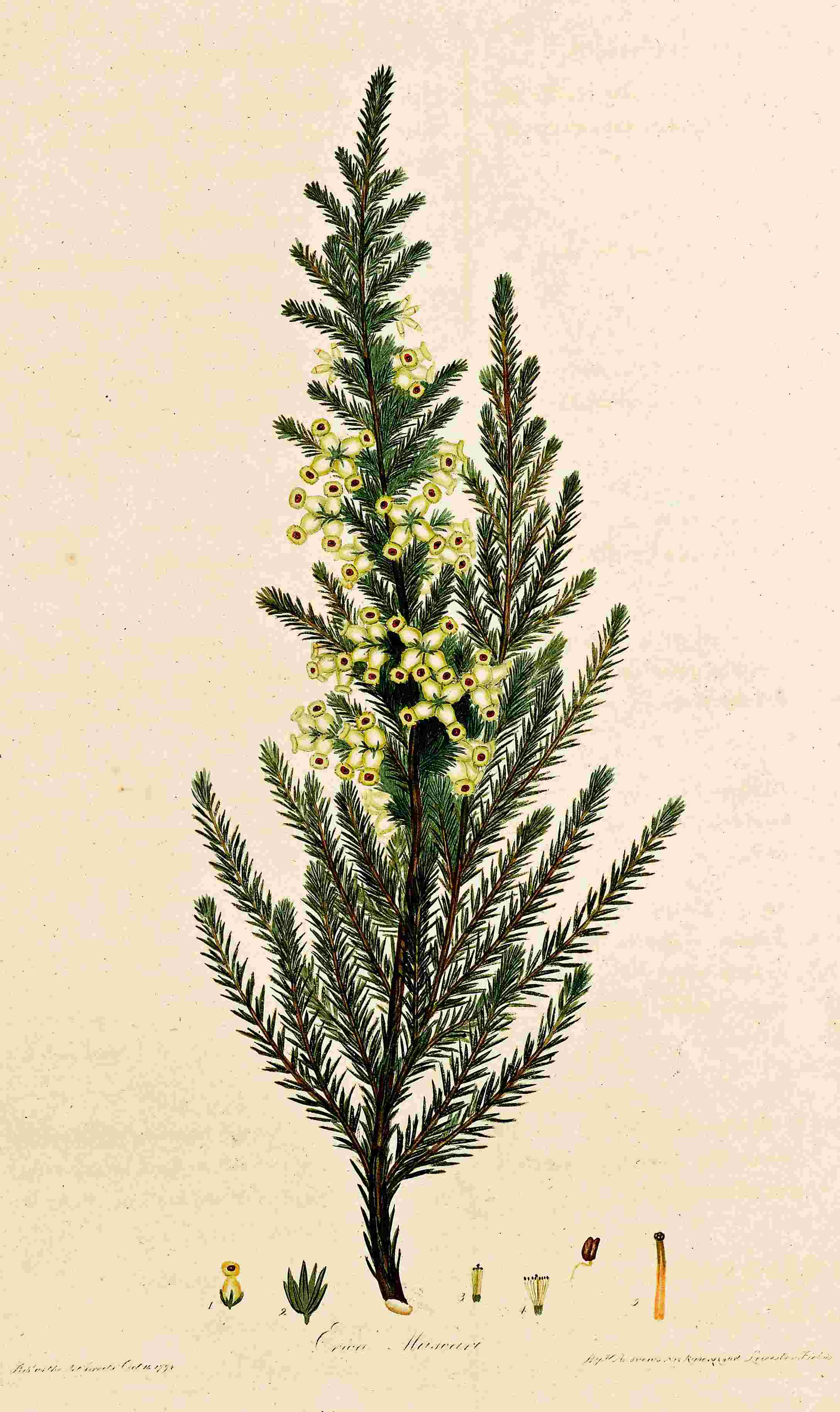
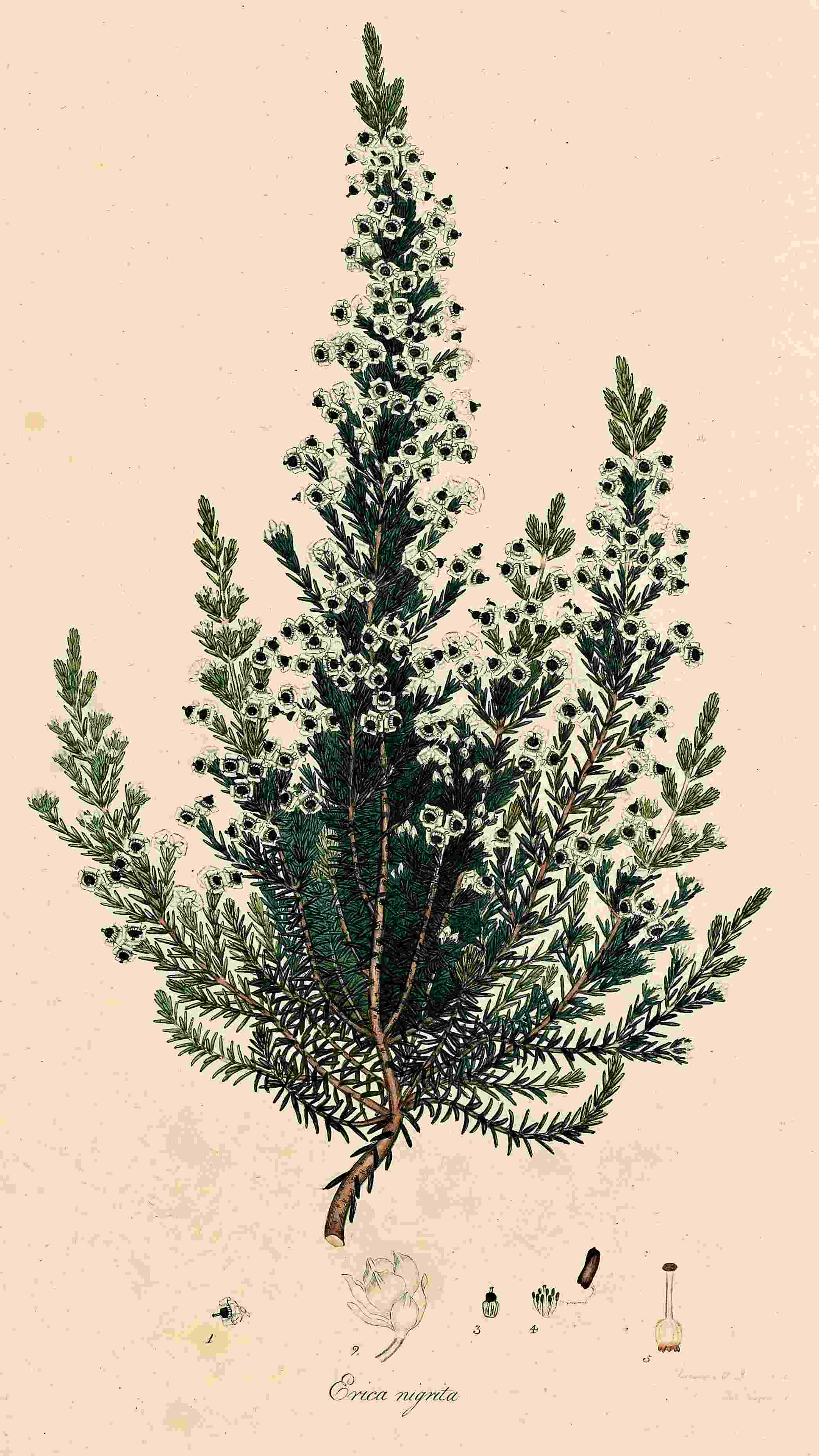
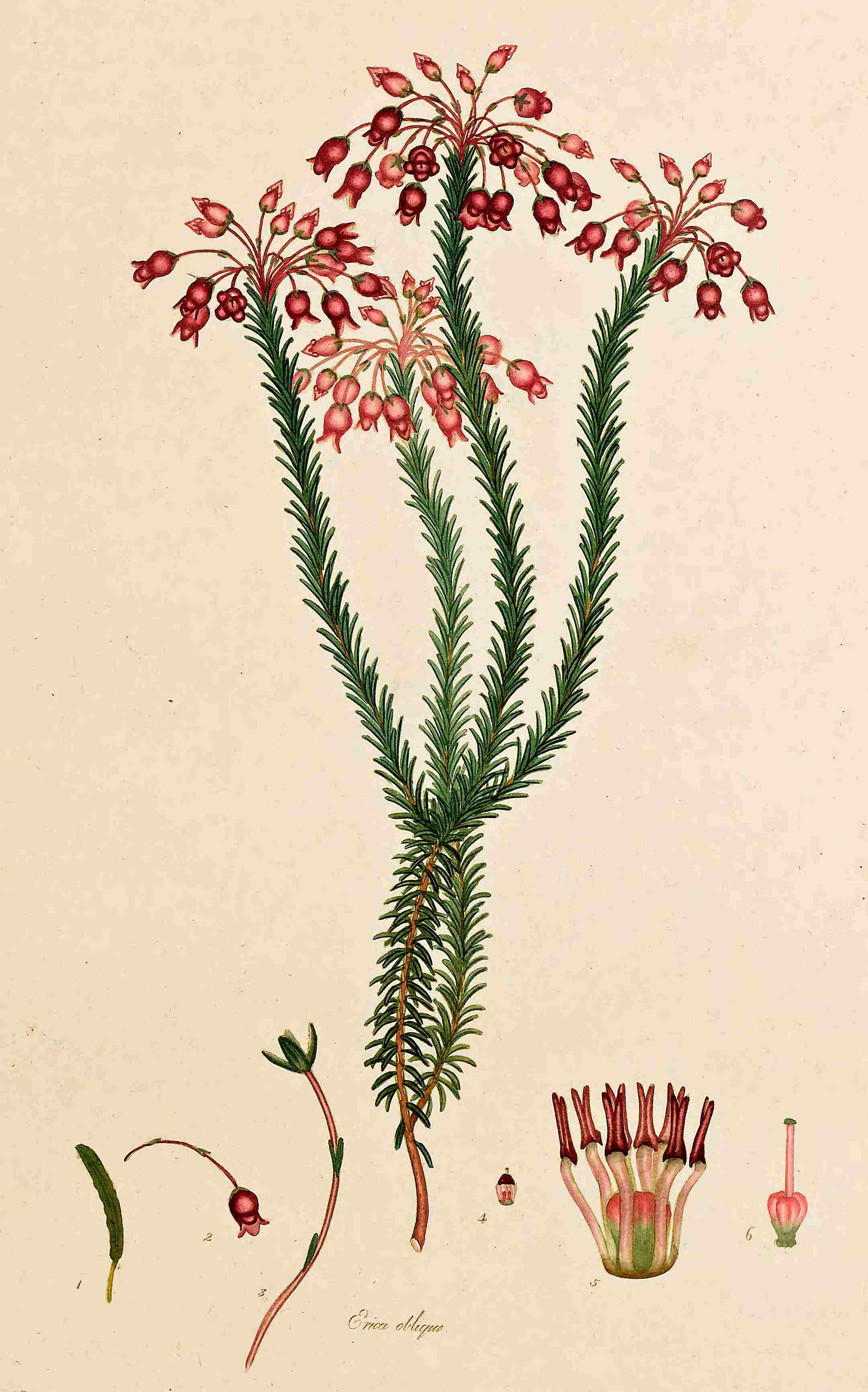
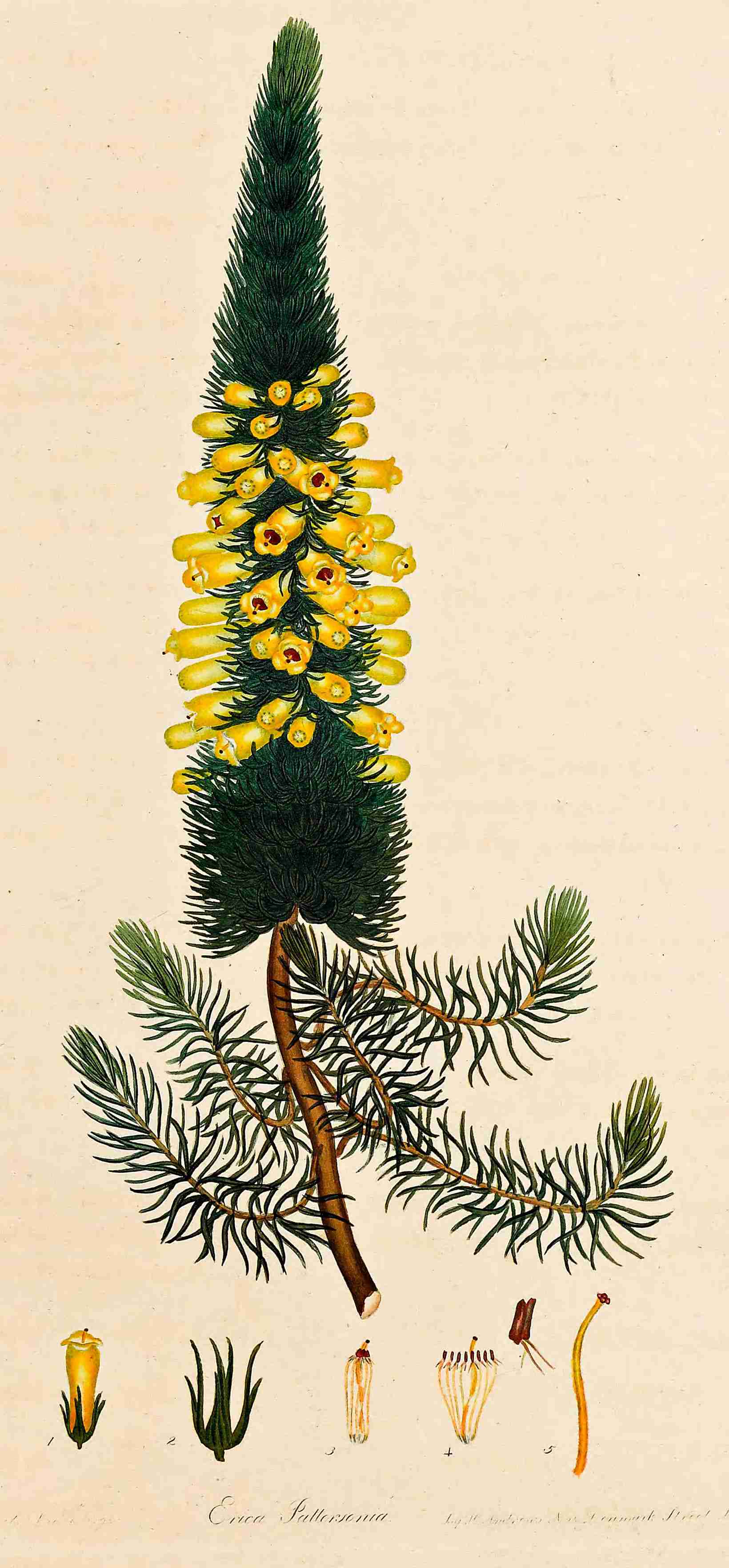
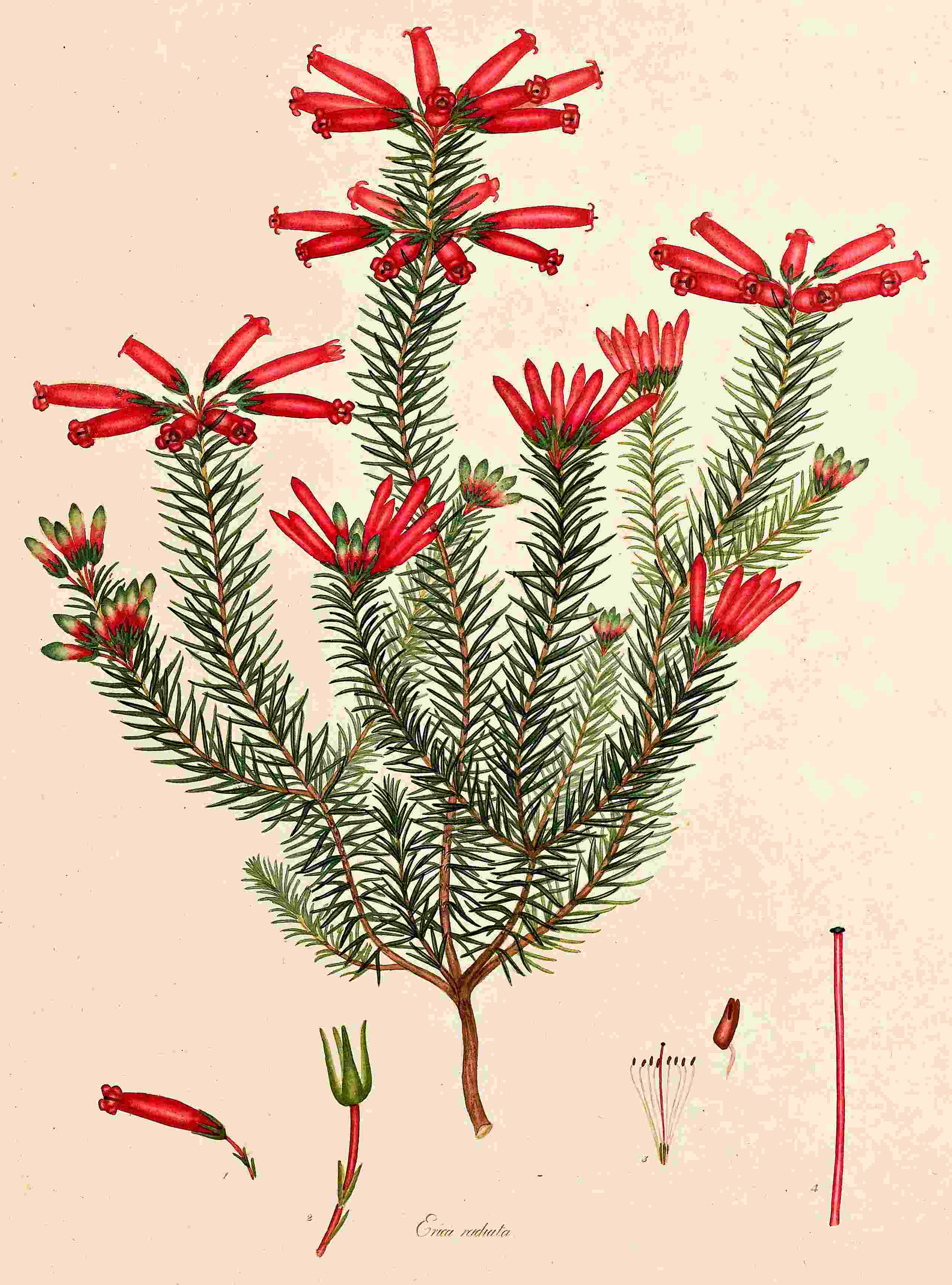
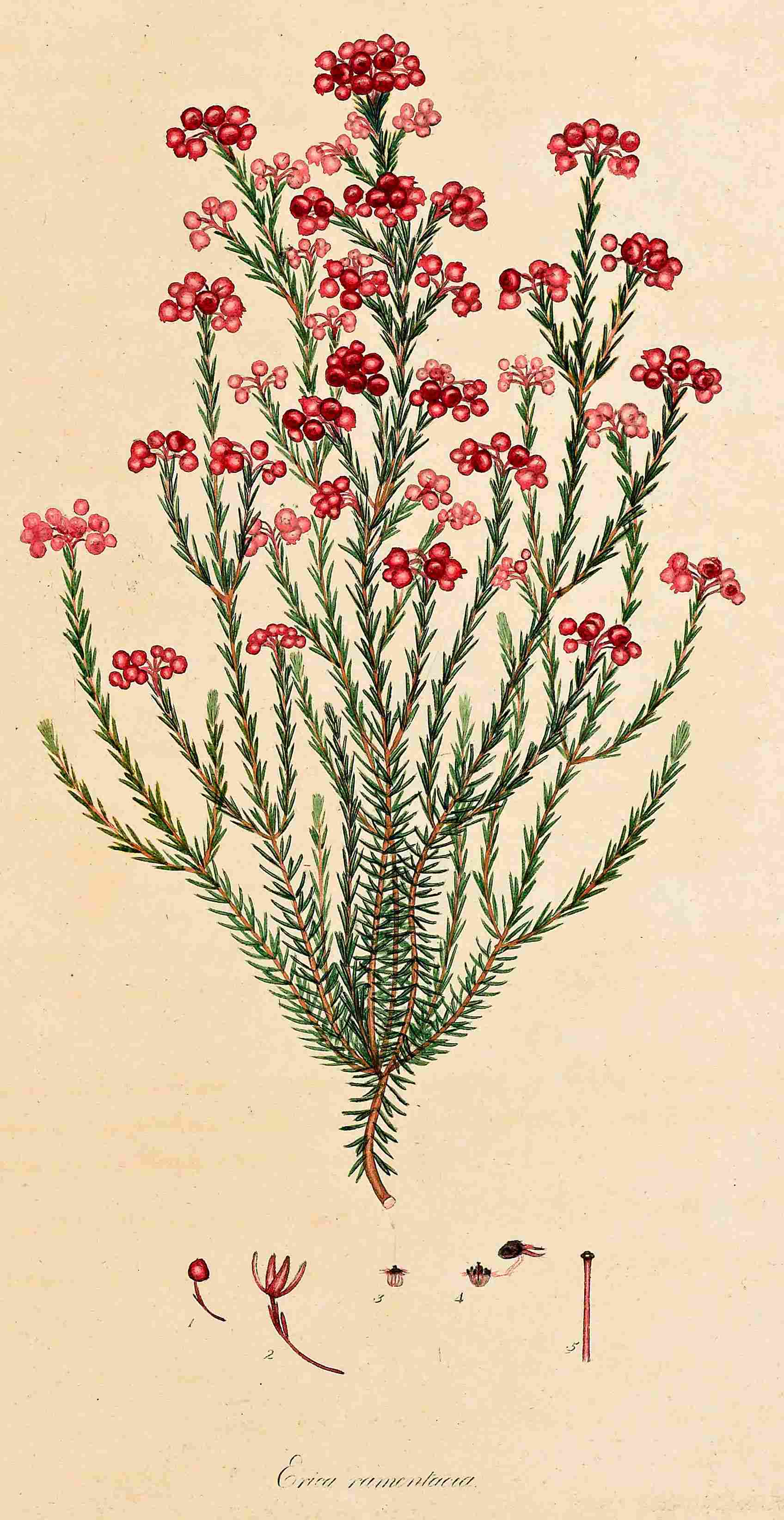
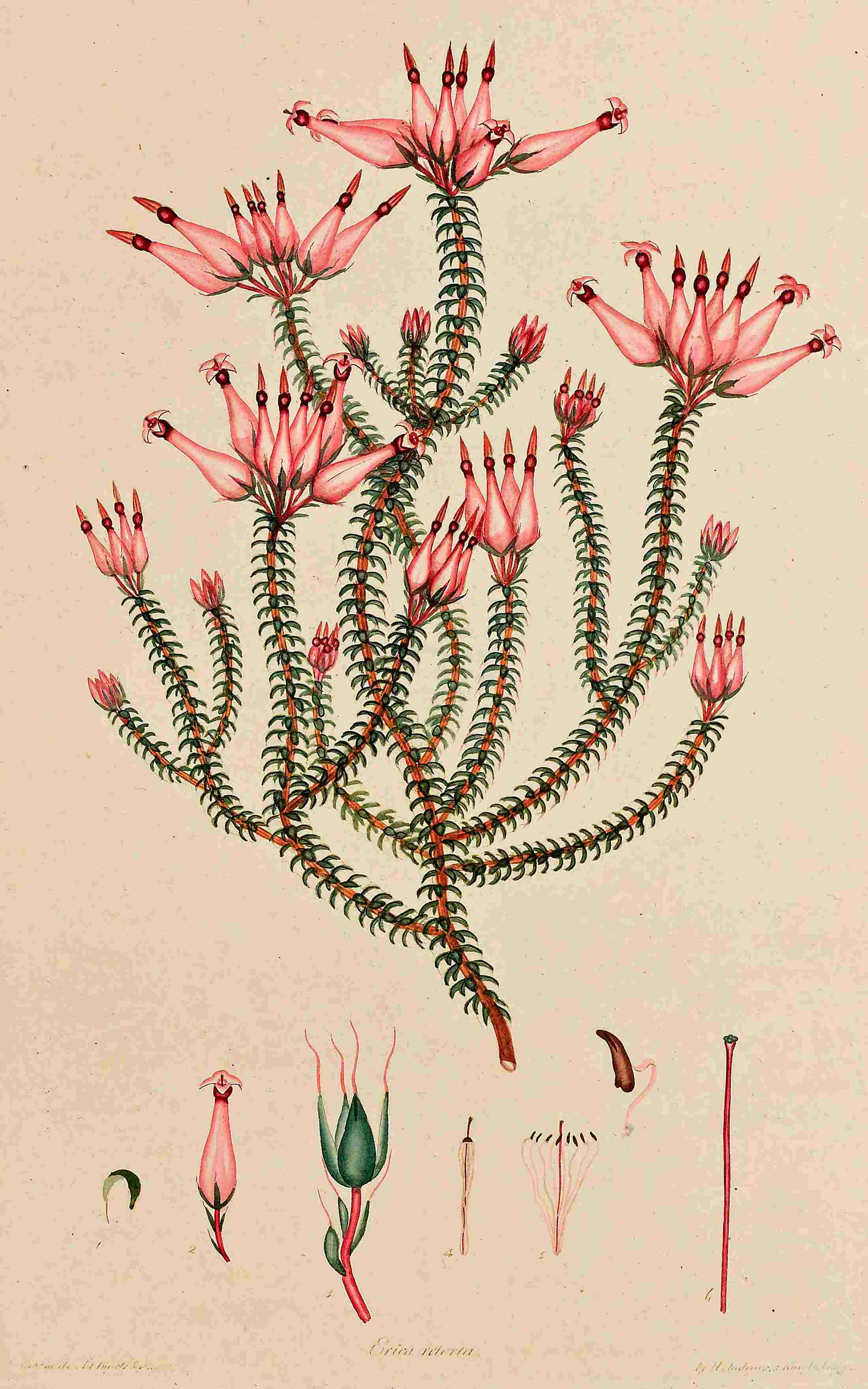
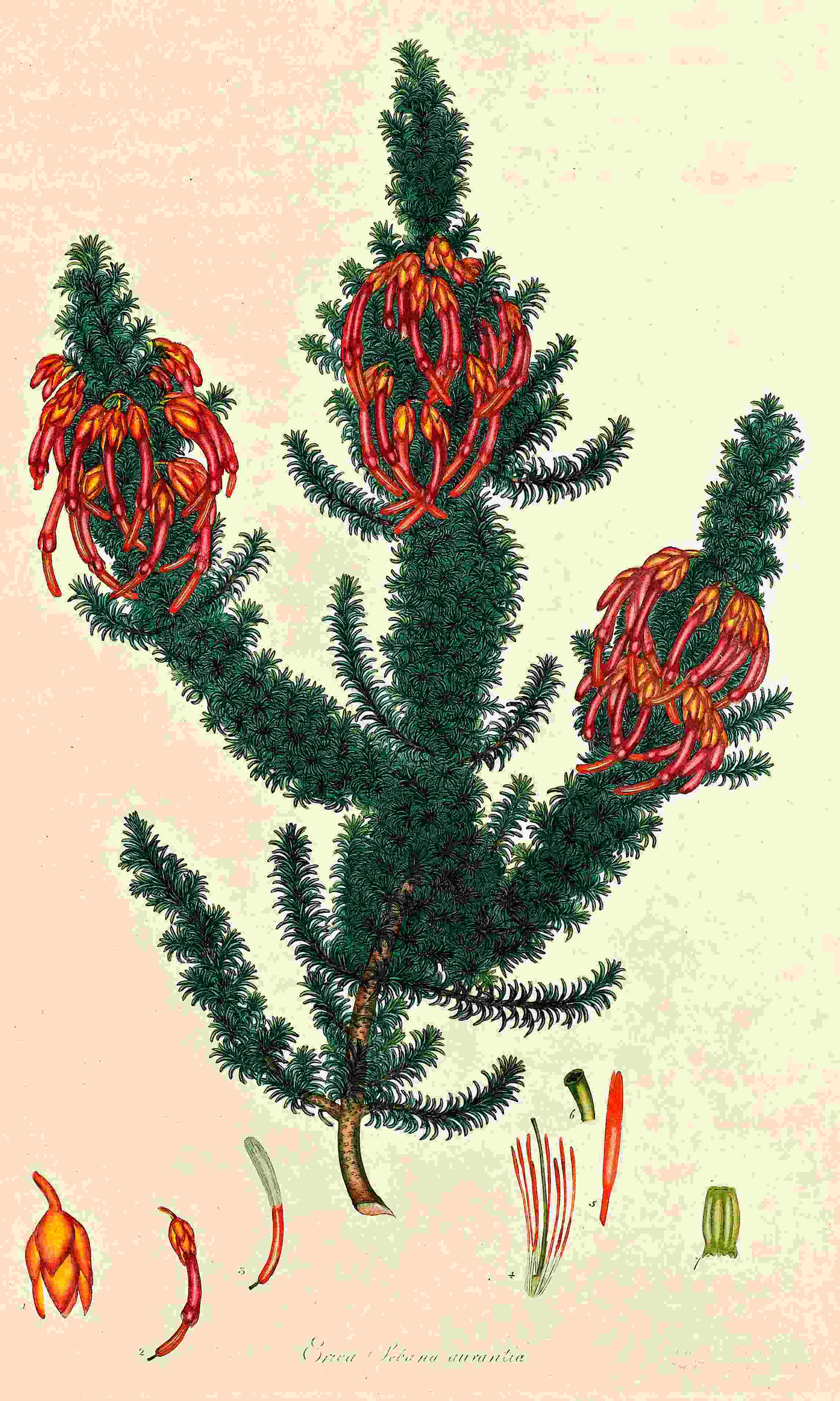
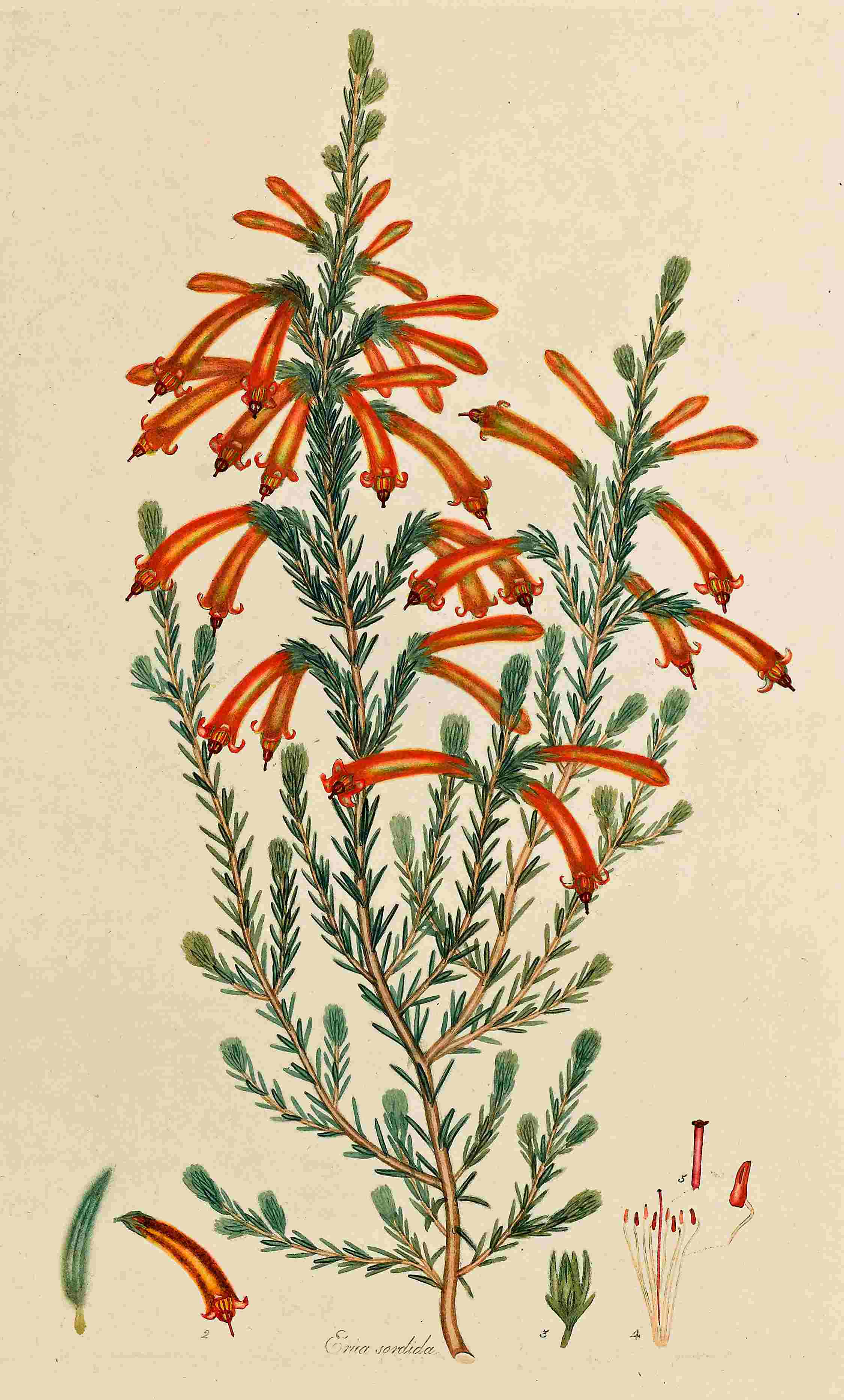
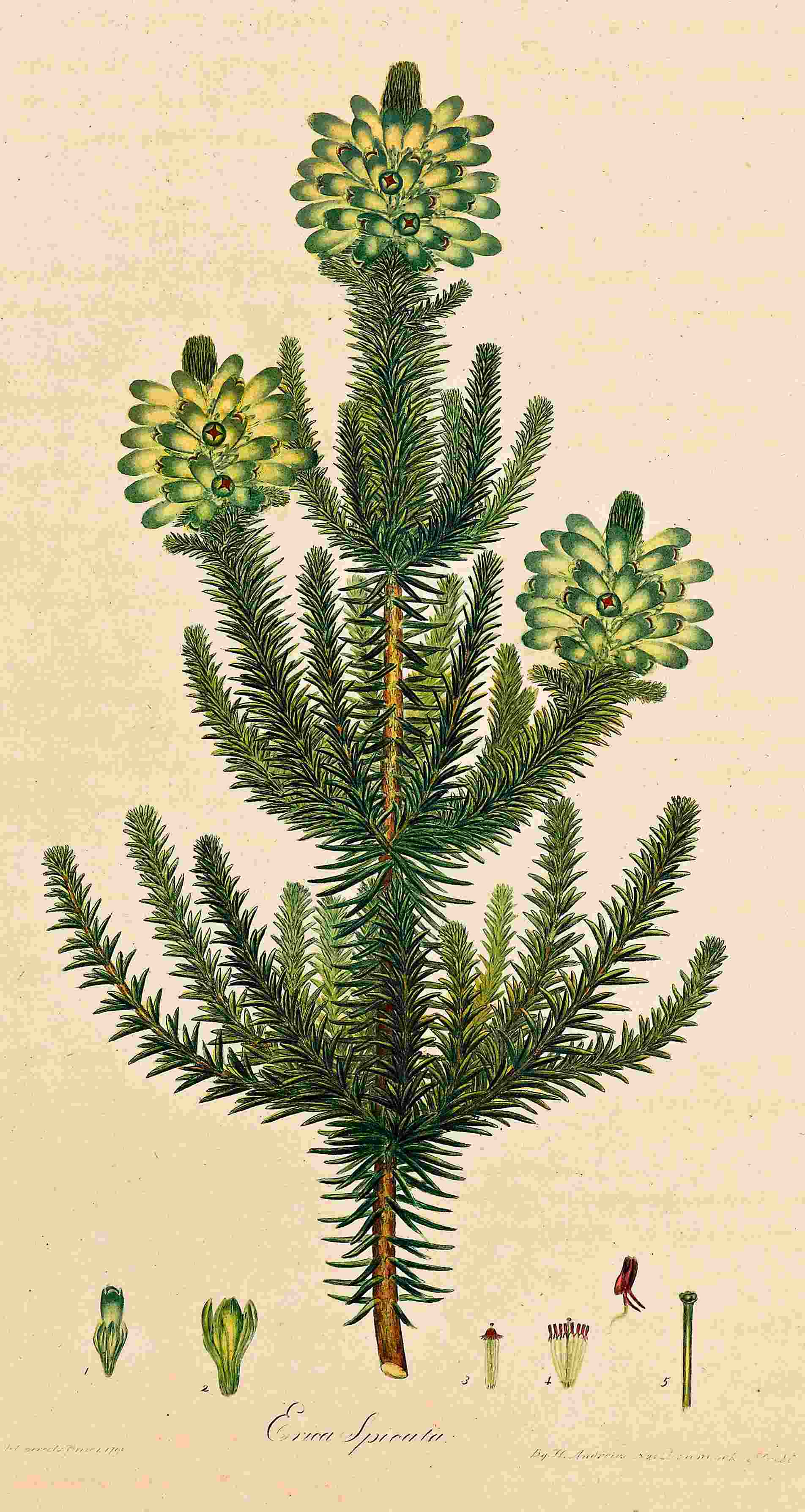
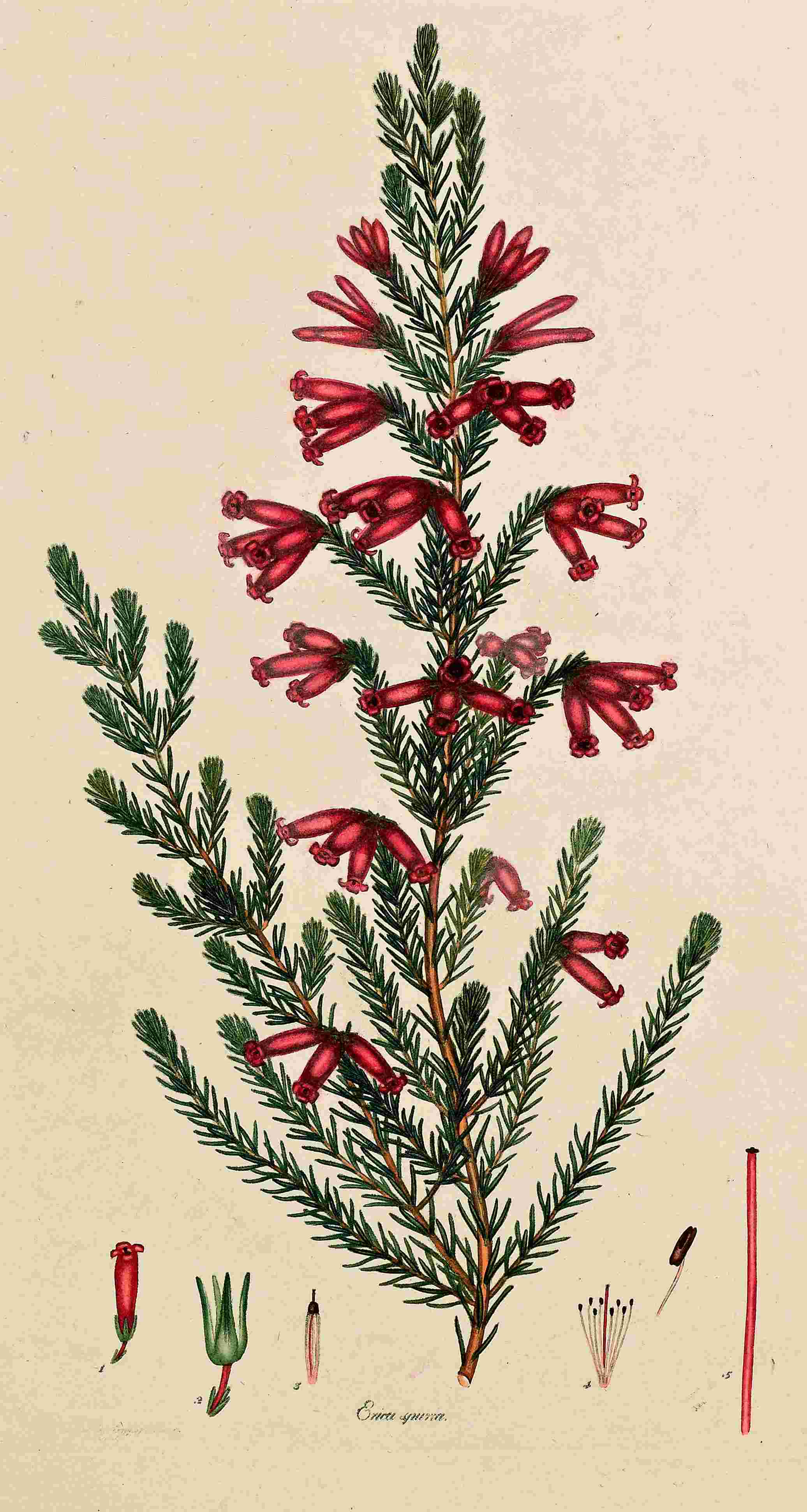
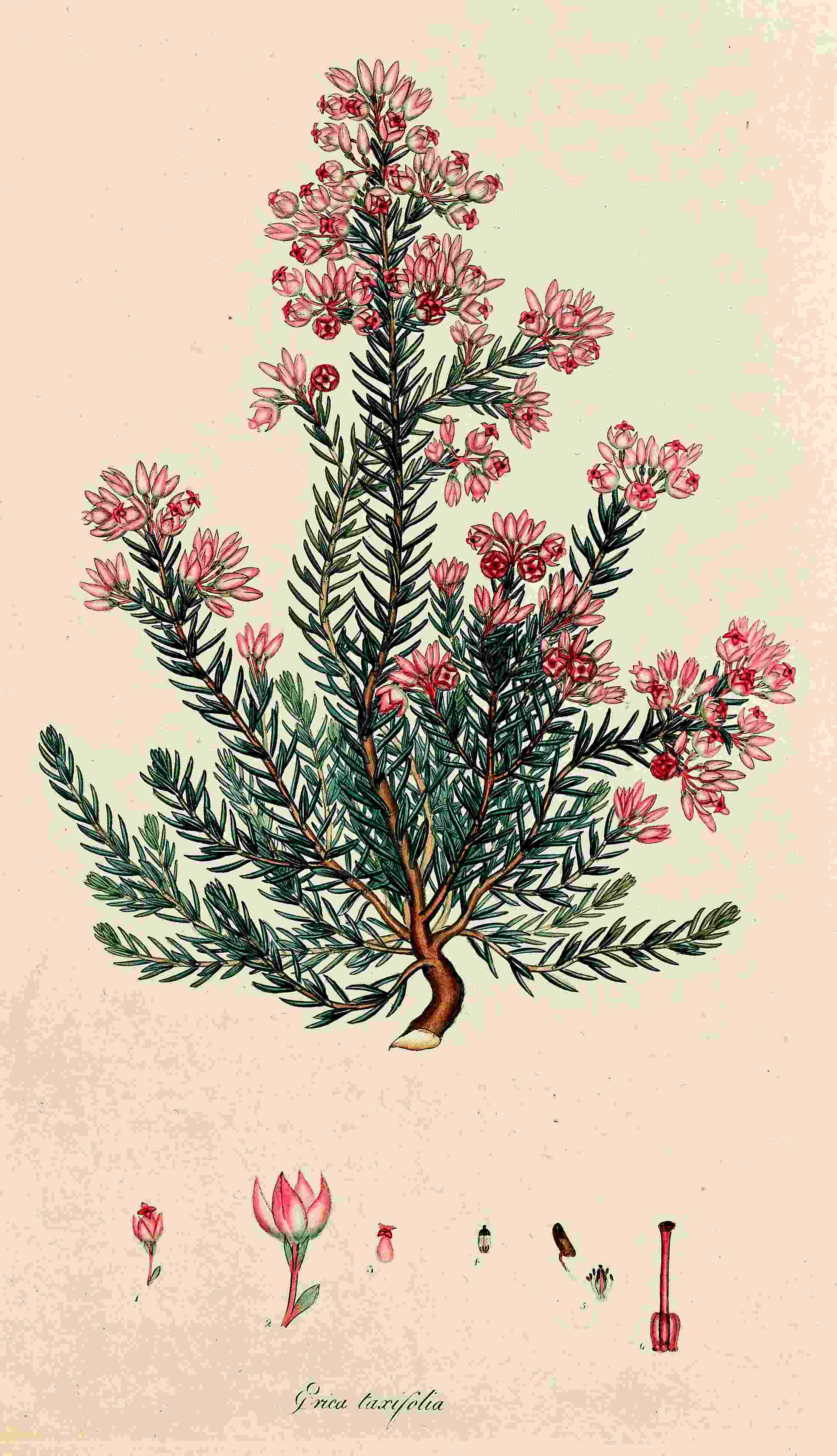
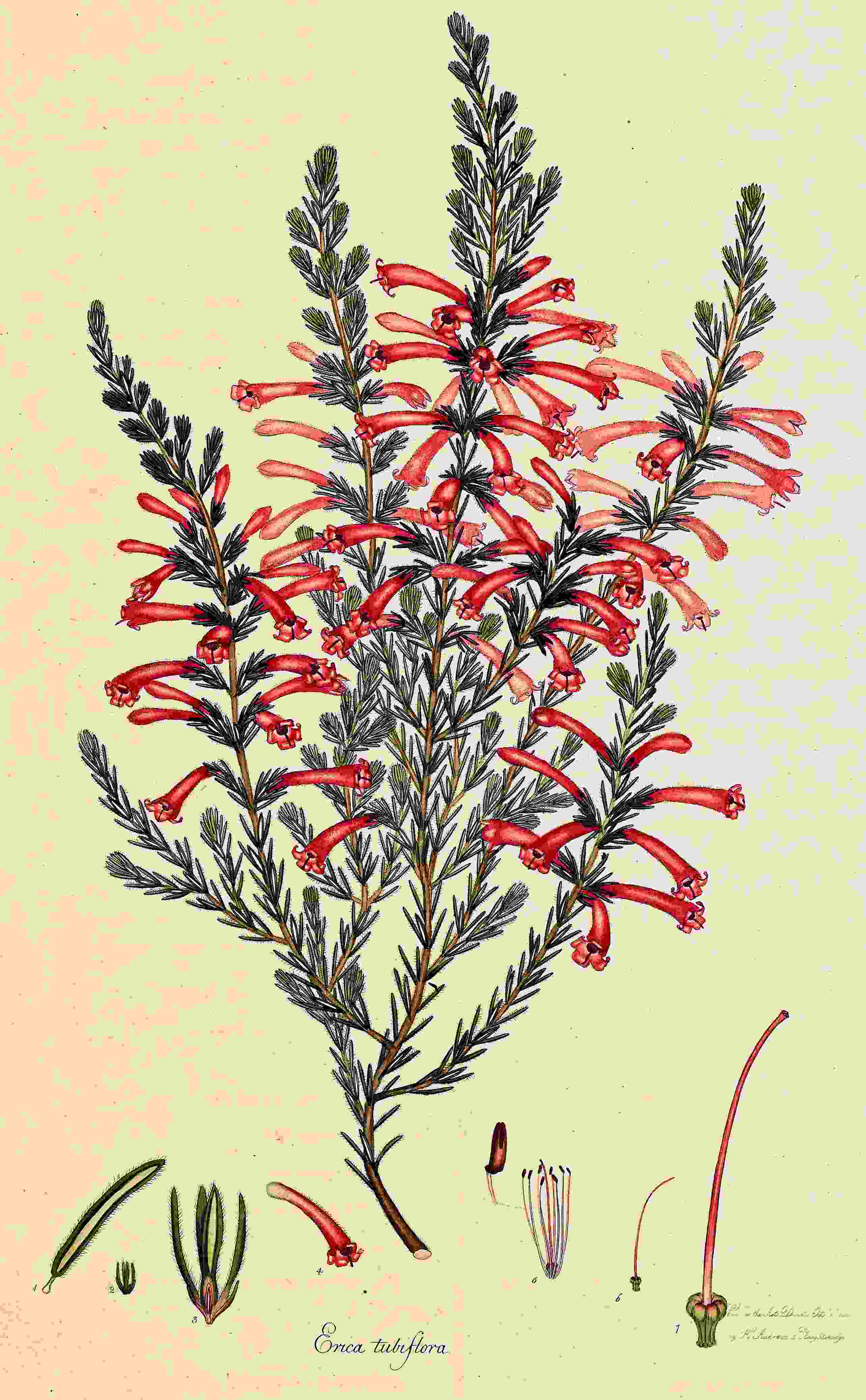
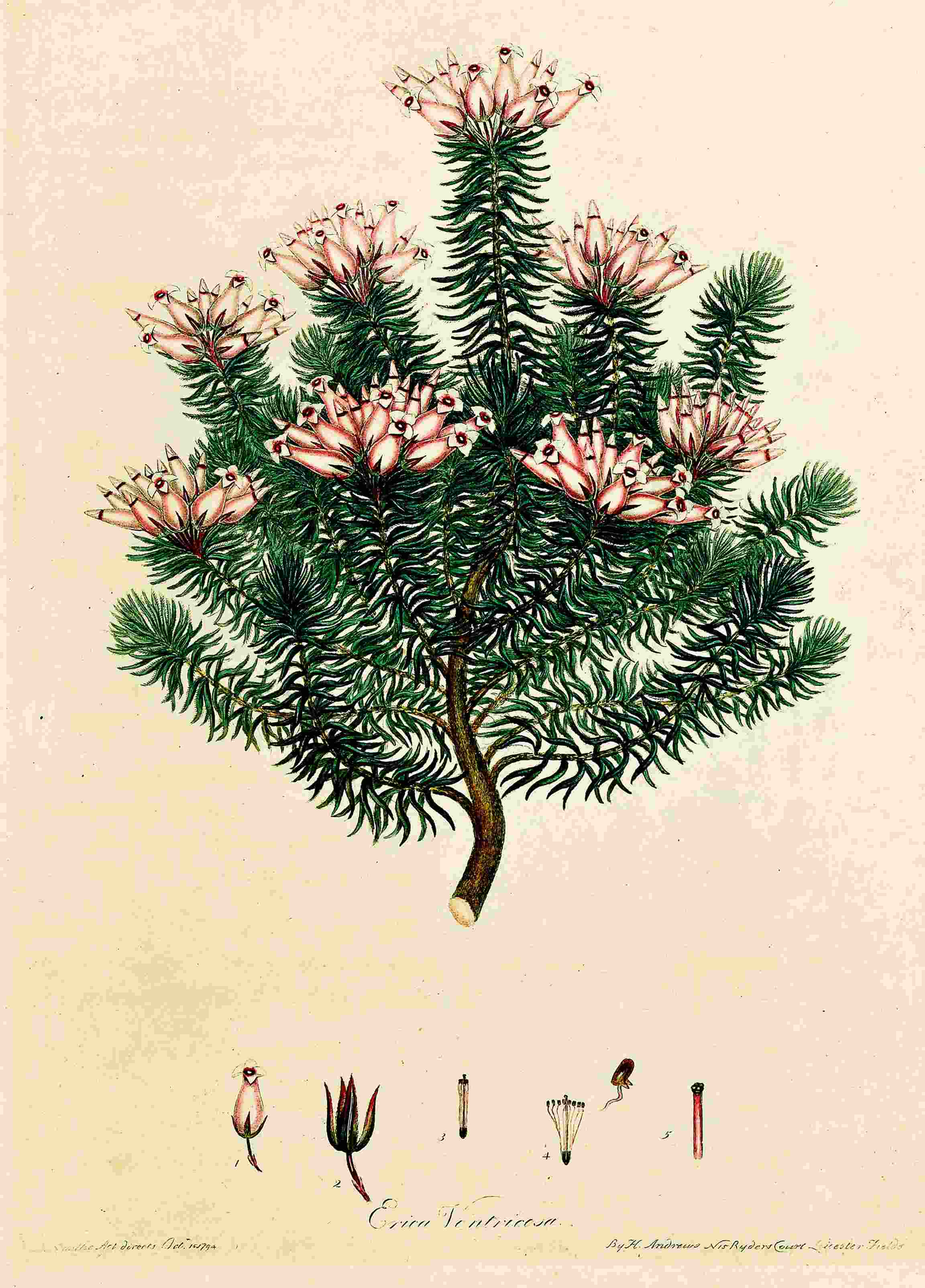
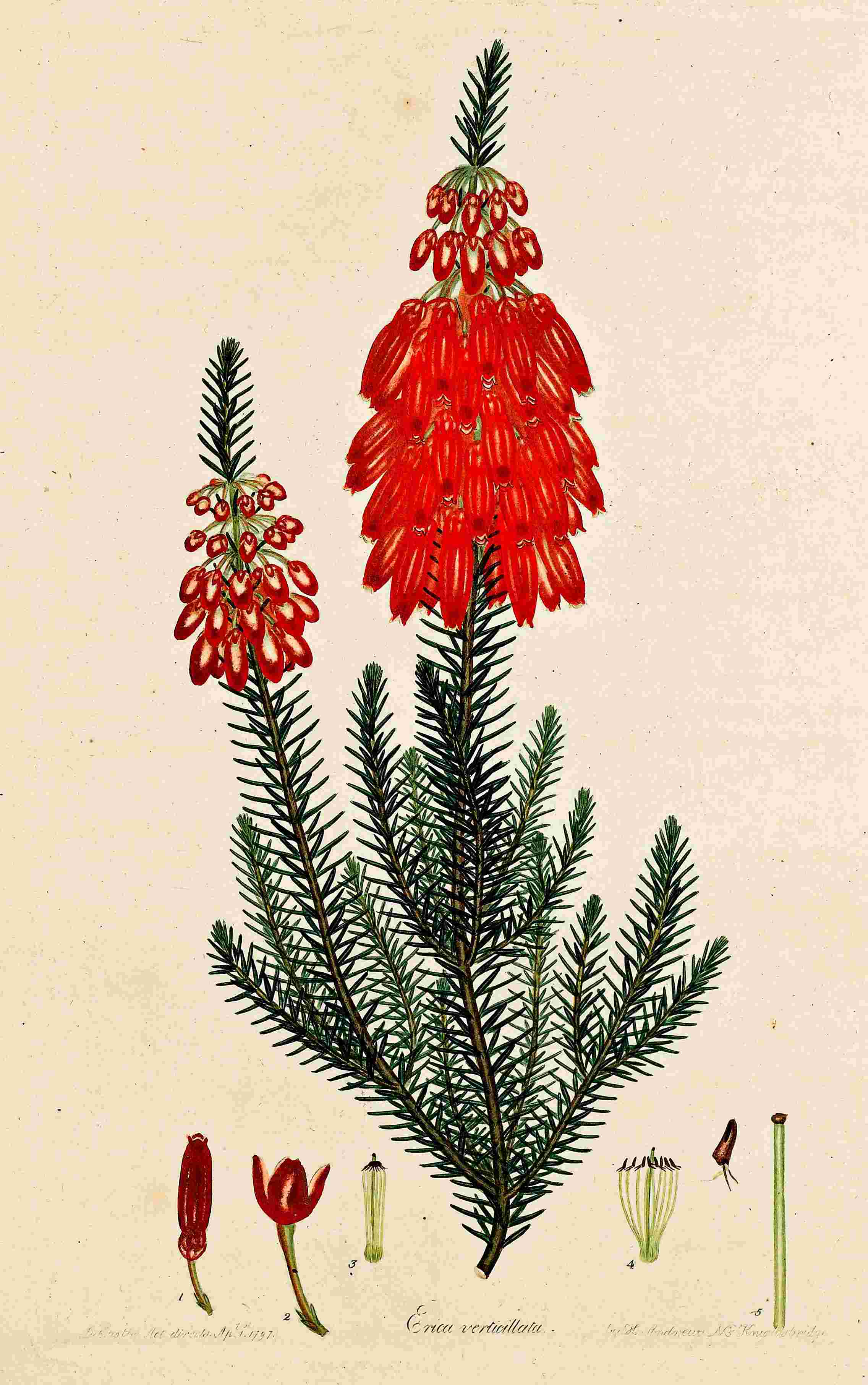
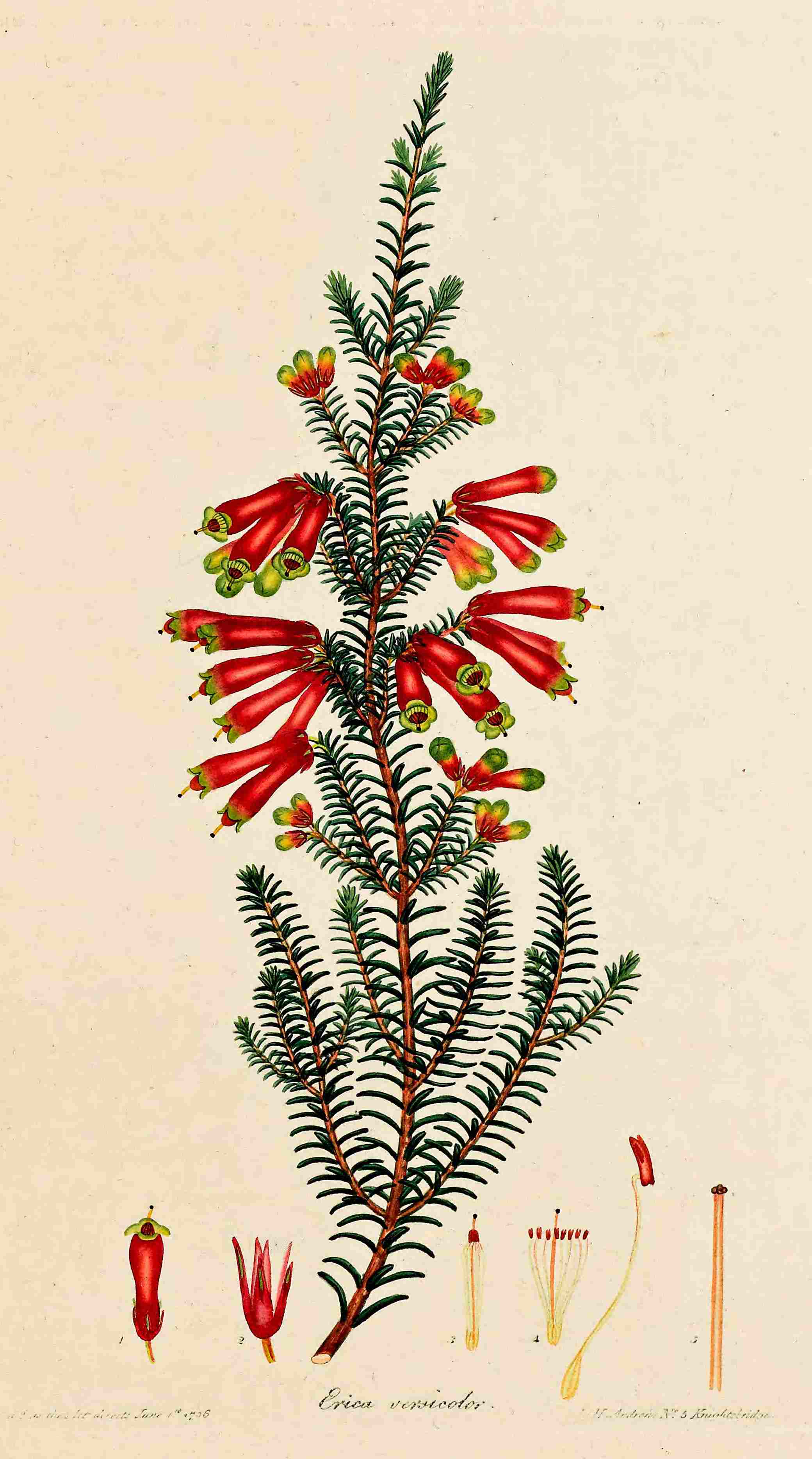
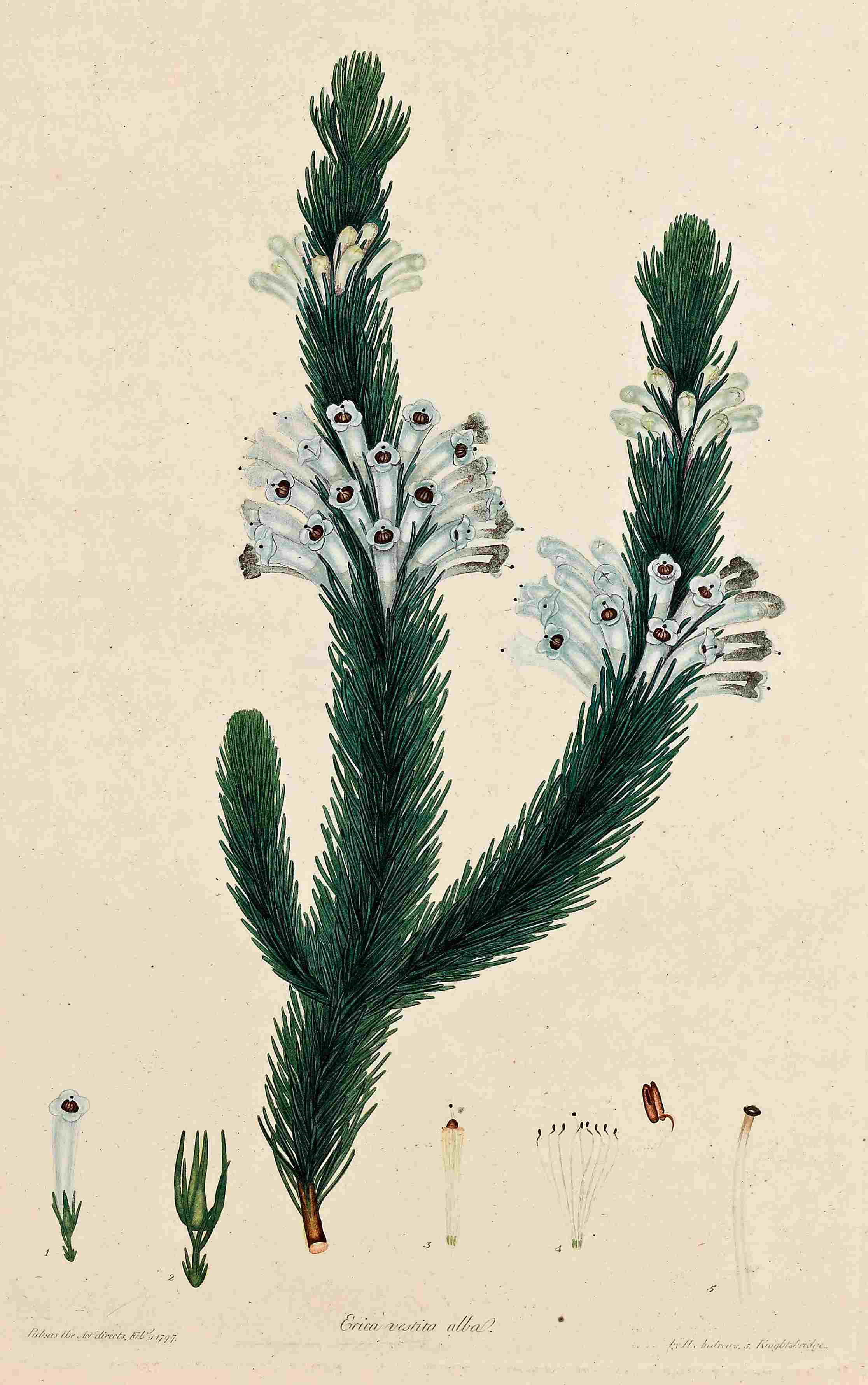
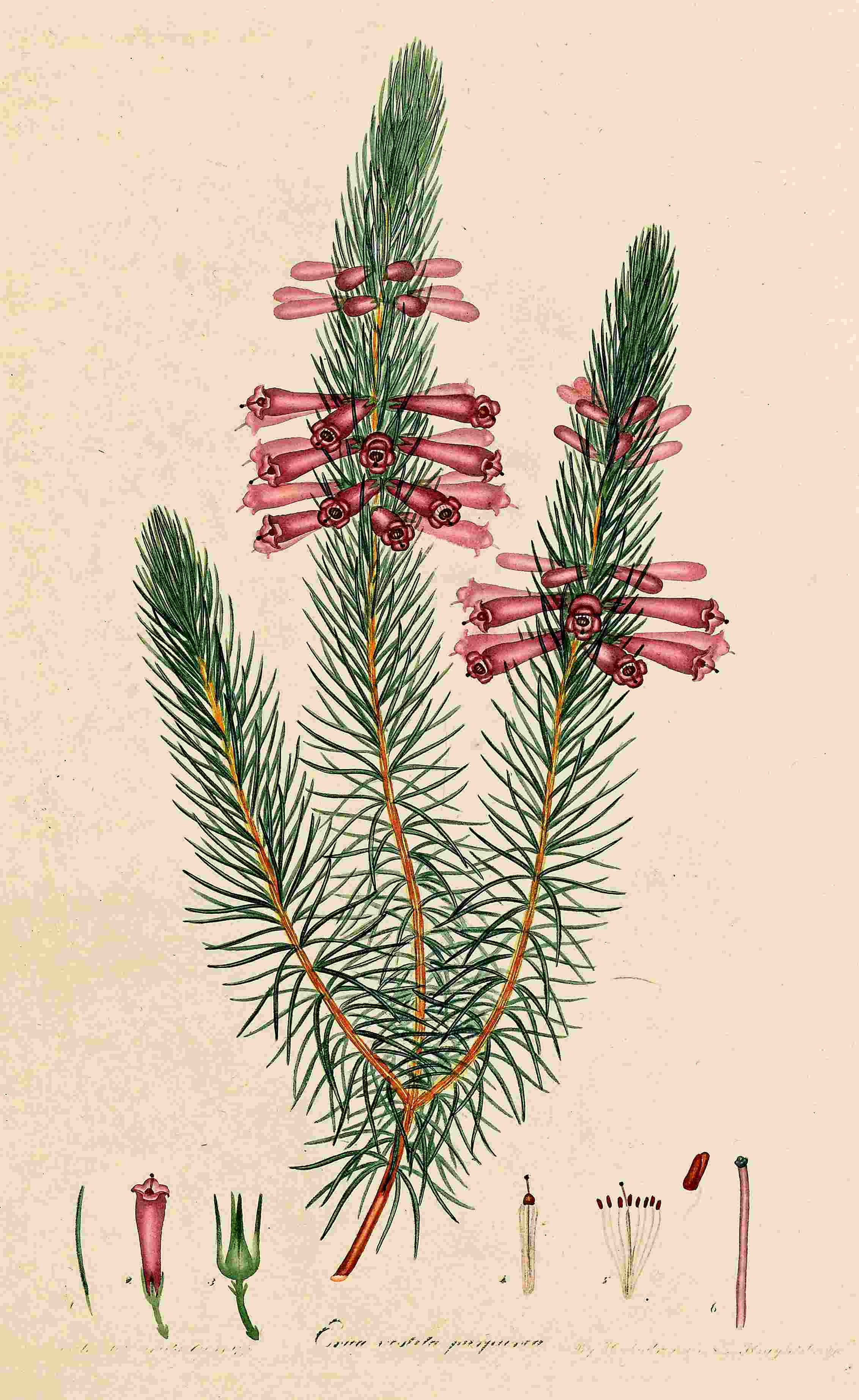
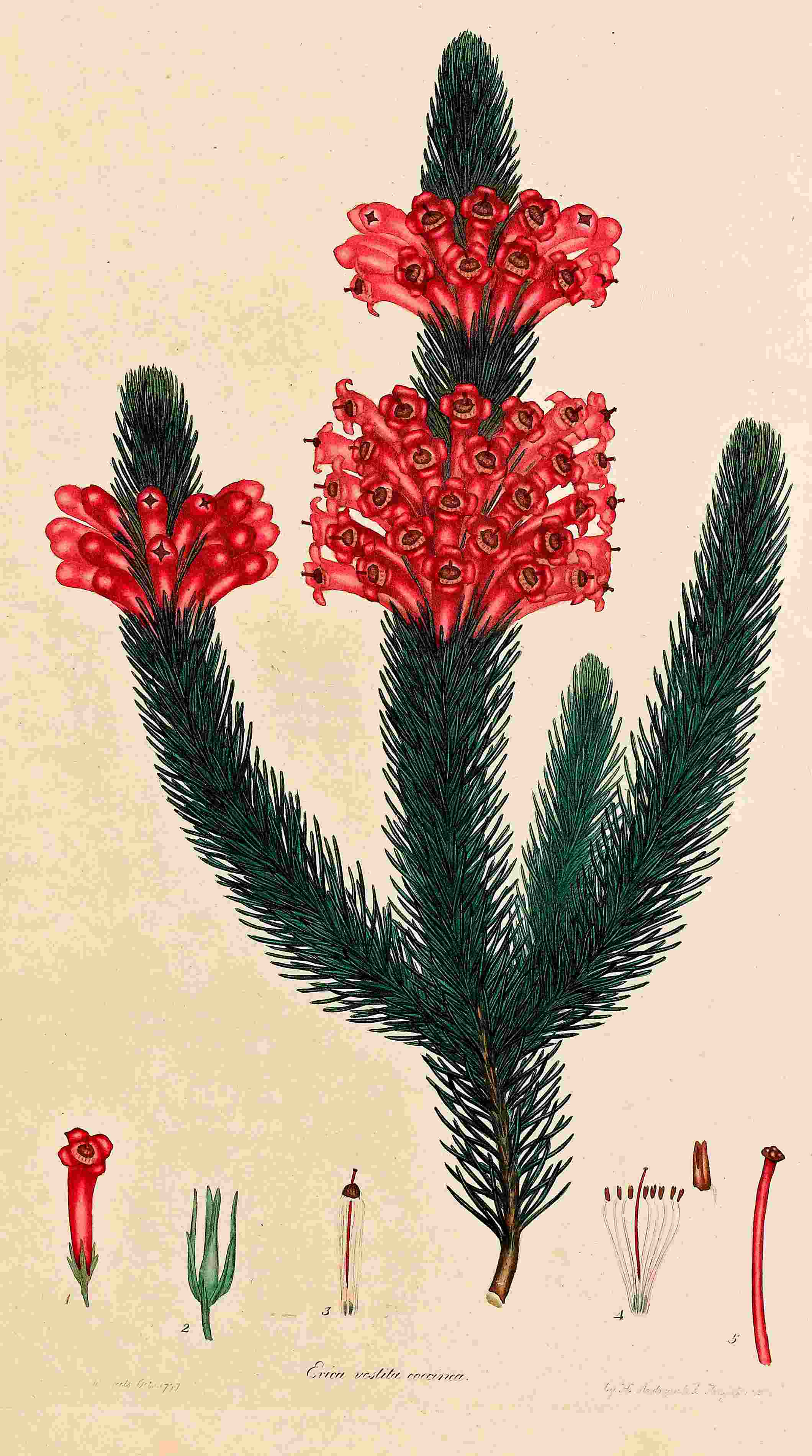
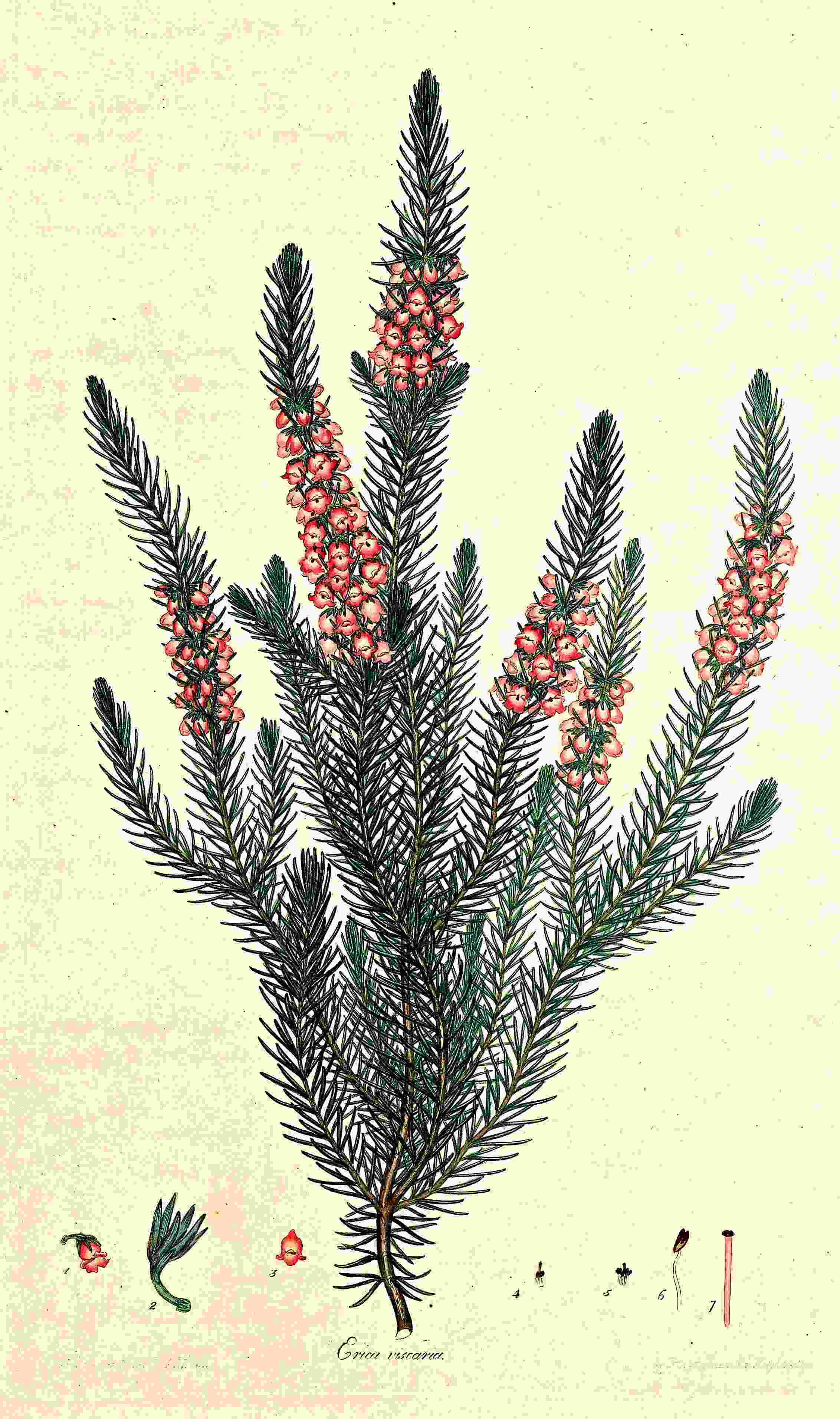
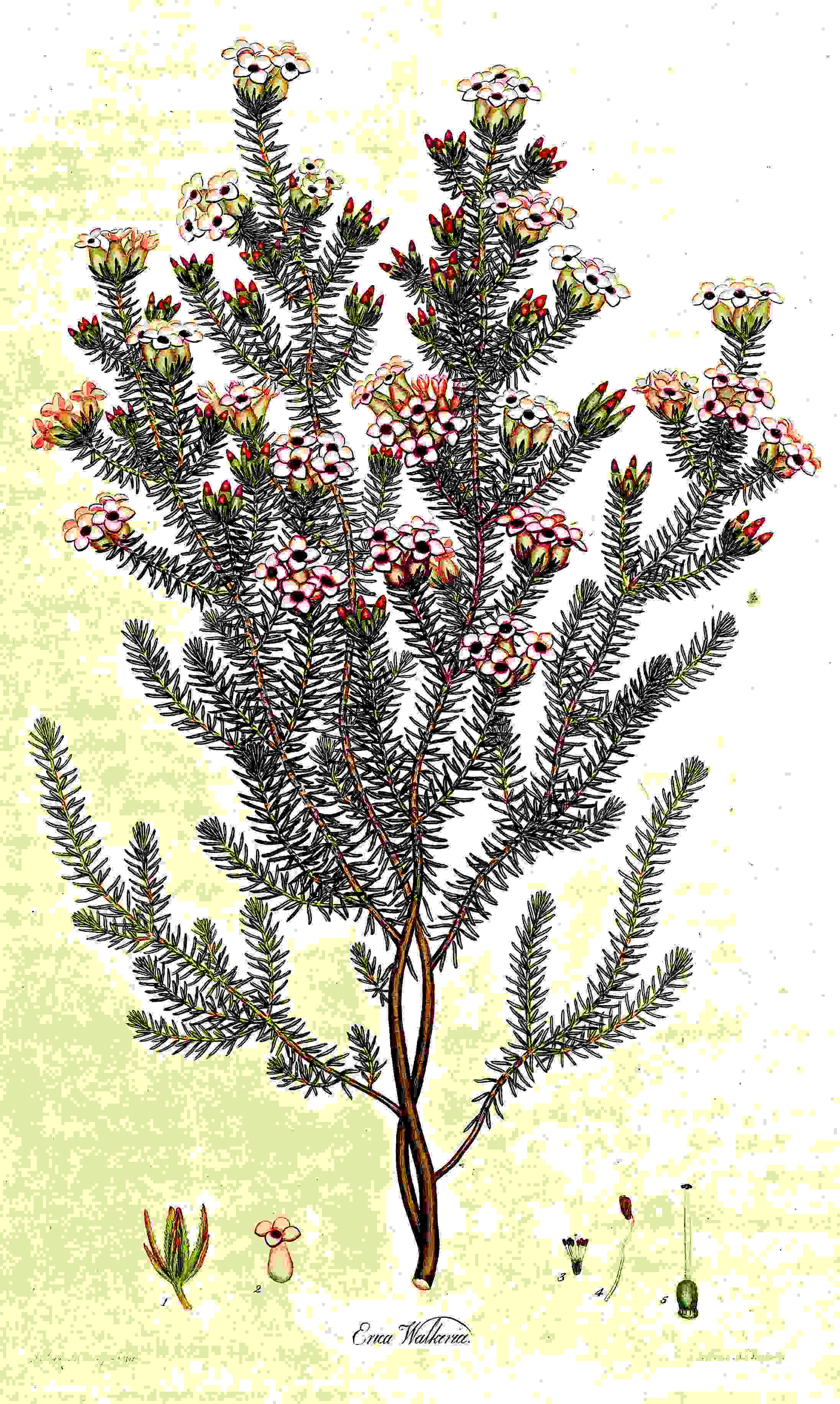
Antecedent to the year 1772, the few species of this, now so
numerous Genus, known in our British gardens, were, the E.
vulgaris, E. Tetralix, E. cineria and E. vagans natives; the E.
Dabœcii, from Ireland; the E. arborea introduced in 1748, from
Madeira; the E. herbacea or carnea in 1763, from Switzerland; the
E. mediterranea in 1765, from Minorca, and the E. scoparia, E.
viridi-purpurea, E. australis, E. ciliaris and E. umbellata, from
Portugal, between the years 1768 and 1707. The two other European
species we possess, the E. stricta and E. multiflora, natives of
Spain, have been but twelve years in cultivation with us. Of the
African species, found within the district of the Cape of Good Hope
and the adjacent territory, which have swelled the Genus to so
great an extent; and which, but as an echo to the general voice,
may be said to contribute, by the extreme brilliancy of the flowers
of these species, more than any other, to the present splendor of
our green-houses, were unknown, till the above æra, to our English
botanists, but by name. In the year 1771 seeds of two species were
received, at the Hammersmith nursery, from the Cape, both of them
vegetated; the first which flowered, proving the E. tubiflora, of
the Sp. Plant. of Linnæus; the other, from the resemblance it bears
to the Spruce Fir, was then named E. abietina; but since, altered
in the Kew catalogue, to E. concinna. Two years subsequent, 1774,
Mr. Francis Masson, botanical collector to His Majesty at the Cape,
laid the foundation for the celebrity of that superb collection at
Kew, which for many years, with unrivalled lustre, far outshone all
others, particularly by the number and variety of this most
beautiful tribe of plants: for which we refer to the second Vol. of
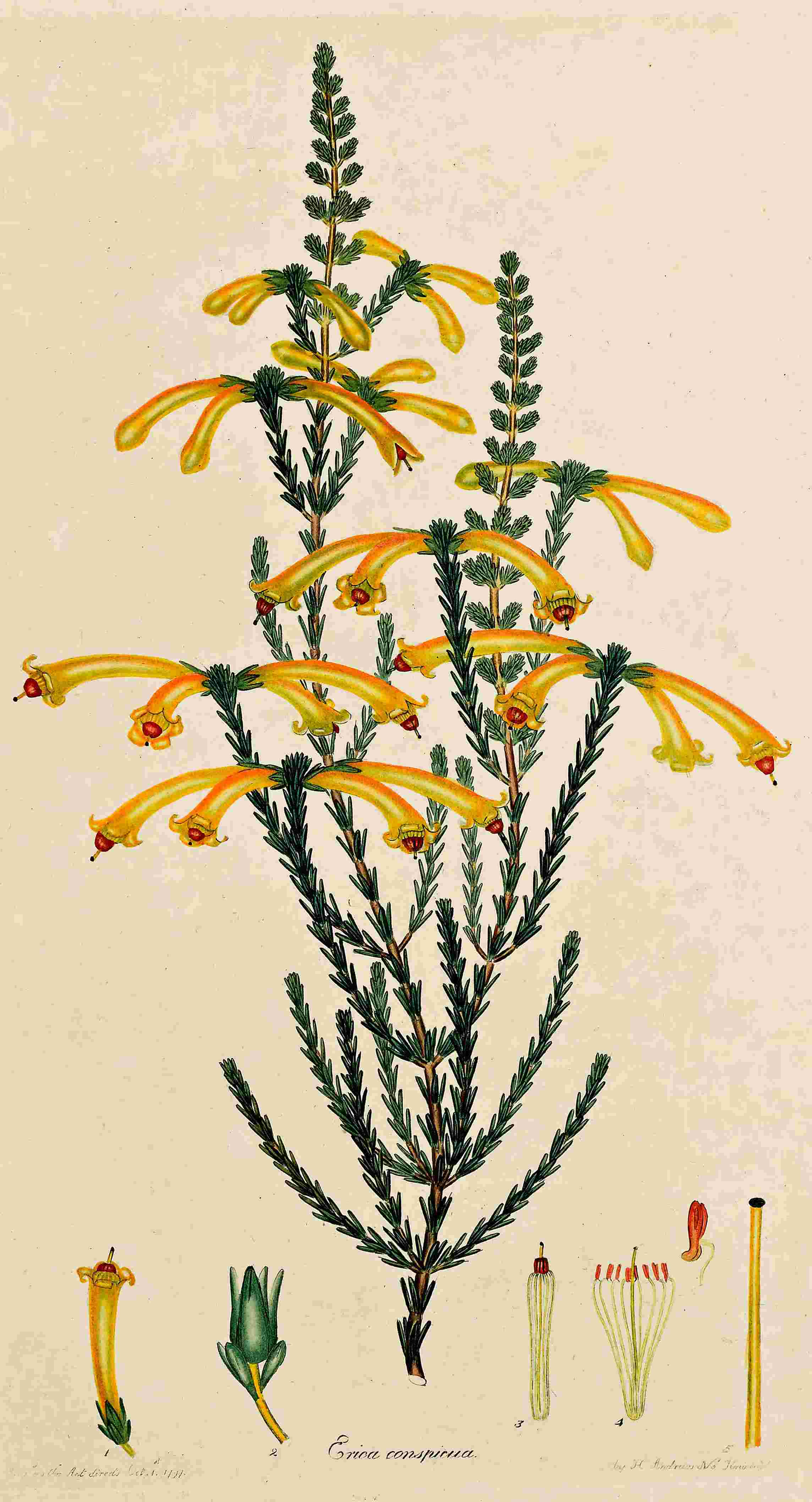
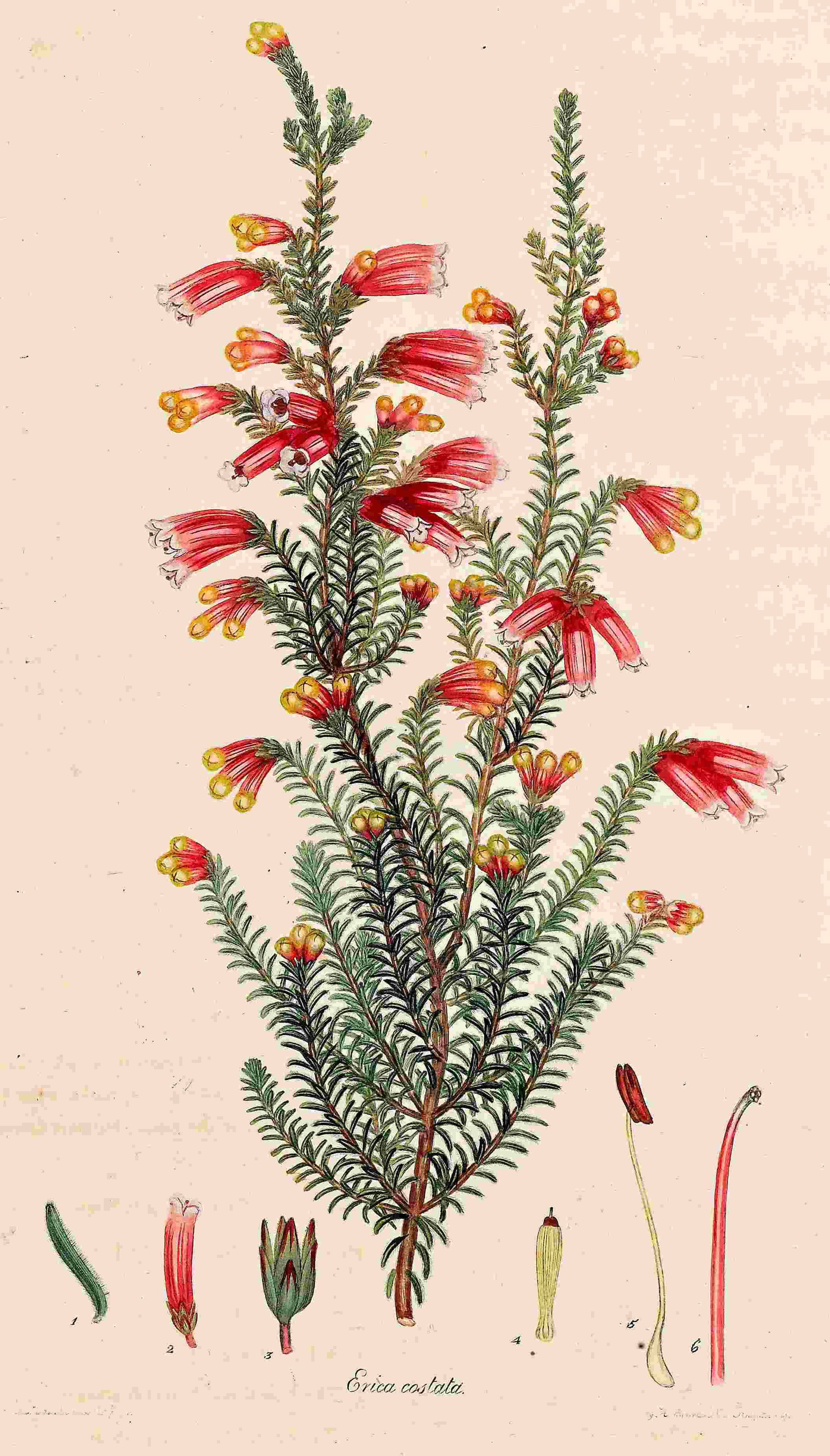
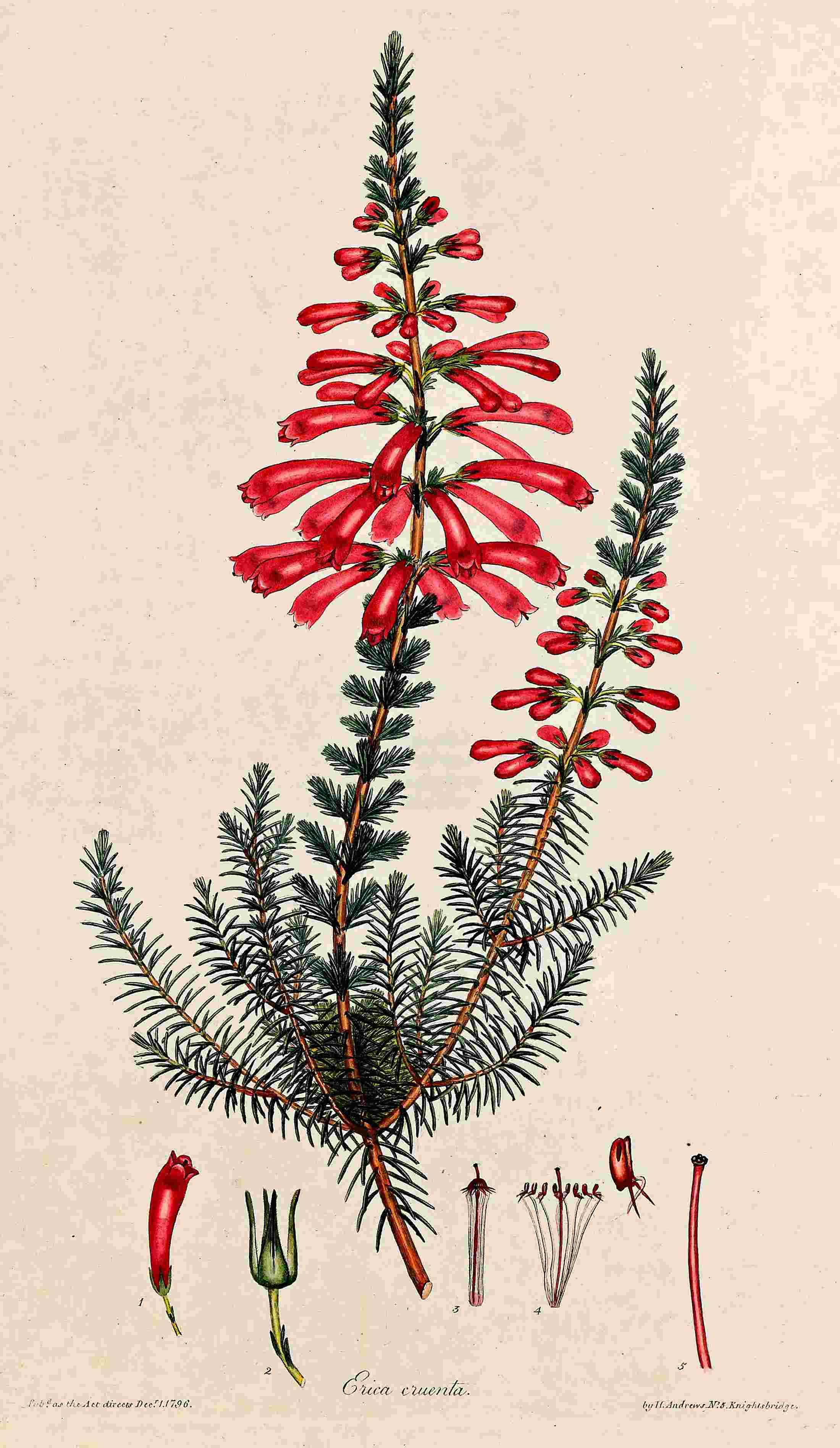
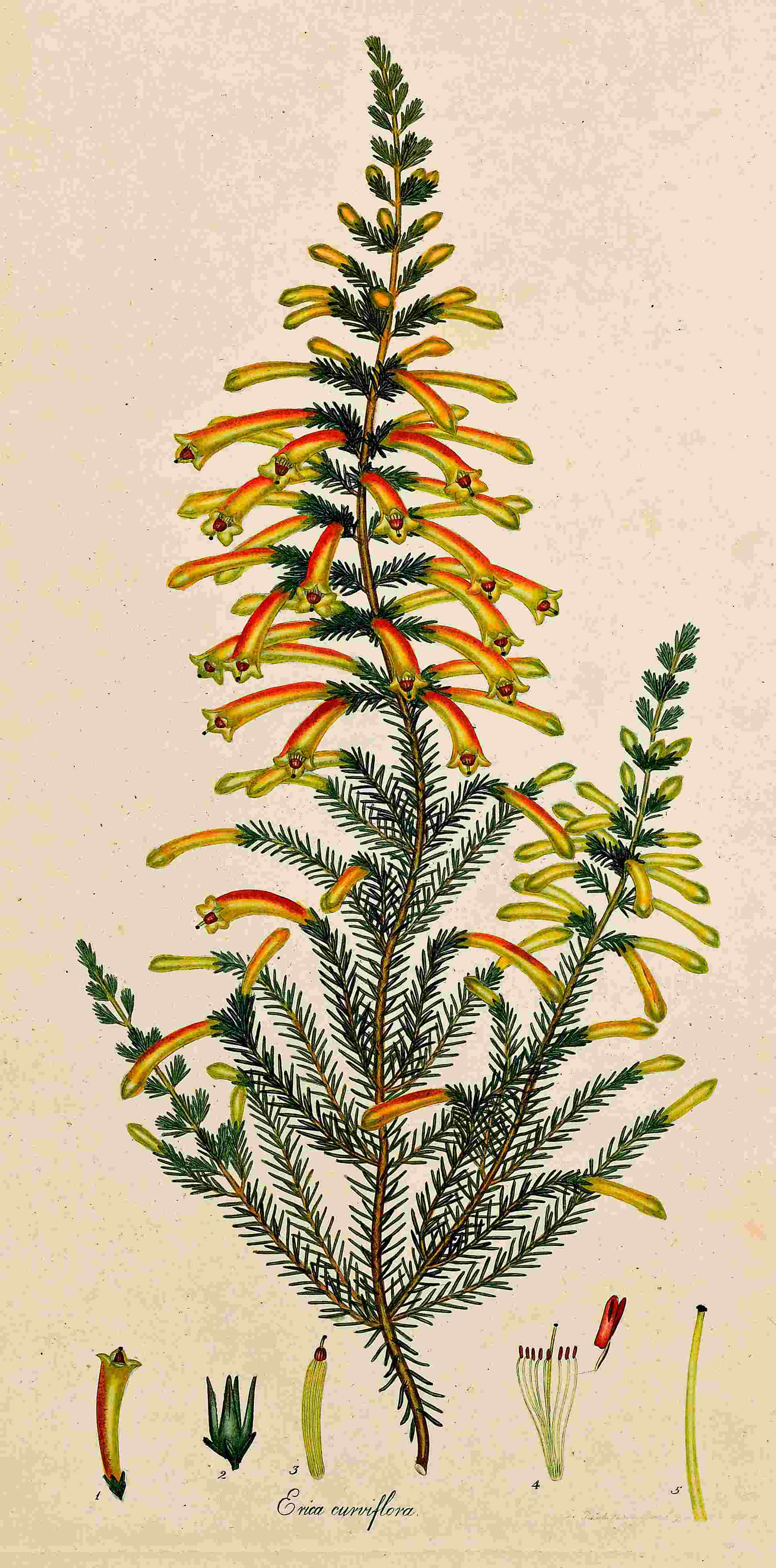
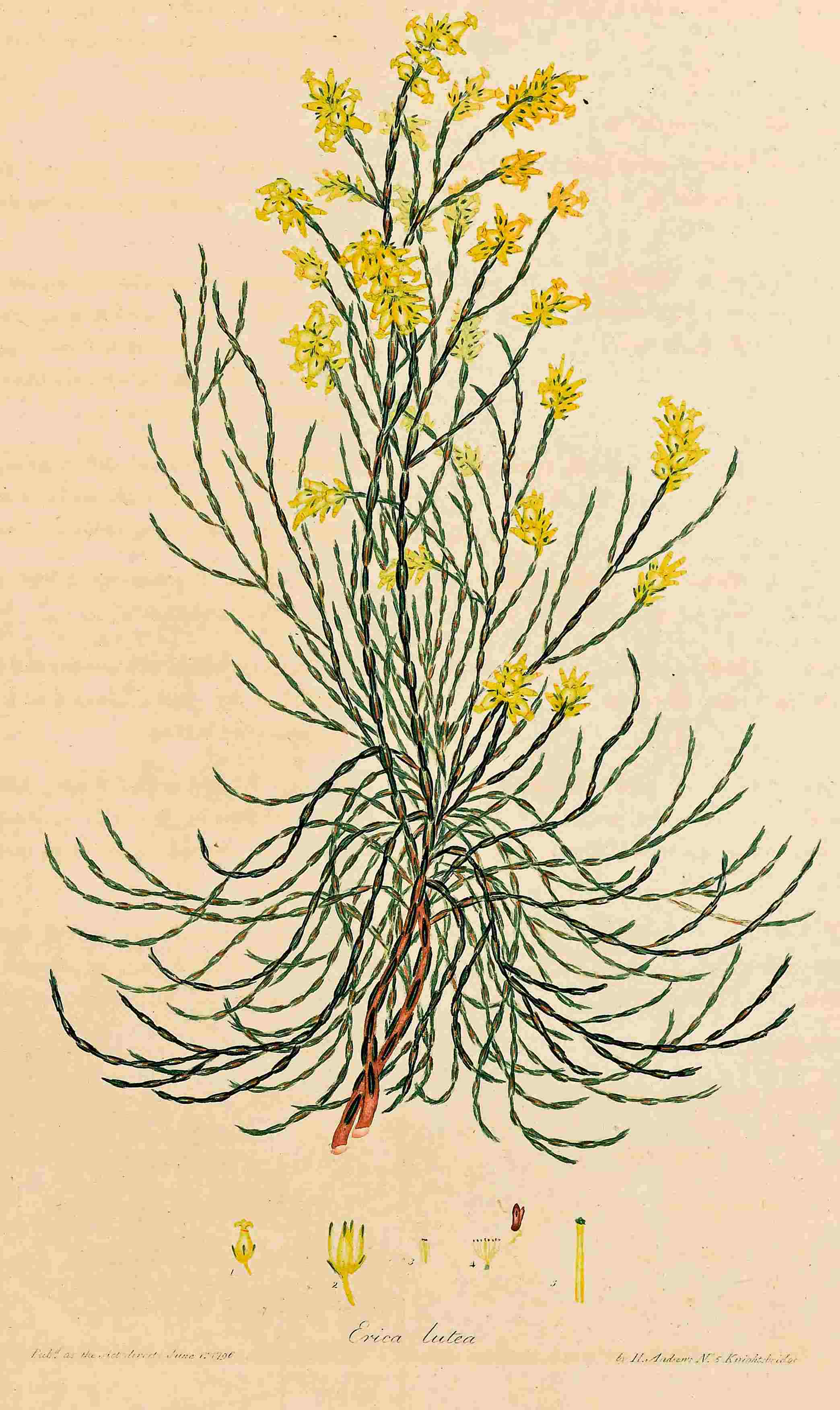
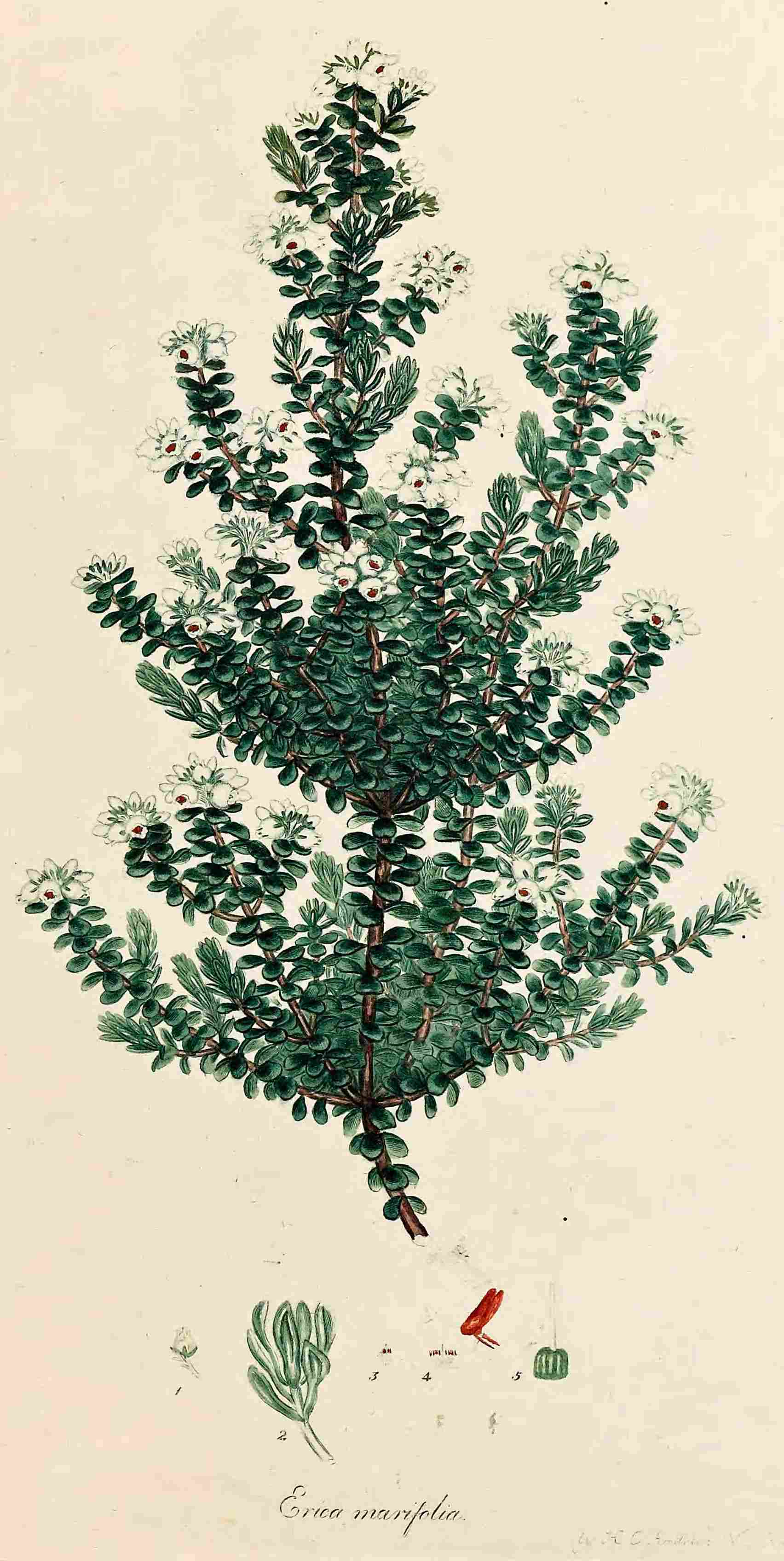
the catalogue of that garden; where the E. curviflora, E. lutea, E.
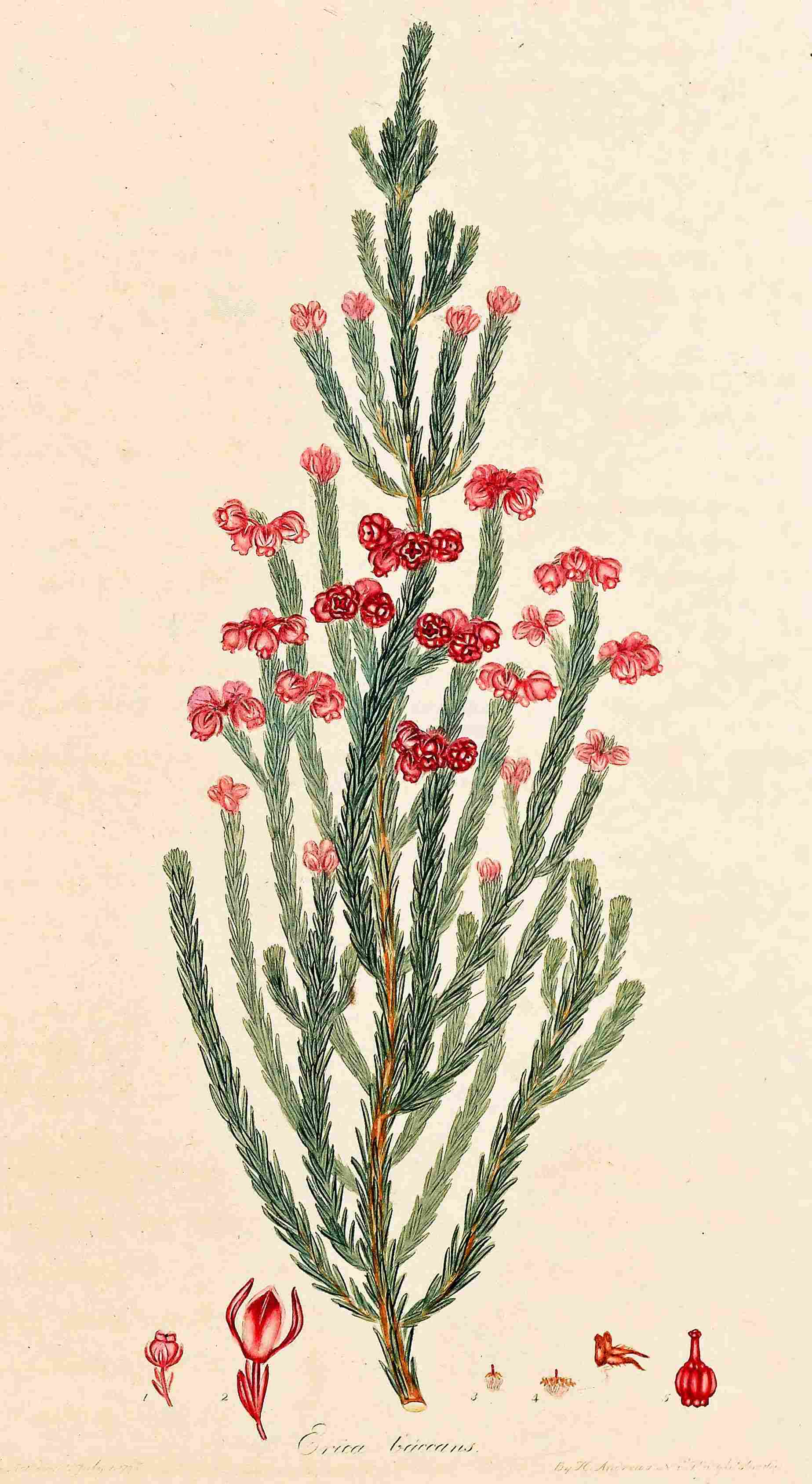
cruenta, E. persoluta, E. baccans, E. marifolia, E. abietina, E.
corifolia, E. paniculata, E. empetrifolia, E. spumosa, E. capitata,
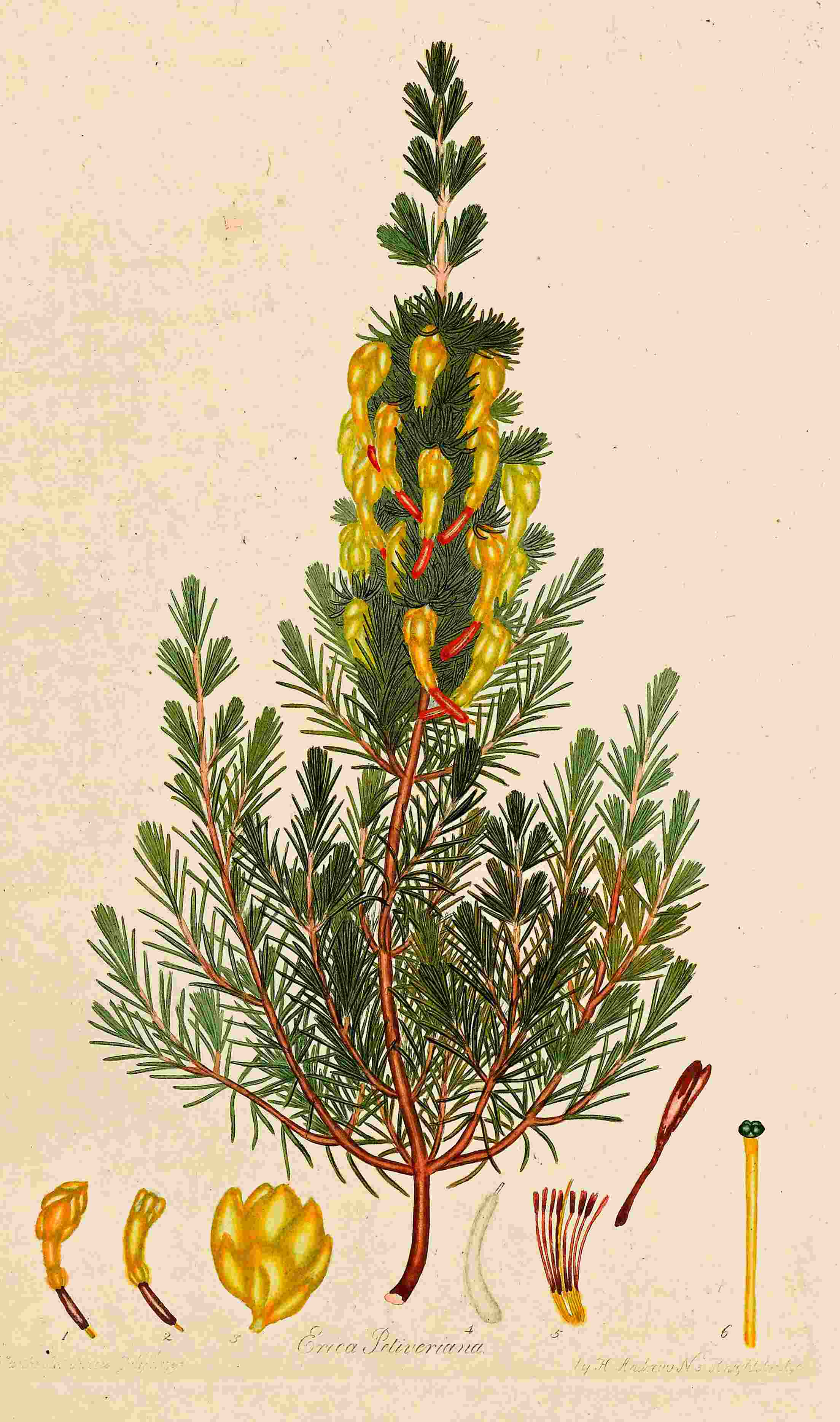
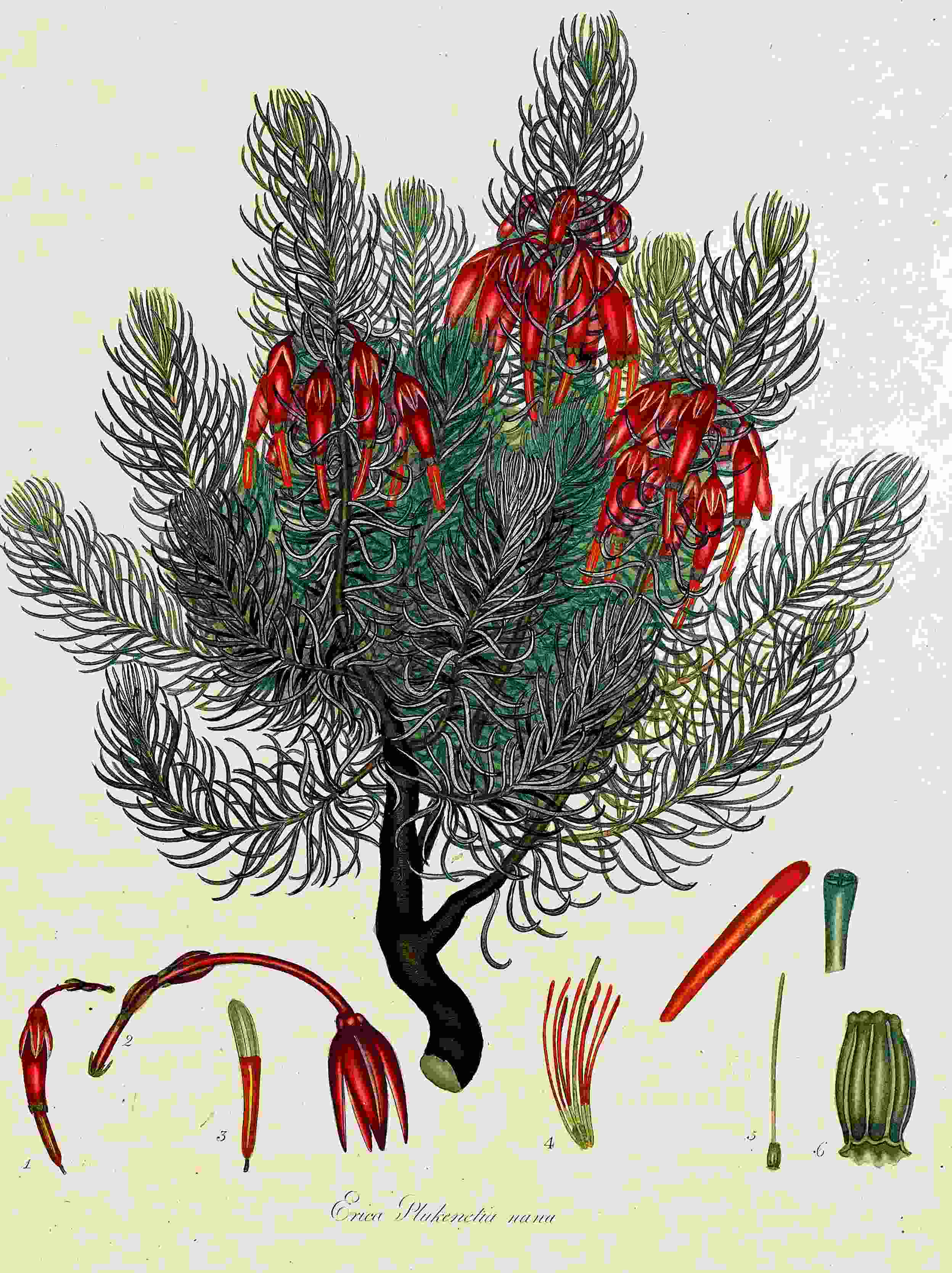
E. conspicua, E. cerinthoides, E. viscaria, E. Plukenetii, E.
Petiveri, and E. petiolata, are all stated to have been of that
year’s introduction. From this period, till within these few years,
the accession was so rapid, that it would be difficult, nay nearly
impracticable, to ascertain the precise date when most of the
remaining species were introduced; as many different collectors
were about this time, or shortly after, producing in their
collections new species to which they each claimed the honour of
priority of introduction; the enumeration of these, therefore, in
succession would be but a list of names, and in no way illustrate
the present subject. It will be nothing relevant to our purpose, to
know how many Ericas were enumerated by Petiver, Plukenet, Hermann,
Oldenland, Ray, &c. &c.; as, before Linnæus had, by his mode of
classification, determined the precise limits of the Genus, the
confusion that then pervaded all the elder Botanists is such, that
any comment from them, would rather perplex, than elucidate.
Wherefore, beginning with the Systema Naturæ of Linnæus, Vol. II.
of 1767, including the European species, he there enumerates but
42; and Dahlgren, in 1770, edited a dissertation, under his eye, on
the genus, containing a catalogue of 58 names from Bergius, the
Mantissa, &c. Thunberg returning from Africa in 1772, added 13 to
the number; all of which were inserted in the Supplementum
Plantarum of 1781. From this last work, and some other sources,
Murray has, in his Syst. Veg. of 1784, made up a Catalogue of 74
names. The last to be noticed, till the appearance of the Hort.
Kew. is, the Dissertatio de Erica; published under the inspection
of Thunberg, in 1785, with a list and descriptions of 91 species.
In the year 1789, a Catalogue of the plants cultivated in the Royal
Gardens at Kew, was published by Mr. Aiton; where, 41 Heaths are to
be found in the 2d Vol.; and four in the addenda at the end of the
3d, making in all 45. Martyn in his Edition of Miller’s Dictionary,
fasciculus of 1795, article Erica, enumerates but 84. Willdenow,
collating from all the foregoing, and assisted by his friend
Wendland, of the Royal Gardens at Herenhausen, Hanover; has mounted
the list to 137, in his Species Plantarum, now publishing in
continuation at Berlin. This, however, as will appear by the
catalogue, falls far short of the number, we have now, in actual
cultivation in Britain. From the great number of beautiful
specimens lately received by G. Hibbert, Esq. many of which were
accompanied by seeds, now living plants, contributing to the
present richness of the extensive and superb Collection of that
Gentleman at Clapham, and brought from the Cape of Good Hope by Mr.
Niven, who was employed for the only purpose, of amassing the
vegetable treasures of that country, to enrich the Clapham gardens,
and herbarium; as well as, from the numberless importations, by
different hands, of seeds, since we have been in possession of that
territory; a fair conjecture may be made, that the Genus is not
bounded, by double the number of species with which we are at
present acquainted. Few, if any, of the species but have been
increased by cuttings; which has occasioned the total disuse of
propagation by layers; wherefore, the only methods we shall treat
of, is this, and from the seed. The process for the making, and
planting of the cuttings, is as follows. Let a middle sized pot be
prepared by filling it, within three inches of the margin, with
small broken potsherds, or some such matter; to the end that, a
constant and ready drain may be gained for the water, which it will
be necessary to give the cuttings, at any time the earth, &c. shall
appear dry on the surface. Then consulting the list given with
Volume 1st, take a sufficient quantity of sandy loam, sandy peat,
or common sand, or a mixture of any of them finely sifted, to fill
the pot up to the margin, and press it lightly with the hand; thus
prepared it is fit to receive the cuttings. These must be taken
about an inch long, or shorter, according to the nature and season
of the plants making their fresh branches, from the smallest and
tenderest shoots; cutting off the leaves from two-thirds of their
length close to the shoot; for which a pair of small scissars is
the most convenient. When a few are thus made ready, for not many
should be cut at a time, lest they wither before they can be
planted, with a small piece of wood, tapered to a point, dibble
them into the pot; fixing the lower end of the cutting as firm as
possible. When the pot has been thus filled with them, at about
half an inch distance each way, leaving a clear half inch from the
inner edge; cover them with a small bell-glass, procured as near as
possible to fit within its inner rim, then place it under a large
hand-glass, or frame, where it must be kept from the stronger rays
of the sun, until the cuttings are rooted. Some time after this has
taken place, which will be known by their growth, the small
bell-glass must be first removed; about a week after, the pot may
be taken from under the large hand-glass, and the plants exposed to
the open air, in the shade of a north wall, or in winter put in the
shady part of the green-house, to protect them from the sun and
wind, till they are removed into separate pots. The seeds of some
species, which ripen in this country, as well as those which may be
procured from the Cape, may be sown about the middle of March, in
pots, prepared in the same way as directed for cuttings; with this
exception, that the earth be invariably sandy peat finely sifted;
the seeds should be covered so slightly, that they may be but just
concealed; when covered, they must be watered with a watering-pot
whose rose, or head should admit of a passage for the water, only
as a light dew; lest the seeds be all thrown together, or washed
over the side of the pot. Both plants from cuttings, and seedlings,
may be removed with greater safety whilst quite young, than after
they have acquired a considerable size. The smallest pots that can
be procured, are the best for the first transplanting; in which
they should remain, till the pots are quite filled with roots. The
earth in which all Heaths thrive most is a soft, loose, sandy peat.
That nothing may be wanting, which we can contribute, to the
illustration of the Genus; a list is subjoined, communicated by
Messrs. Lee and Kennedy, of all those species cultivated by them at
their nursery, Hammersmith; unquestionably, the most extensive
collection, of living plants, of every denomination, now in Europe.