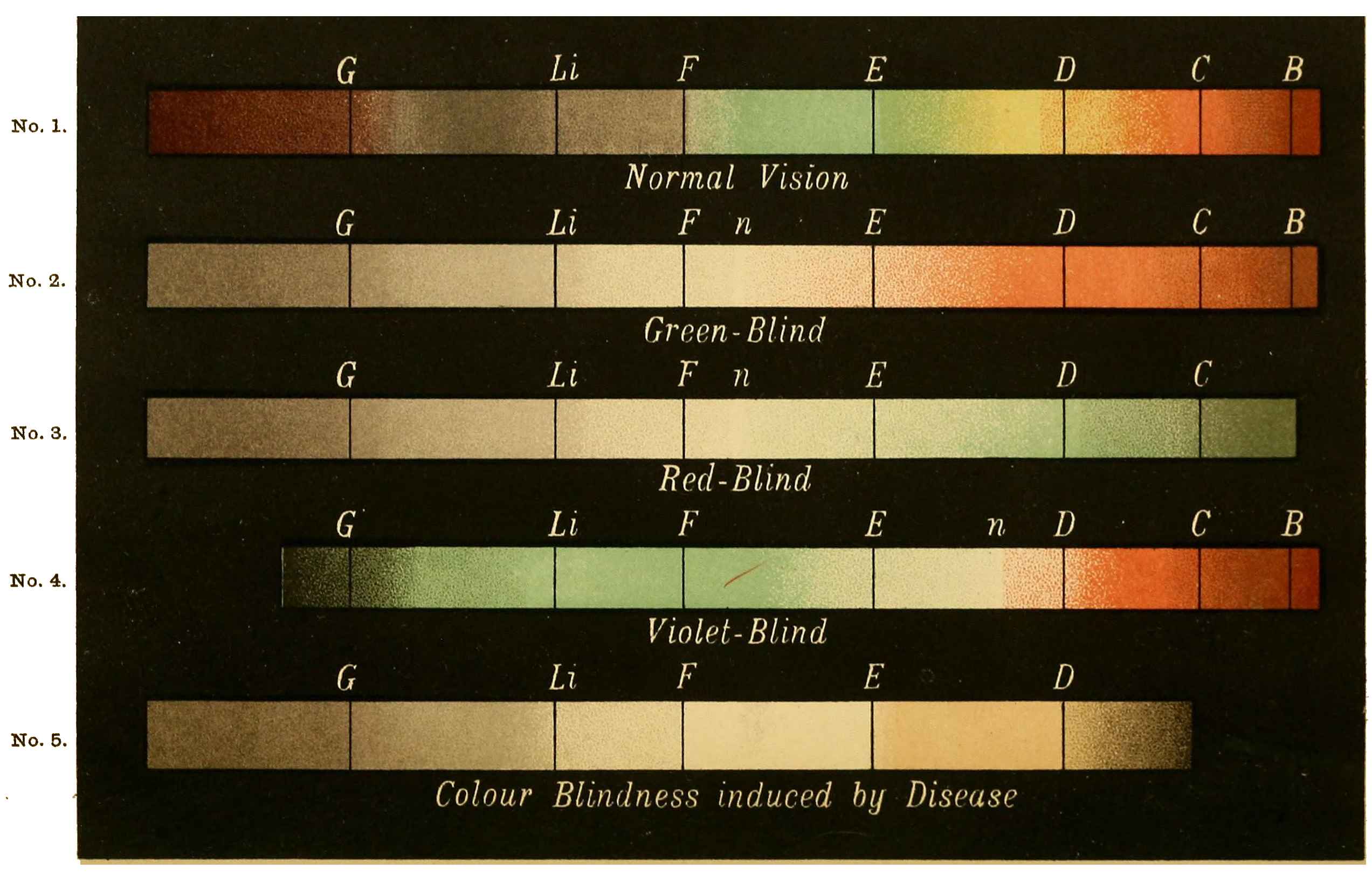
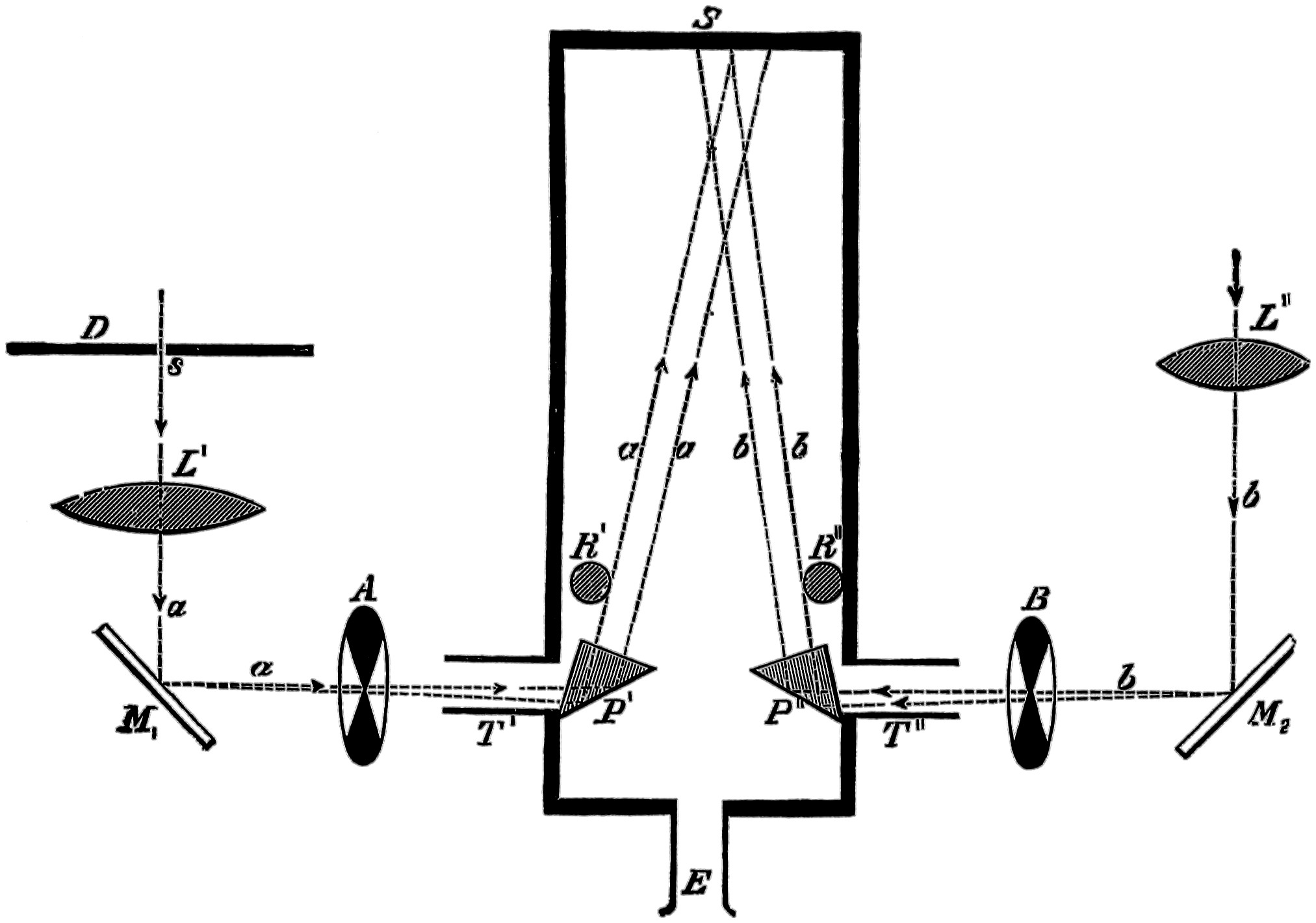
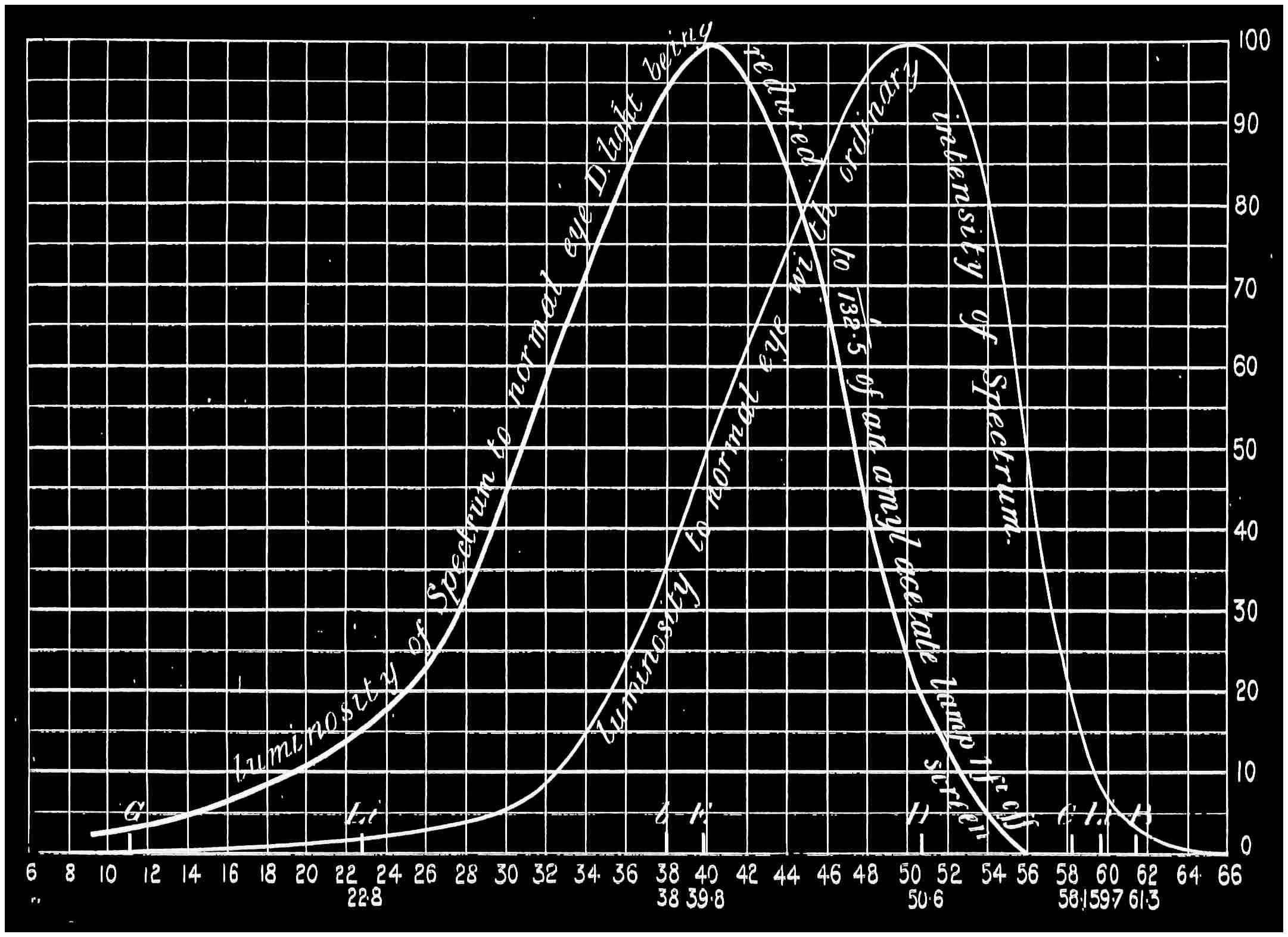
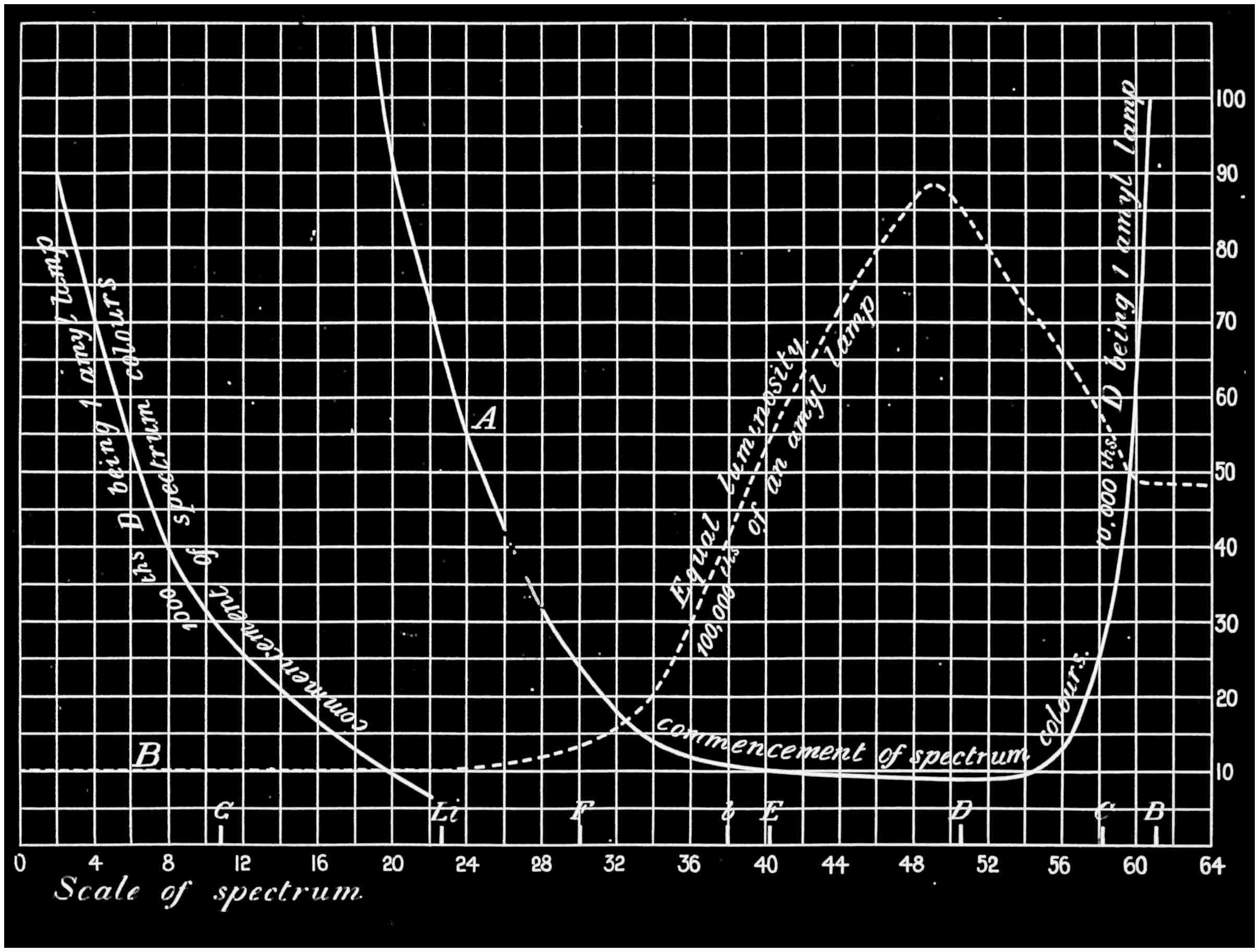
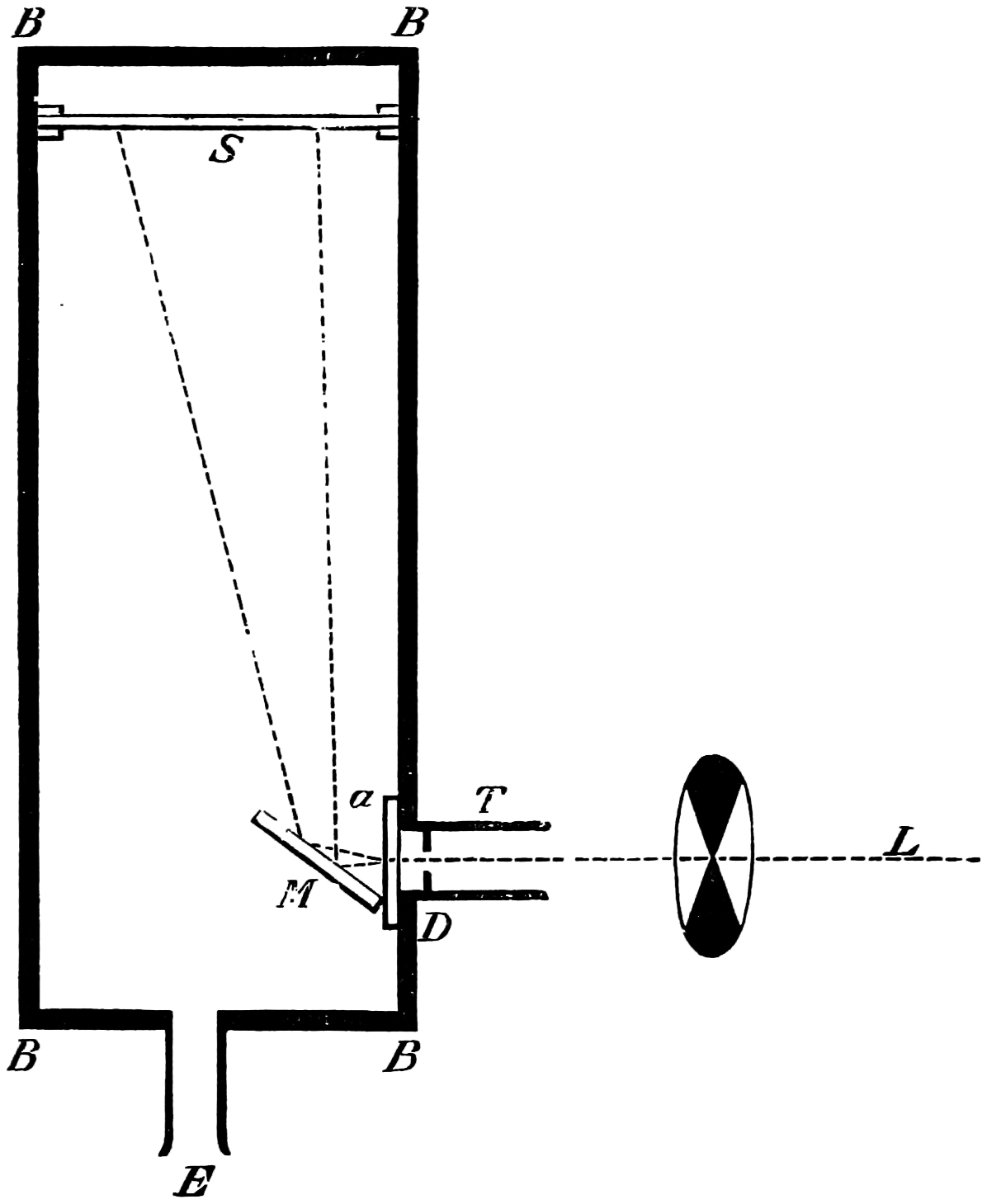
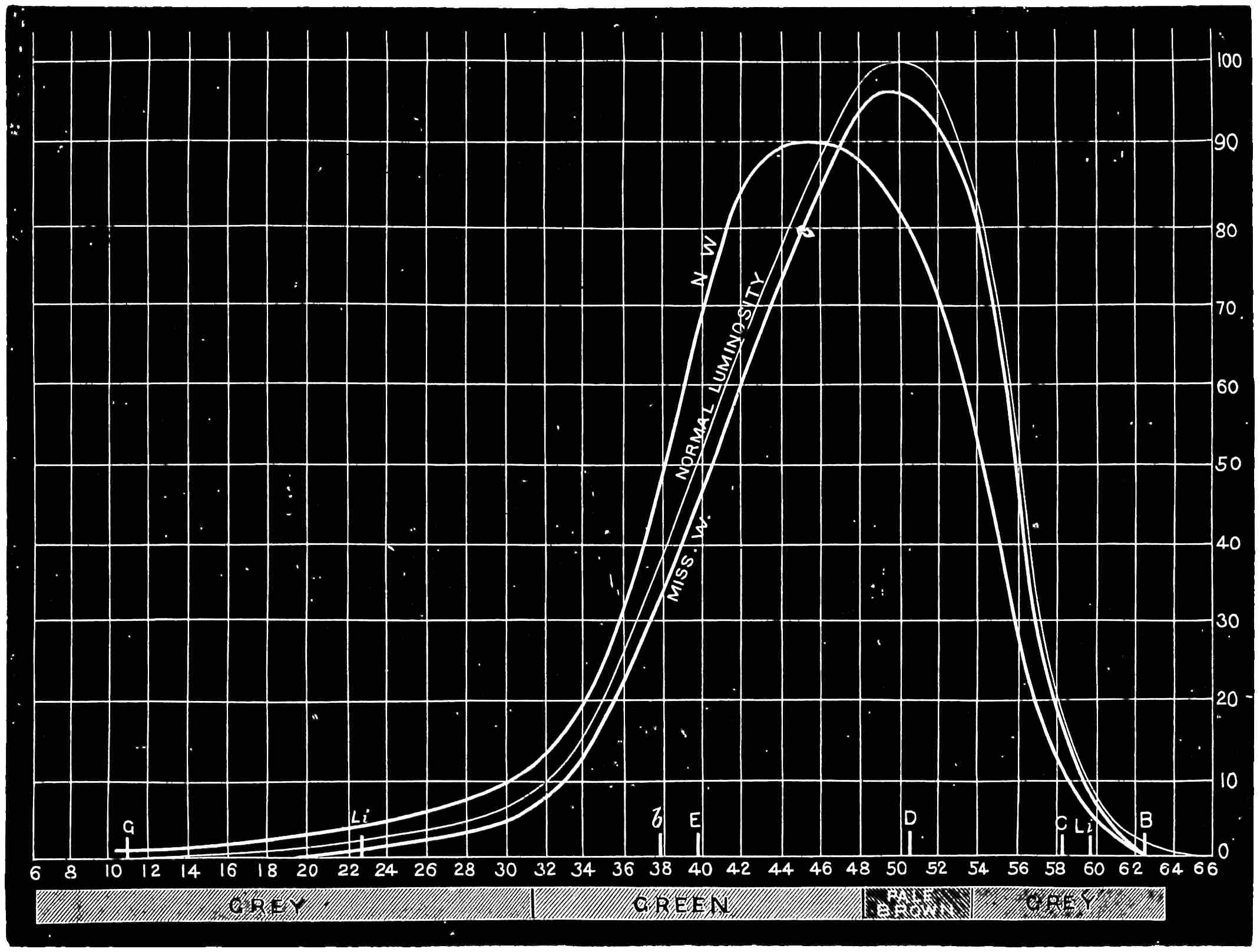
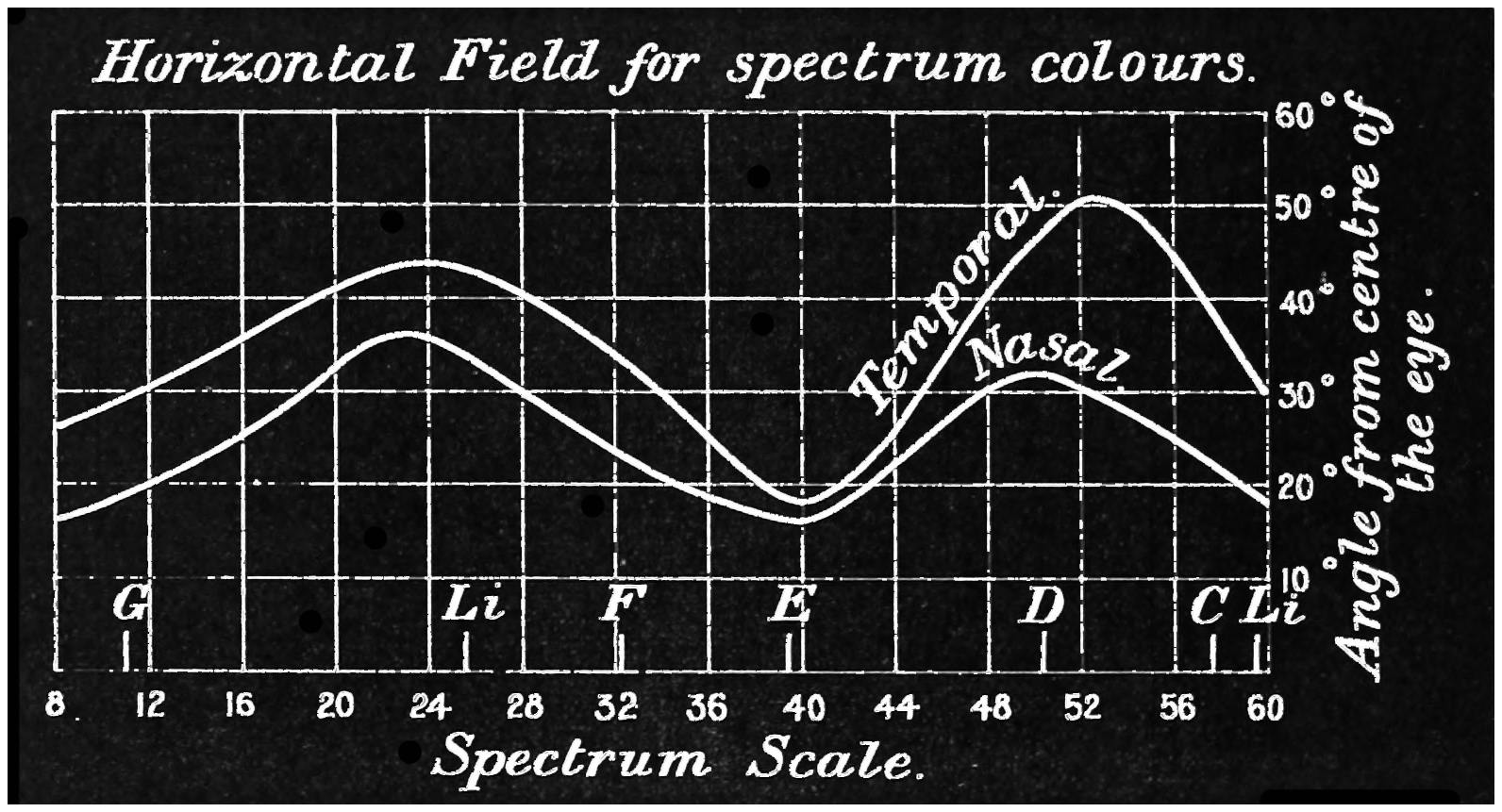
Larger versions of most illustrations may be seen by right-clicking them
and selecting an option to view them separately, or by double-tapping and/or
stretching them.
New original cover art included with this eBook is granted
to the public domain. It includes part of the title page and an illustration taken
from the original book.
The writer had for some years past, in conjunction
with General Festing, and recently as
Secretary and Member of the Colour Vision Committee
of the Royal Society, carried out a series
of investigations on colour vision, and selected that
subject when he was invited, in 1894, to deliver the
Tyndall Lectures at the Royal Institution.
The brief time allotted for these lectures—an hour
on three successive Saturday afternoons—restricted
the discussion of some aspects of the question, and
confined its treatment in the main to those features
most readily explicable by the physicist, and to
bringing into notice the latest results which had been
obtained from physical experiments. How far the
writer has succeeded in the task which he then outlined
it is for the reader to determine.
There was no intention in the first instance to
publish these lectures. After their delivery, many
persons expressed a desire that the information they
contained should be rendered accessible to such as
were interested in the theory of colour vision, and
in deference to that desire the lecture-notes have
been re-cast in book form. For the reader’s convenience
the matter is now divided into chapters
instead of into lectures, and a few additions have
been made in the text to explain some of the experimental
work to those who have not facilities for
its repetition.
The writer has to acknowledge several debts of
gratitude. First, to Mr. E. Nettleship, for his kindness
in looking over the proofs, and making valuable suggestions
whilst the work was passing through the
press; and also, as will be seen throughout its pages,
for many of the interesting cases of defective colour
perception which have been examined by the somewhat
novel methods described. Next, the writer’s
gratitude is due to Professor M. Foster for the permission
he has given to use his admirable description
of the Hering theory; and, lastly, to the Royal Society
for the permission it accorded to use various diagrams
which have served as illustrations to papers which
have appeared in its “Philosophical Transactions”
and “Proceedings.”
COLOUR VISION. — CHAPTER I.
I must commence this course by saying that I feel
the honour that has been done me in asking me
to undertake it, connected as it is with the name of
Tyndall, whose recent removal from our midst has
been deplored by all lovers of science, and by none
more than by those who have had the privilege of
listening to him at this Institution. It is my duty
to speak on some subject of physics, and the subject
I have chosen is Colour Vision. I hope it will not
be considered inappropriate, since it was Thomas
Young, the physicist, whose connection with this
Institution is well known, who first propounded a
really philosophical theory of the subject. Interesting
as it may be to trace how old theories have failed and
new ones have started, I feel that for those who, like
myself, have but little time at command in which to
address you, the historical side of this question must
of necessity be treated incompletely.
Colour vision is a subject which enters into the
domains both of physics and physiology, and it is
thus difficult for any one individual to treat of it
exhaustively unless he be a Helmholtz, who was as
distinguished in the one branch of science as he was
in the other. I am not a physiologist, and at the
most, can only pretend to an elementary knowledge
of the physiology of the eye, but I trust it is
sufficient to prevent myself from falling into any
grievous error. I shall try and show you, however,
that the subject is capable of being made subordinate
to physical methods of examination. I must necessarily
commence by a very brief description of those
parts of the eye in which it is supposed the seat of
vision lies, but in terms which are not too technical.
As to the mere optical properties of the eye I shall say
but little, for they are not necessary for my purpose,
although more particularly adapted to mathematical
treatment than the other properties I have to describe.
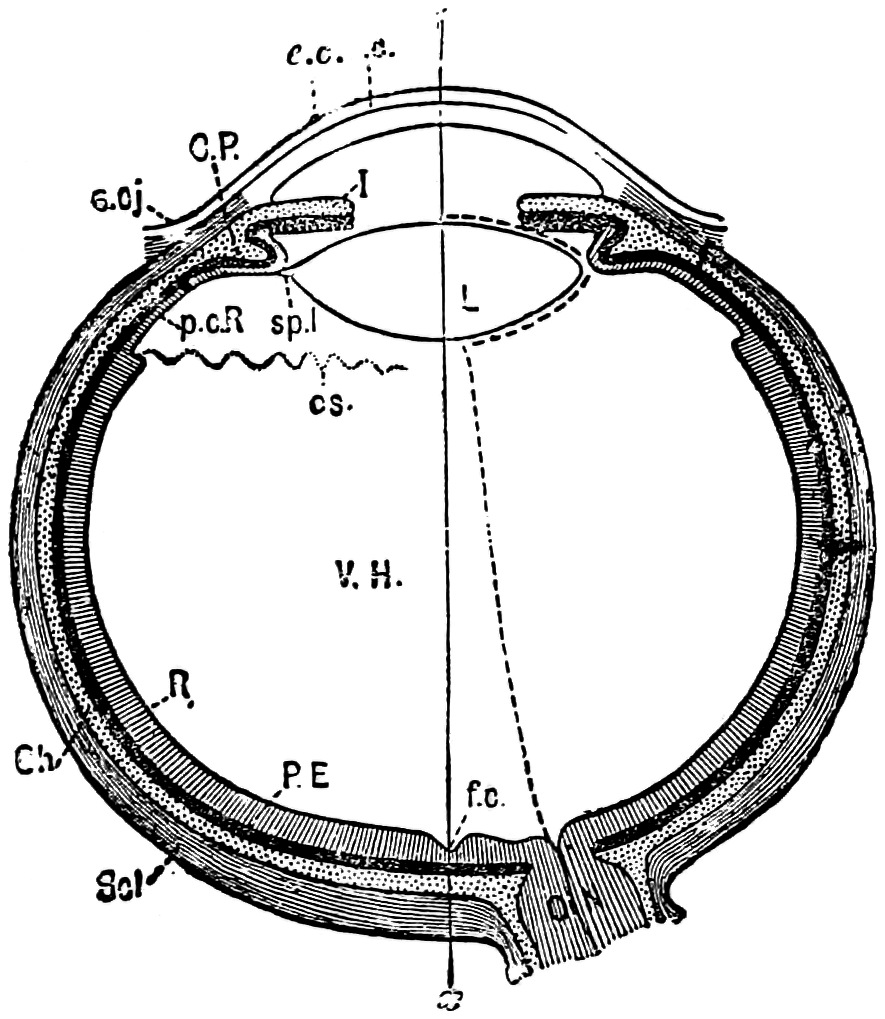
The eye may be diagrammatically represented as
in the figure which is supposed to be a horizontal
section of it, the figure being reproduced from Professor
Michael Foster’s Physiology.
Fig. 1.
Scl is the sclerotic coat. Ch the choroid coat,
with CP the ciliary process. I is the body
of the Iris. R is the retina or inner wall.
PE the pigment epithelium or outer wall.
L the lens held by the suspensory ligament
sp.l.VH is the vitreous humour. ON the
optic nerve, ox is the optic axis, in this
case made to pass through the fovea centralis,
f.c.
As far as the perception of colour is concerned, the
principal part of the eye which is not distinctly optical—i.e.
for the production
of images—is
the retina, and this
it will be seen is in
reality an outcrop of
the brain, the connection
between the two
being the optic nerve.
Owing to this connection,
it is not easy to
determine where the
seat of colour perception
is located; but
for the purpose of
physical investigation
this is not of first-rate
importance, nor
does it affect the discussion of rival theories except
in a minor degree. There are other subsidiary adjuncts
in the eye to which, however, I must call attention, as
they have a distinct bearing on the apparent intensity
of some colours and of the hue that mixtures of
others are perceived. The first is what is called the
“macula lutea,” or yellow spot, a spot which it may
be assumed exists in every eye. It is horizontally
oval in form, and is situated in the very centre of
the retina, embracing some 6° to 8° in angular measure.
It has a brownish or yellowish tint, and the
retina at this part is slightly depressed, being bounded
by a slightly raised rim. In the centre of this area
the retina becomes very thin, having a depression
about 1/100 of an inch or ·3 millimetres in diameter,
which is named the “fovea centralis,” where it is
said that vision is the most acute. This statement
can be well credited when we come to consider where
the seat of the stimulation of sensation lies. The
colour which tints the yellow spot is strongest at the
crater-like rim, and fades away centrally and peripherally,
and is said to be wholly absent in the fovea
centralis.
As the colour of this spot is yellow or brown in
the living eye (and that it is probably brown the
absorption indicates), it follows that white light passing
through it must be deprived of some of its components,
though in differing degrees. If the seat of
sensation is at the outer layer of the retina, as we
shall shortly see must be the case, it will further be
seen that when light of any colour which the brown
pigment will absorb more or less completely falls on
different parts of the oval area, the absorption must
vary at each part, and the intensity of the perceived
light will be least at the rim and increase centrally and
peripherally. As the centre of the yellow spot or fovea
is coincident approximately with the point where the
axis of the eye cuts the retina, the image of an evenly
illuminated object, when looked at directly, must fall
on the yellow spot. If, therefore, a patch of such
light, the image of which more than covers the spot,
be observed, it ought to exhibit a varying brightness of
colour corresponding to the strength of the colouring
matter which exists at the different parts. This it
but rarely does, for habit and constant interpretation
of what should be seen prevents the mind from
distinguishing these variations; but if the colour
brightness, as perceived by the different parts, be
submitted to measurement by proper means, the variations
in brightness of the image can be readily
recognised. A very common method of exhibiting
the presence of the pigment is to look at a bright
white cloud through a layer of chrome alum. Chrome
alum transmits red and blue-green rays. Now as
the spectrum-blue rays are those which the pigment
will absorb, it follows that the colour of the solution
should appear ruddy to the central part of the eye,
but on the rest of the retina it should appear of its
ordinary purplish colour. At a first glance, and before
the eye has become fatigued, this is the case, but the
phenomenon soon disappears. Another way of forming
an idea as to what the yellow spot absorbs is to throw
a feeble spectrum on a white surface and cause the
eye to travel along it. If the spectrum be viewed so
that it does not occupy more than about 40° of the
retina, the movement of the eye will show a dark
band travelling along the green, blue, and violet regions
as the image of these parts of the spectrum fall on the
yellow spot, and their apparent brightness will increase
as they fall outside the absorbing area. This proves
that an absorption takes place in this area.
Fig. 2.
The retina consists essentially of an inner and outer
wall, enclosing matter which is similar to the grey
matter of the brain. On the inner wall are the
vessels which are connected with the optic nerve.
The outer wall is epithelium coloured with a pigment,
and it is here that the visual impulses begin,
although the rays of light giving rise to them
have to pass through the thickness of the retina
before so doing. It has already been stated that
the light has to pass through the thickness of the
yellow spot before a visual sensation is felt in the
centre of the field, and the experiments just given
offer a fair proof of the truth of the assertion, but
there is still another which is perhaps more conclusive.
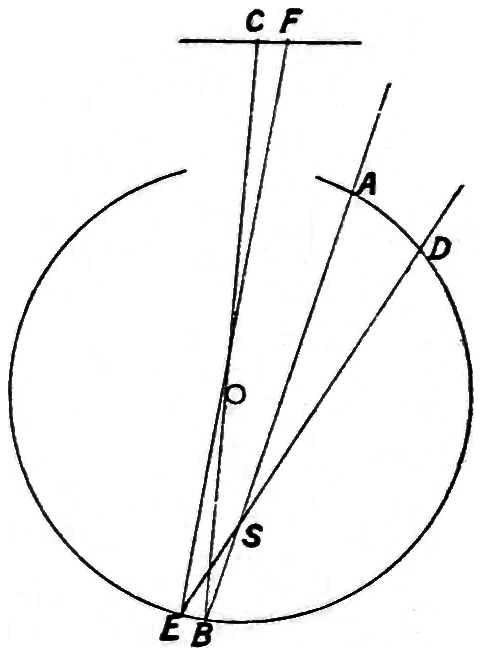
Suppose we have a hollow reflecting ball, as shown
in Fig. 2, and through an orifice A we project a
beam of light to B, which meets
an obstruction, S, in its path, then
A B would be reflected from B to
C on a screen C F, and the obstruction
S would be marked at C.
If another beam from D was directed
so as to meet the same
obstruction, its presence would be
marked at F. Knowing the distance of the centre
O of the hollow sphere from F C and its diameter,
and measuring the distance between F and C and
their respective distances from the axis of the sphere,
the distances S B and S E can be calculated. This
method is applied in the formation of what are known
as Purkinje’s figures. The simplest case is where a
beam of light is directed through the sclerotic and
transmitted through the lens. Images of the retinal
vessels are distinguished as at S, and it is found
that they cast shadows, which are seen as dark lines
in the glare of the field of vision. The sensation
of light must therefore come from behind these
vessels, and calculation shows that the seat of the
sensation is close to the pigmented inner wall of the
retina.
Lying here is a layer of what are known as rods
and cones, which have a connection, either actual or
functional, with the optic fibres which largely compose
the inner wall of the retina, and are connected with
the optic nerve. In the yellow spot the cones are
much more numerous than the rods, but in the peripheral
part the reverse is the case. In the fovea the
rods appear to be altogether absent. The total number
of cones in the eye has been calculated to be about
3,000,000, of which about 7,000 are in the small fovea.
The number of cones will give an idea of their dimensions.
This detail has been entered into as it has been
supposed that these rods and cones are all-important
in translating light-waves into visual impulses. The
inner wall of the retina of most human eyes, as has
been mentioned, is stained with a black pigment,
fuscin, though in albinos it is absent. What its particular
use may be is still unknown, for its change by
light is so slow that it can scarcely be the cause of
vision. In the outer parts of the rods is, however,
diffused a substance highly sensitive to light, called
the “visual purple,” from its colour, and a theory
founded on chemical action, produced by a change
in this substance, has been promulgated. Fascinating,
however, as such a theory must be, it lacks confirmation.
The fact that the cones do not contain it,
and that in the fovea are cones alone, renders it
difficult to reconcile the theory with the fact that
this part of the retina possesses, we are told, the
greatest acuteness of sensation as regards light and
colour.
The eyes of most vertebrate animals, it may be
remarked, have this visual purple, but in those of
the bat, owl, hen, and some others the colouring
matter seems to be absent. Visual purple is an interesting
substance, however, and as it is found in
the eye it probably exercises some useful function,
though what that function may be is at present
unknown. That images of objects can be formed on
the retina, owing to the bleaching of this substance,
has been proved by experiment. The purple is first
changed to a yellow colour, and then passes into
white. These “optograms,” as they are called, can
be fixed in an excised eye if the retina be detached,
and then be treated
with a weak solution
of alum.
Fig. 3.
Many persons are
not aware of the
extent of the field
of view which the
eye embraces. Vertically
it takes in
about 100°, whilst
horizontally it will
take in some 145°,
more or less. The
field is smaller on
the nasal than on
the temporal side.
When both eyes are
used, the combined
field of view is
larger horizontally,
being about 180°.
The field of view
which is common
to both eyes is roughly a circle of about 90°. There
is, however, a marked difference in the distinctness
with which objects are perceived in the different parts
of field of view. On the fovea centralis two dots placed
so as to subtend an angle of 60″ will be perceived as
double. That is to say, if a piece of paper, on which
are two dots 1/30 of an inch apart, be placed 10 feet
away from the observer, these dots will be seen as
separated, whilst dots (in this case they should be
black and of good dimensions) placed half-an-inch
apart would still appear as one if viewed at the same
distance near the periphery of the retina. In the
yellow spot the distance apart of the cones is such
that they subtend about the same angle as the dots
when they are seen separate, viz., about 60″; that is,
they are about 16/100000 of an inch apart, and hence
may have something to say to the limit of separation.
The field for the perception of colour is different to
that for light.
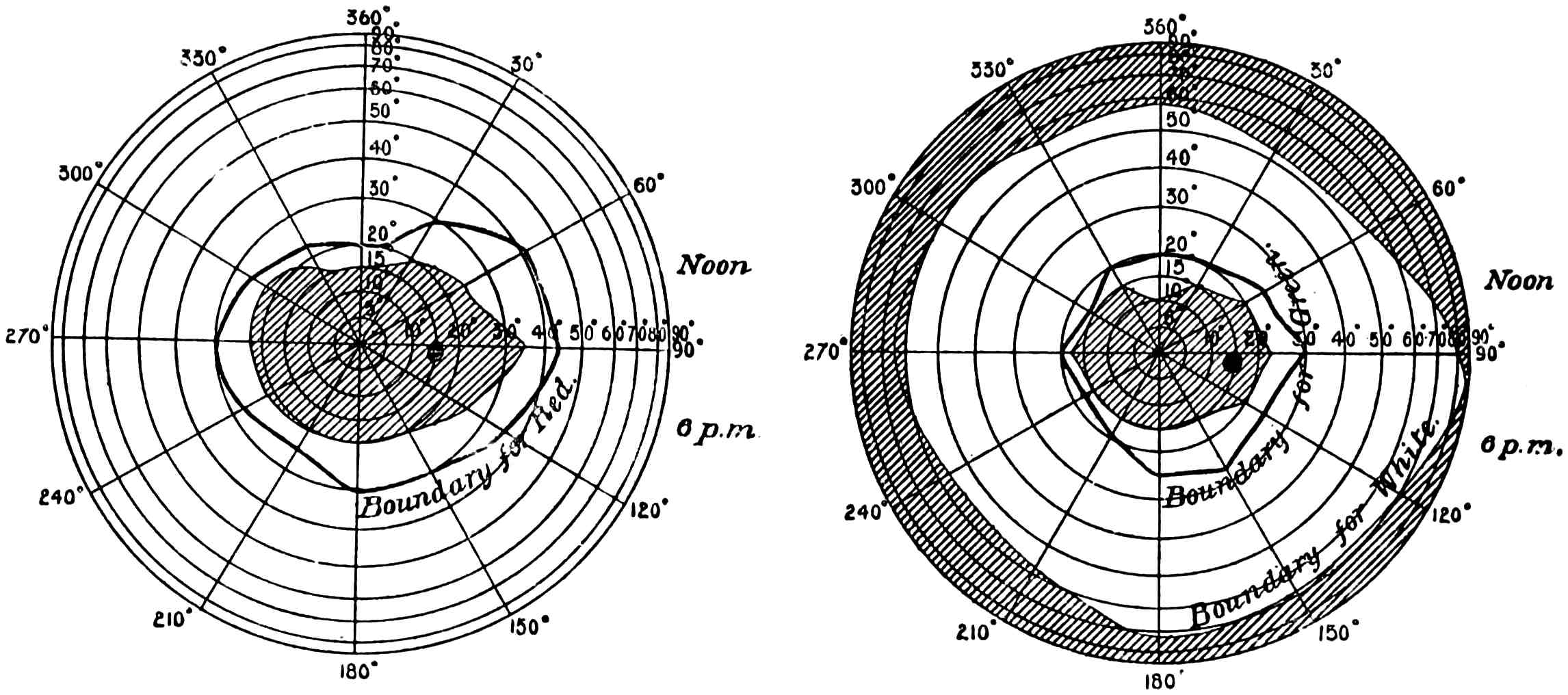
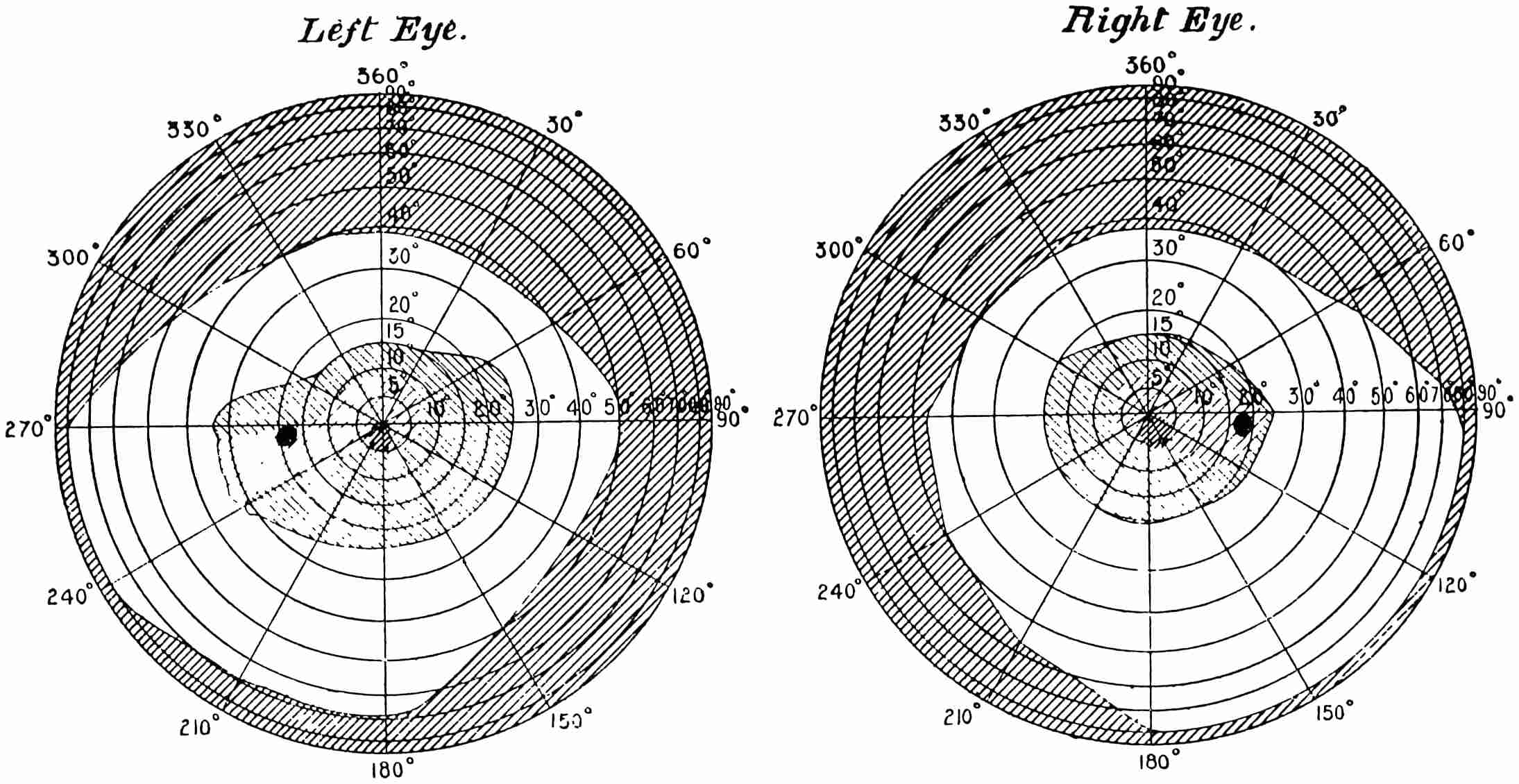
The diagrams (Fig. 3) will show the fields in a
satisfactory manner. The concentric circles are supposed
to be circles lying on the retina corresponding
to parallels of latitude on a globe, and are not, therefore,
equi-distant when seen in projection. To make
these circles it must be imagined that we have a bowl,
in the middle of which is a thin rod standing upright
and passing through the centre, and another rod
attached to it at the centre of the sphere of exactly
the length of the radius. If this last arm be opened
to make an angle of 5° with the fixed rod, and be
twisted round like the leg of a compass against the
bowl, it will make a circle, the projection of which will
give the innermost circle of the diagram; if opened
to 10° it will give the next circle, and so on for every
subsequent 10°. The lines passing through the centre
are 30° from one another, the line stretching from
360° to 180° being a line supposed to be vertical.
By means of an instrument called the perimeter, the
field of vision for each eye can be measured. With
its aid any small object can be made to fall on any
part of the retina by directing the axis of the eye
to a fixed point and moving the object along one
of the diameters. Suppose we wish to ascertain the
field for a white object, a small white disc is moved,
say, along the horizontal line, and the angles at which
the retina just no longer sees it are noted. This gives
two points in the field, and they are plotted on the
chart—in Fig. 3 one touches the outside circle, and the
other is at an angle of about 65°. The field of vision is
next tested along another line, say 300° to 120°, and
other points noted and marked on the chart. When
the whole circle has been examined, the various points
are joined together, and we have the boundary of
vision for a white object. The boundaries of the colour
perception for (say) small red and green discs are found
in the same way. The former is depicted in the left-hand
chart and gives the field for the right eye, and
the latter with that for white in the right-hand chart
for the same eye. It will be noticed that two boundaries
are given, one taken at mid-day and the other
at 6 p.m. The brighter the colour, the larger is the
boundary in both cases, showing that the field of colour
vision varies according to the illumination. Now it is
difficult from this method of experimenting to determine
whether the fields for different colours are the same
or differ in extent, as we have no information as to
whether the colours themselves which were used were
physiologically equal. The only way by which this can
be satisfactorily determined is by using spectrum colours
each of known brightness and area. (Some preliminary
experiments made by myself regarding the colour fields
will be found in the appendix, and will be referred to
later.) It must not be thought that the various colour
boundaries mark the limit at which light is perceived,
but only the limit at which colour is seen; outside the
boundaries the objects appear of a nondescript colour,
to which we shall by-and-by call attention. The yellow
spot lies within the circle of 5°, and the blind spot on
which no sensation of light is stimulated is shown by
the black dot about 15° away from the centre.
I have only attempted to sketch, in unphysiological
language, the primary apparatus with which our
experiments in colour have perforce to be made.
CHAPTER II.
It will be seen, then, that in measuring colour or
light several circumstances have to be taken into
account. These are not simple, and require differentiating
one from another before the results of colour
measures can be finally laid down as correct, or as
being held to be applicable to all cases.
We must naturally ask, what is colour? The answer
I should like to pass over entirely. It can only be
described as a sensation, just as we should describe
touch as a sensation. It has, however, one advantage
over most sensations, in that it is a sensation which
can be submitted to empyric measurement. The
question whether certain phenomena, such as the
colours produced by simultaneous contrast, are subjective
or real, does not require answering for the
purpose that we have in view, but the results recorded
may probably help to throw light on it. Colour is
an impression caused by the stimulation in the eye
of some apparatus, that lies near the outer wall of
the retina, the effect of the stimulation being conveyed
by the optic nerve to the brain. If this
apparatus be complicated by being made up of
distinct parts, each of which transmits its own kind
of impression to the brain, it is not only quite
possible, but more than probable, that when one part
is absent or injured the particular impression for which
it is responsible will be lacking, and that the sum of
the impressions due to the remainder will be unlike
that perceived when they are all working together.
In every investigation, whether it be in physical or
in any other branch of science, it is better to work
up from the simple to the more complicated; and
acting on this plan, it is better to commence experimenting
with simple rather than with complex colours,
though they may apparently produce precisely the
same sensations. I shall, with this in view, devote
most of the remaining part of this chapter to some
necessary experiments with simple colours. The simple
colours are those of the spectrum, and are the result
of motion in the ether, which pervades all space. The
motion is in the form of undulations or waves, and
each colour is due to a series of these waves, which
have a definite length. Thus, 6562 ten-millionths of
a millimetre produces to most of us a red colour in
the spectrum (see Plate I.), occupying the position
indicated by a black line known as the C line in the
solar spectrum.
A table of wave-lengths of certain lines in the solar
spectrum is given below:—
TABLE OF WAVE-LENGTHS IN TEN-MILLIONTHS
OF A MILLIMETRE.
B, deep red
6866
Lithium, cherry red
6705
C, red
6562
D, orange
5892
E, green
5269
b, green
5183
F, bluish green
4861
Lithium, blue
4603
G, violet
4307
H, extreme violet
3968
The rays in the different parts of the spectrum
being due to these simple vibratory motions, cannot
be decomposed further. And it makes no matter
whether we see them as different colours or not, they
will always issue at the same angle from the same
prism (if the prism be used to form the spectrum),
when it is turned to the same angle to the incident
light. Milestones are useful along a road to tell us
where we are in reference to some central place, and
these black lines in the spectrum serve the same end.
But they have the advantage over the milestone, for
whilst the last will tell us how far we are from, say,
York or London, the former tell us our distance from
a zero point. We thus have a scale of light of different
wave-lengths laid down for us, which we can apply
to the study of the sensations stimulated in the eye,
and so have the means of instituting a comparison
between the colour vision of different eyes. A mixed
or composite colour is in a different category, however,
to the simple colour, as you will see directly. It is
one which may be formed by any number of rays of
different wave-lengths falling on the eye. What these
rays are we can only tell by analysing the light and
referring them to the spectrum.
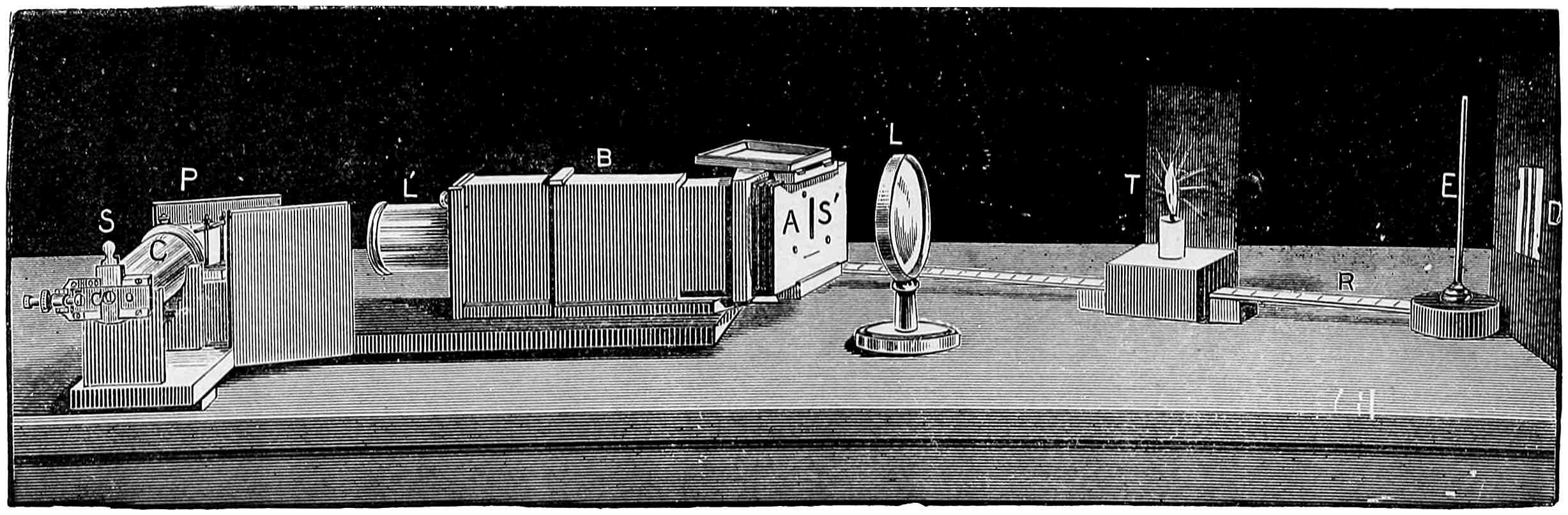
The instrument before you is one which I have
used before in this theatre; but as the major part
of my experiments have been carried out with it, in
case those who are present may not be acquainted
with it, it will be necessary to describe it very briefly.
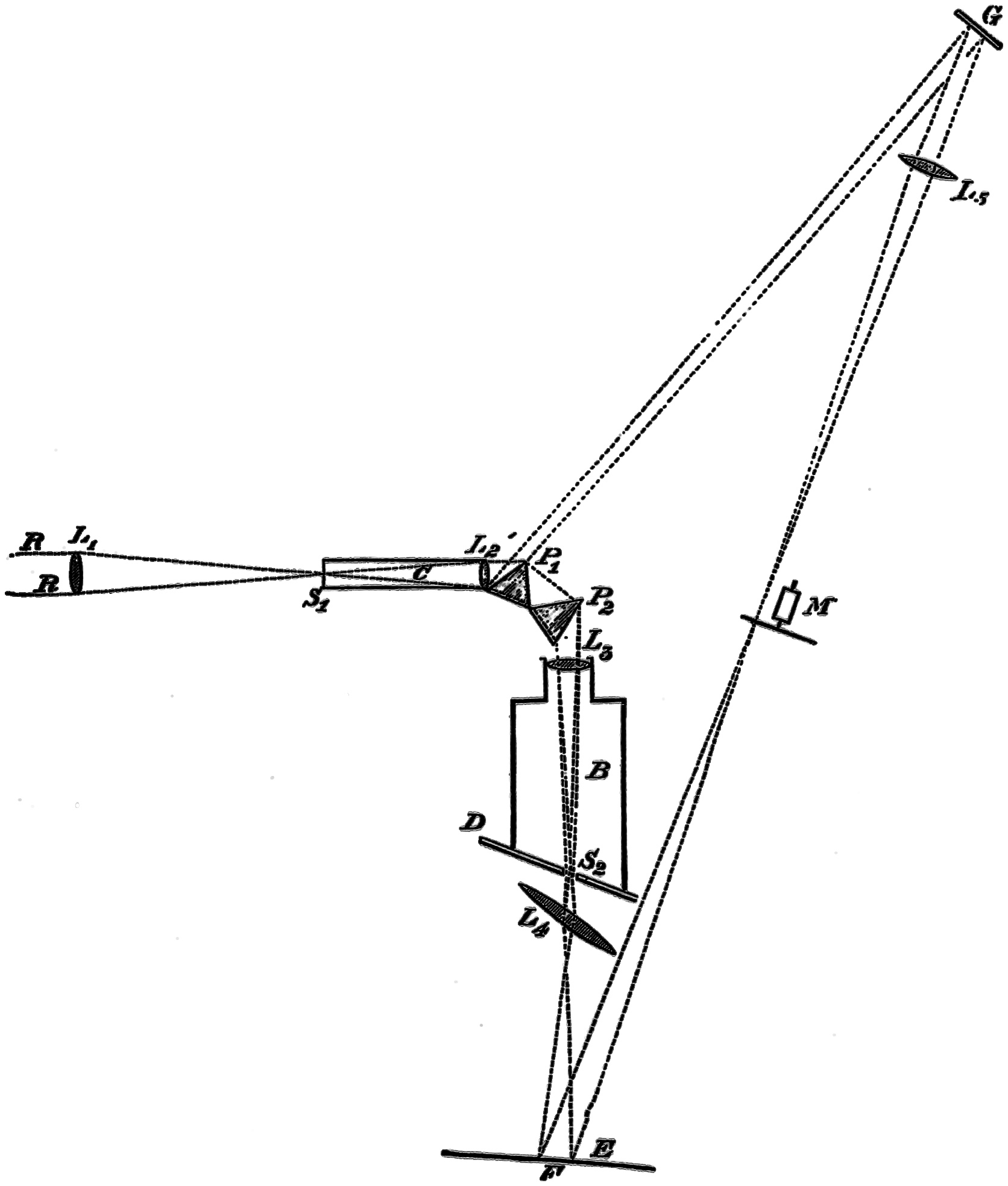
The general arrangement of the apparatus is given in
the accompanying diagram, Fig. 4.
Fig. 4.
R R are rays coming from the source of light, be it
sun light or the electric light, and an image of the one
or the other is formed by a lens L₁ on the slit S₁ of
the collimator C. The parallel rays produced by the
lens L₂ are partially refracted and partially reflected.
The former pass through the prisms P₁, P₂, and are
focussed to form a spectrum at D by a lens L₃. D is a
movable screen in which is an aperture S₂, the width
of which can be varied as desired. The rays are again
collected by a lens L₄, and form a white image of the
surface of the last prism on the screen E. If the light
passing through S₂ is alone used, the image at E is
formed of practically monochromatic light. Part of
the rays falling on P₁ are, as just said, reflected, but
as it and the refracted part are portions of the light
passing through the slit S₁, they both must vary proportionally.
If then we use the reflected portion as
a comparison light to the spectrum colours, the relative
intensities of the two, though they may vary
intrinsically, will remain the same. The rays reflected
from P₁ fall on G, a silver or glass mirror, and, by
means of another lens L₅, also can be caused to form
a white patch on the screen E, alongside the patch
of colour. At M, or anywhere in the path of the
beams, an electro-motor driving a sector with apertures
which can be opened or closed whilst rotating,
is placed, and the illumination of either beam can be
altered at will. To obtain a large spectrum on the
screen E, all that is necessary is to interpose a lens
of fairly short focus in front of L₄, when a spectrum
of great purity and brightness can be formed.
If it be required to measure the width of the slits S₂
(which we shall see further on is often necessary), a
small lens of short focal length placed behind L₄ and
near the slit will cast a magnified image on E, and by
means of a scale placed there, the widths of each slit,
if there are more than one, can be read off on the
scale by bringing them
successively into the
same colour.
Fig. 5.
Originally the comparison
light was a
candle, and it answered
its purpose fairly well,
and for obtaining absolute
measures is convenient
at the present
time. Fig. 5 will show
its arrangement, but as
both the candle and the
electric light may vary
independently of each
other, it will be seen
that for merely the
comparison of the different
spectrum colours,
the previous arrangement
is the better. In
both cases the two beams—the
direct and the
comparison—may be
made to cast shadows
by placing a rod in their path, the shadow cast
by one light is then illuminated by the other light.
By moving the rod towards or from the screen the
shadows can be brought side by side.
With this instrument it is easy to demonstrate that
a mixed colour may be mistaken for a simple colour
of the spectrum. In a glass cell with parallel sides
is a solution of potassium bichromate, which, to myself
and probably most of you, has a beautiful orange colour.
The spectrum of white light is now on the screen, and
if this orange liquid is placed in the path of the white
light before it reaches the prisms, all the violet, blue,
and most of the green is cut off, leaving some green-yellow,
orange and red only on the screen. That
these form the orange colour of the bichromate is
readily shown by removing the auxiliary lens. The
spectrum, which has its focus at D, is now recombined
into a patch of light, which is at once seen to be the
colour of the solution.
Fig. 6.
The colour of the bichromate is therefore a complex
or mixed colour according to our definition, for it is
made up of a large number of simple colours. What I
desire to show, however, is that this complex colour can
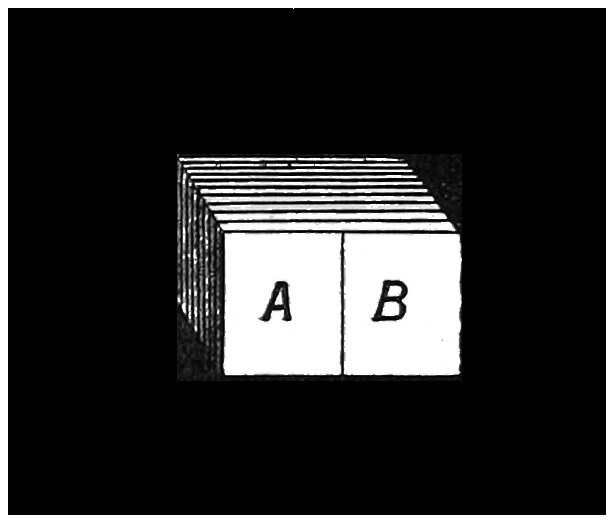
be mistaken by the eye for a simple colour. First, let
us interpose the cell with the bichromate in the path
of the reflected beam, and throw the patch of light
formed by it on a white surface A (Fig. 6), alongside
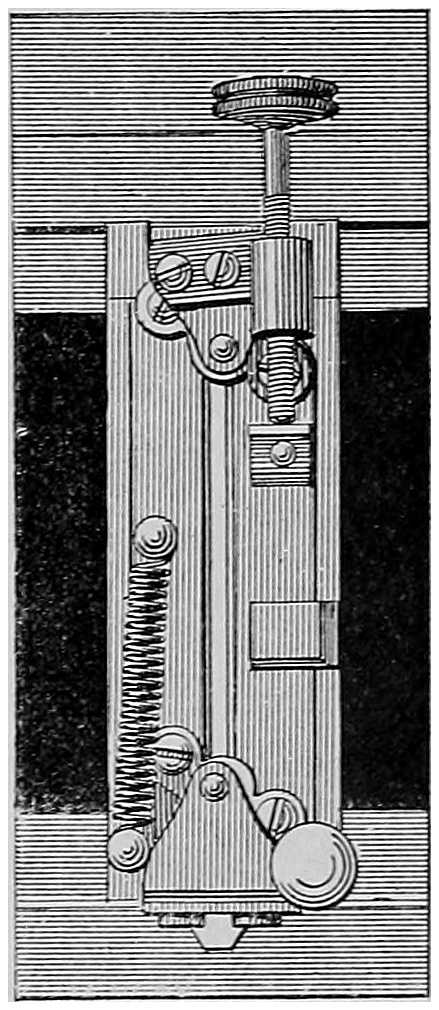
the patch of light B formed by the spectrum. Next
let us pass a single aperture (Fig. 7), which can be
opened and closed by a screw arrangement, through
the spectrum. By careful movement we at length
come to an orange ray, which is spread out by the
apparatus to form a patch on B, that to the majority
(and the word majority is
used with intention) of people
exactly matches the colour
of the bichromate. Thus we
have a proof that, as far as
the eye is concerned, the
simple and the complex
colours are identical. This illustration of the want of
power of the eye to analyse colour might be repeated as
often as we like. We may pass coloured wools, for instance,
through the length of the spectrum and show
that they have the property of appearing bright in,
and therefore of reflecting, some colours and of almost
disappearing in others—a sure indication that these
colours are mixed colours as they are made up of the
rays which are reflected. Yet when viewed in white
light they can in many cases be matched with simple
colours in the way we matched the colour of the
bichromate solution. This tells us that there is something
which requires investigating as to the constitution
of the perceiving apparatus, and points to
the probability that it is less complicated than it would
be were it able to differentiate, without the aid of the
spectrum, between simple and complex colours. If
the eye had a separate apparatus—and when I say
apparatus I use the word for want of a better—for
taking up the impression of every simple colour, it
might well be assumed that a differentiation must take
place.
There is one class of colours, it must be remembered,
which can never be mistaken for simple colours. I refer
to the purples—mixtures of red and blue—for there are
no spectrum colours which unmixed can possibly match
them. All other colours, as no doubt will soon be
apparent, can be referred to some one spectrum colour,
either in its pure state or else mixed with some
variable quantity of white light. We are all familiar
with the fact that there are three primary colours, and
we are naturally led to consider these in the light of
the experiments just made. As good a definition as
any other of a primary colour is that it is a colour which
cannot be formed by the mixture of any two or more
colours. The original investigators in colour phenomena
were the artists, and they found that neither red, nor
yellow, nor blue could be formed by any mixture of
pigments on their palette, but that all other colours
could be made by a mixture of two or more of these
three. Hence to these three were given the name of
primary colours. When, however, the physicist began
to work with the simple colours of the spectrum, it
was speedily found that, at all events, the yellow was
not a primary colour, as it could be formed by a
mixture of green and red, whilst a green could not
be formed by a mixture of any other two colours.
This we can prove with our apparatus.
Fig. 7.
Three apertures, all of which can be opened or closed
as required (see Fig. 7), are placed
in the spectrum, one in the red, one
in the green, and one in the violet.
The last we shall not require at
present, so it is entirely closed; but
we vary the width of the other two.
We find that with a little red added
to a bright green, a yellow green is
produced; with more red added we
have yellow; with still more red, an
orange. The relative brightness of
the two colours mixed together can be shown by removing
the lens which recombines the spectrum to form
the patch of light. Each colour issues through its slit
and forms its own patch on a white screen which, for
the purpose, we make rather larger
than usual. The two patches overlap
in the middle (Fig. 8), and the pure
colours are seen one on each side of
the mixed colours.
Fig. 8.
Now, placing one slit in the yellow
and another in the blue of the spectrum, we find that
whatever width of slit we take, no green is produced,
but that, in fact, a yellowish or a bluish white results,
and that when the two slits are properly adjusted, a
pure white is produced. Evidently since none of the
intermediate spectrum colours between the blue and the
yellow can be made by their mixture, certainly green
cannot. Hence, with pure colours a green and not a
yellow is one of the primaries.
Further investigation on these lines has placed the
violet of the spectrum as a primary rather than the blue,
but this is still a matter of debate. Suffice it to say
that a red and a green in the spectrum are really two of
the primary colours, and most probably the violet the
third. Experiment shows that there is no other
primary colour in the strict sense of the word. We
thus arrive at the fact that, except the primary colours
themselves, every colour in nature may be made by
a mixture of two or three of these primaries.
Just a word of explanation as to why, with pigments,
the primary colours appear to be red, yellow, and
blue, and not red, green, and blue. The colour of a
pigment, it must be recollected, is a complex one. If we
analyse a yellow—a yellow glass will be just as good
an example as anything else—we find it is made up
of green, yellow, orange, and red. A blue is made
up of blue and green. If a yellow is placed behind
a blue glass, and we look at a white surface through
them, the only light that can get through the glass
is the green. If the light, coming through each glass
separately, falls on the same spot on a white surface, it
will be either colourless or bluish white, or yellowish
white, whichever colour preponderates. As the light
reflected from mixed pigments is made up principally
by the light coming through the different particles,
first coming through one and then through another,
and only partially by mixed lights, it will be gathered
why the primary colour, when deduced from experiments
with pigments, was yellow, and not green.
With the spectrum colours there is this fact to
remember, that though all intermediate colours between
the pairs of primaries can be formed by their mixture,
yet in some cases the resulting colours are slightly
diluted with white, and that they thus appear less
saturated than the spectrum colours themselves. The
reason for this we shall be able to account for when
we consider the colour sensations themselves.
When making matches to simple or other colours by
the method of mixtures, we have to be careful of the
conditions under which we experiment. This can be
shown by a very simple experiment. I will make a
match on B with the white light, which is thrown on
the surface A (Fig. 6), by mixing the red, green, and
violet that pass through the three adjustable apertures
or slits already described. The apertures are altered till
the match appears to myself perfect. From an appeal
made to those of the audience who are at least 25 feet
away from the patches of light, as to the correctness of
the match, I gather that the match is to them imperfect.
The mixed colours appear to them to give a pinkish
white. The reason of this defect in the match is due to
the fact that, as the lecturer is viewing the two square
patches of 2 in. side from a distance of 2 ft. 6 in., their
images on his retina extend beyond the boundary of
the yellow spot, whilst the audience receives the whole
of the image on that portion of the retina which is
completely covered by it. To the lecturer only part of
the blue and green is absorbed by the yellow spot, and
the part of the retina outside it on which the image
falls receives and records the full intensity of these
colours. To the audience the full amount of absorption
takes place, with the result that the patch of mixed
colours must appear too red when it is correct to the
lecturer. In this case habit makes the eye take an
average of the different intensities which must exist at
the various parts of the image. We can, however, cause
a perfect agreement between all parties if the experimenter
views the surfaces in a mirror placed some 12
feet away and then makes the match, for he is viewing
the patches from what is practically a distance of 24
feet. If after making the match without the aid of the
mirror the lecturer’s eyes are directed a little to one
side of the illuminated surfaces, a match will no longer
exist; the mixed colour, which is to the audience
pinkish, will now appear a bluish green to him. The
reason for this alteration in hue is that the whole of the
images falls outside the yellow spot.
It will now be quite apparent that we must discount
any assertion in regard to colour matches, unless we are
told the distance of the eye from the surface on which
the match is made, together with the size of that surface.
This yellow spot is often provokingly tiresome
in the study of colour mixtures, and one might almost
be justified in doubting whether any absolutely exact
matches can ever be vouched for, owing to the important
region of the retina which it occupies.
The fatigue of the retina to colour after it has
been presented to the eye for any length of time is a
difficulty, but in a less degree. That the retina
does experience fatigue can be shown by a very simple
experiment. The lecture theatre is now illuminated
by the incandescent light, and if we throw an image
of the bright carbon points of the electric arc light
on the screen and steadily fix the eyes on the image
of the white-hot crater for some (say) twenty seconds,
and then we suddenly withdraw it, a dark image of the
points will be seen on the partially lighted screen, and
will appear to travel with the eyes as they move away
from the fixed point. This phenomenon is due to the
fact that the perceiving apparatus for white light gets
fatigued on the parts of the retina on which the bright
image of the white carbon points thrown on the screen
fell, and that when the source of brightness was removed,
the less intense illumination of the screen failed to
stimulate the vision apparatus at those parts to the
same extent that they were stimulated over the rest of
the field. We can vary the experiment by placing a red
glass in front of the electric light, and, following the
same course as before, we shall see a greenish-blue
image of the carbon points upon the screen. In this
case the retinal apparatus which has not been stimulated
by the red sensation will be capable of the
maximum stimulation by the feeble white light, whilst
that part which has suffered fatigue will not respond so
freely to the red contained in the white light. If we
abstract a certain amount of red from the spectrum,
its recombination will give a white tinged with greenish
blue, which is a counterpart of the colour we feel when
the eyes have been fatigued by the red light.
CHAPTER III.
Let me take you back again to matches of colour.
We will now, however, make the matches with
the primary colours in the guise of pigments. These
colours themselves are complex colours, but as the
eye cannot trace any difference, or at all events very
little difference, between them and simple colours,
a mixture of these complex colours should answer
nearly as well as do mixtures of the simpler colours.
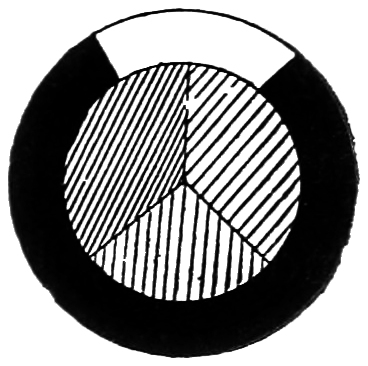
We have here three discs, a red, a green, and a blue,
and we can very closely match these colours by a
red, a green, and a blue in the spectrum.
By having a radial slit cut to the centre of these card
discs, we can slip one over the other so as to expose
all three colours as sectors of a single disc. Then we
can place the compounded disc on the axis of a rapidly
rotating motor, and the colours will blend together,
giving an uniform colour. Any proportions of the
three colours can thus be mixed, and by a judicious
alteration in them we now have them so arranged
that they give a grey. By inter-locking together
(Fig. 9) a black disc and a white disc, each with a
diameter slightly larger than that of the other discs,
but equal to each other, and rotating them on the
same spindle behind the three colour discs, we can,
by an alteration in the proportion of black to white,
form a grey which will match that
produced by the rotation of the three
coloured sectors. In other words, white,
though degraded in tone, can be produced
by the three complex pigment
colours, as we have seen can also be done by the
mixture of the three simple spectrum colours.
Fig. 9.
The mixture of the three spectrum colours can
match other colours than white. For instance, it
can be made to match the colour of brown paper.
By the colour discs also we can do exactly the same
by introducing, if necessary, a small quantity of white
or black, or both, to dilute the colour or to darken
its tone.
Another application of the same principles enables us
to produce an artificial spectrum by means of a red, a
green, and a blue glass. By fixing these three glasses
behind properly shaped apertures cut in a card disc at
proper radial distances from the centre, and rotating
the disc, we have upon the screen when light is passed
through them a ring of rainbow colours. If the
beam of light be first passed through a suitable
rectangular aperture, the breadth of which is small
compared with its length, placed close to the rotating
disc, and an image of the aperture be focussed on the
screen by a suitable lens, we shall have a very fair
representation of the spectrum—every colour intermediate
between the red and green, or the green
and blue, being formed by mixtures of these pairs
respectively.
We have now given a very fair proof that vision is
really trichromic—that is, that it is unnecessary to
have more than the sensations of three colours to
produce the sensation of any of the others.
Fig. 10.
There is one colour, if it may be called so, that has
not been shown you, and whether it is a simple colour
or not cannot be stated. It seems, however, to be the
basis of all other colours, since they all commence with
it. It would, perhaps, be preferable to call it the first
perception of light instead of a colour. We can exhibit
this in a fairly easy manner by a little artifice.
An incandescent lamp is before you, and a current
from a battery passing through the carbon thread
causes it to glow brightly. In the circuit, however,
I have introduced what is known as a resistance,
which consists of a very large number of square pieces
of carbonized linen, pressed more or less tightly together.
By means of a screw the pressure can be
varied. When the pressure is somewhat relaxed, the
resistance to the passage of the current is increased, and
the carbon thread glows less brightly; and by a still
greater release of pressure,
the light can be made to disappear
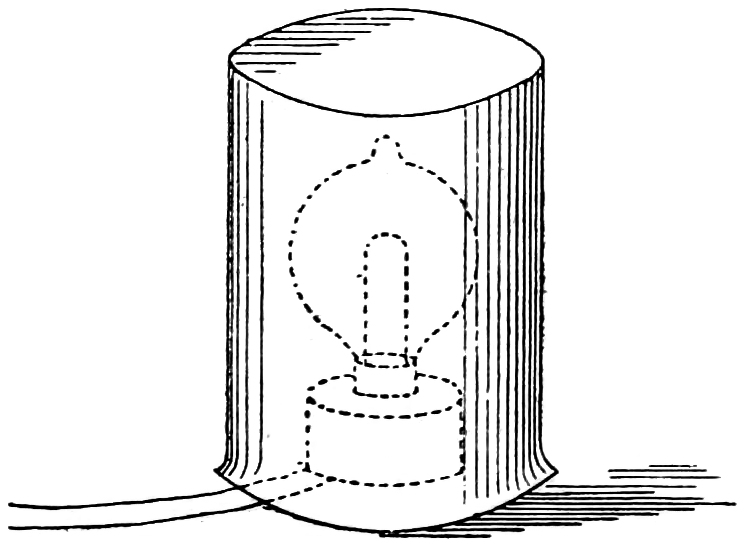
altogether. A beaker
(Fig. 10) which we have
here is covered with thin
blotting paper, and when
placed over the incandescent
glow-lamp it appears as a luminous yellow cylinder, the
colour being due to that of the light within it. We
can next insert more resistance in the circuit, and it
becomes red, due to the ruddy light of the thread.
By inserting still more resistance into the circuit the
red fades away, but in the darkness of this lecture
theatre the beaker is still a luminous object, though
faintly so. It has no colour, and the only sensation
it provokes is one of light. Taking off the beaker, we
see that the carbon thread is a dull red and nothing
more. The passage of this light through the white
blotting paper so reduces it that the red is non-existent,
and the initial sensation is all we perceive.
Placing a piece of red, green, or blue gelatine round
the lamp, we get the same effect, showing that the
basis of all colour, be it red, green, or any other colour,
is what appears to us to be colourless. This experiment
is one which is full of interest, as it has a very
distinct bearing on diagnosing our colour sensations,
and a variation of it will have to be repeated under
other conditions.
To go back, however, a little way, how does it arise
that only three sensations are necessary to give the
impression of all colours? One can understand that
some definite period of the ether waves might be in
unison with the possible swing of one apparatus in
the eye, and another with another, but it is somewhat
difficult at first sight to conceive that more
than one can be made to answer to wave motion of
a period with which it is out of tune, so to speak. A
couple of illustrations taken from physical experiments
may help to suggest how this can happen.
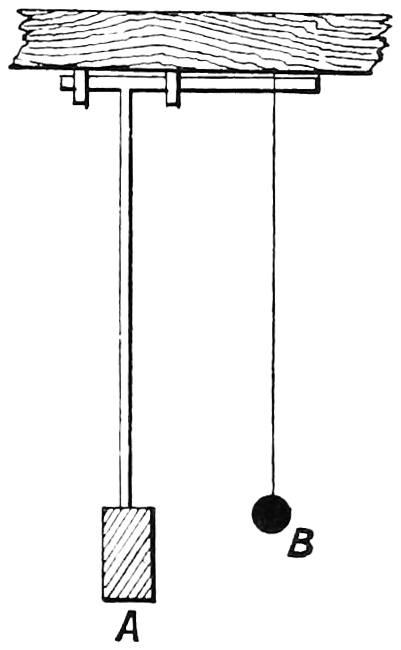
Fig. 11.
Fig. 11 is a double pendulum arranged as shown.
The pendulum A is heavily weighted, whilst the pendulum
B is light, being only a string with a small
weight attached. This difference in weight was made
designedly, to prevent any great effect of the movement
of B being shown on A, though
that of A must necessarily exercise a
great influence on B. The two pendulums
are now of the same length. A
is set in motion, and as it swings, B
also begins to swing, and soon is oscillating
with greater motion than A,
and continues to do so. The length of
the pendulum B is next shortened, and A is again set
in motion. B takes up the motion, and increases its
swing more and more, but now the two pendulums
are in opposite phases, and the motion of A tends
to diminish the swing of B, and continues to do
so till, after an interval of time, B is once more
at rest, when it again will start swinging. The fact is,
that when A commences to swing, B also commences;
and as long as B and A are moving in the same direction
the impulses tend to make B increase its swing,
but when they are moving in the opposite direction, or
rather, perhaps it should be said, when A begins to start
from the highest point of its swing downwards whilst
B is travelling upwards, the swing of B will gradually
diminish. This, of course, must happen when B is
shorter or longer than A, since their times of oscillation
are then different. We can now picture to ourselves
that when in the perceiving apparatus in the retina
the moving parts—probably molecules or atoms—arrive
at a certain amplitude, there is then an impression
of light, and that it is quite possible that
not only those waves whose motion is exactly of the
same period as that of the apparatus will set them
in motion, but also those waves which are actually
of a very different period. If such be the case, it
can be seen that waves of light of some periods may
set each of the three kinds of perceiving apparatus in
motion, and that possibly the resulting impressions
given by the sum of all three for a wave out of tune
with any of them may be even greater than when the
wave period is absolutely the same as one of them.
For in the last case a maximum effect may be produced
on one apparatus, and the effects on the other
two may be insignificant; whilst in the first case the
effects on two of them may be so large that their
combined effects may have a larger value.
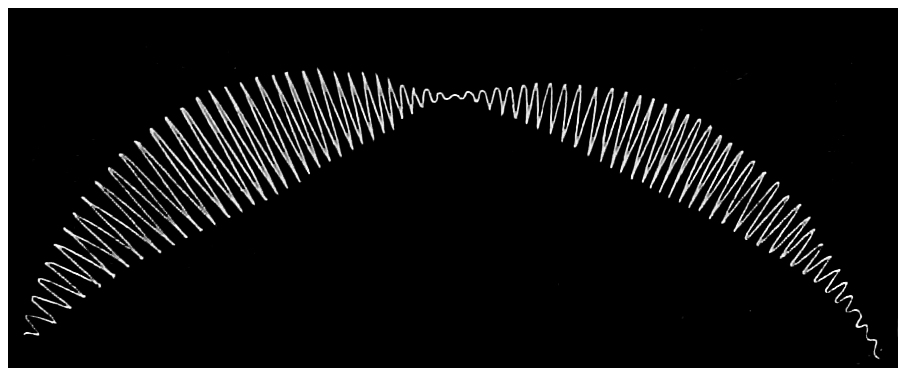
Fig. 12.
The following diagram (Fig. 12), made on the principle
of Lissajou’s figures, shows graphically the motion
of the pendulum. The pendulum, with a pen attached,
was started by an independent pendulum, which had a
different period, and the amplitude of the former
registered itself on paper which moved by clockwork
round the axis of suspension. As the two pendulums
had different periods, the amplitude, as shown by the
traces made, first increased and then diminished till
there was no motion, and then started again. The trace
is very instructive, and deserves attention. It will
be noticed that the amplitude, or length of swing,
increased rapidly at first, and then very gradually
attained a maximum.
Having attained this
maximum, the amplitude
diminished very
slowly for some time,
and finally came rather rapidly to zero, and the
pendulum for an instant was at rest.
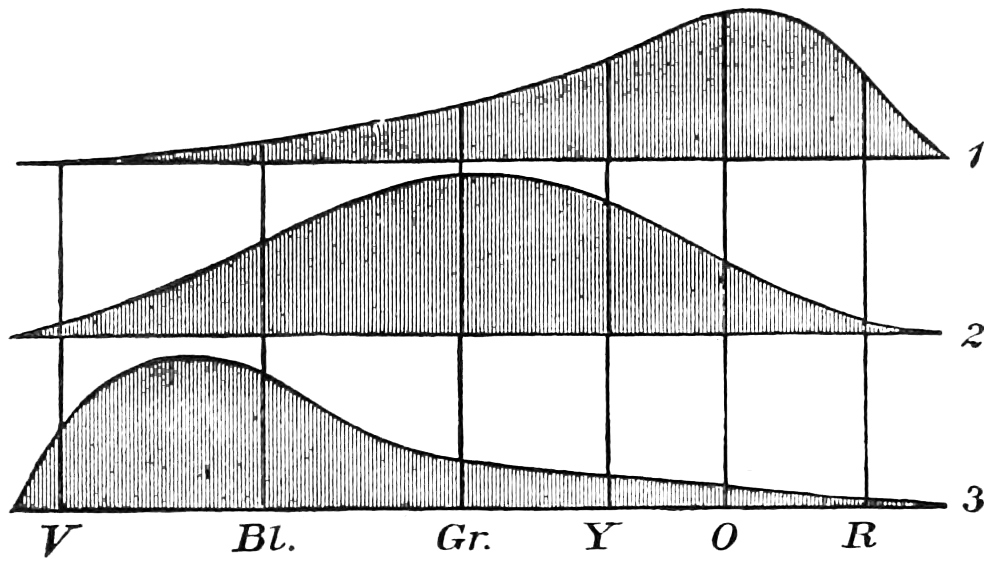
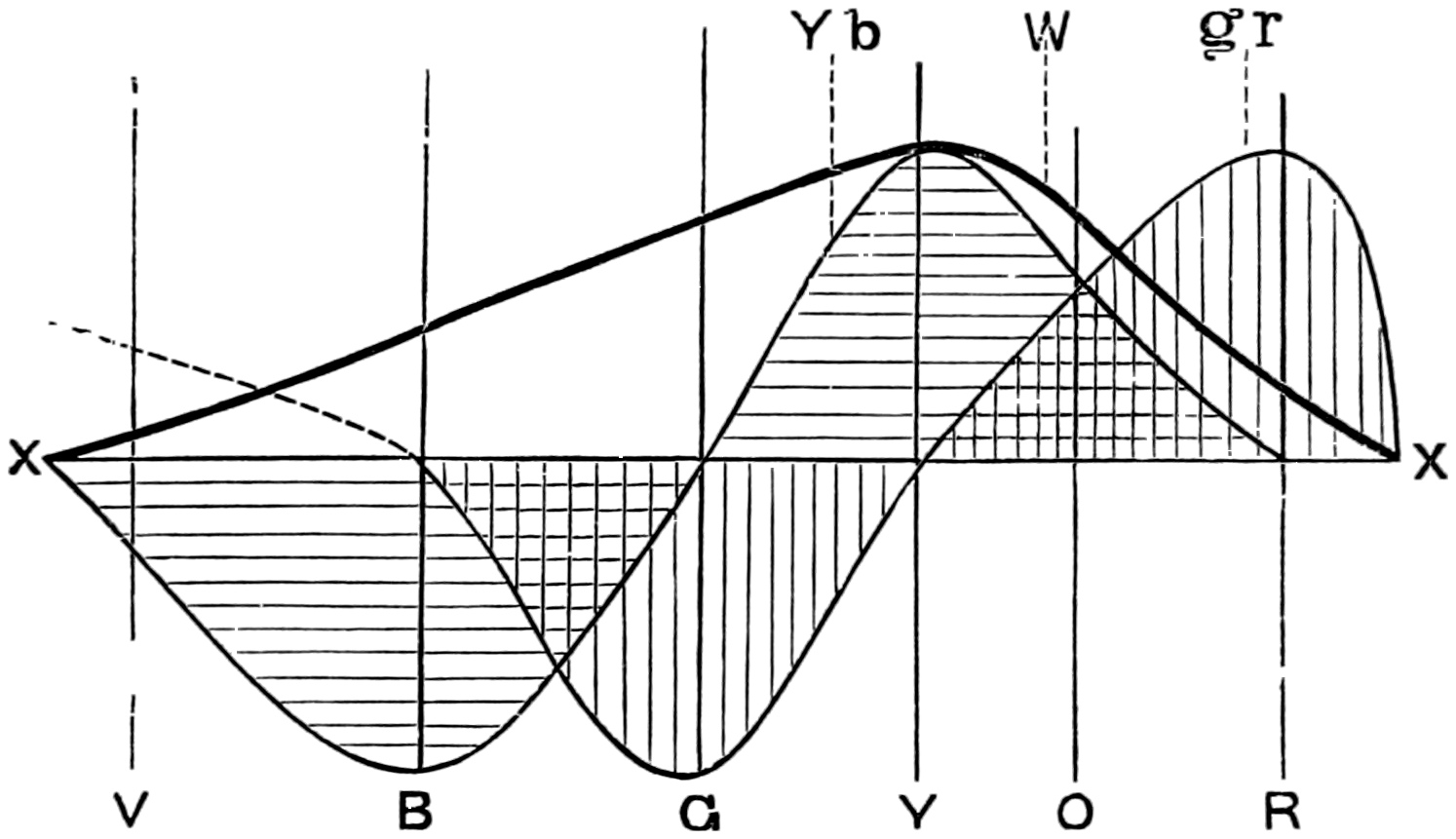
Fig. 13.
The top figure is the red sensation on the Young
theory; the middle is the green sensation, and
the lowest the violet or blue sensation.
With the notion in our minds that the perceiving
apparatus might act in the way that the pendulum
acts, we naturally apply it to the theories which early
investigators on colour vision propounded. Thomas
Young, whose name has already been mentioned, had
propounded a theory of vision, which depended on
the existence of only three colour sensations, and
Von Helmholtz adopted it and explained the action
of the three sensations in reference to the spectrum as
shown in the diagram. These figures do not pretend
to be absolute measures of the sensations, but only
of the form which they might take (Fig. 13). The
height of the curve at each part of the spectrum is
supposed to represent the stimulation given to each
apparatus by the different colours. Looking at the
figures we see that each sensation has a place of
maximum stimulation,
and that the
stimulation falls
off more or less
rapidly on each
side of this maximum.
It will, however,
be noticed
that whilst the green sensation takes very much the
form of the pendulum amplitudes (Fig. 12) between its
periods of rest, the other two differ from it. In the case
of the red sensation, the stimulation falls very rapidly
in the red as it reaches the limit of visibility of the
spectrum, and in that of the blue sensation the steep
descent is towards the extreme violet. When the three
sensation theory is examined in the light of the careful
measurements that have been made, the results tell us
that these diagrams can only be taken as suggestive.
CHAPTER IV.
An independent investigator of this subject was
Clerk Maxwell, who experimented with a “colour-box”
of his own design, by which he mixed the simple
colours of the spectrum, and the results he got are
really the first which are founded on measurement.
He measured something, but hardly arrived at the
colour sensation. His colour-box took two forms,
both on the same principles, so only one will be here
described, the diagram and description being taken
from his classic paper in the Philosophical Transactions
of the Royal Society for 1860.
“The experimental method which I have used
consists in forming a combination of three colours
belonging to different portions of the spectrum, the
quantity of each being so adjusted that the mixture
shall be white, and equal in intensity to a given white.
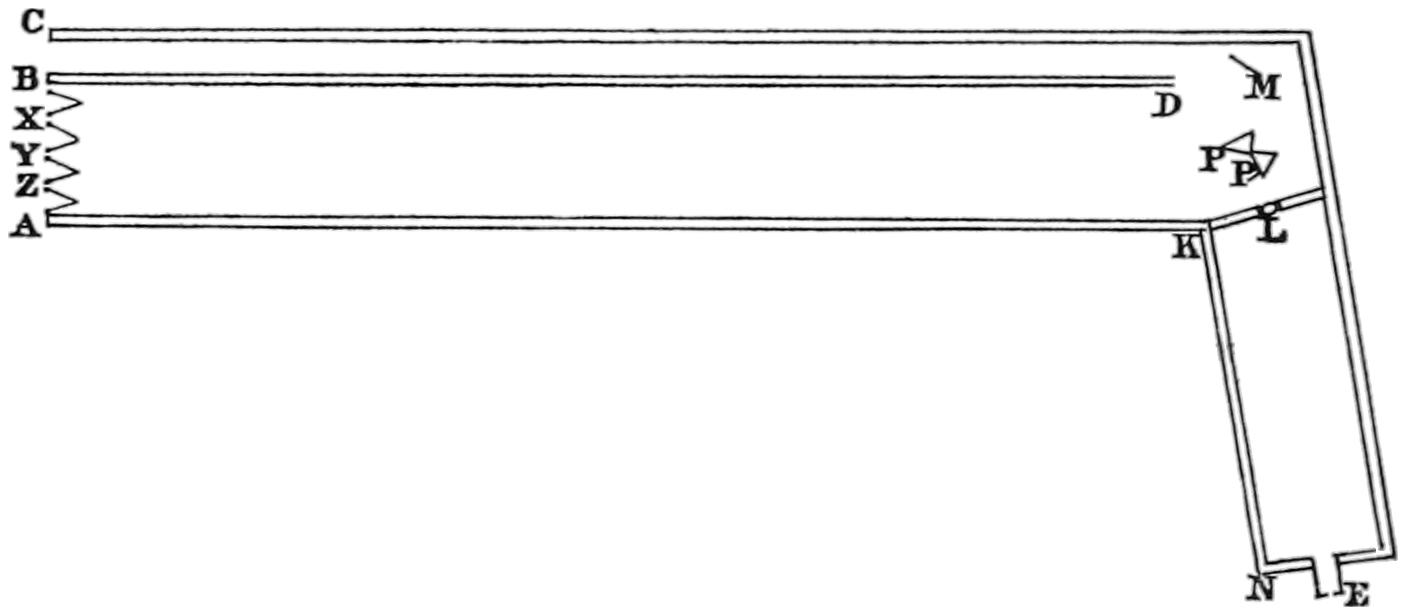
Fig. 14 represents the instrument for making the
observations. It consists of two tubes, or long boxes
of deal, of rectangular section, joined together at an
angle of about 100°.
Fig. 14.
Maxwell’s colour-box.
“The part A K is about five feet long, seven inches
broad, and four deep; K N is about two feet long,
five inches broad, and four deep; B D is a partition
parallel to the side of the long box. The whole of
the inside of the instrument is painted black, and the
only openings are at the end A C, and at E. At the
angle there is a lid, which is opened when
the optical parts have to be adjusted or
cleaned.
“At E is a fine vertical slit, L is a lens; at P there
are two equilateral prisms. The slit E, the lens L,
and the prisms P are so adjusted, that when light is
admitted at E, a pure spectrum is formed at A B, the
extremity of the long box. A mirror at M is also
adjusted so as to reflect the light from E, along the
narrow compartment of the box to B C.
“At A B is a rectangular frame of brass, having a
rectangular aperture of six inches by one. On this
frame are placed six brass sliders, X Y Z. Each of
these carries a knife-edge of brass in the plane of the
surface of the frame.
“These six movable knife-edges form three slits,
X Y Z, which may be so adjusted as to coincide with
any three portions of the pure spectrum formed by
light from E. The intervals behind the sliders are
closed by hinged shutters, which allow the sliders to
move without letting light pass between them.
“The inner edge of the brass frame is graduated to
twentieths of an inch, so that the position of any slit
can be read off. The breadth of the slit is ascertained
by means of a wedge-shaped piece of metal, six inches
long, and tapering to a point from a width of half an
inch. This is gently inserted into each slit, and the
breadth is determined by the distance to which it
enters, the divisions on the wedge corresponding to
the 200th of an inch difference in breadth, so that
the unit of breadth is ·005 inch.
“Now suppose light to enter at E, to pass through
the lens, and to be refracted by the two prisms at P,
a pure spectrum, showing Fraunhofer’s lines, is formed
at A B, but only that part is allowed to pass which
falls on the three slits, X Y Z. The rest is stopped
by the shutters. Suppose that the portion falling on
X belongs to the red part of the spectrum; then, of
the white light entering at E, only the red will come
through the slit X. If we were to admit red light
at X, it would be refracted to E, by the principle in
optics that the course of the ray may be reversed.
“If, instead of red light, we were to admit white light
at X, still only red light would come to E; for all
other light would be either more or less refracted, and
would not reach the slit at E. Applying the eye at
the slit E, we should see the prism P uniformly
illuminated with red light, of the kind corresponding
to the part of the spectrum which falls on the slit X,
when white light is admitted at E.
“Let the slit Y correspond to another portion of the
spectrum, say the green; then if white light is admitted
at Y, the prism, as seen by an eye at E, will be uniformly
illuminated with green light; and if white
light be admitted at X and Y simultaneously, the
colour seen at E will be a compound of red and green,
the proportions depending on the breadth of the slits
and the intensity of the light which enters them.
The third slit Z, enables us to combine any three
kinds of light in any given proportions, so that an
eye at E shall see the face of the prism at P,
uniformly illuminated with the colour resulting from
the combination of the three. The position of these
three rays in the spectrum is found by admitting the
light at E, and comparing the position of the slits
with the position of the principal fixed lines; and the
breadth of the slits is determined by means of the
wedges.
“At the same time, white light is admitted through
B C to the mirror of black glass at M, whence it is
reflected to E, past the edge of the prism at P, so
that the eye at E sees through the lens a field consisting
of two portions, separated by the edge of the
prism; that on the left hand being compounded of
three colours of the spectrum refracted by the prism,
while that on the right hand is white light reflected from
the mirror. By adjusting the slits properly, these two
portions of the field may be made equal, both in colour
and brightness, so that the edge of the prism becomes
almost invisible.
“In making experiments, the instrument was placed
on a table in a room moderately lighted, with the end
A B turned towards a large board covered with white
paper, and placed in the open air, so as to be uniformly
illuminated by the sun. In this way the three slits
and the mirror M were all illuminated with white
light of the same intensity, and all were affected in the
same ratio by any change of illumination; so that if
the two halves of the field were rendered equal when
the sun was under a cloud, they were found nearly
correct when the sun again appeared. No experiments,
however, were considered good unless the sun remained
uniformly bright during the whole series of experiments.
“After each set of experiments light was admitted
at E, and the position of the fixed lines D and F of
the spectrum was read off on the scale at A B. It
was found that after the instrument had been in use
some time these positions were invariable, showing that
the eye-hole, the prisms, and the scale might be considered
as rigidly connected.”
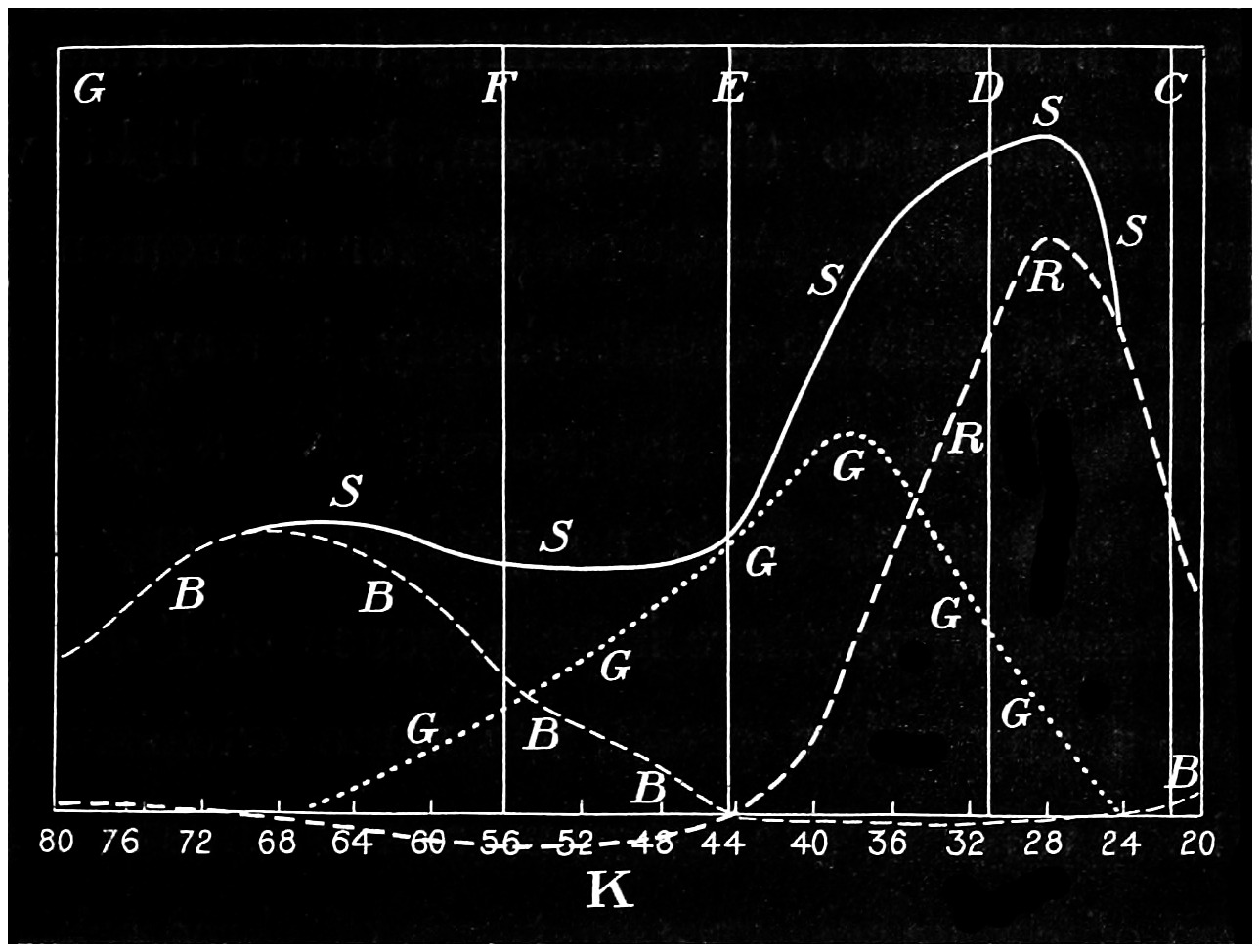
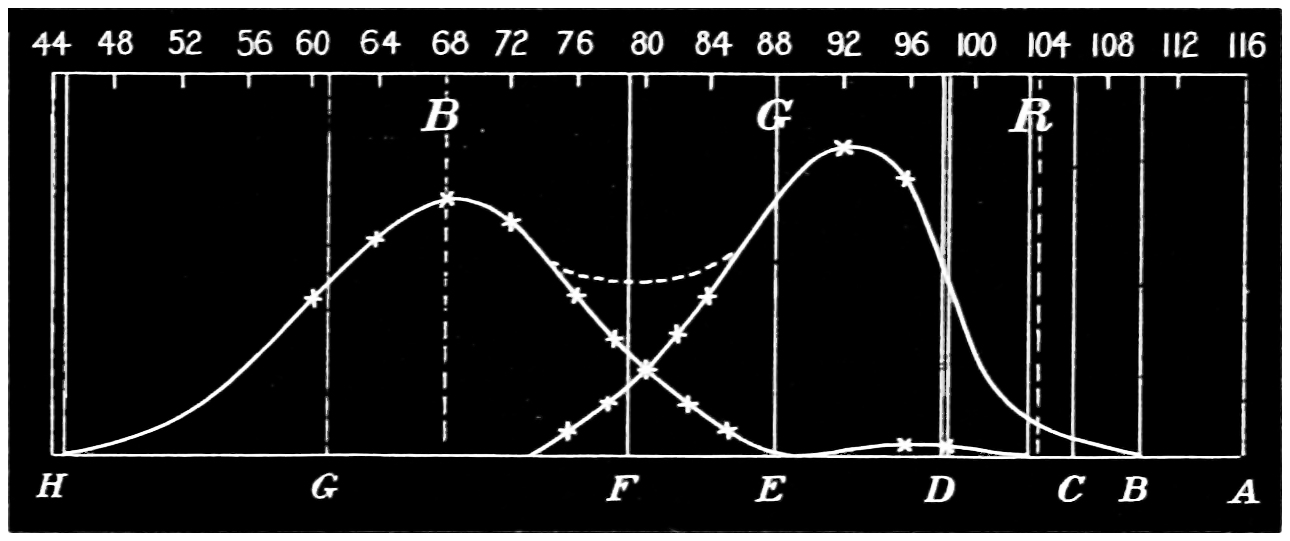
Fig. 15.
With this instrument he made mixtures of three
colours, to match with white. By shifting the slits
into various positions and taking as his three standard
colours a red near the C line, a green near E, and a
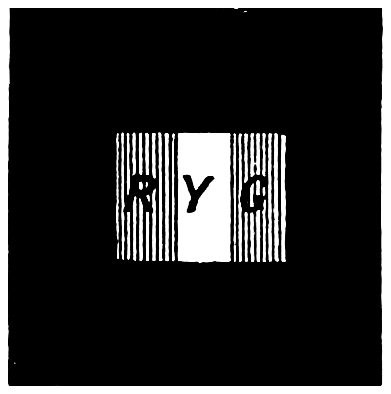
blue between F and G (see frontispiece), he obtained a
variety of matches, from which he formed equations.
After eliminating, or rather reducing the errors to the
most probable value by the method of least squares, he
got from his matches with white a table of colour values
in terms of the three standard colours, from which the
diagram of the spectrum (Fig. 15) was made. (The
heights of the dotted curves are derived from the
widths of the slits, and the continuous curve is the
sum of these heights.) Now what appears to be a
properly chosen colour does not necessarily stimulate
only one sensation. Indeed the probabilities are against
it, except in the extreme red and extreme violet. If
colours intermediate to the standard colours be
matched by a mixture of the latter, we do not arrive
at any solution of the amount of stimulation of each
sensation, since the chosen standard colours themselves
may be due to a stimulation of all three sensations.
As a matter of fact, Clerk Maxwell chose colours
which do not best represent the colour sensations.
The red is too near the yellow, as is also the green.
The blue should also be nearer the violet end of the
spectrum than the position which he chose for it. We
may take it, then, that except as a first approximation,
Clerk Maxwell’s diagrams need not be seriously taken
into account. The diagram itself shows that the
colour sensations are not represented by the colours
he chose. Supposing any one in whom the sensation
of green is absent were examining the spectrum, there
would, according to the diagram, be no light visible
at the green at E. Anticipating for a moment what
we shall deal with in detail shortly, it may be stated
that in cases where it is proved that a green sensation
is absent, there is no position in any part of
the spectrum where there is an absence of light. Had
he chosen any other green, the same criticism would
have been valid. The diagram as it stands is really a
diagram of colour mixtures in terms of three arbitrarily
chosen colours, and not of colour sensations. It merely
indicates what proportions were needed of the three
colours, which he took as standards, to match the intermediate
spectrum colours. The negative sign in
some of the equations—given in the appendix, page 201—may
be somewhat puzzling to those who have not
made colour matches, but not to those who have
actually made experiments. It means that where it
is present no match of colour by a mixture of the
standard colours is possible; and that it would be only
possible if a certain quantity of the colour to which is
attached a negative sign were to be abstracted—an
impossible condition to fulfil, but one which may
often occur in colour-matching experiments. Later you
will find that when colours are chosen as standards so
that the resulting equations give no negative sign for
any colour, we have a criterion as to the colours which
give the nearest approach to the true sensations. The
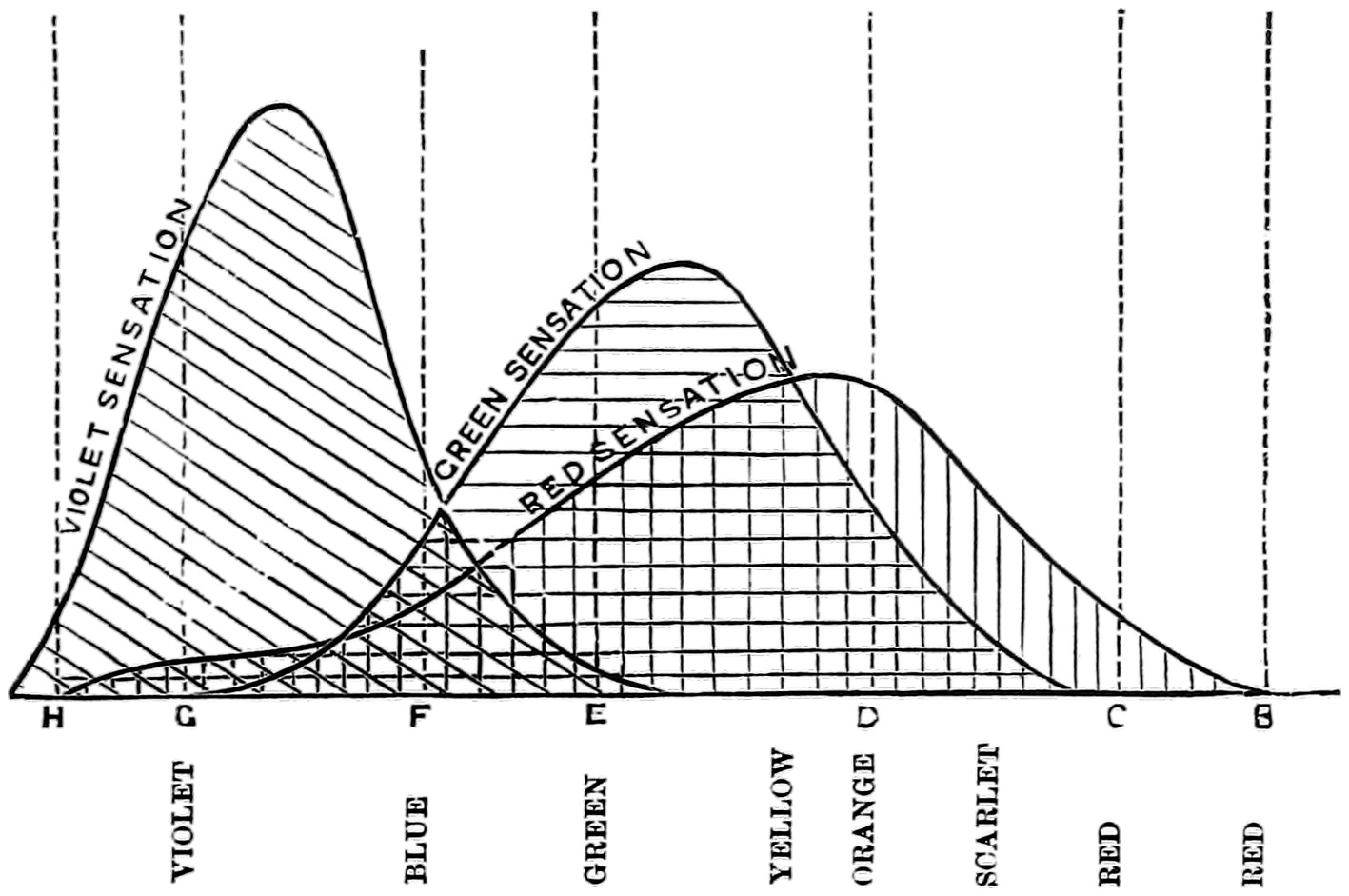
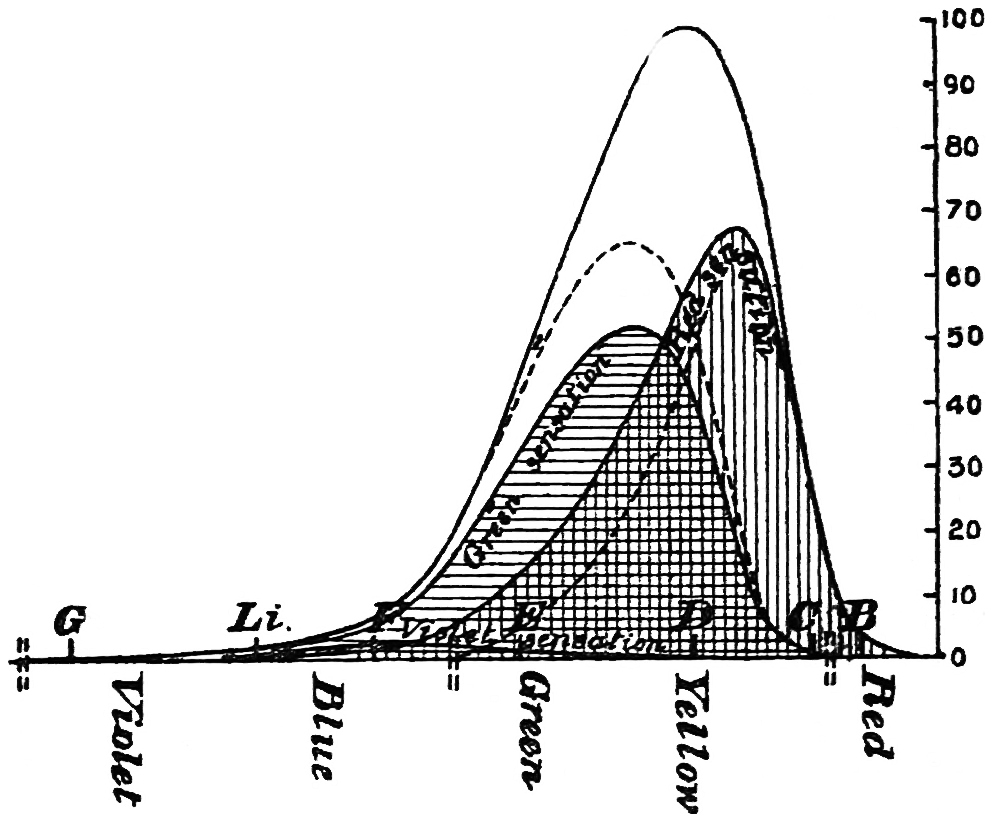
next diagram (Fig. 16) of colour sensations is due to
Kœnig, who investigated the subject with Von Helmholtz.
By a modified method, which perhaps need not
be explained in detail here, he produced them, and
they must be apparently not far from the actual
state of things, supposing this theory be proved
to be true. For my own part, I am under the
impression that the positions of the colours which
most nearly approach the colour sensations might be
slightly altered in regard to the green and the blue,
for reasons that will subsequently be given when the
later experiments of General Festing and myself come
to be described. For the immediate purpose of the
lecture, the curves are sufficiently accurate, and I
will ask you to notice what they tell us. It is
presupposed in these diagrams that, if the three
colour-perceiving apparatus are equally stimulated,
a sensation of white will be produced; and the
reverse, of course, is true, in that white will give
rise to equal stimulation of the three apparatus. It
follows, then, that in the parts of the spectrum
where all three curves of sensation are seen to take
a part in the production of a colour, such as at the
E line, the colour is really due to the extra stimulation
of one or two of the apparatus above that
required to produce a certain amount of white. The
colour in every part of the spectrum may be represented
by not more than two sensations, with a proportion of
white. In the orange and scarlet there are only two
sensations excited, without any sensible amount of
white, as the amount of violet sensation is extremely
small. At the extreme ends of the spectrum only one
sensation—the red or the violet—is excited; but in the
region of the green the colour must be largely diluted
with the sensation of white. As an example, we may
take the part of the spectrum where the red and the
violet sensation curves cut each other. At this point
the green sensation curve rises higher than the intersection
of the other curves. The red and the violet
sensations have only to be mixed with an equal amount
of the green sensation to make white, so that the height
of the green sensation curve above the point of intersection
represents the amount of pure green sensation
which is stimulated. The colour is therefore caused by
the green sensation, largely diluted with white. A
scrutiny of the curves will show that at no point is
the green sensation so free from any other as at this
point, if we regard white by itself as a neutral colour.
Looking at these figures, we can readily see what effect
the removal of any one or two of the three sensations
would have upon the colour vision of the individual.
The probabilities, however, against two of the three
sensations being absent must evidently be very much
smaller than that there should be an absence of only
one of the sensations, either red, green, or violet.
Fig. 16.
It will be well that we should also have before us
the theory which is the only serious rival to that
of Young, viz., that of Hering. In the report of
the Colour Vision Committee there is an excellent
description of this theory. As it was furnished by
Dr. Michael Foster, we may be sure that the ideas
of its originator are correctly given, and therefore I
will quote it in his words:—
“Another theory, that of Hering, starts from the
observation that when we examine our own sensations
of light we find that certain of these seem to be quite
distinct in nature from each other, so that each is
something sui generis, whereas we easily recognise all
other colour sensations as various mixtures of these.
Thus, the sensation of red and the sensation of yellow
are to us quite distinct; we do not recognise anything
common to the two, but orange is obviously a mixture
of red and yellow. Green and blue are equally distinct
from each other and from red and yellow, but in violet
and purple we recognise a mixture of red and blue.
White again is quite distinct from all the colours in the
narrower sense of that word, and black, which we must
accept as a sensation, as an affection of consciousness,
even if we regard it as the absence of sensation from the
field of vision, is again distinct from everything else.
Hence the sensations caused by different kinds of light
or by the absence of light, which thus appear to us
quite distinct, and which we may speak of as ‘native’
or ‘fundamental’ sensations, are white, black, red,
yellow, green, blue. Each of these seems to us to have
nothing in common with any of the others, whereas in
all other colours we can recognise a mixture of two or
more of these. This result of common experience
suggests the idea that these fundamental sensations
are the primary sensations, concerning which we are
enquiring. And Hering’s theory attempts to reconcile,
in some such way as follows, the various facts of
colour vision with the supposition that we possess
these six fundamental sensations. The six sensations
readily fall into three pairs, the members of each pair
having analogous relations to each other. In each pair
the one colour is complementary to the other—white to
black, red to green, and yellow to blue. Now, in the
chemical changes undergone by living subjects, we may
recognise two main phases, an upward constructive
phase, in which matter previously not living becomes
living, and a downward destructive phase, in which
living matter breaks down into dead or less living
matter. Adopting this view, we may, on the one hand,
suppose that rays of light, differing in their wave-length,
may affect the chemical changes of the visual
substance in different ways, some promoting constructive
changes (changes of assimilation), others promoting
destructive changes (changes of dissimilation); and on
the other hand, that the different changes in the visual
substance may give rise to different sensations.
“We may, for instance, suppose that there exists in
the retina a visual substance of such a kind that when
rays of light of certain wave-lengths—the longer ones,
for instance, of the red side of the spectrum—fall upon
it, dissimilative changes are induced or encouraged,
while assimilative changes are similarly promoted by
the incidence of rays of other wave-lengths, the shorter
ones of the blue side. But it must be remembered
that in dealing with sensations it is difficult to
determine what part of the apparatus causes them;
we may accordingly extend the above view to the
whole visual apparatus, central as well as peripheral,
and suppose that when rays of a certain wave-length
fall upon the retina, they in some way or other, in
some part or other of the visual apparatus, induce or
promote dissimilative changes, and so give rise to sensations
of a certain kind, while rays of another wave-length
similarly induce or promote assimilative changes,
and so give rise to a sensation of a different kind.
“The hypothesis of Hering applies this view to the
six fundamental sensations spoken of above, and
supposes that each of the three pairs is the outcome
of a particular set of dissimilative and assimilative
changes. It supposes the existence of what we may
call a red-green visual substance of such a nature that
so long as dissimilative and assimilative changes are in
equilibrium, we experience no sensation; but when
dissimilative changes are increased, we experience a
sensation of (fundamental) red, and when assimilative
changes are increased, we experience a sensation of
(fundamental) green.
“A similar yellow-blue visual substance is supposed
to furnish, through dissimilative changes a yellow,
through assimilative changes a blue sensation; and a
white-black visual substance similarly provides for a
dissimilative sensation of white and an assimilative
sensation of black. The two members of each pair are
therefore not only complementary but also antagonistic.
Further, these substances are supposed to be of such a
kind that while the white-black substance is influenced
in the same way, though in different degrees, by rays
along the whole range of the spectrum, the two other
substances are differently influenced by rays of different
wave-length. Thus, in the part of the spectrum which
we call red, rays promote great dissimilative changes of
the red-green substance with comparatively slight effect
on the yellow-blue substance; hence our sensation of
red.
Fig. 17.
“In that part of the spectrum which we call yellow,
the rays effect great dissimilative changes of the yellow-blue
substance; but their action on the red-green
substance does not lead to an excess of either dissimilation
or assimilation, this substance being neutral
to them; hence our sensation of yellow. The green
rays, again, promote assimilation of the red-green
substance, leaving the assimilation of the yellow-blue
substance equal to its dissimilation; and similarly blue
rays cause assimilation of the yellow-blue substance,
and leave the red-green substance neutral. Finally, at
the extreme blue end of the spectrum, the rays once
more provoke dissimilation of the red-green substance,
and by adding red to blue give violet. When orange
rays fall on the retina, there is an excess of dissimilation
of both the red-green and the yellow-blue substance;
when greenish-blue rays are perceived, there is an
excess of assimilation of both these substances; and
other intermediate hues correspond to various degrees
of dissimilation or assimilation of the several visual
substances. When all the rays together fall upon the
retina, the red-green and yellow-blue substances remain
in equilibrium, but the white-black substance undergoes
great changes of dissimilation, and we say the light is
white.”
It has been said by the same writer that this theory
is tri-chromic. For my own part I do not see that
it is so in the sense in which that word is used in
the theory of Young. It may be a tetra-chromic, for
as far as colour is concerned the black-white sensation
must be excluded; but it appears to me that it cannot
be strictly brought under the head of tri-chromic.
CHAPTER V.
The readiest means of investigating the stimulation
of the different sensations necessary to produce colour
is evidently by eyes in which one or two sensations
are absent, and this applies not only to the Young
theory, but also to that of Hering.
In former days, not much more than a century ago,
the existence of colour blindness, as it is now named,
was a matter of great curiosity, and in the Philosophical
Transactions of the Royal Society of 1777,
the case of a shoemaker named Harris is described
by a Mr. Huddart, who travelled all the way from
London to the Midlands on purpose to see if all the
alleged facts regarding the patient were true. Harris
mistook orange for green, brown he called black, and
he was unable to distinguish between red fruits and
the surrounding green leaves. At first, colour blindness
was called Daltonism, from the fact that the
great chemist Dalton suffered from it, and investigated
the variation which he found existed in his
vision from that of the majority of his fellow-creatures.
It was in 1794 that Dalton described his own case of
colour blindness. He was quite unaware of his defect
till 1792, when he was convinced of its existence
from his observations of a pink geranium by candle-light.
“The flower,” he says, “was pink; but it
appeared to me almost an exact sky-blue by day. In
candle-light, however, it was astonishingly changed,
not having any blue in it; but being what I call a
red colour which forms a striking contrast to blue.”
He goes on to remark that all his friends except his
brother (mark this relationship), said: there was not
any striking difference in the two colours by the two
lights. He then investigated his case by the solar
spectrum, and became convinced that instead of having
the normal sensations, he only had two or at most
three. These were yellow, blue, and perhaps purple.
In yellow, he included the red, orange, yellow, and
green of others, and his blue and purple coincided
with theirs. He says, that “part of the image which
others call red, appears to me little more than a shade
or defect of light; after that, the orange, yellow and
green seem one colour, which descends pretty uniformly
from an intense and a rare yellow, making what I
should call different shades of yellow. The difference
between the green part and the blue part is very
striking to my eye, they seem to be strongly contrasted.
That between the blue and purple much less
so. The purple appears to be blue much darkened
and condensed.”
Dalton said a florid complexion looked blackish-blue
on a white ground. Blood looked like bottle green,
grass appeared very little different from red. A laurel
leaf was a good match to a stick of sealing-wax.
Colours appeared to him much the same by moonlight
as they did by candle-light. By the electric light
and lightning, they appeared as in day light. Some
browns he called red, and others black.
Mr. Babbage, in Scientific London (1874), gives an
account of Dalton’s presentation at Court.
Firstly, he was a Quaker, and would not wear a
sword, which is an indispensable appendage to
ordinary Court-dress. Secondly, the robe of a Doctor
of Civil Laws was known to be objectionable on account
of its colour—scarlet, being one forbidden by
the Quakers. Luckily, it was recollected that Dalton
was affected with that peculiar colour blindness which
bore his name, and that as cherries and the leaves of a
cherry-tree were to him of the same colour, the scarlet
gown would present no extraordinary appearance. So
perfect evidence was the colour blindness, that the
most modest and simple of men, after having received
the Doctor’s gown at Oxford, actually wore it for
several days in happy unconsciousness of the effect
he produced in the street. The rest of the description
we need not reproduce. Both the above cases we shall
see shortly come under the category of red-blindness
in the Young theory. Recent investigations tell us
that such colour blindness is by no means rare, nor can
it have been then. Statistics, derived from carefully
carried out examinations made in various parts of the
world by an approved method of testing, show that
about four out of every hundred males suffer from
some deficiency in colour perception, but that so far
as the more limited statistics regarding them are to
be depended upon, only about four out of every 1000
women suffer in the same manner.
Colour blindness in a healthy subject is usually
hereditary, and is always congenital. It is curious
to trace back in some instances the colour blindness,
where it is to be found, in a family. It often happens
that colour blindness—as the gout is said to do—skips
a generation. This is usually traced to the
fact that the generation skipped is through the
mother. Thus, the maternal grandfather may be
colour blind, as may be the grandsons, but the mother
will very frequently have perfectly normal vision for
colour. On the other hand, the paternal grandfather
may have defective colour perception, and this may
be inherited both by the grandsons and the father.
The remark made by Dalton regarding his brother’s
eyesight points to the fact that his own colour blindness
was probably hereditary. Deaf mutes, Jews and
Quakers, seem to be more liable to colour blindness
than other people, statistics giving them 13·7, 4·9,
and 5·9 as the percentages. It may be well to point
out that the deficiency in colour perception to which
we are alluding is totally distinct from that which may
arise from disease. This last form has such marked
characteristics of its own that it can at once be distinguished
from the congenital form.
Of the four per cent. of males who suffer from
congenital colour deficiency of vision, a large number
are not totally lacking in any one or more colour
sensations. Those in which one sensation, on the
Young theory, is entirely missing are called “completely
red-, green-, or violet-blind,” whilst those in
which the sensation is but partially deadened are
called “partially red-, green-, or violet-blind.” When
two sensations are entirely absent, and such cases
are very rare indeed, they are generally said to have
monochromatic vision; that is, every colour to them
is the same, as is also white, the only distinction
between any of them being the superior brightness of
some over others. The best illustration of this form
of colour vision is perhaps to say that the retinæ of
such people have the same characteristics in regard
to sensitiveness as has a photographic plate, the
resulting prints in black and white representing what
it sees in nature. When we have to adopt the
terms used by the followers of Hering’s theory—the
theory which obtains most followers amongst
the physiologists, since it endeavours to explain
colour vision in a physiological way, though it fails
to meet all the requirements of the physicist—we
should restrict our terms to red-green and yellow-blue
blindness, still perhaps retaining the term monochromatic
vision for the rare cases specified above.
As we must employ some terms to express our meaning,
we shall in these lectures adopt those of the
Young theory.
Now taking a red-blind person and examining him
with the spectrum, we find that he sees no light at
all at the extreme limit of our red, and only when
he comes to the part where the red lithium line marks
a certain red does a glimmer commence; he then sees
what he may call dark-green, or he may call dark-yellow.
When questioned about what to us are greens
he also calls them green or yellow, some being bright,
others saturated hues, and others again paler. When
he gets to the bluish-green he calls it grey, and will
say it is indistinguishable from, and in fact will match
with, a white degraded in tone. From this point he
will say he sees blue, near F pale-blue, and in the violet
dark-blue. Too much importance must not be attached
to the nomenclature adopted by the colour blind. They
have to take the names of the colours from the normal
eyed. Yellow objects are generally brighter than red,
and having annexed the idea that what to them is
bright red is called yellow, they give it that distinguishing
name. His limit of vision at the violet
end will be the same as the majority of mankind,
but it will be considerably shortened at the red end.
The point in the spectrum which he calls grey is an
important point, and corresponds to the place where
the violet and green curves cut in Fig. 16. This
point can be very accurately determined by placing
alongside the colour patch A (Fig. 6) the white
patch, which is reduced in brightness as required by
rotating sectors. As the slit is moved along the
spectrum it will eventually reach a point where he will
say both patches of light are exactly similar in hue.
To the normal eye one will be white and the other
the kind of green indicated above (see frontispiece).
If a similar examination be made of the green-blind,
the red end of the spectrum will be called
red or yellow, but the spectrum itself will be visible
between the same limits as it is to the person who has
the normal sense of vision. A grey stripe will be seen
in the spectrum, but in this case it will be a trifle
nearer the red end of the spectrum than the point
which the red-blind calls grey; from this point to
the extreme violet, the green-blind will name the
spectrum colours similarly to the red-blind. The
part of the spectrum where grey exists to the green-blind
is even more important than that part at
which it exists to red-blind, for it marks the place
where the red and violet curves cut each other in
Fig. 16, and is in the majority of cases the place
in the spectrum where to the normal eye the green
sensation is unmixed with any sensation except that
of white, as quite recently explained. This green
evidently is the colour which is most usefully employed
in making colour mixtures in order to obtain the three
sensation curves of the Young theory, since white can
be added to the colour matched. To avoid verbiage,
we shall call the points where the red- or green-blind
see a grey in the spectrum their neutral
points, and the grey they see at those points their
neutral colours. The three curves we shall call the
red, green, or violet curves, and the slits, when
placed in the red, green, or violet of the spectrum,
as the red, green, and violet slits.
We have already mentioned the case of those who
possess monochromatic vision, and shown in what
respect they will differ in their description of the
spectrum from those more common cases of defective
vision. If the visual sensation they possess be the
violet, they will see no light at the extreme red of
the spectrum, and very little in the orange. They
must match every colour with some shade of grey,
for they will only perceive that sensation, in what to
ordinary normal eyes is white. We need not detail
how those who possess monochromatic vision due to
some other sensation would describe the different
colours. The diagram will tell us. Suffice it to
say, that one colour will only differ from another
and from white in brightness.
It is a very remarkable fact how many people who
are defective in colour vision pass through a good
part of their lives without being definitely aware of it.
It is very doubtful whether, in the majority of cases,
they themselves discover it. They may quite possibly
attribute the descriptions of colour which they hear,
and which appear to them absolutely false or meaningless,
as due to mental or moral defects in their friends.
I have had two cases of this recently. One was a
gentleman of seventy-four, who had no conception
that he had anything but normal colour vision;
his daughters, however, had a suspicion that something
was not quite right in it, and after a good
deal of persuasion brought him to me to examine.
The first mistake that he made was to state that
he was sitting on a black velvet chair, whereas
the seat was a deep crimson plush. He laughed
at his daughter’s description of the mistake he
made, and declared he was only colour ignorant, and
that she was the one who was colour blind. The
examination showed that colour ignorant he was, but
that the ignorance was due to complete red-blindness.
For the seventy-four years he had lived he was unaware
of his deficiency, suspecting it in others, and
it was only an accidental circumstance which made him
acquainted with the true state of his colour perception.
Another elderly gentleman, in a high position
in life, was also accidentally tested, and he proved
to be completely green-blind. He, too, was quite
unaware of his defect, and protested that, yachtsman
as he was, he would never mistake a ship’s lights;
but a very brief test showed his friends who were
with him that his declaration had to be received
with a certain amount of reservation. Others there
are who certainly do know that some peculiarity
exists in their sense of colour, and, foolish as it may
appear to be—though, after all, it is quite consistent
with a sensitive nature—they have tried to hide their
defect from their fellow-creatures. Such examples, no
doubt, some of my audience have met with, and
experience tells me that they have just as much
reluctance to pass an hour in my darkened room as
they would have to occupy a police cell. In those
few cases that have come voluntarily to me for
examination, the peculiarity in colour sense was first
brought to notice by the patient—if patient I may
call him—failing to distinguish between cherries and
the cherry leaves, or strawberries and the strawberry
leaves. Such mistakes committed publicly are usually
the source of unbounded merriment and curiosity to
schoolboys when made by their schoolfellows, and I
am bound to say that even persons of graver years are
not unapt to be amused at what they consider to be
a shortcoming in their fellow-creatures. To the student
of colour vision the discovery of curious cases of colour
deficiency is looked upon in a very different light—a
good case of colour blindness, or still better one of
monochromatic vision, is eagerly sought after, with the
hope of submitting it to a rigid examination. When
we look at the diagram (Fig. 16) we shall find why it
is that the colour blind describe the spectrum as they
do. Literally for those whose vision is dichromic, it is
made up of two sensations alone, and the colours to
which these sensations give rise are mixed throughout
a large part of the spectrum, the pure unmixed sensations
being at each end of the spectrum as they are in
normal colour vision. The annexed diagram (Fig. 18)
gives the curves for a red-blind person as made by
observations under Clerk Maxwell’s directions. The
standard colours here have been badly selected, for one
of them stimulates the two sensations possessed.
Fig. 18.
An easy and instructive experiment can be made to
give an idea of the kind of colour that these colour
blind imagine as white, whether they be red-, green-,
or violet-blind. (For those who have only monochromatic
vision, as before stated, white is coloured
with the one colour they possess.) Three slits are now
in the spectrum, one near the extreme end of the red,
another well in the violet, and the third in that part of
the spectrum in which the green-blind see their neutral
colour (see page 66). With the three colours issuing
from these apertures a match is made with the white
patch, and in this case the match is made as seen
from a distant point, so that the resulting deductions
may be true to the audience. If a colour-blind
person be in this theatre, he will agree with me
that the match is as correct to him as it is to
myself and the rest of you. So far we could not
distinguish his colour perception from the normal,
but if he be red-blind, and the red slit be covered, he
will still say that the match holds good, for, as a
matter of fact, the red with which we helped to
build up the white is non-existent to him. The
white that he now sees is to us the greenish-blue
patch which the mixed violet and green make.
If he be a green-blind person he will tell us the
colour is a very pale blue, but when the green slit
is covered up and the red uncovered, the match will
once more be correct, though the purple, formed by
the mixture of red and blue, will appear to him to
be a little darker than the white. This is what one
would expect, for you must recollect this green in
the spectrum he would call white or grey. If then,
from what to him is also white, though formed by
the rays coming through the three slits, we take
away a certain amount of degraded white (green to
us), he must still see white, but darker. We have,
however, met with what is an apparent paradox.
The green, coming through the now covered slit, he
calls white, as he also does the purple. To impress
this point more strongly upon you, I will place in
front of the green slit a small prism which has an
angle of about one and a-half degrees. This is
just sufficient to throw the green colour on the
neighbouring white surface. Here we have both the
colours which the green-blind calls white side by
side. If the brightness of each be the same, he
would see no difference in them. Is it possible that
on any theory this can be correct? To explain
this apparent paradox, and without reference to the
mathematical proof that white subtracted from white
leaves white, we have only to look at our diagram
(Fig. 16), and it is immediately apparent how it
arises. The red and the blue curves cut at this
point; and if we take away the green sensation
entirely, the residue will be a mixture of the red and
blue, which is the identical purple colour forming
the patch.
If we are wishful to ascertain the colour that the
violet-blind calls white, we have only to cover up the
violet slit and a yellow is left behind as the result.
I would have you remark that these colours which
are seen as white would only be of the hues shown
you, supposing the colour sensations were identical
with those in normal vision. Whether this is the
case we cannot absolutely say, and the only way in
which this can be authoritatively settled is by
examining some person who has normal colour vision
in one eye and defective colour sense, not due to
disease, in the other. One such person has been examined
abroad, but in what way I am unable to say.
It is recorded that he sees the red end of the spectrum
as yellow with the eye that is defective. Another
person I have heard of in England, but so far have not
had the good fortune to get hold of him for examination.
When I can lay my hands on him, he will be
able to help to confirm or disprove what should be a
general rather than a particular case.
So far I have only met with what appears to be
one genuine case of violet blindness. It is very
remarkable, on account of the eccentricity of the
colour nomenclature. The only two colours which the
subject saw were red and black. He named all greens
and blues as black, the distinction between the two
being that the former was “bright black” and the
latter “dark black.” Yellow he called white, and
a glance at Fig. 16 will show that at this place in
the spectrum the neutral point of a violet-blind
should occur. By shifting the slit gradually into
the green, he called it grey, instead of “bright black,”
though it did not match the white patch when
darkened. He called a green light a “bright black”
light. We shall have to refer to this case when we
are describing other investigations.
CHAPTER VI.
Another mode of exhibiting colour blindness, and
one of the first adopted, is by making mixtures of
colours with rapidly rotating colour discs. In my
own experiments I have chosen a red, which is
scarlet, over which a wash of carmine has been
brushed. It has a dominant wave-length of 6300.
The green is an emerald-green, and has a dominant
wave-length of 5150. The blue is French ultra-marine,
with a dominant wave-length of 4700. The
card discs, of some 4 inches diameter, are coated
with these colours as pastes, and by making an
incision in them radially to the centre, as before
described, and inter-locking them, the compound
disc can be caused to show sectors of any angle
that may be required. Outside these are the discs
of black and white, the proportions of which can
be altered at will.
The light thrown on the rotating sectors being
that from an electric arc light, normal vision
requires 118° of red, 146° of green, and 96° of blue to
match a grey made up of 75 parts of white and
285 parts of black. For the last two numbers a correction
has been made to allow for the small amount
of white light reflected from the black surface. This
correction has also been made in the subsequent
matches which will be described. Colour mixtures
such as these are conveniently put in the form of equations,
and that given will then be shown as follows—
118 R + 146 G + 96 U = 75 W + 285 B.
(Here R, G, U, W, and B are used to indicate Red,
Green, Blue, White, and Black.)
This match was exact also for all the colour blind,
for the deficiency in one grey is also a deficiency in
the other. With a red-blind, however, very different
matches can be made, as the red pigment is a
complex colour. There is in it, besides red, a certain
amount of yellow, whilst in the green there is,
besides green, a small amount of a red and a
larger amount of yellow. The yellow will not
only stimulate the green sensation, but also the red
where it is present. Although in complete red-blindness
the red sensation is totally absent, we may expect
that a mixture of red and blue, as well as of green and
blue, will enable a match to be made of the grey
produced by the mixture of white and black.
This was the case. We have the following proportions—
295 R + 65 U = 45 W + 315 B.
When the green disc is substituted for the red, the red-blind
made the following mixture—
229 G + 131 U = 120 W + 240 B.
It is worth noticing that the amount of blue in the
first mixture is about half that required for the
second. This tells us that the amount of green sensation
stimulated in the first case is much less than
in the second. As red can be substituted for green,
it should follow that green, when rendered darker,
should match the red. To try this a red disc replaced
the black disc, and a black disc replaced the
blue. The following match was then made—
131 G + 229 B = 340 R + 20 W.
It seems impossible to believe that these mixtures,
so dissimilar in colour, could ever form a satisfactory
match. This last equation might have been derived
from the two first, in which case it would have stood—
137 G + 223 B = 342 R + 18 W.
By a completely green-blind the following mixtures
were made—
251 R + 109 U = 62 W + 298 B,
and
277 G + 83 U = 107 W + 253 B.
In this case 363 Green are equivalent to 251 parts of
Red mixed with 78 of White and 34 Black. The
difference in the matches made by the two types
of colour blindness is very evident. In the one
case the amount of red required is much greater
than the green, and in the other vice versâ. Another
instance may be given of colour matches made, by
means of discs, by a partially green-blind person,
whose case will be more fully described when we
treat of the luminosity of the spectrum to the different
classes of colour vision.
His matches were as follows—1st, That of the
normal vision. 2nd,—
160 R + 80 G + 120 U = 72 W + 288 B.
The green was then altered to 200, when the following
made a match—
65 R + 200 G + 95 U = 72 W + 288 B.
Using these two equations, we have the following
curious result—that 120 G was matched by 95 R +
25 U. As the green disc is nearly twice as luminous
as the red to normal colour vision, this equation
confirms the result otherwise obtained, that his
blindness to colour is a deficiency in the green sensation.
No mixtures of blue and red, or blue and green,
would match a grey formed by the rotation of the black
and white sectors.
I must now introduce to your notice a different
method of experimenting with colour vision. If we
throw the whole spectrum on the screen, and ask a
person with normal vision to point out the brightest
part, he will indicate the yellow, whilst a red-blind
will say the green, and so on. This tells us that the
various types of colour blind must see their spectrum
colours with luminosity differing from that of the
normal eye. The difference can be measured by causing
both to express their sense of the brightness of the
different parts of the spectrum in terms of white light,
or of one another. Brightness and luminosity are here
used synonymously. On the two small screens are a red
and a green patch of monochromatic light—a look at
the green shows that it is much brighter than the red.
Rotating sectors, the apertures of which can be opened
or closed at pleasure during rotation, are now placed in
the path of the green ray. The apertures are made
fairly small, and the green is now evidently dimmer
than the red. When they are well open the green is
once more brighter. Evidently at some time during
the closing of the apertures there is one position in
which the red and green must be of the same brightness,
since the green passes through the stage of being
too light to that of being too dark. By gradually
diminishing the range of the “too open” to “too
closed” apertures we arrive at the aperture where the
two colours appear equally bright. The two patches
will cease to wink at the operator, if we may use
such an unscientific expression, when equality in
brightness is established. This operation of equalising
luminosities must be carried out quickly and without
concentrated thought, for if an observer stops to
think, a fancied equality of brightness may exist, which
other properly carried out observations will show to be
inexact. Now, instead of using two colours, we can
throw on a white surface a white patch from the
reflected beam, and a patch of the colour coming
through the slit alongside and touching it. The white
is evidently the brighter, and so the sectors are placed
in this beam. The luminosity of (say) a red ray is first
measured, and the white is found to require a certain
sector aperture to secure a balance in brightness. We
then place another spectrum colour in the place of the
first, and measure off in degrees the brightness of this
colour in terms of white light, and we proceed similarly
for the others. Now how are we to prove that the
measures for luminosity of the different colours are
correct? Let us place three slits in the spectrum, and
by altering the aperture of the slits make a mixture of
the three rays so as to form white. The intensity of
this white we can match with the white of the reflected
beam. We can then measure the brightness (luminosity)
of the three colours separately, and if our
measures are correct there is primâ facie reason to
suppose that they will together make up the brightness
of the white. Without going through this experiment it
may at once be stated that the reasoning is correct, for
within the limits of error of observation they do so.
Having established this proposition, we can next compare
inter se, the brightness of any or all of the rays
of the spectrum by a preliminary comparison with the
reflected beam of white light. As in the colour patch
apparatus all colours and principal dark lines of the
solar spectrum are known by reference to a scale,
in making a graphic representation of the results,
we first of all plot on paper a scale of equal parts,
and at the scale number where a reading is made,
the aperture of the sectors in degrees is set up. Thus,
suppose with red light the scale number which marked
the position of the slit was 59, and the aperture 10°,
we should set up at that scale number on the paper
a height of 10 on any empyric scale. If in the green
at scale No. 38 the sectors had to be closed to 7°,
we should set up 7 at that number on the scale.
When observations have been made at numerous
places in the spectrum, the tops of these ordinates, as
they are called, should be joined, and we then get the
observed curve of luminosity for the whole spectrum.
For convenience’ sake we make the highest point 100,
and reduce the other ordinates in proportion. For
some purposes it may be advantageous to give the
luminosity curve in terms of a scale of wave-lengths.
For our purpose, however, it is in general
sufficient to use the scale of the instrument.
Fig. 19.
Now, if we test the vision of the various types of
colour blind by this plan, we should expect to get
luminosities at different parts of the spectrum which
would give very different forms to these curves. We
cannot hope, for instance, that a red-blind who sees no
red in the extreme end of the spectrum would show any
luminosity in that region, nor that the green-blind
should show as much in the green part of the spectrum
as those who possess normal colour vision, since one of
the sensations is absent. With monochromatic vision
there should be a still further departure from the
normal curve. That these differences do exist is fully
shown in Fig. 19. One of the most striking experiments
in colour vision is to place a bright red patch on
the screen, and to ask a red-blind to make a match in
luminosity with the white. The latter will have to be
reduced to almost darkness—a darkness, indeed, that
makes the match almost seem incredible. You will
notice that the places in the spectrum where the
red- and green-blind see grey are by no means places
of greatest luminosity. We shall find that these
luminosity curves are suggestive when making another
investigation into the form of the spectrum curves
of the colour sensations.
Besides cases of complete blindness due to the
absence of one or two sensations on the Young theory,
we have other cases, as was said when remarking on the
percentage of people who are colour deficient, in which
one or even two sensations are only more or less
deadened. It has often been said that with the theory
provisionally adopted, such cases are difficult to class as
red or green deficient. As far as my own observations
go, I have never found this difficulty. The luminosity
curves of such observers, combined with other indications,
give a ready means of classing them. The main
difficulty to my mind is to state what is normal
colour vision, but, as I have found that the very large
majority of eyes give the same luminosity to colours as
my own, I have taken my own colour perception as
normal. In numerous experiments which Lord
Rayleigh has made in matching orange by means of
a mixture of red and green, he has come across several
who have apparently normal vision, as they see colours
correctly in every part of the spectrum, and yet some
require much less red mixed with the green to make a
match with the orange than do others. What is yellow
to them is decidedly green to the majority. This has
been classed as another kind of normal vision; but the
luminosity curves show that it may be equally well
due to a deficiency in the green sensation, and
which would require more green to make the
necessary match. The limits of the visible spectrum
to these persons, as far as my examination of their
cases goes, are the same as my own.
Again, there are others in which the spectrum
seems decidedly somewhat shortened at the red end
compared with my own, and the luminosity curves
point to them as being strictly colour deficient in the
red and nothing else. As they see all colours, they
have been classed as another form of normal
vision. The deficiency in both these cases is so
small that white is their neutral colour, but there
is evidence that the hues are slightly changed. I
do not wish any one to accept my deductions as being
more correct than those who hold differently, but the
results of examination by the luminosity methods
appear to me difficult to reconcile with any other view.
There are, however, a large number of cases in which,
though complete red- or green-blindness is wanting,
there is no doubt that more than slight colour
deficiency exists. For instance, in Fig. 23 we have
the curve of luminosity of the spectrum as measured
by a very acute scientific observer, and it is compared
with that of normal colour vision. He certainly is
not completely blind to any sensation. An inspection
and comparison of the two curves will show
that he is defective in the green sensation, although it
is present to a large extent. The deficiency is obvious
enough. An endeavour to find his neutral point was
most interesting. At 39 in the scale he saw a little
colour, but at 39·5 all colour had vanished, and
between the coloured patch and the white he saw no
difference. This similarity he saw till 47·3 in the
scale, when he began to see a faint trace of colour.
There is a large piece of the spectrum, then, which
to him is grey. It must be recollected that all three
sensations were excited in this region, but some more
than others. Now, experiment has shown that, with
normal vision, two per cent. of any colour may be
mixed with a pure colour without its being perceived.
It is not surprising, therefore, that although the red,
or the green, or the blue may be present in an intensity
above that required to form white, yet the
resulting sensation should pass for white. It may be
remarked that red and white when mixed he never
mistook for yellow, and he always recognised yellows
and red; yellowish green, however, he called pale
yellow.
Fig. 23.
Another example of partial red-blindness is also
instructive. Fig. 23 also shows it graphically. There
is no doubt as to the nature of the defect. The
spectrum is slightly shortened, and the luminosity
of this part of the spectrum is less than that of
normal vision. There was no difficulty in distinguishing
every colour, though the positions of the
colours from yellow to green seemed to be shifted; but
no neutral point could be traced. Apparently, both
this case and the former are about equally colour
defective; but in this last the same reasons do not
apply for the existence of a neutral point. (For
measures see page 214.)
CHAPTER VII.
We are now in a position to carry the investigations
as to luminosity a little further. When we look at
small patches of light, we view the colour through the
yellow spot in the eye. If, when we have matched
the luminosity in the ordinary manner, we turn our
eyes some 10° away from the patches, we shall find
that except at one place in the green the equality in
brightness no longer exists. By a little practice we can
make matches of luminosity when the eyes are thus
diverted. This will give us a different curve of
luminosity, as the yellow spot absorption is absent,
and the difference in the heights of the ordinates
between the two curves will give us that absorption.
Fig. 20 shows this very well; and it will be noticed
that the eye is appreciably not so sensitive to the red
and yellow at 10° from the axis as it is on its central
area. If we measure the areas of these two curves we
get the relative values of the light energy which is
active on the two parts of the eye, and these we found
to be as 167 to 156. The heights at which to put the
maxima of the two curves were found from various
considerations, and the correctness of the deductions
was verified by directly comparing the intensities of two
patches of white light some 10° apart, which, when
looked at direct, were of equal intensities. When one
was compared with the other, the eye receiving one
image centrally and the other outside the yellow
spot, the difference in values was closely proportional
to those of the above areas. The part of this last
curve showing a deficiency in red sensation is very
similar to that obtained from a person who is partially
colour blind. The absorption by the yellow spot
derived from these measures is graphically shown in
the next figure (Fig. 21).
Fig. 20.Fig. 21.
The question of the visual sensation at the “fovea
centralis” (if it be admitted that this is coincident with
the visual axis of the eye, as is usually accepted) may
be very easily studied. When the luminosity of the
spectrum is examined at five or six feet distance, by
throwing the two patches on the whitened face of a
small square of half-inch side, we get a result differing
from both of the above. The fovea appears to be
slightly more sensitive to red than the macula lutea,
and is generally less sensitive to the green rays (see
Fig. 20). If a star, or a distant light, be observed with
the part of the retina, on which the axis of the eye falls,
as is the case in ordinary vision, and then be observed
with the eye slightly directed away, the difference
in the colours of the light is unmistakable. (The
tables giving the measured value of these curves
will be found in the appendix, page 211.)
Fig. 22.
Can we in any way find from these methods the
colour sensation curves? I think we can. Suppose we
have a second instrument exactly like the first placed
side by side with it, we can then throw two patches of
colour on the two adjacent white surfaces, and we can
mix with either, or both of them, as much white light
as we choose. From the second instrument let us
throw all the spectrum colours in succession on to
the one surface, and on to the other the three
primary colours mixed in such proportions as to match
them accurately. This plan is, I venture to think,
a better way of obtaining the value of colours in
terms of standard colours than that adopted by
Maxwell. This method gives the values directly,
and not by calculation from matches with white.
Let us place one slit near each of the extreme ends of
the spectrum; that in the red near the red lithium
line, and another a little beyond G in the violet
of the spectrum, whilst the third slit should be in
the exact position in the green, where the green-blind
sees grey. Now it might be a matter of dispute
as to whether one was entitled to make this last one
of the positions for the slits, for we use it entirely
on the assumption that two of the colour sensations
which we suppose we possess are identical with those of
the green-blind. This might be, or might not be, the
case; but I think it can be shown very easily that the
assumption we are making is more than probably exact.
Having the slits in these positions, we may endeavour
to match the spectrum orange. We mix the red and the
green lights together, and find that the best mixture
is always paler than the orange, but by adding a small
quantity of white to the orange we at once form a
match. In the same way if we have a greenish-blue
to match, we shall find that we can only make the
match when we add a little white to the simple
colour. Now let us shift the position of the slit in
the green just a little—a very little—towards the
blue, and again try to match orange. Do what we
will we cannot find apertures to the slits which will
give us the colour, though it be diluted with white.
It will be too blue or too red, but never exactly orange.
This tells us that there is too much blue in the green
we are using. Next, shift the slit a little towards the
red below our fixed position, and endeavour to match
the blue. We shall find that this, too, becomes impracticable.
The blue is either too green or too violet,
telling us that our mixture contains too much green.
As the neutral point of the colour blind is the only
position for the green slit which enables us to make
a good match to both the orange and the blue, it
follows that this must be the point where these two
colour sensations are so arranged as to be in the proportions
required to form white when green is added;
that is, that there is neither an excess of red nor an
excess of violet. To come back to our measures of
colour. We can make up every spectrum colour with
these three colours, and finally divide the luminosity
curve into the colour luminosity. In all these matches
the violet luminosity is very small indeed compared
with the red or green. A match with white is now
made by a mixture of all these colours, and you will
see, from the images of the slits on the screen, that the
luminosity of the violet is almost a negligible quantity
compared with the others. We may, therefore, as a
first approximation, divide up the luminosity curve into
two parts, one being the luminosity of the green in the
different colours and the other of the red. The green,
however, is made up of red, of violet, and of an excess
of green sensation, which in this case comes practically
to a mixture of white with the green sensation. How
can we tell how much is green and how much is white?
Suppose I, as a normal-eyed person, compare the luminosity
of the colour coming through the red slit with
that coming through the green slit, and then get the
green-blind to do the same, it is evident that any excess
in the luminosity as measured by myself over that
measured by the green-blind must be due to the green
sensation, and we can also see how
much red and violet make up his
white. We shall not be far wrong,
then, in apportioning the constituents
of the white thus found
between the green and the red;
the violet being, for
the time being, negligible.
We must
subtract the red sensation from the green colour curve and
add it to the red colour curve: the two curves will then
be very closely the curves of the red and green sensations.
By causing the green-blind to make mixtures of
red and violet for all the colours of their spectrum, we
can arrive at what must be finally taken away or given
to these curves, though such addition or subtraction of
violet will be small when the luminosities are considered.
The accompanying figure (Fig. 22) gives an idea of the
shape and general features of these curves. It may be
remarked that we can check the general accuracy of
the measures of the colour mixtures by calculating or
measuring the areas of the two colour curves, the red
and the green. If accurate, they should bear the same
ratio that the luminosities of the two colours bear to
each other (when mixed with a little violet, which is
practically negligible) to form white light. So far, then,
we can utilize the luminosity methods to calculate and
to trace the sensation curves for the normal eye. It
will not escape your notice that the maximum heights
of these two component curves are nowhere near the
parts of the spectrum where the colour is the purest.
Another check to these curves may also be made by
taking the difference in the ordinates of the luminosity
curves of the colour blind and the normal eyed. Too
much stress must not, however, for the moment, be
laid on this, as this method depends on the absolute
correctness of the scale of the ordinates in the curves.
It must be recollected that to the former white light
is deprived of at least one constituent sensation which
is perceived by normal eyes. This, in all probability,
renders the white less luminous to them than those
possessing normal vision, so that the comparisons of
luminosities are referred to different standards.
It may seem a very simple matter to ascertain the
correct scale, but it is not, except by the extinction
method, which will be described later. At one time
General Festing and myself tried to obtain a comparison
by finding the limiting illumination at which a book
could be read. We got results, but for the purpose
in question the values are not conclusive. What we
really were measuring was the acuteness of vision in
different coloured lights. As a good deal depends upon
the optical perfection of the eyes under examination,
besides the illumination, we must be on our guard, even
if there were nothing else against the method, against
taking any such measures as being conclusive.
CHAPTER VIII.
Before quitting the measurement of luminosity, it
may be as well to see whether the curves described are
the same whatever the brilliancy of the spectrum may
be. We can easily experiment with a very reduced
brightness. Upon the screen we have an ordinarily
bright spectrum. As the slit, through which the white
light forming the spectrum comes, is narrowed, there is
an evident change in the relative brightness of the
different parts, though the energy of every ray must
be proportionally reduced. The red is much more
enfeebled than the green, and in brightness the green
part of the spectrum looks much more intense than
the yellow, which is ordinarily the brightest part.
This we have assured ourselves of not only by
casual observation, but also by direct measurement.
Perhaps I can make this even more decisive to you.
Two slits are now in the ordinarily bright spectrum,
one in the red, and the other in a green which is
near the E line of the solar spectrum. Instead of
using one lens to form a single colour patch of mixed
light, two parts of a lens, appropriately cut and of
the same focal length as the large combining lens,
are placed in front of the slits, one bit of lens before
each. This artifice enables us to throw the patch of
red on one white surface, and the patch of green light
on another adjacent to it. By opening or closing one
or other of the slits the brightness of the two patches
of light are so arranged that there is no manner
of doubt but that the red is the brighter of the
two. The absolute energies of the rays forming
each of the patches are proportionally reduced by
closing the slit of the collimator, as before. At one
stage both patches appear of about the same intensity.
This might be taken for an error in judgment, but
to make the change that takes place perfectly plain
to you, the rotating sectors are introduced in front of
the two slits, and the rays now pass through them.
The apertures of the sectors are gradually closed, and
we now come to such a reduction that the red is
absolutely invisible; but the green still shines out.
It is losing its colour somewhat, and appears of a
bluish tint. The reason of this change of hue in the
latter we shall shortly see. The sectors are withdrawn
and the red re-appears, and is as bright as the green.
The slit of the collimator is next opened, and there
is no doubt that the red is much brighter than the
green, as it was purposely made at the beginning
of the experiment. The same class of experiment
might have been repeated with the green and violet
or the red and violet, and the same kind of results
would have been obtained. The violet would have
been the last to disappear when the green was so
reduced in luminosity that it appeared in the ordinary
brilliant spectrum to be equal to the violet ray
selected. When the green was of the luminosity
given by a slit equal in width to that of the violet, the
violet would have disappeared first, owing to its feeble
brightness to begin with. Now, if we measure a feebly
illuminated spectrum we must adopt some special
means to exclude all light, except that of the
comparison light and the ray to be measured. This
we can do by the box which is shown in the next
diagram (Fig. 24).
Fig. 24.
At one end of a box, shown in plan, is an eye-piece,
E. The other end has at its centre a white
square of paper of 1½-inch scale. The monochromatic
beam a, coming from the spectrum through
the slit S and the reference beam b of white light,
are reflected from glass mirrors M₁, M₂ to apertures
in opposite sides of the box, and from close to these
apertures by the right-angled prisms P₁ P₂, so as to
fall on and cover S. Rods R₁, R₂ are inserted in the
box in the paths of the beams, so that the opposite
halos of S are illuminated. Diaphragms inside the
box cut off any stray light, and rotating sectors
placed at A and B regulate the intensity of the
beams as required. The sector A is rotated with a
previously determined-on aperture; the white light
coming through B is altered till the luminosity of the
two on the screen, as seen through E, are the same.
Every part of the spectrum can be measured in this
way; the result is shown in the diagram. Fig. 25
(the measures will be found at page 215 in the
appendix). In this case the orange light at D where
it fell on the screen was equal to 1/132 of an amyl-acetate
light, which, in its turn, is closely ·8 of a
standard candle. In the same figure the luminosity
curve of the ordinary bright spectrum is given for
reference, and it can be seen how the point of
maximum luminosity is shifted into the green, lying
almost over the E line of the solar spectrum. The
maximum, of course, has been made 100 as before, for
had it been drawn to the same scale as the other,
the form of the curve would not have been demonstrated.
There is a remarkable resemblance between
it and the curve of luminosity of the monochromatic
vision, and such a resemblance can scarcely be
fortuitous. As a matter of fact, in this we seem to
have come to the final curve for low luminosities,
and is almost the same as that observed when the
spectrum is reduced to such an extent that it is
colourless throughout, a condition that it can assume,
as we shall see very shortly. When the spectrum is
rather more luminous, it gives a curve of luminosity
which is similar to that of the ordinary spectrum
when measured by a red-blind person. Here, then,
we have an indication that a person with normal
vision passes through a stage of red-blindness, as the
intensity is diminished before he arrives at absolutely
monochromatic vision.
Fig. 25.
This investigation is of practical as well as
theoretical interest, as General Festing and myself
quickly discovered when we first made it. The
curious colour of a moonlight landscape is entirely
accounted for by it. White light becomes greenish-blue
as it diminishes in intensity, and the reds and
yellows, being reduced or absent, are not reflected by
surrounding objects. Hence, moonlight is cold, whilst
the sunlight is warm owing to their presence.
When measuring these low luminosities, the various
colours will in a great measure disappear. Part of
the spectrum will be of that peculiar grey which
was shown you in the experiment with the incandescent
light (p. 34). By further experiment it
is possible to arrive at an approximate determination
of the point where all colour vanishes from the
different parts of the spectrum. We use the same
apparatus (Fig. 24) as before, the only difference being
that each of the sectors is movable during rotation.
The apertures of those through which the colour
passes are reduced till all colour on the screen just
disappears, the point being arrived at by a comparison
with the white, which is itself also reduced.
The apertures of the first sector alone need be noted,
and from these readings the diagram (Fig. 26) is
made (for measures, see page 216).
Fig. 26.
This extinction of colour is one which often occurs,
but is seldom noticed. The figure tells us that the
orange is about the last colour of the spectrum
left, some of the others still appearing as greys. The
next to retain its colour is the green, and the most
rapid to lose them are the red and violet. It must
not be supposed that the colours remain of the same
hue up to the time that they vanish. Pure spectrum
red (red sensation) remains the same up to the last,
but the scarlet becomes orange, and the orange
yellower, and the green bluer. This is what would
be predicted from the Young theory if the order of
extinction of sensation be red, green, violet. This
we shall see is the case. At nightfall in the
summer the order of disappearance of colour may
often be seen; orange flowers may be plainly visible,
yet a red geranium may appear black as night; the
green grass will be grey when the colour of the
yellow flowers may yet be just visible. An early
morning start in the autumn before daybreak will
give an ample opportunity of satisfying oneself as to
the order in which colours gradually re-appear as
daybreak approaches. Red flowers will be at the outset
black, whilst other colours will be visible as grey.
As more light comes from the sky the pale yellow
and blue flowers will next be distinguished, though
the grass may still be a nondescript grey. Then,
as the light still increases, every colour will burst
out, if not in their full brilliance, yet into their own
undoubted hue.
CHAPTER IX.
Not only, however, may we lose a sense of colour,
but we may also lose all sense of light by reducing
the energy of the different rays. We have seen that
colour goes unequally from the different parts of
the spectrum. We may therefore prognosticate that
the light itself may disappear more rapidly from some
parts than from others. You will scarcely, however, I
think, be prepared for the enormous difference which
exists in the stages of disappearance of the grey of
the reduced red and of that of the reduced green.
Fig. 27.
But how are we to measure this extinction of light
at the different parts of the spectrum? This is a
problem which I have attacked during the last few
years by a variety of methods; but as is the case
with almost every scientific problem, when the mode
of attack is reduced to its simplest form, it yields
the more readily to solution. If we have a box, like
that figured in Fig. 27, and combine it with our
colour patch apparatus, the problem is solved. B B
is a closed box 3 feet long and about 1 foot high
and wide, having two similar apertures 1½ inch in
diameter in the positions shown. The aperture at
the side is covered on the inside
by a piece of glass a, ground on
both sides, and a tube T is inserted,
in which diaphragms, D, of
various apertures can be inserted
at pleasure. The most convenient
form of diaphragm is that supplied
with photographic lenses—an iris
diaphragm. E is a tube fitted
at the end
of the box
through
which the
screen S is viewed. S is black
except in the centre, where a
white disc is fastened to it. A
mirror, M, placed as shown, reflects the light scattered
by the ground glass on to the screen S. The rotating
sectors are placed where shown, and are in such a
position that they can be readily adjusted by the
observer. The patch of any desired colour of the
spectrum is thrown on a, and an appropriate size
of diaphragm used, so that when the sectors are not
less than 5° to 10° open, the light totally disappears.
We can now make observations throughout the whole
spectrum, and knowing the value of the different
apertures of the diaphragm and the angular opening
of the rotating sectors, we can at once find the
amount of reduction of the particular part of the
spectrum that is being required in order to just
extinguish all traces of light from the white disc
at the end of the box. From these measures
we can readily construct a curve or curves which
will graphically show the reduction given to the
different parts of the spectrum. Fig. 28 gives the
curve of extinction for ordinary normal colour vision.
The spectrum was of such a brilliance that the
intensity of the square patch of light formed on a
of the orange light (D) was exactly that of an
amyl-acetate lamp, placed at one foot distance from
the receiving screen. Knowing this, the actual luminosity
of all the other rays of the spectrum can be
derived from the curve of luminosity (see Fig. 20).
Extinguishing the various parts of the spectrum
by this plan, it is found that the red rays cease
to stimulate the retina sufficiently to give any
appearance of light long before the green rays are extinguished.
It is only the rays in the extreme violet
of the spectrum, and which consequently possess
very feeble luminosity, that make any approach
towards requiring the same amount of reduction as
the red rays.
Fig. 28.
There is the fact to remember in making these
measures in the extreme red and the extreme violet,
that the luminosities of the colours are so small that
the illumination of the prism itself, by the white light
falling on it, has to be taken into account, since it
forms an appreciable portion of the patch of feeble
colour. By placing a proper shade of blue or red glass
in the front of the collimator slit this white light disappears
or becomes negligible, and when the absorption
of the coloured glass is known from measurement,
we can get a very accurate measure of the extinction
of these parts. Some people may propound the idea
that the rotating sectors may in such kind of measurements
give a false result. Now such a criticism is
quite fair, and it is absolutely necessary that it should
be answered. Well, to test the accuracy or the reverse
of the assumption that such measures are correct, the
following small piece of simple apparatus was devised.
A and B (Fig. 29) are two mirrors placed at angles
of 45° to the angle of incidence of the beam. The
path the beam takes can be readily ascertained from
the figure. This piece of apparatus was placed in
position in front of the spectrum, and the reflected
beams used to form the patches of colour. For
convenience only a small pencil of light was allowed
to issue from the prism, a diaphragm of some ½-inch
in diameter being placed in front of it. This allows
a spot of any desired colour to
fall on the screen, the ground
glass being removed. The slit
through which the spectrum colours
pass is moved along the spectrum,
and a position is arrived at where
the last glimmer of light disappears.
Fig. 29.
The mirrors A and B may both
be of plain glass blackened with smoke on one side,
or one may be plain glass and one silvered, or they
both may be silvered. This, with the power possessed
of altering the aperture of the slit of collimator, puts us
in possession of ample means of making our measures.
We may also use the ground-glass arrangement and use
different diaphragms, which puts a further power of
variation in our hands. I may at once state that the
resulting measurements fell on the curves, obtained by
measurements made with the rotating sectors, a sufficient
proof that the sectors may be used with confidence.
There is still another method which avoids a resort
to the sectors. A tapering wedge of black glass can
be moved in front of the colour slit, and a different
thickness of glass will be required to cause the extinction
of each colour. Recently I have modified the
extinction box, more particularly for the purpose of
using it where the spectrum is to be formed of a
feeble light, such as that of an incandescent lamp or
a candle. If a really black wedge could be obtained,
this would seem to be the best method, but no
glass is really black. We have, therefore, to make
a preliminary study of the wedge to ascertain accurately
the absorption co-efficients for the different
rays, a piece of work which requires a good deal of
patience, but which, when done, is always at command.
In Fig. 28 two branches of the curves are given
at the blue end of the spectrum; one is shown as
the extinction for the centre of the eye, and the
other of the whole eye. Of course the former observations
were made by looking direct at the spot. This
may appear a very easy matter, but it is not really
so simple as it sounds. It is curious how little control
there is over the absolute direction of the eyes when the
light has almost disappeared. The axes of the eyes
are often directed to quite a different point. When
the extinction for the whole eye is made, the readings
are really much easier, as then the eye roams where
it likes, and a final disappearance is noted. When
the eye has once been invested with a roving commission,
it is hard to control it. In making these observations
it was therefore advisable to have data for the first
branch of the curve, before commencing to observe for
the later. The main cause of difference between the two
branches of the curve is due to the absorption by
the yellow spot.
It might be thought that with the curves (Fig. 28)
before us, we have learnt all we can regarding the
extinction of light, but is it so? Surely we ought
to know something as to the reduction necessary for
extinction of the different parts of the spectrum
when they are all of equal luminosities and of
ordinary brightness.
We arrive at this by simple calculation. Supposing
we have two luminosities, one double the other, it does
not require much thought to find out that you have
to reduce the greater luminosity twice as much as the
other in order for it to be just extinguished. In other
words, if we multiply the extinction by the luminosity,
we get what we want. Now, in the curves before us,
we have taken the luminosity of the yellow light near
D as one amyl-acetate lamp, and that has a height in
the curve showing the spectrum luminosity very closely
approaching 100. We may, therefore, multiply the
extinctions of a ray by the value of its ordinate
in the luminosity curve and divide the result by
100, and this will give us the extinction of each
colour, supposing it had the luminosity of an amyl-acetate
lamp. A portion of the curve so calculated is
shown in the same diagram (Fig. 28) as a dotted line.
It appears at the violet end as an approximately
horizontal line, and then starts rapidly upwards, and
would, if carried on to the same scale, reach far out
of the diagram; but at the extreme red it would be
found to bend and again become horizontal. I would
have you notice that the same is true not only for
the extinction observed with the centre of the eye
through the yellow spot, but also for the whole eye.
Such straight, horizontal parts of the curve must mean
something.
Fig. 30.
In the diagram (Fig. 16) of colour sensations we
see that in each of these two regions there is but one
sensation excited, viz. the violet and the red. Now,
if these sensation curves mean anything, the reduction
necessary to produce the extinction of the same sensation
when equally stimulated should prove to be the
same, for there is no reason to the contrary, but exactly
the reverse. Primâ facie, then, taking the Young
theory as correct, we may suppose that these horizontal
parts are due to the extinction of one sensation. Let
us treat it as such, and go back to the original extinction
curve shown in the continuous lines. The parts
of the curve which lie over the fairly horizontal dotted
line, at all events, should be the extinction curve
of the same sensation, but more or less stimulated or
excited. As before explained, if we have double the
stimulation at one part of the spectrum to that we
have at another, the reduction of the greater luminosity
to give extinction will be double that of the lesser.
If, then, we take the reciprocals of the extinction, it
ought to give us a curve which is of the form of
some colour sensation; and when we arrive at
the maximum, we may for convenience make that
ordinate 100, and reduce the other ordinates proportionally.
This has been done in Fig. 30 in the
curves C and D. For the sake of a name my colleague
and myself have named such curves “persistency
curves.” Perhaps some other name might be
more fitting; but still a poor name is better than
none at all.
When the persistency curve was scrutinized to see
what might be taken as its full signification, I
must confess that the result astonished us somewhat,
though we ought not to have been surprised.
The persistency curve C, when applied (in a Euclidean
sense) to the curve of luminosity recorded for the
men who had monochromatic vision, almost exactly
coincided with it. In other words, by far the
largest part of the extinction was due to the extinction
of the sensation which in the monochromatic
vision was alone excited. If this be not the case,
there is something in colour vision which no theory
which I am acquainted with can account for. Then,
again, the persistency curve agrees with the curve
of luminosity when the intensity of the spectrum is
very feeble, which is another coincidence of a remarkable
character which some theory should explain.
[Fig. 30 gives, besides the persistency curves, the
luminosity curves of the normal eye, of monochromatic
vision, and of the violet-blind; and an exaggerated
curve of the difference between the normal
luminosity curve and that of the violet-blind, and
others which I think will be found useful for general
reference.]
What sensation is it that is last extinguished, and
which is possessed by a certain class of colour vision?
In the Young theory it can only be the violet sensation.
It is certainly not the green, and much less
the red. It does not correspond, however, very well
with the violet sensation shown in Fig. 16, but more
with one which should be in the blue.
In making the extinctions of light, it is quite
necessary that certain precautions should be taken
to avoid error. All my audience know that when
going from bright daylight into a cellar, in which
only a glimmer of light is admitted, but little can
be seen at first, but that, as the eye “gets accustomed”
to the darkness, the surroundings will begin
to be seen, and after several minutes what before
was blackness comes to be invested with form and
detail. So it is with the extinction of light in the
apparatus described. Observations carried on before
the full sensibility of the eye is attained are of no
value. A recorded set of observations will show
this. A light of a certain character was thrown
on the extinction box, to be extinguished, and the
observer entered the darkened room from the full
glare of daylight. The eye was placed at the eye
end and kept there, and the extinctions were made
one after the other till they became very fairly constant.
The following is the result:—
Times of Observation.
Readings.
At the commencement
1·0
After 38 sec.
3·2
After 53 sec.
4·9
After 1 min. 11 sec.
6·9
After 1 min. 44 sec.
10·5
After 2 min. 43 sec.
17·0
After 3 min. 44 sec.
27·5
After 4 min. 52 sec.
43·0
After 5 min. 59 sec.
63·0
After 6 min. 41 sec.
78·0
After 7 min. 28 sec.
89·0
After 8 min. 32 sec.
96·0
After 10 min. 46 sec.
103·0
After 12 min.
103·0
(For convenience the first reading is unity; the other numbers are
the inverse of the extinction value.)
The eye apparently, under the conditions in which
these observations were made, was at least 100 times
more sensitive to very faint light after twelve minutes
than it was at the beginning, and that then concordant
readings could be made. It will now be quite understood
that before any serious measures can be made
this interval must elapse, and also that the light,
finding its way to the end of the box to illuminate
the spot, should never be strong, otherwise the eye
might lose its sensitiveness.
CHAPTER X.
Before considering the subject of the extinction of
light by other types of colour vision, attention must
be called to what has already been brought before you.
The various colours of the spectrum have to be reduced
to the following amounts before they suffer extinction,
the orange light at D being of the value of one candle.
(See appendix, page 217, for complete tables.)
Reduction in Millionths.
Remarks.
B
10,000 or 1/100
approximately pure red sensation
C
1,100 or 1/909
rather more scarlet
D
50 or 1/20000
orange light
E
6·5 or 1/154000
a green chosen by Maxwell as a standard colour
F
15·0 or 1/67000
beginning of the blue
Blue Lithium
85·0 or 1/11700
a good sample of blue
G
300·0 or 1/3300
approximately pure sensation of violet.
If we make these same colours all of the luminosity
of one amyl-acetate lamp (·8 of a candle), we find
that the numbers are as follows:—
Reduction in Millionths.
B
300
C
225
D
48
E
3·3
F
·9
Blue Lithium
1·1
G
1·1
These numbers are remarkable, and we may enforce
what they mean in this way. The energy of radiation,
and of light also when of ordinary luminosity, varies
inversely as the square of the distance from an incandescent
body when of small dimensions. But from the
above it seems that a white screen receiving the rays
from an amyl-acetate lamp in an otherwise perfectly
dark place, and having a colour which stimulates the red
sensation alone, would be invisible at 58 feet distance,
for there would not be enough energy transmitted to
stimulate the red perceiving apparatus sufficiently to
give the sensation of light. If it were an orange light,
such as sodium, of the same luminosity, we should have
to move it from the screen 142 feet before the same
result was attained. With the green light at E, the
distance would be 550 feet, and with the violet the
distance would be increased to 1000 feet. The reduction
in intensity of white light, which, when of
ordinary brightness, is warm, would make it colder, for
the red would disappear, and finally the residue of
light, just before extinction, would become a cold grey,
due to the absence of all colour. The changes in hue
that would occur are variable, the variation being due
to the loss of colour of the different rays for different
amounts of reduction, and then their final extinction.
We can place two patches of white light on the screen,
and gradually reduce one in intensity, keeping the other
of its original value. No one would expect that the
two would be dissimilar in hue, as they appear to be
when the former is moderately near the extinction value.
If we wish to see this perfectly, we should use an
extinction box and view it away from the surroundings,
which must be more or less slightly illuminated.
It has already been stated that the persistency curve
for persons who have normal colour vision is closely
the same as that recorded for those who are of the
monochromatic type. As this is so, we must expect
to find that the persistency curve of these last is the
same as their luminosity curve. We put this to the
test of experiment and found that our reasoning
was correct, for the persistency curve could be almost
exactly fitted to it. (See table, pages 217 and 222.)
The slight difference between them can be credited to
the fact that the whole eye may have been brought
into use during the extinction observations, the centre
of the eye not being exclusively used. The Figure 31
shows both the extinction and the persistency curves,
and also the curve of luminosity for the normal eye.
Fig. 31.
The former were derived from a case P. sent for
examination. P. and Q. are brothers, each of whom
possesses but one colour sensation, and examination
showed that their vision was identical. Mr. Nettleship
has kindly given me the following particulars regarding
them:—“Their acutes of vision (form vision) in ordinary
daylight is only one-tenth of the normal. A younger
sister and brother are idiotic and almost totally blind,
and in one of these the optic nerves show clear evidence
of disease. Hence, the colour blindness of P. and Q.
must almost without doubt be considered as the result
of disease, perhaps ante-natal, involving some portion
of the visual apparatus.” A lack of acuteness of
vision would be expected from the small amount
of light they perceive compared with normal vision.
The fact that two of a family, not twins, possess
exactly the same colour sense, and that their
extinction curves are entirely different to those
suffering from post-natal disease, but similar to
those of normal vision, point to their colour blindness
as falling in the same general category as
that of the congenital type. To this I shall refer
again.
Fig. 32.
We may reason still further. With the red- and
green-blind the violet sensation is still present, and we
may therefore expect that their extinction curves, and
consequently their persistency curves, should be alike,
and should also agree with that made from your
lecturer’s observations. A study of Figures 32 and 33
will tell you that such is practically the case. The
former shows the luminosity, the persistency, and the
extinction curves of a completely red-blind subject, and
the latter the same curves for a green-blind subject (see
pages 223 and 224). Both were excellent observers, and
their examination was easy, owing to the acquaintance
with scientific methods. The accuracy of their results
may be taken as unquestionable. Each of them may be
taken as a representative of their own particular type of
colour blindness. There is an agreement between them
at the violet end, but a deviation at the red end of the
spectrum. The general form of the curves indicates
that the same sensation is extinguished last in all.
Now, have we any other criterion to offer? We have.
In the first instance, we have the violet-blind person
to compare with the others, and also another observer
who had monochromatic vision, but whose sensation
was different to that of the two monochromatic cases we
have so far brought to your notice. We have already
stated the peculiarities in colour nomenclature of the
violet-blind case. His curve of luminosity for the spectrum
was taken (page 227), and when compared with the
curve of normal luminosity, it became evident that in
the red and up to the orange his measures were those
which a normal eye would make; but that the luminosity
fell off in the green, and finally disappeared
to an immeasurable quantity in the violet (see Fig.
30, curves M and F). If his measures of spectrum
luminosity are deducted from those of the normal eye,
and the ordinates be increased proportionately to
make the maximum difference 100, the figure so
produced, when compared with the luminosity curve
obtained from the monochromatic observers, was found
to be the same, and consequently with the persistency
curves above referred to. Endeavours were made to
gain a good extinction curve, but the results were not
as successful as could be desired; but it was ascertained
that, without doubt, his most persistent sensation was
not more than 1/180 as lasting as that of the normal
eye, or to put it in another way, his green at E was only
extinguished when the energy falling on his eye was
180 times greater than that at which it vanished with
the normal eye. This plainly teaches us that the
missing sensation was that which, when present, is
ordinarily the most persistent.
The next is a case of monochromatic vision, which
differs from those previously brought before you, and I
cannot do better than describe it in the words which
General Festing and myself employed in our paper in
the “Philosophical Transactions.”
Fig. 33.
The patient (B. C.) had been examined by Mr.
Nettleship, who kindly secured his attendance at South
Kensington for the purpose of being examined by
the spectrum and other tests. [Mr. Nettleship states
that this case is without doubt a genuine case of
congenital colour blindness, without any trace whatever
of disease.] B. C. is a youth of 19, who has
served as an apprentice at sea. His form vision is
perfect, and he is not night blind. He can see well
at all times, though he states that on a cloudy day
his vision seemed to be slightly more acute than in
sunshine. He was first requested to make matches
with the Holmgren wools in the usual manner, with
the result that he was found to possess monochromatic
vision. He matched reds, greens, blues, dark yellows,
browns, greys, and purples together; and it was a matter
of chance if he selected any proper match for any of
the test colours. Finally, when pressed, he admitted
that the whole of the heap of wools were “blue” to him,
any one only differing from another in brightness. The
brighter colours he called “dirty” or “pale” blue, terms
which eventually proved to be synonymous. We then
examined him with patches of monochromatic spectrum
colours by means of the colour patch apparatus. He designated
every colour as “blue,” except a bright yellow,
which he called white, but when the luminosity of this
colour was reduced he pronounced it a good blue. So with
white, as the illumination was decreased, he pronounced
it to pass first into dirty blue, and then into a full blue.
Colour discs were then brought into requisition,
and it was hard at first to know how to make the
necessary alterations, owing to the terms he employed
to express the difference which existed between the inner
disc and the outer grey ring. By noting that a pale
“blue” passed into a pure blue when the amount of white
in the outer ring was diminished, and that the inner disc
was described as “pale” or “dirty” when the outer ring
was described as “a very full blue,” we were enabled to
make him match accurately a red, a green, and a blue
disc separately with mixtures of black and white.
The following are the equations:—
360 red = 315 black + 45 white.
360 green = 258 black + 102 white.
360 blue = 305 black + 55 white.
With these proportions he emphatically stated that
all were good blues, and that the inner disc and outer
ring were identical in brightness and in colour.
It may be remarked that this is a case of congenital
colour blindness, and that there is reason to believe that
some of his ancestors were colour blind.
Before using the discs an attempt was made to ascertain
the luminosity of the spectrum as it appeared to
him. His readings, however, were so erratic that
nothing could be made out from these first observations,
except to fix the place of maximum luminosity, the
terms “pale” and “dirty” puzzling us as to their real
meanings. After the experience with the discs we had
a clue as to what he wished to express by pale or dirty
blue, which only meant that the colour or white was
too bright, and on making a second attempt he matched
the luminosities of the two shadows as easily as did P.
and Q., the other cases of monochromatic vision. The
method adopted was to diminish the white light illuminating
one shadow to the point at which he pronounced
it a good blue, when a slight alteration in the
intensity was always sufficient to secure to his eye
equality of luminosity between it and the coloured
shadow without his perceiving any alteration in the
saturation.
Fig. 34.
B. C.’s Luminosity and Extinction Curves.
The curve of luminosity, Fig. 34, is a very remarkable
one, being different in character to that of P. and Q., the
maximum being well on the D side of E. A great falling
off in the luminosity when compared with that measured
by the normal eye will be noticed both in the blue and
in the red. (For measures see page 225.) The evidence
was therefore presumptive that B. C.’s colour sensation
was neither red nor blue, but probably a green.
The next test was made to throw light on this
point. He made observations of the extinction of the
different parts of the spectrum. His observations
were very fair, except on the violet side of F, where
they became slightly erratic, but by requesting him to
use all parts of his retina to obtain the last glimpse of
light, a very concordant curve resulted, as shown in Fig.
34. Some of his observations at this part were
evidently made with the centre of the retina, for they
gave readings which, when the “persistency” curve
was calculated, and these observations treated as part of
the extinction, agreed with the luminosity curve. We
may, therefore, conclude that B. C. has a region in the
retina in which there is an absorbing medium corresponding
to the yellow spot of the normal eyed. This
is diagrammatically shown in Fig. 34 by the difference
in height of ordinates in the persistency (dotted) and
the luminosity curves. On the red side of the maximum
the two curves are practically identical, except from
Scale number 54. At this point it is probable that the
white light which illuminated the prism vitiated the
readings to some degree. At the violet end something
similar, doubtless, occurs, but it is masked by the
difference that exists in the extinction by the central
part of the retina and that of the whole eye.
It must, however, be remarked that the amount of
reduction of the intensity of a ray to produce extinction
is very different for B. C. and for the normal eyed, or
for the red- and green-blind or for P. and Q. B. C.
can bear nearly 200 times less reduction for the rays
near E. We have already pointed out that the same is
practically the case with M., whom we presume to be
violet-blind. We may therefore deduce the fact that
the monochromatic vision in this case is of a totally
different type to that of P. and Q., and that the last
sensation to be lost is the same as that of M. If any
violet sensation were present in either, the fact would
be made evident by the order of the extinction. The
sensation of B. C. is thus apparently the green sensation,
though that this particular sensation is exactly the same
as that absent in the green-blind is not certain.
The observations made by the different types of the
colour blind seem to me to throw great light on the
theory of colour vision. They show that when the
violet sensation is present, according to the Young
theory, the extinction shows its presence; and that
where this sensation is absent, the reduction of light
necessary to produce extinction is greatly less, and
may with great certainty be attributed to a different
sensation being the final one to disappear.
CHAPTER XI.
I have so far spoken only of normal, or physiological,
colour blindness; a peculiarity, or defect, present at
birth, and, as far as is at present known, irremediable,
but not associated with any defect of the visual functions,
or with any disease or any optical peculiarities.
What the nature and seat of this defect may be—whether
in the eye or in the sensorium—is at present
unknown, although some of the characteristics of the
deficiency in colour sensation, I believe, seem to indicate
the existence of a special part of the brain endowed
with the functions for perceiving colour.
But cases are well known to medical men in which
colour vision, normal to start with, fails in greater or
less degree in connection with disease. This part of
the subject is large and very complex, and requires for
its full elucidation an acquaintance with the diseases
and disorders of the eye. Many of the phenomena
accompanying acquired colour blindness, however, are
of great interest to the physicist in his study of colour
vision, more particularly in regard to the test of the
truth of any particular theory. Through the kindness
of several medical men, and Mr. Nettleship in particular,
I have had the opportunity of examining by
the colour apparatus several types of colour blindness
due to disease. One feature, common, I understand,
to all, or nearly all, cases, is the presence of some
disease of the optic nerve. Defective sight—from loss
of transparency of the cornea, the crystalline lens, or
other transparent parts of the eye—does not interfere
with the perception of colour; nor is true colour
blindness, as I am informed, well marked, if present
at all, in disease limited to the choroid and retina (see
Fig. 1). Even in cases of the disease of the optic
nerve, medical authorities tell us that great differences
exist in the amount of colour defect, and that although
the colour defect always goes along with some other serious
visual loss, either of form, light, or field, the relation
between these several factors of the visual defect is by
no means always the same, so far as can be judged by
the tests commonly used by ophthalmic surgeons. They
tell us that in some cases of disease of the optic nerve,
colour vision when tested by the wool test, which will
be described shortly, may be almost perfect, whilst the
capacity for reading test letters of the alphabet may be
extremely bad, and vice versâ. It seems that in some
cases these discrepancies cannot be accounted for; but
in others the facts can be explained by the limitation
of the disease to certain fibres of the optic nerve.
Thus, if those fibres which supply the yellow spot
region of the retina are alone involved, direct, or
central, vision will be much damaged both for form and
colour, whilst a little further from the centre of the
field, the visual functions in such a case are often quite
normal. From what has been said in the opening
chapters, this will be understood to be that the colour
vision is perfect, but the definition of form more or less
imperfect. We are told that cases of this type have
long been known and are comparatively common, and
often favourable as regards recovery; that the mischief
may affect one optic nerve, or both; that when both
are diseased the malady is usually due to the action of
some toxic substance, and that of all substances known to
have this particular effect on the optic nerves tobacco
is the most important. I dwell a little on this variety—damage
to form and colour sense at the centre of the
visual field of each eye from limited, and usually
curable, disease of the optic nerve—on account of its
interest to myself in the investigations I have made,
and also on account of the degree of practical importance
which it assumes in connection with the proper
reading of signals and coloured lights. These cases
of “tobacco amblyopia,” as it is pathologically called,
are, of course, always found in men; and it may
occasionally happen that such a man, if an engine
driver, signalman, or a look-out man on board ship,
may still see form sufficiently well to see his signals,
but may mistake their true colours. From evidence
given before the Committee of the Royal Society on
Colour Vision, it appears that the disease causing this
type of colour blindness is usually produced by the
over-use of tobacco, aided by mental depression and a
low state of health. As we have no sumptuary laws,
cases of tobacco blindness must frequently occur, and
it should be the care of all who have the management
of railways or shipping to take measures for preventing
persons suffering from this disease from occupying
posts which require perfect colour vision in order to
prevent the possibility of loss of life.
Congenital colour blindness can at once be discovered,
and its possessor be excluded from any post in which
normal colour perception is necessary, but with this
type a single examination is no safeguard, as it may
be developed at any period of a man’s career. The
disease is, I believe, a progressive one, and at first is
most generally unrecognised, the deficiencies of vision
being usually slight at its commencement. It is
very often brought to the notice of the sufferer by
finding he is unable to read. The words at first
seem only slightly indistinct, but later become undecipherable,
and as time goes on he is unable to
even see the letters. He or his friends then usually
think it time to consult the specialist. In tobacco
amblyopia the area of insensibility is central, and it
may subtend a very small angle or one which
covers a considerable portion of the field. I am not
aware that it ever extends over it all, but it very
generally covers the yellow spot. Now as the eye
naturally receives the image on the centre of the
retina, it follows that, as the ability to distinguish
some colours is absent in that particular region, the
patient is practically colour blind, though he can distinguish
them on most parts of the retina which are not
affected. As regards form vision, it was mentioned
in the first chapter that in a healthy eye it is much
more acute at the centre than towards the periphery,
and instances were given of the angular distances
apart that black dots on a white ground were required
to be placed to allow their being seen as separate
objects when the images were received on the centre
of the retina, and at the periphery. Sharp definition
may be said to be almost confined to 3° of angular
distance at the centre, and most probably this is a
happy state of affairs, for if we could see equally
distinctly with the whole field of vision, the mind
would be distracted from the object which it wished
primarily to contemplate.
Bearing in mind the want of definition beyond 3°,
and the indistinctness caused by a diseased central
area, it will not be surprising to find that form vision in
these cases is imperfect throughout, though the colour
perception outside such area may be unimpaired. But,
practically, men suffering from this disease are colour
blind to coloured objects, such as a signal light on a
railway or a ship’s light at sea. They may see that
there is light at the distant signal or on the bow of a
vessel, but will be unable to interpret correctly the
colour. The colours which fail to make visual impressions
are the reds and greens. Some will distinguish
yellow, and very nearly all will distinguish blue with
the centre of the eye. If a bright spectrum be thrown
on the screen, and a tobacco-blind person be requested
to name the colours of the different parts pointed out to
him, it is often the case that as his eyes follow the
pointer he will tell you that in the extreme red he
sees no light, but in the bright red he sees dull white.
The bright yellow he will tell you is a pale yellow
or white, according as his case is a moderate or bad
one; the green he will call white, and the blue and
violet he will designate correctly. At the same time
that his eye is turned away to another colour, he
will see the true colour of the part of the spectrum
which he has just incorrectly named, but it will disappear
again as he turns his eyes back again. This
tells us that his sense of colour is apparently unaffected
outside the diseased area.
Fig. 35.
Left Eye.
Right Eye.
At page 10, a description has been given of the
manner in which the field for colour and light has
been determined, and if this same method be pursued
with persons suffering from this form of colour blindness
we get some remarkable results. Fig. 35 is the
chart of the eye for red and for white, which was
made by a case of tobacco blindness. The yellow
spot is entirely affected, and, as is very common,
it extends to the blind spot in the eye. At no place
within that area can red be seen, though blue is immediately
recognised. The extent of the field for white
is that found under normal conditions, and except for
the diseased area the same is true for the red. The
fields for both eyes are given: that for the left eye in
the left-hand chart, and that for the right eye in the
right-hand chart. The small dark spots within the 5°
area are places
where the
colour sensation
is most
defective. The
part in the
central dark
area shaded
with lines in
this direction
//// shows the
portion of the
field which is
insensitive to
red, though
not to light,
whilst the remainder
of the
shaded central
area indicates
the extent of
the field which
is sensitive to red. The field for light generally is also
shown by the (approximately) rectangular unshaded
area. Although the area occupied by the insensitive
part of the retina is small compared with the whole,
yet it is in that part which is used for distinct vision.
For testing for colour the apparatus, Fig. 3, arranged
so that the patch of colour has the white patch alongside,
is the most useful, but it is as well then to use
a surface of patch about ½ inch square only, and thus
to confine the image as nearly as may be to the spot
on the retina which is defective. These cases of central
scotoma are by no means very easy to test; for it
frequently happens that before they are able to distinguish
that there are two patches side by side, they
have to approach very close to the screen. If this be
the case, however, it will usually be found that the
patches of ½ inch side are still efficient, as the near
approach of the eyes to the screen indicates a wide
area as being affected, so that the image still lies
within the diseased retinal area. In some instances
the colours named will vary very considerably; sometimes,
for instance, a red will be named as grey, and
then immediately after as pale red. This is generally
due to the diseased area being small, and a very slight
change in the direction of the axis of the eye causes
it to be seen in nearly its true colour, part being
viewed with the diseased and part with the healthy
portion of the retina. With the wool test, which we
shall describe later, it is the commonest thing possible
for colour-blind persons who have a central scotoma
to match accurately the different test-skeins, for the
reason that the images of the skeins of wool are so
large that they are received on the parts of the
retina which are not diseased. These same colours,
however, if presented to them in small patches, will
inevitably show the defect in vision.
With this end in view, I have had a set of brick-clay
pellets some 3/16-inch in diameter, painted with water-colours
mixed with soluble glass solution of the same
colours as the wools. These are placed in a shallow
tray, and presented to patients affected with this
central colour blindness to pick out all the pellets
which match reds and greens. They will tell you
that they see neither one nor the other, though they
will pick out the blue pellets unerringly. A red pellet
they will match with a red, green, grey, or a brown
one, and a green one with the same. If, however,
you instruct them to direct their eyes a few degrees
away from the tray, they will tell you they see all
the colours, and as they endeavour to pick them out,
they, with a natural instinct, direct their eyes again
to the collection, when once more the colours vanish.
It is almost piteous sometimes to see the distress
which this simple test occasions. The sight of the
colours for an instant and their immediate disappearance
in the cases that I have tried, seem indicative
of something terrible, for they usually have no idea
of the cause of this (to them almost miraculous)
phenomenon. I have seen these colour blind tested
with a pair of ordinary bull’s-eye lanterns, placed side
by side, with diaphragms of moderate size with
coloured glasses, which can be changed at will, in
front. At twelve feet distance they will often see both
lights as one, but as they approach they will make out
two lights and call them both white, or sometimes
they will make a guess and call a green red, or vice
versâ. It goes without saying that such eyesight is
useless for reading signals, and indeed for any
purpose whatever. Sometimes, but I believe this is
rare, no colour whatever can be distinguished.
CHAPTER XII.
I will now give in full the result of the examination
of a patient who was suffering from tobacco blindness.
X., aged thirty-six, a commercial traveller, was suffering
from rather severe tobacco amblyopia. The scotoma
was a very marked one, and the loss of colour sensation
most complete. Mr. Nettleship, who furnished
the case, has kindly added the following remarks on
the case:—
His acuteness of vision was 6/36 with the right eye
and 6/60 with the left. He smoked half-an-ounce of
“shag” daily and drank about four pints of beer. His
sight had been failing for about two months. As is
common in early stages of this disease the ophthalmoscope
revealed no decided changes at the optic discs.
He passed the test of the Holmgren wools satisfactorily,
proving that the usual vision was normal for
colour, but failed at once with the pellet test.
Fig. 36.
The objects in view were to test his perception of
the spectrum colours, and then the extent of his retinal
field for colour. This last is not recorded here. The
spectrum colours were reduced to uniform luminosity
between λ 4600 and λ 6600. Diaphragms containing
holes of different sizes were placed in front of the last
prism, and thus a round spot of monochromatic light of
the same luminosity was produced upon the screen when
a slit was passed through the spectrum. From the red
end to λ 5270 he called the whole of the colours white,
and from that point he began to see blue, called the
colours bluish and blue. When the full illumination
for all the colours was used, the same results were
obtained. From this examination it would appear
that he was totally deprived of the sensation of any
colour except of blue. A subsequent examination of
his perception of the luminosity of different rays,
however, has to be taken into account, for in the first
examination he had no light of pure white with which
to compare the colours. In the next experiments, a
strip of white light was placed in juxtaposition to the
colour, and the results were slightly different. The table
below gives his luminosity measures (Fig. 36). Col. I.
is the empyric scale number, II. is the wave-length, III.
the luminosity of the colour to the normal eye, IV. the
luminosity to X., and V. the ratios of III. to IV.
In the diagram, his luminosity curve X. is shown, its
area being 1400 against 1650 for the normal eye. His
central perception of light, as arrived at by the extinction
method, was only two-thirds of that of the normal eye;
hence his area of luminosity should be 1100. As it is
1400, the ordinates of the above curve should be multiplied
by 0·8, to compare with that of the normal eye.
I.
II.
III.
IV.
V.
Colours to X.
Spectrum colour to normal eye.
Scale No.
Wave- length.
Luminosity to the normal eye
Luminosity to X.
IV. — III.
60
6730
7·3
0
0
Sees only the white stripe
Red.
57
6423
32
10
0·31
Calls red yellowish, and white bluish
Scarlet.
55
6242
65
38
0·65
„ „
53
6074
96
86
0·89
Both one colour
Red-orange.
51
5920
99
90
0·91
„ „
Orange-yellow.
47
5660
92
83
0·90
Calls green a little blue; white he sees as white
Greenish-yellow.
43
5430
69
625
0·90
„ „
Yellowish-green.
40
5270
50
46
0·92
„ „
Green.
32
4910
8·5
9
1·06
Sees blue as blue, and white yellowish
Greenish-blue.
31
4960
7
8
1·14
„ „
Blue.
26
4680
3
3
1·00
„ „
Blue.
His readings of luminosity were made without any
hesitation, and were concordant for each observation,
which is not to be wondered at, as the matches, except
at the blue end, were practically matches of different
mixtures of black and white.
It appears that the white which X. sees as white is
the same as the orange sodium light, and that the red
he sees is yellowish. The mixture of this yellowish-white
with the blue makes white. He sees a little
blue in the spectrum colour at λ 5720, so it must be
taken that at that point of the spectrum he begins
to see colour—a point which is considerably lower than
that given by his preliminary examination of the
spectrum colour, and due, no doubt, to the fact that
in this experiment he had the white light of the
positive pole of the electric light to compare with it.
It seems probable that what X. called yellowish was
really a sensation of white mixed with a very small
quantity of red sensation, for he saw no yellow in the
orange, in which that colour would be most easily
distinguished on account of its luminosity. Red light,
when strongly diluted with white light, to the normal
eye is often called orange.
As, practically speaking, the colour vision of X. is
confined to blue and white, it is of interest to note the
difference in luminosity at the different parts of the
spectrum that is registered by him and by P., who had
blue (violet) monochromatic vision. To facilitate the
comparison, the luminosity curve of the latter is shown
in the diagram.
Fig. 37.
The thin line curve is the normal curve.
Perhaps another case of a patient suffering from
tobacco blindness may be quoted, as it will show the
differences that exist in recognising the colours of the
spectrum, and that the shorter the visible limit of the
spectrum at the red end, the more pronounced is the
extent of the colour blindness. G. suffered from a very
well-marked tobacco scotoma, occupying a considerable
area. His curve of luminosity of the spectrum is
shown in Fig. 37. The horizontal band beneath will
show the colours which the spectrum colours appeared
to match.
G. was tested for light sense by the extinction
method, and it appears that the final sensitiveness to
light at the central part of the eye was nearly 12 times
less than a person possessing normal sense. I may
mention that I have examined one, if not two cases
in which the patient was not only tobacco blind, but
also congenitally colour blind. Though interesting for
record, they need not be given in full here.
With these specimens of examination I must leave
the cases of tobacco blindness. Although very important,
they by no means constitute the sole cases of
colour deficiency due to disease. I will give as an
instance a case of loss of colour sensation due to progressive
atrophy of both eyes which was examined, with
Mr. Nettleship’s aid. When tested with spectrum
colours—a patch of white light being placed in juxtaposition
with the colour—it was found that W. S. was
absolutely blind to colour from 26·75 (λ 4733) on the
scale of the spectrum to the termination of the red of
his spectrum, which was close to 63 on the scale (λ 7082).
Above scale No. 26·75 W. S. saw blue, and his spectrum
was continued normally in the violet. His luminosity
curve (Fig. 37) was made without any difficulty, and,
compared with my own, shows a slight deficiency in
brightness from the red to the yellow, but his perception
of luminosity increases as the blue is approached.
With 260 (U) + 100 (Y) he sees blue. 250 (U) + 110 (Y) he sees light-blue. 242 (U) + 118 (Y) he sees no blue.
This last in connection with (ii) shows that his blue
perception is neutralised by the yellow, although the
yellow to him was matched with white.
I have already shown you a chart of the insensitive
area of the retina found in a tobacco-blind case, and it
may be advisable that you should see an example of
the curtailment that exists, both for light and colour,
in the field of vision of eyes in which there is
progressive atrophy of the optic nerves. The large
black area shows the part of the field that was encroached
upon. The dark spots show small areas which
are also insensitive. The field for colour shown by
the inner shaded area is also encroached upon, and
practically the patient was blind in a great part of
his field. His form vision was also very bad, and
his colour perception feeble. The three charts given
in these lectures were brought by Mr. Nettleship,
for the information of the Colour Vision Committee
of the Royal Society, and by his permission they are reproduced
here.
Fig. 38.
Left Eye.
Right Eye.
Two other
cases I may
give in some
detail, one in
which the sensation
of colour
is totally absent
in the left
eye, the right
eye being normal;
and the
other in which
there is colour
blindness of a
very rare character.
The
first case is
that of a lady,
whom we will
call Miss W.
It appears from
the history of this lady that she had a slight stroke
of paralysis which affected her left side, and that she
subsequently found her left eye was deprived of all
sensation of colour. It is said by the specialists who
examined her retina that this is a case of atrophy
of the optic nerve. She had very little difficulty
in matching the most brilliant spectrum colours with
the white patch of light. Her curve of luminosity
is given in Fig. 39 (see table, page 228). At 19 of
the scale, which is well in the blue, she had very
little sense of light, though her extinction curve
shows that it extended to some distance beyond. The
eye in which normal vision existed was, during the
examination of the defective eye, bound up with a
handkerchief, and when occasionally she was allowed
to use both eyes, her astonishment was great to see the
colours which she had matched with the white. The
curve of luminosity taken with her right eye coincided
with my own, which throughout we have taken as
normal. From her extinction curve we gather that
there was a marked diminution of sensitiveness to light
in her left eye compared with that of normal vision.
Apparently, in that eye she only has 1/25 of the normal
sensitiveness to light near E in the green, but her
extinction curve takes the same general form as that
of the normal eye. The difference between the sets of
ordinates of the two indicates the difference in sensitiveness
for each part of the spectrum.
Fig. 39.
Her persistency curve as calculated occupies the same
position and is of about the same dimensions, when the
maximum is made 100, as that of the normal eye,
as it is therefore of red- and green-blind, and also of
the two cases of monochromatic vision. We have in
Miss W. a type of colour blindness which no present
theory of colour vision accounts for without straining;
and it would probably have to refer it to the seat of
sensation rather than to the retina alone.
Fig. 40.
The thin line curve is the curve of luminosity for the normal eye.
The second is a case of congenital colour blindness
and with no trace of disease, brought by Mr. Nettleship
to the same Committee. He found that this lady,
N. W., mistook blue for red, and it was with some
curiosity that this case was examined. Her first
examination was as to colour sense with the spectrum
colours, a patch of monochromatic light being placed in
juxtaposition with an equal patch of white light. At
62·5 (λ 6890) of the scale the light of the spectrum
disappeared. As the slit moved along the spectrum,
and the white was approximately reduced to equal
luminosity, she described all the red as grey, and of the
same colour as the white until 53·5 (λ 6110). At
this point she said the colour was brownish compared
with the white, and this hue continued to her till 48
on the scale (λ 5720), when she said the colour was
“neither brown nor green, but both.” From 48 on
the scale she described the colour as green, when it
changed quite suddenly at 31·5 (λ 4905). From this
point and in the blue she again began to see grey;
the grey at this end of the spectrum, and also of the
white patch, she called brownish-grey. This name
must evidently have been a mental distinction, as she
described the red end and the white as grey only, and
not brownish-grey; and, indeed, she was tested again
over that part of the spectrum, and adhered to the
previous naming. It would appear to be due to low
luminosity, which made the grey appear to her what she
called brownish, rather than to any actual difference in
hue.
Scale No.
Wave- length.
Reading.
Colours named by N. W.
Spectrum colours to normal vision.
60
6728
3
Both grey
Red.
58
6520
10
„
56
6330
30
„
54
6152
52
Colour “brownish,” white “grey”
52
5996
70
„ „ „
50
5850
81
„ „ „
Orange.
48
5720
87
Colour “brownish-green.” white “grey”
46
5596
90
Colour “green,” white “grey”
44
5481
88
„ „
42
5373
82
„ „
40
5270
62·5
„ „
Green.
38
5172
46
„ „
35
5042
23
„ „
32
4924
12·5
„ „
31
4886
10
Colour “brownish-grey,” white “brownish-green.”
30·5
4862
8·5
„ „ „
Blue.
25
4675
5
„ „ „
20
4518
3
„ „ „
15
4376
2·5
„ „ „
10
4248
1·5
„ „ „
Violet.
0
4010
0·2
„ „ „
Her curve of luminosity in the spectrum was next
taken, and her readings are given in the table above.
The curve is shown in Fig. 40. The shaded band
beneath it applies to her curve. Miss W.’s luminosity
curve is also repeated in the same figure for the sake of
comparison.
An endeavour was made to form a series of colour
equations with her eyesight by placing three slits in
different parts of the spectrum, but without success,
although a match with white was made in two positions.
One slit was in the orange-red (52 of the scale),
another at E, and the third at G; mixtures were made
which she said matched the white, but they were so
erratic that it was useless to measure the apertures.
When the slit in the violet was covered up, a white
patch being alongside as a comparison, she called the
mixture of red and green “brownish-green”; when
the slit in the red was covered she called the mixed
light of green and violet “green”; and when the
green slit was covered up she called the purple colour
a “different kind of brown.”
When the first slit was moved into the red near the
lithium line she called the colours “green,” whenever
the green slit was uncovered. A piece of red glass
was placed in the white reflected beam, forming a red
patch, and a patch of the blue at scale No. 30·5
(λ 4862) was placed alongside, and she matched them
in luminosity and in colour. (The dominant colour
of the signal glass in question was λ 6220.) She
finally was tested with colour discs.
To make white she required
130 G + 113 R + 117 U = 72 W + 218 B.
She was then tried with the blue and green discs
alone and made a match—
258 U + 102 G = 65 W + 295 B.
An attempt was made to match with the green and
red discs alone, but this failed.
She matched the red disc alone with black and white,
and also the blue disc alone—
360 R = 56 W + 304 B (corrected),
360 U = 60 W + 300 B (corrected).
With any proportion of R and U mixed together she
matched a grey of approximately the same intensity as
above, as it might be supposed she would from the
last two equations.
Taking the intensity curve of the light reflected from
the red disc, it was found to contain a great deal of the
part of the spectrum which she called brownish, viz.,
from 33·5 to 48 on the scale, whereas the blue reflected
a trifle of this portion of the spectrum, as did also the
green; and this may account for her making a match to
grey of U and G, and not of R and G, but it is hard to
see why she matched U alone and also R with the grey.
Reviewing the case, it seems that any perception of
colour is very small, and that the sensations are green
and much less red. From the equations it also seems
that she would have matched green with white and black
alone, and that 360 G = 75 W + 285 B. Perhaps the
explanation of the matches and names of colours may
be that a proportion of colour may be mixed with
another without being perceived, but this colour so
hidden has still the capability of neutralising a certain
quantity of the complementary colour.
CHAPTER XIII.
You have been taken through much experimental work,
and possibly it may be thought that there has been too
much of it; but now that we are coming to the more
practical part of the subject, it will become apparent
that a good working hypothesis is absolutely necessary
before effectual tests for colour vision can be carried
out, and that the reasons for its adoption should be
given in full. The question of colour blindness is one of
very practical importance, as in certain occupations it is
essential that colours should be accurately and quickly
known, and that no guess-work should be allowed.
Lives have without doubt been lost by a want of proper
knowledge of colours, both at sea and on railways.
The evidence that such is the case is, as a rule, it is
true, merely negative, though there are cases extant
where great losses which have occurred can be traced
to a deficiency in colour perception. If there be no
proper system of tests for ascertaining the defects of
signal or look-out men in their colour sense, it is
palpable that positive evidence cannot be forthcoming,
and this is very much the state of things which
exists up to the present time. We hear of collisions
at sea and vessels foundering in consequence of the
rule of the road not being followed, but at the investigations
which follow we have no record that the
question of colour perception of the look-out man has
been gone into, though there may be conflicting evidence
as to whether a red light or a green light was
shown. That danger from colour blindness is incurred
has for some time been recognised by the Board of
Trade, as it insists that all officers of the Mercantile
Marine must be tested for their sense of colour, and
that their certificates must be endorsed as having failed
to pass the colour test should they do so. For my own
part, I think endorsement of their certificate is quite
inadequate, for it is still open for shipowners to employ
them (of course at their own risk). A rejection for
colour vision should entail a withholding of the certificate
altogether; for it surely is as dangerous that a
signal should be misread as it is that the logarithm of
the sine of an angle should be misunderstood. If a
candidate fails in theoretical navigation, he is not
allowed a certificate, but if he only fails in a very
practical part of his examination, his certificate is
merely endorsed.
The system employed by this department was a
defective one, and we know of many instances in which
candidates have passed the colour test, though they
ought to have been rejected, and are at present in the
service. The subject of testing for colour vision was
brought prominently forward some two or three years
ago, and a Committee of the Royal Society, to which
I acted as secretary, was requested to consider the
methods at that time in force on the railways and in
the mercantile marine, and to find one which was not
open to objection. It recommended the system that
had been elaborated by Holmgren, a Swedish physicist,
and known as Holmgren’s test, which has long been
in force in Sweden and elsewhere. This system has,
I am glad to say, been adopted by the Board of
Trade, and by most of the railway companies in the
United Kingdom. There have been numerous indications
that this change of method was necessary. Only
within the last month (April, 1894), for instance, I was
informed by the Medical Officer who had to examine
the employés on a certain railway in Scotland by the
Holmgren test that he had found some, amongst others
an engine-driver, who were colour blind, and presumably
unfit for the posts they occupied owing to this
defect.
There is one popular objection which is always made
against this test, or indeed against any proper test,
viz., that the examination is not made under the
same conditions which absolutely exist, nor with the
very lights which the candidates have to distinguish
from one another—that is, the red and green lights.
Let me beg of you to remark, that as a mere matter
of guessing, the chances are equal that a man would
name the light shown correctly. If you turn a man’s
back to the light, and if he has a coin in his pocket and
deliberately calls heads red and tails green, he will have
a good chance of passing the test; for, if he guessed
rightly three or four times, no one would fail to pass
him on his answers. The great point in a test is to
cause the candidate to do something to show that he
appreciates colour. It is this doing something and
saying nothing which is the important feature in the
Holmgren test. A man may be ignorant of the names
of colours—colour ignorant it is called—but he cannot
be ignorant of the colours themselves if he has normal
colour vision. As a matter of fact, the colour blind
may possibly distinguish between red and green lights
by having carefully noted, under ordinary conditions
of atmosphere, their different brightness, and by their
difference in saturation with their neutral colour. If
external conditions are altered, as they are in actual
daily life, these slight indications vanish, and the quick
naming of the colour to be read becomes a mere matter
of chance. A proper test should include all variations
that can occur in these respects. It cannot be too
strongly impressed upon every one that a man who is
colour blind to colours in ordinary daylight is equally
so in lamplight, although some shades of colour which
are well distinguishable by daylight may disappear
when the artificial light is used as the source of
illumination.
Now, on what scientific principles should a colour
test be founded? We must hark back to a theory
for a moment, and as it has been shown that for all
essential purposes that of Young answers, we will use
it as a good working hypothesis, and it was from this
theory that Holmgren himself reasoned. The red- or
green-blind see a grey in a part of their spectrum,
which to us who possess normal colour vision is green.
If then we present such a green to them, they would
match it with a grey. If, however, we have a
yellowish-green, which is pure green mixed with red, the
complete green-blind will not see the green in it, but
only the red. The colour to him would be very pale red,
and as he sees all such greens and yellows and reds as
red more or less saturated, that is, more or less mixed
with his neutral colour, any one of these he would match
with a green. The red-blind, on the other hand, would
see all these colours as green, and he too might make
similar matches with them. Suppose now we have a
pink skein: the green-blind would see it as a white or
bluish-white, for a purple is white to him, and he would
match with it either greys or colours having a slight
excess of blue in them; for a green is to him a neutral
colour. The red-blind, on the other hand, would see
but little green in the pink; blue would predominate,
so he would choose mauves or blues amongst other
matches.
Acting on these principles, Holmgren selected his
test colours. He chose wools as the most convenient
for handling, and also because they present the same
colour without sheen when looked at in any direction.
His first test colour is a very pale green which contained
no blue. Its paleness is a point in its favour.
The colour is quite distinguishable by us normal-visioned
persons, but it might appear as grey to the red- and
green-blind; for as we who possess normal vision may
mix a small percentage of colour with our neutral colour
(white) without it being perceived, so may they with
theirs (white and green). As the green, when it is to us
saturated, would be nearly neutral coloured to them, the
very diluted colour which we see in the skein would to
them be masked by the addition of white. In any case,
if any colour be visible to them, it must be on the red
side of the neutral points. A candidate is given this
skein of wool, and from a heap of over a hundred skeins,
of varying degrees of saturation, amongst which are
drabs, yellows, yellow-greens, blue-greens, purples, pinks,
greys, and so on, he is asked to select others which
appear to him to be of the same colour as the
test-skein, though they may be darker or lighter.
He will, if colour blind, select some of the colours
already indicated. The second test-skein is a pink,
which is a purple diluted with white, but much
less so than the green, to which it is nearly a complementary
in daylight. The candidate is required to
select colours which match this, and according to his
selections is he pronounced as having normal colour
vision or as being colour defective (either completely or
partially) to the red or to the green. The case of violet
blindness is not important in reading the signals ordinarily
used, and therefore in this test no special test-skein
is employed. Let us consider what colour we
should use. The neutral colour to this form of colour
blindness is yellow. If, therefore, we pick out a pale
yellow skein, the candidate would pick out greys to
match it; or if we gave him the pink skein to
match, since he has no blue (violet) sensation, he
would match it with a pure red or with a purple.
Where monochromatic vision is under examination,
all skeins would be matched with one another indiscriminately—blues,
reds, greens, greys will all be a
match, some lighter and some darker than the test-skein.
I have been told by some who have carried
out examinations for colour blindness that this matching
is by no means so uncommon as is often imagined. In
future it is hoped that most of those who make these
matches may be examined by the spectrum test, as it
may turn out that a proportion of them will be most
valuable theoretical cases.
In making an examination with the Holmgren
test, it is almost unnecessary that the candidate should
take up a skein out of the heap of wools to form
a preliminary diagnosis. The colour blind will not
at once pick out an evident match, but will hesitate
and evince a desire to appear very accurate in his
choice. This indicates at once that there is something
amiss. He probably will pick up a skein of the right
colour, place it against the test-skein, lay it down
and again take it up. Or he will pick up a skein
which is evidently incorrect and do the same thing,
but perhaps he will return it to the heap and take
up another which is equally bad.
He will fumble over making his matches, and
eventually have a heap by him which will at once
tell the examiner that he is colour defective. I may
as well give you an idea of the colours which the
colour blind will pick out by a simple experiment.
The heap of wools is on the table, and in the pure
white of the electric arc light, which is thrown on it
from the lantern, every colour is distinct in hue and in
intensity. On one side are placed the two important
test-skeins, the pale green and the pink. There can
be no doubt but that in that heap of wools there are a
large number which can be matched with each of them.
The red-blind, be it recollected, sees no red, and if I
can place in front of the lens of the lantern some
medium which cuts off the red as completely as
possible, the audience as well as myself will see the
colours approximately as the red-blind would do. Such
a medium is found in the same blue-green glass that is
used for signals on most railways and on board ship.
The green-blind, on the other hand, see no green, and if
a medium can be found which when placed in the path
of the light allows no green to pass, the colours in the
heap being deprived of the green would be such as
would very nearly be the same as this type of colour
blind would see. This glass is covered with a film of
collodion in which fuschin and blue have been dissolved.
It transmits a fine purple and should answer our purpose.
That these two media are what we require
can be readily demonstrated by placing them in front
of the slit of the collimator of our colour apparatus and
throwing the spectrum on the screen. The spectrum
of white light is now on the screen, and when we place
the blue-green glass in front of the slit, we see that the
red is very nearly entirely extinguished, whilst if we
substitute for it the dyed collodionized glass the green
is absent. Now, placing the first glass in front of the
lantern lens and switching on the current, the wools are
illuminated with the bluish-green light. The green test-skein
appears green, and we can proceed to make our
matches, picking out the colours which appear the same,
but taking no heed as to their lightness or darkness.
A dozen skeins are now picked out, and I think the
audience will agree with me that the matches as viewed
in the green light are accurate. The glass is now withdrawn,
and the ordinary white light falls upon the skeins
in my hand. They are a strangely variegated lot as now
seen; we have green shades, yellows, and browns, and
greys. Such a variety would tell me that I was colour
deficient, but would not be, perhaps, decisive as to what
was the exact character of the deficiency. For if the
pink glass is placed in front of the lantern you will find
the same matches, with one or two exceptions, might
have been made. The blue-green glass is once more
placed in the beam, and this time I match the pink skein
with the wools. A certain number are picked out, and
the audience will agree with me that the matches are fair
ones. When, however, the glass is withdrawn from the
light and we see what colours have been selected, we
find that they consist of pale blues, mauves, pinks of
various shades, and cerise, and violet. The red in the
pink did not affect my eyes any more than would it
the red-blind. I am evidently then in this light red-blind,
for if the pink glass replaces the blue-green, the
matches are impossible. While this coloured light is
illuminating the heap I will make matches again.
When made, the white light is again thrown on the
selected skeins, and this time we have bluish-green
and neutral tint together with pinks. The reason of
this is evident, there is no green visible; the bluish-green
contains besides blue a certain amount of yellow,
which, in its turn, contains red, and the grey must be
pink. To the green-blind, for reasons already given,
the blue-green looks white, as does the pink, and therefore
the two are matched together. The grey is also
degraded white to him, and therefore he also matches
that with them. The matches which the violet-blind
would make can be well exemplified by placing in the
beam of light a yellow glass, or a glass coated with
collodion in which “brilliant yellow” has been dissolved.
By this plan, then, we can in some measure
produce the effect of colour blindness on ourselves,
and very interesting it is to compare theory with
the results obtained in this manner. There is no necessity
to have recourse to the electric light for this
purpose. If matches are made with such media held
before the eyes in ordinary daylight, the same results
will be obtained. I have often examined through these
same media the matches made by the colour blind, and
been able at once to settle the nature of the
defective vision from which they were suffering.
It must be remembered that the colours transmitted
through these two glasses are not absolutely like the
whites which the two classes of colour blind see respectively,
though they approach it.
We can imitate even more exactly the matches that
they would make by matching white light with a
mixture of red, green, and violet of the proper hues,
and covering up the red or green slit, and then placing
the test-skein and the matches in the colour so formed.
From the other skeins viewed in the same light can
be picked out the matches which would be possible.
There is very little chance, if any, of a mistake about
them being made when this plan is adopted.
CHAPTER XIV.
Holmgren’s test, although a qualitative one, is most
accurate in allowing a diagnosis to be formed, but it
sometimes happens that a candidate is not satisfied that
he has failed in passing the test, and wishes for another
examination. Such a re-examination is best carried out
by the spectrum method, which I will now describe.
The test with the spectrum is a very decisive one,
and can be carried out with the patch apparatus (Fig. 3),
page 19. Personally, I like to have some idea of the
kind of colour blindness, if any, which exists by first
using the Holmgren test. Should these tests show that a
candidate is colour blind in any degree, a very excellent
beginning is to try and find his neutral point in the
spectrum—if he has one. To arrive at it we place two
patches of light on the screen, one of colour and the
other of white, the rotating sectors being in the last-named
beam, and ask him to say when the two colours
appear alike. It must be remembered that white is
coloured from the effect of contrast as long as the
colour alongside differs from it. A good point de
depart is with the slit in the yellow, then to move it
into the red, and then gradually to push it into the
green. When here, if colour blind, he will say, “The
two patches are nearly alike, but that the white is
rather pink or green,” as the slit gets further towards
the blue. The operator, whilst changing the colour,
alters the sectors so that the luminosities are about the
same. A point will be reached when the colour blind
will say, “Now they are both alike, but one is rather
darker than the other.” The sectors are altered until
he says they are both alike, and the observation is
satisfactory when he declares the two patches of light
are both alike in colour and in darkness. It is curious
how misleading the word brightness is to some people
who are uneducated. I find it much safer to ask
which is the darker colour, rather than which is the
brighter. A little patience will always enable you to
get a good observation. The place in the spectrum
which is the neutral point is now noted. The neutral
point is again found, but this time commencing in
the blue. The same procedure is adopted as before,
and we thus get a second reading for it, and the
two will be found to be very close to one another.
In difficult cases, four or five observations may be
made, and the mean taken as a close approximation.
So far the spectrum test has not shown whether the
observer is red- or green-blind, except by comparing
the position of the neutral point with that usually
found by the two types. We have, however, an unerring
criterion by the luminosity method. The red
is placed beside the white, and he is asked to say
which he considers the darker; he will give an answer
of some kind, and probably protest that the two
colours are not alike. A soothing answer will disarm
his objection, and he will quickly see what you mean.
If he be red-blind he will match in brightness a brilliant
red and a feeble white; if he be green-blind he
will make a match very similar to normal vision. In
the case of the red-blind the slit is then moved into
the extreme red, when he will say he sees but one
patch of light, whilst the green-blind will see it as a
person of normal vision would do. If time permits, the
whole luminosity curve may be taken and registered.
This is not essential, but interesting for reference.
Where complete colour blindness exists, it should be
possible to cause him to match a green with a red.
To do this a second instrument, as described in page
18, may be used, but it is quite sufficient if a piece
of red glass, such as is used for railway signals, or of
bottle-green glass, be placed in the white beam. There
is then a red or green patch alongside the patch of
spectrum colour. The red will stimulate the red sensation
of the green-blind, but not being spectrum red it
contains a certain amount of yellow, which stimulates
the green sensation if the observer be red-blind. The
green is of such a colour that it will stimulate both
the red and the green sensations. In the path of the
reflected beam between G and the prisms (Fig. 3) a
sheet of plain glass is inserted, which reflects a proportion
of white on to the red patch. The sectors are placed
in this beam. If the red glass is being used, the slit is
moved into the green near E, and the colour blind will
say that both are the same colour, but one darker than
the other. By opening or closing the slit in the spectrum,
he will possibly say that both colours are alike
and of the same darkness, but he may say one is paler
than the other, in which case the white light must be
increased or diminished by means of the sectors till
equality of tone is established. This applies to the
red-blind and the green-blind. The former will require
a very bright red to match a feeble green, whilst with
the latter the red will require a fairly light green.
When the green glass is used the spectrum colour patch
should be red, and the match be made as before. With
the violet-blind the neutral point will be in the yellow,
and with monochromatic vision matches can be made
throughout the spectrum. So far it will be seen that
no mention of any colour is required. It may next
be advisable to ask him the names of colours. This is
best done by placing the white patch of light over the
spectrum colour patch, and opening and closing, as
may be required, the sectors. If the sectors are
closed it is very probable that correct guesses may be
made, for then the colours will be saturated, and the
colour blind, if they are intelligent, will know that a
green to them is white or pale in colour compared
with red, though of the same hue. If white be mixed
with the red the wrong name is bound to be given, for
they will be unable to distinguish it from the green,
because it is then a less saturated colour. Passing from
green to red and mixing the colour more or less with
white, the most—I was going to say grotesque—telling
mistakes are made. A further excellent test is to place
a cell containing a solution of bichromate in the path
of the reflected beam, and cause the observer to match
its colour with the light coming through two slits, one
in the red near C, and the other in the green near E.
Defective colour perception will be well demonstrated.
There are various other artifices which can be employed
in the spectrum test, which would be too long to recount
here, and if there be two sets of apparatus the
tests are practically unlimited in number.
There are cases in which an observer who may
have normal vision may wish to be reported as colour
blind. A seaman’s life is not always a happy one,
and a boy on a training-ship, knowing that a failure in
colour vision will free him from a sea life, may be
anxious to be told he has failed in colour vision. By
“coaching” in the Holmgren test he might manage
to obtain a “failure,” but a malingerer is sure to be
detected by the spectrum method of testing. He may
call diluted red green, and he may declare he sees
a neutral point in the spectrum, but if he be tested
with the diluted colours near his supposed neutral
point, he is sure to fall into a trap. He will make a
mistake in calling a patch green when it ought to
be white, or white when it ought to be green, if he
were truly colour deficient—indeed, a malingerer has no
chance of escaping detection with the spectrum tests.
It is not an uninteresting experiment to get an acute
observer who has normal colour vision, and is accustomed
to the spectrum test, to feign colour blindness,
and examine him in this manner. He never fails to
make such mistakes as would lead to his detection.
With the partially colour blind the same procedure
may be adopted. In examination by the Holmgren
wool test, slight mistakes will be made in matching the
first two test-skeins. With the spectrum test the red
will require a greater dilution with white before it will
be matched with a green, even if it can be matched at
all. Measures of the luminosity at four or five positions
in the spectrum, extending from near the extreme
red to the blue, will give an unerring criterion of the
kind and extent of colour blindness from which they
are suffering. The existence of a neutral point in the
spectrum is sufficient to indicate that their blindness
is of a nature to be dangerous in certain occupations.
To some it may be a difficulty how a neutral point can
be found in such cases, since all sensations are more or
less present. The reason, however, was explained on
page 96.
CHAPTER XV.
Examples of colour blindness have been brought to
your notice, and various measurements made by persons
possessing normal and defective colour vision have
been recorded, but no attempt has been made to
discuss the two leading rival theories that have been
laid before you. Regarding these theories you may
expect me to say something, and to avow myself a
partisan of one or the other. This last I must decline
to do, though it will have been seen by the line that
I have taken in these lectures that the Young theory
attracts me. There are, however, difficulties in adapting
it to explain several facts of colour vision which seem to
render it, to say the least, incomplete. For instance, to
explain the colours produced by simultaneous contrast,
the Young theory has to betake itself into psychological
ground. I will show you some excellent examples of
contrast colours. We have upon the screen a patch of
white reflected light, superposed over a patch of red
light. Placing a thin rod in the paths of the two
beams, we have two shadows—one illuminated by white
and the other by red, and lying between them a mixed
light of red and white. The shadow illuminated by
the white does not appear white, but a bluish-grey.
When the spectrum colour is changed to orange the
blue is intensified, whilst when it is green, what should
be white appears of an orange-salmon colour. Other
colours give the white different hues which I need not
describe.
These contrast colours are usually said to be complementary
to the spectrum colours employed, though it
must be recollected that what a complementary colour
should be is determined by the quality of the white
light which the two, when mixed, are made to match.
But recent measures of my own show that they are
not truly complementary in most instances, whatever
the white light may be. But whether they are or not
does not much matter when the explanation offered by
the followers of the Young theory is considered, for it is
asserted that such contrast colours have no real existence,
but are psychological, or—what this comes to be—simply
delusions. If they are not real colours felt by the
retina, they have a very good resemblance to them, and
the same series of delusions are so persistent and so
constant for all normal vision that they can always be
measured as having a constant value. I bear in mind
the experiment in which the contrast colour, after being
produced, is isolated in the eye from the colour producing
it and the background, and the continuance of
the hue produced by the contrast. This retention may
be psychological, but there are no grounds to my mind
for saying that its production is due to the same cause,
more especially as experiments have been arranged to
show that one eye may see a contrast colour, whilst the
other may see it of its uncontrasted hue. In this last
experiment it can scarcely be conceived that one eye
should be subject to delusion, whilst the other was free
from it. If, then, we may presume that they are real
colours, the Young theory fails to explain them, and
the explanation offered by the Hering theory is much
more acceptable, as it propounds the idea that the
retina has to be considered as a whole, and that if
(say) red light is at work at one part its complementary
colour (blue-green) must be felt at another. It
would be still more acceptable had it happened that the
contrast colours were truly complementary, and if the
same action was noticeable when the adjacent part of
the retina was not also stimulated.
For what I may call the straightforward part of
colour vision, dealing with ordinarily bright colours, the
Young theory is amply sufficient; but when we come
to the feeble luminosities and the colour fields, it is
again difficult to adapt to explain the phenomena observed.
When we reduce the luminosity of a coloured
ray sufficiently we feel the sensation of grey light: no
colour is felt. Why is this? On the Hering theory it
is capable of the explanation that we have the white
sensation left unextinguished, but I fail to see any
explanation on the Young theory. When we take
colour fields with pure colours (see appendix, page
208), we are met with the unexplained difficulty that
the colour from a bright spot of light vanishes almost
suddenly towards the periphery of the retina, and is
replaced by a bright white light, and that the extent
of the field depends on the brightness of the colour.
This, perhaps, is the most telling observation which
can be recorded against the Young theory as it stands
at present. It has this support, however, in the
sequence of the phenomena observed, viz., when the
boundary for the colour which we will suppose to be
pure red is being taken (as described at page 11),
that close to the point where it bursts into pure white,
it assumes a pink colour (i.e., a mixture of red and
white), whilst, if the red be scarlet, containing according
to this theory a little green sensation, it becomes
orange before white, showing that the red sensation is
dimmed slightly before the green, and so with the
other colours. What are called “after images” I have
not touched upon so far, nor shall I here, for it is at
this point that we step into very debateable ground.
The colours perceived in them are, as yet, not capable
of being put to the test of physical measurement, and
I must leave the psychologist or the physiologist to
account for them in their own way.
Viewing the Hering theory from a physical standpoint,
and in the light of colour measurement, it
appears to be deficient in several respects. To take
one point. We have seen that when blue and yellow
are mixed together to make white the sum of the
luminosities of the two colours separately is equal to
the luminosity of the white produced. According to
the Hering theory, the yellow colour contains a certain
amount of the white-black sensation besides the
yellow sensation, as does also the blue colour besides
the blue sensation. The theory tells us that when
white is produced by the mixture, the blue sensation
undoes the work that the yellow sensation has done,
and the white sensation is alone left behind. If this
be the case, the sum of the separate luminosities cannot
be the same as that of the white produced, but
should be greater. The theory also has to be strained
sometimes to make it fit in with other observed facts.
Take, for instance, the case of persons who are called
red-blind and green-blind on the Young theory. We
are told by the Hering theory that both are red-green-blind—that
is, blind to both green and red, and only
see blue and yellow—and that the only difference between
them is that the former has his spectrum slightly
shortened at the red end, the maxima of the yellow-blue
sensations being shifted a little further towards
the violet end of the spectrum. The natural question
to ask is: Why this shift occurs? Surely it is more
rational to adopt a theory which does not require such a
supposition? If the sensitive matter acted upon by the
yellow-blue rays be always of the same chemical composition,
the shift cannot occur. It might, perhaps,
be allowed that one shift was practicable, but, unfortunately,
the shifts must become numerous when the
cases of partial colour blindness are to be accounted
for, and this would necessitate a constantly varying
chemical composition of this matter, and of that acted
upon by the red-green rays.
Again, in the extinction of the spectrum, the red and
the green sensations in quantities to neutralize one
another should be extinguished nearly together, even
allowing for what physiologists tell us is the case, that
the breaking down, or dissimulation, of cell tissue continues
longer than its building up, but we find a large
difference between the two. As already indicated, the
luminosity curve of the feeble spectrum favours the
theory of Hering being that here we only have the
white-black sensation, and naturally the persistency
curves must be scored in its favour. But the cases of
B. C. and M., it seems to me, cannot be explained by
the theory without any undue straining or assumptions.
If we try and fit the cases of colour blindness due to
tobacco scotoma to the theory, we find that in many
cases yellow is not recognised, though blue is invariably.
If the blue be active, the yellow should also be so.
And here I may remark that it has been assumed
that the two classes of colour blindness are due to
different causes. A question to ask ourselves is whether
all colour blindness may not have been caused originally
by disease. In the congenital form, it is true, no disease
of the retina is traceable in the eye, and it is usually
hereditary, but it does not follow that the want of
response of the perceiving apparatus to certain sensations
may not have been due to what, for want of a
better expression, I may call an hereditary partial
paralysis of the perceiving apparatus. If this be so,
we have a connecting link between the two classes, and
then a perfect theory should explain both classes on the
same grounds. The suspicion that the monochromatic
vision of P. and Q. might possibly be due to disease
before birth, owing to the behaviour of their eyes under
certain conditions, would then be explicable. I have
no desire to press this view, though it seems to me to
be one which is not out of all reason, taking analogies
from other defects which are hereditary.
It has been usually accepted that the fields for blue
and yellow in the eye are approximately the same, as
are those of the green and red, and this has been taken
as showing the interdependence between the two pairs
according to the Hering theory. It has already been
pointed out that the question of extent of fields requires
still further investigation beyond that which
it has received, and measures made by the method
given on page 208 seem to cast a doubt as to
whether this interdependence can be upheld. It will
be noticed that the fields do not extend proportionately
on the nasal and temporal sides (see also Fig. 3).
It should also be remarked that the order of extent
of field for the different colours does not follow the
same order as their disappearance. A point that is
sometimes raised in favour of Hering’s theory is the
negative image formed after the eye is fatigued by
looking at bright red or bright green. The negative
images (see page 30) are said to be the complementary
of these colours. The Young theory tells us that the
red or the green sensation suffers fatigue by one or
other colour, and that when the eye subsequently rests
on a grey surface the other two sensations are chiefly
stimulated and cause the complementary colour. It is
said that it is easier to produce a negative green image
than a negative red image, and the adherents of Hering
tell us that this is due to the fact that destructive
action is more readily carried out than constructive.
In the Young theory, it is held that the green
sensation is always mixed with white, whilst the red
is fairly pure, and thus, for equal luminosities, the
surplus green sensation is much less stimulated than
the red, which offers a consistent explanation of this
fact. There are several other minor difficulties in the
way of accepting Hering’s theory as it stands from a physical
point of view, but we need not discuss them now.
The final sensation curves for the spectrum colours
on the Young theory are still under consideration, and
are not definitely fixed, though the observations made
have been very numerous. Recently Helmholtz, in the
last edition of his “Physiological Optics,” has calculated,
from Kœnig’s observations, that no one of the
three sensations is singly stimulated by any colour,
even at the extreme ends of the spectrum, and he
makes the three fundamental sensations vary considerably
from those given in these pages. Every colour
he states is considerably mixed with white light. The
calculations by which he arrived at this conclusion are
of a complicated nature, and I think if he had had
besides the colour equations of Kœnig, the luminosities
and the extinction measures before him, there might
have been a modification of his views, for these last
give evidence to the contrary.
There is a possible modification of the Young theory
which would account for a good many of the phenomena
that are unaccounted for by it in its present
form, though it may raise new difficulties in the minds
of some. Let us suppose that each of the three sensations
were compounded of fundamental light and of
colour in fixed and definite proportions, and not in
the same proportion in each; and further that the
apparatus in the eye which was responsible for each
sensation had two functions, one of which was to
respond to the fundamental light sensation and the
other to the colour. One essential difference between
this modification of the Young theory and that of
Hering is that, whilst in the latter the white sensation
is a sensation distinct from the colour sensations, in the
former it is a definite part of them. The fact that the
sensation of colour is lost before the sensation of light
is one of the greatest significance, and any theory
to be accepted must offer a reasonable explanation of
it. If the modification suggested be made, it accounts
for the existence of this residuum of light equally
as well as Hering’s theory, and without its drawback.
It is not hard to imagine the apparatus which gives rise
to two sensations, on the assumption of different kinds
of atomic motion, induced by the ether motion, or at
least three kinds are possible. When extinction of
colour is made, the ether vibrations would have sufficient
energy to induce but one kind of motion; and
when all light was extinguished from the same ray, they
would not be capable of inducing any sensible motion
whatever. In the case of Miss W., who saw all colours
as white, it might be that disease had entirely prevented
the first kind of motion in all three sensations, and
that in P. and Q. the red and green sensations were
absent or paralysed in their entirety, whilst the blue
sensation was left in full operation. In B. C. the blue
and red sensations would be similarly absent, leaving
the green sensation unchanged. The coincidence of
their persistency and luminosity curves would then
indicate that the proportions of fundamental light and
colour remained the same throughout. Other examples
and considerations seem to indicate that the proportion
of colour to fundamental light is greatest in the red
sensation, next in the green, and least in the blue.
This would explain why with increasing intensities blue
appears white sooner than green, and much sooner
than red. The proposed modification would also offer
the necessary explanation as to the disappearance of
colour from the field.
Looking at colour vision from what I may call an
evolutionary point of view, the “light-colour” theory
commends itself as probable. There are many reasons
for thinking that the visual sensation first evolved was
that of light, subsequently followed by that of colour.
The first evolved colour sensation would appear to have
been the blue, and the last the red. The discussion of
this hypothesis would carry me beyond my limits, and
I must leave it thus baldly expressed for your
consideration.
For my own part, whatever theory of colour sensations
may prove to be the right one, I lean strongly to the
idea that the cause of vision will be found in chemical
action, induced by the impact of the different wave-lengths
of light falling on sensitive matter. A white
substance may absorb all the wave-lengths found in the
spectrum, and if it have three sets of molecules, one of
which has an atom or atoms vibrating with the same
period as the waves of light which show a maximum
for one sensation and another for another, and so on, the
requirements for the colour sensations are met. It may
be that the sensitive part of the retina is like a photographic
plate, but with this essential difference—that the
sensitive material is constantly changing. A photographic
plate receives an impression which is not
recognisable by the eye, though it can be shown that a
change in the material does take place during the
impact of light, by electrical and other means. When
the eye receives an impression of light, Dewar has
shown that in this case also a current of electricity is
generated. Recent published experiments of my own
have demonstrated that with a low intensity of light,
the chemical change that occurs in a photographic salt
is by no means proportionate to that which takes place
with a greater intensity. In the eye, too, there is a
limit of sensibility to very feeble light. Again, the
curves of the stimulation of the colour sensations to the
spectrum are closely of the same form as the curves
of sensitiveness of the various sensitive salts used by
photographers. These are analogies and, of course,
must not be pressed too far. There must be such a
complexity in the sensitive material in the eye, both
chemical and physiological, that it may be that the
changes induced by light on the sensitive surface of the
retina have to be considered from both aspects. The
purely chemical change is naturally that to which a
physicist is most prone to incline, and his bias must
be discounted, as must also that of the physiologist.
APPENDIX. — X.— Reduction of the Observations. — Measurements of Colour Fields.
The following is extracted from Maxwell’s paper.
The following table contains the means of four sets
of observations by the same observer (K.):—
Table IV. (K.)
44·3 (20) + 31·0 (44) + 27·7 (68) = W.
16·1 (28) + 25·6 (44) + 30·6 (68) = W.
22·0 (32) + 12·1 (44) + 30·6 (68) = W.
6·4 (24) + 25·2 (36) + 31·3 (68) = W.
15·3 (24) + 26·0 (40) + 30·7 (68) = W.
19·8 (24) + 35·0 (46) + 30·2 (68) = W.
21·2 (24) + 41·4 (48) + 27·0 (68) = W.
22·0 (24) + 62·0 (52) + 13·0 (68) = W.
21·7 (24) + 10·4 (44) + 61·7 (56) = W.
20·5 (24) + 23·7 (44) + 40·5 (60) = W.
19·7 (24) + 30·3 (44) + 33·7 (64) = W.
18·0 (24) + 31·2 (44) + 32·3 (72) = W.
17·5 (24) + 30·7 (44) + 44·0 (76) = W.
18·3 (24) + 33·2 (44) + 63·7 (80) = W.
By eliminating W from the equations above by
means of the standard equation, we obtain equations
involving each of the fourteen selected colours of the
spectrum, along with the three standard colours; and
by transposing the selected colour to one side of the
equation, we obtain its value in terms of the three
standards. If any of the terms of these equations are
negative, the equation has no physical interpretation as
it stands; but by transposing the negative term to the
other side it becomes positive, and then the equation
may be verified.
The following table contains the values of the fourteen
selected tints in terms of the standards. To avoid
repetition, the symbols of the standard colours are
placed at the head of each column:—
Table VI.
Observer (K.)
(24)
(44)
(68)
44·3 (20) =
18·6
+ 0·4
+ 2·8
16·1 (28) =
18·6
+ 5·8
- 0·1
22·0 (32) =
18·6
+ 19·3
- 0·1
25·2 (36) =
12·2
+ 31·4
- 0·8
26·0 (40) =
3·3
+ 31·4
- 0·2
35·0 (46) =
- 1·2
+ 31·4
+ 0·3
41·4 (48) =
- 2·6
+ 31·4
+ 3·5
62·0 (52) =
- 3·4
+ 31·4
+ 17·5
61·7 (56) =
- 3·1
+ 21·0
+ 30·5
40·5 (60) =
- 1·9
+ 7·7
+ 30·5
33·7 (64) =
- 1·1
+ 1·1
+ 30·5
32·3 (72) =
+ 0·6
+ 0·2
+ 30·5
44·0 (76) =
+ 1·1
+ 0·7
+ 30·5
63·7 (80) =
+ 0·3
- 1·8
+ 30·5
Mr. James Simpson, formerly student of Natural
Philosophy in my class, has furnished me with thirty-three
observations taken in good sunlight. Ten of
these were between the two standard colours, and give
the following result:—
33·7 (88) + 33·1 (68) = W.
The mean errors of these observations were as
follows:—
Error of (88) = 2·5; of (68) = 2·3; of (88) + (68) = 4·8; of (88) - (68) = 1·3.
The fact that the mean error of the sum was so
much greater than the mean error of the difference,
indicates that in this case, as in all others that I have
examined, observations of equality of tint can be
depended on much more than observations of equality
of illumination or brightness.
From six observations of my own, made at the same
time, I have deduced the “trichromic” equation—
22·6 (104) + 26 (88) + 37·4 (68) = W (2)
If we suppose that the light which reached the
organ of vision was the same in both cases, we may
combine these equations by subtraction, and so find
22·6 (104) - 7·7 (88) + 4·3 (68) = D (3)
where D is that colour, the absence of the sensation of
which constitutes the defect of the dichromic eye.
The sensation which I have in addition to those of
the dichromic eye is therefore similar to the full red
(104), but different from it in that the red (104) has
7·7 of green (88) in it which must be removed, and
4·3 of blue (68) substituted. This agrees pretty well
with the colour which Mr. PoleA describes as neutral
to him, though crimson to others. It must be remembered,
however, that different persons of ordinary
vision require different proportions of the standard
colours, probably owing to differences in the absorptive
powers of the media of the eye, and that the above
equation (2), if observed by K., would have been
23 (104) + 32 (88) + 31 (68) = W (4)
and the value of D, as deduced from these observers,
would have been
23 (104) - 1·7 (88) - 1·1 (68) = D (5)
in which the defective sensation is much nearer to the
red of the spectrum. It is probably a colour to which
the extreme red of the spectrum tends, and which
differs from the extreme red only in not containing that
small proportion of “yellow” light which renders it
visible to the colour blind.
A Philosophical Transactions, 1859, Part I., p. 329.
From other observations by Mr. Simpson the following
results have been deduced:—
Table A.
(88)
(68)
(88)
(68)
(99·2 +) =
33·7
1·9
100 (96) =
108
7
31·3 (96) =
33·7
2·1
100 (92) =
120
5
28 (92) =
33·7
1·4
100 (88) =
100
0
33·7 (88) =
33·7
0
100 (84) =
61
11
54·7 (84) =
33·7
6·1
100 (82) =
47
21
71 (82) =
33·7
15·1
100 (80) =
34
33
99 (80) =
33·7
33·1
100 (78) =
22
47
70 (78) =
15·7
33·1
100 (76) =
10
59
56 (76) =
5·7
33·1
100 (72) =
1
92
36 (72) =
0·3
33·1
100 (68) =
0
100
33·1 (68) =
0
33·1
100 (64) =
0
83
40 (64) =
0·2
33·1
100 (60) =
3
60
55·5 (60) =
1·7
33·1
(57 -) =
0·3
33·1
In the table on the left side (99·2 +) means the
whole of the spectrum beyond (99·2) on the scale, and
(57 -) means the whole beyond (57) on the scale. The
position of the fixed lines with reference to the scale
was as follows:—
A, 116; a, 112; B, 110; C, 106; D, 98·3; E, 88;
F, 79; G, 61; H, 44.
The values of the standard colours in different parts
of the spectrum are given on the right side of the
above table, and are represented by the curves of
Fig. 9, Plate II., where the left-hand curve represents
the intensity of the “yellow” element, and the right-hand
curve that of the “blue” element of colour as it
appears to the colour blind.
The appearance of the spectrum to the colour blind
is as follows:—
From A to E the colour is pure “yellow,” very faint
up to D, and reaching a maximum between D and E.
From E to one-third beyond F towards G the colour is
mixed, varying from “yellow” to “blue,” and becoming
neutral or “white” at a point near F. In this part of
the spectrum the total intensity, as given by the dotted
line, is decidedly less than on either side of it, and near
the line F, the retina close to the “yellow spot” is less
sensible to light than the parts further from the axis
of the eye. This peculiarity of the light near F is
even more marked in the colour blind than in the
ordinary eye. Beyond F the “blue” element comes to
a maximum between F and G, and then diminishes
towards H, the spectrum from this maximum to the
end being pure “blue.”
The results given above were all obtained with the
light of white paper, placed in clear sunshine. I have
obtained similar results when the sun was hidden, by
using the light of uniformly illuminated clouds, but I
do not consider these observations sufficiently free from
disturbing circumstances to be employed in calculation.
It is easy, however, by means of such observations, to
verify the most remarkable phenomena of colour
blindness, as, for instance, that the colours from red to
green appear to differ only in brightness, and that the
brightness may be made identical by changing the
width of the slit; that the colour near F is a neutral
tint, and that the eye in viewing it sees a dark spot in
the direction of the axis of vision; that the colours
beyond are all blue of different intensities, and that
any “blue” may be combined with any “yellow” in
such proportions as to form “white.” These results I
have verified by the observations of another colour-blind
gentleman, who did not obtain sunlight for his
observations; and as I have now the means of carrying
the requisite apparatus easily, I hope to meet with
other colour-blind observers, and to obtain their observations
under more favourable circumstances.
Some experiments in the measurement of the colour
fields in the horizontal direction with the pure spectrum
colours will help to show what importance is to be attached
to the luminosity of the colour and the size of the spot of
light with which the observations are made. A yellow
and a blue of the spectrum were taken of such hues
that when mixed they formed a patch of white light
similar to the electric light. Their luminosities
were measured, and the yellow found to be 1·6 of the
light of an amyl-acetate lamp or 1·28 standard candles;
the blue was 1/24 of this luminosity. The fields for these
two colours were measured by automatically throwing
spots of each colour separately on a white card which
moved round a centre over which the eye was placed.
The light was subsequently diminished to ½, ¼, and ⅛
of the above values, and readings again made. The
following results were obtained with a spot of ·7 inch
diameter:—
Light
Yellow.
Blue.
Nasal side.
Temporal side.
Nasal side.
Temporal side.
Full
33°
45°
35°
45°
½
24°
36°
26°
38°
¼
18°
24°
22°
32°
⅛
11°
15°
19°
30°
With a spot of ·3 inch diameter the following were
obtained:—
Full
24°
32°
21°
27°
½
17°
28°
16°
22°
¼
13°
16°
14°
20°
⅛
8°
10°
13°
16°
It will be evident how the field contracts as the
light is diminished in brightness, and also that the blue
field does not diminish equally with the yellow field,
but is more persistent. Again, it will be noticed
that the luminosity of the blue, for the same extent of
field to be covered, has to be much lower than for
the yellow.
The diminished area of the spot of light also
diminishes the field, and the same order of diminution
of field is obtained as with the larger spot.
Another set of experiments, made with the same
aperture of slit passed through the spectrum, and the
field taken at different points, give the following
results:—
Here we see that although the luminosity of the
colour spots varies at the spectrum luminosity, the
fields do not vary proportionally; when the luminosities
of the green, yellow and red are made equal, the
fields become nearly equal on the nasal side. The
field for the blue, however, then becomes vastly larger
than that for the others, showing a peculiarity which
is very remarkable.
Fig. 41.
Spectrum Scale.
Recently published experiments on colour fields
have been so largely based on the exigencies of the
Hering theory, that it is somewhat difficult to decide
their significance from any other aspect.
Table I.—Luminosity Curves for the Normal Eye (see Fig. 20).
I.
II.
III.
IV.
V.
Scale number.
Wave- length.
Outside yellow spot.
Yellow spot.
Fovea centralis.
64
7217
63
7082
..
1
62
6957
1
2
2
61
6839
2
4
4
60
6728
3·5
7
8
59
6621
7·5
12·5
15·5
58
6520
12·5
21
24
57
6423
19
33
37·5
56
6330
27·5
50
60
55
6242
35
65
77
54
6152
43
80
90
53
6074
52·5
90
97
52
5996
61·0
96
100
51
5919
71·0
99
100
50
5850
79·0
100
98
49
5783
84
99
95
48
5720
85
97
90
47
5658
83·5
92·5
85
46
5596
81·0
87
79
45
5538
77·0
81
72·5
44
5481
72.5
75
66
43
5427
68·0
69
59
42
5373
62·5
62·5
51
41
5321
57
57
45
40
5270
52
50
40
39
5221
46
42·5
32
38
5172
41·5
36
27·5
37
5128
37·5
29·5
22·0
36
5085
33·5
24
18
35
5043
30·0
18·2
14
34
5002
26·5
14·2
10
33
4963
24
10·5
8·4
32
4924
21
8·5
6·5
31
4885
18·5
7·0
5·5
30
4848
16·5
5·5
4·0
29
4812
14·5
4·7
3·5
28
4776
13·0
4·0
3·0
27
4742
11·5
3·5
2·0
26
4707
10·5
2·8
2·4
25
4675
9·4
2·3
2·1
24
4639
8·2
1·82
1·9
23
4608
7·3
1·6
1·5
22
4578
6·3
1·4
21
4548
5·7
1·2
20
4517
5·0
1·08
1·0
19
4488
4·5
·94
18
4459
4·0
·86
17
4437
3·6
·78
16
4404
3·1
·70
15
4377
2·7
·62
·62
14
4349
2·3
·56
13
4323
2·1
·50
12
4296
1·9
·45
11
4271
1·65
·40
10
4245
1·4
·34
9
4221
1·2
·30
8
4197
1·0
·26
7
4174
·88
·22
6
4151
·75
·18
5
4131
·63
·16
4
4106
·50
·14
Tables II. and III.—Curves of Luminosity of a Partially
Red-Blind and of a Partially Green-Blind Person (see
Fig. 23).
Scale number.
Wave- length.
Luminosity.
Red-blind.
Green-blind.
64
7217
0
1
62
6957
1
2
60
6728
2
7
58
6520
6
21
56
6330
12
50
54
6152
26
80
52
5996
49
96
50
5850
70
98
48
5720
77
93
46
5596
77
83
44
5481
70
70
42
5373
61
55
40
5270
47
40
38
5172
34
27
36
5085
23
18
34
5002
14
10
32
4924
8·5
5·5
30
4848
5·5
3·0
28
4776
4·0
2·5
26
4707
2·7
2·0
24
4639
1·8
1·8
22
4578
1·35
1·4
20
4517
1·1
1·1
Table IV.—Luminosity of Spectrum Reduced in Intensity, so
that D = 1/132·5 Amyl Lamp 1 Foot Distant (see Fig. 25).
Mean reading of extinction in millionths of original luminosity.
Adopted reading in millionths of original luminosity.
Persistency curve (680 / ad. reading).
P.’s luminosity curve.
Absolute luminosity of extinction. (IV. × VI.) / 14
52
5996
68
68
10
7
34
50
5850
35
35
19·4
19
47·5
48
5720
17
17
40
39
47·3
46
5596
10·2
10
68
65
46·4
45
5538
9·3
9·0
76
76
48·8
44
5481
8·0
8·1
84
90
52·8
42
5373
7·2
7·2
94·5
98
50·3
40
5270
6·7
6·8
100
99
48·1
38
5172
7·2
7·0
97
97·5
48·7
36
5085
8·05
7·7
90
90
49·5
34
5002
8·05
8·4
81
80
47·9
32
4924
9·9
9·8
69
65
45·5
30
4848
13·2
12·5
54
50
44·6
28
4776
13·9
15·0
45·3
36
38·6
27
4742
16·8
17·0
40
31·5
38·2
26
4707
21·6
20·5
32
26·5
38·8
24
4639
30
27
25
19·5
37·6
22
4578
36
35
19
14
35
20
4517
42
45
15·5
10
32·2
16
4404
79
79
8·5
5·5
31·2
10
4245
180
190
3·6
2·5
32·2
6
4151
270
270
2·7
B In this and the next two Tables the intensity of the illumination of the D
ray before reduction is equal to that of an amyl-acetate lamp at one foot from a
screen. The figures in Col. VII. are in millionths of the illumination of an
amyl-acetate lamp at one foot distant, every ray being made of that intensity.
LONDON: PRINTED BY WILLIAM CLOWES AND SONS, LIMITED,
STAMFORD STREET AND CHARING CROSS.
Punctuation, hyphenation, and spelling were made
consistent when a predominant preference was found
in the original book; otherwise they were not changed.
Simple typographical errors were corrected; unbalanced
quotation marks were remedied when the change was
obvious, and otherwise left unbalanced.
Illustrations in this eBook have been positioned
between paragraphs.
The index was not checked for proper alphabetization
or correct page references.