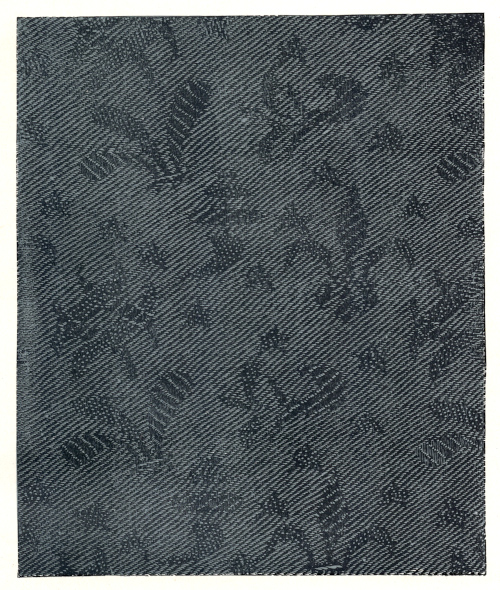
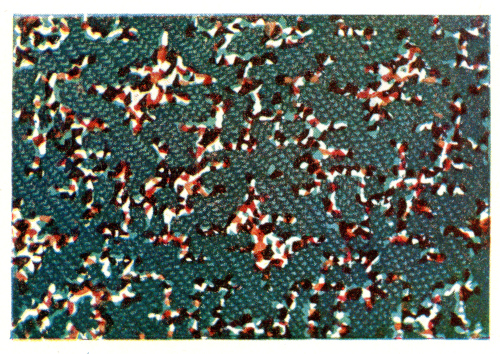
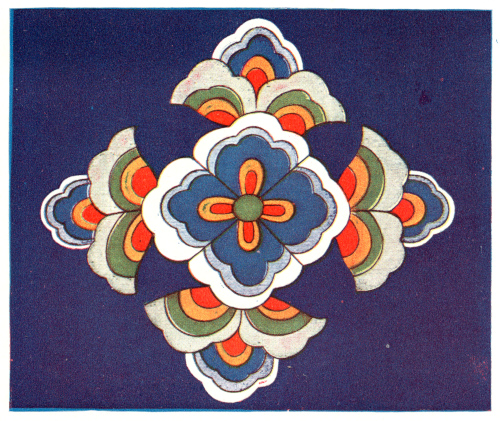
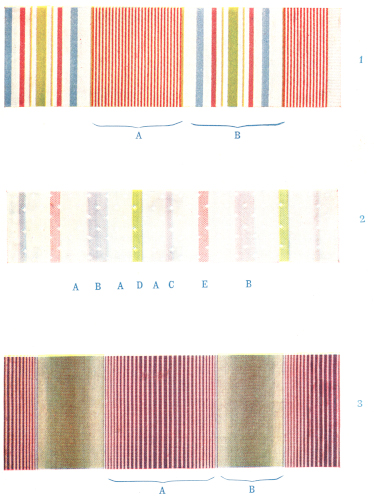
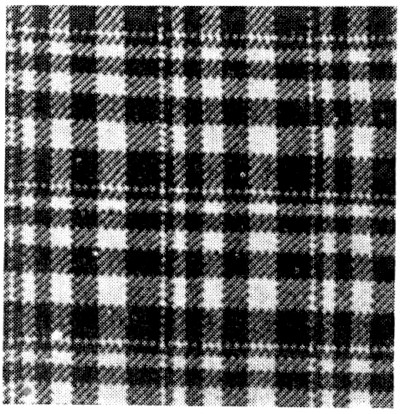
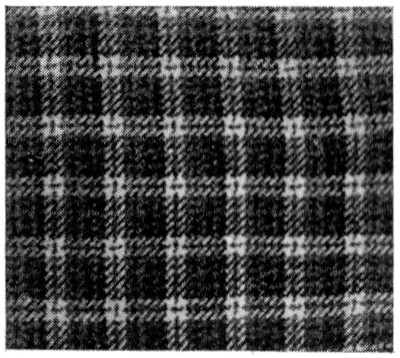
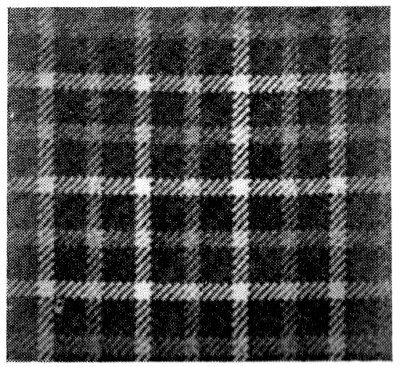
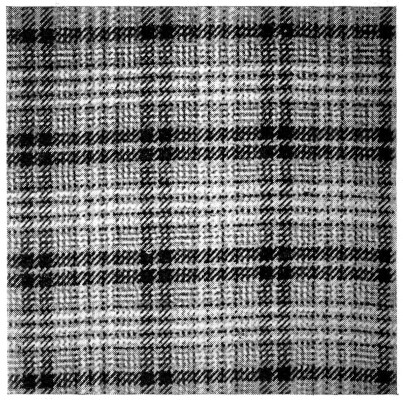
Chris Curnow
(1937-2023)
the Project Manager at Distributed Proofreaders
who selected this book,
and more than 2200 others,
to be preserved as free digital transcriptions
by Project Gutenberg.
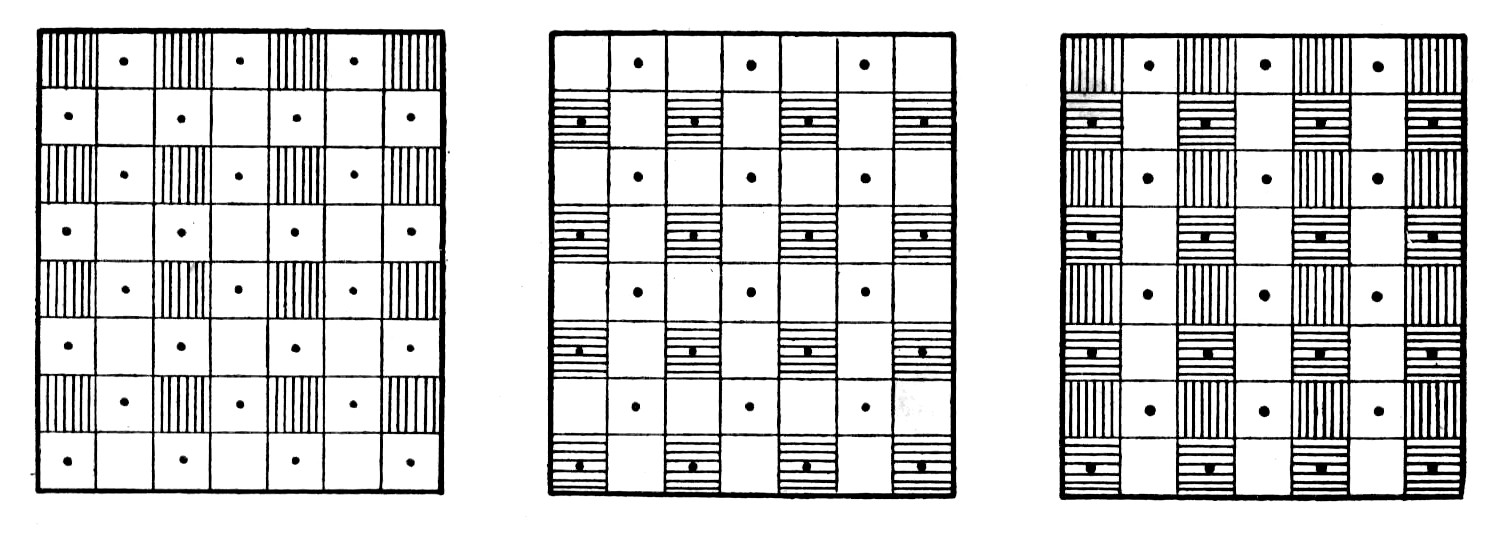
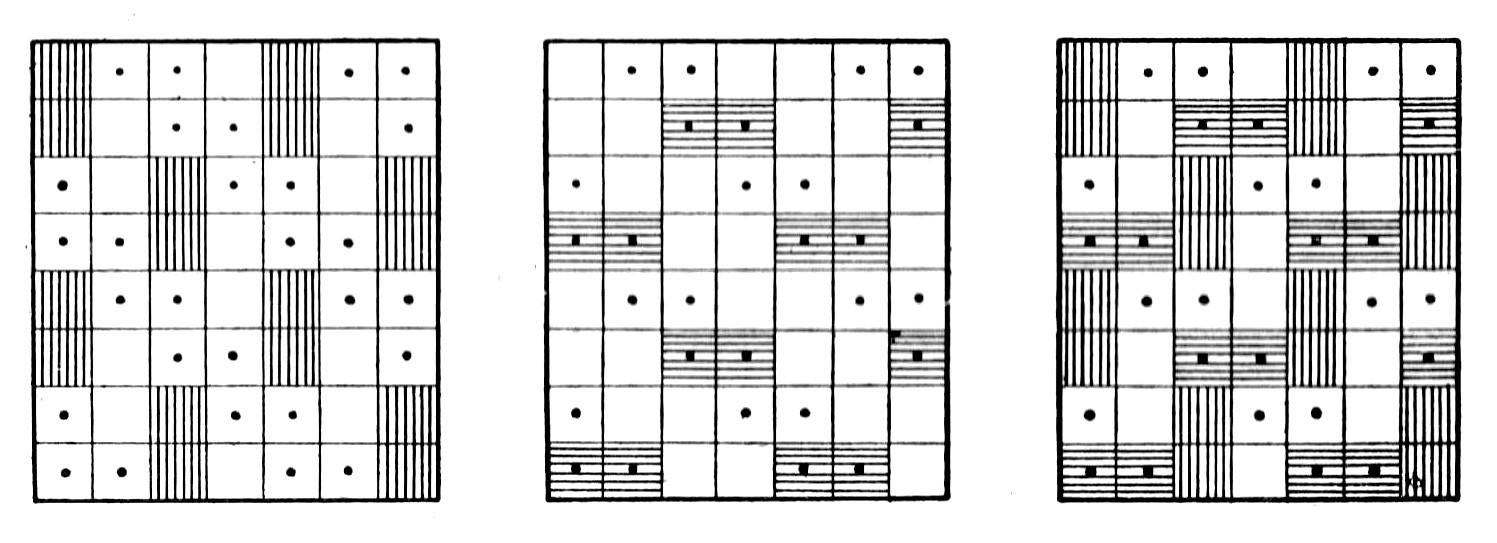
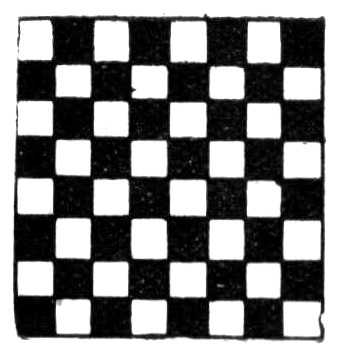
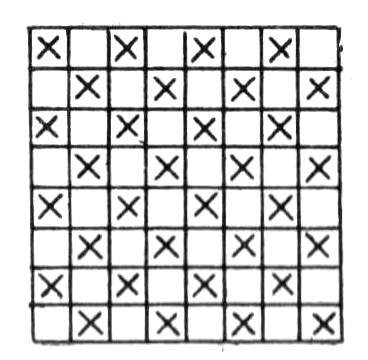
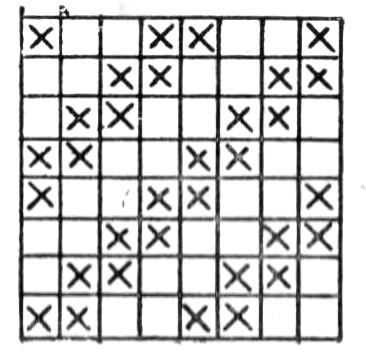
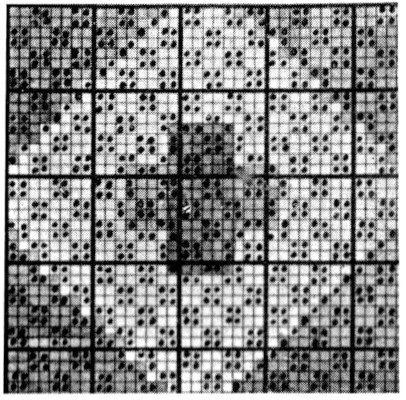
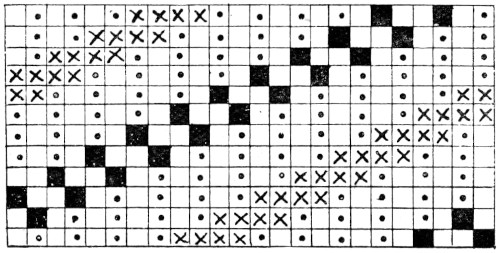
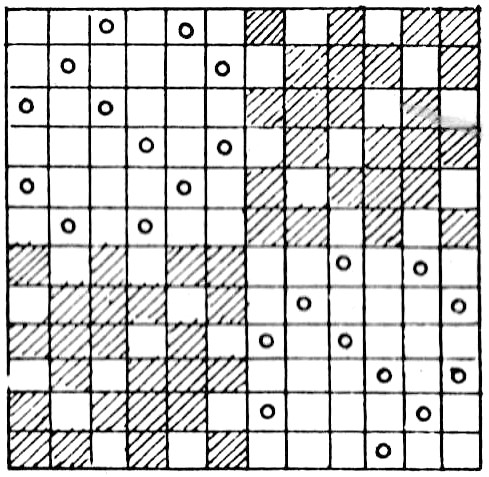
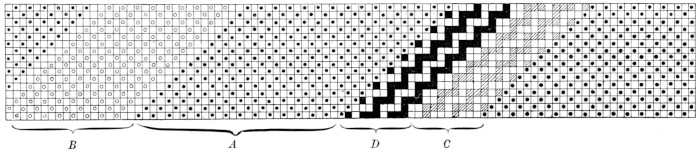
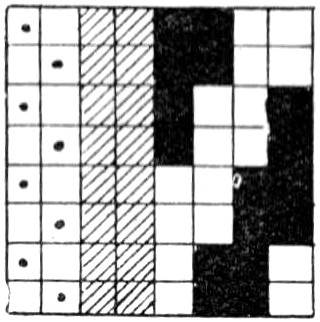
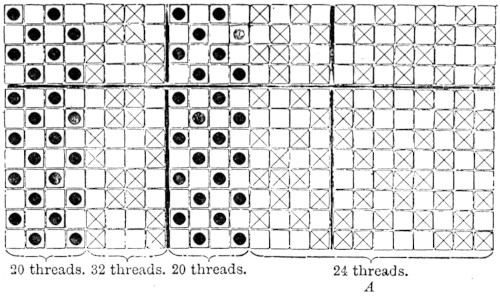
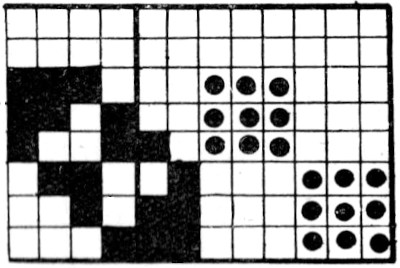
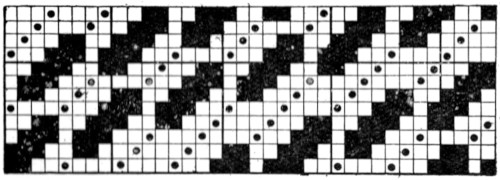
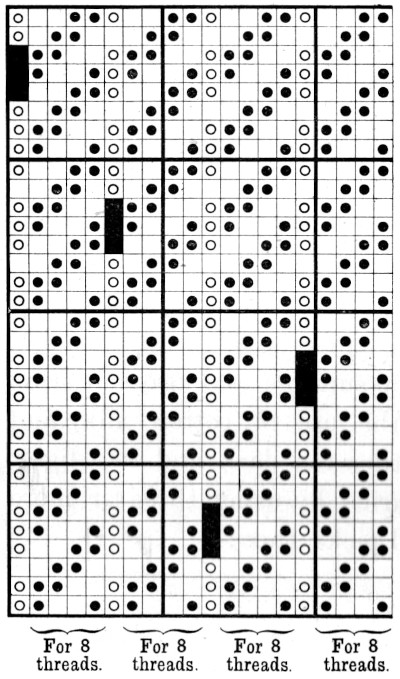
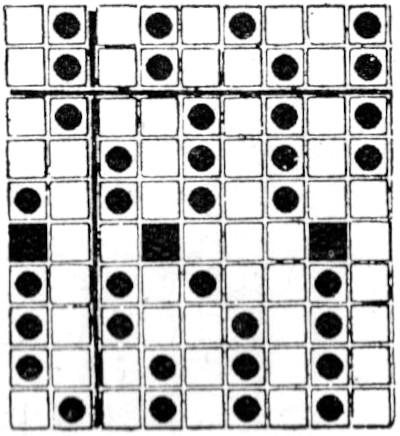
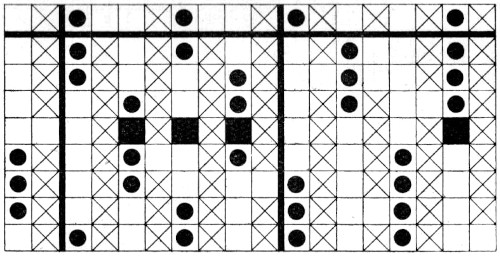
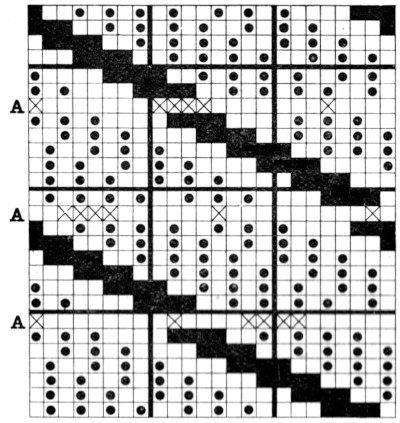
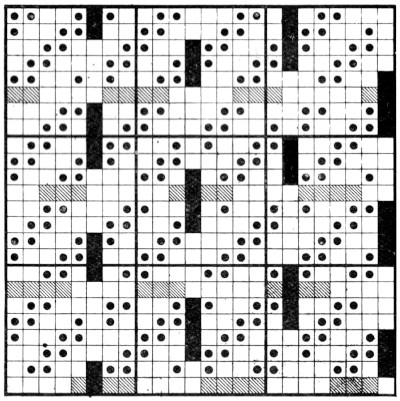
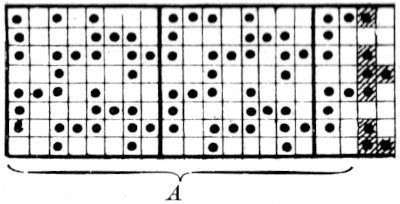
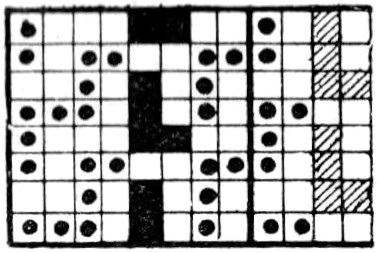
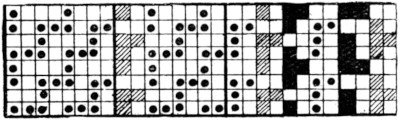
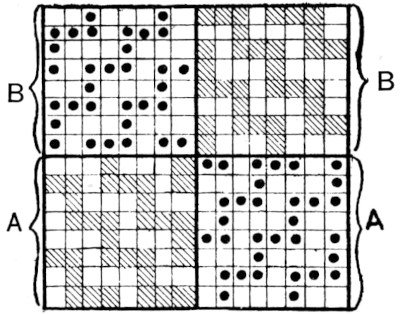
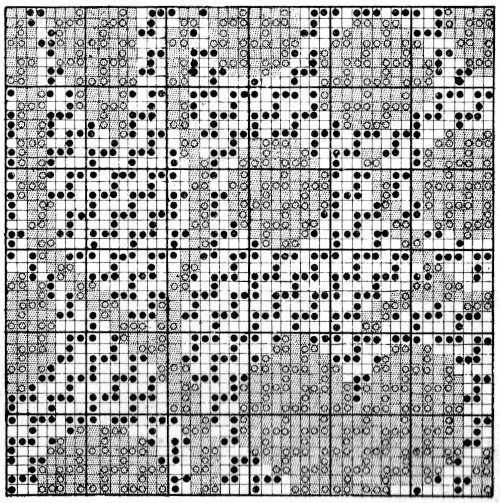
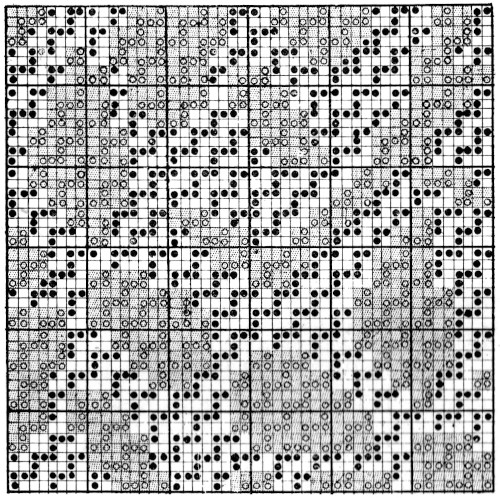
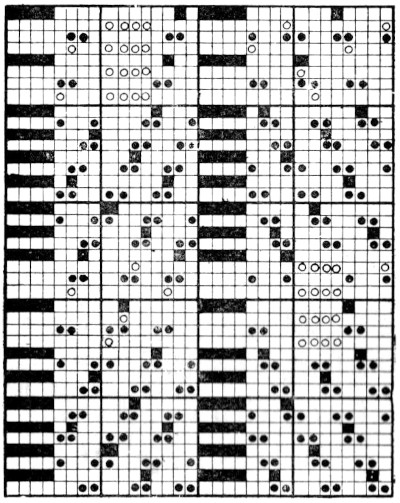
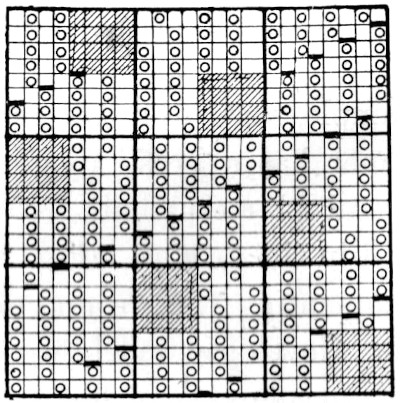
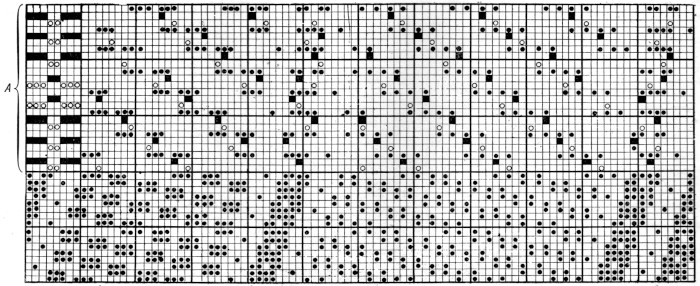
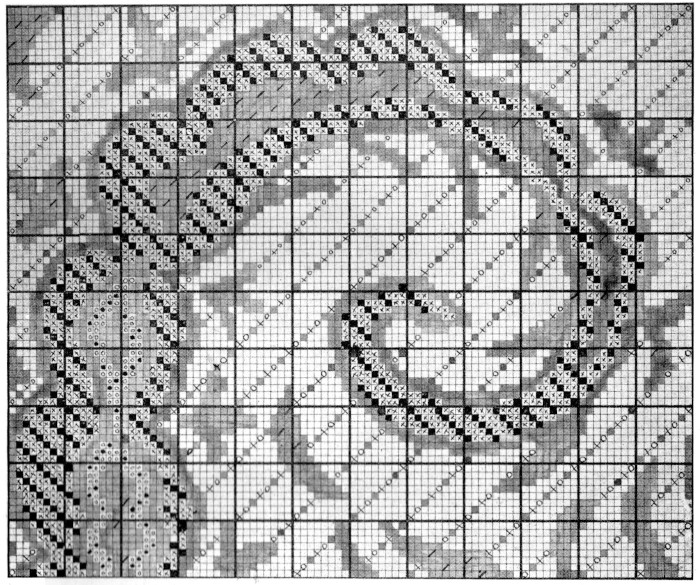
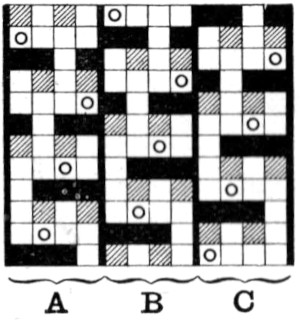
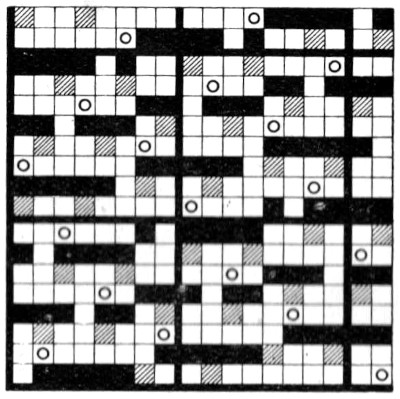
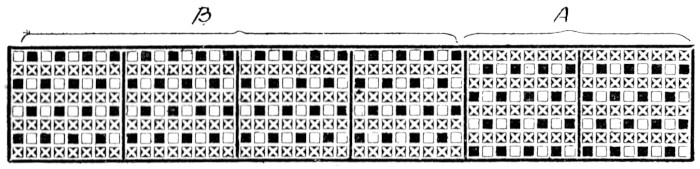
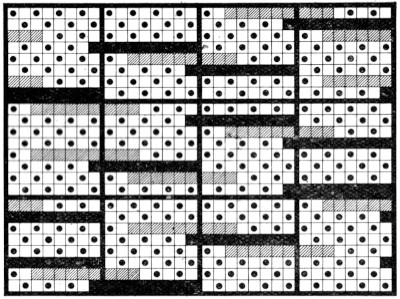
The book uses two symbols for which no unicode exists;
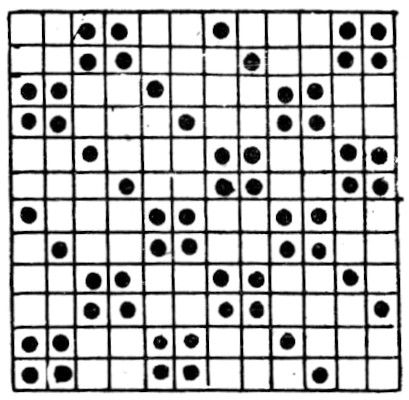
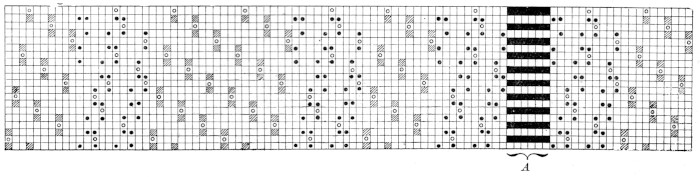
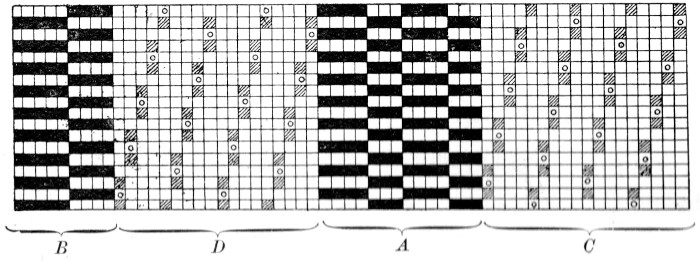
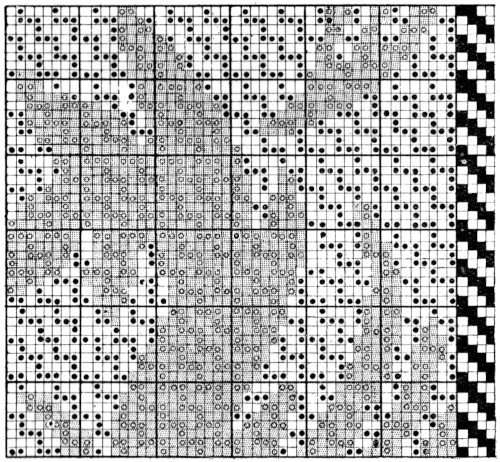
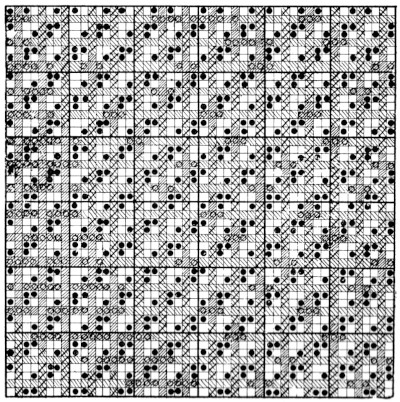
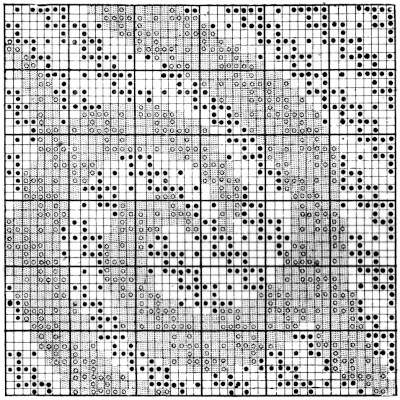
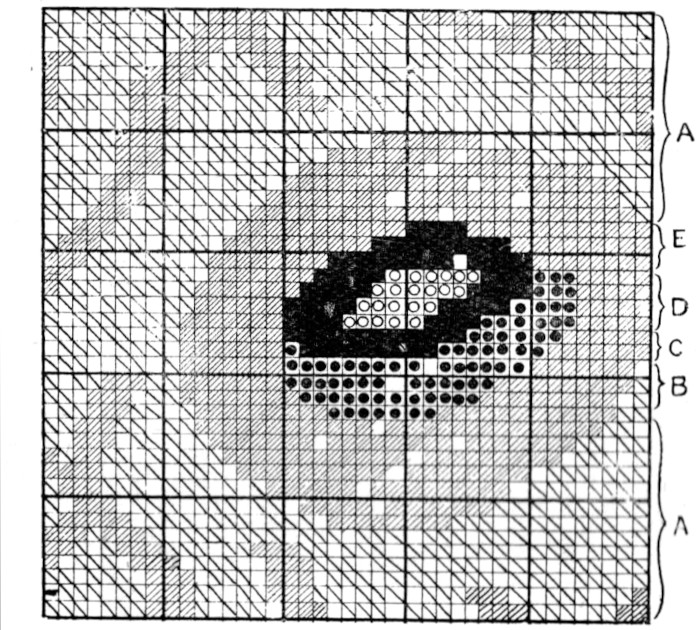
◍ was substituted for a small circle overlapping
slash marks, inside a box; ▦ was substituted for horizontal
lines with a black dot, inside a box; horizontal braces above or below columns are indicated like this:
/~~~~~\ \~~~~~/.
The discussion of twills uses notation like this:
3 3 —- and —-. These were reformatted as [3/1] and [1\3]. 1 1
Final stops missing at the end of sentences and abbreviations were
added. Footnotes were renumbered sequentially and were
moved to the end of the chapter. There are multiple anchors to footnotes [9], [13] and [14].
Ditto marks were replaced with text in some tables to accommodate column alignment.
COLOUR IN WOVEN DESIGN
COLOUR IN WOVEN DESIGN
BEING A TREATISE ON
THE SCIENCE AND TECHNOLOGY OF TEXTILE COLOURING
(WOOLLEN, WORSTED, COTTON AND SILK MATERIALS)
BY
ROBERTS BEAUMONT, M.Sc., M.I.Mech.E.
PROFESSOR OF TEXTILE INDUSTRIES, THE UNIVERSITY OF LEEDS;
AUTHOR OF
“FINISHING, OF TEXTILE FABRICS,” “WOOLLEN AND WORSTED CLOTH MANUFACTURE,”
“WOVEN FABRICS AT THE WORLD’S FAIR.”
VICE-PRESIDENT OF THE JURY OF AWARD AT THE PARIS EXHIBITION, 1900;
INSPECTOR OF TEXTILE INSTITUTES; SOCIETY OF ARTS SILVER MEDALLIST;
HONORARY MEDALLIST OF THE CITY AND GUILDS OF LONDON INSTITUTE.
EDITOR OF
“THE JOURNAL OF THE LEEDS UNIVERSITY TEXTILE STUDENTS’ ASSOCIATION”
WITH 39 COLOURED PLATES, CONTAINING 187 ILLUSTRATIONS
AND 280 FIGURES IN THE TEXT
SECOND EDITION, REWRITTEN AND ENLARGED,
WITH NUMEROUS ADDITIONAL ORIGINAL ILLUSTRATIONS
WHITTAKER & CO.
2 WHITE HART STREET, PATERNOSTER SQUARE
LONDON, AND NEW YORK
1912
THIS NEW AND ENLARGED EDITION
IS DEDICATED TO THE MEMORY OF MY LATE FATHER JOHN BEAUMONT,
PROFESSOR OF TEXTILE INDUSTRIES
THE YORKSHIRE COLLEGE, LEEDS,
1875-1889.
PREFACE TO FIRST EDITION.
Three years ago the first edition of my work on Woollen and
Worsted Cloth Manufacture appeared, and in the preface of the
book I observed that should it be satisfactorily appreciated I
would write other treatises on specific branches of textile
designing and weaving.
Partially in fulfilment of this promise, and partially because
I have frequently been requested by designers, manufacturers,
and students who have attended my lectures on textile colouring
at Leeds, Huddersfield, and other places, to prepare a text-book
on the application of colours to woven fabrics, this volume has
been written, which, to use the hackneyed prefatory phrase, is
intended to meet a long-felt want.
Though there are several useful works on Colour—to wit, those
of Chevreul, Rood, Benson, Hay, Field, Maxwell, and Guichard—dealing
with its scientific phases, yet they can scarcely be said
to lend that kind of help to the student of applied design that
is needed; hence the necessity of this handbook, which is the
first treatise published professing to treat exclusively of the
colouring of woven styles.
During the last fifteen years various efforts have been made
to teach textile designing and manufacturing systematically,
and to specify the principles which underlie the origination of
pattern in the loom: what to some extent was, previously,
haphazard work, inasmuch as there were no schools for teaching
textile technology, and those apprenticed in the mill were
generally allowed to glean information as best they could, has
now become an exact science. Colouring, however, though
practically of primary importance in design, has not been so
efficiently taught as some branches of textile manufacturing.
The object of this book is, therefore, to supply as far as possible
a complete scheme of textile colouring, and to demonstrate the
methods of applying fancy shades to all descriptions of woven
manufactures.
Referring briefly to the plan of the book: In the early
chapters the pigment and light theories of colour are expounded,
and also the attributes and qualities of colours, and
the laws of contrast and harmony. Subsequently, the technicalities
characterizing woven colour combinations are analyzed
in extenso.
As the initiatory method of introducing tints and shades
into fabrics consists in blending raw materials of divers colours,
the art of mixing to obtain artistic mingled compositions is at
the outset fully considered. This part of the subject is possibly
of the first importance to those engaged in designing fancy
tweeds and kindred classes of woollen goods.
After having treated of the combination of shades in
“blending,” reference is made to the principles of developing
simple patterns by amalgamating warp and weft yarns. The
various kinds of stripe, check, mixture, and figured effects, and
the tinting of all types of single, backed, and double cloths, of
combination patterns, of fabrics figured in the warp, in the
weft, and in both warp and weft, are all treated of at length.
Woollen, worsted, cotton, and silk fabrics, and the specific
styles of colouring applicable to each, have also obtained
detailed notice.
Many of the patterns printed on the plates have been woven
at the Yorkshire College under my supervision, and are now
published for the first time; while the other figures, with the
exception of a small number appearing in the Textile Recorder
in articles I have written for that journal, and which the
Editor has kindly permitted me to use, have been specially
prepared for this book. It need scarcely be observed that the
coloured illustrations are unique, being exact representations of
the woven textures.
I have pleasure in acknowledging my indebtedness to my
publishers, who have done all in their power to meet my
wishes in the execution of the plates of woven samples.
R. B.
PREFACE TO SECOND EDITION.
This Work has been rewritten and enlarged. Numerous
original illustrations have been added in the text and also
to the coloured plates, which should enhance its value to
the Textile Colourist, whether Student or Expert.
A chapter has also been prepared on Colour Standardization,
the scheme for which has been originated and
developed in the Textile Industries Department of the
Leeds University, under my supervision and in collaboration
with Mr Thos. Hollis, Lecturer in Yarn
Manufacture.
In reading the proof sheets, I acknowledge the help of
Miss Clara Benton, of the Clothworkers’ Museum of the
University.
I am indebted to my Publishers for the regard and
consideration they have had to my wishes in the preparation
of the Book.
R. B.
University of Leeds, 1911.
CONTENTS.
CHAPTER I.
THEORIES OF COLOUR.
PAGE
1. Elements of Woven Pattern—2. Occurrence and Utility of Colour in Loom
Productions—3. Treatment of Colour in Relation to Textiles—4. Methods
of Using Colour in Textiles—5. Colour Phenomena—6. Analysis of Light—7.
Utility of Prismatic Experiments—8. Schemes of Colouring—9.
Primary Colours—10. Compound Colours—11. The Three Constants of
Colour—12. Temperature of Colours
13. Utility of a Knowledge of the Qualities of Colours—14. Qualifications of
the Textile Colourist—15. Functions of Pure Colours in Design—16. Red:
its Characteristics—17. Methods of Modifying Colours—18. Derivatives of
Red: their Qualities and their Province in Textiles—19. Blue: its
Properties and Uses—20. Derivatives of Blue and their Application to
Woven Textures—21. Shades and Tints of Blue mixed with Shaded and
Tinted Reds and Yellows—22. Methods of obtaining Well-balanced
Colourings—23. Uses of Blue in Twist Yarns—24. Points in the Application
of Blue and Red to Textiles Summarized—25. Attributes of Yellow—26.
Province of Yellow in Woven Fabrics—27. Derivatives of Yellow—28.
Secondary Colours—29. Green: its Attributes and Derivatives—30.
Tints of Green—31. Orange: its Shades and Tints—32. Purple
33. Colours Affected by Adjacent Colours—34. How Colours are Changed by
Juxtaposition—35. Contrast—36. Examples in Contrasts—37. Economic
Contrasts—38. Two Kinds of Contrasts—39. Poly-chromatic Contrasts—40.
Mono-chromatic Contrasts—41. Toned and Tinted Contrasts—42. Comparison
of Contrasts by Shade and Contrasts by Colour—43. Shaded and
Tinted Compositions—44. Bright Colour Contrasts Modified with Black
and White—45. Successive and Simultaneous Colour Effects—46. Methods
of Neutralizing the Effects of Strong Colour Contrasts—47. Harmony—48.
Principles of Harmony
49. Objects of Standardization in Colouring—50. Systems of Colour Standardization—51.
Standardization by Selected Colours—52. Analysis of Standardization
Scheme, Plate XII.—53. Use of Standards in Blending—54. Applications
of the Scheme
55. Varieties of Mixture Patterns—56. Elements of Mixture Colouring—57.
Importance of Pure Materials—58. Several Classes of Mixtures Compared—59.
Simple Blends—60. Blends of Wools and Pigments Compared—61.
Modes of Testing Composition of Colours—62. Mixtures composed of two
Shades—63. Compounds of two Colours in which White is used—64. Illustrations
in Mixtures composed of White and a second Colour—65. Mixtures
composed of Black and another Colour—66. Grey Mixtures—67. Bloomed
Greys—68. Coloured Greys—69. Two-Coloured Mixtures—70. Multi-Shaded
Mixtures—71. Twist Yarn Mixtures—72. Marls—73. Weave
Mixtures
74. Colours applied to Textiles on Various Systems—75. Types of Woven
Colouring—76. Single Weave Colourings—77. Colour in relation to
Backed, Double, and Compound Cloths—78. Colour applied to Single-make
Figured Cloths—79. Fancy Shades applied to Backed and Double
Weave Combination Designs—80. Colour in Designs in which the Figures
are produced by the Weft Yarns—81. Figured Effects obtained by Warp
Colouring—82. Colour in Textiles Figured by both Warp and Weft Yarns—83.
Pattern Design—84. Styles due to Colouring only—85. Stripes—86.
Checks—87. Mixtures—88. Figures—89. Classes of Striped Patterns—90.
Hairlines—91. Compound Hairlines—92. Stripes composed of
Longitudinal and Transverse Lines—93. Stripes composed of Two
Colours—94. Stripes composed of Three or more Colours—95.
Irregular Stripes composed of Black and White Yarns—96. Irregular
and Indefinite Stripes in Two Colours—97. Irregular Stripes—Shades in
Two Colours—98. Shaded Stripes in Two Colours—99. Irregular Stripes
containing several Colours—100. Shaded Stripes in several Colours
101. Utility of Check Styles—102. Principles of Checking—103. Several Styles
of Checks. Checks composed of Two Colours—104. Forms of Checking
in Two Shades—105. Common Check—106. Modification of Common
Check—107. Check consisting of Two Sizes of Squares—108. Pattern composed
of Solid Squares and of an Over-check—109. Counter-change Check—110.
Compound Checking—111. Gradated Check—112. Broken Check
in Two Colours—113. Basket Check. Checks composed of Three or
more Colours—114. Principle of Checking with Three Colours—115.
Ordinary Three-shade Check—116. Set Check—117. Compound Checking
in Three Shades—118. Counter-change Check in Three Shades—119. Interchanging
Check—120. Counter-change with Over-check. Shaded and
Irregular Checks—121. Shaded Check in Black and White Cassimere
Twill—122. Shaded Cheek in Two Colours due to using Designs composed
of Various Weaves—123. Irregular and Mixture Checks—124. Fancy
Broken Check—125. Examples in the Colouring of Tartans—126. Types of
Tartans—127. Two-colour Plaids—128. Three-colour Plaids-129. Four-colour
Plaids—130. Five-, Six-, and Seven-colour Plaids
131. Simple and Compound Colourings—132. Regular Simple Colourings—133.
One-and-One and Two-and-Two Systems—134. Figured Styles in
Common Weaves and One-and-One Colouring—135. Utility of the One-and-One
Principle in Figured Textiles—136. One-and-One and Two-and-Two
Colourings in Fancy Weaves—137. Three-and-Three Colouring—138. Four-and-Four
Arrangement—139. Four-and-Four Method applied to Fancy
Weaves—140. Six-and-Six and Eight-and-Eight Schemes—141. Six-and-Six
Colouring in Various Crossings—142. Three-Odd-Thread Arrangement—143.
Various Three-Shade Patterns—144. Simple Colourings, composed
of Four Shades—145. Irregular Simple Colourings—146. Irregular Simple
Patterns of Two Shades—147. “Irregulars” composed of Three Shades—148.
“Irregulars” composed of Four Shades—149. Cross Wefting
150. Compounds—151. Compounds composed of Three Types of Elementary
Colouring—152. Results of Combining Simple Colourings—153. Compounds
and Weave Combinations compared—154. Utility of a Practical
Acquaintance with the Woven Effects of Simple Colourings—155. Compound
Patterns subjective to the Nature of the Fabrics Manufactured—156.
Types of Compounds—157. Compounds composed of Two Simple
Types—158. Patterns composed of Two Types and Three Shades—159.
Styles of Four Shades containing Two Simple Types—160. Styles composed
of Three Simple Types—161. Irregular Compounds
162. Colour applied to Special Makes—163. Colouring of Corkscrews—164.
Modified Corkscrews—165. Fancy Woollen Weaves—166. Granite Effects—167.
Diagonals—168. Diagonals composed of Plain and Double Plain
Makes—169. Stripe and Check Colourings on Diagonals—170. Methods of
Colouring Fancy Weaves for Cottons or Silks—171. Gauze Textures—172.
Systems of Colouring Gauzes—173. Imitation or Mock Gauzes—174. Colour
in relation to Rib or Cord Styles
175. Principles of Colouring Weave-Combinations—176. Examples in Colouring
Compound Designs—177. Main Points in applying Shades to Weave-Combinations—178.
Examples in Drafted Patterns—179. Designs composed
of Two Prunelle Twills—180. Drafted Designs composed of Two Four-Shaft
Weaves—181. Styles composed of Prunelle and Cassimere Twills—182.
Combinations composed of two-, Six-, Seven-, Eight-, and Nine-Shaft
Weaves—183. Drafted Designs composed of Three or More Weaves—184.
Fancy Stripe Combinations—185. Irregular Woollen Weave Combinations—186.
Cotton Stripes—187. Colouring of Designs containing several Weaves
of Varied Construction—188. Figured Designs striped in the Warp
189. Varieties of Spotted Fabrics—190. Spots due to Specific Systems of Weaving—191.
Swansdown Twill Spotted—192. Spots composed of [3/1] and
[1/3] Twills—193. Weave-spotting produced by both Floats of Warp
and Weft—194. Irregular Spotted Stripes and Checks—195. Spots developed
by single Extra Warp threads—196. Fabrics Spotted with Single Picks of
Weft—197. Mat Weaves Spotted—198. Corkscrew Weaves with Extra
Spotting Picks—199. Spotted Diagonals—200. Warp and Weft Spots
compared—201. Spotting in both Warp and Weft—202. Advantages of
the Warp and Weft Methods of Spotting—203. Yarns used for Spotting—204.
Spotted Effects in Ordinary Weaves—205. Application of Fancy
Yarns to Compound Weaves
206. Principles of Double Cloth Colouring—207. Styles of Colour Effects
obtained in Double Weaves—208. Double Plains—209. Classification of
Double Plain Stripes—210. Double Plain Stripes in Two Shades—211.
Two-Shade Stripes Warped Irregularly—212. Styles in Three Colours—213.
Double Plains combined with other Weaves—214. Intermingled
Double Plain Compounds—215. Reversibles—216. Methods of Colouring
Double Plain Reversibles—217. Colouring of Figured Designs containing
Double Plain and other Weaves—218. Reversibles arranged Two and One—219.
Figured Compound Weave Patterns—220. Compound Colourings in
Compound Weaves—221. Colouring of Double Cloths, such as Golf Cloakings
and Rugs
222. Methods of Colouring Figured Fabrics—223. Special Elements of
Ornamental Woven Design—224. Art and Technique—225. Styles of
Figured Fabrics Coloured in the Warp—226. Cotton Quilting Fabrics—227.
Ornamental Characteristics of Quilting Designs—228. Attributes of
Plush Fabrics—229. Origin of Velvet Weaving—230. Velvets, Compound
in Structure—231. Two Classes of Plush Fabrics—232. Warp Plushes—233.
Methods of securing the Pile—234. Analysis of the Process of Velvet
or Warp Plush Weaving—235. Colouring of Warp Plushes and Figured
Velvets—236. Brussels and Tapestry Carpets compared—237. How the
Pattern is developed in Brussels—238. Structure of Pile Carpets
239. Warp and Weft Colouring compared—240. Classes of Designs Coloured in
the Weft—241. Designs in which the Pattern is a product of the Ground
Weft—242. Extra-Weft Styles—243. Vestings—244. Vestings with one
Extra Weft—245. Two-Cover Vestings—246. Four-Cover Styles—247.
Honeycomb Vestings—248. Two-Cover Colouring—249. Four-Cover Designing—250.
Paisley Shawl Colouring—251. Compound-Weft Reversibles—252.
Warp and Weft Coloured Figuring—253. Curls, Textiles of the
Astrakhan Group—254. Four Types of Curled Effects—255. Curls obtained
by Wires—256. Process of Weaving Curls produced by Wires—257. Curls
formed by the Weft in which the Warp is Cotton—258. The Weave of
Weft Curls—259. Structure of Weft-Curl Fabrics—260. Operation of
Cutting after Weaving—261. Curls developed by Milling—262. Points
of dissimilarity in the various Builds of Curled Textures—263. Two kinds
of Curls developed by Milling—264. Spiral Threads used for Warp—265.
Variety of Pattern in Spiral-Warp Curls due to Colour—266. Twist-Yarn
Cotton Warp Curls—267. Backed Weaves for Curled Cloths—268.
Essential Characteristics of Cotton Warp Curls due to Milling—269.
Examples in Designs for Cotton Warp Curls
1. Elements of Woven Pattern—2. Occurrence and Utility of Colour in
Loom Productions—3. Treatment of Colour in Relation to Textiles—4.
Methods of Using Colours in Textiles—5. Colour Phenomena—6. Analysis
of Light—7. Utility of Prismatic Experiments—8. Schemes of Colouring—9.
Primary Colours—10. Compound Colours—11. The Three Constants of
Colour—12. Temperature of Colours.
1. Elements of Woven Pattern.—Weave, compounds of form,
and blending of colour are the three primary elements of textile
design. They enter, either separately or in combination, into
the many styles of loom effects. Weave relates specifically to
the build or structure of the fabric, and is a necessary factor in
any type of texture, whether plain, twilled, or ornamental in
character. It is the scheme or plan of crossing the warp and
weft yarns that forms or produces the fabric. Weave may give
a compact texture subordinate in effect to other elements in the
design; or, it may be the constructive and not the ornamental
part of the pattern; yet in several woven specimens it possesses
both these qualities. Fabrics of this description are not embellished
with compounds of form or colour, and hence derive
their design from the structural plan employed in the operation
of weaving. Schemes of intertexture giving these results are
devised in such a manner as to form, by interlacing warp and
weft, an even fabric, decorated with a type of pattern consisting
of minute effects in threads or yarns, and which may be
subdued or decided in definition.
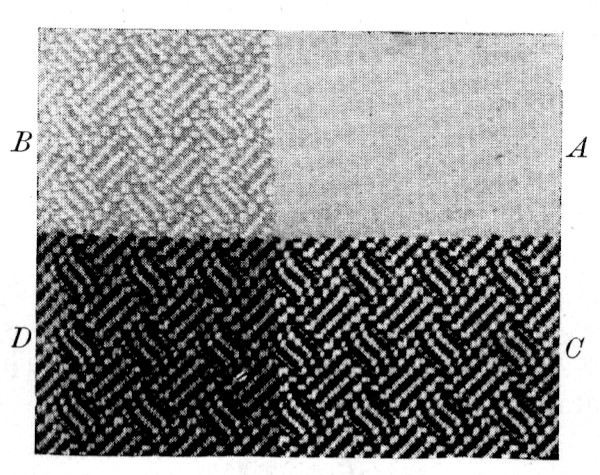
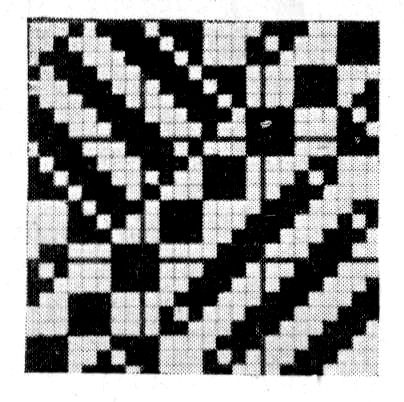
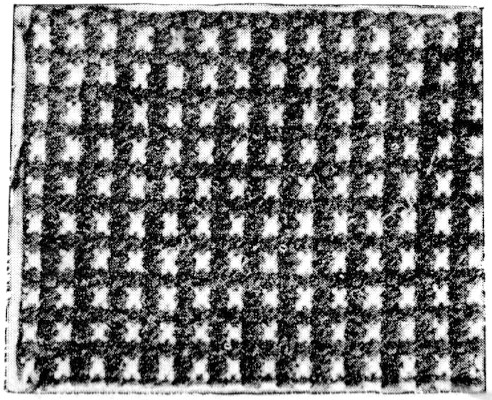
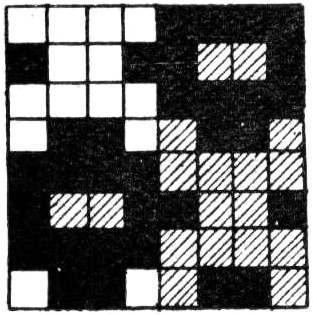
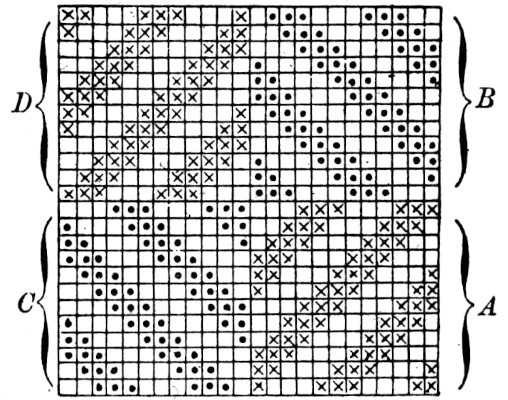
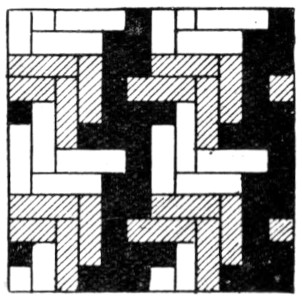
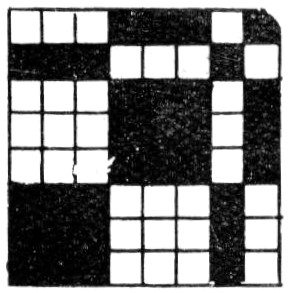
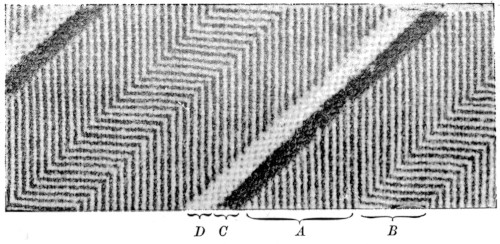
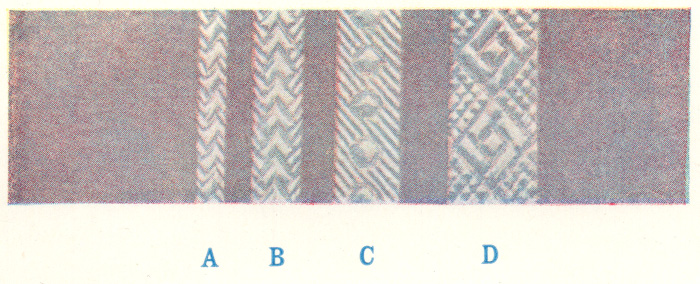
Fig. 1 is an elementary type of Weave design or Pattern.
The weave used is Fig. 1A. The sections are produced thus:—
A.
White
warp
crossed with
white
weft.
B.
Grey
„
„
„
„
C.
White
„
„
black
„
D.
Grey
„
„
„
„
Fig. 1.
Fig. 1a.
Four degrees of definition of the design are present. The
textural effect is clearly visible in section A, but increasingly
distinct in sections B, C, and D, due to the improved or more
pronounced contrasts of the shades of warp and weft combined.
Briefly considered, Weave has the following functions in
textile design:—
(1) In the construction or build of the fabric.
(2) In the development of textural design (Fig. 1).
(3) In the production of special and compound makes of
fabrics.
(4) It is employed to accentuate or subdue in simple and
decorative styles certain parts of the design—producing
harmony of composition, whether due to blends of form,
colour, or both.
Combinations of form have no relation whatever to the
structural arrangement of the fabric. The sphere of form in
woven design is not constructive or utilitarian, but in the
amplest sense ornamental. It is surface decoration obtained by
amalgamating, on definite principles, linear and curvilinear lines:
ornament, consisting of geometrical or floral features, is applied
to such loom products as dress, mantle, and vesting fabrics; silk
textures, including neckties, handkerchiefs, robes, and decorative
styles; damasks, quiltings, tapestries, etc.; carpets, hand-woven
or tufted (produced on the vertical loom and now made in
Donegal and some parts of Scotland as well as in the East);
velvet, or cut pile (Axminster type); looped or uncut pile
(Brussels type); and Kidderminster and other plain-surface
productions.
Colour, the third characteristic in design, is differently related
to textile effects from Weave and Form. The special function of
colour is to impart brightness of tone and improve the qualities
of the design. There are many varieties of pattern in fabrics
for wear, which possess freshness owing to the style and method
of colouring practised. In the woven decorative arts, colour may
be the main constituent of the design, or employed to develop its
integral parts.
2. Occurrence and Utility of Colour in Loom Productions.—Colour
is extensively used in woven design. It obtains, and is
the prevailing element of the pattern, in all classes of fancy
woollens, such as tweeds, flannels, and light textures, and thick
figured rugs, wraps, and shawls. Whether the pattern be stripe,
check, figure, or intermingled effect, it obtains its outline and
detail from the method of colouring adopted. But colour
is not confined to woollens; it is also an important factor
in design produced in worsted, silk, cotton, jute, ramie, and
other yarns. There is, in worsteds, a larger diversity of weave
design than in woollen or carded-yarn textures; but, still,
colour is very extensively employed to develop the effects due to
weave and form, and also to impart a cheerful and lustrous
appearance to the cloths. Patterns in dress fabrics, shirtings and
blouses, made entirely of cotton, are frequently combinations of
fancy shades; while, if the fabrics composed of silk and jute
materials are considered, including—in silk—ties, handkerchiefs,
and various kinds of matelasses; and—in jute—simple carpets,
mats, and coarse rugs, it will be discovered that the colour
element of the design largely predominates. This brief summary
of the textures, in which fancy shades are used, shows that colouring,
and the combinations of colours, in all branches of woven
products embellished with design, are the elements which give
tone and character to the styles. Though the fabrics produced
may be soft to the touch, substantially made, uniform in structure,
and skilfully finished, yet a lack of brightness and harmony
of colouring so powerfully detracts from the merit of the pattern,
that these qualities, in themselves, are not sufficient to give the
fabric an attractive appearance—particulars which demonstrate
the importance of choice and tasteful colouring in designs
produced in the loom. Evidently colour is of twofold utility
in the development of woven effects; for it may, firstly, be the
sole constituent of the pattern; and, secondly, a supplementary
element which affords precision and beauty to the composition of
the design.
3. Treatment of Colour in Relation to Textiles.—Though, to
a considerable extent, the principles of colouring are similar in
all types of decorative design—harmonious blending and contrasting
combinations possessing like qualities in whatever materials
they obtain—still there are several reasons why some of the
recognized canons of the science of colour are inappropriate, if
not inapplicable, when textiles are the media of development.
Foremost of these reasons are the technical difficulties which
arise in the employment of colour in woven pattern. There is
not the same facility nor means for its application here, as in
the treatment of ordinary surface decoration. The make of the
fabric, and the principles of its structure, determine the system
of distribution; while the general aspect of the entire body
of colouring varies according to the nature of the materials
employed. If the same colourings which appear harmonious,
neatly toned, and cheerful in arrangement in a velvet pile carpet,
were reproduced in a silk texture, many points of dissimilarity
would be noticed in the general effect obtained, though the tint
and hue of the shades combined, might be identically the same
in the respective fabrics. Why is this? Are not the apparent
modifications in the colourings—for such they appear when thus
compared—due, first, to the difference in the nature of the
materials composing the textures; second, to the dissimilitude of
their structural character; and, third, to the distinct principles
of weaving practised in their production? The pile of the carpet—dense
and compact—gives breadth, force, and richness to
the colours; whereas the fine and clear texture of the silk
imparts a more precise effect to the shades, causing the whole
blend to possess an aspect which, while harmonious, lacks that
mellow quality of bloom so characteristic of the pile production.
It is clear, therefore, that colour in textiles requires to be studied
as a special art. Its functions and effects in woven fabrics are so
various and distinct from what they are in ordinary decorative
work, that it can only be effectively treated when the nature of
textile materials, and the diverse structures of the fabrics, are
considered. In a word, there are not only recognized principles
of woven design which have no place in purely ornamental art,
but also schemes and laws of colouring which simply apply to
the development of pattern in textile fabrics. Any exposition,
therefore, of the theory and practice of colouring, to be useful to
the textile technologist, must be given in relation to the varied
technicalities of the weaver’s craft.
4. Methods of Using Colours in Textiles.—Colour is not always
applied to woven textures on the same system. The method of
utilization depends upon the composition of the design to be
woven, and on the structure of the cloth it is intended to produce.
There are fabrics in which the colour element is so decided that
the effect obtained is somewhat similar to the results noticed in
ordinary surface decoration. Take, for example, silk textures
of a ribbon class, in which, by skilful workmanship and exact
sketching, any floral form may be developed with a delicacy of
toning and correctness of delineation that cannot be improved
upon, even though the crayon or the brush should be employed.
But this is not a common, because not a useful, species of designing
and colouring. Carpets and tapestry fabrics illustrate other
principles of employing fancy shades. The structure of some
types of carpets very materially affects the character of the
colourings. In Brussels and tapestry, for instance, the loop or
pile of the carpet which forms its distinguishing feature,
prevents that solidity and compactness of colouring noticeable in
the silk ribbon or dress material. If the same design and blend
of shades introduced into a Kidderminster or Scotch carpet were
subsequently applied to a Brussels production, they would be
entirely changed in appearance; for there is no common principle
of intertexture in the respective carpets. In cotton, silk,
woollen, and worsted textures, colour is found to have a
different tone or cast in each fabric. Fancy colours in
cottons, while decidedly smart and clear in effect, are comparatively
non-lustrous, raw, and dull in toning.[1] Silk is
distinguishable by brilliance of hue; woollen colourings have
a unique depth and saturation of hue characteristic of the
material employed in their manufacture; while worsted colourings
are bright, definite, and smart in appearance.
These differences are due to the physical formation and
properties of the several fibres and yarns. Thus, a filament of
silk is almost transparent, and shines like a smooth glass rod
when light falls upon it; that of wool is solid and opaque in the
centre, but its exterior consists of a multitude of semi-transparent
scales, which, when of large dimensions and uniformly arranged—as
in the best qualities of Lincoln and Leicester wools—reflect
light with a minimum amount of dispersion, and impart to the
woven material a lustrous aspect. Cotton has no such partially
transparent surface. Its downy structure absorbs light freely,
while what is reflected is so broken up, that the colour resultant
is impoverished in saturation and brightness. To clearly
apprehend the degree to which the nature of the raw material is
capable of changing the tone or character of colours, compare
three plain woven textures of the same colour made of silk,
wool, and cotton respectively. Lustre, brilliance, and richness
are the features of the silk colouring. Though thus bright,
it lacks that fulness and depth of hue which appertains to
the wool production, the filaments of which closely compounded,
and all tinted alike, possess a peculiar bloom and saturation
of colouring not to be found either in the silk or cotton.
The cotton texture is somewhat dull and flat in quality of
hue, lacking the brightness of silk. Such is the importance
of the relation of the material to the species of coloured effect
produced in textiles, that it will require subsequent analysis.
The various methods of employing fancy shades in patterns
obtained in the loom may be briefly summarized as follows:—
Table I.
Methods of Applying Colour to Textiles.
I. In mixture cloths, for suitings, coatings, and costumes.
a. By combining or blending various colours of materials.
b. By combining several classes of twist threads.
II. In plain, twilled, mat, and fancy weave designs, for
trouserings, coatings, suitings, dresses, costumes, flannels,
shirtings, and fine textures.
a. By applying colour to the warp, forming stripes.
b. By applying colour to the weft, producing spotted patterns.
c. By applying colour to both warp and weft, giving
checks and other styles.
III. In figured designs for dresses, mantlings, vestings, shawls,
rugs, mauds, carpets, and tapestries.
a. By using one or several series of extra warp yarns.
b. By using one or several series of extra weft yarns.
c. By using one or several series of extra yarns in both
warp and weft.
Each of these systems is capable of further subdivision; but,
as here given, they represent the principles of colouring the
general classes of woven designs.
5. Colour Phenomena.—Under ordinary conditions, light is
essential to colour apprehension. Diversity of hue may be
made evident to the mind by mechanical agitation of the optic
nerves in a darkened room. Of course, such an experiment is
only useful as showing the media by which colour sensations
are rendered visible, or rather conveyed to the mind.
The colour of an object is determined by three things: the
nature of light, the physical properties of the material on which
light falls, and the power of the observer’s eye. These are
obvious conditions. Change the light from brilliant daylight
to gaslight, and a richly coloured fabric undergoes several
modifications—the hues suffer in brightness and lose a measure
of their co-relative value. Or, by using a mono-chromatic light
(that from burning sodium is a compound of two yellow lights
of similar quality in the spectrum[2]), coloured objects may be
changed to a similar hue. That colour is affected by the
nature of the material has been stated in reference to fibres
of wool, cotton, and silk.
Fig. 2.
Incapacity to correctly distinguish the hues, tones, and tints
of colour is caused by some affection of the retina. Training
and practice in the matching and blending of colours may
enhance the acuteness of colour vision. The Gobelin tapestry-weaver
will select, without hesitancy, from a bundle of bobbins
of tints of material of the same hue or colour, the one he
requires. Similarly, the carpet-weavers of Donegal—after
a period of training—will unerringly manipulate a varied
assortment of delicate colours.
“Light is due to waves—or other periodic disturbances,
whose recurrence resembles that of waves—in the ether of
space; and just as air-waves of a certain definite frequency
of recurrence will induce in the ear the sensation of a sound of
a particular pitch, so will the impact of ‘ether-waves’ of a certain
particular frequency induce in the eye a sensation of light of
a particular colour.”[3]
The extreme visible red in the spectrum is produced by 392
billions, and the extreme visible violet by 757 billions of waves
per second. The table gives the wave frequency of the spectral
colours:—
Table II.
Wave Frequency of the Spectral Colours.
Red
492·4
billions
per second.
Orange red
484·1
„
„
Orange
503·3
„
„
Orange yellow
511·2
„
„
Yellow
517·5
„
„
Green
570
„
„
Blue
591·4
„
„
Cyan blue
606
„
„
Blue
635·2
„
„
Violet blue
685·8
„
„
Puce violet
740·5
„
„
As the frequency of the vibrations increases, or as they are
diminished in length, the visible colours of the spectrum are
produced. Just as the pitch of a musical instrument depends
upon the celerity of the wave it produces, so the colour of an
object is subjective to the length of the undulations transmitted.
This analogy between the phenomena of sound and light has
led some colourists to attempt a scheme of colours based upon
similar laws to musical harmony.[4]
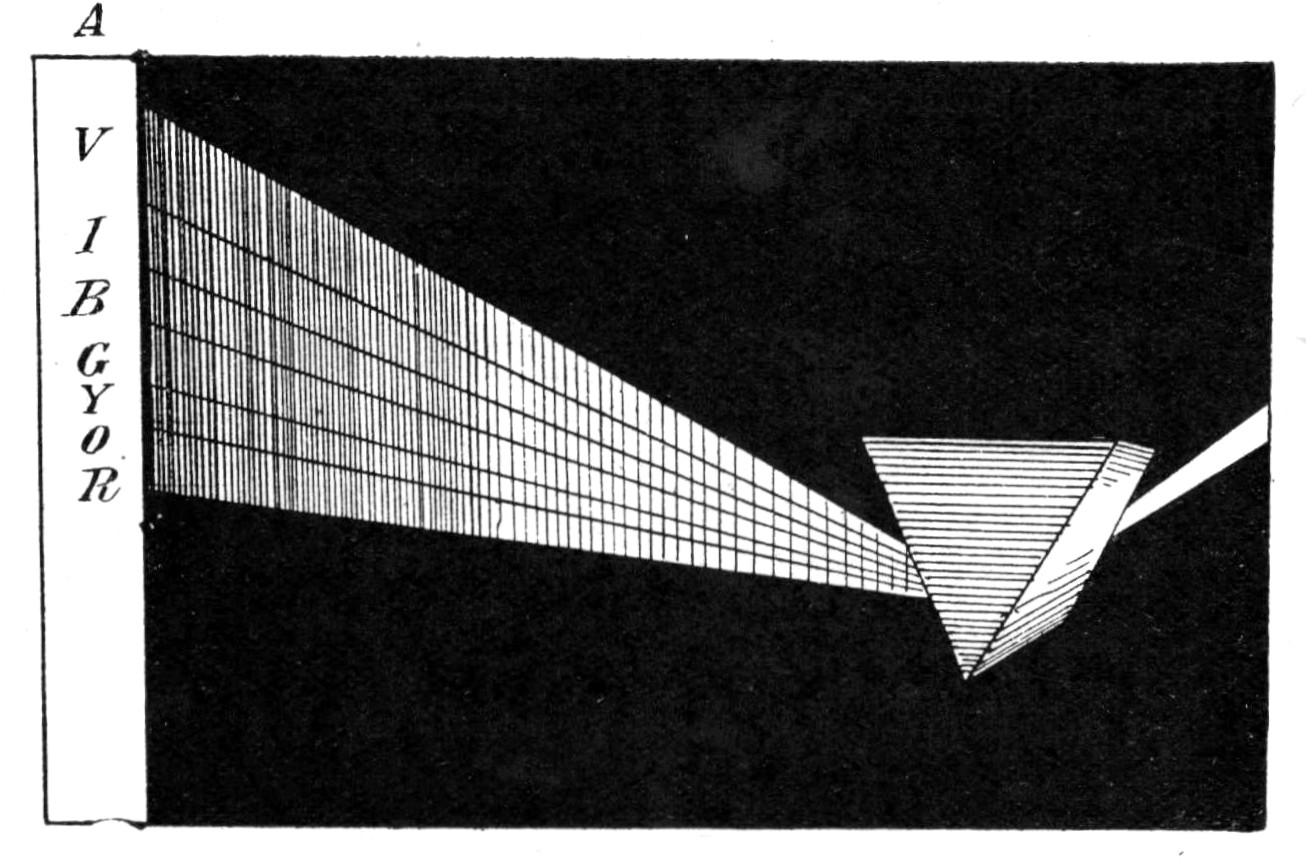
6. Analysis of Light.—When a pencil of sunlight passes
through a prism horizontally fixed, as in Fig. 2, it is decomposed,
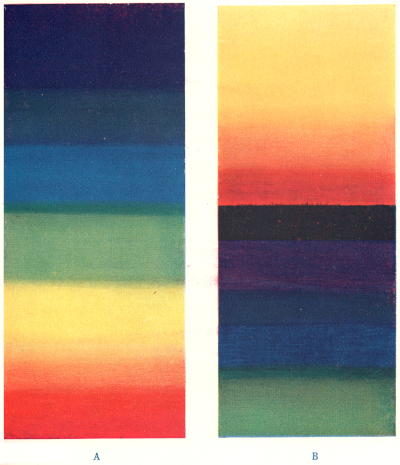
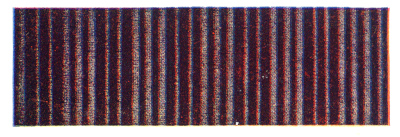
and produces on the screen the colour spectrum A, Plate I. In the
intervals between each hue there is a gradation to which the colours
are severally susceptive. Red passes, through a diversity of tinting,
into orange, which graduates into yellow; and green, green
blue, blue, indigo, and violet occur in succession, all softly toning
into each other. The purity and intensity of each colour will
be observed.
Fig. 3.
A second and useful experiment may be made as follows:—Place
a piece of black cardboard, about an inch wide and a few
inches in length, on a white ground, and view it through
the edge of a prism. If this experiment be correctly made, a
result will be obtained corresponding to B, Plate I. The
edge nearest the observer produces the violet, blue, and green
side of the spectrum, while the opposite edge gives red, orange,
yellow, and pale yellow—these two series of spectrum colours
of distinct qualities being divided by a narrow band of black.
Coldness is the distinguishing characteristic of the violet side,
and warmness that of the red side; in the upper portion of
the spectrum are found the intense, ostentatious hues, while
in the lower portion are the colours of a subdued, soft quality.
Yellow and green are beautifully toned. The former passes
from a yellowish orange into a pure, bright tint, which is softly
shaded off into white. Green, on the front edge of the black
line, is similarly graduated in hue, but as the band of this colour
is not so broad as the yellow strip, its shadings are not so extensive;
still, it imperceptibly changes from deep into pale green,
and diminishes in intensity until it disappears in white light.
One feature of this experiment will at once be observed, namely,
the brilliance and richness of coloured lights, when compared
with corresponding colours obtained by pigments or dye substances.
Bloom, depth, and purity of hue characterize the
former; but however the latter are produced, they seem, in
comparison, to be lacking in fulness, intensity, and brightness.[5]
Plate I A = SPECTRUM
B = SPECTRUM RESULTANT FROM VIEWING A STRIP OF BLACK
ON A WHITE SURFACE THROUGH A PRISM
7. Utility of Prismatic Experiments.—Experiments with the
prism afford suggestive exercises in colour blending. Seeing
that the results of these experiments are richer by far than
those obtained by pigments, and always harmonious in tone,
they are calculated to enhance appreciation for pure and
lustrous colouring. For the purpose of successful manipulation
of prismatic experiments, and of viewing in a suitable
manner the effects that may, by this means, be produced, a
piece of black velvet or cloth should be employed, and patterns
cut out of white cardboard placed on it, and then the design
thus arranged examined through the prism. The more ingenuity
exercised in pattern origination, the more pleasing the combinations
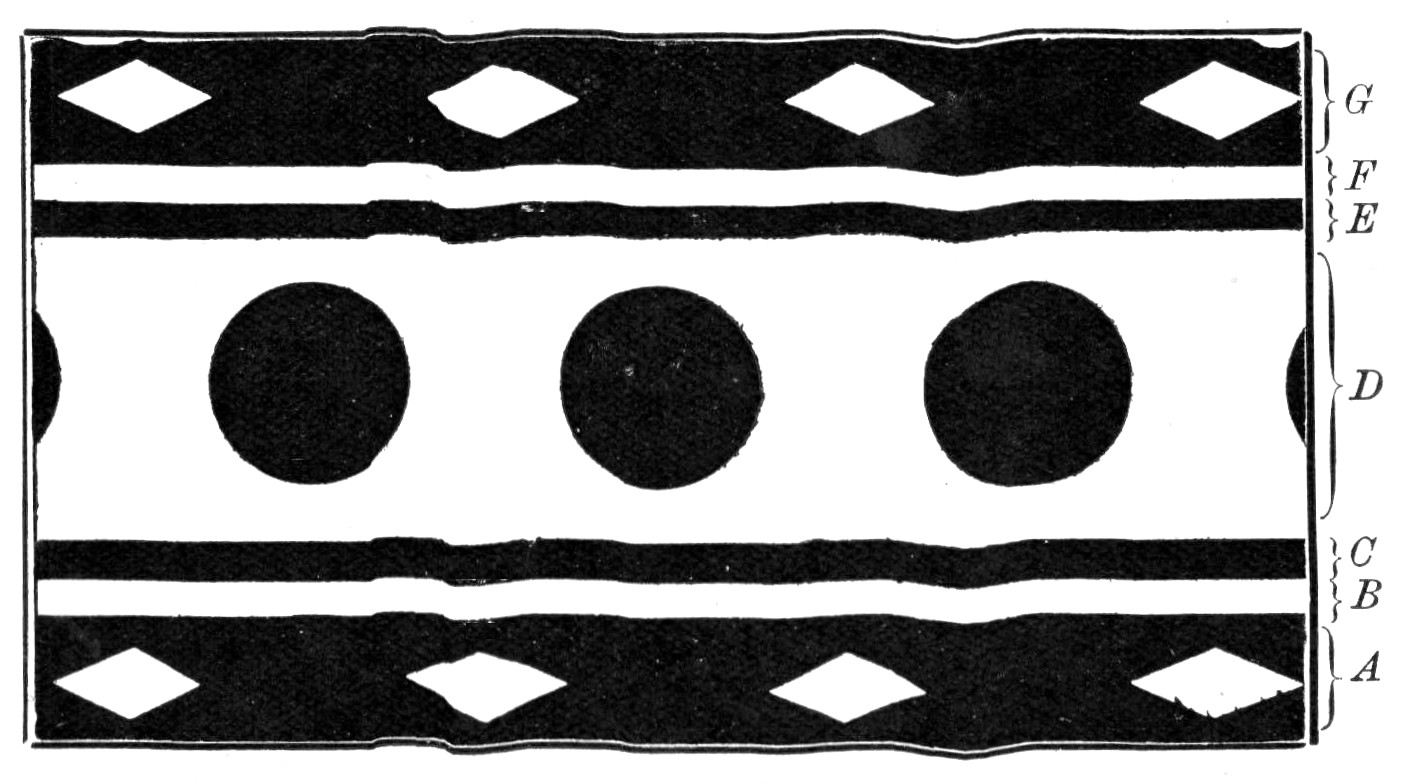
resultant. Fig. 3 illustrates the class of designs
adapted for this work. Form and arrangement should be of
the most elementary kind, and the whole pattern clear and
pronounced, in order to allow of a complete development of the
colours formed on the respective edges of the various figures.
Intermingled, diminutive patterns give confused and indistinct
effects. On the other hand, broad and large designs yield
lustrous colourings, which the experimenter may feasibly
dissect, and which teach principles in colour arrangement,
harmony, and contrast, of utility in pattern production.
When the pattern in Fig. 3 is viewed through the refractory
angle of a prism at a distance of about two feet, and about
three times larger than here sketched, it forms an interesting
assortment of colourings and tinted effects. Any description
of this experiment, however concise and clear, can only afford
a vague idea of the real appearance of the pattern when prismatically
examined. Still, to assist the reader to make the
experiment accurately himself, a detailed analysis is given.
Treating of the different sections of the patterns, the edge of
band A, nearest the observer, should be considered first, which
commences with pure green, running through blue, purple,
deep violet, and crimson. The crimson results from the violet
rays of this edge blending with the intense red rays of the
further edge of band A.
Small Lines B and C. The former begins with crimson,
which successively changes into scarlet, orange, and yellow, a
small strip of white separating these colours from those of
band C, which consists of various tints of green and orange.
Diamond Figures of Band A. The front edges of these
are tinted with scarlet, orange, and yellow, and the opposite
edges with various shades of green.
Circles of Band D. First, as to the edges nearest the
observer. These are coloured with emerald-green and grass-green.
It will be noticed that the green in this section of
the pattern is distinct from that produced by the front edge
of band A, being, as stated, more grass- than sea-green.
Its peculiar tint results from the orange rays of the upper
edge of band C intermingling with the green rays of the
circles. As the centres of the circles are approached, green
is succeeded by blue, purple, and black. Second, as to the
distant edges of the circles. At these points red, crimson, scarlet,
and orange—the latter colour graduating imperceptibly into
yellow—all occur. It is notable that the yellow hue is somewhat
dingy, being adulterated with other colours. Compare it,
for example, with the yellow resulting from the extreme edge of
this diagram. Its dulness and impurity are due to certain colours
intermingling with it. Thus, the space between the extreme edge
of the circles and band E is so limited, that the yellow rays of
the circular objects combine with the green rays of the latter,
and, as a consequence, the yellow suffers in purity and luminosity.
Bands E, F, and the Front Edge of G. These, very closely
resembling strips B, C, and A, require no description.
Extreme Edge of Band C. Here the red side of the spectrum
is seen in its intensity and lustre; it begins with deep red,
which gradually verges into orange, and the latter into yellow.
This simple experiment demonstrates the value of prismatic
results. All colourists should study shade combinations through
these media. Analysis of the colourings obtained in this
manner increases the acuteness of the faculty of discrimination
of the brilliance and depth of hue of individual colours. Though,
in practice, the textile designer has to deal exclusively with
pigments and dye substances, yet the intensity and beauty of
the combinations resulting from the decomposition of light are
so novel and suggestive, that all desirous of cultivating aptitude
for harmonious colourings will be at pains to multiply experiments
of this class, which afford a true conception of what
constitutes harmony and contrast in colours.
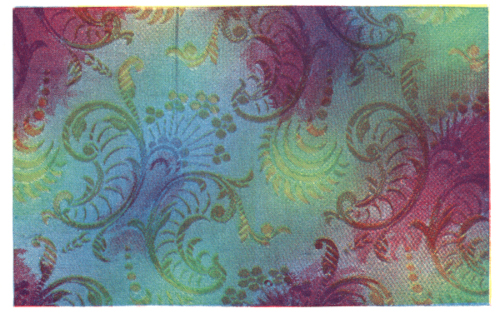
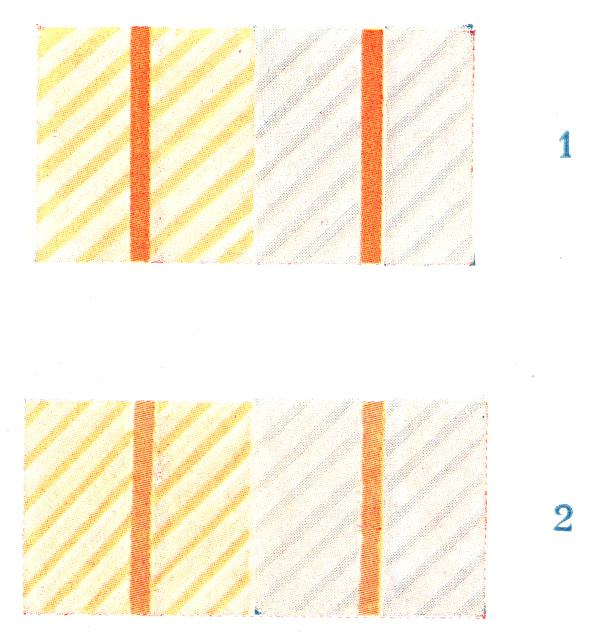
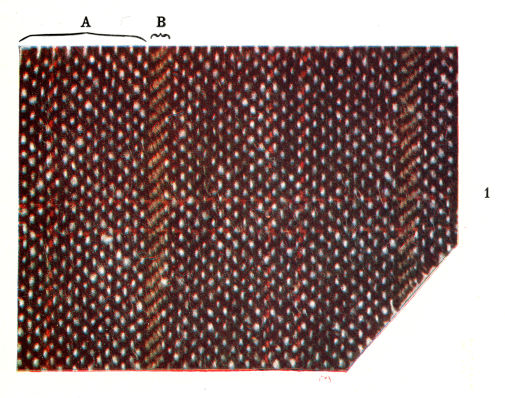
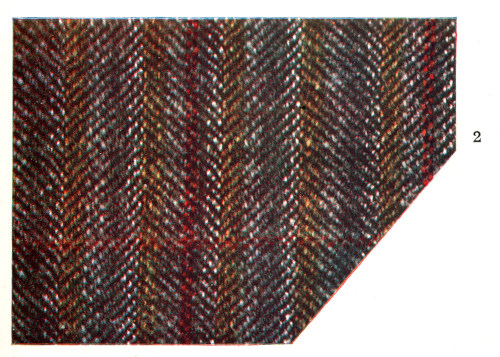
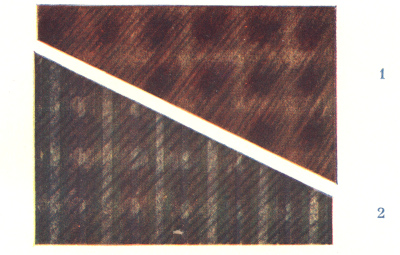
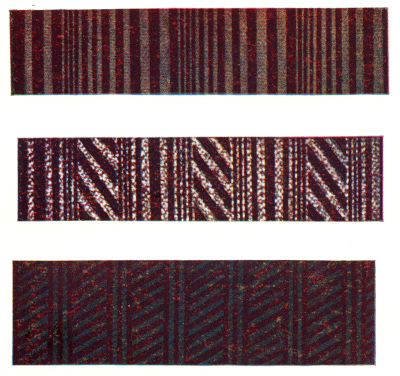
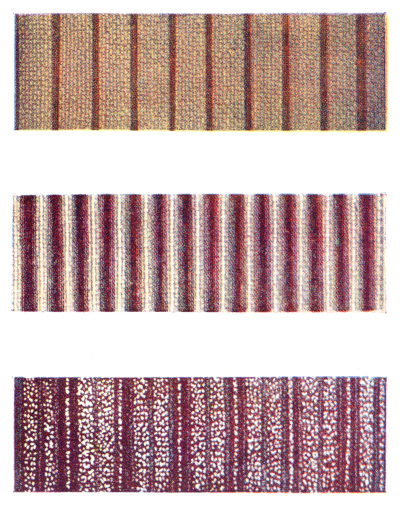
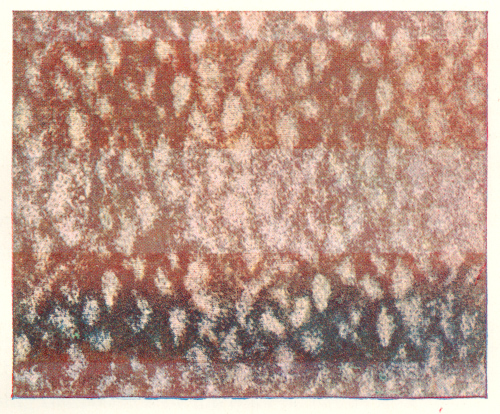
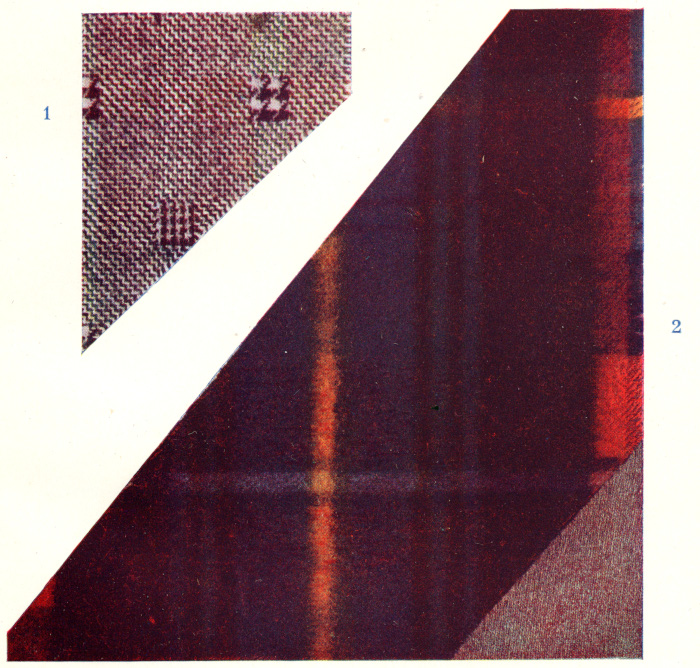
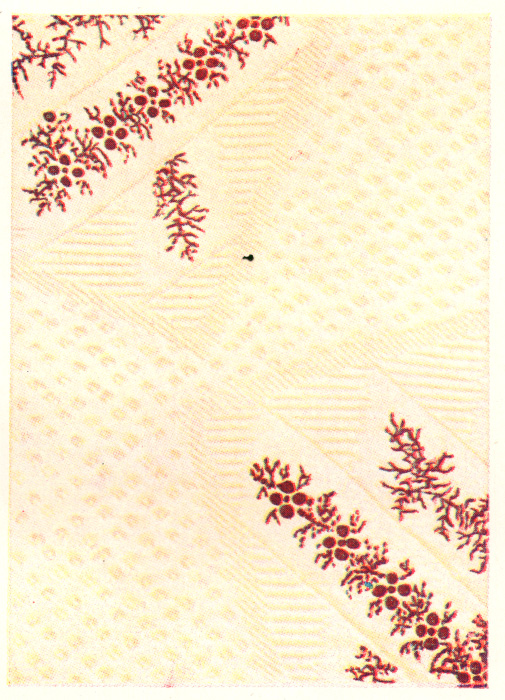
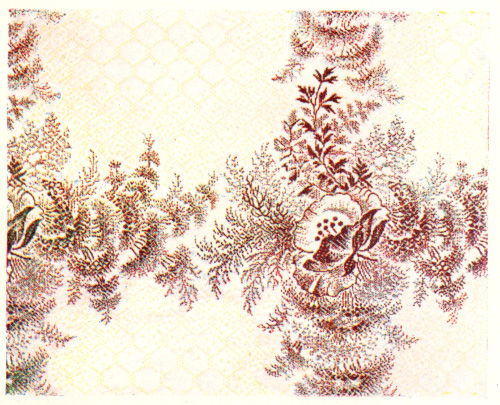
That such compounds of spectrum colours have an application
to textile design is evident from the specimens on Plate II.,
in which tints of the pure or prismatic colours are used in
silk fabrics. The mode of distribution is irregular, but this is
done for the purpose of subduing the strength of contrast
which would be formed if the colours were used on the basis
of the experiment described. Two fabrics are given as examples
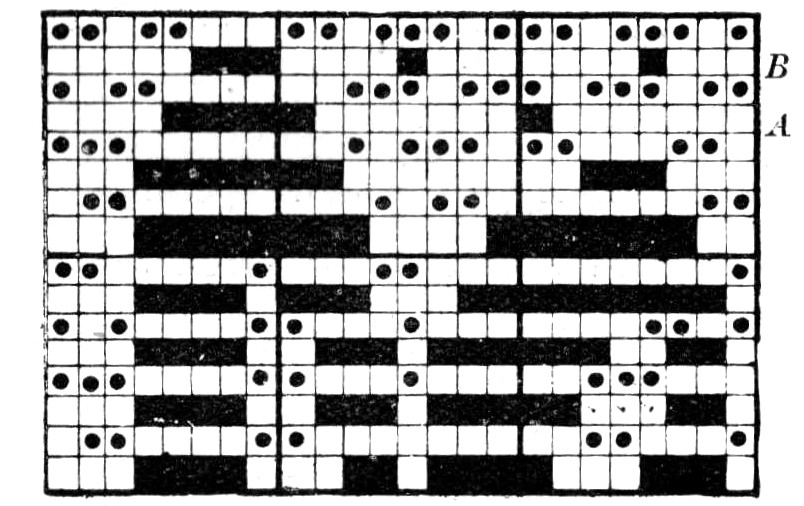
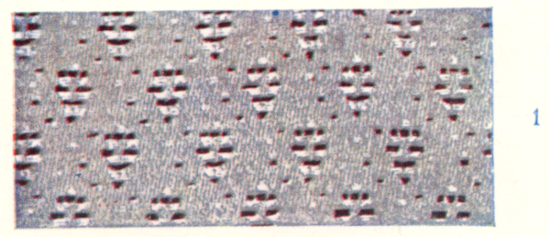
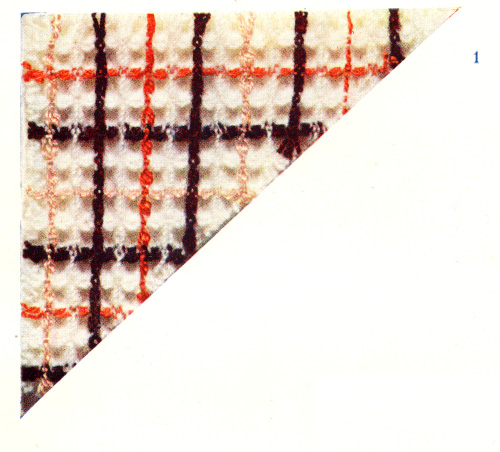
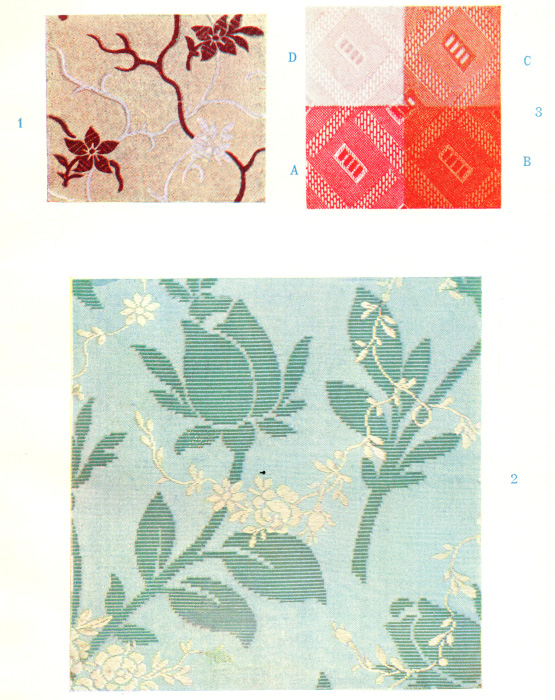
on Plate II. No. 1, a silk ribbon, is produced by weaving in
a bold warp rep or cord weave, the colours being arranged in the
warp to give the intermingled shaded effect. The weft is a thick,
yellow cotton yarn, but, owing to the weave structure, does not
show on either the face or underside of the texture. In the
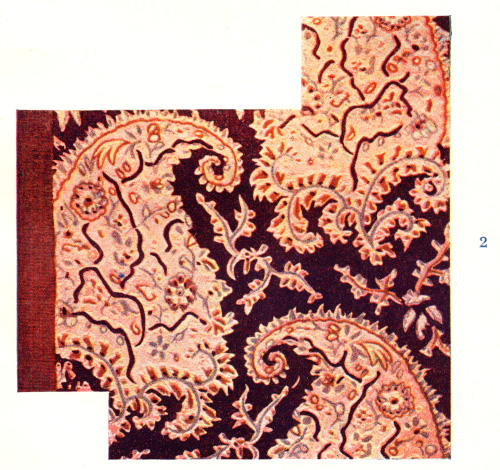
second example, No. 2, the colouring is due to printing the warp
prior to weaving. It has a similar intermingled composition,
but the colour contrasts are harsher in tone. Both examples
show the utility of prismatic colours in their purity, or when
slightly subdued by tinting.
Fig. 4.
8. Schemes of Colouring.—There are two important theories
of colour—the Light Theory and the Pigment Theory. The
former deals with the phenomena of colours, the attributes of
light, and the laws, which control the modification of the
intensity, hue, and tone of colours. These varied phenomena
are theoretically of value, but as they have few practical
applications, the pigment theory of colouring is necessarily
adopted in the applied arts, and deals with colour as an
active element in decorative design. Every possible shade
and hue of colour may be obtained by mixing red, yellow,
and blue in variable proportions, and, of course, by toning
and tinting with white and black. Mixtures of lights and
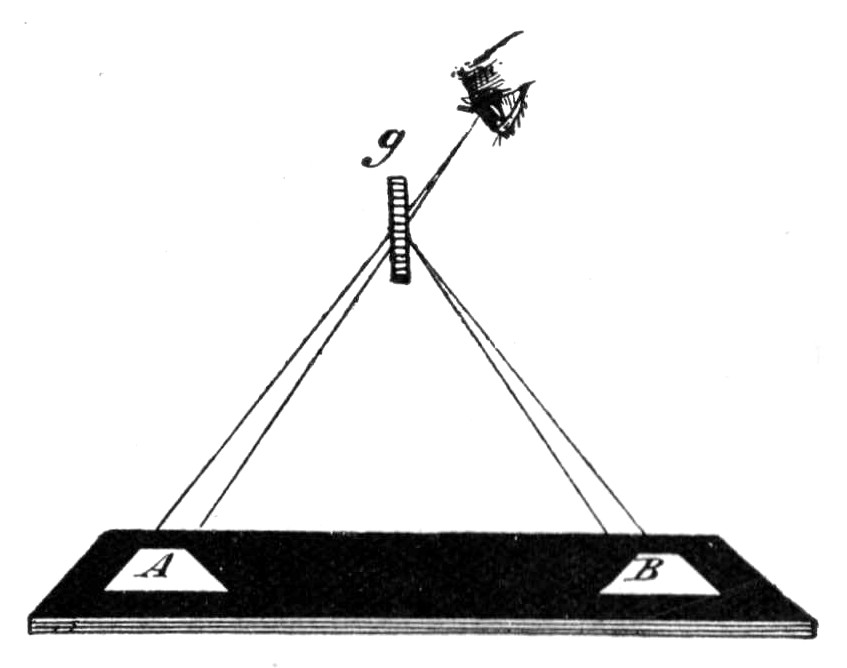
pigments, however, do not give analogous results. Lambert[6]
is credited with being the first to discover and prove that
the colours due to these two causes were rarely identical,
and frequently widely dissimilar. His method of doing this
consisted in using two coloured wafers, A and B (Fig. 4), which
were placed on a black surface, and a piece of ordinary glass, g,
fixed vertically. It was found that when blue and yellow were
thus simultaneously seen, the rays reflected by them did not,
when co-mingled, give green, but a whitish-coloured sensation.
This fact was also subsequently elaborated by Helmholtz, who
pushed his inquiries into the spectrum itself, and, by blending
the lights, obtained valuable
results. Blue-green, when
mixed with red, instead of
giving a brownish or greenish
grey, as with pigments, was
found, like ultramarine blue
and yellow, to also constitute
white light. With pigments,
a mixture of chrome yellow
and ultramarine blue, in variable
quantities, forms different
tints of green. Microscopic examination of this compound does
not reveal the separate particles of yellow and blue pigments,
but simply the greenish hue. The real and obvious distinction
between spectrum and pigment combinations is that the former
are additions, while the latter are subtractions. Knowing this,
it will at once be evident that the colours obtained by these two
methods cannot coincide.
The following are some of the results of combining coloured
lights and pigments respectively:—
Table III.
Compounds of Coloured Lights.
Red + green = yellow. Should the green be slightly bluish
= white.
2 red + green = orange.
Green + blue = sea-green.
2 green + blue = greenish sea-green.
Blue + red = purple.
2 blue + red = violet.
Red + green + blue = white.
2 red + green + blue = white + red, or pale red.
2 red + 2 green + blue = white + yellow, or pale yellow.
Red + 2 green + 2 blue = white + sea-green, or pale sea-green.
2 red + green + 2 blue = white + purple, or pale purple.
Table IV.
Colours resulting from Combining Pigments.
Primaries.
Secondaries.
Tertiaries.
Red + yellow
= orange.
2 R + Y + B, or O + P
= russet.
Yellow + blue
= green.
2 Y + R + B, or O + G
= citron or greenish olive.
Blue + red
= purple.
2 B + R + Y, or G + P
= olive.
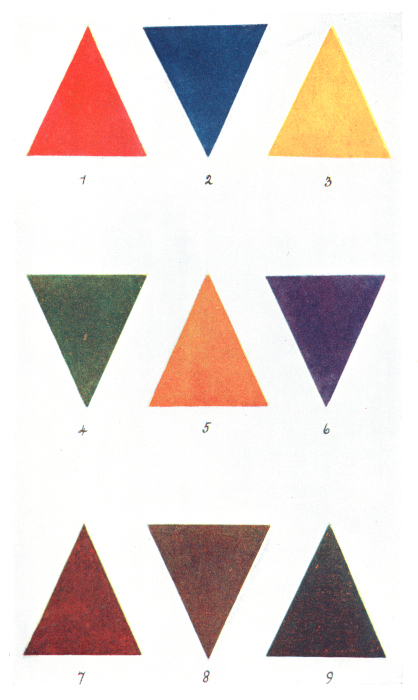
9. Primary Colours.—Writers on the pigment theory are
all agreed as to the selection of the simple colours; but scientists
have, in treating of this subject, chosen several sets of hues as
primaries. Young and Helmholtz take red, green, and violet;
vermilion, emerald-green, and ultramarine blue are selected by
Maxwell. When the subject of colour is considered with a
view to its practical application to the arts, it is needful to
base all combinations on the scheme elucidated by Chevreul,
Hey, Field, and others—that red, blue, and yellow (Plate
III., Nos. 1, 2, and 3) are primary colours, and all others
the resultants of mixing them in variable quantities. For
technical purposes, it is therefore only feasible to deal with
colour as it changes, according to the pigments combined;
hence red, yellow, and blue will be regarded as primaries,
because, when mixed with each other and with black and
white, every possible shade of colour may be obtained.
10. Compound Colours.—These are of two classes—secondaries
and tertiaries. The secondaries—green, orange, and
purple (Plate III., Nos. 4, 5, and 6)—are composed of two
primaries, while the tertiaries—russet, citron, and olive (Plate
III., Nos. 7, 8, and 9)—are composed of two secondaries. Orange
and purple produce russet or reddish brown; orange and green
produce citron or greenish olive; and green and purple, olive.
On reducing these shades to their simple elements, it is found
that they are each composed of three primaries, with one predominating
and giving tone to the colour. Russet, for instance,
contains a double portion of red, for red is a constituent of
both the orange and purple which enter into its composition;
citron contains a double portion of yellow, and olive a double
portion of blue.
The hue or tone of a compound colour is determined by the
proportionate quantities of the primaries combined in its production.
For example, to procure a bluish green, blue must
be the predominating and yellow the subordinate colour; while,
on the other hand, to obtain a yellowish green, yellow would
be the predominating and blue the subordinate colour. Reddish
or yellowish orange is got by increasing the red or yellow
constituents of this colour; and bluish or reddish purple, by
increasing the blue or red components of this secondary. This
affords some idea of how colours are modified and multiplied.
Taking the three secondaries and subjecting them to similar
treatment, a diversity of shades will be found to result.
Russet (Plate III., No. 7) is composed of two parts red, one
part yellow, and one part blue. It will be obvious that by
varying these proportions another series of hues will result.
By increasing the red constituent, the warmth of the colour
is intensified; by increasing the yellow, the reddish tone is
neutralized; while an increase of the blue would add to its
depth and saturation. Similar results are obtained by modifying
the constituents of the other primaries. Thus citron—composed
of two parts yellow, one part blue, and one part red—may
be changed to a yellowish, bluish, or brownish citron,
according to the quantity of yellow, blue, or red used. Olive,
which consists of two parts blue, one part red, and one
part yellow, varies from a deep olive-green, brownish olive,
to a yellowish olive-green, as the blue, red, and yellow constituents
are increased.
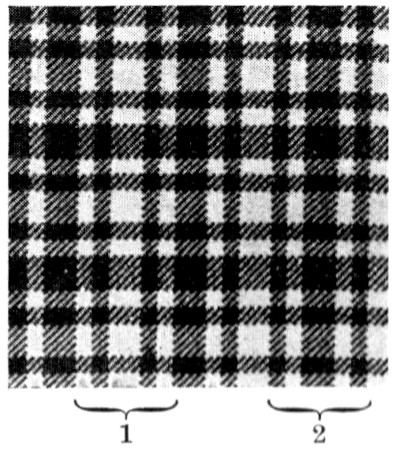
Plate II SPECTRAL COLOURING OF FABRICS 1. Woven-design Specimen
2. Printed-yarn Specimen
The tertiary shades are the most useful colours employed
in textile design. They are generally used for the ground of
the fabric, while the secondaries and primaries are utilized in
enhancing the brightness of the pattern.
11. The Three Constants of Colour.—The three constants of
colour are, purity, luminosity, and hue. If a piece of paper is
painted vermilion and placed across the red end of the spectrum,
it will be seen to be deficient in purity. Emerald-green and
ultramarine blue papers, when compared with their respective
sections of the spectrum, are found to be similarly defective. By
mixing white light with the colours of the spectrum they may
be so adulterated as to correspond with, or match, those obtained
by the use of pigments. Artificial colours are never perfectly
pure—they always contain some measure of foreign element,
which can only be correctly determined by bringing them in
contact with the colours of the spectrum. The second constant,
Luminosity or Intensity, depends on the degree of light a colour
reflects. Yellow, orange, and red represent the most luminous,
and green, blue, and violet the least luminous end of the
spectrum. It will be evident that it is possible to have two
or more colours of the same degree of purity, but of different
degrees of brightness. Two scarlets might both contain the
same proportionate quantities of colour and of white light,
and yet be dissimilar, simply on account of one being more
intense in hue than the other. To match the two colours,
the more luminous one would require to be exposed to a dull
light, or the less luminous to a bright light. The third constant,
Hue, is that special property which is caused by a definite refrangibility
of light, producing the colour proper. Green and
red may be exactly of the same purity and brightness, but they
are different in hue, each being produced by a distinct refrangibility
of rays.
12. Temperature of Colours.—The temperature of the
spectrum colours is not uniform. It augments from violet to
red. Herschel, by exposing thermometers to the several tints
of the solar spectrum, determined the temperature of each colour,
and proved that, proceeding from the most refracted or violet
end of the spectrum to the least refracted or red end, there is a
successive increase of heat. Besides luminous rays, the sun emits
a mass of invisible but potent calorific rays. Herschel, pushing
his thermometers beyond the visible red and violet rays, discovered
the presence in the spectrum of ultra red rays of intense
heat, and ultra violet rays of a less heat. The solar spectrum
may therefore be described as consisting of three distinct
sections: First, of the ultra and invisible red rays; second,
of the luminous rays, red, orange, yellow, green, blue, and
violet; and third, of the ultra and invisible violet rays. Though
it is thus evident that each spectral colour has a different
temperature, yet it cannot be assumed on this basis that a red
fabric will possess a greater degree of heat than a blue fabric
composed of the same materials; because all rays penetrating a
coloured body are not luminous, and yet, whether luminous or
non-luminous, they possess properties of heat. Were the rays
absorbed by a coloured surface only luminous, then it would be
possible, by estimating the measure of absorption, to determine
the colour temperature. But the bulk of radiation from any
luminous body consists of invisible calorific rays, regarding
which colour teaches absolutely nothing. A fact that has to be
taken into consideration is, that a body may be highly susceptible
to one class of rays, but insusceptible to other classes. As it
is generally known that black garments are more effective
retainers of solar heat than white garments, it may be pointed
out why this is the case. White clothes absorb the invisible rays,
but reflect the luminous rays which constitute solar light.
Black or dark clothes, on the other hand, not only retain the
dark rays which penetrate them, but also the visible rays; and
hence they are that degree warmer than white fabrics of the
same structure and material, as the difference in the influx of
temperature due to the absorption of luminous as well as invisible
rays. Tyndall explains that if a white cloth were spread
over the snow, it would even act as a shield to the latter instead
of assisting it to thaw. Snow, which is ice in a powdered form,
absorbs the dark rays with greater avidity than a white fabric;
and, as both the particles of snow and the threads of the texture
reflect the luminous rays poured upon them, the snow would melt
sooner without the cloth than with it. Indeed it would be found
that in a short time the cloth would occupy quite a prominence—the
snow not covered by it thawing more rapidly than that
over which it is spread. Should a black fabric of similar
material be next placed on sunned snow, it would produce the
very opposite results. Absorbing the luminous as well as the
dark rays, it retains more of the sun’s heat than the snow,
which rapidly melts under it; while the surrounding and uncovered
snow remains comparatively unthawed and icy. Both
the white texture and the snow are powerless as regards the
luminous rays emitted by the sun; the myriads of fibres composing
the former receive no warmth from them, nor can the ice-like
atoms of the latter be melted by them. They, in a word,
can only be changed by the dark rays. As to the black-surfaced
texture, there are different conditions to be taken into
account. It is both an absorbent of the invisible and of the
luminous rays, consequently dark materials not only attract but
retain more of the sun’s heat than light materials. More than
this cannot be stated with certainty about the warmth-yielding
qualities of woven textures of various colours.
[1] Mercerized cottons possess some of the qualities of silk colourings.
[6] Atkinson’s Ganot’s Physics; Tyndall’s Fragments of Science.
CHAPTER II. — ATTRIBUTES OF COLOURS. — FOOTNOTES:
13. Utility of a Knowledge of the Qualities of Colours—14. Qualifications
of the Textile Colourist—15. Functions of Pure Colours in Design—16. Red:
its Characteristics—17. Methods of Modifying Colours—18. Derivatives of
Red: their Qualities and their Province in Textiles—19. Blue: its Properties
and Uses—20. Derivatives of Blue and their Application to Woven Textures—21.
Shades and Tints of Blue mixed with Shaded and Tinted Reds
and Yellows—22. Methods of obtaining Well-balanced Colourings—23. Uses
of Blue in Twist Yarns—24. Points in the Application of Blue and Red to
Textiles Summarized—25. Attributes of Yellow—26. Province of Yellow in
Woven Fabrics—27. Derivatives of Yellow—28. Secondary Colours—29.
Green: its Attributes and Derivatives—30. Tints of Green—31. Orange: its
Shades and Tints—32. Purple.
13. Utility of a Knowledge of the Qualities of Colours.—In
order to apply colours artistically to woven fabrics, one must
be conversant with the attributes of the tints, tones, and hues of
colour the technologist uses in his work. More is requisite than
a mere acquaintance with the technical details which lie at the
basis of the construction of useful and decorative fabrics: this
knowledge must be supplemented by practice and training in
the blending of pure and other shades, and in the origination
of novel schemes of colouring. Exact knowledge of the quality
and application of colours, and of the laws which determine
harmony of colouring, is indispensable to the successful textile
designer. The pattern originator must display in his work a
reliable conception of the province of colour in woven style;
this is as essential as it is to the manufacturer to have regard
to the chemical composition, physical structure, and clothing
qualities of the materials used. As in blending wools and other
fibres, the nature and properties of each are taken into account,
so in colouring woven manufactures, the attributes of the several
shades and the method of arrangement require to be carefully
considered.
14. Qualifications of the Textile Colourist.—One of the
primary qualifications of a colourist is natural aptitude for his
work. To “feel” or appreciate harmony and contrast of colour,
the eye of the observer must convey to the mind an accurate
impression of the ensemble of shades visible. Two things are
requisite—intuitive and acquired taste for colouring, combined
with practice in textile designing. Yet these are insufficient.
They may enable one to judge of the purity of colours, or of
the degree in tone between two or more hues; but this faculty
for matching of colours, or of colour discrimination, however
acute, does not constitute that sense for harmony of colouring
which would make it a transgression of nature for a designer
to originate incongruous colour compounds. Another quality is
needful. It may be said to be practically, if not wholly, an
intuitive talent, for it may be displayed in the work of those
who possess but slender knowledge of the laws and theories of
colour. There must be taste or genius for colouring. Such is
the perfection in which some designers have this natural faculty
for colour blending and application, that they are a law in themselves.
Natural talent is the source of inspiration. This faculty
is invariably the better for culture. As a capacity for music
may be developed by training, so a power for colouring may be
augmented by studying harmony and contrast, and the general
principles of the science as they relate to the development of
patterns in the loom; consequently, though culture may not
create that acuteness of conception exercised by those who have
an intuitive bent for harmonious assortments of hues, yet it may
result in producing a passable, if not a proficient colourist, and
is, moreover, calculated to direct even the naturally talented to
a judicious selection and use of materials.
15. Functions of Pure Colours in Design.—Before treating
of the attributes of the primary and secondary colours, namely,
red, blue, yellow, green, orange, and purple, it may be useful to
allude to the application of these colours to the various types of
woven decoration. Some designers so rarely use such hues,
unless tempered with either white or black, that they seem to
entertain an idea that they can only be made to yield strong
and harsh contrasts. Certainly this is likely to occur if they
are not combined with due regard to intensity and quantity of
hue, the methods of distributing the several colours, and the
relative effect they have on each other in the woven fabric.
Bright colours should always be applied to textures for the
purpose of imparting tone and character of pattern. Though,
generally, they do not form the groundwork of the style, yet
they should give additional lustre to the design. What such
hues are in decorative and pictorial art, they are also in loom
productions when skilfully employed.
Showy styles in which the primaries or bright colours are
present, result more from the system of combination practised
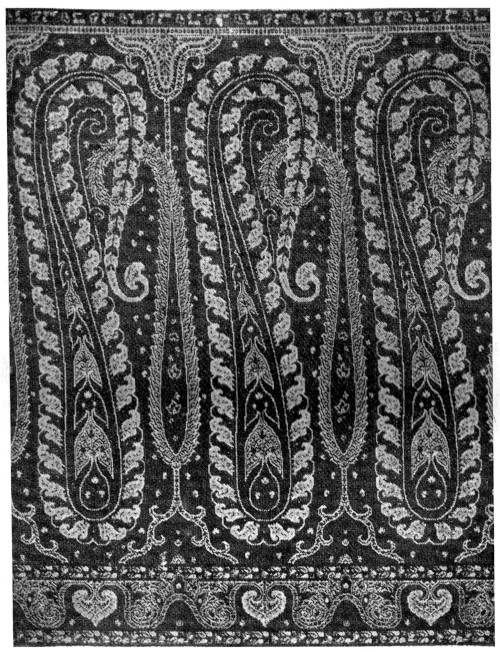
than from excessive brightness. The Indian shawl—or the
Paisley imitation—and the Turkey or Persian carpet, not infrequently
consist of designs composed of the most brilliant
shades producible in the dye vat. In the former, in addition to
a play on certain figures, which are generally unique in arrangement
and ingeniously grouped, there is a depth and fulness of
tinting that seems to possess all but a permanent freshness. As
to the Eastern carpet, it contains a large diversity of colours,
and mostly of a bright tone, but still the general effect is
pleasing and cheerful. To what are the congruity of tone and
richness of colouring due in these textures? This law is
observed in their composition: the quantity of each colour used,
depends entirely on the position it occupies in the pattern and
on its intensity and quality; while the several shades are so
blended that when the carpet or shawl is viewed in its entirety
the whole is harmonious in result. This is the general effect
sought after in tweeds and all classes of fancy fabrics. If scarlet,
blue, green, crimson, or orange were applied to a woven design,—though
decidedly stronger in hue than the shades forming
the bulk of the fabric—while tingeing the pattern with a freshness
of tone, they should not be allowed to unduly attract the
eye. The use of twist yarns very largely facilitates the production
of congruous combinations, in which bright colours play a
prominent part in the composition of the pattern. By employing
these threads, the colours may be broken up, in which form they
do not produce that continuity of effect which necessarily results
from the use of self-coloured yarns. Success in effective colouring
with pure hues lies, however, in a proper distribution of the
shades combined, incongruity of effect being as largely due to
defective balancing of colour as to injudicious and distasteful
combinations; in a word, there is as much dependent on the
arrangement, as on the selection and blending of shades in pattern
origination.
Plate III PRIMARY, SECONDARY AND TERTIARY COLOURS
In addition to thus acting as the brightening elements in
woven design, these colours are also used in some classes of
textures as ground shades. For instance, they are the principal
colours employed in dress fabrics of a Scotch tartan class, certain
kinds of shawls, silk neckties, handkerchiefs, and wraps; but
generally, in worsted and woollen textures they are used
sparingly, and for giving lustre to a sombre mixture of
colours. Pure colours have therefore two distinct functions in
textile patterns: first, they constitute a kind of supplementary
colouring which imparts lustre and intensity of hue to the style
to which they are applied; and, second, they may be the
principal colours comprised in the design.
16. Red: its Characteristics.—Red (No. 1, Plate III.) is designated
a simple or primary colour in both the light and
pigment theories of colouring. Of all hues it is the most showy,
brilliant, and gorgeous. Intense red is so powerful that when
used in large quantities it neutralizes the effect of adjacent hues.
On this account, its distribution in textiles should always be
accomplished in accordance with the depth of the other colours
entering into the style; that is to say, its intensity, as well as
its quantity, must be varied in the same proportion as the general
colouring of the pattern is diminished or augmented in tone.
An otherwise satisfactorily coloured pattern may be destroyed
by using a red too potent in hue, or by using this colour too
profusely. Yet red is decidedly one of the most useful colours
at the command of the decorative designer and the textile
producer. Whether employed as a pure, or as an adulterated
colour, it is of extensive utility in textile designing. When
judiciously applied, it adds brightness and cheerfulness to woven
effects. Its true sphere in textiles is to impart freshness. Red
in these compositions is the brightening or toning hue. In
applying red tints to worsted and woollen fabrics, they should
seldom occur in patches or in continuous lines of a check arrangement,
but they should be more or less intermittent in effect.[7]
It should be borne in mind that in these fabrics it is not
loudness or showiness, but neatness of style, that is sought
after, yet the quality of brightness must not be lacking. In
the form of twist yarns, reds and scarlets may be made to
produce exactly the general toning required. This mode of
applying this colour is particularly well adapted to textures
of a cheviot and tweed description. Worsteds require different
treatment. One method of introducing reds into these fabrics
consists in using silk yarns, and simply bringing them on to
the surface to form a bright spot or minute line of colour.
In silk, cotton, and some kinds of linen textures, this primary
is used in larger quantities, and more liberally displayed in
patterns composed of these materials, than in the ordinary run
of woollen and worsted fabrics.
Being such a potent and bright colour, it is of utility in
the blending process of manufacturing, when several shades of
materials are combined to produce a mixture yarn. Some
mixtures or blends of this class contain scarlet wools, which, in
whatever form they occur give tone and quality to the combination
of which they form a part. A variety of tints and
shades results from mixing red in different quantities with
black or white, and also an extensive range of hues from combining
it with other colours. Still, pure red is not so
liberally used in textile work as its derivatives: thus, it
unites with yellow and blue in the production of orange and
purple. Should a small quantity of yellow be added to red, it
gives scarlet, while the addition of a small quantity of blue
produces crimson. The richness and luminosity of the scarlet
are determined by the proportion of yellow added; and the
depth of the crimson by the amount of blue entering the
mixtures. Both in scarlets and crimsons, a considerable diversity
of hues is obtainable. Before either of these colours is produced,
red undergoes a series of gradations of hue. In the rose,
there is displayed to perfection the various modifications in tint
and shade of which this colour is susceptive. Scarlets, crimsons,
maroons, russets, and browns are all hues employed by the
weaver that obtain their prevailing tint from this primary.
17. Methods of Modifying Colours.—All pure colours, such as
red, blue, yellow, orange, green, and purple, may be subjected to
three kinds of modification: first, they may be darkened in
tone; second, lightened in tint; and third, changed in hue.
If, for example, black is mixed with red in various proportions,
it produces tones or shades of this colour, while an admixture of
white with red yields different tints of red. To alter the hue, it is
necessary to blend it with some other colour, such as blue, when
various shades of full-toned crimsons result. In blending, and
also in the arrangement of colours in the warp and weft of the
woven fabric, the phenomena underlying the changes producible
in the tone and tint of a colour have to be taken into consideration.
Black and red wools when scribbled together give a dark
brown or reddish-brown mixture, according to the quantities
of the respective shades entering into the combination; on the
other hand, if white and red wools are blended, a mixture
of a pinkish character is obtained. Hence it is clear that the
same principles which determine the alteration in the shade,
tint, or hue of a colour when pigments are combined, also regulate
the results due to mixing several colours of textile fibres.
Strictly speaking, white and black cannot be designated
colours, being merely representative of the principles of light
and darkness, and acting, in the multiplication of shades and
tints, as the great modifiers of colour. Such is their province in
the rôle of colour production. In design, they are indispensable
in mellowing certain combinations of hues, and in giving
precision and clearness to specific sections of a pattern. As
ground shades they are also useful. Light colours appear
bright and distinct on black surfaces; while deep colours,
such as blues, purples, and reds, appear intense and clear on
white materials. So that by a proper use of these shades it is
possible, in the first place, by the process of mixing them with
bright colours, to produce a variety of hues; and, in the
second place, by introducing them into the warp and weft of
the pattern, to impart smartness and lustre to the colours
employed.
18. Derivatives of Red: their Qualities and their Province
in Textiles.—By the derivatives of a colour, are signified those
shades and tints which result from mixing it with various
quantities of white or black. Those obtained from red are both
numerous and important, being specially useful in the production
of woven effects. They comprise both ground and fancy hues.
First, in the category of the derivatives of this primary, are
those shades produced by toning it with black. A few typical
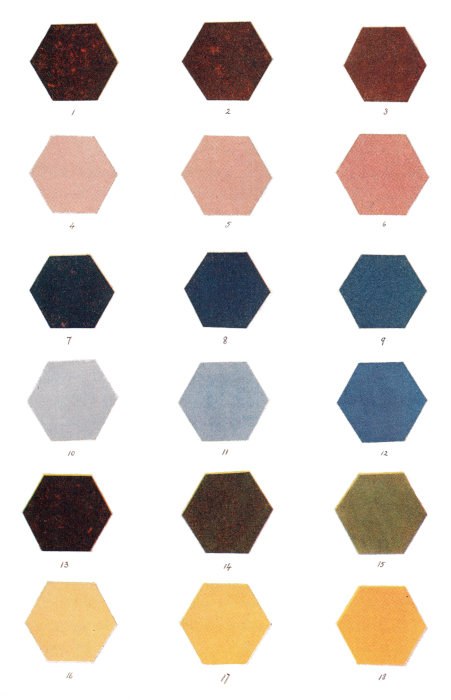
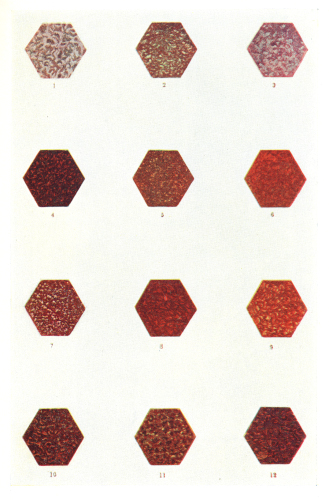
specimens of these are given in Nos. 1, 2, and 3, Plate IV. The
brightest shade (No. 3) is compounded of three parts of red and of
one part of black; the medium shade (No. 2) of equal quantities
of red and black; while in the dark brown (No. 1) black preponderates,
the proportions being one part of red to three parts
of black. Such shades of brown may be used as ground colours,
but the two latter are the most appropriate for this purpose.
Shade 3 is, however, frequently employed with good results
in dress fabrics for the foundation of the texture. Some excellent
colourings ensue from their combination. The two extremes—Shades
1 and 3—when employed in the same style give a softly
toned pattern. A less pronounced contrast ensues from a compound
of Shades 1 and 2, or Shades 2 and 3. In combinations
of this kind, there should usually be a larger quantity
of one colour element than another. Another method of combining
these shades consists in introducing the three into one
pattern. For example, if twelve threads of Shade 1, eight
threads of Shade 2, and four threads of Shade 3, were woven
together and checked over in the weft by a similar arrangement
of yarns, a neat design would be obtained. It might
be changed by taking four threads of Shade 1 instead of
twelve, and twelve threads of Shade 3 instead of four. In the
former style the dark brown would preponderate, but in the
latter the light brown, the quantity of the medium hue being
the same in each instance. These illustrations demonstrate
the utility of these shades and the systems on which they
are amalgamated in pattern construction.
The tints Nos. 4, 5, and 6, on Plate IV., are characterized
by brilliance and intensity of tone, making them adapted
for imparting lustre and richness to design. Like the colour
from which they obtain their specific tint, they are ostentatious
and potent in effect. While the shades given in Nos. 1, 2, and
3 are all darker in tone than the original red, these tints are
lighter on account of the entrance of white into their composition.
Thus they are made up as follows:—
Tint 4, Plate IV.—1 part of red and 3 parts of white.
Tint 5, „ „ —2 parts of red and 2 parts of white.
Tint 6, „ „ —3 parts of red and 1 part of white.
Bright tints of this kind are extensively used in figured
weaving, as in the manufacture of vestings, silk neckties, dress
fabrics, and trimmings. Sometimes in the latter description of
textures they form the pattern proper. In the ordinary run of
woollen and worsted cloths they are, however, only sparingly
employed, and that in the form of twist yarns. Amongst the
varieties of twists which can be produced by combining two or
more of these shades and tints of red, the following are selected
as suggestive illustrations:—
I.—One thread of Shade 1 twisted with one thread of Tint
4, Plate IV.
II.—One thread of Shade 1 twisted with one thread of Tint
6, Plate IV.
III.—One thread of Shade 2 twisted with one thread of Tint
5, Plate IV.
IV.—One thread of Shade 3 twisted with one thread of Tint
4, Plate IV.
V.—One thread of Shade 1; one thread of Shade 3; and one
thread of Tint 4, Plate IV., twisted together.
Each of these compound yarns, in worsted, woollen, or cotton
materials, is capable, when judiciously applied, of contributing to
the quality of woven pattern.
Another section of manufacturing in which these derivatives
are employed is in the blending process, or in the production
of fancy mixture yarns.
19. Blue: its Properties and Uses.—Blue (No. 2, Plate III.) is
one of the most valuable colours used by textile designers. In
dark shades it is utilized for the ground of patterns; in medium
shades it is employed for mellowing and toning purposes; while
bright blues convey freshness and force of colouring; so that
this primary has three distinct functions in textile designing.
In each of these, it will be indicated what its properties are
as a colour, and the relation it sustains to other shades with
which it may be combined.
Unlike red, which is decidedly a warm colour, the quality
of blue is cold and retiring: this distinguishes it from yellow,
orange, and red, which produce a sensation of warmth.
Resembling violet and purple, it is indistinct and neutral in
a declining light, but strong and brilliant in a bright light;
hence, when applied to light grounds, it is not only pronounced
in hue, but is quite distinct from other shades, while on a dark
or black surface it is both mellow and lustrous in effect.
Its property of “coldness” renders it a useful shade for subduing
the redness of tone of some colourings; for it in some
degree neutralizes the warm hue of the browns, maroons, russets,
or other shades forming the pattern in which red is prevalent.
This does not, however, indicate that red and blue harmonize;
on the contrary, whenever these two colours are associated in
large quantities, the resultant composition is somewhat incongruous;
but that when combined with browns and russet
olives, or shades in which the red tint is assimilated by the
quantity of black they contain, blue can be made to yield
excellent coloured effects. Pure blue, like pure red, is not so
largely used as its derivatives, still it has a place in textile
designing. This is principally as a fancy yarn, when it gives
freshness and bloom to the pattern. It is also employed as a
ground colour in the manufacture of fine silk fabrics, and as the
figuring colour in certain makes of fancy worsteds.
Plate IV TONES AND TINTS OF THE “PRIMARIES”
1. 2. 3.
Tones of Red
4. 5. 6.
Tints of Red
7. 8. 9.
Tones of Blue
10. 11. 12.
Tints of Blue
13. 14. 15.
Tones of Yellow
16. 17. 18.
Tints of Yellow
20. Derivatives of Blue and their Application to Woven
Textures.—If blue is mixed with black, shades of an indigo
character result; but, if mixed with white, peacock blues,
lavenders, and pale blues are formed. Some few examples in
both these types of derivatives may be considered. From the
series of dark or shaded blues three examples have been selected,
namely, those in Nos. 7, 8, and 9, Plate IV. The first consists of
one part blue and three parts black; the second (No. 8) of two
parts blue and two parts black; and the third (No. 9) of three
parts blue and one part black. Shade 1 (indigo) is a useful colour
for piece-dye goods, as well as for the grounds of fancy fabrics.
By studying this method of mixing, it will be observed how a
pure and intense colour may be gradually darkened in shade, or—if
white is added—gradually lightened in tint, until it closely
resembles black or white, as the case may be. This system of
varying the tone of a colour makes it feasible, by a proper assortment
of hues, to produce stripes or checks in light or dark shades.
Take, for example, the three blues given in Nos. 7, 8, and 9 on
this Plate. If these are put together thus: eight threads of
Shade 7, eight threads of Shade 8, and eight threads of Shade 9,
a shaded blue check will result, which in worsted, woollen,
or cotton yarns gives a satisfactory pattern. Let the warp
thus arranged be crossed with similar quantities of the respective
shades, and checks of the several blues will be formed in the
fabric. This plan of colouring produces checks of equal proportions
of the different shades; but, if needful, these might be
easily got in various dimensions, say, for instance, the darkest
check about three-quarters of an inch in size, and the remaining
two checks half an inch.
A few of the principal tints of blue, got by mixing this primary
with white, in the same proportions as the shades just described
were produced by mixing it with black, are Nos. 10, 11, and
12, Plate IV. The white has given them a softened and
mellowed tone, having neutralized that forcible and striking
attribute which characterizes pure blue. On comparing them
with the original colour from which they result (No. 2, Plate III.),
the degree to which white subdues and mellows bright hues
with which it is blended will be evident. Tints of this class
are used in various ways in designing. Some styles in
silk handkerchiefs are producible by the exact depth of
hues seen in the illustration—these weights of colours forming
congruous and evenly-balanced patterns. They are also
largely employed in cotton textures. One example of this type
of combination is given in No. 1, on Plate VII. This is a sketch
of a fabric made of cotton yarns. The warp is light blue—Tint
10, Plate IV.—and the weft a deeper blue, or Tint 12. The
neatness of this colouring is due to the soft contrast between
the tints of the warp and weft yarns.
21. Shades and Tints of Blue mixed with Shaded and Tinted
Red and Yellow.—In the styles in which blue is employed for
ground purposes, indigo shades are invariably used. Blue, however,
is not a foundation colour that admits of much diversity
of tinting. To succeed in its application to the grounds
of patterns, a good range of browns, olives, and greys is
important. With shades of the olive class it gives the most
marked contrasts. This is due to yellow being the prevailing
tint of this compound hue. But it also mingles harmoniously
with certain tints of grey and brown. Patterns in which these
shades are arranged as in Tables V. and VI., in woollen,
worsted, cotton, or silk yarns, illustrate the methods of combining
blue effectively with different shades and tints of red and
yellow. In Table I. the combinations of shades are included;
but in Table II. will be found the tints of red, blue, and yellow.
The colours are given in groups of six threads, and would,
providing the arrangements appended were carried out in the
weft, produce a series of clearly developed check effects.
6 threads of very pale yellow (Tint 16).
6 threads of pale lavender (Tint 10).
Ex. 2. Light tints.
Blue and White, and Yellow and White equally mixed.
6 threads of lavender (Tint 11).
6 threads of pale yellow (Tint 17).
Ex. 3. Deep tints.
Blue and Yellow predominating.
6 threads of tinted blue (Tint 12).
6 threads of tinted yellow (Tint 18).
22. Methods of Obtaining Well-balanced Colourings.—From
these Tables it will be evident that if the shade of blue is
modified, that of the combining colour is also changed. Unless
this rule is adhered to, the arrangement adopted will give incongruous
results. Only a certain depth of blue harmonizes with
a corresponding depth of brown and olive; if one predominates
over the other, the colouring becomes deficient and
displeasing to the eye. For example, if Shades 1 and 9 and
Tints 4 and 12 were blended, the result would not be so mellow
as if Shades 1 and 7 and Tints 4 and 10, as in the Tables,
were combined. The reason for this is that, in the first instance,
a shade of red in which black preponderates is used with a
shade of blue in which blue preponderates; while, in the second
instance, a tint of red in which white preponderates is associated
with a tint of blue in which blue preponderates; whereas, to
produce a perfect balance of colour—that is, providing the
quantities of the respective colours are equal—it is necessary for
the shades or tints combined to contain exactly the same quantities
of black and white, as in the combinations of Shades 1 and 7,
and Tints 4 and 10 of Plate IV.
In no combination given in Tables V. and VI. is there a lack
of harmony; indeed, considering the principle on which they
have been obtained, this is almost impossible. Thus, take Ex. 1
in Table V. Here, dark shades of blue and brown are associated.
In both colours black preponderates; that is to say, the former
is composed of three parts of black and two parts of blue, and the
latter of three parts of black and two parts of red. Providing
the primaries blue and red (Nos. 1 and 2, Plate III.) harmonize,
these shades, which are their derivatives, will also mix well
together. A test to which they can be submitted is to view
them side by side. If slips of these shades are thus combined,
they do not appear incongruous and harsh in tone, but possess
a soft and mellow aspect, and in this consists the true characteristics
of harmonious colourings. As the tints are worked out
on the same system as the shades, they form useful compounds.
In order that this important element of congruous colour effects
may be clearly understood, let Ex. 1 of Table VI. be also briefly
examined. Such a combination can only yield an agreeable
pattern. Whether these tints are blended in the wool or in
the yarn, the resulting mixture is satisfactory. This arises
from the weight or depth of colour of the respective tints
being identical; in other terms, the intensity of the tinted red
is precisely the same as that of the tinted blue. In dress
stuffs, tennis flannels, fabrics for trimmings, silks, and extreme
fancy textures, this blend of tints is invariably pleasing.
Equally harmonious results may be arrived at by combining
tinted red (No. 4) with tinted yellow (No. 16), or tinted blue
(No. 10, Plate IV.) with tinted yellow. In each of these
compounds, delicacy of tint and mellowness of hue are the
prevailing qualities.
23. Uses of Blue in Twist Yarns.—Having now treated of
blue as a ground colour, and also as a shade for blending with
other hues to tone down a style or subdue its coloured aspect,
it only remains to indicate its utility as a colour for twist yarns.
It is a valuable shade for this purpose. As it is a bright but not
a showy colour, it is particularly suitable for fancy two- or three-ply
yarns. Twists in which red, yellow, or orange are used, have
a tendency to overpower the general colouring of the pattern in
which they appear, but this is not the case in fancy yarns in
which blue is the principal colour. Such twists, while imparting
lustre and freshness to the design, in no wise detract
from its beauty of colouring, though that may be of a comparatively
subdued character. The following are a few examples
in two-ply yarns in which blue threads are employed:
black and blue; white and blue; brown (No. 1) and tinted blue
(No. 10); dark blue (No. 7) and tinted red (No. 4); blue and
yellow; dark blue and shaded red (No. 3, Plate IV.); and
medium blue and white.
24. Points in the Application of Blue and Red to Textiles
Summarized.—The analyses which have been made of the use
of blue and red in woven designs, have demonstrated that, whenever
primary colours are applied to textile fabrics in their purity
and natural intensity, it is in comparatively small quantities.
Brilliance of hue causes the application of primaries in large
patches to textile surfaces to be undesirable. In dress fabrics,
bright blue, red, and yellow have an important place. Mantlings,
shawls, wraps, and travelling rugs also provide scope for a
liberal use of these shades; but in treating designs with colour
for fabrics of the coating and trousering class, subdued and
indefinite shades prove the most useful. Red and blue are
valuable to impart tone and newness of character to the style.
The groundwork of the pattern should first have attention—the
intensity and strength of the bright colours depending on the
mode of application. Should the ground colouring of a pattern
be strong and harsh, the addition of green or blue will, in some
cases, give it a mellow quality; or should it lack brightness, then
red, orange, or yellow, if applied in small quantities and properly
distributed, will relieve the heaviness of the colouring and impart
the requisite freshness of aspect. Success in the use of pure
colours is determined by the quantities in which they occur, and
by the nature of the shades with which they are associated.
Bright red, however sparingly employed, if applied to a mixture
of brown or russet shades, cannot but form an incongruous
colouring; but if applied to an assortment of shades in which
soft-tinted blues and greens are conspicuous, both harmony and
contrast of composition would result.
Plate V PLAID IN WHICH YELLOW IS THE BRIGHT OVER CHECKING COLOUR
(5013)
25. Attributes of Yellow.—This colour (No. 3, Plate III.) is
generally understood to be emblematical of purity and brightness.
It is the most luminous tint in the spectrum. Purple is its complementary
and contrasting hue. Intense yellow—rich, bright,
and cheerful—has the same relation to light or whiteness as blue
has to darkness. It lacks the lustrous quality of red and the
retiring, mellow characteristic of blue, but possesses vividness
and lustre. Luminosity and brilliance of hue limit its application
to textile design; yet it has a sphere which no other
colour can occupy. Thus, in patterns in which white yarns
and light or delicate shades are employed, it is one of the
most important fancy colours it is possible to introduce into
the fabric. Mingled with such shades, it loses a degree of
that prominence and individuality of tint which characterizes
it when applied to patterns possessing dark and sombre
grounds.
Another quality of this primary is vividness—no colour being
comparable with it in this sense. Orange possesses this attribute,
but not so largely as positive yellow. Its characteristic freshness,
but comparative lightness of hue, imparts to it a clear and
decided tone on black or dark surfaces. Hence it is found
that when yellow is blended with light and medium greys
and lavenders, its property of lustre suffers in intensity;
whereas, if it is applied to dark blue, dark brown, or black
materials, its vivid attributes are forcibly distinguished. When
these modifications, which this and other bright colours undergo
according to the qualities of the several shades with which they
may be combined, are clearly understood, the possible effect of
their application to any pre-arranged scheme of ground colours
may be estimated. Obviously there are three factors to be carefully
considered when employing primary hues: first, the nature
of the contrast resultant when the colours are placed on light
materials; second, on medium-toned grounds; and third, on
textures composed of dark yarns. Yellow is somewhat lessened
in distinctiveness on the first, but improves in intensity on the
dark grounds, being only slightly changed when arranged side
by side with shades of a medium depth.
26. Province of Yellow in Woven Fabrics.—Pure yellow is
but sparingly used in textile designing. In tweeds and worsteds
it is combined, to a limited extent, with other shades in the construction
of fancy twist and mixture yarns. It is the principal
colour in the following two- and three-ply yarns: black and
yellow; blue and yellow; indigo blue and yellow; dark grey and
yellow; black, purple, and yellow; black, medium grey, and
yellow; and black, red, and yellow. When used in this form
it may add lustre and freshness to an otherwise sombre
style. It possibly gives the best results in tweeds, where the
fibrous nature of the texture helps to minimize its excessive
brightness. Yellow is also applied as a self-coloured yarn to
certain styles of check patterns for woollen travelling mauds,
shawls, and rugs. An example of a plaid pattern of this description
is given in Plate V. There are contrasts of dark green and
red, dark green and blue, black and red, and also yellow as an
intermediate colour between green and red, and as a checking
colour on the black. Yellow is thus used for two purposes:
first, as a divisible hue; contrasting with the green, and harmonizing
with the red; and second, as the strongest contrast possible
on the black. It gives what may be termed the chief checking
lines to the plaid, and produces freshness and lustre in the
style. These lines are of sufficient width considering the brightness
and vividness of the colour, which are two qualities to be
taken into account when using colours in combination with
other bright shades.
27. Derivatives of Yellow.—These are both numerous and
important. When blended with blue, as previously explained,
hues of green are formed, comprising myrtle green, sea
green, emerald green, and grass green, all of which vary in
tint according to the intensity of the bluish and yellowish
elements entering into their composition. Yellow with red, on
the other hand, yields an assortment of scarlet and orange hues.
Yellow with white gives delicate tints of a straw, lemon, and
primrose class (see Nos. 16, 17, and 18, Plate IV.); while with
black it forms many shades of an olive character, such as
those supplied in Nos. 13, 14, and 15 on the same Plate. If
it should be mixed with grey, it produces various tints of drab;
so that this primary is a very useful colour for blending with
other hues in the production of compound shades.
28. Secondary Colours.—The attributes and functions of the
primaries in textiles have now been defined. The secondaries—colours
resulting from mixing two primaries—possess quite
distinct properties from the hues of which they are composed.
Compared with the primaries red, yellow, and blue, they lack
intensity and strength of hue. Still, they are potent colours,
and, as a consequence, only produce harmonious combinations
when judiciously employed. As a rule, the stronger and the
more intense a colour, the greater the skill required in its
application to pattern or design. To use the secondaries in
large quantities with success, some practice in textile colouring
is essential.
Of these compound shades, orange is the most ostentatious,
being tinged with red; purple possesses depth and fulness of
hue; and green is suggestive of freshness. Each colour is
largely used in woven manufactures, the methods of application
depending on the type of the texture. In silk ribbons
and neckties, they are used as pure colours, and are also
applied to cotton and flannel shirting styles, linen vestings,
and fancy worsted shawls; but when employed in the ordinary
types of woollens and worsteds, they are somewhat subdued by
mixing with white or black, or they may form one of the threads
in a fancy twist yarn. The qualities of each colour will be
considered separately.
29. Green: its Attributes and Derivatives.—This is a useful
secondary colour. In the Light Theory of Colouring, it is a
primary hue; but it is already understood that, according to the
Pigment Theory, green is not a simple, but a compound colour
resulting from the admixture of the pigment yellow with the
pigment blue. Greens may also be obtained by the same process
in the dye vat. Thus the texture or material may primarily be
treated with the blue colouring matter, such as indigo, and
subsequently with the yellow dye-ware, such as weld or old
fustic.
In Nature, green is the most extensively distributed colour,
but in the decorative arts, unless modified, it has not a wide
application. As a colour it combines the qualities of its component
hues—blue and yellow—for it is at once fresh, bright,
and cheerful. When associated with the various shades and
tints of red, harmonious and contrasting combinations ensue.
Amongst the shades used in textiles derived from this secondary,
are myrtle greens, olive greens, slate greens, and dark greens.
Colours of this description are useful in textile work.
The spectrum green is only applied to extreme fancies, and
then chiefly as an extra, spotting, or figuring yarn; in tweeds
and worsteds, however, it forms an appropriately coloured yarn
for twisting with other threads of such shades as will neutralize
a degree of its intensity and lustre. In fact, green is one of
the most useful colours for twisting purposes employed in
textile designing: such twists as black and green, scarlet and
green, and white and green illustrating its utility in the production
of fancy yarns for tweeds.
Derivatives of green, due to its admixture with black, comprise
a fair diversity of medium and dark shades which are
employed as ground colours, and also for piece-dye textures.
Three examples in such shades are Nos. 1, 2, and 3, Plate VI.
In the first, black is the preponderating element, but in the
third, green is the prevailing hue. With the red browns given
in Nos. 1, 2, and 3 on Plate IV., they form perfect contrasts.
The most pleasing combinations are those in which the greenish
derivatives are blended in equal quantities with the reddish
browns as follows: dark green (No. 1, Plate VI.) with dark
brown (No. 1, Plate IV.); medium green (No. 2, Plate VI.) with
medium brown (No. 2, Plate IV.); and toned green (No. 3, Plate
VI.) with light brown (No. 3, Plate IV.). An endless variety of
striped and checked patterns in woollen, worsted, and cotton
materials is got by combining these shades on the lines just
indicated. Some excellent ground twists result from combining
dark brown (No. 1, Plate IV.) and toned green (No. 3, Plate
VI.); dark green (No. 1, Plate VI.) and light brown (No. 3, Plate
IV.); and medium green (No. 2, Plate VI.) and medium brown
(No. 2, Plate IV.).
30. Tints of Green.—The admixture of green with white results
in the formation of tints of pea-green. (See Nos. 4, 5, and 6,
Plate VI.) These blend harmoniously with the tinted reds
given on Plate IV. For example, the pea-green, No. 4, Plate VI.,
when blended with the whitish pink, No. 4 of Plate IV.,
the pale green, No. 5, Plate VI., with the rose colour, No. 5,
Plate IV., and the tinted green, No. 6, Plate VI., with the
tinted red, No. 6, Plate IV., all form satisfactory contrasts. As
the tints of the respective couplets perfectly balance, being of
the exact depth of hue, they constitute mellow and choice
combinations. Though these tints are not extensively employed
in fancy woollen and worsted fabrics, still there are some
classes of these textures in which they are used for ground
purposes. One illustration of this kind is pattern No. 2 on Plate
VII. The twilled ground of the fabric is a similar tint to
No. 4, Plate VI., while the spotting yarns are two-ply, namely,
tan and white, and crimson and white twists. The white
feature of the colouring serves a twofold purpose: first, it
neutralizes and subdues the intensity of the crimson and
tan threads; and, second, it imparts precision to the mottled
figuring.
31. Orange: its Shades and Tints.—Next to red, orange
(No. 5, Plate III.) is the most intense, showy, and potent colour.
It is closely allied to both red and yellow, of which hues it
is composed. Orange is more luminous, but less intense than
pure red, and is warmer, but not so bright in hue as yellow.
Its potency of hue causes it to suffer little impoverishment
either in lustre or intensity from juxtaposition with certain
shades. With colours of a reddish or yellowish hue, it undergoes
the most marked degree of modification; with blues and
greens, and also with their derivatives, its quality is not
perceptibly diminished. Whether distributed on dark or light
surfaces, it stands out with lustre and freshness, and hence is
one of the most appropriate colours for imparting brightness, or
for giving to any combination of shades, lacking these qualities,
a rich appearance.
Shades of orange (Nos. 7, 8, and 9, Plate VI.) are designated
brownish olives, possessing warmer attributes than the shades
derived from yellow, but wanting that strength and richness of
hue characterizing the russet browns resulting from mixing red
with black. As ground colours they are of utility to the textile
colourist. With shades of green they form complementary
combinations, as the following examples illustrate:—
I. Dark brownish olive (No. 7) with dark green (No 1,
Plate VI.).
II. Medium brownish olive (No. 8) with toned green (No. 2,
Plate VI.).
III. Light brownish olive (No. 9) with medium green (No. 3,
Plate VI.).
These shades also combine satisfactorily with the dark and deep
blues given in Nos. 7, 8, and 9 of Plate IV.
From the orange tints (Nos. 10, 11, and 12, Plate VI.) it will be
noticed that by mixing white with this secondary, salmon and
gold colours are obtained. They are useful in making twist
threads, and are also employed, to a considerable extent, in silk
yarns in the manufacture of vestings, spotted textures, neckties,
and fancies. Satisfactory styles result from combining
them with either tints of green or blue.
32. Purple.—There is no colour comparable with purple
(No. 6, Plate III.) as regards depth of hue. Its characterizing
qualities are softness, bloom, and richness of tone. It is a
composition of the warm and the cold, and the showy and the
quiet elements of the spectrum, namely, of red and blue.
It only yields congruous combinations with a limited range of
shades, and these generally belong to the derivatives of yellow.
Purple and pure yellow form a very pronounced contrast—an
example of which obtains in the common pansy. In this flower,
the deep but lustrous tone of the purple opposes the luminous
and pure hue of the yellow. From this natural combination of
these tints, it is possible to learn with what class of colours
purple will form the most effective contrasts. These are shades
in which yellow preponderates, such as tans, light olives,
and olive browns. To give bloom and richness of aspect to
combinations of fawns, olives, and similar shades, purple, in
conjunction with white, may be employed. Some excellent
tapestries, bordered rugs, and travelling mauds are produced
in which this hue is one of the principal colours.
Plate VI TONES AND TINTS OF THE “SECONDARIES” 1. 2. 3. Tones of Green
4. 5. 6. Tints of Green
7. 8. 9. Tones of Orange
10. 11. 12. Tints of Orange
13. 14. 15. Tones of Purple
16. 17. 18. Tints of Purple
The derivatives of purple are applied to dress fabrics, but
are rarely used in textures for men’s wear, except for line
striping and checking purposes. The examples given in the
tints and shades of this colour, in Nos. 13 to 18, Plate VI.,
inclusive, show that its admixture with white produces hues
of a lilac class, and with black, hues of a deep indigo blue
character. Materials dyed alizarin blue possess a similar
purplish bloom as these shades, being warmer and redder in
tone than the pure indigoes they are dyed to imitate.
Though purple and its derivatives are not largely employed
along with other colours in the construction of fancy patterns,
yet they are of utility in the blending department of a woollen
factory.
[7] Tartans are special forms of checks in the colouring of which this principle
is not observed.
CHAPTER III. — CONTRAST AND HARMONY. — FOOTNOTES:
33. Colours Affected by Adjacent Colours—34. How Colours are Changed
by Juxtaposition—35. Contrast—36. Examples in Contrasts—37. Economic
Contrasts—38. Two Kinds of Contrasts—39. Poly-chromatic Contrasts—40.
Mono-chromatic Contrasts—41. Toned and Tinted Contrasts—42. Comparison
of Contrasts by Shade and Contrasts by Colour—43. Shaded and
tinted Compositions—44. Bright Colour Contrasts Modified with Black and
White—45. Successive and Simultaneous Colour Effects—46. Methods of
Neutralizing the Effects of Strong Colour Contrasts—47. Harmony—48.
Principles of Harmony.
33. Colours Affected by Adjacent Colours.—The intensity,
potency, and hue of a colour may apparently undergo change
by placing it in juxtaposition with other colours. The process
of colour modification has been considered, when it was
indicated in what manner hues are subjective to change in
proportion to the quantity of black, white, or a colour which
forms part of their composition; but the behaviour of colours
when in contact or close together remains to be explained.
Change of hue and tone of colour originated by the laws of
contiguity is both varied and subtle. Trained and practical
colourists realize some difficulty in determining the precise
nature of the alteration, but it is none the less evident.
That the attributes of colours are somewhat modified when
the hues with which they are blended are combined, is an
essential principle of shade compounds. If, for example, a
series of small scarlet spots were woven on black, grey, and
white grounds in succession, the hue of the scarlet, when the
several fabrics were compared, would prove to be different
in appearance in each sample, though the same scarlet yarn
were employed in the production of the respective textures.
Cutting away the grounds and comparing the spots from
each on a common surface would show that identically the
same scarlet had been used in the three fabrics: yet so apparent
is their dissimilarity of hue that a casual examination would
pronounce them distinct shades. Thus, on the black surface
the spots gain intensity and lustre; on the grey they appear
murky and dingy; whereas on the white surface the spots
are bright, but evidently pale and washy as compared with
those on the black ground. On varying the colour of the
spots a different set of modifications ensues. Taking blue as
the spotting colour, the black ground neutralizes a degree of
its bloom and brightness; on the grey it suffers in lustre,
but retains its precision of colour, and increases in richness
and fulness of tone on the white fabric. Continuing this idea:
if a batch of red threads were interspersed in a white warp, a
degree of the colour quality would be subdued by the white
threads; but should similar yarns be introduced into a black
warp, an augmentation in the intensity of the red would be
observed, because of the contrast thus created between the
sombreness of the black and the rich brightness of the red: a
contrast which, if the quantity of the red be large, is sufficient
to give a copper-coloured cast to the black threads with which
the red is in immediate contact. A law of colours is, that if
the fancy shade is lighter than the ground colour, it will
increase in brightness of tone; but if, on the other hand, the
“fancy” is darker than the coloured surface on which it is
distributed, it will suffer in tone. Moreover, if two colours,
such as light and dark olive, were arranged together in the
same warp, the former would appear lighter and the latter
darker than they really are. This illusory alteration is entirely
attributable to contrast. Colours of contrasting qualities and
tones undergo two modifications when juxtaposed; first, they
alter in depth, and, second, in nature of hue. When yellow
and blue yarns are woven together, each is subject to this twofold
change produced by contrast; first, as to tone, the yellow
becomes brighter and the blue deeper; second, as to hue, each
is tinged with the complementary colour of the other.
34. How Colours are Changed by Juxtaposition.—It is a
generally accepted principle of colours that when two surfaces
of different shades are placed in contiguity, each is changed as
though it had been mingled with the complementary of the
other. Chevreul relates an incident, in his Treatise on Colours,
which so clearly sets forth this important rule that it may be
stated here. Certain merchants requested a firm of manufacturers
to ornament red, violet blue, and blue woven stuffs
with black spots or figures. When the goods were produced,
the merchants complained that the spots were not black, as
ordered, but that those on the red fabrics were tinged with green,
on the violet with dark greenish yellow, while those developed
on the blue were toned with a chocolate or coffee-coloured
shade. Chevreul,[8] in order to prove that the spots were perfectly
black, covered the separate grounds with white paper, when it
was at once discovered that the changes in the colours of the
spots were entirely due to the contrast ensuing between the
black shades and the respective grounds on which the spots
had been arranged. All this conclusively shows that colour
is a modifier of colour, and hence those hues which possess
bloom and richness of tone on one species of coloured surface
may be quite different on another. It is a good plan to combine
the shades in the precise order in which they are intended to
occur on a black ground. Classification in this way enables
the colourist to estimate at a glance, without putting the
pattern into the loom, the general tone of the shades.
A common law of Colouring is, that the general effect of
combining colours is that they appear further apart in the
chromatic scale. Thus, when orange and red are combined,
the former does not become reddish or the latter orangish, but
the red seems to approach purple and the orange to assume a
greenish cast. Complementary colours—i.e. those farthest apart
in hue—are the least affected by association, as is evidenced
by the results of such contrasts as red and green, blue and
orange, and yellow and purple. An illustration may elucidate
this primary principle of colour combinations. If a striped fabric
were composed of bands of rose (Tint 4, Plate IV.) and lavender
(Tint 10, Plate IV.) colours, one hue would help to give
prominence to the other, because they strongly contrast with
each other. On the other hand, if the same rose tint were
combined with straw or primrose (Tint 16, Plate IV.), then
the individuality of the separate colours would suffer, for, being
similar in character, they would neutralize each other’s attributes,
and would impinge upon one another. Hence, if in colouring
textiles, it is required to preserve the intrinsic attributes of a
shade, it should be combined with such colours as will differ
most decidedly from it in hue and other qualities; whereas,
if it is sought to change, by the law of contrast, any particular
shade, it should be brought into contiguity with potent colours
more or less allied to it in tone and hue.
Plate VII 1. BLUE TEXTURE
2. FANCY-TWIST YARN SPECIMEN
35. Contrast.—What is termed “contrast” is that principle
or quality of tints which produces a change in their lustre,
depth, saturation, and hue, when in immediate contact with
each other.
Contrast may be explained by considering the effect of black
and grey yarns in a woven style to which white is subsequently
added. There is contrast in the pattern before the white is
introduced, but it lacks precision and force. The addition of
white imparts lustre to the grey, and fulness of tone to the
black. Correctly speaking, neither the black nor the grey
are changed by the white; they are, as it were, developed by
it. White, in this instance, has the same function as in shaded
drawings, in which clearness and boldness are given to form
and outline by increasing the dark element of some parts
and the light element of others. What may be designated a
Tempered Contrast, originates when a quantity of grey intervenes
in a mixture of black and white. In the shading of a
round surface, this kind of contrast, in neutral tints, is developed
to perfection, undue harshness of effect being neutralized by
the gradual toning of black into white; but in the shading of
angular objects, the sudden transitions from the extreme light
to the extreme dark end of the scale of shades, produce good
illustrations of the characteristics of Decided Contrasts. A
pattern composed solely of black and white yarns is full of
this kind of contrast, but by adding grey a toning element
is introduced which forms a mellowed or tempered combination.
Decided or “hard” contrasts, resulting from the use
of positive (primary and secondary) colours, are exactly the
reverse of graduated ones; they are inartistic, and deficient
in softness which constitutes good colouring; on the other
hand, toned contrasts possess richness and mellowness. Contrasts
obtained by combining pure colours may be harsh and
displeasing to the eye. Red and blue, for example, form a
strong colour contrast, but this may be subdued by changing
them to tones or tints. This will be seen by combining
the following derivatives of these primaries: dark brown
(Shade 1, Plate IV.) and dark blue (Shade 7, Plate IV.), and
rose pink (Tint 5, Plate IV.) and blue lavender (Tint 11,
Plate IV.). On account of the colours in these cases being
either shades or tints, they produce mellow or tempered and
not harsh or pronounced contrasts.
36. Examples in Contrasts.—On Plate VIII. and in Nos. 1 and
2, two illustrations in contrast are given. In No. 1 the two
ground colours, pale blue and straw, form a passable contrast, but
the small lines of orange impart harshness of effect to the stripe.
The strength of hue of this colour is not suitable for the
stripings on which it is placed. Providing only three colours
were allowable in this composition, then to prevent the orange
from being too pronounced, it should be softened or tempered as
in the illustration, No. 2, Plate VIII. While in this latter
example the pale blue and straw remain the same, yet the
mellowing of the orange into a paler tint produces a strip of
colouring in which each element, being of similar depth of
tone, is equally prominent and effective. Comparing these
illustrations further, it is obvious that in No. 1 the orange
characteristic first strikes the eye. The slight hardness of tone
does not arise from any want of beauty in the separate colours,
but from the relative undue strength and vividness of the shade
of orange. Providing this hue were replaced by green, an
imperfect contrast would be formed; for green, while detracting
from the lustre of the pale yellow or straw, would also harmonize
indifferently with the lavender or tempered blue. From these
illustrations it will be evident that in a satisfactory blend of
colours all hues contribute to the attractiveness of the ensemble;
but in an imperfect contrast one or more colours may subtract
from the lustre of adjacent hues, and partially neutralize their
effect.
37. Economic Contrasts.—Economic Contrasts comprise the
production of the most effective styles with a minimum variety
of hues. It does not follow because a pattern contains a diversity
of shades that it will be attractive. Just as it frequently
happens that the most permanently beautiful patterns result
from the simple but unique methods of amalgamating forms, so
by the artistic arrangement of a few choice colours excellent
contrasts may be produced. To multiply the diversity of hues
in any combination without marked increase of beauty is
calculated to be more detrimental than beneficial to the style.
An economic method of colouring consists in blending shades or
tints of the same colour, and freshening or brightening the style
by the use of “extras” or “fancies.” To practise economy in colour
compounds, the first care should always be to obtain appropriate
ground shades: if these produce harmony and possess a rich
though subdued bloom, but few bright colours will be necessary
to impart freshness and lustre to the style. On the other hand,
an indifferent selection of foundation shades implies the employment
of an increased range of fancies to tone, strengthen, and
brighten the contrasts.
38. Two Kinds of Contrasts.—All types of colour compounds
may be included under two heads: namely, Mono-chromatic and
Poly-chromatic Contrasts. The former comprise all species of
contrasts due to a diversity of tint or shade in one colour; the
latter comprise all kinds of contrasts arising from combining two
or more distinct colours. The strongest and most effective
colourings occur in poly-chromatic contrasts; while soft, subdued,
and graduated tonings are largely characteristic of analogous
colour contrasts. Blends of scarlet and green, yellow and blue,
and orange and purple are colour couplets which illustrate the
principles of contrast due to a diversity of hues; but blends of
two shades of brown, blue, or slate, form contrasts belonging to
the mono-chromatic class. In textile designing both these types
of colouring obtain. They are frequently present in the same
pattern, for a style may contain contrasts in shade, as well as
contrasts in hue. For example, if two shades of brown, forming
the bulk of a pattern, are brightened by extra threads of scarlet
and blue, its colour elements are a co-mixture of both kinds of
contrasts defined above.
39. Poly-chromatic Contrasts.—A suggestive illustration of
this species of colour arrangement is given on Plate VIII. in
No. 3. It is a scrap of textile ornament, borrowed from a
Japanese work on decorative fabrics found in a Buddhist temple.
A more vigorous combination of colours, possessed of greater
potency and lustre, it would be difficult to conceive. With such
chromatic science have the various hues been associated that
each retains, unaffected, its individual strength and vividness.
Considering that this group of forms contains no fewer than
seven colours, in addition to black and white, and that the
ground shade is a deep purple, the lustre of the separate
hues is exceptional and a forcible quality of the design.
Purple, as a rule, is a shade that, in virtue of its potency,
alters all colours with which it may be mingled that are
in any way akin to it, such as greens, blues, and reds; but it
forms strong and decided contrasts with yellow, orange, and
their derivatives. It becomes, therefore, an interesting inquiry,
why in this blend of hues, green and blue lose none of their
freshness and saturation. The method of arranging the colours,
or the plan of combination—comprising the couplets scarlet
and orange, deep and pale greens, and deep and pale blues—supplemented
by the ingenious touches of black and white,
are elements at the base of the colour emphasis characterizing
the entire pattern. For the purpose of making the sequent
analysis as lucid and instructive as possible, one of the four
triple-leaved conventional forms surrounding the central diamond
figure may be isolated, and its colourings alone considered; for
each of these not only comprises every kind of hue entering into
the design, but also illustrates the system of colour-mingling
adopted throughout the design. Starting with the minute spots
of scarlet—they are contingent, on the one side, with the purple
ground: and, on the other side, with the small curved strips of
orange. If the eye is allowed to single out and rest upon these
scarlet sections where they are in contiguity with the purple,
it will be noticed that the scarlet gains a crimsonish hue; but
the eye takes simultaneous cognizance of the whole series of
hues—a feature of the pattern which markedly contributes to
the freshness of the individual colours. As a result of the
incompetency of the eye to view the colours separately, and also
on account of the method of arranging the colours, green at once
associates itself in the mind of the observer with scarlet, and
orange with pale green and deep blue. The law of contrasts
brings the complementary colours in affinity, and, as a consequence,
develops strength and fulness of hue. Impingement
of colours is by this means avoided. The white edging of the
leaves prevents the purple ground from affecting the purity of
the pale blue, and also imparts clearness of outline to the
ornament in general.
The lessons to be learnt from this colouring may be summarized
as follows: First, pure complementary colours, when
adjacent, do not neutralize, but develop the qualities of each other;
second, that by an appropriate use of white and black, as agents
for separating colours, kindred hues may be arranged to produce
an attractive contrast; and third, a medium shade of green gives
lustre to scarlet, and palish green and deepish blue are complementary
to orange.
Some useful ideas may be gleaned from this example in Colour
Contrasts for textile purposes. Thus, the small figures composed
of the tints, as arranged in one of the conventionalized leaves
of this design, may be grouped on a sateen system in a style
for fancy vestings. It is suggestive in other ways. Ideas
for cotton stripes or checks of a flannelette class may, for
example, be obtained from it. Stripes of the blue shades here
given, placed on a white ground, and brightened with a few
threads of the orange hue, would form harmonious colouring.
Again, a fabric of a dress-stuff description, in which the same
arrangement of tints is observed, but the colours softened or
tempered with black, could be appropriately coloured on this
system. In such an instance scarlet would be replaced by dark
brown (Shade I, Plate IV.); orange by reddish olive (Shade 9,
Plate VI.); medium green by deep green (Shade 2, Plate VI.); pale
green by toned green (Shade 3, Plate VI.); blue by dark blue
(Shade 7, Plate IV.); and pale blue by toned blue (Shade 9,
Plate IV.). It is evident from this group of shades that such a
brilliant blend of hues as that composing the design given in
No. 3, Plate VIII., may be turned to useful account; for in this
instance it has been made to form the base of a new scheme of
combining a number of dark colours adapted to a dress-stuff style.
Of course it will be noticed that the modified colours are related
in hue to the pure colours of the specimen of colour contrast
considered; hence it follows that if the original colouring is
characterized by balance of tone and harmony, the resultant
blend of shades must possess similar qualities mellowed and
tempered in intensity.
One further thought on this plan of colour-mingling should be
alluded to. In the foregoing example in shade-deduction from a
combination of bright hues, dark colours have been employed; but
it is equally feasible to appropriate tints as follows: rose (Tint 6,
Plate IV.) for scarlet; pinkish orange (Tint 11, Plate VI.) for
orange; pale blue (Tint 11, Plate IV.) for blue; lavender (Tint
10, Plate IV.) for light blue; pale green (Tint 5, Plate VI.) for
green; and very pale green (Tint 4, Plate VI.) for light green.
This series of tints, when associated with suitable quantities of
white, might be applied to textiles with satisfactory results, more
especially if the system of grouping given in No. 3, Plate VIII.,
were adopted. Illustrations, based on this interesting specimen
of colour amalgamation, have been multiplied because they
indicate how useful “hints” in harmonious colouring may be
gleaned from an apparently extravagant though elegant arrangement
of hues.
Plate VIII EXAMPLES IN COLOUR CONTRASTS 1, 2. Stripes.
3. Figuring in Bright Colours.
40. Mono-chromatic or Analogous Contrasts.—This kind of
colour contrast is extensively applied to all classes of decorative
work. Nature abounds with suggestive illustrations of the
principles of these colourings, a few of which may be described.
Amongst flowers and plant forms which exhibit contrasts in
reddish hues, the rose and stem of a forced rhubarb are
particularly good. Take the rose first. What a beautiful
delicate series of red tints it contains, and how mellow and
rich are its finely gradated tones! There is an entire absence
of harshness or even tendency to hardness of tinting in its
colour composition. Ruskin, writing on gradation of hues,
observes: “The victorious beauty of the rose as compared with
other flowers depends wholly on the delicacy and quantity of
its colour-gradations, all other flowers being either less rich in
gradation, not having so many folds of leaf, or less tender, being
patched and veined instead of flushed.” A stem of rhubarb also
contains an infinite variety of gradations of crimson. At the base,
it commences with a saturated crimson which alters in intensity
to a palish pink. Not only are examples in red contrasts discovered
in natural forms, but also shadings and tintings of green,
blue, and brown. In the flimsy, delicate petals of the harebell
several gradations of blue occur, running from a deep to a palish
tint. For browns, the foliage of autumn only need be referred
to. The leaves teem with diversity of shade, yet all the colours
are of a brownish cast, varying from bright tan to rich russet.
Some species of sandstone and pebbles exhibit useful gradations
of fawn, such as cool and warm colours, especially suitable for
application to textile patterns.
The chief characteristics of graduated contrasts—which compose
a large variety of colourings in decorative design—are
softness and mellowness of toning, combined with lustre and
force of effect. Compared with hue contrasts, they may lack
strength and precision of emphasis, but they possess a soft,
saturated fulness which makes them useful in the production of
fancy textures.
41. Toned and Tinted Contrasts.—Mono-chromatic compositions
may be considered under two varieties, namely, Toned
and Tinted Contrasts. The former comprise all associations of
shades in which the colours have been toned or darkened by
admixture with black; while the latter are composed solely of
colours which have been tinted with white. These contrasts
comprise the most valuable assortments of colours seen in fabrics
produced for wearing purposes. Their quiet and mellow toning
makes them of great utility in textile designing. Probably
the largest proportion of fancy textures manufactured for men’s
wear, results from this sort of colour composition.
Illustrations in this type of colouring deserve to be carefully
considered. The first example which will be alluded to is
on Plate IX., No. 1. It is a toned contrast, being a mixture of
the three browns, Shades 1, 2, and 3 on Plate IV. The style is
suitable for either woollen or worsted materials, and is of a check
description. The mode of sketching shows the effect due to the
simple twilled weave used in its construction, as well as the
peculiar form of check resulting from the plan of blending the
shades. But it is the colour element of this fabric, with its
gradated contrasts, that is at this stage most important. The
three shades of brown have been combined thus in both warp and
weft: 8 threads of dark brown, 8 threads of medium brown,
8 threads of light brown, and 8 threads of medium brown. The
medium shade thus alternates with the dark and light colours,
maintaining one depth of contrast throughout the pattern.
Blues (Shades 7, 8, and 9, Plate IV.), greens (Shades 1, 2. and 3,
Plate VI.), or olives (Shades 7, 8, and 9, Plate VI.) might have
been selected with similar results as the browns of this illustration.
Three greys would also have shown the principle of this
type of contrast, for compositions of dark, medium, and light
greys form an endless diversity of textile patterns. But to
return to this brown example. The contrast is of a mellow
kind. There is no marked distinction between the shades, the
three composing a softly-toned coloured effect. This characteristic
of the style is of course attributable to the several shades
being derivatives of the same hue—the red element predominating
in each. Whatever kind of shaded or tinted contrasts
are considered, they are characterized by the same tone of
colouring seen in this pattern.
In order to show the precise nature of this class of contrast
in tints instead of shades, another illustration is that in No. 2
on Plate IX., composed in this instance of three lilac tints
similar to those given in Nos. 16, 17, and 18, on Plate VI.
Again, the plan of the weave of the fabric is cassimere twill,
but the system of colouring has been diversified; thus, it consists
of 16 threads of the deep tint, 8 threads of the medium tint,
16 threads of the light tint, and 8 threads of the medium tint.
While this arrangement forms a somewhat more varied style
than the preceding method of combination, the tints of which it
is composed are distributed in equal quantities, producing a
uniform colouring. Its quality of mellowness is even more pronounced
than that of No. 1. Being a light pattern, it possesses
a unique delicacy of toning. This applies to all compositions of
tints, which, when properly graduated, constitute the most
mellow type of colouring producible.
These illustrations in Toned and Tinted Contrasts are typical
of the general effects obtainable by combining colours of the
same hue but of different degrees of lightness and shade; they
show that while effective compositions may be acquired with
shades or tints, yet they are usually deficient in that force of
contrast characterizing patterns containing a variety of hues.
42. Comparison of Contrasts by Shade and Contrasts by
Colour.—Relatively considered, contrasts in several colours are
more definite and brilliant than contrasts in shades or tints;
hence the former are applied to all classes of decorative fabrics,
while the latter constitute the bulk of the colouring in textures
made for wearing purposes. Of course, both systems of colouring
largely overlap each other, making it impossible to limit
the classes of fabrics in which each finds expression; still, in the
general run of styles, tempered colours are the most appropriate
for the ground or foundation of wearable textures; while, on
the other hand, bright and positive colours impart the most
telling precision to ornamental forms. Hence it may be affirmed
to be a common law in textile colouring, that shades and tints
compose a large proportion of styles intended for garments,
whereas the special province of hue contrasts is in the development
of figured designs. Tartan checks or plaids (see Plates V.
and X.) are amongst the principal exceptions to this rule.
43. Shaded and Tinted Compositions.—These may either
result from the use of one or more colours. First, suppose an
instance in which blue shades are combined with blue tints, or
in which the same hue prevails throughout the whole of the
colouring. Thus, take the three shades given in Nos. 7, 8, and
9, and combine them to form a striped pattern with the three
tints, Nos. 10, 11, and 12, on Plate IV. Providing they are
arranged in the order here mapped out, they would constitute a
perfectly toned shade of blue. The gradations would run from
a deep shade to a light tint, or from an extreme dark to an
extreme light blue. An idea of how shaded patterns are arrived
at in woven textures, in one hue of colour, may be gleaned from
this example, for it is evident from the elements of its arrangement
that a shaded effect may be produced in all kinds of hues,
such as brown, olive, and green, if they are capable of yielding a
sufficient diversity of toning.
But, in addition to this method of associating tints and
shades, these colour derivatives are also combined in distinct
hues, forming a varied assortment of colourings. A ground
pattern, for example, consists solely of an arrangement of
shades; but, in order to give brightness to the style, a few fancy
threads of tints derived from other hues—possibly of opposite,
or may be of complementary, qualities to those from which the
shades have originated—may be called into requisition. This
principle of colouring may be clearly demonstrated by referring
to the brown check pattern given in No. 1, Plate IX. To impart
a degree of freshness to this design, blue tinted threads
might be employed, say about two between each shade. Exactly
the same tint should not be introduced between the checks of the
several shades. For the darkest shade the deepest tint should
be used, for the medium shade the medium tint, and for the
light shade the light tint; in other terms, whatever the nature
of the shade, a corresponding tint is requisite. Balance of
colouring and of contrast is only attainable by strict adherence
to this rule. If the same tint were used for all the shades, it
would appear stronger and more pronounced in some sections
of the pattern than others. The blue tint which produces
exactly the desired contrast when associated with the light
brown of this pattern, would have a very different effect if
placed on the dark brown: so that in applying tints to a good
blend of shades, or shades to a good blend of tints, to secure
diversity and freshness of pattern, combined with uniformity of
contrast, care must be exercised in the selection and appropriation
of these fancy or brightening elements, otherwise they are
likely to prove more or less effective in some instances than
calculated, and to destroy the harmony of the whole colouring.
Plate IX MONO-CHROMATIC CONTRASTS 1. Contrasts in Tones
2. Contrasts in Tints
The methods of acquiring Colour Contrasts by combining
tints and shades may be summarized as below: I. Compositions
of several Shades or Tones of the same Hue;[9] II. Compositions
of several Tints of the same Hue;[9] III. Compositions of Shades
of different Hues; IV. Compositions of Tints of different Hues;
V. Compositions of Shades and Tints of the same Hue; and VI.
Compositions of Shades and Tints of different Hues.
44. Bright Colour Contrasts Modified with Black and White.—Some
elaborate check patterns for dress and other materials
consist of bright colours. An example of this type of contrast
is supplied on Plate X. The colouring is harmonious and
choice; showing that the most potent colours may be used in
textiles with satisfactory results.
However this pattern is examined, it is lustrous and rich in
composition. Possibly the black and white introduced into the
texture mellow and soften the general colouring, for they undoubtedly
subdue the strength of the contrast arising from three
such positive hues being in immediate affinity with each other.
It is already understood that these shades are of great utility as
mellowing agents when combined with bright colours. They
prevent the sharp contrast which sometimes ensues when several
lustrous hues are in close proximity with each other. Blue and
red in certain forms constitute a harmful contrast, the two producing
anything but delicate harmony. Vigorous as the contrast
is, in this instance it is not harsh or defective. There are several
elements which are conducive to its harmony. First, there are
the black and white threads just alluded to; second, the quantities
in which the several colours are associated; and third, the
peculiar effect due to the plan of interlacing the warp and weft
threads in the construction of the texture. Weaving largely
multiplies the effects due to a combination of colours, as is
instanced by this pattern, which, though only comprising four
distinct colours, and white and black, contains many varieties
of colouring. These result from the different colours crossing
and blending with each other in the formation of the check.
At intervals, the scarlet weft covers the scarlet, blue, green,
yellow, white and black warp yarns, producing a specific effect
in every transition. Analysis shows the various effects to
comprise solid checks of red, green, blue, yellow, black, and
white; and mingled checks of the following shade couplets:
blue and red; yellow and red; green and red; blue and yellow;
blue and black; blue and white; red and black; red and white;
yellow and black; yellow and white; and black and white.
What a variety of lessons in colouring such a woven sample
teaches! The black and white on the red adds mellowness to
this bright colour, in addition to giving diversity of effect. The
white in other sections in contiguity with the medium green, and
crossing the yellow, has a like toning quality. The black against
the yellow enhances its brightness, but in juxtaposition with the
blue forms a soft shading, the latter making a clear definition of
colour with the shaded green effect to which it is adjacent.
The quantities or proportions in which these colours are distributed
in the pattern should be observed. Any increase or even
variation in the quantities of each colour would produce a
different harmony of composition. Regard must, therefore, be
paid to the nature and potency of colours in determining their
scheme of association in textile design.
45. Successive and Simultaneous Colour Effects.—In the above
pattern, both successive and simultaneous contrasts are found. A
simultaneous contrast is a blend or group of colours in which the
several hues are in proximity. The intermingled checks of red
and blue, yellow and blue, etc., are all illustrative of this type of
contrast. In successive contrasts, there may be the same colours,
but instead of being in juxtaposition they are separated; and,
consequently, do not act in perfect unison on the eye, but each
independently.
Comparison of the results of these contrasts shows, that colours
suffer the most in lustre and purity of hue when in “simultaneous”
association. Several examples of this kind occur in the
pattern given. For instance, in those sections in which the red
and green are intermingled in equal proportions, both colours
undergo an apparent change in hue. In reality, it is simply the
fundamental law of all colour contrasts asserting its influence on
the colouring as a whole, whereby each hue is modified.
Amongst some of the most salient principles of textile colouring
emphasized by this design that should be specially noticed,
are these: Colours are modified the most largely in hue when in
actual contact; the stronger two or more colours, the less are
they changed by simultaneous contrast; bright colours on a dark
ground increase in luminosity, but are impoverished if applied to
light grounds; and lastly, that intense colours gain in saturation
on light grounds, but suffer in this quality on medium and dark
surfaces.
46. Methods of Neutralizing the Effects of Strong Colour Contrasts.—It
has been pointed out that when any positive colours
are in immediate proximity, each suffers somewhat in purity of
hue. To obviate, or partially neutralize, this sequence of colour
association, some ingenious methods and technical devices are
adopted. As already explained, colours change the most in hue
by juxtaposition, so that the object to be attained is to separate
them without bringing the divisional lines into prominence. It
is not always feasible, in figured and fancy fabrics, to have the
colours detached; they frequently intermingle, and it is at the
points of actual contact where the skill of the colourist in obviating
a defective contrast, due to the proximity of two or more
brilliant hues, is exercised. No. 1, Plate XI., illustrates this feature
of colouring. This pattern is composed of red and blue, and
contains small quantities of a third hue which are of value to
the harmony and contrast of the design. If the red had been
allowed to actually touch the blue ground, the figuring would
have lacked precision, and the colouring congruity of toning.
Moreover, as green is the contrasting colour of scarlet, it has
developed the figuring, and mellowed the effect of red on this
deep blue ground. Minus this intermediate colour, the contrast
would have been harsh, if not defective; but by its employment
richness has been given to the red and softness of tone to the
blue. Let it be supposed that red and blue were substituted in
succession by green and tan (Shades 6, Plate VI., and 3, Plate
IV.); by olive and rose (Shade 15, and Tint 5, Plate IV.); and
by lilac and primrose (Tint 16, Plate VI., and Tint 16, Plate IV.).
Tan, rose, and primrose to compose the figuring, and green, olive,
and lilac the ground in the new colourings. Now, in order to
prevent impingement of hues, divisional colours to take the place
of the green in the illustration should be selected, which, while
contrasting with the several hues employed for the figuring,
should also harmonize with the ground colours. For the first
couplet, the pale blue (Tint 10, Plate IV.) may be used; for the
olive and rose combination, pea-green (Tint 4, Plate VI.); while
for the lilac and rose blend, the salmon in Tint 11, Plate VI., will
be found useful. In each of these instances there is harmony
and contrast of colours, which would prominently develop the
figured sections of the design. To show these results, paint
two pieces of paper similar in hue to Shades 6, Plate VI., and
3, Plate IV. Having done this, place the tan sample—which
should be smaller than its companion—on the green slip, and then
surround it with a narrow slip of rose, Tint 4 of Plate IV. On
adding this last colour, a tasteful contrast will be formed by
the green spot and the rose edging; and also soft, mellow
harmony produced by this tint and the tan groundwork.
Should each of the colourings alluded to be similarly experimented
with, they would constitute equally pleasing combinations.
As important principles underlie this kind of colour
arrangement, it is advisable that numerous experiments o£ this
class should be made by the reader; for, in order to educate the
eye for colour contrast and harmony, practice in the combination
of hues is essential.
47. Harmony.—Some colourists have propounded theories of
harmony which are quite untenable in practice. For example, one
scheme is based on the supposition that if the primaries are blended
in the proportions of 3 parts of red, 5 parts of yellow, and 8 parts
of blue, harmony of composition ensues. There can be no doubt
that the ratio of quantities materially affects the congruity of
tone of all shade assortments; but in designing it is not feasible
to work to any set of proportions. Colour harmonies are not to
be acquired by rigid adherence to a mathematical system of
arrangement. Theories of this kind cannot be said to be of
much technical value. Acute and cultured discriminative power
for colour is of more consequence in this art than theoretical
directions; the acquirement of what Rood calls “a delicate
colour emphasis” is difficult even when there is natural aptitude
for colouring. Systematic study of the works of designers of
acknowledged capacity, and of all accessible rare and well-coloured
woven specimens in harmony of tinting, should be
made. Adopting this course, the student will acquire a ready
capacity for blending hues by such methods, as to compose
choice and harmonious results.
Plate X SPECIMEN OF BRIGHT COLOURING IN PLAIDS
48. Principles of Harmony.—Though Colour Harmony is
intricate, and more or less incapable of being reduced to rigid
principles, yet its general qualities may be clearly defined. For
instance, certain colours when amalgamated fail to produce congruous
patterns; whereas other colours invariably constitute
harmonious compositions.
Harmony, moreover, is only attainable when the several
colours are combined in such proportionate quantities, and on
such principles of shade-association, that each hue employed will
conduce to the mellowness of the whole pattern. Should any
colour be conspicuous, it is sufficient to detract from the
harmony of the entire colouring. Balance of hues is an important
essential; and it is generally a feature dependent on the
proportions in which the several colours are combined. Examine,
for example, the blue-green and scarlet check on Plate XI., No. 2.
Red is so much more potent than green, that when these two
hues are associated in the same pattern, the former requires to
be used less extensively than the latter. The common rule is
that those colours which are the intensest and strongest in hue
should be sparingly employed. When the various shades are of
equal depth, the quantities may be more uniform, being only
varied to such an extent as to impart precision to the leading
features of the design.
Apart from hints that may be given in harmonious colouring,
and knowledge that may be acquired by study and experiment
in blending hues, in order to excel in this art the designer must
possess natural aptitude for the work.
[8] Chevreul: The Laws of Contrast of Colour, p. 120.
CHAPTER IV. — COLOUR STANDARDIZATION. — FOOTNOTES:
49. Objects of Standardization in Colouring—50. Systems of Colour
Standardization—51. Standardization by Selected Colours—52. Analysis of
Standardization Scheme, Plate XII.—53. Use of Standards in Blending—54.
Applications of the Scheme.
49. Objects of Standardization in Colouring.—There are
several difficulties in formulating a scheme of colour standardization
applicable to any particular branch of woven design.
This arises, firstly, from the tone of colouring which obtains in
decorative, dress, suiting, and other fabrics. The manufacturer
of each of these styles of textures should select standards of
different degrees of brightness. In the second place, the colourist
must have free scope—he should not on any account be fettered—in
his work. Standardization may appear to impose restrictions.
But on considering the several, branches of textiles, it
is obvious that certain elemental ranges of shades are mainly
used in the several departments of woven manufactures, as, for
example, in fabrics for men’s wear, women’s wear, decorative and
other purposes. This not only suggests the possibility, but
renders it feasible—without placing limitation upon the originative
faculty of the designer—of adopting in practice a standard
set or series of selected colours from which other shades may, by
the process of blending, be acquired.
This may be done with the object of (1) economy of colour
production, a limited set of colours yielding an unlimited set of
distinct shades; (2) the substitution of uncertainty of “colour” or
“shade” due to independent dyeings, by certainty of result due
to mixing; and (3) the manufacture of yarns by blending from
a set of fixed colours which may be stocked, producing new shades
as varied and solid in appearance as those obtainable in dyeing.
In the ordinary method of obtaining new shades by blending,
there is an absence of a scale of fixed colours; neither in the
blending is there a base of proportions, nor in the colours
combined a standard scheme of colour gradation. But in
standardization there is a distinct range of colours, each of
which is toned or graded to the same degree.
50. Systems of Colour Standardization.—There are two
systems on which Colour Standardization may be effected, namely,
(1) the primaries, secondaries, and tertiaries may be adopted as the
initial colours; and (2) a series of initial colours may be determined
upon, each colour being graded from light to dark, and forming
a number of intermediate shades between the two extremes.
Defining the first system, the Primary and Secondary colours
have each three distinctive hues, that is, the pure or spectrum
hue, and the two obtained by modification.
Red, tinged with blue, forms crimson.
Red, tinged with yellow, forms scarlet.
Yellow, tinged with red, becomes slightly orange in tone.
Yellow, tinged with blue, becomes slightly green in tone.
Blue, tinged with red, becomes slightly purple in tone.
Blue, tinged with yellow, becomes slightly green in tone.
thus changing the hue, but to such a small degree that the
original colour predominates.
The Secondaries and Tertiaries are subjective to similar
changes without eliminating the definite or spectrum colour.[10]
On this principle, eighteen base colours are obtained, all of
which, by the addition of white in variable quantities, may form
a series of tints, and by the addition of black, a series of tones; or
they may be softened in brilliancy by the addition of neutral grey.
In such a scheme, it would probably only be found desirable
to modify the Tertiaries by mixing with black and white
respectively.
The question of the brilliance of the initial colours is one that
has to be fixed according to the application of the scheme. To
mix pure white with the colours described would give, in many
instances, useful tints for the dress and decorative trades, and
also, if mixed with black, suitable tones for the same fabrics;
but for ordinary textile purposes the pure elemental colours are
too bright. These would require to be dulled or subdued by
adding neutral grey to a definite scale of gradation.
51. Standardization by Selected Colours.—The second method
of Standardization consists, as stated, in selecting a series of
recognized workable colours and graduating them to six or more
degrees. The principal colours are blue, green, and brown, with
the addition of blue green, olive, and heliotrope, or colours which,
with their gradations, are generally found most appropriate in
fabrics for wearing purposes. (See series A to J, Plate XII.)
Having fixed upon the initial colour in each set, the question
of toning or gradation is all-important. A uniform scale of
gradation must be adhered to in each group. If this is departed
from, mixing would result in a want of balance of gradation.
The base for the standard series of tones and tints are neutral
greys (see Plate XII.). Here the mixing of black and white may
be made to give ten or twelve or more tones with similar degrees
of difference. A scheme of gradation formed in this way is,
applicable to any type of blend composed of a dark and a light
shade, corresponding to black and white in the grey. Between
the two extreme colours, several shades may be introduced, and
yet uniform toning maintained; for whichever series of colours is
selected, it will be seen that the movement from a dark shade to
a lighter, in any part of the series, is correct as to depth and
tone. This must be an absolute law in mixing the same number
of colours in any series, or any group, providing that the scale
of tones has been accurately produced in each kind of colour.
52. Analysis of Standardization Scheme, Plate XII.—The
chart contains in specimens 1 to 6, series A to J, the simple or
dyed colours which have been selected as the base or scale
standards. These are varied in two ways, the specimens 7 and 8
being tinted with white, and 9 and 10 toned with black in the
following proportions:—
Tint No. 7,
5
per cent.,
Standard No. 1.
95
„
White.
Tint No. 8,
60
„
Standard No. 1.
40
„
White.
Tone No. 9,
40
„
Standard No. 6.
60
„
Black.
Tone No. 10,
5
„
Standard No. 6.
95
„
Black.
These tints and tones could be carried out to six in each, when
suitable proportions would be as follows:—
Tints
⎧
Colour
5
20
40
60
80
95
⎩
White
95
80
60
40
20
5
Tones
⎧
Colour
95
80
60
40
20
5
⎩
Black
5
20
40
60
80
95
In the second method, the colours are blended crossways in
equal proportions. No. 1, Series A, and No. 1, Series B, give
No. 1, Xa, Xb, etc. Similarly, No. 1, Series B, and No. 1, Series
C, equal No. 1, Xb, so that whether blending shades in each
series, 1 A, 2 A, etc., or blending two shades in adjacent series,
1 A, 1 B, etc., that is two shades of the same colour in the former,
and two shades of contiguous colours in the latter, for practical
purposes, solid shades would be acquired.
The chromatic scale is compiled as follows:—
A. Blue.
B. Green blue.
C. Blue green.
D. Green.
E. Yellow green.
F. Yellow brown.
G. Brown.
H. Red brown.
I. Purple.
J. Red blue.
It will be observed that there is no such decided change in
hue or tone between any two adjacent colours as to produce,
when mingled in equal quantities, an apparent mixture. This
is an important elemental feature of any scheme of Colour
Standardization—the several colours must be accurately graded.
If, for example, any two shades are too far apart in the chromatic
scale, the blending of them would produce a mixture effect. In
other words, if the difference in tone or the difference in hue is
pronounced, mixtures and not solid shades are formed.
53. Use of Standards in Blending.—In both the Woollen and
Worsted trades, blending is an important department of yarn
manufacture. Solid shades are obtainable in piece-dyes, but
mixtures have to be acquired by the blending of coloured
materials. The designer and colourist has resource to the combination
of colour units in the blending of fibres in the production
of shades and mixtures possessing novelty of tone. In this task
he has two considerations: (1) the choice of the separate or
distinct colours which, prior to blending, must form, in juxtaposition,
harmony and contrast; and (2) the proportionate
quantities in which they are to be combined. The latter, as
every colourist has proved, may destroy the value of the former.
Much of the success of colouring, whether in the material or the
yarn, depends upon the relative weight, intensity, and proportions
in which the colours are united. Now, when a scheme of
standardization has been formed, and is used, the proportionate
parts or quantities are according to a fixed mathematical scale,
but the discovery of the correct colours to blend according to any
series of these proportions is left to the trained faculty of the
designer or expert, who must have regard to the fabrics and style
of design to which they are to be applied.
The proportionate scale which is used does not affect the
latitude for the exercise of the faculty for colour combination,
but rather presents conditions which are so varied and yet
definable, as to give a certainty of result as to depth and nature
of colouring due to the process of blending.
There are two great principles on which the art of Colour
Blending in the raw materials is accomplished, namely—
(1) The origination of blends or mixtures in which tone
gradation is practised.
(2) The origination of mixtures composed of several Colours
to produce different hues or shades, but these to be of
the same weight or tone.
In both, it is a problem of how the colour modification is to be
attained. From the explanation given, it is obvious that in the
first principle of blending, a fixed scale of proportions may be
practised, so that the real essence of the work consists in selecting
colours which harmonize with each other and coincide with the
proportions adopted; or, in other words, the relative contrasts of
colour must be in accordance with the relative proportions. That
is to say, if a bright colour, though harmonizing with other
colours in the mixture, is used in too large a measure, the mixture
will be unsatisfactory.
Plate XI RED, GREEN AND BLUE COLOURING 1. Figured Pattern
2. Check Pattern
54. Applications of the Scheme.—In this scheme there is
ample scope for the colouring of many classes of woven fabrics.
Bright or brilliant hues would be added as required. The
scheme is, however, sufficiently complete for the ordinary styles
of woollen, worsted, and other classes of fabrics. For costumes,
vestings, cottons, and silks, richer colours would be desirable. If,
for example, the principle of colouring was in relation to cottons
and silks, then the “tints” of the standards would be found
chiefly applicable, white and light grounds being mainly used;
on the other hand, for fabrics with dark or medium grounds, the
“tones” of the standards would be selected.
This standard scheme of colours, systematically toned, forms a
practical workable base of colouring, one which, in the first place,
in the use of the pure colours, makes it feasible, in the production
of patterns, to obtain (a) ranges in which the contrast of colour in
each pattern is absolutely uniform, and (b) ranges in which there
may be perfect gradation from the dark to a light shade, and
yet the same quality of contrast of colour in each pattern in the
range.
In the second place, the scheme provides, by the mixture with
black, grey, and white in succession, a means of acquiring a wide
range of mixtures, each series of which runs by natural and
constant degrees from a comparatively light to a dark result.
Third, it is possible by this system, in blending two or more
colours, to acquire (a) graded series of mixtures of exactly corresponding
depths of tone; and (b) varieties of mixtures in light,
medium, and dark shades of similar depth of tone, but of
different hues.
And lastly, the system is applicable to the production of distinct
colours, such as would possess similar qualities to colours dyed
in the wool, yarn, or piece.
55. Varieties of Mixture Patterns—56. Elements of Mixture Colouring—57.
Importance of Pure Materials—58. Several Classes of Mixtures Compared—59.
Simple Blends—60. Blends of Wools and Pigments Compared—61.
Modes of Testing Compositions of Colours—62. Mixtures composed of Two
Shades—63. Compounds of Two Colours in which White is used—64. Illustrations
in Mixtures composed of White and a Second Colour—65. Mixtures
composed of Black and another Colour—66. Grey Mixtures—67. Bloomed
Greys—68. Coloured Greys—69. Two-Coloured Mixtures—70. Multi-Shade
Mixtures—71. Twist-Yarn Mixtures—72. Marls—73. Weave Mixtures.
55. Varieties of Mixture Patterns.—There are five methods of
making mixture patterns, namely, (a) by carding several colours
of fibrous materials together, producing mixture woollen yarns;
(b) by combining in the process of drawing two or more slivers
of different colours, producing mixture worsted yarns; (c) by
combining in the process of roving two or more slivers of
different colours, producing “marl” worsted yarns; (d) by using
fancy yarns; and (e) by mixing two or more classes of threads
in the weaving process. Each system is extensively practised;
but the most intermingled effects ensue from blending the various
coloured elements in the fibrous form. This system of producing
mixtures yields a yarn in which the separate particles of colour,
however diverse, are uniformly distributed throughout its length.
Carding affords every facility for obtaining a softly toned blend,
or one in which the filaments of distinct colours are perfectly
mixed and intermingled. The shades are, as it were, united in
this instance in the powdered or most minute particled form
possible in textile compositions; whereas the methods of combining
twist yarns, and of weaving shades of distinct colours
together to compose mixture effects, consist of blending comparatively
larger particles of colours. Perfect promiscuity, as a
consequence, characterizes mixtures produced in the willowing
and carding processes. These compositions are also distinguished
by softness and mellowness of tone, entirely foreign to corresponding
effects got by other methods. So completely are the
elements associated on this system, that if blue and yellow wools
were compounded they would constitute a green mixture, not so
pure, however, as if pigments were amalgamated, for reasons
alluded to in the sequel, but still they form a suggestion of this
process of combination. If the same colours were united in the
yarn state, even in the form of twist threads, they would still
appear as separate hues; in other words, the yellow would
remain yellow, and the blue would remain blue. To borrow an
illustration, these methods of compounding fragments of colours
in the manufacture of so-called mixture patterns may be compared
with chemical and mechanical mixtures of substances; for just
as in the former the bodies unite to compose a third substance,
and in the latter they are mixed but not changed, so in
blending colours in the fibre the mixing may be so complete as
to yield an additional shade, but in blending them in the thread
each hue retains its individuality. Twist-yarn mixtures possess
a motley appearance of a broader character than those of
blends in the wool or material, but still the richness of intermingling
of tints is not wanting. In self-coloured yarn patterns
of a mixture class the patchy character and detachment of
individual colours are increased, while the mellowness and toned
softness of the composition are diminished.
56. Elements of Mixture Colouring.—All mixtures require
mellow treatment as to colour constituents. Patterns of this
order should not be characterized by a patchy, but by a tinted
appearance; every hue employed should be useful in composing
an indefinite series of minute and closely mingled colour effects.
To produce such styles no single hue should be allowed to obtain
greater distinction or more prominence than other adjacent
colours. Bright colours like red, crimson, blue, and yellow,
seldom require to be used in large quantities. Black and white,
browns, tans, medium blues, medium greens, olives, and other
toned and tinted colours, form the main colouring of mixture
compositions: the more potent hues find a province in enriching
and imparting lustre into these patterns.
The principal colours should generally be of a tempered type;
still, it is important to use bright and decided hues. Murky, dull,
and insipid shades should be avoided, as they are only capable
of yielding dingy effects. The fragmentary nature of mixture
colourings largely affects the lustre of the pattern resultant.
Two colours which, when combined in large quantities, may
possess congruous attributes, on being broken up into particles
and intermingled lose lustre. In blending colours in the natural
state, the separate hues are distinguishable after carding, for
each, in the carded sliver, helps to constitute quite a new and
additional shade. If, for example, claret, fawn, and bright
orange wools, in quantities of four parts of claret and one part
of fawn and one part of the orange were scribbled together,
neither the orange, fawn, nor claret would in the resulting “blend”
possess precisely its original hue. Traces of each would be noticeable,
but a species of indefinite drabbish-brown mixture, streaked
with filaments of orange, would be the composition obtained.
57. Importance of Pure Materials.—Bright and lustrous
mixtures can only be secured by using pure wools. Such colourings
are not feasible in the low materials used in making some
classes of woven goods. Scotch mixtures will always excel in
brilliant tinting so long as fibres of a mungo, shoddy, and extract
class are rejected by manufacturers north of the Tweed. Having
a good foundation to work upon—a fibre that will not only take
a vivid colour but retain it—Scotch textures, notably Bannockburn
and heather mixtures, are unsurpassed in lustre and mellowness
of toning. Mixtures made in centres of the low woollen
industry are not comparable with them as regards freshness of
colouring. Of course, a passable imitation of the pure wool
production is made, but the fabric lacks not only bloom and
fulness of colouring, but quality and softness of handle. How is
it feasible to get these elements of good mixtures developed
to the same degree in these inferior articles, made of materials
which in some instances have been utilized time after time in
made up garments, and as frequently ground up or reduced to
filaments, scribbled, spun into yarn, and woven into a marketable
fabric, as are obtainable in the genuine woollen texture?
If mixtures bright in colouring are to be acquired, resource must
be had to wools of a sound quality. Stress is laid upon these
points because they lie at the basis of good colouring in mixture
styles; and also on account of the necessarily futile attempts
made by some manufacturers to secure corresponding richness
of composition in a mungo, or partially mungo production, as
characterizes an all-wool article, which it is important to understand
is totally impossible, for the simple fact that the better
the raw material, the more lustrous the coloured effects secured.
[TN: Row labels, top to bottom, for Plate XII panels
rows 7 and 8: Tints or Admixtures with White
rows 1 through 6: Standard Shades
rows 9 and 10: Tones or Admixtures with Black]
Neutral Greys
X A
Shade A - Blue
X B
Shade B - Green Blue
X C
Shade C - Blue Green
X A Series - Mixtures of Neutral Grey and Standard A
X B Series - Mixtures of Standards A and B
X C Series - Mixtures of Standards B and C
X D
Shade D - Green
X E
Shade E - Yellow Green
X F
Shade F - Yellow Brown
X G
X D Series - Mixtures of Standards C and D
X E Series - Mixtures of Standards D and E
X F Series - Mixtures of Standards E and F
Shade G - Brown
X H
Shade H - Red Brown
X I
Shade I - Purple
X J
Shade J - Warm Blue
Intermediate Shades produced by mixing the
standard shades A1 and B1, A2 and B2, etc.
X G Series - Mixtures of Standards F and G
X H Series - Mixtures of Standards G and H
X I Series - Mixtures of Standards H and I
X J Series - Mixtures of Standards I and J
Plate XII. CHART Of SCHEME OF COLOUR STANDARDIZATION. Originated and Compiled by the Author and Mr. Thomas Hollis
58. Several Classes of Mixtures Compared.—The diversity of
mixtures, acquired by blending several shades of fibres, is very
large, comprising an infinite range of light, medium, and dark
effects, in both woollen and worsted fabrics. There is, however,
one quality characteristic of every species of this type of
mixtures, namely, a rich, mottled aspect of colouring. Whether
considered in the fibrous state or in the woven fabric, this mingled
but continuous poly-tinted appearance is noticeable. Where the
separate hues occur, and are lost to view, or how numerous they
are, it is only possible to determine after careful examination.
All the hues are scattered equally throughout the mixture,
hence the blend in every part possesses similar qualities of bloom
and diversity of tinting. These mixtures may be distinguished
from those obtained by other processes, by the manner in which
the various colourings are intermingled.
If a mixture fabric made on this system were compared, by
analysis, with one got by using twist yarns, or by threads of
divers colours in both warp and weft, some interesting results
would be obtained. To dissect a mixture fabric produced by
“blending,” the yarns of which the texture is composed would
require to be reduced to the original filaments. The proportions
in which the colours are combined, are far more difficult to arrive
at than the nature of their hues. Having by this method
secured the exact colour elements, some data has been discovered
upon which to base experiments, which, if properly conducted,
will lead to the determination of the quantities in which the
colours have been combined in the production of the composition.
Ordinary twist-yarn mixtures do not offer so many difficulties
to the analyzer. First, as to their colour constitution: this is
easy to discover if the different kinds of threads are classified,
which can be done by unravelling the texture. Next, ascertain
the colour composition of each by untwining the twists or
separating the threads used in their construction. By adopting
this system,of analysis, both the exact hue of the colours and
the quantities in which they have been combined may be
obtained. The reason why the routine of dissection is, in this
case, comparatively simple, is because the coloured factors of the
fabric may be feasibly separated, whereas in the preceding class
of mixtures the isolation of the various hues of the filaments
employed is more difficult to effect. To discover the composition
of a mixture in which self-coloured yarns have been used, it is
only necessary to ascertain the methods of warping and wefting,
or the plan of combining the yarns in the production of the
fabric. Evidently, in these two last styles of mixtures, exact
analysis of the colourings, both as to quantities and hues, is quite
feasible, but in the first kind the proportions, as well as the
precise colours, are difficult to acquire.
59. Simple Blends.—The most economical species of mixtures
belonging to this class is that obtained by combining any one
colour with white. Mixtures of this kind may be defined as
tinted wools, for the process of production exactly coincides
with that of forming tints with pigments. They differ, however,
from the latter in appearance. A tint obtained by mixing
red with white, for example, constitutes quite an even surface
of pink; but mix white and red wools in similar quantities,
and something more than a rose compound is produced, namely,
a mottled, intermingled colouring, whether seen in the material,
yarn, or piece. Equal quantities of blue and white, green and
white, and orange and white wools, all form colourings streaked
with their composing hues. It will be evident that this class
of colour amalgamation opens up a wide field for investigation.
First, there is the range of colours with which white
may be associated, comprising both positive and tempered hues
of a primary, secondary, and tertiary character. Second, there
is the considerable diversity of proportions in which the elements
forming the mixtures may be combined; for either the white
or colour may preponderate, or the two shades may be equally
mixed. In addition to these mixtures, which are of the most
elementary class, there are those resulting from blending black
with other colours, and from compounding materials of two
or more colours. The two former kinds are utilized in the
manufacture of yarns for serge dress textures, for which
fabrics they are particularly well adapted. The tints and shades
on Plates IV. and
VI. illustrate the results obtained by this
scheme of blending. In combining wools, however, or other
materials, though the same proportionate quantities of tinting
and toning elements were used as in forming these examples,
still compounds of a somewhat different character would ensue,
arising from the colour factors being of a fibrous character.
60. Blends of Wools and Pigments Compared.—It is important
that the dissimilarity between wool and pigment
mixtures should be thoroughly understood; for it will be
quite evident from the nature of these substances that, though
in each the same quantities of similar colours were blended,
yet the resulting compositions would be characterized by many
features of difference. To these reference will next be made.
When two or more shades of wools are amalgamated, each
colour—however well the materials are grouped and intermingled
in scribbling, carding, and spinning—retains its individuality
of hue, which, of course, is opposed to the law of
pigment combinations, in which all traces of the original colours,
as separate hues, disappear by admixture. Still, when fibrous
materials are associated, a sort of new shade, streaked more
or less with its composing elements, is obtained. For example,
a species of bluish-fawn mixture would result from blending
wools as follows:—
9
parts
of
dark brown.
6
parts
of
fawn.
4
„
„
pale blue.
4
„
„
green.
But while the resultant composition in this example might be
designated a kind of fawn, yet, if it should be closely examined,
the brown, pale blue, and green would be discovered, which
give bloom and saturation of tone to the whole shade. Providing
the same elements were mixed in pigments, they would
yield quite a different result. In only one particular would
it correspond to its wool contemporary—it would be a fawn
shade; more murky and dingy, however, and scarcely recognizable
as being composed of exactly the same colours in like
proportions. When paints are mixed, all colours, as individual
hues, are totally obliterated, hence a shade is formed in this
instance in which the green and blue can hardly be distinguished,
the brown and fawn with which they are associated
largely neutralizing their effect.
Of course their presence is perceivable, but not to the same
degree as in wool mixtures, for the simple reason that, whereas
in this latter instance, the fibres of blue and green are mixed
and grouped with those of brown and fawn, and the four
colours in association form a brownish-fawn mixture, tinted
with each of its colour elements, in the case of pigments the
particles of various colourings entirely disappear, and combine
to constitute a perfectly new shade of somewhat indescribable
qualities. It follows that, in one sense, fibrous blends of colours
are more effective than those of pigments, for they not only
possess the nature of new shades, but the several hues of which
they are composed are kept unchanged, enhancing the beauty
and intensity of the whole combination. Each colour of
filament remains, and is traceable in the mixture as a separate
hue, and thus a pleasing and attractive compound is obtained;
one, moreover, only producible by blending different colours
of fibrous materials. These effects are alone seen in woven
textures, and in that class of fabrics in which the colours
have been blended prior to weaving or in the carding operations.
Should twist yarns be employed instead of various
hues of fibres, a more patchy colouring results (see Pattern 2,
Plate VII.); one, indeed, in which the colour factors are more
prominently separated, and hence devoid of those qualities of
neatness and softness invariably associated with mixtures produced
in the processes of scribbling, carding, and spinning.
Passing to mixtures got in the loom by self-coloured yarns, a
still further divergence from a one-shade mixture, resulting from
blending several colours, is obtained; for here the several tints
employed remain quite detached and distinct. Undoubtedly,
in woven fabrics, the most elegant style of mixture is that
secured by combining the colours in the material form, or in
mixing them in the production of the thread; which method
produces a promiscuous shade, tinted, freshened, and brightened
with every element of colour entering into its composition; and
which constitutes, moreover, quite an evenly-balanced colouring.
61. Modes of Testing Compositions of Colours.—Two methods
of testing the effect of combining different shades may be
practised. First, the most handy system consists in mixing
various colours of pigments. Although it is barely possible to
represent in this manner the precise result any compound of
shades would have in textile materials when scribbled, carded,
and spun into yarn, still a fairly accurate idea of the tone
and general aspect of a mixture of tints may thus be arrived
at. Tests of this kind also serve another purpose—they foster
a taste for colouring, and develop the faculty of judging the
depth and brilliance of the tone and tint of mixtures in
general. This method of testing new sets of colours for
mixtures is important. The pigments should be used in solution,
which, for convenience, may be kept in small bottles, so
that, in mixing, the minutest quantities can be readily and
accurately measured off. When thus working with liquid
colours, in order to properly test any group of shades, a
surface should first be prepared of the principal colour in the
mixture. Should this be black, brown, or any other dark
colour, it will be necessary to mix the bright colours with
white. After the body of the mixture—that is, in this instance,
the black or dark brown—has been obtained, the whole should
be completed by stippling on to it the other colours in
succession, care being exercised not to apply a new colour
before that previously used has become perfectly dry. Let an
illustration be considered. A mixture of colours which it is
required to put through this test is compounded thus:—
4
parts
of
black.
2
parts
of
medium green.
3
„
„
scarlet.
1
part
of
white.
The first process would be to prepare the black surface,
employing for the purpose four parts from the bottle containing
this pigment in the liquid form. After this has been done,
the scarlet, which requires to be first mixed with white, would be
stippled over the black, leaving intervals or small patches of the
black ground uncoloured. The scarlet dried, two parts of green
would be similarly added, and lastly one part of white. In each
addition of colour minute spaces should be left of black, and
when the last tint has been applied, there should be distinct
streaks of the several colours, the black, of course, largely preponderating.
If this routine is carefully observed, almost any
variety and proportions of colours may be represented. Necessarily
there is an absence in the blend thus acquired of that
mingled colouring so characteristic of wool mixtures, but still
the result is sufficiently accurate to enable the colourist to
form a just conception of the value of any shade composition.
Now for the second method of experimenting with colour
elements in the origination of new mixtures. Here, wools are
used; small hand cards being constructed for the purpose.
This is obviously the best system when the exact shades of
wools can be acquired, but this is often both difficult and
expensive. Where the spinning of mixture yarns is a speciality,
it is, however, advantageous to have a small stock of wools in
as many shades as possible, which the colourist can have
access to and blend in any proportion his ingenuity may
suggest.[11] In adopting this practical system of experimenting,
the several colours selected for combination ought first to be
compared on a convenient surface, preferably black, and then
the quantities of the separate tints determined upon. This
accomplished, mixing would follow, which consists of placing
the various samples on the wire of two hand cards, and then
passing the teeth of one card between those of its companion
till the filaments have become as perfectly mingled as if the
work of mixing had been effected by the scribbling and
carding operation. Assuming, for the purpose of illustration,
the colours selected to be brown, blue, fawn, and sage-green,
and the proportions as follows: 3 parts of brown to 1
part of each of the remaining shades, then, providing the
quantities have been weighed off, the several shades would
be combined and mixed by the process just described. Care
must be exercised not to overload the cards, or blending will
only be imperfectly accomplished. Concluding that “carding”
has been satisfactorily effected, a compound shade of a slatish
or smokish class will be the result, which will contain visible
traces of all the colour elements of its composition, namely,
of brown, blue, fawn, and sage-green.
Both the “pigment” and the “fibrous” systems of experimenting
with colour for blending purposes should be extensively
practised. The former may be adopted with success when wools
are not accessible, while the latter gives a result identical in
every respect to that acquired in manufacturing operations.
62. Mixtures composed of Two Shades.—These are of three
kinds; first, those in which white is a factor; second, those in
which black is used; and third, those in which two fancy colours,
other than black or white, are combined, as brown and lavender,
purple and gold, and tan and drab. Mixtures of this kind may
not only be economically produced, but are simple and neat in
composition. Many of them are largely used in the production
of both woollen and worsted yarns, and are produced in light,
medium, and dark shades. In textures where a neat effect is
requisite, they make most satisfactory combinations. Still, they
lack diversity of tint; and, as compared with blends containing
a larger assortment of colours, they are characterized by tameness.
Of course their degree of freshness and lustre is proportionate
to the brightness of the hues amalgamated. If these
are washy and murky, the resulting combination will be
unsatisfactory. While it is impossible to enumerate all the
colours suitable for this species of blending, yet it may be
remarked that one of the hues should, at any rate, possess bloom
and force of tone; not necessarily harshness of hue, but fulness
of tint and definite emphasis of shade, in order that it may be
capable of affording colour character to the mixture in which it
is used. Such colours as claret, maroon, deep purple, russet,
chocolate, tan, warm olive, full-toned drab, blue, and green drab,
are appropriate for this purpose.
63. Compounds of Two Colours in which White is used.—Blends
of this class are both numerous and important. They are
of many tones, depths, and intensities. Three illustrations are
given on Plate XIII., comprising light and medium compositions.
The first specimen (No. 1) results from mixing 3 parts of
white with 1 of brown; the second (No. 2) is composed of 3 parts
of fawn and 2 of white; and the third (No. 3) consists of 3
parts of reddish purple and 1 of white. In the first and last of
these mixtures the proportions are the same, but in the former,
white is the prevailing, and brown the subordinate tint, while
in the latter, lavender is the main element, and white simply the
secondary factor of the blend. This leads to the consideration
that in forming such mixtures it is imperative to determine, in
the first place, whether white or the colour element, whatever
that may be, is to preponderate in the mixture about to be
produced. Having decided upon this point, some calculation
should be made as to the extent in which one element is to be
overpowered by the other. The illustrations will assist us in the
solution of this problem. Starting with the brown and white
combination, it is quite apparent that, in this instance, it has
been sought to acquire an effect of a light character, one, in a
word, just tinged or toned with a brownish element. As a
consequence, white should preponderate, but the point arises to
what degree. If the proportions were four parts of brown to
one part of white, the mixture would be too pale; if three parts
of white and two parts of brown were combined, the mixture
would assume a dark cast, for the brown element would be too
potent; hence the proportions from which the illustration has
been obtained are the most appropriate for producing a light-shaded
compound. Results of this kind can only be arrived at
by experiment. Theory merely expounds the principles of the
art, practice alone can illustrate and verify them. With pigments,
the reader may acquire much useful and reliable knowledge
of these combinations; or by dyeing for himself in a small vessel
a number of different shades, which is no difficult task, and
using the hand cards alluded to in a previous paragraph, he
may become a competent and skilful combiner of fancy shades
for mixture yarns.
Plate XIII BLENDS OF COLOURED WOOLS
64. Illustrations in Mixtures composed of White and a
Second Colour.—Mixture 3, Plate XIII., is compounded of reddish
purple and white. It is suitable for either worsted or woollen
yarns intended for dress goods made in the plain weave or in
the simple twill. It also forms a yarn capable of giving good
results when blended with Mixture 1 of the same Plate. Stripes
and check patterns formed of these two mixtures, make very
neat and attractive styles. The pinky aspect of Mixture 3
causes it to be applicable to textures for ladies’ costumes, in
which brightness and warmth of colouring are often a valuable
acquisition to the fabric. The white beautifully softens the red
purple, the two shades in union, and in the proportions rendered,
forming a satisfactory mixture.
The remaining sample in these mixtures (No. 2, Plate XIII.)
is the most suitable for tweeds, yet considered. As a compound
shade, it possesses many excellent features for both summer and
autumn styles. Here, as already stated, white is the minor
element of the composition. While in the two preceding
examples it predominates, here it simply acts as a tinting factor
which gives softness and mellowness to the green drab forming
the bulk of the mixture. The utility of white for this purpose
is thus clearly seen.
Below are furnished some additional examples in this description
of mixtures:—
I.
3 parts of light bluish drab.
1 part of white.
II.
3 parts of tan.
1 part of white.
III.
3 parts of olive brown.
1 part of white.
IV.
3 parts of slatish fawn.
1 part of white.
V.
2 parts of deep chocolate brown.
2 parts of white.
VI.
4 parts of chocolate.
1 part of white.
VII.
6 parts of white.
4 parts of deep slatish blue.
VIII.
3 parts of white.
2 parts of fawn.
Nos. I., II., and III. are specially suitable for yarns employed
in the manufacture of dress and other thin fabrics of a bright
and cheerful tone. No. IV. is an interesting compound after
the nature of No. 2, Plate XIII., but deeper and stronger in cast.
Such mixtures are most useful in the production of fancy tweeds
and woollen and worsted textures intended for men’s wear.
Blends V. and VI. are also appropriate for tweed goods.
They are both of a brownish character, but the latter is the
darker and more pronounced in tone. No. VII. might be
defined as a slatish blue mixture. It makes a good fancy yarn,
and, in fine worsted, a thread suitable for thin fabrics for
costumes. The last of these combinations possesses a very
mellow appearance. The fawn is a shade between olive and
brown, approaching a species of tan. By altering the proportions
to three parts of fawn and one part of white, an excellent
mixture results, which might be used in combination with No.
VIII. in the production of checks and stripes and a large diversity
of other patterns.
65. Mixtures composed of Black and another Colour.—These,
if anything, have a more extensive application than the mixtures
just alluded to, and are probably more diversified in composition
and colouring. They are largely employed in the production of
yarns for dark and medium-shaded goods. As the illustrations
furnished on Plate XIII. indicate, many useful combinations
may be obtained on this method. The first example (No. 4,
Plate XIII.) that may be considered, is a russet-brown mixture.
Probably, the russet is a degree too warm, but, for some purposes,
the blend is all that could be desired. Bloom, mellowness of
cast, and rich fulness of tint are its chief characteristics. As a
tweed mixture produced by using two colour factors, it is
invaluable. It contrasts with the following mixture, No. 5 of
the same Plate, which results from blending one part of black
with one part of light olive. The olive used is more drab than
orange, and in association with the black assumes a greenish
cast. By combining yarns made of this mixture with yarns
made of the preceding mixture, some good patterns might be
produced, simple, but neat in composition; the streaks of russet
in the one harmonizing and contrasting with the filaments of
olive in the other. The qualities of bloom and warmth lacked
by this latter example are possessed by the russet blend, while
the mellow characteristic of the olive mixture, when associated
with the russet, yields a compound colouring of tasteful
properties.
But one further illustration, No. 6,
Plate XIII., in this species
of blend calls for description, namely, a black and fawn combination
in which fawn is the principal hue. It is illustrative
of the diversity of effect that may be acquired by mixing two
colour elements. As the fawn composes the bulk of the blend,
it possesses, when viewed at some distance, a brownish tone, but
on closer examination the small flakes of fawn colouring assume
a rich bloom as well as a soft, mellow aspect.
Other examples in this style of mixture, not illustrated, may
be briefly described, the colourings of which are:—
I.
5
parts of
black.
2
„
tan.
II.
1
part of
black.
1
„
tan.
III.
6
parts of
black.
3
„
bluish green.
IV.
4
parts of
black.
5
„
dark purple.
V.
3
parts of
black.
2
„
sage green.
VI.
4
parts of
black.
3
„
drabbish fawn.
VII.
4
parts of
black.
1
part of
lilac (medium shade).
VIII.
6
parts of
black.
1
part of
rose pink.
Combinations I. and II. are quite dark. The former is a
warmish, and the latter a somewhat cool colouring. Yarns from
these two mixtures harmonize well when associated in the same
pattern. The tan used in No. I.
is similar to No. 3, Plate IV.,
and the bluish green to No. 2,
Plate VI., but rather more blue in
tone. Mixture II. is a medium colouring, suitable for suitings
and the general run of fancy tweeds. Warmth, freshness, and
lustre are its main and characterizing elements. No. IV. is a
unique colouring. It forms an admirable dark thread. A fabric
in which the warp is composed of yarns made of this mixture
and woven with yarn from Blend I. is an excellent combination
of tints. Mixtures V. and VI. are both of a medium tone. No.
V. is rather dull in tone as compared with No. VI., but both are
useful colourings. Blends VII. and VIII. are of a different
character. In these examples the colour element is small, but
comparatively light and lustrous in tint. The object has been
to obtain a black composition just streaked with filaments of a
bright shade. The quantity of lilac in No. VII. is just sufficient
to change the tone of the black, and to produce a compound
approaching a species of grey, but bright and fresh in colouring.
No. VIII., though very dark, is cheerful in quality, being suitable
for a fancy yarn, or for thin textures for robes and costumes.
It is unnecessary to multiply examples of mixtures in this class,
as those furnished are typical of the endless variety of combinations
which in practice are required by this scheme of colouring.
66. Grey Mixtures.—Amongst the most useful mixtures
resulting from combining two shades are those known as greys.
These are sometimes bloomed or enriched with purple or full-toned
blue, but they are more frequently constituted of black
and white simply. Ranges of fancy woollen and worsted
patterns are rarely made without their use. For ground shades,
and also for fancy colours in check and stripe patterns, they are
of great utility. Some of the most important and common
proportions are as follows[12]:—
I.
6
parts of
black.
1
part of
white.
II.
5
parts of
black.
1
part of
white.
III.
4
parts of
black.
1
part of
white.
IV.
3
parts of
black.
1
part of
white.
V.
2
parts of
black.
1
part of
white.
VI.
1
part of
black.
1
„
white.
VII.
2
parts of
white.
1
part of
black.
VIII.
3
parts of
white.
1
part of
black.
IX.
4
parts of
white.
1
part of
black.
X.
5
parts of
white.
1
part of
black.
XI.
6
parts of
white.
1
part of
black.
The most useful of these combinations are Nos. V., VI., and
VII., which are in many instances the only ones used. No. V.
is called dark, No. VI. medium, and No. VII. light grey.
To produce a perfectly gradated shade it is necessary to use
some five or seven greys, but in ordinary styles, for both woollen
and worsted textures, it is not customary to employ a larger
number than the three mixtures just named. The following is
an arrangement for a shaded pattern in five greys:—
5
or any
appropriate
number of
threads of No.
IV.
5
„
„
„
„
V.
5
„
„
„
„
VI.
5
„
„
„
„
VII.
5
„
„
„
„
VIII.
5
„
„
„
„
VII.
5
„
„
„
„
VI.
5
„
„
„
„
V.
Mixtures I., II., and III., form very dark shades; and Mixtures
XI., X., and IX., form very light shades; and are only employed
in the production of extreme fancies.
67. Bloomed Greys.—These, as already explained, are greys
tinted with some bright hue. The colours generally used for
this purpose are very deep purple, rich blue, and red purple.
The quantities of such hues are small, but sufficient to impart
freshness of tone or lustre to the mixture. Blue is used
chiefly in brightening light greys. For example, a much
fresher light grey is formed by the following proportions than
if black and white were alone used: 6 parts of white, 4 parts
of black, and 1 part of blue. Though the blue only constitutes
one-eleventh of the mixture, still it imparts freshness. An
excellent medium grey, warmed with reddish purple, can be
secured thus: 8 parts of black, 4 parts of white, and 3 parts
of red purple. Deep purple is one of the most suitable hues for
dark greys, as it possesses both the qualities of warmth and
lustre, and is a most potent hue. Two examples follow in which
it is used with satisfactory results:—
I.
6
parts of
black.
2
„
deep purple.
1
part of
white.
II.
3
parts of
black.
3
„
white.
2
„
deep purple.
Both these mixtures possess richness and depth of tone, and
are preferable to the common greys insomuch as they are
fuller, more lustrous, and mellower in composition; No. I. is a
dark, and No. II. a medium shade.
68. Coloured Greys.—Mixtures of this kind are mainly compounded
of black and white, but the colouring element introduced
may be so potent in hue as to impart quite a tinted aspect
to the shade. It will be sufficient for the purposes of illustration,
to treat of mixtures of this class in which red, blue, yellow,
orange, green, and purple, or the primary and secondary hues,
are used as the tinting factors. It is very rarely that more than
one colour is employed in the same blend, as the examples given
will show. Four standard coloured greys, in which red is the
tinting element, are as follows:—
I.
1
part of
black.
1
„
white.
1
„
red.
II.
2
parts of
black.
1
part of
white.
1
„
red.
III.
2
parts of
white.
1
part of
black.
1
„
red.
IV.
2
parts of
red.
1
part of
black.
1
„
white.
These proportions, giving typical results, will be adopted
throughout the exposition of these mixtures; that is to say, when
the tinting element is changed to blue or orange, the same
quantities will be combined as in those furnished in the above
examples.
In No. 1 the shades are blended in equal proportions, hence
there is no tint preponderating in the resultant mixture,
which is a species of brownish grey, neat in composition, and
one that is useful in textile designing. Black predominates in
Mixture II., resulting in the production of a more appropriate
shade than that formed by No. I. for autumn and winter
cloths. Referring to No. III.—white is the chief element, hence
a medium compound shade is acquired: somewhat pinky in
appearance, owing to the entrance of white and scarlet into the
blend, but still the whole is toned and increased in depth of
composition by the admixture of black. It is, on account of
its richness, more suitable for yarns for dress fabrics than for
heavy goods for men’s wear. The same remark applies to
Mixture No. IV., in which red is the preponderating hue. But
this is a bright and cheerful colouring, and one that makes an
excellent fancy yarn. These reddish-grey mixtures all form
valuable shades for winter styles, as they are decidedly cheerful
and warm in aspect, and produce a kind of pattern both bright
and comfortable in character.
Grey, in conjunction with yellow, forms a species of drab
mixture, which finds appropriate use in the manufacture of
summer textures. Taking the same order of mixing as furnished
in the red greys, the following results are obtained:—
V.
1
part of
black.
1
„
white.
1
„
yellow.
VI.
2
parts of
black.
1
part of
white.
1
„
yellow.
VII.
2
parts of
white.
1
part of
black.
1
„
yellow.
VIII.
2
parts of
yellow.
1
part of
black.
1
„
white.
The equal quantities constitute quite a drab blend. In this
example there is first the association of the black and white
elements constituting mid grey, which receives additional lustre
from co-mixture with yellow, which tinges the whole composition
a drabbish olive. An agreeable variation may be made by
employing a bright tan in the place of yellow. On allowing
the black element to preponderate, as in No. VI. blend, a much
darker result is attained, one, however, in which the olive cast
is preserved, though the bulk of the composition is dark grey.
A pleasing mixture ensues when white (No. VII. blend) is
made the maximum element. It is soft and bright in colouring,
and of extensive utility in the production of fancy yarns and
fine worsted textures. Perhaps when yellow is the main shade
(No. VIII. blend) the cast of the mixture assumes a too ochre-like
aspect, but the yarn resulting from this composition has
nevertheless its specific province in woven design.
Black and white mixed with blue form a valuable series of
mixtures, more or less applicable to all classes of fancy goods.
When the quantities of the several shades are equal (1 part
black, 1 white, 1 blue), the mixture formed is of a peacock blue
tone, streaked with grey. This mixture may be applied both as
a fancy and as a ground shade, according to the texture being
produced. Increasing the black (2 parts of black, 1 white, and
1 blue) results in the formation of a dark bluish grey, applicable
to a large variety of fabrics. By giving preponderance to
the white (2 parts of white, 1 black, and 1 blue), a slatish blue
grey is obtained, which, in combination with certain brown
mixtures, is capable of forming elegantly coloured patterns.
When the blue element is the principal hue (2 parts of blue,
1 black, and 1 white), the mid grey, constituting one-half of
the compound, assumes a mellow, quiet blue tone, making a
mixture specially appropriate for goods, in which cheerful but
soft colouring is an important feature of the design.
It is evident, from these examples, that a wide field of
colouring is opened up in the admixture of black and white with
the primary colours. In the illustrations considered, only four
sets of proportions have been dealt with, but by multiplying
these it will be obvious that an endless diversity of results, even
with these five shades—black, white, red, yellow, and blue—can
feasibly be acquired. But when it is taken into account that
other hues besides those named are used in combination with
black and white, it will at once be seen that the possibilities of
this preliminary method of combining colours for textile work are
largely increased. The subject cannot be followed further than
the secondary colours at this stage: these, in conjunction with
the primary combinations just described, will give a fairly comprehensive
view of the styles of compound shades obtained in
practice by this system.
In the first place, allusion may be made to the admixture of
orange with black and white. Should the quantities be equal
(1 part black, 1 white, and 1 orange), a drabbish grey is produced,
a degree warmer in hue than if yellow were the colouring factor.
On doubling the quantity of the black element (2 parts black, 1
white, and 1 orange) a greyish olive mixture tinged with a
reddish tone is formed; while a light fawn mixture is produced
if the white preponderates (2 white, 1 black, and 1 orange).
A tannish grey composition, suitable for fancy yarns, results
from the proportionate quantities being 2 parts of orange, 1 part
of black, and 1 part of white.
Green, when associated with black and white on this system,
does not constitute mixtures well adapted for yarns for fabrics
of a heavy description, but yields compounds useful in the
decoration of dress and other thin textures. These blends
partake of a species of mellow, mingled, greenish grey. Such
blends are more pleasing to the eye in woven fabrics than solid
green, possessing a softer, quieter, and a more satisfactory tone.
Beginning with white, black, and green, equally compounded, a
mixture is obtained that may be appropriately described as a
slatish green, the grey element imparting to the blend a rich
mellow cast. By increasing the black factor (2 black, 1 white,
and 1 green), the slatish tone is augmented, because it is due
to the association of this shade with the green element of the
blend. As black is, in this instance, the principal shade, the
mixture, while mellow and greenish, is decidedly deep and full
in tone. The employment of white as the leading shade (2
parts of white, 1 black, and 1 green) yields an interesting combination
between a pea and a slate green. If the yarn made
from this mixture, were associated in the same pattern with
that resulting from blend No. III. of the red series, an exquisite
assortment of tints would be obtained. It is by blending the
yarn product of one combination with that of others that
attractive colourings are arrived at. When the proportions
are 2 parts of green, 1 part of black, and 1 part of white, the
compound has too greenish a cast to be of extensive use in
textile designing, hence this mixture is chiefly used in the form
of a fancy or lively thread.
Allusion has now only to be made to the purple-grey combinations.
First, when the proportions are 1 part of black,
1 part of white, and 1 part of purple, a distinctly purple grey
is produced, owing to the extraordinary potency and diffusiveness
of this secondary. Making black the predominant
factor, a more useful compound from a textile standpoint is
acquired; perhaps slatish in cast, but, nevertheless, warm and
cheerful in tint. Should white preponderate, a pure slatish grey,
just tinged with the warm, lustrous hue of purple, ensues. These
two last combinations, in addition to the mixture resulting from
compounding 2 parts of purple, 1 part of black, and 1 part of
white, are chiefly useful in the form of fancy threads. If purple
is employed in grey mixtures, for tweeds, and other medium and
heavy textures, it must be in lesser proportions than here given,
indeed on the principle indicated in the examples supplied in
Paragraph 66.
Many other colours besides the primaries and the secondaries
are blended with black and white in the production of mixture
yarns, but the illustrations that have been treated of, will enable
the reader to arrive at methods of combining other tints or
shades, than those supplied in these mixtures—the most useful
of all compound shades—namely, light, medium, and dark
greys.
69. Two-Colour Mixtures.—Next to the series of blends obtained
by combining black or white with another colour, mixtures resulting
from associating two colour elements are the most
commonly produced. In addition to being the least costly of all
fancy mixtures, into which black and white are not imported,
they are neat, simple, and elegant in composition. Examples are
given in Nos. 7, 8, and 9,
Plate XIII. The first is compounded
of 3 parts of bright brown and 2 parts of lavender; the second
of 4 parts of claret and 1 part of gold; and the third of 3 parts
of tan and 1 part of drab. In mixtures of this class, one shade
should always be chosen for constituting the bulk of the compound;
and this, of course, should be of such a character as to
be suitable for application to fabrics intended for wearing purposes.
Turning to these examples, it will be seen that shades of
this kind have been adopted as the principal factors, for in one
instance, dark brown is the body colour, in another claret, and in
the third instance, tan. So that this law of using a comparatively
mellow and unostentatious colour for the bulk of the combination
has, in this type of mixtures, almost universal application.
Alluding specially to the brown-and-lavender blend, the object
here has been to secure an intermingled shade of rather more
than medium depth. Both colours are prominent, yet they
constitute quite a new shade of recognized utility in textile
manufacturing. In the claret-and-gold mixture, claret largely
predominates, and imparts depth and body of tone to the resulting
compound. The function of the gold-coloured fibres is
essentially to brighten and freshen the whole. The last example
is quite a distinct species, having no common elements with the
two preceding, beyond the fact that it only contains two factors
of colouring, tan and drab. As these shades are more or less
allied in hue, the mixture acquired by combining them is slightly
wanting in diversity of tinting; yet it is a style of blend admirably
adapted for producing fancy yarns for light goods in
woollen materials. Two shades of brown, blue and slate, and
olive and drab, similarly blended, would all form creditable
mixtures. Some of the Bannockburn blends only contain two
colours, though apparently full of variety of tinting. The
peculiar nature of the wool fibre substantially contributes to the
richness and elegance of these two-colour compounds.
70. Multi-Shade Mixtures.—The general principles of the art
of blending have now been explained, and it is not needful to
treat extensively of the remaining kinds of mixtures. By the
aid of further illustrations, the methods of combining any
reasonable number of colours in the constitution of “stock” for
fancy yarns, may be indicated. First, consider the claret-brown
blend given in No. 10,
Plate XIII., and composed of 4 parts of
claret, 1 part of drab, and 1 part of gold. The colours combined
not only harmonize when mixed, but also when separated. If
any one of the colours were removed, the combination would be
incomplete, showing the perfect union of the tints selected.
Should four colours be blended, increased freshness and lustre of
combination may be acquired, as is instanced by No. 11, which
consists of 4 parts of black, 2 parts of drab, 1 part of scarlet, and
1 part of white. As in the previous example, a dark shade is
here employed for the bulk of the mixture, the other tints combining
to impart brightness to the whole colouring. The touch
of scarlet is very appropriate, giving warmth and tone; the
drab is useful as a filling-in factor, while the black and the white
give that general mellowness which characterizes the whole
blend. Another example, No. 12, of a dark description is a
compound of three colours, blended thus:—
2 parts of purple.
1 part of orange.
½ a part of warm slate or smoke colour.
The orange should be verging on scarlet, and the purple possess
a claret-like hue. A pleasing mixture is thus acquired, one in
which the distinguishing features are mellowness and beauty
of tone, combined with warmth and richness of composition.
Purple and smoke colour are utilized in furnishing that peculiar
varied tinting that constitutes the main element of the mixture,
while the orange introduced affords brilliance, bloom, and warmth
of hue. Other combinations are as follows:—
Dark Blends.
I.
4
parts of
brown.
2
„
light brown.
1
part of
lavender.
II.
4
parts of
brown.
1
part of
sage.
1
„
scarlet.
III.
6
parts of
maroon.
1
part of
medium green.
1
„
scarlet.
1
„
bright blue.
Medium Blends.
I.
4
parts of
brown.
2
„
light olive.
2
„
white.
II.
4
parts of
claret.
3
„
white.
1
part of
gold colour.
III.
8
parts of
black.
2
„
white.
3
„
orange.
Light Blends.
I.
4
parts
mid brown.
1
part of
drab.
1
„
white.
II.
2
parts of
brown.
2
„
white.
1
part of
fawn.
III.
4
parts of
chocolate.
5
„
white.
2
„
orange.
71. Twist-Yarn Mixtures.—Recurring to the three great
classes of mixtures defined at the beginning of this chapter,
twist-yarn mixtures were included in the second group. For
many reasons they are not so extensively produced as raw-material
mixtures: thus, they are more costly; they do not
generally yield such elegant effects; and they lack that brilliance
of colouring so universally characteristic of the latter description
of mixtures. The twist used for this purpose includes two-,
three-, and four-ply yarns, and curl, knop, cloud, and other fancy
threads. Black and white twist mixtures in woollen, worsted,
and cotton goods are extremely common. A more marked, and
perhaps more streaky class of effects, is obtained by using these
yarns than by employing mixture threads. If the twists were
of the cloud kind, real spangles, more or less elongated, of black
and white shades would be formed in the woven fabric; whereas
if curl twists were adopted, loops of black and white would be
irregularly spread over the surface of the cloth. Generally, the
most elementary weaves are used in the construction of these
goods, such as the plain make, and the common four-end and
six-end twills. In worsteds, large quantities of these mixtures
are made, the finest of these threads yielding a satisfactory species
of intermingled colouring.
72. Marls.—A series of grey and coloured mixtures obtained
by the second method of blending (Class C, Par. 55) is illustrated
in Plate XIV. These yarns show the principle of obtaining a
marl mixture worsted thread, after combing and drawing, or in
the operation of roving. An intermediate style of mixture is
thus produced between that due to blending coloured slivers in
drawing, and that due to folding or twisting two or more coloured
yarns into a compound thread. The blending of the coloured
elements is not, on this system, so complete as by the first
method; nor yet are the specks of colour so distinct as in mixture
yarns obtained in twisting. “Marls” made in this way are
combined in stripe and check patterns with similar mixture
yarns developed by doubling or folding.
The proportionate quantities of black and white in Series A
and A′, and of black and a colour in Series B, B′ are as
follows:—
Plate XIV.
Marls, Series A and B.
Specimen
I.=
1 black thread twisted with 1 marl thread
=25% white or colour and 75% black.
II.=
1 black thread twisted with 1 marl thread
=50% white or colour and 50% black.
III.=
1 black thread twisted with 1 marl thread
=75% white or colour and 25% black.
IV.=
1 marl = white or colour 25% and black
75%; twisted with 1 marl thread = 25% white or colour and 75% black.
V.=
1 white thread twisted with 1 marl thread =25%
white or colour and 75% black.
VI.=
1 white thread twisted with 1 marl thread =50%
white or colour and 50% black.
Marls, Series A1 and B1.
Specimen
I. =
1 marl thread = white 25%, black 75%;
twisted with 1 marl thread = white 25%, black 75%.
II. =
1 marl thread = white 50%,
black 50%; twisted with 1 marl thread = white 25%, black 75%.
III. =
1 marl thread = white 50%, black 50%;
twisted with 1 marl thread = white 50%, black 50%.
IV. =
1 marl thread = white 75%, black 25%;
twisted with 1 marl thread = white 50%, black 50%.
V. =
1 marl thread = white 75%, black 25%;
twisted with 1 marl thread = white 75%, black 25%.
VI. =
1 white thread twisted with 1 marl thread = white 75%, black 25%.
In Nos. I. to V., Series A′ and B′, each yarn is composed of
two marl threads twisted together, but No. VI. consists of a
white thread twisted with a marl; and in Series A and B, Nos.
I., II., and III. are composed of a marl and black: No. IV. of
two marls, and Nos. V. and VI. of a marl and white.
Plate XIV SPECIMENS OF “MARL” YARNS
73. Weave Mixtures.—These are least manufactured of any of
the three classes of mixtures. They result from intermingling
self-coloured yarns in the loom. Plain and other elementary
weaves are alone suitable for producing these effects. It is usual
to have the warp of one colour, such as grey, and the weft of two
or more colours; or the warp of two or more colours, and the
weft of one. In neither of the two foregoing classes of mixtures
could anything approaching a repetition of effect be traced in
the woven sample, whose surface is invariably one mass of
mottled tinting. For an analysis of the principles on which
these patterns are acquired, the reader is referred to Woollen
and Worsted Cloth Manufacture.
[11]
In the Standardization Colour Scheme these initial colours, as the principal
in the blend, are stocked. Bright or fancy colours might be dyed, in addition,
for toning purposes.
CHAPTER VI. — ELEMENTS OF TEXTILE COLOURING—STRIPES.
74. Colours applied to Textiles on Various Systems—75. Types of Woven
Colouring—76. Single Weave Colourings—77. Colour-in relation to Backed,
Double, and Compound Cloths—78. Colour applied to Single-make Figured
Fabrics—79. Fancy Shades applied to Backed and Double Weave Combination
Designs—80. Colour in Designs in which the Figures are produced by the
Weft Yarns—81. Figured Effects obtained by Warp Colouring—82. Colour in
Textiles Figured by both Warp and Weft Yarns—83. Pattern Design—84.
Styles due to Colouring only—85. Stripes—86. Checks—87. Mixtures—88.
Figures—89. Classes of Striped Patterns—90. Hairlines—91. Compound
Hairlines—92. Stripes composed of Longitudinal and Transverse Lines—93.
Stripes composed of Two Colours—94. Stripes composed of Three or more
Colours—95. Irregular Stripes composed of Black and White Yarns—96.
Irregular and Indefinite Stripes in Two Colours—97. Irregular Stripes—Shades
in Two Colours—98. Shaded Stripes in Two Colours—99.
Irregular Stripes containing several Colours—100. Shaded Stripes in several
Colours.
74. Colours applied to Textiles on Various Systems.—There
are numerous methods of introducing colours and fancy shades
into woven patterns. According to the kind of fabric being
produced, the nature of the materials composing it, and its
structural arrangement, the scheme of colouring practised varies.
Suitings, trouserings, mantlings, dresses, vestings, shawls, rugs,
carpets, and other important typical textures, are all coloured on
distinct principles. Worsteds are not treated in a colour sense
precisely on the same system as woollens, nor silks as cottons.
Simple weaves allow of more varied colouring than diagonals
and other intricate crossings; figured designs of a floral or
geometrical character, than those resulting from combining
several small weaves; single-make than double- and treble-make
patterns; ordinary decorative fabrics, than plushes and lenos,
and so on. Yet there are some principles of textile colouring
common to all species of woven design. Certain methods of
grouping yarns in elementary plans of interlacing warp and
weft yield, under all conditions, the same style of effects. As a
well-known combination of lines makes the key pattern, so in
textile designing there are methods of classifying and uniting
shades which cannot but produce one form of pattern. While
in subsequent chapters it will be needful to specialize and indicate
the complex modes of colouring practised by the weaver,
here the general principles of the art will be simply expounded.
75. Types of Woven Colourings.—All varieties of textile
colourings may be classified under two great heads, which are
capable of subdivision, as in the Table appended.
Table VII.
Illustrating the Types of Woven Colourings.
I. COLOUR IN SIMPLE AND FANCY WEAVES.
(A) Single-make Cloths.—Woollen, worsted, cotton, linen, and
silk textures, in plain, twilled, mat, sateen, corkscrew, leno,
diaper, and other weaves.
(B) Backed, Double, and Compound Cloths.—Effects produced
principally for men’s wear, in both woollen and worsted yarns;
also rugs, travelling maudes, winter mantlings, and blankets.
II. COLOUR IN FANCY AND FIGURED PATTERNS.
(A) Single Fabrics.—Stripes, checks, and drafted patterns for
dresses, mantlings, ulsterings, blouses, and other textures.
(B) Backed, Double, and Combination Patterns.—Woollen
and worsted patterns for men’s garments; shawls, mantlings,
rugs, “Kidder,” Scotch, and other carpets; also damasks and
decorative fabrics.
(C) Figured Patterns Coloured in the Weft.—Vestings, dresses,
matelasses, and cords.
(D) Figured Patterns Coloured in the Warp.—Spotted and
figured styles of various descriptions in simple and complex
makes, fancy dress patterns, mantles, plushes, velvets, astrachans,
and carpets.
(E) Patterns in which the Figure is developed by both Warp and
Weft Colouring.—Silk and worsted robes, and elaborately ornamented
patterns in an endless diversity of textures and materials.
76. Single-Weave Colourings.—The single-make cloths, named
in Group A of the first class of coloured effects, are textures not
only single in structure, i.e., not backed, but composed of one
weave of a simple character. Here some of the most elementary
types of textile colouring occur. Many of the patterns produced
in these weaves are due to the arrangement of the shades of the
warp and weft. They form a species of woven design which is
purely technical in construction. The artistic knowledge requisite
to their origination is exercised in the selection and
combination of colours. As regards the elements which give the
pattern its form or outline, these are solely of a technical nature,
and relate to dexterity and ingenuity in the invention of novel
plans of cloth construction, and of applying to such makes those
schemes of colouring which will most effectively develop their
structural composition. This class of textile pattern may be
described as Woven Colour Design, for it is one in which the
all-important principle consists in devising new systems of
shade arrangement and distribution. When considering pattern
as obtained in simple weaves, this feature of design is the
most prominent for examination. Scotch tweeds, as well as
various classes of fancy woollens for suitings, trouserings, and
flannels, some styles of cotton fabrics, and a considerable diversity
of worsted, silk, and linen fabrics, are examples in this style of
pattern. The more or less complex nature of these textiles is
determined by the intricacy of the weave employed, and the
plan of grouping the shades. Irregular makes or crossings, such
as diagonals, fancy twills, diamond and broken weaves, are more
difficult to treat with colour than simple twills and hopsacks.
The comprehensiveness of this type of textile colouring will be
evident when it is mentioned that in the plain weave, and the
cassimere twill, there is practically no limit to the variety of
patterns obtainable in stripes, checks, diagonals, small figures,
mixtures, spotted, and other styles.
77. Colour in relation to Backed, Double, and Compound
Cloths.—The fabrics named in Section B of Part I. of Table VII.
are much more intricate in structure than those alluded to in
the previous paragraph, and hence require greater technical skill
in colour treatment. As these cloths are multi-ply in the weft,
in the warp, or in both warp and weft, they can only be
economically and advantageously coloured when their build or
structure is thoroughly understood. The yarns employed in the
composition of the face pattern have to be kept distinct from
those forming the back of the fabric, and vice versâ. Frequently,
the colouring of the face forms a different style from that on the
back, in which case a combination of at least two principles of
colouring takes place.
The range of patterns in these makes is very diversified, but
it is confined to a somewhat limited class of goods, as indicated
in the Table. Winter fabrics for men’s and women’s wear are
the principal goods to which these weaves are applied, so that
for climatic reasons light and fancy patterns are only exceptionally
in demand, a fact which somewhat simplifies the application
of colour to these styles. Some heavy tartan travelling rugs
and wraps are also constructed in this type of weave. In the
ordinary backed textures composed of one make on the face, the
patterns are mostly of a simple stripe or check arrangement, but
in rugs and heavy cloths elaborate and complex blends of shades
obtain.
78. Colour applied to Single-make Figured Fabrics.—These
form the A Group of textures given in Part II. of the Table.
In addition to the effect in this instance due to association of
colours, there is design or pattern produced by a combination of
weaves differing in structure or build, and moreover in appearance
in the woven fabric. The weaves may be arranged to form
stripes, checks, and figures. The classes of goods to which these
designs are applied are numerous, including trouserings and
coatings in woollen and worsted yarns, fancy dress goods, mohair,
silk, and other classes of mantlings, ulsterings, silk handkerchiefs,
cotton textures, and decorative fabrics. The principles involved
in this type of textile designing comprise the application of
colour in the development of simple weave effects, and its introduction
into designs composed of several weave elements to give
precision and smartness of figuring. Before colour can be
suitably applied here, its effect on the elementary crossings must
be clearly apprehended. The designs containing various makes,
such arrangements of fancy shades have to be used as will
emphasize exactly the several parts of the whole style, and not
result in the suppression of some sections and in too bold a
development of others. The larger the number of weaves entering
into any single design, the greater the intricacy of colour
application. When colour, in relation to the A Group of fabrics
in the first section of the Table, is understood theoretically and
practically, its functions and scope in this branch of designing
may be readily mastered.
79. Fancy Shades applied to Backed and Double Weave
Combination Designs.—Winter goods of a figured order for
apparel are included in Group B of the Figured Patterns. This
class of textiles also comprises some styles of shawls, mantlings,
and rugs. Many types of striped trouserings, in which two
double makes occur, come within the scope of this useful group
of textiles. Generally, if the method of colouring is simple, the
combination of weaves is diversified; but should the latter only
comprise a few elements of weaving, more complex schemes of
colouring are requisitioned. This order of patterns, moreover,
includes certain species of textile effect not producible by having
recourse to any other principle of weaving, but those appertaining
to double-cloth combinations. Regarding the style
of figuring feasible, it may be either elementary or elaborate
in arrangement. Every description of ornamentation can be
developed, from the simplest rectangular pattern to the most
fantastic and complex blend of floral and other forms. It is
this feature of this principle of design and colouring which
makes it useful in the production of various kinds of reversible
fabrics—textures figured and wearable on both sides, such as
shawls, Austrian blankets or rugs, and carpets. Yet while the
application of colour to these designs may yield these elaborate
loom productions, the same scheme of colouring applied to the
identical type of weave designs, may give such patterns as
obtain in fancy trouserings, suitings, mantlings, and ulsterings
of infinite variety of style. The structure and weave composition
of these fabrics, and modes of gaining effects in them by colour,
will be explained in detail later.
80. Colour in Designs in which the Figures are produced by the
Weft Yarns.—In Group C the Textiles mentioned are vestings,
dresses, matelasses, and curl fabrics. This is an interesting type
of weave design in which colour is of great utility in developing
the integral parts of the figures composing the pattern. Warp
yarns in these goods are only of secondary importance, the
figured elements of the styles being solely the product of the
weft yarns. These are, therefore, of various shades, while the
warp is generally, although not necessarily, of one colour.
Strictly speaking, these fabrics may be several fold in the weft,
but they are invariably single in the warp. The extreme fancy
character of the textures to which this principle of designing
and colouring is applicable, is indicative of its scope. It is
specially useful in fancy vesting styles, and is absolutely
essential to the construction of one important class of matelasses,
and also invaluable in the weaving of some kinds of curl cloths
made for mantlings.
81. Figured Effects obtained by Warp Colouring.—This is
the reverse of the preceding principle of intertexture. All the
fabrics enumerated in Class D are constructed on this system.
They have one weft and several warps, the number of the latter
varying according to the multiplicity of colours forming the
pattern. Warp colouring is applicable to an extensive variety of
fabrics. Commencing with the simplest type first, this system
of colouring plays an important part in spotted designs, or
patterns in which the distinguishing feature is a series of spots
or minute specks of bright colours. These effects appear in
suitings, mantlings, dresses, and cotton goods, including fabrics
for small-ware purposes. Very elaborate dress styles are also
figured by several sets of warp colourings. Here the weft is
a sort of binding agent, uniting into one compact and firm
fabric the various elements of warp colouring. Velvets and
figured plushes, comprising astrachans and pile goods made in
imitation of animal skins, in addition to Brussels, Axminster,
and velvet-pile carpets, owe their design composition to the
employment of two or more layers of warp threads.
82. Colour in Textiles Figured by both Warp and Weft Yarns.—This
is the most comprehensive of all classes of textiles to
which colour is related. The most elaborate patterns made in the
loom, and the most costly, are the product of combining both warp
and weft colouring. It is quite evident, on consulting Table VII.
of the different types of textile colouring, that, in theory,
the E Group of fabrics results from combining the systems of
weaving included in Groups C and D, but, in practice, as
subsequent analysis will demonstrate, other details of designing
and colouring are involved in the execution of this class of
fabrics than those here comprised. As this species of colouring
finds expression in all the types of figured woven effects specialized
in the above mentioned styles of fabrics, it is useless to
attempt further classification. These styles are intricate in
build and unique in principles of intertexture. Usually, they
are neither purely double, nor yet purely single in construction,
but embrace schemes of designing and colouring, such as may
only be mastered by those who previously study the former
fabrics to which colour is applied, and which are named in
Table VII.
Fig. 5.—A, B, C.
Fig. 5.—D, E, F.
83. Pattern Design.—This style of pattern results solely
from the methods of grouping fancy warp or weft yarns, or
both these elements of textile fabrics. It may be appropriately
designated “Colour” to distinguish it from “Weave” design;
for, if the colours are removed from such patterns, all effect is
destroyed. Colour here yields both the form of the design and
the beauty of the style. No type of textile designing is more
extensively utilized than this, for the styles resultant are
characterized by neatness and by great utility. Pattern design
relates not only to the artistic grouping or blending of shades,
but to their arrangement. The latter is a factor which has to be
suited to the build of the weave. The same plans of colours
are capable of yielding quite distinct effects in two different
weaves. Fig. 5, A, B, and C, and Fig. 5, D, E, and F, demonstrate
this important principle of textile colouring. The weaves
(marked ⊡’s for weft) are plain in Fig. 5, A, B, C, and [2\2] or
cassimere twill in Fig. 5, D, E, F. The effects of different marks
in the sketches, and also the methods of warping and wefting,
or the order of colouring, are stated in the following Table:—
Table VIII.
Illustrating the effects on the Plain and [2\2] Twill
Weaves of the changing of the order of Warping
and Wefting.
Section.
Warp.
Weft.
Effect in Sketches.
A and D Fig. 5
⎧
1 thread grey
White
◻’s = white
⎨
1 thread white
▥’s = grey warp over white weft.
⎩
⊡ = white weft over grey and white warps.
B and E Fig. 5
⎧
White
1 pick grey
◻’s = white warp over grey and white wefts.
⎨
1 pick white
▦’s = grey weft over white warp.
⎩
⊡’s = white weft over white warp.
C Fig. 5
⎧
1 thread grey
1 pick grey
◻’s = white warp over grey weft.
⎨
1 thread white
1 pick white
▥’s = grey warp over white weft.
⎪
⊡’s = white weft over white warp.
⎩
▦’s = grey weft over grey warp.
F Fig. 5
⎧
1 thread grey
1 pick grey
◻’s = white warp over grey and white wefts.
⎨
1 thread white
1 pick white
▥’s = grey
⎪
⊡’s = white weft over grey and white warps.
⎩
▤’s = grey
The arrangement of the yarns in the examples is the same,
but the weave structures are dissimilar. The plain make so
determines the crossing of the warp and weft yarns, that the
white picks always float under the grey threads and over
the white threads, while the grey picks always float under
the white and over the grey threads, hence the solidity of the
respective lines of colour is uninterrupted, and a pattern produced
of a simple stripe order. Coming to the twill weave, it
distributes the colours differently. Each pick floats over and
under two threads at a time, so that the picks at every interlacing
cover, or are covered, by both a grey and a white thread.
Let it now be shown what is the result of this. Supposing the
first thread and pick to be grey (Fig. 5, F) and the second thread
and pick white, then, if the effect of the interweaving of the
first pick is traced, it will be obvious how it forms part of the
minute diagonal pattern sketched in Fig. 5, F. This pick floats
over a grey and a white, and then under a grey and a white
thread, so that a small transverse line of grey is formed equal in
length, not to a float over two, but three threads, for although
the extent of the weft float is two, yet the grey thread adjoining
it enlarges it in effect to three. Next take the second pick. It
floats over the second and third threads, and, being white, makes
a transverse line of this shade of similar dimensions to the
preceding pick, because the fourth thread in the warp is white,
and in the texture is added to the two-weft float. If picks
three and four are examined, it will be noticed that they give
like results, only the positions of the small lines of colours are
moved one thread in each case to the right, causing the diagonal
effect in the fabric to move to the right. Analyzing the first
and second threads, it will be seen that they make short vertical
lines, equal in length to flushing over three picks in succession.
Take the first thread, which is grey: it is depressed on the
first pick, being covered by the grey pick, then up twice; the
second thread is also down on the first pick, then down on the
second pick, being covered by the white weft, and afterwards
elevated over picks three and four, forming a float of white of the
same size as if the thread had flushed over three succeeding picks.
These illustrations show how the structure of the weave
modifies the effect of the colours. This relation of weave to
colour, as regards systems of arranging fancy shades, is one of
the technical elements of textile colouring. Weaving principles
cannot be ignored; they must always be considered, as they are
capable both of destroying or of beautifying a set of colours.
Pattern design also relates to the invention of novel methods
of grouping fancy threads, or to the assortment and distribution
of the several colours in both warp and weft. Independent of
the somewhat subtle question of harmony of tints which has
to be considered here, such schemes of blending warp and weft
threads of appropriate colours have to be devised as will give
various styles in the same order of colourings and the same
weave. By a modification of the plan of combining the yarns
great variety of pattern may be obtained. Even when limited
to this mode of producing pattern in the loom, novelty and force
of style is feasible. The simplest alteration in the grouping of
the threads frequently gives quite a new cast to the design.
There are three features of Pattern Design that are intimately
associated with the character of the pattern originated: I. the
selection of appropriate shades; II. their classification and arrangement
as to quantity; and III. the invention of such a plan
of combining these colours in the fabric as will be in accordance
with the construction of the weave or design composing the cloth.
84. Styles due to Colouring only.—The patterns produced
wholly by varying the plan of associating colours in textiles
may in a general sense be grouped under four heads, viz., Stripes,
Checks, Mixtures, and small Figured Effects. These designs
obtain in a large variety in all kinds of materials.
85. Stripes.—Treating of each description of style analytically,
stripe patterns may be primarily examined. They consist of
bands or lines of different shades, varying in width, running
lengthways of the fabric, that is, in the direction of the warp.
The distinctive characteristic of a stripe is its line-like composition.
All patterns of this order are nothing more than a blend of
lines of divers shades and of various dimensions, extending from
end to end of the piece. For trouserings, suitings, and some styles
of dress and mantling cloths, no form of pattern is better adapted.
The prominence of the several bands of colour, their solidity and
distinctness, or their intermittent character and subdued or toned
aspect, are all qualities depending on the structure of the fabric
and its weave composition, which will be subsequently noticed.
If the pattern in striped styles is principally a warp product,
the weft is only a supplementary feature of the design, being
employed, firstly, to bind the warp ends together and thus form
a wearable fabric; and, secondly, to constitute an appropriate
groundwork on which the warp colourings may be correctly
developed. Proper emphasis of the colours composing the stripes
is acquired by employing a suitable shade of weft, and by adopting
that system of crossing or weaving which will, in addition to
yielding the requisite strength and firmness of fabric, sufficiently
interfere with the continuity of the fancy shades introduced into
the warp. Stripes are of various dimensions and arrangements.
Some are mere lines, and no wider than the diameter of the
threads employed; others are many inches broad. One colour
may be so introduced as to form bands of different widths.
Thus, if brown and black were the colours at command, they
could be so combined as to give styles of several descriptions in
which the bands of the respective shades would always be of
corresponding widths; or they might be combined on such a
principle as to form sets of stripes of variable sizes. To a considerable
extent, the character of these patterns is governed by
the class of texture in which they appear. Instances of this
occur in the various fabrics produced in the loom. Generally,
for example, stripes for trouserings are not wide, but of small
and medium sizes, and soft and neatly toned in colouring. For
ulsterings, dresses, and mantlings, much broader effects, more
elaborate in arrangement, and of greater force of colouring, are
required. In cotton blouses, small styles are the most valuable,
but in cotton fancies for dresses there are no definite limits to
the width of the stripes and to the intricacy of the plan of
colouring.
86. Checks.—These may be considered as forming the second
great class of patterns in which colour is the all-important
element. Of course reference is only made at this time to that
type of check in which the weave is a simple factor. No allusion
is made to, or consideration taken of, weave compounds which of
themselves will form a species of check. The checks now being
examined are those resulting from adopting the same or a
similar order of weft as warp colouring. In other words, if the
arrangement of warp yarns were 10 threads of black and 2
threads of white, the weft would be the same, forming a solid
square of black, surrounded by a skeleton square of white. The
term “check” is suggestive of the appearance of these styles
and of the scheme of their construction. The warp colourings,
however complicated in arrangement and diverse in composition,
to produce a perfect check must be crossed or “checked,” as the
operation is technically called, in precisely the same manner and
by exactly the same shades in the weft. The plaids on Plates V.
and X. are typical examples of the principles of checking.
Here it is evident that each set of colours in the warp when
woven with corresponding shades of weft forms a square of
colour perfectly solid. The blue threads of warp and weft make
blue checks; the green, squares of this colour; and the black
and yellow also checks of these shades. The size of the check is
determined by the mode of grouping the yarns, the coarseness of
the texture, and the thickness of the yarns of which it is composed.
Many of the principles of woven colouring applicable to
stripes also apply to checks, which strictly speaking are patterns
striped both in transverse and lineal directions.
87. Mixtures.—The mixtures implied here may be defined as
small all-over effects in which the various colours used are so
fully co-mingled that the particular part played by any one
colour is not observable. They require the most mellow treatment
of all coloured styles. Nothing of a loud character
succeeds, nor appears attractive in these textures. Mellow, smart,
and choice combinations are desired. The pattern should present
not so much a patchy, as a rich and tinted appearance—every
colour utilized in its formation associating with its neighbours
to compose one indefinite blend of minute effects. To produce
styles of this order no single colour should be distinct and louder
than the rest, nor be allowed to intrude on the eye more than
another—complete harmony of colouring and uniformity of
tone are absolutely essential. But one shade more pronounced in
tint or more powerful in hue—being of a deeper intensity than
its associates—is sufficient to destroy the beauty of the whole
combination. This being the case, the system of mixing the
several shades must be such that all colours will be equally
emphasized; for evidently lack of equality in the prominence
of the various colour elements amalgamated, destroys the
essential character of these useful and valuable styles.
Mixtures obtain principally in woollen yarns, whose fibrous
surfaces are well adapted for mixing the hues combined
thoroughly, and without producing a fabric in which the
colours form patches or spangles of variable sizes and shapes.
All mixture effects are minute in character, and are produced
for suitings, dress fabrics, etc. In softness and mellowness
of tinting, these are not comparable with similar styles
resulting from using mixture yarns, but they form such an
important description of woven pattern as to deserve specific
analysis.
In Donegal (Pattern 1, Plate XXVI.) and other extreme
fancy mixtures, specks of bright colour are obtained in the
yarn, which give richness of character without that complete
mixing of fibres which is the ordinary style of blend.
88. Figures.—Necessarily these are very minute in dimensions
and limited in form. Perhaps they might be also appropriately
designated spotted patterns, but as the figures are of definable
shapes, and are arranged on various bases, the former term
appears the more suitable. This species of colouring is applied
to cotton and woollen and worsted fabrics. Invariably the
weaves are of an elementary grade. In these, neat and minutely
figured styles are developed in considerable variety. Thus in
the plain weave alone, several distinct patterns are obtainable;
while in the celtic, or mat, and in the cassimere and six-end
twills somewhat more broken-up figuring is acquired, which for
some makes of cloths is preferable to designs consisting of pronounced
and decided forms.
Plate XV REGULAR STRIPES 1. Two-Colour Patterns
2. Two-Colour Patterns
3. Four-Colour Pattern
89. Classes of Striped Patterns.—All kinds of striped patterns
may be comprised in two classes, namely, Regular and Irregular
styles. In the former (Fig. 11, A,
and Fig. 12, A) the bands of
colours, however numerous they may be, are of equal widths, but
in the latter (Figs. 11 and 12, B, C, D, etc.) they vary to an
indefinite extent. The several species of stripes resulting from
blending colours will be treated of as follows:—
I. Regular Stripes.
(a) Hairlines.
(b) Stripes of two colours.
(c) Stripes of three or more colours.
II. Irregular Stripes.
(d) Patterns of two colours.
(e) Patterns of three or more colours.
(f) Shaded patterns composed of several colours.
Fig. 6. (upper part) Fig. 7. (lower part)
90. Hairlines.—These are the smallest striped patterns produced.
The real hairline is composed of two colours, and is
made extensively in woollen and worsted materials, but is also
produced in cotton and other yarns. Standard hairlines are
produced in the plain weave, prunelle, [3/1] twill, and the five-end
sateen: also in mat and specially-constructed weaves. In
the prunelle, three-line, in the [3/1] twill, four-line, and in the
five-end sateen, five-line, or five-colour patterns are producible.
91. Compound Hairlines.—These consist (1) of two or more
widths of lines with each grouped in series, of which Figs. 6 and
7, and Figs. 8 and 9 are types; (2) of hairline stripes combined
with fancy, and irregular effects. Figs. 6 and 7 are both woven
in the broken [3/1] twill, the former being coloured two-and-two
in section A, 2 black, 2 twist in section B, and one-and-one in
section C, the broad line of white being formed by grouping
three white threads together. Fig. 7 is a compound of one-and-one
and two-and-two warping, making the respective stripes A
and B, which might be of any width and grouped together in
various forms.
Fig. 8. (upper part) Fig. 9. (lower part)
Fig. 8 is developed in mat weaves, arranged to produce two-and-two
and four-and-four stripings, grouped as sketched. Fig. 9
is a compound of hairline effect, one-and-one warping in the
broken [3/1] twill, section A, and of two-and-two warping in the
[2/2] twill, section B, with a fancy twist stripe, C, on the latter.
92. Stripes composed of Longitudinal and Transverse Lines.—This
pattern—sketched in Fig. 10—is a derivative of the common
single-cloth hairline. It is due to changing the positions of the
colours in relation to the intersections of the weave. Analysis
of the fabric shows that in Sections A the light threads float
over the light picks and the dark threads over the dark picks;
whereas in Parts B the opposite rule obtains, viz., the light
threads float under the light picks and the dark threads under
the dark picks. As a consequence, the lines of colours in A are
vertical, while those in B are horizontal. This arrangement of
pattern is entirely due to the system of warp colouring, which
is as follows:—
1
thread of
grey.
⎫
A.
1
„
white.
⎭
1
„
white.
⎫
B.
1
„
grey.
⎭
The weft is 1 pick of white and 1 pick of grey throughout the
pattern. Now as the plain weave has been employed, and is
arranged to allow the white and grey threads in B to be crossed
or covered by corresponding picks, it causes the same threads in
A to float over the respective picks, producing this useful form
of stripe, which is applicable to similar goods as those for which
particulars are supplied in the preceding paragraph.
Fig. 10.
93. Stripes composed of Two Colours.—These are included
in the elementary colour effects. A minimum amount of
technical skill is requisite to their construction. The art of
producing patterns of this description is confined to the selection
and adjustment of appropriate shades. An illustration in the
Regular order of stripes is given in No. 1, Plate XV. It is an
Oxford shirting, the order of colouring being thus:—
Warp.
Weft.
16
threads of
white.
All white.
16
„
blue.
Such shades and tints as the following would form good
patterns: No. 6, Plate IV., and white; No. 10, Plate IV., and
white; and Nos. 12 and 16, Plate VI., and white. In each case
white should be used for weft.
Fig. 11.—Stripe Patterns in Two Shades.
This class of pattern is largely applied to woollen and worsted
textures. No. 2 on Plate XV. is an example. This style has
been produced in the five-end doeskin and has a dress-face
finish. The arrangement of colours is:—
Warp.
10
threads
of
20 skeins
olive.
10
„
„
„
light olive.
Weft.
20 skeins olive.
Without multiplying illustrations, it will be evident how considerable
diversity of styles is attainable on this system by
varying the width of the stripes and the colours employed.
Specimens of Irregular stripes in two shades are given in Fig.
11, B, C, D, E, F, consisting of lines of different sizes in two shades.
It will be seen from these that the method of grouping the lines,
as well as the dimensions, determine the form of pattern produced.
Fig. 12.—Stripe Patterns in Three Shades.
94. Stripes composed of Three or More Colours (Fig. 12, B, C,
D, and E).—As a larger number of shade elements enters into
this kind of stripe than that just described, it follows that the
patterns are somewhat more intricate in composition. Yet, as
the weaves used are invariably of the simplest type, and the
widths of the stripes of different shades in the patterns may
be the same, little technical complication occurs in their production.
One illustration will sufficiently indicate the nature
of this type (Regular stripes) of woven colouring, No. 3 on
Plate XV. Four shades are present in this fabric—blue, tan,
slate, and crimson. The dark blue runs against all the shades
and in this way an appropriate ground is produced on which
the various shades may be developed. If slate were made the
ground colour a totally different pattern would result; by changing
the positions of the shades in this manner, a considerable
range of styles is producible. These coloured examples and the
forms of pattern in Fig. 12, show that this principle of colouring
admits of extensive diversity of composition.
Fig. 13.
95. Irregular Stripes composed of Black and White Yarns.—These
patterns are far more diversified in construction than
regular styles. Even when limited to the use of these shades,
a great variety of design arrangement may be practised. The
line stripe effects (Fig. 13) are woven in warp-face weaves,
such as the ten-heald buckskin (Fig. 13A) and weaves of the
cord and corkscrew type. The warp colouring for the upper
pattern is—
38 threads of 2-fold 60’s black worsted,
2 threads of fine white silk, or worsted and silk twist,
the weft being a dark shade. Of course, any other two shades
might be employed, e.g., Nos. 1 and 3, Plate IV., and No. 13 and
No. 15, Plate VI.
Fig. 13a.
As illustrative of the different effects that may be obtained in
the same shades, Fig. 14 may be compared with the previous
styles. It is a pattern over an inch in width, and composed of
bands of three sizes. There are, first, bands A, containing twelve
threads each; then bands b, containing six threads each; and,
lastly, the small lines of white of two
threads each. There are twelve white
stripes: eleven stripes b, and one stripe
of A, in each repeat of the pattern.
Both this style, and those in Fig. 13,
are of a decided character.
Fig. 14.
Another type is that given in
Fig. 14a. The dark grey, the grey,
and the check lines of grey and
white, all vary in size. There are,
therefore, three types of effect;
the centre stripe A has a dark line on each side adjoining the
check stripe B; then follow stripes of grey and dark grey,
gradually decreasing in size to line C, this being the order
adopted on either side of the centre or leading stripe A. In one
sense, this pattern is on the graduated principle of combining
lines of different widths, and working in two colours at each
change. Stripes in three shades may also be formed on the same
base.
Fig. 14a.
96. Irregular and Indefinite Stripes in Two Colours.—No.
1, Plate XVI., is, in one particular, constructed on a similar
principle to the last illustration, for it contains a series of small
stripes, nine in number, which in combination form one broad
band; and then follows a small band of brown, each repetition
of which determines the size of the pattern. It is a style
adapted to lawn tennis trouserings, flannels,
and cotton fabrics. Though there is a
marked contrast in the shades, yet the
design is somewhat mellow and subdued.
The arrangement of the warp colours is—
6
threads of
white.
⎫
1
thread of
brown.
⎬
For 36 threads.
1
„
white.
⎪
1
„
brown.
⎭
6
threads of
white.
3
„
brown.
The occurrence of the three threads of
brown after each forty-two threads causes
the pattern to appear nearly an inch wide.
If the centre end of these three threads
were changed to white, the whole pattern
would be like the part bracketed A; showing
what a small item may modify the
character of such styles. The white thread
between the browns imparts the indefinite
cast to the stripe. If this were removed
the design would be pronounced and decided
in arrangement. Indefinite stripes
invariably result from distributing the
colours in minute quantities in the fabric.
Plate XVI FORMS OF IRREGULAR STRIPES 1. Tennis Stripe
2. Shaded Stripe
3. Compound of Ordinary and Shaded Stripes
97. Irregular Stripes—Shades in Two
Colours.—The principle of shading by
colour yields a very useful range of woven
patterns. These obtain in fancy dress
fabrics, ulsterings, cottons, and, in small
styles, in trouserings; just as shades are
acquired in black and white in sketching,
they may be produced in fabrics in any
two colours by softly gradating one into
the other. Generally an ordinary twilled
weave is employed, and two colours of
warp yarns, one of which must be dark
and the other of a light shade. Thus, a shaded stripe of blue
may be produced in the Venetian twill by grouping blue and
white threads together, according to the plan given below:—
4
threads of
blue
cotton.
1
thread of
white
„
3
threads of
blue
„
2
„
white
„
2
„
blue
„
3
„
white
„
1
thread of
blue
cotton.
4
threads of
white
„
2
„
blue
„
3
„
white
„
3
„
blue
„
2
„
white
„
This forms a lightened shade of blue. If black were used, a
darkened shade of this colour would ensue. Any two colours
of the same hue, but of different intensities, such as dark brown
and medium brown, drab and light drab, when arranged on this
principle, produce effective patterns.
98. Shaded Stripes in Two Colours.—Two excellent styles
shaded on this system are supplied in Nos. 2 and 3, Plate XVI.
The former consists of broad bands of fawn, and small bands
of scarlet and white, and blue and white shades. The order of
warping being—
4 threads of colour (red or blue).
1 thread of white.
3 threads of colour.
1 thread of white.
3 threads of colour.
1 thread of white.
2 threads of colour.
1 thread of white.
2 threads of colour.
1 thread of white.
1 „ colour.
1 „ white.
4 threads of colour.
1 thread of white.
1 „ colour.
1 „ white.
2 threads of colour.
1 thread of white.
2 threads of colour.
1 thread of white.
3 threads of colour.
1 thread of white.
3 threads of colour.
1 thread of white.
1¼ inches of fawn.
Next, consider No. 3, Plate XVI., a style containing a shaded
stripe of more than an inch in width. While the principle of
construction is the same as in the preceding example, it is
more intricate in arrangement, and comprises a larger group of
threads. It is as follows:—
By this arrangement an elaborate shade is formed in two
colours in Section A. It commences with a maximum degree of
white, which gradually diminishes until a maximum quantity of
red is acquired, when a similar decrease of red and an increase
of white occurs, until the maximum white quantity is again
reached. An analysis of the plan of colouring may explain how
the softly-toned result has been produced. This commences with
a 5 of white, then follows a 4 of white, and subsequently 3,
2, and 1 of white. Meantime the red has remained unaltered.
At C a change takes place. Now the red begins to augment
in quantity, while the white factor is invariable, consisting of
one thread only. The red starts at this point C with 2, then
3, 4, and 5 in succession. Here the maximum intensity of this
hue is reached. (See D in the order of colours.) From D to
E the red factor of the shade decreases, and from E to the
end of the pattern the white increases. While the gradation of
tinting in this pattern is complete, both sides of the shade are
exactly symmetrical.
This style of striping might be adopted in fine cotton, silk, and
worsted fabrics; other colours than those appearing in the
illustration being of course employed.
99. Irregular Stripes containing Several Colours.—In this
class of stripe are included many of the neatest patterns woven.
Such stripes are generally mellow in colouring, and ingeniously
diversified in arrangement. A number of shades may be combined,
but the patterns should always be characterized by softness
of tone.
This scheme of textile colouring is so important that further
illustrations will be considered, two styles in dark, and two in
light colours. Patterns 1 and 2, Plate XVII., show subdued
stripings applicable to tweeds and similar fabrics, and in which
there is diversity of line and of colour. No. 1 has a broad stripe
A, on which there are lines of red, with the bulk of the stripe
consisting of one-and-one colouring, and a second stripe B, of
light olive. The warping and wefting are—
Warp.
White
1
⎫
26
⎧
1
1
1
1
1
1
⎫
24
Black
1
⎭
⎩
-
1
1
1
-
1
⎭
Red
-
1
-
-
-
1
-
Olive
-
-
-
-
-
-
4
Weft.
Black
38
7
Red
1
1
from which it will be seen that there are four colours with three
types of stripes, the large stripe, the single-thread stripes in red,
and the small stripe in light olive.
Pattern 2 is more diversified, and consists of the following
warping and wefting:—
Warp.
Green and white twist
1
1
1
1
1
1
1
1
1
-
-
1
1
1
1
1
1
1
1
1
-
-
White
1
1
1
-
-
-
-
-
-
-
-
1
1
1
-
-
-
-
-
-
-
-
Slate
-
-
-
1
1
1
-
-
-
-
-
-
-
-
-
-
1
-
-
-
-
-
Silk
-
-
-
-
-
-
1
1
1
-
-
-
-
-
-
-
-
1
1
1
-
-
Orange and white twist
-
-
-
-
-
-
-
-
1
1
1
-
-
-
-
-
-
-
-
1
1
1
Fawn
-
-
-
-
-
-
-
-
1
1
1
-
-
-
-
-
-
-
-
1
1
1
Red
-
-
-
-
-
-
-
-
-
-
-
-
-
-
1
1
-
-
-
-
-
-
\
~
~
~
~
~
~
~
~
~
/
Twice.
Weft.
Black
98
1
Red
1
1
In the warp alone there are no less than seven colours, grouped
to give harmony, as well as richness of style. Red, orange, and
green twist are used, but no one colour has greater prominence
than another; though the white silk threads form a feature of the
pattern, the other colours blend and tone into each other. There
is intermingling of colouring and of shades blending together, but
the stripe characteristic is prevalent.
No. 2, Plate XVIII., is a style in silk in which five varieties of
lines are combined, the ground being white, stripe A, with two
widths of lines of heliotrope, B and C; lines in green, D, and in
pink, E. The diversity of lines adds to the richness of the
pattern. Had they been equal in size, there would have been
stiffness of form and want of harmony of colour. The green
and the pink would have been too pronounced in tone, but by
adapting the width of the stripe to the brightness of colour,
harmony and contrast are maintained.
No. 1, Plate XVIII., is still richer in colouring and in variety
of stripe. There is, first, the simple striping of crimson and
white in a series of lines, section A, with edging colour of gold
of similar width. This is one pattern in itself, but in order to
combine it with the second stripe B, without colour impinging
upon colour, there is down either side dividing lines in white.
Stripe B consists of four sizes of lines in addition to the white,
in pale blue, pink, gold, and sage green. Again, there is variety
of line with diversity of hue, the sizes of the stripes having been
well worked out in proportion to the brightness of hue.
In such examples as Nos. 1 and 2, the style of striping has two
applications: first, in other colours of the same depth and degree
of contrast as those in the patterns, and second, in lesser or
larger quantities of each colour, maintaining the same relative
proportionate sizes of the lines.
100. Shaded Stripes in Several Colours.—Another system of
shading, besides that already illustrated, consists in employing
several shades of yarns of the same hue. For instance, to form
a brown shade by this method, at least three or five tones—the
larger the number the better, and the more complete the gradation—of
this colour would be required, such as very dark, dark,
medium, light, and very light brown. Each shade should be
continued for a suitable number of threads, taking them in
succession, and running from dark to light, and vice versâ. But
to obtain diversity of colouring in shaded styles economically,
other methods are adopted besides this. An illustration in
which the two methods are combined is given in No. 3, Plate
XVIII. This is a compound of colours which gives shading in
two varieties: first, that formed in the broad band A, in which
there is a gradation from fine pink and deep maroon lines at the
edges to lines increasing in width to the centre; and, second, the
shaded stripe in green with fawn edges. The style is similar in
principle to Pattern 3, Plate XVI., with the shading in section B
more graduated, the green warp running from a pale green at
the edges to a deep green in the centre. In section A the
shading is due to the change in the grouping of the colours, and
in B to the use of several tints of colour. The colour contrasts
are in tone in stripe A, and also in B, and in hue between A and
B, the whole pattern possessing harmony of colouring.
CHAPTER VII. — CHECK PATTERNS.
101. Utility of Check Styles—102. Principles of Checking—103. Several
Styles of Checks. Checks composed of Two Colours—104. Forms of Checking
in Two Shades—105. Common Check—106. Modification of Common
Check—107. Check consisting of Two Sizes of Squares—108. Pattern composed
of Solid Squares and of an Over-check—109. Counter-change Check—110.
Compound Checking—111. Gradated Check—112. Broken Check in Two
Colours—113. Basket Check. Checks composed of Three or more Colours—114.
Principle of Checking with Three Colours—115. Ordinary Three-shade
Check—116. Set Check—117. Compound Checking in Three Shades—118.
Counter-change Check in Three Shades—119. Interchanging Check—120.
Counter-change with Over-check. Shaded and Irregular Checks—121.
Shaded Check in Black and White in Cassimere Twill—122. Shaded
Check in Two Colours due to using Designs composed of Various Weaves—123.
Irregular and Mixture Checks—124. Fancy Broken Check—125. Examples
in the Colouring of Tartans—126. Types of Tartans—127. Two-colour
Plaids—128. Three-colour Plaids—129. Four-colour Plaids—130. Five-, Six-,
and Seven-colour Plaids.
101. Utility of Check Styles.—Checks form one of the
commonest types of patterns developed in woven goods. They
obtain in all species of colouring, such as subdued and tempered
shades, and bright and lustrous tints. They are characterized by
diversification of arrangement, outline, and dimensions. As a
rule, the check styles appearing in cotton, silk, and worsted yarns
are clearer in pattern than those produced in woollen fabrics,
which are frequently more or less indistinct and intermingled in
composition. Possibly no form of design or method of grouping
shades is more extensively worked than that of checking. It
affords scope for novelty of pattern construction. Figured goods
occasionally possess a checked surface of mellow colouring, on
which the floral or geometrical design is distributed. Not infrequently
this check groundwork enhances the fabric and
pattern in which it occurs, giving diversity of surface to the
former, and developing with suitable precision the integral parts
of the latter. But in addition to this principle of textile design
being utilized in figured fabrics according to the system indicated,
it is adopted in the construction of a wide series of styles.
Shawls, mantlings, shirtings, flannels, suitings, coatings, dress
fabrics, and other classes of textiles are coloured with this
description of pattern. For dress materials and shawls, tartan
and plaid checks are produced in a great variety of shades and
systems of blending; in tweeds, ulsterings, and Irish homespuns,
somewhat loud and broad checkings are applied, generally soft
in colouring. When suitings and coatings are considered, the
checks are usually small in size and neat in colour.
Checks vary in size and form from minute squares to patterns
consisting of solid squares of colour several inches in a repeat;
and from compact rectangular spaces of colour to intermingled line
patterns, but which still form a decided square or check design.
102. Principles of Checking.—There are many systems of
checking, yet there are some principles of construction common
to every class of check pattern. For example, whatever plan of
colourings obtains in the warp, in order to make a perfect
check the same set of colourings must be employed in the
weft. This is the ordinary method of checking; it is the crossing
of the warp shades with corresponding weft shades which
constitutes the square or check divisions. All checks are
formed of rectangular spaces of colours. Such designs may be
defined as compositions of squares of various sizes, of distinct
shades fitting into each other to form a complete pattern. When
producing these styles, the first work to be accomplished is the
arrangement of the warp threads, which will determine the plan of
the check. Supposing this to be, for instance, the pattern given
in Fig. 14 on page 111, then, in order to convert it into a check,
the same order of wefting as warping would require to be adopted,
which would yield a large check of black—formed by the eight
ends of this shade in the warp and weft—filled in with a series
of outline checks of white surrounding solid squares of black; or
consider the tartan plaid given on Plate X. It is a plaid comprising
in each repeat several sets of checks or square divisions.
First, there are the line checks of yellow, lavender, dark green,
and white; second, the squares of blue; third, the squares of
scarlet; and fourth, the main checks of green. These various
squares are so combined as to make a perfect pattern, or one
in which each rectangular space neatly fits into the squares of
colour with which it interchanges. In producing such a fabric,
the system of colouring the warp is primarily determined as
indicated, the wefting being a counterpart of it; though not
necessarily so, because the idea is rather to maintain the clear
squares of colour than precisely the same number of shots or
picks as threads per inch.
Plate XVII FANCY TWEEDS
It will be obvious that on this principle any form of check may be
acquired; for by colouring, say, the shaded stripes given on Plate
XVI. in the weft as in the warp, shaded checks would result.
There is, however, one technicality to be considered, which adds
to the intricacy of this kind of pattern construction, namely, the
weave of the fabric. So long as the weaves employed, float the
warp and weft equally and regularly on the respective sides of
the fabric, the same balance of colouring is acquired in both the
direction of the warp and weft; but should the weave bring
more warp than weft, or more weft than warp, on to the face,
then whichever factor predominates, it will be impossible to
obtain a check style in which both the warp and the weft
colouring will be equally pronounced. If, for instance, Fig. 13
were changed into a check, in order to obtain the same precision
of white colouring across as lengthways of the piece, some
alteration in the structure of the weave would be necessary.
This will be evident on consulting Fig. 13A, the plan of the
weave of this striped fabric. It will be observed that this weave
floats ⅘ths of the warp to ⅕th of the weft on the face; hence, if
it should be used as here given, and the same order of colouring
practised in the weft as in the warp, the white lines in the weft
would be less distinct on the face than on the back of the cloth,
for they only cover one thread out of five. To get a similar
prominence of white in the weft as is seen in the warp of the
fabric, the weave would have to be extended to twenty threads
and picks, and the 19th and 20th picks modified in such a
manner as to bring ⅘ths of the weft ⅕th of the warp on the
face of the texture. When, as in common twills and other
simple weaves, there are equal quantities of warp and weft yarns
appearing on both sides of the fabric, no difficulties of this kind
arise in converting a stripe into a check pattern.
There are various kinds of “broken” checks in which the
combination of warp shades is made to appear like a check by
weaving it with some order of weft colouring which, while
forming a series of transverse lines of colour, will develop the
fancy yarns in the warp which constitute the main element of
such patterns. These, as well as other recognized types of
checking, which are particularly effective in the woven fabric,
and illustrative of the general principles of this class of textile
colouring, will now be described.
103. Several Styles of Checks.—Check patterns may be classified
under three heads, as follows:—
I.
Checks composed of Two Colours.
II.
Checks composed of Three or more Colours.
III.
Shaded and Irregular Checks.
A considerable range of patterns is obtained in two shades;
if the principles of checking with two shades are fully mastered,
the more advanced species of check designs in which a large
variety of colours obtains, will be readily understood. Indeed,
it may be said that checks of three or more colours are elaborations
of two-shade patterns. When a diversity of colours is
employed, it does not follow that large quantities of each shade
are used, but as a rule two shades compose the general cast of
the pattern, while the additional hues are so many brightening
factors. The art of checking consists in the skilful application
of two or more shades, so that several useful schemes of grouping
the threads in such patterns may be considered separately.
Intermingled and irregular checks are composed of square
spaces of colour lacking clearness of character, and are useful for
tweeds and certain classes of worsted goods.
Checks composed of Two Colours.
104. Forms of Checking in Two Shades.—These are illustrated
in Figs. 15 to 23 inclusive. The illustrations furnished are
typical of the different systems of combining two shades in
making check patterns. The forms of checking are, strictly
speaking, unlimited. Beginning with the smallest check, consisting
of two ends of a dark and two ends of a light shade
alternately, the forms increase in intricacy and dimensions until
patterns of several inches in size, and comprising several types
of checking, are acquired.
105. Common Check.—The commonest form of check is given
in Fig. 15. It results from arranging the warp and weft threads
as follows:—
8
or any
number
of threads of
black.
8
„
„
„
white.
Of course the number of threads of each colour, as well as the
shades, may be varied. This style of check is worked in shepherd
plaids and in other patterns, and in all kinds of materials.
The weaves generally employed are plain, cassimere twill, and
mat, each make giving suitable clearness to the colours.
Fig. 15.
Fig. 16.
106. Modification of Common Check.—Fig. 16 shows how, by
a simple variation in the order of colouring the common check,
it may be changed in character. This modification destroys the
stiffness of the pattern. The plan of colouring in this example
is as follows:—
8
threads of
black.
8
threads of
white.
2
„
white.
2
„
black.
8
„
black.
8
„
white.
An outline check of black is thus arranged to divide the squares
of white into four sections, and an outline check of white to
similarly divide the squares of black. It is a neat and useful
form of pattern. Though only consisting of two shades, it comprises
five effects, namely, solid squares of black, white, and
squares of black and white equally mixed; and also of outline
checks of black and white. Other colours besides those in
which it is sketched are used in great variety, and it is a style
applied with satisfactory results to rugs, shawls, dresses, cottons,
woollens, and worsteds, being altered in size in the several fabrics
according to the degree of loudness required.
Fig. 17.
Fig. 18.
107. Check consisting of Two Sizes of Squares.—Another
valuable form of check, and one that is extensively utilized, is
that in Fig. 17. It is a combination of two sets of squares of
different sizes; it is given in the most elementary form, the plan
of colouring being twelve threads of black and six threads of
white, but it is rarely employed without being subjected to
various modifications. Some of these modifications may be
alluded to. In the first example, the large checks of black, and
also of white, are bisected. This is done without increasing the
shade, as follows (Fig. 18):—
5
threads of
black.
2
threads of
white.
2
„
white.
2
„
black.
5
„
black.
2
„
white.
In this way, the stiffness of the pattern is removed and a check
obtained on the same base, but containing fuller variation of
construction. Secondly, the square of black might be warped
and woven thread and thread, while the square of white should
remain solid, making a pattern suitable for flannel shirtings.
One further modification to which this style is subjective, consists
in bisecting the square of black or of white, but preferably
the former, because it contains the largest number of threads.
Fig. 19.
Fig. 20.
108. Pattern composed of Solid Squares and of an Overcheck.—An
over-check is a small line of colour forming a skeleton
square, filled in with solid squares of several shades. This base—illustrated
in Fig. 19—is employed in dress fabrics, shawls,
and ulsterings, and, in small effects, in suitings and mantlings.
The yarns are arranged—4 threads of black, 2 threads of white,
4 threads of black, 10 threads of white, 10 threads of black, and
10 threads of white. The characteristic feature here is that only
every alternate square of black is bisected, causing the small line
of white which divides it to form an over-check equal in size
to four of the black or white squares. This outline or skeleton
check contains one solid square of black, four squares of white,
and four squares of black and white twilled. It is a plan of checking
well adapted for plaids produced in two shades, and in such
colours as blue and white, black and red, tan and medium blue
(Nos. 2 and 7, Plate IV.), and lavender (No. 10, Plate IV.), and
lilac (No. 16, Plate VI.). Fig. 19 is but a modification of the
common check supplied in Fig. 15; for if the over-check were
removed it would be reduced to precisely the same pattern.
To obtain a change in this style, one of the squares of white is
bisected with fine lines of black, leaving one black and one white
check perfectly solid, but dividing one of the white checks into
four equal sections. The order of colouring in such an instance
would be thus (Fig. 20):—
10
threads of
white.
4
threads of
white.
10
„
black.
4
„
black.
4
„
white.
2
„
white.
2
„
black.
4
„
black.
This modified arrangement of Fig. 19 is one that is adopted in
making this description of check in larger numbers of threads
than here given, say twenty threads instead of the tens, and the
other numbers similarly doubled. Patterns of these dimensions
are mostly produced in bright or delicate colours for fabrics in
fine worsted and cotton yarns.
Fig. 21.
Fig. 22.
109. Counter-change Check.—A counter-change check is a
pattern in which the several sets of squares are exactly reversed;
thus, in Fig. 21, the checks included in the bracket 1 are just
the opposite in shade, but of the same size, as those grouped in
bracket 2. It will be noticed that the principal square of black
has one square of white at each corner, while the principal
square of white has one small square of black at each corner,
forming the counter-change which gives this species of checking
its designation. The arrangement as here given, obtains development
in various materials. It is modified in size according to
the fabric to which it is applied. The colourings may be
grouped as below:—
8
threads of
black.
8
threads of
white.
8
„
white.
8
„
black.
16
„
black.
16
„
white.
The style lends itself to numerous schemes of modification, but
two or three can only be named. Firstly, bisect the large squares
of black with small lines of white, and the large squares of white
with fine lines of black; secondly, divide the small squares of
the respective shades with black and white lines; and thirdly,
combine these two systems of alteration.
Plate XVIII COMPOUND STRIPINGS IN BRIGHT COLOURS
110. Compound Checking.—This is one of the most useful
schemes of checking. The example given—Fig. 22—only contains
two sizes of checks, but such designs may be composed of a
much larger series of different-sized squares. Here the plan of
grouping is also elementary, including a set of eighteen small
squares of black and white separated by similar-sized checks of
white and black twilled, and also a number of large checks of
black and white. The colourings are arranged as appended:—
4
threads of
black.
⎫
For 24 threads.
4
„
white.
⎭
8
„
black.
8
„
white.
8
„
black.
4
„
white.
In light shades and colours forming a mellow contrast, it makes
a good style, being a check capable of development, and one that
may be altered in several ways. Thus the
single large square of white is divisible
by two ends of black, which produce an
over-check that considerably improves the
whole pattern. Next, each of the squares
of black should be divided with small lines
of white, and lastly, both alterations should
be combined.
Fig. 23.
111. Gradated Check.—This style—Fig.
23—is not so largely employed as those described, but it gives
an attractive pattern. The object of the arrangement is to
graduate from a series of small to a series of large checks.
In the fabric, the respective checks appear to run into each
other. No less than eight sizes of squares occur in this example,
varying from a check of two to sixteen threads, the order of
colouring being thus:—
2
threads of
white.
4
„
black.
6
„
white.
8
„
black.
10
„
white.
12
„
black.
14
„
white.
16
„
black.
When using fine materials and high counts of yarns the series
of gradations is largely extended, continuing to checks containing
as many as forty-eight and even sixty-four threads.
Occasionally, the check is graduated from a maximum to a
minimum size on both sides of the extreme large square, and not
simply shaded off on one side as in the illustration.
112. Broken Check in Two Colours.—A species of irregular
check in two colours is given in No. 1
on Plate XIX. The order
of the threads is not intricate, being 8 threads of maroon, 8
threads of green, 2 threads of maroon, and 2 threads of green,
and forms a mellow check style. This arises, first, from the
corresponding strength of the two shades used; second, from
the system of blending practised; and third, from the manner
in which the weave distributes the threads. This pattern
illustrates what neat effects may be acquired in two shades by
an appropriate method of combining colours which contrast and
harmonize. The style under consideration is composed of the
contrasting colours green and maroon, which, when of corresponding
intensities, as in this illustration, produce harmony.
This is evident by the sense of completeness which characterizes
the style when it is examined. It does not require any additional
hue to brighten or freshen it, for it is apparently rich and
mellow in colour composition.
The plan of grouping the shades causes the full checks of
maroon and green to be in contact with each other, while the
two threads of the respective hues give a shaded tone to the
pattern—the colours seeming to vanish into each other. When
making checks in which softness rather than loudness of
effect is desirable, this toning of one colour into another is a
very requisite element.
113. Basket Check in Two Colours.—Basket checks are
obtained in two shades, and comprise two sizes of checking.
They are produced in both four-and six-shaft twills, and also in
fine yarns in the eight-end make. They contain four varieties
of work, due to the manner in which the several sets of threads
interlace with each other. A reference to No. 2, Plate XIX.,
will make it evident what is the nature of these effects. This
is a basket check which has been woven in the cassimere twill,
and in the order of threads which follows:—
For 64 threads.
⎧
4
threads of
slate.
⎩
4
„
white.
For 48 threads.
⎧
2
„
slate.
⎩
2
„
white.
The four-and-four grouping gives the shepherd-plaid effect
bracketed A, and the two-and-two grouping the fine and minute
checking bracketed B. The remaining effects in the pattern are
due to the four-and-four wefting crossing the two-and-two
warping—part C,—and the two-and-two wefting crossing the
four-and-four warping in section D. In woollen, worsted, and
other yarns this style of check is largely developed. In the
illustration the sizes of the respective checks are not the same,
the large plaid effect extending over 64 and the small plaids over
48 threads; but in some patterns they are exactly of the same
dimensions. When the six-end twill is used, the shades are not
grouped in fours and twos, but in sixes and threes, as in the
example:—
For 48 threads.
⎧
6
threads of
white.
⎩
6
„
fawn or brown and white twist.
For 48 threads.
⎧
3
„
white.
⎩
3
„
fawn or brown and white twist.
One feature in colouring these checks is that no strong
contrast of shades is suitable. Seeing that the system of grouping
the shades is enough to produce ample diversity of style,
loudness of colouring is unnecessary. From the illustration
given, it will be seen that there is no marked distinction of hue
in the colours combined. Such shades as white, and slate and
white twist; white, and brown and white twist; and white, and
blue and white twist, all yield patterns of the requisite depth of
contrast. These examples are in light shades, but this type of
checking also obtains an important place in dark patterns for
ulstering and mantling fabrics.
Checks of Three or more Colours.
114. Principle of Checking with Three Colours.—The principles
of design and colouring involved in making check styles in three
shades are more intricate than those relating to checking with
two colours. More ingenious patterns, fuller of detail and more
diversified in composition, are producible with three than two
shades. The third colour is important and valuable in toning
and mellowing the check arrangement. Thus, supposing a light
and dark shade formed the principal sections of a check
composition, then by introducing into it a third and intermediate
colour, increased softness of effect could be acquired and harshness
of contrast obviated. Check arrangements of this class are
employed in many types of woven goods, and are particularly
useful in designing for some species of suitings, mantlings, cotton
and silk fabrics. They are not so formal in cast as two-shade
patterns, the square spaces of colour being better toned. Some
of the most generally adopted systems of grouping the shades
in these styles are represented in Figs. 24 to 32 inclusive. By
comparing them with the checks obtained
in two colours given in Figs. 15 to 23, it
will at once be evident that they contain a
more complete range of effects and are
more diversified in outline than the preceding
examples. The function of the third
shade and its utility in improving the
aspect of the patterns will also be observed.
Fig. 25, for instance, though a simple
arrangement, possesses a mellower character than any of the
checks developed in two shades. The grey factor not only
increases the multiplicity of effects appearing in the patterns,
but enhances the value of the respective checkings by giving
a softly-toned cast to them. Amongst the forms of check combinations
illustrated in these figures are the common three-shade
pattern, the set check, the compound base, the counter-change
base, the interchanging base, and counter-change with over-check
base.
Fig. 24.
115. Ordinary Three-shade Check.—The commonest and
most elementary form of three-coloured checking is that in
which the squares of colour are equal in size, e.g., 10 black,
10 grey, and 10 white. When the squares of each colour are
large, the check is satisfactory; but if they are minute, say
about four threads each, and composed of neat colourings, it is
improved in character. Should the colours be dark, medium,
and light, or black, grey, and white, a shaded check is
formed of limited gradation. In greys, blues, browns, or
slates, this arrangement makes a very useful form of pattern,
and one that may be modified in various ways. It might,
for example, be shaded off on both sides by allowing the
intermediate shade to alternate with the dark and light colours.
Another change may be effected by bisecting one of the
squares of colour, say the black, with two ends of a lighter
shade, in which instance one outline check would be obtained
in each repeat of the pattern, which would give quite a
new aspect to the style. If this idea of dividing the checks
is further worked, a considerable range of appropriate modifications
of this base may be acquired. Let one example be
considered. Alter this form by arranging the shades as below
(Fig. 24):—
4
threads of
black.
2
„
medium grey.
4
„
black.
4
„
medium grey.
2
„
black.
4
„
medium grey.
4
„
white.
2
„
medium grey.
4
„
white.
According to this scheme the check would be completely changed,
though the base remains unaltered. Each square of colour is
here divided into four sections. The black checks are divided
with an outline check of grey, the grey with an outline check of
black, and the white with an outline check of grey. It will be
clear from this method of modifying the simple order of colouring,
that it is an elementary principle of grouping three shades
to form a check which may be utilized in the development of
fancy patterns.
116. Set Check.—A check pattern in which certain squares—namely,
black in the illustration—form the main feature of
the design, and are set at corresponding distances apart, with
the respective shades alternately intervening, is supplied in
Fig. 25. It is designated a “set” check, on account of the
manner in which the large spaces of the leading shade in the
pattern are arranged, these repeating on such a principle as to
give a stiff and “set” appearance to the pattern.
It is made in various dimensions, according to the style of
fabric being manufactured. The size of the black check in
lining and shawl textures ranges from eight to forty-eight
threads, but in suitings and other materials it is frequently not
more than six or four threads, and the spaces of grey and white
proportionately reduced.
Fig. 25.
Fig. 26.
Taking the order of the shades to be 16 threads of black, 8
threads of white, 16 threads of black, and 8 threads of grey,
then one method of modifying this base practised with good
results is (Fig. 26)—
6
threads of
black.
⎫
4
„
grey
⎬
= 16 black.
6
„
black.
⎭
2
„
grey.
⎫
4
„
white.
⎬
= 8 white.
2
„
grey.
⎭
6
„
black.
⎫
4
„
grey.
⎬
= 16 black.
6
„
black.
⎭
2
„
white.
⎫
4
„
grey.
⎬
= 8 grey.
2
„
white.
⎭
The centre of each of the squares of black would, by this means,
be occupied with a square of four threads of grey, while the
square of white would be outlined with skeleton checks of grey,
and that of grey with skeleton checks of white. When this
system of alteration is adopted, a pattern fairly diversified in
construction is the result.
Fig. 27.
Fig. 28.
117. Compound Checking in Three Shades.—Fig. 27 forms a
neat principle of checking in three shades in which several series
of small squares of colour are combined. The manner in which
the small checks are grouped, obviates the stiff cast which
characterizes some forms of checking. It will be observed that
the several shades do not occur in uniform quantities. White is
the main element, alternating with both black and grey; then
comes black, of which there are three sets of checks, but only
two sets of grey. To produce the pattern, the yarns are grouped
as indicated below:—
8
threads of
black.
8
„
white.
8
„
black.
8
„
white.
8
„
black.
16
„
white.
8
„
grey.
8
„
white.
8
„
grey.
16
„
white.
The white not only produces minute checks, but also four large
squares in each repeat of the design.
This base may be varied. One alteration consists in, dividing
the large squares of white with fine lines of black; another
modification practised changes the single square of white,
intervening the checks of grey, into black; while a third system
of alteration bisects each of the checks of black with outline
squares of white; then a fourth principle (Fig. 28) combines these
several methods of utilizing this form, making a pattern constituted
thus:—
3
threads of
black.
⎫
2
„
white.
⎬ Repeat.
3
„
black.
⎪
8
„
white.
⎭
3
„
black.
2
„
white.
3
„
black.
6
„
white.
4
„
black.
6
„
white.
8
„
grey.
8
„
black.
8
„
grey.
6
„
white.
4
„
black.
6
„
white.
If this last scheme is employed, the cast of the pattern undergoes
considerable change, and is characterized by much variation of
checking and intermingling of shades. By adopting three tones
or tints of one colour, such as brown, olive green, or slate, this
mode of checking is capable of being used in the construction of
effective patterns for mantling, dress, and other fancy fabrics.
Fig. 29.
Fig. 30.
118. Counter-change Check in Three Shades.—The succeeding
example (Fig. 29) is made up of equal quantities of black and
grey and of a smaller portion of white. The checks of white are
so introduced as to separate the four squares of black and also
the four squares of grey, so that the white yarns form a comparatively
large over-check. Both the black and grey threads,
on the other hand, each compose two sets of checks working
within one another. It is a base developed in cotton, worsted,
and woollen yarns. One suitable plan of blending the shades is—8
threads of black, 8 threads of white, 8 threads of black,
8 threads of grey, 8 threads of white, and 8 threads of grey.
Plate XIX CHECK STYLES 1. Pattern in Maroon and Green
2. Compound Check
3. Small Interchanging check (Fancy Yarns)
The style is susceptive of considerable elaboration. For example,
the white check may be embellished with an over-check
of black, the black squares with outlinings of white, and the
s grey with skeleton checkings of black or white.
119. Interchanging Check.—Three-shade checks on this base
are illustrated in Fig. 30 and No. 3, Plate XIX. On examining
Fig. 30, it will be seen that a group of small squares of black
surround four similarly-sized checks of grey and nine of white.
The grey and black checks interlace with each other. The
principal shade in this pattern, white, is so arranged as to yield
both small and large checks. It is a style which may range
from a pattern of a fraction of an inch in suitings to six or
eight inches in dress materials and shawl textures. When the
following quantities are used, the base may be modified:—
12
threads of
white.
6
„
black.
6
„
white.
6
„
grey.
6
„
white.
6
„
grey.
6
„
white.
6
„
black.
Various systems may be practised in dividing up the twelve
threads of white. To begin with, this group of ends may be
changed to 2 threads of grey, 8 threads of white, and 2 threads
of grey; or the four threads in the centre of the twelve may
consist of 2 grey and 2 black; while a third variation would
change the white square into 4 threads of white, 4 threads of
black or grey, and 4 threads of white. If other changes of this
base are required, the small squares of white should each be
bisected with two threads of black, the checks of grey with
two threads of white, and the checks of black with two threads
of grey.
An application of this principle to costume fabrics is given in
No. 3, Plate XIX. Three colours are used, light brown or fawn,
green, and blue, the blue and green interchanging with each other.
The brown is an intermediate shade, checking with both the
green and blue. The warping and wefting are as follows:—
Light brown or fawn
4
2
Green
-
2
Blue
2
-
If the number of threads of each colour were doubled, some
modifications could be applied: the eight threads of brown could
be bisected with an additional colour, and some further alteration
made in developing both the green and blue sections.
120. Counter-change with Over-check.—Fig. 31 is a pronounced
check form. It is mostly used in tartan patterns for cotton, fine
worsted, and woollen-yarn dress fabrics. More variety of effect
may be introduced into it by subdividing the main squares of
black and white. Each of the spaces of white is in this instance
split up by minute squares of black and lines of grey; and the
squares of black by minute squares
of white in addition to the lines of
grey in the illustration. This form
of check is often made in very large
patterns, some four or five inches in
size, and in strongly contrasting
colours, for which it is, by arrangement,
well adapted.
Fig. 31.
It ought to be observed that all
the examples described may be subjected
to numerous modifications in sectional parts of the colouring,
besides those quoted and analyzed. With a view of making
it evident how the schemes of checking alluded to, are elaborated
in practice, it has been shown to what an extent patterns of
a check description are susceptive of variation in the loom.
The principles of constructing these have been elucidated, and
the chief forms of checking have been treated of.
Shaded and Irregular Checks.
121. Shaded Check in Black and White in the Cassimere Twill.—In
the construction of shaded checks either two or more
colours may be employed. With these, and a proper method of
grouping the yarns, a pattern may be produced of a shaded
character. The weave used, if the order of shade arrangement
is diversified, must be of a simple type. An example will
demonstrate the principle of developing this useful description
of woven design. It is given in Fig. 32, and is a shade in black
and white, the cassimere twill being the weave used in constructing
the fabric. There are several features of this pattern
which may be considered. Obviously it is a compound check,
combining both the ordinary and shaded schemes of checking.
A set of common checks of a shepherd plaid type surround
the shaded check proper. The shaded effect consists of three
factors, which may be separately examined. In the square
spaces, in which white is the main element, a light shade is
acquired by gradually decreasing the quantity of black and
increasing the quantity of
white yarns until a perfect
edging of white is acquired.
Next there are lines of a
deeper shade, due to the
threads used in the composition
of the principal check
crossing those which occur
in the shaded white checkings;
and lastly, there is
the broken square of black,
which decreases by degrees in
intensity from the centre to
its respective edges. Though
the shading as a whole is
not uniformly continued, for
there is a somewhat sudden
change from dark to light
shading, yet at this juncture the effect obtained is softly toned.
Mellowness of gradation is an important element of the pattern.
Fig. 32.
The irregular manner in which the white and black yarns
appear, like specks on the surface of the fabric, arises from the
employment of a print thread in which these shades alternate
in lengths of about ⅜ths of an inch. Solid black and white
threads alone would not yield the intermingled effect so prominent
in this style. They would produce a much stiffer and more
uniform result. If this system of checking should be applied
to woollen and worsted or cotton goods, twist yarns may be
employed in place of the printed threads. These, in all species
of designing, give more intermingled patterns than self-coloured
yarns, and for this reason are useful in the production of shaded
effects.
The plan of colouring this example is rather complicated,
running as follows:—
4
threads of
black.
⎫
For 36 threads.
4
„
white.
⎭
6
threads of
white.
⎫
Repeat. A.
1
thread of
print yarn.
⎭
5
threads of
white.
⎫
Repeat.
1
thread of
print yarn.
⎭
4
threads of
white.
⎫
Repeat.
1
thread of
print yarn.
⎭
3
threads of
white.
⎫
Repeat.
1
thread of
print yarn.
⎭
2
threads of
white.
⎫
Repeat.
1
thread of
print yarn.
⎭
1
„
white.
⎫
Repeat.
1
„
print yarn.
⎭
8
threads of
print yarn.
↠
B.
1
thread of
black.
⎫
For 6 threads. C.
1
„
print yarn.
⎭
2
threads of
black.
⎫
Repeat.
1
thread of
print yarn.
⎭
3
threads of
black.
⎫
Repeat.
1
thread of
print yarn.
⎭
6
threads of
black.
↠
D.
1
thread of
print yarn.
⎫
Repeat.
3
threads of
black.
⎭
1
thread of
print yarn.
⎫
Repeat.
2
threads of
black.
⎭
1
thread of
print yarn.
⎫
For 6 threads.
1
„
black.
⎭
8
threads of
print yarn.
E.
1
thread of
white.
⎫
Repeat.
1
„
print yarn.
⎭
2
threads of
white.
⎫
Repeat.
1
thread of
print yarn.
⎭
3
threads of
white.
⎫
Repeat.
1
thread of
print yarn.
⎭
4
threads of
white.
⎫
Repeat.
1
thread of
print yarn.
⎭
5
threads of
white.
⎫
Repeat.
1
thread of
print yarn.
⎭
6
threads of
white.
⎫
Repeat. E.
1
thread of
print yarn.
⎭
The light shade, which composes the squares consisting mainly
of white, is formed by the threads included within A and B.
This will be seen on examining the plan of colouring. At A
there are six parts of white to one part of black and white print
yarn; but at B there is a small quantity of print yarn only—the
toning from extreme white to a complete mixture of black and
white having been gradually effected by the intervening groups
of shades. From C to D the dark shade is produced. Not containing
as many changes as the light shade, it is more decided
in composition. Practically this shade commences at B, which
connects it with the adjoining gradated square of white and
black. At C, however, the first move to black begins, for here
black and print yarns are equally mixed. The number of black
threads now increases until Section D is reached, when it begins
to diminish, ultimately shading off to a group of print threads
as indicated at E. From this stage the white shade is renewed,
and continues to the end of the pattern.
Apart from its value as a principle of shading, this style is
extremely suggestive of what may be accomplished by grouping
two shades in woven fabrics of a simple or common twill class.
Fig. 33.
122. Shaded Checks in Two Colours due to using Designs
Composed of Various Weaves.—These patterns are in some
respects simpler to produce than the preceding class of check.
There is no diversity of shade arrangement in such styles, the
warp and weft being solid colours throughout. Now in an
ordinary twill such colouring would not give any form of check,
so that this is quite a distinct principle of checking. It is one
that is applied to worsted, silk, and cotton, but not to woollen
textures to any large extent. The combination of weaves
necessary is not so well adapted for development in woollen, as
in the other classes of threads named. Colouring being simple,
the design is correspondingly intricate. If this is well constructed
it will yield a shaded pattern, though the warp and
weft yarns be of precisely the same colour, size, and quality.
When this sort of shade is formed, a better effect is produced in
such yarns as worsted and silk. Cotton or woollen threads
would not give the same effect in designs arranged on the
principle of a gradual movement from a maximum warp to a
minimum weft flush, and inversely, as in Figs. 33 and 34. The
essential of shading consists in diversity of tinting. A brown,
or any other shade, is producible if several colours of brown of
variable depths are combined, but not otherwise. What in this
instance is impracticable from a colour standpoint, is feasible by
a suitable arrangement of weaves. The shade that may thus
be produced is not, of course, so clear and pronounced as that
due to a diversity of colouring, for it simply results from the
difference in effect of the flushes of warp and weft yarns composing
the pattern. As there is some visible distinction in the
brightness of the floats of warp and weft respectively, if the
weaves constituting the design are arranged on such a principle
as to tone one into the other, they produce an effect of a shaded
type. According to the example furnished, one set of weaves
which combines admirably on this method is that derived from
a sateen base. But these are not the only weaves used, many
varieties of twills being employed for similar purposes; but
sateens give the most uniform shades of any class of weaves
that can be utilized. On referring to Figs. 33 and 34, it will be
seen that the weaves differ from each other in the extent to
which they flush the warp and weft yarns on the face of the
texture. To construct a shaded pattern of this kind, commence
with the extreme warp-flush weave, adjoining which place the
weave most closely approaching it in structure; the diminution
in warp and the increase in weft flush continuing from one
weave to another, until the extreme or maximum weft flush is
attained. In such a scale of shades, the extreme warp- and weft-flush
weaves represent opposite ends of the shade, the weaves intervening
completing the gradation or toning of the pattern. The
form or outline of the check is first decided upon, and then the
weaves combined according to the dark or light effect required
in the various parts of the design.
Fig. 34.
This style of checking is determined by the system of arranging
the weaves used, and not, as in the previous examples, by
changing the scheme of colouring; hence this species of shaded
check is extremely simple to produce, so far as the blending of
colours is concerned.
Fig. 35.
A further application of this principle of weave shading in
combination with a difference in the depths of colouring in the
warp and weft is that developed in figured fabrics, of which
Fig. 35 is an example and Fig. 35A a section of the complete
design. There are other weaves forming sections of the figuring,
but they would give a pronounced warp or weft colour effect:
that is to say, should the warp be a light or pale heliotrope, and
the weft dark heliotrope, there would be perfect shading from
the dark to light in the floral parts, but in other sections, marked
in ⊡’s and ◻’s, either a solid warp or weft colour would appear
on the face of the fabric. The principle imparts definition to
the colours used, and also to the integral parts of the design.
Fig. 35a.
123. Irregular and Mixture Checks.—The styles of this
checking, on account of their neat and subdued character, are
produced in many classes of woollen and worsted fabrics. Two
typical examples will be considered—Nos. 1 and 3, Plate XX.
No. 1 is an intermingled check in five colours, and possesses a
black ground, the order of warp colouring being:—
3 threads of black.
1 thread of black and scarlet twist.
2 threads of black.
1 thread of black and green twist.
2 threads of black.
1 thread of black and scarlet twist.
3 threads of black.
2 threads of olive green.
3 threads of black.
1 thread of black and scarlet twist.
2 threads of black.
1 thread of black and green twist.
2 threads of black.
1 thread of black and scarlet twist.
2 threads of black.
3 threads of olive brown.
The method of wefting is much simpler than that of warping,
consisting of 12 picks of black, 2 picks of olive brown, 12 picks
of black, and 2 picks of olive green. The pattern is a combination
of outline checks, enhanced with spotting threads of scarlet
and black, and green and black twists. There is a skeleton
check of olive green interlacing with a similar check of olive
brown. The intensity of the two leading fancy colours ought
in such patterns to be the same, as they should both be equally
prominent in the texture.
Next, as to the twist yarn or mixture check—No. 3, Plate XX.
Here the pattern is composed of green and olive twist. On the
intermingled mixture ground formed by these threads, is a small
check of maroon. This hue forms a mellow contrast with the
general colouring of the fabric. Twist yarns are chiefly suitable
for yielding the rich and mellow indistinctness of effect seen in
this example. The maroon is a solid colour and gives character
to the pattern. For costume fabrics this scheme of checking, in
both woollen and worsted fabrics, is well adapted, as it combines
softness of colouring with neatness of pattern.
Plate XX CHECK STYLES 1. Intermingled Effects
2. Broken Check
3. Intermingled Effects
124. Fancy Broken Check.—This is a species of check in which
the plan of wefting differs from that of grouping the warp
colours, the object being to produce a check-like effect more or
less irregular in composition. No. 2, Plate XX., is one form of
this sort of checking. A pattern composed of small checks is
here obtained, analysis of the colourings showing the warp and
weft to consist of different shades. Thus, while the order of
warping is 5 threads of light fawn, 1 thread of green, 4 threads
of slate, 5 threads of light fawn, and 5 threads of slate; the
weft is 4 picks of black, 1 pick of scarlet, 5 picks of bluish
grey, 5 picks of black, and 5 picks of bluish grey. The
contrast between the warp and weft shades defines the weave,
which, if the warp and weft colourings had been alike, would,
in some parts of the pattern, have been indistinct.
The point to be observed in this type of colouring, is to employ
shades of similar intensities in both warp and weft; thus, in
this example, the slate is almost as prominent in the woven
fabric as the black, the light fawn as the bluish grey, and the
green as the scarlet. It is only by securing this balance of hues
that harmonious colourings are producible in broken check
patterns. Should any particular colour be stronger in character
than others, it destroys some of the elements of the pattern.
This principle of cross checking is also applied to various classes
of striped fabrics, in which it is desirable to partially subdue the
continuity of the warp colourings.
125. Examples in the Colouring of Tartans.—These may be
defined as squares of colour varying in size and arrangement,
and are, strictly, an elaborate scheme of check design entirely in
colouring. One interesting feature of these plaids is that the
colours are usually of the same depth or degree of intensity, as
illustrated by the Erskine plaid, a compound of bright scarlet
and green. These two contrasting and complementary hues
form a good checking. It is not, however, always the case that
complementary colours are blended; for instance, the Montgomery
tartan is composed of green and blue, two colours which, if not
of the proper hue and intensity, would produce an incongruous
pattern. Hence, here, as in many other plaids, it is a question
of using the correct depth and hue of colour.
Tartans illustrate the hues which combine harmoniously, and
also the quantities or areas in which bright colours unite in a
satisfactory manner.
As illustrations of this, the Macdonald and Hunting Menzies
may be compared. In both, exactly the same colours are used,
with entirely different effects. The Macdonald, in consequence
of the large quantity of scarlet entering into its composition, is a
bright plaid; whereas the Menzies is much softer and mellower
in appearance. The larger the variety of colours, the more
interesting the result in the pattern. If, for instance, the Duke
of Rothesay, a three-colour tartan, is compared with the Hay,
a five-colour one, the value of the larger number of hues in
multiplying the diversity of colouring will be understood. Both
are satisfactory compounds of coloured yarns, but the superior
richness of the Hay is apparent. In each, red, green, and white
are used, with the addition of black and yellow in the Hay.
The Rothesay has a large square of red, divided with stripes of
white, whereas in the Hay a similar space of red is subdivided
with stripes of white, black, and green. In the Rothesay the
green sections are crossed with lines of red; but in the Hay,
with lines of yellow and red, forming a check rich in colouring.
126. Types of Tartans.—Tartans may be classified as
follows:—
1. Plaids in two colours.
2. Plaids in three colours.
3. Plaids in four colours.
4. Plaids in five colours.
5. Plaids in six and seven colours.
It is difficult, on account of the varied colouring, to classify them
according to hue; but the above subdivision comprises all the
tartans, and makes it feasible to deal with them in a natural
order, or in accordance with their colour composition.
127. Two-Colour Plaids.—Amongst the most important of
the two-colour tartans are the Menzies, Douglas, Montgomery,
Macdonald, and the Erskine. The Menzies is produced in red
and white, red and black, black and white, and red and green,
the last being termed the Hunting Menzies.
The black and white Menzies, in its original form, is illustrated
in Fig. 36, the order of shades in both warp and weft being as
follows:—
Black
96
12
24
6
6
24
12
White
16
16
8
36
8
16
16
It is a forcible scheme of checking which may be developed on
various lines. Two changes which affect the appearance of the
check are given. In the first (Fig. 37) the largest quantity of one
colour—the 96 of black—has been modified:—
4
black.
⎫
For 16.
4
white.
⎫
For 16.
4
white.
⎭
4
black.
⎭
64
black.
Fig. 36.
Fig. 37.
This slightly subdues the form of the check, which would be
more apparent if the lines added were of a different colour from
the rest of the pattern. The second change to form an overchecking
is applied to the 12 threads of black in the centre of
the squares of white:—
1
black.
⎫
For 4.
1
white.
⎫
For 4.
1
white.
⎭
1
black.
⎭
4
black.
Again, by having the odd threads in a bright colour, the tone of
the pattern would be improved.
Another example, namely, the Montgomery (Fig. 38), with the
derivations obtainable on this base, may be considered. It is
composed of a peculiar hue of grass green and blue. The blue,
however, by its softness and warmth of hue, arising from its
purplish tone, makes a subdued contrast with the green. The
colours being about equal in intensity, are combined in similar
quantities. In a smaller checking, with the blue slightly predominating,
this plaid would make a good lining style, especially
in mantles where the face of the cloth may be a warm colour,
such as deep fawn. The warping and wefting for Fig. 38 are:—
Green (black)
144
16
16
Blue (grey)
48
48
48
Fig. 38.
Fig. 39.
In Figs. 39 and 40,
two simple changes, showing how the
pattern may be altered in appearance, are given. In the former,
the centre 48 threads of blue have been subdivided into
20
threads of
blue (grey),
8
„
green (black),
20
„
blue (grey),
whilst in the latter, the 16 threads have been changed to
6
threads of
green (black),
4
„
blue (grey),
6
„
green (black).
The check should be further modified in the large square of
144 threads of green, working either from the edges to the
centre, or vice versâ, one scheme being as follows:—
Green (black)
24
16
8
16
24
Blue (grey)
8
20
20
8
-
Fig. 40.
Fig. 41.
The Grey Douglas is an effective pattern in black and grey
yarns. As a basis of checking, it is simple in arrangement, and
of such a character as to be capable of numerous modifications.
In fine yarns and close setting, it might be used for dress
materials, in worsted yarns for linings, and in woollen yarns for
rugs and shawls: in thick and soft spun yarns, it would be also
suitable for travelling rugs. A standard form of this tartan is
sketched in Fig. 41, the warp and weft being:—
Black
-
4
4
16
4
32
4
16
Grey
36
8
36
4
4
4
4
-
Fig. 42.
Fig. 43.
Figs. 42 and 43
give some idea of the diversity of style obtainable
by extending the colouring. The form of this check makes
it desirable, in combining other colours than black and grey, that
there should only be a small degree of contrast between the
shades, the best patterns resulting when the colours are of the
same hue.
Fig. 44.
When the plaid is developed on the lines illustrated in Figs. 42
and 43, it suffers somewhat in simplicity of character, but
still makes an excellent pattern for linings, and in fine yarns for
dress materials. The broken-up effects in these two checkings
admit of more pronounced colour contrasts than are feasible in
colouring Fig. 41. The sub-division of the various sections
of 36 threads of grey has been acquired thus:—
8
threads of
grey.
4
„
black.
8
„
grey.
4
„
black.
12
„
grey.
Fig. 43 results from dividing
the 32 threads of black:—
8
black.
1
grey.
⎫
For 16.
1
black.
⎭
8
black.
By changing the weave
from 4- to 6-end twill, a very different colour effect is obtained,
as shown in Fig. 44.
128. Three-Colour Tartans.—These form an important variety,
and may be considered under two heads,—the bright plaids, of
which the Gow, MacLeod, Duke of Rothesay, Cuninghame,
Brodie, Wallace, MacQueen, Crawford, Hamilton, Ross,
Macintosh, Maxwell, Dunbar, Skene, and Mathieson are
examples; and the dark plaids, including the Clergy, Hunting
Mathieson, Keith, Hunting MacLean, MacArthur, and
Elliot.
The following are the orders of colouring for the MacQueen,
the Hamilton, and the Maxwell:—
These tartans are examples of colouring in which red or scarlet
is the most important colour employed.
Fig. 46.
Fig. 47.
Fig. 50, the Elliot, is not of this class, for it is composed of
blue, brown, and a small band of scarlet, the red being used to
give cheerfulness of tone. The order of colouring is:—
Blue (grey)
216
32
32
Brown (black)
64
-
64
Scarlet (white)
-
12
-
It is a simple check, yet is exactly of that type which is capable
of interesting development by modification.
Fig. 48.
Fig. 49.
129. Four-Colour Plaids.—Three of the most interesting
tartans of this class, whether produced in neutral shades or
in the original colourings, are the MacKinnon, Dundas, and
Fraser. They have few elements in common, as comparisons
of Figs. 51, 54,
and 57—the plaids in the unmodified forms—distinctly
show. The MacKinnon in particular is characterized
by simplicity of form and scheme of colouring; the
Dundas is a heavier base; and the Fraser full of details and of
shade contrasts. They are also dissimilar in colour qualities.
The MacKinnon and Dundas are both dark plaids, the former
being composed of brown, green, scarlet, and white, and the
latter of black, green, scarlet, and blue. The Fraser is an
admirable compound of scarlet, black, green, and white. The
following are the orders of colouring for the respective tartans,
with their modifications:—
Both these changes result in the formation of excellent plaids
for travelling rugs. The check given in Fig. 53 would be
difficult to improve upon by combining four shades.
130. Five, Six, and Seven-Colour Plaids.—These are much
more limited in variety, but the following may be given as
examples:—
Clan Alpin (Five-Colour).
Black
-
-
32
32
-
-
6
-
-
Indigo blue
32
-
-
-
32
8
-
8
-
Green
-
-
6
-
8
36
36
-
8
Yellow
-
6
-
-
-
-
-
-
-
White
-
-
-
6
-
-
-
-
-
Fig. 58.
Fig. 59.
Royal Stuart (Six-Colour).
Black
-
20
-
10
-
10
-
-
8
-
-
-
8
-
-
10
-
10
-
20
-
-
Blue
16
-
-
-
-
-
-
-
-
-
-
-
-
-
-
-
-
-
-
-
16
-
Green
-
-
-
-
-
-
40
-
-
-
-
-
-
-
40
-
-
-
-
-
-
-
Scarlet
-
-
-
-
-
-
-
20
-
8
-
8
-
20
-
-
-
-
-
-
-
220
Yellow
-
-
8
-
-
-
-
-
-
-
-
-
-
-
-
-
-
-
8
-
-
-
White
-
-
-
-
8
-
-
-
-
-
8
-
-
-
-
-
8
-
-
-
-
-
MacLean (Seven-Colour).
Black
-
6
-
6
-
12
-
-
-
12
-
6
-
6
-
-
-
-
6
-
-
-
Indigo
-
-
-
-
-
-
-
24
-
-
-
-
-
-
-
-
-
-
-
-
-
-
Green
36
-
-
-
-
-
-
-
-
-
-
-
-
-
36
-
-
-
-
-
-
-
Scarlet
-
-
-
-
-
-
-
-
-
-
-
-
-
-
-
56
-
8
-
8
-
56
Yellow
-
-
-
-
4
-
-
-
-
-
4
-
-
-
-
-
-
-
-
-
-
-
White
-
-
6
-
-
-
-
-
-
-
-
-
6
-
-
-
-
-
-
-
-
-
Lavender
-
-
-
-
-
-
6
-
6
-
-
-
-
-
-
-
6
-
-
-
6
-
In the exposition of tartans given, it has been shown that this
scheme of colouring is not only useful in the production of the
original plaids, but that it may be subjected to almost an endless
series of modifications. Many of these, as well as the plaids
themselves, when developed in subdued colourings, are suitable
for styles in dress and mantle fabrics. In recent years they
have also been developed in the foundation of plush and other
textures. They are specially suitable for such textures, inasmuch
as the contiguity of the figuring formed in velvet or loop pile
destroys any stiffness of character which lines of colour, cutting
each other at right angles—as in all check patterns—must more
or less possess. To the student of colour contrast and harmony
these patterns are interesting and suggestive. They are
illustrative, not only of how bright colours may be blended
without yielding patterns in which the contrasts are displeasing,
but also of the quantities of the colours which give the
most harmonious composition. As they are distinctly textile
colourings, and are the product of weaving, they possess qualities
which are not to be found in any other type of colouring. The
field which has been covered has by no means been fully explored.
There are many possibilities in this branch of textile work which
can only be analyzed by systematic experiments conducted in
the loom.
CHAPTER VIII. — SIMPLE COLOURINGS.
131. Simple and Compound Colourings—132. Regular Simple Colourings—133.
One-and-One and Two-and-Two Systems—134. Figured Styles in
Common Weaves and One-and-One Colouring—135. Utility of the One-and-One
Principle in Figured Textiles—136: One-and-One and Two-and-Two
Colourings in Fancy Weaves—137. Three-and-Three Colouring—138. Four-and-Four
Arrangement—139. Four-and-Four Method applied to Fancy Weaves—140.
Six-and-Six and Eight-and-Eight Schemes—141. Six-and-Six Colouring
in Various Crossings—142. Three-Odd-Thread Arrangement—143. Various
Three-Shade Patterns—144. Simple Colourings composed of Four Shades—145.
Irregular Simple Colourings—146. Irregular Simple Patterns in Two
Shades—147. “Irregulars” composed of Three Shades—148. “Irregulars”
composed of Four Shades—149. Cross-weftings.
131. Simple and Compound Colourings.—As in Weave Design
there are two important types of pattern—such as effects resulting
from the use of one crossing, and effects due to combining
several crossings—so the styles obtained by blending fancy
shades are also of two kinds, and may be designated Simples
and Compounds. Both classes are divisible into Regular and
Irregular orders of colourings. In the Regular order of Simple
colourings, the colour elements are of equal quantities and
systematically alternate; but in Compounds, the shades may
occur in various quantities and be irregularly distributed. If,
for example, a pattern were arranged—
2
threads of
black,
2
threads of
blue,
2
„
brown,
2
„
slate,
it would be a Simple colouring, because it is composed of similar
numbers of each sort of yarns, and the respective shades
regularly succeed each other. The same shades could be made to
form an Irregular Simple pattern in two ways: first, by diversifying
the plan of the colours in such a manner as to allow any
one or more shades to intervene the other shades, as follows:—
2
threads of
black,
2
threads of
blue,
2
„
brown,
2
„
brown,
2
„
black,
2
„
slate;
and second, by retaining the original order of succession of
shades, but by varying the quantities in which they occur, as
illustrated below:—
8
threads of
black,
4
threads of
blue,
6
„
brown,
2
„
slate.
Here are two types of Irregular and Simple colourings, viz.,
those in which the shades are grouped in similar quantities but
are irregularly combined, and those in which the shades obtain
in different proportions, though following in regular order.
To convert the same group of shades into a Compound colouring,
it is only necessary to combine two or more systems of
blending the yarns, as follows:—
For 16 threads.
⎧
4
threads of
black.
⎩
4
„
brown.
For 16 threads.
⎧
2
threads of
blue.
⎩
12
„
slate.
From this example it will be observed, that in making a Regular
Compound at least two systems of elementary colouring are
combined: in this instance, the four-and-four and the two-and-two
methods have been selected. Compounds necessarily give more
diversified styles of pattern than Simples; but unless the effects
of the latter have been studied, the arrangement and composition
of Compounds cannot be fully understood. Simple colourings
are the elements of all Compounds. In order to obtain well-balanced
effects in designs consisting of various weaves, the
construction and woven result of each weave have to be
considered, and only such makes united as will yield symmetrical
patterns and regularly-built fabrics; and similar laws determine
the association of shades as determine the combination of
weaves.
132. Regular Simple Colourings.—The principal forms of
Elementary Simple Colourings are comprised in the three classes
given in the table appended:—
Table IX.
Regular Simple Colourings.
CLASS A.—COMPOSED OF TWO SHADES.
I. Scheme.
1
thread of
black.
1
„
white.
II. Scheme.
2
threads of
black.
2
„
white.
III. Scheme.
3
threads of
black.
3
„
white.
IV. Scheme.
4
threads of
black.
4
„
white.
CLASS B.—COMPOSED OF THREE SHADES.
I. Scheme.
1
thread of
black.
1
„
grey.
1
„
white.
II. Scheme.
2
threads of
black.
2
„
grey.
2
„
white.
III. Scheme.
3
threads of
black.
3
„
grey.
3
„
white.
IV. Scheme.
4
threads of
black.
4
„
grey.
4
„
white.
CLASS C.—COMPOSED OF FOUR SHADES.
I. Scheme.
1
thread of
black.
1
„
medium grey.
1
„
light grey.
1
„
white.
II. Scheme.
2
threads of
black.
2
„
medium grey.
2
„
light grey.
2
„
white.
III. Scheme.
3
threads of
black.
3
„
medium grey.
3
„
light grey.
3
„
white.
IV. Scheme.
4
threads of
black.
4
„
medium grey.
4
„
light grey,
4
„
white.
It is not needful to increase the number of these examples, for it
will be observed that in each scheme of the several classes given,
the order of colouring is identical, but that the quantities of the
shades are systematically enlarged. In fine fabrics, the number
of threads of each colour might be increased; but in these
examples, the bases of all styles of Elementary and Compound
Colourings are enumerated. On this account they will be
considered separately, and the effects of the various systems in
the woven fabric will be fully analyzed and described.
Fig. 60.
Fig. 60a.
Fig. 61.
Fig. 61a.
133. One-and-One and Two-and-Two Colourings.—These
are the most elementary arrangements of shades. They give
different effects, according to the weave in which they are
developed. The one-and-one system is applied chiefly to plain
and twilled weaves, in which it constitutes two styles of patterns
very extensively produced in ordinary fancies. First, in the
plain make, it forms the hairline stripe sketched in Fig. 5C; and
in the cassimere twill, the step-diagonal effect sketched in Fig. 5F.
Both are useful textural styles. In cottons, silks, and fancy
woollens and worsteds, this order of threads can be made to
produce patterns of some intricacy of composition by simply
employing in one instance the two plain makes given in Figs. 60
and 60A,
and in the other instance the two twills given in Figs.
61 and 61A. Should the plain weaves be combined, say, in such
a manner as to make a stripe, and this design woven in the one-and-one
system of colouring, the woven result would consist of
a band of lines of the respective colours running longitudinally
in the fabric, and of a band of transverse lines of the same
shades. This is a principle which is capable of being utilized in
the construction of elaborately figured designs.
When the weaves supplied in Figs. 61 and 61A are combined,
and the resultant design woven in this order of shades, in such
sections of the fabric as 61A occurs, the pattern produced
consists of small step effects twilling to the right, but in the
sections composed of Fig. 61, of similar effects twilling to the
left; hence, by combining these in the form of stripes, checks,
or figures, woven patterns are obtainable diversified in aspect
and arrangement.
Next, as to the two-and-two system (Class A, Scheme II., of
Simple Colourings) of combining shades. This is another plan
of grouping colours for certain elementary crossings. Its
effects in the [2/2] twill and the mat or celtic are typical of the
general style of pattern obtainable.
The results produced in the twill are those in Figs. 62, 62A,
and 62B. The different effects are due to the employment of
distinct wefts. Thus, in Fig. 62 the weft is grey, in Fig. 62A
white, and in Fig. 62B the same as the warp, or two picks of
grey and two picks of white. When the grey weft is used, a
stripe of grey adjoining an intermittent stripe of white is
obtained; when white forms the weft, a small line of white
adjoins a broken line of grey and white; but when a corresponding
method of wefting is adopted as warping, a small broken
check effect is acquired.
Fig. 62.
Fig. 62a.
Fig. 62b.
Changing the weave to hopsack or mat alters the patterns
resultant. If the weft be black in this two-and-two colouring,
and the weave four-end celtic, a style is constructed similar
to that given in Fig. 63, or a pattern with a black ground
on which squares of solid white are regularly distributed
at uniform distances apart. Substituting white for the black
weft, a texture with a white foundation and a black square
spot, just the reverse of Fig. 63, is produced; whereas if the
weft is the same as the warp, a style composed of solid lines
of black and white, or a pattern of a hairline description,
results.
These examples clearly set forth the principles of weaving in
relation to methods of colouring. Here the same order of threads—though
extremely simple—in two different crossings of an
elementary structure, forms quite distinct effects. In the cassimere
twill more intermingled, and hence less severe patterns,
are formed than in the mat or hopsack. They consist of small
indefinite stripes and of a minute and irregular check. But in
the mat, the same warp colouring gives a well-defined check
composition, even when the wefts are all one colour, and instead
of a broken check in the fabric when the
weft is similar to the warp, as in the twill,
a stripe of a decided arrangement is got.
Fig. 63
134. Figured Styles in Common Weaves
in One-and-One Colouring.—The principles
of woven effect, just elucidated, whereby
a combination of plain or twilled weaves
may, in the simplest arrangement of colours,
be made to produce in the texture two dissimilar
patterns, may be utilized in the development of figured
designs. Usually these figured fabrics necessitate the adoption of
various schemes of weaving and colouring in their manufacture;
whereas in this type of design there is no elaboration either of
weave or colour. These are particulars of construction peculiar
to patterns acquired on this system.
A feature of designs of this class consists in the uniform
appearance and sound wearing qualities they impart to the
woven fabric. Some kinds of figured textiles are more or less
loose on the surface and in structure, owing to the diversity of
weave floats requisite to develop the objects or figures composing
the designs. No arrangement of this sort, involving intricacy
of cloth structure, is needed in gaining patterns by this scheme
of weaving. The fabrics, though in some instances elaborately
figured, are plain or twill throughout, according to the makes
employed—hence the textures are even, firm, and neat in both
appearance and construction. Effects of this order are more
subdued in tone and possess a mellower aspect than figured
styles due to combining various principles of weaving and
colouring.
Fig. 64.
Reference to Figs. 64 and 65 will indicate, first, how the
designs are constructed; and, second, how the textural results
are acquired. Fig. 64 is a small spotted design composed of two
plain makes. In constructing these designs, the form of the figuring
is primarily sketched out on point paper, and the weaves
subsequently added. When the two makes are in contact, there
must not be more than a float of three. Having worked out
the design on point paper, the next matter to be arranged
is the development of the ground sections in vertical, and the
figured parts in transverse lines of colour, as in Fig. 65, which is
a sketch of the textural effect produced by this design. In all
designs constructed on this base, it is a rule that the fancy shades
in the warp and weft shall, in conjunction, be arranged to form
the striped effects described. When the design given in Fig. 64
is warped and woven 1 thread black and 1 thread white, these
two shades form stripes lengthways of the piece in the ground
portion of the fabric, for the black picks cover the black threads
only, and the white picks the white threads only, while the
small figures are developed in short transverse stripes; because,
in such sections, the weave in the design causes the black picks
to float over the white threads and the white picks to float over
the black threads.
Fig. 65.
Now consider the effect of the same order of shades in the
design composed of cassimere twills given on Plate XXI. This
style illustrates the process by which the sketch furnished in
Fig. 66 is transferred on to point paper and prepared for the
loom. Designs for these fabrics are worked out on the same
system as the preceding example. A comparison of Fig. 65 with
Fig. 66 brings out several points of dissimilarity. These do not
arise from any variation of
the plan of colouring, but of
the plan of interlacing the
threads in constructing the
fabric. The vertical and
transverse lines of Fig. 65
are substituted by neat diagonal
effects, and a pattern
of more diversified outline
and arrangement obtained.
It has been pointed out that
the thread-and-thread scheme
of shades yields, in the cassimere
twill, the two effects seen in Fig. 66. When the weave
runs to the right, the black and white diagonal effect runs to
the left, and vice versâ; so that in preparing the designs for
the loom it has, in the first place, to be decided whether the
ground or the figured sections shall be developed in the minute
diagonals of shades moving to the right. Generally, it will be
found that this effect is most suitable for the ground.
Plate XXI FIGURING IN SIMPLE TWILLS
135. Utility of the One-and-One Principle in Figured Textiles.—The
scheme of textile colouring and designing analyzed in the
previous paragraph is applicable to a large diversity of goods,
including cotton, silk, worsted, and woollen fabrics. Styles for
dress stuffs and mantlings may be produced in this manner.
Cotton yarns in these designs produce very effective patterns.
The compact structure of these threads develops both series of
effects with a clearness and prominence that are absent from
cloths composed of woollen materials. Whether the designs are
employed in one set of yarns or the other, schemes of colouring
such as the following may be employed:—
I.
1 thread of dark brown
(Shade 1, Plate IV.).
1 thread of medium brown
(Shade 3, Plate IV.).
Colours slightly contrasting in hue, or merely in shade, may
be used in worsted yarns; but in woollens, where the effect is
not so clear or pronounced, owing to the structure of the yarn,
more contrast of colouring is requisite to emphasize the figuring.
Woollen fabrics coloured on this principle may be either “clear”
finished or covered with fibre. It depends entirely on the type
of fabric produced. If a dress texture, the best results may be
obtained by developing the effect of the colours as much as
possible in the finishing processes; but if a mantling, a soft,
fibrous surface enhances the mellowness and attractiveness of
the patterns formed.
Fig. 67.
Of course the methods of figuring obtained by this thread-and-thread
colouring are combined with other schemes of colours
in making more elaborate patterns. For example, a band of
figuring, such as is given in Fig. 66, may be arranged to adjoin
a bold stripe of entirely distinct colouring, and thus a pattern
produced containing much diversity of composition.
Fig. 67a.
Pattern is acquired in these and similar
designs economically in the loom. No
complication, either of weave or of colour,
arises in their origination. By the employment
of two shades and one weave—used
in such a manner as to yield two
varieties of style—any form of figuring
is on this system producible.
Fig. 68.
Fig. 68a.
Fig. 69a.
Fig. 69.
136. One-and-One and Two-and-Two
Colourings in Fancy Weaves.—Some
applications of this scheme of colouring to other weaves
than the plain and twill are shown in Figs. 67, 68, 69, the plans
being Figs. 67A, 68A, and 69A. The only alteration in the
colouring is the use, as seen, of fancy thick yarns for striping or
checking. The contrast in the weaves should be noticed, and also
in the woven patterns. The weaves comprise (Fig. 67A) a fancy
twill composed of [3/1] and [1/3] twills; Fig. 68A, twill and mat;
and Fig. 69A, check in broken [3/1] and [1/3] twills. The
line characteristic is noticeable in Figs. 67 and 69, being more
pronounced in the latter. Fig. 68 is the most regular in style,
due to the weave being composed of twill and mat.
Fig. 70.
Fig. 70a.
Figured styles in two-and-two colouring are producible in the
designs made on the principles given in Paragraphs 134 and 135,
and also in other simple weaves similarly combined. One
example (Fig. 70) may be taken, woven in the [2/2] mat, the
sectional design being given in Fig. 70A. The order of colouring
in both warp and weft is:—
Black
2
⎫
For 36.
White
2
⎭
White
2
⎫
For 36.
Black
2
⎭
By the change in the positions of the colouring, the key pattern
is inverted and made more diversified in character.
137. Three-and-Three Colouring.—This method of grouping
shades of warp and weft (Class A, Scheme III.) is employed in
the six-end twill and its derivatives, also in twelve-shaft and
other weaves.
An example of the effects in the [3/3] twill in the fabric, due to
three-and-three warping and various weftings practised, is
sketched in Figs. 71, 71A,
and 71B. The first of these illustrations
has a grey weft; Fig. 71A is woven with white, and Fig.
71B with three picks of grey and three picks of white.
Fig. 71.
Fig. 71a.
Fig. 71b.
Fig. 72.
Fig. 72a.
Fig. 72b.
138. Four-and-Four Arrangement.—Twill, hopsack, and
other common weaves are used in producing styles in this order
of colours, which is supplied in Scheme IV. of Class A of the
Regular Simple Colourings. Black and white shepherd plaids
are made on this base, a useful form and size of check resulting
from its employment. Some of the effects got in the cassimere
twill by warping four threads of grey and four threads of white,
and wefting with white and grey, and with the same order of
shades as in the warp, are sketched in Figs. 72,
72A, 72B. The
check style here is particularly neat. It is produced in a variety
of colours for almost all kinds of fabrics. When the four-end
mat weave is used, a species of star check is formed, as seen in
Fig. 73. A considerable range of patterns ensues from adopting
this order of colours and combining the cassimere and mat
weaves in the construction of stripe, check, and diagonal designs.
Thus, supposing the last type of weave-combination were employed,
then in such parts of the diagonal where the twill occurred,
the shepherd plaid effect would result, but the hopsack sections
would yield the star check style, so that diagonal bands of these
respective patterns, regularly alternating, would extend across
the fabric.
Fig. 73.
Fig. 74.
Fig. 74a.
139. Four-and-Four Method applied to Fancy Weaves.—There
are various patterns obtained in this order of threads by
using other weaves than the twill or mat. As an illustration in
these effects, Fig. 74, which has been produced in the weave
given in Fig. 74A, may be examined. It is a small spotted
design; the minute crosses of white, surrounded by rectangles
of black, are determined in shape and dimensions
by the arrangement of warp and weft flushes composing
the crossing. The weft yarn of this pattern
is all black. Comparing this style with that
sketched in Fig. 72, which is composed of the
same order of threads, it will be observed that any
modification of weave alters the pattern resultant.
In the weave furnished in Fig. 74A, the white threads only
show on the face of the texture where the blank spaces occur;
whereas, in the cassimere twill employed in the construction
of the sample shown in Fig. 72B, the white warp threads float
on the face of the fabric on the same system as the black picks.
The pattern given in Fig. 74 indicates how, by resorting to novel
schemes of weaving, the simplest methods of colouring may be
made to produce distinct patterns.
Employment of other weaves than the twill and mat give
equally satisfactory results. Such makes are, of course, multiplied
in proportion to the ingenuity of the designer. The
example considered is but a type of the numerous styles obtainable
in this four-and-four colouring by having recourse to
designs of this type.
140. Six-and-Six and Eight-and-Eight Schemes.—These are
not given in the plan of Regular Simple orders of shades,
being but extensions of Schemes III. and IV.; but they are
important in practice, and must be considered as distinct principles
of grouping colours. They are mainly employed when
well-pronounced patterns are required in fine yarns, in which
instances they yield far more effective styles than the schemes
of shades from which they are derived. In both worsted and
cotton dress textures and tweed mantlings, they are largely used.
Both systems are illustrated. The six-and-six plan, and the
styles it gives in the six-end twill, are furnished in Figs. 75,
75A,
and 75B.
The same methods of weft colouring have been
practised as in other sketches, showing the changes resulting
from varying the weft from light to dark, and from having it
exactly like the warp. Fig. 76 has been produced in the eight-shaft
twill, and is composed of 8 threads of black and 8 threads
of white in both warp and weft. Should such shades as the
following be used in the six-end twill, more toned patterns
result than those supplied in the illustrations:—
I.
6
threads of
slate.
6
„
slate and white twist.
II.
6
threads of
light fawn.
6
„
light fawn and white twist.
III.
6
threads of
blue.
6
„
brown.
IV.
6 threads of No. 2 mixture, Plate XIII.
6 threads of No. 8 mixture, Plate XIII.
The I. and II. Schemes are for light textures. They illustrate
an important method of combining shades, inasmuch as the
same shade occurs in both the first and second group of six
threads in each example. Thus, in Scheme I. the second group
of ends consists of slate and white twist—the slate being
exactly of the same hue as that used in the first six threads.
This arrangement gives neatly-toned patterns, and is suited
for Simple Colourings in which the respective shades are
combined in these qualities. The third group of shades is for
a dark pattern. Here the contrast should not be strong; the
mellower the better. It only requires to be sufficiently pronounced
to develop the outlines of the checkings and the
effects due to the plan of interlacing the threads. A mixture-yarn
example is also given in the fourth scheme of shades.
Yarns of this class are useful in the manufacture of both
worsteds and tweeds. The black and white shades which
have been used in these illustrations—75, 75A, 75B, and 76—bring
out the character of the pattern due to the structure of
the weave.
Fig. 75.
Fig. 75a.
Fig. 75b.
Fig. 76.
141. Six-and-Six Colourings in Various Crossings.—Two
examples may be examined in which weave has been advantageously
employed in these schemes of colouring. The first,
Fig. 77, is a species of check, the patches of the two shades
being differently shaped from what they are in Fig. 75B, which
is a composition of the same order of shades. This arises from
the structure of the weave employed. It is given in Fig. 77A,
and is a combination of warp and weft cords. The warp
cord causes the spaces of black and white to practically run
into each other in the direction of the warp, and the weft
cord makes them continuous in the line of the weft.
Fig. 77.
Fig. 77a.
Fig. 78.
Fig. 78a.
The next illustration, Fig. 78, is commonly termed the star
check. It somewhat resembles Fig. 73, but the effects are
more prominent and better developed. The weave used in
this case is the six-end twill angled, Fig. 78A. In making
the pattern, the first six picks should be black, otherwise
they would not meet the interlacings in the weave on the
system requisite to give this effect.
Fig. 79.
142. Three-Odd-Thread Arrangement.—For the plain weave,
prunelle, and six-end twills, this is one of the useful schemes
of colouring. In the plain it forms, when woven with the
same order of weft as warp threads, the neat style sketched
in Fig. 79. When the shades are black,
grey, and white, as in Scheme I.,—Class B,
of the Regular Simple Colourings,—small
vertical and transverse lines of these shades
are formed, meeting each other at right angles.
Thus, in Fig. 79, the vertical lines of black
oppose the transverse lines of black, and the
same arrangement obtains in regard to the
grey and white lines.
Check patterns are producible in this scheme of shades by
colouring as follows:—
In the first eighteen threads, the effects formed are of
russet, citron, and olive; but in the last eighteen, blue takes
the place of the olive, so that when the style is woven with
the same series of weft as warp colourings, it makes a mellow
check design.
Another method of adding to the utility of this form of
pattern consists in introducing into its composition an over-check
of fancy shades, which may be obtained thus:—
For 19 threads.
⎧
1
thread of
black.
⎨
1
„
brown.
⎩
1
„
black and white twist.
1
thread of
black and blue twist.
1
„
black and scarlet twist.
There results from this method of grouping shades, a pattern
consisting of a rectangular space of nineteen ends and picks of
small effects, similar to those seen in Fig. 79, but consisting
of black, brown, and black-and-white twist, instead of black,
grey, and white. In the prunelle twill, this colouring produces
hairline patterns in three shades. Other stripe and check
designs result from combining the warp and weft weaves, and
developing in the same colouring.
Fig. 80.
Fig. 80a.
The effects obtained from using this colouring in the six-end
twill are more diversified in character than those producible
in the plain make. They are of three distinct styles. The
style of pattern now acquired depends on the method in
which the respective shades meet each other in the weave.
The several effects obtained, when the [3/3] twill is used, are
shown in Fig. 80. This has been developed in the weave
given in Fig. 80a, which is a small check design composed
of six-end twill, running in two directions. Let the sections
of the woven pattern acquired in Fig. 80 be analyzed
separately. It must be understood that the order of shades
is the same throughout, namely, that in Scheme I. of Class B
of the Regular Simple Colourings. Hence the diversification
of style here noticed is a resultant of weave and not of
colour combinations. The different effects acquired in Sections
A, B, and D, show that makes of various constructions have
been employed. A distinct style obtains, for instance, in Part
A from Part B. In the former, lines of black are set at right
angles to other lines of this shade, while the grey and white
yarns form diagonals; but in B all the three shades run
diagonally. Section C is practically the same as B, while D
is also similar, only twilling to the left. The parts lettered A,
B, C, and D in the design, Fig. 80A, correspond to those just
described. One other effect may be got in the six-end twill
besides those considered in this order of threads, namely, that
in which two diagonals, grey and white, twill to the left, or the
opposite to what they do in A, and small transverse lines of
black be set across similar vertical lines. If the positions of
the shades were altered, the grey or the white yarns might
be made to form the disconnected spots.
Fig. 81.
Fig. 82.
A further principle of colouring suggested by this illustration
is, that the same plan of shades and method of weaving
are capable of yielding different woven results according to
the system on which they are combined. Thus, as has just
been indicated, without modifying the scheme of colours, the
check design in the six-shaft twill gives the effects sketched
in Fig. 80. Parts A and D are formed by one weave running
to the right, yet how different they are in character! To
what is the difference due? The design shows that the black
threads and picks do not meet each other in the same way,
for while in Part A of Fig. 80A the first pick is two threads
down, three up, three down, three up, and one down; in Part
D it is three up and three down, so that in reality the first
pick in A corresponds to the fifth pick in D. Still, though
the order of the threads is the same in both sections, the
methods on which the colours are crossed in the respective
parts of the texture are dissimilar, hence corresponding results
cannot possibly ensue. This difference of effect, arising from
commencing colouring on certain threads and picks of the
weave, increases the variety of styles obtainable in the same
order of threads and principle of intertexture.
143. Various Three-shade Patterns.—Amongst other Simple
orders of colouring composed of three shades are those given
in Schemes II., III., and IV. of Class B. Each system may
be developed in the six-end twill—the last system, which may
be termed the three-4’s, also produces standards in four-shaft
weaves. Only two of these principles are illustrated, namely,
the three-2’s and the three-3’s. It will be evident from the
sketches, Figs. 81 and 82, that these patterns belong to a useful
class of effects. Fig. 81 is a neat form of intermingled check.
Such compounds of shades as the following may be applied:—
The I. and III. of these colourings are suitable for dress
fabrics, but the II. is adapted for tweed suitings. This form
of pattern should also be developed in mixture and twist
yarns in woollen, worsted, and cotton materials.
As a result of employing this scheme of shades, three sets
of checks, each formed within the other, are obtained in the
fabric. By examining Fig. 81, it will be observed there is
first the check of black; second, the check of grey; and third,
the check of white. The character of the style due to the
weave is apparent in this illustration. There is also perfect
balance of shades. This feature, which mainly results from
the twill employed in the construction of the pattern, contributes
to the general character of the style. Still, it will
be noticed that the manner in which the black threads interlace
produces a different check from that resulting from the
grey or white yarns.
Fig. 82 gives a more irregular style than Fig. 81, on account
of the weave being repeated three times, and the order of the
shades twice, before one complete pattern is acquired. This
arises from there being nine threads in the plan of shades—3
of black, 3 of grey, and 3 of white—and six threads in the
weave. The pattern sketched in Fig. 82 in one particular
resembles the preceding style,
for the shades combined form
three broken checks, but in
other characteristics it is
quite different. The element
of black is exactly proportionate
to that of grey or
white, and each shade constitutes
a well-defined series
of minute effects, which, by
repetition, bring out the check character of the style. It is a
base that is improved by diversity of colouring. In combination
with Fig. 81, wefted either three-2’s or three-3’s, it yields stripe
and check designs of a broad character.
Fig. 83.
144. Simple Colourings composed of Four Shades.—Each of
the four arrangements in Class C of Simple Colourings is
illustrated. Scheme I. is given in Fig. 83. It forms a hairline
stripe of four colours if produced in the swansdown weave,
when the order of the wefting is 1 pick black, 1 pick dark
grey, 1 pick white, and 1 pick medium grey. This style is
applied to fancy woollens, and also to worsteds. It is a
standard colour-base for trouserings and fabrics in which a
fine line pattern is required. The same arrangement of
shades in the plain weave makes a mixture effect, and in the
common twill the colourings form a minute broken check.
Fig. 84 results from the II. Scheme of Colouring given in
Class C. The weave is cassimere twill, but the celtic or
mat, and other weaves of a regular construction on four and
eight shafts, are also used. Here are four more or less disconnected
checkings of colours forming an intermingled pattern,
choice in outline and soft in tone.
A more pronounced style is got when the quantities of the
several shades are increased, and a weave selected of an open
structure. These points are brought out in Fig. 85, in which
the same arrangement of shades obtains as in Fig. 84, only
the quantity of each colour is increased one-third, and the six-shaft
twill substituted for the four-shaft twill. Broader effects
are therefore the result. Were this sketch repeated, to show the
outline of the pattern more clearly, it would be observable that
the black, dark grey, medium grey, and white shades all form
checkings, which, in the fabric, are quite distinct from each other.
As the order of shades here contains twelve threads, the six-shaft
twill is one of the best weaves that can be employed for regularly
and equally distributing the shades.
Fig. 84.
Fig. 85.
Eight-shaft makes being repeated three times before they
meet the plan of colours, give more irregular and mingled
effects.
The last example in Simple Colourings obtained by combining
four shades is given in Fig. 86. It has been produced in the
Mayo weave, in Fig. 86a. In common twills of more uniform
interlacings, it gives a pattern of more decided markings. The
Mayo weave has broken up the groups of fours into which the
colours are divided. As a consequence, the resultant style is
characterized by softness and intermingled colouring. The
weave effect is an important feature. Either sets of hues of
different colours of the same depth, or sets of shades in one
colour, may be employed in this scheme.
All the examples described in Regular Simple Colourings are
of a typical character, and in practice are diversified in colouring
and in weave.
Fig. 86.
Fig. 86a.
145. Irregular Simple Colourings.—These are patterns in
which the quantities of the different shades used, or the plans of
colouring as to succession of colours, are not uniform. They are
not so numerous as the “Regular Colourings” already considered,
but they are important in pattern designing. The principal of
these combinations are furnished in the Table below:—
Table X.
Irregular Simple Colourings.
CLASS A.—COMPOSED OF TWO SHADES.
I. Scheme.
2
threads of
black.
1
thread of
white.
II. Scheme.
4
threads of
black.
1
thread of
white.
III. Scheme.
4
threads of
black.
2
„
white.
IV. Scheme.
4
threads of
black.
2
„
white.
2
„
black.
2
„
white.
CLASS B.—COMPOSED OF THREE SHADES.
I. Scheme.
2
threads of
black.
2
„
grey.
1
thread of white.
II. Scheme.
3
threads of
black.
2
„
grey.
1
thread of
white.
III. Scheme.
6
threads of
black.
4
„
medium grey.
2
„
white.
IV. Scheme.
6
threads of
white.
2
„
grey.
2
„
black.
2
„
grey.
CLASS C.—COMPOSED OF FOUR SHADES.
I. Scheme.
3
threads of
black.
2
„
dark grey.
2
„
medium grey.
1
thread of white.
II. Scheme.
4
threads of
black.
3
„
dark grey.
3
„
medium grey.
2
„
white.
III. Scheme.
4
threads of black.
2
„
medium grey.
4
„
light grey.
2
„
white.
IV. Scheme.
4
threads of
black.
2
„
medium grey.
2
„
light grey.
4
„
white.
2
„
light grey.
2
„
medium grey.
146. Irregular Simple Patterns of Two Shades.—In this class
of colouring are found some useful bases for fancy textures
composed of simple twills and other elementary crossings. They
may be considered in the order named in the Table. The first
scheme is most generally used in the prunelle twill, in which
weave it gives lines lengthways or across the texture, according
to whether the make is warp or weft flushed. These two twills
combined in figured designs, and this order of colouring adopted,
produce a style of pattern resembling that got by blending two
plain makes, only one line of colour is twice the thickness of the
other.
The II. Scheme finds application to five-shaft weaves. Thus,
in twill, Fig. 87a, it makes the neat check style seen in Fig.
87. The same scheme is applied to cottons and fancy woollens.
Some effective patterns ensue from colouring—
For 25 threads.
⎧
4 threads of black.
⎩
1 thread of white.
For 25 threads.
⎧
4 threads of white.
⎩
1 thread of black.
The form of the pattern resultant from this arrangement comprises
a series of effects similar to Fig. 87, and then a series of
effects with a white ground and black spotting.
Fig. 87.
Fig. 87a.
Fig. 87b.
The extent to which one thread and a slight change in the
weave may alter the nature of a woven pattern is illustrated by
Fig. 87b,
obtained in the four-end celtic and the III. Scheme of
shades in Class A. The weave and the colours are combined on
such a principle, that the shade used in the smallest quantity
forms short vertical and transverse lines on the surface of the
texture. This, like the preceding example, is an order of colouring
that is frequently varied by transposing the shades thus:—
For 24 threads.
⎧
4
threads of
black.
⎩
2
„
white.
For 24 threads.
⎧
4
threads of
white.
⎩
2
„
black.
Providing the weft is the same as the warp, a square is first
formed in which the lines or spots are white, and arranged on a
black ground, and then a check of black lines on a white ground.
When the shades do not form strong contrasts, this base is
capable of being utilized in the production of a large variety of
fancy fabrics.
A more irregular effect, Fig. 88, results from employing Scheme
IV., than either Schemes II. or III. The weave, Fig. 87a,
produces the mingled cast of the pattern. Shades may be
employed here that give well-emphasized contrasts.
There are several other forms of these colourings, such as the
following:—
(a)
5
threads of
black.
2
„
white.
(b)
6
threads of
black.
2
„
white.
(c)
8
threads of
black.
3
„
white.
2
„
black.
3
„
white.
Fig. 88.
Fig. 89a.
Fig. 89.
The first of these is applicable to seven- and fourteen-shaft
weaves, in which it may be made to produce some characteristic
effects. The second of these additional irregular two-shade
colourings is mostly employed in eight-end makes of special construction.
Two patterns in which it has been used are sketched
in Figs. 89 and 90.
It is the structure of the respective weaves
that is the cause of one pattern—Fig. 89—being a minute check
of a clear outline, and of the other pattern—Fig. 90—being a
bird’s-eye spot. In Fig. 89, the weave is a fancy mat, Fig. 89a.
The white threads in both warp and weft fall on the 7th and
8th threads and picks in the weave. To these threads and picks,
the check character of the pattern is due. They cause the black
yarns to be grouped together in the form of a minute irregular
rectangle, and the white yarns to give the skeleton check effect.
In Fig. 90a, the same threads and picks again determine the
specific effect of the pattern. They so control the grouping of
the yarns that the white
threads produce the small
spot or star. These illustrations
demonstrate the principle
of originating plans of
weaving, which will change
the pattern produced by a
given set of colours in such
manner as to compose distinct
styles.
Fig. 90.
Fig. 90a.
The effect of the third arrangement given above is to form the
pattern seen in Fig. 91. It is a base that frequently finds an
important place in tweeds, flannels, dresses, and worsted suitings.
It is a neatly-marked check. The weave employed in its construction
is Fig. 91a. This scheme is developed in light,
medium, and dark shades, and in self, compound, and mixture
yarns. Considering that only two shades are used in its construction,
it is a pattern having diversity of outline.
Fig. 91.
Fig. 91a.
Fig. 92.
147. Irregular Simples, composed of Three Shades.—Brief
descriptions need only be given of these. A small check is
obtainable by the first of these schemes. It is best adapted for
weaves occupying five threads. The weave employed in making
this pattern—Fig. 92—is Fig. 87a.
Fig. 93.
Fig. 94.
The II. Scheme is workable in the six-end twill, in which it
yields an ordinary suiting style (Fig. 93). The shades used in
the largest proportions in this pattern should be the most subdued
in tone, while the colour for the single thread should be the
brightest. This arrangement has been adhered to in the
illustration.
Fig. 95.
Fig. 96.
Schemes III. and IV. may be analyzed together. The former,
Fig. 94, has been developed in the six-end twill, and the latter,
Fig. 95, in the mat or celtic. They are two typical patterns.
The latter pattern appears to combine both check and figured
effects, the small detached lines of black producing the figured
appearance, and the grey shade, in combination with the black
and white, yielding the toned check characteristic. It is applicable
to all classes of simple fancies. It does not possess that
distinct check cast which is so apparent in Fig. 94. This style
is really constructed on a similar principle to Fig. 93, for the
respective shades gradually decrease in quantity from the beginning
to the end of the pattern. All such arrangements admit of
two methods of colouring. In the first place, the darkest shade
may be made the principal factor, and in the second place, the
lightest shade. The intermediate colour—in this instance grey—is
invariably placed in the centre in this style of colouring.
Fig. 97.
Fig. 98.
148. “Irregulars” composed of Four Shades.—The first of
these schemes gives an effect somewhat similar to that which
results from Fig. 93, only here the cassimere twill may be employed,
and probably a neater pattern acquired. In certain
weaves, such as Fig. 96, the Second Scheme, Class C, produces an
excellent type of suiting. It is illustrated in Fig. 97. If clearer
effects are needed, common twills should be used, such as the
six-end weave, which forms the pattern in Fig. 98. The III.
Scheme yields in the Mayo a very effective pattern, as is seen
in Fig. 99. Here the black yarns produce a broken line, while
the other colours constitute intermingled checkings. This is a
base, capable of being employed in the manufacture of various
classes of fancy textures. Scheme IV., Fig. 100, is a neat method
of grouping shades for fancy checks. The pattern sketched has
been produced in the sixteen-shaft diagonal (Fig. 100a), but it
might also be worked in common twill and mat weaves. Such a
diagonal adds, however, to the attractiveness of the intermixture
of shades. The characteristics of this example are due to the
system on which the threads of warp and weft interlace. The
pattern is a species of shaded check. From the tinted white to the
black there is a graduated shade of greys, and in the following
sets of colourings the same mellow toning would be observed.
Fig. 99.
Fig. 100.
Fig. 100a.
I.
4
threads of
black.
2
„
dark
brown.
2
„
olive
„
4
„
light
„
2
„
olive
„
2
„
dark
„
II.
4
threads of
black.
2
„
dark
grey.
2
„
light
„
4
„
white.
2
„
light
grey.
2
„
dark
„
III.
4
threads of
dark blue and
dark grey twist.
2
„
„
medium grey twist.
2
„
„
light grey twist.
4
„
„
white twist.
2
„
„
light grey twist.
2
„
„
medium grey twist.
This colour-base may be applied to cotton textures and light
fabrics, when the colourings should
be considerably brighter than those
enumerated. For variety of effect, it
is one of the most important colourings
included in the ordinary series
of irregular elementary styles.
Fig. 101.
149. Cross-Weftings.—This term is
applied to weft colouring which does
not correspond with the warp colouring
as to order of shades. All the
Simple, and many of the Compound
special Schemes of Colouring may be
cross-wefted. As a result, another
form of coloured pattern is obtained
from that due to applying the same order of wefting as
warping.
Plate XXII STYLES DUE TO SIMPLE ORDERS OF COLOURING
On Plate XXII., some further examples of the effects of cross-wefting
are illustrated. The orders of warping and wefting are
as follows:—
Warping.
Wefting.
Series A to A3.
Series I.
2 dark.
Same as warp for Series A to A3.
2 light.
Series B to B3.
Series II.
3 dark.
Same as warp for Series B to B3.
3 light.
Series C to C3.
Series III.
6 dark.
Same as warp for Series C to C3.
6 light.
Series D to D3.
Series IV.
4 dark.
Same as warp for Series D to D3.
4 light.
2 dark.
2 light.
Patterns A, B1, C2, and D3 are woven as warped, but other
specimens are cross-wefted. Of the latter, the following are
regular styles and correct pattern bases:—A1, A2, B, C, C1, C3,
D, D1, and D2. Examples A2, D2, and D3 are striped or lined
across, showing that in extreme differences between the warping
and wefting, irregular forms of pattern or effect result: e.g.A2
warped 2-and-2, and wefted 6-and-6; and D2 and D3 warped
3-and-3, and woven 6-and-6, and 4, 4, 2, 2 respectively.
CHAPTER IX. — COMPOUND COLOURINGS. — FOOTNOTES:
150. Compounds—151. Compounds composed of Three Types of Elementary
Colouring—152. Results of combining Simple Colourings—153. Compounds
and Weave Combinations compared—154. Utility of a Practical Knowledge
of the Woven Effects of Simple Colourings—155. Compound Patterns subjective
to the Nature of the Fabrics Manufactured—156. Types of Compounds—157.
Compounds composed of Two Simple Types—158. Patterns
composed of Two Types and Three Shades—159. Styles of Four Shades
containing Two Simple Types—160. Styles composed of Three Simple Types—161.
Irregular Compounds.
Fig. 102.
150. Compounds.—As these are composed of several elementary
schemes of colouring, they are generally patterns of some intricacy
of composition. With only two shades it is possible to obtain
varied effects in this style of woven colouring. When three or
more shades are used, and several simple methods of grouping
shades practised, though the weave may be of a common twill
or mat description, Compound patterns may be quite elaborate
in arrangement. The elaborateness of the style resultant is
determined by several factors, such as the character of the types,
number of the Simple Colourings combined, and the diversity
of the shades employed. The simpler the schemes of colours
selected, the fewer the elements of the compound, the more
ordinary in cast and aspect is the pattern acquired. Still, the
commonest groupings of shades, even when combined on the
simplest system, form woven styles of considerable richness of
composition. One example, Fig. 102, is suggestive of the characteristics
of this species of textile colouring. It is the most
elementary type of compound, resulting from combining Methods
I. and II., supplied in Table IX., and consisting of black and
white. But it is a pattern which comprises several styles of
minute effects. It is divided into four rectangular spaces, A,
B, C, and D: Each square is formed of a different kind of
textural design. Thus, in Section A, which is composed of two
threads of black and two threads of white in both warp and
weft, it will be noticed there are small irregular checkings
forming vertical lines; in B, where the one-and-one order of
warp colouring is crossed by the two-and-two order of wefting,
minute figures, or spots
of white, separately surrounded
with black, occur;
in Section C the same figures
obtain as in B, only they are
inverted, owing to the warp
and weft colourings meeting
each other in the reverse
way to what they do
in B; Section D consists
of small step-twill effects.
So there are thus, in this
pattern, four textural results
so associated as to
form a neat check design,
which is producible in
woollen, worsted, silk, and cotton yarns. It may be diminished
or increased in size, and modified in various ways. For example,
Checks A and C may be double the size of B and D; or several
striped patterns may be acquired by using Sections C and D
together and Sections A and B—the spaces of each effect being
determined by the class of fabric in which the style is produced.
For trouserings they must be comparatively small, but for dress
textures and mantlings they may be some inches in width. In
such shades and tints as are appended, both the original pattern
and the modifications named may be developed:—
I.
For 24 threads.
⎧
1
thread of
Shade
2,
Pl. IV.
⎩
1
„
„
8,
„
For 24 threads.
⎧
2
threads of
Shade
2,
Pl. IV.
⎩
2
„
„
8,
„
II.
For 24 threads.
⎧
1
thread of
Shade
7,
Pl. VI.
⎩
1
„
„
13,
„
For 24 threads.
⎧
2
threads of
Shade
7,
Pl. VI.
⎩
2
„
„
13,
„
III.
For 24 threads.
⎧
1
thread of
Tint
4,
Pl. IV.
⎩
1
„
„
4,
„ VI.
For 24 threads.
⎧
2
threads of
Tint
4,
Pl. IV.
⎩
2
„
„
4,
„ VI.
IV.
For 24 threads.
⎧
1
thread of
Tint
10,
Pl. VI.
⎩
1
„
„
16,
„
For 24 threads.
⎧
2
threads of
Tint
10,
Pl. VI.
⎩
2
„
„
16,
„
These colourings, with the exception of No. 1, are more
suitable for dress and fancy fabrics than for trousering and
coating textures. They are too bright for the latter types of
loom products, but are of the correct depth of colour for fancy
dress and mantling fabrics.
151. Compounds composed of Three Types of Elementary
Colouring.—In the above example in Compounds, only two
schemes of colouring obtain; but in Fig. 103 three elementary
systems of grouping shades have been combined, yielding a style
rich in diversity of small types of design. The schemes of
shades employed in this construction are the I., II., and IV.
Methods in Class A of the Simple Colourings. They constitute,
in the fabric, nine distinct effects. These must be closely
examined, in order that the principles of pattern design involved
in the formation of the Compound style may be understood.
Commence with the three effects succeeding each other in Bracket
A. First, there is a square of similar minute figuring to that
noticed in C of Fig. 102; second, a rectangle of vertical stripes
composed of neat markings; and third, a repetition of the effect
seen in D, Fig. 102. Next, consider the types included in
Bracket B. The first space here is a composition of the small
checks referred to in Section A of the former pattern; this
adjoins a square filled in with vertical stripes; and then follows
a space of similar dimensions, and of the same species of effects,
as characterizes B of the preceding style. Both the A and B
series of the effects comprise two types of pattern like those
composing Fig. 102, but in the C and E groups five entirely
distinct types of textural work are developed. Two of these—the
two vertical stripes—have
been alluded to.
The horizontal stripes,
comprised in Bracket C
have not been described.
They are similar to the
stripes seen in Bracket
E, only they are formed
across instead of lengthways
of the fabric.
Between the rectangular
spaces of these effects
there is a square of black
and white plaid. It may
be useful to indicate
how the several effects
forming this compound
may be utilized on other
systems than that illustrated. The space of black and white
checkings may be enlarged. But it is not simply in the form
of checks these sets of colourings are combinable, for they
may be associated on such principles as to yield an extensive
range of stripe designs. Take, for example, the series of effects
included in Bracket A. These of themselves make a neat stripe,
especially if choice colourings are selected. Parts D, E, and F
may be varied in dimensions according to the class of texture
being manufactured. About half an inch of D, an inch of E,
and half an inch of F makes a useful base. In the shades and
tints furnished for the preceding example—Fig. 102—this form
of stripe produces attractive styles.
Fig. 103.
The group of types in B should be similarly employed as that
constituting A. After B sections have been separated from the
rest of the pattern they may be used thus for a dress fabric:—A
band of two inches of the effect given over F, and bands of one
inch in width of the two adjacent types. If the style is applied
to trouserings, smaller quantities of each type should be employed,
and some fancy twist yarns added to the shades forming the
bulk of the pattern, to give freshness and diversity of colouring.
The series of broken or irregular types included in Bracket C
may also be worked into stripes for mantlings. In woollen
yarns and mellow colourings, these broad effects in bands of
about an inch in width yield effective patterns. Toned browns,
slates, drabs, light greys, light olives, and lavenders are appropriate
colours for this kind of textiles. Mixture yarns, of which
several illustrations are given below, are also applicable.
152. Results of Combining Simple Colourings.—It will be
obvious from these illustrations—Figs. 102 and 103—that, by
combining several schemes of Simple Colouring, patterns are
obtained rich in diversity of types of textural design, though
the number of shades combined may be limited. This is not
usually the case in Simple Colourings. If the shades in such
arrangements are not numerous, the resultant effect is invariably
plain; whereas, it is obvious that in Compounds, even should
one weave only be employed and two shades combined, styles
full of detail and minute textural patterns are producible. They
represent an economical method of developing design in woven
goods, for they are neither complicated in weave structure nor
colour composition.
153. Compounds and Weave Combinations compared.—Patterns
of a Compound class, being composed of two or more
Simple schemes of colouring, may be compared to designs
resulting from combining several small weaves or crossings.
Compound colourings bear the same relation to the general
classes of coloured patterns, as combined weave designs bear to
the effects obtainable by diversifying the systems of crossing
warp and weft yarns. Thus, the former are the resultants of
combining elementary schemes of colouring, and the latter the
resultants of uniting elements of weaving. Moreover, the
complexity of weave compounds is proportionate to the variety
of weaves combined, and the class of the elementary schemes
of intertexture employed. The complex arrangement and fulness
of detail of Compound Colourings are determined by the
number of “Simple Orders of Colouring” entering into their
composition, and by the character of the methods of colouring
utilized.
When constructing weave combinations, only those weaves
should be used which fit with each other correctly, and which
yield a fabric regular in structure; and when forming compounds,
those schemes of elementary colouring should only be
combined which produce a properly balanced style.
154. Utility of a Practical Knowledge of the Woven Effects of
Simple Colourings.—Before attempting to combine simple
methods of arranging shades, in the construction of Compound
patterns, the textural results of the various elementary systems
of grouping colours already described should have been ascertained,
if possible, by loom experiments. For the purpose of
facilitating the combination of Simple Colourings, it will be
found advantageous to make a collection of the woven patterns
resulting from the adoption of the Schemes given in Paragraph
149 (see Plate XXII.). The utility of such a series of woven
specimens may be indicated. Supposing, for example, a pattern
were required in the cassimere twill in which the two-and-two
and the one-and-one schemes of colouring were to appear. Then,
by consulting the woven results of these two principles of
grouping yarns, some calculation could be made of the actual
aspect of the pattern to be originated. This, of course, is an
advantage in designing. The most effective styles are those
which the designer, by the aid of his technical knowledge, has
been able to partially imagine the woven effect of, when the
patterns were in the theoretical form.
155. Compound Patterns Subjective to the Nature of the
Fabric Manufactured.—Another factor which affects the
selection of “Simple Colourings” in the construction of Compounds,
is the class or description of fabric being produced. In
some species of cotton and dress textures, bold and broad effects
are required, necessitating the use of the larger types of
elementary colourings; but in ordinary fabrics the neatest and
smallest types are suitable. This may be regarded as a general
rule, but the degree of colour contrast, and the fineness of the
structure of the fabric, in some measure also modify the type of
shade-arrangements most appropriate for any specific class of
fabrics. It is chiefly a question of the size of the pattern
required, which governs the dimensions of the various effects
combined in its construction. So that, granting the class of
fabric has been selected, and that its structure is known, then
those Simple Colourings may be applied which will give a
compound style of requisite textural composition, form, and
size.
156. Types of Compounds.—Compounds, like Simple
Colourings, may be divided into Regulars and Irregulars, which
may be subdivided thus: Compounds composed of two elementary
schemes of colouring, and Compounds composed of three or more
elementary schemes of colouring. Each of these subdivisions
includes styles of two, three, or four shades. Examples in these
several classes of Compounds are supplied in the Table given
below:—
Table XI.
Compound Colourings.
Regular Compounds—
CLASS A.—COMPOUNDS COMPOSED OF TWO SIMPLE TYPES.
I.—Styles in Two Shades.
I. Scheme.
1
thread of
black.
⎫
A.
1
„
white.
⎭
2
threads of
black.
⎫
B.
2
„
white.
⎭
II. Scheme.
2
threads of
black.
⎫
A.
2
„
white.
⎭
4
threads of
black.
⎫
B.
4
„
white.
⎭
III. Scheme.
3
threads of
black.
⎫
A.
3
„
white.
⎭
6
threads of
black.
⎫
B.
6
„
white.
⎭
IV. Scheme.
4
threads of
black.
⎫
A.
4
„
white.
⎭
8
threads of
black.
⎫
B.
8
„
white.
⎭
II.—Styles in Three Shades.
I. Scheme.
1
thread of
black.
⎫
1
„
grey.
⎬ A.
1
„
white.
⎭
2
threads of
black.
⎫
2
„
grey.
⎬ B.
2
„
white.
⎭
II. Scheme.
2
threads of
black.
⎫
2
„
grey.
⎬ A.
2
„
white.
⎭
4
threads of
black.
⎫
4
„
grey.
⎬ B.
4
„
white.
⎭
III. Scheme.
3
threads of
black.
⎫
3
„
grey.
⎬ A.
3
„
white.
⎭
6
threads of
black.
⎫
6
„
grey.
⎬ B.
6
„
white.
⎭
IV. Scheme.
4
threads of
black.
⎫
4
„
grey.
⎬ A.
4
„
white.
⎭
8
threads of
black.
⎫
8
„
grey.
⎬ B.
8
„
white.
⎭
III.—Styles in Four Shades.
I. Scheme.
1
thread of
black.
⎫
1
„
dark grey.
⎬ A.
1
„
grey.
⎪
1
„
white.
⎭
2
threads of
black.
⎫
2
„
dark grey.
⎬ B.
2
„
grey.
⎪
2
„
white.
⎭
II. Scheme.
2
threads of
black.
⎫
2
„
dark grey.
⎬ A.
2
„
grey.
⎪
2
„
white.
⎭
4
threads of
black.
⎫
4
„
dark grey.
⎬ B.
4
„
grey.
⎪
4
„
white.
⎭
III. Scheme.
3
threads of
black.
⎫
3
„
dark grey.
⎬ A.
3
„
grey.
⎪
3
„
white.
⎭
6
threads of
black.
⎫
6
„
dark grey.
⎬ B.
6
„
grey.
⎪
6
„
white.
⎭
IV. Scheme.
4
threads of
black.
⎫
4
„
dark grey.
⎬ A.
4
„
grey.
⎪
4
„
white.
⎭
8
threads of
black.
⎫
8
„
dark grey.
⎬ B.
8
„
grey.
⎪
8
„
white.
⎭
CLASS B.—COMPOUNDS COMPOSED OF THREE SIMPLE TYPES.
I. Scheme.
Composed of Two Shades.
1
thread of
black.
⎫
A.
1
„
white.
⎭
2
threads of
black.
⎫
B.
2
„
white.
⎭
4
threads of
black.
⎫
C.
4
„
white.
⎭
II. Scheme.
Composed of Three Shades.
1
thread of
black.
⎫
A.
1
„
grey.
⎬
1
„
white.
⎭
2
threads of
black.
⎫
B.
2
„
grey.
⎬
2
„
white.
⎭
4
threads of
black.
⎫
C.
4
„
grey.
⎬
4
„
white.
⎭
III. Scheme.
Composed of Three Shades.
1
thread of
black.
⎫
A.
1
„
grey.
⎬
1
„
white.
⎭
3
threads of
black.
⎫
B.
3
„
grey.
⎬
3
„
white.
⎭
6
threads of
black.
⎫
C.
6
„
grey.
⎬
6
„
white.
⎭
IV. Scheme.
Composed of Three Shades.
2
threads of
black.
⎫
A.
2
„
grey.
⎬
2
„
white.
⎭
4
threads of
black.
⎫
B.
4
„
grey.
⎬
4
„
white.
⎭
8
threads of
black.
⎫
C.
8
„
grey.
⎬
8
„
white.
⎭
Irregular Compounds—
I. Scheme.
Composed of Two Colours.
2
threads of
black.
⎫
A.
1
thread of
white.
⎭
4
threads of
black.
⎫
B.
2
„
white.
⎭
II. Scheme.
Composed of Two Colours.
1
thread of
black.
⎫
A.
1
„
white.
⎭
3
threads of
black.
⎫
B.
1
thread of
white.
⎭
III. Scheme.
Composed of Two Shades.
1
thread of
black.
⎫
A.
1
„
grey.
⎬
1
„
black.
⎭
1
thread of
grey.
⎫
B.
1
„
black.
⎬
1
„
grey.
⎭
IV. Scheme.
Composed of Three Colours.
6
threads of
black.
⎫
A.
4
„
grey.
⎬
2
„
white.
⎭
3
threads of
black.
⎫
B.
3
„
white.
⎭
Note.—Groups A, B, and C may be repeated to any number of
threads of which they form a multiple.
157. Compounds composed of Two Simple Types.—Four
examples in this class of Compounds are given in Class A of the
Table. Three of them have been examined—namely, Schemes
I., II., and III.
The I. Scheme is analyzed in Paragraph 150,
the II. Scheme produces a common check pattern, and the III.
Scheme the basket check. Scheme II. is used in worsted
designing for both suiting and dress fabrics, and also in cotton
yarns. Both this and the III. Scheme are worked in the mat or
hopsack, as well as in the four- and six-end twills. These forms
of pattern also obtain in stripes and checks. No great contrast
of colours is needed, as they are effective in a textural sense.
The difference between the effects of the two-and-two and the
four-and-four, and the three-and-three and the six-and-six
orders of colouring, is so pronounced as to make decided shade
composition unnecessary. Colours of the same hue, but of
various depths, are appropriate. Another useful type of colour
compound for these schemes of grouping shades is illustrated
below:—
I.
A.
⎧
2
threads of
brown.
⎩
2
„
brown and light brown twist.
B.
⎧
4
threads of
brown.
⎩
4
„
brown and light brown twist.
II.
A.
⎧
2
threads of
light grey.
⎩
2
„
light grey and white twist.
B.
⎧
4
threads of
light grey.
⎩
4
„
light grey and white twist.
Parts A and B may be repeated two, four, or six times,
according to the size of pattern required. A very mellow sort
of style results from this system of colouring. The surface of
the texture is one uniform tint, slightly diversified with the
twist yarns, which develop the details of the pattern, due to
the method of grouping the threads. This species of colouring
is soft in tone and artistic in composition, being equally applicable
to woollen, worsted, and cotton fabrics. In cottons, more pronounced
colouring may be adopted, such shades as follow being
useful: brown and slate, pink and white, and deep blue and
pale lavender.
The woven effects of Scheme IV. are given in
Figs. 104, 105,
and 106. The weave employed in the production of these
patterns is an eight-shaft twill. Whatever twill were used,
providing it flushed the warp and weft equally, the general
aspect of the patterns would be as here illustrated. In order to
afford as clear an insight into the principles of Compound Colourings
as possible, the effect of changing the weft on the pattern
resultant, when the system of warping is not varied, is also
shown in these examples. All the three patterns have the same
arrangement of warp yarns, but in Fig. 104 the weft is white;
Fig. 105, black; and in Fig. 106 it is like the warp. If the weft
contrasted in hue with both the shades of warp yarns, quite a
new type of effect would be acquired. Supposing, for illustration,
it were blue. Such
an alteration would
completely change the
appearance of the
fabric. Neither the
black nor the white
stripes would be solid,
but the former would be half black and half blue, and the latter
half white and half blue. However the weft might be varied;
the form of the pattern would remain the same—that is to say,
it would always consist in the stripes (Figs. 104 and 105) of
four broad lines and two narrow lines, and in the check (Fig. 106)
of sixteen large and sixteen small squares.
Fig. 104.
Fig. 105.
Considering that
only two shades are
used, the patterns are
full of textural detail.
The series of effects
given are useful in
textile designing. The
stripes possess diversity of composition, and are characterized by
neatness and clearness of arrangement. Seeing that the shades
used are black and white, the absence of bold and stiff outlines is
an interesting feature, and one that suggests the utility of the
base in the development of fancy fabrics. In the check there is
much variety of work. In addition to the solid squares of black
and white of two sizes, there are rectangles composed of twills of
black and white blended, of several dimensions and shapes.
Fig. 106.
Fig. 107.
Fig. 108.
158. Patterns composed of Two Types and Three Shades.—Scheme
I. of Class A of the Regular Compounds, in the styles
composed of three colours and of two Simple types, gives somewhat
mellow and subdued effects. The patterns sketched in
Figs. 107 and 108 illustrate the style of design arrangement
resultant when this method of colour-grouping is adopted. The
stripe pattern has a mingled appearance. Parts A of both the
check and the stripe are composed of minute work, which neatly
contrasts with the broader and more distinctly pronounced
effects comprised in Section B. The patterns have a softer
aspect and tone than if only two shades had been employed, the
third shade adding diversity of colouring and freshness of the
style. Fig. 107 is woven with a white weft, and Fig. 108 with
exactly the same order of weft as warp shades. The two Simple
schemes, forming this Compound, combine satisfactorily. The
three-odd-thread grouping, constituting the A sections of the
fabric, yields a species of textural effect which affords prominence
to the small spaces of black, grey, and white composing parts B.
There is, in these samples, congruity of effects. This is one of
the main elements of a well-arranged compound. It is a feature
of all descriptions of designing that the styles amalgamated
should suitably develop each other, and yield a well-balanced
and effective scheme of ornamentation. Even in the smallest
textural effects, resulting from combining various systems of
shade-arrangement, this principle of design has to be taken into
account. For example, the check style given in Fig. 111 would
not form a satisfactory pattern if combined with the check in
Fig. 108; although both styles are composed of similar arrangements
of shades, and have precisely the same colour features.
The character of the respective checkings is, however, very
different. In Fig. 111 the patches of colours are so grouped as
to yield a broad and clearly-pronounced series of effects, whereas
Fig. 108 is a compound of various minute types of woven design;
hence the incongruity which would ensue from their amalgamation.
The elements of Figs. 107 and 108 are, on the other hand,
suitable for this purpose. The stripe is a style that may be
utilized in various ways. Should, for instance, bands A and B
be varied in width, a range of useful patterns for dress and
mantling textures may be produced. Thus, stripes averaging
from two to four inches in width, in mellow shades of twist or
self-coloured yarns arranged on this system, are developed largely
in worsted, woollen, and cotton materials.
In the check, Fig. 108, the development of this Compound
scheme of colouring is shown. It is made up of the two types
lettered A and B. Several groups of shades are given below illustrative
of the type of colouring appropriate for the respective
textures named.
1 thread of brown and white twist (No. 3, Plate IV.).
⎨
1 thread of blue and white twist (No. 9, Plate IV.).
⎩
1 thread of olive and white twist (No. 15, Plate IV.).
For 12 threads.
⎧
2
threads of
brown and white twist.
⎨
2
„
blue and white twist.
⎩
2
„
olive green and white twist.
The II. and IV. Schemes of the styles in three shades of
Class A (see Table of Compounds) are not illustrated. The
former style is most frequently worked in six-shaft weaves, and
the latter in four-and eight-shaft weaves. On account of the
colours being grouped in larger quantities than in Scheme I.,
they give patterns of a broader and more effective character.
They are used for similar classes of textiles as those to which
Scheme I. is applicable, being selected when styles composed of
well-emphasized types of textural work are required. Should
thick yarns be used, they give an excellent form of pattern for
travelling rugs, shawls, and wraps.
Fig. 109.
Fig. 110.
The III. Scheme of these styles, consisting of three shades
and of two simple types, is illustrated in the three patterns in
Figs. 109, 110, and 111. The patterns are twice the size of
Scheme III., that is to say, they contain fifty-four instead of
twenty-seven threads, as given in the Table of Compounds, for
Sections A and B in producing the fabrics have both been
repeated. Types A and B here combined work well together,
and form a species of pattern which may be dissected. Contrast
the effect obtained in Fig. 109 with the effect obtained in Fig. 110.
The arrangement of shades in the warp is the same as supplied
in the Table in both styles; but in the former the weft is black
and in the latter white. Had a blue shade of weft yarn been
employed, or any colour which would have formed an equal
weight of contrast with the black, grey, and white elements
of the patterns, a species of design comprising increased effects
would have resulted; or, had fancy colours instead of neutral
shades been combined, a more elaborate type of colouring would
have been produced. But to revert to the contrast of style due
to changing the weft. It illustrates the importance of employing
the proper shade of weft for developing the various elements
of coloured styles. Each example is applicable to the dress and
mantling branches of weaving, while in certain shades producing
subdued and toned effects, they are used in trousering patterns.
For dress textures, Sections A and B require to be increased in
width in order to give more character and breadth of effect to
the colourings.
Fig. 111, which is composed of the same warp yarns as the
two preceding examples, and woven with a similar order of weft
as warp colouring, is an effective plan of arranging shades. In
Fig. 109, the black lines in parts A and B are quite solid, and
the white and grey effects broken, being crossed with black; in
Fig. 110 the white lines are clear, and the grey and black mingle
with white; but in Fig. 111 Sections A and B each contain
rectangular spaces of various sizes and shapes of black, grey,
and white yarns. These blend and interlace with each other.
Part A of this style, being composed of the three-threes system
of grouping colours, consists of a smaller series of effects than
Part B, which results from the three-sixes plan of combining
shades. The dimensions of each section of the pattern are varied
according to the description of fabric in which it is developed.
Fig. 112.
Fig. 113.
159. Styles of Four Shades containing Two Simple Types.—Four
examples are given in these styles in Table XI. They
do not form patterns so rich in mingled effects as the preceding
compounds. This arises from their occupying an even
number of threads, and constituting, as a consequence, a more
regular and set description of pattern. Schemes I., II., and IV.
are not illustrated, but they produce a similar species of style to
that resulting from Scheme III. in Figs. 112, 113, and 114.
These types resemble each other in outline and textural detail.
The only difference consists in the sizes of the effects produced.
This is not the case in Schemes I. and II. of the styles in Three
Shades, in which Parts A are composed of an odd and Parts B
of an even number of ends. When the composition of the two
types combined is thus dissimilar, the resultant compound is
fuller of effects than if the two Simple Colourings both comprised
an even number of threads. By, however, resorting to the use
of fancy weaves, the textural appearance of the patterns referred
to may be considerably diversified.
Fig. 114.
Figs. 112, 113, and 114
have been acquired in the cassimere
twill by repeating A and B of Scheme III. of the styles of Four
Shades in Class A. In Fig. 112 the weft yarn is black; in Fig. 113,
white; and in Fig. 114, the same as the warp. By using
grey and light grey wefts, other stripes may be obtained. A
contrasting shade of weft also forms a useful class of effects.
Both Figs. 112 and 113 are bases employed in various kinds of
woollen, worsted, and cotton textures. In Fig. 114, the black
weft destroys the effect of the warp shades, hence brown, blue,
or olive would be more suitable. The check is regular in
arrangement. It is a common base, and is employed in larger
or smaller forms in the construction of dress and other fabrics.
Fig. 115.
Fig. 116.
Fig. 117.
160. Styles composed of Three Simple Types (see Table of
Compounds).—As pointed out in reference to Fig. 103, which
results from the adoption of Scheme I. of Class B (see page 200),
when three elements of Simple Colourings are combined, a
pattern is acquired rich in diversity of textural work. This is
apparent in the example. Composed of black and white yarns,
it is a specimen of the diversity of style obtainable with two
shades in compound patterns. It follows that if the number of
the shades employed is increased, designs richer in character are
producible. If Figs. 115, 116, and 117, which have been woven
from the arrangement of shades supplied in Scheme II. of
Class B, are examined, it will be noticed that though the number
of effects corresponds with that of Fig. 103, yet the addition
of the grey tint has produced quite a different form of style.
Figs. 115 and 116 have been woven with white and black weft
respectively. They are composed of three types of work,
comprising minute effects in A, somewhat larger effects in B, and
still broader details in C. The patterns are partially shaded,
and as bases of colouring they are excellent. The three effects
each contains, may be combined in various ways, giving stripes
of suitable proportions for dresses, mantlings, and trouserings,
according to the class of materials employed. A few examples
in colouring this base are given. Any of the three shades of
which they are severally composed may be used for weft.
The I. and II. Examples are for suitings—one for dark and
the other for light fabrics.
These may be produced in
either woollen or worsted
yarns. Example III. is for
dress fabrics. The two
smaller types of work of
which it is composed form
the same size of section in
the texture; but the arrangement
of the three 3’s yields a
section half as large again as
that formed by the other elements
of the style. A bold
and clearly-defined pattern is
thus produced by this order
of colouring.
Fig. 117a.
Example IV. is intended
for cloakings, and is composed of shades of a medium depth
and intensity.
The checks, Fig. 117, in [2/2] twill, and Fig. 117a, in the [2/2]
mat, contain nine species of work, well grouped and arranged.
The two types A and B are just sufficiently emphasized to
contribute to the neatness of the style, while the series of
effects comprised in Bracket C give a distinctness of outline.
These checks are workable in the colourings supplied for the
stripes.
It is unnecessary to illustrate Schemes III. and IV. of Class B
of the Table, which give similar patterns to those described,
though there is considerable dissimilarity in the types of effect
making the respective patterns.
161. Irregular Compounds (see Table XI.).—Styles of this
class are generally quite mingled in colouring. They consist
of such methods of grouping threads as comprise various
quantities of the different colours used. Thus, in Scheme I. of
the Irregular Compounds there are twice as many threads of
black as white in both sections A and B; in Scheme II. the
black again predominates; while in Scheme IV. the several
shades occur in different quantities. This is the colour feature
which causes the dissimilarity between Irregular and Regular
Compounds. In Part A, Scheme III., there is an excess of
black, but in Part B an excess of grey. This species of pattern
is therefore obtained by taking a simple base, in which one
shade is in excess, and repeating it for a suitable number of
threads, and then reversing the positions of the shades. The
following examples of this system of compounding elementary
schemes of colouring may be considered in addition to that
supplied in Scheme III. of the Table:—
Example I.
A. For 18 threads.
⎧
4
threads of
black.
⎩
2
„
brown.
B. For 18 threads.
⎧
2
threads of
black.
⎩
4
„
brown.
Example II.
A. For 16 threads.
⎧
4
threads of
brown.
⎨
2
„
slate.
⎩
2
„
blue.
B. For 16 threads.
⎧
4
threads of
slate.
⎨
2
„
blue.
⎩
2
„
brown.
C. For 16 threads.
⎧
4
threads of
blue.
⎨
2
„
brown.
⎩
2
„
slate.
Fig. 118.
In the A section of Example I. black is the principal and
brown the secondary shade, but in the B section the positions
of the colours are reversed. Such a method of colouring
frequently yields attractive styles. This scheme in the four-shaft
mat produces a twofold effect. Section A, when this
colouring is worked in the mat, forms a black ground on which
small lines of brown are set at right angles to each other, but
Section B gives a brown ground with a similar series of black
lines. The style is produced in both wool and cotton materials
in the plain, twill, and mat weaves.
Fig. 119.
Example II. illustrates the method of changing the positions
of the shades when three colours are employed in this class of
compounds. No perfect style can be obtained on this system
unless each colour occupies every possible position in the repeat
of the pattern. Reference to this example will make this point
evident. Here three colours—brown, slate, and blue—are
combined. In Part A the brown leads, in Part B the slate leads,
and in Part C the blue. Even distribution of colouring is thus
secured, and the production of a pattern in which uniformity of
effects is paramount is effected. The principle of the compounds
illustrated by these examples affords considerable scope for
ingenious arrangement of colours.
Fig. 120.
Two of the Irregular Compounds given are illustrated by
sketches of woven samples, namely, Schemes I. and IV.
Figs. 118 and 119 have been produced by Scheme I.,—Section A
being repeated to 18, and Section B to 18 threads. As this
style is only composed of two shades, the textural result is
somewhat wanting in variety of effect. Still, it is a useful
base. Both the stripe and check arrangements are developed in
woollen and worsted yarns. The check pattern is a compound
of three effects, consisting of the spaces of vertical lines of black
and white, of the parts of intermingled colouring, and of the
sections of minute twilled work. In such couplets of shades as
brown and fawn, blue and slate, and olive and slate and white
twist, neater patterns may be obtained by this base than are
producible in black and white.
Fig. 121.
Fig. 122.
Fig. 123.
Scheme II. gives even more mingled styles than those
resulting from Scheme I. It is a composition of a Regular
and of an Irregular type; for grouping A is the simplest scheme
of textile colouring, but grouping B, containing three elements
of black to one element of white, is an Irregular base. This
arrangement is extended and worked out in a considerable
diversity of weaves. Scheme IV. is also constructed on this
system. Part B, in this instance, is composed of the Regular
elementary type, and Part A of the Irregular type. The class of
patterns it yields is illustrated in Figs. 120 and 121. The former
of these styles has been woven with black weft, and the latter
with the same shades of weft as warp. Part A has been repeated
to twenty-four, and Part B to twenty-four threads. More decided
patterns generally result from combining Irregular and Regular
types, than from combining two or more systems of each of
these representative schemes of textile colouring. In the check
pattern, Fig. 121, the Irregular type, constitutes broad rectangular
spaces of white, grey, and black, which surround a series of
small black and white checks. A diversity of shades and tints
may be practised here, and the base modified and utilized in the
construction of fancy fabrics of various descriptions.
Fig. 124.
Figs. 122, 123, and 124
are other examples of compounds, the
arrangement of the colours being as follows:—
They show how the simple grouping of colours may be effectively
modified. In Fig. 122, the modification results in a compound
of 3-and-3 and 4-and-2 colouring; the latter, causing the check
to appear shaded on account of the 4-and-2 colouring, has one-sixth
more black yarn than the 3-and-3. Fig. 123 consists of
3-and-3 colouring combined with 2, 1, 1, 2; and Fig. 124 of the
same colourings differently grouped together.
[13] For any suitable number of threads and picks.
CHAPTER X. — FANCY SHADES APPLIED TO SPECIAL DESIGNS.
162. Colour applied to Special Makes—163. Colouring of Corkscrews—164.
Modified Corkscrews—165. Fancy Woollen Weaves—166. Granite Effects—167.
Diagonals—168. Diagonals composed of Plain and Double Plain Makes—169.
Stripe and Check Colourings on Diagonals—170. Methods of Colouring
Fancy Weaves for Cottons or Silks—171. Gauze Textures—172. Systems of
Colouring Gauzes—173. Imitation or Mock Gauzes—174. Colour in relation
to Rib or Cord Styles.
162. Colour applied to Special Makes of Cloth.—Having examined
the various schemes of grouping shades in relation to
the elementary order of weaves, and also the methods of combining
colours in both warp and weft, analysis may next be
made of the principles of textile colouring for the development
of specific woven effects. Here it may be an adaptation or an
origination of a scheme of shades—the structure of the weave
being the principal modifying factor. It is not now a matter
of the application of a system of colouring, irrespective of any
particular type of weave, but a question of employing that
assortment of colours which will prove most effective in a certain
design. The build of the fabric, the method of intertexture, and
the weave, are fixed factors; and it becomes a problem of what
grouping of threads will yield the most satisfactory style and
best emphasize the design elements. All weaves employed in
developing colour effects in simple fabrics belong to one of the
orders of crossings given below:—
I. Weaves in which there is a preponderance of warp.
II. Weaves in which there is a preponderance of weft.
III. Weaves in which the warp and weft effects are equally pronounced.
The I. class of weaves, which may be termed warp effects, includes
corkscrews, sateens, buckskins, certain species of diagonals
and twilled mats; the II. class—weft weaves—is not so comprehensive,
being composed mainly of ribs or cords, twills and
small diagonals. A very extensive series of fancy makes of
various types is found in the III. class.
But in addition to these important orders of intertexture,
practised in the construction of single-make fabrics requiring
special plans of colouring, there are some kinds of backed and
double weaves that are so unique in build as to need exceptional
treatment in a colour sense. This, however, is not so largely
the case in backed as in double-make cloths. Backed, and also
some types of double textures, such as trouserings, coatings, and
simple effects in mantlings, are practically coloured on the same
principles as single cloths. The under surface of these builds of
woven styles is occasionally distinctive in shade-arrangement,
but the face generally corresponds in scheme of colouring to
single-make textures. In the combinations of double weaves,
the exceptions to this method occur. Double-plain fabrics, for
example, are coloured on quite distinct principles from some other
descriptions of pattern. The double-plain weave is adapted to the
development of a specific range of style, due to the utility of a
formula of colouring only applicable to its structure. Some other
types of double weaves have also their peculiar orders of shades.
163. Colouring of Corkscrews.—As corkscrews form one of
the principal types of warp weaves, the application of colours
to their construction may be primarily considered. The methods
of colouring adopted here, relate collaterally to other weaves in
which the warp effect is the most clearly developed on the face
of the fabric. Corkscrews are adapted for several orders of
warp colouring. Fancy shades are specially distinct when
introduced into the warp of textures in which such weaves are
used, making strong contrasts and high colourings in the warp
unnecessary. But while these weaves thus afford ample provision
for various methods of tinting in the warp, they neutralize
the effects of weft colouring. This might be changed from
black to dark blue in the common corkscrew without the
character of the face of the fabric undergoing any perceptible
modification in hue. If, for example, the warp and weft were,
in such a weave, twelve threads of brown and twelve threads of
blue, a stripe, and not a check, pattern would result. Of course
in a common twill this colouring would yield a decided check.
There are two reasons why in corkscrews, warp cords, and similar
weaves, such a scheme of shades forms a stripe—first, because
textures composed of this class of weaves possess a warp face;
and second, because they, if properly made, contain a larger
proportion of warp than weft threads to the inch; hence the
weft yarns are almost entirely concealed by the warp. On these
grounds it will be obvious that variety of pattern in these
weaves, when due to colouring, is a product of the warp. To
the typical methods, therefore, of grouping fancy shades in the
warp for corkscrew and kindred weaves, attention has mainly to
be directed. In such instances, the weft is the factor which binds
the threads together, and produces or builds, in conjunction with
the warp yarns, the fabric; and hence it only to a small degree
affects the style of the pattern, and consequently is a minor consideration
in producing the design.
Fig. 125.
Patterns illustrative of the ordinary methods of colouring
applied to corkscrew weaves are given in Figs.
125, 126, and 127. The style in Fig. 125 is a
combination of three effects, viz., of the bands
of solid colour, of the stripes A, and of the
stripes B. The textural types, seen in the
lettered sections, are due to two distinct but
simple schemes of grouping shades, namely, the one-and-one and
the two-and-one systems. They frequently occur in this weave,
giving neat effects. The plan of warp colouring is as appended:—
18
threads of
black worsted.
A. For 9 threads.
⎧
1
thread of
white silk.
⎩
1
„
black
worsted.
17
threads of
black
„
B. For 10 threads.
⎧
1
thread of
white
„
⎩
2
threads of
blue
„
Should part A be modified thus:—1 thread of white and 1
thread of black for six threads; 1 thread of white and 1 thread
of crimson for three threads; and 1 thread of white and 1 thread
of black for six threads—a very different style would ensue.
Section A would, in this arrangement, consist of two small stripes
of twills of black and white separated by a minute band of fine
twills of crimson and white. Another alteration of this base,
which is also frequently adopted, is as follows:—
9
threads of
black.
9
„
brown.
9
„
black.
A. For 27 threads.
⎧
1
thread of
brown.
⎩
1
„
black.
9
threads of
black.
B. For 6 threads.
⎧
1
thread of
tan silk.
⎩
1
„
black.
C. For 6 threads.
⎧
1
thread of
slate silk.
⎩
1
„
black.
D. For 6 threads.
⎧
1
thread of
tan silk.
⎩
1
„
black.
On analyzing this group of shades it will be evident that it
comprises several elements. First, there are the three nine-thread
stripes, viz., black, brown, and black. These are succeeded
by stripe A, composed of twills of black and brown.
Between this part and Sections B, C, and D there is another
series of nine threads of black. Coming to the last three groups,
the black yarns alternate with both the tan and slate silk in
succession—an arrangement which tends to mellow the effect of
the bright hues here employed. Of course the number of
threads in the several sections of this pattern of warp may be
varied according to the dimensions of the style required.
Two further examples developed in warp corkscrew are those
in Figs. 126 and 127, the colourings being:—
164. Modified Corkscrews.—In order to obtain a weft effect in
corkscrews, the weaves are altered in the principles of construction.
Take an example. The weave supplied in Fig. 128 is in
reality a corkscrew, for should the ⊠’s be erased and the ◼’s be
added, the weave, though occupying twenty-four threads,—which
is not a number on which this type of weave is usually constructed,—would
possess the main features of this description of
twill. But the weave must now be considered as being composed
of the ⊡’s and ⊠’s only—the ◼’s corresponding to the ◻’s. The
thread-and-thread scheme of warping in this modified corkscrew
has a different effect from what it has in the common type of this
weave. Taking the shades to be brown and slate, and the weft
blue, a pattern containing four species of work results. First,
there are the two fine twills of the respective shades of warp
yarn; and, second, a furrow of intermingled colouring, due to
the solid floats of warp in the design. These effects are purely
warp products. In addition to these, a fine diagonal of blue,
resulting from the flushes of weft, is also formed, so that an
alteration of this kind in the corkscrew system of twilling
considerably increases the diversity of work producible by a
simple arrangement of shades.
Fig. 128.
Fig. 129.
Another very useful style might be developed in this crossing
(Fig. 128) by warping nine threads of a dark and three threads
of a light shade of yarn, and weaving with a medium colour of
weft. Supposing the shades to be black and white for warp,
and grey for weft, then a pattern consisting of a series of furrows
of black interrupted by small effects of white, arranged on a grey
surface, would result.
In Fig. 129 is given the effect of twilling this weave, Fig. 128,
to the right and left alternately, when the thread-and-thread
system of warping is adopted, and when the weft is all one colour.
If the ordinary build of corkscrew had been employed, the diagonal
of: black and white would only have been produced. The grey
twills are distinctly a weft development, and result from the ⊠’s
in the weave. This and the preceding examples are but types of
the styles producible, by modifying this useful weave, in worsted
fabrics.
Fig. 130.
Fig. 131.
165. Fancy Woollen Weaves.—There is not a large diversity
of weaves employed in the construction of woollen fabrics; still
there are some crossings used in these textures which require
specific colouring. Patterns are produced by using weaves which
are tinted on principles harmonizing with the scheme of interlacing.
Such an example is given in the upper section of
Fig. 130. A neat combination of textural effects has here been
obtained by the employment of an uncommon weave. (See
Fig. 131.) The scheme of colouring for this style belongs to
the elementary class, being as follows in both warp and weft:—
A. For 24 threads.
⎧
1
thread of
black.
⎨
1
„
grey.
⎩
1
„
black.
B. For 24 threads.
⎧
1
thread of
grey.
⎨
1
„
black.
⎩
1
„
grey.
Hence it is the weave which has given the novelty of cast to
the pattern. In a simple twill it would yield an ordinary
style, but in this weave (Fig. 131) it forms a series of minute
effects. The weave is of a check type, and is workable on twelve
shafts. In the sections marked ▨ and ⌻, the weft floats on the
surface of the texture, while in the sections marked ◻, the warp
effect is clearly emphasized. Both warp and weft are equally
prominent. But as the method of floating these threads, groups
the weft effects and the warp effects alternately, the result is a
pattern possessing minute markings of an interesting character.
These are the products of three shades. If a twill or mat had
been used, this diversity of pattern composition by three colours
and simple plan of shade-arrangement would not have been
possible; so that it is obvious that new systems of weaving on a
small and regular base may be employed in woollen textures to
advantage, if novel patterns are required. The intermingled
check characteristic of the style is due to the system of grouping
the shades. Thus the plan of colouring is in two parts; in
A black is the principal, and grey the secondary shade; and in
Bvice versâ. By this means, in some parts of the fabric a dark
or black groundwork is figured with grey, and in others a grey
ground with black. The scheme of colouring here illustrated is
also applicable to worsted and cotton as well as to the woollen
textures.
A different style is supplied in Nos. 1 and 2,
in Plate XXIII.,
to that described. Its novelty is, however, due to the use of an
uncommon weave; this is of a fancy twill order, being arranged
on the base of the following plan of interlacing, which is the
first pick of the design:—[3\1] [3\2] [2\2] [1\3] [1\2] [2\2].
Had, for instance, the six-end twill been used, the patterns
would have lacked that richness of style and newness of colour
by which they are characterized. It may therefore be understood
that in woollens of a suiting and costume class, the weave may
be arranged to add to the freshness of the styles obtainable from
given methods of colouring. The scheme of shade-grouping in
these samples is:—
The order of the weft colouring for Pattern 1 is the same as
the warp; but in Pattern 2 slate takes the place of olive green.
By varying the weftings, modifications of these effects may be
acquired. One rule should be observed in this work—the warp
colourings should slightly preponderate. They should in no
case be subordinated to the scheme of wefting, which is rather a
subsidiary, than a primary element, of this class of patterns.
Fig. 132.
The diagonal utilized here being a combination of twills, each
of which floats the warp and weft to a different degree on the
face of the fabric, yields a style composed of various effects.
Plate XXIII CHECK AND STRIPE PATTERNS 1. and 2. Checks
3. Gauze Stripe
4. 5. Cord or Rib Stripes
166. Granite Effects.—These are produced in woollen yarns,
the nature of which is adapted to the construction of blended
and intermingled styles. Patterns of this class may be due to
the employment of special kinds of fancy yarns, or to the use
of a peculiar type of weave in combination with a given order
of threads. With these effects, as producible by coloured yarns,
there is no need to deal, as they have been treated of with the
ordinary class of mixtures. Reference may therefore be made
to the function of weaves in the production of granite and other
blended styles. The pattern supplied in the lower section of
Fig. 130 is an example of this species of weaving. Its mottled
effect is mainly due to the construction of the design used and
the order of colouring practised. The weave is given in Fig. 132.
It is a compound of several crossings, warp and weft cords, and
warp and weft prunelle twills. The order of colouring for both
warping and wefting is thus:—
For 24 threads.
⎧
1
thread of
black.
⎩
1
„
slatish lavender.
2
threads of
black.
For 6 threads.
⎧
1
thread of
black.
⎩
1
„
slatish lavender.
2
threads of
black.
For 10 threads.
⎧
1
thread of
black.
⎩
1
„
slatish lavender.
2
threads of
black.
For 6 threads.
⎧
1
thread of
black.
⎩
1
„
slatish lavender.
2
threads of
black.
For 26 threads.
⎧
1
thread of
black.
⎩
1
„
slatish lavender.
This scheme of warping and wefting, conjointly with the
weave to which it is applied, cannot fail to give an intermingled
pattern. Even if the weave were of a common class,
the result of this series of shades would be a broken, irregular
style; but the design is arranged on a base to give a mixed
distribution of colouring. The warp and weft cords in the plan
are useful weaves for mingling fancy shades, and so are the
twilled weaves combined. Add to these characteristics the
arrangement of the design, which groups the several weaves
into small figures of different forms. The style is workable in
worsted, woollen, and cotton yarns, and in twists as well as
self-colours. This assortment of weaves is appropriate for
patterns in which mingled colouring, combined with a definite
species of marking or textural form of effect, is required.
Fig. 133.
167. Diagonals.—As a rule, diagonals are but plainly coloured.
Being complex in weave-construction, they do not require
elaborate colouring; moreover, they are frequently of such a
character as to yield intricate and textural patterns in the
simplest arrangements and contrasts of shades; there are, however,
some exceptions. Certain important types can only be satisfactorily
developed when specific colouring is practised. Some
illustrations in these may be considered. First, suppose two
corkscrews—flushing the warp and weft respectively—were
combined in a diagonal pattern of medium size. This arrangement
of weaves, if the yarns were grouped on the one-and-one
method in both warp and weft, would form a style in which one
section of the diagonal would be developed in the warp and the
other in the weft. By arranging the bands of the diagonal to run
at a different angle from the twills of either the warp or weft
corkscrew of which it is composed, an additional effect is obtained,
than would have been the case if they had moved in a line with
the twills. Regarding the application of this principle of pattern
development, it relates to all diagonals composed of two or more
simple weaves. One of the methods of applying colour to such
designs is to adopt a simple scheme of shade-grouping, which
develops neat but contrasting effects in the several makes
combined.
Fig. 134.
168. Diagonal composed of Plain and Double Plain Makes.—In
Fig. 133 is furnished an example of how simple schemes of
colouring may be made to produce quite a diversity of effects
running diagonally in the fabric. This style has been developed
by arranging the colours one thread of
white and one thread of black, in the warping
and wefting alike, and constructing the
design on the base of the sixteen picks
given in Fig. 134. It is unnecessary to
explain here how the several effects have
resulted, as the principles involved in producing
the types A and B, which are composed
of plain weave, are already understood;
while the varieties of patterns
obtainable in the double-plain makes, forming
Sections C and D, will be considered in
a subsequent chapter. Still, it may be
observed that in solid shades such a grouping
of weaves would give but an indefinite
pattern, one lacking character and precision
of outline. The weaves employed in this
example, are the only ones which can be
made to develop effects of this order,
though in some types of simple, double,
or compound weaves, such figured designs
are producible by dissimilar schemes of
colouring. There are certain restrictions
to the methods of combination. Figuring,
requiring large spaces of the double-plain
makes, is not feasible; these crossings are
necessarily looser and more open in structure
than the single weaves, and may therefore
only be used in comparatively small quantities;
moreover, the weaves may not be grouped in the stripe form,
or the texture will not be satisfactory as to firmness and soundness,
nor will it weave regularly. The fact that the weaves in the
example run diagonally, equalizes the interlacing of the warp and
weft and ensures the construction of a uniformly-built fabric.
169. Stripe and Check Colourings on Diagonals.—Other
methods of colouring weaves of a diagonal construction comprise
the development of stripe and check effects, in neatly-toned
shades. Coatings, dresses, and vestings comprise patterns of
this order. It is necessary, in order to have the same weight
of colouring in both warp and weft of such styles, to modify
the design on those threads and picks on which the fancies
occur. Unless this is done, the effect produced is irregular
and imperfect. By, however, altering the design where these
bright striping or checking shades are added, complete balance
of colouring is acquired both across and lengthways of the
fabric.
170. Methods of Colouring Fancy Weaves for Cottons or Silks.—Generally,
these require brighter and more cheerful combinations
of shades than woollen or worsted fabrics, but the weaves, when
of a similar construction to those used in the production of these
textures, are coloured on similar principles. It is in the selection
of the shades where specific treatment is required. There
are, however, some specially-constructed weaves employed in the
manufacture of fancy cottons, and these have to be coloured
according to their principles of arrangement and the type of
pattern they are required to form.
Amongst these weaves are small fancy effects, such as those
illustrated in Figs. 135 and 136, and leno and gauze combinations.
Reference may, in the first place, be made to Figs. 135
and 136. The former is a striped pattern composed of two
sateen weaves. The alternate bands have warp- and weft-flushed
grounds. On the weft-flushed surface a warp spot is
formed, and on the warp-flushed surface a weft spot. A
marked and well-emphasized contrast of effects is thus secured.
The arrangement is an excellent one, and capable of many
modifications. Section B might, for example, be repeated several
times, or the whole design might be enlarged with good results.
A third variation is possible by converting the pattern into a
check. A light warp and a medium shade of weft should be
used. Supposing, for instance, the warp were light blue and the
weft medium blue, then stripe A would consist of light blue
ornamented with small spots of medium blue, whereas stripe B
would consist of medium blue mainly, with light blue spotting.
This method of colouring is useful where the designs are arranged
on a base of this character. Another plan of introducing fancy
shades in such weaves involves the use of two shades in the
warp—one for stripe A and another for stripe B.
One further method of varying styles of this kind may be
mentioned. Add to the design as here given a band of fancy
twill, which might be coloured with bright yarns in the warp,
and the sateen sections plainly coloured, allowing of clear and
distinct development of the spotting.
Fig. 135.
Fig. 136.
The next weave, Fig. 136, may be more diversified in
colouring. In the woven texture, it forms a species of
serpentine pattern filled in with small figures of plain make.
The warp and weft flushes compose similar figuring. Analysis
of its composition shows that it comprises three varieties
of crossings. First, there are the plain weave parts; second,
the solid warp-flush figuring; and lastly, the wave effect
formed by the solid floats of weft. If the thread-and-thread
system of colouring were adopted, an interesting woven effect
results. Thus, assuming the colourings to be pale blue and light
olive, the plain sections would consist of longitudinal stripes of
these colours; the blank spaces in the weave would give warp
floats of the same shades; and the solid floats of weft transverse
but very diminutive lines of olive and blue. Should one colour
of warp yarn be used—such as light fawn, and a second colour for
weft, tannish brown, for instance—quite a different species of style
would be obtained. In this example, a wave figure of light fawn
would be adjacent to a similar figure of tannish brown, and the
oblong figures composed of plain weave in mixed colouring.
These styles, Figs. 135 and 136, when coloured on the lines
indicated, are suitable for silk and mixed materials, as well as
cotton textures, for which they have been arranged.
Fig. 137.
Fig. 138.
Fig. 139.
Fig. 140.
Fig. 141.
171. Gauze Textures.—Gauze or leno effects are different in
structure and appearance from ordinary woven fabrics. When
combined with the common methods of weaving, a variety of
useful designs may be obtained. Compared with ordinary
woven results they are what may be defined as porous or transparent
in composition, or, more strictly speaking, they consist
of compact and open spaces which regularly alternate. The
dimensions of the perforations, and the intervals at which they
occur, are determined by the weave used and the method of
healding adopted. On examining a sample of these textures,
the threads appear to be drawn together in some sections
and in others to be separated and apart. Section A of Fig. 137
affords some idea of the mode in which the yarns twirl round,
over, and under each other. Note, for example, the crossings of
threads I and 2 with 3 and 4. The two former rise alternately
on the right and left of the two latter. Further analysis shows
that some of the threads—namely, those lettered s—are not
drawn out of their positions. They preserve uniform fixedness
of position, being always under the picks of weft and twined
round by the whip yarns 1 and 2, and 5 and 6, etc. If one of
these yarns is removed, the
whole structure of the
fabric is decomposed. Fig. 138
is a photo-micrograph
of a cotton warp and silk
weft gauze fabric showing
distinctly the twisting of
the double warp threads
round the soft floss weft.
In the sample of fancy
gauze, Fig. 137, two whip
threads rise on the left and
on the right of the threads
s simultaneously, forming a wavy texture. The picks are introduced
at such intervals as to be bound together in pairs, first by
ends 1 and 2, D and E, F and G, etc.; and, second, by ends 5 and
7, E and F, G and D, etc.
The bending of the picks is due to the
method of coupling them together. In producing such a style,
first arrange for a band or stripe, of about one inch in width,
of the gauze effect A, and then for a band of 1½ to 2 inches in
width of the plain, like the sections lettered B. The weaving plan
of this pattern is Fig. 139, and the healding draft Fig. 140. A
word or two of explanation is necessary on the latter. Shafts
1 and 2 are the doupe heddles. In healding, the whip threads
are first entered into shafts 3 or 4, then into shafts 1 or 2, as
the case may be. It is necessary that these should be drawn
underneath the stationary ends. When the doupe heddles
rise, the whip ends are lifted on the right of the fixed threads,
but when shafts 3 and 4 rise they are lifted on the left.
The weave given in Fig. 141 is a modification of this structure.
This weave, in the same draft,
gives the stripes of plain unaltered,
but those of leno are
more pronounced in waviness,
for four picks are in this case
grouped together at each
change of the whip threads.
Numerous variations might
also be wrought in the same
method of healding, and by the
same plan, by simply altering
the dimensions of the respective
stripes.
Fig. 142.
The style given in Fig. 142
is of a different class from that
sketched in Fig. 137. For some
sixteen picks the gauze yarns interweave regularly, and then
pass round four threads, being thereby drawn together by the
picks, and at the same time made to prevent them from being
forced into contact with each other. It is thus that the porous
features of the pattern are originated. Between each series of
gauze effects there is a band of twelve threads of fine cotton,
not including the side threads which, conjointly with the whip
yarns, form the interstices at intervals. In healding for this
style, the douping threads pass under four ends in succession,
so that five threads are sleyed together in the gauze sections.
In the plain parts, however, only four threads are entered into
each reed, while a vacant split is allowed between the different
sets of these yarns. This sample, like the preceding one, and
that given in No. 3 on Plate XXIII., illustrates the diversity of
textural arrangement feasible in gauze fabrics.
172. Systems of Colouring Gauzes.—The methods of colouring
these patterns may be grouped under three heads, as follows:—
I. Gauze patterns in which colour is applied to those sections
composed of the ordinary principles of intertexture only.
II. Gauze patterns in which colour is applied to the gauze
parts only.
III. Gauze patterns coloured in both the ordinary and gauze
sections.
Examples in each class may be considered. Primarily, then,
it is feasible to apply colour to these styles on such a system that
the gauze sections will be developed in one shade, while the adjoining
effects may be coloured on any system applicable to
single-make designs composed of simple weaves. Thus, taking
Fig. 137 as a design which it is required to colour by this
method, then the weave of parts B being plain, any of the
Simple or Compound Schemes of Colouring might be used; or
these parts might be coloured on a special system to form, for
example, a shaded band of tints. If the colours used were pink
and white, the maximum quantities of pink could approach the
band of gauze effects, when the largest portion of white would
fall in the centre of the plain stripe; or the shading might proceed
from white at the edges to a pink central band. Whether
the first or the second arrangement is adopted, the stripe of
gauze should be in white, and the weft also of this shade.
Obviously the ordinary schemes of colouring are applicable to
such sections as B of any gauze pattern. With some slight
modification, or rather adaptation, they also relate to the leno or
gauze portions of these styles. When it is required to introduce
the fancy shades into the gauze proper, the structure of the
fabric has to be taken into consideration. Fig. 142 is a sample
of gauze in which the fancy yarn constitutes the gauze effect.
By making it such, the character of the pattern is more clearly
developed. It is only by an arrangement of this kind that the
twisting of the gauze yarns can be prominently brought out. If
the ground threads had been white, and the whip yarns black,
the effect would not have been nearly so good. Hence it is
advantageous in applying colours to these textures to make the
twisting or whip threads into fancies.
Another important feature about the application of colour to
gauze effects is that different materials and thicker yarns may
be employed for the whip than for the ground ends of the fabric.
This is the case in Fig. 142, where the gauze threads are silk
and several fold in thickness. The object of this contrast of
materials and in sizes of yarns is to cause the gauze effects to
appear prominent and distinct from the other characteristics of
the pattern.
The third example in the colouring of these styles is
Pattern 3 on Plate XXIII. There are several textural principles
here for analysis. The gauze sections are developed in three
kinds of yarns. The variegated silk threads form the main
element of the tinting. Such yarns are only used in the finest
of these fabrics. They impart richness of tone and lustre to the
whole effect. Next there are the thick threads of cotton forming
the diamond-work in the gauze parts. Intervening these thick
yarns, and constituting the smaller interstices, the fine threads
occur. These various yarns are effectively employed—the silks
give the twisting, the thick threads the open gauze, and the fine
threads the groundwork. The other sections of the style are
composed of twill and plain. Fancy shades might be forcibly
added to the twilled part, and so the pattern converted into a
colouring of the third class of gauze styles.
In addition to these striped combinations, a limited range of
checkings in gauze are obtained, while figured effects are produced
in this scheme of weaving in a considerable diversity of
tints.
173. Imitation or Mock Gauzes.—The somewhat intricate
mounting required to produce gauze fabrics has led to numerous
ingenious attempts to obtain a gauze effect in the texture without
increasing the complication of the weaving process. One of
the most important methods of accomplishing this is shown in
Fig. 143. The small weave (Section A) in this design, marked in
⊠’s, yields an imitation of the real gauze, and so groups the threads
and picks that they result in forming a fabric full of small
perforations. It is used in combination with the plain weave
and fancy makes in the origination of various descriptions of
patterns. As a rule, the colourings are of a simple order, only
a limited variety of shades being used. The stripe in Fig. 143
may be colourable in the warp as follows:—
20
threads of
tan.
32
„
light blue.
20
„
tan.
24
„
light blue.
The weft might be either light blue, tan, or a tint that would
contrast with both the colours in the warp. Assuming it to be
blue, the pattern resultant would consist of a stripe of mock
gauze in solid blue, a stripe of plain in brown and blue neatly
mingled, a stripe of hopsack in which the respective shades
would form small diaper-work, and of a second stripe of plain
weave of intermingled colouring. The novelty of these patterns
is largely proportionate to the ingenuity exercised in varying the
methods of combining the weaves and in the selection of new
types of crossings; while the special function of the colourings is
to develop the weave elements.
Fig. 143.
The check example, Fig. 144, further illustrates the method of
colouring these mock effects. Fig. 144A is a photo-micrograph
of the fabric, showing the interlacing of the threads, and the
difference in structure of “mock” and gauze fabrics (Fig. 138).
It is produced in Fig. 144B, and coloured:—
Light green
12
12
12
12
24
-
White
48
24
-
12
-
24
Medium green
-
-
24
12
12
-
Fig. 144.
Fig. 144a.
174. Colours in relation to Rib or Cord Styles.—The rib make
of cloth is utilized in the construction of fancy patterns. It is
one of the neatest schemes of weaving that can be used for this
purpose. It allows of considerable scope for both colouring and
designing. Though two wefts may be employed in producing
this class of design, only one of them appears on the face of the
fabric when forming the rib or cord effect. As a result of
the cord may be variously coloured,
and yet quite independently of the
other sections of the style. Fig. 145,
which is the plan of the rib style given
in Pattern 4, on Plate XXIII., illustrates
the base on which such designs
are arranged. Part A forms the cord.
It is produced solely by the even
picks. These, in weaving, come as
close together as if the odd picks were
not part of the construction. At the
same time they float under the several
sets of threads forming the other parts
of the style. It is this arrangement
which makes it feasible to develop the
cord in any order of colours without
modifying the pattern as a whole.
Pattern 4, Plate XXIII., shows the rib
of a distinct shade. The method of
colouring is as appended:—
Fig 144b.
Warp.
10
threads of
brown.
10
„
brown and white twist.
20
„
brown.
10
„
brown and white twist.
10
„
brown.
10
„
brown and white twist.
6
„
brown.
10
„
brown and white twist.
10
„
brown.
Weft.
1
pick of
brown.
1
„
black.
Fig. 145.
(If necessary, stitch or tie beneath the cord section A.)
It is the black weft which forms the cord. Greater diversity
of effect in this section of the fabric might have been acquired
by wefting thus:—
For 92 picks.
⎧
1
pick of
brown.
⎩
1
„
black.
For 4 picks.
⎧
1
pick of
brown.
⎩
1
„
silk.
In this scheme of wefting the rib is spotted with silk. Occasionally
two colours of silk are employed, so that there is evidently
some facility for fancy weft tinting in designs of this character.
It is not necessary to enter into the details of the warp colouring,
which depend largely on the weaves combined.
Fig. 146.
Pattern 5 of Plate XXIII. is a rib of a different arrangement
from that of the preceding example. In Fig. 146, used in its
manufacture, three sizes of ribs are combined. It should be
noted that where more than one rib constitutes any stripe,
both the odd and even picks are utilized in forming the
corded effect, and, as a consequence, it is no longer possible to
have the whole of the rib stripes of a distinct weft shade from
the rest of the design. If Band A only contained three ribs, the
pick-and-pick method of colouring might be practised, because
in such an arrangement the fine twill would start on the first
pick of the design in both Sections C and D, admitting of the
small ribs in A and of the large ribs in B being of a different
colour from the opposing cords and also from the twilled parts.
But this order of wefting, if applied to the design given in Fig. 146,
would partially destroy the solidity and neatness of one of
the twilled bands. Should the odd picks be selected for the
fancy colour, it would be stripe C, but should the even picks be
selected, it would be stripe D that would be modified by the
additional shade of weft.
It may be observed that as a rule weaves of a warp type are
combined with corded effects; clearer patterns, comprising more
forcible contrasts of textural work, result from the use of these
than from employing crossings which flush a considerable proportion
of the weft yarn on the face of the fabric. Mellow and
choice colouring is therefore important in the warp of these
styles, because the yarns composing it float with comparatively
few weft interruptions on the upper surface of the texture.
CHAPTER XI. — COLOURING OF COMBINATION DESIGNS.
175. Principles of Colouring Weave-Combinations—176. Examples in
Colouring Compound Designs—177. Main Points in applying Shades to
Weave-Combinations—178. Examples in Drafted Patterns—179. Designs composed
of Two Prunelle Twills—180. Drafted Designs composed of Two Four-Shaft
Weaves—181. Styles composed of Prunelle and Cassimere Twills—182.
Combinations composed of two-, Six-, Seven-, Eight-, and Nine-Shaft
Weaves—183. Drafted Designs composed of Three or More Weaves—184.
Fancy Stripe Combinations—185. Irregular Woollen Weave-Combinations—186.
Cotton Stripes—187. Colouring of Designs containing several
Weaves of Varied Construction—188. Figured Designs striped in the Warp.
175. Principles of Colouring Weave-Combinations.—In applying
fancy shades to designs containing several weaves, not
only has the character of the pattern as a whole to be considered,
but also the character of its component parts. That
grouping of shades which forms a perfect style in the common
twill may yield incongruous effects in other fancy weaves with
which it may be associated, necessitating in some designs—particularly
in those of a stripe and check order—the adoption
of various systems of colouring, according to the structure of
the crossings forming the different sections of the pattern.
Generally, the elementary schemes of colouring are the most
appropriate for weave-combinations, as they constitute the most
uniform effects. To exemplify the methods practised in colouring
this description of textile designs, some illustrations may be
considered in detail. Supposing, in the first place, a design were
composed of prunelle twills and the plain weave, and it were
required to colour it on such lines as to obtain neat textural
effects in each weave. Now, it will be clearly understood from
the analyses made of Simple Colourings that several schemes
might be employed, so far as the plain make is concerned, such
as the one-and-one, the two-and-one, and the three-odd-thread
systems; but if these analyses have been carefully studied, it
will at once be evident that neither the first nor the last of these
colourings would be suitable for application to this design,
because, while producing satisfactory types in the plain sections,
they form unsuitable ones in the twills; and it is imperative in
this case to use a method of grouping shades that will give
equally clear and regular effects in the prunelle as in the plain
crossings. On this ground, therefore, both these systems must
be rejected. There is not the same objection to the two-and-one
arrangement, for it yields a good pattern in each of the makes.
In the plain weave it forms a species of neat spotting; in the
warp prunelle, lines lengthways of the fabric; and in the weft
prunelle, lines of the two shades across the fabric.
176. Examples in Colouring Compound Designs.—Let the
following examples also be considered: I. a design composed of
four-end twill and mat; II. a design with a cassimere twill
ground, small upright twill for figure, and swansdown twills for
extra spotting; III. a design consisting of six-shaft twill in the
ground, with warp and weft cords for figuring; IV. a design
containing mayo, common twill, and mat; and V. a design with
twilled mat for ground and double-plain for figuring.
In the first design mentioned, two weaves are combined in
which several schemes of colouring might be utilized, such as
the two-and-two, the four-and-four, and the four-two’s arrangements.
But assuming that it were required to adopt an order of
colouring which would cause the twilled parts of the design to
consist of minute checkings, and the hopsack parts of fine
vertical stripes, then it would become a necessity to employ the
two-and-two colouring. This order is, in some respects, one of
the best that could be employed in all-over patterns consisting
of twill and mat weaves, for it not only thus produces a distinct
effect in both makes, which in figured styles would result in the
precise development of the integral parts of the design, but also
a combination in which the sections consisting of the respective
crossings are equally pronounced.
The second type of design named contains four weaves, but
the one most largely employed and which constitutes the ground
of the fabric is common twill. Now, in colouring such patterns
the ground weave must be primarily considered, other makes, so
far as the application of fancy shades to the entire design is
concerned, being of secondary importance. In a combination
comprising four weaves it is not, however, usual to adopt an
order of shades calculated to produce a special effect in any of
the crossings, but rather to employ a scheme of colouring largely
composed of one shade. In other terms, it is advantageous in
designs of this class to allow the bulk of the fabric to be composed
of yarns of one tint—any fancy threads which may be
introduced being used sparingly, and frequently singly, and not
in larger groupings, as is the case in other modes of colouring.
By adopting this arrangement, the weave characteristics are
clearly emphasized, and yet the surface of the texture is neatly
embellished with fancy shades.
The six-shaft twill is the main factor of the third type of style.
It is therefore a question of selecting in the first instance a plan of
colours that is adapted to its structure. As it forms the bulk of
the texture, it requires to be primarily considered. Reference
should be made to the series of simple and compound colourings
applicable to this weave, and then that method employed which,
while making a neat pattern in the twill, will not form an
unattractive effect in the cord weaves. Some of the standard
groupings of shades for this weave are quite unsuitable when
used with these cords. The three-two’s and two-three’s are
arrangements of this character. They form neat patterns in the
twill, but imperfect styles in the ribbed crossings. The one-and-one
and the three-odd-thread schemes are the most appropriate
in a combination of such weaves. They are both capable of
producing regular effects in this compound design. Thus, take
the thread-and-thread order. In the six-end twill it forms neat
spotted work; in the warp rib, transverse bands of colours; and
in the weft rib, vertical bands of colours, varying in dimensions
according to the size of the rib-weaves used.
The IV. class of example in mayo, twill, and mat is a combination
in which several schemes of shades are feasible. The point to
be acquired when such is the case, is the employment of a method
of colouring that will yield effects in each weave, sufficiently
marked in character to contrast neatly with each other, and yet
constitute a harmonious pattern. This can only be practically
worked out by comparing the patterns resulting from each
crossing in standard groupings of shades, which will lead to the
application of that order of yarns known to develop forms of
pattern in the respective makes, calculated to harmonize satisfactorily
in combination.
Fig. 147.
When single and double weaves are combined, as in section V.,
the elementary schemes of colouring to be used have also to be
applied in relation to the
general effects producible.
Fig. 147 is a pattern containing
such weaves, the
ground being single in
structure and the fingering
double-weave structure. A
section is given in Fig. 148.
The simplest arrangement
of colouring, one-and-one,
has been used, because
it produces the figure in
light and dark portions,
and the ground in intermingled
colouring. The
relation of the colour effect to each weave gives satisfactory
definition to the figuring in contrast with the intermingling
of the shades in the ground.
177. Main Points in applying Shades to Weave-Combinations.—From
these examples in the methods of colouring designs
consisting of several elementary crossings, it is apparent that
there are certain principles which must be observed in introducing
fancy yarns into this class of woven patterns. First,
whatever the character of the design, the primary factor for
consideration is the structure of the weaves—the weave which
occurs in the largest quantities being the most important, and
requiring specific colour treatment. Second, when the weaves
combined are similar in construction, a simple scheme of colouring
should be adopted. Third, no order of shades should be
employed which, while giving pleasing patterns in one weave,
produces indifferent results in others. Obviously, these rules
are only applicable to designs composed of elementary weaves,
and in which the variety of crossings is very limited. For
example, in designs comprising such a series of dissimilar weaves
as obtains in Figs. 163 and 166, it will be clear that, to acquire a
well-balanced pattern as to colouring, the several sections of the
style must be specially treated in a colour sense. To warp an
assortment of weaves of this type on one system throughout,
could only result in the construction of a most unsatisfactory
range of effects. The order of colouring must vary with the
alteration in weave. This of course is only feasible in stripe
and check designs, but is absolutely necessary in styles comprising
a considerable diversity of intricate weaves arranged on
either of these methods.
Fig. 148.
178. Examples in Drafted Patterns.—These may be considered
as follows:—
I. Designs composed of weaves related to each other in
structure and occupying a similar number of threads, and in
which the several makes are used in corresponding proportions.
II. Designs of a stripe and check arrangement diversified in
weave assortment.
III. Designs composed of several crossings, but with a simple
twill, mat, or plain weave for the ground of the texture.
In the I. group a range of irregular patterns occur, consisting
mainly of three-, four-, and six-end makes. In colouring these
patterns, it is necessary to consider how the simple schemes of
colouring develop in the several weaves combined, in order that
the scheme which will give the most uniform result in all the
crossings may be applied. If three or four weaves obtain in
the same design it is occasionally advantageous to employ an
irregular grouping of shades, or one which is not intended to
give a particular type of pattern in any one of the weaves
combined.
Increased colouring ingenuity and practical skill are required
in the treatment of the second group; because in the designs
included here, it is frequently necessary to adopt various orders
of colouring—one for each type of weave in the design.
The third group of drafted patterns is largely developed in
cotton fabrics, dress goods, and other fancy textures. The
method of colouring these patterns is twofold, relating, first,
to the treatment of the ground crossing, and second, to the
use of a plan of shades that will yield neat effects in all the
weaves combined.
Examples in each group will be fully analyzed and described.
179. Designs composed of Two Prunelle Twills.—An extensive
assortment of styles in woollen, worsted, and cotton yarns is
obtained in these two weaves by drafting. These are produced
in trouserings, suitings, dresses, etc. When these two makes are
combined and coloured on the two-and-one method, they
give opposite effects, the warp twill forming vertical, and
the weft twill transverse lines of colour. It is this principle
which governs all the patterns obtained in designs composed of
these crossings. In making styles of this kind, the first work
consists in mapping out the form of the design, and the second
work in running the twills on to the ground
and figured sections respectively. Fig. 149 is
a pattern partially constructed from these
weaves. Stripes A are a composition of warp
and weft twills. The reduced design and
the draft for the same are furnished in Figs.
150 and 151. From these it will be evident
that it is the transition from warp to weft
twill which gives the results lettered A and B
in the illustration taken from the woven fabric.
Fig. 149. (upper part) Fig. 152. (lower part)
Fig. 150.
Many types of figuring, whether floral or
geometrical in arrangement, can be developed
on this system.
There is another mode of colouring this
design besides that considered. It consists in employing three
shades in single threads, but as it is somewhat more intricate
than the two-and-one system, and yields a similar pattern, it is
not so extensively employed.
Fig. 151.
Fig. 153.
180. Drafted Designs composed of Two Four-Shaft Weaves.—These
obtain in greater diversity than designs resulting from
three-shaft weaves. This is owing to the considerable series of
makes of twill and mat types producible on four shafts, enlarging
the scope for the origination of all classes of combination
styles. Various illustrations in these designs will be examined,
and the principles of colouring them explained. First, the
pattern, Fig. 152, may be referred
to. It has been obtained in the
design and draft supplied in Figs.
153 and 154. Strictly speaking, it
is composed of only one weave,
which, to gain variety of effect, is
twilled in two directions. It will
be observed, if any of the sections
are analyzed, that every other pick
of this weave is plain. This accounts
for the effect seen in the fabric in
Fig. 152. The arrangement of the
shades is one-and-one, so that one
weave here being the reverse of the
other, while the parts developed in
◼’s are forming one textural type,
the parts developed in ⊡’s are yielding
a second type. It is the plain
picks of the respective sections which constitute the minute
skeleton squares of grey and black; the twill picks filling up the
spaces formed by the grey with black, and those formed by the
black with grey. This pattern may be developed in various
shades of fancy yarns; and the two weaves may also be blended
on such methods as to form stripe and check styles of several
descriptions.
Fig. 154.
Fig. 155.
Fig. 156.
Plate XXIV COLOURING OF DRAFTED STYLES 1. Weave Compound; Prunelle and [2\2] Twills
2. Weave Compound; [1\3] [3\1], and [2\2] Twills
3. Weave Compound; [1\3] [3\1], and [2\2] Twist-warp Yarns
The fabric given in No. 1 on Plate XXIV. has some principles
of construction common with the effect just described, inasmuch
as the design employed in its manufacture is a composition of
cassimere weave twilled to the right and left successively. Thus,
it results from the plan and draft given in Figs. 155 and 156;
hence it is, in reality, a cassimere twill pattern, for this is the
only weave used. But as it runs forward for six picks, and then
starts again—this process being repeated throughout sections
A and B, in which the weave twills in both directions—there is
formed by the draft a check pattern, occupying forty-eight
threads and picks, and in which the weave twills to the right
in each alternate space of twenty-four threads. The order of
colouring is somewhat intricate, being as appended:—
Warp.
2
threads of a
dark
shade.
A. For 16 threads.
⎧
2
„
light
„
⎩
2
„
dark
„
1
thread of a
light
„
1
„
fancy
„
A. For 12 threads.
⎧
2
threads of a
dark
„
⎩
2
„
light
„
2
„
dark
„
4
„
light
„
2
„
dark
„
4
„
light
„
1
thread of a
dark
„
1
„
light
„
1
„
fancy
„
4
threads of a
light
„
1
thread of a
fancy
„
1
„
light
„
1
„
dark
„
4
threads of a
light
„
2
„
dark
„
4
„
light
„
2
„
dark
„
A. For 16 threads.
⎧
2
„
light
„
⎩
2
„
dark
„
1
thread of a
light
„
1
„
fancy
„
A. For 12 threads.
⎧
2
threads of a
dark
„
⎩
2
„
light
„
Weft.
For 21 picks.
⎧
2
picks of a
dark
shade,
⎩
1
pick of a
light
shade same as warp.
2
picks of a
dark
shade.
1
pick of a
fancy
„
There is a sort of broken or irregular shading produced by
this arrangement, the construction of the design having an important
effect on the grouping of shades. The particles of
two-and-two colouring, which occur in brackets A, develop, in
the weaves cutting each other, the waviness characterizing
the coloured effects (Pattern I, Plate XXIV.). The comparatively
large patches of one group of yarns in the warp do
not form a clear stripe in the fabric, because the system of
wefting is irregular, being such, however, as to tally with the
plan of changing the twilling of the weave on every sixth
pick. The effect of the two-and-two order of shades in the
warp in this drafted design shows the extent to which the
construction of the plan of interlacing may modify the result
of a simple order of shades.
181. Style composed of Prunelle and Cassimere Twills.—This
is rather an irregular combination, but in the two-and-one
system of colouring, if the weaves are skilfully adjusted, it is
capable of producing a species of pattern rich in textural details.
Referring, for example, to section B of Fig. 149, the effect of the
cassimere twill worked into checks of sixteen threads and picks
in this grouping of shades is given. It is a neat type of pattern,
contrasting with the effects of the prunelle twills with which it
is combined. The quantity of cassimere twill must not be large
in combinations of this class, or a cloth lacking uniformity of
structure will be produced. Further, the weaves require to be
correctly fitted together, or a fabric possessing an irregular
surface will ensue. It is a suitable scheme of weaves for dress
fabrics. The arrangement is also adaptive, in small styles, to
trousering and similar fabrics.
182. Combinations composed of two-, Six-, Seven-, Eight-,
and Nine-Shaft Weaves.—There are several varieties of patterns
obtained in designs containing six-end makes. As a rule the
twill is the principal weave. One example in which the hopsack
and a fancy crossing are combined may, however, be
described, as it is an interesting and typical specimen of the
general range of patterns obtained in this class of weaves. This
style is sketched in Fig. 157, while the design producing it is a
composition of the two makes in Fig. 158. The method of
colouring is three threads of white and six threads of black
in both warp and weft. In the mat sections the minute figures
are formed, but the intermingled checking is a consequence
of the weave marked in full squares in Fig. 158. These two
crossings are combinable in figured arrangements suitable for
costumes and dressing-gowns. In soft colours, brightened at
intervals by a few fancy threads, this compound of weaves and
scheme of colouring are capable of yielding a series of fancy
fabrics. By changing the mat to twill, quite a distinct species of
pattern is obtained. Both weaves now yield check effects, but
the type of effect resulting from the twill is uniform and regular
in appearance. Some neat figured and check designs are also
obtained in six-shaft makes by employing the twill for the
ground of the texture, and small weaves which may be readily
combined with it, and colouring on the
three-one’s, two-three’s, and three-two’s
systems.
Fig. 157.
Fig. 158.
The variety of styles workable in
seven-shaft crossings is somewhat
limited. Such weaves as the corkscrew
and twill, and the upright twill
and small diagonals, are blended here.
In combinations containing a large portion of corkscrew, the
one-and-one method of colouring is appropriate, particularly if
the make is of a common twill construction. The five-and-two,
four-and-three, and six-and-one groupings of shades are useful
in designs in which an ordinary seven-shaft twill forms the bulk
of the texture.
Eight-thread weave combinations comprise the largest variety
of styles. Designs composed of several classes of twills, of
simple, twilled, and fancy mats, of minute diagonals, and small
figured types, are all colourable on the Simple and Compound
systems of blending shades containing four and eight threads.
Nine-shaft compounds, consisting of weaves about equally
balanced as to warp and weft floats, are principally developed
in the following groupings:—
I.
5
threads
of a
dark
shade.
4
„
„
medium
„
II.
7
threads
of a
dark
shade.
2
„
„
medium
„
III.
3
threads
of a
dark
shade.
3
„
„
medium
„
3
„
„
light
„
IV.
4
threads
of a
dark
shade.
3
„
„
medium
„
2
„
„
light
„
183. Drafted Designs composed of Three or more Weaves.—Four-,
five-, six-, and eight-shaft weaves are all used in the construction
of these designs, belonging to the second group, but
such styles generally consist of four-end makes. For fine
textures, and for fabrics in which a broad cast of pattern is
required, weaves occupying a larger number of threads are
employed. It will, however, be sufficient if illustrations are considered
in designs composed of the four-thread weaves. These
are given in Nos. 2 and 3 on Plate XXIV. They are taken
from woollen textures. The colourings are as follows:—
Pattern I.
Warp.
2 threads of white.
1 thread of black and scarlet.
2 threads of white.
1 thread of black and green.
2 threads of white.
1 thread of black and white.
Weft.
Medium grey.
Pattern II.
Warp.
For 9 threads.
⎧
1
thread of
black and brown.
⎩
1
„
brown and white.
1
„
scarlet and green.
For 9 threads.
⎧
1
„
brown and white.
⎩
1
„
black and brown.
1
„
blue and green.
Weft.
1
pick of
black.
1
„
black and white twist.
Referring to the draft (Fig. 159), and the reduced design for
Pattern 2 (Fig. 160), these are arranged to form the same series
of interlacings on each thread, which ensures the construction of
a regularly-built fabric.
Fig. 159.
It will be noticed that both plans of colouring are irregular,
the first scheme containing nine, and the second scheme twenty
threads. Now as the weaves forming the designs are on four
shafts, the fancy yarns fall on different threads of the respective
makes in different parts of the figuring. In this way a blended
effect is acquired. The bulk of the first warp being white, and
the weft of a medium shade, the weave details are clearly seen.
The three makes, comprising the design (Fig. 160), are all traceable.
The small spaces of white are due to the twill marked in
crosses; the spaces of slate to the twill marked in full squares;
and the spaces of slate and white, equally mixed, to the cassimere
twill which forms the ground of the design. When the warp
consists of broad bands of neatly contrasting shades, this type of
weave-combination gives excellent results in dress and mantling
fabrics.
Fig. 160.
Pattern 3, Plate XXIV., though produced in the same draft
and composed of similar weaves as Pattern 2,
is very different from it in appearance and
composition. It forms a type of granite
mixture. The colours being arranged practically
on the one-and-one system throughout
the fabric, the effects of the various crossings
are partially subdued. Cheviot yarns and
medium counts of worsteds are adapted for
this type of intermingled pattern in fancy
costume fabrics.
184. Fancy Stripe Combinations.—Designs
of this class for worsted trouserings, cotton
textures, and tweed mantlings, may be intricate
in both weave and colour composition.
Indeed, it follows as a natural sequence that
if a striped design is well diversified in weave
arrangement, it will be correspondingly complex
in colouring. Not only in a weave, but
in a textural and colour relation, is there
intricacy of technical contrivance in these
fabrics. First, a uniform texture is indispensable;
second, this quality must be obtained
in conjunction with novel weave
effects; and, third, the arrangement of colouring
must be harmonious in shading and in
accordance with the structure of the weaves
combined.
185. Irregular Woollen Weave Combinations.—A compound
of crossings, forming a style of design specially suitable for
woollen yarns, is supplied in Fig. 161. Whether produced in
fine or medium yarns for dress or cloaking fabrics, it forms an
effective pattern. It is workable on fourteen healds, the plan
of drafting being as follows: Threads 1 to 14 straight drawn,
then shafts 6, 5, 4, 3, 2, 1, 7, 8, 14, 13, 12, 11, 10, and 9.
Should this method of drafting be adopted, Parts A and B
would constitute the reduced plan. Though the design contains
fourteen distinct threads, it is, nevertheless, merely
a modification of the first seven ends. These form a species
of diagonal weave suitable for worsted coatings.
Fig. 161.
The arrangement of this
pattern may he divided into
four sections. Parts C and D
have the diagonal moving to
the right, and parts A and B
to the left. The manner in
which each diagonal commences
and terminates is the
chief characteristic of the
pattern, and is illustrative
of a method of combining
this type of weave that may
be followed out with satisfactory
results. For dress
materials the following weaving particulars are appropriate:—
Warp.
1 thread of fine black and white twist.
5 threads of medium grey.
1 thread of fine black and white twist.
Weft.
All dark grey.
Little variety of colouring is needed; a light shade of warp
and a medium shade of weft are sufficient to give due precision
and proper development to the various features of this design.
Fig. 162.
186. Cotton Stripes.—These have frequently a plain ground, and
belong to the third group of drafted designs. The figuring is
developed in warp and weft flushes neatly grouped in diamonds,
twills, and fancy mats. An example of these designs is Fig. 162—a
compound weavable on twelve shafts. It consists of bands
of plain weave, warp rib, and wave effect. Section A consists
of objects of the same shape and dimensions developed in
both warp and weft floats. Thus, while the figure marked in
solid squares would, in the fabric, be composed of weft flushes,
the part marked in crosses would consist of floats of warp;
hence, providing the warp is light in shade, and the weft of
an intermediate colour, these figures would be of distinct
hues. The following scheme is illustrative
of the methods generally adopted:—
Warp.
2
threads of
lavender.
4
„
white.
2
„
lavender.
4
„
white.
2
„
lavender.
4
„
white.
2
„
lavender.
16
„
white.
2
„
lavender.
For 18 threads.
⎧
4
„
white.
⎩
2
„
lavender.
8
„
bright blue.
Weft.
All lavender.
Fig. 163.
According to this arrangement of colours the rib section would
consist of furrows of bright blue and lavender, while the bands
of plain would be divided into stripes of solid lavender of two
threads each, and of mixture stripes of white and lavender of
two and four threads in width. As to the Section A, the
effect in warp flushes would be solid white on a ground of
lavender and white; whereas the effect in weft floats would be
solid lavender on the same mixture ground. This order of
colours, but in different shades, such as pink and white, slate
and white, and salmon and white, also develops well. In these
latter shades, bright and pale pinks, and salmon and a deep
and pale slate, are requisite to obtain the proper gradation of
tinting.
187. Colouring of Designs containing several Weaves of
Varied Structures.—Three typical illustrations in the methods
of introducing fancy shades into this sort of compound designs
may be considered. They are given in Figs. 163, 164, and 165.
These examples show how full of weave effect, styles of this class
may be. Thus, in the first design, Fig. 163, which is composed
of three weaves, there are four distinct stripes, consisting of
fancy mat weave, corkscrew, and rib respectively. An effective
method of colouring such a compound is as follows:—
10
threads of
light mixture.
10
„
medium mixture.
10
„
light mixture.
For 15 ends.
⎧
1
thread of
light mixture.
⎩
1
„
medium mixture.
10
threads of
light mixture.
10
„
medium mixture.
10
„
light mixture.
2
„
medium blue silk.
2
„
white silk.
2
„
medium blue silk.
According to this system of colours, the rib section consists of
medium blue and white silk, the bands of fancy mat of stripes of
light and medium mixture yarns, and the section of corkscrew,
being warped thread and thread, consists of diagonals of the two
shades of yarns employed.
Fig. 164 is a composition of vertical and oblique twills, with a
strong contrast in the weave effect. The make marked in ⊡’s
forms an oblique twill, of about the same degree as the upright
twill yielded by the crossing developed in solid marks. In
combination, the weaves, though dissimilar in woven results,
produce a uniform texture. The following is an appropriate
scheme of colouring:—
8
threads of
blue.
3
„
slate.
2
„
brown and white.
3
„
slate.
8
„
blue.
8
„
brown.
⎧
1
thread of
brown.
Repeat
⎨
1
„
black and crimson.
⎪
1
„
brown.
⎩
1
„
black and green.
8
threads of
brown.
Fig. 164.
The centre of the large band of twenty-four threads is thus
neatly tinted with fancy twist threads; while the diagonals
developed in ◼’s are composed of the blue, the same diagonal,
when twilling to the right, consists mainly of slate, with a fine
line of brown and white twist down the centre. There is, therefore,
not only in this arrangement an apt grouping of shades in
a colour sense, but the plan of adjustment produces a form of
stripe in keeping with the construction of the design.
Plate XXV FANCY YARNS 1. Ordinary Folded, or Two-Ply and Three-Ply Yarns
2. Flakes and Cloud Twists
3. Curl Twists
4. Gimp Twists
The subsequent three-weave stripe—Fig. 165—is composed of
an uncommon set of crossings, namely, of sixteen-shaft twilled
hopsack, of an eight-shaft diagonal, and of a fine warp cord. The
threads making the cord section ought to be on a separate beam.
Fig. 165.
A good system of introducing colour here consists in shading
the diagonal with colour, as indicated in
the plan of working given below:—
16
threads of
slatish green.
4
„
light brown.
4
„
medium brown.
4
„
dark brown.
4
„
white silk.
The depth of the brown and the slatish
green must be about the same; if anything,
the latter should be the darker.
It is not unusual in these designs to
employ bright shades of silk for weaves
of a rib class, which are so constructed
as to show the characteristic qualities
of yarns of this material. Moreover, it
is almost a general rule to apply the
brightest colours to those sections of the
design composed of warp cord crossings.
Fig. 166.
Fig. 166 is a worsted trousering style,
and is composed of four weaves, namely,
a warp wave, corkscrew warp flushed, corkscrew weft flushed, and
of fine twill. But it is not merely the variety of crossings which
deserves notice, but also the arrangement or plan of combination.
On both sides of the warp wave are bands of weft twill, contrasting
with not only the former weave, but the bold stripes of fine
twill represented in dots. These latter bands are intervened by
a line of nine-heald corkscrew or round twill. The scheme of
warp colouring should be such as to admit of the corkscrew
sections being developed in fine worsted and silk twist. This
can be effected by colouring as below:—
Warp.
For 16 ends.
⎧
1
thread of
light brown mixture.
⎩
1
„
brown mixture.
23
threads of
blue mixture.
10
„
fine worsted and white silk twist.
23
„
blue mixture.
Weft.
All brown or blue mixture.
By this arrangement the bands of upright twill are developed
in blue mixture, the warp wave in light brown and brown, and
the corkscrew in silk twist threads. Should the weft be brown,
the bands of weft twill marked in ⊠’s would be of this shade.
188. Figured Designs striped in the Warp.—Designs of this
type are chiefly workable in cotton and silk yarns. The idea is
to obtain variety of colouring by the use of only one colour in
the weft; therefore, the coloured style consists of some diversity
of striping in the warp. For this purpose, the examples in fancy
stripe colourings, Figs. 11 and 12, may be used. For instance, Fig. 167
(Design 167A) contains three weave effects, there being, first,
the continuous line of figuring developed in ◼’s, and second, the
detached smaller figures in ⊡’s, both being produced in weft, on a
warp sateen ground. Underneath such figuring, stripe colouring
may be arranged.
Two examples, based upon C, Fig. 11, and D, Fig. 12, are
given. In order to fit carefully with the repeats of the design,
the proportions of warp colouring in the former would be as
follows:—
18
threads of
white.
Three times.
⎧
5
„
medium heliotrope.
⎩
5
„
white.
18
„
medium heliotrope.
Three times.
⎧
5
„
white.
⎩
5
„
medium heliotrope.
Fig. 167.
Fig. 167a.
If a dark heliotrope were used in the weft, then the figuring
would be woven in such colour upon the striping of white and
medium heliotrope.
The design may also be woven in a stripe of a three-colour
class. If D, Fig. 12, were used, suitable proportions of colours
would be:—
40
threads of
white.
8
„
green.
8
„
white.
8
„
pink.
8
„
white.
8
„
pink.
8
„
white.
8
„
green.
If two materials were used, say cotton in the warp and silk in
the weft, then white silk would be suitable for the weft; but if
the weft is cotton, then a light tone of heliotrope would form a
pleasing contrast with the striping in the warp. It is a type
of figured designing, economically coloured in the weft, but
diversified both as to the degree of contrast of colour, and
method of shade assortment or striping in the warp.
CHAPTER XII. — SPOTTED EFFECTS. — FOOTNOTES:
189. Varieties of Spotted Fabrics—190. Spots due to Specific Systems of
Weaving—191. Swansdown Twill Spotted—192. Spots composed of [1\3] and
[3\1] Twills—193. Weave-Spotting produced by both Floats of Warp and
Weft—194. Irregular Spotted Stripes and Checks—195. Spots developed by
single Extra Warp Threads—196. Fabrics Spotted with Single Picks of Weft—197.
Mat Weaves Spotted—198. Corkscrew Weaves with Extra Spotting
Picks—199. Spotted Diagonals—200. Warp and Weft Spots compared—201.
Spotting in both Warp and Weft—202. Advantages of the Warp and Weft
Methods of Spotting—203. Yarns used for Spotting—204. Spotted Effects in
Ordinary Weaves—205. Application of Fancy Yarns to Compound Weaves.
189. Varieties of Spotted Fabrics.—Woollen, worsted, cotton,
and linen fabrics are all more or less ornamented on the spotted
principles of designing and colouring. In all cases, it is sought
to distribute or arrange, on a tinted groundwork, a series of
minute spots, which may be composed of either the same or of
distinct shades from those used in the construction of the general
surface of the fabric. When this species of pattern is developed
in woollens and worsteds, the spotting consists of mere specks
of colouring, resulting from the employment of a special scheme
of interlacing the warp and weft yarns. Cotton and linen styles
require bolder and clearer spots than woollens, and, as a rule, are
fuller of effects. There are various points to be considered in
the construction of these patterns, relating to the method of development,
the plan of grouping, and the dimensions of the spots.
Respecting the method of development, this is subjective to
the facilities at command. Thus, if the spotting can only be
worked out in those yarns that constitute the ground of the
texture, then it is more a matter of inventing a suitable scheme
of weave-design than of any specific process of colouring. But
should a special series of warp threads be used for the spotting,
then it becomes necessary to utilize both a particular type of
weave and order of colours. Generally considered, spotted
patterns are of four varieties, as follows:—
I. Spots developed by the ordinary warp and weft of the fabric.
II. Spots obtained by using an extra series of warp yarns.
III. Spots obtained by using an extra series of weft yarns.
IV. Spots obtained by using both an extra series of warp and
weft yarns.
Fig. 168.
The first is the simplest class of spots. It is due to special
schemes of floating the warp, weft, or both these sets of yarns,
at regular intervals in constructing the fabric; that is to say,
if the construction of the texture were of the mat order, here
and there the mat effect would be substituted by groups of warp
and weft flushes, lending to the surface of the fabric a spotted
aspect. This type of spotted weaving is largely practised in
designing for various descriptions of fancy woollens, worsteds,
and cottons. In the second, third, and fourth classes of these
patterns extra groups of shades, entirely independent of those
forming the ground of the texture, are employed. They allow
of the production of more intricate effects than those developable
by the first system, but are more difficult to manipulate in both
weave and colour combinations. Ornamental styles coloured in
the warp for vestings, dresses, robes, and mantlings, also in the
weft, and in both warp and weft, are but developments of these
forms of weaving and shade-arrangements. Subsequent analyses
of these textiles will demonstrate the affinity of the principles of
their construction with those of the spotted designs now under
consideration.
Fig. 169.
Fig. 170.
190. Spots due to Specific Systems of Weaving.—As these are
purely a product of the plan of building
the fabric, they may be designated Weave-Spots.
Thus the design given in Fig. 168
would yield a spotted effect, however
simple the system of colouring might
be. The pattern resulting, Fig. 169, is an
example. The shades in this texture are
slate and white—the latter being the
warp—and the effects consist of small
white spots on a twilled surface. Of
course in silk and worsted dress fabrics
the spots are of various forms, and are
arranged on geometrical bases; but in
woollens small effects, as in the illustration, are the most appropriate.
Still, the principles of this type of designing, whatever
the form of the spot and the scheme of distribution, are the
same, relating primarily
to a diversification
of the plan of
weaving. In Fig. 168
the twill is interrupted
at certain
periods, to allow of
the formation of a
spot composed of floats of warp yarn of some three threads in
width and five picks in length. In Section A such spots lean
to the right, and in Section B to the left, or in both parts of the
style they run with the twill. It should be observed that,
when modifying a common weave to develop spotted results,
care must be exercised not to injure the general build of the
fabric, for this is a factor that must always remain intact. As
to the size of the spot, it varies according to the fineness of the
fabric and the nature of the pattern to which it is applied.
Fig. 171.
191. Swansdown Twill Spotted.—The spots in this instance
are due to the weft yarn. They may consist
of small diamonds, minute figures, and
other forms, and be arranged in diagonals,
twills, or on such a system as to constitute
an irregular effect. For example, in Fig. 170
they run in oblique lines, and in
Fig. 171 they compose a vertical diagonal.
As a rule, the colouring of these styles
is of a simple order, merely comprising
the employment of neatly-contrasting
shades. If any additional shade-effects,
besides those yielded by the spots of weft
yarn, are required, fancy yarns are introduced
into the warp to a limited extent.
Take an illustration in colouring Fig. 170,
in which the yarns are combined to form a striped pattern for
cotton dresses:—
Warp.
26
threads
of
medium blue.
2
„
„
slate.
2
„
„
medium blue.
2
„
„
white.
2
„
„
medium blue.
2
„
„
slate.
Weft.
All bright medium brown
This arrangement gives a pattern consisting of a bold band of
medium blue, succeeded by fine lines of slate and white ornamented
with spots of bright brown on a warp-twill ground.
Now consider Fig. 171 in relation to worsted dress goods.
Taking the warp to be a light fawn shade and the weft brown,
again a texture results with a twilled surface, but in this instance
the ground parts are fawn spotted with brown. It will be
apparent from these illustrations that in designs of this class
but a small variety of colouring is needed, and that the fancy
shades are usually worked into the warp, while the weft, in
order to afford uniform emphasis to the spotting, is of one shade
throughout the texture.
Fig. 172.
Fig. 173.
Fig. 174.
192. Spots composed of [1\3] and [3\1] Twills.—The main
elements of these styles are the irregular character of the spotting,
the uniformity of the weft floats—these never covering more than
three threads in succession—and the clearness of the patterns
when shades forming a strong contrast are used for warp and
weft. They form an extensive series of weave combinations, and
examples are given in Figs. 172, 173,
174, 175, and 176. Whatever
the weft yarn employed in the manufacture of these
textiles, it constitutes, as in the preceding styles, the spotting,
while the warp yarns tint the ground of the fabric. Though
in these designs the spots generally appear to be irregularly
arranged, still, on closer examination, it will be obvious that in
the planning of each weave well-defined principles of textural
composition are observed. Thus, in Fig. 172 each thread is
depressed six times in each repeat of the design; in Fig. 173
sixteen times; and in Figs. 174 and 175 eight times. Here,
therefore, is one element of uniformity of structure denoting the
designing principles in these weaves. This uniformity of interlacing
extends to the picks also, hence the designs are essentially
regular in construction, and, with the exception of Fig. 172, yield
patterns in which the flushes of warp and weft are equally
balanced. It is needless to observe that this is an all-important
characteristic in the
build of spotted combinations.
Fig. 175.
Fig. 176.
Respecting the
schemes of colouring
practised here, they are
so various that only a
few of them may be
indicated. First, suppose
Fig. 172 were woven in a brown and white twist warp, and
crossed with black, slate, or blue weft. The pattern resulting
from this arrangement would consist of a brown and white twist
ground spotted with minute spots of different shapes of black,
slate, or blue, according to the weft yarn used. Fig. 173 produces
a more regular
cast of pattern than the
preceding style. Here
an appropriate method
of colouring in the warp
is two-and-two, while
the weft again should
be one solid shade. For
example, let the warp
be 2 threads of slate and
2 threads of medium
blue and white twist,
and the weft brown,
then the pattern would
consist of some diversity
of tinting. It is only furnished as an illustration in shade-arrangement,
and ought, in practice, to be considerably varied;
a fabric would result possessing a brown, slate, and medium
blue and white twist ground, spotted with small patches of
twist threads and of brown.
Plate XXVI FANCY YARN COLOURINGS 1. Donegal Tweed
2. Compound Weave Worsted
A still more irregular plan is given in Fig. 174, by which a
marked intermingled effect is acquired. The warp and weft shades
used in this design should slightly contrast, but produce a soft
mellow colouring. The pattern may be striped in the warp, 16
threads of medium grey, and 16 threads
of light grey, and woven with blue weft.
The shade of blue used should form
exactly the same depth of contrast with
the light as with the medium grey.
Fig. 175 is of the striped order, for the
spotted effect is here combined with a
band of sixteen threads of cassimere
twill. Any simple method of colouring
the twilled section may be practised,
because if the scheme of colouring is too
elaborate it does not contrast well with
the shades forming the latter part of
the design. Such a scheme as the one
appended is typical of what is usually
applied in this class of effects:—
Warp.
1
thread of
black and grey twist.
1
„
black and green twist.
2
threads of
black and grey twist.
2
„
brown.
1
thread of
black and green twist.
2
threads of
black and grey twist.
1
thread of
black and green twist.
2
threads of
brown.
2
„
black and grey twist.
1
thread of
black and green twist.
1
„
black and grey twist.
16
threads of
brown.
Weft.
Blue.
Fig. 177.
The former, or twilled part of the style, would thus be striped
with lines of colour, while the latter part of the design would
be developed in brown and blue, the brown shade composing the
ground, and the blue the figured or spotted appearance.
Fig. 177a.
Figs. 176 and 177 are examples in
the methods of colouring such weave.
compounds in the weft, the weaves
being grouped to form types of broken
figuring. Both patterns are wefted
one-and-one, but two-and-two and
irregular weftings are also practised,
the warp being, in each case, of one
shade, but contrasting in colour with
the shades used in the weft. Fig. 177
gives the effect seen in Fig. 177a, the
warp of which is cotton and the weft
fine woollen. Another feature of Fig. 177
is that the floats of weft are increased
in order to produce an additional
effect in the fabric. This
principle of designing and colouring
is applicable to fabrics of a figured character, and may be
developed in dress, vesting, and fancy cotton textures.
Fig. 178.
Fig. 179.
◻’s and ⊠’s = warp. ⊡’s and ◼’s = weft.
193. Weave-Spotting produced
by both Floats of Warp
and Weft.—A more elaborate
and interesting species of
patterns results from this plan
of spotting than from that of
producing the spots by the
warp or weft separately. All
the shades entering into the texture
now assist in the development
of the spotted effects—an
element of the designs which
increases the diversity of
colouring and pattern formation feasible. Three very distinct
specimens of this scheme of spotting are Figs. 178,
179, and
180. Considering Fig. 178
first, it has a plain ground, the
spots being arranged on an eight-shaft sateen base. Such a
design may be coloured on two methods—the warp and weft
may be of distinct or of the same shades. Supposing, therefore,
that in the first place the warp is of one colour only, such as
brown mixture and crossed with blue mixture, then the mingled
effects due to the plain ground would be enhanced by the specks
of these colours resulting from the spots in the weave marked
in full squares. By adopting, in the second instance, the thread-and-thread
system of colouring in both warp and weft, a still
more diversified style would ensue. In such a case the ground
of the fabric consists of vertical lines with slightly indistinct
spots at regular intervals. For fabrics in which clear effects are
requisite this latter system of colouring is the most appropriate,
but in goods where mingled colouring is required the former
scheme of colouring is preferable. Fig. 179 shows how this
principle of spotting is applied to designs of a more figured
character. Section A may be used separately, forming a series
of broken twills composed of spots of warp and weft floats
alternately. The extended design gives a more varied style of
pattern, but the principle is the same. Several schemes of
colouring might be practised. First, the Simple orders of shades,
such as one-and-one, and two-and-two, woven as warp in the
same or different colours, or crossed in the weft: that is to say,
one-and-one warping woven with two-and-two wefting, and
vice versâ. Another method is to colour in stripe arrangement
in the warp, and to use one shade of weft: the weft spots then
form a distinct feature of the pattern. Fig. 180 is a compound of
cassimere twill and of a spotted
weave. Part A is a spotted
twill, the spotting comprising
both warp and weft flushes,
thus securing a proper balance
of colouring when fancy yarns
are used. The design is capable
of modification, both in weave
and colouring. For example, if
it were worked out on twenty-four
threads and twenty-four
picks, with the same size of spots,
these would be grouped on a sateen base. Provided a stripe were
required, the eight threads of twill, bracketed B, might be added.
A check, in which the same weave forms the principal factor, is
obtainable by surrounding Section A, which should be doubled
in size, with a band of eight threads and picks of common twill.
The small spots developed in the design in ⊠’s by this scheme
of colouring consist in the woven sample of dark grey warp,
while the spots developed in ◼’s consist of medium grey weft; but
as the groundwork of the pattern is a compound of small dark
and medium grey checks alternating, the spots would not be
pronounced. Another useful method of colouring is as follows:—
Warp.
12
threads of
brown mixture.
1
thread of
black and blue twist.
1
„
black and crimson twist.
2
threads of
brown mixture.
1
thread of
black and crimson twist.
1
„
black and blue twist.
6
threads of
brown mixture.
Weft.
Blue mixture.
In this instance, the spots marked in the design in ⊠’s would, in
the texture, be brown mixture, and those in ◼’s blue. This arrangement
of spotted pattern is also coloured on such principles
as to form mixture, check, and other styles.
194. Irregular Spotted Stripes and Checks.—These styles
constitute a further important type of weave-spotting. Designs
constructed on this base are compounds of three weaves.
Generally the ground weave is common twill, but it may be also
mat or any other crossing which combines well with the twills
employed in forming the spotted lines. If the weaves are of
the four-shaft class they are generally those combined in Fig. 181.
This pattern (see Fig. 182) is a spotted check. The fine
warp and weft lines running transversely and longitudinally
in the fabrics are of similar dimensions. Thus the effects
formed by threads A exactly correspond to those formed by
picks A′. In both instances there is one small weft and warp
line, and one large weft and warp line. It is a rule for each
spotting thread and pick in these designs to be of the same
interlacings.
Fig. 181.
Fig. 182.
If Fig. 181 is woven in a white warp and dark weft the cassimere
twill sections would be a mixture of brown and white twills,
while the surface of the texture would be dotted with lines of
the respective shades, so grouped as to form indefinite rectangular
figuring. Should the picks A′ be changed to common
twill, the spotting would only be lengthways of the fabric,
illustrating the principle on which the spots are made to produce
striped patterns.
There are several methods of colouring practised in this build
of design. Firstly, the spotting threads and picks are alone
fancy yarns, the intervening threads and picks being composed
of solid colours, thus:—
Warp.
10
threads of
medium grey.
1
thread of
black and green twist.
1
„
black and orange twist.
Weft.
10
picks of
dark grey.
1
pick of
black and blue twist.
1
„
black and orange twist.
Secondly, the ground or common twill parts may consist of
small checkings, and the spotting threads of bright shades.
This scheme is worked out in fancy suitings and dress fabrics.
A third arrangement comprises the use of cotton, silk, and
worsted yarns, warping and wefting ten dark and two light,
as in Fig. 182. This method is varied by using three or more
colours for the spotting threads and picks, thus:—
Warp.
10
threads of
white.
2
„
light blue.
10
„
white.
2
„
light brown.
10
„
white.
2
„
green.
Weft.
Same as warp.
195. Spots developed by Single Extra Warp Threads.—Patterns
of this character are applicable to woollen, worsted, and
cotton and silk textures. Differing in construction from the
preceding examples, the system provides for the interlacings of a
special series of fancy warp yarns in developing the spotted
effects. These threads yield a pattern supplementary to that
resulting from the colourings forming the ground of the fabric,
and from the twilled or other weaves used in the structure of the
cloth. Any plan of weave or system of colouring may be adopted
in producing the general foundation of the pattern; for the
spotting is obtained by a distinct set of threads, and is controlled
by a section of the weaving plan entirely independent of the
design giving the cloth proper. As all spots got on this
principle are due to the use of a
regular yarn, and not to fancy
twists of a knop, cloud, or spangle
class, the fabric resultant is quite
uniform in texture and smooth on
the surface. This is a feature the
weave method of spotting possesses
over the yarn system. Threads of
a knop type, though giving the
requisite spot, yield a fabric more
or less rough in appearance and
handle, while the patterns, as
regards the spotting, have no
definite form or arrangement. On
the other hand, in the weave
system, the spots may be located
or distributed over the face of the
fabric according to the effect required.
If desirable, the spotting
may be arranged to form check,
diamond, small figure, and other
designs. Further, there is another difference between these two
systems of introducing spots of bright colouring into woven
pattern. When fancy twist yarns are used for spotting, the
whole design, both ground and weave effects, results from the
interlacing of these threads; whereas, in the weave arrangement,
the spotting yarns do not constitute the groundwork of the
texture, but merely add freshness to the pattern.
⌻ = Spotting threads depressed. ⊡ = Weft.
◼ = Spotting threads on face of fabric. ◻ = Warp. Fig. 183.
Fig. 183 is an illustration in this method of spotting. It will
be observed that there are eight threads of twill to one thread of
spotting. According to the patterns of warp which are given
below, the spotting yarns are much brighter in colour than those
forming the ground of the fabric. This is the general rule. The
spots appear on the face of the pattern in those positions in the
design where they flush over three picks in succession, but run
on the back of the texture in all other instances. The spotting
ends are so controlled that the small specks of bright colouring
they give are arranged on the four-shaft broken swansdown base,
and hence are not only regularly distributed, but are also at equal
distances from each other in the woven cloth. The groundwork
of the pattern is simple in colouring, and forms a species of
shaded check.
Plate XXVII COLOURING WITH CURL AND KNOP YARNS 1. Twill Weave
2. Small Figure
Two examples in colouring this design are appended:—
I. Warp.
1
thread of
tan.
4
threads of
black.
4
„
medium grey.
1
thread of
blue.
4
threads of
light grey.
4
„
black.
1
thread of
scarlet.
4
threads of
medium grey.
4
„
light grey.
I. Weft.
4
picks of
black.
4
„
medium grey.
4
„
light grey.
II. Warp.
1
thread of
green.
4
threads of
black.
4
„
brown.
1
thread of
lavender.
4
threads of
medium brown.
4
„
black.
1
thread of
orange.
4
threads of
brown.
4
„
medium brown.
II. Weft.
4
picks of
black.
4
„
brown.
4
„
medium brown.
Fig. 184.
196. Fabrics Spotted by Single Picks of
Weft.—There are various methods of producing
weft spots, but they may be grouped
under two heads, thus: First, effects in
which certain picks of the weave are removed
and substituted by special picks that
will bring the spotting yarns on to the face
of the texture; second, effects in which a special series of spotting
picks is employed. The latter system is the one most practised,
because it gives the best results and the most uniform style.
Fig. 184 is an illustration of the first method. It is a weave
with a corkscrew-twill ground, the fifth pick of which has been
changed to the pick marked in squares, which brings the fancy
silk pick on to the face. The warp is usually a solid or mixture
shade, and the weft the same or a contrasting shade, with the
spotting pick in bright colour.
197. Mat Weaves Spotted.—One of the most useful methods of
spotting with weft is given in Fig. 185. The spotting picks, A,
appear on the face of the fabric where the full squares are seen.
They have been arranged on the eight-shaft sateen base, which
ensures an even and regular distribution of the spots. The
structure of the design is elementary. It only differs very slightly
from the hopsack weave backed with weft. The solid squares
◼, are the only features which cause it to possess a different
structural appearance from the same weave when backed with the
[1\3] twill. These marks are, however, sufficient to produce the
required spotted effect in the woven cloth, when fancy yarns are
introduced into picks A of the pattern.
The following are two typical methods of colouring this class
of weave. In the first system, the ground of the fabric is one
solid colour, but in the second system, it is striped with twist
yarns.
I. Warp.
Blue or slate mixture worsted.
I. Weft.
2 picks of blue or slate mixture worsted.
1 pick of silk, or worsted and silk twist.
II. Warp.
16
threads of
brown.
1
thread of
black and scarlet.
1
„
brown.
4
threads of
black and lavender.
1
thread of
brown.
1
„
black and scarlet.
II. Weft.
2 picks of black.
1 pick of black, blue, and white silk twist.
198. Corkscrew Weaves with Extra Spotting Picks.—The
scheme of spotting given in Fig. 186 possesses one advantage
over that in Fig. 184—the ground weave or crossing is kept intact.
Any weave or combination of weaves may be employed for
forming the texture, and the spots may be distributed on any
simple principle. If a fancy effect is required, special spots can be
made to form diamond, check, and small figured patterns. The
spots are somewhat more distinct than in the previous design,
but in this example they have only been arranged to give a
very minute dot in the fabric. Should a heavier texture be
wanted than it is possible to produce by this single weave, a
warp back, as in Fig. 187, may be added. In a single-make
fabric it may be woven in one shade of warp and ground weft,
with the spotting pick in bright colour.
Fig. 185.
Fig. 186.
Fig. 187.
199. Spotted Diagonals.—Fancy diagonals, as well as other
types of fancy weaves, are frequently spotted with silk yarns,
particularly in the construction of vesting patterns. An example
in this class of designing is furnished in Fig. 188, which consists
of a twenty-four shaft diagonal composed of corkscrew and
ordinary twilled effects.
Here special picks have been inserted for developing the spot.
Thus the picks A, marked in ⊠’s, produce the spotting. They form
a broken twill pattern, two of the spots leaning to the left and
two to the right. The weave comprises three distinct effects:
first, a solid, compact warp twill; second, a similar twill of weft-flush;
and, third, a furrow of corkscrew twill. The warp
colouring might be solid, but the weft should consist of one pick
silk and of six picks of worsted.
Fig. 188.
200. Warp and Weft Spots compared.—Probably the method
of developing spots by an extra series of warp threads is better
adapted to woollens and cottons than to worsteds. In the last
style of fabrics silk is the common material used for spotting
purposes. Being fine and lustrous, it imparts richness of
character to the woven fabric. For several reasons it is preferable
to use extra picks in spotting worsteds. Thus the weft
principle of spotting allows of considerable latitude for figured
work and variety of pattern,
and does not largely increase
the cost of weaving, nor add
materially to the complication
of design construction. In
spotting worsteds by the
warp system with silk, an
extra warp or chain beam is
required, and an additional
set of healds—which multiply
the difficulties of the weaving
process. Even when these increased
facilities are requisitioned,
the amount of figuring
feasible is limited; whereas, by the weft method, the spot can be
of any form or dimensions. On the other hand, the warp scheme
is specially suitable for woollen effects of a tweed order in which
colouring is the main element, and where the extra yarns form
mere dots of colour on the surface of the texture. Each principle
has therefore its specific place in textile designing.
201. Spotting in both Warp and Weft.—This principle of
design combines the two preceding methods of spotting—making
it feasible to spot the surface of the fabric both in the warp and
weft. It follows that patterns fuller of effect and richer in
spotting are producible by this system. There is, however, one
disadvantage in the employment of this method of spotting—it
adds to the intricacy of the weaving operation, for special
threads and picks are necessary in the production of fabrics.
The spotted twill, Fig. 189, illustrates the plan of arrangement.
The twill or ground weave is, in designs of this class,
continuous, and forms, independently of the spotting threads
and picks, a perfect texture. Further, the spotting is so
arranged that it does not interrupt the twilled effect. It is
an additional and separate element of the design. When constructing
such styles, the order and size of the spots are the two
main points for consideration. The methods of grouping the
spots are similar in both warp and weft; thus, if there are four
threads of ground weave to one thread of spotting in the warp,
there will be the same
proportion of ground and
spotting picks in the
weft. Adherence to this
rule results in the manufacture
of a uniform
pattern. Having decided
upon the scheme
of grouping, say five
threads of ground to
one thread of spotting,
as in Fig. 189, proceed
by marking out the
spotting threads and
picks on point paper in
colour, next add the
ground weave, and, lastly, determine the dimensions and order
of the spots. As to the ground, it may consist of any well-planned
assortment of twills, mats, or fancy weaves. With
regard to the size of the spots, this varies according to the class
of the texture being manufactured. For tweed fabrics, small
effects are the neatest, but in some types of mantlings, in which
the spotting yarn is mohair or lustre worsted, large, clear, and
bold spots yield the best patterns. Worsteds, linens, and cottons,
with silk or mercerized cotton yarns for spotting, are, as a rule,
designed with minute, precise, and smart effects. Distribution of
the spots is done on numerous systems, such forms of arrangement
as the diamond, simple figures, and sateens being used. In
the example, Fig. 189, the spots are grouped on a broken-check
base. Three methods of colouring this design require explanation.
In the first colouring, the ground of the fabric is a composition
of tan and fawn grouped on the thread-and-thread system, the
spotting yarns being pale blue and rose pink. The second
scheme is for textures consisting of one solid shade in the
ground; the surface of the fabric in this instance is dark blue
mixture, having the check spotting produced by the weave—Fig.
189—in fancy worsted and silk twists. The third arrangement is
a simple four-and-four check composed of black and blue, the
spots falling in different parts of the checks. Should it be
necessary to have the spotting always in the centre of the four
threads, the construction of the design would have to be modified.
Instead of the arrangement being five threads of ground to one
thread of spotting, it would require to be four threads of ground
to one thread of spotting.
202. Advantages of the Warp and Weft Method of Spotting.—In
all fabrics in which spotting is the chief characteristic, the
warp and weft principle of design construction is the most
effective. Mantlings of a matelasse order, worsted dress textures,
fancy cottons for vestings and quiltings, are all spotted by this
method. Allowing, as it does, for the employment of a double
series of spotting yarns, it yields patterns characterized by much
diversity of tinting and intermingled effects. By causing the
two sets of spotting threads to interlace with each other, and
arranging for them to be of different colours, patterns full of
textural details are produced. Still, for ordinary suiting fabrics
either the warp or weft method is generally practised, because
in these textiles the spotting yarns are only intended to dot the
surface of the fabric with minute specks of bright colouring, and
not to form decided patterns, as in mantling and dress styles.
203. Yarns used for Spotting.—The yarns used for spotting
purposes are of various types. All classes of fancy threads,
including knop yarns produced in carding, but single in construction,
and twists or folded yarns of various types are used.
The first type is that employed in the production of Donegal
tweeds, where the yarns are single, but coloured knops or specks
are formed at intervals on the thread. These are due to
distributing on the material, during carding, neps of fibrous
material of different colours, which enter into the condensed
sliver and become part of the spun thread. By this method the
position of the colour on the thread is not mechanically controlled,
but the selection of the nebs of fibres used for spotting determines
the harmony of colour result in the woven fabric. There must
first be a suitable blend of ground colour obtained in the carding
of the material, and this having been fixed, the strength and
blend of colour for nepping purposes is arranged. No Donegal
pattern would be satisfactory in colour quality—which is the
chief design characteristic such fabrics possess—unless the
nepping colours gave strength and character of contrast to the
ground colouring, as seen in No. 1, Plate XXVI.
Some of the fancy and folded threads used for similar purposes
as knop carded yarns, are those illustrated in Plate XXV., comprising
3-ply, cloud, knop produced in twisting, curl, and gimp
yarns. Yarns A, B, and C are ordinary threefold twists, being
composed thus: A, black and scarlet worsteds, and salmon silk;
B, black and green worsteds, and salmon silk; C, black, russet,
and orange. For spotted worsteds, there are few yarns so useful
as this class of worsted and silk twists. Samples D, E, F, G,
and H are cloud threads. They are chiefly used in fancy tweeds.
As a rule, they are rich in colouring. Threads D, E, G, and H
are analogous in construction, for they are all composed of four
colours and have one thread, which may be termed the central
or principal yarn, all other threads twisting or twining round it.
The composition of these respective twists is as follows:—
D. Black for the central thread or shade, and crimson, green,
and blue for the intermittent colours.
E. Grey for the central thread or shade, and scarlet, black,
and tan for the intermittent colours.
G. Dark olive for the central thread or shade, and blue, yellow,
and light olive for the intermittent colours.
F. Light drab for the central thread or shade, and black,
scarlet, and tan for the intermittent colours.
Plate XXVIII COSTUME COLOURING IN FANCY YARNS
Obviously, the result of using such yarns is to spot the surface
of the texture with the various tints entering into their composition.
Threads F, being of several thicknesses, differ in construction
from threads D, E, G, and H. Still, this type of thread gives
effects in the fabric somewhat resembling those resulting from
the yarns with which it is grouped, and is also designated a
“cloud” or “flock.” It is, however, less complex in colouring,
and forms an elongated spot in the texture.
The curled yarns are illustrated in types I, J, and K. Three
examples are given—slate, crimson, and fawn. The curls or
loops are of different sizes. Such threads are applied to both
woollen and worsted fabrics, but mainly to tweeds and fancy
costumes. They give to the pattern a richly-tinted aspect. Some
classes of trimmings may be made entirely of these threads, but
their relation to spotted fabrics is here alone considered.
Gimp and knop twists are also employed largely in
designs of a spot class. Five illustrations of these are given in
samples L, M, N, O, and P on Plate XXV. These threads are
generally only applied to the more fancy designs. Yarn L is a
composition of three threads—black, blue, and tan. The black
and blue form a two-ply twist to which the tan is added in the
twisting operation. Small knops, causing the yarn to be somewhat
irregular in thickness, are formed at intervals by the tan
thread. Compound M is more irregular in colouring and construction.
Loose in twine, and of various thickness, it gives a
novel type of spot, but on account of the lack of adhesiveness in
its composition it is a difficult thread to manipulate in weaving,
and hence is but sparingly employed. Yarn N is a real gimp.
Two black threads, well tensioned in twisting, have been combined
with yellow and crimson threads of slack twist, and running
loosely. Thread O is similarly constructed to N, only the
gimp is not so prominent, owing to the several colours being
more evenly tensioned during twisting. Compound P is a
combination of gimp and knop. Thus knops or buttons of tan
colour—see a—are formed at intervals on the thread. Yarns N,
O, and P are suitable twists for spotted goods of various
descriptions.
204. Spotted Effects in Ordinary Weaves.—The several classes
of spotted patterns analyzed have all resulted from the employment
of special builds of weaves. There are, however, some
important species of these effects obtained in designs constructed
on the ordinary principles of intertexture, which are extensively
developed in both plain and ornamental fabrics. Allusion will
now be made to several types of these patterns. It may be
observed that in producing the spotting in these styles the fancy
twists described in the preceding paragraph are utilized.
Pattern No. 1 on Plate XXVII. is a specimen of fancy tweed
spotted by this method. The cloth is woven from a twelve-end
twill, the weft being black, and the order of warping as
appended:—
2 threads of dark blue.
1 thread of black and tan curl.
2 threads of dark brown.
1 thread of black, brown, and white small curl.
2 threads of dark grey.
1 thread of black and blue curl.
It is scarcely necessary to observe that the curled yarns are
the main elements of this colouring, spotting the fabric with
small loops of tan, blue, and white. Knop, cloud, and gimp
threads are similarly introduced into fancy fabrics. The effect
of the knop twist is seen in the next illustration—Pattern No. 2,
Plate XXVII. The minute figuring is due to combining two
broken crow weaves. It is a style of design for union mantlings,
and is capable of being varied to an unlimited extent in both
colouring and ornament. The warp is entirely composed of
brown and white knop cotton twist. The dots of white noticed
in the texture are a product of the warp yarns, and not of any
peculiarity in the structure of the weave or design. Such an
irregularly spotted combination as this sample is only producible
by yarns of the knop and cloud kind.
A third example, full of colour elements, No. 1,
Plate XXVIII.,
may be described. It has been designed for a fancy coloured
costume in the plain weave, and is illustrative of the variety
of effect producible by order of warping and wefting, and
diversity of yarn structure in which hues, tints, and shades of
colours are used. The yarns are of six varieties, A, B, C, D, E, and
F, being composed of two or more colours, and all different in
construction. A is a pronounced knop yarn; B a curl yarn, of
four varieties of colour, namely, deep crimson, orange, pale orange,
and green; C shows the difference in thickness and in wavy effect
possible in gimp yarns; D, irregular twist with knops of fibres;
E and F, more ordinary twists, slack and hard spun intermittently.
These, when arranged as in the fabric to make a check pattern,
with over-checking in green, make a groundwork of colour
which can only be acquired in textiles by using diversity of yarn
structure. Blending in the material, or distributing colour in
the weave, as in the spotted designs, Nos.
168 to 180, all repeat
the colour regularly or in a prescribed pattern; but when the
yarns are so diversified in construction, the colours are, as seen
in the fabric, not selected on any definite method.
205. Application of Fancy Yarns to Compound Weaves.—Only
two examples need be considered here, as the character of the
results is similar to that of those obtained in single weave fabrics;
only by reversing the position of the threads in the warp and
weft, a prescribed form of pattern, see Plate XXIX., may be
produced. On this principle, any type of design, as to figure or
form, may be constructed, but it will have the same varied tinting
as single weave fabrics, in which similar yarns are used.
In this design, fancy knops and other cotton twists have been
used. These yarns give the spots of lavender, tan, and scarlet,
which are regularly distributed throughout the pattern. It is a
double-weave structure arranged one thread ground, one thread
of fancy yarn, and one thread of ground.
A different example produced in worsted yarns, and worsted and
cotton twists, is that given in No. 2, Plate XXVI. It is double
in structure, arranged one thread ground, and one thread fancy
yarn, and not two-and-one, as the style on Plate XXIX. The
ground yarn is a single thread, forming the plain portions of the
fabric, the curled yarn being in dark crimson, heliotrope, orange,
and pale orange. A certain simple outline of pattern is formed
by reversing the face and backing yarns. It is a good blend of
colour, in which there is contrast of hue between the heliotrope
and orange, and contrast of tone between the crimson and
heliotrope; but the chief characteristic is the diversity of colour
surface due to the curl or loop twist yarns, and the way in
which the colours in consequence of their arrangement are
softened in quality.
[14]In each case, the order of picking must correspond with the order of the spotting
picks, in the designs.
CHAPTER XIII. — COLOURING OF DOUBLE WEAVES AND REVERSIBLES — FOOTNOTES:
206. Principles of Double Cloth Colouring—207. Styles of Colour Effects
obtained in Double Weaves—208. Double Plains—209. Classification of
Double Plain Stripes—210. Double Plain Stripes in Two Shades—211. Two-Shade
Stripes Warped Irregularly—212. Styles in Three Colours—213. Double
Plains combined with other Weaves—214. Intermingled Double Plain Compounds—215.
Reversibles—216. Methods of Colouring Double Plain
Reversibles—217. Colouring of Figured Designs containing Double Plain
and other Weaves—218. Reversibles arranged Two-and-One—219. Figured
Compound Weave Patterns—220. Compound Colourings in Compound
Weaves—221. Colouring of Double Cloths, such as Golf Cloakings and Rugs.
206. Principles of Double Cloth Colouring.—As briefly
indicated in Chapter V., the general principles of colouring
fabrics of a backed and double-make structure, resemble those
applied to single textures. Particularly is this the case when
the fabrics are the ordinary types of trousering, coating, and
suiting styles. This follows from the fact that the face of these
cloths largely consists of patterns of similar composition to those
produced in single textiles. Still there are some builds of backed
fabrics, which, owing to being coloured on both surfaces, involve
the employment of two distinct schemes of colouring—one for
each side of the fabric. The object to be attained in such fabrics
is the development on the under side of the texture of a pattern
that will, in general tone and character, correspond with that
appearing on the face; but, though this species of colouring on
the back is frequently necessary, inasmuch as it enhances the
selling qualities of the fabric, yet the grouping of the face shades
is the primary consideration, for it must be in accordance with
the weave-compound used in the construction of the cloth,
whereas the scheme of colouring applied to the back is of
secondary importance, and should be made to coincide in its
main outlines with the style of colouring composing the face
of the texture. An example may be analyzed. Fig. 163 is a
weave-combination, which it is required to back with warp and
colour on such lines as to obtain a stripe style of pattern on the
under surface. The face order of colouring is given on page 261,
and has already been treated of. Without describing the
structure of this build of backed fabric, it may be stated that
the arrangement is generally one thread of face weave and one
thread of backing throughout the design. It is usual to plan
the backing warp according to the composition of the face
design, so that the following scheme would, in this instance, be
appropriate:—
30
threads of
light mixture.
14
„
medium mixture.
30
„
light mixture.
6
„
slatish blue.
This would result in the production of an effect in colouring on
the back of Fig. 163 quite in keeping with the scheme applied
to the face, though the exact order of the face warping is not
followed. The simpler the arrangement of shades on the back
the better, so long as it conforms with the order of colours
producing the pattern on the face side.
Another method of duplicate colouring in double and backed
cloths, consists in having any ordinary scheme on the back
which comprises a number of threads that is a multiple of the
number occupied by the face pattern. Thus, in the scheme of
colours for the design considered, Fig. 163, there are eighty
threads, hence arrangements comprising twenty, forty, and
eighty threads might be utilized. These are divisible into two
or four stripes, according to the style of effect required on the
back of the texture. In this kind of colouring it is evident that
the combination of face shades is not closely worked to—a
stripe neat in colour composition being the main factor for
development.
When the yarns for the face and back of the fabric are of the
same size and material, it is a rule in making out the pattern of
warp to combine the two schemes of colouring, but each scheme
is necessarily designed separately. In fabrics backed on the
warp principle, it is feasible to have patterns of a striped
character on the under surface, while if the fabric is backed
with weft, colouring on the back results in striping the texture
transversely; it is, therefore, only by employing the double-cloth
method that all forms of colour effects may be developed
on both sides of the fabric.
207. Styles of Colour Effects obtained in Double Weaves.—While,
as is evident from the brief definitions of the principles of
double-cloth colouring furnished in the preceding paragraph, the
application of fancy shades to the ordinary groups of double
weaves is more or less analogous to their application to single
weaves and compound designs, yet there are some builds of
double cloths which produce specific styles of patterns, such as
are not obtainable in other descriptions of weaving and schemes
of colouring. Amongst the most useful of these types are the
double-plain, the double-cassimere, the double-mat, and combinations
of these weaves. Patterns obtained in these makes, cover
a large diversity of styles for trouserings, coatings, suitings,
mantlings, shawls, rugs, curtains, and carpets. Here, however,
the plan of colouring is not usually elaborate, being adapted to
the structure of the design. The main characteristic of these
fabrics which distinguishes them from effects obtained in single-make
designs is the firmness and strength of the cloth, combined
with clearness and precision of ornament or pattern. The
utility of this class of design is evident in the varieties of
textures, in which patterns are products of the double-weave
system of cloth construction. As the structure of the weave
is uniform in the fabrics mentioned, there are certain principles
of colouring applicable to each class of effects. But, generally
speaking, the use of a new double-weave necessitates the practice
of a distinct system of colouring.
208. Double Plains.—For giving variety of effect and pattern,
there is no class of double make more useful than the double
plain. The analyses made in Chapter VIII. of the schemes of
colouring used in the single weave make it evident what are the
common principles of gaining effect by combining fancy shades
in double plain; and, moreover, what is the type of pattern
here producible; for, as the system of interlacing is still plain—one
fabric being formed above or over the other—whatever
pattern is workable in the single weave may, by duplicating
the plan of colouring, be also obtained in the double weave.
Bearing this principle in mind, the methods of pattern development
in double-weave designs of all classes will be readily
understood.
The simplest type of effects developed in this structure of
weave is stripe patterns. It includes fabrics of two, three, and
four shades. As a rule, the shades combined are of a mellow
and subdued character, being more in keeping with the build of
the fabric than bright shades. Still, in fine worsted and cotton
textures, somewhat brighter shades are employed than in woollen
fabrics, which, being usually felted, mainly consist of patterns
resulting from combining toned colours. These stripes may be
of any dimensions, from line-like effects to broad bands several
inches in width. Next to stripe patterns in importance are
intermingled patterns. Such styles possess a peculiar diversity
of minute effects, which makes them readily distinguishable from
the mingled patterns obtained in other weaves and methods
of colouring. Some of these effects will be analyzed. Checks,
diagonals, small figured styles, and elaborately ornamented
textiles, are also developed in these weaves. All these fabrics
are double plain throughout. Though the weave is apparently
an unimportant factor, yet it is closely related to the pattern
produced, and has moreover to be modified with every change
effected in the outline and form of the design resultant. Strictly
speaking, all double plain patterns are composed of at least
two weaves—one of which brings the odd series of yarns on
to the face, and the other the even series. It follows that if a
cloth is warped and woven one-and-one—say black and white—that
one make gives a black, and the other a white effect
on the face of the fabric. Remembering this principle, it
will be evident how, by changing these weaves in working out
figured or ornamental patterns, any construction of design may
be acquired.
Plate XXIX REVERSIBLE KNOP-TWIST YARN PATTERN
209. Classification of Double Plain Stripes.—Striped designs,
obtainable by colouring double plain designs according to various
systems, are as follows:—
I. Patterns in two shades.
II. Patterns in three shades.
III. Patterns in four shades.
IV. Patterns in two, three, or four shades, comprising double
plain and other weaves.
The most elementary form of pattern obtained in the double
plain is the “hairline.” It resembles in appearance the effect
produced by warping and wefting the single plain make thread-and-thread,
only the fabric is sounder and firmer in build, as
well as finer and more compact in construction. This simple
style is a product of a certain method of colouring the double
plain, but the same weave can be arranged and coloured to yield
an endless variety of patterns.
Three-shade stripes are, on the average, richer in colouring
than the first order of patterns, and include the most useful
forms and builds of double plain stripes. The third class, while
composed of a larger number of shades, lacks scope for diversity
of arrangement. As to the patterns comprised in the fourth
class, they are rarely composed of more than two shades, but
owing to containing additional weave elements they are more
diversified in design.
210. Double Plain Stripes in Two Shades.—These are of two
types: I. Patterns warped and woven one-and-one; and II.
Patterns coloured variously, but in strict accordance with the
structure of the design used. Allusion will primarily be made
to the I. type of these styles. In this form of pattern, it is a
question of arranging the double plain weaves on such principles
as to produce any style of stripe pattern. Take an illustration.
Patterns 1 and 2 on Plate XXX. are double plain stripes obtained
by this method. The colourings are as follows:—
1.
1
thread of
olive.
1
„
slate.
2.
1
thread of
brown.
1
„
brown and white twist.
The feature for analysis is, how the various combinations of
stripes, and in Pattern 2 of twilling, are developed in these
textures, which are composed solely of double plain weaves.
Pattern 1 is an assortment of small stripes of four different sizes
worked out in two shades. If necessary, the design—i.e. the
plan of weave—could be so modified as to give a pattern in
which the stripes would not only run from a broad to a narrow
band, but tone off on both sides. A brief analysis of the design
for this texture, given in Fig. 190, will make it evident what the
principles of weaving are, which determine the construction of
this kind of pattern. Here two double plain makes are combined,
one of which floats the odd, and the other the even threads and
picks on the face. Now these weaves are so grouped in this
design that they give a pattern corresponding in every detail with
No. 1 on Plate XXX. The use of these two weaves, and the
method of adjustment, are two elements of design to which all
such styles of woven effects are due. The weave marked in grey
is the reverse of that marked in dots, for it brings the even set
of threads on to the face, while the weave, ⊡, takes them on to
the back. When it is considered that the arrangement of
colouring is one slate and one olive, and that each of these
weaves forms two fabrics one over the other, it becomes obvious
that in Sections A of the design (Fig. 190) a slate stripe of plain
fabric will cover an olive stripe of similar dimensions; but in
Sections B a plain olive band conceals a corresponding stripe of
slate. Referring to Fig. 191, which is the weave arrangement
for producing Pattern 2 of Plate XXX., it will be observed that it
is a style containing, in addition to the stripe effects, a series of
clear twills. Evidently these have been developed on the same
system as the preceding example, which consists of the identical
weaves and order of colouring as Fig. 191. Diversity of
pattern has, therefore, been acquired by adopting a different
method of combining the weaves. This is effected by first
sketching out on point paper the exact form of the pattern
required, and then adding weave A of Fig. 190 to the uncoloured
parts, and weave B to the coloured sections. It will
be subsequently shown that reversible double plain styles are but
developments of this species of designing.
Fig. 190.
Fig. 191.
Fig. 192.
211. Two-Shade Stripes Warped Irregularly.—First, there
are styles of this class which are compositions of two shades, and
in which variety of pattern is only producible by ingenious
methods of grouping fancy yarns. By the aid of two examples
(Patterns 1 and 2, Plate XXXI.) it may, however, be shown that
even when thus limited to the use of two colours a considerable
range of patterns may be acquired. The order of shades for
Pattern 1—the design for which is given in Fig. 192—is:—
Warp.
For 54 threads.
⎧
6
threads of
slate.
⎩
2
„
black.
For 58 threads.
⎧
8
threads of
black.
⎩
2
„
slate.
Weft.
1
pick of
slate.
1
„
black.
One principle that requires to be taken cognizance of in
making double plain stripes is, that while only every other
thread comes on to the face, every pick, to some extent, is useful
in forming the pattern on the right side of the fabric. As the
principal feature of such styles is the solidity of the several lines
of colour, providing these do not exceed four in number, it
becomes a problem of so constructing the design that each shade
of weft used, shall only float or flush over that colour of warp
yarn it is supposed to match. To produce a stripe in two colours
is comparatively simple; but, in the example given in Pattern 2
on Plate XXXI., the difficulty of arranging the plan of weave
is increased by varying the order and size of the lines of colour.
Thus, there are bands of colour of eight, six, and two threads
each, or, on the face, of four, three, and one thread respectively.
If the design, Fig. 192, is examined, it will be observed that the
odd picks only cover the face-threads in parts D, which are the
slate threads in the fabric, while the even picks are arranged
to cover the face-threads in part A only. Should the weave
be further dissected, it will also be noticed that picks 1, 3, 5,
and 7 interlace plain with the face-threads of D, but that picks
2, 4, 6, and 8 interlace plain with the face-threads of sections
A. In this manner, the solidity of each stripe of colour, which
is the essential feature of such styles, is kept intact, and a
pattern formed possessing distinctness of parts. This example,
and No. 1 of Plate XXXI.,
illustrate the numerous effects producible
in these weaves by this method of colouring. Both parts
A and B of Pattern 1 form stripe arrangements. By varying
the number of bands of these respective combinations, useful
species of pattern are producible. Pattern No. 2 shows how a
broad band of one shade may be worked into the texture, and
then a line-like stripe of a second shade formed upon it.
There is one peculiarity about the weave-design—Fig. 193—forming
the drab band in Pattern 2 of this Plate, which contains
eighteen threads. The ordinary double plain used in Figs. 190,
191, and 192 is untied;
it follows that if some sixteen or more
threads were used, as in this instance, the woven pattern would
be loose and unsatisfactory in structure. So long as no more than
eight threads form a stripe, tieing may not be necessary; but when
this number is exceeded, a weave must be employed that, while
tied or stitched, will not interfere with the neatness, compactness,
and uniformity of this type of woven colouring. The weave
generally used for this purpose is given in part A of Fig. 193.
Though somewhat irregular in construction, it produces a fabric
perfectly even on both surfaces, and as smart and clear in other
respects as the double plain texture. The order of colouring
for this example is: Warp, 18 threads of drab, 2 threads of
brown; and weft, 1 pick of brown and 3 picks of drab. The
drab picks never float over the face-ends of brown, and, on the
other hand, the brown picks always float under the drab face-ends—this
being the principle of intertexture to which the
solidity of the respective lines of colour is due.
Fig. 193.
Fig. 194.
212. Styles in Three or more Colours.—Some extremely
interesting and effective stripes are got in double plain weaves
by employing three and four colours. Two examples—Patterns
3 and 4 on Plate XXXI.—are furnished in styles composed of
three shades. The weave for producing the former (Fig. 194) is
simple, being so constructed as to form lines of lavender, claret
brown, lavender and white. By comparing the order of colouring—which
is given below—with the weave, the principles of
design in which the pattern is obtained are obvious:—
Warp.
4
threads of
lavender.
2
„
claret brown.
4
„
lavender.
2
„
stained white.
Weft.
1
pick of
lavender.
1
„
stained white.
1
„
lavender.
1
„
claret brown.
It will be noticed that the first pick is lavender; the reason
for this is, that in the design the face-thread of lavender is down,
and if it were covered by any other colour but its match in
shade, the solidity of the lavender line would be interrupted.
Pattern 4 of this Plate contains the same number of colour
elements, but is quite different in arrangement. The design for
this styles—Fig. 195—is so planned as to yield an effect, on the
face of the fabric, as follows: a stripe of four threads of claret
brown and white twist, a fine line of lavender, a stripe of four
threads of claret brown and
white twist, a fine line of
lavender, a fine line of claret
brown, a fine line of twist,
a fine line of claret, and
a fine line of lavender; in
other words, it forms a compound of eight separate bands of
colour. The plans of warping and wefting are appended:—
Warp.
8
threads of
claret brown and white twist.
2
„
lavender.
8
„
claret brown and white twist.
2
„
lavender.
2
„
claret.
2
„
claret brown and white twist.
2
„
claret.
2
„
lavender.
Weft.
1
pick of
claret brown and white twist.
1
„
lavender.
1
„
claret brown and white twist.
1
„
claret.
The effects in four shades are somewhat limited in variety,
the respective stripes being of a single-thread character on the
face. They are constructed on the same lines as the three-coloured
patterns just described.
Fig. 195.
213. Double Plains combined with Other Weaves.—Patterns
of this class are made in worsted, woollen and cotton yarns.
Certain weaves of a warp flush character, including types of
corkscrews, combine satisfactorily with this double plain. The
twills or makes used should be capable of forming neat patterns
when coloured on the one-and-one system, which is the invariable
method of wefting such designs. Referring to Fig. 196, which is
a weave compound of this description, stripes of double plain
are united with a stripe of corkscrew, resulting in the construction
of the style given in Pattern 3 on Plate XXX. The
colours are maroon and dark green, and are grouped on the end-and-end
system in both warp and weft; hence the solid lines of
these shades in the double plain parts, and the oblique twills of
maroon and green in the corkscrew sections of the fabric.
Practically there are two points to consider in the selection of
weaves for combining with double plain crossings, namely, the
wefting capacity of the crossing, i.e., its power to weave regularly
with the plain; and, second, its structure in regard to the scheme
of shade-assortment practised in these designs. Respecting the
first point, if another double make should be used, such as
cassimere or mat for face, and plain for back, there would not be
much liability to form a fabric lacking regularity of construction
and hence evenness of surface; but, should the additional weaves
be single in construction, they must be exactly of such structure
as to work uniformly with the double plain. One point that may
be noted in designing for these combinations, is to frequently
divide the pattern, and so avoid the formation of broad bands of
the several weaves. Then, as to the structure of the crossings in
respect to colouring. Warp twills and warp weaves are most
suitable, because they do not exhibit the weft colouring to any
marked degree, and hence they allow of quite a distinct method
of tinting being introduced in the warp of the sections of the
design in which they occur.
Fig. 196.
Styles of this description are neat in form and colouring.
Being characterized by smartness of composition and richness
of textural effects, they are developed to a large extent.
214. Intermingled Double Plain Compounds.—The most
uncommon effects producible in double plain crossings are
possibly those resulting from employing schemes of colouring
containing an odd number of threads, such as 2, 1, 1 and 1, and
the 4, 1, 1 and 1 groupings. The
weave used in such schemes of combining
shades is given in Fig. 197.
In larger styles, sections A and B are
increased to sixteen threads and picks
each. By the aid of an example the
principles underlying this form of
pattern construction may be expounded.
Pattern 5, Plate XXXI.,
results from the following arrangement of colours and the
weave, Fig. 197:—
Warp and Weft.
⎧
4
threads of
brown.
For 42 threads.
⎨
1
thread of
black and white twist.
⎪
1
„
brown.
⎩
1
„
white.
⎧
4
threads
of brown.
For 14 threads.
⎨
1
thread of
black and white twist.
⎪
1
„
brown.
⎩
1
„
orange silk.
Fig. 197.
The pattern is weavable on eight shafts, one repeat containing
112 threads, so that it possesses the leading characteristics of a
Jacquard design. The dimensions of each repeat of the pattern
are due to the order of grouping the colours, combined with the
weave. Thus, as there are fifty-six threads in each repeat of the
colourings before the plan of weaving coincides with the order
of the shades, the pattern of warp must run through two, and
the weave through sixteen repetitions. The cause of the construction
of this pattern consists in the appropriation of a system
of colouring, containing a number of threads not a multiple of
the number of ends and picks in the weave. This scheme of
colouring is practised in fine worsteds and woollens for mantlings,
in medium counts of yarns for suitings, and also in linen and
cotton textures for vestings.
There is practically no limit to the variety of effects obtained
on this system of colouring double plain designs. On the
diamond base, forming Pattern 5 of Plate XXXI.,
an indistinct
check in orange silk is distinguishable; and in this plan of weave
and by irregular orders of colouring, many varieties of spotting,
intermingled checkings, and other effects in minute and in clear,
bold patterns, are produced in various counts of both woollen and
worsted yarns. The 2 black, 1 twist, 1 grey, and 1 twist, method
of colouring is also useful for this purpose, yielding a form of
pattern that can be diversified by modifications in colouring.
215. Reversibles.—Double and treble weaves are employed
in the construction of these effects. Amongst the compound
weaves used for this purpose, the double plain is one of the
most important. It gives a species of figuring as clearly developed
on one side of the texture as on the other. The system
of colouring is mainly one-and-one, with some slight modification,
such as a stripe or check effect in addition to the ornamental
details worked out in colour. This principle of weaving is
practised in the decoration of woollen and worsted shawls and
rugs, tapestries, curtains, and Kidder and Scotch and other carpets.
In the examples given in No. 4, Plate XXX.,
and Nos. 1 and 2,
Plate XXXII., two builds of fabrics are represented, namely,
the double plain and the double twill. An important element of
all such figuring, distinguishing it from that obtained by other
schemes of weaving, is the clearness with which the details and
component parts of the design are developed. This characteristic
is a product of the double-weave arrangement. Taking, for
instance, the shades of a texture thus constructed to be black and
white, it follows that from any double-make combination in which
the figuring is produced by changing the positions of the weaves,
that is, by transferring that weave on to the back which has
appeared on the face, and vice versâ, there must result a pattern
clear in outline and general composition. No other principle
of weaving is capable of giving effects so well pronounced in
these features: other figured styles are more or less wanting in precision
and regularity of outline. Reversibles are made in double
weaves arranged on the one-and-one, the two-and-one, and the
three-and-one principles. The first method is the most frequently
practised. When the second and third schemes are adopted, the
yarns used are of two sizes—that forming the figure being considerably
thicker than that employed for the ground of the texture.
Fig. 198.
216. Methods of Colouring Double Plain Reversibles.—Generally
these are not very intricate, the main work in ornamenting
such fabrics consisting in the adoption of a well-arranged
design, with the various sections of the figuring correctly represented
on point paper. A few illustrations may be described.
On Plate XXX., Pattern
4, and on Plate XXXII.,
are textures for dressing-gowns
and shawls.
Sections of each design
are given in Figs.
198, 199, and 201. It
should be observed
that in executing these
styles the first work
relates to sketching the
pattern on point paper,
the weaves being subsequently
added. The
ground sections are
occupied by the opposite
weave to that applied to the figured parts. There should not
be figure outlines requiring less than two threads and picks to
develop, or the effect in the woven fabric will not be satisfactory.
It should be considered in preparing these designs that practically
every other thread and pick are duplicate yarns—both the odd
and even threads not being utilized simultaneously in the construction
of the pattern on the face of the cloth. Providing
the figure has been correctly worked out on point paper, an
appropriate scheme of colouring has then to be applied. Here
various technical details and other points have to be considered,
such as the structure of the design, whether bold or subdued
colouring is the most suitable, and the scheme of grouping shades
necessary to develop the ornamental forms of the style. First, the
shades of yarn are arranged, one-and-one, throughout, in order to
meet the structure of the double plain weaves. Second, it may
be useful to consider types in which the designs are clearly
pronounced in every detail, and others in which the figuring
is more or less subdued. Take, for example, the worsted shawl
pattern, No. 4 on Plate XXX. By warping and wefting thus:—
96
⎧
1
thread
dark shade,
96
⎧
1
thread
dark shade,
⎩
1
„
blue,
⎩
1
„
white,
the figuring on the face of the fabric is developed in the dark shade,
and the ground in the white and blue, the effects on the under
side being exactly the reverse of those on the face. For shawls
few principles of design are more useful than this, for it gives a
texture in every particular as neatly ornamented and constructed
on one surface as the other. The border of these goods generally
consists of a different pattern from the centre or groundwork of
the shawl, and is also differently coloured. Take the following
as an example:—
1
thread of
dark
brown.
⎫
For 96
⎫
192 threads—the edge of the shawl.
1
„
blue.
⎭
⎬
1
thread of
dark
brown.
⎫
For 96
⎪
1
„
white.
⎭
⎭
1
thread of
blue.
⎫
24
⎫
Border—repeat; 768 threads in border.
1
„
white.
⎭
⎪
1
thread of
scarlet.
⎫
24
⎪
1
„
white.
⎭
⎪
1
thread of
blue.
⎫
24
⎪
1
„
white.
⎭
⎪
1
thread of
orange.
⎫
24
⎪
1
„
white.
⎭
⎪
1
thread of
blue.
⎫
192
⎬
1
„
white.
⎭
⎪
1
thread of
orange.
⎫
24
⎪
1
„
white.
⎭
⎪
1
thread of
blue.
⎫
24
⎪
1
„
white.
⎭
⎪
1
thread of
scarlet.
⎫
24
⎪
1
„
white.
⎭
⎪
1
thread of
blue.
⎫
24
⎪
1
„
white.
⎭
⎭
1
thread of
dark
brown.
⎫
For 96
⎫
3648 threads—centre of the shawl.
1
„
blue.
⎭
⎬
1
thread of
dark
brown.
⎫
For 96
⎪
1
„
white.
⎭
⎭
Repeat the border.
Repeat the edge.
Fig. 199.
(Section only.)
The above arrangement is for a fine worsted shawl made of
about twofold fifty’s yarns and set in twenty’s reed four’s. The
centre and edges of
the shawl are simple
in colouring, but the
border consists of
checks of blue, scarlet,
and orange on a white
groundwork. As the
white yarns alternate
with each of these
colours, the figuring on
one side of the shawl
in the border is solid
white on the checks
named, but on the reverse
side the figuring
is developed in the
various colours, while the ground is white. Other and simpler
forms of colouring besides this are adopted; for instance, another
appropriate method of colouring the border and the centre of the
shawl, Pattern 4 of Plate XXX., using a double-plain diagonal
weave for the edges, is thus:—
1
end of
white.
⎫
96
1
„
light grey.
⎭
1
end of
white.
⎫
96
1
„
dark grey.
⎭
Plate XXXI VARIOUS DOUBLE PLAIN DESIGNS 1. Warped and Wefted one-and-one
2. 3. 4. System of Warp Colouring Coinciding with the Weave Construction
5. Irregular Warp and Weft Colouring
When this class of designing and colouring is executed in
woollen yarns for rugs, the fabrics are covered with pile on both
surfaces, causing the colourings to possess a very mellow aspect.
Pattern I on Plate XXXII. is an example of this kind. The
design (Fig. 199) is made on the same system as that for the
preceding style. The arrangement of shades is as follows:—
Warp.
1
thread of
dark grey.
⎫
For 48 threads.
1
„
white.
⎭
1
thread of
light grey.
⎫
For 48 threads.
1
„
white.
⎭
Weft.
1
pick of
dark grey.
⎫
For 48 picks.
1
„
white.
⎭
1
pick of
brown.
⎫
For 48 picks.
1
„
white.
⎭
Fig. 200.
217. Colouring of Figured Designs containing Double Plain
and other Weaves.—One illustration in this type of fabric will
show the principles of colouring and weaving which have now to
be considered. The object is to obtain three or more effects in
figured fabrics mainly composed of double plain crossings, and at
the same time to develop with special emphasis the ornamental
forms combined. A feature to be avoided in the construction of
these designs is the employment of such quantities of the single
weaves as will result in the production of a fabric irregular in
build. Fig. 200 shows the manner of combining the different
crossings to obtain such effects. Intricate orders of colouring are
feasible here, providing the thread-and-thread scheme is retained:
the more ingenious the system of grouping the shades, the more
valuable the results.
Fig. 201.
⊡ = Weft in ground. ◻ = Warp in ground.
◍ = Weft figure. ⧄ = Warp figure.
218. Reversibles arranged Two-and-One.—This type of textiles
is produced in various kinds of yarns, such as worsted, woollen,
fancy cottons, and mohair. It is a useful build of fabric, being
developed in dresses,
suitings, mantlings,
vestings, and quiltings.
An example in cottons
is given on Plate XXIX.
A section of the design
used in producing
this fabric is Fig. 201,
from which it is
evident there are two
ends and picks of
ground weave to one
end and pick of figure.
The weave applied to
the ground may be
plain, twill, mat, or
any other simple crossing,
but that applied to the figuring threads is invariably
plain in order to secure a texture quite fast in build throughout.
The following is the method of colouring practised
here:—
1
thread of
fine white cotton.
1
„
thick white cotton twisted with scarlet (knop).
2
threads of
fine white cotton.
1
thread of
thick white cotton twisted with lavender (knop).
2
threads of
fine white cotton.
1
thread of
thick white cotton twisted with tan (knop).
1
„
fine white cotton.
When the following scheme of shades is adopted, the aspect of
the design is completely changed:—
1
thread of
fine medium blue cotton.
1
„
thick white
„
1
„
fine medium blue
„
This latter order gives a solid blue ground with a clear figure.
There are several distinct methods of colouring these designs.
First, the figuring threads, as in the first of these examples, are
coloured variously, while the ground threads are of one shade.
This affords a clear development of the design, particularly when
the ground and figuring yarns are of contrasting shades. The
production by such arrangements of a monotonous groundwork
is obviated by spotting here and there with the figuring yarns,
as in the patterns on Plates VII.
and XXIX. A second system
admits of the ground being composed of stripes or checks of
any dimensions over which the figuring in bright colourings is
distributed. Third, for woollen vestings, to which this type of
design in simple twill and spotted effects may be applied, such
orders of colouring as are given below being practised:—
I.
1
thread of
black.
1
„
black and blue twist.
2
threads of
brown.
1
thread of
black and light olive twist.
2
threads of
blue.
1
thread of
black and scarlet twist.
1
„
black.
II.
1
thread of
light grey.
⎫
1
„
black and white twist.
⎬
For 9 threads.
1
„
light grey
⎭
1
thread of
dark grey.
⎫
1
„
black and white twist.
⎬
For 9 threads.
1
„
dark grey.
⎭
The ground shades in the first method should be of similar
depths of hue, while the twists must not only harmonize with
them but also with each other. The checks of light and dark
grey in the second example may, in practice, be of different sizes.
One feature of this system is that the groundwork may be varied
in colour composition, but the twist yarns making the small
ornamental effects suitable for fancy coatings, are of the same
shade in both sections of the pattern.
Fig. 202.
219. Figured Compound Weave Patterns.—In general colouring
these are treated on similar principles to reversible double
plains—such duplicate schemes of shades as are workable in the
single weaves being employed. Double cassimeres are coloured
on such various methods as to be used in the manufacture of
plain and figured textures.
From Fig. 202,
which is a plan of the
weaves for the curve
effect seen in Pattern
2, Plate
XXXII., it will
be apparent how the
designs are constructed.
It is the same weave
which is run on to the
ground as on to the
figure, only in the
former the odd threads
appear on the face, and
in the latter they
appear on the back,
while the even threads come on to the face. The order of warping
and wefting is one thread of blue and one thread of stained
white, so that the structure of the weave-design produces the
ground of the texture in blue, and the figure is stained white.
The opposite effect obtains on the reverse side of the fabric
from that represented in the illustration, the colours which
form the ground on one side composing the figure on the
other.
220. Compound Colourings in Compound Weaves.—This is a
good principle of colouring for vesting styles, either in woollen
or worsted yarns. Some diversity of yarn structure is used,
that is to say, woollen combined with worsted, or with worsted
and silk, in order to obtain a difference in brightness of surface
in the texture. No. 1, Plate XXXIII, is an example. The ground
colouring is one-and-one in a double cassimere twill; and by reversing,
the square spots in the illustration are developed in
other methods of colourings which harmonize with the thread-and-thread
order. A section of the design is given in Fig. 203,
showing how the reversing is effected. This brings on to the
face in one portion of the design the two-and-two colouring, and
in another part of the design the four-and-four colouring. Other
compound arrangements may be used.
Fig. 203.
▨
⎫
Sections in which the colours are reversed from
back to face of the texture.
⊡
⎭
The method of designing consists in arranging, first, the face
warp and weft, usually in some simple order of colouring; and,
second, a compound scheme for the back, of two or more simple
orders of colouring, which, by combining reversible double weaves,
may interchange with the face to give the style required. In
addition, it is usual in such patterns to colour the face to form
either a stripe or a check, irrespective of the special design or
pattern due to reversing the backing scheme of colourings to the
face, as shown in No. 1, Plate XXXIII. In this pattern, for
example, the face colouring is as follows:—
Face Warp.
For 24.
⎧
1
thread of
white woollen.
⎩
1
„
dark grey woollen.
For 16.
⎧
1
thread of
white silk.
⎩
1
„
dark grey woollen.
For 24.
⎧
l
thread of
white woollen.
⎩
1
„
dark grey woollen.
For 16.
⎧
1
thread of
white silk.
⎩
1
„
green worsted.
Face Weft.
For 32.
⎧
1
thread of
medium grey woollen.
⎩
1
„
white woollen.
For 16.
⎧
1
thread of
medium grey woollen.
⎩
l
„
white silk.
For 32.
⎧
l
thread of
medium grey woollen.
⎩
1
„
white woollen.
For 16.
⎧
1
thread of
white silk.
⎩
1
„
olive brown worsted.
One colour thus alternates with the white woollen and white
silk, and, in the last portion, the white silk alternates with the
green worsted warp and olive brown weft.
The backing warp and weft are:—
Warp.
For 24.
⎧
1
thread of
white woollen.
⎩
1
„
dark grey woollen.
For 16.
⎧
2
threads of
white woollen.
⎩
2
„
dark grey woollen.
For 24.
⎧
1
thread of
white woollen.
⎩
1
„
dark grey woollen.
For 16.
⎧
4
threads of
white woollen.
⎩
4
„
dark grey woollen.
Weft.
For 32.
⎧
1
thread of
medium grey woollen.
⎩
1
„
white woollen.
For 16.
⎧
2
threads of
medium grey woollen.
⎩
2
„
white woollen.
For 32.
⎧
1
thread of
medium grey woollen.
⎩
1
„
white woollen.
For 16.
⎧
4
threads of
medium grey woollen.
⎩
4
„
white woollen.
Or three simple orders of colouring, either the two-and-two or
four-and-four being brought on to the face to form the squares.
221. Colouring of Double Cloths, such as Golf Cloakings and
Rugs.—These are compound in structure, so that a different
scheme of colour may be employed for the face from the back of
the fabric. It is not, as in the preceding example, a question of
reversing the position of the colours, but of confining one scheme
of colour arrangement to each side of the fabric. In Pattern 2,
Plate XXXIII., the face side is one colour, khaki, and the
under-side a tartan check; but, as seen from Fig. 205 (weave
205a), both sides of the fabric may be coloured variously.
This applies both to the ordinary golf cloaking or wrap, and to
double-weave rugs, where the material, as well as the colouring,
may be different on the face and the back of the texture: but in
the example on Plate XXXIII.,
the weave, Fig. 204, is of a special
structure in order to produce on the face side a sateen warp
effect, in which the colouring for the back does not penetrate on to
the face, nor the face colouring penetrate on to the back. The
weave for the under-side is [2/2] twill, suitable to the development
of such colouring. The scheme of colouring for the
backing warp and weft is as follows:—
Backing Warp.
Red
60
-
60
-
-
-
-
-
-
Black
8
8
60
4
4
-
4
4
60
Blue
12
-
-
-
-
-
-
-
-
Blue green
-
-
12
12
48
48
12
12
-
Yellow
-
-
-
-
12
-
-
-
-
Backing Weft.
Red
56
-
56
-
-
-
-
-
-
Black
8
8
64
4
4
-
4
4
64
Blue
12
-
-
-
-
-
-
-
-
Blue green
-
-
12
12
42
42
12
12
-
Yellow
-
-
-
-
12
-
-
-
-
The weft is similar in colouring but the number of picks is
not the same as the threads of warp. The colour compound
forming the check consists of red, black, blue, blue green,
and yellow, the method of finishing the fabric having toned
the colours into each other, and softened or mellowed the style
of the check. The difference between the effect on the face
and on the back is here extreme, but it serves to illustrate how
distinct in colour quality each side of such a fabric may be, by
employing a suitable weave and counts of yarn.
Fig. 204.
◼ = Face weave.
⊠ = Backing weave.
Fig. 205a.
◼ = Face weave.
⊠ = Backing weave.
⊡ = Contre warp stitching.
The method of colouring Fig. 205, produced in Fig. 205A, is as
follows:—
Face Warp.
3
threads of
heliotrope and white twist.
6
„
brown and white twist.
Face Weft.
3
threads of
brown and
white
twist.
2
„
„
fawn
„
2
„
„
white
„
2
„
„
fawn
„
Fig. 205.
Backing Warp and Weft.
30
threads of
white woollen.
2
„
brown and white twist.
2
„
white woollen.
2
„
brown and white twist.
2
„
dark olive and white twist.
4
„
white woollen.
4
„
brown and white twist.
2
„
dark olive and white twist.
4
„
white woollen.
2
„
dark olive and white twist.
2
„
white woollen.
2
„
dark olive and white twist.
2
„
white woollen.
4
„
dark olive and white twist.
4
„
white woollen.
4
„
brown and white twist.
Contrasts in form of pattern—on the face and back of the
cloth respectively—as in this example, are applied to golf
cloakings and rugs, in stripe and check combinations.
[15] For information on the principles of designing double-make fabrics, the
reader is referred to Woollen and Worsted Cloth Manufacture.
CHAPTER XIV. — FIGURED TEXTILES COLOURED IN THE WARP.
222. Methods of Colouring Figured Fabrics—223. Special Elements of
Ornamental Woven Design—224. Art and Technique—225. Styles of Figured
Fabrics Coloured in the Warp—226. Cotton Quilting Fabrics—227. Ornamental
Characteristics of Quilting Designs—228. Attributes of Plush Fabrics—229.
Origin of Velvet Weaving—230. Velvets, Compound in Structure—231.
Two Classes of Plush Fabrics—232. Warp Plushes—233. Methods of
securing the Pile—234. Analysis of the Process of Velvet or Warp Plush
Weaving—235. Colouring of Warp Plushes and Figured Velvets—236.
Brussels and Tapestry Carpets compared—237. How the Pattern is developed
in Brussels—238. Structure of Pile Carpets.
222. Methods of Colouring Figured Fabrics.—There are three
distinct systems of colouring figured textiles—namely, colouring
in the warp, colouring in the weft, and colouring in both
warp and weft. According to the first method, the fancy
shades are introduced into the warp only—the weft being of
one colour throughout the texture. This scheme of colouring is
practised in various types of mantlings and dress fabrics, also
pile textures of a figured velvet and plush class, and Brussels,
tapestry, and velvet pile carpets. Each additional colour in these
styles of woven productions may involve the use of a separate
set of warp yarns, which, as will be indicated, materially
increases the complications of manufacture. Turning to the
second system of colouring named, which also obtains in certain
descriptions of dress textiles, and in vestings, rugs, and matelasses,
it necessitates the employment of several groups of weft
threads of different colours. On comparing these two distinct
schemes, it may be observed that while the former relates to
the utilization of various warp shades—which multiplies the
difficulties of weaving in two ways, first, by requiring a Jacquard
of large figuring capacity; and, second, by increasing the
diversity of the warp colouring—the latter relates to the employment
of various groups of weft yarns, which add to the complexity
of production by increasing the number of cards necessary
in the construction of the design, and by making the use of
a number of shuttles a necessity. Lastly, the third method is
a combination of the arrangements just considered, and is
applicable to similar fabrics. It is, for obvious reasons, the
most complex system of colouring, and is only feasible in looms
specially constructed and mounted for the weaving of figured
fabrics, comprising both warp and weft colouring in a considerable
diversity of shades.
223. Special Elements of Ornamental Woven Design.—Woven
design requires distinct treatment from other species of
decoration; it is not simply surface ornamentation, for it also
relates to the production of a suitable fabric for developing the
details of the pattern. Every description of textile designing
has, in a word, a two-fold relation, for it is both utilitarian and
ornamental. Primarily, it relates to the construction of a
texture uniform in surface and of the requisite quality and
strength; and, secondly, it relates to the decoration of the fabric.
Ornament in woven structures is inseparable from the weave
which produces it. Consequently, it cannot be applied with the
same facility to a textile surface as to paper-hangings, porcelain,
etc. In these instances, the designer’s work consists in the
embellishment of an article obtained by a distinct process
of manufacture; whereas, in textiles, warp and weft are the
elements out of which both the pattern and the fabric are
evolved. Design or ornament and texture have by these
agents to be developed simultaneously. Instead of manipulating
straight and curved lines in the formation of the pattern, threads
of warp and weft have to be interlaced on such methods as to
constitute the design required. In order to develop the integral
parts of woven design, by imparting appropriate prominence to
certain sections and subordinating others, a knowledge of the
structure of textile fabrics in general is indispensable. Elaborate
textile designing is only perfect so far as the various figures
and details of the ornament are clearly defined in weaving.
The correct delineation of the objects, and evenly-balanced
grouping and distribution of figure, chiefly affect the artistic
phases of the subject. Textile pattern is too frequently marred
by defective and faulty development. Either the materials used
are unsuitable for displaying the characteristics of the style, or
the designer has only partially understood the work. With the
form and general conception of the design there is no fault to
be found, but with the manner in which it has been executed.
224. Art and Technique.—It will be obvious from the preceding
paragraph that technical dexterity in textile designing is
the power of developing, with appropriate emphasis, all types of
ornamental effects, whether in relation to form or colour, with
the construction of a fabric uniform in texture and soundly
built. Technology relates primarily to weaving, but in an
ampler sense to the invention and combination of schemes of
crossings calculated to add novelty and uniqueness to woven
design. Technical or weave patterns provide, however, infinite
diversity of texture. It may be ribbed, furrowed, twilled,
diagonalled, or covered with pile. Weave design is the feature
of the ornamentation of some types of silk patterns (see Fig. 232).
Of course it is materially enhanced by artistic elements of form
and colour, for technique and art are, in these fabrics, essential
to each other. In all woven decoration, art is the natural and
requisite associate of technique. Technique determines the
strength and fineness of the fabric; art determines its ornamental
force and symmetry of the design. Technique regulates
the distribution of materials; art appoints the forms, groups the
figures, and blends the colours.
225. Styles of Figured Fabrics Coloured in the Warp.—The
simplest type of figured textures coloured on the warp principle
is essentially single in construction. There is no duplicate
series of yarns for colouring purposes, but a special set of threads
used in certain sections of the ground warp of the fabric.
Pattern 1 on Plate XXXIV. illustrates this scheme of colouring.
From this example and the section supplied of the design in its
production—Fig. 206—it is apparent that the texture is constructed
on the single-weave principle, the only irregularity
consisting in a number of threads—white in the pattern—being
flushed or floated on the surface of the fabric to form the figure
in stripes A, B, C, and D. The weft effect is therefore concealed
in these sections of the texture. In warp matelasses, the same
principles of weaving and colouring obtain—the weft yarns
acting as binding agents, and not appearing on the face in the
figuring, unless a special set of weft yarns is employed, as in
some styles of matelasse vestings, spotted with bright colours.
This description of warp effect is, however, a compound fabric,
possessing two warps and two
wefts, and may be arranged
two threads of figuring to
one thread of ground in the
warp, but one-and-one in the
weft. The ground warp is
invariably cotton, but the
figuring warp is worsted,
silk, or mohair. One weft is
thick cotton or wool, and is
used for wadding or for
giving fulness and clearness
to the design, and the other
is fine cotton, worsted, or
silk, according to the quality of fabric produced. Not infrequently,
an additional woollen weft is employed for backing.
Part 4 of Pattern 1, Plate XXXIV.
▨ ◼ = warp. Fig. 206.
Quite a distinct scheme of warp colouring is practised in some
classes of dress and plush textures from that just alluded to.
These fabrics are, in those sections in which several colours run
m the same line of the design, two-, three-, and fourfold in
structure, according to the number of colours used. In Pattern
2 on Plate XXXIV. a fabric coloured on this principle is given.
It is a vesting style of the quilting character, but is illustrative of
the common methods of colouring by extra series of warp yarns.
On analysis, it is found to be composed of three tints—a white
ground, and brown and tan figuring. These are introduced in
the warp. Now in such textures there is invariably a ground
warp or chain which runs through the fabric, and forms, conjointly
with the weft, a firm fabric to which the figuring yarns
are secured. This ground warp, usually of one colour, is drawn
on to a set of shafts, and is worked plain, twill, mat, and other
simple crossings. The method of combining the figuring yarns
is shown in Figs. 207 and 207A. In the former, the effects
are arranged as they are seen in the texture, the blank spaces
representing the ground of the fabric, the greys the tan spotting,
and the solid blacks the brown figuring.
Fig. 207A shows how
the figuring threads succeed each other in the harness. Between
each two threads of figuring there is one ground end. When
three or four colours are employed
in figuring, there is one ground end
for each group of threads. The
different series of fancy yarns, working
on distinct systems with the weft,
have to be run on to separate beams—an
arrangement which adds to the
cost of manufacture. Moreover, the
principle of construction minimizes
the weaving capacity of the machine.
If a design, for example, requiring a
192 Jacquard to produce it when developed in one colour,
had to be modified to be woven in three colours, each of
which formed some part of the figure, it could not be produced
in a machine possessing a less capacity than 576 wires. In
addition to this machine, the ground of the texture would be
obtained by shafts or heddles. The same design, if coloured in
the weft, would be weavable in a 192 Jacquard, but would
require 576 cards for developing the figure and 192 cards for
producing the ground of the fabric. Hence, while the warp
method of colouring is the most economical in respect of cards,
weaving, and card stamping, the weft method does not necessitate
the employment of a Jacquard of such large figuring capacity.
Amongst the ornamental styles of woven goods coloured in
the warp that may be analyzed, are cotton quiltings, velvets,
and various classes of pile fabrics.
226. Cotton Quilting Fabrics.—Quiltings being one of the
most interesting and important of warp-coloured figured textures,
may be primarily examined.
In texture and ornament, they constitute a specific type of
woven fabrics. One essential in which they differ from other
textures of a vesting character consists in the figure or ornamentation
being produced by several colours, or rather series,
of warp threads. Belonging to that class of fabrics figured
by the warp and not by the weft yarns, the designs are
arranged to elevate or depress any particular set of threads,
according to the section of the pattern being formed. The
threads which constitute the ground of the texture, compose
what is termed the ground warp, while other series of yarns
are “extras.” A similar arrangement of warps is employed
in some classes of plush, tapestry, and carpet weaving, but in no
fabric is an identical effect obtained to that which characterizes
this kind of vesting.
The warps which produce the figured pattern in quiltings
do not flush or float loosely on the surface, but are regularly
secured to the foundation texture, making a “fast” figure, that
is, a pattern which, though marked and well pronounced, is
even on the surface and firm in construction.
Plate XXXIV
EXTRA-WARP COLOURING
1. Stripe Design
2. Quilting Texture
Generally, quiltings have a light or white groundwork, which
is neatly ornamented with small lozenge, diaper, or other figured
effects. The plan of the design (No. 2,
Plate XXXIV.) is
geometrical, yet there is an absence, due to the floral details,
of that rigid appearance which is frequently associated with
patterns constructed on this base. Weave, or the system of
interlacing adopted, is the factor which imparts a variety of
tone and effect to the style. The texture is woven in three
colours—brown, tan, and white. The floral and sprig combinations
are formed of the first colour, the raised or diamond
portions of white, and the indentions of tan. The quantity
of white or tan in any particular part of the fabric is due
to the structure of the design employed. The groundwork
of the fabric is neat and effective. It consists of a fine texture
of white, slightly raised above the indented border surrounding
the figures. The small diamond effects are produced by the
lifting of the figuring warp, which imparts an indented appearance
to the cloth. On this groundwork, two rectangular objects
are placed in such a way that the inverted figures they
contain oppose each other. Treating of the rectangular objects
first, they are separated by the diamond groundwork, and
also by the narrow border of dotted effect, in which, in the
fabric, the tan colour is the most prominent. The space
between this edging and the central figures on which the
floral and sprig work are delineated, consists of rib or rep.
Here the white and tan are equally balanced. The sprig
ornamentation is characteristic of this style of vestings. It has
not been produced, nor can it be applied with such facility, to
other types of woven fabrics. The fineness of the texture,
and smallness of the threads employed, make it possible to
develop the most minute figuring quite distinctly. A neat
and interesting contrast is obtained by having the sprig effect
in one figure faintly marked, while in the other the floral work
is both bolder in form and more compact in arrangement.
227. Ornamental Characteristics of Quilting Designs.—The
ornament applied to this make of fabric is so unique that it
deserves to be briefly noted. It is typical of the texture
in which it is developed, being, so to speak, part of its construction.
No other build of fabric admits of the production of
such fine, line-like, and detailed figured effects as are obtainable
by this principle of weaving. The most minute decoration
is here delineated with a precision that it would be difficult to
surpass with the pencil. All the figures employed are graceful
and delicate in appearance, due mainly to the absence of
floats of warp or weft from their composition. Elaborate designs,
crowded with combinations of form, are thus produced by a neat,
tasteful method. Some patterns which would appear coarse in
other makes of fabric, possess in these textures clearness, combined
with an effective arrangement. The examples supplied in
Pattern 2 on Plate XXXIV.,
and Pattern 1, Plate XXXV., are
illustrations of the minute character of the ornamental forms
developed in these fabrics. Whatever the class of figuring
practised, it is full of small twig and floral effects and clear and
precise details.
228. Attributes of Plush Fabrics.—Another description of
woven production coloured in the warp is plushes, including
imitation astrakhans, the figured velvet, and several classes of
carpets, for example, Eastern, tufted, and Axminster. The distinguishing
quality of all plush fabrics is the soft shag or pile
with which they are so covered that one of the essential features of
a woven texture—namely, the crossing of warp and weft threads—is
entirely concealed. The pile is of two kinds: in some
fabrics it consists of a uniform mass of cut short filaments,
while in others it is in the form of minute curls or loops compactly
clustered together; but in both cases, it projects from the
surface of an ordinary texture. The fineness of the fibre and
density of the plush both combine to conceal the foundation
on which it is produced. The characteristic appearance of
velvet, as well as its quality of softness, which distinguishes it
from all other loom products, are due to the pile alone. The
beauty of the fabric is dependent upon the compactness and
uniform evenness of the pile, any inequality in the length of
the fibres of which it is composed producing an irregular and
defective appearance in the texture. In plush weaving, one
series of threads forms a species of curl or loop on the ground
of the fabric; or such threads, after having been secured to the
foundation of the texture, are cut into short filaments, causing
them to be erect on the surface of the texture: hence a plush or
velvet fabric is an ordinary texture overspread with a compact,
dense pile.
229. Origin of Velvet Weaving.—Velvets are said to have
been originally produced in Asia. The Chinese claim to have
been the makers of a fabric of this description at a comparatively
early date. Velvet manufacture, for a considerable period after
its introduction into Europe, was confined to Italy, where, in
the weaving establishments of Venice, Milan, Florence, and
Genoa, it was extensively carried on with marked success. Two
Genoese manufacturers, Etienne Turquetti and Barthélemy Narri,
under the patronage of Francis I., in 1536, are reported to have
commenced velvet weaving in Lyons, at which place it has
down to the present day remained an important industry. The
productions of the French looms speedily surpassed those of
Italy, both in fineness of texture and in soft, lustrous appearance.
Rather more than a century after velvet manufacture had been
established in France, it was introduced into England by the
refugees of that nation when compelled, by the Revocation of
the Edict of Nantes, in 1685, to leave their country, who, coming
over to England, settled in Spitalfields, the ancient seat of the
English silk industry, and there domesticated this important
textile art.
230. Velvets, Compound in Structure.—All velvets are what
may be termed compound in construction—that is to say, one
series of threads is appropriated to the production of the ground
of the texture, while a second series is employed in the formation
of the pile; in other words, there are distinct warps or wefts
necessary to produce the plush and foundation of the fabric
respectively. As to the ground, it may be formed of the plain
make or of a fine twill. The threads used in the production of
the pile may be of various colours, and treated in such a manner
as to yield a shag or plush of several lengths. When the pile is
obtained in the warp it may be either cut or uncut; that is,
the plush may be formed of small, curl-like loops, or of merely
the ends of threads projecting from the body of the cloth. In
figured plushes, the various parts of the pattern are developed
by resorting to these two modes of producing effects, some
sections of the pile being cut, and others remaining uncut, while
to further enhance the character of the design an ottoman rib
effect may also ornament specific portions of the fabric.
231. Two Classes of Plush Fabrics.—Technically, plushes are
divisible into two great classes: (1) Weft plushes, or fabrics in
which the pile is formed of flushes of extra weft yarns distinct
from those producing the ground of the fabric. (2) Warp plushes,
or fabrics in which the pile results from the use of extra warp
yarns distinct from and independent of the warp utilized in
forming the foundation of the texture proper.
The richest effects are producible on the latter principle,
which is probably the original method of plush weaving. Weft
plushes comprise, however, a considerable variety of textures,
including velveteens, corded velveteens, corduroys, astrakhans,
and feather trimmings.
232. Warp Plushes.—In the first place, let it be understood
that for whatever purpose the fabric is intended, at least two
warps are essential in its production. Though wound on to
separate beams and subjected to different tensions, yet they are
so combined by the weft yarn, that they both, when amalgamated,
become important factors in the same texture. The
weave used in the construction of a warp plush is essentially of
a two-fold character, consisting of a ground crossing, and of a
flush arrangement for producing the pile effect. Plain, mat, rib,
and twill weaves are applied to the ground, according to the
fineness and characteristics of the required texture. As to the
pile, it may be either cut or uncut, of one or several colours, and
also of such variable lengths as are requisite to the development
of the forms contained in the pattern. Whatever the character
of the plush, it is due to the employment of wires which are
inserted between the threads of the pile warp. Thus the wires
are introduced when the series of threads in the ground warp is
depressed, and such threads elevated in the pile warp as are in
accordance with the formation of the design. In some velvets
the whole of the pile warp is lifted for the insertion of each wire.
Fig. 208 illustrates the system on which the wires are employed,
as well as the manner in which they produce the pile. Only
nine warp threads, six picks of weft, and three wires are represented.
The threads lettered A form the pile, and those lettered
G the ground warp. In this diagram the wires are shown
entering the warp when threads G are depressed and threads A
elevated.
Fig. 208.
233. Methods of securing the Pile.—Fastening the pile is an
important feature of the weaving process. Unless a sufficient
number of ground picks is inserted between the wires, and unless
they form such interlacings with the pile warp as to secure
the threads it contains to the ground of the texture, whether
the plush is looped or cut, it will draw out, and the result will
be a defective fabric. A point, therefore, that should have
careful attention is that of securing the pile in such a manner
that it will remain erect after the withdrawal of the wires.
The usual method of effecting this consists in arranging for the
ground picks to float over the pile threads, both immediately
before and after the insertion of the wires, as illustrated in Fig. 208.
This plan is adopted, because it has not only a tendency
to force the wires into position, but to keep them there. It is
not, however, the only system; in fact, there are two other
useful methods of forming a “bed” or foundation for the wires.
One feature of this arrangement is common to all systems,
namely, the pile warp is depressed after the insertion of each
wire; consequently any difference existing between this and
other modes of fastening the plush will be found in the plan
of interlacing the picks preceding the wire. For example, in
making tapestry carpets, the pile warp is not down, but up,
in the shed before that formed for the wire; while in a third
system, the pile threads float over two ground picks and the
wire in succession. Both these systems are better adapted for
the insertion of a large number of wires to the inch of the fabric
than the first method described.
234. Analysis of the Process of Velvet or Warp Plush Weaving.—The
The weaver, having interlaced the requisite series of
ground shoots between the threads of the combined warps,
proceeds to form a division in the threads, by depressing the
whole of the ground warp, and in some cases the half of the pile
warp, for the admission of the wire. This shed remains formed
until the wire has been passed from side to side of the warp
and with the grooved edge towards the sley of the going part.
On the wire having thus been fixed, the reed is brought
against the texture already woven, carrying the wire along
with it, which it causes to rest on its lower edge. In this
upright position it is maintained by keeping the going part
in contact with it, till a new division of the threads (obtained
by depressing all the threads covering the wire and elevating a
portion of those floating under it) is secured, when the sley or
reed is removed from the fell of the cloth and a ground pick
introduced to be driven into contact with the ground shoot
which preceded the wire. On this principle the wires are bound
to the ground of the fabric, for the threads covering them are not
only securely woven into the texture by the shoots preceding,
but also by those following their insertion. After the proper complement
of ground picks has been added, the process of inserting
the wires is repeated, several wires always being retained in the
fabric. The necessity for this is obvious; thus, if the weaver,
before he has introduced a sufficient number of wires, passes his
knife within the groove of the first wire, and so cuts the loops
covering it, the pile ends would, when tension was put on the
warp in the formation of the next shed, draw out, and thus the
plush would be destroyed. This is descriptive of the hand
method, by which some of the finest decorative silk pile fabrics
are produced. In ordinary velvets and carpet weaving, whether
Brussels (loop pile) or Axminster (cut pile), the wires are inserted
and withdrawn by automatic mechanism. In cut pile carpet
weaving, at the end of each wire is a short blade tapering to
the end of the wire, so that, when the wire is withdrawn, the
threads of pile warp covering its upper edge are cut.
Plate XXXV COLOURING OF FIGURED FABRICS IN THE WARP 1. Old Vesting Style (Quilting)
2. Cut and uncut Pile Pattern
235. Colouring of Warp Plushes and Figured Velvets.—Plushes
made in imitation of animal skins may be composed of
several colours, and also of different lengths of pile. Fig. 209 is
a weave for a plush of this order. Threads B are grey pile, and
threads T are white pile. The ground of the texture is formed
by threads and picks G. The two sets of pile yarns are wound
on to separate beams. As the marks in this case indicate
threads lifted, it will be noticed that on the first wire only one
pile thread is up, namely, B¹, both the white and the ground
ends being depressed. The second wire elevates T¹, the third
wire B², and the fourth wire T²; so that
in each repeat of the design all the pile
yarns are up once. This is one method of
colouring plush fabrics, and is practised in
the production of fancy effects in which no
figure or ornamental design is required.
When colour is introduced into styles of a
figured class for robes and mantlings, it is
accomplished on other systems. Pattern 2, Plate XXXV., and
Pattern 1, Plate XXXVI., are illustrations of two types of plush
or velvet colouring.
Fig. 209.
Pattern 2 on Plate XXXV. is a velvet pile colouring. Several
warps have been employed in its construction, white silk for
ground, pale sage green for the principal figure, and variously
coloured warps for the minor parts of the pattern. To produce
elaborate textiles of this description a complicated form of loom
mounting is necessary. First, the ground warp, which is run off
a special beam, is passed through a set of shafts hung before the
harness and worked by the Jacquard or a dobbie machine.
Second, one section of the harness receives the green warp, and
other sections the various hues composing the remaining warps.
These figuring warps are also mounted on separate beams or
run off bobbins or miniature beams, each thread being tensioned
separately. The designs have to be so prepared that all the
effects which are intended to be of one colour will fall exactly
in the same line or occupy the same threads in design.
This is also illustrated in Plate XXXVI.,
a pattern with silk
sateen ground, and with the figuring developed as follows:—
Green leaves and stems in loop and cut pile.
Tinted-rose flowers in loop and cut pile.
Underneath or subdued design in terry or loop pile.
An effective contrast, which is characteristic of pile colouring, is
seen in the tone of the cut and loop pile in the green and tinted
rose. The difference is so marked as to appear the result of
colours of dissimilar qualities. The cut pile imparts a soft, full
colour, and the terry, an apparently lighter colour, but of the
same hue. This technicality relates specially to pile-fabric
colouring. By using the same colour of yarn, e.g. green or
salmon pink, two tones of green and two tones of pink are
acquired. This design element is used in the development of
ornamental details; shading in either leaves or flowers being
rendered feasible with one colour of yarn.
Another contrast to be noted is that between the sateen ground
and the terry pile figuring. The terry is deeper in quality, and,
if produced in cut pile, would be still fuller in depth of tone.
In construction or loom mounting, the sateen warp would be on
one beam, the ground or foundation warp on a second beam,
and the pale green, dark green, and salmon-pink warps on
bobbins, being individually tensioned, as in Axminster or Brussels
carpet weaving.
236. Brussels and Tapestry Carpets compared.—Brussels
and tapestry carpets are so similar in appearance that they
might be regarded as fabrics of the same structure. But, when
the principles on which the pattern is obtained in the respective
carpets are examined, it is at once evident that in the Brussels
the design is purely a woven effect, in the tapestry it is a print.
The technical differences between these manufactures being
understood, there are causes apparent for the superior wearing
qualities of the Brussels. First, in point of colouring it possesses
a distinct advantage over the tapestry, for all the shades used in
its composition are supposed to be “fast,” the yarns being hank
dyed and not coloured in the warp. Second, the pile is fuller
and made of better materials, while the thickness and substance
of the fabric are not due to strengthening threads, like the
“body” of the tapestry, but to the worsted yarns used in the
formation of the pile. Third, the pattern is more smartly
defined, its various parts being clearly and distinctly developed;
whereas the figure in tapestry carpets is more or less indistinct,
arising from the system on which the pattern is produced.
237. How the Pattern is developed in Brussels Carpets.—The
weaving of this carpet possesses some characteristic features.
The pile warp, for instance, instead of running off ordinary yarn
beams, is wound, as stated, on bobbins, or miniature beams, fixed
in frames, or a large creel, placed behind the loom. Each colour
requires what is technically called a separate frame. A five-frame
Brussels is a carpet with this number of colours succeeding each
other in the same line of the fabric. The manner in which the
various colours are controlled—in other words, in which they
are concealed from, or brought into, view—is an important
factor in the manufacture of this article. On examining a
Brussels carpet, it will be observed that the individual threads
forming the pile seem either to be composed of several colours,
or to be substituted by yarns of other shades, according to the
section of the pattern being formed. For instance, in the same
line of the design, looking at the fabric lengthways, apparently
in the same thread, as many as from three to five colours, such as
brown, green, fawn, scarlet, and blue, form the pile in succession.
If these effects are not due to a printed yarn, they result
from the employment of five distinct threads, each of which is
so controlled that it only appears in the pile when assisting to
develop the design. The question occurs, How are the threads
concealed when not appearing on the face of the fabric? An
important principle of weaving is implied in the production of
results of this character. Whatever the colour of the warp yarn
in a single cloth, the pattern is, throughout the piece, continuously
tinged with that shade, excepting in such positions as it is
crossed with the weft thread. In a double cloth two colours of
warp yarns may be applied to one line of the fabric; that is
to say, supposing the shades selected were black and white, the
pattern produced might be composed of these colours alternately,
while in a triple-make fabric three shades could be brought on
to the surface of the texture in succession. Effects of this order
are due to changing the positions of the threads of the respective
warps by reversing the weaves. The several shades of
a Brussels carpet are manipulated on this compound-weave
principle of intertexture. To obtain a three-frame pattern composed,
say, of green, scarlet, and olive, at least three separate
weaves are necessary—one for each shade. Thus the weave
used in forming the shed in the warp for the green pile is so
arranged as to depress the scarlet and olive, while that for
giving the scarlet pile conceals the green and olive threads,
and lastly, that for producing the olive pile conceals the green
and scarlet ends; so that, by an appropriate application of
these respective weaves to the design, the colours are brought
up in the figure where required.
Fig. 210.
238. Structure of Pile Carpets.—Fig. 210 is a sketch of the
interlacing of the threads in a section of this class of carpet,
and is a three-frame structure. The positions the threads
occupy when not covering the wires, will be evident on examining
the illustration. Thus it is clear that when a thread
of pile yarn is not active in the formation of the figure, it is
covered or concealed by the wire and ground shoots of weft.
Take thread b, for instance, which, having covered the first
two wires shown, floats underneath the succeeding wires; a
similar arrangement obtains in the interlacings of thread c,
which floats under wires 1 and 2, and over wires 3 and 4,
while thread a is covered by the first four, but flushes over
the last two wires; hence each class of pile threads interweaves
with the ground weft on the same system, producing
a carpet of uniform strength, and one in which every species
of pile is equally permanent.
Plate XXXVI FIGURED PILE SPECIMEN, SATEEN GROUND
CHAPTER XV — WEFT-COLOURED FIGURED FABRICS—CURL TEXTURES. — FOOTNOTES:
239. Warp and Weft Colouring compared—240. Classes of Designs Coloured
in the Weft—241. Designs in which the Pattern is a Product of the Ground
Weft—242. Extra-Weft Styles—243. Vestings—244. Vestings with one Extra
Weft—245. Two-Cover Vestings—246. Four-Cover Styles—247. Honeycomb
Vestings—248. Two-Cover Designing—249. Four-Cover Pine Design—250.
Paisley Shawl Colouring—251. Compound-Weft Reversibles—252. Warp and
Weft Coloured Figuring—253. Curls, Textiles of the Astrakhan Group—254.
Four Types of Curled Effects—255. Curls obtained by Wires—256.
Process of Weaving Curls produced by Wires—257. Curls formed by the Weft
in which the Warp is Cotton—258. The Weave of Weft Curls—259. Structure
of Weft-Curl Fabrics—260. Operation of Cutting after Weaving—261. Curls
developed by Milling—262. Points of dissimilarity in the various Builds of
Curled Textures—263. Two kinds of Curls developed by Milling—264. Spiral
Threads used for Warp—265. Variety of Pattern in Spiral-Warp Curls due
to Colour—266. Twist-Yarn Cotton Warp Curls—267. Backed Weaves for
Curled Cloths—268. Essential Characteristics of Cotton Warp Curls due to
Milling—269. Examples in Designs for Cotton Warp Curls.
239. Warp and Weft Colouring compared.—This class of
figured styles is the most comprehensive. It includes vestings,
robes, ribbons, and an endless diversity of ornamental textures.
Richer combinations of tints are more feasible by this than the
warp method of colouring. A comparison of these two important
systems of introducing colours into figured fabrics, shows that
the actual weaving process is less intricate so far as shuttling
is concerned—not more than one or two shades of weft being
employed—in warp-tinted textiles; but, as explained in Chapter
XIV., each additional colour in the same line of the design
requires a special warp beam. These arrangements are just
reversed in the weft system, for here there may be from two to
six shades of weft running in the same line of the fabric, but
only one warp is utilized. These conditions make the production
of such fabrics a laborious operation, inasmuch as the number
of picks inserted to the inch in four- or five-colour styles may
be very large. Thus, in a pattern composed of the latter number
of colours throughout, two or more hundred picks to the inch
is not uncommon.
Whatever number of shades occur in succession across the
pattern it is exactly so many fold in the weft, whereas if the
colours are introduced in the warp the texture is several fold
lengthways. The different kinds of weft or warp form layers
of threads in the woven product. When they are composing
the ornamental details of the design they appear on the face
of the fabric, but when not thus used they float loosely on the
back, only being stitched at intervals, and in patterns of several
shades they are frequently not stitched at all. The loose yarns
flushing on the under surface of the texture may be cut off.
One other detail in the two systems affecting economic production
is, that in the weft system, a somewhat inferior or
rather less costly yarn may be used than when colouring by the
warp scheme. There is a minimum degree of tension put on
weft yarns and a maximum degree applied to warp yarns in
weaving. In coarse fabrics and cotton textiles this condition
does not materially alter the cost of manufacture, but in fine
productions it is an item that has to be considered. Summarizing
these points of dissimilarity, the warp method of colouring
affords the most scope for the development of ornament in pile
or plush goods; does not multiply the intricacies of shuttling,
but tends to diminish the figuring power of the Jacquard, and
requires yarns of a better quality than may be adopted for
wefting; on the other hand, the weft method practically
allows of more latitude for diversity of colouring and ornamentation
of all types of fabrics excepting the plush and
leno, and it is, moreover, in fine textiles, less costly, in so
far as it makes it feasible to employ an inferior fancy
thread with satisfactory results; and lastly, it utilizes the
utmost capacity of the Jacquard in the construction of a figured
design.
240. Classes of Designs Coloured in the Weft.—Fabrics figured
and coloured by the weft yarns are of various kinds, but to
facilitate analysis they may be considered under the following
distinguishing types:—
I.
—Designs in which the figure is a product of the ground weft.
II.
—Designs requiring one extra weft.
III.
—Designs requiring two extra wefts.
IV.
—Designs requiring three extra wefts.
V.
—Designs requiring four or five extra wefts.
VI.
—Designs composed of two or more wefts and reversible.
As in warp colouring, a ground warp is an essential element
of the fabric, in textiles coloured in the weft—Classes I. to V.
inclusive—there must also be a ground weft, which forms a
suitable texture on which the more elaborate ornamentation due
to the fancy shades may be produced. By extras are meant the
shades of weft in addition to the ground picks. A design with
two extra wefts is called two-cover; with three extras, three-cover,
and so on—the ground weft always being added. The
word “cover” is therefore synonymous in this sense with
“extra,” and has probably been adopted because it partially
describes the texture to which it relates, which consists of so
many layers or covers of weft threads in thickness.
241. Designs in which the Pattern is a Product of the Ground
Weft.—In this build of fabric there is comparatively little complication
of fabric-structure, of weaving, and of colouring. Thus
the weft, which interlaces with the warp to form the ground of
the fabric, is also used in the construction of the design. Some
types of dress fabrics, particularly those of a lustre character,
and mantlings for summer wear, are coloured and ornamented
on this principle. It may be regarded as the most elementary
type of figured fabric. An example is given in Pattern 1 on
Plate XXXVII., which will show the scheme of colouring
generally practised in this style of textures. A section of the
weave-design is that in Fig. 211. It will be observed that the
small figures are composed of solid weft floats, and are arranged
on a fine sateen twill groundwork. The warp is composed of
lavender cotton, and is mainly useful in constituting the foundation
of the fabric, and in concealing the weft picks when they
are not forming the figured effects. The small objects are
chintzed with weft colouring, the order of picking being four
of dark blue and four of white. This gives the pattern the
aspect of a cloth composed of extra wefts. It should be noted
that such a contrast in weft colouring, as obtains in this specimen,
is only satisfactory in this build of texture when the warp is
closely set, and flushes well in the ground sections. If these
conditions were not complied with, the pattern produced
would be chintzed by the weft in not only the figure, but
also in other parts of the texture. A plain or twill weave, for
example, would expose the blue and white shades right across
the sample.
Fig. 211.
Fig. 212.
Respecting the construction of this style of fabric: it is based
on the single-make principle of design. The figure is purely
a product of floats of the weft yarn, which are determined by
the form of the figure being developed. In some patterns the
ornamental sections are composed of twill and other fancy
weaves to increase the diversity of effects obtained.
Fig. 213.
242. Extra Weft Styles.—Fabrics of this description are
practically two-fold in the weft. An illustration will make the
scheme of colouring and design arrangement evident. Pattern 3,
Plate XXXVII.,
is compound in the weft and single in the warp;
for the wefting consists of deep lavender-blue wool, and of white
silk, and the warping entirely of lavender cotton. The warp
threads are concealed, but this is not an invariable rule, for they
may be a different shade from the wefts, and be flushed on the
surface of the texture. When this is the case, a buckskin weave
is generally used for the ground of the cloth. Should, however,
the wefts be worsted and silk, or woollen and silk, and the warp
cotton, it is customary to conceal the latter by employing a
weave which flushes the ground weft on the face. For vesting
and mantling fabrics, this is the common arrangement, but in
dresses and cottons, the warp is also used for enhancing the
colouring of the fabric. This latter type of design is a compound
form of the system illustrated in Fig. 211, two wefts being used
instead of one, and each being
utilized in the construction of
the figured effects, and also in
forming a fine warp twill in the
ground of the fabric. Different
principles of designing are
practised from these, in the construction
of such styles as are
typified by Pattern 3 of Plate
XXXVII. Figs. 212 and 213
are the weave designs to Section A of this pattern.
The former
illustrates the method of preparing designs of this class on point
paper for the loom, and the latter the method by which the two
series of picks are amalgamated during weaving. Fig. 213 is
the last eight picks of Fig. 212, the ◼’s of which form the odd
and the ⊡’s the even picks. This is the structure of the fabric;
for in stamping the cards each pick of the design as given in
Fig. 212 is treated twice: I., the ⊡’s and the ◻’s are cut; II., the
◼’s and ◻’s are cut. The stitches for the silk or figuring picks
are added during stamping, and occupy similar positions in the
design to those on picks A and B of Fig. 213. The principle of
stitching here corresponds to that of stitching cloths backed
with weft—so that the ties are, as far as feasible, introduced in
such positions in the picks, that the threads on which they
occur are depressed both before and after their insertion. Thus
thread seventeen, on which the tie on pick A occurs, is depressed
on picks twelve and fourteen—resulting in the concealment of
this tie.
Whatever the number of colours used in the construction of
this style of figured fabrics, the designs are simply drawn out
as in Fig. 212, which shows the relation of the colours to each
other in the woven structure.
The manner in which the different effects seen in Pattern 3 of
Plate XXXVII.
have been produced may be explained by referring
to Fig. 213. The first pick of this sectional design—marked
in solid squares—is a figure pick, being white in the texture, and
corresponding to pick 25 of Fig. 212. The second pick is ground,
and also corresponds to the twenty-fifth pick. Now it will be
observed that the figuring picks in Fig. 213 float under the
threads occupied by the ground picks succeeding them; and
also that the ground picks float under the threads occupied by
the figuring picks preceding them. In this way the effects due
to the two series of picks—lavender and white, or ground and
figure—are kept separate and distinct, and a clear pattern is
developed on an equally clear and regular groundwork.
The figured sections here, as in Pattern 1 of the same plate,
may be chintzed, as this process does not increase the number
of “extras” required. As to the ground of these styles, it is
generally a solid colour.
Plate XXXVII FIGURED AND SPOTTED FABRICS.
WEFT COLOURING 1. Chintzed
2. Extra weft Spotting
3. Extra weft
4. Extra weft Spotting
243. Vestings.—One of the most important species of woven
design to which this scheme of colouring relates is vestings.
These fabrics are composed of various materials, and constructed
on different principles of design, and may be figured in the
warp, weft, or both, but in this example only coloured and
figured by the weft yarns. It necessarily follows that the
most elementary type of this class of patterns only possesses
one extra weft, as the example just considered. This extra
colour does not, however, always run through the texture, but
merely spots it at intervals. Some of these fabrics are composed
of cotton and linen in the ground, with these materials or
silk for spotting; others possess a worsted or woollen warp,
with worsted or woollen ground weft and silk extras; a third
class has a cotton warp, with woollen ground and silk figuring;
while a fourth class has silk warp and weft for face, and cotton
warp and weft for foundation. The first group is mainly produced
in light shades for summer wear; the second series has
either light or dark grounds; the third series is invariably developed
in dark shades, and the fourth in dark and light colours.
In the cotton and linen vesting the compound principle of
intertexture is utilized; but whatever the weave-construction
of the fabric, the scheme of colouring is uniform. Moreover,
in the woollen and cotton ground textures, but little
diversity of weave is practised in producing the groundwork of
these styles; whereas, in the worsted and silk types, various
crossings and combinations of weaves are used for this purpose.
The construction of the worsted warp vesting affords scope for
weave ornamentation in the foundation of the fabric as well as
for elaborate figuring by variety of colouring. The two worsted
vestings given in No. 2 and
No. 4, Plate XXXVII.,
are, for
example, very different from each other in groundwork. The
former has a broad diagonal foundation (Fig. 216) composed of
several thirteen-shaft weaves; but the latter a fine corkscrew
twill in the ground. Fig. 214 also illustrates another system of
ornamenting the ground of these textures with weaves. If the
spots developed in ⌻’s were removed, this design would be a rib
pattern composed of fine twill and weft cord. With the addition
of the spots it forms a neat vesting. In colouring, the rib consists
of a distinct shade from either the twilled parts or the
spotting. This is obtained by wefting as follows:—
For 12 picks.
⎧
1
pick of
black worsted.
⎩
1
„
dark blue worsted.
For 8 picks.
⎧
1
pick of
silk.
⎨
1
„
black worsted.
⎪
1
„
silk.
⎩
1
„
dark blue worsted.
This grouping of shades gives a silk spot in the twill parts on
a black ground, and a rib effect in dark blue.
In the designing of the ground sections of worsted vestings, it
is important to obtain an effect which combines neatness with
novelty and richness of colouring.
244. Vestings with one Extra Weft.—Only one specimen in
this type of vesting is furnished. It is given in Pattern 4 on
Plate XXXVII.,
and, as stated in the previous paragraph, has a
corkscrew ground. The weaving plan for this pattern is supplied
in Fig. 215. The spots of which it is composed are arranged on
the six-end sateen base. The silk picks used in forming the
spotted effects are tied regularly, as indicated by the small line
marks in the design; hence, in preparing for the loom, the first
pick would be stamped twice thus: I., cut all but the marks ▨
and—; II., cut all but the marks ⌻.
Fig. 214.
Fig. 215.
It will be observed that the spots in the fabric (Pattern 4,
Plate XXXVII.)
are composed of green, blue, and crimson. This
is due to the system of weft colouring practised, which is as
appended:—
For 8 picks.
⎧
1
pick of
black worsted.
⎩
1
„
crimson silk
For 8 picks.
⎧
1
pick of
black worsted.
⎩
1
„
blue silk.
For 8 picks.
⎧
1
pick of
black worsted.
⎩
1
„
green silk.
Of course it is feasible to colour a design of this arrangement
on other systems. Thus the spots could all be developed in the
same colour, or they might each have been composed of two tints,
such as crimson and white, claret and lavender, and blue and
olive. The base on which the design is constructed causes the
respective spots of blue, green, and crimson in the pattern to be
neatly distributed over the corkscrew twill surface forming the
groundwork of the fabric.
Fig. 216.
245. Two-Cover Vestings.—Vestings of this class possess one
ground weft and two
“extras” for figuring.
Loud patterns only being
occasionally required in
these textures, a scheme of
figuring is practised which
reduces the cost of production.
Thus the spots or
figures are only produced
here and there in the fabric,
a considerable number of
ground picks intervening.
In this way, the quantity
of silk used is considerably
diminished. An example
may be considered in which
two extras are necessary
in developing the spotted
effects. It is the diagonal
pattern given in No. 2 on
Plate XXXVII., and referred
to in the previous
paragraph. The ground
design here is composed of
four weaves—fine corkscrew,
weft sateen, twilled
mat, and an upright twill—and,
apart from the small
figures, occupies 288 picks. The spots are developed in two hues,
and are arranged on this diagonal base on a sateen method, six
occurring in each repeat of the pattern. Those sections of the
design—Fig. 216—in which the spots occur are three-fold in composition,
the ground, crimson, and green wefts being combined.
Picks lettered A, for example, comprise one spot, and include the
ground, crimson, and green picks. The ties for the extra wefts
are on the principle indicated. The system of wefting which
has been practised in producing the pattern formed of the design
worked out on the base of Fig. 216 is as follows:—
For 24 picks.
⎧1
pick of
black worsted.
⎨1
„
crimson silk.
⎩1
„
green silk.
40
picks of
black worsted.
Blue and white, orange and blue, and salmon and light-blue, also
give neat patterns. Light shades may be, moreover, employed,
with satisfactory results, in
the ground of the fabric.
Fig. 217.
246. Four-Cover Styles.—Having
considered two specimens
of vestings in worsteds
an example in five shades,
may be examined in woollens.
Each shade of weft in figured
textiles adds to the construction
of this type of design.
First, it implies a larger
number of cards; and, second,
more picks to the inch, necessitating more weaving. While, however,
these complications are the result of the employment of a
diversity of colours, yet it is mainly by multiplying the shades
of weft that richness of design is obtained. In the example
in the four-cover vestings, Design 217, the foundation of the
texture is broken crow or weft swansdown. All the effects are
due to solid weft floats. The marks ⧅ represent Shade 1 in the
fabric, the ▨’s Shade 2, the ⊡’s Shade 3, the ◼’s Shade 4, and
⌻’s Shade 5. The order of weft colours is:—
For 26 picks.
⎧1
pick of
Shade
1.
⎩1
„
„
2.
⎧1
pick of
Shade
1.
For 12 picks.
⎨1
„
„
2.
⎩1
„
silk,
Shade 3.
⎧1
pick of
Shade
1.
⎪1
„
„
2.
For 8 picks.
⎨1
„
silk,
Shade 3.
⎩l
„
„
4.
⎧1
pick of
Shade
1.
⎪1
„
„
2.
For 20 picks.
⎨1
„
silk,
Shade 3.
⎪1
„
„
4.
⎩1
„
„
5.
⎧1
pick of
Shade
1.
For 9 picks.
⎨1
„
„
2.
⎩1
„
silk,
Shade 4.
For 12 picks.
⎧1
pick of
Shade
1.
⎩1
„
„
2.
In preparing the cards, first cut all but ⧅; second, cut all but
▨; third, cut all but ⊡; fourth, cut all but ◼; and, fifth, cut all
but ⌻. Picks A are stamped twice, picks B
three times, picks C and E four times, and
picks D five times.
Fig. 218.
247. Honeycomb Vestings.[16]—These are an
old style of woven textural effect produced
in weaves irregular in structure, or in which
there is contrast of warp and weft floats, forming
diamond, mat, and other effects. The
fabrics may be single, backed, or compound in structure. An
example of the first type is given in Pattern 1,
Plate XXXVIII.,
the weave being Fig. 218, on a diamond base. The warping
and wefting are as follows:—
2/18ˢ white
2
21
21
21
19
Double
22’s/2 yellow silk
3
-
-
-
-
2/16ˢ black
-
3
-
3
-
10’s/2 red silk
-
-
3
-
-
A more irregular type is that seen in Fig. 219, in which the
diamond principle is combined with mat weave, Fig. 220. The
method of manufacture is as follows:—
Warp.
Three-fold 2/30’s white
worsted
-
24
Four-fold 2/36’s blue
„
4
8
Weft.
Three-fold 2/30’s white worsted.
Fig. 219.
It will be seen from both examples that there is much
irregularity of weave structure and also in counts of yarn.
Fig. 220.
248. Two-Cover Designing.—Several types of fabrics in
addition to Pattern 2, Plate XXXVII.,
are coloured and figured on
this system, which admits of the production of a considerable
diversity of effects. Pattern 1 of Plate XXXIX. is an example.
The warp of this fabric is cotton, but as the ground weave is
a five-end weft sateen, it flushes the worsted picks constituting
the foundation of the texture on the surface, concealing thereby
the cotton yarns. A section of the design used in weaving this
example is given in Fig. 221. By changing the ground weave
to twill, and employing a shade of warp distinct from the weft,
the pattern could be improved in colouring. As here tinted,
however, it is evident that by this scheme of designing ornamental
details may be clearly developed in the texture. The
order of wefting is one pick of light fawn, one pick of black
silk, and one pick of lavender silk. The texture being two-cover,
the process of card stamping is as follows: I., cut blanks,
solid blacks, and small circles; II., cut crosses, blanks, and
circles; and III., cut crosses, blacks, and blanks.
Fig. 221.
249. Four-Cover Pine Design.—An interesting specimen of
four-colour figuring is given in Pattern 2 on
Plate XXXVIII.
It is a good combination of colours, textile effects, and principles
of weaving. First, as to the blending of tints and the figuring
obtained. Though only four colours are used in the weft—claret,
lavender or blue grey, olive, and salmon—yet five-tinted
effects are produced. The extra tint is due to interweaving the
warp—which is a bright crimson—plain with the salmon weft,
forming that intermingled colouring composing the ground of the
interior of the pine figures. The rich claret shade which constitutes
the ground of the fabric gives a velvety aspect to the
entire pattern, and develops the other tints in the texture.
Fig. 222.
The order of wefting and colouring is thus: warp, all crimson;
weft,1 pick of claret, 1 pick of salmon, 1 pick of lavender, and
1 pick of olive. Each shade runs through the fabric, and
is continually helpful in imparting tone and character to the
whole composition of both ornamental and textural details.
Plate XXXVIII 1. HONEYCOMB PATTERN
2. PINE FIGURING
As to the construction of the design. The ground weave—Fig.
222—is a weft broken [1\3] twill. All the figured parts of the
design, excepting where the warp yarns work plain with the
salmon picks, are flushed solid. This is apparent from Fig. 222,
which is the weave-design of the upper part of the pine figures.
Here the solid squares correspond to the claret in the texture,
the dots to the salmon, the circles to the lavender, and the grey
marks to the olive. Every pick of the weave-design is stamped
four times as follows:—
I.
Cut all marks but
solid black.
II.
„
dots.
III.
„
circles.
IV.
„
greys.
The ground weft is tied regularly, but the other wefts are
flushed on the under surface of the fabric.
250. Paisley Shawl Colouring.—Fig. 223 is on the pine base,
similar to No. 2, Plate XXXVIII., but the ornament is of a more
elaborate character. The structure of the fabric is seen from
the section of a design of this character, Fig. 224, the colours
being inserted chiefly in the weft. The weaves in the various
parts of the figuring are fine twills running in different directions,
and the ground is warp twill. Each kind of mark
represents the different colour of weft in which the figuring
is developed. Each colour stitches in the weft to make a continuous
twill.
Fig. 223.
251. Compound-Weft Reversibles.—Reference should be made,
in treating of fabrics coloured in the weft, to rugs and reversible
textures, for some classes of shawls, and—in light materials—for
mantlings. These textures are composed of weaves which
are double or three-fold in the weft but single in the warp
Thus they are of such a character as to allow of the employment
of two series of weft threads of different colours. One
layer of picks is spread over the other. This will be understood
on referring to Fig. 225. The weaves used in the construction
of this 2-ply build of fabric are supplied in Fig. 226. They are
simply swansdown twills backed, hence, when combined and
woven in a warp composed of small yarns, and with thick weft
yarns arranged one pick black and one pick grey, a textile is
produced of the same structure as that represented in Fig. 225.
Here it is apparent that the system of weaving causes the black
picks to cover the grey picks in part A, and vice versâ in part
B. In the actual texture, the black picks are close together,
completely concealing the layer of picks over which they are
spread. The same may be remarked of the grey picks in part
B; consequently the warp threads, being small, are all but
entirely hid, and indeed they should not be observed on either
side of the finished fabric.
Fig. 224.
As the designs are two-fold in the weft, they may contain twice
the number of picks to threads per inch, in which case they would
be worked out on 8-by-16 point paper. Having determined on
the ornamental arrangement of the pattern, say that given in
Fig. 227, the sketch is transferred on to the plan paper on the
same principle as in designing for double-plain reversibles.
Weave A of Fig. 226 is then applied to the figured sections, and
weave B to the ground, and for the hard effect or shade, a weave
arranged 2 picks face and 2 picks backing, intermingling the two
colours, is also used. Should black and white wefts be employed,
the figure on the upper surface would be in black and the ground
in white, and the grey portions, Fig. 227, in black and white.
Fig. 225.
Fig. 226.
In the 3-ply colouring, Fig. 228, weaves, threefold in structure
in the weft, have been used. A simple type of weave for this
purpose is given in Fig. 229, where the face and back of the
texture are in weft twills, and the centre in plain weave. If a
finer fabric is required, then six-end sateen with warp prunelle
twill in the centre may be used, Fig. 230. By such weaves,
three colours of weft may be combined, one for each part of the
figuring, and the pattern developed in three shades.
Fig. 227.
Fig. 228.—Three-ply Weft Reversible.
252. Warp and Weft Colouring.—This species of colouring is
principally practised in figured textiles. The ordinary system
relates to flushing the warp and weft—which are of different
shades—in the construction of the figure, as is instanced in
Pattern 3 of Plate XXXIX.
Here the outside of the oblong
figures consists of floats of weft, and the interior of floats of
warp. Now by warping 96 ends of crimson and 96 ends of
lavender, and weaving 96 picks of tan and 96 picks of white,
several tinted effects are obtained. First, a solid square of
lavender is formed; second, square B is composed of crimson
and lavender; third, square C is composed of crimson and tan;
and fourth, square D is composed of tan and lavender. By this
scheme of colouring and weaving, considerable diversity of
pattern is producible.
Fig. 229.
Fig. 230.
Design 231 is an example in compound warp and weft colouring.
The colour of the warp of this fabric would partially form
both the ground and the figured effects. Two wefts might be
used, say brown and light brown, the former producing the
figure and the latter the ground of the texture. The ⌻’s
represent the rib groundwork, the dots the light brown, and
the greys the solid floats of warp. Being composed of two
wefts, the design is prepared for the loom by first cutting all
but ⌻’s; and, second, by cutting all but ⊡’s. The light brown
is regularly tied to the under-side of the texture.
Other types of colouring, having “extras” in both warp and
weft, are also practised. They are, however, mainly compounds
of the two systems of colouring already illustrated.
A useful example is Pattern 2, Plate XXXIX.
The broader
floral figuring is developed in warp cord (see sectional design 232).
Between such floats of warp making the cord, a firm groundwork
is formed. The weft figuring consists of long floats
of the light silk yarn, underneath which is also constructed a
fast woven texture. The ground weave is a fine cord.
Fig. 231.
253. Curls, Textiles of the Astrakhan Group.—“Curls” are a
type of textile that belong, strictly speaking, to fabrics of the
astrakhan and lambskin type. One of the objects here is to
manufacture a fabric similar in appearance, texture, and general
character to the original astrakhan. But at the same time, it is
sought to acquire these effects by cheaper and more expeditious
methods than are practised in making astrakhan, lambskin, and
similar fabrics. The production of cheap, serviceable “curls”
has led to the construction of spiral, curled, and knopped yarns—all
threads which, when appropriately employed, impart a
curly surface to the cloth.
Fig. 232.—Section of Design for Pattern 2,
Plate XXXIX.
254. Four Types of Curled Effects.—Curled effects may be
classified under four heads:—
(1) Those in which the effect is obtained by employing wires
in weaving.
(2) Those in which the yarn is curled previous to weaving,
and the flushes of weft thread cut after the piece leaves the
loom.
(3) Curls due to the employment of yarns composed of two or
more classes of materials. The curl in this case is developed in
milling.
(4) Fabrics in which a curled thread is used in the weft.
Fig. 233.
The first and second classes of curls represent the original
methods of gaining effects of this kind, while the third and
fourth classes represent the modern principles of manufacture.
Examination of the different classes will show that each possesses
some advantages which the other lacks, and also that certain
defects are characteristic of each process of production.
In the first species of curls—in which colour is introduced
into the warp—are astrakhans, lambskins, and other classes of
similar fabrics.
255. Curls obtained by Wires.—Curls obtained by the use of
wires are fabrics containing two warps—one of which forms the
foundation, and the other the curled effect of the texture. The
ground warp is usually cotton, the curled warp mohair, and the
weft woollen. The mohair yarn is submitted to a process of
curling or crimping before weaving, so that when the threads are
cut over the wires, in the actual manipulation of the fabric, the
ends thus produced twist, twirl, and roll into all kinds of shapes.
The larger the curl, the thicker and more curly the material
used in its formation, and the deeper the wires inserted into the
cloth during weaving. Fig. 233 will illustrate the principle on
which the wires are employed and the part they play in the
development of the curly appearance of such fabrics. In this
sketch, which is a sectional drawing showing the interlacing of
the threads and the position of the wires in a simple astrakhan
prior to cutting, threads A represent the mohair warp, threads
C the ground warp, b the picks or shoots of weft, and W the
wires. It will be observed that there are several picks between
each wire which interlace with threads C to form a texture,
or foundation fabric, on to which a layer of curls, closely
grouped together, is secured. There is a firm woven cloth in
addition to the curled effect in all such structures; and it should
be noticed that the more substantial this concealed portion of
the foundation, the more durable the texture produced. An
insecure ground texture should be prevented in the manufacture
of all fabrics in which wires are employed. The picks
b interweave with threads C on the plain principle, but not
invariably so, as the three-end twill sometimes forms the plan of
intersection for these yarns.
No less than five ground picks are inserted between each wire
in the fabric sketched, forming a firm foundation for the wires.
Another point secured, by having this number of ground shoots
intervening the wires, is the production of a large curl, because
the wires are not forced into close or absolute contact with each
other.
256. Process of Weaving Curls produced by Wires.—The
routine of the actual operation of weaving this style of curl may
be briefly stated:—The proper number of ground picks b,
having been interlaced with yarns C, one half of the mohair
warp is elevated and wire 1 inserted; the same number of
ground picks is again introduced into the warp C, and then the
reverse half of the mohair warp raised and wire 2 inserted. This
completes the process as far as the interlacing of the threads is
concerned. One particular that has not been noticed is the mode
of binding the curled warp to the texture; this is effected by
depressing the mohair yarns both previous to, and after the
insertion of the wires, crossing them of course with the picks b.
After some five or six wires have been secured, as shown in the
illustration, cutting takes place. This is done by the weaver
running his knife down the grooved part of the wire, a process
which divides the loops and liberates the threads, when their
curling properties cause them to twist and curl so effectually
together as to entirely cover the surface of the ground fabric
on to which they have thus been fastly woven. The spiral
condition into which the ends twist themselves on being liberated,
is seen in Figs. 234 and 235, a section of an astrakhan fabric
after cutting.
Fig. 234.
A feature in which this class of curls differs from others is
that if two or more shades of yarn, and several depths of
wires are used, one for each colour of curled warp, then, by
a suitable arrangement in the design, an attractive combination
of effects results.
Fig. 235.
257. Curls formed by the Weft in which the Warp is Cotton
Threads.—This class of “curls,” which may be examined in
detail, also includes fabrics of the astrakhan group. But here,
instead of the curl being obtained in the warp, it is obtained
in the weft yarn. In cloths of this order the warp is invariably
cotton, while the weft is woollen and mohair—the wool
being utilized in the construction of the ground of the
texture, and the mohair in the formation of the curly effect.
The system of forming the curl by the warp offers larger
scope for variety of pattern and texture, than when it is
produced on the weft principle. In this instance, the cloth is
simple in structure. It is possible, however, on this principle
of intertexture, to have either a short or long curl. As in
warp effects, the mohair yarn has to be curled or crimped
prior to weaving by submitting it to a process of boiling,
which may be continued for two or three hours, according
to the quality of the yarn and the permanence with which
it is sought to fix the curl.
258. The Weave of Weft Curls.—The weave of this type
of fabric is arranged on a simple principle. It first admits
of several mohair or flush picks being introduced into the
warp, which are followed by a plain ground shoot. If the
weave occupies, say twenty-four threads, each flushing pick
might float over seventeen ends, and then form a plain interlacing
with the remaining seven ends of the series. This
process securely fastens the curl picks on to the ground of
the fabric.
Fig. 236.
259. Structure of Weft-Curl Fabrics.—Fig. 236 is a section
of the interlacing of the warp and weft yarns in this make of
textile. Here dots a represent the ends of the warp threads;
B, the mohair weft yarns or flushing picks; and c, the plain
ground picks. The fabric is twofold in the weft and single
in the warp. Picks lettered B are placed, in weaving, over
the picks or shoots c, which produce, along with the ends
lettered a, a foundation texture on to which shoots B may
be fastened. The warp threads are thus made to interlace with
both kinds of weft, producing, with the cotton or woollen
weft c, a plain fabric, and, with the mohair picks B, a cloth
in which the face is formed of long flushes of weft yarn.
Plate XXXIX FIGURED STYLES DEVELOPED IN WARP AND WEFT
COLOURINGS
Feather trimmings, Fig. 237, are made on this principle, only
several widths, A, B, C, of the curl effect are formed in one width
of the fabric. The mohair yarn to form the curl is crimped
or curled before weaving. The floats in the texture vary in
length, and extend from Series A to Series B, and from B
to C In the illustration, the weft threads floating over such
spaces have been severed and allowed to form the curl effect
of which the trimming consists. Many methods of colouring
are practised in the production of such fabrics, and also, as
seen from the specimen D, special figuring due to the ordinary
type of weaving.
Fig. 237.
260. Operation of Cutting after Weaving.—When the cloth
leaves the loom there is no appearance of a curl effect, its
under surface being nothing but a plain weave, and the
face consisting of long floats of mohair yarn. To produce
the curl these flushes require to be severed or cut, when the
ends thus obtained twist and twirl into the spiral forms
shown in Fig. 235. The cutting process is done as follows:—About
two yards of cloth having been stretched tightly
on a frame, the cutter inserts the fine point of the knife
and guide under one of the row of long flushes formed by
picks B, Fig. 236; the loops or flushes being arranged in rows,
the knife can be made to travel very accurately under each
row of loops to the end of the length of texture spread on
the frame. As it is forced through this tunnel of loops, it
severs the threads, and, as the yarns were curled or crimped
previous to weaving, they immediately assume curly, spiral
conditions.
By a slight modification of this principle of weaving it is
possible to produce a large variety of patterns. One example
of this class of effects is a pattern with a figured design (see
D, Fig. 237), in which the pine pattern is developed in extra
silk weft in addition to the curl effects. Mohair may be the
material used for the curled figures and silk for the figuring.
261. Curls developed by Milling.—In the two classes of
these fabrics already described, the curl effect is the result
of preparing the yarn by subjecting it to a crimping process
before using it as warp or weft in the composition of the
cloths. Both types of curls considered are, moreover, submitted
to a cutting operation, which, severing the loops or
flushes of mohair yarns, results in the production of the curled
characteristic of the textures. In the curled cloths produced
in milling, the curl is not due to cutting one series of the
yarns in the fabric, but to the more rapid shrinking of some
threads in the texture than others, a process which develops
loops on the surface of the piece. The curl in this instance
is produced by the doubling of certain threads, and not by
any curling and cutting operations the yarns may be subjected
to either previous to, during, or after weaving.
262. Points of Dissimilarity in the Various Builds of Curled
Textures.—If a fabric in which the curl is obtained in the
warp and by the use of wires is dissected, it will be observed:—On
removing, in the first place, to withdraw a curl thread
it would be found to be divided into short lengths, each curl
being a separate length. The entire series of curls might be
removed and still a plain woven texture would remain intact;
if, however, either the warp or weft of this foundation structure
were disturbed, the whole fabric would be reduced to a group
of loose ends.
Let a fabric in which the curl is formed by the weft yarn
and developed by cutting, after the piece leaves the loom,
be next analyzed. Here it is possible to remove the curls,
as in the other fabric, and yet to retain a woven texture.
The wide dissimilarity between this fabric and the warp
curl is to be found in the fact that the various short lengths
of mohair which form the mass of small curls, covering the
texture, are in this case sections of picks of weft and not
threads of warp.
Curl textures, which obtain the curly appearance in the
milling machine (see Figs. 239, 241,
and 243), are constructed
on an entirely different principle of manufacture. To remove
any thread or pick from this fabric, curl or otherwise, destroys
the structure of the cloth. In this type of curl there is only
one warp and one weft, the threads of which appear alternately
on both sides of the piece. Either warp or weft may contain
both woollen and mohair yarns, but still the cloths are constructed
from single weaves.
263. Two kinds of Curls developed by Milling.—Curled
fabrics of this group may be divided into two classes: (1)
those in which the curl yarn is introduced into the warp; and
(2) those in which it is employed in the weft. The warp
thread which forms the curl is in some cases made of the noil
resulting from combing mohair or alpaca, or the waste from
the machines in making lustre worsted yarns. These materials
possess exactly the curling properties that are requisite to
the production of the effect characterizing this kind of curl.
As to the weft thread, it is made chiefly of “extract” and
similar materials.
264. Spiral Threads used for Warps.—The warp is composed
of twist threads known as “spirals,” a name applied to them
on account of their crimpy form. They derive their principal
characteristic from the system on which they are prepared; thus
one of the two threads utilized in their production is, during
twisting, only slightly tensioned, while the other thread is
highly tensioned. This arrangement causes the compound yarn
resultant to be crimpy or spiral, and to possess an undulated,
wavy appearance. When the piece is subjected to heat, soapy
moisture, and the friction of the milling process, the thick, slack
thread shrinks up into loops, or forms small buttons, or curls,
on the surface of the cloth. The process of fulling these
cloths is interesting. Previous to this operation the fabric
possesses a level surface; for there is little indication in the
cloth when it leaves the loom as to any curly or looped effect.
This is entirely a subsequent development. As soon as the
felting operation commences, this characteristic appears, the
thick and soft threads of the twist yarns forming loops or
curls which cover both sides of the fabric.
265. Variety of Patterns in Spiral-Warp Curls due to Colour.—Pattern
or design in these goods is mainly due to colour
combinations. As the weave is generally a four-end twill, there
is facility for developing effects of this character with precision
and clearness. Styles of a mixture, stripe, and check class
are employed. One example of a mixture effect is as follows:
Warp, two ends of maroon (spiral) and two ends of green
(spiral); weft, all olive brown. The pattern thus obtained is
intermingled in colouring, the warp threads giving
indefinite and mellow patches of maroon and green,
while the weft forms a solid and continued series
of olive-brown twills.
Fig. 238.
266. Twist-Yarn Cotton-Warp Curl.—This is a
backed fabric, the face or right side being formed
of curled twists and the back or under side of
woollen yarn. Diversity of pattern or style is, in
this kind of curl, obtained by employing several
colours or shades of twists. Amongst the twists
which are largely used three or four may be
mentioned, namely, black and white, black and steel
grey, black and olive, and black and medium blue,
the white, steel grey, olive, and medium blue forming the loops
or curls of the respective threads.
267. Backed Weave for Curled Cloth.—A reference to
Fig. 238,
which is a standard example of the description of crossing
employed in making this sort of curls, shows that in reality this
curled texture is constructed on the backed weave principle, a
system of intertexture which readily allows of the production
of a thick cloth. The picks marked in ⊠’s represent the woollen
yarns, or weft for the ground, and the picks marked in ◻’s form
the weave for the curl effect, or the looped twist weft. On
examining the former series of picks, it will be observed that they
interlace weft cord with the warp threads. The face weave—marked
in dots—is the eight-heald doeskin or sateen, a plan of
crossing which not only permits the curled yarn to be flushed
on the right side of the fabric, but attaches it to the woollen
and cotton ground texture in a uniform and secure manner.
While the curl yarn should not show on the back of the cloth,
the woollen yarn should not be visible on the face.
Of course it will be understood that the character of the curly
effect is dependent on the kind of twist
weft employed; thus, should the yarn be
of several colours and the loops on its
surface large, a clear, bold curl will result;
but should the loops be more of a knop
than a curl, the pattern will be correspondingly
indistinct.
Fig. 239.
268. Essential Characteristics of Cotton-Warp
Curls due to Milling.—The cotton
warp, which constitutes the foundation of
the fabric, possesses no felting power, but the mohair yarn which
forms the weft, though not possessing the same fulling quality
as some classes of wools, yet when floated on the surface of a
cloth of this character, felts to such an extent as to draw, or
compress, the warp ends into closer contact with each other;
and it is this contracting of the texture in the direction of the
weft that produces the curly or looped appearance desired.
Fig. 240.
It must not be understood that because the curliness is
entirely developed in fulling, the structure of the weave in no
way affects the pattern obtained, for striped and other effects,
can be woven by a proper modification in the arrangement of
the design. A sketch of a curled stripe made on this principle
is supplied in Fig. 239.
269. Examples in Designs for Cotton-Warp Curls.—The
weave, Fig. 240, is technically called a plain rib, being so
constructed as to flush the curl yarn on the face of the cloth,
and yet produce a fast, plain woven texture underneath the
floats. All designs for curls of this description are made on the
principle illustrated in this weave, and also Fig. 243, it being of
equal importance to secure a fast fabric as to float the mohair
yarn on the face side of the texture.
Fig. 241.
Fig. 242.
Part A of the design forms the small curly effects drawn in
Section 1 of Fig. 239, while part B
gives the piping of curls represented
in Section 2. When the
odd picks—1, 3, 5, and 7—are
woven into the warp they flush
over the entire series of threads
in A, but form a plain interlacing
with the threads in Section B. On
the other hand, when the even
picks—2, 4, 6, and 8—are introduced
into the warp, they flush
over the threads in part B, but work plain with the threads in A.
The woven result of this weave is, first, a striped pattern is
formed on the upper side of the cloth, consisting of two distinct
bands of curls; second, a firm cloth is produced, though the
weft is flushed to such
an extent on the upper
surface as to conceal the
cotton warp, for the
picks which give the
flushes for the curl in A,
form a plain cloth under the picks which float over the threads
B, while the picks yielding the curly appearance due to Section
B of the design, at the same time form a plain texture underneath
the shoots of weft which pass over threads A. So that
on this principle, facility is afforded for a proper flushing of
the weft yarns on to the upper side of the cloth, yet provision is
made in the weave for the construction of an all but plain fabric
to which the flushes of mohair that form the curl are securely
attached.
Generally these textures are piece-dyed, but in such patterns as
those given in Figs. 239, 241,
and 243, some excellent styles may
be obtained by using two colours of weft yarn, such as black
and maroon, blue and olive, and black and white. In such combinations
one shade would form the broad and the other the
narrow stripe of curls.
Fig. 243.
In Fig. 241 a fabric is sketched in which the curls are distributed,
without any apparent design; yet according to the
weave—Fig. 242—there is really a twilled or diagonal distribution
of the curls. Felting, however, destroys this
characteristic.
Fig. 244.
A more irregular pattern is that in Fig. 243, produced in
Fig. 244, being woven one pick of light, and one pick of dark
yarn alternately. In this way, varied colourings and forms of
designs are obtainable in these structures.
[16]Not infrequently with extra colour weft or warp spotting, but the example—Pattern
1, Plate XXXVIII.—is coloured on the ordinary method.