The subject of this paper might be
called "Employment as a means of
treating and caring for the insane and
other defectives" the colony being the
means of finding agreeable and profitable
work for the inmates.
To many of you a description of
what is meant by the "colony treatment"
is needed to fully understand the
subject.
As the expression is used in this
paper, and as it is generally understood,
it means the erection of buildings
some distance from the central hospital
plant and placing farm working patients
there, to be under the control
and management of the hospital officers.
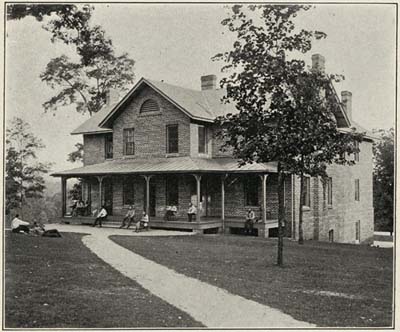
FIRST BUILDING AT THE COLONY
Without discussing the origin of the
idea, and with no reference to Gheel, it
is sufficient to say it was begun in Germany
in the sixties, and that it has
slowly found its way into other countries.
THE COLONY BUILDINGS
Such a colony was established in
connection with the Morganton Hospital
three years ago, or rather it was
ready for occupancy about that time. It
took several years of talk to get the idea
adopted, and as many more to get the
colony built. The plan of conducting it
by the hospital authorities was largely
experimental, and was made to suit the
people of Western North Carolina, but
it is, after all, a modification of the original
German conception.
The first building was for 30 men
with rooms for a man and his family,
the man to have general supervision of
the place and the wife to cook and do
the household work. Afterwards
a small cottage was built for the
manager and his family, and his rooms
were used for patients and later still
another building was erected so that
now 75 patients can be accommodated.
It would have been much better to have
limited the rooms to 30 as first intended.
No single colony plant for the insane
should much exceed that number.
As many colonies as are needed may be
had if land is sufficient, the number depending
on the size of the hospital, as
only a certain proportion of patients,
about 25 per cent., can thus be cared
for, or at the outside 40 per cent.
PATIENTS WORKING RASPBERRIES
The colony buildings, outhouses and
surroundings at the Morganton colony
were made as near as possible like the
farm houses in this section of the State.
This was done to give it a home-like
appearance, and the management has
been such as to make each patient
feel at home; they are free to sit on the
porches and the lawn in the summer, in
the sitting room before open fires in the
winter. They smoke, have games, read
or do what pleases them during these
hours of recreation. They have their
own garden, orchard, vineyard, berry
patches, poultry, pigs and cows, which
they attend to. Every effort is to make
each one feel that these things are his
own, he can gather berries, pull the
fruit when he wants it or as he pleases.
Every one is expected to do something
if no more than pick up chips for the
cook.
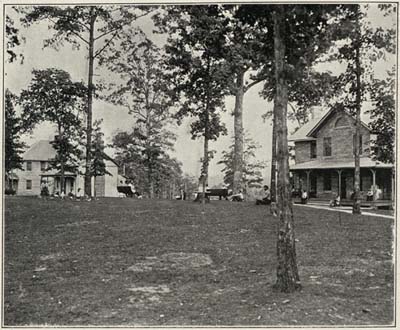
GENERAL VIEW OF COLONY
The first party of patients sent to the
colony, about 15, were quiet, industrious
men who were expected to be the
nucleus of the organization. After
these became accustomed to their new
surroundings, others who were quiet
and who had some remnant of mind
left, but who did little or no work were
tried. These readily dropped into the
ways of those who preceded them and
who set the pace. Further experiment
was made by sending those who seemed
incurably demented, incapable by reason
of their weakened minds of doing any
kind of work. Most of the last mentioned
had been residents of the hospital
for years and years in whom the last
vestige of hope for any improvement
had long vanished. Strange as it may
seem to you, as it did to us, acquainted
with these men and their disease, they
immediately went to work and are to-day
profitably employed. They have
gained in health and self-confidence,
they are happier because they feel there
is yet something in life for them.
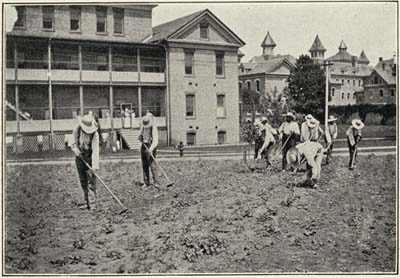
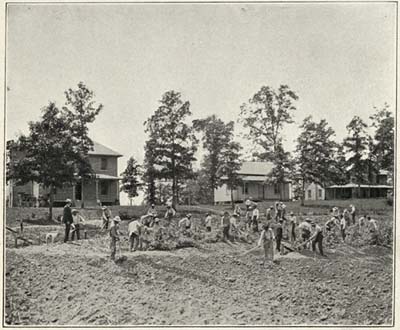
SNAP SHOT—COLONY PATIENTS CULTIVATING STRAWBERRIES
It may occur to some to ask why
these men had not been sent out to work
before and given an opportunity. It
has been the invariable custom since
the hospital opened to try to induce
every one to engage in some kind of
employment and it had been tried repeatedly
with these very men with complete
failure. To conjecture why they
were willing to work in one place
and not in another might be profitless,
it is sufficient to know it is true.
RESTING AFTER THE DAY'S WORK
After the work was well under way,
it was strange to see the development of
the different fancies of the different
men. Each one was allowed, so far as
possible, to follow his own inclination
and to select his own work. One fancied
painting and whitewashing and
building fires under the heating apparatus.
He studied economy in the use of
fuel as much as the average head of a
family, and is as intelligent in his work
as could be expected of any ordinary
man. Another patient has become
greatly interested in poultry and shows
more than ordinary intelligence in following
his bent. He reads journals on
poultry, and not only builds coops, box
nests, etc., but has actually invented
several useful contrivances. Another
hauls wood to the kitchen in a little
wagon he made himself, and so on almost
indefinitely.
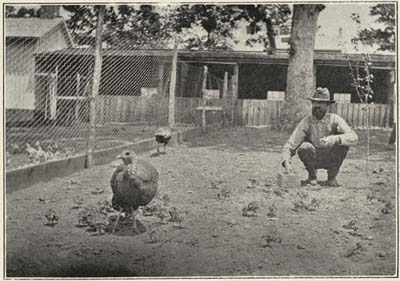
PATIENT TENDING BRONZE TURKEYS
A brief report of two cases will partly
illustrate what has been done. The
following is quoted from a report to the
Board last December: "A boy,
J. B., 13 years old, came to
the hospital in June, 1895. He had a
form of insanity (Dementia praecox)
which rarely improves; indeed, its tendency
is generally to deterioration. This
boy was no exception to the rule and he
grew worse and worse until hope for
any improvement had been given up.
Three months ago he was sent to the
colony, but it was considered a desperate
chance. To the astonishment of
everyone he immediately began to improve,
and this has steadily gone on until
to-day he is a strong, vigorous young
fellow of 23, full of hope and energy,
whereas when he went there he was
dull, indifferent and listless; he never
inquired of his home or home people
and seemed to care for nothing. Recently
he has written home telling of his
marvelous improvement and of his joy
in life. 'He testified as one risen from
the dead,' after ten years of mental
darkness. It is not certain that the improvement
will continue; in fact, it is
not expected, but even if he improves
no more, great good has been accomplished
in relieving this young fellow of
such suffering as we shudder to think
of." Six months after this report was
written this young man has gained but
little and it is probable he is as well as
he will ever be. He enjoys life as much
as the average man, taking part and interest
in baseball and other amusements
we are able to furnish our people. The
second case is of a man who was committed
to the hospital in November,
1898, this being his second admission.
He complained of great discomfort in
his head which he described as being
unbearable, so much so, that he begged
to be killed. His appetite was poor, he
was anaemic and greatly run down in
health and evidently was a great sufferer.
Every effort to relieve him failed.
We were sure if he could be induced to
exercise he would improve, but nothing
we could do would cause him to take
the slightest interest in anything. He
was finally forced to go out with the
working party, but he would lie on the
ground complaining of his head. He
was a few months ago sent to the colony
along with nine other men almost as
bad as he. To the amazement of us all,
the man went to work, his health improved,
the pain and discomfort disappeared
and his face is ruddy and he
gives every evidence of health and
vigor. He works cheerfully, seems perfectly
satisfied, never complaining of
any bad feeling and is as comfortable
as he can be. These two cases are only
two of many as unpromising, who have
been greatly relieved and some few
cured by the colony treatment.
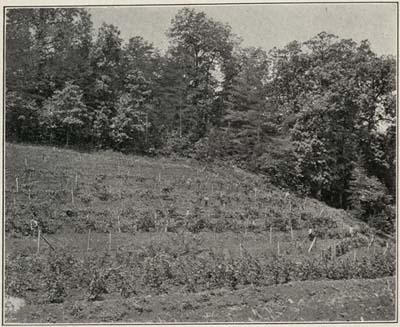
PATIENTS INTERESTED IN GRAPE GROWING
All this seems so simple and is so
obviously the right course that we wonder
why it had not long ago been tried.
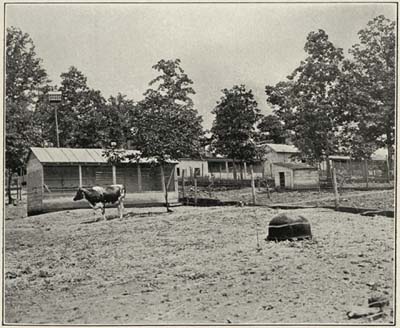
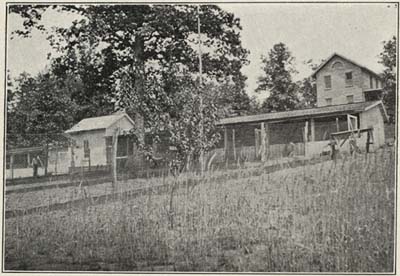
BARNYARD AND POULTRY HOUSES AT COLONY
Two ideas are prominent in this system,
the first to find agreeable, healthful
employment for the patients and to
give them a home.
CHICKEN RUNS
This working class, while too defective
to take up the burden of life, are yet
appreciative of their surroundings and
of most things that make life happy to
the people in the outside world. They
require the minimum amount of care
and discipline and with this given they
conduct themselves as well, indeed, better,
than the same number of sane men.
Some under this treatment recover that
otherwise would not, but the majority
must remain under hospital care, this
being their refuge and their home. How
much need therefore that every effort
should be put forth to make it pleasant
to these afflicted men.
In general hospitals, in institutions
for children, and in reformatories we
have a different class to deal with. A
large number under one roof is not so
objectionable, but these cases of chronic
insanity are not children in whom
the desire for a home is small, nor are
they malefactors in prison for punishment.
You will pardon a little digression,
which, after all, leads to this subject
from another and a practical standpoint.
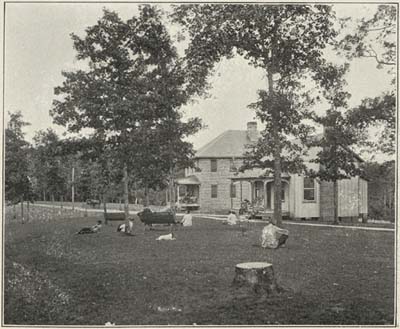
TWO COLONY BUILDINGS
In North Carolina there are not less
than 4,000 white insane; of this number
1,500 are in two hospitals, leaving 2,500
uncared for by the State. To properly
house all these people means the expenditure
of a million dollars, and the
annual cost of maintaining them will be
$500,000. It is well then to consider
carefully how this burden on the taxpayers
may be lightened. Without discussing
the question of the increase of
insanity, there can be no doubt that
there is an increased demand to have
these persons cared for and properly so.
All insane persons are dangerous in
some degree to their neighbors, more so
to themselves. Insanity is the cause
of many suicides, while sexual crimes,
arson, assault, impostures, are often
committed by those mentally deranged.
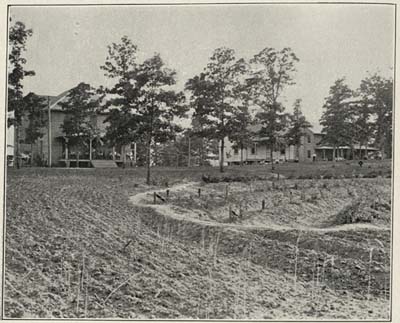
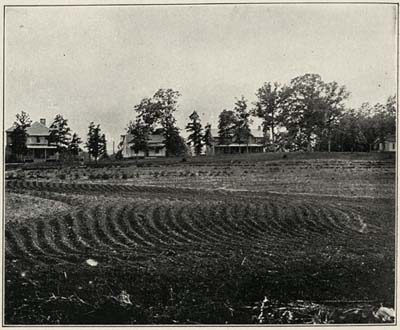
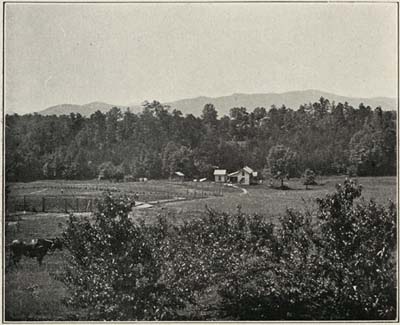
PEACH ORCHARD AND GARDEN, SEEN FROM A COLONY PORCH
Too often families are ruined by
some insane member, the bread winner
having to devote his whole time to
the control of wife or child, or a crime
is committed and every energy and the
savings of a lifetime must be devoted
to the cost of courts. Whole communities
are frequently terrorized by an insane
person and the lives of the women
and children made miserable.
Only a few recover at once or die,
they live on for years not only imbecile
and helpless themselves, but a
burden on the family and community,
a severe drain which must tend to
weaken the general welfare of the
State.
There are sufficient reasons for you
as physicians, men of standing in your
respective communities, not only to
make yourselves familiar with the disease
in order that you may prescribe intelligently
for those suffering from it,
but to use your influence, which is
great, to see that proper provision is
made for them by the public.
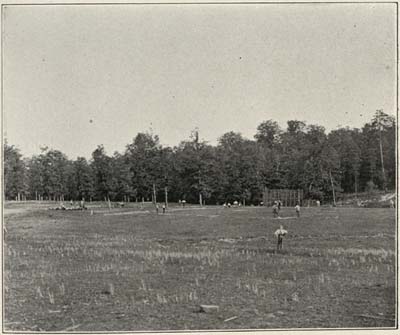
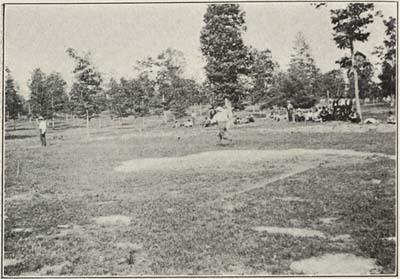
PATIENTS PLAYING BASEBALL
Much insanity is caused by alcohol
and drugs. This touches you more
closely, for you are largely responsible
for these habits. You may do something
by preventing unwise marriages
of those whose heredity is not good.
It should be your special province to
recognize dangerous symptoms in time
and by prompt action prevent suicides
and accidents and to send to the hospitals
at once these patients who have
infinitely more chances to recover when
placed under the care of competent
alienists.
MAKING FIRST BASE
The conclusions we reach are that
2,500 white insane people in North Carolina
are uncared for, that a great outlay
of money will be required to build
for this number and after that the never
ending expense of maintaining them
begins. If it can be demonstrated that
the colony system is the best and the
cheapest, it should by all means be
adopted.
There is an end to the willingness and
even ability of the taxpayers to provide
for the defectives in expensive hospitals
and asylums, and it is clearly the duty
of those who have these matters in hand
to use proper economy. What is done
by the Legislature will depend on the
demand of the people and the wisdom
of the Legislators. It will require great
deliberation and the wisest action to
solve this question.
In North Carolina no more hospitals
ought to be built at present, those now
in existence should be enlarged if possible.
Unfortunately at Morganton no
more land can be purchased and that
institution cannot with advantage be
greatly increased in size. The last opportunity
to buy land there has been
allowed to pass. This is to be deplored
for the plan there has been so successful
that much was hoped for in the
judicious extension of these colonies.
Much more might be said on the
general subject of caring for the insane,
but time forbids. Perhaps on
some future occasion this will be taken
up and discussed.
Hospitals for the insane cannot properly
care for epileptics or idiots. I use
the term idiot in the sense in which it
is defined by the North Carolina statutes
"a person born deficient or who
became deficient before the completion
of the twelfth year of age."
Many of these defectives are capable
of doing common labor and can be
made very nearly self-sustaining if
properly managed in such a colony for
the insane as has been described. In
many of the States where this is tried,
it has been successful. In North Carolina,
where we have such good climate
and where land can be purchased
cheaply, more can be done than in other
less fortunate communities. I believe
in the cotton and truck section of the
State such a colony could be nearly
self-sustaining, but leaving that out of
the question, there can be no doubt it
is the best for these people to live outdoor
lives with proper employment. I
would like also to enlarge on this feature
of my paper, but time will not
permit.
I trust, gentlemen, that you will become
enough interested in these subjects
to give them your hearty support.
If you do, then the labors of those of us
who are immediately responsible, will
be greatly lightened and these afflicted
fellow citizens will be happier and your
State will be a better State.
Since this paper was written my attention
was drawn to a statement in a
medical journal of the number of insane
sent to the hospitals in Massachusetts
during the year 1904. It bears so
closely on what has been said I repeat
it and compare it with our State and
hospitals. During that year 2,426 insane
persons were admitted into the
hospitals of Massachusetts, none of
whom had ever before been inmates of
any hospital for insane. Adding to
these the number of re-admissions,
which could not have been less than
600, we see 3,000 persons sent yearly
to the hospitals of that State. Between
7,000 and 8,000 patients are cared for
by the public hospitals.
As compared with North Carolina
the population of Massachusetts is
twice that of the white people of our
State. We should have 1,500 white
patients sent to our hospitals every
year and we ought to have accommodation
for 4,000. As it is, less than
400 are admitted and only 1,500 can be
cared for in our hospitals. There is
some differences, I believe, in the proportion
of insane to the population in
the two States, but not that much.
Massachusetts gives her insane citizens
proper care. North Carolina does
not.