No literary production of a youth of twenty-one ever electrified the
world as did the publication of the Journal of this dauntless envoy
of the Virginian Governor. No young man more instantly sprang into the
notice of the world than George Washington. The Journal was copied
far and wide in the newspapers of the other colonies. It sped across
the sea, and was printed in London by the British government. In a
manly, artless way it told the exact situation on the Ohio frontier
and announced the first positive proof the world had had of hostile
French aggression into the great river valley of the West. Despite
certain youthful expressions, the prudence, tact, capacity and modesty
of the author were recognized by a nation and by a world.
Without waiting for the House of Burgesses to convene, Governor
Dinwiddie’s Council immediately advised the enlistment of two hundred
men to be sent to build forts on the Monongahela and Ohio rivers. The
business of recruiting two companies of one hundred men each was given
to the tried though youthful Major Washington, since they were to be
recruited from the northern district over which he had been
adjutant-general. His instructions read as follows:
“Instruct’s to be observ’d by Maj’r Geo. Washington, on the
Expedit’n to the Ohio.
Maj’r Geo. Washington: You are forthwith to repair to the Co’ty
of Frederick and there to take under Y’r Com’d 50 Men of the
Militia who will be deliver’d to You by the Comd’r of the s’d
Co’ty pursuant to my Orders. You are to send Y’r Lieut. at the
same Time to the Co’ty of Augusta, to receive 50 Men from the
Comd’r of that Co’ty as I have order’d, and with them he is to
join You at Alexandria, to which Place You are to proceed as
soon as You have rec’d the Men in Frederick. Having rec’d the
Detachm’t, You are to train and discipline them in the best
Manner You can, and for all Necessaries You are to apply
Y’rself to Mr. Jno. Carlisle at Alex’a who has my Orders to
supply You. Having all Things in readiness You are to use all
Expedition in proceeding to the Fork of Ohio with the Men under
Com’d and there you are to finish and compleat in the best
Manner and as soon as You possibly can, the Fort w’ch I expect
is there already begun by the Ohio Comp’a. You are to act on
the Defensive, but in Case any Attempts are made to obstruct
the Works or interrupt our Settlem’ts by any Persons whatsoever
You are to restrain all such Offenders, and in Case of
resistance to make Prisoners of or kill and destroy them. For
the rest You are to conduct Y’rself as the Circumst’s of the
Service shall require and to act as You shall find best for the
Furtherance of His M’y’s Service and the Good of His Dom’n.
Wishing You Health and Success I bid you Farewell.”
The general command of the expedition was given to Colonel Joshua Fry,
formerly professor of mathematics in William and Mary College and a
geographer and Indian commissioner of note. His instructions were as
follows:
“Instruction’s to Joshua Fry, Esqr., Colo. and the
Com’r-in-Chief of the Virg’a Regiment.
March, 1754.
“Sir: The Forces under Y’r Com’d are rais’d to protect our
frontier Settlements from the incursions of the French and the
Ind’s in F’dship with them. I therefore desire You will with
all possible Expedition repair to Alexandria on the Head of the
Poto. River, and there take upon You the com’d of the Forces
accordingly; w’ch I Expect will be at that Town the Middle of
next Mo. You are to march them to will’s Creek, above the Falls
of Poto. from thence with the Great Guns, Amunit’n and
Provisions. You are to proceed to Monongahela, when ariv’d
there, You are to make Choice of the best Place to erect a
Fort for mounting y’r Cannon and ascertain’g His M’y the King
of G. B’s undoubt’d right to those Lands. My Orders to You is
to be on the Defensive and if any foreign Force sh’d come to
annoy You or interrupt Y’r quiet Settlem’t, and building the
Fort as afores’d, You are in that Case to represent to them the
Powers and Orders You have from me, and I desire they w’d
imediately retire and not to prevent You in the discharge of
your Duty. If they sh’d continue to be obstinate after your
desire to retire, you are then to repell Force by Force. I
expect a Number of the Southern Indians will join you on this
expedit’n, w’ch with the Indians on the Ohio, I desire You will
cultivate a good Understanding and Correspondence with,
supplying them with what Provisions and other Necessaries You
can spare; and write to Maj’r Carlyle w’n You want Provisions,
who has my Orders to purchase and Keep a proper Magazine for
Your dem’ds. Keep up a good Com’d and regular Discipline,
inculcate morality and Courage in Y’r Soldiers that they may
answer the Views on w’ch they are rais’d. You are to constitute
a Court Martial of the Chief of Your Officers, with whom You
are to advise and consult on all Affairs of Consequence; and as
the Fate of this Expedition greatly depends on You, from the
Opinion I have of Your good Sense and Conduct, I refer the
Management of the whole to You with the Advice of the Court
Martial. Sincerely recommending You to the Protection of God,
wishing Success to our just Designs, I heartily wish You
farewell.”
This expedition was in no sense the result of general agitation
against French encroachment. And, as in Virginia, so it was in other
colonies to which Governor Dinwiddie appealed; the Governors said they
had received no instructions; the validity of English title to the
lands upon which the French were alleged to have encroached was
doubted; no one wished to precipitate a war through rash zeal.
Before the bill voting ten thousand pounds “for the encouragement and
protection of the settlers on the Mississippi,” as it was called,
passed the House of Burgesses, Governor Dinwiddie had his patience
well-nigh exhausted, but he overlooked both the doubts raised as to
England’s rights in the West, and personal slights, and signed the
bill which provided the expenses of this memorable expedition of the
Virginia Regiment in 1754.
Major Washington was located at Alexandria, on the upper Potomac, in
February where he superintended the rendezvous and the transportation
of supplies and cannon. It was found necessary to resort to
impressments to raise the required quota of men. As early as February
19th, so slow were the drafts and enlistments, Governor Dinwiddie
issued a proclamation granting two hundred thousand acres of land on
the Ohio to be divided among the officers and men who would serve in
the expedition. This had its effect.
By April 20th Washington arrived at Will’s Creek (Cumberland,
Maryland) with three companies, one under Captain Stephen joining him
on the way. The day previous, however, he met a messenger sent from
Captain Trent on the Ohio announcing that the arrival of a French army
was hourly expected. And on the day following, at Will’s Creek, he was
informed of the arrival of the French on what is now the site of
Pittsburg and the withdrawal of the Virginian force under Trent from
the junction of the Allegheny and Monongahela whither they had been
sent to build a fort for the protection of the Ohio Company. This
information he immediately forwarded to the Governors of Virginia,
Pennsylvania and Maryland.
Fancy the state of mind of this vanguard of the Virginian army at the
receipt of this news. It was, then, at the last frontier fort, eleven
companies strong. Their order was to push on to the Ohio, drive off
the French (which was then reported to number a thousand men) and
build a fort. Before it the only road was the Indian path hardly wide
enough to admit the passage of a pack-horse.
A ballot was cast among Washington’s Captains—the youngest of whom
was old enough to have been his father—and the decision was to
advance. The Indian path could at least be widened and bridges built
as far as the Monongahela. There they determined to erect a fort and
await orders and reinforcements. The reasons for this decision are
given as follows in Washington’s Journal of 1754:[1].
“1st. That the mouth of Red-Stone is the first convenient place on
the River Monongahela.
2nd. The stores are already built at that place for the provisions
of the Company, wherein the Ammunition may be laid up, our great guns
may also be sent by water whenever we shall think it convenient to
attack the Fort.
3rd. We may easily (having all these conveniences) preserve our men
from the ill consequences of inaction, and encourage the Indians our
Allies to remain in our interests.”
Thus Washington’s march westward in 1754 must be looked upon only as
the advance of a van-guard to open the road, bridge the streams and
prepare the way for the commanding officer and his army. Nor was
there, now, need of haste—had it been possible or advisable to
hasten. The landing of the French at the junction of the Allegheny and
Monongahela already thwarted Governor Dinwiddie’s purpose in sending
out the expedition “To prevent their (French) building any Forts or
making any Settlem’s on that river (Ohio) and more particularly so
nigh us as that of Loggstown (fifteen miles below the forks of the
Ohio.)” Now that a fort was building, with a French army of a thousand
men (as Washington had been erroneously informed) encamped about it,
nothing more was to be thought of than a cautious advance.
And so Washington gave the order to march on the 29th. of April, three
score men having been sent ahead to widen the Indian trail. The
progress was difficult, and exceedingly slow. In the first ten days
the hundred and fifty men covered but twenty miles. Yet each mile must
have been anticipated seriously by the young commander. He knew not
whether the enemy or his Colonel with reinforcements was nearest.
Governor Dinwiddie wrote him (May 4) concerning reinforcements, as
follows:
“The Independ’t Compa., from So. Car. arriv’d two days ago; is
compleat; 100 Men besides Officers, and will re-embark for Alexa
next Week, thence proceed imediately to join Colo. Fry and You.
The two Independ’t Compa’s from N. York may be Expected in ab’t
ten days. The N. Car. Men, under the Com’d of Colo. Innes, are
imagin’d to be on their March, and will probably be at the
Randezvous ab’t the 15th. Itst.” ... “I hope Capt. McKay, who
Com’ds the Independ’t Compa., will soon be with You And as he
appears to be an Officer of some Experience and Importance, You
will, with Colo. Fry and Colo. Innes, so well agree as not to
let some Punctillios ab’t Com’d render the Service You are all
engag’d in, perplex’d or obstructed.”
Relying implicitly on Dinwiddie, Washington pushed on and on into the
wilderness, opening a road and building bridges for a Colonel and an
army that was never to come! As he advanced into the Alleghenies he
found the difficulty of hauling wagons very serious, and, long before
he reached the Youghiogheny, he determined to test the possibility of
transportation down that stream and the Monongahela to his destination
at the mouth of the Redstone Creek. May 11th. he sent a reconnoitering
force forward to Gist’s, on Laurel Hill, the last spur of the
Alleghenies, to locate a French party, which, the Indians reported,
had left Fort Duquesne, and to find if there was possibility of water
transportation to the mouth of Redstone Creek, where a favorable site
for a fort was to be sought.
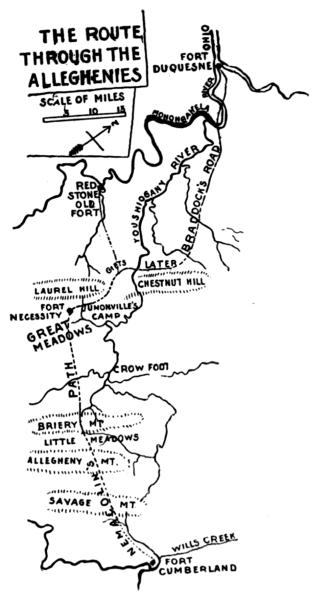
Slowly the frail detachment felt its way along to Little Meadows and
across the smaller branch of the Youghiogheny which it bridged at
“Little Crossings.” On the 16th, according to the French version of
Washington’s Journal, he met traders who informed him of the
appearance of French at Gist’s and who expressed doubts as to the
possibility of building a wagon road from Gist’s to the mouth of
Redstone Creek. This made it imperatively necessary for the young
Lieutenant-Colonel to attempt to find a water passage down the
Youghiogheny.
The day following much information was received, both from the front
and the rear, vividly stated in the Journal as follows:
“The Governor informs me that Capt. McKay, with an independent
company of 100 men, excluding the officers, had arrived, and
that we might expect them daily; and that the men from New-York
would join us within ten days.
This night also came two Indians from the Ohio who left the
French fort five days ago: They relate that the French forces
are all employed in building their Fort, that it is already
breast-high, and of the thickness of twelve feet, and filled
with Earth, stones, etc. They have cut down and burnt up all
the trees which were about it and sown grain instead thereof.
The Indians believe they were only 600 in number, although
they say themselves they are 800. They expect a greater number
in a few days, which may amount to 1600. Then they say they can
defy the English.”
Arriving on the eastern bank of the Youghiogheny the next day, 18th,
the river being too wide to bridge and too high to ford, Washington
put himself “in a position of defence against any immediate attack
from the Enemy” and went straightway to work on the problem of water
transportation.
By the 20th., a canoe having been provided, Washington set out on the
Youghiogheny with four men and an Indian. By nightfall they reached
“Turkey Foot,” (Confluence, Pennsylvania,) which Washington mapped as
a possible site for a fort. Below “Turkey Foot” the stream was found
too rapid and rocky to admit any sort of navigation and Washington
returned to camp on the 24th. with the herculean hardships of an
overland march staring him in the face. Information was now at hand
from Half-King, concerning alleged movements of the French; thus the
letter read;
“To any of his Majesty’s officers whom this May Concern.
As ’tis reported that the French army is set out to meet M.
George Washington, I exhort you my brethren, to guard against
them, for they intend to fall on the first English they meet;
They have been on their march these two days, the Half-King and
the other chiefs will join you within five days, to hold a
council, though we know not the number we shall be. I shall say
no more, but remember me to my brethren the English.
Signed The Half-King.”
At two o’clock of that same May day (24th.) the little army came down
the eastern wooded hills that surrounded Great Meadows, and looked
across the waving grasses and low bushes which covered the field they
were soon to make classic ground. Immediately upon arriving at the
future battle-field information was secured from a trader confirming
Half-King’s alarming letter. Below the roadway, which passed the
meadow on the hillside, the Lieutenant-Colonel found two natural
intrenchments near a branch of Great Meadows run, perhaps old courses
of the brook through the swampy land. Here the troops and wagons were
placed.
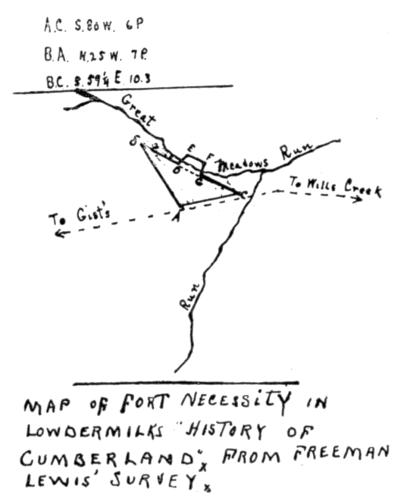
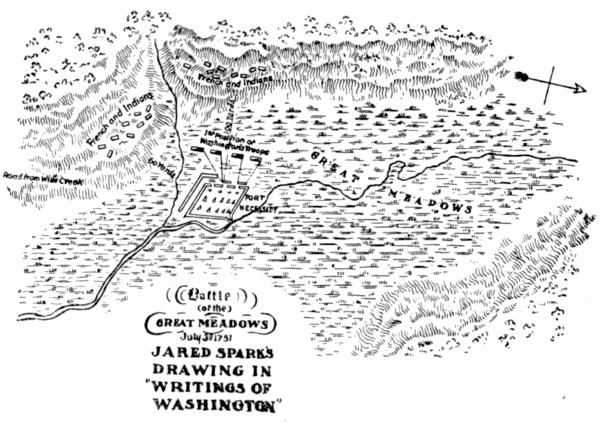
Great Meadows may be described as two large basins the smaller lying
directly westward of the larger and connected with it by a narrow neck
of swampy ground. Each is a quarter of a mile wide and the two a mile
and a half in length.
The old roadway descends from the southern hills, coming out upon the
meadows at the eastern extremity of the western basin. It traverses
the hill-side south of the western meadow. The natural intrenchments
or depressions behind which Washington huddled his army on this May
afternoon were at the eastern edge of the western basin. Behind him
was the narrow neck of low-land which soon opened into the eastern
basin. Before him to his left on the hillside his newly-made road
crawled eastward into the hills. The Indian trail followed the edge of
the forest westward to Laurel Hill, five miles distant, and on to Fort
Duquesne.
On this faint opening into the western forest the little army and its
youthful commander kept their eyes as the sun dropped behind the hills
closing an anxious day and bringing a dreaded night. How large the
body of French might have been, not one of the one hundred and fifty
men knew. How far away they might be no one could guess. Here in this
forest meadow the little van-guard slept on their arms, surrounded by
watchful sentinels, with fifty-one miles of forest and mountain
between them and the nearest settlement at Will’s Creek. The darkling
forests crept down the hills on either side as though to hint by their
portentous shadows of the dead and dying that were to be.
But the night waned and morning came. With increasing energy, as
though nerved to duty by the dangers which surrounded him, the
twenty-two year old commander Washington gave his orders promptly. A
scouting party was sent on the Indian trail in search of the coming
French. Squads were set to threshing the forest for spies. Horsemen
were ordered to scour the country and keep look-out for the French
from neighboring points of vantage.
At night all returned, none the wiser for their vigilance and labor.
The French force had disappeared from the face of the earth! It may be
believed that this lack of information did not tend to ease the
intense strain of the hour. It must have been plain to the dullest
that serious things were ahead. Two flags, silken emblems of an
immemorial hatred, were being brought together in the Alleghenies. It
was a moment of utmost importance to Europe and America. Quebec and
Jamestown were met on Laurel Hill; and a spark struck here and now was
to “set the world on fire.”
However clearly this may have been seen, Washington was not the man to
withdraw. Indeed, the celerity with which he precipitated England and
France into war made him a criticised man on both continents.
Another day passed—and the French could not be found. On the
following day Christopher Gist arrived at Great Meadows with the
information that M. la Force (whose tracks he had seen within five
miles of Great Meadows) had been at his house, fifteen miles distant.
Acting on this reliable information Washington at once dispatched a
scouting party in pursuit.
The day passed and no word came to the anxious men in their trenches
in the meadows. Another night, silent and cheerless, came over the
mountains upon the valley, and with the night came rain. Fresh fears
of strategy and surprise must have arisen as the cheerless sun went
down.
Suddenly, at eight in the evening, a runner brought word that the
French were run to cover! Half-King, while coming to join Washington,
had found la Force’s party in “a low, obscure place.”
It was now time for a daring man to show himself. Such was the young
commander at Great Meadows.
“That very moment,” wrote Washington in his Journal, “I sent out
forty men and ordered my ammunition to be put in a place of safety,
fearing it to be a stratagem of the French to attack our camp; I left
a guard to defend it, and with the rest of my men set out in a heavy
rain, and in a night as dark as pitch.”
Perhaps a war was never precipitated under stranger circumstances.
Contrecoeur, commanding at Fort Duquesne, was made aware by his Indian
scouts of Washington’s progress all the way from the Potomac. The day
before Washington arrived at Great Meadows Contrecoeur ordered M. de
Jumonville to leave Fort Duquesne with a detachment of thirty-four
men, commanded by la Force, and go toward the advancing English. To
the English (when he met them) he was to explain he had come to order
them to retire. To the Indians he was to pretend he was “travelling
about to see what is transacting in the King’s Territories, and to
take notice of the different roads.” In the eyes of the English the
party was to be an embassy. In the eyes of the Indians, a party of
scouts reconnoitering. This is clear from the orders given by
Contrecoeur to Jumonville.
Three days before, on the 26th, this “embassy” was at Gist’s
plantation where, according to Gist’s report to Washington, they
“would have killed a cow and broken everything in the house, if two
Indians, whom he (Gist) had left in charge of the home, had not
prevented them.”
From Gist’s la Force had advanced within five miles of Great Meadows,
as Gist ascertained by their tracks on the Indian trail.
Then—although the English commander was within an hour’s march—the
French retraced their steps to the summit of Laurel Hill and,
descending deep into the obscure valley on the east, built a hut under
the lea of the precipice and rested from their labors. Here they
remained throughout the 27th, while Washington’s scouts were running
their legs off in the attempt to locate them and the young
Lieutenant-colonel was in a fever of anxiety at their sudden, ominous
disappearance. Now they were found.
What a march was that! The darkness was intense. The path, Washington
wrote, was “scarce broad enough for one man.” Now and then it was lost
completely and a quarter of an hour was wasted in finding it. Stones
and roots impeded the way, and were made trebly treacherous by the
torrents of rain which fell. The men struck the trees. They fell over
each other. They slipped from the narrow track and slid downward
through the soaking leafy carpet of the forests.
Enthusiastic tourists make the journey today from Great Meadows to the
summit of Laurel Hill on the track over which Washington and his
hundred men floundered and stumbled that wet May night a century and a
half ago. It is a hard walk but exceedingly fruitful to one of
imaginative vision. From Great Meadows the trail holds fast to the
height of ground until Braddock’s Run is crossed near “Braddock’s
Grave.” Picture that little group of men floundering down into this
mountain stream, swollen by the heavy rain, in the utter darkness of
that night! From Braddock’s Run the trail begins its long climb on the
sides of the foot-hills, by picturesque Peddler’s Rocks, to the top of
Laurel Hill, two thousand feet above.
Washington left Great Meadows about eight o’clock. It was not until
sunrise that Half-King’s sentries at “Washington’s Spring,” saw the
van-guard file out on the narrow ridge, which, dividing the headwaters
of Great Meadow Run and Cheat River, made an easy ascent to the summit
of the mountain. The march of five miles had been accomplished, with
great difficulty, in a little less than two hours—or at the rate of
one mile in two hours.
Forgetting all else for the moment, consider the young leader of this
floundering, stumbling army. There is not another episode in all
Washington’s long, eventful, life that shows more clearly his strength
of personal determination and daring. Beside this all-night march from
Great Meadows to Washington’s Spring, Wolf’s ascent to the Plains of
Abraham at Quebec, was a past-time. The climb up from Wolf’s Cove (all
romantic accounts and pictures to the contrary notwithstanding) was an
exceedingly easy march up a valley that hardly deserved to be
called steep. A child can run along Wolfe’s path at any point from top
to bottom. A man in full daylight today, can walk over Washington’s
five mile course to Laurel Hill in half the time the little army
needed on that black night. If a more difficult ten-hour night march
has been made in the history of warfare in America, who led it and
where was it made? No feature of the campaign shows more clearly the
unmatched, irresistible energy of this twenty-two-year-old boy. For
those to whom Washington, the man, is “unknown,” there are lessons in
this little briery path today of value far beyond their cost.
Whether Washington intended to attack the French before he reached
Half-King is not known; at the Spring a conference was held and it was
immediately decided to attack. Washington did not know and could not
have known that Jumonville was an embassador. The action of the French
in approaching Great Meadows and then withdrawing and hiding was not
the behavior of an embassy. Half-King and his Indians were of the
opinion that the French party entertained evil designs, and, as
Washington afterwards wrote, “If we had been such fools as to let them
(the French) go, they (the Indians) would never have helped us to take
any other Frenchmen.”
Two scouts were sent out in advance; then, in Indian file, Washington
and his men with Half-King and a few Indians followed and “prepared to
surround them.”
Laurel Hill, the most westerly range of the Alleghenies, trends north
and south through Pennsylvania. In Fayette county, about one mile on
the summit northward from the National Road, lies Washington’s Spring
where Half-King encamped. The Indian trail coursed along the summit
northward fifteen miles to Gist’s. On the eastern side, Laurel Hill
descends into a valley varying from a hundred to five hundred feet
deep. Nearly two miles from the Spring, in the bottom of a valley four
hundred feet deep, lay Jumonville’s “embassy.” The attacking party,
guided by Indians, who had previously wriggled down the hillside on
their bellies and found the French, advanced along the Indian trail
and then turned off and began stealthily creeping down the
mountain-side.
Washington’s plan was, clearly, to surround and capture the French. It
is plain he did not understand the ground. They were encamped in the
bottom of a valley two hundred yards wide and more than a mile long.
Moreover the hillside on which the English were descending abruptly
ended on a narrow ledge of rocks thirty feet high and a hundred yards
long.
Coming suddenly out on the rocks, Washington leading the right
division and Half-King the left, it was plain in the twinkling of an
eye that it would not be possible to achieve a bloodless victory.
Washington therefore gave and received first fire. It was fifteen
minutes before the astonished but doughty French, probably now
surrounded by Half-King’s Indians, were compelled to surrender. Ten of
their number, including their “Embassador” Jumonville, were killed
outright and one wounded. Twenty-one prisoners were taken. One
Frenchman escaped, running half clothed through the forests to Fort
Duquesne with the evil tidings.
“We killed,” writes Washington, “Mr. de Jumonville, the
Commander of that party, as also nine others; we wounded one and
made twenty-one prisoners, among whom were M. la Force, and M.
Drouillon and two cadets. The Indians scalped the dead and
took away the greater part of their arms, after which we marched
on with the prisoners under guard to the Indian camp.... I
marched on with the prisoners. They informed me that they had
been sent with a summons to order me to retire. A plausible
pretense to discover our camp and to obtain knowlege of our
forces and our situation! It was so clear that they were come to
reconnoiter what we were, that I admired their assurance, when
they told me they were come as an Embassy; their instructions
were to get what knowledge they could of the roads, rivers, and
all the country as far as the Potomac; and instead of coming as
an Embassador, publicly and in an open manner, they came
secretly, and sought the most hidden retreats more suitable for
deserters than for Embassadors; they encamped there and remained
hidden for whole days together, at a distance of not more than
five miles from us; they sent spies to reconnoiter our camp; the
whole body turned back 2 miles; they sent the two messengers
mentioned in the instruction, to inform M. de Contrecoeur of the
place where we were, and of our disposition, that he might send
his detachments to enforce the summons as soon as it should be
given. Besides, an Embassador has princely attendants, whereas
this was only a simple petty French officer, an Embassador has
no need of spies, his person being always sacred: and seeing
their intention was so good, why did they tarry two days at five
miles distance from us without acquainting me with the summons,
or at least, with something that related to the Embassy? That
alone would be sufficient to excite the strongest suspicions,
and we must do them the justice to say, that, as they wanted to
hide themselves, they could not have picked out better places
than they had done. The summons was so insolent, and savored of
so much Gasonade that if it had been brought openly by two men
it would have been an excessive Indulgence to have suffered them
to return.... They say they called to us as soon as they had
discovered us; which is an absolute falsehood, for I was then
marching at the head of the company going towards them, and can
positively affirm, that, when they first saw us, they ran to
their arms, without calling, as I must have heard them had they
so done.”
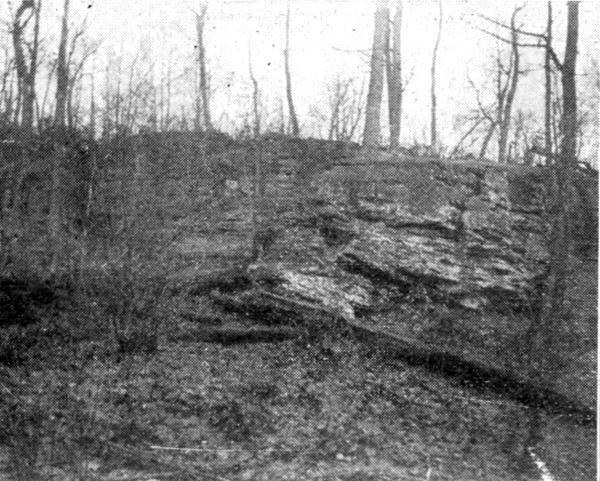
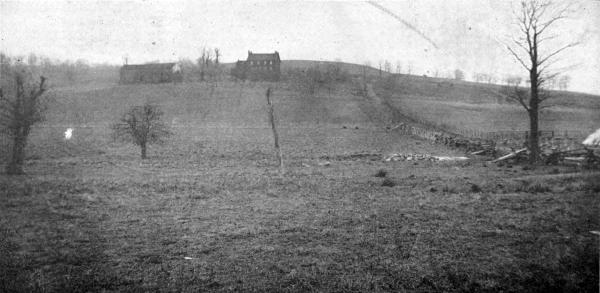
Ledge from which Washington opened fire upon
Jumonville’s party.
In a letter to his brother, Washington wrote “I fortunately escaped
without any wound; for the right wing where I stood, was exposed to,
and received all the enemy’s fire; and it was the part where the man
was killed and the rest wounded. I heard the bullets whistle; and,
believe me, there is something charming in the sound.” The letter was
published in the London Magazine. It is said George II. read it and
commented dryly: “He would not say so if he had been used to hear
many.” In later years Washington heard too much of the fatal music,
and once, when asked if he had written such rodomontade, is said to
have answered gravely, “If I said so, it was when I was young.” Aye,
but it is memorials of that daring, young Virginian, to whom whistling
bullets were charming, that we seek in the Alleghenies today. We catch
a similar glimpse of this ardent, boyish spirit in a letter written
from Fort Necessity later. Speaking of strengthening the
fortifications Washington writes: “We have, with nature’s assistance,
made a good entrenchment, and by clearing the bushes out of these
meadows, prepared a charming field for an encounter.” Over and above
the anxieties with which he was ever beset there shines out clearly
the exuberance of youthful zest and valor—soon to be hardened and
quenched by innumerable cares and heavy responsibilities.
Thus the first blow of that long, bloody, seven year’s war was struck
by the red-uniformed Virginians under Washington, at the bottom of
that Allegheny valley. He immediately returned to Great Meadows and
sent eastward to the belated Fry for reinforcements. On the 30th, the
French prisoners were sent eastward to Virginia, and the construction
of a fort was begun at Great Meadows, by erecting “small palisades.”
This was completed by the following day, June 1st. Washington speaks
of this fort in his Journal as “Fort Necessity” under date of June
25th. The name suggests the exigencies which led to its erection; lack
of troops and provisions. On June 2nd Washington wrote in his Journal:
“We had prayers in the Fort”; the name Necessity may not have been
used at first. On the 6th Gist arrived from Will’s Creek bringing the
news of Colonel Fry’s death from injuries sustained by being thrown
from his horse. Thus the command now devolved upon Washington who had
been in actual command from the beginning. On the 9th the remainder of
the Virginia regiment arrived from Will’s Creek, with the swivels,
under Colonel Muse. On the day following Captain Mackaye arrived with
the independent company of South Carolinians.
This reinforcement put a new face on affairs, and it is clear that the
new Colonel commanding secretly hoped to capture Fort Duquesne
forthwith. The road was finished to Great Meadows. For two weeks, now,
the work went on completing it as far as Gist’s, on Mount Braddock. In
the meantime a sharp lookout for the French was maintained and spies
were continually sent toward Fort Duquesne. Among all else that taxed
the energies of the young Colonel was the Indian question. At one time
he received and answered a deputation of Delawares and Shawanese which
he knew was sent by the French. Yet the answer of this youth to the
“treacherous devils,” as he calls them in his private record of the
day, was as bland and diplomatic as that of Indian Chieftain bred to
hypocrisy and deceit. He put little faith in the redskins, but made
good use of those he had as spies. He also did all in his power to
restrain the vagrant tribes from joining the French, and offered to
all who came or would come to him a hospitality he could ill afford.
On the 28th the road was completed to Gist’s, and eight of the sixteen
miles from Gist’s to the mouth of Redstone Creek. On this day the
scouts brought word of reinforcements at Fort Duquesne and of
preparations for sending out an army. Immediately Washington summoned
Mackaye’s company from Fort Necessity, and the building of a fort was
begun by throwing up entrenchments on Mount Braddock. All outlying
squads were called in. But on the 30th, fresher information being at
hand, it was decided at a council of war to retreat to Virginia rather
than oppose the strong force which was reported to be advancing up the
Monongahela.
The consternation at Fort Duquesne upon the arrival of that single,
barefoot fugitive from Jumonville’s company can be imagined. Relying
on the pompous pretenses of the embassadorship and desiring to avoid
an indefensible violation of the Treaty of Utrecht—though its spirit
and letter were “already infringed by his very presence on the
ground”—Contrecoeur (one of the best representatives of his proud
King that ever came to America) assembled a council of war and ordered
each opinion to be put in writing. Mercier gave moderate advice;
Coulon-Villiers, half-brother of Jumonville, burning with rage, urged
violent measures. Mercier prevailed, and an army of five hundred
French and as many, or more, Indians, among whom were many Delawares,
formerly friends of the English, was raised to march and meet
Washington. At his request, the command was given to
Coulon-Villiers—Le Grande Villiers, so called from his prowess
among the Indians. Mercier was second in command. This was the army
before which Washington was now slowly, painfully, retreating from
Mount Braddock toward Virginia.
It was a sad hour—that in which the Virginian retreat was ordered by
its daring Colonel, eager for a fight. But, even if he secretly
wished to stay and defend the splendid site on Mount Braddock where he
had entrenched his army, the counsel of older heads prevailed. It
would have been better had the army stuck to those breastworks—but
the suffering and humiliation to come was not foreseen.
Backward over the rough, new road, the little army plodded, the
Virginians hauling the swivels by hand. Two teams and a few
pack-horses were all that remained of horse-flesh equal to the
occasion. Even Washington and his officers walked. For a week there
had been no bread. In two days Fort Necessity was reached, where,
quite exhausted, the little army went into camp. There were only a few
bags of flour here. It was plain, now, that the retreat to Virginia
was ill-advised. Human strength was not equal to it. So there was
nothing to do but send post-haste to Will’s Creek for help. But, if
strength were lacking—there was courage and to spare! For after a
“full and free” conference of the officers it was determined to
enlarge the stockade, strengthen the fortifications, and await the
enemy, whatever his number or power.
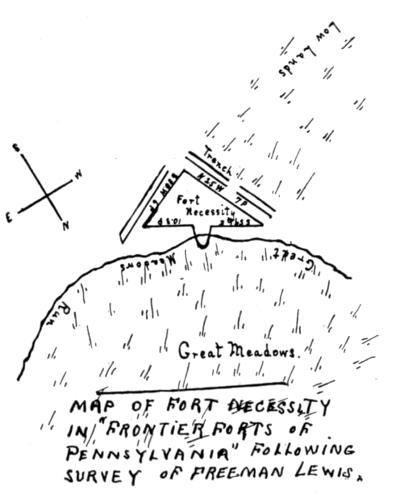
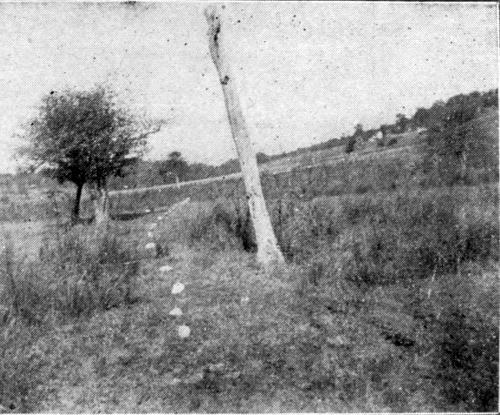
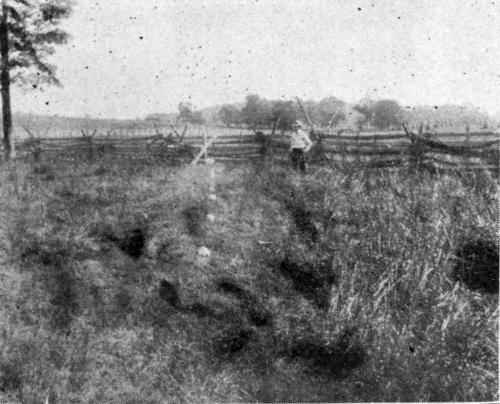
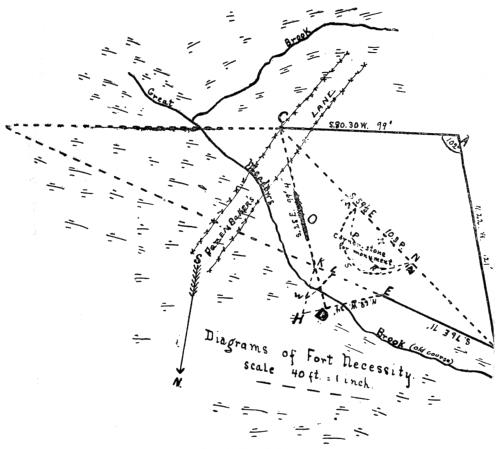
The day following was spent in this work, and famed Fort Necessity was
completed. It was the shape of an irregular square situated upon a
small height of land near the center of the swampy meadow. “The
natural entrenchments” of which Washington speaks in his Journal may
have been merely this height of ground, or old courses of the two
brooks which flow by it on the north and on the east. At any rate the
fort was built on an “island,” so to speak, in the wet lowland. A
narrow neck of solid land connected it with the southern hillside,
along which the road ran. A shallow ditch surrounded the earthen
palisaded sides of the fort. Parallel with the southeastern and
southwestern palisades rifle pits were dug. Bastion gateways offered
entrance and exit. The work embraced less than a sixth of an acre of
land. All day long skirmishers and double picket lines were kept out
and the steady advance of the French force, three times the size of
the army fearlessly awaiting it, was reported by hurrying scouts.
No army ever slept on its arms of a night surer of a battle on the
morrow than did this first English army that ever came into the west.
Le Grande Villiers, thirsting for revenge, lay not five miles off,
with a thousand followers who had caught his spirit.
By earliest morning light on Wednesday, July third, an English sentry
was brought in wounded. The French were then descending Laurel Hill,
four miles distant. They had attacked the entrenchments on Mount
Braddock the morning before only to find their bird had flown, and now
were pressing after the retreating redcoats and their “buckskin
Colonel.”
Little is known of the story of this day within that earthen fort save
as it is told in the meagre details of the general battle. There was
great lack of food, but, to compensate for this, as the soldiers no
doubt thought, there was much to drink! By eleven o’clock the French
and Indians, spreading throughout the forests on the northwest, began
firing at six hundred yards distance. Finally they circled to the
southeast where the forests approach nearer to the English trenches.
Washington at once drew his little army out of the fort and boldly
challenged assault on that narrow neck of solid land on the south
which formed the only approach to the fort.
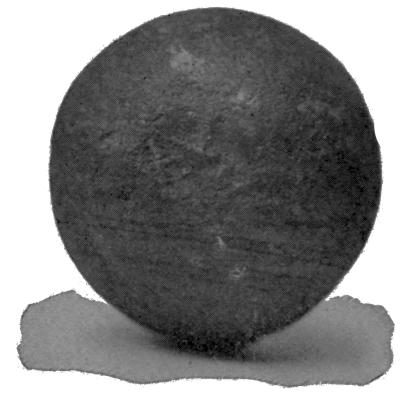
Grape Shot found near Fort Necessity. Actual size.
But the crafty Villiers, not to be tempted, kept well within the
forest shadows to the south and east—cutting off all retreat to
Virginia! Realizing at last that the French would not give battle,
Washington withdrew again behind his entrenchments, Mackaye’s South
Carolinians occupying the rifle-pits which paralleled the two sides of
the fortification.
Here the all-day’s battle was fought between the Virginians behind
their breastworks and in their trenches, and the French and Indians on
the ascending wooded hill-sides. The rain which began to fall soon
flooded Mackaye’s men out of their trenches. No other change of
position was made. And, so far as the battle went, the English
doggedly held their own. In the contest with hunger and rain however,
they were fighting a losing battle. The horses and cattle escaped and
were slaughtered by the enemy. The provisions were being exhausted and
the ammunition was spending fast. As the afternoon waned, though there
was some cessation of musketry fire, many guns being rendered useless
by the rain, the smoking little swivels were made to do double duty.
They bellowed their fierce defiance with unwonted zest as night came
on, giving to the English an appearance of strength which they were
far from possessing. The hungry soldiers made up for the lack of food
from the abundance of liquor, which, in their exhausted state had more
than its usual effect. By nightfall half the little doomed army was
intoxicated. No doubt, had Villiers dared to rush the entrenchments,
the English would have been annihilated. The hopelessness of their
condition could not have been realized by the foe on the hills.
But it was realized by the young Colonel commanding. And as he looked
about him in the wet twilight of that July day, what a dismal ending
of his first campaign it must have seemed. Fifty-four of his three
hundred and four men were killed or wounded in that little palisaded
enclosure. Provisions and ammunition were about gone. Horses and
cattle were gone. Many of the small arms were useless. The army was
surrounded by Le Grande Villiers, watchfully abiding his time. And
there was comedy with the tragedy—half the tired men were under the
influence of the only stimulant that could be spared. What mercy could
be hoped for from the brother of the dead Jumonville? A fight to the
death, or at least a captivity at Fort Duquesne or Quebec was all that
could be expected—for had not Jumonville’s party already been sent
into Virginia as captives?
At eight in the evening the French requested a parley and Washington
refused to consider the suggestion. Why should a parley be desired
with an enemy in such a hopeless strait as they? It was clear that
Villiers had resorted to this strategy to gain better information of
their condition. But the request was soon repeated, and this time
Villiers asked for a parley between the lines. To this Washington
readily acceded, and Captain van Braam went to meet le Mercier, who
brought a verbal proposition for the capitulation of Fort Necessity
from Villiers. To this proposition Washington and his officers
listened. Twice the commissioners were sent to Villiers to submit
modifications demanded by Washington. They returned a third time
with the articles reduced to writing—but in French. Washington
depended upon van Braam’s poor knowledge of French and mongrel English
for a verbal translation. Jumonville’s death was referred to as an
assassination though van Braam Englished the word “death”—perhaps
thinking there was no other translation of the French l’assassinat.
By the light of a flickering candle, which the mountain wind
frequently extinguished, the rain falling upon the company, George
Washington signed this, his first and last capitulation.
Article 1st. We permit the English Commander to withdraw with
all the garrison, in order that he may return peaceably to his
country, and to shield him from all insult at the hands of our
French, and to restrain the savages who are with us as much as
may be in our power.
Art. 2nd. He shall be permitted to withdraw and to take with
him whatever belongs to his troops, except the artillery,
which we reserve for ourselves.
Art. 3d. We grant them the honors of war; they shall withdraw
with beating drums, and with a small piece of cannon, wishing
by this means to show that we consider them friends.
Art. 4th. As soon as these articles shall be signed by both
parties, they shall take down the English flag.
Art. 5th. Tomorrow at daybreak a detachment of French shall
lead forth the garrison and take possession of the aforesaid
fort.
Art. 6th. Since the English have scarcely any horses or oxen
left, they shall be allowed to hide their property, in order
that they may return to seek for it after they shall have
recovered their horses; for this purpose they shall be
permitted to leave such number of troops as guards as they may
think proper, under this condition, that they give their word
of honor that they will work on no establishment either in the
surrounding country or beyond the Highlands during one year
beginning from this day.
Art. 7th. Since the English have in their power an officer and
two cadets, and, in general, all the prisoners whom they took
when they murdered Lord Jumonville, they now promise to send
them, with an escort to Fort Duquesne, situated on Belle River;
and to secure the safe performance of this treaty article, as
well as of the treaty, Messrs. Jacob van Braam and Robert
Stobo, both Captains, shall be delivered to us as hostages
until the arrival of our French and Canadians herein before
mentioned.
We on our part declare that we shall give an escort to send
back in safety the two officers who promise us our French in
two months and a half at the latest.
Copied on one of the posts of our block-house the same day and
year as before.
(Signed.) Messrs. James Mackaye, Go.
Go. Washington
Coulon Villier
The parts printed in italics were those misrepresented by van Braam.
The words “pendent une annee a compter de ce jour” are not found in
the articles printed by the French government, as though it repudiated
Villier’s intimation that the English should ever return. Yet within a
year—lacking nine days—an English army, eight times as great as the
one now capitulating, marched across this battle-field. The nice
courtesy shown by the young Colonel in allowing Captain Mackaye’s name
to take precedence over his own, is significant, as Mackaye, a King’s
officer, had never considered himself amenable to Washington’s orders,
and his troops had steadily refused to bear the brunt of the
campaign—working on the road or transporting guns and baggage. In the
trenches, however, the Carolinians did their duty.
And so, on the morning of July 4th, the red-uniformed Virginians and
the King’s troops marched out from Fort Necessity between the files of
French, with all the honors of war and tambour battant. Much baggage
had to be destroyed to save it from the Indians whom the French could
not restrain. Such was the condition of the men—the wounded being
carried on stretchers—that only three miles could be made on the
homeward march the first day. However glorious later July Fourths may
have seemed to Washington, memories of this distress and gloom and
humiliation served to temper his transports. The report of the
officers of the Virginia regiment made at Will’s Creek, where they
arrived July 9th, shows thirteen killed, fifty-three wounded, thirteen
left lame on the road, twenty-one sick, and one hundred sixty-five fit
for duty.
On August 30th, the Virginian House of Burgesses passed a vote of
thanks to “Colonel George Washington, Captain Mackaye of his Majesty’s
Independent Company, and the officers under his command,” for their
“gallant and brave Behavior in Defence of their Country.” The sting of
defeat was softened by a public realization of the odds of the contest
and the failure of Dinwiddie to forward reinforcements and supplies.
But the young hero was deeply chagrined at his being duped to
recognize Jumonville’s death as an assassination. Captain van Braam,
being held in disrepute for what was probably nothing more culpable
than carelessness, was not named in the vote of thanks tendered
Washington’s officers. But this chagrin was no more cutting than the
obstinacy of Dinwiddie in refusing to fulfil the article of the treaty
concerning the return of the French prisoners. For this there was
little or no valid excuse, and Dinwiddie’s action in thus playing fast
and loose with Washington’s reputation was as galling to the young
Colonel as it was heedless of his country’s honor and the laws of war.
Washington’s first visit to the Ohio had proven French occupation of
that great valley. This, his second mission, had proven their power.
With this campaign began his military career. “Although as yet a
youth,” writes Sparks, “with small experience, unskilled in war, and
relying on his own resources, he had behaved with the prudence,
address, courage, and firmness of a veteran commander. Rigid in
discipline, but sharing the hardships and solicitous for the welfare
of his soldiers, he had secured their obedience and won their esteem
amidst privations, sufferings and perils that have seldom been
surpassed.”