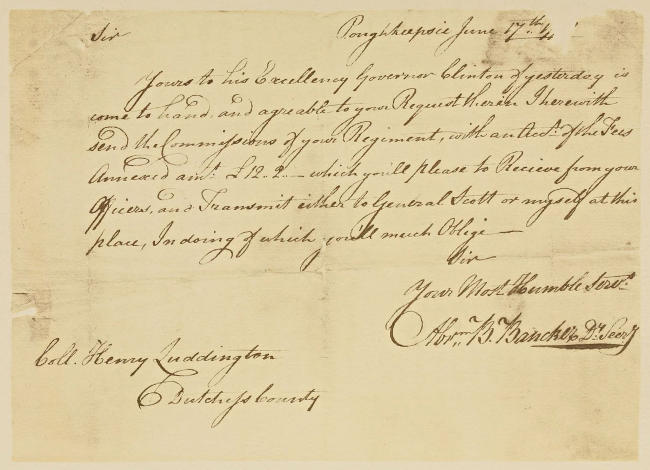
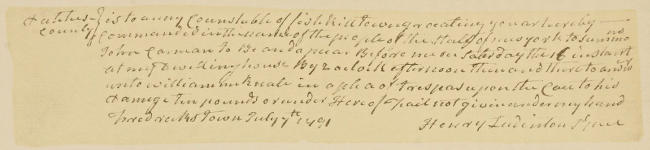
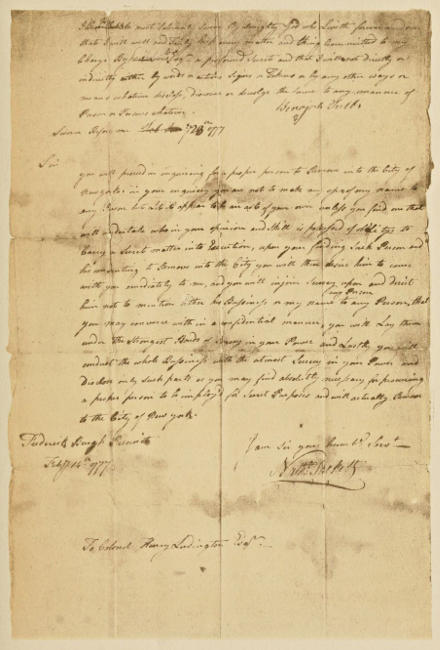
“Between the lines” is always a place of peculiar
difficulty and danger. The Border States
in our Civil War were the deadliest battle-grounds,
not only the meeting-places of the contending armies
but also the scene of innumerable local feuds and
conflicts between the inhabitants, half of whom inclined
to one side and half to the other. A similar
position was held in the Revolution by Westchester
and Dutchess counties, lying between the British at
the south and the Americans at the north. As this
was the most fertile and productive agricultural
region easily accessible from New York, it was frequently
invaded by British foraging parties, seeking
the supplies which were needed by the army in
the city and which were not easily to be got elsewhere.
Nor did the region altogether escape similar
attentions from the American Army. More than
once, indeed, organized raids were made by the latter
southward into the part of the debatable ground
lying nearest to the British lines, not only to secure
forage and other supplies for American use but also
to prevent them from falling into the hands of the
British. Himself a resident of that region, Colonel
Ludington was well fitted to deal with such local
conditions, and accordingly a large third part of his
public services were thus rendered. Entries in his
ledger indicate that he was a member of the Dutchess
County Committee of Safety on June 11, 1776,
and for some time thereafter. This was the committee
which was constituted for the purpose of “inquiring
into, detecting and defeating all conspiracies
formed in this State against the liberties of America.”
When he was no longer a member of the committee
he was one of its most efficient executive
agents, and much of the services of himself and his
regiment were given in pursuance of the plans of
that committee.
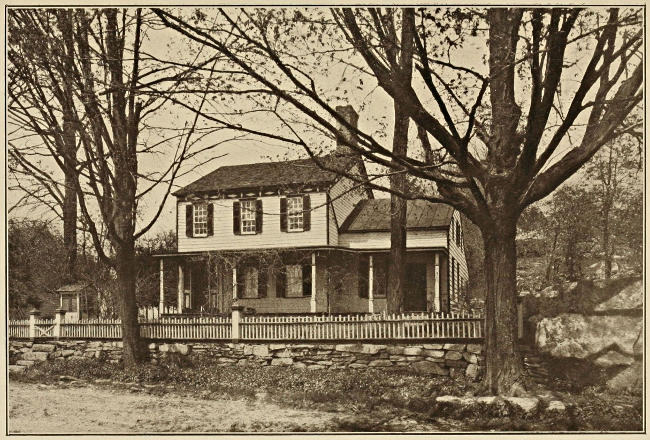
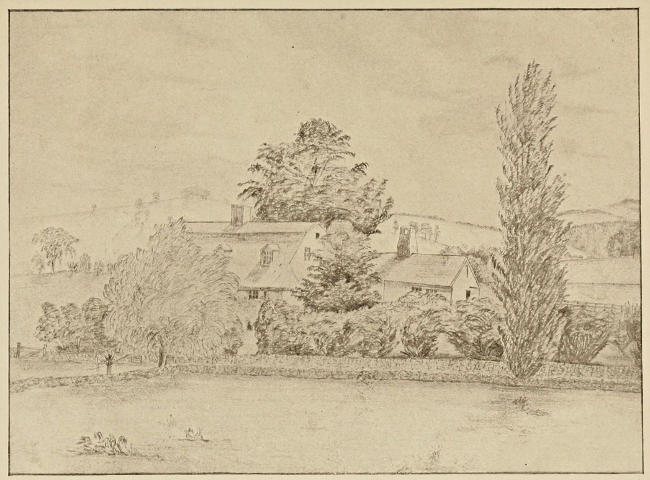
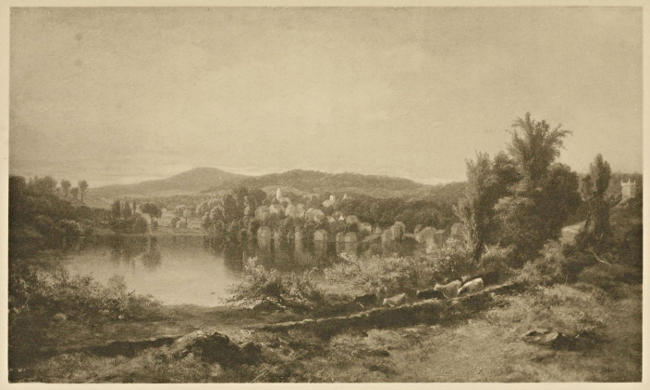
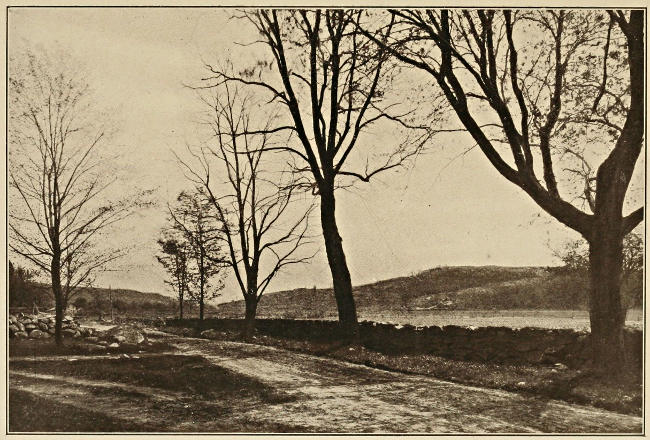
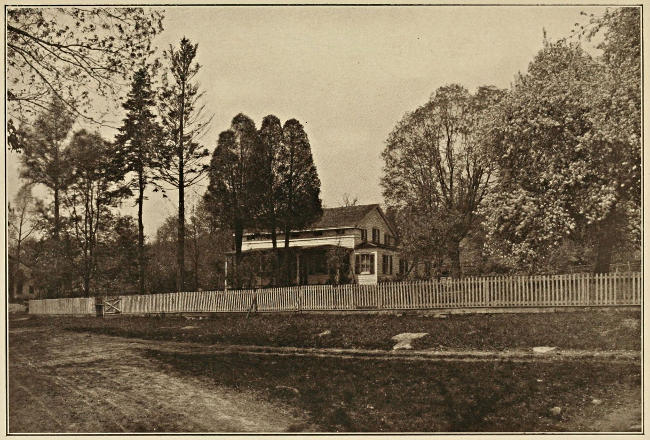
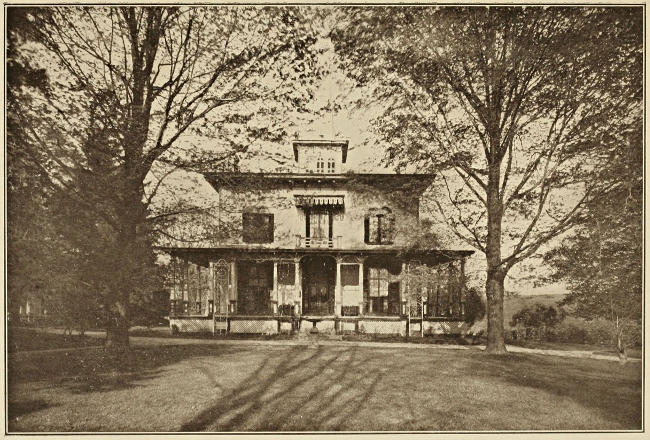
Home of the late Frederick Ludington, son of Colonel Ludington, at Kent
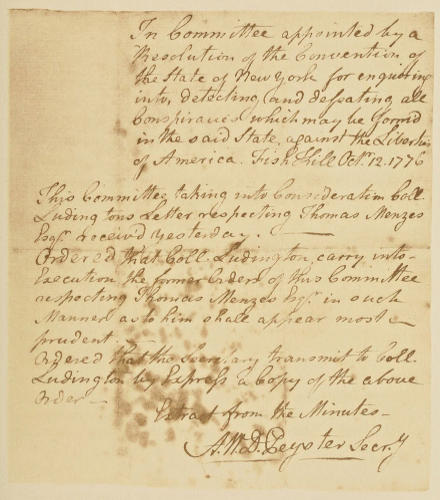
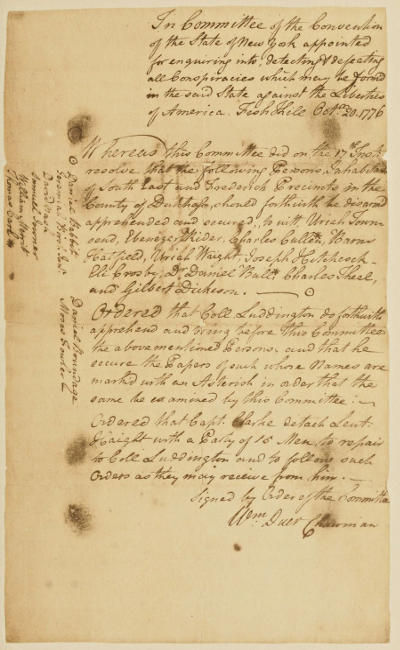
In the records of the Committee of Safety under
date of October 14, 1776, we find that “Col. Ludington
informed a member that he has 20 or more Arms,
taken from disaffected persons, now in his possession,
and requests to know how they shall be disposed of.
Ordered, That Col. Ludington send all arms in his
possession, taken from disaffected persons, to this
Committee without delay, and that he sends his account
for repairing to the Auditor-General.” The
“account for repairing” refers to the work done by
Colonel Ludington on the captured weapons to
make them serviceable for use in the American
Army; many of the Tories deliberately breaking
their muskets or depriving them of essential parts,
before surrendering them. A little later William
Duer, one of the foremost members of the Committee,
reported that “large quantities of hay and corn
were purchased by the Quarter Master General for
use of the Continental Army in the eastern part of
this (Dutchess) County and the western part of
Connecticut, that it would be hardly practicable to
convey the same to the army unless the roads leading
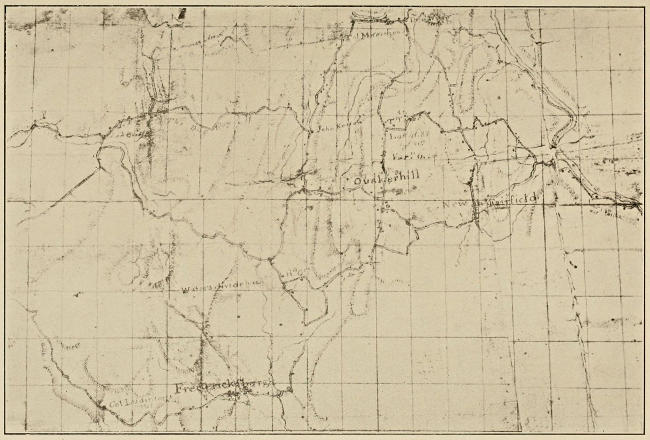
from the Oblong and Fredericksburgh towards
Pine’s Bridge and North Castle were better repaired.
He therefore in behalf of General Mifflin, Quarter
Master General of the Continental Army, prayed
that this House would devise ways and means of
facilitating the above mentioned communication, not
doubting but so necessary an expenditure would be
cheerfully reimbursed from the Continental Treasury.
On taking the application of Mr. Duer into
consideration, Resolved, That it will be necessary to
repair the following Roads in order to facilitate the
cartage of forage to the Continental Army, from the
house of Col. Henry Ludington thence to Samuel
Washburn’s, being 8 miles; the road which runs east
from Col. Harry Ludington’s to the Store of Malcolm
Morrison’s and thence south to the Mills of
Samuel Washburn, being 12 miles. Resolved That
Col. Ludington detach from his Regiment 100 men
for the purpose of repairing that part of the road
which is first mentioned, being in distance 8 Miles.…
Ordered, that copies of these Resolutions be
immediately transmitted to the Supts. above mentioned,
who are directed to communicate them without
loss of time to Cols. Fields and Luddington.”
For this road-mending work the Committee fixed
the price of labor at ten shillings a day, exclusive of
subsistence, for the superintendents, and four shillings
a day for the men, the latter to provide their
own sustenance. They had power to impress teams
and carts, and to pay for each ox-cart and two yoke
of cattle sixteen shillings, and for each wagon twelve
shillings. Those who remember the common condition
of roads in that part of the State a score of years
ago, will appreciate what need there must have been
a century before of repairs and improvements.
The varied character of Colonel Ludington’s services
in the first years of the Revolution is indicated
by the entries in his ledger. Thus in November,
1776, we find him charging the Committee for inquiring
into and detecting conspiracies against the
State of New York with “4 days service riding with
Nathaniel Sackett in order to collect evidence, at 21
shillings, 4 days, £4—5—4.” On November 21,
1776: “Then began the service of buying hay and
grain for the use of the Continental Army by an
agreement with Wm. Duer.” On January 1, 1777:
“Then stopped the service of buying hay, being in
all 41 days at 20 shillings per day.” In November,
1777: “Then engaged in the Commissary Department
under Deputy Commissary General and continued
on the service until the 8th of January, 48
days in all at 32 shillings per day, 58 £ 16 s.”
A number of persons were arrested and taken before
the Committee at Fishkill in December, 1776,
and on December 20 one of them, David Aikins,
made affidavit: “That on or about the 29th day of
November last, he set out from home with a pass
from Colonel Henry Ludington to go to Horse
Neck to buy rum; and further stated he was disappointed
in getting it. He then proceeded to find
one Barnes Hatfield who owed him a considerable
sum of money, but not finding him he went to see
Isaac Williams who had married his cousin, and
while there he was captured by Rogers’s Rangers
(British) and afterwards was taken before a Major
near King’s Bridge. The Major asked him how he
could clear himself from the rebel pass found upon
him. He said he came down upon a particular errand
from Captain Alexander Grant’s wife to him
and if he would send him to Capt. Grant or Capt.
Archbd. Campbell he would prove his character.
Upon his arrival to Capt. Campbell said he was a
prisoner and it was in his power to discharge him.
Campbell said he would discharge him if he would
carry some papers and errands to certain persons in
his neighborhood and be secret about it. He promised
and Captain Campbell gave him two printed
papers and protections from General Howe for Malcolm
Morrison, John Kain, Alexander Kidd, Matthew
Patterson, Charles Collins and one for himself.”
In an affidavit two days later the Patterson
mentioned declared: “That he told Akins that he did
not chuse to have anything to do with such things,
and further saith that there was a Man in the room,
meaning Colo. Luddinton, who if he knew what
Aikins said would immediately send him to Congress,
but did not deem it expedient to mention to
Col. Ludington.”
Malcolm Morrison appears to have been apprehended
on suspicion and to have been held for a
time at Kingston jail, whence he sent, on February
19, 1777, a petition in which he said: “Your petitioner
has always been ready in assisting both officers
and soldiers in their publick business of the States
and in a most generous manner has advanced them
Cash for their Different Reliefs, and is at present a
very considerable sum out of pocket on that account
and has received no part of such sum except six
pounds lent to Colo. Luddleton and Wm. Griffin to
enable them to find out that pernicious plot of John
Miller and Constant Nickerson, Reference being had
to these gentlemen for the truth of his advice & assistance
in bringing that plot to light.” Morrison
took the oath of allegiance and was released. The
Nickerson referred to was doubtless Captain “Josh”
Nickerson, of the Swamp, near Fredericksburgh, a
notorious Tory. He enlisted and drilled a large
number of men, with the design of taking them to
join General Howe’s army in New York. Their
plans and meetings were all supposed to be kept a
profound secret, but Colonel Ludington learned of
them and made counter plans for the capture of the
whole party. To that end he sent one of his tenants
as a spy to ascertain the number, place of meeting,
etc., of the Tories. This spy, after some difficulty,
fell in with one of the party and pretended to him
that he was desirous of enlisting in the British Army.
He was thereupon taken to Nickerson and enrolled.
He ascertained that a certain night had been appointed
for their setting out for New York, and also
that the roster of the company was kept concealed in
a hollow walking-stick which Nickerson always had
by him. This information was promptly conveyed
to Colonel Ludington, who forthwith assembled his
regiment, surrounded Nickerson and his company on
the night set for their departure for New York, and
took them all prisoners. The documentary evidence
of their guilt was found on the written roll, and
Nickerson was vastly chagrined when Colonel Ludington
bade him give up the cane and then opened it
and took out the hidden paper.
The southern part of Dutchess County, now Putnam
County, was, in fact, one of the most critical
danger spots in the whole country, as a passage in
the Journal of the Convention of the State of New
York shows, under date of Sunday morning, May 4,
1777:
Capt. Delavan, who being called before the
Convention, after giving information upon the
subject contained in the letters brought by him,
further informed the House, That the disaffected
persons are very numerous in the southern parts
of Dutchess County, and that without doubt they
will fall upon the Whigs whenever the enemy
attack our army at Peekskill or at the forts in the
Highlands; they therefore request the Convention
to take some measure in the premises. Thereupon
Resolved, That Mr. Jay, Colo. Thomas,
Colo. Ludington be Commissioners to prevent,
quell and subdue all insurrections and disaffections
in the Counties of Dutchess and Westchester,
and to take every measure for that purpose
which they shall deem necessary; and that
they cooperate with Messrs. Robert R. Livingston,
Zephaniah Platt and Matthew Cantine, a
committee appointed yesterday, for the like purpose
in the Manor of Livingston and Rhinebeck
Precinct. Resolved, That the said Commissioners
immediately collect with the assistance of General
McDougall, or General George Clinton, or
from the militia of the County of Dutchess,
whichever shall appear to them most expeditious,
a force sufficient for the purpose and also to comply
with the following instructions, to wit: Gentlemen:
You are to begin in the southern part of
the County of Dutchess and proceed to the northward,
and in your progress secure the disaffected,
call out the whole militia, and destroy all such as
shall be found in arms to oppose you. When you
shall meet with the Committee above mentioned
you are to act in concert with them, to secure the
prisoners you shall have respectively made, to
dismiss such of the militia as you may think
proper, and with the remainder march into the
County of Westchester by different ways, concerting
at the same time such measures with General
McDougall or other commanding officer at
Peekskill as will effectually clear said county of
Westchester of all dangerous and disaffected
persons. You are on every occasion, by every
means in your power (torture excepted) to compel
the discovery and delivery of spies or other
emissaries of the enemy, who you may have
reason to believe are concealed in any part of the
country through which you may make progress
and upon due proof immediately execute them in
terrorem.
A copy of the resolutions was sent to Livingston,
Platt, and Cantine, with additional instructions to
conform with the resolutions sent them, and after
having cleared the manor of Livingston and the precinct
of Rhinebeck of all dangerous and disaffected
inhabitants, to proceed southward until they met
with Jay, Thomas, and Ludington, conducting
themselves in accordance with the resolutions; and
when they had met with them, immediately to form
a proper plan and endeavor to carry the plan into
immediate execution. Discretion was given to vary
from instructions as the circumstances might require.
Copies of the intelligence received by the
Convention were sent to the commissioners. A few
days later, under date of May 8, Livingston, Platt
and Cantine reported that the number of conspirators
was far greater than they had imagined, almost
everybody in the upper manor, particularly the eastern
part of it, being disaffected, and they urged that
courts martial were absolutely necessary for dealing
with the chief offenders. As for Jay, Thomas, and
Ludington, they entered upon their part of the work
with zeal, but found themselves somewhat hampered
by other demands made upon them and by the unwillingness
of some of the militia to engage in the
service of the Continental Army. On June 25 this
matter was brought before the Convention, and it
was—
Resolved, That whereas information hath been
given to this Congress that certain Captains in
Col. Luddington’s regiment of militia in Dutchess
County have refused to draft out of their
respective companies for the purpose of brigade
of militia to be raised in this county for the Continental
service as recommended by this Congress
in pursuance of the resolves of the Continental
Congress of the 1st, 3rd and 4th inst. Resolved,
That the general committee of the said county be
requested to make inquiry into the premises, and
upon due proof of the charge against the said
captains, to send them under proper guard to this
Congress to be dealt with according to their deserts.
During that summer Colonel Ludington seems to
have been much engaged with duties in Westchester
County. Thus in General Putnam’s general orders
we find, under date of White Plains, September 19,
1777, the following:
Colo. Ludington to furnish guards and patroles
from the camp to the North River. Majr.
Gray to Send a guard and patrole on the road
between Stephen Woods and the North River.
Two days later, on September 21, the order ran:
Officer of the Day to-morrow Colo Ludenton
the same No to go on Piquit to-night as Last
night & on the same roads great care to be taken
not to put any on this Piquit but such in whose
Fidelity the greatest Confidence may be Placed.
Colo Ludington & Major Gray will guard the
same Roads as yesterday. Patroleing Partys
are Constantly to be kept up.
Again, the next day, the order ran: “The guards
and Piquits are to be kept up also Majr. Gray &
Colo Ludington as has been kept before.”
The work of detecting and arresting traitors within
the American lines occupied much of Colonel Ludington’s
attention, and in it he seems to have been
particularly energetic and effective. His wide knowledge
of men and affairs in Westchester and Dutchess
counties caused frequent appeal to be made to
him for information concerning suspicious persons.
Thus Lieutenant-Colonel Dimon in September,
1777, wrote to General Putnam as follows:
Harrison’s Purchase Sept’r 12th 1777.
Hon’d Sir,
Enclosed I have sent a Return of the Regt.
Also have sent for your Honor’s Examination,
three Prisoners (viz) John Crabb, an Inhabitant
of Fredericsburg, taken up at White-plains, who
said he was going to Horseneck to buy Salt, but
on being searched, it appeared that 2/6 in paper
& 4/6 or 5/ in hard Mony was all the Mony he
had in Possession, & what renders his Conduct
still more suspicious, was that, James Knox, another
of the Prisoners, was in Company with him,
when first discovered by our Men, but made his
Escape from them, & was next Day taken up
near New Rochelle, & who confesses he was going
to the Enemy: s’d Crabb desiring a Man might
be sent to Col. Luddington, to obtain his Character,
to whom he said he was known; I acordingly
desired Col. Luddington (to) send his
Character, which he did, & which I have sent enclosed.
But the third, as I imagine the greatest
Villian of three, named Hachaliah Merrit was
taken in East Chester early in the Morning after
being out all Night with his Great Coat &
Blanket, & armed with a loaded Pistoll, & who
does not pretend to say any thing in his own Justification.
I am with great Esteem, your Honour’s
most humble Servant.
David Dimon, Lt. Col.
Major Genl. Putman.
Accompanying this was Colonel Ludington’s
reply to the appeal for a “character” for the prisoner
Crabb, which could have given that worthy little
comfort:
Dear Sir,
I have Inquired into the Character of the Said
Jno. Crabb and find him to be an Enemy to his
Country therefore shall Expect he will be
Treated as Such and am Sir
Your Very humble Serv’t
Henry Ludinton, Colo.
Sept’r 10: 1777.
To Colo. David Demmon.
A few days later Colonel Ludington himself wrote
to Putnam:
Philipse Burgh Sept’r 12th 1777.
Sir,
I have sent you one Elijah Taylor; his Crime
is as Follows: he pretends he came from below
our Lines because he was Suspected to be a friend
to us; a few days after he came to me with his
Brother in Law from Milesquare pretending he
had lost a Horse and applied to me for Orders to
take him where he could find him. I gave him
permission to search for his Horse any where he
pleased above our Lines but not to Return home
without calling on me, but Instead of Calling,
Returned home and soon after came up again. I
found by his Conduct that was not his Arrent
(errand) for at the Same time he and the said
Taylor was Laying a Plan to steal our horses.
The way I got Information was that one Dudely
Bailey, a Sutler to our Regiment, was in Conversation
with the said Taylor concerning their
Losing Horses, whereupon the said Taylor told
him they had Lost Horses and knew where to
find them but did not care about them for he
could take them off in the Night; then he ask’d
Bailey where the Horses belonging to the Regiment
were kept, and where our Centenals were
posted, in order that he might Carry his plan in
Execution; and he further told him it would not
be Long before we should be Routed, for a few
men might do it, as we were Obliged to post ourselves
in Houses. He further agread with Baily
for him to go down as far as Milesquare to
one Benjamin Taylor’s and there stay until the
s’d Taylor could go to the Hessian Generals and
when he Return’d he would put him in good
Business where he might Earn a Dollar pr day.
he further said that When he makes his Report
to the General that he might live like a Gentleman
without doing any work. He further Acquainted
him he had been through your Camps
at Peekskill as far up as Poughkeepsy and there
were Several Spies out among whom was an
Hessian Officer, and upon them Circumstances I
have sent you the Said Taylor. For further Information
Refer you to the said Bailey as an
Evidence to the truth of the Matter who shall be
sent up to you whenever I Receive your Order
for that purpose.
I have Likewise sent up three other prisoners,
Jacob Read, Abraham Aston & Joseph Brown,
the two former were taken up on Suspicion of
Carrying on a dangerous Correspondence with
the Enemy and the Latter is a deserter from
Colo. Willis’s Regt. and Capt. Champion’s
Comp’y of the Continental Troops. I am your
honour’s Humble Serv’t
Henry Ludinton, Col.
P.S. Should be Oblig’d to your Honour to give
the Bearer some direction where he may draw
some Cordage for the use of the Teams. I am as
above
H. L.
To Genl. Putnam at Head Quarters Peekskill.
Jacob Read, or Rhead, promptly wrote to Clinton,
protesting that he had always been a true friend of
his country and had repeatedly been employed in its
service, and that therefore he conceived himself to
have been most unjustly treated in being arrested as
a traitor. He begged to be examined immediately
and to be set at liberty on proof of his innocence.
In the fall of 1777 there was a scarcity of provisions
in Westchester and Dutchess counties, and
the Tories sought further to embarrass the American
cause by shipping all provisions they could secure to
the British Army. On this account the following letter
was addressed by Colonel Ludington and others
to the Council of Safety for the State of New York:
Dutchess Co.
3rd December, 1777.
Gentᵐ:
Nothing but the strongest necessity could induce
us to trouble you with an application of so
extraordinary a nature, but if we are esteemed
worthy of your confidence as friends to our struggling
country our sincerity will atone for what in
common cases might appear indecent. Our invaded
State has not only been an object of the
special designs of our common enemy, but obnoxious
to the wicked, mercenary intrigues of a
number of engrossing Jockies who have drained
this part of the State of the article of bread to such
a degree that we have reason to fear there is not
enough left for the support of the inhabitants. We
have for some months past heard of one Holmes
who has been purchasing wheat and flour in these
parts with which the well affected are universally
ill-provided. This man with us is of doubtful character,
his conversations are of the disaffected sort
entirely. He has now moving from Fishkill
toward Newark we think not less than one hundred
barrels of flour, for which he says he has your permit,
the which we have not seen. However we
have, at the universal call of the people, concluded
to stop the flour and Holmes himself until this
express may return. We ourselves think from
the conduct of this man that his designs are bad.
We have the honor to be your humble servants,
- Henry Ludington,
- Joseph Crane Jr.,
- Jonathan Paddock,
- Elijah Townsend.
To the Honorable the Council of Safety for the
State of N. Y.
More than two months later Crane and Ludington
wrote to Governor Clinton on the same matter:
Southeast Precinct, 16th February, 1778.
May it Please Your Excellency,
We about Two Months ago presumed to stop
a parcel of Flour said to be the property of one
Helmes made immediate Report thereof to the
Council of Safety in answer we were favoured
with a coppy of the Licence Granted by the
Council to the said Helms, with a Coppy of the
Oath on which said Licence was Granted & with
Directions from the Council that in Case the Conduct
of sd Helms was not Correspondant with
the Tennor of sd Oath and Licence to apprehend
and committ him for Tryal and Detain the Flour.
Previous to the Return of the Express Dispatched
with our Report to the Council Helms
made his Escape and has not appeared here since.
The Flour was Hurried up some in old Cyder
Hogsheads the Rest in Barrels not well secured
has been exposed to wett and is in Danger of
Spoiling. Your Excellencies Directions Respecting
this matter will be Esteemed as a favour done
to your most Obedient and Humble Servants
- Joseph Crane Junr
- Henry Ludinton
His Excellency Governor Clinton.
The man Holmes mentioned was Colonel John
Holmes, one of the most wary and energetic Tories
in that part of the country. He was famed as a
breeder and racer of horses, and had a stock farm
near Colonel Ludington’s. Indeed, he and Ludington
were neighbors and friends before the outbreak
of the war, but in the animosities engendered by that
conflict they were involved as bitter foes. Holmes
had a commission from the British authorizing him to
enlist men for their service, and for this purpose he
had a recruiting station on Fishkill Plains in an out-of-the-way
place—a field covered with scrub oak.
There he gathered Tories and drilled them for the
British service. He often boasted privately that his
friend Ludington would one day accompany him on
a visit to General Howe at New York—meaning, of
course, as a prisoner. Colonel Ludington, however,
completely turned the tables upon his old neighbor
and would-be captor. Learning from his secret
agents that Holmes was collecting a company of
Tories on the Fishkill Plains, he quietly gathered his
own regiment for what he warned them was to be an
undertaking of much activity and danger. After
several days of preparation, he led his men at night
to the Tory rendezvous. Dividing them into companies,
he caused them completely to encircle the
scrub oak field and close in upon it from all sides. So
quietly and effectively was the work done that
Holmes and every one of his followers were captured,
without the loss of a life or the firing of a
single shot. There were, however, several severe hand-to-hand
struggles, in one of which Colonel Ludington
himself had a brand new suit of clothes almost
entirely torn from his back. Holmes was furious at
being thus trapped, and the more so when he found
that Ludington was his captor. He was compelled
to give up as spoils of war his watch and purse, and a
large sum of British money which had been given to
him for the conduct of his recruiting operations. Colonel
Ludington then marched the whole party off to
Poughkeepsie and deposited them in jail. He appears
to have had no personal grudge against
Holmes, however, and on a subsequent occasion
saved his life at much danger to himself.
The ardent patriots of the border counties were not
content with merely these acts of forcible suppression
of traitorous conduct, but desired to strike still
more strongly and effectively at the foes of their own
neighborhood. An act of the Convention had already
authorized the occupation and leasing at moderate
rentals of all lands owned by those who had entered
the British service. At first there was little disposition
to enforce the measure, but as the Revolution
proceeded, and the “pernicious activity” of the
Tories became more marked, the people of Dutchess
County moved for the execution of the law. The
following letter was accordingly addressed to Governor
Clinton by the Board of Sequestration of that
county:
To his Excellency George Clinton, Esq.
Governor of the State of New York, General
of the Militia, and Admiral of the Navy of the
same.
The Memorial of Theodorus Van Wyck and
Henry Livingston Jun. Commissioners of Sequestration
for the County of Dutchess.
Sheweth, That, whereas, on the 13th day of
May, 1777, The honorable the Convention of the
Representatives of the State of New York came
to the following resolution “Resolved that the
Commissioners of sequestration be directed & impowered
to lease out the lands & Tenements of all
such persons as already have gone, or hereafter
shall go, unto & Join the Enemies of this State,
under Moderate rent, from year to year, to persons
friendly to the cause of America & who will
Covenant to keep the same in repair & to suffer
no waste to be done thereon”—And again “Resolved,
that in all such leases the Inhabitants of
this State who have been driven from their Habitations
by the Enemy should be preferred by the
Commissioners to others who have not that claim
to the favor of the public.”
Agreeable to the above resolutions your
Memorialists have put numbers of well affected
Refugees Inhabitants of this State into the possession
of lands and tenements deserted by the
former disaffected proprietors. As yet your Memorialists
have stipulated with but very few of
the Refugees aforesaid, what rent they shall pay
for the lands & tenements they Occupy. Your
Memorialists wish to have pointed out to them,
what proportion of the highest rent they could
obtain from others, for lands and tenements
above described, the said Refugees should pay.
Your Memorialists would also beg leave to
represent to your Excellency, that numbers of
persons now with our Enemies own large tracts
of land in this County; Many of the tenants on
which are desirous of discharging their rents, and
have in many instances applyed to your Memorialists
for direction. By virtue of any
Resolutions made by the Legislature your
Memorialists do not think themselves authorized
to receive the Same.
If the Legislature see fit to direct to have the
above rents collected your Memorialists wish the
Estates may be particularized.
Your Memorialists would also inform your
Excellency that they have in their possession a
quantity of plate late the property of Mess. John
Livingston, Peter Stuyvesant and Stephen
Crossfield, and be given direction in the disposition
of it.
And your Memorialists will &c.
- Theodorus Van Wyck,
- Henry Livingston Jun’r.
March 16th 1778.
The governor’s reply to this appeal was not altogether
satisfactory to the more ardent patriots, who
were suffering much in their private estates from the
ravages of British irregulars and their Tory allies,
and accordingly a memorial was soon presented to
the Convention asking for further legislation of a
particularly stringent kind. Made by the freeholders
and citizens of Dutchess County, this memorial
was doubtless signed by Colonel Ludington together
with many others, and expressed his vigorous opinions.
It ran as follows:
To the Honorable the Senate and Assembly of
the State of New York,
The respectful address and petition of the Freeholders
and Others, Inhabitants of the County of
Dutchess, Friends to the freedom and Independence
of the United States of America,
Humbly Sheweth:
That the nefarious and most cruel Designs of
the King and parliament of Great Britain, to reduce
our Country to Vasalage, have been and still
continue to be executed with a degree of Malice
and Rancour, altogether inconsistent with the
character of a Nation professing Christianity, or
even a regard to common Justice and humanity;
that while your petitioners in defence of their
Rights and freedom have opposed the devices inspired
by Tyranny, and have suffered severely,
many of them in their own proper persons, and
effects, and all in those of their friends and fellow
citizens; they have always had, as they hope, a
well grounded confidence in the Wisdom and
Justice of an honest, impartial Legislature, by
whom they trust such an adequate adjustment of
forfeited property will be effected as may duly
punish the authors of the publick Calamities, relieve
the distressed and be the most conducive to
the General good of the State.
That as you are now entering upon the Business
of the second year of the Legislature of this
State, we Doubt not but a Variety of important
matters presents themselves to your consideration,
among which, in our opinion, one of the
greatest is the confiscation and sale of the property
of the Traitorous Enemies of this State; that
our Debts contracted in prosecuting this necessary
War, are become enormous; that the whole
of this Burden will be as intolerable for us and
our children to bear, as it will be cruel to exact it
of us; That the only expedient for our relief will
be the appropriation of the property within this
State, of those unnatural Enemies, (whether now
within or out of it) by whose wicked practices the
War, with all its horrors, Calamities and consequent
charges, was brought upon us and is continued
to this present period in the American
States by them devoted to destruction. To this
end have they not exerted every faculty, cancelled
every social and sacred Obligation, and to the utmost
assisted the Enemies of their Country, irritated
them against it, and urged them to compleat
its distruction? Have not many of them
embodied with the British Troops, assisted in
their councils, aided and abetted them in contriving
and executing all their infernal measures?
Lenity to such atrocious offenders, we conceive
to be cruelty to the State in General, and to mankind,
unwarrantable either by the Laws of God
or Man.
These are, therefore, with all due deference and
respect, to desire and request you, as the representative
body of this State, forthwith to proceed
upon, and before the close of the present
Session, effectually form and accomplish a Law
for the confiscation and sale of the Real and personal
property of the Enemies of this State, in
such way and manner as may be for the good of
the people at Large, and we Doubt not, in the
Completion of so important an Act, but you will
readily forego every private Conveniency to
yourselves and particular families.
We have with surprise and concern understood
that several members of your honorable
Houses are impatient to close the Session, on account
of their Domestic concerns. We would
humbly beg leave to remind such gentlemen that,
however pressing their private affairs may be, the
publick Demands ought to be first attended to,
as in them the Interest of every Individual is devolved;
and in particular this Act ought by no
means to be postponed. The publick Debts, the
alarming Depreciation of our paper money, are
pressing, and will admit of no delay. The present
and not the future is in your power, and were
it necessary to use arguments on this subject to
patriots, it would be easy to show that the delay
of this Act to another Session is big with uncertainty
of its passing at all, and therefore of the
most dangerous consequences to this State.
Especially as it will occasion universal uneasiness
and in all probability produce Tumults and
insurrections, and tend to a Domestic Tyranny and
confusion as much to be dreaded as the evils
brought upon us by our connections with Great
Britain, the Effects of which we thus wofully experience.
Tho’ thro’ the smiles of Heaven upon
our past endeavors, we are now arrived within
view of our native inheritance, the promised
Land of peace and freedom, to which we look
with longing Eyes. But our unremited exertions
are still necessary to bring us to the Haven of
rest. Else all our past Labors may still prove in
vain, all our fair prospects be darkened by Intervening
Clouds, that may drive us again upon a
tempestuous sea of trouble till we are overwhelmed
and Lost. To prevent this we and all
your Constituents look up with Anxious Expectations
to you, on whom is devolved the care of
the State Vessel, and on whom we depend to
pilot it into a port of safety; and we trust your
vigilance and unwearied application to the important
Duties of your Station will be continued
till the great End is Obtained, for which as in
Duty bound we shall ever pray, &c.
Poughkeepsie, October 22nd, 1778.
It was inevitable that his activity and zeal in promoting
and executing such measures should make
Colonel Ludington an object of especial antipathy
to the local Tories and also to the British authorities
in New York. He was regarded by them as one of
the chief obstacles to the raising of troops and the
securing of supplies for the British Army in the
border region. Accordingly the strongest efforts
were made to get rid of him, either by death or capture.
On more than one occasion he was shot at by
hidden marksmen by the wayside and narrowly
escaped being killed. The British authorities offered
a reward of three hundred guineas for his person,
and more than one of his disaffected neighbors
sought to win that prize. Much of the time his house
was guarded by a detachment of his regiment, but
often for days and weeks when he was at home his
only sentinels were his two older daughters, Sibyl
and Rebecca. These children would sit for hours,
armed with heavy muskets, at the upper windows,
behind casks on the piazza, or in a neighboring
cornfield, watching for the approach of suspicious
or openly hostile characters and ready to give
their father warning. One night they espied a number
of moving figures, lurking behind trees and
fences, and at once waked their father with the warning
that Tories were surrounding the house. Colonel
Ludington, having no aid at hand sufficient to offer
defense, resorted to a ruse. He hurriedly aroused
the inmates and distributed them through all the
rooms, each with a musket and a lighted candle. The
general illumination of the building, the signs of commotion,
and the shadows of moving and armed figures
on every window blind, persuaded the Tories
that a company of soldiers was in the house. They
therefore feared to make the attack which they had
intended, but contented themselves with yelling and
hooting in the adjoining woods until day began to
break, when they retired down the road to the southward,
through the little settlement which then occupied
the present site of the village of Carmel.
The next day Colonel Ludington ascertained that
his nocturnal visitors were Tories from Quaker Hill
and Pawling, under the leadership of Dr. Prosser,
who has already been mentioned in this narrative,
and were about forty in number. Prosser was a
neighbor of Colonel Ludington’s, but was also his
bitter enemy, and was one of the most virulent Tories
in all that region. He was that night leading his
company down to New York to join the British
Army, and had planned to kill or capture Colonel
Ludington and thus secure the reward of three hundred
guineas which General Howe had offered.
After the war Prosser returned to Dutchess County
to live, thinking his Toryism would be forgotten or
condoned. But Colonel Ludington had not forgotten
nor forgiven his midnight attempt at murder or
capture. One day the two men met on the highway
at Patterson, both being on horseback. As soon as
Prosser caught sight of the man whom he had tried to
“remove,” he turned and attempted to avoid him.
But Colonel Ludington and his horse were too quick
for him. Overtaking him the Colonel belabored him
with a heavy rawhide whip and gave him a most
thorough flogging, which of course Prosser could not
venture to resent by legal means.
On another occasion during the war two gentlemen
and their servants, strangers, stopped at Colonel
Ludington’s house and asked for entertainment for
the night. They were received with some misgivings
as to their loyalty. Some time after they had retired
the watching members of the family perceived that
the house was surrounded by armed men. Suspecting
that the strangers were in league with the besiegers,
they went to their room, roused them, and at
the muzzles of muskets demanded to know who they
were and what was their business. The strangers
managed to assure them that they were friends, and
thereupon joined the family in lighting up the house
and giving it the appearance of a well-garrisoned
stronghold. As on the former occasion the ruse was
effective and the attacking party withdrew.
Colonel Ludington’s activities and also his difficulties
in raising troops for various purposes are suggested
in some of his correspondence with Governor
Clinton:
I would inform your Excelency that I have
proceeded to Raise the Companey aloted me to
Raise as my Quota and Expect them to march on
Munday next; in Regard of officering the Companey
I have Been obliged to Borow a point, and
thought it my Duty to acquaint his Excelency in
that manner; the man apointed as Capt. Did not
Belong to the militia—who is Capt. Elijah
Tounsand the Barer—But has Been the most of
the time in Service Since the war Began and has
Been Captain with me in the 3 months Service at
the Plains and I Conceive him to Be more Suitable
to Command a companey than one of the
militia Captains; would therefore take it as a
favour if you would give him his Comision; the 1
Lieut. is John Berrey, a militia officer; the 2
Lieut. is Mr. William McTine a young man who
formerly Lived at the White Plains and now has
moved among us, has never Born a commision in
the militia, But is Lookt upon to Be a proper
person for it, as he is a man well acquainted with
the part of the Country where he is going and
very Capable of performing the office. Sir I
hope it will Be agreable to his Excelency to grant
Commisions to the above mentioned persons and
in So doing you will mutch oblige your Humble
Servant
Henry Ludinton.
Fredricksburgh May 1d 1778.
To his Excelency George Clinton Esqr. Governor.
To this Clinton promptly replied:
Poughkeepsie 1st May 1778.
Sir, I have rec’d your Letter of equal Date.
By the Law for raising the 700 Men for the Defence
of the State the Officers are to be taken
from the Militia. If, therefore, Capt. Townsend
is to Command the Company you must have him
appointed a Capt. in your Regt. & the other
Gentleman a Lieut., otherwise it will be impossible
to give them the Command tho’ I wish to do
it. I have convened the Council of Appointment
to meet at this Place this Day to compleat the
Military Appointments. I must, therefore,
again call upon you for the proper Returns of
your Regiment, agreable to former Orders to
enable us to perfect the Appointments therein.
I think it would be best for you to attend here in
Person on Monday next at farthest. I am your
Most Obed’t Serv’t
Geo. Clinton.
Colo. Ludington.
The British raid up the Hudson, with the burning
of Kingston, already mentioned, provoked much activity
throughout the border region, and resulted in
added suffering to the unfortunate inhabitants. Immediately
after the burning of Kingston the Committee
of Safety, meeting at Marbletown, adopted
the following:
Whereas, The late destruction of the town of
Kingston, and a vast number of dwelling houses,
improvements, grain and fodder on either side of
Hudson’s River, by a cruel, inhuman and merciless
enemy, has deprived many persons and families,
the good subjects of the State, of shelter and
subsistence for themselves and their cattle—calamities
which by the blessing of God on the
fruits of this land those who have not shared in so
uncommon a misfortune are enabled in a great
measure to relieve;
Resolved, Therefore, that it be, and it is hereby
most earnestly recommended to the several and
respective general and district committees of the
counties of Ulster, Dutchess, Orange and Westchester,
to make, or cause to be made, a proper
and proportionate distribution of the aforesaid
distressed persons and families, and their cattle,
to the end that they may all be provided for as the
circumstances of the country will permit; and it
is hereby most strenuously urged on all those who
may not have shared with them in their afflictions
to receive the aforesaid persons, families and cattle,
and furnish them with shelter and subsistence
at a moderate rate.
To this humane appeal the patriotic part of the
population cordially responded, but of course the
British sympathizers were reluctant to do so. Their
reluctance and refusal brought upon them, however,
the increased wrath of the patriots, and incited to increased
zeal the committees whose province it was to
deal with the disaffected. Among these, Colonel
Ludington was prominent, though he exercised his
powers with a certain humane discretion and was not
inclined to be cruelly vindictive even toward the most
malignant Tories. A letter of his to the Commissioners
of Sequestration, now in the possession of
Mr. William E. Dean, of Fishkill, runs as follows,
its reference being to the “Red Mills,” near Lake
Mahopac:
Gentlemen
Mr. Cox has been with me this day and informed
me that the Mills are likely to be taken
from him and to Be put into the Hands of Mrs.
Cammels and 2 other persons. the two Mrs Camels
I am well acquainted with and would do Everything
in my power to serve them But when you
come to consider upon this matter You may find
they may Be Settled at preasent in such a manner
that they may Remain where they are for a while
and be Less Damidge to them than it will be to
Mr. Cox to turn out at this season of the year and
so sudden as he is Required to Do. it will Be
easy for you to Judg what a bad plight it will
naturally put him to. therefore should take it as a
favour if you would Let Him Remain until he
can have an oportunity of settling Himself in
Some other place. this far can be said of Mr. Cox
it is generally Believed that He Has done Justice
to the publick while He has occupyed the mills
and in the Commisary Department which he has
been in since Last fall. But However gentlemen
I would not Be understood that I am to dictate
you in those affairs and am and remain your Real
Friend
and Humble Servant
Henry Ludinton.
Fredericksburgh January 29th, 1779
Mr Henery Livingston
& Theds Van Wick
The Comitioners Sequestration
Dutchess County.
Another letter, also in the possession of Mr. Dean,
runs as follows:
Dear Sir
I have just had an information of a score of
Sheep in the hands of one Josiah Swift Rented to
him By a person who Hath Been Sundry years
with the Enemy and Likewise Sum Cattell in the
Hands of Henry Charlick which Belonged to one
Ellston which the Bearer can inform you of, and
the Bearer is the person who moved Ellston’s wife
and family and John Millars and wishes that the
Discovery he had maid of those Cattel might be
an inducement to the Commisoners to give him
Sum Satisfaction for moving the 2 families
Down to the Lines
am Sir your very humble Servant
Henry Ludinton
To Theodorus Van wayk Esqs
P S I believe I am on track of a very Considerable
deal of property conseald Belonging to
Kain and Morison
This letter was addressed to “Theodorus Vanwayk
Esqs pr Mr. Daniel Haselton For want of wafer
this is not seald”.
The sternness of the dealings of the State with
British sympathizers was strikingly shown in the law
which was made by the State Convention on October
22, 1779, which ran in part:
Whereas during the present war … divers
persons holding or claiming property within this
State have voluntarily been adherent to the King,
his fleets and armies, enemies of this State …
whereof the said persons have severally and
justly forfeited all right to the protection of the
State and the benefit of laws under which property
is held or claimed … Be it enacted that
the said several persons hereinbefore particularly
named shall be and are hereby declared forever
banished from this State, and each and every one
of them who shall at any time hereafter be found
in any part of this State shall be and are hereby
declared guilty of felony, and shall suffer death
as in cases of felony, without benefit of clergy.
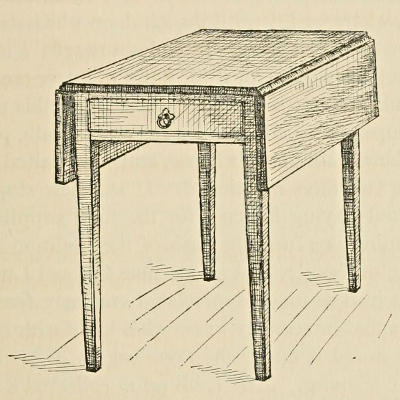
A mahogany table belonging to Colonel Ludington, at which,
according to family tradition, Washington
and Rochambeau dined.
(Now in the possession of Charles Henry Ludington)
Fredericksburgh and the neighborhood were frequently
traversed by officers and bodies of troops,
especially in making the journey from Hartford and
New Haven to Fishkill. Washington himself often
made that journey, and was a familiar guest at Colonel
Ludington’s house. On one occasion Washington
and Rochambeau, on their way from Hartford
to Fishkill, called there for dinner.
In the journal of Captain William Beatty, of the
Maryland Line, the following entry occurs under
date of Sunday, September 20, 1778:
“We marched about four miles past Fredericksburgh,
where we lay until the 22nd, on which day our
division marched about 12 miles towards Fishkill.
At this place we lay until the 28th, when we marched
to Fishkills.” It seems probable that on this march
the troops, presumably under Baron De Kalb, passed
by Colonel Ludington’s house, and were halted there
for the two days mentioned. If so, their stopping
there and paying in scrip for the food supplied by
the Ludingtons form the basis of the tradition in the
Ludington family, that at one time Colonel Ludington
received so much depreciated currency from the
soldiers that he scarcely knew what to do with it, and
finally stored it under the floor boards of his house
for safe keeping. Mrs. Ludington collected it from
the soldiers in her apron, and got her apron running
over full. Long afterward Colonel Ludington
burned a trunkful of the stuff, as worthless litter.
The Ludington house, standing, as before mentioned,
on the great highway from Hartford to the
Hudson, was often resorted to by travelers as an inn,
and while the British held New York City, the
greater part of all travel between New England and
the other colonies passed that way. William Ellery,
of Massachusetts, a signer of the Declaration of Independence,
traveled that road and stopped at Colonel
Ludington’s in the fall of 1777, on his way from
his home at Dighton, Massachusetts, to York, Pennsylvania,
to attend the session of the First Continental
Congress. He was accompanied by the Hon.
Francis Dana and his servant, whom he calls, in his
whimsical diary, respectively Don Quixote and
Sancho Panza, while to himself he gives the title of
Pill Garlick. Under date of “Road to Danbury,
Nov. 5th,” he records:
We intended when we reached Litchfield to
have gone to Peekskill, and there crossed the
North River, but when we got to Danbury we
were dissuaded from it by the Person at whose
house we breakfasted, who told us that there were
Tories and Horse stealers on that road. This account
occasioned us to take the Fishkill road.
Accordingly we set off, baited at the foot of
Quaker Hill, about 7 miles from Danbury, and
reached Colonel Ludington’s 8 miles from the
foregoing stage at night. Here mens meminisse
horret! We were told by our landlady the Col.
was gone to New Windsor, that there was a
guard on the road between Fishkill and Peekskill,
that one of the guard had been killed, about
6 miles off, and that a man not long before had
been shot at on the road to Fishkill not more than
three miles from their house and that a guard had
been placed there for some time past, and had
been dismissed only three days. We were now in
a doleful pickle, not a male in the house but Don
Quixote and his man Sancho and poor Pill Garlick,
and no lodging for the first and last but in a
lower room without any shutters to the windows
or locks to the doors. What was to be done?
What could be done? In the first place we fortified
our Stomachs with Beefsteak and Grogg
and then went to work to fortify ourselves against
an attack. The Knight of the woeful countenance
asked whether there were any guns in the
house. Two were produced, one of them in good
order. Nails were fixed over the windows, the
Guns placed in a corner of the room, a pistol under
each of our pillows, and the Hanger against
the bedpost, thus accoutered and prepared at all
points our heroes went to bed. Whether the valiant
Knight slept a wink or not, Pill Garlick cannot
say, for he was so overcome with fatigue, and
his animal spirits were so solaced with the beef
and the grogg, that every trace of fear was utterly
erased from his imagination and he slept soundly
from evening till morning, save that at midnight,
as he fancieth, he was waked by his companion,
with this interesting Question, delivered with a
tremulous voice, “What noise is that?” He listened
and soon discovered that the noise was occasioned
by some rats gnawing the head of a
bread cask. After satisfying the Knight about
the noise, he took his second and finishing nap.
Again, in Colonel Israel Angell’s diary, cited by
Mr. Patrick, we find:
29th Nov, 1779. This morning after breakfast
I got my horses Shodd, Crost the North River
over to fishkill. Went on for Danbury, Col
Greene and Mr. Griffen. Greene went for
Springfield so we parted about six miles from
fishkill, but Still could get nothing for our horses,
till riding ten or twelve miles, there Dind and fed
our horses, then went to Colo Luttentons Tavern
among the Mountains 21 miles from fishkills
there put up for the night. One of Col. Livingston’s
Officers came to this Tavern in the Evening
on his way home on a furlough.
Nov. 30th, 1779. Left my lodgings this morning
after breakfast went on for Danbury.
It is probable, indeed, that for a time Washington
himself made Colonel Ludington’s house his headquarters.
In the late summer and fall of 1778 he
had his army in that region, and made his own headquarters
at Fredericksburgh, as related by Irving
and Lossing. He wrote, under date of Fredericksburgh
on September 12 and 23, describing the disposition
of his army, “the second line, with Lord
Sterling, in the vicinity of Fredericksburgh.” He
was there with the exception of a week from September
12 to the end of November. Part of the time
his headquarters were at the house of John Kane—also
spelled Kain and Keane. This house stood on the
site since occupied by the house of Mr. Charles H.
Roberts, at Pawling, and was a large house, connected
by a stone-walled passageway with another
large stone building, the ground floor of which was
used as a store and the upper story for dwelling purposes.
The land was a part of Beverly Robinson’s
estate. Kane, of whom mention has already been
made in Colonel Ludington’s correspondence, was a
Tory and was particularly obnoxious to the patriots.
Under the law of October, 1779, his estate was confiscated,
and he, a dignified and venerable magistrate,
was tied to the tail of a cart and drummed out of
town.
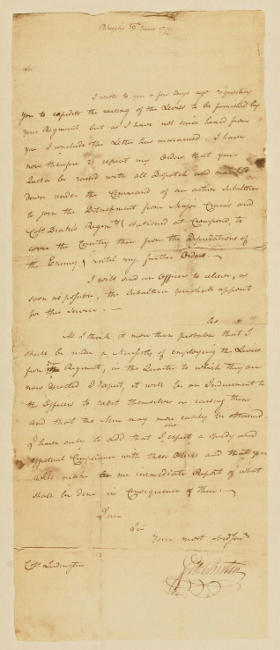
Reduced Fac-simile of Letter, from Governor George Clinton,
to Col. Henry Ludington.
(Original in possession of Charles H. Ludington, New York City)
We have already quoted correspondence between
Governor Clinton and Colonel Ludington, showing
the difficulties which were encountered in raising
troops for various services. As time went on these
difficulties increased rather than diminished, so that
now and then the governor was impatient at the unavoidable
delay. Thus he wrote on one occasion as
follows:
Pokeepsie 9th June 1779.
Sir,
I wrote to you a few Days ago requesting you
to expedite the raising of the Levies to be furnished
by your Regiment but as I have not since
heard from you I conclude the Letter has miscarried.
I have now therefore to repeat my Orders
that your Quota be raised with all Dispatch
and marched down under the Command of an
active subaltern to join the Detachment from
Major Crane’s and Colo. Drake’s Regimts (stationed
at Crompond, to cover the Country there
from the Depredations of the Enemy) until my
further Orders.
I will send an Officer to relieve, as soon as possible,
the subaltern you shall appoint for this service.
As I think it more than probable that I shall
be under a Necessity of employing the Levies
from your Regiment, in the Quarter to which
they are now directed, I expect it will be an Inducement
to the Officers to exert themselves in
raising them and that the Men may more easily be
obtained. I have only to add that I expect also
a speedy and effectual Compliance with these
Orders and that you will make me immediate
Report of what shall be done in consequence of
them.
I am Sir
Your most obed
Geo. Clinton.
Colo. Ludington.
Public Service, Geo. Clinton.
To Colo. Henry Ludington Fredericksburgh.
By Express.
Colonel Ludington was, however, more successful
in securing recruits than some other militia commanders
in that region. Colonel Roswell Hopkins,
at Amenia, seems to have met with many troubles,
which ultimately led to his resignation of his commission.
In the summer of 1780 much trouble arose
over trafficking in certificates of exemption, and this
correspondence took place:
Amenia, July 12th, 1780.
Sir, In Obedience to Brigade Orders of the
30th ult. I now return to your Excellency the
number of Classes in my regiment for raising the
present Levies for three months; the number is
Sixty-two; the men are to be Delivered the 14th
Instant at Major Cook’s & the 15th at Capt.
Roger Sutherland’s to such Officer as your Excellencey
shall appoint. I am, Sir, your most
obedient Hum. Serv’t,
Roswell Hopkins, Colo.
His Excellency Gov’r. Clinton.
May it please your Excellency, We, the Subscribers,
beg leave to inform your Excellency
that Difficulties have arose in this Regiment respecting
Exemption from Militia Drafts Certificates
which have been transferred for a valuable
Consideration by the procurer to another Person—that
is whether the Purchaser of such Certificate
is by act of the Legislature, Pass’d the 25th
of March 1778, for Exempting persons from
Drafts are as much exempted from Militia Duty
as the first Procurers would be in case he had not
transfer’d it. There being several such Instances
in the Regiments and different Opinions in the
Matter which is likely to produce uneasiness, and
we being Inform’d that it has been the Practice in
other Regiments to exempt the Purchasers of
such Certificates. There is James Hildreth &
Lemuel Brush—under this predicament the men
that they purchas’d of have done duty in this
regiment ever since they transfer’d their Certificates
to the present Holders. As their appears
to be no fraud or collusion respecting the said
James Hildreth and Brush, we pray your Excellency’s
advice and Direction respecting such
purchas’d Certificates which will oblige your Excellency’s
Most Obedient Humble Servants
- Roswell Hopkins, Colo.
- William Barker, Lt. Colo.
- Brinton Paine, Major.
- Eben. Husted, Maj’r.
Amenia, July 12 1780.
His Excellency Gov’r Clinton.
thes may sartify that I am knoing to the truth
of what is in the above, as I then Commanded the
Ridgment, & am knoing to theas 2 men mench’ed
dus now due duty in the Ridgment.
David Sutherland.
Poukeepsie 13th July 1780.
Sir, I am this Moment favoured with your two
Letters of equal Date. His Excellency Genl.
Washington in Consideration of the Busy
Season of the year & other Reasons has prolonged
the Day for the Levies to rendevous at
Fishkill till 25th Instant. This I notified Brig’r
Genl. Swartwoudt of by after Orders which I
concluded he had issued to his Brigade. I will
send an Officer to receive & take Charge of your
men in Season to march them to the Place of
Rendevous. This Delay I flatter myself will be
agreable as they may be employed in gathering
in the Harvests & it will afford them Time fully
to prepare & provide themselves for the Campaign
which is the more necessary as they are not
to be relieved.
I wish it was in my Power to relieve Mr. Brush &
Hildridge as I believe they meant to act honestly
& uprightly; but it is not as they have not proceeded
agreeable to Law and none but such are
exempted—neither am I vested with any Discretionary
Power of determining in such Cases.
I have explained myself more fully to Mr. Brush
& am, Sir, your &c.
(G. C.)
(to Colonel Hopkins)
A little later Colonel Hopkins had a lively experience
with a press-master from Connecticut,
which he reported to the governor—his letter being
of interest for the picture which it gives of the times
and customs in which Colonel Ludington was a participant:
Amenia Aug’t 19th 1780.
May it please your Excellency, I beg leave to
trouble your Excellency with a Remonstrance
Concerning a certain Press-master, one George
Tremble, who is a transient person that lives in
Connecticut, who came to me on the 8th Instant
and told me he wanted my team to carry forrage
to the Fishkills. I told him my Circumstances
was such that I could not let them go, for it
would Ruin me for my wheat, about 130 bushels,
all I had was in the field and it would spoil. My
oats, 200 or 300 busshels all lay in the Swarth,
and would be lost, for I had no help but one Son,
and could not hire any man; my flax a fine Crop
was all in the field and some hay in the meadow,
and my grass lodged and rotting, but he said he
cared not for that, but I should go myself with
my team the next day. I told him if I could
secure my grain I would send my son and team
the next week, but he said I should go the next
day. I told him I would not; he showed me a
Coppy of a press warrent from your Excellency
to Colo. Hay with a line from him on the back
authorizing said Tremble to impress teams &
drivers in this state.
I told him that was no legal warrent to him;
he rode off saying he would get a warrent for me,
& then told all about he had got a warrent for
me; but on the 14th he came again with a Sergeant
& 8 men & entered my field, Siezed my son
& confined him under guard, drove out my fatten
oxen that I was fattening for the army, took my
horses & forced my son to drive them with a lode
of my own oats to the Fishkills, altho I consented
if they must go they might carry my oats, he told
me I was a disaffected Person, had done nothing
to support the cause, held bad Princeples, was a
dam’d Lyer and a dam’d Rascal.
I have fined him for cursing; sued him for trespass
& issued a warrant against him in order to
bind him to his good behaviour & recorded a riot
against him.
I think its a pity that there is not a man in this
Precinct County or state that can be trusted with
a press warrant, but such an outlandish Irish,
malicious, abusive fellow must be sent into this
Precinct to press all the whiggs teams, & none in
Charlotte, which is near 3 times as big, and half
tories, for I cant learn of one being pressed there;
after all the malicious fellow wrote a letter to
Colo. Hay sent by the Soldiers that my team
Capt. Shepherd’s & Mr. Ingersoll’s teams were
disaffected teams, and requested they might be
kept in Service a month; he abused others besides
me. I am, Sir, your most obedient Hum’e Serv’t
Roswell Hopkins.
P. S. One Stack of my wheat is spoiled being
wet thro & grown & I shall loose about six tons
of hay. R. H.
His Excellency Governour Clinton.
At the beginning of May, 1781, however, Colonel
Hopkins gave up the struggle to maintain his quota
of men in the field, and insisted upon resigning his
commission:
Amenia, May 1st 1781.
Sir, I wrote to your Excellency about a fortnight
ago to acquaint you that the Classes of my
Regiment were to Deliver their men yesterday,
and requested an officer might be sent to recive
them agreeable to general orders, but no man or
orders came. I was greatly non-plushed & knew
not what to do, but have mustered the men and
ordered them to meet at Peleg Tabors near Mr.
David Johnston, on Saturday this week at 10
O’clock, to march immediately off, when and
where I hope your Excellency will give some one
orders to take care of them. I fear they will not
appear at that time as no one has the care of
them. I fear they will desert, they have got their
bounties.
Sir, I must still insist on resigning my Military
commission as I am wore out with the
trouble & expence of it. I think it unaccountable
that the vacancies in my Regt. are not filled up,
when I have made so many returns and requests,
and have had no adjutant for near 2 years and
orders to send to my Capts. very offen indeed.
Sir, I desire if any officers are appointed this way
to go with these Levies, I might be informed by
the bearer who they be; pray excuse the want of
Paper for I have wrote up 4 quire in a short time
lately in orders &c. all gratis, and know not where
I can get more. I have collected some money
from the delinquent classes for during the war.
I am, Sir, your most Obed’t Serv’t
Roswell Hopkins, Colo.
His Excellency Gover’r Clinton.
Colonel Ludington also appears to have had many
troubles and vexations at this time, though his “staying
qualities” were superior to those of Colonel Hopkins.
He wrote to the governor on the very day on
which Colonel Hopkins resigned, as follows:
Fredericks Burgh, May 1st 1781.
Honoured Sir, I was yesterday a Coming to
wait on your Excellency, but hearing of my little
Son (who is at School at Danbury) lying very
dangerous with the plurisy, was obliged to turn
my Course that way, for which Reason obliges
me to commit my Errand in writing. Your Excellency
no dought has been inform’d of our
troubles of late in Regard of a large party of
Robbers being for four weeks past near me in the
mountains, which has occasioned me in some
measure of being behind hand in turning out my
men for the nine months Service, for the chief
part of my Regiment has been out ever since the
Robbers came among us, And, Sir, were you to
be fully acquainted with the Difficulty I now
labour under you would think is impossible for
me to do it, as I have but one field officer, which is
Major Robinson who lives so near the lines that
he has enough to take care of himself, The Circumstances
of my wife and family renders it inconvenient
for me to move immediately if I intend
to save my life, or anything for my family’s support.
My Captains seeing the Distresses that is
daily comeing upon themselves by Reason of
haveing their Sergents sued and torn to pieces
for what Necessity required them to do among
the tories, while we was under the authority of
Committees, and many of their best men are beat
and robbed by persons who say they are Refugees
from below. It is only for them to call a man a
tory, be him ever so good a man, himself, wife
and Children get beat in such a manner that he’s
obliged to turn out his Substance to save their
lives. And at best the Regiment are verry poor
when compared with other Regiments and are
call’d on to raise an eaquil number with the others,
when I can affirm that ten farmers in Coll.
Brinckerhoff’s Regiment is able to purchase the
whole of mine. In this uneaquil way, I have been
obliged to turn out my men untill they are so
much impoverish’d that they almost dispair.
It seems the power of Earth and Hell was let
loose against me and my Regiment. Even one
of the most abandant Ruffins is indulged to hold
me up to public view for Cowardice, for challenging
him to fight a Duel. It is what I never
thought on, neither did he think I did, but was let
loose upon me by the Instigation of a set of Ruffins
who Conspired together to take my life, and
I knowing this Kees to be a transient person who
had neither Connection, Credit, Money or
friends, nor no place of Residence here, that it
was out of my power to get Recompence from
such a fellow as he, unless it was by giveing him
a floging, and that he had put out of my power
by Secreting himself. This being my Situation
shall expect from your Excellency some Directions
and advice by a line what will be best for me
to doe. I something expect that General Swartwout
will wait on you this day, who will be able
to state some of the Difficulties I have mentioned
and whether it will not be best to anex my Regiment
to some other Regiment, or give me some
field officers, who in time of turning out my men
will be better able and more willing to assist me.
Am, Sir, with due Regard your Excellency’s
Most Obed’t and verry Hum’e Serv’t
Henry Ludinton.
His Excelency George Clinton, Esqr.
The governor regarded Colonel Ludington’s request
for more officers as reasonable, and promptly
complied with it as follows:
Sir, In Answer to yours of the 1st Instant I
have to inform you that Lieuts. Johnson, Duel &
Becker of your Regt. are appointed Officers in
the Levies. These will have orders to receive &
march your Quota to the Place of Rendevouz.
The last I received from you I answered a Day
or two after it came to Hand. My Letter was
forwarded by Judge Paine. If you apply to the
Secry. I imagine you will find that the appointments
for your Regt. agreable to your Return
have long since been perfected. Agreable to a
Notification in the public News Papers the Council
mett at this Place on the 26th Instant. It
would have been proper to have applied to them at
that Time either to have had the vacancies in your
Regt. filled up or to have made your Resignation
as they only have the Power of doing the former
or of accepting of the latter. I am &c.
(G. C.)
There may be some other gentlemen residing
within your Regt. appointed officers for the
Levies but of this I cant be certain as I am
neither acquainted with its Limits or their Places
of Residence. (To Colonel Ludinton.)
A fortnight later new orders as to the distribution
of levies were issued. Colonel Ludington was to be
retained on duty in Westchester County, where he
was much needed. But a sharp controversy arose
over his alleged dilatoriness in raising his quota of
men. These letters indicate the general trend of
affairs at that time:
Fishkeels 13th May 1781.
D’r Governor, I have just Returnd from three
days fortague receving Colo. Vanderburgh Levies.
I beg to no what part of Ulster County I shall
derect that part of the Levis to purposed for that
Quarter. I have proposed Capt. Livingston for
that Command & beg he may be as ney my post as
posable. I am your Excel’cy most Obt. Hbl.
Serv’t
E. V. Bunschoten.
His Ex’ly G. Clinton.
N. B. I expose my poverty as to paper.
May 13th 1781.
S’r, I have rec’d your Letter by Capt. Livingston.
The Detachm’t intended for the frontiers
of Ulster are to proceed to Kingston. Colo.
Graham’s Regt. will furnish 50 so that no more
are to be sent than with them will make up 100.
I am anxious that those for Albany be dispatched
as soon as possible, and it is my wish that a Part
of those already on the ground be sent there as
their appearance on the Frontier will give Confidence
to the Inhabitants. Field’s & Ludington’s
Levies are intended for West Chester. Call in all
the absent Officers immediately. Capts. Marshall
& Whelp who belong to Willet’s Regt. ought to
join & take Charge of the Detachm’t intended for
Albany.
(G. C.)
(Major Van Bunschoten.)
Poughkeepsie, May 13th 1781.
Sir, I am informed by Letter from Colo. Luddenton
that he has not yet done any Thing towards
raising the Levies from his Regt., that they
are not even formed into Classes. I must, therefore,
insist that you immediately take the measures
directed by Law for drawing forth his Proportion
of men, together with the Deficiencies
from all the other Regiments, a Return of which
will be furnished you by Major Buntschoten on
your application. The Service will by no means
admit of Delay in this Business. I, therefore,
expect your utmost exertions. I am &c.
Geo. Clinton.
Brig’r. Genl. Swartwout.
Fishkill May 16th 1781.
D’r Sir, Agreable to your Exlancey’s order, I
wated on Colo. Luddenton to Receive the Levies
from his Ridgment; he promisd to have them
Ready the next week, but hearing he made no
stur, I sent Lt. Dyckman to know when I might
expect them, but he could not see him. I then
went myself several times before I could see him;
he at length set a day to Receive them but
neighther he nor his men mad ther appearance. I
cald on him the nex day to know the Reason, but
he was out of the way. I then concluded to report
to him but by chance I met him on the Road; he
then promised to turn them out the twenty first
of the month. Should I bee disapointed again, I
shall wait on your exlancey with the perticulars
and remain, with the greatest esteem, your exlancey’s
most obediant and most umble serv’t
D’nl Williams.
His exlancey Governor Clinton.
Colonel Ludington appears to have fulfilled his
word and to have completed his quota in a satisfactory
manner, for there is no indication of any
further complaints, and he is known to have continued
in the service in the best of standing. His
next correspondence with Governor Clinton had to
do with the petitions of two deserters for clemency,
and with the case of a woman who had become an
outlaw. Colonel Ludington’s letter and the petition,
and the governor’s reply, were as follows:
Fredericksburgh, September 21d, 1781.
Honored Sir: Being acquainted with the contents
of the petition sent you enclosed from Sem’r
Arnold and Cowin should esteam it as a favour
Dun unto them and my Self if it should have its
Desired efect. But be that as it may an answer
from His Excelenz Consearning the Same will
Mutch oblige your very Humble Servant
To his Excellency George Clinton, Esqr. Governor.
Petition of Daniel Cowing and Seymour Arnold.
To his Excellency George Clinton Esquire
Governor of the State of New York:
The Humble Petition of Daniel Cowing &
Seymour Arnold.
Humbly Sheweth—That your Petitioners
were by undue influence and evil Example
unhappily led to desert their Station in the levies
under Captain Williams on the Lines in the
county of Westchester and though your Petitioners
upon the first reflection were sensible of
the enormity of their Crime & inclined to return
to their Duty, the dread of Corporal punishment
prevented them till pardon could be procured
from their officers; that many applications for
that purpose have been made by persons employed
by your Petitr. without Effect, that your
Petitr. are heartily sorry for, and ashamed of
their conduct, are fully determined and solemnly
promise never to be guilty of the same Crime
again under any Circumstances or treatment
whatsoever, that your Petrs. hope some indulgence
from their known attachment to the Public
cause as your petrs. have been in the service a
great part of the time since the war Commenced
and are now willing to make every amend in
their power to the state by serving longer than
the time limited or Otherways as your Excellency
or their officers may appoint, if by your
Excellency’s interposing in their favour your
petrs. may be exempted from Corporal punishment
for this offence and at Liberty to return to
their duty immediately this your Petitrs. implore
& hope from your Excellencys known
Clemency.
And your Petrs. as in duty bound will ever Pray.
Poughkeepsie, Septr, 21st 1781.
Sir, I have rec’d your letter of this Date with
the Petition of the Deserters from Capt. Williams’
Company & the request of the Overseers
of Poor relative to Mrs. Webb.
The levies you may remember are by the Law
put under the Command of the Commander in
Chief & made subject to the Continental Articles
of War. Genl. Heath has now the command of
the Department & the application in behalf of the
Petitioners should be to him. I cannot with
Propriety interfere in the matter. But at any
Rate they ought first to deliver themselves up &
offer to return to their duty before they can expect
a remission of the Punishment they have incurred.
With respect to Mrs. Webb—the law makes it
the duty of the Justices to warn her out of the
State and she is to depart within twenty Days
after Notice given her accordingly, or be out of
the protection of the law, I am,
(G. C.)
Colo. Luddinton Fredericksburgh.
Later in the war, much difficulty was again experienced
in raising the desired levies:
Fredricksburgh, aprill 14th, 1782.
Honoured Sir, it will be neadles for me to
State to your Excelency the Difficulties and
Disadvantiges my Distresd Regment Labours
under as in Regard of Raising their quota of men,
for Sure I am that if it was Consistant his Excelency
would give us every Asistance in his power.
This one Request I shall atempt to make that we
should Have an offisar or two apointed in the
Regiment. If that should Be the case I think it
would Have a tendancy to aleviate us in the pain
of Raising them and prevent Desartions which
hath Been verry preverlent 2 or 3 of the Last
Campains. The men I Raised the Last year were
as good men as I would Evr wish to Command,
were put under Capt. Williams And Desarted
all to a man. As it is so Burthensom to Rase the
Money to pay their Bounties pray Let us indeavour
they shall Do the Service intended. It is
my opinion that Lt. Charles Stewart that was
with Colo. Wesenfell Last year will answer well
for a capt. and his son for a 2 L’dtant.
am Sir His Excelencys verry Humble Servant
Henry Ludinton.
Governor Clinton.
A few days later he wrote again:
Fredricksburgh Aprill 23, 1782.
Honoured Sir,
I must Beg Leave to trouble his Excelency
this once more with my Request that Lt
Charles Stuart shall Be indulged with the Same
offise he held last year under Colo. Wiesenfelt. I
should not so Strenuously insist upon it only that
I am Sensable it will have a tendancy to induce
the young men of his aquantance to inlist and
that for a mutch les sum than if they were to go
with Strangers. Sir for the Reasons above Resited
I shall hope his Excelency will grant this
my Request as well as others. I am Sir his Excelencys
most obedient and Humble Servant
Henry Ludinton.
To George Clinton Esqr. Governor.
P. S. Sir a line By way of answer if it should be
agreable.
Thus Colonel Ludington served through the war
to its close, in his various capacities, and at the end
was much concerned with securing settlements of the
pay due to himself and his troops. His own rate of
pay is indicated in several entries on the pay-rolls.
Thus we find—
Abstract of Pay & Rations due Col. Henry
Luddington’s Regt. of Dutchess County Militia
in the Service of the United States at different
Periods between March 1779 & November 1780.
| Names. |
Rank |
Commencing |
Ending |
Time |
| Months |
days |
| Henry Luddington |
Colonel |
1779
March |
1780
Novemr. |
1 |
5 |
| Dollars pr Month |
Rations |
Amount of Rations. |
Amount of Pay and Rations. |
| Rations |
Price |
| 75 |
210 |
10d |
8:15:—. |
43:15:—. |
|
Apparently it was long after the war before all
these matters were fully adjusted, as the date of the
following affidavit shows:
I Henry Ludinton do solemnly and sincerely
swear that the List hereunto annexed contains
an Account of all Certificates that remained in
my Hands of those that were issued by the Treasurer
and delivered to me for Paying my Regiment;
That the remainder were to the best of my
knowledge and belief delivered to the Persons
who performed the services or their legal representatives
and that the names subscribed to the
vouchers produced were bona fide subscribed by
them.
Henry Ludenton.
Sworn before me this 13th Day
of Septr. 1792.
Gerard Bancker Treasr.
Voucher No. 306, of “The United States to the
State of New York, Dr. for payments on Certificates
for Military Services performed in the late
War,” presumably covering all payment made to
Colonel Ludington for federal services, shows a total
of £1330:19s:2d.
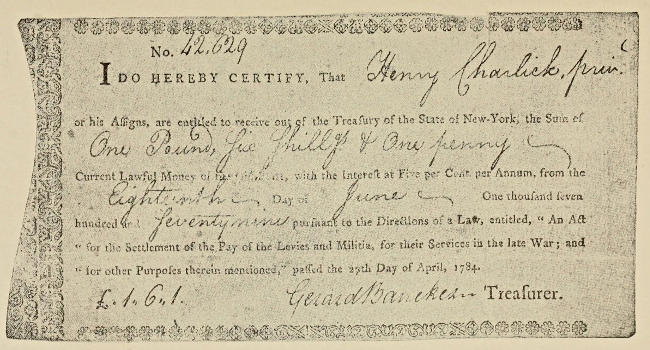
Pay certificate of a member of Colonel Ludington’s regiment
Colonel Ludington appears to have been the purchaser,
for cash, of some of the lands apportioned to
soldiers as bounties for their services. Thus in the
“Manuscripts of the Colony and State of New York
in the Revolutionary War,” on file in the controller’s
office at Albany, Mr. Patrick has found this entry:
We the subscribers members of a class in
Capt. William Pierce’s Company and Colo. John
Field’s Regiment who have Procured a man to
wit Christian Null to serve in the Levies of this
State Until the First Day of January Next who
has been Delivered and a Certificut Taken for
Such Delivery According to Law whereby the
said Class Is Entitled to two hundred acres of
Unappropriated Land we do therefore in Consideration
of the sum of five Pounds to us in
hand paid By Henry Ludenton Esqr the Receipt
Whereof we do acknowledge and Do grant and
transfer unto the said Henry Ludenton Esqr. his
heirs and assigns the Whole Right of the said
two hundred acres of Land which said Class is
Entitled To In persuance of a Law of this State
Entitled an act for Raising Troops to Complete
the Line of this State In the service of the United
States And the two Regiments to Be Raised on
Bounties of Unappropriated Lands and for the
Further Defence of the frontiers of this State
Passed the 25th of March 1782 To have and to
hold the sd two hundred Acres of Land Unto the
sd Henry Ludinton His heirs and assigns to his
and their proper use and Benefit and behoof forever
as witness our hands and seals this the 3d of
March 1783.
Henry Ludinton
Assignee and Assignor
- Edmund Ferris
- Asa Sabin
- John Caswell.
- John Peaslee
- Richd Furniss
- James Ferris
- Stephen Stevenson
- Warren Ferris.
Seald and Delivered
in presence of
- Jathro Sherman
- James Ferriss
This document is endorsed as follows:
Be it remembered that I Henry Ludinton do
Assign over this within Conveyance unto Benjamin
Conklin and to his Heirs and Assigns to
Reserve and injoy the Land therein mentioned.
Henry Ludinton.
Dated November 1st 1783
in presence of Eleazar weed.
With such transactions the military service of Colonel
Ludington was concluded, and the remainder
of his busy life was reserved for civil duties and his
private affairs.