The day before Christmas was a never-to-be-forgotten day in Bedford
Place. Great preparations were being made for the event of the
evening, and everybody helped.
Little Jim under the tutelage of Chad, and in hourly fear of the
promised thrashing—it had never gone beyond the promise since the
Colonel’s talk—had so far forgotten his clothes and his dignity as to
load himself with Christmas greens—one long string wound around his
body like a boa constrictor—much to the amusement of the Colonel, who
was looking out of the dining-room window when he emerged from the
tunnel. Aunt Nancy went all the way to the grocery for some big jars
for the flowers I had sent her (not to mention a bunch of roses of the
Colonel’s) and brought one of the pots back in her own hand; and spoke
in so low and gentle a voice when she purchased them that everybody in
the place ceased talking to listen.
The Colonel busied himself drawing, in the most careful and elaborate
manner, the wax-topped corks of certain be-cobwebbed bottles that had
been delivered the night before by no less a person than Duncan’s own
agent, and to one of which was attached Fitz’s visiting card bearing
his compliments and best wishes. The contents of these crusted bottles
the Colonel had duly emptied into two cut-glass decanters with big
stoppers—heirlooms from Carter Hall—placing the decanters themselves
in two silver coasters bearing the Coat-of-Arms of his family, and the
whole combination on the old-fashioned sideboard which graced the wall
opposite the fireplace. Chad, with the aid of the grocer, had produced
as assistant below stairs, from a side street behind Jefferson Market,
a saddle-colored female who wore flowers in her hat, and who, to his
infinite amusement, called him “Mister.”
“Can’t do nothin’ big, Major, dis place’s so mighty small,” he called
to me from his kitchen door as I mounted the yard steps, “but it’s
gwine to smell mighty good round here ’bout dinner-time.”
Under the deft touches of all these willing hands it is not to be
wondered at that the Colonel’s cosy rooms developed a quality unknown
to them before, delightful as they had always been: The table boasted
an extra leaf (an extra leaf was always ready for use in every
dining-room of the Colonel’s); the candlesticks, old family plate and
andirons, dulled by the winter’s use, shone with phenomenal
brightness; the mantel supported not only half a dozen bottles of
claret (Duncan’s cellars, Fitz’s selection) but a heap of roses that
reached as high as the clock, while over the door, around the windows
and high up over the two fireplaces—everywhere, in fact, where a
convenient nail or hook could be found—were entwined in loops and
circles, the Christmas greens and holly berries that little Jim had
staggered under.
The crowning sensation of the coming event stood in the corner of the
rear room,—a small Christmas tree grown in the woods behind Carter
Hall. A little tree with all its branches perfect; large enough to
hold its complement of candles; small enough to stand in the centre of
the table within reach of everybody’s hand. Aunt Nancy had picked it
out herself. She must always respect the sentiment. No bought tree
would do for her on such an occasion. It must be to the manor born,
nourished in her own soil, warmed by the same sun and watered by the
same rains. The bringing of a tree from her own home at Carter Hall to
cheer the Colonel’s temporary resting-place in Bedford Place, was to
her like the bringing of a live coal from old and much loved embers
with which to start a fire on a new hearth.
These several preparations complete—and it was quite late in the day
when they were complete (in the twilight really)—Chad threw a heap of
wood beside the fireplace, brushed the hearth of its ashes, laid a
pile of India Blue plates in front of its cheery blaze (no crime, the
Colonel often said, was equal to putting a hot duck on a cold plate),
placed the Colonel’s chair in position, arranged a cushion in Aunt
Nancy’s empty rocker; gave a few finishing touches to the table;
stopped a moment in the kitchen below to give some instructions to the
saddle-colored female as to the length of time a canvas-back should
remain in the oven, and stepped back into his little room, there to
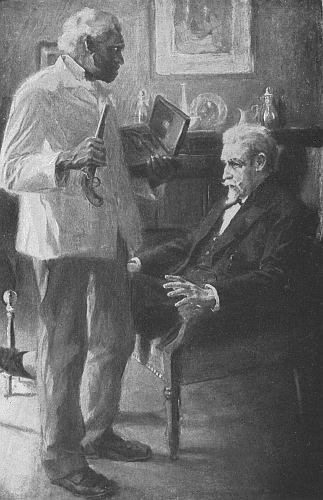
array himself in white jacket and gloves, the latter tucked into his
outside pocket ready for instant use.
During these final preparations the Colonel was upstairs donning a
costume befitting the occasion—snow-white waistcoat, white scarf and
patent-leather pumps, with little bows over the toes, limp as a
poodle’s ears, and his time-honored coat, worn wide open of course,
the occasion being one of great joyousness and good cheer. These
necessities of toilet over, the Colonel descended the narrow
staircase, threw wide the dining-room door, shook me cordially by the
hand with the manner of a man welcoming a distinguished guest whom he
had not seen for years (I had just arrived); bowed to Chad as if he
had been one of a long line of servants awaiting the coming of their
lord (festive occasions always produced this frame of mind in the
Colonel); laid a single white rose beside the plates of his two lady
guests—one for Miss Carter and the other for Miss Klutchem—and
glancing around the apartment expressed his admiration of all that had
been done. Then he settled himself in his easy chair, with his feet on
the fender, and spread his moist, newly-washed hands to the blaze.
Aunt Nancy now entered in a steel-gray silk and new cap and ribbons,
her delicate, frail shoulders covered by a light scarf, little Jim
following behind her with her ball of yarn and needles, and a low
stool for her feet. The only change in Jim was a straggly groove down
the middle of his wool, where he had attempted a “part” like Chad’s.
“I’m glad Mr. Klutchem is comin’, Nancy,” said the Colonel when the
dear lady had taken her seat with Jim behind her chair. “From what you
tell me of his home I’m afraid that he must pass a great many lonely
hours. And then again I cannot forget his generosity to a friend of
mine once in his hour of trial.”
“What was the trouble between you and Mr. Klutchem, George?” she asked
in reply, spreading out her skirts and taking the knitting from Jim’s
hands.
The Colonel hesitated and for a moment did not answer. Aunt Nancy
raised her eyes to his and waited.
“I diffe’ed from him on the value of some secu’ities, Nancy, and for a
time the argument became quite heated.”
“And it left some ill-feeling?”
“Oh, no; on the contrary, it seemed to open a way for an important
settlement in a friend’s affairs which may have the best and most
lastin’ results. I believe I am quite within the mark, Major, when I
make that statement,” added the Colonel, turning to me.
“No doubt of it, Colonel,” I answered. “That same friend told me that
he hadn’t enjoyed anything so much for years as Mr. Klutchem’s visit
to his office that morning.”
“Well, I am so glad,” said Aunt Nancy—“so glad!” The “friend’s” name
had been too obviously concealed by both the Colonel and myself for
her to press any inquiries in that direction. “And you have not seen
the daughter?” she continued.
“No, Mr. Klutchem was ill at a friend’s house when I called on him
once befo’, and his family were not in the room. I shall have that
pleasure for the first time when she arrives.”
Chad now entered, bowed low to his Mistress, his invariable custom,
and began to light the candles on the mantelpiece and sideboard, and
then those in the two big silver candlesticks which decorated each end
of the table, with its covers for six. Little Jim still stood behind
his Miss Nancy’s chair: he was not to be trusted with any of Chad’s
important duties.
There came a knock at the door.
“That’s dear Fitz,” said the Colonel. “He promised to come early.”
Chad looked meaningly at the scrap, and little Jim, in answer to the
sound of Fitz’s knuckles, left the room, picking up his “pan” from the
hall table as he answered the summons.
At this moment the dear lady dropped her ball of yarn, and the Colonel
and I stooped down to recover it. This was a duty from which even Chad
was relieved when either of us was present. While we were both on our
knees groping around the legs of the sideboard, the door opened
softly, and a sweet, low voice said:
“Please, I’m Katy Klutchem, and I’ve come to the Christmas tree.”
The Colonel twisted his head quickly.
A little girl of six or eight, her chubby cheeks aglow with the cold
of the winter twilight, a mass of brown curls escaping from her hat
framing a pretty face, stood looking at him—he was still on his
knees—with wide, wondering eyes. He had expected to welcome a young
woman of twenty, he told me afterwards, not a child. Aunt Nancy
inadvertently, perhaps, or because she supposed he knew, had omitted
any reference to her age. I, too, had fallen into the same error.
The dear lady without rising from her seat held out her two hands
joyously:
“Oh, you darling little thing! Come here until I take off your hat and
coat.”
The Colonel had now risen to his feet, the ball of yarn in his hand,
his eyes still on the apparition. No child had ever stepped foot
inside the cosy quarters since his occupation. Katy returned his gaze
with that steadfast, searching look common to some children, summing
up by intuition the dangers and the man. Then, with her face breaking
into a smile at the Colonel, she started towards Aunt Nancy.
But the Colonel had come to his senses now.
“So you are not a grown-up lady at all,” he cried, with a joyous note
in his voice, as he advanced towards her, “but just a dear little
girl.”
“Why, did you think I was grown-up? I’m only seven. Oh, what a nice
room, and is the Christmas tree here?”
“It is not lighted yet, dearie,” replied Aunt Nancy, her fingers busy
with the top button of the child’s cloak, the eager, expectant face
twisted around as if she was looking for something. “It’s over there
in the corner.”
“Let me show it to you,” said the Colonel, and he took her hand.
“Major, please bring one of the candles.”
The child’s eyes sought the Colonel’s face. The first look she had
given him as she entered the room had settled all doubt in her mind;
children know at a glance whom they can trust.
“Please do,” she answered simply, and her grasp closed over his. The
cloak and hat were off now, and Jim was bearing them upstairs to be
laid on Miss Nancy’s bed.
As the small, frail hand touched his own I saw a strange look come
into the Colonel’s eyes. It was evidently all he could do to keep from
stooping down and kissing her.
Instinctively my mind went back to a night not long before when I had
found him sitting by his fire. “There is but one thing in all the
world, Major,” he said to me then, “sweeter than the song of a robin
in the spring, and that is the laughter of a child.”
I knew therefore, as I looked at these two, what the little hand that
lay in his meant to him.
So I held the candle and the Colonel lighted the tip end of just one
tiny taper to show her how it burned, and what a pretty light it made
shining through the green; and Katy clapped her hands and said it was
beautiful, and such a darling little tree, and not at all like the
big one in the Sunday School that reached nearly to the ceiling, and
that nobody dared to touch. And then we all went back to the fire and
the Colonel’s chair, and before I knew it he had her by his side with
his arm around her shoulders, telling her stories, while Aunt Nancy
and Jim and I sat listening.
And so absorbed was he in the new life, and so happy with the child,
that he only gave Fitz three fingers to shake when that friend of his
heart came in, and never once said he was glad to see him—an
unprecedented omission—and never once made the slightest allusion to
the expected guest of the evening, Mr. Klutchem, now that his daughter
had turned out to be a child of seven instead of a full-grown woman of
twenty.
The Colonel told her of the great woods behind Carter Hall, where the
Christmas tree had grown, and the fox with the white tail that lived
there, and that used to pop into his hole in the snow, and how you’d
pass right by and never see him because his tail, which was the
biggest part of him, was so white; and the woodpeckers that bored into
the bark with their long, sharp bills; and finally of the big turkeys
that strutted and puffed their feathers and spread their tails about
and ran so fast nothing could catch them.
“Not even a dog?” interrupted the child. She had crawled up into his
arms now and was looking up into his face with wondering eyes.
“Dogs!” answered the Colonel contemptuously, “why, these turkeys would
be up and gone befo’ a dog could turn ’round.”
“Tell me what they are like. Have they long—long legs—so?” and she
stretched out her arms.
“Oh, longer—terrible long legs—long as this”—and the Colonel’s
arms went out to their full length.
Jim’s eyes were now popping out of his head, but his place was behind
his Mistress’s chair, ready for her orders, and he had had so many
scoldings that day that he thought it best not to move.
“And does he puff himself out like a real turkey in the picture
books?”
“Oh, worse than a real turkey,—big as so”—and the Colonel’s arms
went round in a circle.
The child thought hard for a moment until she had the picture of the
strutting gobbler fastened in her mind, and said, cuddling closer to
the Colonel: “Tell me some more.”
“About turkeys?”
“Yes, about turkeys.”
“About wild ones or tame ones?”
“Was that a wild one that the dogs couldn’t catch?”
“Yes.”
“Then tell me about some tame ones. Do they live in the woods?”
“No, they live in the barnyard with the chickens, and the cows, and
the horses. Why, did you never see one?”
“Yes, but I want to hear you tell about them—that’s better than
seeing.”
Jim could hold in no longer. He had become so excited that he kept
rubbing one shoe against the other, twisting and squirming like an
eel. At last he burst out:
“An’ one o’ gobble-gobble was dat ornery, Mammy Henny shut him up in
de coop!”
Aunt Nancy turned in astonishment, and Chad, who had come in with some
dishes, was about to crush him with a look, when the Colonel said,
with a sly twinkle in his eye:
“What did he do, Jim?”
“Jes’ trompled de li’l teeny chickens an’ eat up all de corn an’
wouldn’t let nobody come nigh him. An’ he was dat swelled up!”
Katy laughed, and turning to the Colonel, said:
“Tell me about that one.”
The Colonel ruminated for a moment, looked at Chad with a
half-humorous expression, and motioned to little Jim to come over and
stand by his chair so that he could hear the better, his own arm still
about Katy, her head on his shoulder.
“About that big gobbler, Katy, that was so bad they had to put him in
a coop?”
“Yes, that very one.”
“Well, when I fust knew him he was a little teeny turkey—oh, not near
so high as Jim; ’bout up to Jim’s knees, I reckon. He’d follow ’round
after his mammy and go where she wanted him to go and mind her like a
nice little turkey as he was. He didn’t live on my plantation then—he
lived on Judge Barbour’s plantation next to mine. Well, one day, Aunt
Nancy—that dear lady over there—wanted a fine young turkey, and
this little knee-high turkey was growin’ to be a big turkey, and so
she brought him over and gave him the run of the barnyard.
“She was just as good to him as she could be. She made a nice clean
place for him to live in, so his feathers wouldn’t get dirty any mo’,
and he didn’t have to run ’round lookin’ for grasshoppers and beetles
and little worms as he did at home, but he had a nice bowl of mush
eve’y day and a place to go to sleep in all by himself, and Aunt Nancy
did everythin’ she could to make him comfo’table.
“Well, what do you think happened? Just as soon as that turkey found
out he was bein’ taken caare of better than the hens and the roosters
and all the other little turkeys he had left at home, he began to put
on airs. He breshed his feathers out and he strutted around same as if
he owned the whole barnyard, and he’d go down to the pond and look at
himself in the water; and he got so proud that whenever old Mrs. Hen
or old Mr. Rooster would say ‘Good-mornin’’ to him as kind and as nice
as could be, he wouldn’t answer politely, but he’d stick up his head
and go ‘Gobble-gobble-gobble!’ and then he’d swell up again and puff
out his chest and march himself off. Pretty soon he got so sassy that
nobody could live with him. Why, he didn’t care what he did and who he
stepped on. He trampled on two po’ little chicks one day that were
just out of the shell and mashed them flat and did all sorts of
dreadful things.”
“What an awful turkey! Poor little chickens,” sighed Katy. “Go on.”
“Next thing he did was to steal off and smoke cigarettes.”
Katy raised her head and looked up into the Colonel’s eyes.
“Why, turkeys can’t smoke, can they?”
“Oh, no—of co’se not—I forgot. That’s another story and I got them
mixed up. Where was I? Oh, yes, when he got so sassy.”
Katy dropped her head on his shoulder again. Jim was now listening
with all his might, his only fear being that Chad or Miss Nancy or the
knocker on the front door would summon him before the story was ended.
“Well,” continued the Colonel, “that went on and on and on till there
wasn’t any livin’ with him. Even dear Aunt Nancy couldn’t get along
with him, which is a dreadful thing to say of anybody. So one
day”—here the Colonel’s voice dropped to a tone of grave
importance—“one day—Mammy Henny—that’s the wife of Chad over there
by the table, crep’ up behind this wicked, sassy little turkey, when
he was swellin’ around so big he couldn’t see his feet, and she
grabbed him by the neck and two legs, and befo’ he knew where he was,
plump he went into a big coop, and the door was shut tight. He
hollered and squawked and flapped his wings terrible, but that didn’t
make any diff’ence; in he went and there he stayed. He pushed with his
long legs, and stuck his head out through the slats, and did all he
could to get out, but it was no use. Next day Mammy Henny got a great
big knife—oh, an awful long knife——”
“How long?” asked the child.
“Oh, a dreadful long knife—’most as long as Jim, here”—and the
Colonel laid his hand on the boy’s shoulder—“and she sharpened it on
a big grindstone, and Mammy Henny put some corn in the little trough
outside the slats, and when this bad, wicked turkey poked his head
out—WHACK—went the knife, and off went his head, and he was
dead—dead—dead!”
As the solemn words fell from his lips, the Colonel broke into a
laugh, and in a burst of tenderness threw his arms around the child
and kissed her as if he would like to eat her up.
Katy was clapping her hands now.
“Oh, I’m just too glad. And the poor little chickies—served him
just right. I was afraid he’d get out and run away.”
The Colonel stole a look at Jim. The scrap stood looking into the
fire, a wondering expression on his face. How much of the story was
truth and how much fiction evidently puzzled Jim.
During the telling everybody in the room, Fitz, Miss Nancy—all of us,
in fact,—had been watching Katy’s delight and Jim’s eager brown face,
turned to the Colonel, the whites of his eyes big as saucers.
Watching, too, the Colonel’s impartial manner to both of his
listeners—black and white alike—the only distinction being that the
black boy stood, while the white child lay nestled in his arms.
Chad, as the story progressed, had crept up behind the Colonel’s
chair, where he could hear without being seen, and was listening as
eagerly as if he were a boy again. He had often told me that his old
master, the Colonel’s father, used to tell him and the Colonel stories
when they were boys together, but I had never seen the Colonel in the
rôle before.
When the allusion to the cigarettes escaped the Colonel’s lips a smile
overspread Chad’s visage, and a certain triumphant look crept into his
eyes. With the child’s laughter still ringing through the room, Chad
tapped Jim on the arm, led him to one side, held his lean, wrinkled
finger within an inch of the boy’s nose and said in a sepulchral tone:
“Did ye hear dat? Do ye know who dat sassy, low-lived, mizzable,
no-count, ornery turkey was, dat kep’ a-swellin’ up, thinkin’ he was
free an’ somebody great till dat caarvin’ knife tuk his head off?
Dat’s you!”
In the midst of this scene, Katy still in the Colonel’s arms, Aunt
Nancy knitting quietly, talking to Fitz in an undertone, and I forming
part of the circle around the fire, watching the Colonel’s delight and
joy over his new guest—the dining-room door was pushed open, and Mr.
Klutchem stepped in.
“I found the outside door ajar, Colonel,” he blurted out, “and heard
you all laughing, and so I just walked in. Been here long, Katy?”
For an instant I was sorry he had come; it was like the dropping of a
stone into a still pool.
The child slid out from the Colonel’s lap, with an expression on her
face as if she had been caught in some act she should be ashamed of,
and stood close to the Colonel’s chair, as if for protection. Aunt
Nancy, Fitz, and I rose to our feet to welcome the newcomer. The
Colonel, having to pull himself out from the depths of his chair, was
the last to rise. He had been so absorbed in the child that he had
entirely forgotten both the father and the dinner. It, however, never
took the Colonel long to recover his equilibrium where a matter of
courtesy was concerned.
“My dear, Mr. Klutchem,” he cried, throwing out his chest, and
extending his hand graciously. “This is, indeed, a pleasure. Permit me
to present you to my aunt, Miss Caarter, of Virginia, who has left her
home to gladden our Christmas with her presence. The gentlemen, of
co’se, you already know. Yo’ little daughter, suh, is a perfect
sunbeam. She has so crept into our hearts that we feel as if we never
wanted her to leave us——” and he laid his hand on the child’s head.
The banker shook hands with Aunt Nancy, remarked that he was sorry he
had not been at home when she called, extended the same five fingers
to me, and again in turn to Fitz, and sat down on the edge of a chair
which Jim had dragged up for him. Katy walked over and stood by her
father’s knee. Her holiday seemed over.
“Rather sharp weather, isn’t it?” Mr. Klutchem began, rubbing his
hands and looking about him. He had not forgotten the cheeriness of
the rooms the day of his first visit; in their holiday attire they
were even more delightful. “I suppose, Colonel, you don’t have such
weather in your State,” he continued.
The Colonel, who was waiting for a cue—any cue served the Colonel,
weather, politics, finance, everything but morals and gossip, these he
never discussed, launched out in his inimitable way describing the
varied kinds of weather indigenous to his part of the State: the late
spring frosts with consequent damage to the peach crop; the heat of
summer; the ice storms and the heavy falls of soft snow that were gone
by mid-day; the banker describing in return the severities of the
winters in Vermont, his own State, and the quality of the farming land
which, he said, with a dry laugh, often raised four stone fences to
the acre, and sometimes five.
Before the two had talked many minutes I saw to my delight that the
waters of the deep pool which I feared had become permanently troubled
by the sudden arrival of the broker, were assuming their former
tranquil condition. Aunt Nancy resumed her knitting awaiting the time
when Chad should announce dinner. Katy, finding that her father had no
immediate use for her—not an unusual experience with Katy—moved off
and stood by Aunt Nancy, watching the play of her needles, the dear
lady talking to her in a low voice, while Fitz and I put our heads
together, and with eyes and ears open, followed with close attention
the gradual thawing out of the hard ice of the practical man of
affairs under the warm sun of the Colonel’s hospitality.
Soon the long expected hour arrived, a fact made known first by the
saddle-colored female to Jim standing at the head of the stairs, and
who promptly conveyed it to Chad’s ear in a whisper that was heard all
over the room, and finally by Chad himself, who announced the welcome
news to Miss Nancy with a flourish that would have done credit to the
master of ceremonies at a Lord Mayor’s banquet; drawing out a chair
for her on the right of the Colonel, another on his left for Mr.
Klutchem, and a third for Miss Klutchem, who was seated between Fitz
and me. He then stationed Jim, now thoroughly humbled by the
chastening he had received, at the door in the hall to keep open an
unbroken line of communication between the fragrant kitchen below and
the merry table above.
The seating of the guests brought the cosy circle together—and what a
picture it was: The radiance of Aunt Nancy’s face as she talked to one
guest and another, twisting her head like a wren’s to see Mr. Klutchem
the better when the Colonel stood up to carve the ducks: and the
benignant, patriarchal, bless-you-my-children smile that kept
irradiating the Virginian’s visage as, knife in hand, he descanted on
the various edibles and drinkables that made his native County a rare
place to be born in; and Mr. Klutchem’s quiet, absorbed manner, so
different from his boisterous outbreaks—a fact which astonished Fitz
most of all; and Katy’s unrestrained laughter breaking in at all times
like a bird’s, and Chad’s beaming face and noiseless tread, taking the
dishes from Jim’s hands as carefully as an antiquary would so many
curios, and placing them without a sound before his master—yes, all
these things indeed made a picture that could never be forgotten.
As to the quality and toothsomeness of the several and various
dishes—roast, broiled, and baked—that kept constantly arriving,
there was, there could be, but one opinion:
Nobody had ever seen such oysters; nobody had ever eaten such
terrapin! Nobody had ever tasted such ducks!—so Mr. Klutchem said,
and he ought to have known, for he had the run of the Clubs. Nobody
had crunched such celery nor had revelled in such sweet potatoes; nor
had anybody since the beginning of the world ever smacked their lips
over such a ham.
“One of our razor-backs, Mr. Klutchem,” said the Colonel; “fed on
acorns, and so thin that he can jump through a palin’ fence and never
lose a hair. When a pig down our way gets so fat that a darky can
catch him, we have no use for him”—and the Colonel laughed—a laugh
which was echoed in a suppressed grin by Chad, the witticism not being
intended for him.
Soon there stole over every one in the room that sense of peace and
contentment which always comes when one is at ease in an atmosphere
where love and kindness reign. The soft light of the candles, the low,
rich color of the simple room with its festoons of cedar and pine, the
aroma of the rare wine, and especially the spicy smell of the hemlock
warmed by the burning tapers—that rare, unmistakable smell which only
Christmas greens give out and which few of us know but once a year,
and often not then; all had their effect on host and guests. Katy
became so happy that she lost all fear of her father and prattled on
to Fitz and me (we had pinned to her frock the rose the Colonel had
bought for the “grown-up daughter,” and she was wearing it just as
Aunt Nancy wore hers), and Aunt Nancy in her gentle voice talked
finance to Mr. Klutchem in a way that made him open his eyes, and Fitz
laughingly joined in, giving a wide berth to anything bearing on
“corners” or “combinations” or “shorts” and “longs,” while I, to spare
Aunt Nancy, kept one eye on Jim, winking at him with it once or twice
when he was about to commit some foolishness, and so the happy feast
went on.
As to the Colonel, he was never in better form. To him the occasion
was the revival of the old Days of Plenty—the days his soul coveted
and loved: his to enjoy, his to dispense.
But if it had been delightful before, what was it when Chad, after
certain mysterious movements in the next room, bore aloft the crowning
glory of the evening, and placed it with all its candles in the centre
of the table, the Colonel leaning far back in his chair to give him
room, his coat thrown wide, his face aglow, his eyes sparkling with
the laughter that always kept him young!
Then it was that the Colonel gathering under his hand the little sheaf
of paper lamplighters which Chad had twisted, rose from his seat,
picked up a slender glass that had once served his father (“only seben
o’ dat kind left,” Chad told me) and which that faithful servitor had
just filled from the flow of the old decanter of like period, and with
a wave of his hand as if to command attention, said, in a clear, firm
voice that indicated the dignity of the occasion:
“My friends,—my vehy dear friends, I should say, for I can omit
none of you—certainly not this little angel who has captured our
hearts, and surely not our distinguished guest, Mr. Klutchem, who has
honored us with his presence—befo’ I kindle with the torch of my love
these little beacons which are to light each one of us on our way
until another Christmas season overtakes us; befo’, I say, these
sparks burst into life, I want you to fill yo’ glasses (Chad had done
that to the brim—even little Katy’s) and drink to the health and
happiness of the lady on my right, whose presence is always a
benediction and whose loyal affection is one of the sweetest treasures
of my life!”
Everybody except the dear lady stood up—even little Katy—and Aunt
Nancy’s health was drunk amid her blushes, she remarking to Mr.
Klutchem that George would always embarrass her with these too
flattering speeches of his, which was literally true, this being the
fourth time I had heard similar sentiments expressed in the dear
lady’s honor.
This formal toast over, the Colonel’s whole manner changed. He was no
longer the dignified host conducting the feast with measured grace.
With a spring in his voice and a certain unrestrained joyousness, he
called to Chad to bring him a light for his first lamplighter. Then,
with the paper wisp balanced in his hand, he began counting the
several candles, peeping into the branches with the manner of a boy.
“One—two—three—fo’—yes, plenty of them, but we are goin’ to begin
with the top one. This is yours, Nancy—this little white one on the
vehy tip-top. Gentlemen, this top candle is always reserved for Miss
Caarter,” and the lighted taper kindled it into a blaze. “Just like
yo’ eyes, my dear, burnin’ steadily and warmin’ everybody,” and he
tapped her hand caressingly with his fingers. “And now, where is that
darlin’ little Katy’s—she must have a white one, too—here it is. Oh,
what a brave little candle! Not a bit of sputterin’ or smoke. See,
dearie, what a beautiful blaze! May all your life be as bright and
happy. And here is Mr. Klutchem’s right alongside of Katy’s—a fine
red one. There he goes, steady and clear and strong. And Fitz—dear
old Fitz. Let’s see what kind of a candle Fitz should have. Do you
know, Fitz, if I had my way, I’d light the whole tree for you. One
candle is absurd for Fitz! There, Fitz, it’s off—another red one! All
you millionaires must have red candles! And the Major! Ah, the
Major!”—and he held out his hand to me—“Let’s see—yaller? No, that
will never do for you, Major. Pink? That’s better. There now, see how
fine you look and how evenly you burn—just like yo’ love, my dear
boy, that never fails me.”
The circle of the table was now complete; each guest had a candle
alight, and each owner was studying the several wicks as if the future
could be read in their blaze: Aunt Nancy with a certain seriousness.
To her the custom was not new; the memories of her life were
interwoven with many just such top candles,—one I knew of myself,
that went out long, long ago, and has never been rekindled since.
The Colonel stopped, and for a moment we thought he was about to take
his seat, although some wicks were still unlighted—his own among
them.
Instantly a chorus of voices went up: “You have forgotten your own,
Colonel—let me light this one for you,” etc., etc. Even little Katy
had noticed the omission, and was pulling at my sleeve to call
attention to the fact: the Colonel’s candle was the only one she
really cared for.
“One minute—” cried the Colonel. “Time enough; the absent ones
fust”—and he stooped down and peered among the
branches—“yes,—that’s just the very one. This candle, Mr. Klutchem,
is for our old Mammy Henny, who is at Caarter Hall, carin’ for my
property, and who must be pretty lonely to-day—ah, there you go,
Mammy!—blazin’ away like one o’ yo’ own fires!”
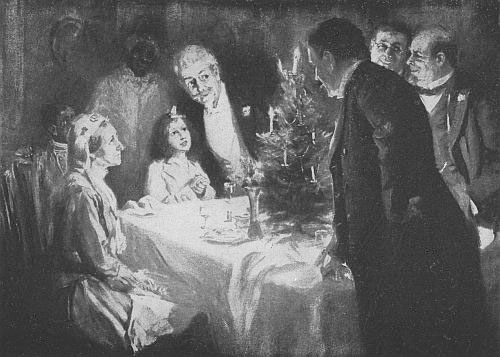 Each guest had a candle alight.
Three candles now were all that were left unlighted; two of them side
by side on the same branch, a brown one and a white one, and below
these a yellow one standing all alone.
The Colonel selected a fresh taper, kindled it in the flame of Aunt
Nancy’s top candle, and turning to Chad, who was standing behind his
chair, said:
“I’m goin’ to put you, Chad, where you belong,—right alongside of me.
Here, Katy darlin’, take this taper and light this white candle for
me, and I’ll light the brown one for Chad,” and he picked up another
taper, lighted it, and handed it to the child.
“Now!”
As the two candles flashed into flame, the Colonel leaned over, and
holding out his hand to the old servant—boys together, these two,
said in a voice full of tenderness:
“Many years together, Chad,—many years, old man.”
Chad’s face broke into a smile as he pressed the Colonel’s hand:
“Thank ye, marster,” was all he trusted himself to say—a title the
days of freedom had never robbed him of—and then he turned his head
to hide the tears.
During this whole scene little Jim had stood on tiptoe, his eyes
growing brighter and brighter as each candle flashed into a blaze. Up
to the time of the lighting of the last guest candle his face had
expressed nothing but increasing delight. When, however, Mammy
Henny’s candle, and then Chad’s were kindled, I saw an expression of
wonderment cross his features which gradually settled into one of
profound disappointment.
But the Colonel had not yet taken his seat. He had relighted the
taper—this time from Mammy Henny’s candle—and stood with it in his
hand, peering into the branches as if looking for something he had
lost.
“Ah, here’s another. I
wonder—who—this—little—yaller—candle—can—be—for,” he said
slowly, looking around the room and accentuating each word. “I reckon
they’re all here—Let me see—Aunt Nancy, Mr. Klutchem, Katy, Fitz,
the Major, Mammy Henny, Chad, and me—Yes—all here—Oh!!” and he
looked at the boy with a quizzical smile on his face—“I came vehy
near forgettin’.
“This little yaller candle is Jim’s.”
When it was all over; and Aunt Nancy herself had tied on Katy’s hat
and tucked the tippet into her neck, and buttoned her coat so that not
a breath of cold air could get inside; and when Jim stood holding Mr.
Klutchem’s hat in the hall, with Chad but a few feet away; and when
Mr. Klutchem had said good-by to Aunt Nancy, and had turned to take
the extended hand of the Colonel, I heard the banker say, in a voice
as if a tear had choked it:
“Carter, you’re mighty good stuff and I like you. What you’ve taught
me to-night I’ll never forget. Katy never had a mother, and I know
now she’s never had a home. Good-night.”
“Come, Katy, I guess I’ll carry you, little girl—” and he picked up
the child, wound her reluctant arms about his neck, and went out into
the night.

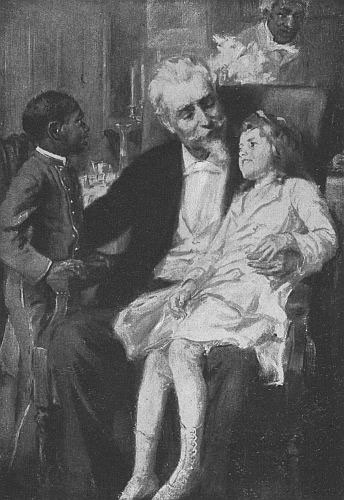 Katy dropped her head on his shoulder again.