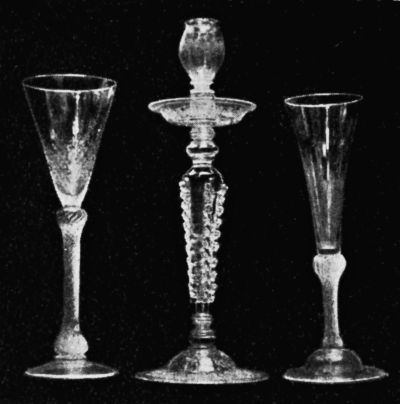
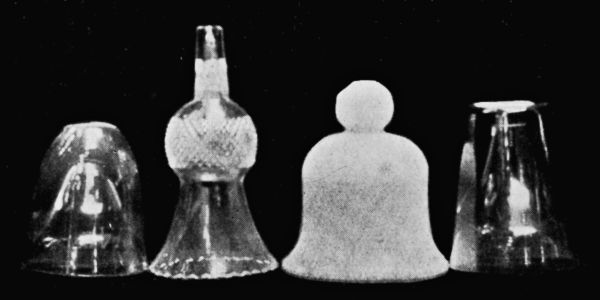
The glassware made in England and Ireland
during the eighteenth and part of the nineteenth
century was the best of the kind ever
made. In quality, tint, feel, and ring the plain blown
glass was a beautiful product, and when it was cut or
engraved the decoration was done by fine craftsmen
and often with excellent taste. Old glass has its own
peculiar charm; the dark beauty of the crystal metal,
the variety of form, the bell-like ring when flipped, the
satiny feeling of the surface, the sparkle of the cut
facets, and the combination of gracefulness and usefulness
attract a collector: in cabinets it shines, gleams,
glows, and sparkles in a reticent, well-bred way.
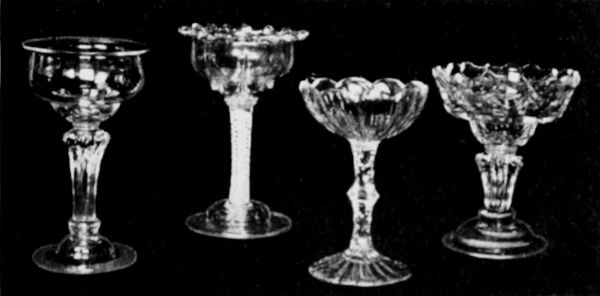
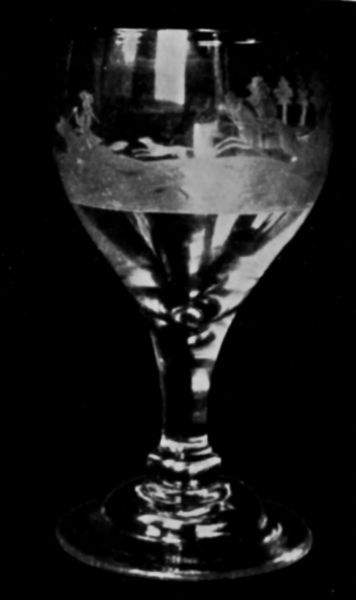
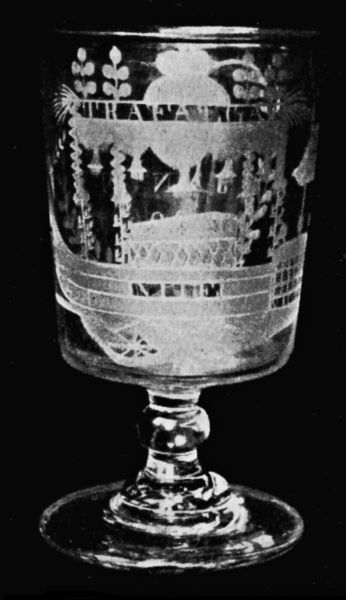
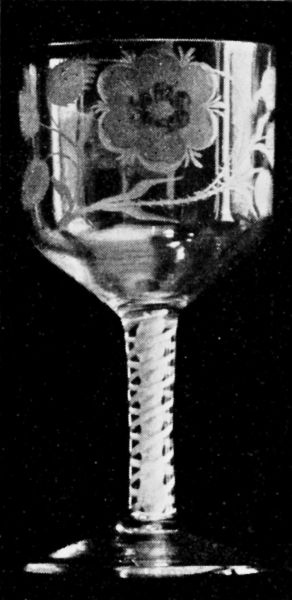
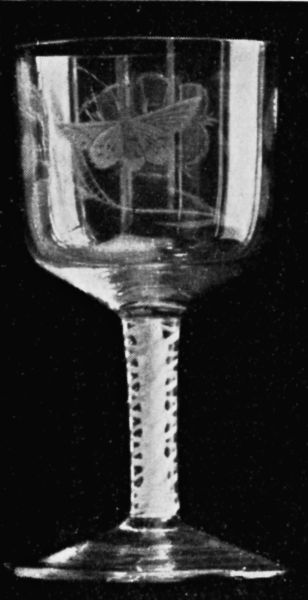
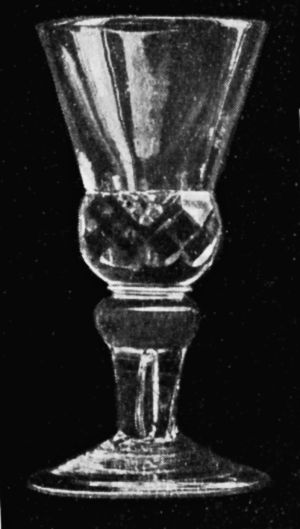
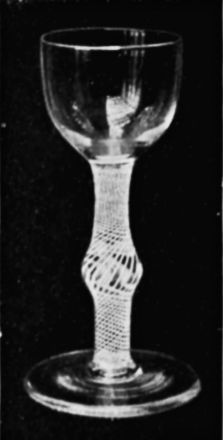
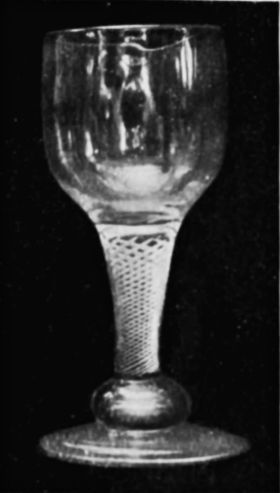
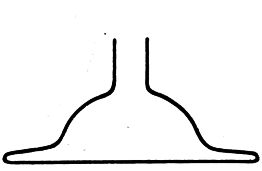
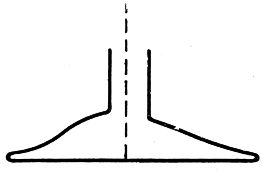
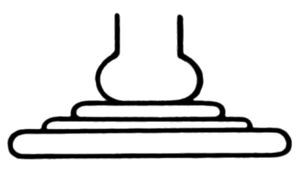
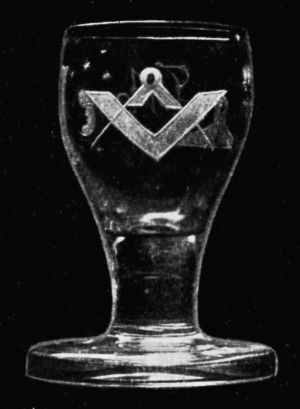
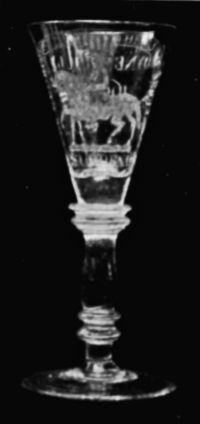
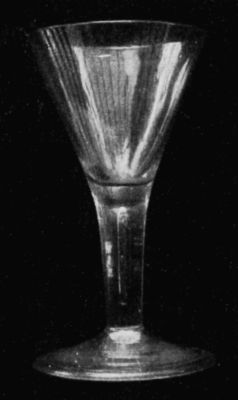
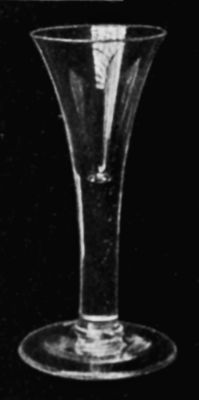
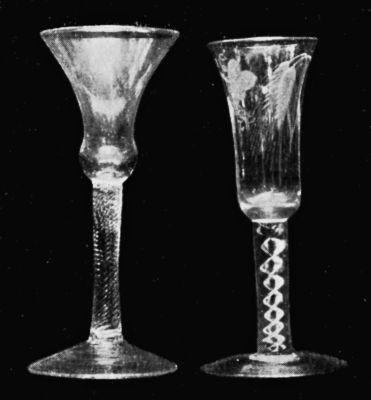
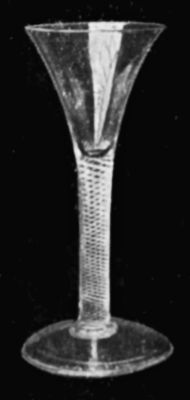
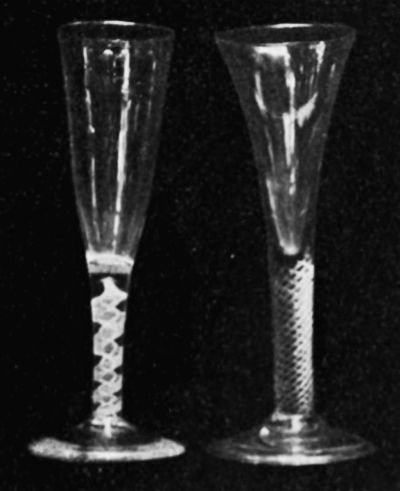
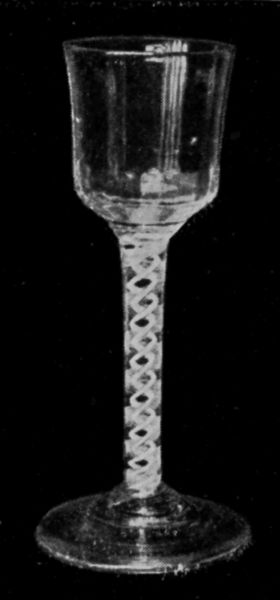
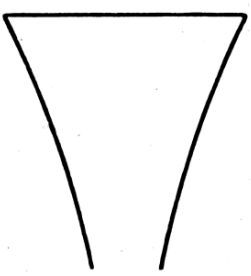
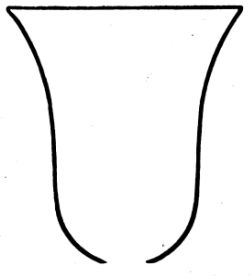
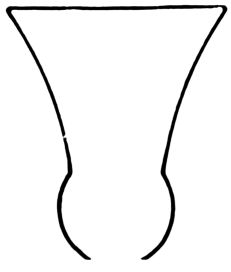
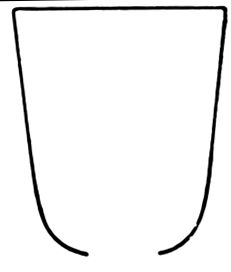
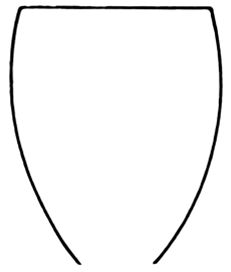
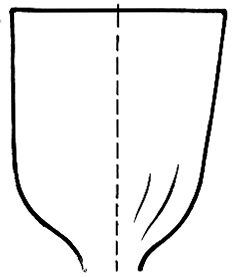
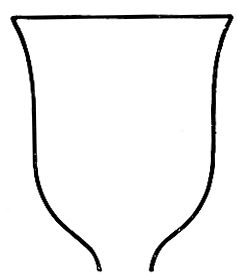
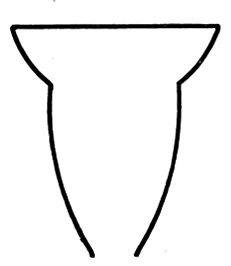
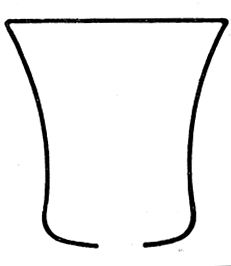
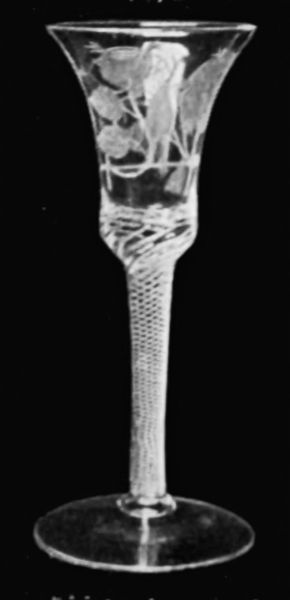
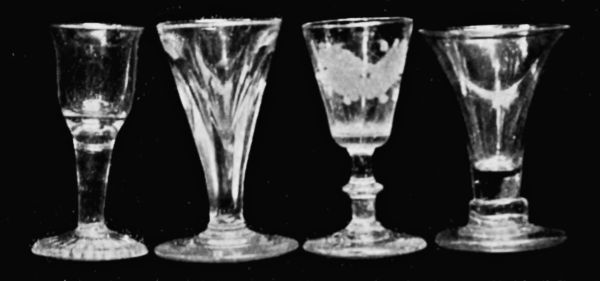
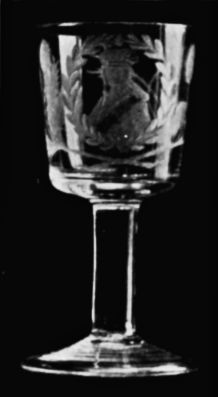
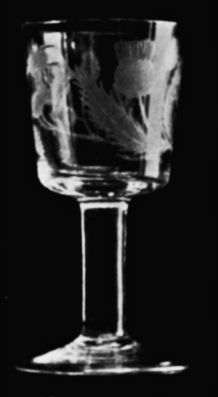
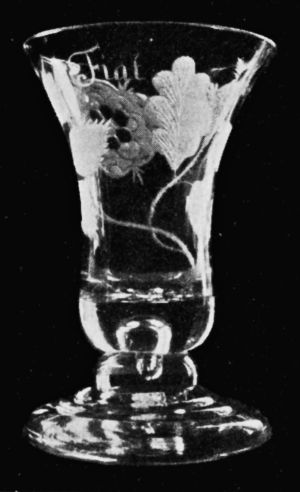
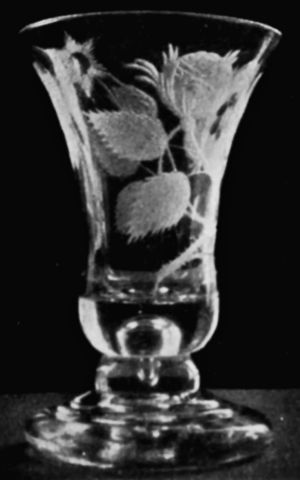
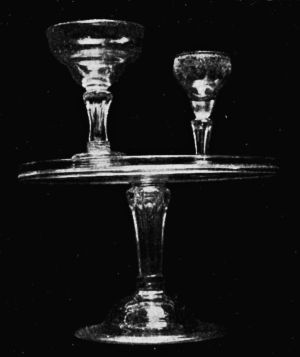
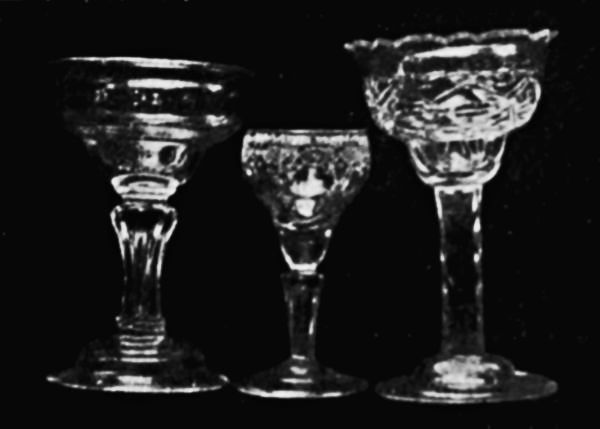
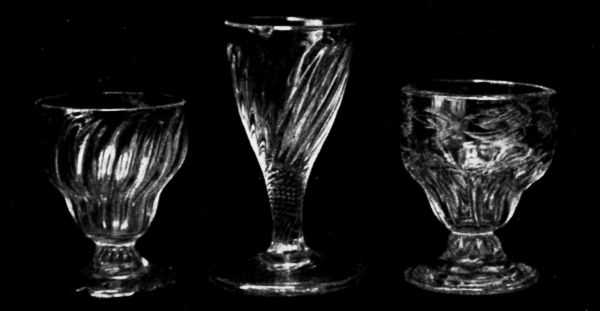
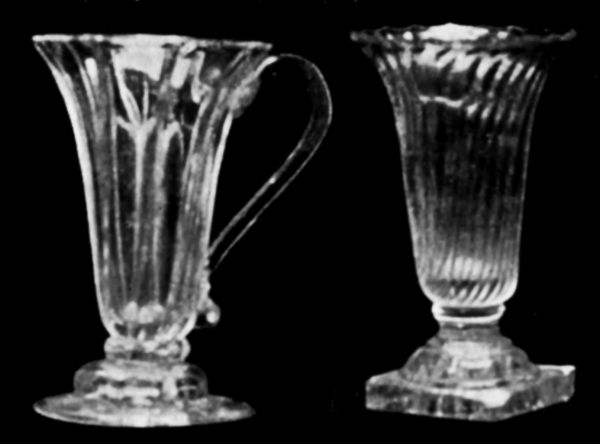
(1) MOULDED; (2) COTTON-WHITE; (3) CUT KNOPPED; AND
(4) CUT AND MOULDED CAPTAIN GLASSES
Then there is attraction in the historical and social
traditions which have gathered around the ware;
romance lingers on in the Jacobite glasses, the Williamite
glasses, the Georgian glasses, the rummers and groggers
engraved and drunk from to celebrate the victories of
Nelson or famous elections; and humour resides in
many of the relics of the punch-bowl and six-bottle days.
To honour particular occasions one’s fine old glasses
may come out of the cabinet and be used at table
again; I know a collector of “captain glasses” who
brings them out for champagne. For decoration or in
use old glass has a refined, artistic, aristocratic air.
The sound of the past seems to throb in the ring of
this frail and dainty ware; at your touch the cry of
the bygone seems heard again. Because of fragility,
enough of eighteenth-century glass has not lasted on to
make it common, and yet so much of it is still extant
that a collector’s hunt for it is by no means a hopeless
quest. It may still be acquired at reasonable prices
from dealers in antiques, and a hunter for it in odd
corners, who buys in shillings, not in pounds, may
reasonably hope to pick up many fine specimens for
next to nothing even yet. Four years ago I bought a
fine drawn cordial glass for 2d. Within the past three
years I have myself bought a perfect captain glass for
3s. 6d.; within the last year I have bought six punch-lifters
for 17s. 6d. in all, uncommon as these bibulous
old siphons are. A large Bristol coloured-glass paper-weight
may cost you £3 in a dealer’s shop, because
three years ago they began to be a “rage,” but within the
past two years I have bought a Bristol glass article, equally
beautiful in colour and glass-flowers, and much rarer, for
2s. Footless coaching glasses and thistle-shaped fuddling
glasses are seldom seen, even on a dealer’s shelves, but
I have found one of each, in odd corners, for 6d.
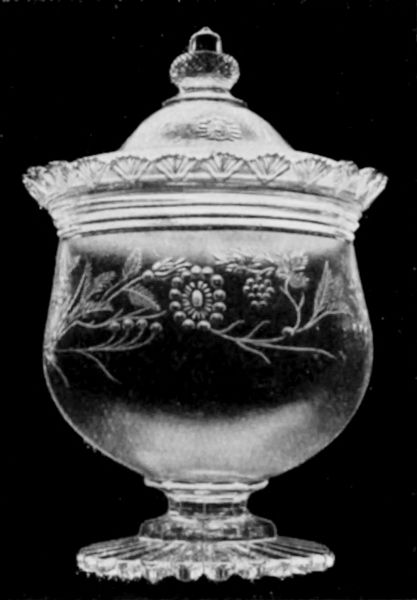
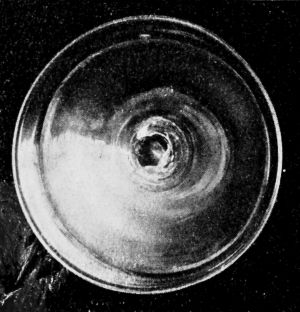
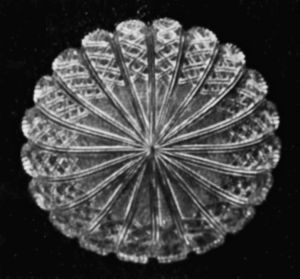
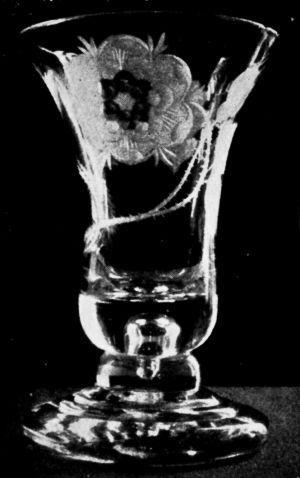
WATERFORD GLASS ENGRAVED AND CUT:
NOTE THE FANLIKE EDGING AND THE
“STAR” CUT TO EDGE OF BASE; ALSO THE
DEEP CUTTING OF THE FLORAL ORNAMENT
Now, if ever, is the time to collect old glass rather
cheaply, for already the prices of it are mounting in
a remarkable way.
Thirty years ago
old wine glasses engraved
with roses,
rosebuds, and butterflies—rose
glasses,
as they are called—could
be bought for
half-a-crown apiece
or less—dozens of
them; this price has
multiplied nearly
twentyfold. Waterford
cut-glass grows
more and more dear
to buy, from dealers
who know it when
they possess it—they
will soon be selling
it as if it were antique silver, at so much per ounce—but
only last year I bought in a provincial town a captain
glass of this ware for 15s., though £8 was the price
asked for one just like it in the West End. Now,
if ever, is the time for a beginner to take up this
line of collecting; old English and Irish glass will
never again be so easy to find at reasonable prices as
it is now.
Collecting is a form of education, but it is not difficult
to become a knowledgeable collector of old glass.
Counterfeits are sent out by the thousand, forgeries lie
in wait, totally new glassware, imitative of the old, is on
sale in hundreds of curio dealers’ shops, some of them
otherwise honest and respectable; but only ignorance
or carelessness need be taken in. A little study, a
little observation, a little care, and the beginner will
soon be able to avoid mistakes. Connoisseurship
in old glass is less difficult than it is in old china,
for example; porcelain or earthenware collecting is
more various, more detailed, has reference to longer
periods of manufacture, and involves much more specific
knowledge than glass-collecting does. Yet I have known
two or three collectors of porcelain who declined to
begin collecting old glass because, they said, they would
“never dare”—as if an almost miraculous skill were
needed to become a connoisseur in old glass! In point
of fact, this is the easiest hobby to study and know;
glass-collecting requires an eye for the different shades
and tints of the metal, a finger-tip for the feel of it, an
ear for the ring of it, and not much money as yet, and
practically that is all. There are no trade-marks to
puzzle or deceive you; there is no such distinction,
difficult to understand and master, as between “soft”
china and “hard.” At present old glass is easy to
know, and not difficult to find.
I propose in this book to give general hints, “tips,”
and instructions applicable to every variety of old glass;
to explain the seven principal tests of genuine age and
antique make; to prepare the beginner to go out collecting
glass with the infallible rules and principles for it fixed in
his mind. Equipped with these, anyone may examine,
test, and if satisfactory buy any vessel of glass which
he or she may find in any odd corner. I am not
writing the book for the rich, but for people with
more taste and cultivation than money, and though I
deprecate “collecting” for the sake of selling again
at a profit, I may well point out that old English and
Irish glass, bought cheaply now, may become an
investment de père de famille; the collector may have
the joy of finding it, the continual pleasure of owning
it, and yet know that it will turn out to be “good
business” for his heirs, when the sale comes, at the
end.
The collecting of old glass is not yet systematized;
there are no dealers’ catalogues of it or prices current.
For the next few years this advantage will continue in
connexion with old glass. Every dealer knows the
high price which square-marked Worcester china can
command; every second-hand bookseller knows the
price current of first editions, or copies of rare books;
but such is not the case with old glass as yet. Systematization
has hardly begun; there has been little research
into the history of makes and the names of makers.
Here is another advantage for a collector: he may
discover things of that kind at present unknown, and
thus attach his name to the history of old glass which
will some day be written. A local collector may at no
great cost make a donation of his treasures to the local
museum. There is no public collection of Newcastle-made
glass at Newcastle, for instance, or of Sunderland-made
glass at Sunderland, and no local antiquary has
studied the history of the fine glass products made on
the Tyne and the Wear. Nobody knows which kinds
of glass were made at Norwich or Lynn. A history of
Stourbridge glass-making and glassware has yet to be
written. So that research, that additional delight of
collecting, is more open in connexion with glass than
with any other well-known “line.”
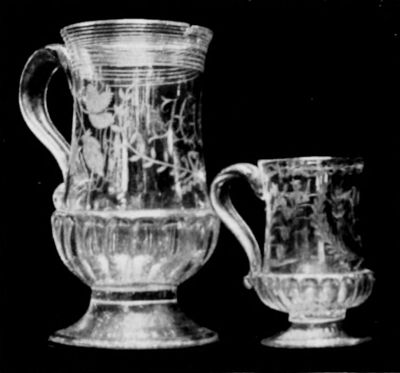
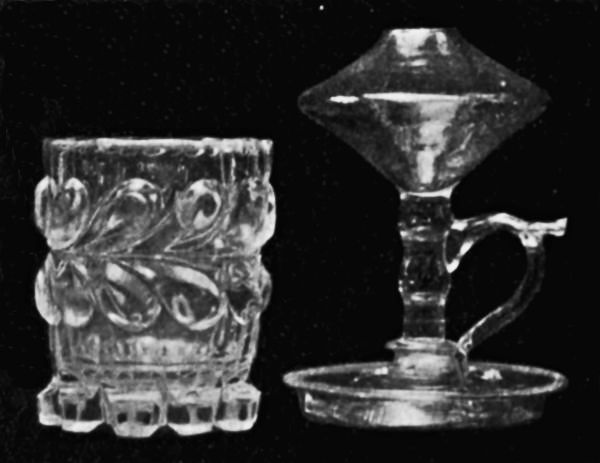
LARGE MUG AND COIN MUG, IMITATING OLD
SILVER SHAPES
The number and diversity of old glass articles may
be indicated by the following incomplete list: wine
glasses, beer glasses, cider glasses, rummers, cordial
glasses, liqueur glasses, tumblers, firing glasses, coaching
glasses, fuddling glasses, beakers, mugs, tankards,
champagne glasses, grog glasses, Masonic glasses,
goblets, Joey glasses, “boot” glasses, “yards of ale,”
toy glasses; flasks, decanters, trays and waiters; punch
or salad bowls, trifle bowls; wine bottles, spirit bottles;
jugs, punch-lifters, decanter stands; jelly glasses,
custard glasses, flip glasses, syllabub glasses; fruit
baskets, centre-pieces, sweetmeat glasses, captain
glasses, comports or sweetmeat glass stands, epergnes,
tazzas; salt cellars, sugar castors, pepper boxes;
caddy sugar bowls; lamps, lanterns, chandeliers,
candlesticks, nightlight glasses, taper holders; finger
bowls, wine
coolers; oil
bottles, vinegar
bottles,
mustard bottles;
jars,
pickle jars;
tea trays, preserve
pots;
vases, covered
vases;
rolling-pins,
knife rests,
knife and
fork handles,
spoons, sugar crushers; butter pots, celery glasses;
weather glasses, chemical glasses, eye baths, witch-balls,
porringers, posset vessels, holy-water vessels;
door-stops, paper-weights; mirrors, knobs, glass
pictures, bellows-shaped flasks, lustres, paste jewels,
beads, taws, toy birds, animals, tobacco pipes, bellows
on stands, walking-sticks, rapiers, and other
elaborate baubles and oddities made for ornament
or as tours de force. There seems to have been
a Glass-makers’ Festival held at Newcastle some
hundred years ago, and it was for exhibition then
that most of the freak glass toys and ornaments were
made.
Much old English and Irish glass was contemporaneously
sent to the American market, and the following
articles were advertised as on sale at New York in
the year 1773: “Very Rich Cut Glass Candlesticks,
Cut Glass Sugar
Boxes and
Cream Potts,
Wine, Wine-and-Water
Glasses, and
Beer Glasses,
with Cut
Shanks, Jelly
and Syllabub
Glasses, Glass Salvers, also Cyder Glasses, Orange
and Top Glasses, Glass Cans, Glass Cream Buckets
and Crewets, Royal Arch Mason Glasses, Globe
and Barrel Lamps, etc.” The “etc.” would be
capacious; it would include most of the articles
mentioned in the paragraph just preceding this,
and such things as crystal globes to be filled with
water through which a candle might throw and condense
its rays, for sewing or lace-making purposes,
at night.
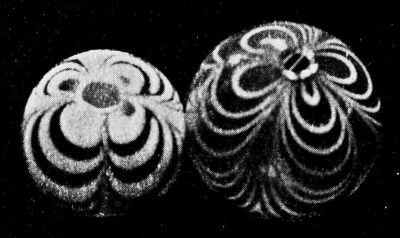
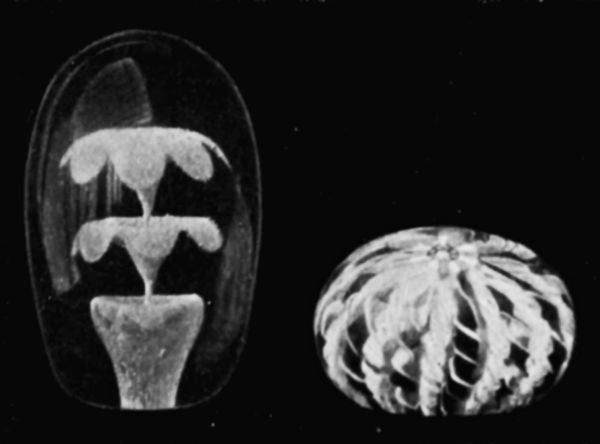
(1) BRISTOL; AND (2) NAILSEA COLOURED GLASS
WITCH-BALLS
A collector ignores window-glass, unless he can come
upon stained glass, purchasing, for £5 perhaps, a leaded
square or oval of sixteenth-century Swiss or German
painted glass, to hang in one of his windows. A collector
ignores plate-glass, except in the form of mirrors,
perhaps. A collector ignores carboys, and also ordinary
bottles, but he acquires when he can one of the thick,
stumpy, almost black glass bottles in which Georgian
people bottled their own claret or port, imported in
the cask. It adds interest to an antique bookcase,
corner cupboard, or cabinet if the panes, or some of
them, show the slight curvature characteristic before
perfectly flat sheet-glass could be cast; and there are
some old panes in which the oxides have turned to a
violet colour—a silversmith’s shop nearly opposite the
top end of the Haymarket still displays some—which are
of interest to-day. There used to be glass objects which,
I suppose, we shall never come upon now: the “mortar”
or nightlight-glass, of the kind which stood beside the
last sleep of Charles I, and the “singing-glasses” which
Pepys heard in 1668, when he “had one or two singing-glasses
made, which make an echo to the voice, the
first I ever saw; but so thin, that the very breath
broke one or two of them.” These, and many other
beautiful pieces of old glass, are for ever gone out of
reach.
But the hunter may come upon pieces which came into
existence before Queen Anne died: Jacobean glass, of
the reign of Charles II at latest, is occasionally found.
For a guinea I obtained a fine sacramental vessel in
purfled and wreathed glass bearing the symbol of
the Trinity (see next page); for 5s. a pistol-shaped
scent bottle; and for 12s. 6d. a hand lamp, all three of
Jacobean date.
In fact, the limits in glass-collecting are not yet fixable;
you never know what quaint or rare thing you may not
come upon in old glass.
Other lines of collecting
are already systematized,
and part of the systematization
is a limiting of
what you may expect to
find and a raising of what
you may have to pay.
With glass there are no
such boundaries, at present;
anything out of the
ordinary in shape, purpose,
or date, may be
acquired, and should be—the
uncommon pieces
are the best—though
often because a piece is
quite unusual, it will be
offered you at a very
low price. The smaller
dealers know that from
half a guinea to a couple
of guineas is what they may charge for an old wine glass,
according to the knobs or the spiral in its stem, but they
do not know any fixed price for less common specimens,
and they will sell at a hundred per cent. profit on the
very small charges they themselves have paid.
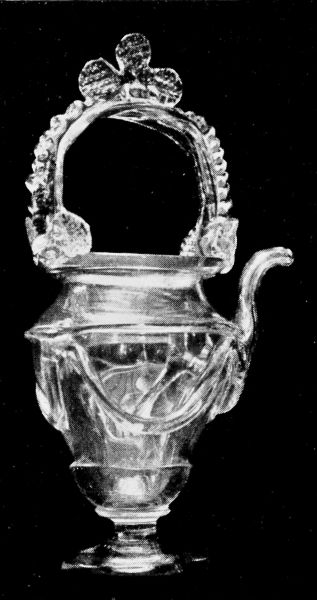
COMMUNION VESSEL, SHOWING PURFLING
ON THE HANDLE, AND
“WRITHEN” ORNAMENT ON THE
BOWL (DATE CHARLES II)
Armed with knowledge of the general tests which I
give in the next chapter, a collector may enter a dealer’s
shop near Bond Street or a marine stores in the Old Kent
Road, a broker’s at Hackney or a cabinet-maker’s warehouse
in a country town, a second-hand furniture shop at
Hammersmith or the Caledonian market on a Friday; he
may look into a butler’s pantry, peer into a cupboard in a
kitchen corner, search amidst the dust of a lumber-room,
or reach to the deep interior of a farmhouse dresser or
sideboard; and almost always he will come upon a
collectable bit of old glass. He may hope to come upon
an old crystal gazing-ball, used by fashionable fortune-tellers
a century ago; or even one of the old glass eggs
which eighteenth-century ladies held in their hands to
keep their palms cool for a lover’s kiss.
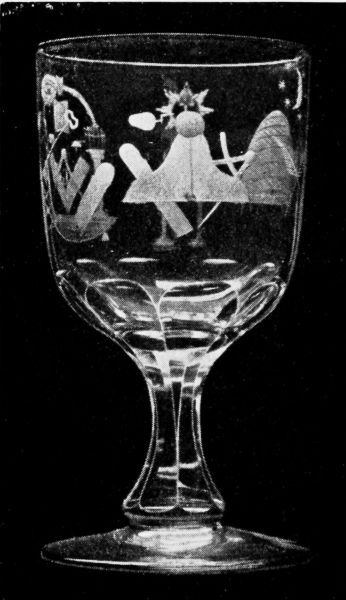
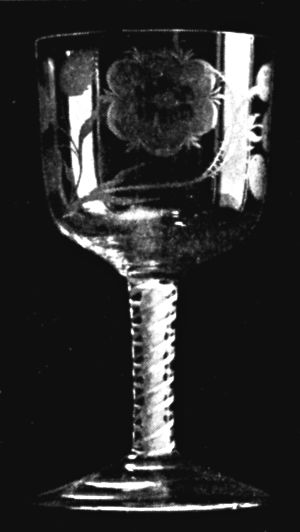
MASONIC ENGRAVED GOBLET, WITH
CUT STEM; THE GROOVES OF THE
CUTTING ENCROACHING ON THE
BOWL
The beginner should recognize from the first that the
range of the collector of old glass is not yet defined;
that the practical hints and rules given in this book may
be applied to any piece of glass, and should be, no matter
how unusual its form or inexplicable now its use in
its time. During the next few years things which now
seem oddities, because they are so unusual, may become
particularly sought after, and valued because they are
rare. I therefore advise the beginner to be a general
and diffusing collector, leaving no genuine old piece
unsnapped-up which comes within his reach and means.
At present cut Waterford glass and spiral-stemmed
blown wine glasses are the things most sought after by
glass collectors, but they may not be so a few years
hence. I do not mean that they will ever drop in selling
value now, but I anticipate that the selling value of other
glass articles, rather neglected now, may appreciate;
that is why I recommend the practice of general and
diffusive collecting and
a wide range. But if
a collector prefers to
specialize, he may set
out to collect wine
glasses only, or inscribed
glasses only, or what-not
in that way; he may go
in for cut-glass only,
or blown glass only, or
coloured glass only, or
toys and eccentricities
only; he may choose
geographically, collecting
Irish glass only, or
English glass only, or
Bristol glass only, and
so forth. In any case
his range will be limited
by certain dates; he will
very seldom come upon a piece so old as the reign of
Charles II, and he will not care to collect glassware made
so late as the year in which Victoria came to the throne.
With Venice-made glass this book has nothing to do.
Much old Dutch-made glass exists in England, but the
student of this book will be enabled to detect it, and not
unintentionally to acquire it believing it to be English
made. Bohemian-made glass, cut and coloured, is seldom
taken up by collectors here. The range in these islands is
for English and Irish glass, for it is the ware most readily
collectable, most likely to increase in value, and to be
most readily sold when a collection comes to be dispersed;
I mention this latter consideration because any
collector not wealthy must, in justice to his heirs and
dependents, in this matter “look to the end.”