The First Pint—Progress—The Total—Congratulation—My Irish
Friend—Sacks Full—Mistaken Identity—A Warm Time—Marks—Excise
Stamping—First Act, 1826—Candlesticks—Church
Pewter—The Basin—Faked Pewter—Plates and
Dishes—Irish and Scotch—Tappit Hens—Whisky Stoups—Britannia
Metal Enquiry—Cleaning—The Tinsmith—The
“Odamifino”—The Pewter Pot—The Mystery Piece.
There is an old axiom that “a man is no good unless he
has a hobby,” but some of my friends say I have been no
use since I took up the collection of old pewter. Many
may wonder what induced a busy man to go to the
trouble of getting together a collection like that shown in
the photographs. It all arose through my rummaging in
a broker’s while waiting for a friend who was looking for
old books, and finding a mug which was dirty and black
with neglect but inscribed, “Canteen, 70th Regiment.”
My curiosity was aroused, and I became the owner. On
submitting this to a tinsmith it was pronounced to be old
pewter, and from the time it was polished, fifteen years
ago, I have been on the look out for more. The experience
I soon gained taught me that the collectors of old pewter
mainly belonged to that class with whom money is little
object, and that what they strived to obtain were very
old, unique pieces, communion vessels and historical
specimens, quite out of the reach of an ordinary householder.
This I recognised when visiting an exhibition
of Old Pewter at Clifford’s Inn Hall in 1908.
It must be patent to any reader that if those were the
only articles of interest that were worth securing for
exhibition purposes then the rest of the old stuff occasionally
turning up might as well go to the melting pot for
solder, the fate of so many tons in years gone by, and even
now men in ignorance of the antique value of old pewter
are daily melting specimens which would be fit to
decorate many a shelf. I have given much attention
to British pewter; the old associations appeal to my
imagination, and I have never been drawn to foreign
specimens.
If you suffer from a good memory you will recall that
Wolsey said to Cromwell, “Take an inventory of all I
possess.” Now if he had as many pieces in such variety
of any one line as I have of old pewter, then Wolsey was
giving Cromwell something to do, and as pewter was
knocking about in those days he may have had a fair
collection. I cannot pretend to describe many of my
pieces, but I present the reader with a selection of photographs,
and I hope these will, to a certain extent, speak
for themselves; anyway they give a good idea of the effect
a large collection of pewter has on the home, and on
the patience of those who attend to the dusting. Space
has not permitted me actually to show in my rooms
or have in the house more than 500 pieces, but I have,
as opportunity occurred, kept on improving the specimens
on view, and I could best do this by letting the stuff come
in whenever I heard of any likely lots, out of which
I selected what I fancied, getting rid of duplicates, pieces
I did not care for, and sending modern and worthless
things to be melted.
So far back as 1908—since when my collection has
much improved—I had the pleasure of exchanging
photographs with a great connoisseur of old pewter, and
I was very gratified when he wrote to me as follows:
“There is so much that is worse than valueless in most
collections; so much unnecessary repetition, that large
collections become irritatingly monotonous. Although
your pieces are often repeated, the repetition represents
always an interesting variation; and this feature contributes
the element of evolution which is always interesting,
and without which no collection is complete or
satisfactory. I congratulate you, therefore, upon your
possessions, and think you have done remarkably well
during the short time. Could you let me see the two
‘salts’ marked on the photo?”
I sent the two “salts,” and he remarked, “The little
one is particularly interesting as it is a reversible one,
the only specimen I have seen.”
That special “salt” is the queer looking little thing
in the centre of the salt group, and I am giving it more
space than its size or appearance seem to warrant. It
was first caught sight of in a shop at Leeds, where a
broker had it filled with black varnish into which he was
dipping his brush, while he was giving an artistic touch-up
to some of his stock. The hunter spotted pewter, and
after some little chaff was told he could have it if he would
bring something that would do for holding the varnish;
this he bought at a shop not far off, and the change was
soon effected. It is a curious specimen, for whichever
way it stands it will hold the salt, but in its present
position it will hold more than twice as much as when it
is placed the other way uppermost.
The results of my hunting and advertising not keeping
pace with my ambition for more, I secured the assistance
of a friend in Ireland, who proved to be a friend indeed.
He had a dog which was constantly jumping on the sofa
and chairs, so he called him Zacchæus because “he was
everlastingly telling him to come down.”
Have you heard of “Phil the Fluter”? I had not
until I heard our friend warble of the wonderful effect the
execution of that phenomenal flautist produced upon his
hearers, but I imagine the charm attained would be as
comparable with that of my Irish friend as modern is to
antique, while he has a tongue that would “wile a bird
off a tree.” Like Father O’Flynn he’d “a wonderful
way wid him, the young and ould sinners were wishful
to trade wid him.” I am not digressing but adorning
the tale to point the moral. With his cheery manner he
succeeded all the time to such an extent that I had to
wire him “Hold! enough.” Later when other collectors
sought my help to get them Irish measures he reported
“Too late, the Jews have been round and bought up the
lot. Why did you stop me just when I was getting my
hand in?” Explanatory of my reason for cancelling my
early instructions, let me give the following. I was
impatient to make a show, so told him to buy all the
pewter plates he came across. A few days after seventy
arrived in two filthy dirty sacks, the state of which
corresponded fairly well with the appearance of their
contents. He apologised later for the condition of the
sacks which “he had borrowed from a place where they
had just skinned a dead horse.” Some of these plates
bore marks and a few others crests, but as the former
owners had a strange custom of polishing the backs with
sand, the marks were mostly rubbed off, and as they
never cleaned the fronts, my getting that consignment into
exhibition form required some trouble and expense,
but as the Tommy said after getting C.B. for being
absent without leave, “It was worth it.”
Referring to this consignment and to the sacks in
conversation later he expressed no wonder at my people
complaining when they and their contents were dumped
in the washhouse, as he thought they were a trifle high
after he found the boots of the hotel, where he had to
spend a night, had put them in his bedroom! Worse than
that, however, happened the following day. He had left
them at one end of the station platform with a porter, that
they might go in the guard’s van, while he went to another
part of the train and joined some friends. He had just
got seated when the porter who must have followed him
with the sacks on a truck, opened the door and enquired,
“Will your honour have these suit cases in the carriage
wid yer?”
The miscellaneous articles which arrived at frequent
intervals were wellnigh confusing, and it kept me busy
finding out what many of them were really for, but when
I found a pewter harp with a screw attached I was so
bewildered I wrote and asked him what on earth this harp
was out of, and he settled my mind by replying, “I
thought it had come down from heaven.”
On one occasion I saw quite a number of pieces in a
shop where I had now and then found an odd one, and
after making a few purchases enquired the reason for this
amazing influx, when I was informed, “You see it’s this
way; there’s a lady who’s got a husband who’s been
collecting pewter until she’s got fed up, so as he’s gone
off for a few days she asked me to call and take the lot
away, as she is not going to have any more of the dirty
stuff about.” Sequel—they lived happily ever after.
For a time I adopted the practice of getting men I
knew to save pewter for me, and, as my rambles permitted,
calling on them periodically. On one occasion I
was looking through the window of a marine store at
—— when I noticed something I was on the look-out
for. I entered, and enquired, “How about the pewter?”
The old fellow replied:
“Hello, you’ve come at last? It must be six months
since you asked me to save any bits that came in.”
“Oh, well,” I said, “it’s better late than never,”
and paid him what he asked.
I had never visited the place before. Reader, I hope
you have never been the victim of mistaken identity.
You will recollect the story I told of my friend who
brought me my first eight-day clock. In talking over
reminiscences lately, I asked if he remembered assisting
me to get pewter. Instantly he replied, “Remember!
I shall remember it to my dying day. I was at Sneinton
(Nottingham), and I asked a marine store man had he any
pewter. He said, ‘Not here, but I have any amount at
my Radford place.’ Now Radford was out of my way,
but I thought I would do you a good turn, so I padded
there, about twenty minutes’ walk—it was warm. When
I got there, I was offered about half a hundredweight of
zinc that I should think had for a few years previously
been fastened on a pub counter. Of course I had to
walk back, and I never felt so hot in my life.”
This is an all important subject to some collectors and
I feel I ought to treat it with a consideration bordering on
veneration, but anyone who has had to put up with the
queries I have been compelled to answer, which has
necessitated my fetching the step-ladder to bring down
plates from shelves in order that the marks may be
examined, would have the reverential esteem knocked
out of him. On one occasion a lady who had taken a
superficial look at my display remarked “What a
number of pieces you have. Do they all bear the
London mark?”
I was taken aback as I was unaware she was so well
up in the subject, but when she informed me she had
begun to collect and had already bought a 5s. half-pint
tankard with a cross and crown stamped on the bottom,
which the seller had assured her was the London mark,
then I understood.
When another visitor asked, “Is it all marked?” I
replied that I collected makes, not marks, and that was
why I had such a variety of pieces, and that many of my
most interesting specimens never bore any.
Those readers who want solid books of reference on
this point will find them among the works issued by
authors whose names are well known and to whose
remarkable patience in probing into the past I am under
a debt of gratitude. I must add that from information
received a work is coming out which will be quite the
last word on old pewter, its makers, and marks. I will
here repeat a statement which has been printed in
almost every book on old pewter since the flood of
1667—viz.: that the early touch plates of makers’ marks
were destroyed in the Great Fire of London.
With the aid of my old watchmaker’s magnifying
glass, 2¼ inches diameter, cased in horn and hinged on an
iron rivet to shut up and carry in the pocket, I have just
examined the fine quart tankard stamped “Js Dixon”
in three small panels. This was no doubt James Dixon’s
mark just after he lost his partner Smith, who had been
with him since 1809, and as he took his son into the
business in 1824, this mark I think, would only have
been used for about twelve months, and must be very
scarce. Underneath the maker’s name I see the first
Excise mark, “WR” surmounted with a small crown.
Next I find an imperfect impression which looks like
“NOXO,” but I can make no sense out of that; then I
discover a stamp “Crown V.R. 106,” and another with
a Crown between the letters “V.R.” also the figures “50,”
these all denoting that at least three inspectors have
passed this tankard as up to the standard at different
periods of its useful career.
Now I came to the most interesting part to my mind,
of the outward signs visible to the naked eye; under the
word “QUART,” which is boldly stamped, there are the
initials “T.B.” and a fine large crown with the date
“1823” all neatly engraved with some embellishment.
The initial letters will no doubt be those of the landlord
of a licensed house known as “The Crown,” and the
year that in which the tankard was made for him.
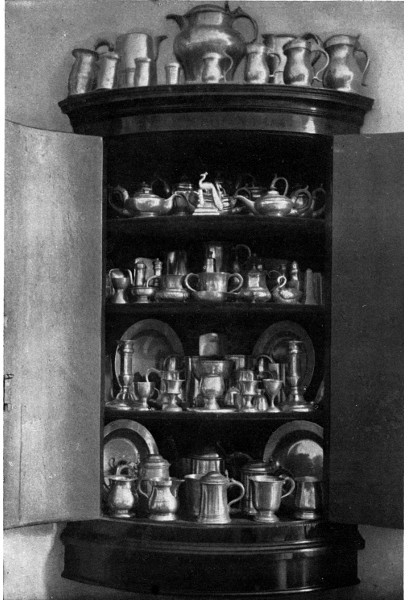
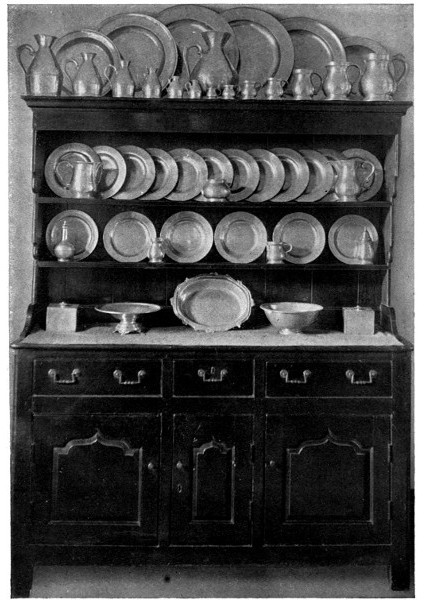
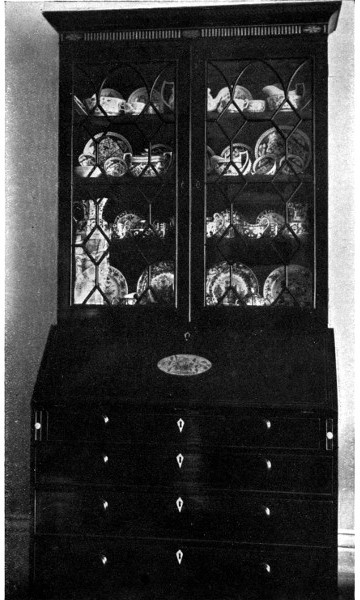
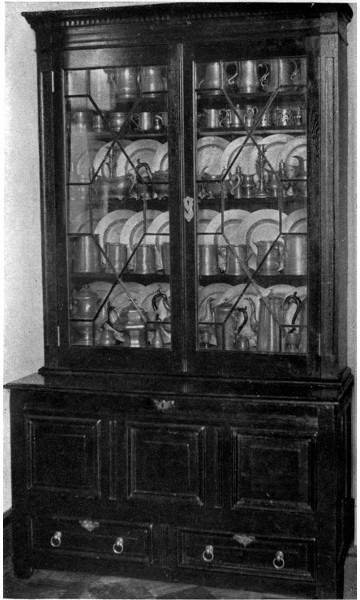
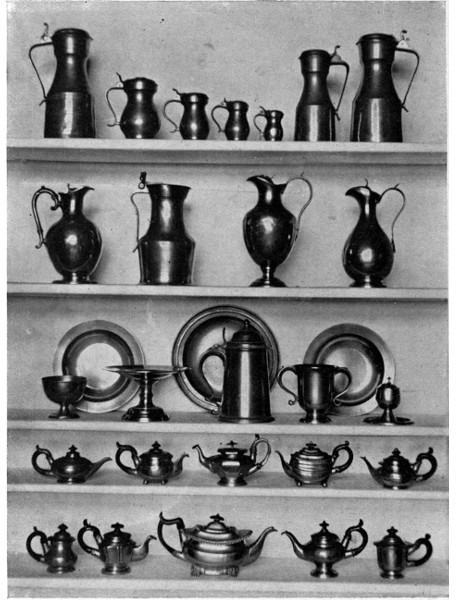
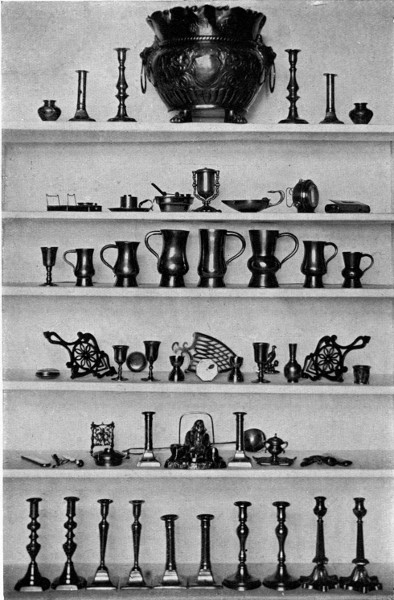
Mahogany Corner-Cupboard with Pewter.
Plate XVIII.
PLATE XIX
DESCRIBING THE PEWTER
First and Second Shelves. Note the two Tea Infusers in which
the tea used to be brewed to replenish the small teapots.
The Teapot on the right of the large Queen Anne is
stamped “half-pint,” so will no doubt have been in a
refreshment house when tea was scarce. The only makers’
names on the ten are Vickers and Dixon.
Third Shelf. See notes on Church Pewter (page 45). The Dish
by Allen Bright in centre is 11½ inches across, the Flagon
is 9½ inches high.
Fourth Shelf. Hot-water Jug. Jersey Cider or Wine Measure.
Two Wine Flagons.
Top Shelf. See notes on Tappit Hens and Whisky Stoups
(page 54).
I have several other tankards bearing makers’ initials
and touch marks, and I know they were made prior to
1826, which I notice did not come into the Inspector’s
mutilating hand until Queen Victoria was on the throne.
I have just taken down two small measures of an uncommon
shape, a gill and half-gill. They have had a
small raised plate soldered on with raised lettering,
“Imperial G. Crown R. IV,” under. They were excised
once “W.R.,” and six times “V.R.”
I have gone to this trouble to make it clear that the
Excise marks are a lame guide to the age of early
pewter, as the Weights and Measures Act which compelled
inspection was passed only in 1826. These
Excise marks have been fair game for the antique dealers,
one of whom, when recommending me to buy some of his
tankards and measures, which bore a “Liver” bird as an
Excise stamp told me that Lady —— was collecting
only pewter which bore the Liverpool mark. He seemed
surprised at my ignorance when I told him this was the
first time I had heard Liverpool was celebrated for the
manufacture of pewter.
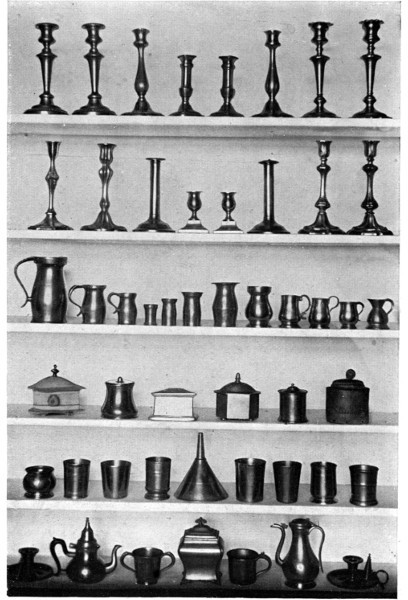
Before going to bed I will just tell you how I got
these tall fellows shown on Plate XX. They were in
a greengrocer’s shop window, so I thought I would
buy some apples. I came out with these 10½ inch candlesticks
as well. No, I did not steal them, and they were
not actually given away, but that is not what I wanted to
tell you. They have loose tops and in consequence are
extra special. Be sure you blow out the light. Nearly
all pewter tops get melted through the candles being
left burning until they get down to the sockets.
Of the candlesticks in the group I wonder which you
will like the best. I prefer the 7 inch, as they are oblong
shape, base pillar and top; the bottoms have the original
wood filling and the very old baize to stand on. I found
these suddenly in the office of a gentleman who perchance
made a lot of money out of me; anyway, shortly after
this final transaction he retired from business, and built
and endowed a—cinema. One candlestick was broken
and the other needed repair, and as I could not clean
them in the usual way I sent them to a manufacturer
who made a good job and gave them a polish without
injury to the priceless bottoms. The 4½ inch pair were
kindly sent to me by a lady in Norway. I bought the
8 inch straight pillar pair from a Jew, who later wished
to buy them back as he had found a new customer who
would give 30s. for them. As I have given you these
sizes you can easily guess the heights of the remainder.
Church pewter which has been associated with Church
worship now gets more worship than it did in its Church
days. Firstly from the dealers, who seem to be able
to get any money they like to ask from some collectors,
who in their turn worship their expensive idols mainly on
account of the satisfaction they experience in the knowledge
that no other collector can worship at the same
shrine. The flagon shown on Plate XIX originally
came from Bearley Church, near Stratford-on-Avon.
I was assured by the dealer that “Shakespeare
attended Bearley Church.”
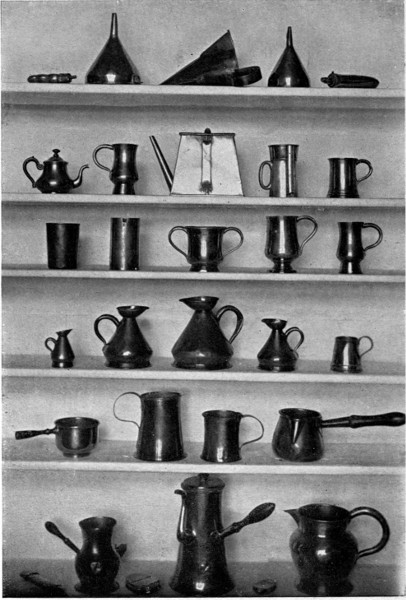
PLATE XX
DESCRIBING THE PEWTER
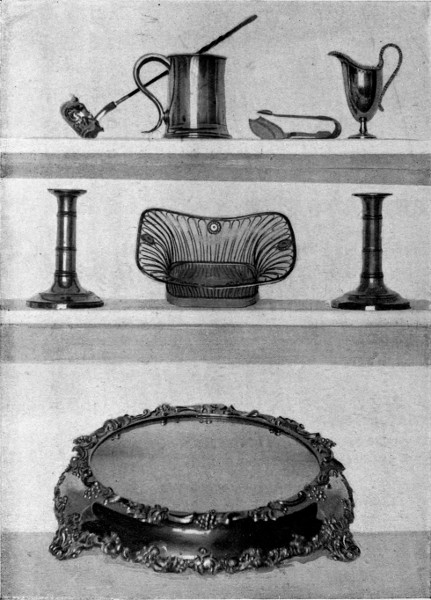
Bottom Shelf. Pair Bedroom Candlesticks with loose tops and
extinguishers. Quaint Teapot. Tea Caddy. Chocolate
Pot. Two-handled and one-handled Caudle Cups.
First Shelf. Spill Bowl inscribed “43” with crown and bugle,
showing it belonged to the Leinster Regiment. Seven
Beakers. Funnel dated 1698.
Second Shelf. Tobacco Jars. The two end ones are of lead, the
one on the left being made by hand. The other is cast,
and has on each side a reproduction of “The Last Supper”
by Leonardo Da Vinci, very clearly moulded, while it is
fitted with the old oak bottom fastened with iron studs.
Third Shelf. Three Baluster-shaped Wine Measures. Four Irish
Measures. Five Measures.
Fourth and Top Shelves. See notes on Candlesticks (page 44).
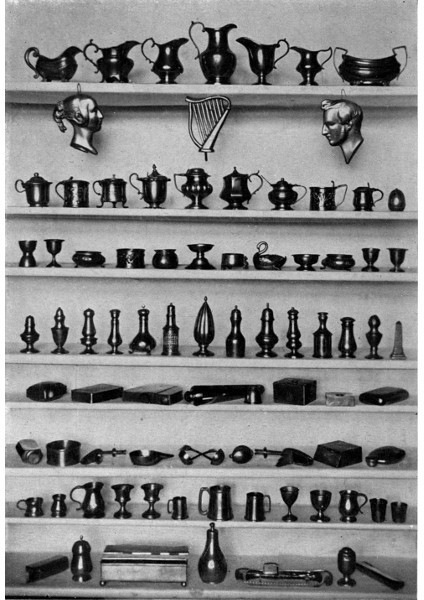
PLATE XXI
DESCRIBING THE PEWTER
Bottom Shelf. Spice Box. Spice Dredger. Box Inkstand. Sand
Sprinkler for drying the ink. Tray with Sheffield Plate
Snuffers. Snuff Holder. Scotch Token Box.
First Shelf. At either end three Measures. Four Wine Cups.
Three Measures in centre.
Second Shelf. Flask; top screws in and not on—a peculiarity
of early Flasks. Wine Bottle Stand. Pap Boat and
two Castor Oil Spoons (see notes). Rat-tail Toddy Ladles.
Mould for Clay Eggs. Small Tea Caddy. Odd-shaped
Flask.
Third Shelf. Tinder Box. Sandwich Case. Combined Sandwich
Case and Flask. Saddle Flask and Cup. Tea Caddy.
Snuff Box. Cigar Case.
Fourth Shelf. Peppers, except centre, which is probably for
sugar.
Fifth Shelf. Double-ended Egg-cup. Egg-cup from St. Bees
Lighthouse. Salts—three-legged, dated 1801. Glass-lined.
Reversible. French. Three-legged Sphinx. Swan. Plain.
Three-legged early Elkington. Two Egg-cups.
Sixth Shelf. Mustards. The three largest have fixed glass
lining.
Top Shelf. Queen Victoria and Prince Albert with date 1840.
Irish Harp. Cream Jugs and Sugar Basin (J. Vickers).
Centre Cream and one adjoining are blue glass lined, and
the fitting of the Pewter cover denotes careful workmanship.
“Did he read the lessons?”
“Of course, that’s why he went.”
After this I felt compelled to buy it.
I have some alms-dishes which may have done serious
duty and I have one which I feel sure has never been
inside any sacred building. I have also an old two-handled
cup and a pair of collecting plates from the old
Runcorn Baptist Chapel, which was erected soon after
1800 and closed about 1880; a small private set, paten
and chalice and an engraved Scotch chalice, and I will
embellish these notes by relating the extraordinary
circumstance which brought the latter into my fold at
a time when I was yearning for something sacramental.
I was in my office and had just put down a pewter
snuffers-tray when a traveller for a Scottish firm was
announced. As soon as the interview commenced he
opened his bag to get out his samples, when my eye
chanced to catch a glimpse of something almost hidden
by a sleeping garment and my instinct spotted pewter.
He told his tale and waited for an indication of the
impression he had created, which was conveyed to him
in this form.
“Excuse me, but was that a piece of old pewter I
caught sight of in your bag?”
“Yes, sir; are you interested in old pewter? I slept
the night in Warrington and I saw this in a shop as I was
going to the station; I think it is an old rose-bowl, and I
shall be pleased to give it to you if you will have it.”
Of course, I couldn’t think of such a thing, but I
should be glad to exchange with him for a snuffers-tray
I had on my desk. He assured me that he would be
delighted, and as I always endeavour to give pleasure to
others I fetched the tray. That gentleman secured a
contract and a tray and left me with thanks and a seventeenth-century
Scotch chalice. You never know your
luck when collecting.
But for my awkward conscience I should include the
basin shown on Plate VI, this being sold as “a vestry
piece.” It may have been used by the parson, or for
washing the Communion vessels, anyway I preferred to
believe the dealer, and gave it a conspicuous position,
which the ladies objected to, and I found it relegated to
the rear. On seeking an explanation, and calling it
“a vestry piece,” I retired hurt, so to speak, by the
remark “Vestry! Why my aunt had a thing like that,
in which she made us children wash our hands,” and then,
still so gently o’er me stealing, memory would bring back
the feeling of us youngsters having been caused to do the
same very necessary performance in a similar utensil,
with cold water from the pump at the old house at home
fifty to sixty years ago.
I had not been many years a collector before I found
spurious Communion cups and Communion sets were on
the market and I obtained some very enlightening information,
much of which I cannot publish. It was the
practice to blacken the new pieces with acid to give them
an appearance of age, and I heard of an instance relating
to hundredweights of faked pewter, but I am coming
straight to the point and the photographs on Plates
XXV and XXVI will corroborate my statement. I was
further informed that they were making deep dishes
out of old bedpans, preserving the maker’s mark
on the bottom. I had had a bedpan hidden away in
the stable loft for some time, and I decided to prove
how far this information was correct. The pan had come
from Ireland with a box full of “gatherings,” and I
had almost decided to sell it to be melted.
I eventually wrote to a firm of pewter manufacturers
explaining the conversion I wished to have effected, and
they informed me they would do the job if I would say
whether I wanted a deep dish or a shallow one and what
width of rim I desired. In about three weeks after I had
sent them the bedpan I received the fine deep (alms) dish
bearing the maker’s name and mark—Joseph Austen—well
preserved, proving the article was made in Cork over
100 years ago. It looks very well indeed and I have never
had its virtue questioned; in fact when I have told
visitors they have been greatly astonished, while a few
have been hard to convince.
Now you understand my remark that I had one “alms
dish” that had never been inside a sacred edifice.
When the Pewterer’s done his pewtering,
And his work is quite au fait:
When his making’s turned to faking,
And the marks are left O.K.;
The collector sees, and then agrees,
The pewter must be old.
Now doubts arise, before his eyes,
He fears that he’s been sold.
These under the eye of the camera are more or less
alike, especially more—then let it suffice the reader to
learn that I have forty small and thirty large of various
sizes displayed wherever a likely space is available without
giving a too crowded appearance. They nearly all bear
makers’ marks or owners’ crests or initials, or evidence that
they have been put to good use at some time or other.
I have been told that when these big chaps were in vogue
the various conglomerations forming the meal were
heaped together and formed a goodly pile, so there is no
doubt of the authenticity of the story of the Scottish
farmer with a prodigious appetite at a Rent Dinner
who when they wanted to take away his plate said
“Bide awee for I hae just found a doo (pigeon) in the
reddin o’ ma plate.”
As regards the rims, while I know some enthusiastic
collectors could talk for a week on this feature,
which to the uneducated suggests distinction without a
difference, I will not labour the point.
I saw some very bright 9 inch plates in London
recently with ornamental rims, and out of curiosity
enquired the price. I was told 25s. each, but the information
that they were Dutch was not vouchsafed.
Probably my “pride of the paddock” plate is one on
Plate XIX (facing p. 43). It has a raised bead running
round the centre of the rim, is thought to be early
eighteenth century, and was made by Allen Bright,
who has since retired from business. Judging by its
shape it should pass muster as a genuine alms dish;
though it may have been constructed to hold pennies in
the kirk, I think it just as likely it held puddings in the
kitchen—a thought inspired by the old knife-cuts on the
bottom.
I have referred to the Irish plates being scoured
on the back, and wiped on the front. Apropos of this
remark I have a set of eight with the crest of a sea-horse
on the rim; the marks are all obliterated, with the exception
of the word “Jonas,” and by the lettering I was
able to identify it as made by Jonas Durand about 1660.
I also have three plates with the crest which represents
the red hand of Ulster, and I believe they would originally
be the property of an old Derbyshire family that has an
estate in Ireland.
I have one very rare plate inasmuch as it bears on its
surface ten rows of tap marks made with a round-headed
hammer. The number in each circle lessens until they
get down to seven, which surround the centre tap. This
plate bears the initials and touch impression of the maker,
which are undecipherable, but that does not worry me.
I would far rather have the uncommon surface and
indistinct marks than plain marks and a smooth surface.
The strange thing is that if anyone wants a plate to,
perhaps, stand a pot on, and there is no pottery one handy,
or the artistic eye thinks a certain pot or flower would go
better with a pewter than with a coloured pottery plate,
they invariably lift this one off the dresser shelf, when
any of the others would do equally well. This must stop,
as I find the treatment does not improve its peculiar
appearance.
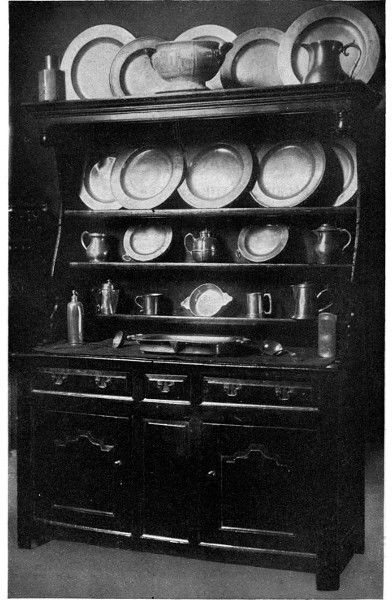
On the first shelf of the oak dresser (Plate VI) there
are four Scotch plates made by William Hunter, of
Edinburgh, 1749-1773. The fronts must always have
been well polished, for they shine like silver now. The
backs have been kept clean, though not scoured, as
the maker’s name and touchmarks are quite distinct.
One pair were called “meatplates” and the other
“pudding” or “porridge plates.” The latter are
deep and would pass for collecting-plates among church
pewter in some hands. My obtaining possession of these
from the shelves of a farm kitchen in Scotland is an
illustration of the proverb that kissing goes by favour.
I wish I could obtain more in the same very agreeable
manner.
As evidence of the age of the plates and dishes I give
the following list of makers’ names, and the approximate
dates when they were making these things hum.
For most of my records I have searched my books of
reference, and when these have failed me I have appealed
to Mr. H. H. Cotterell, a great authority on marks,
who has very kindly furnished me with the information
required whenever possible.
| Allen Bright |
1750 |
| J. Baskervile |
1695 |
| R. Chambers |
|
| Tudor Rose |
Early 17th century |
| T. Compton |
1807 |
| Thorne, London |
|
| George Seymour |
1768 |
| Brown |
17th century |
| G. Smith |
1676 |
| G. Smith |
1790 |
| Jonas Durand |
1658 |
| William Hunter |
1750 |
| John French |
1687 |
| Charles Clarke (Irish) |
1790 |
| John Duncomb |
1730 |
I must mention a pair of very rare plates of special
shape with tooled borders. Two holes are drilled in each,
and it is probably due to the fact that some vandal has
scratched the name “Lizzie” on them that they have not
been put to the use for which they were intended, namely,
to embellish the drop handles of an old-time coffin.
When an obliging broker told me he had a couple of
plates he had saved for me, and then produced these
ghastly things, I was rendered mute.
“Paint Scotland greetin owre her thrissle;
Her mutchkin-stoup as toom’s a whissle.”
Well she may with whisky at half a guinea a bottle!
When we were in Barmouth we stayed at the Cors-y-gedll
Hotel, and when I asked the landlord, who up to that
point had been the personification of geniality, “What
is the meaning of Cors-y-gedll?” he blurted out,
“Nobody knows; everybody asks me that question,”
and left me abruptly. I was not a collector of old
pewter in those days, but I can now fully appreciate the
cause of his irritability, for the number of times I have
been asked, “What is the meaning of ‘Tappit Hens’?”
leaves me tired. I once suggested that the name may
have originated because they tappited to see if it was
empty or not, only to be further puzzled by the query
“But why hen?” and I could only suggest that “It
cackled whenever it laid an egg,” which was condemned
as an inane joke, which if I had any conceit of myself as a
humorist I should never repeat.
Having read so much about Tappit Hens, I have
known all about the history a long time ago, and I have
forgotten most of it. The name for a Scottish pint
measure of a certain shape was “Tappit Hen,” which
held two quarts (Imperial). A “Chopin” held a quart
and a “Mutchkin” an Imperial pint. My photograph
shows a pair of Tappit Hens and a Chopin.
After Tappit Hens came the lidded whisky stoups
which were in use in Scotland from 1826 to about 1870,
when an Act was passed to do away with profiteering by
short measure, and so the use of lids was prohibited.
As inspired individuals began to buy up the original
Tappit Hens the supply gave out, so the dealers elevated
the whisky stoups to the designation of the former. I do
not exaggerate, for I have seen Tappit Hens advertised,
and had them sent on approval, only to find the much less
valued stoup, or pot-bellied measures as they were often
called. Now I suppose they are getting done up, and
that any old thing with a lid on is a Tappit Hen. Anyway,
I was told by a gentleman, whose knowledge and
experience of his profession are much greater than they
can be of Scottish pewter, that he had just bought a
French Tappit Hen!
In all my travels I have only been offered the genuine
article once, and that was in Glasgow some years back,
and as I already had two of the same size I did not buy,
although it would have been a good investment at the
price at which I could then have purchased it. The
three imposing Tappit Hen shaped measures I have bear
on the lids the imprints of the initials of a fine family,
whose old grey stone hall still stands in its lonely but
grand surroundings on the Pentland Hills, of which I am
constantly reminded by the kindness of a descendant,
who placed these treasures in my hands.
I am not a statistician, but I dare hazard an opinion
that there are ten or may be twenty times more “Tappit
Hens” in existence to-day than ever were made.
It is now time I tapped Burns again:
“Come, bring the tither mutchkin in,
And here’s, for a conclusion.”
This name puts me on my mettle, and as the uncertainty
of what is the difference between pewter and
Britannia metal has not to my knowledge been clearly
explained I intend to deal with this question somewhat
didactically.
I was so struck with the effect of turning my 70th
Regiment pint pot from a dirty disused mug into a
pleasurable thing that I visited all likely shops for some
few miles round and bought up everything I thought and
was told was old pewter, and I soon had more than
would fill a corner cupboard, which I had lined with
blue velvet to show it off. Then I bought “Marks on
Old Pewter,” by W. Redman, which was the only book
bearing on the subject I could hear of, and in it I
read:
“The manufacture of goods in Britannia (white metal)
was an important 18th century addition to the Sheffield
industries. Whether James Dixon or James Vickers
commenced first to make this kind of ware we are not able
to say. It is said that James Vickers bought for five
shillings from a sick man whom he happened to be
visiting a recipe for making white metal. The experiment
turned out a great success, and for years both these firms
were kept busy making all kinds of articles of what was
called Britannia metal. Now these old articles are often
called pewter, which is a mistake; neither of these firms
made any pewter ware. Alloy: 80 per cent. tin, 10 per
cent. antimony, and a little copper.”
This was rather a blow, as some of my purchases were
stamped “Britannia Metal” and a few others “B.M.E.P.,”
although the electro-plate was mostly worn off, giving the
things a pewter-like look. Next I obtained a short history
of the firm of James Dixon and Sons, and found they did
make pewter in their early days. I also learned from a
history of Sheffield in the 18th Century that Vickers
started making money and Britannia metal at the end
of that period, so this stuff seemed ancient enough.
I now had the pleasure of obtaining “Old Pewter,”
by Malcolm Bell, and found among the illustrations
articles of which I had duplicates, one of which was a
pepper-pot, and this reminds me that when I went in for
this and inquired the price, and was told fourpence, I
repeated the word “fourpence!” which immediately
drew the rejoinder “Yes, fourpence, it’s half full of
pepper.” From the trouble I had in getting out that
solid pepper, I rather think the pewter must have been
built round it.
I opened a correspondence with Mr. Bell, and he most
courteously and kindly gave me every assistance. In one
of his letters he wrote: “I must confess that for my
own part I could not pretend to draw any hard and fast
line between pewter and Britannia metal, for though
one can tell the difference between the extreme types by
the eye the varieties merge so gradually into each other
that the boundary is indefinable. In fact, hard metal
pewter with 96 parts tin, 8 of antimony, and 2 of copper
is practically identical with the Britannia metal containing
92 parts of tin, 8 of antimony, and 2 of copper,” which
was what I expected. Consequently I have among my
lot many pieces which may have been sold as Britannia
metal in the old days, but I would defy anyone to pick
them out and prove them not to be pewter.
I asked Mr. Redman to come over and see me, and
he readily did so. After he had gone, and from remarks
he had made, I gathered he had been more impressed by
the kindness of my partner than with the quality of some
of my pewter. The result of this interview was that I
never refused anything in the pewter line of mature age,
and came to the conclusion that the difference in the
names was a clever move of cute business men to enable
them to charge something extra for their wares which
were made of somewhat harder metal than was being
generally used at the time. I have frequently come
across early plates and tankards that differed materially
in their hardness.
Pap-Boat. On shelf 3, Plate XXI (facing p. 47), I
show a specimen of rarity. Pap-boats would be as
common as babies at one time. This one was bought
at Lytham, and was introduced to me as a pig feeder.
It is 4½ inches long.
Castor-oil spoons. What a fuss they made about
taking a dose of castor oil, or had they not conceived
the idea of disguising it between other liquids? The
manipulation of such a spoon was a tricky job, for after
getting it into the mouth a twist would be needed to
bring the lid on to the tongue, the lid would partly
drop open and the castor-oil would then flow gently down
the patient’s throat, provided of course there was no
resistance. This forcible feeding was of everyday
occurrence. The larger of the spoons is about seventy
years old, and the smaller about ninety years.
There are eighty-five specimens on Plate XXI, and
I believe that the reader, with the aid of a magnifying
glass, will be able to form a very good idea of each piece.
The photographing of the groups generally entailed
quite a lot of work, and some anxiety, for as I do not
develop myself, or, rather, as I do not do my own developing,
I had put all the things back in their places
before I knew if the negatives were right. Fortunately it
turned out all the exposures had been correctly timed,
which was more than I anticipated with the varying and
often poor December light.
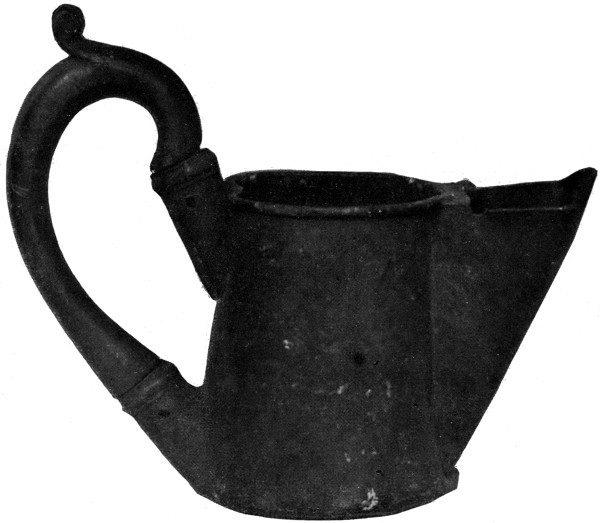
This was picked up quite recently by a keen collector
of rags and bones and other relics whose glory has
departed. It was snapped out of his day’s doings by a
flourishing dealer in anything that blew into his yard,
and it was only by my going over the top of about
10,000 rabbit skins, the age of which could be more
accurately guessed by their odour than by their sealskin-like
appearance, that I caught sight of it. Then
ensued a discussion as to the part this pewter had
played in the past. The R and B collector called it a
“Funniosity,” the skin specialist diagnosed it as a
“Cream jug,” while a third gentleman (who dare not
take on any other job than spirit testing while he is
drawing out-of-work pay) said without hesitation, but
not very distinctly, “Odamifino,” with a pronounced
emphasis on the second syllable. When I suggested it
might be a barber’s shaving-pot I was immediately ruled
out of that court, as “Barbers never used anything
made of pewter.”
Now if any collector can inform me when “Odamifinos”
were in vogue, and why they came into existence,
I shall be obliged, and in the meantime I will consider the
cleaning, for is not cleanliness akin to collectingness?
At present it has hardly an appearance suitable to my
cabinet of rarities, while its high-sounding designation
suggests that as its proper environment, and yet I have
in mind the quip of that inveterate humorist Froude,
“A thing of beauty is a joy for ever,” muttered at the
Annual Meeting of the Peace Congress, when Carlyle
chipped in with a chuckle, “Rough hew them as we will,”
to be capped by that infernal joker Dante with the
remark, “You cannot paint the lily whiter.” At this
point Mr. Chairman Darwin brought back the members
to their customary somnolence with the admonition:
“Come, gentlemen, please, don’t ape the silly goat. The
next subject for consideration is ‘Shaving—should each
customer have fresh water?’”
This was a great source of trouble to me and to those
associated with my home life, and it was not until I had
strained their patience almost to the separation point
that I was informed: “You really must make some
arrangement for getting the pewter cleaned elsewhere, as
the maids have given warning they cannot put up with
the master messing up the kitchen any longer. Half the
saucepans are ruined, as of course they could not be used
after having that filthy stuff in them.”
I started boiling corroded pieces and letting them
soak in washing soda all night, but found this made no
impression on those which had been most neglected, while
some came bright after a good scouring with hot water
and Brookes’s soap, being later polished with methylated
spirit and plate powder. I may here advise the reader
that the latter treatment is all I now find necessary to
furbish up my stock and keep it presentable.
I will not dwell further on my early difficulties, but
relate how they were overcome. At the time I was almost
overwhelmed with putrid plates, dishes, and other
things I had received Mr. Redman came to my rescue
with the following recipe:
“2 oz. rock lime, 2 oz. caustic soda, 6 oz. common
salt, 8 oz. common soda, dissolve in 3 quarts of water in a
saucepan on the fire. When dissolved pour into a bowl,
and when cold add eight quarts of cold water. Steep
as long as necessary as much pewter as the liquid will
cover, and the bath can be used until the liquor has lost
its nature.”
I had a mixture made in a bath and let the things lie
in this until the corrosion was easily wiped off, and I
entrusted this job to a man who had been used to cleaning
machinery and whose practical knowledge and serviceable
hands made him far more competent than his employer.
I never had the surface of the pewter injured
in any way with the strong solution, and so long as the
rubbing with the coarse flannel and Brookes’s soap was
done the way of the grain—that is, circular or round and
round—no scratching was apparent. When I say I have
dealt with no fewer than 1,450 pieces the reader may
gather that the trouble and expense has not been trifling.
I hope this information in regard to cleaning may be of
value to many amateurs, to whom I wish good luck.
In case some curious minds may wonder how I account
for the difference between the total given and the 500
pieces I stated I now have I do not mind disclosing that
I sent a lot of it to a friend at New York who was anxious
to exhibit his old family plate, and I learnt when he was
last over that as the brightness I had been at such pains
to secure militated, in his opinion, against the appearance
of antiquity he had abstained from further cleaning,
and that the pewter was now looking quite old.
I believe I must have earned that friend’s undying
gratitude, for did I not provide him with his great-great-grandfather’s
clock, and further spared him and
shipped out an early dated Broadwood grand piano,
which I had previously converted into a dressing-table,
and which he has since discovered is the identical
instrument that his great-great-grandmother used for the
five-finger exercise?
I have mentioned that on some occasions I found it
necessary to send pewter to the manufacturers, but I
have scores of pieces which only required slight repairs—soldering,
straightening and reshaping—such as an accomplished
tinsmith could manage. Fortunately I found
the man of the hour, day, month, and year, and not far off,
and I cannot say how much time I spent in his workshop.
He was always very busy, and if I sent him anything to do
I never knew when I should see it again, so I had to resort
to taking it myself and waiting until it was finished,
otherwise it would be half done and then laid aside while
he went out to pick a lock, or put down while he mended
a kettle or something that was most urgently required.
Really the way he handled my pewter was terribly
fascinating, making pieces so hot at times and putting
them so close to his fire that I positively trembled for fear
they would be ruined altogether, but he never made a
mistake.
His favourite expression was, “You understand me,”
so the reader will appreciate that these three words kept
coming into his conversation in the most unexpected
places. “It was a good job—you understand me—that
church was burnt out. I got all the organ pipes; I’m
using some of them in this solder—you understand me—about
18 cwt. of them altogether.”
I took him a big jug to have the handle soldered not
long ago. I saw him start it and said I would call on my
way back from the bank. I did so and found the job
only partly done. By way of explanation he said:
“Mr. A. has been in about a freeze—you understand
me.”
“No, I’m afraid I don’t. What is a freeze?”
“A refrigerator for milk.”
“Oh, will you be much longer?”
In the course of my many entertaining interviews I
learnt that he first went into a shop when he was aged 8,
in the year 1847. Tinsmiths then used to fix all gaspipes,
and I have found out since that Westminster Bridge was
first illuminated with gas in 1813. But to go back to my
confrère. He did not stop in the shop long, as he was sent
to school for about twelve months. The school was in a
cellar, with forms round, on which there was always a
birch-rod handy, and as the schoolmaster had been a
soldier he knew how to use it, and my friend added: “You
understand me—there were no inspectors in those days.”
It was on the floor of this workshop that I literally
“picked up” the James Dixon quart tankard which I
described under Marks. It lay amongst other scrap
pewter in a dark corner, ready for going into the melting-pot,
when I kicked against it and so prolonged its life.
It is now 96.
I am afraid my tinsmith is no respecter of old age, for
he is at the time I write this only eighty, and when I
congratulated him upon his steady hand and wonderful
eyesight he smiled and said: “My mother was ninety-one,
and she didn’t know what spectacles meant.”
More power to his elbow.
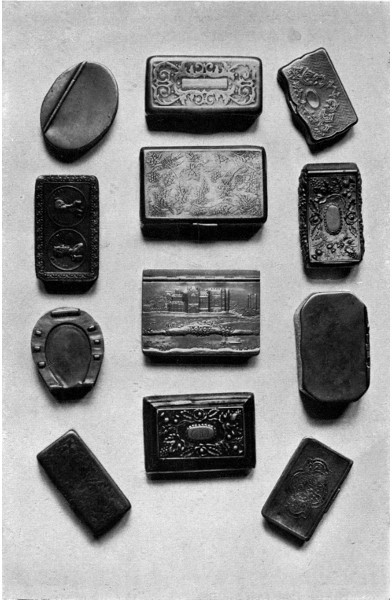
Pewter Snuff Boxes.
Plate XXII.
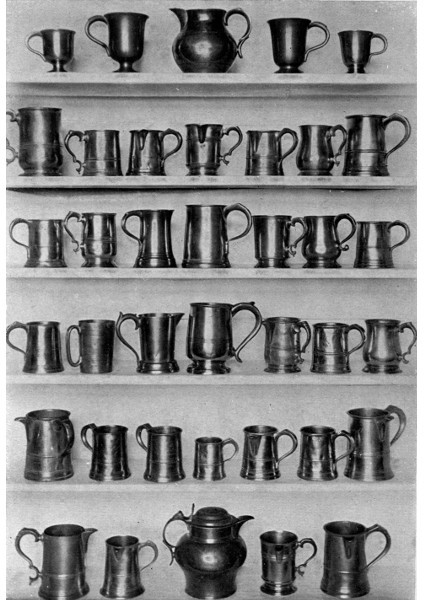
Pewter Pots (All inscribed except the top row).
Plate XXIII.
I have little more to say on the subject of old
pewter generally, as the Tavern Measures are given
an article on their own. Of course, I have left the
photographs to do most of the talking, and I hope they
have risen equal to the occasion. Next to the fascination
of collecting comes the pleasure of exhibiting to an
appreciative audience, and this brings to mind a delightful
evening when a young witty Canadian went through my
show, and at the conclusion, in the naïvest manner
possible, said: “I have asked you a great many
questions, sir, but as I am undecided in my mind I thought
before I left I had better enquire, ‘does the pewter go
with your daughter?’”
Half a century ago Winchester Cathedral in the winter
was decidedly cold, and on occasions some of those small
choir boys, who found little warmth and comfort from
their white linen surplices, now and then collapsed during
the services. Candles may have answered the purpose of
providing all the illumination required, but they were
hardly a flaming success for heating purposes. In the
records of the deliberation of the Dean and Chapter at
that time there would be a resolution to pay Mr. Edward
Sheppard, of the Bishop’s Palace, a certain sum to provide
each of the youthful songsters entrusted to his care with
a pot of porter each day with their dinners. Which
denotes there was no Pussyfoot in that Chapter. Mr.
Sheppard, whose name I use with all respect, was most
particular as to his pupils’ cleanliness, and every morning
held a hand and neck inspection in the long hall by the
entrance door. To illustrate that he had a mind for the
internal as well as the external frames which filed past
him he once a week, being provided with a bowl of
brimstone and treacle, administered a tablespoonful to
each boy. If Mr. Sheppard had given the same scrutiny
to the big can in which the porter was drawn from the
barrel there would have been no heel taps in our pewter
pots, but as the can was rarely washed out, and the porter
left from one day was frothed up when being filled the
next, the result, so far as benefit to the boys was concerned,
must have been flat, stale, and unprofitable.
No writer refers oftener to the pewter pot than does
Charles Dickens, and he might have said of me, as he
did of Master Micawber, “He was brought up to the
Church.”
In the book of the chronicles of Pickwick the reader
can easily find the text suitable for my discourse. That
great and good man with his host of friends used the
pewter pot with such effect that it would be a national
scandal to allow it to be relegated to the lumber shop.
Old Pickwick and old pewter are synonymous, and so let
us keep his memory alive by preserving the main medium
of his hospitable and generous nature. Time is changing
everything so ruthlessly that unless some of us have a
care the passing of the pewter pot will become an absolute
fact. To guard against such a calamity, and to preserve
models of a commodity which played so important a part
in the episodes that made life in England all the brighter
for its presence in past centuries, I have gathered together
a representative array of old pewter pots, many bearing
quaint inscriptions, which, if they could speak for themselves,
would enable me to treat you to a chapter replete
with true stories of adventure, love, crime, deeds of chivalry,
and scenes of woe which no imagination could evolve.
What of the “70th Regiment” cup? What stirring
episodes has that been through?—among others, probably
the Afghan War of 1840. I do know that the “Shipwrights’
Arms’, Limehouse Hole,” pint took part in, and
survived, the Indian Mutiny bivouacs and battlefields, as
it was given by the then landlord to a soldier just before
leaving home. I specially prize this; it has written
on the front before the address the name, “D. Saul,”
alongside which is the toper’s big initial, “K,” and the
number of his peg or hook on which it hung, “55,” on the
bottom. This number would be seen when looked up at
from the floor.
If Pickwick has us in hand, we shun the battle and
resort to the bottle, so let us look in at the “Windmill,
Dartford,” and see what manner of men were there.
Surely not smugglers on the banks of the Thames? Of
about the same period, what was the “Wellington,
Shepherd’s Bush,” like? Rather a swagger inn, probably,
judging by the beaded pattern of the mug, which was
supplied or made by “W. R. Loftus, 146, Oxford Street,”
who has been, and will be, a long time dead. At the
“Feathers” at Chiswick, and “Hope,” Islington, they
must have had quite high-class callers, or why the lip on
the tankards unless it were to pour the contents into
beakers? The customers at all inns were so diversified
in character that I see no reason why the same measure
should not have done for the post-boy on his frequent
calls, for the parish priest on duty bent, or later by the
highwayman in a hurry, if they held it in the left hand
and turned the lip of the pot skywards.
From London to the “Blackburn Arms,” Hale,
situated on the Mersey, an old-time village, and home of
the Ireland Blackburne family, was a long journey by
road in those days, and the pewter pot would be in
great request. I warrant this particular one was handed
back many a time with a determination to “Have
another, and dom the expense.”
When I came across the pint inscribed “Post Office
Hotel, Church Street, Soho,” I wrote to a Fleet Street
friend asking him to find out a likely date for it, and after
making enquiries he reported he could find neither the
hotel nor Church Street, and that the oldest man he had
seen in Soho (a sexton, I think) could tell him nothing
about either. The same friend was here one night, and I
left him looking at these pewter pots. I heard a Fleet
Street exclamation of surprise, and when I enquired the
reason he held up the “Baker’s Arms’, Waltham Abbey,”
pint, saying, “Why, I was born close to the Baker’s
Arms.”
The “Post Office Hotel” brings the post-boy of old to
my mind, and I turn to the oldest book I possess, given
to me by my father, in which he wrote my name in 1861.
“The Sporting Scrap Book,” by Henry Alken, containing
fifty plates, designed and engraved by himself,
published by Thomas McLean, 26, Haymarket, 1824.
I have always treasured this book, and the coloured prints
are as good to-day as ever. I was wondering how often
the pewter pot appeared in Alken’s drawings, and I find
twice. The first is entitled “The Post-Boy,” who with a
pair of harnessed horses has just called for drinks for
himself and his horses, and no sooner has he got his than
he has the pot to his lips. The shape is similar to the
“Post Office Hotel” pint, but probably the “Post-Boy”
needed a quart, for the pewter pot is as tall as his pot
hat. In the second picture Alken shows a pewter pot with
almost as much “frill” on the top as there is round the
cap of the woman who holds it, and this one is also the
same shape, which confirms my impression that the “Post
Office Hotel” pint pot is about 100 years old.
I now turn my attention from the handy pints to the
capacious quart pots, just the things to wash down a
breakfast with; pause and conjecture what “lovely”
thirsts they must have had! It was quite the custom
to put the landlord’s monogram on the front, and the
name of the tavern on the bottom of the mugs; there
again is a theme for reflection. As a reason, I think
we may assume there were kleptomaniacs, souvenir
hunters, and sneak thieves in the far gone times, just as
there are to-day, and by marking in this way it would
limit the loss to the latter class, who would sell the things
for old metal. These big mugs would well set off a table
on which were pewter plates anything from nine to twenty
inches in diameter. Although I have studied all the books
written on old pewter, I have failed to find that it was
always a case of “One man, one quart,” and am forced
to the conclusion that there may have been odd occasions
when more than one shared.
To get back to the pots illustrated, does any living man
know where the “Baptist Head,” High Holborn, stood?
It is perhaps typical of the country that the largest and
heaviest quart comes from Ireland, and from the battered
condition it was in when I got it, I surmised it had often
been used to add weight to an argument.
My eye now wanders to the fine old loving cup made
by John Edwards about 1750. This has a glass bottom
to prove to all users how clear were its contents, and I
wonder to what extent it has been used at family gatherings
for weddings, christenings, and buryings, and the
very important part it has played in making them all
enjoyable. Glance at that copious lidded jug, and mulled
ale at once suggests itself; can you not hear the horn
that gives warning of the stage coach, the bustle at the
“Queen’s Hotel” (called after Mary, Elizabeth, or
Anne, probably), or imagine the anxiety of the passengers
to test the brew, and how quickly the jug would be
emptied on a cold journey, while on warmer days the
flat-bottomed jug, full to the brim with foaming beer,
would be equally welcome? Some of the pots are fitted
with a strainer at the lip, and this would be most useful in
the period of poor lighting and typical practical joking
by keeping hops, flies, wasps, cockroaches, or perhaps an
odd mouse, out of the mouth of the customer using the
mug. It would also be requisite to use the funnel when
filling passengers’ flasks, most travellers were no doubt
provided with the latter of no mean size. The funnel
shown is dated 1698, while a particular flask I illustrate
is a fine specimen; probably its original owner was a man
of grit, for roughly engraved on one end is “PRO DAOS
ET REGE,” a fitting toast when the custom was “The
Passing of the Pewter Pot.”
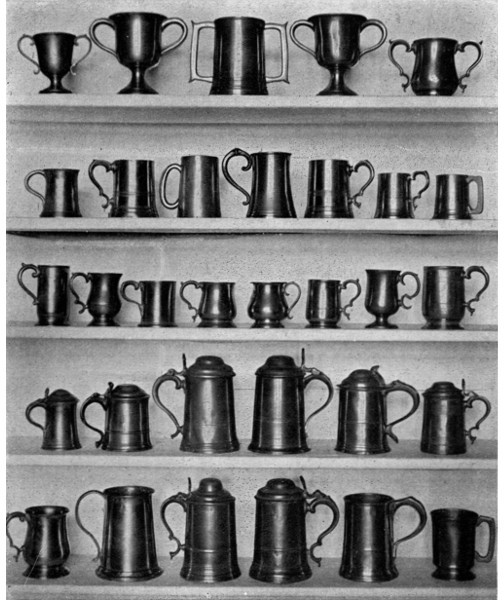
Pewter Pots. Lidded Tankards with makers’ initials
“J. C.” (1780), “Y. & B.,” “J. M.” (1825), “T. P.”
(1710), “H. I.” (1690), “T. L.,” “T & C.” (1775)
Plate XXIV.
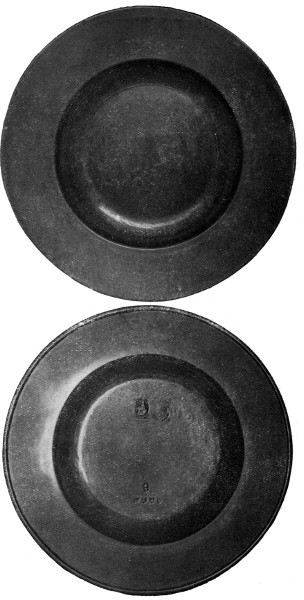
Front and Back of Faked “Alms-Dish.”
Plate XXV.
You will, I hope, be interested in a study of the
variety of shapes and handles on the photographs, but
you need to handle these old things to realise their
fascination; even if they bear no inscription or maker’s
mark, some of the early Excise marks, “G.R.” or “W.R.”
with various town crests, are worth looking at. Could
you examine the bottoms you would find red cut glass,
plain glass (Waterford possibly), wood and pewter,
double and single pewter bottoms, some with holes in their
bottoms through age and ill usage, while one has no bottom
at all, so you can’t knock the bottoms out of that. One of
the quart measures bears the initials and touch mark of
George Bagshaw, who was enrolled on the list of the
Freemen of the Pewterers Company in 1826; it is boldly
stamped with a crown, and the words “Imperial
Standard” with a small stamp “Crown W.R.” with
“W.W.” under. I am not sure what “W.W.” stands
for, but believe it will be the initials of the Excise
Inspector, and that this measure would be the Imperial
standard whereby the quart measures in a certain locality
were tested. The list of inscriptions given should not
fail to entertain; some are quaint and there may be one or
two that a reader will recall, but I imagine that most of the
addresses have ceased to exist.
This remark does not apply to the Old Whyte Harte
Hotel at Wisbeach (now spelt Wisbech), for that is the
present day Izaac Walton Association House. My set
of measures was made by Grimes, of London, for J. Hill,
the landlord in 1880.
| Quart |
T. B., Crown. |
| Lidded Jug |
W. T. S., Queen’s Hotel. |
| Quart, Lipped |
G. Bamden. Wenlock Brewery Tap. |
| Pint ” |
Sportsman. |
| Beaker |
H. Mattock, Malt Shovel, Dartford. |
| Pint |
E. H. Bakers’ Arms, Waltham Abbey. |
| ” |
W. Bullin, Bears Paw Inn. |
| Quart |
A. Johnston, Baptist Head, High Holborn. |
| Pint |
G. C. Collier, Catherine Wheel, near Brentford. |
| ” |
D. Saul, Shipwrights Arms, Limehouse Hole. |
| Lipped Pint |
Hope, Islington. |
| Pint |
Canteen, 70th Regt. |
| ” |
J. E. B., The Feathers, Chiswick. |
| Quart, Lipped |
G. Thompson, Tipperary. |
| ” |
J. C. D., Montague Arms, Peckham. |
| Pint |
C. M.—C. Mannerson, Windmill, Dartford. |
| ” Lipped |
J. T. R., Duke’s Head, Leman St., Southwark. |
| Pint |
Post Office Hotel, Church St., Soho. |
| ” |
Blackburn Arms. |
| ” |
G. M. Wellington, Shepherds Bush. |
| ” |
G. A. Y., King’s Arms, Woolwich. |
| ” |
John Machin, Bimm. Tavern. |
| ” |
A. B., Black Lion, Kingston. |
| ” |
W. E., Flying Scud, Sutton St., Comml. Rd. |
| ” |
Nichols, Court Sampson, Thomas St. |
| ” |
Robt. Moor, Cockermouth in Cumberland. |
| ” |
T. Forman, 35, Brompton Rd. |
| Quart, Lipped |
Courtenay Arms, Starcross. |
| Pint |
Barclay Perkins & Co. J. Nolan. |
| Quart |
J. Hill, White Hart Hotel Wisbeach. |
The collection continues to increase, and I have
recently acquired a quart, mark “S.C.” inscribed
“Longden White, Ewell, 1820.” Another, which belonged
to W. James, Welney, marked four lions—a
lipped quart by Geradin & Watson, stamped “G.R.”
1826, and lastly a quart pot-bellied measure by W.
Nettleford, early 19th century, being the only measure
of this shape which I have seen fitted with a lip. I
must now end this potty discourse, and on pondering
for a fitting quotation wherewith to conclude, I can think
of none more suitable than one which I trow good King
Hal is not likely to have used when ruminating on his
bunch of wives—“Let ’em all come.”
I have given this title to the photograph I recently
had taken for various reasons which I will now particularise.
Most books contain a mystery of some kind and the
creation in many instances must cause the author much
anxious thought, but in my case the mystery is real up to
the time of writing; possibly soon after this appears in
print the mystery will be explained by some kind correspondent
who possesses a similar piece. In the first place,
I know not its proper name, so must call it for the time
being “the piece.” Where I obtained it will remain a
mystery to the reader, but how I happened to become its
possessor I will readily relate, and in doing so I confirm
my previous statement that you never know your luck
when collecting.
In the early part of 1919 business called me to London
on several occasions, and as many readers will have had
unpleasant experiences of the hotel accommodation there
at that time they will not be surprised to hear that I made
arrangements with friends who live in a fine old town
umpteen miles from the City to take me in. On a visit
in June I was walking to the station to catch the morning
train to take me to London when I passed a broker’s
shop and of course stopped. Among a lot of furniture
and odds and ends I noticed “the piece,” and I thought
at first it was a brass water bottle from India, but on
further consideration I felt sure it was pewter, so I
essayed to walk in, but locks, bolts and bars defied
resistance, while no one took heed of the noise I was
making. In the end I had to rush for the train. Business
over I returned and was met at the station by a lady friend.
I am afraid I hurried her along to the shop where I saw
“the piece” still perched. I tried the door again, but
it was still fastened, so I started knocking. My friend
then informed me it was no use as it was the half holiday,
but I was determined to get in if I rattled all night. At
length I was admitted, found “the piece” was real old
pewter, was informed they had had it a fortnight, and
that it was a Rose Vase, but they didn’t know where it
came from. There are antique shops in that town, and this
was just the sort of thing they could have done with, so
my picking it up when on a flying visit was most
fortunate.
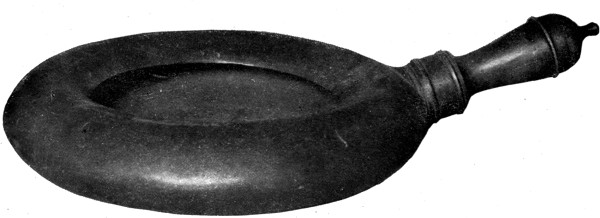
Bed Pan which has been converted into the Faked “Alms-Dish.”
Plate XXVI.
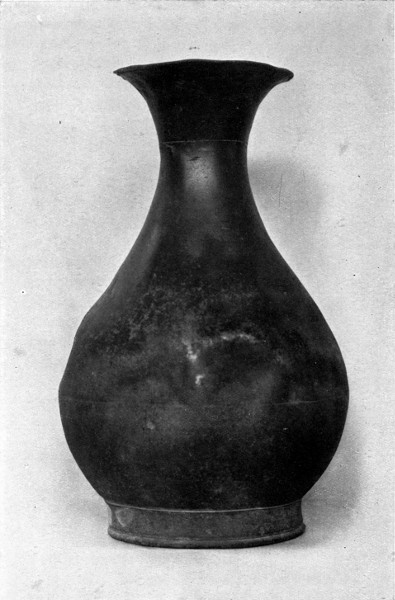
The Mystery Piece.
Plate XXVII.
On returning to my real home “the piece” was much
admired for its antique appearance and I was told I
should spoil it if I had anything done to it, so I had it
photographed in the state I found it. It bore no maker’s
marks and the shape was quite unknown to me, so I
wrote to three pewter connoisseurs sending them each a
photograph giving dimensions and weight and asking
them to give me its name and age. These are the opinions
I received:
No. 1:
“Your Vessel seems to be a Vase and latish. I
have never seen one like it.” And later he kindly
wrote: “The more I think of your pewter Jar the more
convinced I am that it dates about 1750.”
No. 2 said:
“I thank you for the photograph of the interesting
Vase or Bottle, for those are the only possible names
one can give to the piece.”
No. 3. wrote:
“I have seen two or three of the pieces your photograph
shows but have never found out their purpose. I
have heard them described as 1. Lavers for the water
in Baptism. 2. Water Bottle used in Tavern
parlours, and I think the latter is more probable.”
So you see I had then six names for it, and lately when
my Irish friend was here I asked him his opinion and he
said, “It reminds me of ‘Rebecca at the Well.’” This
set me longing to see what it looked like when Rebecca
used it, so I got a painter to remove the corrosion with
caustic and lime, as I had no bath mixture on tap, then
I took it to my tinsmith and spent some time quaking—you
understand me—for fear he should hole it or do
something awful, but he straightened it, tapped out the
dinges, and soon got it into its original shape. Strange
to say it is the only piece of pewter in my collection which
I prefer to see looking dull, the reason why is another
mystery, but I have stopped having it polished up
brightly like the rest. I really believe it is the oldest
specimen in my collection, certainly it is the most antique
in shape. It is nine inches high and its weight (2½ lbs.)
denotes it was made when thick metal was worked with,
and that is a sure sign of old times. It will not go with
any pewter I possess, it makes it all appear comparatively
modern, and so we have to allot it a position by itself on
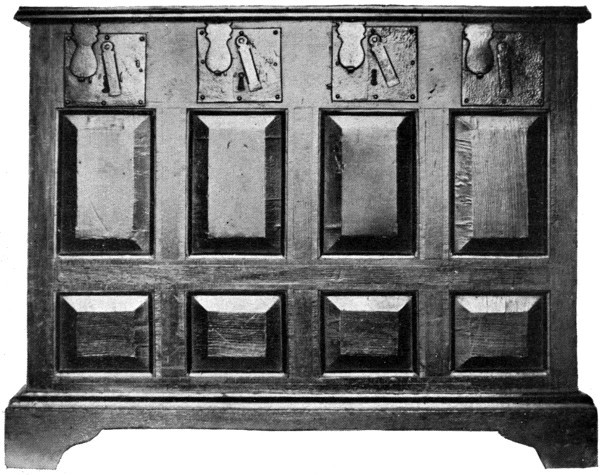
an old oak chest, and here I will leave “The Mystery
Piece,” with this poser—is it early Georgian or ogygian?