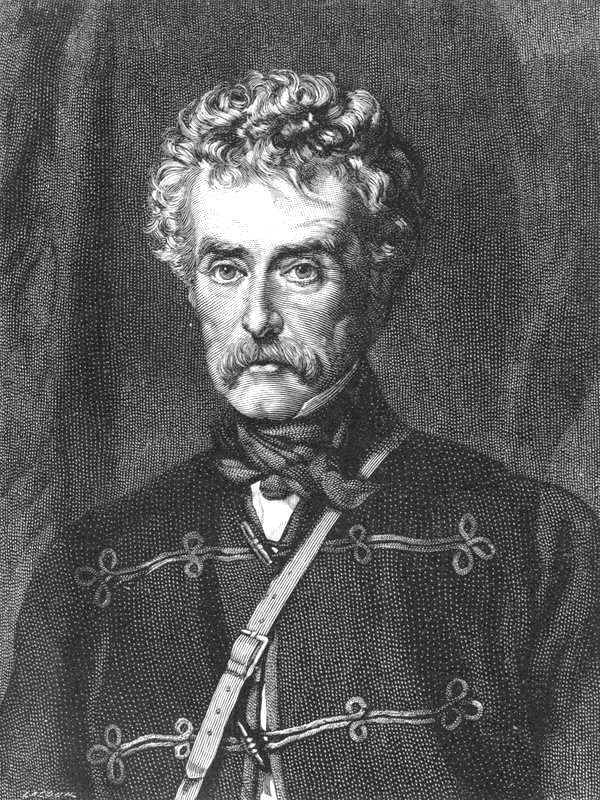
The Ninety-Eighth had been moved to Plymouth in
anticipation of departure on foreign service, and on the
20th of December, 1841, it embarked for Hong-Kong on
H.M.S. Belleisle, a line-of-battle ship which had been
commissioned for transport service. According to present
ideas the Belleisle, whose burden did not exceed
1750 tons, was abominably overcrowded, especially for
a voyage of six months or longer. The Ninety-Eighth
embarked eight hundred and ten strong; and what
with staff officers, details, women and children and crew,
the ship carried a total of nearly thirteen hundred
souls. Among her passengers was Major-General Lord
Saltoun, the hero of Hougomont, who was going out
as second in command of the Chinese expeditionary
force. During a short stay in Simon's Bay Colin Campbell
had the pleasant opportunity of visiting his old
Demerara chief Sir Benjamin D'Urban, who since they
last met had served a term of office as Governor of
Cape Colony, and was now living in retirement among
his orchards and vineyards a few miles from Cape Town.
The Belleisle made a fairly quick voyage to Hong-Kong,
where she arrived on June 2nd, 1842, and where orders
were awaiting the Ninety-Eighth to make all haste to
join the force of Sir Hugh Gough operating in the
region of the estuary of the Yang-tse-Kiang. Active
hostilities had for some time previously been in progress.
After the capture of the town of Chapoo on
May 18th the fleet carrying the expeditionary force
had proceeded to an anchorage off the mouth of the
Yang-tse-Kiang, where it lay for a fortnight while the bar
was being surveyed and buoyed. The Chinese had constructed
a great line of defensive works about Woosung,
but the British fleet anchored in face of the batteries
on the 16th of June, and as the result of a two hours'
bombardment the Chinese fire was crushed and the garrisons
were driven from their batteries by the sailors
and troops. Shanghai was occupied, and the expedition
remained in the vicinity of Woosung while surveying
steamers were prospecting the river. It was during
this halt that the Belleisle with the Ninety-Eighth aboard
joined the expeditionary force at Woosung on the 21st
of June. The regiment was assigned to the first brigade
under Lord Saltoun, and occupied part of the third
division of vessels during the ascent of the river.
The expedition left Woosung on July 6th, its objectives
being the great cities of Chin-Kiang and Nanking.
The strength of it was overwhelming, for the fleet consisted
of fifteen ships of war, ten steamers and fifty
transports and troop-ships, on which were embarked nine
thousand soldiers and three thousand disciplined seamen
ready for service on shore in case of need. The Belleisle
was off Chin-Kiang on the 19th, and on the morning of
the 21st the troops disembarked in three brigades. The
columns of Sir Hugh Gough and General Schoedde had
some hard fighting with the Tartar garrison of the city
commanded by the gallant Haeling. Lord Saltoun's
brigade, with the Ninety-Eighth in advance, marched
against a Chinese force occupying a low ridge some miles
inland and to westward of the city. The opposition
encountered was trivial, and was easily overcome by the
light company of the Ninety-Eighth in skirmishing order
supported by a few discharges from a mountain-battery.
But the regiment, debilitated as it was by a long tropical
voyage in an overcrowded ship, unsupplied with an
equipment suitable for the climate and wearing its
ordinary European clothing, was in no case to resist the
fierce summer-heat of China. The sun had its will of
the men, thirteen of whom died on the ground; and
Colin Campbell, seasoned veteran as he was, was himself
struck down, though he soon recovered. From this day
forth for months, and even for years, disease maintained
its fell grip on the victims of overcrowding, and Napier
would have been puzzled to recognise in the shattered
invalids of Hong-Kong the "beautiful regiment" which
had sailed from Plymouth in fine physique and high
heart. On the night following the disembarkation
several cases of cholera occurred, and fever and dysentery
became immediately prevalent. Within ten days from
the landing at Chin-Kiang fifty-three men of the Ninety-Eighth
had died, and the Belleisle was rapidly becoming a
floating hospital.
A garrison was left in Chin-Kiang, and on August 4th
the Cornwallis man-of-war anchored in front of that very
gate of Nanking which twenty-six years earlier had
been rudely shut in the face of a British ambassador.
Opposite that same gate it was destined that severe
terms should now be dictated by a victorious British
force. The mass of the expedition reached Nanking on
the 9th and preparations for the attack on that city
were promptly begun. The Ninety-Eighth men fit for
service were transferred from the Belleisle to a steamer
which conveyed them to a point where a diversion was
intended. Colin Campbell was too ill to accompany his
regiment, and when he joined it a few days later he was
again prostrated by fever. But Nanking escaped its
imminent fate. Negotiations resulted in a treaty of
peace which was concluded on August 26th; the expedition
retraced its steps, and in October the Belleisle
reached Hong-Kong with the wreck of the unfortunate
regiment. Even after those long months fate still kept
imprisoned on ship-board what remained of the hapless
Ninety-Eighth. The regiment had to remain on the
Belleisle until barracks could be built for its reception.
Writing to his sister in December, Colin Campbell had
the following sad tale to tell:—"The regiment has lost
by death up to this date two hundred and eighty-three
men, and there are still two hundred and thirty-one sick,
of whom some fifty or sixty will die; and generally, of
those who may survive, there will be some seventy or
eighty men to be discharged in consequence of their
constitutions having been so completely broken down as
to unfit them for the duties of soldiers. This is the
history of the Ninety-Eighth regiment, which sailed from
Plymouth in so effective a state in all respects on the 20th
of December of last year—and all this destruction without
having lost a man by the fire of the enemy!" His
estimate of the losses, grave as it was, did not reach the
grim actual total. From its landing at Chin-Kiang on
July 21st, 1842, up to February, 1844, a period of
nineteen months, the unfortunate regiment lost by death
alone four hundred and thirty-two out of a strength of
seven hundred and sixty-six non-commissioned officers
and men; and there remained of it alive no more than
three hundred and thirty-four, an awful contrast to the
full numbers with which it had embarked at Plymouth
twenty-six months earlier.
When the expeditionary force was broken up at the
end of 1842 Colin Campbell became commandant of the
island of Hong-Kong, and he devoted himself to the care
of the survivors of his regiment. The worst cases were
sent to a hospital ship, those less serious to a temporary
hospital on shore. The remainder of the corps, some
three hundred and thirty men, at last, in February, 1843,
quitted the Belleisle and occupied quarters at Stanley.
While at Hong-Kong he learned that he had been made
a Companion of the Bath and aide-de-camp to the Queen,
the latter appointment conferring promotion to the rank
of colonel. In January, 1844, he left Hong-Kong to
succeed General Schoedde in command of the garrison
quartered on the Island of Chusan, a transfer which gave
him the position of brigadier of the second class. In the
more bracing and salubrious climate of Chusan Campbell
materially regained his health; and he had not been
many months in his new command when he began his
efforts to have the Ninety-Eighth removed from its
unhealthy quarters in Hong-Kong to the reinvigorating
atmosphere of Chusan. This he was able to accomplish
in the earlier months of 1845, and he immediately set
about the restoration of the regiment to its former
efficiency. He was a rigorous task-master, but if he did
not spare others he never spared himself. He seldom
missed a parade, and except in the hot season there were
three parades a day. Leave of absence except on medical
certificate was refused to officers who had come from
England with the regiment, on the ground that their
experience was needed to instruct the comparatively raw
material from the depôt. The officers of the Ninety-Eighth
who belonged to the garrison staff were also
required to perform their regimental duty. The painstaking
and laborious chief thus notes in his journal the
progress of the regiment in the midsummer of 1845:
"Parade as usual morning and evening; men improving,
but still in great want of individual correctness in
carriage, facings, motions of the firelock, etc.; but they
move in line and open column very fairly, and I confidently
expect before the end of the year to have them
more perfect than any battalion in this part of the
world." When toward the close of the year the health
of the regiment was fully re-established, its colonel conceived
that it should undergo higher tests than the
ordinary movements of the drill-ground afforded. He
accordingly took it out into the open country and divided
it into an attacking and a defending force, in order to
train the men in the art of taking cover and skill in
skirmishes over broken ground. By the beginning of
1846 he was "quite at ease as to the appearance the
regiment would make on landing in India."
The time fixed by the treaty of Nanking for the
evacuation of the island of Chusan by the British troops
was now approaching, and on May 10th the Chinese
authorities resumed jurisdiction over the island. Until
then Campbell's duties had not been purely military,
the entire civil charge of Chusan having been vested in
his hands. The most friendly relations existed between
the British Brigadier and the Chinese Commissioners.
Arrangements were made without a trace of friction for
the preservation of the European burial-grounds and in
regard to other matters. Campbell was the recipient
of an interesting letter from the Commissioners, passages
in which deserve to be quoted:—"While observing
and maintaining the treaty, you have behaved with
the utmost kindness and the greatest liberality towards
our own people, and have restrained by strict regulations
the military of your honourable country....
The very cottagers have enjoyed tranquillity and protection,
and have not been exposed to the calamity of
wandering about without a home. All this is owing to
the excellent and vigorous administration of you, the
Honourable Brigadier.... Now that you are about to
return to your own country crowned with honour, we
wish you every happiness."
Notwithstanding occasional attacks of ague which
rendered him liable to depression and irritation, Campbell
appears to have been fairly happy during his stay
in Chusan. He writes on the eve of his departure of
"'my last walk' in Chusan, where I have passed many
days in quiet and peace, and where I have been enabled
to save a little money, with which I hope to render my
last days somewhat comfortable. My health upon the
whole is pretty good; and altogether I have every
reason to be thankful to God for sending me to a situation
wherein I have been enabled to accomplish so much
for my own benefit and the comfort of others, whilst my
duty kept me absent from them." The latter allusion
was to his father and sister, for both of whom he had been
able to make provision in the event of his predeceasing
them. Having left England heavily embarrassed, the
increase of his emoluments during his stay in China had
enabled him to relieve himself of liabilities, and this
without being at all niggardly in the hospitalities which
he dispensed.
Sailing from Chusan on July 5th in the transport
Lord Hungerford, the colonel and headquarters of the
Ninety-Eighth landed at Calcutta on October 24th, 1846;
the last of the detachments carried by other transports
arrived at the end of November, when the regiment was
complete. Colin Campbell meanwhile had been in
charge of Fort-William, but when the regiment began its
march to Dinapore in December he resumed its command.
He really seemed to live for the Ninety-Eighth. Lord
Hardinge had expressed his intention of appointing
him a brigadier of the second class. "This," writes
Campbell, "is very flattering; but I would prefer to
remain with my regiment." He writes with soldierly
pride of its conduct on the route-march: "The march of
the regiment has been conducted to my entire satisfaction,
no men falling out, and the distance of sections so
correctly preserved that their wheeling into line is like
the operation of a field-day. Those who follow me will
benefit by this order and regularity in conducting the
line of march." On arrival at Dinapore in the end of
January, 1846, he found his appointment in general
orders as brigadier of the second class to command at
Lahore. Before starting for his new sphere he held
what proved to be his last inspection of the Ninety-Eighth.
"Men steady as rocks," he writes, "moving by
bugle-sound as correctly as by word of command—equally
steady, accurate, and with the same precision."
In the evening he spoke to the regiment some simple
manly, soldierly words, to which the men must have
listened with no little emotion. He dined with the mess
the same night, when the president rose and proposed his
health in connection with the day's inspection of the
regiment and the exertions he had made as commanding
officer to produce such results. "The toast," he
wrote, "was received with great warmth and cordiality....
I could not speak without emotion, and my manner
could not conceal my deep anxiety respecting a corps in
which I had served so long. I begged that, if their old
colonel had been sometimes anxious and impatient with
them, they would forget the manner and impatience of
one who had no other thought or object in life but to
add to their honour and reputation collectively and
individually."
Next day he started for Lahore, "feeling," as he
records in his restrained yet sincere manner, "more
than I expected when taking leave of the officers who
happened to be at my quarters at the moment of my
departure." He had a pleasant meeting at Cawnpore
with his old West Indian comrades of the Twenty-First
Fusiliers; and on the road between Kurnal and Meerut
he had an interview with the Governor-General. Lord
Hardinge received him with the frank kindness of an
old Peninsular man to a comrade, described Henry
Lawrence, the British Resident in the Punjaub, as "the
King of the country, clever and good-natured, but hot-tempered,"
and gave Campbell to understand that if any
part of the force in the Punjaub should be called upon
to take the field, he should have a command. A few
days later he reached Saharunpore, the headquarters for
the time of Lord Gough, the Commander-in-Chief, also
an old Peninsular man, whom he found most cordial and
friendly. The old Chief asked him whether he could be
of any service to him. Colin Campbell, sedulous as ever
for the welfare of the Ninety-Eighth, replied that he had
no favour to ask for himself, but that his lordship would
give him pleasure by removing his regiment nearer to
the frontier as early as might be, away from its present
station which afforded the men so many temptations to
drink. On his arrival at Lahore in the end of February,
1847, he was cordially received by Henry Lawrence,
whose guest at the Residency he became until he should
find accommodation for himself.
Campbell came into the Punjaub at a very interesting
period. The issue of the war of 1845–46 had placed
that vast territory at the mercy of the British Government,
and Lord Hardinge might have incorporated it
with the Company's dominions. But he desired to
avoid the last resource of annexation; and although
he considered it necessary to punish the Sikh nation for
past offences and to prevent the recurrence of aggression,
he professed his intention to perform those duties without
suppressing the political existence of the Punjaub
State. The Treaty of Lahore accorded a nominally
independent sovereignty to the boy Prince Dhulip Singh,
a British Representative was in residence at Lahore, and
the Sikh army was being reorganised and limited to a
specified strength. Within a few months Lall Singh,
who had been appointed Prime Minister, had been
deposed, and a fresh treaty was signed in December,
1846, which provided that a council of regency composed
of eight leading Sikh chiefs should be appointed
to act under the control and guidance of the British
Resident, who was to exercise unlimited influence in all
matters of internal administration and external policy.
British troops were to be stationed in various forts and
quarters throughout the country, maintained from the
revenues of the State. The management was to continue
for eight years until the Maharaja Dhulip Singh should
reach his majority. The treaty conferred on the
Resident unprecedented powers, and Major Henry
Lawrence, an officer of the Company's artillery, became
in effect the successor of Runjeet Singh.
This settlement had a specious aspect of some
measure of permanency. It might have lasted longer
if the state of his health had enabled Henry Lawrence
to remain at his post; but it was unsound at the core,
for a valiant and turbulent race does not bow the
neck submissively after a single disastrous campaign
on its frontier. But the Punjaub seemed in a state of
unruffled peace when Colin Campbell shook hands with
Henry Lawrence in the Residency of its capital. In
those days the familiar sobriquet of "Kubhur-dar," of
which the English is "Take care!", had not attached
itself to him; but Campbell, even when his Highland
blood was aflame in the rapture of actual battle, was
never either reckless or careless; and the motto "Be
Mindful," which he chose for his coat of arms when he
was made a peer, was simply a condensation of the
principles of cool wisdom and shrewd caution on which
he acted through life. A strong Sikh force, he found,
was located in and about Lahore, and the population of
the city had a name for turbulence. In order to inform
himself as to how the troops were posted in relation to
the defences of the city, as well against an interior as
an exterior attack, one of his earliest concerns was to
make a careful inspection of the positions along with
the responsible engineer. In choosing his residence
he held it to be his duty to have it in the proximity of
his troops. Soon after his arrival there was a fête in
the Shalimar gardens to which all the garrison had
been invited, but he allowed only half of the officers
of his command to be absent from their men, giving
as his reason that "if the Sikhs wanted to murder
all the officers, they could not have a better chance
than when these were gathered four miles away from
their men, enjoying themselves at a fête." In the
measures of precaution which he adopted he had the
approval of Henry Lawrence and of Sir Charles Napier,
to the latter of whom he wrote on the subject. Napier
expressed himself in his trenchant fashion:—"I am
delighted at all your precautions against surprise. In
India we who take these pains are reckoned cowards.
Be assured that English officers think it a fine dashing
thing to be surprised—to take no precautions. Formerly
it was an axiom in war that no man was fit to be
a commander who permitted himself to be surprised;
but things are on a more noble footing now!"
In the end of 1847 Henry Lawrence left Lahore and
went home to England in the same ship with Lord
Hardinge. A week before they sailed from Calcutta
Hardinge's successor, Lord Dalhousie, arrived there and
took the oaths as Governor-General,—a potentate at
whose hands a few years later Colin Campbell was to
receive treatment which caused the high-spirited soldier
to resign the command he held and leave India. In
the Lahore Residency Henry Lawrence was succeeded
temporarily by his brother John, who in March, 1848,
gave place to Sir Frederick Currie, a member of the
Supreme Council. The position was one which required
the experience and military knowledge of a soldier, but
Sir Frederick Currie was a civilian. In January Sir
John Littler had been succeeded in the Punjaub divisional
command by Major-General Whish, an officer of
the Company's service, an appointment which disappointed
Colin Campbell who had hoped for the independent
command of the Lahore brigade.
The deceptive quietude of the Punjaub was
now to be exposed. When Sir Frederick Currie
reached Lahore, he found there Moolraj the Governor
of Mooltan, a man of vast wealth who had come to
offer the resignation of his position for reasons that
were chiefly personal. Moolraj stipulated for some conditions
which were not conceded, and ultimately he
resigned without any other condition than that of saving
his honour in the eyes of his own people. A new
Governor was appointed in his place, who set out for
Mooltan accompanied by Mr. Vans Agnew of the
Bengal Civil Service and Mr. Agnew's assistant, Lieutenant
Anderson of the Bombay Army. Moolraj
marched with the escort of the new Governor, to
whom, on the day after the arrival of the party in
Mooltan, he formally surrendered the fort. After the
ceremony Agnew and Anderson started on their return
to camp, Moolraj riding alongside the two English
gentlemen. At the gate of the fortress Agnew was
suddenly attacked,—run through by a spear and slashed
by sword-cuts. At the same moment Anderson was
cut down and desperately wounded. Moolraj galloped
off, leaving the Englishmen to their fate. Khan Singh's
people carried them into a temple wherein two days
later they were brutally slaughtered; their bodies
were cut to pieces and their heads thrown down at
the feet of Moolraj. What share Moolraj had taken
in this treacherous butchery was never clearly ascertained;
but every indication pointed to his complicity.
This much is certain, that on the morning after the
assassination he transferred his family and treasure into
the fort, and placed himself at the head of the insurrectionary
movement by issuing a proclamation summoning
all the inhabitants of the province, of every creed,
to make common cause in a religious war against the
Feringhees.
News of the outrage and rising at Mooltan reached
Lahore on April 24th. It was emphatically a time for
prompt action, if an outbreak was to be crushed which
else might grow into a general revolt throughout the
Punjaub. It was extremely unlikely that the fort of
Mooltan was equipped for an early and stubborn
defence. To maintain our prestige was essential, for
it was by prestige and promptitude only that we have
maintained our pre-eminence in India. Sir Henry
Lawrence would have marched the Lahore brigade on
Mooltan without an hour's hesitation. Lord Hardinge
would have ordered up the troops and siege-train from
Ferozepore and the strong force collected at Bukkur;
and would have invested Mooltan before Moolraj could
have made any adequate preparations for prolonged
defence. Marches through Scinde, from the north-western
frontier, and from Lahore, could not have been
made in the hot season without casualties; but, in the
words of Marshman, "our Empire in India had been
acquired and maintained, not by fair-weather campaigns,
but by taking the field on every emergency and at any
season."
On the first tidings from Mooltan Sir Frederick Currie
ordered a strong brigade of all arms to prepare for a
march on that stronghold, being of opinion that the
citadel, described in poor Agnew's report as the
strongest fort he had seen in India, would not maintain
a defence when a British force should present
itself before it, but that the garrison would immediately
abandon Moolraj to his fate. Colin Campbell, on the
other hand, held that since the fort of Mooltan was
very strong it was to be anticipated that Moolraj would
obstinately defend it; in which case a brigade sent to
Mooltan would be obliged to remain inactive before it
while siege-guns were being brought up, or, as seemed
more probable, should no reinforcements arrive in support,
it would have to retrace its steps followed and
harassed by Moolraj's active and troublesome rabble.
Eventually, in great measure because of the arguments
advanced by Campbell, the movement from Lahore on
Mooltan was countermanded; and the Commander-in-Chief,
with the concurrence of the Governor-General,
intimated his resolve to postpone military operations
until the cold weather, when he would take the field
in person.
Meanwhile a casual subaltern, for whom swift
marches and hard fighting in hot weather had no
terrors, struck in on his own responsibility. Gathering
in the wild trans-Indus district of Bunnoo some
fifteen hundred men with a couple of guns, Lieutenant
Herbert Edwardes marched towards Mooltan.
Colonel Cortland with two thousand Pathans and
six guns hastened to join him; and on May 20th the
united force defeated Moolraj's army six thousand
strong. The loyal Nawab of Bhawalpore sent a strong
force of his warlike Daudputras across the Sutlej to join
hands with Edwardes and Cortland; and the junction
had just been accomplished on the field of Kinairi
some twenty miles from Mooltan, when the allies, about
nine thousand strong, were attacked by Moolraj with a
force of about equal magnitude. After half a day's
hard fighting the enemy fled in confusion from the
field. Edwardes and Cortland moved up nearer to
Mooltan, their force now raised to a strength of about
eighteen thousand; and there was a moment when
Moolraj seemed willing to surrender if his life were
spared. But he rallied his nerves and came out on
July 1st with twelve thousand men to give battle on the
plain of Sudusain within sight of the walls of Mooltan.
After another obstinate fight his troops were thoroughly
beaten and fled headlong into the city. "Now," wrote
Edwardes to the Resident, "is the time to strike; I
have got to the end of my tether. If," added the
gallant and clear-sighted subaltern, "you would only
send, with a few regular regiments, a few heavy guns
and a mortar battery, we could close Moolraj's account
in a fortnight, and obviate the necessity of assembling
fifty thousand men in October."
Meanwhile the Resident had taken the strange
course of empowering the Lahore Durbar to despatch
to Mooltan a Sikh force of some five thousand men under
Shere Singh. It was notorious that both commander
and troops were thoroughly disaffected; and so anxious
was the Resident to prevent the force from approaching
Moolraj that Shere Singh had orders to halt fifty miles
short of Mooltan, and was only allowed to join Edwardes
after his victory of July 1st. In tardy answer to that
young officer's appeal for reinforcements, in the end of
July a force of seven thousand men with a siege-train
was ordered to converge on Mooltan from Lahore and
Ferozepore under the divisional command of General
Whish. It had been chiefly at Colin Campbell's dissuasion
that the Resident had relinquished his intention
of sending a force to Mooltan in April. Campbell's
argument in that month had been the unfavourable
season for marching; and now in a season not less
unfavourable he was scarcely justified in considering
himself the victim of a job in not obtaining the command
of the Lahore brigade ordered on Mooltan. The
disappointment proved fortunate, since a few months
later he found himself in command of a division in
the field with the rank of brigadier-general. By
August 24th the whole of Whish's field-force was before
Mooltan, but it was not until September 7th that the
siege-guns were in position. Moolraj, confident in the
increased strength which our delay had afforded him,
spurned a summons to surrender. Active and bloody
approaches were carried on for a week, when Shere
Singh with his contingent suddenly passed over to the
enemy. After this defection Whish held it impossible
to continue the siege, and he retired to a position in
the vicinity pending the arrival of reinforcements from
Bombay. The siege was reopened late in December:
the city was stormed after a hard fight; and finally on
January 22nd, 1849, Moolraj surrendered at discretion.
It must be said of him that he had made a heroic
defence.
By the end of September, 1848, the local outbreak
was fast swelling into a national revolt. The flame
of rebellion was spreading over the Land of the Five
Rivers, and by the end of October only a few brave
English officers were still holding together the last shreds
of British influence in the Punjaub outside of Lahore
and the camp of General Whish. Moolraj was the reverse
of cordial to Shere Singh, who on October 9th
quitted Mooltan and marched northward towards Lahore,
his original force of five thousand men strengthened at
every step by the warriors of the old Khalsa army who
flocked eagerly to his standard. After threatening Lahore
he moved westward to meet the Bunnoo insurgents, who
had mutinied and murdered their officers, and he finally
took up a position à cheval of the Chenab at Ramnuggur,
his main body on the right bank of the river.
During the summer and autumn Colin Campbell passed
an uneasy and anxious time. It was not until the
beginning of November that he had the full assurance
of being employed in the manifestly impending campaign.
By this time Cureton's cavalry brigade and
Godby's infantry brigade were in the Doab between the
Ravee and the Chenab, and on November 12th Colin
Campbell joined Cureton there with two native infantry
regiments, taking command of the advanced force
with the temporary rank of brigadier-general. At
length Lord Gough himself took the field, and on the
19th he crossed the Ravee at the head of an army of
respectable strength. Apart from the division before
Mooltan and the garrison required for Lahore, he had
available for field service four British and eleven native
infantry regiments. He was strong in cavalry, with
three fine British regiments, five of native light cavalry,
and five corps of irregular horse; and his powerful
artillery consisted of sixty horse and field-guns, eight
howitzers, and ten 18-pounders. On the early morning
of the 22nd his lordship, with Colin Campbell's
infantry division and a cavalry force under Cureton
with horse and field artillery, marched from Saharun
towards Ramnuggur with the object of driving across
the Chenab some Sikh infantry reported to be still on
the left bank. Some small detachments hurrying
towards the river were pursued somewhat recklessly by
horse-artillery, which had to retire under the heavy
fire opened from the Sikh batteries on the commanding
right bank. A gun and two waggons stuck fast in the
deep sand and could not be extricated. Colin Campbell
suggested to Lord Gough the measure of protecting the
gun until it could be withdrawn at night, by placing
infantry to cover it in a ravine immediately in its rear;
but the Commander-in-Chief disapproved of this measure.
The enemy lost no time in sending the whole of his
cavalry across the river to take possession of the gun
under cover of his overwhelming artillery fire. Our
cavalry was foolishly sent forward to charge the
superior hostile horse,—a folly which was committed,
according to Colin Campbell, under the personal direction
of the Commander-in-Chief. Ouvry's squadron of
the Third Light Dragoons made a brilliant and useful
charge which materially aided the withdrawal of the
artillery. In the face of a heavy fire Colonel William
Havelock, a noble soldier who had fought in the Peninsula
and at Waterloo, led on the Fourteenth Light
Dragoons to a desperate combat with the Sikh horse.
The horses of the dragoons were exhausted by the long
gallop through the heavy sand and the casualties were
heavy. Among the slain was Havelock himself, after a
hand-to-hand combat; and while riding forward to stay
Havelock's last advance Brigadier-General Cureton, who
had raised himself to distinction from the ranks in which
he had enlisted as a runaway lad, was killed by a Sikh
bullet.
Lord Gough withdrew his troops beyond the reach of
the Sikh batteries and awaited the arrival of his heavy
guns and the remainder of his force. If his intention
was to refrain from coming to close quarters with the
enemy until the fall of Mooltan should bring him reinforcements,
he was well placed on the left bank of the
Chenab, covering Lahore and the siege of Mooltan and
leaving Shere Singh undisturbed. If on the other
hand he preferred the offensive, that offensive should
have been prompt; a rapid stroke might have ended
the business, for the Sikhs, as the sequel proved, were
eager enough for fighting. And to all appearance the
Commander-in-Chief meant to gratify their desire. To
do so he had in the first instance to cross the Chenab.
To accomplish this by direct assault on the Sikh position
on the opposite bank was impracticable; and he resolved
to compel the enemy's withdrawal by a wide
turning movement with part of his force under the
command of Sir Joseph Thackwell, an experienced
soldier. Thackwell's command consisted of Colin
Campbell's strong division, a cavalry brigade, three
troops of horse-artillery, two field-batteries and two
heavy guns,—in all about eight thousand men. This
force started in the early morning of December 1st, and
after a march of twenty-four miles up the left bank of
the Chenab was across that river at Wuzeerabad by
noon of the 2nd. The same afternoon the force marched
ten miles down the right bank and bivouacked. During
the short march of the following morning Thackwell
learned that a brigade was on its way to reinforce him,
crossing by an intermediate ford; whereupon he halted
the force and rode away in search of this reinforcement.
Before he departed Colin Campbell asked permission to
deploy and take up a position. Thackwell replied,
"No—remain where you are until my return."
The force was then in open ground in front of the
village of Sadoolapore, which has given its name to the
engagement. Campbell rode to the front to reconnoitre.
In front of the centre were some hostile horse; to the
right in wooded ground some detachments of cavalry
and infantry were seen scattered about. Certain that
the enemy was in force and near at hand, he returned
to the force and as a measure of precaution occupied
with an infantry company each of the three villages in
his front,—Langwala, Khamookhan and Rutta. The
force, in his own words, "was not in a state of formation
for troops to be when liable to be attacked at any
moment. However, my orders were imperative not to
deploy." Two hours later the enemy opened fire with
their artillery from the woodland behind the villages.
At that moment Thackwell returned, and he ordered
the companies holding the three villages to withdraw
and rejoin their respective corps. The columns were
immediately deployed. Between the British line and
the Sikh troops, which had occupied the villages and
were firing heavily from some twenty pieces of artillery
while large bodies of their cavalry were threatening
both flanks of the British force, was a smooth open
space over which Thackwell desired to advance to
the attack. Colin Campbell suggested that "as they
were coming on so cockily, we should allow them to
come out into the plain before we moved." He states
in his journal that, since presently the enemy halted at
the villages and there plied their artillery fire, he was
convinced that they did not intend to come further
forward; and that he twice begged of Thackwell to be
allowed to attack with his infantry but was not permitted.
The affair then resolved itself into a simple
cannonade the result of which was to silence the Sikh
fire. By this time Thackwell had received permission
from the Commander-in-Chief to act as his judgment
should dictate, whether his reinforcements had come up
or not. It seemed the moment for an advance; the
troops were full of eagerness, and a portion at least of
the enemy's guns were in Thackwell's grasp. Thackwell,
however, exercised caution for the time, hoping
most likely for a decisive victory on the morrow. But
during the night the enemy withdrew and marched
away towards the Jhelum, probably without having
sustained serious loss. That of the British amounted to
some seventy men. Thackwell's turning movement had
not been brilliant, and Sadoolapore was not an affair to
be very proud of; but it had brought about the relinquishment
by the Sikhs of their position on the right
bank of the Chenab, and this enabled the main British
force to cross the river. By the 5th the mass of the
army was at Heylah, about midway between Ramnuggur
and Chillianwallah; but the Commander-in-Chief
and headquarters did not cross the Chenab until
December 18th.
If until then Lord Gough had been trammelled by
superior authority, a few days later he was set free to
act on his own judgment,—the result of which was
simply absolute inaction until January, 1849. On the
11th of that month he reviewed his troops at Lassourie,
and next day he was encamped at Dinjhi, whence the
Sikh army had fallen back into the sheltering jungle,
its right resting on Mung, its left on the broken ground
and strong entrenchments about the village and heights
of Russoul. Colin Campbell had been suffering from
fever resulting from night exposure in bivouac during
Thackwell's flank march; he had been on the sick list
until the 10th and was still weak. In the memoir of
the late Sir Henry Durand by his son occurs an interesting
passage illustrative of Campbell's anxiety that
the ground on which the enemy's position was to be
approached should be properly reconnoitred. Durand
writes: "Whilst in the Commander-in-Chief's camp
to-day (11th) the projected attack on the enemy's
position was described to me by General Campbell.
He had just been with the Commander-in-Chief, who
had spoken of attacking the Sikh position on the 13th.
Campbell, seeing that his lordship had no intention of
properly reconnoitring the position, was anxious on the
subject; and we went into the tent of Tremenheere the
chief engineer, to discuss the matter. Campbell opened
on the subject, announcing the intention to attack, and
that it was to be done blindly, that was to say without
any reconnaissance but such as the moment might
afford on debouching from the jungle. He advocated a
second march from Dinjhi, the force prepared to bivouac
for the night, and that the 13th should be passed by
the engineers in reconnoitring. Campbell wished
Tremenheere to suggest this measure in a quiet way to
the Commander-in-Chief; but he said that since the
passage of the Chenab the Chief was determined to take
no advice, nor brook any volunteered opinions; and he
proposed that I should speak to John Gough (the
Commander-in-Chief's nephew) and try to engage him
to put it into the Commander-in-Chief's mind to adopt
such a course." It is not certain that anything came of
this improvised council of war: but there is no question
that up to the afternoon of the 13th Lord Gough intended
to defer the attack until the following morning.
Early on the 13th the army was at length marching
on the enemy. The heavy guns moved along the road
leading over the Russoul ridge to the Jhelum fords.
Gilbert's division marched on their right, Colin Campbell's
(the third) on their left, with the cavalry and light
artillery on their respective flanks. The original intention
was that Gilbert's (the right) division, with the
greater part of the field-guns, was to advance on Russoul,
while Campbell's division and the heavy guns should
stand fast on the left, overthrow the left of the Sikhs,
and thus cut them off from retiring along the high road
toward Jhelum. Their left thus turned, Gilbert and
Campbell were to operate conjointly against the Sikh
line, which it was hoped would be rolled back upon
Moong and driven to the southward. A reconnaissance
made by Tremenheere and Durand reported the road
clear and practicable up to Russoul, but that the enemy
was marching down from the heights apparently to take
up a position on the plain. The march was resumed to
beyond the village of Umrao; but when deserters
brought in the intelligence that the enemy was forming
to the left front of Gough's line of march behind the
village of Chillianwallah, he quitted the Russoul road,
inclined to his left, and moved straight on Chillianwallah.
An outpost on the mound of Chillianwallah
was driven in upon the main body of the enemy, and
from that elevated position was clearly discernible the
Sikh army drawn out in battle array. Its right centre
directly in front of Chillianwallah was about two miles
distant from that village, but less from the British line,
which was being deployed about five hundred yards in
its front. There was a gap nearly three-quarters of a
mile wide between the right wing of the Sikhs under
Utar Singh, and the right of the main body under
Shere Singh. The British line when deployed could do
little more than oppose a front to Shere Singh's centre
and right, which latter, however, it overlapped a little,
so that part of Campbell's left brigade was opposite to a
section of the gap between Shere Singh's right and Utar
Singh's left. Between the hostile lines there intervened
a belt of rather dense low jungle, not forest, but a
mixture of thorny mimosa bushes and wild caper.
It was near two o'clock in the afternoon of a winter
day, and the troops had been under arms since daybreak.
Lord Gough, therefore, wisely determined to
defer the action until the morrow, and the camping-ground
was being marked out. But the Sikh leaders
knew well how prone to kindle was the temperament of
the gallant old Chief. They themselves were keen for
fighting, and the British commander needed little
provocation to reciprocate their mood when they gave
him a challenge of a few cannon shots. Late in the day
though it was, he determined on immediate attack. The
heavy guns were ordered up and opened fire at a range
of some sixteen hundred yards, the gunners in the
thick jungle having no other means of judging distance
than by timing the intervals between the flash and
report of the Sikh guns. The advance of the infantry
soon obliged the fire of the British guns to cease. The
line pressed on eagerly, its formation somewhat impaired
by the thickness of the jungle through which it had to
force its way, and met in the teeth as it pushed forward
by the artillery fire which the enemy, no longer smitten
by the heavy guns, poured on the advancing ranks of
the British infantry. For a while nothing but the roar
of the Sikh artillery was to be heard; but after a short
time the sharp rattle of the musketry told that the conflict
had begun in earnest and that the British infantry
were closing on the hostile guns. Of the two divisions
Gilbert's had the right, Colin Campbell's the left. The
latter had been the first to receive the order to advance
and was the first engaged. Pennycuick commanded
Campbell's right brigade, consisting of the Twenty-Fourth
Queen's, and the Twenty-Fifth and Forty-Fifth native
infantry regiments; Hoggan's, his left brigade, was
formed of the Sixty-First Queen's and the Thirty-Sixth
and Forty-Sixth Sepoy regiments. In the interval
between the brigades moved a field-battery, and on the
left of the division three guns of another. At some
distance on Campbell's left were a cavalry brigade and
three troops of horse-artillery under Thackwell, whose
duty it was to engage the attention of Utar Singh's
detachment and to attempt to hinder that force from
taking Campbell in flank and in reverse. The nature of
the ground to be fought over rendered it impossible that
the divisional commander could superintend the attack
of more than one brigade; and Colin Campbell had
arranged with Pennycuick that he himself should remain
with the left brigade. Pennycuick's brigade experienced
an adverse fate. During the advance its regiments were
exposed to the fire of some eighteen guns on a mound
directly in their front, from which they suffered very
severely. The Twenty-Fourth, a fine and exceptionally
strong regiment, advancing rapidly on the hostile batteries
carried them by storm, but encountered a deadly fire
from the infantry masses on either flank of the guns.
The regiment sustained fearful losses. Pennycuick and
thirteen officers of the regiment were killed at the guns,
nine were wounded, two hundred and three of the men
were killed and two hundred and sixty-six wounded.
The native regiments of the brigade failed adequately to
support the Twenty-Fourth, and musketry volleys from
the Sikh infantry, followed by a rush of cavalry, completed
the disorder and defeat of the ill-fated body.
Already broken, it now fled, pursued with great havoc
by the Sikh horse almost to its original position at the
beginning of the action.
Hoggan's brigade, the left of Colin Campbell's
division, had better fortune. Campbell himself conducted
it and its advance was made without any great
difficulty. Its experiences he thus described in his
journal:—"I took care to regulate the rate of march
of the centre or directing regiment (H.M.'s Sixty-First),
so that all could keep up; and consequently the
brigade emerged from the wood in a very tolerable line.
We found the enemy posted on an open space on a
slight rise. He had four guns, which played upon us in
our advance; a large body of cavalry stood directly in
front of the Sixty-First, and on the cavalry's left a large
body of infantry in face of the Thirty-Sixth N.I. That
regiment went at the Sikh infantry and was repulsed;
the Sixty-First moved gallantly and steadily on the
Sikh cavalry in its front, which slowly retired. When
the Sixty-First had nearly reached the ground which the
cavalry had occupied, I ordered the regiment to open its
fire to hasten their departure." This fire was delivered
as the corps advanced in line, a manœuvre constantly
practised by Campbell, and it put the Sikh cavalry to a
hasty flight. At this moment the enemy pushed forward
two of their guns to within about twenty-five yards
of the right flank of the Sixty-First, and opened with
grape while their infantry were actually in rear of its
right. Campbell promptly wheeled to the right the two
right companies of the Sixty-First and headed them in
their charge on the two Sikh guns. Those were captured,
whereupon the two companies opened fire on the flank
of the Sikh infantry in pursuit of the Thirty-Sixth
Native Infantry and obliged the former to desist and
fall back. While the Sixty-First was completing its new
alignment to the right, an evolution by which Shere
Singh's right flank was effectually turned, the enemy
advanced with two more guns strongly supported by
infantry. Neither of the two native regiments had succeeded
in forming on the new alignment of the Sixty-First;
"but," writes Campbell, "the confident bearing of
the enemy and the approaching and steady fire of grape
from their two guns made it necessary to advance, and
to charge when we got within proper distance. I gave
the word to advance and subsequently to charge, heading
the Sixty-First immediately opposite the guns as I
had done in the former instance. These two attacks,"
he continues, "gave the greatest confidence to the Sixty-First,
and it was evident that in personally guiding and
commanding the soldiers in these two successful attacks
under difficult circumstances, I had gained the complete
confidence and liking of the corps, and that with it I
could undertake with perfect certainty of success anything
that could be accomplished by men."
While Campbell was leading the earlier charge on
the two first Sikh guns, one of the enemy's artillerymen
who had already fired at him from under a gun
apparently without result, rushed forward sword in
hand and cut at the General, inflicting a deep sword-cut
on his right arm. Not until the following morning was
it discovered that the Sikh gunner's bullet had found its
billet, fortunately an innocuous one. It had smashed
to atoms the ivory handle of a small pistol which
Campbell carried in a pocket of his waistcoat, and had
also broken the bow of his watch. The Sikh's aim was
true, and but for the pistol and the watch Colin
Campbell would never have seen another battle. His
charger was found to be wounded by a musket-shot
which had passed through both sides of the mouth and
finally had lodged and flattened in the curb-chain.
The journal thus continues:—"After the capture of
the second two guns, and the dispersion of the enemy,
we proceeded rolling up his line, continuing along the
line of the hostile position until we had taken thirteen
guns, all of them by the Sixty-First at the point of the
bayonet. We finally met Mountain's brigade coming
from the opposite direction. During our progress we
were on several occasions threatened by the enemy's
cavalry on our flank and rear. The guns were all
spiked, but having no means with the force to remove
them and it being too small to admit of any portion
being withdrawn for their protection, they were, with
the exception of the last three that were taken, unavoidably
left on the field."
Colin Campbell had to fight hard for his success,
and it was well for him that in the gallant Sixty-First he
had a staunch and resolute English regiment. But he
would have had to fight yet more hard, and then might
not have attained success, if away on his left Thackwell
had not been holding Utar Singh in check and impeding
his efforts to harass Campbell's flank and rear.
Brind's three troops of horse-artillery expended some
twelve hundred rounds in a hot duel with Utar Singh's
cannon which else would have been playing on Campbell's
flank, and Unett's gallant troopers of the famous
"Third Light" crashed through Sikh infantry edging
away to their left with intent to take Campbell in reverse.
Thackwell did his valiant best until he and his
command were called away to the endangered right, but
before then he had time to serve Campbell materially,
although he could not entirely prevent Utar Singh's
people from molesting that commander; and although
Campbell did not record the critical episode, there was a
period when he found himself engaged simultaneously in
front, flank, and rear, and when the brigade was extricated
from its entanglement only by his own ready skill and
the indomitable staunchness of the noble Sixty-First.
In spite of the disasters which chequered it the
battle of Chillianwallah may be regarded as a technical
victory for the British arms, since the enemy was compelled
to quit the field, although they only retired into
the strong position on the Russoul heights from which
in the morning they had descended into the plain to
fight. The moral results of the action were dismal, and
the cost of the barren struggle was a loss of two thousand
four hundred killed and wounded. At home the intelligence
of this waste of blood excited feelings of alarm
and indignation, and Sir Charles Napier was immediately
despatched to India to supersede Lord Gough in
the position of Commander-in-Chief. Meanwhile the
army lay passive in its encampment at Chillianwallah,
within sight of the Sikh position at Russoul, awaiting
the surrender of Mooltan and the accession of strength
it would receive in consequence of that event. The
Sikh leader more than once gave the British Commander-in-Chief
an opportunity to fight, but Gough with
tardy wisdom resisted the offered temptation, resolved
not to join issues until his reinforcements from Mooltan
should reach him. On the night of February 13th the
Sikh army abandoned Russoul, marched round the British
right flank, and on the 14th was well on its way to
Goojerat. Gough, who had slowly followed to within a
march of Goojerat, was joined at Koonjah by the Mooltan
force on the 18th and 19th, and on the 20th advanced
to Shadawal whence the Sikh encampment around the
town of Goojerat was within sight. The battlefield of
February 21st was the wide plain to the south of
Goojerat, intersected by two dry water-courses. The
Sikh line of battle extended from Morarea Tibba, where
their cavalry was in force, along an easterly bend of the
Bimber (the western) channel, thence across the plain,
behind the three villages of Kalra which were occupied
by infantry, to Malka-wallah a village on the left bank
of the eastern channel. Against this extended front
advanced the British army, now twenty-three thousand
strong with ninety guns, eighteen of which were heavy
siege-pieces. The heavy guns, followed by two and a
half infantry brigades, moved over the plain between
the two channels. Campbell's division and Dundas'
brigade were on the left bank of the western channel,
with Thackwell's cavalry still further to the left. The
Sikhs, ever ready with their artillery, opened the battle
with that arm. Gough at last had been taught by hard
experience that an artillery preparation should precede
his favourite "cold steel." The British batteries went
out to the front and began a magnificent and effective
cannonade which lasted for two hours and crushed the
fire of the Sikh guns. The infantry then deployed and
marched forward, stormed the three Kalra villages after
experiencing a desperate and prolonged resistance, and
swept on up the plain toward Goojerat. There was
little bloodshed on the right of the Bimber channel,
where marched Campbell and Dundas, but there was
plenty of that skill which spares precious lives. Campbell
describes how he handled his division:—"I formed
my two brigades in contiguous columns of regiments
with a very strong line of skirmishers—the artillery in
line with the skirmishers. When we arrived within
long range of the enemy's guns, we deployed into line.
In this order, the artillery—twelve 9-pounders with
the skirmishers and the infantry in line close in rear,
advanced as at a review; the guns firing into the masses
of infantry and cavalry behind the nullah, who gradually
melted away and took shelter in its channel. I then
caused the artillery of my division to be turned on the
flank of these throngs while the Bombay troop of horse-artillery
fired direct on their front. I finally dislodged
them by artillery which enfiladed the nullah, and
which was moved forward and placed in position for
that object. I was ordered to storm this nullah; but to
have done so with infantry would have occasioned a
useless and needless sacrifice of life. Recognising that
the result could be obtained by gun-fire without risking
the life of a man, I proceeded on my own responsibility
to employ my artillery in enfilading the nullah; and
after thus clearing it of the enemy, I had the satisfaction
of seeing the whole of our left wing pass this formidable
defence of the enemy's right wing without firing a shot
or losing a man. We had too much slaughter at Chillianwallah
because due precaution had not been taken
to prevent it by the employment of our magnificent
artillery. Having felt this strongly and expressed it to
the Commander-in-Chief in warm terms, I had determined
to employ this arm thenceforth to the fullest extent;
and I did so, accordingly, in the battle of Goojerat."
The discomfiture of the enemy was thorough.
Cavalry, infantry, and artillery left the field in utter
confusion. The rout was too complete to allow of the
reunion of formed bodies in anything like order. A
body of Sikh horse with a brigade of Afghan cavalry
adventured an advance on Thackwell's flank. He
hurled against them the Scinde Horse and the Ninth
Lancers, and a wild stampede resulted. The rest of the
British cavalry struck in and rushed on, dispersing,
riding over, and trampling down the Sikh infantry,
capturing guns and waggons, and converting the discomfited
enemy into a shapeless mass of fugitives. The
horsemen did not draw rein until they had ridden
fifteen miles beyond Goojerat, by which time the army
of Shere Singh was a wreck, deprived of its camp, its
standards, and fifty-three of its cherished guns. On the
morning after the battle Sir Walter Gilbert started in
pursuit of the broken Sikh host, while Campbell took
out his division in the direction of Dowlutanuggur, but
the latter was recalled on the 25th. On March 6th,
however, he received the order to join Gilbert's force in
room of Brigadier Mountain who had been injured by
the accidental discharge of his pistol. On the road to
Rawul Pindi on the 15th he passed the greater part of
the Sikh army with its chiefs, who were laying down
their arms. Campbell was moved by the fine attitude
of the men of the Khalsa army. "There was," he
wrote, "nothing cringing in the manner of these men
in laying down their arms. They acknowledged themselves
beaten, and they were starving—destitute alike
of food and money. Each man as he laid down his
arms received a rupee to enable him to support himself
while on his way to his home. The greater number of
the old men especially, when laying down their arms,
made a deep reverence or salaam as they placed their
swords on the heap, with the muttered words 'Runjeet
Singh is dead to-day!' This was said with deep feeling;
they are undoubtedly a fine and brave people."
On the 21st Gilbert and Campbell reached Peshawur,
and the latter encamped near the fort of Jumrood at
the mouth of the Khyber Pass, through which the
Afghans, whom Dost Mahomed had sent into the Punjaub
to reinforce the Sikhs in their warfare with the
British forces, had retreated very shortly before. The
campaign was at an end; and early in April Colin
Campbell took command of the Sind Sagur District
with his headquarters at Rawul Pindi. There he shared
a house with his friend Mansfield, who in the time of
the Mutiny was to be his Chief-of-Staff. In July there
occurred an event which called for all his firmness and
discretion. Two native infantry regiments stationed at
Rawul Pindi refused to accept the cantonment scale of
pay, which was lower than they had been receiving
when on campaign. Evidence was clear that the combination
to resist the cantonment scale had spread to
other stations, and the situation was temporarily critical;
but fortunately there was a British regiment at Rawul
Pindi, and the sepoys came to reason without the necessity
on Campbell's part of resorting to strong measures.
When at Rawul Pindi he had the gratification to learn
of his having been promoted to be a Knight of the Bath
for his services in the recent campaign; and Sir Charles
Napier in sending him the intimation added that "no
man had won it better," and expressed the hope that
"he would long wear the spurs."
In November he was transferred to the divisional
command of the Peshawur District, a more important,
but also a more unquiet post than Rawul Pindi. Thenceforth
for three years he was to be the Warden of the
turbulent north-western frontier. It pleased him to
find in his command his old regiment the Ninety-Eighth,
and also the Sixty-First which he had led at Chillianwallah.
When in February, 1850, Sir Charles Napier
reached Peshawur on a tour of inspection, Sir Colin
was able to assemble for review quite a little army of
all ranks; three troops of horse-artillery and two field-batteries,
three cavalry regiments, three European and
three native infantry regiments. While Sir Charles was
in Colin Campbell's district, it happened that he came
under hostile fire for the last time in his tumultuous life.
Between Peshawur and Kohat, both places in British
territory, a mountain road ran outside that territory
through a long and dangerous defile. The Afridis inhabiting
the intervening hill country had complained
that their subsidy for keeping open the pass had not
been paid, and in revenge had slaughtered a working
party of sappers and miners. Sir Charles determined
to force the defile in person. Campbell, on Napier's
requisition, detailed a tolerably strong force as escort
to the Commander-in-Chief. It chanced that before
starting Napier inspected a regiment of irregulars under
the control of the much-vaunted Punjaub Government.
The men were of fine physique, but "one soldier had
a musket without a lock, another a lock without a
musket. A stalwart soldier, his broad chest swelling
with military pride, his eyes sparkling with a malicious
twinkle, held on his shoulder between his finger and
thumb a flint—his only arm." The defile was duly
forced, but its passage was one long skirmish. Kohat
was inspected and reinforced, but Napier, on commencing
his return march, found that the pickets left to
keep the road open had been roughly handled and had
suffered serious loss. The Afridis were very daring,
and actually fired on Sir Charles and his staff at short
range. The loss sustained in this somewhat quixotic
expedition amounted to one hundred and ten men killed
and wounded—"not much," comments Napier grimly,
"when one considers the terrible defile through which
we passed, defended by a warlike race." His biographer
calls the enterprise an "interesting episode"; it certainly
was not a very wise enterprise to be undertaken by the
Commander-in-Chief of British India. It was Napier's
last eccentricity of a military character. By the end of
the year he resigned the command of the army of India,
and was succeeded by Sir William Gomm, an old brother
officer of Colin Campbell in the Ninth in the Peninsula
days.
In March, 1851, Lord Dalhousie visited Peshawur
and discussed with Sir Colin the policy to be adopted
towards the troublesome and turbulent tribes on the
north-western border. Scarcely had the Governor-General
gone when news came in that a Momund tribe,
of the region north of Peshawur between the Swat and
Cabul rivers, had been raiding into British territory.
Dalhousie left to Sir Colin the decision whether to make
signal reprisals or to adopt defensive measures, and, as
the result of the description of the wild and rugged
region sent him by Sir Colin after a reconnaissance he
had made, elected for the defensive as an experiment.
It failed, for in October the Momunds of Michni made
an irruption upon some villages within British territory.
The Governor-General now decided on an immediate
resort to active measures, and Sir Colin was ordered to
inflict summary chastisement on the offending tribe.
He marched from Peshawur on October 25th with a
force of all arms about twelve hundred strong,
and advanced to the confines of the Michni territory.
He did not hurry, because he desired that his
political officer should have opportunity to inform the
inhabitants of the conditions intended to be offered
them; which were annexation of the territory, exile
for the irreconcilables, and the retention of their lands
by the cultivators on payment of revenue. Campbell's
humane view was that "to drive into the hills the whole
population of Michni, occupying some seven and twenty
villages, could only result in forcing them to prey on
the plunder of the villages inside the border." The
villages and fortalices whose inhabitants were implicated
in the violation of British territory were destroyed
under a harmless fire maintained by the
mountaineers; but, as Campbell records, "while engaged
in duties in which no soldier can take pleasure
no lives were lost on either side. God knows the
rendering homeless of two or three hundred families
is a despicable task enough, without adding loss of
life to this severe punishment." The British camp
was more than once assailed by bodies of Momund
tribes, and one of those attacks was made by some
five thousand hillmen whom Sir Colin dispersed by
shell fire. A fort was built and garrisoned in the
Michni country, and the field-force returned to Peshawur
in February, 1852. With the results it had accomplished
the Governor-General expressed his entire satisfaction.
The column had scarcely settled down in Peshawur
when fresh troubles were reported from the wearyful
Momund frontier. Sir Colin hurried thither with two
horse-artillery guns and two hundred and sixty native
troopers, to find the Momund chief Sadut Khan in
position on the edge of the Panj Pao upland, fronting
towards Muttah, with six thousand matchlock men and
some eighty horsemen. The affair had its interesting
features. Sir Colin took in reverse the Momund hordes
with his artillery fire, broke up their masses, put them
to flight, and pursued them. As he was preparing to
return the Momunds suddenly wheeled in their tracks
and rushed upon him over the broken ground. The
guns were instantly unlimbered, and double charges of
grape checked the wild and gallant attack,—a brilliant
rally after the endurance of two hours' shell fire
followed by a hasty retreat. The mountaineers continued
to press Campbell's slow retirement across the
table-land, notwithstanding the fire of grape which
he maintained. The incident strengthened his belief
in the superior efficacy of defensive operations, and he
declined to fall in with the anxious wish of the Punjaub
Board of Administration that he should act on the
offensive against the Momunds, on the ground that he
was not prepared to execute operations of that character
without the most precise orders by the Commander-in-Chief,
the authority to which he was responsible. His
reply met with the full approval of the Commander-in-Chief,
which however the Governor-General did not
share. Sir Colin maintained his ground with the approval
of the former authority, when pressed by the
Commissioner of Peshawur to enter Swat. Meanwhile
the Ootman-Kheyl tribe had become implicated in the
murder of a native official in British employ at Charsuddah.
Sir Colin had no hesitation in taking measures
to inflict punishment on this powerful and turbulent
clan. A column of all arms, two thousand four hundred
and fifty strong, was assembled on the left bank of the
Swat river, and on May 11th proceeded to destroy a
group of deserted villages belonging to the Ootman-Kheyl.
The column then advanced on the large village
of Prangurh, the Ootman-Kheyl stronghold. It had been
prepared for defence, and was crowded with men who
opened fire on Sir Colin's advanced guard. Covered
by artillery fire his troops carried the village with
a rush, after a stout defence on the part of the enemy.
During the destruction of Prangurh letters were found
proving a strong feeling of hostility towards the
British Government on the part of the rulers of Swat.
Sir Colin then fell in with the views of the Commissioner,
and declared himself prepared to invade the
Swat territory unless he should be absolutely prohibited
by the Commander-in-Chief.
The British force next moved upon Iskakote, a large
village of Ranizai, a dependency of Swat, whither large
bodies of hillmen hastened to defend the village and
valley. Sir Colin estimated the number of the hostile
clansmen to be not less than six thousand. They made
a stubborn resistance, and endured a sharp cannonade
with great firmness. The Guides and Ghoorkas stormed
the nullah with some hand-to-hand fighting, whereupon,
having suffered severe loss, the enemy broke up and made
for the hills pursued by the cavalry.
The Commander-in-Chief interposed no veto on the
invasion of Swat, but it became apparent to Sir Colin
Campbell that the transport for that operation was
inadequate and inefficient. Experience of the opposition
he had encountered in the Iskakote affair, and a
subsequent reconnaissance in the Ranizai valley, convinced
him that his infantry would require a reinforcement of
two thousand five hundred men, without receiving
which he could not proceed to the invasion of Swat.
The Punjaub Board of Administration refused his
requisition for the number of troops he asked, and as it
was unadvisable to keep the force in the field in the hot
weather, the column returned to Peshawur in the
beginning of June.
Campbell had already been made aware by the
Commander-in-Chief of the Governor-General's dissatisfaction,
which in the shape of a formal censure awaited
him at Peshawur. Lord Dalhousie used expressions
which must have cut the old fighting man to the quick.
His lordship chose to tell the soldier of many battles
that he had manifested "over-cautious reluctance" in
advancing against the Swat marauders in March.
Presently came the further charge that not only had he
"transgressed the bounds of his proper province," but
that "he had placed himself in an attitude of direct and
proclaimed insubordination to the authority of the
Governor-General in Council." Campbell replied with
disciplined dignity and self-respect, expressing his
regret that expressions so strong should have been used
in regard to him, and his painful surprise that after a
lifetime of unswerving military subordination he should
be accused of the reverse. He was aware that he was
in disaccord with the Government, and already when in
the field he had determined to resign his command, an
intention which he had communicated to the Commander-in-Chief.
To that old friend he wrote without
heat:—"I have come to the conclusion that I should be
wanting in what is due to myself, if, after what has
passed, I were to continue in this command; there is a
limit at which a man's forbearance ought to stop, and
that limit has in my case been reached."
Sir Colin resigned his command on July 25th. He
declined a farewell banquet to which the officers of the
Peshawur garrison desired to invite him, believing that
in the circumstances to accept the honour would be
contrary to the spirit of the Queen's regulations. After
spending three months in the bracing hill-station of
Murree, in the end of October he visited at Dugshai the
Ninety-Eighth regiment, to his original position as
senior lieutenant-colonel of which he had reverted on
the resignation of his divisional command; then, after a
brief visit to Simla, he sailed from Bombay, arriving in
England in March, 1853. Before leaving India he had
read the official acknowledgment by the Government of
the services of the troops engaged in the recent operations.
The despatch recorded the Governor-General's
regret "that any incident should have occurred to
deserve a censure of any portion of Sir Colin Campbell's
conduct;" but it "acknowledged in the most ample
terms the ability, the personal intrepidity and activity,
and the sterling soldierly qualities, which this distinguished
officer had displayed in the military command
of the troops at Peshawur upon every occasion on
which they had taken the field." The amende honorable
was well enough in its lumbering way; but it could
scarcely take away the bitter flavour of the barbed and
venomous insinuation conveyed in the cruel words
"over-cautious reluctance."