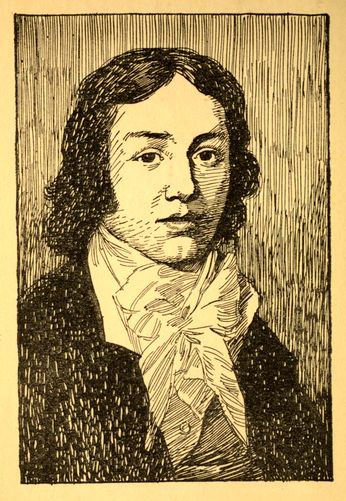
For a while Coleridge stayed with the Lambs, to whom his company was
ever welcome, and then took up work in the office of the Courier,
where he found a room. By the end of September he was at Greta Hall,
where his relations with his wife, doubtless made more difficult by the
undiplomatic but strenuous and honest Southey, must have gone from bad
to worse, for by December the two had decided to separate, Coleridge
being allowed to take the boys, Hartley and Derwent, on the
understanding that they spent their holidays with their mother. He
passed Christmas at Coleorton, lent by Sir George Beaumont to the
Wordsworths, and it may be that the relief of the proposed separation
accounted for better spirits, better health, and inclination to work. He
was still far from well, no day seems to have passed without bringing
some hours of pain and unrest, but there was some change, and it was for
the better. Wordsworth's dedication of The Prelude may have given him
a much-needed stimulus. In the early summer of 1807, Coleridge joined
his wife for a time at Nether Stowey, where kindly Thomas Poole managed
to patch up the differences between husband and wife, and brought
Coleridge and Josiah Wedgwood together again. The poet had refused to
answer his patron's letters or to supply promised material for a life of
Thomas Wedgwood. In his letter to Josiah Wedgwood he declared that the
contribution to the story of Thomas Wedgwood's life had been detained at
Malta together with "many important papers," and that he had several
works on the eve of publication. The measure of foundation upon which
these statements stood was hardly sufficient to support them even in the
pages of a letter to a fairly credulous patron. Soon the "penniless and
friendless" man was to find another supporter, Thomas de Quincey, who,
after meeting the poet and spending one evening in his company, supplied
him anonymously, through Cottle the publisher, with a loan of three
hundred pounds, without any conditions, in order that his financial
troubles might be ended.
Here we have another proof of the extraordinary personal magnetism of
Coleridge. However badly he might behave, his friends forgave him and
continued to love him, strangers helped to smooth the rough road over
which his follies drew him—all in vain. Coleridge accepted the gift
from an unknown sympathiser without compunction—he was quite reconciled
to doles—merely remarking that he hoped in twelve months to ask the
name of his benefactor in order to show him the results of his gift.
Towards the end of an unsatisfactory year, Coleridge returned to his
room and his work in the office of the Courier, and set himself to
prepare some long-promised lectures to be delivered at the Royal
Institution. The first were heard in February 1808, and others followed
in the spring; they seem to have attracted considerable attention and to
have been representative of the lecturer's considerable gifts. This work
over, he went to stay at Bury St. Edmunds with his friend Mrs. Clarkson,
whose influence was wholly good, and helped in no small measure to
restore his health and peace of mind. From there he went to visit the
Wordsworths at Allan Bank, and the improvement in health was maintained.
He was now separated from Mrs. Coleridge; they met as friends, united to
some extent by a genuine interest in their children's welfare. The year
1809 saw the birth of a paper called The Friend, described as "a
Literary, Moral, and Political Weekly Paper, excluding Personal and
Party Politics and Events of the Day. Conducted by S. T. Coleridge of
Grasmere, Westmorland." This was another ill-planned venture, foredoomed
to failure from the start. It contrived to appear at regular intervals
on twenty-seven occasions, and considering the enormous difficulties
associated with its production, this was a remarkable achievement
enough. Needless to say helpers came forward with hard work and advances
of money. Wordsworth wrote much for the columns of his friend's venture,
but success and Coleridge never could run in double harness.
By March 1810, after involving in endless trouble all who helped the
editor, The Friend was numbered among the things that had been, and
until October the poet lingered on in the Lake Country, apparently at
his wits' ends once more. He took his latest failure very much to
heart.
In October Coleridge accepted at short notice an invitation from Basil
Montague, who was passing to London through Keswick, to stay with him in
Soho, and this unfortunate journey led to a break in the very amicable
relations that had existed so long between Coleridge and Wordsworth, and
had been a source of great comfort to the less fortunate man. The author
of The Prelude warned Montague that his friend's habits were not
satisfactory, and that he had but little hope of their permanent
improvement, and Montague, translating Wordsworth's tempered note of
advice into harshest terms, gave Coleridge his own crude version of it.
The breach was not mended for two years, and even then the marks of it
made the old happy relations between two great poets, who were
intellectually brothers, though morally as far as the poles asunder,
impossible. Stricken to the heart, Coleridge left Frith Street at once
and went to Hammersmith on what was practically a six years' visit to
some Bristol friends, the Morgans, who had settled in the western
suburb. He had the Lambs to turn to as well, and in their company met
Henry Crabb Robinson, to whose voluminous diary students of the poet are
so deeply indebted. He completely ignored his relatives and friends in
the Lake Country, though their anxiety about him was unfeigned. In 1811
he worked on the Courier until the autumn, when he turned again to the
lecture platform, which he could always adorn, for it was possible for
Coleridge to speak without notes on almost any subject and to treat it
luminously. These lectures, delivered in the rooms of the London
Philosophical Society in Crane Court, Fetter Lane, were eminently
successful, taking into consideration the conditions of their delivery.
They were devoted to examination and criticism of the work of
Shakespeare, Milton, and living poets, a study that Coleridge had made
his own. The spring of 1812 was at hand before the series was completed,
and at its conclusion the poet, who had delighted some of the sanest
critics in London, set out for Greta Hall. While he was there—it was
destined to be his last visit to the Lake Country—he was on the best of
terms with his wife, but kept away from the Wordsworths because William
had refused to apologise. It required the persistent efforts of Crabb
Robinson to bring the two men together in May of 1812. One Brown,
printer of The Friend, had left Penrith owing Coleridge money, so the
poet went to his office to investigate the matter, and remained in
Penrith for a month, without communicating with any of his anxious
friends! Then he returned to the Morgans, who had left Hammersmith for
the neighbourhood of Oxford Street, and issued a prospectus for a series
of lectures designed to deal with the drama. He delivered about half a
dozen, and arranged for a winter series to be given at the Surrey
Institution. It was a period of renewed literary activity; he had
re-written his play Osorio, now called Remorse, and it had been
accepted for Drury Lane; he was working again for Stuart. The winter
lectures opened badly and closed brilliantly; the poet was happy in
having sympathetic audiences. Then came rehearsals of Remorse, which
proved remarkably tedious to the gifted author, who for once in his
life found a substantial reward for his work. Remorse appealed
sufficiently to the patrons of Drury Lane to yield over four hundred
pounds to Coleridge in acting and publishing rights. The money came at
an opportune moment, for Josiah Wedgwood had reduced his pension to the
poet by one half. He has been very freely blamed for this, but who can
say that Coleridge had kept to his promise to devote himself to poetry
and philosophy or that he had justified to any reasonable extent the
hopes that prompted the generous gift? Naturally, he resented the
reduction of his allowance, but it did not stir him to any further
effort. On the proceeds of his play he would seem to have lived in
comparative idleness until the autumn of the year, when, finding the
financial strain no longer bearable, he set out in October for Bristol,
to deliver an extended series of lectures. The summer had been spent in
formulating good resolutions and talking of the books he proposed to
write as soon as his mind was sufficiently tranquil and he had no more
worries. On the whole, the Bristol lectures were a great success. It may
be said with all respect that Coleridge was always lecturing; even in
private life, he had succeeded in keeping the brilliant Madame de Stäel
a contented listener by the hour, and it was quite an easy matter for
him to stand on a platform and discuss any matter in which he was
interested, in a fashion safe to hold an educated audience. There is
evidence that while Coleridge was at Bristol doing good work in a
desultory fashion he was indulging immoderately in opium. Cottle, his
old publisher, remonstrated with him, and some effort was made to raise
the money to put him in a doctor's home; but Southey, who was
approached, opposed the suggestion firmly and, with a certain brutal
frankness that is not hard to condone, declared that nothing but a
return to Greta Hall and hard, regular work, would minister effectively
to his brother-in-law's complaint. This of course availed to keep
Coleridge from the Lake Country, and still further to embitter his
relations with the family at Keswick.
In September 1814 he joined the Morgans in a cottage at Ashley, on the
Bath Road, and planned the creation of some literary monuments, that
when they came to be completed were of comparatively small account. He
wrote some papers for the Courier, and towards the end of the year
went with the Morgans to Calne in Wiltshire. There he wrote
begging-letters, visited the leading representatives of the county and
enjoyed the entertainment he received, ignored letters from his family,
and wasted his great gifts by devoting them to consideration of local
questions of small importance. By the kindness of friends, Hartley had
been sent to Oxford, so doubtless his father thought he had done well
for one of his family.
The year 1815 passed, finding him more concerned with promises than with
the performance of work, but in March 1816 he returned to town with the
MS. of a new play—Zapolya. He stayed for a while with his faithful
friends, Charles and Mary Lamb, and then took the strongest and wisest
decision of his life by putting himself in the hands of Mr. Gillman of
Highgate, with whom his life was so closely associated down to the end.
He took this step, after much self-searching, and on the advice of a
physician, Dr. Adams of Hatton Garden, to whom he told frankly and fully
the story of his case. A few days after his arrival at Highgate the
"Christabel," "Kubla Khan," and "Pains of Sleep" were published by John
Murray, to whom Coleridge appears to have been introduced by Lord Byron.
Murray also accepted Zapolya, but parted with it to another publisher.
In the summer of 1816, Coleridge took a holiday at Muddiford, near
Christchurch in Hampshire. Back in Highgate, he projected more work, and
being in better health, carried on brisk quarrels with publishers. Under
Gillman's care he was becoming more temperate, but his system was
suffering from lack of its accustomed stimulant. By the spring of 1817,
the Metropolitan Encyclopædia was projected, and Coleridge was to be a
liberal contributor as well as assistant editor in return for £500 a
year, but he wanted so much down on account that the publishers, who
probably knew their man, broke off negotiations, and Coleridge wrote
nothing but his well-known paper, "Preliminary Treatise on Method," for
which he received sixty guineas. In March 1817, the publication of the
Biographia Literaria, a glorified scrap-book, full of profound
thoughts that dazzled many a thinking man, led to bitter criticism in
the Edinburgh and Blackwood's. The philosophical prose of Coleridge
is of importance, but no attempt will be made to deal with it here, in a
sketch that has no other aim than to present a great figure in our
literary history to those who need such an introduction. The
Biographia Literaria and the Æsthetical Essays have been published
as recently as 1907 by the Oxford University Press. They supply a
complete reprint of the 1817 edition, and have been edited with a
masterly introduction by Mr. J. Shawcross.
In this year (1817) Coleridge renewed his work in the Courier and
upheld Southey's reputation in connection with the pirated publication
of that poet's twenty-five-year-old indiscretion, "Wat Tyler." This was
generous vindication of a severe critic. In the same year he started his
stimulating friendship with Joseph Henry Green, philosopher and surgeon.
In the autumn he again sought the sea, going this time to Littlehampton
in Sussex, where he met the Rev. H. F. Cary, translator of Dante, and
Charles Augustus Tulk, afterwards member for Sudbury. It is to the
efforts of Coleridge that Mr. Cary owed the first acceptance of his
remarkable work. Zapolya sold well towards the close of this year, and
the sale helped to stimulate the author. It would seem that residence at
Highgate was doing something at last to build up the poet's shattered
nervous system, that the bonds of opium were being loosened, that
self-respect was coming, however late, into his life. Lectures on
Shakespeare and Poetical Literature delivered at Flower-de-Luce Court in
Fetter Lane occupied the opening months of the new year, and while
engaged on these addresses, Coleridge made a new and valued friend,
Thomas Allsop, with whom he maintained for several years an important
correspondence. A further course of lectures was delivered in the last
weeks of 1818 and for some months in the following year, but although
they were doubtless remarkably good, there was no money in them. The
year 1819 was a disastrous one financially. Not only was little profit
forthcoming from work, but, to make matters worse, Fenner, the poet's
publisher, became bankrupt, and the unfortunate Coleridge was compelled
to buy back his own books and copyrights, at least he wrote to that
effect to Allsop, though one cannot take all these statements au pied
de la lettre. In 1820, fortune had still more blows in store. Hartley
Coleridge, who to his father's great delight had gained a Fellowship at
Oriel, was deprived of it on account of his intemperance, nor could all
the influence of friends or of the sorely stricken parent avail to move
the Provost of Oriel to reconsider his judgment, though a sum of £300
was paid to Hartley by way of compensation later in the year. The career
of Hartley Coleridge, the "little Hartley," beloved of the Lakemen, who,
it will be remembered, preferred both his verse and his company to those
of the self-centred Wordsworth, is no less sad than that of his father,
and was far less brilliant. He inherited all the curses that made the
career of Samuel Taylor Coleridge so disastrous, he was constitutionally
unable to settle down to hard work, he was weak, and prone to give way
to temptation on the least provocation. A great part of his life was
passed in the Lake Country, where William and Mary and Dorothy
Wordsworth were his staunch friends, loving him perhaps as much for his
father's sake as for his own. He died shortly before William
Wordsworth, and the graves of the two men, so remote from each other in
all things save affection, may be seen side by side in Keswick
churchyard. Coleridge was soon reconciled to his erring son, but the
blow was the more severe because he could see that he was the father of
the lad's faults and failings.
In 1821 we find him turning to Allsop for pecuniary aid; self-respect
must be laid aside in the face of financial straits. The excuse is the
old one that age cannot wither nor custom stale. He is in sore distress,
reduced to writing for Blackwood (who had been to Highgate bearing the
olive branch, nearly two years before). He is even writing sermons for
illiterate clergymen, he has four books well-nigh ready for press, he
wishes to bring about a revolution in the world of French and English
metaphysics through the medium of a work of far-reaching importance,
still, of course, to be written. What remains, then, at a time when he
is being pressed for money for the necessities of life, but an appeal to
a few admirers who "think respectfully" of his gifts to subscribe an
annuity of about £200 a year for three or four years? Nearly £100 has
been promised by young friends whom he is engaged in teaching. Perhaps
Allsop will suggest how, without loss of dignity, the appeal may be
circulated in the proper quarters. Those of us who admire the work with
which Coleridge has enriched his country may be pardoned if they regret
the fact that this appeal ever saw the light. It had not even the
negative virtue of success. The much-maligned Blackwood came to the
rescue with an advance on account of work, and with the amount prepaid
Coleridge went to Ramsgate for two months with the Gillmans, where he
met Cowden Clarke, and derived benefit from the sea air and ample
exercise.
The next plan that came to the fertile brain was an extension of the
informal class in philosophy that he held at Gillman's, and something,
but not much, was done in this direction. A long visit from Mrs.
Coleridge and their daughter Sara marked the comparatively cheerful
close of the year 1822. Henry Nelson Coleridge, the poet's nephew, son
of Colonel James Coleridge and afterwards Sara's husband, was of the
party; his Table Talk, in which Coleridge shows something of his
conversational quality, may still be read with interest. These visits
and the poet's fast-widening social sphere suggest that the opium habit
was being conquered at last, that the closing years of a strangely
troubled life were bringing with them some measure of tranquillity.
There is yet another indication of improvement; the fire of poetic
inspiration flared up for a little while in the fall of 1823, and "Youth
and Age," was the result. Aids to Reflection was in the making in
these days too, though it was not given to the world until the early
summer of 1825, and then in a very slovenly form, which did little or
nothing to diminish its value to thinking men and women. While the
reception was a mixed one, there was a fairly substantial reward. The
Royal Society of Literature gave him an Associateship carrying with it
the welcome annuity of 100 guineas; there was balm in Gilead at last. In
return for the honour, the poet read a paper on the "Prometheus of
Æschylus" before the R.S.L. (May 1825). In addition to some definite
relief from financial stress, Coleridge was entering upon a mental phase
of infinite comfort to his remaining years. The transcendentalist became
suddenly convinced of the efficacy of prayer, of the existence of a
personal God, and of other tenets peculiar to Christianity. We cannot
indicate the gradual processes by which the brilliant mind reached
harbour in the last days. It may be that the futility of his own
struggles was becoming apparent, that his reasoning faculties,
strengthened by relief from drugs, reverted to the faith of earlier
times at Ottery St. Mary when, a little boy with the page of his life
fair and unstained, he listened to the teachings of his father, a man of
godly ways and simple belief. It may have been the final sense of defeat
in the long struggle to realise ambitions, to justify the hopes of
friends, and to silence those whose doubts were openly expressed.
Whatever the cause, the result was eminently satisfactory; the last
years saw the poet baffled and beaten by the world, but for once strong
in failure, full of a conviction that there lay beyond the grave that
which should atone for unsuccess. There is more dignity and less
querulousness in the years that followed publication of Aids to
Reflection than in almost any of those that had passed since Coleridge
left Cambridge; and for this spell of comparative tranquillity his
latter-day admirers must needs be grateful.
There would be interesting matter for speculation, if we had any data to
assist us, how far the late-found faith of Coleridge enabled him to
atone to his conscience for what seem to us the least reputable
incidents of his career, and many remain to be explained away. He was
too shrewd a critic, too sound a judge of life and character, to have
overlooked his own failings, above all he must have been haunted by fear
of his son Hartley's future and known that his own lack of
self-discipline had, in all human probability, set yet another soul
wandering along the paths of trouble. Perhaps we should be careful to
remember, in considering the life of Coleridge, that all his faults were
open to the eye. His friends discussed them with the greatest freedom
and even set them down in cold print. History has turned a far more
careful eye to the blemishes in a strange character than to the virtues
that must have been present by their side. The worst foes of Coleridge
have never denied the extraordinary influence he spread around him, or
doubted that it was for good. They bear witness to the intense
theoretical devotion to unattainable ideals, the respect for virtue,
even in hours of backsliding, the belief in his own ability ultimately
to overcome the faults that beset him and to rebuild the shattered
fabric of personal honour. He was ever fighting against his own little
company of devils, for ever being worsted, and yet it would be wrong to
say that he abandoned the struggle for long. Doubtless, when he looked
closely into his own past, he was less conscious of his faults than were
his biographers; by him they were regarded as the outcome of forces he
could not control. Had he pleaded his own case at the bar of public
opinion, and some of his utterances come very near to constitute a plea,
he could doubtless have done so with sincerity and conviction. He was at
least nearer to the springs of action than were those who judged him by
normal standards, forgetting that whether for good or for evil the man
of genius is a law to himself, and that genius is at once a disease and
a misfortune, which no sane man need covet. Certainly if Coleridge could
forgive himself, we of another generation, who have had nothing but the
fine fruits of his intellect for our portion, who bear no share of the
burden of his weakness, are not called upon to judge him harshly, and
only the fact that his life is one long record of faults and failings
excuses any reference to them in a brief biography.
The tragedy of the life we have watched for a moment at Highgate now
loses something of its intensity. It gains a tranquillity we have
learned to associate with evening twilight. The sudden recovery of faith
calls for more than a passing word; it must have gladdened the heart not
only of Coleridge, but of many of the devout admirers who have succeeded
him. The thoughtful readers of our own generation can hardly turn to the
life or works of Coleridge to-day without feelings of infinite pity for
a man in whom the body and the spirit waged such long and uneven combat.
We may remember, too, that his own generation had no perspective by
which to judge him; it was unaware of his greatness, and ignored or
misjudged him as it ignored Wordsworth and Elia until they had passed
beyond the reach of praise or censure. Had it recognised the presence
of a great force there might have been more happiness for the author of
Aids to Reflection. But we can see, or think we see, that though help
came to him in no small measure, there was little understanding save by
the few, and in the long run the assistance he received was futile. Like
every man born of woman, Coleridge had to seek and find his own
salvation; it was his own effort that triumphed in the end.
To the life-long list of disappointments another was added in 1827, when
the post of Paymaster of the Gentlemen Pensioners, a sinecure long since
abolished, became vacant by the death of William Gifford. A big effort
was made by Hookham Frere to obtain this office for Coleridge, but it
was not to be. The industrious, steady, resolute Wordsworth had his
sinecure, and it seems a little hard, if such things were to exist, that
poor Coleridge, whose necessities were not inconsiderable and whose
means of satisfying them were so scanty, should have failed to gain one.
Happily he still had his pension of one hundred guineas from the Royal
Society of Literature, and in 1828 an edition of three hundred copies of
his poems was published in three volumes and sold out. William Pickering
of London was the publisher, and the preface, with a few unimportant
alterations, is a reprint of the one attached to the edition of 1803,
published by Longman and Rees, which in its turn was taken from the
edition of 1797. Another edition with some added verses was published in
1829. When the volumes of the 1828 edition had been passed for press,
Coleridge joined William Wordsworth and his favourite child, Dora, who
married Mr. Quillinan and predeceased her father, and the three went to
Belgium and Germany. The journey lasted six weeks, and at Bonn the
travellers met some of the leading writers of Germany, including
Schlegel and Niebuhr. The German visit is recorded by Thomas Colley
Grattan, the author of Beaten Paths, and by Julian Young, son of
Charles Mayne Young, the actor. Although the warmth of attachment
between Wordsworth and Coleridge had undoubtedly suffered since the days
when the former wrote his ill-advised letter to Basil Montague, nearly
twenty years before, the admiration of the one poet for the other was
quite unfeigned. Wordsworth's delight in a great intellect had never
faltered; he could always distinguish between a man's gifts and
weaknesses, admiring the one while he condemned or regretted the other.
The journey refreshed Coleridge in body and mind. He was in high
spirits, and the point of his pen was still very keen; witness his lines
to Cologne, written when he and his fellow-travellers had passed through
that malodorous city in July:
"In Koln, a town of monks and bones
And pavements fang'd with murderous stones,
And rags, and hags, and hideous wenches;
I counted two and seventy stenches,
All well defined, and several stinks!
Ye Nymphs that reign o'er sewers and sinks,
The river Rhine, it is well known
Doth wash your city of Cologne;
But tell me, Nymphs! what power divine
Shall henceforth wash the river Rhine?"
These lines are worth quoting merely as a definite indication of the
change in spirits that had come over the poet. Doubtless, for all the
angry de Quincey has written to the contrary, Coleridge was in a
comparatively healthy condition both mentally and physically in these
closing years, nor could he have made the favourable impression upon the
illuminati of Bonn had he been still addicted to excess of opium. An
easier mind prompted him to take further holiday during the year, for we
have a record of a week with Charles and Mary Lamb, who were then at
Enfield Chase, and a month at Ramsgate towards the beginning of the
winter. In the following year his well-beloved daughter Sara married her
cousin Henry Nelson Coleridge, who, in the spring of 1830, resumed the
Table Talk records that do so much to show us the extent, variety, and
penetration of the poet's comments upon men and things. In this year
Coleridge published, through the London firm of Hurst, Chance & Co., his
remarkable essay "On the Constitution of the Church and State, according
to the idea of each," a publication said to have been the foundation of
the famous Oxford Movement.
This year saw the death of George IV, and of the pensions of the
Associates of the Royal Literary Society. King William IV pleaded that
his very reduced income made it impossible for him to continue the
grants of his predecessor, but a strong private representation to Lord
Brougham led to the offer of a private grant of £200 to Coleridge, who
declined to receive it. Hookham Frere undertook to pay the pension
annually as long as Coleridge lived, and the Treasury compounded with
King William's conscience by paying a sum of £300 in settlement of
further liabilities.
It is well that there were friends at hand in these latter days, for the
star of Coleridge had set; he was to publish nothing more. His mind
retained its pristine vigour, but his body was failing fast. Wordsworth,
Lamb, Crabb Robinson, Walter Savage Landor, Harriet Martineau, Emerson
and Poole were among the visitors to Highgate, where the poet, now
seldom able to leave the house, waited with patience and resignation for
the hour to come when "the dust returns to earth as it was, and the
spirit unto God who gave it." He rallied sufficiently to attend the
baptism of his granddaughter Edith, and in 1833 he went to the meeting
of the British Association at Cambridge, the return to his old haunts
being the occasion of great emotion. Too weak to rise betimes, he
received old friend and new in his bedchamber. Then he returned to
Highgate, never again to leave the Gillmans' hospitable house. In May
1834 his old and faithful comrade Thomas Poole, the man our memory loves
to dwell upon, visited him, and Coleridge remarked that all the
incidents of his life were now seen by him in a clear light "reconciled
and harmonised." A bad attack of weakness in the last days of July was
the signal of the end. In his last hours he communicated to his pupil J.
H. Green a statement of his religious philosophy, and tired by the
supreme effort passed peacefully from the lesser to the greater sleep.
He was buried on August 2, in the Churchyard at Highgate. He had
written his own epitaph not a year before he died, and no excuse is
needed for its quotation here. There are several versions, differing but
slightly from each other:
"Stop, Christian Passer-by! Stop, Child of God!
And read with gentle heart. Beneath this sod
There lies a Poet: or what once was He,
O lift thy soul in prayer for S. T. C.
That He who many a year with toil of breath
Found death in life, may here find life in death.
Mercy for praise, to be forgiven for fame
He ask'd, and hoped thro' Christ. Do thou the same."