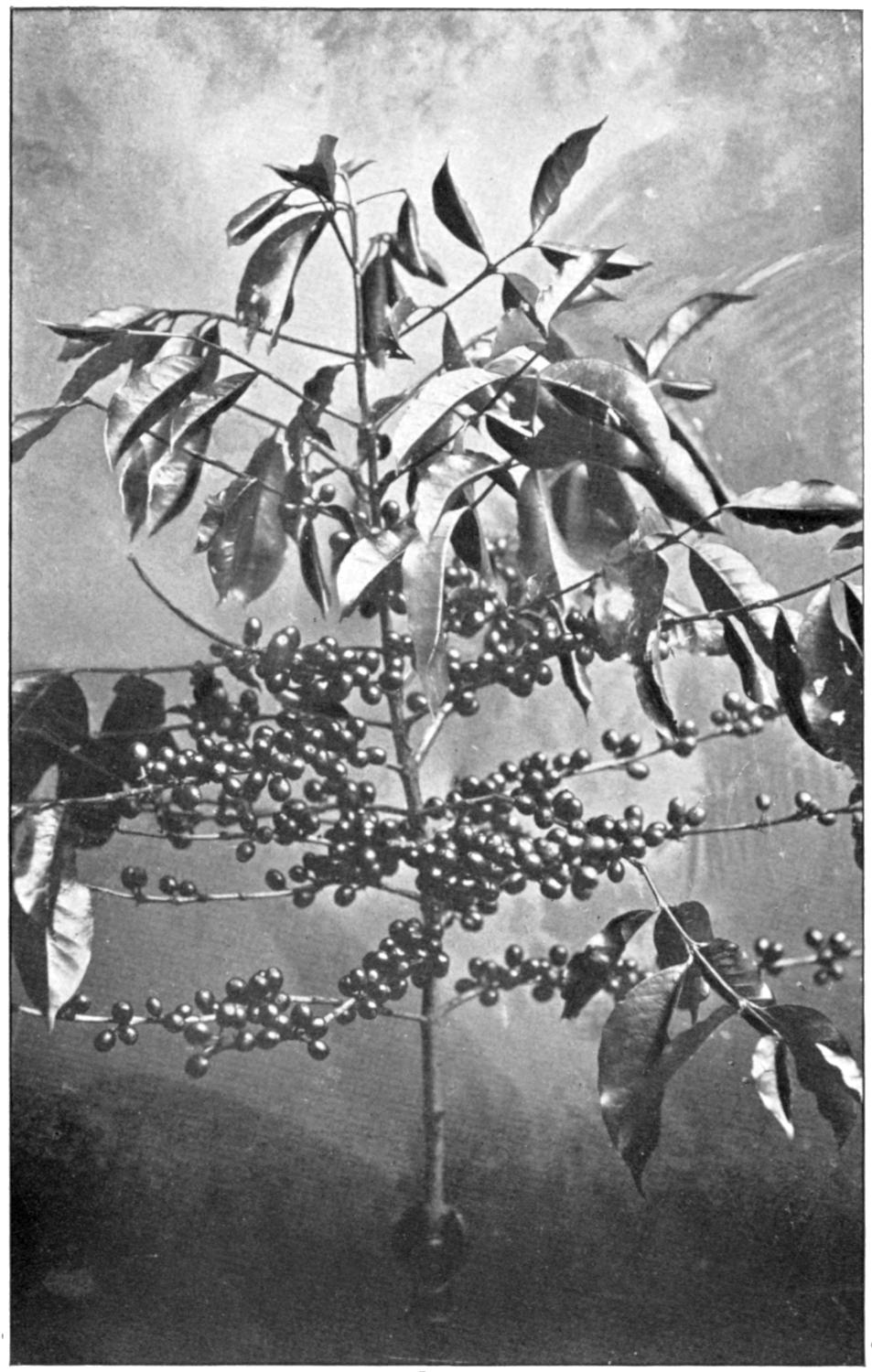
CHAPTER I. EARLY HISTORY. — INTRODUCTION INTO EUROPE.
 The
gigantic extent to which the production and
consumption of Coffee has been carried of late
years, the vast number of hands employed in its
cultivation and preparation for market, including
the great quantity of shipping necessary for its transportation,
and the enormous amount of capital invested in its
production and trade, naturally invest the commodity,
not only from a commercial but also from a moral and
social standpoint, with great importance, creating as it
does an industry of almost fabulous proportions and
capital, rendering it second to no other article of food or
drink in the world. The early history of Coffee, however,
like that of Tea, is involved in considerable obscurity,
the almost total absence of any historical fact
being only compensated for by an unusual profusion of
legendary and conjectural statements, or by purely mythical stories.
As far as can be ascertained, it was not
known to the ancients, although one writer claims that
it is mentioned in the Bible, making the bold assertion
that the potion offered to King David on a certain occasion,
at the hands of the fair Abigail, to calm the temper
of the excited monarch, must have been Coffee, basing
his argument on the untenable grounds that the beverage,
whatever it may have been, was prepared from something
roasted. Yet no mention of the plant or its product is to be
found among the Egyptians in the time of the Pharaohs,
although their trade at their period, as in the present, lay
up the valley of the Nile toward Berber, its reputed
birthplace. It was unknown to the Greeks and Romans
in any form, and though claimed to have been in use
among the Arabs at a very remote time, no reference is
made to it by Mohamet or his followers up to the seventh
century. No account of its use is to be found during the
first Moslem invasion of southern Europe by Abdulrahman
in the ninth century, although large quantities of the
commodity were captured in their camp before Vienna
during their second invasion of eastern Europe in the
seventeenth century, and it is not even alluded to by
any of the writers who accompanied the Crusaders into
Syria during the thirteenth century.
To the Ethiopians its use is said to have been known
from time immemorial, and that the plant and its virtues
were first discovered in that country is now generally
admitted by all authorities on the subject. The first
human beings who appear to have used the Coffee-berry
in any form being the semi-savage tribes inhabiting
higher Ethiopia, to which country the Coffee-plant is
indigenous, and where it is to be found at the present time,
growing abundantly both in a wild and cultivated state.
Bruce, in his Travels to Discover the Source of the Nile,
published in 1678, informs us that “The Gallæ is a
wandering nation of Africa, who, in their incursions into
Abyssinia, are obliged to traverse immense deserts, and
being desirous of falling on the towns and villages of
that country without warning, carry nothing to eat with
them but the berries of the Coffee tree roasted and
pulverized, which they mix with grease to a certain consistency
that will permit of its being rolled into masses
about the size of billiard balls and then put in leathern
bags until required for use. One of these balls they
claim will support them for a whole day, when on a
marauding incursion or in active war, better than a loaf
of bread or a meal of meat, because it cheers their spirits
as well as feeds them.”
From Ethiopia, the Coffee-plant is claimed to have
been introduced into Abyssinia as early as A. D. 875,
while, according to Lagrenie, Coffee has been known and
used in Abyssinia, from the very earliest times, quoting
the Abbé Raynal, a missionary to that country in the latter
part of the sixteenth century, to that effect, stating that
“he procured some of the berries from cultivated plants,
and made a trial of them, finding them larger, rather longer
and quite as fragrant as those obtained from Arabia.”
From Abyssinia it was evidently first introduced into
Arabia, but at what period of the world’s history, or
under what circumstances is also lost in doubt. Tradition—never
at a loss for some marvelous story—ascribes
its first discovery in the latter country to a Dervish, who
in the year 1275 was driven out of Moka, pursued and
surrounded by his enemies in the adjacent mountains.
In the extremity of hunger he is said to have gathered
some Coffee-berries and eaten them, then, steeping some
of the parched berries in some water to allay his thirst,
he accidentally discovered their agreeable flavor and
nutritious properties. While another Arabian legend
attributes its first discovery as an alimentary infusion
in that country to a Mollah named Chadeley, who on
being informed by a goat-herd of the peculiar and
exciting effect produced on his goats, whenever they
happened to browse on the leaves and fruit of a certain
kind of tree, resolved to test their virtues on his monks,
with whom it is related he had considerable difficulty in
keeping awake during their nocturnal devotions. Preparing
an infusion from the berries of the plant indicated,
he served it to them, the experiment proving a complete
success; the dervishes taking eagerly thereafter to the
new and exciting beverage. While, according to an
Arabian manuscript, now to be found in the Bibliotheque
Nationale of Paris, the use of Coffee was known in
Arabia as early as the thirteenth century. This coffee-colored
document states that “a certain Mufti of Aden,
on his return from a journey to Persia, about the middle
of the fifteenth century, brought back with him some
roasted beans of Coffee.” While in an old treatise upon
Coffee, published in 1566 by an Arabian sheikh, it is
stated that the first knowledge of Coffee and its use was
brought from Abyssinia to Arabia about the beginning
of the fifteenth century by a learned and pious mollah
named Djmaleddin Abou Elfager. According to this
document, the use of Coffee as a beverage was prevalent
among the Abyssinians from the most remote times, and
that in Arabia, when first introduced, it only supplanted a
preparation made from the leaves of the Celastrus in that
country. The introduction and use of the beverage by the
Mufti gave reputation to the practice, his example soon
rendering the new luxury popular among his countrymen,
“first among lawyers and professional men, then with
students and those who learned reading, the custom
eventually spreading to artisans and others who worked in
the night, and finally by travelers, who journeyed in the
night to avoid the heat of the day.” In a short time it
was declared in Aden “that this liquor purified the blood,
by a gentle agitation, dissipated the ill condition of the
stomach and aroused the spirits.” As a result of this high
extolation it was quickly adopted by those who had
no occasion to keep awake at night, and in a brief
space of time, says M. Galland, “the whole inhabitants
of Aden became inveterate coffee-drinkers.” Its peculiar
property of dissipating drowsiness and preventing sleep
was taken advantage of in connection with the prolonged
religious services of the Mahometans, and its use as a
devotional anti-soporific stirred up a fierce opposition on
the part of the strictly orthodox and conservative section
of the priesthood. Coffee being held by them to be an
intoxicant beverage, and therefore prohibited by the
Koran, and the dreadful penalties of an outraged sacred
law were held over the heads of all who became addicted
to its use in any form. But notwithstanding the threats
of divine retribution, and though all manner of devices
were adopted in order to check its growth, the coffee-drinking
habit spread rapidly among the Arabian Mahometans,
and the growth of coffee, as well as its use as a
national beverage, became as inseparably associated with
Arabia as tea has with China.
From Aden, the use of coffee extended to Mecca,
Medina and other cities and towns of Arabia, the
knowledge and taste for it rapidly spreading outwards
from that country to Syria and Persia. Public coffee-houses
being everywhere established, also in many of the
other countries in western Asia, affording, according to
one authority, “a lounge for the idle and a relaxation for
the man of business, where the politician retailed the news
of the state; the poet recited his verses, and the Mollahs
delivered their sermons to the frequenters.” But the
mania for coffee becoming so great about this period,
particularly in Syria, that an effort was made by authority
of the government to check, if not to entirely suppress,
the further growth of its consumption among the
inhabitants, on the alleged ground of “its intoxicating
properties,” but in reality because of its use leading to
social and festive gatherings, incompatible with the
strictness and teaching of the Mahometan religion.
From Syria the use of the “benign potation,” as it was
then termed, reached Cairo about 1510, being received
with equal avidity in that city, so much so that in that
year its indiscriminate use was prohibited on religious
grounds, also by Khaine Beg, the then governor of the
city. In his proclamation forbidding the use of coffee,
it was assailed by him as “having an inebriating effect,
and of producing inclinations condemned by the Koran.”
This edict was, however, rescinded by his successor,
Causin, soon after his assuming the governorship. But
another effort was made to suppress its use in 1523 by
the chief priest, Abdallah Ibrahim, who denounced its
use in a sermon delivered in the mosque of Haffanaine,
a violent commotion being produced among the populace,
the opposing factions coming to blows over its use. The
governor, Sheikh Obelek, a man wise in his generation
and time, then assembled the mollahs, doctors and others
of the opponents of coffee-drinking at his residence, and
after listening patiently to their tedious harangues against
its use, treated them all to a cup of coffee each, first
setting the example by drinking one himself. Then dismissing
them, courteously withdrew from their presence
without uttering a single word. By this prudent conduct
the public peace was soon restored, and coffee was ever
afterward allowed to be used in Cairo.
Coffee continued its progress without further molestation
through Egypt, the beverage being received in
Damascus in 1530, and in Aleppo a few years later, without
opposition, becoming known to the inhabitants of
Constantinople for the first time in 1554, in which year
two persons, named Schems and Heken, the former
coming from Damascus, and the latter from Aleppo,
opened the first coffee-houses in that city, where it
soon became the favorite drink with all classes, “the
coffee-houses being thronged night and day, the poorer
classes actually begging money in the streets for the sole
object of purchasing coffee.” And in Constantinople, at
this time, we are informed that “a refusal to supply a
wife with a specified quantity of coffee per diem was
admitted to be a valid cause for divorce.” But in Constantinople,
as in Cairo, the new habit excited considerable
commotion among the ecclesiastical authorities and
political rulers, owing to the popularity of the coffee-houses
having a depressing influence on the attendance
at the mosques, on which account a fierce hostility was
excited among the religious orders against the new
beverage. They laid their grievances before the Sultan,
who first prohibited and then laid a heavy tax upon the
coffee-houses, notwithstanding which they continued to
flourish and extend. A similar persecution to that in
Syria and Cairo soon attended its use in the Turkish
capital, having not only to contend there with religious
but also with political opposition, the religious, as usual,
predominating in its severity. The dervishes had the
sagacity to discover “that coffee when roasted became
a kind of coal, and coal being one of the substances
which their prophet had declared was not intended
by Allah for human food,” they therefore declaimed
against it with unbounded fury. The mufti being of
their party, the coffee-houses were at once closed by
a firman of the Sultan, Amuret III. This prohibition
was, however, found impossible to maintain, as a few
years later a more liberal governor succeeding, he
assured the faithful “that roasted Coffee was not coal,
and had no relation to it.” The coffee-houses were
immediately reopened, and soon became as much patronized
as before. But though religious superstition thus
readily gave way to the seductive influences of sensitive
enjoyment, a submission not at all uncommon, the
political objections were not so easily silenced. The
government, first with that instinctive faculty so natural
to all despotic rulers of converting to their own advantage
the tastes and prejudices of their subjects, laid
a heavy tax on the sale and consumption of coffee,
from which it derived an enormous revenue. But the
ever-trembling apprehensions of such forms of government,
not satisfied with this restriction, found, or rather
fancied it found, in the coffee-houses resorts for the
disaffected and nurseries of sedition. These “dangerous
places” were consequently regarded with a jealous eye,
and again proclaimed against by the edict of the Sultan.
But not being deemed formidable beyond the precincts
of the city, and also being of too much importance to
the public revenue, they were suffered to remain open in
all other parts of the empire. Scruples of conscience
and political objections, however, eventually died out,
religious superstition and political opposition being no
longer excited against the use of coffee as a beverage,
so far as the Turkish empire was concerned.
It is likewise very difficult to determine in what year
and in what exact manner coffee was first carried from
Constantinople to western Europe, but it is generally
admitted that the Venetians, on account of the proximity
of their dominions and extensive trade with the Levant,
were the first Europeans to become acquainted with it.
And it is a noteworthy fact that the three principal dietical
beverages of the world were introduced into Europe
within a few years of each other, Cocoa being the first
of the three which actually appeared there, having been
brought to Spain from South America. Coffee followed,
coming from Arabia, and Tea, the latest of the series,
coming from China by the hands of the Portuguese.
The first authentic mention made of Coffee or its
use by a European is probably that of Rauwolf, a German
physician and traveler, upon his return from an
extended tour through Syria, in 1573. The first scientific
account of the plant being that given by Alpinus,
an Italian naturalist, in his Medicina Egyptorium, published
in Venice in 1591. Its use as a beverage is first
referred to by two English travelers—Biddulph and
Finch—the former, in writing of it in 1603, stating “that
the Turks have for their most common drink Coffee—a
blackish drink made from a kind of pulse-like
pease, and called by them Coava.” In 1607 Finch
relates that “the people of the island Socotra have for
their best entertainment a China dish called Cobo, a black,
bitterish drink, made of a berry very like a bay-berry,
brought from Moka, and supped off hot.” While Pietro
Valla, a Venetian, in a letter written from Constantinople,
in 1615, states that upon his return to Venice “he would
bring back with him some coffee which he believed was
a thing heretofore unknown in his country,” and which
he subsequently did. It is also referred to, in 1621, by
Burton in his “Anatomy of Melancholy” as follows:
“The Turks have a drink called Coffee, so named from a
berry, black as soot and as bitter, which they sip up hot,
because they find by experience that that kind of drink,
so used, helpeth digestion and promoteth alacrity.” And
coffee in a liquid state is said to have been sold in Rome
as early as 1625. Some of the prepared beans of Coffee
were first carried from Turkey to France by De la Haye,
as early as 1644; “not only coffee, but also the proper
apparatus for preparing it.” In 1657 a small quantity
was brought to Paris by Thevenot, its use, however,
being confined solely to his own immediate family and a
few friends. Up to this period, however, and for many
years after, it had never been seen and scarcely ever
heard of by the public at large in that country. But in
1660 “several bales of coffee” were shipped from
Alexandria to Marseillaise, and in 1671 the first coffee-house
was opened in the latter city near the Exchange,
“where the merchants met to smoke, talk business and
divert themselves with play.” But it was not until the
year 1669 that Coffee drinking became popular in France,
though infrequent travelers had brought with them from
the East a few pounds of the then curious berry. In
that year Solieman Aga was sent as Ambassador from
Mahomet IV. to the court of Louis XIV., where he
soon became a “lion,” through the splendid and unique
entertainments at which he figured as host. On bended
knees, the black slaves of the Ambassador, arrayed in
the most gorgeous Oriental costumes, presented the
choicest Moka, in tiny cups of egg-shell porcelain, hot,
strong and fragrant, poured out on saucers of gold and
silver, placed on embroidered silk napkins fringed with
gold bullion, to the grand dames who fluttered their fans
with many grimaces, and bent their piquant faces—berouged,
bepowdered and bepatched—over the new
and steaming beverage. Such was the half-barbaric
occasion by which Coffee first became generally known
to that nation, which is now so largely dependent upon
the “brown berry of Arabia.” The Parisians immediately
became quite enthusiastic over it, the aristocracy
adopting it as the fashionable beverage, it being recorded
that the daughters of Louis XIV. had Coffee imported
expressly for the use of the royal household, at a cost
of $15,000 yearly.
The first Coffee-house was opened in Paris, in 1672,
by an Armenian, at the fair of St. Germaine. Meeting
with considerable success, he was encouraged to open
another at the Quai d’Ecole, where he was subsequently
succeeded by another, but who, owing to a lack of
address and a proper place to serve it in, was soon compelled
to relinquish the business. About 1675 an enterprising
Frenchman, Ettienne d’Alep, fitted up spacious
apartments in the Rue des Italienes, with Oriental magnificence
for the purpose of catering to the public taste
for coffee. This Café—as it was called—was the first of
these now famous institutions, was furnished in the most
elegant and expensive manner, ornamented with rich
tapestries, mirrors, pictures, divans and costly lustres,
tea and chocolate being also sold in it. This style of
coffee-house multiplied in a very short time in the gay
city, and were regularly frequented by people of fashion,
artists, men of letters and politicians, the Café Procope
in particular becoming immortalized from its being
patronized by Voltaire, Molière, Bolieau, Fontaine and
other Encyclopedists, while another, the Café de la
Régence, became the Mecca of chess players. In a brief
period these coffee-houses had increased to nearly three
hundred in Paris alone, the Cafés eventually becoming
dangerous rivals to the Cabarets; finally becoming the
cradle of the modern clubs, it being in one of these coffee-houses—the
Café Procope—that Camille Desmoulins
was wont to deliver his stirring addresses. But, as in the
East, at first, coffee here again met with considerable
opposition, Madame Sévigné presuming “that coffee
and other poisons would soon go out of fashion.”
The use of coffee as a beverage is claimed to have
been known in England prior to its introduction into
France, and by some authorities even before the return
of Thevenot from the East. One account states that it
was first offered for sale there by a Jew named Jacobs
at Oxford, as early as 1640. And according to the journal
of Thomas Rugg, dated September 22, 1651, coffee
was then sold in a liquid state at the “Sultaness Head, a
Cophee house by the Royal Exchange, London,” there
being also distinct evidence extant that for some years
prior to that date it was also offered for sale in many other
parts of that city. The first authentic account, however,
states that coffee was first introduced into England by a
Turkey merchant named Daniel Edwards, who, on his
return from a trip to Smyrna, brought back with him a
quantity of it, and with it a Greek servant from Ragusa,
named Pasquale Rossie, who understood the Eastern
method of roasting and preparing it. Edwards had it
prepared and served every day to his friends and visitors
in true Oriental style, but finding that the novelty began
to attract too many visitors, his house being thronged
daily by those anxious to taste the new beverage, he
established Rossie, in company with another named
Bowman, in a tent for its sale in St. Michael’s Alley,
Cornhill, London, over which Rossie erected a sign with
his own portrait, and subsequently announcing himself
to be “the first person who made and publicly sold
Coffee drink in England.” Bowman, later, opened a
coffee-house on his own account on Lombard street, his
former partner, Rossie, going to Holland, where, it is
said, he was the first to introduce coffee in the drink.
At this time coffee sold for from twenty to twenty-five
dollars per pound, but soon became cheaper.
In 1657 many other houses were opened in London for
the sale of coffee, an excise tax of eight pence per gallon
being paid on it, when made and sold in the infusion
at that time. The same year a newspaper advertisement
appeared, stating that “In Bartholomew Lane on the
back of the old Exchange the drink called Cophee is
sold in the morning and at three o’clock in the afternoon.”
The first mention of coffee on the statute books
was in 1660, when a duty of four pence was laid on
every gallon of coffee made and sold, to be paid by the
maker thereof, another particular statute, in 1663, directing
that “all coffee-houses should be licensed at the
general quarter sessions of the peace for the county in
which they are kept.” While another advertisement in
that year says of coffee: “It much quickens the spirits,
and makes the heart lightsome, suppresseth the fumes
exceedingly, and, therefore, is good against headache,
prevents cough and consumption, and is excellent for
the cure of gout, dropsy, scurvey, hypochondria and the
like.”
In London, as in the other cities where Coffee was
first introduced, coffee-houses multiplied rapidly, not
only in the capital, but in all the larger cities of England,
there being in 1688, according to Ray, as many
coffee-houses in London alone as in grand Cairo itself,
Coffee becoming a beverage of general consumption
throughout the entire country. Long antedating newspapers,
the coffee-houses became news-centres, where the
intelligent men of the times gathered to learn what was
occurring in the literary and political world, to discuss
public affairs, governmental measures, and form public
opinion. Wits and poets, essayists and philosophers,
daily gathered in the coffee-houses of London, during
several generations, to quote from favorite authors. How
faithfully they harangued and button-holed each other
in that fashion so common to all ages, and within their
precincts, what fear and folly, what foolishness and wisdom,
have been uttered over steaming cups of Mocha.
Many of these London coffee-houses afterwards became
famous as the resorts of celebrated men. It was
at “Will’s Coffee-house,” in Covent Garden, that Dryden
and Addison, Steel and Davenant, Cary and Pope,
met with other luminaries, while others frequented “Buttons”;
Garrick sipping his Mocha at “Paine’s,” in
Buchnal Lane. It being at the famous coffee-houses of
“Garraway,” “Coventrie,” and the “St. James,” that the
Whigs of that time “did most congregate,” and if it be
proved that other potations more fiery and deep mingled
with those of the Arabian product, it may be taken
for granted that Coffee often supplied the place of worse
beverages, or, at least, mitigated their evil effects, the
“intellectual drink” gaining friends daily among the
wits of the reign of Queen Anne. It was in a London
coffee-house that Pope found the inspiration of “The
Rape of the Lock,” if not the “Essay on Man,” also,
an inspiration, which he celebrated in the following
lines:—
“From silver spirits the grateful liquors glide,
While China’s earth receives the smoking tide;
At once they gratify their sense and taste,
And frequent cups prolong the rich repast;
Coffee! which makes the politician wise,
And see through all things with half-closed eyes.”
The coffee-houses of London, as in other cities, eventually
became convenient and much frequented resorts
of association and acquaintance where politics, literature
and business topics were freely discussed, and it is also
remarkable that the introduction of coffee into England
encountered the same hostility that it was fated to meet
with in all other countries where it was first introduced.
Here also it had its fanatical opponents, numerous
pamphlets being published in favor of and against its use.
It was discussed from every point of view, medical,
moral, physical and political, at one time threatening to
become a causus belli between the sexes. The “Women’s
petition against coffee” and the “Men’s answer” to the
same have become a matter of history. Among the men
also the new beverage had its opponents, as in 1657 the
“Rainbow Coffee-house” kept by James Farr in Queen’s
Temple was reputed and persecuted by them as “a great
nuisance, and a prejudice to the neighborhood,” and as such
was suppressed, but reopened in a short time afterwards.
In 1675 Charles II. for political reasons attempted to suppress
the coffee-houses by a royal proclamation, classing
all of them as “Seminaries of sedition,” and in which
it was stated that “they were the resort of disaffected
persons who devised and spread abroad divers false,
malicious and scandalous reports to the defamation of
His Majesty’s Government, the disturbance of the peace
and quiet of the nation.” This proclamation caused so
much excitement throughout the city that it had to be
rescinded in a few days on a petition from the tea and
coffee dealers. On the opinion of legal officials being
taken as to the legality of that step, an oracular deliverance
was given to the effect “that the retailing of coffee
might be an innocent trade, but as it was used to nourish
sedition, spread lies and scandalize great men, it might
also prove a common nuisance.” Cromwell ordered them
closed again during the Protectorate for somewhat
similar reasons, but having become necessary to the
people they could not be put down for any length of
time. But in England also, as in the other countries,
the most effective check on the increase of the consumption
of coffee was found to be a heavy tax, which, while
restricting honest trade, opened up a channel for extensive
smuggling operations.
The London coffee-houses, however, soon assumed the
additional character of Taverns also, other liquors being
added to the fare, thereby losing their attraction for the
temperately inclined, the Café or coffee-house proper
flourishing only for any length of time in Paris alone.
But while the people of London began to complain that
the company to be found in their coffee-houses was somewhat
mixed, those of the Parisians from the very first
continued to be the most elegant and select places of
resort even to the present day. Before their doors the
equipages of the nobility stopped, while ladies of the
highest rank drank their coffee without alighting, and the
Salons within were crowded with nobles, philosophers,
poets, artists and litterateurs.
The sale of Coffee in a liquid form is claimed to have
been first introduced to Holland by the aforementioned
Rossie in 1664, from whence its use soon spread
throughout Germany and other parts of the continent
of Europe. While to Vienna the Turks themselves
first introduced coffee in 1683, under somewhat singular
circumstances. In that year the Moslems besieged that
city with an enormous force, the siege being raised,
as history tells, by the Polish King, John Sobieski, and
the Moslem hordes completely routed. Large quantities
of coffee were found in their deserted camp, and presented
to one Kolschutski as a reward for the heroic
services he had rendered during the investment of the
city, and utilized by him in the establishment of the first
Coffee-house in Vienna.
Coffee-houses have been known in the United States
from an early period in its history, but for a long time
New Orleans was the only city where they existed in
their true character, the manner being learned from Paris.
Among the American people, however, the beverage has
met from the first with great favor, being at the present
time more extensively used here than in any country
of the world, not excepting the countries of original
production.
Thus in a course of a few centuries has a berry, until
then entirely unknown as an article of diet, except to the
semi-savage tribes of Ethiopia and Abyssinia, made its
way through the whole civilized world. In the nations
professing the religion of Mahomet it is drunk at all
hours of the day, and during the night by all ranks
and classes of the people, from the Sultan and the
Mufti to the merchant, the artisan and the peasant.
While among the nations professing Christianity, by
whom it has been known for a couple of centuries, it is
still regarded as a luxury, but indulged in, more or less,
by all classes and conditions of society. In none of the
states of Christendom was its use ever opposed by religious
fanaticism, nor had it to encounter much opposition
from political jealousy, except for a brief period in England,
when its use was interdicted by Charles II. But,
like every other innovation which has occupied the
human mind, it could not fail to occasion a difference of
opinion among medical experts, social reformers and
similar bodies. Its history, at the present time, being
only valuable as an example of a commodity for which
there is a universal craving amongst mankind in general,
civilized as well as savage, and to illustrate how it has
struggled successfully, and at length triumphantly, over
religious superstition, political opposition, physiological
prejudice, fiscal restrictions, exorbitant taxes, differential
duties and an endless accumulation of antiquated obstructions.
Yet, still, in common with other important necessaries
of life, it has never attained to the natural state
of “unrestricted competition.”
CHAPTER II. GEOGRAPHICAL DISTRIBUTION — INTRODUCTION OF THE COFFEE PLANT INTO AMERICA.
 The
Coffee plant, although now so widely and extensively
grown and cultivated in both hemispheres,
and to be found in all the Botanic
gardens as well as in many of the private conservatories
of the new and old worlds, was entirely unknown outside
of Abyssinia and Arabia up to the close of the seventeenth
century. Ray, in his “History of Plants,” published in
1688, expresses his surprise “that the neighboring
countries of Europe should permit so rare a treasure to
be confined to a single province, and wonders what
watchful dragon is employed by the natives to prevent
strangers from procuring either the plant or its seed,
which could be readily grown in similar climates and
soil;” adding, “It cannot be imagined how the enterprising
commercial nations of Europe, which founded
colonies in the tropics can be so inattentive to the value
and importance of such an acquisition.” Whether acting
on this suggestion or not, the plant soon afterwards
was introduced and extensively cultivated in many of
the countries colonized by Europeans.
Between well-recognized limits north and south of the
equator Coffee is found growing and bearing highly
profitable crops in a wide range of countries to attempt
anything like an exhaustive account of which, is impossible
within the range of a single chapter. Originally a
native of Southeastern Africa the coffee plant has been
widely distributed, successfully cultivated and propagated
in regions and countries geographically apart
and in districts widely differing in climatic and topographic
conditions, and as having been found to endure
greater extremes of climate, variations in soil and situation
than any other variety of plant of tropical origin.
Its facility of propagation and production under such
extreme conditions is admitted by botanists as most
remarkable and equalled only by few members of the
vegetable kingdom, its cultivation at the present time
extending over the entire tropical belt of the globe.
It is practically indigenous to almost the whole of
Africa, being one of the few useful economic products
that the African flora has as yet given to the world. It
is to be found growing there abundantly in a wild state,
particularly between the 5th and 15th parallels, and in a
state of cultivation on the west coast in Liberia, Loango
and northern Angola, as well as in many of the districts
lying between the lower Congo and the latter country,
wherein no white man has as yet penetrated, its planting
and gathering being carried on by the natives, who bring
their harvests down to the coast at Ambrig and neighboring
settlements to sell to the white traders. The
Portuguese colonists of Principe and Sao Thorné, cultivate
coffee extensively, their products standing in high
repute. It has been grown with success in the Gaboon by
French missionaries, and some desultory planting is also
being carried on in Senegal, St. Helena, Sierra Leone and
the Gambia colonies. It grows wild in the Congo
region, the districts around Glandypool being eminently
adapted to its cultivation, but is as yet not taken advantage
of there, the natives of these countries, unlike those
further south, ignoring the properties of its fruit.
It is cultivated in Natal and on the Zambesi river as
well as in Usumbara, opposite to Zanzibar, which presents
a splendid field for Coffee planting, containing as it
does admirable soil, cheap labor, easy transport and land
which is to be had for next to nothing, the missionaries
distributing the Coffee seed among the inhabitants to
induce them to cultivate it more extensively. While
further into the interior, towards Pare, Nyanza and Killimanjaro,
there are increasingly fine sites and suitable soil
for successful and profitable Coffee planting only owned
as yet by the birds of the air and the beasts of the field. It
is to be found both in a wild state as well as in a state of
cultivation in Abyssinia and the Nyassa district, being
also cultivated for commercial purposes further north in
lower Egypt, Nubia, Somali and the Soudan, as well as
in Mozambique, and the islands of Madagascar, Bourbon
and Mauritius. But the total yield of Africa so far as
its influence on the world’s supply is concerned is comparatively
insignificant, the export capacity of the latter
countries not exceeding 800 tons annually. The total
product of the eastern provinces of Africa taken in connection
with the small quantities raised on the west coast
making Africa contribute only between 3,000 to 4,000
tons to the world’s production, this amount including
all the Coffee grown in Egypt and the interior countries
of that continent.
From Africa the coffee plant was undoubtedly carried
to Arabia, but at what period of the world’s history or
under what circumstances is not definitely known. It
was introduced from Arabia to Java in 1690, according
to Boerhave, who tells us that “Nicholas Wilser, Burgomaster
of Amsterdam and Governor of the Dutch East
India Company, in that year instructed Van Horn, the
then Governor of Batavia, to procure some plants or
seeds of the Coffee tree from Arabia and endeavor to
cultivate them in that settlement.” Although its introduction
into Java is placed later by Stavornius, who
claims that the plant was first carried from Mocha to
Batavia as late as 1722 by Zwardekiom, the governor of
the colony in that year, other authorities claiming that
Zwardekiom only helped to extend its cultivation on that
island. The latter account is probably the most correct
one, as it is recorded that coffee in the bean, grown in Java,
was offered for sale in the Amsterdam market the exact
year that Stavornius states that it was first introduced into
that island. Be this as it may, the undertaking was
successful from the beginning, many plants being propagated
there, one of which, the first seen in Europe,
was sent to the botanic garden in Amsterdam, where it in
due time bore fruit. Many young trees were subsequently
propagated from this plant and distributed among the
gardens and conservatories of Europe, one of these being
sent as a rare present to the king of France. The Dutch
later extending the cultivation of coffee to Sumatra,
Celebes, Bali, Timour and many other of the smaller
islands of the Malay archipelago.
The Coffee plant was introduced into India, on the
Malabar coast, about the year 1700, from Aden, although
it is claimed to have been grown in that country, in the
province of Mysore, long anterior to that year, tradition,
relating that the plant was first introduced by Baba
Booden, a Musselman pilgrim, who brought “seven
berries” with him from Arabia about the year 1600,
which he is said to have planted around his hut in the
hills of Mysore, near which coffee trees over one hundred
years old are yet to be seen. The earliest written
account of the cultivation of the coffee plant in India is
that contained in a Dutch work, entitled “Letters from
Malabar,” by Jacob Visscher, chaplain at Cochin, in one
of which he states that “the Coffee shrub is planted in
gardens there for pleasure, and yields plenty of fruit,
which attains a proper degree of ripeness, but has not
the refined taste of Mocha coffee.” The exact year in
which these letters were written is not known, but the
Dutch editor’s preface is dated 1743, so that it may be
concluded that the plant must have been introduced and
known in India prior to that year, although there is no
official record made of the plant or its product in that
country further back than 1822, and though undoubtedly
grown there at an early period, does not seem to have
met with much attention there up to the close of the
last century, no allusion being made to it in any Indian
work until we come to “Heynes’ Tracts,” published
in 1800, in one of which we are merely told that coffee
was then being sold in the bazaars of Bangalore and
Seringapatam. At the present time Coffee is grown all
along India from the northern limits of Mysore and south
to the summits and slopes of the western Ghauts in British
Cape Comorin, Coorg and Travancore, in the Wynaad
and Neilgherry mountains, as well as in the slopes of the
Shevany and Pulney hills. In 1880 over 500,000 acres had
been taken up for Coffee culture in the Cochin, Madras,
Mysore, Travancore, Belgaum and Bengal presidences,
of which nearly 200,000 acres have now maturing plants.
A very large portion of the surface of Burmah which
still remains in its primeval state of unproductive jungle—owing
to the almost total absence of natural energy
on the part of the natives—is admirably adapted to the
successful and profitable cultivation of Coffee. While in
the hilly districts of the east coast of the Gulf of Siam,
Cochin-China and the Straits settlements, the cultivation
of Coffee is carried on to a limited extent, some fine
samples being shown at the Exhibition of 1862.
The Coffee plant was introduced from Java into the
island of Ceylon by the Dutch in 1720, where they
began to cultivate it without any successful results, their
efforts being confined to the lowlands in the districts of
Galle and Negonogo, the location proving unfavorable
in soil and temperature, the natives being also opposed
to the innovation. But although some coffee of excellent
quality was produced, notwithstanding these obstacles,
it was found that it could not be cultivated there
to advantage, when compared with the Java product.
Yet though suspended for a time by the Dutch, it was
not entirely abandoned by the native Cingalhese, who
having, in the meantime, learned the commercial value
of the article, continued to grow it in small quantities, so
that after the British obtained possession of the island
the Moors, who collected it in the villages, brought the
hulled beans to Galle and Colombo, to barter them for
cutlery, cotton and trinkets. It is claimed, on the other
hand, to have been grown in Ceylon long before the
arrival of the Dutch, and even the Portuguese, but that the
preparation of a beverage from its fruit was unheard of
by the natives, who only employed its tender leaves for
their curries, and its delicate, jassamine-like flowers for
ornamenting their shrines and temples. On the occupation
of Ceylon, after its concession to the British in
1825, however, the English troops found the coffee tree
growning in profusion in the vicinity of the temples in
Kandy, and also large coffee gardens, highly cultivated,
were found on the banks of the river Mahawelli and
close to the palace of Hangaurau.
The coffee plant was introduced into the Phillipine
Islands by Spanish missionaries from Java about 1740,
but a species of wild coffee trees have been found on the
island of Luzon, the berries being left ungathered, the
natives being ignorant of their use or preparation, there
being well-authentic instances of the same kind at the
present day where the natives wonder what is done with
the berries when hulled and cleaned, whether it is eaten
or for what purpose intended. It was first introduced
into the islands of Bourbon and Mauritius by the
French through Du Fougerais Grenier in 1717, from
Arabia and from Mozambique to Madagascar by natives
about the same period.
The island of Borneo grows good Coffee, and since
the country has been opened up to settlers some
200,000 acres of forest lands have been selected by Cantonese,
European and Australian planters for this purpose,
the gardens around Silam particularly being very
encouraging as regards the new product. With the
splendid and well-proportioned rain-fall Coffee grows
extremely well, especially Liberian Coffee, for which the
soil and climate of that island seems well adapted. Coffee
cultivation is carried on there in the gardens of the Europeans
and thrives remarkably well, while the Malays
state that it is grown extensively by the Dyaks of the Pontianak
river for the use of that settlement, but its cultivation
on an extensive or systematic scale has not been
encouraged, the government not wishing to create a competition
with Java. The hills on the mainland opposite
Lubuhan are well adapted for its successful cultivation,
since there Coffee can be grown without the trouble and
expense of raising trees amongst the plantations to protect
the plants from the sun, as has to be done in so
many other countries. It is also systematically cultivated
in the islands of Guinea, Fiji, the Friendly and Hawaiian
Islands, as well as in many others of the South Pacific
ocean. The Coffee plant having been in existence in
Samoa and other islands of that group for some years
past where it is found to flourish luxuriantly, proving
the suitability of the soil and climate, but in consequence
of never being scientifically treated there it has not as
yet become an article of commerce from these islands.
Coffee cultivation has been successfully introduced into
Caledonia and other groups in the South Pacific, which,
in the course of a few years, will probably form an important
export, the trees raised there from seed bearing fruit
in the fourth year. In Honolulu its cultivation is also
progressing, large plantations having been laid out with
a view to supplying the markets of Chili, Peru, Sydney
and California.
The mountain ranges on the northern coast of Australia
from Moreton bay to Torres straits, and other parts
of that section, are recommended for Coffee cultivation,
while in Queensland the plant has long been successfully
grown, but it has not as yet become an article of export
there, the plantations having recently suffered much
from disease. It has been found to thrive well, however,
in the vicinity of Brisbane, Cardwell and other northern
districts, especially among the sheltered ridges of the
Herbert and Endeavor rivers, these sites offering the
most favorable conditions, the smaller farmers finding
that Coffee pays them better than corn or potatoes, several
of them having recently sold to the merchants of
Brisbane some of their product as high as 20 cents per
pound. This list does not by any means exhaust the
possible sections in the South Pacific where Coffee cultivation
has been tried with great advantage, but simply
touches upon some of the chief centres adapted to the
enterprise.
The history of the first introduction of the coffee plant
into the new world is as romantic as it is interesting. In
the year 1714 the French king, Louis XIV, was presented
by the magistrates of Amsterdam with a fine
specimen of the Coffee plant, almost five feet high and in
full foliage, from the botanic garden of that city. This
plant was carefully nursed, and from it some sprouts were
sent to Martinique in 1717, being committed to the care
of De Clieux, an officer in the French naval service, who
subsequently proved himself worthy of the trust reposed
in him. The voyage being long and the weather unfavorable,
the whole ship’s crew were at length reduced to
a short allowance of water, all the young plants dying
except one for lack of nourishment. It was at this
juncture that this zealous patriot divided his own scanty
allowance with the plant committed to his care, happily
succeeding in bringing it safe to Martinique uninjured,
where it afterwards flourished and from which was
propagated sufficient to supply the adjacent islands, De
Tour claiming that from this single plant was produced the
almost innumerable varieties now to be found on the
American continent.
In 1718, however, the Dutch colony of Surinam began
to introduce and cultivate Coffee, from plants received
from Java. In 1722 the French governor of the adjoining
colony of Cayenne, having business in Surinam, contrived,
by an artifice, to bring away with him from there a small
Coffee plant, which, in the year 1725, had produced many
thousands, which were distributed among all the French
colonies on the mainland, its cultivation being extended
to Para from Cayenne, by the French, in 1732; the first
Coffee plantation opened in Brazil being commenced in
that province a few years later. Its cultivation, however,
made little or no progress in that now world-famous
Coffee-growing country until 1767, when its cultivation
was still further extended to the province of Maranhao,
where it soon increased rapidly under careful and judicious
management.
In 1774 a Belgian monk, named Molke, procured
some plants from one of the prosperous Maranhao
estates, and carried them to Rio de Janeiro, the first one
being planted in the garden of the Capuchin monastery
of Adjuda, then situated in the suburbs, but now almost
in the centre of that city. This plant prospered so well
under his care, and he, becoming convinced of its future
importance as a valuable acquisition to the industries of
the country, that a few years later he cleared a plantation
for its systematic and more extensive cultivation.
Joachim Bruno, the then Bishop of Rio de Janeiro, also
perceiving the valuable benefits to be derived by the
country from Coffee cultivation, and to whom Brazil
is indebted for the introduction and cultivation of many
of its now valuable trees and plants, was accustomed to
distribute the seeds of the coffee produced on Molke’s
plantation and the garden of the monastery among the
religious institutions of his diocese, personally recommending
and encouraging its cultivation by them, at the
same time presenting many specimens to the laity. From
this simple and unostentatious beginning, has grown the
extensive coffee-lands of to-day in Brazil, hundreds of
thousands of acres of land being devoted to its culture
at the present day, over $100,000,000 being invested in
the industry.
From Brazil the coffee plant was later carried to Peru,
Chili, Paraguay and other South American countries,
while from Martinique it was first introduced into
Jamaica by Sir Nicholas Lawes in 1732, a special act of
Parliament being passed in that year to encourage and
foster its cultivation on that island. Coffee culture is
claimed to have been first introduced into San Domingo
by wild fowl who carried the seeds in their craws from
one of the neighboring islands about 1735, being later
introduced to the smaller islands of the Antilles by the
French themselves.
The Spaniards procured some plants from Martinique,
and undertook its cultivation in Cuba, Porto Rico and
others of their possessions in the West Indies about 1750,
its culture prospering well in these islands until replaced
later by the less expensive and more profitable sugar
industry, but it was not until 1784 that they undertook
its cultivation in their possessions on the mainland. In
that year Bartholemew Blandin started a plantation in the
Chacao valley, situated about a league from the now
famous coffee-growing district of Caracas, a Dr. Sligo, soon
afterwards, following Blandin’s example in the equally
famous district of Maracaibo, the new branch of industry
being soon generally adopted throughout Venezuela,
Columbo, Ecuador and Bolivia, where several varieties
are grown, particularly throughout the Yungas district,
the best product being valued as not inferior to the far-famed
Mocha itself.
In 1818 the profitableness of coffee culture in the West
Indies led to the establishment of extensive plantations in
Mexico in the cantons of Orizaba and Cordova, which
in 1825 were in a most flourishing state, its cultivation
in that country being still further extended to the valleys
of the interior, in 1826 there being in Cuentla and
Cuenmarca alone estates containing as many as 500,000
coffee trees. Elsewhere in Mexico at the time much
attention was bestowed in extending its cultivation,
great hopes being entertained that every available spot
would be occupied in its cultivation and that its people
would be largely engaged in its cultivation and exportation
to foreign countries. But the civil disorders which
begun so soon after its introduction to that country and
which continued for so long a time after paralyzed the
industry in its infancy, disappointing these hopes so
much so that the production of coffee in Mexico has been
almost limited to supplying the home demand. Now,
however, a brighter era has arrived, more attention being
given to its cultivation in that country, her coffee product
steadily increasing and improving from year to year.
From Mexico the cultivation of the coffee plant spread
through Guatemala to Nicaragua, Honduras, Salvador
and Costa Rica, until it is or will be grown throughout
all the Central and South American countries.
Efforts have been made from time to time during the
past twenty years to introduce the cultivation of coffee
into the United States, many thousands of plants being
distributed throughout Florida, Texas and Lower California
with that object in view. Reported results to the
Agricultural Department in Washington from these distributions
lead to the belief that the climate is too cold for its
production for commercial purposes. Some years ago
the department received a sample of coffee berries which
had been gathered from plants said to have been grown
in the open air near the Manatee river in Florida. It was
afterwards learned upon investigation that these plants
had been protected during the coldest nights by canvas
coverings, and in some instances with blankets, yet it is
admitted that while it is more than likely that in the
extreme southern parts of Florida the coffee plant
would thrive without protection and in the open air, the
topographical conformation of that part of the State is
most unfavorable for its commercial cultivation. Again,
in the extreme southern part of California climatic conditions
favorable to its production have been found, but so far
little encouragement has been received from the efforts to
cultivate the plant in that section. Some years ago
Liberian coffee-plants were introduced by the Agricultural
Department, this species being hardier and needing less
care and attention when transplanted to other countries.
But, contrary to all precedent and expectations, they
were found to require a warmer climate and more congenial
topographic conditions than the Arabian species
already tried. Here it is a fact worthy of note, that in
many of the countries into which the coffee plant has
been introduced, indigenous varieties were subsequently
discovered. This is more particularly true of Liberia,
Mauritius, Malabar and Manilla in the Eastern Hemisphere,
and in Mexico, Costa Rica, Bolivia, Peru and
Brazil in the Western. No less than sixteen different
species being claimed to have been discovered in the
latter country alone.
CHAPTER III. BOTANICAL CHARACTERISTICS AND FORM. — SUB-VARIETIES. — Coffea Arabica , — Coffea Liberica , — Coffea Maragogipe , — OTHER VARIETIES.
 This
now important and valuable article of food was
known to the early inhabitants of Ethiopia, where
its virtues were first discovered and used, as Bun,
signifying “brown” or “roasted.” In Arabia it is termed
Kawah, meaning “strength” or “vigor,” the infusion
being called Quahouch; while to the Turks it is known as
Chaube in the bean, and Kahve in the liquid state; to Persians,
Karweh; to the natives of the Malay Archipelago as
Kopi, and finally Kaffa or Caffia by the inhabitants of
that district, situated in the Province of Narca, in southeastern
Abyssinia, where it is to be found growing in wild
abundance, even at the present day, whence its botanical
name, Coffea, adopted by Linnæus and others.
The genus known as Coffea is divided by botanists
into some sixty species, of which fifteen are referred to
Africa, seven to Asia and about twenty-two to America;
but there is abundant reason for supposing that the
majority of these so-called species are but mere varieties,
a single genus, due to different conditions of soil, climate
and cultivation, three of which it will be sufficient for all
practical purposes to distinguish in this work. It is
classed botanically as a species coming under the head
of the Pentandria of Linnæus and the family Rubiceæ,
although by others it is placed among the Cinchonaceæs
family of plants which comprise numerous species of
tropical berry-bearing shrubs, one of which only is
known to possess valuable properties celebrated for the
agreeable and stimulating effect of an infusion made
from its roasted albumen.
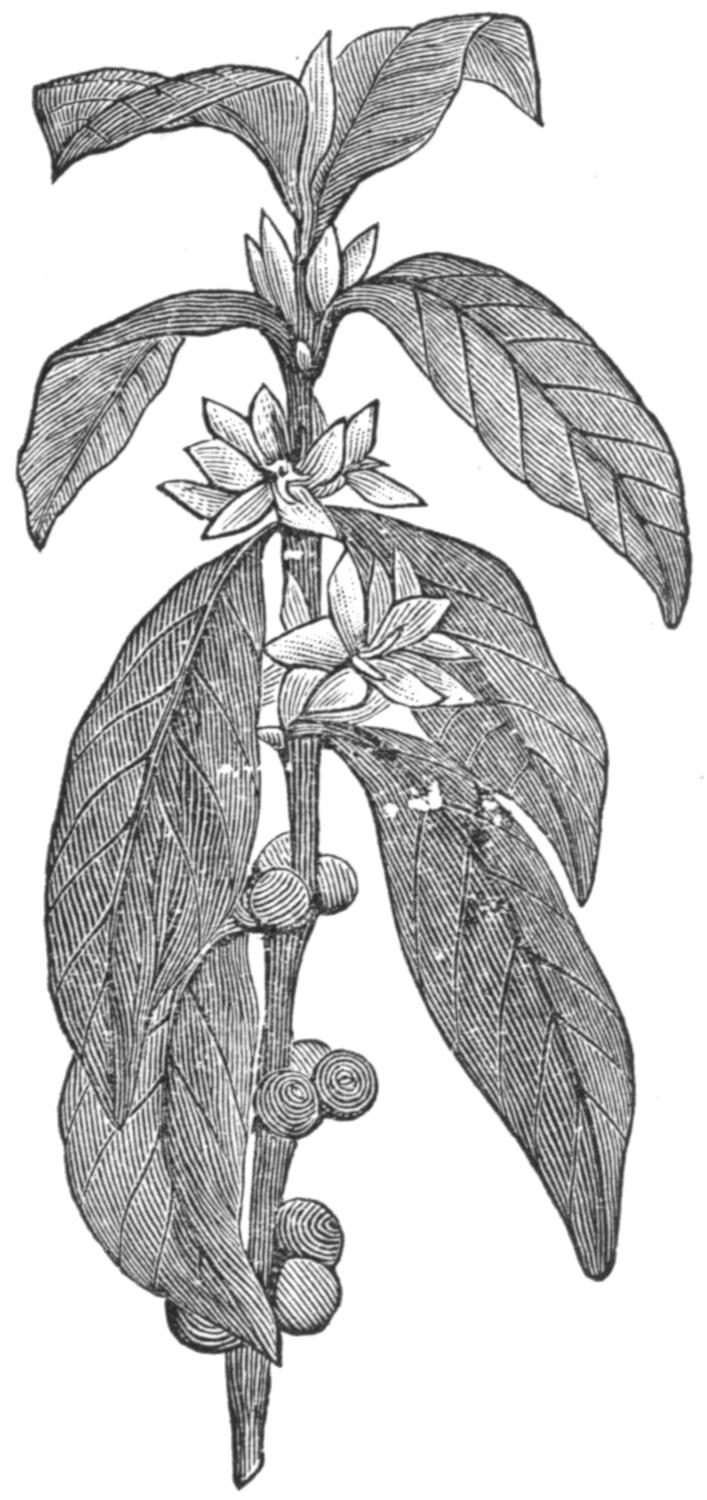
The common Coffee shrub is an evergreen plant, which,
under natural conditions, grows to a height of from
eighteen to twenty feet, having the appearance of an
upright, slender tree, with main stem very erect, and free
from branches for the greater part of its height, but
opening at the top into drooping branches, few but long,
with an abundance of fine fibrous roots under ground,
and an all-important top-root. But in a state of cultivation
it is a shrub of close and systematic growth of low-standing,
and averaging only from four to six feet in
height, its upward growth being checked by the pruning-knife
of the cultivator, and also trained by frequent cutting
and topping so as to assume a pyramidal form for
the purpose of increasing the quantity and improving
the quality of its product as well as to facilitate the picking
of its crop. The branches are bracheate, horizontal,
simple and opposite, growing regularly from the ground
up, but trailing towards the top, cylindrical in form,
flexible, loose and expanding out and downwards like
those of the apple tree, and extremely pleasing in general
appearance. The leaves are from five to six inches in
length, and from two to three wide in the middle
when full grown, oblong-ovate, accuminate, smooth, and
of a dark, shiny-green color on the upper surface, but pale
underneath, firm and leathery in texture, closely resembling
those of the Portuguese laurel, continuing three
years, and possessing slightly tonic and stimulating properties.
The flowers, which are produced in dense
clusters in the axils of the leaves fitting close to the
axils, are funnel-shaped and small but numerous, having
a five-toothed calyx, a tubular five-parted corolla,
five stamens and a single bifid style, snow-white in color,
possessing a rich, fragrant odor, approaching that of the
jessamine, the plants in blossom having a peculiarly rich
and attractive appearance, the bloom being very evanescent
and of short duration, but are quickly followed by
fruit, there being generally two, sometimes three, relays
of blossoms before all the buds mature, until after a day
or two, when they gradually turn brown and fade
away; the slower and more gradual this process the
better for the crop, which is always estimated by the
abundance of the blossoms. The fruit, which quickly
follows in the hollow of the leaves, is a fleshy or “pulpy”
berry, at first greenish and hard to the touch, assumes
a yellowish hue as it continues to ripen under the meridian
sun, the color deepening not regularly but by crimson
or scarlet shades and tints which spread over the
surface, having at this stage the size and appearance of a
small cherry, assuming a dark-red or deep, glossy purple
black color with a smooth and bloomless cuticle as it
matures. In both states of flower and fruit nature is
nowhere so profuse and beautiful in the variety of its
colors and forms. The plant, being an evergreen, the
foliage is always fresh, and, though, in the autumn season,
the blossoms appear scattered among the dark-green
leaves, resembling flakes of snow, they are hardly ever
absent from the tree. It continues to put forth fruit,
while the blossoms are arriving at maturity, and nothing
is more singular or striking of its kind than its producing
capabilities, as at all seasons, leaves, blossoms and ripe
fruit are to be seen on the same tree at the same time,
and the fruit may be gathered at any period, but the
regular harvests are usually two in the course of a year.
Each fruit contains two seeds embedded in a yellowish
pulp, the seeds being again enclosed in a thin membraneous
parchment. The Epicarp or outer-skin of the
berry is at first dark-green in color, but assumes a
yellow and finally a bright-scarlet color as it ripens,
becoming dark-purple as it dries, having a little circular
area at the summit and a callous point through it. In
this condition it contains a mucilaginous, saccharine,
glutinous substance, technically termed the “pulp,” a succulent,
sweet and palatable matter, closely enveloping the
seeds, frequently eaten by the pickers. Another substance,
known as the Mesocarp, secures and separates the
Pyrenes or seeds, and as the fruit dries this mesocarp
hardens and becomes part of the shell or hull surrounding
the seeds, which it becomes necessary to remove by
a milling or hulling process in order to free them from
this covering. These pyrenes or seeds are again invested
by a cartilaginous membrane termed the Endocarp, but
commonly known as the “parchment,” a papery, elastic
substance, loosely but completely enveloping them. On
removing this parchment we have exposed two small,
oval seeds facing each other, though sometimes there is
but one called from its shape male or “pea-berry.” These
seeds, which constitute the raw Coffee of commerce, are
plano-convex in form, the flat surfaces which are laid
against each other within the berry, having a longitudinal
furrow or groove extending their entire length. When
first exposed they are of a soft, semi-translucent bluish or
greenish color, afterwards becoming hard, tough or flinty
in texture, in which state it is known as “rice coffee,” the
bulk of which forms the Coffees of commerce. This
seed or “bean” as it is called in trade is still incased in
what is known as the Testa, another covering which
forms an integument of the seed and which is known to
commerce as the “silver-skin,” the mass of the coffee
beneath this testa being termed the Albumen. Contained
in this albumen and embedded near its base is to be found
the Embryo. The first of these structures, that is, the epicarp,
mesocarp and endocarp, belong to the fruit or berry,
the other three, that is, the testa, albumen and embryo, being
essentially parts of the seed or bean. The uses of these
various structures surrounding the embryo are to protect
it from injury and at the same time supply it with proper
nourishment until such time as it is enabled to take care of
itself. The testa or silver-skin enveloping every part of
the albumen, following and dipping into the furrow on
the face of the Coffee bean by its tough, leatherly nature,
acts as an effectual protection to the delicate structures contained
within. The albumen, bearing the same relation
to the bean that flour does to wheat, the white-meat to
cocoanut, and the aromatic, ruminated secretion to the
nutmeg. It is a secretion, found in the internal of the
seed, enveloping the embryo plant, and for the support
of which it is destined when it first begins to germinate.
Each perfect Coffee berry should contain two such
oval seeds, placed facing each other, the flat sides opposite;
but it frequently occurs that only one seed forms,
the other becoming abortive, and variously known as
“virgin” “male” or “pea-berry.” Coffee seeds are
generally termed “beans” in commerce, a term not
derived from any resemblance they may have to a bean;
while, again, they are termed by many as “berries,” the
latter term being applicable only to the fruit or pod, the
term “bean” being more appropriate to the seed.
According to some botanists, there is but one genus
of the Coffee plant,—Coffea Arabica,—others, again,
contending that there are two separate and distinct
species, classified as Coffea Orientalis and Coffea Occidentalis.
While admitting but one genus, the difference in
size, appearance and product being attributed by them
to a variation in soil, climate and methods of cultivation,
there are three principal varieties, however, readily
distinguished and recognized by those who have much
to do with it, and are known to commerce as Coffea
Arabica, Coffea Liberica and Coffea Maragogipe, lately
discovered in Brazil, all of which or their transplants
furnish the Coffees of commerce.
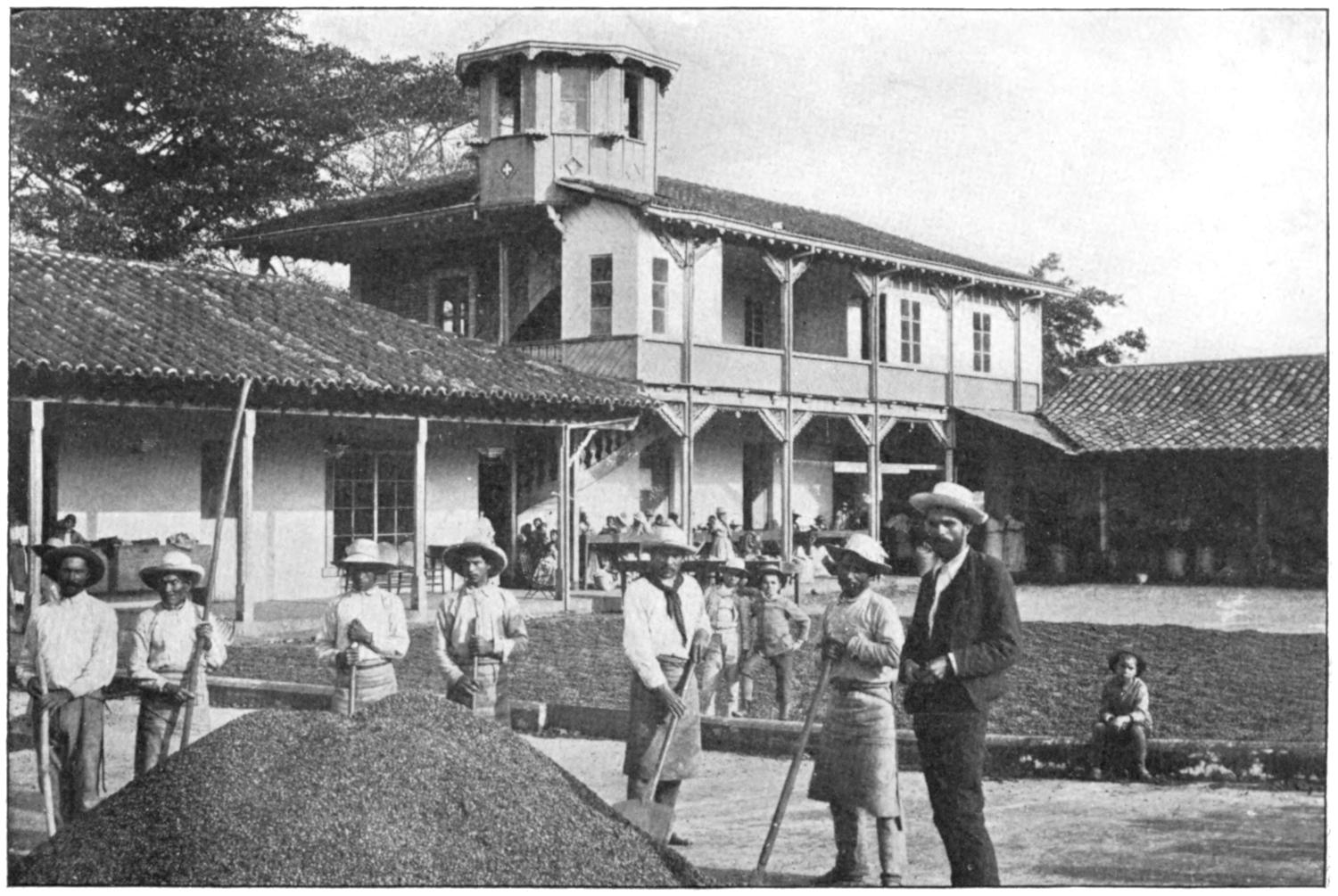
Coffee Hacienda and Grower.
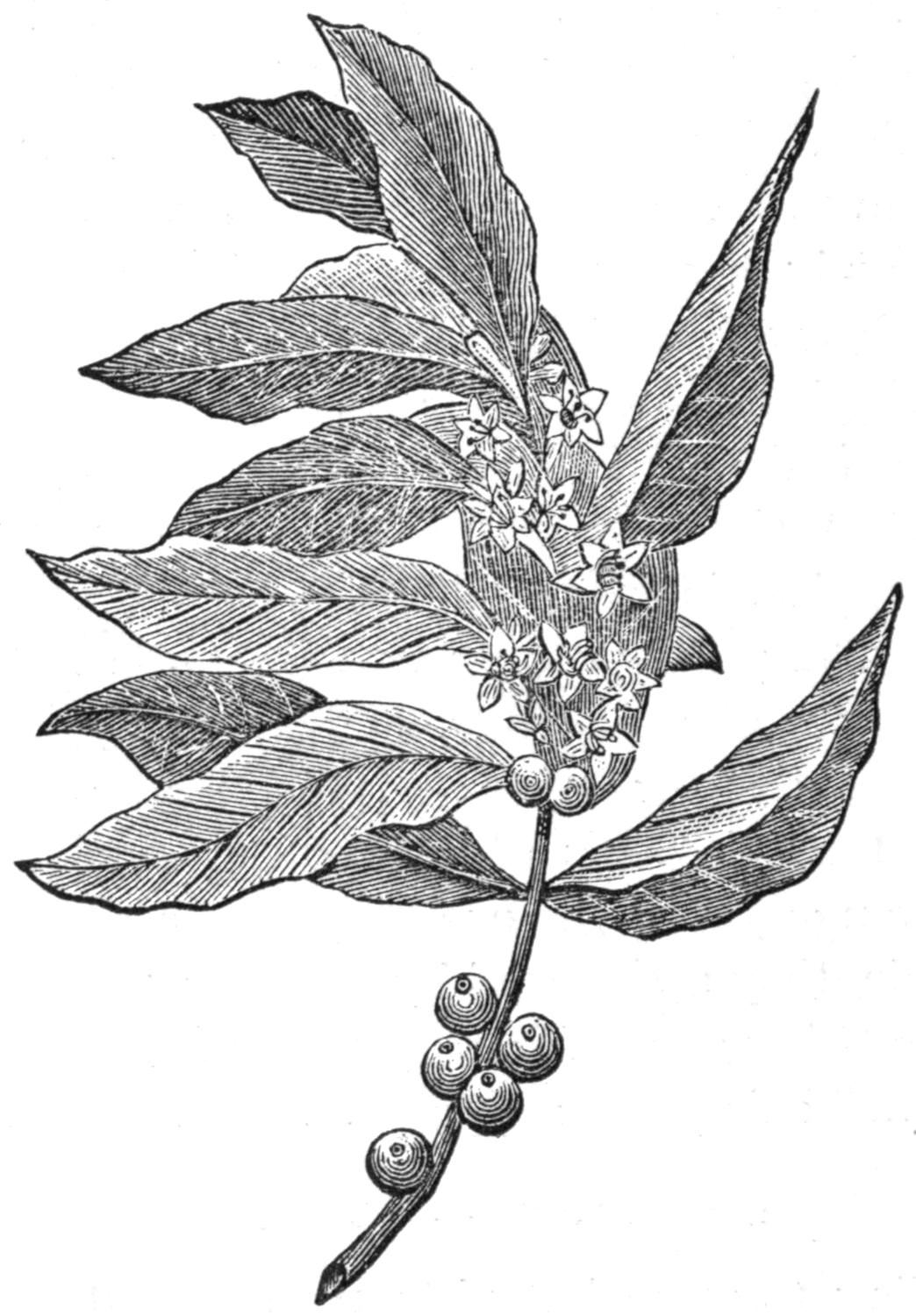
Or “Arabian Coffee plant,” is the best-known species,
being an evergreen, partaking more of the nature of
a shrub, which, in a state of cultivation, varies in height
from four to six feet, its foliage resembling that of
Portuguese laurel. The trunk is erect and slender,
averaging about three inches in diameter and covered
with a whitish-brown bark, rather rough in appearance.
The branches are numerous, ordinarily bending downwards
when the plant begins to grow old, but when
young and vigorous extend in a round form like an
umbrella. The wood is very limber and pliable, so much
so that the ends of the longest branches may be bent
down to within three inches of the ground without
snapping. The leaves are oval in form, dark green in
color, shiny and sharp pointed as those of the citron
tree, ranged on the branches opposite, but at a little
distance from each other. The flowers or blossoms are
also numerous, clustering with projecting antlers, snowy-white
and very fragrant, but of short duration, disappearing
quick, but rapidly followed by the fruit springing
apparently from them. The fruit is a small berry,
green at first, but assuming a rich scarlet as it ripens.
From this species has been propagated the numerous
varieties now known to commerce. The range of this
species is at elevations of from 1,000 to 4,000 feet above
sea-level between the latitudes of 15° north and 15° south,
but its cultivation may be extended for commercial purposes
to 36° north and 30° south in latitudes where the
temperature does not fall below 55°; still the most favorable
climate for it would be where the temperature does
not fall below 60° to 80° in the shade, and as to humidity
there should be no month in the year entirely devoid of
rain, the total of which should range from 100 to 150
inches per annum, that is, an absence of extremes of
temperature with a constant supply of moisture. This
species is cultivated chiefly in Arabia, India, Ceylon,
Natal, Java, Sumatra and other islands in the Malay
Archipelago, as well as in Mexico, the West Indies,
Central and South America and recently in Australasia,
furnishing almost the whole of the coffees of
commerce.
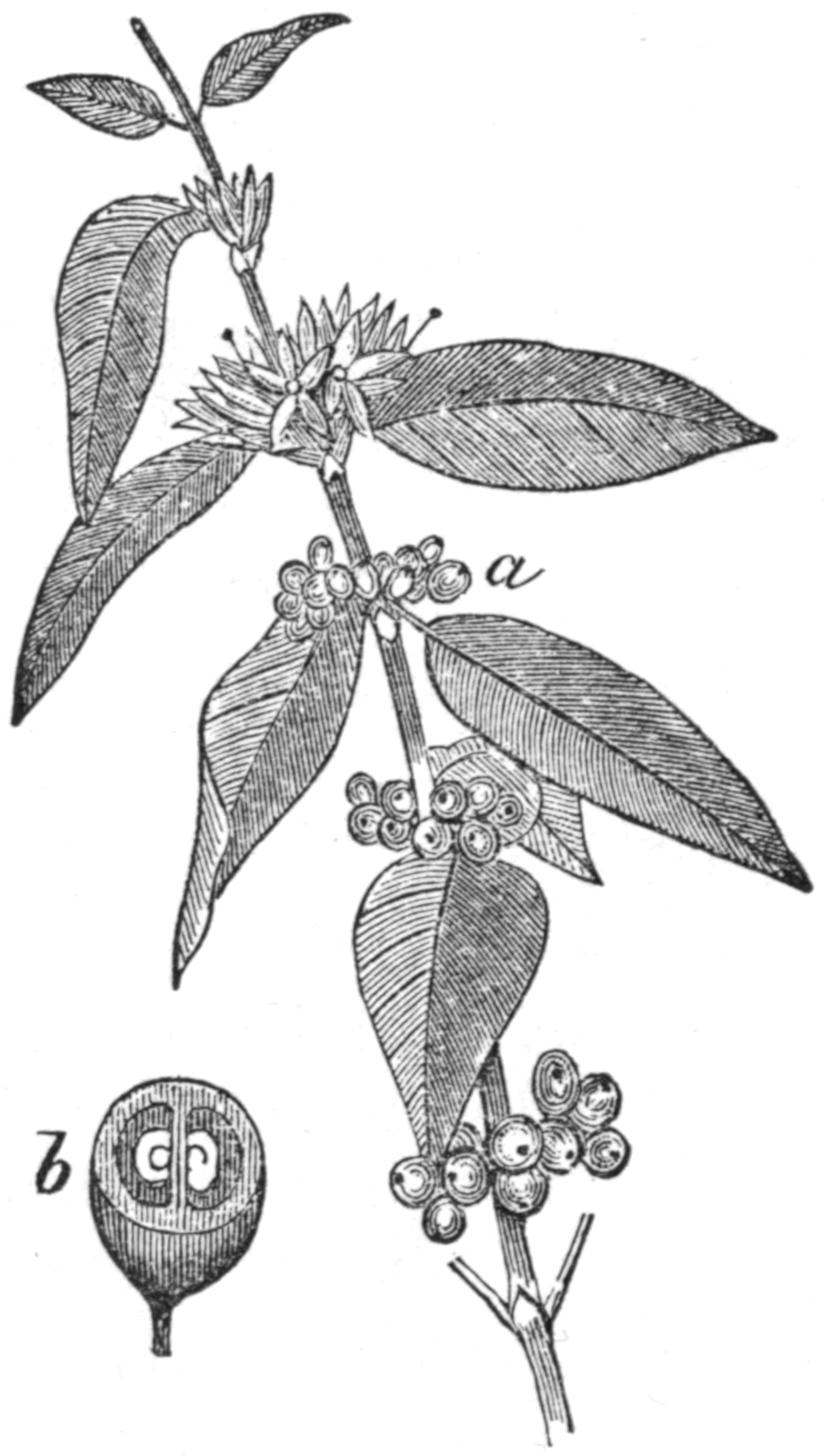
Or “Liberian Coffee plant,” which has recently been
brought forward as a rival to the Arabian variety, is
an indigenous species found both in a wild and cultivated
state on the west coast of Africa, and which in an
adult cultivated state ranges in height from fifteen to
twenty feet, being of tree-like habits. The trunk is thick,
very erect, and covered with a dark-brown bark of a
downy texture. The branches also differ from those of
the Arabian species insomuch as they do not possess
the horizontal, drooping tendency so characteristic of the
latter, being also hardier and more prolific. The leaves
are proportionately large, varying in length from eight to
fifteen inches and in many instances from four to five
inches in width at their widest part. They are dark-green
in color, leathery in texture, and instead of the wedge-shaped
base, narrowing as it approaches the petitole or
stalk; it more resembles the continuation of the extremity
of the leaf itself. The flowers are also fewer, never more
than six to eight in a cluster, are much larger, but devoid
of fragrance. The fruit, as may be inferred from the
tree-like habits of this species, is extremely large, averaging
an inch to an inch and a quarter in length, ellipsoidal
in form, and characteristically pointed at both ends. It
lacks the bright red color of the Arabian variety, when
ripe, being commonly of a dull red, approaching brown,
becoming black as it dries. The pulp is also thicker,
fibrous and more fleshy, but lacking in succulence, and
cannot be eaten; the parchment being hard and brittle,
dark-brown in color and never clear. The testa, or
silver-skin, is much stronger, tougher, and more tightly
rolled into the deep, narrow furrow on the face. The
seed or bean is also extremely large in size, peculiar in
form, what is known as “male” or “pea-berry” in
form is dark-brown in color, solid and heavy in weight
and exceedingly strong in flavor. Taken altogether, the
wide divergence in the general appearance and habits of
this variety, the culture of the leaves, lesser number of
flowers, size, weight, color, peculiar formation, and other
characteristics, stamp it as a distinct species of the genus
Coffea.
Increasing attention is lately being devoted to this
species. It is a native of Liberia, and is to be found
growing wild in great abundance along the whole of the
Guinea coast and is to be distinguished from the ordinary
shrub by much more vigorous growth, by affecting flat,
low and coast lands as well as hill sides, by attaining
greater size and withstanding greater extremes of climate.
It also possesses the additional advantage in that it
is capable of improvement by cultivation, and though as
liable to disease as the Arabian plant, appears to be
affected only in a minor degree, while on the other hand
the product is much coarser flavored, which is considered
no drawback to its being used for admixture with
better sorts, by which means it yields a cheap, yet genuine
beverage. Experiments have been lately tried in
Ceylon of grafting the finer flavored Arabian on the
stocks of this species, thus producing a hybrid from
which great benefits are anticipated in the future. It
is a species, moreover, which grows well in low altitudes,
and would probably flourish is situations that have
proved unsuitable for the Arabian plant, and should it
come up to the sanguine expectations of the Java, Ceylon,
Mexican, South American and other planters, to
whom it has been submitted for experiment, there is no
doubt but that it will prove a formidable rival to the
species which have hitherto received the exclusive attention
of planters generally.
Or “Brazilian Coffee plant,” is a new and indigenous
variety, recently discovered in the province of that name,
in Brazil, much larger than the Arabian, but smaller than
the Liberian. It grows with extraordinary vigor, coming
into full bearing much sooner than either of the foregoing
varieties, trees of two to three years attaining a
height of eight to ten feet, being full of fruit at that
age, the berry and product per acre being also larger.
Planters who have adopted this variety are so well
pleased with the results obtained that they are replacing
the regular species with it, all agreeing that in size of
berry, style of bean, strength and flavor, it is a species
to be recommended.
There are numerous other varieties of the Coffee plant,
closely allied, but still markedly distinct from the foregoing
species, inasmuch as they do not possess any
valuable or intrinsic properties, being cultivated only for
the sake of their foliage or flowers. Among which is
that of:—
Coffea Mauritiana.—Found on the island of Mauritius,
and evidently belonging to the Arabian species, yet
claimed by La Marche to be specifically distinct from it,
on account of the difference in the size and form of its
fruit. This eminent botanist must have been unaccountably
negligent with respect to its specific character,
having retained the description given by Linnæus of the
Arabian plant, which is in the Plantarium described as
entirely opposite to it.
Coffea Guinensis.—A native of Guinea, on the
west coast of Africa, and a shrub from one to two feet
high, with flowers quadrified, berries small and violet-colored,
seeds two in number, cartilaginous and pointed
at the ends; but found to be entirely devoid of the valuable
or stimulating properties so characteristic of those
of the true Coffee plant.
Coffea Panenlato.—Another species, also found on
the Guinea coast, being a shrub having a large trunk,
from seven to eight feet high, covered with a gray,
cracked bark and yielding a fruit totally different from
that of Coffee.
Coffea Racemora.—A species found in a wild state
on the east coast of Africa, and in a state of cultivation
in the vicinity of Zanzibar. It is a small, upright, tree-like
plant about six feet high, heavy in foliage and flowering,
but devoid of fragrance and barren of fruit.
Coffea Trifora.—A shrub of about six feet high, found
in Othahetai, foliaceous and flowery, but producing no
fruit. This particular variety is also to be found in
Jamaica, San Domingo, Martinique and other islands of
the West Indies. Many other species such as the Coffea
Fambasena, a native of the Friendly Islands, Coffea
Ghengalensis, grown in Nepaul, Coffea Opulina and the
Cirdorata, the latter being claimed to be analogous to the
true Coffee plant, and is extensively grown on the island
of Tamai, and many others cultivated principally for
their seeds.
CHAPTER IV. CULTIVATION AND PREPARATION. — SOIL AND CLIMATE. — SELECTING LAND. — SITUATION AND ASPECT. — SHELTER AND SHADE. — CLEANING AND BURNING. — LINING AND MARKING. — ROADING AND DRAINING. — LAYING OUT THE NURSERY. — DISTANCES OF PLANTS. — HOLING AND PITTING. — PLANTING AND PICKING. — DIBBLING AND STAKING. — SUPPLYING VACANCIES. — CATCH-CROPS. — MANURES AND MANURING. — WEEDING AND PRUNING. — ENEMIES AND REMEDIES. — GATHERING AND HARVESTING. — PULPING AND PREPARING. — FERMENTING AND DRYING. — HULLING AND PEELING. — WINNOWING AND SIZING. — BUILDINGS AND STORES. — PACKING AND SHIPPING. — COST AND PROFIT.
 The
principal points which determine the value of
a location for the successful and profitable cultivation
of Coffee are:—(1) Soil and climate; (2)
Situation and aspect; (3) Temperature and rainfall; (4)
Proximity to a river, and (5) Shelter from wind and wash.
Most of which are necessarily subject to variation, according
to country and locality, shelter from wind being perhaps
of the most paramount importance, and which should
not be sacrificed for a richer soil, as the latter can be artificially
supplied much quicker than the former.
Soil and climate are subjects of primitive importance
in the cultivation of Coffee. The soil of Coffee lands
varies as widely almost as the different countries in which
it is grown. In Africa, where the plant is indigenous, it
is chiefly composed of a reddish clay on the West Coast,
with a hard sandy subsoil, while on the East Coast it is
found to be composed chiefly of a dark loamy earth.
The Arabian soil, where the plant is exotic and where
the finest Coffee is produced, is purely an artificial one,
while in India it is successfully grown in five different
kinds of soil, ranging from a dark chocolate clay to a
deep jungle mould. The soil of Ceylon consisting of a
rich, dark earth, friable and mixed with blocks and small
stones. On the island of Java, to the contrary, where
some of the finest varieties are produced, the soil is principally
composed of a black leaf-mould, intermixed with
fine sand and small stones, whereas in the principal
Coffee-growing countries of the American continent the
best crops produced, as a general rule, are raised on rich,
dark loamy lands, the subsoil of which are too rocky to
be worked with a plow. The only exception to the rule
being Brazil, where the soil varies to a great extent, a
clay of terra rocha forming the chief upper and lower
subsoil. The most suitable soil for Coffee cultivation,
however, is that which grows soft timber, to be found on
high quartzy ridges, where the land is of a dark chocolate
color, mixed with small stones, and overspread here
and there with boulders of granite, as where the soil is
dark, loose and full of roots, it is sure to be rich in
organic matter, and therefore good for Coffee, which is a
hardy plant and not on the whole difficult to please in
this matter; such a soil generally contains about 5 per
cent. of its weight of organic matter in combination with
other fertilizing substances. Looking at Coffee soil from
an analyst’s standpoint, it consists of an organic part,
which when placed in the fire will burn away, and an
inorganic or mineral part which will not burn. The
constitution of the first is well known to planters, being
formed of the remains of animals, insects, or minute
visible and invisible organisms of various kinds, from the
dung of animals, birds, caterpillars and worms, to that of
roots, stems and leaves of decayed vegetable matter.
The inorganic part, consisting of sand, clay, lime, magnesia
and the oxides of soda, potash and manganese, including
carbonic, sulphuric and phosphoric acids. The preponderance
of one or more of these natural divisions,
making the soil productive or unproductive as the case
may be, while certain plants make certain calls upon one
or more of these substances, and, consequently, such
must be present and available in a soil that is to suit
them. A rich soil for Coffee generally contains about
five per cent., or one-twentieth of its weight, of organic
matter in combination with other fertilizing substances.
But as to the best soil for Coffee in particular the leading
authorities differ, so that as a broad principle it may
be laid down that the best soil is the richest, no matter
what its color, whether it be the valley silt of Arabia,
the volcanic mould of Java, the jungle soil of India
and Ceylon, or the rich red earth of Brazil. But the
deeper, freer and richer the soil, whatever it may be, the
better as long as it is specially tested for phosphoric acid
and potash. The latter is found in abundance wherever
a large forest has been felled, burned grass-land being
also considered good for this purpose, as it also contains
those very requisite properties of Coffee soil.
If the soil be naturally light and poor and washed by
every shower, the more soluble portions, together with
the salts of the manure applied to the trees, is generally
robbed by the heavy rains. In such a case it is next to
impossible to keep a plantation in a high state of cultivation
without an enormous expense in the constant
application of manure. Many plantations are again
subject to landslips, which are likewise produced by the
violence of the rains; in such cases the destruction is most
disastrous, and whenever landslips are frequent they
may be taken as an evidence of a poor clay subsoil.
The rain soaks through the surface, and not being able
to percolate through the clay with sufficient rapidity, it
lodges between the two strata, loosening the upper surface,
which slides from the greasy clay, launched, as it
were, by its own gravity, into the valley below. This is
the worst kind of soil for the coffee tree, whose long
tap-root is ever seeking nourishment from beneath. On
such a soil it is very common to see a young plantation
giving great promise, but as the trees increase in growth
the tap-root reaches the clay subsoil, and the plantation
immediately falls off. The subsoil is of far more importance
to the coffee tree than the upper surface, as the
latter may be improved by manure, while if the former is
bad there is no remedy. The first thing to be considered
being the soil, and the planter being satisfied with its
quality, there is another item of equal importance to be
taken into consideration when choosing a locality for a
coffee plantation. This is an extent of grazing land sufficient
for the support of cattle that may be required for
producing manure. In countries with large proportions
of forests this is, however, not always practicable, the
planter having recourse to artificial manure.
The subject of climate, though quite as important as
that of soil, can yet be described with more accuracy.
The extreme limits of coffee cultivation lie between the
isothermal lines of the 25° north and the 30° south of
the equator, but the best zone of latitude is that lying
between the 20° north and south of the equator, one
having a mean temperature of 65° to 75° Fahrenheit.
A constant and uniform moisture, either natural or artificial,
is especially requisite and indispensable to the free
development of the trees, together with a rainfall of
from 75 to 150 inches per annum, falling early in the
season, but must be well distributed at the same time.
The regions, however, found to be best adapted for the
most successful and profitable cultivation of Coffee, are
well-watered mountain slopes at an elevation ranging
from 1,000 to 4,000 feet above sea-level, in latitudes
lying between 15° north and 15° south of the equator,
although it is profitably grown at the present time from
25° north to 30° south of that line, but only in situations
where the temperature does not fall below 55° at any
time.
As a general rule, virgin forest land has been found
the most suitable to break up for Coffee plantations, it
having become naturally enriched by decayed vegetable
matters, and the burning, to which it must first be
subjected, frees it from all weeds and insects. But
exceptional tracts of land, that have been once under
cultivation and then allowed to run wild, also form
good properties, and although the soil is rarely rich,
it is generally exposed, and always entails great trouble
and expense to keep down the weeds. A temperate
climate within the tropics is to be preferred at all
times, a certain degree of warmth and humidity combined
being essential—in other words, an atmosphere
resembling that of a northern hot-house produces the
finest crops of Coffee, but, unfortunately, it is inimical to
the unacclimated planter and favorable to weeds. The
most suitable climate, under these circumstances, is precisely
that which Americans prefer; frost, even though
it be only at night and for a short period, is fatal, while
the presence of water, preferably a running stream, is
most essential for watering the young plants, as well
as for the “pulping” process. In a wooded country
the plantation may be laid out in blocks of fifty acres,
encircled by natural belts of forest; but flat land must be
avoided, as a wet soil is fatal to profitable coffee-growing,
and flat lands also would entail great expenditure for
drainage, while steep slopes, on the other hand, are also
objectionable on account of the wash occasioned by
rains carrying away both soil and manure, thus exposing
the roots of the shrubs. The top or surface-soil must
be fairly good in all cases, the subsoil may be, but must
never be, composed of stiff clay, the shrub being essentially
a lateral feeder.
In opening a plantation, which is in all cases to be
shaded by preserving a portion of the original forest trees,
the first thing to be done is—after having ascertained the
amount of land that can be conveniently planted in one
season—to clear a wide road through the underwood
from one end of the block of forest to the other, and as
many at right angles to the line as may facilitate easy
examination and of thoroughly inspecting the land to be
cleared. The next thing to be done is to cut another
wide line round the entire portion to be cleared, leaving
a belt of from fifteen to twenty yards wide as a margin
which is always to be kept uncleared, as this marginal
belt will be found useful for shelter. The amount of
shade must be regulated according to the value of the
exposure as shown in the aspect. A great deal of shade
being required on southern slopes, very little on northern
ones, and only a moderate degree of shade being required
for eastern and western slopes. The preliminary lines
having been cleared, the whole of the underwood should
then be cut down from one end to the other, and while it
is yet green such portions of the larger trees as it may
be difficult to remove by carting or dragging along the
ground, should be cut up in pieces, but never burned, as
is frequently the custom. This work should be completed
by the end of December. The land being thus
thoroughly cleared, lines of road should be laid out and
the usual linings and pit diggings carried out, and the
plants put down immediately after. The next point to be
attended to is to plant out such trees as are particularly
suited to coffee shading, and to remove any kinds which
experience has proved to be injurious; these latter vary
in the different countries. As the shade trees grow up,
the same care must be taken of them as of the coffee
tree, as regards pruning or topping, the lower branches
being judiciously removed, the object being to grow a
tree not only luxuriant but lofty, in order that it may
throw a long shadow and so afford greater protection to
the plants in its vicinity. Another point to be considered
in the location of a successful Coffee plantation
is situation, as regards shade, sun and wind, as a location
and method of cultivation suited to one climate may be
entirely unsuited to another. In sea-coast or moist
climates planting without shade is generally the custom,
while in dry arid climates shade is indispensable, as in
wet or damp districts Coffee cannot be grown to advantage
under the shade of the largest trees; the methods
of cultivation therefore should be entirely different in the
differing districts or localities. To be emphatic, climate
should regulate shade, that is, shade plantations thrive best
in hot, dry climates, and unshaded in moist or humid ones.
The Coffee-plant in most countries has been found to
flourish best, and produce more abundantly, and reach a
greater longevity on upland or mountain situations at
altitudes ranging from one to four thousand feet above
sea-level; but a mean elevation of three thousand feet
has been found by experience to be best adapted for its
most profitable culture. In the selection of a site for the
establishment of a coffee plantation the same general
rules are observed throughout all the coffee-growing
countries; and, while an eastern or southern exposure
is preferable at all times, it is not essential under all
conditions, this general principle being subject to modifications
from such causes as local peculiarities of climate,
abundance of forest shade and methods of special cultivation.
Many plantations situated at sea-level are
generally overshadowed by thickets of dense foliage,
while those situated on mountain slopes are usually
much exposed to winds and wash. In the older coffee-growing
countries of the East an eastern aspect is
considered the most desirable, a western exposure being
generally selected on the American continent, as it loses
less of its moisture. The opposite slope being more
exposed to the vertical rays of the sun thereby preserves
a more equal temperature.
Before clearing and burning the planter should take
considerable pains to ascertain the values of the different
aspects as regards sun and wind with the view of regulating
the amount of shade accordingly, as it is impossible
to exaggerate the importance of the various exposures.
For the effects the sun’s rays have on certain aspects in
heating the soil and drying up the plant are such as
would be extremely difficult to believe had the effects
not been verified by competent observers and with the
aid of a thermometer. And as regards sites, northern
and southern slopes in particular, the difference between
the one exposure and the other is just what constitutes
the difference between green and dried grass, and between
leaves luxuriously green and leaves dried and
withered. The grass on the northern aspects being
green and comparatively fresh, while even in a valley
sheltered from drying winds the grass on the southern
slopes is completely withered. An equally striking difference
is observable in the coffee plants grown on these
situations, those on the northern slopes being full of
health and life, while those situated on the southern are
yellow, drooping and sickly; even in districts where coffee
will not thrive without a considerable amount of shade
the plants thrive well with little or even none on a
northern bank, and look better than on a moderately
shaded southern aspect. Nor in the nursery is the
effect less of aspect, less striking, a nursery situated on
a northern slope requiring less water and far less shade
over the young plants than in a nursery sloping towards
the south.
With regard to the aspect of wind the subject is an
infinitely more difficult one than aspect as regards the
sun’s rays, the value of the latter being mathematically
ascertained, for in countries full of hills and ravines one
is constantly liable to be deceived as to the points that
are exposed and those that are sheltered from the force
of the wind; what is the right side of the hill for one
planter is often the wrong side for another, whose
plantation is perhaps only a few miles distant. While
one planter may rail against the east wind, another will
be equally loud against a west. The winds, however,
that are most to be dreaded as being absolutely fatal to
a coffee plantation are the fierce gales accompanied by
torrents of rain. These winds are injurious in two ways:
first, the plants are blown about, their hold on the soil
weakened and the tender rootlets broken as fast as they
are formed, and in the second case, the rain which
accompanies such winds is driven into the hillsides with
such force as to occasion a certain amount of wash, the
particles of soil being lifted and valuable top soil swept
away and utterly lost. The southwest winds are only
fatally injurious on the first barrier; further inland their
force is greatly modified, and to such an extent that
little or no injury results from them.
In estimating the value and importance of exposures,
planters and others of experience are frequently deceived;
as aspects that one would naturally conclude are very much
exposed often remain untouched by the wind, while on
others apparently sheltered it has been known to burst
with tremendous force. Of aspects as regards wind there
are two points that may fairly be relied upon. The first
is the appearance of the soil on the slopes, and the second
the inclination of the forest trees. The soils on windy
slopes will be found invariably to present a hardened and
washed appearance, and are deficient in decayed vegetable
matter on the surface. The inclination of the trees,
also, and especially the extent to which their heads are
bent, denotes how forcibly the wind strikes on these sites.
In summing up on these important points of aspect it
may be observed, as regards the sun’s rays, it is patent
that a northern aspect is the best, and a southern one
the worst, because the latter is exactly twice as hot as
the former. And as regards the eastern and western
aspects there is not, as regards heat arising from the
sun’s rays, much to choose between them.
The worst enemy of the Coffee shrub is wind, its effects
becoming apparent in pinched and stunted growth or in
lack of foliage. In situations where the soil is soft and
yielding it does equal mischief by working the stems in
the ground, so that in a short time a funnel is formed
round the neck of the plant, and this being continually
chafed the bark is worn off, the roots are loosened, and
the plant dies of what is called “wind-wrung.” Should
it be rescued before the bark is entirely worn off the
plant may live, but it will be extremely liable to attacks
from “lug worm” or any other blight that may be prevalent
in the locality. Belts of jungle or forest land are
sometimes left standing as a protection from wind, but
opinions differ as to the advantage of this plan, some
planters holding that more harm is likely to result from
the wind being concentrated into eddies instead of taking
its natural and more equitable course. This question
can only be decided by the local surroundings in each
case. Such belts being sure to form nurseries for weeds
and vermin are not intended to be permanent, and should
gradually give way to fruit or other useful trees. Sometimes
artificial shelter is erected, but is considered too
costly to find general favor; indeed, in moderately sheltered
situations, staking, combined with low topping,
ought to be sufficient to secure the stability of the plant.
Where they are not, the situation has little to recommend
it for successful Coffee culture.
Shade is also a consideration of great importance, and
the opinion now generally adopted is that the wholesale
felling of the forest in some sections has been altogether
a mistake, and that plantations which are now extinct
might still be flourishing had the forest shade been at
least partially retained. The history of Coffee cultivation
in the East proves that in hot climates, and where
prolonged periods of drought may recur, Coffee will not
flourish permanently, except under shade. In a state of
nature the Coffee plant universally affects shade. This
is the more remarkable, though the seeds are deposited
by wild animals and birds as freely on open grass-lands
as in forests. The suspicion that the “bover leaf disease,”
and other immediate causes of decay, are only induced
by weakened state of the shrubs consequent upon their
exposure to light and periods of drought, is supported
by the fact that where shade trees are found standing
upon an abandoned plantation, they are still surrounded
by a surviving remnant of Coffee bushes. The question
as to where shade is necessary is, however, one of climate,
as it has been proved that it is not universally beneficial.
The advantages to be derived from it in very hot climates
being: diminished exhaustion and consequently increased
longevity of the plant, reduced cost of cultivation, a conservation
of the nutritious properties of the soil, and an
actual increase of them, as the cover given to the ground
causes the surface vegetable matter to decay more rapidly.
And provided the tree be a subsoil feeder, the shedding
of the leaves will yield a positive gain of surface matter
which the roots of the Coffee plant would otherwise
never have reached. In addition to these there is the
direct value of the timber grown on the estate. The
only serious drawback to shade would seem to be a
diminished yield of Coffee, but this is fully atoned for by
the increased longevity of the plant.
When forest land is taken for cultivation the first step is
to effectually clear it of all timber and underwood, the
latter being first cut by means of a “cattie” or machete,
the large trees being felled from the top, and their
branches lopped off so as to compact the pile, as otherwise
the “burn” will only be partial. A fine day, after
the night’s dew has evaporated, is best for setting fire to
the prostrate mass, the advantages of a thorough burn
being that subsequent operations are greatly facilitated,
and that the weeds and insects are thoroughly destroyed,
while the disadvantage is that the upper soil is burnt
and rendered unfit for filling into the holes. That injury
may, to a great extent, be obviated by “lining and pitting”
the land beforehand, by which means the surface
soil would be mostly covered over with the earth taken
out of the pits, and thus be protected from the fire. On
the other hand, the “lines” could not be marked out
with accuracy or with any regularity, so that the estate
would subsequently suffer to some extent in appearance,
though it is an open question how far this drawback is
worth considering in comparison with the other advantages
gained. When there is not sufficient timber to
make a good burn, the brush is felled and burnt in heaps,
after which the ground is carefully gone over for the
purpose of rooting up the tree stumps which remain,
but these are sometimes so difficult to eradicate that they
are left to decay, care being taken, however, to knock
off shoots as fast as they appear. It is, however, a bad
method and one seldom followed, as the rotting stumps
harbor vermin of all kinds. After burning the wood the
ashes should be scattered evenly over the ground as
manure to enrich the soil.
Immediately after the burn the plantation is “lined
and marked out” for the reception of the plants, the two
following methods being most in vogue among old and
experienced planters: (1) A base line is laid down as
nearly as possible straight up and down the slope, and a
cross line is set off exactly at right angles to it; on this
line stakes are driven into the ground at the distances
determined upon for the final position of the young
plants, to each stake a rope is fixed and stretched parallel
with the base line, and as straight as possible,
smaller stakes being provided along these lines, a rope is
then finally held across them at succeeding stages of
equal width as guided by measuring poles and the small
stakes, and the small stakes are put in where the movable
rope crosses the fixed ones, each stake indicating
the site of the plant. (2) A rope is furnished with bits of
scarlet rag or flannel at the distances decided on between
the plants and stretched across the plot, stakes being
inserted at each rag, the rope is then moved forward a
stage at a time, gauged by measuring rods. The first
plan is the better, especially in broken ground, but is more
laborious, the second being best available in even grass-land,
but the stretch of the rope must be estimated and
allowed for, the great object being to have the lines perfectly
regular, and instead of making any deviation where
stumps or other obstacles occur, the rope is laid over
them and the corresponding plant omitted.
Efficient roads not only greatly facilitate the making
of a Coffee plantation, but they should be so laid out as
to serve the additional purpose of drainage. A cart road
should pass through the centre of the plantation wherever
it is possible to avoid a steeper gradient than one in fifteen,
emerging upon the main highway. From this branch
roads should be cut at right angles with as easy gradients
as possible, and not more than from one hundred to one
hundred and fifty feet apart; these branch roads should
cross the lay of the ground so as to check, to the fullest
extent, the effects of waste, and a boundary path encircling
the estate is also useful for many reasons, but the
main central road should be set out before pitting and
planting. An excess of road accommodation as regards
both the number and width of the paths is far preferable
to insufficient roadway, despite the extra first outlay, and
if the ground be such, it may cost a great deal to keep
the roads clean and free from weeds. This, however,
may be greatly lessened by plowing them up and planting
them with an annual crop until the land is exhausted,
as not only will the roads be bounded by the plowing
but weeds will not so readily grow.
Nothing is more important than the thorough drainage
of a Coffee plantation, in order to carry away the excess
of moisture during heavy rains without allowing the
surface soil to be washed away. For this purpose continuous
open trenches are cut in parallel lines across the
face of the slope and at from ten to fifteen yards apart;
their gradient, however, should never exceed one in
twelve, one in twenty or even one in thirty will be still
better, their width may be from fifteen to eighteen inches
and their depth not less than one foot on the lower side.
They will need constant cleaning out and repair, especially
after a heavy shower, and must in all cases empty
into a natural or artificial channel amply capable of
carrying off the water; if furnished with breaks to catch
the suspended or detached soil so much the better, as the
latter can be collected and returned to the plantation as
a dressing.
The Coffee plant is propagated in three different ways,
by “Seeds,” “Buddings,” and “Cuttings,” the two last
being the most troublesome and objectionable, there
being at the same time no branch of Coffee cultivation of
more importance and none so frequently mismanaged
or neglected as that of the production of the plant in
the nursery, the greatest care and most constant watching
being absolutely necessary to the attainment of
success.
For this purpose should be selected a patch of gently
sloping virgin soil, warm and dry, soft in nature and not
richer than that to which the plants are to be subsequently
transferred, but close to water, running water, if possible.
The seed-beds must be somewhat shaded, but not so as
to entirely exclude the sun nor so that the shading plant
may gather rain and send it in streams upon the beds; it
must also be cleared of all the largest stumps and
thoroughly dug to a depth of from nine to twelve inches
and made very friable and at the same time slightly raised
to promote drainage, and divided by paths into narrow
strips. A deep trench is cut above the bed in an oblique
direction to prevent damage by rain and wash. The
seeds are sown in rows six to nine inches apart and about
two feet deep and strewn about one inch apart in the
holes, after which they are lightly covered with mould and
shaded. A cheap and efficient shading may be secured
by laying branches across a light framework of poles.
All watering must be done in the morning or toward
sunset. A bushel of coffee-seed should yield from
20,000 to 30,000 plants, the best seed being what is
known as “parchment” coffee, picked when fully ripe,
pulped by hand, unfermented, unwashed and dried in the
shade. When the plants produce from two to four leaves,
exclusive of the seed-leaves, they are carefully loosened
and transferred, in damp, cloudy weather, from the seed-beds
to the nurseries and placed there from nine to twelve
inches apart. Great care must be taken meantime not to
double up the tender tap-roots, but if the tap-root is very
long, it is best shortened by an oblique cut, which soon
shoots again. But when transplanting from seed-beds
to nurseries is not practiced the plants are left in the
seed-beds until they grow larger. Many planters, however,
strongly recommend the former plan, as by checking
the growth of the plants the young roots become
hardened and better able, when finally planted out in
the field, to resist insects, disease and unfavorable weather.
A practical suggestion for preventing young seedlings
from being eaten off at the surface of the ground by grubs
is to lightly wrap them with a piece of paper about three
inches broad where the stem joins the roots when planting.
The risk of having the young seedlings burnt up
just after planting is best guarded against by various
simple measures for shading them. In about a year, or
when the plants have attained the height of about eighteen
inches, they are ready for transfer to the permanent
positions on the plantation which has been meantime
prepared for their reception.
In selecting a plot for a nursery such a command of
water as will facilitate the flooding of every bed so as to
thoroughly saturate the soil, will be found indispensable,
as it has been found by experience that it is much
cheaper to carry soil to water than water to soil. If a
good supply of water cannot be conveniently had on
forest land by erecting a tank or directing a stream, the
cheapest plan will be found to be to transport the soil
already prepared and lay it down to the depth of a foot
to eighteen inches on any land that has a good command
of water. A couple of boys can effectually irrigate a
large nursery by this means if the water be conducted
to each bed, while twenty men will be required to carry
water as many yards to a nursery of the same size,
and even then the beds will be but one-half watered.
But economy alone is not the only advantage to be
gained by this method of flooding the beds, as this
process can be carried on at any time of the day, while
watering-pots cannot be used except early in the morning
or late in the afternoon without scorching the leaves.
If the nursery is formed on forest land as, if possible,
it should be, the timber should be felled, cut up and
carried or rolled off the ground—and not, as is too commonly
the case, burnt on it—to obtain the best results.
The former plan is the most expensive but will be found
to pay better in the end, as the surface mould is not
injured and the friable nature of the soil is preserved
intact, whereas burning by consuming the vegetable
matter on the surface renders the soil more tenacious
and less suitable to the springing of the seed. The beds
should never exceed five feet in breadth, and each bed
should be sixteen in length. Between each row of
beds shallow channels should be cut along which the
water may be conducted to the head of each bed, and in
these channels during the dry season water should be
allowed to run continuously, penetrating by this means
gradually into the land, keeping it cool and moist.
During the extreme hot weather the longitudinal division
between the beds should consist of earth heaped up to
the height of three inches, which will not only render
the flooding of the beds more complete, but will also
prevent them drying up as rapidly as they otherwise
would. But during any storm these divisions should be
removed and each converted into a channel to convey
away the superfluous rain-water.
As regards seed there is very little to be said, except
that it should, as a matter of importance, be selected
from the finest and healthiest trees, and consist only of the
ripest and finest berries to be had. These precautions
are seldom attended to, however, as it has never been
ascertained definitely that plants from carefully selected
seeds are any better than from those grown at random.
Seeds have been sown from trees both native and imported—on
some plantations, of all ages and in every
kind of way—pulped by hand, pulped by machinery,
and not pulped at all, sometimes fresh and as frequently
six months old. Yet no difference could be perceived
in the way the seeds come up, or in the plants produced
from them, but, as a matter of convenience, it is much
preferable to separate the seeds from the pulp and put
them down in drills. In the drills the seed should be
planted at least a quarter of an inch apart, and between
each drill should be left a space of from four to five
inches. The seed should be planted in March or April,
except where a crop of plants has been previously taken
from the soil, when the seed should be put down a month
earlier; in from fourteen to eighteen months excellent
plants ought to be had, if the soil consists of virgin land.
Many planters put down nursery seedlings that have
sprung up under the old coffee trees, but this plan is not
to be adopted when seed can be procured, and especially
where the water is good.
An excellent soil for sowing the seed is prepared from
an admixture of loam and leaf-mould, obtained from the
decayed leaves of trees and vegetable matter, ground
fine, well sifted and then mixed with an equal quantity
of sand; while for the successful propagation of the
young plants a manure composed of finest soil, cattle and
sheep dung, dried, pulverized, sifted and then blended
with proportionate quantities of a fine sandy loam has
been found specially adapted for the purpose. The tap-roots
of the young plants being extremely long and tender,
an abundant supply of the latter will be found
requisite, a good depth being very necessary to nourish
and maintain them during the early period of growth.
During the hot weather the young plants should be
shaded, the most approved method of shading being to
place posts about four feet high, with forked heads,
driven into the ground at the corner of each bed, long
sticks being then laid across them from post to post,
resting in the forks and also laterally, the whole being
then covered with grass, reeds or other material. Some
months before the plants are required this shade should
be judiciously thinned, and ultimately removed altogether,
in order to harden the plants gradually by exposure to
the sun and air. The plants, too, at this period, should
be allowed to grow nearly to the required size, stinted of
water and brought to a stand-still, in order that the heads
of the plants and the extremities of them may solidify,
for if the plants be transferred to the plantation with
newly-formed and tender shoots they run great risk of
being nipped off by the scorching rays of the sun, which
frequently makes its appearance when least expected in
rainy or cloudy weather. And when the nursery is
at all exposed to dry, east winds the rows and divisions
between the row of beds should be thickly planted with
rose and fruit trees, as these not only add to the appearance
of the nursery, but are also extremely valuable as
shelters.
The next branch of planting that demands special
attention is that of transferring or transplanting the
young shrubs or plants at the best possible distance from
one another. Distances should be altered in accordance
with the poorness or richness of the soil; the richer
and stronger the land, the greater distance should they be
planted apart; and the poorer the soil and more exposed
the location, the closer and more thickly they should be
grown. If roads are made across the slopes and about
midway up them, it may be laid down as a general rule
that the plants above the roads should be planted far closer
than those in the richer soil below. Thus, if six feet by
six feet be found a convenient distance in the best land,
four and a half feet by five and a half feet will be found
the best distance in the poorer and more exposed positions.
One prime object must always be borne in mind, i.e., to
cover the soil, in order the better to shade it, to keep down
weeds, and at the same time leave sufficient room between
the rows to allow of passing up and down the lines with
ease, and for the pickers to get about without forcing
their way and breaking the branches. Bearing these
objects in mind, a planter should regulate his distances
carefully in accordance with his soil, situation and climate.
But on these points a planter must, in a great
measure, rely upon his own judgment, and these suggestions
are mainly intended to caution the planter against
fixing on any arbitrary distance as being the best.
Scarcely any two planters are agreed as to the best
distances to allow between the plants, the question being
governed to a great extent by the richness of the soil, as
well as by climate and situation, the object in view must
be that with the greatest convenient number of trees in a
given space none shall interfere with or incommode its
neighbor. In cold or exposed situations where the plants
cannot obtain any great size, close planting is necessary,
the reverse being the case where the climate is warm and
humid and the soil is productive, and consequently likely
to produce large bushes. In Java and the West Indies
the space is often 10 × 12 feet, but other crops are there
usually planted between the Coffee rows, while in India
and Ceylon distances vary from four feet each way to
eight feet, the best being perhaps seven feet between the
rows and six feet between the plants. The number of
trees contained in an acre planted 6 × 7 feet will be about
1,000; 6 × 6, 1,200; 6 × 5, 1,450; 5 × 5, 1,750; 5 × 4,
2,150; and 4 × 5, 2,700. The advantages to be gained in
wide planting are that field labor is facilitated and the
shrubs grow larger, the disadvantage being that more
room is left for weeds.
Around or beside each stake a hole is next dug, its
size depending much upon the kind of soil; in stiff or
poor land two feet each way is not too large, but in good
light ground eighteen inches will suffice, but they had
better be too deep than not deep enough. The implement
commonly used for this purpose is a kind of grubbing-hoe
or spade-bar. The earth thrown out is usually
left to mellow until just before planting, after which the
hole is filled in with the best of the mould, which must
have been previously carefully freed from stones, roots
and other extraneous matter, and mixed with a little
manure. The filling-in must be done very lightly and
the loose earth should rise in a heap above the hole.
This operation is best performed while the ground is
moist, but it is also a good plan to break down the sides
somewhat, more especially if they are hardened.
When the holes have been duly prepared the young
plants are removed from the nursery with the same care
as they are transplanted to the nursery from the seed-beds;
for taking up the young plants an ordinary prong is
much superior to the spade-bar, but hand-pulling must
be rigidly guarded against. The fibrous roots of each
plant as taken up are carefully pruned off to about four
inches so that they may not be doubled up in the planting,
the tap-root being also shortened to about nine
inches by a clean sloping cut for the same reason, and a
ball of earth should surround the roots and if the plants
are exposed to the air for more than a few minutes, the
roots should be covered with wet moss or some other
damp material. A dull, cloudy day should be chosen
for this operation whenever possible, as in bright sunshine
the plants would be all burnt up. The plants are carried
in batches in wicker trays or baskets to the plantation
and are placed in the ready prepared holes by hand, great
care being taken that no roots are doubled up, that the
plants are upright and that they are placed no deeper in
the ground than they were before, and in treading the
earth down around the plant every precaution is necessary
to prevent leaving holes for the accumulation of
water around the roots. The surface must also be made
firm and level as possible, but on a steep slope the outer
edge may be slightly higher than the inner, to check the
effect of any wash that may occur, but in subsequent
weeding it will be necessary to guard against exposing
the lateral roots. There is some diversity of opinion as
to the size and age most suitable for putting out nursery
plants, but when dull, rainy weather can be depended on
for some little time, nursery plants of the second year
are the most satisfactory, plants of one season only being
too tender for the operation, but under ordinary conditions
and with due care no serious loss of plants should
be incurred in this way. A novel plan, one which may
be advantageously adopted on small plantations, is the
one resembling the method of planting Cinchona. A
number of calabashes are deprived of their small end
and emptied of their contents, into these the seedlings
are placed and gradually exposed to the sun as they
grow and finally planted in the calabashes; the latter soon
rot and form manure for the plants. A new plan that
has been much followed is the substitution of “stumps”
for nursery plants—that is, plants that have been in the
nursery for about three years are dug up and pruned
back leaving only about six to eight inches of stem; they
are hardier and safer in a general way than whole plants,
more especially in uncertain weather, as they will strike
readily, even without rainfall for some little time after
being put in, provided the ground has become sufficiently
moist to prevent their being burnt up, but they cannot be
used in districts where a long period of drought may be
expected to succeed to a wet season. The planting of
stumps is performed in the usual way, the plants send up
several shoots from the parent stem of these, the finest
are retained to form the future tree and the rest are
pulled off carefully. The shoot that is left grows rapidly,
but from the way it springs from the stem it is liable to
be accidentally broken off either by a high wind or by
the weeders. The crookedness of the stump from native-grown
seed renders them very inferior; the best size for
stumps is the thickness of a common pencil.
When the land is very rich and friable holing may be
replaced by the less expensive plan known as “dibbling,”
which is performed in two ways: (1) by the aid of the
spade-bar is made a sufficiently deep hole into which the
plant is dropped, and secured by treading the earth lightly
around; (2) a patch of ground measuring about one
foot each way is thoroughly loosened without the soil
being taken out, in the disturbed earth a hole is made
with the hand, the plant is then inserted and trodden
around as before; the latter method is preferable.
Dibbling is only practicable in exceptionable cases, and
is, moreover, open to objection, as a hole is often left in
which water may accumulate and rot the plant, and the
roots are more liable to injury than in ordinary planting,
but, on the other hand, much labor is saved. When
the plants are exposed to the wind they should be
provided with supports as soon as they are ten to twelve
inches high, and present a resisting surface. For the
first season’s plants lining pegs may be used, but larger
plants will need strong, inflexible stakes, three to four feet
long, entering the ground on the windward side at about
six inches distant from the plant, and at such an angle as to
meet the stem at about its middle. The plant is attached
to the stake by a broad loop of some vegetable fibre,
firmly tied to the stake but loose around the stem of the
plant. If the plants have already been worked round by
the wind they will need earthing up to five or six inches
as well. The ties should be brushed with coal-tar, as a
protection against theft, insects and decay.
Every precaution should be taken to guard against
failures, as “supplies,” as they are called, will seldom, if
ever, do as well as young plants put into virgin soil, but
in new land failures can be entirely guarded against by
care, and their number may subsequently be limited
by keeping the ground free from weeds, and by good
draining, manuring and pruning. A certain number of
vacancies, however, will occur from time to time. And
they must be filled up in the following manner: The
original pit having been re-emptied should be enlarged
an inch or two all around, but especially in depth, and
this should be done in dry weather, the pit being left
open for some time, and only filled in when the time for
planting has arrived, but in most cases it will be desirable
to refill the pit with the soil which has been taken
out of it. Where the vacancy is in the midst of old
trees a large pit is necessary to protect the new plant
from being interfered with by these roots, and it will be
also well to isolate the young plant by surrounding it
with a ring trench, six to eight inches wide and one foot
deep. It is also desirable to put a basketful or so of new
soil from the first into the pit near the top, but where
this cannot be managed a few handfuls of manure should
be mixed with surface mould, for only strong, healthy
plants must be used for this purpose. Stumps are, by
some planters, considered more suitable than nursery
plants for supplying vacancies, as, being hardier, they
throw out from three to four “suckers,” the best of
which are selected when they have attained a height of
from six to nine inches, the others being carefully pulled
off. Well-formed nursery plants, with three or four pairs
of primaries and about twelve to fifteen inches high, put
in just as they come from the beds with a good ball
around the roots, are to be preferred when steady wet
weather can be calculated on for some time, but in any
case supplies ought to be put in early in the wet season,
so as to give them every advantage; they should also be
marked by a tall stake, and should be allowed to bear a
maiden crop before being topped or pruned.
Much has been said for and against the growing of
other crops on the plantation among the Coffee shrubs.
In Java and other Coffee-growing countries of the East
it is grown between the rows. In Ceylon two catch-crops
were long in vogue, but they appear now to have
gone out of fashion, it being claimed that they exhausted
the soil and produced too much there. While in Mexico,
the West Indies, Central and South America, the culture
of plantains, yams, cocoa and bananas was carried to
such an extreme on many plantations that the Coffee
became, in fact, of only secondary importance, or was
even entirely killed out. There is nothing, however, to
object to in the simultaneous cultivation of several
crops, so long as each has proper space and sufficient
manure, and the plants are not antagonistic to each
other, as many claim, and the failure of one crop may
be compensated for by the success of the other. Rice
and tobacco have been found to yield good returns as
catch-crops, but they possess a disadvantage, in not
affording any shade to the young Coffee plants. Cocoa,
yams, bananas and plantains are perhaps even less
advisable, and similar attempts with cotton have proved
altogether failures, while maize, on the other hand, is
highly recommended from experiences in Brazil and
other countries. When adopted, it should be planted
thinly in three rows, eighteen inches apart between the
Coffee rows, and two plants apart in the Coffee rows
between the Coffee plants. The seed should be sown
immediately after the Coffee is planted. It grows very
quickly and should early be thinned out to eighteen
inches apart in the rows, and will soon be high enough
to completely shelter and partially shade the Coffee,
which will grow all the faster in consequence, the latter
being also greatly benefited by the extra working of
the ground. In the fall a dressing of manure—the same
manure will suit both Coffee and maize—is applied and
the ground plowed or deeply hoed, preferably the
former. The crops may also be repeated the following
spring, reducing it, however, to two rows and one
Coffee plant and repeating the manuring and plowing or
hoeing, but this time the choice between the plow and
hoe must be governed by the size of the Coffee shrubs;
if too high, the latter is best.
It is commonly said that Coffee is an unusually exhaustive
crop, but the exhaustion of the soil consequent
upon Coffee culture is only the result of the peculiar conditions
under which the industry is prosecuted rather
than of the nature of the plant itself. Better than any
amount of artificial manuring is the retention of the
naturally rich surface soil by the effective prevention of
wash as a secondary adjunct; however, judicious manuring
will prove highly beneficial, and even necessary in
almost all cases after the first or two. But it is impossible
to lay down any hard and fast rule for manuring, the
most that can be done is to indicate the essential elements
of coffee soils, the best artificial substitutes and the best
methods of applying these substitutes. The best coffee
soils appear to contain about 15 per cent. of combined
iron and alumnia, the iron, if as red oxide may amount to
about 20 or even 30 per cent. being a good absorbent of
fertilizing constituents, but the alumnia should not
exceed 10 per cent. Lime is also an essential, which
must be supplied, if wanting in the soil; this is too often
overlooked in the anxiety to furnish stimulants. The
percentage of organic matter may be too high, it should
represent only about 0.2 to 0.3 per cent. of nitrogen, so
that the best average manure for supplying nitrogen and
potash is well-rotted dung, but its frequent application
should be accompanied by a little lime unless the soil is
already very rich in that constituent, for, without the
presence of lime, the shrubs will not receive the full benefit
of the nitrogenous principles, but its use in a tropical
climate must be governed by caution. Thoroughly fermented
coffee pulp is also a useful manure, but it is only
half as valuable as dung and costs more to apply, it
should be kept covered as it is produced, and is best
mixed with fermented dung, failing which it should be
well-limed, while alone is of small benefit, but forms a
good vehicle for concentrated fertilizers. Almost all
coffee soils requires a constant renewal of phosphoric
acid and lime, which are not supplied by the dung alone;
these constituents are best furnished in the form of bones
steamed and ground or by concentrated superphosphate
containing from 40 to 45 per cent., while phosphate of
lime. Nitrogenous manures alone are too stimulating
and help only to produce premature exhaustion, therefore
bones may with great advantage be added to the dung.
Composts of pulp and cake are useful nitrogenous manures,
but they must be accompanied by phosphates and
lime. Potash seldom requires to be directly applied, but
is very advantageous after attacks of leaf-disease, while
magnesia seems to be a necessary constituent of all good
coffee soils in the proportion of 0.5 to 2 per cent., but
when wanting dolomite may be applied in its place.
The great object of manuring is to apply all the constituents
required and in a soluble form, but for coffee the
nitrogen is better applied in an insoluble form—as in
dung, cake and fish manure—than in a soluble form—as
in guano, nitrate of soda or sulphate of ammonia. Phosphates
are best supplied in bones, when a lasting effect
is required, but high-grade superphosphates are always
preferable for immediate effect as in cases of leaf-disease.
Again in tropical countries, all manures are best applied
frequently and in small quantities. Regular manuring
after each crop would doubtless be most generally
economical and advantageous, the quantity depending in
local conditions, but should always be extra liberal after a
full harvest. Artificial manures should be put out only
in damp weather, dung may be applied at almost any time,
while lime must never be in a caustic state; when applied
its best forms are gas-lime and gypsum.
The manure most freely applied and most relied on in
countries where it is available, is cattle dung, and with
the view of keeping up a regular supply of it, many
estates keep a considerable stock of cattle for this purpose
alone, and which are, in many instances, stall-fed
with grass and oil-cake. But in many of the coffee-growing
countries this form, owing to a fatal obstacle in climate
is not obtainable, for while, in some countries, grass can
be readily grown all the year round, in others it is found
impossible to provide any quantity of grass for even any
part of the year, and cattle have to be grazed all day to
support them at all. Besides the fatal objections to the
foregoing kind of manure, there are others which serve to
show that it is only under very favorable circumstances that
cattle manure could be used with advantage. The first
is the bulky nature of the manure and the consequent
cost and labor of application, and the second, and by no
means the least, is the great risk run of losing stock by
disease. The latter consideration should be sufficient to
deter the planter from depending on a manurial source
which is liable to be suddenly cut off at any moment.
Another form of manure in use among planters is bone
manure, the value of which for all crops and in all
countries, combined with its extreme portability and
cheapness of application, renders it by far the most important
of fertilizers for coffee. This form, mixed with
the pulp of the coffee is a popular one on many plantations.
The pulp being moist prevents the bone dust
from being blown away, and when heaped up before
using, the heat that is thereby generated seems to exercise
a considerable effect upon the bone dust. Still another
excellent manure is made from alternate layers of farm
yard manure and bone dust, making a splendid compost.
The former is generally composed of horse, cattle and
sheep manure, wood ashes and general sweepings.
The best results have been obtained from this latter
form, and if sufficient quantities of the first substance
could always be obtainable, readily and cheaply, it is
without exception, the best yet discovered for coffee
manure. Bone dust, when used alone fails, though
valuable as a berry producer, to give that dark green
leaf and growth of strong young wood which is
absolutely necessary to produce abundantly.
The manner of applying manure is not the same in
all countries or cases and no manure should be put more
than one foot below the surface of the ground, nor less
than eighteen inches from the stem of the coffee bush.
On flat land, where there is no danger of wash, the
manure may be spread over the surface and hoed into a
depth of from nine to twelve inches, or, better still, a
square hole may be cut between each four shrubs and the
manure buried in it; while on slopes it is customary to dig
a hole above each bush. For bulky manures it may be
two feet long by one and a half feet wide and one foot deep,
but for concentrated manures these dimensions must be
considerably reduced. The holes should be filled up with
any prunings of other vegetable matter at hand and then
covered down firmly with the loose top-soil and the new
earth from the hole should be spread around the stem of
the neighboring tree to protect its roots. Ordinary manuring
is sometimes supplemented by other methods of
improving the soil, one of which is to loosen it by driving
a long bar or a manure-fork deeply into the ground
and then prying up the earth without turning it over.
Another operation is that known as “mulching” or
“ground thatching,” which consists in simply covering
the ground under the bushes with a layer of long, hard
grass six to nine inches thick, the effect of which in cold,
wet soils is to keep the ground warm and throw off
excessive moisture, while in hot, dry situations it is
equally useful to retain moisture. But in any case weeds
are kept down and wash is quite prevented, and when
rotten the grass may be hoed or dug in as manure; this
thatching has been found a perfect cure for black bug. A
third operation, termed “trenching” or “water hoeing,”
is where trenches are made across the slope, which may be
either opened or closed. In the former case holes three to
four feet long, twelve to fifteen inches broad and from fifteen
to eighteen inches deep are cut between each four trees, the
soil taken from them is spread over the roots of the trees,
while the holes are left open to act as catch drains and
receptacles for wash, weeds, prunings and other vegetable
refuse, being emptied twice a year and their contents
spread around the roots of the shrubs. Closed trenches
are ditches cut across the entire length of the coffee rows
two feet wide and deep and filled with any vegetable rubbish
at hand, they are then covered with earth and well
trodden down, while the remaining soil is spread under
the trees. The benefit of trenching is greatest in stiff
soils. The refuse matter in the trenches should be well
limed in all cases, in order to kill the grubs and other
vermin for which it will otherwise form a nursery.
By “weeding,” on a Coffee plantation, is meant the
eradication of every plant which is not being intentionally
cultivated. The operation is performed in different ways,
according to the nature of the soil. On light soils and
sloping situations hand-weeding is much the best. The
laborer is provided with a pointed stick to help in getting
up obstinate roots, and carries at his waist a small bag,
into which the weeds are at once thrust, and afterwards
turned out of the bags into pits dug at convenient intervals,
or are heaped up on the roads and finally buried or
burned, the latter being the surer method of effectually
destroying them. By weeding early and repeating the
operation as often as necessary, the ground may be kept
clean by hand alone. But when hand-weeding will not
suffice, recourse must be had to “scraping” the ground,
which is, however, attended with a serious drawback—the
first inch or more of the best surface-mould is removed,
at the same time thus robbing the plants of nourishment
and exposing the earth to the full effects of the wash.
On stiff clay soils, on level plantations and in damp, cool
climates on the other hand, hoeing is not only necessary
for the perfect eradication of the weeds, but is of itself
exceedingly beneficial to the soil, and except during the
dry season should be regularly done, whether weeds are
present or not. When scraping or hoeing it is imperative
that the operation should be conducted from the outside
towards the trees, so that the roots may be kept well
covered and the wash easily escape into the drains.
The coffee tree, if allowed to grow to its natural height,
will commonly be found to measure from twelve to
fifteen feet. But the most experienced planters reduce
their shrubs to at the most four and a half feet, and
sometimes as little as three feet, and in windy and exposed
situations two and a half feet in some countries have been
adopted as the best height. And here, as in distance,
the planter should be guided by the nature of the soil
and partly by the aspect as regards wind. In thoroughly
sheltered situations and in the finest land a tree may be
allowed four and a half to five feet with advantage, but
in all medium situations, as regards soil and exposure,
four feet should be the limit, or even a few inches less; in
very poor and much exposed situations three feet will be
found ample for all purposes. The height being determined
on the next point is to consider the best time for
topping or pruning them. By many planters the safest
and most sensible time for performing this operation is
considered to be when the tree has exceeded the height
it is intended to keep it at, and when the bark has become
brown and fully developed. Pruning should, if possible,
be all completed before blossoming season, except when
it is confined to the removal of plainly superfluous wood
that is past bearing, or has, perhaps, only a berry or two
on it, when pruning may be continued without injury or
inconvenience until up to the commencement of May.
When all these are removed it will generally be found
that sufficient has been done; but on very luxuriant trees
the shoots growing in the right direction will be still too
numerous, and will require further thinning so as to
reduce the number to two shoots at every point of the
branch. If this process of handling be fully and regularly
attended to there will be very little and very simple work
for the knife to do, and the pruner will merely have to
remove the very driest and oldest secondaries and shorten
back such primaries as may be too long and whippy.
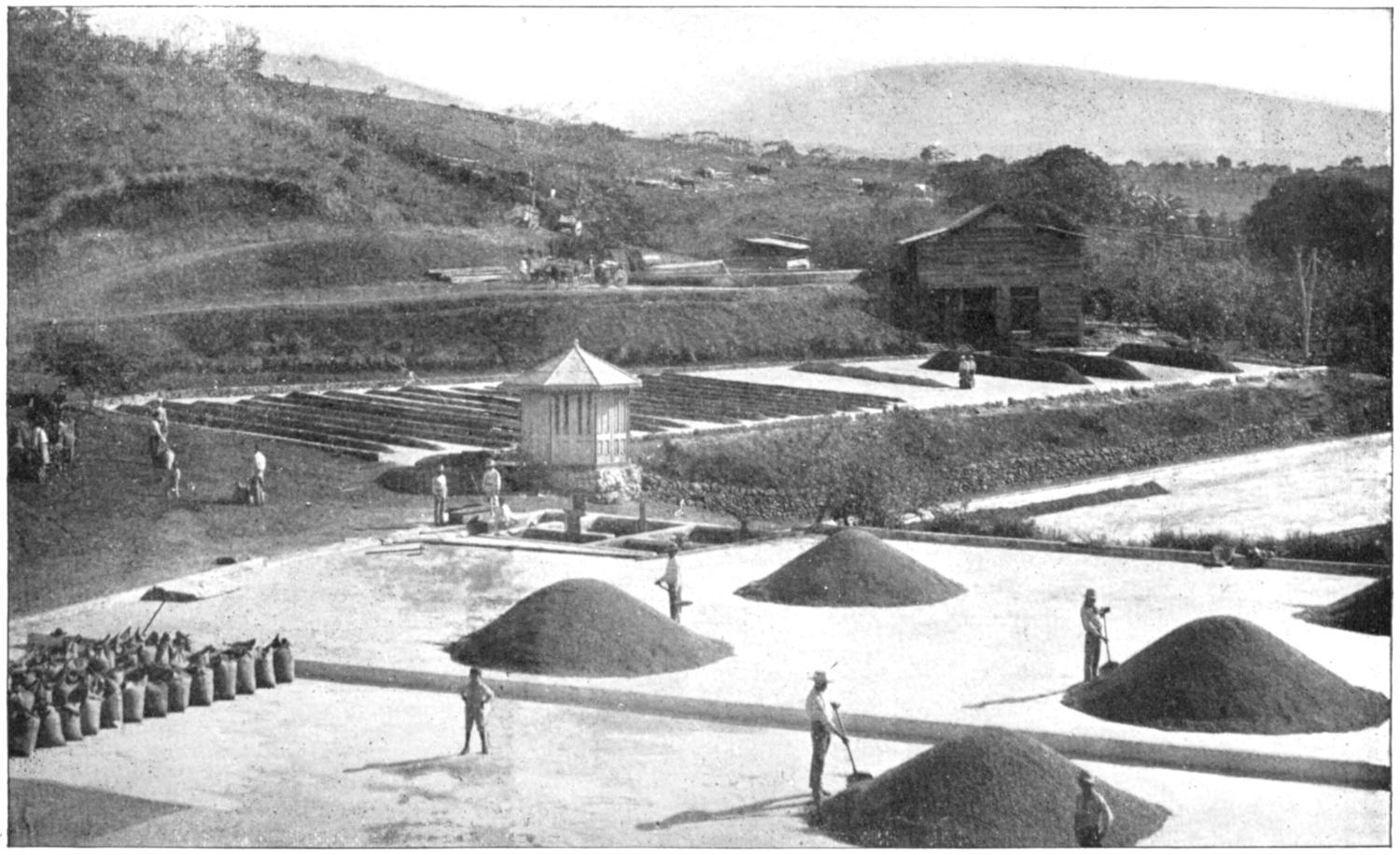
Fermenting Coffee.
In the old neglected trees the process is more difficult,
but may, with a little patience, be got into good order
easy and cheaply. The first thing to be done with them
is to cut out all secondary and tertiary branches that are
past bearing, and to clear out the centre of the head on
the trees. The removal of this superfluous wood will be
followed by a sufficiently rapid growth of young wood
which should be carefully handled, and after the next
crop a fair proportion of cross branches may be cut out,
but only to a slight extent, so as not to diminish the
crop prospect. Others, again, contending that the proper
time is immediately before or after the first blossoming
season. In the former case it is claimed that topping
before the blossoming season has a tendency to turn out
a heavy crop on the pruning branches, while in the latter
instance other planters boldly sacrifice the heavy yield
in order to add to the permanent strength of the tree,
invariably refraining from topping the plant until just
after the blossoming period. By this latter method
several pairs of branches, with their blossoms, are cut
off and lost, but the sacrifice will be amply repaid by the
increased strength added to the young tree, and also by
the advantage of having a small crop on the primary
branches below.
The style of pruning first required by Coffee bushes
is that known as “topping,” the age and height at which
this operation is performed depending in a great measure
upon local circumstances, this question also being a much-debated
one. The object of “topping,” or removing the
top of the bush, is to restrain its upward growth within
convenient limits, and, as a natural consequence, to
strengthen and concentrate its lateral growth. In some
countries of the East topping is commenced at the age
of twelve to eighteen months, the maximum ordinary
height being four feet, which is sometimes reduced to two
feet, the operation being postponed until the shrubs have
borne their maiden crop, even though extra staking is
required to withstand the wind; the best plan being to
remove the two primaries at the required height by a
sloping outward cut close to the stem, and then to remove
the top by an oblique cut so that the stumps resemble a
cross, and a firm, natural knot remains to guard against
the stem splitting down. But some planters contend
that the plants should be topped as soon as they have
reached the required height, when the soft wood is easily
severed by a pinch between the finger and thumb, as in
the case of tea. In other countries the shrubs are topped
either at their full height—four and one-half to five feet—or
at three feet, allowing a “sucker” to grow up on the
weather side, the latter plan being preferred. There is
much advantage gained in limiting the height to five feet,
as not only is the crop gathered more easily, and without
damage to the tree, but it is actually heavier, and the
shrubs are more readily made to cover the ground. The
first result of “topping” is to induce the growth of a
number of shoots, the removal of which is termed
“handling” or “searching.” The first to appear are
vertical “suckers” or “gormandizers,” from under the
primary boughs; these are immediately rubbed off without
injuring the bark. From the primaries spring
secondary branches in pairs, and at very short intervals.
All such appearing within six inches of the stem are
removed at once, so that a passage of at least a foot high
is left in the centre of the tree for the admission of the
air and sun. The object of pruning is to divert the
energies of the tree from forming wood, and to concentrate
them upon forming fruit. The fruit of the Coffee
tree is borne by young wood, and as the secondaries are
reproduced when they are removed, they are cut off as
soon as they have borne. A constant succession of young
wood is thus secured. In order that this may be regular,
and to avoid weakening the shrub, the secondaries that
grow outside of the foot space are left on alternate sides
of the primary, their opposites being removed each year
in turn; thus one is growing while the other is bearing.
The one point in view must be the equal development of
the tree and the yearly growth of as much as it will bear,
but no more. Branches must not be allowed to grow
into or cross each other, and if two or more secondaries
spring from one spot the strongest only must be retained;
where a gap occurs tertiaries may be trained to free it in
the same way. When practicable, the bushes should be
handled twice before the crop, and the pruning should be
commenced immediately after the crop and finished before
the blossom comes out, but should this be impossible, it
must be suspended during the three or four days of blossom-time,
and then be carried to completion. When it is
evident that the crop on a tree will exhaust it if allowed
to mature, a portion of it must be sacrificed by pruning.
The loss thus occasioned is more apparent than real, as
in every prolific season much fruit is wasted for lack of
labor, and the trees are unreasonably overtaxed and bear
poorly for some time afterwards. Everything should be
done to insure regular and even crops; the cuttings
should be trenched in among the plants as manure, and
no branch should be allowed to bear more than two or
three crops before removal. Regular and systematic
pruning is one of the first essentials to successful and
profitable Coffee culture. Where Coffee plantations have
been neglected on this score they must be very gradually
reduced to proper condition by sawing out the branches
and opening up the centre of the trees in the first year,
and trimming out about half the remaining wood in the
second year.
The profits derived from healthy Coffee growing are
so large that were it not for the many enemies which
hamper the planter’s struggles and stultify his best efforts,
his occupation would be one of the most profitable in the
world. But as it is he has to contend with numerous
foes, and the more lowly and minute forms have proved
themselves the most difficult to combat in these long
struggles which have been waged since Coffee cultivation
first rose to its present importance in the various countries
in which it is grown. From the mammalian kingdom he
has not much to fear or is generally able to devise efficient
remedies against their ravages. But besides the
peculiar conditions of climate, aspect, drainage, shade,
shelter and the many other drawbacks already alluded
to, particular attention must be paid to the prevention or
cure of certain maladies to which the Coffee shrub is
specially liable. The number of these insect forms and
fungoid pests is considerable, but the only ones of
sufficient importance to merit description are leaf-blight,
fly, bug, borer and canker.
Leaf-blight.—Is a fungus known as Homilica Vasatux,
allied to the moulds, and is present in some form or
other all the year round, first attacking the under side
of the leaves causing spots or blotches, at first yellow,
but subsequently turning black. These blotches are
covered with a pale orange-colored dust or powder,
which easily rubs off; they gradually grow in size until
at last they have one part of the former with three parts
of the latter, thoroughly incubating them before use.
A disease known as leaf-rot, rather prevalent in some
countries, is distinguished from the above, and which is
referred to as a fungus named Pelicaalana Kolorga,
sometimes appears when the leaves of affected shrubs
become covered with slimy, gelatinous matter, turn black
and drop off, the clusters of berries also rotting and falling.
There is every probability, however, that the
sulphur and lime treatment will be effective in this case
also, but the shed leaves and fruit should be collected
and burned as a precaution.
The Coffee Borer.—This pest, formerly known as
the “worm” and “coffee-fly,” is most troublesome in
the East, where in former years it destroyed whole plantations.
It has been identified as the Xycotrechen quadmepes,
and in its complete stage the insect appears as
a winged beetle, having from one-half to three-quarters of
an inch in length, rather finer in shape than a wasp, with
hard, shiny coat, red and black in color, but in some
cases yellow and black in alternate transverse lines,
boring a passage into the stem of the coffee tree usually
a few inches above the ground.
The Coffee-fly.—This disease has been known for
many years in San Domingo and Brazil, having also
spread to Venezuela, the Antilles, Porto Rico, Martinique,
Mexico, and all down the Atlantic coast of
South America. It is caused by the larvæ of a moth
scarcely half an inch long, named Comistana coffcalaun,
the color of the insect being dull-white or pale-gray,
with a bar across the posterior end when quiet. Its
motions are very active and it readily takes alarm. This
insect prefers young and delicate leaves, and is most
active about the commencement of the wet season, when
demolition spread over the leaves, which then drop off,
leaving the trees unable to produce any crop, or to bring
to maturity that which may have already been produced.
In districts affected by the northwest winds, the fungus
generally exists as an external parasite, in the form of
long, filamentous threads, covering every part of the
back of the leaves, but so minute as to be invisible to
the naked eye. Of the many remedies experimented
with for the suppression of this disease, one only is
invariably effective—that is a mixture of the best quality
of flowers of sulphur and caustic lime.
The majority of the eggs are deposited, but are dormant
during the wet season—that is, from March to
May. The disease manifests itself by the appearance of
large, discolored blotches on the leaves, causing their
decay and fall. As a remedy, it has been stated that by
picking the leaves at such a time, as to take the greatest
number of the larvæ when about two weeks old, it
would be easy to destroy the pest, as the size of the
blotches would then easily distinguish the diseased
foliage. Again, each of these contains several hundred
eggs undergoing incubation, and in a short time the
whole of the green wood of the tree will become covered
with the young insects and coated with a black,
soot-like powder, which renders the tree easily discernible
at a distance. The bug will soon spread over
the whole plantation, entirely checking the growth of
the trees, the fresh, young shoots being always first
attacked, and such wood as is allowed to mature, produces
hardly any crops; the berries, moreover, are in the
earliest stages destroyed by these insects, which cut them
off with the stalk. The measures recommended for
checking this scourge are to dust the bushes with a
mixture of powdered saltpetre and quicklime in equal
parts, or to brush or sponge the affected parts with a
mixture of soft-soap, tar, tobacco and spirits of turpentine,
in about equal quantities. The white bug is a distinct
species of insect, known as Psedococcus adombrum,
and is a small, flat, oval inspect, about one-sixteenth of an
inch long, covered with a white down or fur, having parallel
ridges running across its back from side to side,
like the wood-louse, though on a much smaller scale.
It is found in various stages of development all the year
round, and takes up its quarters on the roots of the
Coffee trees, to start one part beneath the surface, at the
axils of the leaves, and among the stalks of the crop-clusters,
which it cuts off wholesale, either during the
blossoms’ stage or just after the young berries have
formed. In the latter case, its operations may be easily
recognized by the large quantities of young, green berries
with which the ground beneath the trees will be strewn,
and is also discerned by a white, flour-like excretion,
which it deposits around the axil-works where it has
made its abode. The prescription alike recommended
for black-bug will be here found equally efficacious, but
in either case probably a decoction of common tobacco
might be sufficient when much more evenly prepared.
The Coffee-bug.—The Coffee tree is attacked by
various species of coccida in most countries, where they
are known by different names, but careful cultivation has
greatly reduced the evil. There are two distinct species
of bug found in the Coffee-growing countries, called
respectively the “black” or “scaling,” and the “white”
or “mealy.” The former, Lecumimum Coffea, is a minute
insect which attaches itself to the tenderest shoots of the
plant, the females having the appearance of small scallop-shells,
of a brown color, and adhering to the leaf or twig
in the same manner as the scallop-shell to a rock; at
first horizontal, soon takes an upward, spiral direction,
and proceeds until a safe shoot is found in which the
larvæ may be deposited. The tree soon droops and
dies down to the point at which the entry has been
effected, and where it can be easily broken off by a sharp
pull at the upper part. The only course in this case
is to break off the tree in this manner, and then burn the
stem with the larvæ secreted in its centre. Young shoots
will proceed from the stump, and one of these may be
trained to succeed the original stem. The insect is very
susceptible to the effects of wood smoke, and may be
easily driven off or destroyed by the smoke of ordinary
wood or grass fires.
Canker, or Bark Disease.—Is a disease of the Coffee
plant which has created great havoc in Africa and other
countries of the East, and which causes an annual loss
of about one per cent. of the trees of Jamaica and other
West India Islands. The first symptoms is the withering
of a secondary or tertiary branch, when it will be found
that the bark under the primary branches is decayed and
blue-mouldy, the blue mould gradually extending downwards
over the whole stem; a tree once attacked never
recovering, but dying in a few months. All soils and
situations seem liable to this disease, the trees beginning
to suffer when about six years old. Though the mould
is the proximate cause of death, the ultimate cause
is undoubtedly due to some unfavorable external
condition.
The opinions of experienced planters as to what
this may be are various, being generally attributed to
neglect of cultivation, to unstability of climate and to
a want of sufficient depth of soil. All may be practically
right, but the last seems the most probable, and is the
reason given for it in many countries. Rot, grubs, rats
and squirrels are accounted for in the following manner:
“Rot,” or the blacking and withering of the young leaves
and shoots, is due to wet and cold, and may be cured by
good drainage and mulching. Grubs of a large and
yellow kind, destroy the tap-roots of the plants, cattle-manure
being a fertile source of them, must be well-limed.
Rats, squirrels, grasshoppers, ants and spiders
collectively do considerable mischief, and should be
exterminated whenever possible.
The cluster of buds which duly make their appearance
are at first little dark-green spikes, but as they grow
they become straw-colored, then, under the influence of
a few showers, almost white, and finally burst into snowy
blossoms, and after a day or two the flowers turn brown
and fade away, the more gradually the better; when the
bloom is out, the rainfall is unwelcome, but after it is
“set” the shower is beneficial. The pistils of the flowers
now assume the form of berries, gradually growing and
changing their color from dark-green to light-yellow,
which finally drys out to red or crimson. As soon as a
sprinkling of red berries is seen, picking should begin
and continue as long as any berries ripen, that is to say,
from one to three months, but the berries or “cherries”
as they are more frequently called, must not be picked
until they are fully ripe, which is best indicated by a
deep, purplish-crimson color, and as the crop rarely or
never ripens all at once, two to three pickings are
required, the second being the principal one, the others
being rather gleanings than pickings. Each mature
berry should be picked separately off its stalk and never
stripped off; the cherries as picked are dropped into a
small bag about eighteen inches square, suspended from
the neck of the picker, and the bags are then emptied
into one or two bushel sacks or hampers placed at
intervals on the paths of the pickers. If the berries
are allowed to get over-ripe in wet weather, they will be
liable to burst and drop the beans, or to fall off bodily,
but if on clean ground much of them may be recovered,
while in very hot weather they are more likely to dry up
and hold on to trees. In order to convey the berries to
the curing-houses in some countries a great saving is
effected in long distances, by running them with water
down galvanized iron spouting, made in 8-inch lengths,
laid with even gradients and curves duly secured. The
berries are then despatched from the cisterns, to which a
due proportion of water has been admitted, provision
being made for collecting and utilizing the latter at the
mills.
The preparation of Coffee for market necessitates the
erection of extensive buildings and machinery on large
estates, for which no specific plans can be given, because
much depends upon the size and situation of the estate,
and as much upon the kind and degree of the preparation
contemplated. But the site selected for the works
should be as near the centre of the plantation as is compatible
with securing a patch of open, airy ground to
which a good stream of water can be brought. The first
requisite building should be the “pulping-house,” comprising
three floors—the berry loft, the pulping platform
and the cistern floor—and whenever possible it should be
built against a shallow cliff or embankment, so that the
berry coffee may be delivered into the loft without being
hauled upstairs by hand, while the berry loft is usually
placed immediately over the pulping platform.
The operation known as “pulping” consists in clearing
the coffee “beans” from the pulp in which they are
enveloped, which with ripe berries is most easily and
effectively accomplished immediately after picking, efforts
being usually made to complete the pulping of a day’s
picking during the same evening. If over-ripe or
shriveled, but still comparatively moist inside, the berries
should first be soaked in water for a few hours previous.
A number of machines have been invented for this
purpose, the chief objects in all cases being to pulp
rapidly, thoroughly and without injury to the bean, for
if the inner or “silver-skin” of the bean be broken the
latter is wasted.
But the latest and most simple form of “pulping”-machine
is what is known as the “Disc Pulper,” in
which the separation of the bean and the pulp is effected
by means of rotating discs, covered with a thin sheet of
copper, whose surface has been “knobbed,” is raised
into sort of oval knobs by the application of a blend
punch. Pulpers of this class being portable and cheap,
are most frequently used in the opening of distant estates.
The “single” form is very light, and when driven by
three plantation hands, it will pulp all the way from 20 to
25 bushels of berries an hour. The “double” form, which
has two discs and which is furnished with a feeding-roller
inside the hopper, requires from four to six hands to pulp
40 bushels an hour, but when driven by power, it will hull
from 70 to 80 bushels in the same time. In the machine
the discs are placed between “cushions” of smooth
iron, set at such a distance that the berries cannot pass
without being bruised. The cushions rest in a movable
bed of iron, set so that no bean can pass downwards.
When the disc revolves, the berries are driven forward
and squeezed, the corrugations then catch the skins and
drag them between the disc and bed. These small
pulpers have an advantage over the larger ones, in that
each can be set to suit the size of a portion of the crop—which
always varies in size—and in that, with two or
more machines, there is less likelihood of complete stoppage
in case of accident. One disc pulper to every 30
or 40 acres—that is, about three to every 100 acres, two
to be set alike for large size and one for smaller berries—should
be ample in a fair-sized estate.
There are times, however, when it is impossible to
pulp Coffee; the pulpers may get out of repair, or the
weather may be so untoward that the berry does not
ripen sufficiently, or become too dry for pulping. In
these cases the berries must first be fermented. The
best way to do this is to place them in one of the tanks, or
if the quantity is too small to nearly fill a tank, in an
old box or cask, and cover it with sacks or grass, and
let it remain until it acquires a good warmth; then, when
the berries in squeezing are no longer slippery, they may
be taken out and spread in the sun to dry. For two or
three nights it need not be housed, nor will rain hurt it.
When dry, it may be stored for curing like parchment
Coffee, but must not be mixed with it. To ferment the
berries by leaving them in a heap on the ground is a bad
plan for two reasons: First, when fermented in this manner
it becomes very wet and collects dirt, which, in the
after treatment, will affect the color of the Coffee.
Second, because in a heap the fermentation cannot be
equalized throughout the Coffee. Pulping may be performed
whenever possible, as the increased trouble entailed
by the latter process is not compensated for by the
alleged improvement of the flavor and no better price is
received for it.
The “parchment” coffee as it comes from the pulper
is next submitted to a fermentation process for the purpose
of removing the saccharine matter, without which
the beans would not dry. This operation is performed
in a series of tanks, whose capacity varies with the size
of the estate, and which may be arranged in squares.
The pulpers are placed on a platform above the tanks
and in such a position that the pulped coffee can be run
by water into the tanks, which must also be so situated
that the coffee will always advance by the aid of running
water and may finally be conveniently conveyed to the
drying ground, while the water and refuse run off. The
amount of cistern accommodation necessary for a plantation
maybe based on the allowance of one cubic foot for
each bushel of berries picked in one day. The tanks are
seldom less than three in number—two receiving cisterns,
each large enough for the greatest possible daily picking
and a third for washing the parchment, nearly as large
superficially, as the two others combined, that is, the
“washing” tanks from twelve to fifteen feet long, two
feet deep and separated by a causeway three and one-half
feet wide, and the “fermenting” tanks eight
by eighteen feet long and two and one-half feet
deep. These tanks are usually made of brick-work,
lined with cement or asphalt, but wood is much better
because less cold, but all should have a slight incline in
order to assist the drainage. The receiving tanks are
provided at the lowest corner with a good-sized outlet,
fitted with a plug and with a movable sieve of perforated
zinc or woven-wire, fine enough to keep back the coffee
when draining off the water, but not so fine as to choke
with saccharine scum; the receiving cisterns being used
alternately. All the coffee pulped in one day is allowed
to remain in the receiving cistern until a slight fermentation
has set in; this occurs in from twelve to eighteen
hours in mild weather, but in cold weather it may take
from thirty to forty hours and even more. There are
two ways of conducting fermentation—the dry and the
wet—the former consists in allowing the berries to be
without water, the bottom of the tank being perforated
so as to draw off the liquid, but by the latter process the
tank remains full of water. The dry system, however, is
the better as long as care is taken to turn the mass so
that the fermentation shall be equal throughout; the
presence of water equalizes the fermentation but retards
it and slightly injures the quality of the coffee. When
fermentation is not sufficiently prolonged, the beans will
assume a yellowish color—called “blankety”—and will
be difficult to dry, becoming liable to absorb moisture
at the same time. But when properly fermented the
separation of the saccharine matters is easily effected in
the washing tanks, to which the pulped beans and a good
supply of water is admitted. The washing cistern is
provided with a sluice door at the lowest corner, this
door commonly measuring six inches wide by three
inches deep. The coffee is meanwhile constantly agitated
by a wooden scraper or rake, by which the light
coffee and refuse matter float and may be skimmed off,
the dirty water flowing off through a tall cistern provided
with a grating to catch the skins and stray parchment,
while the sound berries are placed in draining
boxes to remove the excess of moisture and are then
transferred to the drying ground with the least possible
delay. But should the climate be uncertain it will be
necessary to provide for the emergency of a succession
of wet days, when drying cannot be proceeded with.
Parchment coffee may be kept in the undried state for
two weeks without injury by placing it in a cistern exposed
to a continuous flow of cold water.
In drying, the berries to be dried are first spread out
on a flat surface exposed to the heat of the sun. The
material forming the terrcino (terrace) or drying ground
varies greatly in the different coffee-producing countries,
but most commonly the ground is leveled and then
covered with a kind of concrete, sometimes asphalt is
laid down, but, besides being expensive it is not sure
in hot climates to withstand the heat, and such a surface
is liable to crack and give way if not carefully drained.
A very good and much better plan is to lay down coir-matting
on ground which has simply been made smooth
and hard; the advantages of this plan are its cheapness,
the ease with which extra ground can be requisitioned
in case of need, and the use of the matting as a temporary
covering in case of a sudden shower; modifications
of this method are to stretch coir or gunny cloth
across modern frames, or across trays with or without
wheels. Shed accommodations must always be provided
ready for the reception of the coffee at any moment, and
the beans must be constantly turned over and over, either
by light rakes or shovels. The drying must also be
rendered equable and must not proceed too rapidly so
as not to crack the parchment before the bean is quite
dry, for this reason also, the coffee should not be exposed
too long to a strong sun for the first day or so. During
the drying it is gathered in each day when the sun is
hot, but will then continue to dry under cover. Every
care must be taken to prevent overheating, which may
happen by prolonged drying in mild weather; rather than
permit this the coffee should be returned to a tank, and
kept washed with running water.
A new method, known as “artificial drying,” has
recently been adopted in Brazil and other countries, being
much quicker and cheaper. An easy means of applying
artificial heat is by passing an iron pipe, open at both
ends, through a fire outside the stove and below the level
of the floor, continuing it into the stove just beneath the
floor; the heated air, by passing upwards through the
coffee, will carry off much of the damp. Revolving drying
machines are also in use; one of the best of these is
one introduced originally for drying corn. It consists of
cylinders into which steam enters and agitators arranged
so that the coffee is impelled forwards and caught up and
rained down as the cylinder revolves. The central cylinder
works in a steam packet, outside which is a light
casing of sheet iron, perforated at one end so that the
air may be drawn through by a fan to assist in the drying
and carry off the liberated moisture; this machine
obviates the necessity for respreading the coffee in the
terraces before hulling. Three days’ thorough sunning
usually suffices to render the coffee quite dry and brittle,
in which condition it is known as “parchment coffee,” in
which state, in many countries, it is sent to port, its
further curing being left to the shippers, for not only is
considerable expenditure in buildings and machinery
necessary for the purpose, but the experience gained by
manipulating various lots of coffee will enable those
who make the subject a special study to bring the sample
up to the best standard of appearance and keeping properties,
but the coffee retains its color better if allowed to
remain for several weeks in the parchment, and its quality
continues to improve for months, even years, the process
being known as “curing;” as, however, protracted
curing causes great subsequent difficulty in removing,
the “silver-skin” coffee is never kept in the parchment
longer than is compulsory.
This operation consists in the removal of the “parchment”
and the “silver-skin,” after which the beans are
again exposed to the sun for a period which is difficult
to define. Some planters say that they should be dried
till they resist pressure of the thumb-nail, but there is
really no infallible test, as no two samples are exactly
alike. It needs much experience to prevent loss of weight
by over-drying, or of color by under-drying, but they
peel best while still warm. A variety of hullers have
been tried, but preference is commonly given to the old-fashioned
edge-runner mill, composed of a circular trough
with two large wheels revolving in it and suspended
about two inches from the bottom. The trough is one-half
to two-thirds filled with beans, which remain until
the grinding action of the revolving-wheels has separated
their skins, when they are let out by a lateral aperture.
A trough fifteen feet in diameter should turn out at least
1,200 pounds of marketable coffee an hour, four bushels
of good parchment coffee yielding 100 pounds clean
coffee. The appearance of the coffee immediately after
hulling is very light colored, but it soon assumes a fern-green
hue, which it will retain unless exposed to damp,
when it becomes dingy or mottled-gray, and is classed
as “country damaged.”
The peeled Coffee as it comes from the huller in company
with the detached skins is submitted to the influence
of a fan whose force must be so adjusted that it will
effectually remove the skins without carrying off the
Coffee. When the Coffee has been cleaned from the
skins, it is necessary to separate it into various sizes for
market, chiefly with the object of rendering the subsequent
roasting process more equable in effect. Formerly
the sizing was performed by hand-picking, but it is now
the custom to employ a machine called a “separator,”
which consists of an inclined, revolving cylindrical sieve
formed of perforated sheet-iron or steel wires, and divided
into sections of different meshes. The Coffee is fed in at
the hopper, which is furnished with a regulator and an internal
worm for the purpose of distributing it equally,
while a revolving brush prevents the meshes from being
choked. Sand and dust pass through the first section
and fall into the space while the small and broken beans
are delivered below, the best and largest beans are caught
up and the peaberry rolls freely out at the end.
Though there is no necessity for curing the Coffee,
and it may be hulled at once if desired, the exigencies of
climate render a properly constructed warehouse one of
greatest desiderata. The characteristics of structure
must be, first, dryness combined with security; hence,
galvanized iron forms the best material. It is generally
of two stories, the lower floor being sometimes boarded
or asphalted, but the upper must always be so made so
as to admit of free circulation of air through the Coffee
placed in it. This object may best be obtained by laying
wire gauze or coir matting over reapers about one inch
apart. Abundant ventilation must also be provided, and
it will be necessary to watch for any signs of heating.
Immediately on its appearance the Coffee must be turned
over rapidly. An improved form of Coffee structure is
that built on what is termed the Clerichew principle, in
which the floor of the upper story is constructed as in
the former case, resting on joists running lengthwise in
the building. A ceiling is provided for the lower story
by tacking to the joists cloth which has been well soaked
in boiled rice water and lime, to render it air-tight. Continuous
air-passages are thus made beneath the floor.
About ten feet of one end of the lower apartment are partitioned
off, and its sides are made as nearly air-tight as
possible, and it has no ceiling other than the floor above,
so that the passages all open into it. In an opening in
the wall of this chamber a pair of large revolving fans
are placed, their rapid vibrations drawing a continuous
current of air from the inside, and therefore through the
Coffee itself. In this manner dried parchment Coffee can
be kept in perfect condition without any turning over,
and by using heated air on the same principle as before
Coffee may be housed while still only partially dry and
yet not suffer from fermentation.
As soon as the Coffee is sized and graded it is ready
for the market. Bags are most commonly used, but it is
best packed in air-tight casks, made from wood, which is
not likely to taint the Coffee in any way. In shipping
Coffee great care is required to prevent its coming in
contact with any merchandise that may communicate to
it a foreign flavor or odor. Vessels engaged in the
Coffee trade should have perforated ventilating tubes
from the bottom of the hold, passing through the cargo,
so as to allow the escape of all steam and gases generated
during transit; without such an appliance the beans
will be discolored and classed as “damaged,” an injury
which cannot be covered by insurance. In well-ventilated
ships Coffee loses about one-half per cent. in weight
but gains in quality during transit; while under bad
ventilation there will be a gain of one-half per cent. in
weight but a loss of color, and consequent depreciation
in value.
Here a few remarks on the cost, prospects and profits
of coffee planting may not be out of place. How much
does it require to start on safely is frequently asked.
From ten to twenty thousand dollars may be considered
a fair capital. As to what kind of a plantation that can
be had for these sums is a question that from the shifting
nature of prices, and the varieties of climates, soils and
situations, cannot be accurately answered, or with even an
approximation to accuracy. With regard to the profits
of coffee planting the investor may get a very large return,
a moderate or a small one, and he may even suffer, as many
who have tried it have done, a considerable loss. No
reliance whatever can be placed on the estimates so often
published, and though many of them may be accurate
enough as far as they go, assuming that everything goes
well, good soil, climate, cheap labor, good health, and good
seasons must be taken into account, in the brilliant reports
of the returns to be expected in the first few bearing years,
usually terminating with the assertion that “the profits
subsequently to be derived will be something fabulous.”
Transport facilities are another important factor and deserving
of much consideration. In many countries they
exceed the cost of growing and preparing the crops for
market, and it frequently occurs in the interior of Brazil,
Mexico and other countries, that it does not pay to forward
the coffee to the markets at the ports of shipment.
But whatever may be the ascertained advantages in
point of soil, temperature, moisture and situation, and
however bountiful may be the yield of the plants, the
speculation must always be estimated in connection with
the cost and vicissitudes with which coffee planting as a
business is unhappily associated. Anxiety must be inseparable
from an undertaking exclusively dependent on
native labor, and liable to be affected at the most critical
moment by its capricious commercial fluctuations. The
crops in most of the coffee-growing countries, when
saved on the plantation, has either to encounter the risk
incident to transportation by hand through mountain
districts as yet unopened by roads, or the chances of
deterioration to which it is exposed in bullock carts
during long journeys to the coast. The real facts being
that the difficulties in the way of forming accurate agricultural
statistics are in the coffee-producing countries
almost insuperable, there being either a tendency to exaggerate
or depreciate the yield, as it best serves the
interests of the cultivators. And again as regards coffee
in particular, there is no means whatever of estimating
the product. A great deal being said, but very little
known in the way a man generally requires to know
that he may wish to publish as reasonably near the truth.
So in going into coffee planting in any country it signifies
little whether you know what certain plantations have
yielded or what amount of profits may be expected.
One fact may be relied on, however, that is, if an estate
frequently changes hands, it is certainly a bad or indifferent
one, if seldom it is sure the coffee growing pays well,
and further it is not necessary to inquire, for hardly any
landed investment pays so well as good sound coffee
property, and the owners are therefore seldom inclined
to part with it.
The extent of coffee plantations varies from 100 to 300
acres, the annual product ranging from 500 to 1,000
pounds per acre of prepared coffee, according to location
and care bestowed on the plantation. The profits also
vary with the ruling market price of the coffee at time of
sale, of labor, transportation and the inscrutable effects
of the season. But a cost of from $350 to $500 per 100
pounds may be considered a fair average; any yield
under 300 per acre scarcely paying expenses, any over
700 paying a handsome profit.
CHAPTER V. COMMERCIAL CLASSIFICATION AND DESCRIPTION. — AFRICAN COFFEES. — ASIAN COFFEES — ARABIAN COFFEE — OTHER VARIETIES. — EAST-INDIAN COFFEES. — CEYLON COFFEES. — MALAYAN COFFEES — JAVA COFFEES. — OTHER VARIETIES. — SUMATRA COFFEES. — CELEBES COFFEES — POLYNESIAN COFFEES — AMERICAN COFFEES. — MEXICAN COFFEES. — WEST INDIAN COFFEES. — CENTRAL AMERICAN COFFEES. — SOUTH AMERICAN COFFEES — OTHER VARIETIES.
 Coffee
in commerce is the seed which grows in
the pod or fruit of the coffee plant, like the pea
or the bean. Geographically, it is divided into
African, Asian, American and Polynesian coffees,
and, topographically, into “Mountain,” or upland, and
“Plaingrown,” or lowland Coffees, while commercially
they are generally classified as “Mild” and “Strong,”
the former comprising in trade the product of all
countries, with the exception of Brazil. Grown in so
many different and widely separated countries, provinces,
districts and situations, it is but natural that the different
products should vary materially in size, style, color,
form, flavor and character, and which also accounts for
the almost innumerable commercial divisions and subdivisions
of names, grades and values.
Africa is the original home of coffee, it being indigenous
to almost the entire Continent; but while it is to be
found growing in a wild state almost all over the entire
of tropical Africa, more particularly between the fifth and
fifteenth parallels, its cultivation for commercial purposes
on the “Dark Continent” is very light and partial at the
present time, although it affords a field of boundless development
in the future. African Coffees are divided into
West and East Coast, the former comprising Liberian,
Loango, Angola, Benguelan, Congo and Natal; the latter
including Abyssinian, Egyptian, Zanzibar, Mozambique,
Nubian, Madagascar, Bourbon and Mauritius.
Liberian—Is produced in the Americanized colony
known as the “Black Republic,” and is principally
cultivated in the district of Mesurado, on the St. Paul
river. It is an extremely large dark-brown bean, possessing
very marked peculiarities, being “concave-convex”—technically
termed “Male or pea-berry”—in form;
that is, round on top, with long, deep furrow extending
longitudinally down the face, tightly rolled or “folded”
in appearance and very hard and solid in texture. When
roasted and infused the liquor is dark in color, heavy in
body and from 30 to 40 per cent. stronger in flavor than
that of any other variety grown, and is considered too
strong to use alone, but when blended in the proportion
of about one to three parts of some of the milder growths
it makes a fairly smooth and rich drinking coffee.
The annual production is limited—about 10,000,000
pounds—put up in large, coarse bags, averaging 200
pounds, and is principally exported to England and the
continent of Europe, where it is used principally, on
account of its ultra strength, for mixing with chicory,
and sold chiefly in the form of ground coffee.
Loango—Also an indigenous variety, is grown in
the interior province of Encougé, deriving its trade name
from the port of shipment. It closely resembles Liberian
in form and color, but is much smaller in size and greatly
inferior in quality, and is sometimes termed “African
pea-berry.” The raw or natural bean is dark-brown in
color, light or “chaffy” in weight, very brittle and poorly
prepared, while the liquor is almost black and insipid, if
not actually rank or nauseous, in flavor, the decoction
tasting more like an infusion of char-bones than anything
else it may be likened to. It is principally shipped to
Spain, Portugal and other European countries, very little,
fortunately, ever reaching the United States.
Angola—Produced in the Portuguese colony of that
name, is medium in size, concave in form, light-brown
in color, strong and pungent in flavor, but lacking in
smoothness and aroma. Not being regularly cultivated,
its production is limited, that grown by the settlers on
the uplands of the interior being much superior to the
wild or native sorts.
Benguelan—Is another variety of Angola, grown in
the adjoining province to the south and closely resembles
it in size, color and general character. Being also
limited in supply, it is rarely if ever shipped to this
country, what is not retained for home consumption
being forwarded to Lisbon, Madrid and the Canaries.
Congo—Is a medium-sized, heavy bean, strong and
rich in the cup, and, taken altogether, a desirable sort.
Natal Coffee—Is a large light-brown bean, closely
resembling the Liberian product, being grown from that
species, but greatly modified in body and strength.
Coffee culture in Natal is struggling against adverse
conditions, owing to the spread of the bark disease in
that colony and for which no cure has been found. This
is much to be regretted, as the quality of the product is
very fair, the demand for the article continually growing.
Some Coffees are also grown in the States of Senegal,
Gambia, Sierra Leone, St. Helena and the Cape of Good
Hope, but, being limited in supply and unknown to
commerce, do not need description here.
Abyssinian.—The Coffee plant and its product have
been known in Abyssinia from time immemorial, its fruit
being used there in a roasted state, but in solid form, for
centuries before its introduction to the civilized world,
receiving its now universal name from the district of Kaffa
or Caffa, in the southeastern part of that country, and
becoming the parent-plant of all the numerous varieties
now to be found on the Red Sea littoral. At the present
time it is grown there in all its native luxuriance and
primitive abundance, from the borders of Narla to the
banks of the Nile, forming the chief wood of the country.
It is also cultivated there in almost all situations, on
plateaus and table-lands, mountain and valley, hill and
plain, growing as luxuriantly and producing as prolifically
on low as on upland sites. The bean is small in comparison
with the average coffee of commerce, but long and
narrow in shape, hard and “flinty” in texture, and varying
in color from a translucent green to a yellowish hue,
according to its age. In body and flavor it ranks next to
Mocha, to which coffee it is analogous, and is by many
connoisseurs preferred to it as being smoother and less
heating in effect. It is little known to commerce under
its true name, being principally shipped from Massowah
to Aden and Alexandria, where it loses its identity, masquerading
under the head of “Long-berry Mocha,” and
going principally to the Mediterranean and other European
markets. The annual crop is large and the yield
excellent, but communication and transport facilities
being difficult and crude, the bulk of the product does
not reach the outside world. It is to be hoped, however,
that whenever this rich country which produces
coffee in such wild abundance shall be permitted, by
civilized man, to enjoy its fertility it will rapidly become
an article of extensive cultivation and commerce.
Egyptian—Comprises the product of the Upper
Nile region, and that grown around Berber and the
Soudan, very little being produced in the country itself.
Being the product of different districts, they vary in size
and quality, ranging from small to medium, are palish-green
in color, flat or regular in shape, and possess
superior drinking properties; so much so that many of
the smaller bean varieties are put up in Mocha bales at
Alexandria and sold under the name of “Short-berry
Mocha,” being shipped principally to France and
England, where they are known to the initiated as
“Alexandrian or Egyptian Mochas.”
Nubian—Is a small-bean coffee, hard and flinty in
texture, oval in shape, pale-green in color, heavy in body,
and unusually rich in flavor. This variety is usually
forwarded to Alexandria for conversion into a so-called
Mocha, seldom finding its way into the American or
European markets under its legitimate name.
Zanzibar—Is medium in size, regular in appearance,
full in body and pleasing in flavor, but also very limited
in quantity. Increased effort is now being made, however,
by the French, German and Italian colonists to
increase and extend its cultivation in that country.
Mozambique—The product is fairly good, ranking
with the average of mild coffees, medium in size, greenish
in color, heavy and mellow in the cup.
Madagascar—Grown on the immense island of that
name, to the east, is a small-bean variety, solid and firm,
but shorter and rounder than the latter. It is of a pea-green
color when first picked, but gradually assumes
that of a silver-gray as it matures; in body it is round
and full, in flavor rich and fragrant. The supply of this
variety is very small when compared with the extent of
area that may be utilized for its profitable culture in that
island, the entire product being chiefly retained for home
consumption, only small lots occasionally reaching the
outer world.
Bourbon—Is a small, hard and flinty bean, being
chiefly mountain grown, pale-yellow in color and closely
resembling the Arabian product, for which coffee it is
extensively substituted, large quantities of the smaller
beans being annually shipped to Aden to be repacked in
the inimitable Mocha bales and sold as “genuine Aden
Mocha.” The larger beans are usually exported to
France and the continent, where it is held in high esteem
for its rich, fragrant flavor and aroma, but rarely found
in the American market unless specially ordered.
Mauritius—Like Bourbon is also an island coffee,
the average bean being medium-sized, heavy and well
developed, light-green in color, full in body and mellow
in flavor, the liquor, in general, comparing favorably with
that of finest of the mild grades. The smaller beans
are separated and sold for shipment to Aden for the purpose
of adulterating, or, what is worse, substituting for
Mocha, where it sinks its identity, reappearing in the
European market as “Short-berry” Mocha coffee.
More or less Coffee is also produced in Sofala, Somali,
and the Soudan, in Usumbara, the Zambesi, Nyassa,
Nyanza, and other districts as far west as the base of the
Kilimanjaro mountains, the total yield of which, however,
so far as its influence on the world’s supply is considered,
is insignificant, the export capacity of the whole
not exceeding 150,000 pounds annually. The entire
product of the Eastern provinces of Africa taken in connection
with the comparatively small crops raised on the
West coast makes that country contribute only between
5,000 to 6,000 tons to the world’s supply, this amount
including all coffees grown in Egypt and the interior
countries of the continent of Africa.
Comprise Arabian, East Indian, Ceylon, Malayan and
all coffees grown in the Straits Settlements.
Is universally but erroneously known to trade as the
far-famed “Mocha,” as no coffee is or ever was grown
there. Mocha itself, being comparatively a modern
town, which rose with the coffee trade to a short-lived
prosperity, the term “Mocha” as applied to Arabian
coffee, being derived solely from the shipment of its
product from there in former times. The internal disorders
of Arabia and the efforts of Mohamed Ali to
make the coffee trade pass through India accelerated its
decline, the place being now nothing more than a mere
village. The shipment of coffee is no longer carried on
there, being transferred further south to the ports of
Aden and Hodeida, yet, although, still known to trade
as “Mocha,” and notwithstanding the fact that Arabian
coffee has been popularly and commercially known for
centuries as Mocha, it never produced any coffee, being
situated as it is in a sterile plain. Seeing that Arabia is the
parent soil of most of the coffees of commerce, and comparatively
little known as a coffee-producing country, it
may be interesting to transcribe some particulars of the
cultivation and trade in the article in that country. The
Coffee plant is claimed by some authorities to be indigenous
to Arabia, and by others to be simply exotic, and
as having been introduced there from Abyssinia, but
at what period of the world’s history has never been
definitely decided. The plant or its product is not mentioned
in the Koran, was certainly unknown to Mahomet,
and his contemporaries make no reference to it
up to the seventh century, although the many commodities
and beverages in use among his followers in Mecca
and Medina during his Calyphate are accurately and
minutely detailed by his biographers, both Arab and
Christian. But while to Abyssinia belongs the honor
of its first discovery, it is to Arabia that the civilized
world is indebted, not only for the first knowledge of
the plant and its virtues, but also for the first plants
from which it is now so extensively propagated as well
as for the first knowledge of preparing it in liquid form.
Yet, although exotic to Arabia, it has been cultivated
there for centuries, attaining its most extensive distribution
and highest standard of production in the province
of Yemen, a highland country formed by a labyrinth of
precipitant hills and fertile valleys, the air being pure,
and even cold in some parts. These mountains are well
supplied with water, but no considerable rivers find their
way from them to the sea, tropical evaporation, coupled
with the light and porous quality of the soil, drying up
the torrent beds: nor do any natural lakes exist there.
Artificial pools and reservoirs have, however, been constructed,
in which water is preserved all the year round,
and are numerous in the district.
In the province of Yemen, where the best Mocha coffees
are produced, the plant is cultivated in both situations,
upland and lowland, that raised on the latter
being greatly inferior to that cultivated on the former
sites. The best being that grown on the mountain slopes
under the greatest difficulties and natural disadvantages
of climate, soil and site, the small gardens, for they
cannot be called plantations, being situated on terraces
ranged one above the other, forming an amphitheatre on
the mountain slope and literally covering its sides from
almost base to apex. The plant is cultivated throughout
more than half these upland districts, the finest qualities
of the berry being produced on the western slopes of the
mountains in the neighborhood of Bulgosa and Sanaar,
the capital of the province, at elevations estimated at
5,000 feet above sea-level. The soil in these situations
is composed chiefly of basaltic columns, the detached
rocks forming grand objects of landscape, especially
where cascades of water rush from their summits. Indications
of volcanic action, long since extant, abound;
basalt formations comprising a considerable portion of
the soil in the most favored gardens of the coffee-bearing
districts, while in others it is composed of jurassic rock,
basalt-granite patches also occurring in many of them.
The basalts are of great utility to the inhabitants of
this region, the columns, which are usually separated,
serving as steps where the ascent is difficult, and as walls
to support the gardens of coffee trees, which are principally
situated on the steep declivities of the mountain
sides, and although requiring the well-diffused heat of
an equatorial climate and a rich soil for its most successful
and profitable growth, it is in this region and under
these great disadvantages and peculiarities of soil, climate
and situation—hot, sandy and stony—that the far-famed
Mocha coffee obtains its finest, richest and most valuable
developments, and to which its superior excellence is
attributed.
The gardens are arranged on rocky terraces, situated
one above the other, the slopes being densely covered
and close together and are watered from large reservoirs
built upon the heights above them, into which spring
water is collected and sprinkled in a novel and ingenious
manner, being first conducted to the top terrace and then
allowed to fall gradually from one terrace to another,
where the plant and shade grow so thick together that
the sun’s rays can hardly penetrate among the branches.
The plants yield ripe fruit twice a year and frequently a
third crop is gathered; the produce of the latter is, however,
greatly inferior to that of the previous ones. The
cultivation and preparation of coffee in Arabia are also
of the simplest and most primitive kind. When the
berries have been gathered they are carefully and assiduously
picked over and separated by hand by experienced
pickers and sorters. So constant and frequent is this
selecting and separating process carried on, that a graduation
almost as regular as the degrees upon a map may
be discerned in the grades and qualities of Mocha coffee.
The operations of hulling and cleaning being performed
with the utmost seriousness and scrupulous exactness,
reminding one of the diligence ascribed to diamond
searchers and gold hunters, when sorting the torrent
sands for the minute but precious treasure.
The coffee is dispatched by caravan from the interior
to the ports of Aden and Hodeida at almost every
season of the year, but principally in February, March
and April, the export consisting of crude and prepared
beans; the former is dried in the husk, and is termed
by the Arabs “Jaffal coffee.” The dealers are chiefly
Arabs, who frequently barter English manufactured
goods for the article, the producers seldom attending
the seaport markets. The principal coffee dealers at
the shipping ports being Arabs from Hadramant, Syrians,
Armenians, Bhuddists, Brahmins and Musselmans
from Hindustan, who also trade in drapery and other
English goods, which they send through their agents
in the interior to pursue the aforesaid system of barter
for the coffee. There are, however, three or four Anglo-Indian
firms in Hodeida, and one or two American
houses in Aden, who deal in coffee on their own account.
Before reaching the harbor of Aden, from which port
the coffee intended for the aristocracy of Alexandria and
Constantinople is chiefly shipped, the beans are sifted
and re-sifted by the Arab merchants en route, the best
being retained for their own use; the less generous, flattened,
opaque and whitish beans alone reaching their
destination, the last stage seldom conveying the genuine
article except on rare occasions, and only then by
previous arrangement, personal influence or interest.
That intended for the Syrian and Persian markets is forwarded
by caravan from Jaffa and Beyrouth under the
same conditions, as whenever mere sale and traffic is
concerned, substitution of an inferior quality or an
adulteration equivalent to a substitution is frequently
resorted to in the storehouses of Aden, and the other
points from which it is forwarded, until whatever Mocha
coffee intended for the general European or American
markets is no more the real offspring of the Yemen
plant than the logwood preparations of a fourth-rate
wine resembles the pure libation of an Oporto vineyard.
Arabian coffee, like that of all other countries, though
one in name is manifold in fact. Geographically they
are classified as Yemen and Tehama, but are known to
trade almost universally as “Mocha” coffee, from being
at one time all shipped from that port; but since the
opening of the Suez Canal, the bulk of the crop is now
shipped from the ports of Aden and Hodeida.
Yemen Mocha—Is grown on the mountain slopes
surrounding the towns of Bulgosa, Sanaar and the
valley of the Oudien, and constitutes the true Mocha
coffee, which is rarely if ever exported, being consumed
chiefly within the limits of Arabia itself; very little, so
little, indeed, of this variety finds its way west of Constantinople
that it is almost inappreciable. Nor, indeed,
do the latter always get the best or purest, Arabia, Syria,
Persia and Egypt consuming over two-thirds of the
limited product of the Yemen hills, the remainder being
reserved for the Turkish and Armenian æosophagi, from
which fact it is sometimes termed the “Aristocrat of
Coffees.”
The true “Mocha” or Yemen bean is exceedingly
small, hard, round, and symmetrical in form, regular
and uniform in general appearance, of a translucent,
olive-green color when new, but assuming a rich semi-transparent
yellowish hue with age. It is perfectly clean,
being entirely free from stems, stones, chaff and all other
extraneous matter. When fresh roasted it exhales a
pleasing if not delicious odor, not even approached by
that of any other variety grown or known; the liquor is
heavier in body than that of Java, but creamy and rich,
and the flavor fragrant and aromatic to an eminent degree.
The superior excellence attributed to this particular variety
of Mocha coffee is said to be due to two causes,
first to the extreme dryness of the climate, hard granitic
nature of the soil, and second to the fact that the berries
are never picked, but allowed to fall from the trees of
their own accord when ripe, and then allowed to dry
naturally, after which they are gathered and hulled by
the simplest and most primitive methods, which process
of drying cannot be pursued in countries where the rainfall
is great, as sudden showers spoil the crop if left
unprotected. While others claim that the high reputation
which it so long held in the European markets, is not
to be ascribed to either superior cultivation or improved
stock, but to the fact that the coffee was formerly shipped
to India, and thence by circuitous routes to Europe, so
that it was generally two to three years old when it reached
its destination, all coffees improving with age and keeping.
Still growing as it does high up on the sandy terraces
of the Yemen hills, sparse of leaves, gaunt and stunted,
as becomes a plant of the desert as well as from its condensed
vitality, it appears difficult to understand the
aromatic pungency of its small berries, a quality that has
never been even approached by any achievement of scientific
cultivation.
Tehama Coffee—Is grown in the low, level sandy
plain of that name, extending from the Red sea littoral
to the base of the Yemen hills, formed by the arc of
their curve, and reaching from the province of Hejaz
in the north down as far as Aden on the southern extremity
of the peninsula. As might be expected from its
geographical situation towards the coast, it is an exceedingly
hot, dry and sandy region, being only of moderate
fertility, the soil being composed of an agglomeration of
coral debris. The rains are periodical, sometimes flooding
the plantations, and hardly drying up through the year,
the coast being indented with several small harbors.
The coffee produced in this district—like all plain-grown
or lowland coffees—is greatly inferior to the mountain product
of Yemen. The bean is small, irregular, immature
and chaffy, having a gnarled or shriveled appearance,
greenish in color when new but assuming a yellowish
hue as it dries. Being only imperfectly cured it
frequently contains fragments of hull, fibre and small
stones. It is invariably “quakery” when roasted, and
in body and flavor is inferior to the average run of what
are known in trade as “mild coffees.” Yet, though not a
palatable coffee when drunk alone, it makes a fairly fragrant
infusion when combined with a Preanger or other
good Java. It is principally shipped from Hodeida, now
the second considerable port in the Red sea, from which
it is known to trade as “Hodeida Mocha,” and in contradistinction
to that shipped from Aden, and known as
“Aden Mocha.” At Hodeida the coffee is sold in the
custom house, whither it is brought from the interior.
The Hodeida dealers also receiving large quantities of
Malabar, Bourbon and other small-bean varieties to mix
with or substitute for the original sort.
There are several other varieties known to trade and
sold as Mocha coffee, but having little or no relation to
it. Among these are:—
Lechia.—Shipped from a small port to the north of
Hodeida and from which it derives its trade name. It is
very inferior in quality, roasting and drinking poorly,
and on the whole not a desirable sort.
Djebelli.—Which is imported into Aden from the
African coast, and is a mountain-grown coffee possessing
valuable cup qualities.
Berberah.—Also an African coffee recognized by its
large and tapering bean, heavy body and rich infusion,
and used principally for mixing with or substituting for
genuine Mocha coffee.
Havar.—Another variety of Mocha coffee known to
trade as “Havar” or “Hazar,” which comes from the
south African coast of the Red sea, is being recently
shipped from Aden. The bean is long and pointed,
greenish in cast, and solid in structure; it roasts and
drinks exceedingly well, being preferred by many connoisseurs
to the true Mocha bean.
Mussowah—Is an Abyssinian variety, previously
described, deriving its trade name from being shipped
from that port on the African coast of the Red sea.
Egyptian Mocha.—In Alexandria, Mocha coffee is
imitated by the substitution of small-bean African varieties,
principally produced in Berber, Nubia, Somali and the
interior of the Soudan, which are carefully picked over
and assorted by hand, the larger beans being separated
from the smaller, the better to adapt them to their
respective markets, being usually shipped to France and
other continental European countries.
Arabian or “Mocha” Coffee is put up in large grass-mat
bales—containing two smaller packages termed
“quarters” or four termed “eights”—distinctive in shape
and material, being made of a coarse, grassy substance
and sewn with a fibrous ligature that becomes excessively
hard and tough as it seasons. The exports, the amount
of which it is difficult to determine owing to the fact that
there is no real custom-house control in the country,
consists of about 8,000,000 to 10,000,000 pounds only,
about half of which only is pure Mocha, the product being
so badly manipulated and so extensively substituted with
other coffees of foreign origin and inferior quality.
Unlike tea, coffee was not introduced into India by
European enterprise, and even in the present day its cultivation
there is largely followed by the natives only. The
Malabar coast has always enjoyed a direct commerce
with Arabia, and at an early date in the world’s history
gave many converts to Islam, one of whom, Baba
Bouden by name, is said to have gone on a pilgrimage
to Mecca and to have brought back with him “seven
coffee-berries,” which he planted on the hill range of
Mysore and which is still called after him, and which,
according to local tradition, occurred about two centuries
ago. The shrubs thus said to be sown lived on, but their
systematic cultivation did not spread until the beginning of
the present century. While another account states that
the coffee-plant was first introduced into India, on the
Malabar coast, by the Arabs themselves, as far back as
1740, yet no official mention is made of the plant or its
product in that country up to 1822, when its cultivation as
a curiosity was first began in the Wynaad district, another
plantation being formed later in the adjoining district of
Manjarabad. The Baba Bouden range, in the State of
Mysore, also witnessed the first opening of a coffee plantation
by an English planter in 1840, the success of this
experiment leading to the extension of coffee cultivation in
the neighboring districts of Madras and Malabar. In 1840,
a plantation was also started in Manautoddy, and in 1842
it was found growing well in Belgaum. From 1842 to
1860, however, the enterprise made but slow progress,
but since the latter date it has spread with great rapidity
along the whole line of the Western Ghauts, clearing
away the primeval forest and opening up a new era of
prosperity to the laboring classes in that country, its cultivation
for commercial uses increasing at a most remarkable
rate.
Coffee at the present time in India is grown all along
the summits and slopes of the Western Ghauts from the
northern limits of Kanura south to Cape Comorin, the
chief centres of production being located in the Presidencies
of Madras, Mysore, Malabar, Coorg and Travancore,
attempts being also made to introduce the plant into
the Bengal district of Chittagong and the northern districts
of Nepaul, the Punjaub and British Burmah, the cultivation
extending within the past few years to the Shevaroy
hills in the Salem district as well as to the Neilgherry
and Pulmey mountains in Madras, the slopes adjacent
to Octacamund being literally covered with coffee
plantations on every side. In India, after the berries,
or “cherries,” as they are called there, have been
harvested, they are cured in one of two ways, one
of which is to pulp them in the soft state, the coffee
being known as “Cherry-dried,” while by the other
they are dried first and the pulp removed by a
huller. Where the latter method is adopted, they are
spread upon terraces and there kept until complete
desiccation takes place, the coffee prepared in this
manner being known as “thick-hull” or “sun-dried”
coffee. They are classified in trade as “Malabar,”
“Mysore,” “Wynaad,” “Tellicherry,” “Coorg,” “Neilgherry”
and “Travancore,” grading commercially in
the order named.
Malabar—Produced on the western slopes of the
Ghaut mountains, is a small, hard, whitish bean, closely
resembling a Bourbon, being frequently shipped to Aden
for substitution or conversion into Mocha coffee. It is
full in body, high in color and rich in flavor, particularly
when old, ranking high commercially in the European
markets, where it is principally disposed of.
Mysore—Is a mountain coffee grown on the slopes
of the Eastern Ghauts, and, like all mountain-grown
coffees, is large or bold in style, bluish-green in color,
hard and solid in texture, heavy in body, but apt to be
somewhat “grassy” in flavor when new, mellowing considerably,
however, with age. It commands a higher
price in the English market than Java, not on account
of its intrinsic worth, but from the fact that English
merchants favor the products of their own colonies to
the prejudice of all others.
Wynaad—Is simply a Malabar coffee, grown in the
interior of that province, and deriving its trade-name
from the district of growth, and possessing the same
intrinsic qualities of body, color and flavor, being heavy,
rich and fragrant in the cup.
Tellicherry—Is another variety of Malabar, deriving
its commercial cognomen from the port of shipment, but
is generally conveyed to the coast for curing, and is
classed commercially with it, being used for the same
purpose of mixing or substituting for Mocha.
Coorg—Is a plain-grown or lowland coffee, large
and flat in appearance, dark-greenish when new, but
becoming a dull-white with age, and while regular and
uniform in the roasted state is apt to be “quakery.”
The liquor is thin and flat in the cup, while the flavor
is somewhat “mawkish” to the taste.
Neilgherry—Although a mountain coffee, seems to
be an exception to the general character of this variety,
for while the bean is fairly large in size and uniform in
appearance, it is usually moist and soft in substance,
losing heavily in the roast, and yielding a flat, almost
insipid liquor.
Travancore—Grown in the extreme South, is a lowland
variety having an average-sized, flat, but whitish
bean, soft or “spongy” when new, but becoming light
and brittle as it dries. It is invariably “quakery” in
the roast, thin and watery in the cup, and lacking in even
an approach to fragrance.
Burmah Coffee—Is a comparatively new variety to
commerce, being only recently introduced, and very
limited in supply to the present. The bean is fairly
large and regular in form, greenish in color and soft
in texture in the natural state, tough or “leathery” when
roasted, and wild or “grassy” in the infusion—defects
due to its newness, which may, however disappear in the
later crops. A very large portion of the surface of Burmah
is admirably adapted for the cultivation of fine coffees, but
it still remains in its primeval state of unproductive jungle,
owing to the entire absence of natural energy on the part
of the natives, who have been described as the laziest under
the sun. At the present time, however, the government is
making liberal offers to Europeans and others who understand
the art of coffee-planting in order to develop the
industry in that country; such settlers being offered free
grants of land in the celebrated Tavoy district, the only
conditions being the cost of survey and demarcation.
India coffees are classed in the English market as
“Bold,” “Middling” and “Small,” the bulk of the
small-bean Mysore, Malabar and Wynaad being shipped
to Aden and Alexandria, where they are repacked and
sold as Mocha. The average quantity and value of
the coffee product of India is about 40,000,000 pounds,
valued at $75,000,000, fully one-half of which is retained
for home consumption, the balance being shipped to
England and France, which are the two next largest
consumers of India coffee, although in both countries
it is subject to excessively heavy duties. The average
product per acre is only about 350 pounds, but the
drought having affected the plantations would of itself
sufficiently account for the diminished exports if the
leaf disease and borer did not also help to keep down
the yield.
The history of coffee cultivation in the island of Ceylon
is one fraught with interest and full of instructive
lessons, which, since the year 1845, has assumed a
position of great and ever-increasing importance. Although
coffee is claimed to have been an article of
growth and export from Ceylon even as far back as the time
of the Portuguese, it only grew wild there without any
attempt at cultivation. Small patches of it were to be
found around the Kandyan villages, growing in wild
luxuriance, the berries being gathered before they were
ripe and imperfectly cured, seldom possessed much flavor,
they were but lightly esteemed as an article of commerce.
Its systematic cultivation was first commenced in 1824,
by Sir E. Barnes, the then governor, who hoped by his
example to introduce coffee planting by Europeans into
the island. Up to 1834, however, public attention does
not seem to have been occupied with the industry, but in
that year the falling off in supplies from other countries
brought capitalists into the field, and when, in 1836, the
duty in England was reduced to six pence per pound, a
great impulse was given to coffee planting in Ceylon.
During that and the following year about 7,000 acres of the
finest lands were purchased for the purpose, until, at the
end of a few years, it became a matter of notoriety that
the soil and climate of Ceylon were capable of producing
coffee equal in value to most kinds then grown, when the
influx of capital from England for investment in this
new branch of industry became simply enormous. In
1840, nearly 10,000 acres of mountain forest were
felled and planted in coffee, and in an exceedingly short
space of time the sale of crown-lands for coffee culture
averaged 40,000 acres per annum. The mountain ranges
on all sides of the district of Kandy became speedily
covered with plantations, the great valleys of Ambogamoa,
Doombera, Kotmalie and Pusilawa were occupied
by speculators, others settling in the steep passes of
Neurailla and penetrating the Ouvah and Badulla
districts, coffee-trees quickly blooming on every solitary
hill, even up to and around the very base of Adam’s
peak. The first ardent adventurers pioneering their way
through pathless woods, living in log-cabins whilst felling
the forest and making their preliminary preparations for
planting, until, in a few years, the paths by which
they came were converted into roadways and their
cabins replaced by comfortable “bungalows.” The
coffee cultivation mania in Ceylon, however, reached
its climax in 1845, when the governor, council, military,
judges, civil servants, and even the clergy penetrated
the hills in their mad haste to become purchasers
of crown lands for coffee growing. The East India Company’s
officers crowded to Ceylon to invest their savings
in coffee lands, capitalists from England at the same
time arriving by every vessel, the bulk of the emigrants
as a class being more than ordinarily aristocratic, and
who, if not already opulent, were still in haste to become
more so. So dazzling was the prospect that expenditure
was unlimited, its profusion being only equalled by the
ignorance and inexperience of those to whom it was
intrusted; five millions sterling being sunk in the “Coffee
craze” in less than as many years. The rush for coffee
lands at this period in Ceylon was only paralleled by
the movement towards the gold mines of California and
Australia, but with this painful difference, that the wild
enthusiasts in Ceylon instead of thronging to disinter
were hurrying to bury their gold, for in the very midst
of their visions of riches a crash suddenly came which
awakened the victims to the reality of their ruin. The
financial panic of 1845 in England rapidly extended its
destructive influences to Ceylon; remittances ceased,
credit failed, prices fell, and the first announcement on
the subsidence of the turmoil was the doom of protection
and the withdrawal of the distinctive duty which
had so long screened the British coffee plantations from
competition with those of Java and Brazil. The consternation
thus produced in Ceylon was proportionate to
the extravagance and hopes that were blasted, coffee
plantations being forced into the market, and many sold
off for a twentieth part of the outlay incurred in forming
them, while others that could not be sacrificed at any
price were abandoned and allowed to return to their
natural jungle. For over three years the enterprise
appeared paralyzed, the ruined disappeared and the timid
retreated, but those who, combining judgment with
capital, persevered, succeeded eventually, not alone in
restoring energy to the enterprise, but in imparting to it
the prudence and experience gleaned from former similar
disasters. Still, the crisis, had it not been precipitated
by the calamities of 1845, must have ensued eventually,
from the indiscretion of the previous period; and the
healthy condition which coffee planting appears to
have attained at the present day in Ceylon results from
the correction of the errors then committed; and it is
no exaggeration to state that there is not a single well-established
principle now governing the management
of the plantations and the conduct of the proprietors
that was not preceded by a directly opposite policy
in 1845.
Since the explosion of this second edition of the
“South-sea bubble” in Ceylon, the island has made
rapid strides in coffee growing, the mountain forests
have been replaced by extensive plantations, of which
there are at the present day no less than 1,000
under cultivation, yielding an average annual crop of
nearly 80,000,000 pounds exclusive of that raised by the
natives. Observation has also since discerned the true
tests of soil, climate and aspect, former delusions as to
high altitudes have been exploded, unprofitable districts
avoided and unproductive localities abandoned. And in
lieu of the belief that the coffee tree, once rooted, would
continue ever after to bear crops without further attention
or manure, and flourish perennially in defiance of
weeds and neglect, every plantation is now tended like
a garden, and the soil enriched artificially in proportion
to the produce it bears, expenditures also being reduced
within the bounds of discretion. An acre of forest land
can now be purchased for one-tenth of what it cost in
1844, and though the extravagant prices and the still
more extravagant expectations of that period have been
entirely dissipated, coffee planting at the present day in
Ceylon under careful supervision, promises as sound an
investment as moderate enterprise can hope for. Systematic
coffee cultivation is almost exclusively confined
to the hill region, which embraces the districts of
Kandy, Pusilawa, Doombera, Kotmalie and Ambogama,
although irregular native gardens are to be found everywhere
in the southwestern portion of the island, even
close to the seashore. The favorite and most productive
elevation is, however, between 3,000 and 4,000 feet
above sea-level, but in a few exceptional cases plantations
descend almost to the foot of the hills, others being
situated nearly 6,000 feet above. While native gardens,
sometimes bearing good crops, may be met with along
the coast actually at sea-level; in such instances, however,
the gardens are limited in extent, and are generally
richly manured and well watered during the dry season.
The principal coffee-producing zone of Ceylon of
the present day is chiefly situated in what is known
as the Gampola district, in which the scientific cultivation
of coffee was first attempted, and the point at
which the great roads converge connecting the rich
coffee districts of Doombera, Kotmalie and Pusilawa
with the ports of Kandy and Colombo. The soil and
situation of the Gampola district have proved so favorable
to the growth of the coffee-plant that there is hardly
one of the magnificent hills seen from it that has not been
taken possession of by planters, the plantations being
situated chiefly in the mountain ranges on all sides of it.
Ceylon coffees are classified commercially as “Native,”
“Plantation,” “Liberian” and “Mountain” or “Mocha,”
the latter being nothing more than a small-bean plantation
coffee usually separated.
Native.—What is known to commerce as “Native
Ceylon” is principally produced in the district of Ouvah
by native growers, from which fact it derives its trade-name.
Being a plain-grown or lowland coffee, the bean
is large and flat in style, greenish, moist and “flabby”
when first picked, but becoming almost white, broken
and “chaffy” as it dries. It is a poor “roaster,”
being invariably “quakery,” weak and thin in the
infusion, and devoid of any distinctive flavor or aroma
in the cup.
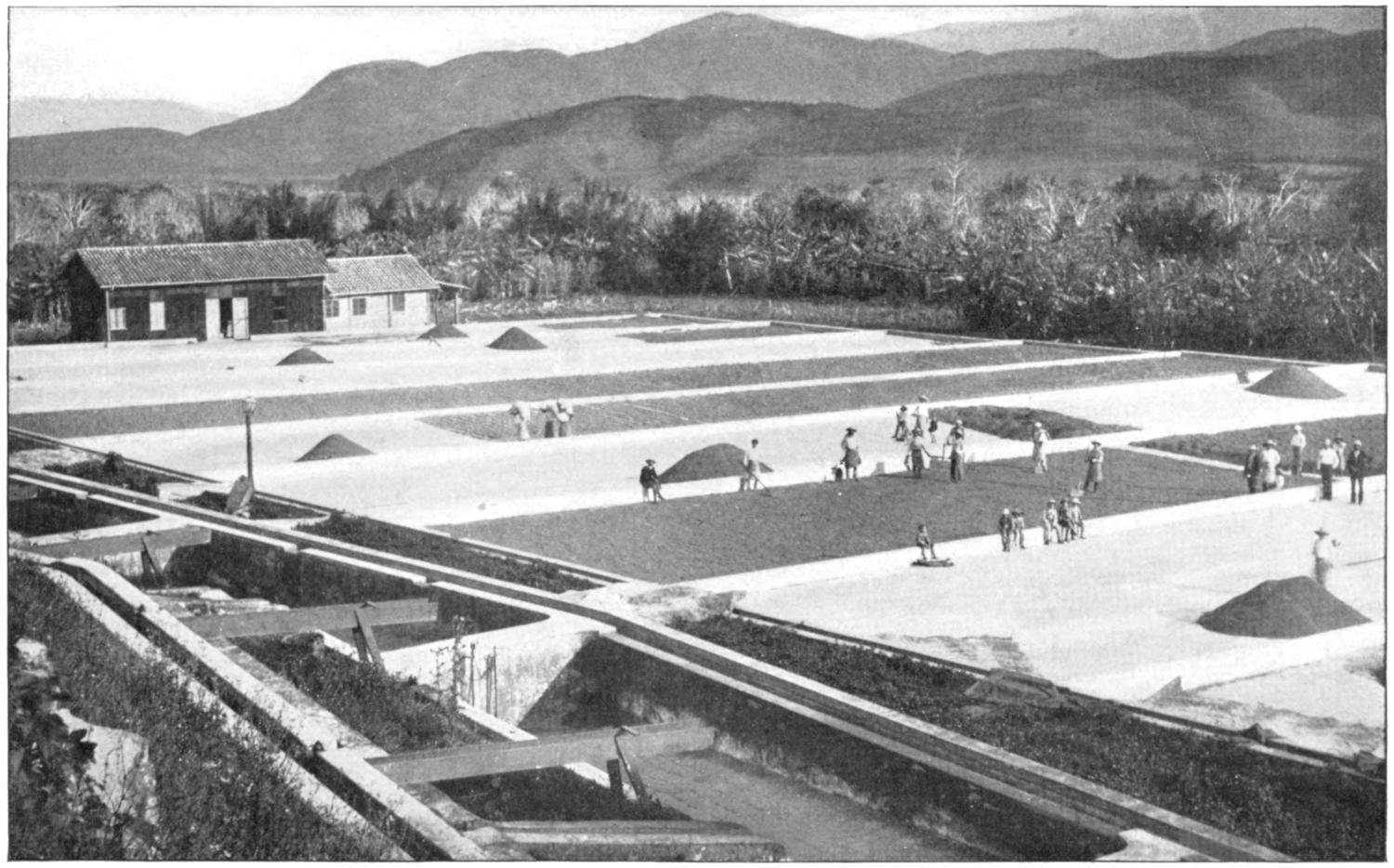
Drying Coffee on the Patio or Terrace.
Plantation—Derives its trade-name from its being
systematically cultivated in regularly-laid-out plantations,
by scientific methods under intelligent management, and
is without doubt one of the finest varieties grown, ranking
high commercially for its intrinsic value. The raw or
natural bean is large, bold, symmetrical and exceedingly
well developed, of a light bluish or translucent-green
tint or cast, very regular and invariably uniform in general
appearance. It roasts even and handsomely, as fine, if
not more so, than any variety known, while in the infusion
it is rich and strong, but smooth and creamy in body,
fragrant and aromatic in flavor; an equal quantity of this
variety yielding a heavier-bodied and richer liquor than
that of the finest Java, but will not be quite as high in
flavor.
Liberian-Ceylon—Is produced from a transplant of
the Liberian species, which, owing to the destruction
caused by the “leaf disease” on the Ceylon plantations,
has been introduced to that island, on account of its
being considered much stronger, hardier and better able
to withstand disease than the native trees, but while it
was found specially adapted to the plains and low-lying
situations, it would not bear so well on the upland or
mountain slopes. A hybrid species was at length evolved,
the product of which is known to trade as “Ceylon-Liberian,”
the bean of which in the natural state is not
quite as large as that of the parent plant, not as convex
in shape, the color being paler, bordering on a rich yellow
instead of brown, while the infusion though not as
heavy in body or dark in color, is much smoother and
more palatable, the too-heavy properties of the original
being greatly modified by climatic and other causes.
Ceylon-Mocha—Is a small bean, mountain-grown,
coffee, very even and uniform, usually separated from the
regular plantation variety. The raw or unroasted bean
is of a steel-blue or silvery-grey color, according to age,
exceedingly rich in liquor and fragrant in flavor, and considered
by some experts to be equal in drinking qualities
to any variety grown, being frequently shipped to Aden
for substitution or mixing with Mocha coffee.
Ceylon coffees are usually packed in casks and in
hogsheads (except Native, which is put up in bags),
the former weighing 400 and the latter 1,000 pounds,
and shipped to England, where it commands a high
price, relatively, and where they are graded as No. 1
(largest); 2 (medium); 3 (small), and “Triage,” or common,
but generally as “Plantation” and “Native” in the
American market. In 1880 it was estimated that the
capital invested in coffee culture amounted to over
$70,000,000, a notable increase having taken place since
that year, there being at the present time some forty
districts on the island in which coffee culture is carried
on for commercial uses. While the native product is
usually calculated to extend over 50,000 acres, which,
however, varies very much, according to the character of
the season, the prices obtained, and the cheapness of
money. The annual exports are about 80,000,000
pounds, giving an average yield from old and new
plantations of a little over 400 pounds per acre.
Include the products of the islands of Java, Sumatra,
Celebes, the Sunda and many other of the smaller islands
of the Malayan Archipelago.
Java is a generic term applied to all coffees grown in
the Eastern Archipelago, and is almost a synonym for
coffee. While the coffee plant, which is only known in
Java by its European appellation and its intimate relation
with European despotism, was first introduced into that
island by the Dutch at the close of the seventeenth
century, and has ever since remained one of their chief
articles of exclusive monopoly. The labor by which it
is planted and its produce collected is included among
the oppressions or “forced services” of the natives at
inadequate rates. Previous to the year 1808 the cultivation
of coffee in Java was principally confined to the
Sunda districts, there being, up to that year, but few
plantations comparatively in the eastern districts, the
product of which they were capable of yielding not
amounting to one-tenth of the whole. But under the
rapacious administration of the Dutch East India Company
and government the cultivation of coffee has
usurped the soil of almost the entire island, otherwise
destined for yielding the subsistence of the people, the
cultivation of all other products being made subservient
to it and the withering effects of a government monopoly,
extending their influence indiscriminately throughout
every province and district in the island. In the Sunda
districts particularly each native family is compelled to
care for 1,000 coffee plants, and in the eastern districts,
where new and extensive plantations are being formed
from time to time in soils and situations in many instances
by no means favorable to its profitable culture, 650
plants is the prescribed allotment. No negligence can
be practised in the performance of this duty, the whole
operations of planting, picking and pulping being
conducted under the immediate superintendence of the
government officials, who select the sites where the new
plantations are to be formed, seeing that they are preserved
from weeds and rank grasses and overseeing its
selection and removal to the “go-downs” or warehouses
when prepared. Under this system the Sunda districts are
estimated to yield an annual produce of 100,000 piculs, and
it was at one time calculated that the young plantations of
the eastern districts, when they should come into full bearing,
would produce an equal quantity, but in the latter
section many of the plantations had been formed on ill-judged
sites, the natives being also averse to the new
and additional burden which this increase of cultivation
imposed upon their labor. Had the system been persevered
in or enforced by a despotic authority, it is
questionable whether the quantity anticipated in the
above estimate, or even one-half of it, would have been
obtained from the eastern districts. The Sundas living
in an island and mountainous country, and having been
long accustomed to the hardships of coffee culture, are
less sensible of its pressure than the rest of their countrymen,
time and habit having reconciled them to a system
of servitude, which was at first revolting to them,
and a state of slavery, which the philanthropist laments
as degrading, is scarcely felt to be even a grievance by
themselves. Instances, however, are not wanting in
which the usual measure of exaction having been surpassed
they have been awakened to a sense of their
wretchedness, a government of colonial monopolists,
eager only for profit, and heedless of the sources from
which it is derived, subjecting its native subjects to privations
and distresses, the recital of which shock the ear
of humanity. In brief, the system of coffee culture in
the island of Java has sometimes been so severely exacted
that, together with the other constant and heavy
demands made upon them by the government authority
on the native labor of the country, that they deprived
the unfortunate peasants of the time necessary to raise
food for their own support, many thus perishing by
famine, while others fled to the mountains, where, raising
a scanty subsistence in patches, or often dependent
for it upon the roots of the forest, they congratulated
themselves on their escape from the reach of their
oppressors; numbers of these people, with their descendants,
remaining in these haunts to the present time. In
their annual migrations they frequently pass over the
richest lands, which still remain uncultivated, awaiting
their return to till it, but they prefer their wild independence
and precarious subsistence to the horrors of being
again subjected to forced servitude and forced deliveries
at inadequate compensation.
In the Java highlands the tree yields fruit for a period
of twenty years, while on the plains or lowlands it seldom
attains a greater age than nine or ten, bearing only during
six or seven of these, the fruit being larger comparatively,
but the flavor less as a general rule. About the end
of the rainy season such plants as have not thriven are
replaced by others and the plantations cleared, this latter
operation in well-managed plantations being generally
performed from three to four times in the year, the tree
being never topped or pruned, but universally allowed to
grow in all its native luxuriance. In this state it often, in
favored situations, reaches a height of sixteen feet, and
plants eight inches broad have been frequently procured
from the trunks. The average product of a coffee tree in
Java is not estimated at much more than 1¹⁄₄ pounds,
but there are instances on record where as much as from
twenty to thirty pounds have been yielded by a single
plant in a season. Again, in Java there does not appear
to be any fixed or certain season for the plant to arrive
at maturity, as in the Western countries, the gathering
usually commencing in June or July, and it is not until
late in the following April that the entire crop is
delivered to the go-downs. The picking season in general,
however, consists of three pickings or crops of
which the first or “roor-pluk,” which is small, begins
in February, the second or “main-pluk” in May or
June, when the heaviest portion is gathered. It is also
termed the “full-pluk,” from being the most abundant of
the season the third or “after-pluk,” being what is left
to open on the trees, may be considered more of a gleaning,
as it is merely a general sweep of the fallen berries.
When the berries become of a dark crimson color they
are plucked off one by one with the assistance of a light
bamboo ladder, the greatest care being taken not to
shake off the blossoms which still remain on the tree or
to pluck the unripe fruit. The women and children of
the country usually do the picking, the men attending to
the heavier work around the plantations. Attached to
every village near which there are coffee plantations of
any extent, there is a “drying-house,” to which the
newly-gathered coffee is carried and where it is placed on
hurdles about four feet from the floor, under which a
slow wood-fire is kept up during the night; the roof is
opened in the mornings and evenings to admit the air,
the berries being frequently stirred meanwhile to prevent
fermentation. As the excessive heat of the sun is considered
prejudicial, the roof of the “drying-house” is
closed during mid-day, this operation being continued
until the husk is thoroughly dried. The coffee dried
in this manner is generally small, sea-green or grayish
in color and is supposed to acquire a peculiar flavor
from the smoke, although it does not appear that any
particular kind of wood is used as fuel. On the other
hand, when the coffee is dried in the sun the bean
becomes of a pale yellowish color, is larger in size,
specifically lighter in weight and more pungent in
flavor than the former. The most common method of
pulping in Java among the natives is to pound the berries
when dried in a bag made of buffalo hide, care being
taken not to break or mutilate the beans. A mill of the
most elementary construction is, however, sometimes
used for the purpose, but is said not to answer as well.
When the operations of pulping and cleaning are completed
the coffee is then put in bags and baskets and
stood on raised platforms until the period of delivery
arrives, when it is carried to the “go-downs” or storehouses,
sometimes by men but more generally on the
backs of buffaloes and mules in strings of from 1,500 to
2,000 at a time. In the Sunda district there are three
principal depots for receiving the coffee from the cultivators—Chikan,
Karang and Buitzenorg. From Buitzenorg
it is either sent direct to Batavia by land in carts
or by way of Linkong, whence it is forwarded in boats
by the Chidana river, while from Chikan the coffee is
sent in boats down the river Chitaram and thence along
the sea-coast to Batavia, where it is received into extensive
warehouses and from which it is in turn generally
exported to the European and American markets.
Up to a very recent period almost all coffee in Java
was cultivated by the natives under supervision of the
Dutch government, which had a monopoly of the
product, deriving an enormous revenue from its cultivation.
Under this system, each family was compelled to
cultivate, pick, dry, hull and deliver the coffee at the
nearest government warehouse for transport to the port
of shipment, the natives being allowed but a small percentage
of the crop as compensation for their labor in
many instances, but more generally the government placing
a figure so low as to enable it to sell the coffee at an
enormous profit, and also deducting again a heavy duty
from the gross price paid to the growers, thereby deriving
an almost fabulous revenue from this system of
cultivation.
It is difficult to state what recompense the native
cultivator of coffee receives in Java for his services and
his product, the complicated system of accounts which
prevails there seem only calculated to puzzle or mystify
the investigator and allow the Dutch commissary to
derive an income of from eighty to one hundred thousand
dollars per annum at the expense of the government by
whom he is employed, on the one hand, and that of the
natives whom he oppresses, on the other. Latterly,
however, it has been directed that the cultivators should
receive, on delivery at the government storehouses,
“three rix-dollars (copper) for each “mountain” picul (225
pounds) of coffee, being very little more than one dollar
per hundred, while this same coffee has frequently been
sold in Batavia, within fifty miles of the spot where it
was raised, at twenty dollars per hundred, and has been
seldom sold in the European or American markets at less
than twenty cents per pound. It is, also, difficult to fix
the exact rate at which the coffee might be produced
under the free system, but that it can be raised for
exportation at ten dollars per hundred with profit is
beyond doubt. The price paid the natives, however, is
deemed liberal by the Dutch government, though in
many cases it has to be transported over sixty miles of
an almost impassible country, where two men are required
to carry a hundred pounds of coffee on their shoulders
and at an expense of labor which one would suppose at
least equal to the remuneration.
All the available mountain slopes on the island of
Java are literally covered with coffee plantations, owned
and operated by the Dutch government, which assigns
to each Javanese family the cultivation and care of from
600 to 1,000 trees under severe penalties, the natives
being compelled to deliver their crops, hulled and cleaned,
to the nearest government stores at the end of the harvest,
accepting in return whatever price the government is
pleased to put on it. Considerable coffee is, however,
cultivated by the natives themselves, independently of that
raised directly for the government, being chiefly grown
along the borders of the government plantations and
other unused patches, as well as along the fences around
their farms, being generally raised in the shade; the berry
of some of this coffee attains a high excellence rivalling
if not actually excelling the government product in many
instances.
A considerable portion of the peasantry having—as
already observed—been long accustomed to the
cultivation of coffee, it is owing to their skill and experience
that the coffee owes its excellence as much as to any
direct knowledge, superintendence or interference of the
Dutch officials, who derive their information from the
natives, having little more to do than occasionally ride
around the plantations with a pompous suite, keep the
accounts and examine the coffee, as it is received from
the cultivators. The plantations are generally laid out in
squares, the distances between the plants varying according
to the fertility of the soil, that is, in a soil not considered
fertile, a distance of six feet is preserved, and in
each interval is planted a “dadap” tree for the purpose
of affording shade to the plants; while in a rich soil where
the plant grows more luxuriantly, fewer shade trees are
required and the plants are placed at greater distances
from each other. But in Java, a certain degree of shade
appears to be necessary at all times to the health of the
coffee plant, especially during its earlier stages, and in low
situations, for which purpose the dadap tree is found to
be better calculated for affording this protection than any
other kind in the country, it being a common saying on
that island that “where the dadap flourishes, there also
will flourish coffee.” But it must not be inferred from
this that they are always constant or even necessary
companions, for in the highlands many of the most
flourishing plantations are to be observed with but very
few dadaps in the vicinity.
Coffee is cultivated for commercial use in all of the
twenty-two residencies into which the island is divided,
including Bantam, Batavia, Bezoeki, Bagelen, Banjoewanjie
and Banjoemas, Cheribon, Japara, Kadoe,
Kediri and Krawang, Madioen, Rembang, Preanger,
Probolingo, Passoeren and Pekalongan, Soerabaya,
Soerakarta and Djokjakarta, Bali, Timour, Malang and
Samarang, each of which residencies or districts containing
from five to fifty plantations, by which they are further
distinguished. In trade they are generally divided into
“Government” and “Free Coffees,” the free cultivation
being now permitted in the residencies of Bantam, Cheribon
and many other of the Eastern districts. And, as
with the coffees of all other countries, the product of
the different districts of Java varies considerably in
quality and value, many of them possessing a richness
and mellowness not approached by that of any other
country; others, again, being so inferior that were it not
for the fact of being grown on that island they would
not be deserving of the name.
Bantam and Batavia—Are medium-sized, yellowish
in color, regular and uniform in appearance, roasting and
drinking exceeding well, being generally clean and free
from quakers.
Bagalen and Bezoeki—Are rather bold and plump
in style, rich yellow in color, solid and compact in form,
full in body and fragrant in flavor, ranking with the best
of the Java growths.
Banjoewanjie and Banjoemas—While not plentiful
sorts, rarely coming to this market, being principally
shipped to Holland, where they are much appreciated for
their great strength and rich flavor, are medium-sized,
heavy and round in body, creamy and fragrant in the cup.
Cheribon and Japara—Are rather light in weight
and color, inclined to be “chaffy” in the natural state
and “quakery” in the roasted, but nevertheless yield a
pleasing and palatable liquor on infusion.
Kadoe and Kediri—Are small, hard-bean coffees,
approaching brown, and usually good drinkers, being a
favorite in the European market, where they rank high
commercially.
Rembang and Krawang—Rank next to Kadoe in
general cup qualities, but are somewhat irregular in the
raw state, roasting and drinking well, however.
Preanger and Probolingo—The soil of these districts
being pre-eminently adapted for the cultivation of
fine coffees, they are noted for their products. The bean
is round, full and well developed, high-yellow in color,
but assuming a rich-brown with age, firm and regular in
style, rich, mellow and creamy in liquor, fragrant and
aromatic in flavor, rivalling the best product of Arabia
itself.
Passoeren and Pekalongen—Rank next to Preanger,
being usually brown, regular and uniform, full in
body, round in flavor and as a general rule very fragrant,
particularly when the crop is good.
Madioen and Soerabaya—Belong to the yellow-bean
class, and are rather light in weight and body but
pleasing and agreeable in the cup, approximating to a
fine Cucuta Maracaibo in form, liquor and general
characteristics.
Soerakarta and Djokjakarta—Are among the best
of the Java growths, large, heavy and well-developed in
bean, handsome and attractive in the roasted state, yielding
a rich golden-yellow liquor, creamy in body and
aromatic in flavor.
Bali and Timoor—Are grown on the small islands
to the south of Java, and though fair in size and quite
brown in color, are nevertheless deceptive in roasting and
drinking qualities.
Malang and Samarang—Are light in weight and in
color, somewhat chaffy in the natural state and “quakery”
in the roasted, thin, flat and flavorless in liquor.
Old Government Java—Is a trade term applied to
coffee grown and stored under the supervision of the
officers of the Dutch government, and in contradistinction
to that raised by the natives, but is now an almost
obsolete term. It is produced principally in the Preanger
district, where the greatest care and attention is
bestowed on its cultivation and curing, its cultivation
never being entirely entrusted to the natives; the primary
object of the government officials being to improve
the berry and enhance its value to the exclusion of
increased quantity. After being picked and cured, it is
stored in “go-downs” or storehouses for a number of
years, frequently seven, before being offered for sale,
the go-downs being erected expressly for the purpose,
being open at the sides so as to admit the sun and air in
order to mature and season the coffee, which, like wine,
improves with age, the bean assuming with time a dark-brown
color and the flavor becoming richer and more
mellow by the development of the volatile or essential oil
contained in the beans. By prolonged keeping in the
raw state it is found that the richness of any seeds in
this peculiar oil is increased, and with increased aroma
the coffee yields a blander and more mellow beverage.
Stored coffees, for this reason, lose weight at first with
great rapidity, sometimes as much as 8 per cent. having
been found to dissipate in the first year of keeping, 5 per
cent. in the second and 2 per cent. in the third; but
such loss of weight is more than compensated for by the
improvement in quality and consequent enhancement of
value. Old Government Java is for this reason celebrated
for its superior excellence, and justly deserving of its high
repute. Latterly, however, the term has been indiscriminately
used and applied to all Java coffees of a brown
color, irrespective of age, grade or district of production
and has thereby ceased to possess any real significance as
implying any extra merit or superiority over the average
run of Java coffees. The natural bean of the true Old
Government Java Coffee is large, round and well developed,
of a rich brown color, exceedingly regular and
uniform in general appearance and entirely free from
defects of any kind, while the infusion is round and heavy
in body, creamy, mellow and fragrant in flavor, surpassing
in general “cup qualities” that of any other variety grown.
All coffees raised under the supervision of the government
are disposed of through the agency of the “Netherlands’
Maatschappy,” or Trading Company, at the
periodical (quarterly) auction sales held in Batavia or
Amsterdam, the sales occurring in the months of March,
June, September and December. It is offered for sale
only in limited quantities—from one to two hundred
picul lots—no purchaser being permitted to buy more
at a single bidding, the prices varying at each sale, being
regulated by the quantity offered and the number of
orders received by the agents or brokers to buy, so that
parties purchasing two or more lots cannot calculate
what the average cost will be until the sale is ended.
Plantation—Or “Private Growth Javas,” are so
termed from being grown on plantations owned and
operated by private or individual planters, and in contradistinction
to that raised under government supervision.
Being grown from selected seed, under the best
agricultural conditions and scientific cultivation, it produces
a quality of coffee that cannot be surpassed for
size, style, color, regularity and general intrinsic merit.
It is also marketed differently from the government
system, being disposed of by contract or tender, that is,
as soon as the quantity and quality of the crop can be
estimated, the planters issue a circular letter or note to
the principal firms of Batavia and to the representatives
of European and American houses, informing them of the
facts and soliciting bids for the entire crop. Proposals
are received and the coffee sold to the highest bidder;
but if, according to the planter’s views, the offers are too
low, he claims the right to reject them and hold the
coffee for a better market. If accepted the coffee is carefully
picked over, assorted and transported to the shipping
port by the planter and delivered in bulk, the purchaser
furnishing his own bags and marks, the coffees being of
such high repute and quality they sell high, there being
great competition to obtain them. Many of these plantations
were in existence prior to the introduction of the
government monopoly system, or are situated on the
estates of the native princes, who have been permitted
to retain some portion of their sovereign privileges.
Liberian-Java—Is the product of a transplant of
the Liberian species introduced into the island about ten
years ago, where it was found to prosper well and vigorously;
a great demand springing up for its seed, the
cultivation increasing and yielding a bean much larger
than that produced by the parent plant, full and well
developed, yellow to brown in color, concave in form
and closely resembling “Padang” in liquor and flavor.
W.I.P.—Or “West India Prepared” Java is so termed
from being pulped and prepared by the “Washed” or
West India process, being also known to trade as “Blue-bean
Java.” The raw bean is bold, regular and bluish-green
in color, hard and solid in substance, heavy, rich
and flavory in liquor. Some authorities, however, contend
that this new process is detrimental to the coffee,
claiming that by the old or “dry-hulled” method the
bean retained all the properties of the coffee to a much
greater degree, whereas by the new process, considerable
of the active principle (caffeine) is carried off in the
washing.
Loeke or “Tiger-cat Java”—Is a variety of Java
coffee highly prized for the intrinsic merits imparted to it
by a peculiar process. It is composed simply of the
undigested beans which have passed through the intestinal
canal of the “Loeke,” a small species of tiger found
in Java, which, climbing the trees, selects the ripest and
richest of the berries, feeds on them, swallowing both
pulp and beans, the latter being left in the jungle and
afterwards collected by the natives. It is analogous to
the “Monkey coffee” of Brazil and the “Jackal coffee”
of India, the excellent qualities of which is due to the
chemical process which the beans undergo in the
stomach of the animal that has stolen them, the appreciation
of such stercoraceously deposited beans by the
natives being an undoubted fact. The bean is large and
bold, but whitish in color, heavy, round and creamy in
body, exceedingly fragrant and aromatic in flavor and
not excelled by that of any coffee grown or known to
commerce.
At the time of shipment all Java coffees are of a light-green
shade unless—as in the case of government and
other coffees—they have been previously stored for the
purpose of seasoning or to await a better market. During
the long voyage through the tropics the bean gradually
changes to a deep-yellow, and finally to a dark-brown,
particularly if the voyage be materially lengthened, as it
frequently is; the darker the color becomes the more valuable
the coffee on arrival. This distinctive feature being
characteristic of Java coffees only, no other variety
acquiring this color except by artificial means. Color is
the standard of value and the principal consideration in
appraising its price in the American market, there being
a wide difference made in the values of “Pale,” “Yellow”
and “Brown” Java coffees in favor of the latter. As stated
before, by being stored for a certain length of time, Java
coffees improve in quality, the bean becoming browner
and the flavor more mellow, probably in the same manner
as wine. The moisture evaporates from the bean and the
aciduous, astringent taste, of the young, new bean is
entirely dissipated and lost by the process, which, by
becoming thoroughly dry and seasoned, enhances its
value commercially. Yet color cannot always be taken
as an indication of age or genuineness, as much of the
coffee offered under the head of Brown Java at the
present time is nothing more than Malang and other
varieties “sweated,” and colored by a steaming process
or artificially faced with a preparation of kaolin or soapstone.
Again if this feature of turning brown with time,
were always an indication of age, it may be taken for
granted that “Brown Javas,” possessed finer roasting and
drinking qualities, than the “Light” or Yellow-bean
varieties, but it is an acknowledged fact that this brown
color, even when natural, neither adds or detracts from
its value in the cup. Practically the demand for “Brown
Java” coffee is but an American caprice, enhancing its
commercial value from two to three cents per pound
beyond its intrinsic worth; this caprice being also
directly responsible for the immense amount of other
so-called Java coffees that are annually sweated and
colored to imitate or counterfeit the naturally colored
and genuine kinds. While in Europe the yellow-colored
coffees are preferred to the brown, being quite as good,
if not superior, to them, and less liable to manipulation.
Java coffees are packed for export in bags containing
one picul (133 pounds) when intended for the European
markets, and in mats of one-half picul for the American,
the latter style being preferred in this country. In
the European markets they are classed as “Green,”
“Pale-green,” “Greenish” and “Extra-green” when new,
but as “Yellow,” “Dark-yellow,” “Light-brown” and
“Brown” when old, grading in the order named. While
in the United States they are generally classed as
“Light,” “Yellow” and “Brown,” according to color, the
packages being usually marked with the initials of the
importer, underneath which is a letter or letters denoting
the district or plantation where grown. The average
annual production is about 100,000,000 pounds, of which
30,000,000 pounds is produced on private plantations.
Sumatra known to the Arabians as Srimata (“the
happy”), lies to the northwest of Java, being separated
only from it by the narrow Sunda strait, and is much
richer in products than the latter island. The coffee-plant
was first introduced into Sumatra from Java, by the
Dutch, in the latter part of the eighteenth century, but
its cultivation made little or no progress on that island
until about the year 1800, when measures were taken by
the government to promote and stimulate its production
there, since which period there has been a rapid increase
in its output. The system of coffee cultivation is nearly
identical with that in Java, each native family being furnished
with seed by the government on condition that
they keep in good bearing order not less than 650 trees,
the crop, “if up to standard,” being purchased by the
government, that is, taken, at an arbitrarily fixed price.
The coffee, after being inspected and accepted, is stored
in go-downs or warehouses adjacent to the districts of
growth, until a sufficient quantity has been collected,
when it is transported to the ports of Padang or Benkoolen,
where, after being duly advertised, it is sold
at auction, under the immediate supervision of the
officers of the Dutch government, the sales being held
quarterly during the months of March, June, September
and December, as in Batavia and Amsterdam. Latterly,
however, the cultivation of coffee in Sumatra has been
further encouraged by the government leasing or selling
coffee-lands to independent planters, the product of such
plantations being termed “Free coffee,” in contradistinction
to that raised with restrictions by the natives, such
coffees being sold only by tenders, as in Java.
Like Java, Sumatra is geographically divided into a
number of districts politically termed “Residencies,” under
Dutch control, the coffee-producing districts comprising
Painan, Padang, Palembang, Ankola, Ayerbanjies and
Mandheling, grading relatively in the order named.
Painan—Is a medium-sized bean brownish in color,
hard, solid and regular in appearance, generally clean
and well prepared, and though fairly heavy in body and
pungent in flavor is yet devoid of the mellowness and
fragrance which characterize Sumatra sorts in general,
but is still superior in many respects to a number of
the Java growths.
Padang—Known to trade generally as “Interior”
from being raised in a somewhat desultory manner by
the natives on government lands, in the Padang plateau
or highlands of the interior, which furnishes the largest
quantity. Padang or Interior coffees are not, as a rule,
as stylish or uniform as the other district growths, owing to
careless cultivation and the primitive methods of preparation
in use by the natives. Yet, notwithstanding these
drawbacks, Interior coffees frequently comprise invoices
rivalling in roasting and drinking qualities many of the
regularly cultivated district coffees, and at all times far
outrank the average of the Java product. The raw bean
as a rule is of fair proportions, but very irregular in
general appearance, fairly uniform, and though lacking
in the style and finer qualities of the plantation grades,
is nevertheless strong, rich and fragrant in the cup,
possessing a characteristic flavor entirely their own.
Palembang—Differs from Padang both in size, style,
color and drink, being smaller in bean, lighter in color,
but stronger and more pungent in liquor, and not, as a
general rule, as highly valued, except when the crop is
good.
Ankola—Ranks among the finest of the Sumatra
sorts in point of size, color and general character, the
natural bean being round, full and firm, rich dark-brown
in color, bright and mellow in liquor, and very fragrant
if not aromatic in flavor, and much superior in every
respect to the best of the Java growths, excepting alone
that produced in the Preanger district.
Ayerbanjies—Is closely allied to Ankola in all its
leading features of size, color, structure and character,
being classed commercially as on an entire parity with
it, commanding the same price, and frequently substituted
for it when the former is scarce or difficult to obtain.
Mandheling—Is without exception the finest of the
Sumatra products, and is valued high commercially, not
alone for its undisputed intrinsic merits, but also on
account of the comparatively small amount produced,
forming only about ten per cent. of the entire product
of the island. The bean is much larger, almost as large
as Liberian, of a rich dark, natural-brown color, round,
full, well developed and symmetrical in form, very stylish
and attractive in the roasted state, and equalling, if not
positively surpassing, the much-vaunted Old Government
Java itself.
Lahat—Is another of the Sumatra varieties, but not
deserving of being classed with them. Being of lowland
growth, the bean, while large, is flat in shape, whitish in
color, and chaffy in substance, approaching a Malang in
general contour. It is invariably “quakery” in the
roast, flat in liquor, insipid in flavor, or more correctly,
almost devoid of “cup” qualities.
Sumatra coffees, in general, possess a peculiarly characteristic
flavor in the raw or natural state, described by
some dealers as “musty,” but claimed to be acquired in
transit through the tropics, the coffee sweating in the
hold of the vessel during the long voyage. Certain it is,
however, that this mustiness, or whatever it may be
termed, enhances rather than detracts from the value or
flavor of the coffee. And, more singular to add, Sumatra
forms nine-tenths of the coffee imported and sold in the
United States under the head of Java, being preferred to
the latter by the American dealers in general, on account
of its usually dark-brown color and distinctive “musty”
flavor. The annual product, like that of all other
countries, varies materially from various and obvious
causes, both in quantity and quality, the average annual
export being about 20,000,000 pounds, of which the
United States takes upwards of 75 per cent., the product
of “Free” or private plantation coffee forming about
one-fifth of the annual yield. It is packed in grass mats,
and shipped from the port of Padang, when purchased
for account in the United States, and from Benkoolen,
in the north, when intended for the European market.
Are grown in the Dutch island of that name, situated
to the northeast of Java, the coffee plant being introduced
there from Java as far back as 1750, but except
where Dutch influence was felt little or no attention was
paid to it by the native races until about 1822, when it
was discovered by the Dutch rulers that the soil of the
mountain sides was admirably adapted to the cultivation
of fine coffees and a system established which stimulated
the native chiefs to foster the industry and undertake the
management of coffee plantations. A law was subsequently
enacted by the Dutch government, however,
compelling the native princes to direct the total annihilation
of the cultivation of coffee in their dominions
and to secure by treaty with them the destruction and
confiscation of all coffee found in the hands of the
natives. The island is divided into thirteen districts, in
nearly all of which more or less coffee is produced.
The principal coffees being known to commerce as
Menado, Bonthyne and Macassar.
Menado—Produced in the district of Minnahassa
situated in the extreme north of the island, is not only
the finest grown on that island, but, also excels the
best products of both Java and Sumatra. The bean is
uniformly large and regular, of a rich dark-yellow color,
solid and heavy in weight, magnificent in the roast,
creamy and aromatic to a high degree in the cup. It is
claimed to possess the “highest standard of excellence,”
no other variety containing the same all-round qualities
of size, style, color, liquor, flavor and aroma to the same
extent. The supply, however, is very limited, and is
generally shipped to Holland, where it commands a price
in accordance with its merits, but rarely reaching the
United States.
Bonthyne—Is medium in size, flat in form, reddish
in color, inferior in roast and flavor, and not a desirable
sort by any means.
Macassar—Is the poorest of the Celebes sorts, closely
resembling Lahat and Malang, and on a parity with
them in appearance, character and value.
Singapore Javas.—What are known to commerce
as “Singapore Java Coffees” are not produced on that
island, which, although lying directly in the coffee zone,
produces little or no coffee, except small quantities of the
Liberian species, which has recently been introduced there.
90 per cent. of the coffee shipped from Singapore is
chiefly composed of the products of Bali, Timour, the
Mollucas and smaller Sunda islands, its position making
it the only entrepot for the commerce of the entire archipelago.
The coffees are usually small in size, reddish
in color, irregular in grade and inferior in quality, being
generally produced from wild or carelessly cultivated
plants, and also possessing a peculiar spicy or “peppery”
flavor, said to be contracted from being imported with
cargoes of pepper, but more probably from being grown
in the vicinity of pepper plantations in the Spice islands.
Formerly these coffees were marketed under their true
titles, but as their character became known they were
palmed off as Padang and other district Javas, to the
detriment of the latter.
The systematic cultivation of the Liberian species of
coffee was commenced about ten years ago in Siam,
Malacca and many of the smaller islands of Malaysia,
where it was found to prosper so well at first that the
demand for Liberian seed became very great. But
after a fair trial it does not seem to have been a great
success, what little is produced in these new districts
being generally classed as “Jahore Liberian” coffee.
Embrace Phillipine, Borneo, Guinea, Fijian, Samoan,
Hawaiian, Australian, New Zealand, and other islands
in the South Pacific Ocean.
Phillipine Coffees.—Opinions differ as to whether
the coffee plant is indigenous to the Phillipine Islands or
only exotic there, some authorities declaring that it was
first brought there by Spanish priests from the Malay.
Others again claiming that the plant was found in
a wild state in the island of Luzon prior to its
introduction, but that the natives, being ignorant of its
properties, allowed the fruit to decay on the trees. Be
this as it may, coffee thrives there remarkably well, the
product possessing a peculiarly rich flavor, for which
it is highly esteemed on the continent of Europe, and,
although it is by no means well prepared or uniform, the
worst grades bring a higher price there than the Java
growths, the value on the spot exceeding the current
rates for the latter in the foreign markets, and is generally
classed as “Luzon,” “Manilla” and “Zamboango,”
from the ports of shipment.
Luzon—Is a small-bean variety, hard and flinty in
texture, rich and aromatic in the infusion, but poorly or
indifferently cleaned or prepared, for which causes it is
not as well appreciated as it deserves.
Manilla—Is principally produced on the islands of
Indan, Laguna, Batangas and Cavité, its price on the spot
varying from twenty to twenty-two dollars per picul.
The bean is medium in size, regular in form, and pale-green
in color, perfect in roast and aromatic in flavor.
Zamboango—Comes chiefly from Mindano and the
southern islands generally. The bean is much larger
than that of Manilla, yellowish-white in color, but somewhat
flabby in texture, and containing much extraneous
matter, being poorly prepared, while the liquor is thin,
flat and apt to be wild or “grassy” in flavor.
Recently the natives have planted patches of coffee
in the islands of Cebu and Bohol, small quantities of
which have appeared in the European markets, some also
being secured from the islands of Yligan and Amboyana.
The area of land under coffee cultivation in the
Phillipines, and the amount of coffee raised annually is
not definitely known, as the plantations are widely scattered
over the islands of the archipelago, but is usually
estimated at about 10,000,000 pounds. The largest plantations
are situated in the province of Batangas in the
island of Luzon, but considerable coffee is also produced
independently by the natives in small plots which they
sell to speculators, who hold it until they make up a fair-sized
shipment, collected in this manner, from the neighboring
islands. The increase in production, however, has
been marked during the past five years, from about
10,000,000 pounds in 1888, to over 16,000,000 pounds
in 1893, about 6,000,000 pounds coming direct to this
country, the remainder being taken by Spain, France
and Continental Europe generally.
Borneo Coffee.—The Liberian plant has been recently
introduced into Borneo on a small scale, where it has
been found to thrive well but producing a bean greatly
modified in size, color and flavor of the original species.
It is much smaller, not as convex or brown, but smoother
and more pleasing, if anything, in the drink.
Guinea Coffee.—Rapid strides are being made in the
cultivation of coffee in New Guinea, the product ranking
with the average of the mild grades of the older
countries.
Samoan Coffee.—The coffee plant has been in existence
here for some years, and though thriving luxuriantly,
and the soil and climate being well adapted, it
has never been scientifically treated, and as a consequence
is not as yet an article of commerce.
Fijian Coffee.—Some coffee of fair quality was
exported from these islands as early as 1877, the industry
making but little progress there since that time, notwithstanding
the fact that the islands possess abundant
facilities for the production of a superior variety. Several
of the most wealthy and enterprising planters are now,
however, engaged in its cultivation, and it is expected
soon to become one of the chief exports of those islands.
The bean is medium sized, green in color, as with all
new coffees, and, owing to improper curing, somewhat
grassy in flavor.
Hawaiian Coffee.—Coffee has been cultivated in
Hawaii and other islands of that group with considerable
success for many years past, although the production
has varied greatly there. The first plantations
formed in the island were only a few feet above sea-level,
to which fact is attributed the failure or rather slow progress
of the industry there. New plantations at higher
elevations have recently been established, from which
better returns are expected. They are classified, and
known to trade as Puna, Hilo, Kona and Hamakua, of
which Kona is the finest, the others varying in size, color
and flavor. The exports have declined from 415,000
pounds in 1870, which in 1885 fell to as low as 1,675
pounds, but for 1892 it had again increased to 13,000
pounds, the total exports since 1881 amounting to
215,782 pounds.
Australian Coffee.—Coffee has been found to prosper
well in Queensland, a yield of over 600 pounds
per acre being obtained there so far and selling in Brisbane
at twenty cents per pound, the smaller farmers
finding it paying better than corn or potatoes. Efforts
are also being made to introduce the industry into New
Zealand and other of the Antipodean colonies. This
list does not by any means exhaust the possible spots
or sections in Polynesia where coffee is or may be
grown with the greatest advantage, touching only the
chief centres of the industry, and as suggesting some
eligible sites for the extension of the planting enterprise.
Fair quantities of coffee being also produced in the
Hebrides, Society, Friendly and many other of the
island groups in the South Pacific Ocean.
As previously stated, the history of the first introduction
of the coffee plant into the American continent is as
romantic as it is interesting. In 1714 the magistrates of
Amsterdam presented to Louis XIV a specimen of the
coffee tree, which was carefully nursed in one of the
botanic gardens of Paris, until it eventually yielded fruit.
In 1717 the French king sent several of the shoots from
it to the island of Martinique in care of one De Clieux, an
officer in the French naval service. The voyage being
long and stormy, the ship’s crew were reduced to a short
allowance of water; for lack of which essential all but one
of the young plants died. De Clieux to save this remaining
slip shared with it his own scanty allowance, eventually
succeeding in bringing it safely to its destination.
From this single plant thus heroically preserved, according
to De Tour, was propagated the numerous varieties
now to be found in the West Indies, Mexico, Central,
and the northern countries of South America. And
where, notwithstanding the fact that Coffee is indigenous
to the Old World it has evidently found its true habitat
in the New, its production at the present being many
times greater than in the East; its cultivation also constantly
and immensely increasing there.
The climatic and topographic conditions of the American
continent are pre-eminently adapted to the cultivation
of fine coffees, the great mass of coffee lands, consisting
of an elevated plateau formed by an expansion of
the Cordilleras from which terraced slopes descend with
a more or less rapid inclination towards both the Atlantic
and Pacific oceans. This vast tract comprises one of
the richest and most varied zones of the world, for while
its geographical position secures to it a tropical vegetation,
the rapid differences of elevation which characterize
it afford it the advantages of more temperate climates,
thus combining within its borders an almost unparalleled
exuberance and multiplicity of natural products, lands
favorable to the cultivation of coffee being found not
only on the entire Andean range but also on its sea and
land slopes from Mexico to Paraguay. While in addition
to these immense stretches of mountain range, the plant
is also found to flourish in the numerous valleys and
plains of the interior of the continent, and wherever the
great tablelands of the Cordilleras are sufficiently depressed
to reach the level of tropical vegetation.
American Coffees are geographically divided into
Mexican, West Indian, Central and South American, and,
as with the products of the Old World, the commercial divisions
and subdivisions of the numerous varieties are based
rather on the districts of production and the ports of
export than upon any great material difference in the
appearance or even quality of the various kinds produced.
It is also a fact not generally known to Americans that
at our very doors there exists the climatic conditions
and capacity for the production of all the coffee that is
required for consumption in the United States, the area
adapted to the cultivation of coffee in Mexico being
almost illimitable, and bounded only by the extent of
land brought under cultivation. Its suitability as a
coffee-producing country has been tested by more than
fifty years of experience, and that it has not heretofore
assumed first place in point of production, exportation,
and the rank to which the merit of its product entitles
it, is to be attributed to the same causes that have so
long retarded its other agricultural and commercial
developments. But while coffee is chiefly produced for
export only in the States of Vera Cruz, Oaxaca, Michacoan,
Colima, Chiapas, Jalisco and Tabasco, excellent
coffee is also grown on the plains of the interior as far
north as Sinaloa, as well as in the coast States from
Yucatan to Tamaulipas. They are commercially classified
as Oaxaca, Cordova, Urupuan, Tepic, Tabasco, Soconusco
and Caracolillo, varying materially in size, style
and quality.
Oaxaca—Is a “Sierra,” or mountain coffee, large, bold
and blue when new, but bleaching with time. It is one
of the best of the Mexican varieties, being regular in
roast, heavy in body, strong and rich in flavor and aroma.
Cordova.—Grown in the State of Vera Cruz, is
usually a large yellow-bean coffee, from which fact it is
sometimes termed “Mexican Java.” It makes a handsome
roast, yielding a round, full liquor, approaching to
that of a fine Maracaibo or medium Java.
Urupuan—Produced in the State of Michacoan is
also a mountain grade, rather small in size, greenish-blue
in color but somewhat irregular in appearance, not
being well prepared. In flavor it is, however, high and
fragrant, approximating most to that of a Plantation
Ceylon.
Tepic,—or “Mexican Mocha,” grown in the State
of Jalisco is claimed to be a transplant of the Arabian
berry, which has by careful and scientific cultivation
been so improved in flavor and aroma as to rival, if not
actually excel, the product of the parent plant. The
natural bean is exceedingly small, hard and “flinty” in
texture, steel-blue in color, faultless in roast, rich and
creamy in body and highly aromatic in flavor. The supply
being limited it is rarely exported, being principally
consumed in the district of production, where it commands
a very high price, selling on the spot for as much as one
dollar per pound.
Tabasco—Is a coast-grown coffee cultivated in the
hot, moist low-lands of the Campeachy gulf, and is the
poorest of the Mexican varieties. The bean is of a
sickly-green hue, medium in size, and moist or
“spongy” in substance, bitter and astringent in flavor,
and taken altogether a most undesirable sort for any
purpose.
Soconusco—Produced in Chiapas, close to the rich
coffee lands of Guatemala is another high-grade coffee,
ranking among the finest of the Mexican varieties. It is
a large, mature bean, varying in color, according to age,
from a bluish-green to a pale-yellow, full and round in
body, ripe and mellow in flavor as a rule.
Colima—Raised on the west coast is a medium-sized
bean, flat in form, fairly solid, but varying in color from
greenish to pale, even in roast, rather round in liquor
and pleasing in flavor, and generally shipped to the
Pacific States.
Caracolillo—or “Mexican pea-berry,” is a concave-convex
bean, grown on the new wood at the end of
branches of trees that are pruned year after year; but
though not confined to any particular species, such trees
yield almost entirely male or pea-berry coffee, being the
only instance on record, and is considered the fanciest
grade grown in Mexico.
Mexico possesses more and better coffee lands than
many other countries where it is now extensively grown,
a small proportion of which only are under cultivation.
The popularity of the product increases as it becomes
better known, besides being the nearest and most accessible
coffee producing country to the United States, the
largest and best coffee market in the world. More attention
is now being directed to the cultivation of coffee in
Mexico, however, by both natives and foreigners than
has ever before been given to the industry in that country.
Native Mexicans are quietly, but steadily laying out new
coffee plantations or enlarging and reviving old ones
and many large tracts of land adapted to the growth of
coffee have recently been purchased there by foreigners
with that object. But while Mexico practically has no
limit to her production of coffee, yet the average annual
exports amounts only to about 10,000,000 pounds, the
bulk of which is shipped to France, where it is graded
as “Verde,” or Green, and “Blanco,” or White, the
United States receiving the largest proportion of the
remainder.
The West India Islands at the beginning of the present
century were noted for the extensive quantity and excellent
quality of their coffee product, ranking at that period
with the largest coffee-growing countries of the world.
Its cultivation has rapidly and materially declined there
in recent years, still continuing to do so at a disproportionate
rate; the decrease since the emancipation of the
negroes almost amounting to abandonment. But while
commonly attributed in a great measure to the ravages
of the blight, already described, it is more evidently
traceable to social influences and a faulty system of cultivation.
Latterly, however, attempts are being made to
restore the industry to something like its former importance
by new and improved methods of culture, so that
it remains to be seen what art can do to combat the
difficulty. They are classified in trade as Cuban, Jamaica,
Haytian, San Domingo, Porto Rico, Trinidad, Dominica,
Martinique and Guadeloupe.
Cuban—Though at one period one of the largest
coffee-producing countries in proportion to its size, yielding
nearly 50,000,000 pounds annually, Cuba now ranks
lowest in the scale, not raising sufficient to supply the
home demand, its cultivation being replaced in that island
by that of sugar and tobacco. The districts most noted for
the richness and excellence of their coffees are situated on
the Sierra Maistra range, in the vicinity of Vuelta Abajo,
as well as in the districts of Alquizar and San Marcos, and
from the fact that these latter are among the oldest coffee-producing
sections on the island, their product bears a
high reputation for fragrance and excellence. But the
coffee grown in the mountain district of Guantanamo is
now considered the finest, its cultivation there being on
the increase, while decreasing rapidly in the former districts.
The bean of what little is produced on that island
is large in size, whitish in color and peculiar in form,
somewhat resembling a “male” or pea-berry. In roast
and drink it is superior to many of the mild grades, with
which it is usually ranked.
Jamaica—The coffee plant was first introduced into
Jamaica in 1730, a special act of Parliament being passed
in that year to encourage and foster its cultivation.
The island is famous for the production of fine coffees,
those grown on the regularly conducted plantations
rivalling the best products of any country. It is divided
into two kinds, “Blue Mountain” and “Plain-grown,”
the latter being graded commercially as “Ordinary” in
contradistinction to the former, which is always choice.
“Blue Mountain Jamaica” is a bold, well-developed bean,
bluish almost translucent in cast, very solid and attractive
in style and appearance, and developing a characteristic
peculiarity, that of opening and exposing a whitish hull
or silver-skin down the furrow when roasted, while the
liquor is heavy, round, full and rich, fragrant and aromatic
to a high degree. It is packed for export in barrels and
large casks, the bulk of the choicer grades being compulsorily
exported to England, where it commands a
higher figure relatively than Java and other equally fine
coffees. Nearly all the coffee plantations on the Island
of Jamaica being mortgaged to London brokers and
dealers, the contracts containing a clause or stipulation
compelling the planter to dispose of their crops through
the holders, who, by the harsh terms of the contract, not
only secure the best of the product and the interest on
the money advanced but also the commissions or profits
on its sale.
“Ordinary” or plain-grown Jamaica is a large, whitish,
flat and broken-bean coffee, moist or spongy in the raw
state, and invariably stony and hully, being imperfectly
cleaned. The roast is usually either “quakery” or “niggery,”
the liquor is strong, almost to rankness, and apt
to be “wild” or “grassy” in flavor, more particularly
when new, approximating close to a Travancore or
Native Ceylon, to which coffees it bears a striking resemblance
in character and value. It is put up in large
coarse bags, averaging about 200 pounds, and shipped
principally to the United States.
Haytian Coffees.—Coffee is claimed to have been first
introduced into this island by wild fowl, being steriocaceously
deposited there after the manner of Monkey,
Jackal and Tiger-cat coffees. Its systematic cultivation
was first begun there about 1740 by the French, the
industry flourishing during the French régime, but rapidly
declining after the island passed under native rule. It is
cultivated there now by natives exclusively, principally
in the districts of Jeremie, Jacmel and Gonaives, by which
terms it is more familiarly known to commerce. They
are generally large, flat, white and broken in appearance,
invariably stony and stemy, being but crudely cultivated
and prepared for market. Yet, notwithstanding these
defects, they are elegant roasters, yielding an excellent
liquor, full of snap and rich in flavor, but owing to its
indifferent treatment its commercial value is reduced far
below its intrinsic worth. The coffee itself being mild
and pleasant, added to its low price, would commend it
to many consumers were it but properly cleaned and
graded. Usually all of it received into this country is
reshipped to France, Belgium and Germany, where it is
picked over by hand, the consumers in these countries
not being as exacting as regards cleaning and grading as
in this country. The production of coffee in Hayti has
fallen from over 80,000,000 pounds in 1789 to less than
50,000,000 at the present time, although the island offers
an excellent and extensive field for the industry, which,
it is hoped, will be taken advantage of as soon as the
country devotes its energies more closely to the improvement
of its internal affairs and the encouragement of capital.
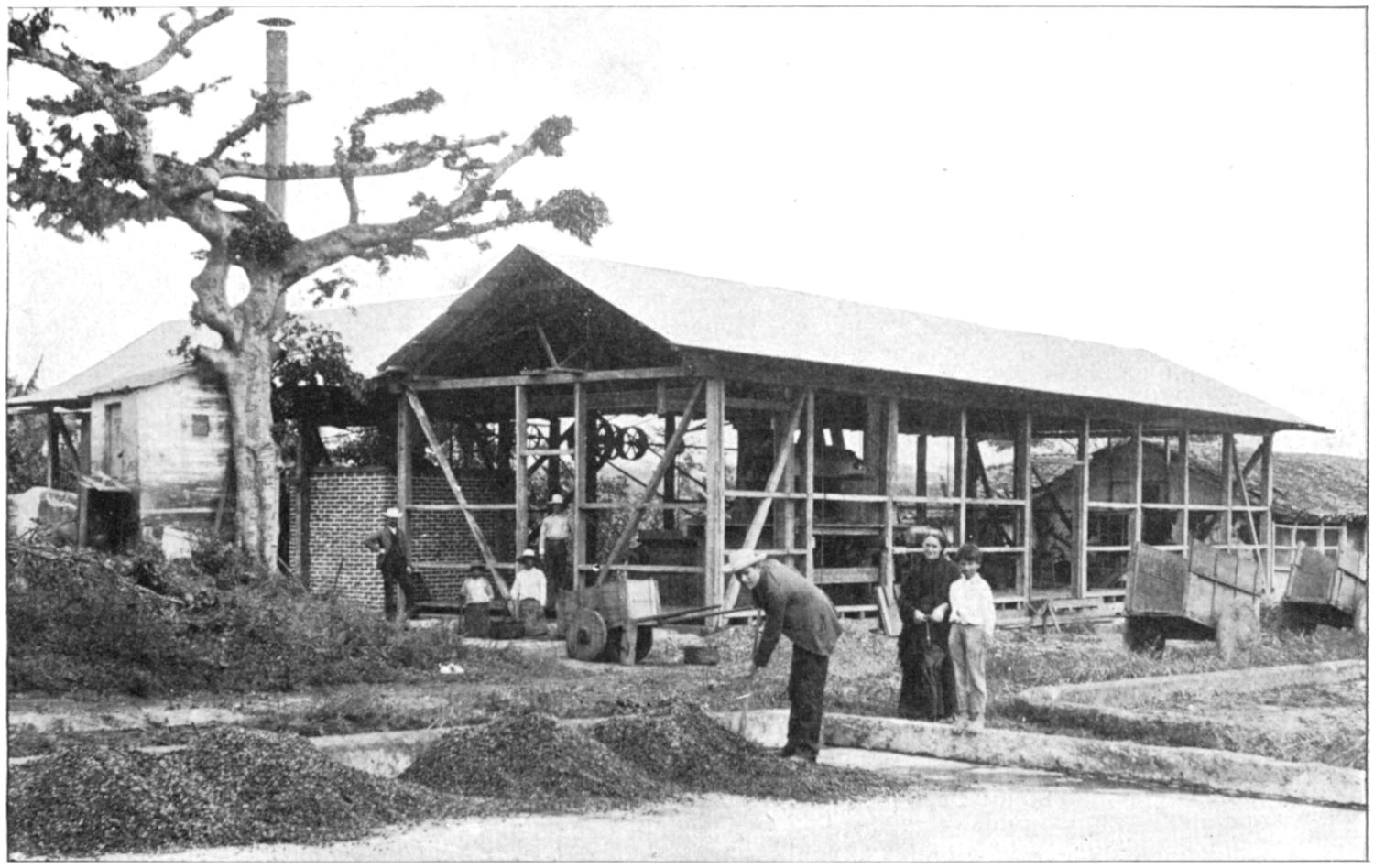
Hulling Coffee.
San Domingo—Known to trade as “Cape,” is grown
on the same island to the west of Hayti, and approximates
very closely in size, style and color to ordinary Jamaica—so
much so that it is frequently substituted and sold in
lieu of it. Its cultivation being also principally conducted
by natives, who are so indifferent to its proper preparation
for market—machinery being employed only to a very
limited extent—that most of the product is shipped in a
stony and otherwise dirty condition, thus reducing its
value commercially far below its intrinsic worth.
Porto Rico—Is grown chiefly in the province of
Ponce, small quantities being also produced in the districts
of Arecibo, Mayaguez and Aguadilla. The bean
is regular and well formed, but varying in color from
yellow to greenish, the quality is fairly good, and though,
not well known in the American market is much valued
in Spain and the European markets generally.
Dominica—Known to trade as “Souffriere,” from
the district of growth, is a peculiarly shaped bean, said
to be produced from Mocha seed, but much inferior to
the product of the parent plant. From the effects of
Negro emancipation and the coffee blight, the annual
production of Dominica has fallen from over 2,000,000
pounds to almost nominal.
Trinidad—The coffee export from Trinidad is only
about 25,000 pounds yearly, yet there is scarcely any
part of the island where coffee culture may not be
profitably undertaken, particularly in the districts of
Aripo and Maracas, where the conditions are unsurpassed.
Both the Arabian and Liberian species are
grown there, the product being commercially divided
into “Large” and “Small” and generally shipped to
Spain.
Martinique.—Although originally introduced into
the New World through Martinique, which island was
for a long time celebrated for the quantity and quality of
its coffee, it produces very little comparatively at the
present day. In fact, barely sufficient to supply the
home demand, the excess going to France, where it is
highly esteemed for its intrinsic merits. The bean is
exceedingly small, hard and flinty, somewhat resembling
that of a Mocha, bluish-gray in color, heavy and round
in body, pungent and piquant in flavor, and grading
with the finest of the milder sorts.
Guadeloupe.—More or less coffee is produced in
Guadeloupe and other of the smaller islands of the
Antilles, but chiefly to supply the home demand, and,
with the exception of the former, are almost entirely
unknown to commerce. It is grown principally in the
districts of Bonfleur and Hatrant, what little is exported
being shipped to France, where it is valued high commercially
for its superior drinking qualities. A century
ago the island exported nearly 8,000,000 pounds, being
now reduced to less than 500,000. The total annual production
of the entire West India Islands not exceeding
90,000,000 pounds at the present time, but strenuous
efforts are being made to increase the product.
Coffee forms the principal staple of the Central American
States, the soil and climate being eminently adapted
to the cultivation of fine coffees, but, as in all other
countries, the best grades are produced on the upland or
mountain slopes. In some of these countries, however,
the most primitive system of cultivation and elementary
methods of preparing are still in use, while in others,
notably Guatemala, the most improved modern machinery
is employed. They embrace Guatemala, Nicaragua,
San Salvador, Honduras and Costa Rica coffees.
Guatemala—Produces the finest, ranking in intrinsic
merit with that of any variety grown—more particularly
that grown in the now famous Coban district, in Vera Paz,
which rivals, if it does not actually excel, all other varieties
in size, style, roasting and drinking qualities. The average
bean is large, bold and symmetrical in form, of a
translucent blue cast, and exceedingly handsome in general
appearance, making a perfect roast, yielding a rich brown
liquor, sparkling and aromatic in the cup. The next
best coffees in Guatemala are those grown in the “Costa
Chica” and “Costa Grande,” a prolongation of the chain
of mountains crossing the southern boundary of Mexico.
The production of coffee has more than doubled in
Guatemala in the past ten years, the price during the
same period being more than quadrupled. The total
product for 1892 was over 700,000 quintals, representing
a total value of 16,000,000 dollars. The extraordinary
high price of coffee now ruling has led to a transformation
of the country, small land-owners who heretofore
realized from their crops scarcely sufficient for working
expenses, now find themselves with considerable capital,
with which they improve and enlarge their plantations.
These results have led to unbridled speculation, large
companies being formed there for still increasing the area
and yield of coffee, every speculator and small trader
who has been enabled to save a little money, abandoning
his former occupation, turning his attention to
coffee growing. This condition may last as long as the
present high prices of coffee continues, but a reaction
may occur at any time, when complete ruin will be
the natural consequence to the suddenly increased
number of producers, of which the reflex cannot
be but felt in the economic conditions of the country.
Land which was but a few years ago uninhabited, has
been suddenly converted into smiling and well-cultivated
coffee plantations, towns and villages long in decay
have risen around them as if by magic and are steadily
increasing in wealth. New roads to facilitate transportation
to the ports are being constructed, commercial
transactions are multiplied, the revenue of the country is
increasing, public credits re-established on a sounder
basis, and what was but a short time ago a poor, declining
and almost ruined State has been suddenly, by the
cultivation of coffee, converted into a rich and prosperous
commonwealth.
Nicaragua—Is a medium-sized regular-formed bean,
solid and heavy in the hand, greyish-yellow in color,
what is technically termed “foxy,” and a smooth roaster.
The drinking qualities, however, are only fair, the liquor,
while heavy, being devoid of snap and fragrance, approximating
more to a Rio in flavor.
Salvador—Is allied to Nicaragua in appearance and
character, and classed the same, but possesses much finer
roasting and drinking properties. The natural bean of
the finer grades is, if anything, better developed and
more uniform, while the poorer ones are very uneven,
broken and “mottled” in appearance; the liquor thin in
body and lacking aroma.
Honduras—Is a yellowish, heavy-bean coffee, assuming
a rich straw color with age, and having an attractive
appearance in the hand. As a general rule it roasts even
and smooth, becoming a rich brown color when parched;
the liquor, while thin, gives out a pleasant odor, resembling
that exhaled by cocoa or chocolate, said to be
acquired from being grown in close proximity to cocoa
plantations.
Costa Rica—Is one of the most deceptive coffees
grown, the raw bean being large and bold in style, a rich
pea-green in color, uniform and shapely; but is invariably
what is termed “hidey,” which is in reality due to the
soil in which it is grown, and, while it makes an almost
perfect roast, is “grassy” and bitter in the infusion, particularly
when roasted for any length of time, it becomes
sour and unpalatable, making its purchase at all times
risky.
Comprise Venezuelan, Colombian, Equador, Bolivian,
Guiana, Peruvian, Paraguayan and Brazilian, small quantities
being also produced in Chili and Argentina.
VENEZUELAN COFFEES.
The chief coffee-producing districts of Venezuela lie
in a central division, having Caracas and Valencia as a
base, with the ports of La Guayra and Puerto Cabello as
shipping points, the district surrounding the Lake of
Valencia being one of the most productive coffee countries
in the world in the quantity and quality of its product.
They include La Guayra, Caracas, Maracaibo, Curaçoa
and Angostura coffees.
La Guayra—Also known as “Coro” and “Port,”
or Puerto Cabello, from the ports of shipment, varies in
size from small to medium, and from a pale to a dark-green
in color. It is usually graded on a parity with
Rio, to which coffee it most approximates in roast and
drink, it being frequently polished and sold as such,
particularly when Rios are scarce, and, although classed
as a “Mild coffee,” develops more or less of a Rio flavor
in the cup.
Caracas—Is of two kinds—Trilliado Milled or
“dry-hulled” and Descerazado (Washed) or “wet-hulled”—from
the different methods employed in pulping and preparing
for market. The former is a yellowish, medium-sized
bean, regular and uniform in the natural state, but
apt to be “quakery” in the roasted, and only fair in the
drink. While “Washed Caracas,” on the other hand, is
bold and bluish in color, opening at the furrow when
roasted like a Mountain Jamaica or Plantation Ceylon,
exceedingly heavy and rich in body and fragrant in
flavor, and may be classed as one of the best varieties
grown.
Maracaibos—Consist of five different varieties or
grades—Cucuta, Merida, Bocono, Tovar and Trujillo—district
terms, ranking in the order named, “Cucuta”
being, when the season is favorable, one of the best
coffees grown, grading with many of the products of
Java itself. The raw or natural bean of the finer grades is
large, round and solid in substance, deep, rich-yellow in
color, approximating to that of the best yellow-bean
Java sorts in style, appearance and drink. While
“Merida” is a mountain-grown coffee, large, bold and
bluish in color, frequently excelling “Cucuta,” particularly
when the crop is good, and possessing a full ripe
liquor with round full body and distinctive flavor very
pleasing to the average consumer.
“Bocono,” “Tovar” and “Trujillo,” are inferior
grades to the above, small and gnarled in the natural
state, generally stony and broken, “quakery” and
shriveled when roasted, light in liquor, but smooth and
pleasing in flavor withal, making good useful coffees for
blending purposes. Maracaibo coffees are packed in
Sisal-hemp bags averaging 130 pounds, and principally
shipped to the United States, where they are held in high
esteem for their many excellent qualities, the regular
grades of Cucuta being marked “C” under the importers’
initials, and the choicer grades “C C.” Merida is indicated
by the letter “M” in the same manner, Bocono
by “B,” Tovar by “T” and Trujillo by “To.” But
owing to the too common practice of substituting and
repacking indulged in by unscrupulous dealers, these
distinguishing marks cannot always be relied on with
any certainty.
Curaçoa—Is a small, yellowish, shriveled or shrunken
bean coffee, evidently immature or blighted in growth
from some unknown cause. It is generally “quakery”
in the roast, but yields a not disagreeable liquor in the
cup, making a valuable variety in combination to reduce
cost.
Angostura—Is a large, flabby, yellowish bean
variety, shapely in form but light and “chaffy” in substance,
and invariably “quakery” when roasted, the
liquor being thin, watery and almost flavorless.
Venezuela supplies about one-tenth of all the coffee
consumed in the United States, the total imports being
in round numbers about 60,000,000 pounds per annum,
and growing steadily.
COLOMBIAN COFFEES.
The coffee-producing districts in Colombia are situated
chiefly in the departments of Boyaca, Santander and
Cundamarca, these three departments having an area of
over 160,000 square miles, of which nearly one-half is
adapted to the cultivation of some of the finest varieties
of coffee grown. The possibility of this extensive area
promises a future supply of almost six times the amount
consumed in the United States; in fact, coffee-growing
in Colombia, like Mexico, has no limit except that caused
by the lack of labor and capital to work it. They are
known in trade as Ocana, Bogota, Panama, Savanilla and
Bucaramanga.
Ocana.—While bold in bean and regular in form,
inclining to a yellowish in color, is still light in weight
and thin in body, approaching that of a Trujillo Maracaibo
in flavor, with which coffee it is usually graded.
Bogota—Is a mountain-grown coffee, raised on the
western slopes of the Andes. It is usually a large and
well-developed bean, bluish-green and very uniform in
general appearance, solid, compact, and faultless in the
roast. The liquor is heavy, full, round and fragrant in
flavor, comparing favorably with Caracas, Jamaica, Guatemala
and Plantation Ceylon in general style and
character.
Savanilla—Is a large, light and “spongy” bean
coffee, brittle and chaffy in the roast, devoid of body
and almost flavorless. It closely approximates to a Native
Ceylon or Angostura in appearance and character,
with which coffees it is commercially classed.
Panama—Is comparatively a new variety, recently
produced on the isthmus, and like all new productions
immature in appearance. It is of the average size,
greenish in color, but moist and spongy in the natural
state, and as yet but poorly prepared. The liquor is
heavy and strong almost to rankness, possessing a grassy
or uncooked taste, defects, it is claimed, that will be
overcome in time when its cultivation and preparation is
better understood there.
Bucaramanga—Known to trade as “Bucaramanga
Maracaibo,” ranks among the finest of the South American
varieties, being large and bold in style, solid and weighty
in substance, perfect in roast, heavy, round and full in
liquor, fragrant and aromatic in flavor, the finest grades
being superior to many of the Java sorts. The department
of Chinqui in the interior of Colombia also offers
a good field for coffee culture, the fine lands along the
slopes of the mountain ranges being admirably adapted
for the purpose. The annual product is about 20,000,000
pounds, going chiefly to the United States and France.
Equador Coffees—Include Cuenca, Tacunga and
Machala, but are generally classed under the name of
“Guayquil,” being shipped from that port and consumed
principally on the Pacific coast, but are limited in
production, little being left for export after the home
demand has been supplied. They range from medium
to large in size, are somewhat bold in style, hard and
flinty in texture, pale to greenish in color, and only fairly
uniform, being rather imperfectly prepared, but roast and
drink well, nevertheless, yielding a light-brown liquor,
full in body and fairly fragrant in flavor. Increasing
attention is being given to coffee cultivation in Equador,
the produce of the new districts being of good quality.
The exports from Guayquil average about 1,000,000
pounds per annum, but in some years the crop is entirely
spoilt by heavy rains, the yield being inferior in quality
and so low in quantity as not to suffice for local needs.
Bolivian Coffees—Are comparatively new to commerce
and bid fair to become popular sorts in time,
when their cultivation and methods of properly preparing
are better understood in that country. They are produced
principally in the provinces of Yungas and Mapin,
small quantities being also grown in the other provinces.
The finest kind is that cultivated in the valley of Yungas,
which though small in size and pale in color possesses a
peculiarly rich and delicate flavor, commanding a very
high price relatively. The product, however, is limited,
only about 300,000 pounds per annum, or equal to one-fourth
the entire supply. The product of Mapin is much
larger in size, greenish in color, but not near as rich in
flavor, bringing a much less price, the annual product
being three times greater. Bolivian coffees in general
produce an intoxicating effect, this peculiar action being
as yet unaccounted for, but is claimed by some authorities
to be acquired from being grown in the immediate vicinity
of the cactus plant, from which pulque is distilled, the
coffee plant being of such a sensitive and absorbent nature
that it readily acquires any foreign flavor within range.
Whether this claim is correct or not has not as yet
been ascertained, but certain it is that what is known as
Singapore coffee usually tastes of spices, Honduras of
cocoa and Costa Rica of what is called, for want of a
more applicable term, “hide,” but which is in reality due
to the presence of oxide of iron in the soil.
Guiana Coffees.—Known to trade as “Surinam,”
“Demerara” and “Cayenne,” from the ports of shipment,
are produced in the French and Dutch colonies of South
America. But although the cultivation of coffee was
introduced into these countries about the same period as
to Martinique, its cultivation there has made but little
progress, the total production being limited in supply, and
going chiefly to the mother countries.
Peruvian Coffee.—Coffee grows luxuriantly on the
mountain slopes of Peru, the crops often being so heavy
as to necessitate artificial support for the branches, yet the
export from Mollendo, the shipping port, amounts only
to about 16,000 pounds per annum. It ranges in size
from medium to bold, varying in color from bluish to
yellow, roasting and drinking with the average of other
South American sorts.
Paraguayan Coffee.—The total production of coffee
in Paraguay is exceedingly small in comparison with
what might be grown there under more favorable circumstances,
little or no attention being given to its cultivation,
owing to lack of labor and capital, and notwithstanding
that it offers a fine field for its more extensive
growth.
BRAZILIAN COFFEES.
Brazil being the most extensive coffee-growing country
in South America and the largest producer of coffee in
point of quantity of any country in the world needs
more than a passing notice in this work. The gigantic
extent to which its production has been carried there,
the enormous, almost fabulous, amount of capital invested
in its cultivation, the multitude of people employed in its
preparation and handling, including the quantity of shipping
employed in its transportation invests it with great
importance. One must have been an eye-witness of the
immense bustle occasioned by the coffee trade of Rio
and Santos, must have observed the feverish excitement
and the unprecedented rapidity with which it is prepared,
transported, bagged, unbagged, mixed, rebagged, loaded,
marketed and shipped before he can form any conception
of the extent of the coffee industry in Brazil.
In 1718 the Dutch colony of Surinam began to introduce
and cultivate coffee in Guiana from plants received from
Java, and in 1722 De la Motte, the French Governor of the
adjoining colony of Cayenne, having business in Surinam,
contrived by an artifice to bring away with him from there
a small coffee plant, which in 1725 had produced many
thousands which were distributed among all the French
colonies on the mainland, its propagation extending to
Para in 1732, the first coffee plantation formed in Brazil
being commenced in that province a few years later. Its
cultivation, however, made but little progress there until
about 1767, when its cultivation was still further extended
to the province of Maranhao, where it soon increased
rapidly under a more careful and systematic management.
In 1774 a Belgian monk named Molke procured some
coffee plants from a prosperous plantation in Maranhao,
which had previously been obtained from Surinam, and
planted them in the garden of the Capucin monastery of
Adjuda, then situated in what is now the centre of the
city of Rio de Janeiro. The plants prospered so well,
and he becoming convinced of their importance as a
valuable acquisition to the industries of the country that
he established a plantation in the vicinity for its more
systematic cultivation. Joachim Bruneo, the then
Bishop of Rio de Janeiro, perceiving the valuable benefits
that would result from its more extensive cultivation,
distributed seeds and plants raised on Molke’s plantation
among the religious institutions and planters of the country,
recommending and encouraging its cultivation among
them, but it was not until 1800 that Brazilian coffee
came to be so highly valued in the markets of the world.
In that year a planter named Dr. Lecesne, expelled by
the revolution from San Domingo, settled near Rio and
introduced the latest improved methods of cultivating
the coffee plant into that country. From these simple
and unostentatious beginnings has grown the now
enormous coffee industry of Brazil, which at present produces
more coffee than all the other countries in the
world combined; it being calculated that upwards of
1,500,000 acres of land are under coffee culture there,
containing nearly 600,000,000 trees, hundreds of millions
of dollars of capital being invested in its culture, sale
and transport. The cultivation of coffee in Brazil now
extends from the banks of the Amazon to the southern
province of Sao Paulo, and from the coast to the western
limits of the country, the plant seeming to find the
requisite conditions of soil and climate in almost every
part of this vast region, and nearly everywhere giving an
abundant yield. Its chief zone of production for commercial
purposes, however, is chiefly confined to the coast
provinces of Bahia, Ceara, Rio Janeiro, Sao Paulo, Minas
Geraes and Espiritu Santo.
In Brazil it was formerly the custom to propagate the
coffee plant by slips or “shoots” cut from the older
plants on the plantations, but at present it is more generally
grown from the seed, as in the Eastern countries. The
seeds are sown in nurseries planted with advanced stalks
of the mandioca, which serve to shade the sprints while
young and tender from the extremes of heat and cold
alike, but are gradually thinned out as the growth of the
young plants advance, the nursery at this period resembling
a young plum thicket. When the plants have reached
a height of from eighteen to twenty-four inches, they are
transferred to the plantations and planted from six to
ten feet apart, according to the district and conditions. As
a general rule a crop is not expected until four years after
setting out the young plants, unless when the plants are
from eighteen months to two years old before transplanting,
in which case a partial crop is obtained at the end of
the third year. Nearly all over the Brazilian coffee zone the
plantations extend with the greatest regularity, as far as
the eye can reach, presenting a most attractive and pleasing
effect, some fazendas (plantations) having as many
as 350,000 trees, others again having as low as 30,000,
but all averaging from 500 to 800 trees to the half fanegada
(acre), the average annual produce of each tree
ranging from one to seven pounds of prepared coffee, or
about one to one and a half pounds per picking of
cleaned coffee. The plantations situated on high lands
and exposed to the east being the most productive, but
prospering equally well in the lowland districts, although
the product is much inferior in quality and flavor.
The trees are grown in lines and squares, the face of
the country in the coffee-growing districts being undulating
and hilly, a plantation of coffee being at every season
of the year an object of beauty and interest. The leaves
are perennially bright and polished, resembling those of
the laurel when in full bloom, but of a much darker
green in color, the flowers or blossoms of the purest
white, growing in tufts along the top of the branches, and
blooming so suddenly that in the morning the trees
look as if snow had fallen on them in flaky wreaths
during the night, their jasmine-like perfume being powerful
enough to be oppressive, but lasting only for a single
day, being succeeded immediately by branches of immature
green and the dark-crimson hull of the ripe berries—resembling
cherries in their brilliancy and size—and
following each other in quick succession, which added to
the thick foliage of the trees presents altogether a magnificent
spectacle.
In Brazil the coffee trees continue to bear from fifteen
to twenty years, but it is found necessary to the healthy
development of the plants to keep the ground in good
condition, and when the interspaces are not cultivated
with other plants—principally corn and beans—as is
usually the custom, it is annually cleared around the
roots, a compost of dead leaves and coffee-hulls being
placed about them. In some districts—notably Sao
Paulo—many of the trees have been producing continuously
for twenty-five years, still presenting a vigorous
appearance and yielding an average each year, while others
that had attained an age of thirty-five years were cut off
within eighteen inches of the ground, and two years later
put forth new branches, presenting all the appearance of
thriving trees, bearing fruit like much younger trees.
This is a new and interesting feature in the management
of the old trunks of coffee trees, one having the advantage
of new growth being secured in one-half the time it
could be obtained from seedlings, as even should these
stumps require to be dug around and manured frequently,
it is much more preferable and profitable to the
trouble, expense and uncertainty connected with the raising
of new plants from seed, and certainly presents greater
advantages over the latter method. In Brazil the picking
is latterly—since the abolishment of slavery—done
by contract with the fazendon, or proprietor, who only
requires the services of the pickers to gather the
berries from the trees, for which labor they are paid
what is considered to be one-half the value of the
crude coffee that is gathered by them. The estimate
placed upon an alquerie (bushel) of crude berries
being about seventy-five cents, which, unless the crop is
good, ordinary hands do not gather more than two bushels
per diem; yet, again, when the crops are large, an
industrious and skillful picker can average from five to
eight bushels without effort. The berries are picked by
hand, the ground being raked clean under the trees previous
to picking, an immense, broad, flat receptacle of
bamboo being placed underneath the trees, the berries
that fail to fall into this being carefully swept up from
the clean, smooth ground and emptied into it until filled,
when it is carried to a point convenient to the roadside
and emptied in piles, from which the coffee is afterwards
hauled in ox-carts to a large building known as the
terreiro or drying-yard. Picking commences in April,
and is continued almost uninterruptedly until November,
and after the coffee is gathered it is carted just as it
comes from the plantations, mixed with leaves, stalks
and stones to the drying-house and spread out on the
terraces, large smooth, concrete pavements, to dry in the
sun until the berries become black and crisp, after which
they are “hulled” or cleaned by one of two methods:
one the old or “Monjola process,” and the other the
new or “Despolpodor” process.
Brazilian coffees are known to commerce as Bahia,
Ceara, Capatinea, Rios, Santos and Maragogipi.
Bahia—Is a small, uneven greenish bean, very inferior
in style and appearance, usually “stemmy” and stony
and thickly interspersed with black or immature beans,
and is usually branded “S” or “S S.” The roast is
poor, irregular and quakery, the liquor thin and grassy
or unripe in flavor.
Ceara—Resembles Bahia somewhat in general character,
being poorly prepared and very unsightly in the
natural state, the body and flavor being still more inferior.
Capatinea—Grown in the province of Espiritu Santo,
but also known to trade as “Victoria” from the port of
shipment, is a large whitish, soft and flabby bean
coffee, quakery in the roast and watery and flavorless in
the cup.
Rio Coffees—Are almost too well known to need
description; the bean, however, varies widely in size
and color, ranging from small to large, and from dark
green to light yellow, being known to trade as “Light,”
“Dark” and “Golden.” They are heavy in body,
possessing a flavor and aroma peculiarly distinct from that
of all other coffees, and which is so marked in degree as
to be readily detected by the most inexpert, excepting
“Golden Rio” which, aside from its rich color, possesses
a markedly pungent liquor and pleasing flavor.
Pole-cat Rio—Is a very dark, almost black bean
coffee, which, although muddy and dark in liquor, is
nevertheless much appreciated by many coffee drinkers.
Liberian Rio—Grown from Liberian plants in Brazil,
is little thought of, producing little, and that irregularly.
The fruit also requires special machinery to prepare it,
the husk being too thick and leathery to pass through
the regular machines.
Rio Hache—Though frequently classed with Rio
coffees, as a matter of fact is not grown in that country,
but in Colombia. The bean is yellowish-brown in color,
light in weight and liquor, and somewhat mawkish in
flavor. Like all other coffees, Rios improve with age,
and with time lose their harsh flavor, which becomes
greatly modified by storing, disappearing altogether in
from three to four years, particularly when kept in an
even temperature.
Santos Coffees—Produced in the adjoining province
of Sao Paulo, but deriving its trade-name from the port of
shipment, ranges from small to large in size and from
green and yellow to a full white in color according to its
maturity, it is an immensely popular sort among American
consumers as well as in Europe, having more than
doubled in consumption in recent years. It is fast supplanting
the milder growths of other countries, the
finer grades being frequently substituted for Maracaibo,
and even Java, by unprincipled dealers. While many
of them roast “quakery,” they are nevertheless almost
invariably smooth and pleasing in liquor and flavor.
Red-bean Santos—Grown in the Campinas district,
is medium in size and reddish in color—a peculiarity
derived from the soil, which is composed of terra rocha
(red earth)—and is claimed to be richer and more
flavory than either the white or yellow bean varieties.
Mocha-seed Santos—Is a small-bean variety, grown
from Bourbon seed or transplants, and is fast becoming a
very popular sort. It is shipped principally to France,
where it masquerades under the name of Mocha, thereby
diminishing the demand for this favorite sort in proportion
to the amount distributed.
Maragogipi—Which was discovered in the province
of Bahia some years since, is claimed to be an indigenous
variety and is called after the district where it was
first found. The bean is as large as Liberian, but flat in
form and varies in color from a very light to a dark-green,
but while heavy and full in body and fair in quality,
it is yet lacking in all the essentials of a fine coffee,
disappointing the great expectations at one time formed
of it.
OTHER BRAZILIAN VARIETIES.
Cafe des Aguas—Is so termed from blossoming in the
rainy season, and which has the effect of stunting and
deforming the beans. The bean is oblong in shape and
imperfectly formed, while the liquor is thin and watery
and devoid of flavor.
Cafe Vermelho—Is the regular “Red-berry” species,
and is so named to distinguish it from a new variety said
to have been recently discovered and termed
Cafe Amarello—Or “Yellow-berry,” recently found
in the district of Botucatu, and is so called because the
ripe berry is yellow instead of red. It is superior to
the ordinary sort, not on account of any difference in the
size of the bean, but according to the chemical analysis
of experts, who claim that it is much richer in caffeine.
Brazilian Java.—Extensive plantations of Java coffee
plants have lately been formed in Brazil as an experiment,
but does not produce such heavy and regular crops as in
the original soil.
Goyaz Coffee—Is a wild species, discovered a few
years ago in the province of Goyaz, but is little thought
of by planters or dealers, being wild and grassy in flavor.
In Brazil the planters generally forward their crops to
a Commissario or factor at the shipping port, who acts
as their agent, the coffee being received in varying lots
and conditions from different growers, no uniformity
being observed in the kind of bag or quantity. The commissarios
again disposes of it to the Ensaccaderes, who
are the actual buyers at first hands, and who store it in
large warehouses, where it is graded and bagged, and
stored until required for shipment to the foreign markets.
The sacks of coffee being piled on either side, each being
numbered and further distinguished by some special
mark or brand. At the present time many commissarios
have the coffee weighed as they sell it, but sales between
the commissarios and ensaccaderes are never concluded
in Rio without the assistance of a Corretor or
broker, while in Santos, where the exporter buys his
coffee direct from the commissario, it is sold mostly
without the intervention of a broker, the terms of
payment being fixed at thirty days.
Brazilian coffees are generically classed in the Rio and
Santos markets as “Highland” and “Lowland” and are
graded as Superior or “Choice,” Primera or “First,”
Primera boa or “Good first,” Primera regular or
“Regular first,” Primera ordinaria or “Ordinary first,”
Segunda or “Second,” Segunda boa or “Good second,”
and Segunda ordinaria or “Ordinary second.” Importations
are generally in “Cargoes” divided into “Invoices”
or “Lines,” designated by letters. An invoice consisting
of a number of “Chops” denoted by figures, each chop
varying from the other in quality, size and color. In the
American market the coffee is subdivided into six grades,
known to trade as “Fancy,” “Choice,” “Prime,” “Good,”
“Fair,” “Ordinary” and “Common,” the first four
grades being further distinguished by the terms “Light,”
“Medium” and “Dark,” and by prefixing the term
“Strict” or “Strictly” correct selections of each grade
may be secured.
There is no standard grade, nor is it possible to establish
one, owing to the changes made by time in the appearance
of the coffee, which causes the different grades
to vary with the size, color and quality of the coffee and
the condition of the market on arrival. On an active
and rising market the coffee that on a steady market
would be denominated only “Fair,” suddenly becomes
“Prime” or “Good,” and on a dull or declining market
may be classed as “Ordinary.” The following constitutes
the different grades as they are generally accepted
on this market:—
Fancy Rio or Santos—Is large, bold and uniform
in size and color, free from all imperfections, and attractive
in style and appearance.
Prime—Is very clean and regular in size and color,
but deficient in the rich, pleasing appearance of the
former.
Good—Is acknowledged as the average or “Standard”
grade, and ranges from clean to strictly clean, and is
uniform in bean and color.
Fair—Is only moderately clean, containing some
black or broken beans and other slight imperfections.
Ordinary—Is irregular in size and color, and unsightly
in appearance, containing much black beans and
other extraneous matter.
Common—Is the poorest grade, and is generally full
of black and broken beans, stems, hulls and chaff, having
no definite color, and very unsightly in general appearance.
On the Coffee Exchanges they are graded numerically
from No. 1 to No. 10, No. 7, or “Low ordinary,”
being adopted as the “Standard grade,” upon which all
transactions are based. In point of quantity Brazil heads
the list of coffee-producing countries, its annual product
ranging from 7,000,000 to 8,000,000 bags of 130 pounds
each, 75 per cent. of which is exported to the United
States, the remainder going chiefly to Europe.
Pea-berry Coffees,—Also known to trade as “Male-berry”
and “Pearl-bean,” are concave-convex in form
and may belong to any variety, from Rio to Java. Their
peculiar shape being accounted for as follows: Each
perfect coffee berry should contain two oval seeds or beans
placed facing each other in the fruit or pod, but it most
frequently occurs that only one seed will form in it, the
other becoming abortive. The one forming receiving all
the nourishment of the investing coats, forces itself
against the dividing membranes and encountering no
opposition naturally develops into a larger bean, which
in the process of growth assumes a shape different from
that of the regular or “flat bean” of commerce.
Cherry-dried Coffee—Is a term applied in the East
to coffees cured by the old or sun-dried process. After
the berries have been harvested they are spread out on
“patios” or terraces exposed to the sun’s rays for a period
covering from six to eight weeks, or until they are
thoroughly dried, before being pulped and hulled. Meanwhile
they are raked and turned over once a day during
the drying period, in order to prevent heating and fermentation,
and at night heaped up and covered over with
matting or other material to protect them in case of rain,
and from the heavy dews, until the process is completed,
after which they are pulped and hulled by crushing in a
mill.
Washed Coffees—Are so termed from being prepared
by the new or West India process, by which the
coffee is pulped immediately after being picked, the
berries being placed in a large vat and the pulp soaked
off. The coffee in the parchment left in the vat is kept
in constant motion by agitation with a kind of rake
or shovel to wash it well, the water being constantly
changed also while the washing continues, to remove the
débris with which the coffee charges the water, the coffee
sinking, while the pulp, blighted berries and other
extraneous matter such as stems and leaves are floated
off by the water, after which the beans are again washed
and spread out on mats to dry. By this method the
coffee must be crushed the same day, otherwise it will
ferment and the flavor be greatly injured.
Triage—Is composed chiefly of dead or decayed
beans, which are invariably sour, bitter and black, being
entirely destitute of the active principle of coffee, containing
no aroma and invariably injuring and detracting
from any coffee in which they may be mixed—as they
usually are—no matter how small the quantity used.
Screenings—Are composed of the dust, chaff and
mutilated beans separated from the regular grades of
coffee in the process of milling, and drink well according
to the variety or grade from which they are obtained,
but are generally roasted, ground and mixed with chicory,
and sold in package form.
Skimmings—Are usually composed of that portion
of the cargo stowed in the bottom or sides of the vessels
in which it is imported, or of the storehouse sweepings
after the regular coffee has been delivered. A greater or
less portion of all cargoes are found damaged by dampness
or bilge-water during the voyage, thus staining and
discoloring the coffee, rendering it mouldy or musty.
The strained and damaged bags are emptied and the tainted
coffee “skimmed” off, milled, rebagged and sold under
the head of “Skimmings.” They are generally branded
“G. S.” (Good skimmings), “G. L. S.” (Good light
skimmings), “G. D. S.” (Good dark skimmings), “F. S.”
(Fair skimmings), and “S. S.” (Store or ship sweepings).
Notwithstanding their origin many of those coffees roast
and drink exceedingly well, but great care must be exercised
by the dealer in selecting them, as they may taste
of the bilge-water or be mixed with coal, iron, chips and
other extraneous substances.
United States Coffee—The Department of Agriculture
at Washington has recently issued a circular relative
to the possibility of coffee culture in some of the
Southern States, in which it is led to believe that the
soil and climatic conditions of Texas, Florida and Lower
California will be found suitable to the profitable cultivation
of coffee. It is also claimed that a species of wild
coffee has been discovered in the two latter States, and
that in California seed has been planted obtained from
Costa Rica with satisfactory results. A coffee planter
from Guatemala has recently been investigating the soil
and climate of San Bernardino in Lower California with
a view to the introduction of coffee culture in that section.
The conditions there, it is stated, are very favorable
for its profitable production, and he has offered to invest
capital in a company to be organized to start the industry.
CHAPTER VI. ROASTING AND GLAZING. — GLAZING. — GRINDING.
 Coffee
undergoes essential chemical changes in
the process of roasting. In the raw or natural
state the coffee-bean is tough and horny in structure
and entirely devoid of the appearance, character
and peculiar aroma that so distinguishes it in the
roasted condition, and by which it is best known to
the public. The testa or investing membrane of the
raw bean has a layer of long cells with a peculiar pitted
structure, containing a crystaline substance chemically
termed Caffeine, and another known as Caffeic, or tannic
acid, while the inner substance consists of an assemblage
of vesicles of an angular form, the cavities of
which include in the form of little drops a considerable
quantity of a highly aromatic oil technically termed
Caffeone, on the presence and amount of which the
fragrance and active principles of the coffee depends,
and by which its commercial value in the roasted state is
estimated. The existence of this “coffee oil” makes itself
known in a striking manner by roasting; being driven out
of the beans by the intense heat, it is partially volatilized
and, together with other products of the roasting, produces
the characteristic aroma peculiar to roasted coffee,
an odor possessed by no other known substance.
In the operation of roasting the beans swell up and
open at the furrow by the liberation of the gases within
their substance, their weight decreasing, but volume
increasing in proportion to the extent to which the operation
is carried, developing the aromatic oil and liberating
at the same time a portion of the caffeine from its
combination with the caffeic or tannic acid. The
amount of this aromatic oil contained in coffee varies
from 8 to 13 per cent. at least, one-half of which is lost
by evaporation during the roasting process, so that it
may prove a paying experiment to attempt to collect it,
especially in large establishments where large quantities
of coffee are roasted and several pounds of this valuable
oil are dissipated daily, which would no doubt find a
ready market at a good profit for the making of liqueurs,
or medicinal use.
Before being roasted coffee also contains from 6 to 8
per cent. of sugar, which after roasting is reduced to as
low as 1 per cent. and sometimes even to zero, from
which it would appear that the description of sugar (cane)
present in the raw coffee suffers destruction during roasting,
which, however, is not the case, as in the process of
roasting the saccharine matter in the raw bean is converted
into caramel. A change in the fat of the raw coffee
is also brought about by the roasting, for where ether
extracts only some four to five parts of fat from the raw
coffee beans, it readily extracts double that quantity from
the roasted beans. So striking is this fact that Von Bibra
has even credited the roasting process with the production
of fat, whereas the action is only mechanical in
bursting the fat-cells of the raw bean, thereby rendering
the fat accessible to the solvent action of the ether.
The operation of roasting also tends to make coffee
soluble in boiling water, as when raw coffee is perfectly
exhausted by means of boiling water, it yields up only 25
per cent. which passes into solution, while roasted coffee,
on the other hand, when completely exhausted by means
of boiling water yields readily upwards of 40 per cent.
of soluble matter, proving that in actually using coffee
as a beverage, we are not in the habit of making anything
like a complete extraction, as only some 10 to 12
per cent. of the active principles of the coffee passes into
the liquid.
The modern appliances for the roasting of coffee are
numerous and labor-saving to a great extent, many of
them are, however, calculated only to enhance the appearance
of the bean, while others enable the roaster to
obtain almost to perfection the full development of the
aromatic properties of the coffee. Coffee is roasted for
commercial purposes and domestic use in a large sheet-steel
or malleable-iron cylinder mounted on a hollow
axle, so as to revolve over a brisk fire and allow the gases
generated during the torrefaction to escape. The surface
of the cylinder is perforated with a number of small holes
for the purpose of allowing the vapor arising from the
coffee in the process of roasting to pass off readily, and
through the interior runs laterally four ridges, the object
of which is to toss it about in all directions, causing it
to pass from end to end, and diffuse a uniform heat to
every part of the coffee in order to make the “roast”
even and regular in appearance. This cylinder is again
encased in a frame brick-work at the bottom of which is
built a coal fire well distributed so as to heat all portions
of the cylinder at the same time during the operation.
On the outer head it has a small opening through which
the operator occasionally inserts a “tryer” to enable
him to note the progress made as the process advances,
the cylinder being also so arranged that it can be drawn
from over the fire when it is required to either fill or
empty it through a slide or hopper in the centre. It is
operated by steam-power, revolving slowly but regularly,
and having a capacity of from 25 to 300 pounds.
After roasting, the coffee is run off into a large wire-bottomed
box termed a “cooler,” to the end of which is
fitted a powerful fan or “blower” used for forcing cold
air through the hot beans and preventing the volatile oil
from exuding, the coffee being thoroughly agitated
during the process, the hulls, chaff and stems being
removed meantime to a large extent by the fan and
sieve. Thirty-five to forty-five minutes is usually the time
consumed in the operation, the former for a “Light”
and the latter for a high or “Dark” roast, the entire process
of roasting, cooling and rebagging occupying about
one hour. In roasting, coffee loses in weight from 12 to 16
per cent., according to the age and nature of the coffee
under treatment and the extent to which the operation is
carried, the average, however, being 14 per cent. for old
and well-seasoned coffee, which accounts for the relatively
higher price—three to six cents per pound—of
roasted coffees, according to the price green and the loss
per cent. in roasting. But, it at the same time increases
in bulk—100 volumes of raw coffee yielding from 150 to
160 volumes of roasted—that is, two pints of raw beans
will yield three pints roasted. It also loses from 1 to 2
per cent. more in the warm months of summer than in the
damp months of winter, for which reason it should not be
roasted as high in the former season as in the latter, owing
to its greater tendency to sweat and absorb the higher
temperature, thus causing the volatile oil to exude, and
dissipate and impart an astringent taste to the infusion.
When coffee is roasted light-brown, or until it assumes a
pale-chestnut color, the loss is from 13 to 14 per cent. the
quantity of extract obtained from such roast by means
of boiling water ranging from 20 to 21 per cent. of the
weight, while the loss in weight of the extract will be
much larger if the roasting process is continued until
the color becomes dark-brown or black by over-roasting.
New, moist and light coffees lose a larger percentage than
old, dry and solid ones, the average being about 14 per
cent. The operation of roasting coffee is one of the greatest
exactness, amounting almost to an art, perfect roasting
requiring not alone skill and judgment but experience
and constant practice, as not only the style, strength and
flavor but also the commercial value of the coffee depends
upon the operator deciding when it is properly parched
or roasted. It is also one of a crucial nature, for equally
by insufficient as well as by excessive roasting, much of
the aroma of the infusion is lost, the beverage under
either of these circumstances being neither agreeable to
the palate or exhilarating in its influence. The operator,
for these reasons, must judge of the exact amount of heat
required for the adequate roasting of the different varieties,
which, while variable, the range of roasting temperature
proper for roasting the various grades is only very
narrow. In a modern, well-equipped coffee-roasting
establishment, the coffee is handled almost exclusively
by machinery, being fed into the cylinder from hoppers,
emptied into the cooler from the cylinder and from thence
into the bins by drafts of air through tubes or pocket-elevators,
so that the coffee is scarcely once handled
during the entire process.
The entire art of coffee roasting may be summed up in
the following sequence: (1) Starting the machinery in
motion. (2) Starting a brisk fire with enough coal for a
single roast. (3) Putting in the coffee before the cylinder
becomes too hot. (4) Opening the draft and keeping up
a brisk fire during what is termed the steaming period.
(5) When the beans begin to crackle and the steam
changes into an aromatic vapor, rake the fire well, put
on sufficient coal to make the next roast and shut off the
draft. (6) Empty the coffee from the cylinder into the
cooler and cool off rapidly, then sift and pack. If a light
color is required roast quickly, if a dark, slowly. The
exact time for a perfect roast under these rules depend
to a great extent on the size of the cylinder, the quantity
of coffee to be roasted, the amount of heat and the color
desired, the average ranging from 30 to 40 minutes. The
addition of a little water to the coffee when it begins to
crackle in the cylinder, will cause the beans to swell up,
liberate the chaff and make the process safer by extinguishing
any sparks that may by accident occur in the
cylinder. It also preserves the aroma longer to some
extent when used in moderation, but will not, as is sometimes
claimed, protect it from atmospheric influences,
but on the contrary makes it more liable to such influences,
particularly when used in excess.
When the beans begin to crackle the revolutions of
the cylinder are increased for a short time in order to
prevent them from scorching or burning, a bluish vapor
is emitted at the same time, which indicates that the
coffee is nearly if not quite roasted. At this stage the
operator pours on the coffee a quantity of water to prevent
it from burning, the rapid evaporation from which
reduces the intense heat and causes the beans to burst
open and swell up to about double in size. The use of
a little lard at this juncture will impart to the beans a
smoother, glossier and more attractive appearance. The
addition of water in the roasting of coffee is not, as is
generally supposed, intended to increase its weight—unless
when used to excess—as the intense heat converts
it into steam which rapidly passes off in the air, many
old roasters contending that coffee cannot be properly
roasted without the use of some water. In the proper
roasting of coffee a strong, well-distributed heat extending
the entire length of the cylinder is imperative. The
cylinder should never be allowed to lie empty over the
fire for any length of time or become too hot before the
coffee is put in, as the beans will become mottled or
“specked” if poured in while in that condition, thus
detracting from the appearance and value of the roasted
coffee.
An experienced roaster can readily discern when the
coffee is properly roasted, by the light bluish vapor
arising from the coffee, as well as by the smell of the
aromatic principle developed as it evaporates from the
cylinder at this stage of the operation, without even once
examining it during the process. A perfect “light roast”
should be free from specks and other blemishes, of a cinnamon-brown
color, even, uniform and oily in appearance,
much depending on the amount of this latter property
developed in the process, imparting as it does a pleasanter
and more agreeable aroma as the quantity is increased,
making the liquor blander and more mellow in the cup.
While a perfect high or “dark roast” when required
should be of a deep chestnut or chocolate-brown color,
oily and free from all burnt or scorched beans, as the
latter, no matter how few the number, invariably spoil
the flavor of the coffee in the infusion, irrespective of its
fineness or value. Over-roasting dissipates the active
principle (Caffeine) to which the coffee owes its refreshing
and stimulating properties while under-roasting
imparts to the infusion a raw, uncooked, grassy or
astringent flavor by not properly developing it. So that
the finest grades of coffee when imperfectly roasted—that
is, be under or overdone—yield an inferior liquor to the
poorer grades when properly roasted. As stated before,
coffee contains a crystaline substance termed caffeine
(identical with the theine of tea), which is volatile in
its nature, and every care must be taken to retain this
principle in the coffee, for which reason the beans should
be roasted only until they are of a pale-brown color;
again, if they are roasted too dark this essential property
is destroyed.
The proper cooling of coffee after roasting is also an
operation of great importance. If the coffee has been
properly roasted and the beans well developed, it must be
cooled quickly to prevent them from becoming too dark-colored
or mottled in appearance. When the coffee has
been cooled and cleaned it is then packed, the operations
of roasting, cooling and rebagging occupying altogether
about one hour.
In France and other European countries it is the custom
to roast coffee in small quantities, so that the whole
“charge” is well under the control of the operator during
the process, while in this country large roasts are the
rule, in dealing with which much difficulty is experienced
in producing uniform torrefaction as well as in stopping
the process at the proper moment. A novel method
for roasting coffee in use in France is to put it in an
iron globe, suspended over a brisk fire, and containing
a tubular shaft perforated with holes smaller than the
beans, through which passes the vapor generated from
the coffee in the process of roasting and issuing out
of either end of the shaft or axis of the globe. As
these openings are small, but a limited amount of the
vapor escapes, thus confining the aroma within the globe
and securing the retention of the volatile or essential
element of the coffee to a greater degree than is possible
by the cylindrical method of roasting. When the globe
is filled and suspended over the fire an iron cap is placed
over it so as to completely surround it, but leaving an
intervening space between it of about three inches, the
object of which is to secure the full power of the heat,
which being so confined circulates completely around the
globe, the retention of the vapor under this high pressure
preserving to a still greater degree the aroma of the
coffee. The application of the heat by this method is
very uniform, while the motion of the globe distributes
the beans equally about the interior and thus removes
any possible chance of scorching.
The roasting process also usually develops in many
coffees more or less whitish beans, technically termed
“quakers” but more properly “blights,” being in reality
blighted or immature beans, which, having ripened to an
extent on the tree and after obtaining a certain growth
cease to draw further nutriment from it, thus failing to
develop into healthy fruit. These peculiar beans detract
considerably from the value of the coffee, and cannot always
be detected in the natural state except by experts and
others accustomed to the constant handling of raw coffee,
but in the roasted condition their real character is unmistakably
shown, presenting as they do a yellowish-white
color, totally devoid of the moisture, oil and flavor so
characteristic of the healthy bean. They exist to a much
greater extent in some varieties more than others, most
notably in lowland and coast-grown coffees—in mild
grades more than strong—the only kinds most unaffected
being mountain-grown and “washed” coffees, the
blighted beans in the latter rising to the surface in the
process of washing and carried off by the water. Some
authorities contend that these “blights” or “quakers”
in coffee instead of being, as might be naturally expected,
detrimental or injurious to its drinking qualities really
improve it by softening or mellowing what may otherwise
prove to be a harsh or astringent flavor, thereby rendering
it smoother and more palatable. Such a claim
is simply preposterous, as the said beans are entirely
devoid of any of the properties distinguishing coffee,
possessing neither caffeine or caffeone, the two principal
constituents of coffee, and an infusion prepared
exclusively of “quakers” will be found to resemble
more closely, in flavor and aroma, a decoction made from
roasted peanuts than anything else it may be likened to.
Raw coffees are distinguished in commerce by the
names of the countries, districts, localities, plantations
in which they are grown or from the ports of export,
and it is found that the produce of each particular
country and respective district maintains a fairly constant
and distinctive flavor and character of its own. While
in the roasted state this distinctive character disappears,
the process of roasting largely destroying these distinguishing
features of raw or green coffee, making it very
difficult for any but experts to determine from its appearance
when once roasted its kind or origin. After coffee
has been once roasted it should be kept in air-tight bins
and sold or used as fresh-roasted as possible, as after the
process the aroma constantly escapes, thereby losing its
strength and fragrance rapidly on exposure to the oxydizing
influences of the atmosphere. Neither should it be
exposed in damp or humid weather, as it constantly
absorbs moisture which makes it tough and difficult to
grind, or placed in the vicinity of any foul or foreign
odors, the porous and sensitive nature of the roasted
bean making it liable to absorb such flavors, for which
reason wooden and freshly-painted bins should never be
used to hold roasted coffee, as it readily absorbs the wood
and paint flavors, which become very pronounced in the
infusion.
It has been the custom for some years back to coat or
glaze coffee with certain gluey or starchy compounds,
ostensibly to protect the beans from the oxydizing influences
of the atmosphere, preserve the aroma and clarify
the liquor in preparation, each roaster and dealer having
a different compound for the purpose. It is most generally
composed of various glues, moss and other starchy
substances and is usually prepared by placing the materials
composing the compound in a cask, vat or tank
filled with boiling water conveyed through pipes or by
injecting steam, thoroughly stirring it at the same time
until it is mixed to the requisite consistency. After the
solution is prepared it is applied to the coffee while hot,
generally in the cylinder while revolving, which diffuses
the material and imparts an even and uniform coating
to the coffee, adhering and hardening as it cools. But
the claims made by roasters and others who coat or
glaze coffee, that large quantities of eggs are used exclusively
in the preparation of the glazing compound is
simply absurd, as is also the claim that it is resorted to
for the purpose of closing the pores, to protect and retain
the aroma and for self-settling purposes. The real object
being to conceal defects, disguise low grades and damaged
coffees, as well as to add weight and color to light, chaffy
and “quakery” coffees, the process adding all the way
from 5 to 10 per cent. to the weight, according to the
nature of the coffee and the character of the substance
used; light, chaffy-bean coffees absorbing more of the
material than the hard and solid ones, while the softer
and rougher the bean the more it improves in appearance
by the process.
What is known as the “Egg-glaze” is prepared from
eggs alone, mashed and applied after the coffee has been
first cooled, and then baked on by means of a hot blast,
when it forms a hard, transparent shell, protecting the
coffee until it is ground and ready for use; and also
serving to clarify the liquor in the pot after infusion.
Another composed of one part gum arabic dissolved
in water, to which is added four parts starch, with sufficient
water to make it limped, the whole being boiled
for upwards of twenty minutes, and which is best accomplished
by inserting a small pipe of live steam from the
boiler into the compound until it is reduced to the consistency
of cream; then, after stirring well, it is poured
on the coffee while in the cylinder as it revolves, or it
may be spread over it while in the cooler, if proper care
be taken to diffuse it well. Still another excellent compound
for glazing coffee is prepared from one part Irish
moss, one part gelatine, one part isinglass, one ounce
sugar and two dozen eggs, the first three ingredients
being first boiled in water, then strained and applied as in
foregoing formula. For the purpose of imparting a lustrous
aspect to roasted coffee, a liquid has recently been
invented, the composition of which is so far unknown.
It has a specific gravity of 0.868 at 15 degrees, burning
with a sooty flame and leaving no fixed residue. It
absorbs no iodine when treated, and is but little affected
by chromic acid or concentrated sulphuric acid, taking
only a slight color when treated with the latter. It is clear
and oily in appearance, but entirely free from color, taste,
or smell, and mixes in all proportions with petroleum,
from which fact it would appear to be nothing more than
a highly purified petroleum oil, in which case it must
be classed among the illegitimate additions to roasted
coffee.
The process of grinding the roasted bean is also one
that requires more attention than is generally bestowed
on it. Coarse-ground coffees require protracted boiling
in order to extract its full strength, and too much
boiling is fatal to the production of good coffee in the
cup. But, on the other hand, it may be ground too fine,
so that just to what degree of fineness it should be ground
depends in a great measure on the method of preparing
it for use.
CHAPTER VII. ADULTERATION AND DETECTION. — RAW OR GREEN COFFEES. — ROASTED COFFEES — GROUND COFFEES — SUBSTITUTES AND ADULTERANTS.
 In
commerce coffee is to be met with in three conditions—Raw
or unroasted, Roasted and Ground—and,
as may be inferred, it is in the latter condition
that it is most liable to the chief adulterations, so that with
the raw and simply roasted coffee the public analyst will
have very little to do, his services being principally
required in dealing with ground coffee alone. But at the
same time it is also subject to much manipulation and
sophistication in the two first conditions also, scarcely
any dietic article being so persistently adulterated.
From the time of picking and preparing coffee for
market until it finally reaches the table of the consumer,
there is probably no article of diet subjected to more or
as many forms of manipulation, sophistication, substitution
and adulteration as coffee. The producer mixes one
variety with another, the refuse of the old and inferior
with the new and choice, while the commission agent at
the shipping ports manipulates it again by changing the
grade or altering the quality by running one grade with
another in order to complete his consignment. Again,
on its arrival in the consuming countries it is frequently
emptied out of the original packages, separated or run
together as required, the bags turned inside out, and the
marks altered in order to conceal any stained or damaged
in transit. All “bilge-water” or otherwise damaged coffee
being picked over, the musty beans set aside, milled or
cleaned, rematted or rebagged as the case may be, and
eventually sold as sound, but which no process of roasting
or glazing can eradicate. But while almost all varieties
pass through more or less manipulation or substitution,
from the producing to the consuming countries, it
does not always follow that it is detrimental to the coffee.
Rios—Are most subject to sophistication by altering the
color from light to green and dark to meet the demand
for each particular kind, the light Rios being converted
into dark by the application of a preparation of “bone
black,” and into yellow or golden by the use of chromate
of lead, or into green by a combination composed of
both compounds. This dangerous and iniquitous practice
is resorted to in order to cater to the prejudices of
dealers and consumers in the different sections of the
country for “Light,” “Dark,” “Green” and “Golden
Rios,” as the case may be. The cosmetic is best detected
by the simple process of washing in a little warm water
and rubbing with a dry towel, exposing the natural color
of the bean, whatever the original may be, or by cutting
the bean in half and seeing if the color runs through.
Maracaibos—In the raw or natural state are principally
substituted with large, white-bean Santos, Savanilla,
San Domingo, Mexican, Salvador or other Central American
coffees as well as by transferring the lower into high-grade
bags. While La Guayras are usually polished or
“soapstoned,” and converted into Rios when the finer
grades of the latter are scarce or high.
Javas—Are generally either substituted, mixed,
sweated or colored artificially. In the first case any
large, whitish, yellowish or brownish variety, such as
Maracaibo, Savanilla and Santos is used for the purpose
or mixed with it in the natural state, and can only be
detected by a familiar knowledge of the genuine bean.
The lower and paler grades of Java, such as Lahats and
Maccassars are usually “colored” or “sweated” for
the purpose of imparting an aged appearance or the so
much desired brown color, other spongy-bean coffees
that easily absorb, and retain the coloring matter being
frequently subjected to the same processes. While the
higher grades are more often substituted one for the
other by changing the mats, such as replacing a Preanger
with a Timour, an Ankola with Padang or Singapore.
When simply colored as before described the washing
it with a little water and rubbing with a dry towel will
expose the cosmetic, or better still by cutting the suspected
bean open with a sharp pocket-knife, examining
it through; if not of the same color to the core it
is undoubtedly doctored. Another method, when the
coffee is mixed with Savanilla or other light bean coffee, is
to place a sample of the suspected coffee on top a vessel
of water, in which case the hard, solid-bean Java will sink
to the bottom and the light-bean substitute float on top.
“Sweated” Javas are browned by placing any fair-sized,
light-colored variety such as Lahat, Maccassar,
ordinary Jamaica or Savanilla in a zinc or iron-lined
room or case surrounded on all sides by pipes, through
which steam passes and subjecting them to an intense
heat, the process causing the—whatever little volatile oil
this class of coffee contains—to exude and impart a
dark, muddy-red color to the beans. This sophistication
is best detected by the unnatural, repulsively reddish
color produced by the process, by their light weight and
irregular, unsightly appearance in the hand as well as by
their nauseous, almost sickening flavor, developed by the
volatile oil and the zinc, and which is evidently prejudicial
to the health of the consumer.
Mocha Coffee.—Probably there is no single variety
of coffee grown more generally counterfeited or adulterated
than Mocha in the raw or unroasted state, owing to
its limited supply and high commercial value. In addition
to the manipulation and substitution which it undergoes
at the ports of export, by the addition or substitution
of small-bean Wynaad, Malabar, Ceylon, Bourbon and
other African varieties annually shipped to Aden for the
specific purpose of conversion into Mocha, that it has
become a difficult matter to determine what is true
Mocha and what is not. The substitutes are first
separated from the regular crops and then carefully
picked over and assorted by hand, the better to adapt
them to their respective markets, and then packed in the
unique and peculiar packages which distinguish the true
article from all others. It had at one time been considered
as next to impossible to tamper with or imitate
these packages without detection, composed as they are
of a coarse vegetable material, sewed with a fibrous substance
that becomes excessively hard and tough by age;
but modern ingenuity has found a way in the countries
of consumption to cut this “Gordian knot,” first by a
process known to the initiated as “stove-piping,” by
which a portion of the genuine coffee is run out of the
original package with an iron tube resembling a “coffee
tryer,” inserted at one end of the bale and a spurious
article composed of some small-bean variety, such as
Santos, Maracaibo or Guatemala, poured in its place and
the puncture closed up. Another ingenious method is to
soften the fibrous cord of which the withes are made,
and with which the bales are sewn, by a process known
as “steaming,” by which they are softened and drawn
out, the bales being easily opened entire and the contents
substituted by the introduction of one or other of the
same class of coffees already mentioned, and even by
small-bean Rios, particularly when the former kinds are
high or difficult to procure. These glaring forms of
adulteration and substitutions practiced in Mocha coffee
may be readily detected by a comparison of the mixture
or contents with a sample of the genuine bean, which is
invariably small, round, uniform and symmetrical, varying
in color from a rich olive-green cast, almost translucent
when new, and a bright-yellowish hue when old, being
at the same very clean, and attractive in the hand. While
the adulterants and substitutes are much larger, more
irregular and varying in size, style, form and color, from
a dark or grass-green to a pale white, according to the
age and nature of the coffee used.
There has recently been discovered another and very
ingenious coffee fraud, in which the raw beans look quite
natural, but yield no coffee liquor on infusion. On close
inspection these spent or exhausted beans resemble artificial
coffee beans composed of baked dough colored, but
a microscopical examination disproves this supposition.
The beans are genuine coffee beans, but the cells show a
remarkable freedom from caffeine and the oil of coffee,
indicating that they had been steeped in water, so that on
the microscopical examination being supplemented by a
chemical analysis, the result showed that almost every
valuable property of the coffee had been removed from the
beans, evidently for medicinal purposes or the manufacture
of some extract of coffee, after which they are re-dried and
disposed of to roasters and unscrupulous dealers as sound
coffee. The beans of such coffee look quite natural, but
on close inspection are found to be tough and light,
yielding a watery and flavorless liquid on infusion. A
patent has also been recently obtained the purpose of
which is to impart to coffee beans by a summary operation
the properties and characteristics possessed by coffee
which has been stored and kept under favorable conditions
for a comparatively long period of time. The process
of maturing or “aging” the coffee consisting in
spreading out the raw beans in a thin layer between
alternate layers of damp bags or other textile material
first by sprinkling a number of bags with water, and
piling them one on top of the other until they have all
become uniformly moistened, then spreading out one of
the bags and laying on it a dry bag upon which is placed
a layer of green coffee, another dry bag being placed
over it and a damp bag on that again, and so on to any
desired height. The pile of bags and coffee thus formed
is then compressed in order that the dry bags may absorb
the moisture from the damp bags and also become damp,
thus maintaining the coffee beans in their confined space
until the desired maturing or aging effect has been produced.
Are chiefly sophisticated by mixing or substituting
lower with high-grade coffees, and by coating or glazing
the beans with some obnoxious compounds as previously
described. Many of the so-called Javas and other
high-sounding-name coffees now in the market so much
vaunted and extolled being nothing more than combinations
of Santos, Maracaibo and other medium grades,
some of the most reputable consisting merely of Santos
and Java in the proportions of 40 per cent. of the former
to 60 per cent. of the latter. The distinguishing features
of the raw or natural bean being largely altered in the
process of roasting, making it a difficult matter for any
but experts to detect this most common form of adulteration,
an acquaintance with the original flavors of the
different varieties being the only sure means of detection.
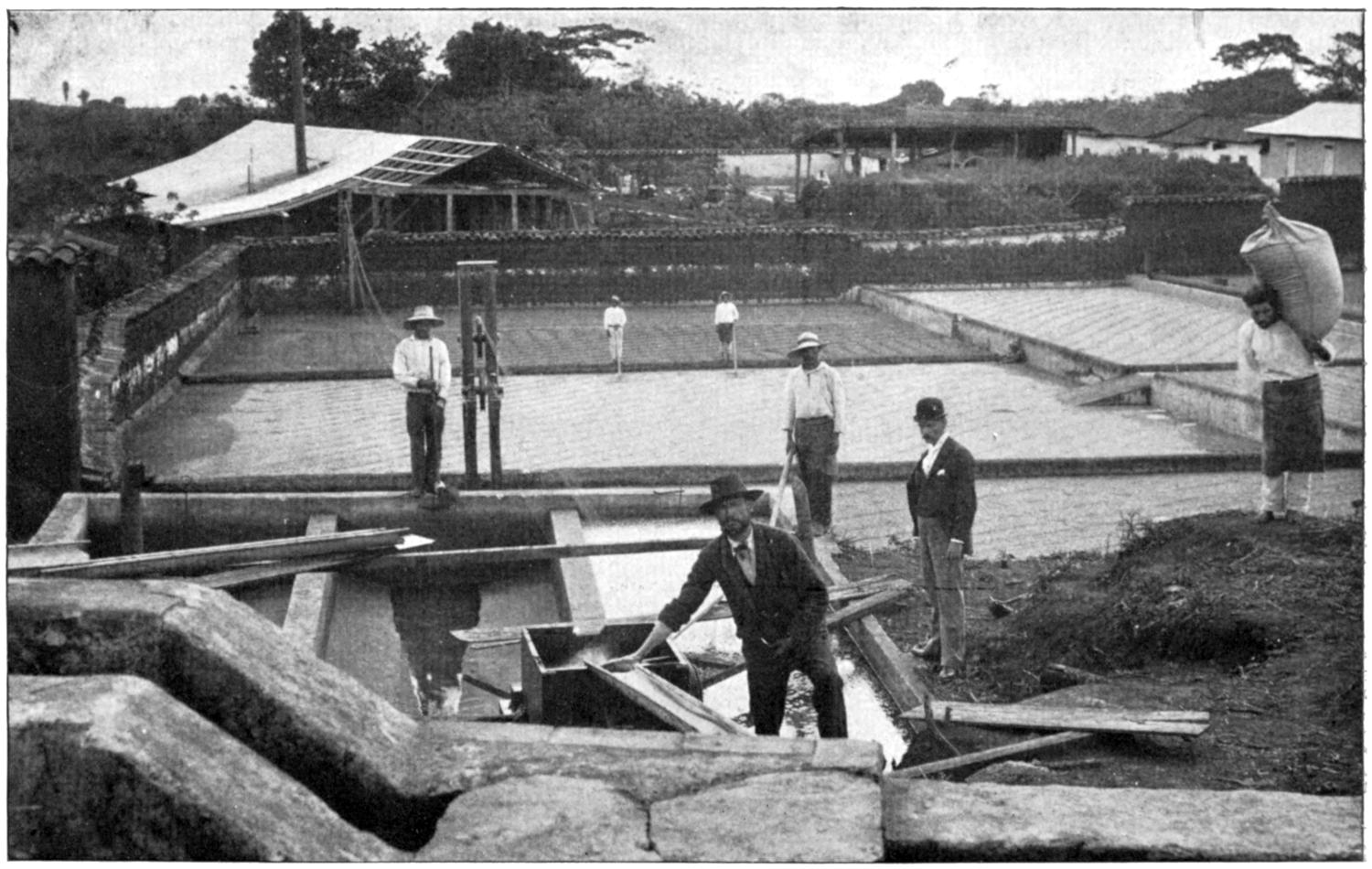
Washing Coffee.
Some years since, there was invented a bean resembling
that of roasted coffee, made from dyed plaster
of paris, which was intended for admixture with
coffee, and at the present time a far more dangerous
fraud is being perpetrated in the already too wide field of
coffee adulteration. It is that of a bogus or artificial
bean, resembling that of whole roasted coffee, which, on
analysis, proves to be largely composed of wheat flour,
mixed with a glutinous compound of cracker dust, paste
and molasses, moulded in the form of the true coffee
bean of commerce and flavored with a weak solution of
caramel or chocolate. These spurious coffee beans are
not, however, intended to supply in themselves a beverage
which from any similarity of appearance, taste or effect
might form a substitute for coffee and cannot therefore be
regarded as such, but are intended solely as an adulterant
of whole roasted coffee. It is readily detected by close
inspection in the hand, but still more so in the cup,
tasting as it does more like a decoction made from burnt
dough and molasses. When dissolved in boiling water
it yields a blackish, muddy liquor akin to slop, leaving
a thick, greasy residue in the bottom of the vessel.
The custom of coating or “glazing,” now so much in
vogue among roasters and dealers, may also be classed
among the many, but milder forms of adulteration, which,
though ostensibly claimed to protect the pores of the
coffee from the oxydizing influences of the atmosphere,
preserve its aroma, and at the same time clarify the
infusion, is in reality, in nearly all cases, resorted to for
the purpose of disguising or concealing the defects of
artificially-colored, stained, damaged and immature or
“quakery” coffees, or for adding an extra weight of
from 5 to 6 per cent. to it.
Are subject to the most extensive adulterations, all
being more or less sophisticated or adulterated in one
form or another, chief among which is that of the admixture
of the roasted and ground roots of Chicory, Dandelion,
Carrot, Parsnip, Beet and other leguminous vegetables.
Peas, Beans, Rye, Rice, Wheat, Barley and
various other cereal grains, including the seeds of the
broom, fenugreek, iris and acorn. These various roots
and seeds, with many more similar substances, have not
only been used as adulterants, but under various high-sounding
names several of them have been introduced
as substitutes for coffee. But so far not a single one of
them have either merited or obtained any success as
such, their sole effect being to bring coffee into undeserved
disrepute as a pleasing and agreeable beverage
with the public.
Among the numerous substitutes and adulterants in use
for coffee may be mentioned first:—
Rye Coffee.—Prepared from roasted rye and a little
butter ground fine, and put up in packages.
Rice Coffee.—Made from roasted rice in the same
manner as the former and considered a very good substitute.
Malt Coffee.—A preparation made from malt, which
is first soaked in water at 40 degrees and dried in a
coffee roaster until the grains assume a glossy-brown
color is used as a substitute for the coffee of commerce,
the finished product, when ground and infused, is claimed
to be a passable coffee substitute.
Currant Coffee.—Manufactured from the seeds of
that fruit, washed out of the cake left in making currant
wine, then roasted and ground, but principally used as an
adulterant.
Gooseberry Coffee.—Prepared from the seeds of
that fruit in the same manner and used as an adulterant
also.
Holly Coffee—Is made from the berries of the common
holly, roasted and moistened with a little lemon
juice.
Acorn Coffee—Is prepared from acorns, deprived of
their shells, husked, dried and roasted in the same manner
as regular coffee.
Sassafras Coffee.—Manufactured from the fruit or
root of that plant, or from the bark, cut up, dried and
roasted, the decoction being very wholesome, and a
specific for skin diseases.
Beechmast Coffee.—Made from the roasted and
ground roots of the beechmast, and also claimed to be
very wholesome.
Beet-root Coffee.—Principally used as an adulterant;
is prepared from the yellow beet-root, sliced, dried in an
oven and ground with genuine coffee.
Almond Coffee—Is made from either rye or wheat,
roasted with almonds and a very small quantity of cassia
buds, making a very good substitute.
Bean Coffee—Is prepared from ordinary horse-beans,
roasted along with a little honey and burnt sugar, a small
quantity of cassia buds being frequently added when
removed from the fire, the whole being stirred until cold.
German Coffee—Is chiefly made from chicory
roasted and ground fine, and used either as a substitute
or an adulterant of the regular coffee of commerce.
Coffee-pulp Coffee.—In Arabia the pulp of the berries,
which constitutes about twenty per cent. of the prepared
coffee, is dried and shriveled up by a method
peculiar to Arabia. This product is known by the distinct
name of Kishr, a decoction of which forms
the common beverage of the poorer Arabs.
French Coffee.—What is known and celebrated as
“French Coffee” is made from a mixture of coffee and
caramel, which must be packed in tins, as otherwise the
hygroscopic properties of the caramel will cause it to
absorb moisture, and thereby run to decomposition.
Pelotas Coffee—Is also prepared from ground
acorns and sold under the name of Pelotas, but is exceedingly
dark in liquor, wild and insipid in flavor.
Corsican Coffee—Is made from the roasted seeds of
the Knee-holly, and used extensively on that island as a
substitute for the regular coffee of commerce.
Egyptian Coffee—Is prepared from the common
Chick-pea roasted, ground and mixed with genuine
coffee in equal parts, being more of an adulterant than
a substitute.
Mesquite Coffee.—It has been recently claimed that
a species of coffee may be produced from the “Mesquite
plant” found growing in wild abundance in Texas, Arizona
and New Mexico, but so far no positive results have
been reported.
Dandelion Coffee.—The root of the Dandelion, first
dried, roasted and ground, is also extensively used as a
substitute for coffee, and is claimed by many physicians
to be much preferable to chicory for that purpose, its
infusion, decoction and extract being frequently employed
as a tonic and aperient, especially in disorders of the
liver and digestive organs.
Spent Coffee—Prepared from “exhausted” coffee
grounds which are dried and re-atomized by the transforming
hand of modern chemistry, put up in shiny packages
under seductive titles, and from which the deluded
and over-confiding consumer endeavors to extract a
desired beverage.
Mussenda Coffee.—A patent has recently been
granted in France, the object of which is to substitute
the berry of the Mussenda plant for the various substances
now used for mixing with ground coffees, by
which the berries are roasted with the coffee in any
desired proportions, usually from ¹⁄₃ to ²⁄₃ Mussenda, or
³⁄₄ coffee to ¹⁄₄ Mussenda. During the roasting process
a small quantity of Caramel is added to improve the
flavor, the compound being then ground and put up in
cans, possessing at least one good recommendation,
that of not containing any injurious properties.
Canada Peas—Which is the most extensive form
of adulteration, are first roasted in the same manner as
coffee, but requiring a much longer time and more
care, as the shell of the pea does not assume a coffee-color
until the inside is overdone, and must be judged
by the inside appearance, being brittle and a little darker
when broken than coffee, but when ground they are
dry and dusty, on which account they make an excellent
compound with chicory, keeping it from forming
into lumps and making it assume a uniform color.
Wheat, rye or barley may be substituted or added to
this compound without affecting it, the method of treatment
being identical. There being but little aroma to
protect and none to save, the virtue of this compound
lies altogether in the healthy properties of the cereal
used, not in the flavor of the liquid.
Essence of Coffee—Is simply an article of manufacture,
containing no coffee, but intended for use with
coffee for the purpose of imparting color and as a clarifying
agent. It may be prepared at will from any cereal
before named, bread raspings or burnt cracker dust, but
is chiefly composed of carbonized corn, that is, corn
roasted to blackness. The material from which it may
be prepared is first roasted, ground fine and spread out
thinly over a large surface, and then covered with burnt
sugar or molasses while boiling hot, the whole forming a
large cake, which when thoroughly cooled is broken into
pieces and reground in an iron mill until reduced to a
dust, after which it is put up in packages or barrels for
use in coffee. It is also used extensively as an adulterant
in ground coffee, and when made from good stock it
is not objectionable, possessing excellent coloring, sweetening
and clarifying properties.
Coffee-leaf Coffee.—A decoction made from the
leaves of the coffee shrub has long been used in the
Eastern Archipelago, and has more recently been introduced
among the coolies of southern India, and a few
years since attracted considerable notice, being recommended
as a new article of import to become a cheap
substitute for tea. There seems to be no doubt that
coffee leaves contain the principle caffeine in sufficient
abundance for the making of a valuable beverage, but
the presence of an unpleasant senna-like odor militates
greatly against its popularity as a regular drink, and there
exists also the difficulty that of depriving the tree of its
foliage damages the crop of berries and injures the tree
itself. On berry-producing trees therefore only the
leaves obtained in the ordinary pruning operations would
be available, and these would seem to yield so small a
supply as not to be worth the cost of collection, while
growing the shrubs for the leaves alone would be a very
questionable undertaking. Yet there appears to be no
valid reason why in the event of the berry crop failing a
portion at least of the leaves might not be gathered and
prepared in the form of coffee if any means can be
invented for removing the objectionable odor.
Whey Coffee—Another very novel substitute for
coffee is prepared of whey from milk, which is evaporated
down in open vessels or vacuum pans until most of the
water is driven off and a thick paste remains. During the
process the whey is kept constantly stirred, the stirring
being continued until the pasty mass becomes cold, when it
is rolled into cakes and dried at a temperature of boiling
water, after which it is broken up and moulded into
pieces about the size and form of coffee beans. The
next operation is that of roasting, which is more preferably
performed by first mixing them with an equal quantity
of raw coffee, the roasting process thus turning the
whey-paste beans into a rich brown color, which on cooling
are ground with another percentage of coffee. The
compound yields a pleasant and agreeable beverage and
may find some use as a harmless if not really nutritious
ingredient in the lower priced coffee preparations.
In Brazil and other South American countries the fruit
of the Wax palm is used extensively as a substitute for
coffee, being very rich in caffeine and possessing nutritious
properties, while recently a substitute for coffee has
been introduced to England and the continent of Europe
under the name of “Mochara,” which is simply a preparation
made from ripe figs, roasted and pulverized, which
is sold at about half the price of coffee. Another illustration
of the modern craze for replacing every genuine
article by an inferior substitute is to be found in the
announcement of a company to work a recent patent for
making coffee out of dates. In New Zealand the berries
of the Coprosma have been proposed as a coffee substitute,
while the seeds of the Cassia have been lately imported
into England from the river Gambia and sold
there under the name of “Negro Coffee.” But although
such substitutes and admixture are demanded, yet it
appears to be impossible to replace coffee altogether,
all the elaborate attempts made by the French chemists
during the wars in the early part of this century being
unsuccessful in providing any approximate substitute for
coffee.
Kola-nut Coffee.—The diminishing production of
coffee in Java, Ceylon, and other countries of East
Indies has given rise to the suggestion that the cultivation
of the Kola-nut as substitute for coffee should
be undertaken, which not only as a stimulant, but as an
article of food, possesses the essential properties of coffee,
and is even said to be richer in the active principle,
caffeine. Heretofore this product has been raised chiefly
for medicinal purposes only, but its acceptability as a
stimulating and nutritious beverage is rapidly growing,
possessing as it does a high value, because of its power
of enabling men to sustain great effort as well as to
endure long fasting. It is fast finding a place in commerce
in the same order as that held by coffee, the
beverage being called at the present “Kola-nut Coffee,”
but the term “Kolatina,” has recently been proposed as
more appropriate for the decoction, and to which there
can be no reasonable objection. The beverage prepared
from the Kola nut resembles that made from coffee, and
is both pleasant and agreeable, and for persons troubled
with weak indigestion “Kolatina” is found to be better
adapted than either tea or cocoa. This is the bean
which Stanley speaks in several of his works on African
exploration as possessing much greater sustaining power
than either tea, coffee, or cocoa; the natives, he states,
carry these beans in their pockets and eat them during
long marches. The beans are first ground and put up in
packages, with directions for making the infusion, one
teaspoonful being sufficient for a cup of Kolatina. A
concentrated essence is also made from the beans, and an
acerated drink called “Kola champagne,” very agreeable
to the taste and recommended by physicians.
Chicory—The common root of the Endive or “Succory”
plant, as used along with coffee was originally a
Dutch practice dating back to over a century ago, but
for many years after the nature of Chicoried coffee was
kept a profound secret by the Dutch dealers until 1801,
when the secret was first disclosed. The fact that for
over a hundred years it has been successfully used as a
substitute for and recognized addition to coffee, while in
the meantime innumerable other substances have been
tried for the same purpose and abandoned indicates that
it must be agreeable, if not beneficial, to many constitutions
besides imparting to coffee additional color, body
and pungency, and may, by acting as a sedative, tonic
and diuretic, modify its stimulating and exciting effects,
and is at least in very general, almost universal, use at the
present time. It is extensively cultivated in Belgium,
Holland, France, Germany and other European countries,
being principally prepared from the old, stout and white
roots of the plant, which after washing are sliced into
small pieces, and kiln-dried, in which condition it is
usually sold to the chicory roasters, by whom it is
parched or burned, until it assumes a deep-brown color,
after which it is ground, the fine dust being separated
from the coarse and granulated parts. In its external
characteristics it closely resembles ground coffee, but is
entirely destitute of its pleasing and aromatic odor,
neither does it possess any trace of the alkaloid—caffeine—which
give their peculiar virtues to coffee, tea and
other diet drinks. It occupies a peculiar position, however,
since very many coffee consumers deliberately
prefer an admixture of chicory with coffee to the pure
article alone, notwithstanding that it is entirely devoid of
the essential oil for which coffee is so valued. Differing
diametrically in their botanical nature and chemical
composition as well as in their physiological properties
and action. Again, coffee is the fruit of a tree, while
chicory is the root of a herbaceous plant, and it is a
well-established fact that of all parts of either vegetables
or plants the fruit and seeds possess the most active and
nutritious properties. This is no doubt due to their being
freely exposed to the influence of light and air—agencies
which invariably promote chemical changes in the plant
itself and so effect the elaboration of those complex
organic substances on which the activity of all plants
depends. While on the other hand it is manifest that, as
roots are concealed from these powerful agencies, they
cannot be richly endowed with active properties, there
being but few roots containing either alkaloid or volatile
oil—the properties which give to coffee its unique virtues.
The distinction therefore between the properties of the
seeds and roots of plants in general is very important,
and especially so in the case of coffee and chicory, the
infusion of the latter being heavy, black, mawkish and
entirely destitute of aroma; that of the former being
light, rich, fragrant and refreshing. Coffee containing
three active principles: caffeine, volatile oil and
tannin, chicory possessing no such analogous constituents.
Coffee exerting very marked and highly important
physiological effects of a beneficial character in the human
system, while there is not a single proof that chicory
exerts any one of these effects, it being very questionable,
in the contrary, whether the properties it does possess are
not really injurious. None of these or analogous principles
are to be found in any of the substitutes or adulterants
of coffee, so that the latter cannot possess a single
one of the peculiar and beneficial properties of coffee, being
simply a deception on the stomach of the consumer.
Chicory contains neither caffeine nor essential oil like
coffee, and is neither exhilarating nor pleasant in taste,
while on some persons it acts as an irritant and purgative.
Some so-called coffees contain large quantities of it, even
to the extent of 95 per cent., which it would be more
correct to call such a mixture “adulterated chicory,”
rather than coffee, which term it seems entitled to only
as a matter of courtesy, chicory being in its turn
also subject to adulteration in many forms, two very
common adulterants being beet-root and mangel-wurzel.
As to the nutrition possessed by chicory, it contains
only about one-half the nitrogenous substances of coffee
and even that quantity in no way benefits the consumer,
as these substances are insoluble in water and are wasted
in the infusion. It has been proved also that even the
chicory itself is extensively adulterated, as all of the
substances found in adulterated coffee have also been discovered
in ground chicory. Viewed under a magnifying
glass the component fibres and elementary structures of
the different substances used in the adulteration of coffee
present peculiarities and characteristics that enables the
experienced observer to identify without difficulty the particular
substitute or adulterant employed. The principal
adulterant, chicory, being readily distinguished by the
size, form, and ready separation of the component cells of
the nut, as well as by the presence of an abundance of
spiral vessels of a dotted form. Whole roasted beans,
peas and cereals may be best detected by the respective
size, form, texture and other characteristics of the
starchy granule, of which such substances are chiefly
composed.
In minute structure true coffee is so distinct from all
other vegetable substances that it is readily recognizable by
means of the microscope, and as the roasting process
does not destroy its distinguishing peculiarities, microscopic
examination forms the readiest method of determining
the genuineness of any suspected sample. The
true coffee bean consists of an assemblage of vesicles or
cells, angular in form, which adhere so firmly together
that they break up into pieces rather than separate into
distinct and perfect cells. And, again, by microscopical,
physical and chemical tests the purity of coffee can be
still further determined with perfect certainty. The mixture
of chicory with coffee is best detected by the aid of
the microscope, the structure of both which they retain
after torrefaction being very characteristic and distinct.
The granules of coffee remain hard and angular when
steeped in water, to which they communicate but little
color, while chicory on the other hand by swelling up
and softening imparts a deep brown color to the water,
the specific gravity of chicory being also much lighter
than that of coffee.
All of the pseudo patent or proprietary ground coffees,
put up in bulk or packages, and recommended to the
consumer by high-sounding, seductive names and attractive
labels, which are annually palmed off in such vast
quantities, consist of nothing more than a combination
of these adulterants with genuine coffee. So much so
that it may be safely said that wherever grinding is done
it may be safely set down that more or less adulteration
is practised, the ground coffee being put up in packages
or in bulk form. The average basis for the compound
being composed of the following proportions to every
1,000 pounds: chicory, 100; rye, 200; peas, 400; coffee,
200, and other substances 100 pounds.
According to some English chemists, coffee is adulterated
in that country, outside of chicory, with such
substances as roasted peas, beans, carrots, turnips, parsnips,
potatoes, acorns, beets, lupins and even fragments
of the baked livers of oxen and horses. To such an
extent is the practice carried there, that it is next to impossible
to procure a pound of pure coffee there at almost
any price. The evil also flourishes to a great extent in
this country, but with the exception that nothing worse
than roasted rye, peas, beans and cereal grains are chiefly
used for its adulteration. With regard to the propriety of
selling chicory with coffee, it may be stated that while it
certainly is not right to sell a mixture of coffee with chicory
under the name of pure coffee, and unreasonable to compel
the manufacturer or vender to specify approximately
the proportion of chicory contained in the mixture,
this latter is especially desirable, inasmuch as chicory
is far cheaper than coffee, and it is, therefore, necessary
to protect the public against having chicory palmed off
on it for pure coffee. According to the best authorities,
coffee, when pure, is a most valuable ingredient of our
food, owing to its agreeable flavor, pleasing odor and
refreshing and gently stimulating properties, which, if
not absolutely necessary, is at least a most desirable
constituent of our daily dietary, and any one that
deprives it of its true qualities by adulteration or substitution
inflicts an injury more or less grave on the public
health, because the adulterants are claimed not to be
poisonous—that is, directly—but only indirectly injurious.
The offense is thought little of, and never punished
in this country, with the result that the nefarious
practice is rather encouraged than repressed. So that,
in considering the many evils of coffee adulteration,
we must not overlook the fact that coffee is not
only a beverage, but also a drug, antagonistic in
action to the alkaloid morphia, as well as to other
alkaloids of like nature, so that in cases of poisoning
its adulteration may lead to the failure of medical
treatment, even to the extent of the loss of life.
The operation of roasting also tends to make coffee
soluble in boiling water, as when Raw coffee is perfectly
exhausted by means of boiling water it yields up 25 per
cent. which passes into solution, while Roasted coffee, on
the other hand, when completely exhausted by means of
boiling water, yields up 39 per cent. of soluble matter.
These figures appear rather high, as in actually using
coffee as a beverage we are not in the habit of making
anything like a complete extraction, only some 10 to 12
per cent. of the coffee passing into the liquid. From these
the facts it will be perceived that the chemical character of
coffee provide fairly satisfactory criteria for the recognition
of many species of adulteration, the absence of starch alone
in genuine coffee offering in itself a character which enables
the analyst to at once deal with the whole class of possible
adulterants, including many species of grain, while
the absence of more than traces of sugar in Roasted
coffee can likewise be turned to excellent account inasmuch
as Chicory contains no starch, but is highly saccharine
even after roasting, the percentage of sugar in
Roasted coffee ranging from 0.0 to 1.1, while in Roasted
chicory the quantity of sugar ranges from 12 to 18 per
cent. The proof of this character is best made by the
aid of the copper-reduction test, for which purpose a
standard solution of copper is required, which may be
prepared by dissolving 34.65 grams of crystalized sulphate
of copper in 200 C.C. of water and adding to it
173 grams of double tartrate of potash and soda, with
400 C. C. of a solution of caustic soda, the whole being
subsequently diluted with water so as to occupy a litre.
The standard solution of copper made in this manner is
of such a strength that 10 C. C. are reduced by .050
grams of grape sugar, the best method of using this
solution being to take a known volume of it, say 10 C.
C. accurately measured out, and dilute it with three or
four times its volume of boiling water and then dropping
into the boiling copper solution, which is to be added,
until the point is just reached when the copper solution
is exhausted, and as the reduction of the copper-salt to
the state of red sub-oxide of copper progresses, the
precipitate will accumulate, and at the same time the blue
color will fade from the solution. The last delicate reading
is finally effected by half of the reduction between
the ferro-cyanide of potassium and copper solutions, for
which purpose a little of the liquid is filtered, acidified
slightly with acetic acid and tested with a drop of the
solution of the ferro-cyanide of potassium. In this triturate,
as in all like cases, a rough and rapid estimation
is first made, and then a second operation when the
quantity is approximately known to make a delicate and
careful reading of the exact point. Thus if 100 parts of
coffee when infused yield sensibly more than 1 per cent.
of sugar, then the presence of chicory or other adulterant
may be strongly suspected and a rough calculation of
the quantity made. The fact that coffee extract is devoid
or almost devoid of sugar, while many of the other
natural products yield saccharine extracts, makes itself
manifest in many ways, and the specific gravity also of
equal quantities of an infusion of coffee being very much
lower than the specific gravity of an infusion of chicory
and the other principal substances used in the adulteration
of ground coffee. Chicory also possessing greater
coloring power than coffee, for which reason this character
may be rendered available in the testing of coffee, as
not only does chicory color water more deeply than
coffee, but it colors it with greater rapidity, the oil contained
in the coffee hindering the solution of the coloring
matter by the water, whereas chicory, which contains no
oil, imparts its coloring matter to water with great readiness.
All of which tends to render the color-test, when
properly applied, the easiest and most available for the
detection of chicory or other substances in coffee.
What is known as the “Ash test,” is as follows: Pure
coffee when incinerated or burned, yields about 4 per
cent. of ash on an average, while the ash of chicory and
other adulterants used in coffee amounts to between 5
and 6 per cent. of the residue, the ratio of soluble to
insoluble ash being inverted when dissolved in water
thus:—
| Ash of Coffee. |
Ash of Chicory. |
| Soluble, |
3.24 |
Soluble, |
1.74 |
| Insoluble, |
0.76 |
Insoluble, |
3.52 |
From this analysis it will be observed that the average
ash of coffee when incinerated is about 4 per cent., 3.24
of which is soluble in water, and 0.76 insoluble, more
than half of the entire ash consisting of potash in combination
with carbonic and phosphoric acids. Magnesia
amounting to about 8 and lime to about 4 per cent. of
the whole, while it is claimed that soda and silica are
entirely absent from coffee ash, great stress being laid on
this circumstance. The ash of chicory, on the other
hand, which is the main adulterant of coffee, amounts to
5.06 when incinerated, 1.74 per cent. of which only is
soluble in water, and 3.32 insoluble, being almost an
inversion of figures and from which it may be easily
understood why the examination of the ash alone would
suffice to distinguish between coffee and chicory, and
from which it may readily be determined, an examination
of the ash test alone sufficing to distinguish pure
coffee from the adulterated compounds.
Another unerring test, known as the “Color test,” is to
prepare a saturated solution of common salt and mix a
small quantity of the coffee to be tested with ten times its
weight of the solution in a test-tube at least three quarters
of an inch in diameter, shaking it repeatedly so that the
coffee may be thoroughly wetted, and then allow the tube
to stand for half an hour. Next, closely observe the color
of the liquid and the quantity of coffee floating on the surface
as well as the amount deposited in the tube. If the color
be a very pale amber and almost all of the coffee floats
on top, the sample may be assumed to be pure, but if of
a decidedly dark-yellow or brownish hue, it clearly indicates
the admixture of chicory or some similar adulterant,
in which case there is also a larger deposit for the
reasons already stated. This deposit increases and the
color of the brine grows darker in proportion to the
extent of the impurity in the coffee, as with the addition
of only 30 per cent. of chicory the brown color is very
marked, so that with a still larger percentage of the
adulterant it becomes correspondingly darker.
CHAPTER VIII. BLENDING AND PREPARING. — ROASTED COFFEE BLENDS. — GROUND COFFEE BLENDS. — PREPARING FOR USE.
 By
the combination of different varieties of coffee
much better results are sometimes obtainable
than when one variety is used alone, but in the
mixing or blending of two or more kinds together,
several points have to be studied, such as the age, grade,
body, flavor, appearance, and affinity of the coffees to be
combined. The public taste for certain flavored coffees,
like that of tea, being an acquired one, it behooves the
dealer to first study and learn the taste of his customers
before catering to it.
The successful blending of coffees may be easily
accomplished if only a fair knowledge of the merits and
general character of the coffees be possessed by the
dealer; but tastes differ so widely that it is next to impossible
to give any fixed formulas for any specific combinations.
For this reason the following blends are only
given for the purpose of conveying some idea as to what
coffees assimilate best in combination and also ascertain
what body, strength and flavor is required by the customer
or customers before preparing the combination;
but a taste for any fairly good blend of coffees may be
cultivated in the customer with time. And as no
definite formulas can be given for combining two or
more varieties of coffee, the dealer must study the taste
and requirements of his trade, noting its peculiarities and
experimenting with it until he has discovered a combination
that will suit or please a majority of his customers
which, having once found, he should adhere to
strictly, by being always careful to select, as nearly as
possible, the same grades of coffee, and keeping them up
to the same high and uniform standard.
Though not generally admitted, the testing of coffee
is much more difficult and requires more experience
than that of tea, inasmuch as the sample of tea is all
ready to have the water applied to it, while the sample
of coffee is presented in the raw or natural state and
must not only be roasted properly and ground before
being tested, but must also be roasted as precisely as the
other samples with which it is to be compared, in order
to determine its exact value. To smell or taste correctly
requires a knowledge of all the properties and
characteristics of the article under consideration, as
these senses convey to the mind their impressions, so
that if the mind can analyze the cause and effect, the
senses of smell and taste act in consonance with the sense
of reason. It is thus obvious that to be an expert
judge of either tea or coffee requires a thorough knowledge
of the different varieties and grades of both, and
what the most desirable qualities of each are. It is
also further necessary that the dealer should be well
aware of what characteristics and blending of flavors
his customers prefer. Having carefully selected, tested,
and purchased his coffee, the next important thing
is to so roast or have it roasted as to best develop the
drinking qualities, which, as stated before, is a more
important and essential process than the hulling and
curing of it, though frequently underestimated by the
average dealer, as many otherwise good coffees are injured
irreparably by improper roasting.
Owing to the wide difference in the age, weight and
texture of coffees they should never be blended in the
raw or natural state, as old and dry coffees require a
shorter time to roast than new and moist ones, the same
rule applying to what are known in trade as “mild” and
“strong” coffees, as one will be but half roasted or
roasted only when the former is roasted or burned, thus
imparting to the combination a raw, uncooked or burned
flavor, as the case may be. The best way is to roast or
have roasted the coffee intended for the blend in different
cylinders, then mix and cover them up tightly immediately
after roasting, in order that the differing characters
and flavors may exchange and assimilate freely while the
pores are still open to receive them.
No. 1.—(Low-priced). May be made from a fair Rio
and Santos, low-grade Maracaibo or other mild sort, in
the proportions of half and half, or, when three or more
varieties are used, in equal quantities.
No. 2.—(Medium). Is composed of equal quantities
of a large white-bean Santos and Cucuta Maracaibo or
other standard mild growth, the whole being strengthened
by the addition of one part choice Rio, if considered
too weak in body.
No. 3.—(Choice). When a really rich, smooth,
mellow beverage is desired a combination, composed of
one-third Arabian Mocha and two-thirds Preanger Java
will yield the desired results. While a liquor equally
as good, if not more popular, may be obtained from
equal parts of Cucuta or Merida, Maracaibo, Aden,
Mocha and Preanger Java, particularly when fresh roasted.
For a good coffee the most common practice is to blend
a Padang Java and a Cucuta Maracaibo, or large,
yellow, old-bean Santos in the proportions of 40 pounds
of the former to 60 of either, or both the two latter,
the combination answering well for a straight coffee, and
for which it may be safely sold. In fact, one of the most
popular so-called finest Javas in the market to-day is
composed of these three varieties, the addition of the
Santos improving the combination, as it lends to it the
essential quality which is lacking.
In ground coffees the appended specimen blends are
given to illustrate how they are mixed, rather than as
laying down any fixed formulas, and are recommended
as being at least non-injurious, if not positively wholesome.
No. 1.—Composed of 20 pounds roasted rye, 20 pounds
chicory and 20 pounds ground coffee makes a fairly drinkable
compound, when a cheap coffee is required.
No. 2.—A good medium grade may be prepared of 10
pounds rye, 20 pounds chicory and 20 pounds coffee.
These proportions may be altered at pleasure, but care
must be taken to at all times have the rye in excess of
the chicory and to thoroughly mix and grind the component
parts together. The dry dust of the rye quickly
absorbs the moisture of the chicory and will also prevent
the mill from becoming clogged in grinding.
No. 3.—Better still in the proportions of 15 pounds
rye, 10 pounds chicory and 10 pounds good, mild coffee,
the component parts of which may be still further varied
to suit the price and taste of the customer and to which
may be added any of the other ingredients with which
coffees are mixed, except corn or beans, but it must be
borne in mind that only the best grade of coffee must be
used in the blend, as what may otherwise be a good combination
may be utterly spoiled by the introduction of a
tainted, stained, damaged or hidey coffee.
But the best and safest of all substances for mixing or
blending with coffee with the object of reducing its cost
is chicory and rye, containing as they do a large percentage
of saccharine, which in the process of roasting becomes
carameled, thus imparting to the compound the flavor of
coffee to a much greater extent than any other substitute
known and for which reason it lends itself to the purpose
more readily than any other vegetable substance. Again,
it is not injurious to health, while at the same time it
gives up its extractive matter easily, thus improving the
extract yielded by poor coffee and imparting a dark color
to the decoction such as can only be produced by three
times the weight of pure coffee. It has one great defect,
however, that of easily absorbing moisture, becoming
hard and lumpy on exposure to the atmosphere, more
particularly when ground fine.
The methods of preparing for the table are almost as
numerous as the countries in which it is grown, and as
much of the beneficial influence which it undoubtedly
exerts depends in a great measure on its proper preparation.
This question has given rise to such a maze of
psuedo chemical subtleties and mechanical devices that it
is difficult to arrive at any fundamental common-sense
rule for its most perfect production in the cup. The two
principal objects to be sought for in the proper preparation
of coffee as a beverage are: (1) To obtain the greatest
amount of strength and aroma, without extracting any
of its astringent properties, and (2) to produce a rich,
transparent, nut-brown liquor, free from all cloudiness and
grounds. The first requisite in securing these results is
that the article be purchased pure and fresh roasted in the
bean and ground personally a short time previous to preparing
for the table, for if roasted too long prior to its
use the beans lose much of their strength and aroma,
becoming tough and difficult to grind. This latter defect,
however, may be remedied in part by reheating in a pan
or oven for some minutes previous to being ground and
infused.
The usual methods of preparing coffee for use as a
beverage are: (1) By Infusion or drawing; (2) By
Decoction or boiling, and (3) By Filtration or distillation.
Infusion—or “drawing”—is accomplished by first
making the water boil and then putting in the ground
coffee, the vessel being immediately removed off the fire
and allowed to stand quietly, in the same manner as tea,
on the stove or range for about ten minutes, in order to
more fully extract its properties. The coffee is ready for
use by this method when the powder swimming on the
surface sinks to the bottom on slightly stirring it. This
process yields a very aromatic beverage, but one containing
very little of the extract or stimulating properties.
Decoction—or “boiling”—is the custom in the East,
and generally yields an excellent coffee. The ground
coffee is put in the vessel with cold water and placed on
the fire, where it is allowed to boil for a few seconds,
care being taken not to allow it to overboil. If boiled
too long by this method the aromatic properties are
volatilized, and while the coffee will be rich in extract it
will be poor in aroma.
Filtration—or “distilling”.—By this process the coffee
is prepared in a “percolator,” in which the ground
coffee is compressed between two metallic diaphragms,
so arranged as to permit the water to filter through it
slowly. This method often, but not always, yields a cup
of good coffee, as when the pouring of the boiling water
over the ground coffee is done slowly the drops in passing
come in contact with too much air, the oxygen of
which makes a change in the aromatic particles, often
destroying them entirely. The extraction also is incomplete,
for, instead of 20 per cent. the water by this process
dissolves only from 10 to 15 per cent., the balance
being lost by evaporation, while by the other methods
more than half the valuable parts of the coffee remain
in the grounds and is entirely lost.
It is contended by many experts and connoisseurs that
to obtain the full aroma of coffee without extracting its
astringent properties, it must in all cases be prepared as
an infusion with boiling water, that is, “drawn” in the
same manner as tea, or simply allowed to reach the boiling
point after infusion, but no more. While others,
among whom is Baron Liebig, maintain that by simple
infusion alone much of the valuable soluble principle in
the coffee remains unextracted, being eventually thrown
out with the grounds. To avoid this unnecessary waste,
it is suggested that the grounds of the coffee once used by
infusion should be preserved, boiled and the liquor resulting
therefrom be used for infusing a fresh supply. By
this method it is claimed that the substantial properties
of the previously infused coffee, and the aroma of the
new are obtained together in the fresh infusion. In many
French households the coffee grounds are utilized by distillation
for economy’s sake, hot water being poured over
them, which, after passing through, is preserved in a bottle
and used as an extract. In fact, this is claimed to be the
method adopted in making the finest French coffee.
The best method under these circumstances is a combination
of the second and third, in which the usual
quantities of both coffee and water are to be retained,
a tin measure containing half an ounce of roasted
coffee beans being generally sufficient for two small
cups (or one large breakfast cup) of coffee of moderate
strength, or four ounces for eight small cups or four
large ones. With three-quarters of the coffee to be prepared
after being ground, the water is made to boil in
ten or fifteen minutes, after which the other quarter is
put in, and the vessel immediately withdrawn from the
fire, tightly covered over and allowed to stand for five or
six minutes. In order that the powder on the surface
may fall to the bottom more readily, it is meantime
stirred round, and after the deposit takes place the coffee
may be poured off, being then ready for use. But in
order to separate the grounds more completely, the
coffee may be passed through a clean muslin cloth, but
generally this operation is not necessary, being frequently
prejudical to the pure flavor of the beverage. By this
process the first boiling gives the strength, the second
adding to the flavor without extracting its astringent
properties, it does not, however, dissolve more than
one-fourth of the aromatic substances contained in the
roasted coffee. The beverage, when ready for use by this
process, ought to be of a rich brownish-black color,
semi-transparent, somewhat resembling chocolate
thinned with water.
Coffee may be prepared in any kind of vessel, tin cup,
iron pot, earthen pitcher or regular coffee-pot, but the
utensil, whatever it may be, must be thoroughly clean
before using. When prepared in a tin cup or iron pot
first heat the ground coffee in the vessel and pour on boiling
water or milk when the coffee is sufficiently heated,
and stir with a spoon for one minute, then allow to stand
by the fire where it will keep hot, without boiling, for
another minute and stir again and then let stand to settle
for two minutes, after which it is ready for use, care being
taken when pouring out not to disturb the grounds.
But, if a pitcher be used, it must be first heated with boiling
water and allowed to stand in a warm place to infuse
for at least ten minutes before serving.
There are so many different varieties of coffee and such
a wide dissimilarity of tastes, that it is almost next to
impossible to suggest the special kind of coffee to select
for use, even for the average consumer, the same difficulty
also applying to what constitutes the requisite quantity.
Many old-time coffee-drinkers prefer a strong, dark, or,
as they term it, “an old-fashioned Rio.” Others like a
good Maracaibo, or other fine, mild grade, such as Ceylon,
Jamaica and Guatemala; in fact, these are the most
popular grades and the choice of the majority of consumers,
not only on account of their intrinsic merits,
but also on account of price. For an exceedingly fine
coffee, however, the best results are obtained from a
combination of true Java and genuine Mocha, mixed in
the proportions of two-thirds of the former to one-third
of the latter, fresh roasted, fresh ground and fresh made;
while, with regard to quantity, one, two and three tablespoonfuls
to each pint of water is recommended, according
to the number to be served and the strength required.
The degree of strength is altogether a matter of taste,
two ounces, or four heaping tablespoonfuls, of pure,
ground coffee, made with absolutely boiling water, will
yield a full quart of average strength, making a pleasant
and well-flavored breakfast coffee. But for four persons
a tea-cup of finely-ground coffee—the finer, the better—will
be required, to be served as soon as made, as the
infusion rapidly deteriorates by standing too long.
In Ethiopia and Southeastern Africa, where its virtues
were first discovered and where it has been in use for
centuries prior to its introduction to civilization, it is
used in a solid form, being first roasted, crushed and
mixed with fat or grease, rolled into balls and eaten.
The natives claiming that one of these balls will support
them for an entire day, and preferring it so prepared to a
meal of bread or meat.
While the Arabs, to whom the civilized world is
indebted not only for the first knowledge of the plant and
its product, but also for the first knowledge of preparing
it in liquid form, prepare it for use in a porous earthenware
pitcher first set in hot ashes until all moisture is
evaporated and the vessel is well heated, after which
freshly roasted and pounded coffee is put in and a little
salt added, both being heated thoroughly. Boiling
water is then poured on, the vessel covered and allowed
to rest in the hot ashes until it settles before serving. A
decoction known as Kishr is also made there from the
dried pulp of the berries, which is prepared by bruising
or pounding the raw pulp with stones and putting it in
boiling water, contained in an earthen pan placed over a
slow fire. Ground cardamons and a little cinnamon or
ginger is next added to the decoction, after which it is
allowed to simmer for half an hour before using.
In Turkey, where it is regarded as the national beverage,
it is prepared by first grinding the roasted beans
exceedingly fine, almost as fine as flour, and put in a pot
in which cold water is poured and placed on the fire until
it heats up to almost the boiling point and then, served
without the addition of either milk or sugar. But when
only a single cup of coffee is wanted, the requisite quantity
is measured into a small, long-handled brass coffee
pot, made expressly to hold one or two cups, as the
case may be, and water enough poured on to fill the
vessel, which is set on live coals until it heats up to, but
not beyond, the boiling point and then served in a tiny
cup without straining or otherwise settling the grounds.
While in Egypt, which is also proverbial for the excellence
of its coffee, it is prepared by first grinding the
beans fine, as in Turkey, and adding an equal quantity of
sugar to it, pouring on boiling water, and placing the
vessel over the fire until it is thoroughly boiled, but
removing and allowing it to cool occasionally between
times until it becomes black and rather thick, in which
state it is served. Coffee thus prepared will be found
very rich and strong, too much so for the average taste, but
dark, frothy-tipped, and, taken altogether, a delicious
beverage.
In Java, Sumatra and other Eastern coffee-growing
countries the natives make a beverage from the leaves of
the coffee plant, the leaves containing a large percentage of
the active principle—caffeine. They first roast and cure
the leaves after the manner of tea, and prepare them by
infusion the same as tea, the natives preferring the liquor
from the leaves to that produced from the roasted beans.
The Dutch settlers in South Africa not only use coffee
at all meals but at all times, the coffee-pot being always
on the fire ready for any visitors and friends who may call.
In preparing it they use two kettles, boiling the water in
one and pouring it on the coffee which has been previously
placed in the other; the water is then poured
back and forth several times, a little cold water being
finally added to settle the grounds just before serving.
In Mexico the coffee is roasted, ground and prepared
at the same time; the beans are roasted as required and
pounded fine in a bag or coarse cloth, and immediately
transferred to the pot, boiling water is then poured on
and milk added to it, after which it is allowed to simmer
or boil slowly for about three minutes. But in some
instances the milk is added as served, a third of a cup of
coffee, or less, and the balance in hot milk being the
customary proportions.
In Cuba, where the most delicious coffee obtainable
anywhere is to be found, the beverage is prepared by
first half filling a coarse flannel bag with finely pulverized
roasted coffee and suspending it from a nail or hook over
the pot or other vessel. Cold water is next poured on
the bag at intervals until the entire mass is well saturated,
when the first drippings which have fallen into the receptacle
are poured again over the bag until the liquid
becomes almost thick and very black. One teaspoonful
of this novel extracted liquid placed in a cup of boiling
milk will yield a draught of coffee that is simply deliciousness
itself—a nectar fit for the gods. In Cuba this flannel
bag hangs day and night on the wall, the process of
pouring on the cold water and allowing it to drip being
almost ceaseless in its operation, all classes, ages and
conditions offering and drinking coffee there as freely as
the Chinese do tea or as we do water.
Coffee constitutes the almost exclusive or “national
beverage” of the people of Brazil, particularly in the
regions where it is most grown. It is made thereby first
roasting, as in this country, in small roasters, but more frequently
in iron pans, very high and dark, and is prepared
for use by grinding or pulverizing the beans very fine,
almost as fine as flour, and putting it in a muslin or woolen
bag placed in a pot or other vessel upon which boiling
water is poured, and allowed to infuse for about fifteen
minutes. The entire strength is thus extracted, the
Brazilians almost universally preferring their coffee strong
and “black,” that is, without milk, for which reason
larger quantities are also used.
Many connoisseurs maintain that the roasting of coffee
is best done at home, as no doubt it is, all risk of adulteration
and stale coffee being avoided by this method.
So to avoid all risks the consumer should purchase the
coffee in a whole state and grind it personally; but any
suspected sample of ground coffee may be tested by the
following simple and practical experiments: (1). Note
whether the ground coffee hardens or “cakes” when
pressed between the fingers, if so, the coffee is evidently
adulterated, most probably with chicory; (2).
Place a small sample of the suspected coffee on top of
water in a wineglass, and if part floats and part sinks it
is undoubtedly adulterated either with chicory, roasted
cereals or other analogous substances; (3). If the cold
water in which a sample of the ground coffee has been
placed becomes deeply colored it is an evidence of the
presence of some roasted vegetable substance; (4). But
to more definitely detect the presence of chicory or other
foreign substances in ground coffee, put a teaspoonful of
the suspected sample on the surface of a glass of cold
water. If it floats for some time, scarcely coloring the
water, it is pure coffee, but if part sinks and imparts a
reddish-brown tint to the water as it falls to the bottom
of the glass, it is adulterated with either chicory, rye,
peas or other analogous matter. Or again, place a spoonful
of the coffee in a white bottle of cold water and shake
well for a few moments, and if the sample is pure it will
rise to the top, scarcely coloring the water, but if adulterated
it will sink and discolor the fluid for the following
reason: The pure coffee being enveloped in an oily substance
prevents the grounds from absorbing the water,
while the adulterant being devoid of this feature quickly
absorbs the water, and thus becoming heavy sinks and
discolors the fluid to a greater or less extent according
to the proportion used; (5). Spread out on a piece of
glass or other smooth surface a little ground coffee and
moisten it with a few drops of water, and pick out by
means of a needle the small particles. If these particles
are of a soft consistence the coffee is undoubtedly adulterated,
as the particles of the coffee-seed or bean are
hard and resisting in nature and do not become soft or
pliable even after prolonged immersion in water. These
simple methods will usually suffice to detect the ordinary
forms of adulteration, but to determine the character and
extent of the adulteration science and chemistry must be
resorted to, for which purpose the use of a microscope
will prove the most reliable and powerful auxiliary as a
means of detection. The appended formulas are given
as showing the different methods by which coffee is or
may be prepared to suit the varying tastes of different
consumers, which after testing, one may be selected for
permanent adoption.
1. Put the requisite quantity of finely-ground coffee
in a granitized vessel and pour on sufficient cold water to
just cover it and allow to stand over night in a moderately
warm position. Put it in the pot next morning, pour in
absolutely boiling water and allow to heat to the boiling
point and set back from the fire to prevent ebullition.
By this method the full strength of the coffee will be
obtained and the delicate aroma preserved without the
extraction of its bitter and astringent properties.
2. To prepare coffee by filtration without the aid of
an urn or French coffee-pot. Put finely-ground coffee
in a thin muslin bag and place in an ordinary utensil,
first heating the vessel thoroughly and pour on briskly
boiling water slowly around the bag, so as to permit it to
absorb and saturate the coffee effectually and extract its
full strength, after which allow it to stand and settle
without boiling.
3. Another excellent method, known as the “Cold-water
process,” is to mix the finely-ground coffee with
the white of an egg and sufficient cold water to just
cover the mass, stirring it well meantime; next, pour in
about one-third of cold water required for the infusion
and set the vessel on the range where it will heat gradually
to the boiling point; just as soon as it approaches
the boiling point add another third of cold water and
repeat until it again reaches the boiling point, then pour
on the balance of cold water and allow it to come to the
boiling point again. After which remove and let stand
where it will simmer for a few minutes and settle, which
may be hastened by the addition of a little more cold
water; but if in a hurry, boiling water may be used instead
of cold by this method also, but the cold water extracts
more fully the active and refreshing principles of the
coffee without its deleterious properties making a stronger
and richer infusion than the boiling water, as more of the
strength and aroma is carried off in the vapor arising
from the use of the latter.
4. A quick, convenient and economical method for
producing a cup of good coffee is to first heat some
freshly-roasted and finely-ground coffee—an ounce to
each quart of water—in a pan over a brisk fire and fill a
muslin bag with it, then so arrange as to suspend it midway
in the pot, and pour on absolutely boiling water
slowly, so as to allow it to trickle through the bag.
After which allow it to stand for about ten minutes
where it will keep hot without boiling, and serve with milk
and sugar. But the simplest, most rapid and effective
method is to place about two ounces of ground coffee in a
stew or saucepan, and set it on a bright fire, stirring the
coffee meantime with a spoon until quite hot, and then
pouring over it a pint of briskly boiling water, covering
it over closely for five minutes and passing it through a
thin muslin cloth, warming the liquid again before
serving.
5. For the “ideal cup of coffee,” take one part genuine
Arabian Mocha and two parts finest Java; roast each
separately and blend well together, and grind fine immediately
before preparing. Fill an ordinary tea-cup two-thirds
full of the coffee, with one raw egg and shell.
Place the whole in a strainer or percolator and pour on
one quart of briskly boiling water, then let stand for
about ten minutes where it will keep hot without boiling,
and serve with cream and sugar to suit, or, better
still, with hot milk. But should a vessel without a
strainer or percolator be used let the infusion boil up
once, and pour in a cup of cold water, after which let it
stand for at least five minutes to thoroughly settle, and
you have a beverage brown, creamy, rich, fragrant and
delicious.
A most convenient, simple and inexpensive method of
roasting coffee by families, travelers or others desiring to
roast their own coffee is to put the requisite quantity—usually
about a quarter of a pound—in a thin glass flask
or bottle placed over a charcoal fire and shaking it well
during the process until completed. The non-conducting
power gives this material an advantage over the metal,
the coffee being less liable to burn in it and the coffee
can be better observed and regulated during the progress
of the process. But a simple iron pan may also be used
effectively for the purpose, if care be taken to keep the
coffee constantly agitated with a wooden knife or spoon,
as a single burnt bean will impair the aroma, and stopping
the operation as soon as the beans begin to crackle and
assume a light-brown color. Before grinding put the roasted
beans in an iron pan or plate and place on the range to heat
until the aroma developed in the coffee by the roasting
operation perfumes the room, after which grind in an
ordinary mill and prepare according to any of the foregoing
recipes.
Many consumers connect the idea of the strength
of coffee with a dark or black color and fancy their coffee
to be thin and weak if it does not possess such color.
This is entirely erroneous, as good, pure coffee is never
so, the dark color being imparted by means of a little
burnt sugar or other ingredient. The true flavor of pure
coffee is so little known to some persons that many who
drink it for the first time doubt of its goodness because it
tastes of the natural flavor, forgetting that coffee which does
not possess the flavor of coffee is not coffee at all, but an
artificial concoction, for which many other things may be
substituted at pleasure. Hence it is that if to the vile decoctions
made from chicory, carrots and beets be added the
slightest quantity of pure coffee, such persons fail to
detect the difference, and which also accounts for the
enormous diffusion of such substitutes and adulterants;
such mixtures with an empirical taste most people fancy to
be coffee. Another error of frequent occurrence in the
preparation of coffee for the table, and which results probably
from the habit of tea-making, is that of using too little
coffee in proportion to the quantity of water. More
coffee in proportion should be used than tea, that is, for
a full pint of the infusion an ounce to an ounce and
a half of coffee, that being about the proper proportions
for a beverage of average strength.
Café de Paris—Or “French Coffee” is most generally
prepared by mixing a cupful of finely-ground coffee
with a raw egg and shell in a quart of cold water and
placing the pot over a brisk fire, occasionally stirring it
until the boiling point is reached, after which set the vessel
aside to simmer for a few minutes, then pour on a cupful
of cold water and allow to stand for eight or ten minutes
before serving, using cream and sugar to suit.
Café au Lait—or “French Breakfast Coffee” is made
by grinding two tablespoonfuls of coffee for each cup
required, and packing solidly in a regular French filtering
coffee-pot, pouring on boiling water and passing it from
two to three times through the coffee-pot. When serving,
boiling milk in equal quantity or to suit the individual
taste is poured into the cup from a separate vessel,
after which it is sweetened to suit. The French usually
mix chicory with their coffee, particularly when used in
the form of café au lait. For this form, add half tablespoonful
of powdered chicory to two tablespoonfuls of
ground coffee, and after thoroughly mixing, pour on
boiling water and pass twice through the coffee-pot
before serving.
Café Noir.—A black “after-dinner coffee,” is prepared
by adding four ounces of freshly-ground strong
coffee to a quart of absolutely boiling water and allowing
it to stand until it reaches the boiling point, meantime
passing it twice or thrice through the coffee-pot
before serving.
Café au Crême—Is prepared by the addition of boiled
cream to clear, strong, fresh-made coffee and allowing to
infuse or draw together from fifteen to twenty minutes.
Café Glacé.—To every six cups of freshly-made coffee
add one egg with cream, and sweeten well, then mix
thoroughly and place in a refrigerator until frozen to the
consistency of cream.
Café Demi-tasse—Is a beverage prepared after the
manner of Café Noir, but sweetened to a much greater
extent, and to which is added Cognac, Kirsch, or some
other liqueur, but when taken with a small glass of
liqueur it becomes a Café Gloria.
Café Capucin—Is merely another name for Café au
lait, served in a glass instead of a cup, while “Mazagran”
is coffee served with water instead of milk, the
coffee which is prepared exactly the same as Demi-tasse
is served in a tall, narrow glass or goblet, a decanter of
cold water being served with it, the consumer diluting to
suit.
Café à la Russe—Like “Tea à la Russe” is simply
strong, black coffee, prepared after the manner of Café au
lait, to which a squeeze or slice of lemon is added before
drinking.
Coffee à la Hollandaise—Is prepared in a vessel
composed of two detached parts, the lower one answering
as a reservoir and the upper as a filter; the bottom
being perforated with small holes, and over which is
placed a piece of flannel to cover it entirely. The
requisite quantity of finely-ground coffee is placed in
the filter and firmly pressed down, cold water being next
slowly poured over it, after which it is allowed to stand
until all the water has percolated through it into the
reservoir beneath; the passing of the water occupying
at least four hours, extracting the full strength and flavor
of the coffee in that time. The vessel is high and
narrow, so as to retard as much as possible the passage
of the liquid, but large enough to hold the requisite
quantities of both coffee and water at the same time and
to avoid the necessity of an additional supply of water.
Vienna Coffee.—The famous Vienna Coffee is prepared
in a somewhat complicated contrivance, resembling
a cylinder or urn, fitted with a coarse sieve, the
water being boiled by means of an alcohol lamp underneath.
When the water boils the steam passes through
a tube and at the same time through the finely-ground
coffee, which has previously been placed loose on the
top, but protected by several strainers. A glass top
attached to the urn enables the cook to observe when
the coffee is properly prepared, the process securing a
perfect infusion of the coffee, and at the same time preserving
its full aroma and other properties.
Creole Coffee—Is prepared by distillation, the coffee
being first roasted until it has assumed a uniformly
brown color, after which it is covered up and allowed
to cool. It is then ground and covered up carefully
again until ready for use, when the requisite quantity is
put in a filtered coffee-pot into which it is pressed compactly,
a little briskly boiling water is then poured on and
allowed to filter through the coffee, when more boiling
water is poured on, the process being repeated about
every five minutes until ready to serve. The result of this
process is very strong and rich in extract, which is often
preserved in a perfectly air-tight jar or other vessel until
again required for use. A single teaspoonful of which
is sufficient to yield a rich and creamy cup of the beverage
when desired.
Extract of Coffee—Is, properly speaking, the true
“Essence of Coffee.” It is best obtained by distilling
one part of pure ground coffee with five parts water and
keeping them at a temperature of 209° C. in a very close
vessel for about ten minutes, steaming and evaporating
it at a low temperature in a vacuum pan until reduced to
one part. Or it may be more conveniently obtained by
the Cuban and New Orleans methods already described,
one spoonful of which yields a delicious cup of coffee
instantaneously as desired.
It is not too much to state that more than one half of
the beverage which masquerades and is sold under the
name of coffee, is unworthy of the appellation and that
the majority of the people of this country live and die
without ever knowing even the true taste of that delicious
and exhilarating beverage; people being prone to think
that they know all about coffee without ever studying
what special qualities the different varieties possess, or the
best methods of preparing it. As a nation, the American
people want the best of everything and expect to get it,
and a country which expends so many millions of
dollars annually for coffee, can well afford to study the
best methods of selecting and properly preparing it.
But what avails the best material if it be not prepared
in such a manner as to develop and extract its most
volatile, delicate, subtle and refreshing properties, as the
same properties may be depressing and injurious, or
exhilarating and beneficial proportionately as they are
treated?
A large proportion of housekeepers purchase their
coffee already roasted, and many more buy it ground, but
if bought whole while still hot and kept in an air-tight can
until required and then ground, the improvement in the
liquor would amply repay for the trouble expended, as
much of the fragrance and aroma of the roasted coffee
is lost by laying too long, there being even a greater
loss when the coffee is ground for too long a time. But,
on the other hand, unless the roasting is done very carefully
at home, the coffee will not be good, either, as a few
burnt beans in the roast will invariably spoil the drink.
So that when careful attention cannot be given to the
proper roasting of coffee at home, it will be better to purchase
it in the whole bean already roasted but never
ground, using a small mill which can be regulated to
grind coarse or fine as needed.
To roast coffee at home, put the raw beans about an
inch deep in an ordinary dripping-pan, which must be
perfectly clean, and hold over a brisk fire and stir frequently
until the beans are sufficiently browned. When
the coffee becomes a cinnamon-brown, and begin to
crackle, add one tablespoonful of fresh butter, stirring
well at the same time, after which remove and place
while hot in a can, and cover closely, again heating
the coffee before or after grinding prior to preparing.
Or place one pound of raw beans in a broad dripping-pan,
shaking and stirring it until they begin to brown
and crackle, then turn the pan from end to end rapidly,
until they are evenly colored to a cinnamon or chocolate
shade. Then place the pan on a table to rest, and
stir into the coffee the beaten whites of two eggs and a
tablespoonful of fresh butter, glazing every bean, as this
preserves the aroma until ground. When cool shake the
beans in a small sieve, so that they may not stick together,
and put them in an air-tight canister until
required.
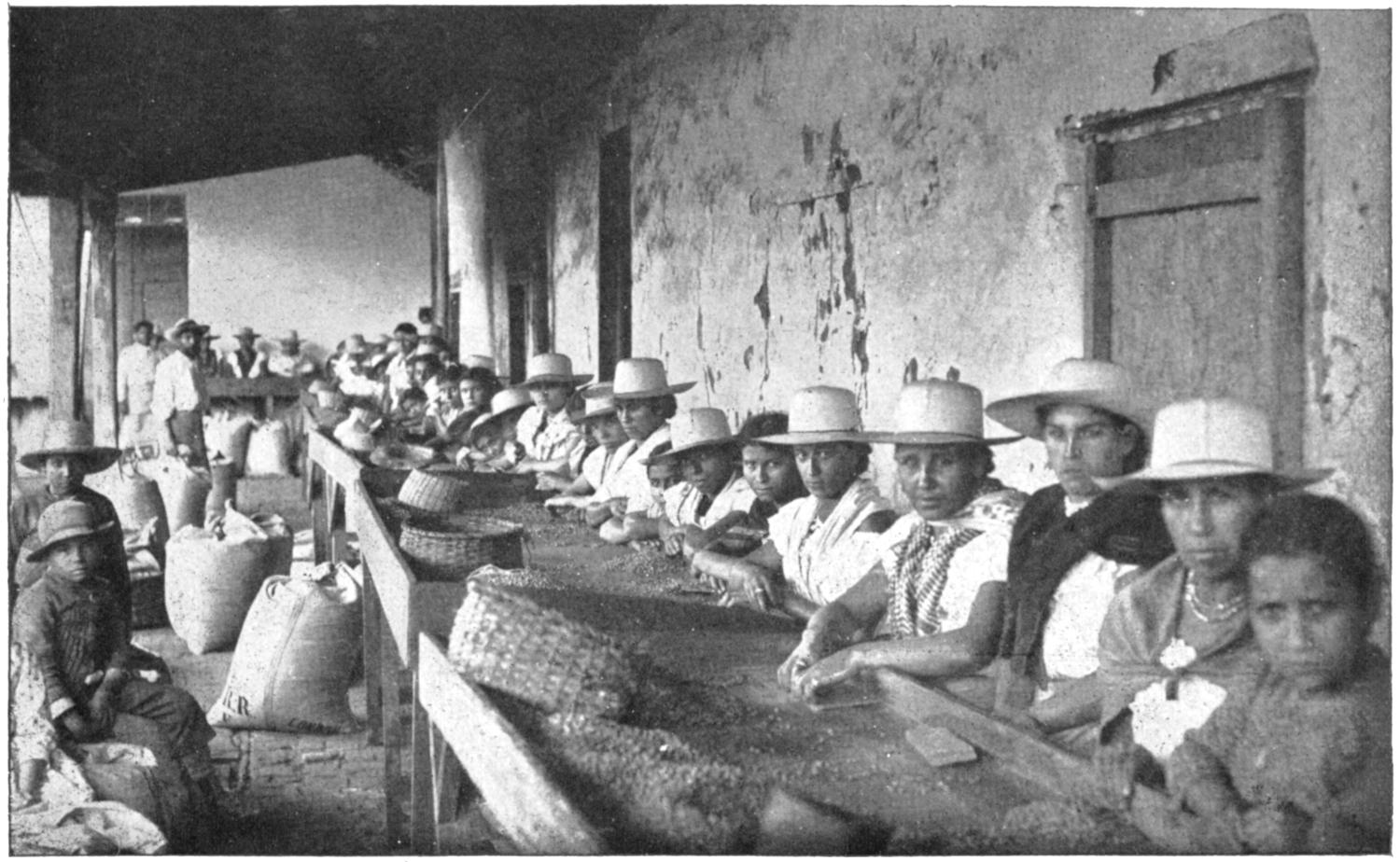
Sorting Coffee.
A combination of one part Mocha, one part Rio and
two parts Java or Maracaibo will yield a heavy, rich,
strong-flavored coffee, but not as smooth and pleasing as
if the Rio were omitted, unless for those preferring it.
In other words, when a smooth and delicate flavored
beverage is required, use one-third Mocha and two-thirds
Java. When strong and heavy is desired, use Rio and
Maracaibo or temper the former by combining it with some
of the milder kinds. When a rich, smooth beverage is
desired, a combination of one-third Mocha and two-thirds
Java; if a medium, Java and Maracaibo or some other
good, mild grade. But when a heavy body and strong
flavor is required, a blend of Rio or Santos and Maracaibo
in equal proportions should be made. Good Maracaibo
being equal to many Javas and is constantly substituted
for it by unprincipled dealers, both wholesale and retail.
A combination consisting of one-third Mocha and two-thirds
Java fresh roasted and fresh ground makes an
ideal cup of coffee. Two tablespoonfuls or one ounce of
this blend to each pint of boiling water produces a
beverage that cannot fail to suit the average taste. But
for consumers who prefer a heavy-bodied beverage a
combination of equal proportions of Santos, Caracas and
Maracaibo, will be found to yield a rich, heavy, pungent
and fragrant liquor. These quantities are intended for a
strong beverage, but where only a moderate degree of
strength is desired it is best to use only half these quantities
of coffee to the same quantity of water.
Some recent experiments in Germany confirm the
opinion that coffee, which is an aid to digestion, should
be an infusion and not a decoction, for which particular
reason alone the after-dinner coffee especially should be
an infusion, as the caffeine of coffee, which is the element
most stimulating, is best drawn out by keeping the
coffee at the boiling point, but without boiling, for a few
minutes before serving, as prolonged boiling extracts
the astringent property, tannin. There seems to be,
however, a general tendency in favor of the filtering
process, by which the use of all foreign substances, such
as eggs, isinglass, hartshorn, codfish and sole-skins, to
clear and settle it, may be dispensed with altogether.
To make filtered coffee with cold water, put one
teacupful of finely-ground coffee in a small pan and heat
over the fire. Stir constantly until hot and then put
the hot coffee in the filter of the coffee-pot, placing the
coarse strainer on top and pour in a cupful of cold water
by degrees, then cover and let stand for half an hour.
Next add three cupfuls of cold water, a cupful at a time,
and when all the water has passed through the filter, pour
it out, and pass it again through the filter, cover closely
and heat it to the boiling point before serving. The
coffee prepared in this manner will be perfectly clear and
sparkling in liquor, smooth, rich and fragrant in flavor, or
mix the coffee with the white of an egg together, then
pour one-third of the requisite quantity of cold water
and set the pot on the range where it will heat up
gradually until it begins to boil; then add another third
of cold water, and when it again begins to boil add the
balance of cold water and allow it to again reach the
boiling point; remove and let stand for a few minutes
to settle before serving. By this method boiling water
may be used instead of cold if so desired, but the use of
cold water makes a richer and stronger infusion, as none
of the aroma of the coffee is lost by evaporation, and the
refreshing properties are better extracted by the slower
process.
Filtered coffee should never be boiled; so that by placing
the coffee-pot in a vessel of boiling water it keeps the
coffee at the boiling point, but prevents it from boiling.
Coffee made by the cold-water process is invariably
stronger than when made with boiling water, and is, in
the opinion of many connoisseurs, much better, so that
a reduced quantity of coffee will answer. Another
advantage of using cold water in the filtering process is
that the coffee may be prepared from it at any time and
heated as required; but if to be served after dinner it
will be better if made with three cupfuls of water instead
of four.
But no matter what method of preparing is adopted,
or what kind of vessel the beverage is prepared in, the
result will be satisfactory if the coffee be pure, good and
fresh roasted, fresh ground and fresh made with fresh
water, fresh boiled and fresh served. But always serve
with whipped cream or hot milk, heating the milk to
the boiling point, but never allow it to boil.
CHAPTER IX. CHEMICAL, MEDICAL AND DIETICAL. — MEDICINAL EFFECTS. — DIETETICAL PROPERTIES. — MORAL INFLUENCE.
 In
chemical composition the seeds or beans of coffee
are complex, containing as they do variable proportions
of proximate principles. The appended analysis
represents the average constitution of raw coffee, according
to M. Payen, and which is accepted as the standard:—
| Constituents. |
Parts. |
| Fat, |
10 to 13 |
| Water, |
12 |
| Caffeine, |
0.8 |
| Cellulose, |
34 |
| Legumen and caseine, |
10 |
| Glucose, dextrine and organic acid, |
15 |
| Caffeone and aromatic oils, |
.002 |
| Caffetannate and potassium, |
3 to 5 |
| Viscid essential oil (insoluble in water), |
.001 |
| Ash and other mineral matter, |
6 |
| Other nitrogeneous substances, |
3 |
In addition to the foregoing, Payen also describes
some 0.8 per cent. of free Caffeine and very small quantities
of essential and aromatic oils, amounting to about
0.003 per cent. of the coffee, in addition to other azotized
and saline matter.
In the process of roasting, coffee undergoes certain
chemical changes, as before roasting it contains from 5.7
to 7.8 per cent. of sugar, which is reduced to 1.1, and
sometimes even to zero, after being roasted, and from
which, it would appear, that the description of sugar
contained in the raw coffee is destroyed by the roasting
process to which it is subjected previous to using.
COMPARATIVE ANALYSIS OF RAW AND ROASTED
COFFEES.
| Constituents. |
Raw. |
Roasted. |
| Ash, |
3.97 |
5.17 |
| Fat, |
11.42 |
8.30 |
| Water, |
8.26 |
0.36 |
| Sugar, |
8.18 |
1.84 |
| Gluten, |
10.68 |
12.03 |
| Caffeine, |
1.10 |
1.06 |
| Cellulose, |
42.36 |
44.96 |
| Extractive matter, |
14.03 |
26.28 |
| Total parts, |
100 |
100 |
In the operation of roasting, the saccharine matter is
converted into caramel, and a portion of the caffeine is
liberated from its combination with the caffeic acid, the
latter still retaining its astringent properties and developing
into a bitter, soluble principle. A change in the fat of
coffee is also undergone in the roasting, as ether will
extract only from 4 to 5 per cent. of fat from the raw
bean, while it readily extracts double that quantity from
the roasted bean. So striking is this fact that Von Bibra
goes so far as to claim that the roasting process produces
fat, but most probably the process is only mechanical
and not chemical in its action in bursting the “fat cells,”
and thereby rendering the fat accessible to the solvent
action of the ether. Roasted coffee is also tolerably rich
in nitrogen, containing from 2.5 to 3 per cent., but is
found to be quite devoid of starch. The operation of
roasting, in addition, tends to make coffee soluble in
boiling water, as, when raw coffee is perfectly exhausted
in boiling water, it will yield only some 25 per cent. of
soluble matter, while roasted coffee, on the other hand,
when completely exhausted by means of boiling water,
yields as high as 40 per cent. in some instances. A
chemical analysis of the bean after being roasted also
shows that it contains 20 per cent. of water and about 60
per cent. of cellulose, a substance resembling starch or
grape sugar. But the agents that especially distinguish
coffee from all other substances are the Caffeine, Caffeone
and Caffeic, each of which constituents possess virtues
and effects peculiar to itself, and produce, by acting in
combination, the general effect of coffee.
Caffeine—Is the principle to which coffee owes its
refreshing and agreeable properties. It is an inodorous
agent, having a slightly bitter taste, and belonging to
that group of chemical agents known as alkaloids. It
is identical with the theine of tea, and also forms the
characteristic principle of cocoa, maté, the guarana and
many other plants used by the inhabitants of widely-separated
countries, on account of their yielding a slightly
exciting and refreshing beverage and apparently forming
a necessary diet for mankind in general. Its quantity
varies from 0.8 to 1 per cent. in the different kinds of
coffee, being greatest in Martinique and smallest in San
Domingo. According to Chandler, pure Caffeine appears
in white silky needles, having no odor, and containing
about 8 per cent. of water of crystalization, which it parts
with at 150° C., being apparently soluble in cold water, but
much more so in hot, still less so in alcohol and still less
in ether, acting as a weak base and dissolving in acids
from which it may be crystalized by evaporation. When
boiled with fixed caustic alkalies it decomposes and
yields methlamine, while heating with basic-hydrates
alters it to a stronger base, termed Caffeidine, but when
boiled with an excess of nitric acid and evaporated at a
gentle heat gives it a reddish color resembling that
obtained from minoxide; the addition of a little ammonia
making it again quite characteristic. Administered in
strong doses it causes trembling and a kind of intoxication
not unlike that resulting from alcoholic stimulants,
but diminishes the work of organic tissue at the same
time.
Caffeone.—Besides Caffeine coffee contains a volatile
or essential oil chemically termed Caffeone which, according
to some authorities, is not present in the raw bean,
but is the result of an essential change produced in the
coffee by the roasting process. It is to this subtle and
fugitive principle, however, that roasted coffee owes its
peculiar and fragrant aroma, an odor possessed by no
other known substance. When chemically separated by
ether from the coffee it presents the appearance and consistency
of cocoa-butter, which in roasting permeates the
entire bean, but if the heat be too intense or the roasting
prolonged beyond the proper time, it is entirely dissipated
and lost, the result being to seriously injure the coffee.
And although coffee forms part of the daily food of more
than half the nations of the world, we are still uncertain
of the chemical nature, composition and effects of these
products of roasted coffee, and particularly of this “oil of
coffee,” one of the most important characteristic constituents
of the bean. The existence of this coffee oil
makes itself known in a striking manner by its roasting;
being forced out of the bean by the intense heat, it is
partially volatilized, and together with the other products
of the roasting, produces the characteristic effects and
aroma of roasted coffee. In very strong black coffee it is
found in oil-like drops floating on the surface, the amount
in the raw bean varying from 8 to 13 per cent., at least one-half
of which is dissipated and lost in the roasting, so that it
might prove a paying experiment to attempt to collect
this oil, especially in large establishments where much
coffee is roasted, several pounds of this oil being wasted
daily which might find a ready market at a handsome profit
in the manufacture of liqueurs. It is best obtained by
crushing about 50 pounds of roasted coffee in a mortar
and then extracting with the aid of ether and alcohol.
The oil of coffee obtained in this manner is a thick, green,
almost transparent substance, which deposits after a time
a few long needles of caffeine, proving that since caffeine is
not extracted from the exhausted beans by ether, and very
little is taken up by the alcohol employed, the coffee
from which the oil has been extracted may be again used
for the manufacture of caffeine. The oil becomes turbid
in about six months from the time of extraction, although
preserved in hermetically-sealed bottles small groups of
crystals forming in the middle of the liquid, but slowly
settling in the bottom, forming a precipitate, which in time
forms a cloudy mass of crystals, consisting of the solid
fatty acids, but the upper layer remaining clear and transparent
for years, and of a beautiful green color, proving that
a portion of the coffee oil consists of liquid oleic acid.
Taken alone, this “oil of coffee” is found to produce
a gentle perspiration and exhilaration, as well as to
stimulate the mental faculties, but is claimed to retard, in
a marked degree, the process of food assimilation, and
consequently the waste of tissue matter. It also produces
an aperient effect on the bowels, while overdoses cause
sleeplessness and symptoms of sthenic excitement, a
condition clearly bordering on inflammation.
Experiments made with Caffeine and Caffeone prove
that they produce different effects on the animal economy,
the former exercising a sedative and tranquilizing action,
being more prolonged in its effect than the latter, which
acts strongly as a transient stimulant and exhilarant.
But in the drinking of an ordinary cup of coffee both
these actions are obtained, the stimulation and exhilaration
preceding the state of sedation and repose. The
essential principle of the coffee, however, is the alkaloid
caffeine and not the volatile oil caffeone, the effects
of both constituents being different in time and character.
The former slows the heart’s action and expends its
main force on the spinal cord, to which effect is due the
shaking hand of the inveterate coffee-drinker and the
marked tremor which sometimes follows a copious
drink of coffee when taken on an empty stomach, while
the latter reduces the arterial tension, thereby allowing
a freer flow of blood and a more rapid action of the heart,
at the same time stimulating the brain, rendering the
mind clear and promoting wakefulness, being also speedier
and more transient in effect.
Caffeic.—Caffetannate, or “tannic acid,” as it exists in
the raw bean of coffee possesses an astringent action, which
is greatly modified in the roasting and neutralized by
the aperient properties of the Caffeone. A great deal
of doubt still exists as to the exact agency of this
property in coffee, many chemists contending that to it
the flavor and other properties of the coffee as a beverage
is due. It is a powerful astringent principle, puckering
up the mouth when chewed, and is the property to
which coffee owes its bitterness when boiled or over-infused,
but whether it contributes in any degree to the
exhilarating, satisfying or narcotic action of the coffee
has not yet been definitely determined. But united,
their specific properties modified by combination and
acting and reacting upon each other, these three constituents
give to coffee its peculiar properties and effects
on the human system.
To the chemist, coffee and tea are much the same,
their two alkaloids, caffeine and theine, being to them
undistinguishable one from the other, each also containing
a volatile or essential oil, the difference in the
taste of which is doubtless due to subtle properties
which the chemist is so far unable to detect. For this
reason the following comparative analysis of coffee and
tea may be found interesting, as showing how closely
they are chemically allied:—
| Constituents. |
Coffee. |
Tea. |
| Water, |
12. |
0 |
5. |
0 |
| Theine, |
0. |
75 |
0. |
5 |
| Tannin, |
5. |
|
15. |
0 |
| Gluten, |
13. |
0 |
25. |
0 |
| Wood fibre, |
34. |
0 |
24. |
0 |
| Volatile oil, |
13. |
0 |
4. |
0 |
| Gum and sugar, |
15. |
0 |
21. |
0 |
| Ash or residue, |
7. |
0 |
5. |
0 |
From recent experiments it appears that the quantity
of tannin in the coffee bean is not over about one-third
of that contained in the tea leaf and frequently is considerably
less, six samples of coffee being tested in the same
manner as tea for the amount of soluble tannin, and
steeped in fifty parts of water. Equal quantities of coffee
and tea were also analyzed and the amount of tannin
estimated with the result that, on an average, tea yielded
nearly four times as much tannin than the coffee, which
proves that in case of poisoning by alkaloids strong tea
is better than coffee as an antidote. When used in
equal quantities tea yields about twice the amount of
theine that coffee does to the water in which it is
infused, but as we use a greater weight of coffee than
we do of tea in preparing the beverage, a cup of
coffee of ordinary strength will contain as much theine
as a cup of ordinary strong tea. While, however, coffee
checks waste and is naturally a food, the same cannot be
said of tea, the specific effect of which is to quicken
respiration and the vital functions generally.
Coffee belongs to the medicinal or auxiliary class of
food substances, being solely valuable for its stimulating
and exhilarating effect upon the nervous and vascular
system. It produces a feeling of buoyancy and exhilaration
comparable to a certain stage of alcoholic intoxication,
but which does not end in the depression and collapse
produced by the latter. It increases the frequency of the
pulse, lightens the sensations of fatigue and sustains the
strength under prolonged and severe muscular exertion.
It also contains valuable medicinal properties, among
which is that of being an anti-soporific, and hence most
useful in narcotic poisoning. It has also been found to
be the best stimulant for administration to persons rescued
from starvation or perishing from intense cold, as
ardent spirits when given under these conditions often
prove fatal. It dispels languor, stupor and lethargy and
as an antidote is a specific in cases of poisoning by
opium and morphine.
The early history of coffee informs us of its use among
the Arabians for its exhilarating as well as its curative
powers, being used in Mecca and Medina originally for the
purpose of overcoming torpor and drowsiness by the
Mohamedan monks, its exciting and sleep-dispelling
power tending much to bring it into popular favor in
these cities as a medicine as well as a beverage. At this
early period it was claimed that “this liquor purified the
blood by gentle agitation, dissipated the ill-condition of
the stomach and aroused the spirits.” In the treatment
of spasmodic asthma its utility is well established as well
as in the cure of whooping cough, cholera infantum and
similar complaints, being also an excellent preventative
against all infectious and epidemical diseases. While in
hysterical attacks, for which, in many instances, the
physician can find no diagnosis, coffee has proven to be
one of the greatest helps.
Fresh-roasted coffee has proven to be an effective dispeller
of foul gases as well as a valuable disinfectant in the
sick-room, or any enclosed space where the fumes can
penetrate. As an instantaneous deodorizer, particularly
in the sick-room, where it has no equal, possessing
wonderful, almost magical power, all foul and noxious
exhalations being immediately neutralized or dispelled
by simply passing a chafing-dish of fresh-roasted coffee
through the room. As a disinfectant fresh-roasted coffee
has been invaluable as an absorbing agent in purifying the
atmosphere of all foul-smelling and offensive odors,
especially when roasted in the vicinity of the room or
place to be fumigated. When roasted, and while still hot,
if placed on a tray or other open vessel in the centre of
the apartment, by the time it has cooled the surrounding
atmosphere will be rendered thoroughly pure and sweet.
Or, better and more advantageous still, by heating an iron
fire-shovel red hot and placing a handful of ground coffee
on it and carrying it around the room or house to be
disinfected in this condition until it cools. The vapor
arising from the coffee so heated will meantime have
destroyed all disagreeable and noxious odors.
Experiments recently made with roasted coffee in
France prove it to be one of the most powerful deodorizers
yet discovered for the dissipation of all noxious
odors. As an instance of its great worth in this case, a
quantity of decomposing meat was hung up in a tightly-closed
room and a tin pan containing a few handfuls of
fresh-roasted and ground coffee was placed over a spirit
lamp, as the pan became hot and the vapor from the
coffee filled the room, it was found that the foul smell of
the decomposed meat was entirely removed, even when
standing close up to it. While Professor Beer, an eminent
Vienna oculist, maintains that the vapor arising from pure,
hot and fresh-made coffee is very invigorating to the eyes,
but at the same time attributing many frequent occurring
cases of affections to the sight to the constant use of
chicory, as well as to the habitual use of the decoctions
prepared from the admixtures of chicory and coffee.
Coffee and pepper are highly recommended as a certain
specific for rheumatism, as well as in many forms of gout.
In such cases the proper proportions consist of a pint
of hot, strong, black coffee, which must be perfectly
pure, and seasoned with a teaspoonful of pure black
pepper, thoroughly mixed before drinking, and the
preparation taken just before retiring. Quite a number
of chronic cases of rheumatism are reputed on excellent
authority to have been cured by a single dose of this
simple remedy. The greatest care has to be exercised,
however, that cold is not contracted through the free
perspiration that follows its use, yet severe colds may also
be broken up and cured by its administration. Such a
simple and convenient remedy is certainly worth a trial, as
it is, at least, perfectly harmless, and makes no demand on
the doctor or druggist. Another use for coffee medicinally,
is in nausea and violent retching, for which purpose
a strong infusion is prepared and “sipped” slowly while
very hot. This oftentimes acts effectively alone, but is
much more so if a strong mustard plaster is applied to the
pit of the stomach at the same time. Its beneficial effects
in extreme alcoholism is already too well known for
description, but is as yet not fully appreciated in such
cases, nor as to what extent this otherwise exhilarating and
potent beverage may be substituted in lieu of spirituous
and malt liquors. It is positively asserted by men of high
professional ability that when the system requires a good
stimulant, nothing equals a cup of good, strong, fresh-made
coffee for the purpose, so that those who may desire to
rescue a drunkard from his bane will find no better substitute
for alcoholic spirits or malt liquors than strong, fresh-made
coffee, in the proportions of two ounces of good,
pure coffee to one part of boiling water, making an excellent
tonic beverage, but must be administered without the
addition of either milk or sugar in these particular cases.
It is also positively asserted by those who have tried it
that malarial and other miasmatic complaints are prevented
by drinking a cup of hot coffee before venturing out into
the morning air, and by many eminent physicians it is
regarded as almost a specific in typhoid and other endemic
fevers, so much so that in malarial and intermittent
fevers it has been used by the best physicians with the
happiest results, coffee being opposed to malarial and all
noxious vapors, particularly in alienating and reducing
the earlier attacks, and, when properly administered in
such complaints, it is found superior to the sulphate of
quinine in many extreme cases, while in that low state of
intermittent fever as found on the Mississippi and the
banks of all large rivers, accompanied with torpid liver
and enlarged spleen, when judiciously prepared and administered
it has been found one of the safest and most
effective remedies. In districts rife with malarial and
other low fevers the drinking of hot coffee before passing
into the infected districts will enable persons living
in such regions to escape all contagion, the nervous system
being aroused and the fever germs thereby
rendered innocuous by the coffee. It is also almost a
specific for the disease after being contracted when used
with lemon juice, and is found to be of sovereign
efficacy in tiding over any attacks of the nervous
system in a number of emergencies from whatever cause;
and in answer to the query so often put, “Does coffee
facilitate or retard digestion?” it may be observed that it
contains several active principles, each of which exercises
a specific influence on the human system, the first and
most important of these being the caffeine, which raises
the activity of the heart, operating in small doses as a
wholesome stimulus. The second, the caffeone or volatile
substance, which operates chiefly on the nerves and
acting in moderate quantities as an agreeable exhilarant,
but to which is also attributable the fantasies and intoxicant
effects so frequently experienced as a result of excessive
coffee drinking. The third being the caffeic or
tannin, to which coffee owes its bitter taste when boiled
or over-infused and which, as is well known, enters into
combination with the albumen, thereby materially prejudicing
its digestibility. These three principal properties
vary greatly in the quantities extracted according to the
methods of preparation, so much so that if the coffee be
simply infused in water at the boiling point and allowed
to cool rapidly we get but little of the caffeine in the
extract, a good deal of the aromatic principle and
scarcely a trace of the tannin, but by over-boiling
and prolonged infusion the aroma is dissipated by
passing off with the steam or vapor arising from it
in the process of preparation, more caffeine being
also extracted, and the longer it is infused or boiled the
more tannin is dissolved in the liquid. These facts serve
to confirm the views generally expressed by physicians,
that coffee boiled or over-infused prejudices its digestibility,
while simple infusions facilitate it, but its beneficial
action in the latter case is now proved to be due
not to any direct chemical action on the albumen present,
but indirectly to its action on the nerve-centres of the
stomach by promoting the secretion of the gastric juices,
such action being, in other words, physiological and not
chemical, as heretofore supposed.
With regard to the anti-bilious properties of coffee Dr.
Elliott states that “We speedily found that patients in
hospitals and all persons leading sedentary lives must
avoid too concentrated food and drink abundantly of
diluent fluids, that coffee acted on the liver and was
altogether the best remedy for constipation and what is
commonly termed a bilious condition, that tea acted in a
precisely opposite direction, and that not poppies, mandragora
nor all the drowsy syrups of the East could
bring the peace to a sufferer from malarial chill that
would come of strong coffee, with a little lemon juice
added, and that strong tea was almost a specific for
neuralgia in its simplest and most uncomplicated form.”
Liebig also calls attention to the fact that coffee contains
many of the elements which stimulate the flow of
bile, being a decided laxative, as well as a pronounced
diuretic, which is confirmed by the fact that the “coffee
belt” of the world is also the “bilious belt” and the
“malarial belt,” as well as the regions where noxious
germs and suppurative processes most abound. Ample
evidence of “the fitness of things” in nature, no people
understanding better than the inhabitants of these tropical
countries the value of coffee to open the secretions which
have been checked by the heat or miasmatic influences of
such climates. Knowing this, they take full advantage
of the well-known antiseptic properties of coffee.
It is now more than thirty years since Landarabilco
called attention to the great value of raw or unroasted
coffee in hepatic and nephritic diseases; who, after having
continued to use the remedy for over a third of a century
in many hundreds of almost hopeless cases, still continues
to use it with marked success in the treatment of liver
and kidney troubles which have persistently resisted all
other treatment. For such cases, 3 drams (¹⁄₄ oz.) of
raw coffee beans are placed in a tumbler of cold water—the
best results being obtained from a combination of
Mocha, Bourbon and Martinique coffees in equal parts
of 1 dram each. The infusion is allowed to stand over
night, and after being properly strained or filtered must
be taken on an empty stomach the first thing on rising
in the morning. This simple remedy has been found a
sovereign remedy in numerous cases of renal and hepatic
colics, as well as in diabetes and migraine or nervous
headache, which, while rebellious to all other treatment
for years, readily yielded to the raw coffee infusion. It
may be here remarked that Bourbon and Martinique
coffees cannot be had in this country, going exclusively
to France, but may be substituted by what is known
in trade as Bourbon or Mocha-seed, Santos, Jamaica and
Mocha or almost any other fine mild coffee.
Coffee, like tea, acts powerfully on the respiratory
organs, but increases the rate of respiration more than
tea and also the pulsation; while tea, on the other hand,
increases the action of the skin, and, by lessening the
force of the circulation, cools the body, and does not
cause congestion of any of the mucous membranes,
particularly that of the bowels. But coffee, by diminishing
the action of the skin, lessens also the heat of the body,
but increases the vis-a-tergo, and therefore the heart’s
action and fulness of pulse, thus exciting the mucous
membranes. The conditions, therefore, under which
coffee may be used are different from those suited to the
use of tea, and under these circumstances better adapted
for use among the poor and feeble as a dietecal beverage.
But, besides accelerating the action of the bowels, and,
according to Liebig, aiding in the secretion of the bile,
it also invigorates to a very high degree the ganglionic
system of the brain, soothing the painful feeling of
fatigue and exhaustion, stimulating to renewed mental
exertion, for which reasons it always has been highly
appreciated by students and literary people generally.
The exhilarating and stimulating effect which coffee
has on the human organization is due chiefly to the
characteristic principles which it contains. It excites
the heart’s action, and, as that organ is feeble in the
morning and the skin is active, it is best adapted for use
at the morning meal, its action upon the nervous system
being less exciting than that of tea. Very strong coffee,
however, produces sleeplessness in many persons when
taken at night, owing to its effects on the heart’s action,
by retarding that full action of this organ, which is
natural at night, and so requisite to permit sound sleep,
while if only a light infusion be prepared and taken at
night, these effects are not likely to be experienced.
In typhoid and other fevers its action is frequently
very prompt and efficacious, particularly in the early
stages before local complications set in. Dr. Guillasse,
of the French navy, in a recent paper on typhoid
fever, states that “Coffee has given us unhoped-for
satisfaction, for, after having dispensed it, we found,
to our great surprise, that its action was as prompt
as it was decisive. No sooner had our patients taken a
few tablespoonfuls of it than their features became
relaxed, and came immediately to their senses, while the
next day the improvement was such that we are tempted
to look upon it as a specific against typhoid fever. Under
its influence the stupor is dispelled and the patient arises
from the state of somnolency in which he has lain since
the invasion of the disease; soon all the functions take
their natural course, and he enters on convalescence.”
His formula is to give to an adult two to three tablespoonfuls
of strong, black coffee every two hours, alternately
with one to two tablespoonfuls of claret or burgundy
wine, a little lemonade or citrate of magnesia, to be
taken daily, and after a few days quinine in small doses.
From the fact that malaise or cerebral symptoms appear
first, the doctor regards typhoid as a nervous disease,
and the coffee, acting on the nerves, is peculiarly indicated
in the early stages, before local complications arise.
While in extreme cases of yellow fever it has been
used effectively by many doctors as the main reliance
after all the other well-known remedies had been administered
and failed. In such cases it acts by retarding the
tissue change, that becoming a conservator of force,
especially in that state in which the nervous system tends
to collapse, owing to the blood becoming impure. In
such a condition it sustains the nervous power until the
depuration and reorganization of the blood are accomplished,
possessing the advantage over all other stimulants
of inducing to no secondary ill-effects.
As early as 1835, during the cholera epidemic, the
physicians of New York issued a public manifesto urging
the people to abstain from beer and other liquors and
confine themselves to the exclusive use of pure, strong
coffee as a beverage, in order to keep the system healthy
and render it less liable to an attack of the disease, with
the most beneficial and gratifying results. That they
“builded better than they knew” has since been conclusively
proven by Sudentz, who in detailing a series of
experiments in which he has determined the powerful
influence of coffee infusions of varying strength upon the
growth of the different forms of pathogenic and non-pathogenic
micro-organisms. The variety of coffee used
in these experiments was the finest Java—although good
and bad coffee was afterwards found to effect precisely
similar results—the infusions being made by adding from
10 to 30 parts of coffee to from 70 to 90 parts of boiling
water. The coffee was first freshly roasted, ground fine
and then covered with the boiling water, the infusion
thus prepared being placed in a closed flask, put in a
hot water bath for about ten minutes and next filtered
through a sterilized filter. The infusion thus produced
is used in the making of a gelatinous compound, both
directly and in part, until a nutrient gelatine was prepared
from it. With this as a “menstruum” the various forms
of fungi and other forms of micro-organisms were inoculated
with the object of determining the possibility of
their growth or propagation in such a medium, but in
other cases the organisms were added directly to the
coffee alone in infusions of varying strength and after different
periods of time inoculations were made from these
infusions into other nutrient media. By this method he
found that the forms of fungi experimented with showed
more or less growth in the coffee gelatine and that the
abundance of the growth was in many cases distinctly
less than in the former media. The other organisms
which he used for his experiments were the phyogenes
aureus, prodigiosus, erisipelous, the germ of anthrax or
splenic fever, the bacilli of typhoid fever and the spirulum
of Asiatic cholera, all of which and many other forms of
micro-organisms were greatly influenced in their life and
growth by exposure to the coffee infusions, some being
far more susceptible than others, however, the bacillus
prodigiosus and proteus vulgaris being entirely destroyed
only after an exposure of four days in a 10 per cent.
infusion, while in a 30 per cent. infusion they were all
destroyed in one day. The spore of erysipelas was totally
destroyed after an exposure of one day in a 10 per cent.
infusion, the germ of splenic fever dying in from one to
three hours in a 20 to 30 per cent. infusion; while the
typhoid bacilli were completely destroyed in a 5 per cent.
infusion after an exposure of three days and in a 30 per
cent. infusion in from one to two days. While the microbe
of Asiatic cholera was easily destroyed in a 1 per cent.
infusion after only seven hours’ exposure, in a 5 per cent.
infusion after four hours and in a 30 per cent. infusion
after two hours; the cholera spirulum being by far
the most susceptible of the numerous organisms used
in the experiments, next to which was the anthrax
bacilli, except the young forms or spores of the latter
germs, which perish only in from three to four weeks’
exposure. These latter results speak volumes for
“coffee as a germicide” for anthrax or splenic fever,
as the spores of this disease are by no means easy to
scotch or kill, and after these revelations coffee administered
internally or hypodermically in some new form or
combination of forms, may be eventually used as a remedy
for all germ-produced diseases. It must be borne in mind
by the student or chemist, however, that the antiseptic
effects of coffee do not depend on its Caffeine so much as
on its Caffeone or essential oil developed in the roasting
of the beans. But aside from these experiments, others
were also made with decomposing meat soups, which were
actually swarming with various forms of micro-organisms,
the results obtained showing that the vitality of the
spores contained in the fluid was greatly diminished after
a short exposure, but was not completely destroyed until
after an exposure of many days.
It may at first sight seem irrational that a substance
which restricts tissue-waste should be used for the purpose
of quickening certain other functions, more especially
those of the brain, yet the physical activity, mental
exhilaration and wakefulness it causes explains the liking
for it shown by so many men of science, poets, scholars
and others devoted to thinking. But all of these
occupations involve increased waste of tissue in the
brain as well as of the spinal marrow, the very
action which coffee is said to restrain, so much so
that to reconcile these apparent incongruities, it has been
maintained that coffee does not act primarily as a cerebral
stimulant, but only secondarily by removing the
vascular plenitude occasioned by prolonged study, by
a full meal, and especially by opium, alcohol, or other
agents which directly tend to load the brain with blood,
so that when taken on an empty stomach it does not
quicken the functions of the brain, but on the contrary
renders it dull and inapt for steady thought, creating
nervousness and general debility and frequently causing
hemicrania.
During digestion, however, the case is different, particularly
if a full and stimulating meal has been taken,
the mind grows dull and sluggish, a tendency to sleep
arises, and everything indicates an increased amount of
blood on the brain, it being in like manner that prolonged
mental labor produces cerebral plenitude and drowsiness.
It is this condition apparently which coffee corrects
by contracting the blood-vessels and thereby relieving
the brain of its oppressive load of blood. The habit of
using coffee at breakfast and after dinner is thus explained
by the stimulant action which it exerts, not only upon
the nervous system generally, but more especially on the
stomach and bowels, there being no doubt that it quickens
gastric digestion and relieves the sense of plenitude in
the stomach, stimulating the secretion of bile and augmenting
the peristaltic action of the intestine, and thereby
promoting defecation. While it is quite as certain
that, used to excess, it paralyzes the digestive function in
all its stages and leads to further disorders, of which the
chief are constipation, hemorrhoids and congestion of
the liver, but whether these effects are to be ascribed to
a power in coffee to produce contraction of the capillary
blood-vessels or not is uncertain, but their reality is
beyond dispute.
With regard to the injurious effects charged to the
abuse of coffee by some authorities, it may be said that
the consequences of an abuse of tea were declared to be
similar to that of coffee long before chemistry had
demonstrated the identity of theine with caffeine, when
among their evil effects were enumerated acidity, heartburn,
indigestion, tremors, wakefulness, irritability of disposition
and depression of spirits. Most of these ill-effects
are more likely to follow the abuse of tea than coffee, if
at all, and the spinal symptoms, such as painful muscular
tension, cramp and persistent wakefulness, are also more
apt to be produced by tea. In experiments made with a
number of selected healthy persons, the operation of
caffeine has been found to vary exceedingly, some being
scarcely affected at all, while others by the same dose
suffered from a full, frequent or irregular pulse, headache,
trembling limbs, palpitation of the heart, flashes before
the eyes, roaring in the ears, sleeplessness, phantasms, a
sort of intoxication, and a subsequent unfitness for all
physical and mental labor when very large doses were
taken. These effects illustrate the danger of exceeding
due moderation in the use of coffee, showing that it may,
if abused, tend to develop a morbid condition of the nervous
system, rendering it peculiarly liable to disease,
although in a much less degree than either opium or
alcohol, its excessive use being much more injurious to
the spinal than to the cerebral functions.
From these facts it may be advanced by some authorities
that an article possessing such great powers and
capacity for such energetic action must be injurious by
habitual employment as an article of diet, or at least not
without some injurious or deleterious properties. But
no corresponding ill-results or nervous derangements
are ever observed after its effects have disappeared as are
noticed in other narcotics and stimulants, the action imparted
to the nervous system by coffee being natural and
healthy in the extreme, in proof of which it has been
shown that habitual coffee-drinkers generally enjoy
good health and spirits, some of the longest-lived
people having used coffee continually from their earliest
infancy without experiencing any inconvenience, depressing
reaction, or other ill-effects such as is invariably
produced by the use of alcoholic stimulants. There
are, on the other hand, systems with which it does not
agree, as, being a stimulant, it may be taken too freely;
in such cases it undoubtedly produces irregularities
in the action of the heart and nervous system. But
generally it is an unmixed blessing, its beneficial influence
becoming more apparent as its use penetrates into the
lower strata of society, taking the place of the various
debasing alcoholic beverages.
In addition to its many other virtues, coffee has been
found to be an excellent barometer, from the fact of its
being such a great absorbent. On the eve of a rain-storm
grinding coffee will be found difficult, the bean
becoming damp and tough, while when dry weather is
indicated the process is quite easy. Another method of
predicting the weather by it is to drop a lump of sugar
into a cup of coffee without stirring. In a very short
time the air contained in the sugar will rise to the surface
in the shape of bubbles. If the bubbles collect in the
middle of the cup a fair day will be sure to follow, but if
they should adhere to the side of the cup, forming a
ring of bubbles with a clear space in the centre, rain is
certain to be near at hand, while if the bubbles be neither
of these, but scatter irregularly over the surface of
the liquid, variable weather is indicated by the movement.
What the scientific explanation of the action of
the atmosphere on the bubbles so found is not known,
but that their indications curiously and correctly
agree with those of a barometer has been tested and
proved.
The human family have, from time immemorial, been
addicted to the use of warm food and liquids in some
form, infusions or decoctions of sage and the leaves of
other plants being used extensively in Europe for the
purpose prior to the introduction of tea and coffee.
The human body demands food or liquid when in an
exhausted state, and if they be not warm they make an
immediate drain on the system for heat before it can supply
material for combustion, so that the body is taxed for
heat at a time when it is least fitted for the purpose. It
is but natural therefore that there should be a craving
for warm food and drink, and as liquid food, particularly
in a cold state, is deficient in heat-giving matter,
the use of cold liquids is more injurious than that of
cold solids. The temperature of the human body being
98°, when food is taken into the stomach at a lower
temperature than that of the body, it obstructs the heat
from the stomach and surrounding tissues, so that when
the practice of taking cold food into the body becomes
habitual, depression occurs and the stomach is disordered.
The system must therefore make good the heat lost in
raising the temperature of the cold food—liquid or solid—or
else suffer the consequences.
The action of coffee as a diet is directed chiefly to the
nervous system, producing a warming cordial impression
on the stomach, which is quickly followed by a diffused
and agreeable nervous excitement which extends itself
to the cerebral function, giving rise to increased vigor of
the imagination and intellect, this too without any subsequent
reaction or stupor such as are characteristic of liquor
and other narcotics. It contains essential principles of
nutrition far exceeding in importance its exhilarating
properties, and is one of the most valuable articles of food
for sustaining the system in certain protracted and wasting
diseases, and as compared even with the best soups, coffee
has a decided advantage and is to be preferred to them in
many cases. But to rightly understand its function as a food
it should be used chiefly as an accessory to food, as it aids
in the digestion and assimilation of the other foods
when it is properly prepared—that is, by protracted
infusion—as when boiled too long the caffeic acid or
tannin is extracted. The action of this acid in
combination with the milk and cream being to harden
the albumen into an indigestible compound, which has
been found exceedingly irritating to the delicate membranes
of the digestive organs and nervous system.
Milk and coffee act similarly upon the skin and other
organs, its use with coffee making it a more perfect food
than when milk is used with tea. But while, like tea, it
increases the respiration, yet again, unlike it, its effects
are not lasting, as by the use of coffee the rate of the
pulse is increased, and the action of the skin’s pores
diminished, thereby lessening the quantity of the blood
circulating in the organs of the body, it distends the veins,
but contracts the capillaries, thus preventing a waste.
According to Professor Johnstone, “Coffee arouses, exhilarates
and keeps awake, counteracts the stupor occasioned
by fatigue, disease or opium, allays hunger to a
certain extent, gives to the wearied increased strength
and vigor, and imparts a feeling of comfort and repose.
Its physiological effects upon the human system appear
to be, that while it makes the brain more active, it
soothes the body generally, retards the change and waste
of tissue, making the demand for food consequently less.
The Gallæ, a wandering nation of Africa, during their
incursions, are obliged to travel over immense deserts,
and being also desirous of falling upon the towns and
villages of their victims without warning, carry nothing
to eat with them but the roasted and pulverized beans of
coffee, which they mix with grease to a certain consistency,
that will permit of its being rolled into masses about
the size of billiard-balls, which they keep in leather-bags
until required for use. One of these balls so prepared
supports them for an entire day when on a marauding
excursion or in active war better than a loaf of bread or
a meal of meat, claiming that they prefer it to grain or
meat because it cheered their spirits as well as fed them.
Eaten in this manner, coffee undoubtedly affords much
nourishment, as, according to Payen, it contains more
than twice the nutriment of soup and three times as
much as tea. In the liquid state, however, the nitrogeneous
or flesh-forming properties, being mostly insoluble,
they remain in the grounds. For this reason coffees
lightly roasted possesses the maximum of nutrition,
strength and aroma.
The Belgian coal miners live and work effectively on a
ration of solid food less than the French miners, yet perform
more labor than the latter, the only difference in their
food consisting in the Belgians receiving a ration of coffee
instead of wine, to which is attributed their greater endurance.
While Jomand states that eight pints of an infusion
made with six ounces of different kinds of coffee
enabled him to live for five consecutive days without
lessening his ordinary occupations, as well as to use
more and prolonged muscular exercise than he was
accustomed to without any other physical injury than
a slight degree of fatigue and a little loss of flesh.
The value of hot infusions of coffee under the rigors
of an Arctic cold has been demonstrated by the
experience of all polar explorers, and it has been
found scarcely less useful in tropical regions, where
it beneficially stimulates the action of the skin. Captain
Parry states that when on his Arctic expedition he
placed his starboard watch on a diet of coffee and the
port watch on that of rum, as an experiment, with the
result that the coffee watch was found to possess a vigor of
health and activity entirely wanting in that of the other.
And many of our own troops during the late war
declared that they could march longer and endure more
hardship and exposure under the stimulus of a cup of
warm coffee—and they got far from the best or purest—than
they could under an equal quantity of liquor.
But there is still another effect of coffee—that of
checking the too rapid consumption of nitrogeneous
matter in the system—which, while not nutritious
in itself, yet possesses an indirect nutritive value; this
result, added to its stimulating character, have made
it the chosen beverage for breakfast, and therefore
the best staple supply for both our army and navy.
By taking a cup of strong, black coffee, without milk
or sugar, between two glasses of hot water before rising
in the morning and at least an hour before breakfast, the
various secretions are stimulated and the nervous force
aroused, so that an hour later a hearty meal is enjoyed and
the day’s labor begun favorably, no matter how the duties
of the day and night preceding may have drawn upon the
system. While another cup at four in the afternoon is
sufficient to sustain the flagging energies for many hours
thereafter. In this manner its full effect is best secured,
but if along with this the proper diet is taken at the
proper time, the capacity for work will be almost unlimited.
Its physiological effects upon the human system, so far
as they have been investigated, appear to be that while
it makes the brain more active it soothes the body generally,
making the waste and loss of tissue slower and
the demand for food less. It is a mental stimulus of a
high order, and therefore is as a beverage liable to be
abused for that reason. Through its influence the student
burns the midnight oil to excess, and consequently
reduces his store of physical force.
The German naturalist Martin relates a case he met
with of a horse which owed its life to the use of coffee
after being in a condition considered as incurable. The
animal was reduced to a mere skeleton and so weak that
it could scarcely walk, when infusions of coffee were first
given it as an experiment, and then some ground coffee
mixed with honey. In a short time the animal began to
improve rapidly, eventually becoming better than ever.
The same treatment was afterwards tried with like success
in many similar cases where the horses had been
over-worked or lost their strength and appetite.
It has been affirmed that coffee and other substances
containing the alkaloid Caffeine have a direct influence
in retarding the waste of tissue matter in the human
frame, a single cup of the liquid prepared from a quarter
ounce of coffee, containing from 1.5 to 1.9 grains of
Caffeine in the infused state. The moderation of tissue
waste attributed to coffee in common with other articles
having the same general action and in use among
different nations, is proven by various well-established
facts. In its primary operation it agrees with those
stimulants in exciting mental and muscular activity as
well as cheerfulness, while in its after effects it does not
tend to produce narcotism or stupor, only that unsteadiness
of mind and of the spinal functions which denotes
exhaustion.
It has been the custom at frequently-recurring periods
for moralists and scientists to claim that coffee is injurious
to the health of its votaries, and many coffee drinkers
believing such statements give up its use regretfully.
That its use or rather its abuse may be injurious in some
instances cannot be denied, but of all beverages now in
use the facts and effects prove it to be the least injurious
of any and all when not indulged in immoderately.
Taken in moderation it is both a mental and physical
stimulant of the most agreeable and pleasant nature,
being followed by no harmful reaction. It produces contentment
of mind, allays hunger and bodily weakness,
increases the incentive and capacity for work, enabling
those who use it in bounds to remain long without food
or sleep, endure unusual fatigue, and preserve their cheerfulness
and composure, coffee-drinkers as a rule being
generally cheerful, active and persevering. The truth
is that coffee, if of a pure kind and properly prepared,
is about the pleasantest and most innocuous stimulant
that can be resorted to, particularly after a long
worry or severe drain on the emotional or intellectual
forces. So that if it could be but made to take the place
of absinthe, champagne and other such beverages the
coming race would be all the better intellectually and
physically for it. Habitual coffee-drinkers generally
enjoy good health, some of the longest-lived people
have used it from their earliest infancy without apparent
injury or depressing reaction, such as is invariably
produced by alcoholic stimulants. The physiological
action of coffee is directed chiefly to the nervous
system, producing a warm, cordial feeling in the
stomach, which is quickly followed by a well-diffused
and agreeable nervous excitement extending itself to the
cerebral functions, giving rise to increased vigor to the
imagination and intellect without causing any subsequent
stupor or confusion of ideas, such as are so characteristic
of all other narcotics. It produces contentment of mind,
allays hunger, mental and bodily weariness, increases the
capacity for work, makes man forget his troubles and
anxieties, enabling those who use it judiciously to endure
unusual fatigue and remain a long time without food or
sleep, as well as to preserve their temper and cheerfulness.
The influence which the introduction of coffee has
exercised on modern morals is on account of its peculiar
character, much easier to understand than to prove. We
know that the discovery of gunpowder changed the entire
art of war from the equipment of the individual soldier to the
alignment of an entire army, and thus its influence became
a palpable fact. But the changes in modern life effected
by the introduction of coffee belong to the general and
concealed springs of life; to its motives, rather than to
any circumscribed set of utterances regarding its facts,
and an influence of this nature requires the application
of a peculiar instrument in order to in a measure calculate
or even demonstrate it. A doctor may be perfectly correct
in ascribing a fever to certain atmospheric conditions,
but without thermometer, barometer or microscope, he
can prove absolutely nothing. We may be perfectly
certain then that the introduction of coffee has altered the
whole moral atmosphere in which we move, but without
statistics we are unable to demonstrate the legitimacy or
correctness of the assumption, and statistics is a scientific
instrument of much later date than the introduction of
coffee.
Observations, however, which in some degree may
be of some service in arriving at exact figures, are
not altogether wanting. It cannot be contended that
life has become more just and honest, which would be
the legitimate result of a better education, but it is certain
that it has become gentler, more uniform and pacific,
two results which essentially depend on food and occupation.
Nor can it be denied that it is the increasing
demands of reason which awe, superstition, bigotry and
narrow fanaticism out of our educational system, and not
this system which spontaneously has endeavored to
make everything else subservient to reason, and what
thus is dimly or vaguely indicated by a general view of
life, often becomes more striking in many individual
instances. It is a hazardous, but nevertheless felicitous
expression, that “if Queen Elizabeth had breakfasted
upon coffee and hot rolls, instead of beer and bacon,
Queen Mary would never had been beheaded.” We find
in bygone ages a perversity of temper, an impetuosity of
will, a violence of the passions which has led some moralists
to consider the later generations of the human race
as decreasing in vital force, while indeed the phenomenon
might be explained as the single result of an over-stimulating
and too exciting a diet and a lack of temperance.
Let the people begin to indulge once again in drinking
wine, ale or other intoxicating beverages at the morning
meal instead of tea or coffee, and we will soon have the
same amount of vital force back again. It is not the
power of passion which has decreased, but the power
of restriction which has increased, and a comprehensive
consideration of historical facts seem to justify the conclusion
that this increased power of the reason is due as
much to a more proper feeding of the body as to a better
system of education.
The mental exhilaration and physical activity and buoyancy
which coffee causes explains the fondness which has
been shown for it by so many men of science, poets, scholars
and others devoted to writing or thinking at all times,
and for which reason it has been styled the “intellectual
beverage.” Preachers, orators, editors and lawyers finding
a cup of good coffee the gentlest, most harmless and
effective of brain-bracers, but it does not appear to be
generally known that nearly all men of literary habits
who exhaust much nerve force use it constantly. It
supported Voltaire in his old age and enabled Fontenelle
to pass his hundred years. It was Voltaire who replied,
on being informed by his physician “that coffee was a slow
poison,” “Yes, I know it is a very slow poison; it has
been poisoning me for over seventy years;” and Sydney
Smith who said, “If you want to improve your understanding
drink coffee; it is the intellectual beverage.”
Brady terming it “The sovereign drink of pleasure and of
health,” and Pope eulogizing it in the following lines:—
“From silver spouts the grateful liquors slide
While China’s earth receives the smoking tide,
At once they gratify their sense and taste,
And frequent cups prolong the rich repast;
Coffee!——which makes the politician wise
And see through all things with half-shut eyes.”
Howells paying his tribute to it when he says, “This
coffee intoxicates without exciting, soothes you softly
out of dull sobriety, making you think and talk of
all the pleasant things that ever happened to you.”
But times have changed since Voltaire, Diderot, Pope
and others wrote and sang of coffee, jested, reasoned
and made themselves immortal under its influence;
alimentary and not literary is the modern café, though
some can still boast of a clientèle artistic, journalistic, or
scientific, the commercial element preponderating, but the
old historic café, the café of tradition, where one was
sure to find some celebrity on exhibition—a poet or a
philosopher—may be said to be defunct.
From its cordial and gently stimulating effects we
may well join in the enthusiastic panegyric pronounced
on it by an Arabian of old, of which the following is
a free, but condensed, translation: “O, coffee, thou dispellest
the cares of the great and bringest back those
who wander from the paths of knowledge! Coffee is
our gold, and in the place of its illusions we are in
the enjoyment of the best and noblest society. Every
care vanishes when the cup-bearer presents the delicious
chalice to our lips. It circulates freely through our
veins and will not rankle there. Grief cannot exist
where it grows and sorrow humbles itself before its
powers.”
Vive la café!
CHAPTER X. PRODUCTION AND CONSUMPTION. — TABLE I. WORLD’S PRODUCTION (ESTIMATED). — TABLE II. WORLD’S CONSUMPTION (ESTIMATED). — TABLE III. — TABLE IV. — TABLE V.
 Fifty
years ago a supply of 150,000 tons of all
kinds of coffee was considered sufficient to meet
the entire demand of Europe and America combined.
In 1848, however, these two continents alone
consumed upwards of 250,000 tons, which had increased
in 1868 to 375,000 tons, and in 1888 to over 700,000
tons, or more than double that of fifty years before.
| Countries. |
Weight
in Tons. |
| Liberia and all other Countries on the West Coast of Africa, |
19,500 |
| Abyssinia and all other Countries on the East Coast of Africa, |
20,000 |
| Natal and Cape of Good Hope, |
300 |
| Arabia, Bourbon and Mauritius, |
15,000 |
| British India and Ceylon, |
30,500 |
| Java, Sumatra and Celebes, |
60,000 |
| Bali, Timour and other Islands in the Malayan Archipelago, |
10,000 |
| Philippine, Fiji and Samoa Islands, |
11,000 |
| Sandwich and all other Islands in the South Pacific Ocean, |
1,200 |
| Cuba and Porto Rico, |
25,000 |
| Hayti and San Domingo, |
15,000 |
| Jamaica and other Islands in the West Indies, |
18,000 |
| Mexico and Central America, |
80,000 |
| Venezuela and Colombia, |
50,000 |
| Equador and Bolivia, |
15,000 |
| Brazil and other Countries in South America, |
500,000 |
| Grand total, |
875,500 |
Or about 1,800,000,000 pounds per annum, the value
of which averages over $275,000,000 wholesale, according
to its market price at time of sale.
| Countries. |
Weight
in Tons. |
| Asia, |
40,000 |
| Africa, |
25,000 |
| Australia, |
5,000 |
| Continent of Europe, |
430,000 |
| Great Britain and Ireland, |
15,000 |
| United States and Canada, |
275,000 |
| Mexico and Central America, |
20,000 |
| West India Islands, |
15,000 |
| Brazil and South American Countries, |
40,000 |
| Total, |
865,000 |
Which shows that, in recent years, the world’s supply
has not kept pace with the growing demand throughout
the civilized world.
Showing the average annual consumption in the United States,
imported principally as follows:—
| Country. |
Tons. |
Per Cent. |
| Brazil, |
150,000 |
75.00 |
| Venezuela, |
20,000 |
5.00 |
| Mexico, |
10,000 |
4.00 |
| Central America, |
5,000 |
2.00 |
| West India Islands, |
10,000 |
4.00 |
| India and Ceylon, |
1,000 |
1.00 |
| Arabia and Africa, |
10,000 |
5.00 |
| Java and Sumatra, |
10,000 |
4.00 |
| Total, |
216,000 |
100.00 |
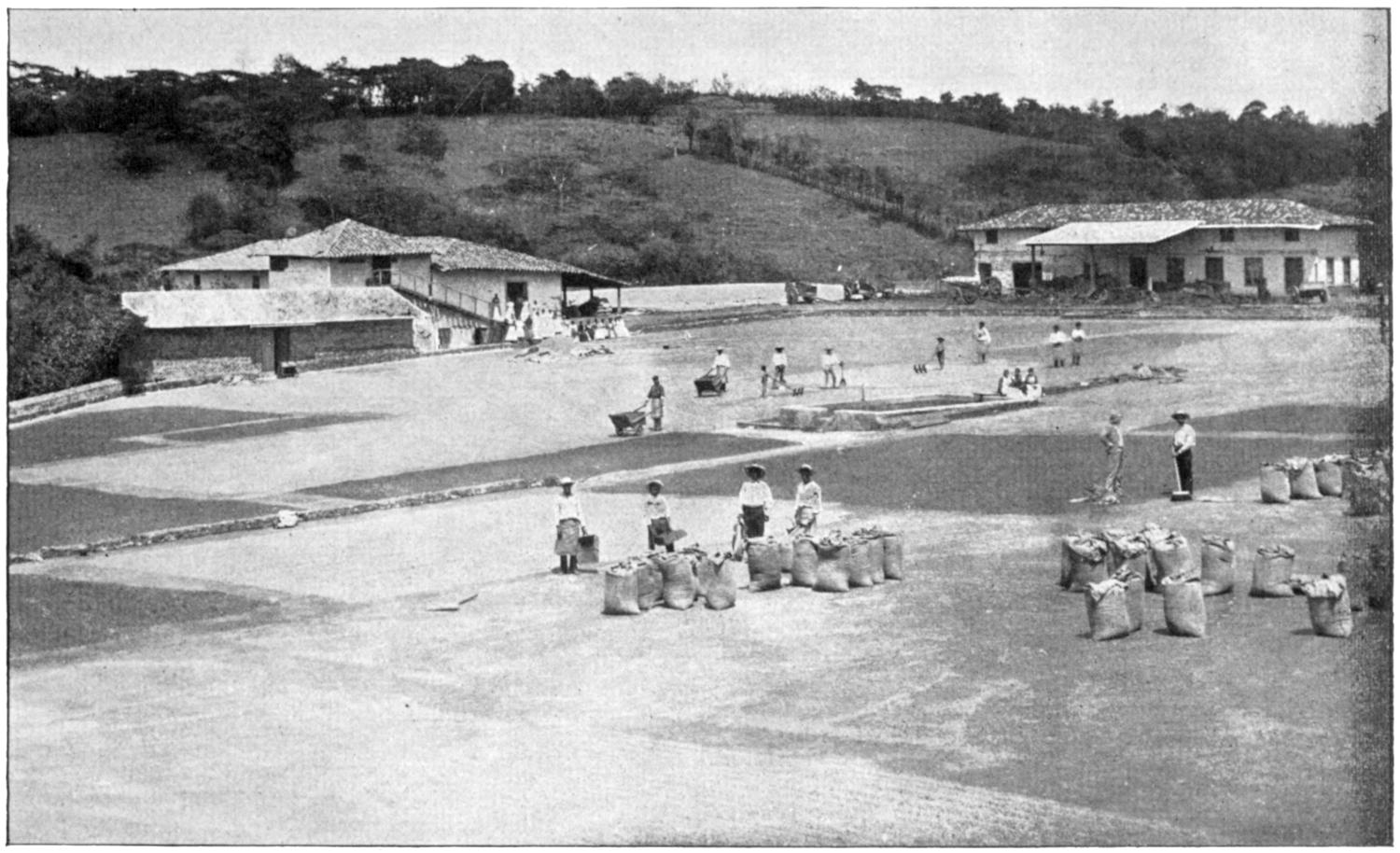
Bagging Coffee for Shipment.
Showing where United States receives supplies of coffee from
in general and the various kinds consumed:—
| Country. |
Pounds. |
| Africa, |
25,000,000 |
| Arabia, |
10,000,000 |
| England, |
5,000,000 |
| Holland, |
5,000,000 |
| Germany, |
250,000 |
| Belgium, |
80,000 |
| Portugal and Spain, |
150,000 |
| Brazil, |
400,000,000 |
| Canada, |
500 |
| Mexico, |
10,000,000 |
| Venezuela, |
35,000,000 |
| Colombia, |
15,000,000 |
| Equador and Bolivia, |
1,000,000 |
| West India Islands, |
5,000,000 |
| British and Dutch Guiana, |
1,500,000 |
| Malayan Archipelago, |
25,000,000 |
| British India and Ceylon, |
5,000,000 |
| Philippine and Pacific Islands, |
10,000 |
| Sandwich and other Islands, |
75,000 |
| Azores and Cape Verde Islands, |
1,500 |
| French Possessions in Africa, Madagascar and Bourbon, |
1,500 |
| Total importation, |
600,000,000 |
| Total value, |
$80,000,000 |
Which, according to the Bureau of Statistics, is about
9 pounds per capita, valued at $1.15 per head, for every
man, woman and child in the United States, while it has
been ascertained that the consumption of coffee has
declined in England in the past ten years to less than
one pound per capita of the population as against an
increase in the consumption of tea from 6 to 8 pounds.
Showing per capita consumption of the principal countries of
the world in round numbers:—
| Countries. |
Consumption
(Pounds). |
Per Capita
(Pounds). |
| Asia, |
80,000,000 |
—— |
| Africa, |
50,000,000 |
1 |
|
| Australia, |
10,000,000 |
2 |
|
| Austria, |
10,000,000 |
2 |
¹⁄₂ |
| Belgium, |
50,000,000 |
10 |
|
| Denmark, |
25,000,000 |
6 |
|
| France, |
100,000,000 |
2 |
¹⁄₂ |
| Germany, |
180,000,000 |
5 |
|
| Greece, |
2,000,000 |
0 |
¹⁄₂ |
| Holland, |
70,000,000 |
14 |
|
| Italy, |
30,000,000 |
1 |
|
| Switzerland, |
20,000,000 |
5 |
|
| Russia and Siberia, |
15,000,000 |
—— |
| Sweden and Norway, |
35,000,000 |
10 |
|
| Great Britain and Ireland, |
35,000,000 |
1 |
|
| United States and Canada, |
600,000,000 |
6 |
|
| Mexico and Central America, |
35,000,000 |
3 |
|
| West India Islands, |
30,000,000 |
5 |
|
| South American States, |
100,000,000 |
3 |
|
What tea is to the United Kingdom coffee is to the
United States, the consumption of the latter in this
country increasing from 80,000,000 pounds in 1861 to
116,000,000 in 1871, and to over 400,000,000 pounds in
1881, the consumption of coffee, at the present time in
this country, falling just short of the enormous figures
of 600,000,000 pounds.
The use of coffee has been extending at an enormous
rate for the past 150 years, until at the present day it
is found in every civilized country and almost every uncivilized
country on the habitable globe. It has become
one of the corner-stones of civilization. As has been
well said by one writer, it smoothes the troubled soul,
heals all family feuds, fits one for the annoyances of
business, and organizes a truce between the man who
drinks it and all the troubles and cares of life. The
United States is without doubt a nation of coffee-drinkers,
the average annual consumption reaching upwards
of 600,000,000 pounds, or nearly ten pounds per
capita of the entire population.
Up to 1860 there was a wide disparity between the
production and consumption of coffee throughout the
civilized world, the former remaining stationary while the
latter continued to increase rapidly until the civil war,
which caused a reduction in this country of nearly 200,000
tons per annum, thus re-establishing the relative difference
between the laws of supply and demand. With the close
of the rebellion, the United States, however, and a
reduction of the duty, the consumption again steadily
increased, exceeding in a short time the increase in the
production, causing a steady advance in prices from 1869
to 1880, the extreme advance in prices in the latter year
naturally stimulated and increased production until stocks
accumulated largely and prices again declined accordingly.
During the period from 1880-87, planters and
dealers suffered greatly, many disastrous failures among
both classes following as a consequence. The consumption
meanwhile continued to increase steadily, as did also
the production, owing to the yield of new plantations
previously opened under the stimulus of the high prices
prevailing in 1880, fair relations between the production
and consumption being to the present maintained.
The history of tariff legislation on coffee in the
United States may be summed up in the following
sequence: The first duty on coffee was levied in 1789,
which was 2¹⁄₂ cents per pound. In 1790 this was
increased to 4 cents, and again to 5 cents in 1794, being
retained at the latter figure until 1812, when it was
increased to 10 cents, owing to the increased expenditures
of the government, due to the war with England.
At the close of this war, in 1814, the duty was reduced
to 5 cents per pound, remaining at the latter figure until
1828, when it was still further reduced to 2 cents; in
1830, to 1 cent, being removed altogether in 1832, and
placed for the first time on the free list. No tax was
again placed on coffee until the beginning of the civil
war in 1861, when a duty of 4 cents per pound was
levied on it, which was shortly after increased to 5 cents,
at which figure it remained until 1871, when it was
reduced to 3 cents, the duty being entirely removed
from coffee in 1872, since which year it has remained
uninterruptedly on the free list.
During the years from 1832 to 1861, when coffee was
entered free of duty, it ruled lower in price and increased
more in consumption than it had at any previous period,
the per capita consumption increasing from three pounds
in 1830, to nearly six pounds in 1860, the quantity
imported into the United States in the latter year
reaching nearly 236,000,000 pounds, being valued at
$21,500,000, the three following years showing an
average annual importation of about 220,600,000 pounds,
valued at $21,000,000. In 1855 fair Rio averaged 11
cents per pound; Maracaibo, 12 cents, and Java, 14¹⁄₂
cents; these being the three principal then in demand
in the American market, while in 1860 the range was
considerably higher and the consumption correspondingly
less, Rios averaging 13³⁄₄ cents; Maracaibos, 14¹⁄₂
cents; and Javas, 16¹⁄₂ cents. These prices continuing
to advance until 1863-4, when the prices of coffee ruled
exceptionally high, owing to the war duty of 5 cents per
pound; the figures averaging in 1863 31 cents for Rio,
32 cents for Maracaibo, and 37 cents for Java, increasing
in 1864 to 42¹⁄₂ cents for Rio, 43 cents for Maracaibo,
and 49 cents for Java. From 1864 to 1880, however,
there was a steady decline in the prices of coffee, there
being at the same time a correspondingly steady increase
in its consumption. The prices ruling for the three leading
kinds of coffee in the American market, from 1880 to
1890, is as follows, per pound:—
| Year. |
Rio.
Cents. |
Maracaibo.
Cents. |
Java.
Cents. |
| 1880 |
16 |
|
16 |
¹⁄₂ |
23 |
¹⁄₂ |
| 1881 |
12 |
¹⁄₂ |
13 |
|
18 |
|
| 1882 |
9 |
³⁄₄ |
10 |
¹⁄₂ |
16 |
|
| 1883 |
10 |
¹⁄₂ |
11 |
|
17 |
¹⁄₂ |
| 1884 |
11 |
|
11 |
¹⁄₄ |
16 |
¹⁄₂ |
| 1885 |
9 |
|
10 |
¹⁄₄ |
15 |
¹⁄₂ |
| 1886 |
10 |
³⁄₄ |
10 |
¹⁄₂ |
16 |
³⁄₄ |
| 1887 |
8 |
¹⁄₂ |
10 |
|
16 |
|
| 1888 |
16 |
¹⁄₂ |
16 |
¹⁄₂ |
20 |
|
| 1889 |
19 |
|
20 |
|
22 |
|
| 1890 |
18 |
|
20 |
|
22 |
|
In many of the years from 1870 to 1880, Java, which
is regarded as the standard coffee, sold less than Maracaibo;
the latter frequently selling for less than Rio,
which is considered the lowest in the scale during the
same period. In 1875, however, the imports again increased
to 300,000,000 pounds, valued at $51,000,000.
Taking the population in 1856 at 27,000,000 and in 1875
at 42,000,000, it will be noticed that the increase in
quantity of imports was only 34 per cent., 21 per cent.
less than the increase of population for the same period,
while the increase in value was 146 per cent. meantime.
Figures which serve conclusively to prove that while
low prices tend to increase consumption, high prices only
serve to retard it. About 1883 new factors in the buying
and selling of coffee appeared, coffee exchanges been
opened in Havre, Hamburg and New York, which created
large transactions in “options,” some of them becoming
enormous in their magnitude, and against which considerable
quantities of coffee must be held, the operations for
future deliveries reaching as high as 22,000,000 bags in
1887. This enormous increase in the transactions of
that year was due entirely to a short crop report and to
the active speculation based thereon. The continued
increase in consumption and the increased demand for
stocks held against the trading in options not being met
by a corresponding increase in the production of the
article, added to the serious injury to the crops in Java
by leaf disease and in Brazil by blight, having still
further disturbed the relations between the established
laws of supply and demand.
APPENDIX. — TABLE I. — TABLE II. — TABLE III. — TABLE IV. — TABLE V. — TABLE VI. — TABLE VII. — TABLE VIII. — TABLE IX. — TABLE X. — TABLE XI. — TABLE XII. — Transcriber's Notes
Showing tares, style of package and average weight of the
principal coffees imported into the United States.
| Kind. |
Style
of
Package. |
Average
Weight
Pounds. |
Tare. |
| Mocha, |
Bales, |
160 |
Actual. |
| Javas, |
Mats, |
66 |
1 per cent. |
| India, |
Bags, |
140 |
2 per cent. |
| Ceylon, |
Bags, |
140 |
2 per cent. |
| Ceylon, |
Casks, |
1,000 |
Actual. |
| Jamaica, |
Bags, |
200 |
2 per cent. |
| Jamaica, |
Barrels, |
200 |
Actual. |
| San Domingo, |
Bags, |
150 |
2 per cent. |
| Hayti, |
Bags, |
150 |
2 per cent. |
| Mexican, |
Bales, |
150 |
2 per cent. |
| Guatemala, |
Bags, |
140 |
1 per cent. |
| Nicaragua, |
Bags, |
140 |
1 per cent. |
| Honduras, |
Bags, |
140 |
1 per cent. |
| Costa Rica, |
Bags, |
140 |
1 per cent. |
| Caracas, |
Bags, |
130 |
2 per cent. |
| Maracaibo, |
Bags, |
130 |
1 per cent. |
| Laguayra, |
Bags, |
130 |
1 per cent. |
| Angostura, |
Bags, |
130 |
Actual. |
| Colombo, |
Bags, |
230 |
1 per cent. |
| Equador, |
Bags, |
130 |
1 per cent. |
| Bolivian, |
Bags, |
130 |
1 per cent. |
| Brazilian, |
Bags, |
130 |
1 per cent. |
All other coffees in bags one per cent. and all others in bales
and barrels actual tare.
Showing relative difference between cost of raw and roasted
coffees, including cost of roasting (¹⁄₂ cent per pound), and loss by
shrinkage (15 per cent).
| Raw. |
Roasted. |
| 10 |
|
12 35 |
| 10 |
¹⁄₄ |
12 65 |
| 10 |
¹⁄₂ |
12 94 |
| 10 |
³⁄₄ |
13 24 |
| 11 |
|
13 53 |
| 11 |
¹⁄₄ |
13 82 |
| 11 |
¹⁄₂ |
14 12 |
| 11 |
³⁄₄ |
14 41 |
| 12 |
|
14 71 |
| 12 |
¹⁄₄ |
15 00 |
| 12 |
¹⁄₂ |
15 29 |
| 12 |
³⁄₄ |
15 59 |
| 13 |
|
15 88 |
| 13 |
¹⁄₄ |
16 18 |
| 13 |
¹⁄₂ |
16 48 |
| 13 |
³⁄₄ |
16 67 |
| 14 |
|
17 06 |
| 14 |
¹⁄₄ |
17 35 |
| 14 |
¹⁄₂ |
17 67 |
| 14 |
³⁄₄ |
17 94 |
| 15 |
|
18 24 |
| 15 |
¹⁄₄ |
18 53 |
| 15 |
¹⁄₂ |
18 82 |
| 15 |
³⁄₄ |
19 13 |
| 16 |
|
19 41 |
| 16 |
¹⁄₄ |
19 71 |
| 16 |
¹⁄₂ |
20 00 |
| 16 |
³⁄₄ |
20 30 |
| 17 |
|
20 59 |
| 17 |
¹⁄₄ |
20 89 |
| 17 |
³⁄₄ |
21 47 |
| 18 |
|
21 76 |
| 18 |
¹⁄₄ |
22 06 |
| 18 |
¹⁄₂ |
22 35 |
| 18 |
³⁄₄ |
22 64 |
| 19 |
|
22 93 |
| 19 |
¹⁄₄ |
23 22 |
| 19 |
¹⁄₂ |
23 52 |
| 19 |
³⁄₄ |
23 82 |
| 20 |
|
24 41 |
| 20 |
¹⁄₄ |
24 41 |
| 20 |
¹⁄₂ |
24 71 |
| 20 |
³⁄₄ |
25 00 |
| 21 |
|
25 30 |
| 21 |
¹⁄₄ |
25 59 |
| 21 |
¹⁄₂ |
25 88 |
| 21 |
³⁄₄ |
26 19 |
| 22 |
|
26 47 |
| 22 |
¹⁄₄ |
26 76 |
| 22 |
¹⁄₂ |
27 06 |
| 22 |
³⁄₄ |
27 35 |
| 23 |
|
27 64 |
| 23 |
¹⁄₄ |
27 94 |
| 23 |
¹⁄₂ |
28 24 |
| 23 |
³⁄₄ |
28 53 |
| 24 |
|
28 82 |
| 24 |
¹⁄₄ |
29 12 |
| 24 |
¹⁄₂ |
29 42 |
| 24 |
³⁄₄ |
29 71 |
| 25 |
|
30 00 |
For each one-eighth of a cent Raw add one-fifteenth Roasted.
Showing comparative loss in roasting coffee between Winter and
Summer months of the principal coffees:—
| Months. |
Rio.
Per cent. |
Java.
Per cent. |
Mocha.
Per cent. |
Maracaibo.
Per cent. |
| January, |
14 |
16 |
15 |
16 |
| February, |
14 |
16 |
15 |
16 |
| March, |
14 |
16 |
15 |
16 |
| June, |
13 |
15 |
14 |
15 |
| July, |
13 |
15 |
14 |
15 |
| August, |
13 |
15 |
14 |
15 |
From which it may be noted that Rio and Mocha lose on an
average one per cent. less than Java and Maracaibo in both
seasons, which is accounted for by the greater hardness and
solidity of the bean of the former over the latter, which are lighter
and softer in texture, the average loss being 15 per cent. on all
coffees.
Showing comparative weights of Raw and Roasted coffees, after
sustaining a loss of from 12 to 16 per cent.:—
Weight
raw. |
Weight roasted. |
| Net. |
Per cent.
12 |
Per cent.
13 |
Per cent.
14 |
Per cent.
15 |
Per cent.
16 |
| 50 |
lbs. |
44 |
|
43 |
¹⁄₂ |
43 |
|
42 |
¹⁄₂ |
42 |
|
| 55 |
„ |
48 |
¹⁄₂ |
48 |
|
47 |
¹⁄₄ |
46 |
³⁄₄ |
46 |
|
| 60 |
„ |
52 |
¹⁄₄ |
52 |
|
51 |
¹⁄₂ |
51 |
|
50 |
¹⁄₂ |
| 65 |
„ |
57 |
|
56 |
¹⁄₂ |
56 |
|
55 |
¹⁄₄ |
54 |
¹⁄₂ |
| 70 |
„ |
61 |
¹⁄₂ |
61 |
|
60 |
|
59 |
¹⁄₂ |
58 |
³⁄₄ |
| 75 |
„ |
66 |
|
65 |
¹⁄₄ |
64 |
¹⁄₂ |
63 |
³⁄₄ |
63 |
|
| 80 |
„ |
70 |
¹⁄₂ |
69 |
¹⁄₂ |
68 |
¹⁄₄ |
68 |
|
67 |
|
| 85 |
„ |
74 |
³⁄₄ |
74 |
|
73 |
|
72 |
¹⁄₄ |
71 |
¹⁄₂ |
| 90 |
„ |
79 |
|
78 |
³⁄₄ |
77 |
¹⁄₂ |
76 |
¹⁄₂ |
75 |
¹⁄₂ |
| 95 |
„ |
83 |
¹⁄₂ |
82 |
¹⁄₂ |
81 |
¹⁄₂ |
80 |
³⁄₄ |
79 |
³⁄₄ |
| 100 |
„ |
89 |
|
87 |
|
86 |
|
85 |
|
84 |
|
| 105 |
„ |
92 |
¹⁄₂ |
91 |
¹⁄₂ |
90 |
¹⁄₂ |
89 |
¹⁄₄ |
88 |
|
| 110 |
„ |
96 |
³⁄₄ |
95 |
¹⁄₂ |
94 |
¹⁄₂ |
93 |
¹⁄₂ |
91 |
¹⁄₄ |
| 115 |
„ |
102 |
|
100 |
|
99 |
|
98 |
|
96 |
¹⁄₂ |
| 120 |
„ |
105 |
¹⁄₂ |
104 |
¹⁄₂ |
103 |
|
102 |
|
101 |
|
| 125 |
„ |
110 |
|
108 |
³⁄₄ |
107 |
¹⁄₂ |
106 |
¹⁄₄ |
105 |
|
| 130 |
„ |
114 |
¹⁄₂ |
113 |
|
112 |
|
111 |
|
110 |
¹⁄₄ |
| 135 |
„ |
118 |
³⁄₄ |
117 |
¹⁄₂ |
116 |
|
114 |
³⁄₄ |
113 |
¹⁄₂ |
| 140 |
„ |
124 |
|
121 |
³⁄₄ |
120 |
¹⁄₂ |
119 |
|
117 |
¹⁄₂ |
| 145 |
„ |
127 |
¹⁄₂ |
126 |
|
124 |
¹⁄₂ |
123 |
¹⁄₄ |
121 |
³⁄₄ |
| 150 |
„ |
131 |
¹⁄₄ |
129 |
³⁄₄ |
128 |
¹⁄₄ |
126 |
³⁄₄ |
125 |
¹⁄₄ |
Showing cost of Roasted coffee after sustaining a loss of:—
| Cost Raw. |
Per cent.
12 |
Per cent.
13 |
Per cent.
14 |
Per cent.
15 |
Per cent.
16 |
| 10 |
|
11 |
³⁄₈ |
11 |
¹⁄₂ |
11 |
⁵⁄₈ |
11 |
³⁄₄ |
11 |
⁷⁄₈ |
| 10 |
¹⁄₂ |
12 |
|
12 |
¹⁄₈ |
12 |
¹⁄₄ |
12 |
³⁄₈ |
12 |
¹⁄₂ |
| 11 |
|
12 |
¹⁄₂ |
12 |
⁵⁄₈ |
12 |
³⁄₄ |
12 |
⁷⁄₈ |
13 |
|
| 11 |
¹⁄₂ |
13 |
|
13 |
¹⁄₄ |
13 |
³⁄₈ |
13 |
⁵⁄₈ |
13 |
³⁄₄ |
| 12 |
|
13 |
⁵⁄₈ |
13 |
³⁄₄ |
14 |
|
14 |
¹⁄₈ |
14 |
¹⁄₄ |
| 12 |
¹⁄₂ |
14 |
¹⁄₄ |
14 |
³⁄₈ |
14 |
¹⁄₂ |
14 |
³⁄₄ |
14 |
⁷⁄₈ |
| 13 |
|
14 |
³⁄₄ |
15 |
|
15 |
¹⁄₈ |
15 |
³⁄₈ |
15 |
¹⁄₂ |
| 13 |
¹⁄₂ |
15 |
³⁄₈ |
15 |
¹⁄₂ |
15 |
⁵⁄₈ |
15 |
³⁄₄ |
15 |
⁷⁄₈ |
| 14 |
|
15 |
⁷⁄₈ |
16 |
¹⁄₈ |
16 |
¹⁄₄ |
16 |
¹⁄₂ |
16 |
⁵⁄₈ |
| 14 |
¹⁄₂ |
16 |
¹⁄₂ |
16 |
⁵⁄₈ |
16 |
⁷⁄₈ |
17 |
|
17 |
¹⁄₄ |
| 15 |
|
17 |
|
17 |
¹⁄₈ |
17 |
³⁄₈ |
17 |
⁵⁄₈ |
17 |
⁷⁄₈ |
| 15 |
¹⁄₂ |
17 |
⁵⁄₈ |
17 |
⁷⁄₈ |
18 |
|
18 |
¹⁄₄ |
18 |
¹⁄₂ |
| 16 |
|
18 |
⁷⁄₈ |
18 |
³⁄₈ |
18 |
⁵⁄₈ |
18 |
⁷⁄₈ |
19 |
|
| 16 |
¹⁄₂ |
18 |
³⁄₄ |
19 |
|
19 |
¹⁄₈ |
19 |
³⁄₈ |
19 |
⁵⁄₈ |
| 17 |
|
19 |
¹⁄₄ |
19 |
¹⁄₂ |
19 |
³⁄₄ |
20 |
|
20 |
¹⁄₄ |
| 17 |
¹⁄₂ |
19 |
⁷⁄₈ |
20 |
¹⁄₂ |
20 |
³⁄₈ |
20 |
⁵⁄₈ |
20 |
⁷⁄₈ |
| 18 |
|
20 |
³⁄₈ |
20 |
⁵⁄₈ |
20 |
⁷⁄₈ |
21 |
¹⁄₈ |
21 |
³⁄₈ |
| 18 |
¹⁄₂ |
21 |
|
21 |
¹⁄₄ |
21 |
¹⁄₂ |
21 |
³⁄₄ |
22 |
|
| 19 |
|
21 |
⁵⁄₈ |
21 |
⁷⁄₈ |
22 |
¹⁄₈ |
22 |
³⁄₈ |
22 |
⁵⁄₈ |
| 19 |
¹⁄₂ |
22 |
¹⁄₈ |
22 |
³⁄₈ |
22 |
⁵⁄₈ |
23 |
|
23 |
¹⁄₄ |
| 20 |
|
22 |
³⁄₄ |
23 |
|
23 |
¹⁄₄ |
23 |
¹⁄₂ |
23 |
³⁄₄ |
| 20 |
¹⁄₂ |
23 |
¹⁄₄ |
23 |
¹⁄₂ |
23 |
⁷⁄₈ |
24 |
¹⁄₈ |
24 |
³⁄₈ |
| 21 |
|
23 |
³⁄₄ |
24 |
|
24 |
³⁄₈ |
24 |
³⁄₄ |
25 |
|
| 21 |
¹⁄₂ |
24 |
¹⁄₂ |
24 |
³⁄₄ |
25 |
|
25 |
¹⁄₄ |
25 |
⁵⁄₈ |
| 22 |
|
25 |
|
25 |
¹⁄₄ |
25 |
⁵⁄₈ |
25 |
⁷⁄₈ |
26 |
¹⁄₈ |
| 22 |
¹⁄₂ |
25 |
¹⁄₂ |
25 |
⁷⁄₈ |
26 |
¹⁄₈ |
26 |
¹⁄₂ |
26 |
³⁄₄ |
| 23 |
|
26 |
¹⁄₈ |
26 |
³⁄₈ |
26 |
³⁄₄ |
27 |
|
27 |
³⁄₈ |
| 23 |
¹⁄₂ |
26 |
³⁄₄ |
27 |
|
27 |
³⁄₈ |
27 |
⁵⁄₈ |
28 |
|
| 24 |
|
27 |
¹⁄₄ |
27 |
⁵⁄₈ |
27 |
⁷⁄₈ |
28 |
¹⁄₂ |
28 |
⁷⁄₈ |
| 24 |
¹⁄₂ |
27 |
⁷⁄₈ |
28 |
¹⁄₈ |
28 |
¹⁄₂ |
28 |
³⁄₄ |
29 |
¹⁄₈ |
| 25 |
|
28 |
³⁄₈ |
28 |
³⁄₄ |
29 |
¹⁄₈ |
29 |
³⁄₈ |
29 |
³⁄₄ |
To which must be added cost of roasting, ¹⁄₂ cent per pound.
Showing New York Coffee Exchange point card, and giving
decimal value of 5 points to one cent per pound on 250 bags coffee
(32,500 pounds), which is the smallest transaction:—
| Points. |
Difference. |
| 05, |
|
$16 25 |
| 10, |
32 50 |
| 15, |
48 75 |
| 20, |
65 00 |
| 25, |
81 25 |
| 30, |
97 50 |
| 35, |
113 75 |
| 40, |
130 00 |
| 45, |
146 25 |
| 50, |
162 50 |
| 55, |
178 75 |
| 60, |
195 00 |
| 65, |
211 25 |
| 70, |
227 50 |
| 75, |
243 75 |
| 80, |
260 00 |
| 85, |
276 25 |
| 90, |
292 50 |
| 95, |
308 75 |
| 100 |
(one cent), |
325 00 |
| 105, |
|
341 25 |
| 110, |
357 50 |
| 115, |
373 75 |
| 120, |
390 10 |
| 125, |
406 25 |
| 130, |
432 50 |
| 135, |
438 75 |
| 140, |
455 50 |
| 145, |
471 25 |
| 150, |
487 50 |
| 155, |
503 75 |
| 160, |
520 00 |
| 165, |
536 25 |
| 170, |
552 50 |
| 175, |
568 75 |
| 180, |
585 00 |
| 185, |
601 25 |
| 190, |
617 50 |
| 195, |
635 75 |
| 200 |
(two cents), |
650 50 |
No. 7 (low ordinary) is adopted as the “standard grade,” and
is taken as a basis for all operations, but a grade comparing with
any of the ten numbers may be substituted at their approximate
values when delivered is insisted on and No. 7 cannot be had.
The brokerage for buying and selling is 4 cents per bag, and the
original margin $1.00 per bag, the smallest transaction allowed
being 250 bags and the market fluctuation ⁵⁄₁₀₀ cents per pound.
Showing method for converting Rio and Santos quotations into
United States currency, including freight charges at 40 cents and
5 per cent. per bag marine insurance. One month’s charges in
New York, at 2 per cent. discount, $4.80, equaling the pound
sterling at 60 days sight.
Market Price
in Rio per
10 Kilos. |
Rio Rates of Exchange on London
(equivalent in cents per pound). |
| 21d |
21¹⁄₂d |
22d |
| .000 |
12¹¹⁄₁₀₀ |
12³⁹⁄₁₀₀ |
12⁶⁷⁄₁₀₀ |
| .200 |
12⁵⁶⁄₁₀₀ |
12⁸⁵⁄₁₀₀ |
12¹⁴⁄₁₀₀ |
| .400 |
13⁰¹⁄₁₀₀ |
13³¹⁄₁₀₀ |
13⁶¹⁄₁₀₀ |
| .600 |
13⁴⁷⁄₁₀₀ |
13⁷⁷⁄₁₀₀ |
14⁸⁹⁄₁₀₀ |
| .800 |
13⁹²⁄₁₀₀ |
14⁴⁰⁄₁₀₀ |
14⁵⁶⁄₁₀₀ |
| .000 |
14³⁷⁄₁₀₀ |
14⁷⁰⁄₁₀₀ |
15⁰³⁄₁₀₀ |
| .200 |
14⁸²⁄₁₀₀ |
15¹⁶⁄₁₀₀ |
15⁵¹⁄₁₀₀ |
| .400 |
15²⁷⁄₁₀₀ |
16⁶²⁄₁₀₀ |
15⁹⁸⁄₁₀₀ |
| .600 |
15⁷²⁄₁₀₀ |
16⁰⁹⁄₁₀₀ |
16⁴⁵⁄₁₀₀ |
| .800 |
16¹⁸⁄₁₀₀ |
16⁵⁵⁄₁₀₀ |
16⁹²⁄₁₀₀ |
| .000 |
16⁶³⁄₁₀₀ |
17⁰¹⁄₁₀₀ |
17⁴⁰⁄₁₀₀ |
Fractional equivalents to be added if necessary, each ¹⁄₄ d. in
exchange being equivalent to about 1 per cent. Bases for freight
differences to be added or deducted at rate of 5 cents and 5 per
cent. per bag—.04 cents per pound, to which must be also added
commission for buying in Rio or Santos, but if the coffee should
be wanted for sale on the Exchange no addition need be made.
For converting London quotations into U. S. currency, including cost,
insurance, freight, one month’s charges in New York and
2 per cent. discount.
Market Price
in London
per 112 pounds. |
London Rates of Exchange at 60 days,
equivalent in cents per pound. |
| Shillings. |
$4 80 |
$4 85 |
$4 90 |
| 50 |
$11 43 |
$11 54 |
$11 65 |
| 51 |
11 63 |
11 78 |
11 89 |
| 52 |
11 89 |
12 00 |
12 12 |
| 53 |
12 11 |
12 23 |
12 35 |
| 54 |
12 34 |
12 46 |
12 58 |
| 55 |
12 53 |
12 69 |
12 81 |
| 56 |
12 73 |
12 91 |
13 04 |
| 57 |
13 02 |
13 14 |
13 27 |
| 58 |
13 23 |
13 38 |
13 51 |
| 59 |
13 48 |
13 60 |
13 75 |
The best and most rapid method of reducing the cost of coffee
in Brazil to United States currency is, however, to multiply the
price by the rate of exchange ruling at the time of purchase. The
result will be in English pence, which is converted into American
gold in the regular way at the existing rate of London exchange.
Another method by which a result accurate enough for
all practical purposes may be obtained is to multiply the price by
the rate of exchange, and then deducting one-fourth of the amount
so obtained, first getting the free-on-board charges in Rio or
Santos, to which must be added the cost of freight and other
charges.
Showing the average value for each year from 1846 to 1878,
inclusive, for fair to prime Rio coffee, cargo price in gold, “in
bond,” in New York:—
| Year. |
Value. |
| 1846 |
7 |
.44 |
| 1847 |
7 |
.34 |
| 1848 |
6 |
.63 |
| 1849 |
7 |
.37 |
| 1850 |
10 |
.91 |
| 1851 |
9 |
.44 |
| 1852 |
8 |
.85 |
| 1853 |
9 |
.76 |
| 1854 |
10 |
.48 |
| 1855 |
10 |
.47 |
| 1856 |
11 |
.04 |
| 1857 |
11 |
.15 |
| 1858 |
11 |
.08 |
| 1859 |
11 |
.66 |
| 1860 |
13 |
.74 |
| 1861 |
12 |
.31 |
| 1862 |
15 |
.22 |
| 1863 |
16 |
.39 |
| 1864 |
16 |
.22 |
| 1865 |
15 |
.95 |
| 1866 |
13 |
.86 |
| 1867 |
12 |
.23 |
| 1868 |
10 |
.5 |
| 1869 |
11 |
.00 |
| 1870 |
11 |
.33 |
| 1871 |
12 |
.91 |
| 1872 |
1617 |
4827 |
| 1873 |
19 |
.99 |
| 1874 |
21 |
.08 |
| 1875 |
18 |
.87 |
| 1876 |
18 |
.21 |
| 1877 |
18 |
.45 |
| 1878 |
15 |
.58 |
| 1879 |
14 |
.87 |
| 1880 |
15 |
.12 |
| 1881 |
12 |
.23 |
| 1882 |
9 |
.77 |
| 1883 |
10 |
.36 |
| 1884 |
10 |
.92 |
| 1885 |
9 |
.01 |
| 1886 |
10 |
.33 |
Coffee was admitted free up to the first of August, 1861, when
an import duty of four cents a pound was levied. In January,
1862, the duty was raised to five cents a pound; and this continued
to 1870, when the duty was reduced to three cents a pound.
On the first of July, 1872, the impost was removed, and coffee was
admitted to duty free once more. In the above table, it will be
observed that the highest point was in 1874, after the impost had
been removed, when it was 21 cents. This was about the same
as in 1863 and ’64, with the duty of 5 cents added; but this, it
will be remembered, is an average for the years alluded to for
fair to prime, but during the year there was often fluctuations, and
prime, as circumstances demanded, brought a very high price, as
in some instances it touched at or near 25 cents, when of course all
other coffees were proportionally large.
Showing fluctuations in the coffee market from 1850 to 1867,
inclusive.
| Year. |
Pounds. |
| 1850 |
131,640,000 |
| 1851 |
177,760,000 |
| 1852 |
291,344,000 |
| 1853 |
172,898,000 |
| 1854 |
175,780,000 |
| 1855 |
206,250,000 |
| 1856 |
214,104,000 |
| 1857 |
168,916,000 |
| 1858 |
246,510,000 |
| 1859 |
219,010,000 |
| 1860 |
173,844,000 |
| 1861 |
194,656,000 |
| 1862 |
87,406,000 |
| 1863 |
78,562,000 |
| 1864 |
107,052,900 |
| 1865 |
125,708,000 |
| 1866 |
157,146,000 |
| 1867 |
199,760,000 |
| 1868 |
219,212,400 |
| 1869 |
238,653,800 |
| 1870 |
275,895,400 |
| 1871 |
310,956,800 |
| 1872 |
266,866,600 |
| 1873 |
264,666,600 |
| 1874 |
272,608,600 |
| 1875 |
301,727,800 |
| 1876 |
295,039,800 |
| 1877 |
297,523,600 |
| 1878 |
213,830,000 |
| 1879 |
396,391,600 |
| 1880 |
390,188,500 |
| 1881 |
411,633,200 |
| 1882 |
467,504,400 |
| 1883 |
449,002,400 |
| 1884 |
490,468,000 |
| 1885 |
530,127,400 |
It will be seen that the consumption increased to 1858, and
gradually declined to 1863, when it touched the lowest point.
Since that time it has increased nearly seven-fold, but while
the quantity imported or consumed has increased beyond our
power to fully realize the amount in figures, it is curious to consider
the varied values of coffee under the many peculiarities of
circumstances for the past thirty-six years.
SHOWING HOW COFFEE IS IMPORTED.
Pro Forma Invoice of 1,000 Bags of Coffee, of 60 Kilos. each,
Shipped from Rio de Janeiro or Santos to the United States.
| 1,000 bags coffee of 60 kilos. each =net 10 kilos. 60,000, @ 6$350 per 10 kilos., |
[1]Rs. 38:100$000 |
|
| 1,000 empty bags @ 700 reis, |
700$000 |
|
| |
Rs. 38:800$000 |
| Export duty on kilos. 60,000 @ 502 rs. per kilo. = Rs. 30,120$000 @ 13 per cent., |
Reis 3:915$600 |
|
| Harbor-master (Capatazias) fees, 60 rs. per bag, |
60$000 |
| Brokerage, 50 rs. per bag, |
50$000 |
| Shipping expenses (at 220 rs. = Rs. 220,000), sample, tins and box (Rs. 25$000), freight on same (Rs. 2$000), consul’s certificate
(included in sample, tins, etc.), cablegram (Rs. 100$000), stamps, petties, etc. (included in sample, tins and box), |
347$000 |
| |
4:372$600 |
| 43:172$600 |
| Commission for buying, 2 per cent., |
|
863$450 |
| |
44:036$050 |
| Bill brokerage and stamps, ³⁄₈ of 1 per cent., |
|
165$760 |
| |
Reis 44:201$810 |
SHOWING CONVERSION OF BRAZILIAN INTO AMERICAN
CURRENCY.
| Amount of pro forma invoice, |
Reis 44:201$810 |
|
| At 21¹⁄₂d. exchange at Rio, |
£3,959 15 |
|
| $4.84¹⁄₂—¹⁄₈ per £ sterling, |
|
$19,161 00 |
| Charges accruing in the United States:— |
|
| Freight per steamer to New York, 40c. per bag and 5 per cent. primage, |
$420 00 |
|
| Marine insurance, 1 per cent. less 30 per cent.—⁷⁄₁₀ net, on $21,672 or invoice and £ value @ $5.50, |
151 70 |
|
| Banker’s commission for credit = ³⁄₄ of 1 per cent. on $19,161, |
143 72 |
|
| Bill stamps in London (nil). |
|
| Labor at vessel, 4c. per bag; storage, one month, @ 4c.; weighing, 3¹⁄₄c.; fire insurance, 1¹⁄₄c. per bag; delivery (lighterage),
4c. per bag = 16¹⁄₂c. per bag, |
165 00 |
|
| Petty charges, i. e., sampling, sewing, custom fees, etc., on bags, per bag, 3¹⁄₂c.; approximate for skimming of quality,——bags
@ ; furnishing new bags, |
35 00 |
|
| Cables at New York, |
5 00 |
|
| |
920 42 |
| Cost of 1,000 in store, |
|
$20,081 42 |
Unusual, inconsistent, erroneous and archaic spelling, hyphenation, punctuation, grammar, typography, etc. have been
retained, except as mentioned under Changes below. Many non-English words and phrases and geographical, proper and scientific names
in particular contain typographical or other errors.
Page 74, alumnia (2x): possibly an error for aluminia.
Page 132, ...crops of which the first or “roor-pluk,” which is small...: probably an error for “voor-pluk,” (pre-picking).
Page 292, table: the entry for 17¹⁄₂ is not present in the source document.
Page 296, table VII: presumably the bottom 6 rows in column 1 should read 1.000, 1.200, ..., 2.000.
Page 297, Table IX: the values for 1872 may represent the two values 16.48 and 17.27 (before and after the removal of the impost respectively).
Page 298, Showing fluctuations in the coffee market from 1850 to 1867, inclusive: the data given continue through 1885.
Page 300, table entry Petty charges ... bags @ ; furnishing new bags: the price per bag is missing in the source document.
Changes made:
Illustrations were moved out of text paragraphs.
Minor obvious punctuation and typographical errors have been corrected silently.
Page 31: ...climatic conditions favorable to its production has been found... changed to ...climatic conditions favorable to its production have been found....
Page 46: ...the latter being claimed to be analagous... changed to ...the latter being claimed to be analogous....
Page 86: ...when about two weeks’ old... changed to ...when about two weeks old....
Page 95: An easy meany of applying artificial heat... changed to An easy means of applying artificial heat....
Page 135: ...at least equal to the renumeration changed to ...at least equal to the remuneration.
Page 139: Stored coffees, for this reason, loses weight... changed to Stored coffees, for this reason, lose weight....
Page 142: ...the bean graduing changes to a deep-yellow... changed to ...the bean gradually changes to a deep-yellow....
Page 143: ...by becoming throughly dry and seasoned... changed to ...by becoming thoroughly dry and seasoned....
Page 177: ...Rios improve with age, and with time loses their harsh flavor... changed to ...Rios improve with age, and with time lose their harsh flavor....
Page 210: ...coffee leaves contain the principle coffeine... changed to ...coffee leaves contain the principle caffeine....
Page 213: ...innumerable other substances has been tried... changed to ...innumerable other substances have been tried....
Page 217: ...patent or proprietory ground coffees... changed to ...patent or proprietary ground coffees....
Page 232: A decoction known as Kishre... changed to A decoction known as Kishr... as elsewhere.
Page 271: ...it should be used chiefly as an accessary to food... changed to ...it should be used chiefly as an accessory to food....
Page 295, table: repeated entry 150, 487 50 deleted.
Page 296, table VIII, bottom row: 1360 changed to 13 60.