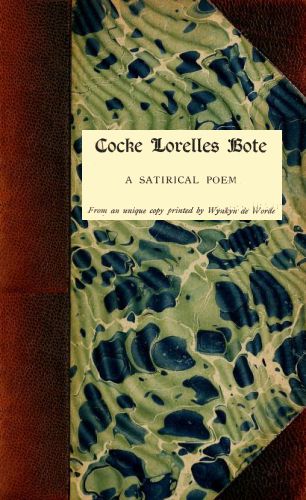
THE singularly interesting fragment of early English literature known as
Cocke Lorelles Bote, is a satirical poem of four hundred and fourteen
lines, in which various classes of society, chiefly of the lower order,
are passed under review in rapid succession. The glimpse we obtain of
each class is only momentary, but the author with some well chosen
phrase, in that short time sketches their failings.
The original from which this poem is reprinted, is in black-letter, and
is preserved in the Garrick Collection, British Museum. It is
considered unique, but unfortunately it is imperfect at the beginning.
It was printed in London, by Wynkyn de Worde, and bears no date, but may
safely be ascribed to the early part of the reign of Henry the Eighth.
The idea of the “Bote,” in which so many different characters are
gathered together, is supposed to have been taken from Sebastian
Brandt’s “Shyp of Folys,” which was translated into English by Alexander
Barclay, and printed by Pynson at the beginning of the sixteenth
century. What gives weight to this suggestion, is the fact that the
wood-cuts with which the original of Cocke Lorell is illustrated, are
similar to those used in the “Ship of Folys.”
The hero of the poem was the leader of a notorious band of robbers which
infested the metropolis, and was probably alive at the time of its
publication. He is mentioned by Samuel Rowlands in “Martin Mark-all,
Beadle of Bridewell, his Defence and Answere to the Belman of London,”
printed in 1610, who describes him in these terms:—“After him,
succeeded by general councell, one Cocke Lorrell, the most notorious
knave that ever lived: by trade he was a tinker, often carrying a panne
and a hammer for show: but when he came to a good booty, he would cast
his profession in a ditch, and play the padder,[1] and then would away,
and as hee past through the toune, crie, ‘Ha you any worke for a
tinker?’ To write of his knaveries it would aske a long time: I referre
you to the old manuscript remayning on record in Maunder’s Hall.[2]
This was he that reduced and brought in forme the Catalogue of
Vagabonds, or Quarterne of Knaves, called the five and twentie Orders of
Knaves: but because it is extant, and in every mans shop, I passe them
over.... This Cocke Lorrell continued among them longer than any of his
predecessors before him, or after him, for he ruled almost two and
twentie yeares, until the yeare An. Dom. 1533, and about the five and
twenty yeare of K. Henry the Eight.”
The “Catalogue of Vagabonds” to which Rowlands alludes in the above
extract as having been written by Cocke Lorell, is a tract printed by
John Awdely in 1565, and of which a second edition was issued by the
same printer in 1575. It is not improbable that Awdely may have himself
been the compiler of the “Catalogue.” A copy of the edition of 1575 is
in the Bodleian Library, the quaint title of which is as follows:—“The
Fraternitye of Vacabondes. As wel of ruflyng Vacabondes, as of beggerly,
of Women as of Men, of Gyrles as of Boyes, with their proper names and
qualities. With a description of the crafty company of Cousoners and
Shifters. Whereunto also is adioyned the XXV Orders of Knaues, otherwyse
called a Quartern of Knaues Confirmed for euer by Cocke Lorell.
The Vprightman speaketh.
Our Brotherhood of Vacabondes,
If you would know where dwell;
In graues end Barge which seldome standes,
The talke wyll shew ryght well.
Cocke Lorell aunswereth.
Some orders of my Knaues also
In that Barge shall ye fynde;
For no where shall ye walke I trow,
But ye shall see their kynde.
Imprinted at London by John Awdely, dwellynge in little Britayne Streete
withoute Aldersgate, 1575.”
Dr. Bliss describes the above mentioned tract at length, in the “British
Bibliographer,” Vol. II., p. 12, and makes further allusion to it in his
edition of Earle’s “Microcosmography,” p. 256, published in 1811.
One of the earliest, if not the earliest, printed mention of the Bote
occurs in Thomas Feylde’s “A contrauersye bytwene a louer and a Jaye.
[Colophon.] Imprynted at London in Fletestrete at the sygne of the
Sonne by Wynkyn de Worde.” The Lover in the preceding verses
apostrophizes Nature regarding his passion for his mistress, at which
the Jay thus expostulates:—
“Thoughe nature moue,
And bydde the loue,
Yet wysdome wolde proue,
Or it be hote,
Whan fortune sowre
Dothe on the lowre,
Thou getest an ore
In cocke lorels bote.”
The next mention of Cocke Lorell is in a black-letter poem, preserved in
the Bodleian Library, without date or printer’s name, entitled “Doctour
Double Ale.”
“I hold you a grota
Ye wyll rede by rota,
That ye wete a cota
In cocke lorels bota.”
The Rev. Charles H. Hartshorne, in “Ancient Metrical Tales,” reprinted
“Doctour Double Ale,” but rendered the last line cocke losels bota.
In pointing out this error, Mr. Collier says, that in John Heywood’s
“Epigrams upon three hundred proverbs,” printed in 1566, mention is made
of Cocke Lorelles Bote, under the heading of
“A BUSY BODY
He will have an ore in every man’s barge,
Even in cocke lorels barge, he berth that charge.”
Later on we find that the rascal is not forgotten, for Ben Jonson in his
masque of the “Gypsies Metamorphosed,” has introduced him as feasting
the Evil One, in a song which continued popular for some considerable
time, and was frequently printed as a broadside, copies of which are in
the Pepysian and Ashmolean Collections.
The first verse is as follows:—
“Cock Lorrell would need have the devil his guest,
And bid him once into the Peak to dinner,
Where never the fiend had such a feast
Provided him yet at the charge of a sinner.”
In 1807, the Rev. William Beloe, in his “Anecdotes of Literature and
Scarce Works,” Vol. I., p. 393, called attention to the following tract,
but unfortunately he changed the title to “Cocke Lorells Vote,” in place
of “Bote.” That this was a misprint may be inferred from the fact, that
in another place in the same work, he makes reference to a passage in
Bishop Percy’s Reliques, where the correct title is given.
Dibdin, who appears never to have seen the work, but says he was
“indebted to Mr. H. Ellis of the British Museum” for specimens “of this
singular performance” has fallen into the droll blunder of writing “of
the licentious and predatory character of its Author, ... one Cock
Lorell,” whose “popularity has, I believe, escaped the notice of our
chroniclers.”[3]
The poem was presented to the members of the Roxburghe Club in 1817, by
the Rev. Henry Drury, but the impression was limited to thirty-five
copies, two of which were printed on vellum.
It was again printed at Edinburgh for Stanley and Blake in 1817, from a
transcript made by the Rev. Joseph Stevenson, with an introductory
notice by Mr. James Maidment. This reprint has become almost as rare as
the Roxburghe Club edition, only forty copies having been taken.
The Percy Society, in 1843, issued an edition of the “Bote” to its
members, with a preface by Dr. E. F. Rimbault. The rarity of the two
first mentioned reprints, and the form, apart altogether from the
comparative scarcity of the last, has led to the reprinting once more of
this poem. The writer begs to acknowledge his obligations to both Mr.
Maidment’s and Dr. Rimbault’s editions as supplying the material for the
foregoing notice. While aware that there is little that is new which can
be said about Cocke Lorell, he trusts that this edition may be
favourably received, if for no other reasons than these, that while it
avoids the many inaccuracies of the Edinburgh edition, it omits the
modern punctuation which has been introduced into the Percy Society’s
reprint.
The present impression is limited to one hundred and one copies, one of
which is printed on vellum.
J. P. EDMOND.