Immediately after the importation of the Coca
leaf into Europe, we conceived the plan, the
outcome of the request of many physicians, of
making preparations from Coca. Vin Mariani.—Elixir
Mariani.—Pâte Mariani.—Thé Mariani.—Pastilles
Mariani, etc. (The author's name was kindly added to his
preparations by the medical profession, who had recognized
the superiority of his products.)
These different preparations had been used by our greatest
practitioners long before the discovery, or rather the
application of Cocaine.
The results obtained were marvelous, and the innumerable
letters which were addressed to us by physicians who
experimented with and used our products and rendered
accounts in the medical journals in all parts of the world,
would fill several large volumes.[21]
Under the esteemed patronage of our greatest medical
celebrities, our preparations are known all over the world;
they have reached all classes of society and everywhere, in
the large cities as in the small villages, men, women, children,
in fact, convalescents of all ages now know the name
of the salutary plant, which it is and has been our effort
to popularize, though strictly so according to the code of
medical ethics and by those channels approved of by the
entire medical profession.
We shall now consider the different ways in which we
use Coca, and which under the well-known forms of vin,
élixir, pâte, and of thé Mariani, have received such universal
recognition. We will show incidentally the esteem in
which these preparations are held by the highest medical
authorities.
This is the first of the preparations of Coca and the one
most generally adopted; to the tonic and stimulant action
of the drug there is added that of a choice quality of wine.
Vin Mariani contains the soluble parts of the Coca plant.
The combination of Coca, with the tannin and the slight
traces of iron which this wine naturally contains, is pronounced
the most efficacious of tonics.
The fresh Coca leaves that we employ, after careful selection,
come from three different sources and are of incomparable
quality. It is this that gives to our wine that
special taste and agreeable aroma which renders it so acceptable
to the sick.
It is likewise to the combination and preparing of these
three varieties of Coca leaf in our wine that we can attribute
this important fact: during more than thirty years, no
matter in how large doses taken, Vin Mariani has never
produced cocainism, nor any other unpleasant effects.[22]
Vin Mariani is a diffusible tonic, the action of which is
immediate. This action, instead of being localized on a single
organ, the stomach, spreads to the whole system. Taken
into the circulation, it awakens in its course the retarded
functions of every organ, and this is owing to the presence
in our preparation of the volatile principles of the plant.
Unlike other tonics, the astringent properties of which
lead at length to heat and constipation, Vin Mariani does
not produce any disorder of the digestive functions; it
stimulates them, exerts a refreshing action on the gastric
mucous membrane, and on that account so advantageously
replaces the preparations of cinchona, iron, strychnine, etc.
"There is," says Dr. Mallez, "a form of anæmia to which
the attention of physicians has not yet been called, and
which yields marvelously to the employment of Vin
Mariani; we allude to that state of profound depression of
the economy, of extremely marked impoverishment of the
blood, which also results from the prolonged abuse of balsamics
in the treatment of diseases of the urinary passages.
"The number of persons who, attacked with blennorrhagia,
use cubebs, copaiba, turpentine, etc., to a deplorable
extent is considerable. So true is this that, out of a hundred
young dyspeptics, we may affirm without fear of being
in error that at least forty of them have become so by the
use of balsamics.
"In like manner, the number of patients affected with
urinary gravel whom the prolonged and excessive use of
the agents just mentioned, has rendered dyspeptic and
then neuropathic is enormous. Like the former, they owe
the profound disorder of their digestive functions to the
immoderate use of resins and oleo-resins.
"It is of the first importance, therefore, to relieve these
persons by making them take, after having given them light
laxatives and some preparations intended to strengthen
the stomach, not iron, not cinchona, not, as we have said
above, local tonics, which would be of little if any use, but
diffusible tonics, that is to say, those that act upon the local
condition and at the same time upon the general condition,
and which, moreover, do not constipate.
"It is here that Vin Mariani, proves its great advantage
and succeeds where other tonics have failed, in stimulating
the functions of the stomach. On the one hand by the
small quantity of tannin which it contains, on the other
through the active principles of Coca, associated with the
wine, which serves as a vehicle, exciting the vitality of
each organ separately, not, however, without having previously
exerted its vivifying action on the mucous membrane
of the stomach itself." (Gazette des Hopitaux, Nov.
23, 1877.)
The analgesic properties of Vin Mariani have received a
happy application in clinical laryngoscopy by Dr. Ch. Fauvel.
This eminent specialist has made use of it for the
past twenty-six years with unvarying success in all affections
of the laryngeal mucous membrane, the air passages,
and the vocal organs. In granular angina it takes the place
of the topical medication and cauterizations which are so
often injurious when they are used indiscriminately and to
excess.
The employment of Vin Mariani rapidly relieves patients
of the feeling of heat and tingling which is
one of the most annoying symptoms of this very common
disease of the throat. (Gazette des Hopitaux, May
12, 1877.)
Dr. Beverley Robinson recommends Vin Mariani as a
heart tonic.
Dr. W. H. Pancoast says that Vin Mariani is a valuable
preparation and a tonic of the highest merit.
Dr. Jules Bouvyer, of Cauteretz, employs it with success
in certain affections of the larynx as an adjuvant to the
sulphurous treatment.
In 1875, in his Traitement rationnel de la phthisie pulmonaire,
Dr. de Pietra Santa said, page 394:
"Among the most renowned practitioners of Paris, Péan,
Barth, G. Sée, and Cabrol have promptly adopted the preparations
of Coca. Ch. Fauvel prescribes it in affections of
the respiratory passages. It is in these diseases that I, too,
have had occasion to advise its daily use in the most convenient,
the most agreeable, and the most active form—that
of the Vin Tonique de Mariani."
Thus has been realized Réveil's prediction: "This substance
(Coca) is destined to take an important rank in
therapeutics."
In the Revue de Thérapeutique médicaux-chirurgicale, June
11, 1876, page 381. Bibliographie: Dictionnaire Encyclopédique
des sciences médicales, par A. Dechambre, Dr. H. Cottin
thus closes his article:
"In France, we are using a great deal of Coca wine, and it
is tending to take the place of all other tonic wines; it is
borne a longer time by the stomach and is more agreeable
to the palate. M. Mariani has contributed much to the
popularization of Coca by the perfection of his preparations,
vin, thé élixir and pâte. These are the forms at present
most employed."
Dr. Chapusot, of Paris, thus sums up his personal observations:
"A claret-glass of this wine has always been
enough to make me forget hunger and to sustain my
strength; I have felt a grateful warmth and a general
exaltation of the economy; the digestion of the following
meal has always been easier than if I had not taken the
Vin Mariani, and, although I had not such a ravenous
appetite as if I had gone without it, I ate a good deal, the
stomach appearing stronger and more active."
It was Dr. Ch. Fauvel who gave our wine the very striking
and exact title of "Tensor of the vocal cords." He
says: "Thanks to Vin Mariani, I have been able to restore
the voice of many lyric artists who would have been unable
without this potent agent to give their performances."
Dr. J. Leonard Corning, in Brain Exhaustion, New York,
1884, pages 78 and 112, says: "Of all the medicaments that
I employ in the very numerous cases of irritability, Vin
Mariani has rendered the greatest service. I do not except
even the bromides, for this preparation of Coca possesses
the calmative properties of those salts without producing
the unpleasant depression which characterizes them."
The same author continues:
"The Vin Mariani is the remedy par excellence for ennui.
At the same time it produces a fortifying action on the
cerebral center and gives rise to a decided sensation of
well-being."
Dr. Morell Mackenzie, London, advises the Vin Mariani
as a stimulant and tonic, and uses it especially with speakers
and singers.
19 Harley Street,
Cavendish Square, W., London.
Gentlemen:—I have much pleasure in stating that I
have used the Vin Mariani for many years, and consider it
a valuable stimulant, particularly serviceable in the cases
of vocalists.
Yours faithfully,
Morell Mackenzie, M. D.
Professor Sajous, of Philadelphia, who has experimented
with Vin Mariani in troubles of the vocal organs, has
obtained excellent results from its use, and he advises
it, not only as a restorative of the voice, but as a general
tonic.
Dr. Libermann, Surgeon-in-Chief, French Army, communicates
his experience, as follows:
"I have the honor to inform you of the results which I
have obtained in my long career of military practice from
the use of Vin Mariani.
"I have used it with great success for profound anæmia
resulting from long and tedious campaigns in hot countries,
and accompanied, as is nearly always the case, by gastro-intestinal
irritation with loss of appetite and dyspepsia.
Two or three Bordeaux-glasses of Vin Mariani daily, removed
that condition quite rapidly, by restoring the appetite
and the tolerance of the stomach for a tonic aliment.
"I have also employed it in cases, happily rare in our
army, of chronic alcoholism resulting from the abuse of
brandy, absinthe or strong liquors. The Vin Mariani produced
all the excitement sought by drinkers, but had at
the same time a sedative influence on their nervous systems.
I have frequently seen hardened drinkers renounce
their fatal habit and return to a healthy condition.
"I have also used Vin Mariani to save smokers of exaggerated
habits, from nicotinism. A few glasses of Vin
Mariani taken in small doses, either pure or mixed with
water, acted as a substitute for pipes and cigars, because
the smokers found in it the cerebral excitement which
they sought in tobacco, wholly preserving their intellectual
faculties.
"I have also employed it with success for chronic bronchitis
and pulmonary phthisis. Vin Mariani increases the
appetite and diminishes the cough in these two morbid
states.
"To combat the cough I give it mixed with water in the
form of tisane, a Bordeaux-glass of Mariani in a glass of
hot water.
"Besides I have used it to the greatest advantage in
convalescence from typhoid fever, when no wine, not even
Bordeaux, was retained by the stomach on account of gastric
irritation which is the rule after fevers of this nature.
"Although I have confined myself to giving but a rapid
glance at the results that I have obtained, I have the statistics,
which I keep in reserve should they be needed.
"I can certify that Vin Mariani is the most powerful
weapon that can be put in the hands of military physicians
to combat the diseases, the infirmities, and even the vicious
habits engendered by camp life and the servitude of military
existence."
Dr. Villeneuve, among other cases of morphinomania
conquered by the combined use of the pâte and the Vin
Mariani, communicated to us in 1884 the following observation:
"M. X...., barrister, 32 years of age, five years ago
began to use morphine preparations as a remedy against a
very alarming chronic bronchitis and granulations in the
throat, which were irritated constantly by cigarette smoking.
"The patient at first only used morphine, but his physicians
committed the imprudence of treating him by
hypodermic injection. A notable change for the better
was produced during the first month, but, unfortunately,
abuse succeeded promptly the use of the medicament—so
much so that when I commenced to treat the patient, he
was taking daily from 1 gramme 50 centigrammes to 1
gramme 80 centigrammes of morphine hypodermically.
When he was four hours without his dose there appeared
insomnia, hallucinations and delirium; constipation lasting
sometimes for fifteen days, which brought on in the
spring a very alarming perityphlitis, jerking of the muscles,
sudden frights, dyspepsia, and at last frightful congestion
of the face whenever he drank a drop of wine or
brandy.
"After a month's treatment I had succeeded in reducing
the daily doses without causing alarming symptoms; the
physiological functions seemed to awaken again. However,
the congestion and especially the dyspepsia was very
grave, and the cough which had been suppressed by morphine
returned. It was then that I treated my patient
with phosphate of lime, the pâte and the Vin Mariani. Lacking
his habitual stimulant, he was plunged in a semi-coma
from which he could not always be relieved with
weaker daily doses of morphine.
"The danger I feared most was a relapse of bronchitis,
and that the cough and expectoration might end fatally.
But in about a week, during which he took ten doses of
Pâte de Coca daily, the cough became less fatiguing and disappeared
entirely in about twenty days. The patient then
commenced to take small doses of Vin Mariani (two Madeira-glasses
a day). At first congestion appeared, but little by
little, as digestion became more easy, my patient, who on
account of his profound anæmia could not tolerate any
table wines, took at first a small glass, then two, then three
glasses at a meal. Now he can go and take his dinner in
town, which he had not been able to do for three years; he
regained his former vigor, is able to undertake anew his
occupations, and has entirely given up his morphine habit."
We will conclude our quotations, already too numerous,
with an article by Dr. Scaglia, published in 1877 in the
Gazette des Hopitaux: "La Coca et ses propriétés thérapeutiques."
"In anæmia, connected with chronic pulmonary affections
without fever, and in anæmia accompanied by gastralgia,
Vin Mariani has an excellent effect. Its stimulating
properties can also be admirably made use of in those
intermediate states of impaired health which are not yet
anæmia, but must in the end become so; physical or mental
overwork, the cerebral weakness due to excess of work or
pleasure; the exhaustion from which the inhabitants of
large cities suffer through irregularities of diet and imperfect
hygiene owing to their positions and surroundings.
"Vin Mariani is unquestionably of benefit to people of
sedentary habits worn out by work, to convalescents who,
from a prolonged confinement in bed, have lost muscular
strength, to patients suffering from diabetes or Bright's
disease, whose muscles have lost their elasticity and vigor.
"Let us add that the taste of Vin Mariani is exquisite,
that it is in no way suggestive of drugs, and that its use is
acceptable to the most fastidious."
Ordinary Dose—Two or three claret-glassfuls daily, half
an hour before or immediately after eating.
Coca Grog.—By mixing a wineglassful of Vin Mariani
with half a glassful of boiling water, sweetened to the
taste, we get a grog of exquisite flavor, and capable of rendering
the greatest services whenever an immediate effect
is desired in severe cases of cold, attended by convulsive
coughing. (As prescribed by Dr. Libermann, Dr. Cyrus
Edson and others, recorded in the medical journals during
the grip epidemics.)
The Elixir Mariani is more alcoholic, very agreeable to
the taste, and three times as highly charged with the
aromatic principles of the Coca leaf as the Vin Mariani;
therefore it should be taken in doses of a liqueur glassful,
in the morning upon rising, and after the two principal
meals.
It may be used clear or mixed with water, in nearly all
cases where the Vin Mariani is used. Its tonic and eminently
digestive properties and its special aroma, at once
mild and penetrating, make it an agreeable liqueur, very
much esteemed by gourmets and persons who are careful
about their health.
A small glass of the Elixir Mariani taken after a meal,
spreads a gentle warmth through the stomach and calls
forth an abundant secretion of gastric juice, which mixes
with the food and facilitates digestion.
For travelers, hunters, and in general all who walk
much and who are exposed to fatigue, to dampness,
and to fog, the use of the Elixir Mariani may be recommended
and will render admirable service, because of
the tone and strength that it gives to the stomach and
to the muscles.
Dr. Collins, Révue de Thérapeutique, observes that this
liqueur acts "heroically" in anæmia, chlorosis and rickets.
Dr. Ch. Fauvel, Dr. Conqueret, Dr. Villeneuve, Dr. Chapusot,
Dr. Odin, Dr. Cintrat and others declare as the result
of their clinical observations that the Elixir Mariani exerts
a "masterly action" in granular pharyngitis, quinsy, and
albuminuria, and that its stimulating properties on the
whole nervous system cannot be denied.
Dr. J. Leonard Corning, of New York, recommends the
Elixir Mariani as a strengthener of the brain.
"As a remedy in sea-sickness, the Elixir Mariani has
always given excellent results."—Dr. Slant, Dr. Letellier,
Dr. Trossat, Dr. Derrecagaix.
The Elixir Mariani is generally prescribed in doses of a
liqueur-glassful after the principal meals. Mixed with cold
water, in the proportion of two liqueur-glassfuls to a tumbler
of water, it constitutes a very strengthening and pleasant
drink.
Tonic and pectoral, Pâte Mariani is a Lozenge very
agreeable to the taste, which is prescribed daily with the
greatest success by throat specialists for obstinate coughs,
granular catarrh of the throat, and the various inflammations
of the digestive and respiratory passages. Composed
only of clarified gum, sugar and Coca, without a trace of
opium or of any narcotic substances, it may be taken without
danger at any hour of the day and in any quantity,
without fear of its disturbing the digestion, since, on the
contrary, it can only aid it. From six to ten of the Lozenges
daily are the usual dose, but more may be taken if
necessary.
Its beneficial action is due to the happy combination of
the emolient properties of pure gum-arabic and the tonic,
astringent and analgesic properties of Coca.
"Pâte Mariani has a powerful tonic action on the larynx,
and, like Vin Mariani, it is invaluable in cases of aphonia
caused by feebleness or relaxation of the vocal cords. This
property is of special advantage to singers and orators. Pâte
Mariani is a very valuable substitute in granular catarrh of
the throat and throat affections in general, for chlorate of
potassium pastilles and the various lozenges containing
opium, etc., the Pâte Mariani is more agreeable to the taste
and produces anæsthetic and soothing effects." (Gazette des
Hopitaux.)
The Pastilles Mariani are used in the same cases as the
Pâte, from which they differ only by the addition of two
milligrammes of Cocaine hydrochlorate to each pastille.
Their action is much more intense and more rapid than
that of the plain Coca Lozenges.
The paroxysms of cough which are so frequent and so
annoying to those who smoke tobacco to excess, are overcome
as if by enchantment by the use of a few pastilles.
Dose—Four to eight daily. This amount, however, may
be exceeded, at the discretion of the physicians.
As its name indicates, Mariani's concentrated extract of
Coca, or Thé Mariani, contains within a small bulk all the
active principles of the Coca leaf. This extract, prepared
in special apparatuses which prevent all alteration and preserve
all its properties and all its aroma, answers entirely
in the various modes of using Coca and constitutes a most
scrupulously exact preparation in dose, the most convenient
and the most active that could be desired.
Thé Mariani is capable of indefinite preservation and easy
of transportation; it renders great service to persons who
make mountain ascensions, fatiguing marches, or long
journeys through unhealthy countries, and in fact in whatever
may be called fatiguing work or pleasure.
Thé Mariani may be taken in the dose of from three to
six teaspoonfuls in the course of the day, clear, or mixed
with brandy, wine, water or milk, etc., hot or cold, in
the latter cases sweetened to taste, if desired.
Coca Tea or Infusion.—A teaspoonful of the Thé
Mariani, added to a cup of hot water, sweetened to the
taste, with or without the addition of cream or milk, makes
a very agreeable drink, more digestive, more tonic, and
less exciting than coffee or tea, while possessing in a
higher degree the tonic and stimulating properties of
those two substances.
It is in this form that Coca is especially used in Peru and
Bolivia, where it is preferred to the Chinese tea.
Persons who drink Chinese tea at meals may advantageously
substitute the Thé Mariani for it.
For patients who cannot generally take milk, it is advisable
to add Thé Mariani. Excellent results will be
obtained.
Coca Gargles and Sprays.—Independently of its tonic
and reconstituent action, Coca possesses anæsthetic and
soothing properties that have been observed and made use
of in practice by laryngologists in the form of a spray, in
the proportion of a teaspoonful of Thé Mariani to half a
glassful of warm water.
An ambulance physician of Tonkin, who has experimented
with Thé Mariani, sends the following note:
"Thé Mariani has rendered us real service during expeditions
as well as in hospital practice; on the march it
makes with boiled water, with or without the addition of
sugar, a very agreeable, tonic and stimulating drink; a
veritable reserve food, it takes the place of alcoholic drinks
and insufficiency of food, and aids the men in bearing the
most distressing fatigue. The water of swamps, rivers or
ditches, mixed with a few spoonfuls of Thé Mariani, could
be drank without any inconvenience, and assuaged thirst.
"Thé Mariani stimulates the appetite, overcomes atony
of the digestive organs, and prevents and combats diarrhœa
efficiently.
"Mixed in small quantity with fresh or condensed
milk, it gives it an agreeable taste and causes it to be
borne by the most delicate stomachs; hence it becomes a
valuable adjuvant in the treatment of the endemic dysenteries
and diarrhœas of tropical countries.
"Finally, its exclusive use, even its excessive use for
several days, has not seemed to us to exert any injurious
influence on the system, as the abuse of coffee or of
alcoholic drinks had certainly done under like circumstances."
Dr. Fordyce Barker, Dr. J. H. Douglas, Dr. Henry B.
Sands and Dr. Geo. F. Shrady have authorized us to make
known that it was due to Thé Mariani, added to milk
(in the proportion of a teaspoonful of the Thé to a cup of
milk), that they were able to nourish Gen. Grant, the ex-President,
when he was unable to support any other food.
By this means they succeeded in prolonging the life of
their illustrious patient for several months.
Coca taken in infusion gave excellent results to Tschudy
while he was sojourning in the valley of the Puna, the
highest in Bolivia, which has given its name to the disease
of mountain sickness, known in Peru by the name Mal de
Puna, also designated by the words sorroche, veta and mareo;
this last term shows clearly enough the analogy which
exists between sea-sickness and the influence of great altitudes
on the human body. Experience has proved the
usefulness of Coca against dyspnœa and vomiting, so that
the Indians who make ascensions always carry a stock of
Coca with them. Dr. Tschudy found himself comfortable
by the use of it while hunting in those valleys, at a height
of ten to twelve thousand feet above the sea.
Dr. Salemi, of Nice, gives an account of a case of epilepsy
in a woman, 38 years of age, cured by the daily and
prolonged use of Thé Mariani, given in increasing doses
(ten drops daily at first and eighty drops daily at the end
of a month). This case is not an isolated one.
Owing to the success obtained by our preparations of
Coca for many years, imitators and counterfeiters have
dared to apply to their own valueless productions the observations
made with our special products. These occurrences,
often repeated, have given rise to protests from
many physicians, among others Dr. W. Oliver Moore, Sir
Morell Mackenzie, Dr. Ch. Fauvel.
To the Editor of the New York Medical Journal:
Sir: In your issue of January 3, 1885, page 19, in a report
of a paper read before the New York Medical Society, on
"The Physiological and Therapeutical Effects of the Coca
Leaf and its Alkaloid," occurs the following: "For over
twenty years Dr. Fauvel has used it, both internally in the
form of Vin Mariani, and also by local applications to the
pharynx and larynx in spray or by brush, in the form of a
fluid extract, or, more recently, of a concentrated non-alcoholic
preparation more of the nature of a cordial (prepared
by Mariani & Co.)."
Several manufacturers of Coca preparations have taken
occasion to quote from this paper, each in turn substituting
the name of his own production instead of the one mentioned
in the original.
As the preparations of Coca mentioned in my paper were
personally tested and found to be the best of a large number
experimented with, I wish to call attention to these
misquotations and substitutions.
Very truly,
W. Oliver Moore, M.D.
⁂ We have taken the trouble to compare the report of
Dr. Moore's remarks with the little book on Coca prepared
by M. Mariani, and with the circulars issued by a number
of manufacturers of Coca preparations; and we certainly
think that some of these manufacturers have taken an unwarrantable
liberty in appropriating work that evidently
cost M. Mariani a good deal of time and no little outlay of
money.—Editor N. Y. Medical Journal.
New York Medical Journal, October 24, 1885.
"In another column we publish a letter from Dr. W.
Oliver Moore, calling attention to an injustice that certain
competing pharmacists have practiced toward Messrs.
Mariani & Co., in 'pirating' published records of the successful
use of the Mariani preparations of Coca, and at the
same time craftily making these records appear to apply to
their own preparations. It is very much to be regretted
that a house that has been so punctilious in avoiding even
the semblance of any offense against the courtesy of trade
should have been treated in this shabby way by some rival
manufacturers."
31 Rue Guénégaud, Paris, Dec. 8, 1887.
To the Editor of the New York Medical Journal:
Sir—Will you kindly have it announced in your journal,
in justice to myself before the medical profession,
that the various notices appearing in journals and circulars
quoting my name in connection with Coca are
entirely false and in every respect a prevarication? The
only preparation of Coca employed by me with undoubted
and uniform success has been the so well-known
Vin Mariani, which, since 1865, I have had occasion to
prescribe daily in my clinique, as well as in private practice.
My opinion of this valuable medicament has, during
many years, been frequently made known for the
benefit of the profession in various writings, and it is
but just to this worthy preparation that it receive all
the honor due it. I thank you for compliance with my
request.
Ch. Fauvel, M.D.
Continued compliment is paid M. Mariani for the maintained
high standard and excellence of his preparations,
by the numerous honorable mentions and indorsements by
the members of the medical profession and those who have
occasion to use his Coca preparations; latterly through the
following awards:
Gold Medal and Silver Medal from the Académie Nationale
de France; Gold Medal and a Grand Diploma of
Honor from the Wine Exhibit of Bordeaux, France; Gold
Medal and a Diploma of Honor at the Hygienic Exhibit at
Amsterdam, Holland, and a Gold Medal and Diploma
at Leamington, England, the jury surnaming his Vin
Mariani, "Wine for Athletes."
N. B.—Professional bicyclists and athletes, after careful
trials of ours and preparations of others, among which the
Cafeine. Theobromine, Kola, pseudo-Cafeine or Kolamine
(Knebel), Maté, etc., invariably give the preference to
our Coca preparation. Messrs. Dubois, Lucas, Vigneaux,
Echalié, André Henry, Imans, Buffel, and many others
have attested to the vast superiority of Coca Mariani over
all other tonics (dynamogéniques).
We request those physicians, who kindly place confidence
in our preparations, to prescribe them under the name of
Mariani, and to insist that their prescriptions be scrupulously
executed.
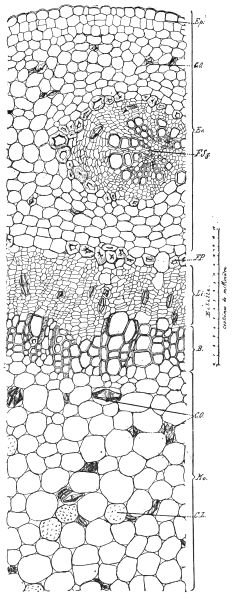
TRANSVERSE SECTION OF A YOUNG BRANCH; PRIMARY
FORMATIONS.
(See Plate III., Figure 3.)
- Ec., Bark formed of an epidermis Ep., of a parenchyma (pulp) well developed
with some oxaliferous cellules C. o. On the section is seen
a bundle of libero-ligneous stipulaires F. s.
- F. p., Fibres pericycliques.
- Li., Liber, with oxaliferous cellules C. o.
- B., Wood.
- Mo., Pulpy pith containing cellules of ligneous dotted partitions C. l., and
oxaliferous cellules. The cortical and medullary pulp contain in
their cellules numberless grains of starch, which are not indicated in
this plate.
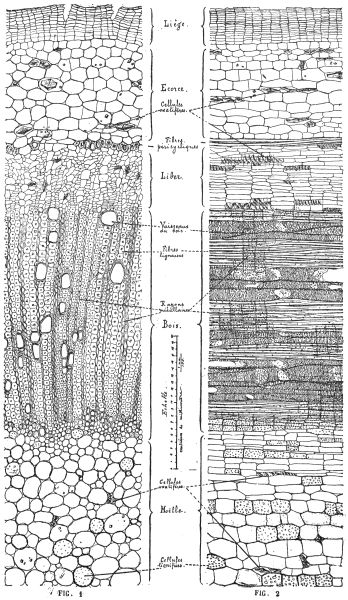
Fig. 1—TRANSVERSE SECTION OF AN AGED STEM; SECONDARY
FORMATIONS.
Fig. 2—LONGITUDINAL SECTION OF SAME STEM.
Bark formed of a corky and pulpy cortical of a secondary origin. The
primary bark exfoliates itself at a very early stage.
The pulp contains some oxaliferous cellules and some grains of starch.
The wood contains some veins and a considerable quantity of fibres
with thick and dotted partitions. The marrow remains always pulpy and
with lignified cellules.
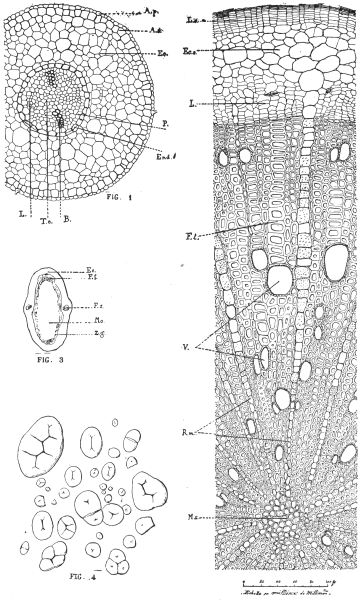
Fig. 1—TRANSVERSE SECTION OF A PRIMARY ROOT.
- A. p., Heaped layer.
- A. s., Corky layer.
- Ec., Pithy bark.
- End., Endoderm; the thickening of the lateral partitions of its cellules is
very apparent.
- P., Pericycle formed of a single layer of cellules.
- T. c., Conjunctive tissue or pith.
- B., Ligneous fasciculous; there are two to the diameter.
- L., Liberian fasciculous; there are two to the diameter, perpendicular
to the preceding.
Fig. 2—TRANSVERSE SECTION OF A ROOT; SECONDARY
FORMATIONS.
- L. s., Cork, secondary.
- Ec. s., Bark, secondary; the primary formations are exfoliate.
- L., Liber.
- F. l., Ligneous fibres in large numbers and meatus.
- V., Veins of wood, dotted.
- R. m., Medullary radius.
- M. s., Pith which has become entirely sclerotic.
Fig. 3—SCHEMATIC SECTION OF A YOUNG BRANCH.
- Ec., Bark.
- F. f., Foliated fasciculous not yet separated from the central cylinder.
- F. s., Fasciculous stipulaire.
- Mo., Pith.
- Z. g., Generating zone libero-ligneous.
Fig. 4—GRAINS OF STARCH OF THE SEED.
(Maximum dimensions: 22 to 24 p. × 15 to 18 p.)
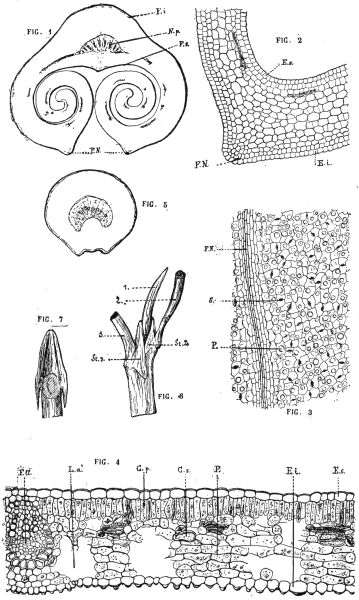
Fig. 1—FOLIATION. TRANSVERSE SECTION OF A LEAF
NOT YET UNROLLED, SHOWING THE TWO LONGITUDINAL
JUTTINGS WHICH FORM THE FALSE NERVURES OF
THE COCA LEAF.
- F. i., Lower surface.
- F. S., Upper surface.
- N. p., Principal nervure.
- F. n., False nervures.
Fig. 2—TRANSVERSE SECTION OF ONE OF THE JUTTINGS.
- E. s., Upper epidermis.
- E. i., Lower epidermis.
- F. n., False nervure.
Fig. 3—LOWER EPIDERMIS OF THE LEAF AT THE FALSE
NERVURE F. n., WHICH IS FORMED OF LENGTHENED
CELLULES WITHOUT STOMATUM S., STOMATUM P., EPIDERMIC
PAPILLOUS CELLULES.
Fig. 4—TRANSVERSE SECTION OF A LEAF ENTIRELY DEVELOPED.
- E. s., Upper epidermis.
- E. i., Lower epidermis.
- P., Parenchyme foliate.
- C. p., Palissadique cellules.
- C. s., Sclerotic cellules.
- L. a., Air-conveying cell.
- F. l. l., Fasciculous libero-ligneous.
Fig. 5—SCHEMATIC SECTION OF A PETIOL NEAR THE BASE.
Fig. 6—EXTREMITY OF A BRANCH SHOWING THE STIPULES
OF THE LEAVES.
Fig. 7—TWO STIPULES CONNECTED, SEEN FROM THE
BRANCHED SURFACE.
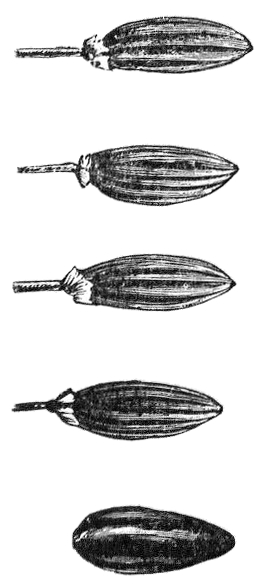
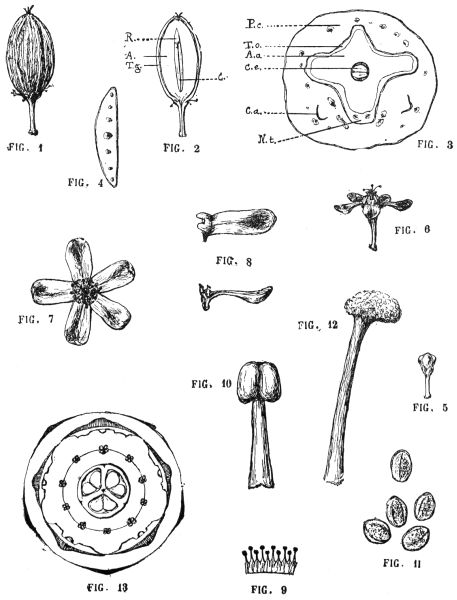
Fig. 1—RIPE SEED; THE THREE STYLES AND THE STAMENS
ARE STILL ADHERENT.
Fig. 2—LONGITUDINAL SECTION OF SAME.
- T. g., Tegument of the seed.
- A., Amylaceous albumen.
- R., Embryo rootlet.
- C., Cotyledons.
Fig. 3—SCHEMATIC SECTION OF THE HALF-DEVELOPED
SEED.
- P. c., Carpellary pulp.
- C. a., Abortive carpelle.
- T. o., Tegument ovarium.
- A. a., Amylaceous albumen.
- C. e., Embryo cotyledons.
- N. t., Nervure of tegument of the ovule.
Fig. 4—TRANSVERSE SCHEMATIC SECTION OF A COTYLEDON.
Fig. 5—FLORAL BUD.
Fig. 6—AN EXPANDED FLOWER.
Fig. 7—THE SAME, SEEN FROM UNDERNEATH.
Fig. 8—TWO PETALS, ONE SEEN FROM UNDERNEATH, THE
OTHER SEEN SIDEWAYS AND SHOWING THE APPENDIX
WHICH FORMS THE CROWN.
Fig. 9—THE ATTACHED 10 STAMENS; THE EPIPETALS ARE
LARGER THAN THE EPISEPALS.
Fig. 10—AN ANTHER AND THREAD OF STAMEN.
Fig. 11—POLLEN SEEDS.
(Dimensions: 35 p. × 28 p.)
Fig. 12—STYLE AND STIGMATE.
Fig. 13—FLORAL DIAGRAM.
The floral formula is: [5 S] + 5 P + [10 E] - [3 C].
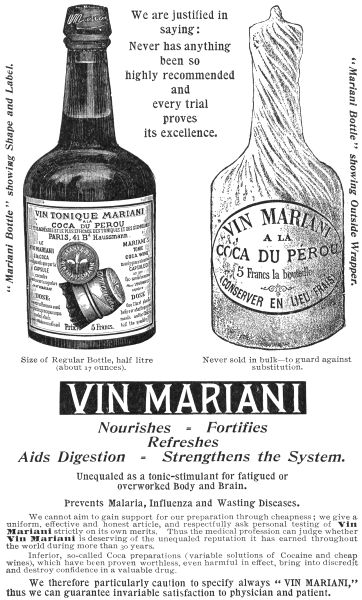
We are justified in
saying:
Never has anything
been so
highly recommended
and
every trial
proves
its excellence.
"Mariani Bottle," showing Shape and Label.
Size of Regular Bottle, half litre
(about 17 ounces).
"Mariani Bottle," showing Outside Wrapper.
Never sold in bulk—to guard against
substitution.
VIN MARIANI
Nourishes = Fortifies
Refreshes
Aids Digestion = Strengthens the System.
Unequaled as a tonic-stimulant for fatigued or
overworked Body and Brain.
Prevents Malaria, Influenza and Wasting Diseases.
We cannot aim to gain support for our preparation through cheapness; we give a
uniform, effective and honest article, and respectfully ask personal testing of Vin
Mariani strictly on its own merits. Thus the medical profession can judge whether
Vin Mariani is deserving of the unequaled reputation it has earned throughout
the world during more than 30 years.
Inferior, so-called Coca preparations (variable solutions of Cocaine and cheap
wines), which have been proven worthless, even harmful in effect, bring into discredit
and destroy confidence in a valuable drug.
We therefore particularly caution to specify always "VIN MARIANI,"
thus we can guarantee invariable satisfaction to physician and patient.
Minor punctuation and printer errors repaired.