Pietro Napolini di Vendetta Pasquarelle
Deserted balmy Italy, the land that loved him well,
And sailed for soft America, of wealth the very fount,
To earn sufficient dollars there to make himself a count.
Alas for poor Pietro! he arrived in winter-time,
And marvelled at the poet who observed in tripping rhyme
How this New World was genial, and a sunny sort of clime.
No chance had he for music that’s developed by a crank,
No chance had he at sculpture, nor a penny in the bank.
The pea-nut trade was languid, and for him too full of risk;
He thought the work on railways for his blood was rather brisk.
The sole profession left him to assuage his stomach’s woe,
It struck him in meandering the city to and fro,
Was surely that of shovelling away the rich man’s snow.
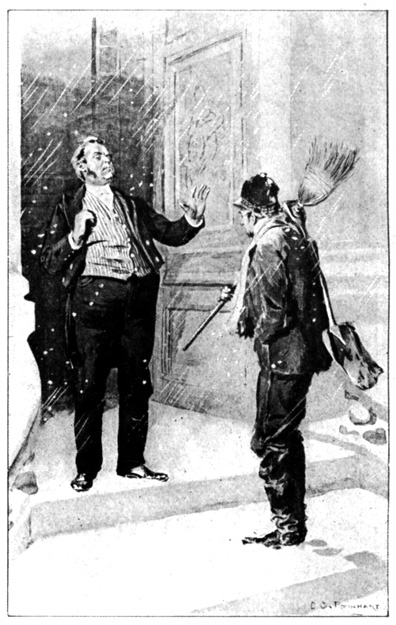
And then P. Napolini di Vendetta Pasquarelle
Sought out a city thoroughfare, the swellest of the swell.
He stole a shovel, and he found a broom he thought would do,
Then rang the massive front-door bell of Stuyvesant Depew.
“I wanta shov’ da snow,” he said, when there at last appeared
Fitzjohn Augustus Higgins, who in Birmingham was reared,
A man by all in low estate much hated and much feared.
“Go wi,” said Fitz, with gesture bold. “Yer cahn’t do nothink ere,
Yer bloomin’, hugly furriner!” he added, with a sneer.
“Hi thinks as ’ow you dagoes is the cuss o’ this ’ere land,
With wuthy citizens like me ’most starved on every ’and.
Hi vows hif I’d me wi at all hi’d order hout a troop,
Hand send the bloomin’ lot o’ yer ’ead over ’eels in soup.
Git hout, yer nahsty grabber yer; hewacuate the stoop.”
Then when the snow had melted off, Fitzjohn Augustus went
And humbly asked his master for two dollars that he’d spent
In paying Napolini di Vendetta Pasquarelle;
While Nap went back to Italy, the land that loved him well,
Convinced that when he sailed that time his country to forsake,
He must have got aboard the ship when he was half awake,
And got to London, not New York, by some most odd mistake.
My best-loved color? Well, I think I like
A soft and tender dewy green—for grass.
Sometimes a pink my fancy too will strike—
In lobster purée or a Sauterne glass.
Blue is a color, too, I greatly love.
It’s sort of satisfying to my eyes.
’Tis their own color; and I’m quite fond of
This hue also for soft Italian skies.
For blushes, give me red, nor hesitate
To pile it on; I like it good and strong
Upon the cheeks of her I call my Fate,
The loveliest of all the lovely throng.
On golden-yellow oft my fancy dwells.
’Tis almost godlike, as it sparkles through
The effervescent fizz; and wondrous spells
It casts o’er me when coined in dollars, too.
Hence, friend, it is I cannot specify
What hues particular my joys enhance.
I like them all; their popularity
At special times depends on circumstance.
I would not change my joys for those
Of Emperors and Kings.
What has my gentle friend the rose
Told them, if aught, do you suppose—
The rose that tells me things?
What secrets have they had with trees?
What romps with grassy spears?
What know they of the mysteries
Of butterflies and honey-bees,
Who whisper in my ears?
What says the sunbeam unto them?
What tales have brooklets told?
Is there within their diadem
A single rival to the gem
The dewy daisies hold?
What sympathy have they with birds
Whose songs are songs of mine?
Do they e’er hear, as though in words
’Twas lisped, the message of the herds
Of grazing, lowing kine?
Ah no! Give me no lofty throne,
But just what Nature yields.
Let me but wander on, alone
If need be, so that all my own
Are woods and dales and fields.
When the order was given to withdraw from battle
for breakfast, one of the gun-captains, a privileged
character, begged Commodore Dewey to let them keep
on fighting until “we’ve wiped ’em out.”—War Anecdote
in Daily Paper.
At the battle of Manila,
In the un-Pacific sea,
Stood a gunner with his mad up
Just as far as it could be—
Stood a gunner brave and ready
For the hated enemy.
Near the Isles of Philopena
Raged the battle all the morn,
And the plucky Spanish sailors
By the shot and shell were torn;
And the flag that floated o’er them
To oblivion was borne.
Every cannon belched projectiles,
Every cannon breathed forth hell,
Every cannon mowed the foeman
From the deck into the swell,
When amid the din of battle
Rang the silvery breakfast-bell.
“Stop your shooting! Come to breakfast!”
Cried the gallant Commodore.
“After eating we will let them
Have a rousing old encore.
Stow your lanyards, O my Jackies;
Let the cannon cease to roar.”
Then upspake the fighting gunner:
“Dewey, don’t, I beg of you.
What’s the use of drinking coffee
Till we’ve put this scrimmage through?
If there’s any one who’s hungry,
Won’t this Spanish omelet do?
“Farragut would not have done it
When through Mobile Bay he sped.
Why then, Dewey, should we breakfast
Till we’ve plunked ’em full of lead?
Let our motto be as his was—
Damn the fishballs! Go ahead!”
“Come here,” said I, “oh caddy boy, and tell me how it haps
You cling so fast unto these links; not like the other chaps,
Who like to dally on the streets and play the game of craps?
“Is it that you enjoy the work of carrying a bag
While others speed the festive ball o’er valley, hill, and crag?
And do your spirits never seem to falter or to flag?
“I’ve watched you many a day, my lad, and puzzled o’er the fact
That you are so attentive to the game; your every act
Doth indicate perfection—there’s been nothing you have lacked.
“And I would know just why it is that you so perfect seem—
In all my golfing days you’ve been the very brightest gleam—
Or am I lying home in bed and are you just a dream?”
“Oh, sir,” said he, “I caddy here because I love my pa;
I cling unto these gladsome links because I love my ma;
In short, I love my parents, sir, and these my reasons are:
“’Twas but a year ago, good sir, when first this ancient sport
Came in the portals of our home—home of the sweetest sort;
When golf came through the window, sir, why home went through the port.
“My father first he took it up, and many a weary night
My mother with us children waited up by candle-light,
In hopes that he’d return and free us from our lonely plight.
“Then mother she went after him—alas! that it should be—
And shortly learned the game herself—she plays it famously—
Which left us children orphans, I and all my brothers three.
“They play it here, they play it there, they play it everywhere;
No matter what the weather, be it wet or be it fair,
And for the cares of golf they’ve dropped their every other care.
“And so it is that we poor lads are forced to leave our home,
And join the ranks of caddy boys who o’er the fields do roam
In search of little golf-balls in the sunlight and the gloam;
“For some day we are hoping that our eyes again will see
Our most beloved parents on some putting-green or tee;
A sight to gladden all our hearts if it should ever be.”
And lo—I looked upon that boy—his face was sweet and sad,
And to my heart there came a twinge, for in that little lad
I recognized my eldest son—I was that wicked dad!
And now together we are out on links at home and far.
He and his three small brothers with their shamed, repentant pa,
A-looking here and looking there to find their dear mamma.
I know a wondrous man—my neighbor he;
He’s ripe in years, and great in understanding.
He’s versed in art, and in philosophy
He shows a mind that’s verily commanding.
He’ll stand before a painting, and without
A single instant’s thought, or hesitation,
He’ll tell the painter’s name, nor any doubt
Is there he gives the proper information.
The rocks, the hills and valleys, hold from him
No secret that is past a man’s revealing.
He knows why some are stout and others slim;
He comprehends all kinds of human feeling.
The records of the stars he knows, and each
Romance that round about the heavens lingers.
At dinner-time he oft delights to preach
On which was made the first, or forks or fingers.
Indeed, all things he knows, or high or low—
The things that fly on wing, or go a-walking—
Except one thing he never seems to know,
And that’s when he should stop his endless talking.
When I was twenty-one, I swore,
If I should ever wed,
The maiden that I should adore
Should have a classic head;
Should have a form quite Junoesque;
A manner full of grace;
A wealth of hirsute picturesque
Above a piquant face.
But I, alas! am perjured, for
I’ve wed a dumpy lass
I much despised in days of yore,
Of quite the plainest class,
Because each maiden of my dream,
Whose favor I did seek,
Was so opposed unto my scheme
I married Jane in pique.
Maid of culture, ere we part,
Since we’ve talked of letters, art,
Science, faith, and hypnotism,
And ’most every other ism,
When you wrote, a while ago,
Ζώη μοῦ, σὰς ἀγαπώ,
Let me tell you this, my dear:
Though your lettering was clear,
Though the ancient sages Greek
Would be glad to hear you speak,
They would be replete with woe
At your μοῦ, σὰς ἀγαπώ.
For, dear maiden most astute,
You have placed the mark acute
O’er omega. Take your specs.
See? It should be circumflex.
Still I love you, even though
You have written ἀγαπώ.
Her eyes are blue—a lovely hue
For eyes; her cheeks are pink,
And for the cheek, ’twixt me and you,
That color’s right, I think.
Her fingers taper prettily,
Her teeth are white as pearls—
Her hands seem softer far to me
Than any other girl’s.
Her figure’s trim—it is petite—
I like them just that way,
And truly, maiden half so sweet
You’d not find every day.
And yet, alas! she’s not my choice,
This creature of my rhyme—
Because her soft and rich-toned voice
Is going all the time.
I love the leaf of the old oak-tree,
I love the gum of the spruce,
I love the bark of the hickory,
And I love the maple’s juice.
On the walnut’s grain I fondly dote,
On the cherry’s fruit I’d dine,
And I love to lie in a narrow boat,
And scent the odor of pine.
Ah, me! how I wish some power grand
Would invent some single tree
With all these points well developed, and
Would send that tree to me!
I’d plant it deep in the jardinière
That stands in this flat of mine;
I’d give it the sweetest, tenderest care,
And water its roots with wine.
What has become of the cast-off coats
That covered Will Shakespeare’s back?
What has become of the old row-boats
Of Kidd and his pirate pack?
Where are the scarfs that Lord Byron wore?
Where are poor Shelley’s cuffs?
What has become of that wondrous store
Of Queen Elizabeth’s ruffs?
Where are the slippers of Ferdinand?
Where are Marc Antony’s clothes?
Where are the gloves from Antoinette’s hand?
Where Oliver Goldsmith’s hose?
I do not search for the ships of Tyre—
The grave of Whittington’s cat
Would sooner set my spirit on fire—
Or even Beau Brummel’s hat.
And when I reflect that there are spots
In the world that I can’t find,
Where lie these same identical lots,
And many of this same kind,
I’m tempted to give a store of gold
To him that will bring to me
A glass, Earth’s mysteries to unfold,
And show me where these things be.
Yon maiden once a jester did adore,
Who early died and in the church-yard sleeps.
Once in a while she reads his best jokes o’er
And sits her down and madly, sorely weeps.
I know a man in Real Estate,
Whose pride of self’s sublime.
He’d like to be a poet great
But “can’t afford the time.”
As I read over old John Dryden’s verse,
The rhymes of men like William Blake, and Gay,
The stuff that helped fill Edmund Waller’s purse,
And that which placed on Marvell’s brow the bay,
It doth appear to me that in those times
The Muses quaffed not sparkling wine, but grog,
And that to grow immortal through one’s rhymes
Was ’bout as hard as falling off a log.
Shakespeare was not accounted great
When good Queen Bess ruled England’s state,
So why should I to-day repine
Because the laurel is not mine?
Perhaps in twenty-ninety-three
Folks will begin to talk of me,
And somewhere statues may be built
Of me, in bronze, perhaps in gilt,
And sages full of quips and quirks
Will wonder if I wrote my works.
So why should I repine to-day
Because my brow wears not the bay?
God spare the day when I am satisfied!
Enough is truly likened to a feast that leaves man satiate.
The sluggishness of fulness comes apace; the dulness of a mind that knows all things.
The lack of every sweet desire; no new sensation for the soul!
To want no more?
What vile estate is that?
What holds the morrow for the soul that’s satisfied?
What holds the future for the mind content?
Is aspiration worthless?
Is much-abused ambition then so vile?
What is the essence of the joy of living?
Must yesterday, to-morrow, and to-day all be the same,
With nothing to be hoped for?
Is not a soul athirst a joyous thing?
Where lies content to him whose eye doth rest on higher things?
What satiation can compare to hope?
Yet who among the satisfied hath need of hope?
What can he hope for if he’s satisfied?
’Tis but conceit, and nothing more, to prate of satisfaction!
God spare the day when I am satisfied!
I do not want the earth,
Yet nothing less will leave me quite content;
And once ’tis mine,
I’m very sure you’ll find me roaming off
After the universe!
Thy span of life was all too short—
A week or two at best—
From budding-time, through blossoming,
To withering and rest.
Yet compensation hast thou—aye!—
For all thy little woes;
For was it not thy happy lot
To live and die a rose?
I do not fear an enemy
Who all his days hath hated me.
I do not bother o’er a foe
Whose name and face I do not know.
I mind me not the small attack
Of him who bites behind my back:
But Heaven help me to the end
’Gainst that one who was once my friend.
Blessed jokes of my dreams! Your praises I’d sing.
No mirth can compare to the mirth that you bring.
I’ve read London Punch from beginning to end,
On all comic papers much money I spend,
But naught that is in them can ever seem bright
Beside the rich jokes that I dream of at night.
How I laugh at those jests of my brain when at rest,
The gladdest and merriest, sweetest and best!
And how, when I wake in the morning and try
To call them to mind, oh how bashful, how shy
They seem, how they scatter and hide out of sight—
Those jokes of my dreamings, those jests of the night!
Take the one that came to me to-day just at dawn:
The Cable-Car turns and remarks to the Prawn,
“The Crowbar is seasick; but then what of that,
As long as the Camel won’t wear a silk hat?”
I laughed—why, I laughed till my wife had a fright
For fear I’d go wild from that joke of the night.
And they’re all much like that one—elusive enough,
Yet full of facetious, hilarious stuff—
Stuff past comprehension, stuff no man dares tell;
For nocturnal jests, e’en told ever so well—
’Tis odd it should be so—are not often bright,
Except to the dreamer who dreams them at night.
A leaf fell in love with the soft green lawn,
He deemed her the sweetest and best,
And then on a dreary November dawn
He withered and died on her breast.
Where glistening in the softness of the night
The vagrant will-o’-wisps do greet the sight;
Where fragrance baffling permeates the breeze
That gently flouts the grasses and the trees;
Where every flying thing doth seem to be
Instinct with sweetly sensuous melody;
Where hills and dales assume their warmest phase,
With here and there a scarf of opal haze
To soften their luxuriant attire;
Where one can almost hear the elfin choir
Across the meadow-land, down in the wood,
In songs of gladness—there are all things good.
Ah! ye who seek the spot where joys abide,
Awake! Awake! Seek out the country-side,
And through the blue-gray July haze see life
All free from care, from sorrow, and from strife.
It seemed to be but chance, yet who shall say
That ’twas not part of Nature’s own sweet way,
That on the field where once the cannon’s breath
Lay many a hero cold and stark in death,
Some little children, in the after-years,
Had come to play among the grassy spears,
And, all unheeding, when their romp was done,
Had left a wreath of wild flowers over one
Who fought to save his country, and whose lot
It was to die unknown and rest forgot?
“What shall I put my dollars in?” he asked, in wild dismay.
“I’ve fifty thousand of ’em, and I’d like to keep ’em too.
I’d like to put them by to serve some future rainy day,
But in these times of queer finance what can a fellow do?
“A railway bond is picturesque, and the supply is great,
But strangely like a novel that upon occasion drags,
Of which the critics of the time in hackneyed phrases state,
‘The work has certain value, but the int’rest often flags!’
“The same is true of railway shares, ’tis safer to invest
In ploughshares, so it seems to me, in this unhappy time.
Some think great wealth a blessing, but it cannot stand the test;
He’s happier by far than I who’s but a single dime.
“He does not lie awake at night and fret and fume, to think
Of bank officials on a spree with what he’s toiled to get.
He is not driven by his woe quite to the verge of drink
By wondering if his balance in the bank remains there yet.
“He does not pick the paper up in terror every night
To see if V.B.G. is up, or P.D.Q. is down;
It does not fill his anxious soul with nerve-destroying fright
To hear the Wall Street rumors that are flying ’bout the town.
“Ah, better had I ta’en that cash that I have skimped to save,
And spent it on my living and my pleasures day by day!
I would not now be goaded nigh unto my waiting grave,
By wondering how the deuce to keep those dollars mine for aye.
“I’d not be bankrupt in my nerves and prematurely old,
These golden shackles must be burst; I must again be free.
What Ho without! My ducats—to the winds with all my gold,
That I may once again enjoy the rest of poverty.”
It was an ancient populist,
His beard was long and gray,
And punctuated by his fist,
He had his little say:
“This is the age of gold,” he said,
“’Tis gold for butter, gold for bread,
Gold for bonds and gold for fun;
Gold for all things ’neath the sun.”
Then with a smile
He shook his head.
“Just wait awhile,”
He slyly said.
“When we get in and run the State
We’ll tackle gold, we’ll legislate.
We’ll pass an act
And make a fact
By which these gold-bugs will be whacked
Till they’re as cold
As is their gold.
We’re going to make a statute law by which ’twill be decreed
That standards are abolished, for a standard favors greed.
This is the country of the free, and free this land shall be
As soon as we the ‘people’ have our opportunity,
And he who has to pay a bill
Can pay in whate’er suits his will.
The tailor? Let him take his coats
And pay his notes;
Or if perchance
He’s long on pants,
Let trousers be
His £. s. d.
The baker! Let his landlord take
His rent in cake,
Or anything the man can bake.
And if a plumber wants a crumb,
He may unto the baker come
And plumb.
A joker needing hats or cloaks
Can go and pay for them with jokes,
And so on: what a fellow’s got
Shall pay for things that he has not.
If beggars’ rags were cash, you’d see
No longer any beggary;
In short, there’d be no poverty.”
“A splendid scheme,” quoth I; “but stay!
What of the nation’s credit, pray?”
“Ha-ha! ho-ho!” he loudly roared.
“We’ll leave that problem to the Lord.
And if He fails to keep us straight
Once more we’ll have to legislate,
And so create,
Confounding greed,
As much of credit as we need.”
I knew a man who died in days of yore,
To whom no monument is like to rise;
And yet there never lived a mortal more
Deserving of a shaft to pierce the skies.
His chiefest wish strong friendships was to make;
He cared but little for this poor world’s pelf;
He shared his joys with every one who’d take,
And kept his sorrows strictly to himself.
Fair Nature, like the mother of a wayward child
Who needs must chide the offspring of her heart,
Disguiseth for a season all the sweet and mild
Maternal softness for an austere part.
And ’neath her frown the errant earth in winter seems
Prostrate to lie, and petulant of mood;
Restrained in icy fetters all the babbling streams,
Like naughty babes who’re learning to be good.
Then, in this second month, most motherlike again,
The frown assumed gives now and then a place
To soft indulgent glances, lessening the pain,
And hints of spring and pardon light her face.
Horatius at the bridge, and he
Who fought at old Thermopylæ;
Great Samson and his potent bone
By which the Philistines were slone;
Small David with his wondrous aim
That did for him of giant frame;
J. Cæsar in his Gallic scraps
That made him lord of other chaps;
Sweet William, called the Conqueror,
Who made the Briton sick of war;
King Hal the Fifth, who nobly fought
And thrashed the foe at Agincourt;
Old Bonaparte, and Washington,
And Frederick, and Wellington,
Decatur, Nelson, Fighting Joe,
And Farragut, and Grant, and, oh,
A thousand other heroes I
Have wished I were in days gone by—
Can take their laurels from my door,
For I don’t want ’em any more.
The truth will out; it can’t be hid;
The doughty deed that Dewey did,
In that far distant Spanish sea,
Is really good enough for me.
The grammar’s bad, but, O my son,
I wish I’d did what Dewey done!
Onset Bay, Massachusetts, May 24, 18—.—Theosophists
and others at Onset Bay Camp Grounds have
been greatly excited of late by a message which has
been received from the Mahatmas, Koot Hoomi, and
his partner, who are summering in the desert of Gobi.
The message is of considerable length, and contains
much that is purely personal.—Daily Newspaper.
Sound the timbrel, beat the drum!
Word from the Mahatma’s come.
Straight from Hoomi Koot & Co.
Comes the note to us below,
Full of joy and gossiping.
Hoomi Koot is summering
In the desert waste of Gobi,
In a cottage of adobe.
All the little Koots are well.
Tommy Koot has learned to spell.
Mrs. Koot is busy on
Papers on “The Great Anon,”
Which by special cable soon,
From her workshop in the moon,
Will be sent to us below
By grand Hoomi Koot & Co.
We are told that Maggie Koot
Looks well in her golfing suit;
And her brand-new Astral Bike
Is the best they’ve seen this cike—
Cike is slang for cycle, so
I have learned from Koot & Co.
Soon she’s going to take a run
Out from Gobi to the sun,
After which she thinks to race
For the Championship of Space,
And a trophy given by
The Grand High Pasupati.
Baby Koot has learned to walk,
And likewise, ’tis said, to talk;
But, to Mrs. Koot’s dismay,
Seems to have a funny way:
Full of questions, “Why and How,”
All about the sacred cow.
Questions of a flippant ilk,
Like “Is Buddha made of milk?”
Questions void of answers spite
Of his parents’ second sight.
What to do with Baby Koot
Worries all the whole cahoot.
Finally the message ends
With best love to all our friends.
Give our enemies a twist.
Let each true theoso-fist
Strike a thunder-hitting blow
For the firm of Koot & Co.;
Strike till black is every eye
Doubting our theosophy.
And impress on every tribe
Now’s the season to subscribe.
Guard against the coming storm;
Keep our astral bodies warm.
Give us bonnets for the head;
Keep our spirit stomachs fed.
Let your glad remittance go
Out to Hoomi Koot & Co.,
Through their Agents on the earth,
Men and women full of worth;
And when next a message comes
From the Koots down to their chums,
Those who’ve paid their money down
Will receive a harp and crown.
Step up lively! now’s the time
For your nickel and your dime,
To provide for winter suits
For the grand Mahatma Koots.
Furthermore, be not too brash,
Send it up in solid cash.
Astral money, it may be,
Circulates in theory;
But ’tis best to give us cold,
Bilious, drossy, filthy gold.
All our blessings to you go.
Yours, for health,
H. Koots & Co.
Gold, gold, gold!
What care we for hunger and cold?
What care we for the moil and strife,
Or the thousands of foes to health and life,
When there’s gold for the mighty, and gold for the meek,
And gold for whoever shall dare to seek?
Untold
Is the gold;
And it lies in the reach of the man that’s bold:
In the hands of the man who dares to face
The death in the blast, that blows apace;
That withers the leaves on the forest tree;
That fetters with ice all the northern sea;
That chills all the green on the fair earth’s breast,
And as certainly kills as the un-stayed pest.
It lies in the hands of the man who’d sell
His hold on his life for an ice-bound hell.
What care we for the fevered brain
That’s filled with ravings and thoughts insane,
So long as we hold
In our hands the gold?—
The glistening, glittering, ghastly gold
That comes at the end of the hunger and cold;
That comes at the end of the awful thirst;
That comes through the pain and torture accurst
Of limbs that are racked and minds o’erthrown,
The gold lies there and is all our own,
Be we mighty or meek,
If we do but seek.
For the hunger is sweet and the cold is fair
To the man whose riches are past compare;
And the o’erthrown mind is as good as sane,
And a joy to the limbs is the racking pain,
If the gold is there.
And they say, if you fail, in your dying day
All the tears, all the troubles, are wiped away
By the fever-thought of your shattered mind
That a cruel world has at last grown kind;
That your hands o’errun with the clinking gold,
With nuggets of weight and of worth untold,
And your vacant eyes
Gloat o’er the riches of Paradise!
All hail to thee, O son of Æolus!
All hail to thee, most high Borean lord!
The lineal descendant of the Winds art thou.
Child of the Cyclone,
Cousin to the Hurricane,
Tornado’s twin,
All hail!
The zephyrs of the balmy south
Do greet thee;
The eastern winds, great Boston’s pride,
In manner osculate caress thy massive cheek;
Freeze onto thee,
And at thy word throw off congealment
And take on a soft caloric mood;
And from afar,
From Afric’s strand,
Siroccan greetings come to thee!
The monsoon and simoom,
In the soft empurpled Orient,
At mention of thy name
Doff all the hats of Heathendom!
And all combined in one vast aggregation,
Cry out hail, hail, thrice hail to thee,
Who after years, and centuries, and cycles e’en,
Hast made the winds incarnate!
To thee
The visible expression in the flesh,
Material and tangible,
Of all that goes to make the element
That rages, blusters, blasts, and blows!
And if the poet’s mind speaks true,
If he can penetrate their purposes at all,
It is not far from their intent
To lift thee on their broad November wings
So high
That none but gods can ever hope
Again to gaze upon thy face!
Shakespeare was partly wrong—the world’s a stage,
This is admitted by the bard’s detractors.
Had William seen some Hamlets of this age
He’d not have called all men upon it actors.
LITTLE BOOKS
BY FAMOUS WRITERS
The First Christmas (From “Ben-Hur”)
By Lew. Wallace
The Story of the Other Wise Man
By Henry van Dyke
Two Gentlemen of Kentucky
By James Lane Allen
Episodes in Van Bibber’s Life
By Richard Harding Davis
Good for the Soul
By Margaret Deland
Evelina’s Garden
By Mary E. Wilkins
Cobwebs from a Library Corner (Verses)
By John Kendrick Bangs
The Woman’s Exchange
By Ruth McEnery Stuart
The Captured Dream
By Octave Thanet
Stories of Peace and War
By Frederic Remington
Uniform with this Volume—with Frontispiece
Fifty Cents a Volume
HARPER & BROTHERS, Publishers
NEW YORK AND LONDON
☞Any of the above works will be sent by mail,
postage prepaid, to any part of the United States, Canada,
or Mexico, on receipt of the price.