In the Spectator, No. 9, March 10, 1710-11, we read:
"The Beef-steak and October Clubs are neither of them
averse to eating or drinking, if we may form a judgment
of them from their respective titles." This passage refers
to the Beef-steak Club, founded in the reign of
Queen Anne; and, it is believed, the earliest Club with
that name. Dr. King, in his Art of Cookery, humbly
inscribed to the Beef-steak Club, 1709, has these lines:
"He that of honour, wit, and mirth partakes,
May be a fit companion o'er Beef-steaks:
His name may be to future times enrolled
In Estcourt's book, whose gridiron's framed with gold."
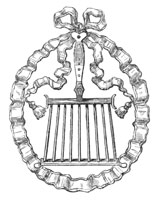
Estcourt, the actor, was made Providore of the Club;
and for a mark of distinction wore their badge, which
was a small gridiron of gold, hung about his neck with a
green silk ribbon. Such is the account given by Chetwood,
in his History of the Stage, 1749; to which he
adds: "this Club was composed of the chief wits and
great men of the nation." The gridiron, it will be
seen hereafter, was assumed as its badge, by the "Society
of Beef-steaks, established a few years later: they call
themselves 'the Steaks,' and abhor the notion of being
thought a Club." Though the National Review, heretical
as it may appear, cannot consent to dissever the Society
from the earlier Beef-steak Club; which, however, would
imply that Rich and Lambert were not the founders of
the Society, although so circumstantially shown to be.
Still, the stubbornness of facts must prevail.
Dick Estcourt was beloved by Steele, who thus introduces
him in the Spectator, No. 358: "The best man
that I know of for heightening the real gaiety of a company
is Estcourt, whose jovial humour diffuses itself from
the highest person at an entertainment to the meanest
waiter. Merry tales, accompanied with apt gestures and
lively representations of circumstances and persons, beguile
the gravest mind into a consent to be as humorous
as himself. Add to this, that when a man is in his
good graces, he has a mimicry that does not debase the
person he represents, but which, taken from the gravity
of the character, adds to the agreeableness of it."
Then, in the Spectator, No. 264, we find a letter from
Sir Roger de Coverley, from Coverley, "To Mr. Estcourt,
at his House in Covent Garden," addressing him as "Old
Comical One," and acknowledging "the hogsheads of
neat port came safe," and hoping next term to help fill
Estcourt's Bumper "with our people of the Club." The
Bumper was the tavern in Covent Garden, which Estcourt
opened about a year before his death. In this quality
Parnell speaks of him in the beginning of one of his
poems:—
"Gay Bacchus liking Estcourt's wine
A noble meal bespoke us,
And for the guests that were to dine
Brought Comus, Love, and Jocus."
The Spectator delivers this merited eulogy of the player,
just prior to his benefit at the theatre: "This pleasant
fellow gives one some idea of the ancient Pantomime,
who is said to have given the audience in dumb-show, an
exact idea of any character or passion, or an intelligible
relation of any public occurrence, with no other expression
than that of his looks and gestures. If all who have
been obliged to these talents in Estcourt will be at Love
for Love to-morrow night, they will but pay him what
they owe him, at so easy a rate as being present at a
play which nobody would omit seeing, that had, or had
not, ever seen it before."
Then, in the Spectator, No. 468, August 27, 1712, with
what touching pathos does Steele record the last exit of
this choice spirit: "I am very sorry that I have at present
a circumstance before me which is of very great importance
to all who have a relish for gaiety, wit, mirth,
or humour: I mean the death of poor Dick Estcourt. I
have been obliged to him for so many hours of jollity,
that it is but a small recompense, though all I can give
him, to pass a moment or two in sadness for the loss of
so agreeable a man.... Poor Estcourt! Let the vain
and proud be at rest, thou wilt no more disturb their
admiration of their dear selves; and thou art no longer
to drudge in raising the mirth of stupids, who know
nothing of thy merit, for thy maintenance." Having
spoken of him "as a companion and a man qualified for
conversation,"—his fortune exposing him to an obsequiousness
towards the worst sort of company, but his
excellent qualities rendering him capable of making the
best figure in the most refined, and then having told
of his maintaining "his good humour with a countenance
or a language so delightful, without offence to any
person or thing upon earth, still preserving the distance
his circumstances obliged him to,"—Steele concludes
with, "I say, I have seen him do all this in such a
charming manner, that I am sure none of those I hint
at will read this, without giving him some sorrow for
their abundant mirth, and one gush of tears for so many
bursts of laughter. I wish it were any honour to the
pleasant creature's memory, that my eyes are too much
suffused to let me go on——" We agree with Leigh
Hunt that Steele's "overfineness of nature was never
more beautifully evinced in any part of his writings than
in this testimony to the merits of poor Dick Estcourt."
Ned Ward, in his Secret History of Clubs, first edition,
1709, describes the Beef-steaks, which he coarsely
contrasts with "the refined wits of the Kit-Cat." This
new Society griliado'd beef eaters first settled their
meeting at the sign of the Imperial Phiz, just opposite
to a famous conventicle in the Old Jury, a publick-house
that has been long eminent for the true British quintessence
of malt and hops, and a broiled sliver off the
juicy rump of a fat, well-fed bullock.... This noted
boozing ken, above all others in the City, was chosen
out by the Rump-steak admirers, as the fittest mansion
to entertain the Society, and to gratify their appetites
with that particular dainty they desired to be distinguished
by. [The Club met at the place appointed, and
chose for a Prolocutor, an Irish comedian.] No sooner
had they confirmed their Hibernian mimic in his honourable
post, but to distinguish him from the rest, they
made him a Knight of St. Lawrence, and hung a silver (?)
gridiron about his neck, as a badge of the dignity they
had conferred upon him, that when he sung Pretty Parrot,
he might thrum upon the bars of his new instrument,
and mimic a haughty Spaniard serenading his
Donna with guitar and madrigal. The Zany, as proud
of his new fangle as a German mountebank of a prince's
medal, when he was thus dignified and distinguished
with his culinary symbol hanging before his breast, took
the highest post of honour, as his place at the board,
where, as soon as seated, there was not a bar in the silver
kitchen-stuff that the Society had presented him with,
but was presently handled with a theatrical pun, or
an Irish witticism.... Orders were dispatched to the
superintendent of the kitchen to provide several nice
specimens of their Beef-steak cookery, some with the
flavour of a shalot or onion; some broil'd, some fry'd,
some stew'd, some toasted, and others roasted, that every
judicious member of the new erected Club might appeal
to his palate, and from thence determine whether the
house they had chosen for their rendezvous truly deserved
that public fame for their inimitable management
of a bovinary sliver, which the world had given them....
When they had moderately supplied their beef stomachs,
they were all highly satisfy'd with the choice they had
made, and from that time resolved to repeat their meeting
once a week in the same place." At the next
meeting the constitution and bye-laws of the new little
commonwealth were settled; and for the further encouragement
of wit and pleasantry throughout the whole
Society, there was provided a very voluminous paper
book, "about as thick as a bale of Dutch linen, into
which were to be entered every witty saying that should
be spoke in the Society:" this nearly proved a failure;
but Ward gives a taste of the performances by reciting
some that had been stolen out of their Journal by a false
Brother; here is one:—
ON AN OX.
"Most noble creature of the horned race,
Who labours at the plough to earn thy grass,
And yielding to the yoke, shows man the way
To bear his servile chains, and to obey
More haughty tyrants, who usurp the sway.
Thy sturdy sinews till the farmer's grounds,
To thee the grazier owes his hoarded pounds:
'Tis by thy labour, we abound in malt,
Whose powerful juice the meaner slaves exalt;
And when grown fat, and fit to be devour'd,
The pole-ax frees thee from the teazing goard:
Thus cruel man, to recompense thy pains,
First works thee hard, and then beats out thy brains."
Ward is very hard upon the Kit-Cat community, and
tells us that the Beef-steaks, "like true Britons, to show
their resentment in contempt of Kit-Cat pies, very justly
gave the preference to a rump-steak, most wisely agreeing
that the venerable word, beef, gave a more masculine
grace, and sounded better in the title of a true English
Club, than either Pies or Kit-Cat; and that a gridiron,
which has the honour to be made the badge of a Saint's
martyrdom, was a nobler symbol of their Christian integrity,
than two or three stars or garters; who learnedly
recollecting how great an affinity the word bull has
to beef, they thought it very consistent with the constitution
of their Society, instead of a Welsh to have a
Hibernian secretary. Being thus fixed to the great
honour of a little alehouse, next door to the Church, and
opposite to the Meeting, they continued to meet for some
time; till their fame spreading over all the town, and
reaching the ears of the great boys and little boys, as
they came in the evening from Merchant Taylors' School,
they could not forbear hollowing as they passed the door;
and being acquainted with their nights of meeting, they
seldom failed, when the divan was sitting, of complimenting
their ears with 'Huzza! Beef-steak!'—that
they might know from thence, how much they were reverenced
for men of learning by the very school-boys."
"But the modest Club," says Ward, "not affecting
popularity, and choosing rather to be deaf to all public
flatteries, thought it an act of prudence to adjourn from
thence into a place of obscurity, where they might feast
knuckle-deep in luscious gravy, and enjoy themselves free
from the noisy addresses of the young scholastic rabble;
so that now, whether they have healed the breach, and
are again returned into the Kit-Cat community, from
whence it is believed, upon some disgust, they at first
separated, or whether, like the Calves' Head Club they
remove from place to place, to prevent discovery, I sha'n't
presume to determine; but at the present, like Oates's
army of pilgrims, in the time of the plot, though they
are much talk'd of they are difficult to be found." The
"Secret history" concludes with an address to the Club,
from which these are specimen lines:
"Such strenuous lines, so cheering, soft, and sweet,
That daily flow from your conjunctive wit,
Proclaim the power of Beef, that noble meat.
Your tuneful songs such deep impression make,
And of such awful, beauteous strength partake,
Each stanza seems an ox, each line a steak.
As if the rump in slices, broil'd or stew'd
In its own gravy, till divinely good,
Turned all to powerful wit, as soon as chew'd.
To grind thy gravy out their jaws employ,
O'er heaps of reeking steaks express their joy,
And sing of Beef as Homer did of Troy."
We shall now more closely examine the origin and
history of the Sublime Society of the Steaks, which has
its pedigree, its ancestry, and its title-deeds. The gridiron
of 1735 is the real gridiron on which its first steak
was broiled. Henry Rich (Lun, the first Harlequin)
was the founder, to whom Garrick thus alludes in a prologue
to the Irish experiment of a speaking pantomime:
"When Lun appeared, with matchless art and whim,
He gave the power of speech to every limb.
Though masked and mute conveyed his true intent,
And told in frolic gestures what he meant;
But now the motley coat and sword of wood,
Require a tongue to make them understood."
There is a letter extant, written by Nixon, the treasurer,
probably to some artist, granting permission by
the Beef-steak Society "to copy the original gridiron, and
I have wrote on the other side of this sheet a note to
Mr. White, at the Bedford, to introduce you to our
room for the purpose making your drawing. The first
spare moment I can take from my business shall be employed
in making a short statement of the rise and
establishment of the Beef-steak Society."
Rich, in 1732, left the Lincoln's Inn Fields Theatre
for Covent Garden, the success of the Beggars' Opera
having "made Gay rich and Rich gay." He was accustomed
to arrange the comic business and construct
the models of tricks for his pantomimes in his private
room at Covent Garden. Here resorted men of rank
and wit, for Rich's colloquial oddities were much relished.
Thither came Mordaunt, Earl of Peterborough,
the friend of Pope, and thus commemorated by Swift:
"Mordanto fills the trump of fame;
The Christian world his death proclaim;
And prints are crowded with his name.
In journeys he outrides the post;
Sits up till midnight with his host;
Talks politics, and gives the toast,
A skeleton in outward figure;
His meagre corpse, though full of vigour,
Would halt behind him, were it bigger,
So wonderful his expedition;
When you have not the least suspicion,
He's with you, like an apparition:
Shines in all climates like a star;
In senates bold, and fierce in war;
A land-commandant, and a tar."
He was then advanced in years, and one afternoon
stayed, talking with Rich about his tricks and transformations,
and listening to his agreeable talk, until Rich's dinner-hour,
two o'clock, had arrived. In all these colloquies
with his visitors, whatever their rank, Rich never neglected
his art. Upon one occasion, accident having detained
the Earl's coach later than usual, he found
Rich's chat so agreeable, that he was quite unconscious
it was two o'clock in the afternoon; when he observed
Rich spreading a cloth, then coaxing his fire into a clear
cooking flame, and proceeding, with great gravity, to
cook his own beef-steak on his own gridiron. The steak
sent up a most inviting incense, and my Lord could not
resist Rich's invitation to partake of it. A further
supply was sent for; and a bottle or two of good wine
from a neighbouring tavern prolonged their enjoyment
to a late hour. But so delighted was the old Peer with
the entertainment, that, on going away, he proposed
renewing it at the same place and hour, on the Saturday
following. He was punctual to his engagement, and
brought with him three or four friends, "men of wit
and pleasure about town," as M. Bouges would call
them; and so truly festive was the meeting that it was
proposed a Saturday's club should be held there, whilst
the town remained full. A sumptuary law, even at this
early period of the Society, restricted the bill of fare to
beef-steaks, and the beverage to port-wine and punch.
However, the origin of the Society is related with a
difference. Edwards, in his Anecdotes of Painting, relates
that Lambert, many years principal scene-painter
at Covent Garden Theatre, received, in his painting-room,
persons of rank and talent; where, as he could
not leave for dinner, he frequently was content with a
steak, which he himself broiled upon the fire in his
room. Sometimes the visitors partook of the hasty
meal, and out of this practice grew the Beef-steak Society,
and the assembling in the painting-room. The
members were afterwards accommodated with a room in
the playhouse; and when the Theatre was rebuilt, the
place of meeting was changed to the Shakespeare Tavern,
where was the portrait of Lambert, painted by
Hudson, Sir Joshua Reynolds's master.
In the Connoisseur, June 6th, 1754, we read of the
Society, "composed of the most ingenious artists in the
Kingdom," meeting "every Saturday in a noble room
at the top of Covent Garden Theatre," and never suffering
"any diet except Beef-steaks to appear. These,
indeed, are most glorious examples: but what, alas! are
the weak endeavours of a few to oppose the daily inroads
of fricassees and soup-maigres?"
However, the apartments in the theatre appropriated
to the Society varied. Thus, we read of a painting-room
even with the stage over the kitchen, which was
under part of the stage nearest Bow-street. At one
period, the Society dined in a small room over the passage
of the theatre. The steaks were dressed in the
same room, and when they found it too hot, a curtain
was drawn between the company and the fire.
We shall now glance at the celebrities who came to
the painting-room in the Lincoln's Inn Fields theatre,
and the later locations of the Club, in Covent Garden. To
the former came Hogarth and his father-in-law, Sir James
Thornhill, stimulated by their love of the painter's art,
and the equally potent charm of conviviality.
Churchill was introduced to the Steaks by his friend
Wilkes; but his irregularities were too much for the
Society, which was by no means particular; his desertion
of his wife brought a hornets' swarm about him,
so that he soon resigned, to avoid the disgrace of expulsion.
Churchill attributed this flinging of the first stone
to Lord Sandwich; he never forgave the peccant Peer,
but put him into the pillory of his fierce satire, which
has outlived most of his other writings, and here it is:
"From his youth upwards to the present day,
When vices more than years have made him grey;
When riotous excess with wasteful hand
Shakes life's frail glass, and hastes each ebbing sand;
Unmindful from what stock he drew his birth,
Untainted with one deed of real worth—
Lothario, holding honour at no price,
Folly to folly, added vice to vice,
Wrought sin with greediness, and courted shame
With greater zeal than good men seek for fame."
Churchill, in a letter to Wilkes, says, "Your friends
at the Beef-steak inquired after you last Saturday with
the greatest zeal, and it gave me no small pleasure that
I was the person of whom the inquiry was made."
Charles Price was allowed to be one of the most witty
of the Society, and it is related that he and Churchill
kept the table in a roar.
Formerly, the members wore a blue coat, with red
cape and cuffs; buttons with the initials B. S.; and
behind the President's chair was placed the Society's
halbert, which, with the gridiron, was found among the
rubbish after the Covent Garden fire.
Mr. Justice Welsh was frequently chairman at the
Beef-steak dinner. Mrs. Nollekens, his daughter, acknowledges
that she often dressed a hat for the purpose,
with ribbons similar to those worn by the yeomen of the
guard. The Justice was a loyal man, but discontinued
his membership when Wilkes joined the Society; though
the latter was the man at the Steaks.
To the Steaks Wilkes sent a copy of his infamous
Essay on Women, first printed for private circulation;
for which Lord Sandwich—Jemmy Twitcher—himself,
as we have seen, a member of the Society—moved in
the House of the Lords that Wilkes should be taken
into custody; a piece of treason as the act of one brother
of the Steaks against another, fouler than even the
trick of "dirty Kidgell," the parson, who, as a friend of
the author, got a copy of the Essay from the printer,
and then felt it his duty to denounce the publication;
he had been encouraged to inform against Wilkes's
Essay by the Earl of March, afterwards Duke of Queensberry.
However, Jemmy Twitcher himself was expelled
by the Steaks the same year he assailed Wilkes for the
Essay; the grossness and blasphemy of the poem disgusted
the Society; and Wilkes never dined there after
1763; yet, when he went to France, they hypocritically
made him an honorary member.
Garrick was an honoured member of the Steaks;
though he did not affect Clubs. The Society possess a
hat and sword which David wore, probably on the night
when he stayed so long with the Steaks, and had
to play Ranger, at Drury-lane. The pit grew restless,
the gallery bawled "Manager, manager!" Garrick had
been sent for to Covent Garden, where the Steaks then
dined. Carriages blocked up Russell-street, and he had
to thread his way between them; as he came panting
into the theatre, "I think, David," said Ford, one of
the anxious patentees, "considering the stake you and
I have in this house, you might pay more attention
to the business."—"True, my good friend," returned
Garrick, "but I was thinking of my steak in the other
house."
Many a reconciliation of parted friends has taken
place at this Club. Peake, in his Memoirs of the Colman
Family, thus refers to a reconciliation between
Garrick and Colman the elder, through the Sublime
Society:—
"Whether Mr. Clutterbuck or other friends interfered
to reconcile the two dramatists, or whether the
considerations of mutual interest may not in a great
measure have aided in healing the breach between Colman
and Garrick, is not precisely to be determined;
but it would appear, from the subjoined short note from
Garrick, that Colman must have made some overture to
him.
"'My dear Colman,—Becket has been with me, and
tells me of your friendly intentions towards me. I
should have been beforehand with you, had I not been
ill with the beefsteaks and arrack punch last Saturday,
and was obliged to leave the play-house.
"'He that parts us shall bring a brand from Heav'n,
And fire us hence.'
"'Ever yours, old and new friend,
"'D. GARRICK.'"
The beef-steaks, arrack punch, and Saturday, all
savour very strongly of a visit to the Sublime Society
held at that period in Covent Garden Theatre, where
many a clever fellow has had his diaphragm disordered,
before that time and since. Whoever has had the pleasure
to join their convivial board; to witness the never-failing
good-humour which predominates there; to listen
to the merry songs, and to the sparkling repartee; and
to experience the hearty welcome and marked attention
paid to visitors, could never have cause to lament, as
Garrick has done, a trifling illness the following day.
There must have been originally a wise and simple code
of laws, which could have held together a convivial
meeting for so lengthened a period.
Garrick had no slight tincture of vanity, and was fond
of accusing himself, in the Chesterfield phrase, of the
cardinal virtues. Having remarked at the Steaks that
he had so large a mass of manuscript plays submitted to
him, that they were constantly liable to be mislaid, he
observed that, unpleasant as it was to reject an author's
piece, it was an affront to his feelings if it could not be
instantly found; and that for this reason he made a
point of ticketing and labelling the play that was to be
returned, that it might be forthcoming at a moment.
"A fig for your hypocrisy," exclaimed Murphy across
the table; "you know, Davy, you mislaid my tragedy
two months ago, and I make no doubt you have lost it."—"Yes,"
replied Garrick; "but you forgot, you ungrateful
dog, that I offered you more than its value, for
you might have had two manuscript farces in its stead."
This is the right paternity of an anecdote often told of
other parties.
Jack Richards, a well-known presbyter of the Society,
unless when the "fell serjeant," the gout, had arrested
him, never absented himself from its board. He was
recorder, and there is nothing in comedy equal to his
passing sentence on those who had offended against the
rules and observances of the Society. Having put on
Garrick's hat, he proceeded to inflict a long, wordy
harangue upon the culprit, who often endeavoured most
unavailingly to stop him. Nor was it possible to see
when he meant to stop. But the imperturbable gravity
with which Jack performed his office, and the fruitless
writhings of the luckless being on whom the shower of
his rhetoric was discharged, constituted the amusement
of the scene. There was no subject upon which Jack's
exuberance of talk failed him; yet, in that stream of
talk there was never mingled one drop of malignity, nor
of unkind censure upon the erring or unhappy. He
would as soon adulterate his glass of port-wine with
water, as dash that honest though incessant prattle with
one malevolent or ungenerous remark.
William Linley, the brother of Mrs. Sheridan,
charmed the Society with his pure, simple English
song: in a melody of Arne's, or of Jackson's of Exeter,
or a simple air of his father's, he excelled to admiration,—faithful
to the characteristic chastity of the style of
singing peculiar to the Linley family. Linley had not
what is called a fine voice, and port-wine and late nights
did not improve his organ; but you forgot the deficiencies
of his power, in the spirit and taste of his
manner. He wrote a novel in three volumes, which was
so schooled by the Steaks that he wrote no more: when
the agony of wounded authorship was over, he used to
exclaim to his tormentors:—
"This is no flattery; these are the counsellors
That feelingly persuade me what I am."
His merciless Zoilus brought a volume of the work in
his pocket, and read a passage of it aloud. Yet, Linley
never betrayed the irritable sulkiness of a roasted author,
but took the pleasantries that played around him with
imperturbable good-humour: he laughed heartily at his
own platitudes, and thus the very martyr of the joke
became its auxiliary. Linley is said to have furnished
Moore, for his Life of Sheridan, with the common-place
books in which his brother-in-law was wont to deposit
his dramatic sketches, and to bottle up the jokes he had
collected for future use; but many pleasantries of Sheridan
were deeply engraved on his recollection because
they had been practised upon himself, or upon his
brother Hozy (as Sheridan called him), who was an unfailing
butt, when he was disposed to amuse himself
with a practical jest.
Another excellent brother was Dick Wilson, whose
volcanic complexion had for many years been assuming
deeper and deeper tints of carnation over the port-wine
of the Society. Dick was a wealthy solicitor, and many
years Lord Eldon's "port-wine-loving secretary." His
fortunes were very singular. He was first steward and
solicitor, and afterwards residuary legatee, of Lord Chedworth.
He is said to have owed the favour of this
eccentric nobleman to the legal acumen he displayed at
a Richmond water-party. A pleasant lawn, under a
spreading beech-tree in one of Mr. Cambridge's meadows,
was selected for the dinner; but on pulling to the
shore, behold a board in the tree proclaiming, "All persons
landing and dining here will be prosecuted according
to law." Dick Wilson contended that the prohibition
clearly applied only to the joint act of "landing
and dining" at the particular spot. If the party landed
a few yards lower down, and then dined under the tree,
only one member of the condition would be broken;
which would be no legal infringement, as the prohibition—being
of two acts, linked by a copulative—was not
severable. This astute argument carried the day. The
party dined under Mr. Cambridge's beech-tree, and, it
is presumed, were not "prosecuted according to law." At
all events, Lord Chedworth, who was one of the diners,
was so charmed with Dick's ready application of his law
to practice, that he committed to him the management
of his large and accumulating property.
Dick stood the fire of the Steaks with good humour;
but he was sometimes unmercifully roasted. He had
just returned from Paris, when Arnold, with great dexterity,
drew him into some Parisian details, with great
glee; for Dick was entirely innocent of the French language.
Thus, in enumerating the dishes at a French
table, he thought the boulevards delicious; when Cobbe
called out, "Dick, it was well they did not serve you at
the Palais Royal for sauce to your boulevards." The
riz de veau he called a rendezvous; and he could not
bear partridges served up in shoes; and once, intending
to ask for a pheasant, he desired the waiter to bring him
a paysanne! Yet, Dick was shrewd: calling one day
upon Cobbe at the India House, Dick was left to himself
for a few minutes, when he was found by Cobbe, on
his return, exploring a map of Asia suspended on the
wall: he was measuring the scale of it with compasses,
and then applying them to a large tiger, which the artist
had introduced as one of the animals of the country.
"By heavens, Cobbe," exclaimed Dick, "I should never
have believed it! Surely, it must be a mistake. Observe
now—here," pointing to the tiger, "here is a tiger
that measures two-and-twenty leagues. By heavens, it
is scarcely credible."
Another of the noteworthy Steaks was "Old Walsh,"
commonly called "the Gentle Shepherd:" he began life
as a servant of the celebrated Lord Chesterfield, and
accompanied his natural son, Philip Stanhope, on the
grand tour, as valet: after this he was made a Queen's
messenger, and subsequently a Commissioner of Customs;
he was a good-natured butt for the Society's
jokes. Rowland Stephenson, the banker, was another
Beef-Steaker, then respected for his clear head and
warm heart, years before he became branded as a forger.
At the same table was a capitalist of very high character—William
Joseph Denison, who sat many years in
Parliament for Surrey, and died a millionnaire: he was a
man of cultivated tastes, and long enjoyed the circle of
the Steaks.
We have seen how the corner-stone of the sublime Society
was laid. The gridiron upon which Rich had broiled
his solitary steak, being insufficient in a short time for
the supernumerary guests, the gridiron was enshrined as
one of the tutelary and household emblems of the Club.
Fortunately, it escaped the fire which consumed Covent
Garden Theatre in 1808, when the valuable stock of
wine of the Club shared the fate of the building; but
the gridiron was saved. "In that fire, alas!" says the
author of The Clubs of London, "perished the original
archives of the Society. The lovers of wit and pleasantry
have much to deplore in that loss, inasmuch as not only
the names of many of the early members are irretrievably
gone, but what is more to be regretted, some of their
happiest effusions; for it was then customary to register
in the weekly records anything of striking excellence
that had been hit off in the course of the evening. This,
however, is certain, that the Beaf-steaks, from its foundation
to the present hour, has been—
"'native to famous wits
Or hospitable.'
That, as guests or members, persons distinguished for
rank, and social and convivial powers, have, through
successive generations, been seated at its festive board—
Bubb Dodington, Aaron Hill; Hoadley, author of The
Suspicious Husband, and Leonidas Glover, are only a few
names snatched from its early list. Sir Peere Williams,
a gentleman of high birth and fashion, who had already
shone in Parliament, was of the Club. Then came the
days of Lord Sandwich, Wilkes, Bonnell Thornton,
Arthur Murphy, Churchill, and Tickell. This is generally
quoted as the golden period of the Society." Then there
were the Colmans and Garrick; and John Beard, the
singer, was president of the Club in 1784.
The number of the Steaks was increased from twenty-four
to twenty-five, in 1785, to admit the Prince of
Wales, an event of sufficient moment to find record in
the Annual Register of the year: "On Saturday, the
14th of May, the Prince of Wales was admitted a member
of the Beaf-steak Club. His Royal Highness having
signified his wish of belonging to that Society, and there
not being a vacancy, it was proposed to make him an
honorary member; but that being declined by His
Royal Highness, it was agreed to increase the number
from twenty-four to twenty-five, in consequence of which
His Royal Highness was unanimously elected. The
Beaf-steak Club has been instituted just fifty years, and
consists of some of the most classical and sprightly wits
in the Kingdom." It is curious to find the Society
here termed a Club, contrary to its desire, for it stickled
much for the distinction.
Arthur Murphy, the dramatist, John Kemble, the
Dukes of Clarence and of Sussex, were also of the Steaks:
these princes were both attached to the theatre; the
latter to one of its brightest ornaments, Dorothy Jordan.
Charles, Duke of Norfolk, was another celebrity of
the Steaks, and frequently met here the Prince of Wales.
The Duke was a great gourmand, and, it is said, used to
eat his dish of fish at a neighbouring tavern—the Piazza,
or the Grand—and then join the Steaks. His fidus
Achates was Charles Morris, the laureate-lyrist of the
Steaks. Their attachment was unswerving, notwithstanding
it has been impeached. The poet kept better
hours than his ducal friend: one evening, Morris having
left the dinner-table early, a friend gave some significant
hints as to the improvement of Morris's fortunes: the
Duke grew generous over his wine, and promised; the
performance came, and Morris lived to the age of ninety-three,
to enjoy the realization.
The Duke took the chair when the cloth was removed.
It was a place of dignity, elevated some steps above the
table, and decorated with the insignia of the Society,
amongst which was suspended Garrick's Ranger hat.
As the clock struck five, a curtain drew up, discovering
the kitchen, in which the cooks were seen at work,
through a sort of grating, with this inscription from
Macbeth:—
"If it were done, when 'tis done, then 'twere well
It were done quickly."
The steaks themselves were in the finest order, and
in devouring them no one surpassed His Grace of Norfolk:
two or three steaks, fragrant from the gridiron,
vanished, and when his labours were thought to be over,
he might be seen rubbing a clean plate with a shalot
for the reception of another. A pause of ten minutes
ensued, and His Grace rested upon his knife and fork:
he was tarrying for a steak from the middle of the rump
of beef, where lurks a fifth essence, the perfect ideal of
tenderness and flavour. The Duke was an enormous
eater. He would often eat between three and four
pounds of beaf-steak; and after that take a Spanish
onion and beet-root, chop them together with oil and
vinegar, and eat them. After dinner, the Duke was
ceremoniously ushered to the chair, and invested with
an orange-coloured ribbon, to which a small silver gridiron[12]
was appended. In the chair he comported himself
with urbanity and good humour. Usually, the President
was the target, at which all the jests and witticisms
were fired, but moderately; for though a characteristic
equality reigned at the Steaks, the influences of rank
and station were felt there, and courtesy stole insensibly
upon those who at other times were merciless assailants
on the chair. The Duke's conversation abounded with
anecdote, terseness of phrase, and evidence of extensive
reading, which were rarely impaired by the sturdy port-wine
of the Society. Charles Morris, the Bard of the Club, sang
one or two of his own songs, the quintessence of convivial
mirth and fancy; at nine o'clock the Duke quitted the
chair, and was succeeded by Sir John Hippisley, who had
a terrible time of it: a storm of "arrowy sleet and iron
shower" whistled from all points in his ears: all rules
of civilized warfare seemed suspended, and even the new
members tried their first timid essays upon the Baronet,
than whom no man was more prompt to attack others.
He quitted the Society in consequence of an odd adventure
which really happened to him, and which, being related
with malicious fidelity by one of the Steaks, raised
such a shout of laughter at the Baronet's expense that
he could no longer bear it. Here is the story.
Sir John was an intelligent man; Windham used to
say of him that he was very near being a clever man.
He was a sort of busy idler; and his ruling passion was
that of visiting remarkable criminals in prison, and obtaining
their histories from their own lips. A murder
had been committed, by one Patch, upon a Mr. Bligh,
at Deptford; the evidence was circumstantial, but the
inference of his guilt was almost irresistible; still many
well-disposed persons doubted the man's guilt, and
amongst them was Sir John, who thought the anxiety
could only be relieved by Patch's confession. For this
end, Sir John importuned the poor wretch incessantly,
but in vain. Patch persisted in asserting his innocence,
till, wearied with Hippisley's applications, he assured the
Baronet that he would reveal to him, on the scaffold, all
that he knew of Mr. Bligh's death. Flattered with being
made the depository of this mysterious communication,
Sir John mounted the scaffold with Patch, and was
seen for some minutes in close conference with him. It
happened that a simple old woman from the country was
in the crowd at the execution. Her eyes, intent upon
the awful scene, were fixed, by an accidental misdirection,
upon Sir John, whom she mistook for the person who
was about to be executed; and not waiting till the criminal
was actually turned off, she went away with the wrong
impression; the peculiar face, and above all, the peculiar
nose (a most miraculous organ), of Hippisley, being
indelibly impressed upon her memory. Not many days
after, the old lady met Sir John in Cheapside; the certainty
that he was Patch, seized her so forcibly that she
screamed out to the passing crowd, "It's Patch, it's
Patch; I saw him hanged; Heaven deliver me!"—and
then fainted. When this incident was first related at
the Steaks, a mock inquest was set on foot, to decide
whether Sir John was Patch or not, and unanimously decided
in the affirmative.
Cobb, Secretary of the East India Company, was another
choice spirit at the Steaks: once, when he filled
the vice-chair, he so worried the poor president, an Alderman,
that he exclaimed, "Would to Heaven, I had another
vice-president, so that I had a gentleman opposite
to me!"—"Why should you wish any such thing?"
rejoined Cobb; "you cannot be more opposite to a gentleman
than you are at present."
After the fire at Covent Garden, the Sublime Society
were re-established at the Bedford, where they met until
Mr. Arnold had fitted up apartments for their reception
in the English Opera House. The Steaks continued to
meet here until the destruction of the Theatre by fire, in
1830; after which they returned to the Bedford; and,
upon the re-building of the Lyceum Theatre, a dining-room
was again provided for them. "The room they
dine in," says Mr. Cunningham, "a little Escurial in
itself, is most appropriately fitted up—the doors, wainscoting,
and roof, of good old English oak, ornamented
with gridirons as thick as Henry the Seventh's Chapel
with the portcullis of the founder. Everything assumes
the shape, or is distinguished by the representation, of
their emblematic implement, the gridiron. The cook is
seen at his office through the bars of a spacious gridiron,
and the original gridiron of the Society, (the survivor of
two terrific fires) holds a conspicuous position in the centre
of the ceiling. Every member has the power of inviting
a friend." The portraits of several worthies of
the Sublime Society were painted: one brother "hangs
in chain," as Arnold remarked in alluding to the civic
chain in which he is represented; it was in allusion to
the toga in which he is painted, that Brougham, being
asked whether he thought it a likeness, remarked that
it could not fail of being like him, "there was so much
of the fur (thief) about it."
The author of the Clubs of London, who was a member
of the Sublime Society, describes a right in favouring
them, "a brotherhood, a sentiment of equality. How
you would laugh to see the junior member emerging from
the cellar, with half-a-dozen bottles in a basket! I have
seen Brougham employed in this honourable diplomacy,
and executing it with the correctness of a butler. The
Duke of Leinster, in his turn, took the same duty.
"With regard to Brougham, at first sight you would
not set him down as having a natural and prompt alacrity
for the style of humour that prevails amongst us. But
Brougham is an excellent member, and is a remarkable
instance of the peculiar influences of this peculiar Society
on the human character. We took him just as the
schools of philosophy, the bar, the senate, had made him.
Literary, forensic, and parliamentary habits are most intractable
materials, you will say, to make a member of
the Steaks, yet no man has imbibed more of its spirit,
and he enters its occasional gladiatorship with the greatest
glee."
Admirable were the offhand puns and passes, which,
though of a legal character, were played off by Bolland,
another member of the Society. Brougham was putting
hypothetically the case of a man convicted of felony, and
duly hanged according to law; but restored to life by
medical appliances; and asked what would be the man's
defence if again brought to trial. "Why," returned
Bolland, "it would be for him to plead a cord and satisfaction."
["Accord and satisfaction" is a common
plea in legal practice.] The same evening were talked
over Dean Swift's ingenious but grotesque puns upon
the names of antiquity, such as Ajax, Archimedes, and
others equally well known. Bolland remarked that
when Swift was looking out for those humorous quibbles,
it was singular that it should never have occurred
to him that among the shades that accost Æneas in the
sixth book of the Æneid, there was a Scotchman of the
name of Hugh Forbes. Those who had read Virgil began
to stare. "It is quite plain," said Bolland: "the
ghost exclaims, 'Olim Euphorbus eram.'"
The following are the first twenty-four names of the
Club, copied from their book:—[13]
- George Lambert.
- John Boson.
- William Hogarth.
- Henry Smart.
- John Rich.
- John Huggins.
- Lacy Ryan.
- Hugh Watson.
- Ebenezer Forrest.
- William Huggins.
- Robert Scott.
- Edmund Tuffnell.
- Thomas Chapman.
- Thomas Salway.
- Dennis Delane.
- Charles Neale.
- John Thornhill.
- Charles Latrobe.
- Francis Niveton.
- Alexander Gordon.
- Sir William Saunderson.
- William Tathall.
- Richard Mitchell.
- Gabriel Hunt.
The following were subsequent members:—
- Francis Hayman.
- Mr. Beard.
- Theo. Cibber.
- Mr. Wilkes.
- Mr. Saunders Welsh.
- Thomas Hudson.
- John Churchill.
- Mr. Williamson.
- Lord Sandwich.
- Prince of Wales.
- Mr. Havard.
- Chas. Price.
In 1805 the members were—
- Sir J. Boyd.
- Estcourt.
- J. Travanion, jun.
- Earl of Suffolk.
- Crossdill.
- J. Kemble, expelled for his mode of conduct.
- Prince of Wales.
- Charles Howard, Duke of Norfolk.
- Mingay.
- Johnson.
- Scudamore.
- Haworth.
November 6th, 1814:—
- Stephenson.
- Cobb.
- Richards.
- Sir J. Scott, Bart.
- Foley.
- Arnold.
- Braddyll.
- Nettleshipp.
- Middleton.
- Denison.
- Johnson.
- Scudamore.
- Nixon.
- T. Scott.
- Wilson.
- Ellis.
- Walsh.
- Linley.
- Duke of Norfolk.
- Mayo.
- Duke of Sussex.
- Morrice.
- Bolland.
- Lord Grantley.
- Peter Moore.
- Dunn, Treasurer of Drury Lane Theatre.
When the Club dined at the Shakspeare, in the room
with the Lion's head over the mantelpiece, these popular
actors were members:—
- Lewis.
- Irish Johnson.
- Munden.
- Fawcett.
- Pope.
- Holman.
- Simmonds.
Formerly, the table-cloths had gridirons in damask
on them; their drinking-glasses bore gridirons; as did
the plates also. Among the presents made to the Society
are a punch-ladle, from Barrington Bradshaw;
Sir John Boyd, six spoons; mustard pot, by John Trevanion,
M.P.; two dozen water-plates and eight dishes,
given by the Duke of Sussex; cruet-stand, given by
W. Bolland; vinegar-glasses, by Thomas Scott. Lord
Suffolk gave a silver cheese-toaster; toasted or stewed
cheese being the wind-up of the dinner.