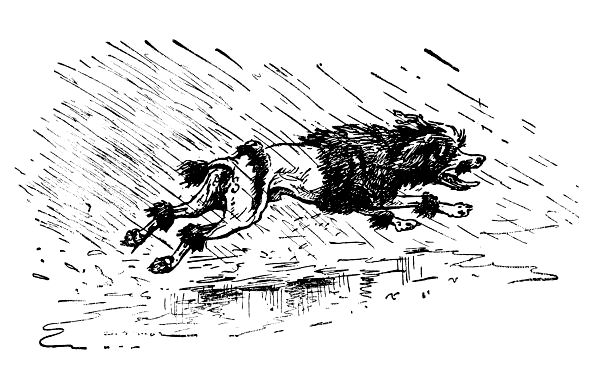
However, as he
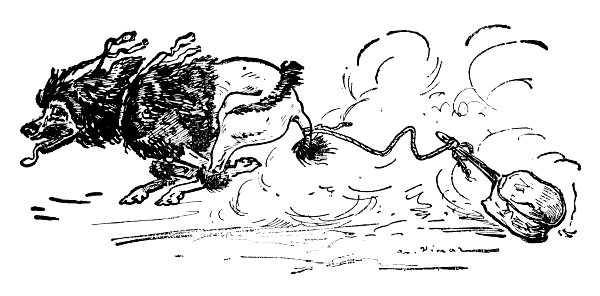
reached the edge of the
wood, the rain grew less
violent. Night was coming
on but among the
trees he could see bright
lights shining.
Drawing nearer,
Clown made out
some kind of a big
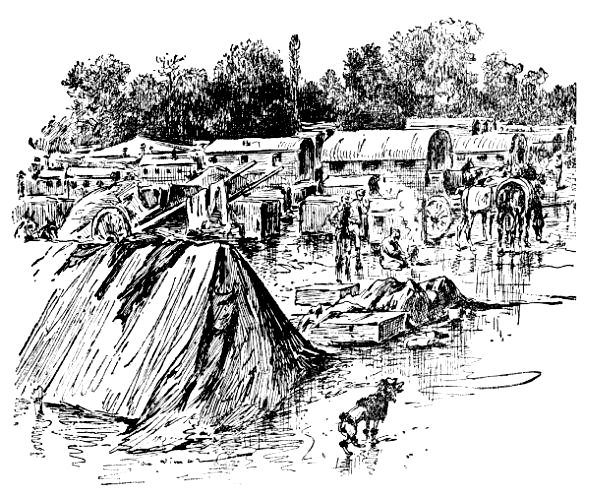
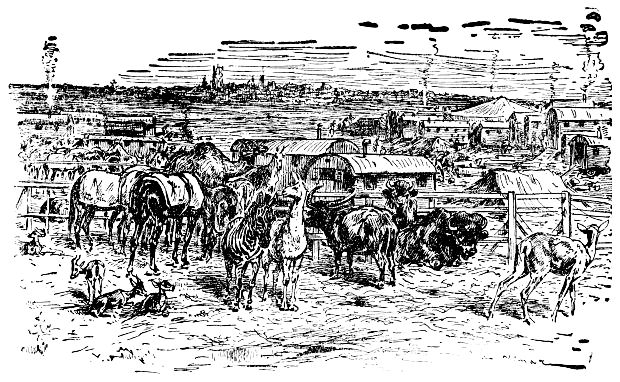
camp; carriages
and closed wagons
and tents stood
out against the
background of the
forest. At last he
saw people and
animals coming and going in all directions.
When he was quite close to this busy scene, Clown
stopped, breathless and anxious, sniffing the air,
listening keenly to the slightest sound.
He was not quite satisfied, and in his doubt he
thought of going farther on the chance of finding other
shelter. But he was more tired than he was afraid.
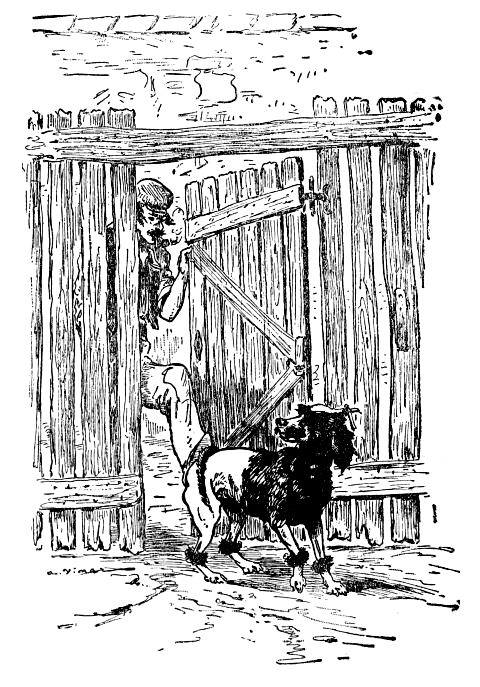
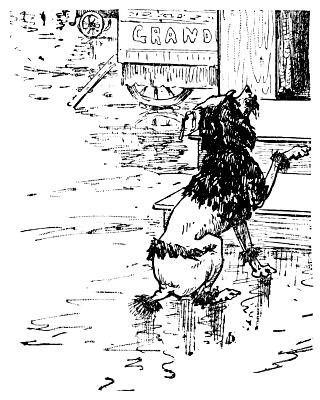
Plucking up his courage, poor Clown crept slowly
toward the larger of the two lighted vans that stood
on the edge of the woods.
Just at this moment the curtain that closed the rear
of one of these vans opened and a young girl came out
and stood on the doorstep. She wore a gleaming
costume of spangles, with a very short, fluffy skirt,
covered with shiny stones, and she had little satin
slippers on her feet, and the daintiest of pink stockings.
A plaid shawl hung from her shoulders.
Clown was dumbfounded. Never had he seen his
dear mistress in such a dress. While he was gazing
in astonishment at her, the girl stretched out her hand
to see if it was still raining. As she looked down she
caught sight of our poor little doggie, who, squatting
in front of her, wet through and muddy, raised imploring
eyes, waiting till she should take pity on him.
"What's this? A lost dog?" and, bending toward
him, she coaxed him nearer, saying:
"Poor doggie, poor little thing."
Clown went forward at once, trembling, anxious to
please but still half afraid. He let this strange girl
pet him, and made himself so agreeable, so eager and
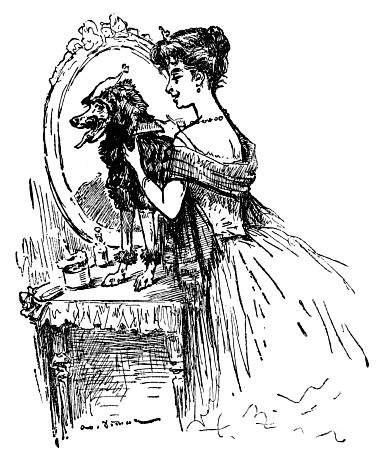
so interesting, that ten minutes later she had him all
cleaned, combed and brushed.
Having won the favor of this kind-hearted girl,
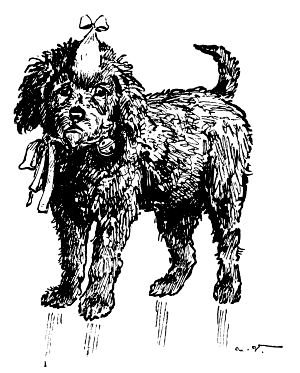
Clown became once more his old handsome self.
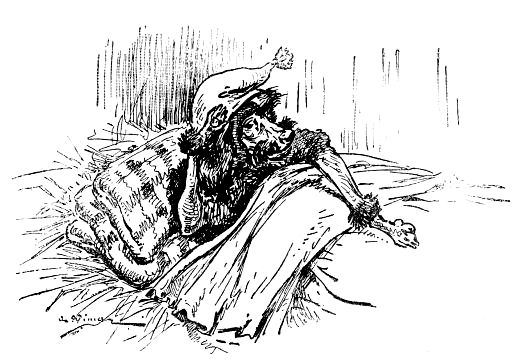
On a soft pile of blankets he passed an excellent
night. Now and again strange noises troubled his
ears, but completely worn out, and drowsy from so
much fresh air, he fell asleep again and dreamed
golden dreams.
The next morning the sky was clear again and the
air was fresh and balmy.
Clown was awakened at dawn by the sound of
people rushing about, packing up, just as though they
were moving house. Without leaving his bed, his eyes
still half-closed, he listened closely, and finally understood
with what kind of people he had to deal. Then
were explained the low growls which had so puzzled
and frightened him during the night. The carriages,
the cages, were the dwelling places of strange and
terrifying animals, such as he remembered having seen
at the fair of Neuilly, whither his dear mistress,
Bertha, had taken him one evening when he was still
a baby.
He had, then, fallen in with an immense traveling
circus which, constantly on the move, gave performances
in the principal cities of the world. Just now
it was headed, by gentle stages, for the center of
France. Clown was quite comforted and happy at the
thought of one day or another reaching Paris. Then—then—then
he would manage somehow to see her
again, her for whom he yearned, her whom he loved
with all his faithful little heart.
Traveling this way was much nicer than running
along the highroad. He was a sturdy fellow, but, all
the same, that one day of walking under such conditions
had made him somewhat thin. In short, he had
had enough of it, especially when he remembered
that he hadn't the least idea how to get to Paris.
Slipping cautiously under the tents which sheltered
the cages, Clown took a good look around the place.
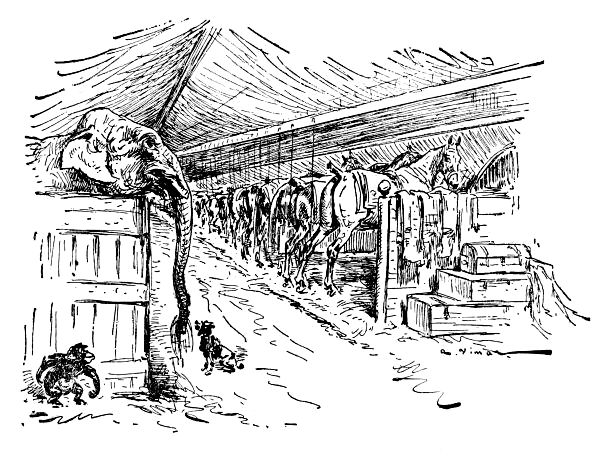
The stables, huge affairs, contained no less than one
hundred and fifty horses of all kinds and colors. He
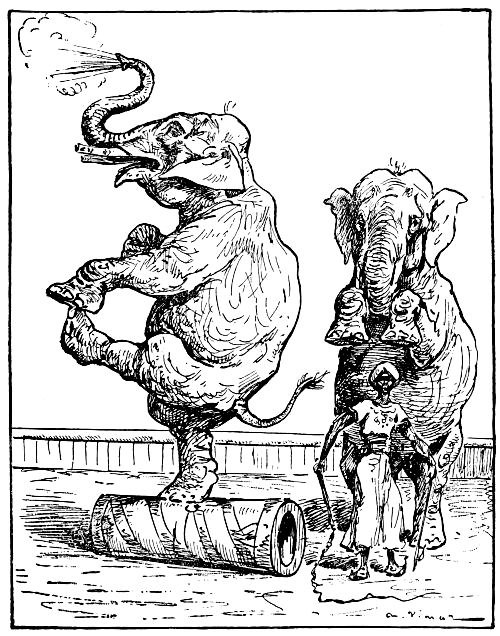
saw, too, three monstrous elephants, dromedaries,
giraffes, zebras, donkeys, and even pigs.
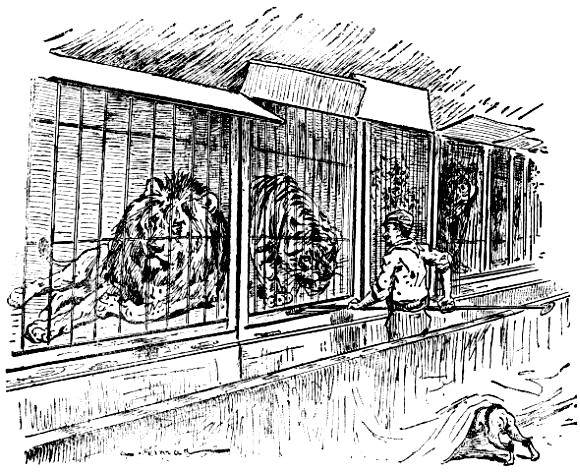
Then came the turn of the menagerie—a fine collection
of lions, tigers, panthers, jaguars, foxes,
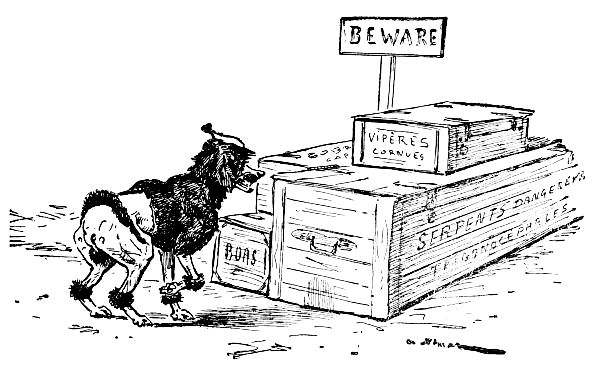
hyenas, boars. What didn't he see? Boxes full of
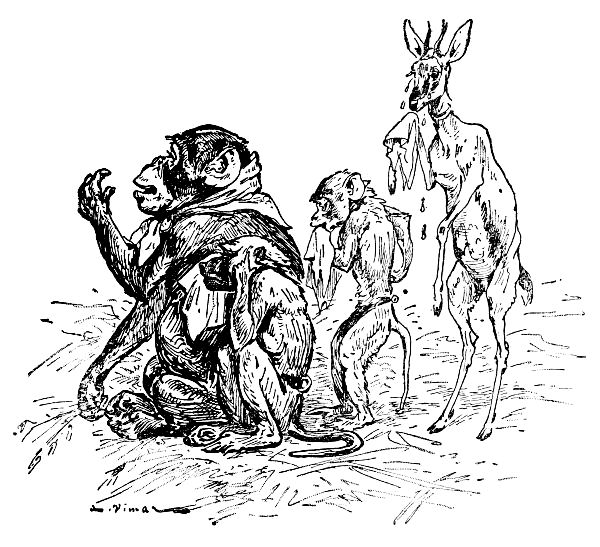
snakes, crocodiles, monkeys in cages—a chimpanzee
who was walking about all alone gave him a terrible
fright.
Parrots of every hue swayed on swinging perches,
uttering, for no reason that Clown could see, harsh discordant
cries.
Thus he passed slowly through the whole menagerie,
seeing all the animals. He even grew bold enough
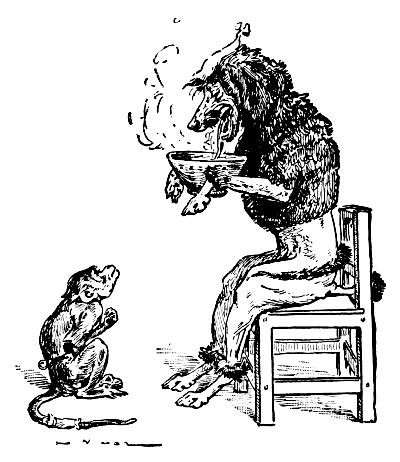
to lap freely at a large lake of milk, put there, he
thought, for the snakes and monkeys, who are very
fond of it. After this light breakfast he felt stronger
and more light-hearted. He spent some time visiting
and making much of his new mistress, and then went
on to finish his visit with the animals so happily begun.
Passing close to the elephants, he noticed their small
intelligent eyes, contrasting so queerly with their huge
size. While he was wondering about them, Clown, who
was by nature very curious, drew nearer, wanting to
sniff more closely at those long noses which swayed
so slowly and calmly from side to side. He succeeded
in getting close enough to touch them, but at the slightest
movement of the trunk he leaped back, his tail
between his legs, although he just had to return.
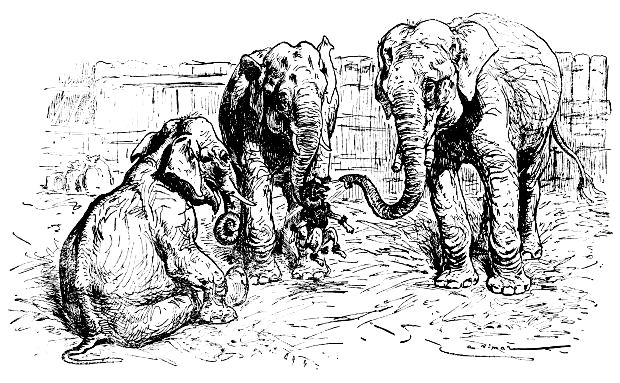
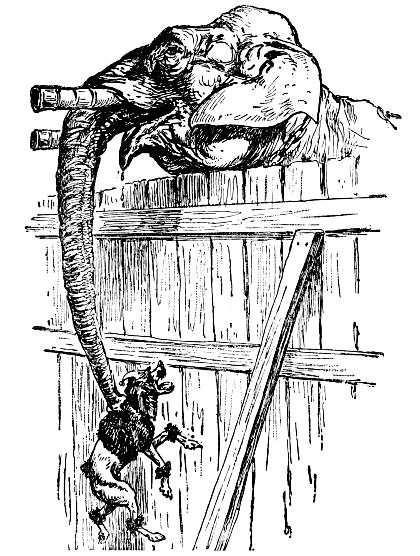
Suddenly, without being in the least hurt, he felt
himself lifted like a feather, and cleverly drawn into
the elephant-house. Now it was the elephants' turn
to sniff at him. One blew upon his nose until he could
scarcely breathe, while another gently pinched his
hind-quarters, and they all laughed at the figure he
cut. I can tell you, Clown did not enjoy all this one bit.
He did not even dare to show his teeth, he was so
afraid of being torn to pieces if he made the slightest
movement. Those five minutes in the air seemed to
him very long and terrible.
At last he was gently put upon his feet again. He
made one bound for liberty, a bound which brought
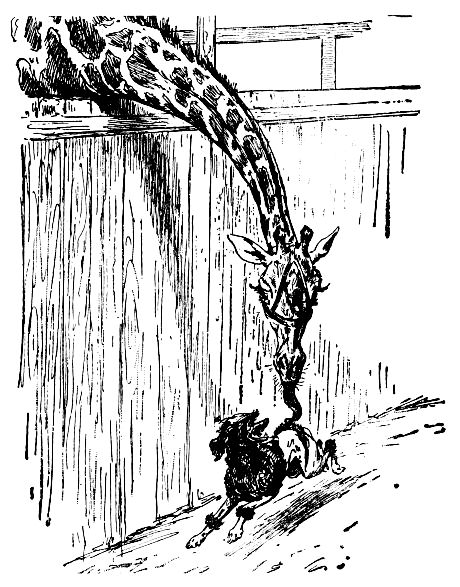
him close to the giraffes. Here again he felt a keen
pang of fear, for one of them, suddenly stretching his
long neck over the top of the box, touched him quite
unexpectedly with his long black tongue.
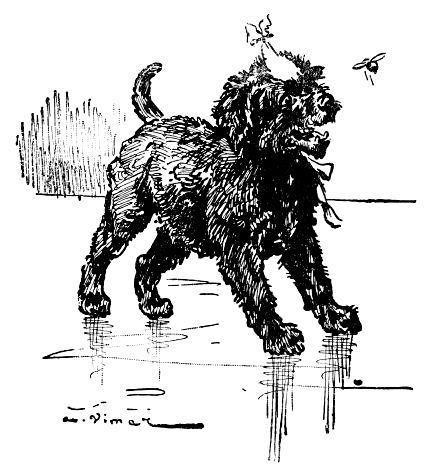
After this Clown was much more watchful and did
not come too close to the animals in the boxes. Even
the sound of a fly buzzing put him on his guard, and
this was a good thing for him, for he was in the midst
of a horde not always pleasant and sometimes quite
dangerous, where all sorts of accidents might have
happened to him. Fortunately he had escaped harm,
and these lessons made him very careful afterwards.
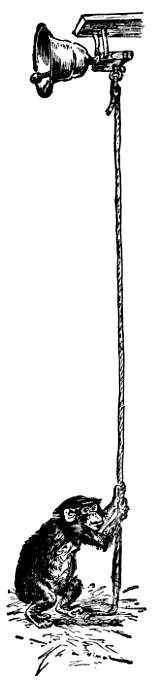
A bell rang. Immediately commotion
arose; people moved about in
all directions; the feeling of unrest
showed more and more in the cages;
the inmates turned and twisted.
Clown wondered what could be the
matter. The wild beasts roared, the
horses whinnied; all the animals
clamored at once.
There was a medley of sounds
that was simply deafening. It was
feeding time.
Barrows full of fresh meat, loaves
of bread and bundles of forage,
were passed around freely. Each
animal was served in turn according
to his taste. After the first bite
or two calm gradually returned, in
the cages anyhow.
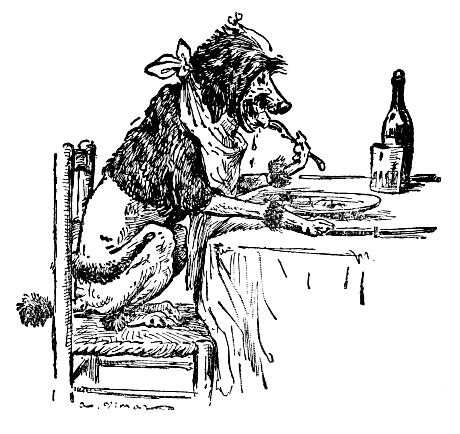
Clown was served apart and
lunched with excellent appetite.
His new mistress fairly stuffed him
with dainties, feeding him out of
her own hand. Her kindness made
Clown love her more and more.
When the animals were all fed and the men had
finished their own meals, the whole circus got ready
to move. By noon everything was ready, and at a
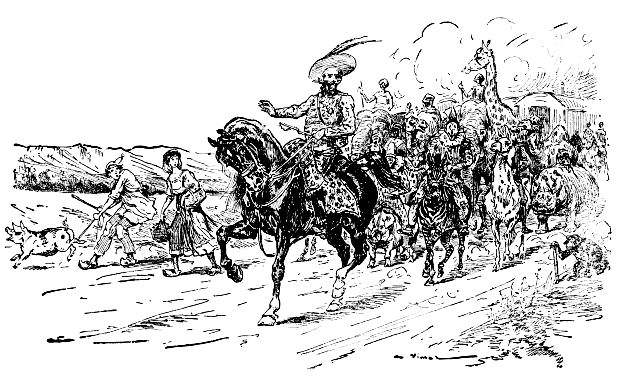
given signal, the entire troupe set off.
As the country was flat, and they were to march
until evening before reaching their next stopping
place, orders were given to leave the shutters of the
cages open and to lead as many of the animals as possible
so that they might breathe in the fresh air and
stretch their legs a bit. You can guess that the
passing of such animals on the road frightened more
than one good peasant as they went along, although
everyone along the road was warned in time by the
tamer and his helpers, who rode at the head of the
procession so as to avoid accidents.
It was in an elegant carriage, with good springs,
drawn by two fine young horses, that Clown made the
journey, seated beside his new mistress. The longing
to go quickly, made him hang his tongue out of his
mouth so that his white teeth showed under his black
moustache, and his eyes, turning from his mistress to
the splendid horses and back again, spoke his impatience
but at the same time his delight at the progress
they were making.
They went on and on, over miles of road bordered by
poplars, on into the golden dust, into the purple sunset.
A few miles more, and there lay Dijon.
A week before, the town had been prepared, by
bright-colored posters, for the coming of the great,
the marvelous circus. The walls and fences were
simply covered with pictures of the wonderful performance.
Performing horses, looking huge as elephants,
clowns at their most amusing tricks, gymnasts doing
their most thrilling feats, all were pictured.
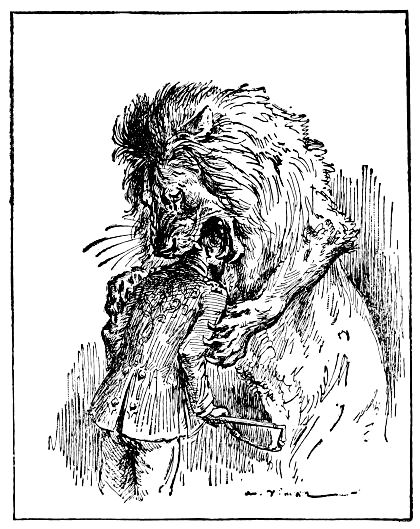
The tamer was there too, life-size, his head in the
mouth of Sultan, the big black Persian lion, while
Mademoiselle Reine, his charming daughter, Clown's
new mistress, beneath a cloudless sky drove four white
does, scattering flowers as she went.
At last the travelers came to the first country houses,
the vineyards and finally the spires, the tower of St.
John the Fearless and the other buildings of the capital
of Burgundy standing out against the evening
gloom.
Before they entered the town, a halt was called.
Order was restored, the cages were shut, a moment's
rest was taken; then the troupe set out again, to
encamp at last on a large piece of open ground near
the gates of the city.
While the tents were being set up and the cages
placed—in short, the whole circus installed—a huge
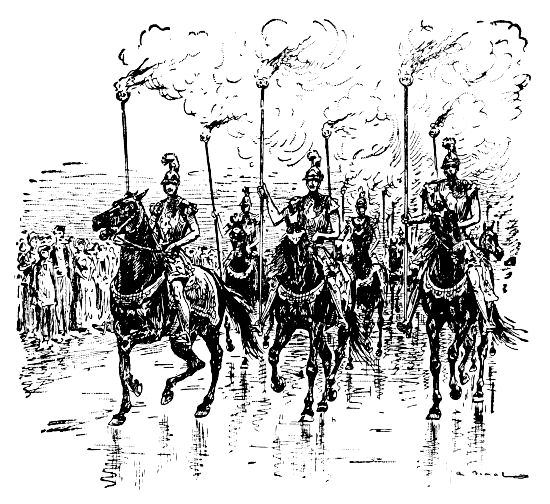
procession bearing torches was organized, which rode
through Dijon, led by a band of music.
Knights in shining armor, mounted on magnificent
horses, handed out bills telling of a big performance
for the next evening and giving the program.
The whole town was abroad to see and admire this
strange sight. Men, women, children, all came out to
meet them. It was a grand spectacle. Everybody
wanted a program. Just imagine a procession of elephants,
decked with gold and silver, a hundred and
fifty horses, some ridden and some driven but all with
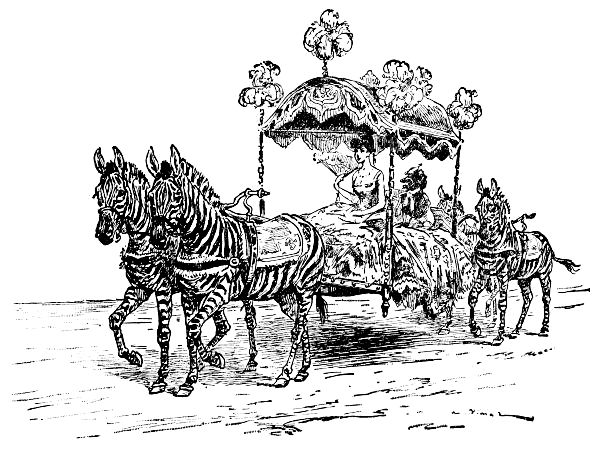
magnificent harnesses, dromedaries, parade chariots
shimmering with gold and gleaming with precious
stones, and all these lighted up by flaring torches.
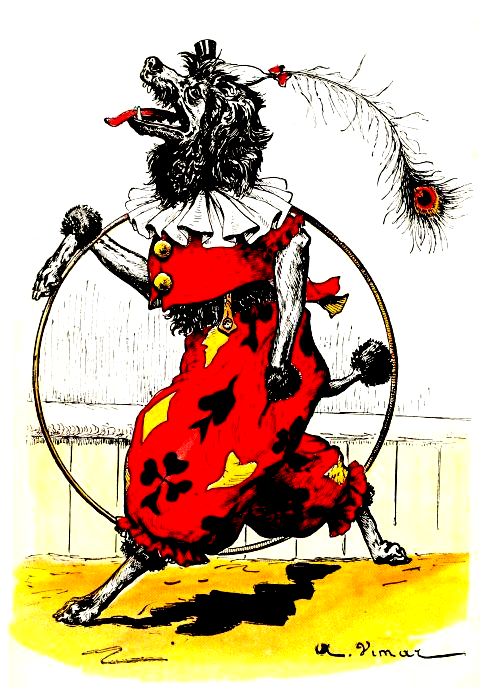
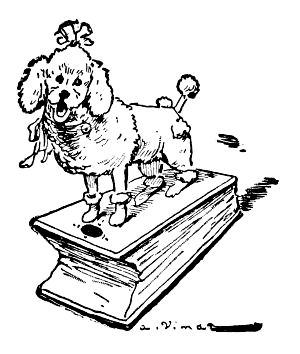
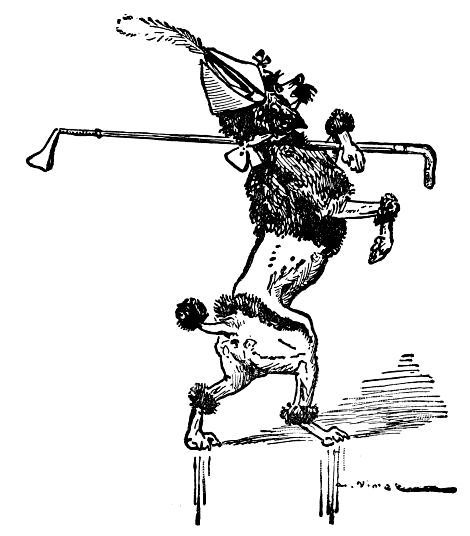
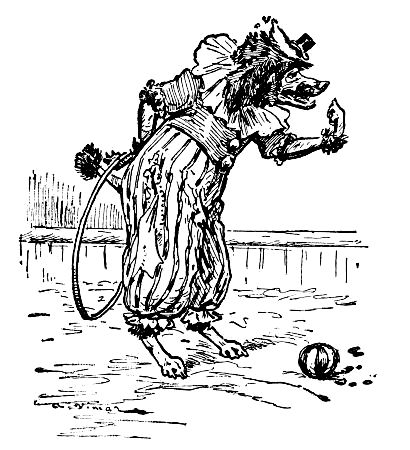
Clown had been dressed up for the occasion with
yellow ribbons, a color which suited his black coat to
perfection. Seated beside his new mistress he was
radiant upon a canopied chair of gold borne by four
zebras.
After going through the principal streets the troupe
at last came back to camp to rest for the night, still
followed by a vast crowd who did not think of sleep
until long after the circus fires were all out.
The night was calm, but at daybreak, as on the preceding
day, the noise in the camp started again, perhaps
even a little louder this morning on account of
the rehearsal which was to take place in preparation
for the evening's performance.
Clown, always very curious, was present at all the
rehearsals and enjoyed them thoroughly—so much,
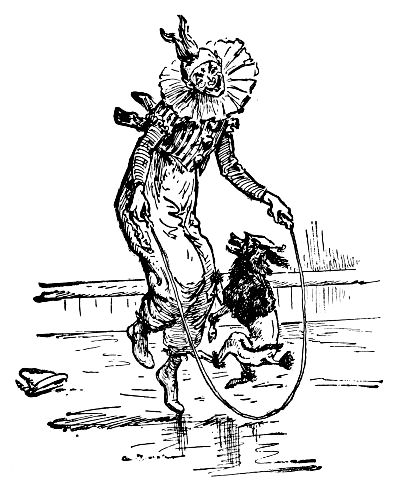
indeed, that he suddenly joined in and showed how
well he could skip. Then he wanted to jump over and
through everything. At last he got so excited that
Reine made him take a nice hot sugar-drink with a
little orange flower in it to calm him.
After this, Clown was considered one of the troupe.
Always on the watch, our doggie learned at breakfast
that three days hence they were to go to Fontainebleau,
where they were to give two performances, and
after that they were to set off for Paris, so as to arrive
in time for the opening of the big festival at Neuilly.
This made him so happy that for the moment he
quite forgot to eat. Then, hope in his soul and joy in
his heart, he made up his mind to do his very best at
the next performance. He wanted to make all the
people admire him, to do something that would repay
Reine and her father for their kindness. Perhaps, too,
he hoped that by acting in this way he might get
talked about and get his name into the papers. Man
is vain and even a dog has his pride. His fame might
perhaps reach Bertha, his dear, tender, much-regretted
mistress. All this made him very serious when at last
the time for the performance arrived.
Beneath an immense tent, brilliantly lighted,
decorated with garlands of foliage and flowers, the orchestra
struck up a joyous march.
Immediately the doors were flung open, and to the
sound of the music a great crowd poured into the huge
tent and took seats.
For about an hour and a half the menagerie held the
floor. Then the animals were put back into their
cages. The wild beasts were obedient and rebellious in
turn; whips sounded continuously. The noise of
squibs, firecrackers, and growls almost drowned the
orchestra.
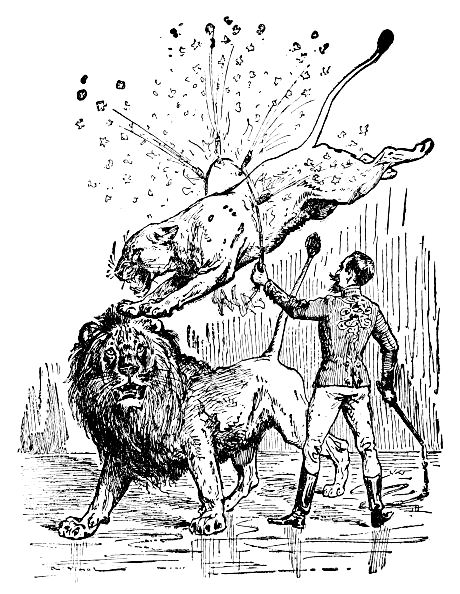
Three times did the tamer put his head into Sultan's
great mouth. The excitement of the audience was
tremendous. They really thought he was done for.
"Enough, enough," was heard on all sides, and amid
a thunder of applause, the first part of the performance
came to an end.
Then came an interval of ten minutes.
Soon the second part was announced by a cheerful
burst of music and the mad entrance of the clowns.
Our Clown only waited for this moment to show off his
talents, those already known and those nobody had
ever seen before. He entered barking, in a series of
wild leaps exactly like those of his companions. It
was then that an artist in the troupe, astonished and
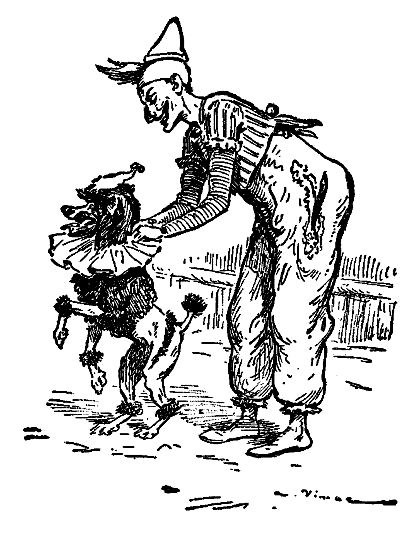
enthusiastic, took off his clown's collar, and then and
there put it round the neck of the poodle, naming him
the "Dog-Clown."
So, for the second time, although until then they had
not known what to call him, he received the name of
Clown—"Dog-Clown."
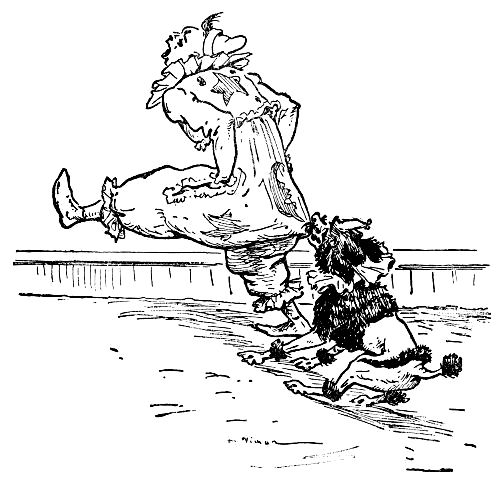
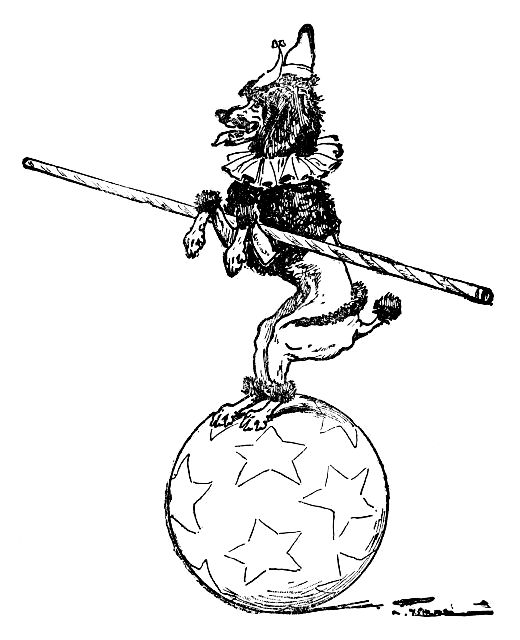
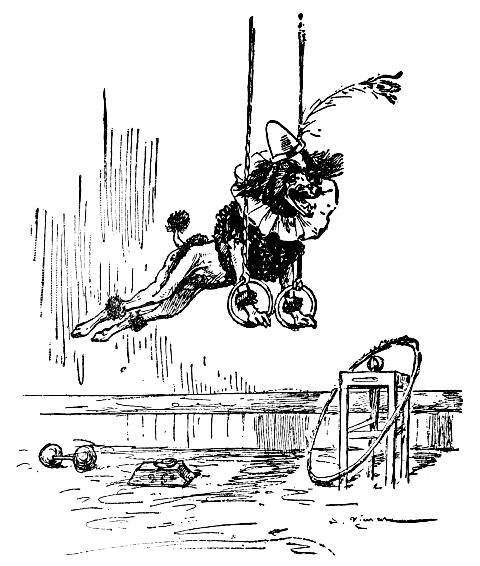
During the first number, Clown set to work to copy
all the fun-making tricks of the other clowns, and
succeeded wonderfully well. Jumping through hoops and
over barrels, he gave himself up to the pleasure of the
thing; pleasing everyone so well that they clapped
and clapped until he came back several times.
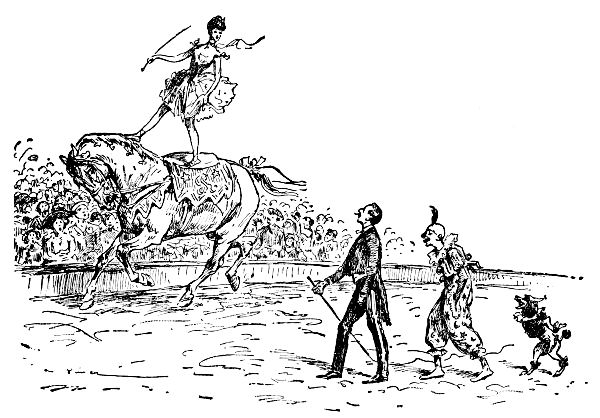
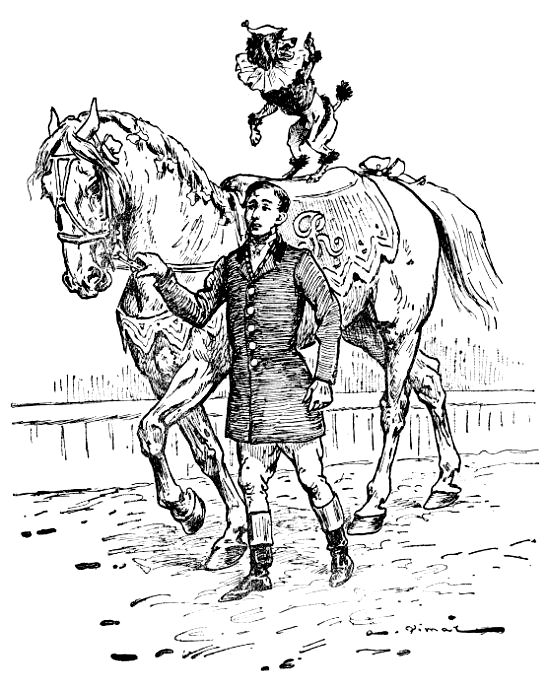
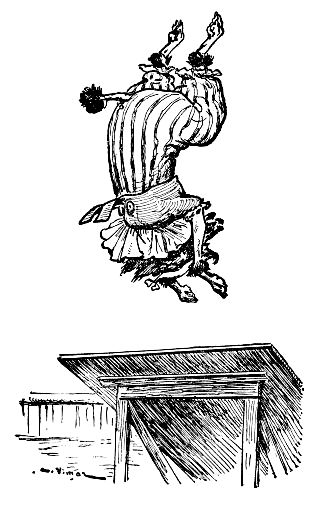
When the second number was called, there appeared
on the scene a very handsome horse led by a groom
dressed in the latest fashion. No sooner had they
entered than they were followed by Clown, who, as
he had seen done at the rehearsal, leaped with one
bound into the saddle. They had great difficulty in
coaxing him down. He could not see that this was
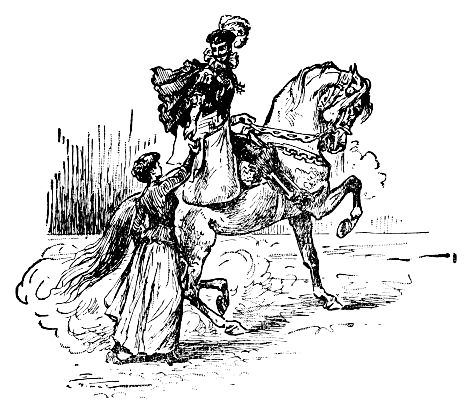
not the place for him. Reine, beautifully dressed in a
blue spangled gown, was placed with her father, in
the saddle and set off at a gallop, to the sound of music
and the gay cracking of the whip.
A clown joined the groom and Dog-Clown, who in
spite of everything had remained on the scene, began
to limp along behind them, to the great amusement
of the spectators.
He was the success of the evening. He even, it is
said, caused some jealousy among the artists of the
troupe. Thus from the very beginning Clown felt the
thrill of stage life and became a privileged actor.
Petted and adored by the public, he became so
important that he hardly ever appeared on the scene
until the end of the first and second numbers, a place
reserved always for the stars of the troupe.
As was fitting, Dog-Clown had the place of honor on
the circus posters. Sometimes he was a groom,
sometimes a clown, but he did not stop there. He succeeded
in showing that he was a mimic, and in a little play
written for him by the manager, he made a huge success.
Reine, who introduced Clown, shared the
applause with her favorite.
Between whiles—and this was what astonished the
company most—the dog invented unexpected and
novel entrances. He gradually became a part of the
circus life, and always watching what was going on
around him, he was cute enough to make a place for
himself in every number, and the tricks he played
were so funny that everyone howled with laughter.
When the circus left Dijon, the people of that town
were heart-broken. The mayor himself even begged
that the manager give a few more performances. In
vain. The manager was sorry, but time pressed; he
had made arrangements for a certain date at Fountainebleau.
When Dog-Clown appeared for the first time in
public in this town, even before he began he received
such a welcome that he was moved to tears. The
people had heard all about him and were wild to see
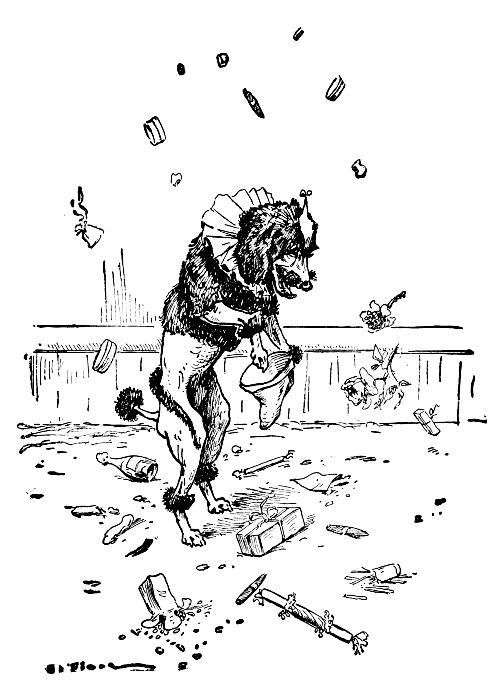
him. In a moment the stage was covered with a mass
of good things, thrown to him from all parts of the
house, from the nearest seats to the farthest. Some
threw sugar, some cakes; the clown even picked up
cigars and oranges.
Dog-Clown, by way of thanks, gave such a performance
as even he had never given before. His success
was almost unbelievable. At last so great did his
fame become that the Paris papers took it up, giving
long accounts of this wonderful dog.
Clown was glad to be on the road again, for each
move brought him that much closer to Paris. Besides,
now that he was an important member of the company
he always rode in state beside Reine, with velvet
cushions to nap on if he chose.
It was late in the afternoon when they reached
Fountainebleau, so no performance was given till next
day, and the animals had a needed rest. Clown spent
his time in thinking up new tricks with which to surprise
the people who came to see him.
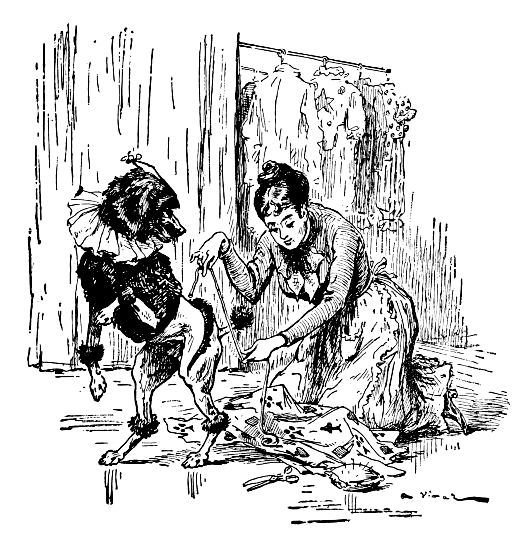
I must tell you that, as soon as Clown had shown
what an artist he was, and how wonderfully he could
adorn a collarette, the management had attached to his
person a dressmaker who made for him all sorts of
quaint costumes.
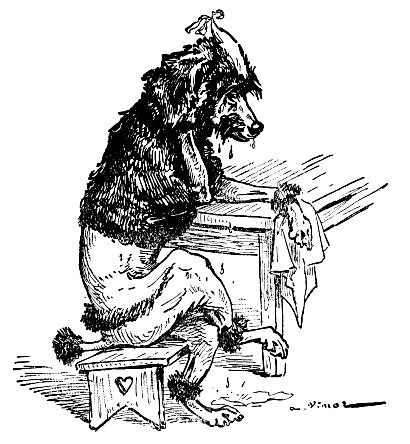
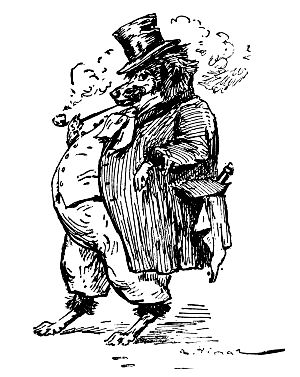
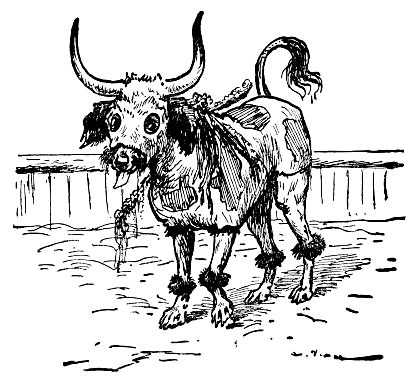
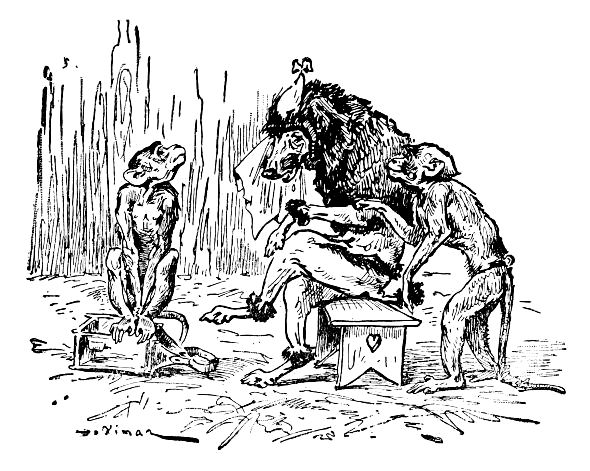
Soon he had a rich and thoroughly equipped wardrobe,
from a frock-coat to a bull's skin and horns, a
costume which he wore to act the bull in a mock bullfight
in which young dwarfs figured as matadors and
teased him.
5 THE RETURN HOME
Meantime Clown was growing tired of his popularity.
The fame, the applause of the friendly public, the
pleasure he felt in knowing that Reine and her father
were doing a fine business, the liberty he enjoyed, the
honors paid him daily, all these worldly vanities
flattered his pride, but neither success nor his pleasant
relations with the members of the troupe could make
him happy.
He was always longing for his dear mistress Bertha.
Often in the night, overtaken by a horrible nightmare,
he would wake with a start, not knowing where he
was. Like many other artists, comic on the stage, he
was silent and gloomy away from it.
After three big performances, given one after the
other, without counting rehearsals, some of the most
important members of the menagerie became ill, owing
to the heat and their hard work. It was the animals
who suffered most. For two days Sultan, whose appetite
was usually hard to satisfy, had refused his food—a
thing hitherto unheard-of.
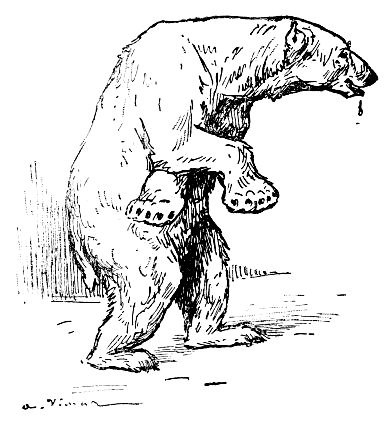
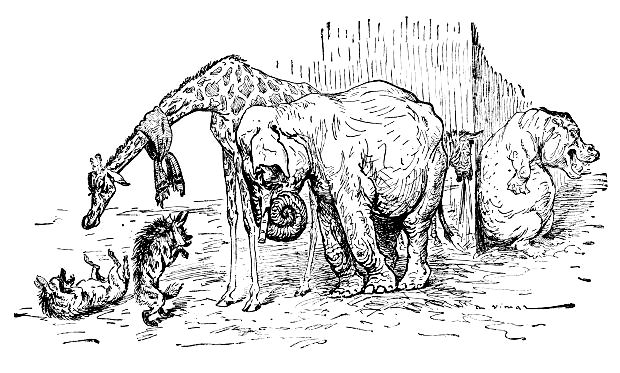
One of the white bears complained of terrible colic;
the llamas sneezed continually; Hercules, the giant
elephant, with trunk rolled up like a snail, could
hardly stand upright; a giraffe trumpeted; the hippopotamus,
"Poivro," stung by mosquitoes, scratched
himself till his cage shook. From the hyena-cage came
forth dismal howls; two of the poor creatures, down
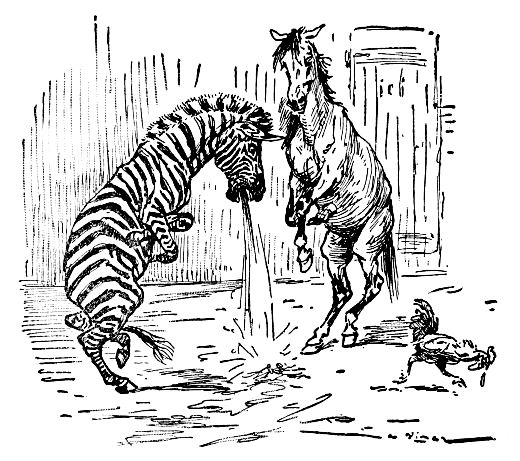
with toothache, were rolling about in agony. Several
horses, a zebra, and a rooster all felt very far from
well.
The truth was the whole troupe was worn out. The
manager, too, felt that a rest was absolutely necessary
for all of them. Everybody agreed that the director
should announce to the public, giving any reason he
chose, that for the next forty-eight hours there would
be no performances.
No one was allowed even to visit the menagerie. It
was only after much delay and because he begged so
hard that one stranger was admitted. This was a
reporter from one of the important Paris newspapers,
who, having heard by the many-tongued mouth of
rumor of the queer tricks of Dog-Clown, was most
anxious to see the dog for himself, and if possible to
learn all about him, for he wanted his paper to be
the first to tell the people of Paris the true story of
this wonderful dog.
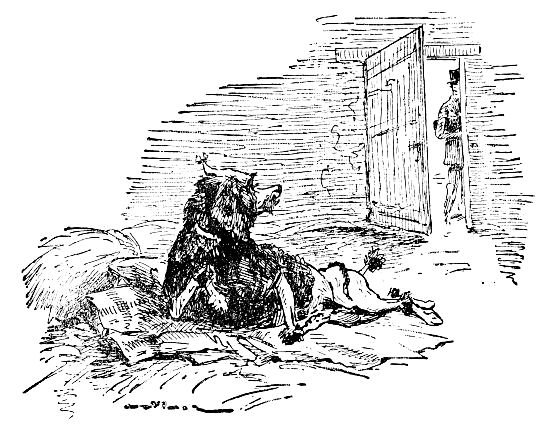
At the time Clown was resting on a pile of blankets;
although he seemed to be asleep he was listening to
the conversation, for like a policeman, he always slept
with one eye open. As soon as he realized what it was
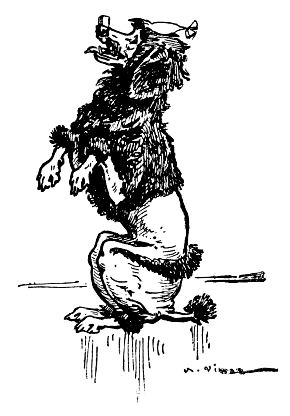
all about, he got up on his hind legs and went straight
to the reporter, understanding probably how much
what the newspaper said might help Bertha to find
him.
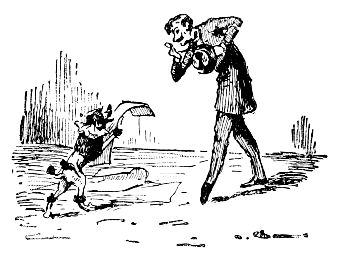
He was polite as he could be to this reporter and
took great pains to show off before him, and—this
was really a flash of genius—succeeded three different
times, using as his letters the print on a rolled
placard lying near him, in putting together the word
"B-E-R-T-H-A," by placing his foot on the letters in
the right order.
Greatly puzzled as to what it could mean the
reporter wrote down on his tablet the word Clown
had spelled. He could not help being surprised by
this strange sign of intelligence. He bowed respectfully
to this strangest of all subjects for interview, and
as he left him he said gravely:
"Delighted to have met you, my dear sir."
Clown returned his bow, no less politely. He felt a
trifle proud, perhaps, but he was charmed to have
made himself understood by a human being.
I leave you to imagine, dear friends, what a stir was
caused by this article which appeared on the front
page of the paper. It was headed:
DOG-CLOWN, OR THE DOG WITH A BRAIN
It gave details of Clown's wonderful tricks—it
described them as simply beyond belief—and ended
by calling upon men of science to come and see for
themselves this curious, this strangely gifted dog.
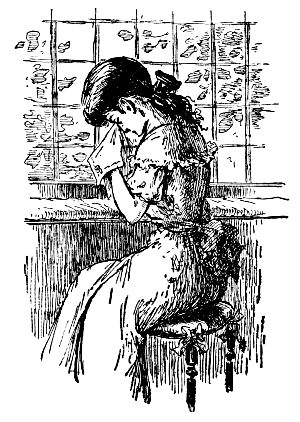
That day Bertha, who since the moment of Clown's
disappearance had not ceased to mourn for him and
to seek him everywhere, was even sadder than usual,
having at last given up hope of ever seeing him again,
now that all her attempts had ended in failure.
At noon her father came home to lunch as he generally
did. She ran to meet him and was struck by his
jovial manner. She guessed something pleasant was
in the air.
"You have good news, father dear?" she said.
"Well, I think so, but don't make too sure yet. I
really do think though that we have found your dog."
Bertha turned
pale and nearly
fainted for joy.
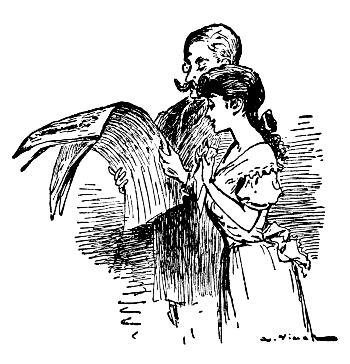
Her father read
her the article and
when he came to
the part where the
journalist told how
the dog had
spelled, without a
doubt, the name
"Bertha," she
cried:
"There's no
doubt about it! It is—it is my dog. Let's go—let's
go at once and get him!"
Two hours later the express train going at its fastest
to Fontainebleau, bore Bertha and her father and
mother.
There was a matinee that day. When Bertha and
her family took places beside the ring the performance
had already begun. The wild animals had been
shown and the second part of the performance
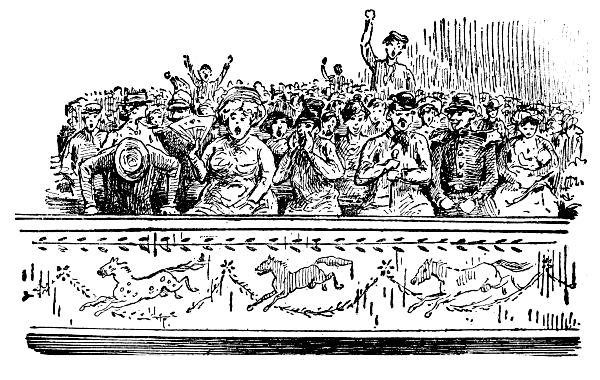
announced the appearance of Dog-Clown. This clever
individual kept them waiting a moment or two to
enhance the importance of his entry. The audience
began to grow impatient, cries of "Dog-Clown, Dog-Clown!"
were heard repeatedly.
It was a critical moment.
The father, the mother, the daughter sat motionless,
wide-open eyes glued to the door through which
he would come.
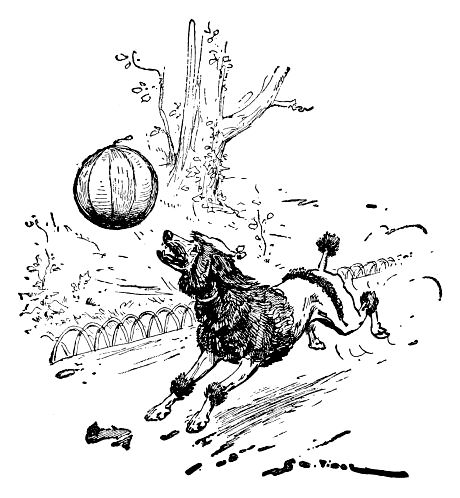
Like a ball which, vigorously hurled, bounces on the
pavement, Dog-Clown in a succession of wild leaps
went rapidly round the arena.
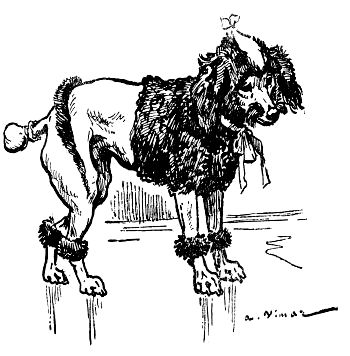
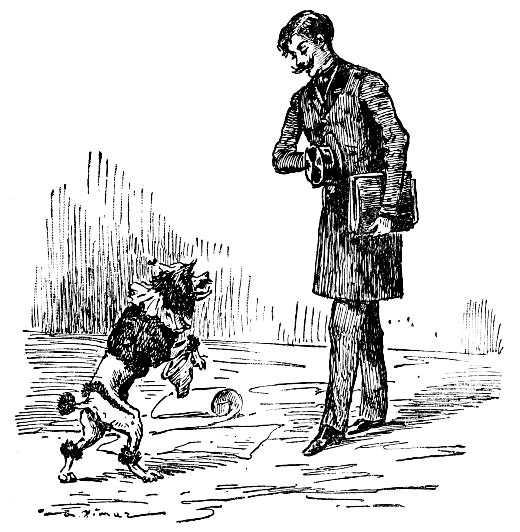
It was impossible to see his face, especially as he
was all dressed up and powdered.
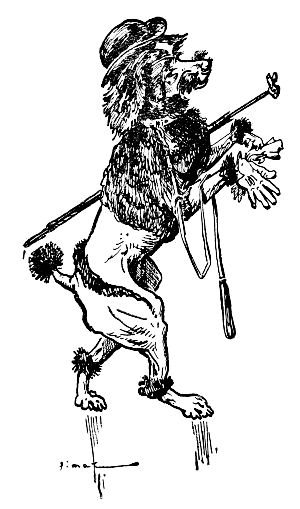
Having finished his first act, he went to the center
of the stage, and there standing on his hind legs made
his bow to the audience.
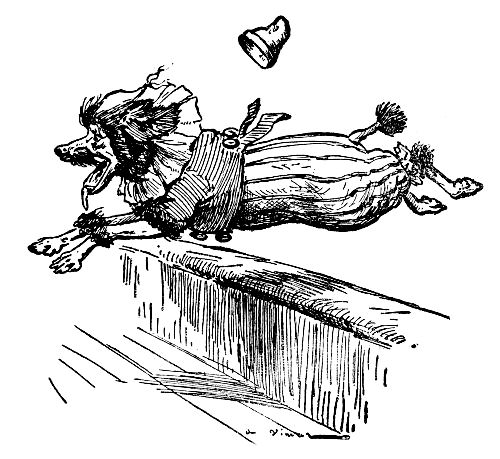
One sniff and he had recognized his owners.
It was like a flash of lightning. Next instant he
had hurled off his clown's hat and leaped at them like
a mad thing. He bounded over benches and fell, eyes
full of tears, whimpering softly, into the arms of
Bertha, who held him trembling and sobbing.
For a long time they clung to one another. This performance
amazed the public; the circus people thought
at first that this was just one of Clown's mad tricks—to
which they were growing accustomed—but soon
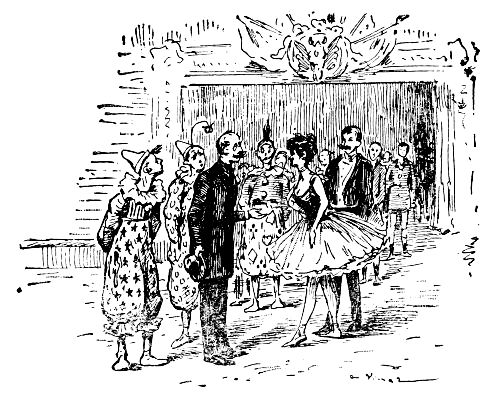
the truth was known when Reine, surprised and
anxious, came forward and asked for an explanation.
"Mademoiselle," said Bertha's father, "I am
extremely sorry to interrupt the performance, but, as
you see, the dog is ours. He was stolen from us. There
is no doubt at all that he is our dog, and I demand
that the manager give him back to us at once."
His decided tone convinced the young girl.
"As we are honest people," she said in her turn,
"and so that you may not think that we stole him, as
you seem to suggest, I will tell you how, three weeks
ago, he became one of us."
Thus begun, the conversation was continued in a
friendly way. True, a policeman was called, but only
to inform the audience, at the manager's request, of
the adventures of Dog-Clown who had delighted them
all.
Reine wept for the handsome poodle who would now
no longer be with her on her travels, and there was
weeping and wailing in the menagerie, when his comrades
heard the news, for all the animals loved Clown.
This last scene was so affecting that the audience
itself, moved to tears, made no complaint.
It's a sad thing but true, alas, that what brings
happiness to one brings sorrow to others.
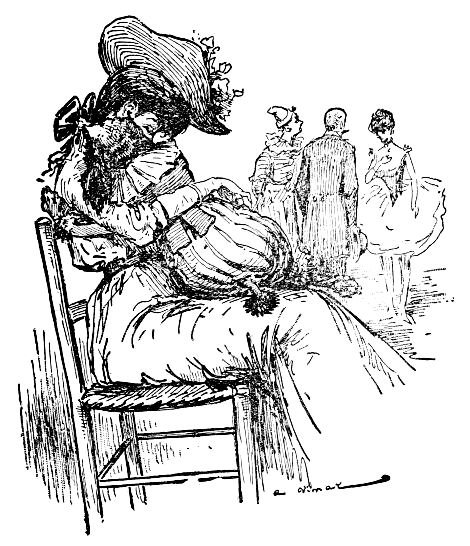
Bertha was too happy and this time too anxious, to
leave Clown any longer, even in the midst of these
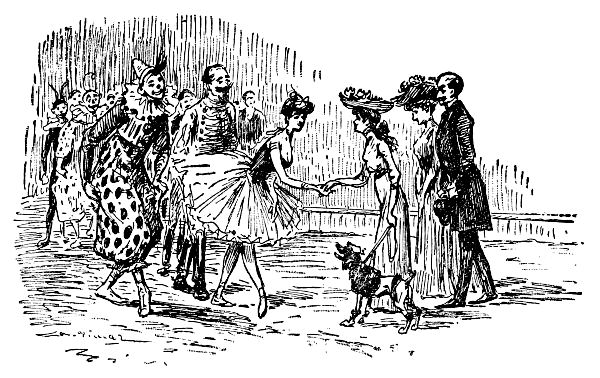
kind circus people. She thanked them warmly for the
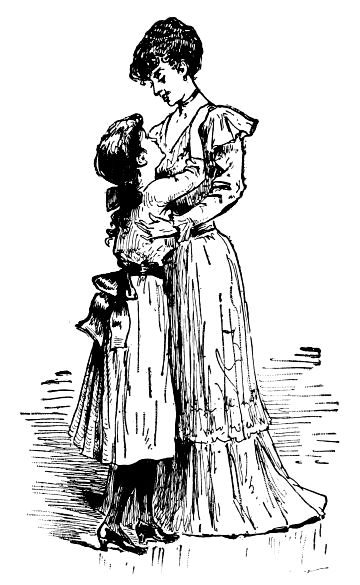
good care they had taken of her dog, Mademoiselle
Reine especially, whom she kissed very sweetly. She
promised, too, to take Clown to see her as soon as they
reached Neuilly, and giving her address, begged the
young girl to come to visit her in Paris.
After this Bertha departed in haste, hardly giving
Clown time to say good-bye to his best friends and
comrades, all of whom wept at the parting.
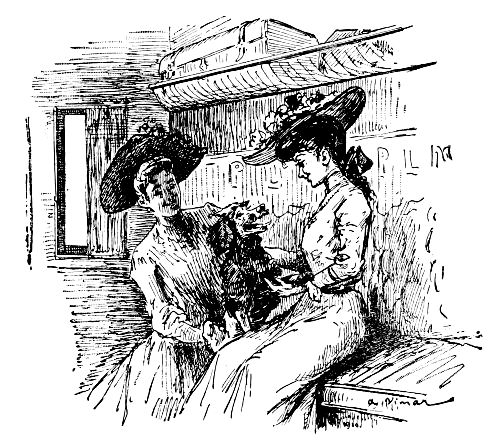
That evening four joyful travelers took the train
for Paris. During the trip, Clown, seated on the
cushion between Bertha and her mother, his head
against the shoulder of his dear mistress, gazed at her
with moist, affectionate eyes. Licking her hands, wagging
his pompom of a tail, and uttering plaintive little
cries, he tried to tell her about all his past sufferings
and his present happiness.
Who could describe Clown's joy when he reached
home after his long journey, when he saw his own part
of town, his own house, his own room, where once
again he would have lovely naps and dream golden
dreams?
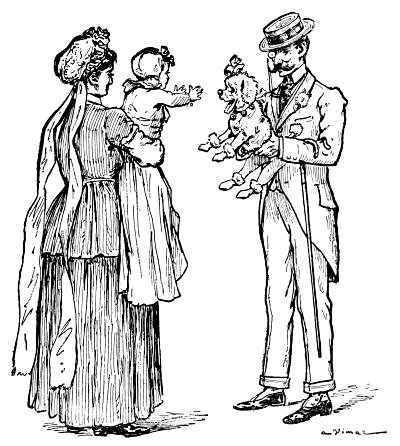
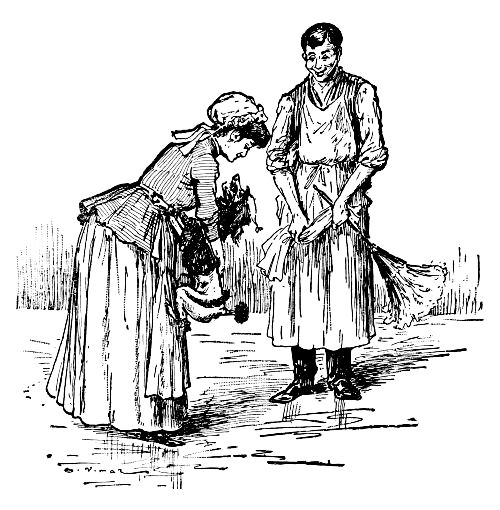
When he caught sight of Marie, he jumped into her
arms like a child. Marie burst into tears and could
not utter a word of reproach. He leaped all over the
footman, and did not forget even the cook. Then,
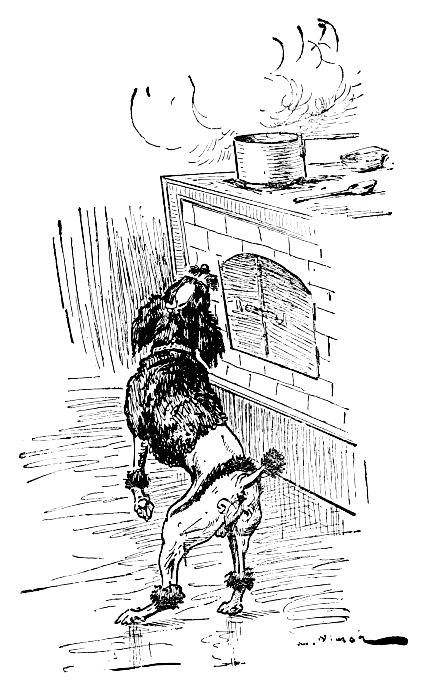
smiling to himself, he went off to see what they were
to have for dinner—and seemed well satisfied.
In a word, he took up once more his happy family
life, full of delightful things: pleasant strolls with
Marie, delightful wanderings with Bertha, caresses
lovingly given and returned.
From this memorable day, Clown, who had learned
his lesson, and grown wise by experience, was the
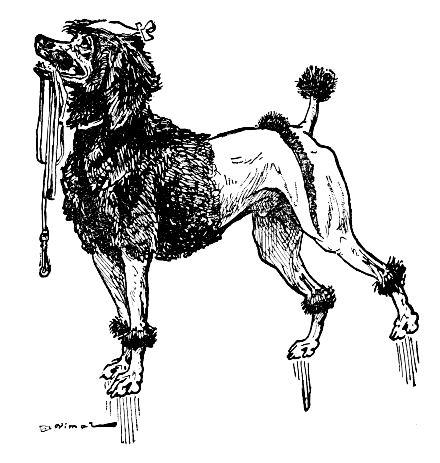
first to bring his leash when it was time to go out.
He would carry it triumphantly in his mouth as if
to say, "Don't let's forget it!" For nothing in the
world could you get him to venture alone upon the
streets.
At the present time Clown is perfectly happy. His
adventures are all in the past.
Now that he no longer has anything to worry him he
is getting fatter and lazier, but he is always ready for
a frolic with his beloved mistress, Bertha. I am sure
that very few people who meet the contented dog and
his devoted mistress have any idea that this is the
famous Clown.
As to the moral of this story, you have understood
it, I am sure; but don't forget it, dear little readers.
If you don't take the wise advice of your parents you
are likely to suffer. Just because he didn't obey his
little mistress, Clown, in spite of all his intelligence
and wit, was very nearly lost forever.
Advertisement:
The Famous Oz Books
The Christmas Stocking Series
Six beautifully made books designed for little children, with a charming
introduction written especially for the series
By L. Frank Baum
The Titles are:
* The Story of Peter Rabbit
Little Black Sambo
The Night Before Christmas
Cinderella and the Sleeping Beauty
Fairy Tales from Grimm
Fairy Tales from Andersen
The cover of each book has an appropriate panel, painted by Emile A. Nelson, set in a
beautiful gold design of holly-leaves and berries on a scarlet background. Every volume
contains from fifteen to twenty-seven full-page pictures in colors, besides from twenty to
forty black-and-white illustrations. Large, clear type, fine paper; fancy end sheets and
specially drawn pictorial title page in colors.
18mo. 128 pages. Fancy scarlet and
gold binding, with multi-colored inlay.
Price 25 cents per volume
TWO VOLUME SETS BOXED AS FOLLOWS
Set
I |
{
{ |
The Story of Peter Rabbit
Little Black Sambo |
|
Set
II |
{
{ |
The Night Before Christmas
Cinderella and the Sleeping Beauty |
Set
III |
{
{ |
Fairy Tales from Andersen
Fairy Tales from Grimm |
Put up in fancy boxes
Price 50 cents per set
Six Volumes in Display Box
Price $1.50 per set