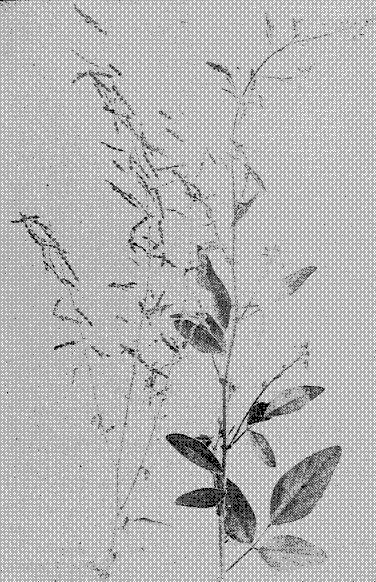
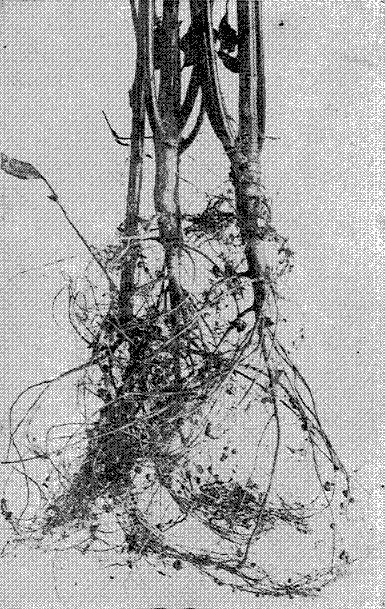
ALFALFA
Alfalfa (Medicago sativa) previous to its introduction
into California, from Chili, about the middle
of the last century, was usually known by the
French name Lucerne. The name Alfalfa is probably
Arabic in its origin, and the term Lucerne has
probably been given to it from the Canton Lucerne
in Switzerland. It has followed the plant into
Spain and South America, and now it seems probable
that soon it will be known by no other name
over all the United States and Canada. It has also
been known by names applied to it from various
countries for which it has shown high adaptation,
as, for instance, Sicilian Clover, Mexican Clover,
Chilian Clover, Brazilian Clover, Styrian Clover and
Burgundy Clover. In yet other instances, names
have been applied to it indicative of some peculiarity
of growth, as, for instance, Branching Clover, Perennial
Clover, Stem Clover and Monthly Clover.
Alfalfa is upright and branching in its habit of
growth, more so than the common varieties of clover.
It usually grows to the height of 2 to 3 feet,
but it has been known to reach a much greater
height. Although possessed of a single stem when
the plants are young, the number of the stems increases
up to a certain limit, with the age of the
plants and the number of the cuttings. Forty to
fifty stalks frequently grow up from the crown of
a single plant where the conditions are quite favorable
to growth, and in some instances as many as
a hundred. The leaves are not large, but numerous,
and in the curing of the plants they drop
off much more easily than those of the more valuable
of the clovers. The flowers are borne toward
the top of the stems and branches, and they are in a
long cluster, rather than in a compact head. They
are usually of a bluish tint, but the shades of the
color vary with the strain from blue to pink and yellow.
The seeds are borne in spirally coiled pods.
They resemble those of red clover in size, but are
less uniform in shape. The color should be a light
olive green. The tap roots go down deeply into the
soil and subsoil where the conditions as to texture
and moisture are favorable. It has been claimed that
alfalfa roots have gone down into congenial subsoils
40 to 50 feet, but usually less, probably, than
one-fourth of the distances mentioned would measure
the depths to which the roots go. And with
decreasing porosity in the subsoil, there will be decrease
in root penetration until it will reach in some
instances not more than 3 to 4 feet. But where the
roots are thus hindered from going deeper, they
branch out more in their search for food.
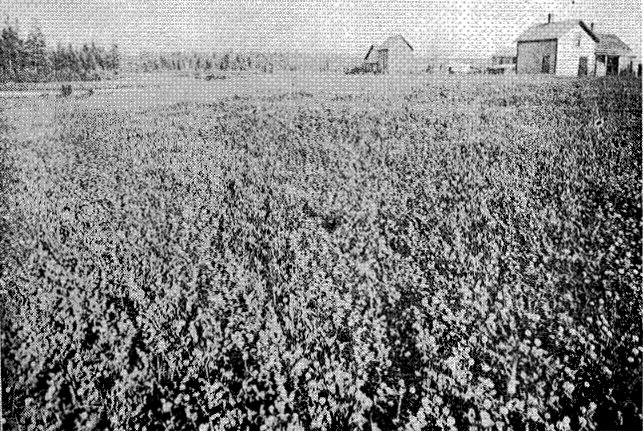
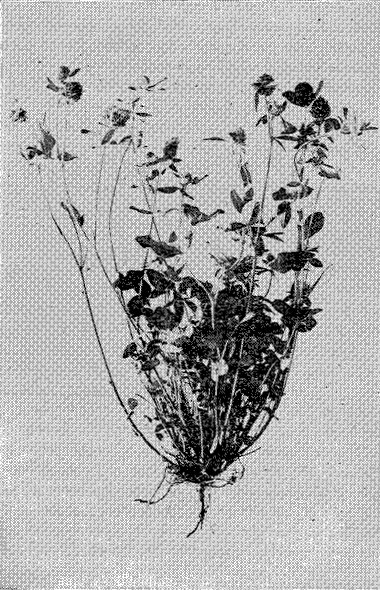
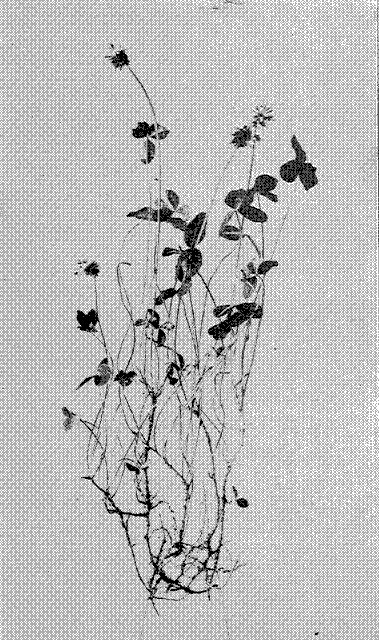
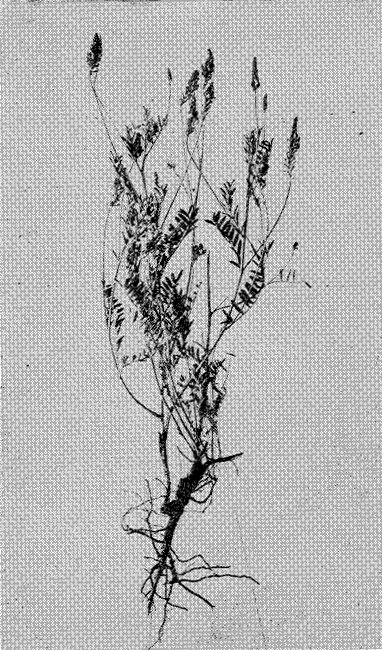
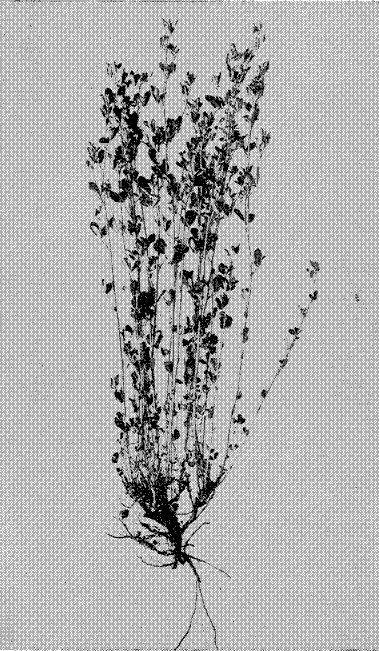 Fig. 3. Alfalfa (Medicago sativa)
Oregon Experiment Station
Alfalfa is perennial. In the duration of its
growth, no fodder plant grown under domestication
will equal it. It has been known, it is claimed, to
produce profitable crops for half a century. In some
of the Western States are meadows from 25 to 40
years old. Ordinarily, however, the season of profitable
growth is not more than, say, 6 to 12 years
when grown on upland soils. The meadows usually
become more or less weedy or possessed by
various grasses, and some of the plants die. The
plants at first send up a single stem. When this
matures or is cut back the uncut portion of the stem
dies down to the crown of the plant, which then
sends out other stems. This is repeated as often
as the stems are cut down until many stems grow
up from one plant as indicated above, unless the
plants are so crowded that such multiplication is more
or less hindered. The plants grow rapidly as soon
as spring arrives, and as often as cut off they at
once spring again into vigorous life, where the conditions
are favorable to such growth; hence, from
one to twelve cuttings of soiling may be obtained in
a single season, the former result being obtained in
arid climates, where the conditions are unpropitious,
and the latter being possible only in congenial soils,
where the winters are very mild and where the soils
are irrigated. Usually, however, even on upland
soils and in the absence of irrigation, not fewer than
3 to 5 cuttings of soiling food are obtained each
year and not fewer than 2 to 4 crops of hay.
A number of varieties so called are grown in
this country. They differ from each other more,
however, in their adaptation in essential properties
relating to the quality of the pasture and fodder produced,
than in the quality of food product obtained
from them. The variety commonly grown from
seed produced in the West is usually spoken of
simply as alfalfa, while that grown from seed European
in origin has been more commonly called
Lucerne. The former of these has a tendency to
grow taller than the latter and to send its roots down
to a greater depth. In addition to these, such strains
as the Turkestan, the Rhenish, the Minnesota and
Sand Lucerne have been introduced.
The Turkestan variety was introduced by the
United States Department of Agriculture during
recent years. It was brought from provinces beyond
the Caspian in Russia, Asia. The object
sought was to introduce a variety that would better
withstand the rigors of a climate dry in summer and
cold in winter than the variety commonly grown.
Some strains of this variety have proved drought
resistant to a remarkable degree. It has also shown
itself capable of enduring without injury temperatures
so low as to result in the destruction of plants
of the common variety. In trials made by growers
in North Dakota and Northern Minnesota, it has
been found able to endure the winter's cold in these
areas. But it has also been found that while the plants
produced some seed in the Central Mountain States,
they did not produce much seed when grown in the
Northern States. Unless seed can be secured from
plants grown in the latter in sufficient quantities to
meet the needs of growers, it is feared that in time
some of the hardy characteristics of this variety will
be lost if the Central and Southern Mountain States
must be relied upon as the American sources of seed
supplies.
The Rhenish strain comes from Central Europe.
It has been highly commended by some European
seedsmen for its hardihood, but it has been as yet
grown to only a limited extent in America. The
Minnesota strain was doubtless brought to Carver
County by German farmers, by whom it has been
grown in the neighborhood of Lake Waconia for
nearly 20 years. It has been found much hardier
than the common variety when grown in that neighborhood,
and the endurance of plants grown from
seed of this strain far northward has been very
pronounced. As this variety produces reasonably
good seed crops in Central Minnesota, it
would seem reasonable to expect that it will become
popular in Northern areas. Sand Lucerne, which
comes from Central Europe, has considerable adaptation
for poor and light soils, and in trials made
at the Michigan experiment station was found possessed
of distinctive merit for such soils.
Where alfalfa can be grown freely, it is unexcelled
as a pasture for swine, and is in favor also
as a pasture for horses. While cattle and sheep
grazed upon it are exceedingly fond of it, the danger
that it will produce bloat in them is so frequently
present as to greatly neutralize its value for such a
use. It is a favorite pasture for fowls. In furnishing
soiling food where it produces freely, it is without
an equal in all the United States. It is highly
relished by all kinds of farm animals, not excluding
rabbits and goats, and when fed judiciously may
be fed in this form with perfect safety. Its high
value in producing such food rests on its productiveness,
its high palatability and the abundant nutrition
which it contains. As a hay crop, it is greatly
prized. Even swine may be wintered in a large
measure on cured alfalfa hay.
As a fertilizer, the value of alfalfa will be largely
dependent on the use that is made of the plants.
When pastured or fed upon the farm, the fertility
resulting being put back upon the land, it ranks highly
as a producer of fertility. But this question is further
discussed on page 191. As a destroyer of weeds
much will depend upon the way in which it is grown.
This question also is discussed again. (See page
185.)
Distribution.—It is thought that alfalfa is more
widely distributed over the earth's surface, furnishes
more food for live stock, and has been widely
cultivated for a longer period than any other legume.
It is grown over wide areas of Asia, Europe, North
and South America, and its cultivation is constantly
extending. It was grown on the irrigated
plains of Babylon long before the days of Nebuchadnezzar.
It was the principal fodder used in the
stables of the kings of Persia. From Persia, it is
thought, it was brought to Greece about 470 B. C.,
and that its cultivation in Italy began at least two
centuries before the Christian era. Several Roman
writers, as Virgil, Columella and Varro, mention it.
From Italy it was introduced into Spain and from
Spain it was doubtless carried by missionaries of the
Roman Catholic Church to Mexico and the South
American States which lie west of the Andes, as
Peru and Chili. In the arid and semi-arid regions
of the Andes, the conditions were found so favorable
to the growth of alfalfa that it is now the principal
forage crop grown. It is almost certain that it was
brought from Chili to California, from which it has
spread over much of the cultivated portion of the
arid and semi-arid west. Western grown seed is also
the chief source of supply at the present time for all
the States of the Union.
Fully a century ago attempts were made by Chancellor
Livingstone and others to introduce it into the
Eastern States, but without much success, owing,
probably, to the lack of knowledge on the part of the
people as to how it should be grown. The seed at
that time was doubtless brought from European
sources, probably France. It has been noticed by
more recent growers in these States that the results
from sowing such seed do not prove as satisfactory
as those from American grown seed, but that
alone should not sufficiently explain why the
attempts to grow alfalfa just referred to were not
successful.
But it is not alone in the areas named that alfalfa
has proved so helpful to agriculture. In Central
Asia and northward it has for long centuries furnished
the Tartars with the principal forage crop
grown. In Turkestan and other places it will grow
under conditions so dry as to forbid the vigorous
growth of many hardy grasses. In Southern Asia,
from India to Arabia, it has lost none of the popular
favor accorded to it long centuries ago. In
Southern Russia it is extensively grown, and up and
down the basin of the Danube. In the Mediterranean
provinces of Southern Europe it is still one
of the leading forage crops. In France it stands
high in the popular estimate, and also in some parts
of Germany. And even in humid England it is
grown more or less freely on dry, calcareous soils.
And the day is doubtless near when in many parts
of Africa, Australia, New Zealand and Eastern South
America this great fodder plant will be found capable
of yielding abundant harvests. In some parts of
Argentina it has been claimed that it grows like a
weed.
It is believed by many that alfalfa if exposed to
very low temperatures will perish and that it cannot
stand as much winter exposure as medium red
or alsike clover. This is only true of some varieties.
Other varieties, as the Turkestan, for instance,
will endure lower temperatures and more exposure
than the clovers named. Alfalfa has been
grown with some success at the government experiment
station, Indian Head, Sask, Canada, and yet it
sometimes winter kills in Texas. As with clover,
it is injured most by exposure to sweeping winds
blowing over it in winter when the mercury is low,
and the injury is more fatal just after the removal
of a snow covering and when the plants are young.
Ice forming over the fields after a sudden thaw
and remaining for a time is very liable to kill the
plants. It can stand considerably more summer
heat than any of the clovers grown northward, as
witnessed in the good crops grown in some parts of
Louisiana during the hottest weather of summer.
Nevertheless, with reference to temperatures, what
may be termed a mild climate, such as characterizes
Southern France in Europe and Western California
in the United States, is best adapted to its growth.
It is better adapted to climates that are dry, where
the plants can be irrigated, as then rains do not interfere
with the harvesting of the hay. Even in
the absence of irrigation, a climate that is reasonably
dry is preferable to one where drenching rains frequently
fall, which wash away the soil when sandy,
or which fill it full of water when composed of clay.
But where rains fall frequently and in moderation,
as in the northern Puget Sound region, the effect is
helpful to the growth of the alfalfa plants, although
it may add somewhat to the labor of making alfalfa
hay, and to the hazard in curing it. Alfalfa will
maintain its hold for years on some portions of the
table lands of the mountain States under conditions
so dry that the plants can only furnish one cutting of
hay in a season. It is safe to assume, therefore,
that alfalfa can be grown under a wider range of
climatic conditions than any other legume grown in
the United States. But the influence which climate
should be allowed to exercise on the use that is to
be made of it should not be lost from view. In climates
much subject to frequent rains in summer, it
should be grown rather for soiling food and pasture
than for hay, whereas in dry climates, and especially
where it can be irrigated, it should be grown
for hay, soiling food and pasture, but especially
the former.
While alfalfa can be successfully grown in one
or the other of its varieties in some portion of every
State in the Union, it has its favorite feeding
grounds. The best conditions for growing it are
found in the valleys of all the Rocky Mountain
States, where the growth can be regulated by the
application of irrigating waters. In these the conditions
southward are superior to those northward,
because of the milder climate, which precludes the
danger of winter killing by exposure, which occasionally
happens in the more northerly of the mountain States,
and because of the more prolonged season
for growth, which adds to the number of the
cuttings. This does not mean that the river bottoms
in other parts of the United States will not
be found good for growing alfalfa. It can be grown
in many of these; in fact, in nearly all of them, and
to some extent by the aid of irrigation, if the waste
waters were stored, but the deposit soil in these valleys
being of much closer texture than that in the
western valleys, is, on the whole, lower in adaptation
than the soil in the latter.
In the western valleys of the mountain States, alfalfa
is the crop around which it may be said that
agricultural production centers. It is the principal
hay crop of those States. The extent to which it
may be grown there is revolutionizing the production
of live stock on the ranges, as it is providing
food for them in winter, which is fast removing, and
will probably soon entirely remove, the element of
hazard from live stock dependent on the range pastures
for support in that season. The dairy and
swine industries in those valleys must largely depend
upon it. Fruit orchards must ultimately grow
on buried alfalfa meadows, and the rotation of all
crops in the same will be largely dependent upon
the growing of alfalfa. Next in adaptation to the
mountain States are, it is thought, certain soils that
lie between the Rocky Mountains and the Mississippi,
especially such as are in proximity to rivers, or are
underlaid with sheet water not far distant from the
surface. But an unusually large proportion of the
upland soil in these States, from Central Minnesota
southward, have high adaptation for the growth of
this plant. Particularly is this true of the soils of
Nebraska and Kansas and of considerable portions
of Missouri, Arkansas and Louisiana.
In States east of the Mississippi, the adaptation
is not so general, and is more dependent on soil conditions
than on those that are climatic. In nearly
all of the river bottoms of these States it will grow
with more or less success. On nearly all upland
soils it will also grow well, where the subsoil furnishes
naturally good drainage. For the exception,
see page 132. But in no State east of the Mississippi,
is such a proportion of the area so highly adapted to
growing alfalfa as in many of the States west of
that river. In other States areas are found in which
alfalfa will produce excellent crops, but usually
these do not embrace the larger portion of the entire
area in any State. In a considerable number of the
States such areas are more or less limited, and usually
they are distributed variously in the different
States; that is, they do not lie side by side. The
favorite soil conditions in these are a good loam,
preferably more or less sandy and resting upon a
porous subsoil.
A more exact idea will be given of relative adaptation
in various States in what is now submitted. In
California, Nevada, Utah, Colorado and New
Mexico, alfalfa is now grown chiefly by the aid of
irrigation, and all of these States have highest adaptation
for its growth. In some parts of California
6 to 10 tons of cured hay are obtained in one year,
with pasture in winter additional. In Utah, good
crops have been grown successively on the same land
for more than a quarter of a century. In Colorado
two cuttings are obtained the first season, and it is
said that there the plants are not easily destroyed.
It yields enormously in the irrigated valleys of New
Mexico and Arizona.
In Washington, Oregon, Idaho, Montana and
Wyoming, it is grown with and without irrigation.
In large areas in all these States, excellent crops are
and may be grown, but the season of growth being
shorter, not so many cuttings are obtained per year
as in the mountain States further south. In Northern
Idaho two cuttings may be obtained per year,
even on high, dry land.
In North Dakota, especially westward, alfalfa gives
promise of successful growth. It will grow well
in much of South Dakota, especially on sandy soils
not too distant from water. In Minnesota it has
been grown successfully in Carver County since
1886. Good success is being obtained from growing
it in other parts of the State, even in some parts of
the Red River valley. In Western Iowa it is being
grown with much success, and in some portions of
Eastern Iowa. In Missouri, the two important centers
for growing it are the northwest and the southeast,
but in other areas it has also done well. In
Kansas it will grow well in all parts of the State
where the subsoil is porous. It has been cut for hay
in that State in less than 60 days from the date of
sowing. It grows equally well over at least two-thirds
of Nebraska, especially the eastern half, and
its growth in Nebraska is rapidly extending. In
the Arkansas valley it luxuriates, and it is also being
grown in Oklahoma. In Louisiana immense
fields are being grown along the Red River and in
other parts of the State. In Texas it is being grown
more or less north, east and south, and especially in
the valley of the Brazos.
In the Southern States alfalfa has not in many
instances been given a good chance where tried. The
plants have too frequently had to contend there as
elsewhere with ill-prepared and weedy soils and imprudent
pasturing. Yet it is being grown with considerable
success, though as yet in limited areas, in
all the Southern States. It has done well in parts
of Kentucky, Tennessee, Mississippi and Alabama,
and in Georgia are some alfalfa meadows 25 years
old. In the other Southeastern States, viz., Virginia,
the Carolinas and Florida, it does well only
in areas more or less circumscribed, but it has been
grown with some success even in the rainy climate
of Southern Florida.
In the States northward from the Ohio River, that
is, Illinois, Indiana, Ohio, Michigan and Wisconsin,
the necessity for growing alfalfa has not been so
much felt as in some other States, because of the
excellence of the crops of clover grown in these.
Its growth, however, is extending in all of these
States. Much of the soil in Illinois, it is said, must
first be inoculated with the bacteria proper to alfalfa
before vigorous crops can be grown, and this is probably
true of sections of Indiana soil. Some sections
of Ohio are becoming noted for the crops of alfalfa
which they have grown, and in Wisconsin Hon. W.
D. Hoard succeeded in securing 5.7 tons of alfalfa
hay in one season from four cuttings made on
three-fifths of an acre.
In all the Eastern and New England States, alfalfa
is being grown to some extent. In some counties
of New York, as Onondaga and Madison, it is
becoming the leading soiling and hay crop. In
Massachusetts it has borne cuttings year after year on
sandy loam soil. On Long Island three to four
cuttings each season have been obtained for a series
of years. It is believed that it will grow over nearly
the whole of Southern Maryland and also in much
of the eastern part of that State, and its growth has
been quite successful in parts of Delaware and
Pennsylvania.
Alfalfa will grow well in considerable areas in
Canada. The statement would seem safe that at the
present time profitable crops could be grown in some
parts of every province of Canada in which the land
is tilled. In Quebec, even on high land, it usually
endures the winters. Near Montreal it has been cut
for soiling food at the height of 30 inches as early
as May 15th. In some parts of Eastern Ontario
good crops can be grown, and also over considerable
areas of Western Ontario. The author grew it with
much success at the experiment station at Guelph
in 1890 and subsequently, and during recent years
considerable areas are being grown in several of the
Lake Erie counties and in those that lie north from
them. But in no part of Ontario are the conditions
for growing alfalfa better than in some of the mountain
valleys of British Columbia.
But few crops, if, indeed, any, are being experimented
with at the present time to so great an extent
as alfalfa; hence, the expectation is reasonable
that there will be an enormous increase in the area
grown in the future that is near. The two chief
causes of failure in the past were want of knowledge
in growing and caring for it on the part of the
growers, and the absence of the proper bacteria in
the soil. Acidity in some soils and want of drainage
in others are also responsible for many of the failures
referred to. But even where it does grow reasonably
well, some trouble is found from the alfalfa
failing in spots. In some instances the cause can
be traced, as when coated with ice in winter, or
where the soil is not uniform, but in other instances
the precise causes have not been determined. Notwithstanding
these drawbacks, however, greatly increased
areas will be grown in the future, especially
in States in which the dairy interest is paramount
or even important.
Soils.—It was formerly thought by many that
alfalfa would only grow vigorously on soils and
subsoils sandy in character, and underlaid at some
distance from the surface with water. It is now
being ascertained that it will grow on a great variety
of soils, providing they are reasonably fertile, free from
acidity, sufficiently porous below to carry away water
with reasonable quickness, and not underlaid with
hard pan or a subsoil so tenacious that it is almost
impervious to water.
The best soils for alfalfa are those of the Western
mountain States, and in these the deposit soils of
the river valleys stand among the foremost. These
soils are usually of much depth. Many of them
have water underneath, and the subsoil is usually
so porous that the roots can go far down in them,
such is the character of nearly all the bottom land
west of the Mississippi. But in nearly all of the
mountain region of the West, from Banff in British
Columbia to Mexico, alfalfa will grow well under
irrigation, or in the absence of irrigation, if ground
water is not too distant from the surface. In this
region alfalfa grows more vigorously and more persistently
than in almost any other portion of the
United States.
In regions where alfalfa is not dependent upon irrigation,
the best soils probably are deep, rich calcareous
loams, clay or sandy, and underlaid with
what may be termed a mild or reasonably porous
clay subsoil. With such soils the plants may be in
no way influenced by sheet water below, as on some
of these in Nebraska, for instance, such water is
fully 150 feet below the surface. These soils are
usually possessed of abundant food supplies to
nourish the plants, and the roots can go far down
into the subsoils to gather food and moisture. Such
lands are found more or less in nearly all the States
of the Union east from the Rocky Mountains; hence,
when the requisite bacteria are present, good crops
can be grown on them in every State in the Union.
On the ordinary black soils of the prairie, alfalfa
will usually grow reasonably well if underlaid with
clay not too distant nor too tenacious. When the
roots get down into the subsoil, they can usually
find much food in the same, and unless in very dry
areas a sufficiency of moisture, but in many instances
it may be necessary to introduce the requisite bacteria,
and to apply farmyard manure to encourage
sufficient growth to carry the roots down quickly to
the subsoil. In some prairie soils the growth will
be vigorous from the start, but usually these are
lands that have grown hardwood timber, and that
have in them more or less clay.
In climates where the rainfall is considerable, alfalfa
will frequently grow well on gravelly soils and
on those that are stony. Some of the best alfalfa
soils in the State of New York, New England
States, and in the Canadian provinces of Quebec
and Ontario are of this character.
Alfalfa will frequently grow fairly well even on
stiff clays, and in some instances on gumbo soils.
But these soils must not be so retentive as to collect
and hold water for any considerable time within
a few feet of the surface. Such lands have usually
much staying power; hence, alfalfa grown on them
frequently improves for years after it has been sown.
On the reddish soils that cover much of the South,
it has been found, as in growing alfalfa on stiff
clays in the North, that where deep subsoiling is
practiced alfalfa is not only more easily established,
but it also grows with added vigor.
On upland soils sandy or gravelly in character
where the rainfall is much less than normal and
where the subsoil is not underlaid with sheet water,
alfalfa will not usually succeed, notwithstanding
that it may grow well on these soils where the rainfall
is normal. On such soils it is not easy to get
a stand of the plants, as they are much apt to perish
in the dry weather of the first season, but if once
established on such soils the plants have much power
to grow even where the rainfall is considerably less
than normal.
Alfalfa will not grow well in soils naturally wet
until they are drained. And when drained it will
not grow with normal vigor, on what may be termed
slough soils, where the subsoil is far down and covered
with a deep covering of vegetable mold. What
are termed slough soils in the Western prairies, therefore,
are not well fitted for the growth of alfalfa. On
these it may not succeed well, when it may grow with
much vigor on the adjoining upland. When some
wet soils are drained, alfalfa may not succeed well
on them for a time and later may grow luxuriantly.
This may arise from the lack of time for proper
aeration after being drained, or from the want of
lime to further correct acidity in the soil, or from
the want of the proper bacteria. Notwithstanding
that alfalfa will not grow well on undrained lands
that are naturally wet, and notwithstanding that it
will perish if the roots reach standing water at a distance
too near the surface, the best crops by far are
usually grown on irrigated lands. This arises, first,
from the ability to adjust the supplies of water to
meet the needs of the plants, and second, from the
congenial character of the soil and subsoil. Next
to these the best crops are grown where congenial
soils are underlaid with ground water, not too near
nor too distant from the surface. On these soils the
plants are largely supplied with moisture from the
water below ascending on the principle of capillary
attraction. How near or how distant such water
should be will depend somewhat on subsoil conditions.
It would seem correct to say that it ought
never to come nearer to the surface than 3 feet, nor
should it be more than 20 feet down. The most suitable
distance would be, say, 8 to 16 feet. When the
roots of alfalfa reach water at too short a depth they
will die.
Alfalfa may sometimes be grown satisfactorily on
soils subject to overflow, but usually there is hazard
in growing it on these. If the overflow occurs comparatively
early in the season, if it is not of great
depth, if it is of short duration, and if the waters
quickly drain out of the subsoil possessed by the alfalfa,
it may receive little or no harm from such
overflow. Instances are on record wherein ice has
formed on alfalfa and yet the plants survived, but
such a condition will usually prove fatal to them.
But should the overflow take place in hot weather,
usually it will injure the plants seriously, and may,
indeed, completely destroy them. So great is such
hazard, that care must be taken against the application
of an excess of irrigating waters under such
conditions. Overflow waters that are stagnant are
more injurious probably than those that are in motion,
owing, it may be, to the less supply of dissolved
oxygen in the former.
Soils suitable in themselves, but lying on stiff clay
bottoms or underlaid with hard pan within two or
three feet of the surface, will not maintain a good
stand of alfalfa. The plants in these may grow well
for a time, probably a year or two, after which they
will fail. The roots are not able to go down to
gather food. When the subsoils are simply stiff
clays, deep subsoiling, as already intimated, may
render much service, but when composed of hard
pan this may not be practicable. In moist climates,
however, reasonably good crops have been obtained
from soils with underlying rock not more than four
feet below the surface.
The fact should not be overlooked that soils may
have the requisite physical conditions for growing
alfalfa, and they may possess in fair supply the essential
elements of plant food, and yet alfalfa will
not succeed at the first when sown on these, because
of the absence of the soil bacteria, the presence of
which is essential to the vigorous growth of the
plants. Because of this, growers should be slow to
conclude that alfalfa will not flourish on the soils
on which they sow it until they have first tried to
grow it on those soils that have been inoculated with
the requisite alfalfa bacteria. For the methods of
procedure in such cases see page 53. Some persons
claim that soils which will grow medium red clover
in good form will also grow alfalfa in good form.
This does not necessarily follow. While there is
much of similarity in the soils suitable for the
growth of both, alfalfa may fail on lands that grow
red clover luxuriantly until the bacteria proper to
alfalfa have been introduced. Soils may be tested
for bacteria, and even in winter, by sowing some
seed in pots and treating them like well-cared-for
house plants. When the plants are 2 to 3 months
old, if tubercles are found on the roots, the conclusion
would seem safe that such soil does not require
inoculation.
Place in the Rotation.—In a certain sense it
can scarcely be said of alfalfa that it is a rotation
plant, because of the long term of years for which it
is grown in an unbroken succession. Nevertheless,
in all places it cannot always be maintained for a
long term of successive years without renewal. In
the Eastern States it is frequently, though not always
so crowded by various grasses, that the fields
in which it grows are broken up at some period
short of ten years, and not infrequently at the end of
five or six years. When thus grown, it becomes a
rotation plant, though grown in what may be termed
long rotations. But even in the West, where, under
irrigation, it may be grown for a quarter of a century
or even for a longer period without renewal,
it may be used when desired in short rotations. In
such situations it grows so readily and becomes established
so quickly, that the fields may be broken
with a view to alternate with other crops at the end
of the second year, or of any year subsequently from
the sowing of the seed that may be desired. Alfalfa
in these soils will serve even better than medium red
clover in such situations, since while it is growing,
it will produce more hay or soiling food, and consequently
should excel the former in the fertility
which it makes available.
East of the Mississippi and north of the Ohio
River, alfalfa will frequently follow cultivated crops,
as corn, potatoes and field roots, and when the fields
are broken, it will be followed by crops other than
legumes. On many soils the influence which this
crop has on relieving the surface soil from excessive
moisture, through channels opened into the subsoil
by the decaying roots, is so helpful as to considerably
stimulate production in addition to the fertilizing influence
which it exerts directly. Particularly good
crops of corn, the small cereal grains, and even
field roots may be grown after alfalfa.
On soils east of the Mississippi and south of the
Ohio, the rotation will be somewhat similar. But
on Southern soils alfalfa will frequently follow immediately
crops especially grown to be plowed under
as green manures for the benefit of the alfalfa.
These crops include cow peas, soy beans, crimson
clover, and to a limited extent, burr clover. It will
also be followed frequently by crops of cotton and
other non-leguminous plants, the growth of which
in the United States is confined to the area now
being considered.
In the area west of the Mississippi and east of the
semi-arid region beside the mountains, alfalfa may
follow the small cereal grains, and may in turn be
followed by them and also by millets. It may also
follow and precede corn, or the non-saccharine sorghums,
where the climatic conditions are suitable for
growing the latter.
In the irrigated regions of the West, alfalfa may
be made to serve almost any purpose in the rotation
that may be desired. By growing it as a rotation
crop in these valleys it may be made to furnish
the soil indefinitely with supplies of nitrogen and
humus. In these soils it may be made to follow
directly almost any crop grown on them, and similarly
it may be made to precede the growth of
almost any crop for which the locality has marked
adaptation. Small cereal grains, timothy, vegetables,
field roots, potatoes, corn, small fruits and
orchards may be profitably grown on buried alfalfa
meadows. This does not imply, however, that alfalfa
meadows should not, as a rule, be maintained for
a long term of years.
Preparing the Soil.—In preparing the soil for
alfalfa the aim should be to make a seed-bed clean,
rich, fine, moist, even, and sufficiently firm or friable,
according to the conditions. The subsoil should also
be made sufficiently dry and open. From what has
just been said, it will be apparent that in properly
preparing the seed-bed, it will be necessary to study
closely the requisite conditions.
The advantage from having a clean seed-bed will
be apparent when it is called to mind that alfalfa
is a somewhat delicate plant when young, and that
because of this, it is ill able to overcome in the fight
with weeds. Cleanness in the surface soil may be
obtained by summerfallowing the land, by growing
a root crop or a crop of corn or any of the non-saccharine
sorghums. When the seed is spring
sown, this preparation must be given the year previously,
but when autumn sown, it may be given the
same season. In preparing the land thus, the aim
should be to make the surface as clean as possible,
rather than to get weed seeds out of the lower strata
of the cultivated soil, in which they will likely perish
before the field sown to alfalfa is broken up again.
Summerfallowing makes an excellent preparation
for the land, because of the fine opportunity which
it furnishes for cleaning the same perfectly and
leveling it off properly. The excellent condition in
which it puts the seed-bed, viewed from the standpoint
of the duration of the years of cropping that
are likely to follow, would seem to more than justify
such preparation of the land. The outcome may
more than justify the loss of the crop for one season
when thus summerfallowing the land. But it
may not be necessary to lose the production of one
season whether the seed is sown spring or autumn,
as the summerfallowing in the North may follow the
pasturing off of some crop, and in the South the
interval for fallowing the land may be sufficiently
long after the harvesting of an early winter grain
crop, before sowing the seed in the autumn. (See
page 136.)
When sowing the seed autumn or spring, on land
that is filled with weed seeds near the surface, it is
frequently better to defer sowing the seed for some
weeks to give time for sprouting many of these than
to sow at once. This suggestion is specially applicable
to spring sowing. It should also be mentioned
that when the weeds infesting the soil are annual
or even biennial in character, the harm done to the
alfalfa by these will be much less than when the
land is infested with perennials at the time of sowing.
The former may be prevented from seeding
by clipping back frequently, while the latter remain
in the soil, increase from year to year, and injure
the plants by crowding. Where crab grass grows
abundantly, as in some parts of the South, unless the
alfalfa is sown and cultivated, spring sowing ought
to be avoided. But it is less objectionable to sow
alfalfa on land that is weedy when the adaptation
of the land for the crop is high than when it is low,
as the alfalfa in the former instance has so much
more power to fight its own battle. On good alfalfa
soils, therefore, it may be wiser in some instances to
sow alfalfa in weed-infested land than to defer sowing
for a whole year in order to clean the land.
It is greatly important that the land shall be rich
in available plant food on which the seed is sown.
If naturally poor, it should be well fertilized before
sowing. When this cannot be done, it is better not
to sow. A vast preponderance of the land in the
Rocky Mountain region, when first broken, would
seem to possess abundantly all the essential foods
required by alfalfa; hence, for a time, at least, it is
not necessary to enrich these before sowing the seed.
The sandy and hungry gravelly soils, which are considerable
in the South, in the Atlantic States, and in
some of the Central and Northern States, should be
fertilized before laying them down to alfalfa. Such
fertilization usually calls for both humus and readily
available plant food, and these are most cheaply supplied
by growing certain green crops and plowing
them under, or by applying farmyard manure.
These may be supplemented when necessary by commercial
fertilizers. Some precede alfalfa on such
soils by growing cow peas or soy beans, followed by
crimson clover, both crops being plowed in, and
shortly before sowing the alfalfa they apply more or
less of phosphoric acid and potash, which is usually
incorporated in the surface soil by the harrow.
On some soils, as in some parts of Florida, two successive
crops of cow peas should be plowed under
before sowing alfalfa. When farmyard manure can
be used in fertilizing those leechy soils it is well
when it can be applied on the surface in a somewhat
decomposed form and also kept near the surface during
the subsequent cultivation given when preparing
the seed-bed. In the North it is best applied in the
autumn or winter, and in the South in the summer.
But on loam soils with a reasonably retentive subsoil,
the better way to apply farmyard manure is to make
a heavy application of the same to the crop preceding
the alfalfa. It has thus become incorporated with
the soil, and many weed seeds in it will have
sprouted before sowing the alfalfa. The results
from applying manure on soil somewhat stiff and
not highly productive have been noticeably marked.
This may have been owing in part to the mechanical
influence of the manure on the land. The relation
between the free application of farmyard
manure and abundant growth in alfalfa is so marked
in all, or nearly all, soils west of the Mississippi
River that in many instances better crops will be
obtained from poor soils well manured than from
good soils unmanured. The relation between abundant
manuring and soil inoculation is worthy of
more careful study, in the judgment of the author,
than has yet been accorded to it.
Fine pulverization of the surface soil is advantageous
when sowing alfalfa, because of the influence
which it has upon the retention of moisture
near the surface, and upon the exclusion from the
soil of an overabundance of light. It is in clay soils,
of course, that this condition is most difficult to secure.
The agencies in securing it are the cultivator,
the harrow and the roller, and in many instances the
influences of weather, after the land has been
plowed, especially when plowed in the autumn prior
to spring seeding.
Moistness in the seed-bed sufficient to promptly
sprout the seed is a prime essential, but it is very
much more important where the seasons are dry
than where the lack of rain is but little feared. When
the seed is sown after summerfallow or cultivated
crops, it is usually considered preferable to make the
seed-bed without using the plow, but to this there
may be some exceptions. If sowing is deferred for
a few weeks in the spring on such lands, or on other
lands autumn plowed or early spring plowed, a free
use of the harrow ought to be made in the interval,
because of the favorable influence which this will
have on the retention of moisture. In preparing
some soils for autumn sowing after a grain crop, as
in some parts of Nebraska and Kansas, it is only
necessary to use the harrow; in preparing others
the disk and harrow; and in yet others the disk and
harrow and roller. In preparing other soils, as the
clays of the South, it may be necessary first to plow
and subsoil, and subsequently to use sufficiently the
harrow and roller.
Evenness in the soil on the surface is important
when it is so retentive that water may collect in the
depressions after heavy rain. In such places the
plants are much liable to fail, especially in the early
winter, or even shortly after they may have begun
to grow, if moisture is excessive. In order to smooth
and even the land sufficiently, it may be necessary to
run over it some form of leveller. This does not
mean, however, that it will not be necessary sometimes
to plow the land in ridges, or "lands," as they
are sometimes called, but it does mean that the slope
from the center of the lands toward the furrows shall
be even and gradual, in order that an excess of surface
water, as in rainy climates, shall be carried away
by the latter.
Firmness in the seed-bed is necessary chiefly to
prevent too much drying out near the surface in
dry weather, and the holding of too much water in
the spaces between the particles near the surface in
wet weather, followed by freezing of the soil. The
less deep the stirring of the cultivated portion when
preparing it, the longer the interval between such
stirring and the sowing of the seed, and the heavier
the pressure when rolling, the more firm will the
seed-bed be. The deeper the land is plowed, therefore,
the longer should be the interval before it is
sowed, but ample rainfall will shorten this period.
Firmness in the seed-bed is more important, relatively,
in summer or early autumn when evaporation
from the surface soil is the most rapid. On
some soils of the Middle States which border on
the Mississippi, the early sown autumn crop will
sometimes perish after the plants have grown some
distance above the ground, because of want of firmness
in the soil; hence, in such locations harrowing
the surface of the ground thoroughly may sometimes
be a more suitable preparation than plowing
and harrowing.
Friability in the seed-bed is important when the
soils are heavy. The influences which promote it
are the presence of humus, liberal cultivation, and
sometimes weather influences, as rain and frost.
Unless heavy clay soils are brought into this condition,
the roots of the alfalfa will not be able to penetrate
the soil quickly enough or deeply enough in
search of food.
As has been intimated, it will not avail to sow
alfalfa in soils not sufficiently drained naturally or
otherwise. Usually, good alfalfa soils have sufficient
drainage naturally, the subsoil being sufficiently
open to admit of the percolation of water
down into the subsoil with sufficient quickness. But
good crops of alfalfa may be grown on subsoils so
retentive that underdrainage is necessary to facilitate
the escape of an excess of moisture with sufficient
quickness. The question has been raised as to
whether the roots of the plants will be much liable
to enter and choke the drains at the joints between
the tiles. While it would not be safe to say that
this would never happen, it is not likely to happen,
owing to the character of the root growth. Where
too much water is held near the surface, in climates
characterized by alternate freezing and thawing in
winter, the young plants will certainly be thrown
out through the heaving of the soil.
The subsoiling of lands not sufficiently open below
will be greatly helpful to the growth of alfalfa.
This may also be true of lands not over-retentive
naturally, but made so by the treading of the animals
for successive years on the soil under the furrow
when plowing the land. In some conditions, without
subsoiling thus, the growing of alfalfa will not
be successful, but in doing this work, care should
be taken not to bring up raw subsoil to the surface.
In subsoiling for alfalfa, usually the more deeply the
ground can be stirred by the subsoiler, the better
will be the results that will follow. Subsoiling is
particularly helpful to the growing of alfalfa on
many of the clay soils of the South.
In the far West, toward the mountains, and probably
within the same, are areas in which excellent
stands of alfalfa may be obtained by simply sowing
the seed on surfaces stirred with a disk or with a
heavy harrow weighted while it is being driven over
the land. The implements should be driven first one
way and then the other, and, of course, the seed is
harrowed after it has been sown. Where the soil is
sufficiently level, this plan of preparing will prove
satisfactory, more especially where water can be put
upon the land, but it will also succeed frequently in
the absence of irrigating waters. In some instances
the disking and sowing are both done by the same
implement, which is driven both ways across the
field.
Alfalfa is sometimes sown, and with profit, on
steep hill sides which are inclined to wash. When
set on these it tends to prevent the washing of the
land. In such situations it is better to sow with a
nurse crop, which will help to hold the soil until
the alfalfa becomes rooted. Where land is so loose
as to blow and irrigation cannot be practiced, only
as much should be sown each season as can be covered
with stable litter and well-rotted straw drawn
out at the proper season.
Sowing.—The best season for sowing alfalfa will
depend upon such conditions as relate to soil, moisture
and climate. On rather stiff clay soils, the other
conditions being right, the most satisfactory results
are obtained from sowing the seed in the spring,
and on land that has been plowed in the autumn
and exposed to the mellowing influences of winter.
But to this there may be some exceptions. On lands
so light as to lift with the wind, that season should
be avoided in sowing, if possible, when lifting winds
prevail. Such winds are common in some localities
in the spring, and may uncover the seed in some
places and bury it too deeply in others.
Where moisture is deficient the seed must be sown
at those times when it is most plentiful. This may
be in the autumn, but more commonly it is in the
quite early spring. In some of the mountain States
the best results have been obtained under semi-arid
conditions from sowing the seed in the late autumn,
so that it would be ready for germination at the first
commencement of the period of growth in the
spring. Under some conditions the too dry character
of the weather may preclude the sowing of alfalfa
in the summer and autumn months. Where
moisture is plentiful all the season of growth, alfalfa
may be sown almost any time, except the early
spring or late autumn. Where irrigating waters are
plentiful, the only hindrances to sowing alfalfa at
any season of the year are such as may arise from
climate. Far South in very mild areas it may be
sown almost any time.
Where the temperatures are low in winter, the
best results are obtained from sowing alfalfa in the
spring and early summer, otherwise the plants do
not become sufficiently well established to withstand
the rigors of the winter following. Under some conditions,
sufficiently satisfactory results follow sowing
in the early summer, even in Northern latitudes.
Where the winters are sufficiently mild and the
moisture is sufficiently plentiful, early autumn sowing,
as in August or September, according to the
locality, is, all things considered, the most satisfactory,
for the reason, first, that it follows, or may
follow, a crop grown the same season; second, that
the plants are less hindered in their growth by weeds
when they are young; and third, that they produce
crops of soiling food or hay the first season after
sowing. Many weeds do not grow in autumn and
winter; hence, the less injury done by them to alfalfa
plants, since the latter are so strong by spring
that they overshadow the weeds in their effort to
grow. When alfalfa is sown at such a time, the
growth of one year virtually is gained by the
process.
North of parallel 40°, that is, north of the latitude
of Columbus, Ohio, and Denver, Colorado,
speaking in a general way, alfalfa is more commonly
sown in the spring, but not usually so early as clover,
lest the young plants, which are more tender
than clover plants, should be nipped by spring frosts.
This danger is frequently present in the region of
the upper Missouri. East of the Mississippi it may
usually be advisable to sow in the spring some distance
south from the latitude named. West from
the same are areas where early autumn sowing is
frequently the best. In much of the Southern and
Southwestern States, early autumn sowing is considered
better practice than spring sowing, but to
this there are exceptions. Under some conditions
alternate freezing and thawing of the land near the
surface tend to throw out young plants, as, for instance,
those autumn sown, more readily than
plants from spring-sown seed.
Alfalfa is usually sown much the same as medium
red clover (see page 75), but there are the following
points of difference: 1. Since alfalfa is more
commonly sown in dry areas, it is more important,
relatively, that the seed shall be buried more uniformly
and deeply in the soil in such areas. 2. Since
it is liable to be more injured, relatively, by a nurse
crop than the clovers, it is more frequently sown
without one. And 3. Since it is expected to furnish
food for a much longer term of years than any of the
clovers, it is relatively more important that the seed
shall be sown with a view to seek a uniform and
sufficient stand of the plants.
Whether the seed is sown by hand, or by any of
the hand machines in use, the results will usually
prove satisfactory, but in climates where moisture
is deficient, decidedly better results are obtained
from sowing the seed with some form of seed drill.
A press drill is preferred in soils so light and open
as to dry out easily or to lift easily with the wind.
Under conditions of ample moisture, a light covering
with a harrow will suffice, but under conditions
the opposite, more covering is necessary. In areas
where spring and early autumn showers are frequent,
the roller will provide a sufficient covering,
especially where the soils are well charged with a clay
content. On other soils, as those which cover much
of the prairie, the seed should be buried from 1 to
2 inches deep.
Where alfalfa is much sown on soils well supplied
with humus, and on the soils which prevail in the
Rocky Mountain region, many growers sow the
seed with the grain drill, and before sowing they
first mix the seed with some material, as earth,
some kind of coarse meal, bran or other substance
to make it feed out more regularly. In some instances
one-half of the seed is sown the first time
the drill is driven over the land, and the balance is
sown by driving again over the same at right angles
to the drill marks previously made. When thus
sown, the plants are more evenly distributed over
the soil, and produce, it is thought, a more uniform
quality of stalk. This method meets, in part, at
least, the objection sometimes made to drill sowing,
that it does not distribute the plants sufficiently in
the soil.
In the Northern and Atlantic States, also west of
the Cascade Mountains, and in some parts of the
South, alfalfa is frequently sown with a nurse crop,
and under favorable conditions the results are usually
satisfactory, if the nurse crop is not sown too
thickly. The best nurse crops in the areas named are
barley and winter rye, but oats will answer also, if
sown thinly and cut for hay. It has also been sown
quite successfully along with winter wheat in the
spring and also with spring wheat. When sown
with winter wheat or winter rye, it is usually advantageous
to cover the seed well with the harrow.
In many instances, however, even in these areas, it
is thought better to sow the seed without a nurse
crop, in order that the plants may have all the benefit
from moisture and sunlight which it is possible
to give them. This is specially desirable when the
fear is present that they may succumb the first winter
to the severity of the weather. As weeds grow
rapidly along with the plants, the mower should be
run over the field from one to three times during
the season. If the mowing is done at the proper
time, it will not be necessary to remove what has
been cut off by the mower. It may be allowed to lie
as a mulch on the land. But should the growth of
weeds be excessive before the mowing is done, it
would then be necessary to remove them, in order
to avoid smothering the plants. The clipping back
of the alfalfa plants is helpful, rather than hurtful.
When not thus clipped back the leaves frequently
assume a yellowish tint on the top of the plants,
which gradually extends downward until the greater
portion of the leaves may be thus affected. Such
condition frequently betokens a lack of nitrogen,
but it may also be induced by other causes. When
it does appear, the mower should at once be used
and also as often as it appears. As soon as mowed
off the plants usually stool out, sending up fresh
shoots more numerously. They thus form a crown,
somewhat like the crown in clover plants. Root
growth is also strengthened, and the plants are thus
made much stronger for going into the winter.
Each clipping during the season, of course, cuts
down weeds and prevents them from making seed.
If not thus clipped, they would frequently injure
the crop more by shade and crowding than would
a nurse crop. The mulch thus made through clipping
back the plants is in many instances quite helpful
to them, because of the check which it gives to
the escape of ground moisture. There is some difference
in the view held as to whether close clipping
is preferable, but the balance of authority is in favor
of reasonably close clipping.
Alfalfa is usually sown alone, but in some instances
it maybe advantageous to sow more or less of
some other kind or kinds of grass or clover along with
it. When grown for hay it is usually preferable to
sow the seed without admixture. But there may
be instances in which medium red or alsike clover
may improve the crop the first year or two that it
is mown for hay. But where red clover grows much
more vigorously than alfalfa the first season, it
should not be thus sown in any considerable quantities,
or the clover plants will injure the alfalfa
plants by crowding and overshading. Nevertheless,
alfalfa may frequently with profit form a considerable
factor in clover grown as pasture.
Where the main purpose of sowing alfalfa is to
provide pasture, various grasses and clovers may
be sown along with it, and in varying quantities,
according to the attendant conditions. The choice
of the variety or varieties to sow along with the
alfalfa should be based on the needs of the stock
to be pastured, and on the degree of the vigor with
which these grow and maintain themselves in the
locality. In the Northern States and Eastern Canada
timothy and Russian brome grass (Bromus
inermis) may be chosen. In areas with Southern Illinois
as a center, red top and timothy should be satisfactory.
In the Southern States, the claims of orchard
grass and tall oat grass would probably be paramount.
In areas with Iowa as a center, nothing
would be more suitable, probably, than Russian
brome grass. In the mountain States, with
Wyoming as a center, timothy and alsike clover
would be suitable. In the dry upland country in
Washington and Oregon, Russian brome grass or
tall oat grass would answer the purpose. In many
areas the plan of sowing clover chiefly with the
alfalfa is a good one, providing the alfalfa is cut for
a year or two, and is then grazed, as by that time
grasses indigenous to the locality, or which grow
well in the same, come in to such an extent as to
form a very considerable proportion of the pasture.
Blue grass frequently behaves thus in the North,
and crab grass in the South.
The amounts of seed to sow will vary with the
character of the soil and climate, with the use that
is to be made of the alfalfa, and with the manner
in which it is sown. On soils and in climates quite
favorable to the growth of alfalfa it is common to
sow more seed than in those with less adaptation,
and with a view, probably, to check coarseness in
the growth of the stems. If sown thinly in such
areas, the rank growth which follows would be
coarse. This explains why in the Western and
mountain States more seed is usually sown than
in the Eastern and Northern States. Averaging
the whole country, 20 pounds of seed per acre is
more frequently mentioned as the proper amount to
sow than any other quantity. In the Northern
States many growers sow 15 pounds per acre, and
judging by the yield obtained, this amount of seed
has proved satisfactory. Some growers even mention
10 to 12 pounds as satisfactory. The amounts
last named are certainly too small for average conditions.
Fifteen to 20 pounds may be fixed upon as
the proper amounts to sow on soil in good condition
for speedy germination. But many growers claim
satisfactory results from sowing larger amounts of
seed than those named. Under semi-arid conditions,
where irrigation cannot be given, a moderate amount
of seed will be more satisfactory than very thick
seeding, as when sown too thickly the plants would
suffer more from want of moisture than if sown
more thinly. The aim should be to obtain a stand
that will cover the ground evenly and as thickly as
will admit of the vigorous growing of the plants.
Because of the relatively long duration of the period
of the growth of alfalfa fields, it is specially important
that good stands shall be obtained at the
first, and for the further reason that the plants will
then be better able to contend with intruding weeds,
the great bane of alfalfa meadows.
When alfalfa is grown mainly for seed, it should
be more thinly sown than when it is grown for hay
or soiling food. It has been noticed that when the
plants stand thickly beyond a certain degree, they
do not seed well. Twelve to 16 pounds have been
mentioned as quite enough to sow for such production
in the mountain States. Where both objects
are important, medium thick sowing would be
the most suitable.
When sown in combinations such as have been
named above, it will be necessary to modify somewhat
the amounts of alfalfa seed sown, according to
the proportion of the other seeds sown with the
alfalfa. But since many grasses are more aggressive
than alfalfa, it is not necessary to reduce the
amount of alfalfa seed sown proportionately to the
amounts of the other seeds that may be sown along
with it. In many instances it may be proper not
to reduce the amount of the alfalfa seed at all, as
some of these grasses will soon crowd the alfalfa
plants, to their injury, even though the usual amount
of seed should be sown. The amount of the grasses
sown with the alfalfa will, of course, vary. It will
seldom be necessary in any instance to sow more
than 6 or 7 pounds per acre, and under many conditions
not more than 5 pounds. When alfalfa is
sown with timothy and clover in temporary meadows
or pastures, it is seldom necessary to sow more
than 3 to 5 pounds per acre, and the same is true
of it when sown in a permanent pasture. The crop
is so little grown for hay in mixtures, that it is
scarcely necessary to dwell upon the nature of these,
or the respective amounts of seed to sow in making
them.
When alfalfa is sown with the grain, there will
be a saving of seed to the extent of at least 20 per
cent., as compared with broadcast sowing. This
arises from the more general sprouting of all the
seeds, since they are planted at a more uniform
depth, and from the subsequent loss of a smaller percentage
of the plants through drought, and it may
be other causes. But when sowing broadcast, it will
in many instances prove more satisfactory to add
20 per cent. to the amounts mentioned above, as suitable
for being sown without admixture with other
grasses and clovers, rather than to deduct 20 per
cent. from these amounts when sowing the seed with
the drill.
Cultivating.—Under some conditions, it is, in a
sense, necessary to sow alfalfa in rows, and to give
it cultivation during the first season and sometimes
for a longer period. In some parts of Florida, for
instance, the most satisfactory results have been obtained
from sowing in rows with 12 to 24 inches
between the rows, and then to cultivate between
these as may be necessary to keep down the growth
of weeds. Under some conditions also in the Atlantic
States, the most satisfactory results have been
obtained from sowing alfalfa in rows 14 to 16 inches
apart and cultivating between them. Even hand
hoeing the first season may be justifiable along the
line of the rows for small areas, but with the price
of labor as at present, would be too costly for large
areas. When grown in rows as indicated in the
Atlantic States and westward from these, the yields
of seed have been more satisfactory than when sown
broadcast, but the crop is less satisfactory for hay,
owing to the coarse and uneven character of the
stems. The amounts of seed wanted for such sowing
will, of course, vary chiefly with the distance between
the rows. As small an amount as 6 pounds
or even less will in some instances suffice per acre.
Pasturing.—The practice of pasturing alfalfa
the first season, especially where it cannot be irrigated,
is usually condemned, lest it should weaken
the plants unduly for entering the winter. It would
seem probable, however, that under some conditions
such grazing would be helpful rather than hurtful.
The cropping of the plants by stock, in the influence
which it exerts upon the plants, is akin to that which
arises from cutting them back frequently during the
summer. The animals thus grazed will also crop
down weeds. This, at least, is true of sheep. The
author has succeeded in getting a good stand of
alfalfa by sowing seed at the rate of 15 pounds
per acre, along with 2 to 4 pounds of Dwarf Essex
rape seed, and grazing the same with sheep. Other
growers, during recent years, have succeeded similarly.
The grazing should not begin until the plants
have made a good start, but it should not be deferred
so long that the rape and the weeds will unduly
shade the alfalfa plants. The pasturing should not
be too close, nor should it be so long continued that
the alfalfa plants will not be able to provide a good
growth in the early autumn before the advent of
winter.
The management of the spring-sown crop the first
season requires careful attention in areas where the
hazard exists in any considerable degree that the
plants may take serious harm at that season, or, indeed,
fail altogether. In Western areas, from Canada
to Kentucky and Missouri, it is important that
the stubbles of the grain shall be cut high, amid
which alfalfa grows when it is sown with a nurse
crop. When not thus sown, it is of prime importance
that the plants shall stand up several inches
above the surface of the ground before the advent of
winter. This is specially important in States west
of the Mississippi River. The objects effected are
three-fold. First, the snow is arrested and held for
the protection of the plants, and to furnish them
with moisture when the snow melts. The extent to
which the stubbles and the erect young alfalfa
plants will hold snow is simply surprising. On the
exposed prairies, the snow usually drifts so completely
from unprotected lands, that during almost
any winter a large proportion of the area will be
quite bare. The melting of the snow thus held is
also of much value to the crop in the moisture
which it brings to it, especially in areas where the
rainfall is less than normal. Second, the plants are
thus protected from the sweep of the cold winds
which blow so much of the season in the unprotected
prairie, and which are frequently fatal to various
winter crops. Third, they are also protected from
the intensity of the frost, which may in some instances
kill young alfalfa plants in areas northward.
In the Northern States east of Minnesota, the
New England States, and the provinces of Canada
east of Lake Huron, the considerable covering on
the ground is not so important, relatively, to protect
the plants against the coming winter, but it is also
of considerable importance, as sometimes the early
snows melt so completely that the fields are left bare
in midwinter. The warm temperatures which melt
the snow may be followed by a cold wave, which
may be greatly injurious to the plants. There may
be instances, as where the snow usually falls very
deeply, in which the covering left would prove excessive,
and so tend to smother the plants; hence,
sometimes it may be necessary to guard against too
much covering.
If the plants should lack age or vigor on entering
the first winter, a top-dressing of farmyard manure
will render great service in protecting them. This,
however, is only practicable with comparatively
limited areas. It is sometimes practiced in the
North Atlantic States, where the manure thus applied
will prove greatly helpful to the growth of the
alfalfa during the following season. These precautions
to guard against the severity of winter
weather are not nearly so necessary in the Rocky
Mountain States where irrigation is practiced. In
these, alfalfa spring sown is sometimes pastured
during the following winter, and without any great
harm to the crop. Thus greatly do conditions vary.
It may also be well to remember that where rainfall
is usually plentiful and sometimes excessive,
that a better stand of the young plants can be obtained
when the rainfall is moderate than when it
is copious. Saturated ground is hurtful to the
young plants. They will not grow properly under
such conditions and are likely to assume a sickly
appearance. Mildew may appear and the plants
may fail in patches. And this may happen on land
which will ordinarily produce reasonably good crops
of alfalfa after they have once been established.
The value of alfalfa in providing pasture is more
restricted than in providing hay. This arises in
part from the injury which may come to the plants
from grazing too closely at certain times, and in a
greater degree from injury which may result to certain
animals which may feed upon the plants, more
especially cattle and sheep, through bloating, to
which it frequently gives rise.
This plant is pre-eminently a pasture for swine.
They may be grazed upon it with profit all the season,
from spring until fall. No plant now grown
in the United States will furnish so much grazing
from a given area in localities well adapted to its
growth. Swine are very fond of it. Some growers
do not feed any grain supplement to their swine
when grazing on alfalfa, but it is generally believed
that, under average conditions, it is wise to supplement
the alfalfa pasture daily with a light feed of
grain, carbonaceous in character, as of rye, corn
or barley, and that this should be gradually increased
with the advancement of the grazing season.
One acre of alfalfa will provide pasture for 5 to
15 head of swine, through all the grazing season,
dependent upon the degree of the favorable character
of the conditions for growth in the alfalfa, the
age of the swine, and the extent to which the pasture
is supplemented with grain. But in some instances
the area named will graze at least 15 hogs
through all the growing season without a grain
supplement.
Swine may be turned in to graze on alfalfa when
well set, as soon as it begins to grow freely in the
spring. It should be so managed that the grazing
will be kept reasonably tender and succulent. For
swine pasture the plants should never be allowed to
reach the blossoming stage. This can be managed
by running the field mower over the pasture occasionally
when the stems are growing long and
coarse. Close and prolonged grazing by swine will
tend to shorten the period of the life of the alfalfa.
The extent to which this result will follow will depend
upon soil and climatic conditions and the closeness
of the grazing. To avoid such a result and
also to secure the utilization of the food to the utmost,
some growers advocate cutting the alfalfa and
feeding it to swine as soiling. The advisability of
handling it thus will be dependent to some extent
on the relative price of labor.
The best results, relatively, from growing alfalfa
to provide pasture will be found in the Western valleys,
where alfalfa grows with much vigor, and in
certain areas of the South, where it grows freely
and can be pastured during much of the year. In
areas eminently adapted to the growth of clover, it
is not so necessary to grow alfalfa for such a use.
In Western areas, where Canada field peas are a success,
and especially where artichokes are not hidden
from swine by frost, pork can be grown very
cheaply, and without the necessity of harvesting any
very large portion of these crops, except through
grazing them down by swine.
Such conditions would be highly favorable to the
maintenance of health in the swine, and the quality
of the pork made would be of the best. In some instances
a small stack of Canada field peas is put
up in the swine pasture that the swine may help
themselves from the same the following year, as in
rainless or nearly rainless climates, where such
grain will keep long without injury.
Alfalfa furnishes excellent grazing for horses,
more especially when they are not at work. Like
other succulent pastures, it tends too much to induce
laxness in the bowels with horses which
graze it, without any dry fodder supplement.
But it has high adaptation for providing pasture
for brood mares, colts, and horses that are idle or
working but little. While it induces abundant milk
production in brood mares, and induces quick and
large growth in colts until matured, it is thought by
some practical horsemen that horses grown chiefly
on alfalfa have not the staying power and endurance
of those, for instance, that are grazed chiefly on Kentucky
blue grass and some other grasses. There is
probably some truth in the surmise, and if so, the objection
raised could be met by dividing the grazing
either through alternating the same with other pastures
or by growing some other grass or grasses
along with the alfalfa.
The alfalfa furnishes excellent grazing for cattle,
whether they are grown as stockers, are kept for
milk producing, or are being fattened for beef. For
the two purposes first named it has high excellence,
and it will also produce good beef, but alfalfa grazing
alone will not finish animals for the block quite
so well without a grain supplement as with one.
But the danger is usually present to a greater or
less degree that cattle thus grazed may suffer from
bloat, induced by eating the green alfalfa. This
danger increases with the humidity of the atmosphere,
with the succulence of the alfalfa, and with
the degree of the moisture resting on it, as from dew
or rain. This explains why in some sections the
losses from this source are much greater than in
others. It also explains why such losses are greater
in some areas than in others. It is considered that
grazing alfalfa with cattle in the mountain valleys is
less hazardous than in areas East and Southeast, as
the atmosphere is less humid, the danger from the
succulence can be better controlled by the amount of
irrigating water supplied, and because of the infrequency
of the rainfall. Nevertheless, the losses from
bloat are sometimes severe in both cattle and sheep
in the mountain States, notwithstanding that some
seasons large herds are grazed upon alfalfa through
the entire season without any loss.
Cattle grazed upon alfalfa may be so managed
that the extent of this hazard will be very much lessened,
if not entirely obviated, but with large herds
some of the precautionary methods now to be submitted
may not always be practicable. They should
never be turned in to graze upon alfalfa when hungry.
Some grazers adopt the plan of leaving them on the
grazing continuously when once put in to graze.
Others leave them in for a limited time each day at
the first, increasing the duration of the pasturing
period from day to day. After managing them thus
for a week or two, the animals are only removed
from the pasture for such purposes as milking.
Others, again, feed some alfalfa or other food in the
morning before turning them on to alfalfa pastures.
Another plan adopted is to graze them on a field of
other grazing, located, if possible, beside the alfalfa
field, until after the dew has lifted, and then to open
the gate into the alfalfa pasture. This is readily
practicable with a herd of cows, but not to anything
like the same extent with a large herd being grown
for beef.
The danger from bloat in pasturing sheep upon
alfalfa is at least as great as in pasturing cattle on
the same, and the methods of managing them while
thus being grazed are not far different. So, too,
the experiences in such grazing are very similar.
The losses from such grazing some seasons have
been slight. Other seasons they have proved so
heavy as to make such grazing unprofitable. When
sheep are being grazed on alfalfa, a light feed of
grain given in the early morning reduces materially
the danger from bloat. It also enables the flock-master
to finish his sheep or lambs for the market
cheaply and in fine form, since this small grain factor,
not necessarily more than half a pound a day,
whether given as wheat, rye, barley, oats or corn,
puts the ration practically in balance for the purpose
named, and it may be given to the sheep daily in
troughs without taking them out of the pasture.
It is thought that there is more danger to cattle
and sheep from grazing on alfalfa than on any of the
clovers, and probably such is the case. But whether
this is true or not, the danger is very considerable,
and is enhanced by the presence of frost as well as
the presence of moisture, from much succulence in
the plants, from rain and from dew. So great is the
danger that the inexperienced should proceed with
much caution in such grazing. When bloat does
occur, the method of dealing with it is given on
page 95.
The tendency to produce bloat in alfalfa pastures
decreases with the extent to which other grasses
are present in the pastures. Should alfalfa be
grown, therefore, for the purpose of providing pasture,
some other grass or grasses should be sown
along with it. Which of these should be thus sown
ought to depend chiefly on the adaptation of the
grasses for producing vigorous growth under the
conditions present. In the States east of the Mississippi
and north of the Ohio, and in all of Canada east
from Lake Huron, alfalfa may be made an important
feature in pastures variously composed. For instance,
on suitable soils alfalfa may be made an important
feature in pastures composed otherwise of medium
red and alsike clover and timothy. The author can
speak from experience as to the slightness of the danger
from grazing cattle and sheep on such pastures.
In the Southern States tall oat grass could be sown
with the alfalfa, and probably orchard grass. In
some areas alfalfa will maintain its hold on lands
smitten with Johnson grass, both producing freely.
In much of Kansas meadow fescue would answer
the purpose, northward brome grass would probably
answer, and in some places timothy. In Idaho
and the States adjoining, tall oat grass, meadow
fescue and orchard grass will all be helpful, and in
some of the mountain States it has been found that
when alsike clover is grown freely in alfalfa pastures,
the tendency to bloat is not only lessened in
the animals grazing, but the value of the pasture,
especially for winter grazing, is greatly improved.
Some grazers, especially in the mountain States,
have adopted the plan of sowing other pastures, as
wheat or barley, beside the alfalfa pastures, and
these are made accessible at will to the animals that
are being grazed. The plan has some commendable
features, but grazing animals thus does not reduce
the danger as much as when they are grazed on pastures
in which other grasses grow up amid alfalfa.
In some of the Western States pure alfalfa meadows
are grazed through successive seasons with but little
loss, but in such instances the grazing began in the
spring and was continuous. Judicious care should
be exercised in grazing alfalfa lest the stand of
the plants shall be injured. The liability to injury
in the plants from injudicious grazing increases with
the lack of adaptation in the soil and climate for
abundant and prolonged growth in the alfalfa.
In a large majority of instances, as previously intimated,
it is not wise to graze down alfalfa at all
closely the season of sowing, and in some instances
it should not then be grazed to any extent, lest the
plants be unduly weakened for entering the winter.
In cold areas the hazard is much greater from such
grazing than in those that are mild, and likewise, it
is greater when the growth is only moderately vigorous
than in areas where alfalfa grows with the vigor
of a weed, as in Western mountain valleys. In areas
where the winters are cold, and especially where the
snowfall is light and the winds have a wide sweep,
the animals which graze upon alfalfa should be removed
in time to allow the plants to grow up to
the height of several inches before the advent of
winter. The growth thus secured will catch and
hold the snow, and the protection thus furnished is
greatly helpful to the preservation and vigor of the
plants. Experience has shown that in Northern
areas pasturing alfalfa in winter, especially when the
ground is bare and frozen, brings imminent hazard
to the plants. On the other hand, grazing in winter
in the mountain valleys, when as far north as Central
Montana, may be practiced with little or no
hazard to the stand of plants when these have become
well established. In such areas alfalfa may be
grazed practically as may be desired, providing this
grazing is not too close.
Cattle injure alfalfa less than other animals when
they graze upon it, as they do not crop it too closely;
swine injure it more, if the grazing is constant.
Horses do even greater injury, through biting the
crowns of the plants too closely; but sheep injure
alfalfa pastures more than any of these animals,
when the grazing is close, owing to the extent to
which they trim off the leaves.
As Soiling Food.—For being fed as soiling
food, alfalfa has the very highest adaptation, owing,
1. To the long period covered by the growth. 2. To
the rapidity of the growth resulting in large relative
production. 3. To the palatability of the green food
produced. 4. To the entire safety to the animals fed.
And 5. To its high feeding value. In Louisiana,
for instance, alfalfa may be made to furnish soiling
food for nine months in the year. In the North, of
course, the duration of production is much less, but
it is seldom less than five months. The growth is
so rapid that cuttings for soiling food may usually
be made at intervals of four to six weeks, according
to season and climate; hence, the cuttings for soiling
food will run all the way from two to eight or
nine each season. It is so palatable that horses,
mules, cattle, sheep and swine relish it highly. When
wilted a little before being fed, the danger of producing
bloat is eliminated. Its feeding value is
nearly the same as that of the medium red clover,
thus making it in itself what may be termed a balanced
or perfect food for horses, mules, cattle and
sheep until development is completed and subsequently
when they are at rest; that is, when they
are not producing, as in the form of labor or
milk.
The highest use, probably, from feeding alfalfa
when green will arise from feeding it to milch cows.
Its high protein content in combination with its succulence
pre-eminently adapts it to such a use. Wherever
alfalfa can be grown and will produce even two
cuttings a year, it will serve a good purpose in producing
milk. Every dairyman dependent more or
less on soiling food will find it to his advantage to
grow alfalfa where it may be grown in good form.
When fed to milch cows, some meal added, carbonaceous
in character, as corn or non-saccharine sorghum
seed, may prove a paying investment, and it
may also be advisable to alternate the green alfalfa,
morning or evening, with such other green crops as
oats and peas, millet, rape, corn or sorghum when
in season, to provide variety. But even though alfalfa
alone should be thus made to supplement the
pastures, the outcome should be at least fairly satisfactory.
When fed to horses that are working, some
care must be exercised in feeding it, lest too lax a
condition of the bowels should be induced, and a
grain factor should be fed at the same time. It has
frequently been given to sheep that were being fitted
for show purposes, but may also be fed green to the
entire flock, with a view to supplement the pastures.
It has special adaptation for promoting large growth
in lambs, and, indeed, in any kind of young stock
to which it may be fed. When fed to swine, a small
grain supplement properly chosen and fed will insure
more satisfactory growth. It is thought that
more satisfactory results will be obtained from allowing
the alfalfa to get fairly well on toward the
blossoming stage before beginning to feed, and to
continue to feed until in full bloom. This in practice
may not always be possible, but usually an approximation
to it may be reached, especially when
the production of the alfalfa will more than supply
the needs in soiling food. The ideal plan is to commence
cutting the alfalfa as soon as a good growth
is made, cutting enough daily or every other day to
supply the needs of the animals. If the growth becomes
too much advanced before the field is gone
over thus, the balance should be made into hay, and
the cutting should begin again where it began previously.
There is no question but that considerably more
food can be obtained from a given area when green
alfalfa is fed in the soiling form, instead of being
grazed. The difference in such production would
not be easy to determine, but of the fact stated there
cannot be any doubt. Ordinarily, each cutting of
green alfalfa for soiling should not produce less than
4 tons; hence, where 8 cuttings can be secured,
not fewer than 32 tons of soiling food could be obtained
per season. But whether the increase from
soiling alfalfa, as compared with pasturing the
same, would repay the cost of the extra labor, will
depend upon conditions that vary with time and
place. Alfalfa fields thus managed or cut for hay
will also produce for a longer period than when
the fields are grazed.
Continuity in the production of soiling food may
not be possible some seasons in the absence of irrigation;
hence, under such conditions provision
should always be made for a supply of such other
soiling foods as may be needed, and of a character
that will make it practical to turn them into dry
fodder when not wanted as soiling food. But where
irrigating waters are unfailing, it is quite possible
to furnish soiling food from alfalfa soils through
practically all the growing season. Dairymen thus
located are in a dairyman's paradise.
Alfalfa, like clover, may be made into silage. In
dry climates this would seem to be unnecessary, but
in rainy climates it may be wise in some instances
to make alfalfa ensilage, the better to insure the
curing of the crop. What has been said with reference
to clover ensilage will apply almost equally
to alfalfa. (See page 103.) It would be more desirable,
usually, to make the first cutting from alfalfa
into ensilage than later cuttings, because of the
showery character of the weather at that season,
but the strong objection stands in the way of doing
so, that no carbonaceous food, as corn, sorghum or
soy beans, is ready for going into the silo then as
they are later, with a view of aiding in the better
preservation of the ensilage and of making a better
balanced ration. Good alfalfa silage is more easily
made when the alfalfa has been run through a cutting-box
than when in the uncut forms.
Harvesting for Hay.—The best time to harvest
alfalfa for hay is just after the blossoms begin to appear.
Ordinarily, not more than one-third of the
blossoms are out when the harvesting should begin,
but when the hay is to be fed to horses the cutting
may be deferred until more than half the blooms are
out. If cut earlier, the loss of weight in the crop
will be considerable, as much as 30 to 45 per cent.,
as compared with cutting when in full bloom. If
cut later, the stems become over-woody, and the loss
of leaves in curing will be much greater. When
the cutting is delayed beyond the period of early
bloom, the growth of the next cutting is retarded,
and when it is deferred until some of the leaves
turn yellow or until some seed is formed, in many
situations the influence on the succeeding crop is
seriously adverse, and in some instances this influence
would seem to react against the vigorous
growth of the plant during the remainder of the
season. In other instances, as where the conditions
are quite favorable to the growth of the plant, these
results are not present in so marked a degree. When
large areas of alfalfa are to be harvested, the importance
of beginning early cannot easily be overestimated.
It would be much better to sacrifice
something in loss of weight in the hay, through cutting
too early, than to meet with greater loss in
weight in the next crop or crops by cutting too long
deferred.
Much that has been said about the harvesting of
medium, red clover will apply equally to alfalfa.
(See page 95.) The mowing should begin as soon
as the dew has lifted in the morning. The tedder
should follow after the hay has wilted somewhat,
and later, the horse rake, the aim being to get the
crop made into winrows, preferably small, before
nightfall, and when the weather is uncertain, the
aim should be also to put the hay up into small
cocks the same evening. This may not always be
practicable. If the loss of leaves is likely to be considerable
when raking the hay, raking should be
deferred until the influence of evening dews begins
to be felt. After the hay has become wilted it should
not be stirred or handled any more than is really
necessary, that loss of leaves and of the tips of the
stems and branches may be avoided, and the
handling during the curing process should be done
to the greatest extent practicable before or after the
sunshine has waxed strong. In showery weather,
when small areas are being harvested, hay caps can
be used with profit. Where large areas are to be
harvested and where there is no danger of rain,
the crop when nicely wilted is drawn into winrows,
and in these the curing is completed without further
stirring or handling. From the winrows it is
drawn usually on rakes of a certain make, and the
rake loads thus slid over the ground are lifted bodily
onto the stack by the use of the "rickers." (See
page 100.)
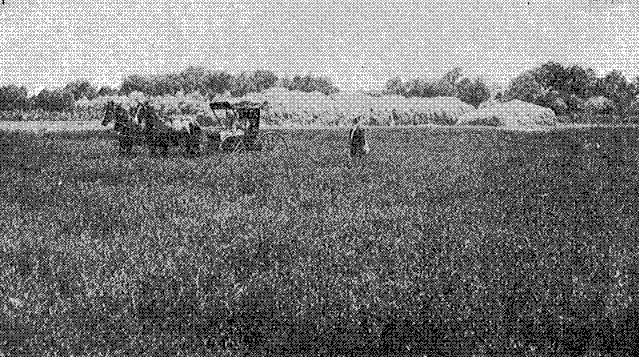 Fig. 4. Field of Alfalfa in California
Storing.—When cured in cocks, these are preferably
made small to facilitate quick curing, but
usually from two to four days are necessary to complete
the curing. If the cocks require opening out
before being drawn, the work should be done with
care. Ordinary stacking and storing may be done
in practically the same way as in handling medium
red clover, and the same care is necessary in protecting
the stacks. In areas where considerable
rain falls in the autumn, hay sheds will prove
a great convenience in storing alfalfa in the
absence of better facilities. In the Eastern States
alfalfa is sometimes stored in mows undercured, by
putting it into the mow in alternate layers with
straw. The straw not only aids in preserving the
alfalfa in good condition, but the alfalfa imparts
an aroma to the straw which induces live stock to
eat it readily. In showery weather this method of
curing alfalfa merits careful attention where straw
can be had near at hand and in sufficient quantities.
The method is sometimes adopted of cutting alfalfa
even for hay by using the self-rake reaper.
The sheaves thus made are allowed to lie on the
ground undisturbed until they are ready for being
drawn. By this method of cutting, the loss of leaves
is almost entirely avoided, but there are these objections
to it: that it exposes unduly to sunlight
during the curing process, and in case of rain the
sheaves are easily saturated and do not dry readily
unless turned over.
Rain falling on alfalfa will injure it quite as much
as it does red clover. (See page 96.) In climates
with much rainfall in May or June, when the first
cutting of alfalfa is ready for being harvested, according
to locality, in instances not a few much difficulty
is found in curing alfalfa without loss. Sometimes
the entire cutting will be rendered practically
useless by rain. Because of this, as previously intimated,
it may be well to arrange, where practicable,
to cut the first crop of the season for soiling food.
The number of cuttings during the year depends
on such conditions as relate to the length of the
season, the character of the soil, the abundance of
moisture present, and the use to which the alfalfa
is put. In some of the river bottoms southward in
the Rocky Mountains, where irrigating waters are
plentiful, it is claimed that alfalfa may be made to
furnish one cutting for soiling food every month
in the year. Even in the Northern western valleys,
as many as five or six cuttings for the use named
may be obtained. North from the Ohio and Potomac
rivers three to five cuttings of soiling food may
be looked for each season, and south of these rivers
even a larger number. North of the same rivers
the hay crops run from two to four, and southward
from the same they are seldom less than three. In
the western valleys they range from three to five
or six, according to location. In States bordering
on the semi-arid States eastward and some distance
south of the Canadian boundary, from three to four
cuttings may usually be expected. In Colorado and
States north and south from the same, two good
crops of alfalfa may be cut from spring-sown seed
the same season, but where irrigation is not practiced
it is seldom that one crop of hay is harvested
under similar conditions of sowing. But in the
semi-arid belt not more than one cutting is usually
obtained each season in the absence of water. But
the number of cuttings will be reduced when one of
these is a seed crop. When a seed crop is taken, the
vitality of the plants is apparently so much reduced
for the season that the subsequent growth is much
less vigorous than if seed had not been thus taken.
The yield of hay from each cutting will, of course,
vary much with conditions, but it is seldom less
than a ton. An approximate average would place
the average cutting at about 1¼ tons, but as much
as 2 tons have been obtained per acre at a cutting,
and, again, not more than ½ ton. In New Jersey
an average of 4.57 tons per acre was obtained under
good conditions of management, but without irrigation,
at the experiment station for three years in
succession. In Kansas, 4 to 6 tons per acre may usually
be expected from good soils. In Tulare County,
California, as much as 6 to 10 tons have been secured
under irrigation.
The yields from the various cuttings are by no
means uniform, especially in the absence of irrigation.
They are much influenced by rainfall. In
such areas, the second cutting is usually the best for
the season, the subsequent cuttings being considerably
less. Where irrigation is practiced, the crops
are much more uniform, but even in mild climates,
as the season advances, there is a tendency to lesser
yields, indicative of the necessity of at least partial
rest for plants during a portion of the year. The
yields of alfalfa are usually exceeded by those of
no other crop, where the conditions are quite favorable
to its growth, even in the absence of irrigation.
At the New Jersey Experiment Station, as stated in
Bulletin No. 148, one acre of alfalfa produced
36,540 pounds of green food; of corn, 24,000; of
red clover, 14,000; of crimson clover, 14,000; of
millet, 16,000; of cow peas, 16,000; and of oats
and peas, 14,000 pounds. But where only two, or
even three, cuttings can be obtained per year, some
crops may produce larger yields than alfalfa. In
the distinctive alfalfa belt in the West, no forage
crop can be grown that will compare with it in the
yields obtained. The protein in alfalfa is also relatively
high. At the station quoted above it was
found one ton of alfalfa contained 265 pounds of
protein; hence, its high relative value as a food; red
clover, 246 pounds; timothy, 118 pounds; and wheat
bran, 118 pounds. At the Delaware Experiment
Station, in Bulletin No. 55, it is stated that maximum
crops of cow peas and of crimson clover gave
720 pounds of protein, while a maximum crop of
alfalfa gave 1230 pounds.
Where alfalfa is irrigated, it is usual to apply
irrigating waters just after each cutting of the crop.
It is a matter of some importance that the water
shall be applied at once as soon as the previous crop
has been harvested, otherwise time will be lost in
growing the next crop. There are instances where
it is necessary to apply water before the first crop
is grown, but usually the moisture which falls in
the winter and spring will suffice to produce the
first crop of the season. Some irrigators apply
water some time previous to harvesting the crop,
but not so late as to leave the ground in a soft condition
when mowing is begun. The amount of
water required will vary with the soil, the season
of the year, the distance of the ground water from
the surface, and the precipitation. The more porous
the soil and subsoil, the hotter the weather, the less
the precipitation and the farther below the surface,
up to a certain limit, the greater will be the amount
of water needed. There are situations, as in some
of the islands in the Yellowstone River, in which
ground water is so near the surface that alfalfa
grown on these is able to get enough of water from
this subterranean source to produce good crops.
Care should be taken not to apply water in excess of
the needs of the crop, or the yields will be proportionately
reduced. The amounts that will best serve
the end sought can only be ascertained by actual
test. Caution is also necessary where the winters
are cold not to apply water late or in excessive quantities,
lest a sappy condition of the plants shall be
induced, which will make them succumb to the cold
of the winter following. Moreover, on some soils
alfalfa fields will produce good crops, if irrigated
only the first season, until the roots get down to
moisture, the irrigating waters being utilized when
more needed.
Alfalfa hay is fed freely to all kinds of domestic
animals on the farm, and with results that should
prove highly satisfactory. Properly fed, it is an
excellent food for horses and mules. It not only
serves to maintain flesh, but it is favorable to glossiness
in the coat. Horses that are working hard
should be accustomed to it gradually. When it is
fed to them too freely at the first, it induces too
much of a laxity in the bowels, too free urination,
and profuse sweating. When fed to such horses or
mules, some authorities claim that several weeks
should be covered in getting them on to what is
termed a "full feed" of alfalfa. When fed to milch
cows, free lactation results. Alfalfa fine in character
is now manufactured into food suitable for
calves and other young stock. Cattle and sheep
are now fattened for slaughter on alfalfa hay fed
alone, but when thus fattened the finish made is not
equal to that resulting from adding grain to the
alfalfa. To meet the needs of the best markets,
alfalfa alone does not produce enough of fat or of
firmness in the flesh, but it has been claimed, and
probably it is true, that one-half the amount of
grain required for finishing along with carbonaceous
fodder, such as corn stalks or timothy,
will give equally good and quick increase when fed
with alfalfa hay. It is most excellent fodder on
which to grow cattle and sheep, even in the absence
of a grain supplement. The later cuttings of the
season are thought to be the most suitable for
calves and also for sheep and lambs, because of the
greater fineness of the fodder and the greater abundance
of leaves on it. Alfalfa hay is used with
much advantage in wintering swine, especially brood
sows. Swine have been wintered on alfalfa hay
without any grain supplement where the winters are
mild, but they will fare much better with a grain
supplement. It is thought that half the usual
amount of grain fed will produce equal results when
fed with alfalfa, to those obtained from feeding a
full allowance of grain in its absence. Alfalfa and
sorghum properly grown make an excellent food
for swine, and the two may be profitably fed thus
where the conditions may be over-dry for corn, but
not for sorghum. When feeding alfalfa, the aim
should be to use it in conjunction with a carbonaceous
food, as corn. Fortunate is the country
which grows good crops of corn and alfalfa.
Securing Seed.—Localities differ much in their
capacity to produce alfalfa seed. The best crops of
seed are now grown west and southwest of the Mississippi
River. Certain areas in the semi-arid country
east of and between the ranges of the Western
mountains seem to have special adaptation for growing
seed. At the present time the greatest seed-producing
States are Kansas, Colorado, Utah, Arizona
and California. But in some areas east of that
river paying crops can be grown. It has also been
noticed that when the crop is sown less thickly than
it is usually sown for hay, the plants seed more
freely, when sown with sufficient distance between
the rows to admit of cultivating the crop, and when
such cultivation is given, the influence on seed production
is also markedly favorable; such treatment
given to the varieties of recent introduction may possibly
result in the production of seed from the same,
notwithstanding that they bear seed very shyly when
grown in the ordinary way.
Nearly all the seed now grown in the United States
is produced by fields that have been sown in the
usual way, and primarily to produce hay, but in
some areas, especially where irrigation is practiced,
it is sometimes grown mainly for seed. On the irrigated
lands of the West it is customary to grow the
first cutting of the season for hay and the second
for seed. But in many instances the second cutting
also is made into hay, and the seed is taken from the
third cutting; even in the States east of the Mississippi,
and also in Ontario and Quebec, seed is usually
taken from the second cutting. But in Montana,
Washington and Idaho, on the higher altitudes,
seed is not unfrequently taken from the first
cutting for the season, since, in the short season for
growth of those uplands, seed from cuttings later
than the first does not always mature so well. In a
large majority of instances seed does not form so
profusely from plants of the first cutting as from
those of later growths. This is thought to arise,
in part, at least, from the fact that bees, and it may
be other insects, are then less active in searching for
food, and because of this do not aid in the fertilization
of the plants as they do later. Nor does seed
of the first cutting ripen so evenly. An important
justification is also found for taking seed from the
later cuttings, in the fact that when a crop has produced
seed, it grows less vigorously during the subsequent
period of growth that same season. So
pronounced is this habit of growth in alfalfa, that in
many localities, if the first growth is allowed to produce
seed, but little subsequent growth will be made
again the same season. The second cutting, all
things considered, is the most favorable to seed production,
as, unless on irrigated lands, the third cutting
is not usually possessed of that vigor necessary
to induce abundant seeding in the plants.
The yields of seed are also much influenced by
moisture. An excess of moisture is more unfavorable
to the production of seed than a shortage in
the same. Hence, in areas where the rainfall for
the season is very abundant, but little seed will be
produced. Where irrigation is practiced, the excessive
application of water would have a similar effect,
though less pronounced in degree; hence, the apportionment
of the water to the prospective needs of the
seed crop calls for careful adjustment. Where the
first crop is grown for seed, where irrigation is
practiced, in many instances no water is applied until
after the seed crop has been harvested.
The seed is ready for being harvested when a majority
of the seed-pods assume a dark brown tint.
The pods of later formation will still possess a
yellow tint, and some of them may still possess the
green color. These do not produce seed nearly
equal in quality to the pods which ripen earlier. To
wait for all the later maturing pods to ripen before
harvesting the crop would mean the loss of much of
the best seed through shattering. Another test of
maturity is made by shelling the pods in the hand.
When the seed can be thus shelled in a majority
of the pods in a single plant, it is ready for being
harvested. Alfalfa seed shatters easily; hence, it is
important to harvest the seed crop with promptness
when it is ready, to handle it with due carefulness,
and in some instances to refrain from handling during
the hottest hours of sunshine.
The seed crop is sometimes cut with the mower
and raked into winrows, and in some instances put
up into cocks. When it is handled thus, the aim
should be to do the work, as far as this may be
practicable, in the early and late hours of the day,
but not, of course, while much dew is on the crop.
Sometimes the seed is drawn from the winrows to
the thresher; in other instances from the cocks, and
in yet other instances it is stacked before being
threshed, a work that calls for the exercise of much
care in the storing of the crop, lest the seed should
be injured by heating in the stack. This method of
harvesting is usually attended with much loss of
seed.
There is probably no better way of harvesting
alfalfa than to cut it with the self-rake reaper or
the binder. The loose sheaves dry quickly, and
when lifted, the aim is to carry them directly to the
thresher. Less seed, it is considered, will be lost in
this way than by the other mode of harvesting given
above, and the work is more expeditiously done.
But owing to the difficulty in securing a thresher to
thresh the seed, it is sometimes found necessary to
stack the crop, but in areas where irrigation is practiced
such stacking is seldom necessary.
The seed is frequently threshed with the ordinary
threshing machine, but in many instances
it is also threshed with a clover huller. The
huller does the work less quickly, but probably,
on the whole, more perfectly. Threshing machines,
with or even without certain adjustments in the
arrangement of the teeth in the cylinder and
concave, and with extra screens, are now doing
the work with much despatch, and with a fair measure
of satisfaction. But the opinion is held by competent
judges that a machine that would more completely
combine the qualities of the thresher and the
huller would be still more satisfactory. It is easily
possible to have the crop too dry to thresh in the
best condition, and care should be taken to regulate
the feed in threshing so that the alfalfa will not enter
the cylinder in bunches. More than 200 bushels of
seed have been threshed in a day from crops which
yielded abundantly. The seed should be carefully
winnowed before putting it on the market. The
seed crops, as would naturally be expected, vary
much; crops are harvested which run all the way
from 1 to 20 bushels per acre. From irrigated
lands the yields are, of course, much more uniform
than from unirrigated lands, since in the
former the supply of moisture may be controlled.
Fair to good average yields on these may be stated
at from 4 to 6 bushels, good yields at from 6 to
8 bushels per acre, and specially good yields at from
10 to 12 bushels. The bushel weighs 60 pounds. Growing
alfalfa seed under irrigation has frequently
proved very profitable. The seed grown in such
areas is larger and more attractive to the eye than
that ordinarily grown in the absence of irrigation,
and because of this many are lured into sowing it
on unirrigated land when the former would better
serve their purpose. The seed is frequently adulterated
with that of yellow clover (Medicago lupulina),
which resembles it closely, but this is more
likely to be true of imported than of American
grown seed.
Renewing.—Alfalfa may be renewed and also
renovated where the stand secured at the first has
been insufficient, where it may have been injured
from various causes, where it is being crowded with
weeds, and even with useful grasses, and where the
land requires enriching.
The stand of alfalfa secured is sometimes thin and
uneven. This may arise from such causes as sowing
too little seed; whether over-dry or through the
crowding of the young plants. When this happens,
in many situations it is quite practicable to thicken
the stand by disking the ground more or less, adding
fresh seed, according to the need of the crop, and
then covering the seed thus added with the harrow.
Such renovation would be comparatively easy on
clean land, were it not for fact that the alfalfa plants
already rooted overshadow the young plants, always
to their injury, and sometimes to their total destruction.
The spring will probably be the best season
to attempt such renovation, but there may be instances
where the winters are not severe, in which
autumn seeding will succeed as well or better than
spring seeding. Because of the uncertainty of the
results of such renovation, the aim should be so
to prepare the land and sow the seed that a good,
thick stand will be secured at the first.
Should the alfalfa fields be spotted, because in
places the nurse crop lodged and smothered the
plants, or because excessive moisture destroyed
them on the lower portions of the field in an abnormally
wet season, the renewing process is simple
indeed. It consists in disking those parts so thoroughly
as to destroy all vegetation that may have
become rooted on them, and sowing seed in the
usual way without a nurse crop. But should the
low places be such as to hold an excess of water at
any time of the year under normal conditions for
days in succession, even though it should not rise
to the surface, the attempts to make alfalfa grow
successfully on these will prove abortive.
When weeds and grasses crowd the crop, the
plan of disking the fields to destroy these is becoming
quite common, especially in the West. The
work is usually done in the early spring. In doing
it, disk harrows are driven over the field, usually
two ways, the second disking being done at right
angles to the first. The disks are set at that angle
which will do the least injury to the plants, and that
will at the same time do the work effectively. This
can only be determined by actual test in each instance.
Some of the crowns of the plants will be
split open by the disk, which some authorities claim
is an advantage in that it tends to an increase in
the number of the stems produced, an opinion which is
by no means held in common at the present time,
and yet there are localities where it has certainly
proved advantageous. Occasionally, a plant will be
cut off. There can be no doubt, however, that such
disking, when necessary, does tend to clean the land
and also to strengthen growth in the alfalfa crop, on
the principle that cultivation which does not seriously
disturb growing plants is always helpful to
them. The frequency of such diskings will depend
on the needs of the crop. Some advocate disking
every spring, some every other spring, and some not
at all. That plan which disks the ground only when
it is necessary to keep the weeds at bay would seem
to be the most sensible. This would mean that sometimes,
as where crab grass has a firm hold, disking
may be necessary at least for a time every spring.
In other instances it would be necessary only every
second or third season, and in yet other instances
not at all. However, some growers in dry areas
advocate disking frequently, as, for instance, after
some of the cuttings of the hay, and with a view to
retain moisture. It is at least questionable, however,
if disking so frequently would not soon tend
to thin the plants too much, to say nothing of the
labor while the work is being done.
The idea of stirring the surface soil in alfalfa
fields is by no means new. In England the plan
prevailed to some extent years ago of harrowing
the fields in the autumn with heavy harrows until,
when the process was completed, they would take
on the appearance of the bare fallow for a time. In
the Eastern States and in some parts of Canada
the harrow is used instead of the disk, but usually
the latter will do the work more effectively and
with less cost. Frequently, when the disk has been
used on alfalfa, it may also be advantageous to run
a light harrow over the ground to smoothen the
surface.
With a view to renovate the crop and increase the
yields, in some sections, as in the Atlantic States,
it has been recommended to top-dress alfalfa fields
with farmyard manure every autumn. This, no
doubt, would prove very effective, but it would also
be very expensive, unless in the neighborhood of
large cities. It would be impracticable without neglecting
the needs of the other crops of the farm.
In the mountain areas of the West, it has been
found that the cost of fertilizing with farmyard
manure is in the meantime greater than the increased
production in the alfalfa is worth, but it may
not be always thus, even on these rich lands. Some
Eastern growers also apply more or less gypsum.
This is generally sown over the fields after the
crop has begun to grow in the spring.
Renovating alfalfa fields is much more easily and
effectively done, as would naturally be expected, in
areas where conditions are highly favorable to its
growth than where these are only moderately favorable.
In some of the mountain valleys instances
have occurred in which alfalfa fields have been
plowed and sown with oats, with a result, first that a
good crop of oats was reaped, and second, that
fairly good crops of alfalfa were harvested the following
season without re-sowing the field.
Sources of Injury to Alfalfa.—Chief among the
sources of injury to alfalfa, after the plants have
become established, are frost in saturated ground,
ice, floods, grasshoppers, gophers, dodder, and pasturing
by live stock in the late autumn or winter.
When it happens that two or three of these act in
conjunction, the injury following is just so much
more rapid and complete. As has been intimated,
where water is excessive, in a climate which in winter
or spring is characterized by alternations of
freezing and thawing, the plants will either have the
roots snapped asunder, or they will be gradually
raised out of the ground. This will only happen
in soil with a subsoil more retentive than is compatible
with well-doing of the highest order in the
plants. The danger from this source is greatest
during the first winter after sowing the plants, as
then the roots are not really established. The only
remedy for such a contingency is the draining of
the land.
Some reference has also been made to injury
done through ice, where it collects in low places in
land. The destructiveness of the ice depends on
its thickness and its nearness to the ground. When
it rests upon the ground for any considerable time
the plants die. If, however, water intervenes, the
plants may live when the submergence is for a limited
time. One instance is on record in Onondaga
County in New York State, in which alfalfa survived
submergence for a considerable period under
a thin sheet of water covered by three inches of
ice, but when growth came it was for a time less
vigorous than normal.
Floods in warm weather are greatly injurious to
alfalfa. The extent of the injury done increases
with increase of depth in the waters of submergence,
increase in stagnation in the waters, and increase
in the duration of the period of overflow. Stagnant
water sooner loses its dissolved nitrogen;
hence, the plants cannot breathe normally. The
harm done, therefore, by floods in each case can
only be known by waiting to see the results. These
summer floods always harm the crops temporarily,
and in many instances kill them outright. Occasional
periods of overflow should not prevent the
sowing of alfalfa on such lands, since on these it
is usually not difficult to start a new crop, but the
seed should not be sown on such lands when overflow
occurs at such a season. When it occurs in
cool weather and quickly subsides, it may be possible
to grow paying crops of alfalfa.
In some areas grasshoppers are a real scourge in
alfalfa fields. Because of the shade provided by the
ground and the influence which this exerts in softening
it, they are encouraged to deposit their eggs
and remain so as to prove a source of trouble the
following year. It has been found that through
disking of the land both ways after sharp frosts have
come is greatly effective in destroying the grasshopper
eggs deposited in the soil. They are thus
exposed to the action of the subsequent frosts and so
perish. The disking has also tended to stimulate
growth in the crop the following year. The eggs
will not, of course, be all destroyed by such disking,
but so large a percentage will, that the crop should
be practically protected from serious injury, unless
when grasshoppers come from elsewhere.
It would seem correct to say that gophers do more
injury to alfalfa fields in certain areas of the West
than comes to them from all other sources combined.
They not only destroy the plants by feeding
upon them, but they fill the soil with mounds, which
greatly interfere with the harvesting of the crops.
They are destroyed by giving them poisoned food,
trapping, shooting, and suffocating through the use
of bisulphide of carbon. Poison is frequently administered
by soaking grain in strychnine or dropping
it on pieces of potato and putting the same in
or near the burrows. Bisulphide of carbon is put
upon a rag or other substance, which is put into the
burrow and the opening closed.
Dodder is a parasitical plant introduced, probably,
in seed from Europe, which feeds upon alfalfa
plants, to their destruction. The seeds of alfalfa
sometimes become so impregnated with the seeds of
dodder that the latter will grow where the seed is
sown, thus introducing it to new centers. The
dodder starts in the soil and soon throws up its
golden-colored thread-like stems, which reach out
and fasten on the alfalfa plants that grow sufficiently
near. The dodder then loses its hold upon the soil
and gets its food entirely from the alfalfa plants,
which it ultimately destroys. But since the seeds of
the dodder remain at least for a time in the soil, and
the adjacent soil becomes infected with them, the
circles in which the dodder feeds continually widen.
In certain parts of New York State some fields have
become so seriously affected as to lead to investigations
conducted through officials from the State experiment
station. Pending these investigations, the
exercise of great care in the purchase of seed and the
immediate plowing of the infested areas are recommended.
Some reference has already been made to injurious
results from pasturing close in the autumn or
winter, except in the most favored alfalfa regions.
In addition to what has been already said, the wisdom
of not grazing alfalfa the first year is here emphasized,
and also the mistake of grazing at any
time when the ground is frozen, at least in areas
east of and, generally speaking, adjacent to the Mississippi
River.
Alfalfa as a Fertilizer.—Alfalfa is not considered
equal to medium red clover as a direct means
of fertilizing and otherwise improving the land on
which it grows. This does not arise from less inherent
power on the part of alfalfa to draw nitrogen
from the air and deposit it in the soil, but rather
from the fact that clover establishes itself more
quickly, and is much more frequently grown in the
rotation. Several crops of medium red clover can
be grown in short rotations, each one being a source
of much benefit to the crops that follow, while one
crop of alfalfa occupies the land. But when the alfalfa
is all fed upon the farm on which it grew,
where the plants grow freely, it then becomes a
source of fertilization without a rival, probably,
among plants grown upon the farm.
The fertility thus furnished does not consist so
much in the plant food deposited in the soil directly
as in that furnished in the successive crops
that are grown and fed every year. In Farmers'
Bulletin No. 133, published by the United States
Department of Agriculture, it is stated that the Wyoming
Experiment Station found 44 pounds of
nitrogen, 8.27 pounds of phosphoric acid, and
50.95 pounds of potash in one ton of alfalfa. This
would mean that in the yield of alfalfa hay from
a given area, estimated at four tons per acre for
the season, alfalfa would furnish 176 pounds of
nitrogen, 33.08 pounds of phosphoric acid, and
203.8 pounds of potash. If this alfalfa were fed
upon the farm, it would not only prove a cheap
source of protein for feeding, but it would furnish
fertility, as stated above, without seriously diminishing
the supply of the same in the surface soil,
since much of the fertilizing material produced
would come from the air and subsoil. The manure
thus made, if carefully saved and applied, would thus
add materially to the fertility of the land. If, however,
the alfalfa were sold, the mineral matter drawn
from the cultivable area of the soil and from the
subsoil lying under it would be reduced to the extent
of the draft made upon these in growing the
alfalfa.
The direct influence of alfalfa upon the fertility
of the land on which it grows is shown in the
greatly increased production in the crops which follow
alfalfa. This increase is not only marked, but it
is frequently discernible for several successive years.
But as has been intimated, the benefit that would
otherwise accrue from growing alfalfa as a direct
means of fertilizing the land is much circumscribed
by the long term of years for which it is usually
grown.
The mechanical effects of alfalfa upon the land
are beneficent. It improves the tilth by means of
the shade furnished, and the extent to which the
roots fill the soil. These in their decay further
influence favorably that friability which is so desirable
in soils that are cultivated, and as previously
stated, the long, deep roots in their decay exercise
a salutary influence on drainage.
The work of breaking alfalfa fields is frequently
laborious, owing to the number and size of the
roots. If, however, a plow is used, the share of
which has a serrated edge, the roots will be cut
or broken off more easily and more effectively.