Climate and Health in Hot
Countries.
PART I.
In hot climates, as elsewhere, people are rarely in a
position to exercise much choice in their selection of a
habitation, as its site must usually depend on considerations
of business, and in the majority of cases, the number of
available dwellings is limited. Oftener still, it is a matter of
“Hobson’s choice,” and one must needs occupy the house
that has served one’s predecessors in the work in which one
may happen to be engaged. On this account it will be
superfluous to do more than generally indicate the general
principles on which it is desirable, that houses designed to
afford shelter in hot climates, should be placed and constructed.
In the matter of choice of site, the same general considerations
as to soil and configuration of the ground that
determine our choice in temperate climates, as a rule, hold
good. A gravelly or sandy soil, and gradients favourable to
natural drainage, are even greater desiderata in the Tropics
than in Europe, and this is especially the case in climates
characterised by a heavy rainfall; but ideal sites are rare
in all countries, and as a rule, one must be content to
make the best of less favourably placed spots. In the
countries which we are at present considering, the especial
danger against which we have to guard is always that of
malaria, and hence, in choosing the site for a house or
station, the great point is to select one, which is, as far
as possible, free from natural or artificial collections of
water, within a radius of a quarter of a mile; or at any
rate, including such only as can be easily filled in, drained,
or otherwise dealt with. The site should also be sufficiently
raised above the level of some natural watercourse to afford
an adequate outfall for its surface drainage.
For a single house, no better position can be selected
than the summit of a mound, whether natural or artificial;
and such situations are generally to be preferred to the slope
of a hill, even where the latter affords a considerably greater
elevation. On the sea coast, and not unfrequently in the
neighbourhood of some of the great rivers, sand dunes,
where sufficiently clad with vegetation to afford a sufficiently
stable foundation, form excellent sites for single houses,
good examples of which are to be found in Chittagong, where
nearly every European residence has its own little hill, on
which it is perched by itself; and it is doubtless to this
circumstance that the comparative healthiness of the
European population of the town, under otherwise unfavourable
surroundings, is mainly due. The neighbourhood
of jungle, and even of trees, should be as far as possible
avoided, for trees undoubtedly harbour mosquitoes, and
their presence is generally equivalent to that of malaria:
moreover, the appearance of coolness, associated with trees,
is deceptive rather than real. As a rule, even when numerous
and thickly set, they throw no actual shade on the
walls of the house, which hence receives as fully the power
of the sun as it would in an open plain, and added to this
they obstruct the breeze and generally impede ventilation;
so that a house placed in the midst of a glaring, treeless
space is often really far cooler than one surrounded with
fine timber. Even a garden is by no means too desirable
an adjunct to a tropical residence, for unless there is abundant
labour to keep it in a condition of perfect neatness,
and constant intelligent supervision to ensure that the
cultivation of flowers and vegetables be not associated with
the breeding of mosquitoes, it is only too likely to originate
fever of a luxuriance at least equalling that of its roses and
salads.
It must not of course be forgotten, that the provision of
a free supply of good vegetables is everywhere an essential
to health, and is in many localities obtainable in no other
way than by the maintenance of a garden, and that under
such circumstances, it is probably safest to keep their
cultivation under personal supervision; but where such an
accessory is indispensable, its attendant dangers should
always be carefully borne in mind, and care should be
taken that the garden should be so worked as to avoid its
becoming a breeding place for mosquitoes. A house for
example, such as that shown in the subjoined sketch,
makes, doubtless, a very inviting picture, but when lived
in, it would be found that the fine trees almost completely
cut off the breeze, that the beautiful creepers render the
verandahs and the rooms behind them “stuffy,” and that
the wealth of vegetation, combined with the arrangements
for irrigation, render it a veritable paradise of mosquitoes.
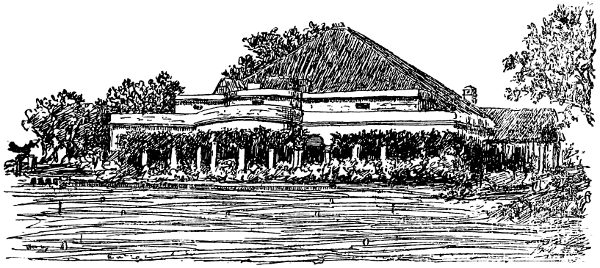
Fig. 1.—A Regular Mosquito-trap Bungalow.
Coming now to questions of general plan, one of the
first essentials is that the floor level should be well raised
above that of the surrounding ground. In most localities
this object is attained by simply forming a platform of earth
dug from some situation hard by, so as to form a plinth;
and too often, the excavations for the purpose are made
absolutely without plan or method, and result in the production
of a number of irregular depressions, close by the
habitation; which during rainy weather are always full of
water, and form ideal breeding places for mosquitoes, besides
too often serving as depositories for refuse. The earth for
forming the plinth should, however, never be allowed to be
obtained in this way, but previously to laying out the plan
of the house or station, a careful survey of the levels and
contours of the site should be made, and the alignment of
a series of deep cuttings, so designed as to form an efficient
system of surface drains extending from the site to the
nearest natural effluent, should be laid out, so that the spoil
wherewith to form plinths should be taken in a systematic
manner in the digging of these cuttings, and from no other
situations. The cuttings should be made as deep and
narrow as they can be without expensive revetting of the
sides, as experience has shown that the larvæ of the really
dangerous species of mosquitoes, the Anopheletes, avoid collections
of water shielded from the sun and light. As the
station develops, it may perhaps become possible to pave
these channels with some permanent material, such as brick
or concrete, but as a rule the expense of such a proceeding
is prohibitory. When, however, a certain amount of money
is available for this purpose, it should be devoted to paving
the smaller shallow surface drains close to the dwelling, and
the deeper distant cuttings close to the effluent left to the
last. No house should ever be allowed to be constructed
with a plinth of less than one foot, and provided the material
be obtainable without making undesirable excavations, it
cannot well be too high, a fact well understood by the earlier
European residents in India, whose fine old houses, however
wanting their work may be in the matter of finish, form an
admirable contrast, in this and many others of the essentials
of a healthy residence, to the cramped, low-lying heat
traps of admirably pointed brickwork in which the occupant
of a “sealed pattern” government quarter is now doomed
to live.
The writer is personally strongly of opinion that all tropical
residences should be at least two storied, so that the
sleeping apartments should be raised at least some 12 or 15
feet above the ground, and of course, where this is the case,
the provision of a high plinth is less essential, but in any
case, the minimum of at least a foot should be insisted
upon.
In regions such as Assam and Burmah, where the rains
are so heavy as to reduce the entire country to a chronic
condition of flooding, any adequate plinth would be so costly
that both natives and settlers build their houses perched up
on poles, and the numerous sanitary advantages of the plan
are undeniable; which is also, I understand, adopted in
Honduras.
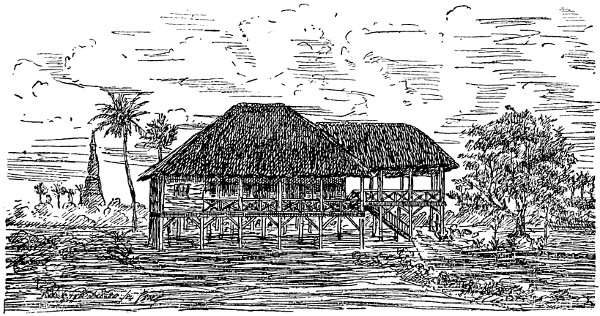
Fig. 2.—In the above sketch of an ordinary Anglo-Burman bungalow, it will
be noticed that the large projecting porch is raised higher than the rest of the
house so as to admit of a carriage being driven beneath it to the foot of the
steps to the platform of the house. These porches form a sort of open-air
sitting room, and are more usually on the same level as the rest of the house.
They form a most attractive feature of most Burmese bungalows, but it
would be very difficult to protect them against mosquitoes by means of wire
gauze.
The general characteristics of these “chang” houses
may be gathered from the above sketch. In the cottages of
the peasantry the “chang,” or platform, is rarely raised
more than 4 or 5 feet above the ground, but 10, or even 15
feet is no uncommon height in the case of the houses of
people of means and position. Even in the case of houses
occupied by planters and officials, the walls are largely composed
of bamboo matting, while in those of the populace,
the floor itself is formed of a stouter variety of the same
material; and on account of the growing cost of timber of
a class that will resist white ants, I have little doubt that
ere long steel girders will replace the wooden framework
and corrugated iron will take the place of the picturesque
thatched roof, at any rate in the coast towns. A chang of
concrete carried on stout corrugated iron, 8-inch walls of
the “Elizabethan” pattern, and a double corrugated iron
roof, with a large intervening air space, would form a most
comfortable, if not very beautiful, residence, for the combination
of heat and moisture with the evils of which the
chang house is intended to cope; but walls of such flimsy
materials would be of little avail to withstand the furnace-heated
air of hot dry climates, such as are met with in the
Punjab and the deserts of Rajputana.
One of the great sanitary advantages of the chang house
is the circulation of air beneath the floors, and the comparative
immunity from vermin secured by its isolation on the
top of high posts, and though there is no objection to the
storing beneath it of carriages and other articles frequently
moved, because in daily request, the covered space beneath
the house should on no account be allowed to degenerate
into a lumber room, as not only will lumber attract dangerous
vermin, but with the inevitable numerous native
dependants, the lumber room will soon develop into a refuse
heap, or worse. Although there is no need to construct a
regular plinth, the ground below the chang should always
be slightly raised by laying down a layer of gravel, as any
collection of water would be obviously unhealthy; besides
which, if kept in proper order, the large shady space forms
an excellent playground for children, where such charming
encumbrances form part of the household.
In actually desert climates, a plinth is less essential, but
there are comparatively few countries in which heavy rain
does not occur at some time of the year, and any dampness of
the soil immediately underlying a house is always unhealthy.
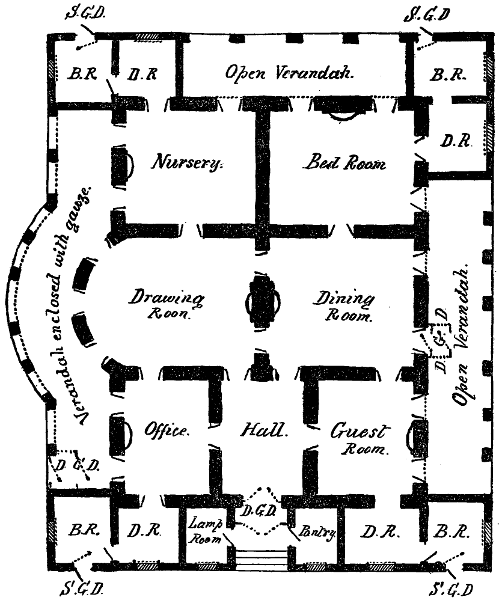
Fig. 3.—Ground plan of an existing “up-country” Indian Bungalow, in
which the doors and windows are well placed. (The dotted lines represent
wire gauze screens.) Scale, 18′ = 1″
The second great desideratum of a tropical house is free
ventilation, to secure which at least one, and preferably two,
sides of each room should be in free communication with
the outer air by means of doors or windows, and some at
least of these should extend to the floor level or near it.
Many Indian houses are spoilt by want of attention to
this point, especially those of long standing; for though the
original plan may have been fairly sound, the desire for
additional accommodation generally, in course of time, leads
to additions, and especially to the enclosure of verandahs,
whereby rooms, originally light and airy, are quite cut off
from all exterior ventilation. Many of these enclosed rooms
have small dormer or clerestory windows, close up to the
roof; but openings of this sort are no real substitute for
proper windows and doors in the usual position, and where
choice can be exercised, a house with inner rooms should be
rejected in favour of one affording freer ventilation.
The subjoined plan is a good example of an existing,
well-planned bungalow of one floor, in which every room
has external doors and windows, and several have them on
two sides. It should be added that every room has one or
more clerestory windows to give exit to the heated air that
always finds its way to the top of any enclosed space.
In the best class of houses in Persia this principle of free
external ventilation is often carried to the extent of all four
sides of the rooms being provided with several openings—the
different rooms being separated from each other by
open passages, running right across the building from
verandah to verandah.
As there are often several doors on each side, one easily
realises that Aladdin’s hundred-doored palace may have
been no mere creation of the fancy, but was probably based
on some actual palace—indeed, as a matter of fact, the
Subsabad Residency at Bushire has, I believe, a good deal
over the allowance of doors assigned to Aladdin’s palace, and
I know that the room I occupied there had no less than nine
doors, though two of them gave access respectively to a
dressing-room and bath-room.
The outline (fig. 4) will give some idea of the way in
which the rooms are arranged; but it is needless to say
that the plan is a very expensive one. It will be noticed
that the southern verandahs are double. Practically speaking,
indeed, a Persian house is little else than a series of
colonnades, with the spaces between certain of the pillars
filled in with door frames, so that it would be an expensive
business to fortify one against the invasion of mosquitoes.
Houses of this type are well suited to climates usually
blessed with a good breeze, and in which the heat during
the day does not reach such a degree as to necessitate
shutting it out, and are specially adapted to places where,
from scarcity of labour, there is a difficulty about the pulling
of punkahs. When, however, the midday heat reaches into
the nineties, such a plan of building becomes unsuitable,
and it is necessary to adopt the thick-walled type of house,
with comparatively few floor level openings; the object
being to keep imprisoned the cooler night air, so that the
interior may never approach the maximum shade temperature
of the day. It is obvious that the adoption of this
principle quite precludes all proper ventilation, and that
unless the rooms are exceptionally large and lofty it must
be positively unhealthy. At the same time, heat beyond a
certain degree induces such severe nervous and physical
prostration that the adoption of this course is almost unavoidable
during the worst hours of the day in such climates
as the Punjab; but the shorter the period the better, and
as the same reasons that render the house cooler than the
outer air in the day, make it hotter at night; it is always
well to compensate for the lack of ventilation during the
day by sleeping absolutely in the open at night.
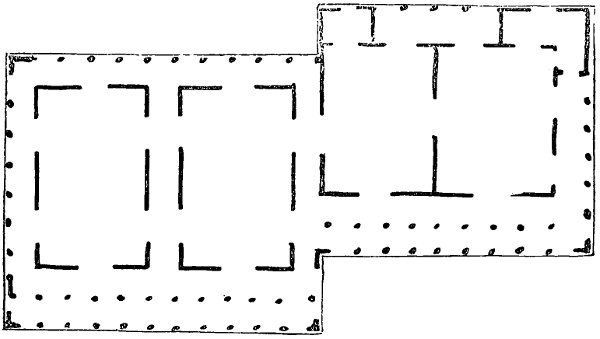
Fig. 4.—Rough ground plan of an European Bungalow in Persia.
Too often, not only the air, but the light is shut out,
a course of action which is as pernicious as it is futile,
for unless the sun be shining directly into the room its
temperature will be in no way raised by admitting an ample
amount of light.
There can be no doubt that this baneful practice of
keeping children shut up in darkened rooms is one of
the principal causes of the blanched and enfeebled little
ones so often met with in India; for they suffer promptly
from deprivation of light, though they are wonderfully
tolerant of heat, and if unchecked by their anxious mothers,
will follow their own wholesome instincts, and be found
romping and tumbling about with the servants and orderlies
in the verandah, at temperatures that make their parents
devote anxious consideration to the question of crossing
a room.
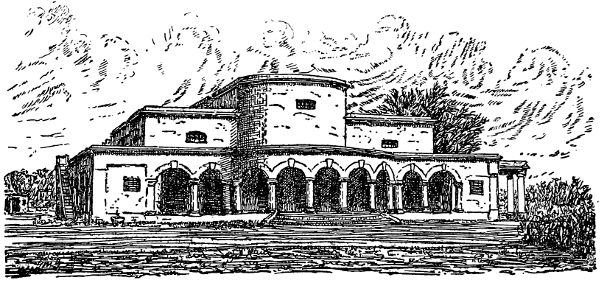
Fig. 5.—Sketch of bungalow with terraced roof, of a type very common
in the Punjab and United Provinces in India. Speaking generally, this
bungalow is well planned. Its faults are that the verandah is too low-pitched,
leaving a needlessly large proportion of the external walls exposed
to the full power of the sun. The dormer or ventilating windows also are
too low down, as they leave several feet of confined “dead” air at the top
of the rooms. They should have been placed close up to the cornice.
The third important consideration in planning a good
tropical house is that the outer walls should, as far as possible,
be shielded from the direct rays of the sun by ample
verandahs. Objects exposed to the full glare of the sun soon
become so hot that it is difficult to handle them, reaching a
temperature 40° or 50° F. higher than that of the air, and
though building materials conduct heat but slowly, they do
so very surely, so that the air within any building with
extensive unshielded sunward walls cannot fail to be considerably
hotter than that of one so planned that as small an
area of wall as possible is directly exposed. Within the
true Tropics, the sun must necessarily come to the northward
of any localities for a longer or shorter portion of the
year, and in such low latitudes it is desirable that the
verandah should extend all round the house; but outside the
equatorial zone the side looking away from the noon-day
sun may be left unprotected as far as the coolness of the
house is concerned; though a northern verandah is still
desirable, as affording the most eligible position for an open
air lounge during the day. Within practicable limits, a
verandah can hardly be too wide, and as one of its main
functions is to shield the main wall, it is also important that
it should be high pitched, but this point is too often lost sight
of, although the additional cost of constructing a higher-pitched
verandah is very small, as the supports of these
structures cost but little, in comparison with the roof. Of
course the oblique rays of the sun will search into a high
verandah for a longer time than they can in a low one, but
this defect is easily obviated by closing the upper part of the
colonade with wooden jalousies or with mats, but in this
case openings should be provided in the roof to give exit to
what must be almost dead air. Verandahs of less than six
feet width are of comparatively little use, and 10 feet may
be considered to be a fair average standard, but 15 feet is
by no means excessive, if it can be afforded, and as shown
in the diagram on page 9, double verandahs, consisting of
two colonnades, each about 12 feet wide, are by no means
uncommon in Persia.
To attain an equivalent standard of comfort, the rooms of
a tropical house require to be much higher pitched than is
needful in temperate climates, but it is quite possible to
carry this to excess, as over a certain height, the pendulum
swing of the punkah is too slow; and it is well known to
students of ventilation that spaces of dead air, unsearched
by the currents normally circulating through the room, are
very apt to be found in too lofty apartments. From 16 to
18 feet is a good average standard, and if the height be
carried many feet above the higher figure, it is desirable
that a strong beam should be carried across the room, at
about that level, to carry the punkah. As far as ventilation is
concerned, there is probably little advantage in any height
of ceiling above 13 feet, but this does not give an adequate
swing for a punkah.
As already incidentally mentioned, the writer holds a
strong preference for houses of two or more floors. While
residents of Calcutta or Bombay will never, if they can
avoid it, live on the ground floor, there is a general but
quite unfounded idea, amongst up-country residents in India,
that upper floors are necessarily hotter.
It is needless to say that the reverse is actually the case,
and that other things being equal, upper storey rooms are
necessarily cooler and more healthy, on account of their
better exposure to the breeze and their being to a great
extent raised above dust and other more subtle emanations
from the soil. The reason for this misapprehension is that,
outside the Presidency towns, upper rooms are almost universally
makeshift additions, with no proper verandah protection,
and often flimsy roofs. Now it is obvious that to gain
the full advantage of an upper storey, all verandahs should
be carried right up, so that except in being elevated above
the soil, the upper rooms are exact reproductions of those
below them. I cannot recall, however, a single instance of a
properly planned two-storied house “up-country,” and it is
absurd to expect that a room with thin brick walls, exposed
directly to the sun’s rays, can be as comfortable as one with
massive walls and broad verandahs. It may be admitted
that during the day, when the doors are shut to keep out
the heat, the upper rooms of a two-storied house will be
hotter than the lower ones, because one has but a single
roof overhead in place of two, but they will be cooler than
the lower ones would be, assuming the upper story to be
removed.
It is also extremely desirable that the plan of the house
should include a stair giving access to the roof, as during
the hot dry season, there can be no doubt that it is by far
the healthiest plan to sleep there.
A small area of thatched roof supported on four pillars
should be erected on the roof to protect the sleeper from
dew, and to prevent his being worried by the glare of the
moon, which to say the least of it makes it very difficult
to sleep. Whether there is any truth in the belief that
exposure to the moon’s rays may cause blindness or not, I
cannot say, but I certainly have met with a number of cases
of temporary blindness for which it was, to say the least of
it, extremely difficult to find any plausible explanation other
than the popular one. Moreover, as we are quite in the dark
as to the modus operandi of true sunstroke, it seems unscientific
to deny that over-stimulation of the retina by the
moon’s rays can be capable of producing the symptoms in
question, and at any rate it is preferable to act on the
assumption that “moon-blindness” may be a possible
contingency.
It is, further, a matter of great importance that the
upper limits of the air-space included within a room should
be ventilated by means of openings placed close up to the
ceiling, as otherwise a stratum of impure, heated air will
lodge there, which can only be removed by the slow action
of diffusion. In one-storied houses this is usually effected by
means of small windows, and in order to admit of a sufficient
number of these being provided, it is a common expedient
to carry the walls of rooms situated in the interior of the
house above those of the lateral rooms, as shown in fig. 4.
There should, however, be no necessity for doing this, as
no room should be ever built with no external wall; and
though upper openings on more sides than one may be
desirable, this is not so essential as to warrant the large
increase of cost involved in building in this way. Where
a house has an upper storey, the top ventilation of the
lower rooms is usually effected by openings into the
verandahs; but this is by no means a satisfactory outlet,
and it would be far preferable to effect the purpose by
means of shafts carried up in the thickness of the walls to
the roof, the long column of air within which would favour
the production of a good current.
In certain parts of the East, subterranean chambers
(taikhana) are used as a refuge during periods of extreme
heat, and are occasionally to be met with in very old
European bungalows, though I have never seen one in
actual use. Good examples are to be seen in the ruins of
the historical Residency at Lucknow; and it was within
them that many of the women and children were sheltered
during the memorable siege. They can, of course, be
ventilated only from above; but there can be no doubt
that they are cooler than rooms above ground, and it is
possible that the principle might be adopted with advantage
under certain extreme climatic conditions.
The materials appropriate for house-building necessarily
vary according to the character of the climate, but it is
desirable to consider briefly the advantages and disadvantages
of those in most common use. Taking first
the structure of the walls, it may be noted that in rainy
climates near the coast, where very high temperatures are
seldom registered, the materials can hardly be too flimsy
and permeable; but as one recedes from the coast and
meets with the extreme climates characteristic of the
interior of continents, it will be found that the buildings
become progressively more massive; so that while the
Bengali or Malay inhabits a shanty formed of thatch and
matting, the peasant of the Punjab shelters himself within
mud halls some two feet thick. These differences in
domestic architecture are the necessary outcome of differing
environment, and to be comfortable, European houses must
be built of very much the same materials as those of the
natives around them.
In dry climates, sun-dried bricks make an excellent wall,
which resists heat even better than one of burnt brick, and
provided it be protected from rain, it is wonderfully permanent
and much stronger than would be expected; so
that heavy, terraced roofs are easily carried by a two-feet
thickness of this material, and they are even quite adequate
to sustain a second story of lighter materials. The great
drawback of the material is that it forms a favourite haunt
for white ants, which tunnel it in all directions; but this
can easily be obviated by introducing, just at the floor level,
a single course of some damp and insect-proof material,
such as burnt brick, laid on cement and tarred. Owing
to its extreme cheapness a large house can be built for
the same expenditure as a small one of burned brick, and
as air space is of the greatest importance in hot climates,
it is unfortunate that this material is not more utilised in
Government buildings.
—The most suitable material is stone flagging,
marble, of course, being preferable. After these come hard
tiles, brick on edge, and cement, in order of desirability.
Besides these there are, of course, various special modern
inventions, but they hardly come into practical consideration,
outside large seaports. Wooden floors should be
generally avoided, as owing to decay and the attacks of
insects, they are apt to become dangerous, and may give
way unexpectedly at any time. For upper floors, by
far the most suitable material is the narrow brick arch
supported on steel girders, which are now so generally
obtainable and cheap, that they can be economically
substituted for wooden beams in any locality tolerably
accessible from a railway.
One great advantage of this form of construction
of flooring and terraced roofs, is the entire absence of
nooks and crannies which can harbour vermin, for even
the equally massive roofs of concrete, laid on flat tiles
supported by a system of beams and battens, afford most
dangerous refuges for disagreeable intruders, and I well
remember an inmate of my house being put to intense
suffering on two successive nights by vermin that fell
from such a roof; the first disturber of our rest being an
enormous centipede, and the second a hornet. For the
same reason, all cornices and similar architectural adornments
are distinctly to be deprecated.
The roofing materials generally employed in tropical
countries are thatch, tiling, terraced constructions, and
corrugated iron. Thatch is, from many points of view,
an excellent material, as while it favours ventilation by
being extremely pervious to air, it gives excellent shelter
from rain, and is quite unequalled as a protection against
the sun; in addition to which it does not, to any appreciable
extent, throw out into the house during the night the
heat absorbed during the day.
With all this, it has great and, it is to be feared,
preponderating disadvantages, the principal of which is
that it forms a perfectly ideal refuge for vermin of all
sorts, vertebrate and invertebrate. As a rule, owing to
the high pitch necessary in this form of roofing, the lower
edge of the roof is rarely more than a few feet from the
ground, and owing to the usual existence of creepers,
trellises and similar facilities, is usually easily accessible
to any animal endowed with the most moderate powers
of climbing. Owing to this, such roofs are usually honeycombed
with the nests of squirrels, rats, civet cats, and half
wild domestic cats, to say nothing of snakes, and birds and
other flying things. The large empty space between the
ceilings and the rafters is usually alive with bats, and as
all this extensive population is quite without any system of
conservancy, an old thatched roof is simply permeated with
guano; and the emanations from this necessarily find their
way into the house, and indeed are always plainly perceptible
in a thatched house that, for any reason, has been
shut up for any length of time.
Besides this, the substance of the thatching is always
slowly decomposing under the slow action of mildew, and
this adds further musty exhalations to the bouquet. Hence,
if used at all, the thatch should be completely renewed at
frequent intervals, and its employment should be confined
to situations which cannot be scaled by large vertebrate
vermin.
Where it is used, the interior of the rooms should
be completely cut off from the cavity of the roof by some
fairly impervious ceiling, such as one formed of match-boarding,
and not, as is commonly the case, by a “ceiling
cloth” of ill-stretched canvas.
These “ceiling cloths” are utter abominations, and,
even when their untidy appearance is ameliorated by subdividing
the cloth into a number of small panels, the
improvement is purely one of appearance, and in no way
diminishes their sanitary defects, so that no effort should
be spared to induce landlords to replace them with match-boarding
or any material that will shut out the emanations
from the thatch and its inhabitants.
For some reason, the lath-and-plaster ceilings and partitions,
so commonly used in Europe, are never employed in
Indian house-building. It is difficult to understand why
this is so, as the natives are skilful plasterers, and there
would be no difficulty whatever in teaching them this
particular application of their trade, which would be a
valuable and inexpensive expedient in this and a number of
other cases.
Tiles of the old-fashioned sort present few of the advantages
of thatch, and most of its disadvantages, besides
numerous special objections of their own, but these remarks
do not apply to roofs formed of large tiles of European
patterns laid on a properly graded framework of squared
battens. To these latter the only objection is that they let
in too much heat unless they are supplemented with a
tolerably substantial ceiling; and the same remarks apply
even more to corrugated iron, but both these materials, and
especially tiles, are excellent materials for verandahs, especially
those of upper stories, where weight is a consideration.
Corrugated iron, however, is scarcely tolerable in extreme
climates unless it is actually doubled, and the most scientific
way of doing this is to form a ceiling of corrugated iron of a
thin gauge screwed up to light joists and painted white
below. On the upper surface, should be spread about an
inch of dry sand, to retain which it is necessary that any
ventilation openings should be protected with a wooden
edging. The outer roof should be of stouter gauge, and
must of course be pitched at an appropriate slope, and it is
of the first importance that the space between the two roofs
should be freely ventilated by large openings placed at the
apices of the gables, but these openings should be secured
against the entry of birds and cats by means of wire netting,
and all other openings by which they can enter should be
carefully closed with plaster. The coolness of a roof so
planned depends largely on the thickness of the layer of dry
sand, and, provided the joists that carry the sheets are fairly
strong, there is no difficulty in raising this to even a couple
of inches. The preceding materials all have the disadvantage
that they must be pitched at a considerable slope, and hence
cannot be used as a platform for sleeping on.
All considered, however, a terraced roof, formed of brick
arches supported on steel girders, covered with concrete, is
by far the best for most tropical climates. It forms an
excellent protection against sun and rain, and the smooth
finish of both its upper and lower surfaces offers absolutely
no hiding place for even insects; besides which it forms an
excellent elevated platform on which to sleep during periods
of intense dry heat. Its one disadvantage is that a great
deal of the heat absorbed during the day is radiated into
the rooms at night, and that it generally is inferior as a
non-conductor either to thatch, or to double roofs of any
description.
Another form of terraced roof commonly found in dry
climates consists of a considerable thickness of beaten clay,
spread on mats supported on a system of beams and battens.
Owing to their great thickness and the fact that the clay
conducts heat much less easily than burnt bricks, such roofs
are very cool, and they form a good sleeping platform; but
they give endless trouble during periods of rain, as they
always leak at the beginning of one, and vermin are apt to
harbour amongst the matting and battens that carry the
mud. Owing to their immense weight, too, they are not
free from danger, especially as they are usually found in combination
with walls of unburnt brick, which offer no obstacle
whatever to the tunnelling of white ants, which thus can
readily reach the beams, the interior of which may be
entirely eaten away by these mischievous insects without
any sign of the mischief appearing externally.
All the above considerations appear at first sight tolerably
obvious and would, one would think, be adopted wherever
not rendered impracticable by consideration of cost, and yet
it is perfectly wonderful to notice how frequently every consideration
of common-sense sanitation and comfort is ignored
in buildings, on which neither space nor expense have been
stinted.
Quite recently the writer halted in a large hotel which
illustrated this point in a most pitiable manner. The
masonry was admirable, being worthy almost of an
Egyptian monument, and speaking generally, it was obvious
that expense had been almost disregarded by the enterprising
proprietors. The management showed every desire
to secure the comfort of their guests, and the cuisine was
excellent. In spite of this the bulk of the rooms were scarcely
habitable, as they seemed contrived to give a tropical sun the
best possible chance to make itself felt. Save for a verandah
of paltry width to the magnificent dining-room, these
indispensable adjuncts of a tropical residence were absolutely
wanting.
Moreover, this omission was clearly not due to any desire
or necessity for economising space, for the area absolutely
wasted in the form of corridors was astonishing, and could
not have fallen short of half the space occupied by the
sleeping rooms, though these were exceptionally spacious.
Facing south-east, the full glare of the sun and the dazzling
reflection from the sea glared directly into the windows of
the most desirably placed rooms, without even the protection
of an ordinary “jalousie,” while the magnificent view was
shut out by windows of granulated greenish glass, the
sashes being pivoted in such a way as to make it difficult to
enjoy either the breeze or the prospect, even when they were
opened. Apart from these latter details, the building would
be admirably adapted for the accommodation of winter
visitors in Italy, where the sun is made to do duty for
artificial heat, and the whole is a striking example of the
way in which the most lavish expenditure may be rendered
futile by a want of due appreciation of the principles that
should govern tropical domestic architecture. I give
this instance mainly to show that, however self-evident the
principles described above may appear, they are far from
being generally appreciated.
These principles may be briefly epitomised as follows:—
(1) Through ventilation of all rooms.
(2) The elevation of all rooms, and especially of sleeping
chambers, to as great a height as practicable above the
ground.
(3) The selection of appropriate building materials which
cannot harbour vermin.
(4) The shielding of outer walls from becoming heated
by the direct rays of the sun by the provision of adequate
verandahs.
(5) The application of the same principle to the construction
of roofs by planning them so as to secure a well-ventilated
air space between the actual roof and a fairly
substantial ceiling, or by constructing them of massive
materials, if single.
(6) The admission of sufficient light.
In the case of a house of moderate dimensions, these
principles might be carried out as follows:—
Basement of brick arches ten feet high, including a low
plinth and thickness of floor. These arches would be
utilised for the accommodation of the kitchen, cook room,
pantry, lamp room, store room, coach house, and well house,
the well being placed beneath the house, and so well protected
from any neighbouring fouling of the soil. The platform
of the house supported on these arches would be
pierced only by a concealed staircase for the use of the
sweeper, but this would not be in communication with the
other offices, though a hand lift might advantageously be
arranged between kitchen and dining room. First floor
18 feet high-dining room, drawing room, office, and one or
more bedrooms with dressing and bathrooms communicating
with them, if large accommodation is required. Verandah
all round not less than 10 feet wide. Second floor, 17 feet
in height—principal bedrooms with dressing and bathrooms,
some of the central rooms provided with terraced
roof; the rest, together with the verandahs, with tiles of
good pattern, the rooms having substantial ceilings. On terraced
roof-large iron water-tank, with windmill to work
force pump from well; small sleeping shelter, and protected
with corrugated iron roof, supported on pillars.
It would be well to have the southern verandahs (in the
northern hemispheres) of greater width than the others, and
to place in them the stairs giving access to the second
storey and to the roof.
The first floor would be reached by means of a flight of
steps leading from the carriage drive, which might, if desired,
be protected by a sloping porch. Such a house would, of
course, be somewhat costly, but not much more so than
one of equal accommodation constructed on the ordinary
plan, and would undoubtedly be far more healthy than
those of the usual type.
It is needless to remark that this imaginary residence
would be completely protected against mosquitoes by means
of metallic gauze, but the point is not dealt with here, as it
is fully considered in the chapter on the prevention of
malaria.
The principles that should guide us in the contrivance
of tropical costume may be epitomised in a single sentence.
Keep the head cool and the abdomen warm:—and most of
the costumes of the more civilised tropical races usually
meet these requirements.
It is of course generally true that it is well in matters
of costume to take as a general guide the habits of the
inhabitants of the country we are visiting; but the recommendation
cannot be taken too literally, as, apart from questions
of cut and fashion, a too slavish imitation might be
as hazardous to health as it would be fatal to decency, as
there are places where the Paris fashions consist only of a
hoop of cane or a liberal smearing of clay. Nor can the
question be lightly solved by simply adopting lighter
materials, as, in addition to adaptation to altered meteorological
conditions, our dress should be so contrived as to
afford protection against certain other dangers which are
only indirectly the outcome of climatic conditions, notably
against the attacks of mosquitoes, which are now known
to be no mere irritating annoyances, but to undoubtedly
serve as the carriers of several of the most deadly of tropical
diseases.
Moreover, although very pleasant, it is by no means safe
to knock about the house bare-footed in countries where
scorpions and centipedes, to say nothing of poisonous
snakes, are every-day vermin.
The “flannel next the skin” doctrine, too, is applicable
only to those blessed with hides sufficiently phlegmatic to
tolerate the material; and enthusiasts in its favour are apt
to forget that our powers of resistance to extreme heat
depend entirely on the healthy action of the skin, so that,
if that important portion of our anatomy be kept in a condition
of chronic inflammation by “prickly heat,” it must
necessarily be more or less incapacitated from performing
its proper functions.
The substratum of truth that underlies most doctrines,
good, bad and indifferent, depends in this case on the fact
that in hot climates it is especially important that clothing
should be absorbent and porous; but, provided this be
secured by the plan of manufacture, the nature of the fibre
used is of little moment.
It must be admitted that the well-known Jaeger
materials are in all respects admirable for all but the
higher grades of atmospheric temperature, but when the
thermometer gets up in the nineties, unadulterated wool
becomes too irritating for the majority, and an admixture of
silk, as in the so-called “Anglo-Indian gauze,” is preferable.
Pure silk gets too easily sodden with perspiration, and in
that state is too good a conductor of heat to form by itself
a desirable material, but the combination of the two fibres
forms an ideal material for wear during periods of excessive
heat.
This material is necessarily rather costly, though it is
surprisingly strong in proportion to its weight, and with
ordinary care in washing lasts a long time, whereas the
cheaper material of mixed cotton and wool is apt to shrink,
and hence requires to be frequently replaced.
All materials into the composition of which wool enters,
require great care in washing if they are to retain the properties
which render them, in one form or another, so
valuable in all climates. It need hardly be pointed out that
they are at once hopelessly spoiled by a short immersion in
boiling, or even very hot water. For the frequently changed
garments of European residents of the Tropics little else is
required than immersion and rinsing about in luke-warm or
cold soap and water, and there is rarely need to guard
against their being spoiled by heat, as neither soap nor hot
water are much used by persons following the trade of
washing in semi-civilised lands; but the severe beating and
manipulation to which they subject everything that comes
into their hands is almost as effectual in felting and spoiling
woollen goods as great heat. It is pretty well impossible to
induce a native to so alter his methods as to wash such
articles in the orthodox European fashion, unless, indeed,
one were disposed to occupy one’s time in personally superintending
the process; but by cautioning against rough and
excessive manipulation, and steadily refusing to pay for
articles spoiled, it is generally possible to minimise the evil.
While touching on the subject of the washing of clothes,
it may be well to remark, that although personal superintendence
of the process may be out of the question, it is
certainly important to find out and inspect the place where
the washing is done, which in such countries as India and
China, and doubtless elsewhere, will too often be found to be
some filthy stagnant pool, redolent with the accumulated dirt
of all classes of the population. But for the powerful germ-killing
powers of the tropical sun to which the articles are
subjected in the process of drying, there can be no doubt
that disease would be spread in this way much more frequently
than is actually the case, but it will not do to trust
this natural disinfection too far, and without counting suspected
instances of the transmission of really serious
diseases, there can be no doubt that the troublesome skin
disease known as “dhobie’s itch,” is often contracted by
Europeans in this way. The policy of sparing the imagination
by shutting the eyes is, in this case again, a fallacy
which may lead to considerable personal inconvenience and
perhaps to danger.
If, as is not unfrequently the case, all the public washing
places are undesirable, it is well worth while providing
the simple arrangements required by natives following this
calling within one’s own enclosure.
All that is required is a masonry platform about 6 feet
square, connected by a channel with the well and enclosed
with walls about a foot high, the whole being lined with
cement. A short length of metal pipe, capable of being
closed with a wooden plug, must be built into the wall at the
lowest edge of the platform, so as to admit of the dirty water
being drained off. A piece of smoothly-worked plank, about
4 feet by 2 feet, with rounded corrugations athwart it, formed
like those of corrugated iron roofing on a smaller scale, is
all the additional apparatus required, and I feel sure that
these simple appliances would be found much more frequently
within our compounds than they are, if Anglo-Indians
in general had any idea of the filthy conditions
under which their clothing is commonly washed. Of
course, such a matter as the cleanliness of public washing
places ought to be a matter of superintendence and regulation
by the authorities, but as yet everything is usually left
to individual initiative, and those who wish to protect themselves
must take their own precautions.
A not uncommon mistake of persons making their first
sally into these warm climates is to leave behind them all
their everyday European apparel, under which circumstances
the one or two old suits that were taken to see them through
the chops of the Channel and “Bay” become most treasured
possessions, for there are very few parts of the world where,
at some season or another, our ordinary English outfit will
not be found convenient and suitable. Even the “Equatorial
Rowing Club” probably find it well to put on their
sweaters on returning to Singapore, after a spurt along
“the line.”
Within intertropical limits no doubt, the occasions on
which the garb of temperate climates is required are rare,
but everywhere outside them there are ample opportunities
of comfortably wearing out clothing adapted to life in
Europe. In the Northern Punjab one’s heaviest English
clothing is required for two or three months in the year,
while in South Africa the diurnal range of temperature is
so great that a light overcoat is required after sunfall in the
hottest time of the year, and even in the Persian Gulf stout
woollen clothing is required from December to early March.
A glance at the meteorological data furnished in the second
part of the book devoted to climate, will give the best idea
of what will be required, as it may be taken as certain that
in any case where the mean monthly temperature approximates
at any season to that of our native island, clothing
appropriate to the corresponding season of the year will be
desirable.
In choosing a costume for really hot weather it must be
remembered that any material requiring to be starched is
about as suitable for the purpose as mackintosh sheeting,
because linen and cotton fabrics, starched and ironed, are,
as long as they retain their appearance, quite as impervious
to transpiration. After they have lost their stiffness their
appearance is most objectionable and disgusting, and it is
a fortunate circumstance that they become so soon sodden,
as there can be no doubt, that but for this, their use would
be clung to by the conservative Briton, far more than he is
able to do.
For this reason the loss of popularity of late years of the
old-fashioned white “American drill” clothing, once universally
adopted, is hardly to be regretted. Without a considerable
amount of starching they never looked fresh after
an hour or two’s wear, and with it the material ceased to be
suitable. It is, indeed, a mistake to provide oneself with
clothing of this sort in England, as even “American drill”
of the right sort, cannot be obtained, and the light cotton
tweeds and checks which are now in use in India do not
appear to be found in the home market. It is, of course,
necessary to obtain two or three suits for use on the outward
voyage, but to obtain more than this, is only to burden
oneself with what will, as likely as not, prove to be useless,
and perhaps noticeably out of the fashion of the country.
A few shirts of soft cotton “twilled lining,” made with
turned down collars, like a cricketing shirt, perhaps three
pairs of white drill trousers (the material used by merchant
seamen and known as “Dungaree” is the most suitable) and
an alpaca coat and waistcoat will suffice. Unless one
belongs to the clerical profession, the alpaca should be fawn-coloured,
or, at any rate, not black, as in this colour the
material is a sort of badge of missionary enterprise, and
it is embarrassing to be asked to conduct service on the
main deck, under false pretences. For the sub-tropical
portion of the voyage, light flannel suits, made with as little
lining as possible, are most suitable, and will prove useful,
in any warm climate, at certain seasons of the year.
In really hot weather, however, if thin enough to be
cool, flannel becomes too flimsy to serve for outer garments,
and one is practically restricted to cotton fabrics. Of late
years a variety of cotton materials have been made in India
in imitation of the woollen tweeds in general use in Europe,
and have the great advantage that the little deception is all
the better maintained if they are kept unstarched.
Without desiring to furnish a gratuitous advertisement
to any individual enterprise, missionary or otherwise, I see
no harm in mentioning that I have met with no fabrics so
suitable for tropical wear as those manufactured by the
admirable Basel Mission at Cannanore, and though their
energies are presumably mostly confined to the Indian
market, I have little doubt they would export parcels if asked
to do so.
They have shown great ingenuity in contriving light
porous materials, almost indistinguishable at a short distance
from those to which we are accustomed at home, and there
can be no doubt that the short-fibred Indian cotton possesses
certain properties that cause materials manufactured from
it to be softer and more absorbent than those made from
the harder and longer American fibre. At any rate I can
account in no other way for the marked difference that exists
between the fabric known as “twilled lining,” manufactured
in Cawnpore, and what appears to the eye the same article
obtained in England, though the latter is by no means to
be despised.
It is but ten or twelve years since some bold innovator
made the discovery that the cheap and despised “twilled
lining” formed an admirable underwear for hot climates,
and whoever he may have been, he was certainly a great
benefactor to the Anglo-tropical community, for none of the
numerous expensive patent materials that have from time
to time been brought out, combine the same good qualities
to anything like the same degree. It absorbs moisture quite
as well as flannel of the same substance, and can be comfortably
tolerated by the most irritable skin, while I doubt
if it exposes one to greater danger of chilling than any other
material of like weight. It can be safely worn next the
skin without the intervention of a vest, which is indispensable
with the ordinary starched linen shirt, and is, all
considered, the best material for shirts, and for pyjamas for
night wear, as various striped patterns are made specially
suitable for the latter purpose. While speaking of night
clothes, it may be well to remark that the ordinary pattern
of short coat, commonly worn with pyjamas, is a distinctly
dangerous garment, as it is very liable to ruck up during
sleep, and so leave exposed the abdominal organs, which are
of all parts of the body the most vulnerable to chill. To
leave any portion of the abdomen exposed for even a short
time while at rest is an extremely hazardous matter, so
that in place of the usual coat it is far better to wear a shirt
which can be safely tucked into the pyjamas.
I was glad to hear, during a recent visit to India, that
the rational and cleanly custom of adopting white for evening
dress was again coming into vogue, for even the lightest
cloth clothing is undesirably hot, and the idea of wearing,
night after night, garments which cannot be washed, in a
climate so productive of perspiration, is, to say the least of
it, somewhat repulsive.
It is, I understand, now the custom to have them cut
after the pattern of the now almost universal “dress jacket,”
but it is probably better to have them made by an English
tailor of white drill, when fitting out, as the cut of the
native workman is hardly to be relied on, though he may
be trusted fairly well for nether garments. A broad silk
sash or kamarband is usually substituted for the waistcoat;
and to protect the ankles from the attacks of mosquitoes,
which bite easily through a thin sock, it is a good anti-malarial
precaution to have the trousers fitted with straps.
For riding, either stout khaki drill or the admirable
cotton cords made at Cannanore are most suitable, and they
are best cut after the pattern of the very handy “Puttialla”
breeches, in which the breeches are prolonged below the
knee into a closely fitting extension formed like a gaiter, as
this does away with the necessity of wearing the very hot
and unsanitary long boot. These garments would also be
very useful, either at the Cape on account of ticks, or in
parts of Burmah and Assam as a protection against leeches,
as in both these, and no doubt in many other localities,
these pests swarm so amongst the herbage that it is impossible
to go abroad in ordinary trousers unless they be
tucked into the socks. It is true that knickerbockers and
long stockings will serve the same purpose, but few can bear
the irritation caused by stockings thick enough to be worn
in this way, in climates of this sort.
Another very suitable class of material for outer garments
is to be found in the coarse wild silk that is met with and
manufactured in parts of India, under the name of Tussur
serge, and I have no doubt that many other parts of the
world produce materials equally adaptable to our needs.
The matter of head covering requires special consideration,
as there is a quite unaccountable difference as to the
risk of sunstroke in climates which, as judged by the thermometer
and the brilliancy of the sunlight, appear quite
similar.
Accidents of this sort are almost unknown at the Cape
of Good Hope; even as far north as Natal, and throughout
our colonies there, and I believe also in America and Australia,
a broad-leaved felt hat appears to afford quite adequate
protection, always provided that it be not looped up in the
idiotic “smartness” of an Imperial yeoman’s headgear. It
is wonderful, too, how European officers contrive to go about
in Egypt in the singularly unpractical “fez,” which, save as
a protection for the bald within the house, appears about the
most ill-contrived headgear yet contrived.
To wear one in June in most parts of India, would be
certain death to the majority of Europeans, and few could
venture to wear it at any time of the year.
For India, however, and other climates where sunstroke
is common, a good sun-hat is indispensable, and there is
undoubtedly no material that at all equals pith or solah for
the purpose; and the bigger, the thicker, and uglier, the
better it is for the purpose. Thick stiffened felt also
answers very well, but is not reliable under extreme conditions,
unless made double with an intervening air space
throughout. Whatever the material, it is essential that the
interior should be well ventilated, and this is most efficiently
secured by the hat itself being attached to a comparatively
narrow band that encircles the head, by the means of a few
widely separated pieces of cork; no lining or other material
being allowed to obstruct the passage of air.
The ordinary brass bound eyelet holes and squat top
ventilator, so often seen in home-made “helmets,” are
generally, for all practical purposes, absolutely useless.
Of the various shapes of solah hat in use, I am inclined
to think the “Cawnpore tent club hat” is the best. This
is made with the brim almost horizontal in front so as not
to interfere with vision, and well sloped elsewhere, and is
quite comfortable to ride, shoot, or work in. It has been
adopted for the troops for tropical field service, but is I
notice, already commencing to undergo evolution in the
direction of smart inefficiency so dear to the heart of the
military milliner.
Constructed as they are of strips of pith glued together,
solah hats naturally go to pieces in rainy weather, but this
can be obviated by covering with some waterproof material
instead of the alpaca, or brown holland, usually used. The
padded and quilted coverings to solah hats sometimes seen
are absurd, as quilted cotton is far inferior as a non-conductor
of heat to a similar thickness of pith, and the padding
greatly increases the weight of the head gear.
In case of emergency, the oriental pugaree or turban is a
very fair protection, though it requires a good deal of practice
to tie it properly. Five or six yards of coarse muslin can,
however, be got even in small native towns, and such
accidents as one’s hat blowing out of a railway carriage, or
off the head into a river, may occur to any one, so that the
expedient may obviate one’s either incurring considerable
risk, or submitting to the alternative of returning with one’s
errand unperformed.
Many persons are well nigh as sensitive to insolation of
the spine as of the brain, and suffer at once from the exposure
of the back to the sun’s rays. I have never personally
experienced inconvenience on this score, but know that
many find that the sun playing on this part of the person
causes a dull, heavy aching:—an oppression rather than pain.
Persons subject to such symptoms should wear a broad
pad of the same material as the coat, thickly padded with
cotton wool. The pad should not form part of the coat,
but be made separately to button on, as it is cooler worn
thus. Turning to the opposite extremity of the body, it
must be admitted that, owing to the entire want of ventilation,
our European foot gear is very unsuited for use in hot
climates. Every one knows the discomfort that is caused
by boots that “draw” the feet, and these symptoms are
entirely caused by the comparative imperviousness of
leather, as is clearly shown by the greater discomfort caused
by patent leather, which is practically air-proof. On this
account, shoes are more generally useful than boots, though
the latter are required for shooting, or work in the jungle;
as shoes do not sufficiently protect the ankle from thorns,
or the possible attacks of a snake. During the hot weather,
the most comfortable form of foot-gear is a canvas shoe, but
as made by the ordinary English shoemaker with leather
lining and elaborate leather toe-caps and cross straps, they
present no real advantages over an ordinary leather shoe.
They should be made of stout but open woven canvas, with
no lining except over the stiffener at the heel, and quite
without toe-caps or other ornamentation; though the sole
should be as stout as that of an ordinary walking shoe, and
it is better to choose a brown canvas, as the “blanco” used
for giving a clean appearance to white canvas, soon fills up
the pores of the fabric and makes it almost as impervious as
leather. The Persians wear a sort of ankle boot, the upper
of which is formed of knitted twine, and these “málikis,”
made up on an European last, form ideal “uppers” for hot
climates, for they are admirably porous, though so strong
that they will outlast half-a-dozen leather “uppers.” Can
not our European manufacturers devise something similar?
In hot wet weather, it is a mistake to try to keep the water
out, as the sock, if enclosed in a water-tight boot, will
very soon become so saturated with perspiration that one
has simply subjected oneself to heat and discomfort to no
purpose. Whether for rainy weather, or for wading after
snipe, or when fishing, the only desideratum is that the
water should be able to ran out as easily as it gets in.
Provided that clothing is changed as soon as one gets into
shelter, no harm need be feared from getting either clothing
or the feet wet, as long as one is on the move, in the climates
with which we have to do. For the same reason the advantages
of a waterproof are very doubtful, the fact being that,
with a combination of heat and rain, one is bound to get
wet anyhow, and whether the moisture comes from the outside
or the inside of our garments is a matter of little
moment. One other point in connection with foot-gear
remains to be noticed, and that is that as one’s feet and
hands become a full size larger under tropical conditions, it
is necessary that those included in our outfit should be full
large; for a shoe so loose as to be almost slipshod in
England, will be found to be quite tight when tried on in
India. The best way is not to confuse your shoemaker with
directions, but to put on a couple of pairs of thick woollen
socks and get measured over them.
At night, the main object is to have as little in contact
with the skin as possible, so that mattresses of all sorts are
best put aside during the hot months and a smooth mat
substituted. Most tropical races actually prefer to sleep on
a hard surface, such as the floor, during periods of heat,
and though few Europeans can habituate themselves to so
hard a couch, the majority prefer a cot formed of tightly
strained cordage or webbing to the more modern spring bed
of woven wire, the yielding character of which causes the
surface laid upon to follow too closely the curves of the
body. Personally, I prefer the woven wire, covered only
with a loosely-made reed mat. Costing only a few pence,
such mats may be frequently renewed, and they are far
cooler than the fine and closely-woven “China” mats,
which are rather costly, and in the finest quality almost
impervious to air.
Assuming that one is properly protected against mosquitoes,
the feet and chest may be left bare, but a light
blanket or rug, folded to about 2 feet wide, should be thrown
across the abdomen, as nothing is more dangerous than chill
to this portion of the body.
Ladies’ costume lends itself more readily to coolness than
that of the sterner sex, though its advantages are usually
thrown away, by their obstinate adherence to the corset,
a garment which is even more pernicious in hot climates
than elsewhere. Apart from this, their most common
mistake is to err on the side of over-coolness, and medical
men who practise in the Tropics are constantly meeting with
serious and obstinate cases arising from inadequate protection
to the abdominal and pelvic organs.
Ladies too often expose the head to the sun in a most
foolhardy way. It may be admitted that a safe sun-hat is
not particularly becoming to either sex, but in the presence
of the girl graduate, often surpassing her male competitors,
no one can doubt that a substratum of brains underlies the
golden hair, and this being admitted, it is clearly morally
incumbent on ladies not only to make themselves attractive,
but to take proper care of thinking organs of such high
quality. Besides, a woman with a headache is seldom
charming, and a very genuine one—no mere boredom—is
too often contracted by the conscientious performance of the
quasi-religious duty of paying calls at noon in a picture hat.
Even where a covered conveyance is available—and many
of us do not run to anything more ambitious than a dog-cart
in the East—it is quite possible to contract a headache in
crossing a pavement, and when a lady drives herself, it is
almost impossible for her groom to so hold an umbrella over
her as to afford protection, without obstructing her view.
On this account, it is better that on such expeditions she
should submit to be driven, so that she may have her hands
free to carry an umbrella or sunshade; and it is well to
remember that a fairly large sunshade with a padded cover
is really more efficient than the largest single umbrella, or
even one provided with the customary thin outer white
cover.
Mothers have a general tendency to overclothe their
children. Provided that the abdomen be properly protected
by a flannel “binder,” the less they are hampered during
the day the better. A child’s extremities rapidly become
clammy if it be inadequately clothed, and as long as these
feel comfortably warm, nothing but harm can result from
stifling them with coverings which cause prickly heat, with
attendant loss of rest and all the evils that result from
chronic nervous irritation. Above all things, the face should
never be covered, even with a handkerchief, in the case of
the youngest of infants; as this pernicious fad of nurses
and mothers necessarily leads to the rebreathing of air
already rendered impure by passing through the lungs, than
which few things are more destructive to health, even in
adults, let alone in an infant, where the rapid chemical
changes involved in growth and development demand a
supply of oxygen proportionately far in excess of that
required by a grown-up person.
In children much troubled with prickly heat, who have
reached the age of intelligence, a pair of silk drawers should
be worn under the binder; and during the day, and at night
under the mosquito net, nothing more than this is really
required. At dusk, when they go out for their airing, and
at any time when mosquitoes are in evidence, their costume
should be contrived so as to protect them from the attacks
of the insects as far as possible.
In countries where ophthalmia is common, protection
from flies during the day is almost as essential as against
mosquitoes at night, and if the child falls asleep it should
at once be placed under a mosquito net, as the eyes of
children seem to have a peculiar attraction for flies, and
there can be no doubt that these insects are often instrumental
in carrying infectious matter from the eyes of the
diseased to those of the healthy.
The importance of attention to personal hygiene in
the matter of what to eat, drink and avoid, may be judged
by the fact that three of the greatest scourges of tropical
life—cholera, dysentery, and typhoid fever—are conveyed
exclusively by the agency of germs that find their way
into the body along with ordinary articles of diet; and
even putting aside diseases of so dramatically striking
a character, bad food, careless cooking, and impure water
may set up such minor troubles as dyspepsia, with all
its prolonged attendant miseries of body and mind. Those
who do not die from an attack of cholera or typhoid
usually recover fairly completely, but he who has once
suffered from a bad attack of dysentery is as truly lamed
for life as if he had suffered mutilation of a limb.
Accidents will, of course, occur, whereby the most
careful precautions are frustrated, but putting aside such
contingencies, it is quite possible to guard oneself against
either of the above diseases by proper care and attention;
and those who know how to take care of themselves may
carry on their duty, with but little apprehension, while
encamped in the midst of a cholera epidemic, which makes
it no uncommon occurrence to find in the morning several
pilgrims dead of the disease within a few yards of one’s
tent. On one occasion, my camp arriving after dusk,
I found in the morning that my tent had actually been
pitched over a new-made grave; but cholera cannot be
caught by proximity to either the dead or dying, but only
by the fouling of what enters the mouth, so that I was
more disgusted than alarmed at the gruesome discovery;
whereas I should have been decidedly uneasy for the
next day or so, had I discovered that I had unwittingly
swallowed either water or food that had not been rendered
harmless by cooking. There is one point, moreover, about
the necessary precautions, and that is that they must be
carried out, or at least superintended, personally; for
neither natives nor even the lower class of Europeans can
be trusted to carry them out, because, not understanding the
reason of them, they are too apt to scamp the business;
and, as a matter of fact, neglect that would discredit
a native dairyman has more than once, to the writer’s
knowledge, occurred in regimental dairies, where every
operation was supposed to be either conducted or superintended
by European soldiers.
One of these little incidents, due to sheer laziness and
direct neglect of duty, cost nearly fifty lives, for it more than
decimated the wing of the corps in which it occurred. The
method in which this terrible catastrophe was brought
about is worthy of record, as an instance of the way in
which lives are sacrificed by a lack of attention to such
details.
The water supply of the station was excellent and all
water used in the dairy was supposed to be drawn from a
standpost. Unfortunately, there was a well on the dairy
premises, and the soldiers in charge were too lazy to prevent
its being used. One of the native dairymen lived in
a village which was attacked with cholera, and like all
Hindoos, had a special vessel for drinking water. This
vessel he used, of course, at home, and also during the day,
to get himself a drink from the well in the dairy. He
remained himself free from disease, but the germs of cholera
were carried, adhering to his lotah, or drinking cup, from
the infected village well, to the dairy well, and this, in its
turn, infected the milk stored in vessels which had been
washed in the well water, with the terrible results already
described.
The remote fault, of course, in this case lay with the
authorities, who should have seen that no alternative, and
more easily obtained, water supply was available; for no one
who knew much about either the native, or Tommy Atkins
would have any doubt of the less laborious source of water
supply being used the moment the eye of authority was off
them. As a matter of fact, the quality of the well water
was usually excellent, and its only fault, that it was not
guarded against contamination, so that not understanding
the subtle mechanism of infection, both soldier and native
naturally regarded the journey to the more distant standpost
as a mere unreasonable infliction.
The piped water supply ought, of course, to have been
brought into every room of the dairy, but “spoiling the ship
for a pennorth of paint” is a very common cause of failure
in attempts at sanitary reform in India.
I have given this incident at some length, because it
affords a good example of the way in which lives are sacrificed
by a want of attention to the details of sanitary
management, and because, although it occurred in a public
institution, and the fatality was on a correspondingly large
scale, it is an equally good illustration of the way in which
infection finds its way into private households.
Let us now proceed to the consideration of the various
articles of supply, commencing with water.
As a rule, in our dependencies and settlements, water
supply is of a private character, as only a few of the larger
towns enjoy the advantages of public waterworks. Even
where this is the case too, it is not always safe to trust entirely
to its purity, as in many places the arrangements are
not such as to ensure safety, and it is only in towns where the
waterworks are large modern instalments, with proper filter-beds,
under the constant supervision of an adequate European
staff, that it is safe to forego the systematic sterilising of the
water. In India, for instance, while the supply of Allahabad,
Cawnpore, Lucknow, and most of the other large towns is
probably a great deal above the European average, the
mere fact of the supply being laid on in pipes is by no
means a guarantee of purity. In Naini Thal, a considerable
hill station, for example, the supply is pumped directly from
a lake without filtering, close to the spot at which the
drainage of a filthy native bazaar is allowed to flow into
it. When living, then, in a place where there is a piped
water supply, it is well to ascertain if filtration is properly
carried out, and if not, to treat the water with the same
suspicion as that derived from any other doubtful source.
Where water of undeniable purity is laid on, all that has
to be attended to is the method of transport from the
nearest standpost to the house, for it is as yet extremely
exceptional for pipes to be carried right into buildings as is
the practice in Europe, so that a special servant as a water-carrier
is still a necessity in India, even in large towns.
In this case, and indeed whatever may be the source of
supply, it is of the greatest importance that nothing but
metal vessels, so constructed as to be easily cleaned, should
on any account be used. In all Mahomedan countries, water
is conveyed in a goat or calf skin, stripped from the animal
entire, with the legs tied up, and filled from the neck,
which is secured with a thong for transport; and it is a
most unfortunate circumstance that it has become traditional
for Europeans to employ the Mahomedan bhisti with
his mashak instead of the more cleanly Hindu kahar with
his easily cleansed iron water vessel, for the Mahomedan
water-skin or mashak is an abomination that cannot be too
strongly condemned. Few will, it is thought, deny that if
a piece of half-tanned hide were found lying in water intended
for domestic uses, they would at once reject it; and
apart from the objectionable character of the material of the
mashak, it must be remembered that from its construction
it is absolutely impossible to clean the interior; and this must
necessarily become foul in the course of a few days’ use, even
if it were constructed of silver instead of half-dressed hide.
Added to this, it has been ascertained, by actual experiment,
that disease germs, deposited on the outside of a water-skin,
are capable of growing into and working through it,
and so continuously contaminating the contained water.
Anyone who knows the ways of the bhisti must be familiar
with the careless way in which his mashak is laid down on
the ground anywhere that may come handy, so that it cannot
fail to get frequently fouled with germs of all sorts,
which, owing to the vessel being composed of organic
material, find themselves at once placed on a “culture
medium” as congenial to their growth as if prepared in a
laboratory.
The above reasons, it is thought, should suffice to show
that no leather vessel should on any account be tolerated in
connection with our water supply, and it may be added that
there is no difficulty whatever in substituting cleanly metal
buckets for the abominable filth trap that has just been
described.
While the Hindu holds the wholesome belief that contact
with leather means utter defilement to water, and would
very probably die at the stake rather than drink from a
mashak; the use of the latter by the Mahomedan is purely
a matter of custom, in no way connected with religious
sanction, so that in hospitals too small to afford a double
establishment, a Hindu water-man alone is entertained, because
no Mahomedan can object on the score of religion to
taking water from any cleanly vessel or from any one’s
hands, so that though a bhisti can serve the Mahomedan
alone, a kahar can serve both castes.
For many years before leaving India the writer insisted
on the use of metal buckets for carrying his household
water, a pair being carried slung from the ends of a
bamboo balanced on the shoulder; and it never became
necessary to dismiss the Mahomedan water-carrier, as he
always proved ready to adopt the change, as soon as he
discovered one was in earnest in the matter, and that any
infraction of the rules meant instant dismissal.
There are no more hard-working and better servants in
India than the bhistis, who are deservedly, as a body, great
favourites with the European community, ever ready to put
their hand to anything. One who once served me for
several years used often to act as factotum on short expeditions,
cooking my food and waiting at table, and finally, as
no groom was available at the last moment, marched one of
my horses from one end of the Punjab to the other by
himself, and brought it in in good condition. With willing
and obliging men of this sort, it is naturally easy, by a little
insistence, to ensure the adoption of any plan that does not
actually clash with their religious beliefs—and I can assure
my Anglo-Indian readers that they, too, will meet with no
difficulty in introducing this important reform, provided they
show clearly from the first that they mean to be obeyed. It
is rarely even necessary to threaten to entertain a Hindoo
paniwalla in the bhisti’s place, for as a race they are of the
most amenable.
Putting aside public water supplies, the usual sources are
wells, rivers and springs. Of these, the first are, in most
parts of the world, the most common form of private water
supply, and, speaking generally, they are by far the most
reliable, for save in most exceptional cases, the pollution of a
well always takes place from above. It is, of course, most
desirable that the upper part of the well tube should be lined
with impervious cement, but provided a reasonable amount
of care be taken to prevent the surface of the ground near
the well becoming fouled, little danger is to be apprehended
from dirty surface water gaining admission to the well, for
there are few better filters than a few feet of ordinary soil.
The ordinary filter, employed in large waterworks, consists of
nothing more than a few feet of sand, and it is well known
that, when in good working order, such filters rival even
the Pasteur biscuit porcelain filter in their power of
excluding germs.
Now to reach the interior of a well by any other route
than through its mouth, water must needs pass through a
much greater thickness of soil than is ever used for the
filtration of water on a large scale, and hence, provided the
mouth of a well be protected, its water may be used with the
greatest confidence.
At first sight, it appears that nothing should be easier
than to provide the well with a water-tight cover of some
sort, and draw all water by means of a pump; and wherever
the water lies sufficiently near the surface, and the means of
keeping a pump in repair are at hand, there can be no doubt
that there can be no better plan. Very often, however, wells
are so deep as to necessitate the use of a force pump, in
which case, unless long connecting rods are used, which are
very apt to get out of order, the pumper has to work half-way
down the well, a necessity which introduces new difficulties
and dangers.
In places where pumps cannot be readily repaired, it is
useless to attempt the adoption of this method of raising
water, and one must trust to other means of protecting the
supply. The mouth of the well should be raised a foot or
two above the level of the ground by building a masonry
drum, wide enough for the person drawing water to stand
on, and well sloped, so that slopped water runs off, and not
back into the well.
It is further highly important to protect the well from
drifting leaves and dust, and also from being used by
strangers and passers-by. This is most easily effected by
building a well-house over the mouth of the well, provided
with a door, for even if this is not kept always locked, it at
least serves as an intimation to outsiders that the well is not
public property, which will probably be generally respected.
As the well-house may be of the simplest material and
construction, the cost of one need be no bar to the adoption
of the plan; for the shelter will always be of small dimensions,
and can be built with walls of sun-dried brick and a
thatched roof, or even of grass screens throughout.
A single metal vessel and rope should be provided, which
should never be removed from the well-house, and no other
vessel should be permitted to be lowered into the well on
any pretence; for the practice of each person carrying about
his own drinking vessel and string provides the mechanism
whereby cholera is carried from one place to another in the
majority of outbreaks of that disease in India. If possible,
only a single servant should be employed to draw water, and
he should be provided with a padlock and instructed to keep
the door locked. Very probably the door will often be left
open, but it is something gained if it be locked for some
hours in the day, as the fact of finding the door even sometimes
locked will serve to show outsiders that the use of
the well by them is regarded as a trespass.
Provided that the entry of leaves and other even more
objectionable matters be prevented in this way, a well should
require but little attention, though it may be useful to occasionally
purify it, especially if it has been out of use for
some time, by treatment with permanganate of potash in
manner described below.
Where a well is persistently foul, it may be taken as
certain that this is due to prolonged neglect and insufficient
cleansing; for when, as is usually the case, no attempt is
made to guard a well, so much dust and rubbish of all sorts
gain admission that it requires to be emptied and thoroughly
cleaned out, down to the soil in which it is excavated, at
least once a year, and the expense of doing this will be
found to be at least as great as the construction of a well-house
of inexpensive materials. When the water of a well
has been obviously offensive, the actual soil at the bottom
of the well should be dug out for two or three feet, and fresh,
clean river sand substituted. After the well has refilled, it
should be treated once or twice with permanganate, and the
water will then usually be found to be restored to good
condition.
To purify a well by means of permanganate of potassium,
take from 2 to 4 ounces of the chemical, according
to the size of the well, the larger quantity being required
only in the case of the enormous wells 10 to 12 feet wide
that are occasionally met with; draw a bucketful of water
and dissolve the permanganate in its contents by stirring
with a stick. Lower the solution into the well, and
flounce the bucket about in the water till the permanganate
is thoroughly mixed. Permanganate attacks the organic
matter present in the water, on which the disease germs
and other micro-organisms feed, and so kills them by
starvation, besides which the brown precipitate which is
formed carries down with it much suspended matter.
This process is of especial value in destroying the cholera
microbe, and when moving about in camp, it is an excellent
precaution to send on a man two days in advance to disinfect
in this way the wells that will be used in each camp. If
the amount of permanganate used be sufficient, the water
should still retain a faint pink tinge after twenty-hours, and
should have another day’s rest to settle before being again
taken into use. The purer the water, the longer will the
pink tinge persist, while on the other hand, the rapid disappearance
of the colour is an indication of great foulness,
and of the necessity for the application of a further supply
of permanganate.
The water of large rivers is usually fairly reliable, provided
the water be got from the full current and not from
a backwater, but is often very turbid from fine sand and
other mineral matter. In such cases, the water may be
cleared by stirring it round with a crystal of alum; after
which the suspended mineral matter will sink to the bottom
in the course of an hour or so. The manner in which the
alum acts is not clearly understood, as the amount dissolved
is so small as to be insufficient to affect the taste of the water
or to do any harm, even if it be consumed for a long period.
The action of the alum, too, is far more efficient than that
of any ordinary filter, completely clearing glacier-fed water
turbid with particles of such extreme fineness that they will
pass anything except the biscuit-porcelain, or Pasteur,
filter. Alum may also be used for disinfecting wells when permanganate
is not obtainable, about twice the weight of alum
being used, but it is not as reliable; and in case of need,
lime may be used, 40 or 50 lbs. of well-slaked lime being
thrown into the well, and thoroughly mixed with the water
by keeping it disturbed for some time.
The water of small pools and marshes should be avoided,
and even springs should be regarded with suspicion, unless
some idea can be formed as to the origin of the water. If
this be from a deep source, it may of course, be safely used,
but care must be taken not to mistake surface drainage that
has oozed a short distance under ground for a true deep
spring. Caution in this matter is especially necessary in
hill country; and in doubtful cases it is well to get water
analysed by an expert before adopting it as a permanent
supply, for it is noteworthy that some springs of the highest
reputation have been shown to be extremely impure, the
sparkle of their waters being really due to their being charged
with the gases of decomposition.
Not unfrequently, however, the tropical sojourner has no
choice as to his water supply, and must make the best of
perhaps a very bad source. Under such circumstances, all
water used for drinking, or in the preparation of food, must
be specially treated so as to remove or destroy any of the
germs of disease which it may contain. It is desirable,
though very difficult, to treat water used for bathing in the
same way, but as a rule, one has to be content with taking
every precaution against such water entering the mouth.
Ordinary filters, it must be clearly understood, are not
only useless, but even worse; for the moist filtering agent,
clogged as it is with the coarse organic and inorganic débris
that it has strained out of the water, is quite capable of
acting as a cultivating medium for microbes, on which they
can multiply so enormously that however clear the water
may appear to the eye when it issues, its really dangerous
impurity, so far from being diminished, has been enormously
increased. There is only one form of filter that can be
trusted to remove the minute organisms that are the active
agents in the propagation of disease, and that is that in
which the water has to pass through a piece of biscuit
porcelain, the pores of which are so excessively minute that
even the smallest of the bacteria are excluded. The employment
of such filters on a domestic scale is, however, extremely
difficult, for they naturally act so slowly that a very large
appliance must be used to secure an adequate supply.
Added to this, their efficiency depends on the perfection
of a number of rubber connections, a material which deteriorates
very rapidly in hot climates, and except by the
increased rapidity of flow, it is not very easy to detect the
fault. In any case, they should never be used except under
constant personal care, and one way and another, they require
a good deal of attention; besides which they are heavy, and
quite unsuitable for camp or travelling. On the other hand,
boiling for a few minutes gives a security quite sufficient for
practical purposes, and requires no more formidable appliances
than an ordinary kettle or saucepan, which are available
everywhere. I am perfectly aware that certain spores
will sometimes survive the treatment recommended, but the
objection is rather academical than real, and so far as I
know, in the actual practice of daily life no instance of the
conveyance of disease has ever been traced to the use of
boiled water, so that I have always been accustomed to
recommend the adoption of this plan in preference to all
others, in all cases where the water supply is not absolutely
above suspicion.
One caution, however, is necessary: always personally to
see that the water boils; for, apart from absolute deception,
servants often really do not know when water has actually
reached the boil, as most housewives know from experience
of the spoiling of their “dish of tea.”
There is no need to stand over the man and watch the
process however. A portable stove should be brought into
the verandah, and the servant should be instructed to let one
know when it is boiling, so that a moment’s inspection
suffices to satisfy one of the fact, which, after all, is not a
very formidable addition to the day’s work.
The water should be covered so as to protect it from dust
and insects, and put aside to cool. If a sorhai, or porous
water bottle, be used for cooling, it should be frequently
washed out with strong permanganate solution and occasionally
boiled, as it is difficult to keep the interior of these vessels
clean, on account of their rough surface, and impossible
to see whether they are so or not. It should be remembered,
too, that it is as essential to have pure water on the
toilet table for cleaning the teeth, as it is for drinking purposes,
as the quantity of poison introduced into the system
is of comparatively little importance, in the case of the virus
of infective diseases, which have the power of multiplying
within the system.
When travelling, it is a good plan to have an ample
supply of tea brought for the early morning meal, usually
taken before dressing; and to use what is left for cleansing
the mouth instead of water. After standing as it thus has,
the tea contains a good deal of tannin, and so forms an
excellent mild astringent mouth wash, which makes it in
some respects an improvement on plain water.
By far the greater proportion of the water consumed
by Europeans in hot countries is, however, drunk in the
form of aerated waters, and very frequently little or no care
is taken in their manufacture, even when it is carried out
by European firms in a large way of business. There can
be no doubt that where the business is conducted on a
large commercial scale, the water used should have been
passed through suitable bacteria-proof filters; but in one of
the few instances I have met with where this was even
professed to be done, the filtering plant was obviously
absurdly inadequate to filter more than a small percentage
of the supply turned out by the firm. If such is the case
with large and responsible European concerns, the character
of the article turned out by the small native factories can
easily be imagined. It would be hopeless to expect much
improvement from the latter, but if consumers insisted on
a guarantee that the water had been sterilised, in the case
of the European factories, there can be little doubt that,
before long, a safe supply would be put on the market to
meet the demand.
Of late years the practice of aerated waters being
manufactured by clubs and regimental institutions has
enormously increased, but it must be remembered that,
except as regards the avoidance of the coarser grades of
filth, there is little or no advantage in this, unless the water
supply of the factory be religiously guarded against pollution.
As in the case of small institutions the amount of
European supervision that can be given is but small, it
may be doubted if much is likely to be gained by any
attempts to sterilise the water either by filtration through
biscuit porcelain or by boiling. The difficulty of cooling
the water is an insuperable obstacle to the adoption of the
latter expedient on even as large a scale as is required for
a small club, for to make good aerated beverages the water
must be as cool as possible. Quite recently the writer went
over a station factory to try and ascertain why the “soda”
was so feeble. Installed in a corner was a bath warmer
capable of warming some forty or fifty gallons of water
sufficiently for bathing purposes, but quite incapable of
boiling so large a quantity under any circumstances, and
indeed, not constructed with the view of doing so. This
appliance had been installed by some previous zealous
reformer, with the view of sterilising the drinks of the
station, but he had never been at the pains of ascertaining
if it was really capable of bringing its contents to the boiling
point.
The murder was out:—the club soda had been systematically
made of luke-warm fluid, tainted with the indescribable
flavour of half cooked water. At the well a number of
bhistis were chattering with a wandering faqir; and if his
lotah had not been let down, the last time it was used, into
a cholera-infected well, it was no fault of the arrangements.
As the health of the entire European community depends
on the purity of this well it should surely be worth while
to make some attempt to secure its purity. It is quite true
that the building of a well-house with a locked door might
not ensure the absolute exclusion of unauthorised intruders,
but an occasional surprise visit would go far to ensure a very
general, if not complete, obedience to orders; especially after
detection of neglect on some occasion had been followed by
prompt dismissal of the responsible servant, and after the
prompt destruction of any unauthorised water skins found
in the well house. It is no more difficult to secure the
locking up of a well, than it is to check peculations of club
stores, provided that equal attention be devoted to the
matter. No one expects absolute success in either task,
but there can be no doubt that ill-gotten gains are successfully
reduced to a minimum in most well-managed institutions;
and surely our lives are as important as the curtailing
of our club bills to the extent of a few shillings per mensem.
Besides, to put it on a mere commercial basis, an attack of
typhoid is a most expensive luxury, even apart from its
dangers. After all, a doctor and two trained nurses for a
month, followed up by an unostentatious funeral, cost
something, and a very small proportion of the energy that
is devoted by zealous honorary secretaries to thwarting the
efforts of the club “bearer” to appropriate kerosine would go
far to keep a well free from pollution. In places where no
reliable aerated water is obtainable, there is no longer any
necessity of drinking the more than doubtful fluids bottled
in some dirty corner of the bazaar, as there is no longer any
necessity for any complicated plant for the purpose.
At the present day, carbonic acid, compressed in steel
cylinders, can be obtained at all large centres, and the
attachment for filling bottles costs so little, and the method
of using it is so simple that there is no difficulty whatever
in making aerated waters at home, no skill whatever being
required in the process.
The germs of certain diseases, such as cholera, are killed
by the prolonged action of carbonic acid under pressure, and
on this account, it is a good plan to keep a stock of aerated
waters for a week before using them, but it must be understood
that this is no protection against many other diseases,
the majority of their germs being unaffected by carbonic
acid.
In the matter of food supply, the main points that
require attention are that it should be not only well, but
also thoroughly, cooked, as only in this way can the destruction
of disease germs be secured. Further, cooked food put
aside for subsequent consumption should always be carefully
protected from the access of insects. No one who
has noticed how flies are attracted by filth of all sorts, and
their omnivorous liking for food of every kind, can doubt
that they must necessarily occasionally befoul food with
the filth on which they have been battening but a few
moments before; and in all probability both cholera and
typhoid fever are not unfrequently conveyed in this way.
Many articles of food, such as soups, jellies, and milk
puddings, form ideal “cultivating media” for disease
germs, as their composition is practically the same as the
materials that are artificially prepared for the purpose in
the bacteriological laboratories; so that if food of this sort
be accidentally inoculated by an insect fresh from feeding
on some dangerous form of filth, it may, in a few hours,
become a teeming mass of microbes of the most virulent
character. On this account a liberal supply of wire gauze
dish covers should always be provided by the careful housekeeper
in the tropics, and no cold food should ever be put
aside without being covered in this way, unless it be placed
in a large safe constructed of the same material, of which
one or two should form a part of the furnishing of every
tropical house. For camp use, receptacles formed of strong,
closely-meshed, hand-made cotton netting, kept extended by
means of hoops of cane, are very useful, as they collapse
and occupy little or no space on the march. It is almost
needless to remark that a cool airy spot should be selected
for the larder, and that all safes, covers, &c., should be
scrubbed out at frequent intervals with soap and water, to
which a little boracic acid may advantageously be added.
After these preliminary remarks it will be preferable
to consider separately the selection and treatment of the
principal articles of food.
—Owing to the fact that, apart from the question
of deliberate adulteration, a certain amount of the water
used for cleansing and rinsing vessels, &c., generally gains
access to milk, it is always open to contamination in the
same way as the water supply; and as milk forms an
excellent cultivating medium for many sorts of bacteria,
their multiplication to a dangerous extent is a very easy
matter, so that there is probably no article of food which
is so often concerned in the transmission of disease.
The conditions under which cattle are stalled and the
milk collected, in the more or less imperfectly civilised
countries with which we are concerned, are usually filthy to
a degree; and hence it may be laid down as an universal
rule that unless one’s dairy is under one’s own personal
supervision milk should always be either boiled or systematically
“sterilised” before using. There are a number
of excellent appliances in the market for sterilising milk,
and as directions for their employment always accompany
them, it is unnecessary to occupy space with any instructions
as to their use.
Unfortunately it is by no means certain that boiled or
sterilised milk is as wholesome and digestible as the natural
untreated article, and that there is a distinct, and slightly
disagreeable, alteration of taste cannot be denied. It has
been asserted that infants fed exclusively on sterilised milk
are liable to be attacked by a form of scurvy, though it does
not appear quite established that the possible sophistication
of the milk in other ways has been excluded in the
instances that have been reported, and it is undeniable
that large numbers of infants thrive excellently on milk so
treated. In any case, the risks of harm accruing to either
infants or adults from the use of sterilised milk are
absurdly small in comparison with those with which they
are threatened by the consumption of milk, produced under
conditions over which no supervision can be exercised.
Apart, moreover, from the dangers of filth and infection,
the milk supplied by native cow-keepers is nearly always
of poor quality owing to niggardliness and ignorance in the
feeding of the animals, which are either kept stalled under
foully unsanitary conditions, or, on the other hand, may
be left to wander about and pick up a living as best they
can. When pressed by hunger, there is no fouler feeder
than a cow, and it is a dismal fact that, in the polity of an
Indian village, the cattle rival the pigs in their efficiency as
scavengers, so that from the mere point of nicety it is well,
whenever possible, to keep one’s own milch cattle. Cattle
kept for milking should always be as carefully groomed and
bedded down as one’s most valued horses, and before
milking the udders and the hands of the milker should
be carefully washed. When it is impossible to keep cows,
there is often no difficulty in keeping goats, one or two of
which will easily supply sufficient milk for use with tea,
in which alone the altered flavour of boiled milk becomes
disagreeably perceptible. Goats are extremely hardy, and
being naturally clean feeders, require far less attention than
cows, while the flavour of their milk in tea is preferred by
many to that of cow’s milk. They stand marching well too,
and are therefore better suited for use in camp; and as their
favourite food is the leaves of bushes they may be trusted
to find their living to a great extent as they trot along on
their way from camp to camp. Usually their milk agrees
excellently with infants, but there can be little doubt that
asses’ milk is superior for this purpose.
It is quite a mistake to imagine that it is a sufficient
precaution to have a cow brought to the house and milked
in one’s presence. Various expedients are known to all
cowkeepers whereby the richest part of the milk can be
reserved for butter making, and apart from the knowledge
of physiological facts which enables this to be done, the
native cowkeeper is capable of performing certain small
feats of legerdemain by which the milk may be pretty
freely diluted under the very eyes of his European
customer.
Well aware of the “sahibs’” absurd fad for cleanliness,
a native cowkeeper I met with utilised our weakness in
that respect to perform a very clever trick. He always
brought with him a bowl of clean water, with which he
ostentatiously washed the udders of the cow, and while
milking, on the pretext that a cool hand was necessary for
the process, he occasionally dipped his really well washed
hands into the bowl. Hidden in the palm, however, was
a piece of sponge, which was squeezed against the udder in
the action of milking, so that its contents mingled with
the milk as it jetted into the can, and by frequently repeating
the cooling process, he was able to dilute the milk
to a very profitable extent. It is well, therefore, to occasionally
test the quality of milk, and this is better done by
noting the depth of cream that rises in a given long, narrow
glass, than by any of the so-called lactometers, as they
really only test the specific gravity of the milk, as they
afford no sure index of the amount of fatty matter present,
and it is on this that the main nutritive properties of milk
depends.
For the use of infants on voyages, unconcentrated sterilised
milk should always be used, as it is much less altered
by the process than is the case with the “condensed”
article, even when the latter is honestly and carefully prepared.
This, however, is far from being even generally the
case, as very often the milk has been skimmed before concentration,
and large numbers of cases of malnutrition
among infants are due to this cause, as the material lends
itself easily to the perpetration of despicable frauds of this
sort, which appear to be sometimes practised even by large
and much advertised concerns. In the case of unconcentrated
sterilised milk on the other hand, the substitution of
skim milk can be detected at a glance.
—Containing as it does a considerable proportion
of unaltered milk and whey, butter is open to the same
dangers as the milk from which it is prepared, and it is
therefore equally risky to obtain it from uncertain sources,
so that, where these are doubtful, it is better to have it
made in the house.
Butter can be easily made on a small scale, by shaking
cream in a wide-mouthed bottle, or by beating it with a fork,
and as it tastes none the worse for being made from boiled
milk, and the poorness or otherwise of the latter only affects
the yield of butter, there is no need of any great caution as
to the source of supply for this purpose. It should be needless
to remark that all vessels used for setting the cream
and for other purposes in the process should be kept scrupulously
clean, and be frequently scalded, as success is
impossible without minute precautions in this respect.
Buffalo milk is nearly twice as rich as the milk of even
the best humped cattle, and is therefore to be preferred for
the purpose of making butter. There is a silly prejudice
against the use of buffalo milk among Europeans in India,
but it is really far superior to that supplied by the local
breeds of cattle, even when well fed and carefully kept, and
the only objection that can be fairly raised to butter made
from it, is its absolute whiteness, which, however, is easily
modified by the addition of a little harmless colouring
matter. I have often been much amused at guests remarking
on the excellence of the butter they were eating, who
were convinced they could detect the least taste of “that
nasty buffalo butter,” which in reality they were consuming
with the greatest gusto all the while. In spite of her uncouth
appearance, the buffalo cow is a nicer feeder than are
the Indian humped cattle, and it is well known that the
flavour of milk is greatly affected by the character of the
animal’s food.
Tinned butter is generally quite wholesome, but is,
strictly speaking, not butter at all, but ghi, as the material
is necessarily melted in the process of tinning.
—I cannot recall any instance of cheese being
incriminated as a carrier of disease. This product is really
the result of the action of certain special microbes on
milk; and it is probable that any micro-organisms of a
dangerous character that may chance to be present in
the milk employed in its manufacture, are crowded out
and destroyed during the vegetative changes that determine
the production of cheese. Tinned cheese, though often of
inferior flavour, is usually quite wholesome, and is quite
good enough for made dishes. Used as cheese is by the
Italian housewife as a flavouring agent rather than a food,
it may be used in the concoction of a great variety of dishes
having macaroni, rice, or vegetables as their basis, and is
invaluable used in this way to impart a variety to the
rather scanty menu available during the hotter months,
when eatable meat is often almost unobtainable; and from
considerations of health, it is desirable to reduce the amount
of this form of nourishment.
—The meat obtainable in hot countries is usually
greatly inferior to what we are accustomed to in England,
although it may be doubted if it be any worse than the
average supplies of most parts of Europe.
The animals are much smaller, a cleaned carcase of
mutton weighing often no more than 30 lbs. in the East;
and the same remark applies, in a smaller degree, to beef.
Prime meat, such as alone satisfies the English market,
can only be produced by careful stall feeding, which is
an expensive process in any part of the world; and it is
a mistake to suppose that such meat can be produced very
much more cheaply in one part of the world than in another,
as its cost depends on that of grain, which in these days
of rapid communication, has a tendency to equalise itself
throughout the world. The meat supply, available in the
local markets, is usually simply grass-fed, and none too well
nourished at that, so that it is usually stringy and of poor
flavour, though very cheap as compared with European
prices; and people are apt to grumble at the much higher
price demanded for specially grain-fed meat; but the better
article is well worth the extra cost from the health point
of view, so that when local enterprise fails, it is very
desirable that European residents should combine to supply
themselves.
In India co-operations of this sort are usual in the
smaller stations, and are known as “Mutton Clubs.” To
get the animals into anything like good condition, they must
be grain-fed for at least four or five months, so that the
club must start with at least forty to fifty sheep for each
four members, and this number must be kept up by fresh
purchases as soon as killing is commenced; it being usual
for each member to be apportioned a quarter twice a week.
A shepherd has, of course, to be entertained, and the butcher
paid for slaughtering and preparing the meat, so that the
cost seldom falls far short of the best English meat; but
mutton thus fattened can hardly be surpassed, and it must
not be forgotten that wholesome food is no less essential to
health than pure water, so that the plan might with advantage
be adopted in other similarly situated communities.
Neither veal nor lamb are, as a rule, very satisfactory,
as the condition of the parental animals is rarely good
enough to enable them to get their progeny into plump condition,
and pork should certainly be avoided, except in the
highly salted and smoked form of imported ham and bacon.
Even in temperate climates pork is very liable to those
peculiar forms of decomposition, barely perceptible to the
nose or eye, which give rise to ptomaine poisoning; and the
risk of accidents of this sort is obviously much greater in
hot latitudes.
Poultry, like meat, in the countries with which we have
to deal, nearly always requires to be fed up at home before
killing, and there is as a rule no difficulty in doing so, as
space is usually ample, and the birds require but little attention.
It should not be forgotten that scraps from the table
are invaluable for fattening poultry of all sorts—odds and
ends of meat being specially valuable.
It is important that meat should be hung long enough for
it to become tender before cooking, and as the changes that
bring about the wholesome softening of meat are quite distinct
from the operations of the bacteria that are concerned
in ordinary decomposition, it is possible to do this even in
the hottest weather provided that means are taken to suspend
bacterial action.
“Wyvern” in his invaluable “Culinary Jottings from
Madras,”[1]
a book which should be possessed and carefully
studied by every tropical housewife, concludes with what he
terms “The last and most worthy recipe of all.” “It is not
generally known that the fumes of sulphur prevent the rapid
decomposition of animal matter and that tender meat can
be had, in the hottest weather, by exposing the joint to the
fumes of burning pastiles in an air-tight box for two or
three hours after being brought from market. A joint thus
treated will keep perfectly for thirty-six hours, even in
Madras, and will be found deliciously tender the day after
it is purchased. Take—sulphur, 2 lbs., powdered charcoal,
11⁄2 oz., saltpetre, 2
oz.[2] Mix, and add just enough gum
water to shape them into pastiles of conical form. A roomy
tin-lined packing case, fitted with hooks to suspend the
meat, and with a well-fitting door, which can be easily made
air-tight by means of strips of felt nailed round the edge, is
all that is required. Suspend the meat, place two or three
pastiles below it, light them, close the door securely and
leave well alone.” The writer has personally tested this
plan, and can answer for its excellence; and also that, once
the appliance has been obtained, its use involves, practically
speaking, no trouble whatever, as it is just as easy to store
the meat in this way as in an ordinary safe.
Under the debilitating influences of prolonged heat the
digestive powers are never too strong, so that it is taxing
them too far to ask of them to digest the quasi leather that
has to pass for meat in tropical weather, unless measures of
this sort be adopted; and health, it must be remembered,
depends largely upon good digestion.
In the countries with which we are concerned, meat
should always be thoroughly cooked, no portion being left
showing the red of unaltered blood, as the persistence of the
red colour shows that the meat has not been raised to a
temperature sufficiently high to kill internal worms. Out of
the many hundreds of carcases that I have examined in
India and at the Cape, I cannot recall finding even one
absolutely free from the encysted parasites that develop in
man into tapeworms; and it is well-known that the same
is the case in Australia and most other warm countries;
besides which it is very doubtful if meat is really more nutritious
or digestible, when eaten “raw.” All parasites of this
class however, are killed by a temperature of 140° F., and as
the blood contained in the meat turns brown at this heat, no
risk is run, provided it has lost its pink colour.
, whether consumed raw or cooked, are perfectly
safe as long as they remain in good condition; and so may be
relied upon greatly where supplies are of doubtful quality.
It is useful to remember that they keep much longer if the
shells be well smeared with oil.
—On account of its easy digestibility, fish forms a
very desirable article of food for the tropical resident, but
it is almost needless to say that the greatest care is necessary
to secure its being brought to the table in the freshest
condition. On this account fish transported for long distances
in ice in such climates should always be regarded
with suspicion, for most medical men who have practised
long “up country” must recall cases where disagreeable
consequences have resulted from its use. I cannot say that
I have always found myself able to resist the temptations
of ice-carried pomfret from Bombay, but would give this
hint that fish so transported should never be eaten in the
form of “made dishes,” but always either plainly boiled or
fried; under which circumstances the first mouthful can
hardly fail to make apparent the least sign of commencing
decomposition. It is safer, however, in inland places to
rely on river fish; and in their case the muddy flavour,
which so often renders plainly cooked fish unacceptable,
may often be masked by cooking them with tomatoes or
other vegetables, or by boning them and serving up as a
curry, only please consult “Wyvern,” or some other competent
authority, before instructing your chef; for a curry
is not mulligatawny soup with scraps of food floating in it,
as so many people who have not lived in India appear to
imagine, and fish curried a l’Anglais is most uninviting.
—A free supply of these is essential to
healthy nutrition in all climates, and especially so in the
Tropics, where it is desirable to restrict the amount of meat
consumed. English folk might with great advantage take
lessons from our neighbours across the channel, by introducing
to their tables plats of vegetables served up alone,
and flavoured with some tasty stock, or with simply a little
butter. Well cooked, and served piping hot, such dishes
are most tempting and wholesome, and may most advantageously
take the place of meat dishes at the mid-day meal
in hot climates; besides which it is as great a mistake to
mask the delicate flavour of early peas and French beans
by eating them with meat, as it would be to try to appreciate
the flavour of a vintage claret under like circumstances.
Where vegetables are scarce, it is well to investigate the
dietary of the native races amongst whom one lives, as even
in long-settled colonies it is astonishing how often excellent
articles of food are entirely neglected by European residents.
Served up as haricots verts, the soy bean (Glycine soja) or
the lablab bean (Dolichos lablab) cut at the same stage of
maturity, as is customary with the ordinary French bean,
are excellent and are specially valuable, as they come on at
a time when little else is obtainable; but in spite of this,
they are very rarely eaten by Europeans. Then too a
great variety of succulent leaf plants form an excellent
substitute for spinach, and a variety of herbs, wild or cultivated,
suitable for serving up in this way, are usually known
to the indigenous inhabitants of any country; the very young
tops of gram (Cicer arietinaum), for example, are excellent
eating. During the Cgaleka campaign, the troops were often
for long periods quite without vegetables, and one day the
writer, wandering among the kraals near the camp, found
some Kaffir women busily gathering a wild plant with small
succulent leaves. On discovering that they were picking
it for food, a basketful was purchased from them, and when
cooked, furnished an excellent dish, almost indistinguishable
from genuine spinach. Arrangements were then made to
supply the entire detachment once or twice a week; and the
men remained throughout the year entirely free from scurvy,
a disease which has nearly always given rise to a certain
amount of trouble in prolonged military operations in that
part of the world, and notably in the Boer concentration
camps during the late war.
Many vegetables, too, are excellent when cut very young,
which are scarcely eatable when mature. This is especially
the case with the bhindi, one of the commonest of the few
hot weather Indian vegetables; but your native gardener likes
to see them “large and fine,” and will never cut them young
enough unless this is insisted upon by his customer. Many
vegetables such as pumpkins, onions and tomatoes, may be
kept a long time if hung up in an airy place so that they
do not come in contact with each other; and where the
plan is not practised by those who supply the market, it
is well to bear this point in mind, so as to lay by a timely
supply against the “rainy day” when vegetables will be
scarce. There can be little doubt that the inclusion of a
certain amount of uncooked vegetable food in the dietary
is always desirable, but salads are too often a dangerous
luxury, owing to the very obvious danger from the fertilisers
that may have been used in their cultivation, and on this
account it is better to avoid them, unless one is absolutely
certain as to the conditions under which they are grown;
the more as an adequate supply of vegetable acids and salts
can usually be taken in the form of fruit. Cucumbers and
tomatoes, which can be peeled, need not of course be included
in this general law against leaf salads, but tomatoes should
always be peeled, as the skin is extremely indigestible, and is
a frequent cause of diarrhœa. By dipping it for an instant
in boiling water, the skin may be removed with the greatest
ease without crushing the tomato.
—The remarks that have been made as to the
avoidance of raw vegetables that cannot be peeled apply
necessarily to fruit, and those in which this is impossible
should always be cooked. Provided the fruit be sound—neither
over nor under ripe—a certain amount may always
be taken by most persons with advantage, but during hot
weather, when the digestive organs are feeble and irritable,
it is well to avoid fruit such as apples, which are naturally
rather hard of digestion, even when in the best condition.
For the same reason, the harder portion of a melon near the
skin should be avoided, as hard melons, like any other
indigestible matter, may cause looseness; but it is a mistake
to imagine that they can cause cholera, a superstition which
leads many people to deny themselves the indulgence in
this very wholesome and delicious fruit. The origin of this
fallacy is no doubt to be found in the fact that cholera is
usually at its worst during the melon season, but there
is no causal connection between these merely coincident
facts.
—When manufactured by the unsuperintended
native, the conditions under which this almost indispensable
article of food is prepared are too often unspeakably nasty;
but a good deal more might be done to ameliorate this than
is usually attempted, by the occasional unofficial superintendence
of customers, and by the boycotting of such bakers
as refuse to maintain a decent standard of cleanliness. It is
quite possible that the result of such a visit may lead the
enquirer to “cry off” bazaar-made bread for the rest of his
life, for it is an absolute fact that a surprise visit of this sort
once revealed the fact that several lepers were employed in
kneading the European bread supply; but it is surely undesirable
that such enormities should be perpetrated
unchecked, and there can be no doubt that at least some
improvement might be secured if people would but interest
themselves in the matter. When good bread cannot be
obtained, it should be remembered that it is quite possible
for it to be made at home with baking powder, by the use of
which the trouble and uncertainty involved in the use of
yeast may be avoided.
Investigations conducted under the Food and Drugs Act
have, however, shown that the acid ingredient of many
baking powders is alum, which is injurious, if taken for
any time in so large a quantity as is required to raise bread,
so that perhaps it is safer to use cream of tartar and
bicarbonate of soda, mixed separately with the flour in the
proportion of 16 by weight of the former to 7 of the latter;
a bare teaspoonful of the tartar, to an eggspoon of soda, for
each nine tablespoons of flour, is the housewife’s way of
getting a sufficiently near approach to chemical accuracy.
—Most Oriental nations depend largely
for their supply of nitrogenous or proteid food on pulses of
various sorts, and, weight for weight, many of these are far
more nutritious even than meat. No doubt religious and
economical considerations have had much to say in the
development of this preference, but, on the other hand, the
minute regulations to be found in many religious codes are
very often based on really sound sanitary notions that have
grown up as the result of traditional experience, and it is
probable that the repugnance of the Hindu for meat food,
though doubtless carried too far, is based on something
more than a mere whim of ritual, and that the introduction
of pulses into our dietary as a partial substitute for
meat would be advantageous, at any rate during the great
heats. At such seasons, the kidneys have all they can do to
clear off the waste materials that naturally result from the
work of the body, and as meat always contains a large
amount of these same waste materials that have originated
in the work of the animal that furnished the meat, it is
obvious that its extensive use must throw an additional
strain on already over-taxed organs. Caution in this matter
is, of course, doubly necessary in persons who suffer from
either gouty or rheumatic tendencies. The two most
palatable among the commoner pulses are lentils (Lens
esculenta) and thur dal. (Cajanus Indicus), the latter of
which often finds its way to Anglo-Indian tables, but might
be more extensively eaten with advantage. All pulses
require very thorough cooking, and should be reduced to
an absolute pulp by the process; for under other circumstances,
they are apt to prove extremely indigestible,
whereas when properly treated they are absorbed with the
greatest facility.
Rice should be so cooked that the grains, though thoroughly
softened, lie quite separate, but it is seldom or
never met with cooked to perfection out of India, and by no
means always there. The stodgy, sticky mass turned out
by the ordinary English cook, or French chef, obstinately
resists admixture with the gastric juice, and instead of
being the lightest, is converted into a very heavy article of
food.
The secret, I understand, consists in putting the well-washed
rice into boiling water to which a crystal of alum
has been added, and completing the cooking in this. The
alum water is then washed off with several changes of cold
water, the rice drained, and finally warmed up over a very
gentle fire.
—A good many familiar home luxuries
can only reach our distant possessions in the form of tinned
stores, but there is a tendency to rely too much on them.
At their very best they cannot approach well-cooked fresh
food in wholesomeness and palatability; and frugality in
their employment may be always regarded as one of the
distinguishing marks of a good housekeeper, for, speaking
generally, the less tins are used the better.
The various classes of food, however, vary greatly in the
extent of deterioration produced by the process of tinning.
Most vegetables and fruits preserve well in this way, and
at any rate I cannot recall any instance of their having
been proved to do harm. Meat and fish that have been
highly smoked or salted, as well as fish preserved in oil,
also appear fairly safe; but tinned fresh meat, and fish of all
sorts are luxuries that should be avoided by prudent persons,
unless driven to their consumption by scarcity. Tinned
soups, containing as they usually do a considerable amount
of salt, appear generally safe; and are better in the case of
emergencies than the so-called meat extracts, which at best
merely act as stimulants. Despite all that specious advertisements
and uninformed testimonials may blazon forth to
the contrary, it is an impossible feat to pack a cow in a
cup, and, though there is a considerable concentration of
undesirable excrementitious matter, the actual nutritive
value of these preparations is less than that of an equal
bulk of the meat from which they are produced.[3]
They, of
course, have their uses, but must not be depended upon for
nourishment in prolonged cases, where they are in every
way inferior to properly made beef tea. In ordinary
cookery their use is quite indefensible, on account of
the strain thrown upon the excretory organs in the elimination
of the excrementitious matters of which they are
so largely composed.
does not, I think, need any
special treatment here, as I doubt if its bearings are in
any way altered by a change of latitude. Equally in the
tropics and on polar expeditions, the majority of persons
are, to say the least of it, none the worse for total abstinence;
but excess is neither more nor less fatal in the one
than in the other locality, and you will everywhere find a
few to whom alcohol in strict moderation is useful. One
would hesitate to say that this minority would be actually
harmed by abstinence, but I am, on the other hand, equally
sceptical as to the harmfulness of strict moderation; for,
despite the very strong evidence of insurance statistics as to
the superior longevity of total abstainers, it must be remembered
that the so-called moderate drinkers must necessarily
include a considerable number of those who would define
moderation as the avoidance of getting drunk, and that the
teetotaller is, ipso facto, usually one who is inclined to take
more than usual care of his health.
—In the first place,
the rule may be generally laid down that it is a false
economy to be niggardly in the matter of the cook’s wages.
The desirability of good cooking is far from being a mere
matter of the gratification of the tastes, but is undoubtedly
also a matter of the first hygienic importance. Added to
this, a skilful operator can turn a wholesome and appetising
dish out of comparatively inferior materials, while a bad one
will turn the best into indigestible nastiness; and it will be
generally found that those who economise on this detail
of expenditure, pay for it over and over again by an excessive
expenditure on ready cooked, and tinned foods.
A second point of at least equal importance is the
insistence of cleanliness in the kitchen, and in all the
operations of cookery, but to secure this adequate appliances
must be supplied; for it is useless to expect either
good cookery or decent cleanliness without an adequate
outfit of “pots and pans,” and proper appliances for
cleaning them. At the same time it is a mistake to suppose
that the utensils in use among English people will serve
equally well in other hands, so that it is generally better to
purchase locally what is needed. The heavy English iron
saucepan is, e.g., quite unsuited for use on charcoal fires,
and an Indian generally lacks the strength of wrist to
manipulate it with its clumsy and ill-contrived handle.
Speaking generally, aluminium cooking vessels will be
found most suitable for charcoal or wood fires, but they
should be, if possible, fashioned in the forms to which the
local cook is accustomed. Their great advantages are that
they lend themselves well to cleansing with sand or ashes,
which comes natural to races to whom soap is an unaccustomed
luxury; while, unlike copper utensils, they do
not require periodical tinning, and so are free from the risk
of causing metallic poisoning. Most English housekeepers
will probably admit that, even with a home establishment,
a certain amount of superintendence of affairs below-stairs
can hardly be dispensed with; and if this be so, how very
much more must such scrutiny be necessary in places where
the workers belong to races to whom cleanliness in such
matters is an exotic curiosity. Too often, however, people
are apt to let these matters drift, and try to comfort themselves
with the reflection that the heart need not imagine
what the eye has not seen, but those who do so expose
themselves to the certainty of consuming unspeakable
nastiness.
I remember well how our mess committee decided that
each week a couple of officers in turn should inspect the
officers’ kitchen. Being the first on the roster, the senior
major and myself proceeded to make our first inspection.
As we were expected, a very salutary, and probably much
needed, clean up had been effected, and we found little
to criticise till we turned to go away; when making for the
door, the kindly major, who could never resist the sight of
a child, espied sitting behind the door the brown but
cherubic form of the butler’s little boy, dressed in the
national costume for children of his age of a piece of
string. So he strolled towards the child with the intention
of gratifying his little friend with some coppers to
purchase sweets, when the urchin respectfully sprang to
his feet and revealed the fact that the stool on which he
was sitting was a huge round of spiced beef, which had
figured on the sideboard at breakfast, and was meant to
reappear at lunch. Now we all know that our food must
necessarily be more or less handled, but, on the whole, most
of us would prefer it not to be sat upon; and our visit
resulted in the provision of a proper safe for cold provisions,
which, as a matter of fact, was wanting.
This is hardly the place for any detailed consideration of
culinary matters, but I would commend to the careful consideration
of every tropical housekeeper “Wyvern’s” excellent
article on “Our Kitchens in India,” in his book already
quoted. There is only one point on which the writer would
be disposed to disagree with his authority, and that is as to
his recommendation of coal and English kitchen ranges; for
whatever may be the case in Madras, this would, for many
reasons, be in most places impracticable. Charcoal is a
fuel which, no doubt, requires a great deal of attention, but
native cooks are quite accustomed to this, and, trouble
apart, its cleanliness and freedom from smoke makes it an
ideal fuel for cooking, and the antiseptic properties of the
charcoal dust in the kitchen are not to be despised.
There is a southern proverb that, between the hours of
two and four in the afternoon, only Englishmen and dogs
are to be found abroad; and there is doubtless a good
deal of truth in this as regards our countrymen, though
the dictum is perhaps rather hard on the dog.
Whether this impeachment be libellous or not, it is
undoubtedly the universal custom of all races inhabiting
sunny lands to devote these hours to rest, and it is hardly
likely that the visitor from northern Europe is wise in
refusing to accommodate himself to new conditions. From
“ten to four” may suit the business conditions of the City of
London excellently, but it does not follow this is equally
adapted to Calcutta, and the attempt to do so doubles the
strain on nerve and constitution. Apart from this, work
done under such trying conditions can never be of the same
quality as that which would be accomplished at more suitable
hours. Even in busy modern Rome, which is a good
deal to the northward of any portion of India, it is quite
common for commercial establishments to close during these
hours; and it is absurd to reply that this is a mere evidence
of sloth and want of business energy, as in spite of this
interval of rest, the shops open so much earlier and close so
much later that the total of working hours is greater than it
is in London. I believe, then, that English folks settled in
the Tropics would be wise to adopt an arrangement of the
working hours which is the outcome of centuries of experience
of life under a vertical sun; and rest when not only
our fellow-men, but all animated nature seeks repose; for
in those hours, beside a few vagabond crows and those
objectionable insects, the flies, a sign of life is hardly to be
found abroad to disturb the stillness of the tropical noon.
Unless rest be taken in the afternoon the tropical
resident is apt to suffer from want of sleep, for even if he
goes to bed at ten o’clock he must needs be astir at five a.m.,
as exercise can only be comfortably taken in the very early
morning and in the dusk of the evening, and seven hours’
sleep, even assuming it to be sound and restful, is quite an
inadequate allowance under such trying conditions. Too
often however, the night’s sleep is neither sound nor
refreshing, and much of the time is passed in rolling from
side to side in the vain effort to find some portion of one’s
anatomy which the pins and needles of “prickly heat”
will cease to trouble. For certain kinds of work, such as
travelling, it is indeed necessary to “turn the night into
day,” and get through the business during the hours of
darkness; for neither men nor horses can perform any
work involving muscular exertion, once the sun is well
above the horizon, without rapid exhaustion.
It is usually the custom to commence the day with a
very light meal, consisting of a cup of tea or coffee and a
scrap of toast, which is usually brought to the bedside;
but, if one’s work is of a character to keep one away from
home for the greater part of the morning, it is better to
supplement this with something more substantial, such as
an egg, and to eat this after dressing, instead of before.
Those whose work takes them into the open had best go
straight to it, and trust for morning exercise to the riding
and walking that are involved in the superintendence of
the work under their charge; but those whose occupations
are of a sedentary character, will come to them all the
fresher for half an hour’s canter, or a spin on the ever
useful “bike.” Exercise at this time of the day should
never, however, be carried to the extent of producing
fatigue, or the quality of the work done after it will be
sure to suffer.
At one time it was a very common custom, on coming
in from the morning ride, to have a plunge in the swimming
bath, and the writer has pleasant memories of the al fresco
meal of fruit and hot tea beside the big station bath, in
company with most of the assembled male members of the
post. A very pleasant custom it undoubtedly was, but I
suspect we did ourselves more harm than good, for the first
feeling of freshness was very apt to be succeeded by one
of increased fatigue; and I believe this is generally recognised
in India; for the fine old swimming baths are everywhere
going to ruin from disuse, and this would hardly be
the case if they were found as beneficial as they undoubtedly
are pleasant. If a plunge bath be taken at all, the best
time of the day is probably after the evening game of
racquets or tennis—not immediately, of course, but after
having given oneself time to cool down somewhat.
If practicable, the backbone of the day’s work should
be broken by noon, and this is the time adopted by probably
the majority for a meal, which is generally, but rather
inappropriately, called breakfast; after which it is a very
comforting and, the writer believes, healthy custom to make
up for the short, and perhaps disturbed night, by what
sailors call a “dog’s snooze”[4]
of a couple of hours, after
which and a bath, a couple of hours more work can be got
in before the sun is low enough to admit of sallying forth,
on exercise and recreation bent. After this perhaps another
bath, dinner, and bed.
This programme, it will be observed, admits of an eight
hours’ working day, and if anyone is asked to work more
than this in a hot climate, the most appropriate advice that
can be given them, of course strictly from the point of view
of hygiene, is—to strike. This arrangement of meal times is
of course very much that obtaining on the Continent, and on
this account many find it difficult to accustom themselves
to it, and retain the nine o’clock English breakfast and early
afternoon luncheon, but this breaks up the morning’s work
awkwardly, and makes the number of substantial meals
too large to suit most people under the altered conditions
of life. Comparatively few people find it advisable to
persevere in the use of the cold bath in hot climates, for,
strange as it may appear, but few people find it “agree”
with them as well as is commonly the case in Europe.
This is especially so in the case of those who have suffered
much from malarial fever, as most residents of any standing
have; for in such persons any sudden shock is apt to give
an opportunity to the germs of the disease lying latent
in the system, and so to bring about a relapse of fever.
Personal experience can of course alone serve as a guide
in such a matter, but those who have recently suffered from
a malarious attack will do well to be cautious.
With regard to the question of light and ventilation of
the house; in places on the coast, where really excessive
heat is rarely experienced, all that is necessary is to get as
much air as possible without admitting the direct rays of
the sun. Inland, however, where the thermometer may
stand in or above the nineties for months together, a certain
amount of management is required to keep the heat inside
the house down as much as possible. To effect this, it is
above all essential that every door and opening should be
thrown open at night so that the cooler air may get the
best possible chance to reduce the temperature of the heated
walls. Unfortunately, owing to the uniform peccability of
human nature, it is not always practicable to do this, if one
wishes to retain one’s ownership of movable property; as
in most parts of the world, it is scarcely possible to keep
all doors and windows open unless they are protected with
bars, a precaution which lends a very forbidding and prison-like
aspect to a house. Fortunately, as a rule the native
burglar is not a very desperate character; and prefers to
work by stealth to attempting to get through any obstacle
that might make a noise in the opening. But for this, and
the fact that a certain awe usually attaches to the person
of an European, robberies could hardly fail to be much
more common than they are, for as a rule the bolts and
bars of a tropical villa are contrived with a child-like
simplicity, which would raise a smile on the face of Mr.
William Sykes and his pals.
Here again is another direction in which the adoption
of the system of metallic gauze protection against mosquitoes
will tend to make tropical life more tolerable; for the
stuff is much stronger than it looks, and would form a
quite adequate protection against ordinary thieves; besides
which, the gauze, for those troubled with nerves, might
be easily strengthened by supplementing it with a layer of
the strong wire netting used for fowl runs, &c., without
making the place look like a jail, or appreciably diminishing
the freedom of ventilation. It would be easy, too, by
attaching to some part of the frames, inaccessible from
the outside, bells hung on springs such as used to be used
in houses before the adoption of the electric mechanism,
to render the frames a very difficult obstacle to open without
rousing the inmates, even for light-fingered gentry
much more skilful than those with whom one has usually
to deal. An obstruction that will keep out a mosquito
may easily be modified to exclude men, and only those who
have passed a hot weather in towns where it is dangerous
to sleep with open doors, can appreciate what a benefit it
would be to be able to dispense with the use of solid doors
and sashes. Strengthened with wire netting, the gauze
would form a far more formidable obstacle than any
ordinary window, for a little reflection will convince anyone
that even the gauze alone would be far more difficult to
dispose of than the simple panes of thin glass on which
we have been accustomed to rely. Usually the house may be
kept open with advantage until eight or nine in the morning;
but after this the thermometer begins to rise rapidly, and it
becomes necessary to close up everything, while in very
extreme climates it may be desirable to supplement the
doors by the addition of thick, wadded curtains, but this
should never be carried to the extent of making the rooms
difficult to see in, for a fair amount of light is absolutely
essential to health. Besides this various other expedients
may be adopted, a very useful one being the sprinkling of
the verandahs with a watering can as soon as the heat of
the day is over, a process which may be very advantageously
extended to the roof, where this is of the terraced form,
always assuming that cheap labour is available. The coolness
produced by the evaporation of water is also utilised
by means of “tatties,” as well as in a machine known as the
thermantidote.
Tatties are thick, loosely-woven mats, made by binding a
thatch formed of short lengths of a scented grass (known as
khaskhas) to a frame-work of bamboo, which are constructed
to fit the frames of the windward doors and windows, and
are kept constantly wet by a man, who goes from one to the
other throwing water on them. Their efficiency depends
entirely on the amount of wind, and to maintain a good
current it is of course necessary that one or more of the
leeward doors should be also kept open, a fact of which it
is often difficult to convince the ladies, who, in their intense
eagerness to shut out the heat at all costs, not unfrequently
succeed in shutting it in instead. Given a fairly
good breeze, and a waterman who does his work well, it is
possible to produce a very marked amelioration of the
temperature; and the free passage of air through the room
goes far to neutralise the dangers of dampness. Of course
neither these appliances, nor the thermantidote, can act
except in dry heat, so that their usefulness is quite confined
to the dry months of inland climates.
The thermantidote, in its usual form, is a large wooden
drum, within which revolves a system of fans, one of the
upper quadrants of its circumference being removed and
replaced by a horizontal tube, which projects through an
opening in a temporary screen into the room to be cooled.
The sides of the drum, through which the axle projects, are
replaced, in the middle, by small tatties, and the effect of
driving the fans (which work like those of a paddle boat, and
not on the principle of the screw) is to draw air through
these small wet mats and drive it into the room. Some of
the more elaborate sort are provided with a miniature pump,
which delivers water on to the mats from a trough below,
the pump being driven from the same multiplying wheel
as the fan. In thoroughly dry weather, it is quite possible
to reduce the temperature of a room by fully ten degrees by
means of these machines, but they are treacherous arrangements,
especially for those who allow themselves to be
tempted to sit in the full force of the current, and are
responsible for a great number of chills and rheumatic
twinges of all sorts, so that I believe it is better to endure
the heat without them. The labour of driving them, too,
is rather severe, so that relays of strong young coolies must
be entertained if they are to be worked efficiently; whereas
in the case of the punkah a certain knack is required, rather
than mere brute strength and stupidity, so that the work
is very suitable for men who are past their prime. The
best punkah wallah I ever had was an old blind man,
and the work seems particularly suitable for the blind,
as sight is in no way required, but, in the East, these
unfortunates generally prefer to resort to their traditional
employment of mendicancy. The little art of pulling a
punkah lies in never checking it as it swings away from
you; and in making the pull just as it begins to lose way
on its return; but simple as this may appear, the men
often require a good deal of training before they do it
well. The original punkah is said to have been invented
by a bored clerk in a Calcutta office, over whose
head, it happened, the spare leaf of a table had been hung
to keep it out of the way of the white ants. In an idle
moment he began to make the suspended plank swing to
and fro, and finding the resulting breeze very comforting,
proceeded to make fast a cord, and set a coolie to pull
it. The contrivance, at any rate, dates only from the
English occupation of India, and the original flat plank has
never been improved on, as the less unsightly pole punkah
and frill is in every way inferior to it. The broad, flat
punkah of course is usually also fitted with a frill, but a
light, single cloth, about the substance of a bath towel,
really acts far better than the usual heavy frill, as it gives
a peculiar flick at the top of its stroke which is extremely
effectual.
It is a not uncommon misapprehension to imagine that
a punkah cools the air within a room, though this, of course,
is an obvious impossibility, but the current of air produced
by it promotes the rapid evaporation of the moisture of the
skin, and the body is thereby cooled, which for practical
purposes is much the same thing.
Ladies who make up their minds to face the hot weather
do well to strive to compass a certain amount of exercise in
the open air, for their occupations tend to keep them in the
house more than their worse halves. It is a great mistake
to picture the Anglo-Indian lady as passing her time in sloth
and idleness. Civilisation has not reached the same pitch in
the Tropics that it has in temperate climates, and those who
migrate there must be prepared to live two centuries behind
Europe; with the result that a multitude of the details of
household economy have to be done in the house which,
at home, would be managed by the tradesman. On this
account, the memsahib finds herself back in the days of
domestic dairies and still rooms, and must busy herself with
the superintending of a score of details undreamt of in a
modern English housewife’s philosophy. To realise how
much she has to do and how well she does it, one has only
to put up for a few days in a bachelor’s ménage, and reflect
how much better the “singly blessed” fare west of Suez.
Whether ladies really suffer more from the strain of hot
climates than persons of the male persuasion, is very difficult
to say, as it is probably mainly the more robust who
elect to share the burden and heat of the day in the plains
with the mere man; but it is probably more a question of
will power than of physical strength that determines the
question; for as often as not it is the big Du Maurier type
of girl that leads the rout to the hills, while some fragile-looking
piece of bottled energy remains to be the life of the
parching station below. Those who do stay, as a rule, do not
appear to suffer any more than their husbands; but no one is
any the better for a hot weather in the plains, and whether
the strain of such surroundings is well or ill borne, is
probably more a question of individual temperament than of
either sex or physical strength.
The writer has met with ladies who had passed many
consecutive years in the plains of India with apparently no
very noticeable bad effects, but these have been mainly such
as, owing either to inclination or the nature of their occupation,
were a good deal out and about, in spite of the heat,
and so got a fair amount of exercise, and did not shut themselves
up for all the daylight hours in stifling and depressing
semi-darkness.
Owing to the circumstance that it is more convenient
to deal with the subject of the feeding of infants in connection
with that of the prevention of infantile diarrhœa,
but little of a nature special to hot climates remains to
be noticed in connection with the management of young
infants, for being concerned with little else than the assimilation
of nourishment, their well-being or otherwise is
governed almost entirely by the state of their digestion.
Putting aside the special danger of infantile diarrhœa,
young infants generally do well in hot climates, which are
in many ways suitable to their low powers of resistance
to cold. Some writers, very competent to speak on the
subject, are indeed of opinion that very young infants do
better in India than in cold or temperate climates; and perhaps
this may be the case as regards breast-fed children, for,
the air temperature being but little below that of the body,
they are almost entirely protected from the coughs and colds
of all sorts that do so much damage at home, and lead to
the poor children being confined to a stuffy atmosphere
instead of enjoying the enormous advantage of unlimited
fresh air, of which an infant requires proportionately even
more than an adult. On this account never allow a nurse,
however experienced she may be in her own conceit, to
cover a child’s face with a handkerchief even out of doors,
as the re-breathing of air already polluted by passing through
the lungs is one of the most frequent causes of illness in
human beings of all ages, and if the air outside be really so
cold as to be harmful, the child will be better indoors, in a
well-warmed and ventilated room, than outside, if half stifled
in this silly fashion.
If she has any lingering doubts on the matter, let the
mother borrow an ambulance, and try how much fresh air
can be got, lying flat on the back, with a handkerchief spread
over the face, and a fussy old woman in attendance to replace
it should it chance to get disarranged.
The dangers of that abomination, the “baby’s comforter,”
are elsewhere adverted to, but to show that the
writer is by no means singular in his opinion, the following
extract from Science Siftings may be read with advantage:—
“Most expert observers of the infectious nature of consumption
have stated that the bacilli almost invariably enter
the system through the nose or mouth, the respiratory
system, in fact. Yet there are others who state that the
milk drunk by infants is a chief cause of infection. But
a new and deeply interesting theory is put forward by
Drs. J. O. Symes and T. Fisher in the British Medical
Journal. All day long, they write, babies are sucking an
indiarubber comforter, and it no sooner drops on to the
dirty floor than it is hastily picked up and thrust again
into the mouth of the infant. Older children also, as they
crawl, take up every article they can lay hold of and put it
into their mouths, to the danger of which their dirt-begrimed
cheeks bear witness. The moral is obvious.”
Native attendants are especially fond of the contrivance,
and hence it is desirable to emphasise its dangers in a work
on the present subject.
It should be needless in these days to warn mothers
that all “soothing syrups” are extremely harmful and even
dangerous preparations; but there is another preparation in
almost universal use, which, in a smaller way, does a great
deal of harm. I allude to the abuse of dill water and
similar pungent stomachics. The usual pretext for its
administration is that the baby has got what is popularly
termed “wind in the stomach,” which may mean merely
indigestion, due, in all probability, to the use of some
patented abomination in the way of “infants’ foods,”
containing farinaceous material; or that, as evidenced by
belching, there really is gas in stomach produced by fermentation,
or by sucking in air from the use of a “comforter.”
Now the dill water will no doubt temporarily relieve the
pain, but it will rather aggravate the malady than cure
the condition that causes it; as the remedy is of exactly
the same character as the nip of gin which Mrs. Gamp
found so useful in soothing her “spasms,” and is probably
even less suited for babies than the gin was to the good
lady so inimitably portrayed by Dickens.
It is astonishing how mothers, who would exclaim with
horror at a few wholesome grains of pepper to season the
breakfast egg of a child of five or six, will go on giving a
new-born baby dose after dose of what is much the same
thing as a very pungent liqueur. Should the pain be really
due to “wind,” as shown by belching, some unirritating
antiseptic such as a grain or two of resorcin will rapidly
check the fermentation that is producing the gas, and so
cure the disease. Though comparatively little used for this
purpose, the writer has found this drug most useful in these
little troubles, and has found that even infants of but a few
days old tolerate it perfectly. If, on the other hand, the
pain be due to indigestion, the trouble is probably caused
by the character of the food, and an effort should be made
to find something that agrees better. Probably the commonest
cause of these disorders is the use of the numerous
much-advertised “infants’ foods,” most of which contain
farinaceous material of some sort. Now young infants
cannot digest starchy matter of any kind, and the only
proper food for them is milk. When the milk of the lower
animals is used it is of course desirable to modify it, so
that its composition may be made to more closely resemble
that of human milk; and this in the case of cow’s milk is
effected by diluting the milk and adding a little sugar,
preferably milk sugar. Again the tendency of cow’s milk
to clot in large mass has to be neutralised by the addition
of some material that will prevent this, and the general
ban against farinaceous materials need not extend to the
use of the deservedly popular barley water for this purpose,
as the amount of starchy matter it contains is too small to
be harmful.
When goats’ milk is used, the goat should be kept tied
up and its food gathered for it, as although a clean feeder,
it is apt, if left at freedom, to eat acrid leaves which may
affect the milk. Goats’ milk requires somewhat less dilution
than that of the cow, and may agree in cases where cows’
milk fails.
In proportion as the heat is greater, so should the milk
be more freely diluted, as otherwise thirst may lead to the
child taking more food than is good for it; and if at such
times the child craves too frequently for food, a few teaspoonfuls
of plain water should be given; as the craving
is merely an indication that the child, like larger people,
is thirsty. The water can do no harm, but irregular feeding
is always injurious. As the child grows older, the milk can
be given less diluted, and after eight or nine months the
yolk of a raw egg beaten up with the milk may be occasionally
given, if the child appears to require more nourishment;
but this should not be overdone, as such food is apt
to cause “biliousness.” In the second year milk puddings
and bread and gravy may be given occasionally, and after
the third the child should be encouraged to eat plenty of
well-cooked vegetables, but stewed fruits should be given
with caution.
In the case of older children brought up in hot climates,
it must be remembered that their appetite, like that of their
elders, is apt to suffer at trying times of the year, and hence
it is important to introduce as much variety as possible into
the menu. A dish nearly always much appreciated, and I
believe perfectly wholesome, is a curry;—not too highly
spiced of course, but still a curry. The writer had at
one time, as a sole charge, the care of some five hundred
children, varying from four to seventeen years of age, in
a large school. For many years, on two days in the
week, a curry had formed the dinner for the children
of all ages in this institution. That of the “infants”
had even less pepper in it than what was supplied to
the elder boys and girls, but was still distinctly appetising.
Now no item of the dietary was as thoroughly relished and
finished with as hearty an appetite as this; and there never
appeared the least reason for suspecting it was anything
but useful and wholesome. Children are often much to
be pitied on account of the fads of their parents in the
matter of diet, for the poor little souls are continuously
placed in the position of Sancho Panza, when they made
him governor of Barataria, and the court physician would
allow him nothing decent to eat. When children have
passed the stage of early infancy, and nature has furnished
them with teeth, one may be pretty sure that what is bad
for them is equally deleterious to oneself, and it is well,
instead of denying them all sorts of things on mere suspicion,
to give a small quantity and notice if it causes any
discomfort. Otherwise, as likely as not you are denying
them things that may suit them excellently, and forcing
them to eat insipid traditional children’s dishes, which very
possibly, do not really suit them. Milk should of course be
always given freely to all growing children, but apart from
this too great monotony is sure to be harmful. There are
some children, of course, to whom even small quantities of
usually wholesome articles of food seem to act as absolute
poisons. This is especially the case with sugar, extremely
small quantities of which will, in such peculiarly constituted
children, bring out an attack of nettle-rash. The skin
is always abnormally irritable under great heat; and hence
such cases show themselves more commonly in European
children brought up in the Tropics than in those living
in temperate climates.
When, therefore, a child is greatly troubled with nettle-rash
it is well to suspend sugar, and should this fail, experiment
with the stopping of other articles of its dietary.
A very common mistake on the part of anxious mothers
is to cut up a child’s food too small. As soon as a child’s
digestive organs have so far developed as to be capable
of digesting solid food at all, as shown by its having come
into the possession of a full set of first teeth, it is very
important that nothing should be swallowed without
thorough mastication; and the mincing of the food not
only renders it possible for the food to be swallowed
without chewing, but actually makes it difficult for the
child to do otherwise, as anyone may convince himself
by trying to masticate any minced dish.
Now mincing is in no sense a substitute for chewing, and
as it is disagreeable to swallow a large piece of food without
proper mastication, it is better to err on the side of cutting
too large than too small. Moreover, the cutting up of the
food too finely actually trains the child to bolt its meals, and
this causes it to acquire a most harmful habit, of which it
will be very difficult for him to break himself in after life.
On the other hand, many children take up the almost
equally injurious habit of churning their food about in the
mouth for an unreasonable time. This habit is a very
common one with Anglo-Indian children and should always
be checked, as the prolonged mumbling of each mouthful
stimulates an undue flow of saliva, and produces dyspepsia
by flooding the stomach with it. It is really, I believe,
due to want of appetite, and is generally caused by
the monotonous and insipid diet to which children are
often confined, while they watch their parents consuming
appetising dishes which they are not allowed to touch.
Surely it is hard to expect the child to swallow a stodgy
mass of boiled flour and milk, with the savour of crisply
fried bacon under its nose; and why should a child whom
Nature has already provided with a full set of teeth be less
able to digest a simple wholesome article of food, such as
this, than an adult? No one would suggest the giving of
large quantities of such delicacies, of which, indeed, adults
very commonly consume a good deal more than is good for
them; but some bread and butter with a few scraps of
bacon and some bread crisply fried in the fat, eaten with
a relish that stimulates the proper flow of the digestive
secretions, is surely more likely to be properly assimilated
than some insipid mess, eaten under compulsion, with
difficulty and loathing.
It is often impossible to find any good reason for popular
maternal notions as to what children should eat, drink
and avoid, but the broad principle underlying it appears to
be that anything nice is necessarily harmful. “Children
should be given only simple food.” Doubtless!—but what is
“simple food”? Food, I take it, which it is a simple job
to digest. But it is quite a mistake to imagine that every
insipid mess is easy, and every tasty relish difficult, of digestion.
Some insipid foods are easily digestible and some not,
and some tasty foods are indigestible and some digestible.
The taste and savour are in fact no guide whatever.
To pursue our particular example:—bacon fat is an exceptionally
easily assimilated form of fatty matter, rivalling cod
liver oil in that respect; and every whit as useful in the
treatment of malnutrition.
Again, the method of preparation makes all the difference
as to digestibility. Cheese, for instance, of the cheaper
varieties, is proverbially hard to digest, for the obvious
reason that it is difficult for the digestive organs to dissolve
its rather leathery substance, but a crumbling Stilton taken
in reasonable quantities is far from being so; and even less
expensive cheeses, if grated and cooked, are quite harmless,
so that a dish of macaroni just flavoured with a little grated
cheese is a far more suitable food for a child than the pasty
gruel that passes under the style of oatmeal porridge southward
of the Tweed.
The hardy Italian peasant children are as regularly
brought up on the dish I have just described as the young
Scot on oatmeal porridge; and as, unless given all day and
every day, both are perfectly suited to young digestions,
there is no good reason why both should not take their turn
in the nursery cuisine.
A great deal that has been said is no doubt equally applicable
to temperate climates, but in these healthy children
rarely suffer from want of appetite, whereas in the trying
time of the year in the Tropics there is often a strong
temptation to eat too little to keep up the needs of the
system, and hence this exhortation to the adoption for
children of a varied and tempting diet is especially applicable
to those brought up in hot countries.
A separate work would be required to deal adequately
with the subject of the present chapter, so that it is impossible
to do more than offer a few general hints on the subject, and
it accordingly remains only to consider the question of the
necessity, or otherwise, of children being sent off to a hill
station during the worst part of the tropical year. To do so
is often a terrible tax on the financial resources of the
parents, and there can be no doubt that the advantages of
the hill climates over those of the plains, though no doubt
very real, are much over-rated; for the hills have special
dangers of their own. Some years ago I had occasion to
compare the sick rates of a number of the largest Indian
boarding schools, and was much astonished to find that the
justly celebrated “La Martiniere,” at Lucknow, had a
somewhat smaller sick rate than the great Laurence Military
Asylum for soldiers’ children, which was then under my
care. Now if the difference in favour of the hill climate
were as great as is popularly supposed, this could hardly be
the case; as Lucknow is by no means an exceptionally
healthy plains station, and the site of the La Martiniere
leaves much to be desired. Yet the hill school would have
been counted a healthy one anywhere, for in two years we
had but two deaths among the whole half-thousand boys
and girls. Apart from the mere question of personal comfort,
the main advantage of the hill climates are their
freedom from malaria, but this ought to be guarded against
in the plains by proper metallic gauze protection of the
nursery; while, on the other hand, hill climates are extremely
treacherous for children during the rains. Assuming
the adoption of rational precautions against malaria,
I believe that whatever may be the case during the dry,
hot season, the majority of children would be better in the
plains than on the hills during rains. Part of this is perhaps
due to the increased sanitary difficulties; for typhoid fever
is endemic in almost all hill stations; but the bulk of it
is due to the raw, clammy chills of a sodden atmosphere,
and given an equal number of children, it is a matter of
common experience with medical officers that the doctor’s
visiting book will often show an enormously larger number
of calls in these sanitaria (?) than in the much maligned
stations below.
Hence, while in no way counselling the retention of
children in the plains during the hot, dry season, by those
who can well afford to send them away, I trust that the
facts adduced may tend to the comfort of those whose
finances do not admit of such a luxury, and the question
whether great sacrifices should be made to do so should be
determined by the comparative healthiness, or otherwise, of
the locality in the plains where they may be stationed.
The amount of sickness, both of a serious and trifling
character, on most hill stations is perfectly alarming, and
there cannot be the least doubt that there are a great many
stations in the plains that are far less unhealthy for Europeans
the whole year round, so what is gained by resorting
to the hills is, in most cases, not health, but personal
comfort.
Another caution:—do not always jump to the conclusion
that a child is necessarily suffering from malaria when
it becomes feverish. The temperature-regulating mechanism
of a child is much more delicate than that of an adult, so
that very little suffices to put it out of gear; and an indiscretion
in diet which would show its effects in an adult
merely in the form of a bad head and a worse temper, will
perhaps send a child’s temperature up to 104° F. or over.
Such cases are almost as common in Europe, but unlike the
Anglo-tropical matron, the English mother does not usually
go about with a clinical thermometer in her pocket, and they
usually pass undetected, as far as the element of temperature
is concerned, and are ascribed to their true cause of
some upset of the digestive organs, which yields easily to
some mild laxative. More than half the cases of so-called
fever are of this nature, and as the diagnosis of malaria
can only be made, even by a doctor, by a careful examination
of the patient’s blood under a powerful microscope, it is
wise in his absence to try the effect of such simple measures
as a dose of “Gregory” or grey powder before needlessly
drugging the child with quinine.
Lastly, and most important of all, do not always go
rushing off to your medicine cupboard because the dear child
“looks so pale,” or is protesting more vociferously than
usual at the crumpling of some of the rose leaves of its couch.
Anyway, it is no good emptying drugs down the interior of the
poor child’s neck till you feel pretty sure of your reason for
doing so. It is very natural and excusable that a mother
should be so anxious to “do something”; but unless sure of
your reasons for acting, the something done is too apt to
be something wrong. The amount of needless drugging
of children that goes on is cruel, even when it is not harmful;
and I cannot help thinking the little ones would be a
good deal better on the whole if mothers would make a rule
of swallowing a duplicate spoonful of nastiness for every
one they are so anxious to administer to their progeny.
In many hot countries Europeans of all classes pass a
considerable portion of their time under canvas, and though
it is not proposed to refer in any way to military operations,
some reference to the management of small private camps is
desirable.
In pioneering life in the colonies, permanent encampments
necessarily have to serve in place of houses, often for
long periods, and in such colonies as South Africa whole
families are often “on the trek” for months together;
whilst in India most officials must pass much of the cold
season under canvas as a part of their routine duty, and it
is quite common for an official to be accompanied on these
long tours by his family and entire establishment.
Now in spite of its apparent inconveniences, tent-life is,
if fairly well managed, extremely healthy, and there can be
no doubt that in India these cold weather tours under
canvas form the saving clause in the description of an
official’s life; so that it is extremely desirable that, wherever
practicable, the ladies and children of a family should share
in its advantages. In a well-ordered Indian cold weather
tour in tents, the hardships are indeed so purely nominal
that there is no difficulty whatever in taking even the
youngest children, not only without any increase in the risks
of life, but with enormous advantage to health.
Tents should, as a rule, be obtained on the spot, as those
manufactured in any given country will generally be better
planned to meet special local exigencies than those obtainable
elsewhere, and in any case it is a mistake to obtain an
outfit of this description in Europe, as tent-life is so foreign
to the habits of settled countries, that our manufacturers
are utterly ignorant of the proper plan of construction, or
of the most suitable materials to choose. The English
service bell-tent, for example, seems contrived to combine all
possible disadvantages that a tent can possess, every other
consideration being sacrificed to the idea of supporting it by
means of a single pole; though the advantages of this are
more than neutralised by the employment of a spar, better
suited to serve as the mizen-mast of a small cruiser than
for the purpose for which it is intended. In India, on the
other hand, the manufacture of tents has been an extensive
industry for centuries, and the intending explorer or
colonist who is likely to have to pass prolonged periods
under canvas cannot do better than obtain what he requires
from some of the large manufacturers in Cawnpore or
Lahore.
In the first place, it may be laid down as an absolute
rule, that tents with single “flies” or roofs, are quite unsuitable
to any climate, and should never be used except
under the absolute compulsion of restricted transport. Such
tents are insufferably hot in warm climates, bitterly cold in
chilly ones, and damp and unwholesome in rainy weather
in either. On the other hand, the use of waterproofed
material is, as a rule, a mistake, and should at any rate
never be adopted for the inner fly, as to do so would make
any tent of moderate dimensions intolerably “stuffy.” In
very rainy climates, there might be no harm in selecting
light milrained canvas as the material for the outer fly; but
there is no real necessity for this, as a tent should be so
planned as to throw off the water by virtue of the slope of
the roof, and not by the character of its materials.
A second point to be remembered, is that two or more
layers of comparatively light material will afford far greater
protection against either heat or cold than the same weight
of material woven as a single heavy cloth, and on this
account the canvas universally used in Europe for work of
this sort is absolutely unsuited for the purpose.
Each fly of an Indian tent is usually formed of two or
three layers of cloth, the outer layer being formed of what
is generally known as “American” cotton drill, though it
is usually of local manufacture; and it would be hard to find
a material better suited for the purpose. Where only two
layers of cloth are used, the inner layer should be a deep
red, as this colour cuts off the largest proportion of the
chemical rays of the sun, which exercise such a powerful
effect on the human economy. With three layers the
middle one should be red, and the undermost deep indigo.
In the case of the inner fly, for the middle layer of cloth,
where there is one, a deep red should also be selected, but
the inner lining should be a pale yellow chintz, as a sombre
cloth makes a tent uncomfortably dark. The poles should
be so constructed that a space of free air, of not less than
a foot, should intervene between the two flies, even in the
smallest tents, and if the outer fly be properly planned, it
should be impossible for rain to reach the inner fly, even
under the worst conditions of weather; though this proviso
need not extend to verandahs and bath-rooms, which are
not intended for prolonged occupation, and so may be formed
by the outer fly only. When weight is a serious consideration,
as in the case of exploring parties, it would be difficult
to find a better form than that known as the “Kabul tent,”
which, with poles, mallet and pegs, weighs but 80 lbs.,
while the somewhat larger “Field Officer’s Kabul,” weighing,
with verandah and bath-room complete, 120 lbs., forms
about as comfortable a little residence as can be desired for
such purposes. For Indian family use, and for permanent
encampments, where a tent has to serve in place of a house,
the best form is probably that known as the “Swiss
Cottage Tent,” which, however, weighs, according to size,
from 4 to 6 cwt., and is therefore only useful for a moving
camp, where ample wheeled transport is available.
People unaccustomed to living in tents are apt to think
that they are necessarily draughty and uncomfortable, but
this is so far from being the case that it is quite as necessary
to attend to their ventilation as that of a house; and
this is especially true of large tents, the gable part of which
is rarely sufficiently ventilated to allow of the escape of foul
and heated air. All that is provided for this purpose by
manufacturers are a few brass eyelet boles, the total area
of which is far too small to have any appreciable effect
whatever. Those who possess large tents will do well,
therefore, to have made in the uppermost part of the gable
of the inner fly of a Swiss Cottage, or near the apex of the
pyramidal single pole tent, a small window measuring some
8 in. or 10 in. square. It is easy to arrange a curtain for
this, capable of being closed with strings from below, but
in practice it will be found that it is never necessary to close
the opening, which may merely, therefore, be filled in with
strong twine netting, so as to maintain the strength of the
tent. The gain in coolness effected by this little modification
will be astonishing to those who have not tried it, and it
is equally necessary where a stove is used for heating a tent.
Having mentioned this point of the warming of tents,
it may be well to point out that on no account should the
common native plan of using an open charcoal brazier be
adopted, as it is quite a mistake to imagine that a tent is
not quite capable of sufficiently retaining the poisonous
charcoal fumes to cause harmful, and even serious, effects.
The writer has met with attempts to copy the Indian
patterns in tents manufactured in England; but the inveterate
attachment of our tent-makers to flies formed of a
single heavy waterproof cloth has rendered the best of them
next door to useless, and though very pretty, none were fit
to be put up anywhere outside a colonial outfitter’s show-room;
so that unless the necessary delay of a couple of
months be an absolute bar to doing so, novices fitting themselves
out for camp life will do well to get what they require
from India, or some other country where camp life is a
practical everyday contingency.
When used for a living room during the day a tent can
not well be too lofty, but for sleeping purposes, tents with
the ridge of the inner fly not more than 8 ft. or 10 ft. high
present many advantages over larger ones, as not only are
they warmer and snugger, but it is far easier to keep them
free from flies, which if once they gain admission, render
rest during the day impossible.
It is wonderful how free a small tent of this sort can be
kept from these pests, provided the chicks or blinds formed
of split bamboo be kept always closed. Every night when
the flies have become sluggish and sleepy as many as
possible should be killed by striking at them with a towel
or duster; and then the lamp should be put outside the tent
door and the chicks and flies raised, while the flies are
kept from settling by flecking and shaking the interior.
Attracted by the light, in a very short time, all insects will
be coaxed out of the tent, and the chicks and curtains being
then replaced, one starts the next day with the tent free
from these intruders. The same plan may be also used
with large tents, but cannot so effectually be carried out, as
it is difficult to reach insects that have settled in the uppermost
part of the tent, but vigorous shaking will usually
suffice to dislodge most of them.
Mosquito-nets for camp use should be shaped like a
miniature tent, with a ridge and gable-shaped ends, so that
they can be easily and quickly suspended from the tent
poles by means of strings fitted to each end of the ridge,
which should be strengthened with a stout piece of tape.
In selecting a site for camp, it is well to keep as far as
possible from native villages, but as a rule one is obliged to
pitch tolerably near them, on account of the difficulty of
bringing supplies to a greater distance. In any case, however,
the site chosen should be to the windward of the village,
and sufficiently removed to be clear of the results of its
primitive notions on the subject of conservancy. Conservancy,
indeed, is always a difficulty in camp, and renders the
prolonged occupation of any one camp extremely undesirable.
In private marching camps and even in the tolerably
large caravans of exploring parties, it may be taken for
granted that any attempt at the establishment of regular
latrines is doomed to failure; so that the utmost that
can be done is to fix a limit of distance, within which
cleanliness is enforced by punishing any detected infraction
of the rule as sharply as may be practicable. Where, however,
tents are pitched in standing camp, as a temporary
substitute for a permanent habitation, trenches should
always be established, and their use insisted upon, as otherwise
it will be absolutely necessary to periodically shift the
camp to a clean site.
In the matter of water supply, it should be needless to
point out that its sources are always necessarily of doubtful
purity, and that more than common care is therefore essential
to secure that it is properly sterilised by boiling. As
already remarked, it is a good plan, where possible, to send
on and get the wells in advance disinfected by treatment
with permanganate of potash, and this precaution is, of
course, especially important in the presence of cholera.
In the sort of camp life under consideration, regular
camp beds are assumed to be carried, so that there is no
need to burden oneself with heavy ground sheets, ordinary
cotton carpets being, for our purposes, far more comfortable
and sightly; but it is nevertheless well, wherever the
material is available, to lay down, beneath the floorcloth, a
good layer of hay or straw, as this not only serves as a sop
to the white ants, but serves the further sanitary purpose
of taking up the damp that is always arising from the soil
even in apparently very dry localities. As the litter is in
no way damaged by its use for this purpose it is rarely
necessary to buy it outright, the owners being usually
satisfied with a trifle for the loan of it, sufficient to remunerate
them for the trouble of bringing the straw and
fetching it back. In standing camps however, litter used
for this purpose should always be cleared out and dried in
the sun at frequent intervals, as without this precaution it
is sure to get mildewed and offensive.
There is, of course, no real difference between the rules
of personal hygiene suitable to camp life, and those of
dwellers in more settled habitations, and with due attention
to a few special points such as those that have been touched
upon in the present article, camp life, on account of the
constant enjoyment of fresh air which it affords, will always
be found far healthier than that passed within houses.
“Fever,” i.e., malaria, is responsible for so large a share
of the sickness peculiar to tropical countries that the subject
of its prevention requires especial and separate consideration.
Up to a few years ago the causation of malaria was a complete
mystery. We had known for some score of years or
more that the disease was due to the presence of certain
minute animalcules in the blood, but as to how they got
there, or the manner in which they passed from man to
man, we had not the remotest idea. There was a general
opinion that the seeds of the disease were carried by the
air in the form of what was pretentiously spoken of as
a miasma—a formidable word which served well enough
to hide from the profane vulgar the fact that no one
could define, or in fact had the vaguest notion as to
what a miasma might be. It was also popularly known
in many parts of the world that miasmata found great
difficulty in getting through a mosquito net; but by the
majority of the profession these traditions were looked
upon as laic fables, unworthy of scientific attention, though
there were not wanting observant practitioners of tropical
medicine who were willing to admit the efficacy of the
protection afforded by a mosquito net, and who even
attempted to account for the fact by all sorts of lame
physical explanations, barring only the simple one that
a mosquito net serves very fairly the purpose for which
it is designed, viz., of keeping out mosquitoes. The condensed
moisture of the dew on the fluff of the meshes in
some way attracting the germs or dissolving some assumedly
gaseous emanation, was a favourite so-called explanation,
and was, I believe, that adopted by the late Prof. Maclean,
of Netley, who in his lectures was always careful to
impress upon us the protection afforded by mosquito nets,
as a well-established, though ill-understood, fact.
This was before the date at which the French military
surgeon, Laveran, discovered the fact that malaria was due
to the presence in the blood of certain animal parasites
(Protozoa), and although this discovery was made in 1880,
it was many years before its truth was accepted by the
general body of the medical profession, who have somehow
always exhibited a curious reluctance to admit the harmfulness
of animal parasites.
Some years later Sir Patrick Manson, F.R.S., then
a hard-working doctor in practice in China, made the
remarkable discovery that the blood-worm disease, which
is very common in those parts, was conveyed from man
to man by the agency of mosquitoes; and as the parasitic
origin of malarial fever became more and more firmly
established, the idea suggested itself to him that this
disease, too, might very well be transmitted by the intervention
of the same insects.
At this time Sir Patrick had left China, to work harder
than ever in London, so that he was unable to personally
test the truth of his surmise, which he, however, communicated
to Major Ronald Ross, I.M.S., who after prolonged
work, was able to establish the truth of Manson’s
suggestion, which was a remarkable instance of the value
of imagination in science. Almost immediately after
Rossi’s work was confirmed and amplified by Prof. Grassi,
of Rome, and by several other naturalists, and the fact
that malarial diseases are communicated by the agency of
mosquitoes, and can be carried from man to man in no other
manner, is now absolutely established. Medical science has
commonly to accept, as a working theory, whatever hypothesis
of the causation of disease may appear most tenable,
but in the present case there is no room for doubt, and,
like the protective power of vaccination, the carriage of
malaria by mosquitoes only, may be taken as one of the few
absolutely proven facts of medicine.
In saying as much, it is not implied that the reader may
not on his travels meet with medical men sceptical or hostile
to this theory, but this is because the training required to
appreciate the cogency of the facts adduced in proof is that,
not of a medical man, but of a naturalist, and though the
profession of medicine numbers in its ranks many distinguished
naturalists, it is quite possible to gain the highest
qualifications without acquiring any knowledge of zoology
sufficient to render the student capable of really forming an
opinion on such a point; for, as a matter of fact, the five
years of medical training are so overburdened with absolutely
necessary medical subjects, that any critical knowledge
of the associated subjects of chemistry, physics,
and biology must needs be left to the after years of those
to whom good fortune affords sufficient leisure to admit
of their attacking the fringe of these great subjects when
they are no longer in statu pupilaris. Hence, especially
among the older hands, there are numbers of medical
men who would regard the above statements as premature,
but the reader will find it difficult to find any naturalist
who entertains any doubts on the subject. Many details
undoubtedly remain to be worked out, but the broad data
may be taken as absolute facts, of a character that future
investigations can only amplify.
These facts may be shortly stated as follows:—
(1) Malarial fevers are caused by the presence in the
blood of minute animal parasites. There are several species
of these, corresponding to the various types of fever; but
the life-history of all is broadly the same.
(2) These animalcules multiply in the blood, and when
they have become sufficiently numerous, determine an attack
of fever, but while in this stage cannot pass from the blood
of one human being to another, except by the somewhat
difficult vivisectional experiment of injecting the living
blood of an infected person into the vessels of a healthy
subject, a process which cannot occur in Nature.
(3) Large numbers of the malaria animalcules are
destroyed by what may be called the vital powers of the
patient’s blood, and the question whether an untreated case
of malaria dies or recovers, depends on the outcome of the
struggle between the parasites and the vital forces of their
host.
(4) The process of multiplication of the parasites within
the human body is by simple division, or non-sexual breeding
of the single cell of which each parasite consists; but
by a well-known law of the life-history of this class of
animalcules this method of multiplication cannot continue
indefinitely without the intervention of a period of sexual
multiplication; and this can not occur within the human subject
under any circumstances, but only in the bodies of certain
species of mosquitoes; so that the disease always tends
to wear itself out, provided the strength of the patient holds
out sufficiently long; and the parasites are unable to find
their way into the blood of other human beings by natural
processes, unless mosquitoes of certain special species be
present.
(5) If, however, a human being infected with malaria
be bitten by a mosquito of the appropriate sort, the parasites,
sucked into the stomach of the mosquito along with
its meal of blood, undergo further development into distinct
male and female animalcules, whose union gives birth to
myriads of germs which, although incapable of further
multiplication within the organism of the insect, find their
way into its salivary glands, which are the organs in which
the irritating poison of the mosquito is elaborated, and so
are necessarily inoculated into the tissues of any human
being whom the mosquito may bite, with the result that
a new victim becomes infected, and the chain of events
commences anew.
(6) The malarial parasites can exist in the mosquito only
within certain limits of temperature, and hence the disease
is not found in countries where the maximum summer
temperature is less than 76° F., or in places so hot that the
temperature rises above 86° F. for any length of time, and
the comparative healthiness of many hot continental climates
is due to the fortunate circumstance that a period of excessive
dry heat follows immediately on the cold season.
In considering the measures of prevention detailed below,
it must be remembered that their importance is enhanced
by the fact that not only malaria, but also the blood-worm
disease already alluded to, or filariasis, and yellow fever,
have also been shown to require the intervention of mosquitoes
for their transmission from man to man, and that
although not carried by mosquitoes, the germs of sleeping
sickness are also probably conveyed by a winged insect, so
that many of the measures detailed below will have a certain
value also in the prevention of the last-mentioned disease.
Thus for the maintenance of malarial fever the co-existence
of three animal organisms are essential, viz., of
man, the mosquito, and the malarial protozoon; and it is
obvious that even the temporary banishment of either of
the three from any given locality will necessarily put an
end to all possibility of the occurrence of fever; for man can
be infected only by the mosquito, and the mosquito by man,
and the presence of both of the others is necessary for the
maintenance of the species for the parasite.
For the proper contrivance, then, of measures of prevention
it is essential that we should be well acquainted
with the life-history of our two partners in this curious
cycle of development, and as that of the parasite has
already been sufficiently described for our purposes, it
remains only to describe the leading parts of the life-history
of the mosquito. Mosquitoes, or, as they are called in
England, gnats, are small two-winged insects whose appearance
is quite familiar to most people, though midges so
closely resembles them, in general appearance, that they are
commonly confused with them, but mosquitoes may be easily
distinguished by their possessing a long, trunk-like proboscis
which is wanting in the midge, as well as by the fact that,
if examined with a strong magnifier, it will be seen that
their wings and the greater part of their surface are covered
with minute, downy scales exactly like those of butterflies,
while midges are quite devoid of any such covering. The
males carry a pair of beautiful plume-like feelers, while
those of the females, though quite as long, show only a few
inconspicuous hairs.
Over five hundred species of mosquito have been described;
and, as might be expected, their habits vary to some
extent; but, speaking generally, they are mainly twilight and
nocturnal insects which remain hidden in sheltered places
during the day, and come forth to feed and disport themselves
in the open at dusk. Owing to the peculiar structure
of their mouth-parts, which consist of a long, delicate tube,
supported in the midst of a group of lancets, they are
incapable of taking solid food, and subsist almost entirely
on the juices of living plants and animals, which are sucked
up by means of the tube which is introduced into a puncture
made by the lancets. With one or two doubtful exceptions,
the males of all species live entirely upon the juices of
plants, but the females of perhaps the majority of species
are not content with so simple a diet, and attack animals
of all sorts, puncturing the skin and filling themselves with
blood till they are scarce able to fly. No animal is safe
from their attacks, and improbable though it may appear,
it is recorded, on the authority of a skilled naturalist, that
young fish are killed in large numbers by the crowds of
mosquitoes which pounce on them as they show their heads
and backs at the surface of the water.
Fig. 6.—Various forms of Mosquito Eggs. (1) Egg-boat of Culex, seen
from above; (2) the same, side view (after Sambon); (3) separate Culex eggs;
(4) eggs of Panoplites (after Daniels); (5) eggs of Stegomyia; (6) the same
more highly magnified (after Theobald); (7) groups of Anopheles eggs as
they float on the water (after Sambon); (8) egg of Anopheles maculipennis,
showing lateral floats, seen from above, × 30 diams.; (9) the same, viewed
laterally (after Nuttall).
With the exception of the fleas and ticks, no insects are
so admirably adapted for the conveyance of disease from
one animal to another by inoculation; and owing to their
enormous numbers, and their capability of flight, their
powers of mischief must be far greater than those of either
of these other pests. When biting an animal, the mosquito
injects into its tissues a fluid specially secreted within its
body, which being of an irritating character causes a congestion
of blood round the puncture, whereby the insect is
secured a full and ample feed of blood. The early life of
the mosquito is passed in water, on the surface of which the
eggs are laid by the female flying insects. These eggs are
of various forms, but are all provided with some arrangement
to secure their floating on the surface of the water.
In many species they are glued together by their sides so
as to form rafts consisting of some hundreds of eggs, while
in others, and notably in the special sorts that carry malaria,
they are laid separately and float on their sides. In a few
rare cases they may be laid on dry surfaces, in situations
that will be flooded during the rains. This is notably the
case occasionally with the form that carries yellow fever;
but for practical purposes it may be considered that the
eggs can only be laid on water, and in any case, when the
young insects are hatched out, it must needs be into water,
as at that stage of their existence they are purely aquatic
organisms, and live but a short time if removed from the
water. In spite of this they are air-breathers, and in the
anatomy of their arrangements for obtaining air, present a
curious resemblance to the type of submarine boat that
gets its air by means of a small tube reaching just above
the surface of the water. The young mosquitoes, or larvæ,
are small, wormlike animals, which may often be seen
wriggling about vigorously in water, and are especially common,
in warm weather, in water standing in small stagnant
pools, broken crockery, old tins, and so forth.
When full grown they are about a quarter of an inch in
length, and vary in colour from bright green, through
brown to black. Two principal forms may easily be distinguished
by the difference between the structure of their
breathing organs. The first and commonest kind, of which
the common English gnat (Culex pipiens, L.) is a good
example, has a long breathing tube projecting from the back
close to the tail, so that it looks much as if the hinder part
of the body were forked.
Fig. 7.—Larvæ and pupa of Culex mosquitoes, as seen when viewed from
the side of a tumbler or other transparent vessel of water. Drawn from
a photograph of the living insects.
As will be seen from the above illustration, only the tip
of the breathing tube is kept at the surface of the water,
while the body and head hang down into it in a slanting
position, so that the head is the most deeply immersed portion
of the insect. In the other kind there is practically no
breathing tube, the air-vessels opening almost flush with
the surface, though in the same part of the body; and hence,
in order to keep these openings at the surface, the larvæ
must needs lie horizontally at the surface, looking much
like a small blackened straw, and on closer inspection are
seen to have an outline not unlike the ornamental keyhole
plates often seen in old-fashioned furniture. They generally
lie with their tails supported against some solid object,
such as the side of the saucer in which they have been
placed for observation.
PLATE I.
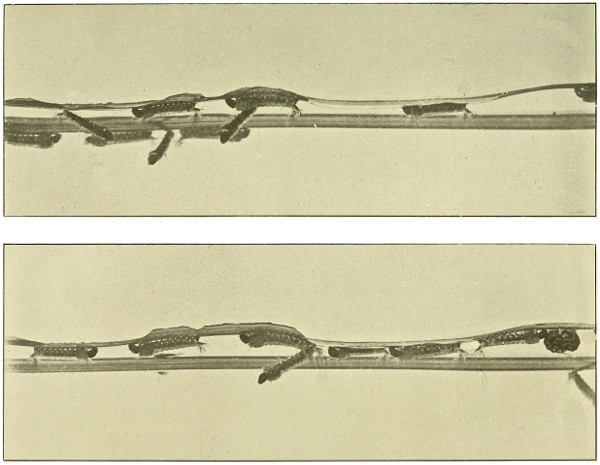
Living Anopheles larvæ. Photographed by Mr. T. H. Royle, of Rosa.
Owing to their being confused with the line of optical
contact of air and water, and the latter being raised by
adhesion into curves over their backs, they do not come out
as clearly in the photograph as in a drawing, but they are,
nevertheless, sufficiently clearly shown for easy recognition,
a matter of some importance, as these are the larvæ of the
sub-family Anophelinæ, to which belong all the mosquitoes
that are concerned in carrying malaria, besides which they
are the commonest carriers of blood-worms. The mosquito,
however, that conveys yellow fever (Stegomyia)
belongs to the Culex sub-family.
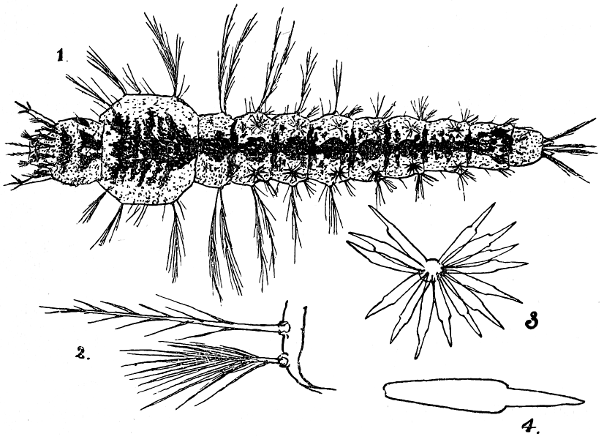
Fig. 8.—(1) Larva commonly found in jhils and tanks (probably of Myzorrhynchus
sinensis.); (2) frontal bristles of the same; (3) abdominal palmate
tuft; (4) separate leaflet of palmate tuft.
For any one possessing a microscope these larvæ form
most fascinating examples of “pond-life,” as many species,
especially when young, are transparent enough to enable
one to follow the entire mechanism of their internal organs;
but a great deal of interest can be made out with a simple
hand-lens.
On the back of each of the rings of the abdomen, or
hindmost division of the body, of the Anopheles larvæ may
be made out a pair of structures formed like minute palm
leaves, the function of which appears to be that of keeping
the little creature flush with the surface of the water.
One of these larvæ, magnified about twenty times, with
these structures and certain peculiar hairs on the front of
the head, which are of value in distinguishing one species
from another, more highly magnified, is figured on the
preceding page. By the aid of these illustrations the reader
should have no difficulty in recognising these organisms
when he meets with them. When disturbed, they dart
backwards and seek refuge among the débris at the bottom,
but cannot remain there long, and soon resume their resting
position on the surface.
The larvæ of many species are said to be carnivorous, and
even cannibalistic, though I cannot say I have ever observed
this personally, and in any case their main provision is
found in the minute vegetable organisms which are abundant
in the sites where they are common; the Culicine larvæ
confining themselves mainly to those that are found completely
immersed, while the young Anopheles browses on
those floating on the surface, keeping its head screwed
round, a full half-turn, so as to bring the mouth uppermost.
The abrupt way in which this action is performed and
reversed is extremely quaint, so that, as a writer remarks,
one is rather surprised at its not being accompanied by an
audible click.
The duration of the period of larval existence depends
on the temperature of the water and on the abundance or
scarcity of food. When first hatched out from the egg, the
larvæ are barely visible to the naked eye, whereas when full
grown they contain within themselves the entire material of
the adult flying insect. Once full-grown, the weather being
favourable, they change into “nymphs” or pupæ, not
unlike small tadpoles in form, the head and thorax being
enclosed in an almost spherical envelope, to which is
appended a sort of tail, formed by the abdomen, which is
usually kept folded under the body, as shown in the figure
below. In this stage the animal breathes through a pair of
horns springing from the back of the thorax. The mouth
is completely closed, so that the pupa is incapable of feeding,
but is in no sense quiescent, as it is capable of lively
movements and tries to elude capture almost as briskly as
the larva. After a sufficient time has elapsed for the completion
of the extraordinary anatomical changes that convert
the larva into the adult insect, the pupa-case bursts along
the back, and the perfect gnat gradually disentangles itself
from its temporary home, and flies away, very shortly to
reinitiate the cycle of events by laying a fresh batch of eggs.
As has already been remarked, the time required to complete
these changes varies greatly in different species and
under varying environments, of which climate is the
most important factor, but under moderately favourable
conditions the time required is a fortnight or three weeks,
the greater part of which is passed as a larva. In
countries where water freezes during winter for any length
of time, all larvæ that have not completed their metamorphosis
by the end of autumn, must necessarily perish;
and the continuity of the species is maintained entirely
by the survival of pregnant females that hide themselves
in warm corners and pass the winter in a truly hybernating
or dormant condition. Further south, both males and
females hybernate, and the dormancy is so much less pronounced
that the insects are often tempted to issue from
their hiding places on exceptionally warm days. In such
climates, which include Italy and most of the sub-tropical
zone, the species finds an additional string for its bow in the
survival of larvæ, which, though they cannot be said to
hybernate in the strict sense of the term, being always lively
and alert in their movements, are yet incapable of growing,
and appear to remain at whatever size they may have previously
attained until the return of warmer weather. Quite
recently Dr. Bancroft, of Queensland, has discovered that
in some species these wintering larvæ can give birth to
small broods of young larvæ, so that in such cases the bow
has no less than three strings. Further south again, in
truly tropical climates, breeding goes on all the year round.
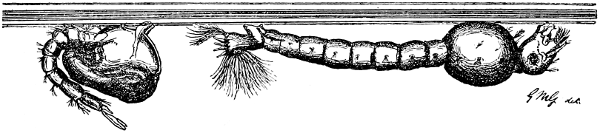
Fig. 9.—Larva and Nymph of Anopheles, to show habitual resting position.
The head of the larva is shown looking up, as when feeding.
No adult mosquito can stand the direct rays of the sun,
and hence all of them have to seek the shelter of houses,
trees, or some such protection, during the heat of the day;
moreover, with very few exceptions, they are nocturnal or
twilight insects, so that there is comparatively little danger
of being bitten during the hours of daylight. For the
majority of species too, extreme atmospheric heat has
much the same effect as great cold, so that during periods
of intensely hot, dry weather the number of species
to be met with in a state of activity is very small, and
fortunately those that convey malaria are not amongst the
number; but on the other hand, the one or two sorts that
possess this tolerance are so enormously prolific that their
numbers far exceed those of all other species combined.
Another point of importance is that, for practical purposes,
mosquitoes cannot fly far, and hence never wander far
from the puddle on which they were born. Being tolerably
long-lived insects, it is of course possible for them to slowly
spread amongst trees or bushes for considerable distances,
a few straying further and further away every night from
the place of their birth, but the number that can travel in
this way for any considerable distance, is so small as to be
scarcely worth consideration; and any considerable expanse
of bare, open country is practically impassable to them.
Mosquitoes are most active during the periods of twilight,
and especially in the evening, at which time they quit the
shelter in which they have dozed away the day, and come
out into the open to seek their food, remaining outside for
the most part throughout the night, though the females
of those species that attack man and animals, it is needless
to say, will find their way back into houses in search of
their favourite food. As soon, however, as the sun has
got well above the horizon they may be observed trooping
back into the house, and if a window be closed it is very
amusing to watch the numbers that will alight on the
glass at this time of the day, and their efforts to find a
way through the obstruction. The special importance of
keeping all means of entry closed at this particular hour
can therefore easily be understood, though in ordinary
tropical practice, it is the very time at which every door
and window is habitually thrown open.
Mosquitoes are found all over the world, it being a
great mistake to imagine that they are confined to tropical
climates. Some score of species are to be found in
England, and though in high latitudes they cease to be
dangerous as carriers of disease, there are perhaps no
localities where they are so numerous and troublesome as
certain parts of the North American Continent, and in
Scandinavia, close up to the Frigid Zone.
Almost any collection of water will serve as a nursery
for the larvæ, unless indeed, there be a decidedly strong
current; but the situations taken by preference during the
breeding season are small stagnant pools and domestic
collections of water, such as small tanks, broken crockery,
empty tins, &c.; while wintering larvæ prefer the larger
ponds and marshes which are permanent throughout the
cold weather, and especially select those in which there is
sufficient vegetation, reaching to the surface of the water, to
afford cover and protection from their numerous enemies.
Practically speaking, wintering larvæ will never be found
in tanks or ponds devoid of fairly robust vegetation, and it
may easily be understood from this fact that the clearing
away of reeds, grasses, and weeds of all sorts during the
cold weather from all such collections of water which
may be found near an inhabited site is a most important
sanitary measure. Some species prefer the fairly clean water
of marshes and ponds, while others luxuriate in the dilute
sewage of the domestic waste water, but it would occupy
too much space to go into any detail on this subject, and
all that the sanitary amateur need remember in this
connection, is that any and every collection of water,
capable of standing for ten days or a fortnight, should be
regarded as dangerous to health in any country where
malaria is known to exist.
For our purposes, it will suffice for the reader to understand
the general characteristics of three sorts of mosquitoes.
First, there are the common Culex mosquitoes, which are,
almost everywhere, far more common than the others.
They are usually of a dull grey colour, and with very few
exceptions, their wings are quite plain and free from spots.
As will be seen from the photographs in the accompanying
plate, they sit in rather a humped-up position, and the
proboscis is obviously much thinner than the body, its
appendages, or palps, being held apart from it. Mosquitoes
of this sort cannot convey human malaria, though
they are instrumental in conveying a similar disease for
certain animals. They are to be found, in greater or less
numbers, throughout the year.
The second sort is the Stegomyia, which is the genus
concerned in the conveyance of yellow fever. These mosquitoes
are seldom to be seen except during the rains, and
rest in much the same position as the Culices, which they
resemble closely in form. Their wings are never spotted,
and almost all are small insects clothed with jetty-black
scales, picked out with an ornamentation of dazzling white
lines on the body and spots on the abdomen and legs.
PLATE II.
Photographs of living mosquitoes. Above, ♂ and ♀ Culex mosquitoes
in profile; in the middle, ventral aspects of the same; and beneath, ♀ and
♂ Anopheles mosquitoes. About twice natural size.
The third, or Anopheles, sub-family is that concerned in
the transmission of human malaria, and, as may be seen
by comparing the two lower photographs of the plate with the
upper ones, can easily be recognised by their characteristic
form and attitude. In these mosquitoes the feelers are long
and thick in both sexes, and as they are held habitually in
contact with the proboscis, these together appear to the naked
eye as a prolongation of the body as thick, or thicker, than
the abdomen. Moreover, except in a few species, their position,
when resting, forms a singular contrast to that of the
Culices, the whole body and proboscis being held in one
straight line, with the abdomen raised from, and the proboscis
pointed almost vertically at the surface on which they
rest, and almost touching it with its point, as if they were
preparing to drive the latter into it; so that, viewed with
the naked eye, they look much like minute black thorns,
stuck into the surface on which they are sitting. On closer
examination, it will be seen that the wings are not plain,
but spotted (the number of plain-winged species being
unimportant).
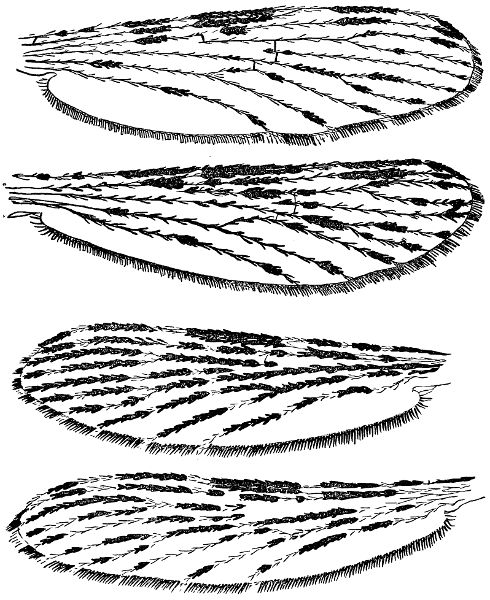
Fig. 10.—Wings of various sorts of Anopheles mosquitoes, much magnified,
to show the arrangement of the dark and light scales which form the
characteristic spots.
The appearance of spotting is usually produced by
alternate lengths of the veins of the wings being coloured in
finely contrasted dark brown or black, and white or yellow,
and varies, of course, in detail in different species, but the
above figures of the wings of some of the commoner Indian
forms will give an idea of the general effect, as seen under
a moderate magnification, for though the spots are quite
visible to the naked eye, it requires a fairly powerful hand
lens to make out the details properly.
Like the Stegomyiæ, the Anophelinæ are only common
during the rains, but stray specimens will be met with for
a month or two afterwards; and though they practically
disappear during cold weather, a few may be generally
met with during the hot dry months of continental hot
climates.
From what has been said, it follows that the prevalence
of malaria, like that of mosquitoes, must necessarily be
seasonal. The survival of the malarial parasite at those
times of the year when mosquitoes are scarce or absent,
is maintained by the persistence of considerable numbers
in a latent condition, in the persons of human beings who
have been imperfectly cured of an attack of malaria.
Cases of this sort, which have either been never treated
at all, or in which the administration of quinine has been
stopped too soon, are extremely common in all malaria-stricken
communities, and such persons are always liable
to relapses if they are brought below par by any depressing
influence, such as chill, too great exposure to the sun, or
the incidence of injuries, or of other diseases.
During such periods the latent parasites, which have been
perhaps for months lying hidden in the internal organs, will
reappear in the blood in large numbers, and there are always
a sufficient number of such cases of relapse persisting
through the naturally malaria-free season, to suffice to infect
the early broods of mosquitoes that come to maturity with
the advent of the rains.
This shows that the curing of all cases of malaria
is matter by no means confined to the interests of the
patient himself, but is of great importance to the entire
community of which he is a member; for, despite the
fact that the disease is only indirectly transferable through
the agency of the mosquito, a case of malaria is as
great a danger to his fellow-men as one of any other
infectious disease, and should, as far as possible, be
dealt with in the same way; only the problem of isolation
is in this case easier than usual, as it suffices to prevent
mosquitoes getting access to the sick person; and in a
properly fitted mosquito-proof house or hospital, malaria
cases may quite safely be allowed to mix freely with the
healthy, as well as with persons affected with other diseases.
Relapses in persons chronically infected with malaria
may occur at any time of the year, but the fresh infections,
which always form the bulk of the cases met with, can
only happen as the result of a tolerably recent bite by an
infected mosquito; and as about a couple of weeks are
required for the maturing of the parasite within the insect,
and a further period of incubation is necessary within the
human subject before the parasites attain sufficient numbers
to produce a definite constitutional reaction, fever does not
as a rule commence in earnest until some three weeks or a
month after the break of the wet season. Once the process
is started, infected mosquitoes and malaria-stricken
men increase in numbers rapidly, and as numbers of infected
mosquitoes survive for a considerable period after the cessation
of the breeding season, the prevalence of malaria
continues until the advent of cold weather puts a period to
the possibility of the survival of the parasite within the
insect organism. Hence it is generally quite possible to give
a fair idea of the monthly distribution of rainfall in any
warm climate from the returns of sickness and mortality,
and vice versâ.
The natural history of the living organisms that are concerned
in the propagation of malaria has been described
with some detail, as suitable measures for the prevention
of the disease must needs be based on a fairly competent
knowledge of the subject, and is the more necessary as it
is hardly possible to give any “rule of thumb” directions;
because the circumstances on which the prevalence of
malaria depends vary so greatly in different localities that,
to ensure success, our operations must necessarily be modified
in each case to meet local conditions.
In the following remarks, however, it is not proposed
to deal with the question of prevention on a large and public
scale, but only with such as can be adopted as measures of
individual and personal hygiene, as the larger question of
provincial and municipal anti-malarial sanitation cannot be
adequately dealt with in a short treatise like the present.
Keeping always in view the just described data of the
life history of the malarial parasite and of its temporary
host, the mosquito, it is obvious that our measures of protection
must be based on one or more of the following
plans of action, any one of which, could it be carried to
complete success, would suffice to “stamp out” the disease.
These measures are:—
(1) To destroy the mosquitoes.
(2) To prevent mosquitoes biting man.
(3) To prevent mosquitoes from becoming infected, by
isolating all cases of malaria in man.
In practice, however, it is extremely rare that anything
like complete success can be attained on either of the three
above indicated lines of action, especially as concerns the
second and third methods, and though here and there
localities may be met with in which the breeding places
for mosquitoes are so circumscribed and easily dealt with as
to render the actual extermination of mosquitoes practicable,
in by far the majority of cases we must be content with a
partial success all along the line, by adopting such measures
as may be locally most practicable, based on any or all three
of the above principles of action.
In the case, for example, of habitations placed in the
midst of canal irrigation where ample and efficient subsoil
drainage is impossible or too expensive, the attempt to
destroy mosquitoes can be little better than a waste of time
and money; for under such conditions the breeding places are
so numerous, and appear so constantly in new and unexpected
situations, as to defeat the utmost vigilance; and the thorough
protection of all habitations against the invasion of mosquitoes,
and the careful treatment of all cases with quinine,
is all that can be done. On the other hand, in an exceptional
case, such as that of the town of Ismailia in Egypt, where
the rainfall is practically nil, and the breeding places all of
artificial origin, the practical extermination of mosquitoes
may be so easy a matter as to be effected at a small expense
in a single year, with the immediate result of reducing the
cases of malaria to a tithe of their previous numbers.
Measures of the first class, i.e., the extermination or
diminution of the numbers of mosquitoes, can often be
undertaken with considerable success by private individuals,
the possibilities of success varying, of course, with the extent
of the area directly or indirectly under his control.
The resident of a closely inhabited town can, it is needless
to say, do no more than contribute his personal mite to
the general welfare in this matter, with little chance of reaping
much benefit unless his neighbours follow his example;
but with the exception of diplomatic officials and merchants
residing in places under oriental rule, where the safety of
life and property are too badly secured to admit of their
living outside town limits, it is rare for any European to be
so situated, as in most of our colonies and dependencies the
European quarter of the town consists of widely separated
villas each surrounded with a garden of some size, with
generally a small hamlet of dwellings for native servants
and dependents included within its boundaries. In addition
to this, there are often open spaces, of considerable extent,
between the various “compounds” which, though not
directly under one’s control, are so far “no man’s land” that
no one will interfere with any one employing on them any
of the measures required for anti-malarial sanitation, while
the most litigious municipal council is hardly likely to object
to the sprinkling of a little paraffin on the roadside puddles.
In this way it will generally be possible to effect a good
deal within a radius of three or four hundred yards of one’s
dwelling, and actual experience has shown me that if all
breeding places within such limits can be rendered harmless
the number of stragglers that will stray across from places
beyond will be too small to be seriously troublesome.
In devising measures for the destruction of mosquitoes
it is obvious that while they may be attacked either in the
aquatic or aerial stages of their existence, the easily localised
larvæ and pupæ will be far more easily dealt with than the
elusive flying insect, and it will be therefore best to devote
most attention to the destruction of the former.
There are two principal methods of dealing with the
insects during their aquatic stage, i.e. (1) by doing away
with their breeding places; (2) by poisoning them. Of the
two it is clear that the former method is, where practicable,
the more valuable, as in nearly all cases its effects are more
or less permanent. With either object in view, however,
the first step is to seek out the breeding places.
As a preliminary measure, all domestic rubbish capable
of holding water, such as disused flower-pots, empty
tins, &c., should be carefully sought out and destroyed or
disposed of by throwing into some depression of the soil
which it is desired to fill in. Next, the entire surface should
be carefully inspected after a brisk shower of rain, and all
such puddles as are of manageable dimensions carefully
filled in and levelled.
The amount of labour that can be profitably afforded in
work of this sort will depend a great deal on the probable
duration of one’s stay in a place; as temporary residents,
such as government officials, will find it much cheaper to
employ temporary measures, such as the use of paraffin;
while in the case of merchants and other permanent residents,
the expenditure of a considerable sum on permanent
measures will be more remunerative in the long run. The
great difficulty often lies in finding spoil wherewith to fill
in the depressions, as unless care be exercised, the only
result will be to shift the site of the puddle. Sometimes,
however, a bank of earth surrounds the compound by way
of a hedge; and as in a level country the existence of such
an obstruction to surface drainage is most objectionable
such banks should always, if possible, be removed and
a hedge of wire or bamboo substituted; when the spoil
can be advantageously utilised for filling in hollows. Where
no localised elevations are to be found, the material required
should be obtained by a general very slight removal of the
surface. In other cases it may be possible to drain a depression
by cutting a shallow gutter to the nearest surface drain.
Another and very important class of breeding place consists
of the comparatively large collections of water formed
by the various reservoirs, channels, &c., constructed for
obtaining and storing water for various domestic purposes,
such as wells, tanks, &c., and especially the appliances for
watering gardens. Of these the most harmful of all is
canal irrigation, which should undoubtedly be never tolerated
near a dwelling by any one valuing his health, malaria
or no malaria; for the waterlogging of the soil, that is
practically inseparable from the system, is either the exciting
or predisposing cause of a variety of diseases, many of which,
such as rheumatism, consumption and cancer, are perhaps
more seriously dangerous than malaria. Sodden and waterlogged
sites are notoriously unhealthy all over the world,
and chronic ill-health is a high price to pay for a few flowers
and vegetables; so that the settler will be well advised to
leave irrigated cultivation to those who are constrained
to adopt it for a livelihood, and banish it from his own
premises; as much is gained by living on a comparatively
dry site of however limited extent.
As a matter of fact, indeed, the possession of a garden of
any sort is a more than doubtful benefit in malarious places,
for trees and shrubs necessarily form lurking-places for
mosquitoes; and even with the greatest care, it is difficult to
carry out the necessary watering of the plants without
giving rise to puddles; while the various reservoirs, &c., that
are almost indispensable, are a constant source of danger
unless constantly and minutely supervised.
In India, for example, gardens are commonly watered
from wells by means of water lifts of various forms, which
are worked either by means of bullocks or by manual labour.
In order to facilitate the distribution of the water, masonry
channels are usually constructed which carry the water
from the well head to all parts of the garden, and as the
lift cannot conveniently be worked continuously, a number
of small tanks are arranged along the line of channels
wherein water is stored, so that it can be dipped out and
distributed by means of an ordinary watering can without
the gardener ever having to go far to replenish it. Now
these small tanks are par excellence the main source of supply
of mosquitoes of all species, and therefore of malaria, to the
houses to which they are appended. If, therefore, a garden
be considered indispensable, all such tanks should be carefully
emptied and all deposit cleaned out at least once a week;
under which circumstances, though they will probably swarm
with larvæ by the end of the time, it is impossible for any
of the latter to complete their metamorphoses into adult
insects. By far the least objectionable plan of relieving
the dust and glare of a bare situation is the cultivation of
a well-kept lawn, a few large trees being left and the area
of flower beds strictly limited, for as flooding the grass is
sure to spoil a lawn, success can only be ensured by careful
and moderate waterings at frequent intervals.
Collections of water that are too large to be done away
with by filling in or by draining, should be dealt with by
oiling the water with paraffin. There are some other agents
which may be employed for the purpose, but none of them
are so cheap, efficient, and readily obtainable. As an additional
advantage, though fatal to all kinds of insects, it is
in the quantities employed, not only absolutely harmless to
vegetation, but water so treated is actually a most valuable
application, owing to its power of destroying other injurious
insects. When sprinkled on water paraffin spreads out into
an extremely thin film, so that a very small quantity will
cover a considerable area. A three-gallon tin, for example,
contains enough to cover an area of 100 yards each way,
though it may be a day or two before the oil reaches all
parts of such a space. It is important to remember that
the cheaper and commoner the oil, the better it is for the
purpose, and the addition of a little of common bazar
ghi, or clarified butter, is said to make the oil spread
better and render its action more lasting, though the writer
has not personally experimented with the mixture.
In the quantities used there is no possible danger of fire,
even though wooden structures, such as the piles of bridges,
be immersed in the water, as the film is so thin that it is
impossible to ignite it; a matter one would have thought
sufficiently obvious, were it not that objections have been
gravely raised to the use of paraffin on this score.
The method of application must be varied to suit the size
and situation of the piece of water to be dealt with. Small
puddles, such as those left in the course of roadside ditches,
may most economically be dealt with by, as it were, lightly
wiping over the surface with a wisp of rags dipped in the
oil; filling in being in such cases out of the question, as to
do so would be equivalent to obstructing the drainage; and
it is quite impossible to maintain an exact and uniform
gradient in an unrevetted channel.
For larger collections of water, by far the best appliance
is an ordinary gardener’s watering-pot. The oil should be
applied mainly along the windward side of the pool by a
coolie, who should, if possible, walk out some distance into
the water, and should be trained to sprinkle the oil by rapid
single sweeps of the rose of the can, a few steps being taken
between each sweep, as there is no need to make the loop-shaped
areas of water sprinkled in this way continuous, as
the oil will spread laterally and join each of them together
even if separated by several yards, and no advantage whatever
appears to be gained by applying the oil thickly. In
exceptional cases, such as the moats of fortifications, where
the water is enclosed within high vertical walls, a garden
syringe may be required in place of the watering can.
In situations such as the pools in canal beds, ditches,
&c., the oiling must obviously be done after each flow of
water through the channel; but in most ordinary situations,
the effects of a careful oiling may be trusted to last for at
least three weeks, as, though larvæ may be beginning to
reappear by the end of that period, none of them will have
had time to complete their metamorphoses. For the destruction
of wintering larvæ, two oilings, one at the commencement,
and one towards the end of the cold season,
amply suffice; and in Continental hot climates it is needless
to repeat the process during the dry hot season, as at that
time only artificial breeding places, such as garden tanks,
require attention, and these are better dealt with by
periodical emptying.
At that season indeed, the undried-up breeding places are
so few and far between that people have only themselves
to thank if mosquitoes are in evidence at all; and yet in
many places there is no season of the year when they are
so numerous and tormenting. There are no remaining
natural breeding-places, and the pains of a weekly stroll
round one’s premises to ensure the emptying and cleaning
out of all garden tanks, water-vessels, &c., are all that
is required to secure complete immunity at that season of
the year, but it is most difficult to induce people to take
even this trifling trouble; and the mosquitoes are likely to
flourish undisturbed until the existence of breeding places
within the premises of any person is treated by the authorities
in the same way as other dangerous nuisances; and yet
these very people are the loudest in their condemnation of
the inertia of the native in sanitary matters, and while they
maintain malaria breweries on a scale in which the modest
extent of his premises forbids him to compete, inveigh
against him for starting a cholera factory on the most
modest lines. The native who refuses to avail himself of
the protection against plague of a health camp is, they
admit, an impracticable fool for his pains; but the sahibs of
the civil lines, whose gardens supply a large share of the
harmful mosquitoes to the neighbouring city, are merely
“common-sense” people who attach no importance to
doctor’s fads and “scientific rot” of all sorts. The native,
however, has at least usually the excuse that he is unable
to read or write; and for the rest, does not pretend to be a
very highly civilised person.
Once they have emerged from the pupa case, our means
of attacking mosquitoes are comparatively feeble, and for
those that habitually pass most of their time in the open air
practically nil.
In the case however of domestic species, which habitually
shelter in houses, a good deal can be done in this matter;
and, just as in the repression of other troublesome insects,
such as fleas and bugs, scrupulous tidiness and cleanliness
is by far the most important of all agencies. Useless, rarely
dusted draperies and curtains, and untidy collections of
clothing hung about on nails and pegs, instead of being kept
in properly closed wardrobes, are the things that are mainly
responsible for attracting and sheltering mosquitoes within
houses, for they will not, if they can avoid it, remain in a
well-lighted room, with freshly colour-washed bare walls.
In the tropics, the Italian villa with its frescoed walls and
minimum of useless furniture, is the ideal that should be
aimed at, and not the elaborate lumber warehouse of an
English drawing-room; which, though comparatively harmless
in our own climate, is about as well adapted for imitation
in hot countries as the coat of the Polar bear in the Zoo
is suited to our summer.
Perhaps our most effective agency in dealing with adult
mosquitoes depends on the intense objection all species of
these insects entertain to smoke.
That it is quite possible to effectually protect animals
from mosquito bites by the agency of smoke alone, has
recently been conclusively shown in the course of Mr.
Power’s experiments on the prevention of horse sickness
in South Africa; but, though most semi-civilised people
seem to live comfortably enough in a smoky atmosphere,
Europeans would find such a state of things intolerable;
and the plan can only be utilised to drive mosquitoes out
of houses, other methods being relied on to prevent their
re-entering. Smoke from almost any source will put mosquitoes
to flight, and if sufficiently intense will stupefy them;
but certain special materials must be burnt if it is desired
to kill them outright, and our modus operandi must be
varied according to the means at our disposal, for if we
can only expect to annoy the insects sufficiently to drive
them out of doors, the latter must be left open during the
fumigation; whereas, if it is proposed to kill them, all
openings must be closed as completely as possible, so that
the fumes may reach the insects in as concentrated a form
as possible.
For simply driving out mosquitoes, any fuel that produces
a dense smoke, such as damp straw, will serve. Maize
cobs are excellent for the purpose, but probably the least
objectionable is the burning of a little incense (Hindustani,
Lobán). To actually kill them, on the other hand, it is
necessary to shut up all openings as closely as possible, and
to burn certain special substances, such as sulphur, unopened
chrysanthemum flowers, the leaves of the neem tree, tobacco,
&c., and the degree of success attained will vary a good deal
according to the character of the building in which it is
attempted; it being obviously extremely difficult to secure
an adequate concentration of the fumes in a very pervious
structure, like a house with a thatched roof and walls of
bamboo matting, such as is often met with in Burmah and
the Malay Archipelago. Under such circumstances, the
rapid burning of a large amount of the fumigating agent
is the only way of meeting the difficulty; and under any
conditions, plain sulphur, simply ignited as a powdered
mass, or placed on the hot coals of a charcoal brazier,
burns so slowly as to be quite useless.
A few instants’ exposure to an atmosphere containing
a fairly high percentage of sulphurous acid will kill any
insect, whereas they will be merely stupefied or unaffected
by prolonged exposure to a weaker mixture of the poison.
I am quite aware that sulphur has been decried as almost
useless by several observers, but this is simply because
they have not used it properly; for to secure success, something
must be added to the sulphur which will make it
burn quickly, and what is wanted is, in fact, a weak firework.
In well-constructed buildings the sulphur pastiles
prescribed in the second edition of my work on the “Gnats
or Mosquitoes” answer sufficiently well, but subsequent
experience has shown that the proportion of nitre is not
enough to secure a sufficiently rapid combustion to instantly
flood the air with sulphurous acid, and that nothing short
of a slow burning firework, such as a Roman candle or
Bengal light, will do this in a building roofed with tiles or
thatch. Possibly it might be advantageous to raise the
proportion of sulphur; and it is undoubtedly better to pack
the material as a powder in paper cases, than to mould it
into pastiles. Proper precautions against fire must of course
be taken, but in fireworks of this sort the sparks do not fly
far, and it is quite safe to use them in any ordinary room
if the precaution be taken of placing the cases under a low
shield, formed of a sheet of corrugated iron supported on
four piles of bricks.
The occasional fumigation of a dwelling in this way is
a useful adjunct to the destruction of the larvæ; and where
combined with proper wire-gauze protection, after the plan
described below, may be relied upon to secure immunity
from the attacks of insects, even where measures for the
destruction of larvæ are impracticable. It has the further
advantage that it is fatal not only to mosquitoes, but also
to insect pests of all sorts, such as flies, hornets, bugs, or
fleas, and even to such more awesome foes as scorpions and
centipedes, all of which delight to share the home of the
dweller in tropical climes.
Mosquitoes are always greatly attracted by draperies,
especially those of dark colour, and the fact may be utilised
to trap them by means of deep bags of black gauze (chiffon),
the mouths of which are held open by an oval loop of cane,
or some such material. Such bags, if hung up mouth down-wards
in tempting dark corners, will usually be found
swarming with mosquitoes each morning, and the insects
can easily be killed by crumpling the bag in the hands and
then shaking out the dead insects.
By working on the above lines, especially where one has
the co-operation of neighbours, it is in all cases quite possible
to materially diminish the nuisance of mosquitoes, and
under favourable circumstances to practically extirpate
them; though, in a usual way, complete success must not be
expected. In the exceptional cases where this is possible,
there is, of course, no need for the adoption of any other
sort of measures; but, in the majority of cases, an amelioration
only in the numbers of insects is all that can be
attained; and it is necessary to guard against the risk of
some of the survivors becoming infected, by the adoption
of measures of the second and third classes. Of these
the second, i.e., the protection of man from mosquito bites,
is in most cases the most easily practicable.
A variety of ointments and applications of various sorts
have been from time to time vaunted as protectives, and
the presence of certain plants, such as the eucalyptus
and the castor-oil shrub, have also been stated to be so
obnoxious to mosquitoes of all sorts that they might be
trusted to make themselves scarce wherever these plants
might be found. For these ideas there is doubtless this
much foundation in fact, that most strongly smelling bodies
really are obnoxious to mosquitoes; but unfortunately, whatever
objection they may have to strong scent is not very
deeply rooted, and in default of more congenial shelter they
will settle upon either eucalyptus or castor-oil plants, and
will brave even the hated smell of paraffin to secure a good
feed on the blood of a human or animal subject. All these
special applications to the skin, too, have the further disadvantage
that, though some of them are fairly effectual for
a few minutes after they have been just applied, and so
enable the user to get sleep, they leave those who are
deluded into depending upon them to fall unresisting victims,
as soon as the thick of the scent has evaporated. So that,
though valuable for securing rest, they are worse than useless
from the point of view of the prevention of malaria.
With these untrustworthy exceptions, all available measures
are of a mechanical character, and consist in modifications
of our housing and clothing.
It must be remembered that during the working hours
of the day there is little chance of being attacked, at any
rate in the open air, and the same is the case in well-lighted
rooms. Thus men whose work takes them into the open
air for some considerable portion of the day, or are occupied
in well-lighted offices, run much less risk than ladies, who,
when they attempt to face the hot weather at all, are too
fond of shutting themselves up in a darkened room, devoid
of light or fresh air, and filled up with hangings and other
superfluities, so as to form a perfect mosquito paradise in
which the insects can fly about and bite during the day as
comfortably as during the night. With such exceptions,
there is therefore no need to modify costume to diminish the
chance of mosquito bites as long as the sun is up, or even
during the twilight, as long as one is in motion. It is
when people are resting after the evening game of golf,
racquets, or tennis, that they are most commonly attacked
while awake; but the time of greatest danger is the period
passed in sleep. During the waking hours it is uncommon
for a mosquito to get the chance of an undisturbed meal
by attacking the face and hands, but she often does so by
attacking the ankles, and even thick stockings are no adequate
protection. Trousers are therefore more suitable than
knickerbockers for evening wear, and should be made extra
long; so that when turned down after taking one’s evening
exercise, they thoroughly protect this very vulnerable portion
of the person. A lady can generally arrange her dress
so as to protect herself, but the ordinary costume of children
is extremely dangerous, and certainly should be modified to
meet this danger during the hours when mosquitoes are
active. In the case of little boys a “sailor suit” with long
voluminous trousers meets the difficulty; and—fashion or
no fashion—it is a clear duty on the part of mothers to
devise some cool but adequate protection for the little girls.
The alternative lies between doing so and wilfully offering
them as sacrifices to the god of dress by needlessly exposing
them to the danger of infection.
The low-necked, sleeveless dresses worn by ladies in the
evening must, we can well understand, be very temptingly
cool wear in the climates with which we are dealing, but are
obviously extremely dangerous, as they leave a large surface
of the person exposed at the very time when mosquitoes
are most active. A dress covering these parts should be
therefore substituted, which, however, may safely be made
of the lightest materials, provided that it be so puffed or
otherwise “confectioned” as to make it difficult for a
mosquito to get within reach of the skin. Mosquitoes are
always fond of collecting under tables, as they are there
sheltered from the glare of the lamps, and on this account
it is advisable for men to wear straps to their trousers when
dressing for dinner; and though the plan is a very old-fashioned
one, I have some hope that the suggestion may
meet the approval of our better halves, as, whatever its real
object, the adoption of the plan certainly gives the wearer
the air of having sacrificed comfort to appearances.
There would, however, be no need of modifying costume
for indoor wear in any way were houses properly protected
against the entrance of mosquitoes by means of suitably
planned wire-gauze protection to all openings.
The plan in question was devised by Professor A. Celli,
the Principal of the Institute of Hygiene in the University
of Rome, and in Italy at least has long passed its experimental
stage; though, owing probably to the small number
of Englishmen who are familiar with the Italian language,
it appears to be practically ignored even by our specialists
on the subject.
Within a few miles of the great city of Rome there are
large areas where malaria, far more virulent than the type of
disease we usually meet with in India, is so rife that, during
the malarious months, the country is practically deserted by
all but a few necessary railway officials and caretakers.
Amongst the former the mortality and invaliding used to be
so heavy that the working of the lines was a matter of the
greatest difficulty.
The majority of the peasantry, being only temporary
inhabitants, live in grass huts not a whit in advance of those
of the savages of Central Africa, and from the migratory
nature of their employment, are among the most ignorant
and backward of the Italian populace, and so about the last
people likely to lend themselves to the adoption of any
“new-fangled” custom. As a matter of fact, however,
the object lesson of the advantages of the system have
been so obvious that, after the first year, there has been no
difficulty in securing the eager co-operation of the simple
railway men and scarce civilised farm hands. As the system
is necessarily being very gradually introduced, there are
plenty of unprotected houses for comparison, and after
personally conversing with the inhabitants, the writer found
that all who had enjoyed the benefits of the plan were
convinced of its efficacy.
It must be remembered, however, that it has been long
a matter of popular belief in the Campagna that malaria
was, in some way, caused by mosquitoes; and it is the
difficulty of convincing those in high authority of this
fundamental fact that is at the root of the indifference and
inertia which oppose all attempts at amelioration in India
and in many of our colonies.
During the first two years’ experiments on the Campagna,
out of 25 protected cottages, with a population of 173
persons, only 8 persons contracted malarial fever; while in
30 unprotected cottages, having a population of 220, only
17 escaped the disease; although the protected and unprotected
cottages were, as far as possible, paired as regards
the site, and were otherwise of a uniform plan of construction,
and all inhabited by the same class of railway subordinates.
The system is the one above all others most suited for
adoption by private persons, because it secures an almost
complete immunity in spite of the most unfavourable surroundings,
and renders the user quite independent of the
sanitary lapses of his neighbours; but in spite of this, the
plan is almost ignored in our English colonies and dependencies,
though the writer has recently received an interesting
communication from a medical man practising in China
who has adopted it with signal success.
Professor Celli’s plan consists in rendering habitations
impervious to the entry of insects by closing all openings
with wire gauze (mesh of about 12 strands to the inch).
All windows, as well as such doors as only serve as such,
and are not absolutely required for ingress and exit, are
permanently closed by frames covered with the gauze, and
all indispensable exterior doors are fitted with double spring
doors of the same material, sufficiently separated from each
other to secure the closure of the first door before the
second can be opened.
In most Tropical residences, the number of doors is far
in excess of actual needs, it being nothing uncommon to
find rooms with four or five doors, all opening in the exterior.
Though desirable and even necessary for free ventilation, no
room can possibly require more than a single door opening
on the outside, and in a well-planned house with suitable
corridors, there is no real necessity for more than one or
two exterior doors to the whole house. All outside doors,
then, not absolutely necessary as such, should be treated as
windows and permanently closed with single frames of wire
gauze, so that the number of the more expensive double
spring doors may be reduced to a minimum. In Tropical
climates it is, however, essential that a considerable area of
verandah should be included within the protected area, as
a good deal of time is necessarily most pleasantly spent in
the verandah, not only in the evening, but during the rains
throughout the whole day. On this account a northern
verandah should be the one selected for protection in this
way.
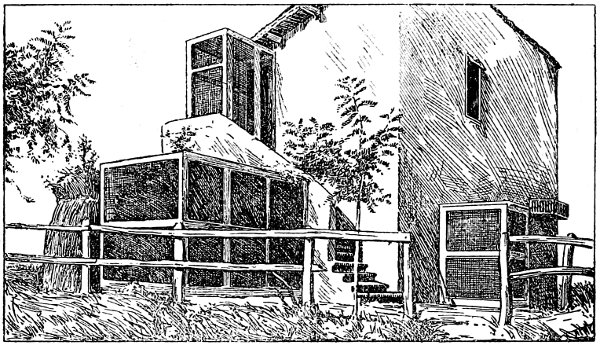
Fig. 11.—Railway servant’s cottage in the Roman Campagna, protected
against the entry of mosquitoes by Professor Celli’s method.
The main obstacle to the adoption of the plan is undoubtedly
the expense, which would amount to £20 or £30
for an ordinary Indian bungalow, and though this may
appear by no means prohibitory in the case of permanent
residents, it puts the matter practically out of the reach of
even well-paid officials, as they can never count on enjoying
the benefits of any permanent improvement of this sort for
more than a few months; the wisdom of our rulers almost
always leading them to transfer an officer to another station
long before he is likely to have thoroughly learned his way
about the streets of the town he has to govern.
Fig. 12.—Ground-plan of an existing up-country Indian Bungalow, to show
method of adapting one (Professor Celli’s plan) of wire gauze protection. The
dotted lines represent the wire gauze screens. D.G.D., double spring doors of
wire gauze; S.G.D. single spring door of wire gauze combined with existing
ordinary door; B.R., bath-room; D.R. dressing-room. Scale, 18′ = 1″.
On the preceding page is given the ground plan of an
actually existing “up-country” bungalow of a very usual
type in which the spaces guarded by gauze are indicated
with dotted lines. The original doors are shown as
complete, and the windows as shaded gaps. As will be
seen, the number of doors for actual traffic is reduced to
three, not counting those of the bath-rooms, which, being
but little used during the hours of mosquito activity, have
been left with single spring doors only.
There are many situations, such as houses necessarily
placed in the midst of canal irrigation—Government canal
bungalows for example—in which no other method of protection
is in any way practicable, and it is clearly the duty
of Government to protect officers, such as irrigation and
forest officials, whose duties lead them into specially dangerous
places, in this way in all cases where official quarters
are provided. There cannot be the least doubt, too, that
the capital so spent would be found to be a highly remunerative
investment, and that this would be equally the case if
steps were taken to protect all barracks in this way instead
of wasting the costly soldier by needless invaliding. In the
case however, of civil and military officers, who have to
rent their houses from landlords, who are generally needy
natives, with neither inclination, nor means, to provide
costly improvements, the utmost they can do is to provide
themselves with a sufficiency of portable folding gauze
screens to protect their sleeping chambers. In any given
locality there is generally some approach to a standard
size for doors and windows, so that by the exercise of a
little ingenuity it ought to be possible to adapt a set of
folding screens to any room, allowing them when too large
to overlap the sides of the embrasure, and supplementing
deficiencies with sacking or rough planking. In India, for
example, door openings are usually about 7 ft. by 4 ft., and
screens opening out to this size might be utilised in most
houses. It is obvious that the set of frames provided for
each room must include one filled with a small spring door.
I believe that a number of screens capable of opening out to
something larger than the dimensions of an average doorway
would be less bulky than any possible portable mosquito-proof
room—and at any rate a complete set for an
ordinary family would weigh far less than an average piano,
and would be far more conducive to health. It should be
added that in this, and in all cases where single rooms are
placed under protection, all doors, internal as well as external,
must be protected, and as they would in no way prevent
the use of a punkah, they would be an enormous improvement
on the ordinary mosquito net, which, failing such
appliances, is an absolute essential to health during the
malarious season.
Where nothing more permanent is possible, recourse
must be had to mosquito nets, which can with care be
made to afford a fairly thorough protection during the
most dangerous portion of the twenty-four hours. It
is a mistake, however, to trust to tucking the net in
beneath the mattress, as this is apt to become disarranged
during the night, and it is further very undesirable that the
net should touch any portion of the mattress at all, as if it
does so, the net can be also touched by the sleeper, who
thus readily exposes himself to being bitten through the net.
The top of the frame of the net should, therefore, be made
both longer and wider than the bed and should be long
enough to reach easily to the floor, with which its edge
should be kept in contact by means of a hem weighted with
sand or small shot.
I have seen, especially in Calcutta, several attempts at
the construction of curtains so large as to admit of a punkah
being swung inside them, the top of the curtains being
carried right up to the ceiling, and the strap of the punkah
being pulled through a sort of sleeve; but the arrangement
is necessarily an expensive one, and the swing of the punkah
is always more or less crippled by the sleeve. A better plan
is, I think, to make the frame supporting the netting very
low, scarcely higher in fact than that of a child’s cot, so that
the punkah swinging outside, but almost in contact with
it, still passes within a foot or two of the sleeper. Such an
arrangement is rather awkward to get in and out of, but
this drawback is a very trifling one, compared with the
enormous advantage of combining the protection of the
net with the comforts of a punkah. For this idea I am
indebted to Mr. Symmonds, of Rosa, whose contrivance I
presume it is, as I have certainly never seen beds fitted in
this way in anyone else’s house. For sleeping out of doors
in the open, the net must, however, be of the usual fashion;
as if the wind be at all strong, a weighted hem would not
suffice to keep the net closed. It is therefore important
when sleeping out to use a large bed, so that contact with
the net may be less likely to happen; and the top of the
net should be formed of ordinary calico, so as to keep off
the dew. Not unfrequently the mesh of the netting sold
for making mosquito nets is too coarse, a point of some
importance, as Anopheles mosquitoes in particular are
adepts in creeping through small openings; and as the
writer has found it impossible to confine them in enclosures
formed of the coarser patterns of net, it may be concluded
that such a material is equally inadequate to keep them out.
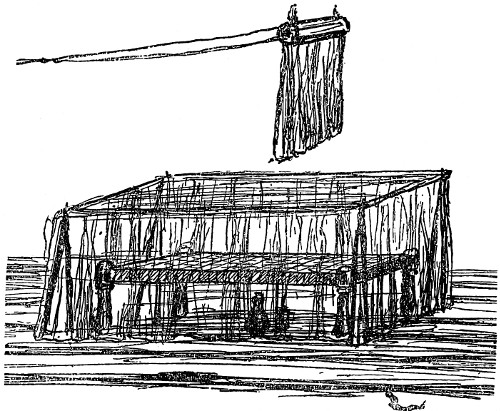
Fig. 13.—Bed arranged with a low mosquito-net frame, with punkah above it.
References to the protection against malaria afforded by
mosquito nets by observant sportsmen and explorers are
to be found in numbers of books of travel and adventure
published long before any explanation of the fact was
possible; and during the malarious season it is nothing
better than culpable rashness to pass the night without
this protection, except in a room properly guarded with
wire netting. It is quite common to hear it asserted that
a punkah alone is sufficient protection, but this is an entire
mistake, as I have repeatedly watched a mosquito making
a comfortable feed on my person within a few inches of a
spot actually flicked by the towel which it is usual to pin
on to the lower edge of the punkah. In non-malarious
months, such as the hot dry weather preceding the rains
in northern India, there is, of course, no need of a net
except as a matter of protection against the harmless, but
very annoying, Culices that are very common at that season
of the year; and in spite of its inferior protection against
being bitten, many will prefer the freer air current afforded
by the punkah. After the commencement of the rains,
however, the fact cannot be too strongly emphasised that to
sleep without the protection of a net is to wilfully expose
oneself to a real and ever-present danger.
In the matter of preventing mosquitoes from becoming
infected it is obvious that comparatively little can be
effected by the private individual. All he can do is to
bear in mind that persons suffering from malaria are as
great and real a danger to their neighbours as those affected
with scarlet fever, small-pox or any other communicable
malady, and accordingly to try to limit the number of such
cases amongst his servants and dependents. In the great
majority of cases in all probability, the mosquito that infects
the European resident has been infected by a case amongst
his servants; and quite apart from philanthropic considerations,
it is most important to detect all such cases and have
them treated with quinine.
It is a well-known fact that, even where the drug
appears to fail to cure the disease, it is very difficult to
find the malarial parasite in the blood of cases that have
been well dosed with the drug, and as there must be parasites
present in the blood itself in order to convey infection
to the mosquito, it is obvious that, apart from its curative
action, quinine may also be said to act as a disinfectant.
On this account, where the removal of a servant “down
with fever” cannot be arranged, it is highly important that
he should be liberally dosed with quinine; and it must be
remembered that it is not sufficient to supply him with the
drug, but that it is also necessary to see it taken. In some
countries, the native is so truly a child in intellect, that
he has to be treated like one if a bitter drug is to be
administered; while the Indian, though in no way wanting
in intelligence, has often a prejudice against quinine owing
to the active propaganda against the drug preached by the
Baids and Haqims, or practitioners of the indigenous
systems of medicine. As a matter of fact, I believe these
men use quinine largely, but they take care not to let their patients
know they are taking a drug which can be got for
a halfpenny a full dose at any post office, and try to prevent
the spoiling of their market by promulgating all sorts of
fables as to its dangerous and harmful character.
According to the queer phraseology in vogue amongst
these folks—and it is not so long ago since it was employed
also in Europe—fever is a cold disease which by an attractive
paradox should be treated by cold remedy, while quinine
is made to belong to the opposite category of medicinal
agents. It is as well, then, to be prepared for objections
of this sort; but, as a rule, the personal influence of an
European employer will suffice to secure the taking of the
medicine, provided he will take the trouble to personally see
it swallowed.
Liable as all residents in the Tropics are to be attacked
with fever at times and places where skilled medical
assistance is not obtainable, it may be well to conclude this
chapter with a few words on the treatment of the malady.
This really resolves itself into the adequate administration
of quinine; for provided a sufficiency of the drug can be got
into the circulation, it will, I believe, always cure malaria;
but it is one thing to make the sick man swallow the drug
and another to secure a sufficiency of it being absorbed into
the blood; and unless this takes place, the remedy can have
no more effect than as much oatmeal or any other inert
substance. Anyone who has suffered from a severe attack
of malaria, or had the nursing of a case, must have noticed
that want of power to tolerate or digest even the lightest
food, is one of its most prominent symptoms. In the more
virulent type of the disease, nausea and vomiting is one of
its most distressing features, and are nothing more than the
outward manifestations of the fact that the digestive organs
have ceased to perform their functions, and this may be
equally the case, even where these additional evidences of
the fact are not so prominent.
A little reflection will show that it is very unlikely that
quinine or any other drug will be absorbed by a stomach
that can no longer deal with even the lightest food, and
hence it is not surprising that the severer forms of remittent
fever will often resist quinine for long periods. For the
same reason that quinine so often fails to do good in virulent
cases, it is equally obvious that it is unlikely to do harm,
and the absurd theory that “blackwater fever” is the
outcome of treating malaria with quinine may now, I think,
be said to be abandoned by all, save perhaps one or two of
its original propounders; for though quinine appears to be
of but little value in the treatment of that doubtfully
malarial disease, it has now again and again been shown
to occur in patients who have taken no quinine at all.
It cannot, therefore, be too strongly insisted upon that,
in spite of failure to produce immediate effects, the administration
of quinine should be steadily persisted in, as sooner
or later in almost all cases a sufficiency will be absorbed to
check the disease.
From what has been said, it is clearly important to do
our best to put the digestive organs, if possible, in a position
to perform their functions, and as in the majority of cases
the sluggish bowels are loaded with half-digested or undigested
food, it is a good general rule, as a preliminary
to the administration of quinine, to administer some unirritating
laxative, for which purpose nothing can be better
than our old friend and bugbear of childhood, castor oil; and
the dose should be repeated whenever constipation becomes
a symptom in the course of the case. Once the laxative
has acted, the sooner quinine is administered the better,
and, unless the patient be one of those unfortunately constituted
persons who are unable to take it—and there are
some few to whom quinine seems as poisonous as it is to
the malarial parasite—it should be given in full doses to
the extent of 20 or even 30 grains (1 to 2 grammes of
metric system) in the twenty-four hours. A dose of 10
grains, followed by others of 5 grains each, will usually
be found a convenient plan of administration; but there are
cases which do better with smaller doses more frequently
administered. The best way to give it is, I think, to stir
up the powder in a little milk; and it may be well here to
offer a word of caution as to the employment of the drug in
the form of tabuloids. For some reason, the drug appears
difficult of digestion in this form, for I have repeatedly
found fever yield at once to the ordinary powdered form
of the drug, after days of fruitless treatment with quinine
tabuloids obtained from firms of so high a reputation that
the suggestion of the substitution of some less expensive
material for quinine is quite untenable. The indiscriminate
use, too, of antipyrin, phenacetin, &c., is also to be deprecated.
They are all powerful depressants; and though they afford
great relief to the aches and weariness of an attack of fever,
undoubtedly have no effect whatever in curing the disease,
even if they do not, as I have often been inclined to suspect,
tend to prolong it. Where the suffering is very acute, an
occasional dose may be of use for securing rest, but anything
like continuous dosing with medicines of this sort should
be carefully avoided. On the other hand, the old-fashioned
“fever mixture,” composed of ten or fifteen drops of nitrous
ether with a drachm of Minderus’ spirits (liquor ammoniæ
acetatis), every four hours, in a wineglass of water, is often of
great use in favouring perspiration, besides acting as a useful
diuretic; and may be recommended as not only affording
much relief to the patient’s subjective symptoms, but also
of being absolutely safe even in inexperienced hands.
Except in the weakness of very prolonged attacks, stimulants
should be but sparingly given, but they should not be
withheld when the patient is flagging, and obviously falling
into what is known as a “typhoid state.”
It is almost needless to remark that care is required in
the matter of diet. During the febrile periods “slops” only
should be given, and then in not too large quantities at a
time; but in those cases where there is a distinct fever-free
interval between the paroxysms of the disease, a great deal of
license may be allowed, and solid food of a light digestible
sort is often not only well tolerated, but even beneficial, while
it is almost needless to say that these intervals of returned
digestive power should always be seized upon to get a liberal
supply of quinine into the system. During convalescence the
administration of 10 to 15 grs. a day of quinine should be
maintained for at least a week after the disappearance of
all febrile symptoms, and some ordinary tonic, such as
Easton’s syrup, is often useful in facilitating the return to
strength.
The least sign of a relapse, as evidenced by a rise of
temperature, of however temporary a character, should be
met with a further treatment with quinine for at least a
week or ten days, as it is a clear sign that the disease is
scotched, but not killed, and that some of the parasites are
still lingering, in a latent condition, within the system; for
the patient cannot really be considered as cured till the last
of these is put an end to.
The length to which this chapter has attained may be
justified by the fact that the universality and the extent
of the mischief wrought by malaria in tropical climates
renders the subject by far the most important of all in connection
with the preservation of health in the tropics; and
the writer trusts his readers may be moved to do as much as
they possibly may to preserve themselves and their neighbours
from the havoc wrought by this insidious disease, for
without an informed and intelligent public opinion to back
them, no possible efforts on the part of sanitary officials and
medical men can be expected to exercise any great or
lasting effects on the prevalence of the disease.
Although the main essentials of domestic sanitation have
already been dealt with at some length, and incidental
mention has necessarily been made of their bearing on the
avoidance of particular maladies, it appears desirable to
devote a few pages to the separate consideration of the
avoidance of some of the more common tropical diseases.
Some apology may be necessary for the inclusion in the
following remarks of some brief references to medical treatment,
but it is difficult to keep absolutely distinct the subject
of prevention and cure in a popular work, and while there is
no desire to convert this little book into a treatise on family
medicine, it is thought that a few words on the subject of
remedial treatment may not be out of place, especially as
most of the writers that treat of this subject popularly, from
the tropical point of view, are hopelessly out of date.
It must be clearly understood that what little is said on
this subject is in no way intended to supersede the necessity
of medical advice, whenever that may be available; but in
these out-lands, the number of doctors to the square yard is
far smaller than it is in Europe, and even in comparatively
settled regions, it is quite easy to place twenty miles or more
between yourself and the nearest medical man.
It must be remembered that in tendering general advice
of this sort the prescriber is considerably hampered by the
necessity of recommending nothing that is likely to do harm
should the amateur doctor’s diagnosis be faulty, and that he
is thus debarred from suggesting many measures that would
be perfectly appropriate were the case under competent
supervision.
I do not of course refer merely to the question of poisons,
as there are few drugs that are of any real use that are not
capable of causing dangerous symptoms if administered in
adequate doses—and many of the drugs recommended are
as a matter of fact powerful poisons—but rather to the fact
that even assuming reasonable care and intelligence in
weighing and measuring, one must needs direct only such
measures as will not be harmful in the by no means unlikely
event of a mistaken diagnosis. In only too many of the
scourges that devastate these latitudes, there is no time to
wait for the arrival of a doctor living a day’s journey away,
as the chances are that the fate of the patient will be no
longer in the balance when at last he arrives; so that for
anything to be of any use it must be done quickly.
This method of treating the subject necessarily involves
occasional repetition, but in view of the importance of the
details thus emphasised, this may not be entirely disadvantageous.
When the writer first went to India some quarter of
a century ago, there was still a tendency to invest this
disease and its propagation with certain mysterious attributes,
and a certain pompous obscurantist who was then
at the head of affairs invented the awe-inspiring term of
“pandemic waves” to account for, or rather cover, ignorance
as to its method of spread; nor was it altogether safe for
his subordinates to record facts that appeared to indicate
a more common-sense explanation. But even then, the
theory that the disease was usually conveyed from man
to man by infected water, was held practically by all whose
opinions were worth having. Still we were very much in
the dark as to the methods whereby it gained access to
water, and had no means of distinguishing infected from
harmless water; and our measures of prevention, being
thus based on guess work, were uncertain and often ineffective.
At the present day, thanks in the main to the labours
of Koch and Hankin, there is no disease about which our
knowledge is more definite. In dealing with semicivilised
communities it is still, it is true, quite impossible to prevent
or foresee outbreaks of the disease, but when it occurs our
knowledge now enables us to bring an epidemic to a speedy
termination, always provided we are permitted to do so by
the population; and personal prophylaxis may almost be
said to amount to security.
We now know that the germs of cholera can exist
only in the human organisation, but that they are capable
of living and also multiplying in water. In very impure
water, they cannot long survive, as they soon get crowded
out of existence, in such situations, by putrefactive and other
germs that are most at home under such conditions. For
their multiplication the presence of a certain amount of
otherwise harmless organic and mineral matter is of course
necessary, but if introduced into water containing this, they
can survive some time in the purest natural waters, though
they ultimately die out in such situations. Owing to these
habits of life on the part of the germ, it follows that the
taste and appearance of water are absolutely valueless as
regards its safety, and that the chemical examination of
water is an equally futile test. The disease is carried
about from place to place by infected human beings; but
in ninety-nine cases out of a hundred is conveyed from
man to man not directly, but indirectly through the agency
of drinking water. In the hundredth case the germs may
be carried in food, and of course milk, being often intentionally
or accidentally mixed with water, is a frequent
vehicle.
Direct infection from man to man does probably occasionally
occur, but the contingency is too remote an one to
be worthy of consideration, as it implies close personal
contact, and in fact is usually traceable to those in attendance
on the sick getting their hands or clothing fouled with
the discharges and neglecting due measures of disinfection
before eating or drinking. Save in this way, there is practically
no risk whatever in the proximity of, or of attendance
on, cholera cases, and no one need shrink from nursing
persons stricken down with the disease, provided they
observe a few very obvious precautions.
Fortunately the cholera germ is rather a delicate sort
of plant, and but for its sharing with man a preference for
good drinking water it would be comparatively harmless,
as it soon perishes elsewhere, and is very soon destroyed by
drying or too great heat. It is needless to remark that it
cannot stand boiling, for the germs that can stand that
sort of treatment are few and far between; but it is also
very sensitive to the action of most of the ordinary disinfectants,
which destroy it in dilutions far weaker than is
the case with the agents of most other diseases; and it is
also killed by a sufficiently long exposure to the action of
carbonic acid, from which fact there outcomes the useful
bit of knowledge that it is quite safe, qua cholera, to drink
aerated waters even of doubtfully careful preparation, provided
that they have been kept a few days in the house
before use. Owing to the fact that the cholera germ cannot
only survive, but is also capable of multiplying, in
drinking water of average purity, the amount of fouling of
the water which is required to infect it may be very small
indeed, and usually is infinitesimally small.
A traveller draws water from an infected, but chemically
practically pure well, and marches on, or it may be travels
some hundred miles by train. Arrived at his next halting-place,
he lowers his drinking vessel into the well he finds
there. The amount of matter carried from the infected to
the clean well is necessarily far too small to turn the most
delicate balance ever constructed, but that same amount
would suffice to infect not one, but an indefinite number of
wells, so infinitely small are the individual germs concerned
carrying the infection. Moreover, the drinking of infected
water does not imply certain infection, as at certain stages
of digestion the germs are destroyed in the stomachs of
healthy people; and hence it is quite possible for the disease
to be introduced by a person who has not himself suffered,
though perhaps it is more common for it to be caused by
mild cases; for it is a mistake to think that cholera is always
a fatal or terribly serious disease, as in every epidemic large
numbers of cases occur of slight upset of the digestive
organs, but which we now know by microscopic examination
to be really true cholera. These cases, however, are rarely
recognised or recorded, and the really virulent form of the
disease, which kills, roughly speaking, half of those it
attacks, is alone referred to in ordinary statistics of attacks
and deaths.
In India, and I suspect in most other semicivilised
countries, the commonest method by which wells become
infected is by the using of a vessel which has contained
infected water to draw water from an uninfected well. The
quantity of material required to start the fermentation in
a still wholesome well is, as already remarked, infinitesimally
minute, and a small drinking vessel and the string used for
lowering it into the water, if carried by a traveller from an
infected to a healthy place, is amply sufficient, and as the,
chemically speaking, still pure water of an infected well is
all that is required, it is obvious that no actual fouling of
drinking water with the discharges from those stricken
down by the disease is either necessary or common. The
actual fouling of wells from contiguous latrines or cesspits
does no doubt occasionally occur, but owing to the
extremely primitive character of Oriental plans of conservancy,
is rare.
From what has been said, it will be obvious that it is
perfectly easy to suggest measures for the prevention of
cholera which may be trusted to be perfectly effectual.
The only difficulty lies in carrying them into practice.
Practically, all that is required is to protect all supplies of
drinking water by covering in wells and fitting them with
pumps. But the mere expense of doing so is often beyond
the means of the community, and when the pumps have
been fitted, there is no one available to keep them in order;
so that after a very short period they become useless, and
the old infection-carrying bucket and string must needs be
reverted to. Nor is it by any means easy to protect one’s
own supply, as strangers have a free and easy way of
making use of their neighbours’ wells, whether rich or poor.
Nor can one’s native servants be trusted either to prevent
this or to employ for drawing water a single vessel set apart
for the purpose, for being unable to comprehend the reasons
for such precautions, they naturally regard them as merely
troublesome fads on the part of their employer, to be
observed only when he chances to be looking on.
On this account the cardinal precaution of personal
hygiene is to drink only water that has been boiled, and to
see it boiled oneself. Every housewife knows that even
European servants are often singularly obtuse, or neglectful,
in recognising when water has actually come to the boil;
and that to be certain of the perfection of the domestic cup
of tea she must satisfy herself that the water is actually
in a state of ebulition. Nor are such precautions onerous
or troublesome. Orders should be given that the portable
charcoal stove should be brought into the verandah and that
the water should be boiling at the time of some meal, when
the master of the house necessarily passes through on his
way to table; preferably that of late dinner, so that
the water may have all night to cool in, and so be ready
for the next day’s consumption. The boiling water should
be poured directly into the vessels, porous or otherwise,
in which it is to stand, and put aside in some place
sheltered from dust. They should not be filled too full,
as after they have cooled it is desirable to shake the
water violently so as to re-aerate it, and so remove the
insipid taste which the water has acquired, owing to its
dissolved air having been expelled during the boiling process.
The still boiling water may generally be trusted to sufficiently
sterilise the containers, but it is perhaps well, as an
additional precaution, to boil them occasionally in a large
cauldron. Above all, do not filter; but trust to settlement.
Ordinary filters are perfect germ-traps, while all varieties of
the Pasteur filter are slow in action and apt to get out of
order. Added to this, their rubber connections may leak
without our being aware of it, and even when in their most
perfect condition, they afford a protection but little superior
to that given by boiling, so that personally I would far
prefer to put up even with a little turbidity in boiled water
than put any trust even in the best of them. Remember that
you can trust no one but oneself to attend to their cleanliness
and efficiency, and that to do so implies the sacrifice of
a good deal of time on a very irksome job. Drinking water
that chances to be impregnated with lime necessarily
becomes turbid on boiling, but the turbidity is perfectly
harmless. If the deposit be so fine as to be very slow in
settling, the process may be hastened by stirring it round
a few times with a crystal of alum. These precautions
should be, of course, routine ones at all times, but should be
maintained with special vigilance at times when cholera is
present in one’s place of residence. Aerated waters that
have been kept in the house a week may also be drunk, but
care should be taken to avoid any articles of food that are
consumed raw, such as salads and fruits. Tomatoes may
be dipped into boiling water and peeled without detracting
from the pleasant, fresh acidity of their taste, but it is well
to specially avoid during such periods lettuces and melons,
as owing to the circumstances under which they are cultivated
they are specially liable to have been wetted with
infected water. Cucumbers may be dealt with in the same
way as tomatoes, as from their shape it is very easy to
sterilise their exterior by dipping them for a few seconds
beyond the middle of their length in boiling water and
changing end for end. This and the customary subsequent
peeling really affords a sufficient practical security, and it
must be remembered that the usual dressing of vinegar,
“fortified” as this article of consumption usually is with
sulphuric acid, affords an additional security, and does away
with the necessity of submitting to what would be really a
considerable deprivation at the time of the year when
cholera is most common; for cholera and cucumbers flourish
most at the same season of the year, a coincidence which
has led to the not unnatural, but quite erroneous, popular
idea that cholera may be caused by eating this vegetable.
Of course, too liberal an indulgence in cucumber, like too
much of any other rather indigestible good thing, may
cause bowel disturbance, and an irritated bowel is especially
liable to infection; but apart from superadded infection, no
article of food is capable of causing the disease.
In dealing with drinking water on a large scale, such as
the disinfection of wells and tanks, we have several available
methods, for one or the other of which the materials are
almost everywhere available. The most valuable of these
agents is undoubtedly the permanganate of potash, and the
suggestion of its use for the disinfection of drinking water
from the germs of cholera is undoubtedly due to Mr.
Hankin, our official bacteriologist at Agra. No doubt more
than one medical officer had previously made experiments
with this chemical for the purification of drinking water,
but the credit of definitely proposing its use on a large scale
in cholera epidemics, and of proving that it is lethal to the
cholera germ, even when greatly diluted, is undoubtedly due
to him alone.
The enormous practical importance of the discovery has,
however, been but slowly realised, though its capabilities
were put to the test of practical application by the writer
immediately after Mr. Hankin published his suggestion,
with the result that a severe epidemic in a town of over
10,000 inhabitants was brought to an abrupt termination
within three or four days.
The method of disinfection of wells by means of this
chemical has already been described on page 47, et seq.
The addition of a few ounces of common sulphuric acid
increases, I believe, the lethal effects of the permanganate on
the cholera germ, but is certainly not necessary, and I have
no personal experience in its employment, as the taste
imparted is somewhat persistent; and in dealing with
suspicious races such as those inhabiting our Indian possessions,
it is desirable that all obvious change in the taste or
appearance of the water should pass off as soon as possible.
The alternative agents are alum and quicklime, either of
which is very fairly effectual, though by no means as trustworthy
as permanganate. Their great advantage lies in
the fact that they are obtainable almost everywhere, and
that being familiar articles of daily life their use is less
likely to give rise to misunderstandings in dealing with
ignorant and suspicious populations, who regard with mistrust
the treatment to their wells with a chemical so
strange and striking as permanganate must appear to
them. Nearly all races are, however, familiar with the
cleansing powers of lime, and in the case of Indians, the
wonderful powers of alum in clearing turbid water is a bit
of household knowledge familiar to everyone. A pound or
two of alum, or half a hundredweight of lime, are required
for each well. If alum is employed, it should be roughly
powdered.
To further avert all suspicion I find it a good plan to hand
the necessary money to an inhabitant of the place and ask
him to fetch me from the local shop the amount of alum or
lime required. I then, if alum be chosen, tell him to pound
it up with a brick and himself to throw it into the well, myself
standing somewhat aloof. As everyone is familiar with the
use of alum in purifying water, and there is obviously no
possibility of the surreptitious introduction of anything
else, with ordinary tact, no objection will ever be made. Of
course, the person thus impressed into the service of sanitation
should always be a man of good caste, preferably a
Bhraman.
Both these agents act, I believe, mechanically by coagulating
certain forms of organic matter present in the water,
and so carrying to the bottom, entangled with it, the germs
present in the water, in which situation they perish on
account of the free access of water containing their nourishment
being impeded, and on this account at least two days
should be allowed to elapse before the water is again taken
into use, during which all disturbance of the water should
be carefully avoided.
Neither of these agents is in any degree as trustworthy
as permanganate, but their employment should not be neglected
in cases where the latter is either unobtainable or
objections are raised to its use. Of the two, lime is probably
the better, but alum much the handier.
Whichever agent be adopted, it is well to treat as large
a number of wells as possible. A certain number must
needs, of course, be left untouched, for use during the time
the treated wells must be left undisturbed, and these should
be dotted about the town, so that the minimum of inconvenience
may be inflicted on the townsfolk; but always
leave as few as possible, as objections may be raised on your
second visit, a couple of days after, to complete the process
by disinfecting the remaining wells, and it may hence
happen that you may have to rest content with what you
have been able to effect on your first visit. Always, too,
commence operations on the well you have reason to suspect
is infected, or, in other words, that used by the people of the
house in which the first local case has occurred.
Permanganate has now had a long trial in India. I
have never known it fail, wherever it has been used in the
manner above described, and the operation has been conducted
by an European officer in person. The native
medical officer, even when trained after our European
methods, is seldom really convinced of its efficiency, and
moreover he lacks the prestige of prophets hailing from
abroad, and so may be really unable to carry out his instructions.
An even commoner mistake is to go to work piecemeal,
disinfecting a few suspected wells and leaving the
rest till fresh cases spring up, as they necessarily must, as
buckets infected from the first infected wells will inevitably
be taken to other wells during the time that the former are
unusable, and they can scarcely fail to infect them, and so
start new foci of infection, if sufficient time be allowed for
the germs to increase and multiply to a dangerous extent in
their new location. Reports of failure I have received in
plenty, but on investigation they have always proved to be
due to some such cause as those indicated above. It is, of
course, only rarely that a layman will find himself called
upon to conduct such operations on a large scale; but the
knowledge of how to do so may be of such great public
benefit to the readers’ coloured fellow-subjects, that it is
most desirable that every European should know how to
proceed, and, at any rate, I would strongly advise my
readers, should cholera appear in their neighbourhood, never
to omit the precaution of disinfecting all wells under their
own control, as it is a great protection to one’s servants and
other native attendants. It is well, too, to repeat the process
occasionally as long as the disease continues near one.
By the simple precautions as to food and drink described
above, the danger of being attacked by cholera may be
reduced to a very small contingency, even when it is raging
around one, and there is no reason whatever for the almost
superstitious fear with which the disease used to be regarded.
It remains to say a few words as to the treatment of
cases should they arise in your household in places where
medical aid is unobtainable.
In the first place, it should be remembered that the
danger of handling and nursing patients is but small, for,
as already remarked, you cannot “catch” cholera in the
same way as you can small-pox or plague. To become
infected by the germs you must eat or drink them. The
discharges in cholera are, of course, intensely poisonous, and
it is impossible to nurse a case without the hands, and
perhaps one’s clothing, becoming fouled; but the germs
are perfectly harmless applied to the skin, and with due
precautions as to cleanliness and disinfection of the hands,
there should be no danger of their gaining access to the
nurse’s mouth. To avoid contamination of clothing, a
washable overall should be worn, such as can be improvised
from a sheet, with a hole for the head cut in the middle,
secured round the waist with a cord, and the sleeves should
be turned up well above the elbows. Care should be taken
not to touch the lips or face with the hands while in attendance
on the patient. On leaving him, the overall should
be wrung out in sublimate lotion and spread out in the full
blaze of the sun to dry, and the hands and arms should be
thoroughly washed first with warm soap and water and
then with sublimate lotion, care being taken not to eat or
drink until these precautions have been complied with.
Medical science is absolutely at fault in the treatment of
cholera, so that no treatment can be recommended beyond
such measures as naturally suggest themselves to relieve
the patient’s sufferings.
The symptoms of the disease consist of violent purging
and vomiting, the discharged matter being watery and almost
colourless, with small particles and shreds of whitish matter
floating in it, being, in fact, to quote the usual simile, very
like rice water. Very often the patient suffers from violent
muscular cramps, which cause great suffering. This active
onset is followed by a stage of collapse, in which the skin
becomes cold and livid and the face and hands singularly
pinched and blue. If the patient survive this stage, it will
be found that the urine is suppressed, the functions of the
kidneys being, for the time, absolutely suspended; and the
patient can never be considered out of danger till this
function has resumed its natural course.
Now as to treatment. It must be in the first place
remembered that it is absolutely useless to worry the patient
with attempts to administer medicines by the mouth, as the
digestive and absorptive functions are for the time totally
stopped, and it is quite as much to the purpose to put your
remedies in the patient’s pocket as to force him to swallow
them. To have any chance of acting, medicines must be
administered by being injected beneath the skin by means
of the hypodermic needle; and so powerless are all known
drugs in this disease, that I should hesitate to recommend
such medications to be attempted by amateur physicians.
The only drug which has ever appeared to me to effect
any good has been chloral hydrate dissolved in water and
injected under the skin in 5-grain doses every few
minutes until 30 or even 40 grains have been administered.
There can be no doubt that this treatment controls the
violence of the symptoms, and usually does away with the
horrible suffering caused by the terrible cramps that are so
common in the disease. I am even inclined to believe that
a somewhat better percentage of cases recover under the
treatment, though this is doubtful. Failing this, massage
and frictions with the hands do much to relieve the cramps,
and in the cold stage, every care should be taken to maintain
the heat of the body by covering the patient with blankets
and placing around him bricks heated in the fire and wrapped
round with strips of wet blanket. During the reaction that
follows on the cold stage, in favourable cases, attempts should
be made to stimulate the kidneys by the application of
mustard plasters to the loins. To attempt to give food
during the acute stage is obviously worse than useless, but
there is no harm in letting the patient suck small lumps of
ice to assuage the terrible thirst of the disease. In the stage
of collapse, stimulants naturally suggest themselves, but are
seldom of any use when given internally. A few drops of
ether inhaled from a handkerchief is, if available, perhaps
the best method of stimulation, but the weakened kidneys
have quite enough to do without having to deal with
alcohol, so that it should be but sparingly resorted to, if at
all. When the patient shows such signs of recovery that it
appears likely that food can be tolerated, small quantities
only of easily digestible food, such as milk, rendered mucilaginous
by the addition of a little arrowroot, Brand’s
extract, &c., should be given, but it can easily be understood
that after so severe a shock to the digestive system,
the greatest care will have to be exercised in the feeding of
the patient. Finally, it should not be forgotten that all the
discharges of the patient are virulently infective, and that
they and everything soiled by them should at once be disinfected.
When the supply of disinfectants is limited, a
good plan is to place in the bed-pan and basins used a
sufficiency of sawdust, and to at once burn the contents by
emptying them on to a brisk fire.
We cannot claim to know much definitely as to the
exact method in which this disease arises. Four or five
vegetable germs and at least two small parasites belonging
to the animal kingdom have been found, but none of these
are present in all cases, and many of them may be quite
commonly discovered in the interior economy of quite
healthy persons, so that either the true germ remains to be
discovered, or those we know of have only a secondary
importance, becoming harmful only when they find themselves
in contact with an irritated bowel. As a matter of
fact, there are a good many kinds of dysentery, but to enter
into their various characteristics would only confuse the lay
reader.
The common characteristic is the discharge of frequent
scanty motions, with much pain, and an intolerable
sensation that more is to come. The material voided is
always extremely offensive, of a mucous consistence, and
wanting in the natural bilious colour. In severer cases, the
mucus becomes streaked with blood, and sometimes little
else will be seen, and the actual loss of blood itself may
become a serious element of danger.
The disease does not usually occur as an epidemic,
though something very like one is not unfrequently to be
met with among bodies of men subjected to severe hardships
and privations, as for example among soldiers during an
arduous campaign in extreme climates. Some predisposing
cause capable of causing irritation of the intestine seems to
be essential to enable the germs, known or unknown, to
take action. This irritant may be mechanical, such as
coarsely ground, ill-cleaned grain; or chemical, as in the
dysentery that is apt to appear among persons feeding on
too newly reaped barley, or from foul or saline water; but
the commonest of all causes appears to be the decomposition
of the contents of the bowel which almost inevitably
occurs when, from any reason, the production of the bile is
arrested.
The peculiar yellowish-green secretion of the liver
known as the bile appears not only to assist in the solution
and digestion of the food, but to act as a natural antiseptic,
which checks the too great multiplication of the various
germs which are naturally always to be found in the intestine.
It is comparatively rarely that the liver itself strikes
work, but what does very commonly happen is that a chill,
or a mechanical or chemical irritation of the bowel, may
extend to the bile duct, and by causing swelling, or spasmodic
action of its muscles, prevent the contents of the gall
bladder, in which the bile secreted by the liver is stored up,
from passing on into the intestine. The chill or irritant
that thus stops the flow of the bile necessarily at the same
time produces a greater or less amount of catarrh and
inflammation of the lower bowel, which, lying as it does
next to the wall of the abdomen, is most easily affected by
cold; but stoppage of the flow of bile into the intestine
seems an essential element in the production of dysentery,
as a more or less complete absence of bile from the motions
is a universal symptom of the condition, and to restore the
action of the liver is, practically speaking, in cases taken
sufficiently early, equivalent to curing the disease.
As has been already noticed, dysentery may be caused by
a variety of mechanical and chemical irritants, but by far
the commonest cause is undoubtedly chill to the surface of
the abdomen, and the reason the disease is so common in
tropical climates is their peculiarly treacherous feature of
the chill that precedes the dawn. The earlier part of the
night is often intolerably close and sultry, and it is only with
difficulty that the jaded European manages to get off to
sleep, and then naturally with next to no covering of the
body. As the hours pass, the temperature falls somewhat
and he sleeps more easily and deeply, and when the peculiar
chill falls that usually precedes a tropical dawn, he is too far
off in the land of dreams to be roused by the cold; and the
abdomen, bared probably by his restless movements during
the earlier part of the night, is left exposed to the treacherous
chill.
That there are other ways of getting dysentery I have
no doubt, but a tolerably long experience has convinced me
that the above is the history of nine cases out of every ten
that one meets with, and it follows from this that the all-important
safeguard against dysentery is to protect the abdomen
from chill. From this it follows that a cardinal
measure of precaution in the preservation of health in hot
climates is the adequate clothing of this part of the
body. It is this fact that accounts for the general consensus
of opinion as to the value of the familiar article
of clothing known as the “cholera belt,” though I am by
no means inclined to regard the said garment as the best,
or even a good, method of attaining the object. At best the
thickness of material is inadequate, it is generally made too
narrow to include the liver above and much of the lower
part of the abdomen below within its protection, and it
naturally has a strong tendency to “ruck” together so as
to form merely a very uncomfortable sort of belt, quite
valueless for the purpose for which it is intended. For
wear during the day a much more comfortable and efficient
garment is the well-known Oriental “kamarband,” a long,
narrow scarf of woollen, cotton, or silk, according to taste,
folded into a broad band and worn twisted round the waist
in place of a waistcoat, over which it possesses the superiority
of leaving the upper part of the body free. The
elasticity of the folded scarf gives also a comfortable
feeling of support, without any of the sensation of constriction
inseparable from a belt, and its adaptation to climatic
needs is testified by the fact of its being, in one form or
another, in use by every tropical race, if we except the Negro,
who seems to the manner born, and to want little artificial
protection while he keeps within the limits, to meet the
conditions of which he evolved. How the Negro gets on
with no clothing at all, and the really much civilised
Bengali contrives to survive without a hat, are problems
which we poor products of centuries of artifice cannot be
expected to solve; but the bald fact remains that the
Northern European, when translated to the Tropics, must
protect his viscera against cold in equatorial climates, even
more carefully than in his native north, if he wants to get
back there alive.
The cholera belt is especially fallacious at night. Unsupported
as it then is by other clothing, it is at no other
time so liable to slip down and leave unprotected the very
parts that it is most important to keep covered. In the
dark hours one wants a protection that is unlikely to be
disturbed by forgetfulness, and is more likely to fall back
into place than be cast off. This exigency is met by a
folded blanket thrown across the trunk, within which are
massed the delicate viscera essential to life; the ends of the
folds lying on either side on the ground, and folded so that,
without too thoroughly rousing oneself, one can spread the
rug out a bit, above or below, should the chill of the morning
become disagreeable to the chest or the lower limbs.
Provided that the feet, chest and arms are left free, a
blanket arranged in this way gives no feeling of oppression;
and after a short period of habituation, its deprivation
conveys a distinct sensation of discomfort. Lying across
the body, with either end on the ground, it is unlikely to
be disturbed by the uneasy movements of the body. The
fact of the ends resting on the ground makes it difficult
to shake it off, and it affords far better protection than any
closely-fitting garment, is more comfortable, and less likely
to cause prickly heat. Care in this matter, especially during
the hours of sleep, is second only in importance to the protection
of the head against the sun during the day.
Never let the mildest dysentery, or even diarrhœa, continue
unchecked. Taken early, no disease is more tractable,
while if allowed to pass on to a chronic condition, no malady
is more troublesome; while really severe chronic dysentery
is practically incurable. Some knowledge of how to deal
with such cases is therefore of special importance, as without
embarking on the career of an explorer, any one may
find himself a day or two’s distance from competent medical
assistance in the countries with which we have to deal.
Practically speaking, to restart the action of the liver is
to cure dysentery in all recent cases, and hence it is of the
greatest importance not to give opium, or that dangerous
abomination “chlorodyne,” both of which are most efficient
in diminishing the flow of bile. They are doubly dangerous,
because they quiet not only the action of the gall bladder,
but also that of the intestines, and this, it must be remembered,
without really curing the disease. The flux from
the bowel is not really the disease, but merely an outward
symptom of mischief going on within, and is further the
useful and salutary effort of Nature to get rid of the irritating
matter that is causing the mischief; and hence to stop the
movements of the bowel, before the peccant matters have
been got rid of, is a most dangerous step to take; so that no
drug of the above description should on any account be
given during the earlier stages of an attack of this sort.
Next to this the matter of greatest importance is to give
the irritated intestine rest by at once stopping the ordinary
diet of solid food and substituting some mucilaginous preparation,
such as milk thickened with a little arrowroot and
taken cold. Where the attack is sharp, a few hours’ fast is
by no means unadvisable, but must not, of course, be
continued too long. Wherever possible, it is best for the
patient to rest in bed, and if there be much abdominal pain
a hot-water bottle placed against the pit of the stomach will
afford great relief. In a large proportion of cases no other
treatment than rest and avoidance of opiates is required.
Avoid also alcohol in all forms, at any rate unless extremely
diluted. If, however, the symptoms fail to moderate under
this treatment, it is well to secure the removal of any irritating
or poisonous matter that may remain in the bowel
by the administration of a dose of castor oil, a full ounce for
a grown-up person down to a teaspoonful for small infants.
The great advantage of this drug is that besides acting
as a safe and certain laxative, the oil itself forms a most
soothing application to the irritated bowel, just in the same
way as it does to the skin when that structure is scorched
or otherwise inflamed. To treat an intestinal flux by the
administration of a laxative may appear strange to the lay
mind, but you need never fear to employ castor oil, however
violent the flux may be, and in children especially, it is a
good routine commencement of treatment for any looseness
of the bowels. A good plan for getting down this remedy,
which, it must be admitted, is usually most obnoxious to
adults, is as follows. Select a wide, shallow drinking vessel,
such as a champagne glass, and moisten its interior
thoroughly with a teaspoonful of some strongly-flavoured
spirit, such as gin, turning the glass about until all parts
are wetted, then add a couple of tablespoonsful of water,
and into the middle of this pour the oil, avoiding the sides,
so that it floats separately, like the yolk of an egg surrounded
by the white. If now the contents of the glass
be swallowed as nearly as possible at a single gulp, the
oil passes through the mouth and throat so completely surrounded
by the spirit and water that its presence cannot
be noticed. A tabloid containing 1⁄40 grain of perchloride
of mercury should be taken shortly after, and after a lapse
of three or four hours the disinfection of the contents of the
intestine may be completed by taking a 10-grains tabloid
of resorcin every four hours.
As a rule, under this treatment the yellow colour soon
reappears in the motions and all symptoms disappear; but
should the liver refuse to act, as is indicated by the continued
absence of the natural yellow colour in the motions, it will
be necessary to give a large dose of ipecacuanha—to get
this drug down without setting up vomiting, requires a
certain amount of preparation—as in smaller doses, it is one
of the safest and most certain of emetics. It is best to
give the dose the last thing at night, when the patient
is naturally likely to be sleepy, and half an hour before it is
given, a preparatory dose of a grain of opium should be
administered. The patient should lie as quietly as possible,
and after the dose (30 grains, or half a dozen 5-grain tabloids
of ipecacuanha) all liquids should be withheld. It is also
important to use as little water as possible to wash down
the tabloids, as success in keeping down the drug depends
mainly on the absence of any notable amount of fluid from
the stomach; and this abstinence from fluids, as well as
from food, should be continued until the next morning,
when in all probability a copious bile-stained motion will
show that the drug has taken its desired effect. As a rule,
after this, two or three tabloids, containing 1⁄40 of a grain of
perchloride of mercury per diem, for a few days, will suffice
to maintain the action of the liver and to disinfect the
bowel, but occasionally the medication with ipecacuanha
may have to be repeated. Remember, however, that no
drugs will be of much service in this disease without the
greatest care in diet.
An Indian medical officer has generally a variety of
institutions under his charge, and usually amongst them a
prison, of which he is not only the medical officer, but also
the military governor—a sensible combination of offices
which might well be imitated elsewhere. Now, although
dysentery is a disease which gives much trouble in Indian
prisons, the writer did not lose a single one of his jail-birds
from that cause for several years; and he imputes his success
to the practice he made of at once relegating each case of
dysentery to a solitary cell, where it was utterly impossible
for the patient to obtain any other food than that ordered
for him. When left in the general wards they could not
be kept from obtaining more or less of the bread and vegetable
curry that formed the ordinary diet of those not
seriously ill.
Soups are rarely well borne in dysentery, and hence
the diet must be restricted to milk foods, the milk being
always rendered mucilaginous by the addition of a little
arrowroot or gelatin, cornflour, &c. When there is much
dyspepsia the milk may be given semidigested by combining
it with one of the numerous pancreatised proprietary
articles, such as Benger’s food. Afterwards a raw egg
may be given beaten up with the milk or Benger’s food,
and subsequently rice pudding and fish; but great caution
is always required in resuming the ordinary diet, as the
bowel always remains easily irritated for some time after
the attack has subsided. Everything should be given cold
(preferably moderately iced), and in small quantities at a
time.
Diarrhœa in tropical climates arises from much the
same causes as dysentery, and like it, is very apt to be set
up by chills to the abdomen; in fact, these diseases may be
regarded, for the practical purposes of prevention and treatment,
as different degrees of the same condition; the more
serious disease being further complicated by concomitant
affection of the liver. Heavy dosing with ipecacuanha will
not, of course, be required in the milder disease, but otherwise
its prevention and treatment may be regarded as the
same, especially as in tropical climates, the mildest access
of diarrhœa should always be respectfully dealt with, as it
may easily develop into dysentery if neglected.
Hill diarrhœa is a peculiar form of chronic looseness of
the bowels that is not uncommon in the Himalayas, and,
I believe, in other elevated regions. Certain people appear
specially liable to it, much in the same way as some are
subject to hay fever, while others are never affected; and the
proclivity is so marked in some persons that it is impossible
for them to reside in such localities, and they are hence
debarred from taking refuge from the fierce heat of the
plains. We are not very clear as to its causation, though
the disease is traceable in some places to the presence of
finely divided mineral matter (mica) in the drinking water,
and so may be guarded against by careful filtration of all
water used for drinking or cooking. The climate of the
hills, again, though pleasant enough, is during the rains
even more treacherous than that of the plains—damp cold,
alternating with warmth; but withal, as has already been
remarked, the disease is mainly one of personal proclivity,
and where the tendency is very marked the only course is to
avoid residing in places where it is apt to occur. Should
you, when travelling in the hills, be attacked with this
malady, careful filtration of water and care in diet should
be attended to, and a pill or tabloid containing one grain
each of euonymin, blue pill and ipecacuanha may be taken
at night; but should the trouble persist, no time should be
lost in returning, if possible, to within range of competent
medical assistance, as if neglected, the disease is apt to
develop into a most troublesome condition known as sprue.
Infantile Diarrhœa
is terribly common in hot countries,
and hence the least disturbance of this sort should never be
neglected in young children. The rapid rise in the infantile
death-rate that coincides with any approach to a tropical
temperature in Europe, shows well how full of risk is a
child’s tenure of life in latitudes where such temperatures
are not the exception, but the rule. The liquid food, which
alone is suitable to the infantile digestion, is perilously liable
to decomposition when the temperature of the air rises
much over 70° F., and, under such conditions, food which,
to the nose and eye, shows no appreciable change, may yet
be virulent with a poison as lethal in its effects as arsenic,
and far more deadly, weight for weight. As a matter of
fact, the poisons which may be generated in food subjected
to high atmospheric temperatures, differ only from the most
active of mineral poisons in their greater virulence, and to
commence treatment in such cases with any agent that
checks the action of the bowels ensures an unfortunate
result with even greater certainty than if we were dealing
with antimony or vitriol.
The first desideratum is to get rid of the supply of
poison which has already been generated within the bowels,
and the second to stop the fermentation which alone can
generate the poison. To meet the first indication an unirritating
laxative should be at once administered. When the
symptoms are severe, one or two teaspoonfuls, according
to the age of the child, of castor oil is probably the safest
remedy, but in less violent disturbances a drachm of our old
friend, Gregory’s powder, will be more appropriate. The
laxative should be promptly followed by the administration
of one of the intestinal antiseptics, amongst which I have
a personal preference for 5-grain doses of resorcin; but
β naphthol grs. ii., salicylate of bismuth grs. v., or perchloride
of mercury gr. 1⁄64, if more readily to hand are
equally valuable, and are, I know, preferred, one or the
other, by practitioners according to their individual favourable
experiences; but opiates of all sorts are always to be
avoided as long as active mischief continues, though fifteen
or twenty drops of paregoric or some other preparation of
the poppy may possibly accelerate the cessation of obvious
symptoms when the “causing cause” of the disease has
been disposed of.
The germs that produce this intensely poisonous matter
are quite different from those whereby milk “turns sour,”
and the fermentation which produces it may go on some
time without giving rise to changes obvious to the nose or
eye. Hence, though it is no doubt possible for the germs to
reach the stomach in other ways, as a rule the changes
have commenced before the food is swallowed.
Diarrhœa is naturally rare in infants fed entirely at the
breast, and from what has been said it will be clear that the
surest protection against this terribly fatal malady lies in
the avoidance of bottle feeding; for to carry out the latter
safely in a tropical climate, would tax the resources of a
skilled bacteriologist. It is, however, unfortunately the
fact that European women residing in such climates are
very often really unable to suckle their children, in spite of
all the good will to do so; and when the supply is inadequate
and has to be supplemented by artificial feeding
there is little real gain, as the bottle, with all its dangers,
must needs be used several times in the day. On this
account, whenever the mother is unable to fully nourish her
infant, by far the safest course is resort to wet nursing. I
have met with people who have a sentimental objection to
entrusting their child to a woman of another race; and are
even capable of believing that the mental and moral qualities
of their offspring may be affected by such a diet; but it
should be needless to say that there is no foundation whatever
for any such idea. Great care is of course necessary
in the selection of the foster-mother, who should be young,
healthy, and vigorous. Her own baby ought not to be
much older than the one she is to nurse, while it is needless
to say that she should never be permitted to nourish both
infants together. It is also most important that she should
be examined, and, if possible, selected, by a medical man.
When, however, artificial feeding is unavoidable, the
most elaborate care as to the purity and cleanliness of the
milk and all utensils that come in contact with it are
required. In hot climates it is not enough to merely wash
the bottles and jugs which are used. They should be boiled
at least once a day, and in very hot weather, even each time
after using. The simpler the bottle is in its construction the
better, those with long tubes and elaborate screw stoppers
being so dangerous that it is far better to resort to spoon
feeding than be tempted to use one, even as a temporary
expedient. The form of bottle which presents least dangers,
because the most easily cleaned, is that in which the nipple
is in one piece, with an elastic cap that is made to fit the
mouth of the bottle, thus doing away with the necessity of
any stopper or cork. Moreover, if the special bottle chance
to get broken, it is generally easy to find some medicine
phial, or other small bottle, over which the cap can be
stretched and which serves equally well. Rubber will not
stand repeated boiling, hence, when not in use the nipple
should be always kept immersed in a strongish solution of
boracic acid (10-15 grs. to the ounce) and rinsed before and
after using in ordinary drinking water. In making the
boracic solution, a sufficient approach to chemical accuracy
may be made by placing an eggspoonful of boracic acid in a
breakfast cup and filling up with boiling water.
Asses’ milk is probably the best substitute for an infant’s
natural food; and failing this, goats’ milk is to be preferred
to that from the cow. Whichever is employed, it is best to
buy the animals and have them kept in one’s own compound,
so that one can ensure, by personal supervision, their being
cleanly kept and carefully fed. Before milking, the animal’s
teats and the hands of the milker should be washed in
boracic solution, which should be kept ready made up in a
large earthen vessel (an Indian gurrah, for example).
A great drawback of cows’ milk as a food for infants in
India lies in the fact that, whereas human milk has a distinct
alkalinity, that of the breeds of kine indigenous to that
country is often (in my own experience, always) rather
strongly acid, even when freshly milked from perfectly sound
and well-cared for animals.
Generally speaking, indeed, the acidity is so considerable
that the amount of alkali contained in even twice its bulk of
lime water, is quite insufficient to neutralise it. In place,
therefore, of the conventional lime water, it is better to add
about as much as will stand on a sixpence, of a mixture of
equal parts bicarbonate of soda and citrate of potash, to
each bottle. Of course, if you wish to be exact, you can get
from your chemists some books of litmus paper which
change to a redder tint when dipped into an acid fluid and
become bluer when moistened with an alkali; and it is a
good plan to test in this way, at any rate to commence
with, in order to ascertain roughly the amount required for
the milk of the particular cow that yields the milk. The
citrate of potash, besides being for practical dietetic purposes
an alkali, has the additional valuable property of preventing
the milk, after it has reached the infant’s stomach, from
curdling in large masses, as cows’ milk is apt to do unless
treated in this way. Human milk, when curdled in the
process of digestion, does so in small flocculi; and the
tendency of cows’ milk to curdle in large masses makes
it a frequent cause of dyspepsia as well as of diarrhœa.
Whether or no the peculiarity of possessing a so strongly
acid reaction is shared with the milk yielded by cows in other
hot climates I cannot say. Whatever may be the source of
the artificial food, it is needless to remark that it should be
sterilised by means of one of the numerous appliances now
sold everywhere for the purpose, and that care should be
exercised to guard against chill to the abdomen.
The prevention of infantile diarrhœa is in fact purely
a question of guarding against impure and unsuitable food,
and though the same is no doubt also true for more temperate
climates, precautions which may be sufficient in an
English summer, break down at once in a moist heat of 90°
in the shade.
Should, however, in spite of all precaution, the disease
appear, steps should at once be taken to get rid of the food
that is fermenting within the stomach by administering a
teaspoonful of castor oil, and if any obviously large proportion
of the oil be thrown up within half an hour of taking
the oil, give another half teaspoonful. The milk given
should be much more diluted than usual, and if it obviously
continues to disagree, as evidenced by continued sickness
after the bottle, it should be pancreated by means of Benger’s
food, which will often be kept down where the simply sterilised
milk is rejected. If, however, milk in any form prove
unsuitable, meat juice may be substituted for a few hours.
Meat juice is made by mincing raw lean meat, sprinkling
lightly with salt, and adding just enough blood-warm water
to cover it. Place the mixture aside in a covered jug in the
sun for two hours and then place the pulpy mixture in
a clean cloth and squeeze out the juice into a basin by
wringing the cloth. Before administration, a sufficiency of
sugar to make the mixture palatable should be added.
Another very useful food, as a temporary substitute for
milk, when the latter disagrees, is egg albumen. To prepare
this, beat up the white of a small egg with enough cold
water to make a bottle, add just enough sugar to perceptibly
sweeten, and let it stand till the froth produced in the
beating has settled. Should these novel delicacies be refused
by the infant, the addition of even a teaspoonful of
milk will often lend sufficient of the desired flavour to induce
the child to take it. The egg albumen should always be
given cold, as even warming the bottle by placing it in hot
water might easily coagulate a little of the albumen and so
convert an exceptionally bland food into a very dangerous
and indigestible material. After the oil has acted, about
5 grains of Gregory’s powder may be given once or twice
a day, and if the natural yellow of the child’s napkins be not
rapidly recovered a grain of grey powder should be added.
The course of infantile diarrhœa is often appallingly
rapid, so that all may be over with the little sufferer in a
few hours, and on this account there should be no delay in
obtaining medical assistance, even on the appearance of
slight symptoms of the kind, wherever such help is at hand.
Strictly speaking, this terrible scourge cannot be said
to be in any sense a disease peculiar to warm climates, for
the one climatic condition that appears to check the course
of epidemics of this disease is extreme heat, which always
moderates their virulence as long as it lasts. In reality, it
is a disease of low civilisation; and appears to be practically
incapable of attaining any serious spread amongst people of
European habits. During the terrible recrudescence of this
disease, which, for the last decade, has been ravaging the
semicivilised world, although repeatedly introduced, it has
never succeeded in seriously establishing itself in any European
town. Even the admittedly backward sanitation of
Spanish towns appears to be too advanced to admit of the
spread of plague, and, what is more remarkable, the European
portion of the population of plague-stricken Eastern
towns has remained practically unscathed, while the indigenous
population have been dying around them in their
thousands. When first the disease invaded India there was
naturally a good deal of alarm amongst the European population
of Bombay, but nowadays the official, commercial,
and social life of the European community goes on unmoved,
even at times when the disease is doing its worst—and is so
assured of its own immunity that timid ladies out for their
evening airing will scarcely turn their head as the bodies of
the plague-stricken are carried past them on the way to the
burning ghaut. Perhaps this immunity may be to some
small extent a question of race, but the main determining
cause is undoubtedly difference of habits of life, as natives
who have adopted European habits share in it.
The most important conditions favouring the spread of
plague appear to be overcrowding and inadequacy of air
space and ventilation in dwellings; and especially lack of
light, as well as the want of domestic cleanliness, and the
treasuring up or neglect to do away with dirty rags, dust and
rubbish. A further reason in India is the sacredness of
animal life, which leads to the unrestricted multiplication
of rats and vermin of all sorts.
The germs of the disease are easily destroyed by
moderate heat, strong light, and most disinfectants, but
are apparently capable of preservation for long periods when
protected from such agencies; and hence the disease is
capable of being transported from place to place by the
agency of dirty clothing, infected rags and such like, but
the characteristic which most embarrasses our efforts to
deal with the malady is the fact that plague is a disease
not only of man, but also of many other animals; and that
rodents in particular are specially liable to be affected by
it, and are in fact generally seriously involved before an
epidemic has attained any serious spread amongst human
beings. Not infrequently, the first warning of an impending
epidemic is the discovery of dead and dying rats in large
numbers; and the best considered plans of dealing with
the disease are necessarily constantly defeated by the impossibility
of extending to these proverbially secretive and
cunning animals the measures of isolation and disinfection
that are indispensable to success. It is obviously to little
purpose to disinfect the room in which a human patient
has died, when in hollows in its walls, roof and floors are
hidden whole families of rats in every stage of the disease;
and it can avail little to isolate the comparatively few
human patients, while hundreds of infected rats are left
to wander about at will. Luckily, the infection of plague
requires close contact to secure transmission, and there is
practically no danger of contracting the disease in the
ordinary open-air intercourse of life.
From what has been said, it will be seen that for
Europeans resident in plague-stricken towns personal
prophylaxis is a comparatively simple matter, as it is
instinctively carried out as a matter of national habit.
There is comparatively little danger in entering infected
buildings during the day, or even in handling the sick, but
unless it be a part of his duty to do so, it is better for the
European to avoid passing through the infected portion of
the town; to keep a keen eye on the health of his servants;
and generally to restrict, as far as possible, association with
the native community. The house should be kept freely
open to air and light, avoiding the closing of doors and
windows to exclude the heat, as in doing so we reproduce the
domestic habits which cause the natives to suffer so severely.
If the weather admit of it, it is better to sleep in the open;
and should any mortality among rats be observed within the
dwelling, there should be no waiting for any second hint, but
the place should be vacated at once, and thoroughly disinfected;
nor is it well to return to it for at least three weeks.
Among the very small number of cases in which Europeans
have fallen victims to the disease, neglect to take timely
warning from the death of rodents within the house has
occurred in more than one instance directly reported to the
writer.
On the personal prophylaxis of plague no more need be
said, but in out-of-the-way places, it not unfrequently
devolves on the non-medical European to have to take
measures for the protection of the indigenous community,
in the absence of medical advice. To be effective, the little
that can be done must be done at once, and therefore a few
words on the general or public prophylaxis against the
disease may not be out of place. One of the few redeeming
features in the natural history of plague, is that it at first
spreads very slowly. It is doubtful if, in any case, the bulk
of the infections are from man to man, and it appears on
the whole probable that, after the first introduction of the
infection, time is usually required to admit of the thorough
establishment of the disease amongst the rats before it can
attain any formidable spread amongst men. During this
early stage there is no great difficulty in dealing with the
disease, and hence it is absolutely of the most vital importance
to obtain information as to the occurrence of the first
cases. In the case of these first attacks, whether imported
or apparently of local origin, no measures of disinfection and
isolation can be too rigorous; but the people should be made
to clearly understand that except at their own express desire
and by their own enforcement, compulsion in such matters
will be at once relaxed should the disease unfortunately gain
a firm footing in their midst. As a matter of fact it is
unfortunately too true that there is really very little that can
be done to any purpose, when once the disease has fairly
fixed itself on the susceptible mass of an oriental urban
population, and above all things it is worse than useless to
attempt to enforce sanitary measures by compulsion, as it
only leads to the concealment of extent and localisation
of the disease, and to organised obstruction to all remedial
measures attempted by those in authority.
It should be the duty of a civilised government to place
at the disposal of the population every possible means of
combating the disease which our superior knowledge and
civilisation enables us to recommend, but it should be made
absolutely clear that these benefits of civilisation are there
to be simply taken or left, as they please. In the cases of
measures particularly liable to be mistrusted, such as inoculation,
it may even be well to charge a small fee for the
operation, to be remitted of course in cases when the
patient can show that he is really impecunious. The joy of
getting to windward of the too credulous official by a pardonable
understatement of finances, would be a temptation hard
to resist by the average Oriental, and there is no harm in
writing out such a receipt; for the folks who require Hibernian
driving of this sort cannot read, and it was one of their
countrymen who could not only read, but think very much
to the purpose, who suggested the expedient to the writer.
I believe my good native friend was right, for I have
actually seen ordinary vaccination eagerly sought for by
Orientals over whom we had no shadow of political control,
and who would have been up in arms at the idea of compulsion;
through the simple stimulus of the nominal fee
system.
As a matter of fact, there are few things that the Indian
cannot be persuaded to do by a tactful European official who
has been allowed to remain sufficiently long in a locality
to become known and trusted by the people among whom he
has to work; but the notion of utilising the personal factor
in administration is, unfortunately, far from the Indian
bureaucracy, and the theory of one man being as good as
another for any purpose has been adopted to such an extent,
that combatant magnates were actually selected to control
the operations of the medical experts in dealing with plague.
The attack on the plague bacilli with so tactless a weapon as
the bayonet naturally failed, but we certainly secured a
striking and no doubt valuable demonstration of “how not
to do it.”
The opportunities that should be placed at the disposal
of the population may be epitomised as follows:—
(1) Evacuation.—The truth of the old proverb as to the
policy of “running away,” is illustrated in the case of
plague, if possible, even more forcibly than in that of the
late Boer war, and as the population, like the warlike Boer,
should always have a new position ready to fall back on, a
certain number of huts should be set up in the open for
the accommodation of those who are wise enough to take
Nature’s hint in good time, and to leave the germs of infection
behind them to “stew in their own juice” till they
die for want of material.
The ruder these structures are made the better, it being
essential that they should cost so little that they can be
burned without regret should they become infected; and
hence nothing beyond the provision of shelter against the
sun and rain should be aimed at. In the case of village
communities, complete evacuation of an infected site is
generally possible, but in towns of any size such a plan
may be out of the question. A small camp should, however,
be provided for the accommodation of such as are wise
enough to avail themselves of it. Where, as is the case
with tea-garden and mine managers, the European superintendent
for all practical purposes constitutes the government
on the spot for the time being, the policy of instant
evacuation of “the lines” wherever a case of plague has
appeared cannot be too strongly insisted upon. Even when
left to themselves, the germs have a strong tendency to die
out in the course of a few weeks; and aided as it can be by
systematic disinfection of the inhabited site, there can be no
doubt that this policy of flight is the sheet anchor of our
armament for meeting the disease.
(2) A hospital constructed of the same temporary
materials should be provided for the reception of travellers
and vagrants, as well as for such cases in which, on account
of panic, the friends and relatives decline to attend to the
sick; a contingency which, however, is but rarely met with
in India.
The patients should be left to choose their own medical
attendants as far as possible, but the paid attendants should,
if possible, be subjected to protective inoculation, and the
people should be further encouraged to bring their sick to
this hospital for treatment and nursing by themselves, but
no attempt should be made to isolate the persons employed
in nursing, or, indeed, to enforce isolation in any form, as
experience has shown that, however desirable it might be
to do so, such measures cannot practically be carried out.
(3) Protective Inoculation.—Although there is some
doubt as to the extent and duration of the protection conferred
by injection with Haffkine’s protective emulsion,
there can be no doubt that it confers a considerable power
of resistance. The operation is one that can only safely be
undertaken by professional men, but it should certainly
be placed at the disposal of the community wherever practicable.
As a matter of example, it is as well for Europeans
to submit to the process, though in view of the rareness
with which they are attacked, it can hardly be considered
necessary, except in the case of those whose duty brings
them into close and constant association with the native
community.
(4) The destruction of rats is a measure of no small
importance, and one which should be undertaken in all
towns where there is even a probability of the introduction
of the disease. Most communities possess professional rat-catchers,
and the services of these men should be enlisted,
though where a reward is offered for dead rats, only full-grown
animals should be paid for, as otherwise it may lead
to breeding rats for the sake of the reward.
Quarantine, protective cordons, train inspections, and the
like, have been tried, and found rather worse than useless;
as like all other systems that interfere with personal liberty,
they lead to concealment of cases, and concealment necessarily
involves the treatment of the sick under circumstances
that render the spread of the disease to relatives and attendants
almost certain. At the same time, measures of this
class are those that are regarded with most favour by
natives, and provided they are assured that, in case of the
discovery of cases, there will be no forcible interference with
their habits and customs, they will generally adopt and
themselves carry out the more useful and practicable of
the measures of this class, such as the watching of new
comers by road and rail, and even the inspection of the
dead. It is a mistake to think they are not as anxious to
keep the pestilence out of their towns as their European
rulers can be, and, as a rule, they will make no objection
to the proper disinfection of houses that have become
infected, but they will prefer to run any risk rather than
submit to any interference with their domestic customs.
(5) The means of thorough disinfection should be provided.
The best of all disinfectants is fire, and, as far as
possible, all infected bedding, clothing and rubbish should
be burned, and paid for. In order to secure, to some extent,
the destruction of rats and other vermin, as a preliminary
measure, the house should be fumigated by means of sulphur
fumes, and after this has been completed and the house
opened, the floor, walls and furniture should be thoroughly
washed down with strong solution of corrosive sublimate
(1⁄1000) thoroughly acidified with hydrochloric acid. Phenyl
has also proved serviceable. The men employed in this
work should have been, if possible, inoculated. They should
thoroughly grease all exposed parts of the skin before commencing
work, and should be thoroughly clothed, being
made to wear nether garments reaching to the ankles and
tucked into boots of European pattern, which should be
kept well greased, so that they may not get hard from
contact with the disinfecting solutions. I cannot recommend
the digging up of earthen floors, as the task is
undoubtedly a very dangerous one to the men employed
in the work, and there can be no possible real need for it,
as, of all parts of a dwelling, the floor is that which can
most easily be saturated with powerful disinfectants.
Lastly, after washing down with perchloride do not lime-wash
or attempt in any way to employ these agents in any
combination, as to do so shows a pitiable ignorance, not
only of the Board School rudiments of chemistry, but of
the behaviour of the specific germ of plague to external
surroundings. I am perfectly aware that the combination
is ordered in several sets of Indian regulations, but in
justice to the service to which I have had the honour to
belong, I hope my readers will accept my assurance that
these ludicrous recommendations are one of the natural
results of the meddling of ignorant amateurs, military
and civilian, who unfortunately have often been allowed to
assume the command of sanitary matters within our great
bureaucratic dependency.
If the inhabitants of infected houses can be induced
to migrate for a time into camp, so much the better, as in
such cases the enormous additional disinfecting powers of
air and light can be utilised by removing, for a time,
portions of the tiling or thatch, and it must be remembered
also that time alone is also an excellent disinfectant. The
danger they run in immediately returning should be clearly
pointed out, but if return they will, they must be let do so,
as compulsion means opposition, and the benefit of the disinfection
to the general community is only lessened by their
return in so far that should they fall victims to their own
rashness they form fresh foci of infection and the process
has to be gone over again. In the case of small compact
communities, such as gangs of coolies working under commercial
corporations, a more autocratic course of action is,
of course, practicable, but should never be carried to such
an extent as to bring about organised opposition, and however
stupid and prejudiced they may appear to the ordinary
European mind, no effort should be spared to obtain the
co-operation of the people themselves, and it is in securing
this that the personal element of long association and
mutual trust is especially valuable.
In spite of the great advances in our knowledge of the
disease that have been made during the present recrudescence
of the disease, we are still a great deal in the dark
on many points, and especially as to the mechanism of
infection in the majority of cases. Each year of the progress
of the epidemic demolishes some one or other of the
few standpoints of certainty that we had imagined as firmly
established, and it is evident that some great discovery
remains to be made before plague will cease to be, from
many points of view, an almost complete mystery.
Although in no sense a malady in any way peculiar to hot
countries, Europeans are necessarily much more exposed
to infection among semi-civilised communities, where vaccination
is at best only partial, than in Europe; and hence
it is well to impress the necessity of efficient re-vaccination
on all who have to live among people by whom the blessings
of vaccination are, as yet, imperfectly appreciated. Even a
single vaccination affords so great a protection that it is
rare to meet with fatal cases amongst those who are foolish
enough to live in the midst of small-pox without being re-vaccinated,
but it is hardly worth while to risk suffering
from so revolting a disease, with the chances of disfigurement
for life, for the sake of avoiding so trifling an inconvenience
as that involved in the little operation. On this
account it is very desirable for the intending emigrant to
tropical parts to be re-vaccinated before starting, as an
inflamed arm is much more troublesome when complicated
with prickly heat than it is in temperate climates.
In addition to this, it is always wise to submit to re-vaccination
whenever an epidemic of small-pox is raging around
one. If needless, the virus will not “take,” and you will
suffer nothing worse than the trifling scratch involved in
the operation. If, on the other hand, it “takes,” it shows
that a grave risk would have been run in neglecting the
precaution.
This peculiar malady has only come into notice of late
years, since the opening up of Central Africa, and though
it was at first thought to be confined to the negro race, has
recently been shown to occasionally attack Europeans. In
its early stages, the disease presents many points of resemblance
to ordinary malarial fever, and has usually been
confused with it, both by patient and doctor; but following
this, after an interval of a few weeks or months, certain
peculiar nervous symptoms appear, from which the disease
has taken its name, and which are mainly characterised by
hebetude and somnolence. It would be superfluous, in a
work like the present, to enter into any details as to its
peculiarities, especially as our knowledge on the subject is
at present in its infancy. It may, however, be fairly said
that we are almost certain that the disease is caused by
certain peculiar parasites (Trypanosomes) that are found
in the early feverish stage of the disease in the blood, and
subsequently, when the peculiar sleepiness appears, in the
fluid that bathes the spinal canal. From the analogy of
malaria, as well as from anatomical considerations, it is
tolerably certain that the disease is conveyed from one
human being to another by means of inoculation through
the agency of biting insects.
Further, strong suspicion, approaching moral certainty,
strongly points to certain flies, of the class known as horse
and cattle flies, as the species that acts as the intermediary.
These flies are much more common in tropical climates
than they are at home, and are characterised by the peculiar
persistency with which they attack an animal, in spite of
all attempts to drive them off; and so much is this the
case that nothing short of pursuing the insect until it is
killed is of any use. They do not, as a rule, invade houses,
and it is exceptional for them to attack man, but they will
do so occasionally, and the stab they give is so sharp that
it is hardly likely to be overlooked.
At present the disease appears confined to Africa, but
species of the same flies are to be found in India, and
the writer has more than once been bitten by them, though
no danger attaches to the incident, as the specific germs
of the disease do not occur in that country.
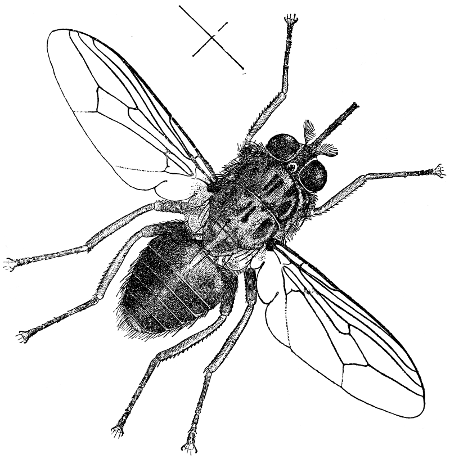
Fig. 14.—Drawing of the fly concerned in the Tsetse, or Trypanosome,
disease of horses.
They are usually dark grey, flattened insects, with a
peculiarly hard integument, which forms so efficient a protection
against injury that, if merely squeezed between the
fingers, they will commonly fly away in a perfectly unconcerned
manner. The easiest way to dispose of them is to
knock the insect down with the whisp of horsehair mounted
on a cane, commonly carried by horsemen when flies are
troublesome, and then to crush it under the boot, giving
the foot a good twist, so the wound, like that of the sergeant-instructor’s
bayonet, may be “made incurable.”
The general appearance of these insects may be best
gathered from the above magnified figure.
It is obvious that as far as our knowledge extends, the
prevention of sleeping sickness is purely a matter of avoiding
being bitten by insects of this sort, and it is also clear that
as far as indoor life is concerned, the adoption of metallic
gauze protection of the house will be as effectual as it is
in the case of malaria. These flies are, however, mainly
forest insects, and watchfulness, especially when sitting out
of doors, is all that can be suggested. Personally, if bitten
by one of these flies in a country where sleeping sickness
exists, I should be strongly inclined to destroy the bit of
tissue around the bite by means of some powerful caustic,
such as pure carbolic acid dropped into a small cut at the
site of the puncture, for as yet no instance of recovery from
the disease has ever been met with, and in all probability
this measure, if done with tolerable promptitude, would
probably suffice to destroy the germs before they gained
access to the general circulation.
The disturbances of the nervous system that are grouped
under the above heads vary a good deal, and probably comprise
several different diseases, with as many distinct causations.
It is a curious fact that sunstroke is practically unknown
on the high seas, and in certain countries, notably in South
Africa, where the fierceness of the sun would naturally lead
one to expect to commonly meet with it; and this circumstance,
and the fact that something like epidemics of the
disease are occasionally met with, lend a certain amount of
probability to the idea held by certain authorities, that, in
one form at least, the malady belongs to the category of
germ-caused diseases.
The symptoms of the disease are insensibility, combined
with a greater or less elevation of temperature, and a large
proportion of the cases that one hears of are merely
instances of fainting, due to fatigue and exhaustion from
heat. Such cases are specially common where large bodies
of men are massed together, and have to undergo great
exertion under unsuitable atmospheric conditions, and where,
besides being hot, the air is foul with dust and the emanations
of the closely packed animals and men, whose sufferings
are often aggravated by thirst and the restricted
possibility of evaporation from the surface of the skin
that is inseparable from an inadequate supply of water;
while the free play of the lungs and heart are too often
impeded by the unsuitable and fantastic garments and equipments
so dear to the infantile genius of militarism.
Fainting is due to a sudden weakening in the action of
the heart, and in a certain number of cases of “sunstroke”
of this sort, the mischief goes beyond enfeeblement, the
heart stops, and the man is dead. Most of the cases of
sudden death from “sunstroke” that occur on hot “field-days,”
as well as in military operations undertaken in
earnest, are probably of this character; and even when
the heart has not absolutely stopped, its action may be so
feeble and fluttering that the insensibility is prolonged and
serious. The temperature of the body is, however, only
moderately raised, and when, under proper treatment, the
patient has regained consciousness, he soon recovers if permitted
to rest, and in a day or two may be little the worse
for his adventure. In cases of this sort all clothing and
equipment should at once be loosened or removed, and the
patient should be given the full benefit of what “air” there
is to get. Hence, it is of the first importance to prevent
sympathetic onlookers from crowding round him in a ring.
The chest and face should be freely soused with water,
and when the patient is able to swallow, a little stimulant
may be administered.
Some kind of shade should be improvised, at any rate
over the head, but no attempt should be made to move the
patient till the pulse can again be plainly felt, after which
he should be placed on some sort of stretcher and removed
as quickly as possible to shade and comfort, where he will
probably speedily recover, for though “sunstroke” of this
sort is a highly dangerous condition while it lasts, it is rare
for it to be followed by any serious after-effects.
Cases of this sort are comparatively rare in civil life, the
conditions which lead to them being usually wanting; for
it will be noticed that even the military officer takes the
greatest care not to be “smart” when he goes out shooting
under a tropical sun, his costume, when so engaged, being
generally a model of the way he and his men ought to be
equipped when engaged in the business of their profession.
What may be called true sunstroke is less common, and
beyond the bare fact that the sun’s rays are capable of
acting in this way, we are really quite without any explanation
of its causation, as the condition may be brought
about by comparatively short exposure, without any coincident
exhaustion or fatigue; and may occur at times when
the temperature of the atmosphere is by no means excessive.
It is probable that over-stimulation of the nerves of sight
by glare may have something to say in the matter, as it has
been found that persons at rest in the open, in the Tropics,
have their temperature less raised if they wear darkly tinted
spectacles than others similarly situated, but having the
eyes unprotected. This cannot, however, be the complete
explanation, as it appears to be exposure, not of the face,
but of the skull and back-bone, to the direct rays of the sun
that constitutes the real danger, and it is not the forehead
but the back of the head and temples that are most sensitive
to the influence of “insolation.” So many unexpected
discoveries have been made lately of forms of light whose
very existence was, but a little time ago, unsuspected, that
the matter is less inexplicable than it was before the discovery
of the Röntgen rays made us familiar with light vibrations
capable of passing easily through substances we have been
accustomed to regard as quite opaque. The rays of the
sun do not, of course, include vibrations of that particular
description, or none of our ordinary wooden photographic
apparatus would be of any use to us; but they may well
have amongst them other vibrations, as yet not identified,
which are capable of passing through the tissues and affecting
the brain and spinal cord beneath; and no other suggestion
appears capable of explaining the extraordinary way
in which a few instants of exposure of the unprotected head
to an Indian sun suffices to cause a sharp headache; as the
effect is utterly inexplicable on any mere assumption of rise
of temperature. It is quite a mistake, for example, to think
that it is safe to cross one’s garden hatless, from the house
to one’s stables, in the heat of an Indian day. One is not
of course likely to be stretched out in a state of insensibility
by so short an exposure, but you may easily earn a splitting
headache which will last you the rest of the day; and from
the time the sun is well over the horizon, till it again sinks
beneath it, it is a purposeless imprudence to be found in
the open with the head inadequately protected.
The selection of a suitable headgear for tropical wear
is a matter of the utmost importance, and no material
appears to be as effective in intercepting the peculiar vibrations
which cause sunstroke, whatever they may be, as
the pith of the solah, or Indian rush, from which the
well-known tropical sun-hat is made.
Next to this in efficiency, I think, comes felt, and after
this cork; but the latter material, when adequately supported
to give sufficient strength, is really too heavy for
comfortable wear; and if any concession to “smartness”
is desired, stiffened felt is to be preferred, such as, for
example, the well-known “Elgin helmet.”
But those who are wise, will abjure such compromises,
and stick to pith, either in the ordinary mushroom form, or
in that of the admirable “Cawnpore tent club” hats. Let
it be freely admitted, that either contrivance is as ugly as
well may be, but it is better to keep one’s brain clear for
the appreciation of artistic beauty elsewhere, than to have
them permanently muddled for this and other less æsthetic
purposes in the effort to maintain a becoming exterior.
Further, the sun is never more treacherous than just after
it rises, and before it sets; because just then the nearly
horizontal rays can reach the temples and other parts of
the head that are well protected by any ordinary sun hat
when it is higher above the horizon. In fact, as long as the
sun is above it, it is a mistake to go abroad in European
head gear, though in the morning and evening a soft felt
hat, which can be bent and manipulated so as to shield the
particular side exposed to the sun, is better than a solah hat,
which of course cannot be adapted in this way. For really
tropical climates, in the heat of the day, no other material
but solah pith is at all adequate; but in South Africa and
other sub-tropical climates a less clumsy and more comfortable
covering for the head may be safely adopted, and
for such purposes the broad-leafed Boer felt hat, so familiar
to us of late in the drawings in the Illustrated London News,
and Graphic, is hard to beat. I do not of course refer to the
melodramatic brigand arrangement that, in feeble imitation
of our late foes, was inflicted on the Imperial Yeomen by
the would-be smart military male milliner, but to the real
article, as worn by the real Boer and, it may be added, by
everyone else who has work to do in the open in that
climate, after he has been out there sufficiently long to have
discarded the “helmet,” decked out with a pugaree finished
off with a pair of long tails down the back, with which his
London Colonial outfitter has probably provided him. The
true Boer hat is an admirable example of adaptation of
costume to special climatic exigencies; but though they are,
I presume, manufactured somewhere in Europe to suit the
Colonial market, I doubt if such a thing can be purchased
in England, for as is well known the English manufacturer
insists on his customers taking his own designs, and those
who would consult their own requirements must needs deal
elsewhere. Hence, if you are bound to “the Cape” you
will be wise to defer providing yourself with a hat till you
land, for the English outfitter’s muslin-bedecked helmet is
a natural object of derision to those who know what is
really wanted, and no extra protection is wanted under the
double awning of the big liner that takes you out to your
new home.
The true Boer hat has an ample crown, a very broad
brim, and is not looped up at one side, as anyone but a fool
can see that to do so is to make the hat suitable only for a
one-sided world, in which the inhabitants never require to
deviate from a course carefully laid so that the sun is always
kept on the “brimmery” side of the hat. The Mexican
“sombrero,” worn everywhere in sub-tropical America, is
practically identical, and the hat worn by the American
“rough riders,” though not quite so absurd as those of
our Yeomen, is another good example of the mischievous
effects of the childish military craving for “smartness.”
In India and elsewhere in the Tropics, a broad-leafed felt
of this sort is very useful and comfortable for wear in the
early morning and evening, but is quite inadequate for use
in the middle of the day during the hot weather, though at
other seasons a less cumbrous head covering than the big
felt hat may be safely adopted; but, however cool the air,
it is at no season safe to go abroad in India in the ordinary
small hat of Europe.
Children are strongly influenced by the sun in two
ways: they are in the first place enormously benefited
by getting plenty of his health-giving light; in the second
their little skulls appear to be remarkably easily penetrated
by the y or z rays that cause sunstroke. Hence, even in
the hottest weather, it is a mistake to shut them up in
the darkened rooms so dear to their mother’s hearts. It
is as well, of course, to keep children out of the direct
rays of the sun during the day, more especially as it is
difficult to ensure that they will always keep their hats
on; but it is a mistake to curtail their morning and
evening walks on account of the sun being above the
horizon, though it must be admitted that the greatest vigilance
is required to insure their keeping their hats on
their heads.
Ladies resident in hot climates as a rule suffer far more
from the want of the sun and light than from serious sunstroke,
their greater sensitiveness to discomfort rendering
them more apt to shrink too much from light and air in
hot weather; but on the other hand their desire to maintain
a pleasing appearance not infrequently leads to their
suffering from the earlier and milder symptoms of insolation.
Owing to their not unnatural objection to the admittedly
unbecoming forms of head-gear which alone can insure
safety. The singular preference for the unfitness of things
which appears everywhere to characterise the ritual of
Society, and demands that a man must go a-hunting in
English winter weather in a tall silk hat, ordains that
in India ladies shall pay their conventional calls between
the hours of noon and two p.m., when to go abroad in
a hat at all in keeping with their costume is hazardous
in the extreme. Unfortunately, out of the larger towns,
closed carriages are possessed by comparatively few, and
the result is that an umbrella, unsteadily held by the
native groom behind her, is all that there is to shield her
head from a tropical sun at the meridian.
That severe headache, lassitude and other less easily
defined nervous symptoms should follow such expeditions
is not surprising, and undoubtedly if a closed carriage be
unobtainable, for a lady to attempt a “round of calls” at
the conventional hours, is a proceeding involving such a real
risk that it should never be attempted, and calls should be
postponed to the cool of the evening. Moreover, even for
occasions when not equipped in full uniform, a safe head
covering for ladies living in the Tropics has yet to be
popularised. Those who are wise enough to determine to
be out of doors daily, and to take a sufficiency of exercise,
will find it best to wear a hat of the same pattern as those
worn by their husbands and children, and to entirely
abjure the absurd constructions of pith, fashioned in
imitation of English head gear, which have of late years
appeared on the scene. Some years ago an admirable
pith head gear, shaped somewhat on the lines of the “Gainsborough
hat,” enjoyed a well-deserved popularity, and it
is a pity ladies cannot see their way to adhere to it; as it
not only afforded excellent shade and protection, but when
tastefully bemuslined was by no means unbecoming in its
obvious adaptation to its surroundings. Recently, however,
fashion has chosen as its model the “sailor hat,” and frankly,
inartistic as is the European original, the fantastic deformity
of the Anglo-Indian pith imitation requires to be seen to be
appreciated. It may be doubted if human ingenuity could
shape the material to a worse form, and it is wiser for a
lady to keep out of the sun altogether than to trust herself in
the open wearing only such an ill-contrived head covering.
Fig. 15.
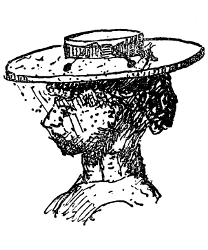
Fig. 16.
Useful and Futile Forms of Ladies’ Pith Hats.
It is, of course, of the first importance to get a person
stricken by the sun at once into the shade, and as the
temperature of the body is rarely excessive in such cases,
cold locally applied to the head is of more importance than
a general bath, which, indeed, unless carefully watched,
is apt to make matters worse, by driving the blood from
the surface and so increasing the congestion of the brain
and other internal organs. Hence it is better to apply
ice to the head and to confine oneself to sponging the
extremities as a measure for reducing the general temperature.
In climates where insolation is common, there is
little risk in getting wet, and hence if no proper ice bag be
obtainable the ice, roughly crushed, may be applied to the
head, simply tied up in a towel. Anyone who has suffered
from even a mild attack of insolation remains for a long
time specially sensitive to the effects of the sun, and
therefore requires, for a long time, to be especially careful
in avoiding exposure. When prolonged exposure to the sun
at its fiercest must be braved, as in big game shooting,
it is well to protect the spinal column by means of a pad
worn outside the coat. Some persons are much more
sensitive to the effects of the sun playing on the back than
others, and though the precaution cannot be considered
universally necessary, no one who feels himself inconvenienced
by the effects of the sun on this part of the body
should neglect the warning and fail to provide himself with
a suitable protection. The usual plan is to have made a
pad, cut to the shape of the back piece of the coat, of
quilted cotton wool, covered with the same material as that
of the coat and secured by buttons suitably placed.
The third form of “stroke” is that of heat, and appears
to be due simply to the inability of the regulating powers
of the system to keep down the temperature of the body to
the normal level.
Unlike true sunstroke, it nearly always occurs at night,
when the resisting powers of the organism are reduced to
their minimum, and mostly under conditions in which the
sleeper has inadequate air room, such, for example, as in
crowded barracks and closely-packed railway compartments.
Such cases may possibly occur, but personally I cannot
recall an instance of this accident occurring to persons
sleeping in the open air. Every year one reads in the
Indian press of persons being taken dead out of railway
carriages, and perhaps of a number of cases occurring simultaneously
in a single barrack, but with adequate air space
such an occurrence is, to say the least of it, exceptional.
At the same time, it is just in the hot “stuffy weather
of a break in the rains,” when it is always on the cards that
it may rain before morning, that such cases occur, and apart
from the traditional danger of sleeping outside a room during
the rains, one is naturally loth to risk a ducking. Given,
however, adequate shelter from rain, there is no danger
whatever from sleeping in the verandah at such times of the
year, always provided, of course, that protection against
infected mosquitoes is assured by a carefully tucked-in mosquito
net, and when the atmospheric conditions are such as
to involve risk of heat stroke, I personally prefer to sleep on
the roof, under the shelter of the top of a tent, or of a
special thatch shelter consisting of a roof without sides, or
at most with one lateral wall to windward, when there is
a probability of a driving rain falling during the night. As
a matter of fact, under atmospheric conditions of this sort,
one is unlikely to take much harm even if one does get
damp, and the admittedly enhanced danger of malaria can
be entirely obviated by means of mosquito curtains.
Till lately we heard nothing of the danger of anything
worse than itching being connected with mosquito bites,
and naturally those who were callous enough to popular
notions of safety to sleep outside the house in the rains
were about the last folks in the world to trouble themselves
about the tickle of a mosquito bite, and became “moral
examples” by contracting fever accordingly. During
periods of great heat, especially if combined with dampness
of the air, under which conditions heat stroke is likely
to occur, severe muscular exertion should be avoided as far
as possible; a light, mainly vegetable, diet adopted, and the
amount of stimulants taken should be very limited, though
it is a great mistake to limit fluids of other descriptions, and
tea taken very hot is often useful and refreshing. Care
should also be taken not to allow oneself to become constipated,
and speaking generally it should be recognised that
under the extreme climatic conditions that bring on heat
stroke, the European must live cautiously if he wishes to
come out of the ordeal unharmed.
In this form of the disease the temperature of the body
is always high, 103° to 107° F., and the stupor deep and
prolonged. Should you have to do with a case in the
absence of medical assistance, every effort should be made
to reduce the temperature of the body, the most efficient
means being to place the patient in a full length bath. As
a rule, under such conditions, the temperature of the water
obtainable is too near that of the body to bring down the
temperature sufficiently rapidly, and pieces of ice require
to be added to obtain sufficient cooling power. The patient
should be kept in the bath until the temperature (taken in
the mouth) is restored to the normal level of 98°-99° F.,
after which he may be removed; but in serious cases the
temperature shows an obstinate tendency to go up again,
and it is generally necessary to keep it down by continuous
sponging, applied especially to the extremities. If, in spite
of these measures, it still continues to rise, the bath must
be again resorted to. If ice be unobtainable wherewith to
cool down the bath, the want of it should, as far as possible,
be met by dipping out the water warmed by contact with
the patient’s body, and replacing it with freshly-drawn
water as cool as may be obtainable. It is well also to try
to relieve the bowels by placing 5 grains of ordinary
powdered calomel on the tongue, which will ensure its being
gradually swallowed, even in the deepest coma, and every
effort should be made to keep down the temperature of the
air of the room, always provided that the freest possible
ventilation be kept up.
It is never prudent for anyone who has survived a
warning of this sort to remain in a climate the severity of
which he has proved himself unable to resist; and it should
be the rule for those who have suffered to take refuge in a
cooler climate as soon as they are sufficiently recovered to
travel.
If stationed far inland, it is best to seek refuge in a
mountain sanatorium, and not to attempt to reach Europe,
as the long journey in the train and subsequent passage of
the Red Sea would, in all probability, finish the record of a
person so situated before the desired relief could be gained.
On the coast the quickest relief can be generally obtained
by sending the patient to sea, but if the route necessarily
involves passing through the Red Sea, such a course is
too hazardous at the bad time of the year, and the change
to Europe should be postponed till the dreaded stretch of
water can be passed in safety, or a visit to Australia substituted.
It must not be imagined that in practice cases of
“stroke” can be as sharply divided into classes as it is easy
to do upon paper. Naturally a large number are of mixed
origin, but the extent to which heat, pure and simple, is
concerned, may be generally judged by the temperature of
the body, and whatever may appear to be the causation of
the disease, whenever this is high, no efforts should be
spared to bring it down as soon as possible.
Among the minor ills which European flesh inherits in
the Tropics there is none that is more distressing than this
troublesome malady. The symptoms and appearance are
too well known to require description, and the disease is, as
a rule, rather irritating and distressing than involving any
danger. The process of regulating the temperature of the
body depends, however, almost entirely on the action of the
skin, and where prickly heat is so extensive and severe as to
partially incapacitate it from its functions, it is obvious
this usually trifling disease may be a predisposing cause
of more serious maladies. Then, again, the loss of sleep
and nervous irritation kept up by the constant itching, pricking,
and soreness, are powerful helps in pulling down the
already severely tried powers of resistance to the climate,
and often have a great deal to say in determining an
ultimate breakdown.
There is a common popular notion that prickly heat is
“healthy,” people saying that “it is a sign of health,” and
that it is a mistake to check it. This, however, except in so
far that healthy, full-blooded persons usually suffer worse
than those in an anæmic condition because they usually
perspire more freely, is an entire fallacy; as though good
health may predispose to prickly heat, it cannot but have
an influence in rapidly reducing that factor in its causation.
Then, too, the numerous small abrasions that result from
the bursting of the minute vesicles, and from scratching,
are extremely liable to become infected with the germs of
suppuration, and give origin to crops of boils.
Boils are extremely common, and are most painful and
debilitating when present in large numbers, as they often
are in hot climates, and I believe they should be really
regarded merely as sequelæ of neglected prickly heat and
not as a distinct condition. For these reasons the writer
is strongly of opinion that prickly heat should always be
treated, especially as it is usually quite possible to keep it
within moderate bounds, by the use of appropriate remedies.
At sea the use of salt water for bathing should be avoided,
but frequent bathing in fresh, and especially in rain water,
is not only a great alleviation, but tends towards cure by
removing the irritating accumulation of saline matter that
results from the constant evaporation of the perspiration.
Almost any metallic astringent, such as sulphate of copper
or sulphate of zinc, 4 grains to the ounce, will be found to
be extremely useful in reducing the extent of the irritation,
but none of these are nearly as effectual as a lotion of perchloride
of mercury of a strength of one per thousand.
This agent can be obtained ready measured out into
tabloids, which are always coloured blue to prevent mistakes
in handling the solution; which is a most useful one, not
only for this purpose, but as a general antiseptic. Care
should, of course, be taken in the custody of these tabloids,
and also in the handling of the solution; but the latter is
not really more poisonous than the copper solution, or than
many other antiseptics which, like carbolic acid, are nowadays
in constant domestic use. This mercurial solution
is undoubtedly by far the best remedy we have for prickly
heat, and I have never seen any harm or signs of absorption
of the mercury result, even from its copious use. The
tabloids should be got of such a size as to make about
a quarter of a pint of the solution, and after the bath and
before retiring to bed, all affected parts of the skin should
be dabbed with a bit of lint dipped in the solution, which
should be allowed to dry on to a certain extent before
putting on one’s clothes. A further great advantage over
the other metallic astringents is that, owing to the weakness
of the solution, it does not injure the clothes, and the
slight blue aniline colouration easily washes out. It will
be found, too, an almost complete preventive against boils,
if resorted to from the commencement of the hot season.
Powdering with violet powder is also useful in subduing the
irritation, which by the adoption of the above-described plan,
may almost always be kept within moderate bounds.
“Dhobi’s itch” is a troublesome irritation of the skin
often met with in hot climates, which is due to the growth
of a minute fungus within the structure of the scarf-skin.
It commonly attacks those parts of the body where the surfaces
of the skin come in contact with each other, as, for
example, between the legs, and in the armpits. The general
appearance is very much that of a “ringworm,” the patches
spreading by their edges, where they are red and irritable
and tending to fade in the middle. There can be little
doubt that the disease is generally caught by the infection
of clothing that has been washed in dirty pools along with
that of previous sufferers from the disease, which is very
common among the native races. If neglected, it is apt to
spread so as to cover a large area, under which circumstances
it is apt to be troublesome, but if taken early, there
is generally no difficulty in dealing with it. All that is
necessary is to destroy the fungus by means of strong antiseptics,
but in doing so it must be remembered that any
solution strong enough to kill the fungus must necessarily
also cause more or less inflammation and, for the time,
increased irritation of the skin.
On this account, if any considerable area be involved, it
is a mistake to attempt to treat the whole of it at once, as
such a course may easily result in producing an amount of
soreness and inflammation which may involve confinement
to bed. The patches should be attacked piecemeal, a couple
of separate patches the size of a shilling being quite as
much as is prudent to attack on any one occasion.
Equal parts of tincture of iodine, carbolic acid and
glycerine painted over each patch, to the extent above
described, is a safe and efficient remedy, as also is Goa
powder; but the essential point is to be on the look-out
for the contingency, and to at once treat any patch that
may appear before it has time to spread.
The disease is, I believe, common enough in other warm
climates, but I am not acquainted with its popular designation
elsewhere than in India, where it is known by the
above name.
Internal worms are extremely common in most hot
countries, and especially in those climates where moisture
and heat are combined. Where they prevail to a serious
extent, they often constitute one of the principal causes
of mortality amongst natives, but white residents rarely
suffer, as the habits of the better-class European to a very
great extent protect him from being invaded by these pests.
There are three principal sorts of these parasites: the
round-worms, which usually divide their time between some
animal and the outer world, and the flat-worms and the
flukes, both of which must pass through two or more
animal hosts. The life-history of these troublesome guests,
especially those belonging to the two latter classes, include
some of the most wonderful and interesting pages of natural
history, but unfortunately considerations of space prevent
our describing these changes except by the barest allusions.
The commonest round-worms that establish themselves
in mankind are the common thread-worms and round-worms
(Lumbrici), and that much more formidable pest of tropical
life, the Ankylostoma, or hook-worm.
Thread-worms and Lumbrici are common enough everywhere,
but are far more commonly troublesome in hot
climates than at home in Europe. The eggs of both are
probably usually carried into the human intestine on food or
in drinking water, and in the case of the Lumbricus this
is the only way in which the numbers of the parasite can be
maintained, as its eggs take a long time to hatch out; but
those of the thread-worm, when deposited, are quite ready
to burst at once, and though no individual worm as a rule
resides within the intestine for any great length of time,
the patient infested with them is continually reinfecting
himself, so that their numbers have a tendency to increase.
Thread-worms are especially common in children, on account
of the strong tendency of the little folks to put their fingers
in the mouth.
Thread-worms live in the lowest part of the bowel, and
so cause much itching and tickling about its orifice. This
prompts the child to scratch itself, with the result that some
of the innumerable eggs laid by the worms adhere to the
fingers, and once there soon find their way, along with the
fingers, into its mouth. The intruders are usually easily
expelled by an injection of salt and water, but it is difficult
to get rid of all of them, and the child is nearly sure to reinfect
itself unless it is made to sleep in drawers. Provided
reinfection is prevented in this way, however, the
remaining worms will soon be got rid of, as this species as
a rule does not take up a prolonged residence.
Round-worms can be expelled by the means of a dose of
santonin, but as neither these parasites nor tape-worms
usually cause immediate serious symptoms, and both this drug
and most other vermifuges require a certain amount of care
and caution in their administration, it is better to wait any
moderate time until the treatment can be supervised by a
medical man.
The third common round-worm parasite—the hook-worm
namely—though but little known in Europe, is so
widely distributed in hot, moist countries, that in such
climates the greater proportion of the indigenous races are
often affected to a greater or less extent. It is quite a small
worm, but fastens on the lining of the bowel in exactly the
same way as leeches attack the outer integuments, and
exhibits the same insatiable appetite for blood. The extent
of the mischief wrought by them depends entirely on the
number harboured. When only a few are present, they
may be considered practically harmless, and thousands of
such cases are to be met with in any country where they
are common; but wherever this is so, numbers of subjects
will be met with, in whom they are so numerous as to cause
serious symptoms and death; so that there are many places
where they constitute one of the most serious scourges of the
Tropics. The eggs of this parasite, deposited along with the
dejecta of persons infested with them, hatch out in the soil,
and multiply there enormously, so that owing to the insanitary
habits of the populace, the soil round about a native
village comes to swarm with this free stage of the parasite.
Now as the population is generally a purely agricultural one,
and none too nice in its habits, it can be easily understood
that persons, eating as they do with unwashed hands, must
constantly carry to their mouths some of the earth containing
the minute embryos which convey the disease, and hence
the process of infection is commonly continuous and progressive.
As a matter of fact, out of some hundreds of
specimens of drinking water examined by the writer in
Assam, where the disease is extremely rife, in no one
case was there anything found to show that the malady
was commonly conveyed in water, but the contingency is
clearly a possible one; and in any case, it is clear that very
moderate care as to food, water, and personal cleanliness
would suffice to render infection impossible. From what
has been said, it is easy to understand that the disease
is practically unknown among European residents whose
habits have reached the most moderate degree of refinement;
but though it may not affect the planter’s health, it
reacts most seriously on his pocket, owing to the disastrous
amount of sickness and mortality it gives rise to among his
native labourers. Now it is perfectly obvious that this
disease can be easily prevented by the most ordinary
measures of conservancy, and the question whether the evil
can be obviated or not, is purely one of whether the
master has the will and power to insist on the use of proper
latrines. This, however, is by no means so simple a matter
as it looks, where one has to deal with labourers belonging
to a primitive stage of civilisation. Once seen, the
disease is easily recognised by the deadly pallor of the lining
membrane of the eyelids, and of the tongue, especially the
latter, which looks much like a piece of a wet, pipe-clayed
buff belt. By treatment with vermifuges and careful nursing
there would be little difficulty in curing people of European
habits; but only those who have had to attempt it know
how impossible it is to get semi-civilised people to adopt,
or even submit to, what to us are the most ordinary sick-room
comforts, and as a matter of fact, there is very little
hope for a native who is at all seriously affected with these
parasites.
The best vermifuge we have is thymol; three doses of
30 grains each, given within six hours, followed up by a
dose of castor oil. A certain amount of caution is required
in giving this to cases in a very weak state, but after all
it is the only chance for them. This medication may have
to be repeated once or twice, at intervals of a week, and
should be systematically carried out in all cases that have
not gone too far. The worst of it is, that unless proper
sanitary measures can be carried out, treatment is little
better than a waste of drugs, as otherwise the patients will
be sure to reinfect themselves within a few weeks, however
thoroughly the vermifuge may have done its work.
The Guinea-worm is a curious parasite, which is found
burrowing under the skin, and finds an exit through the
opening formed by a sort of boil. It very rarely attacks
Europeans, as it may be avoided by the most ordinary
care in the matter of water used for drinking and bathing.
Another curious malady caused by one of the round-worms
is the blood-worm disease, or filariasis. In this the
parent worm is found embedded in the tissues of the host,
and periodically discharges into the blood enormous numbers
of its embryonic offspring. As this disease is undoubtedly
communicable through the agency of mosquitoes alone, its
prevention may obviously be secured by the adoption of the
same measures that serve to protect us from malaria.
Tape-worms have a very curious life-history. The
long, flat, jointed strip is really a chain of sexually mature
individuals, but when their eggs are swallowed by an
animal there is hatched out from it, not another tape-worm,
but a minute embryo, which has the power of
boring through the tissues of its host till it reaches some
favourable resting-place, where it settles down, protected
by a capsule, forming what is known as a bladder-worm.
It may live for years in this condition, but cannot reach
maturity until the capsule has been swallowed by some
carnivorous animal, though some species can multiply non-sexually
and so cause terrible damage to the animal that
harbours it. Both stages of several species of these parasites
infest man, but fortunately their prevention is a very
simple matter, at any rate as far as the adult strings of
worms are concerned, as infection is impossible provided
all meat and fish eaten be thoroughly cooked. The mature
stage of the bladder-worm which is found infesting man
inhabits the intestine of the dog, and as it is capable, in
this stage, of non-sexual multiplication, may give rise to
large tumours, the effects of which may be most serious
if a vital organ be invaded. Though almost a medical
curiosity in Europe, it constitutes a really serious danger
in certain pastoral colonies, such as Australia, where large
numbers of dogs have to be kept for herding sheep, and are
allowed unrestricted access to the offal of carcases, which is,
of course, very abundant where meat-preserving is an important
industry. The disease might be guarded against by preventing
the dogs having access to anything but thoroughly
cooked meat, and by avoiding undue fondling and too close
association with these animals.
The third important class of parasites, the flukes, but
rarely infest man, but in Egypt and, in fact, throughout
Africa, a peculiar fluke, the Bilharzia, is found infesting
the blood-vessels, especially those of the kidney, and gives
rise to the appearance of blood in the urine. It is extremely
common amongst the natives of Egypt, but it very rarely
attacks Europeans, and though we are quite in the dark as
to its life-history outside the human subject, there is little
doubt that moderate care as to the water used for drinking
and bathing is sufficient to afford complete protection against
the disease.