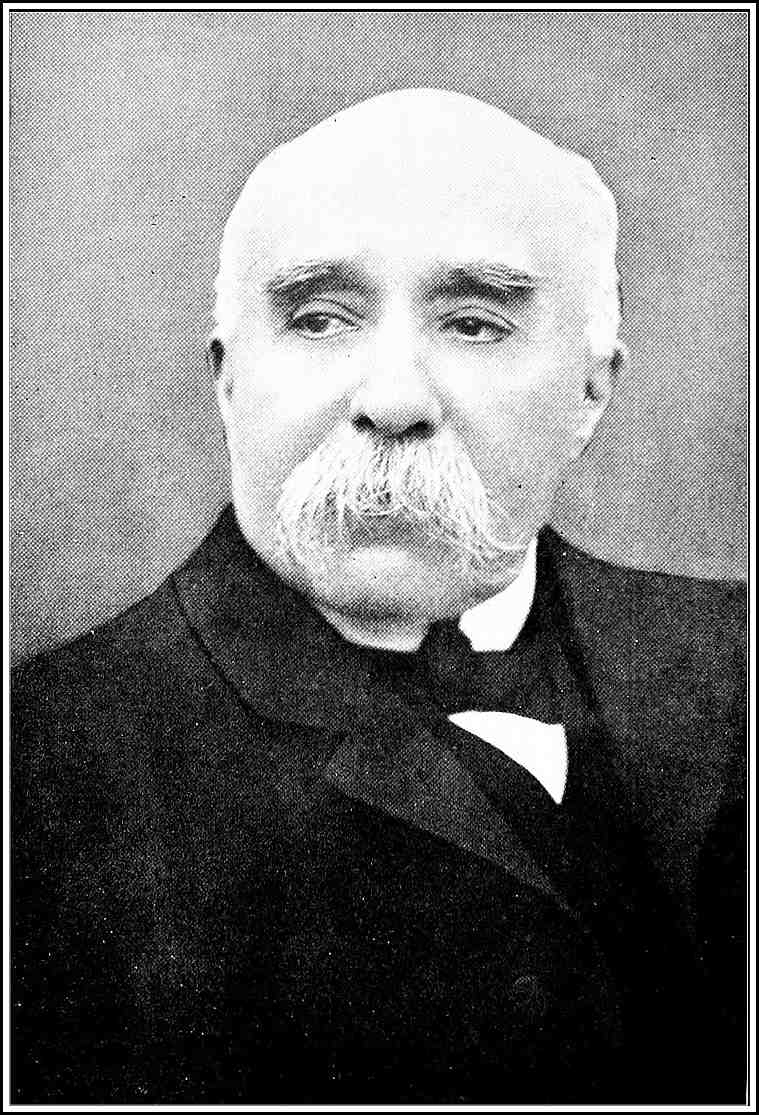
At this time Clemenceau, owing to his apparently resolute
determination not to take office, no matter how many Ministries
he might successfully bring to naught, had got into a back-water.
He had become permanently Senator for the Department
of the Var in 1902, a startling, almost incomprehensible
move when his continued furious opposition to that body is
remembered. However, having thus made unto himself
friends of the mammon of unrighteousness, he found their
“eternal habitations” a not unpleasing dwelling-place. His
position as publicist and journalist was assured and nothing
could shake it; his criticisms by speech and pen were as telling
and vigorous as ever. But at sixty-five years of age he was
still a free-lance, a force which all parties were obliged to
consider but with which no Ministry could come to terms.
It was a strange position. So his countrymen thought. Those
who most admired his ability and his career saw no outlet for
his marvellous energy that would be permanently beneficial
to the country in a constructive sense. Perhaps no politician
of any nation ever so persistently refused to “range himself”
as did Clemenceau for thirty-five years of stormy public life.
He revelled in opposition: he rejoiced in overthrow. He was
on the side of the people, but he would not help them to realise
their aspirations in practical life. He was a political philosopher
compact of incompatibilities. As an individualist he
was a stalwart champion of individual freedom: as a man of
affairs he advocated the use of State power to limit the anarchic
domination of personal power.
There was no understanding such a man. He would remain a brilliant Frenchman of whom all were proud until the end,
when he would be buried with public honours as the champion
Ishmaelite of his age. “When I saw he doubted about everything,
I decided that I needed nobody to keep me ignorant,”
wrote Voltaire. Much the same idea prevailed about Clemenceau.
He was the universal sceptic: the man whose sole
intellectual enjoyment was to point out the limitless incapacity
of others with epigrammatic zeal. I myself, who had watched
him closely, was afraid that he would allow all opportunities
for displaying his really great faculties in a ministerial capacity to
slip by and leave to his friends only the mournful task of writing
his epitaph: “Here lies Clemenceau the destroyer who could
have been a creator.”
But this was all nonsense. “Ce jeune homme“—Clemenceau
will die young—”d’un si beau passé” had also before him un bel avenir. Nothing is certain with Clemenceau but the
unforeseen. At the very time when people had made up their
minds that he was a back number, he had a brand-new volume
of his adventures ready for the press. After a few conversations
with M. Rouvier and then with M. Sarrien, he became
Minister of the Interior in the latter’s Cabinet. He took office
for the first time on March 12th, 1906, at a very stirring epoch.
It is difficult to exaggerate the impression produced by this
step on the part of M. Clemenceau. His accession to M.
Sarrien’s Cabinet eclipsed in interest every other political
event. Here was the great political leader and organiser of
opposition, the Radical of Radicals, the man who had declined
the challenge alike of friends and of enemies to take office,
time after time, at last seated in a ministerial chair. All his
past rose up around him. The destroyer of opportunism: the
Guy Earl of Warwick of ministries: the universal critic; the
immolator of Jules Perry and many another statesman; the
one Frenchman who had maintained the ideals of the French
Revolution against all comers—this terrible champion of
democracy à outrance now placed himself in the official hierarchy,
whence he had so often ousted others. His victims of yesterday could be his critics of to-day. How would this
terrible upsetter of Cabinets act as a Minister himself? That
was what all the world waited with impatience to see. They
had not days, but only hours to wait.
That was the time when, M. Delcassé having been forced to
resign from the Foreign Office, almost, it may be said, at the
dictation of Germany, the Morocco affair was still in a very
dangerous condition, threatening the peace of France and of
Europe. But even the critical negotiations at Algeciras were
for the moment overshadowed by a terrific colliery disaster
in the Courrières-Lens district, causing the death of more
miners than had ever been killed before by a similar catastrophe.
This horrible incident occurred but a few days before
Clemenceau became Minister of the Interior, and it fell within
the immediate sphere of his official duties.
The mines where the accident occurred had long been regarded
as very dangerous, fire-damp being known to pervade them
from time to time, and the miners throughout the coal regions
had long held that the owners had never taken proper precautions
to ensure the safety of the men. They went down
the pits day after day, not only to work on very difficult
and narrow seams, but at the hourly risk of their lives. Owing
to the great social and political influence of the mine-owners
it was practically impossible to get anything done, and the
general treatment of the men employed was worse than is usual
even in those districts in our own and other countries where
coal magnates are masters. The pitmen under such conditions
were less cared for and more harshly treated than animals,
probably because they were less costly and could be more
easily replaced.
Three days before the main explosion there had been an
outburst of fire-damp at a small adjacent mine, whose workings
were in direct communication with the larger pits. This alone
ought to have been taken as a serious warning to the engineers
in control. But markets were good, coal was in great demand,
the “hands” were there to take risks. So this minor difficulty was dealt with in a cheap and convenient way, and the extraction
of coal went on upon a large scale from the imperilled shafts as
it did before. Meanwhile the dangerous gases were all the time
oozing in from the smaller pit to the larger ones. For three
days this went steadily on, and nothing whatever was done,
either in the way of taking further precautions where the
original danger began, or of testing the character of the air
in the bigger mines to which the other pit had access.
On Saturday, March 10th, no fewer than 1,800 men went
down the shafts into the mines. A full account of what
actually took place could never be given. All that was learned
from the survivors was that the miners working with bare
lights in these dangerous pits suddenly encountered an influx
of fire-damp. Explosion after explosion took place. The
unfortunate men below, threatened at once with suffocation
or being burned alive, rushed in headlong disorder for the cages
which would lift them to the surface. Horrible scenes inevitably
took place. Those in front were pressed on by those
behind, who, as one of them expressed it, were breathing burning
air. For the majority there was and there could be no hope.
Out of the 1,800 miners who went down in the morning, more
than 1,150 were either stifled by the gas or burnt alive. The
heroism displayed by the pitmen themselves, in their partially
successful endeavours to rescue their entombed comrades, was
the only bright feature in the whole of this frightful disaster.
Some of these fine fellows went down to what seemed certain
death, and others worked at excavation until almost dead
themselves in their efforts to save a few from the general fate.
No wonder that the feeling throughout the neighbourhood was
desperately bitter.
The war, sad to say, has much modified our general conception
of the value of human life, even when unnecessarily thrown
away. But sacrifices for a great cause on the battlefield or on
the ocean, however serious, are made as a rule for high ideals.
They differ widely from the loss of life deliberately occasioned
by capitalist neglect or greed. Thus a mining accident on a large scale, or a conflagration in a peaceful city, produces a
stronger impression on the public mind than the loss of ten
or twenty times the number of soldiers or sailors in a world-wide
struggle. Among the widows and children and relations and
comrades of the victims on the spot the exasperation against
the employers was still greater. Class hatred and personal
hatred were excited to a very high pitch.
This was the more natural for two reasons. First, the
company on whose property the immolation of so many pitmen
had occurred, and to whose mismanagement and cold-blooded
indifference the avoidable explosions were due, had made
enormous, almost incredible profits. From dividends of fifty
per cent. in 1863 their returns had risen to profits of 1,000 per
cent. in 1905. Yet they could not spare the comparatively
small sum necessary to safeguard the lives of the men who
obtained this wealth for the shareholders. Secondly, the
Germans, who rendered assistance in the attempts to rescue
the Frenchmen still in the workings below, openly proclaimed
that it was quite impossible—as indeed was the truth—that
such an accident on such a scale should have occurred in
Germany. That the Empire in Germany should be far more
careful of the lives and limbs of the miners than the Republic
in France, and that huge profits should have been made still
huger by the refusal of the French coal-owners to adopt the
ordinary precautions enforced by law on the other side of the
frontier—these considerations, driven home by the results of
the great catastrophe, rendered the situation exceedingly
perilous from every point of view. A strike for increased wages
seemed a very poor outcome of the horrors inflicted upon the
actual producers of the coal under such conditions.
Clemenceau was perhaps the best man in the country to deal
with the miners at such a juncture. A Socialist of mining
experience would possibly have taken more decidedly the side
of the men, but he would not have been able to carry with him
to the same extent the support of the Chambers. And Clemenceau
had gone very far already on collectivist lines. Not many years before, in an article on “The Right to Strike,” he had
put the case of the men very strongly indeed. In a vehement
protest against the theory of supply and demand, as applied
to the human beings compelled to sell labour power as a commodity,
and the political economy of the profiteers based upon
subsistence wages for the workers—all being for the best in the
best of possible worlds—Clemenceau set forth how the system
worked in practice:—
“The State gives to some sleek, well-set-up bourgeois
immense coal-fields below ground. These fine fellows turn to
men less well dressed than themselves, but who are men all the
same, men with the same wants, the same feelings, the same
capacity for enjoyment and suffering, and say: ‘We will grant
you subsistence; sink us some pits in the earth; go below and
bring us up coal, which we will sell at a good price.’
“Agreed. The pits are sunk, the coal comes out of the
earth.
“But, observe, those comfortable bourgeois for their outlay
of five hundred francs (£20) have now a bit of paper which is
worth forty thousand francs (£1,600).
“The miners, who watch what is going on, think this a good
deal, and, as they have got nothing by way of profit, they protest
and ask for a share.
“‘That, my friend, is impossible. The price of coal has
fallen this year, the price of man must come down in proportion.
All I could do for you is to reduce your wages. You object
to that. All right; down the shaft you go: don’t let us talk
about it any more.’
“But the men won’t go down.
“‘You don’t make money this year. All right. But when
you made huge profits, did you give us even the crumbs from
your banquet?’
“‘I wasn’t a shareholder then; it was my father.’
“‘My father, like myself, was a miner. He died of consumption,
his lungs choked with coal-dust. Now it is my turn to
cough and spit black. And my wife, looking at her babes, asks herself whether I shall live long enough for them to be
old enough, before my death, to go down into the mine which
will kill them in turn. If I crack up too soon, misery, ruin,
beggary, wholesale wretchedness for wife and children.’
“They don’t come to terms. The strike begins.
“Economists argue, to begin with, that the State has no
right to interfere in the relations between miners and mine-owners.
The mine-owner is at home on his own property.
Certain securities for life and limb may be demanded, nothing
more. But no sooner does a strike begin than the State, which
five minutes ago had no right to interfere, is called upon to
bring in horse, foot and artillery on the side of the coal-owners.
Then the miners have no rights left, and the judges decide
against them on shameless pretexts and condemn them to
prison, when they cannot bear false witness in support of the
police and military.”
Such were Clemenceau’s views on the right to strike and the
grievances of the men, before he accepted the post of Minister
of the Interior and began to deal with the troublous state of
things at Courrières-Lens, where the terrible accident had
occurred and a strike had been entered upon, while the entire
district was in a state of mind bordering upon anarchist revolt.
The first step he took was as bold and as remarkable an act
as any in the whole of his adventurous life. He went down at
once to Lens himself. Arrived there, he walked straight off,
without any escort whatever, to meet and confer with the
committee of the miners themselves. Courageous and honourable
as this was, it failed at first to impress the strike committee.
This was natural enough. They were lamenting the wholesale
butchery of their comrades and were incensed against the
employers who, with hundreds upon hundreds of dead pitmen
below, would not deal fairly with the survivors. Clemenceau
therefore met with a very cool reception. But he was nothing
daunted, and began to address them. Gradually, he convinced
the committee that he meant fairly by the men, and that he
had not come down, alone and unarmed as he was, with any intention of suppressing the strike, but, so far as he could,
to see that they had the fairest of fair play, according to their
rights under the law.
Thereupon, the committee agreed that Clemenceau should
go with them to speak to a mass meeting of the miners. It was
a doubtful venture, but Clemenceau went. In the course of
his speech he reassured the men upon the attitude of the
Government as represented by himself. He told them plainly:
“You are entitled to strike. You will be protected by the law
in doing all which the law permits. Your rights are equal to
the rights of President or Ministers. But the rights of others
must not be attacked. The mines must not be destroyed.
For the first time, you will see no soldiers in the street during
the strike. True, soldiers have been placed in the mines, but
solely to protect them, not in any way to injure you. On the
other hand, you must not resort to violence yourselves. The
strike can be carried on peacefully and without interference.
Respect the mines upon which you depend for your livelihood.”
This was quite plain, and Clemenceau adhered to his own
programme as he had formulated it. But the difficulty was
apparent from the first, and it is a difficulty which must always
recur when a great strike is organised. If the State claims the
right to intervene, in order to protect the laws and liberties of
those who wish to work for the employers, in spite of the strike
and the decisions of the strikers, antagonism to such action is
practically certain beforehand. For, in this case, as the strikers
say, the State is using the forces of the military and the police
in order to protect “blacklegs” who, by offering their labour
to the employers at such a time of acute class war, act in the
interests of the coal-owners and against the mass of the workers.
Socialists argue that the strikers are sound in their contention,
and that by assuring to non-strikers the right to work the
Government practically nullifies the right to strike. When,
therefore, in this typical Courrières case, the strikers as a whole
remained out, notwithstanding certain insufficient offers by
the coal-owners, and a minority of non-strikers claimed the help of the law, with support of the State army, to weaken by
their surrender the position of the majority of their fellow-workers
in the same industry, then the ethics of the dispute
between sections of the miners could not be so easily determined
as M. Clemenceau from his individualist training assumed.
If the employers were in the wrong, as it appears they were,
then to call out the military to protect those miners who showed
themselves ready to make immediate terms with injustice was,
however good the intention, to take sides against the main
body of the men. So it seemed to these latter. When, therefore,
the soldiers defended the non-strikers, the strikers assailed
the military, who had not attacked them. Clemenceau
accordingly decided that the strikers had broken the law, as
undoubtedly they had, by stoning and injuring the servants
of the State, who were upholding the law as it stood. The
truth is that, so long as these antagonistic sections exist among
the working class, and persist in fighting one another, it is
practically impossible for the State not to intervene in order to
keep the peace. There may be no sympathy with blacklegs,
but the Minister of the Interior could scarcely be blamed for
protecting them against an infuriated mob, which would
probably have killed them, or for insisting upon the release
of those whom the strikers had seized. That the temper of the
crowd had become highly dangerous was apparent a little later,
when the Socialist Mayor was knocked down as he was trying
to calm them.
All this rendered M. Clemenceau’s second and third visits to
the scene of class warfare far more stormy than the first.
Owing to the horror and hatred created by the avoidable
holocaust in the Courrières mines, and the further discovery
that engineers appointed by the State had played into the hands
of the employers, the situation got worse from day to day.
The strike itself was not only an effort to get more wages, but
a declaration of hostility to the mine-owners, and those of the
miners’ own class who showed any tenderness towards them,
or were ready to take work under them. Their own leaders and representatives had no longer any influence with the men
or control over them. M. Basly, the deputy who acted throughout
for the miners, had as little power over the strikers as
anybody else. The whole movement was taking an anarchist
turn. Also, agents were at work among them both from the
reactionary and the revolutionary side whose main object, for
very different reasons, was to foster disturbance and influence
passion. Foreign emissaries likewise were said to be at work.
Clemenceau’s task was therefore an exceedingly hard one.
He had ever in mind the old eighteenth-century watchword
which, from his point of view, is the foundation of the French
Republic—Liberty, Equality and Fraternity. And the greatest
of these is liberty! He throughout forgot, or overlooked, that,
even according to his own pronouncements, liberty in any real
sense is impossible for the weaker—the majority who own no
property—against the stronger—“Les Plus Forts,” the
minority who own all the property. This triune fetish Clemenceau,
with all his keenness of criticism, might be said to worship:
yet to worship in a more or less reasonable way. He could not
shut his eyes to the truth that, for men and women whose livelihood
was at the mercy of capitalists, there could be no real
liberty, dominated as the workers were by their daily compulsion
to obtain the wherewithal for the necessaries of life.
The only way by which even partial justice could be secured,
under the system of payment of wages, was combination among
the wage-earners. Hence he recognises the liberty to strike.
But he was equally determined, as he puts it, to defend the
liberty of those who would not strike. It was logical: it was
in harmony with the law; but it was a virtual help to the
employers none the less.
On the occasion of his second visit he enforced his view in
his usual emphatic way. Three miners who would not join
the strike were being paraded through the town by the strikers
with an insulting placard hung around their necks: “Nous
sommes des poires cuites; des faux frères.” Clemenceau insisted
that they should be released, and succeeded in freeing them. The very fact, however, that it was possible for the strikers to
act in this way, without protest, showed how small was the
minority and how strong the feeling against these claimants of
the liberty of taking the other side. Clemenceau likewise acted
with vigour against all who were guilty of any violence. But
the strikes still spread.
Speaking at Lyons on May 3rd, he explained the difficulties
of the situation:—“My position is between the political
demagogues of the Church, the clericals and the reactionaries
on one side, who tried hard to hound on the troops I was forced
to call in to fire upon the strikers, who greatly provoked them.
This the ecclesiastics and restorationists did with the hope of
fomenting a revolt against the Republic—a revolt supported by
certain military chiefs, inspired by the clericals and their shameless
lack of discipline.” The Separation of Church and State
was being decided while all this was going on. “Their object
was to bring about a massacre in the interest of the Catholic
Church and the monarchy. This plot was frustrated. Butchery
was avoided.
“On the other side, I am accused by the revolutionary
Socialists of indulging in brutal military oppression because
I suppress anarchist rioting. This though no striker was killed
or wounded. I acted for tranquillity, while the monarchists
fostered disturbances. They wanted a Government of the
Republic which should rely for support solely on the Right.
The anarchists helped the monarchists, who had agents throughout
the perturbed districts, by denouncing the Republic and
excusing mob violence. Yet how stood the case? Was it I
who organised a campaign of panic? Was it I who was responsible
for the original explosion and strike? Was it I who
brought about the state of things which resulted in general
disturbance and might have tended towards another coup
d’état? Nothing of the sort. I was suddenly called upon to
deal with unexpected troubles. I acted for the maintenance of
the Republic, and kept the peace under the law.”
By taking office at the time when he did it was at once apparent that Clemenceau had brought himself into the full
whirlpool of strike difficulties which then arose. He was called
upon to solve in everyday life, as a man committed to a policy
of justice to the workers, problems which, at critical moments,
are almost insoluble under the capitalist system of wage-earning
and production for profit. Has any section of the
community the right to hold up the life of a nation or a great
city in order to secure advantages for itself? At first sight
the answer would undoubtedly be “No.” But if the conditions
of existence for those who act in this way are admittedly such
as ought not to continue in any civilised country, it is not
possible to reply so confidently in the negative. Neither can the
“No” be repeated with certainty when employers, or the State
itself, are guilty of a direct breach of faith towards the workers,
unless, by ceasing to carry out their duties, they actually imperil
the welfare of the entire collectivity of which they form a part.
In short, all depends upon the circumstances, which have to be
considered most carefully in each case. It fell to Clemenceau’s
lot to decide in what might almost be taken as the test incident—the
strike of the electrical engineers and workers of Paris.
There seems to be something in M. Clemenceau’s horoscope
which has decreed that his career shall be diversified and rendered
interesting by a series of dramatic events. This strike
of the electricians of Paris was certainly one of them.
Scene: Cabinet of the Minister of the Interior. The
Minister, M. Clemenceau, at work at his desk and dictating to
his secretary. Everything going on quite nicely. No sign of
more than ordinary pressure. Electric light functioning as
usual for the benefit of the Radical leader as well as for Parisians
of every degree. Hey presto! Darkness falls upon the bureau
of the Minister. Very provoking. What is the matter?
Corridors and other bureaux suffering the like eclipse. Evidently
something wrong at the main. Candles obtained, lamps got
out from dusty cupboards, oil hunted up. Ancient forms of
illumination applied. Darkness thus made visible. Telephones
set going. All Paris obscured. A city of two or three millions of inhabitants suddenly deprived of light. What has
happened? The entire electrical service disorganised until
to-morrow by the sudden and unexpected strike of the whole of
the skilled men in the electrical supply department. Lovers
of darkness because their deeds are evil likely to have a good
time. Business arrested, fathers and mothers of families
perturbed. Dangers of every sort threatened. Apaches and
other cut-throats preparing for action in the to them providential
enactment of endless gloom.
Such is the baleful news borne over the telephone wires to
the much troubled Minister of the Interior, with his wax tapers
and old-world lamps glimmering around him. How preserve
his Paris, his ville lumière, from the depredations of the miscreants
engendered by the social system of the day, when light
fails to disclose their approach? How protect the savings of
the conscientious bourgeois and the diamonds of the high-placed horizontale from removal and conveyance under cover
of the night? To surrender to the strikers is to admit their
right as a few to blackmail the many. It is to sanctify the
action of the despoiling minority above by giving way to the
organised minority below. Immediate decision is essential.
Night is upon us, when no man can work, save the man who
communises movable property to his own use. Light is a
necessary of security for property, nay, even for life. The
State must come in to fulfil the functions which the Creator
neglected to provide for when He divided the night from the
day. The sapper is the man to supplement the deficiencies
of Providence and to mitigate the social revolution by electrical
engineers. Rien n’est sacré pour un sapeur! No sooner thought
of but acted upon. M. Clemenceau, as Minister of the Interior
and trustee for the well-being of the citizens of Paris, calls upon
the State engineers under military control to light up Paris
afresh. The thing is done. Paris sees more clearly and
breathes more freely. Society itself has the right to live.
But stay a moment: here is M. Jaurès. He has a word to
say. What are you doing, M. Clemenceau? You are outraging
all your own principles. You are interfering with that
very right to strike which you yourself have declared to be
sacred. You are using the military discipline of the comrades
of the men out on strike against the electrical companies, to
render their protest nugatory, by employing the sappers against
them. You have, in fact, called out the powers of the State
to crush the workers in a particular industry. If you were
true to yourself, you would convert the electrical supply of
Paris now in the hands of greedy monopolists into a public
service, and give the strikers every satisfaction. That is the
only real solution of social anarchy.
To him Clemenceau: “But this was not merely a strike or
a limited liability class war against employers. It was a
bitter fight between two irreconcilable antagonists against
inoffensive passers-by. The people of Paris, for whom I am
concerned, had nothing to do with the matter. I myself
knew nothing about the decision to strike till my own work was
rendered impossible by the sudden infliction of darkness upon
me by these resuscitated Joshuas. Not only was the general
security threatened, as I have declared, but the lives of your
own clients, Jaurès, were threatened by immersion in a flood
below ground. The inundation of the Metropolitan (the
Underground Railway) had already begun. The workers of
Paris who used that means of communication in order to return
to their work would most certainty have been drowned owing
to the suspension of electrical pumps and lifts, had not the
sappers and the firemen, both of them sets of public functionaries,
rushed at once to the rescue. Were the workmen of
Paris engaged in other departments to be allowed to perish,
with the State standing by, wringing its hands in hopeless
ineptitude, while the electrical engineers got the better of their
masters in a dispute about wages? This was a practical
question which I had to decide at once. I decided in favour
of the inoffensive people of Paris and against the electrical
engineers on strike.”
Taking a wide view of the whole question, I hold Jaurès’s opinion to be the right one. But Clemenceau had to deal with
an immediate practical difficulty of a very serious kind indeed.
The lights went out at six o’clock. Night was coming on.
No time could be lost in negotiating with the engineers. Still
less was nightfall the period when a public service could be
instituted in hot haste. The matter was settled in that form
and for that occasion. But none the less the real point at
issue was not thus easily disposed of. Clemenceau was right
in preventing Paris from being left all night in darkness.
Jaurès was right in claiming that the State should have a more
definite and consistent policy than that of dealing with
differences between wage-earners and employers by such
hand-to-mouth methods.
It was just at this point that, notwithstanding all adverse
criticisms in regard to the instability of Ministries, and the
scenes of apparent disorder which sometimes arise, the French
National Assembly displayed its immense superiority to the
Parliaments of other countries when serious matters of
principle were involved. The desire to get to the bottom of a
really dangerous question, to hear the arguments on both sides
taken, as far as possible, out of the narrow limits of personal
or party politics, puts the French Assembly on a very high
level. From the point of view of economic development
France is far behind Great Britain, America and Germany.
The great factory industry and the legislation growing out of
it are not nearly so far advanced. But, in the wish and
endeavour to investigate the principles upon which the future
regulation of society must proceed, France gives the lead.
This openness of mind and anxiety to let both views have
fair play have grown under the Republic in a wonderful way.
Where else in the world would men of all parties and all sections
allow the two chief orators of the Left—Jaurès, the Socialist
leader of the opposition, Clemenceau, the Individualist
Minister—to debate out at length, in two long sittings, the
issues between genuine Socialism and that nondescript
reformist Collectivism which goes by the name of Socialistic Radicalism: the latter really meaning, to Socialists, capitalism
palliated by State bureaucracy.
This was indeed a great oratorical duel, and those who
contend that oratory has lost its significance and virtue in
modern times would have to admit that they were wrong, not
only in this particular case, but in regard to other speeches
delivered by the two chief disputants afterwards. The debate
itself was a contrast between styles just as it was a conflict of
principles. Jaurès was an orator of great power and wonderful
capacity for stirring the emotions. His voice, his face, his
gestures, his method of argument and fusing of forcible
contentions into one compact whole made so great an impression
that he could capture a large audience with the same ease,
even on subjects remote from the immediate matter of his
address—as once he held the Assembly entranced by a long
digression on music in the course of a fine speech on the
tendencies of the time.
If it might be urged that he occasionally used too many
words to express his meaning, this was easily forgiven by his
countrymen, on account of his admirable turn of phrase and his
understanding use of the modulations of the French language.
However prejudiced his hearers might be against him (and his
personal appearance was not such as to disarm an opponent),
they had only to listen to Jaurès for ten minutes to feel
interested in what he had to say. From this to admiration
and excitement was no long step. Short, stout and somewhat
cumbrous in figure, wearing trousers nearly halfway up his
calves, with a broad, humorous, rather coarse face, his eyes
full of expression and not wanting in fun, troubled with a
curious twitching on the right cheek which affected his eye
with a sort of wink, Jaurès was certainly not the personality
anyone would have fixed upon as the greatest master of
idealist and economic Socialist oratory in France, and perhaps
in Europe. But his sincerity, his eloquence soon overcame
these drawbacks on the platform and in the tribune, just as
his bonhomie and good-fellowship did in private life. He had been a Professor of Literature in the University of Toulouse,
and was a man of wide cultivation. But his learning never
made him pedantic, nor did his great success turn his head.
Gifted with extraordinary vitality, his powers of work were
quite phenomenal. To say that he “toiled like a galley-slave,”
for the cause to which he devoted himself, was no
exaggeration. Yet he was always fresh, always in good spirits,
always ready to contribute wit and vivacity to any company
in which he found himself. Add to this much practical good
sense in the conduct of his party and the affairs of the world,
and all must admit that in Jaurès the Socialist party of France
had a worthy chief and Clemenceau a worthy antagonist.
The galleries, like the Assembly itself, were always crowded
when either orator was expected to address the House.
Jaurès dealt with the development of society from the chaos
of conflicting classes and mutual antagonisms to the co-ordination
of common effort for the common good. This can and
should be a peaceful social evolution. Property for all means
a universal share, not only in politics, but in the production
and the distribution of wealth. This could not be obtained
under the conditions of to-day, where those who possessed no
property but the labour in their bodies were at the mercy of
the classes who possessed all else; where only by strikes in
which the State took the side of the employers could the wage-earners
obtain an infinitesimal portion of their rights. By
collectivism, leading up to Socialism and general co-operation,
every individual would have a direct interest in and be benefited
by the general social increase of wealth, due to the growing
powers of man to produce what is useful and beneficial to all.
Socialism substitutes order for anarchy, joint action of
every member of society for the mutual antagonism which is
now the rule. Legal expropriation with compensation will
gradually put the community in control of its own resources.
Our task is to convince the small proprietor and the small
bourgeoisie that they will benefit by the coming transformation.
Incessant social reform on Socialist lines would lead to the realisation of Socialist ideals in a practical shape. Such
strikes as that at Courrières, followed by the military intervention
of the State, at M. Clemenceau’s direction, and
repression of the strikers, displayed the injustice of the existing
system and proclaimed the necessity for accepting the higher
view of social duty by which all would benefit and none would
suffer.
The speech thus briefly summarised was delivered at two
sittings of the Chamber, and was listened to with profound
attention by those present, the great majority of whom were
directly opposed to Socialist views. No higher tribute could
have been paid.
Clemenceau rose to reply to the Socialist leader a few days
later. Twenty years had passed over his head since I last
described his personal appearance, his vigorous individuality
and his incisive, clear-cut, witty conversation and oratory.
Time had affected him little. He was still the same energetic
and determined but ordinarily cool political fighter that he
had shown himself in the eighties of the last century. His
head was now bald, and his moustache grey, but his eyes looked
out from under the heavy white eyebrows with all the old fire,
and the alertness of his frame was apparent in his every movement.
Though many years older than his Socialist challenger,
there was nothing to choose between them in regard to physical
and mental vigour. Jaurès had been eloquent and persuasive;
he brought in the ideals and the strategy of the future to
illuminate the sad truths of the present. He relied upon the
history of the past and the hopes of humanity ahead to constitute
a policy of preparation for coming generations of Frenchmen,
while applying the principles he advocated, as far as
possible, to the events of the day. Clemenceau confined his
answer, which also extended over two sittings of the Chamber,
to the matters immediately in hand and the criticisms on his
method of dealing with them. This sense of practicality, not
devoid of sympathy with the disinherited classes of our day,
gave the Minister of the Interior a great advantage and precisely
suited his style. The interval between the two speeches
also told in favour of Clemenceau. The ring of Jaurès’s fine
sentences had died down in the meantime. His glorious
aspirations were discounted hour by hour by the continuance
of the conflict, whose existence he himself could not but admit,
which formed, in fact, part of his case, and in a way strengthened
his indictment. Yet this had to be dealt with all the same.
Clemenceau began his oration with a glowing tribute to
Jaurès’s passion for social justice. But his magnificent eloquence
has eliminated the whole of the bad side of life. He rises to
the empyrean, whence he surveys creation through a roseate
atmosphere which is raised far above plain facts. “For myself,
I am compelled to remain in the valley where all the events
which Jaurès leaves out of his picture are actually taking place.
That accounts for the difference in our perspective. I am
accused of attacking the workers and of doing worse than other
Governments. I have never attacked the workers, I have
never done them wrong. The duty of the Government is to
maintain tranquillity. This I have done without injury to
the toilers, though I had to face 85,000 strikers in the Pas de
Calais and 115,000 in Paris—the largest number ever known on
strike at the same time in France. I went down to Courrières to
ensure liberty. We have all of us here to go through our
education in Liberty. Education is not a matter of words,
but of deeds. Those deeds form part of the education.
The working classes become worthy of taking over the responsibility
of Government for themselves when their own deeds
are in accordance with the law. If speeches alone could
teach administration, the Sermon on the Mount would have
dictated practical politics for centuries.
“In these disturbances my orders, issued through the highest
police authorities, were precise. Maintain, I said, Liberty to
strike, liberty to work. Soldiers to be called in only in case
of actual violence. But the miners themselves infringed the
liberties of others. They indulged in the anarchical wrecking
of houses belonging to men of their own class. I have here photographs of the destruction wrought. Were Monsieur
Jaurès Minister of the Interior—misfortune comes so suddenly—he
himself would send down troops to stop wholesale pillage.
Yet, if he did, he would in turn be denounced, by the anarchist
heads of the General Confederation of Labour, as the enemy
of the class whose cause he now champions. I challenge
M. Jaurès to say what he would do under such circumstances
as I have had to face”—the orator pauses and waits. There
is dead silence. No answer. “By not replying, you have
replied. There have, I repeat, been no dead or wounded
among the working class. On May 1st, when general disorders
were openly threatened, I took precautions against organised
outbreak. No trouble arose.”
The Republic, he continued, was a rule of freedom for the
individual, so far as it could be secured under existing conditions.
Those conditions and the law itself might work injustice, but
it was then the duty of the State, and the Minister who had to
translate its functions into action, to mitigate such harshness
by protecting the weaker side. Soldiers had been sent down
to Courrières not to attack the strikers—no attack had been
made upon them—but to prevent the strikers themselves from
destroying the mines and inflicting illegal punishments upon
those of their class who did not agree with them. When this
was done, the strikers molested the soldiers, who never fired a
shot. The lieutenant in command was assailed, though his
sabre remained all the time in its sheath. The right of men
to work on terms they themselves are willing to accept could
not be contested as the law now stood. “But, says M. Jaurès,
by assuring non-strikers the right to work, I myself am
violating the right to strike, which I have declared to be the
inalienable privilege of the wage-earners. But then, I ask,
what are the non-strikers to do? They also have wives and
children who demand to be fed. What law justifies me in
preventing them from working? Republicanism means the
right of the individual to combine with others to resist oppression
and obtain advantages. This freedom is admitted. It does not include the freedom to oppress others, still less to
assault servants of the State, who are acting in order to safeguard
the law as it stands. When the Socialists of M. Jaurès’s
school begin to deal with facts, and not with ideals at present
all in the air, what sort of programme do they formulate?
“Here we have it. An eight-hours working day for all trades.
The right of State Employees to form Trade Unions and to
strike. Proportional Representation. A progressive Income
Tax, and so on. A nice little programme, but a bourgeois
programme all the same. No idealism, no Socialism there!
M. Jaurès, however, claims the immediate Nationalisation and
Socialisation of all departments of industry, including the land.
But such unification of society is in reality the Catholicisation
of Society. There is a definite programme of Radical Reforms,
nevertheless, constituting an advance towards a Socialist
policy. They are formulated by the bourgeoisie, but Socialists
threaten to vote against the Budget, which is necessary in order
to carry out some of their own proposals. Take Old Age
Pensions. These need money. The Socialists refuse the
required funds. Yet Socialists are for the Republic. So far
we cordially agree. So far I, of necessity, work with them.
But if they at the same time denounce Republicans as the
enemies of the workers and secure a majority of votes in that
sense, then that is to vote for the defeat of the Republic. If
Socialists would work with the Radicals, in order to attain the
ends they have in common, none would be more glad than I.
But if such common action is impossible, then let each work on
in their own way.”
It was said at the time that at the close of the debate, when
Clemenceau was leaving the Assembly, he remarked to Jaurès,
“After all, Jaurès, you are not the good God.” To which
Jaurès replied: “And you are not even the Devil.”
I have dealt with this famous controversy at some length,
without attempting to give the speeches in full, because,
although the discussion led to no decision at the moment, it
certainly brought before the public of France and even the public opinion of Europe the direct theoretical and practical
difference between Socialism and well-meaning Radicalism, in
an intelligible manner, as nothing else would. The effect upon
French politics within the next few months, in spite of further
desperate outbreaks in 1907, was also remarkable. Jaurès’s
speech did much to consolidate the Socialist Party as a unified
section of the Chamber; and Clemenceau himself was so far
influenced by it and by the trend of events that, as will be seen,
it affected his policy as Prime Minister in the formation of his
own Cabinet shortly afterwards. Looking at the matter
from the Socialist point of view, therefore, Jaurès was building
better than his opponents in the Chamber knew, and Socialists
had no reason to regret the apparent victory of his formidable
antagonist at the time. In fact, as Bernard Shaw
said in regard to a very different debate under widely
different circumstances in London more than thirty years
before: “The Socialist was playing at longer bowls than you
know.”
It is this power of detachment, this recognition that theory
and sentiment play a great part in the moulding of public
character and public opinion, even in the practical affairs of
everyday life, that renders France—independent, idealist,
revolutionist, conservative and thrifty France—so essential a
factor in the discussion of the world-problems of to-day.
France alone among the nations rises above the smoke of class
warfare; and though her own social and economic conditions
are not themselves ready for the definite solution of social
problems, she indicates the route which may be most safely
followed by countries more economically advanced. Both
Jaurès and Clemenceau, therefore, rendered good service to
mankind when they used their utmost efforts to place before the
peoples and the students of all nations the views of the
Socialist, with his outlook on the future, and the Radical, with
his policy of the present based on the traditions of the past.
Jaurès, in the prime of his manhood and the fullness of his fame,
was torn from the useful and noble work which lay well within his power and his intelligence by the murderous revolver of a
reactionary assassin: a loss indeed to his party, his country,
and the world at large! His antagonist, Clemenceau, still
works on as nearly an octogenarian, with all the vigour and
energy of his fiery youth, on behalf of that France, who, to-day,
as for many a long year past, has been the mistress and the
goddess of the materialist democrat and Radical champion of
the people.
On October 23rd, after six months of service as Minister of
the Interior, Clemenceau was called back from Carlsbad,
whither he went every year before the war to conjure attacks of
gout (which might at least, in all reason, have spared a lifelong
teetotaller), in order to form a Cabinet of his own in place of
M. Sarrien. That Cabinet was remarkable from many points
of view. Comments upon its constitution and significance
may be reserved for a wider survey. Suffice it to say here that
Clemenceau himself, in addition to holding the Presidency of
the Council as Prime Minister, remained Minister of the
Interior, thus declaring his intention not to shirk any of the
responsibility he had taken upon himself or the animosity he had
incurred in his dealings with strikes and other social questions.
France was passing through a very difficult period. Whatever
view a thoroughgoing Socialist may take as to the need
for a wider general policy than that adopted by Clemenceau,
it is not easy to see how, the French people being unprepared
to accept a purely Labour or Socialist Government, the
Republic could have been peacefully maintained, but for the
cool determination of the Radical Republican at the head of
affairs. Scarcely a day passed without some fresh economic
and social conflicts that called for prompt action. These,
however, arose in provinces and cities and under conditions
where the antagonism between wage-earners and employers,
between capital and labour, in the ordinary way offered no
exceptional features for the statesman. But in the spring
and summer of 1907 a more complicated and dangerous
uprising, which developed into little short of an attempt at an Anarchist-communist, anti-Republican revolution, broke out
in the South of France among the wine-growers.
The peasants of the districts round Narbonne and Montpellier,
together with many of the inhabitants of those towns,
who were themselves dependent upon the wine industry, made,
in fact, a desperate local attack upon the existing Government
of France. Disaffection had been growing for a long time and
was due to a series of economic and agricultural troubles
among the wine-growers, which successive Ministries had not
understood, far less attempted to cope with. It had its
direct origin in a natural cause. This cause was the appearance
in the Bordeaux country of the deadly enemy of all vignerons,
large and small—the much-dreaded phylloxera. The vineyards
of the Gironde were devastated and the famous clarets shipped
from Bordeaux ceased to be the product of Bordeaux grapes.
Thereupon the inferior vintages of the Midi came into abnormal
demand. But the wine-producers of the West were not wholly
defeated, even while the phylloxera continued his ravages
and no method of checking the mischief had been discovered.
There are ways and means of meeting even such a calamity.
“Would your lordship like madeira served with that
course?” said a butler to a well-known bishop who was giving
a dinner, in days long before the war, to a number of his clergy.
“Madeira!” was the reply, in great surprise. “Why, I have
not a single bottle in my cellar.” “Oh, yes, my lord, you have. Monseigneur oublie peut-être que je suis de Cette.” Madeira,
so the story goes, was duly served. But Cette is not the only
town in France where the art of blending and refining wine
for foreign and even home palates has been brought to a high
pitch. At any rate, during the phylloxera period, Australian,
Algerian, Spanish and other wines, which previously had been
regarded contemptuously by foreign and French consumers of
claret, were, it was alleged, imported at Bordeaux in great
quantity and came out again with the old familiar Bordeaux
labels and duly impressed corks.
Thus adulteration, which John Bright declared was a legitimate form of competition, made its appearance in a
widely different industry from his own, to the detriment,
even thus early in the struggle, of the legitimate growers of
more acid but more genuine beverages in the South. Adulteration
became a war-cry among the peasants, who felt
themselves defrauded. Republicans of great commercial
reputation and high standing in finance were accused, rightly or
wrongly, of being deeply and profitably concerned in this
nefarious traffic. That was all bad enough. But, at last,
a remedy for the vineyard plague was discovered and
widely used, with the aid of the Government, partly by
chemical applications to the vines, partly by bringing in new
stocks from without. Then followed exceptionally good
vintages in the Bordeaux country, while the adulteration,
falsification, manipulation of other wines with sugar and the
like continued. Hence an abnormal glut of wine of every
degree, with a corresponding fall in price.
The peasants, whose views of the admirable law of supply
and demand were very crude, only discovered that the more wine
they produced the less money could they get for it! To produce
for the consumer, at a loss to themselves, at once struck them
as an unfair dispensation in the order of the market, since it
affected the sales of their wines. Obviously, they said, the
Government was to blame. How could they pay taxes when
wine was fetching a derisory price? Why should they borrow
to pay taxes when wine was fetching a derisory price? Let
Government take short order with the adulterators and big
producers out there in the West, who were preventing the
hard-working toilers on the soil in the South from disposing
of their sole saleable product at a profit. A Republic which
couldn’t protect the backbone of the nation, the Southern
wine-growers, to wit, was of no use to them. And the people
of the South, as M. Clemenceau knows very well, for he is
Senator for the Var, are a vivacious and an excitable folk.
But their vivacity and excitement had already been worked
up to a high pitch by gradual exasperation before M. Clemenceau
himself took office. It was his hard fate to meet the full
fury of the storm as Premier of France.
No trifling storm it was. The whole countryside, in the late
spring and summer, was aflame. Commune after commune,
district after district, took part in the agitation. Peasants
and prolétaires made common cause against the authorities.
Taxes should not be paid. Tax-gatherers should appear at
their peril. The Government was an unjust Government, and
should be defied. And it was so. Meetings were held in every
town and village. Capable representatives and leaders, of
whom a M. Albert was the chief, were chosen by the men themselves.
Attempts to confer with the people as a whole resulted
in failure. The old story was told again. The reactionaries of
the Right took the side of the people, and shouted against
“adulteration,” because they were victims of a chaotic economic
system, because also they objected to the use of troops, who
belonged to and were paid by the whole people, in order to
maintain that system in full vigour. What was to be done?
Things got worse and worse. The Minister of the Interior felt
obliged to call out the troops in order to prevent downright
ruin being wrought in Narbonne, Montpellier and St. Béziers.
There were killed and wounded on both sides. Hence a serious
ministerial crisis was threatened which, as matters stood, could
scarcely fail to tell in favour of reaction and against the only
Republic then possible.
The facts were beyond dispute. In consequence of the
causes and results summarised, the temper of the people became
unmanageable. There were terrible riots of a wholly anarchist
character. The doors of public buildings were soaked with
kerosene and then set on fire. At Narbonne, Montpellier and
St. Béziers attacks were made on peaceful citizens at dead of
night by uncontrolled mobs of armed men recruited from the
worst members of the population. Soldiers on the spot refused
to fire in reply to revolver shots aimed at them. The provocations
to the troops, who were brought in solely to maintain
order, were almost intolerable, but they were borne with heroic calm. At first they fired in the air. Then they fired in earnest,
and there were killed and wounded on both sides. Hence
there was the greatest excitement in the Chamber and unrest
throughout Paris, where the wildest rumours were spread.
Everything pointed to a serious political upset when Clemenceau
rose to give an account of the circumstances and to defend
the action of the Government. This is, in brief, what he said:
“I did my best to avoid sending troops, and directed that they
should not be used except in case of absolute necessity. But
can a Government allow a wine-growers’ committee to forbid
the villagers to pay taxes? Can it quietly permit tax-collectors
to be molested when they arrive in the communes? Can it
look on with indifference while 300 mayors of communes
declare a general strike and hold up the entire business of the
community? Everywhere the committees of the wine-growers
took upon themselves to give their orders in place of the constituted
authority, and were obeyed. Soldiers who mutinied
against their officers were applauded and a large sum was raised
for their compensation. No Government could stand that.
Citizens were bound to pay their taxes. No Minister can deny
that. I could have resigned. I do not want office. But I
felt it my duty to remain when the troops were attacked.”
After this speech the ministerial crisis ended. The difficulties
on the spot slowly calmed down, owing largely to the good
sense and loyalty to the Republic of M. Albert and other
leaders of the men. But the Socialists have never forgiven
M. Clemenceau for calling in the military at Courrières and
Narbonne, and particularly for the bloodshed at the latter town.
This has been a great misfortune for both sides, the rather that
both could plead justification for the course they took. The
Socialists contended that the troubles arose in the North and
in the South from causes whose development the Government
ought to have watched and whose results it should have foreseen.
The State ought to have made ready, and introduced
adequate legislation to encounter and overcome these troubles
by peaceful methods, which all governments have, or ought to have, at their command. Clemenceau could and did answer
that he was in no wise to be held responsible personally for
outbreaks which had arisen from circumstances over which
he had no control, and that all he had to do was to prevent
any mistakes that had been made from leading to violent action
that must harm innocent persons and injure the Republic.
The split between Radicals and Socialists remains unbridged
to this day.
Yet in the Senate on more than one occasion in 1906 Clemenceau,
interrupting a speaker, declared: “I claim to be a
Socialist!” And again, “When I accepted the offer to form
a Government I conceived the idea of governing in a Socialist
sense. Years ago I offered to co-operate with M. Jules Guesde
to carry Socialist measures on which we mutually agreed.”
This has never been denied. It ought to have been possible
to come to terms on palliative measures at least.
For the strike difficulties did not end in 1906 and 1907, nor
did Clemenceau change his policy in dealing with them. Non-strikers
were always to be protected against strikers: anything
in the shape of violence on the part of strikers, no matter how
great the provocation, was to be repressed by the forces of the
State. Also civil servants, being the servants of the State,
were not to be allowed to combine in trade unions against
the State as employer. Still less could Clemenceau allow them
the right to strike against the State. They then became, as he
expressed it, “rebellious bureaucrats,” allied with those who
would like to destroy “la Patrie.” To them the amnesty
granted to the rebellious wine-growers and rural anarchists of
the South must be denied. Civil servants in revolt and the
bigots of anti-militarism—Hervé was at this time an ardent
peace-at-any-price man and fanatical anti-militarist—were
guilty of a crime against their country; and with such criminals
the Government was engaged in battle.
Once more an actual strike close to Paris gave point to all
these declarations, and put Clemenceau and his Government
again at variance with the Socialists by the acute difference of principle which was then accentuated in practice. This was
at Vigneux, when there was a strike of the workers in the sand-pits.
Clemenceau, who was still Minister of the Interior as well
as Prime Minister, used the gendarmes to protect the non-strikers
or blacklegs still working in the pits. As a result, there
was open conflict between the two sides. Two of the men on
strike were killed, and several of the gendarmes were injured.
This aroused great indignation against the Government among
the organised workers. They felt that the right to strike
became illusory, if, at any moment, the Ministry could turn the
scale against the strikers, no matter how great their grievances
or how just their claims might be, by bringing in the State to
uphold the minority of the men in standing by the masters.
In practice, as has often been found in England, such
intervention on behalf of the blacklegs means that the strike
may be broken in the interest of the capitalists. The deputies
of the places where the strikes took place interviewed Clemenceau
on the matter. It is clear that the antagonism went very
deep. In answer to a bitter attack Clemenceau again defended
his action in the Chamber. The question was one not of mere
opinion, but of justice. “When the workers are in the wrong
they must be told the truth about it. The Government will
never approve of anarchy.” (“You are anarchy enthroned
yourself,” cried Jaurès.) “My programme is Social Reform
under the law against grievances, and Social Order under the
law against the revolutionists.” Finally, the National Assembly
passed a vote of confidence in Clemenceau as against the
Socialists. That, of course, was to be expected.
I have given a fairly detailed account of these affrays—they
were no less—between Clemenceau and the Socialists because
they are of great importance, not only as explaining the
vehement hostility which has since existed between them, but
because the points at issue affect every civilised country to a
greater or less degree. Capital and labour, capitalists and wage-earners,
are at variance everywhere. Their antagonism can
no more be averted or bridged over than could the class struggle between land and slave-owners and their chattel slaves, or the
nobles and their serfs. Only the slow process of social evolution
leading up to revolution can solve the problem. Meanwhile,
combination on the one side is met by combination on the other.
Outside political action, which is ineffective until the workers
themselves understand how to use it, there is no weapon for the
wage-earners or wage-slaves but the strike. They suffer, even
when they win, far more than the capitalists or employers, who
are only deprived of the right to make profits out of their hands,
while those same hands are undergoing the pangs of hunger
and every sort of privation, not only for themselves but for
their wives and children.
Arbitration, when the social conditions have reached the
stage where this is feasible, may postpone the crucial battle
and smooth over the matter temporarily; but it can do no
more than that. A step towards this arbitration was made
under M. Millerand’s measure declaring strikes illegal unless
decreed by a majority of the employees upon a referendum,
and the enactment of an arbitration clause. But when strikes
actually take place and the men’s blood is up, then comes the
real tug-of-war.
Should the State—obviously the capitalist State to-day—interfere
to keep order and maintain the right to work for
non-strikers, or should it refrain from interference altogether?
When Jaurès and the Socialists were challenged to say what
they would do under the circumstances, they failed to answer,
as already recorded. This put them in a weak position. An
opposition must have a policy which it would be prepared to
act upon if it took office. Socialism, however desirable, could
not be realised all at once. But it was open to Clemenceau, as
to any other Minister entrusted with full powers by the State, to bring at least as much pressure to bear upon the capitalists
and employers as upon the strikers, and to insist that they
should yield to the demands of the men and continue to work
the mines, out of which, by the purchase of the labour-power
of the pitmen, they had derived such huge profits. This course was not adopted by the Minister of the Interior, nor does it
seem to have been demanded by Jaurès. The troubles in the
wine districts arose from different economic causes, and had to
be dealt with in a different way. But the truth is that, in periods
of transition, no Government can go right. It was Clemenceau’s
lot to have to govern at such a period of transition.