Muckle Alick trotted the children soberly down the
street, and at the foot he turned his long lumbering stride
up a country road. For Alick had a little wife who was
an expert market-gardener and beekeeper.
Her name was Mirren, and her size, as reported by
her husband, was "near-aboots as big as twa scrubbers."
It was for her sake and because he could not help himself,
that Muckle Alick lived so far from his work.
"D'ye think that because I hae to put up wi' a great
hulk like you, comin' hame at nicht smellin' o' cinders
and lamp oil, that I'm gaun to leeve in a hut amang the
coal waggons? Na, certes, gin ye want to hae Mirren
Terregles to keep ye snug, ye maun e'en walk a mile or
twa extra in the day. And it will be the better for keepin'
doon that great muckle corporation o' yours!"
And that is the way that Muckle Alick Douglas lived
out at Sandyknowes. It was to his small garden-girt
house that he took the children.
"What's this ye hae fetched hame in your hand the
nicht?" cried the little wife sharply, as she saw her husband
come up the loaning. "It's no ilka wife that wad be
pleased to hae a grown family brocht in on her like this!"
"Hoot, Mirren woman!" was all that Muckle Alick
said, as he pushed Vara and Hugh in before him, Gavin
nestling cosily in his arms the while.
"Whaur gat ye them, Alick?" said Mirren, going forward
to look at the bairn in his arms. "They are bonny
weans and no that ill put on."
Little Gavin was so content in the arms of Muckle
Alick that he smiled. And his sweetness of expression
struggling through the pinched look of hunger went right
to the heart of Mirren, who, having no bairns of her own—"so
far," as Muckle Alick remarked cautiously—had so
much the more love for other people's. She turned on
Vara, who stood looking on and smiling also. The little
woman was almost fierce.
"What has been done to this bairn that he has never
grown?" said Mirren Douglas, wife of Muckle Alick.
Vara flushed in her slow still way, at the imputation
that she had not taken good care enough of her Gavin—to
pleasure whom she would have given her life.
"I did the best I could," she said, "whiles we had to
sleep oot a' nicht, an' whiles I had nae milk to gie him."
"Lassie! lassie!" cried Mirren Douglas, "what is this
ye are tellin' me?"
"The truth," said Vara Kavannah, quietly; "Gavin
and Boy Hugh and me hae walked a' the road frae Edinburgh.
We hae sleepit in the hills, and——"
"But how cam' the bairn here?" asked Muckle Alick's
fiercely tender little wife; "tell me quick!"
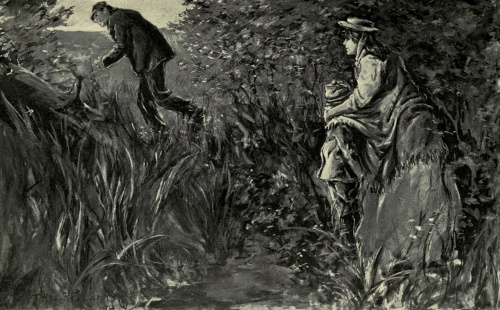
"I hae carried Gavin a' the road!" said Vara, simply.
"You, lassie!" cried Mirren, looking at the slip of
pale girlhood before her, "it's juist fair unpossible!"
"But I did carry him. He's no that heavy when ye
get the shawl weel set."
"O lassie, lassie, ye juist mak' me fair shamed," cried
Mistress Douglas. "Alick, ye muckle bullock; what for
are ye standin' there like a cuif? Gang ower to Mistress
Fraser's and ask the lend o' her cradle. Thae bairns are
gaun to bide——"
"But, wife, hae ye considered?" Alick began.
"Considered, my fit, did ye no hear me? Dinna
stand hingin' there, balancin' on your soles like a show
elephant lookin' aboot for cookies—gang, will ye!"
The little wife stamped her foot and made a threatening
demonstration. Whereupon Muckle Alick betook
himself over the way to Mistress Fraser's, and he never
smiled till he got past the gate of the front garden, in
which Mirren kept her old-fashioned flowers.
"I thocht that's what it wad come to," said Alick to
himself, "when she saw the bairns. I wonder if she
means to keep haud o' them a' thegither? She's been
wearing her heart on the flooers a lang while, puir lassie.
It wad be a farce if three bairns cam' hame at once to
Sandyknowes after sae lang withoot ony, twa o' them
walkin' cantily on their ain feet!"
Thus Alick mused, laughing a little to himself as he
went over to borrow Mistress Fraser's cradle. He had an
idea.
"There'll be some amusement at ony rate," he said,
"but I maunna be ower keen. Na, and I maun haud
back an' make difficulties. And then the wife will tak'
the ither side and be juist daft to get her ain way and
keep them."
Alick was well aware of the value of a certain amount
of opposition, judiciously distributed.
He arrived before long at the cottage of Mistress
Fraser. It was set like his own in the midst of a garden.
But instead of being bosomed in flowers, with beeskeps
scattered about, the garden was wholly taken up with
potatoes, cabbage, and curly greens. It was a strictly
utilitarian garden. As soon as Muckle Alick hove in
sight, turning up off the main road, a covey of children
broke from the door of the house and ran tumultuously
towards him. They tripped one another up. They
pulled each other back by the hair, or caught those in
front by the heels or the coat-tails. It was a clean-limbed,
coltish lass of thirteen who gained the race and sprang
first into the arms of Muckle Alick. Then two smaller
boys gripped each a mighty leg, while a whole horde of
smaller banditti swarmed up Alick's rearward works and
took his broad back by storm. When he got to the
potato garden he looked more like the show elephant
his wife had called him than ever. For he was fairly
loaded with children "all along the rigging," as Mistress
Fraser said.
She was a buxom, rosy-cheeked woman, gifted upon
occasion with an astonishing plainness of speech.
"Guidnicht to ye, Alick," she said, "thae bairns maks
as free wi' ye as if they were a' your ain?"
Alick disentangled the hands of one of the rearward
harpies from his beard and mouth. Whereupon the offended
rascal was not to be appeased. He slid down,
caught the giant about the knee, and began to kick an
outlying shin with all his might.
"Ye should ken best whether they are or no," said
Alick, "there's plenty o' them at ony gait!"
"An' what wind has blawn ye awa' frae Sandyknowes
this nicht? It takes naething less than an earthquake to
shake ye awa' frae Mirren. Ye hae fair forgotten that
there's ither folk in the warl."
"I was wanting the lend o' your cradle, guidwife,"
said Alick, with affected shamefacedness, well aware of
the astonishment he would occasion by the simple request.
Mistress Fraser had been stooping over a basin in
which she was mixing meal and other ingredients, to
form the white puddings for which she was famous. She
stood up suddenly erect, like a bow straightening itself.
Then she looked sternly at Alick.
"Ye are a nice cunning wratch to be an elder—you
and Mirren Terregles baith—and at your time o' life.
An' hoo is she?"
"Ow, as weel as could hae been expectit," said Muckle
Alick, with just the proper amount of hypocritical resignation
demanded by custom on these occasions. Mistress
Fraser, whose mind ran naturally on the lines along
which Muckle Alick had directed it, was completely
taken in.
"An' what has Mirren gotten?—a lassie, I'll wager,"
said the excited mother of eleven, dusting her hands of
the crumblings of the pudding suet, and then beginning
breathlessly to smooth her hair and take off her baking
apron. So excited was she that she could not find the
loop.
"Aye," said Alick, quietly, "there's a lassie!"
"I juist kenned it," said Mistress Fraser, drawing up
wisdom from the mysterious wells of her experience;
"muckle men and wee wives aye start aff wi' a lassie—contrarywise
they begin wi' a laddie. Noo me and my
man——"
What terrible revelation of domestic experience would
inevitably have followed, remains unfortunately unknown.
For the words which at that moment Muckle Alick delicately
let drop, as the chemist drops a rare essence into
two ounces of distilled water, brought Mistress Fraser to
a dead stop in the fulness of her career after the most intimate
domestic reminiscences.
"But there's a laddie come too!" said Muckle Alick,
and looked becomingly at the ground.
Mistress Fraser held up her hands.
"Of a' the deceitfu', hidin', unneighbourly craiturs,"
said Mistress Fraser, "Mirren Terregles is the warst—an'
me to hae drank my tea wi' her only last week. I'll
wager if I live to hae fifty bairns——"
"The Lord forbid," said her husband, unexpectedly,
from the doorway. "We hae plenty as it is——"
"And wha's faut's that?" cried his wife over her
shoulder. "Oh the deceitfu' randy——"
"In fact," said Muckle Alick, dropping another word
in, "there's twa laddies—and a lassie!"
Mistress Fraser sat down quite suddenly.
"Gie me a drink frae the water can, Tam!" she said;
"haste ye fast, Alick's news has gi'en me a turn. Twa
laddies and a lassie—I declare it's a Queen's bounty!
Preserve me, it's no a cradle ye want, man, but a mill happer!
A time or twa like this, and ye'll hae to plant taties
in the front yaird—ye will hae to pay soundly for your
ploy at this rate, my man. Three at a whup disna gang
wi' cancy-lairies in the cabbage plots, my lad."
"It's a maist notoriously curious thing," began Tam
Fraser, unexpectedly, "that I saw Mirren carryin' twa
cans o' water this very mornin'——"
Muckle Alick gave him a warning look, which made
him catch his next unspoken sentence as a wicket-keeper
holds the ball before the field has seen it leave
the bat.
"But—but she didna look weel——" added Tam.
"I wad think no, juist," cried Mistress Fraser, who in
an inner room was busy putting a selection of small white
things into a covered reticule basket. "An puir Mirren,
she'll no be ready for the like. Wha could be prepared
for a hale nation like this—I'll tak' her what I hae. O,
the deceitfu' besom—I declare it wad tak' a little to gar
me never speak to her again."
"Dinna do that!" said the hypocritical giant; "think
on her condeetion——"
"Condeetion, condeetion, quo' he—I wonder ye are no
black ashamed, Alick Douglas. And nane o' the twa o'
ye ever to say a word to me, that's your nearest neebour——"
"I gie ye my word," said Muckle Alick, "I kenned
nocht aboot it till an hour or twa afore the bairns cam'
hame!"
Mistress Fraser turned fiercely upon him.
"Weel, for a' the leers in this pairish—and there are
some rousers—ye beat them clean, Alick Douglas—and
you an elder amang the Cameronian kirk! Hoo daur
ye face your Maker, to say nocht o' the kirk folk as ye
stand at the plate on Sabbaths, wi' siccan lees in your
mouth?
"Come awa, man," she cried from the door in her
haste, "I hae twa bagfu's o' things here. Tam, gang
ower by to the Folds and up to Cowdenslack and borrow
their twa cradles. They'll no be needing them for a
month or twa—I ken that brawly—na, they are straight-forrit
women, and never spring the like o' this on puir
folk to set them a' in a flutter!"
"I think a single cradle wad do. It was a' that Mirren
asked for," said Alick demurely; "but please yoursel',
Mistress Fraser, it is you that kens."
"Yin," cried Mistress Fraser, "the man's gane gyte.
Gin ye wull bring a family into the warld by squads o'
regiments, ye maun e'en tak' the consequences. Lod,
Lod, three cradles a' rockin' at the same time in yae
hoose, it will be like a smiddy—or a watchmaker's shop!
It'll be fine exerceese for ye, Alick, my man, when ye
come hame at nichts—nae mair planting o' nasty-hurcheons
and pollyanthies. But every foot on a cradle
rocker, and the lassie's yin to pu' wi' a string. An' serve
ya baith richt. O, the deceitfu' madam; wait till I get
ower to the Sandyknowes!"
And Alick had to take his longest strides to keep pace
with the anxious mother of eleven—to whom he had told
no lie, though, as he afterwards said, he "had maybes
keeped his thumb on some blauds o' the truth."
"It shows," said Alick, "what a differ there is atween
the truth and the hale truth—specially when there's a reason
annexed in the shape of a woman's imagination, that
naturally rins on sic like things."
But as they neared Sandyknowes it is not to be doubted
that Alick grew a little anxious. His position would not
be exactly a pleasant one, if, for instance, Mirren should
suddenly come out of their little byre with a full luggie
of milk. And it was about milking time.
"There doesna appear to be muckle steer aboot the
place, for siccan an awfu' thing to hae happened so
lately!" said Mistress Fraser.
"Na," said the arch-deceiver Alick, making a last
effort, "we are tryin' to keep a' thing as quaite as possible."
"And faith, I dinna wonder. Gin the wives nooadays
had ony spunk in them ava', ye wad be mobbed and ridden
on the stang, my man!" Then her grievance against
Mirren came again upon Mistress Fraser with renewed
force, "O, the randy, the besom," she cried; "wait till I
get her!"
By this time they were nearing the door of Sandyknowes.
"I dinna think I'll come ben wi' ye the noo. I'll
gang ower by the barn instead. There's some things to
look to there, I misdoubt," said Alick.
Just then they heard Mirren's voice raised in a merry
laugh. It was really at the tale of Boy Hugh and Miss
Briggs, which Vara was telling her.
But the sound brought a scared look to the face of
Mistress Fraser.
"She's lauchin', I declare!" she cried; "that's an
awesome bad sign. Guid kens hoo mony there may be
by this time——"
And she fairly lifted her voluminous petticoats, and,
with her bundles under her arm, ran helter-skelter for the
door of Sandyknowes, more like a halfling lassie than a
douce mother of eleven bairns.
Muckle Alick saw her fairly in at the kitchen door.
"I think I'll gang ower by to the barn," he said.
But he had not got more than half-way there when
both leaves of the kitchen door sprang open, and out flew
Mistress Fraser with the large wooden pot-stick or spurtle
in her hand. Alick had admired her performance as she
ran towards the house. But it was nothing to the speed
with which she now bore down upon him.
"It was like the boat train coming doon by the Stroan,
ten minutes ahint time, an' a director on board!" he said
afterwards.
At the time Muckle Alick had too many things to
think about, to say anything whatever. He ran towards
the barn as fast as he could for the choking laughter
which convulsed him. And behind him sped the avenger
with the uplifted porridge spurtle, crying, "O ye muckle
leein' deevil—ye blackguaird—ye cunnin' hound, let me
catch ye——"
And by the cheek of the barn door catch him Mistress
Fraser did. And then, immediately after, it was Muckle
Alick who received the reward of iniquity. But Mirren
stood in the doorway with little Gavin in her arms and
Vara and Boy Hugh at either side, and laughed till the
tears ran down her cheeks in twin parallel rills.
"Gie him his paiks, and soundly, Mistress Fraser;
pink him weel. Hit him on the knuckles or on the
elbows. Ye micht as weel hit Ben Gairn as try to hurt
him by hitting him on the head!"
Alick was speechless with laughter, but Mistress Fraser
exclaimed with each resounding stroke, "Twa laddies
and a lassie! O ye vermin!—And me has sent to the
Folds and the Cowdenslacks for twa cradles to mak' up
the three. Ye hae made a bonny fule o' me. I'll never
hear the last o' it till my dying day in this countryside.
But, at ony rate, I take my piper's pay in ha'pence out o'
your skin, my man Alick!"