EXPLANATIONS.
THE next morning several people were absent from breakfast, among them
Priscilla and Fanny. Fanny had already made a clean breast of it.
"I never thought of any such thing, till one day when I was in
Priscilla's room, she asked me if I didn't want something nice to read,
and she lent me a novel she had. I knew that it wasn't a good book, but
it was interesting, and I read it and several others. I used to go to
Priscilla's room to study my lessons, and read almost all the time. And
since I have slept in the little room, I have read in bed at night.
"Then we got engaged with a story in a paper, and Priscilla said we
might get the rest of the numbers if there was a news-shop here. We
asked at Robison's, and he said he didn't keep that kind of papers.
And then Priscilla said she had seen another news-shop down near the
landing; and I said Mr. Hausen said we must never go to Sawyer's for
anything, because it wasn't a respectable place. And Priscilla said
she didn't care—she guessed it wouldn't hurt her. So we went down and
bought ever so many papers of different kinds, and a great parcel of
candy and lemons and things. Then we were afraid to come home the front
way, and we went round through Mr. Mansfield's orchard."
"Have you been to Sawyer's more than once?" asked Mrs. Richardson.
"Yes, ma'am; two or three times."
"And where are the papers and books you had?"
"Some are in Priscilla's room and some in mine; some in that little
garret place at the end of our hall, in an old basket."
"Did Claribel have anything to do with all this reading and buying of
papers?" asked Mr. Hausen.
"No, sir; indeed she didn't," said Fanny, eagerly. "She never knew
anything about it. I don't believe Claribel would tell a lie for
anything, though I do think she is cross sometimes," added Fanny.
"But, Fanny, how could you go on so?" asked Mr. Hausen gravely. "You
knew all this was wrong as well then as you do now. You knew that you
were doing what was injuring yourself and others, didn't you?"
"Yes, sir."
"Then why did you keep on with it so long?"
"I don't know," answered Fanny, hanging her head. "I thought I would
leave it off ever so many times, and then Priscilla laughed at me and
said it was all nonsense, and there was always a bit of a story that
I wanted to finish. That was what I lighted my candle for last night.
I thought I would just finish one story I was reading in a paper, and
then I would give them all back to Priscilla again."
"Ah, my child, that is the rock which has wrecked many a sinner," said
Mr. Hausen. "The dram drinker thinks he will leave off drinking after
he has taken one more glass; the gambler only waits till the luck shall
turn, so that he can win one more game. Such conduct shows that you are
not honest with yourself. If you really desired to forsake your sin,
you would not want to sin once more."
"And then Priscilla laughed at me and said I might as well go on now I
had begun. But I don't mean to lay all the blame on her, either, though
I must say I shouldn't have begun if it hadn't been for her. But I
never will read a bad book again—no, not if I was to be shipwrecked in
the middle of the great desert of Sahara," added Fanny, vehemently.
"You would find that rather difficult to accomplish," said Mr. Hausen.
"But, Fanny, what am I to do with you? Nobody can watch you all the
time, and how can I take the responsibility of a girl whom, I cannot
trust?"
"Oh, Mr. Hausen, please don't send me home," pleaded Fanny. "Indeed, I
will never do so again. I know how naughty I have been, but please do
try me a little longer."
"Very well; I will try you a little longer," said Mr. Hausen, after
some consideration; "but you must remember that you are on probation.
You must not ask to go outside the grounds again this term unless one
of the teachers or one of the senior-girls can go with you; you must
not read a single story-book of any kind without first asking Mrs.
Richardson, and you must study all your lessons either in your own room
or the school-room. Remember, these are the conditions. If I find you
disobeying me in one single point, I shall send you home directly."
Priscilla began by denying the whole thing; but when Mr. Hausen
produced the books and papers which had been found in her room, she
changed her tone.
"She didn't know whose business it was what books she read. She came
to school to learn her lessons, and she had learned them. Nobody could
deny that."
"Nobody wishes to deny it, Priscilla; but how has it been about Fanny's
lessons?"
"I am not responsible for Fanny's lessons," answered Priscilla. "She
is a little dunce, anyhow, but I don't see what great harm I have done
her."
"Indeed! I do not agree with you. And what do you say to the harm done
your cousin?"
"I am sorry about Claribel," said Priscilla, with some feeling. "The
poor thing had enough to bear before. I thought when I first came here
that she was setting up to be good and that she felt above me because
she was rich, and I meant to tease her by getting Fanny away, but I am
sorry it has turned out so badly: and I have told her so."
"I am glad to hear it," said Mr. Hausen. "Priscilla, how did you
acquire a taste for such reading?"
"Oh, I don't know. We don't have many books, anyway, and one must read
something."
"But you have had plenty of better books to read since you have been
here."
"Well, to tell you the truth, I don't care one pin for the books the
girls read here," answered Priscilla; "they seem to me so stupid. I
wouldn't give a pin for a story in which somebody isn't killed."
"I dare say not. One of the bad effects of such reading is that it
unfits the mind for any innocent or rational amusement. A man who
accustoms himself to brandy cares nothing for anything less exciting.
But that is not the worst. Every time you read a bad book, you stain
your soul with a mark which cannot be rubbed out. By dwelling on wicked
actions and bad characters you become like them. Even though you may
repent and by God's grace be forgiven, you will find the images in
which you used to delight coming back to haunt and distract you, and
if you do not repent, you make yourself utterly unfit for goodness or
usefulness here and for happiness hereafter."
Priscilla seemed a good deal moved.
"I never thought so very much about it," said she. "Mother never
seemed to care what I read. She never looks at a book herself.
Claribel wouldn't read them, but I thought it was only a piece of her
contrariness."
"Don't you see that what I say is true, Priscilla? You say yourself
that you don't care for a book unless somebody is killed. By and by you
will need even stronger seasoning than murder, and what are you going
to do then? My child, what am I to do with you?"
"I suppose you will have to send me home," answered Priscilla.
"Do you wish to be sent home in disgrace, Priscilla?"
"No, I don't," answered Priscilla. "Mother will feel dreadfully,
because I was sent home that way once before. But, of course, I can't
expect you to keep me."
"Suppose I should let you stay to the end of the term, would you give
me your word to try and do better? Would you give me your word to tell
the truth, obey the rules of the school, and give up this abominable
reading?"
"Why, would you let me stay if I did?" asked Priscilla, in astonishment.
"Yes, I would try you; but you must expect to be more watched and
restrained than the other girls. We can't put the guilty and the
innocent on the same level, you know."
"I am sure you are very good," said Priscilla, with some emotion.
"My child, I have no other wish than your own good, but you know that I
must consider the welfare of the other girls; I cannot risk poisoning
a dozen to save one. You have done us a great injury. Nobody has ever
disgraced the school as you have. You have been seen again and again at
that vile place where you have bought your papers, and of course those
who have seen you, know what was your errand there. You have injured
Fanny. You have injured Claribel—perhaps endangered her life, for such
a shock is a grave matter to anybody as weak as she is. Nevertheless,
I am willing to forgive you and to give you a chance to retrieve your
character."
"You are very good," said Priscilla again, in a broken voice. "I did
not think anybody could be so—"
"Ah, Priscilla, there is One far better to you than I am," said Mr.
Hausen—"One against whom you have been sinning and rebelling all your
life, who is yet ready to forgive and receive you the moment you turn
to him. I can forgive you, but only he can wash away your sin and
sanctify your heart. I can help you by outward aids and restrictions,
but he can change your whole nature, so that you will hate the things
you now love and love the things you do not now care for. Why can you
not turn to him in the hour of youth, in this time of trouble?"
"I don't know anything about that," said Priscilla. "It never seems to
me as if there were anything real about religion any more than about
anything else one reads of, but I suppose there must be."
"Ask Claribel what she thinks about that matter," said Mr. Hausen.
"Well, I will say for Claribel that something has changed her," said
Priscilla. "I never saw such an alteration in anybody. I would give a
good deal if she were well once more."
"Well, Priscilla, I hope that some day these things may seem as real to
you as they do to me. But now how are we to settle this matter?"
"Mr. Hausen," said Priscilla, "if you will let me stay, I will try to
do the best I can. I can't promise to be good, but I will promise to
try, and I will do everything you tell me. I did think I would face it
out and pretend I did not care; but I do care. I am very sorry."
"I am glad to hear you say so," answered Mr. Hausen. "I shall lay you
under the same restrictions as Fanny, and I want you to promise me one
thing more—namely, that you will read two chapters in the New Testament
every day while you stay here."
"Well, I will agree to that," said Priscilla, "though I tell you
honestly, Mr. Hausen, I don't care as much as I should for the Bible."
"No, I suppose not; but I mean that you should learn to care. My mother
knew a lady who was converted from a very gay and worldly life, and
became one of the most consistent and useful Christian women that ever
lived. She told my mother that when she first began to read the Bible
she cared nothing about it—she could not become interested in it—and
she made a resolution that she would read no other book till she had
learned to love the Bible best of all."
"And did she?" asked Priscilla, much interested. "Did she keep her
resolution, I mean?"
"Yes. Though she was a highly cultivated woman, and fond of reading,
she did not for a whole year touch any other book than the Bible. After
that, she allowed herself to read other books, but she always loved the
Bible best. I don't ask you to read no other book, but I do ask you
to pledge yourself to read at least two chapters in the New Testament
every day."
"Well, I will," said Priscilla. "Where shall I begin?"
"Begin at the beginning, and read straight on; you cannot have a better
plan than that. Try to feel what you read, and ask God to give you
grace to understand it. But you must remember, Priscilla, that you are
on probation. You will be closely watched, and the first disobedience
or deception sends you home."
"All right," said Priscilla; "that is only fair. Mr. Hausen, I do thank
you for letting me stay, if only on mother's account. I have been, and
am, a bad girl, but I do love my mother. I will do all that you tell
me."
Priscilla shut herself up in her own room and remained there till near
dinner-time. Then she went to Rebecca's room and knocked.
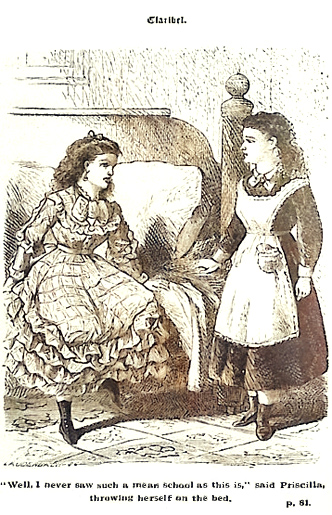
"Come in," said Rebecca, opening the door and then shutting it
directly. "I thought you were never coming. I went to your room as soon
as I saw you come out of the study, but you were locked in. Why didn't
you open the door?"
"I was busy," answered Priscilla.
"Well, and how did you get off?" asked Rebecca. "Isn't it fun that
nobody suspects me, or has said a word to me?"
"You had better not be too sure that nobody suspects you," said
Priscilla.
"Well, anyhow, nobody has accused me. What did Mr. Hausen say to you?"
"Never mind," said Priscilla, shortly. "Rebecca, I want all those books
and papers directly."
"Oh, why?" asked Rebecca. "I have not half finished them, and I am sure
they are as safe here as they can be anywhere."
"Never mind; I want them, every one."
With considerable reluctance and grumbling, Rebecca produced the pile
of pamphlets and papers.
Priscilla looked them over.
"They are not all here," said she. "Where are the rest? I want every
one of them."
"I think you might leave me one," said Rebecca, producing a thick
yellow book and giving it to Priscilla. "You can't want to read all
these at once."
"I don't want to read any of them, as it happens."
"What are you going to do with them?" asked Rebecca.
"I am going to give them to Mr. Hausen," said Priscilla, doing the
books up in a bundle and tying them together in a very decided fashion.
"Priscilla! You won't do that!"
"You will see that I will."
"Oh, I suppose you mean to set up for good, like Claribel," said
Rebecca, sneeringly. "It is rather late in the day for that. Suppose I
set up for good too, and tell Mr. Hausen all about our going down to
Sawyer's, and so on?"
"You won't tell him any news if you do," answered Priscilla, coolly.
"Fanny has told him already, and so have I. You needn't look so scared;
I didn't say anything about you, and sha'n't. As for Claribel, you had
better not say anything to me against her, if you know what is good for
yourself."
"Well, I never thought you would be scared and give in so easy as
that," said Rebecca. "For my part, I shall keep my own counsel."
"You are welcome to keep it, for all me," said Priscilla. "I don't
think I have done you any great harm; that is one comfort."
"But what is the use of giving these books to Mr. Hausen?" asked
Rebecca, loath to give up the stolen waters which her unhealthy taste
had found so sweet. "If you don't want them yourself, you might let me
have them. Mr. Hausen don't know anything about them; and if he finds
them, I won't tell him they are yours. But he won't find them. I have
got a capital hiding-place, and we can have some fun with them by and
by, when this has blown over a little. Come, what is the use of making
such a great pretence of goodness all at once?"
"I suppose you can't possibly understand that I am in earnest," said
Priscilla. "Perhaps it isn't so very strange, either. But it is true,
for all that. I am in earnest, and I mean Mr. Hausen shall see that I
am. You will never see these things again as long as you live, Rebecca.
You may make up your mind as to that."
So saying, Priscilla picked up her bundle of books and departed. She
carried them straight to Mr. Hausen, telling him that they were some
which Fanny did not know about, but she said nothing of Rebecca.
Claribel was very sick. Her hands were badly burned, and the shock and
alarm had brought on one of her fits of palpitation and difficulty of
breathing. The girls were not allowed to see her, but Priscilla waylaid
the doctor on the stairs and begged to know what he thought of her
cousin.
"My dear, your cousin is very sick," said Dr. Benedict, kindly and
seriously. "There is no telling how the attack may terminate. She may
get better again; and she may pass away very suddenly."
Priscilla turned very pale, but she showed no other sign of agitation.
"Dr. Benedict," said she, "would you ask them to let me sit up with
her? Indeed I can do it. I have watched with sick people a great many
times. I am sure I can help take care of her, and I think Claribel
would like it."
The doctor looked keenly at her.
"Yes, you shall," said he. "I don't think it will hurt either of you."
Priscilla shared Mrs. Herman's watch that night, and showed herself
such an excellent nurse that she was allowed to take her full share of
the care demanded by the invalid, though Mr. Hanson insisted that her
lessons should be discontinued.
"You need not mind letting them go," said he. "You are learning quite
as much in another way."
Claribel continued very ill for many days, but she grew better at last,
and was able to take some rest.
"You will soon be well now," Priscilla remarked one day when her cousin
was sitting up by the window, for the doctor had recommended the fresh
air.
"Yes, I shall soon be well," answered Claribel, with a little sigh.
"Don't you want to get well?" asked Priscilla, struck by something in
Claribel's tone and manner.
Claribel hesitated.
"I am willing to get well," said she.
"Can't you get any farther than that?" asked Priscilla.
"To tell you the truth, Priscilla, I am afraid I can't. You know what
Dr. Benedict says about my hands?"
"No. What does he say? I thought they were almost well. Do they hurt
you so much?"
"They don't pain me very much now," said Claribel, "but Dr. Benedict
says I shall never have any use of them again. That isn't a very
pleasant prospect, especially to anybody as lame as I am."
"Perhaps he doesn't know," said Priscilla.
"I believe he does. The surgeon that Mr. Steele brought from the city
says the same thing."
"Claribel," said Priscilla, in a low voice, "don't you hate me?"
"No," answered Claribel, smiling. "I don't hate anybody, and I am sure
I should be very ungrateful to hate you, who have been so good to me
and waited on me since I was sick."
"You used to say you hated me when you lived at home, and I am sure you
have more reason now."
"I was a very ill-tempered girl when I lived at home," said Claribel.
"And besides, Priscilla, if you don't mind my saying so, I think I had
more reason then. You did not mean I should burn my hands or be sick,
but you did use to mean to torment me then. There is a fine sentence
for you. And you did hurt me cruelly too, especially when you said my
father did not love me and was ashamed of me. I did not get over it for
a long time—not till Mr. Hausen showed me some letters father wrote to
him and to Mr. Steele about me."
"I only said it to be hateful," said Priscilla; "I knew it wasn't so.
But, after all, Claribel, I was the means of your being burned. It
never would have happened if I had not put Fanny up to reading those
horrible papers. Somehow, I don't think Fanny minds it as much as I do."
"Fanny is very light-hearted," said Claribel, with a little sigh.
"Things don't stick to her as they do to you and me, and I am glad they
don't. But she feels badly enough, I am sure, and I don't believe she
will ever do such a thing again, or you either."
"I would give my own right hand to make yours well again," said
Priscilla. "How long have you feared you could never use them?"
"Ever since Mr. Steele was here; I made the doctor tell me what he
thought about them. I was determined to know the worst."
"A whole week, and you have been so cheerful all the time!" said
Priscilla. "Claribel, how can you?"
"I don't know—I have had help; and besides," said Claribel, with a
radiant smile, "I don't think they will trouble me long. I am better,
but I am not well, and I heard the doctor say that another attack would
carry me off."
"And you are glad, are you, really?" asked Priscilla, wonderingly.
"Yes, I am; I have so little to live for. I did want to do a great many
things for people, but I suppose somebody else can do them just as
well. Please don't cry, Priscilla, if you can help it. You will make me
cry too, and that sets my heart to beating so I can't talk, and I have
ever so many things I want to say."
"I won't," said Priscilla, with a strong effort sending back her tears
and composing herself. "But won't it hurt you to talk?"
"Oh no; I asked the doctor, and he said I might. Priscilla, I am too
young to make a will. I asked Mr. Steele, and he said so, but he said I
could do some things now. So I wrote on a paper what I wanted to give
to one and another—at least, I told him, and he wrote it down. And one
thing I want to tell you, because it depends on you. I asked him if
you and your mother were willing to keep you here at school till you
finished the course; that will be about six years."
"Oh, Claribel, I can't," said Priscilla, in a smothered voice. "How can
I let you do that for me after all—"
"I shall not be any poorer," said Claribel, smiling, "and I am sure you
will consent when you know I wish it. And oh, Priscilla, if you would
do something else! Ever since I began to think about such things—about
doing for others instead of myself—I have thought how much I should
like to be a missionary. But I knew it was out of the question, of
course, and I always meant to educate and fit out somebody to go in my
place—a substitute, you know, as people used to say in war-time. Oh,
Priscilla, if you would only be my substitute! I know you don't care
much for religion now—"
"Yes, I do," said Priscilla; "I can't help it when I see how it has
changed you, and since I have read so much in the Bible. Claribel, I
will do what you wish. I will be your substitute. I promise you that
if mother is willing, I will fit myself for a missionary and go in
your place; and if I cannot do that, I will be a missionary at home. I
suppose I am about the last person anybody would think of for such a
place as that. I wonder what Mr. Hausen would say?"
"He would say you are the very one," said Claribel. "He told me that
you had the making of an energetic Christian woman in you if you would
only take the right turn."
"Claribel," said Priscilla, "I don't know, but I believe—I feel—as if I
had taken the turn this very hour. But of one thing you may be sure: I
shall keep my promise to you if it be possible."
"There is just one thing more," said Claribel, after she and Priscilla
had kissed each other—"yes, two things." She calmed herself by a strong
effort. "If you will be a friend to Fanny, and try to keep her steady,
and away from—you know who."
"I will do my best," said Priscilla; "I owe her as much as that. But
honestly, Claribel, I don't think there is very much in Fanny."
Claribel sighed:
"Well, perhaps not so very much. But she was the first friend I made,
and she did me a great deal of good. I think she may turn out a good,
useful woman if she can stay here, especially if the other goes away."
"You might just as well say 'Rebecca,'" said Priscilla; "we both mean
her. I think, Claribel, there was a black sheep in this flock before I
ever came into it."
"And so do I. I know how I felt when she came and asked me to write her
composition for her."
"Rebecca thinks nobody finds her out or knows about her, but I think
she is mistaken," observed Priscilla. "But what is the other thing you
want me to do?"
"I want you to take my place with Madge. Poor little thing! She will be
very forlorn when I am gone, and she is a dear, good child. I am sure
Mrs. Richardson will consent."
"I will ask her," said Priscilla. "But, Claribel, don't you want me to
do something for you?"
"No, I don't think so, any more than you are doing constantly."
"I never saw any one so changed as you are about that," said Priscilla.
"You used to think about yourself all the time, and that nobody could
do enough for you."
"It was Mr. Hausen who showed me the way out of that prison," said
Claribel. "He made me promise to try never to miss a chance of helping
anybody. I remember the very first time I ever did it, too: I put away
the 'Tales of the Crusaders' to help Fanny about her shirts. Have you
read that book? It is in the library, and I am sure you would like it."
Priscilla smiled:
"To tell you the truth, Claribel, I can't trust myself to read any
story-book just now. I am like a reformed drunkard who does not dare to
drink even a glass of sweet cider. I hope I shall have more sense some
day, but till I do, I think total abstinence is my best way. But I will
read to you if you like."
"Oh no; I don't care about it. But don't you want to learn your Bible
lesson? Get the book, and we will study it together."
Claribel lingered for two or three months, sometimes worse and
sometimes better: even able to leave her room and come down to the
library or school-room. Priscilla devoted herself to her cousin, even
refusing to go home for the holidays lest Claribel should miss her.
Claribel enjoyed her Christmas, and helped fit up the tree prepared for
the girls who did not go home. She was very bright and animated all the
evening, and did not seem very tired when she went to bed. But when
Priscilla went to wake her in the morning, she was no longer there.
Only the poor house which had so long held Claribel lay quietly resting
as if in sleep, for a greater than an angel had been there in the night
and opened the doors, and Claribel was indeed out of prison.
Rebecca did not come back after holidays. To some of the girls who saw
her afterward, she said the school was so disagreeable that she did not
wish to go back; and she wanted to make her father send her to a large
school where she could have some fun. But "deception is the essence of
lying;" and they were not deceived, for all knew that she could not
have returned if she had desired it.
Priscilla's mother is dead, and her sister is married. She herself is
now one of the oldest, as she is one of the best, girls in the school.
She has steadily pursued her great object—that of fitting herself for
a missionary by the acquisition of every sort of useful knowledge—and
in another year will probably take her place among those who are
witnessing for the light amid the darkness of heathenism.
THE END.