The sun was low in the heavens next morning when
I was afoot and down to the beach, the glorious bay
now brimming full, and the schooners and chasse
marées, like the swan on St. Mary's Loch, floating
double, ships and shadows. The scene was very
strange. The green meadow had disappeared, and
where it had been, a gleaming lake stretched brilliant
in the sunshine, set in the pine-woods like a mirror
in an ebony frame, cutting slices of sweeping bay out
of their dusky margins, and piercing their depths with
silent, weedy water-veins.
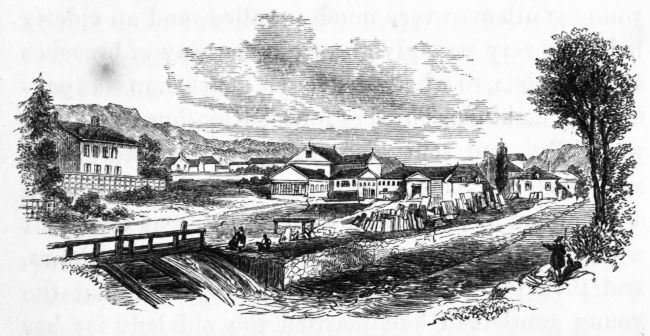
Where the villages lie, there have been clearings
made in the wood, precisely as one would expect to
see in a New Zealand or Australian bay. Close to
high-water mark, rows of rounded huts serve as storehouses
for nets, and spars, and sails. Before them
straggling jetties run on piles far to seaward; behind,
huddled amid scanty vineyards and patches of broadleaved
Indian corn, groups of houses—their roofs
nearly flat, and their walls not above six feet, in some
places not four feet, high—seem cowering away from
observation. For every cottage built of stone, there
are half-a-dozen out-houses, sheds, pig-sties, and so
forth, piled up with old oars, broken masts, furze,
pine-cuttings, and Irish-looking sod. I made my
way to what seemed the principal landing-place—a
bleached jetty. A dozen or so of boats floated round
it, roughly built, very narrow, and very light, lying
upon the very top of the water, and just, in fact, as
like canoes as the scene about resembled some still
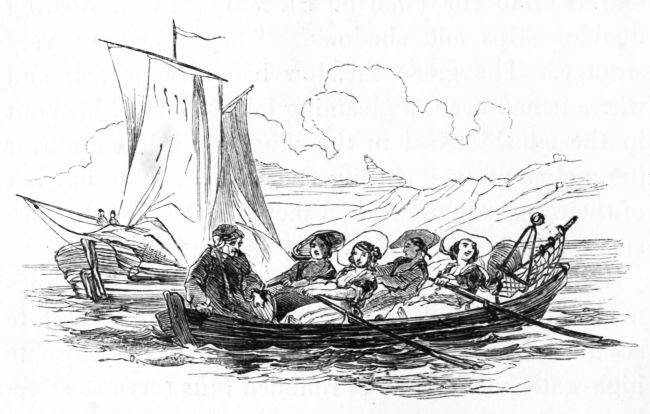
savage country. Three boats were starting for the
oyster fishery, manned each by four as buxom, blithe,
and debonnaire wenches as you would wish to see.
They had short petticoats—your Nereides of all shores
have—and straw hats, shaped like a man's. In the
stern-sheets of each boat a venerable, ancient mariner
held the tiller; and as I approached, the damsels,
who were getting their clumsy oars inserted between
the thole-pins, clamoured out in a torrent of vociferous
gabble, offering me a day's oyster-fishing, if I
would go with them. They were evidently quite au
fait to ridding the Bordeaux loungers of their spare
francs, in the shape of passage-money, for a frolic on
the oyster-banks; but I had determined to pass the
day in another fashion. I wanted a sail on the bright,
still bay, a walk in the pine-woods, and a glance at
the surf tumbling in from the Bay of Biscay; so I
scrutinized the faces of two or three lounging boatmen,
with as much reference to Lavater's principles
as I might, and selecting the most intelligent-looking
of the lot—a mild, grey-eyed man, who spoke gently
and slowly—we soon made a bargain, and were
speedily afloat in the bean-cod looking canoe of which
he was the skipper. I was gazing doubtfully at the
heavy oars, and the expanse of water, when a flying
cat's-paw made just a pretence of ruffling it.
"Merci, le bon vent!" said the fisherman. Up
went a mast; up went a light patch of thin white
canvass, and straightway the bubbles flew fast and
faster by the gunwale, and there arose a sweet gurgle
from the cleaving bow.
"You can see how fast we're going by the bottom,"
said the boatman. I leant over the gunwale, and
looked down. Oh, the marvellous brightness of that
shining sea! I gazed from the boat upon the sand
through the water, almost as you might through the
air upon the earth from a balloon. Ghost-like fish
gleamed in the depths, and their shadows followed
them below upon the ribbed sea-sand. Long flowing
weeds, like rich green ribbons, waved and streamed
in the gently running tidal current. You could see
the white pebbles and shells—here a ridge of rocks,
there a dark bed of seaweed; and now and then a
great flat-fish, for all the world like a burnished
pot-lid set in motion—went gleaming along the
bottom.
"Once," said the boatman, "all the bottom of
this great bay that you are looking at was dry land,
and there were cottages upon it, and an ancient
chateau. That was the chateau of Armand de Chatel-morant,
an old baron of these parts, a wicked man
and a great magician, who had a familiar spirit, which
came when he blew a horn, and who was able, by his
sorceries, to rule the winds that blow. Only, once he
raised a storm he could not quell; and it was that
storm which made the Bay of Arcachon; for the wind
blew the sand of the sea-shore up the country, like a
snow-storm, and the sand-hills rolled before it; and
what the wind began, the coup de mer finished, and
the ocean came bursting through the breach it had
battered in the sand-ridges of the coast, and swallowed
up the chateau and drowned the magician, and there
was an end of him."
"Well," said I, "so be it; he deserved his fate."
"For many a year after the flood the baron had
made," the boatman continued, "you could see, out
of a boat, the pointed tops of the towers of the chateau
below you, with the weather-cocks still pointing to the
west, and the green seaweed hanging to them, like
pennons from a ship's vanes."
"But I fear it is not to be seen now."
"Oh! no. Ages and ages ago it rotted and rotted
away; but the old men of the village have heard from
their fathers that the fishermen only ventured there
in calm summer weather and in good daylight; for,
in the dark, look you, and when a Biscay wind
was blowing, they said they heard the sounding
of Chatel-morant's magic horn, and they saw his
imp flying above them and wailing like a hurt seabird."
Of course, I was on thorns to hear all the story;
and so my boatman recounted a rude, disjointed tale,
which I have hitched, legendwise, into the following
narrative:—
The Baron Armand de Chatel-morant sat in his
dim studio high up in the most seaward tower of the
chateau of Chatel-morant. His hair and his beard
were white, but his eyes were keen, and his cheeks as
ruddy as the eyes and the cheeks of a young man.
He had a furnace beside him, with implements of
projection, crucibles, and powders. On the table
were astrological instruments, and the magic crystal,
which his Familiar had given him, and in which—only,
however, when the Familiar pleased—the baron
could read the future; but, for every reading of the
future, the baron was a year older—the Familiar had
a year of his life. The baron was clothed in a long
furred robe, and he wore red shoes, with peaked toes,
as long again as his feet. His face was moody, and
clouds went driving along his brow. He took up his
instruments, and laid them down, and opened a big
book, full of spells and cantrips, and shut it; then
he walked about the room; and then he stopped and
blew a silver whistle.
Very prompt at the sound came an old man—reverent
and sorrowful looking—with a white wand;
for he was the seneschal of the chateau of Chatel-morant.
"Your niece," said the baron, "who comes hither
from the town of Bordeaux to visit you, and whom I
saw but yester even,—has she returned?"
"She went this morning, monseigneur," said the
seneschal; "she has preparations to make; for, God
save the pretty child! she is to be married on the
day of Blessed St. John."
The baron frowned; for he was not an admirer
of the saints, being quite, indeed, on the other side
of the hedge.
"Say the number of the day, and the name of the
month," he replied, angrily; "and do not torment
me with that shaveling jargon which they talk in
the monastery of Andrew, whom they call St. Andrew
at Bordeaux."
The seneschal, who was accustomed to be bullied,
particularly upon religious subjects, crossed himself
behind his back; for he was a prudent man, and,
owing to the absence of mind of the baron, who was
always experimentalizing in the black art, managed,
one way or other, to pick up so much as to make his
place a tolerably profitable one.
"Married!" said the baron; "and to whom?"
"Just to honest and brave Jacques Fort—the
stoutest mariner who sails out of the Garonne. He
has got a ship of his own, now—the Sainte Vierge;
and to-day he sails upon his first voyage, as far as
Bayonne."
"He sails to-day—so; and the maiden's name—your
niece's name—what is that?"
"Toinette, so please you, sir."
"You may go."
And go the seneschal did, wondering very much
at the uncommon interest his master seemed to be
taking in vulgar, sublunary things.
Then Baron Armand de Chatel-morant paced the
room a long time in gloomy meditation. At length
he sat down again, and said aloud: "There is no
doubt of it—I am in love. That face haunts me;
Toinette's face is ever floating opposite to me. 'Tis
an odd feeling; I was never so before. But, since
it is so, I must even have the maiden—she will cheer
me—I love her face. I will send to-morrow to Bordeaux,
as from her uncle; and when she comes here,
by the star of Aldeboran, she stays here, Jacques Fort
to the contrary notwithstanding!"
"Wrong—quite wrong!" said a voice.
The baron turned coolly round, and saw, sitting
upon the arm of the chair close to him, the figure of
a very thin dwarf, with a long, unearthly face, and
fingers like hawks' claws. This was the imp—the
baron's Familiar.
"How, Klosso!" said Armand; "you come without
being called?"
"Yes; but you would have called me soon."
"You know what I am thinking of—of Toinette.
I love her—I must have her."
"You will not have her."
"Why so?"
"Because it is so decreed."
"Klosso," said the baron, "I don't believe you.
You know the future; but you lie about it when you
speak."
"Will you, then," answered the demon, "look
into the crystal: that can't lie. Come—it's only
another year—give yourself a treat—come!"
"I have given you many years already," said the
baron, musing; "look how grey my hair is!"
"Dye it," said the imp, who, if he was a Familiar,
certainly behaved as such. But the baron took no
notice of his impertinence. He was dreadfully smitten
by Toinette, and said he'd have a twelvemonths'
worth of knowledge of futurity for her sake. The
thin dwarf grinned, and then made a motion of relief,
as one who saw before him the speedy end of a long,
long watch. So he took the crystal, uttered, as may
be supposed, some magic words; and the baron
looked upon the clear surface.
"Malediction!" he exclaimed, as he saw in the
crystal a huge hearth, with pots on the fire, and poultry
roasting before it, and Toinette tending the cookery,
and a stalwart fellow helping her clumsily.
"That is Toinette!" cried the baron; "but who
is the rascal with her?"
"Her husband, Jacques Fort."
"Curses on him!"
Here the baron saw Jacques fling his arm round
Toinette's waist, and kiss her so naturally, that he
ground his teeth.
"Domestic felicity," said the imp; "a charming
picture, baron—they're cooking the christening
feast for young Jacques."
The baron flung the crystal down.
"Pay me," said the imp; and he passed the
bird-like hand over the baron's face, and each of his
fingers drew a wrinkle. A shudder went over the
sorcerer's frame, and then he breathed heavily, and
looked wistfully at the imp. He was a year older.
"Klosso!" shouted Armand, leaping to his feet,
"I will fight fate!"
"Better not," said Klosso.
"Curse the future!" exclaimed the baron; "I
will alter the future, and give the lie to the crystal, as
to you!"
"If you try," replied the imp, coolly, "you will
belong to me before the morning."
"Silence, slave!" cried Armand, who was not a
man to be put out of his way; "you rule the winds—I
rule you. Make the west wind blow."
The imp raised its hand, and they heard the
whistling of a strong, gusty wind, and the creaking
of the weather-cocks, as they all turned towards the
sea.
"Stronger—stronger—stronger!" shouted the
baron; and the whistle became a roar, and the roar
a howl; and the castle shook and swayed in the blast.
"Good—good!" laughed the baron; "something
more than a puff there—ha! ha!—as Jacques Fort
has found by this time on the deck of his new ship
in the Bay of Biscay."
The Familiar gently remarked that the weather
was roughish, when the seneschal rushed into the
room in a dreadful state of terror at the storm.
"My lord—my lord!" he said, "we shall all be
blown away; the air is full of sand; you would be
suffocated outside. The wind is tearing up the pines;
and oh, poor Jacques Fort is at sea, and drowned—drowned,
by this time, to a certainty!"
"Yes," said Armand, "I should rather think so.
Toinette must take up with somebody else.—Stronger!"
The last injunction was addressed to the imp, and
instantly complied with. The tempest roared like
the up-bursting of a volcano, and screeched and
screamed through the sugar-loaf turrets and the lattices,
which it had burst in, and the loop-holes, like
a hundred thousand devils' whistles. The seneschal
fell on his knees.
"Stronger still!" said the baron.
And meantime what was Jaques Fort doing in
his new ship? With every rag of canvass torn out of
the bolt-ropes, the Sainte Vierge was flying on the very
top, as it seemed, of the driving spray, on to the
breakers. Jacques was the only man left on deck—every
one of the rest had been washed overboard,
and were already sleeping in the sea; and he knew
that in a moment he would follow them. The staggering
ship rose on the back of a mighty breaker;
and the captain knew that with its fall upon the
beach his vessel would be ground to powder.
"Oh, Toinette!" he murmured, as the ship was
hove forward like a bolt from a bow, and then fell
shooting into a creaming current of rushing water,
while the sand-hills appeared right and left for a
moment, and then were left astern. The last grand
wave had burst the barrier, and the frail ship and the
kneeling mariner were borne onward on the ridge of
the advancing flood, which formed the lake of Arcachon.
Jacques Fort saw a light, and steered towards
it: it was the light in the baron's chamber at the
chateau of Chatel-morant.
There, by the burst-in lattice, stood the baron,
his grey hair flying above his head, and ever shouting
to the imp, "Stronger, Klosso—stronger!" And
every time he used the words, the hurricane burst
louder and louder upon the rocking turrets. And
still Armand clung to the stone-work of the burst-in
lattice, through which the flying sand drove in, and
clustered in his robes and hair.
And now the terrified domestics began to rush up
to the chamber of the baron.
"My lord, such a storm was never heard of!"
"My lord, the devil is loose, and riding on the
wind!"
"My lord, the end of the world is at hand!"
"Klosso!" shouted the baron, "stronger!"
As he spoke, the wind burst like a thunder-clap
over them, and they heard the crash of a falling tower.
The serving men and women grovelled in terror on
the floor; the baron clung by the window; the imp,
visible only to him, sat on the back of the arm-chair,
as he had sat since his appearance.
But hush! Another sound, mingling with the
roar of the wind, and deeper and more awful still.
It rapidly increased, and the baron found his face
besprinkled with driving drops of water—they were
salt.
"My lord—my lord!" screamed the seneschal,
sinking, as he spoke, at the baron's knees; "my lord—the
sea!"
A cry was heard without; the lights of the hamlet
beneath disappeared; and then a shock from below
made the chateau swing and rock, and white waves
were all around them.
"The sea, my lord," said the seneschal, "has
burst the sand-banks; the castle stands on low ground.
We are all dead men—the sea—the sea!"
The Baron Armand turned to Klosso: "Does he
speak truth?"
"The worthy gentleman," said the imp, "is perfectly
in the right; you are all dead men; and, Monseigneur
le Baron, when you gave me last a year of
your life, you gave me the last you had to give."
Up rose the water, and higher dashed the waves.
Up, foot by foot, and yard by yard; and still the
baron stood erect amid the raving of the elements—his
face as white as his hair, but his eyes as bright
and keen as ever.
"Klosso," he said, "I am yours; and the future
is the future."
He looked at the iron lamp swinging above his
head.
"It will soon be out," said Klosso.
Jacques Fort still steered to the light. It came
nearer and nearer; and he saw, even through the
gloom and the driving spray, that it shone from a
castle-turret, and he seized the tiller to change the
course of the vessel; but as he did so, the grand,
triumphant, finishing blast of the hurricane fell upon
the seething flood like iron—heaved up one bristling,
foaming sea, which caught the Sainte Vierge upon its
crest, and flung the ship almost into the air. The
light gleamed for a moment almost beneath him; and
Jacques, rushing to the bow, saw below it, as in a
prison, a fierce convulsed face, and staring eyes, and
flying white hair; and the eyes saw him. As Jacques
recognised the sorcerer Armand of Chatel-morant, so
did Armand recognise the face and form he had seen
helping Toinette to cook the christening feast.
The next instant the Sainte Vierge was borne over
and over the highest turret of the chateau, her keel
a fathom good above the loftiest and the gaudiest of
all the gilt weather-cocks.
The event foreshadowed in the crystal duly took
place on the anniversary of the day which saw the
chateau de Chatel-morant swallowed in the Bay of
Arcachon.
The legend of the submerged chateau, with which
I plead guilty to having taken a few liberties, but
"only with a view" (as the magistrate said when he
put his neighbour into the stocks)—"only with a view
towards improvement," occupied us during the greater
part of our smooth and pleasant sail. Dismissing
matters legendary, we talked of the fishermen of the
bay, and their neighbours, the shepherds on stilts.
The man of the sea held the men of the land cheap.
The peasants were never out of the forests and the
sand, he said; the fishermen often went to Bordeaux,
and sometimes to Rochelle, and sometimes even to
Nantes. They (the boatmen) never used stilts; but
as soon as the peasant's children were able to toddle,
they were clapped upon a pair of sticks, and many a
tumble, and many a broken face they caught, before
they could use them easily. "They are a good set of
people, but very ignorant, and they believe whatever
you tell them. They are frightened out of their wits
if you speak of witches or sorcerers; but we know
that all these old tales are nothing but nonsense.
We go to Bordeaux very often as pilots, and to
Rochelle, and even to Nantes." I was further informed,
that in the winter time the fishermen pursued
their occupation in the bay in such boats as that in
which I was sailing; and that in summer they went
out into the Atlantic; but never ventured more than
a few miles to sea, and never, if they could help it,
stayed out a night.
This kind of conversation brought us tolerably
well to the narrow passage, all fenced with intricate
sand-banks, which leads to the open sea. A
white, graceful lighthouse rose above the sand-banks
on our right, into which the pine-woods were
stretching in long, finger-like projections; and the
boat, beginning to rise and fall upon the slow, majestic
heave which the swell without communicated
to the shallow water within the bar, assured me that
if we went further, the surf would prevent our landing
at all. We ran the boat upon the beach, and drawing
her up high and dry, plunged into, not the greenwood,
but the black-wood tree. It was hard walking.
The pines grew out of fine bright sand, bound here
and there together by carpets of long bent grass, and
the air was sickly with the peculiar resinous smell of
the rich sap of the tree fermenting and distilling down
the gashes. In our ramble, we encountered two of
the peasants, whose dreary work it is to hack the
pines and ladle up the flowing proceeds. We heard
the blows of the axe echoing in the hot silence of
the mid-day, and made our way to whence the sound
proceeded, speedily descrying the workman, perched
upon a slight bending ladder, gashing the tree. This
man, and, indeed, all his brethren whom I saw, were
miserable-looking creatures—their features sunken
and animal-like—their hair matted in masses over
their brows—their feet bare, and their clothing painfully
wretched. Their calling is as laborious as it is
monotonous. Starting with the dawn, they plunge—a
ladder in one hand, and an adze in the other—into
the recesses of the pine-wood, repeating the same
process to every tree. The ladder in question is very
peculiar, consisting of a single strip of elastic wood,
about ten feet long, dotted with knobs cut plain upon
one side for the foot to rest upon, and thus serving
instead of rounds or steps. This primitive ladder is
sliced away towards the top, so as to rest more commodiously
upon the tree. When in use, it is placed
almost perpendicularly, and the workman ascends it
like a monkey, never touching the tree, but keeping
the ladder in its position by the action of his legs,
which, from the knee downward, seem to cling round
and round the bending wood, and keep it in its place,
even when the top, laid perhaps against the rounded
side of the trunk, appears to be slipping off every
moment.
"Well," said my guide, the Teste boatman, "I
would rather reef topsails in a gale of wind than go
up there, at any rate."
The ladder, its proprietor told me, could not be
used except with naked feet. The instrument with
which he cut the tree was as sharp as a razor, and
required long practice to acquire the knack of using
it. I wondered that the gashing did not kill the trees,
as some of the largest were marked with half-a-dozen
cuts from the ground to the fork. Here and there,
indeed, you found one which had succumbed to the
process, rotted, and fallen; but the majority seemed
in very good case, nevertheless.
"Look at that tree," said a resin-gatherer. More
than half the bark had certainly gone in these perpendicular
stripes, and yet it looked strong and stately
"That tree is more than a hundred years old; and
that is not a bad age for either a man or a fir."
Leaving the peasant behind, we pushed steadily
towards the sea. The ground, thanks to the debris
of the pines, was as slippery as ice, except where we
plunged into fine hot sand, half way to the knees.
Every now and then we crossed what I cannot describe
better than by calling it a perfectly bald spot
in the woods—a circular patch of pure white sand—in
certain lights, you might have taken it for snow.
All around were the black pines; but not a blade
or a twig broke the drifted fineness of the bald
white patch. You could find neither stone nor shell—nothing
but subtle, powdery sand—every particle
as minute and as uniform as those in an hour-glass.
"That," said my guide, when we came in view of
the first of these singular little saharas—"that is a
devil's garden."
"And what does he grow there?" I asked. The
man lowered his voice: "It is in these spots of fine
white sand that all the sorcerers and witches, and
warlocks in France—ay, and I have heard, in the
whole world—meet to sing, and dance, and frolic; and
the devil sits in the middle. So, at least," he added,
after a pause, and in a more sprightly tone—"so the
peasants say."
"And do you say it?"
"Well, I do not know. There's witches, for
certain, in the Landes,—old women—but whether
they come flying out here to dance round the devil or
no—the peasants say so for certain—but I don't think
I believe it."
"I should hope you didn't."
"They enchant people, though; there's no doubt
of that. They can give you the fever so bad that no
doctor can set you to rights again; and they can curse
a place, and keep the grass from growing on it; but
I don't believe they fly on broomsticks, or dance
round the devil."
"Are there any young women witches?"
"Well, I do hear of one or two. Mais elles ne
sont pas bien fortes. It is only the old ones make
good witches, and the uglier they are the better."
"Well, now, did they ever do any harm to you?"
The man paused, and looked at me with a puzzled
expression. "Our little Marie," he said, "has fits;
and my wife does say—" Here he stopped. "No,
monsieur," he said, "I do not believe in witches."
But he did, as firmly as King Jamie; only now
and then, in the bright sunlight, and with an incredulous
person, he thought he did not.
On, however, we went mile after mile, over the
slippery ground, and in the shadow of the pines, ere
we saw gleaming ahead, the region of fine sand, and
heard—although the little breeze which blew was off
the shore—the low thunder of the "coup de mer"—the
breaking surf of the ocean. Presently, passing
through a zone of stunted furze, and dry thin-bladed
grass, we emerged into the most fearful desert I ever
looked upon—a sea of heights and hollows, dells and
ridges, long slopes and precipitous ravines—all of
them composed of pure white, hot, drifting sand.
The labour of walking was excessive. I longed for
the stilts I had seen the day before. Every puff of
breeze sent the sand, like dry pungent powder, into
our faces, and sometimes we could see it reft from the
peaks of the ridges, and blown like clouds of dust far
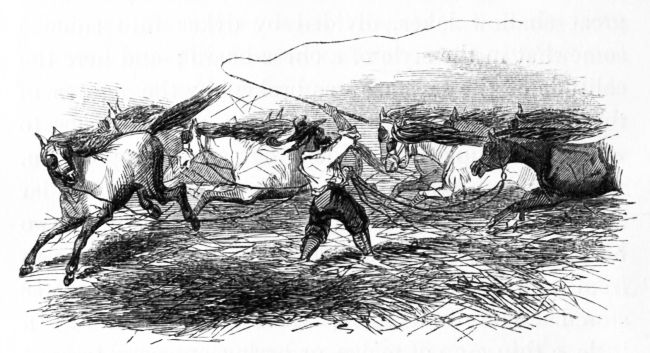
out into the air. All at once my guide touched my
arm, "Voila! donc, voila! des chevaux sauvages!"
It certainly only required a breed of wild horses to
make the country an exact counterpart of Arabia;
and I eagerly turned to see the steeds of the desert,
just succeeding in catching a glimpse of a ruck of
lean, brown, shaggy ponies, disappearing round a
hill, in a whirlwind of sand. There is, undoubtedly,
something romantic and Mazeppaish in the notion of
wild horses of the desert; but stern truth compels me
to add, that a more stunted, ragged lot of worthless
brutes, not bigger than donkeys, than were the troop
of desert steeds of the Landes which I had the fortune
to see, could be nowhere met with. My fisherman
told me that, when caught and tamed, they were useful
in carrying sacks and panniers along the sandy ways;
but that there were not more vicious, stubborn brutes
in nature than Landes ponies.
A doubly fatiguing trudge, unbroken by any further
episodical visions of desert steeds, but enlivened
by the fast increasing thunder of the surf, at length
brought us to its foam. Winding through a succession
of sand valleys, we climbed a steepish bank, sinking
to our knees at every step, and from this last ridge
beheld a long, gentle slope, as perfectly smooth as
though the sand had been smoothed by a ruler—fining
away down to the white creaming sheets of
water which swept, with the loud peculiar hiss of
the agitated sea, far up and down the level banks.
The full force of the great heaving swells was expended
in breakers, roaring half a mile from the
land; and from their uttermost verge to the tangled
heaps of seaweed washed high and dry upon the
beach, was a vast belt of foaming water, extending
away on either hand in a perfectly straight line as far
as the eye could reach, and dividing the shipless
expanse of water from the houseless expanse of land.
The scene was very solemn. There was not even a
seabird overhead—not an insect crawling or humming
along the ungrateful sand. Only the grand organ
of the surf made its incessant music, and the sharp
thin rustle of the moving sand came fitfully upon
the ear. I sat down and listened to it, and as I sat,
the continually shifting sand gradually rose around
me, as the waters rose round the chateau of Chatel-morant.
Had I stayed there long enough, only my
head would have been visible, like the head of the
sphinx.
I dined that day at the hotel, tete-à-tete with
a young priest, who was returning to Bordeaux from
a visit to his brother, one of the officers of the Preventitive
Service, whose lonely barracks are almost the
only human habitations which break the weary
wilderness stretching from the Adour to the Gironde.
One would have thought that there could be but
little smuggling on such a coast; but the Duaniers
are always autorités, and the waves of the Gulf of
Gascony could not, of course, break on French ground
without autorités to help them. With respect to
the priest, however, he had one of the finest heads
and the most perfectly chiselled features I ever saw.
The pale high brow—the keen bright eyes, with
remarkably long eye-lashes—the tenuity of the cartilage
of the nose, and the perfect delicacy of the
mouth—all told of intellect in no common development;
while the meek sweetness of the noble face had
something in it perfectly heavenly. Fling in imagination
an aureole round that head, and you had the
head of a youthful martyr, or a saint canonized for
early virtues. There was devotion and aspiration
in every line of the countenance—a meek, mild
gentleness, beautifully in keeping with every word he
uttered, and every movement he made. I was the
more struck with all this, inasmuch as there is not
an uglier, meaner, nor, I will add, dirtier, set of worthy
folks in all the world, than the priests of France.
Nine times out of ten, they are big-jowled, coarse,
animal-looking men, with mottled faces, and skins
which do not take kindly to the razor. The arrangements
about the neck show a decided scarcity of
linen, and a still greater lack of soap and water.
They are seldom or never gentlemen, their figures
are ungainly, their motions uncouth, and—barring, of
course, their scholastic and theological knowledge—I
found the majority with whom I conversed stupid,
illiterate, and unintelligent. Now, the young priest
at Teste was the reverse of all this. With manners
as polished as those of any courtly abbé of the courtly
old regime, there was a perfect atmosphere of frankness
and quiet good-humour about my companion, and his
conversation was delightfully easy, animated, and
graceful. I do not know if my friend belonged to
the College of Jesus; but, if he did, he was cut out
for the performance of its highest and subtlest diplomacy.
We talked of the strange part of the world I was
visiting, and I found he knew the people and the
country well. I mentioned the submerged chateau
and its legend, and he replied that it was an undoubted
fact, that both chateaux and villages had
been overwhelmed—both by the inbursting of the sea,
and by great gales blowing vast hills of sand down
into the existing lakes, and so forcing them out of
their ancient beds. The sand, indeed, he said, was
more dangerous than the water. Often and often
the coast-guard stations had to be dug out after a
gale; and he believed that, on one occasion, a small
church near the mouth of the Gironde had been overwhelmed
to such a height that only a few feet of the
spire and the weathercock were left apparent. The
story put me forcibly in mind of the remarkably
heavy fall of snow experienced by my old friend,
Baron Munchausen; but, for all that, I see no reason
why it should not be literally correct. The pines, the
priest informed me, were the saving of the country, by
fixing the unstable soil, and the Government had engineers
busily engaged in laying out plantations all
along the coast—the object being to get the trees
down to high-water mark. I mentioned the superstitions
of the people.
"Alas!" said the priest, "What you have heard
is perfectly true. We are improving a little, perhaps.
The boys and girls we get to come to school are
taught to laugh at the notion of their old grandmothers
being witches, and in another generation or
two there will be a great change."
"And how do your witches work?" I asked.
"As ours in England used to do—by spell and
charm?"
"Precisely. They are said to make clay figures
of their victims, and to stick pins in them, or bake
them in a fire; and then they have rhymes and cabalistical
incantations, and are greatly skilled in the
magic power of herbs. The worst of it is, that a year
seldom passes without an outrage on some poor old
woman. A lout, who thinks himself bewitched by
such a person, will attack her and beat her; and occasionally
a bullet has been fired at night through the
cottage-window."
"The Landes people have, or had, other queer
notions, as well as the witch ones?"
"Oh, yes! They long held out against potatoes,
which, they said, gave them apoplexy, and they have
only lately begun to milk their cows."
"Why so? As a pastoral people, they ought to
be great in butter and cheese."
"On the contrary, they dislike them, and use lard
or goose-grease instead. Indeed, for centuries and
centuries, they religiously believed that Landes cows
gave no milk."
"But was not the experiment ever tried?"
"Scores of times. An anxious reformer would go
to a Landes farmer, and urge him to milk his cows.
'Landes cows give no milk,' would be the answer.
'Will you let me try?' would, perhaps, be replied.
The Landes man would have no objection; and the
cow would be brought and milked before him."
"Well, seeing that would convince him."
"Ah, you don't know the Landes people—not
in the least; why, the farmer would say, 'Ay, there
are a few drops, perhaps; but it's not worth the trouble
of taking. Our fathers never milked their cows,
and they were as wise as we are. And next day he
would have relapsed into the old creed, that Landes
cows never gave milk at all."
I inquired about the rate at which the stilt-walkers
progressed—whether they could, as one sometimes
hears, keep up with a horse at the gallop; and found,
as I expected, that six or seven miles an hour was
as much as they ever managed to achieve. The priest
went on succinctly to sketch the costume and life of
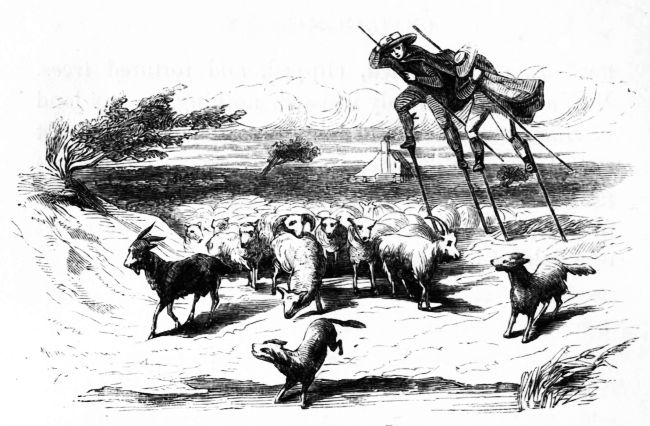
the people. When in regular herding dress, the
shepherd of the Landes appears one uncouth mass
of dirty wool. On his body he wears a fleece, cut in
the fashion of a rude paletot, and sometimes flung
over one shoulder, like a hussar's jacket. His thighs
and legs are defended on the outside by cuisses and
greaves of the same material. On his feet he wears
sabots and coarse worsted socks, covering only the
heels and the instep. His remaining clothing generally
consists of frayed and tattered home-spun cloth;
and altogether the appearance of the man savours
very strongly of that of a fantastically costumed
scarecrow.
So attired, then, with a gourd containing some
wretched piquette hung across his shoulders, and
provided with a store of rye-bread, baked, perhaps,
three weeks before, a few dry sardines, and as many
onions or cloves of garlic, the Landes shepherd sallies
forth into the wilderness. He reckons himself a rich
man, if his employer allows him, over and above his
food, sixty francs a-year. From the rising to the setting
of the sun, he never touches the ground, shuffling
backwards and forwards on his stilts, or leaning
against a pine, plying the never-pausing knitting-needle.
Sometimes he drives his flock home at eventide;
sometimes he bivouacs in the wild. Unbuckling
his stilts, and producing his flint and steel, he has
soon a rousing fire of fir-branches, when, gathering
his sheep-skins round him, he makes himself comfortable
for the night, his only annoyances being the
mosquitoes and the dread of the cantrips of some
unchancy old lady, who may peradventure catch a
glimpse of him in the moonlight, as she rides
buxomly on her besom to a festal dance in a
devil's garden.
"Yet still," continued the young priest, "they
are a good, honest-hearted, open-handed people. For
their wild, solitary life they have a passionate love.
The Landes peasant, taken from his dreary plains,
and put down in the richest landscape of France,
would pine for his heath, and sand, and woods, like
a Swiss for his hills. But they seldom leave their
home here in the forests. They live and die in the
district where they were born, ignorant and careless
of all that happens beyond their own lonely bounds.
France may vibrate with revolution and change—the
shepherds of the Landes feel no shock, take no
heed, but pursue the daily life of their ancestors,
perfectly happy and contented in their ignorance,
driving their sheep, or notching their trees in the
wilderness."