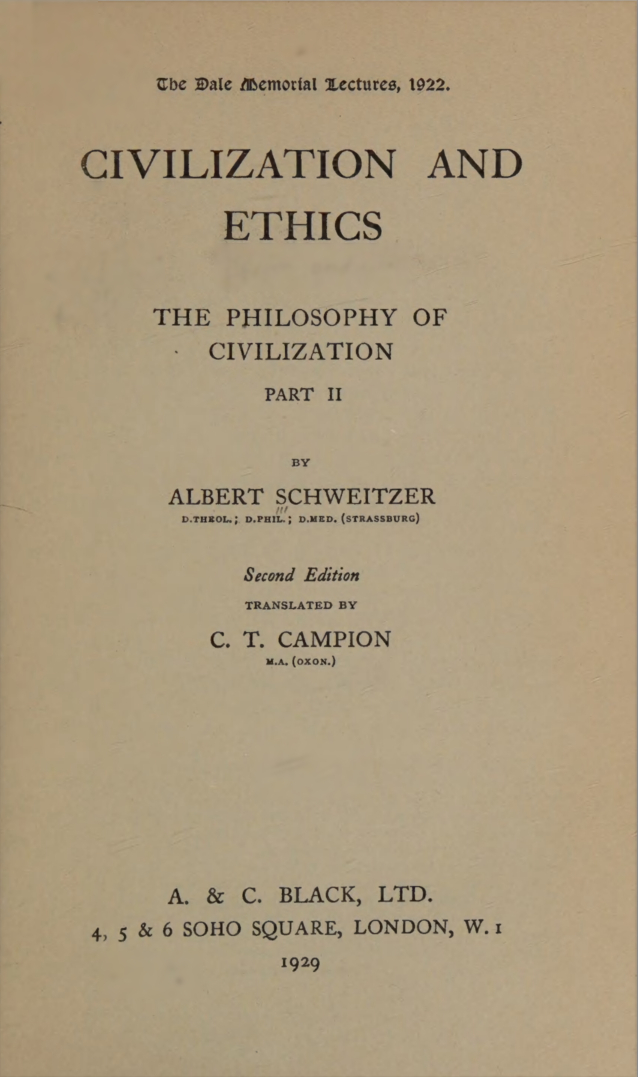
Civilization and Ethics
by Albert Schweitzer
★★★★★No ratings yet
Language: English
Sign in to rate this book.
Sign in to shelve this book.
About this eBook
- Author
- Albert Schweitzer
- Title
- Civilization and ethics : The philosophy of civilization, part 2
- Original Publication
- London: A. & C. Black, Ltd., 1929
- Credits
- Actonian Press
- Language
- English
- Subject
- Ethics
- Category
- Text
- Project Gutenberg
- eBook-No. 76061
- Release Date
- May 10, 2025
- Copyright
- Public domain in the USA.
Contents
- 1.Untitled
- 2.PREFACE — CIVILIZATION AND ETHICS
- 3.CHAPTER I — THE CRISIS IN CIVILIZATION AND ITS SPIRITUAL CAUSE — The material and spiritual elements in civilization — Civilization and World-View
- 4.CHAPTER II — THE PROBLEM OF THE OPTIMISTIC WORLD-VIEW — The Western and the Indian conceptions of civilization — The struggle for the optimistic world-view — Optimism and Pessimism — Optimism, Pessimism, and Ethics
- 5.CHAPTER III — THE ETHICAL PROBLEM — The difficulties of ethical perception — The importance of thought about ethics — The search for a basic principle of morality — Religious and philosophical ethics
- 6.CHAPTER IV — RELIGIOUS AND PHILOSOPHICAL WORLD-VIEWS — The world-views of the world-religions — The world-views of the world-religions and that of Western thought
- 7.CHAPTER V — CIVILIZATION AND ETHICS IN THE GRÆCO-ROMAN PHILOSOPHY — The beginnings: Socrates. — Epicureanism and Stoicism. The Ethic of Resignation — Plato’s abstract basic principle of the ethical. The ethic of world-negation — Aristotle. Instruction about virtue in place of ethics — The Ideal of the Civilized State in Plato and Aristotle — Seneca, Epictetus, and Marcus Aurelius — The Optimistic-Ethical World-View of the later Stoicism
- 8.CHAPTER VI — OPTIMISTIC WORLD-VIEW AND ETHICS IN THE RENAISSANCE AND POST-RENAISSANCE PERIODS — Belief in Progress and Ethics — Christian and Stoic Elements in Modern Ethics
- 9.CHAPTER VII — LAYING THE FOUNDATION OF ETHICS IN THE SEVENTEENTH AND EIGHTEENTH CENTURIES — Hartley, Holbach. Devotion as Enlightened Egoism — Hobbes, Locke, Helvetius, Bentham — Altruism as a natural quality. Hume, Adam Smith — The English ethic of self-perfecting
- 10.CHAPTER VIII — LAYING THE FOUNDATIONS OF CIVILIZATION IN THE AGE OF RATIONALISM — The Mentality and the Achievements of the Ethical Belief in Progress — Obstacles to the reform movement. The French Revolution — The undermining of the rationalistic world-view
- 11.CHAPTER IX — THE OPTIMISTIC-ETHICAL WORLD-VIEW IN KANT — Kant’s ethics, deepened, but lacking content — Kant’s attempt to reach an ethical world-view
- 12.CHAPTER X — NATURE-PHILOSOPHY AND WORLD-VIEW IN SPINOZA AND LEIBNIZ — Spinoza’s attempt to reach an optimistic-ethical nature-philosophy — Leibniz’s optimistic-ethical world-view side by side with nature-philosophy
- 13.CHAPTER XI — J. G. FICHTE’S OPTIMISTIC-ETHICAL WORLD-VIEW — Speculative philosophy and Gnosticism — Fichte’s speculative founding of an ethic and of optimism — Fichte’s mysticism of activity incapable of being carried through
- 14.CHAPTER XII — SCHILLER; GOETHE; SCHLEIERMACHER — Schiller’s ethical world-view; Goethe’s world-view based on nature-philosophy — Schleiermacher’s attempt at a nature-philosophy
- 15.CHAPTER XIII — HEGEL’S SUPRA-ETHICAL OPTIMISTIC WORLD-VIEW — Ethics in Hegel’s nature-philosophy, and in his philosophy of history — Hegel’s supra-ethical world-view. His belief in progress
- 16.CHAPTER XIV — THE LATER UTILITARIANISM. BIOLOGICAL AND SOCIOLOGICAL ETHICS — Beneke, Feuerbach, Laas, Auguste Comte, John Stuart Mill — Darwin and Spencer — The weak points in biological and sociological utilitarianism — Sociological ethics and socialism. Mechanical belief in progress
- 17.CHAPTER XV — SCHOPENHAUER AND NIETZSCHE — Schopenhauer. An ethic of world- and life-denial — Absorption of ethics in world- and life-denial — Nietzsche’s criticism of current ethics — Nietzsche’s ethic of higher life-affirmation
- 18.CHAPTER XVI — THE ISSUE OF THE WESTERN STRUGGLE FOR A WORLD-VIEW — Academic thinkers: Sidgwick, Stephen, Alexander, Wundt, Paulsen, Höffding — The ethic of self-perfecting. Kant’s successors: Cohen, Herrmann — Martineau, Green, Bradley, Laurie, Seth, and Royce — Nature-philosophy and ethics. Fouillée, Guyau, Lange, Stern — Nature-philosophy and ethics in Eduard von Hartmann — Nature-philosophy and ethics in Bergson, Chamberlain, Keyserling, Haeckel — The death-agony of the optimistic-ethical world-view
- 19.CHAPTER XVII — THE NEW WAY — Why the optimistic-ethical world-view cannot be carried through to the logical conclusion — Life-view independent of world-view
- 20.CHAPTER XVIII — THE FOUNDATIONS OF OPTIMISM SECURED FROM THE WILL-TO-LIVE — The pessimistic result of knowledge — The world- and life-affirmation of the will-to-live
- 21.CHAPTER XIX — THE PROBLEM OF ETHICS, STARTING FROM THE HISTORY OF ETHICS — An ethic of self-devotion, or an ethic of self-perfecting? — Ethics and a theory of knowledge. Ethics and natural happenings. The enthusiastic element in ethics — The ethic of ethical personality, and the ethic of society — The problem of a complete ethic
- 22.CHAPTER XX — THE ETHIC OF DEVOTION AND THE ETHIC OF SELF-PERFECTING — The widening of the ethic of self-devotion into a cosmic ethic — The ethic of self-perfecting and mysticism — Abstract mysticism and the mysticism of reality. Supra-ethical, and ethical mysticism
- 23.CHAPTER XXI — THE ETHIC OF REVERENCE FOR LIFE — The basic principle of the moral — The ethic of resignation. An ethic of veracity towards oneself, and an activist ethic — Ethics and thoughtlessness. Ethics and self-assertion — Man and other living creatures — The ethic of the relation of man to man — Personal and supra-personal responsibility. Ethics and humanity
- 24.CHAPTER XXII — THE CIVILIZING POWER OF THE ETHIC OF REVERENCE FOR LIFE — Civilization as a product of reverence for life — The four ideals of civilization. The struggle for a civilized mankind in the machine age — Church and State as historical entities, and as ideals of civilization — The moralizing of the religious and political community
- 25.FOOTNOTES — Preface Notes — CHAPTER III Notes — CHAPTER V Notes — CHAPTER VI Notes — CHAPTER VII Notes — CHAPTER VIII Notes — CHAPTER IX Notes — CHAPTER X Notes — CHAPTER XI Notes — CHAPTER XII Notes — CHAPTER XIII Notes — CHAPTER XIV Notes — CHAPTER XV Notes — CHAPTER XVI Notes — CHAPTER XX Notes
- 26.INDEX
- 27.TRANSCRIBER’S NOTES
Community reviews
Sign in to write a review.
No reviews yet.