IN CAIRO.
Covered with dust, parched with thirst, exhausted with hunger,
burnt up with heat, I am landed at the charming Hôtel du
Nil, in the gardens of which, filled up with American
rocking-chairs, and trees bearing gorgeous red flowers and
bananas and palms, and eucalyptus and banyan-trees all around, I
realize as I have never done before something of the splendour
and the wondrous beauty of the East. It must have been a
fairy palace at one time or other, this Hôtel du Nil, with
an enchanted garden. In the day it is intolerably hot, but
the mornings and evenings are simply perfection. If there
be an Elysium on earth, it is this. I feel inclined to
pitch my tent here, and for ever bid adieu to my native
land. The dinners are all that can be desired, the bedrooms
large and lofty, and the servants, who, with the exception of the
German waiters, are Soudanese—tall, white-robed, with a
girdle round the middle—seem to me to be the best and most
attentive in the world. There is nothing they will not do
for me, and they are honest as the day. Apparently the dark
boys have a good deal of the negro in their blood. I walk
out to see the fine buildings and palaces which lie
between me and the railway-station, but I cannot stand the bustle
and confusion of the street, and soon beat a hasty retreat.
The infirmities of old age follow me into this land of perpetual
youth.
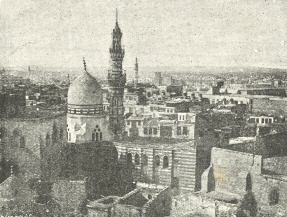
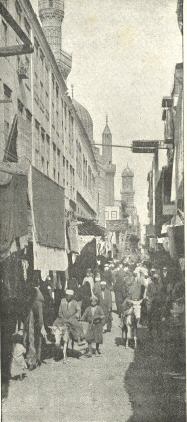
I walk outside the narrow and sombre lane which leads to the
hotel in the quaint and ancient street Mousky. Let me
attempt to describe it, and it will give the reader an accurate
idea of Oriental life. The Mousky is the busiest street in
all Cairo. Here meet Greek and Syrian, Anglo-Saxons,
American or English, Armenian and Turk, Maronite and Druse,
Italians, French, Russians, German, Dutch, and Belgian, and the
vast army of residents, men, women, and children, of all shades
and complexions, from the ebony-black Soudanese to the
olive-tinted Arab, walk its length, penetrate its dark and
confusing bazaars, and there
 is
nothing more for you to see. Donkey drivers, who beset me
at every step, and the guides on the look-out for their prey, are
a perpetual nuisance, even though they assure me they like the
English and are glad to see them here.
is
nothing more for you to see. Donkey drivers, who beset me
at every step, and the guides on the look-out for their prey, are
a perpetual nuisance, even though they assure me they like the
English and are glad to see them here.
Crowded together are nooks and corners where native merchants
ply their trades, and the gloom of some dark recess is lit by the
glowing blue and scarlet and purple of Persian rugs, and the
glare of polished and embossed brass. In the street the
modern descendant of Tubal Cain is hard at work, and the tailor
plies his needle, and the cigarette-maker rolls up his tobacco in
its thin wrapper of paper, and the weaver bends over his loom,
differing in nothing from that used by his forefathers a thousand
years ago. Eatables and drinkables of strange flavour and
colour are exposed for sale, and pedlars meet you at every turn
uttering hoarse and discordant cries. There is quite a buzz
of conversation, but I cannot understand a word. Why, I
ask, did not Leibnitz carry out his grand idea and give us a
universal language? It would have saved some of us a good
deal of trouble. The pavement is too narrow for anyone to
walk on, as the shopkeeper sits outside smoking his cigarette,
while the customers also do the same, and the street is
completely blocked. You are obliged to get into the narrow
way where carriages and donkey and luggage waggons meet you at
every step.
Women abound, all clad in black, with a black cloth over their
faces, leaving only the eyes and nose visible, and a cheek of
pallid skin. The nose is covered with a little gilt
ornament, I suppose they call it, coming from the forehead, so
that you really see nothing of it. Now and
then you pass a coffee-house where smoking and gambling seem to
be going on all day. In the course of my ramblings I came
to a street lined with scribes on stones writing letters for
their clients, and was struck with the firm, clear hand in which
their letters are written—all in Arabic, of course.
Every now and then a swell passes me in his carriage, with a
running footman to clear the way with a white or black
staff. I expect to be knocked down every minute. To
walk the Mousky in peace and safety, you require to be as deaf as
a post and to have a pair at least of good eyes at the back of
your head.
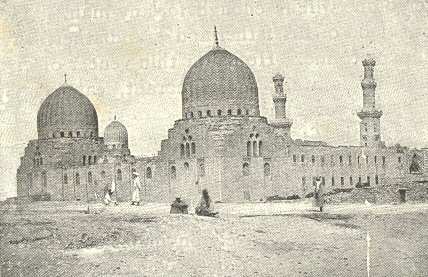
Wearied, I return to the quiet and shady groves of the hotel,
a large pile of buildings streaked red and yellow, with a grand
bit of garden ground at the back, and a wooden tower, from which
you may see all Cairo at a glance. All the houses are
flat-roofed, and many of them look unfinished, though not
in reality so. I sink into a rocking-chair, light my pipe,
and talk of the future of Cairo. I say I want to visit a
Coptic Church, the church which was held heretical by the
Orthodox Church, as they were said to have held imperfect ideas
of the dual nature of Christ. One gentleman tells me I had
better keep away, as the priests will pick your pockets in the
very church. He has 300 Copts in his employ, and gives them
all a very bad character. I ask as to the Khedive; everyone
gives him a bad character, though he has discovered one wife is
enough for any man. ‘He has the bad blood of his
father and grandfather,’ says an Englishman to me. He
has a thin veneer of civilization, but he is weak and ignorant,
eaten up with ambition, and over head and ears in debt, though
his allowance is £100,000 a year, a sum which should go far
in a city where the price of labour is from two piastres to five,
the piastre being valued at twopence halfpenny.
The people live exclusively on maize-corn, certainly not an
expensive article of diet. The intelligent people are all
in favour of the English Government, but, alas! the majority does
not in Cairo, as I am told it does at home, represent the
enlightened opinions of an intelligent people. I hear the
shilly-shally policy of the English Government bitterly
condemned. We are here, and must remain here. As it
is, the people know not what to expect. There is no
progress, but a terrible paralysis all over the city.
‘I like you English,’ said an intelligent native;
‘but you are here to-day and may be gone to-morrow, and
then we who have adhered to England will all have our throats
cut. We are like a boat between two shores, and know not
whither we are going. The English must either stop or
go.’ Our stay is to the lasting advantage of all the
European nations.
We have wonderfully improved the condition of the fellaheen,
who, according to all I hear, are not too thankful for the
liberty we have gained for them. I met an intelligent old
Greek, who deeply resented that we had abolished flogging—a
little of it now and then, according to him, did the natives
good. Manual labour is so cheap that it is used in every
department. At the hotel I note that they bring the coals
in in baskets, and in the railway-station I see a native employed
in laying the dust, with a skin of water, which he carries on his
back, using the neck as a water-spout.
Of all the cities I have known—and, like Ulysses, I am
ever wandering with a hungry heart—I infinitely prefer
Cairo, and am not surprised that it is becoming more and more the
winter residence of the English aristocracy. It was a
delight to live when I was there, and as I took my breakfast
al fresco in the beautiful grounds of the Hôtel du
Nil, with tropical plants in full flower all round me, a bright
sun and unclouded blue sky above, the question whether life was
worth living seemed to me an absurdity. But, alas! no one
can look for perfect happiness—at any rate, on earth.
In Cairo there are the flies, not so bad as I have seen them in
Australia or America, but a terrible infliction
nevertheless. One of my companions, Mr. Willans, the
popular proprietor of the Leeds Daily Mercury, suffered
much from them, and had for a time to give up reading and
writing, and to wear coloured glasses, but I was let off more
easily. In Cairo, for the first time, I realized what a
luxury it was to have dates to eat. We at home, who buy
dates at the grocer’s, have no idea how juicy the date of
Cairo is.
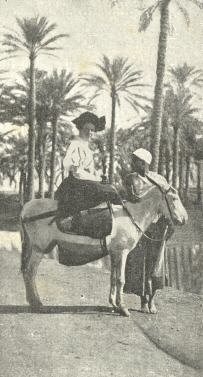 Then the heat is great, and walking far is out of the
question. But what of that? Directly you turn into
the street the donkey-boy comes up to offer you a ride; and the
Cairo donkey is lively, large, and white, and well
groomed, sure of foot, swift in speed, and beautiful to look
at. An English coster’s moke is not to be named on
the same day with the Cairo donkey, on which you can have a ride
for a trifling sum.
Then the heat is great, and walking far is out of the
question. But what of that? Directly you turn into
the street the donkey-boy comes up to offer you a ride; and the
Cairo donkey is lively, large, and white, and well
groomed, sure of foot, swift in speed, and beautiful to look
at. An English coster’s moke is not to be named on
the same day with the Cairo donkey, on which you can have a ride
for a trifling sum.
Life and prosperity seem everywhere to prevail, and the
station at Cairo conducts you at once into a fine city, with
broad streets, well watered, and shaded by trees, handsome shops,
fine hotels, beautiful gardens, and the inevitable statue of
Mohammed Ali, who did so much to develop modern Egypt.
Palaces of all kinds attract the eye, one of the finest of these
being the residence of Lord Cromer. Cairo is distinctly a
society place, though, perhaps, not so much so as Cannes or Nice,
and living is dear, though cheaper than it used to be.
French seems the language principally used, though the guides,
who pester you at every corner, and the donkey-boys, who are
equally persistent, have a confusing smattering of English.
The resident English colony is chiefly composed of the diplomatic
and Consular bodies, or of those connected with the different
Consular departments, and of officers of the garrison. You
meet many English soldiers whose appearance is creditable to the
country, and amongst the birds of passage are many
Americans. There are two good clubs for visitors—the
Khediveal and the Turf, the latter chiefly supported by army
officers. The theatre, where French plays and Italian
operas are performed, is a very fine building. In the same
neighbourhood is also a café chantant in the
gardens. All day long, under the bright blue sky, the scene
is very animated.
But the visitors, although a welcome addition, do not entirely
make up Cairene society. The gaiety begins and
is mainly kept up by the residents, especially the British civil
and military, who are always most hospitable at the winter time
of year. Cairo is no doubt a court and capital, the
residence of the sovereign to whom diplomatists are accredited
from all the civilized Powers. But it is also a British
military station, and it owes much of its present liveliness to
the British officers and civil servants.
It was the British garrison that established the Cairo
Sporting Club, where good polo is played, and very fair cricket,
‘squash’ rackets, and lawn-tennis; where there are
monthly race-meetings, and officers ride steeplechases on their
own horses. The big lunches, the pleasant afternoon teas,
the dances and flirtations so constantly in progress, are
essentially British.
Out at Mena, under the shadow of the Sphinx, there is a
golf-course, and the caddie is an Arab boy in a long blue
bed-gown, and you can aim your ball from the putting-green
straight at the Pyramid of Cheops. Out at Matarieh, just
where Mr. Wilfrid Blunt lives the life of an Arab patriarch,
under tents, surrounded by his flocks and herds, there is a
training stable, and the British sporting subaltern keeps his
‘tit’ there, and comes out to give him his gallops at
early dawn.
But it is as you get away from the broad streets of new Cairo,
and plunge into the bazaars and the narrow streets, that you
realize what a bewildering place old Cairo is. The city of
Cairo covers an area of three square miles, and greatly exceeds
the limit of the old walls. On the south stands the ancient
citadel, on a rock, memorable for the massacre of the
Mamelukes. Of the most perfect of the old gateways still remaining
is the Gate of Victory. Above the archway is an Arabic
inscription: ‘There is no god but God, and Mohammed is His
Prophet.’ The streets are narrow and irregular, and
badly paved, while the white houses, with their overhanging
windows, are, at any rate, picturesque.
The bazaars are of all sorts: the leather-sellers have one,
the carpet-dealers another, silk-merchants another, and
everywhere purchaser and buyer seem to spend a great deal of time
in smoking cigarettes. The gold bazaar is so narrow that
three persons can scarcely pass; there, and at the silver bazaar,
you see the artificers constantly at work. Coptic churches
and mosques you meet everywhere. There is a good attendance
at the English Church; there are also a Presbyterian Church, and
two Roman Catholic churches. I saw the bishop of one of
them, who was to preach, driving along in very grand style.
The Wesleyans have also a chapel. The howling dervishes
have also their sanctum, where they exhibit their peculiarly
unpleasant powers. I decline to go and see them, as
everyone tells me they are a fraud; and if I want to be deceived,
there is the Egyptian conjuror always ready with his little
tricks. He comes daily to the hotel to give a performance;
also daily resort there the Egyptian minstrels, whose
performances we all greatly applaud.
The English have a party paper called the Sphinx,
which, however, I fancy has little influence in the formation of
public opinion. In Alexandria a daily English paper is
published, which reaches Cairo about eight in the evening, but
which gives little general news, and is chiefly devoted to trade
and commerce. It was with a heavy heart I left
Cairo and its bright and busy life for the gray skies and bleak
winds of my native land. My consolation is that we breed
better men than they do in southern climes—a fact of which
the Roman Cæsars were aware when they drew their best
troops from Britain or Northern Gaul.
The French complain bitterly of English influence in
Egypt—a country for which we have done much, and which, if
it ever becomes prosperous, will owe its prosperity to England
alone; and yet it is the fact that the Englishman in Egypt lies
under peculiar disadvantages, and that as much as possible
English enterprise is discouraged and destroyed. It ought
not to be so. We who have made Egypt what it is, who have
fought its battles, developed its resources, improved the
condition of its people, destroyed its corrupting and enervating
influences, put its finances in a healthy condition, may be
expected to have, at any rate, fair play there.
That this is not so, the case of Mr. Fell, of Leamington, one
of the few men who have raised themselves from the ranks and
become honoured far and near, is a notorious illustration.
In 1890 he obtained a concession from the Egyptian Government
giving him the right to make tramways in the city of Cairo.
The particular department of the Egyptian Government which has to
do with such affairs has at its head a Secretary of
State—at that time the office was held by Sir Colin Scott
Moncrieff—and a financial adviser appointed by the Egyptian
Government on the recommendation of the English Government.
Mr. Fell went to Egypt, had the whole city surveyed, and the
plans drawn, a difficult task which occupied a considerable amount of
time. In August of the same year he bought the steel rails,
ordered the cars to be built, and did all he could to hasten the
fulfilment of his contract, and, as a security, deposited with
the Egyptian Government twenty-two Egyptian bonds of the value of
£100 each. To still further strengthen his position,
he had a letter from Sir Colin Scott Moncrieff to the effect that
he was quite satisfied that Mr. Fell had complied with legal
requirements.
So far all was straight sailing, but in April the Egyptian
Government confiscated the bonds Mr. Fell had deposited with
them, and also declared the contract null and void, on the ground
that he had failed to comply with the conditions under which the
contract was made. Mr. Fell had a long correspondence with
the Egyptian Government of a very unsatisfactory character.
In 1893 he returned to Egypt, and interviewed the
authorities. Lord Cromer advised him to go to law. In
his action against the Government, he was defeated on the plea
that the letters written by Sir Scott Moncrieff, as Secretary of
State, were not valid. In the meanwhile, the Egyptian
Government advertised for a new concession in July, 1894, for
which Mr. Fell again tendered, depositing a thousand
guineas. In compliance with a request from the Egyptian
Government, Mr. Fell again returned to Egypt, but found, on his
arrival, that the contract had been given to a Belgian firm, who
frankly admitted that they had paid so much for the concession
that it was scarcely worth having. ‘My loss in
consequence,’ said Mr. Fell to me, ‘is at least from
£17,000 to £20,000, and this all through French
intriguing.’
Such is a brief outline of a case of hardship, not to an
individual, but the whole nation. Practically speaking,
there is no British capital invested in Egypt except what was
there previous to 1882. In the railway department, for
instance, of late years all the works have been carried on by
French and Belgian—to the exclusion of
British—contractors. All the contracts for bridges
which have recently been let have been let to Belgian
contractors. The only companies that thrive in Egypt are
French companies. Everything is in their favour. The
law officers of the Crown are exclusively foreign, principally
Corsicans, and they are able to control the native tribunal,
notwithstanding the fact that there are English judges upon it;
and to these Corsican law officers it is due that so much
anti-English feeling exists in Egypt at this present time.
Assuredly, Egypt makes us but a poor return for the money and
blood we have spent in its behalf. We have a right to
expect better treatment. If John Bull stands this sort of
thing, he must be a poor creature indeed.
Anthony Trollope gives us an amusing illustration of the
official life of Cairo in his time. He was sent there by
the English Post-Office to accelerate the mail-service to Suez,
and it took him two months to do his business. ‘I
found, on my arrival,’ he writes, ‘that I was to
communicate with an officer of the Pasha, who was then called
Nubar Bey. I presume him to have been the gentleman who
lately dealt with our Government as to the Suez Canal shares, and
who is now well known as Nubar Pasha. I found him a most
courteous gentleman, an Armenian. I never went to his
office, nor do I know that he had an office. Every other
day he would come to me at my hotel, and bring with him
servants and pipes and coffee. I enjoyed his coming
greatly, but there was one point on which we could not
agree,’ and that was as to the rate of speed with which the
mails should be carried through Egypt. The Post-Office said
it must be done in twenty-four hours. The agent of the
Egyptian Government contended that it would take forty-eight
hours at the least. For a long time they could come to no
agreement. Both were equally obstinate. It was
impossible, said Nubar, that the mail could be carried at such a
rate. It might do for England, but would not do for
Egypt. The Pasha, his master, he said, would, no doubt,
accede to any terms demanded by the British Post-Office, so great
was his reverence for anything British. In that case, he,
Nubar, would at once resign his position and retire into private
life. He would be ruined, but the loss of life and
bloodshed which would follow would not rest on his head.
Nevertheless, he gave way after many days’ delay and a good
deal of smoking and coffee-drinking. The twenty-four hours
gained the day. It is to be hoped that official business is
done more quickly now. A two months’ stay in Cairo
over such an affair may have been pleasant. It certainly
was expensive, and someone other than Mr. Trollope had to pay the
bill.
Lord Cromer’s latest report of the state of matters in
Egypt is cheering. The finances are better. The
income from railways, customs, and tobacco has improved. A
great boon has been conferred on the fellaheen by the
experimental money advances made by Government to tide them over
till their cotton-crop is ripe. Hitherto they have had to
borrow from Greeks, who, however admirable in the character of
liberators, are not so lovely as money-lenders. They charge
from 20 to 30 per cent. for their loans, and, in addition, always
take back an Egyptian pound, equal to £1 0s. 6d., for the
pound sterling. This is really more than an extra 2½
per cent., for the loans are not for a whole year. There
are Mohammedan lenders, too. Their religion forbidding
usury, they take it out of the fellaheen in cotton. The
Government in their experimental loans have charged a half per
cent. per month, or 6 per cent. per annum. The experiment
was successful. Of nearly £8,000 lent between
February and July, all but £20 had been repaid with
interest by the end of November. The benefit that an
agricultural bank would be to the smaller cultivators has been in
this way realized by Lord Cromer, who suggests that private
bankers should take the experiment in hand.
The Government has also been checkmating the money-lenders by
sending them good seed at 58 pounds Turkish an ardeb, payable in
three instalments, upon finding out that the usurers were
advancing inferior seed at 70 to 100 pounds Turkish, payable at
cropping-time.
The land-tax is now got in with certainty, whereas formerly
the Government never knew what to estimate for arrears; the
post-office revenue is improving; exports and imports have gone
up by about two millions; the cotton-crops are better; the sugar
industry is rapidly increasing in Upper Egypt; the railway
receipts are the highest on record; railway extension is going
on, and plans and surveys for light railways are well advanced;
agricultural roads are constructed; there are electric tramways
and lighting in Cairo. The light dues will be decreased this
year. The only relic of forced labour is a yearly
diminishing amount for the protection of the Nile banks during
the period of flood. Crime is diminishing, and sanitary
reform is progressing. Education is advancing as far as
possible, considering the deficiency of funds, and slavery is
kept under.
As to the question when our work shall be done, and we English
shall retire from Cairo, it is impossible, says Sir A. Milner, to
give a definite answer. It would be difficult to
over-estimate what that work owes to the sagacity, patience, and
fortitude of the British Ambassador. The contrast between
the Egypt of to-day and the Egypt as it was when he first took it
in hand is the best testimony to his efficiency and wisdom.
All writers on Egypt agree in this. ‘There is not a
native,’ writes Mr. Wood, ‘that does not recognise at
heart the benefits of the British occupation’—a
remark which seemed to be to a certain extent true; but not quite
to the extent Mr. Wood suggests. ‘It is quite an
anachronism,’ Sir A. Milner remarks, ‘to suppose that
the interest of Egyptian finance centres in the debt, and that
the financial authorities of the country are the mere bailiffs of
the bondholders.’ As a matter of fact, now that it
has been established that the resources of Egypt can bear the
interest of the debt at its present rate, the last people whom an
Egyptian Finance Minister need trouble himself about are the
bondholders. Except when an occasion presents itself to
reduce the interest by the legitimate method of conversion, the
debt need no longer have a foremost place in his mind.
‘Even the Commissioners of the Caisse,’ writes Sir A.
Milner, ‘who only meet to protect the creditors, and who from
time to time, to justify their existence, get up a little fuss
about some supposed danger to interests which in their hearts
they know to be perfectly secure—even the Commissioners of
the Caisse, I say, are more occupied now-a-days with employing
their reserve fund in developing the wealth of the country than
with needless anxieties about the coupon.’ Sir A.
Milner has no doubt well weighed his words. Of all the
romances of finance there are few to be compared with the
borrowings of Ismail, to whom is due the honour of having
originated the Egyptian National Debt.


