By Helen Louise Ricketts
THE STORY OF THE ALPHABET
Chapter I
I want to tell you a story about something you use every day, something
you could not get along without, and yet that you never think about or are
glad to have. I do not believe that even after I tell you several things
about it you can guess what it is.
It is one of the oldest things in the world, so old that no one knows when
it was first used.
It is a more wonderful thing, a great many people think, than the
invention of steamboats and steamcars, or of airships and submarines.
It is so important that you could not have any books without it, and if
there were no books, you would not go to school, and then how could you
learn all the things you want to know?
It is so common that you see it and hear it and use it almost every minute
of the day.
It is made of twenty-six different parts. You can make me know what these
are with a pencil or crayon. With them you speak and write and read. There
are machines which hold these parts separately or form them in groups, and
then leaving their likeness on paper give us books and stories to read.
Now I am afraid that I have told you too much! Have you guessed what these
twenty-six little tools are called? We call them, and so did your
grandfather and greatgrandfather and all the people that lived hundreds
and hundreds of years ago—the Alphabet.
You never knew before that the Alphabet was such a wonderful thing, did
you? Would you like now to hear the story about it?
Long, long ago in a country called Egypt, which is far across the sea (you
may find it on your map, and that will make it more interesting for you)
they had a very curious way of writing. They had no letters like our A, B,
C’s, but did what we call picture writing; that is, they drew pictures
instead of writing letters and words as we do today. Their writing looked
like this—

That does not look much like writing, does it? You do not know what it
means, either, do you? Yet the people at that time could read their
picture writing just as easily as we can the Alphabet writing. This is the
way they sent messages to each other and wrote down the things they wanted
to remember. Do you know that they did not have any paper in those days
long ago, either? What do you think they used? They cut their pictures on
stone, on walls of buildings, and sometimes on wood and the bark of trees.
They also had a material called papyrus, which was made from reeds growing
in the swamps of Egypt. Think what a long time it must have taken them to
write in this way, and how much easier and quicker it is for you and me
today!
To the north of Egypt there is a small country called Phœnicia. If you
will look on your map you will find that the sea comes to the very shores
of this country. In Phœnicia there were many beautiful things that
people in other countries wanted to buy. So the Phœnicians built big
ships and filled them full of the beautiful things and sailed away. Across
the water they came to a land by the name of Greece, the country you know
about where Hercules and Ulysses lived, and here they unloaded their
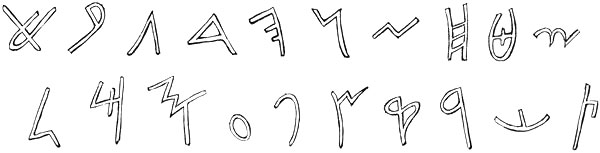
ships. Of course the Phœnicians brought the picture writing they had
learned from the Egyptians with them. By this time they were beginning to
think pictures took too long to draw, and they gradually changed the
pictures into signs so that they could write easier and quicker. So the
writing they brought to Greece was quite different from the picture
writing they had learned from the Egyptians. It looked like this—
We cannot understand this either, can we? But you can see it is much
better than the way they wrote before.
The Greek people were very happy that the Phœnicians brought such a
wonderful way of writing with them and soon began to copy it, and use it
in their country, too. When the Phœnicians went back to their own
country the Greeks continued to use the sign writing, but changed it and
made it more beautiful. They gave it a name, too, and called it by the
names of the first two signs, Alpha which means “ox,” and Beta which
means “house.” If you put these two words, Alpha and Beta, together,
what do you have? ALPHA-BET—the word we use today.
Now the Greeks were an adventurous people, and one day they set sail in
their ships, and went to the land of the Romans, which is now called
Italy. They liked this new country, and some of them settled there. Like
the Phœnicians long ago, they brought their new Alphabet with them. The
Romans were a great and wonderful people, but they did not know the easy
way of writing by signs that the Greeks used. They saw right away what a
fine thing this Alphabet was, and began to use it for their writing, too.
At first they wrote the signs exactly the way the Greeks did, but soon
they changed them, and made them simpler and better.
Chapter II
You know the story of the Alphabet from its beginning so long ago in far
Egypt to the time when it came to the Romans and how it changed from
pictures to signs and from signs at last to the letters of the Alphabet.
You know, too, how hard it was for the people to write in those days when
they had no better material than papyrus, wood and stone. That was a long,
long time ago. Would you like to hear a story about what has happened to
writing since the time of the Romans and the changes that have taken place
in the Alphabet in its travels through the countries of Europe?
The first great thing of importance was the discovery of a new material to
write on. What do you think it was?—the skins of sheep and calves! That
seems strange to us and we like the paper we use today better, but think
what a great improvement this discovery was then and how much easier
writing could be done on the smooth surface of the skin with a pen and
ink. In all of the countries except Italy this change of writing material
brought about a change in the style of lettering too. The Romans alone
kept to the simple form of lettering they had always used and did not
change it when writing on the skins. The other European countries
gradually came to vary this style and make the letters more pointed,
heavier and blacker and in some cases more elaborate. This style of
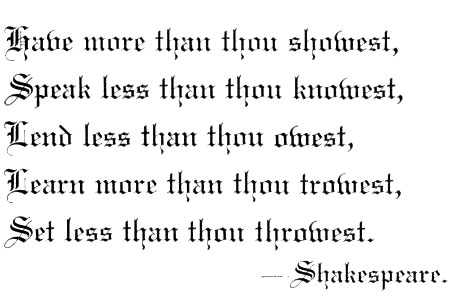
lettering was called the Gothic. Do you see the difference between these
two alphabets?

The Alphabet had not been in these countries long enough yet for all the
people to have learned to write. Only a very few knew the letters, and as
all the writing was done by hand, it took a long time to write a whole
book. The few books that were written were so precious that they were
chained in the churches and monasteries and the people were only allowed
to read them there. At last in the country of Germany a man by the name
of Gutenberg thought of a way to make more books and make them faster. And
this way was by printing. Just as the Alphabet spread to the different
countries so this new way of writing spread, until all of the people of
Europe were using printing machines and making many books.
In Germany the Gothic lettering had been used when the writing was done by
hand and Gutenberg copied this style in printing the first book. When the
art of printing spread to the different countries the Gothic alphabet, of
course, came with it and was accepted as the correct style of letter. The
Romans, however, still believed their Alphabet to be the better and cut
their printing type after the Roman model. So a great quarrel sprang up
between the different countries as to which Alphabet should be used, the
Roman or the Gothic. In Italy a man called Manutius tried to settle the
quarrel by making a letter which all the printers would use and he called
his style of lettering the Italic. The printers who used the Gothic and
Roman letters also used these Italic letters, but were not willing to give
up their own style and use the Italic entirely.
We are so used to seeing and using the Alphabet today that we never ask
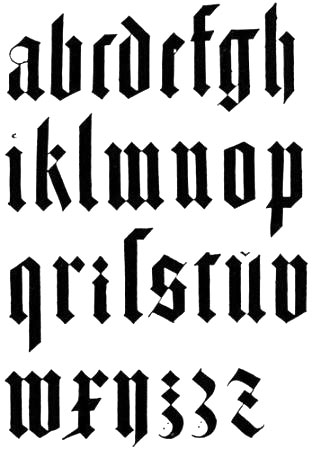
ourselves how the letters came to look the way they do now. Look at Plate
I, which shows a beautiful Alphabet of Gothic letters made by a famous
German artist, Albert Dürer. There are twenty-nine of them, all entirely
different, but still you can see that they are all brothers and sisters in
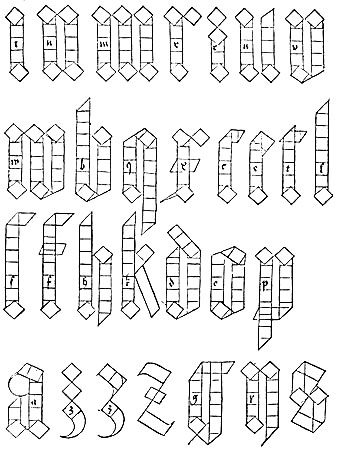
one big family. Do you wonder how this came about? Look at Plate II and
you will learn. The first letter i is made by putting together a number
of small squares in a certain way. Can you see the way the other letters
are made from this letter i?—the n is made by putting two i’s
together; the m, three i’s, and the r, one i and an extra square
at the top. Go through the rest of the Alphabet and see if you can find
out the way it is made.
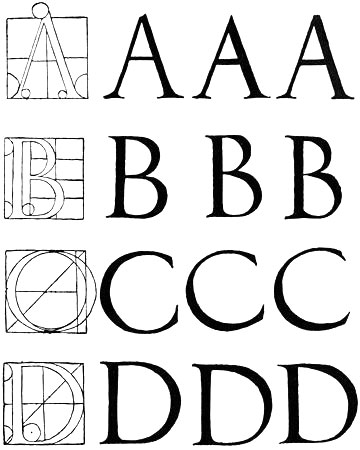
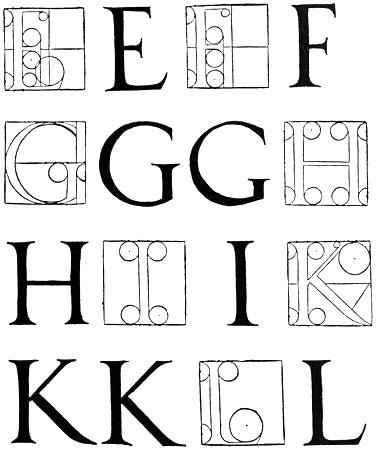
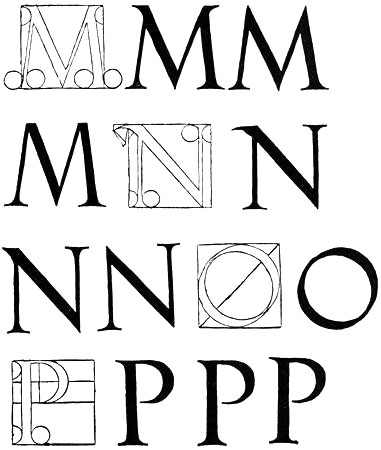
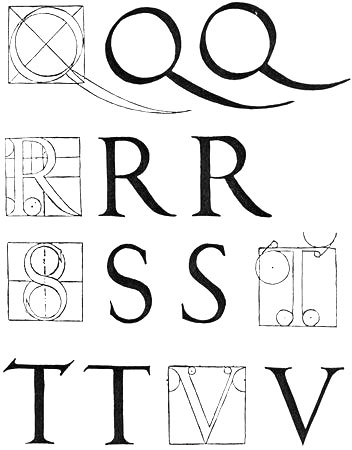
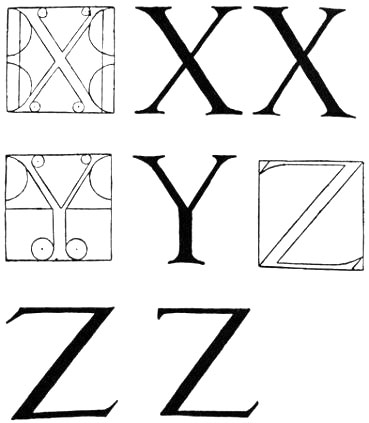
Now look at Plates III, IV, V, VI, and VII showing another Alphabet by the
same artist, which he patterned after the Roman letters. He found that
they were made according to a certain rule and proportion, and it was
these he worked out in making his Alphabet. Here you see the pattern is a
large square, and the letters are drawn very carefully in them. Did you
know before there was as much figuring and measuring done in the making of
the Alphabet as there is in building a house? Look at the letter E, for
example, and all the circles and squares that have been measured and drawn
to make it. You will find that every letter is made just as carefully.
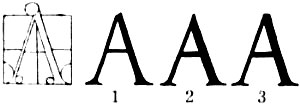
Here are the three A’s that you see in Plate III. You will find that
they are not exactly alike. Can you see the difference between them?—A,
1, is cut off in a curve at the top, A, 2, goes straight up in a sharp
point, and A, 3, is cut off flat. Do you notice, too, the difference in
the thickness of the letters?
Look at the other letters in this Alphabet (Plates III, IV, V, VI, and
VII) and see if you can tell me about them in the way I have told you
about the A’s.
For many, many years, the printers in the different countries used
Alphabets the artists had made for them, without being able to decide
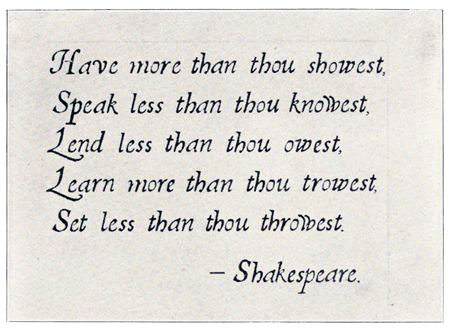
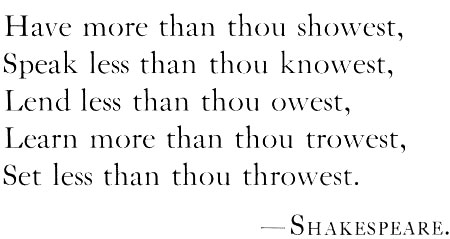
which they liked the best, the Roman, Gothic or Italic. On Plate VIII you
will find a little poem by Shakespeare printed in these three Alphabets.
Which one do you like the best? I am sure you will choose the one that is
the simplest, the easiest to read and at the same time the most
beautiful—the Roman. In the quarrel which had been going on for so many
years, the Roman alphabet won the victory, and that is how it came about
that the Roman is used in printing all our newspapers and books today. At
last after so many hundreds of years it has traveled through the other
countries to us. Many times you cannot recognize the letters, and they
look very different from the Roman models from which they were patterned,
but that is because we are not as careful with the measurements and
proportions as were Albert Dürer and the other Masters in that time long
ago.
Chapter III
You know now the beginning of the Alphabet, the careful way it was planned
and made, and how finally after so many years it has come to be used in
the form in which we have it today. Do you remember that when Albert Dürer
made his Alphabet of Roman letters he made more than one form of each
letter—there were three A’s, for example. Would you like to know why he
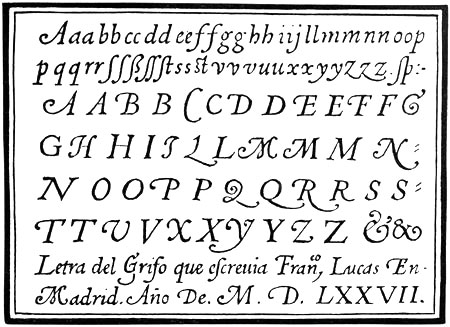
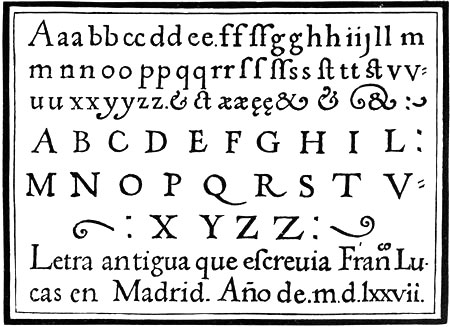
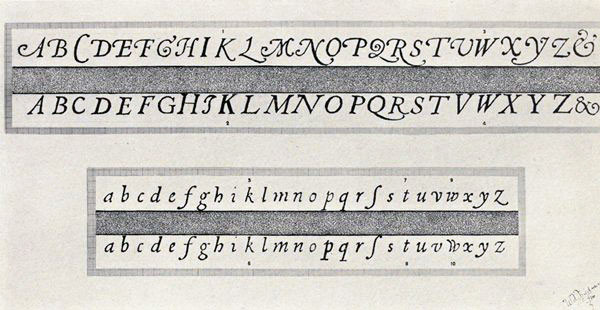
did this? Plate IX shows you two other kinds of Alphabets made long ago by
a Spanish artist, Francisco Lucas. Look at the Italic capital letters in
the upper part of this Plate. You can easily see that there are two
different forms of the same letters, can you not? But now look at the
small letters. You still see that there are two examples of each letter,
but they are so much alike that you will have to look very carefully to
see the difference between the two forms. Why do you suppose this artist
went to the trouble to make these letters so much alike, and yet
different? Do you not think that this would be a very strange thing to do
unless there was a good reason for it? Look at the lower part of the Plate
and you will see that there are two different forms of the small Roman
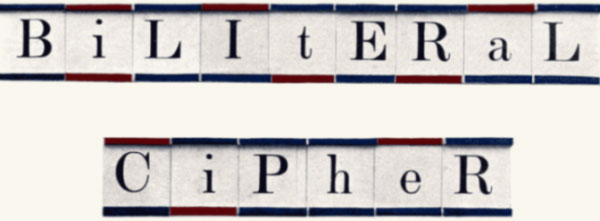
letters also. Now turn back to Lesson XV. You see that by using a capital
letter for the a form and a small letter for the b form you were able
to hide within the phrase “Biliteral Cipher” the word, “key.” You can
easily see that this would not be a good way to hide a secret, for the
difference between the large and small letters is not only easy to see,
but looks so strange that it is the first thing you notice. Now suppose
that instead of using a capital letter for the a form and a small letter
for the b form you use for each letter of the Alphabet, both capital and
small, two forms which were very much alike but still were different. In
the following line—

you see the same phrase “Biliteral Cipher,” but it does not look strange
to you, does it? Still, if you will study it carefully you will see that
the first i is different from the second, and that the first l in
“Biliteral” is different from the second l. You have guessed by this
time that the phrase “Biliteral Cipher,” as it stands here, also
contains a hidden word. The word is “the.” This phrase was made to
contain the word “the” by using the two forms of letters which you see
in the upper part of Plate IX and which were called “doubles” by the
printers who used them several hundred years ago. Now do you begin to see
how important these two forms are?
Look again at the little Shakespeare poem in the Italic alphabet on Plate
VIII. Now that you know about doubles you can see, if you have learned
to use your eyes, that we have hidden a secret within this poem too. Would
you like to know what it is? We will help you to work it out by giving you
what is called a Classifier which will make it easy to decipher the
verse. On this Classifier, which you will find on Plate X, the very same
Italic letters that you saw in Plate IX have been arranged so that all the
a form letters are above the shaded part and all the b form letters
below. Now if you will tear out this whole page and carefully cut out
these shaded parts you can place this page over the lines of the poem in
italic letters. This will help you to decide to which form the letters of
the poem belong. Place the Classifier over the poem so that the first
letter, the capital H of Have, is between the a form and the b form
capital H on the Classifier. You will see that this capital H of Have is
the a form. Now below the Classifier has been placed something which
will help you still more. All the words of the poem have been divided and
have been placed into groups of five letters. As we decided that the H of
Have belongs to the a form, we have placed an a beneath the H in the
first group of five letters. Now move the Classifier so that the a in
Have comes between the a form a and the b form a on the Classifier.
You will see that this letter also belongs to the a form. If you will do
the same to the rest of the letters of this first group you will find that
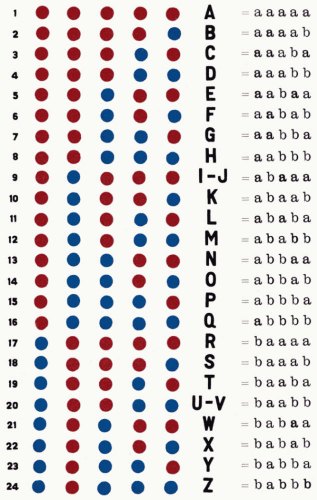
they are all a form letters. Now what letter of the Alphabet does a
group of five a’s stand for?—A, does it not? So the first letter in our
secret is A. Now place the Classifier over the rest of the letters of the
poem and see to what form they belong, just as we have done for you in
the first group. If you do your work carefully you will find the hidden
secret.
If we can hide one word in “Biliteral Cipher” and a sentence in a short
poem, do you not see how a whole story could be hidden so carefully within
a book that it might not be discovered for many, many years?

PLATE I
ALPHABET by ALBERT DÜRER (A. D. 1525)
PLATE II
CONSTRUCTION OF ALPHABET
PLATE III
ALPHABET, with construction: A. DÜRER (A. D. 1525)
PLATE IV
ALPHABET, with construction: A. DÜRER (A. D. 1525)
PLATE V
ALPHABET, with construction: A. DÜRER (A. D. 1525)
PLATE VI
ALPHABET, with construction: A. DÜRER (A. D. 1525)
PLATE VII
ALPHABET, with construction: A. DÜRER (A. D. 1525)
PLATE VIII
PLATE IX
ITALIC ALPHABET, BY FRANCISCO LUCAS
ROMAN ALPHABET, BY FRANCISCO LUCAS
PLATE X
THE BI-FORMED ALPHABET CLASSIFIER
For Use with the Lucas Alphabets, 1577
a forms above the shaded parts, b forms below
COPYRIGHTED, 1916. GEORGE FABYAN CUT OUT SHADED PART WITH SHARP KNIFE
TRANSCRIPTION
Havem oreth antho ushow estSp eakle sstha nthou knowe
aaaaa
A
stLen dless thant houow estLe arnmo retha nthou trowe
stSet lesst hanth outhr owest Shake spear e |