Language, the vehicle of thought as it is, conveys not
unfrequently different impressions to different persons;
especially is this the case when that language is not the
hearer’s mother tongue. We may take in the general drift of
what is said to us in a foreign tongue, but fail to
understand the meaning which lies hidden beneath the
surface. In reading a novel we may be unable to discriminate
between a national characteristic and a personal
idiosyncrasy; the rhythm and cadence of poetry may appeal to
us in vain; and we may take too seriously humourous language
and mistake the vulgar and coarse for the refined and
elegant.
The Japanese language, which comes of a stock totally
different to the Indo-European languages, has grown in a
state of almost complete isolation, and in course of time,
developed characteristics of its own. One of these is the
abundance of vowel-sounds, for the consonants are almost
invariably accompanied by vowels. Another is the frequency
with which connective enclitics occur in a sentence. The
Japanese is an agglutinative language, and the repetition of
meaningless form-words naturally deprives the language of
force and allows of little change in the order, of speech.
Although there are other characteristics, the frequency of
enclitics and form-words and abundance of vowels in
individual words are the most important.
It is hardly necessary to dwell here upon the difficulty of
translating a joruri, or semi-lyrical drama, like the
Chushingura, especially as it abounds in word-plays. In
the phonetic
system of the Japanese language, which has a
comparatively few consonantal sounds, such sounds being, as
has already been stated, seldom unaccompanied by vowels, the
variety of syllables is small and so, accordingly, is the
number of their combinations, with the result that there is
an abundance of homonymous words. The identity or similarity
of sound is utilised to produce words that may be taken in
more senses than one. Often, also, sentences that sound
sweet and graceful are taken wholesale from literature of a
former age and inserted so skilfully that one fails to
detect any incongruity in the mosaic so formed; and yet,
unless one is versed in the literature which has been drawn
upon, it would be difficult to make out the drift of the
passages in which they occur. These peculiarities are not,
it is true, confined to joruri, for they may be found in
all other works of lyrical nature; but they give a
characteristic charm to joruri, and make it a very
difficult task to translate a joruri into a European
language. Thus, the eighth act of the Chushingura, which
is made up of sentences and phrases of this description,
fails to convey much meaning when translated into English.
In spite of these linguistic difficulties, an attempt has
been made, it is to be hoped not altogether without success,
to give in the present work the plot and spirit of the
Chushingura; but for the full comprehension of the play
and its motif, the reader should possess some acquaintance
with the social condition, manners, and ideas of the time to
which it refers.
The vendetta of the retainers of Ako, which forms the
subject of the play, took place early in 1703; and the play
saw the light forty-five years later, in 1748. It was a
production of the golden age of Tokugawa
literature. During
the little more than a century and a half that have since
elapsed, remarkable changes have come over society. The
peace which had lasted under the Tokugawa Shogunate for two
centuries and a half was rudely broken by the cannon’s roar
off the coast of Uraga; and soon after, with the Restoration
of the Imperial authority, the nation began to introduce the
civilisation of the West. Our wars with China and Russia
have greatly influenced the whole society, and our customs
and manners undergone marked changes. In these days it is
difficult to form a clear idea of the state of society under
the feudal régime. Few of those people to-day who leave
Shimbashi by the night express to awake next morning at Kobe
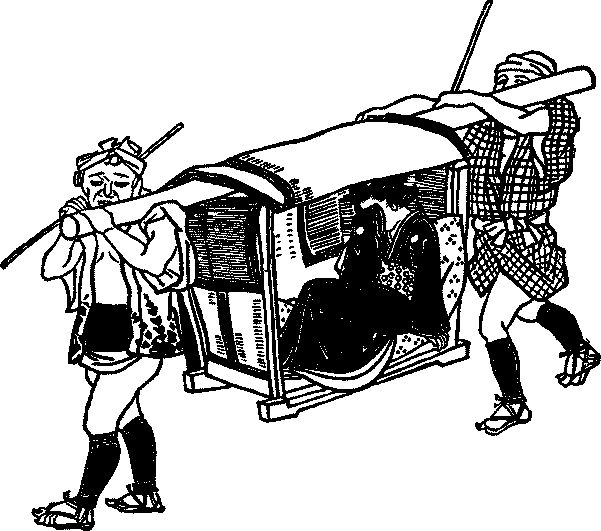
have a definite conception of the daimyo’s procession that
used to be borne on the shoulders of coolies across the
River Oi which they pass in their sleep. The postal
halting-places have become railway stations, and express
couriers have been replaced by telegraph. And we can hardly
imagine how cheap life was held in the old times when, for
the loss of their lord’s treasured article, retainers who
had faithfully served him and his fathers had to surrender
their lives and family estates; and we can hardly bring
ourselves into sympathy with those lovers who, taking their
lives into their own hands, have become subjects of songs
for their suicide. When even we Japanese at the present time
are thus out of touch with much that was of common
occurrence in our forefathers’ days two centuries ago, it is
only to be expected that Old Japan should appear almost
incomprehensible to the Western peoples whose manners,
customs, and ways of life are totally different to ours. It
is therefore believed that it would not be an altogether
needless task to make a few remarks here on the condition,
manners, and thought of society at that time.
Before treating, however, of the Genroku age in which the
vendetta of the Ako retainers took place, which has left
such a mark upon the history of this country, we must glance
at the period of the Tokuwaga Shogunate. That period lasted
two hundred and sixty-four years from the appointment to the
Shogunate of Tokugawa Iyeyasu in 1603 to the surrender of
political power to the Emperor by Tokugawa Yoshinobu in
1867. Towards the close of the Ashikaga Shogunate
(1338-1573), the country was torn by factions and plunged in
civil war. But the great hero Toyotomi Hideyoshi, better
known as the Taiko, gave the country a brief respite from
war. The predominance of his house, however, lasted only for
two generations; and on the defeat of his son by Iyeyasu in
1600 at Sekigahara, supreme power fell into Iyeyasu’s hands,
and the campaigns of Osaka in 1614 and 1615 put an end to
the Toyotomi line. The nation now bowed to Iyeyasu’s
authority, and his house ruled over it for more than two
centuries and a half.
Society during the Tokugawa period may be generally divided
into four classes, the kuge, the samurai, the common
people, and the lowest classes. The Emperor reigned over the
country at Kyoto; and around him were the Imperial princes,
some of whom were qualified to succeed to the Throne in case
of failure of Imperial issue. The kuge, or Court nobles,
numbered about one hundred and thirty; their titles and
offices were hereditary. They were jealous of their social
position. They attended daily at the Imperial Court; but
their duties mostly concerned the grant and deprivation of
Court rank, various ceremonies, and Court etiquette.
Administrative affairs were entirely
in the hands of the
feudal government. All business between it and the Imperial
Court was transacted by a few high officials.
The political authority over the whole nation was held by
the feudal government. The feudal system was first
established by Minamoto no Yoritomo towards the close of the
twelfth century; at first there was no intention of
replacing the Imperial Court in the government of the
country; but from various causes the political and military
power fell into the Shogun’s hands. The Emperor merely
watched over the sacred treasures of his House and delegated
political power to the feudal government. During the civil
wars the fortunes of Imperial Court seriously declined; but
Ota and Toyotomi, who were loyal to the Throne, presented
landed estate to the Court when they had brought the country
into peace. Tokugawa frequently built Imperial palaces and
presented funds for household expenses; and the Imperial
House was placed in easier circumstances. But it was the
policy of the Tokugawa family to hold the real power over
the nation. In 1614, Iyeyasu established regulations for the
control of the kuge, by which although the real power of
the Imperial House was diminished the principle of loyalty
to the Throne and distinction of lord and subject were
strictly maintained, and Tokugawa himself set the example to
the nation by his reverent treatment of the Imperial Family.
Although this attitude towards the Throne was a policy of
Iyeyasu, it was also an expression of the innate loyalty and
patriotism of the people. Thus, the dignity of the Imperial
Family remained unimpaired; and it may be seen from the
original cause of the Ako revenge how high the importance
was attached to the reception of Imperial envoys.
The samurai were all under the control of the feudal
government. Those whose annual stipends were not less than
ten thousand koku of rice were called daimyo, those
below them were hatamoto, and the lowest were kenin. The
daimyo were of three classes, lords of provinces, lords of
castles, and lords of domains without castles. They ruled
over their domains. Asano Takumi-no-Kami, the vengeance for
whose death forms the subject of the Chushingura, was the
lord of the castle of Ako in the province of Harima; his
annual income was 50,000 koku; he belonged to the second
category of daimyo. The daimyo came in turn to Yedo for
a short stay; and among their retainers, some remained
permanently in Yedo, while others accompanied their lords on
their journeys to and from the Shogun’s city. The samurai
who left their clans and drifted about, or for some reason,
lost their stipends, were known as ronin. Such were the
retainers of Ako who lost their stipends through the fall of
their lord’s house.
By common people were meant the merchant and agricultural
classes. They were not permitted to wear swords or have
family names; and they were known only by their individual
names. Thus, merchants and artisans were called by their
trades and farmers by their villages.
Besides the above-mentioned kuge, samurai, and the common
people were the lowest classes. Although there were in this
way four grades of society, such grades did not regulate the
material circumstances of the people belonging to them; but
as a whole the kuge were poor and the daimyo wealthy.
With the samurai wealth was considered contrary to the
principles of Bushido; and while they made it their pride
that they possessed no more than a hat to shelter them from
wind and rain, few tried to accumulate wealth; but as the
samurai spirit began to decline, there were many who sought
for
wealth. The most wealthy were to be found among the
common people, for, debarred from the rights and privileges
enjoyed by the samurai, they directed all their energies to
money-making; it must, however, be added that many of them
also lived in abject poverty.
The vendetta of the retainers of Ako was an outward
expression of the spirit of Bushido. A few words must be
here added regarding Bushido, a peculiar product of our
country, which reached its highest development under the
Tokugawa régime.
The people of the Eastern Provinces, the centre of which was
Yedo, were from the oldest times noted for their fearless
courage. Moreover, when Yedo became the seat of the feudal
government, the samurai who had been engaged in rapine and
slaughter during the wars preceding the Shogunate of
Tokugawa, flocked to the city and made it their place of
residence. The city became the second home of the simple and
intrepid samurai of Mikawa, the province, of which Tokugawa
Iyeyasu was originally daimyo; and the retainers of other
clans also repaired thither in great numbers. In fact, Yedo
was the centre of neither commerce nor industry; it had been
established solely for the residence of samurai; and there
hundreds of thousands of samurai gathered to practise
military arts. In short, in Yedo, Bushido was in greatest
vigour. The principal elements of Bushido were three in
number:—
The first of these was the high esteem for military valour
and practice of military arts. It was the most important of
the samurai’s accomplishments. In remote antiquity, the two
families of Mononobe and Otomo took to the profession of
arms and guarded the Imperial Court. It became their
hereditary office to act as the Imperial bodyguard. All
their descendants were
trained in military arts and grew up
to be men of high resolution and integrity. They were taught
to refrain from all acts likely to bring dishonour upon
their family name. When, however, the Fujiwara family came
into possession of the political power, military affairs
began to decline and give place to civil affairs which were
then held in high esteem. The military profession was
regarded with contempt and looked upon as fit only for
barbarians. This slighting of the military calling was due
to communication at this period with China, whose
civilisation so dazzled the Japanese that they caught the
literary effeminacy which then afflicted that country. The
samurai of Kyoto the capital gradually lost their former
military spirit. But Bushido was not seriously affected by
its decline in Kyoto; for this effeminacy was confined to
the capital and its immediate neighbourhood. Those, for
whose ambition Kyoto was too small, mostly migrated into the
country where they strengthened their position. And Bushido
found its home in the country and there it developed without
obstruction. These ambitious men lived in different
provinces; and when their families grew too bulky, the
members established themselves in other places. Most of them
became powerful men with large domains. They had many
followers, who became their private soldiers. The relations
between these local magnates and their adherents continued
unchanged for ages. The lord took care of his adherents and
instructed and encouraged them so that they might prove of
service to him in an emergency, and they, on their part,
trained themselves in military arts so that they might be
able to show their loyalty to their lord. Thus, Bushido was
driven out of the political centre of the land by the
introduction of Chinese civilisation and grew up in the
country, especially in the Eastern Provinces, because those
provinces were lower in the degree of civilisation and at
the same time
retained a spirit peculiar to them. Military
training was pursued to the highest pitch in the East; the
samurai, whether leader or follower, considered it cowardly
to show the back to the enemy, and always feared to bring
dishonour upon their family name. They looked upon it as
shame to themselves not to die when their lord was hard
pressed and not to help another in his difficulty. Their own
shame was the shame upon their parents, their family, their
house, and their whole clan; and with this idea deeply
impressed upon their minds, the samurai, no matter of what
rank, held their lives light as feather when compared with
the weight they attached to the maintenance of a spotless
name. In their breasts was always present the thought that
an unstained reputation was of highest value to those whose
profession was of arms, and it was disgrace upon a samurai
to be spoken of as having fled for fear of the enemy.
Especially, when the Minamoto and Taira clans became the two
great military families in the eleventh century, was this
spirit carefully instilled into the hearts of their
followers; and the characteristics of the samurai became
more highly developed and the path of conduct of the subject
towards his lord, of the soldier towards his commander, and
of samurai towards each other became clearly defined to a
degree unparalleled in any other age or country of the
world. This path was called the path of loyalty, which was
the second essential element of Bushido Thus, by failure to
follow this path, the samurai forfeited the name, he was
despised and held up to scorn as a leper and a man of no
spirit. Such contempt, once a man was exposed to it, was
heaped upon him to the end, and he himself felt it keenly
until death; and however wealthy he might subsequently
become, he was too ashamed to hold up his face in public.
If, on the other hand, he strictly followed the path of
loyalty, he was constantly praised by friend and foe alike;
and consequently, if a
man was born of an unexceptionable
lineage and had any military prowess of his ancestors to
boast of, he would, in the battle-field even when a question
of a few minutes was of vital importance, stand up before
the enemy and make boast of it to them. The third essential
element of Bushido to be mentioned is the high estimation of
honesty and integrity and disregard of pecuniary profit. It
was considered most despicable to change one’s mind for
lucre. Even when he was offered a thousand pieces of gold,
the true samurai should not for a moment alter his original
intention. The samurai gave money, but did not lend it; and
he received money, but did not borrow it. To borrow money
with a promise of repayment was to rely upon one’s life
continuing till the morrow, which was unworthy of a samurai.
At the time of the invasion of Korea towards the close of
the sixteenth century, Hineno Hirotsugu, before he set out
on his mission to that country, borrowed a hundred pieces of
silver from Kuroda Josui, and upon his return he went to
Kuroda to repay the money; but the latter told him that he
had not lent it in hope of its being repaid, and in the end
he absolutely refused to take it back.
The essential elements of Bushido may appear, when only
these three are mentioned, to be very simple; but that is
far from being the case, for there are many other minor
elements which go to its making. But one that deserves
special mention, and may indeed be deduced from the elements
above described, was the keeping of one’s word. Once
anything was undertaken, it was dishonourable not to carry
it out even at the sacrifice of life, property, and all that
one possessed. Thus, in a bond of debt often appeared the
words “in case of failure to repay this money, I shall be no
longer looked upon as a man,” or “if I should by any chance
neglect to repay this money, I should not utter a word of
protest even if
you laughed at me before company.” From
these words the honesty and simplicity of the samurai may be
readily inferred. The contempt for money and money-making
which they expressed at all times had no doubt been handed
down from the period of civil wars, when the whole country
being overrun by soldiery, those who possessed wealth were
in constant danger of attack and robbery. To the warriors
whose lives could never be called their own, money was only
a means of temporary gratification of their senses; for if
they fell into straits, they merely robbed, and in war time
money was of less value to them than a mouthful of food or a
sword, and it was only natural that they should be utterly
indifferent to its acquisition. Kono Moronao is made in the
Chushingura to take bribes, because the authors wished to
exhibit him as a man utterly bereft of the Bushido spirit
and so contrast him with the loyal retainers who are the
mirror of chivalry and single-heartedness; for the same
reason he is shown up as a poltroon. The qualities above
referred to are the characteristics of Bushido; and that
they composed the spirit peculiar to our country will be
patent to all who study the history of Japan from the oldest
times. But Bushido underwent slight changes with the
progress of the times, and coming under the influence of
Buddhism and Confucianism, it was brought to perfection
under the Tokugawa régime, especially in the Genroku era in
which the Ako vendetta took place.
It would be tedious to describe one by one the customs of
the samurai, which may be taken as the outward expressions
of Bushido in its most developed form; but perhaps the most
conspicuous among them was the vendetta, to which, on
account of the important part it plays in the Chushingura,
we will refer later on. Another
custom was the seppuku (or
harakiri), or self-disembowelment. It was an act inspired
by the spirit of Bushido which urges loyalty and considers
life light as compared with the preservation of one’s
honour. Death was looked upon as an atonement for all faults
and errors. One who had acted contrary to the principles of
Bushido did not wait for others to lay their hands upon him,
but slew himself without hesitation; and he who showed fear
or irresolution on such occasion was looked upon as bringing
dishonour upon the samurai’s name. The death of Kanpei in
the sixth act of the Chushingura is an instance in point.
A samurai guilty of a serious offence which deserved capital
punishment was sentenced to commit seppuku. In such case
the order to commit seppuku, instead of being beheaded
like a common criminal, was looked upon as an honour, as may
be seen in the fourth act of the Chushingura where Enya
Hangwan is condemned to death. A curious form of seppuku
was the junshi, the suicide of a retainer upon the death
of his lord in order to serve him still in the other world.
This custom, which was in great vogue in the early years of
the Tokugawa régime, was founded upon the principle of
Bushido that it was dishonourable for a samurai to serve a
second master. Some went so far as to look upon it as a
stain upon their honour to serve the heir of their dead
master and so followed him to the grave. The feudal
government, however, prohibited this practice by law and
threatened with severe punishment all who violated it; and
by the Genroku era the junshi was entirely discontinued.
We may now proceed to touch upon the custom of vendetta.
Among the most marked social products of the Tokugawa period
must be mentioned vendetta. It was the favourite subject for
the novels, ballads, and plays of
the period and was treated
so frequently that it seemed to be the peculiar product of
that period. But the vendetta was not peculiar to that age.
It made its first appearance some fifteen centuries ago and
was known in every period of our national history. The
revenge of the Soga Brothers, for instance, who killed their
enemy in 1193 seventeen years after their father’s murder,
is the most famous of our vendettas and was sung in songs,
played on the stage, and treated in novels, of the Tokugawa
period. There were many vendettas before the Tokugawa age;
and what made them appear peculiar to that age was the
strong contrast they presented to the idle, luxurious life
which was resulting from the long-continued peace under the
Tokugawa rule; and for that reason they attracted the
greatest attention of the nation.
A vendetta is the wreaking of vengeance upon a man’s
murderer by his relations, friends, or retainers. It took
place not only when the murderer killed his victim with his
own hand, but also when he incited another to the act, or
even when one struck and killed a man without intent to
murder. Strictly-speaking, it was of course the duty of the
state to punish a murder and not to leave it to private
vengeance; a vendetta was, in fact, an act done in defiance
of the punitive right of the state and subversive of the
social order. In the Yedo period, society was, it is true,
kept in strict order, and the relations between lord and
retainer and between father and child were rigorously
observed; but it was also a period in which an intimate
connection subsisted between morality and law, and the
vendetta was recognised as an unavoidable act originating in
the intense feelings of loyalty and filial piety. It was
permitted on moral grounds as the result of the teachings of
Bushido and Confucianism. It may here be added that although
the vendetta of the Ako retainers was a subject of
discussion
among contemporary and later scholars, the
question turned upon whether the retainers were justified in
looking upon Kira Yoshinaka as their true enemy; no doubt
was ever expressed upon the legitimacy of vendetta itself.
The formal procedure for carrying out a vendetta in the
Tokugawa period was first for the avenger to apply for
permission, if he lived in Kyoto, to the deputy-governor, if
in Yedo, to the city magistrate, and if in the provinces, to
the local lord; and these reported it to the central
government, which then entered it in the official register
and gave the required permission. Now, the murderer seldom
remained quietly in the locality where the act was
committed, but almost invariably fled to other territories;
and therefore it was probable that if the avenger killed him
as he always did regardless of time or place immediately he
discovered him, he would cause a disturbance there and might
be brought to account for it. If, however, his vendetta was
entered in the official register, he was permitted to kill
his enemy anywhere. In such case, the local officials came
as soon as they heard that a vendetta had taken place, and
if they were satisfied that it had been officially
registered, they took no further note of the matter.
However, even when it had not been registered, they usually
let the avenger go if it was shown that he had not been
actuated by malice, but had done the deed from loyalty or
filial piety.
If, after the official permission had been obtained, the
enemy died before the revenge could be taken, it had to be
reported with satisfactory proofs of his death. Such
procedure was considered necessary, because after the
official registration, the avenger took leave of his lord,
who assisted him in every way and made him parting presents,
and the avenger naturally set out full of hope; but it
sometimes happened that when he was unable to find his enemy
after a long search and at the same time his purse
became lighter every day, he longed for home and with his first
resolution now gone, he grew anxious to give up the
fruitless search. In such cases he might come home,
pretending that his enemy was dead. And it was to prevent
such fraud that satisfactory proofs of the enemy’s death
were required to free the avenger from the duty which he had
voluntarily undertaken.
The avenger was usually the murdered man’s inferior,
although sometimes he was his superior in position. He was
in most cases his son, younger brother, relative, servant,
pupil, or intimate friend.
The person upon whom vengeance was to be wreaked was not
necessarily a bad man. In the early years of the Tokugawa
régime, duels were of frequent occurrence among the samurai;
they seldom discussed which were right and which wrong in a
dispute. If there was a difference, one would exclaim,
“Come, let us fight it out;” to which the other would as
lightly express his willingness, and they drew their swords
on the spot. Thus, a duel was an appeal to arms made by
mutual agreement; and the vanquished had no cause of
resentment against the victor. Yet his surviving family
often took up his cause and revenged themselves upon his
adversary. Sometimes justice was on the enemy’s side and the
avenger was entirely in the wrong. Such cases were
unavoidable when vendetta had the moral sanction of the
nation and was practically a duty imposed upon the nearest
relative of the murdered man.
Although the vendetta may be said to have been concluded
when the avenger had killed his man, yet the avenger himself
was sometimes looked upon as the enemy by his victim’s
family, who, thereupon, commenced a vendetta against him.
Next, the first avenger’s family would upon his death take
revenge upon the second avenger, and so on, so that the feud
would become as
interminable as a Corsican vendetta. To put
a stop to such endless vendettas, the Tokugawa Government
strictly prohibited secondary vendettas.
Again, in a duel between the avenger and his enemy, the
former was not unfrequently killed. Hence, the avenger
sometimes was accompanied by his second. The second usually
fought the enemy when the principal was in danger of being
beaten; but in some cases he fought side by side with the
principal. That was mostly the case when the avenger was a
child or a woman, who had no chance against the adversary.
It may be mentioned that when the government was reorganised
upon the accession of the present Emperor, a law was issued
in 1873 strictly prohibiting vendettas.
In the early years of the Tokugawa period, the samurai still
retained the rough and violent manners of the period of
civil wars; they despised gentleness as characteristic of
the effeminate people of Kyoto and luxurious living as
peculiar to the merchant class, while they trained
themselves in military arts and fostered military spirit.
Such was the turbulence of those times that even merchants
wore swords when they walked the streets. They had indeed
need of them; for innocent men were cut down in the streets
at night to try the temper of swords. Servants who were
guilty of theft, had failed to accompany their master as he
came home on horseback, or eloped with female
fellow-servants, were punished at the will of their master,
who tested the edge of a new sword upon their necks. The
feudal government frequently issued laws to put an end to
these violent acts.
This prevalence of strong military spirit gave rise to
a peculiar class of men, known by many names, the most common
of which was otokodate. In all classes of society in the
beginning of the Tokugawa rule, rough manners and turbulent
spirit prevailed; but more especially among the hatamoto,
or immediate feudatories of the Shogun, was it the case.
They were samurai of Mikawa, the native province of Tokugawa
Iyeyasu, and retained the simple manners and intrepid spirit
of their country home; they prided themselves upon the fact
that small as their stipends were, they were under the
direct command of the Shogun, and in their pride, they
lorded it over the streets of Yedo. Among the merchant class
were some who were indignant at the arrogance of the samurai
and their contemptuous treatment of the merchant and
agricultural classes; they also trained themselves in
military arts and opposed the tyranny of the military class;
and they formed a special class under the name of
otokodate. These otokodate mostly lived by gambling;
they made it their business to take up other people’s
quarrels or to mediate in them; and they spent their lives
to a large extent in the pleasure-quarters. Yet their ideal
was not inconsistent with the principles of Bushido; for
they took pleasure in helping the weak and crushing the
strong, they kept their word with the most scrupulous care,
and if a mere stranger respectfully begged for their
assistance, they would help him even at the risk of their
lives. They refused to be beaten in anything by others, a
word of insult was enough to draw their sword out of the
scabbard, and the least grudge was repaid; they hated to
work for profit and thought it undignified to count money.
They went to eating-houses and ate their full; and if they
had no money, they went away without paying. If they were
pressed for payment, they used their fists; but if they were
treated with respect and allowed to leave without payment,
they came again when they
had money and repaid more than
their debt. These otokodate infested every part of the
city in the early years of the Tokugawa period and so much
damage was caused by their quarrels that they were
suppressed in the Genroku era. They were punished with such
severity that their number gradually diminished; but their
customs did not altogether disappear. Among the ordinary
citizens of Yedo were many who esteemed the samurai spirit
of the first years of Tokugawa and the manners of the
otokodate. In what is called the Yedo spirit is to be
detected much which originated with the otokodate; for the
true-born natives of Yedo show to this day the same hatred
of being beaten by others, love of quarrel, contempt for
skin-flints, and inability to keep the day’s earnings until
the next day. Amakawaya Gihei, in the tenth act of the
Chushingura, is a good sample of a chivalrous-spirited
merchant after the manner of the otokodate.
Some eighty years after the establishment of the Tokugawa
Shogunate began the Genroku period. The Shogun at the time
was the fourth of Iyeyasu’s line. No insurrection was feared
at home and there was as little danger of the country’s
isolation being disturbed by foreign invasion, for no
foreigner was allowed to trade in Japan with the exception
of the Dutch and Chinese, whose trade was confined to
Nagasaki. The country, in short, enjoyed absolute peace and
grew in wealth and prosperity. Such was the condition of the
land in the Genroku period, which takes its name from the
Genroku era (1689-1701) and extended over some fifty years
beginning with the Tenna era in 1681 and ending with the
Kyoho era in about 1735. It was a period of great importance
in the history of Japanese manners, institutions, and
literature. The first years of the Tokugawa régime were a
period of
turbulent militarism and its last years that of
indolence and immorality; in the Genroku period, however,
the rough militaristic spirit was nearly gone, but the
people had not yet fallen into weak and effeminate ways;
luxury and extravagance had commenced their sway, but the
brave military spirit had not yet vanished. It marked, like
the Heian period of the ninth and tenth centuries, the
highest stage of Japanese civilisation; and with the dark
age of internecine wars intervening between these two
periods, it was, indeed, our age of renaissance.
During this period, Bushido, in spite of some evils that
attached to it, reached its highest level. This peculiar
spirit of Japan had been influenced in the earlier ages by
the doctrines of Buddhism; but coming under the influence of
Confucianism when the Tokugawa family came into power, it
became a cult of complete growth and took its final form
early under the Tokugawa rule. But Bushido, like all other
institutions, was bound to undergo changes as time went on.
Under Shogun Iyetsuna (1650-1680), the fourth of the
Tokugawa line, the old sturdy military spirit began to
decline in Yedo; and under his successor Tsunayoshi
(1680-1709), the Genroku period came in with its love for
luxurious living, display, and immorality, with the result
that Bushido which had been developed to the highest degree
among the warriors of the Eastern Provinces left Yedo, the
centre of those provinces, and sought refuge in the country,
where it remained unimpaired among the simple samurai of the
daimiates. The Ako vendetta was a striking instance of its
hold upon the country samurai.
The changes of manners under the Tokugawa Shogunate spread
as a rule from Yedo to the provinces. But in the early years
of that Shogunate Yedo was not yet the centre of Japanese
civilisation; for though it held the foremost position in
military arts, it was in literature,
art, and other things
inferior to Kyoto and Osaka which were as cities far older.
The Eastern Provinces changed their manners by imitating
those of these two western cities. But the manners and
customs of the latter cities were at the time almost
directly opposite to those of Yedo. They were soft,
frivolous, and elegant to effeminacy; Kyoto had, since it
became the capital of the country in 794, been the centre of
Japanese civilisation, while Osaka which had been from the
oldest times an important port for vessels sailing to and
from the western provinces, became especially prosperous
from the days of Hideyoshi the Taiko (1536-97); and while
they had long lost the simplicity and straightforwardness of
more primitive districts, they were less moved by a sense of
honour, more impelled by desire for wealth, and became more
and more luxurious as they advanced in civilisation, and
naturally grew more fond of ostentation.
The characteristics of the Genroku period were then
represented by the manners and tastes of Kyoto and Osaka. In
that period, though Yedo was firmly established as the
political centre of the country, it had to import from Kyoto
and Osaka their literature and customs, which were thereupon
acclimatised in Yedo. The true Yedo spirit and manners did
not come into being until a century later, that is, the
beginning of the nineteenth century.
The centre of the literature and customs of Kyoto and Osaka
was not, as in Yedo, the samurai, but the merchant. The
merchant who had, until a generation or two previously, been
oppressed by class distinctions, came in the long period of
peace to acquire wealth and extravagant habits as the
standard of living rose. For as the means of transportation
and communication developed,
many of them made large
fortunes by engaging in building and public works. There
were not a few of these noted men of wealth in Osaka and
Kyoto. In Osaka the world was the merchants’; and the
samurai, however high he might hold up his head, had to
yield in actual power to the common people.
As there were many wealthy men among the merchants who spent
money freely, they were the best customers in theatres and
in pleasure-quarters. The samurai, too, grew in time to envy
the merchant’s popularity and began finally to imitate his
ways. The manner in which Yuranosuke is drawn as a man about
town in the seventh act of the Chushingura, may be due
partly to the fact that the authors were all of the merchant
class; but it also serves to show the general behaviour of
samurai in pleasure-quarters.
But a merchant could only be a merchant; the strict social
distinctions could no more than the hereditary character of
family occupations be set aside. And the only place where
the merchants could spend money lavishly without fear of the
samurai and without distinction of classes, was the
pleasure-quarters. The attitude of the people of that time
towards those quarters was different to the attitude of men
of the present time. Love between the sexes was condemned by
the moral teaching of the time; and it was not to be thought
of that men and women should exchange love of their own free
will. Not only women, but men, usually left entirely to
their parents the arrangements for their marriages; and when
the husband and wife lived together, they appeared to the
world somewhat in the relations of master and servant,
however much they might really love each other. Some of
Chikamatsu Monzaemon’s plays depict men and
women freed from
all trammels and indulging in unfettered love. These plays
won the admiration and sympathy of the world because they
were written with peculiar skill by their great author. But
otherwise, the people of the period regarded such characters
as being immoral and licentious; and while they pitied them
for their sufferings, they condemned no less their lack of
chastity. In the pleasure-quarters was to be found a world
free from social restraint and from fetters of morality,
where could be seen women in their natural mood,
untrammelled by restraints of any kind. These quarters were
outlets for the depressed spirits caused by the pressure of
the negative policy of the Tokugawa government, where all
ranks and grades of society could associate freely and on
equal terms. The quarters in Yedo, Kyoto, and Osaka were
frequent subjects of plays and novels of the time; indeed,
it may be said that more than half the literature of the
Genroku period was devoted to these quarters and their
inhabitants.
The revenge of the Ako retainers took place in the twelfth
month of the fifteenth year of Genroku (January, 1703); and
few months later, a play founded on it was already on the
stage. In 1706, the Takemotoza, the great puppet-theatre of
Osaka, put up a ballad drama by Chikamatsu Monzaemon, called
Kenkohoshi-Monomiguruma, upon the same subject, which the
same great dramatist followed up with another, entitled
Goban-Taiheiki, in which the story was carried back to the
time of the first Shogun of the Ashikaga line in the middle
of the fourteenth century. In this play occur for the first
time the names of Kono Moronao and Enya Hangwan, noted
warriors of that period, as those of the two enemies whose
fatal quarrel gave rise to the great vendetta, and also the
loyal chief councillor of Asano appears as Oboshi
Yuranosuke and the humblest of the loyal retainers, Terasaka Kichiemon,
is disguised under the name of Teraoka Heiyemon. After this,
several plays of more or less merit were performed in Yedo,
Kyoto, and Osaka. A noted actor of the time, Sawamura
Sojuro, made a great hit with one of these plays in Osaka in
1746 and in Kyoto in the following year; and a famous writer
of puppet-plays named Takeda Izumo, who saw these successes
of Sojuro, produced in collaboration with Namiki Scnryu and
Miyoshi Shoraku in 1748 the play, Kanadehon-Chushingura,
which is translated in the following pages. It was put up,
as originally intended, at a puppet theatre and afterward at
an ordinary theatre. It became not only the most celebrated
version of the vendetta, but also the most popular of all
plays; and other plays upon the subject of the loyal
retainers of Ako were entirely dropped. So great is even at
the present time the fame of the play that the revenge of
Ako retainers is better known as Chushingura and its hero
Oishi Kuranosuke sounds less familiar to the ears of the
common people than his play-name of Oboshi Yuranosuke. For
the latter name which first appeared in Chikamatsu’s
Goban-Taiheiki is adopted in the Chushingura, as also
the names of Enya Hangwan, Kono Moronao, and Teraoka
Heiyemon. The play still retains its popularity and it is
even now, as it used formerly to be, in many theatres the
stock play for the last month of the year since it is sure
to draw large houses, just as the plays founded on the
vendetta of the Soga brothers are the most commonly
performed in the first month.
We will now proceed to discuss the plot of the play and
compare it with the true story of the famous vendetta.
It was the established custom under the Tokugawa rule for
the feudal government to offer to the Imperial Court a large
sum of money and other articles as presents when a messenger
was sent there to tender the New Year’s greetings in the
first month of every year; and the Imperial Court, too,
despatched envoys to Yedo to inquire after the Shogun’s
health. On such occasion the Shogun’s government specially
appointed from among the daimyo officers to attend upon
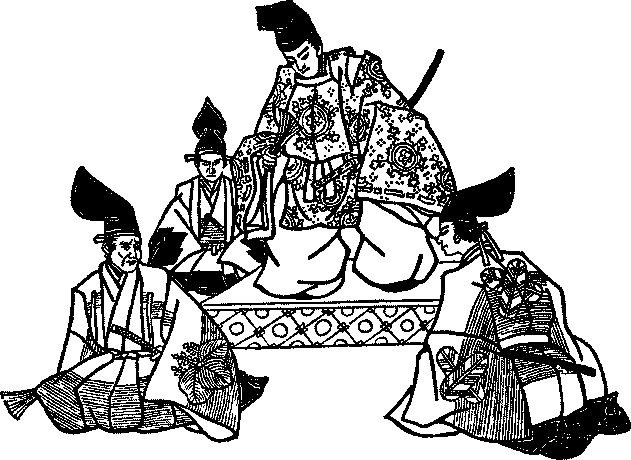
the Imperial envoys. On the day on which the Shogun received
the envoys took place a great ceremony at which the Shogun
himself received the Imperial message direct from the
envoys; on the following day a performance of No was given
in their honour, after which a grand banquet was held. On
the third day the Shogun himself presented his reply to the
Imperial message. Throughout these ceremonies the daimyo
immediately connected with the Shogun and others then
staying in the city presented themselves at the Palace in
full Court dress.
In the second month of the fourteenth year of Genroku
(1701), when it was announced that the envoys of the Emperor
Higashiyama and the Ex-Emperor Reigen were coming to Yedo,
Asano Takumi-no-Kami Naganori, Lord of Ako, in the province
of Harima, and Date Sakyo-no-suke Muneharu, Lord of Yoshida,
in the province of Iyo, were appointed officers to entertain
the envoys, and the Kōke,[1]
Kira Kozuke-no-Suke Yoshinaka
and Otomo Omi-no-Kami Yoshitaka, were ordered to receive
them. At first Takumi-no-Kami declined the appointment, for
though it was a great honour to him and his family, he was,
he pleaded, unused to Court etiquette; but one of
the Court Councillors replied that there was not one
daimyo who was used to such office, but as Kira
Kozuke-no-Suke was well versed in these matters from having
for many years taken part in the reception of the envoys, he
could perform his duties by consulting him. And
Takumi-no-Kami was obliged to accept the appointment.
Date Sakyo-no-Suke being still young, his councillors
managed all his affairs; and knowing Kozuke-no-Suke’s
character, they made him valuable presents when they asked
him to instruct their lord in the ceremonies which he was to
attend. Takumi-no-Kami’s councillors on duty in Yedo were
Yasui Hikozayemon and Fujii Matazayemon; and though he told
them to send presents to Kozuke-no-Suke, they, being unused
to the world’s ways, made presents which were far smaller
than Date’s and thereby aroused Kozuke-no-Suke’s anger.
Kozuke-no-Suke then determined, when Takumi-no-Kami asked
for instruction, to make him commit blunders and fall into
disgrace. On the 11th day of the third month (April 6th,
1701), the Imperial envoys arrived in Yedo; and on the
following day they proceeded to the Shogun’s castle and
presented the Imperial messages; and on the 14th they were
entertained at a banquet. All these ceremonies were
concluded without a hitch. The 15th was the day on which the
Shogun was to present a reply to the Imperial messages.
Early in the morning, the Shogun’s near relatives and other
daimyo and lower lords were awaiting the arrival of the
envoys in the Pine Corridor (so called from pictures of
pine-trees on the doors), when Kozuke-no-Suke began to abuse
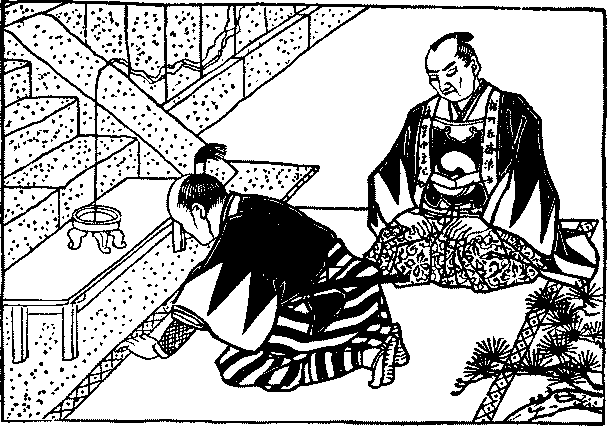
Takumi-no-Kami for his ignorance of Court etiquette. The
latter, who had hitherto borne his insults in silence, now
lost his temper and struck the other’s forehead with his
sword. As Kozuke-no-Suke sank on the floor, he cut at him on
the shoulder. As Kozuke-no-Suke then rose and fled
stumbling, his enemy pursued him, but was prevented
from striking him again by being caught from behind by Kajikawa
Yosobei, an attendant of the Shogun’s mother.
Kozuke-no-Suke’s wounds were slight and were immediately
attended to by Court physicians. The Shogun, who had
intended to show every respect to the envoys, was highly
incensed when he heard of this attack and ordered an inquiry
to be made into the matter. He appointed on the spot a
daimyo to take Takumi-no-Kami’s place, and concluded
without further accident the ceremony of presenting a reply
to the Imperial messages. When the inquiry was held,
Kozuke-no-Suke averred that he had given no cause for the
attack, which Takumi-no-Kami had made in a fit of insanity,
while Takumi-no-Kami asserted that Kozuke-no-Suke’s frequent
insults were such that he could no longer bear them in
silence and so had drawn his sword.
The above incidents afford the material for the attack scene
in the third act of the Chushingura, and are the true
cause of the vendetta of the Ako retainers. The story of
Moronao’s love for Kaoyo is taken from the twenty-first book
of the Taiheiki, which gives a romantic history of the
wars and other events during fifty years from 1318 to 1367.
The names of Kono Moronao and Enya Hangwan, which were first
used by Chikamatsu in his play, were taken from that book.
The story told in that work is briefly as follows:— The
daughter of Prince Hayata, a connection by marriage of the
Emperor Godaigo, was considered one of the most beautiful
women of her time. She was given in marriage to Enya Hangwan
Takasada in the province of Izumo; but Kono Musashi-no-Kami
Moronao was also deeply in love with her. He made love to
her, but was rejected. Piqued at her refusal, he pretended
to the Shogun that Enya was plotting against him. The Shogun
believed his words,
and Enya was compelled to fly for his life to his province. He revolted
in self-defence, but was attacked by the Shogun’s forces, and finally
put an end to himself.
The first act of the play treats only of the collision
between Moronao and Wakasanosuke; it is merely a byplay to
prepare the spectator for an exhibition of the respective
characters of Moronao, Enya, and Wakasanosuke.
The second act presents Honzo in his lord’s house and makes
Wakasanosuke an indirect cause of Enya’s ruin. As
Wakasanosuke corresponds to Sakyo-no-Suke, Honzo is made to
act as the latter’s councillors did and offer valuable
presents to Moronao. And to economise the characters of the
play, Honzo takes Kajikawa Yosobei’s place and stops Enya
when he pursues Moronao, and his daughter Konami is promised
in marriage to Oboshi’s son Rikiya, all which leads to the
tragedy in the ninth act.
Takumi-no-Kami had caused a disturbance in the Palace by
giving vent to private resentment although he was on duty as
officer for the entertainment of the Imperial envoys, and
thereby shown great disrespect to the Imperial House; and on
those grounds he was given in charge to Tamura Sakyo-dayu,
Lord of Ichinoseki, in Mutsu, and ordered to commit
seppuku on the same day. The inspectors and others to be
present at the self-immolation were appointed on the spot.
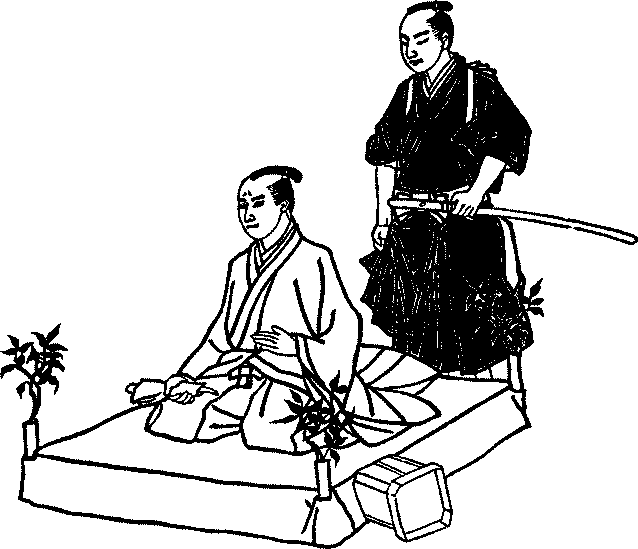
At Lord Tamura’s mansion, mattings were spread on the ground
in front of a small reception-room, and upon them were laid
mats, which were then covered with a rug, and curtains were
hung all around. Takumi-no-Kami’s head-page, Kataoka
Gengoemon, who had attended his lord to the Palace and
waited
for his return at the gate, ran back immediately to
his lord’s mansion when he heard of the attack in the
Palace; and after reporting it there, he went to Lord
Tamura’s mansion and was permitted to be present at his
lord’s death. Takumi-no-Kami composed an ode which ran:—
“Frailer far than the tender flowers
That are soon scattered by the wind,
Must I now bid a last farewell
And leave the genial spring behind?”
And calmly he put an end to himself. He was in his
thirty-fifth year.
In the scene of Hangwan’s death in the fourth act of the
Chushingura, Hangwan is made to wait impatiently for
Oboshi’s arrival and to see him when he had just thrust the
dirk into his body; but as a matter of fact, Yuranosuke and
his son were at the time at Ako, in the province of Harima.
The lamentations of Kaoyo in the same scene are equally
fictitious. For Takumi-no-Kami’s wife was in his mansion at
Teppozu near the River Sumida, and upon hearing of his
death, she shaved her head at once and became a nun under
the name of Yosen-in, and spent the rest of her life in
prayers for her husband. The mansion in Yedo was
confiscated.
Takumi-no-Kami’s domain was also to be forfeited. When his
death became known at Ako on the nineteenth of the third
month, that is, four days after the attack, Oishi
Kuranosuke, who was in charge of the castle, convoked a
meeting of all the retainers of Ako and informed them of the
whole affair. From sympathy for his lord’s feelings at the
time of his death, he said to them that as it was the loyal
subject’s duty to die if disgrace fell upon his lord, they
must discuss how they should put an end to themselves. Some
of the loyal retainers exclaimed with indignation that they
should proceed at once to Yedo
and cut off Kozuke-no-Suke’s
head to appease their lord’s angry spirit, while others as
firmly urged that they should not surrender the castle, but
hold it to the last against the government officers until
they were killed to a man. After heated discussion, it was
finally decided to surrender the castle. And when, on the
eighteenth of the following month, the officers came to take
possession of it, the retainers remained quiet, and after
putting their account-books in order and making an
inventory, they formally made over the castle to the
officers on the nineteenth in the grand hall of the castle.
The retainers then all dispersed and became ronin.
It will be seen that the incidents in the fourth act of the
play have no foundation in fact beyond the suicide of
Takumi-no-Kami. It is only important as introducing
Yuranosuke, the hero of the play, and showing the great
confidence placed in him by both his lord and his
fellow-retainers.
Thus, the retainers of the clan lost their stipends upon the
ruin of their lord’s house and became ronin. Oishi
Kuranosuke began to make preparations for the revenge, and
at the same time made every effort to bring about the
restoration of his lord’s house. When he found all his
efforts were unavailing and the Government refused to
restore the forfeited domain and title to Takumi-no-Kami’s
younger brother, he decided definitely to take revenge upon
Kozuke-no-Suke. Such of the late retainers as were filled
with great loyalty gradually formed a league; and Kira
Kozuke-no-Suke, too, took strict measures to provide against
sudden attacks and sent spies and detectives to watch the
movements of the loyal retainers. The retainers, also,
underwent untold hardships in their efforts to inform themselves
of their enemy's condition. Many
of them separated from their families and engaged themselves to
tradesmen or became artisans, and so disguising themselves,
obtained entry into Kira’s mansion. In the meantime, several
of the retainers lukewarm in their loyalty left the league
one by one until the forty-seven men of matchless fidelity
were left behind to carry out their plot amid almost
insuperable difficulties.
Oishi placed under the care of his maternal uncle, Ishizuka,
at Toyooka, in Tajima Province, his wife and four children,
the eldest of whom was Matsunojo, afterwards known as
Chikara Yoshikane (called Rikiya in the play), then in his
fourteenth year. For a while he lay concealed in a
neighbouring village; but towards the close of the sixth
month, he left his native province and arrived in the
following month at Yamashina, a village lying east of Kyoto,
to which he brought his wife and children, and made it look
as if he intended to settle permanently in that place. He
received offers to take him into service from great daimyo
like Nabeshima of Hizen and Hosokawa of Higo, and from other
lords; but he declined them, one and all. And to show that
he had no intention of re-entering service, he purchased a
house and land at Yamashina, and brought carpenters and
plasterers from Kyoto to build a retreat within the grounds,
while he himself took pleasure in rearing tree-peonies in
his garden. It looked quite as if he would in course of time
make over the headship of the house to his son Matsunojo and
retire into his retreat, there to pass the remainder of his
life in admiring the beauties of nature. He was all the
while waiting for the opportunity to carry out his plot.
Meanwhile, Kira still kept strict guard. No one was taken
into service in his mansion without careful inquiry into his
antecedents; and from retainers and sandal-carriers even to
common servants, no one but a native of Kira’s domain was
engaged except in unavoidable cases.
Tradesmen were strictly forbidden to enter the premises and the
gate-keepers were required to examine carefully all who came to the mansion.
And at the same time Oishi’s movements at Yamashina were
carefully watched.
Now, Oishi determined to throw the enemy completely off the
scent by leading a dissolute life and pretending that he had
given up the revenge in despair. He took to pleasures
against his inclination; he became a noted profligate. He
frequented the pleasures-quarters of Kyoto and Fushimi and
then, those of Osaka. Ronin as he was, he had been the
chief retainer of Ako; and he seemed to have inexhaustible
supply of money, which he spent with lavish liberality and
became notorious for his dissipation in Kyoto and elsewhere.
His confederates, too, decided to show to the world how
dissolute they had grown in their despair, and vied with
their chief in profligacy. And while these loyal retainers
pretended to the world that they had given themselves up
utterly to debauchery, their leaders held consultations in
these pleasure-quarters and matured their plan amid the
revelry of their comrades.
The dissolute life, which Oishi was now leading, exposed him
to the abuse of the world, which condemned him for
apparently sinking into dissipation, forgetful of his lord’s
death. Next, Oishi sent away his family with whom he had
lived in great affection. He did this, partly to show that
he had no thought beyond his pleasures and partly to prepare
for the revenge. According to the law in those days, for a
serious crime not only the offender himself, but also his
family, were punished; and he feared that his wife and
children might suffer from his act. He, therefore, divorced
his wife, who went away with their three youngest children.
He became more dissolute than ever. He brought to his house
a woman named Okaru, who was noted throughout Kyoto for her
beauty and made her his mistress. Kira’s spies grew
weary of watching him and became less vigilant. Meanwhile, the
retainers’ plan matured, and finally Oishi left Yamashina in
the tenth month for Yedo, where he arrived early in the
following month.
The above furnishes the material for the seventh and ninth
acts of the play. Oishi’s mistress, Okaru, appears in the
play as Hayano Kanpei’s wife and Teraoka Heiyemon’s sister,
and so connects her story with the death of Kanpei in the
sixth act and with the night-attack in the eleventh. It
makes her of more interest than if she only remained a
mistress whom Oishi brought home to conceal his true
designs. The seventh act also reveals Oishi as a man of
great loyalty, who conceals his plot under cover of
dissipation. It is an act which shows him in his true
character and one that calls for fine acting on the part of
the player who assumes the role of the hero.
All the loyal retainers, after their great hardships and
perseverance, succeeded in carrying out their object at
last; but there was one who died before the revenge was
taken. His name was Kayano Sanpei Shigezane, who appears in
the play as Hayano Kanpei. He was the second son of Kayano
Shigetoshi, a retainer of Oshima Dewa-no-Kami; and when he
was twelve years old, he was, at Dewa-no-Kami’s
recommendation, taken into Takumi-no-Kami’s service as page.
When Takumi-no-Kami was condemned to death for the attack in
the Palace, Sanpei was in the mansion in Yedo; and
immediately the sentence was passed, he left with another
retainer for Ako, where he arrived in four days and a half
and reported to Oishi. After the surrender of the castle and
dispersal of the retainers, Sanpei returned to
his native village to mourn for his mother who had lately died. As his
village was only about thirty miles from Yamashina, he went
often to see Oishi and consulted him on the revenge. In the
following winter, he ashed his father’s permission to
proceed to Yedo and seek a new situation; but his father
refused as he was sure, he said, that Sanpei was going to
take revenge upon his lord’s enemy, and added that such an
act on Sanpei’s part might implicate not only his own
family, but even bring trouble upon Oshima Dewa-no-Kami,
which he could not allow as he was no less loyal to his lord
than Sanpei was to his. Then, Sanpei asked him to sever
their relation of father and son; but this also his father
refused, saying that nothing worthy could be done by one who
cut off natural ties. Sanpei could do nothing; and seeing
that he could not revenge his lord’s death, he resolved to
die and apologise to his lord in the other world. On the
fourteenth of the first month in the following year, he sent
a letter to Oishi and before daybreak next day, he killed
himself while the family were asleep. His father, fearing
that the Ako retainers’ plot would be discovered if his
son’s death became known, had his body secretly buried in a
neighbouring hill. Sanpei was twenty-six years old at the
time of his death. He was perhaps over-hasty in rushing to
his death; but the principles of Bushido left him no choice;
a man of knightly spirit could do nothing but die under the
circumstances.
In their eagerness to enlist the sympathy of their audience,
the authors of the play have brought love-interest into his
story and weakened his character by attributing to him an
act of disloyalty. Still, his failure in duty in the third
act for the love of a woman was necessary for showing his
deep repentance in the fifth act and its incidental
consequences, the sale of his wife and his tragic end in the
sixth,
which lend peculiar pathos to Okaru’s story in the seventh act.
Amanoya Rihei was a merchant of Osaka, whose family had for
generations enjoyed the patronage of the lord of Ako. When
the loyal retainers held council after their lord’s death,
Rihei hied to Ako to offer his services. And when they had
formed the plan for the revenge, they kept it strictly
secret from all except Rihei; and later Oishi secretly asked
Rihei to procure all the weapons and other implements that
were needed for the night-attack. The retainers lay
concealed in Kyoto, Osaka, and Yedo; and Rihei in Osaka,
went himself, without the knowledge of his family and
servants, to different shops and works to have the necessary
weapons made, and as soon as they were ready, he forwarded
them to Yedo. One of the smiths reported to the authorities
that he had received an order for a special description of
weapons; and Rihei was soon after arrested and examined.
Rihei replied that the weapons of the special make had been
invented by a certain samurai; and other smiths, upon
hearing of Rihei’s arrest, also reported that they had
received orders from him. Rihei was, then, put to the
torture; but still he would not tell the truth. His wife and
children were also tortured; but they all answered that they
knew nothing. Rihei told the prison officers that his family
knew nothing of his purchases and begged them to torture him
instead of his family. He was then put to such tortures that
he was more than once on the point of death. He told the
officers that he had from the first been prepared for death
when he entered upon the undertaking, but that when the new
year came, he would confess all or submit to any punishment
they might inflict. He spoke with such composure that they
took his word and refrained from
further tortures. When the
new year came, the revenge of the Ako retainers was
everywhere talked of; and when Rihei heard of it in prison,
he went up to the officers and confessed that as his family
had for generations enjoyed the patronage of the lord of
Ako, he had been asked by Oishi to procure the weapons for
their night-attack upon Kira’s mansion, and it was for that
revenge that he had ordered the smiths to make weapons for
him, and now that the revenge had been successfully carried
out, the time had come for him to receive his just
punishment; and he added that from fear of the plot being
discovered and of the punishment for his offence being
extended to innocent persons, he had concealed it from his
family, and he therefore begged that his family might be
spared while he himself would willingly submit to the
severest punishment. The officers were greatly struck by his
manly spirit and released him. They restored to his son
Rihei’s property which they had confiscated and made him
follow his father’s trade. Rihei himself renounced the world
and peacefully ended his days in a temple closely connected
with the Asano family.
All the other incidents of the play, such as the story of
Kanpei and Okaru, the marriage of Konami and Rikiya, and the
death of Honzo, are more or less connected with the main
plot of the play; but the story of Amanoya Rihei, who
appears in the play under the name of Amakawaya Gihei, is
the least connected. The tenth act was written to exhibit
the manly spirit of a merchant and to show that even among
the mercantile class were men who could help the retainers
in their great undertaking. Amanoya Rihei was, in fact, a
fine example of the otokodate, to whom reference has been
made in a former page, and his character, as it appears in
the play, has been the boast of his class. It is a
vindication
of the commoners by writers who belonged to that class.
The loyal retainers willingly submitted to every hardship
and privation in their efforts to carry out their
long-cherished plan of revenge. The league which was
originally composed of more than a hundred persons,
gradually dwindled by defection to less than half the
number, and made more onerous the labours of the loyal men.
Some of them became doctors, others taught fencing and
similar arts, and others again turned rice-dealers and
merchants; but they devoted all their energies, so far as
they could do so without arousing suspicion, to watching the
enemy’s movements and keeping in communication with one
another. The labour and trouble they took to obtain
information regarding the interior of Kira’s mansion was
such as would hardly be believed in these days. One of them
who was versed in the art of tea-making, obtained news from
time to time of the goings-on in the enemy’s mansion from a
professor of that art who was patronised by Kira. He
ascertained from him that there was to be a tea-party at the
mansion on the fourteenth day of the twelfth month of the
fifteenth year of Genroku (which corresponded to the 20th
January, 1703), On that night, then, their enemy was sure to
be at home; and the retainers decided to carry out their
long-planned scheme early the following morning. From about
two o’clock they began to gather at their trysting-place;
and at about four o’clock they all arrived in the snow under
a clear moonlight in front of Kira’s mansion. Here they
divided into two companies; one under Oishi made for the
front gate and the other under Yoshida Chuzaemon for the
back gate on the west side. They entered the mansion and
making the capture of their enemy
Kira
their sole object,
they only cut down those who offered resistance. They
searched the whole mansion for him, but apparently without
success. They feared that he had escaped them; but one of
them, hearing a man’s voice in a shed near the kitchen, went
in and dragged him out and found he was the enemy they had
undergone so many hardships to seize. They cut off his head.
Then, they marched out in order without losing a single man.
It was about six o’clock, so that the fight had lasted two
hours.
The eleventh act merely serves to bring the story to a
conclusion. The true climax would have been the suicide of
the loyal retainers; but it was doubtless felt by the
authors that they would give the greatest satisfaction to
the sympathetic audience by ending the play when the loyal
men were at the height of their joy after accomplishing
their long-cherished object.
Although the story of the famous vendetta in the play
concludes with the departure of the retainers from the
mansion with their enemy’s head, we may, to complete the
story, here give a brief account of the subsequent events.
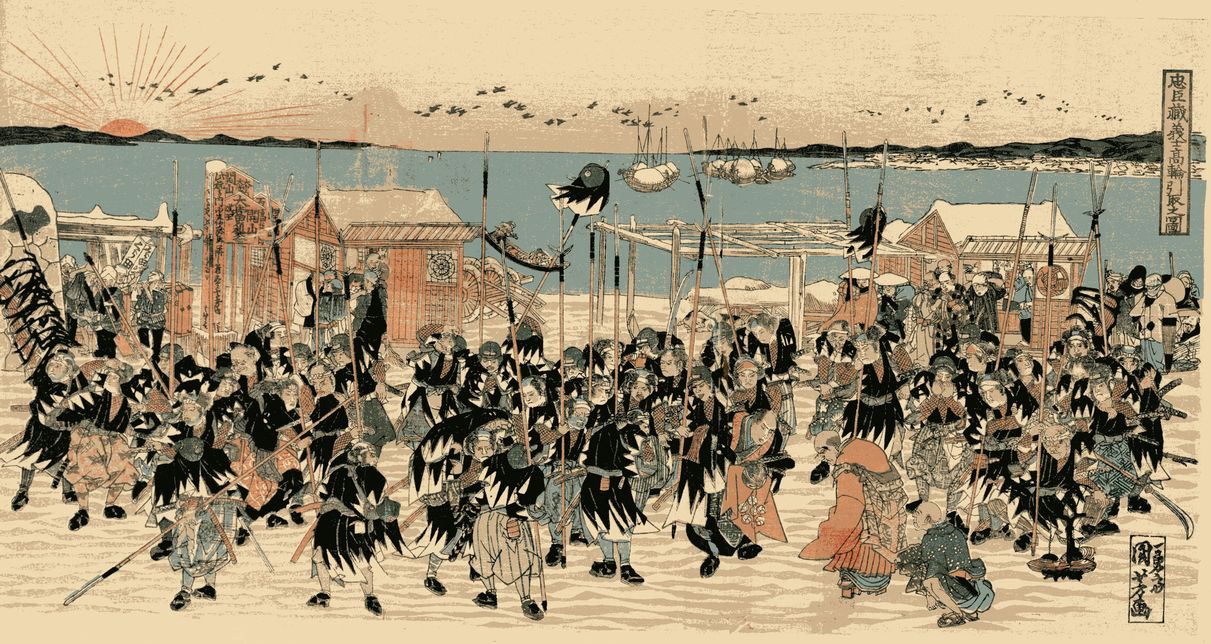
The loyal retainers of Ako marched in order through the city
and arrived at the temple of Sengakuji, their lord’s
burial-place, in the south of Yedo. There they washed Kira’s
bloody head and placing it in front of their lord’s grave,
reported as to a living person all the circumstances of the
revenge. Oishi sent two of his men to the Chief Censor,
Sengoku Hoki-no-Kami, to report their late attack, while a
similar report was made by the superior of the temple to Abe
Hida-no-Kami, the Commissioner of Temples and Shrines; and
both these officers went to the
Shogun’s palace to report
the matter. Officers were then sent to inspect Kira’s
mansion to verify the report. Universal sympathy was
expressed for the retainers; and pending the decision of
their case, they were given in charge, seventeen to Hosokawa
Etchu-no-Kami, Lord of Higo, ten each to Mori Kai-no-Kami,
Lord of Chofu and Hisamatsu Oki-no-Kami, Lord of Matsuyama,
and nine to Mizuno Kenmotsu, Lord of Okazaki. All these
daimyo received them into their mansions with willingness
and treated them with great consideration. It will be seen
that the number of retainers taken charge of by these
daimyo was forty-six, because one of them, Terasaka
Kichiemon, the Teraoka Heiyemon of the play, was sent
immediately after the attack to report to Takumi-no-Kami’s
widow, and his name did not appear in the report made by
Oishi to the Chief Censor.
The fate of the brave retainers became the burning question
of the day. Opinion was divided among the scholars and
government officials on the way they should be treated. Some
were for pardoning them as vendetta was permitted by the
state, while others advocated that as they had broken the
law of the land from private motives, they should be
condemned to death and that an order to commit suicide would
show that their great loyalty was duly appreciated since
they were not to be beheaded like common criminals. Finally,
on the fourth of the second month of the following year
(10th March, 1703), they committed seppuku by order in the
mansions of the respective daimyo who had them in charge,
and were buried at Sengakuji beside the tomb of their lord
whom they had served so well.
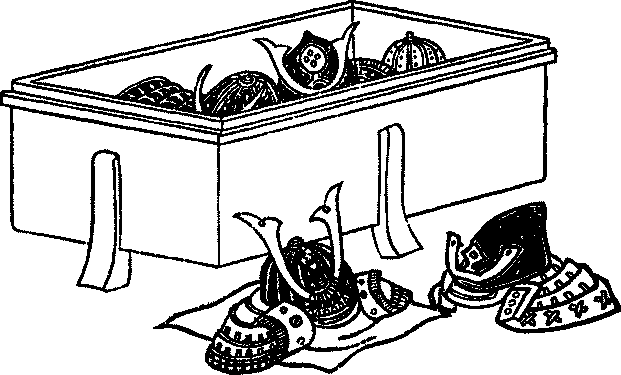
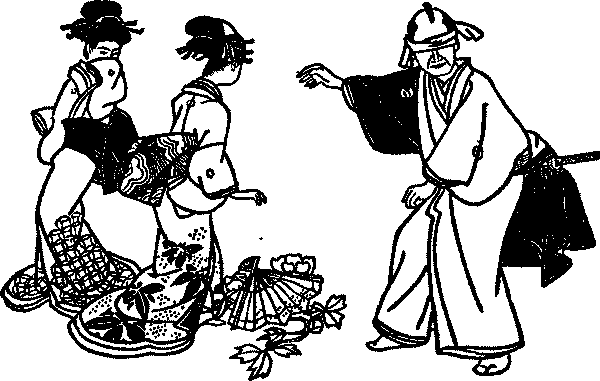
 families. Some are plain, and others are without camail for
ease in bending the bow. Among these many which vary with
the tastes of their wearers appears at last a five-plated
helmet with a dragon-head. Before Kaoyo can say that this is
the one they seek,
the scent of the rare incense pervades all around.

 presently he comes to a determination. He
draws his dirk, and then partly unsheathing his sword with
the other hand, he strikes it with the
dirk.
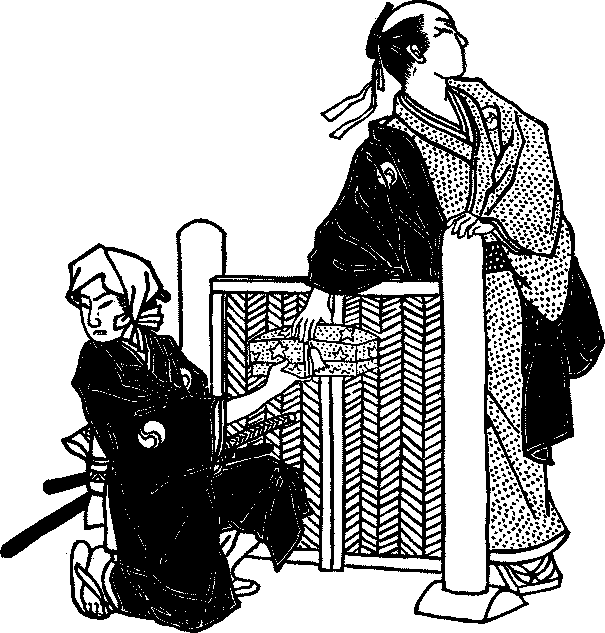
 there is no getting away. So make up your mind to it.
Please, lend it to me, do.
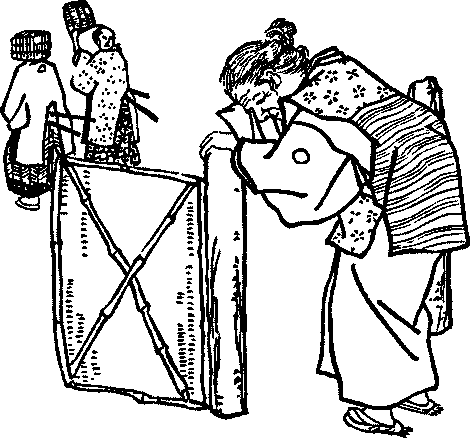
![Illustration: Kanpei leaning over supine Sadakuro]](https://openoldbooks.sgp1.digitaloceanspaces.com/books/chushingura-or-the-treasury-of-loyal-retainers/images/pg102.png)
![Illustration: drum]](https://openoldbooks.sgp1.digitaloceanspaces.com/books/chushingura-or-the-treasury-of-loyal-retainers/images/pg104.png)
 I wonder what makes him so late. I will just run and see.
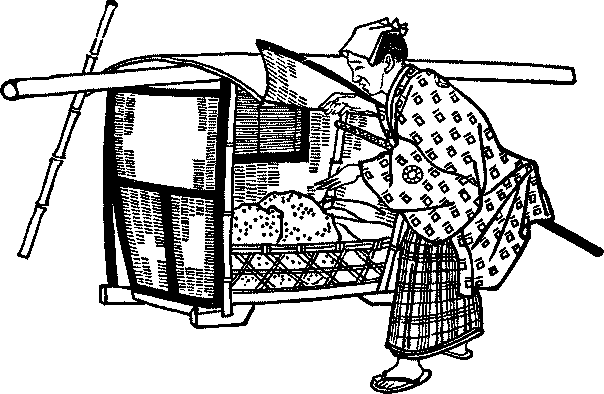
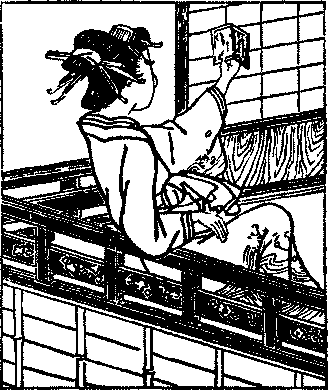 looks around and, by the light of the
hanging lantern, he reads Lady Kaoyo’s letter which tells in
detail the enemy’s condition. Being a woman’s
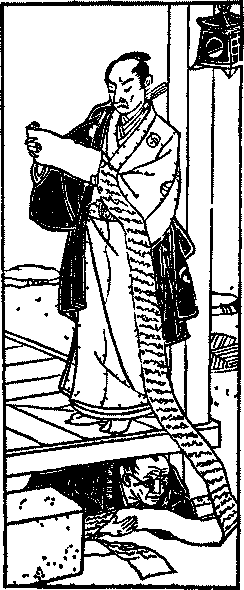 letter with
many redundant phrases he cannot read it quickly. Thinking
with envy that it is a letter from some loved woman, Okaru
looks down; but she cannot distinguish the characters in the
dim light. She thinks of her metal mirror; and bringing it
out, she reads the letter by its reflection. Little dreams
Yuranosuke, being no god,
that
under the verandah Kudayu is reading the same letter by the
moonlight as it unrolls and hangs down. Okaru’s hair-pin
comes loose and falls on the ground. At the sound Yuranosuke
looks up and hides the letter behind him; under the verandah
Kudayu is still in smiles; and on the upper floor Okaru
conceals her mirror.
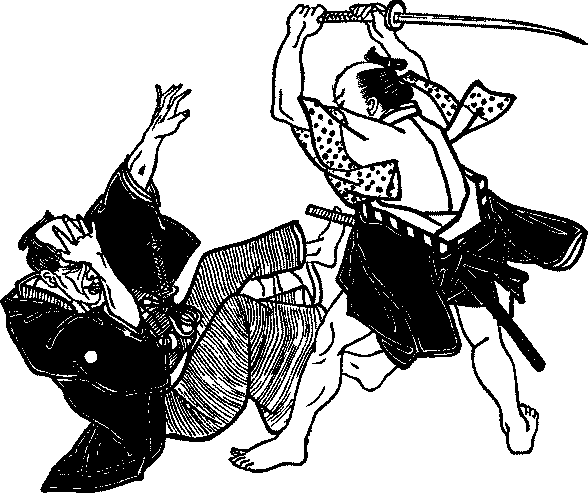
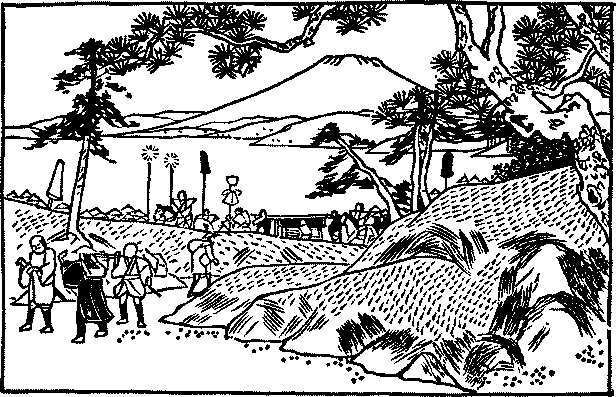
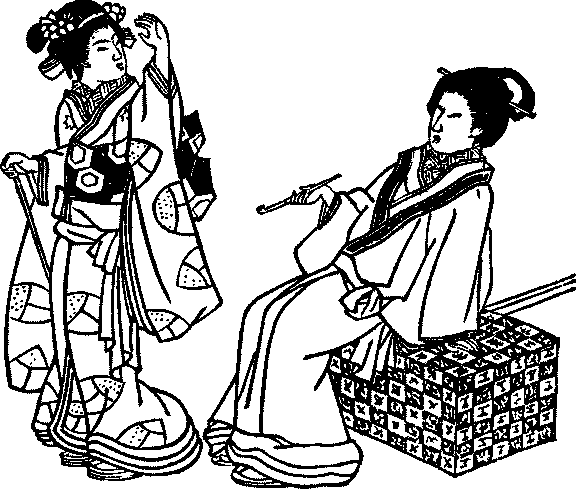

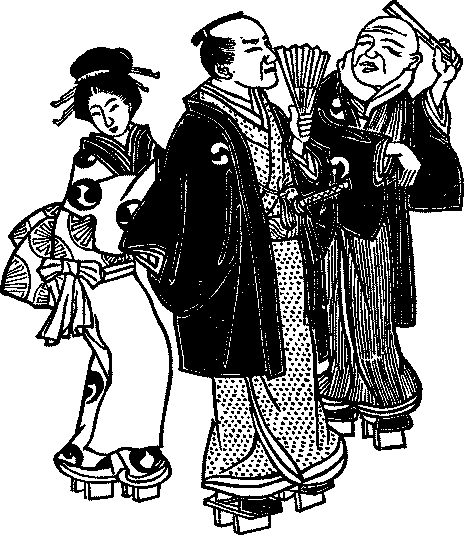 Though a man may be proud of his garden, he cannot relish
wine at home; it will not go down his throat. Now, come in,
come in. Where is my wife when I have visitors?
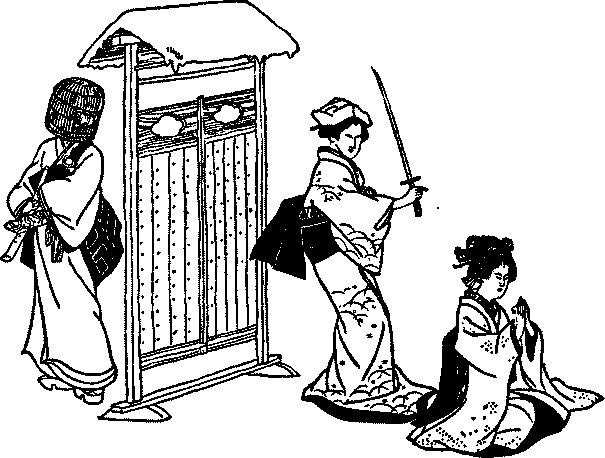
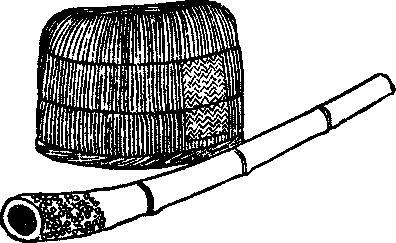
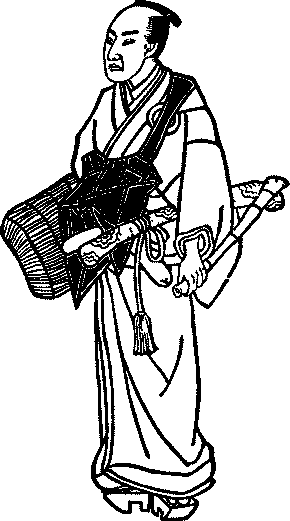 komuso who has been standing outside,
takes off his hat and throws it down; and slowly he comes
within.
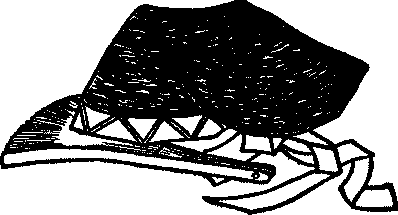
![Illustration: Samurai hat]](https://openoldbooks.sgp1.digitaloceanspaces.com/books/chushingura-or-the-treasury-of-loyal-retainers/images/pg270.png)