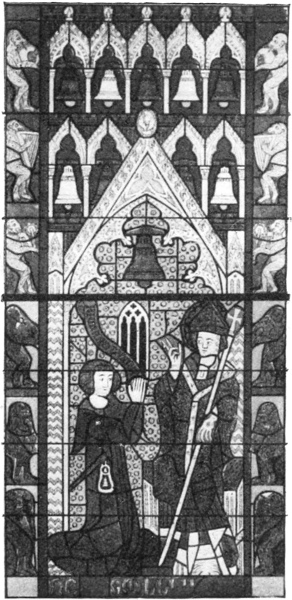
Most of us are probably aware that
it is usual for bells to bear inscriptions,
be it only the date or name of the
maker; but few who have not actually
examined bells for themselves may have
discovered that they are often richly or
effectively decorated. We do not as a
rule find them as highly ornamented as
foreign bells, which often have every
available space covered with inscriptions,
figures and devices, or borders of ornament;
but to some the greater soberness
of the English method may seem preferable.
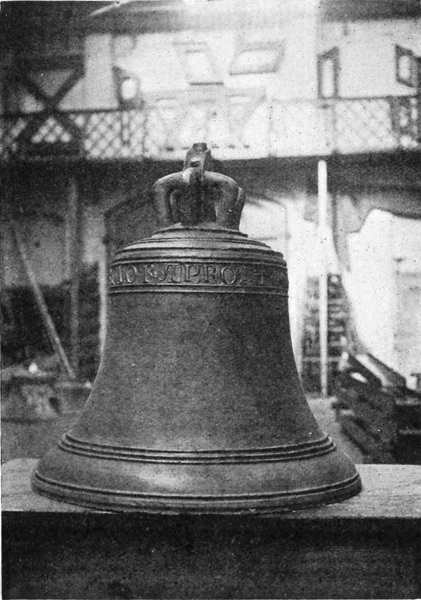
Nor is this practice of ornamenting
bells confined to the more artistic age
before the Reformation. Some of our
most richly decorated bells belong to the
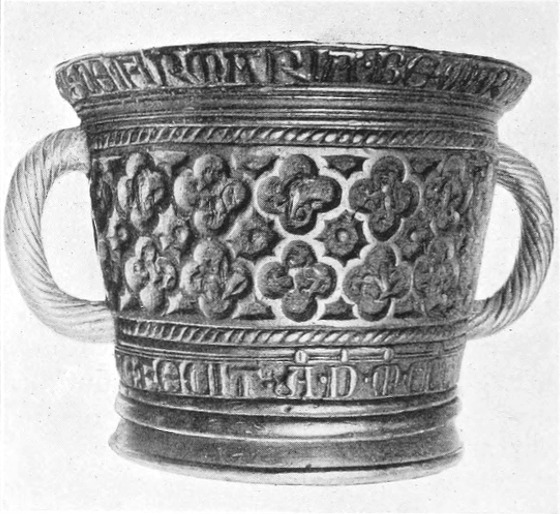
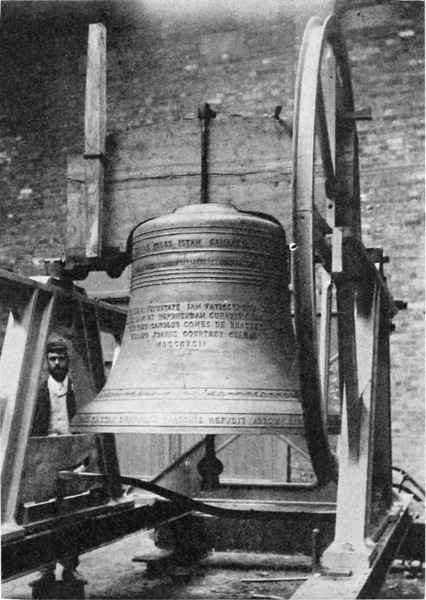
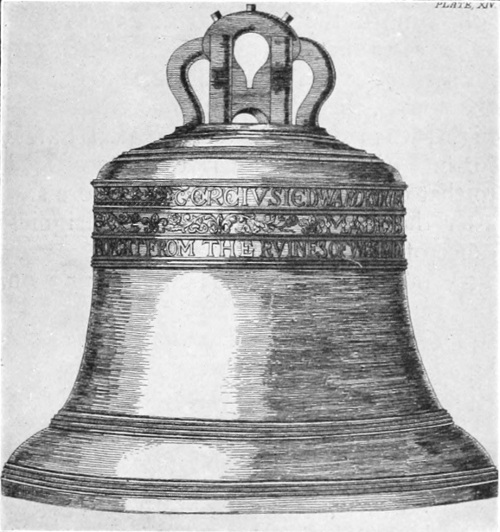
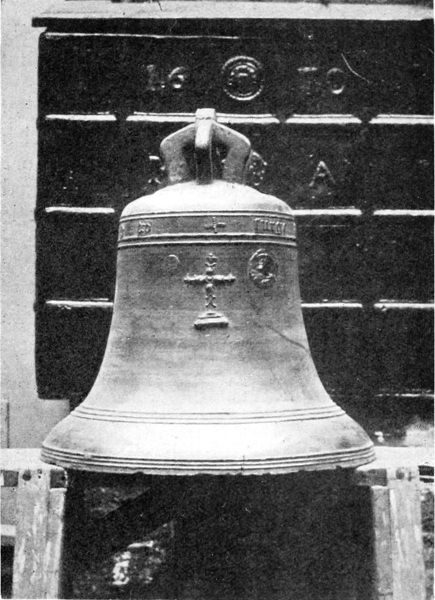
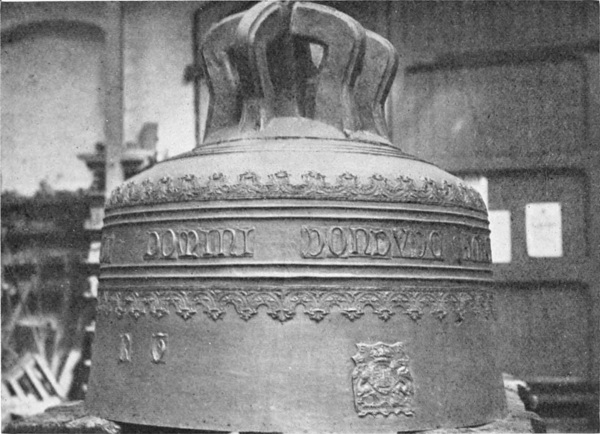
seventeenth century or even later (see
Plate 38); and it is only the character of
the ornamentation which is changed.
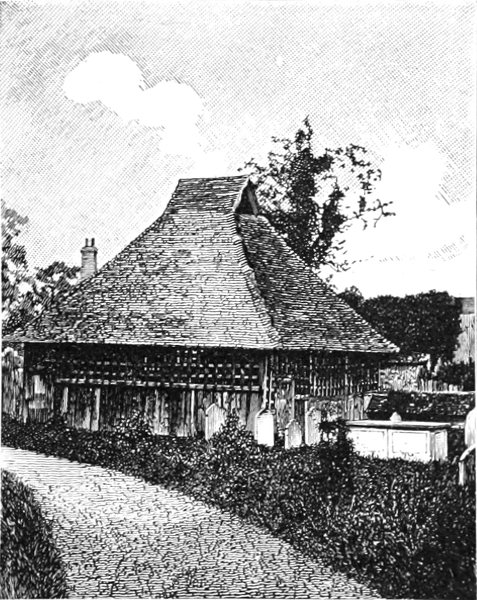
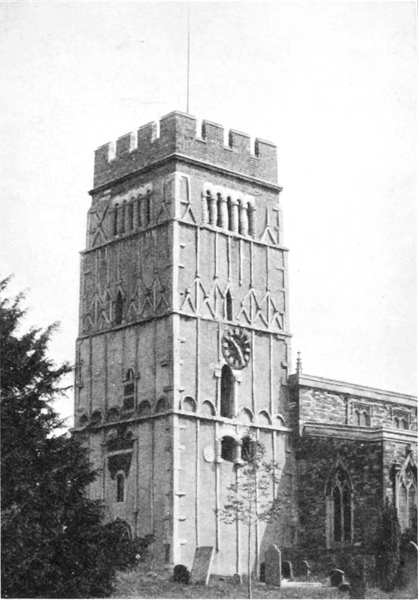
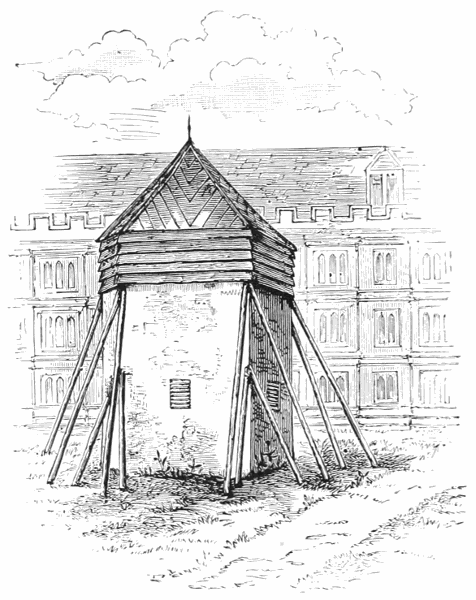
The “Bell House” in the Churchyard at East
Bergholt, Suffolk.
(See page 64.)
In point of fact the earliest bells are
usually the plainest, and the mediaeval
craftsman contented himself with devoting
his skill to producing elegant and artistic
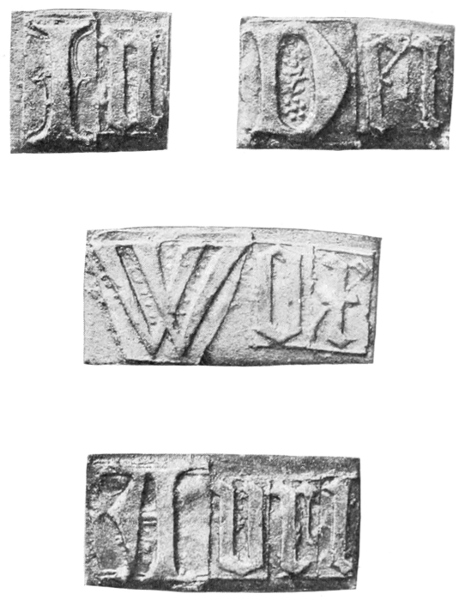
lettering, beautiful initial crosses, or ingenious
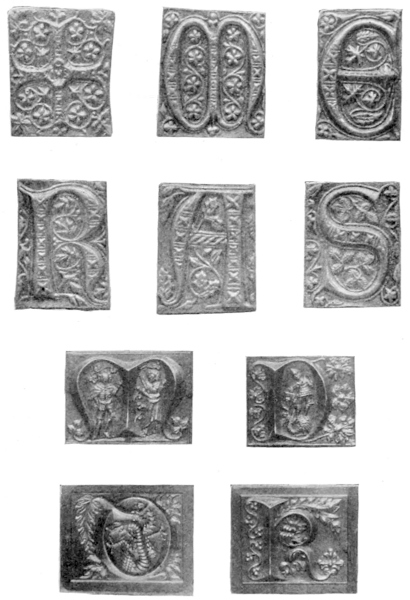
foundry marks (Plates 14, 36).
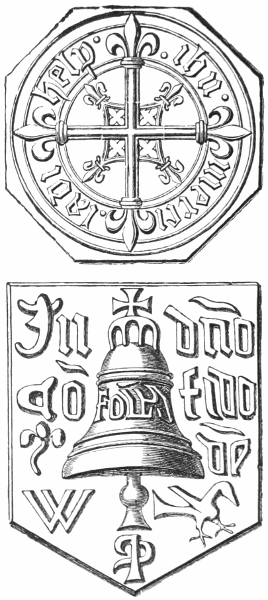
The latter were introduced about the
end of the fourteenth century, when, as
we have seen in an earlier chapter, the
guild of braziers or “belleyeteres” were
more regularly organized. Those used
by Henry Jordan (see page 29) are good
examples; as are the shields of the
Bury and Norwich foundries (page 30). In
the West and North of England such
devices are rarer; but badges, such as
the Bristol ship, or the Worcester “Royal
Heads,” take their place. One or two
of the London founders use the symbols
of the four Evangelists (Plate 34). A
favourite device is the merchant’s mark,
a kind of monogram, or the rebus, a
pictorial pun on the founder’s name.
John Tonne, who worked in Sussex and
Essex about 1520–1540, decorated his
bells in the French fashion, with large
florid crosses, busts and figures, and
other devices (Plate 35).
Initial crosses are almost invariably found
on mediaeval bells, and their variety is endless,
from the plainest form of Greek
cross to the elaborate specimen shown on
Plate 36, which is found in the Midland
counties. The words were frequently
divided by stops, varying from a simple
row of three dots ⠇ to such devices as a
wheel, a rosette, or an ornamented oblong
panel. Impressions from coins pressed
into the mould are by no means uncommon.
But often the chief or sole beauty of a
mediaeval bell is its lettering. In the
fourteenth century this is invariably composed
of capital letters throughout, of
the ornamental form known as Gothic or
Lombardic (Plate 36). Towards the end
of that century the black-letter text used
in manuscripts was introduced into other
branches of art, such as brasses, and thus
also makes its appearance on bells. But
the initial letter of each word is still
executed in the old Gothic capitals, and
such inscriptions are known as “Mixed
Gothic” (Plate 37), later ones of the sixteenth
century being more strictly styled
“black-letter,” where no capitals are used.
The change, however, was not universal,
and many of the foundries in the West
and North of England preferred to adhere
to the capitals down to the Reformation;
while even in London, as at Leicester,
Reading, and elsewhere, there was a distinct
revival of inscriptions in capitals
during the sixteenth century.
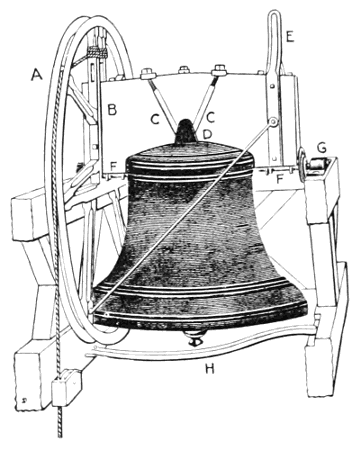
Diagram showing method of hanging a
bell for ringing (see page 68).
| A. | Wheel with rope attached. |
| B. | Headstock. |
| CC. | Straps or Keys. |
| D. | Cannons (modern form). |
| E. | Stay. |
| FF. | Gudgeons. |
| G. | Brasses (in which the gudgeons revolve). |
| H. | Slider. |
The reign of Queen Elizabeth is usually
regarded as a period of transition, and
there was, before the general introduction
of modern Roman lettering, a time when
no general rule was observed. Some
founders used Gothic capitals; others
black-letter; others again, nondescript
ornate capitals difficult to classify; while
the Roman lettering, introduced about
1560–70, gradually ousted all the older
styles from favour, and with very few
exceptions became general about 1620.
The use of older lettering and stamps by
many founders during this “transition”
period is noteworthy. The Leicester
founders were especially addicted to this
practice, and among other old stamps
bought up the beautiful lettering and
ornaments used by the Brasyers, of Norwich,
in the fifteenth century. Henry
Oldfield of Nottingham (1580–1620), and
Robert Mot of London (1575–1608), may
also be mentioned under this head.
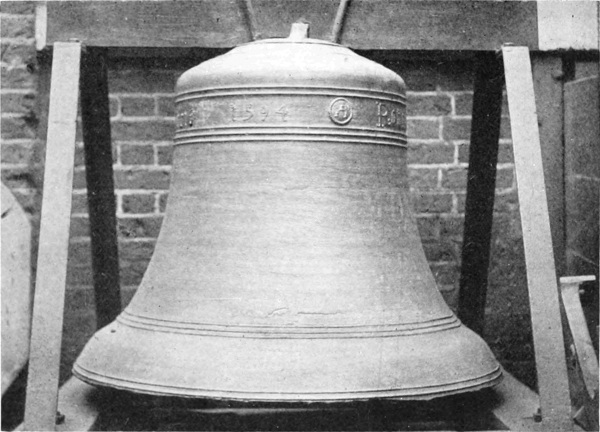
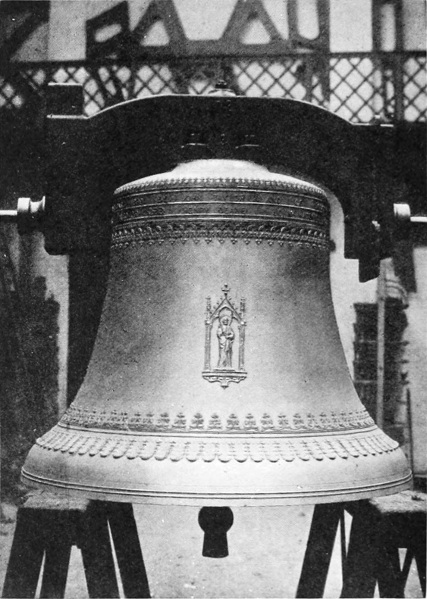
I have said that seventeenth century bells
were often very richly decorated; and the
ornamental running borders or elaborate
arabesque patterns which separate the
words of the inscriptions or surround
the upper and lower edges of the bells,
surpass in that respect anything attempted
in mediaeval times (Plate 38). Thomas
Hancox of Walsall (1620–1640) adorned
his bells with reproductions of mediaeval
seals; and as late as the beginning of the
eighteenth century the Cors of Aldbourne,
in Wiltshire, bought up a lot of pieces of
old brass ornaments from which they used
to decorate their bells. At Malmesbury
and Tisbury in that county they have left
bells covered with figures of cherubs, coats
of arms and monograms, a medallion of
the Adoration of the Wise Men, and
other curious ornaments. Most of these
founders, such as John Martin of Worcester,
Oldfield of Nottingham, and
Clibury of Wellington, used trade-marks
with their initials, and a bell or other
device.
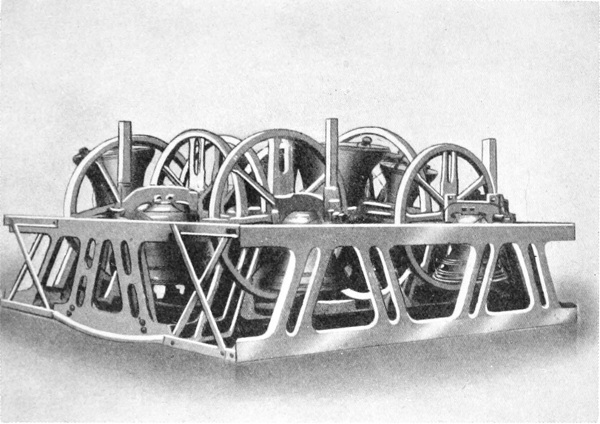
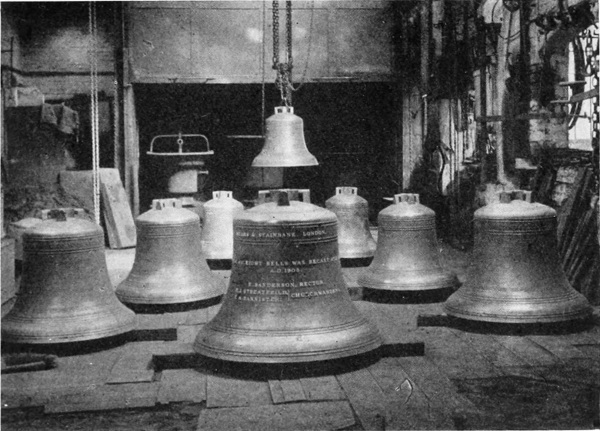
Peal of Eight Bells (Tenor 16 cwt.) for Aberavon Church, Glamorganshire.
This is an example of an ordinary English peal constructed for change-ringing and shows
some of the bells “up,” ready for ringing. In this case the frame and stocks are of iron and
the bells are without cannons.
Seventeenth-century Roman lettering,
although plain, is often most effective and
artistic; capitals are almost always used
throughout, and small Roman letters are
very rare. It is not until the middle of
the next century that it was replaced by
the dull mechanical printing types which
are characteristic of the present day. But
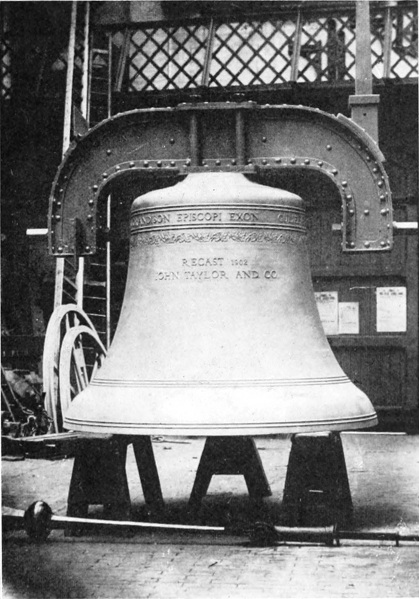
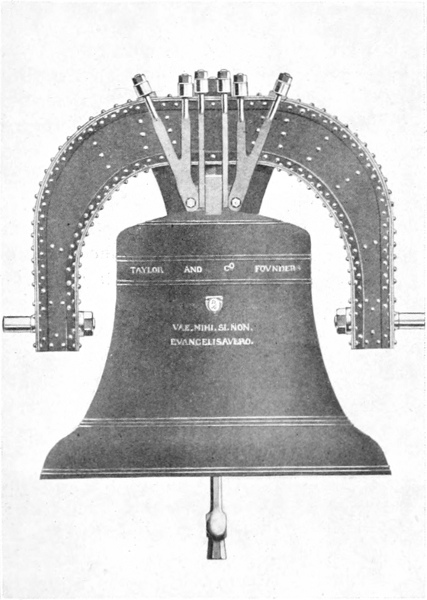
since the Gothic revival several modern
founders have re-introduced capital letters
of the old style with good effect; notably
the Taylors of Loughborough. Nowadays,
however, there is little attempt at
ornamenting bells; not only the usual
inscription-band on the shoulder, but the
whole surface of the bell is utilized for
immortalizing local officials and celebrities.
On a bell recently cast for a church on the
outskirts of London are given the names,
not only of the Vicar, Bishop, and Archbishop,
but of the Prime Minister, Member
of Parliament, and Chairman of the District
Council!
So far little has been said about the
inscriptions placed on bells; but as these
form one of the most interesting features
of the subject, they demand some little
attention.
The earliest inscriptions, those of the
fourteenth century, were usually in Latin,
and very simple in form. We find merely
a name such as IESVS or IOHANNES, or such
phrases as CAMPANA BEATI PAVLI, “the
bell of blessed Paul,” or IN HONORE SANCTI
LAURENCII, “in honour of Saint Lawrence.”
More rarely, the founder’s name, as—
MICHAEL DE VVYMBIS ME
FECIT
“Michael de Wymbis made me.”
ION ME YEYT
“John cast me.”
Other forms of inscription soon became
common, especially the simple invocation
to a saint—
“Sancte Petre (or ‘Sancta Katerina’) ora pro nobis.”
“Saint Peter,” or “Saint Katherine, pray for us.”
By one founder, whose theology was
somewhat confused, the Holy Trinity
itself was similarly invoked—
“Sancta Trinitas ora pro nobis.”
He should have said “miserere nobis,”
“have mercy upon us,” as in our Litany.
What are known as “leonines,” or
rhyming hexameter verses, are also very
popular, such as—
IN MULTIS ANNIS RESONET
CAMPANA IOHANNIS
“For many years let the bell of John resound.”
VIRGINIS EGREGIE VOCOR
CAMPANA MARIE
“I am called the bell of Mary the excellent Virgin.”
MISSI DE CELIS HABEO
NOMEN GABRIELIS
“I have the name of heaven-sent Gabriel.”
VIRGO CORONATA DUC NOS
AD REGNA BEATA
“Crowned Virgin, lead us to realms of bliss.”
SUM ROSA PULSATA MUNDI
KATERINA VOCATA
“I am the rose of the world, when struck, called
Katherine.”
Most frequent of all is the Angelic
salutation (S. Luke i. 28):
AVE MARIA GRACIA PLENA
DOMINUS TECUM
sometimes found in an English form as—
“HAIL MARY FUL OF GRAS”
(“Full of grace”).
There are said to be altogether seventy
different forms of dedication to the Blessed
Virgin. She is by far the favourite saint
with bell-founders, though S. Katherine
(possibly on account of her emblem the
wheel) was their special patron. On the
whole the dedications correspond fairly to
those favoured for churches; but we note
that S. Andrew, S. James, and S. Paul,
are rarely found, whereas S. Anne and
S. Gabriel are more common. We must
not expect to find bells necessarily dedicated
to the patron saints of their churches;
it is in fact exceptional, and possibly the
name was determined by that of some
guild or chantry. Where they are the
same it is usually the tenor; but the old
ring of five at S. Bartholomew, Smithfield,
has the treble dedicated to that saint.
Among texts of scripture are also found
SIT NOMEN DOMINI BENEDICTUM
“Blessed be the Name of the Lord” (Job i. 21).
IESVS NAZARENVS REX IVDEORVM
“Jesus of Nazareth the King of the Jews”
(S. John xix. 19).
BEATVS VENTER QVI TE PORTAVIT
“Blessed is the womb that bare thee” (S. Luke xi. 27).
But such texts become commoner in the
seventeenth century. An early post-Reformation
example is at Hannington,
Northants:
LOVE HORTETH NOT (Rom. xiii. 10).
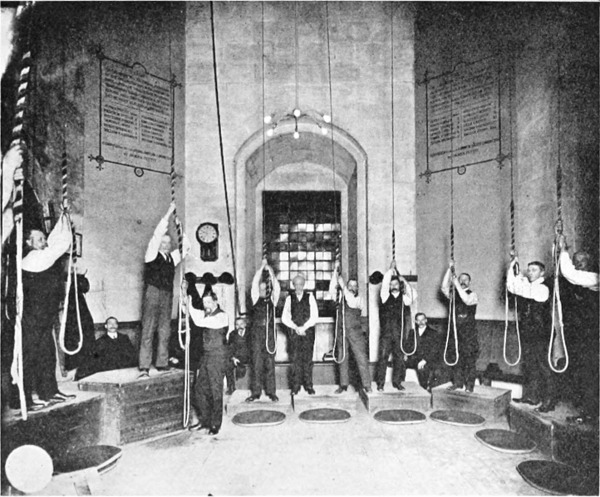
Ringers at S. Paul’s Cathedral Ringing a Peal on New Year’s Eve
on the Twelve Bells. (See page 75).
Sometimes a bell bears a prayer for its
donor, or for his soul, as at Goring,
Oxfordshire—
ORATE PRO PETRO
EXONIENSE EPISCOPO,
“Pray for Peter, Bishop of Exeter.”
This was Peter Quivil, Bishop about 1290.
Or at Bolton-in-Craven, Yorkshire—
Sc’e Paule, ora pro a’i’abus Henrici
Pudsey et Margarete consorte sue
“St. Paul, pray for the souls of Henry Pudsey and
Margaret his wife.”
In these cases we are enabled to gain a
clue to the date of the bell, a piece of information
rarely found given in mediaeval
times. Henry Pudsey, for instance, died
about 1510. There is an interesting bell at
Aldbourne, in Wiltshire, dated 1516, with
a prayer for the souls of Richard Goddard
of Upham, his two wives and his children.
It is said that this is the only known
record of his double marriage, though the
family is an old one, well known in those
parts.
English inscriptions are very rare, but
when found are often very quaint, as at
Snowshill, in Gloucestershire—
“IN NAME OF TRINITE;
GILLIS [Giles’] BELLE MEN
CALLE ME”;
or at Alkborough, in Lincolnshire—
“JESU FOR YI MODIR [the
Mother’s] SAKE
SAVE AL YE SAULS THAT ME
GART MAKE [had made] AMEN.”
The Reformation brought about a great,
though not an immediate but gradual,
change in the character of bell inscriptions.
We often find about this time the whole
or a portion of the alphabet; and it has
been supposed that the founder wished to
use his old stamps, but was afraid of
giving offence by adhering to the old style
of inscription, and so arranged the letters
in a fashion to which none could object!
But right through the Reformation period,
the reign of Elizabeth, and the ensuing
Stuart period, it is by no means rare to
find the old formulae repeated. It is
possible that ignorant founders reproduced
them when recasting bells, without realizing
their meaning, or that they trusted to
the inaccessibility of belfries, not to be
found out! Still the fact remains, not
only that more “Popish” inscriptions
were left intact by Reformer and Puritan
on bells than on any other part of the
fabric of churches, but also that prejudice
and fanaticism here seems to have played
a smaller part. Yet there are indications
of Protestant zeal on the part of some
seventeenth-century founders. Tobie
Norris of Stamford (1603–1626) is fond
of proclaiming—
NON SONO ANIMABVS MORTVORVM SED
AVRIBVS VIVENTIVM
“I sound not for the souls of the dead but for the
ears of the living”;
and William Purdue of Bristol, in 1678,
perhaps with the fear of James II’s advent
to the throne before his eyes, gives vent
to the prayer:
LORD BY THY MIGHT KEEP US FROM
POOPE AND HYPOCRITE,
at Stanley S. Leonard, Gloucestershire.
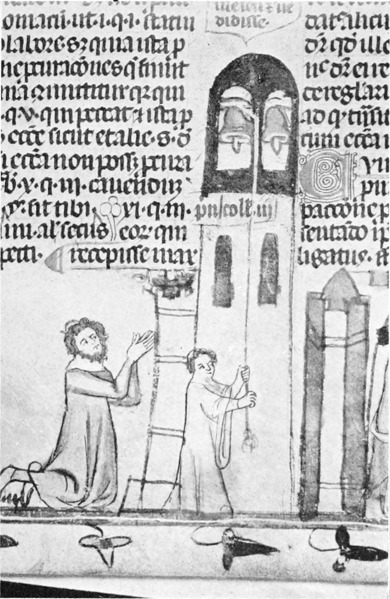
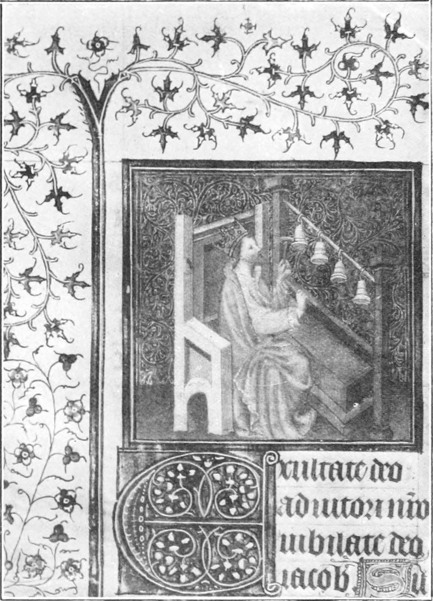
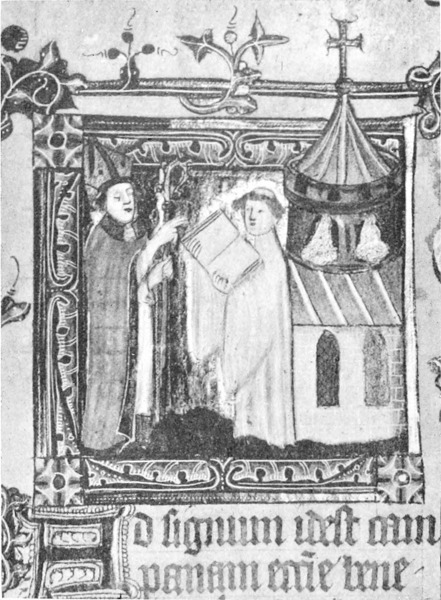
The Ringing of the Sacring Bell by a Clerk
in Minor Orders.
From a Manuscript in the British Museum.
(See pages 68, 88).
For the most part the inscriptions of
this period are, when not merely churchwardens’
names, coloured with a piety
which finds vent in quaint and homely
expressions, such as “FEARE GOD,” “IESVS
BEE OVR SPEED,” “IN GOD IS MY HOPE.”
They remind us of the bells of Rylstone,
in Yorkshire, of which Wordsworth
says:
“When the bells of Rylstone played
Their Sabbath music—God us ayde—
Inscriptive legend, which I ween,
May on those holy bells be seen.”
He was, however, unfortunately misinformed,
as the true inscription (on one
bell) was, “In God is all.” Other attempts
are more ambitious, such as—
I AM A CRIER IN THE HOUSE OF GOD
COME AND KIP [keep] HOLI,
at Witcomb, Gloucestershire (1630), or—
BE MECKE AND LOLY TO HEARE THE
WORD OF GOD,
at Chichester Cathedral (1587). Some of
these inscriptions are on bells by John
Wallis of Salisbury, of whom it has been
said, “If we estimate him by his works
he was a great man; and if we take
his laconic epigraphs as an index of his
heart, he was a trustful, thankful, religious
character.” They are, at all events,
characteristic of the sober and straightforward
piety of the days of George
Herbert and Bishop Andrewes. Three
more characteristic expressions of the
period are largely used by the Nottingham
founders:
“I sweetly toling men do call to taste on meate
that feeds the soule.”
“All you who hear my roaring sound repent
before you lie in ground.”
“My roaring sound doth warning give that men
may not here always live.”
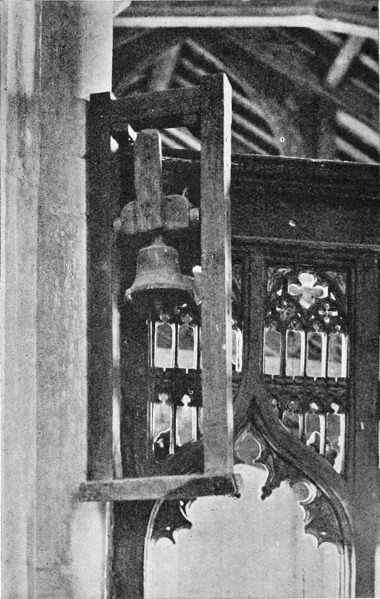
Sacring Bell hung on Rood-Screen, Scarning
Church, Norfolk. (See page 88).
Other founders, like Tobie Norris,
already quoted, preferred to use Latin.
Another favourite of his is—
NON CLAMOR SED AMOR CANTAT IN
AVRE DEI
“The sound that reacheth God above
Is not a clang but voice of love.”
A very beautiful Latin inscription, and
most remarkable for the time when it was
composed (1651), is on the tenor at
Stockton, Salop; it runs in English—
“Glory in the highest to God the Father, Son,
and Holy Ghost; William Whitmore, Knight,
patron and restorer of this church, now called to the
Church triumphant, vowed and designed me for the
use of the Church militant.”
More quaint than edifying are the
following, found at Thatcham in Berkshire—
| 1. | I AS TREBIL BEGIN |
| 2. | I AS SECOND WIL SING |
| 3. | I AS THIRD WIL RING |
| 4. | I AS FORTH IN MY PLACE |
| 5. | I AS FIFT WILL SOVND |
| 6. | I AS TENNAR HVM ALL ROVND. |
We pass from these to others of the
same period, which show a sad falling-off
in poetry and sentiment. Early in the
seventeenth century the deplorable habit
of self-advertisement was begun by the
Newcombes of Leicester, who invented
the distich—
BE YT KNOWNE TO ALL THAT DOTH ME SEE
THAT NEWCOMBE OF LEICESTER MADE ME.
This is adopted, but not improved, by
later founders, as by Henry Farmer of
Gloucester, who, on a bell of 1623, at
Throckmorton, in Worcestershire, proclaims—
BE IT KNOWNE TO ALL THAT SHALL VS SEE
THAT HENRIE FARMER MADE WE 4 OF 3.
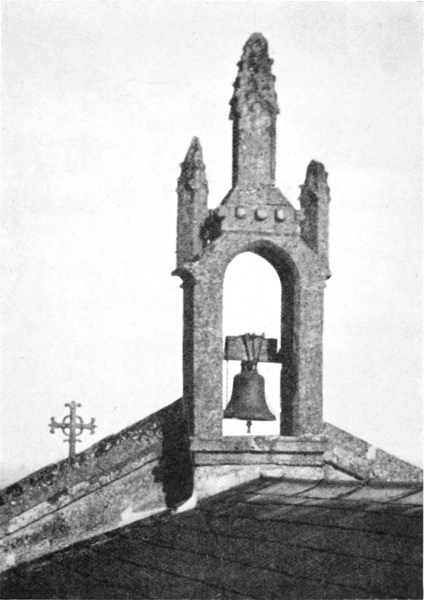
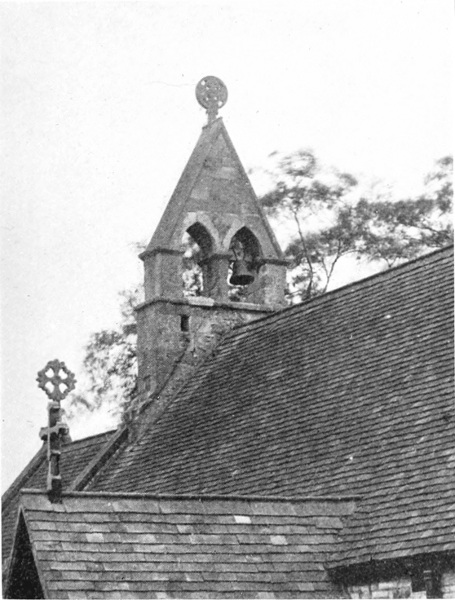
Ancient Sanctus Bell (Fourteenth Century).
In its Original Cot over the Chancel Arch of Idbury Church,
Oxfordshire. (See page 88).
Worse depths are reached by Richard
Keene of Woodstock on two bells at
Brailes, Warwickshire. On one is—
IME NOT THE BELL I WAS BUT QUITE ANOTHER
IME NOW AS RIGHT AND TRUE AS GEORGE MY BROTHER.
On the other—
I’LL CRACK NO MORE NOW RING YOUR FILL
MERRY GEORGE I WAS AND WILL BE STILL.
This style of inscription is even more
characteristic of the early eighteenth
century; and we find at Meriden, in
Warwickshire—
WHEN MY FIRST AND THIRD BEGIN TO RING
MY THIRD WAS BROKE BEFORE WE ALL DID SING.
There is a pun here on the name of the
founder, William Brooke. An even worse
punster is Henry Pleasant of Sudbury,
who at All Saints’, Maldon, placed on four
of the bells the following effusions—
(1) WHEN THREE THIS STEEPLE FIRST DID HOLD
(2) WE WERE THREE EMBLEMS OF A SCOLD
(3) NO MUSICK THEN BUT NOW [YOU] SHALL SEE
(4) WHAT PLEASANT MUSICK SIX WILL BE.
Joseph Smith of Edgbaston, another
would-be poet, has several inscriptions of
this class, as at Alvechurch, Worcestershire—
IF YOU WOULD KNOW WHEN WE WARE RUNN
IT WAS MARCH THE 22, 1711 [i.e., “seventeen-one-one”].
Yet another type of vulgarity is to be
found at Bakewell, Somerset—
BILBIE AND BOOSH MAY COME AND SEE
WHAT EVANS AND NOTT HAVE DONE FOR ME.
When we reach the middle of the
century a change comes over the inscriptions,
though hardly one for the better.
The frivolous doggerel rhymes are replaced
by prim, though not always decorous,
couplets which seem to be
thoroughly characteristic of that period.
In fact, so greatly was Methodism feared
by the correct and worldly churchmen of
Georgian days that we actually find on a
bell at Welwyn, Herts.—
PROSPERITY TO THE CHURCH OF ENGLAND
AND NO ENCOURAGEMENT TO ENTHUSIASM.
The most typical specimens, however,
are on the bells of the London founders at
this period—
AT PROPER TIMES OUR VOICES WE WILL RAISE
IN SOUNDING TO OUR BENEFACTORS’ PRAISE.
WHEN FEMALE VIRTUE WEDS WITH MANLY WORTH
WE CATCH THE RAPTURE AND WE SPREAD IT FORTH
MAY ALL WHOM I SHALL SUMMON TO THE GRAVE
THE BLESSINGS OF A WELL-SPENT LIFE RECEIVE.
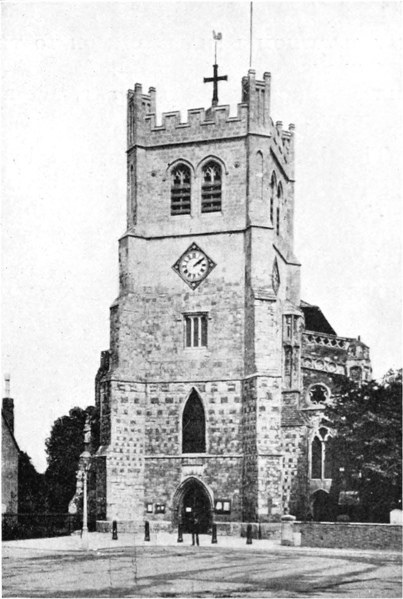
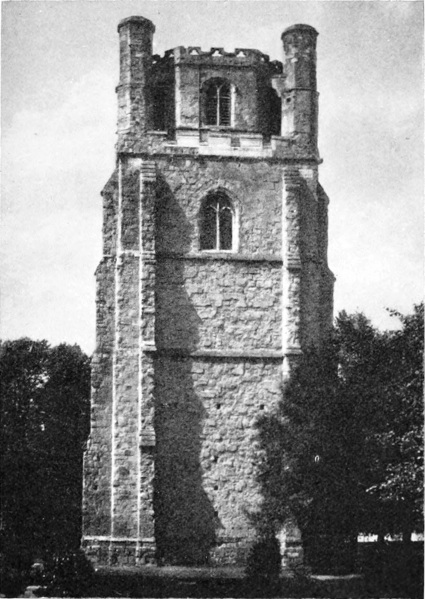
Tower of Waltham Abbey Church, Essex.
The Bells of which inspired Tennyson’s well-known lines.
(See page 90).
The last-named was composed by a
Shropshire schoolmaster, who also devised
verses of the same type for bells in his
own church of High Ercall. One example
may be given—
WHERE MEANDRING RODEN GENTLY GLIDES
OR TURNE’S PROUD CURRENT FILLS ITS AMPLE SIDES
HENCE MEDITATION VIEWS OUR CALM ABODE,
HEALS THE SICK MIND, AND YIELDS IT PURE TO GOD.
The Rudhalls of Gloucester, who were
typical “Church and State” men, usually
place on their tenor bells the familiar
couplet—
I TO THE CHURCH THE LIVING CALL
AND TO THE GRAVE DO SUMMON ALL.
Perhaps the worst specimen of the taste
of this period is to be found at Hornsey,
in Middlesex—
THE RINGER’S ART OUR GRACEFUL NOTES PROLONG;
APOLLO LISTENS AND APPROVES THE SONG.
Doubtless this seemed appropriate
enough to an age which adorned its
tombs and churchyards with cupids, urns,
and such-like pagan emblems.
Other examples of this kind from the
provinces are—
THE PUBLIC RAISED ME WITH A LIBERAL HAND;
WE COME WITH HARMONY TO CHEER THE LAND [Stroud].
ALL YOU OF BATH THAT HEARE ME SOUND
THANK LADY HOPTON’S HUNDRED POUND [Bath Abbey].
Some inscriptions again are of historical
interest, such as at Child Okeford, Dorset,
where, in 1648,
was actually placed on a bell by a founder
who must have had the courage of his
convictions! It need hardly be pointed
out that the royal cause was just then at
the depth of unpopularity. The eight
bells of S. Helen’s, Worcester, bear the
names of Marlborough’s victories in
Queen Anne’s reign, with an appropriate
couplet in each case. Other bells, such
as the great bell of Glasgow Cathedral,
and the tenor of Stepney, London, record
their own history from mediaeval times
down to their latest re-casting.
A curious form of inscription found on
seventeenth-century bells, and sometimes
revived at the present day, is the chronogram,
where the date is given by Roman
letters of a larger size than the rest of the
inscription, as at Clifton-on-Teme, Worcestershire—
henrICVs Ieffreys keneLMo DeVoVIt,
where the letters MDCLVVVIII in numerical
order read as the date 1668.
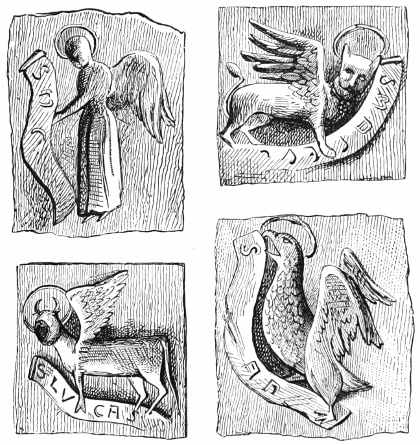
Symbols of the Four Evangelists.
Used as stamps by London bell-founders of the fifteenth
century. (See pages 106, 108.)
It is one of the many debts that we owe
to the Church Revival of the last century
that such desecrations of our bells as
quoted above are now a thing of the
past. If our modern bells are often
very dull affairs as regards their decoration
or inscriptions, we can at least be
thankful that profanity and frivolity have
disappeared. Though as I have already
noted, a tendency to self-advertisement
is still too apparent, there has been a
great change in the last fifty years, and
the improvement in the choice of inscriptions
is most marked. Those to whom
such things are a concern have begun to
realize that a bell is a vehicle of history,
and that, therefore, its history should be
duly recorded and preserved. But what
is of far more importance, they have also
learned to look upon it as an instrument
destined for God’s service—as one of the
“Ornaments of the Church”—and therefore
just as deserving of honour as any
other furniture of God’s house.