Author of “Squinty, the Comical Pig,” “Mappo, the
Merry Monkey,” “Tum Tum, the Jolly
Elephant,” “Tinkle, the Trick Pony,”
“Lightfoot, the Leaping Goat,” etc.
ILLUSTRATED BY
WALTER S. ROGERS
PUBLISHERS BARSE & CO.
NEW YORK, N. Y. NEWARK, N. J.
Once upon a time, some years ago, but
not so long that you could not easily
remember if you tried, there lived in a
muddy river of a far-off country called Africa,
a great, big, animal-baby named “Chunky.”
He was not a fish, though he could stay under
water, not breathing at all, for maybe ten minutes,
and that is why he swam in the muddy river
so much. He did not mind the mud in the river.
He rather liked it, for when he sank away down
under the dark, brown water no one could see
him.
And Chunky did not want any of the lions or
tigers, or perhaps the black African hunters to
see him, for they might have hurt him.
But, for all that, Chunky was a happy, jolly,
little animal-baby, and would soon grow up to be
a big animal boy, for he ate pecks and pecks of
the rich, green grass that grew on the bottom and
banks of the African river.
Now, I suppose, you are wondering what sort
of animal-baby Chunky was. In the first place
he was quite large—as large as the largest fat
pig on your grandfather’s farm. And Chunky
really looked a little like a pig, except that his
nose was broad and square instead of pointed.
Chunky was a hippopotamus, as perhaps you
have guessed. But, as hippopotamus is quite a
long and hard word for little boys and girls to
remember, I will first tell you what it means, and
then I will make it short for you, so you will have
no hard work at all to remember it, or say it.
Hippopotamus means “river-horse”; and a
great many years ago when people first saw the
queer animals swimming in the African rivers,
they thought they were horses that liked to be in
the water instead of on land. So that is how the
hippopotamus got its name of river horse. But
we’ll call them hippos for short, and it will do
just as well.
Chunky was called the happy hippo. And he
was very happy. In fact when he opened his
big mouth to swallow grass and river weeds you
might have thought he was laughing.
Chunky lived with Mr. and Mrs. Hippo, who
were his father and mother, in a sort of big nest
among the reeds and bushes on the bank of the
river. Near them were other hippos, some large
and some small, but Chunky liked best to be with
his own folks.
Besides his father and mother, there was
Mumpy, his sister, and Bumpy, his brother.
Funny names, aren’t they? And I’ll tell you
how the little hippos happened to get them.
One day, when Chunky didn’t have any name,
nor his brother or sister either, a great, big, fat
hippo mother came over to see Mrs. Hippo.
The visitor, whose name was Mrs. Dippo, as we
might say, because she liked to dip herself under
the water so much—this Mrs. Dippo said, talking
hippopotamus talk of course:
“My, what nice children you have, Mrs.
Hippo.”
“Yes, they are rather nice,” said Mrs. Hippo,
as she looked at the three of them asleep in the
soft, warm mud near the edge of the river. You
may think it queer for the little hippo babies to
sleep in the mud. But they liked it. The more
mud they had on them the better it kept off the
mosquitoes and other biting bugs.
“Have you named them yet?” asked Mrs.
Dippo.
“Not yet,” answered Mrs. Hippo. “I’ve been
waiting until I could think of good names.”
“Well, I’d call that one Chunky,” said Mrs.
Dippo, pointing with her left ear at the largest
of the three little hippos. Mrs. Dippo had to
point with her ear, for she was too heavy to raise
one foot to point and stand on three. She had
only her ears to point with. “I’d call him
Chunky,” said Mrs. Dippo.
“Why?” asked Mrs. Hippo.
“Oh, because he’s so jolly-looking; just like
a great, big fat chunk of warm mud,” answered
Mrs. Dippo. “Call him Chunky.”
“I will,” said Mrs. Hippo, and that is how
Chunky got his name.
“Now for your other two children,” went on
Mrs. Dippo. “That one,” and she pointed her
ear at Chunky’s sister, “I should call Mumpy.”
“Why?” Mrs. Hippo again asked.
“Oh, because she looks just as if her cheeks
were all swelled out with the mumps,” answered
Mrs. Dippo. For animals sometimes have
mumps, or pains and aches just like them. But
Chunky’s sister didn’t have them—at least not
then. The reason her cheeks stuck out so was
because she had a big mouthful of river grass on
which she was chewing.
“Yes, I think Mumpy will be a good name for
her,” said Mrs. Hippo, and so Chunky’s sister
was named. Then there was left only his
brother, who was younger than Chunky.
Just as Mrs. Dippo finished naming the two
little animal children, the one who was left without
a name awakened from his sleep and got up.
He slipped on a muddy place near the bank of
the river and bumped into Chunky, nearly
knocking him over.
“Oh, look out, you bumpy boy!” cried Mrs.
Hippo, speaking, of course, in animal talk.
“Ha! That’s his name!” cried Mrs. Dippo,
with a laugh.
“What is?” asked Mrs. Hippo.
“Bumpy!” said Mrs. Dippo. “Don’t you see?
He bumped into Chunky, so you can call him
Bumpy!”
“That’s a fine name,” said Mrs. Hippo, and
Bumpy liked it himself.
So that is how the three little hippos were
named, and after that they kept on eating and
growing and growing and eating until they were
quite large—larger even than pigs.
One day, Mr. and Mrs. Hippo and most of
their animal friends were quite far out in the
river, diving down to dig up the sweet roots that
grew near the bottom. Chunky, Mumpy and
Bumpy were on the bank lying in the sun to get
dry, for they had been swimming about near
shore.
“Are you going in again?” asked Mumpy, of
her brothers, talking, of course, in the way hippos
do.
“No, I’ve been in swimming enough to-day,”
said Bumpy. “I’m going back into the jungle
and sleep,” for the river where the hippos lived
was near a jungle, in which there were elephants,
monkeys and other wild animals.
“I’m going in the water once more,” said
Mumpy. “I haven’t had enough grass to eat.”
“I haven’t, either,” said Chunky, who was fatter
than ever and jollier looking. “I’ll go in
with you, Mumpy.”
So the two young hippos walked slowly down
to the edge of the deep, muddy river. Far out
in the water they could see their father and
mother, with the larger animals, having a swim.
Chunky and Mumpy walked slowly now, though
they could run fast when they needed to, to get
away from danger; for though a hippo is fat and
seems clumsy, and though his legs are very short,
he can, at times, run very fast.
And as they went slowly along, Chunky and
Mumpy looked about on all sides of them, and
sniffed the air very hard. They were trying to
see danger, and also to smell it. In the jungle
wild animals can sometimes tell better by smelling
when there is danger than by looking. For
the tangled vines do not let them see very far
among the trees, but there is nothing to stop them
from smelling unless the wind blows too hard.
“Is everything all right, Chunky?” asked
Mumpy of her brother, as she saw him stop on
the edge of a patch of reeds just before going into
the water, and sniff the air very hard.
“Yes, I think so,” he answered in hippo talk.
For his father and mother had taught him something
of how to look for danger and smell for it—the
danger of lions or of tigers or of the black
or white hunter men who came into the jungle to
shoot or catch the wild animals.
“Come on, Mumpy!” called Chunky. “We’ll
have another nice swim.”
“And we’ll get some more sweet grass to eat—I’m
hungry yet!” replied the little girl hippo;
for animals, such as elephants and hippos who
live in the jungle or river, need a great deal of
food.
Out to the edge of the river went Chunky and
his sister. They saw some other young hippos—some
mere babies and others quite large boys
and girls, as we would say—on the bank or in
the water.
Just as Chunky and Mumpy were going to
wade in, they noticed, on a high part of the bank,
not far away, a fat hippo boy who was called Big
Foot by the jungle animals, as one of his feet was
larger than the other three.
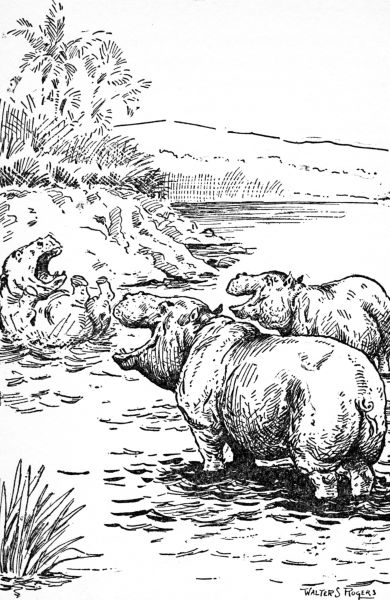
“Watch me jump into the river!” called Big
Foot.
Then, when they were all looking, and he
thought, I suppose, that he was going to do something
smart, he gave a jump and splashed into
the water. But something went wrong. Big
Foot stumbled, just as he jumped, and, instead of
making a nice dive, he went in backward and
made a great splash.
“Ha! Ha! Ha!” laughed Chunky, wagging
his stubby tail. “Ho! Ho! I can jump better
than that, and I’m not as large as you, Big Foot!
Ha! Ha!” and Chunky laughed again. “That
was an awful funny jump!”
Big Foot climbed out of the water up on the
bank. His eyes, which seemed like lumps or
bumps on his head, appeared to snap at Chunky
as he looked at him and Mumpy.
“Some one laughing at me, eh?” growled Big
Foot in his deep voice. “Ha! I’ll show you!
Why are you laughing at me?” he asked, and he
went so close to Mumpy that he bumped into her
and almost knocked her into the river.
“Here! You let my sister alone!” bravely
cried Chunky, stepping close to Big Foot.
“Well, what did she want to laugh for when I
splashed in the water?” asked Big Foot.
“I didn’t laugh,” answered Mumpy, speaking
more gently than did the two boy hippos.
“No, she didn’t laugh. I laughed,” said
Chunky, and his sister thought he was very brave
to say it right out that way. “I laughed at you,
Big Foot,” said Chunky. “You looked so funny
when you fell into the water backwards. Ha!
Ha!” and Chunky laughed again.
“So! You’ll laugh at me, will you?” asked
Big Foot, and his voice was more angry. “Well,
I’ll fix you!” and with a loud grunt, like a great
big pig, he rushed straight at Chunky.
CHAPTER II CHUNKY IS SURPRISED
“Oh, Chunky!” cried Mumpy, as she
saw Big Foot rushing at her brother.
“Oh, Chunky, come on home!”
“Pooh! I’m not afraid of him!” said Chunky,
as he stood still on the river bank and looked at
the on-rushing Big Foot.
“I’ll go and call father,” went on Mumpy, as
she waded into the water and began to swim out
toward the grown hippos where they were having
fun of their own in the river.
“I’ll show you that you can’t laugh at me!”
grunted Big Foot, who came on as fast as he
could. “I’ll bite you and push you into the
river, and see how you like that.”
“Pooh! I’m not afraid!” said Chunky again,
but really he was, a little bit.
Of course, if you had been in the jungle, or
hidden among the reeds on the bank of the African
river, you would not have understood what
Chunky and Big Foot said. In fact, you would
not even have guessed that they were talking;
but they were, all the same, though to you the
noises they made would have sounded only like
grunts, squeals and puffings. But that is the way
the hippos talk among themselves, and they mean
the same things you mean when you talk, only a
little different, of course.
“Oh, look! Big Foot is going to do something
to Chunky!” cried the other boy hippos,
and they gathered around to see what would
happen. For fights often took place among the
jungle animals. They did not know any better
than to bite, kick and bump into one another
when they were angry.
“I’ll fix you!” said Big Foot again.
“Pooh! I’m not afraid,” answered Chunky
once more, just as you may often have heard boys
say.
To tell the truth, Chunky would have been
glad to run away, but he did not like to do it with
so many of his young hippo friends looking on.
They would have thought him a coward. So he
had to stand and wait to see what Big Foot
would do.
On came the larger hippo boy, and, all of a
sudden, when he was quite close to Chunky, he
gave a jump and bumped right into him.
Chunky tried to get out of the way, but he was
not quick enough.
The next minute he found himself slipping
into the river, for Big Foot had knocked him off
the bank. But Chunky did not mind falling
into the water. He had been going in anyhow
for a swim with his sister. Chunky was not
hurt. No water even went up his nose, as it
does up yours when you fall into the water. For
Chunky could close his nose, as you close your
mouth, and not a drop of water got in.
“There, I told you I’d fix you for laughing at
me!” growled Big Foot, as he stood on the bank
and watched Chunky swimming around in the
water. “If you laugh at me any more I’ll push
you in again!”
“Oh, you will, will you?” exclaimed a voice
back of Big Foot. “Well, you just let my
Chunky alone after this! He can laugh if he
wants to, I guess!”
And with that Mrs. Hippo, who had quickly
swum to shore when Mumpy told her what was
going on, gave Big Foot a shove, and into the
water he splashed.
“Ha-ha!” laughed all the other hippo boys
and girls, as they saw what had happened.
“Look at Big Foot! Ha-ha-ha!”
Big Foot was very angry because Mrs. Hippo
had pushed him in. But when he saw all the
others laughing at him, he knew that he could
not knock them all into the water, as he had
knocked Chunky, so he made the best of it.
“Ha-ha!” laughed Chunky. “So you’re here
too, Big Foot! I saw my mother push you in.
She’s awful strong, she is! I hope she didn’t
hurt you. She didn’t mean to if she did. Here
are some nice sweet grass roots I dived down and
pulled up off the bottom of the river. Have
some?” and Chunky held out some in his mouth.
Now Big Foot liked grass roots very much
indeed, as did all the hippos. So, though he
still felt a little angry, he took them from
Chunky, and when the big boy hippo, with one
foot larger than his other three, had swallowed
the sweet, juicy roots he felt much better.
“They were good,” he said. “Thanks! And
say, I hope I didn’t hurt you when I shoved you
into the river just now, Chunky.”
“No, you didn’t,” Chunky answered. “And I
hope my mother didn’t hurt you when she shoved
you in.”
“Ho! Ho! I should say not!” answered Big
Foot, and he laughed now. “I’m sorry I got
mad,” he went on. “Come on, have a game of
water-tag!”
“All right,” said Chunky, “I will. Come on,
Mumpy!” he called to his sister. “We’re going
to have a game of water-tag.”
“Let’s all play!” cried Bumpo, who had not
after all gone away. Then he slid down the
river bank into the water.
“Yes, we’ll all play tag!” chimed in the rest
of the hippos, and they were soon swimming and
diving about in the water, splashing and bumping
into one another almost as you boys and girls
play when you go in bathing at the beach in the
summer. Only, of course, the hippos, being
very big, made heavy splashes.
“This is lots of fun!” cried Chunky, as he
tagged Bumpy and then dived to get out of the
way, for sometimes the hippos “tagged back,”
just as you children play.
“Yes, it’s jolly fun!” yelled Big Foot.
So the animal children swam, splashed and
dived in the water, having much more fun than
when the one was angry at the other and had
pushed him into the river.
All of a sudden, Mrs. Hippo, who had stayed
on the bank after making Big Foot behave, gave
a grunting cry.
“Quick!” she called in her own language.
“Swim ashore, all you little hippos! Swim
ashore, quick!”
“What’s the matter?” asked Big Foot. He
thought he was too large to mind without first
asking questions.
“Don’t stop to talk! Swim ashore as fast as
you can!” cried Mrs. Hippo.
Chunky, Bumpy and Mumpy, her own three
children-hippos, did as they were told, and paddled
for shore as fast as they could. For, though
a hippopotamus is a very big animal and looks
very clumsy, there are few as large as he who
can swim so well or so fast, or dive so easily.
On and on toward shore swam the hippo children,
who, a few seconds before, had been playing
tag. Last of all came Big Foot. As yet
neither he nor any of the others knew why Mrs.
Hippo wanted them to come ashore.
Big Foot partly turned in the water and looked
back. Then he saw what it was. A big crocodile,
which is something like an alligator, only
with a longer and more slender nose, or snout, its
mouth filled with long, sharp teeth, was swimming
after the little hippos.
“Is that why you wanted us to come ashore?”
asked Big Foot of Chunky’s mother, calling to
her as he swam toward land.
“Yes, indeed it is!” she answered, in her big
deep voice. “And don’t stop to ask any more
questions! Hurry!”
So they all hurried and got safely into shallow
water, where the crocodile dared not come, bold
and hungry as he was. He thought perhaps big
Mrs. Hippo would step on him and smash him.
A crocodile can grab hold of a baby hippo, and
take it away, but dare not touch a big hippo. So
this crocodile, with an angry snap of his teeth,
turned and swam back into the middle of the
river again, to wait for another chance to grab a
tender, baby hippo.
“My! how frightened I was!” said Mrs.
Hippo, when she saw that her own and the rest
of the animal children were safe. “I saw the
crocodile coming toward you, but you didn’t see
him because you were playing tag so hard.”
“It’s a good thing you called to us to swim out
of his way,” said Big Foot. “I’m much obliged
to you, Mrs. Hippo, and I’m sorry I pushed your
Chunky in!”
“Oh, you didn’t hurt me!” laughed Chunky,
as he stood on the bank and looked out to the
middle of the river, where he could just see the
nose of the crocodile in the water, as the long animal
swam away.
And then Chunky had another surprise, for
escaping from the crocodile surely was one.
All of a sudden, out from the jungle flew a lot of
birds, and before the hippos knew what was happening
the birds began to settle down on their
backs.
“Oh, look!” cried Chunky. “What are the
birds going to do?” he asked his mother. “Are
they going to bite me?”
“No; don’t be afraid, silly little hippo boy!”
she answered, with a loud laugh. “The birds
just came to get the snails and water bugs that
are sticking to your back. The river is full of
snails, and when you go in to swim they stick to
you. The birds like to pick them off and eat
them, and that’s what they’re doing now.”
And that is just what the birds were doing.
Out of the jungle they had flown, and they circled
around and lighted, one after another, on
the broad, flat backs of Chunky and the other
hippo children. The skin of a hippo is very
thick—two inches in some places—but there are
tender spots where mosquitoes, or bad bugs like
that, can bite. But on the backs of the hippos
nothing could bite through, and even when the
birds picked off the water spiders and snails with
their sharp bills the hippos did not feel it.
“Isn’t it funny to have birds on your back?”
said Chunky to Big Foot.
“Oh, it has happened to me before,” said the
larger hippo boy. “Of course you’re young yet—you’ve
got lots to learn.”
“Well, I’m glad the birds can get something to
eat off me,” laughed Chunky in his jolly way.
He laughed, in his own fashion, more than any
of the other hippos, and seemed quite happy, so
much so that often, when he was spoken of, he
was called “Chunky, the happy hippo.”
Here and there fluttered the birds on the backs
of the hippos, picking off the water insects,
which might get under the folds of the skin of
Chunky and his mates and pain them. So the
birds not only got a meal for themselves but they
helped the animals.
After a while all the bugs and snails were
picked off and the birds flew back into the jungle.
Chunky watched them as they sailed above the
tree tops, and then he, too, walked slowly into
the deep woods.
“Where are you going?” asked his sister.
“Oh, off into the jungle to have a sleep,” he
answered. “Want to come along?”
“No,” she said. “I’m going with some of the
other hippo girls to roll in the mud.”
So Chunky went into the jungle by himself.
On and on among the trees he wandered, making
his way through the tangled vines, breaking
them off without any trouble, because he was
very strong.
All at once Chunky heard a funny noise, like
a big horn blowing, and, looking up, he saw,
standing in front of him, a big animal, much
taller than himself. And this animal had two
big long white teeth sticking out in front, and he
seemed to have two tails, one longer than the
other.
“Oh dear!” thought Chunky. “This is a terrible
beast! I wonder if he will bite me as the
crocodile tried to;” and in order to get away,
Chunky turned to run back through the jungle.
CHAPTER III CHUNKY IS BITTEN
“Hold on there! Wait a minute! Don’t
be afraid! Wait for me, little hippo
chap!” cried the big animal to Chunky.
“Oh, no! You’ll bite me!” answered Chunky,
as he crashed his way through the jungle.
“Bite you? I wouldn’t bite you for the world.
I never bite anything except the grass and leaves
I chew for my dinner. I might tickle you with
my trunk, if I wanted to have some fun, but I’d
never bite,” and the big animal talked in such a
kind way that Chunky no longer felt frightened.
He stopped and looked back.
“What do you mean—tickle me with your
trunk?” he asked, speaking animal talk, of
course. “Do you mean with one of your two
tails?”
“I haven’t two tails,” answered the big animal.
“The little one is a tail, to be sure, but the
other is my trunk, or nose. See! I can wiggle it
any way I like to;” and this he did.
“My! that’s wonderful!” cried Chunky. “I
can wiggle my tail, even if it is shorter than
yours, and I can open my mouth real wide, but
I can’t make my nose go as yours does. And so
you call it a trunk! What do you do with it?”
“It is like a hand to me,” said the big animal.
“I pick up in it things to eat, and I pull off the
leaves of trees that grow above my head on the
high branches. What is your name, little hippo
boy?”
“My name is Chunky. And what is yours?”
“I’m called Tum Tum, the jolly elephant, and
I’m in a book,” said the big animal. “Now don’t
ask me what a book is, for I don’t know. All I
know is I’m in one and the book is about a lot of
my adventures.”
“What’s adventures?” asked Chunky.
“Things that happen to you,” said Tum Tum,
the jolly elephant. “If I had tickled you with
my trunk, that would have been an adventure.”
“And if the crocodile had bitten me when I
was out playing water-tag a while ago, would
that have been an adventure?” asked Chunky.
“It would,” said Tum Tum. “But that’s all
I know about a book—I’m in one, and there’s
a picture of me. I had a lot of adventures in
the jungle, and then I was caught and taken away
far off and put in a circus. There I had lots of
fun.”
“Why aren’t you in the circus now?” asked
Chunky.
“Well, I’m getting too old to do circus tricks
any more, though I feel as jolly as ever,” answered
Tum Tum. “So the man who owned me
said he’d take me out of the circus and bring me
back to the jungle to help train any wild elephants
he might catch. That’s why I’m back in
the jungle. I’m going to help tame and train
wild elephants, which the hunters, who are with
the man who owns me, are going to try to catch.”
“Ha! So there are hunters here, are there?”
cried Chunky, for he had heard his father and
mother speak of these creatures, and they had
told him always to keep out of their way.
“Yes, there are some hunters in the jungle,”
said Tum Tum. “They are after elephants.”
“Do you think they’ll want a hippo?” asked
Chunky anxiously.
“Well, I can’t tell. Maybe they might.
Would you like to be caught and put in a circus?”
“Indeed I would not!” cried Chunky. “I
want to stay in the jungle, and swim in the
muddy river with my brother Bumpy and my
sister Mumpy. We have lots of fun.”
“We had fun in the circus, too,” said Tum
Tum, the jolly elephant. “There I met Mappo,
the merry monkey, and I know lots of other animals,
about whom those things that are called
books have been written.”
“Oh, tell me about the other animals!” begged
Chunky. “Was there one like me?”
“Yes, there was a hippo in the circus,” said
Tum Tum; “but he was old and big, and slept
in his tank of water most of the time. I didn’t
have much to say to him. But I like you.
“Then there were other animals in the circus,
and out of it, too, for that matter, and I liked
most of them. I met Squinty, a comical pig,
and there was Don, a runaway dog, besides Flop
Ear, a funny rabbit. They all have books written
about them, and you’d be surprised at the
many adventures my friends had.”
“I was surprised, just now, when the jungle
birds perched on my back,” said Chunky.
“You’d be more surprised if you could read
about my adventures in the book,” said Tum
Tum, with a jolly twinkle in his eyes, as he
reached his trunk up in a tree and pulled off some
sweet, green leaves. “Have some,” he invited
Chunky, and Chunky did.
“Well, I’m very glad to meet you,” said the
little hippo boy, after a while, when he and Tum
Tum had talked for some time, and the jolly elephant
had told him a few of his adventures, especially
of once having been in a fire when the
circus barns caught, and of how he had helped
save some of the animals from being burned, including
Dido, a dancing bear.
“My! that was an adventure!” cried Chunky.
“Pooh! that’s nothing,” said Tum Tum.
“Maybe I’ll have more adventures now that I’ve
come to the jungle. What! you aren’t going,
are you?”
“Yes, I guess I’d better go home,” said
Chunky. “Some of those hunter friends of
yours might try to catch me to put me in a circus,
and I don’t want to go. Maybe I’ll see you
some other time,” and away he went through the
jungle toward the river, on the edge of which,
amid the tall reeds, he lived with the other
hippos.
“Good-bye!” called Tum Tum. “If ever you
get caught by the hunters, and you don’t like it,
I’ll help you get away if I’m around.”
“Thank you!” said Chunky, and he made up
his mind never to be caught if he could help it.
But you just wait and see what happens to the
little hippo boy!
Chunky made his way through the jungle to
where his father and mother had their home.
It was not a house, or even a nest, such as birds
live in, though I have called it a nest. It was
just a place where the reeds and weeds were
trampled down smooth to make a soft place for
the hippos to sleep.
There was no roof over the top of the hippos’
house, if you can call such a place a house.
There were no windows in it, nor doors, and
when it rained the water came in all over. But
Chunky and his brother and sister did not mind
the wetness. They liked being in the water as
much as being on dry land, and they spent more
than half their time in the river, anyhow.
So, really, all they needed of a house was a
place where they could lie down and sleep, and
it was easy to make such a place. All Mr. and
Mrs. Hippo had to do was to lie down in the
weeds and reeds, roll over once or twice to make
them stay down smoothly, and the house was
made.
There was no furniture in it—neither tables
nor chairs, and not even a piano or a talking
machine. The hippos had no use for these
things. All they needed was a place to lie down,
and such a place need not even be dry. Then all
else they wanted was something to eat, and this
they could get on land or in the water.
“I think I like my home on the river bank better
than the circus, even if Tum Tum did say it
was jolly,” thought Chunky, as he crashed his
way back through the jungle to where he had left
his sister. She was out in the river now, playing
water-tag with some of the other hippo boys and
girls.
“Aren’t you afraid of the crocodile?” asked
Chunky, as he, too, waded out to get some more
grass roots, for he was hungry again. Hippos
and elephants eat very often during the day.
“The crocodile has gone away,” answered
Mumpy. “The big hippos swam around in the
water and drove him to the other side of the
river. We are not afraid. Come and play tag
with us, Chunky.”
“Not now,” he answered. “I’m going to eat.
After I eat I will play.”
Chunky waded out into the river until he felt
the water coming up over his nose. Then he
shut the breathing holes, so no water would run
into them. It was just as if one of you boys had
ducked your head under water and held your
nose closed with your fingers, only Chunky did
not need to hold his nose.
He could not have done so if he had wanted,
for he had no hands, and he needed his four feet
to walk on. For, though in deep water he could
swim, as could the other hippos, he now wanted
to walk along under water on the soft, oozy,
muddy bottom of the river and eat grass and
plant-roots.
Chunky had in his jaw some long, sharp teeth,
called tusks. They were not as big as the tusks
of Tum Tum the elephant, and they did not show
when Chunky closed his big lips. But when he
opened his mouth his tusks could easily be seen
and so, too, could his other big teeth, called molars,
which were used for grinding up the grass
and other things he ate, just as your teeth grind,
or chew, your food.
It was with his long, sharp tusks that Chunky
dug up from the muddy bottom, or from the
banks of the river, the roots which he loved so
well. And now, as the boy hippo waded out, he
opened his eyes under water to look about and
to find a good feeding place.
“Ah, I shall have a fine feast!” thought
Chunky to himself, as he saw, a little ahead of
him, under water, a big clump of rich, green
grass. “There must be some fine roots there.”
Walking along on the soft mud at the bottom
of the river, the little hippo boy peered about,
trying to decide which was the best place to begin
his meal. The surface of the water was
about a foot over his back, and he could see quite
well, for the sun was shining overhead in the
blue sky.
Opening wide his mouth, so he could use his
tusk-like teeth to uproot the grass, Chunky began
his feast. With a motion of his big head, which
made the water above him boil and bubble, the
hippo tore out a lot of the juicy roots, getting
them into his mouth.
“Ah! but these are good!” he thought to himself.
“I don’t believe that Tum Tum, even if
he was in a circus, and was put in an adventure-book,
ever had anything as good as this. Yum-yum!”
said Chunky, or whatever it is hippos say
when they have something good to eat.
Chunky was chewing away, wishing his sister
Mumpy and his brother Bumpy were with him
to enjoy the sweet grass roots, when, all of a sudden,
Chunky felt something sharp nip him on
the end of his nose.
“Ouch!” he cried to himself. “I must have
run against a sharp stone.”
He tried to step backward, and then he felt the
sharp pain again. This time he knew he had
not struck himself.
“Something has bit me!” cried Chunky.
“Oh, it must be a big fish! I must get out of
here!”
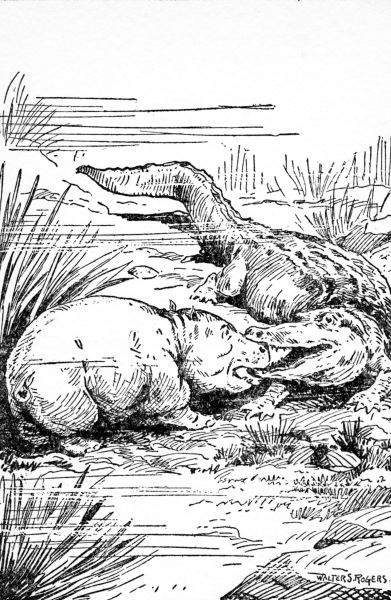
He started to rise to the top of the water, so he
could swim ashore, but, just as he did so, there
came a third bite on his big nose, and he saw,
right in front of him, a great big crocodile with
a lot of teeth in his long jaws.
Poor Chunky was having a dreadful
time. Never before had he been caught
by a crocodile. It would not have been so
bad, he thought in his hippo way, if it had happened
on top of the water. There some of the
big animals might have seen him and they would
have helped him. But down under the muddy
river—who could help him there?
Chunky flopped about in the water, sticking
his feet deep down in the muddy bottom, and
pushing back as hard as he could, trying to get
his nose loose from the crocodile’s teeth. But
the crocodile held fast to the hippo.
“Let me go! Let me go!” blubbered Chunky,
speaking in a strange way because his mouth was
partly closed by the crocodile.
“Indeed and I’ll not let you loose!” answered
the crocodile. “I want you for my supper!”
At least he might have answered that if his
mouth had not been busy holding fast to
Chunky’s nose.
Chunky pulled and pulled and pulled, but still
he could not get loose, and the crocodile was
slowly, but surely, dragging him out to a deeper
part of the river, when, all at once, there was a
great splashing in the water, and something big
and heavy sank down beside the little hippo boy.
“Get away from here, Mr. Crocodile!” a voice
shouted, sounding like thunder under the water.
“Leave my Chunky alone.”
And then a great, big body began pushing and
shoving the crocodile, and Chunky saw that it
was his father who had come to save him.
Mr. Hippo, being big and strong, squeezed
the crocodile up against the hard bank of the
river, down under the water, and nearly squeezed
the breath out of him. So the crocodile was
very glad, indeed, to take his jaws off Chunky’s
nose and let the little hippo go. Then, with
another shove of his big body, Mr. Hippo thrust
the crocodile far out into the river. The crocodile
made a snap at Mr. Hippo, trying to bite
him, but the big hippo floated out of the way just
in time, and that was the end of the fight.
“Oh dear!” cried Chunky to his father, who
swam up beside him under water. “Oh dear!
How my nose hurts!”
“Yes, I guess it does, little chap,” said Mr.
Hippo. “Come along with me and I’ll get your
mother to put a grass poultice on it. Or you can
hold it in the soft, cool mud on the edge of the
river. That will cure it.”
Of course I don’t mean to say that sick animals
really doctor themselves, but if you ever see your
cat or dog eat grass, you may be sure it is doing
it because it feels ill, so, in a way, it is taking
medicine.
And if you have ever watched a dog when it
has been stung by a bee, you may have seen him
go to some place where there is cool, wet mud
that he can lie down in, and so get some plastered
on the stung place, to make it pain less. So he
takes this kind of medicine.
In the jungle wild animals, when they are shot,
or hurt by one of their own kind, or by another
kind, get away if they can, where they can drink
water and let some of it wash up on their wound.
Water, mud and some kinds of grass and leaves
are jungle medicines for the animal folk.
And that is what Mr. Hippo meant. He did
not mean that Mrs. Hippo would make a real
grass poultice for Chunky’s sore nose, only that
she might chew up some grass until it was soft
and mushy and then her little boy hippo could
lay his nose against it to make the bites of the
crocodile feel better.
“Where have you been?” asked Mrs. Hippo,
as she saw Mr. Hippo and Chunky coming
home.
“Oh, the boy got into trouble—one of those
crocodiles,” said the father hippo, in his own
kind of talk. “We’ll have to move away from
here, I guess, if many more crocodiles come to
this river.”
Jungle animals do move from place to place;
hippos, monkeys and elephants especially.
They stay around one spot until they have eaten
all the good food there, or until all the water is
gone, and then they move on to a new home.
Sometimes they move from one place to another
because of danger, such as crocodiles or snakes
might make.
“Oh, Chunky, your nose is bleeding!” said
Mrs. Hippo.
“That’s where the crocodile bit me,” he answered.
His mother showed him a place where he
could lie down and put his nose in some soft mud.
Then she brought him some sweet lily-plant
roots to eat, and made a little cushion of soft
grass for his sore nose to rest on that night.
Chunky did not sleep very well. His nose
pained him too much, but he did not cry. Wild
animals do not know anything about crying, no
matter how much pain they may feel. In the
morning the sore nose was a little better, but
Chunky could not go to play with his brother
and sister and the other young hippos. He had
to stay on the river bank.
Still he was quite happy, for all the other animals
were kind to him, and brought him nice
things to eat. Mumpy and Bumpy came to see
him, and told him what fun they were having
playing water-tag and other games in the
river.
“I wish I could play!” said Chunky.
“Oh, but you can’t go into deep water until
your nose gets better!” said his mother. “You
must stay on shore. Perhaps you might go in
wading, but even then you must keep your head
out of water. In a few days you will be better,
and then you can have fun.”
“Did you see any crocodiles?” asked Chunky
of Bumpy.
“No. But if I do I’ll step on ’em and make
’em go away!” he answered boastfully.
“Better not try that!” said Mr. Hippo. “You
are not yet big enough to fight the crocodiles.
Leave that to me!”
For three days Chunky had to keep out of the
deep part of the river. He could only wade
about and splash near shore, not diving or swimming.
And as he had been used to going far out
in the water ever since he was a tiny baby, he
missed this very much indeed.
But at last his nose was almost well, and his
mother said it would be good for him to go in the
water. Then Chunky was happy. He splashed
in the river, dived away down to the bottom,
rolled over and over in the mud and swam about
as much as he pleased.
“Glad to see you!” cried Big Foot, for he and
Chunky had become good friends since their
little quarrel. “Is your nose all well?”
“Almost,” Chunky answered. “But I don’t
want to see any more crocodiles!”
“I should say not!” agreed Big Foot. “But
when I get larger I’m going to fight them, same
as your father did.”
Then Chunky played with the other hippos in
the water, diving and having games of what you
would call tag, until finally Big Foot said:
“Oh, come on! Let’s wade ashore and go into
the jungle!”
“All right!” agreed Chunky. “Maybe we can
have some fun there.”
So into the jungle they went, trampling their
way through the thick tangle of vines, chasing
one another and grunting like pigs; and indeed
they looked something like pigs as they pushed
their noses in wet and muddy places to get at the
sweet roots underneath.
All at once Big Foot, who was walking ahead,
cried:
“Look out, Chunky! I hear something coming!
Maybe it’s a crocodile!”
“Crocodiles don’t come this far into the
jungle,” said Chunky.
“Well, it’s something!” went on Big Foot.
“Oh, look what a big animal, Chunky! I’m going
to run back to the river! I’m afraid!”
Chunky looked at the animal to which Big
Foot was pointing with his ears, and then the
little hippo laughed.
“You don’t need to be afraid of him!” he said.
“Why, do you know him?” asked Big Foot.
“Yes, that is Tum Tum, the jolly elephant,”
was the answer. “I met him here in the jungle
the other day, and he told me about being in
a book and having adventures. Hello, Tum
Tum!” cried Chunky in jungle talk.
“Hello yourself,” answered the big, jolly elephant.
“I see you have a friend with you.”
“Yes, Tum Tum, this is Big Foot,” said
Chunky, waving his ears toward the other hippo.
Big Foot, though older than Chunky, had never
seen an elephant before, and he was much surprised.
Just as Chunky had supposed, Big Foot
thought Tum Tum had two tails, but he soon
learned better, and he, too, liked the jolly elephant.
“What are you doing here in the jungle?”
asked Chunky of his big friend.
“Oh, I’m looking to see if there are some wild
elephants about, so the men with whom I am
staying can catch them and train them for a
circus,” was the answer.
“Are there men hunters around here?” Big
Foot asked in an awed and very rumbling
whisper.
“Yes, they are back in the jungle, and they will
soon be here,” answered Tum Tum.
“Then we’d better run!” cried Big Foot to
Chunky. “My folks always told me to look out
for hunters.”
“That’s right!” agreed Chunky. “We had
better go back to the river.”
“Oh, don’t be in a hurry,” said Tum Tum.
“The hunters are not here yet. I can hear them
coming long before they can see you, and I’ll
tell you in time for you to get away. Still,
maybe you would like to be caught and sent to a
circus.”
“Not me!” cried Big Foot.
“Nor I,” added Chunky, though the more he
thought about it the more he wished he could
have some adventures, such as Tum Tum had
had, many of them being written about in a
book like this one you are reading.
So the elephant and the two hippos stayed in
the jungle for some little time, talking. Then,
all of a sudden, Tum Tum raised his big ears,
lifted his trunk, sniffed the air, and said:
“The hunters are coming now. You had better
run if you do not want to be caught. Good-bye!
I hope I’ll see you again some day.”
“Good-bye!” called Chunky and Big Foot to
Tum Tum, and then the hippos went back to
their river, while Tum Tum began his search
for wild elephants.
It was two or three days after this that Chunky,
who had gone off by himself up along the river
bank to look for a certain kind of sweet grass,
had another adventure.
The little hippo was thinking of what Tum
Tum had said about the circus, and how nice it
was there, when, all of a sudden, Chunky stepped
into a pool of water, which he did not think was
very deep. But it was, and the worst of it turned
out to be that under the water was some very
sticky mud. So sticky, in fact, that Chunky sank
down deep in it, being quite heavy and fat for his
age. He tried to pull out his little short, stumpy
legs, one after the other, but he could not. He
only sank deeper and deeper in the mud. He
was held fast there.
“Oh, dear!” thought Chunky. “I’m stuck
tight! I wonder if this can be a trap of the
hunters to catch me for the circus. Oh, I wish
Tum Tum were here to help me out! Oh,
dear!”
CHAPTER V CHUNKY IS CAUGHT
Chunky, the happy hippo, was not as
jolly as he had been when playing water-tag
in the river with Bumpy, his brother,
and Mumpy, his sister. In fact, he was rather
sad. Stuck fast in the mud as he was, he pulled
and twisted and wiggled and turned, trying to
get loose. But he could not. He was still held
fast.
“Oh, dear!” said Chunky again, in hippo talk.
I guess this was about the tenth time he had said
it.
Then, all at once, he sort of smiled—that is,
he opened his mouth, as if he were laughing,
though I don’t suppose that jungle animals
really either smile or laugh as you do.
But, at any rate, Chunky, who was usually a
jolly, happy little chap, made up his mind there
was no use in feeling too bad about what had
happened to him.
“I am stuck in the mud—that’s true,” he said
to himself; “but it is better than being held fast
at the bottom of the river by a crocodile who has
you by the nose. This is much better.
“I am out on the land, and I don’t have to
hold my breath under water for fear of being
drowned. And the mud doesn’t hurt me. In
fact it is rather nice and soft,” continued the
hippo boy.
So Chunky made the mud go “squee-gee” between
his toes, and tried to make himself think he
was happy. But he was a little anxious, for he
feared he had fallen into a trap.
He had heard his father and mother, as well
as the other big hippos, talk about traps set by
hunters in the jungle. Some of the hunters
were the black or brown people who lived in the
big woods, and others were white hunters who
came from far-off countries. And the traps they
set were of different kinds.
Some were nets, made of strong jungle vines.
Others were great pits, or holes, dug in the
ground and covered with leaves and grass, so the
animals could not see them. Whenever they
stepped on the grass scattered over the hole, the
animals fell through and could not get out of the
pit.
Other traps were made of big stones or of logs,
so fixed that they would fall on the animals that
walked beneath them, and would hurt the animals
very much. The hole-traps were the most
common, though Chunky thought a mud trap
was very good, for catching hippos.
“Anyhow it has caught me!” thought Chunky.
Then he listened again, waving his ears to and
fro for any sound that might tell him the hunters
were coming to get him. But he heard nothing
but the noises of the jungle, which he heard every
day—the cries of the red and green parrots, the
trumpeting of elephants afar off, the chatter of
monkeys and, now and then, the roar of a lion.
“I hope one of the lions doesn’t get me,”
thought Chunky. “They could easily, now that
I am fast in the mud.”
Once more he tried to pull his feet loose, but
could not. The mud was too sticky. Chunky
was sinking deeper and deeper into it. But still
he tried to be cheerful.
“After all,” he thought to himself, in the queer
way that such animals have of thinking, “it may
not be so bad to be caught and taken to a circus.
Tum Tum said it was jolly. Maybe it will be
so for me.”
So Chunky waited in the mud. He could not
do anything to get himself loose. He put his
nose down in the water and drank some, but it
was not nice like the water of the river near
which he lived. The water in the muddy pool
where he was held fast was hot, and not at all
tasty.
“Still, it is better than none at all,” thought
Chunky. “And it is a good thing I ate a good
breakfast this morning, or I would be hungry
now.” And it was a good thing, I suppose, for
there was nothing to eat near the jungle pool,
and no sweet grass grew on the muddy bottom.
All at once, after the happy hippo, who was
not as jolly as he had been at other times, had
tried again and again to get loose—all of a sudden,
I say, he heard a noise back of him. He
tried to look around to see what it was, but he
could not turn far enough.
The noise came closer.
“Oh, I guess it’s the hunters!” thought
Chunky, sadly.
He tried very hard, now, to get loose, but it
was of no use. He was just making up his mind
that he would be caught and carried off to the
circus, as Tum Tum had been, when he heard a
voice shout, in animal talk:
“Hello there! What’s the matter?”
Then Chunky knew who it was! It was Tum
Tum, the jolly elephant!
“What’s the matter?” asked Tum Tum again,
and he blew a big lot of air through his long
hosey-nosey trunk, until it made a noise like a
Christmas tin horn.
“Oh, is that you, Tum Tum?” asked Chunky,
and he felt ever so much better—more like his
happy self.
“Yes, it is I, Chunky,” answered the jolly elephant.
“But what is the matter with you?”
“I’ve fallen into one of the hunter traps,” answered
the hippo, “and now they’ll come and
catch me and send me off to a circus as you were
sent.”
“Oh, no they won’t!” laughed Tum Tum.
“Why not?”
“Because you’re not in a trap at all,” Tum
Tum said, laughing again.
“But I’m stuck fast! Look!” and Chunky
tried to pull himself loose, but he could not.
“Oh yes, you are stuck all right,” laughed
Tum Tum. “But don’t let that worry you.
You are not in a trap. This is just one of those
jungle pools with sticky mud at the bottom. I
often got stuck in them myself, years ago.”
“But how am I going to get out?” asked
Chunky. “I’ve tried and tried and tried, but I
can’t!”
“I’ll help you,” said Tum Tum. “Just wait
until I get hold of you with my trunk. Then
I’ll pull you right out of that mud. Just you
wait, Chunky!”
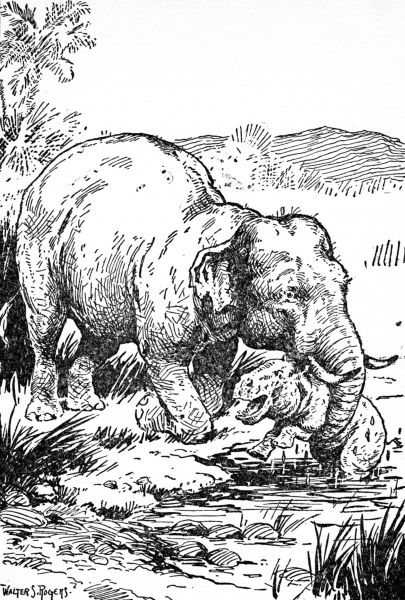
So Chunky waited, and Tum Tum, the jolly
elephant, going as close to the edge of the pool as
he dared without danger of getting stuck in the
mud himself, stretched out his trunk, and wound
it around Chunky as if the little boy hippo were
a bundle.
“Now, all ready!” cried Tum Tum.
Then he gave a haul and a pull and another
one. There was a squidgy-idgy sound, a sort of
squeaking in the mud, just as when you step on
a rubber ball, and out came Chunky as nicely as
you please.
“There you are!” cried Tum Tum, as he set
the little boy hippo down on a firm place in the
ground where Chunky could step without sinking
in. “Now you’re all right!”
“Yes, thank you, I am,” said Chunky, for,
though you may not know it, jungle animals are
often kind to one another, and they do not scratch
or bite one another unless they are very hungry
or very angry. So Chunky was polite to Tum
Tum.
“Take care, after this,” went on the elephant,
“not to step into a pool when you can not see the
bottom.”
“I’ll be careful,” promised Chunky.
Then he and Tum Tum walked through the
jungle, and the elephant reached up, with his
long trunk, and picked green leaves off the trees,
putting them where Chunky could get them.
For many months after this Chunky lived in
the jungle on the edge of the river, which he
had known ever since he was a baby hippo. He
ate lots of green grass and roots, learning to dig
the last from the bottom of the river with his big
front teeth. And Chunky grew to be a large
hippo, though he was not yet full size, and only
about a year old. Mumpy, his sister, and
Bumpy, his brother, also grew larger and
stronger, as they also ate grass and roots.
After having lived for quite a while in their
home among the reeds near the place in the river
where the crocodile had caught Chunky, the
hippo family moved on to a new spot, where the
grass was better and where there were not so
many crocodiles.
“It is getting too dangerous around here for
the little ones,” said Mrs. Hippo one day, when
the little-girl hippo who lived next door had
been carried off by one of the biting animals.
So Chunky and his family moved away. It
was very easy for them to move. All they had
to do was to walk on the ground or swim in the
river. They did not have to pack up or take
anything with them. That is one of the nice
parts of being a jungle animal. It’s so easy to
move.
“I hope I’ll see Tum Tum again where we
are going,” thought Chunky, remembering how
the jolly elephant had helped him. “I like him
very much.”
But though the hippo boy looked all over the
jungle, near his new home, he did not meet Tum
Tum. Sometimes he could hear the wild elephants
trumpeting in the forest, or crashing their
way among the big trees. But Chunky could
not see any of them, and he wondered if the hunters,
led by Tum Tum, were after the big animals
to catch them for a circus.
And then, one day, after Chunky had been
playing in the river with his brother and sister,
and had gone on shore to rest, he thought it
would be nice to take a walk by himself.
“Maybe I’ll have an adventure, just as Tum
Tum did, and somebody will put it in a book,”
said Chunky to himself.
He did not know what was going to happen
to him, or he would not have wished for the kind
of adventure that came to him.
So, saying nothing to any of the other hippos
about what he was going to do, Chunky set off by
himself. He walked along and along, now and
then stopping to chew a bit of grass in his big
mouth, when all at once he happened to see a
path leading off through the jungle.
“Maybe if I go along that path,” thought
Chunky to himself, “I’ll meet Tum Tum again.
I wish I could. I’ll try it!”
So he started off along that path. But he had
not gone very far when, all at once, he felt the
ground sinking away from under him, just as
it feels to you when you go down in an elevator.
Down and down went Chunky, and a lot of sticks
and leaves went with him.
“Oh, I’m going to be stuck in the mud again!”
he cried.
But he was not. Instead, he suddenly landed
with a hard bump and a thump on the ground.
It was quite dark around him.
Chunky looked up. He could see some blue
sky above him, but all around were walls of dark,
brown earth.
“Why!” exclaimed Chunky, “I’m in a hole—a
deep hole! I must try to get out!”
So he raised himself up a little on his hind
feet—not very far for he was very heavy—and
he tried to reach the top of the hole.
But Chunky could not. The top was far
above his head. Then he looked around him
once more. All he could see was dirt, sticks and
leaves.
“Oh, I know what’s happened!” cried Chunky.
“I’ve fallen into a pit-trap! That’s it! I’ve
fallen into a trap, and I’m caught! Oh, dear!”
Then Chunky was not the happy hippo—at
least just then. He was sad. For he really had
walked across a hidden pit along the jungle path,
and was caught. There was no getting out of
the deep hole. Chunky was surely caught.
CHAPTER VI CHUNKY TAKES A TRIP
Poor Chunky did not know what to do.
He could hardly move around on the bottom
of the hole, because it was so small.
It had not been made to catch him, but he did not
know that. The black hunters who had dug the
pit hoped to catch in it a small deer. Chunky
was really a little too big for the pit-trap, but it
was too late to think of that now. He was in it.
“Oh dear!” thought Chunky, “I wonder if any
of my friends will come to help me out? I wish
Tum Tum would come. He could lift me out
with his strong trunk. I’ll call him.”
So, in a sort of grunting voice, Chunky called:
“Tum Tum! where are you? Please come
and get me out of the hole!”
After he had called the name of his big animal
friend Chunky kept still and listened. He could
hear nothing but the sounds of the jungle all
about him. He could not see anything except
the earth sides of the deep pit.
“Tum Tum! where are you? Come and help
me out of this hole!” called the hippo boy, in
animal talk of course.
But no one answered him. He could hear the
birds in the jungle making their queer noises, not
at all like the sweet sound your canary makes.
The birds screamed instead of singing, though
now and then one or another would utter a pleasant
note.
And the monkeys! How they chattered!
Other animals ran here and there through the
jungle, going to get something to eat or something
to drink. None of them, however, paid
any attention to Chunky’s calls. Tum Tum did
not answer him, because the jolly elephant was
far away; and if any of the other jungle animals
heard what Chunky was saying, they did not
reply to him. Perhaps they, too, were in some
sort of trouble, or they may have been busy.
“Well, I guess no one is coming to help me out
of this hole,” said Chunky to himself, after a
while. “Oh, dear! I wish I’d been more careful,
and had not stepped on the dried leaves over
the hole. Then I wouldn’t have fallen in!”
But it was too late to think of that now.
Chunky knew he must try to get out before the
black or white hunters came, for that he was in
a pit dug by these men the hippo boy very well
knew. Tum Tum, as well as his father and
mother, had told him about such places and had
warned him to be careful.
“I must get out!” thought Chunky.
So he turned and twisted himself about on the
bottom of the pit, and tried to raise himself up
to look over the top, but he could not. In the
first place he was too heavy to raise himself up
very far on his hind legs. If he had been Lightfoot,
the leaping goat, about whom some stories
have been told you, Chunky might have done
this, or he might even have jumped out of the
pit. But, as it was, he could only bob up a little
way and then drop back again.
“Maybe I could dig my way out with my big,
long teeth, the same as I dig up the grass roots at
the bottom of the river,” thought Chunky to himself.
“Oh, dear! I wish I were back in the
river now! I’m going to try to dig myself out.”
But though Chunky’s front teeth, or tusks, answered
well enough for digging up grass or lily
roots on the bottom of the river, where the mud
was soft, they were not made for digging in the
hard, earthen sides of the pit. The hippo boy
could only make a few scratches, and these did
him no good.
“It’s of no use!” sadly thought Chunky. “I
guess I’ll have to stay here. But if only Tum
Tum would come! I’ll call him again!”
So lifting up his head, with his big, broad
nose pointing toward the opening at the top of
the pit, Chunky called:
“Tum Tum! Please come and help me!”
He waited, but no one answered. The jolly
elephant was still far away. Pretty soon, however,
a little bird perched itself on top of a tree
where it could look down into the pit. The bird
saw the hippo and heard his big voice calling.
“My! what a funny way you have of singing,”
remarked the bird.
“I am not singing,” answered Chunky.
“Not singing? Then what do you call it?”
asked the bird, looking down at Chunky, its little
head on one side, just as your canary often looks
at you.
“No, I wasn’t singing,” went on Chunky. “I
can’t sing—at least not like you. I was calling
for my friend Tum Tum, the jolly elephant, to
come and help me get out of this hole.”
“What did you want to go and get in the hole
for?” asked the bird, somewhat pertly.
“I didn’t want to,” Chunky explained patiently.
“I fell in. This isn’t a regular hole.
It’s a trap. It was all covered with leaves, sticks
and grass, and I didn’t see it until I stepped right
into it. Now I can’t get out unless my friend
Tum Tum comes and lifts me out with his big,
strong trunk, as he lifted me out of the mud.
Oh, if Tum Tum were only here!”
“Maybe I can find him for you,” said the bird
kindly, realizing now that Chunky was in a sad
plight.
“I wish you would!” exclaimed Chunky.
“You can fly all over the jungle. Perhaps you
will see Tum Tum, the jolly elephant. If you
do, please tell him to come and help me.”
“I will,” promised the bird.
“And tell him to hurry, please,” went on
Chunky. “If I don’t get out of here soon, the
black or white hunters—whoever made this pit—will
come and get me, and then maybe they’ll
put me in a circus.”
“What’s a circus?” asked the bird.
“I don’t know, but Tum Tum does,” answered
Chunky. “He was in one long ago. He can
tell you what a circus is when you find him to ask
him to come to help me.”
“So he can!” chirped the bird. “Well, I’ll
go off and see if I can find your jolly elephant
friend for you. Good-bye, Chunky. Don’t
worry; I’ll get Tum Tum to help you.”
“Good-bye, birdie, and thank you,” said the
hippo boy.
Then the bird flew away across the jungle, and
the hippo stayed at the bottom of the pit-trap,
waiting for what would happen next. Though
he did not know it, his real adventures had begun,
and he was to have a great many.
Away flew the bird over the jungle, but it did
not find Tum Tum, at least in time to be of any
use to Chunky. The jolly elephant was helping
the white hunters catch some wild elephants for
the circus. And, while this was going on, along
came the black hunters who had dug the pit into
which Chunky had fallen. The black hunters
were Africans, and they had on very little clothing,
for it was very hot.
Along the jungle path they came, with their
spears and guns—for the white hunters had sold
the black hunters guns—jabbering and talking
in their own language. This would have
sounded very queer to you, but no queerer than
your talk would sound to those black Africans.
And it sounded queer to Chunky, who heard it,
down in the bottom of the pit as he was. But
then his way of talking in animal language
sounded queer to the black hunters, so matters
were even, you see.
“I wonder if we have caught anything in our
trap,” said one black hunter to another, as he
walked along the jungle.
“I hope we have a nice deer, so we can have a
good meal,” observed another.
They were close, now, to the pit they had dug,
and the black men walked more softly along the
jungle path, for they wanted to see what was in
their trap without being seen. One of them
went carefully up and looked in. When he saw
Chunky, the hippo boy, at the bottom, the black
man gave a cry of delight.
“Oh, we have caught a hippo! We have
caught a young hippo!” he shouted, leaping
about and waving his sharp spear over his head.
“It is much better than a goat or a pig, for we
shall have much more meat to eat. Ho! for the
hippo!”
Of course the black hunter talked in his own
language which his friends, the other hunters,
understood. They gathered with him about the
edge of the pit and looked down. They could
see poor Chunky there, though, of course, they
did not know his name.
“Ha!” cried the black hunters. “We shall
have a fine meal now! We shall have lots to
eat!”
For the reason they had dug the pit in the
jungle was to get something to eat. They had no
store or market where they could go to buy anything.
When they were hungry they had to
hunt pigs, elephants or hippos with their guns or
spears, or trap them in pits or nets.
“We must get him out of the pit,” said the first
black hunter. “We cannot cook him and eat
him if he is down there.”
Chunky did not understand what the men were
saying, and he did not know what they were going
to do to him. But he soon found out. The
men brought long ropes, made from twisted
jungle vines, and lowered them down into the
pit. They did not dare jump down themselves,
for though Chunky was only a little hippo, compared
to the grown ones, still he was strong, and
his big teeth could bite very hard. The black
hunters wanted to tie him with ropes before they
lifted him out.
So down into the pit they dangled their strong
vine ropes. Chunky saw them coming and felt
them on his back, but he could not get out of the
way of them. Soon they were tangled about his
legs and body, and then, all the black hunters
pulling together, they lifted the hippo out of
the hole.
Chunky grunted and wiggled, but it was of
no use. He could not get away from the ropes
that were soon wound all about him.
Then just as one of the black hunters was about
to stick him with a spear, to kill him, suddenly
there was a loud noise in the jungle that made
the black hunters look in the direction from
which it sounded.
They saw, coming toward them, some white
men with black men—servants to carry their
guns, tents and boxes of food. It was a party of
white hunters out seeking wild animals.
“What have you there?” asked the leader of
the white hunters of the head of the black hunters—the
one who had first looked down at
Chunky in the pit. “What have you there?”
“We have a small hippo,” was the answer.
“And what are you going to do with him?”
“We are going to eat him, for we are hungry,
and he has much meat on him—he is nice and
fat.”
“Oh, don’t kill him!” said the white hunter.
“I will buy him from you alive, and I’ll take him
to a far-off land where people who do not see
many hippos can see him. I can sell him to a
circus. Don’t kill the little hippo. Sell him to
me. Then you can buy other things to eat.”
“Well, we will do that,” said the black
hunter. “But how can you carry this hippo
alive to a far country?”
“I’ll show you,” answered the white hunter.
“Leave him to me. Here are lots of beads and
copper rings and looking glasses that flash in the
sun like silver. I will give you these for the
hippo.”
The black hunters liked very much the pretty
things the white man had, so they took them and
let him take Chunky, though of course the white
man, as yet, did not know the hippo’s name.
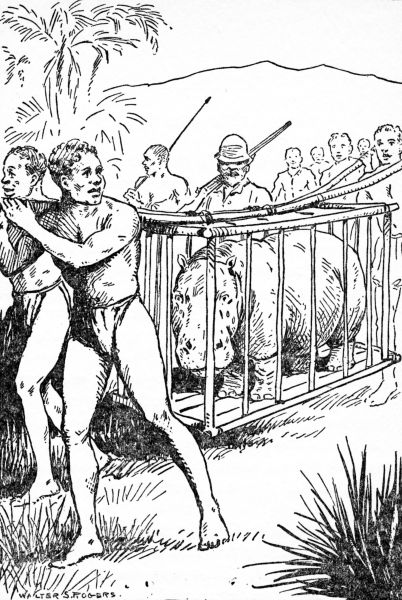
“Make me a strong cage of jungle vines and
poles of wood,” said the white hunter to his black
helpers. “In the cage we will carry the hippo
through the jungle until we come to the ‘great
water,’ as you call the ocean. There, in a ship,
I can take him to America, where I live. Make
me a strong cage for the hippo.”
So they made a strong cage for Chunky, and
when he was put in it and the ropes slipped off
him, he could stand up, and move about, though
he could not get out. And oh! how hot and tired
and cramped and thirsty he was! How he
would have liked to take a swim in his river,
dive down out of sight and chew some of the
sweet grass roots! But this was not to be.
Chunky was caught, and was in a cage, and,
pretty soon, many of the black men with the
white hunter, taking hold of poles thrust through
the cage, began carrying Chunky through the
jungle.
“Oh, dear!” thought Chunky, as he felt himself
being lifted up and carried along. “I guess
that bird didn’t find Tum Tum and tell him to
come and help me! I wonder what is going to
happen to me?”
And well might Chunky, the happy hippo,
wonder. He did not feel very happy now, but
better times were coming, though he did not
know it.
Along through the jungle jogged the
black men, carrying the cage with
Chunky in it. Now and then the black
men would sing a funny song. At least it would
have sounded queer to you, for it was like a lot
of coughs, sneezes, hiccoughs and giggles. But
it was a song the men often sang as they marched,
so the way would not seem so long, nor their
burdens so heavy, and Chunky was quite a heavy
load, let me tell you!
After a while the men stopped in the jungle,
to make a fire and cook something to eat. Farther
back, the other black hunters who had
caught Chunky and sold him to the white man,
were doing the same thing. They had found a
deer, which one of them speared, and they
cooked it.
The cage, with Chunky in it, was set down in
the jungle, not far from the fire the men made to
cook their meal. This was the first time the
hippo had seen a blaze, and, for a time, he was
frightened, as are all jungle animals at the sight
of fire. But, after a bit, when Chunky found
that the fire did not come near him, he was not so
much afraid. But he was very hungry for some
grass, and he wanted very much to swim in a lot
of water, and wallow in the mud.
Pretty soon, when it had grown dark in the
jungle, and the black men were eating their meal,
along came the white hunter.
“Have you given that little hippo anything to
eat?” he asked the black men.
“No,” they answered, “we have not.”
“Well, you’d better do so,” said the white man.
“He is hungry, as well as you. And I want him
to be nice and fat and strong when I put him on
the ship to take him to America to the circus.
Get him some grass and water.”
Then two or three of the black men, putting
their fingers in their mouths, and sucking them,
which was their way of cleaning them instead of
using napkins, went down to the river bank, near
which they were camped, and pulled up a lot of
grass for Chunky. They also brought him water
in hollow gourds, which were as large as a
water pail. They knew the hippo liked lots of
water.
My! how thirsty Chunky was! He drank almost
a barrel full, it seemed, and then he ate some
of the grass the men tossed into his cage. It
tasted good, and he felt better after that.
The men went to sleep around their jungle fire
then, and Chunky, having had something to
drink and something to eat, fell asleep also.
You might have thought, being carried away
from his home as he was, Chunky would have
felt so bad that he could not sleep. I know
you would, but animals are not like that—especially
jungle animals. As long as Chunky
had enough to eat he was pretty well satisfied.
And though back in the jungle his father and
mother missed him, they did not worry much.
When night came and Chunky was not home,
Bumpy and Mumpy, his brother and sister, asked
Mrs. Hippo:
“Where is Chunky?”
“I don’t know,” she replied. “He may be lost
in the jungle or he may have gone away. He is
getting old enough, now, to look after himself.
I guess he is all right.”
And so, after a little while, Chunky’s folks forgot
all about him, and went to sleep too. They
did not know that the little boy hippo was being
taken on a long journey.
Early in the morning Chunky, in his wooden
cage, awoke in the jungle camp. It is so hot in
Africa that when hunters travel they do so early
in the morning and late in the afternoon. At
mid-day the sun is too hot to walk out in it.
So, after breakfast, Chunky being given more
grass and water, the black men picked up his
cage again and set off. As they went along under
the jungle trees, Chunky could hear, overhead,
many monkeys chattering away.
“Oh, look at that poor hippo the hunters have
caught,” said one. “Isn’t it too bad! I wouldn’t
want to be in a cage.”
“Oh, I don’t mind it so much as I did at first,”
said Chunky, speaking to the monkeys in jungle
talk, which the black men and white men could
not understand. “I’ve had enough to eat and
drink and no one is hurting me. No crocodiles
can get me here.”
“Well, you certainly are a happy chap,” went
on the monkey who, by leaping from branch to
branch overhead in the trees, easily kept up with
the marching men carrying Chunky. “What
makes you so jolly?”
“I guess I must have caught it from Tum
Tum, the elephant,” was the answer, and Chunky
actually opened his big mouth as if he were
smiling.
“Oh, I know Tum Tum!” cried one of the
monkeys. “He’s a jolly elephant who once was
in a circus. And he knows a friend of ours.”
“Who?” asked another chattering chap.
“Mappo, the merry monkey,” was the answer.
“Don’t you remember Mappo, who used to live
in the jungle with us?”
“Oh, yes!”
“Well, he went away, and, for a long time we
did not see him.”
“Yes,” said the other monkeys. “That’s so!”
“Well, he was caught and sent to a circus, and
that is where Tum Tum was, only he’s out now.
Maybe you’ll go to a circus, Chunky,” said the
monkey.
“Maybe,” agreed the happy hippo, who smiled
again. “I guess it won’t be so bad. Tum Tum
was telling me about it. Yes, I think I would
like to go to a circus.”
“Tum Tum said Mappo liked it,” put in another
monkey, with a queer twist to his tail.
“Mappo did tricks, and he had a lot of adventures
and had a book written about him.”
“Do you know what that is like?” asked
Chunky. “I heard Tum Tum speak of adventures
and a book.”
“No, I don’t know,” was the answer. “I
never heard of a book except from Tum Tum,
and I don’t believe he really knows what it is.”
“Well, perhaps if I go to a circus I shall find
out,” went on Chunky.
“Do you want us to go and get Tum Tum, and
have him break your cage with his big feet and
strong trunk, so you can get out?” asked a white-whiskered
monkey.
Chunky thought about this for a while, as the
black men carried him through the jungle, while
the monkeys leaped along in the tree tops overhead.
“No,” said the hippo boy after a while. “I
guess you don’t need to bother Tum Tum,
though it’s kind of you to offer. I sent a little
bird to find him, but I guess my elephant friend
is too far away.
“Besides, I think I won’t try to break loose.
I feel very good here, though I wish my cage was
a bit larger. But I’ve had water to drink, and
sweet grass to eat, and I am having a nice ride.
I think I’ll stay longer and see what else happens
to me. I want to have some adventures
and be put in a book.”
“All right, then we won’t get Tum Tum,”
said the monkey who had offered to try to find
the elephant. “And, Chunky, if you do get in a
circus, and see our old friend Mappo, give him
our love, will you?”
“I’ll certainly do that!” promised the hippo
boy.
Then, all at once, the hissing of a snake was
heard, and as monkeys are very much afraid of
snakes, they gave loud chatters and scurried
away through the jungle, leaving Chunky in his
cage being carried along by the black hunters.
For many mornings and afternoons the white
men and their black helpers, who were out to get
live animals for circuses and parks in big cities,
traveled on through the jungle. They caught
two more hippos, though neither was as large as
Chunky, and they caught other animals and
birds, all of which were carefully put in cages to
be carried to the ship to go across the sea.
Chunky felt happier now that he had some
friends with him, and he was especially glad
there were two more hippos.
“Now I shall not be lonesome,” he said to his
new friends, in animal talk. “How did you
come here?”
“I was caught in a big net as I went through
the jungle,” said Short Tooth, one of the hippos
that had one tusk which was shorter than the
other.
“And I was caught as I was swimming in the
river with my mother,” said the other hippo,
which was named Gimpy by Chunky and Short
Tooth. Gimpy walked a little lame from having
stepped on a sharp stone when he was a baby,
cutting his foot.
So the three hippos were kept in cages close
together, and were carried through the jungle,
down toward the seacoast, with the other wild
animals. Chunky made friends with them all,
for he was a happy chap, and tried to look on the
bright side of everything—as much as any animal
can.
“We might be a good deal worse off,” he said
to a young lion who was grumbling because he
had been caught and put in a cage. “Just think,
here we have all we want to eat without ever going
after it.”
“Burr-r-r-r-r!” growled the lion. “I don’t
like it at all! I want to get out of here!” and
he leaped about, scratching and clawing at the
wooden bars of his cage until the black hunters
cried in fright and ran away. But one of the
white men came and stood near the lion’s cage
and spoke to the lion, which was a small cub.
“Be quiet!” said the white man, though of
course the lion could not tell what the man was
saying. “Be quiet, little King of Beasts! You
shall have good meat to eat, clean water to drink
and you need never hunt for food again. Besides,
you are going to be in a circus! Be quiet!”
And the man spoke in such a kind way that
the lion was quiet.
Then the white man, who was the head, or
chief, of the others out looking for live wild animals,
came over to where the hippos were in
their cages.
“Three of you, eh?” he said, though of course
Chunky could not understand what he said.
“Three nice hippos! Well, you will be worth
a lot of money if I can get you across the ocean
safely and to the big city. There I can sell you
to a circus or a menagerie in the park.
“Ha! You are a fat, chunky chap!” the man
went on, looking at our hippo. “And you seem
quite contented. I should even say you were
happy by the way you smile,” continued the
white man, for, just then, Chunky opened his
mouth as wide as he could. Perhaps he was
only yawning, sleepy-like, but it looked like a
big laugh.
“Yes, you are quite fat, I think Chunky would
be a good name for you,” went on the white
hunter, and so the hippo was named over again,
the same name his mother’s friend had given him
in the jungle.
For many more days the white and black men
traveled on with the live animals they had
caught. Then, one morning, after quite a long
march, Chunky noticed that the black men suddenly
stopped singing and broke into loud cries.
They seemed quite happy.
“What do you suppose has happened?” asked
Gimpy, as he stood up in his traveling cage.
“I don’t know,” answered Short Tooth.
“Maybe they have caught an elephant.”
“I hope it’s my friend, Tum Tum,” thought
Chunky. “I’d like to see him now.”
CHAPTER VIII CHUNKY ON A SHIP
Standing up in the cage made of jungle
vines, Chunky, the happy hippo—happy
even though he had been caught and taken
away from home—listened, hoping to hear the
trumpeting of his friend, Tum Tum, the jolly
elephant. But no such sound came. Instead,
the black men shouted more loudly than before,
and began dancing.
“What is it all about?” asked Chunky of some
monkeys who had been caught a few days before.
“Why are the men shouting?”
“I think it’s because they can see the ocean
from the top of the hill,” returned one monkey.
“I can smell the salt air. I remember it; for
once, years ago, a troop of monkeys of which I
was one, came down to the seashore. It smells
now just as it did then.”
“But why should the black men be glad to get
to the ocean?” asked Chunky.
“I can tell you why,” growled the lion. “It
means they have come safely through the jungle
with us animals, and do not have to march and
carry us any more. I know, for I heard a lion
friend of my father’s tell about it. He was
caught and carried through the jungle to the
sea, ready to be put on a big floating house and
sent across the ocean. But he got away and ran
back into the jungle.
“And now they are going to take us away.
I’m not going! I’m going to break out of my
cage!” and once more the lion roared and tried to
break loose, but he could not.
“Quiet! Quiet!” said the white hunter in a
gentle voice, but the lion roared, and would not
be still.
“You are very silly,” said Chunky. “You
can’t get out, and you may as well make the best
of it. Being in a circus may not be so bad.
Tum Tum liked it.”
“But I am not Tum Tum!” roared the lion,
and he would not be quiet until they gave him a
lot of meat. When he chewed on that he could
not very well roar.
It was the sight of the ocean that had made the
black men shout so joyfully, and soon Chunky,
in his cage, was carried down to a spot from
which he could see what, at first, he thought was
a big river. But it was the sea, not a river.
“I think we’ll give the hippos a bath,” said
the head white hunter to his men, though the
animals, of course, did not know what he was
saying. “The hippos like lots of water,” went
on the man, “and they haven’t had a chance to
get a good soaking since we caught them. Take
their cages down to the ocean and dip them in,
but don’t let the animals out.”
Chunky, Short Tooth and Gimpy did not
know what was going to happen to them when
they found themselves being lifted up again and
carried forward. But they soon found out.
Long ropes were fastened to their cages, and
they were dipped right down into the salty ocean.
This was the first time Chunky or any of the
other hippos had been in salt water, for the rivers
where they lived in the jungle were of fresh
water, though it was muddy. But salt water or
fresh is all the same to a hippo, except for taking
a drink. They like to swim in one as well as
in the other, and often, when the jungle where
the hippos live is near the sea, they spend all day
in the ocean, near shore and travel inland at night
to feed.
So, though it was the first time Chunky had
had a salt bath, he and his two friends liked it.
In their cages they sank away down on the sandy
bottom of the ocean near the shore, closing their
nose holes, so as not to swallow any of the briny
water.
Short Tooth thought he could break out of his
cage while he was in it under water, and he tried,
but it was of no use. The black men knew how
to make cages strong enough to hold even a
young hippo.
“Ah ha! Now I feel fine!” cried Chunky, as
they raised his cage out of the ocean, and he
puffed and blew out the air from his nose, which
he had kept closed under water. “I feel just
dandy!”
Of course Chunky didn’t use the word
“dandy,” but he used one in animal talk which
means the same thing, only it would be too hard
for you to pronounce if I put it in here.
“What makes you so happy?” asked one of the
monkeys, who sat in his cage near the shore,
really shivering, though the day was warm—shivering
as he saw how the hippos liked the
cool water.
“I am happy because I hope I am going to be
in a circus,” said Chunky.
“Well, I’m not!” growled the lion; “though I
am feeling a little better since they fed me.”
“Chunky is always happy,” said Gimpy. “He
has been jolly ever since I’ve known him.”
“Yes, so he has,” added Short Tooth, as he
stood up to let the water drip off him.
“Well, why shouldn’t I be?” asked Chunky.
“It’s true I’ve been taken away from the river I
liked so well, away from the jungle, away from
my father and mother, away from Mumpy, my
sister, and Bumpy, my funny brother. But what
of that? I’d have had to leave them some day,
anyhow, and why not now? Besides, I am going
to be in a circus, and I may meet Mappo, the
merry monkey.”
“I wish I could be jolly, like you,” said one of
the monkeys.
“Well, just think what fun you may be going
to have, and not about the trouble you’re in now,
and you’ll be happy,” said the hippo, and he
opened his mouth as wide as he could.
The black hunters, who were just then bringing
up great quantities of grass for the hippos to
eat, thought Chunky was opening his mouth to
take a big bite of the food, but, instead, he was
smiling because he felt so jolly. It’s hard to
tell, sometimes, when a hippo is laughing, or
when he is smiling, or when he just opens his
mouth to eat, but once you learn to know the difference,
you’ll never make a mistake. Chunky
was smiling.
None of the other wild animals that had been
caught in the jungle and brought to the sea, felt
as happy as Chunky did, though the other two
hippos were pretty jolly. Having a bath in the
sea and getting sweet grass to eat made them that
way, I guess.
And now began a busy time, for all the animal
cages—in some of which were lions, big apes,
snakes, monkeys, and deer with big horns, besides
the hippos—had to be hoisted up into the
ship, or the “floating house,” as some of the
jungle beasts called it. In this ship the animals
would be carried across the ocean from Africa
to America, where they were to be put on exhibition
in circuses or in zoological parks or in
menageries.
Of course Chunky and his friends knew nothing
of this. They did not even know what a
circus was, though Chunky had heard Tum Tum
talk about one, and about books and adventures.
“I shall be very glad to get to a circus, I think,
and off this floating house, or whatever it is,”
thought Chunky, when the ship had started.
Chunky was in his cage up on deck, as were his
two hippo friends and some of the larger animals.
The others were under the deck, in the
hold of the ship.
“I don’t like this at all,” Chunky said to the
other hippos. “It’s too swishy-swashy like!”
He meant the ship was rolling to and fro, and
pitching and tossing up and down with the
waves, for it was soon out of sight of land, and
going far away from Africa and the jungle.
Though Chunky and his friends were used to
being tossed about in the river, when they played
tag and other water games, this motion of the
ship was different. It made some of the animals
seasick, and the lion, especially, was quite
sad and miserable. He grumbled and growled,
but he was too sick to roar, and Chunky, too, did
not feel as well as when he had been carried
through the jungle in the vine cage.
“Still, I suppose I might be worse,” thought
the hippo. “I might have nothing to eat or be
chased by a crocodile,” and he sort of looked
down cross-eyed at his nose, which was scarred
by the teeth of the crocodile that had bit Chunky.
Indeed Chunky and the other animals had all
they wanted to eat, and were kindly treated, for
the men who had bought them from the black
hunters wanted the animals to be well and strong
when they were taken off the ship. So Chunky,
Short Tooth, Gimpy and all the rest were well
treated, though of course they were not allowed
to go around loose.
On and on steamed the big ship with its load of
animals. There was nothing much Chunky
could do except eat and sleep and drink water.
He wanted a bath, but there seemed to be no way
of giving him one.
However, one day, as an animal man passed
along the deck and looked in at the hippos, he
saw that their skin was very dry and that it was
getting hard and cracking open.
“That will never do!” he said to the captain.
“We must fix it so the hippos can have a bath.”
“How can we?” asked another animal man.
“Very easily,” put in the captain. “I’ll get a
big wooden tank up on deck. We can pump it
full of sea water from a hose and let the hippos
have a bath in it.”
“That will be just the thing for them!” said
the animal man. “Get a tank for the hippos.”
The sailors soon made one, for I guess sailors
can do almost anything. On deck a big wooden
box as large as a room in your house, was set, and
water was pumped into this. It was salt water
from the ocean in which the ship was steaming
along, but the hippos liked salt water to wash in
as well as fresh, as I have told you.
“Now we’re all ready,” said the animal man.
“We’ll hoist the hippos up, one at a time in their
cages, and dip them into the tank.”
Chunky and the others rather hoped they
might be allowed to come out of their cages and
splash around loose in the water tank, but this
could not be. They might have gotten out and
run all about the ship, not knowing any better.
So they had to stay in their jungle cages still.
“Oh, but this is fine!” cried Chunky, as he sank
down in the water and let it soak into his hard,
dry skin. “This is fine!”
“Just what we wanted!” said Short Tooth.
“Couldn’t be better!” gurgled Gimpy, as he let
the water come up over his back.
“How happy those hippos seem,” said a giraffe.
He had stuck his head out of a hole in the
deck, for he was down below, though he could
look out, as he was very tall and had a long neck.
“Yes, they are happy,” said the lion. “Especially
the one they call Chunky. I never saw
such a jolly chap. He thinks he’s going to have
lots of fun in a circus; but wait until he sees how
it is! Then he won’t open his big mouth and
smile any more.”
The hippos liked the tank so much that the
animal man said they could stay in it during the
rest of the voyage. It was not so deep but what
they could put their heads out to breathe, and
this just suited Chunky and the others.
One day, when they had been steaming over
the ocean a long while, the sun went under some
clouds and it became very dark, though it was
not night. The sailors ran here and there about
the ship, making everything fast.
“We are going to have a bad storm!” cried the
captain. “I hope none of the animals will get
loose.”
“We must take the hippos out of the tank, and
tie their cages fast on deck,” said the animal man.
But, before that could be done, the storm came
and the ship was in the midst of wind and rain.
CHAPTER IX CHUNKY FALLS OVERBOARD
The storm was a very hard one, and it
tossed the ship, large as she was, up
and down and sidewise. Sometimes it
seemed as if the steamer would go entirely down
under the water, and again it seemed as if she
would be tossed up to the angry clouds that blew
along so fast overhead. The wind blew the rain
so hard that the water drops sounded like hail
stones.
“What shall we do about those hippos?” asked
the animal man of the captain. “They are in
the big tank, and that may slide overboard. It
is so big you can not very well make it fast.”
“That is so,” answered the captain, who was
wet through with the rain. “We had better lift
the hippos out in their small cages. Those we
can fasten to the deck more easily.”
So, though it rained and it blew, and the ship
pitched and tossed, the sailors went to lift from
the tank the small cages of the three hippos.
First they hoisted up, with long ropes, the cage
which Short Tooth occupied. This hippo had
not heard much of the storm, for he had stuck his
head under water. But as soon as he was lifted
out and felt the wind blowing across the deck, he
knew there was great danger.
“Oh, I wouldn’t like to be in the ocean now!”
thought Short Tooth, as he saw the big waves,
almost as high as the masts of the ship.
“Nor I,” added Gimpy, as he, in his cage, was
lifted out of the tank. “I’d be afraid.”
Then it came the turn of Chunky to be lifted
out. The sailors fastened ropes to the top of his
cage, and began to pull on them to raise him out
of the tank. All the while the ship was pitching
and tossing, sometimes almost going in under
the big waves that sloshed around on deck near
the tank in which the hippos had been living.
Some of the bigger animal cages had been put
below the deck to keep them from being washed
away.
All of a sudden, just as Chunky’s cage was being
lifted out, the ship was struck by a very big
wave—the largest yet. At the same time the
wind blew very hard and the rain came down
twice as bad as before.
“The rope is slipping!” cried one of the sailors,
who was helping lift Chunky out of the tank.
“The hippo’s ropes are slipping!”
“Hold them—don’t let him go overboard!”
yelled the animal man.
But one of the sailors must have gotten some
rain in his eyes, or else the ship went too deep
into the water. How it happened, I can’t exactly
say, but the next instant the big water tank,
in which Chunky and his two friends had been
kept for a while, slid off the deck into the ocean.
At the same time a big wave struck the sailors
who had hold of the ropes on Chunky’s cage.
They let go, and down the cage crashed to the
deck, with Chunky in it.
“Ugh!” grunted Chunky as he came down
with a thump. “Ugh! This is no fun!”
And it was even less fun when the cage broke,
just as another big wave came on deck. The
first thing Chunky knew, he was out of his cage
in which he had been kept ever since he was
taken from the jungle pit. Out of the broken
cage rolled Chunky, turning over and over on
the slanting deck like a queer football rolling
down a cellar door. The cage went one way and
Chunky another.
“Look! Look!” shouted some of the sailors,
but they could hardly be heard, for the storm
was making so much noise. “Look! The
happy hippo is out of his cage!”
And so Chunky was. I think it was nice of
the sailors, even if they were all excited in the
storm, to call Chunky the “happy hippo,” for
if ever there was one, he was.
“Get him!” yelled the animal man! “Get
that hippo! He’s the best of the three, and I
want him for a circus! Get Chunky!”
But this was more easily said than done. The
deck of the ship, pitched and tossed as it was in
the storm, now looked like the slanting roof of
a house. Anything that was not fast to it would
roll off. The other hippo cages had been made
fast. But Chunky’s, out of which he had been
tossed when it fell and broke, now began to slide
down the wooden deck toward the water. And
Chunky himself, not being able to stand on the
slippery deck, began to slide too. Right toward
the ocean slid the hippo, not as happy now
as he had been in the jungle.
“Splash!”
That was Chunky’s broken cage falling into
the water off the deck of the ship.
“Look out that Chunky doesn’t fall in!” cried
the captain.
Some of the sailors, with ropes in their hands,
made a rush, intending to tie Chunky fast to the
deck. But they were too late.
That was Chunky himself falling overboard.
Right into the salty ocean he fell, off the deck
of the ship, and then the ship steamed on, leaving
the hippo and his floating cage on the big
ocean. For the ship had to steam on, or else the
big waves would have made her sink.
As for Chunky, as soon as he found himself
tossed into the water, he did what he had been
taught to do by his mother and father when he
was a little baby hippo. He closed his nose and
mouth so he would not choke in the water.
Fresh water or salt water, did not matter to
Chunky. As soon as he jumped in, fell in, or
was pushed in, shut went his nose and mouth!
Down, down, down in the ocean sank Chunky.
He thought it safest to sink down quite a way
at first, until he saw what would happen next.
Besides, down under the waves it was quieter
than on top, where they were being tossed about
by the wind.
Hippos can dive, sink, float or swim as they
please, almost like a big fish, but they can not
stay under water more than about ten minutes
without breathing. After ten minutes they have
to come up to fill their lungs with air. Then
they can dive again.
So Chunky dived down in the ocean. He did
not know how deep it really was, and at first had
an idea he might go to the bottom and perhaps
find some grass or lily roots there.
But the ocean was not like his jungle river,
as he very soon found. It was much deeper, and
there did not seem, at least, in the part where he
was, to be any grass or other roots.
“I guess I’d better not sink any deeper,”
thought Chunky, after a bit. “I can’t find any
place on which to stand. I’ll go up and get some
air. I need it.”
So he swam toward the top, and when he stuck
his head out of the water, to take a breath and to
look around, he could see nothing except big
waves, ever so much bigger than any he had
seen in his river.
“Well, now that I am off that floating house,
and out of my cage, now that I can do as I
please,” thought Chunky to himself, as he swam
along with just his nose and eyes out of water,
“I guess I’ll go on shore and back to my jungle.
I’m free now, and I won’t go to the circus. I’ll
go back home.”
Ah, Chunky little knew all that was going to
happen to him, and the adventures he was to
have!
CHAPTER X CHUNKY IN THE CIRCUS
Chunky began to feel quite happy
again. He felt that these were more
like the times when he had been in the
jungle. But he did not open his mouth to smile
or to laugh, and there was a very good reason for
this. If he had opened his mouth, as he was
swimming in the stormy ocean, he would have
swallowed a lot of salty water, and he did not
want to do that. So he kept his mouth closed
tightly, and his nose holes also, whenever a wave
broke over him, which often happened.
“Yes, I’ll swim back to shore and go to my
jungle again,” thought Chunky to himself. “I
guess I don’t want to be in a circus, even if Tum
Tum said it was so jolly. I’m glad my cage fell
and broke so I could get out.”
So Chunky began to swim. I have told you
that hippos are very good swimmers and divers
in the water, and Chunky was one of the best.
Even if his legs were very short, he knew how
to use them to paddle himself through the ocean
waves, and he was soon swimming in fine style.
At first Chunky liked it, but, after awhile, he
became tired.
“I wonder how much farther away the shore
is,” thought Chunky. “I ought to be there
pretty soon. And I wonder if I can get down
to the bottom of this big pond of water and dig
up some grass roots to eat. I guess I’ll try that.”
Taking a long breath, so he would not have to
come up to breathe for about ten minutes,
Chunky let himself sink under the waves.
Down and down he went, quite a distance in the
ocean, but he did not come to the bottom. That
was more than a mile down, and quite too far
for Chunky to sink.
As he was floating around in the water, big
fish brushed by him, and tried to talk to him,
but he could not understand what they said.
They were asking him what kind of fish he was,
and, of course, he was not a fish at all!
Then, all of a sudden, a big shark, with a
large mouth and very sharp teeth, made a rush
for Chunky, intending to bite him.
“My!” thought the hippo. “This is as bad as
the crocodile! I must get away from here!”
He began swimming toward the top as fast as
he could go, and the shark for some reason or
other, not liking to go too near the surface,
stopped following Chunky.
For two or three hours Chunky swam about in
the ocean, and by that time the storm had commenced
to die down. The wind did not blow so
hard and the rain did not come down so heavily.
The waves, too, were not so large.
“But it’s queer I don’t get to shore,” thought
Chunky. He did not know what a big place the
ocean was, especially when one falls overboard
in the middle of it, as the young hippo had done.
Chunky was beginning to feel tired now. He
raised his head as far out of the water as he
could, and looked all about him. Afar off he
saw a black speck, and he remembered, once,
when he had swum far out in the jungle river,
and looked back, the shore had seemed to him
but a black speck.
“That must be the shore,” thought Chunky.
“I’ll swim toward that. Then I’ll be all right.”
So Chunky swam toward the black speck,
which, though it got larger, did not seem large
enough for the shore. And then Chunky noticed
a queer thing. When he stopped swimming,
which he did now and then to rest his legs, the
black speck seemed to be coming toward him.
And then, all at once, a lot of black smoke
came out of the black speck and Chunky knew
what it was. It was the very ship off which he
had fallen earlier in the day during the storm.
“Well,” thought Chunky to himself, “if I
can’t get to shore, and it doesn’t seem as if I was
going to, I suppose I may as well go back to that
floating house. At least I can rest there, and,
even if I have to go to the circus, maybe it will
be as jolly as Tum Tum said it would be. Yes,
I’ll go back to the ship.”
At first, those on the steamer knew nothing of
Chunky’s swimming about in the ocean. They
knew he had fallen overboard when his cage
fell and broke, but, if they thought any more
about it, they must have thought the hippo was
drowned. And so there was much surprise
when one of the sailors cried:
“I see something in the water! It looks like a
big, black pig!”
“A black pig!” exclaimed the captain.
“More likely it’s a shark or a whale!”
However, the captain had the ship steered toward
Chunky, where he was swimming, and
then, looking through a telescope, the captain
saw what really was in the water, and cried:
“Why, there’s that hippo we lost overboard!
Get ready, men, and we’ll hoist him on deck
again! Lower a boat.”
The ship was steered close to Chunky where
he floated in the water. Then a rowboat was
lowered, with some sailors in it, carrying ropes
to put about the hippo and hoist him on deck
again. Of course Chunky might have dived
down, and, keeping under water, out of sight,
he could have swum far away. But he was
tired, and quite ready to go back on deck again.
The small boat came close to him. At first
some of the sailors were afraid, and one called:
“Look out that he doesn’t open his big mouth
and bite our boat in two!”
“Oh, he won’t do that!” said one of the animal
men, who was in the rowboat with the sailors.
“This hippo is very good-natured and happy.”
And Chunky showed that he was by letting
the sailors put ropes around him in the water,
for they could not lift him out unless they did
this.
Once the ropes were fastened about Chunky,
he was towed to the side of the ship, and there,
by means of a derrick, he was hoisted on deck
again.
“There you are!” cried the animal man.
“I’m glad to get you back again, Chunky.”
And so Chunky had fallen overboard and
got back on the ship again, for the vessel had not
moved far from the spot where, in the storm,
the hippo had slid off the deck.
Chunky was so tired from his swim, and from
having been in the water so long, that he was
very easy to handle. He made no trouble at all,
though he had been wild in the jungle only a few
weeks before, and had never seen a man, white
or black. He was put in another cage, and then
the ship kept on, for the storm was over.
“Oh, so you are back with us again!” cried
Gimpy, when he saw Chunky.
“Yes,” was the answer. “I started to swim
to shore, but it was too far. I got tired, and
then I saw this ship and swam toward it. I am
glad to be back.”
“And we are glad to have you back,” said
Short Tooth. “We were lonesome without you.
Now tell us about your adventure.”
“I didn’t have any adventure,” said Chunky,
in surprise.
“Yes you did!” declared a monkey in the cage
next to Chunky’s. “Falling overboard was an
adventure. I’ve heard Tum Tum tell about his
adventures, and some that Mappo, the merry
monkey, had, and some of them were no more
exciting than yours. Tell us about it.”
“Well, I didn’t suppose that was an adventure,”
said Chunky. “But I’ll tell you about
it,” and he did, just as it is set down in this book,
which tells many more of Chunky’s adventures.
“Well,” said the lion, who had listened to
Chunky’s tale, “if I ever get off this ship I’ll
never come back.”
“Maybe you’ll be glad to,” said the happy
hippo. “I was.”
So the ship steamed on and on with its load of
wild animals. There were one or two other
storms, but they did no damage, and no more
cages slid overboard. Another and larger tank
was built for the hippos on deck, and in this they
took long baths each day. The animal men, for
there were several of them, would come around
to feed and talk to the different beasts. One
special man always came to the hippos, and they
learned to know him and watch for him, for he
brought them long, yellow sweet vegetables
every day. They were carrots, of which the
hippos grew very fond, though they never had
had any in the jungle.
“Why are you so good to the hippos?” one of
the sailors asked this animal man one day.
“I want them to know and like me,” he answered.
“Then I can teach them a few tricks to
do when they are in the circus.”
“Ho! Ho!” laughed the sailor. “What tricks
can a great, big clumsy hippo do?”
“Well, not very many, it is true,” admitted the
animal man. “Not as many as an elephant.
But maybe I can teach Chunky to do a few.”
The animal man seemed to like Chunky a
little better than he did the other two hippos,
though he was kind to all three. Perhaps he
saw that Chunky was a little smarter than Gimpy
or Short Tooth.
After many days of steaming the ship came, at
last, to a big city. Chunky did not know it was
a city, but he knew it was quite different from
his jungle. There were only a few trees here
and there, and he could see no rivers with nice,
muddy, oozy banks on which he might sleep.
And it was very noisy, not at all like the jungle,
where the only noises were the wind blowing in
the trees, the howling of animals, the chatter of
the monkeys, and the songs and screechings of
birds.
With the other animals, some of them still
seasick, and most of them very lonesome for the
forest or jungle they had left, Chunky was
hoisted off the ship in his cage and put on a big
wagon. He was drawn through the city, but he
could see nothing of it, for his cage was covered
with a big sheet of canvas, such as tents are made
of.
Then Chunky was taken to a large building,
where his cage was set down among those containing
Gimpy, Short Tooth, the lion, the monkeys
and others.
“What place are we in now?” asked Chunky
of the monkey who knew Mappo and Tum Tum.
“Is this the circus?”
“No, I guess it is just the beginning of it,”
was the answer. “Tum Tum said the circus was
a jolly place. This isn’t!”
And it was not, for it was just a sort of barn,
or storehouse, where the animals were kept until
they were sold to circuses or park menageries.
For more than a month Chunky stayed in this
animal barn. Every day he could go into a
tank, specially made for him and the other
hippos, and have a nice swim, though not for
very far.
And every day Chunky had grass or hay or
bran-mash to eat, with carrots, apples and other
fruit. In fact he had much nicer things to eat
than he had had in the jungle, and he liked them
very much.
One day the man who looked after Chunky,
feeding him and seeing that the hippo had plenty
of water to drink and swim in, came to the cage,
looked in, and said:
“I think you are tame enough now, to be
taught a trick or two.”
“You can’t teach a hippo tricks!” said another
man. “They are too clumsy to stand on
their heads.”
“Well, I wouldn’t teach this one that kind of
trick,” returned the first man. “But I think I
can get him to open his mouth wide when I tell
him to, and I’ll teach him to raise one leg and
stand on only three. They are not very hard
tricks, but they will be something for the circus,
if ever we sell Chunky to one.”
Of course Chunky did not understand this
talk, nor did he know what the man wanted when
he stood in front of him and said:
“Open your mouth, Chunky! Open your
mouth!”
Chunky did not open his mouth until he got
ready, which was when he wanted to take a bite
of hay. And then, as he opened it wide, the
man, all of a sudden, gave Chunky some carrots,
which he liked very much.
“Every time you open your mouth wide when
I tell you to, I’ll give you some carrots,” the
man said.
Chunky did not understand this talk, either,
but he soon came to know that each time he
opened his jaws as wide as he could when the
man was standing in front of him and making
that, to Chunky, queer noise, he would get one of
the long, sweet, yellow vegetables; so, after a
while, all the man had to say was:
“Open wide, Chunky!”
Then the jaws would open like a big window,
and you could look down Chunky’s throat, which
seemed to be lined with red flannel.
“Ha!” cried the man. “Chunky has learned
to do a trick! Now he is ready for a circus.”
And so Chunky was, for, besides learning to do
the mouth trick, the hippo had learned to be
gentle, and not to try to bite the man who fed
him, knowing the man would not hurt him, but
would be kind to him. The man could go into
the cage with Chunky and pat him on the head,
and Chunky rather liked that.
Then, one day something new happened to
the hippo, who was quite happy once more;
happier than he had been in the jungle. Some
men brought a new, small cage up beside
Chunky’s big one, in which he stayed with Short
Tooth and Gimpy, and Chunky was gently
pushed into the small cage. He went readily
enough, for he saw a pile of carrots in the small
cage. Once inside, the door was shut and the
cage was wheeled away.
“Oh! are you going to leave us?” asked Gimpy.
“Why, it seems so!” replied Chunky, rather
surprised.
“Where are they taking you?” asked Short
Tooth.
“I don’t know,” answered Chunky.
“I can tell you,” said an old elephant, who had
lived in the animal house many years. “You
have been sold to a circus, Chunky, and they are
taking you there.”
And so it happened. The next day Chunky
found himself in a circus, but what happened to
him there I’ll save for the next chapter.
CHAPTER XI CHUNKY’S NEW TRICK
Chunky thought the circus was a very
queer place. When the cage, on wheels,
in which he was kept, was drawn up for
the first time on the lot where the circus tent was
pitched, the happy hippo thought he had never
before seen so many people. There was a big
crowd trying to get in the tents to look at the
animals, watch the men and women ride horses
around the ring, jump from the trapezes, and
see the clowns do their funny tricks. Of course
Chunky knew nothing of that. All he knew was
that he had been brought to the circus. He
knew this much because of what the elephant
had said.
The circus happened to stop in the town where
Chunky was being kept, and, as they needed a
hippo, one of the men who owned the circus
bought Chunky.
The circus had been traveling about from
place to place, and Chunky’s wagon, of which
half was a tank containing water in which he
could float around, had been put on the car and
hauled with the other circus wagons. At first
Chunky was afraid of the train of cars, but he
soon grew to like it.
So the hippo really came to the show in the
middle of the season, when it was traveling from
city to city. At what was the first performance
for Chunky, his cage was wheeled into the animal
tent, and placed in a ring next to a cage of
monkeys on one side and a cage with a rhinoceros
in it on the other.
“How do you do,” said Chunky, as politely as
he could to the monkeys.
“Who are you?” asked one of the big monkeys.
“They call me Chunky, the happy hippo,” was
the answer. “I used to live in the jungle, but I
fell into a pit and was caught, put on a ship, and
then I fell overboard into the ocean.”
“My! you’ve had a lot of adventures!” said the
monkey.
“Did you say you just came from the jungle?”
asked the rhinoceros.
“Well, not long ago,” answered Chunky.
“Oh, tell me about it!” begged the rhino. “I
used to live in the jungle myself, and I would
like to hear about it again, though it is much easier
to live here in the circus, where you get all
you want to eat. Tell me about the jungle.”
So Chunky told about swimming in the muddy
river, of the crocodile that bit him, and how
Tum Tum had pulled him out of the mud.
“Did I hear you speak of Tum Tum?” asked
one of the elephants on the other side of the animal
tent.
“Yes, I met him in the jungle,” said Chunky.
“He said he used to be in a circus. Perhaps you
knew him.”
“Know him? I should say I did!” trumpeted
a large elephant. “Why, Tum Tum used
to be in this very circus! He was such a jolly
fellow! We were all sorry to see him go.”
“Who’s that you’re speaking of?” asked a bear,
who came into the tent just then. He was
dressed up like a clown.
“We were speaking of Tum Tum,” said one
of the elephants. “Here is a hippo who has just
joined our circus. He met Tum Tum in the
jungle.”
“I have been wondering what had become of
him,” went on the bear, who had been out in the
ring doing some funny tricks with a clown.
“Did you know Tum Tum?” asked Chunky.
“I should say so!” laughed the bear. “My
name is Dido, and I’m a dancer. Why, Tum
Tum once saved me and some other animals from
a fire when we were shut in our cages. He
opened mine and the others’, and let us out, so we
did not get burned. Tum Tum is a great elephant!
He has a book written about his adventures.
And so have I!”
“So I heard,” said Chunky, and then he told
more of the things that had happened to him.
“You’ll have a book written about you before
you know it,” said one of the monkeys. “You’ve
had as many adventures already as Mappo, who
was one of us once.”
“Yes, I met friends of his in the jungle,” said
Chunky.
Then he and the circus animals talked for
some time, discussing together how the show
moved from place to place and how the animal
cages were put on railroad cars and hauled many
miles, from one big city to another.
Out in the other tent there was music, as
Chunky could hear. It was not like the music
the black Africans of the jungle made, and
which Chunky had heard when he and the other
hippos ate at night near the jungle towns. But
it was music that Chunky liked.
“Well, it is time for us to go into the rings and
do our tricks,” said one of the elephants, as the
men came in to lead them away.
“I wish I could do tricks outside my cage,”
said Chunky.
“Can you do any tricks at all?” asked Dido,
the dancing bear.
“Yes, I can open my mouth wide, and eat carrots,”
said the happy hippo. “See!” and he did
his one and only trick.
“Well, that is very nice,” said Dido, “but I
guess it would hardly do for the circus ring.
You have to jump through hoops, or stand on
your head or turn somersaults to get taken out
to the rings or the platforms in the big tent, where
the people sit down to watch you.”
“I guess I’ll never be able to do any of those
tricks,” said Chunky. “I have only one.”
But in a few days he learned another. It
happened this way.
Every circus day his wagon stood in a ring
with the others in the animal tent, and the people
used to crowd about to look at him, at the elephants,
at Dido and the others. Then Chunky’s
trainer, who had been told about the mouth-opening
trick, would call:
“Open, Chunky!” and open would go his big
mouth.
“Oh-o-o-o-o!” all the people would cry, and
one little boy said:
“I wouldn’t want to fall down his throat. I’d
never get up again—never!”
“No, indeed!” said the little boy’s mother.
So Chunky did his only trick, and wished he
could do more, and pretty soon he did. One
day a keeper was tossing loaves of bread to the
elephants who stood in line, that time, next to
Chunky’s wagon. One of the loaves was not
thrown straight, and went toward Chunky’s cage.
Now the happy hippo happened to be hungry;
so he opened his mouth as wide as he could, as he
saw the loaf of bread coming his way, and right
in it went. And Chunky chewed it with his big
teeth, and it tasted very well.
“Ha!” cried Chunky’s keeper, who had seen
what happened. “If he could do that every day
it would make a good trick. I’ll try it.”
Chunky learned this trick very easily. Whenever
he saw his friend, the keeper, standing in
front of the cage with a loaf of bread in his hand,
Chunky knew what was going to happen.
“Catch this now!” the keeper would cry, and,
as he tossed the loaf, the happy hippo would
open his mouth as wide as ever he could, and
down it would go. Then the boys and girls in
the circus tent would laugh and clap their hands,
and even the big folks would smile, for the loaf
of bread looked so small in Chunky’s big mouth.
“Now my hippo can do two tricks!” the keeper
cried. “Maybe I can teach him some others.”
But if you have ever looked at a hippo in a
circus or in a menagerie, you can easily see that
they can not do very many tricks—not as many
as an elephant or a horse. But, in time, Chunky
learned to lie down and roll over outside his
tank, and that was something to do. He also
learned to stand on three legs, and raise the other
toward his keeper when told to do so. Thus
Chunky had four tricks he could do, and one day
the man said:
“My hippo is getting so smart I think I can
take him out in the big tent where the music is,
and have him do his tricks there.”
This the man did, and Chunky was quite
proud and happy. He opened his mouth wide
when his master told him to.
“Now he is smiling at you!” the keeper would
say to the circus crowds, and then the boys and
girls would laugh. It seemed funny for a hippo
to smile, but that is what Chunky meant it for.
He was very happy now, and quite jolly among
the other animals.
“He is almost as jolly as Tum Tum was, when
he was here,” said the rhino. “And it needs
some one to keep us animals jolly. When I
think of the jungle where I used to live, I get
lonesome.”
“Oh, well, the circus is a nice place!” Chunky
would say, and then he would open his big mouth
and smile in such a way that all the other animals
had to laugh. So Chunky made them jolly
whether they wanted to be or not. But most of
them did.
Chunky stayed with the circus for a number of
years, and grew very large and heavy, so that he
weighed about five thousand pounds, or more
than two tons of coal.
In fact Chunky grew too large for the circus,
as he had to be carried around in a tank wagon,
and could not walk, as the elephants did, to and
from the trains. So one day Chunky was sold to
a park in a big city, and the park had a menagerie
in which different animals were kept, including
some elephants, camels and giraffes.
In this park Chunky had a very fine and large
cage, with a big tank at one end. Into this he
could go whenever he wanted to, and stay as long
as he liked.
Many people came to the park to see him, for
he was one of the largest hippos in the world, it
was said, and people seem to like to look at very
large or very small things.
Chunky did not forget his tricks, though soon
after he went to live in the menagerie he became
too heavy to stand on three legs and raise the
other. And he could hardly roll over when the
keeper told him to.
But Chunky could still do his trick of catching
a loaf of bread in his mouth, and he could
open his jaws as wide as ever, and the children
who came to the park to see the animals never
were tired of watching the keeper make Chunky
do his two best tricks.
One day when Chunky was in the dry part of
his cage, at the end where there was no water
tank, he saw a small animal run in between the
heavy iron bars—that is, an animal much smaller
than he was, but almost as large as Dido, the
dancing bear, it seemed to Chunky.
“Ho! who are you that dares come into my
cage without asking me?” inquired Chunky,
though he did not speak crossly. “Do you belong
to the park menagerie? If you do, you
must have gotten out of your cage.”
“No, I don’t belong here,” answered the small
animal. “I am Don; and I am a dog. Once I
was a runaway dog, but I am not any more. I’ve
had lots of adventures, and a book has been written
about me.”
“My!” grunted Chunky. “It seems also every
animal I meet has had a book written about him
or her. Well, Don, I am glad to see you.”
“Have you had any adventures?” asked Don,
with a friendly bark.
“Oh, yes, many of them,” answered Chunky.
“If you want to lie down on that pile of hay, I’ll
tell you about them.”
So Don lay down on the pile of hay in the cage,
and Chunky told some of his jungle adventures.
And, though the happy hippo did not know it,
he was soon to have an adventure with Don.
CHAPTER XII CHUNKY AND THE LITTLE GIRL
Chunky liked it very much in the park
menagerie. He could do almost as he
pleased. There was water always ready
for him to swim in, and on cold days in winter it
was made warm for him.
Chunky had all he wanted to eat, and, though
it was not quite the same as he had had in the
jungle, it was very nice and good for him. He
could not go down to the bottom of his tank and
dig up grass or lily roots, but one can’t have
everything.
Though it had been quite jolly in the circus,
Chunky liked it rather better in the park menagerie.
For he did not have to be carted from city
to city each night. The park stayed in one
place, and the circus moved about nearly every
day.
Nor was Chunky lonesome in the park, though
there were not so many animals near him as there
had been in the circus. But across from him
were the elephants, in great big cages with iron
bars in front, and next to him was a rhinoceros,
almost like the one in the circus.
Chunky made friends with these animals, and
often, even when crowds came in to see them,
he and his friends could talk together in their
own way.
Don, the runaway dog, about whom a book has
been written, often came to the park, and he
never failed to pay a visit to Chunky, slipping in
between the bars of the hippo’s cage, and lying
down on a pile of hay to talk.
“Did you ever live in the jungle?” asked
Chunky of Don one day.
“Not that I remember,” Don answered. “I
have lived in different places though, and once I
caught Squinty, the comical pig, when he got
out of his pen. Did you ever meet Squinty?”
“I don’t believe I did,” said Chunky. “He
didn’t live in the jungle, did he?”
“No. In a pen. But he got out, and I had to
lead him back by the ear. And did you ever
meet my friend Blackie, the lost cat, or Flop
Ear, the funny rabbit?”
“I’m sorry, but I don’t believe I did,” answered
Chunky.
“Or did you ever know Lightfoot, the leaping
goat, or Tinkle, the trick pony?” asked Don.
“Never,” answered Chunky.
“Well, you may. They’ve had lots of adventures,
and books have been written about them,”
went on Don. “If I meet Blackie or Tinkle on
my way home, I’ll tell them to stop in to see you.”
“Do, please,” begged Chunky. “But where
do you live, if you don’t come from the jungle?”
“Oh, I live in a house in this big city, not far
from this park,” said Don. “I belong to a little
girl who pats me and is very kind to me. She
gives me nice things to eat.”
“I’d like to see her,” remarked Chunky. “I
love children. Does she ever come to the park?”
“Oh, yes, when her mother or father brings
her. She is too little to come alone. Some day
when she comes I’ll walk along with her, and
then I can tell you who she is. I’ll come into
your cage and tell you.”
“All right,” said Chunky. “I’d like to see
the little girl.” And he was going to, soon, in a
queer way.
For some time Chunky lived in his cage in the
park. Sometimes he thought of the jungle he
had been taken away from, and he wondered
what his brother and sister were doing—whether
they were playing water-tag in the muddy river
or sleeping in the soft grass.
Back in the African forest Mr. and Mrs.
Hippo had given up thinking about Chunky.
If they ever remembered him at all, it was only
for a moment, to wonder what had happened to
him that he did not come home the last time he
went away. But they thought he had been
killed by some other animal, or perhaps by the
black or white hunters, and they knew it was of
no use to try to find the happy hippo.
One day, just after Chunky had finished doing
his trick of catching some loaves of bread tossed
into his mouth by his keeper, the hippo heard a
voice saying in animal talk:
“Well, Chunky, to-morrow I will bring my
little girl mistress to see you,” and in ran Don,
the dog.
“Will you, really? That will be fine!” said
Chunky. “I’ll be glad to see any friend of
yours.”
Then he opened his mouth wide, as the keeper
told him to, and all the people laughed.
The next afternoon, as Chunky was about to
go into his tank to have a cool swim, for the day
was hot, he saw Don run in between the bars of
the cage. The dog said:
“Here comes my little girl. I’ll bark three
times when she gets right in front of you, so
you’ll know which one is she. And do some of
your tricks for her, please.”
“I’ll do them all except stand on three legs,”
promised Chunky. “I’m too fat for that.”
“Thank you; that will be all right,” said Don.
Pretty soon a little girl, wearing a blue dress,
and holding her father’s hand, came and stood in
front of the hippo cage where Don was. The
dog had run on ahead to tell Chunky who was
coming. Don barked three times, as he had said
he would, then he said:
“Do some nice tricks for my little girl!”
“I will,” said Chunky.
Then the hippo caught loaves of bread in his
mouth, and opened his jaws as wide as he could.
He even rolled over on the floor of his cage, but
it was hard work, as he was very fat.
“Oh, Daddy! look at the funny hippo!” cried
the little girl. “Isn’t he happy looking?”
“Well, yes, I guess you could call him happy
when he smiles in such a broad grin,” answered
her father. “He looks very jolly.”
Chunky liked so much the nice way the little
girl laughed that he tried to do for her the trick
of standing on three legs and lifting the other
up in the air. But he could not, as he was too
fat and heavy.
“I like that hippo,” said the little girl.
Of course Chunky could not understand just
what she said, but he could tell, by the way she
talked, that the little girl liked his tricks.
“I’ll do another one for her,” said the happy
hippo to Don. “I’ll go in the water and roll
over and over like a tub. Maybe she’ll like
that.”
“I’m sure she will,” said Don.
So, down into the tank of water walked
Chunky. The little girl had never seen anything
like this before, and, very much excited,
she let go of her father’s hand and cried:
“Oh, Daddy, he’ll be drowned!”
“No; hippos can stay under water a long
time,” said her father, for by this time Chunky
was out of sight. The waters had closed over
his broad, flat back.
“Oh, he’s gone! My nice, happy hippo is
gone!” cried the little girl, and before her father,
or anyone else, could stop her, she ran right in
between the bars of the cage toward the tank.
“Come back, Alice!” cried her father.
“Bow-wow!” barked Don, and that was his
way of saying the same thing.
But the little girl did not come back. On she
ran, right into Chunky’s cage, and her father
was too big to squeeze in between the bars after
her. Don ran in, though.
All at once the little girl stumbled and fell,
right over the edge of the tank, into the water.
“Oh! Oh, my!” cried all the people.
Don the dog saw what had happened, and,
while Alice’s father was trying to get the keeper
to open the door of Chunky’s cage, so they could
go in and get the little girl, Don was barking:
“Don’t hurt my little girl, Chunky! Don’t
hurt her!”
This kind of talk—being animal language—Chunky
could understand. Down under the
water he had heard the splash as Alice fell in,
and then he saw the little girl sinking down near
him.
“This is no place for her!” quickly thought
Chunky. “She is not a fish to live in the water.
I must help her out.”
Then the hippo sank away down in the water
and got under the little girl, so that she floated
right on his broad back. And when Alice
was there, gasping and choking and grabbing
Chunky by the ears, up rose the hippo, and there
was Alice safe and sound, but very wet, of course,
on Chunky’s broad back, under water no longer.
“Oh, look!” cried all the people.
“Your little girl is safe,” said the keeper, who
opened the door of the cage. “The hippo has
her on his back.”
Then, with Alice on his back, Chunky swam
to the side of the pool, and there her father and
the keeper lifted her off, Don taking hold of her
dress as if he were helping also. And how Don
did bark! But he was happy.
“I knew you wouldn’t let my little girl get
hurt,” he said.
“Of course not!” grunted Chunky. “I came
to the top as soon as I got her on my back, for I
knew she couldn’t stay as long under water
without breathing as I can.”
Alice was very much frightened, and she cried.
She was wet, too, but not hurt a bit, and her father
called an automobile and took her home
with Don.
“I’ll come and see you to-morrow and let you
know how she is,” the dog promised the happy
hippo.
“I wish you would,” said Chunky.
And Don did. Alice was all right as soon as
she got on dry clothes, the dog said, and she
promised never again to run up to a tank of water
to see what was happening to a hippo.
What Chunky did—saving Alice from drowning
in the pool—became known to many people
who went to the park, and there was even something
in the papers about it. It made quite a
hero of Chunky, though of course he did not
know that. All he knew was that crowds of
people came to see him, and his keepers were
good and kind to him.
So Chunky lived in the park menagerie for
many years. He did his tricks and was glad to
have the boys and girls come to look at him.
“It is much better, after all, than the jungle,”
he said to one of the elephants.
“Yes, we like it better than the jungle,” said
the biggest elephant. “I was in a circus
once.”
“So was I,” said Chunky. “I liked it, but it’s
nicer not to have to travel at night. I can sleep
better here.”
Then, having had a good meal of carrots, he
lay down in the hay and went to sleep.
Chunky had many more adventures, but this
book is full enough of them, I think. And I
want to write another for you. It will be about
a fox, and the name of it will be “Sharp Eyes,
the Silver Fox. His Many Adventures.”
Chunky grunted in his sleep, and talked something
in animal language.
“What did I say?” he asked the elephant who
told him about it afterward.
“You said: ‘Now you stop pushing, Bumpy.’”
“I guess I was dreaming about my brother in
the jungle,” said Chunky.
And so we will let him dream on, and say
good-bye to him.
THE END
Transcriber’s Notes:
Printer’s, punctuation and spelling inaccuracies were silently
corrected.
Archaic and variable spelling has been preserved.
Variations in hyphenation and compound words have been preserved.