I LEFT school on my birthday, May 29, 1863, and returned to my home in
Charleston. There great activity and excitement reigned, for my sister
was to be married June 24 and I was to be first bridesmaid. The wedding
was very beautiful. To begin with, Della was lovely beyond words, an
ideal picture of a bride, and the groom, Arnoldus Van der Horst, was a
handsome and martial figure in his uniform, that of a major of the
Confederate army. They were married by the assistant rector of St.
Michael’s Church, the Reverend Mr. Elliot, in our beautiful oval
drawing-room or ballroom. It had a very high ceiling and was papered in
white with small sprigs of golden flowers scattered over it. There were
four large windows on the south, opening on the iron balcony which ran
round on the outside. And, on the opposite side of the room, two windows
exactly like those opening on the balcony, running from the tall ceiling
to the floor, but the panes of these were mirrors. It made you think you
were looking into another crowded room. There was a high mantelpiece of
white wood carved with exquisite figures of women dancing and holding
aloft garlands of flowers, Adam’s most beautiful designs; the cornice
around the ceiling was also beautiful; the furniture was rosewood,
covered with blue velvet with little pink rosebuds, and the carpet was
velvet with bouquets of pink roses tied with blue ribbons. The first
groomsman, Lewis Van der Horst, brother of the groom, was also in
uniform, that of a private in the Charleston Light Dragoons, C. S. A. He
was killed the following spring in Virginia, fighting gallantly.
I have a foolish little journal I wrote at this time, so foolish and
lacking in all interest, that I do not use it, but think perhaps this
little excerpt may be pardoned:
“Charleston, June 27th, 1863.
“Della is married!!
“It all seems like a dream; all the excitement is over, and now for the
first time I can think over it calmly. Wednesday at nine the wedding
took place. It was a very beautiful ceremony. She was perfectly lovely.
Her costume was a full plain dress of Brussel’s net, a beautiful
material, over a splendid white silk, with a beautiful real lace veil
falling almost to the ground; a wreathe of white hyacinths and bouquet
of the same.
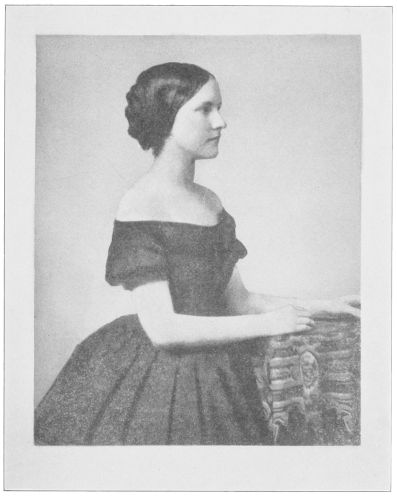
ADÈLE ALLSTON AT SIXTEEN.
Afterward Mrs. Arnoldus Van der Horst.
Such was her costume, but her appearance I cannot describe!”
This diary is a help as to dates, and it records that on July 10, at
daybreak, the shelling of Charleston began, and records also the hasty
packing up of the household gods and family impedimenta, and their
removal from the city; also our arrival at the station at Society Hill,
Darlington County, that night at twelve. There had been no time to send
orders for Daddy Aleck and the carriage to meet us, but the wonderfully
kind neighbors whom we were to find there gave their evidences of
generous friendship that night; for John Williams happened to be there
and offered his carriage and so did Doctor Smith, so that we got to
Crowley Hill with little delay. This was to be our place of refuge
during the war, while the plantations on the coast were regarded as
unsafe.
Before we left the city there comes to my mind a very vivid picture of a
visit paid by another member of the Charleston Light Dragoons, also a
private. He was at home on a short furlough and called to pay his
respects to my mother, and she sent for me to see him also. It was in
the same beautiful oval drawing-room. Mamma was seated on the little
sofa in front of one of the mirror windows, and when I entered the room,
on a chair facing her and talking with great animation sat Poinsett
Pringle, whom I had never seen before, the almost twin brother of my
future husband. Introductions were made, and I sat down and listened and
looked, and looked and listened. Efforts were made both by himself and
by mamma to draw me into the conversation, but in vain. When he had gone
mamma said to me:
“Well, Bessie, if this is the way you are going to behave, you certainly
will not be a success in society! You sat there with your mouth wide
open, gazing at the young man! What was the matter?”
I said solemnly: “Mamma, he was so beautiful that I was paralyzed! I
never saw any one so beautiful in my life.”
And it was true. He was angelically beautiful; light-brown hair parted
in the middle, with a curl in it, short as it was; wonderful blue eyes
that looked like windows to a beautiful soul, fair, smooth skin, perfect
teeth, and a dimple in his smooth chin—add to this very beautiful hands
and the sweetest voice, and no one will wonder that my breath had been
taken away by the sight of him. He was the darling and pride of his
whole family. His mother had him educated for the diplomatic service.
He was a most accomplished musician, playing beautifully on the piano,
and had a charming voice. I never saw him again. All this charm and
beauty of mind and body was snuffed out by a bullet the following May. I
think it was the battle of Haws Shop in Virginia, which the Confederates
lost, and had to give up the field. Poinsett was going out unhurt when
he saw his friend Bee lying wounded. Poinsett picked him up and carried
him some distance toward the rear, when a bullet struck, killing them
both. If I could paint, how I would love to perpetuate that beautiful
face and figure.
It was a terrible undertaking to pack all that big, heavy furniture and
get it away under stress. We found afterward that we had left many
things of great value. At this moment I remember especially two blue
china Chinese vases, urn-shaped, which stood two feet high and were very
heavy. It seemed impossible to get boxes and material to pack them and
they were left. Daddy Moses remained alone to take charge of the house
and garden.
CROWLEY HILL, the place to which we went, was a quaint old-fashioned
house set in a great grove of oak-trees, not the big live oaks we were
accustomed to, but Spanish oaks and red oaks and scrub oaks, which are
beautiful in summer and brilliant-colored in autumn, but bare all
winter. There was quite a little farm land attached, and the place had
been lent papa by the widow of his dear friend, Nicholas Williams.
Nicholas Williams, like my uncle, James L. Petigru, was opposed to
secession, and when he found himself powerless to influence his State,
he determined to leave it and live abroad—but it killed him. He died in
New York before sailing. It is impossible to tell the kindness we
received from these friends all the time we were refugees in their
midst. Of course we were much cut off from our supplies; until mamma had
a garden planted and our dairy was got going we were stranded; but every
day came servants bringing supplies of every kind, milk, cream,
vegetables, fruit, flowers, everything we did not have. At last I said
one day to mamma:
“I cannot stand this. I hate to receive! I am accustomed to give, and so
are you! I don’t see how you stand it, saying ‘Thank you’ all the time.”
Mamma laughed and said: “My child, you are not worthy to give if you
cannot receive gracefully. It shows that you think too much of your
power to give, and it makes you feel superior! I love to give and am
thankful for the many years I have been able to help my neighbors and
others in that way; and now I receive with pleasure these evidences of
the affection and interest of my dear generous friends.”
But never did I get over the feeling of impatience at the necessity of
receiving those daily trays and baskets of delicious things. Our
household consisted only of mamma, my little sister, and myself, for
papa remained at his work on the plantation, only coming now and then
for a few days; and Charley having left the country school, Mr.
Porcher’s, to which he had gone at nine, and where he had endured much
hardship from the scarcity of food the year we were at Barhamville,
having lived for months on nothing but squash and hominy, had now gone
to the Arsenal, the military school in Columbia. We had the full force
of servants, except that William was in the army with my brother, who
was serving as colonel of the 4th Alabama Regiment in Virginia, and
Stephen, who was on the plantation with papa. Mamma at once began to
plant the farm and garden, with the house-servants, and made wonderful
crops.
I went for a month to visit my sister in Wilmington, Major Van der Horst
being on General Whiting’s staff, stationed at Wilmington. Mr. McCrea
had lent them his beautiful and convenient house, so that my sister was
delightfully situated there, and the society was very gay. The first
party I went to I made a great mistake. A very handsome man, young De
Rosset, asked me to dance as soon as he was introduced. I accepted with
pleasure, as I was devoted to dancing. As we stood preparatory to the
start, he asked: “Do you dance fast or loose?” I was confused and
stammered out, “Oh, I made a mistake. I do not dance at all!” and sat
down. I could not bear to say “fast” nor could I bear to say “loose”;
but, as I looked at the dancers, I understood what it meant, and there
was nothing to terrify me in it. One-half of the dancers held hands
crossed, as you do in skating. This was “loose,” and the rest danced in
the ordinary way which I had always been accustomed to; this was called
“fast.” This marred my pleasure in the many parties I went to while in
Wilmington; for, once having said I didn’t dance, I had to stick to it.
The price of every article of clothing was enormous, and shoes were
impossible. I thought of buying a pair of stays, but a very common pair
were fifty dollars, so I ripped up some old Paris ones and made a
beautiful pair for myself, using all the bones, etc. Mamma wrote me to
get three yards of material to make a coat to wear next winter. It was
ninety-five dollars a yard, the only stuff I could get, thick and hairy,
but not fine at all.
At Society Hill, when I returned, the loom was set up in the
wash-kitchen, and I learned to weave as well as to spin, and we knit,
knit, knit all the time. We had one of the maids to spin a fine yarn of
cotton and silk ravellings, with which we knit gloves for our own use.
All pieces of old black silk were cut into small scraps and ravelled out
and carefully mixed with the cotton, and made a very pretty gray for
gloves. We had only one caddy of tea, which was kept for sickness, and
a very little coffee. As a substitute, people used bits of dried sweet
potato parched, and Indian corn parched, also the seed of the okra; this
made a very rich drink, very full of oil. The root of the sassafras made
a very nice tea. Sugar was very scarce, so mamma planted sorghum, a kind
of sugar-cane which made very nice molasses, which Nelson boiled in the
big copper kettle. I made delicious preserves with honey, and we dried
figs, and mamma made all the vinegar we used with the fig-skins, put in
a cask and fermented. This winter there was trouble about the supplies
for the negroes. There were no blankets to be had, and papa wrote,
begging mamma to have the carpets cut up into blanket sizes, so that
those who were expecting blankets that year should not be disappointed.
The thick damask curtains were cut up for coats, as they made good
coats, thickly lined. Altogether there was so much to do that the days
were not long enough.
One day we had a visit from Julius Pringle, who was on furlough at the
house of an uncle, who was refugeeing about four miles away. This was
only the second time I saw him. Mamma and he did all the talking, while
I sewed in silence. Mamma went out of the room to order some cake and
wine, and he told me he didn’t know the way to Crowley, and had come to
a place where four roads crossed, and was puzzling how to decide which
road to take “when I saw a track of a tiny foot leading this way, and I
followed that and I knew it would bring me to you.” This made me very
angry indeed, and I got red and lost the use of my quick tongue. When
mamma came back the talk flowed on as easily and pleasantly as possible.
She told him what a fine crop of rye she had made in her calf pasture,
and what difficulty she had to find a place to put it until she thought
of the big piano box, which had helped very much, for it held so much.
All this time I sewed in silence, with flaming face. At last he asked me
to play. I declined fiercely, but mamma said: “My dear Bessie! Of course
you will play for us”—she being quite shocked at my manner. I went to
the piano and played as though I were fighting the Yankees. When I
returned to my seat Mr. Pringle thanked me, and, turning to my mother,
said:
“Mrs. Allston, apparently the piano box is of more use than the piano!”
And then they both laughed heartily.
I could have killed him without hesitation. I saw him at church after
that, only a moment. And then the day he was to leave to go back to
Virginia, mamma wanted to ask him to take a letter, and we drove to the
station. And when he shook hands with me and said good-by, the look in
his eye was a revelation and declaration of devotion that seemed to
compass me and seal me as forever his, near or far, with my own will or
without it. From that moment I knew that no other man could be anything
to me. It was so strange that in absolute silence, with not a second’s
prolonging of the hand-pressure necessary to say a proper, conventional
good-by, my whole life was altered; for up to that moment I had no idea
that he was devoted to me.
I had always longed to take part in the work going on everywhere for our
soldiers. In our little isolated corner we could do nothing but sewing
and knitting. Soldiers’ shirts made by an extraordinarily easy pattern
which some one had invented we made in quantities. All the ladies in
Columbia were cooking and meeting the soldier trains day and night, and
feeding them and asking what they needed and supplying their wants.
They took it by turns, so that no hour of the day or night could a train
come and find no one to give them hot coffee and biscuits and
sandwiches, and sometimes fried chicken, too.
WHEN the spring came papa made us a little longer visit than usual. He
was not feeling well, his heart was giving him trouble. I only knew this
afterward from mamma, for papa never complained. I remember from my
early childhood looking on in wonder at the self-denial he exercised,
not once or twice, but all the time. His digestion was weak, and day
after day, when we had such delicious things, shrimp, fish, and
rice-birds, and coots, and green corn, and lima beans, I saw him dine on
a plate of milk-and-rice, or a plate of soup with all the delicious okra
and tomatoes and beans strained out. But he never talked of it, nor did
it make him cross. He was specially tender and gentle to us all this
time. One day he asked me to do something and I answered:
“Papa, I don’t know how, I can’t do it.”
And he laid his hand on my shoulder and said: “Don’t ever say that, my
daughter. God has given it to you that whenever you put your whole self
to accomplish anything you will succeed. When you fail it will be
because you have not tried hard enough. Don’t forget this; it is a great
responsibility. Never say again you cannot do a thing!” He spoke so
solemnly that I was greatly impressed; and, many times in my life when
things have risen up before me which have seemed quite beyond my
strength and capacity and endurance, I have remembered that conversation
and gone ahead, only to find that he was right.
When papa said he must go back to the plantation, mamma thought it a
great risk, as he was so far from strong. She urged him to take another
week’s rest; but he said he must go; there was to be a meeting in
Georgetown to determine something about the public schools, and he must
be there. He would take two days on the drive through the country home,
and rest two days before the meeting, for it was most important. He left
us March 18, Friday, promising to return to us the next Sunday week.
About a week after he left, early in the morning, a messenger came up on
horseback with a note from Mr. Belflowers. He thought it his duty to let
mamma know that he thought papa an ill man. He had attended a meeting in
Georgetown in very inclement weather, when he was so far from well that
he had a mattress put in the carryall, and lay on that instead of going
in the carriage. He was afraid “the governor,” as he continued to call
papa, would not like it if he knew he was writing this, but he had to do
it. Mamma ordered the carriage at once and we prepared to start on the
journey. By the mail which came in just before we started, a letter came
from papa to her, saying he had taken a bad cold and wished very much he
could come back and put himself under her care. That was so much for him
to admit that she felt she could name the letter as the cause of her
coming and not betray Mr. Belflowers. It was dreadful to have no quicker
means of going. We started at nine o’clock; that night we spent at Mrs.
Fryer’s, about half-way. The next morning we started by dawn, met a
fresh pair of horses, Mr. Belflowers sent to meet us at Union Church,
and reached Chicora about five in the afternoon.
When we got to Chicora we found papa very ill. He had pneumonia. He was
very happy to see us and did not inquire why we came. It seemed quite
natural to him that we did come. Doctor Sparkman, the same who had saved
his life at The Meadows when they were both young, was in attendance and
was perfectly devoted. Stephen was in constant attendance and very
efficient, also a very faithful man named John Locust, sent by my
cousin, William Allan Allston, over from Waccamaw. As soon as I came I
was established in the position of head nurse, for I had always had a
turn for nursing and at school had nursed all the sick girls and got the
nickname of Miss Nightingale. I was truly thankful for my experience
now, for I was able to be a comfort to papa and a help to everybody,
specially mamma, who was completely unnerved by seeing papa so
desperately ill. The doctor had told us he had little hope, but I was
full of confidence that he would get well. I was very happy to find
papa’s comfort in my nursing. I could see his eyes follow me as I moved
about the room, and one day as I brought him his cup of gruel he said,
“Daughter, that is a pretty dress; it pleases me”—and he held the fold
of the skirt in his fingers as he reluctantly swallowed the gruel which
I gave him by the teaspoonful. His breathing was so labored it was hard
for him to speak and also to swallow. No one can understand the joy his
words gave me, for I loved him so dearly and it was such a delight to
give him pleasure now. I remember the frock well. It was a greenish-gray
material, something like mohair, with dark-green conventionalized
leaves here and there over it; an old dress Della had given me when she
got new things for her trousseau. I had had it washed and made it over
myself. I kept it just to look at for years and years.
The neighbors helped. Mr. Josh La Bruce came over from Sandy Island in
his boat and sat up one night, and was a great help, he was so quiet and
so strong in lifting. Then one night Mr. Weston came and sat up and Mr.
Belflowers sat up one night. Then Mr. La Bruce came again. Papa suffered
terribly from the difficulty of breathing and the want of sleep was
dreadful. He could not sleep. He would repeat in a low voice, “He giveth
his beloved sleep”; then, “I am not beloved!” I would sing a hymn in a
low voice sometimes, which seemed to soothe him and made him doze a
little.
One day he called for Mr. Belflowers, saying he wanted to see him alone,
and every one went out, and it must have been nearly an hour before Mr.
Belflowers came out. Papa asked me to read to him from the Bible, and
that always seemed a comfort to him. The 14th chapter of St. John was
what he asked for most often: “Let not your heart be troubled.” One day
I was reading it to him when his niece, Mrs. Weston, came in, and I
asked her to read it, and she took the Bible from me and read so
beautifully. I saw at once how it comforted him, so slowly, so quietly,
so distinctly, so impersonally. It might have been the blessed Saviour
himself uttering those great words of comfort and promise to his
disciples. The mind of a suffering, dying person acts slowly. If you
hurry the words they cannot follow them without painful effort. When
Cousin Lizzie got to the end of the chapter papa gasped out, “Go on,
Elizabeth,” and she went slowly on a long time.
The breathing became more and more terrible every hour, such a struggle
that I could not endure to see it and be helpless to aid in any way. I
would kneel beside the bed and take his hand and he would press mine in
a grip which showed his pain, and at last as I knelt there I gave him up
and prayed God to relieve him from his agony. Poor mamma could scarcely
stay in the room, it was such an agony to her. She came in and knelt
beside him and held his hand, and then she had to go out. But at last we
all felt the end was at hand, and knelt beside the bed, praying for him
with all our being, when he lifted his right hand with a powerful sweep
and said in a strong voice: “Lord, let me pass!” And it was all over in
a few seconds, with no struggle or distress. It was peace after the
awful storm, and we felt he was safely in the haven.
I had not slept for days and nights and went into the next room and fell
into a deep sleep for an hour. When I woke I went into papa’s room. The
big bed had been moved out, and there he lay on the little single
mahogany bed,[4] looking oh so peaceful and so beautiful; all the lines
of care and anxiety gone and a look of youth and calm strength in his
face. Oh, the comfort of that look. Mamma was sitting there, quite
self-controlled and calm. I called her outside, for we had to make all
the arrangements and give all the directions.
In the country there are no officials trained to take charge of things,
and I suggested that we have Mr. Belflowers come and give him necessary
directions. He was waiting down-stairs, and came up at once. Mamma began
to tell him what she thought he had better do, but faltered and said: “I
really don’t know what directions to give!”
He said: “There is no need for you to give any or to think about it,
Mrs. Allston. The governor called me in three days ago and gave me every
direction. He had it all in his mind, but his speech was so cut short by
his breath that it took a good while for him to tell me. He told me what
carpenters must make the coffin, where the specially selected and
seasoned wood was; what negro was to drive the wagon which carried him
and which horses; what horses to go in your carriage, with Aleck
driving; who was to carry the invitation to the funeral, and with what
horses on this side of the river, and to Georgetown, and what man was to
take the boat and take it to Waccamaw. He said he wanted to be laid in
the graveyard of Prince Frederick’s church, as it was so near, and it
would give too much trouble to be taken to Georgetown, and that after
the war was over he could be moved to the family enclosure in
Georgetown. And, ma’am, I have already given all the orders, just as he
told me.”
It is impossible to give any idea of the immense relief this was to
mamma and to me. It just seemed a horror to see after all the sordid,
terrible details. Papa had told John Locust and Stephen just how to
arrange and dress and lay him out, so John had asked mamma to leave the
room when the spirit had fled, and called her back when it was all done.
The day before the end mamma had wanted to ask him some questions as to
what she should do, etc. She broke down and said: “What can I ever do
without you? Tell me what to do!” He pressed her hand and said: “The
Lord will provide; have no fear.” He could not direct her as to anything
ahead in those troublous, changing times, but he could see that she was
spared all trouble at the last, and we both felt it was the most
touching and wonderful proof of his devotion even in the agony of death.
He was laid to rest in the churchyard of Prince Frederick’s, just a mile
away, where the beautiful half-finished brick church in whose building
he had been so much interested, stood, a monument to war. All the
trimmings and furnishings had been ordered in England, and, in running
the blockade, they had been sunk. The architect, whose name was Gunn,
had died, and was buried near the church, and the roofless but beautiful
building stood there forlorn. There we laid him, with all the beauty of
the wild spring flowers and growth he so loved around him, nearly under
a big dogwood-tree in all its white glory. Crying and lamentation of
the negroes who flocked along the road behind the wagon which carried
papa, and filled the large graveyard, standing at a little distance
behind the family, according to their rank and station on the
plantation. Those who dug the grave had been specially named by papa,
and it was considered a great honor. My dear father, if love could
avail, when he reached those gates of pearl, they would fly open at his
approach, for he carried the love and devotion of many people of all
colors and classes.
As soon as possible my uncle, Chancellor Lesesne, arrived and opened and
read the will. Mamma was named executrix and Chancellor Henry D. Lesesne
executor. The house in Charleston and all the furniture were left to
mamma, with all the house-servants and their families, and what
carriages and horses she wanted, and a sum of money. To each of us five
children a plantation and negroes, one hundred each. They were all named
for each one. Charley was to have Chicora Wood, where we had always
lived, and all the negroes who lived there. Brother Guendalos, the
plantation adjoining on the south; Jane, Ditchfield, the plantation
adjoining Chicora on the north; and to me was left Exchange, the
plantation just north of that. To my sister Adèle, Waterford, a
plantation on the Waccamaw, very valuable, and which would sell well;
and Nightingale Hall, which was considered the place which would sell
best, as it was at the pitch of tide most considered, being subject
neither to freshet from above nor salt from the ocean below, was to be
sold for the benefit of the heirs.
Then came an immense deal of writing and work for me. My brothers not
being available nor any clerical outside help, I did all the writing and
copying of the will to be sent round to the different heirs, and the
lists of negroes, cattle, farm implements, and personal property, and
helped Uncle Henry in every way. I have by me now the list of 600
negroes.
It was a great relief to have the work to do, for more and more as the
days went on and the sense of thankfulness for his relief from suffering
grew fainter, the sense of terrible desolation and sorrow possessed me.
Papa was the only person in the world in whom I had absolute faith and
confidence. I had never seen him show a trace of weakness or indecision.
I had never seen him unjust or hasty in his judgment of a person. I had
watched him closely and yet I had never seen him give way to temper or
irritation, though I had seen him greatly tried. Never a sign of
self-indulgence, or indolence, or selfishness. It was my misfortune to
see people’s weaknesses with uncanny clearness, and my mother often
rebuked me for being censorious and severe in my judgments of all around
me; but never had I seen a thing in my father which I would criticise or
wish to change. Only, I often wished he would talk more; but when I once
said that very shyly to him, he laughed and said: “Child, when I have
something to say I say it, and it seems to me that is a good plan.”
We returned to Society Hill in May, mamma and I driving up in the
carriage as we had gone down; but oh, how different the whole world was
to us! The beauty of nature on the way, the woods in all the glory of
their fresh leafage, the wild flowers, the birds, the gorgeous
sunshine—all, all seemed a mockery. Our life was to be a gray, dull
drab always. We stopped a night on the way up with kind, devoted
friends, General Harllee and his charming wife, in their beautiful home,
with a wonderful flower-garden. There was no power left in me to admire
even, much less to enjoy. I had always been the most enthusiastic person
in the world, too much so for polite standards. Now it was all gone. I
was just a very thin, under-sized, plain, commonplace young person,
ready to do anything I was told, but without one spark of initiative.
Mamma was crushed not only by her grief but by the feeling that she was
utterly inadequate to the task before her, that of looking after and
providing for over 600 negroes in this time of war and stress, of seeing
that the proper supplies of food were at the different points where they
were needed.
Mamma had never had the least planning about supplies, beyond buying her
own groceries. The supplies of rice, grist, potatoes, everything, had
been brought to her storeroom door regularly once a week, calling for no
thought on her part. Now suddenly she had to plan and arrange for the
100 people on the farms in North Carolina, as well as for the 500 down
on the plantations. It was perfectly wonderful to see how she rose to
the requirements of the moment, and how strong and level her mind was.
In a little while she had grasped the full extent of the situation, and
was perfectly equal to her new position.
SOON after we returned to Crowley Hill she determined to go to the North
Carolina farms and see the people, so as to reassure them as to her
taking care of them fully.
We started very early in the morning, Daddy Aleck driving, with baskets
packed with lunch for the day and provisions to cook, for we expected to
stay three or four days. The drive of thirty miles was charming until it
got too hot, and we stopped under a tree by a spring, took out the
horses and tied them in the shade and had our lunch, and rested until it
became a little cooler. Loch Adèle, as we girls had named the farm, was
a very pretty place with a mill and large pond, which we dignified into
a loch, much to papa’s amusement. A pretty rolling country, and the Pee
Dee River, called the Yadkin as soon as it passed the line from South to
North Carolina, ran a small rocky stream about a mile from the rambling
farmhouse. Flats had brought supplies in large quantities up the river
from Chicora, and most of the Charleston furniture had been brought by
rail to Cheraw, fifteen miles away, and hauled out to this place, so
that the house was thoroughly furnished, pictures hanging on the walls,
because it seemed better than to keep them packed. The two lovely
bas-reliefs of Thorwaldsen’s, “Night” and “Morning,” looked especially
beautiful hanging on the white walls of the drawing-room, and the whole
place was homelike and delightful with our Charleston belongings. And
the poor negroes were so glad to see us and to realize that “Miss” was
going to look after them and to the best of her ability take “Maussa’s”
place. They wanted to hear all about papa’s illness and death and the
funeral, and who had been honored by taking special place in it. Mamma
was interviewed by each one separately, and had to repeat all the
details over and over. She was very patient, to my great surprise, and,
I think, to the people’s, too, for she had never been as willing to
listen to their long rigmaroles as papa had been. But now she listened
to all and consoled them and wept with them over their mutual loss.
Altogether the visit did us both good.
Old Daddy Hamedy, who was head man on the place, had been a first-class
carpenter and still was, but when there was needed some one to take
supervision of the farm and people up there, papa chose him on account
of his character and intelligence. Papa had engaged a white man, a Mr.
Yates, who lived some miles away, to give an eye to the place from time
to time and write him how things went on, and Hamedy was to apply to Mr.
Yates if anything went wrong. He was originally from the North, but he
had bought a farm near the little town of Morven some years before, and
lived here ever since. Mamma sent to ask Mr. Yates to come and see her,
and he came. He was a very smart man, but impressed me most unpleasantly
as unreliable and unscrupulous, as I watched him talking to mamma. He
evidently felt that, papa being gone, his time had come, and was quite
sure he could manage my mother easily. He was most flattering in his
admiration, which was not surprising, for my mother was beautiful in her
plain black frock and widow’s cap.
In trying to make easy conversation as he sat and talked to us, he
asked: “Miss Allston, do you smoke?”
In some surprise my mother answered: “No, I have never smoked.”
“Well, well,” he said. “You wouldn’t find another lady of your age in
this country that didn’t smoke.”
This nearly upset my gravity, for the idea of my mother’s smoking was
too much for me, and I went out down to the mill-pond. Into this lake my
father had had rolled many hogsheads packed securely with bottles of old
Madeira wine, as being the best chance of saving them from the Yankees.
They were certainly not safe at Chicora Wood, only about twenty miles
from the mouth of Winyah Bay, when gunboats could run up from the sea so
easily. So the wine was packed and shipped by his flats in charge of
faithful men. I remember when the flats were going, on one occasion,
papa wanted to send up a very beautiful marble group of “The Prodigal
Son,” which was always in the drawing-room at Chicora, and he called in
Joe Washington, who was to take charge of the flat, to look at it, and
told him that he would have it carefully packed by the carpenter, and he
wanted him to be specially careful of it; whereupon Joe said:
“Please, sir, don’t have it pack. I’ll tek good kere of it, but please
lef it so en I kin look at it en enjoy it. I’ll neber let nuthin’ hut
it.”
So papa acceded and did not have it packed, and on that open flat, amid
barrels and boxes and propelled by oars and poles, only a little shed at
one end under which the eight hands could take shelter in case of rain,
“The Prodigal Son” and the happy father made their journey of 300 miles
in perfect safety. And I may say here the group was brought back when
the war was over, and now rests in the old place in the drawing-room at
Chicora Wood. How it escaped Sherman I do not know; some one must have
hid it in the woods.
I INSERT here an extract from my diary:
“Croley Hill, Sunday July 19th, 1864.
JUST as we were leaving for Church the paper came and there in it was
the dreadful intelligence that my cousin Gen’l Johnston Pettigrew, who
was wounded on the 17th had died of his wounds. It is too dreadful! If I
could I would hope that this, like the first might be a false report,
but something tells me it is true.... Next to Uncle (James L. Petigru)
he was the light of the family, so clever, so learned, so noble; and how
I have almost adored him in his nobleness and wisdom; how I have sat and
listened to Uncle and himself talking until I thought nothing could ever
be as brilliant and pleasant as that; but now both have gone and we
shall never see their equals again.... I am glad I have Cousin
Johnston’s beautiful book ‘Spain and the Spaniards’ which he gave me. We
heard he was wounded at Gettysburg but his name was not mentioned among
the generals and never since, so we supposed it was a mistake, and
Now....” This was a terrible blow and distress. After this, sad news
kept coming in of reverses, and things looked dark. The hospitals were
in great need of stimulants and mamma determined to send the rye she had
made to the still about twenty miles away and have it made into whiskey.
Daddy Aleck took it and told of the dangers he had encountered on the
way, so that when it was finished, he was afraid to go for it alone, and
mamma told Jinty and me we must ride along with him.
About this time my cousin, Captain Phil Porcher, of the navy, went out
on a little vessel, the Juno, which had been built in Charleston
harbor to run the blockade, and nothing was ever heard of him or of any
of the crew or officers. Weeks passed into months and not a word of the
fate of the boat. It was terrible for Aunt Louise and her daughters.
Mamma wrote and begged them to come and stay with us, and they came. It
was dreadful to see their sufferings. My aunt was a beautiful and heroic
figure. They would not act as though they had heard of his death, for
each day there was the hope that when the paper came there would be some
news of him. They tried so hard to be cheerful and hope against hope.
But no news ever did come. It remains one of the mysteries of the
deep.”[5]
Phil Porcher was a gallant, charming, and exemplary man, and the
greatest loss to the whole family and to the country.
AFTER my aunt and cousins left we began to bury every treasure we had.
All the silver which had not been sent to Morven was packed in a wooden
chest, and Mr. William Evans, our nearest neighbor, came one day in his
wagon to take it as, it was supposed, to the station to send it away by
the railroad. Nelson went with him, and they drove by a winding route
into some very thick woods near, and Nelson dug a deep hole and the two
of them lowered it in with ropes, filled the grave, and marked the spot.
That was one weight off of our minds. We kept just enough for daily use.
I became an expert in burying. Three sheets were a necessity; one to put
the top earth on, with moss and leaves and everything to look natural,
then one to put the second colored earth near the surface, and one to
put every grain of the yellow clay below, one little pellet of which
would tell the tale that a hole had been dug.
Charley came home for a few days on his way to Virginia, the boys at
the Arsenal having been called out. He was just sixteen, and it was
pitiful to see him weighed down by his knapsack and all the heavy things
he had to march with, for he was very thin and gaunt. Mamma consulted
him as to what to do with the old Madeira, of which she still had a good
deal packed in barrels in the storeroom. He consulted Nelson, and they
agreed to pack it in the big piano box, which was still used as a grain
bin. So the piano box was cleared out and emptied, and brought into the
little front porch, which it nearly filled, as there had been a room cut
off from each end of the porch, which originally ran the length of the
house, and this left this porch with steps all the way along down to the
ground, only about five steps. Here they brought hay and we all helped
bring the bottles of wine up quietly from the storeroom, and Nelson, who
was an expert, packed them beautifully. It was done so quietly that the
servants in the yard knew nothing of it. We all went to bed at the usual
hour, but at twelve o’clock Charley and Nelson got up, having provided
ropes, spades, and everything necessary in one of the shed-rooms, which
Charley occupied, also two pieces of round oak as rollers. They dug a
hole big enough for the piano box, using sheets for the earth, as I
have described, and how those two accomplished it is a mystery, without
help, but they did put that huge box into that deep hole, covered it up,
removing the dirt which was too much, and levelled the surface, raked
the whole front road, and then brought the wagon and rolled it back and
forth over it, making it look natural; so that in the morning there was
no trace of anything unusual. Charley left the next day for Virginia,
and oh, how miserable we were! Poor mamma, he was her special darling,
named after her youngest brother, who gave his life for his friend so
long ago.
Mamma was kept very busy, sending supplies in different directions, and
having cloth spun and woven. She sent demijohns of whiskey to the
hospitals and some down to Mr. Belflowers for use on the plantation in
case of sickness (the darkies having a feeling that no woman can be
safely delivered of a child without a liberal supply of whiskey).
I cannot mark the passage of time exactly, but the report came that
Sherman was advancing, and there came awful rumors of what he was doing
and would do. We made long homespun bags, quite narrow, and with a
strong waistband, and a strong button, to be worn under the skirts. And
into these we put all our treasures. They said every photograph was
destroyed, after great indignities. I took all my photos of my dear ones
(such sights they look now, but then seemed beautiful). I put them one
by one in a basin of clear cold water and left them a few minutes, when
I found I could peal them off of the card; and then I pasted them into a
little book which I could carry in one of my pockets. The book was
Brother’s passport-book when he was travelling abroad, and I have it now
with all the pictures in it. Our kind and generous neighbor, Mrs. Wm.
Evans, was a very, very thin, tall woman, but when I ran over to see her
during these days of anxiety and she came out into the piazza to meet
me, I could not believe my eyes. She seemed to be an enormously stout
woman! I looked so startled that she said:
“My dear Bessie, they say these brutes take everything but what you have
on and burn it before your eyes. So I have bags of supplies, rice and
wheat flour and sugar and what little coffee we had, hung round my
waist, and then I have on all the clothes I can possibly stand, three
dresses for one item.” And then we both laughed until we nearly fell
from exhaustion. And when I ran home and told mamma we had another great
laugh, and oh, it was such a mercy to have a good hearty laugh in those
days of gloom and anxiety. We never quite got to Mrs. Evans’s condition,
but we each had treasures unknown to the others concealed about us.
Things in the Confederacy were going worse and worse. It was an agony to
read the papers. My sister, Mrs. Van der Horst, came home from
Wilmington, bringing her maid, Margaret. Her husband did not think it
safe for her to stay any longer there. It was a great comfort to have
her with us. The Yankees were reported nearer and nearer, but we never
saw any one to hear positively where they were. Then one evening, just
at dusk, two horsemen galloped up to the front door, tied their horses
and came in. They were Charleston Light Dragoons acting as scouts for
General Hampton—Julius Pringle and Tom Ferguson. They came to tell us
Hampton was protecting all our troops as they left the State. They were
the very last, and Mr. Pringle said to mamma:
“I knew you had wine and whiskey in the house and I came to beg you for
God’s sake to destroy it all. Do not let a drop be found in the house,
I implore you.”
Mamma said: “But, Julius, I have not sent all that whiskey to the
hospitals yet, and it is so greatly needed! I have two demijohns still.”
“Oh, Mrs. Allston, I implore you, do not hesitate. Have those demijohns
broken to pieces the first thing to-morrow morning.”
She promised. We gave them a good supper, of which they were in great
need. Nelson fed the horses. They took two hours’ sleep and then left in
the middle of the night. As they were going, there were shots heard on
the public road which ran back of our house about 400 yards. The two
dragoons jumped on their horses and galloped off from the front door
into the darkness of the night. It was an awful moment. They were gone,
our last friends and protectors, and the agony in Mr. Pringle’s face was
indescribable.
We found the next morning that the shots had been the forerunners only
of the license we had to expect. It was negroes shooting our hogs, which
were fat and tempting. Early the next morning mamma called Nelson and
Daddy Aleck and had them bring the wheelbarrow and put into it the
demijohns with the precious rye whiskey and roll them to a little
stream near by, and pour it into the water. We went along and it was a
melancholy procession, and Daddy Aleck secretly wept and openly
grumbled, as he felt he had risked his life for that whiskey. As it was
poured into the branch by Nelson, who also loved whiskey, Daddy Aleck
went lower down the stream and knelt down and drank as if he were a
four-footed beast. Then we went back and wondered how we could dispose
of the two dozen bottles of wine still in the storeroom. Papa had once
said it might prove the most salable thing we had after the war. I
undertook to conceal them, and, going up into the garret, I found the
flooring was not nailed down, and, lifting one board at a time, I laid
the bottles softly in, softly because they were placed on the ceiling
laths and it was an old house. But the ceiling held and the bottles were
disposed of.
After having done all he could to help mamma that day, Nelson came to
her and said: “Miss, I want you to give me some provision and let me go
for a while.”
She exclaimed: “Nelson, you cannot leave us when these Yankees are
coming! You must not leave us unprotected.”
He said: “Miss, I know too much. Ef dem Yankee was to put a pistol to my
head and say tell what you know or I’ll shoot you, I cudn’t trust
meself. I dunno what I mite do! Le’ me go, miss.” So mamma put up his
bag of provisions and he went.
The next day she decided it was best to send Daddy Aleck off, as he said
if she let him go he thought he could take the horses in the swamp and
save them. So he went, taking the horses and a bag of harness and all
the saddles. It was a brave, clever thing of the old man to carry out.
But we felt truly desolate when both he and Nelson were gone, and we
only had Phibby and Margaret, Della’s maid, and Nellie, Nelson’s wife,
and little Andrew, who was a kind of little dwarf, a very smart and
competent, well-trained dining-room servant, who looked about fourteen
but was said to be over twenty.
AS everything would be seized by the enemy when they came, we lived very
high, and the things which had been preciously hoarded until the men of
the family should come home were now eaten. Every day we had a real
Christmas dinner; all the turkeys and hams were used. One day mamma had
just helped us all to a delicious piece of turkey when Phibby rushed in,
crying: “Miss, dey cumin!” Bruno, Jane’s little water-spaniel, began to
bark, and she rushed out to the wide roofless porch where he was, threw
her arms round his neck and held his throat so tight he couldn’t bark,
just as a soldier was about to strike him with a sword. I was terrified
for her as she knelt there in the middle of the porch, holding him; but
they only looked down at her, as they rushed by on each side into the
house, calling out:
“Whiskey! We want liquor! Don’t lie; we know you have it! We want
whiskey! We want firearms!” Each one said the same thing.
Mamma was very calm. As they clamored she said: “You may search the
house. You will find none. I had some whiskey, but it is here no
longer.”
They seemed delighted at the sight of the dinner-table, and for a time
were occupied eating and pocketing all that could be pocketed. When the
renewed cry for wine, whiskey, and firearms came, mamma took from the
nail where it hung the huge storeroom key, and went down the steps to
the storeroom, just in time to prevent its being smashed in with an axe.
She opened the door and they rushed in with many insulting words. Poor
Phibby was wild with terror, and followed mamma, closely holding on to
her skirt and entreating her not to go.
“Miss, dem’ll kill yu, fu Gawd sake don’ go wid dem.” But mamma showed
no sign of excitement or alarm and never seemed to hear the dreadful
things they said. They opened box after box in vain, but at last in the
box under all the rest they came on a bottle and the men shouted: “We
knew you were lying!” The finder struck the head off with one blow, and,
putting the bottle to his mouth, took a long draft. Then there was a
splutter and choking, and he got rid of it as quickly as possible, to
the amusement and joy of the others, who had envied his find. It was
our one treasured bottle of olive-oil, which had been put out of reach,
to be kept for some great occasion.
Upstairs in her bedroom my sister was having a trying time. She unlocked
her trunk to prevent its being ripped open with a sword, and looked on
while they ran through it, taking all her jewels and everything of
value, holding up each garment for examination and asking its uses, each
one being greeted by shouts of laughter. She, having recently come, had
not concealed or buried any of her things. After disposing of her big
trunk, they turned to a closet, where a man’s leather trunk was. They
asked for the key, and when she said she did not have it, they cut it
open, and there on top lay a sword. Then there were howls of: “We knew
you were lying. You said you had no arms.” Della only answered: “I did
not know what was in this trunk.” It was her brother-in-law Lewis Van
der Horst’s trunk. He had been killed fighting gallantly in Virginia,
and his trunk had been sent home by his friends to his brother without
the key.
All this time I was with another party, who were searching for liquor,
and I followed them into the garret. It was odd how impossible it was
not to follow them and see what they did. I was told afterward that in
most places the women shut themselves up in a room while they searched
the house; but, with us, we were irresistibly borne to keep up with them
and watch them. When I heard them tramping over the garret, the loose
boards rattling, I flew up myself and stood there while they opened
every box and trunk, taking anything of any value, every now and then
quarrelling over who should have a thing. I was in misery, for the
boards seemed to be crying aloud: “Take us up and you’ll find something.
Take us up.” Whenever they asked me anything I answered with some quick,
sharp speech which would intensely amuse any one but the questioner, who
generally relapsed into sulky silence. They seemed to be in great dread
of being surprised by Hampton’s cavalry, whom they spoke of as “the
devil, for you never knew where he was,” so they did everything very
rapidly.
All this time there were parties going all over the yard, running
ramrods into the ground to find buried things. My terror about that big
box of wine was intense as I saw them. They even went under the big
piazza at the back of the house and rammed every foot of the earth. It
was a marvel that they never thought of coming to the front, having come
up at the back of the house from the public road. They never even opened
the gate which separated the front yard from the back, and so the great
piano box was never found. Little Andrew we never had felt very sure of,
and so everything about the burying of things was kept from him. As they
left, Margaret and Nellie came in crying bitterly. They had taken every
trinket and treasure they had, and all their warm clothes. Margaret was
specially loud in her denunciation:
“I always bin hear dat de Yankees was gwine help de nigger! W’a’ kynd a
help yu call dis! Tek ebery ting I got in de wurld, my t’ree gold
broach,” etc., etc. Poor Margaret had sometimes been supposed to be
light-fingered, and she had returned from Wilmington with a good deal of
jewelry, which we wondered about; but now, poor soul, it was all gone.
For four days the army kept passing along that road, and we heard shouts
and shots and drums beating, and every moment expected another visit,
but, as I said, they moved in haste, always fearing to leave the main
road and be ambushed by Hampton’s ubiquitous scouts. We never went to
bed or took off our clothes during that time. We sat fully dressed in
the parlor, all night through, Phibby always sitting with us on the
floor near the door, leaning straight up against the wall, her legs
stretched out in front of her, nodding and praying. She was a great
comfort. Mamma tried to induce her to go to bed and sleep, saying:
“Phœbe, you have nothing to fear. They won’t hurt you.”
All her answer was: “Miss, yu tink I gwine lef’ yu fu dem weeked men fu
kill, no ma’am, not Phibby. I’ll stay right here en pertect yu.”
Mamma read calmly. Della slept on the sofa. I scribbled in my journal. I
will make a little extract here from the little paper book I carried in
my pocket. It seems very trivial and foolish; but here it is:
“March 8th, 1865.—Twelve o’clock! and we still sit whispering around
the fire, Phœbe on the floor nodding, Della with her feet extended
trying to rest on the sofa, and I on a stool scribbling, scribbling to
while away the time till dawn. Thank God, one more quiet day, and we so
hoped for a quiet night, but a little after nine Phœbe ran in saying she
heard them coming. Oh, the chill and terror that ran through me when I
heard that; but it proved a false alarm.... I never fully understood
terror until now, and yet every one says our experience of them is
mild.... They delight in making terrible threats of vengeance and seem
to gloat over our misery. Yesterday a captain was here who pretended to
be all kindness and sympathy over the treatment we had received from the
foragers.... He did not enter the house. We placed a chair on the piazza
and gave him what we had to eat. But when he began to talk, he seemed
almost worse than any other. He vowed never to take a prisoner, said he
would delight in shooting down a rebel prisoner and often did it! My
disgust was intense, but I struggled hard to keep cool and succeeded
somewhat. He asked, ‘Do you know what you are fighting for?’ I replied,
‘Existence.’ He said, ‘We won’t let you have it,’ with such a grin....
He said, ‘At the beginning of this war, I didn’t care a cent about a
nigger, but I’d rather fight for ten years longer than let the South
have her independence.’ Then, with a chuckle, he said, ‘But we’ll starve
you out, not in one place that we have visited have we left three
meals.’ At something Della said he exclaimed, ‘Oh, I know what you
mean, you mean the Almighty, but the Almighty has got nothing to do with
this war.’ Such blasphemy silenced us completely.”
The tales the negroes heard from one another were terrific, as to what
the Yankees had done, and what the negroes had done. We never saw any
one during this time but those in the yard. Little Andrew, whom we never
had felt sure of, behaved very well. We had thought he would probably go
off with the Yankees, but whether his experience of them had not been
such as to make him desire a closer knowledge I don’t know, but
certainly no one could have behaved better than he did, laying the table
with the few forks and spoons mamma had managed to hide, and bringing in
our scanty meals with as much dignity as if things were unchanged; and
he was a help, though he never expressed devotion or the contrary, only
brought in specially hair-raising stories of the outrages committed on
every side, many of which stories proved to have no foundation in fact.
At last the noises on the highway ceased, and we knew Sherman’s great
army had passed on toward the North.
We began to breathe freely and feel that we could go to bed at night and
sleep. At first we went to bed with all our clothes on, but gradually
we realized that the army had passed entirely, leaving no troops in the
country behind them. News began to come in, and we knew that Sherman had
burned Columbia and left a trail of desolation where he had passed. The
fear of the Confederate troops had kept them to a narrow strip of
country. It was like the path stripped by a tornado, narrow but complete
destruction in it. Mrs. Evans ventured over to make us a visit. She had
not yet assumed her natural proportions, but had lightened her burden so
that she could walk the half-mile between our houses. We were eager to
hear her experiences, but, to her intense disappointment, she had had
none! She had not seen a Yankee! It shows how careful they were not to
leave the main road for fear of ambush. She had prepared many brilliant,
severe speeches to make to them, for she had a very witty, sharp tongue
and was as bold as a lion, so that she felt very sore and aggrieved, and
when she heard of our experiences her blood boiled that we had not
lashed them with bitter words.
About four days after they passed Daddy Aleck reappeared with the
horses, safe and sound, but greatly distressed that he had waked hearing
shots near one morning, packed up his things quickly on his horses, and
taken them deeper in the swamp and left one of the side-saddles hanging
on a limb. Nelson also arrived, looking weary and blanched by his
experiences. Daddy Aleck was a naturally brave, combative nature and
very tough, but Nelson was a lover of peace and comfort, and camping out
in the swamp was no joy to him. He and Daddy Aleck were never friends
and distrusted each other, so they had not cared to go together.
ONLY a few days after Daddy Aleck’s and Nelson’s return, Brutus came
from Loch Adèle, bearing a piece of paper with hieroglyphics on it in
pencil. After much studying over it by each one of us, we found it was a
note from dear, faithful Daddy Hamedy: “Miss, cum at once. Mister Yates
dun dribe de peeple.” Then mamma questioned the boy, not telling what
trouble we had to make out the important document of which he was the
bearer. He told his story. General Kilpatrick and the whole army had
camped on the place a week. They had burned the gin-house after taking
all the provisions they could carry away, and left the negroes without a
thing to eat, and the whole country was the same—nothing to eat for the
white people who belonged there any more than for them—and Mr. Yates
had come to the farm the day before and told Daddy Hamedy they must all
leave the country at once and go back down to the low country from which
they came. Daddy Hamedy had answered him civilly; he said it would take
them a day to prepare, and as soon as Mr. Yates left he had started this
runner, Brutus, off. He had travelled all night to bring it quick! Mamma
praised him and gave him the best meal she could and told him to go to
sleep. Everything was stirring that night, preparing for an early start.
Mamma went over to see Mr. Evans and consulted him about it and told him
she was going up the next day. He advised her greatly against it, but,
finding he could not persuade her to give it up, he said he would ride
on horseback along with us. He had saved his riding-horse by taking it
in the swamp as Daddy Aleck had.
So at daylight the next morning we started; mamma and I in the carriage
with a basket of cooked food, Daddy Aleck driving and Brutus beside him
on the box, Mr. Evans riding beside the carriage. It was an awful
experience, as it must always be to travel in the track of a destroying
army. To begin with, the road was a quagmire. It took an experienced
driver like Daddy Aleck to get us through, and even with all his care
Brutus and Mr. Evans had often to get a rail from the fences along the
road and pry our wheels out of the bog. We were never out of the sight
of dead things, and the stench was almost unbearable. Dead horses all
along the way and, here and there, a leg or an arm sticking out of a
hastily made too-shallow grave. Along the way ten cows dead in one pen,
and then eight or ten calves dead in another. Dead hogs everywhere; the
effort being to starve the inhabitants out, no living thing was left in
a very abundant country. It is a country of small farms, just two-roomed
houses; all now tightly shut up, no sign of life. Wells with all means
of drawing water destroyed. We stopped at one or two houses and knocked
without any response, but at last we knocked at one where a tall, pale
woman opened a crack of the door wide enough to talk through. No, she
had nothing; could not help us in any way to draw water. So Daddy Aleck
got his halters and tied them together and let his horse-bucket down
into the well, and I was so thirsty I drank, but mamma would not. As we
got beyond Cheraw, fifteen miles on our way, we began to meet some of
our people from Morven, who had started on their hundred-mile flight to
the low country, in obedience to Mr. Yates’s mandate—forlorn figures, a
pot sometimes balanced on the head, and a bundle of clothing swung on
the back, a baby in arms, sometimes one or two children trailing
behind. Mamma stopped as we got to each traveller and told them to turn
back; she had come to feed them and do all she could for them, and they
need have no fear. To Daddy Aleck’s great indignation, she took some of
the impedimenta from the most heavily loaded and we went on our way. We
had made such an early start that few had gone more than a few miles,
and all were so rejoiced to see mamma and so thankful to turn back that
we began to feel quite cheerful.
It was lucky, for things were worse and worse as we went on; and when
finally we got to pretty Loch Adèle a scene of desolation met us—every
animal killed, and the negroes had had a kind of superstitious feeling
about making use of the meat, or they could have cured meat enough to
last the winter; for, though the Yankees had burned down the gin-house,
with cotton and provisions and salt, they could not destroy the latter,
and there, in a blackened mass, was a small mountain of salt. If Mr.
Yates had been any good he could have seen to that. The house was not
burned, but everything in it was broken to pieces—beds, sideboard,
chairs, tables, and on the floor the fragments of the beautiful big
medallions of “Night” and “Morning,” chopped into little pieces. I
found one baby’s foot, whole, in the mass of rubbish, which I kept a
long time, it was so beautiful, quite the size of a real baby’s.
We had a tremendous afternoon’s work to clear away and make the place
habitable for the night, but Brutus worked with me and I got two women
to help, and we managed to prop up a table and put boards over the
bottomless chairs, and by supper-time, with a bright fire burning, for
we had only brought two candles, it was quite a different-looking place.
Mamma had brought two roast chickens and a piece of boiled bacon (as she
had buried a box of bacon, fortunately) and a loaf of bread and some
corn-dodgers which we toasted by the fire, so we had a good supper. The
thing that worried us most was the fixing a comfortable bed for Mr.
Evans, but we succeeded in propping up things, and, putting some straw
and the blankets we had brought, made a comfortable resting-place; but,
when it was all fixed, Mr. Evans absolutely refused to occupy it, said
he preferred to rest on the three-legged sofa by the fire, and insisted
that mamma and I should take the bed. Which, after a little friendly
contention, we did, and most thankful was I to stretch myself on
anything after the fatigues and agitations of the day.
Early in the morning we were up and busy. Brutus cooked hominy for
breakfast and fried some bacon. After breakfast Mr. Evans, seeing mamma
equal to the situation, rode back home. Before we had sat down,
forlorn-looking country people began to arrive. They sat around the fire
on broken chairs while we ate breakfast. Then Mr. Yates arrived. He was
so startled when he saw mamma he looked as though he would faint. He
said good morning and then went out. People still came and mamma was
filled with wonder as to what it meant, till one man said:
“Wall, when’s the auction goin’ to begin?”
Mamma said: “What auction?”
He said: “We was notified by your agent how as there was to be an
auction here to-day, an’ everything on the place was to be sold. I come
to buy a plough.”
Mamma said: “There will be no auction here to-day.”
Then they one by one rose and said: “I reckon if there ain’t to be no
auction, we better be gittin’ home.” And they made their adieus and
left.
Then we understood. Mr. Yates had ordered the negroes to leave, and
intended to sell out all
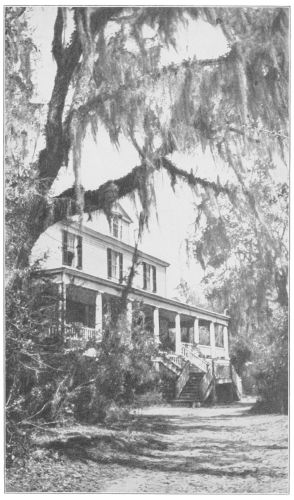
CHICORA WOOD.
Photograph by Amelia M. Watson.
the things on the place and take the money, never supposing there was
any possibility of mamma’s being informed in time to get up to prevent
it. But he reckoned without knowing the negroes or mamma. As soon as
they had all left, she summoned Mr. Yates and had a talk with him. She
told him she would not need his services any more, that he had quite
exceeded his authority in sending the negroes off without consulting
her, and that the fact of his having advertised an auction without her
consent also showed that he misunderstood the situation. He was quite
insolent and said he would not go unless he was paid in full. To which
she answered she had no intention of letting him go unpaid, asked for
his accounts, looked over them, and gave him a check on Mr. Malloy in
Cheraw.
Mamma found that below the salt was a large pile of rough rice which
would not burn, and which was ample provision for the negroes. On
examination we found that only the outside of the pile of rough rice was
scorched. Rough rice (which is the rice still encased in its thick,
rough, outer shell) cannot burn, and there was enough rice there to keep
the people well fed a long time, and they prefer rice to any other food.
They beat it in mortars made by taking about three feet of the trunk of
a hardwood-tree and burning out the centre, so as to hold about six
quarts of grain. Then they make a pestle from a smaller limb of hardwood
neatly smoothed and rounded at the end; and with these crude implements
the stiff, hard, almost indestructible hull is easily removed.
Mamma also found that away from the path of the enemy there were
supplies of sorghum syrup and potatoes, etc., which people would gladly
bring to exchange for salt and rice. So we turned home, an immense load
lifted from our hearts. The people would not really suffer!
Mamma made a little talk to the negroes, and told them just to stay
quietly there and do their ordinary work, and that she had made
arrangements for provisions for them to be brought to the farm every
week, and that very soon she would have the flats come up from Chicora
Wood and take them all back to the low country, and begged them not to
lose their good reputation by breaking the law in any way, now that the
whole country was so upset. And she thanked them for having behaved so
well ever since papa had been taken, and having made it easy for her by
their good conduct. And they courtesied and said: “Tank Gawd” that she
had come to “luk after” her people and not let them be driven away by
“Po’ buckra.” Altogether it was a very comforting little scene. Daddy
Hamedy made a little speech, assuring her of his fidelity to her, and
that he would look after everything and let her know if anything went
wrong. He apologized much for not having been able to protect the
property, but he said General Kilpatrick and the soldiers wouldn’t
listen to him at all, and just cut the dam and drained off the water and
got Maussa’s wine, and got drunk on it, and sent some off in wagons, and
were so harsh to him he just had to keep out of sight of them. By the
time they set fire to the gin-house, full of good provisions and all the
fine cotton-crop, he was struck down by a severe chill and had to go to
bed. And, when one looked at his face, one had to believe in his
distress. Three of the young men had gone off with the soldiers. They
wanted to take many more, but “tank de Lawd,” they had more sense than
to go. We left early the next morning and returned to Crowley.
AFTER this things are vague in my mind, only an impression of distress
and gloom. I got a letter from my cousin and friend, Hal Lesesne,
telling of the successive falling back which was so terrible to them
all. He had been so long in the forts around Charleston, and so greatly
desired to see active service in Virginia, and now, alas, things were so
black, no one could help fearing. “But be assured,” he said, “we are
fighting every step of the way, and make the enemy pay dearly for their
gain.” When I got that letter he had already fallen, killed in the very
last battle of the war, Averysboro, I think. This was a great sorrow to
me; and the surrender was just crushing and numbing to all my being. Men
began to come in on their way home from the front, worn, weary, gaunt,
and hungry. They had lived days and days and fought on a handful of
parched corn. Their shoes were worn out, their uniforms ragged; only
their spirit was undimmed, and that made them suffer so in the sense of
failure.
My dear brother Charley finally came, a ghost of his former self,
shoulders bowed down by marching with his heavy knapsack. He looked so
ill and changed, we were not surprised when we found he had typhoid
fever. He had been taken in and kindly nursed by friends on his way
home, but he was a pitiful sight.
THEN one day, to our amazement, Sam Galant came with two horses which he
had brought back safe all the way from Virginia! They were thin and so
was he, but it was a wonderful feat, without money and without food, at
a time when the soldiers returning home on foot were desperate for a
horse to till and cultivate the little farms to which they were
returning empty-handed. How was it possible for Sam to escape capture by
some of them, almost hopeless at the great distance from their homes,
which they must travel mostly afoot! Sam had wonderful tales to tell of
his experiences. He kept with Hampton’s Cavalry all the time, leading
horses to be at hand to replace those killed in battle. He gave a
thrilling account of the death of Bill, the mail horse. Edward Wells, of
the Charleston Light Dragoons, was riding him, and as they were
galloping out of Cheraw, just over the bridge, a shell went through Bill
from tail to head, without exploding, leaving Mr. Wells standing on his
feet unhurt. “Sam, a horse,” he called, and, according to Sam’s tale,
he stepped up instantly with a fresh horse, Mr. Wells mounted and was
gone. Sam concluded:
“Yes, ma’am, Mr. Wells is the bravest man in the world, I believe. He
neber mind de shell busting all ’round him, en I was dere right
alongside him, ready to his han’.”
Oh, if I had only got Sam to come and tell it all to me quietly long
afterward, so that I could write it down as I did Daddy Ancrum’s story!
But Sam was comparatively young, some years younger than myself, and I
always thought there was time. I never thought of his dying.
One day a messenger arrived from the plantation to mamma, with a badly
scribbled line on brown paper: “Miss, cum quick, dem de ’stribute ebry
ting.” Mamma questioned the boy. He said the people had gone wild, that
“a Capting from de Yankee A’my kum en a kerridge en tell de people dem
is free en ebry ting belongst to dem. No wite peeple ’ill neber jum
back, en den him ’stribute ebery ting.”
Mamma told Daddy Aleck to have the carriage ready early the next
morning, and she and I started off, leaving Della and Jane still at
Crowley, with all the servants. Charley rode with us on horseback and,
to our surprise, Julius Pringle turned up the evening before and said he
would ride along with us too. The presence of these two, just home from
all the dangers and suffering of the war, now here safe and sound, made
the journey a great pleasure. Mr. Pringle rode Jerry, Charley’s young
half-Arab stallion, which mamma had sent on to Virginia for him, and
which he rode as one of Hampton’s scouts all the last year of the war.
We had not gone far when a runner on foot from Chicora Wood met us.
He said: “Miss, I got a pa’tikler messidge fu yu, en I wan’ to speak to
yu private.” So mamma got out of the carriage and went a little way into
the woods with him. He said: “A’nt Milly say don’t kum, ’tis dang’us,
but ef yu does kum, don’t keep de publik road. Dem de watch fu yu! Kum
troo de ’oods.” Mamma thanked and told him to go on to Crowley and rest
and Miss Adèle would give him plenty to eat, and when he was rested, he
could start back. She got into the carriage and we drove on.
I never have understood that message from Maum Milly, whether it was a
genuine anxiety on her part, or whether it was to keep mamma from coming
and asserting her rights, by intimidating her. Maum Milly had always
been greatly considered and trusted. She held herself and her family as
vastly superior to the ordinary run of negroes, the aristocracy of the
race. Whatever her intention was, the message had no effect on mamma’s
plans, and we never left the public road.
That night we stopped at a house where dark caught us, and asked for
shelter, simply that; we had provisions. The family were from Georgetown
and had refugeed here, the Sampsons, and they received us with
enthusiastic hospitality and kindness, making us most comfortable for
the night, and giving us a delicious and abundant supper and breakfast
of fried chicken, so that we were able to keep our supplies for the next
day. I do not think I ever saw as beautiful a young Jewess as the
daughter of the family, Deborah Sampson.
When we got to Plantersville we drove to Mrs. Weston to ask about them
all, for we knew nothing of how they had fared in these dark days.
Cousin Lizzie was rejoiced to see us after all we had both gone through,
and Mr. Weston and herself and Pauline most hospitably invited us to
stay with them, until we could make arrangements to get the log house in
order for us to occupy, as it had been shut up a long time. There was
so much to hear and so much to tell that it was hard to go to bed. They
had been through a great trial in the Bunker raid, when this Yankee had
come through the little village in an open carriage, followed by a
throng of negroes, whooping and yelling with joy, in response to his
announcement that they were free, and that everything belonged to them.
He went to every house and seized every article of value, took the
earrings from women’s ears and the rings from their fingers; for the
inhabitants of the little hamlet had been so far removed from the centre
of war that they had not thought of concealing their valuables and
jewelry, as no one had any fear of the negroes. This seems to me a
wonderful tribute to them, and they deserve to have the changes rung on
it. When this man, announcing himself as “A N’united State Officer,” as
they called it, authorized them to take possession of everything as
their own, it is a marvel that license and shooting did not ensue on
their part; for the end had not come yet, and none of the men had come
home from the army. There were only women and children and two old men
in the village, and there might have been frightful scenes there. They
took all Bunker gave them, but touched nothing themselves where the
white owners were present. It was only on the plantations, where the
owners were absent, that, on his persuasion, they pitched in and
“stributed” the contents of the houses. That darky word for it is good,
for each one took what he selected as fast as he could till there was
nothing left.
The next day Mr. Pringle rode up with a note from his mother, asking us
to go down and stay with her at the White House, their plantation,
twelve miles south of Plantersville, on the Pee Dee River,—that is, the
Pee Dee ran in front of the house, and the Black River half a mile away
at the back. Mamma accepted the invitation with much pleasure. Mrs.
Pringle and her husband and Mary had been in Europe when the war broke
out. The sons, Julius, Poinsett, and Lynch, were at Heidelberg
University. The young men at once left, ran the blockade, and entered
the Confederate service. Mr. and Mrs. Pringle and Mary remained in
Italy. Mr. Pringle died and was buried in the beautiful cemetery in Rome
in 1863, and the next spring Mrs. Pringle and Mary came to America, and
stayed with Fanny Butler (daughter of Fanny Kemble), at Butler Place,
outside of Philadelphia, until they were able to slip through the lines
and get into Virginia, only to find the darling of them all, Poinsett,
had been recently killed in battle. It was too awful for them. They
stayed where they could occasionally see the other two boys, until this
winter, when they made their way down to the plantation, to remain
there.
I had never been to the White House before, though I had always heard of
it as very beautiful; a picturesque, rambling house with three gables,
set facing the river about 200 yards away, in a most beautiful garden,
which had been planted by Mr. Poinsett, who was a specialist on gardens,
a botanist. The White House was even more beautiful than I had imagined.
As soon as you left the road you entered on a lane bordered on each side
with most luxuriant climbing roses, now in riotous bloom, long garlands
of white roses swaying in the breeze, high up, and quarrelling for
supremacy with long garlands of pink roses. This lane took you direct to
the Pee Dee River, where you made a sharp turn and drove along the
avenue of live oaks just on the edge of the river, which had here a sand
beach like the seashore. The effect was delightful; on the left the
river, only a few feet away, on the right a green lawn, until you came
to the vegetable-garden. A picture garden! All the vegetables sedately
in straight rows, and having nothing to do with each other. The French
artichokes standing in stately stiff rows, not so much as glancing at
the waving asparagus bed, nor the rows of pale-green mammoth roses,
which turn out to be heads of lettuce. I had never seen a
vegetable-garden which was ornamental before. While I was taking it in
we entered the flower-garden, with a wilderness of roses, azaleas,
camellias, and other beautiful shrubs and plants.
Mamma and Mrs. Pringle were rejoiced to see each other, but it was sad,
for both had suffered much sorrow since their last meeting. Papa had
been taken from us and Mrs. Pringle had lost both her husband and
beautiful son, so it was a long time before they could become composed.
That evening, however, they made up, for there was so much to be told.
First of all, Mrs. Pringle told mamma that the government had ordered
that all property belonging to Mrs. Allston, the sister of James L.
Petigru, should be protected from all damage. This seemed to impress
Mrs. Pringle very much, but mamma did not seem to attach much importance
to it. She said she did not think it was at all to be depended on, that
she must go to Georgetown and get the commanding officer there to send a
detachment of men to take from the negroes the keys of the barns at each
plantation, where the large crops made were locked up. These keys they
had given to the negroes, and mamma could get no corn for the horses nor
provisions for herself, and they must restore the keys to her. Mrs.
Pringle said it would be quite useless for her to ask anything until she
took the oath of allegiance to the United States, that she had wanted
something done and their reply was until she took the oath of allegiance
no request could be considered; that she had declined to do so at the
time, but now felt it must be done. So it was arranged that mamma would
take Mrs. Pringle down in her carriage to Georgetown the next day to
take the oath, while I should remain with Mary and her brothers at the
White House.
Oh, what a white day that stands out in my memory! I was embroidering a
waist in black silk, to make a Russian blouse out of the everlasting
purple calico we were all wearing. As I sewed in a big chair in the
beautiful library, filled with most delightful books, exquisite
engravings on the walls and marble busts around the room, Mr. Pringle
read aloud to me. He picked up the first book his hand came upon,—I
think it was “Eugene Aram.” But the book was nothing; it was his voice,
so beautifully modulated, and his presence, safe back from the awful
danger, and in his own beautiful home. It cast a spell over me; and long
afterward he told me he had no idea of what he was reading; nothing of
it entered his mind; it was the simple fact of having me sitting there
in his own home, sewing as if I belonged there, that intoxicated him, so
that he was afraid to speak, and so took refuge in reading! So there we
were, a pair of idiots, in a fool’s paradise, some might think, but such
moments are immortal. Soul speaks to soul, though no voice be heard.
THAT evening reality returned heavily when the two mothers, widows and
managers of large estates and property, returned. The day had been very
trying. The oath was taken as the first thing, they having made up their
minds to take it at once. Then mamma asked the colonel to send a guard
or a single soldier to take back the keys which they had given to the
negroes and give them to her, the rightful owner of the foodstuffs in
the barns. He said quite nonchalantly that she could take the keys; it
was not at all necessary for him to send a guard; he would give her a
written order. She remonstrated with him, saying she believed in
authority, and as an officer had delivered the key to the negroes,
taking it from the overseer, a white man who was in charge of the
plantation, she thought it was absolutely necessary that an official or
a man wearing the United States uniform should take the keys from the
negroes and deliver them to her; that, without that, there was an
opening for dispute and contention and disrespect. The colonel said
shortly he did not agree with her. She then asked about the order from
Washington as to the protection of her property. Yes, he said that he
had received such an order, but they knew of nothing to which it would
apply. He wrote an order for the negroes to deliver the keys to her, and
the interview was ended. She had some business of a different nature
which she attended to in Georgetown, and then they drove back to the
White House, very tired and very indignant at the want of courtesy, and
desire to facilitate the return of things to a possible working order.
The negroes were free—no one had a word to say on that score—but they
were not owners of the land, and in order for things to assume a
condition when the land could be planted, or, rather, prepared for
planting, in the new order of things, the negroes would look to the
officers for the tone they were expected to assume to their former
owners. But it was evident these men absolutely refused to back up the
white people in any way. The talk that evening was not cheering, to say
the least.
Mrs. Pringle told us, after the Georgetown matter had been fully
discussed, of her experience with the man, Bunker, who had led the
negroes to Plantersville and behaved so outrageously there, after
turning over all the houses on the river, Chicora Wood included, to the
negroes, to distribute all the contents among themselves. It was two
days afterward that he came down to the White House, followed by an
immense throng of negroes, and demanded wine and money. Mrs. Pringle,
who was as bold as a lion and very clever, tall, stout, and of
commanding presence, with the face of a man, met them on the piazza and
refused to let them enter the house. Bunker had been drinking heavily
and also some of the negroes. She spoke with authority, and said she
knew the United States Government would not sanction the seizure of her
things by a drunken mob, even though one man, the leader, had on the
United States uniform; and the army regulations were severe against
intoxication. She was a Northern woman herself and knew all about it,
and had friends in the government and the army at that moment. Bunker
was a little dashed, but very angry at being talked to in that haughty
manner before his followers, and things looked ugly for a moment, so
that Mary, who was standing behind her mother, began to cry, and,
Bunker’s attention being diverted to her, he began to try to console
her. She was a very beautiful girl. He brought forward some of the
things he had stolen from the Plantersville people and presented them to
her—silver pitchers, etc. Mary indignantly pushed them away, but her
mother bent down and said: “Take them; you can restore them to the
owner.” So Mary let him bring them into the piazza and present them to
her, but when he began to try to console her by complimentary speeches
and admiring looks, she dropped her full length on the piazza in a dead
faint! Mrs. Pringle took her by the feet and dragged her in through the
hall to the dining-room, and, locking the door, put the key in her
pocket, and returned to the mob; but they had vanished away, leaving
rapidly and quietly. They, no doubt, thought Mary was dead; those kind
of people do not faint, and to see her brilliant, radiant color suddenly
turn to deadly white and her mother drag her limp body away like that
sobered them. In the meantime the man whom they trusted as house-servant
had busied himself getting out—the keys being in the basket in the
drawing-room—all the wine and liquor there was in the house. He packed
it up, and took it out of the back door to a cart which he had there,
and went off with the party. He was never seen by them again. When they
had all gone, Mrs. Pringle unlocked the door, and used restoratives,
and finally succeeded in bringing Mary to life, but she was terribly
weak and ill for some days. Mrs. Pringle reviled Mary for being such a
weakling and failing her at a critical moment, but we all felt and she
knew that Mary had really saved the day, diverting the unsteady mind of
Bunker from his original intention of plunder, first her tears and then
her faint had converted his rage first to pity and then to fright.
The next morning mamma and I left the hospitable, beautiful White House
after breakfast and drove to Nightingale Hall, about two miles away.
Here the negroes had been specially turbulent. The overseer there, Mr.
Sweat, was a very good, quiet man, and had been liked by all the
negroes, but in the intoxication of freedom their first exercise of it
was to tell Mr. Sweat if he left the house they would kill him, and they
put a negro armed with a shotgun to guard the house and see that he did
not leave alive. Mr. Sweat seems to have been something of a
philosopher, for he assured them he had no intention of leaving, and
settled himself quite cheerfully to pass the time of his imprisonment.
The key of the barns having been given to the negroes, he kept a little
journal of all they did. From his window he watched them take supplies
from the barns, corn and rice, using the baskets which were always used
in measuring grain, open baskets made to hold a bushel, which is
thirty-two quarts. In this way, as he knew exactly what was in the
barns, having superintended the planting, harvesting, and threshing of
the grains, he could tell just how much was left. He had written all of
this to my mother, getting a friendly negro who cooked for him to take
charge of the letter.
When we drove in the yard the negroes soon assembled in great numbers.
Mamma had not seen them at all yet. She talked with the foreman, Mack,
very pleasantly from the seat in the carriage, asking after all the old
people on the place, and his family, etc. Then, finally, she said:
“And now, Mack, I want the keys to the barn.”
He said: “De officer giv me de key, ma’am, en I kyant gie um to yu.”
She drew from her silk reticule the order, and said: “I have here the
officer’s order to you to give the key to me.”
He took the paper and looked at it, but there rose a sullen murmur from
the crowd, and a young man who had stood a little way off, balancing a
sharp stone in his hand and aiming it at mamma from time to time, now
came nearer and leaned on the wheel of the carriage. Mamma thought he
wanted to intimidate her, and so she stepped out of the carriage into
the very midst of them. I motioned to follow, but she said in a low
tone, as she shut the door, “Stay where you are,” and I obeyed.
The foreman said: “How we gwine eat ef we gie yu de key? We haf fu hab
bittle.”
Mamma answered: “Mack, you know that every man, woman, and child on this
place has full ration for a year! You know, for you measured it and gave
it out yourself. If anything should be wanted, I will come down and give
it out myself.”
At that the young man, still balancing the stone, laughed, and all
followed in a great shout, and he said: “Yu kyant do dat, dat de man
wuk. Yu kyan do um, en we’ll starve.”
But mamma held her ground, and walking up and down among them, speaking
to each one by name, asking after their children and babies, all by
name. Gradually the tension relaxed, and after a long time, it seemed to
me ages, in which she showed no irritation, no impatience, only
friendly interest, no sense that they could possibly be enemies, Mack
gave her the keys without any interference from the others, and we left.
She did not think it wise to go to the barn to look at the crops. Having
gained her point, she thought it best to leave. We were both terribly
exhausted when we got home, and enjoyed a good night’s rest in our own
very original-looking log house in Plantersville, which Charley had
succeeded in getting made clean and comfortable for us.
The next morning, after breakfast, we started to Chicora Wood to get the
keys there. Mamma did not take Charley, for he was very weak from his
illness, and having made the trip down before he was strong enough.
Besides that, in the condition of the country, the negroes were apt to
be more irritated by the presence of a returned soldier than with ladies
only. Besides which, it was a very mortifying position for a man, whose
impulse, under insolence or refusal to do the right thing, was naturally
to resent it, and, being perfectly powerless, not having taken the oath,
he was not even recognized as a citizen, and had no rights and would
have no support from the law. Therefore, it was certainly the part of
wisdom to leave him behind, though I did not fully understand it at the
time. We did not have much trouble at Chicora. Daddy Primus had been the
man to whom the keys were given, and he was a very superior, good old
man. He had been head carpenter ever since Daddy Thomas’s death. He took
mamma into each barn and showed her the splendid crops, and as he locked
the door to each, she just held out her hand for it, and he placed the
key to that barn in her hands without question. And here the people
seemed glad to see her and to see me, and we walked about over the place
and talked with every one.
We looked at the house; it was a wreck,—the front steps gone, not a
door nor shutter left, and not a sash. They had torn out all the
mahogany framework around the doors and windows—there were mahogany
panels below the windows and above the doors there were panels
painted—the mahogany banisters to the staircase going upstairs;
everything that could be torn away was gone. The pantry steps being
there, we went into the house, went all through, even into the attic.
Then the big tank for the supply of the water-works, which was lined
with zinc, had been torn to pieces, and the bathroom below entirely
torn up. It was a scene of destruction, and papa’s study, where he kept
all his accounts and papers, as he had done from the time he began
planting as a young man, was almost waist-deep in torn letters and
papers. Poor things, they were looking, I suppose, for money or treasure
of some kind in all those bundles of letters and papers most
methodically and carefully tied up with red tape, each packet of
accounts having a wooden slat, with the date and subject of account upon
it. We looked through every corner, and then went out on the piazza and
sat down and ate the lunch we had brought. It is wonderful to me, as I
look back, that we were so cheerful; but we were, and after a good lunch
with some hard-boiled eggs Maum Mary brought us, we got into the
carriage and drove home to the dear, peaceful log house.
The next morning we started early in the carriage for Guendalos, mamma
and I, driven by Daddy Aleck. This plantation belonged to my elder
brother, Colonel Ben Allston, who had been in the army since the
beginning of the war, never having been home at all. There had been no
white man on the place, and we heard the negroes were most turbulent and
excited. As we neared the place the road was lined on either side by
angry, sullen black faces; instead of the pleasant smile and courtesy or
bow to which we were accustomed, not a sign of recognition or welcome,
only an ominous silence. As the carriage passed on they formed an
irregular line and followed.
This would be a test case, as it were. If the keys were given up, it
would mean that the former owners still had some rights. We drove into
the barnyard and stopped in front of the barn. Several hundred negroes
were there, and as they had done the day before, they crowded closer and
closer around the carriage, and mamma got out into the midst of them, as
she had done at Nightingale. She called for the head man and told him
she wished to see the crop, and he cleared the way before us to the rice
barn and then to the corn barn. Mamma complimented him on the crops. As
she was about to leave the corn barn a woman stretched her arms across
the wide door so as to hold up the passageway. Mamma said, “Sukey, let
me pass,” but Sukey did not budge. Then mamma turned to Jacob. “This
woman has lost her hearing; you must make her move from the doorway.”
Very gently Jacob pushed her aside and we went out and Jacob locked the
door. Then mamma said: “And now, Jacob, I want the keys.” “No, ma’am, I
kyant gie yu de key. De officer gen me de key, en I kyant gie um to
nobody but de officer.”
“I have the officer’s written order to you to give me the keys—here it
is”—and she drew from her reticule the paper and handed it to Jacob. He
examined it carefully and returned it to her, and proceeded slowly to
draw the keys from his pocket and was about to hand them to mamma, when
a young man who had stood near, with a threatening expression sprang
forward and shouted, “Ef yu gie up de key, blood’ll flow,” shaking his
fist at Jacob. Then the crowd took up the shout, “Yes, blood’ll flow for
true,” and a deafening clamor followed. Jacob returned the keys to the
depths of his pocket. The crowd, yelling, talking, gesticulating,
pressed closer and closer upon us, until there was scarcely room to
stand. Daddy Aleck had followed with the carriage as closely as the
crowd would allow without trampling some one, and now said to mamma:
“Miss, yu better git een de carriage.” Mamma answered by saying: “Aleck,
go and bring Mas’ Charles here.”
Most reluctantly the old man obeyed, and drove off, leaving us alone in
the midst of this raging crowd. I must say my heart sank as I saw the
carriage with the faithful old man disappear down the avenue—for there
was no white person within five miles and in this crowd there was
certainly not one friendly negro. Jacob, the head man, was the most so,
but evidently he was in great fear of the others and incapable of
showing his good feeling openly. I knew that Daddy Aleck would have to
drive five miles to find Charley and then back, and that must consume a
great deal of time.
The crowd continued to clamor and yell, first one thing and then
another, but the predominant cry was: “Go for de officer—fetch de
Yankee.” Mamma said: “By all means bring the officer; I wish to see him
quite as much as you do.”
The much-desired and talked-of officer was fourteen miles away. In the
midst of the uproar a new man came running and shouting out that the
officers were at a plantation three miles away, so six men started at a
run to fetch him. Mamma and I walked slowly down the avenue to the
public road, with a yelling mob of men, women, and children around us.
They sang sometimes in unison, sometimes in parts, strange words which
we did not understand, followed by a much-repeated chorus:
“I free, I free!
I free as a frog!
I free till I fool!
Glory Alleluia!”
They revolved around us, holding out their skirts and dancing—now with
slow, swinging movements, now with rapid jig-motions, but always with
weird chant and wild gestures. When the men sent for the officer reached
the gate they turned and shouted, “Don’t let no white man een dat gate,”
which was answered by many voices, “No, no, we won’t let no white pusson
een, we’ll chop um down wid hoe—we’ll chop um to pieces sho”—and they
brandished their large, sharp, gleaming rice-field hoes, which looked
most formidable weapons truly. Those who had not hoes were armed with
pitchforks and hickory sticks, and some had guns.
It was a strange situation: Two women, one fifty, the other eighteen,
pacing up and down the road between two dense hedges of angry blacks,
while a little way off in the woods was a company of men, drawn up in
something like military order—guns held behind them—solemn, silent,
gloomy, a contrast to the noisy mob around us. There we paced for hours
while the autumn day wore on.
In the afternoon Daddy Aleck returned without Charley, having failed to
find him. It was a great relief to me, for though I have been often
laughed at for the opinion, I hold that there is a certain kind of
chivalry in the negroes—they wanted blood, they wanted to kill some
one, but they couldn’t make up their minds to kill two defenseless
ladies; but if Charley had been found and brought, I firmly believe it
would have kindled the flame. When the carriage came, I said to mamma in
a low tone: “Let us go now.”
She answered with emphasis, but equally low, “Say not one word about
going; we must stay until the officers come”—so we paced on, listening
to blasphemous mutterings and threats, but appearing not to hear at
all—for we talked together as we walked about the autumn flowers and
red berries, and the brilliant skies, just as though we had been on our
own piazza. I heard the little children say to each other: “Luk a dem
buckra ’oman, ain’t ’fraid.”
The sun sank in a blaze of glory, and I began to wonder if we would
spend the night there, when there was a cry, “Dey comin’!” We thought
it was the officers, and how I did wish they could come and see us
there, but it turned out to be four of the runners, who had returned,
saying they had not found the officers, and that Jacob and one of the
men had gone on to Georgetown to see them. Then we got into the carriage
and drove home. We were hungry and exhausted, having tasted no morsel of
food or drop of water through the long day. We went to bed in our log
castle, which had no lock of any kind on the door, and slept soundly.
In the early dawn of the next morning there was a knock at the door, and
before we could reach the hallway the door was opened, and a black hand
thrust through, with the keys. No word was spoken—it was Jacob; he gave
them in silence, and mamma received them with the same solemnity.
The bloodless battle had been won.
During the war there was great demand for horses, which increased as the
time went on. My father always raised a few horses, and at this time
there was a gray stallion (part Arab), just four years old, that my
father had given to me the winter before he died; there were also
several other horses, saddle and draft. After my father’s death, my
mother, in the summer of 1864, made an arrangement with some friends in
the Cavalry Service, C. S. A., Butler’s Command, to take and use our
horses, with the promise that any that survived should be returned to us
after the war.
One of the horses was killed under Edward L. Wells, of the Charleston
Light Dragoons, as Butler’s Scouts were leaving Cheraw, S. C., by a
Parrot shell that passed through him, going in at the tail and coming
out of the chest, did not explode, and left Wells uninjured.
My gray stallion was ridden by Julius Pringle all through Virginia,
wherever Butler’s Cavalry went, and returned safe and sound. The other
two horses, a gray gelding and a bay filly, were alive at the time of
the surrender, and Julius Pringle turned them over to a young negro of
ours, who had been sent along with the horses, in charge of them (Sam
Galant) somewhere in Virginia, and told him to make his way back home,
and to get away before the actual surrender. The lad was of a family who
had been long in our service, family servants for generations; his
father had been my father’s body-servant for years, and then been
succeeded in that office by one of his sons, and Sam had grown up with
me. My father had sent him to Charleston to be instructed in music by
Mr. Dauer, a German, with three others, and he played the violin very
well. This boy had no money that we knew of, food was scarce, straggling
marauders many, the horses in pretty poor shape, yet he managed to work
his way with two horses through the country, and arrive at Crowley Hill
safe, but nearly starved, both he and the horses, specially the gray. I
asked him afterward how he managed it; he said he seldom moved during
the day, but got out of the way as much as possible, and let the horses
eat grass; then at night he travelled, but was careful to avoid all
other travellers, and also all camp-fires. He must have done some very
adroit foraging, also, or he would surely have starved. Horses were
specially valuable then, and we were glad to see these two return.
After things settled down somewhat, in May, 1865, I think, my mother
decided that she would have to go to the plantation home in Georgetown
County to look after affairs there, and try to restore order. A deserter
from the fleet off the coast had gone through all the plantations near
Georgetown, and incited the negroes to plunder and rob in every
direction, and had caused much trouble and demoralization. Several fine
dwellings had been completely destroyed, and all of them robbed of every
movable article. My mother and one of my sisters started in the
carriage, with a pair of horses driven by old Aleck—I rode along on
horseback—Julius Pringle, also on horseback, joined us. There was
practically no law in the land, but the influence of established
authority in the past kept a very fair semblance of order. We had a
journey of over ninety miles ahead of us, roads and everything
uncertain, but we made the trip safely and with little incident, and
arrived safely at Plantersville, which was a collection of houses built
irregularly in the pineland, as summer homes for the rice-planters along
the rivers, who had to leave the comfortable plantation homes in May and
go to the rough pineland houses until November, on account of malaria
fever. Our summer house was on the sea, and could not be occupied at all
during the war, so my father had built by his carpenters in this
settlement a large log house, on lightwood pillars ten feet high, to
escape damp, and put on it a double roof of cypress shingles, in which
there was not a single metal nail; they were securely fastened on with
wooden pins. (Up to the year 1900 this roof did not have to be renewed.)
To this log house my mother, sister, and myself were to go.
. . . . . . . .
After a while we had to set to work to gather in some of the furniture
which the negroes had carried off and hidden, for we had not enough to
get along with; my mother, having taken the oath as soon as she returned
to the low country, some time before, applied to the military
authorities, and a corporal and three men were detailed to assist in
recovering what we could find.... There were some wild and weird scenes
enacted. The nigs had been told that everything would belong to them;
that the government would punish the whites for the war, by taking their
property and dividing it among the nigs, giving forty acres to each head
of family, etc. So when we arrived, backed by soldiers, to take from
them what they had collected of our belongings, they were much taken
aback, and some of them were inclined to resist. However, we gathered up
enough furniture and stuff to get along comfortably.
. . . . . . . .
Then came the agreements as to planting; what portion of the crop they
should have in payment of their labor, and what portion we, the owners
of the land, should have; here again the military had to be called in.
One lieutenant, who was trying to argue with a violent gang, finally
turned to my mother and said, with a most troubled face: “Mrs. Allston,
I think I would rather have white help.” He could do nothing with them,
and a man of sterner mould had to come another day and make the contract
with that gang.
But in Plantersville we young folk took every opportunity possible to
have a dance or some frolic at night. It was certainly most wholesome to
have some diversion from the serious problems of the day.