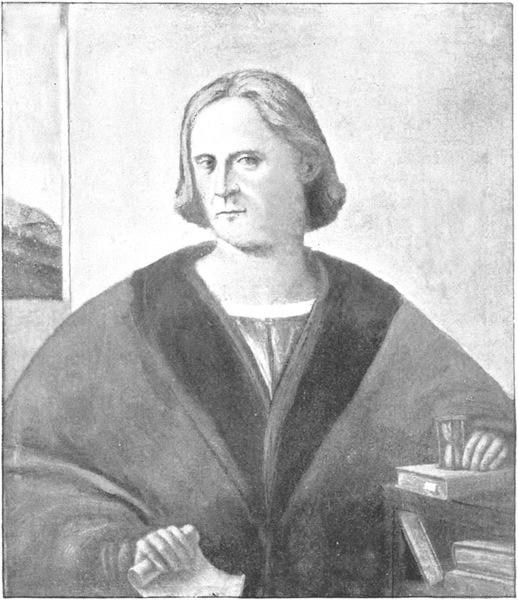
The commission of Columbus bore date of April 30,
1492. On the same day was signed a royal requisition
on the inhabitants of the town of Palos, requiring
them to furnish at their own expense two caravels for
the expedition. This singular proceeding was in consequence
of some offence which the town had given
the king and queen, for which the people had been
condemned to render the service of two vessels for
the period of twelve months, whenever the royal
pleasure should call for them. The vessels moreover
were to be armed at the expense of the town. Within
ten days from the sight of the letter the authorities
were required to have the two vessels in complete
readiness for the enterprise. The royal treasury was
also further relieved by the fact that they were required
to furnish the money for the wages of the crew
during a period of four months.
Another royal order bearing the same date was of
greater importance in its influence on the character of
the expedition. All the magistrates in the realm were
informed that “every person belonging to the crews
of the fleet of said Christopher Columbus” were “exempt
from all hindrance or incommodity either in
their persons or goods;” and that they were “privileged
from arrest or detention on account of any
offence or crime which may have been committed by
them up to the date of this instrument, and during
the time they may be on the voyage, and for two
months after their return to their homes.”
This remarkable order must have been inspired by
the fear that the requisite crews for the vessels could
not readily be obtained. The special inducements
held out to the criminal classes appealed to every
debtor, to every defaulter, and to every criminal.
Here was immunity from the pursuit of justice. Such
an order could hardly have failed to have a powerful
influence on the character of the crew. The fleet became
a refuge for runaway criminals and debtors; and
accordingly it was not singular that sailors of respectability
were slow to enlist. Popular opinion at Palos
was violently opposed to the expedition. Though the
town was required to furnish two caravels within ten
days after receiving the royal order, weeks passed before
the necessary vessels could be procured. A third
ship was provided for out of the funds furnished for
the expedition. Every shipowner refused to lend his
vessel for the enterprise. Another royal order had to
be issued, authorizing Columbus to press the ships and
men into the service. Meanwhile the mariners of
Palos held aloof, partly in the belief that the proposed
expedition was simply the work of a monomaniac, and
partly from the fact that the ships had been made a
refuge for criminals. But Juan Parez, the friar whose
influence had already made itself so powerfully felt,
was active in persuading men to embark. The Pinzons,
who, it will be remembered, had offered to defray
one eighth of the expense, now came forward to
aid the enterprise with their money and their personal
service. Agreeing to take command of two of
the vessels, their wealth and their influence gave a new
impulse to the undertaking. But enlistments went
forward very slowly; and even after men had been
enrolled, the least cause of dissatisfaction induced
them to desert. In the putting of the ships in order,
the work was so badly done as to justify the suspicion
that a deliberate effort was put forth to make them
unseaworthy.
Though the sovereigns had supposed that ten days
would be time enough to put the fleet in readiness for
the voyage, it was with the utmost difficulty that the
work was accomplished in ten weeks. Columbus had
chosen small vessels of less than a hundred tons’ burden
each, believing that they would be better adapted
for service along the coast and in the rivers. It has
been estimated that even the longest of them was
only sixty-five feet in length, and not more than twenty
feet in breadth. The “Santa Maria,” commanded
by the Admiral himself, was the only one that was
decked midships. The others, the “Pinta” and the
“Nina,” were built high in the prow and stern, that they
might the more easily mount the waves, and were covered
only at the ends. The “Pinta” was commanded
by Columbus’s old friend Martin Alonzo Pinzon,
while his brother, Vincente Yañez Pinzon, was captain
of the “Nina.” On all the ships there were a hundred
and twenty souls, ninety of them being mariners.
Harrisse has computed the sum provided for the
expedition at 1,640,000 maravedis, or about $3640.
Of this amount Santangel, as the agent of the monarchs,
furnished 1,140,000 maravedis, while Columbus,
aided by the Pinzons, provided the remaining five
hundred thousand. The fleet’s contingent contained
a notary for drawing up necessary papers, and a historiographer
to put the story in formal order. There
was an interpreter learned in all Asiatic tongues, and
a metallurgist to examine the ores. Though the fleet
was equipped with a physician and a surgeon, it does
not appear that it had a priest. The squadron was
at length ready to put to sea. We are told that on
the last days before sailing, everybody in Palos was
impressed with the solemnity of the undertaking.
Officers and crew united in going to the church in
the most formal manner and confessing themselves,
and after partaking of the sacrament, in committing
themselves to the special guidance and protection of
Heaven. It was an hour before sunrise, on Friday,
the 3d of August, when the ships were cut from
their moorings and entered upon their perilous
adventure.
Fortunately we are not without Columbus’s own
account of this voyage. The Admiral kept a diary,
which, though it is not now known to be in existence,
was carefully epitomized by Las Casas, and the abstract,
very largely in Columbus’s own words, is preserved.
There are also still in existence the two
letters of Columbus by means of which the great discovery
was formally announced to the world. It is to
these three priceless documents that we are chiefly
indebted for our knowledge of the voyage. In the
introduction to the diary Columbus says: “I determined
to keep an account of the voyage, and to write
down punctually everything we performed or saw from
day to day.” He also adds: “Moreover, besides
describing every night the occurrences of the day,
and every day those of the preceding night, I intend
to draw up a nautical chart which shall contain the
several parts of the ocean and land in their proper
situations; and also to compose a book to represent
the whole by pictures, with latitudes and longitudes,
on all which accounts it behooves me to abstain from
sleep and make many efforts in navigation, which
things will demand much labour.”
The contemplated geographical work was never
written; but the purpose of the navigator is of interest,
as it creates a presumption in favor of carefulness
in the preparation of the diary.
The general course of the fleet was in a southwesterly
direction, the purpose being to touch at the
Canary Islands. This intention was fortunate; for on
Monday, the fourth day out, the rudder of the “Pinta”
become loose, and threatened to make a continuance
of the voyage with this vessel impossible. The Admiral
suspected that the accident happened with the
connivance of disaffected members of the crew. Many
of the men had shown an uncompromising opposition
to the expedition before setting out, and there could
be no doubt that any accident that would interrupt
the voyage would be most welcome. The “Pinta,” however,
was in command of Martin Alonzo Pinzon, an
officer of capacity and courage, to whose faith in the
enterprise Columbus had already been largely indebted
while fitting out the fleet and securing the
crew. The skill and vigour of the commander caused
the rudder to be put in place; but it was again unshipped
on the following day, and it was necessary to
put into port for repairs.
Owing to delays occasioned by the condition of
the “Pinta,” it was not until the 12th of August that
the little fleet reached port in one of the Canary
Islands. Here it was found that the condition of the
disabled caravel was worse than had been supposed.
Besides having her rudder out of order, she was
leaky, and the form of her sails seemed not to be
adapted to the perils of an Atlantic voyage. Columbus
tried to find another vessel for which he could
effect an exchange; however, he was not successful,
and so it was found necessary to delay the voyage
until the little ship could be put into seaworthy
condition. The rudder was made secure, the form
of the sails was changed, and every practicable precaution
was taken to prevent leakage. But it was
not until the 6th of September—more than a month
from the day of leaving the port at Palos—that the
fleet was once more ready to sail.
During the stay at the Canaries two or three interesting
things happened. Columbus reports that
they “saw a great eruption of flames from the Peak
of Teneriffe, which is a lofty mountain.” But more
important to the matter in hand were the several
reports he heard in regard to the existence of
land in the west. The Admiral says he “was assured
by many respectable Spaniards inhabiting the island
of Ferro that they every year saw land to the west of
the Canaries,” and also that “others of Gomera
affirmed the same with the like assurances.” He
also makes note of the fact that when he was “in Portugal
in 1484 there came a person to the king from
the island of Madeira soliciting a vessel to go in quest
of land, which he affirmed he saw every year, and
always of the same appearance.” Still further he says
that “he remembers the same was said by the inhabitants
of the Azores, and described as in a similar
direction, and of the same shape and size.”
This interesting delusion, which is supposed to
have had its origin in certain meteoric appearances,
had taken a firm hold of the credulity of the people.
The country which they imagined they saw in the
west bore the name of the isle of Brandon, in commemoration
of Saint Brandon, a Benedictine monk of
the sixth century, who, it was believed, spent seven
years in the region to which his name was finally
given. Belief in the existence of land not very far
west of the Canary group was current in the fifteenth
century, and several expeditions were undertaken, by
order of the king of Portugal, for the discovery of
this mystical continent. As yet, however, the repeated
failures of these efforts had not convinced the
inhabitants of the islands west of Africa that land
within any possible range of vision from the Canaries
had no existence except in the imaginations of the
beholders. The special connection of this credulity
with the expedition of Columbus is in the influence
which it must have had upon the spirits of the crew.
While there was an air of mystery about it that may
have been depressing to certain temperaments, to the
mass of the crew it can hardly have failed to give
some encouragement. But at the same time it undoubtedly
provided the way for a depressing reaction
when, after days of fruitless sailing, no land was
discovered.
On the morning of the 6th of September the little
fleet put out from the harbour of Gomera and entered
again upon its course. A report was brought by a
vessel from the neighbouring island of Ferro that
there were three Portuguese caravels cruising in search
of Columbus. This circumstance was interpreted to
mean a hostile intent on the part of the king of Portugal,
owing to the fact that the Admiral had abandoned
his service and resorted to the patronage of
Spain. But if the report was true, the Spanish
squadron was successful in evading its enemies. The
course now taken was due west; but owing to a
strong head-sea, progress for several days was very
slow.
We have already had occasion to see that Columbus
never attached very great importance to the
matter of precision in the statement of fact. The
recent scrutiny to which his writings have been subjected
has revealed so many contradictions and inaccuracies
that we are forced into the belief that he
often used words in a very general rather than in a
specific and strictly accurate sense. We shall not
infrequently have occasion to note this habit of mind,—a
peculiarity which it will be necessary to remember
if we would form an accurate conclusion as to
the value of his testimony. He seems not to have
been without conscience; but it is not too much to
say that whenever there was a powerful motive for
misrepresentation, Columbus did not hesitate to ask
himself whether the end would not justify the means.
The modern ethical standard, which requires absolute
truthfulness at all hazards, did not prevail at the end
of the fifteenth century; but it is not without much
regret that even at that period we find one whom we
would gladly rank as a moral hero admitting frankly
that he systematically prevaricated in order to convey
a false impression. If, on the one hand, there
are those who will succeed in finding adequate
excuse for the misrepresentation indulged in, on
the other it will be hard to find any one who will
regard such misrepresentation as a characteristic of
lofty conscientiousness.
In the journal of September 9 we find this
entry:—
“Sailed this day nineteen leagues, and determined to
count less than the true number, that the crew might not
be dismayed if the voyage should prove long.”
On the following day Columbus says,—
“This day and night sailed sixty leagues, at the rate
of ten miles an hour, which are two leagues and a half.
Reckoned only forty-eight leagues, that the crew might
not be terrified if they should be long upon the voyage.”
In the days following, similar entries were made,
always with the same end in view. Interesting evidences
of life were often observed. On the 13th of
September one of the crew saw a tropical bird, which,
it was believed, never goes farther than twenty-five
leagues from land. On the 16th large patches of weed
were found which appeared to have been recently
washed away from land; on account of which the
Admiral writes that “they judged themselves to be
near some island;” “the continent,” continues the
narrator, “we shall find farther ahead.” These indications
multiplied from day to day. On the 18th the
“Pinta,” which, notwithstanding her bad condition,
was a swift sailer, ran ahead of the other vessels, the
captain having informed the Admiral that he had seen
large flocks of birds toward the west, and that he
expected that night to reach land. Though as yet
they had only reached the centre of the Atlantic, on
the 19th the ships were visited by two pelicans,—birds
which, it was said, were not accustomed to go twenty
leagues from land. On the 21st the ocean seemed to
be covered with weeds; and the same day a whale
was seen,—“an indication of land,” says the journal,
“as whales always keep near the coast.” The next day
a wind sprang up, whereupon the Admiral observes:
“This head-wind was very necessary to me, for my
crew had grown much alarmed, dreading that they
never should meet in these seas with a fair wind to
return to Spain.”
On September 25 the disappointing monotony of
these indications was interrupted. At sunset Pinzon
called out from his vessel that he saw land. The
Admiral says, when he heard him declare this, he
fell down on his knees and returned thanks to God.
Pinzon and his crew repeated “Gloria in excelsis
Deo,” as did the crew of the Admiral. Those on
board the “Nina” ascended the rigging, and all
declared that they saw land. The Admiral judged
that the land was distant about twenty-five leagues.
It was not until the afternoon of the 26th that they
discovered that what they had taken for land was
nothing but clouds.
As revealed by the journal, the events of each day
were much like those of every other. The most
striking feature of the voyage was the constantly
occurring indications of land. After the little fleet
passed mid-ocean there was scarcely a day that did
not bring some sign that beckoned them on. Seaweed
abounded, and as a sounding of two hundred
fathoms revealed nothing but a steady undercurrent
of the ocean, the weeds could not have come from
the bottom of the sea. At one time a green rush was
found, which, the commanders thought, must have
grown in the open air, with its roots in the soil.
At another, a piece of wood was taken aboard that
gave unmistakable signs of having been somewhat
curiously wrought by the hand of man. But the most
significant tokens were the birds. They appeared in
considerable numbers almost, if not quite, every day,
many of them known to be unaccustomed to wander
for any very great distance from land. To
every thinking man on board the squadron they
seemed to give evidence absolutely unmistakable that
they were not far from land, and that the object of
their expedition was likely to be successful. The
birds, moreover, so far as any general direction of
their flying could be regarded as an indication,
seemed to have their home in a southwesterly
direction. This fact led the commander of the
“Pinta” to urge the Admiral to change his course.
At first Columbus thought it best, in spite of the
course of the birds, to keep on due west. But at
length the indications were so unmistakable and so
persistent that he yielded, and set the rudders for a
southwesterly course. But for this incident, seemingly
very trifling in itself, the fleet, as Humboldt
has remarked, would have entered the Gulf Stream
before touching land, and would have been borne to
a landfall somewhere on the coast of the future
United States.
Many of the later historians of Columbus, taking
the hint from Oviedo, have given graphic pictures
of the way in which the skill and the tact of the
Admiral prevented the crew of the fleet from breaking
out into mutinous revolt and turning the vessels
toward home. It has been said that at one time
there was a serious purpose of throwing the Admiral
into the sea, and declaring that he fell overboard
while making an observation; at another, that Columbus
found himself compelled to promise that unless
land was discovered within three days, he would
abandon the expedition, turn about, and sail for
home. But these stories must now, for the most part,
be regarded as apocryphal. None of them are
mentioned by Columbus himself, nor do they appear
in the other early accounts of the voyage. No hint
of mutiny or even of any lack of due subordination
appears in the searching trials of 1513 and 1515,
when every event that could possibly have a bearing
upon the methods of Columbus was brought upon
the witness-stand. As a matter of fact, the voyage
was for the most part an uneventful one, save as its
placid progress was occasionally excited by the variations
of the compass, an unusual amount of seaweed,
or an unwonted flight of birds. That the
hopes and fears of the crews were alert cannot of
course be doubted, but there is no evidence sufficient
to justify the belief that the life of the Admiral
or the advance of the expedition was ever in serious
danger.
In the evening of the 11th of October, Columbus
thought that he discovered a light moving with fitful
gleams in the darkness. He called to him two of his
companions, one of whom confirmed his impression,
while the other could not. The journal says that
“The Admiral again perceived it once or twice, appearing
like the light of a candle moving up and
down, which some thought an indication of land.”
But evidently Columbus did not regard this as a discovery,
for he not only reminded the crew of the
reward of a pension that awaited the one who should
first see land, but he also offered a silk doublet as an
additional inducement to the search. They were still
some forty-two miles from the coast, which lies so
low that it could hardly have been seen at a distance
of twenty. It was four hours later that land was first
unmistakably seen in the moonlight, at a distance of
about two leagues. There can be no question that if
a light was really seen at all, it was on a boat at some
distance from the shore. A reward of ten thousand
maravedis per year had been promised by the king
and queen to the person on the expedition who
should first descry land. Columbus in his journal
admits that land was first seen and announced by
Rodrigo de Triana of the “Pinta” at two o’clock on the
morning of October 12th; and it would be a pleasure
to record that he subsequently had sufficient magnanimity
to waive his own very absurd claim in favour of
the poor sailor to whom it was so justly due. But
after his return he set up the demand for himself;
and to him it was promptly adjudged and paid by
the king and queen. It is said that the poor sailor,
thinking himself ignobly defrauded, renounced Christianity
and went to live among the Mohammedans,
whom he regarded as a juster people.
It was then on Friday, October 12, that the fleet
first came to land upon an island which the natives
called Guanahani. Early in the morning Columbus
and the brothers Pinzon and the notary entered a
boat with the royal standard and made for the shore.
The rest of the crews immediately followed. As
soon as they had landed, the requisite formalities
were performed, and witnesses were summoned to
note that, before all others, Columbus took possession
of the island for the king and queen, his sovereigns.
He gave it the name of San Salvador.
Over the question as to the spot where Columbus
first landed there has been much difference of opinion.
The narrative of the Admiral concerning this
important part of his voyage, though it has been preserved
entire, is not so free from ambiguities, or so
definite in its positive statements, as to relieve the
subject of doubt. The reckoning of Columbus, moreover,
on the matter of longitude and latitude was
not sufficiently accurate to throw much light on the
subject. Accordingly, several of the Bahamas have
had their advocates. The modern San Salvador, or
Cat Island, was believed to be the place of landing
by Humboldt and Irving. South of Cat Island lie
Watling’s, Samana, Acklin, and the Grand Turk; and
no one of them has been without its ardent supporters.
Recently, however, the most careful students
of the problem have unmistakably drifted toward
the belief that the spot of the landfall should be confidently
fixed upon Watling’s Island.
The arguments in favour of this locality were first
elaborately set forth by Captain Becher in a volume
published in 1856, and were followed by Peschel two
years later in his “History of Modern Discovery.”
Mr. R. H. Major, a careful student of the subject, was
for many years inclined to favour Turk’s Island; but
in 1870 he conceded that the weight of evidence was
in favour of Watling’s. Lieutenant Murdock of the
American navy and Mr. Charles A. Schott of the
United States Coast Survey reached the same conclusion
by independent studies in 1884, as did also Mr.
Clements R. Markham in 1889. Finally, and perhaps
most important of all, the Bahamas were visited
and this problem was carefully studied in November
of 1890 by the German explorer Herr Rudolf Cronau,
with the result of establishing Watling’s Island as
the site of the landfall beyond any reasonable doubt.
Cronau’s investigations are twofold in their nature:
the first point of his inquiry being devoted to the
reasons for thinking Watling’s the island on which
Columbus landed; the second, to establishing the
point at which the landfall took place. Though
it is on this last point that special significance is to
be attached to his investigations, it may not be out of
place to give a brief summary of the argument as a
whole.
Columbus describes the island as low, covered with
abundant and luxuriant vegetation, and as having a
large body of water in the interior. In one place he
speaks of the island as “small,” at another as “pretty
large.” After the first landing, he goes N. N. E. in
the small boats, and soon passes through a narrow entrance
into a harbour “large enough to accommodate
the fleets of Christendom.” In this harbour he discovers
an admirable site of a fort, which he describes
with minute care. He says, moreover, that the part of
the island visited is protected by an outlying reef of
rocks not far from the shore. Las Casas, who became
very familiar with the islands during the life of
Columbus, and who probably knew where the first
landing was made, states that the form of the island
was oblong, or “bean-shaped.” The length of Watling’s
Island is about twelve English miles, the breadth
between four and six. All these characteristics apply
to Watling’s, and in their entirety they apply to no
other.
There are, however, certain difficulties in the way
of accepting this theory. The most serious is the
fact that the rocks off the northern, eastern, and
southern parts of the island are so formidable as to
offer no safe place for anchorage, and that an approach
from none of these directions could afford the
view described by Columbus. It is in meeting this
difficulty that the ingenious theory of Cronau is of
importance. It is in substance as follows.
The journal of Columbus tells us that on Thursday,
October 11, the ships “encountered a heavier sea than
they had met with before in the whole voyage.” It also
states that in the course of twenty-four hours they
made the remarkable run of fifty-nine leagues, running
at times “ten miles an hour, at others twelve,
at others seven.” In the evening of the 11th, “from
sunset till two hours after midnight,” the average rate
was “twelve miles an hour.” It was at ten o’clock
that Columbus reports that he saw the light, and consequently
the vessel must have advanced forty-eight
miles before two o’clock on the morning of the 12th,
when land was seen by Triana from the “Pinta.” These
facts, together with the extraordinary length of the run
on the 11th, indicate unmistakably that the roughness
of the sea was caused by a strong easterly wind, for
by no other means could so rapid an advance have
been made. At “two o’clock,” says the Admiral,
“land was discovered at a distance of two leagues.”
In which direction the land lay is not indicated. All
sails “except the square sail” were taken in, and the
vessels “lay to” till day,—probably about four or five
hours. The supposition of Cronau is that a wind
which up to two o’clock carried them when under full
sail twelve miles an hour, must have borne the ships,
when under square sail, at least ten or fifteen miles
before dawn. It would have been impossible in a
heavy sea to land on the rocky coast of the east side;
and whatever the advance, it must have been either
on the north or on the south. It seems reasonable
to suppose that the fleet found itself at the break of
day west of the island. In any case, good seamanship
required that they should seek anchorage in
a high wind on the lee, or west side; and accordingly,
the only natural course was for them to turn
about and approach the island from the west. On
the supposition that this course was pursued, no difficulties
whatever are found in reconciling Columbus’s
narrative with the present condition of the island.
At about the middle of the west coast the locality
at present known as Riding Rocks must have presented
then, as it does now, an inviting anchorage.
All the features of the coast as described by Columbus
are now easily identified. The sail to the
N. E. E., which under any other hypothesis presents
insurmountable difficulties, is now easily explained.
Taking a boat and following along the same
course, Cronau entered the mouth of the harbour,
and readily distinguished all the characteristics described
by the Admiral.
If the data given by Columbus afford no very definite
clew to the spot on which the landing took place,
his account of what he saw, especially of the people,
is so replete with interest as to justify a quotation of
some length. After describing the formalities of the
taking possession of the island, and noting that the
trees seemed very green, that there were many streams
of water and divers sorts of fruits, Columbus gives the
following graphic account of the natives:—
“As I saw that they were very friendly to us, and perceived
that they could be much more easily converted to
our holy faith by gentle means than by force, I presented
them with some red caps, and strings of beads to wear
upon the neck, and many other trifles of small value,
wherewith they were much delighted, and became wonderfully
attached to us. Afterwards they came swimming
to the boats, bringing parrots, balls of cotton thread, javelins,
and many other things, which they exchanged for
articles we gave them, such as glass beads and hawk’s
bells, which trade was carried on with the utmost good
will. But they seemed on the whole to me to be a very
poor people. They all go completely naked, even the
women, though I saw but one girl. All whom I saw were
young, not above thirty years of age, well made, with
fine shapes and faces; their hair short and coarse like
that of a horse’s tail, combed toward the forehead, except
a small portion which they suffer to hang down behind,
and never cut. Some paint themselves with black, which
makes them appear like those of the Canaries, neither
black nor white; others with white, others with red, and
others with such colours as they can find. Some paint
the face, and some the whole body; others only the eyes,
and others the nose. Weapons they have none, nor are
they acquainted with them; for I showed them swords,
which they grasped by the blades, and cut themselves
through ignorance. They have no iron, their javelins
being without it, and nothing more than sticks, though
some have fish-bones or other things at the ends. They
are all of a good size and stature, and handsomely
formed. I saw some with scars of wounds upon their
bodies, and demanded by signs the cause of them. They
answered me in the same way, that there came people
from the other islands in the neighbourhood who endeavoured
to make prisoners of them, and they defended
themselves. I thought then, and still believe, that these
were from the continent. It appears to me that the people
are ingenious, and would be very good servants; and
I am of the opinion that they would readily become Christians,
as they appear to have no religion. They very
quickly learn such words as are spoken to them. If it
please our Lord, I intend at my return to carry home six
of them to your Highnesses, that they may learn our language.
I saw no beasts in the island, nor any sort of
animals except parrots.”
The next three months of this renowned expedition
were spent in going from island to island, in making
brief visits to the various places that seemed to promise
any interesting or important revelation, and in
seeking for objects of interest and value. The Admiral
was in constant hope of learning something that
would direct him to Cipango. In all the islands the
people were found to speak the same language and to
have the same general characteristics. After visiting
and exploring Long Island and Saometo, which he
respectively named Fernandina and Isabella, he at
length, on the 21st day of October, landed on the
northern coast of a large island which the natives
called Colba. This was the modern Cuba. He explored
the picturesque region far to the west, and
found it so large that he supposed it to be a continent.
The Indians, however, informed him that it
was only an island. As he perceived neither towns
nor villages near the sea-coast, but only scattered
habitations, the people of which fled at his approach,
he sent two of his men into the interior to learn
whether the inhabitants had either king or chief. The
men, after an absence of three days, reported that
they found a vast number of settlements built of wood
and straw, with “innumerable people.” Yet they were
able to discover no indications of any kind of government.
To the island the name Juana was given, in
honor of Don Juan.
Columbus did not attempt to circumnavigate the
island. After coasting far to the west, and noting
carefully the rivers and harbours, he resolved to retrace
his course. From the point where the first landing
was made, he sailed a hundred and seven leagues
toward the east, when he came to a cape from which
he reports that he saw another island, about eighteen
leagues away. This was the island now known as San
Domingo, or Hayti, to which Columbus gave the name
Hispaniola. Sailing thither, and skirting along its
northern coast, the explorers found it more beautiful
even than any of the others they had seen. The
journal describes the harbours as far more safe and
commodious than any to be found in Christian countries;
the rivers were large and noble, the land was
high, with beautiful mountains and lofty ridges covered
with a thousand varieties of beautiful trees that
“seemed to reach to heaven.” Most gratifying of all,
they learned from the Indians that there were “large
mines of fine gold.”
It was here that Columbus decided to establish the
first permanent settlement. Through the carelessness
of the pilot, however, the Admiral’s own vessel
struck upon a rock off the northwestern coast of the
island, and, finally, in spite of all the efforts of the
crew, had gone to pieces. The assistance rendered
by the natives in rescuing the stores of the wreck
afforded touching evidence of their friendly feeling.
The timbers of the ship furnished the material for a
structure that should at once be a storehouse and a
fort. It was resolved to leave provisions for a year,
together with seeds and implements for the cultivation
of the soil.
As to the number of the crew that were left at this
new settlement, the authorities do not agree. It is
probable, however, that there were about forty. In
the narrative of Columbus, the words are these: “I
have directed that there shall be provided a store of
timber for the construction of the fort, with a provision
of bread and wine for more than a year, seed
for planting, the long boat of the ship, a calker, a carpenter,
a gunner, a cooper, and many other persons
among the number of those who have earnestly
desired to serve your Highnesses and oblige me by
remaining here, and searching for the gold mine.”
As the wreck and the consequent determination to
build a fort and establish a colony occurred on Christmas
Day, the Admiral named the new settlement “La
Navidad.”
The people of the island manifested a most
friendly disposition. The abode of the king was
about a league and a half distant from the shoal
where the wreck had taken place. Columbus relates
that when the Spanish messengers informed the cacique
of the misfortune, he “shed tears and despatched
all the people of the town with large canoes
to unload the ship.” Again he says that the king,
“with his brothers and relations, came to the shore
and took every care that the goods should be brought
safely to land and carefully preserved. From time
to time, he sent his relations to the Admiral, weeping
and consoling him, and entreating him not to be
afflicted at his loss, for he would give him all he had.”
The Admiral still further observes that “in no part of
Castile would more strict care have been taken of the
goods, that the smallest trifle be not lost.” And
again: “The king ordered several houses to be
cleared for the purpose of storing the goods.” On
the following day, Wednesday, December 26, the
Admiral’s journal contains this memorandum: “At
sunrise the king of the country visited the Admiral
on board the ‘Nina,’ and with tears in his eyes entreated
him not to indulge in grief, for he would give
him all he had; that he had already assigned the
Spaniards on shore two large houses, and, if necessary,
would grant others, and as many canoes as could
be used in bringing the goods and crew to land,—which,
in fact, he had done the day before, without
the smallest trifle being purloined.” In forming an
opinion of a policy which in a few years completely
annihilated the inhabitants of these islands, this estimate
of their character ought not to be forgotten.
Before leaving this settlement, Columbus took the
precaution to give to the natives an exhibition of the
force of fire-arms. A lombard was loaded and fired
against the side of the stranded ship. The shot,
much to the amazement of the natives, passed through
the hull of the vessel, and struck the water on the
farther side. He also gave them a representation of a
battle fought by parties of the crew, and conducted
in accordance with Christian methods. This was
done, as he informs us, “to strike terror into the inhabitants
and make them friendly to the Spaniards
left behind.”
Having left the settlement in charge of Diego de
Arana, and three others as subordinate officers, and
having conferred upon them all the powers he had
himself received from the king and queen, Columbus
prepared to enter upon his homeward voyage.
The commander of the “Pinta,” who, as we shall presently
see, had entered upon an exploring expedition
of his own, had now rejoined the Admiral; and on the
4th of January the two little ships turned their rudders
and set sail for home.
In the study of the journal and the letters of Columbus,
in so far as they relate to the first voyage, a
number of impressions are strongly, and, it should
perhaps be said, painfully, stamped upon the mind of
the reader.
While the desire of the explorer to Christianize the
island was never lost sight of, he was prevented from
any missionary work, not only by the fact that the
expedition was unaccompanied by priests, but also by
the nature of the expedition itself. It was simply a
voyage of discovery; and the movements from one
island to another were necessarily too rapid to admit
of anything more than a temporary impression.
Nothing more, therefore, was done to propagate
Christianity than to leave here and there upon the
islands the mysterious emblems of the new faith.
The preaching of the Gospel was reserved for future
expeditions.
But the ultimate Christianizing of the natives was
only one of the religious motives that inspired the
expedition. For many years Columbus had entertained
the hope that gold might be found in quantity
sufficient to enable the Spanish Government to rescue
the Holy Sepulchre from the possession of infidels.
The project inspired him throughout his life. From
these, as well as from personal motives, he was therefore
particularly desirous of finding gold. Nothing is
more painfully obvious in his journal than the power
of this pecuniary motive. The quest for gold lured
him on from one island to another, and from the sea-coast
to the interior. He everywhere makes inquiries
for gold, and again and again he hears reports of
gold mines; but his efforts in search of them are
always unsuccessful. However, he never abandons
hope. The journal abounds in expression of optimistic
expectation that gold in vast quantities will yet
be found, and that the object of this search will yet
be fully realized. But the gold-bearing mines everywhere
eluded him, and indeed the natives appear to
have possessed the precious metal in no more than
very trifling quantities. Still, the hopes of Columbus
were kept sanguine to the last. It was only ten days
before the expedition sailed for home that he entered
upon his journal the expression of a most sanguine
expectation. Las Casas tells us that in his journal for
December 26th, Columbus “adds that he hopes to
find on his return from Castile a ton of gold collected
by them in trading with the natives, and that they
will have succeeded in discovering the mine and the
spices, and all these in such abundance that before
three years the king and queen may undertake the
recovery of the Holy Sepulchre. ‘For I have before
protested to your Highnesses,’ continues Columbus,
‘that the profits of this enterprise shall be employed
in the conquest of Jerusalem, at which your Highnesses
smiled, and said you were pleased, and had the
same inclination.’”
In one of the letters of the Admiral announcing the
discovery, known as the Sanchez Letter, the Admiral
writes in still more sanguine terms. He says: “To
sum up the whole, and state briefly the great profits
of this voyage, I am able to promise the acquisition, by
a trifling assistance from their Majesties, of any quantity
of gold, drugs, cotton, and mastick, which last
article is found only in the island of Scio; also any
quantity of aloe, and as many slaves for the service of
the marine as their Majesties may stand in need of.”
In the letter written to the royal treasurer, Santangel,
Columbus invariably speaks in terms of similar
confidence. “In conclusion, and to speak only of
what I have performed,” says he, “this voyage, so
hastily despatched, will, as their Highnesses may see,
enable any desirable quantity of gold to be obtained,
by a very small assistance afforded me on their part.”
On the eve of sailing for Spain, after referring to
the opposition he had received from the clergy and
others about the court, he says: “These last have
been the cause that the royal crown of your Highnesses
does not possess this day a hundred millions
of reals more than when I entered your service, from
which time it will be seven years the 20th day of this
month of January.”
The reader will hardly fail to observe that these
promises, so comprehensive in their nature, rested
upon a very slender foundation. Very little gold
had been seen by the explorers, and the mines had
all baffled their most diligent search. The ardent
nature of Columbus found no difficulty in converting
hopes into confident expectations. How painfully
these were destined to be disappointed, we shall have
occasion hereafter to see.
Another matter that is worthy of notice is the
general attitude of Columbus toward his crew and
toward the islanders. It may be difficult to determine
how far it was Columbus’s fault; but the fact
is unmistakable that there are no indications of any
attachment to him by any of the members of his
crew. His habit of deceiving them in regard to the
distance passed over, and in regard to the needle, is
likely to have occasioned general distrust. Certain
it is that Martin Alonzo Pinzon, the ardent friend
whose support at Palos made the expedition possible,
deserted him without warning soon after the fleet
reached the first land. The Admiral himself says,
in his journal of November 21st, that Pinzon, “incited
by cupidity,” sailed away with the “Pinta”
“without leave of the Admiral,” and that “by
his language and action he occasioned many other
troubles.”
But the conduct of Pinzon was even to Columbus
something of a mystery; for elsewhere in his journal
he “confesses himself unable to learn the cause of
the unfavorable disposition which this man had manifested
toward him throughout the voyage.” Elsewhere
the Admiral says Pinzon “was actuated solely
by haughtiness and cupidity in abandoning him.”
Again he says that both of the Pinzon brothers “had
a party attached to them, the whole of whom had
displayed great haughtiness and avarice, disobeying
his commands, regardless of the honours he had conferred
upon them.”
It is evident that Columbus was quite devoid of
tact in the management of men; for the bitterness
that at a later period manifested itself could not
otherwise be accounted for.
Toward the natives Columbus seems not to have
been actuated by any motives of cruelty. He is not to
be harshly judged, moreover, if his methods were simply
those of the fifteenth rather than those of the nineteenth
century. But human nature is ever essentially
the same, and it is therefore easy to understand the
history of the change that rapidly came over the
spirit of the natives. Immediately after he arrived at
the islands, Columbus took a number of the natives
by force, and kept them upon the ship. On the
12th day of November he writes: “Yesterday a
canoe came to the ship with six young men; five
of them came on board, whom I ordered to be detained,
in order to have them with me. I then sent
ashore to one of the houses and took seven women
and three children; this I did that the Indians might
tolerate their captivity better with their company.”
In the same connection the Admiral adds: “These
women will be of great help to us in acquiring their
language, which is the same throughout all these
countries, the inhabitants keeping up a communication
among the islands by means of their canoes.”
Again, on the 14th of January, only two days before
taking final leave, Las Casas says that, “wishing
to make prisoners of some Indians, he intended
to despatch a boat in the night to visit their houses
for this purpose; but the wind blowing strong from
the east and northeast occasioned a rough sea, which
prevented it.” On the following day he says: “There
came four young Indians on board the caravel, where
they gave so good an account to the Admiral of the
island to the east that he determined to take them
along with him.”
It is impossible to reflect upon this habit of the
Admiral without realizing that, however friendly
and hospitable the natives had shown themselves at
first, the impression soon made upon their minds
must have been one of the utmost repugnance and
enmity. To indulge in any other supposition would
be to suppose that the natives were not human beings.
The captives seem for the most part to have
been kindly treated, and they may not have manifested
an unconquerable aversion to their captivity;
but this unscrupulous policy of kidnapping the natives
whenever opportunity offered, could not have
been otherwise than disastrous to all friendly relations.
It is impossible to conceive that the islanders
were so devoid of all human sensibilities as to see
with indifference their husbands and wives, their sons
and daughters, stolen from them for the gratification
of the lust and the cupidity of their visitors. Nor,
aside from all moral considerations, on the part of
the wisest historian of the time was there any failure
to understand the disastrous consequences of such
a policy. Las Casas was fully alive to all the political
significance of this course of action. While this
great moralist, whose nobility of character raises him
far above all the other public men of his time, fully
acquits Columbus of any wrong intent, he does not
hesitate to indict him for initiating a policy that was
the cause of all the crimes and disasters that ensued.
The right to kidnap was of course resented by the
natives. The consequence was a war of extermination.
The sad fate of the colony of La Navidad can never be
fully understood, for reasons which in due time we
shall see; but it would have been strange indeed
if men, endowed with even the feeblest attributes
of human nature, had not been desirous of exterminating
a race actuated by such a policy. The
words of Las Casas are at once so judicious and so
just that they ought not to be abridged. After speaking
of the ardent desire of Columbus to bring as
much profit as possible to Ferdinand and Isabella,
he uses these admirable words:—
“For this cause the Admiral thought and watched
and worked for nothing more than to contrive that there
might come advantage and income to the sovereigns....
Ignoring that which ought not to be ignored concerning
divine and natural right and the right judgment
of reason, he introduced and commenced to establish
such principles and to sow such seeds that there originated
and grew from them such a deadly and pestilential
herb, and one which produced such deep roots, that it
has been sufficient to destroy and devastate all these
Indies, without human power sufficing to impede or intercept
such great and irreparable evils.”
And then, with a charming discrimination and charity,
the same benignant author continues,—
“I do not doubt that if the Admiral had believed there
would succeed such pernicious detriment as did succeed,
and had known as much of the primary and secondary
conclusions of natural and divine right as he knew of
cosmography and other human doctrines, he would never
have dared to introduce or establish a thing which was
to produce such calamitous evils; for no one can say
that he was not a good and Christian man.”
The course taken by Columbus does not show that
he was exceptionally immoral; for morality is at least
so conventional as to be entitled to be judged in the
light of the age under consideration. But his course
does show that he was not above the moral debasement
of the age in which he lived, on the one hand,
and, on the other, that he was destitute, not only of
the characteristics of what we call statesmanship, but
also of ordinary tact and good judgment. Nothing
could have been easier than by a judicious use of
rewards and inducements to persuade a sufficient
number of the natives to accompany the fleet in a
most friendly spirit. Either this was not perceived,
or it was not desired. In either case, the whole
history is a sad commentary on the management of
the Admiral.
In spite of the popular superstition, Columbus
did not hesitate to set sail for home on Friday.
It had been on Friday that he left Palos; on Friday
that he left the Canaries; and now on Friday,
the 4th of January, he took leave of the colony at La
Navidad and ordered the pilots to set the rudder for
home. On the 9th day of January they proceeded
thirty-six leagues, as far as Punta Roxa, or Red Point,
where the Admiral records that they found tortoises
as big as bucklers, and where also he saw three mermaids
that raised themselves far above the water.
Of the latter the Admiral has the frankness to say
that although they had something like a human face,
they were not so handsome as they are painted. Two
days later Columbus came to a mountain covered
with snow, which he named Monte de Plata; and, a
little beyond, after passing a succession of capes, which
were duly named, he came to a vast bay in which he
determined to remain to observe the conjunction
that was to be seen on the 17th. Here for the
first time he found men with bows and arrows,
and not only bought a bow and some arrows, but
learned from one of the natives that the Caribs
were to the eastward, and that gold was to be
found on an island not far away, which he called
the island of St. John. Bernaldez says that “in the
islands of these Caribs, as well as in the neighbouring
ones, there is gold in incalculable quantity, cotton
in vast abundance, and especially spices, such as
pepper, which is four times as strong and pungent
as the pepper that we use in Spain.”
It soon became evident that these people were
of a less pacific nature than the other islanders whom
Columbus had met. A band of fifty-five of the natives,
armed with bows and arrows and swords of
hard wood, as well as heavy spears, attempted to seize
seven of the Spaniards. An altercation ensued. Two
of the Indians were wounded, whereupon they all
fled, leaving their arms behind them. The incident
is worthy of note from the fact that it was the only
time during this expedition that the Spaniards and
the natives came to blows. The breach was easily
healed, however, for on the following day the
Indians returned as though nothing had happened,
and a complete reconciliation took place. The Admiral
gave the native king a red cap, and the next
day “the king sent his gold crown and provisions.”
On the 15th, Columbus entered the port of a little
island where there were good salt pits. The soil, the
woods, and the plains convinced him that at last he
had come to the island of Cipango. Perhaps he was
confirmed in this impression by the current reports
that the gold mines of Cibao were not far distant.
On the next day the Spaniards discovered the caravel
“Pinta” sailing toward them. Twenty days before,
Pinzon, apparently moved by a resistless ambition,
had gone off on an independent cruise. Columbus
now received the excuse of the captain,—that he
acted under necessity; and though he thought it
by no means satisfactory, he was willing to condone
the offence.
The Admiral now decided to sail directly for Spain;
and accordingly the Spaniards prepared at once to
leave the bay, which they called De las Flechas, or
the Bay of Arrows. When they had advanced about
sixteen leagues, the Indians pointed to the island
of St. John, which, they said, was the home of the
Caribs, or cannibals. Columbus did not think it
wise, however, to delay for further investigation or
inquiry. Sails were set, and the prows of the two
little ships were turned toward home. It was on
the 16th of January that the last of the Bahamas
passed to the rearward out of sight.
During several days the navigators had no adverse
fortune. The killing of a tunny-fish and a shark afforded
a welcome addition to their larder, as they were
now reduced to bread and wine. The “Pinta” soon
proved to be in poor condition for the voyage, as
her mizzen-mast was out of order and could carry
but little sail. The sea was calm and the course was
east by northeast until February 4, when it was
changed to east. On the 10th the pilots and the
captains took observations to determine their bearings,
but with very unsatisfactory results. The imperfect
condition of the science of navigation was
well illustrated by the fact that their reckonings
differed by a hundred and fifty leagues.
The calm monotony of the voyage was broken on
the 13th. All night they laboured with a high wind
and furious sea. On the next day the storm increased,
“the waves crossing and dashing against one another,
so that the vessel was overwhelmed.” In the following
night the two little ships made signals by lights
as long as one could see the other. At sunrise the
wind increased, and the sea became more and more
terrible. The “Pinta” was nowhere to be seen, and
the Admiral thought her lost. The journal records
that he ordered lots to be cast for one of them to go
on a pilgrimage to St. Mary of Guadaloupe, and
carry a wax taper of five pounds weight, and that he
caused them all to take oath that the one on whom
the lot fell should make the pilgrimage. For this
purpose as many peas were put into a hat as there
were persons on board, one of the peas being marked
with a cross. The first person to put his hand in the
hat was the Admiral, and he drew the crossed pea.
Two other lots were taken, one of these also falling
to Columbus. They then made a vow to go in procession
in penitential garments to the first church
dedicated to Our Lady which they might meet with
on arriving at land, and there pay their devotions.
But notwithstanding these vows the danger continued
to increase. Lack of ballast was partially
supplied by filling with sea-water such casks as they
could make available. It is easy to conjecture what
the anxiety of the Admiral must have been. One
of the vessels had been lost in the Indies; the
“Pinta” had also probably perished; and now the
fury of the hurricane was such as to make it extremely
improbable that even the “Nina” would survive. In
such a calamitous event no word of the discovery
would ever reach Europe, and all the worst conjectures
of the opponents of the expedition would seem
to have been fulfilled.
As a possible means of preventing so disastrous a
result, Columbus wrote upon parchment an account
of the voyage and of the discoveries he had made,
and after rolling it up in waxed cloth, well tied,
and putting it into a large wooden cask, he threw it
into the sea. Another he placed upon the deck of
the vessel, in order that in case all upon the vessel
should be lost, there might be a chance that the
results of the voyage might still be made known.
At sunrise of the 15th, land was discovered, which
some thought to be Madeira, and others the rock
of Cintra, near Lisbon. According to the Admiral’s
reckoning, however, they were nearer the Azores.
But the power of the storm was still so great that
it was not until the morning of the 18th that they
were able to come to an anchorage, and to find
that they were in the group of the Azores, at the
island of St. Mary.
Columbus now sent a half of the crew on shore to
fulfil their vows, intending on their return to go himself
with the other half, for the same purpose. But
the first company of pilgrims were set upon by the
Portuguese and taken prisoners. An attempt, though
unsuccessful, was also made to capture the Admiral.
A severe altercation occurred, in which the captain of
the island ordered the Admiral on shore, and the
Admiral in turn displayed his commission and threatened
the island with devastation. It was not until
the 22d that the parleyings came to an end and the
captured portion of the crew was restored.
Though for a few days the weather was propitious,
on the 27th another storm came on, which continued
for several days. On the 3d day of March a violent
squall struck the vessel and split all the sails. They
were again in such imminent danger that another
pilgrimage was promised, and the crew all made a
vow to fast on bread and water on the first Saturday
after their landing. Having lost its sails, the vessel
was now driven under bare poles before the wind.
Through the night Columbus says that the “Nina”
was kept afloat “with infinite labor and apprehension.”
But at the dawn of the 4th of March the
Spaniards found they were off the rock of Cintra.
Though from what had occurred, the Admiral entertained
a strong distrust of the Portuguese Government,
there was no alternative but to run into the port for
shelter.
In view of his experience during the returning voyage,
Columbus can hardly have been surprised to
learn from some of the oldest mariners of the place
that so tempestuous a winter had never been known.
He received numerous congratulations on what was
regarded as a miraculous preservation.
Immediately on reaching the port the Admiral made
formal announcement of his discoveries. A courier
was despatched to the king and queen of Spain with
the tidings. To the king of Portugal a letter was
also sent requesting permission and authority to land
at Lisbon, as a report that his vessel was laden with
treasure had spread abroad and gave him a feeling of
insecurity at the mouth of the Tagus, where he was
surrounded by needy and unscrupulous adventurers.
Accompanying this request was the assurance that the
vessel had not visited any of the Portuguese colonies,
but had come from Cipango and India, which he had
discovered in the course of his westward voyage.
For some days after his arrival Columbus seemed
to be in some danger. For nearly a century Lisbon
had derived its highest glory from maritime discovery,
and it was therefore not singular that the advent of a
vessel with such tidings should have filled the people
with wonder and surprise. From morning till night
the little ship was thronged with visitors piqued with
curiosity. On the day after his arrival, the captain of
a large Portuguese man-of-war summoned Columbus
on board his ship to give an account of himself and
his voyage. The explorer replied that he held a commission
as admiral from the sovereigns of Spain, and,
as such, he must refuse to leave his vessel, or to send
any one in his place. This attitude of lofty dignity
was successful. The Portuguese commander visited
the caravel with sound of drums and trumpets, and
made the most generous offers of protection and
service.
On the 8th of March Columbus received an invitation
to visit the king at Valparaiso. Complying with
this invitation, he received a friendly greeting. King
John did not scruple to say that in his opinion,
according to the articles stipulated with the Spanish
monarchs, the new discovery belonged to him rather
than to Castile.
This claim was not without some show of reason.
In the time of the Crusades the doctrine had been
promulgated and generally accepted that Christian
princes had a right to invade and seize upon the territories
of infidels under the plea of defeating the
enemies of Christ and of extending the sway of the
Church. What particular Christian monarch was to
have the right to a given territory was to be determined
by papal decision. Under this authority Pope
Martin V. conceded to the Crown of Portugal all the
lands that might be discovered between Cape Bojador
and the Indies. This concession was formally consented
to and ratified by Spain and Portugal in the
treaty of 1479. Though it was evident that the intent
of the treaty only related to such lands as might
be discovered in a passage to the Indies by an easterly
course, there was no verbal limitation, and
therefore it can hardly be regarded as singular that
the Portuguese monarch should now claim that it
included within its provisions any lands that might be
discovered in even a westerly voyage.
But it is evident that Columbus regarded this question
as one to be determined by the monarchs themselves
rather than by any discussion between his
royal host and himself. Accordingly, he was content
merely to observe that he had not been aware of the
agreement to which allusion had been made, and
that when setting out on his voyage, he had received
explicit instructions not to interfere with any of the
Portuguese settlements.
Perhaps the only importance to be attached to this
visit to the Portuguese port is the fact that by it Columbus
was made fully aware that the king of Portugal
intended to contest the rights of Spain to the
newly discovered lands. The claim of the king was
eagerly taken up and seconded by his courtiers, some
of whom were the very men who, ten years before,
had advised against giving Columbus the assistance
he needed, and consequently were piqued at the success
that had finally crowned his efforts. They assured
the monarch that the new lands, even if they were
not the identical ones that had been reached by the
Portuguese navigators who had sailed toward the east,
were at least so near them as to make an independent
title invalid. From one absurdity they went on to
another, until they reached the conclusion that the
claims of the discoverer were absurd and preposterous,
and that they were entitled to no consideration
whatever. Spanish and Portuguese historians agree
that the king’s advisers even went so far as to propose
the assassination of the Admiral, in order to prevent
any future complications.
It is to the credit of the monarch that, notwithstanding
these ignoble proposals of his ministers, he
treated Columbus with distinguished personal consideration.
The hospitality extended was scarcely less
than princely, and on the departure of the navigator
the king gave him a royal escort that was commanded
to show him every kindness. On his way
back to Lisbon the Admiral accepted an invitation to
visit the queen at the monastery of Villa Franca,
where he regaled her with a glowing and circumstantial
account of the expedition and the islands he
had discovered.
It must not be supposed, however, that the king
was ingenuous. On the contrary, he listened with
favour to some of the more subtle and sinister suggestions
of his courtiers. The proposal that met with
most countenance was the advice that they should
fit out a strong fleet at once, and despatch it under
command of one of the foremost captains of the
Portuguese service, to take possession of the newly
discovered country before a second Spanish expedition
could reach its destination.
After thus passing nine days within the domain of
Portugal, Columbus hoisted anchor on the 13th of
March, and reached the port of Palos on Friday, the
15th, where he was received with great demonstrations
of joy.
By the people of this little Spanish port the expedition
had been regarded as chimerical and desperate.
But the crews had formed no very small portion of
the able-bodied men of the town. Many, therefore,
had given up their friends as abandoned to the
mysterious horrors with which credulity had always
peopled the unknown seas. But now, many of their
friends had not only returned, but they brought back
accounts of the discovery of a new world. The
bells were rung, the shops were closed, business of
all kinds was suspended, a solemn procession was
formed, and wherever Columbus was observed, he
was hailed with acclamations.
The court was at Barcelona. The Admiral at once
despatched a letter to the king and queen, announcing
his arrival, and informing them that he would
await their orders at Seville. Before he departed
from Palos, however, an event of great interest occurred.
On the very evening of the arrival of Columbus,
and while the bells of triumph were still ringing,
the “Pinta,” commanded by Martin Alonzo Pinzon,
entered the river. The two little vessels had parted
company in the terrible storm off the Azores; and
each, supposing that the other was lost, by a singular
coincidence now, on the same day, reached the port
from which they had together set out more than six
months before.
The connection of Martin Alonzo Pinzon with the
first voyage of Columbus is a subject which has
received more or less of the attention of every historian
of that remarkable event. Unfortunately, the
ending of his career was one that threw an indelible
stain upon the credit of his name. The concluding
facts of his life may be briefly stated. After
parting from the “Nina,” the “Pinta,” driven by
the storm far to the north, and finding its way with
infinite difficulty into the Bay of Biscay, took refuge
in the port of Bayonne. Pinzon seems to
have deemed it safe to presume that the “Nina”
and all its crew had been lost. Accordingly, he
wrote to the monarchs of Spain, announcing the
discoveries he had made, and asking permission to
wait upon the court and give the particulars in person.
As soon as the storm abated, he set out for the port
of Palos, evidently anticipating a triumphant entry;
but when, on nearing the harbour, he beheld the ship
of the Admiral, and heard the joyful acclamations
with which Columbus had been received, his heart
must have failed him. It is said that he feared to go
ashore, lest Columbus should put him under arrest
for having deserted him on the coast of Cuba,—at
least he landed privately, and kept out of sight till
the Admiral had taken his departure for the Spanish
court. Deeply dejected, and broken in health, he
betook himself to his home, to await the answer to
the letter he had written to the king and queen. At
length the answer came. It was reproachful in tone,
and even forbade the appearance of Pinzon at court.
This seemed to complete the humiliation of the old
sailor, for he sank rapidly into a species of despair,
and a few days later died, the victim of chagrin.
Nevertheless the services that Pinzon rendered to
the expedition ought not to go unrecognized. As we
have already seen, his generosity had enabled Columbus
to offer to defray one eighth of the expense of
the expedition. More important still, at the moment
when it seemed impossible to recruit, or even conscript,
a crew, it was no other than Martin Alonzo
Pinzon that came forward as the earnest and successful
champion of the expedition. He had been a
navigator of distinction, and his wealth, his social
rank, and his experience gave him an influence that
withstood the tide of prejudice and made the securing
of a crew possible. He not only offered to give
the enterprise his moral and pecuniary support, but
he gave proof of the integrity of his declarations by
offering to command one of the vessels in person,
while his brother was to command another. It cannot
be denied that these were great and important
services, without which it would have been far more
difficult, if not, indeed, impossible, to put the expedition
into sailing condition. But the extent of these
services seems to have poisoned his mind in regard to
his relations to his chief. During the voyage there
were symptoms of an insubordinate spirit. The commission
under which the fleet sailed gave to Columbus
unquestionable authority; but Pinzon chafed
under his restraints, and no sooner had they reached
the coast of Cuba than he deserted his commander
and undertook a voyage of discovery of his own. The
sequel unfortunately showed that in spirit he was not
above ignoring entirely the work of Columbus, and
arrogating to himself the credit of the discovery.
Columbus, on the other hand, received in answer
to his letter of announcement a most gracious reply
from the Spanish sovereigns. That he was held in
high favour, was shown by the simple form of the letter,
which addressed him as “Don Christopher Columbus,
our Admiral of the Ocean Sea, and Viceroy and Governor
of the Islands discovered in the Indies.” The
letter expressed the great satisfaction of the monarchs
with his achievement, and requested him not only to
repair immediately to court, but also to inform them
by return of courier what was to be done on their part
to prepare the way immediately for a second expedition.
Columbus lost no time in complying with their
commands. He sent a memorandum of the ships,
munitions, and men needed, and taking the six Indians
and various curiosities he had brought with him,
set out for an audience at Barcelona.
The fame of the discovery had been noised abroad,
and even grossly exaggerated reports of the wonderful
curiosities brought back had obtained currency.
The people, therefore, everywhere thronged into the
streets to get sight of Columbus and of his Indians,
as they made the long journey from Palos to the
court.
On reaching Barcelona the Admiral found that every
preparation had been made to receive him with the
most imposing ceremonials. It has been customary
to compare his entrance into the city with a Roman
triumph. Certainly there was not a little to justify
such a comparison. The Indians, painted and decorated
in savage fashion, birds and animals of unknown
species, rare plants supposed to possess great healing
qualities, Indian coronets, bracelets, and other decorations
of gold,—all these were paraded and displayed
in order to convey an idea of the importance
and the wealth of the newly discovered country. At
the rear of the train, Columbus, on horseback, was
escorted by a brilliant cavalcade of Spanish hidalgos.
The sovereigns had determined to receive him with
a stately ceremony worthy of his discovery. Upon a
throne specially set up for the purpose the king and
queen, with Prince Juan at their side, and surrounded
with noble lords and ladies, awaited his coming into
their presence. Columbus, also surrounded with a
brilliant retinue, entered the hall and approached the
throne. Las Casas, who was present, tells us that the
Admiral was stately and commanding in person, and
that the modest smile that played upon his countenance
showed that “he enjoyed the state and glory
in which he came.” Though he was probably only
forty-eight years of age, his prematurely gray hairs
had already given him a venerable appearance. The
sovereigns had made it evident that they desired to
bestow upon him the admiration and gratitude of the
nation. As he approached, they arose and saluted
him as if receiving a person of the highest rank.
When he was about to kneel, for the purpose of kissing
the hands of the sovereigns, in accordance with the
conventional ceremonies of that proud court, they
ordered him in the most gracious manner to arise,
and then to seat himself in their presence.
At their bidding, Columbus then proceeded to give
an account of his voyage and of his discoveries. The
authorities agree that this was done in a sedate and
discreet manner, though it is difficult to avoid the
conviction that the Admiral promised for the future far
more than was warranted by anything that had as
yet been discovered. But the thought was never
absent from his mind that the islands were just off the
coast of Asia, and that they were not far from all the
wealth of Cipango and Cathay. With this belief he
did not hesitate to assure their Majesties that what
he had already discovered was but a harbinger of incalculable
wealth, and that by further explorations
whole nations and peoples would be brought to the
true faith.
The contemporaneous historians tell us that at the
conclusion of this account the sovereigns were so
affected that their eyes filled with tears of gratitude,
and that they fell upon their knees and poured forth
their thanks to God for the great blessing of this
discovery. The Te Deum was sung by the choir of
the chapel, and Las Casas remarks that it seemed as
if “in that hour they communicated with celestial
delights.”
It is not strange that in this mood the monarchs
were ready, not only to continue, but even to extend
the authority already bestowed upon Columbus. Accordingly,
they confirmed the grants made at Santa
Fé the year before, they granted him the royal
arms of Castile and Leon, and for his sake they conferred
special honours on his brothers Bartholomew
and Diego. Columbus in turn committed himself to
great things in the future. His ordinary religious
fervour seems to have been greatly reinforced by the
ceremonies of the day. In his desire to promote the
conquest of the Holy Sepulchre he now went so far as
to make a solemn vow that for this purpose he would
furnish within seven years an army consisting of four
thousand horse and fifty thousand foot, and that he
would also provide a similar force within the next five
years that should follow.
It was unquestionably a weakness of Columbus that
he was always prone to promise more than he could
fulfil. This is perhaps the besetting fault of very
fervid natures. But the consequences are often far
reaching. Columbus thus prepared the way, or at
least gave the opportunity, for virulent criticism and
even hostility. Not a few of the old nobility had been
piqued by the honours conferred upon a parvenu and
a foreigner. All such were ready to organize an
attack if the new favourite should show any weakness
or fail to fulfil any of his promises. This important
element in the situation should prepare us to understand
much of what is to follow.
In all affairs of international interest in the fifteenth
century the Roman pontiff played a conspicuous part.
There were unusual reasons why a formal announcement
to the Pope of the success of Columbus should
be made without delay. Such announcement was
prompted, not only by the importance of the discovery,
but also by the religious motive that formed so
large an element in the purpose of the discoverer.
But there was an additional reason. As we have
already seen, the king of Portugal had hinted that
the newly discovered lands, in view of the treaty of
1479, would be found to belong to himself rather
than to the monarchs of Castile and Aragon. The
Pope was the international mediator in all questions
of this kind. The Spanish sovereigns accordingly
determined to turn to the Pope without delay.
The pontiff at that time was Alexander VI., who,
though he has been stigmatized as having been guilty
of nearly every vice, was not unmindful of the political
significance of his position. Born a subject of Aragon,
he might be supposed to think favourably of the
claims of Spain; but Ferdinand judged his character
accurately, and therefore thought it not wise to trust
anything to chance or accident. Accordingly, he
despatched ambassadors to the court of Rome to
announce the new discovery with due formality, and
to set forth the gain that must accrue to the Church
from the acquisition of so vast a new territory. The
ambassadors were charged to say that great care had
been taken not to trench upon the possessions that
had been ceded to Portugal. On one further point
the instructions of Ferdinand were characteristic of
his great political acumen. He desired to intimate
as delicately as possible, but at the same time with
unequivocal distinctness, that whatever the papal
pleasure might be, he should maintain and defend his
newly acquired possessions at all hazards. This he
did by instructing his ambassadors to say that in the
opinion of many learned men it was not necessary
that he should obtain the papal sanction for the title
of the newly discovered lands, but that notwithstanding
this fact, as pious and devoted princes, the king and
queen supplicated his Holiness to issue a papal bull
conceding the lands which Columbus had discovered,
or hereafter might discover, to the Crown of Castile.
The news was received by Alexander with great
joy; and the request was the more readily granted
because of the favour which the Spanish sovereigns had
recently acquired at Rome by the successful termination
of the terrible conflict with the Moors. Indeed,
these new discoveries appear to have been regarded
as in some sense an appropriate reward for the vigorous
prosecution of that crusade against the infidels.
A bull was accordingly issued on the 2d of May, 1493,
conceding to the Spanish sovereigns the same rights
and privileges in respect to the newly discovered
lands in the West as had previously been granted to
the king of Portugal in regard to their discoveries in
Africa. In order to prevent the liability of dispute as
to jurisdiction, this bull was accompanied with another
to determine a line of demarcation. The pope established
an imaginary line “one hundred leagues
west of the Azores and Cape de Verde Islands,” extending
from pole to pole. All lands west of this
line that had not been discovered by some other
Christian power before the preceding Christmas,
and that had been or might hereafter be discovered
by Spanish navigators, should belong to the
Crown of Spain; all east of that line, to the Crown
of Portugal.
While these negotiations were going on with the
Pope, great activity was displayed in preparation for
the next voyage. In order to further the interests of
Spain in the West, what in these days we should perhaps
call a bureau of discovery was now established.
This was placed under the superintendence of Fonseca,
archdeacon of Seville, who afterward received
several high ecclesiastical honours, including the patriarchate
of the Indies. He was already a man of position
and influence; but the writers of the time agree
that he was possessed of a worldly spirit, and was devoted
to temporal rather than to spiritual affairs. He
seemed, however, to be so well adapted to the forming
and the fitting out of armadas that, notwithstanding
his high ecclesiastical dignities, the monarchs saw
fit to keep him in virtual control of Indian affairs for
about thirty years. Though he had great business
abilities, he was capable of intense animosity, and was
by no means above gratifying his private resentments
in the most malignant and vindictive spirit. To assist
Fonseca, Francisco Pinelo was appointed treasurer,
and Juan de Soria comptroller. Their office was
fixed at Seville, but the jurisdiction of the company,
as we shall see, extended over a wide territory. Cadiz
was made the special port of entry, with a custom-house
for the new branch of maritime service.
The despotic rigour with which affairs were then
kept in the hands of the government is well illustrated
by the character of the orders that were
issued. No one was permitted to go to the New
World, either to trade or to form an establishment for
other reasons, without an express license from the
sovereigns, from Fonseca, or from Columbus. A still
more despotic spirit was shown in the royal order
commanding that “all ships in the ports of Andalusia,
with their captains, pilots, and crews,” should hold
themselves in readiness to serve in the new expedition.
Columbus and Fonseca were authorized to
purchase, at their own price, any vessel that was
needed, and, in case of necessity, to take it by
force. They were also authorized to seize the requisite
arms, provisions, and ammunitions “at any place
or in any vessel in which they might be found,” paying
therefor such a price as they themselves might fix
upon as fair and just. They were also authorized to
compel, not mariners alone, but officers holding any
rank or station whatsoever, to embark on their fleet,
under such conditions and pay as they might deem
reasonable. Finally, all civil authorities were called
upon to render every assistance in expediting the
armament, and were warned not to allow any impediment
to be thrown in the way, on penalty of loss of
office and confiscation of estate. To provide the
necessary expenses, the Crown pledged two thirds of
the church tithes and the sequestered property of the
Jews, who, by the edict of the preceding year, had
been deprived of their jewels and other possessions
and ordered out of the realm. If, notwithstanding
these somewhat ample resources, there should still be
a lack of funds, the treasurer was authorized to contract
a loan. These orders were issued while Columbus
was still at Barcelona, and presumably with his
approval.
Under these rigorous instructions, and in view of
the popular interest in the enterprise, preparations
for the new voyage went forward without delay. Fonseca
gave himself to the collecting of vessels and their
equipment with great energy. But notwithstanding
the great resources placed at his disposal, the preparation
of the fleet necessarily made slow progress.
Confronting these great powers, there were the perpetual
obstacles of human nature and individual interest.
Even despotism has its limitations. So much
opposition was found to be in the way of the practical
confiscation of ships and munitions that it was
not until the summer was far gone that the fleet was
ready to sail. Columbus had left Barcelona on the
28th day of May; it was not till the 25th of September
that the fleet were ready to weigh anchor and turn
their prows to the west.
There were special reasons why the Spanish sovereigns
desired Columbus to hasten his departure on
the second voyage. A diplomatic controversy of
more than usual subtilty had sprung up between Ferdinand
and Isabella and King John of Portugal.
The Portuguese monarch, probably moved by chagrin
as well as by envy, entertained a firm determination
not to abandon his claims to the new discoveries,
except from the most absolute necessity. One of the
historians of King John’s reign admits that this monarch
distributed bribes freely among the courtiers of
Ferdinand, and that by this means he had no difficulty
in learning of the secret purposes of the Spanish
court. Ambassadors were freely interchanged for
the purpose of settling the questions of jurisdiction
that had been raised. At one time the envoy of
Ferdinand was intrusted with two communications,
one of which was friendly, while the other was stern
and imperative in its nature. In case he should
find a pacific disposition on the part of the Portuguese
king, he was to deliver the former; but if he
should learn of any hostile intent to seize upon or
disturb the newly discovered lands, he was to present
the communication couched in peremptory terms,
forbidding him to undertake any enterprise of the
kind.
The import of both these communications was
made known to John by his spies at the Spanish
court. Accordingly, he conducted himself in such a
way as to draw forth only the more pacific despatch.
But notwithstanding this show of courtesy, Ferdinand
had little difficulty in learning that the Portuguese
monarch was planning to seize upon the new
possessions before the second expedition of Columbus
could reach its destination. His policy, therefore,
was not only to hasten the preparations of the new
expedition, but also to delay as much as possible by
dilatory negotiations the movements of King John.
In this latter purpose his great diplomatic acumen
had full scope, and was entirely successful. He proposed
that the question of their respective rights
should be submitted for arbitration. The envoys
consumed much time in passing with great ceremony
between the two courts. King John considered
it prudent neither to accept nor to decline
this proposition until he had taken the precaution
to make due inquiries of the Pope. The answer
was what, in view of the papal bull above referred
to, might have been expected. The Portuguese ambassador
was informed that his Holiness would adhere
to his decision establishing the line of demarcation
at a hundred leagues west of the Azores. Thus
Ferdinand secured a twofold triumph. The Pope
had confirmed his title, and time enough had elapsed
to enable the Spanish fleet to reach the disputed
ground before the fleet of King John could be put
in readiness to sail.
It remains to be added on this subject that King
John, finding himself defeated in his attempts to
gain possession of the newly discovered territories,
now addressed himself to the task of having the
line of demarcation extended farther to the west.
In this he was more successful. After prolonged
negotiations, it was finally agreed, and the agreement
was embodied in the treaty of Tordesillas, June
7, 1494, that the papal line of partition should be
moved to three hundred and seventy leagues west
of the Cape de Verde Islands. This treaty remained
in force during the age of discovery, and its importance
is attested by the fact that it prevented all
further discussions.