Another week passed and still no tidings of the stolen diamonds came.
The inspector, to be sure, asserted with high confidence that he had
clews but apparently they were tangled tracks reaching too far away to
bring immediate results; neither would he confide what they were.
Instead he shook his head sagely, cautioned patience, and merely
observed he was giving the culprits plenty of rope.
This information was disheartening enough to Mr. Burton, his partner,
and Christopher himself, but to the unfortunate Hollings it was
well-nigh exasperating.
"Anybody'd think we had half a century to land those thieves," snarled
he. "Why, they have had almost time enough to get to Holland or Siam,
and dispose of their loot. I can't see what the police are thinking of
not to round them up quicker than this. Since they have a description of
the men and can even call them by names there is no excuse for
them—none."
"My father seems to think the men at headquarters know what they are
about," Christopher said, making an attempt to soothe the ire of the
distressed clerk.
"Maybe they do," sighed Hollings. "I hope so." Nevertheless, there was
no spontaneity in his optimism.
Thus the days went along and Christopher came to find in them great
contentment. Perhaps his serenity was due in part to the fact that the
weakness of his eyes shut him out so completely from almost every other
diversion that he welcomed any sort of companionship with
disproportionate appreciation. He could not read, he could not write, he
could go neither to the theater nor the movies. And while he thus halted
and marked time, the world and everybody in it marched along without
giving him a thought. What marvel, therefore, that he attached himself
eagerly to any person who was kind and willing to bother with him?
It had not taken him long to sift out those who tolerated him from
motives of pity or policy and those who really liked him, and he was not
a little proud to class in the latter group both Mr. Rhinehart and the
Scotchman, McPhearson. Mr. Rhinehart not only had boys of his own but
was in addition enough of a boy himself to be dowered with a keen
sympathy and understanding of them.
McPhearson, on the other hand, was a solitary creature whose forlornity
prompted him to take with gladness any hand stretched out to him. He
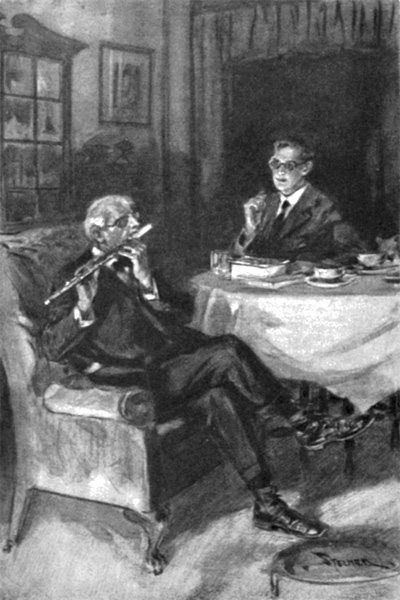
lived alone in dingy bachelor quarters, where, save for his books and
his flute, he had few companions. Therefore he came to look forward to
Christopher's daily visits with an even greater degree of anticipation
than did the lad himself.
"I've got to go out to-day," was his greeting when Christopher made his
appearance on a cold December morning.
The boy's face fell.
"What do you say to coming with me? Would your father be willing?"
"Oh, he wouldn't care. Where are you going?"
"Out to Morningside Drive to look at a clock that they want me to see."
"When are you leaving?"
"Right away. I was waiting a second or two to see if you'd put in an
appearance."
"That was awfully good of you. I'll get my coat."
"You'd better ask your father."
"Don't worry. He'll think it's all right."
"Still, I'd rather you asked him."
"If it will make you any easier in your mind, I will. It won't take a
second."
Off rushed Christopher, only to return breathless a moment or two later.
"Dad says I can go as long as it's with you. And he told me to tell you
we needn't rush the trip. Here's money for our fares."
Christopher extended a fresh new bill.
"Pooh! Pooh! Nonsense!" growled McPhearson. "We'll not need that. I've
money enough. Besides, we're only going in the bus."
"No matter. Dad said—"
"Come along," interrupted the Scotchman, catching up his bag of tools
and cutting short further discussion. "If we stand here arguing we shall
never get off at all."
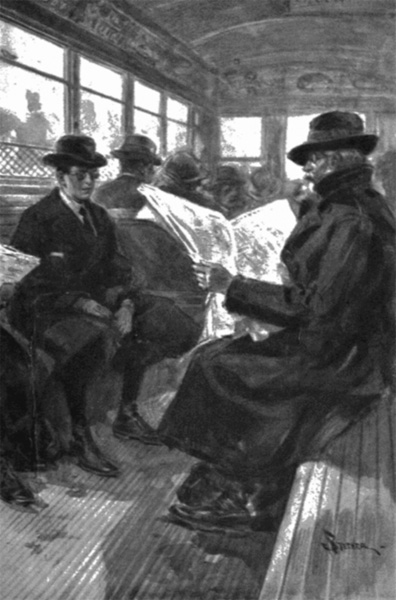
Docilely Christopher followed him into the street where amid surging
crowds they hailed the bus and began rolling up the avenue.
"New York couldn't get along very well without clocks, could it?"
commented Christopher, as he looked down upon the maelstrom of hurrying
humanity.
"Not very well," laughed his companion. "I suppose the majority of this
rushing mob is aiming to arrive somewhere at a specified time. There are
probably men with business engagements; women with dressmakers' and
dentists' appointments; students hastening to lectures; people going for
trains and cars. You may be reasonably certain it is the clock that is
spurring them forward. Earlier in the day the throngs would have been
denser than this, for then we should have seen the workers who pour into
the city every morning. As it is there are quite enough of them. So it
goes from dawn until dusk. Everybody moves on schedule and it is
precisely because the day is cut up into this checkerboard of hours that
we can fit our work and play together and accomplish so much in it."
"It doesn't leave us much time for play," suggested Christopher
mischievously.
"No, I am afraid it doesn't—not enough time. Somehow the proportions
have become distorted. We consider play almost a waste of time and with
life short as it is, to fool time away has become little short of a sin.
Certainly to waste another person's time is criminal—the actual
stealing of a valuable commodity that can never be replaced."
"People who are late never seem to consider themselves thieves," grinned
Christopher.
"They ought to," McPhearson answered solemnly. "Everybody's time has a
money equivalent in these days. If a man keeps me waiting or talks my
time away, he robs me of five or ten or twenty dollars, according to the
length of the interval he has kept me from my work."
"Great Scot!" exclaimed the boy in consternation. "At that rate I've run
up a whale of a bill."
McPhearson laughed at the ejaculation.
"Cheer up, son! I shall not attach your bank account yet," said he. "You
see, when I talk to you I can work at the same time, which puts quite a
different phase on the matter; and when I cannot both work and talk, why
I stop talking. But if I were with some one else it might be my work
that would have to stop, and my talk go on, and that would make all the
difference."
"Sure!"
"It is useless for us to kick against the rush of the age in which we
live," continued McPhearson. "We are here and must move with the tide.
But if we had been born a few hundred years ago, one day would have been
so like another that to waste moments or even hours would not have
greatly mattered. In fact, people expected to waste time and wait about
for nearly everything they wanted. Clothing was made by hand and it took
a long time to make it. Even the cloth was spun at home after the day's
work was finished, and there was nothing else to do. When you traveled,
roads were poor and the stage-coaches obliged to halt at intervals for
fresh horses. In the meantime you stopped at an inn and hung about,
waiting not only for your own dinner but until the drivers and horses
had had theirs. Afterward more precious moments were consumed in
harnessing up the new steeds and getting once more under way. Then if no
wheels came off, or reins broke, or horses stumbled, not to mention
possible onslaughts of highwaymen who beset unfrequented districts, you
eventually arrived at your destination."
"At that rate I should never expect to get anywhere," announced
Christopher.
"All living proceeded at that ratio or even a slower one, for if you
could not afford coach fare you walked to where you were going.
Nevertheless, in spite of the defects of the period, it was considered a
very comfortable era, and people were well content with it. Fortunately
nobody wished to travel very extensively, for as knowledge of geography
was scant they did not know there was anywhere to go. Hence they
cheerfully remained in the spot where they happened to be born or within
a short radius of it.
"About the great estates hung swarms of retainers who in times of peace
had little to do. Some of these helped dress the venison brought in from
the hunt, some dragged in logs for the fires, some cared for the horses;
and with all that there were several times as many retainers as there
were duties. Therefore it was unavoidable that many men were idle the
greater part of the day. Indeed they had not resources enough to be
anything else, for scarce a one of them had any education. They could
neither read nor write, and in many cases, their masters could do no
better. The bare fact that a nobleman sent his servant to the public
square to find out what time it was proves that such little things as
quarter or half hours did not concern them much.
"Ladies worked tapestries, danced and sang their days away; gossiped
with one another or quarreled with their maids, while the gentlemen of
the household hunted, hung about the court, loitered at the inn or rowed
on the river. For such an existence as that one did not need to slice
his time up into very fine pieces. An idle, leisurely life it was, with
little cause for haste. What wonder the clocks had no minute hands when
even hours were of such minor importance?"
The bus halted with a jerk, to escape running over an abnormally daring
pedestrian.
"A second made some difference to him," said Christopher, when once more
the vehicle was in motion.
"All the difference between being in this world and out of it," was the
terse reply. "He'd better have lost a minute rather than take a chance
like that. But, alas, we have got into the habit of thinking we cannot
stop for anything. From morning to night we race about as if the bogey
man were at our heels. Sometimes I wish myself in the forest of Arden,
where there were no clocks."
"You'd have nothing to repair there, certainly."
"I know it. And before a week was out I should be the most miserable of
mortals, in consequence," retorted the Scotchman quickly. "No, no! It is
better to be perched up here on a bus whizzing to doctor a balky old
clock than to be idle day in and day out."
"Where is the balky old clock you mention?" Christopher inquired.
"In a fine mansion not far from here," replied McPhearson. "A rich old
gentleman who is a clock collector lives there all alone with enough
servants to man a warship. You may be sure our shoe leather will not be
wasted, for none of his clocks are ever out of commission because of
neglect or foolish handling."
Signaling the bus, the travelers descended into the street and walked a
few blocks.
"You are sure your old gentleman won't mind my coming with you?"
murmured Christopher, as they neared the house.
"Oh, Mr. Hawley won't mind. I have been coming here for years. He never
lets anybody else touch his clocks. If he is at home, he will probably
be proud as a peacock to show you his treasures; and if he isn't you can
look about by yourself. He never minds what I do."
On investigation, however, it proved that Mr. Hawley was not at home.
"He done gone to some board meeting this morning," explained the colored
butler. "And sorry enough he'll be to miss you too, Mr. McPhearson, for
he always likes havin' a talk with you."
"Which clock is it this time, Ebenezer?"
"Number Seventeen, sir," answered the darky gravely. "She done been
kickin' up something vexatious. She absumlutely won't strike with the
others—absumlutely won't! After the rest of 'em are through, in she
comes a minute late, chiming away on her own hook, all independent
like, as if she was runnin' the world. You know what that means. Mr.
Hawley, sir, he won't stand for no nonsense like that—not for a second.
If there's any strikin' to be done round here, or chimin' either, it's
got to be done in chorus or not at all. Ain't he been well-nigh a year
trainin' those clocks? We've got 'em down now almighty fine too—'cept
for Number Seventeen."
"I'll have a look at her."
"Do, sir! She's on the stairway, you know, halfway up."
"Oh, I remember her, although I don't believe I could give her number
offhand."
"I could. I could recite the numbers of them clocks frontways an'
backways," answered Ebenezer. "You could, too, if you had 'em to wind."
"Oh, you wind them now, do you?"
"I certainly do!" affirmed the negro, with no small degree of pride.
"Mr. Hawley's been a long time comin' to it, but at last he's let me.
Yes, sir! I wind 'em, every one."
"Indeed!"
"Yes. You see, Mr. Hawley ain't so young as he was, an' mor'n that, he's
got rheumatism in his arm. So one mornin' he say to me 'Ebenezer,' he
say, 'I reckon you'll have to take on the windin' up. My hand is gettin'
shaky.' Well, sir, had he given me the management of a railroad I
couldn't have been prouder. That's why, when Seventeen begun branchin'
out for herself, I was so 'specially upset. I wondered what I'd done to
her."
"We'll look and see," McPhearson smiled. "Very likely she's just taken
a whim, Ebenezer."
"I hope so—I do indeed, sir."
Following the old butler, Christopher and the Scotchman ascended the
stairs until they came to a niche where stood the clock in question.
It was perhaps four feet tall—an exact replica of a long-case clock.
"I never saw such a little grandfather's clock as that," commented
Christopher.
"It is a bracelet clock of early Colonial make," McPhearson explained.
"Many of them were made in Massachusetts in the early days."
"And its works are like the big ones?"
"Practically, yes. This one, as you see, was made by John Bailey of
Hanover, a small town on Cape Cod. Probably its date is about 1812 or
1815."
"It is over a hundred years old already."
"Yes. And considering it is, don't you think, Ebenezer, it has earned
the right to a little independence?" McPhearson inquired of the darky, a
twinkle in his eye.
But Ebenezer shook his head.
"Mr. Hawley done say no clock can go strikin' by herself—no matter how
old she is," Ebenezer asserted, without hint of a smile. "He say there's
no excuse for it—no excuse!"
McPhearson opened the door and glanced inside.
"Can you see anything wrong, sir?" queried the old butler eagerly.
"Not yet. I've got to make a more thorough examination."
"Likely you have. But whatever's the matter, you'll find it—I know
that. I never see such a man for clocks as you in all my born days; an'
the master, he say the same. 'Mr. McPhearson will soon get Seventeen
into line,' he says, an' I know you will, sir. Don't you always?"
In the meantime Christopher had peeped inside the clock.
"Why, look at the great lead weight!" ejaculated he.
"Yes. Many old clocks had weights such as this, which were pulled up
when the clock was wound and gradually dropped as the clock ran down.
Sometimes a stone was used; sometimes even a pail of small stones."
"But where were springs and pendulums?" gasped the astonished boy.
"Springs came a good deal later. Even pendulums were not introduced in
any practical form until 1657. Up to that time a balance did the work.
The advent of the pendulum, invented probably by Christian Huygens, a
Dutch mathematician, opened up no end of complications for the early
clockmakers. In the first place they could not decide where to put this
new article. Some placed the pendulum at the front of their clock,
letting it dangle down across the face; others tried to conceal it by
hanging it outside the back. Still others made a dial that would project
enough at either side to cover it up.
"Nor did the novel innovation of the pendulum do much good at first,
although theoretically makers of clocks conceded pendulums to be a
scientific advance over older methods. Of course the theory of the
pendulum had been for a long time in the minds of many thoughtful
persons. Galileo had seized on its principle when observing the swinging
of lanterns in the church at Pisa, and had written a scientific treatise
on it. But to get an idea is one thing and to apply it is quite another.
Pendulums were very complicated mechanisms. In the first place the
length of the pendulum decides, you see, the rate of the clock's
vibration; a short one resulting in a quick, nervous tick; and a long
one in a slow, quiet one. Therefore pendulums meant more even vibration
and more accurate time-keeping, and it was just when makers were
rejoicing over these advantages that it was discovered the temperature
of the place in which a clock stood affected the rod the bob hung on and
threw the whole timepiece out of adjustment. Here was a pretty kettle of
fish! A hot room, for example, would expand the rod and lengthen it."
"And make the clock tick slower," put in Christopher eagerly.
"Precisely."
"Then the clock would go slower sometimes than others."
"Exactly that! The variation was not great, of course, and we now have
learned how to meet it by lengthening or shortening the pendulum by
means of a screw placed near the bob. Nevertheless the variation is
there. A common wire pendulum will vary approximately a minute a week; a
brass rod will, on the other hand, vary that same minute in five days
instead of seven. Wood, a material showing less change than metal, will
vary only a minute in three weeks.
"All this we have learned to make allowance for. But the poor old
clockmakers had to gather these facts by long and tiresome experiment.
At length brass pendulums which, they discovered, made the most trouble,
were replaced by those of iron or lead which, being of softer material,
expanded and contracted more readily. In our day you will sometimes see
a very finely adjusted astronomical clock whose pendulum terminates in a
hollow glass or iron receptacle filled with mercury, instead of the
usual metal bob."
"There are two of them at the store."
"To be sure there are! For the moment I had forgotten that."
"And all this time while clockmakers were fussing round about bobs and
pendulums, did the people have to keep on running to the cathedral or
the public square to find out what time it was?"
"No, indeed! By 1600 you could buy for a moderate sum a clock to use at
home. Not that it was a very accurate timekeeper. Nevertheless it gave a
fair idea of the hour, which was all that was demanded of it," laughed
McPhearson, busying himself with his screwdriver.
"What sort of clocks were the first ones?"
"They were not like ours, you must remember that. There was, for
instance, the bird-case clock, a small chased or perforated brass affair
from four to five inches square, and named because its shape suggested a
cage for birds. I spoke of it before. Then there was the lantern clock.
Both these varieties were made to hang on the wall and were wound by
pulling down the weights that dangled from them."
"They had no springs, pendulums or things?" questioned Christopher
wonderingly.
"That was before the days of springs. This particular type of clock,
however, had a pendulum; but it was only a pendulum driven by weights
showing the pendulum idea in its crudest form. Not until the long-case
(or grandfather) clock made its advent into England did the pendulum,
scientifically applied, come into being; and before that era many years
intervened during which bracket clocks held the center of the stage."
"Clocks like Richard Parsons'!" interrupted Christopher triumphantly.
"Yes, the very same. These were better yet because they had no weights
hanging down and so could be put on a table, a shelf, or mantelpiece. In
the meantime, somewhere about the year 1500, a Nurenburg locksmith named
Peter Henlien had made a clock so small that it could be carried in
one's pocket—if that pocket was of pretty ample size. It had works of
iron, one hand, and no crystal, and was, to be sure, both thick and
clumsy, but it boasted one amazing feature. Since it was too small to
depend on weights, it contained a coiled mainspring—something entirely
new to the clockmaking world. Now this article fashioned by Peter
Henlien cannot be termed a watch as we know watches; but still it was
the nearest approach to one that had yet been produced. The fact that
this egg-shaped concoction was no great timekeeper was a secondary
matter. The important thing was that a small, compact article that would
keep some sort of time had been made, and a coiled mainspring was inside
it."
"How funny to have a blacksmith—or rather a locksmith, making a watch!"
"Not at all. Records show that a great many of the best clockmakers
belonging to the Clockmakers' Company were, or had formerly been,
blacksmiths."
"But it seems odd, doesn't it?" mused Christopher. "And did everybody
start making watches after this queer article of Peter Henlien's was
produced?"
"Not very extensively. Indeed, there was nothing very appealing or
attractive in Peter Henlien's watch. Moreover, since such objects failed
to keep good time, what earthly inducement was there for owning one?
Nevertheless horologers themselves were not discouraged. They kept right
on trying to turn out something better, and in 1525 Jacob Zech, a Swiss
mechanic from Prague, hit on a remedy to prevent these crude watches
from running fast when first wound up and slower when they began to run
down. In other words he discovered something that would equalize the
mechanism."
"And what was that?"
"A fusee."
"I'm afraid that doesn't help me much," was Christopher's rueful plaint.
"Well, a fusee was a short cone having a spiral groove round it, with a
cord or chain wound to the groove and fastened at the big end of the
cone. It was a simple device but it did the work. The shaft of the fusee
was attached to the large wheel that moved the gears, and the other end
of the cord was fastened to the mainspring barrel. Therefore as the
mainspring slowly turned the barrel, it gradually uncoiled the cord from
the fusee, making it turn and as soon as it turned, the wheels had to
turn too, and the watch began to go. Since from the very start the cord
unwound from the small end of the cone where the leverage was least, and
as the force of the mainspring decreased it, the leverage of the cord
strengthened in the same proportion. So you see, the power which turned
the wheels was constantly the same. Do not dream, however, this result
was reached all in a minute. The crude fusee of Zech had to be perfected
by Gruet, another Swiss clockmaker, and by still others. Nevertheless
the scheme did work and caused a revolution in clock and watch making.
There was now some hope that ultimately timepieces would furnish correct
time, which after all is, I suppose, the only excuse a clock has for
being."
McPhearson brought from his bag a small copper oil can.
"Wants oilin', does she?" interpolated the butler, who had been standing
anxiously near by.
"A drop won't hurt her."
"Much wrong with her, sir?"
"Next to nothing, Ebenezer. She just needed a little readjusting and
tightening up."
"Praise de Lord! Then you're most through, sir."
"Pretty near."
"I'm clean afraid Mr. Hawley won't get back before you finish."
"I'm not gone yet."
"Oh, I ain't in any hurry to shoo you out, Mr. McPhearson," declared the
darky hurriedly. "No, indeed, sir. I could listen to you talk all day."
"I forgot you were listening, Ebenezer."
"Listening? 'Deed an' I was listenin'! My two ears was pricked up like a
rabbit's."
The clockmaker flushed and smiled.
"They's silver to clean; an' brasses to polish, an' I dunno what—"
continued the butler, "but I'm lettin' 'em all lie 'til by an' by—I's
improvin' my mind—I is!"
"So am I," rejoined Christopher, laughing.
"I seem to be furnishing a lecture free of charge to a very select
audience," the Scotchman returned drily; "and having once started, I
suppose I may as well finish it. You can testify that at least I have
not been idle while talking.
"Nor was the era, of which I have been speaking, an idle one. Like Rip
Van Winkle, it began slowly to awaken from its long sleep and become
alert. Printing was invented and the Bible, along with other books,
gradually reached the hands of the common people. In the meantime,
Columbus had made his voyage to America and returned with tales of new
lands, stimulating in others a spirit of adventure. The recently evolved
compass, as well as the fact that larger and more staunch ships were
now to be had, lured persons previously shy of the sea to voyages of
discovery. On every hand new ideas were coming to light. In the clock
world somebody began making screws to replace the primitive little pins
and rivets hitherto employed to fasten wheels and dials in place; glass
came into more general use, and by 1600 crystals began to be quite
generally in evidence; and the appearance of the minute hand gave
evidence that the universe was a busier place and short intervals of
time becoming of greater worth. But although the sale of clocks
increased, watches were not yet in general use. They were too much of a
luxury. People therefore consulted their clocks (if they were lucky
enough to have them); hied them to the village square if not; or
depended upon their sundials of which there were still many in use.
Watchmen also went about the streets crying the hours.
"The rich, to be sure, purchased watches, but they bought them more for
ornaments than for use. Those who could afford it frequently owned
several, wearing them around their necks on chains or ribbons, and
displaying a different one to suit either their costume or their fancy."
"But weren't those old egg-shaped watches heavy and ugly?" asked
Christopher.
"Oh, by this time watches had got far beyond that original design and
had now become monuments to the goldsmith's art, being small and
fashioned in every imaginable design. I regret to say that a great
portion of the labor went into the cases, which were beautifully made
by hand. There were flowers with watches concealed in their centers;
baskets of tiny fruits, hearts, animals, death's-heads—every form that
was novel or original. Some cases had on their covers miniatures set in
jewels; and there were cases of leather studded with decorations in nail
heads. In every instance it was the outside of the watch that interested
both purchaser and goldsmith—not the inside. Can you wonder, therefore,
that the watch deteriorated into being a mere toy and ornament?"
"How could people be so ridiculous!" exclaimed Christopher with scorn.
"It would have been ridiculous had the art of making watches stopped
there," McPhearson acquiesced. "But fortunately, if the public was
content with such pretty, silly toy affairs, the horologers were not.
Patiently they continued the struggle to make timepieces better; and to
prove that all this nonsense about pretty watches was not without value,
I will tell you that it was while making a white enamel base on which to
paint a miniature that some clever person bethought him how nice a watch
face of white enamel would be with black figures printed upon it."
"It is never all loss without some gain, is it?" smiled Christopher.
"And clocks?"
"Clocks, too, were sharing the general improvement," answered
McPhearson. "The old system of the balance with its accompanying weights
and chains had passed, and the pendulum, now becoming less of a puzzle,
was coming into vogue. Makers had, however, been convinced by this time
that pendulums did not look well hanging down across the faces of
clocks, and so they now put them at the back, their swingings being
frequently concealed by projecting dials. So you see, the world was
moving on."
As he concluded this speech, McPhearson took off his working glasses,
substituted for them another pair, and began packing up his tools.
"There!" exclaimed he to Ebenezer, "I think you will find Seventeen will
do better after this. Don't blame the poor thing. It wasn't her fault."
"I'm glad to hear you say so, sir," returned the butler with a broad
smile. "I always did like that clock."
"The others, you say, are all right."
"Mostly, sir. Number Fifteen lagged a little and kept the master
botherin' for a while, but she's catchin' up now. I wouldn't dare have
you touch her 'cause she's runnin' too close to be disturbed."
"Then I'll go along. Give my respects to Mr. Hawley, Ebenezer."
"I will, sir," and the butler let his visitors out.
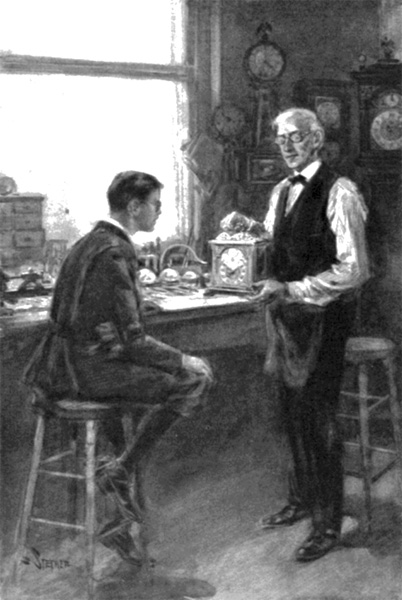
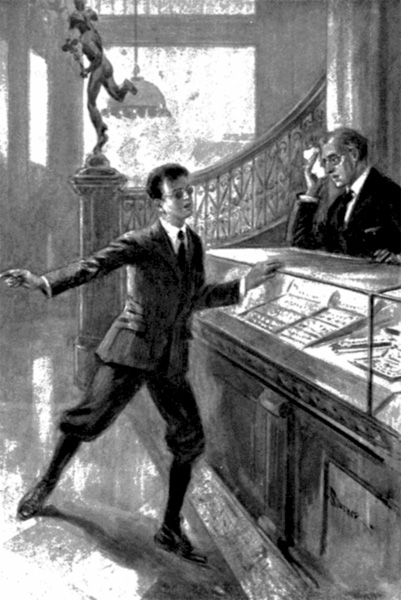 "Those men—one of them took a ring—I saw him."
frontispiece. See page 34.
"Those men—one of them took a ring—I saw him."
frontispiece. See page 34.