CHRISTMAS STORIES.
Transcriber’s Note:
The cover image was created by the transcriber and is placed in the public domain.
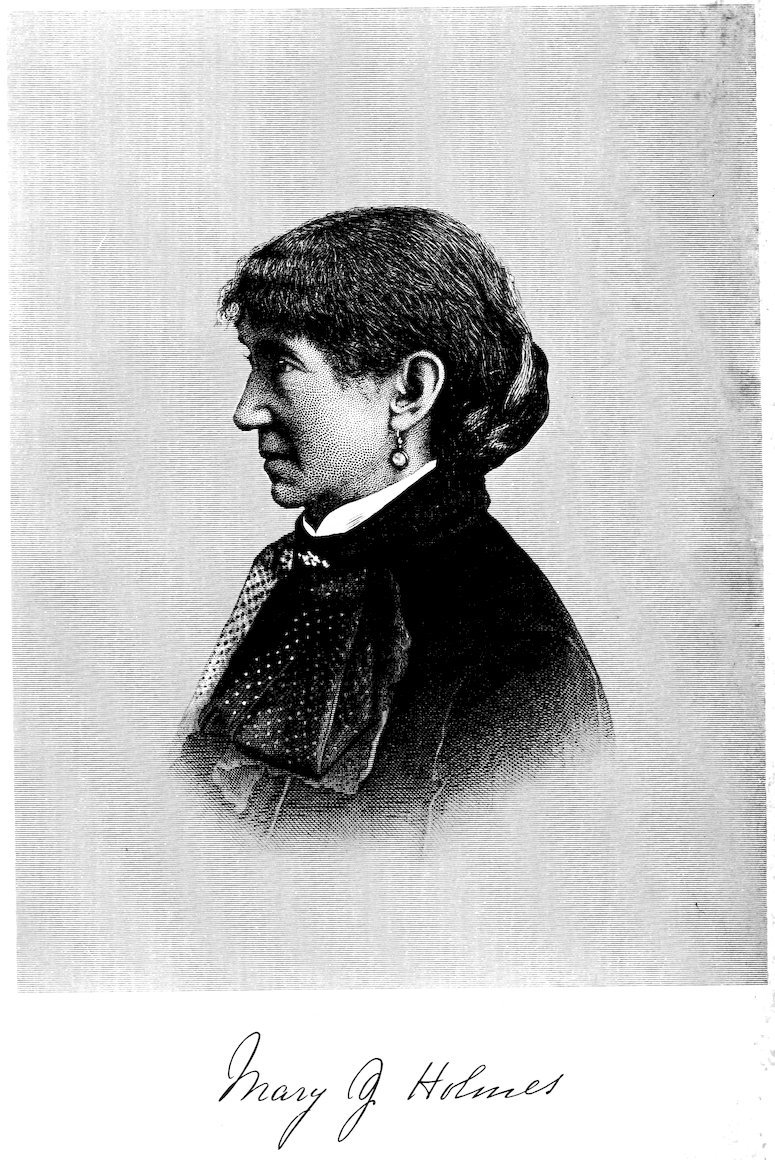
Engd. by Geo E. Perine, N. York

CONTENTS.
ALICE AND ADELAIDE. — CHAPTER I. CHRISTMAS EVE. — CHAPTER II. THE HOUSE OF MOURNING. — CHAPTER III. THE BROWN HOUSE IN THE HOLLOW. — CHAPTER IV. THE WHITE HOUSE ON THE HILL. — CHAPTER V. CALLS. — CHAPTER VI. PAY-DAY. — CHAPTER VII. THE UNKNOWN DELIVERER. — CHAPTER VIII. THE PARTY DRESS. — CHAPTER IX. THE FIGURE ON THE HEARTHSTONE. — CHAPTER X. REVELATIONS. — CHAPTER XI. NATURAL CONSEQUENCES.

It was Christmas eve, and the parlors of No. 46 Shelby Street were ablaze with light; rare flowers, in vases rarer still, filled the rooms with a sweet perfume, bringing back, as it were, the summer glory which had faded in the autumn light, and died in the chill December’s breath. Costly pictures adorned the walls; carpets, which seemed to the eye like a mossy bed inlaid with roses, covered the floors, while over all, the gas-light fell, making a scene of brilliant beauty such as was seldom witnessed in the quiet city of ——, where our story opens.
It was the night of Alice Warren’s first presentation to society, as a young lady, and in her luxurious dressing-room she stood before her mirror, bending 10her graceful head, while her mother placed among her flowing curls a golden arrow, and then pronounced the toilet complete. Alice Warren was very beautiful with her fair young face, her waving hair, and lustrous eyes of blue, which shone with more than their wonted brightness, as, smoothing down the folds of her dress, she glanced again at the mirror opposite, and then turned toward her mother just as a movement in the hall without attracted the attention of both. It was a slow, uncertain step, and darting forward, Alice cried:
“It is father—come to see how I look on my eighteenth birthnight!”
“Not to see you, my child,” the father answered; and in the tones of his voice there was a note of sorrow, as if the struggle of nineteen long years were not yet fully over.
To Hugo Warren the world was one dark, dreary night, and the gold so many coveted would have been freely given, could he but once have looked upon the face of his only child, who, bounding to his side, parted the white hair from his forehead, and laying his hand upon her head, asked him “to feel if she were not beautiful.”
Very tenderly and caressingly the father’s hand moved over the shining hair, the glowing cheek, 11and rounded arms of the graceful little figure which stood before him, then dashing a tear away, the blind man said:
“My Alice must be beautiful if she is, as they tell me, like her mother,” and the sightless eyes turned instinctively toward the mother, who, coming to his side, replied:
“Alice is like me as I was when you last saw my face—but I have changed since then—there are lines of silver in my hair, and lines of time upon my face.”
The blind man shook his head. The picture of the fond girl-wife, who, in his hour of bitter agony had whispered in his ear, “I will be sunlight, moonlight, starlight—everything to you, my husband,” had never changed to him—for faithfully and well that promise had been kept, and it was better perhaps, that he could not see the shadows on her face—shadows which foretold a darker hour than any he had ever known—an hour when the sunlight of her love would set forever. But no such forebodings were around him now. He held his wife and daughter both in his arms, and holding them thus, forgot for a moment that he was blind.
“Did you invite Adelaide?” Alice asked at last; and Mr. Warren replied:
12“Yes, but it is doubtful whether she will come. She is very proud, her father says, and does not wish to put herself in a position to be slighted.”
“Oh, father!” Alice cried, “Adelaide Huntington does not know me. I could not slight her because she is poor, and if she comes I will treat her like a royal princess,” and Alice’s face flushed with pleasure as she thought how attentive she would be to the daughter of her father’s “confidential clerk and authorized agent.”
Meanwhile, in a distant part of the city, in a dwelling far more humble than that of Hugo Warren, another family group was assembled, father, mother, daughter—all, save old Aunt Peggy, who, thankful for a home which saved her from the almshouse, performed willingly a menial’s part, bearing patiently the whims of the mother, and the caprices of the daughter, the latter of whom proved a most tyrannical and exacting mistress. Tall, dignified, and rather aristocratic in her bearing, Adelaide Huntington was called handsome by many, and admired by those who failed to see the treachery hidden in her large, dark eyes, or the constant effort she made to seem what she was not. To be noticed by those whose position in life was far above her own, was her aim, and when the envied Alice Warren extended 13to her family an invitation to be present at her birthday party, her delight was unbounded.
She would go, of course, she said, “and her father would go with her, and she must have a new dress, too, even if it took every cent they had.”
The dress was purchased, and though it was only a simple white muslin, it well became the queenly form of the haughty Adelaide, who, when her toilet was completed, asked her father if “he did not think she would overshadow the diminutive Alice?”
“I don’t see why there should be this difference between us,” she continued, as her father made no answer. “Here I must be poor all my life, while she will be rich, unless Mr. Warren chances to fail——”
“Which he will do before three days are passed,” dropped involuntarily from the lips of Mr. Huntington.
Then with a wild, startled look he grasped his daughter’s arm, exclaiming:
“Forget what I just said—breathe not a word of it to any one, for Heaven knows I would help it if I could. But it is too late—too late.”
It was in vain that Adelaide and her mother sought an explanation of these strange words. Mr. Huntington would give none, and in unbroken silence 14he accompanied his daughter to the house of Mr. Warren.
Very cordially Alice welcomed the young girl striving in various ways to relieve her from the embarrassment she would naturally feel at finding herself among so many strangers. And Adelaide was ill at ease, for the spirit of jealous envy in her heart whispered to her of slight and insult where none were intended; whispered, too, that her muslin dress which, at home with her mother and Aunt Peggy to admire, had been so beautiful, was nothing, compared with the soft, flowing robes of Alice Warren, whose polite attentions she construed into a kind of patronizing pity exceedingly annoying to one of her proud nature. Then, as she remembered her father’s words, she thought, “We may be equals yet. I wonder what he meant? I mean to ask him again,” and passing through the crowded apartments she came to the little ante-room, where all the evening her father had been sitting—a hard, dark look upon his face, and his eyes bent on the floor, as if for him that festive scene possessed no interest.
“Father,” she said, but he made her no reply; he did not even know that she was standing at his side.
15Far back through the “past” his thoughts were straying, to the Christmas Eve when penniless, friendless and alone he had come to the city, asking employment from one whose hair was not as white then as it was now, and whose eyes were not quenched in darkness, but looked kindly down upon him, as the wealthy merchant said:
“I will give you work as long as you do well.”
Hugo Warren was older than William Huntington, and his station in life had always been different, but over the mountain side the same Sunday bell had once called them both to the house of God—the same tall tree on the river bank bore on its bark their names—the same blue sky had bent above their childhood’s home, and for this reason he had given the poor young man a helping hand, aiding him step by step, until now, he was the confidential clerk—the one trusted above all others—for when the blindness first came upon him the helpless man had put his hand on William’s head, saying, as he did so:
“I trust you, with my all, and as you hope for Heaven, do not be false to the trust.”
How those words, spoken years before, rang in William Huntington’s ears, as he sat thinking of the past, until the great drops of perspiration gathered 16thickly around his lips and dropped upon the floor. He had betrayed his trust—nay, more, he had ruined the man who had been so kind to him, and before three days were passed his sin would find him out. Heavy bank notes must be paid, and there was nothing with which to pay them. The gambling table had been his ruin. Gradually he had gone down, meaning always to replace what he had taken, and oftentimes doing so; but fortune had deserted him at last, and rather than meet the glance of those sightless eyes, when the truth should be known, he had resolved to go away. The next day would be a holiday, and before the Christmas sun set, he would be an outcast—a wanderer on the earth. Of all this he was thinking when Adelaide came to his side.
The sound of her voice aroused him at last, and starting up, he exclaimed:
“It is time we were at home. The atmosphere of these rooms is stifling. Get your things at once.”
Rather unwillingly Adelaide obeyed, and ten minutes later she was saying good night to Alice and her mother, both of whom expressed their surprise that she should go so soon, as did Mr. Warren also.
“I meant to have talked with you more,” he 17said, as he stood in the hall with Mr. Huntington, who, grasping his hand, looked earnestly into the face which for all time to come would haunt him as the face of one whom he had greatly wronged.
A few hours later, and all was still in the house where mirth and revelry had so lately reigned. Flushed with excitement and the flattery her youthful beauty had called forth, Alice Warren had sought her pillow, and in the world of dreamland was living over again the incidents of the evening. The blind man, too, was sleeping, and in his dreams he saw again the forms of those he loved, but he did not see the cloud hovering near, nor the crouching figure which, across the way, was looking toward his window and bidding him farewell.
Mr. Huntington had accompanied Adelaide to his door, and then, making some trivial excuse, had left her, and gone from his home forever, leaving his wife to watch and wait for him as she had often done before. Slowly the December night waned, and just as the morning was breaking—the morn of the bright Christmas day—a train sped on its way to the westward, bearing among its passengers one who fled from justice, leaving to his wife and daughter grief and shame, and to the blind man darkness, ruin, and death.

The third day came and passed, and as the twilight shadows fell upon the city, Alice and her mother pushed back the heavy curtain which shaded the window of their pleasant sitting-room, and looked anxiously down the street for one who seldom tarried long. An hour went by, and another still, and then he came, but far more helpless than when he left them in the morning. The blind eyes were red with tears—the stately form was bent with grief—the strong man was crushed with the blow which had fallen so suddenly upon him. He was ruined—hopelessly, irretrievably ruined, and in all the world there was nothing he could call his, save the loved ones who soothed him now, as one had done before, when a mighty sorrow overshadowed him.
As well as he could he told them of the fraud which for many years had been imposed upon him 19and how he had trusted and been betrayed by one whom he would not suffer the officers to follow.
“It will do no good,” he said “to have him brought back to a felon’s cell, and I will save the wife and daughter from more disgrace,” and so William Huntington was suffered to go at large, while in the home he had desolated there was sorrow and mourning and bitter tears shed; the blind man groping often through the familiar rooms which would soon be his no longer; and the daughter stifling her own grief to soothe her father’s sorrow, and minister to her mother’s wants.
As has before been hinted, Mrs. Warren was far from being strong, and the news of the failure burst upon her with an overwhelming power, prostrating her at once, so that before two weeks were gone her husband forgot everything, save the prayer that the wife of his bosom, the light of his eyes, the mother of his child, might live.
But she who had been reared in the lap of luxury, was never to know the pinching wants of poverty—never to know what it was to be hungry, and cold, and poor. All this was reserved for the gentle Alice, who, younger and stronger, too, could bear the trial better. And so, as day after day went 20by, the blind man felt what he could not see—felt the death shadows come creeping on—felt how the pallor was deepening on his wife’s cheek—knew that she was going from him fast—knew, alas, that she must die, and one bright, beautiful morning, when the thoughtless passers-by, pointing to the house, said, one to another, “He has lost everything,” he, from the depths of his aching heart, unconsciously made answer, “Lost everything—lost everything!” while Alice bowed her head in anguish, half wishing she, too, were blind, so she could not see the still, white face which lay upon the pillow.
Suddenly the deep stillness of the room was broken by the sound of footsteps in the hall below, and, lifting up her head, Alice said, “Who is it, father?” but Mr. Warren did not answer. He knew who it was and why they had come, and going out to meet them, he stood upon the stairs, tall and erect, like some giant oak which the lightning stroke had smitten, but not destroyed.
“I know your errand,” he said; “I expected you, but come with me and then surely you will leave me alone a little longer,” and turning, he led the way, followed by the men, who never forgot that picture of the pale, dead wife, the frightened, 21weeping child, and the blind man standing by with outstretched arm as if to shield them from harm.
The sheriff was a man of kindly feelings, and lifting his hat reverentially, he said:
“We did not know of this, or we would not have come,” and motioning to his companion, he left the room, walking with subdued footsteps down the stairs, and out into the open air; and when the sun went down not an article had been disturbed in Hugo Warren’s home, for sheriff, creditors, lawyers—all stood back in awe of the mighty potentate who had entered before them, and levied upon its choicest treasure—the white-haired blind man’s wife.
Nearly a year has passed by since we left the blind man weeping over his unburied dead, and our story leads us now to the handsome rural town of Oakland, which is nestled among the New England hills, and owes much of its prosperity and rapid growth to the untiring energy of its wealthiest citizen—its one “aristocrat,” as the villagers persisted in calling Richard Howland, the gentleman from Boston, who came to Oakland a few years ago, giving to business a new impetus, and infusing new life into its quiet, matter-of-fact people, who respected him as few men have ever been respected, and looked upon him as the founder of their good fortune. He it was who built the factory, bought the mills and owned the largest store and shoe shop in the town, furnishing employment to hundreds of the poor, many of whom had moved into the village, and rented of him the 23comfortable tenements which he had erected for that purpose.
Richard Howland’s home was very beautiful, overlooking, as it did, the town and the surrounding country, and the passers-by often stopped to admire its winding walks, its fountains, its grassy plats, graceful evergreens, and wealth of flowers, the latter of which were the especial pride of the stately Miss Elinor, the maiden sister, who was mistress of the house, for Richard Howland had no wife, and on the night when we first introduce him to our readers, he was seated in his pleasant sitting-room, with his sister at his side, and every possible comfort and luxury around him. The chill December wind which howled among the naked branches of the maples, or sighed through the drooping cedar boughs, could not find entrance there. The blinds were closely shut—the heavy curtains swept the floor—the fire burned brightly in the grate, casting fantastic shadows on the wall, and with his favorite paper in his hand, he almost forgot that in the world without there were such evils as poverty or pain. Neither did he see the fragile form toiling through the darkness up the street, and pausing at his gate. But he heard the ringing of the door-bell, and his ear caught the sound of some one in the hall, asking to see him.
24“I wish I could be alone for one evening,” he said, and with a slight frown of impatience upon his brow, he awaited the approach of his visitor.
It was a delicate young girl, and her dress of black showed that sorrow had thus early come to her.
“Are you Mr. Howland?” she asked, and her eyes of blue timidly sought the face of the young man, who involuntarily arose and offered her a seat.
Her errand was soon told. She had come to rent his cheapest tenement—the brown house in the hollow, which she had heard was vacant, and she wished him to furnish her with work—she could make both shirts and vests tolerably well, and she would try hard to pay the rent!
The stranger paused, and Miss Elinor, who had been watching her with mingled feelings of curiosity and interest, saw that the long eyelashes were moist with tears. Mr. Howland saw it, too, and wondering that one so young and timid should come to him alone, he said:
“Little girl, have you no friends—no one on whom to depend, save yourself?”
The tears on the eyelashes now dropped upon the cheek, for the little girl, as Mr. Howland had 25called her, mistook his meaning and fancied he was thinking of security, and payment, and all those dreadful words whose definition she was fast learning to understand.
“I have a father,” she said, and before she had time for more, the plain-spoken Miss Elinor asked:
“Why didn’t he come himself, and not send you, who seem so much a child?”
There was reproach in the question, and the young girl felt it keenly, and turning toward Miss Elinor, she answered:
“My father could not find the way—he never even saw my face—he couldn’t see my mother when she died. Oh! he’s blind, he’s blind,” and the voice, which at first had merely trembled, was choked with bitter sobs.
The hearts of both brother and sister were touched, and the brown house in the hollow, nay, any house which Richard Howland had to rent, was at the girl’s command. But he was a man of few words, and so he merely told her she could have both tenement and work, while his sister thought how she would make her brother’s new tenants her especial care.
Miss Elinor was naturally of a rather inquisitive turn of mind and she tried very skillfully to learn 26something of the stranger’s history. But the young girl evaded all her questioning, and after a few moments arose to go. Mr. Howland accompanied her to the door, which he held open until she passed down the walk and out into the street. Then the door was closed, and Alice Warren was alone again in the cold, dark night, but she scarcely heeded it, for her heart was lighter than it had been for many weeks. The gentleman whom she had so much dreaded to meet had spoken kindly to her; the lady too, had whispered “poor child” when she told her of her father, while better far than all, she had procured a shelter for her father, the payment for which would come within their slender means.
Not time, but the joy or sorrow it brings, changes people most, and the Alice Warren of to-day is scarce the same we saw one year ago. Then, petted, caressed and glowing with youthful beauty, she presented a striking contrast to the pale-faced girl, who, on the wintry night of which we write, traversed street after street, until she came to the humble dwelling which for the last few days had been her home. Every cent of his large fortune had Mr. Warren given up, choosing rather to starve and know he had a right to do so, than to feed on what was not his own. His handsome house and 27furniture had all been sold, and with a mere pittance, which would not last them long, they had gone into the country, where Alice hoped to earn a livelihood by teaching. But she was “too small, too childish, too timid,” the people said, ever to succeed, and so at last she resorted to her needle, which in her days of prosperity, she had fortunately learned to use.
As time passed on a kind-hearted woman, who visited in their neighborhood, became interested in them and urged their removal to Oakland, her native town, whither they finally went, stopping with her for a few days until further arrangements could be made.
Hearing that the brown house in the hollow, as it was called, was vacant, Alice had applied for it, with what success we have seen, and returning home, she told her father the result of her application, and how small a sum they would have to pay for it, and how neatly she could fit it up, and how in the long winter evenings he should sit in his arm-chair before the cheerful fire, and listening to her as she talked, the blind man thanked God that the wife-love he had lost forever was in a measure made up to him in the love of his only child.
Two weeks went by, and then, in the shoe shop 28and store the workmen said to each other, “to-morrow is Christmas,” wondering if Mr. Howland would present each of the families in his employ with a turkey, as he was wont to do.
He had always done it before, they said, he would surely do so now.
Nor were they disappointed, for when the day’s labor was over, each man was given his usual gift, and when all had been served, there was one turkey left, for which no owner came.
“We shall need it ourselves perhaps,” Mr. Howland thought, as he remembered the numerous city friends expected on the morrow; and, as he was not ashamed to carry it himself, he placed it in a covered basked and started for home, turning involuntarily down the street which would take him through the hollow. He did not often go that way for though it was quite as near, it was not a pleasant portion of the town. But he was going that way now, and as he came near the brown house, from whose windows a cheerful light was shining, he thought of his new tenants, and half decided to call; then, remembering that one of his clerks had told him of a young lady who had inquired for him that afternoon, expressing much regret at his absence and saying she should call at his 29house early in the evening, he concluded to go on. Still the light shining out upon the snow, seemed beckoning him to come, and turning back he stood before the window, from which the curtain was drawn aside, revealing a picture, at which he paused a moment to gaze. The blind man sat in his old arm-chair, and the flickering flame of the blazing fire shone on his frosty locks and lighted up his grief-worn face, on which there was a pitiful expression, most touching to behold. The sightless eyes were cast downward as if they would see the fair young head and wealth of soft brown tresses resting on his knee.
Alice was crying. All day long she had tried to repress her tears, and when, as she sat in the gathering twilight with her father, he said, “She was with us one year ago,” they burst forth, and laying her head upon his lap she sobbed bitterly.
There were words of love spoken of the lost one, and as Mr. Howland drew near, Mr. Warren said:
“It is well, perhaps, that she died before she knew what it was to be so poor.”
The words “to be so poor” caught Mr. Howland’s ear, and glancing around the humble apartment he fancied he knew why Alice wept. Just then 30she lifted up her head and he saw the tears on her cheek. Mr. Howland was unused to tears—they affected him strangely—and as the sight of them on Alice Warren’s eyelashes, when she told him her father was blind, had once brought down the rent of the house by half, so now the sight of them upon her cheek as she sat at her father’s feet brought himself into her presence and the turkey from his basket. Depositing his gift upon the table and apologizing for his abruptness, he took the chair which Alice offered him, and in a short space of time forgot the young lady who had so nearly prevented him from being where he was—forgot everything save the blue of Alice’s eyes and the mournful sweetness of her voice as she answered the few questions he addressed to her. He saw at once that both father and daughter were educated and refined, but he did not question them of the past, for he felt instinctively that it would be to them an unpleasant subject, so he conversed upon indifferent topics, and Alice, as she listened to him, could scarcely believe he was the man whom she had heretofore associated with her wages of Saturday night, he seemed so familiar and friendly.
“You will come to see us again,” Mr. Warren said to his visitor, when the latter arose to go, and 31smiling down on Alice, who stood with her arm across her father’s neck, Mr. Howland answered:
“Yes, I shall come again.”
Then he bade them good night, and as the door closed after him, Mr. Warren said:
“It seems darker now that he is gone,” but to Alice, the room was lighter far for that brief visit.
Mr. Howland, too, felt better for the call. He had done some good, he hoped, and the picture of the two as he had left them was pleasant to remember, and as he drew near his home, and saw in imagination his own large easy-chair before the fire, he tried to fancy how it would seem to be a blind man, sitting there, with a brown-haired maiden’s arm around his neck.
“Miss Huntington, brother,” Miss Elinor said, and Mr. Howland bowed low to the lady thus presented to him by his sister on his arrival home.
She had been waiting for him nearly an hour, and she now returned his greeting with an air more befitting a queen than Adelaide Huntington—for she it was; and by some singular co-incidence she had come to rent a house of Mr. Howland just as Alice Warren had done but two or three weeks before. The failure which had ruined Mr. Warren had not affected Mrs. Huntington further than the mortification and grief she naturally felt at the disgrace and desertion of her husband, from whom she had never heard since he left her so suddenly on the night of the party—neither had she ever met with Mr. Warren, although she had written him a note, assuring him that in no way had she been concerned 33in the fraud. Still her position in the city was not particularly agreeable, and after a time she had removed to Springfield, Mass., where she took in plain sewing—for without her husband’s salary it was necessary that she should do something for the maintenance of her family. Springfield, however, was quite too large for one of Adelaide’s proud, ambitious nature. “She would rather live in a smaller place,” she said, “where she could be somebody. She had been trampled down long enough, and in a country village she would be as good as any one.”
Hearing by chance of Oakland and its democratic people, she had persuaded her mother into removing thither, giving her numerous directions as to the manner in which she was to demean herself.
“With a little management,” she said, “no one need to know that we have worked for a living—we have only left the city because we prefer the country,” and old Peggy, who still served in the capacity of servant, was charged repeatedly “never to say a word concerning their former position in society.”
In short, Adelaide intended to create quite a sensation in Oakland, and she commenced by assuming 34a most haughty and consequential manner toward both Mr. Howland and his sister.
“She had come as ma’s delegate,” she said, to rent the white house on the hill, which they had heard was vacant. Possibly if they liked the country, they should eventually purchase, but it was doubtful—people who have always lived a city life were seldom contented elsewhere. Still, she should try to be happy, though of course she should miss the advantages which a larger place afforded.
All this and much more she said to Mr. Howland, who, hardly knowing whether she were renting a house of him or he were renting one of her, managed at last to say:
“Your mother is a widow, I presume?”
Instantly the dark eyes sought the floor, and Adelaide’s voice was very low in its tone as she answered:
“I lost my father nearly a year since.”
“I wonder she don’t dress in mourning, but that’s a way some folks have,” Miss Elinor thought, while her brother proceeded to say that Mrs. Huntington could have the white house on the hill, after which Adelaide arose to go, casually asking if the right or left hand street would bring her to the hotel, where she was obliged to spend the night, 35as no train, after that hour, went up to Springfield.
For a moment Mr. Howland waited, thinking his sister would invite the stranger to stop with them, but this Miss Elinor had no idea of doing; she did not fancy the young lady’s airs, and she simply answered:
“The right hand street—you can’t mistake it;” frowning slightly when her brother said:
“I will accompany you, Miss Huntington.”
“I dislike very much to trouble you. Still I hardly know the way alone,” and Adelaide’s dark eyes flashed brightly upon him as she accepted his offer.
Mr. Howland was not a lady’s man, but he could be very agreeable when he tried, and so Adelaide now found him, mentally resolving to give her mother and old Aunt Peggy a double charge not to betray their real circumstances. Mr. Howland evidently thought her a person of consequence, and who could tell what might come of her acquaintance with him? Stranger things had happened, and she thought that if she ever should go to that handsome house as its mistress, her first act would be to send that stiff old maid away.
With such fancies as these filling her mind, Adelaide 36went back next day to Springfield, reported her success, and so accelerated her mother’s movements that scarcely a week elapsed ere they had moved into the white house on the hill, a handsome little cottage, which looked still more cozy and inviting after Adelaide’s hands had fitted it up with tasteful care. It was a rule with Mrs. Huntington to buy the best, if possible, and as her husband had always been lavish with his money, her furniture was superior to that of her neighbors, many of whom really stood in awe of the genteel widow, as she was thought to be, and her stylish, aristocratic daughter. They were supposed to be quite wealthy, or at least in very easy circumstances, and more than one young girl looked enviously at Adelaide, as day after day she swept through the streets, sometimes “walking for exercise,” she said, and again going out to shop; always at Mr. Howland’s store, where she annoyed the clerks excessively by examining article after article, inquiring its price, wondering if it would become her, or suit ma, and finally concluding not to take it “for fear every shoemaker’s daughter in town would buy something like it, and that she couldn’t endure.”
Regularly each week she went to Springfield, to take music lessons, she said, and lest something 37should occur making it necessary for her to stay all night, Aunt Peggy usually accompanied her to the depot, always carrying a well-filled satchel, and frequently a large bundle, whose many wrappings of paper told no tales, and were supposed by the credulous to cover the dressing-gown, which Adelaide deemed necessary to the making of her morning toilet.
“It was very annoying,” she said, “to carry so much luggage, but the friends with whom she stopped were so particular that she felt obliged to change her dress, even though she merely stayed to dinner.”
And so the villagers, looking at the roll of music she invariably carried in her hands, believed the tale, though a few of the nearest neighbors wondered when the young lady practiced, for it was not often that they heard the sound of the old-fashioned instrument which occupied a corner of the sitting-room. Finally, however, they decided that it must be at night, for a light was always seen in Mrs. Huntington’s windows until after the clock struck twelve. As weeks went by, most of those whom Adelaide considered somebodies, called, and among them Mr. Howland. By the merest chance she learned that he was coming and 38though she pretended that she was surprised to see him, and said she was just going out, she was most becomingly dressed in her nicely-fitting merino, which, in the evening, did not show the wear of four years. The little sitting-room, too, with its furniture so arranged as to make the best of everything, seemed homelike and cheerful, causing Mr. Howland to feel very much at ease, and also very much pleased with the dark-eyed girl he had come to see. She was very agreeable, he thought, much more so in fact than any one he had met in Oakland, and at a late hour, for one of his early habits, he bade her good night, promising to call again soon, and hear the new song she was going to learn the next time she went to Springfield.
In dignified silence his sister awaited his return, and when to her greeting, “Where have you been?” he replied, “Been to call on Miss Adelaide,” the depth of the three winkles between her eyebrows was perceptibly increased, while a contemptuous Pshaw! escaped her lips. Miss Elinor was not easily deceived. From the first she had insisted that Adelaide “was putting on airs,” and if there was one thing more than another which that straightforward, matter-of-fact lady disliked, it was 39pretention. She had not yet been to see Mrs. Huntington, and now, when her brother, after dwelling at length upon the pleasant evening he had spent, urged her to make the lady’s acquaintance, she replied rather sharply, that she always wished to know something of the people with whom she associated. For her part, she didn’t like Miss Adelaide, and if her brother had the least regard for her feelings, he wouldn’t call there quite as often as he did.
“Quite as often,” Mr. Howland repeated, in much surprise. “What do you mean? I’ve only been there once,” and then in a spirit which men will sometimes manifest when opposed, particularly if in that opposition a lady is involved, he added, “but I intend to go again—and very soon, too.”
“Undoubtedly,” was his sister’s answer, and taking a light, the indignant woman walked from the room, thinking to herself that, if ever that girl came there to live—she’d no idea she would—but if she did, she—Miss Elinor Howland would make the house a little too uncomfortable for them

The next morning Miss Elinor felt better, and as time passed on and her brother did not again visit his new tenants, she began to feel a little more amiably disposed toward the strangers, and at last decided to call, intending to go next to the brown house in the hollow, where she was a frequent visitor. She accordingly started one afternoon for the white house on the hill, where she was most cordially received. With the ladylike manners of Mrs. Huntington she could find no fault, but she did not like the expression of Adelaide’s eyes, nor the sneering manner in which she spoke of the country and country people; neither did she fail to see the basket which the young lady pushed hastily under the lounge as Aunt Peggy ushered her into the sitting-room. On the table there were scissors, needles and thread, but not a vestige of sewing was visible, though on the carpet were 41shreds of cloth, and from beneath the lounge peeped something which looked vastly like the wristband of a man’s shirt.
“Pride and poverty! I’ll venture to say they sew for a living,” Miss Elinor thought, and making her call as brief as possible, she arose to go.
It was in vain that Adelaide urged her to stay longer, telling her “it was such a treat to see some one who seemed like their former acquaintances.”
With a toss of her head Miss Elinor declined, saying she was going to visit a poor family in the hollow, a blind man and his daughter, and in adjusting her furs she failed to see how both Adelaide and her mother started at her words. Soon recovering her composure, the former asked, who they were, and if they had always lived in Oakland?
“Their name is Warren,” said Miss Elinor, “and they came, I believe, from some city in western New York, but I know nothing definite concerning them, as they always shrink from speaking of their former condition. Alice, though, is a sweet little creature—so kind to her old father, and so refined, withal.”
Mechanically bidding her visitor good afternoon, Adelaide went to her mother’s side, exclaiming:
42“Who thought those Warrens would toss up in Oakland! Of course, when they know that we are here, they’ll tell all about father and everything else. What shall we do?”
“We are not to blame for your father’s misdeeds,” Mrs. Huntington answered; and Adelaide replied:
“I know it, but people think you are a widow with a competence sufficient to support us genteelly—they don’t suspect how late we sit up nights, sewing, to make ends meet. Mercy! I hope the peeking old maid didn’t see that,” she exclaimed, as her own eye fell upon the wristband. Then, after a moment, she continued, “I know what I’ll do. I’ll go to Alice this very night, and tell her how sorry we are for what has happened, and I’ll ask her to say nothing about father’s having cheated them and run away. She’s a pretty good sort of a girl, I guess, if I did once to think her so proud.”
The plan seemed a feasible one, and that evening as Alice Warren sat bending over a vest, which she must finish that night, she was startled by the abrupt entrance of Adelaide Huntington, who, seizing both her hands, said, with well-feigned distress:
“My poor Alice! I never expected to find you thus.”
43In his arm-chair Mr. Warren was sleeping, but when the stranger’s shadow fell upon him, he awoke, and stretching out his arms, he said:
“Who is it, Alice?—who stands between me and the fire?”
“It is I,” answered Adelaide, coming to his side, “the daughter of him who ruined you. I have just learned that you were living here in the same village with ourselves, and, at my mother’s request, I have come to tell you how bitterly we have wept over my father’s sin, and to ask you not to hate us for a deed of which we knew nothing until it was all over.”
Then seating herself in a chair she continued to speak hurriedly, telling them some truth and some falsehood—telling them how, for a few months they had lived with a distant relative, a wealthy man, who gave them money now for their support—telling them how her father’s disgrace had affected her mother, and begging of them not to speak of it in Oakland, where it was not known.
“I don’t know why it is,” she said, “but people have the impression that mother is a widow; and though it is wrong to deceive them, I cannot tell them my father ran away to escape a convict’s cell. It would kill my mother outright, and if you will keep silent, we shall be forever grateful.”
44There was no reason why Mr. Warren should speak of his former clerk, and he answered Adelaide that neither himself nor Alice had any wish to injure her by talking of the past. Thus relieved of her fears, Adelaide grew very amiable and sympathetic, saying she did not suppose they were so poor, and pitying Alice, who must miss so much her pictures, her flowers, her birds and her music.
“Come up and try my piano. You may practice on it any time,” she said, when at last she arose to go.
“I never played much. I was not fond of it,” was Alice’s answer, while her father rejoined quickly:
“Then you keep a piano. I did not know you had one.”
“Oh, yes, father bought it for me at auction, three years ago, and as he was not owing any one then, our furniture was not disturbed.”
The blind man sighed, while Alice dropped a tear on the vest she was making, as she thought of the difference between herself and Adelaide, who paused as she reached the door, and asked if she knew Mr. Howland.
“I sew for his store,” said Alice, and Adelaide continued:
45“Isn’t he a splendid man?”
Alice did not know whether he was splendid or not—she had never observed his looks particularly, she said; but she knew he was very kind, and she liked nothing better than to have him come there evenings, as he often did.
“Come here often!” exclaimed Adelaide, her voice indicating the pang with which a feeling of jealousy had been brought to life.
Before Alice could reply there was a footstep outside, and the blind man, whose quick ear caught the sound, said joyfully:
“He’s coming now.”
“I wish I had gone home before,” was the first thought of Adelaide, who did not care to be seen there by Mr. Howland. It might lead to some inquiries which she would rather should not be made. Still, there was now no escape, and trusting much to the promise of the Warrens, she stepped back from the door just as Mr. Howland opened it. He seemed greatly surprised at finding her there, and still more surprised when he learned that they were old acquaintances.
“It is kind in her not to desert them in their poverty,” he thought, and his manner was still more considerate toward Adelaide, who, after 46standing a few moments, made another attempt to go.
“Wait, Miss Huntington,” said he. “It was both raining and snowing when I came in, and you will need an umbrella.”
This was just what Adelaide wanted, and taking a seat she waited patiently until Mr. Howland signified his readiness to go. Then, bidding Alice good night, she whispered to her softly:
“You never will say a word of father, will you?”
“Certainly not,” was Alice’s reply, and in another moment Adelaide was in the street walking arm in arm with Mr. Howland, who began to speak of the Warrens and their extreme poverty.
“It is evident they have seen better days,” he said, “but they never seem willing to speak of the past. Did he meet with a reverse of fortune?”
For a moment Adelaide was silent, while she revolved the propriety of saying what she finally did say, and which was—
“Ye-es—they met with reverses, but as they are unwilling to talk about it, I, too, had better say nothing of a matter which cannot now be helped.”
“Of course not, if it would be to their detriment,” said Mr. Howland, a painful suspicion entering his mind.
47Hitherto he had regarded Mr. Warren as the soul of integrity, but Adelaide’s manner, even more than her words, implied that there was something wrong, and hardly knowing what he said, he continued:
“Was it anything dishonorable?”
“If you please, I would rather say nothing about it,” answered Adelaide. “I don’t wish to do them harm, and I dare say they regret it more than any one else.”
Mentally pronouncing her a very prudent, considerate girl, Mr. Howland walked on in silence, feeling the while that something had been taken from him. He had become greatly interested in the helpless old blind man, and in his writing-desk at home was a receipt in full for the first quarter’s rent, which would become due in a few days. But Mr. Howland was a man of stern integrity, hating anything like fraud and deceit, and if Mr. Warren had been guilty of either, he was not worthy of respect. Alice, too, though she might not have been in fault, did not seem quite the same, and now as he thought of her, there was less of beauty in the deep blue of her eyes and the wavy tresses of her hair.
“Will you go in? It is a long time since you 48were here,” said Adelaide, when at last they reached her mother’s door.
Her invitation was accepted, and the clock struck nine before Mr. Howland rose to leave. Accompanying him to the door, Adelaide said, jingly:
“I trust you will forget our conversation concerning those Warrens. You know I didn’t really tell you anything.”
Mr. Howland bowed and walked away, wishing in his heart that she had not told him anything, or at least had not created in his mind a suspicion against people he had hitherto liked so much. So absorbed was he in his meditations that he did not at first observe the slender figure which, wrapping its thin shawl close around it, came slowly toward him, but when the girl reached him and the cold wind blew the brown curls over her white face, he knew it was Alice Warren, and his first impulse was to offer her his arm and shield her from the storm. But Adelaide’s dark insinuations were ringing in his ears, and so Alice went on alone, while the rain and the sleet beat upon her head and the cold penetrated through her half worn shoes, chilling her weary feet, and sending a shiver through her frame. But she did not heed it, or even 49think of the driving storm, so eager was she to be at home, where she could count the contents of the little box and see if with the money received there was not enough to pay the quarter’s rent.
But the blind man, listening to the storm, knew how cold his darling would be, and groping in the darkness, he added fresh fuel to the fire, and then swept up the hearth, placing her chair a little nearer to his own, so that it would seem pleasant to her when she came. Poor, helpless man! He could not see—nay, he had never seen his child, but he could fancy just how bright and beautiful she would look sitting at his side, with the fire he had made shining on her hair, and when at last she came, he clasped her little red hands between his own, rubbing, kissing, and pitying them until he felt that they were warm. Then, seated in his chair, he listened while she counted the silver coin, dropping it piece by piece into his palm and bidding him guess its value by its size. It was all counted at last, and very joyfully Alice said to her father:
“There is enough to pay our rent, and we have been comfortable, too, thanks to Miss Elinor, who has saved us many a shilling by her timely acts of charity.”
Miss Elinor had been to them a ministering 50angel, and however much she might be disliked at the white house on the hill, she was loved and honored at the brown house in the hollow, and that night when Alice Warren sought her pillow, she breathed a prayer for the kind woman who was to befriend her in more ways than one.
Miss Elinor sat alone in her pleasant parlor, bending over her bit of embroidery, and setting her needle into the dainty fabric in a manner plainly indicating a mind ill at ease. And for a lady of her temperament, Miss Elinor was a good deal disturbed. During the past week her brother had spent four evenings at the white house on the hill, and though she had unreservedly given him her opinion of the young lady Adelaide, he persisted in saying she was the most agreeable and intelligent girl in Oakland. It was in vain that she told him of the wristband, saying she had no doubt they sewed secretly for a living.
He only smiled incredulously, telling her, however, that he should like Adelaide all the better if he found she was skillful in shirt-making.
In short, Miss Elinor began to have some wellfounded 52fears that she should yet have an opportunity of making the house uncomfortable, both to herself and the wife her brother might bring there and it was this reflection which made her so nervous, that pleasant March afternoon.
“I would rather he married little Alice Warren—blind father and all,” she thought, just as the door opened softly, and “little Alice Warren” stood within the room.
She had been to the store to see Mr. Howland, she said, and as he was not there she had come to the house, hoping to find him, for she would rather give the money into his hand and know there was no mistake.
“What money, child?” asked Miss Elinor, and Alice replied that “it was pay-day,” at the same time opening the little box and showing the pieces of money she had saved from her earnings.
Miss Elinor did not know of the receipt lying in her brother’s writing-desk, but she resolved that not a penny should be taken from that box, and bidding Alice be seated on a little stool at her feet, she told her to wait until her brother came. Then when she saw how languid and tired Alice seemed, she put her head upon her lap, smoothing the long brown curls until the weary girl fell asleep, dreaming 53that it was her mother’s hand which thus so tenderly caressed her hair.
For half an hour she slumbered on, and then Mr. Howland came, treading carefully and speaking low, as his sister, pointing to the sleeping girl, bade him not to wake her.
“Look at her, though. Isn’t she pretty?” she whispered, and Mr. Howland, gazing upon the fair, childish face, felt that he had seldom seen a more beautiful picture.
In a few words Miss Elinor told why she was there, adding, in conclusion:
“But you won’t take it, of course. You are rich enough without it, and it will do them so much good.”
“I never intended to take it,” Mr. Howland replied, and going to his library, he soon returned with the receipt, which he laid within the box.
Just then a new idea presented itself to the mind of Miss Elinor. They would change the silver, she said, into a bill, which they could roll up with the receipt and put in Alice’s pocket while she slept. This plan met with her brother’s approval, and when at last Alice awoke, the box was empty, while Mr. Howland, to whom she told her errand, blushing 54deeply to think he had found her sleeping, replied indifferently:
“Yes, I found it there, and I like your promptness.”
At that moment Miss Elinor left the room, and when she returned, she bore a basket of delicacies for the blind man, who, even then, was standing in the open door at home and listening anxiously for the footsteps which did not often linger so long. He heard them at last, and though they were far down the street, he knew they were Alice’s, and closing the door he passed his hands carefully over the tea-table, which he himself had arranged, feeling almost a childish joy as he thought how surprised Alice would be.
“Oh, father!” she exclaimed, when at last she came bounding in, “how could you fix it so nicely? and only think, Miss Elinor has sent you so many good things—here’s turkey, and cranberry sauce, and pie, and cheese, and jelly-cake, and white sugar—and everything. I mean, for once, to eat just as much as I want,” and the delighted girl arranged the tempting viands upon the table, telling her father, the while, how pleased Mr. Howland was at her promptness.
55“He gave you a receipt, I suppose?” Mr. Warren said, and Alice replied:
“Why, no, I never thought of a receipt. I’m so sorry,” and in her confusion she hit her hand against the hissing teapot she had just placed upon the table.
The slight burn which she received, made her handkerchief necessary, and, in feeling for it, she touched the little roll which Miss Elinor had put in her pocket. Drawing it forth, and examining its contents, she experienced, for an instant, sensations similar to those which Benjamin’s brothers may be supposed to have felt when the silver cup was found in their possession.
“What does it mean?” she exclaimed, reading aloud the receipt and examining the bill, which amounted exactly to the quarter’s rent.
The blind man knew what it meant, and, bowing his white head upon his bosom, he silently thanked God who had raised them up friends in their sore need. Upon Alice the surprise produced a novel effect, moving her first to laughter and then to tears, and, notwithstanding her intention of “eating as much as she liked,” she forgot to taste many of the delicacies spread out so temptingly before her. In her estimation they were almost rich again, and 56never, perhaps, came sleep to her more sweetly than on that night, when she knew that the contents of the little box was theirs to do with as they pleased.
Several evenings after this they were surprised by a call from Mr. Howland, who had not visited them before since the night he had found Adelaide Huntington there. Thoughts of Alice, however, as she lay sleeping on his sister’s lap, had haunted him. She was innocent of wrong, he was sure, and he had come to see her. It was hard, too, to believe there was aught of evil in that old man with the snow white hair and truthful looking face, and, after receiving their thanks for his generosity, he resolved to question them a little of the past, so he commenced by asking Alice if she had been intimately acquainted with Adelaide Huntington.
Remembering her promise, Alice seemed much embarrassed, and answered hastily:
“We were never intimate,” while at the same time she glanced toward her father, whose voice trembled slightly as he rejoined:
“I had business transactions with Adelaide’s father, but our families seldom met.”
The next moment he was talking of something else—his manner plainly indicating that any further allusion to the Huntingtons was not desired.
57“There is something wrong, or they would not be so unwilling to talk of their former life,” Mr. Howland thought, and, with his suspicions strengthened, he soon took his leave, stopping by the way to call on Adelaide, whose eyes beamed a joyous welcome as he entered the parlor, in which she received his frequent calls.
Her mother was in the way in the sitting-room, she thought, and whenever she had reason for expecting him, she made a fire in the parlor, shutting up the stove and turning down the lamp until the ringing of the bell announced his arrival; then, while old Peggy hobbled to the door, she opened the draught and turned up the lamp, so that by the time Mr. Howland was ushered in, everything looked cheerful and inviting. By this means, too, she escaped another annoyance, that of being urged to play; for, if Mr. Howland did not see the piano, he was not as likely to ask her to sing, and she had already nearly exhausted her powers of invention in excuses for her indifferent playing and the style of her music.
Ma insisted upon her taking old pieces, she said, but by and by, when she had a new piano, she should do differently.
Fortunately for her, Mr. Howland was not a 58musical man and was thus more easily deceived. On the evening of which we are speaking, after listening a while to her sprightly remarks, he suddenly changed the conversation by saying he had been to see Mr. Warren.
“And he told me,” said he, “that he once did business with your father.”
Turning her face away to hide its startled expression, Adelaide asked hastily:
“What else did he tell you?”
“Nothing,” returned Mr. Howland. “He would not talk of the past.”
“I should not suppose he would,” quietly rejoined Adelaide—then, after a moment, coming to his side, she continued, “Mr. Howland, I wish you would promise never to mention that subject again, either to me or those Warrens. It can do no good, and a knowledge of the truth might injure some people in your estimation. Promise me, will you?”
Her hand was laid imploringly upon his arm, her handsome, dark eyes looked beseechingly into his, and as most men under similar circumstances would have done, he promised, while Adelaide mentally congratulated herself upon the fact that his business never took him to the city where she had formerly lived, and where the name of Huntington 59had scarcely yet ceased to be a by-word in the street. Mr. Howland was much pleased with her, she knew, and if they could manage to keep up appearances a little longer, he might be secured. One thing, however, troubled her. Pay-day was near at hand, but alas for the wherewithal to pay.
It was not in her mother’s purse, nor yet in any other purse whence they could procure it. Still Adelaide trusted much to her inventive genius, and when she bade Mr. Howland good night, chatting gayly as she accompanied him to the door, he little dreamed how her mind was distracted with ways and means by which to dupe him still more effectually.
Three weeks passed away, and then, as Miss Elinor sat one evening with her brother, she asked him if Mrs. Huntington’s rent were not that day due.
“Possibly, though I have not given it a thought,” Mr. Howland answered, his voice indicating that he neither deemed it essential for himself to be particular, or his sister to be troubled, about Mrs. Huntington’s rent.
As far as dollars and cents were concerned, Miss Elinor was not troubled, though she did think it 60doubtful whether Adelaide would be as prompt as Alice had been. But when, as if to verify a proverb not necessary to be repeated here, Adelaide came to the door almost before her brother had ceased speaking, she began to think her suspicions groundless, and her manner was quite conciliatory toward the young lady, who, after throwing back her veil of dotted lace and fidgeting a while in her chair, managed to say:
“It is very humiliating to me, Mr. Howland, to tell you what ma says I must. She fully expected that the agent who does her business would have sent her money ere this, but as he has not, she cannot pay you to-day. Shall we pack up our things at once?” she continued, playfully, as she saw the expression on Mr. Howland’s face.
“Perhaps you had better,” he answered in the same strain, continuing in a more sober tone. “Tell your mother not to be concerned about the rent. It does not matter if it is not paid until the end of the year.”
Adelaide drew a relieved breath, while Miss Elinor dropped her embroidery and involuntarily gave vent to a contemptuous “Umph!”
The sound caught Adelaide’s ear, and thinking to herself, “Stingy old thing—afraid they will lose 61it, I dare say,” she made her call as brief as possible.
Nodding to her civily as she arose to go, Miss Elinor turned to her brother, saying:
“You know, Richard, you are to go with me to-night to call on Jenny Hayes.”
But Richard did not know it, and as his distressed sister saw him going down the walk with Adelaide Huntington on his arm, she muttered:
“I’d like to see the man who could make such a fool of me as that girl has made of him!”
A wish not likely to be verified, considering that she had already lived forty-five years without seeing the man.
Very rapidly the spring passed away, and the soft, sunny skies of June had more than once tempted the blind man and his daughter into the open fields, or the woods which lay beyond. Their favorite resort, however, was a retired spot on the bank of the river, where, shut out from human eyes, they could speak together of the past, the present, and what the future might bring. Here, one pleasant afternoon, they came, and while Mr. Warren talked of his childhood and his early home, Alice sat sewing at his feet, until growing somewhat weary, she arose and began to search for wild flowers upon the mossy bank. Suddenly espying some beautiful pond lilies floating upon the surface of the water, she exclaimed:
“Oh, father, father, these must be white lilies just like those you used to gather when a boy.”
63“Where, where?” the blind man asked, and his face shone with the intense longing he felt to hold once more within his hand the fair blossoms so interwoven with memories of his boyhood.
“They are here on the river,” Alice replied, “and I can get them, too, by going out upon that tree which has partly fallen into the stream.”
“Don’t, Alice—don’t! There may be danger,” Mr. Warren said, shuddering even while he spoke with an undefinable fear.
But Alice was not afraid, and springing lightly upon the trunk of the tree she ventured out—farther, and farther still, until the lilies were just within her reach, when, alas, the branch against which she leaned was broken, and to the ear of the blind man sitting on the grass there came the startling cry of “Father!” while a heavy splash in the deep, dark water, told that Alice was gone.
In wild agony the distracted man ran to the water’s edge and unhesitatingly waded in, shrieking, as he did so:
“My child! my child! Is there no eye to pity, no arm to save?”
Yes, there was an eye to pity, and it raised up an arm to save; for, rushing from a clump of alders which grew not far away, there came a rough, hard-featured 64man, who, catching up Mr. Warren as if he had been a child, bore him back to the grassy bank, then boldly plunging into the river, he seized the long tresses of the drowning girl, just as they were disappearing for the third and last time. Wringing the water from her brown hair, the stranger folded his light burden gently to his bosom, and bending over her still, white face, looked earnestly to see if she were dead. There was yet life, he hoped, and swimming to the shore, he laid the unconscious maiden upon the grass, resting her head in the lap of her father, who cried:
“Is she dead—oh, tell me, is she dead!”
But the stranger made him no reply, save to take his hand and lay it on the little heart which was beating faintly. Then with rapid footsteps he walked away, half pausing once as he heard the poor old man call after him imploringly.
“Don’t leave me all alone, for I am blind, and Alice’s heart will stop beating, I’m afraid. It has stopped beating! She’s dead! oh, she’s dead!” he screamed, as in the distance he heard the tramping footsteps going from him fast.
Still though he knew it not, they went for him, and Mr. Howland, whom chance had led that way, was surprised in his walk by the sudden appearance 65of a man with uncovered head and dripping garments, who bade him hasten to the river bank, where a young girl, he feared, was drowned.
“I am going for a physician,” he said, and he sped away, while Mr. Howland hurried on to the spot where Alice still lay insensible, and whiter than the lilies for which she had risked her life. Over her bent the poor old man, his tears falling like rain upon her face, and himself whispering sadly:
“It’s darker now than midnight—they are all gone from me—wife, daughter, all; oh, Alice, Alice, my bright, my beautiful one. Why did God take you from me when I needed you so much?”
“She may not be dead,” said Mr. Howland, and touched with the grief of the stricken man, his own tears dropped on Alice’s face.
But they did not rouse her, and with a terrible fear at his heart, he lifted her lightly in his arms, saying to her father:
“My house is nearer than any other—we must go there.”
Dizzy and faint with excitement, Mr. Warren arose to his feet, but to walk was impossible, and sinking back upon the grass, he cried:
66“Leave me here and care for her. You can send for me by and by.”
This seemed the only alternative, and Mr. Howland started for home, meeting ere long with several of the villagers who had been alarmed by the stranger. A few of them kept on to the river, while others accompanied Mr. Howland to the house, where crowds of people were soon assembled, and where every possible means were used for Alice’s recovery. But they seemed in vain, and when at last the poor old father reached the door he knew by the death-like silence pervading the room, that the physician had said, “no hope.”
“Lead me to her, somebody—lead me to Alice,” he whispered, and taking his outstretched arm, Mr. Howland led him to the couch where Alice lay, her wavy hair clinging in damp masses to her forehead, and her long eyelashes resting upon her marble cheek.
Quickly the trembling fingers sought the heart, but alas! they felt no motion, and more than one turned away to weep as they saw the look of bitter anguish settling down upon the father’s face. There was yet one test more, and laying his ear upon the bosom of his child, the blind man listened 67intently, while the lookers-on held their breath in agonizing suspense.
Suddenly through the room there rang the wild, glad cry, “I hear it—she lives, she lives!” and with renewed courage the people returned to their labor, which this time was successful, for she who had been so near to death, came slowly back to life, and when the sun went down, its last parting rays shone on the bowed head of one who from his inmost soul was thanking God for not having written him “childless.”
It was thought advisable that Alice should remain where she was for a day or two, and they carried her into a large, pleasant chamber, overlooking the town, Miss Elinor constituting herself the nurse, and ever and anon bending down to kiss the lips of the young girl who had so narrowly escaped a watery grave.
Meanwhile, in the parlors below, both Mr. Warren and Mr. Howland were making inquiries for the stranger, who, after giving the alarm, had suddenly disappeared. No one had seen him since, and of those who had seen him before, none knew who he was or whence he came.
“If I could have heard the sound of his voice, I should know him anywhere,” said Mr. Warren, 68while Adelaide Huntington, who had not been there long, and who, for some reason, did not like to hear much of the stranger, suggested that it might have been some foot traveler, who, not caring for thanks, had gone on his way.
This seemed probable and satisfactory to all, save Mr. Warren, who replied:
“If he would come back, I’ve nothing in the wide world to offer him; but an old man’s blessing might be of some avail, and that he should have, even though he were my bitterest enemy, and had done me terrible wrong.”
There was a deep flush on Adelaide’s cheek as Mr. Warren said these words, and turning quickly away, she walked to the window to hide the emotions which she knew were plainly visible upon her face. She seemed greatly excited, and far more interested in the accident than her slight friendship for the Warrens would warrant, and when she learned that Alice was to remain, she, too, insisted upon staying all night, provided she could be of any assistance. But Miss Elinor declined her offer, and at a late hour she started for home, managing to steal away when Mr. Howland did not see her. She evidently did not wish to have him accompany her, and for a few succeeding days she avoided him 69going to his house but once, and that on the morning when Alice was taken home in the carriage. There was something preying upon her mind—something, too, whose nature neither Mr. Howland nor his far-seeing sister could divine, though the former fancied he had discovered it, when, a little more than a week after the accident, she came to him with her face all wreathed in smiles and handed him the entire amount of money then due for the rent.
That provoking agent had attended to them at last, she said, and she was so glad, for it was very mortifying to be owing any one.
“And this is what has been troubling you of late?” said Mr. Howland, who was greatly pleased at seeing her appear like herself again.
“Then you noticed it,” Adelaide replied, coloring crimson, and adding hastily: “We have recently been much annoyed and perplexed, but for the future our agent will be prompt, and so shall we.”
Whether the agent referred to was prompt or not, there seemed for several weeks to be plenty of money at the white house on the hill—so much so, in fact, that Adelaide did not, as usual, go to Springfield to take her accustomed lesson, while 70old Peggy, whose shabby dress was beginning to create some gossip among the villagers, presented quite a respectable appearance in her new gingham and muslin cap. About this time, too, there was sent by mail to Mr. Warren the sum of twenty-five dollars, and as there was no word of explanation accompanying it, he naturally felt curious to know from whom it came.
“Miss Elinor sent it, I am sure. It is exactly like her,” said Alice, who was now entirely well, and that afternoon, when her work was done, she went up to see Miss Howland, whom she found suffering from a severe headache, and in ministering to her wants she entirely forgot to speak of the money. The next day Miss Elinor was much worse, and for many weeks was confined to her bed with a lingering fever, which left her at last so nervous and low that her physician advised a journey to the West as the surest means of restoring her health. Her only sister was living in Milwaukee, and thither Mr. Howland, who began to be seriously alarmed, tried to persuade her to go. For a time Miss Elinor hesitated, and only consented at last on condition that her brother promised not to engage himself to Adelaide Huntington during her absence.
Bursting into a laugh, Mr. Howland assured her 71that she need have no fears of finding her station, as mistress of his house, filled on her return, for though Adelaide might possibly some day bear the name of Howland, he could wait a while, and would do so for his sister’s sake.
With this promise Miss Elinor tried to be satisfied, and after giving him many charges not to neglect the blind man, she started for Milwaukee in company with some friends who, like herself, were westward bound.

It was now the first of December. Miss Elinor had been gone from home nearly three months, and during this time Mr. Howland had spent one-half of his evenings at least with Adelaide Huntington, who marvelled that he did not ask her to be his wife. But the promise made to his sister must be kept, and so, night after night, he came and went, while Adelaide experienced fresh pangs of fear lest her deception should be discovered ere Mr. Howland was secured.
About this time there were rumors of a large party to be given by Mrs. Hayes, the most fashionable lady in Oakland, and knowing well how the beauty of her person would be enhanced by a party dress, Adelaide resolved to leave no means unspared for the procuring of such a dress.
She had always observed, she said, that Mr. Howland was unusually attentive when she looked 73unusually well, and there was no knowing what would happen if she eclipsed all the ladies who might be present at the party, and then, as day after day went by, she grew impatient because no letter came from one who, at the post-office, was designated as ma’s provoking agent, but who at home, with none but mother to hear, was called by a different name. Fretting, however, was of no avail—the provoking agent did not write, and her purse contained only seven dollars.
“If I could get the dress,” she said, “I might possibly manage the rest,” and then, as she remembered the dainty fabric which Alice Warren had worn upon that memorable Christmas Eve, she started to her feet exclaiming, “That’s a good idea,” and ere her mother had time to question her she was on her way to the brown house in the hollow.
For a few weeks past Mr. Warren had been seriously ill, and though Alice worked both early and late, she could not procure for him the little comforts which he needed and missed so much. Miss Elinor’s words, Do not neglect the blind man, had been forgotten, and many a weary night had the blind man’s daughter bent with aching head and tearful eyes over the piece of work which her 74increased cares had not permitted her to finish during the day. They were indeed drinking the bitter cup of poverty, and the sick man in his sleep was moaning sadly for wine, which he said would make him strong, when Adelaide Huntington entered the humble room. Glancing hurriedly at the scanty fire and empty wood-box, she thought:
“They must be wretchedly poor—I dare say I can get it for almost nothing.”
Then seating herself by Alice’s side, she told at once the object of her visit. She had never forgotten the beautiful lace dress which Alice had worn on the night of her party, and if there was one thing more than another which she coveted, it was that. In short she wished to know if Alice had it now, and if so, would she sell it, telling no one that it had ever belonged to her.
At the first mention of the dress, Alice’s tears began to flow, for it was almost the only relic of the past which she possessed, and now, laying her head in Adelaide’s lap she sobbed out:
“Oh, Adelaide, my mother bought it for me, and can I let it go?”
“You know which you need the most, that or the money,” was Adelaide’s cold reply, while from his pillow the sick man faintly murmured:
75“Something to make me well.”
This was enough, and wiping her tears away, Alice took from her trunk the dress, sighing deeply as she recalled the night when first and last she wore it.
“I did not know it was so exquisitely beautiful,” was Adelaide’s mental comment as Alice shook out the soft, fleecy folds, but she did not say so. On the contrary she depreciated its value, saying, it had turned yellow, was rather old-fashioned, and a second-hand article at most, besides being quite too short for her in its present condition.
In this manner she paved the way to the price which she finally offered, and which Alice at first refused to take. Four dollars seemed so little for what had cost so much. But Alice’s necessities were great, and when Adelaide offered her another dollar to change the dress as it would have to be changed for her, she yielded, promising to have it in readiness and bring it home on the night of the party. After trying it on and giving numerous directions as to the changes she wished to have made, Adelaide arose to go, saying nothing concerning the pay. With a beating heart Alice saw her about to leave, and though it cost her a mighty 76effort to do so, she at last conquered her pride and catching Adelaide’s shawl as she was passing out, she said with quivering lips:
“If you only will pay me part to-day! Father is sick, and we are so poor,” and the little blue veined hands were clasped beseechingly together.
“There’s a dollar, if that will do you any good,” said Adelaide, thrusting a bill into Alice’s hand, and then hurrying away.
She had no intention of cheating Alice out of her pay, but she hated to part with her money, and on her way home she thought of so many things which she must have, that she began at last to wonder if Alice would not just as soon take something from the house, bread, or potatoes, or soap—she heard old Peggy boasting of having made a barrel full, and soap was a very useful article—she’d ask Alice when she brought the dress! and, feeling a good deal of confidence in her plan, she stopped at Mr. Howland’s store, where she spent a portion of her remaining six dollars for white kids, satin ribbon, blonde lace and so forth.
As she was leaving the store, she met Mr. Howland, who accompanied her to the door, casually asking if she knew how Mr. Warren was getting along.
77“It is some time since I was there,” he said, “and I think of going round to-night. As he is sick, they may perhaps be suffering.”
“Oh, no, they are not,” Adelaide quickly rejoined, “I have just been to see them myself. Mr. Warren is no worse, and they are doing very well. I gave Alice some work, too, paying her in advance.”
“So, on the whole, you think I had better spend the evening with you,” said Mr. Howland, playfully interrupting her, as he saw that one of his clerks was desirous of speaking to him.
“Most certainly I do,” she answered laughingly, as she passed into the street.
And so that night, while her father slept, poor Alice Warren trimmed her little lamp, and with a heavy heart sat down to work upon the costly garment, every thread of which seemed interwoven with memories of the mother, who had bought it for her. Occasionally, too, she lifted up her head, and listened for the footsteps which now but seldom came that way, for only once had Mr. Howland been there since her father’s illness, and brushing away a tear, she sighed:
“He does not care for such as we.”
That afternoon she had heard the rumor that 78the proud Miss Huntington was to be his wife, and though the idea that she, little Alice Warren, could ever be aught to him, had never entered her mind, the news affected her painfully, and as she sat alone that night, the world seemed darker, drearier than it had ever been before, while the future home of Richard Howland’s bride looked very pleasant to her.
“Alice,” came faintly from her father, and in a moment Alice was at his side. “Alice, are you sewing to-night?”
“Yes, father, I am sewing.”
“But I thought you finished the vest this afternoon. What are you doing now?”
Alice hesitated. She could not tell him she had sold her party dress, neither would she tell him a lie, so she finally said:
“Adelaide came here while you slept, and I am fixing a dress for her to wear to Mrs. Hayes’ party. She gave me a dollar for it, too, and to-morrow I shall buy you the wine which Dr. Martin says you need, and maybe I’ll get you some oranges, too. Would you like some oranges, father?”
“Yes, yes,” the tremulous voice replied, and the childish old man cried, as he thought that to-morrow he would have the wine and the oranges, too.
79The morrow came, and with it came the delicacies so long desired. But the sick man scarcely tasted them; “some other time he might want them more,” he said, and with a feeling of disappointment Alice put them away, while her father, turning wearily upon his pillow, prayed that the deep, dark waters, through which he instinctively felt that he must ere long pass, might not be suffered to overflow.
But to Alice there came no forebodings like these. She only knew her father was very sick, and she fancied that the luxuries to which he had been accustomed would make him well again.
So with untiring patience she worked on, thinking how the money which Adelaide was to pay her should be expended for her father’s comfort.
Alas for the poor little girl, who, just as it was growing dark on the night of the party, folded carefully the finished dress, and then stole softly to her father’s bedside, to see if he were sleeping. He was very—very pale, and on his face there was a look like that of her dead mother.
But Alice was not alarmed. She had never thought it possible for him to die, so quiet, so gentle, so uncomplaining he seemed.
“Father” she said, “can you stay alone while I 80carry Adelaide her dress? She is to pay me more than that dollar, and I will buy you ever so many nice things.”
“By and by,” he whispered, “it is early yet,” and drawing Alice to him, he talked to her of her mother, who, he said, seemed very near to him that night—so near that he could almost feel her soft hand clasp his own, just as it used to do in the happy days gone by. And while he talked the darkness in the room increased—the clock struck six, and releasing his daughter Mr. Warren bade her go.
“He felt better,” he said, “and was not afraid to stay alone.”
“You must sleep till I return. I shall not be gone long,” were Alice’s parting words, and going out, she walked rapidly in the direction of Mrs. Huntington’s.
In a very unamiable mood Adelaide met her at the door, chiding her for her delay, and saying:
“I began to think you were never coming.”
“Father has been worse, and I could not work so fast,” was Alice’s meek reply, as she followed Adelaide into the sitting-room, helping her try on the dress, which the petulant young lady declared:
Didn’t fit within a mile! It was too high in the 81neck—too long in the waist—too short in the skirt, and must be fixed before it was decent to wear!
“Oh, I can’t leave father so long,” said Alice, in dismay, as she thought how much there was to be done.
“I’ll risk him,” returned Adelaide. “Any way, when I hire anything done I expect it to suit me, or I don’t pay, of course.”
This remark was well-timed, for Alice could not go back without the money, and with a heavy heart she sat down to her task. But the tears blinded her eyes, and so impeded her progress that the clock struck eight before her work was done.
“Now, put these flowers in my hair, and tie my sash just as yours was tied,” said the heartless Adelaide, as she saw Alice about to put on her bonnet.
In a box which stood upon the table lay the bead purse, and glancing at that Alice did whatever was required of her, nor scarcely felt a pang when at last the toilet was completed, and Adelaide Huntington stood before her arrayed in the selfsame dress which she had worn but two short years ago.
“I meant you should dress me all the time,” said Adelaide, glancing complacently at herself in 82the mirror. “I meant you should dress me—mother knows so little about such matters, and then, too, she is sick up stairs with a violent headache, but I do not need you any longer—what are you waiting for?” she continued, as Alice made no movement to go.
“I am waiting for the money which I want so much to-night,” answered Alice.
“Ah, yes, the money,” said Adelaide, making a feint to examine the purse, which she knew was empty.
Alice knew it, too, all too soon, and sinking down upon a little stool she cried aloud:
“What shall we do? The wood is almost gone, and I baked the last cake to-night. Oh, father, father, what will you do to-morrow?”
Adelaide Huntington was not hard-hearted enough to be unmoved by this appeal, and forgetting entirely the soap, she glided from the room to which she soon returned, bringing a basket of food for Alice, whom she comforted with the assurance that she should be paid as soon as possible.
“I’d no idea they were so poor,” said Adelaide to herself, as the door closed upon Alice. “I wish he would send the money so I could pay the debt and have it off my mind.”
83Just then the village omnibus stopped at the door, and Adelaide ran for a moment to show her mother how she looked, then gathering up the folds of her rich lace skirt, and throwing on her shawl, she entered the carriage and was soon riding toward the scene of gayety, while Alice Warren was hurrying home, a nameless terror creeping into her heart, and vaguely whispering that the morrow, for which she had been so anxious, might bring her a sorrow such as orphans only know.

For a while after Alice left him, Mr. Warren lay perfectly quiet, trying to number the minutes, by counting each tick of the clock, and wondering if it were not time for Alice to return. While thus engaged he fell asleep, and when at last he woke there was a death-like faintness at his heart; his lips were dry and parched, and he felt a strong desire for water with which to quench his burning thirst.
“Alice,” he said feebly, “Alice, is that you? are you here?” but to his call there came no answer, and throughout the room there was heard no sound save the steady ticking of the clock.
Why then did the blind man raise himself upon his elbow and roll his sightless eyes around the silent apartment. Did he hear aught in the deep stillness? He thought he did—ay, he was sure he did, and again he called:
85“Alice, Alice, are you here?”
But Alice made him no reply, and as the minutes went by, the sick man grew delirious, talking of the past, which seemed present with him now. Then, as reason for a moment returned, he moaned:
“Oh, Alice, will you never come? The fire is going out and I am growing cold. Oh, must I die alone at last?”
No, not alone; for, crouched upon the hearthstone, there sat a human form. It was the figure of a man—a dark, hard-featured man; and often, as the wailing cry came from the humble bed, it bowed its head upon its hands and wept. Carefully, stealthily through the door it had come while Mr. Warren slept, and the deep black eyes, which glowed at first like coals of living fire, grew dim with tears as, glancing hurriedly around the room, they saw how poor it was.
“Isn’t there somebody here with me?” the sick man said at last, as his quick ear caught the sound of breathing. “Speak, isn’t there somebody here?” he continued, while the figure on the hearthstone glided noiselessly to the bedside, where it stood erect, gazing pitifully upon the white, worn face which, with the lamp-light shining on it, seemed of a deathly hue.
86It was a strange sight, that statue standing there so silently, and that blind old man trying in vain to penetrate the darkness and learn who it was that stood there beside him. Raising himself at last in bed, and stretching out his arm, he touched a hand colder even than his own, for guilt and fear had chilled the blood of him who remained immovable, while the trembling fingers passed nervously over the face, through the hair, down the side, until they reached the left hand, from whose fore-finger a joint was gone. That missing joint, though we have made no mention of it heretofore, was well remembered by Hugo Warren, and it needed but this proof to tell him who was there.
“William Huntington,” he hoarsely whispered, and falling back upon his pillow, he wiped the drops of perspiration from his face, for the presence of that man, coming to him thus, awakened all the bitter memories of the past. “William Huntington,” he gasped, “why are you here on this night of all others, when my lost wife seems present with me, and my ruined hopes pass in sad review before my mind. Say, have you come to add the last drop in the brimming bucket?”
There was a moment’s silence, and then, falling 87upon his knees, William Huntington made answer to the man he had so wronged.
“I did not come to insult you, but rather to seek the forgiveness which I know I do not merit. Only say that you forgive me, Mr. Warren—let me once hold your hand in token of reconciliation, and then do with me what you will. A life within a felon’s cell is preferable far, to the remorse which I have carried with me for two long, dreary years. Say, will you not forgive me?” he continued, and the strong man’s voice was choked with tears.
“Forgive you, William,” Mr. Warren replied, “I might perhaps forgive you, were my fortune all you wrested from me, but when I think of my lost Helen, my heart is turned to steel, for you killed her, William Huntington—you killed my precious wife.”
“Yes, yes, it was my base act which killed her, it is true, still I have made you some amends. I saved your daughter’s life, you know, else I had never dared to seek your face again,” said Mr. Huntington, interrupting him.
“You saved Alice’s life?” the excited man rejoined, and the hand which had withdrawn itself beneath the bed-clothes now came forth again, feeling eagerly for the bowed head, on which it rested 88forgivingly, while he continued, “It was you, then who took her from the river, and laid her in my arms—you who saved me from a darker night than any I have ever known. Yes, William, because you did this good to me, you are forgiven, fully, freely forgiven—but why have you not told of it before? Where have you been, and did your family know aught of this?”
“My family know aught of this?” repeated Mr. Huntington. “Can it be I am deceived?” and then, with the shaking hand still resting on his head, he told how he had wandered far and wide, seeking rest and finding none, for ever present to his mind was a white-haired, sightless man, weeping, o’er his pale, dead wife.
In the far off California land he had dug for gold, vainly hoping by this means some time to make amends for the ruin he had wrought. At last, as the burden of remorse grew heavier to bear, he sought his home to see once more the faces of his wife and child, hoping, too, that the forgiveness he so much desired might be obtained.
“I found them here,” said he—“found my wife and Adelaide working hard and secretly, lest the world should know how poor they were. I met my daughter first, and Heaven forgive me if I do her 89wrong, I thought she was not glad to see me. I questioned her of you, and learned that you were here, too, and very poor. You were fully determined, she said, to revenge yourself on me should I ever be found, and she urged me not to let my presence here be known, until she had tried to procure for me your forgiveness. My wife did not seem to understand your feelings, for she had never seen you, and she wished me to remain; but my daughter’s fears and my own dread of a convict’s fate prevailed, and trusting to Adelaide’s promise that she would eventually obtain your pardon for me, I left them again and became a second time a wanderer. I intended to take the cars at West Oakland, and was following the course of the river, when, pausing for a moment to rest, I saw you approaching, and hid behind the alders, one moment resolving to throw myself at your feet, and again fearing to do so, for guilt had made me cowardly and weak. The rest of that day’s incidents you know. I saved your daughter’s life, but I dared not speak, lest I should be betrayed. My wet clothes made it necessary for me to return to the house, where I told what I had done, and asked if this would not atone. My wife said yes, but Adelaide was fearful still. She would see you herself, 90she said, and she did see you that very day, but you refused. ‘The law must take its course,’ you said, ‘even though I saved a hundred lives.’”
“Never! so help me Heaven!” Mr. Warren exclaimed. “Such words as those never passed my lips, and till this moment I knew not who it was that saved my child. Forgive me, William, but she lied, that girl Adelaide. There was treachery in her voice when she sat at my feet and asked me not to tell of your misdeeds, lest disgrace should fall on her. People thought her mother was a widow, she said, and she would rather they should not know that you ran away to escape a prison home.”
“Oh, Adelaide, my child, my child, why did you thus deceive me?” the wretched father groaned, while Mr. Warren continued:
“I never tried to find you, William, or sought to do you harm; but go on and tell me where you have been since that time.”
“I remained at home a day or two, hiding from the sight of men,” Mr. Huntington replied, “and then one night I went away, thinking to make for my family a home in the distant West, where you would never find me. But no spot could be home to me with that load upon my mind, so at last I determined to see you myself, and beg for your forgiveness. 91They think me far away, my wife and Adelaide, for I only paused a moment at their door. Looking through the half-closed blind I saw your daughter there, and knowing that you must be alone I hastened on, entering your dwelling while you slept, and now it remains for you to do with me what you will.”
“Nothing, William, I shall do nothing—only raise me up, my breath is going from me,” Mr. Warren gasped.
The faintness he had experienced once before had returned again, brought on by the excitement of what he had heard, and Mr. Huntington, when he saw the corpse-like pallor stealing over his face, feared that he was dying. He was not afraid of death, but the world, he knew, was a suspicious one, and he would rather the man he had so wronged should not die alone with him. Just then he heard without, a footstep coming near, and thinking it must be Alice, he hurried to the door, exclaiming:
“Be quick! your father, I fear, is dying!”
In a moment the person thus addressed stood at Mr. Warren’s bedside, and when the fainting man came back to consciousness he whispered softly:
“God bless you, Mr. Howland, for coming here again.”
92It was Richard Howland who stood there side by side with one whom he readily recognized as the stranger who had saved the life of Alice Warren. He had started for the party, going through the hollow as the shortest route, and was passing Mr. Warren’s gate, when the words, “Be quick! your father, I fear, is dying,” arrested his attention, bringing him at once into the presence of the blind man whom he had so long neglected.
“I did not know you were so ill,” he was about to say, when Alice entered the room.
“Father,” she cried, bounding to his side, “are you worse?” and then, as her eyes fell upon Mr. Huntington, the hot blood stained her face and neck, for she knew who he was, and marveled much that he was there.
“Alice,” said Mr. Warren, “I have forgiven William Huntington because he saved your life, though he dared not let us know it then, for Adelaide had said I thirsted for revenge. He has suffered much, my child, and you, I am sure, will sanction my forgiveness.”
It was in vain that Alice attempted to speak, so astonished was she at what she had heard, and, misinterpreting her silence, Mr. Huntington advanced toward her, saying, imploringly:
93“Hear, me, young lady, and you will perhaps be willing to forgive.”
Then very rapidly he repeated in substance the story he had told her father, touching as lightly as possible on Adelaide’s duplicity, but still making the matter plain to Alice and clear to him, who, with clasped hands and wildly beating heart, listened breathlessly to the strange tale he heard. Richard Howland was undeceived at last, and the girl he had almost loved was revealed to him in her true character, as an artful, designing woman. The father, who he supposed was dead, stood there, a living, breathing man, identical, he was sure, with the agent of whom he had often heard, and, worse than all, the people against whom she had breathed her dark insinuations, were innocent of evil; the wrong was on the other side, and he had been her dupe; had even thought it possible to call that girl his wife. His wife! how he loathed the very idea now that he knew her guilt, and how his conscience smote him for having ever wronged in thought the helpless old blind man and his gentle, fair-haired daughter. They had suffered, too, from his neglect, but he could make amends for that, and his heart went out in pity toward Alice as he contrasted her former life with her present dreary lot. The party 94was forgotten, and while Adelaide, in a most impatient mood, watched each fresh arrival, he, for whom she watched in vain, smoothed the tumbled pillow, bathed the burning brow, or brought the cooling draught, and then spoke words of comfort to the weeping Alice, who read upon his face, and that of Mr. Huntington, a confirmation of her fears.
But not that night did Mr. Warren die, though the physician, for whom Mr. Huntington was sent, would give no hope. The disease had assumed a most alarming form, he said, and Mr. Howland’s hand rested pityingly on the bowed head of the young girl who was soon to be an orphan. The morning came, and then, as it was necessary for him to go home for a time, he left both father and child to the care of Mr. Huntington, promising to send down one of his domestics, and to return himself ere long.

The morning train from Albany had thundered through the town, and Mr. Howland was about returning to the hollow, when hasty footsteps were heard in the hall, and in a moment his sister stood before him. She had traveled night and day since leaving Milwaukee, she said, but she didn’t mind it at all, she was so impatient to be at home and tell him what she had heard, and, without so much as untying her bonnet, Miss Elinor continued:
“I told you all the time they were impostors—but men have so little sense. I’m glad I ain’t a man, though if I were, no woman would ever impose on me as that Adelaide has on you. Why, instead of taking music lessons, as she pretends to do, she goes to Springfield after work, and the satchel you more than once carried for her, had in it vests and shirts, and mercy knows what—tell me 96that wasn’t a wristband I saw under the lounge. I guess I know a wristband. They are just as poor as they can be, and sew for Mr. Lincoln’s store in Springfield, for Mrs. Lincoln’s cousin told me so. I met her in Milwaukee, and when she knew I was from Oakland, she spoke of Adelaide, and asked me if I knew her. I told her yes, and then she asked if she were married yet, saying she hoped she was, for it seemed a pity that a stylish-looking girl like her should be obliged to sew for a living. Of course I questioned her, learning what I’ve told you, and, worse than all the rest, Adelaide made this lady believe that she was going to marry a very wealthy man, who had a most delightful home, with one incumbrance, which she should soon manage to dispose of, and that incumbrance was a dried-up old maid sister! Do you hear that, Richard Howland? A dried-up old maid sister. That means me!” and the highly scandalized lady walked up and down the room, upsetting, in her wrath, both her traveling basket and band-box, which last in a measure diverted her attention, for no woman, whether married or single, can think of anything else when her “best bonnet” is in danger.
Picking up the box, and assuring herself that its contents were unharmed, she continued:
97“Why don’t you say something, Richard? Are you not surprised at what I have told you?”
“Not particularly,” he answered, and coming to her side he repeated to her the story he had heard from Adelaide’s own father, so long supposed to be dead.
“The trollop! the jade!” ejaculated Miss Elinor. “I understand her perfectly. She wished to keep up appearances, and make her father stay away until she became your wife, and you couldn’t help yourself. Dried-up old maid, indeed! I’ll teach her to call me names. But what of Mr. Warren and little Alice? I’ll go to them at once,” and notwithstanding her recent fatiguing journey, the energetic woman started for the hollow, saying to her brother, who accompanied her, “I am determined upon one thing, Richard. If Mr. Warren dies, Alice will live with us and have the best chamber, too. Poor little creature, how she must have suffered.”
They found both Mr. Warren and Alice asleep, but Miss Elinor’s kiss awoke the latter, who uttered a cry of joy at the sight of her friend and benefactress. The sick man, too, ere long, awoke, but only to doze again, and as the day wore on he continued in a state of stupor, from which it was difficult 98to rouse him. Just before the sun was setting, however, consciousness returned, and he asked for Alice, who in a moment was at his side. Winding his arm lovingly around her neck, he prayed that the God of the fatherless would not forsake her when she should be alone.
“I am going from you, Alice,” he said, “going to your mother, who has waited for me all day, and the pain of death would scarce be felt did I know what would become of you.”
“Tell him, Richard,” whispered Miss Elinor, and advancing to the bedside, Mr. Howland said:
“Your daughter shall live with me when you are gone.”
“God bless you,” came feebly from the dying man, while the fair head resting on his bosom was a moment uplifted, and Mr. Howland never forgot the grateful, glad expression of the soft blue eyes which looked into his face.
“I, too, will care for Alice so long as my life is spared,” said Mr. Huntington, who had been there all the day, and again from the white lips a faint “God bless you” came.
Slowly toward the western horizon sank the setting sun, and when at last his farewell beams looked into that room of death, they shone on the 99frosty hair and still white face of one who was no longer blind, for to him the light of a better world had been revealed, and the eyes so long in darkness here were opened to the glories of the New Jerusalem.
Every necessary care was bestowed upon the dead, and then, leaving the orphaned Alice in Miss Elinor’s arms, with Mr. Howland standing near and speaking to her an occasional word of comfort, Mr. Huntington started for his home, walking slowly, sadly; for his heart was full of sorrow—sorrow for the dead and sorrow for his only child, who had so cruelly deceived him. What her motive was he could not guess, unless it were that she dreaded the disgrace his presence might bring upon her, and when he thought of this, he half resolved to leave her forever, but love for his wife prevailed, and with an aching heart he kept on his way.
Restless and impatient Adelaide had passed the day in wondering what had happened to Mr. Howland, and why he was not at the party. She had confidently expected him there, but he had disappointed her, and the lace dress with which she hoped to impress him was worn for naught.
“Parties were bores, anyway,” she said, “and 100she hoped she should never attend another so long as her name was Adelaide Huntington.”
In this unamiable mood she fretted until late in the afternoon, when old Peggy, who had been sent on an errand to the village, returned, bringing the news that Mr. Warren was not expected to live, and that she saw Mr. Howland entering the door as she passed. Then lowering her voice to a whisper, she continued:
“Right up against the window was a man’s head, which looked so like your father that I stopped a little, hoping he would turn his face one side, but he didn’t, and I came along.”
“My father,” repeated Adelaide, “isn’t within a hundred miles of here.”
Still the idea troubled her even more than the news of Mr. Warren’s illness, and after old Peggy left the room, she turned to her mother saying:
“Wouldn’t it be mean if father had come back and gone to see Mr. Warren?”
“I suppose it would be right, though,” returned her mother, while Adelaide continued:
“Right or wrong, nobody wants him turning up bodily just yet, for Mr. Howland is so squeamish about a little deception that any chance of winning him would be rather slim, if he knew father was not 101dead as he believes him to be. If I secure him before he finds it out, he can’t help himself, and I wish he’d either propose or let it alone. I declare, mother, I think it is your duty as a prudent, careful parent to ask what his intentions are. You can tell him there is a great deal of talk about his coming here so much, and unless he is serious, you prefer that he should discontinue his visits, hinting, of course, that you fear my affections are already too deeply enlisted for my future happiness should he not be in earnest. Say, mother, will you tell him this when he comes again?”
Mrs. Huntington at first refused, but Adelaide’s entreaties finally prevailed, and it was decided that when Mr. Howland next visited them he should be questioned concerning his intentions.
“Oh, I hope he’ll come to-night,” said Adelaide, and feeling confident that he would, she made some changes in her dress, smoothed her glossy hair, and then, just as it was growing dark, lay down upon the lounge, building castles of the future, and wondering if she should be Adelaide Huntington one year from that day.
As she lay thus, she heard the gate open and shut—a heavy footstep was coming up the walk, and thinking it must be Mr. Howland she assumed 102a half reclining posture, which she fancied was careless and graceful, and then awaited the appearance of her expected visitor. He did not ring, and she heard his step in the hall. Nearer and nearer he came, his hand was on the knob, and as the door swung back the large black eyes, which turned at first so eagerly in that direction, flashed their surprise and anger, not on Richard Howland, but on William Huntington, who keenly felt the coldness of his welcome.
“Father,” she exclaimed, “where did you come from?”
“I came from Mr. Warren’s,” he answered. “He is dead, but I have been forgiven, and can once more walk the earth a free and fearless man. Adelaide,” he continued, and in the tone of his voice and gleam of his eye there was something which made the guilty girl tremble, “I have heard that of you which fills me with grief. Oh, my child, how could you so shamefully deceive me?”
“What do you mean?” she asked, in well-feigned surprise, for she would not admit anything until she knew how far she was implicated.
Very briefly her father repeated to her what he had heard from Mr. Warren, and then awaited her answer. At first she thought to deny the charge, 103but she dared not give the lie to one then lying dead not far away, so she remained silent, trying in vain to frame some excuse with which to appease her father, and also to find some way of again binding Alice to secrecy, so that Mr. Howland should never hear of her falsehoods. He would, perhaps, excuse her deception with regard to her father when she told him, as she should do, that she had done it for the sake of her mother, who could not endure to have the matter known, and if the rest were kept from him, all might yet end well.
At that moment she remembered what Peggy had said, and with a faint voice she asked:
“Does any one know this but yourself?”
“Mr. Warren’s daughter knows it,” he returned. “And the young man—Howland is his name—knows it, too, for he was there all night and heard my conversation with Alice.”
“Mr. Howland!” Adelaide fairly screamed, and in the terrified expression of her face the motive for her conduct was revealed to her father, who rather enjoyed than otherwise the passionate tears of anger and mortification which she shed at finding herself thus betrayed to one whom she had loved as well as such as she could love.
“I understand you perfectly,” said Mr. Huntington, 104advancing toward her as she lay weeping on the lounge, “and your punishment is just; for a child who can abuse its father as you have abused me, ought never to be the wife of a man like Mr. Howland. I will not reproach you further with your guilt,” he continued, “for your sin has found you out, and I leave you to your own reflections.”
So saying, he passed on in quest of his wife, whose welcome to the repentant man was far more cordial than that of his daughter had been.
Adelaide was, indeed, sorely punished, for all hope of winning Mr. Howland was gone, and, as the days wore on, she experienced more and more that the way of the transgressor is hard.
The story of Mr. Huntington’s existence and return to his family circulated rapidly, and with it, hand in hand, went the rumor of the wrong he had once done to the blind man, who by the people of Oakland was honored more in death than he had been in life, for they came in crowds to his funeral, gazing pityingly at the white face of the dead, and then staring curiously at the dark-browed stranger who was said to be William Huntington. Adelaide was not there, for Miss Elinor, a little given to gossip, it may be, had kindly remembered her, and numerous were the exaggerated stories afloat concerning 105the deception she had practiced both upon her father and the villagers. Like most people she had one so-called friend who dutifully kept her informed with regard to all that was said concerning her, and completely overwhelmed with shame and mortification, she resolved to keep herself secluded at home, where she vented her disappointment in harsh language and bitter tears, particularly when, on the day succeeding the funeral, she heard that Miss Elinor had taken Alice to live with her.
But little did Miss Elinor care for her anger. The world to her was brighter now than it had been for many years, and with something of a mother’s love, her heart went out toward the orphan to whom she had given a home. Adelaide, however, was not forgotten, and the good lady was certainly excusable if, when riding with her protege, she did frequently order Jim to take them round to High Street, bidding him drive slowly past the house of the Huntingtons. But if in this way she thought to obtain a glimpse of Adelaide, she was mistaken, for the young lady was never visible, though, safely hidden behind the curtain, she herself seldom failed to see the carriage and the little figure in black, who she instinctively felt would some day be her rival.
106The bitterest drop of all in Adelaide’s cup of mortification was the knowledge that Mr. Howland had once thought to make her his wife, for he told her so in a letter written three weeks subsequent to Mr. Warren’s death. It is true he had never committed himself by words, but he had done so by actions, and honor demanded an explanation. So he wrote at last, and though it was a most polite and gentlemanly note, its contents stung her to her inmost soul, and casting it into the fire she watched it as it turned to ashes, feeling the while as if her own heart were charred and blistered with its load of guilt and shame. There were no more trips to Springfield now, for concealment of labor was no longer necessary, and the satchel Miss Elinor taunted her brother with having carried so often, lay useless upon the closet shelf.
“I’ll die before I’ll do that—father may support us,” Adelaide had said when her mother suggested that they take in sewing from Mr. Howland’s store.
And Mr. Huntington did do his best toward maintaining his family, but popular opinion was against him. He had defrauded his employer once—he might do so again—and so all looked upon him with distrust, making it sometimes very hard for him to procure even the common necessaries of 107life. His health, too, had become impaired, both by exposure and the mental anguish he had so long endured, and night after night his labored breathing and hacking cough smote painfully on the ear of his wife, whose love no circumstances could destroy.
One morning, toward the middle of February, he left them as usual, but he was soon brought back with a broken limb, which he had received from a fall upon the ice. For him to work was now impossible, and Adelaide no longer objected when her mother proposed that Peggy should be sent for sewing to Mr. Howland, who gave it to her readily, manifesting much concern for Mr. Huntington, whom Peggy represented as being in a most deplorable condition.
Two or three days afterward, as he was leaving the store, he received a message from the sick man, who wished to see him, and in a short time he stood at the bedside of Mr. Huntington, who told, in a few words, why he had been sent for.
They could not keep that house—they must rent a cheaper one, and if no tenant for the brown house in the hollow had been obtained, would Mr. Howland let him have it? He would try hard when he got well to pay the rent, and the strong 108man’s eyes filled with tears, just as little Alice Warren’s had done when words similar to these escaped her lips.
Yes, he could have it, Mr. Howland said, and the sum he asked for it was just what Mr. Warren had paid; then fearing lest Adelaide by chance should enter the room, he hastened away, pondering upon the changes which a few short weeks had brought to the haughty girl, who, when she heard of her father’s arrangement, flew into a violent rage, declaring she would kill herself before she’d live in that little shanty.
But neither her wrath nor her tears could shake her father’s determination, and when the first April sun had set, and the warm spring moon had risen, wretched, hopeless and weary, Adelaide Huntington crept up to her bed beneath the rafters, covering her head with the sheet, lest she should see the white-haired, sightless specter, which, to her disordered fancy, seemed haunting that low-roofed dwelling.

It is summer again—“the leafy month of June”—and in the spacious, well-kept grounds of Richard Howland hundreds of roses are blossoming, but none so fair and beautiful to the owner of these grounds as the rose which blossoms within the house—the brighthaired, gentle Alice, who, when the grief-laden clouds of adversity were overshadowing her life, did not dream that she could ever be as happy as she is in her new home. The grass-grown grave in the quiet valley is not neglected, nor he who rests there forgotten, but though her tears fall often on the sod, she cannot wish the blind man back in a world which was so truly dark to him.
And Alice has learned to be happy in her luxurious home—happy in the tender love which Miss Elinor ever lavishes upon her, and happy, too, in the quiet brother-like affection of him who seems 110to her the embodiment of every manly virtue. He does not talk often with her, for Richard Howland deals not so much in words as deeds, but in a thousand little ways he tells her he is glad to have her there. And this is all he tells her, so that neither she nor his more discerning sister dream how sweet to him is the music of the childish voice, which often in the gathering twilight sings some song of the olden time; nor do they know, when returning home at night, how wistfully he glances toward the window where Alice is wont to sit, and if they did know it, they could not fathom his meaning, for when the golden hair and bright young face is there, he always turns aside, lingering without, as if within there were no maiden fair, whose eyes of blue played wilder notes upon his heart-strings than the dark, proud orbs of Adelaide had ever done. Even he does not know he loves her, so quietly that love has come—creeping over him while he slept—stealing over him when he woke—whispering to him in the dingy counting-room, and bidding him cast frequent glances at the western sky, to see if it were not time that he were home. He only knows that he is very happy, and that his happiness is in some way connected with the childish form which flits before him like a sunbeam, 111filling his home with light and joy. It had never occurred to him that she might sometime go away, and leave in his household a void which no other one could fill, and when one day, toward the last of June, his sister said to him, “Alice has received a letter from an old friend of her mother, asking her to take charge of the juvenile department of a young ladies’ seminary in B——,” he started as if he had been smitten with a heavy blow.
“Alice teach school!” he exclaimed. “Alice go away from—me—from you, I mean. Preposterous! She don’t, of course, think of accepting the offer?”
“Yes, she does. I’d no idea she had so much decision,” and Miss Elinor’s scissors cut quite a hole in the embroidery on which she has worked ever since we knew her. “I remonstrated when she told me she should return an affirmative answer, but it did no good. She never intended long to burden people on whom she had no claim, she said. She would rather be independent, and though she was very happy here, she felt it her duty to earn her own living, now that an opportunity was presented.”
“Earn her own living,” repeated Mr. Howland, “just as though she cost anybody anything. There 112is some other reason, and if I didn’t know you as well as I do, I should be inclined to think the fault was with you. Maybe you do sometimes scold her, Elinor?” and he fixed his eyes inquiringly upon his sister’s face.
Miss Elinor had striven hard to restrain the tears which thoughts of parting with her favorite induced, and thus far she had succeeded, but when she heard her brother’s remark, they burst forth at once.
“Me scold Alice?” was all she could articulate, as with a deeply injured air she left the room, while her brother, seizing his hat, hurried off to the store, where he remained the entire day, trying to think how it would seem to him when he knew that Alice was gone.
It didn’t seem at all, either to him or to his clerks, for never before had he been so irritable and cross, finding fault with the most trivial matters; chiding the cash-boy for moving too fast, and the head clerk for moving too slow; refusing to trust the widow Simpson, whom he had trusted all his life, and making himself so generally disagreeable that the young men in his employ were not sorry when, about five o’clock, they saw him start for home.
113“I’m glad he’s gone, anyway, dern him!” muttered Check, who had been, perhaps, the greatest sufferer, and with a most contemptuous whistle he looked after the retreating figure of his master.
Alice was not in the yard—nor in the parlor—nor in the house. He knew it by that indefinable feeling which we experience when the one we love the best is absent.
“She had gone to walk by the river,” Miss Elinor said, when questioned, asking him in the same breath why he didn’t come home to dinner.
“I was not hungry,” he replied. “The prospect of losing Alice has taken my appetite away. Do you think she would stay with us, if I were to adopt her as my daughter?”
Miss Elinor didn’t think anything. She had not quite forgiven his unjust remark in the morning, and failing to obtain satisfaction from her, he started in quest of Alice, who, he was sure, would listen favorably to his plan of adoption. The tree where she and her father sat on that afternoon when she had come so near to death, was her favorite resort, and here he now found her, thinking of the coming time when she would be gone. It had cost her a struggle to decide the matter, but it was best, she thought; she could not always be dependent, 114and that very night she would answer “Yes.” But she wondered why she should feel so sad, or why the thought of leaving Mr. Howland should make her pain harder to bear.
“I shall miss both him and his sister so much,” she unconsciously said aloud, “I shall miss them both, but him the most.”
“Why then do you go?” came to her startled ear, and Richard Howland stood before her.
Springing to her feet she blushed and stammered out something about the watch-dog Ponto, whom she should miss. But it would not do. Mr. Howland was not to be deceived, and in her telltale face he knew the watch-dog Ponto meant himself.
“Alice,” said he, “sit down with me upon the bank, and tell me why you wish to leave us.”
Alice obeyed, but neither of them spoke until Mr. Howland, growing suddenly very bold, wound his arm around her waist, and drew her to his side. It was the first time in his life he had ever found himself in a position like this, and though it was very novel—very strange—he liked it. He forgot, too, all about the adoption, and bending low, so that in case of an emergency his lips could touch her cheek, he whispered:
115“Alice—”
But what else he said the murmuring river never told, neither the summer air which lifted the shining tresses falling over his arm, nor yet the little bird, which from the overhanging bough looked archly down upon them, shutting its round, bright eye with a knowing look as if it understood that scene. It did understand, and the sight of them sitting there thus brought to mind the dainty nest up in the maple tree, where its own loved mate was waiting, and when at last the maiden lifted up her head, it plumed its wings for flight and flew away, singing as it flew.
“She’s won—she’s won.”
That night Alice, instead of Mr. Howland, was missing from the table, and when Miss Elinor sought her in her room, she was surprised at the abruptness with which the young girl threw her arms around her neck and whispered:
“I am happy—oh, so happy.”
Then, with the twilight shadows gathering around, Alice told her story to the wondering lady, who in her joy forgave her brother for his unjust insinuation, and folding the orphan girl lovingly in her arms, she told her how gladly she should welcome her as a sister. It was known ere long 116all over town that the wealthy Mr. Howland was to wed the blind man’s daughter, and the rude brown rafters of the cottage in the hollow never witnessed so fierce a storm of passion and of tears as on the night when first to Adelaide came tidings that the man she so much loved had given himself to another. To William Huntington, however, the news brought joy and gladness. He had recovered from his broken limb, but his health did not improve, and now he seldom left his home. Still he did whatever he could do for his family, and the little yard in front of his house was filled with flowers, which he tended with the utmost care, and sold in small bouquets to such of the villagers as wished to buy. When he heard that Alice was to be a bride ere the summer days were gone, he set apart his choicest flowers, watching them with jealous care, and experiencing a childish delight in thinking how he would form a rare bouquet, worthy of her to whom it should be given.
There was no reason why the marriage should be delayed, Mr. Howland said, and so one balmy night, when the harvest moon was in its infancy, St. Luke’s Church was filled to overflowing, and the same man, who, over Hugo Warren’s grave, had read the burial service, now spoke the solemn 117words which made one flesh of two. And when the rite was ended and Alice was a bride, from the three towers of Oakland there rang a merry peal, for Mr. Howland was greatly honored by the citizens who thus would keep his wedding night.
Across the grassy meadow, up the wooded hill, and down into the hollow, floated the music of those bells, awakening an answering note of joy in every heart save that of the wretched Adelaide, who, grinding her teeth together, fled to her lonely garret and stuffed cotton in her ears, so as to shut out the hateful sound, which told her of her rival’s happiness. Anon, and from the rocky heights which overlooked the town, and from the village green, there shone a lurid light. Bonfires had been kindled by the workmen from the factory and shop, and among the boys who danced around the blazing fire, none threw his hat so high or cut so many antics as did the little Check, who in his bran-new suit, the gift of Mr. Howland, forgot his grievances on that memorable day when his master tried to see how it would seem, to live without Alice Warren.
From her window Adelaide looked out upon the scene, shedding bitter tears of envy and of rage, then, wishing she had never seen the light of day 118she sought her solitary pillow and cried herself to sleep, while the song and the dance moved joyously on, and the gentle bride, in her robes of white, looked lovingly up to him who was her all in all. Nor were the inmates of the brown house in the hollow forgotten by Alice in her prosperity. From Mr. Huntington she had received a beautiful bouquet; it was all, save his blessing, that he had to give, he said, and Alice prized it the more when she knew how carefully he had watched each opening bud, shielding it alike from storm and noonday heat.
“I will remember him for this,” she thought, and many a timely gift found its way to the brown cottage where it was sorely needed, for as the fall advanced Mr. Huntington grew worse, and to the other labors of his family was added the task of ministering to him and providing for his wants.
As yet, no rent for the cottage had been paid, and Miss Elinor, when she remembered the ugly name which Adelaide had called her, secretly wished she might be turned into the street. But her brother was more forgiving, and when Alice’s birthday came, he gave her the brown house in the hollow, telling her playfully that she must collect the rent of her own property!
119“And I would do it too,” spoke up Miss Elinor, who, nevertheless, was just as sure then of what Alice intended to do as she was next morning when she saw upon her sister’s writing-desk a receipt in full for the rent, and heard Alice bid a servant take it, with sundry other things, to the brown house in the hollow as a Christmas gift from her.
Surely it is more blessed to give than to receive, and the prayer which the sick man breathed for Alice Howland was worth far more to her than the paltry sum which she had lost by doing what she did. Adelaide, too, was softened, for the pangs of poverty were beginning to be keenly felt, and when the servant turned to go, she said to him, with quivering lip:
“Tell Mrs. Howland that I thank her.”
Another year has nearly gone, and from the windows of the cottage there shines a glimmering light, while gathered round the hearth three lonely women sit. They are now indeed alone—the bed in the corner is empty—the husband and father is gone. When the last May flowers were blooming, and the voice of spring was on the hills, strong men carried him out into the open air, and in the village churchyard, not far from Hugo Warren’s grave, they laid the weary one to rest. William 120Huntington had saved the life of Richard Howland’s wife, and for this reason his family were not neglected, though Miss Elinor took good care that not enough assistance should be given to them “to keep the trollop, Adelaide, from working.”
In Richard Howland’s home all is joy and gladness, and though the curtains of one room are dropped, and the blinds are closely shut, it is only because the fussy old nurse will have it so, and not because the young mother is in any danger now. In the crib there sleeps a sturdy boy, and the bottom of his cambric petticoat is trimmed with the veritable embroidery which we have often seen in the hands of Miss Elinor, who is the baby’s aunt.
She had fully expected that it would bear her name, but it proved a Betsey Trotwood affair, and when the Christmas bells are ringing, and the star of Bethlehem gleams on the walls of the old stone church, she will stand as sponsor for the little boy, to whom in memory of the blind man now singing to the praise of Bethlehem’s child, will be given the name of “Hugo Warren.”
RED-BIRD. A BROWN COTTAGE STORY. — CHAPTER I. INTRODUCTORY. — CHAPTER II. THE STORY. — CHAPTER III. ROBIN’S HOME. — CHAPTER IV. LITTLE STUPID. — CHAPTER V. BLACK-EYES AND BRIGHT-HAIR. — CHAPTER VI. CONCLUSION.

It was Christmas morning, and everywhere the merry bells were ringing and telling again the story, which, though more than eighteen hundred years old, is always sweet, always new—the story of Bethlehem’s babe, for whose birthday we keep the Christmas-tide. All over the northern hills the December snow was lying, and the wind was sharp and cold as it went singing past the windows of the houses where so many eager, happy children ate their Christmas cakes, or counted their Christmas toys. But far away in the south land it was like summer still, 122and the orange-trees were fresh, and green, and beautiful, with the yellow fruit and the white blossoms showing among the leaves. Upon the highest branch of a tall orange-tree which grew upon the bank of the river St. John, a Red-bird was sitting, and listening to a Paroquet, which, on a magnolia near by, was dressing its bright plumage, and talking to his neighbor, the Red-bird.
After wishing him a merry Christmas, he said:
“And so, Mrs. Red, you are still alive! Why, we all thought you were dead, and Mr. Red wore mourning for a month, and then—but never mind. Have you been up to the old nest among the yellow jasmine? If not, I advise you to stay away; but say, where have you been this year or more? Tell me about it.”
It seemed strange to me, who was sitting on a bench beneath the magnolia-tree, to hear birds talking together after this fashion, and remembering the children at the North who had never seen a Paroquet, nor a magnolia, nor a Red-bird, nor an orange-tree, I said to myself, I will write down what these birds are saying, and sometime, perhaps, I’ll send it to the little ones at home.
And this, as nearly as I could understand it, was the story the Red-bird told.

“You may well ask me where I have been, Mr. Paroquet,” said the Red-bird, “but you can keep your Merry Christmas to yourself, for it is not a merry Christmas with me. My heart is as heavy as lead, and if it were not that I dreaded the cold so much, I’d fly to the North, where they are having a grand time to-day with their Christmas trees, and the children all so happy.”
“Fly to the North!” said Mr. Paroquet, with a shudder. “Fly to that horrid place where they have ice and snow the year round, with nothing green or bright, unless it’s that Christmas-tree you speak of! Pray, may I ask what kind of a tree that is? Is it like this magnolia, or that palm across the river, waving its fans in the breeze, or that orange-tree where you are sitting? And what kind of fruit does it bear? Icicles, or what?”
124“Icicles!” And Mrs. Red laughed a merry, rippling kind of laugh which did me good to hear, for there was something very sad in the expression of her face, as if she had lost every friend she ever had. “Little you know of the North and what they have there. I’ll wager now you never heard of the place before.”
“Haven’t I, though?” Mr. Paroquet returned. “Didn’t one of those men from the North shoot the first Mrs. Paroquet one morning, just after breakfast, when she had gone out to take the air, and I was watching the three little birds in the nest? And didn’t he take her away to that place they call New York, and didn’t I hear afterward from a robin who comes down here every winter that they stuffed her, and put glass eyes in her, and strung her on a wire frame, and set her up in somebody’s parlor for an ornament, to be admired? My dead wife stuffed!—and such a time as I had with the little ones, who kept tumbling out of the nest, and who had such appetites that I was almost worn out with hunting things for them to eat, and was obliged to get another Mrs. Paroquet to help me do the work. Of course, I know about the North; but pray go on and tell me how you happened to be there, and why you are here again.”
125“Yes,” returned Mrs. Red, “I’d like to tell some body. You remember my old home up the river, where the stream is so narrow that the boats almost touch the shore as they pass. There’s a splendid mass of yellow jasmine there, with lots of white dogwood, and Cherokee roses, and orange-trees, and palms, and magnolias, and water oaks, and there I had my nest, all covered up with flowers and leaves.
“I was very happy in my soft, warm nest, with Mr. Red, and four of the prettiest little birds you ever saw just hatched and wanting a mother’s care so badly. But one morning I saw coming down the river one of those big boats, full of people, who kept firing at the poor alligators sunning themselves in the warm spring air. At last the boat stopped, and some of the men got out and began to look around and fire at anything they saw; and one shot hit me under my wing, so that I could not fly, but dropped to the ground, half dead with pain and fright, but still having sense enough to be glad that it was I who was hurt instead of Mr. Red, who flew away to the top of the very tallest palm-tree in sight, where he sat and watched while a man picked me up and said:
“‘See, she is not dead; she is only wounded. 126I shall take her to my wife at the hotel. She has wanted a Red-bird so much.’
“What a hotel was, or where he meant to take me, I did not know, and for a time I must have been unconscious, for the next I knew I was on the boat covered over with a kind of wire screen, which kept me a prisoner. I could not get away, though I beat my head against the screen until it ached almost as hard as the place under my wing.
“Oh! what a change it was from my lovely nest among the oranges, and magnolias, and jasmines, to that dreadful wooden box in which they put me at the hotel, and which they called a cage. I think my new mistress meant to be kind to me, for she stroked my feathers very gently, and called me a ‘poor little thing,’ and brought me so many things to eat. But I could touch none of them, I was so home-sick and lonely, and my heart was aching so for the dear home up the river, and the little birdies there, who were sure to cry for me when the dark night came on and I was not there to shelter them. Would Mr. Red do it? I wondered, and I was afraid he wouldn’t; for, though the very best of all the Red-birds on the St. John’s, he did not always like to be bothered with the 127children, especially when he was tired and a little cross.”
“But he did, though,” interrupted Mr. Paroquet. “He took care of them for quite a while after you went away. I used to see him hunting worms, and seeds and things; and he’d go every day to the top of that palm you spoke of, and watch to see if you were not coming back. After awhile—well, you remember old Mr. Red, whose nest was near yours on a sour orange-tree, and whose pretty little grand-daughter, Spotted-Wing, with the shining feathers and so many airs, you did not fancy much?
“Yes, I remember her,” Mrs. Red answered very sadly, I thought, and Mr. Paroquet continued:
“She used to fly up to that palm, too, and balance herself way out on the very tip of the longest green fan, and help him watch for you, because she was so anxious for you to come back and relieve him of his family cares, and then her eyes were younger than his, and could see farther, you know.”
And as he said this Mr. Paroquet rolled both of his eyes quite out of sight in what I thought a very disagreeable, insinuating manner. But Mrs. Red did not seem to notice, and went on with her story:
“I am glad if he was good to the children, and missed me a little, for I was so home-sick for him, 128that I could neither sleep nor eat, and I heard my mistress say she was afraid I would starve to death. And I was afraid, too, for had I been disposed to eat I could not have touched what she brought me—sweet potato, cake, and bread and sugar, as if that were proper diet for a bird. I had a great deal of attention from the guests of the hotel. It was the St. James, I heard them say, and it was full of people who did nothing but eat, and sleep, and dress for the parlors or the piazzas, where the young ones used to walk sometimes of an evening. At last, one morning very early, before anybody was up except a few of the servants, I was sitting on my perch in a new cage, with my head down, thinking so hard that I heard nothing until suddenly I was startled by a strange voice with a decidedly foreign accent, close to the bars of my cage.
“‘Halloo, Miss Red-top,’ it said, ‘seems to me you are down in the mouth this morning. Guess you didn’t sleep well. What’s the matter with you? Look up and speak to a fellow, can’t you?’
“So I looked up and saw a big round fat robin, with a breast red and shining, and a very good-natured face, and eyes which were very curious and 129inquisitive, as if he meant to know everybody’s business, and help them attend to it, too.”
“I’ll bet that’s the very robin who brought me news of my stuffed wife,” interposed Mr. Paroquet. “He knows everybody, and can trace their family back to the time when Mr. Noah let the first bird out of the ark. He comes here every winter for his health, he says, and he stops along by the way, and so gets all the news.”
“Maybe it was the same,” Mrs. Red replied. “But he was very kind to me, and asked me a great many questions, and when he heard my story, he said if it were not so warm he’d go up the river and find Mr. Red, and tell him about me. I thanked him and said that would do no good as I could not get out of prison, and should die there very soon.
“‘No, you won’t,’ he answered, cheerily. ‘You’ll get used to it.’
“Then, after eyeing me awhile, he continued:
“‘Why, Miss Red-top, I’ll tell you what’s the matter. You are starved! Look at that sweet potato and frosted cake. You’ll have dyspepsia sure. What you want is a good fat bug, and seeds of some kind. Just keep up your courage, and I’ll fix you.’
“So saying, he flew away to a neighboring garden, while I thought how good he was to me, 130an entire stranger, though I did wish he would not call me miss. It made me feel ashamed when I remembered Mr. Red and the nest among the jasmine.
“When my mistress came to see me, after breakfast, bringing the usual sweet potato, and broiled fish and bits of bread, she found a part of a bug in my cage, and a piece of fig which my new friend had found near one of the dining-room windows and brought to me. Great was her wonder as to where it came from, but as I could not talk to her, though able to understand all she said, I do not suppose she ever knew about the robin who came to see me every morning before there was much stir in the hotel, and kept me so well supplied with such things as I liked, that I began to recover my health and my spirits, too, though my heart was always aching for the nest up the river, and the babies I left in it. Gradually, too, I began to have a great liking for Mr. Red-Breast, as I called him at first, though he insisted that I should say Robin, as that was more familiar. At home they all called him Robin, and no one ever mistered him, he said, except Mrs. Robin, when she began to help him build the nest in the mountain ash, which he told me grew in the garden where he lived at the North.
“One morning when he came to see me as usual, complaining of the heat, and saying he should soon be starting for home if the weather continued like this, he found me very sad and anxious, for only the night before I had heard my mistress say that she intended taking me North with her, and should, perhaps, give me to a friend who had asked her to bring her a bird from the South. This was a deathblow to all my hopes, for as day after day I had watched the piles of baggage and the crowds of people which left the hotel, and heard the waiters say they were starting for home, I thought to myself the day will come when my mistress will go, too, and then she will surely set me free, and I fancied the surprise and joy of Mr. Red and the little ones, when I flew down upon them some evening.”
“About how long was this after your capture?” asked the Paroquet, and Mrs. Red replied:
132“Three, or four, or five weeks. I don’t quite remember.”
“Ah!” and Mr. Paroquet nodded very knowingly. “I reckon he might have been surprised to see you, and glad, of course, very glad, and Miss Spotted-Wing, too, for she was at the jasmine nest every day by that time, helping take care of the children, and must have been pretty well tired out.”
“Yes,” and Mrs. Red spoke sorry-like, as she always did when Spotted-Wing was mentioned, but if she understood the Paroquet’s meaning she gave no sign, and went on with her story.
“All my hopes were blasted now, for if my mistress took me away with her that was the end to my dream of freedom, and I was feeling so wretched and heart-sick when Robin came, as usual, and to him I told my trouble, asking what the North was like, and if, as I had heard, it snowed there all the time, though what snow was I did not then know, any more than you knew what icicles were when you asked if they grew on Christmas trees.
“‘Snow all the time!’ and Robin laughed so loudly that I was afraid he would awaken the lady on whose window-sill he was sitting. ‘That is one of your mistaken ideas of the North. Snow all the 133time! No, nor half the time, though we do have some pretty heavy north-easters when the wind blows enough to shake your feathers off; but that is in the winter, when such as you are in the warm house, hanging by the windows, where you can look out and see the snow drifting down through the trees, as the leaves of the dogwood and Cherokee roses fall in high wind. But it is the summer that is just glorious up there! Do you see that patch of green?’ and he nodded toward a yard not far away, which I had before noticed, and thought very fine.
“‘Well, the people who live there have sowed some kind of grain to make believe it was grass, but, dear me, it is no more like the turf at the North than your sand is like our clay. I wish you could see our beautiful lawns and meadows; they are just like a piece of green velvet. There is grass everywhere, and such flowers as we have in the summer time; such roses! No Cherokees, to be sure, but all the other kinds, with names I cannot begin to pronounce. And there is some smell to the lilacs, and honeysuckles, and the June pinks, and the English violets, and I can’t begin to tell you what else, except that the beds and borders are one 134blaze of beauty and brightness from early June till the frost comes in the fall.’
“‘Do you have magnolias there?’ I asked, and he answered slowly, ‘Well, now, Miss Red, we don’t have magnolias, nor orange blossoms, nor jasmines, and such like, but we have pond lilies, which to my mind beat everything else in the world. I wish you could see my home, or rather the garden where I was born, and have lived all my life. It is so lovely, with its grass and evergreens, and mountain ash and horse-chestnuts, and so many crooked little paths winding here and there, and arbors covered with woodbine, and grape-vines, and roses, and in the summer so many baskets and tall white things filled with flowers; and, oh my, if you could just see the cherry-trees! It makes my mouth water now to think of the luscious fruit of which we robins can have all we want. There is one tree which my mistress says belongs to the boys and birds, and such squabbles as we have over it. I don’t much like the boys, for they will leave cherries any time to break up a bird’s nest, and I’ve seen some sad sights in my time; though in the garden everything was peaceful and quiet, for my mistress takes care of the birds, and sometimes in spring, when the snow comes late, 135and we cannot find any worms, she gives us bread crumbs to eat, and we are not afraid of her, though she comes very near to us. My nest was up under the eaves, and near a chamber window, where I felt so safe and secure, knowing that nothing could ever touch the pretty blue eggs which Mrs. Robin laid every spring and summer. Neither boy nor cat could reach us there.’
“‘Cat?’” I said. “‘Cat! Pray what is that? I never heard of a cat before.’
“‘Never heard of a cat?’ Mr. Robin repeated, and now he laughed so loudly that the lady in the room upon whose window-sill he was sitting turned the shutter, and looked out to see what all the chattering was about.
“‘Seems to me the birds make a great noise this morning. They have been at it more than an hour,’ I heard her say, and then she went on with her dressing, while Robin continued:
“‘Never heard of a cat! Why, where were you raised, that your education was so neglected? But I forgot that you Red-birds lead a kind of Bohemian life apart from civilization, and so fail to learn a great many things which we robins, who are in society all the time, take naturally.’
“I had before observed that Mr. Robin, though 136given to a good deal of slang, sometimes went off into strains which I could not understand, and this was one of them, for I had not the remotest idea what he meant by civilization or Bohemian either, and I said so to him, whereupon he laughed again, and told me that the free and easy life I led up the river with Mr. Red and the little Reds, and the jasmines, and Cherokees, and alligators was Bohemian, while it was the very top of civilization and society to be shut up in a gilded cage as I was, with no chance of escape. At the risk of seeming very vulgar and ignorant in his eyes, I told him I liked Bohemian best, even if I had never heard of a cat, and then I questioned him again of that creature, was it a bird, or a beast, or what?’
‘A beast most decidedly,’ he said; ‘a vile, ugly beast,’ and by ugly he meant bad, for he said cats looked well enough, and he had even heard his mistress call one she had ‘a darling little beauty,’ but he did not see it. They had fur instead of feathers, four legs instead of two, with a long streamer behind which was called a tail, and which was anything but handsome. Then they were the natural enemies of birds, which they caught and ate whenever a chance occurred.
137“‘Eat birds! Eat my little Reds!’ I exclaimed, in horror, and he replied:
“‘Yes, quicker than wink if they could get at ’em; and they are so sly and creeping-like that they are upon you before you know it, and they keep us in a constant fret when we are teaching our young ones to fly.’
“‘Then there is something bad even at the North, which you describe as so perfect,’ I said, a little maliciously.
“‘Why, yes,’ he answered, slightly crestfallen. ‘We have cats there, but then there’s no place just exactly right, you know. There’s a cat or something everywhere.’
“I knew that ‘by cat or something,’ he meant an annoyance of some kind, and I thought of the yellow jasmines up the river, and said to myself, ‘There’s no cat there;’ and then, when I remembered how Mr. Red had sometimes troubled me with his indolent habits, and his familiar way of talking to that pert Miss Spotted-Wing, I thought that might perhaps have been a cat, or at least a kitten, as Robin said the little cats were called.
“And then he told me of a kitten which came to his mistress’ door one wintry day when the snow was blowing, as he said, great guns, and the mountain 138ash almost bent up double before the driving wind. His mistress heard the cry, and saw the kitty looking in at the window and begging to come in; and as both she and the master were fond of cats he waded out into the snow and brought the kitty in, and gave it milk in a china saucer in the parlor, and petted it more than they did old Fanny, a highly respectable cat, who had lived with them a long time, and who did not at first take kindly to Jim—that was what they called the intruder—but spit at him, and boxed his ears, and growled if he came near her. But Jim was not to be repressed, and cared nothing for Fanny’s growls, or spits, or boxes, but seized every opportunity to jump at her from under chairs and tables, and to spring at her tail, until the old cat’s life was almost a burden to her. At last, however, Jim conquered, and the two were the best of friends, Fanny treating him as if he had been her own, giving him more than half the milk, and even waking him up when the dinner-bell rang, if he happened to be sleeping in the easy-chair near the fire, where he took his usual nap.
“‘After a time,’ said Robin, ‘old Fanny died, and was buried in the garden, under the plum-tree, and then Jim was really the master of the house, for I never knew a cat petted as my mistress petted 139him. And for a cat he was very handsome. He did not grow tall and long, as cats usually do, but was short, and fat, and round as a ball, with fur which shone like satin, and a white spot under his chin. I did not wonder my mistress liked him, he was so playful and affectionate; but it used to make me sick sometimes when she actually kissed him and called him a darling. But when one morning he caught a little striped snake, and carried it to her in triumph, and persisted in keeping it and tossing it in the air in spite of all her efforts to make him drop it, I noticed that she did not fondle him for a week; and I think she put him in the bath-tub, for I saw him lying in the sun, looking very wet and forlorn. But his fur was soon dried, and he raced about the grounds like a mad creature, catching grasshoppers and flies, and worrying almost to death a highly respectable toad, who lived near the cellar door, outside.’

“All this time I had felt no fears for the pretty blue eggs in our nest under the eaves, and with Mrs. Robin I was very happy watching them until the shells cracked open and four little birds appeared. They were our first, and we were so proud and fond of them, and nursed them with so much care, until one beautiful summer morning when we thought them old enough to begin to learn to fly. I shall never forget that day, and it all comes back to me now so vividly, the bright sunshine, the shadows on the grass, the ripe cherries on the trees, and our little ones hopping about on the walks, and then flying a few feet. I had taken the precaution to see that Jim was asleep in his chair, and so had no fear of him. Three of our children were sitting on the branch of a tree; but the fourth, who had never seemed quite as bright as the others, and whom we 141called Stupid, was in the grass pecking away at a cherry, while I was hunting about for more, when suddenly Mrs. Robin gave a terrible scream, and darted past me so swiftly that I felt kind of dizzy like and frightened, and flew up into a honeysuckle, where I was out of danger, and could look around and see what Mrs. Robin was so excited about. I never thought of Stupid, and my blood curdled in my veins, and I went a little higher up in the honeysuckle, when I saw that Jim had him in his mouth, and was bounding through the grounds with Mrs. Robin in hot pursuit, uttering such dreadful cries that out came my mistress with her parasol, and the cook with the broom, and the housemaid with the duster, and all took after Jim, on whose back Mrs. Robin finally pounced, pecking him so with her beak that he dropped his victim and turned to defend himself. But it was too late; poor little Stupid was dead, and that night there were only three little birds in our nest, and Mrs. Robin never spoke to me but once, and that was to call me a coward for hiding in the honeysuckle, instead of fighting as she did. If there was anything she despised, it was a sneak, she said, and for a whole week she was very cool and distant toward me, and would not believe me at all when I told her how 142sorry I was for my apparent want of courage, and that I stood back to look after our other young ones, and see that no harm came to them, while she, and my mistress, and the cook and the housemaid did battle with Jim.
“‘That was our first quarrel and our first sorrow, and I may say our last, for before we had any more eggs in our nest the horrid Jim was dead. Just what ailed him I never knew, but Mrs. Robin said he had been fed too high, and possibly she was right. At any rate he grew very thin, and sick, and weak, and we watched him anxiously, feeling glad to see him suffer when we remembered Stupid, but sorry for our mistress, who nursed him so carefully, and cried that morning when they found him dead on the grass, with the rain falling heavily upon him. They buried him under the plum-tree, by the side of Fanny; and there’s not even a kitten about the house now, for they made such work with the lace curtains, jumping at each other through them, and scratched up the flower-beds so, that my mistress grew tired of them, and there’s nothing in that garden to trouble us birds. But our nest is not now up under the eaves, for they have torn the house down over our heads two or three times, and our home is in a big 143horse-chestnut, where the leaves are so thick that not a boy in the neighborhood has ever suspected where we live.’
“Here the robin stopped to rest, for he had talked so fast, and used so many large words, that he was quite out of breath; and as by that time the people began to come out on the piazza for the fresh morning air, he flew away to a live-oak-tree, and began to sing merrily.”
Here the Red-bird paused, and from my seat beneath the magnolia I looked at the Paroquet just in time to detect him trying to hide a yawn, as if he were slightly tired with Robin, and Stupid, and Jim, and cats generally. But perhaps I was mistaken, for after a moment he asked:
“Where is Mrs. Robin now? Do you know if she is dead or alive?”
“Dead,” answered the Red-bird. “Robin told me that she was with him two winters ago, near Tallahassee, and that they built a nest there—almost the first in Florida, for as a general thing robins do not nest here; but they did, and were very happy, too, until poor Mrs. Robin was killed—shot by one of the soldiers who used to be so thick in those parts.”
“It’s the same fellow I know,” returned the 144Paroquet, “a great gossip; but go on—you certainly have more to tell.”
“Oh, yes, a great deal more,” said Mrs. Red; “but my story takes me now to the North, for my mistress left Florida a few days after my long talk with Robin; and after a three days’ voyage by sea, during which I was so sick that I hoped I should die, we reached a place they called New York, and there I changed owners. It seems my mistress lived very far to the West, and as she had found it some trouble to travel with me, she gave me to a friend of hers whom she met at the hotel, and who took even better care of me than she had done, for sometimes she had forgotten to give me any water for an entire day, and had otherwise neglected me. But my new mistress was very kind, and petted me a great deal, and called me some of the names Robin had said his mistress gave to her cat Jim. I missed Robin, and wondered if I should ever see him again. It was not likely, I thought, for of course his home and mine must be miles apart.
“We were going home very soon, I heard my mistress say, and one morning we left the noisy city, and when we stopped it was so late and so dark that I could not see where we were, or what the house was like. It was very quiet and still, and I was so tired and worn with the journey that I slept soundly 145until morning, and was only awakened by the housemaid when she came to open the shutters. It was a funny kind of a house, unlike anything I had ever seen before, which was not strange, perhaps, inasmuch as I had only been in big hotels. Still I think it was different from most houses, for the rooms all opened into each other, with no doors to shut, if one had wished to shut them; and there were queer nooks and corners, everywhere, and pleasant places to sit, and read the books upon the shelves. I really began to feel quite literary and learned myself, there were so many books, and pictures, and curious things from foreign parts, the names of which I did not then know, but I learned these afterward from hearing the people, who came to see my mistress, talk about them. There were Madonnas, and saints, and angels from Florence, and Rome, and Dresden, and dancing girls from Pompeii, and Apollos, and Venuses, and vases, and shells, and tables, and more things than I can remember now. I think my mistress wrote books, for there used often to be ink spots on her fingers, and a very tired look on her face when she came from a room upstairs which they called the library, and where she spent most of her mornings.
“It must have been April when I went to my 146new home, and one morning I saw what a snow-storm was for the first time in my life. My cage was hung in such a pretty little nook off from a bay window where a great many flowers were kept, and there were windows on three sides, so that I could look out into the yard, and see the big snowflakes sifting down through the trees, until the ground was completely covered with a soft carpet of white, and the little birds which had been flitting about for several days, hid themselves in the evergreens, and I heard my mistress say she must throw them some crumbs if the weather continued so cold. And that made me think of Mr. Robin, and what he had told me of his mistress feeding the birds. Where was he, I wondered, and where was his home, and I wished so much that I might see him again, if only to ask if there was any news from the South, where I left all that made life pleasant to me. I was always thinking of the old home among the jasmines, and it was especially kept in my mind by a stuffed bird which hung on a shelf in one corner of the nook where my cage was hung. My mistress brought it and put it there one morning, and said to me very friendly-like: ‘There, little Reddy, that will remind you of home, and who knows but poor Greenie came from the same place with yourself?’ 147It was a Paroquet, with such lovely green and golden feathers.”
“With a brownish tinge on the breast?” Mr. Paroquet asked, somewhat anxiously, and Mrs. Red replied:
“Yes, I noticed that particularly—the mottled appearance of the breast, where there was a spot of bright yellow.”
“My first wife, I’ll wager my head!” exclaimed Mr. Paroquet, very much awake now, and excited, it seemed to me, for he flew from the magnolia, where he had been sitting in a sleepy kind of way, to the orange-tree, where he alighted close to Mrs. Red, and continued: “My wife, from your description; the one they carried away and stuffed, so Robin said. Do you think she was stuffed—think she was really dead, or will she be coming back some day when I don’t expect her?”
“Dead? Of course she was dead,” returned Mrs. Red, rather scornfully. “She never spoke nor moved, all the time I was there, but just stared at me with those dreadful glass eyes, which made me feel so uncomfortable. You need have no fears of her coming back.”
“Oh, well,” returned Mr. Paroquet, brightening up a little. “Not that I shouldn’t be very glad to 148see her; very glad, of course, but then, you see, there’s the present Mrs. Paroquet, who might not be so glad, and that would make it rather awkward. Nobody can be dead a year, and come back, without being a very little in the way, for they are sure to find their places filled, or at least bridged over.”
To me, who, you will remember, was sitting on a bench listening to the conversation of these birds, the Paroquet’s assertion was startling, and for a few moments I forgot what the birds were saying, while I asked myself:
“Is it true that if I were to die, and go away into the darkness and silence of the grave, and then after a year could come back to the friends who had wept so bitterly when I left them, is it true that I should find myself in the way—my place filled, or bridged over with new loves and interests, which my sudden return would disturb and mar?”
And then I thought of a little blue-eyed, golden-haired girl, whom we called Nellie, and whose grave had been on the hill-side more than a dozen years. If she could come back again, would she not find a warm welcome from the mother who never mentions her without the hot tears springing to her eyes! Would Nellie be in the way? Oh, no, not the little Nellie who died that winter day so many 149years ago, the child Nellie, whose chair is in the corner yet, and whose picture looks down upon us from the wall. She could never be in the way, though the woman, the Nellie of twenty years, might be strange at first to the mother twelve years older now, with fuller and larger experiences of life, and habits of making plans with Nellie left out of them; but there could be no real jarring of new loves and interests; there could only be a deep joy and thankfulness for the Nellie alive again. So I reasoned—so I decided, and then turned back to the birds, who were still at their talk, and had passed from the snow-storm of April to the month of May, when Mrs. Red’s cage was first hung in a mountain ash which grew in the garden of her new home.
“The day was so bright,” she said, “and the grass so green, and the yard so beautiful, that for a time I could only look around me and admire the many pretty things scattered about the grounds. And as I looked it seemed to me I must have been there before, everything was so familiar, even to the iron deer with Southern moss upon his horns. Had I dreamed of all this, or what was it? I asked, and my head was beginning to ache with trying to recall something in the past, when suddenly a voice, which I remembered perfectly, called out:
“‘Halloo, Miss Red, if this don’t beat all. Here you are away up here on my own ground. How did it happen? And what do you think of the North now?’
“It was Robin, of course, and to my great delight I found that I was actually in the very garden he had 151described to me, that my mistress was his mistress, and that his nest was up in one of the tall horse chestnuts, which grew at the entrance of the grounds. And there was another Mrs. Robin now, a pretty little bird, who arched her neck so gracefully and looked so shyly at me from her bright eyes when Robin brought and introduced her to me. They were very happy together—Mr. and Mrs. Robin—and I in part forgot my own sorrows and loneliness in watching them day by day as they flew in and out of the nice soft nest in the chestnut tree, and made wide circles in the air just as I used to do away down on the river.
“At last Robin came to me with a very important air, and told me there were four blue eggs in the nest, and Mrs. Robin was sitting on them to keep them warm, and he was going to hunt worms for her from the mound of earth just turned up in the garden. They were Mrs. Robin’s first eggs, and she scarcely left them at all until the shells were broken and I heard there were four young birds in the nest. Oh, how proud little Mrs. Robin was! What care she took of her babies—more care, indeed, than Robin, who was growing old and fat, and indisposed for work, and who sometimes called her nervous and fussy, and told her that nothing 152could harm her children as long as they staid up in that tall tree. Still Mrs. Robin was very watchful and vigilant, and looked askance at every boy who passed on the walk, and even at Harry and Grey and Gifford, little boys who came sometimes to play in the garden, and who could no more have climbed to the nest than they could have gone to the steeple of the church just showing above the trees in the distance.
“At last, when the birds were old enough to be taught to fly, an event occurred which threw Mrs. Robin into a wild state of excitement. I had several times heard my mistress and the cook talking together of some people who were coming to spend a portion of the summer, and I had caught the names of Florence and Johnnie, but who Florence and Johnnie were I did not know or particularly care, for it mattered little to me who came or went. I was never molested, and my daily wants were supplied with great regularity. And still I did have some little curiosity with regard to the expected guests, on whose account the whole household was, for a few days, in an unusual commotion. On the afternoon when they arrived my cage was hanging in a little archway at the rear of the grounds, and so I heard and saw nothing until 153Robin, who had been absent for a few hours, came home, and stopped for a moment on a shrub near me to rest and chat awhile, as he was in the habit of doing. In fact, I had sometimes thought that Mrs. Robin, whom, since the birth of the birds, he had called little Motherdy, while she in return had called him Fatherdy, was more than half jealous of me because of Robin’s sociability. At all events he never sat near me long before she joined him and made some excuse to get him away. So I was not surprised to see her flying toward us from the cherry-tree, where she had been pecking away at a half-ripe cherry. As she came near I saw at a glance that something was the matter, and so did Robin, and he called out in his cheery, teasing way:
“‘Well, little Motherdy, what’s up now, that your feathers seem so ruffled, and you so excited? Anything happened to the young ones, or what is the matter?’
“‘Matter!’ she repeated. ‘Matter enough. What do you think has come right into our midst to worry our birds to death?’
“‘Cats, maybe,’ he said; and she replied:
“‘Cats! No, something worse than that. Two children, boy and girl, and by the looks of the luggage they have come to stay, and there’s an end 154of all peace for us. Why, the boy has already spied me, and actually thought he could reach me, and I on the top of the Brockway house. You would far better have put our nest in the evergreens across the street, where I wanted it. But no, you must stay in that old place just because you used to live there with the other one, who I wish was here now. Such a time as I am going to have with those children! Afraid for my life and the babies every minute!’
“I had known before that Motherdy, though a nice little thing, had a temper, and that she was sometimes given to being jealous of the first Mrs. Robin, and that she had opposed the old nest in the chestnut tree, because Mrs. Robin 1st had lived there. But she was so pretty, and had such graceful ways, that Robin never lost his temper, no matter how unreasonable she might be, and now he only laughed good-humoredly and made light of her fears, saying his mistress would never allow any one to disturb the birds, and as for the evergreens across the street, where she had wanted him to build a new nest, she would have been no safer there, for was not Harry over there, and Grey, and were they not both larger than this Chicago boy who had so alarmed her?
“‘You are nervous, little Motherdy,’ he said. 155‘You have boy on the brain. Hadn’t you better go home? Some boy may have stolen your babies, nest and all.’
“Motherdy was too angry to reply, and flew away rapidly, followed soon by Robin, who, I suppose, made his peace with her, for they were out together early the next morning, hunting for worms and grasshoppers, and talking lovingly in the language which birds understand. And still I could see that both were rather anxious for the appearance of the children, Florence and Johnnie, and so was I, for I had heard the sound of voices from the house—sweet, musical voices, such as children always have—and I thought I could tell which was Florence and which was Johnnie, for one I knew was two or three years older than the other.
“At last they came into the grounds with a laugh and a bound, and from the ridge-pole of the Brockway house Fatherdy and Motherdy were watching them, while I, in my cage, looked eagerly and curiously at them. How pretty they were in their white dresses and gay sashes—Florence with her pale face and starry eyes of black, which seemed to see everything at once, and Johnnie with his great round blue eyes, the color of the robin’s eggs, and his 156beautiful golden hair falling in curls about his neck. ‘Black-Eyes’ and ‘Bright-Hair’ I named them at once, and I watched them as they started to run up the gravel walk. Bright-Hair, whose little feet had just commenced to walk, fell down, of course, and bumped his nose and soiled his clean white dress; but he did not seem to mind it at all, but, man-like, got up again and started after Black-Eyes, who had spied a little arbor under an apple-tree, which she decided was just the place for the mud pies she was longing to make, as no child’s life in the country is complete without a trial of making and baking pies. Then she saw me next, and both came rushing to me, and Bright-Hair wanted to ‘take, take,’ and stretched his little hands toward me, and tried to climb the lattice, in the archway of which I was hanging. But I was far above his reach, and looked down upon him fearlessly as he tried in vain to get me.
“What lovely children they were, and those were very happy days when I watched them flitting about the grounds or making their mud pies in the grapevine arbor. I think the cook must have been very good-natured, for she gave up her muffin-rings, and sponge-cake tins, and iron spoons, and a pan and dipper for the bakery, and even brought a box of 157dirt, which little Florence called flour; and then the mud pie business began in earnest, and Johnnie’s fat white arms were besmeared above his elbows, and his face was covered with mud, and Florence was not much better, as in her long-sleeved gingham apron she worked industriously at her pies and cakes, which were made into wonderful shapes, and baked on a griddle in the sun.
“Sometimes Maggie and Harry, and Grey and Sophie and Louise came to help, but the girls were almost too old for mud pies, and Grey was afraid of soiling his clothes, and Harry fonder of chasing a kitten which had strayed into the yard the day after the children came, and which my mistress kept as a plaything for them, and so Black-Eyes and Bright-Hair had the pies mostly to themselves. It was difficult to tell which Bright-Hair liked the best—the pies or the kitten, which he called the ‘cart,’ or the little robins, which were just learning to fly, and who hopped about in a very stupid way, while little Motherdy watched narrowly and nervously to see that no harm came to them, either from the cat, or Bright-Hair, who always started for them when he saw them in the grass, and seemed greatly disturbed because they flew away just before he had reached them.
“One afternoon there was a garden party for the 158children, and I think I never saw a finer sight than it was to see all those little girls and boys in their best clothes, which did not look quite so fresh and nice when they went home, as when they came. Oh, what fine times they had playing upon the lawn, and in the different arbors, which were fitted up with dollies, furniture, and called by different names. There was the ‘Doll’s Drawing-room,’ where the larger dolls sat solemn and still in their chairs, and there was a sleeping room for the dolls, and Apple-Tree Hotel and a restaurant near by, where the children had macaroons, and took weak lemonade through straws; but the thing which pleased them most was the wheel chair, in which all the children had a ride before the day was done.
“That afternoon, Motherdy kept her robins out of sight, and did not allow them once to fly down into the grass, lest some harm should befall them. She was not afraid of Bright-Hair nor Black-Eyes, nor Harry, nor Grey, nor Maggie, nor Gifford, she said, but she distrusted some of the larger boys, who ran so fast and made so much noise, and she kept her children at home greatly against their will. They were not afraid, and I think had really become attached to Black-Eyes and Bright-Hair, and so had the Fatherdy and Motherdy birds, who 159liked to see them round, and thought the grounds were prettier because they were there. I thought so, too, and when at last their father came and took them away, I felt more lonely and desolate than I had done in weeks, while my friends, Mr. and Mrs. Robin, with their four young ones, flew up to the ridge-pole of the house, and watched the huge thing which bore them away until it was out of sight, and there was nothing to be seen but a ring of smoke away to the west, where they were gone. I remember that my mistress came out to the arbor where the children had played, and cried a little as she picked up the spoons, and plates and dishes which had been used for their mud pies, some of which were still baking in the sun.
“I pass rapidly over the remainder of the summer and the fall, when Mr. and Mrs. Robin bade me good-by, and, with their family started for the South. How I longed to go with them, and how many messages I sent to Mr. Red and my own little ones, should they chance to meet them. And then the days were very long and dreary, until little Florence came again to pass the holidays with her auntie, and there was a Christmas-tree in the church, and I was taken there in my cage and hung near the chancel, where I could see all the fine 160doings which were so new and strange to me. But I soon began to understand it, and watched the ladies with a great deal of interest as they filled the tree with every conceivable toy for the children, who, when it was done, came crowding in, and filled nearly half the church. What carols they sang of the ‘Wonderful Night,’and ‘Jesus of Bethlehem,’ and how the organ filled the church and even made the floor tremble, as the organist played with both hands and feet, and the children’s voices rose louder and clearer as they sang of a Saviour’s birth. I really began to feel quite like a churchman myself, or at least like a church bird, though I did wonder why I was there. But I soon found out, for as name after name was called, and the children came trooping up to receive their gifts, I heard at last little Florence called, and, to my surprise, I was given to her as a Christmas gift from her auntie. I knew that she was very fond of me, and called me a great many pet names, and gave me more things to eat than I could possibly take, but I had never dreamed of belonging to her, and when I found that I was to go with her to her home in Chicago, where Bright-Hair lived, I felt at first sorry to leave my former mistress, who had been so kind to me. And there was Robin, whom I 161might never see again, and the beautiful garden where I had spent so many pleasant days. But it could not be helped, and within a week or two I was hanging in a bay window in my new home in the city, and I was very happy there, too, with Black-Eyes and Bright-Hair for my companions. Children do cheer up a house wonderfully, and I learned to listen to their merry voices, and wait anxiously for their appearance in the morning. As the winter wore away and the spring came on, little Florence, who was always a pale, delicate child, seemed to grow paler and thinner every day, until at last she refused to eat anything, and in the summer they took us all to their country home, a few miles from the city, where she improved rapidly, and ran about the grounds as merrily as ever. But when the autumn came and the winds blew cold from the lake, she began to droop again, and I heard them say they must take her South, where it was always warm and sunny.
“Then my heart began to beat so fast with wondering if she would take me with her. I half believed she would, she loved me so much—and she did, and we came to the same hotel where I was first a prisoner, and my cage was hung again in the old place, where through the trees of oak and orange I 162could see glimpses of the river, and the boats as they went up and down.”
“Really, now, it is all quite like a story. Have you seen Robin? and how did you get away?” Mr. Paroquet said, hopping up and down, first on one foot and then on the other, as if he were growing tired.
Mrs. Red noticed this, and hastened on.
“Yes, I have seen Robin; it was up the river, where he is spending the winter with Mrs. Robin, who is as bright, and pretty, and spirited as ever—but I must tell you how I came to be up the river myself. My dear little mistress, Florence, knew that my home was once in this part of the country, and a few days ago, when she gave me my breakfast of seeds and figs, she talked to me in her usual loving way, and said:
“‘You know my mamma says I am not getting well here as fast as I ought, and she is going to take me to St. Augustine, down by the sea, and so, poor little Reddie, I love you ever and ever so much, but I’ve been thinking and thinking how dreadful it would be for me to be shut up as you are, and taken away where I never could see my papa, or mamma, or Johnnie any more. Maybe, though, you haven’t a papa, or mamma, or Johnnie. I guess birds never 163have such things, like us girls, but you may have had some little birds in some nest somewhere, and maybe you can find your way home to that nest, and so, you precious old Reddie, I am going to make you a present of your freedom. I am going to open the door of your cage, and let you go—so!’
“And here she opened the door suddenly, and gave the cage a shake which sent me out upon the piazza.
“If I had stopped a minute to consider, I might have hesitated about leaving the cage which had been my home so long, and to which I was really very much attached, but just as I hopped out upon the floor, some children came running round the corner and frightened me so, that I instantly flew to the top of a tree near by. It was my first experiment in flying for almost two years, and it seemed so natural, so delightful, to beat the air with my wings once more, and freedom seemed so sweet that I could not go back, but sat for a moment looking at the empty cage and my little mistress standing by it with a sorry look on her face, as if she had not quite expected me to leave her so readily. Then I thought of the nest in the jasmine, and of Mr. Red, and the happy life I had lived with him among the orange-trees and magnolias, and I said to myself, ‘I must 164go there,’ and while my mistress was looking up at me with those bright black eyes of hers, I flew away as fast as my wings could take me, in the direction of my old home. But not being accustomed to flying, I soon grew tired, and stopped many times to rest and look down from some tall tree upon the river, which had never seemed so beautiful to me as it did that day.

“It was late in the afternoon when I reached the clump of jasmine where I had left my little ones, and though I knew that by this time they were grown-up birds, and possibly had families of their own, I could not help feeling as if I should find them just as I had left them, hungry, noisy, and so glad to see me. It was very still in the thicket, and not a single bird of any kind was to be seen. But this did not surprise me much, for it was the time of day when the old birds would naturally be off after the little ones’ supper. They would soon be coming back, and I thought how delighted Mr. Red would be, and how startled, too, when he found me waiting for him just as I used to do.”
“I reckon he was startled, too,” interrupted the Paroquet. “But pray hurry on. I was getting a little tired, but I’m all attention now. You waited, 166you say, for Mr. Red to come, and didn’t you go near the old nest till he came?”
“Yes,” returned Mrs. Red, “I went to the nest the first thing, and found it just as I had seen it in my dreams so many times, and right at the bottom, huddled together, were three little ones about the size of mine when I left them. And for an instant I forgot myself and thought they were mine, and flew down so close to them that they awoke and began to scramble toward the top of the nest and open their mouths as if they were hungry. On the right wing of two of them little brown spots were beginning to show, and then I knew, and grew sick and faint, and more sorry than I had been since the day I was stolen away, and with such a different kind of sorrow, too.
“Always before in the midst of my sharpest pain there had been a kind of comfort in thinking that Mr. Red remembered and longed for me just as I longed for and remembered him, but now I knew better. Those birds in the nest were not my birds. Spotted-Wing was their mother. I was forgotten; my place was filled; nobody wanted me there, and I felt as if my throat would burst with the lump which kept rising in it.
“And while I waited, sitting high above the 167nest where I could look down into it, there was a whiz and whir in the air, and Spotted-Wing came home, looking a little older than when I saw her last, but quite as pretty and very happy. I was obliged to own that to myself, as I sat and watched her feeding her young ones, and every now and then turning up her head as if listening for some one. Just so I used to listen and just so I used to act when Mr. Red was coming home, as he did at last, and Spotted-Wing flew out a little way to meet him, and rubbed her bill against his, and kept at his side as he flew so near to me that the air set in motion by his wings stirred my feathers, and I could have touched him had I tried.
“Oh, little did he dream who it was that sat and watched him until it grew dark, and all was still in the dear old nest which was once my home. When I could no longer see him and knew that he was asleep, I said good-by to him forever, and flew away to the palm-tree; where I staid till morning, and then I started down the river, caring nothing where I went or what became of me, and feeling an indescribable longing for the cage I had quitted and the little mistress I had left.
“It was then that I came suddenly upon Robin, who is living near Green Cove Spring, and who 168was both astonished and delighted to see me. My face must have told him that I knew the worst, for he only said:
“‘Poor little Reddie, it is rather hard, but it’s the way of the world. I s’pose you didn’t see your own children. One of them is dead, and the others are far up the river, near Enterprise, with families of their own, and as likely birds as you could wish to see. They think you dead, and so does Mr. Red, of course.’
“Both Robin and Motherdy were very kind to me, and I staid with them all that day and night, and they brought me my supper and tried to cheer me up, but nothing can ever make me happy again unless it be to find myself in the cage once more, with Florence and Johnnie to pet me. But even that pleasure is denied me, for when I left Robin I went back to Jacksonville and the hotel, hoping to find my mistress. But she had gone down by the sea, and it is a long way there, and I might get lost, and not find her after all, so I have given it up, and what I shall do with myself now I am sure I don’t know.”
“Do?” repeated the Paroquet, who began to evince a friendliness I had not given him credit for. “Why, make the best of it, of course, and if you 169are so anxious to find Black-Eyes and Bright-Hair again, go over to St. Augustine after them. It is not so very far: I’ve been there. I know the way. I’ll go with you and start now, to-day, if you like. It’s up the river a ways, and then across the wildest, swampiest piece of country you ever saw. But St. Augustine is lovely—some like that North you are so delighted with, and maybe you will make up your mind to stay there if you do not find the children.”
“And I almost know I shall not,” returned Mrs. Red, who seemed to be quite discouraged, “for how shall I know where to look for them?”
“Look! Why, look everywhere, at all the hotels and boarding-houses, but mostly at the Old Fort and in a square they call the Plaza. Children all like to play there. We shall find them, don’t you fear, so come; it is getting almost noon, and we ought to be off. We will fly across the river first, and then hunt a bug or two for dinner, before we start again, so here goes.” And spreading his beautiful green wings, the Paroquet flew swiftly away, followed by Mrs. Red, who moved more slowly, for she was tired, and had not much heart or courage left.
I was half afraid she would drop into the water, but the Paroquet evidently encouraged her to exert 170herself as much as possible, and at last I was glad to see that they were fairly over the river, and resting on a live-oak tree. Then I started as from a dream, and wondered if it were really true that I had heard birds talk together, and if poor Reddie would ever find Florence and Johnnie again, and be happy once more. I hoped she would, and that I might know it; and I did, for when the spring came, and, with many other travelers, I started for home on the City of Savannah, I noticed upon the boat two lovely children, a boy and girl, one with beautiful black eyes, and the other with eyes as blue as the April sky over our heads. Fornce the little boy called his sister, and then I guessed at once I had found Black-Eyes and Bright-Hair, and remembering Mrs. Red I said to the little girl one day:
“Isn’t your name Florence and your brother’s name Johnnie, and don’t you live in Chicago?”
“Why, yes,” she answered, looking curiously at me. “How did you know that?”
“Oh, I guessed it,” I said, and then I added: “Did you ever have a Red-bird in a cage, which you let go one morning?”
“Yes,” she replied; “but I think I have her again. I’m almost sure of it. She is in my stateroom. Don’t you want to see her?”
171Of course I wanted to see her, though as Red-birds are much alike, I knew I could not tell if this were the one whose sad story I had heard on Christmas morning. But when Florence told me the particulars of its recapture I was sure of it, and rejoiced that poor little Reddie was happy with its friends, Florence and Johnnie. They were at the Old Fort in St. Augustine one morning, Florence said, and one of the Indians kept as prisoners there, was teaching her how to use the bow and arrow, while Johnnie stood by begging to “soot too,” when suddenly a Red-bird, which seemed to be very tired, flew down at her feet, and kept hopping around close to her, while Johnnie tried to catch it, and the young Indian suggested making it a mark to shoot at. But from this Florence recoiled in horror, and, stooping toward the bird, she said:
“I believe it’s my very own dear old birdie I used to have in a cage. Are you mine, Reddie?” and she held her hands toward it, when Reddie flew up to her shoulder, and caressed her face, and neck, and hair with its bill, nestling close to her, as if it did not wish to be let go again.
So Florence took her back to the hotel where she was stopping, and, bringing out the cage, 172opened the door and set it before Reddie, who instantly went into it, and springing up to the perch, began to swing back and forth as if perfectly delighted with its quarters; nor could it be tempted to come out of the cage, although the door was left open the entire day.
“Then I knew for sure it was mine,” Florence said, “and that it wanted to come and live with me again; though it is very funny how she found her way here, and why she did not go back to the nest, which I am sure she used to have somewhere in Florida.”
I could have told her what I knew, and made her eyes blacker and larger than they were, but when I remembered the little girls and boys at home who had asked so often for a story which they could understand, I said I’ll wait, and some day when I feel like it I will write it, and so let other children, whose names I do not know, but whom I love because they are children, read the story which I heard the Red-bird tell that Christmas morning when I sat under the magnolia-tree far away in Florida.
RUTH AND RENA. — CHAPTER I. CHRISTMAS EVE IN OAKFIELD. — CHAPTER II. CHRISTMAS EVE IN NEW YORK. — CHAPTER III. THE FIRE. — CHAPTER IV. RENA AT UNCLE OBED’S. — CHAPTER V. DAISY.

It was Christmas Eve, and the first snow of the season lay upon the fields of Oakfield, and the wintry wind blew cold and chill through the leafless trees in the yard and shook the windows of the old red farm-house, where Uncle Obed Harris lived, and where in his comfortable kitchen he sat waiting for the supper which his wife, whom everybody knew as Aunt Hannah, or Grandma Harris, was putting upon the table. Across the common and distant from the house a quarter of a mile or more, the stone church was seen with lights shining from every pane of glass, for the worshippers at St. Mark’s had that night, in addition to their usual Christmas-tree, an illumination in honor of Bethlehem’s child, born 174amid the Judean hills so many years ago. And ever and anon as Uncle Obed took his tea he heard the merry sound of sleigh-bells and the happy voices of the children as they went tripping by, excited and eager to know what the tree held for them on its many and beautiful branches of green.
It was thirteen years since Uncle Obed had been inside his church on Christmas Eve, and during all these years he had nursed only bitter memories of the night when his daughter, Agatha, had made such glorious music in the organ loft, and then sang so sweetly the “Peace on earth, good will toward men,” with a soft look of ecstasy upon her face which the proud old father thought sprang wholly from a love divine, never dreaming of the terrible blow in store for him, when, after the services were over, he waited in vain for Agatha to join him on his homeward walk; Agatha did not come either then or ever after, and he heard next day of a marriage performed by a justice of the peace and knew from the note sent to him that Agatha was gone with the young man whom he had forbidden her ever again to speak to if she cared to be his daughter.
“You must choose between Homer Hastings and me,” he had said, and she had chosen, and his door 175was henceforth barred against her, and she knew it, and accepted the situation, and wrote once or twice to her mother from New York, and said that she was happy, and told of a little girl baby, whom she called Ruth, and who had her grandmother’s soft brown eyes and hair.
Then for a time they lost all trace of her until a letter came, telling them her husband was dead and asking if she might come home; Aunt Hannah pleaded with Uncle Obed then, begging him to go for their child and the little one, who would brighten their lonely lives, but he said: “No, she has made her bed and now she must lie in it. She was my eyes, and when they are once pulled out you can’t put them in again.”
Uncle Obed and his wife had married late in life and were old when Agatha was born, and it seemed as if the father loved her more for this, and her desertion of him for a worthless fellow, whose only virtue was his handsome face, had hurt him cruelly, and he would not forgive, and he kept aloof from the Christmas-tree, which was each year set up in the church where other fingers than Agatha’s swept the organ keys, and another voice sang “Glory to God on High.” But he was going to-night; he had promised his wife that he would, 176and Aunt Hannah’s face had been brighter all the day for that promise, and her step brisker and lighter as she prepared the basket of presents for the poor children of the parish, thinking, as she folded up a pair of lamb’s wool stockings, of the little Ruth whom she had never seen, and whose feet they would just fit. Where was she now, and where was Agatha that wintry day when the snow was drifting down so swiftly, and the wind was blowing so hard over her native hills. Something seemed to bring the absent one nearer to Aunt Hannah, and she almost felt the touch of the chord which was to have a beginning that night far away in New York and which would reach even to her lonely home and make it bright as the sunshine, which, as the day wore to a close, came through the dull gray clouds and fell soft and warm upon the pure white snow.
There was a great crowd in the church that night, and Uncle Obed felt a throb of pain cut like a knife through his heart when he saw the gaily decorated tree, and heard the organ peal and the children’s voices telling of the “wonderful night” when
177He was thinking of thirteen years ago, and the golden head he saw in the gallery where Agatha sat in her bright beauty playing her Christmas songs. But his wife’s thoughts were more with Ruth, the unknown child, and as one after another the little ones went up the aisle, she prayed softly to herself, “God grant me life to see her some day before this very railing.”
And God, who hears and answers the prayer of faith, heard and answered hers, though in a different way from what she had expected. As if the sight of the Christmas-tree and the happy, joyous faces of the children had softened Uncle Obed’s heart, he talked much that night of Agatha and the baby, as he always designated Ruth, who, if living, was then twelve years old at least.
“They haunt me,” he said; “and it seems as if Aggie was here in this very room telling me to do something—I can’t make out what.”
“She has been close to me all day, too,” Aunt Hannah replied, “she or the little one; and before the train came in I was foolish enough to go to her old room to see if all was right in case she came. You know, it is just as she left it, only the curtains are new.”
“Yes, yes, I know, wife,” and Uncle Obed lifted 178his head suddenly. “Should I be an old fool to go to New York to-morrow and inquire?”
Aunt Hannah had done with kissing years ago, but now her arms were around her husband’s neck in a trice, and her cheek was laid to his as she kissed him fervently, while the great tears choked her utterance and kept her from answering. But she was understood, and the next morning, while the bell was ringing for church and the Christmas sun was shining brightly over the earth, Uncle Obed sat in a corner of the car which was taking him to New York and, as he hoped, to the lost ones he sought. Aunt Hannah ate her Christmas dinner alone that day, and after it was over went to Agatha’s room and kindled a fire upon the hearth, and felt her pulse beat with a new hope as she watched the flames lapping the bits of pine and then leaping up the chimney mouth.
“He may not be home in three or four days,” she said to herself, “but it’s well to be ready; and the room needs airing so much.”
So she opened both the windows, and brushed the snow from the stools, and made the bed up fresh and clean, and gave the pillows a loving pat as she put them in their places, and moved Agatha’s favorite chair nearer to the fire, and put the book of 179Psalms upon it, with “Doddridge’s Rise and Progress,” and by way of variety laid beside them one of the Waverly Novels which Agatha used to like so much and prefer to Doddridge or the Psalms. This done, she shut the windows but left the blinds open to let the sunshine in, thinking to herself as she went out and closed the door, “I’ll build a fire every day until he comes back with ’em.”
Alas for Aunt Hannah praying so often and waiting so anxiously for him and them, she little knows how long and severely her faith is to be tested, or of the rich fruition which will crown that faith at last.

There was no snow in New York that Christmas Eve, but the wind seemed colder for that, as it blew in sharp biting gusts through the dark streets and alleys, and sweeping up a long flight of rickety stairs to one of those tenements where the poor live,—God only knows how,—crept through the wide cracks of a room where two little girls crouched before the fire, which the elder of them was trying to coax into a blaze. She had been out all day in the crowded streets offering her pins and shoe-lacings and matches, first to one and then to another of the gay throng hurrying by, all, or nearly all, in too great haste to notice her, shivering with cold and pinched with hunger though she was. Had they done so, they would have seen that she was no ordinary child, and her soft brown eyes, and sweet pale face, 181would have attracted attention to her at once. But it was the day before Christmas, and though money was spent by the thousands for toys which would please for an hour, and then lie idly upon some nursery floor, only twenty-five cents of it came to poor little Ruth, who wanted it so much, and whose eyes had in them a wistful, anxious look every time she offered her wares for sale. She did not tell a pitiful tale of her mother, dead six months before, or of the poverty and the sorrow, as one article after another was sold for food and fuel, until the comparatively comfortable home was bare of nearly everything, save the absolute necessities for daily use. Neither did she tell of her struggles to earn bread for herself and Rena, darling little five-years old Rena, whose eyes were like the violets of spring, and whose hair was golden in the sunshine, with a tinge of red upon it. Poor little Rena, who kept the house at home while Ruthy was away,—who washed the two plates and the one mug they shared between them, and swept the floor and washed the hearth, and wiped the dingy paint, as her mother had done when it was not as dingy as now, and did it more than once to pass away the long, lonely hours of Ruth’s absence. She had been told never to play with the children in the street, 182and her dead mother’s command was sacred to the conscientious child, who contented herself with looking from the windows of the fourth story, where she lived, down upon the moving, everchanging crowd in the narrow street below.
And here she sat waiting for Ruth, as the short December day drew to a close, and the cold night shut down over the great city. She knew all about Christmas eve and Santa Claus, and many times that day she had said to herself, “I wish Santa Claus would bring Ruthy something,” and once she thought to go herself upon the walk and beg a few pennies for “Ruthy’s present,” as she had seen children do, but this had been forbidden, and so she sat in her chair by the window and watched and thought of many things, and among others, of the story of Bethlehem, which she liked so much. The lowly manger, the mound of hay, the meek-eyed oxen with their long white horns, were things she never tired of. But she delighted most in the baby, the little boy and his mother, and she had so wanted a book full of pictures which should tell her all about it. There was such a one called “That Sweet Story of Old.” Ruthy had said, and Rena had made many plans for getting it when she was older, while Ruth, too, had her own darling scheme with 183regard to it, and every day for a month, she had put by a few pennies from her little earnings, and eaten less herself, in order to save enough to buy the book, as a Christmas gift to Rena. She had almost enough that morning when she went out, but the day was not a good one for her trade. Nobody wanted boot-lacings and pins, when in all the shop windows, there were so many beautiful things, and if she bought the book, she must go without her supper. But she did not care for that, though she was very hungry, and the smell of the food which came to her so often from the many basement kitchens, nearly drove her wild. Still she did not falter, and when at last she turned into the narrow street, and ascended the long, steep stairway, the book was under her shawl, and she had only two buns and a hot roll in her hands. These she had bought far up town, at Purssell’s, as a treat for little Rena, to whom a lady had once given a Bath bun, and who had talked of it ever since.
Rena was off her guard, and in thinking of Bethlehem had fallen asleep and let the fire go out, so that it was dark and cheerless enough when Ruth entered the room; but though very cold and tired, she did not care for Rena’s remissness, as it gave her time to hide the book which was to be a 184great surprise on the morrow when it was fairly Christmas day. Putting it carefully away she lighted the lamp and then tried to rekindle the fire. The noise awoke Rena, who was soon beside her on the hearth and looking into her face to see if the day had been a good one.
To little Rena good days meant a bit of meat for supper with perhaps a piece of pie, and a warm fire in the evening, and she saw that none of these luxuries were in store for her that night, and the old, patient, but sad look came back to her face as she wound her arms around Ruthy’s neck and said:
“You didn’t get much; but no matter, you’ve got me.”
Yes, Ruth had little Rena, and forcing down a great sob just as she had forced it down the livelong day when she remembered other Christmas tides, she held her darling sister close to her and parted her bright-hair from her brow, and told her of the nice Bath buns from Purssell’s and the roll for breakfast, and said she did not want anything herself, as she had had her supper, meaning a part of an apple she had found near a fruit stand.
And hungry little Rena ate a bun, sitting on the floor by the fire, for neither of the girls thought it worth while to set the table just for a single bun! 185And as Rena ate she talked of Christmas and Christmas trees, and asked Ruth to tell her again of the tree which she saw once, and which had on it a doll and a paper of candy for her. “Jesus’ birthday party” Rena called the Christmas eve festival, and as she warmed her blue hands by the fire, she wished that she might go to His “party” and get “oh, lots of things—some new shoes and stockings, and a doll that would squeak, and some mince pie, and that story of Jesus—only, Ruthy, I’d give them all to you, ’cause you goes in the cold, but I’d keep the book about the pretty Bethlehem child,” she said, as she stuck out her little feet with her ragged shoes and looked ruefully at them.
Poor little Rena, there were shoes and stockings both, just fitted to her cold feet, in the basket Aunt Hannah carried to the Oakfield church that afternoon, but Rena knew nothing of them, and she kept on talking to Ruth, asking finally what it was their mother had said about her old home in the country where there was grass in summer, with flowers and birds, and always enough to eat and “Jesus’ birthday party” every year in the church.
So Ruth told her again of the house of which she had heard so much from her mother; and Rena asked:
186“If we’ve a grandpa and grandma there, why doesn’t they come for us? It’s so cold here, Ruthy, and I’s so hungry, too. I want the other bun so bad, and I’s savin’ it for you.”
There were great tears on Rena’s cheeks as she confessed that her hunger was greater than her spirit of self-denial could endure. She had meant to keep the other bun for Ruthy’s breakfast, but, as she said, she was “so hungry,” and Ruth made her eat it, and then to save the fire, they crept into bed, but not until their prayers were reverently said, Rena venturing to improvise a little and ask God “to send them a great big fire, which should make them, oh, as warm as toast—and let her sometime go to His Son’s birthday party and get something from the tree, please, for Christ’s sake; good night, and don’t let us be cold any more, amen.”
This was Rena’s prayer, and then nestling close to Ruth, she whispered, “God is here, isn’t He; in this room?”
“Yes,” was Ruth’s reply.
“And hears me pray when I say ‘please, for Christ’s sake?’ And I am sure he will, for mamma said so, and we’ll be warm to-morrow, Ruthy, you and I; oh, so warm, with a big fire—fire—for Christ’s sake—please.”
187The words were far apart and indistinct for little Rena was fast falling into dreamland. But so long as consciousness remained, there was a prayer in her heart for “fire—a big fire to warm us, please.”
And God, who was there, in that humble room, and heard their prayer, answered it in His own way, which was not exactly little Rena’s way.

The Christmas Eve Festivals were over, and night brooded silently over the great city, until the clock on Trinity rang for twelve; then a few moments went by, and the great bell at Jefferson market sent forth its warning, which was caught up and repeated faster, louder, more excitedly, as the mad flames, let loose from the nooks and corners where they had perhaps been smoldering through the day, leaped high in the air and ran riotously over the roofs of the old tenement house on —— street, where Ruth and Rena lay sleeping. “Fire,—fire,—” how the cry sounded through the streets, and what a clatter the firemen and the people made and how the women shrieked and the children cried, and nobody but God thought of Ruth and Rena. He was taking care of them, and woke Ruth just as the flames 189looked for an instant into the room, already filled with smoke, and then were subdued by a powerful jet of water, which left all again in darkness.
Ruth knew what it meant, and with a gasp of suffocation sprang from the bed, and groping her way to the door, opened it wide, hoping to admit the fresh air, without which she knew she must smother. But only thick, dark billows of smoke came rolling in, filling her lungs and eyes and mouth, as she tried to find her way back to her sister to whom she shrieked, “Wake, Rena; the house is on fire. Run for your life.”
The cry awoke Rena, who staggered toward the door, more by chance than design. Fortunately for her, it was still open, and, blinded by smoke, and wild with fright, she rushed down the stairway, and escaped unharmed into the street below, where the excited throng of people were running and shrieking, and where she would have been trampled to death, if a city missionary, had not found her as, in her night dress, with her little white feet nearly frozen, she ran hither and thither, sobbing in a pitiful kind of way for “Ruthy” to come and get her. One of the mission houses received her, and when the Christmas dawn broke over the city, and the bells were pealing merrily she lay on one of the 190little cots asleep, her lips occasionally whispering softly, “Come, Ruthy, come.”
The fright and exposure brought on a low fever, and for weeks kind nurses watched by her trying to make out something from her not very clear story.
“Mother’s dead,” she said, “I haven’t any papa; Ruthy and me lives alone, and sells pins and things, only Ruthy sells ’em and I keep house, and she’s burned, and I’s Rena Cutler and she isn’t.”
This was her story, and as nothing more could be learned of her or of the Ruth of whom she talked, and as it was known that several had perished in the flames, it seemed probable that Ruth was one of them; and Rena’s fever ran higher, and she talked of the baby of Bethlehem and Jesus’ birthday party, and the buns from Purssell’s, but after a time she grew better, and was interested in things around her, and was a great favorite with every one and happy in her new home, where all the influences were calculated to strengthen the good there was in her when she lived with Ruth in the old house.
But she never forgot “poor Ruthy,” whom she believed to have been burned to death, and every night she prayed that God would make her “good enough to go some day to Heaven where Ruthy and mother were; amen, for Christ’s sake, please.”
Uncle Obed had not found his lost daughter in New York, or any trace of her; but he heard of the fire, and he went down and looked at the ruins, and stood close to the place where little Rena came shrieking down the stairs into the streets; then he went to the Mission House on Sunday and heard the children sing their songs, and saw them take their evening meal, and went into the room where little Rena lay and saw her bright-hair on the pillow and just the outline of her pale face, and heard she was one of the little ones rescued from the fire. He left ten dollars with the matron to be used for her and “the other wee ones, God bless them!” and then went home and told Aunt Hannah, who all the winter long worked for that Home in New York, and sent to it more than one garment which happened to fit Rena.
192And so five years went by, and then there came to Oakfield one day an agent for the Home, and with him several little girls for whom places were wanted. Rena was among them, and in her soft blue eyes and pretty face there was something which appealed strongly to the sympathy of Aunt Hannah, who took the child for her own and brought her home and put her in the room which had been Agatha’s, and gave her so much love and kindness that the little girl sometimes wondered “if Heaven, where Ruthy was, could be better than this.”
There in Oakfield she saw, for the first time, the Christmas-tree in all its glory, and “Rena” was called so many times, that at last when she came back with a huge doll which Aunt Hannah had worked at in secret for weeks, she hid her face in her hands and sobbed hysterically, so great was her happiness. That was to her in truth “Jesus’ birthday party,” and when that night she knelt alone in her room, she thanked Him in her quaint way for all the joy and brightness crowning her young life, and then, with a sigh as she remembered poor Ruthy, asked that if there were Christmas trees in Heaven, Ruthy might see one and get everything she wanted, just as she had done.
Here Rena paused with a thought of the book 193she had coveted so much, and which Ruth had promised to buy as soon as she saved money enough. Rena had never seen the book, for Grandma Harris, as the child called her, knew nothing of it, and the nearest Rena had been to possessing it was on that night when Ruth had hidden it away so carefully against the morning which dawned upon them amid smoke and flame. The book had burned to ashes; Rena was there at Grandpa Harris’s; and Ruth, as she believed, was in Heaven with the mother whom Rena could scarcely remember. Fright and sickness had driven some things from her mind, but Mr. and Mrs. Harris knew that she was picked up on the street on the night of a fire and that her name was Rena Cutler. They knew, too, about poor Ruth, and Grandma Harris had wept more than once over the two little girls living alone in the cold, forlorn chamber of the dreary tenement house. So much Rena could tell, but when it came to her mother she remembered nothing except that she was good, and sick, and died; and so grandma never suspected the truth, or dreamed why the orphan seemed so near to her and her husband, both of whom would have been very lonely now without the little girl to whom they had given their name, so that she was known to everybody as Rena Harris.

Swiftly the years came and went till Rena had been for more than four years in Oakland, and was a fair, sweet-faced girl of thirteen, when one day, toward the last of August there came to the farm-house from the hotel on the hill across the river, a young man whom Rena had seen in church and who she had heard was stopping in town with his wife. Occasionally he had driven by the farm-house, and Rena had caught sight of a pale, beautiful face which had made her heart throb quickly with a feeling she could not define. It was a young girlish face, and Rena was surprised when she heard that the lady was the young man’s wife, and very sorry and grieved when she further heard that she was crazy.
“Not quite right in her mind,” George Rivers said, when he came to the farm-house to ask if they would take his poor “Daisy” for a few weeks 195“She lost her baby six months ago,” he said, “and she’s been strange ever since. I brought her to the country hoping a change from the city would do her good, and I think she is improving. We have driven by here several times, and for some reason she has taken a great fancy to this place, and says she could sleep and should get well if she were here, so I called to ask if you will take her.”
The price offered was remunerative, and as dollars were not so very plenty with the old couple they consented at last to take the young lady, whom her husband called Daisy, and whom Rena felt that she should love so much. She was a wonderfully beautiful little creature, not much taller than Rena herself, and her soft, brown eyes had in them an expression so sad and pitiful, that Rena could scarcely keep back the tears when she saw her coming in leaning upon her husband’s arm. There had been talk of a nurse to look after her when George returned to the city, but Rena had begged so hard for that office that Mr. Rivers had consented and Rena was to attend her, and she came at once to the invalid and showed her to the large, pleasant chamber which adjoined her own, and which overlooked the town and the hill country beyond.
“This is so nice—so like a dream I’ve had of 196something. I shall be better here,” Daisy said, as she leaned from the window and looked out upon the yard and garden below.
“Can I do anything for you? I am to be your little maid. I am Rena Harris.”
This was what Rena said as the lady turned from the window, and Daisy’s brown eyes looked wonderingly at her, while a deep flush suffused the white face for an instant and then left it paler than before.
“Rena, Rena,” she repeated; “I never knew but one, and she is with the angels. I called baby Irene, and she died too. Rena; it’s very strange that you should have that name.”
Daisy was talking to herself now, for at the first mention of Irene, Rena had darted down stairs to Aunt Hannah, exclaiming:
“I’ve got it now—my real name. You know I never could think for sure, but the moment she said her baby was Irene, it came back to me. That was the name in the Bible—Irene Cutler, and Ruth read it to me once and she called me Rena. Oh, grandma, you don’t know how sad the lady looked when she said, ‘Rena, Rena!’ I shall love her so dearly, and I mean to take such good care of her, too.”
197Rena was as good as her word, and soon loved the beautiful Daisy with a devotion both rare and curious, while Daisy never seemed happier than when her little maid was with her. She was very pretty with a fair creamy complexion, soft brown eyes and abundant hair of the same shade, which she wore in braids coiled about her head, while, added to her beauty was an air of grace and gentle dignity which alone would have made her very attractive. She did not seem to be really crazy; her mind was only weak, and sometimes when talking of her baby she said queer things, which showed that her reason was not quite clear. But the quiet, happy life she led at the farm-house began to have its influence, and when in September her husband, who had returned to Boston after seeing her comfortably settled, came again to Oakfield, he found her greatly improved. She was very happy there, and begged so hard to be allowed to stay until after Christmas that both Mr. and Mrs. Harris and her husband consented, while Rena was wild with delight when she heard of the arrangement.
When Mr. Rivers first came she had feared that she might lose the sweet lady whom she loved so much, but now she was to stay a long time, it seemed to her, and her joy knew no bounds, while she redoubled 198her efforts to please and amuse her patient who owed much of her improvement to Rena’s care. Together in the bright autumn days they roamed over the fields and thro’ the woods of Oakfield, and the villagers sometimes saw them sitting on the banks of the river, Rena at Daisy’s feet, looking up into the lovely face above her, while Daisy’s fingers caressed her golden hair, or wove for it a crown of the rich-hued autumn leaves.
Once Daisy said to her:
“You make me think so much of the sister I lost; her name was Rena, too.”
“Tell me about her, please,” Rena said, and Daisy replied:
“Sometime when I am stronger I will, but now it makes my brain thump so to think of her. Oh, Rena, Rena, my darling, my darling.”
She covered her face with her hands, and Rena could see the tears trickle through her fingers as she rocked to and fro, whispering of things which perplexed and puzzled the little girl to whom they did not seem strange or new.
After a little Daisy became quiet, but for many days she was not quite herself, and Rena never spoke again of the dead sister, and the autumn went by and the winter came with its dull gray clouds 199and wailing winds, and still Daisy tarried at the farm-house where she was to remain until after the holidays. These her husband was to spend with her, and he came the day before Christmas with gifts, some for his wife, some for Mr. and Mrs. Harris, and some for Rena. Among these last was a book—too young it might seem for a girl of thirteen, but it had been gotten up with beautiful binding and colored prints expressly for the holidays, and its title was:
Very carefully, nay, almost reverently, Daisy took the book in her hand and her eyes were full of tears as she said:
“It is beautiful, but not much like the one I bought that day for my darling. Oh, George, how the Christmas holidays bring her back to me, and I see her just as she looked that last night kneeling by the fire and talking of ‘Jesus’ birthday party,’ and what she wanted from the tree if she ever went to one—shoes, and stockings and a doll that would squeak, and some mince pie and the story of Jesus and she would give them all to me but the book, she said, because I went in the cold, and, 200George, her shoes were so ragged then and her little toes so blue.”
“Yes, yes, I know. Don’t talk of it any more; it excites you too much,” George said, as he drew his young wife fondly to him, but Daisy answered:
“I must talk. I feel just like it, and the words will choke me if I do not let them out. I have thought of Rena all day just as I always do at Christmas time. It’s eight years to-night since the fire, and I loved her so much; she was so sweet and pretty, with a look in her eyes like Rena Harris, whom I love for her sake. Darling sister, I see her now as she prayed for a big fire to warm her and Ruthy, as warm as toast, and God sent the fire and burned my precious sister up. Oh, George, does he always answer prayer that way?”
Ere George could reply there was the sound of a choking sob by the open door, a rush across the floor, a folding of arms tightly around the astonished Daisy’s neck, while Rena’s voice said:
“Oh, Ruthy, Ruthy,—you are Ruthy and I am Rena. I was not burned that awful night, but thought you were, and have cried so often for you. God did answer my prayer and I never was cold any more. I am Rena Cutler and you are sister Ruth.”
201Rena had been passing the open door when her attention was attracted by hearing Daisy repeat the title of the book she had once coveted so much. Involuntarily and without any intention of listening, she paused a moment and heard that which kept her riveted to the spot, while the hot blood surged wildly through her veins at Daisy’s story. She did not stop to reason or ask herself how that beautiful young lady, with all the signs of wealth and culture around her, could be the Ruth who once sold matches in New York, and lived with her in that cheerless upper room. She knew it was she—the Ruth she had mourned as dead,—and with a glad cry she went to her, and falling upon her neck, claimed her as her own.
And Daisy neither shrieked, nor fainted, nor cried out, but sat like one dead, while George unclasped Rena’s arms from her neck and questioned her of the past. Very rapidly Rena told her story, and Daisy listened till the color came back to her face, and the tears flowed in torrents, while sob after sob shook her frame, and her lips kept whispering gladly: “Thank God; thank God, it’s Rena, it is.”
Mr. and Mrs. Harris were now summoned, and to them George appealed for confirmation of Rena’s 202story. As concisely as he could Grandpa Harris told what he had heard of Rena from the man who brought her to Oakfield, and when he had finished even Mr. Rivers himself could no longer doubt that Daisy had found her sister, and drawing Rena to him he kissed her fondly in token of his recognition as a near and dear relation.
Daisy’s story was soon told. After her frantic call for Rena to waken she had fallen senseless upon the floor, where she would have died but for the women who occupied the adjoining room, and who suddenly remembered the little girls and called to a fireman to save them. The flames by this time were rolling up the stairway, and Ruth’s hair was scorched when the brave man reached her and bore her safely into the street. To venture again into the roaring mass of fire was impossible, and as none of Rena’s acquaintances chanced to see her in the crowd, it was supposed that she perished in the flames, and not all the good fortune which came to Ruth could ever obliterate the memory of that dreadful night, or her sister’s terrible fate. A kind woman belonging to the better class of poor had taken Ruth into her house, where within a few days came Mrs. Rivers, from far uptown, to get plain sewing done. Six months before she had lost 203her only daughter, who was just Ruth’s age and size, and something in the face of the desolate young girl attracted the lady’s notice, and when she heard her story it seemed as if her own dead child from the grave in Greenwood, was pleading for the orphan. And so it came about that Ruth found herself in a beautiful home, where, as Mrs. Rivers’ adopted daughter, every want was supplied, and she went no more into the street to sell her humble wares. So certain did Rena’s death seem, that no effort was ever made to find her, and for more than two years the sisters lived in the same city, and possibly met sometimes in the street, as Ruth rode with Mrs. Rivers in her luxurious carriage, and Rena took a walk with a teacher or older girl. Then Mrs. Rivers moved to Boston, and three years after Rena was sent to Oakfield, so that their lives were as far apart from each other as they were different in incident.—Loved, and petted and caressed, Ruth, to whom Mrs. Rivers gave the name of Daisy, had no wish ungratified which money could procure, and she grew up a beautiful and accomplished woman, retaining still the same sweet unselfishness of disposition and gentleness of manner which had marked her childhood, when she went hungry that little Rena might be fed. At eighteen 204she was married to the nephew of her so-called father, and after the birth of a little girl, whom she named Irene, she seemed perfectly happy until her infant died, when she sank into a weak, peculiar state of mind from which nothing had power to rouse her until Providence directed her to Oakfield. There she felt at home from the first, she said; the place reminded her so much of the house she had heard her mother describe so often.
“And,” she continued, taking up her story where George had left it, “I never thought of it when I first came here. I guess I did not think of anything, but mother’s name was Harris—Agatha Harris—and she——”
Daisy never finished the sentence, for ere another word could be uttered Grandpa Harris fell heavily against his wife, with the look of death on his face. The shock was too great for him to bear, and they laid him fainting upon the couch, while Aunt Hannah, Daisy and Rena bent over him, trying to restore him to consciousness. When he was himself again and able to listen, it needed but few words more to convince him that the Rena whom he loved already as his own, and the beautiful Daisy, whom he looked up to as a superior being, were both the children of his daughter, whose marriage with 205Homer Hastings twenty-one years ago that very night had so offended him.
Daisy could remember very little of her own father. He had been kind, she knew, and they had been comfortable while he lived, but after his death they were very poor till her mother married a Mr. Cutler, who though a worthy and respectable man, was always sickly, and died soon after Rena’s birth.
“So long as mother lived, we did pretty well,” Daisy said. “She took in sewing and I went for and carried home the work; but when she died and we sold the things to pay the doctor’s bill, and keep us from starving, it was so hard; then I peddled in the street and tried to earn a living, and tried to be good and remember all mother had taught me, but sometimes, when I was so cold, and nobody bought, and the ladies held their purses tight if I came near them, and the newsboys halloed after me, and Rena was home so hungry waiting for me, I thought God had forgotten us; but Rena never did. Her faith was always strong, and her sweet, baby words of comfort kept my heart from breaking.”
They were all sobbing but Daisy, who alone was calm, as she went over the dreadful past which was now done with forever. Cold, nor hunger, nor 206insult, would ever touch Daisy again, and, as some great shock frequently unsettles the mind, so, contrarywise, it sometimes restores it, and the excitement and surprise of finding her sister and friends seemed to restore Daisy’s reason wholly, and after a moment she said, as she put her hand to her head and turned to her husband with one of her brightest smiles, “It is all gone,—the confusion and uncertainty. Every thing is clear as it was before baby died. I am myself once more. Thank God for giving me back my mind with all the other blessings.”
She did seem perfectly sane, and never was there a happier family group than that at the farm-house on that Christmas eve. They did not go to the church, for they felt that their joy was something with which strangers had nothing to do, and they kept the festival at home and talked together of all the wonderful ways through which God had led them, until the bell of the church across the common rang for twelve and another Christmas morn was ushered in.
Rena had her book at last,—the story of Bethlehem,—and though many costlier presents have been given her since, she prizes none of them so much as that “sweet story of old” which came to her with 207the sister she had believed to be dead. Her home proper is in the city now, with Daisy, where her winters are spent, and where Grandpa and Grandma Harris often come; but, all through the summer months, she stays at the old farm-house with Daisy and the sturdy boy who has taken the place of the little Irene. Uncle Obed always goes to the Christmas festival in the old church, and though his voice trills and shakes a little, he does not stop for that, but with a silent thanksgiving in his heart for the children restored to him, joins heartily in the “Peace on earth, and good will toward men,” which goes up to Heaven from so many tongues on that, night of nights—that “wonderful night” when—
BENNIE’S CHRISTMAS. — CHAPTER I. BENNIE’S HOME. — CHAPTER II. BENNIE’S FIRST CHRISTMAS. — CHAPTER III. BENNIE’S SECOND CHRISTMAS.

It was very cold down in the old lumber yard which skirted the canal, and Bennie’s little hands were numb and blue as he gathered the bits of boards and shingles and piled them in his basket, until it seemed as if so small a boy as he could not lift the heavy load. But Bennie was used to burdens and hardships; indeed, he would hardly have known himself without them, and when the basket was full he took it in both his hands and walked slowly along the towpath towards the miserable hovel he called his home. As he came near the bridge a young lady was going up the stone steps which lead to the street above, and with her was a little boy 209just Bennie’s age, but so different in looks and dress and general appearance that one could not fail to notice the contrast at once. Clad in a warm winter suit of the latest style Wallie Morgan knew nothing of cold or hunger and cruel neglect, and the sight of Bennie, with his ragged clothes and old slouched cap roused the boy nature and he called out, “Halloo, there, tow-head! What are you stealing chips for from my father’s lumber yard? I mean to tell him of you, Mr. Out-at-the-knees.”
“Hush, Wallie!” said the young lady whose face was very sweet, “you should not speak so to the little boy. He looks very poor and very cold. Come here, boy, and tell me your name and where you live.”
She held her hand towards the child, who was scowling defiantly at Wallie, but who, at the sound of her voice, seemed intuitively to recognize an ally in her, and replied: “He ’allus calls me tow-head, or out-at-the-knees, ’cause my hair’s white and my trouses is tore. I can’t help it, I didn’t make myself.”
“Who did make you?” the young girl asked, and Bennie replied, “I dunno, mother’s dead and pa gets drunk. I dunno nothing.”
“Don’t know who made you! That’s dreadful,” 210the lady said. “Why, you poor child, you must come to Sunday school and into my class and I will tell you about God. Will you come next Sunday? It is the church on the corner.”
“Will he be there?” Bennie asked, nodding towards Wallie.
“Yes, he is in my class, and I am his Aunt Nellie; but he will be very kind to you. He is not a bad boy. Come, and perhaps you may get something at Christmas. Do you know what that is?”
“Yes, it’s when the old chap fetches things down the chimbly; but he never brung me none. We’re poor, and Hetty keeps house and runs the streets all the time, and Mag and I is alone. I’ll tell Maggie, and mayby she’ll come. She’s got a new gown Miss Katy give her. I must go now, we are goin’ to have hasty puddin’ for dinner.”
He took his heavy basket and almost staggering under the load walked slowly away. As usual at that time of day Hetty was out, but Maggie, a dark faced girl of twelve, was waiting for him, and with her help a fire was soon kindled in the old broken stove, and the hasty pudding, of which Bennie had spoken, was boiling and bubbling in the one kettle the miserable house afforded.
“I wish we had some ’lasses, don’t you?” Bennie 211said, as Maggie poured into his dish more than half of the blue milk she had begged of a neighbor.
But molasses was a luxury quite beyond the means of the Hewitts, and so Bennie ate his pudding and skimmed milk, and told Maggie of Wallie Morgan who had called him tow-heard and of the beautiful lady who had invited him to Sunday school.
“Yes that’s Nellie Morgan, his aunt; his mother’s dead, and she keeps house and has a class, a big one, in Sunday school, and give Jane Shaw a doll and a dress and lots of candy and pop-corn last Christmas, and her brother Tim got a top and a whip.”
“My, that’s jolly; less go to her class next Sunday,” Bennie said, his fancy caught with the top and the whip, and the shoes which would keep his little red toes from the cold.
But Bennie was a delicate child and when Sunday came he was sick and lay on an old rug in a little room off from the kitchen where he was safe from his drunken father, while Maggie went to church and into Miss Morgan’s class.
That day was a new era in Maggie’s life, and unmindful of the bitter cold which struck through her thin garments and made her shiver involuntarily, 212she hurried home to Bennie with the picture card she had received and the wonderful story she had heard of Jesus’ birthday and the baby born among the cows and oxen in that far off manger in Bethlehem. Wonderingly Bennie listened, asking innumerable questions about the child; was he ever cold, or hungry, and was he afraid of the cattle, and did his father get drunk and thrash him? To all these inquiries Maggie answered no decidedly, but when Bennie asked if he really could hear what every body said and would give them what they wanted, Maggie was doubtful. She thought, however, they better try it, and so the two forlorn little ones knelt down as Maggie said they did in church and tried to pray. But neither knew what to say and when Bennie suggested that his sister ought to know “’cause she’d been to meetin’,” she answered, “I know they said Our Father, I am sure of that.”
But Bennie scoffed at this idea, “That baby in the hay our father! Why, pa is drunk down to the grocery!”
As well as she could, Maggie explained, drawing some from her imagination, some from what Miss Morgan had told her, and some from faint remembrances of a time when her mother, who died at Bennie’s birth, had taught her of God and Heaven. 213Half convinced, half doubtful still, Bennie tried again, and said, “Our Father, if you is my father, and was oncet a little boy like me, give me something to eat and some gooder trouses and shoes, and a pair of lines on the tree when you have your birth night.”
“For Christ’s sake; say that,” Maggie whispered, and Bennie rejoined, “Who’s he! I shan’t do it. I’m not goin’ to get ’em mixed, I’ll stick to Our Father.”
And surely the good Father, who is so kind and pitiful to the little ones, heard that prayer of the ignorant child, and would in His own time and way answer it.

The snow had fallen all day long, and from the window of his wretched home Bennie had watched the feathery flakes as they fell in perfect clouds, covering the old lumber yard where only yesterday he had gathered his basket of wood and chips, covering the tow path which skirted the canal, and covering the roofs of all the houses as far as he could see. It was the first genuine snow of the season, and he wanted to enjoy it as he saw some school-boys doing on the bridge, but his toes were out of his shoes, and his elbows were out of his jacket and there was that little hacking cough to which he was subject every winter, and which this season was worse than usual and kept him awake at night. He had learned that wet feet and chilled limbs increased it, and he dreaded to lie all day long in that dreary little bed-room, with no fire and nothing pleasant to look at. 215From his mother, who had been his father’s superior in every respect, he had inherited a love of the beautiful, an appreciation of comfort and pretty things, which made the squalor around more offensive, and he could not endure the thought of being sick again, as he was a month ago, when he was soaked in a rain and had the cough so badly; and then, he wanted to go to the Christmas-tree that night, and Hetty had said that he “should not stir a step if there was any sign of his coughing, for she would not be bothered with a sick young one again.” So, lest he should take cold and cough Bennie staid in doors all day and watched the falling snow, and late in the afternoon hailed with delight a rosy cloud in the west which said the storm was over. It was not very cold, and when the sun went down and the full moon rose up over the carpet of pure white snow Bennie thought he had never seen so beautiful a night, or felt as happy as he did when starting for the church, with Maggie as his chaperone. She had been three times to Sunday school and when Miss Morgan asked for the little boy seen that cold day in the lumber yard, Maggie had told her of his ragged clothes and worn-out shoes, and Miss Nellie, who was like an angel of mercy in the homes of the poor, had made a note 216of it; determining after Christmas was over to find the child and do what she could for him.
It was early when Maggie and Bennie entered the church, but they found it nearly full, and abashed at the sight of so many strangers and attracted by the heat of the registers Bennie insisted upon staying by them, near the door where he was jostled by the crowd and jeered at by some thoughtless boys who made fun of his old clothes and asked “what he would take for himself, rags and all.” But Bennie bore their jeers meekly and only doubled his fist once, so intent was he upon the tree in the chancel, bending with its hundreds of gifts. He had never dreamed of anything like that, and his belief in Bethlehem’s baby grew stronger as he saw this tangible commemoration of his birth night. How fine it all was, and how splendidly the rector looked in his white robe, and how grandly the music of the organ rolled through the aisles, making the floor tremble under his feet, and causing him to start a little and look down to see what was the matter. And when the children began one of their Christmas carols and sang of the “Silent night, the holy night,” Bennie felt a strange thrill creep over him and every nerve quivered with excitement as he listened to the words:
Was Heaven, of which Maggie had told him such wonderful things, any better than this, or the children there happier than these whose faces looked so eager and expectant as they went up to the tree, and so full of joy when they came back? They were calling the names very rapidly now, and Bennie held his breath to hear, and watched them anxiously. Wallie Morgan seemed to be a favored one, for he was called many times, and when he came back with a pair of red lines with little tinkling bells, Bennie exclaimed aloud, “Oh, if they’d only call me!”
Would they? Was there anything for him on that heavily laden tree? There were gifts for Johnnie and Jakie, and Susie and Freddie, and Sam, and yes,—certain and true, he heard his name at last, or something like it, and half started forward, when a rough boy caught his arm, saying, “’Tain’t you. It’s a gal.”
No, it was not Bennie, but it was Maggie, his sister, whose name he had heard and who received 218a Bible and a bundle of something which looked like clothes.
“Maggie Hewitt; Maggie Hewitt,” Bennie heard a woman in front of him say. “That is a new name. Who is she?”
“Oh, some waif Miss Nellie has picked up, I dare say,” was the reply. “She is always doing such things, you know. Isn’t she beautiful to-night with that long feather and jaunty sacque?”
Bennie thought she was beautiful and watched her admiringly as she moved among her pupils, sharing their joy and occasionally trying to repress their wild spirits. Johnnie and Jakie and Tommie again, and Susie and Katie and Anne, but no Bennie Hewitt; he had been forgotten; there was nothing for him, and with a choking, gasping sensation he stood, holding fast to the pew railing in front of him, while the grand old anthem Glory to God on High, rang through the church, and the final prayer was said. But the music and the prayer were nothing to him now; faith in Bethlehem’s baby was gone, and his little heart was as empty of happiness as the tall tree was of gifts, and as full of bitter disappointment as the church was of people, all moving out and crowding him as they went. Maggie had been near the chancel with Miss 219Morgan’s class, and when at last she came there were few left in the church, and these were gathered about the rector, near the tree.
“Oh, Ben, see what I’ve got; a bran-new gown,” Maggie said, as she caught sight of her brother.
At the sound of her voice Bennie’s pent-up grief gave way, and a low, piteous, wailing cry reached the ear of Nellie Morgan, who, in a moment was at Bennie’s side asking what was the matter.
“Everybody got somethin’ but me, and I never had a darned thing. I thought the baby in the stable would bring me suthin’; I asked him this mornin’ would he.”
This was the sobbing reply of the little ragged boy who cried as if his heart would break, while Nellie tried to comfort him. In the multiplicity of her cares she had forgotten him, and she felt so grieved and sorry, until an idea struck her. There were a few whispered words to Wallie, whose hands were full, and then turning to Bennie, she asked what he wanted most.
“Some lines and some shoes,” he said, and glancing at his thin, worn boots, Nellie replied, “Poor boy, you do need shoes, and you shall have them to-morrow, while the lines,—” she turned appealingly 220to Wallie, who, after a momentary struggle, laid the lines in her hand. “Yes,” she continued, “you shall have the lines to-night. Wallie gives them to you, and is sorry for the naughty words he said to you the other day. Now, shake hands and be friends with him.”
Such generosity and self-denial were more than Bennie could comprehend, and he stood staring blankly at Wallie, while his lip quivered and the tears rained down his cheek.
“Git out! Yer only foolin’,” he said, while the glimmer of a smile showed round his mouth.
Wallie had felt like crying himself, but at the sight of tears in another he assumed a show of manliness and answered, “No, I ain’t foolin’. I want you to have ’em. Auntie can knit me some more. They are three yards long. Look!” and with a swift movement he threw them across Ben’s neck, exclaiming, “Get up there! Go ’long!”
Quick as thought Ben started off on a brisk canter, with sundry little squeals and kicking up of heels, and before the astonished rector could stop it the two boys had made the entire circuit of the church, one as driver and the other as horse! It was an unprecedented thing, but Bennie knew no better, and Wallie would not admit that he was 221sorry. It was the greatest fun, he said, and Ben was the nicest kind of a horse, because he squealed and kicked up so good! To Bennie that race was, perhaps, the best part of the festival, though the next day was to him the real Christmas, the white day of his life, which he never forgot. There was much cheer and festivity at the Morgan house that Christmas time, for many guests were staying there, and Nellie, as the mistress, had numberless duties to perform, but she did not forget her promise to little Ben, and just before the bell at St. Luke’s rang for the morning service, the Morgan carriage stopped at the wretched house where the Hewitts lived, and Nellie entered the cold, dirty room, laden with gifts for Bennie. There was a warm suit of Wallie’s half worn clothes, a pair of shoes, with mittens and tippet, a book of pictures, and a horse on wheels, which, possibly, pleased the little boy more than all the rest. He was very happy and proud in his new clothes, and when the next Sunday came and Nellie Morgan joined her class in Sunday school Bennie was the first one she saw, his face all aglow with excitement and eager expectancy. Forlorn and despised as he was, he was no ordinary child, and the quickness with which he comprehended her and the aptness of his replies and questionings 222surprised and interested Miss Nellie, who felt that she had known the child for years, so fast did he gain upon her love during that first hour of teaching. Regularly every Sunday after that, through sunshine and storm, Bennie was in his place, his lesson always perfect, and his brain full of the puzzling thoughts which had come to him during the week, and which only Miss Nellie could explain. Of the child Jesus he was never tired of hearing, and the story of Bethlehem was told him again and again until he knew it by heart, and prompted both Miss Morgan and his sister if, in telling it, they deviated ever so little from the original. Of Calvary and its agony he did not care to hear. There was something horrible to him in that three hours’ suffering, and the darkened sky and opening graves, and he would far rather think of Christ as a little child sleeping on a mound of hay, or playing by the door of his home in Nazareth.
“Seems if I got nearer to Him, and He was sorrier for me when I’m cold and hungry and father licks me so hard for nothin’,” he said, and his prayers were mostly said to the baby boy he had first heard about, and we have no doubt that God listened with love and sympathy for the poor child who sometimes asked so touchingly, “Was you ever 223hungry, dear Jesus, and be flogged and cuffed as I am when I hain’t done nothin’, and did the snow come into your winder and cover the front of your bed, and make you so cold at night?”
At first Bennie’s prayers were mostly interrogatories of the Lord with regard to His early life; but as he learned more from the faithful Nellie, he came at last to ask for what he wanted in his own peculiar way, and God, who always hears and answers the prayer of faith like Bennie’s, heard and answered him, as we shall see in our next chapter.

The year had rolled round swiftly, and the little ones of St. Luke’s were again looking eagerly forward to Christmas Eve and the wonderful tree, which all the summer long had been growing down by the lake and gathering new beauty and strength for the task it was to perform. It was in the cellar of St. Luke’s now, and the ladies and children were busy trimming the little stone church on the corner, and Maggie Hewitt was with them, holding twine and pulling twigs for Miss Nellie, at whose side she hovered constantly, and whom some of the young girls called “Miss Morgan’s shadow.” But Bennie was not there, and if you had gone down on the tow path that winter day and entered the room, into which the snow used to drift at night, and where Bennie used to hide away from his drunken, crazy father, you would scarcely have known the place. 225Nellie Morgan had proved the good angel of that house, as of many others, and discovering that appreciation of tidiness and comfort which Bennie possessed to so great a degree, she had made his surroundings as pleasant as possible under the circumstances. Bennie was a delicate child, and often sick for days and even weeks, and when Miss Nellie found how distasteful to him was that dingy, dreary room where the broken window was stuffed with rags, and the damp, stained paper hung in strips on the wall, she went to work with a will, and many an article of cast off furniture found its way from the garret of the Morgan house to the hut on the tow path, and in comparison with his condition one year ago, Bennie now lodged like a prince, and felt almost as happy as one. There was fresh paper on the walls, the window was mended, and a clean white curtain hung before it; a strip of carpet covered the floor, and Bennie’s bed was a wide, capacious crib, which had once been Wallie Morgan’s; and there, propped up with pillows and clad in a bright dressing-gown, Bennie lay that December day when his sister Maggie was busy at the church where he so longed to be. A severe cold had settled on his lungs, and for weeks he had kept 226in doors, trying to subdue the tickling cough, which harassed him day and night.
“Oh, if I only can be well by Christmas, I want to see Jesus’ birth night once more. Do you think he’ll let me go?” he would say to Miss Nellie, when she came, as she often did, to see him, and with tears in her eyes Nellie would smooth the light hair of the little boy who had grown so fast into her love, and answer that she hoped so, when all the time there was a great fear in her heart that never again would Bennie celebrate the Saviour’s birth night.
But she would not tell him so then, for she felt sure that he was one of the little ones of whom our Savior said “of such is the kingdom of Heaven.” Her labor had not been in vain so far as Bennie was concerned. With astonishing avidity he had seized upon her words of instruction, and now, whether awake or asleep, the baby of Bethlehem was always present with him, the friend to whom he told his joys and griefs and to whom he often prayed for his drunken father, his idle, wicked sister Hetty, and his other sister, Maggie, whom he loved so well.
Such a child could not fail to influence any household for good, and it was observed by many that Mr. Hewitt worked more steadily, and was not intoxicated so often as of old, while Hetty was less 227in the street and never brought her vile, noisy companions to disturb her sick brother. And Bennie was very happy except when he thought of the Christmas Festival and his desire to attend it.
“Please, Jesus of Bethlehem, let me be well enough to go there just this once and hear my name called from the tree, will you, and I’ll be so good and not fret at Mag when my side aches and I cough so hard.”
This was Bennie’s prayer, or the substance of it, said often to himself, but for once God did not seem to hear the little boy, for his cough daily grew worse, the pallor about his lips grew deeper, the red on his thin cheeks redder, and his great blue eyes had in them that bright, glassy look which only the eyes of consumptives wear.
“I can’t go; he won’t let me,” he said, with a burst of tears, the morning before Christmas to Miss Nellie, who had come down to see him, and who tried to comfort him by saying that he would be remembered just the same, and that his presents would be new to him Christmas morning.
“’Tain’t that,” he answered with quivering lip, “’Tain’t the presents. It’s going up myself and feeling that he counts me in as one of ’em, I want to 228hear Him call my name,—Bennie Hewitt, and know how it sounds.”
It was a fancy of his that Jesus himself called the names of the little ones, and Nellie did not try to dispel the illusion. Jesus would call him soon, she was sure, and with a kiss and a promise to come again on the morrow she left him and went back to the church where she was busy all the day with Maggie as her constant aid. And while they trimmed the house of God and hung their gifts upon the tree, little Bennie lay in his crib thinking about it and of the tree of life, of which Nellie had once read to him. Would he ever see that tree, and would there be something on it for him, and could he bathe his burning cheeks and hands in that pure river of water, and wouldn’t it be nice to have no nights to cough so in, and no need of sun or moon to light those golden streets.
It was nearly dark when Maggie came in, full of the beautiful church and the tree on which were so many curious things.
“Something for you,” she said to Bennie. “I saw more than one, and I’ll bring ’em to you when it’s out. Don’t cry, Bennie, I’m so sorry you can’t go with me. Next year you will.”
“No, Maggie, I shall never go—never hear my 229name,” Bennie tried to say, but a fit of coughing severer than any he had ever had came on and the cloth he held to his lips was stained with blood.
Neither Hetty nor Mag knew the danger, or what those crimson stains portended, and both went to the church leaving their father with Bennie, who at first lay very still and seemed to be asleep; then he began to grow restless and asked his father to read to him of the “golden city where the gates stand always open and there is neither sun nor moon.”
But Mr. Hewitt was unused to the Bible, and did not know where to find that description of the New Jerusalem of which Bennie talked so much, sometimes coherently and sometimes not, for his mind wandered a little and was now in “Jerusalem the golden, with milk and honey blest,” where the tree of life was growing and where Christ’s name was written on the foreheads of his children, and then at the church where the names were called, his perhaps, and he bade his father listen and tell him if he heard it.
“I can’t go up,” he said, “I’m so sick, but Maggie will bring them, and next year I shall see that other tree in the New Jerusalem, I guess I will, I mean, for I have tried to be good since she told 230me how, and I’ve prayed to Jesus every day. Do you love Him, father?”
There was no answer from the rough-faced man who sat watching his child with a pain in his heart such as he had not felt in years.
“Father!” and Bennie’s voice was very low and pleading, “You ain’t drunk now one bit.”
“No, by Jove, no,” came emphatically from the father’s lips, and Bennie continued, “Don’t ever be so any more, will you? Promise me, father, promise your little sick boy, who is going to die.”
“No, Bennie, you must not die, and I’ve been so hard on you, and flogged you when I was in drink,” Mr. Hewitt sobbed, laying his head upon the pillow, while Bennie went on: “But I’ve forgiven that, father, and I was naughty sometimes, and called you names and made faces at you when you did not see me. I’m sorry for it now, and when I’m gone remember me as I was at the best, when I tried to be good, and, father, don’t drink any more, please keep sober, for Maggie’s sake, and Hetty’s; will you? Say you will; say it, father, quick.”
His wasted hand rested lovingly on the bowed head of his father, who faltered out: “Yes, Ben, I’ll try, I will, so help me God.”
“And He will help you, father, I’ll ask Him, 231now; He will hear me because I am going to die,” and folding his hands reverently, Bennie prayed, “Oh, Jesus, man Jesus, I mean; please keep father from getting drunk, and don’t let him trade at the groceries where they sell it; then he won’t see it and want it so bad, and make him a good man, for Christ’s sake.”
Bennie’s voice ceased, and for a long time there was silence in the room, broken at last by the sound of steps outside, and Maggie came rushing in, her arms full of presents and her cheeks glowing with excitement and exercise. But she stopped quickly when she caught sight of Bennie’s face. It was very white, with a rapt look upon it, as if he were already lost to earth and was listening to “the shouts of them who triumph, the song of them that feast.” But her voice called him back and his eyes sparkled with pleasure for a moment as she spread his presents before him, and told him how many times his name had been called.
“Six times; ’most as often as Wallie Morgan’s; and look, here’s a Christmas card, and a bran-new suit of clothes, and a ball, and a top, and a jumping jack, and—and—oh, Bennie, guess what else; a pair of skates from Wallie Morgan.”
She had kept the skates for the last, knowing 232how her brother had wanted them, and now, at sight of them, he did seem to brighten up, and took them in his hands and examined them carefully; then, laying them where he could see them, he said, “Yes, I’m so glad, and they are all so good. I’d like to skate just once. I know I could beat Tom Carter in a little while; but, Maggie, I’m going to die. It came to me to-night. I’m going where Jesus is, and pa is not going to drink anymore, and Hetty must stay home nights, and you must be a real good girl, and not romp and tear your clothes so much.”
“Oh, Bennie, Bennie,” and all the brightness was gone from Maggie’s face as she dropped beside the bed, and seizing her brother’s hand begged of him to stay with her and not leave her all alone.
“Father and Hetty will be with you, and Jesus, too,” the pale lips whispered, and then Bennie’s mind began to wander, and he talked strange things of the Tree of Life, which he said was hung with tapers and beautiful gifts, some of which were for him, and he listened to hear his name, bidding his father and sisters keep very quiet lest he should fail to catch the sound.
All night they sat by him, scarcely daring to move, while, with closed eyes and parted lips, he lay listening—listening—till over the snow-clad town 233the grey morning broke and the Christmas chimes were rung from the church tower; then with a triumphant voice he cried, “There, he has called me at last, little Bennie Hewitt, he said. Didn’t you hear his voice? He’s there, with something for me. I’m going now. Good-bye. Tell Miss Morgan she told me the way, and I love her for it. I wish more ladies would hunt up the poor little boys on the canal. I’m going up the aisle, and the music is playing, too. Such music! oh, Maggie, don’t you hear it? It’s better than the ‘Silent Night,’ and I hear the heavenly hosts sing ‘Alleluia.’ Little Bennie Hewitt they call. Yes, I’m coming—coming—coming. A golden harp and golden crown. That’s what is on the tree for me and joy forever and forever. Good-bye, good-bye, good-bye.”
Little Bennie was dead and the Christmas he had looked forward to so eagerly was kept with the Saviour he loved, and when Miss Nellie came to inquire for him she found only a white wasted form which her own hands made ready for the grave. The new suit of clothes which was to have kept him warm, were put upon him, and flowers from the Morgan conservatory were placed in his hands and on his pillow, and over the little coffin bitter tears 234were shed and promises were renewed as the wretched father whispered to himself, “I’ll keep my word to Ben. I’ll try to be a man.”
There’s a small white head stone near the gate in the Rosedale Cemetery, and Bennie’s name is on it.
Strangers pass it by and think nothing of it, but God knows all about that little grave and the boy sleeping there, and when the Golden City shall indeed come down and Christ’s saints be gathered home, Bennie will be with them, where there is no more night, or need of sun or moon, for the glory from the Eternal Throne transcends the light of noonday and Christ is all in all.
Does my story seem a sad one to you, my little readers? In one sense it is, and in another it is not. It is always sad to see the children die, but when like Bennie they go from cold and hunger and toil, to be forever with the Lord it is for them a blessed thing, so, on Christmas morning of 1884 do not think of little Bennie, as in the grave where they laid him one year ago, but
There we find our little Bennie. No more hungry days and freezing nights and cruel blows for him, for he is safe forever. Jesus called his name, and he has gone to that beautiful land where so many children are, and where, I pray, we too may meet to celebrate our Saviour’s birth in one never ending Christmas.
THE CHRISTMAS FONT. — CHAPTER I. INTRODUCTORY. — CHAPTER II. SOMETHING ABOUT THE CHURCH, AND THE CHILDREN WHO BOUGHT THE FONT. — CHAPTER III. THE CHILDREN’S SEWING SOCIETY. — CHAPTER IV. WHAT WAS DONE IN THE INFANT CLASS FOR THE FAIR. — CHAPTER V. THE DAY OF THE FAIR. — CHAPTER VI. THE NIGHT OF THE FAIR. — CHAPTER VII. POOR LITTLE HUNTER — CHAPTER VIII. CHRISTMAS, 1867.

When I was a child, as young as some of the children who may read this story, I brought from the Sunday school one afternoon the story of “Ruth Lee.” The day was warm and bright, and the summer sunshine fell softly on the grass in the old orchard, where, beneath an apple-tree, I sat down to read about Ruth and her half-brother Reuben, to whom she was always so kind, even when he was cross and irritable. The story was not a long one, and I read it very rapidly, growing more and more interested with every page, and wishing so much that I knew just where the brother and sister lived, and if Ruth still watched the web of cloth bleaching on the mountain side, or Reuben in a pet threw his piece 237of pie over the ledge of rocks, where his good, patient sister could not get it. To me every word was true. I believed in Ruth and Reuben. I knew just how they looked—Ruth with her grave, womanly face and soft brown eyes, and Reuben with his rosy cheeks, and round, hard head, which he sometimes bumped upon the floor when in one of his passions. I could see him bumping his head—could see Ruth, too, trying to quiet and soothe him. I would imitate her, I thought, and when my little baby brother screamed and kicked and wanted me to gather flowers instead of reading under the apple-tree, as I was given to doing, I would put up my books and go with him to the brook in the meadow where the little fishes glided in and out from their hiding-places and where the buttercups and daisies grew on the side of the mossy bank. I would be more like my older sister, who had borne with my childish freaks, who always gave me the fairest apple and the largest piece of cake, and who might have stood for Ruth herself.
The story was having a good effect upon me, when suddenly I came upon a little note appended by the author, and which said the whole was a fiction; that no such person as Ruth Lee had ever lived, and I had been reading what was not true. 238I did not know then that but few of the Sunday school books are literally true, and I was terribly disappointed. I felt that in losing Ruth I had lost a real friend, and, leaning my head against the tree, I cried for a few moments, thinking to myself, that when I was older I would write a book for children, which should every word be true. I am older now—much older than I was then; that Sunday afternoon lies far back in the past; the sister, who might have been Ruth, is dead, and her grave is under a little pine, which whispers softly to the wind, of the gentle sleeper below. There are more graves than hers near to the pine. The household is broken up, and children of another name than mine read under the old apple-tree in the orchard, or search for violets and buttercups down by the meadow brook. I have learned to know that stories of fictitious people, if true to life and written with an earnest purpose to do good, may oftentimes be as beneficial as stories of real people; but I have through all adhered to my resolution, that my first story for children should be true; and so this bright May morning, when the sky is beautifully blue, and the grass in the garden is green and fresh with yesterday’s rain, I begin this story of the Font, which shall in every particular be true.

I must tell you first about the Church where the children who bought the Font went to Sunday school. St. Luke’s we call it, and it stands on the corner where two streets cross each other, in a little village which we will call Carrollton. That is not its real name, you know, but I will call it that, and then go on to tell you how the church is built of stone, with a spire from which the paint has been worn off by time, and the rains which beat against it from the west. The window, too, on that side, has been broken by the wind, and boards are nailed across the top where the stained glass used to be. But the window will be mended in time; the old spire will be repainted; the ivy at the corner will reach higher and higher, until the tendrils will cling perhaps to the very roof; the fence will be built around that plot of grass, which looks so fresh this morning; and then 240the church will be as nice and neat as it was the day it was completed and consecrated to God. It is very pretty now inside, and the fine-toned organ in the gallery makes sweet music on a Sunday when they chant the “Gloria in Excelsis” and sing “Peace on earth, good-will to men.” That organ has played the Christmas songs which tell of a Saviour born, and the joyful Easter carols, which proclaim a Saviour risen. It has pealed a merry strain as bridal parties went up the aisle to the altar bedecked with flowers, and then its notes have been sad,—oh, so sad!—as strong men carried coffins up the aisle and laid them on the table. Two of them little coffins, with a dead boy in each,—boys who once came to the Sunday school, but who will never come again, or join their voices in the hymns the children sing and the prayers they say.
To the left of the chancel, looking toward the organ, is a little enclosure, or room where the singers used to sit, but which is now used for the infant class;—the nursery which feeds the larger Sunday school. It is nearly seven years since the class was first organized, and, during that time, there have been in it one hundred different children. Three of these are dead,—three little boys,—and they lie up in the quiet graveyard where the white 241stones show so prettily through the dark evergreens. Berkie was the first to die,—blue-eyed, pale-faced Berkie, who used to sit so quietly all through the Sunday school, with an earnest expression on his thoughtful face and in his great blue eyes, as if he were already looking away from this world into the one where he was going so soon. There is a picture on the wall before me of Berkie, with many other members of his class, and I never look at it without a sigh, as I recall the dear little boy who used to run so gladly to meet me, and listen so attentively to the stories I told him of Jesus; and then I think of that innumerable host of white-robed children
And I know Berkie is there with them, and I cannot wish him back, though his going from us made a sad vacancy in our little school, and left his parents’ hearts so desolate.
Children cannot be sorry long, neither is it right they should; and so the members of Berkie’s class, although they did not forget him, soon began to 242wear their cheerful faces again, and look forward to the Christmas festival, when the church was hung with garlands of green, and in the chancel was set up the young pine-tree, which, away in the marsh by the lake, had been growing year by year, and gathering strength in its young limbs to bear the many gifts hung upon it by parents, and teachers, and friends, when, on Christmas eve, they came together to keep the birthnight of the child born in Bethlehem’s manger more than eighteen hundred years ago. Children are always happy on such occasions, and it seems to me that the children of St. Luke’s, in Carrollton, are particularly so, judging from the eager joy which lights up their faces, and beams in their eyes when they hear their own names called, and go up the aisle to receive the expected gift. I wonder every church in the land does not have the Christmas trees, and thus give to the children pleasant remembrances of that day, without which we had indeed been shrouded in the deepest gloom! True, we do not know the exact date of Christ’s birth, but we know near enough, and children should be early taught that Christmas has a far deeper meaning than merely a day for festivity and mirth.
As far as possible the little ones of St. Luke’s 243were taught to understand why the day was kept; and that rosy, round-cheeked Fred did understand was proved by his saying to his mother, “I know what the Christmas-tree means. It is Jesus’ birthday party.”
Freddie had caught the spirit of the thing, if not its exact meaning; and as often as Christmas comes round he will remember the child Jesus, whose birth the church then commemorates.
The summer following Berkie’s death the infant Sunday school was unusually large, and every seat was full, while a few of the smaller boys sometimes sat upon the floor. There were some visitors in Carrollton Parish that summer,—Susie Ganson from Jersey City, Maggie Holmes from New York, Lena and Ira Stevens from Philadelphia, and Sammie Field from New Orleans,—and these were all in the class. Then there was another Susie and Maggie, with Louise and Maria, and Carrie, and Fanny, and Mary, and Cora, and Ida, and Dell, and Nellie, and Lizzie, and Lulu, and Jennie, and Geenie, and two Emmas. Then came the boys,—a host of them: five Willies, four Freddies, three Franks, three Georges, two Walters, two Johns, with Ezra, and Mason, and Eddie, and Charlie, and Hugh, and Hunter, and Polie, and Newton, and 244beautiful little Wallie,—the youngest of them all,—who presented the Easter offering last year, and whom we love so much because of his mother, who died ere he could remember more of her than the cold, white face which he patted with his dimpled hands, as he said to the weeping ones around, “That is my mamma.” Darling Wallie! God keep him in safety, and bring him at last to the home where his mother is waiting for him!
To say that these fifty children were always quiet and well-behaved would not be true; for sometimes, when the day was warm, and they were crowded more than usual, there was a pushing among the boys, a knocking together of boots and elbows, with a few wry faces made, and a few sly pinches given. Then, too, they sometimes whispered during prayers, and compared marbles and balls, and traded Jack-knives; while the girls thought sometimes of their new dresses, and the ribbons on their hats. Do any of the children who read this story play in Sunday school, and whisper to each other when they should be listening to what the teacher is saying? And do they know how displeasing this is to God, whose eyes are upon them everywhere, and who would have them reverence his house? I am sorry to say that there were a few 245children in the class who were very irregular in their attendance. The most trivial thing would keep them at home. The day was too hot or too cold,—or their new clothes were not done,—or they went out into the country to see their grandmother,—or they wandered off to some other Sunday school, where there was to be a festival or celebration, from which they hoped to be benefited. For this last the parents are especially to be censured. Better have some regular place, and stay there; for as a rolling stone gathers no moss, so no real good can come from going to different schools, and learning sometimes from one catechism, and sometimes from another, and sometimes from none at all.
One boy there is at St. Luke’s who deserves especial notice for his regular attendance. The day is very cold and stormy indeed which does not find him there; and neither worn-out shoes nor threadbare coat avail to keep him at home. He does not always have his lesson, and he loses more catechisms than I can tell; but he is always there; and, what is better yet, he brings other children with him. Six, in all, he has brought to the Sunday school, and we call him our little “recruiting officer.” He has a very high-sounding name,—“Napoleon Augustus,”—but we all know him as “Polie.”

There were many baptisms that summer, and the little silver bowl was so often called into requisition, that the people began to think a marble Font would be a most appropriate and useful ornament for the church; and who more appropriate to buy it than the children? So the teachers set themselves at work to devise the best means by which it could be done. And now, as it has something to do with the Font, I must tell you of the Children’s Sewing Society, which met every Saturday afternoon at the different houses in the parish, and was composed of the young girls of St. Luke’s, together with many who came from the other denominations. There were Carries and Lilies, and Adas, and Jennies, and Nellies and Ellas, and Marys, and Kitty, and Lenas, and Ida, and Annies, and Fannys, and many others, and they worked at first upon a patchwork quilt 247intended for Nashotah. There were bits of calico of every quality and hue, from flaming yellow down to sombre brown; and the blocks were put together with but little regularity or adaptation of one color to another. But could the student, whom it will keep warm next winter, have seen the group of merry-hearted girls who worked upon that quilt,—some with thimbles and some without; some with long stitches and some with short,—and could he know how engaged they were in the work, and how anxious even the youngest of them was to learn to sew for Nashotah,—he would forgive whatever there is unsightly in the quilt, and hold it more precious than the covering of kings’ couches. A lady in the parish, who was deeply interested in the children’s society, offered to give five dollars for the quilt when it was done, and then send it herself to Nashotah; and this five dollars was the nucleus round which other funds were to be gathered for the Font.
At last a fair was suggested, and then the little girls’ fingers worked faster and their faces grew brighter as they talked together of what they could make or do for the fair. It was the one absorbing topic of conversation, and the society increased, and all were busy with something which they intended 248for the fair. I cannot enumerate all the articles, for it would make the story too long; and then I do not remember them. But I have in mind the beautiful bead mats, which little Susie made; and the elephant, as natural as the real ones which sometimes come into town, with their fanciful blankets on, and their big feet, which leave so large prints in the sand. There was a little air-castle made of straw, and designed for the flies to light on; and every time I lift my eyes I can see it hanging over my head, and I think of the bright-eyed Carrie who made it, and who was so much interested in the fair, even though she did not belong to St. Luke’s Sunday school. There were handsome hair-receivers, made by a young girl, from New York, who was spending the summer in Carrollton, and who contributed both labor and material. Boys tried their skill in making mats on corks, and harnesses for dogs; and all through the parish the enthusiasm increased until the fair promised to be a great success.

There were two teachers in the infant school,—one the mother of little Berkie and the other Mrs. Hoyt, who wrote to a friend in New York, telling him of the fair, and asking if his little daughter would like to send a few toys for the tables. Three days passed, and then the answer came, not in the shape of toys, but a crisp five-dollar bill from little “Susie Street,” another five from “little Joe,” and two from “little Mamie.” This was the answer; and the ladies, who had sometimes felt discouraged, and feared they might fail, believed that God was blessing them in their efforts, and with earnest prayers they gave the fair into his charge, and the result proved how faithful he was to the trust. Not satisfied with what his children had done, the kind gentleman from New York, who was an editor, 250interested his workmen in the matter, and the treasurer was one day surprised with twelve dollars and a half, contributed by the printers and workmen in the press-room,—strangers, the most of them, to the ladies of St. Luke’s—and the gift was all the more acceptable for that, while many thanks and blessings were showered upon the generous donors. In Massachusetts, too, where the treasurer’s childhood was passed, a few kind friends interested themselves in the Children’s Fair, and eleven dollars more was the result. And so the fund kept growing, as one friendly hand after another was stretched out to help, and the Font seemed almost a certainty without the fair.
It was a plan of the teachers that the smaller children should assist, and, either by saving or earning, contribute their mites. And so each Sunday the pennies were brought, while during the week the little ones were busy as bees in devising ways and means to save or earn for the fair. I wish you could have seen the boys who lived in the brick house just across the street from St. Luke’s. They were as fond of play as boys usually are; but they gave it up for a while, and the croquet mallets rested quietly in the grass, and the old house-dog had a worried, anxious look in his eyes, as if he wondered 251what had come over his young masters, and why, instead of running up and down the walk with him, they stayed so long out in the back yard, or climbed the trees where he could not reach them. They were picking plums, and piling up wood, and selling grapes; and, as the result of their work, they brought to the Sunday school over a dollar and a half. And while they were thus busy, two little girls, Susie and Maria, were picking apples, their chubby faces getting very red and their white aprons somewhat stained with the juicy fruit. Down on Main street there was a soda-fountain, and the delicious, creamy liquid was very tempting, on a hot day, to the children who had the pennies to spare, and in many cases the temptation was too strong to be resisted; but a few denied themselves, and brought the fruits of their self-denial to their teacher, just as Willie Sutherland brought the pennies which he had saved by going without the chewing-gum which boys usually like so much. To us these self-denials may look very small, but God knew just how hard the struggle was in each little heart, and he surely commended the offerings as he did the widow’s mite, and blessed the children, too, who made them. Fourteen dollars and 252thirty-three cents was the sum total which the children saved in seven weeks; and never were pennies more acceptable than these, which had cost the children quite as hard a struggle as many a greater self-denial costs those of maturer years.

Oh, how it rained and rained for days and days before the one appointed for the fair, and how many anxious eyes were turned up towards the clouds which looked so heavy and gray and pitiless, as if they never intended to stop raining again! It was hard to believe that behind the dark mass the sun was still shining, and the children watched in vain for the “silver lining” which is said to invest every cloud. But it appeared at last on the very day of the fair, and patches of blue sky showed here and there in the heavens, and before noon the October sun was drying the walks and the wet grass, and brightening up the little faces which for days had been overcast with gloom. The fair was to be held at a private house, and I wish you could have seen the multitude of pretty things which came pouring in, until the Brown Cottage looked like one great 254bazaar of toys and fancy articles. There were cushions of pink and cushions of blue, and penwipers and book-racks, and a beautiful whirling butterfly which Lulu bought on Broadway, and needle-books and spool-cases, and tidies of various devices and colors, with mittens and gloves, and fanciful lines with tinkling bells attached, and I know a little boy, among the Massachusetts hills, who to-day drives his miniature horses, of which he has forty or more, with a pair of those very lines. Then there were toys of every description sent from New York by Susie Ganson’s mother, and spread out upon the tables in the upper room, whose glass door looked into the garden. There were jumping-jacks, which turned the boys wild, and churns, which made the little girls scream with delight. There were washbowls and tubs, tin-kitchens and rolling-pins, and bars to dry the dolly’s clothes on, and chairs, and tables, and dishes, with balls and canes, and old Santa Claus himself bearing his Christmas-tree with the gifts to put upon it. There was a negro, too, with his woolly head and calico frock, looking so life-like and real that some of the smaller children drew back from him in terror, fancying he was alive.
Downstairs, in the bay window, and on a table 255where it could be distinctly seen, was the “Beauty of the Fair,”—a little stained bedstead, which an ingenious gentleman had whittled out with his penknife. It was a most perfect thing, with castors and mattress tufted with pink, with ruffled sheets and pillow-cases, the ruffles all nicely fluted and showing well against the covering of white Marseilles. Upon it lay a handsome doll, in her muslin dress and scarlet cloak, ready for the opera. The two were to go together, and many a little girl hoped she might be made the happy possessor of so beautiful a gift. In a corner of the parlor, the books which a kind New York publisher had given, were arranged, together with the Fate Eggs, which looked so pretty, suspended from the branch of evergreen made to resemble a tree. The books and the eggs were to be Jennie’s charge,—dear little Jennie, with the pale, sweet face, whom everybody loves and pities so much,—for Jennie is lame; and when the other children of her age are at their merry play, she can only lean upon her crutches and watch the sport in which she can take no part. Near Jennie’s corner the candy and flower tables stood, and Annie and Carrie were to preside there, and send out little peddlers with baskets of candy and bouquets to sell.
256I must not forget to tell you of the famous fish pond, as it was something new in Carrollton, and proved a great success. A corner of the room was divided off with a heavy curtain, on which the printed words,
were pinned, while standing near were fishing rods and lines, with hooks made out of wire. With these the children were to fish, throwing the lines over the curtain and into a box filled with toys of various kinds, which a boy fastened upon the hooks as fast as they came over.
At last everything was ready. The drapery had been taken from the windows and the pictures from the walls; the furniture had been removed from the rooms, which looked bare and empty enough, I assure you. There were curtains before the doors of the library where the tableaux were to be, and on the piano stood the big shoe where Louise was to sit and sell her three dozen dolls. There were loaves and loaves of cake in the kitchen, which served as the restaurant, and gallons of ice-cream in the freezers. And all over the town the excited children were getting ready, and watching for the sun to set and the clock to point the hour when it was time for them to start.

It seemed a very inhospitable thing to close the doors of one’s house, and let in only those who paid for the admittance; but it had been decided that such should be the rule, and so at precisely six o’clock every door was locked, and the boys who were to tend them waited with an air of great importance for the ring which was to herald the first arrival, and put the first dime in their box. They had not long to wait, for the children were prompt to time, and came in groups of half-dozens, and dozens, and scores, until the boys who kept the doors became confused and bewildered, and gladly gave up their post to some one who was older, and could better stem the tide of human beings pouring in so fast, and filling the lower rooms till there was hardly a place to stand. It was a great jam,—the greatest which had ever been in town. Four hundred 258people were present, and, in an inconceivably short space of time, the tables upstairs were cleared, and then the crowd came surging down to the parlors, and gathered round the candy-table, which was emptied in a few moments,—for the little peddlers, Lily and Kitty and Jennie and Lena and Ada and Emma and Nellie, did their part well, and no one could refuse to buy when asked by so beautiful little girls. There were pictures, too, contributed by one of our finest artists, and these sold rapidly, until only two were left,—one of Horace Greeley, and another of some scene in Germany.
Then came the tableaux. The first, called the “Red, White, and Blue,” was a group of three little girls,—Lizzie, Susie, and Lulu,—each wearing a white dress, and a sash of the color she represented, ornamented with stars. Around them were gathered the children,—three of whom sang the popular air, “Red, White, and Blue,” while all joined in the chorus,—the boys’ voices rising loud and shrill with their “Three cheers for the Red, White, and Blue!”
I wish you could have seen the next tableau, called the “Bridal of Tom Thumb,” where Maria, in her long tarletan dress and flowing veil, with the orange blossoms in her hair, stood for Lavinia Warren: and little Maggie Holmes, only three 259years old, represented Minnie,—her soft, blue eyes looking shyly out from under their long lashes at the people, who set up loud shouts of laughter at the sight of the comical-looking party. There was Wallie, as Tom Thumb, in his swallow-tailed coat, with his white vest and white cravat, just putting the ring on Maria’s finger; while beside him was Little Josey Allen, similarly attired, and making the drollest figure you ever saw, as, with his thumb in his white vest, he stood erect and still,—making a better Commodore than the Commodore himself,—while Willie Campbell, in surplice made of a sheet, was supposed to perform the ceremony. As you may imagine, Maria and Maggie, Wallie and Josey, were the stars of the evening; but the poor little girls, in their long, trailing dresses, were almost as helpless as the ladies of China are with their little feet; and they had to be carried around in gentlemen’s arms, and shown to the people who had been unable to see them distinctly.
“Santa Claus” came next; and Mason, with his white hair, and beard, and furs, made a capital St. Nick, and elicited peals of laughter as he drove in his eight reindeer, each with pasteboard horns tied on his head, and his name pinned on his back in large capitals. There were Dasher and Dancer, 260and Prancer and Vixen. There were Comet and Cupid, and Dunder and Blitzen; and the little bells about their necks made a soft, tinkling sound, as they shook their horned heads, and pranced in imitation of deer, while waiting for their master to fill the sleeping children’s stockings with toys. Then, with a bound, St. Nick sprang into his sleigh, and the little cortege passed on through the parlor and hall and sitting-room and dining-room, and so out of sight.
There was a post-office, too, and the mail was drawn by eight little boys, with red plumes on their heads, and driven again by Mason, who showed great skill in the management of his horses and reindeer. Close beside the boys ran little Sammie Field, with the words “This-is-a-Colt,” pinned on his back; and I assure you that kicking colt attracted quite as much attention as the eight plumed horses did. The letters, which sold for five and ten cents each, made a great deal of fun, and added to the general hilarity of the evening.
You should have seen Ella, dressed as an old woman, and trying to thread the point of her needle by a tallow candle of enormous length, and which was called “The Light of other Days.” Louise, too, in broad frilled cap and glasses, with her dollies all 261over her, represented the “Old Woman in the Shoe,” and attracted crowds around her, until every doll was sold, and the great shoe was nearly empty. The Fish Pond was very popular, and was drained in half an hour,—the boys and girls going nearly crazy over it, and contending with each other for a chance to fish, at five cents a bite. It proved a great success, as did everything pertaining to the fair which closed with “Johnny Schmoker,” sung and acted by the children, and a tableau arranged by the young ladies.
It was rather late when at last the fair was over, and the children went home very tired, and a few of them a little cross, it may be, though some were very happy, as was proved by little black-eyed Johnny, who had come up from Rochester, and who, after the fair was over, and he was going to bed, asked his mother if she did not think that children were sometimes as happy in this world as they would be in heaven; “Because, mother,” said he, “I know I was as happy to-night at the fair as I shall ever be in heaven.”
When the ladies, who had worked so hard and been sometimes so disheartened, heard of that, they felt that the fair had paid, if only in making one child so happy. That it paid, too, in a more tangible 262form, was shown when the receipts were footed up, and found to amount to over two hundred and sixty dollars. You may be sure there was great rejoicing the next day when it was known that we had enough to get the Font, together with the bishop’s and rector’s chairs, which we so much needed. Means were immediately taken to have them in readiness by Christmas, so that the children could then present them to the church.

The fair was held on the third of October, and of all the boys there, none was happier, or enjoyed it more, than little Hunter Buckley, who never dreamed that this was the last festivity in which he would ever join with his comrades,—that before the winter snows were falling, or the Font for which he had worked was set up in the church, he would be buried away from sight and sound,—where the songs of the children could not reach him, nor the sobs of his poor mother, who mourned so bitterly for her little darling boy. His death was very sudden. In the morning he was perfectly well, and his mother little thought, when, after breakfast, he bade her good-by, and started for the village, that never again would his feet come down the grassy lane, or his loved voice sound in her ears; that when he came back to her it would be as the dead 264come back,—lifeless and still. Yet so it was, for in a few hours the news ran through the village that Hunter Buckley was dead,—smothered in the wheat where he was playing; and which was running through a large tunnel into a boat loading at the wharf. It was a careless thing to play there; but he had done it before, and thought of no danger now, until the suction became so great that it was impossible to escape, and he was drawn into that whirlpool of grain.
I saw him the next day, looking, except that he was paler, exactly as he had the Sunday before, when he sat in Sunday school, and listened to the lessons his teacher taught.
The next day was the funeral; and six young boys carried his coffin up the aisle and laid it on the table; while, in silence and awe, his companions listened to the words the clergyman spoke,—words of admonition to them,—words of commendation of the dead,—and words of comfort for the weeping friends, upon whom so heavy a sorrow had fallen. Those were sad notes which the organ played then, and more than one voice trembled as it joined in the hymn sung over the dead boy, and then they carried him out to the long, black hearse, which 265bore him to the graveyard where Berkie had gone before him.
Since that time they have made another grave, and the boys of the Sunday school have followed Walter Hewitt there. He died when the winter snows were heaped upon the ground, and now lies in the same yard where Hunter and Berkie are,—three little boys, who will sleep there in their coffins until the resurrection morn, when Jesus comes to claim his own and take them to himself.

There was no rector in the parish that winter; but the people kept up lay-services and the Sunday school, and were resolved that the children should not go without the usual festival. So the evergreens were brought from the lake, with a beautiful pine-tree, and a few of the ladies worked industriously, day after day, fashioning wreaths and crosses and anchors, which were hung upon the walls and festooned about the chancel, where the tree was placed, its long branches reaching out in every direction, as if asking for the many hundred gifts which came pouring in so fast. There were dolls and tops, and bows and arrows, and Christmas cakes all sugared over the top, and stamped with the owner’s name. There were books and cards, and marbles and balls, and a beautiful slipper-case, which Lulu gave to her teacher. There were 267boxes with candy and boxes without, and horses and cows, and monkeys in red, and tea-kettles and pails, and golden fishes, which gleamed so brightly among the dark-green leaves of the tree. There was a white ermine muff, and a picture called the “Christmas Bell,” bought for Berkie’s mother by her class; while, swinging in his pretty cage, was a beautiful Canary, who, when the gas was lighted and he had recovered a little from his fright at being brought from the depot with a shawl over his cage, began to look about him, and wink his bright eyes at the children. Then, as he began to feel more at home and to get an inkling of what it all meant, he opened his mouth and poured forth one sweet song after another until it seemed as if his little throat would burst.
But the handsomest gift of all was the font, which had come the night before and been firmly fixed in its place just outside the chancel. It was of Italian marble, very graceful in its proportions, and on the top, in black letters, were the words “Presented by the children of St. Luke’s Sunday School, Christmas, 1867,” followed by “Suffer the little children to come unto me, and forbid them not.” This was, of course, the center of attraction, and both the children and the grown people 268gathered around it, commenting on its beauty, and wondering who would be the first child baptized from it. The new chairs, too, were there, made of solid oak, and upholstered with crimson, so that the church looked very handsome with its new furniture, and the Christmas-tree, with the tapers shining from its branches and lighting up the hundreds of pretty things upon it.
I have told you before that we had no clergyman; but our good doctor read a part of the evening service, and then made a few remarks to the children, who, I am afraid, did not listen very closely, they were so intent upon the tree and what they would probably get from it. Our organist had taken great pains to drill the children in their carols, and when they sang of “The Wonderful Night,” we could almost see the
It is a splendid carol, and if you do not already know it, I advise you to get the “New Service Book” and learn it before another Christmas eve.
The distribution of gifts commenced at last, and never were children happier than those who, as their names were called, went up one after another 269to the chancel, and came back with loaded hands, and hearts throbbing with a keener, purer delight than they will ever know after the years of childhood are past, and they have grown to be women and men. The tree was stripped at last, and all over the church there was the hum of eager, excited voices, mingled occasionally with a blast from a whistle or horn blown by some boy who could not wait till he reached home before testing his musical instrument. Then there came a hush, as the closing prayer was said, and the grand old chant was sung “Glory to God on high.” How the music rolled through the church as the organ pealed its loudest strains, and the boys and girls joined in the song, while the little bird, frantic by this time with all it had seen and heard, fairly shook its golden sides as it trilled its clear, shrill notes, and mingled its own loud voice in the last Christmas song!
Half an hour later, and the church was silent and empty, the organ was hushed, the echo of the singing had died away, the tree was shorn of its decorations, the children were all at home, sleeping many of them, and dreaming, perhaps, of that boy-baby whose birth the angels sang, whom wise men came to worship, and over whose cradle hovered the shadow of the cross. But with the early dawn 270I know they will awake, looking at their treasures and living over again the joy of the preceding night.
Blessed childhood, when guarded and hedged around with the influences which religion brings! Which of us does not recall with a pang of regret those halcyon days when the summer was so long and bright because of the flowers and birds, and the autumn so fair and sweet because of the ripening fruits and nuts, and the winter so glorious because of the beautiful snow? And who does not love the children and wish to make them happy? I most certainly do; and as, while writing this story of The Font, the actors in the fair have one by one passed in review before me, I have kissed and blessed them all, and asked that God would keep them to a green old age, when, perhaps, they may read, with strange, curious feelings, what I have written of them.
And to the children I have never seen, but who may read this story, I would say, I love you, too;—love you because you are children and parts of God’s great family, and I pray him that you may one day meet in the better world with every one of those who helped to buy the Font and her who wrote its story.