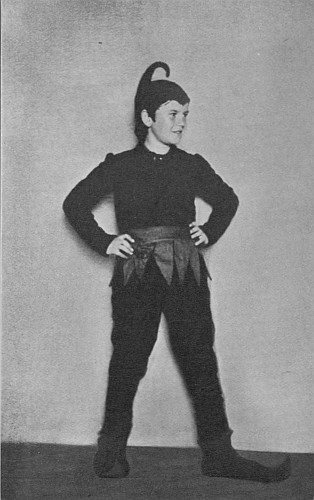
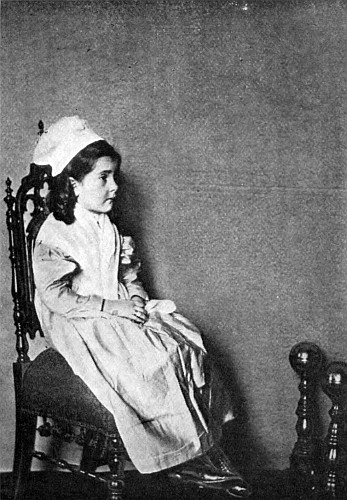
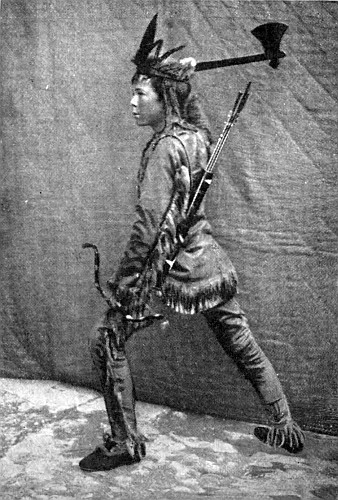
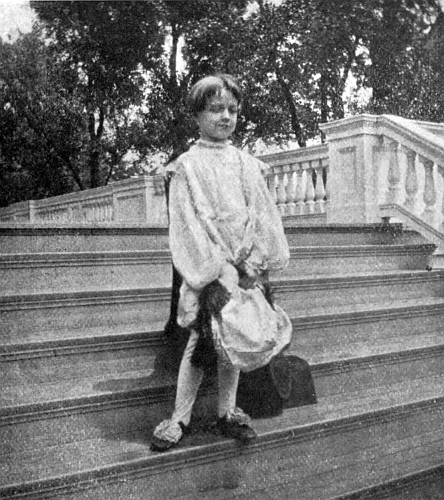
A chamber or corridor in the Manor House. Door [L.]. Hangings on
wall. Gillian seated [R.], with the three children about
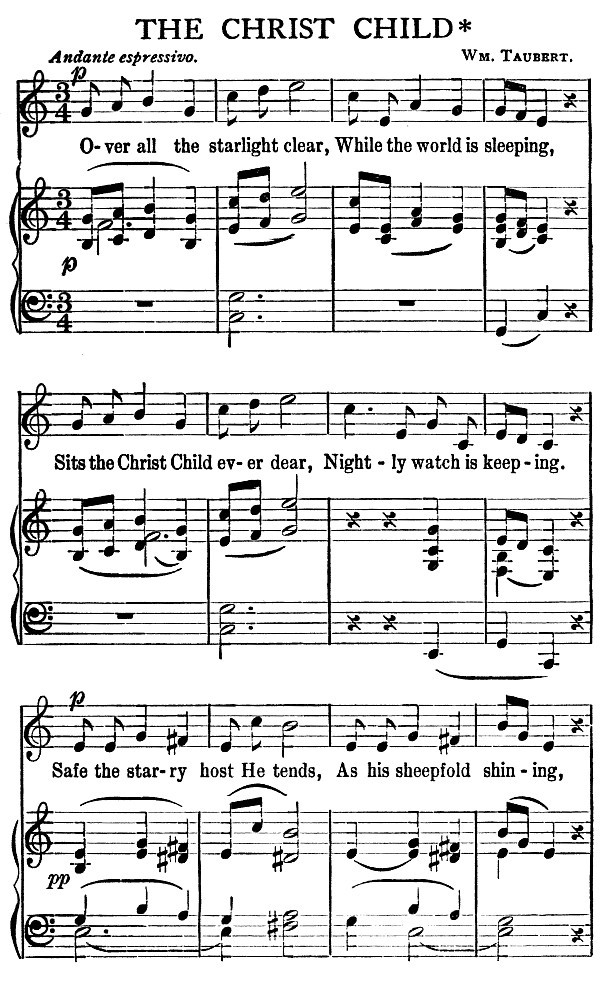
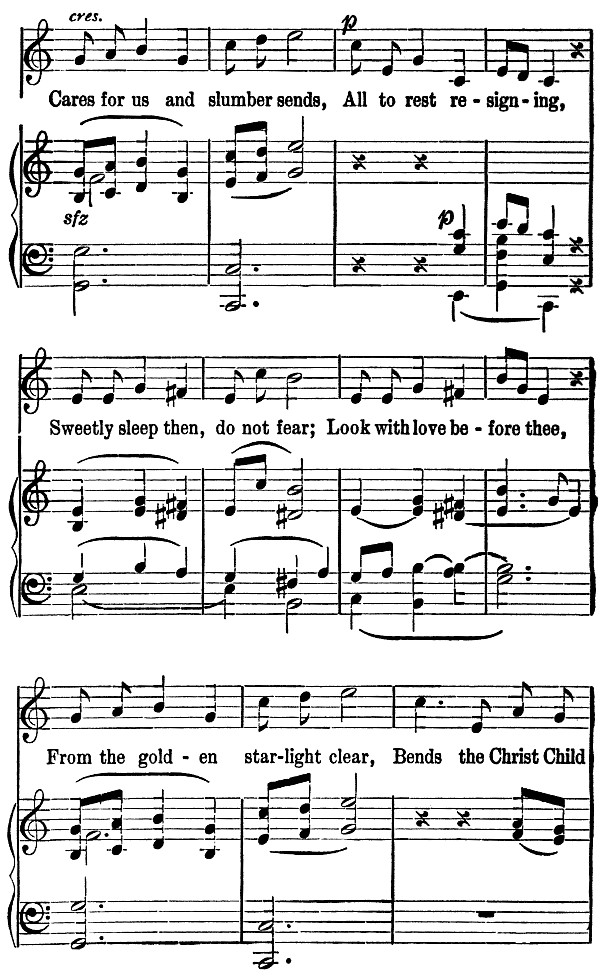
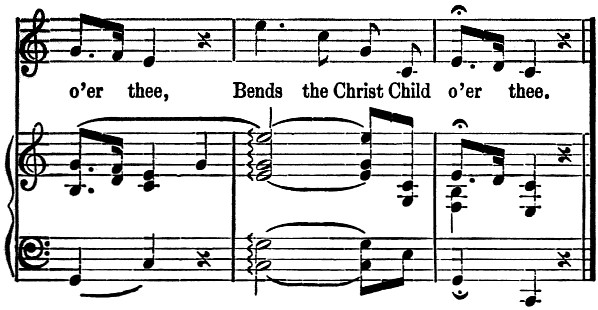
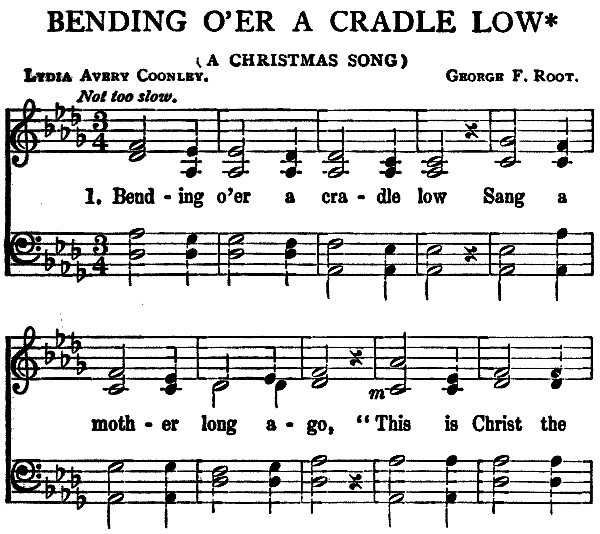
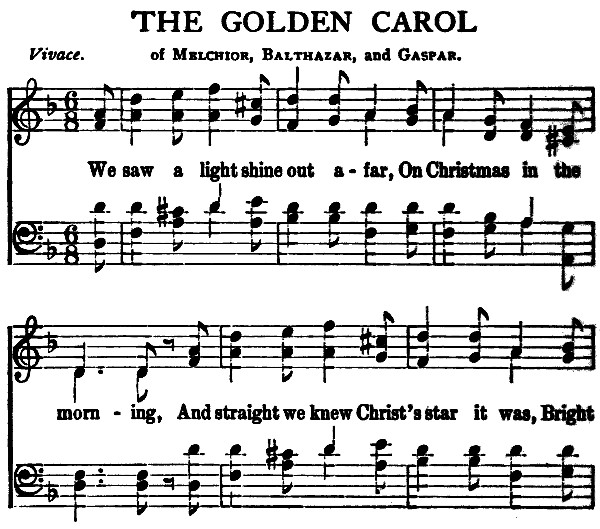
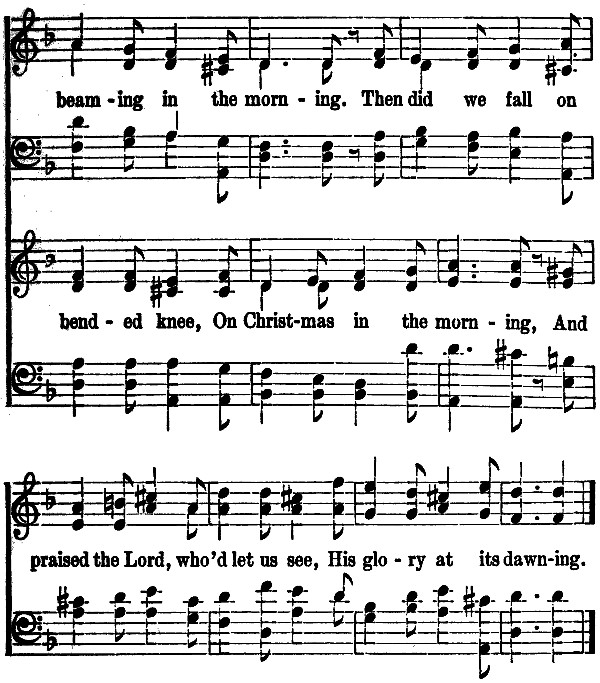
her, all working at wreaths and garlands, and singing an old carol.
Curtain rises on second verse. While they sing, Diccon
enters. Takes up sword or other piece of armor from table [L.] and
begins to polish it.
Cicely [with a deep sigh]. Good Gillian, methinks that
though we sang our carols o'er and o'er we could not make it seem
like Christmas-tide. Brother Rufus is gone away, and we may not even
say we miss him. I would I knew—— [Chin on hand.]
Gillian. You would you knew what, little mistress mine?
Cicely. I would I knew what is wrong with us. Christmas was
ever such a merry season in this dear house.
Rafe [wisely]. 'Tis because my father goeth about wearing
such a stern face.
Allison. And Mother looketh so sad.
Cicely [confidentially]. And I think cousin Phyllis cries
in her chamber sometimes.
Diccon [mutters]. Meseemeth we should all know right well
what aileth this place. [Enter Sir Gilbert. Stands in
doorway.] When he that was the very life and soul is missing from
the hearth——
Gillian. Hist, Diccon [warning gesture].
Diccon. ——and more than that, under a cloud——
Gillian. Be silent, I say, Diccon.
Diccon [paying no heed]. 'Tis young Master Rufus this
house needs so sorely, I'm thinking.
Sir Gilbert [striding forward angrily]. Silence, I say.
Have I not given command that my son's name shall not pass the lips
of any of my people? I will be obeyed in mine own house. Diccon,
hence! Thou canst spend thy days in the stables caring for my horses,
an thou'lt not learn to bridle thy tongue. Mayhap the dumb beasts
will teach thee a lesson.
Diccon [bowing humbly]. I crave pardon, Sir Gilbert. I but
thought——
Sir G. Enough. [Turns to table. Exit Diccon,
with an awkward bow.] Gillian, let this be a warning to you as
well. I have laid my commands—I will be obeyed. [Exit.]
Rafe. 'Tis very hard to be just children, when anything's
wrong, I think. We may not know what our elders do know, and yet we
must be just as uncomfortable.
Gillian. Tst-tst, my lambs! Let us think of other things.
Shall we measure our garlands? [Stretches out her green.]
Rafe [measuring his against it, while Cicely
and Allison stretch theirs together]. Indeed, 'tis soon
done, good Gillian. We've used up all our greens.
Gillian [rising]. I will see if Roger and Noll have
brought more for us. [Exit.]
Rafe [considering his garland]. Would my garland measure
around the great pasty Dame Joan hath made for to-morrow's feast,
think you, Cicely?
Cicely [laughing]. The venison pasty, Rafe? Mayhap when
Dame Joan hath turned her back, we can try and see.
Allison. I fear mine will but reach around a very little
pudding! [Enter Phyllis.] Oh, cousin Phyllis, cousin
Phyllis, come see our garlands!
Phyllis [coming forward]. Did my little Allison wreathe
all this long piece? [Allison nods proudly.] That's brave
work, indeed.
Cicely [arms around Phyllis]. Dear cousin
Phyllis, won't you stay and help us—and tell us why everyone is so
sad?
Phyllis [frightened]. Nay, dear, I must not, and you must
not be sad—'tis Christmas Eve.
Rafe. Yes, we know. But why doth my father look so
stern——
Phyllis. Nay, nay—I may not speak of it. My aunt will be
sore displeased.
[Enter Lady Katherine.
Lady Katherine [in doorway]. Phyllis, why art idling here
with the children? To thy tasks, girl!
[Exit.
Phyllis [turning hastily to follow]. You see, sweethearts,
I must not tarry. But I wish good speed to your garlands. Farewell.
[Exit.]
Cicely. Thou dost see, Rafe. Father will not let us speak of
brother Rufus, and Mother is so cross to poor cousin Phyllis.
Allison [shocked]. Nay, Cicely; Mother isn't cross. It's
naughty to say that.
Rafe. I think I know what it is all about. [Very
confidentially. Girls draw their chairs close.] I think brother
Rufus ran away to the wars to fight for the King——
Cicely. But, Rafe, that can't be what displeaseth Father,
for Father is a soldier, too, and he himself will fight for our lord
the King, if so be the King needeth him.
Allison [nodding her head with conviction]. Father is the
most gallantest soldier in all the country.
Rafe. But I do think that is why Father is so angry with
brother Rufus.
Cicely. And why is Mother so—so unkind to poor cousin
Phyllis?
Rafe [very solemnly]. Because—because Rufus did say that
when he was come of age and was a man he would marry cousin Phyllis!
Cicely. Oh! But I think that's very, very nice! Why
doesn't Mother like it, Rafe? They'd never go away to any other house
at all—and then, beside,—Allison and I could be their bride-maidens!
[Enter Gillian with an armful of greens.
Gillian [sitting down among them]. Here's work for us all,
my pets. We must e'en make our fingers fly an we would finish our
task.
Cicely [full of importance]. Oh, good Gillian, Rafe doth
say——
Rafe [trying to repress her]. It's no use to ask Gillian,
Cicely. Didst not hear my Father tell her she mustn't talk of it?
Gillian. That's best, Master Rafe. Let Gillian tell you a
tale whilst we work.
Allison. A fairy-tale, Gillian? [Whispers full of awe.]
Are the fairies about to-night, dear Gillian?
Rafe. Not on Christmas Eve, Allison. They aren't, are they,
Gillian? Midsummer Eve is the fairies' night.
Cicely. And fairies have no power on Christmas Eve, and
witches can't charm you, nor cast their spells upon you——
Rafe. Because 'tis such a holy, holy night.
Gillian. Oh, but there be wonderful things that do befall on
Christmas Eve, Master Rafe. My old grandam used to say that when the
midnight bells ring, the cattle in the stables do kneel down to hail
the holy day!
Cicely. Oh, Gillian, do they?
Rafe. Hast ever seen them, Gillian? Or hath thy grandam?
Allison. All the cows, and the sheep, and the little, little
lambs?
Gillian. Nay, sweetheart, I never saw them, but I was wont
to think, each Christmas Eve, that I would surely creep out to the
stables and keep watch.
Rafe. And did you?
Gillian. Oh, Master Rafe, in truth 'twas a pretty plan,—but
I was not a very brave little wench,—and it was so cold and dark and
fearsome: when the time was come, I was always fain to put it off
until the next year!
Rafe [scornfully]. Sooth! I would never do that!
Gillian. Nay, that I'll warrant, Master Rafe! But let
me tell thee what else my grandam hath told me. 'Twas about the
portraits in the long gallery in this very house.
[Enter Diccon, with armful of wood for fire,
which he piles upon the hearth.
Cicely. The portraits—— Oh, yes, Gillian. [Draws close
to Gillian.]
Rafe. I know. Our great-great-grandfather and our
great-great-grandmother.
Cicely. Bethink thee, Rafe—what are their names? I do
forget.
Rafe. They are Sir Philip and Lady Geraldine Underhill. And
they lived right here in this very house.
Diccon [turning from hearth]. Yes, Master Rafe, they lived
in this house. He was a passing gallant gentleman, and fought for
the King, and she was as beautiful as he was brave, and as brave as
she was beautiful. And they say that in a great war his enemies came
to search this house for him, but he and my lady hid themselves in a
secret chamber that's long since forgot. But 'tis somewhere in the
house,—— [looks about as if expecting to find door at once] if a
body just but knew how to find the door——
Gillian [in contempt]. Nay, nay, Diccon. I'll warrant me
the Master knoweth where that door is.
Diccon. Mayhap Sir Gilbert doth know. But none else may find
it. Many's the time the lads ha' looked for it—many's the time.
[Exit.]
[Rafe goes about for a moment, lifting hangings,
etc., as if in search for door, but returns
to Gillian's side to hear her answer
to Cicely.
Cicely. But, Gillian, what was it thy grandam told about the
portraits?
Gillian. Oh, verily, my sweet. Thinking about the secret
door I had well-nigh forgot. My grandam said that if all the house
was still and sleeping, just on the stroke of twelve every Christmas
Eve, Sir Philip and my Lady Geraldine do move and breathe, step forth
from their picture frames, clasp hands, and move together in an
ancient dance!
Rafe. Do they?
Cicely and Allison. Oh-h-h! [Drawing near to
Gillian with a little delighted shiver.]
Lady K. [without]. Gillian, Gillian! Come hither, wench; I
need thee.
Gillian [rising]. Anon, my lady! [To children.] Think
of it, bairns—that fine brave gentleman and that beautiful lady,
stepping across the floors in the moonlight—— [Exit, hand lifted
as if holding a partner's, taking stately dancing steps.]
Cicely. Oh, Rafe, think'st that Gillian speaketh true?
Rafe. Yes, I do believe her. Christmas is such a marvelous
fair time, Cicely, that I do think anything wonderful might happen.
Allison. I would I could see Sir Philip and Lady Geraldine
at their dancing.
Cicely. Oh, so do I! Rafe, dost think—— [Hesitates,
afraid to speak her thought.]
Rafe [boldly]. I think—that if my lord and my lady do
dance—we shall see them this very Christmas Eve.
Cicely. Oh, Rafe, what dost mean us to do?
Rafe. When the great doors are closed at eleven o'clock—I
always hear Diccon making them fast—I'll sit up in my bed, so that
I can't by mischance fall asleep. Then I will wake thee and Allison,
and we will steal into the long gallery and hide ourselves.
Cicely. But if Sir Philip and Lady Geraldine see us, mayhap
they'll be displeased and not come forth.
Rafe. But if we go soon enough they can't see us, because
they don't come alive until twelve o'clock. Until the clock strikes,
they're only pictures, Cicely.
Cicely. Verily, I did forget.
Rafe. I mean to make sure the nursery door which giveth on
the back passage is left unlocked and open, or mayhap I might fail to
hear. Come, sister, bring your wreaths. [Goes toward door.]
Cicely [gathering up wreaths]. Oh, Rafe, 'tis a wonderful
fine plan!
Allison. Thou'lt let me come too, Rafe?
Rafe. We'll all go. S-sh-sh, now, not a whisper to
anyone. [Exeunt children in great excitement. Short pause. Enter
Rufus, secretly (L.), stopping to look about and listen.
Crosses furtively to door (R.) and looks out. Enter Phyllis
(L.), and as Rufus turns back into room, she sees him,
and with a low cry hurries to meet him.]
Phyllis. Oh, Rufus, Rufus—not you!
Rufus. Yes, 'tis I, fair cousin. I prithee speak softly. I
would not have it known as yet that I am here.
Phyllis. But whence came you, Rufus? We thought you miles
away, with the King's troops——
Rufus. My company made a secret march, across this valley,
and I thought to spend Christmas in mine own dear home. My Captain
gave me leave to come here to-night, and join him to-morrow eve. But
after I set out on my solitary march, a company of Roundhead rebels
sprang up from a copse by the way and gave chase to our men.
Phyllis. How knew you this?
Rufus. I had come but a half-hour's walk, up the long hill,
and saw it all quite plainly.
Phyllis [much troubled]. But, Rufus, then you are cut off
from the King's men, for there be very many rebels and few loyal
hearts about us, in these parts.
Rufus. I know, Phyllis. And, furthermore, though I would
not alarm thee, I must tell thee that I was seen by that treacherous
Farmer Gosling on the road hither, and I fear he may set others like
himself upon my track.
Phyllis. Oh, Rufus, you frighten me so—they will surely
come and take you.
Rufus. Aye, they will try, dear cousin. But I've safe harbor
in my father's house, and when darkness comes I can put forth once
more and rejoin our men in the North.
Phyllis. A safe harbor, saidst thou! Thou little knowest——
Hark! someone comes. Hide thee speedily, Rufus. Here, behind
this curtain. There—do not show thyself until I see thee again.
[Hides Rufus behind hanging, and exit (R.). Enter
Sir Gilbert and Lady Katherine (L.). Sir
Gilbert sits moodily in chair by fire. Lady Katherine
stands before him.]
Sir G. [as they enter]. I tell thee, I will hear no more
of it.
Lady K. But, my lord, this day have I heard a rumor that a
band of King's men were near us—here in this nest of rebel enemies!
If there were fighting—if my boy Rufus were in danger, and I might
not succor him, 'twould go nigh to kill me. And so, my lord, I'm come
once more to crave pardon for him.
Sir G. I tell thee, it will not be granted thee. When the
boy disobeyed me and ran away I disowned him. I vowed he should never
enter these doors again.
Lady K. My lord, the lad was so eager to serve his King.
Sir G. [springs up and paces the floor]. Did I forbid
him to serve his King? Nay, when the time was come, he should have
gone with me, with horse and arms, in state befitting a gentleman's
son. And so I told him. I told him he was full young yet—the lad is
scarce turned seventeen. Eagerness to serve his King, forsooth! 'Twas
mere idleness. He chose to run away from his tasks and his studies.
Beshrew me! Whether he find the camp life of a common soldier a bed
of roses or no, I care not. He must e'en lie in it. I'll neither
grant him pardon, nor receive him in my house. To consort with common
soldiers and camp ruffians—he hath disgraced my name.
Lady K. Oh, my poor lad.
Sir G. Thou and Phyllis need not grieve so foolishly——
Lady K. [stiffens angrily]. Phyllis! She is the one reason
why I am reconciled to his being away.
Sir G. [more gently]. Come, good wife, be not so hard upon
poor Phyllis. She's a good maid and a fair. What if the lad have
turned her head a bit? I would fain have thee remember the lass is an
orphan and we her only kinsfolk.
Lady K. [moving away]. I care not to talk of Phyllis.
[Turns back.] Will nothing move you, my lord?
Sir G. [hardening]. I've told you my mind—let's hear no
more of this. [Exeunt (L.). Rufus comes from hiding-place
and stands sadly by fire. Enter Phyllis.]
Rufus [turning toward her]. Why, Phyllis, I little guessed
my father could be so hard and stern. I knew I had displeased him,
but this passeth belief.
Phyllis. He is very unforgiving. When you called this house
a safe harbor, you little knew.
Rufus [turning as if to go]. So be it, then. If my father
cannot forgive me,—I'll e'en forth to the tender mercies of mine
enemies.
Phyllis [alarmed]. Oh, no, no, Rufus! At least do not
venture forth until the dark hath come! No one must see you here.
Come into the blue guest chamber. 'Tis not a secure hiding-place
should the house be searched, but 'twill serve for the time, and by
midnight you may steal away safely. Do come, Rufus! [He lets her
half lead, half push him out as she talks. Exeunt (R.). Pause——
Children's laughter heard. Enter (L.) Cicely with a bunch
of raisins. Rafe in pursuit. They run all about the
stage. Cicely jumps upon a chair and holds the raisins
over Rafe's head. He tries to jump for them.]
Cicely [breaking off raisins and dropping them one at a
time into Rafe's mouth]. Oh, Rafe, such rare sport!
You'll have no need to waken me. I'll never sleep this night, I
know.
Allison [without, calling]. Rafe, Rafe! Where art thou?
Oh, Cicely!
Rafe [pulling Cicely down and securing
raisins]. Quick, sister, let's hide us! [Rafe runs
behind hangings (R.), Cicely behind table (L.). Enter
Allison (L.). Stands still and looks about.]
Allison [softly]. Of a truth, I did hear their voices....
I know.... 'Tis sport. 'Tis a game of hide and hunt. I must set me
to find 'em. [Goes peering about. As she peeps over chair (R.),
Cicely runs out and covers Allison's eyes
from behind with her hands. Rafe comes from other side
and feeds Allison with raisins. Rafe and
Cicely begin to sing Christmas carol, and Allison
throws off Cicely's hands and joins in song.]
CURTAIN
A gallery in the Manor House. R. front, fireplace[27] with glowing
red fire. Beside it, at right angles, settle. R. back, door. Back
Center, the portraits of Sir Philip and Lady
Geraldine, in tall old frames reaching down nearly to floor,
so that only a short step is necessary when the figures come out. L.
back, window, with snow-covered trees in distance, and moonlight.
L. front, door. Hangings, a few quaint chairs, etc. Center of
stage clear. Curtain shows empty stage. Diccon and
Gillian cross from L. to R., talking—Gillian
enters first, as if in haste, Diccon trying to stop her.
Stage lights very dim. Gillian carries a candle, which she
shades with her hand.
Diccon [calling softly]. Gillian, Gillian! Hang the wench!
Wilt not wait, good Gillian? I've somewhat of great import to tell
thee.
Gillian [impatiently]. Were I to believe thee, Master
Diccon, all thine affairs are of great matter. Mayhap thou thinkest
my business is ever of small consequence?
Diccon. Nay, then, Gillian—but this news is thine and mine
and my lord's and my lady's too!
[Gillian turns, a little curious, and waits for
him.
Gillian [scornfully]. A strange matter, methinks, that can
be thine and mine and theirs, too!
Diccon. But list a moment, and you shall hear. Giles, the
horse-boy, hath been in the village this day, and heard that which
bodes ill to us. Giles heard them talking in the tavern——
Gillian. Heard whom talking, Diccon? I can make naught of
thy twisting tales!
Diccon. Why, the Roundhead knaves, be sure. And the pith and
kernel of Giles' tale—an thou'lt not hear the how and the when—is
this! that they mean to come hither this night and search our house.
Gillian [gives a little scream and claps her hand over her
mouth]. Oh, Diccon, Diccon,—what can they want here? We be peaceful
folk. In sooth 'tis known we are all good King's men, but no harm
have we done to any! Oh, Diccon!
Diccon. Sst! silly wench! They'll not harm thee. But hark to
what else Giles heard. They be coming to search for Master Rufus!
Gillian. Master Rufus! But he hath not been here these many
weeks.
Diccon. Sst! Speak more cautiously, Gillian. The knaves did
say they have certain knowledge that Master Rufus is here in hiding.
Gillian [looking fearfully and suspiciously about]. Oh,
Diccon, dost believe it?
Diccon. In good sooth, how can I tell? But I am in great
fear.
Gillian. Thou afeard, Diccon? Oh, what dost think the
Roundhead villains will do to us?
Diccon [angrily]. A pest upon thee, wench! They'll do
naught to us! 'Tis for my young master I am troubled. If they take
him, 'tis doubtless to a rebel prison he'll go, and then—it's rough
fare for such a young lad,—and gentle born and bred to boot.
Gillian [curiously]. But can he be here, think you, Diccon?
Diccon [anxiously]. He may be. And I do fear to ask my
lord or my lady of the matter. [Going towards door.] I would I knew
my duty, Gillian.
[Exeunt (R.). After a moment enter (L.)
the three children in nightgowns, the little
girls in caps, also. They do not speak, but
motion to each other excitedly, and run
about, choosing a fit hiding-place. Allison
takes a small stool and plants it
directly in front of portraits, sits down,
and folds her hands to wait. The others,
consulting by signs, do not at first see her,
then rush upon her in alarm and drag her
away, taking stool with them, and making
reproving gestures. All go to settle, place
stool by fire, and allow Allison to sit on
it. Cicely kneels at end of settle, partly
concealed by its arm. Rafe lies full
length upon it, alternately ducking below
arm and peeping over it. They shake fingers
at each other, touch lips to insure silence,
and when Allison turns as if to
speak. Cicely claps a quiet hand over her
mouth. Business of settling into place.
When there has been a moment's pause, a
bell is heard in the distance striking midnight.
The portraits slowly turn their
heads, take a long and deep breath, and
begin to move; soft music is heard (minuet,
from Mozart's "Don Giovanni");
they bend forward, step with one foot from
the frames and clasp hands across the space
between; then step forth entirely, and bow
and courtesy low and slowly to each other.
Then they take hands, and to the music
go through such part of the old French
minuet as is practicable for two alone.
When this has continued as long as is desirable,
there is a sudden noise without.
Instantly the music ceases and the figures
go back with all swiftness and resume
pose in frames. Children also much
startled.
Cicely [in alarmed whisper]. Oh, Rafe, what was that?
Rafe. I don't know. Sh-sh-sh!
[Enter Rufus (R.), silently and furtively.
Goes to window and peers out. Comes
back hurriedly and without seeing children.
Exit (R.). Rafe springs up and follows
to door, gazing out after Rufus.
Cicely [aloud, but still cautious, though in great
fright]. Oh, Rafe—I saw a man! Who was that?
Allison. So did I, sister! Let's run!
Cicely. Mother! Mother! I'm frightened!
Allison. Oh, Gillian, come get us!
[Both rush screaming out of door (L.). Rafe
comes quickly and silently back. Goes to
window and stands peering out.
Rafe. That was brother Rufus. I wonder how he came
hither.... And there is someone ... away out there in the snow ...
men ... coming this way. [Leaves window and stands directly in front
of portraits, with his back to them, and a little way off. Stares
anxiously straight before him, and speaks low and quietly.] Perhaps
they are soldiers ... or wicked people come to seek for him and take
him away.... Rufus went up the little stairs to the Tower.... There's
no place to hide in the Tower! [His voice gradually rising.]
They'll find him as soon as they get here.... Oh, what shall I
do—what shall I do? [Stands with hands clenched, listening and
thinking, wide-eyed. The portraits move and bend toward him.]
Lady Geraldine [leaning forward and smiling tenderly].
Little Rafe, little Rafe, thou must play the man this night!
Sir Philip [leaning forward and speaking earnestly].
Little lad, little lad, thou art little and young! Go and fetch thy
father!
Rafe [does not turn at all]. My father will know what
to do.... Mayhap he will even open the secret door Gillian telleth
of.... Surely, surely he cannot be angry now. [Turns and rushes
wildly out (R.)].
[Enter Phyllis (R.), all shaking and trembling.
Phyllis [calls softly]. Rufus! Rufus! Where art thou?
[To herself.] Oh, where can the rash boy have gone? He was safe
for the time in the Blue Chamber. And now—— Oh, what can I do! I
must warn him! [Wrings her hands and goes to window.] Gillian hath
told me they are coming to seek him. He must be warned! Oh, where can
he have gone? [Goes to door (L.), then to window once more. Enter
Rafe, dragging Sir Gilbert by the hand.]
Rafe [breathless]. You needs must listen, Father! Brother
Rufus came in at this door and went to the window, softly, to peep
out. Then he ran out again and I got me up speedily and ran to the
casement. [Tries to draw Sir Gilbert to window, but he
resists and stands frowning (R. Center).] And I looked out, Father,
and there was someone coming—men—away over toward the village. I
saw them. And Rufus is gone up the Tower stairs—— [Phyllis
starts forward to door, but turns back.]
Phyllis. The Tower, saidst thou, Rafe?
Rafe. Yes! The Tower! And thou knowest, Father, there is no
way of escape from the Tower! Father, tell us what to do!
Phyllis [coming to his side with clasped hands]. Oh, good
Uncle, save him while there is yet time!
Rafe. I know thou canst find a way, Father!
[Enter Lady Katherine, the two little girls
clinging to her skirts.
Lady K. [in amazement]. What can be the meaning of all
this coil? The children crying to me in fright some old wives' tale
about the family portraits—someone in the gallery—the soldiers——
My poor wits cannot fathom it!
Rafe [still clinging to his father's hand]. Oh, lady
Mother, Rufus is hiding in the Tower, and the soldiers are coming,
and Father must save him!
Lady K. [cries out]. Rufus, saidst thou? [Shakes off the
children and hurries toward Rafe.] Where is he, boy?
Rafe [seizes her hand and draws her to door (L.)]. Here,
Mother, here, up in the Tower. [Exeunt. Cicely and
Allison cling together.]
Cicely. Oh, Allison, sweet sister, it was brother Rufus we
did see in the gallery. And the Roundhead soldiers are coming.
Allison. Will they drag him away from here?
Phyllis. Oh, Uncle, dear Uncle, surely thou knowest some
secret place in this old house where he can lie safe until danger be
past?
[Enter Rafe and Lady Katherine with
Rufus (R.). Lady Katherine hastens
to window, glances out, then goes to quiet
children, who are sobbing. Rafe rushes
to his father, and Rufus at first starts to
him.
Rafe. Father, here he is. Now what's to do?
Rufus. Father, I would——
Sir G. [interrupting]. Not a word from you, sirrah! How
dare you enter this house whence you went but to disgrace my name?
You are no son of mine!
[Rufus draws back and stands proudly a little
aloof. The rest cry out in protest.
Lady K. Oh, my lord, you cannot mean the words you speak!
Phyllis. Uncle!
Rafe. Oh, Father, poor Rufus!
Diccon [without]. Sir Gilbert! Sir Gilbert! Where art
thou, master!
Gillian [without]. Oh, mistress! Oh, my lady!
[Enter Diccon and Gillian in greatest excitement.
Diccon carries a pair of candles,
which he places hastily on the chimney-piece.
Raise lights.
Diccon. My lord, the soldiers are coming! [Rushes to
window.] They be at our very gates!
Gillian. Oh, mistress, the murthering knaves will burn the
house above our heads!
Lady K. Hold thy peace, silly wench!
[General hubbub. Children cling crying to
their mother. Diccon and Gillian at
window. Rafe now running to window,
now tugging at his father's hand. Phyllis
at his other side.
Diccon. They come down the long hill!
Gillian. I see them, the knaves!
Phyllis. Oh, Uncle, prythee forgive Rufus—save him quickly!
Sir G. [angrily]. He doth not desire forgiveness.
Phyllis. Oh, Uncle, he would have asked it but now. Thy
bitter words did check him, and thou knowest he is proud. He could
not ask it then.
Gillian. Here they be!
Diccon. At our very gates!
Lady K. [above noise]. My lord, thou dost know some secret
place. Do but disclose it to me. Remember he is thine own flesh and
blood.
Diccon. Hark, ye can hear them! [Silence falls. In the
distance the carol of the Waits is heard.]
Phyllis [relieved]. 'Tis the waits at their carols.
Lady K. [thankfully]. 'Tis not the soldiers, after all!
Diccon [turning from window]. Would it were not, my lady!
Ye do hear the waits singing beneath the hall windows, 'tis true, but
these at our gates be no peaceful carollers. [Turns back to window.
All are silent for a moment, listening, until the refrain of "Peace
on earth" is reached.]
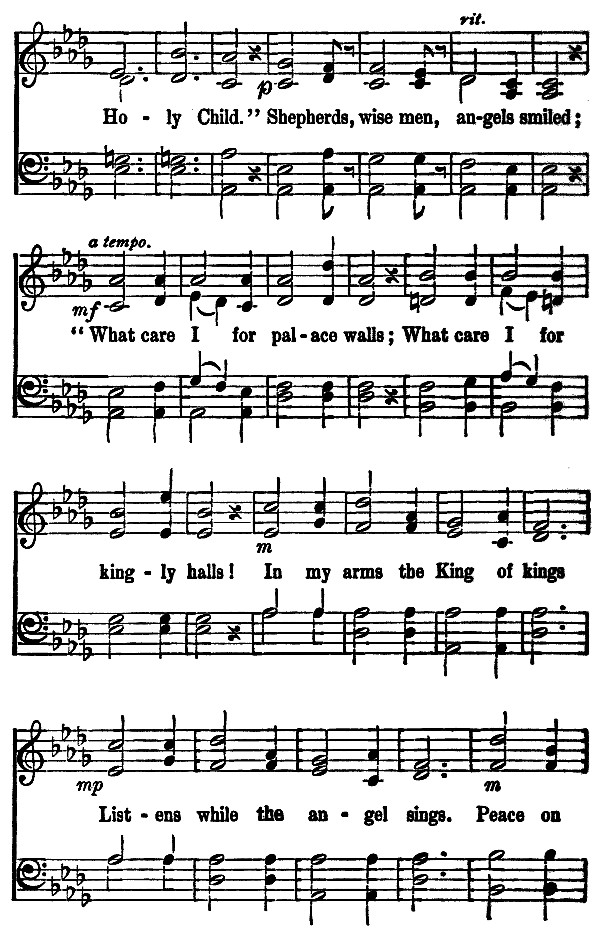
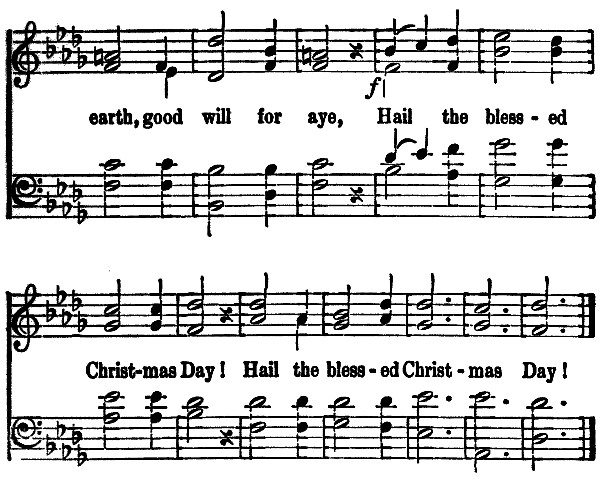
Sir G. [startled]. "Peace on earth, good will to men!"
Now Heaven forgive my angry spirit! Here, Rufus—quick, lad!
[Touches spring at R. of portrait. Panel opens, and Sir
Gilbert thrusts Rufus through, and it closes behind
him. Sir Gilbert turns and takes command.] Clear the
room—this throng will never do—guilt and suspicion sit upon our
very faces. Wife, Phyllis! take these children to bed. Gillian! to
the kitchen, wench, and do all in thy power to quiet the maidens
there. Hasten to the gate, Diccon, and say that your master throws
open his doors to their search. Bear yourselves, all, as if nothing
had befallen! Now, haste!
[Rapid clearing of the room. Lady Katherine
and Phyllis hurry the children
out (L.), trying to quiet them. Exeunt
Diccon and Gillian by the door (R.).
Unnoticed, Rafe springs into box of settle,
and closes lid over him. When all are
gone, Sir Gilbert goes quietly about room
to put all in order. Looks out at window.
Sounds from without, of beating on doors,
etc. Cries, "Down with the false King!"
"Death to traitors!" etc. Sir Gilbert
goes to panel for a moment.
Sir G. [tapping]. Rufus! Rufus!
Rufus [within]. Yes, Father!
Sir G. Cheerly, good lad! Lie thou quiet, no harm shall
come to thee. [Sir Gilbert goes to chimney, takes an old
book from shelf, and sits on settle. Noises of search gradually come
nearer. Enter Diccon, followed by soldiers.]
Diccon [torn between his fear and hatred of the soldiers
and his wish to propitiate them]. Here is my lord, your masterships!
He bade me give you free welcome [bows politely, but as they pass
him he snarls aside], and a pest upon all of ye!
Sir G. What would you of me, my men? Why, Diccon, these be
all old neighbors—not soldiers.
[The men are disconcerted, and advance awkwardly,
pulling at their forelocks.
Stephen. Yes—Sir Gilbert—no, Sir Gilbert—we be verily
soldiers—soldiers of the Parliament.
Sir G. You have taken up arms against your King? I had
thought to see old neighbors and friends and loyal men. [Rises,
laying down book.]
Stephen. We do be loyal men——
Andrew. Loyal to the Parliament.
Wat. And soldiers of Cromwell.
Sir G. What, then, would you of me? Ye do know I am a
subject of King Charles.
Stephen. My lord, we have orders to search this house.
Sir G. So be it, then. Obey your orders. What do ye look to
find here?
Andrew. 'Tis a false traitor Cavalier.
Wat. He lurketh here and we mean to have him, too.
Stephen. We would do our work peaceably, my lord. But our
general must have the country cleared of all Malignants.
Sir G. You have my free consent. My house is open to you
from turret's peak to the bins in the cellar.
Diccon. There be more of 'em, my lord—a round dozen. And
they waited not thy permission. They be already both on tower and in
bins.
Sir G. Disturb them not, good Diccon. [Turns back to
settle, takes up book and pretends to read, but keeps a careful eye
on soldiers.]
Stephen. Do your work with thoroughness, men.
Andrew. That will we, captain!
Wat. There be many lurking—places in these old rats' nests.
Andrew. We'll ferret him out!
Wat. Aye, aye—the false villain.
[They go carefully about room, lifting hangings,
tapping walls and floor, trying to see
behind picture-frames, coming very near
secret door.
Stephen. Have ye tested the walls?
Wat. Aye, and the floors.
Andrew. There be no secrets here.
Stephen. Then we'll look further. Give ye good even, Sir
Gilbert.
Andrew. Mayhap we'll meet again——
Wat. Aye,—on the field of battle!
[Exeunt soldiers, with angry gestures. Sir
Gilbert rises and bows slightly, signing to
Diccon to follow. Sir Gilbert waits an
instant, follows to door, then goes to window
and watches. Rafe jumps out of box,
and stands beside settle. Enter Lady
Katherine, followed by Phyllis and
Gillian, stealing in to peep out at window.
Enter Cicely and Allison, catching
at Gillian's skirts.
Allison [piteously]. Gillian! Gillian!
Cicely. Oh, Gillian, don't leave us alone!
Gillian [turns back]. Never! my lambs. Have never a fear
of that. [Sits in chair (L.), gathers Allison into her
lap, drawing Cicely beside her. Gillian still
looks anxiously towards window.]
Phyllis. There they go, those wicked men!
Lady K. Now Heaven be praised! [Rafe runs to stand
at panel. Enter Diccon.]
Diccon. My lord and my lady—— [All turn. Sir
Gilbert crosses stage to meet Diccon.] The knaves
be all gone, sir. I shut the gate upon them with my own two hands.
[Everyone takes a breath of relief. Rafe touches spring
and Rufus steps out and strides to his father.]
Rufus. Father, let your son's first word be to crave pardon
for all his willfulness!
Sir G. [clasping his hand warmly and putting an arm across
his shoulder]. Nay, lad, 'tis freely given. Methinks I should first
ask thine for all my hardness of heart.
[Phyllis goes to Lady Katherine, who
turns and kisses her affectionately. They
stand side by side.
Phyllis. Our little Rafe has played the man and saved Rufus
for us all.
Lady K. He is a brave little lad! But tell me, children,
what doth it mean that you were out of your beds at such a strange
hour?
Rafe. We got up to see our ancestors dance.
All. Ancestors dance!
Sir G. What meaneth the child?
Rafe. Why, sir, Gillian's grandam hath said to her, that
when the midnight tolled on Christmas Eve, my lord and my lady here
did step forth, clasp hands, and dance.
Allison. And so we came to see.
Cicely. And soothly, it was so. They came forth and danced,
here in the shine of the fire. A brave sight, Father!
Sir G. Now, saints defend us! What is a man to make of this?
Lady K. Never heed them—'twas just a sleep-heavy fancy. A
beautiful Christmas-tide dream.
Rafe. Nay, lady Mother, it was no dream. It was the spell of
Christmas brought it all to pass.
Sir G. Now doth the lad speak truth, good friends! Verily it
is the spell of Christmas which hath saved us all from sin and much
sorrow this night. The spell of "Peace upon earth, good will to men."
Hark, the waits are singing still—as angels sing, and ever shall
sing the world around, on Christmas Eve.
[All stand listening for a moment to distant
singing, then join in carol.
CURTAIN
Adult parts in this play taken by boys and girls of fifteen or
sixteen. In contrast to these, the smaller the children playing Rafe,
Cicely, and Allison, the better—Rafe not over eight, Cicely and
Allison six and five years.
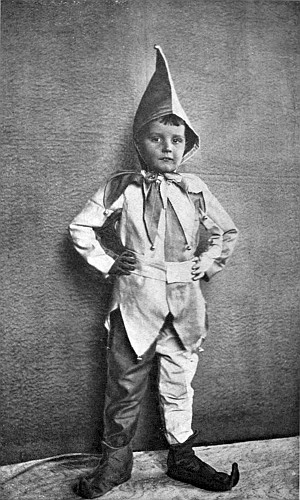
Costumes follow the Van Dyke pictures of Charles I and those of
his children. Very helpful illustrations may also be found in
"Merrylips," by Beulah Marie Dix. (The Macmillan Company.)
Sir Gilbert and Rufus wear sleeveless jerkins made
of tan-colored canton flannel to represent leather. Rufus wears boots
and a broad-brimmed hat with plumes, and long cloak of the same color
as his suit. These suits should be of rich colors in contrast to the
sober colors of the Puritan soldiers, who also wear leather-colored
jerkins and boots.
Cavaliers wear broad lace collars and cuffs, while the Puritan
Soldiers wear square linen collars and cuffs, and under-sleeves
with stripes running around them of black and orange, the colors of
the Parliament. Orange baldric over right shoulder. If possible,
metal helmets, or firemen's helmets silvered to represent the steel
caps of the time; otherwise, broad-brimmed felt hats with band or
scarf of orange and black. They carry swords, cross-bows, or other
arms.
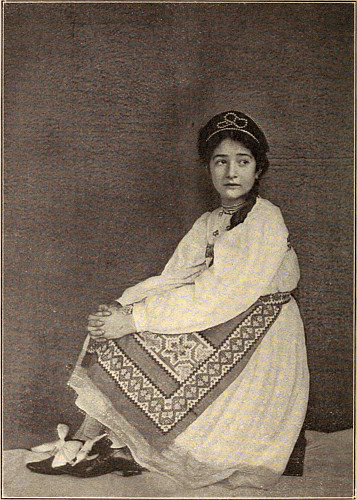
Lady Katherine and Phyllis. Full, quilted
petticoats, broad, deep-pointed lace collars and cuffs. Dressed in
rich colors. Lady Katherine wears a small lace cap upon her hair.
Rafe. Suit like the picture of Prince Charles. May wear a
broad fringed sash, and fringed bows at his knees. Lace collar and
cuffs. Sleeves may be slashed.
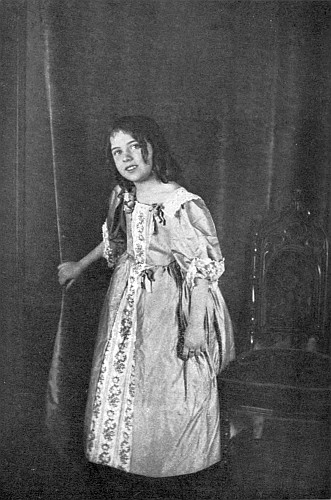
Cicely and Allison. Little short-waisted, quilted
dresses, with flowered panels set in. Lace at the square necks and
the elbow sleeves.
Gillian. Plainly made dress of flowered material. Skirt
full, but not quilted. Short caps to the sleeves. White kerchief,
apron, and plain white cap.
Diccon. Plain suit, like the Puritans, but less sober in
color, and without the leather jerkin. Square linen collar and cuffs.
The Portraits. Costumes of an earlier century.
Sir Philip. Slashed doublet and trunks of rich color, and
long stockings to match. Ruff, and plumed cap or hat of same material
as doublet. Wears a dagger.
Lady Geraldine. Dress of rich color to harmonize with Sir
Philip's. Puffed and slashed sleeves, figured panel in front of skirt
and waist, and panniers on hips. Ruff, and small beaded cap.
To stand in absolute stillness for so long a time is a difficult
matter. Therefore the portraits must be careful to take poses which
they can hold without too great a strain throughout the act.
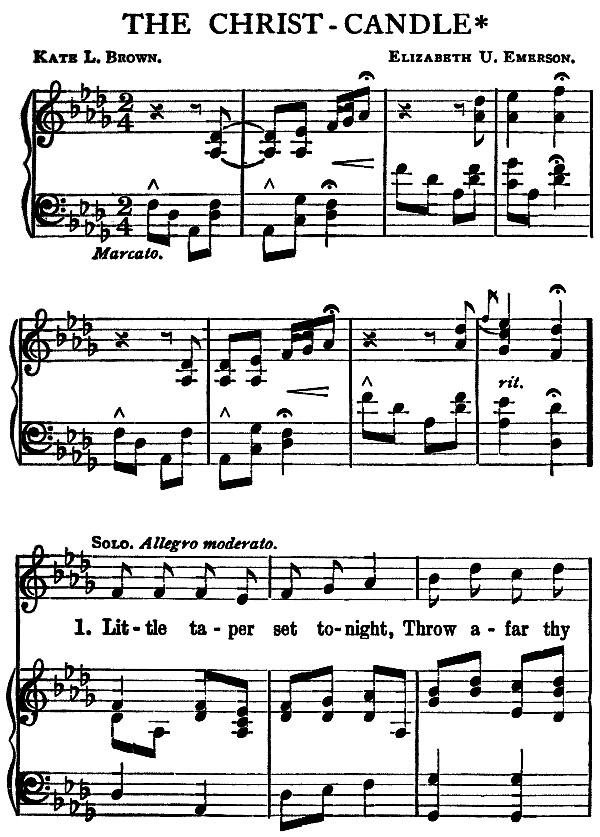
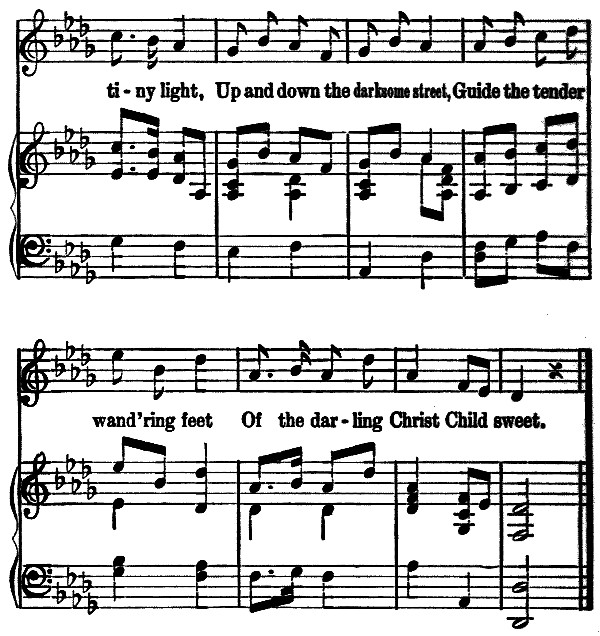
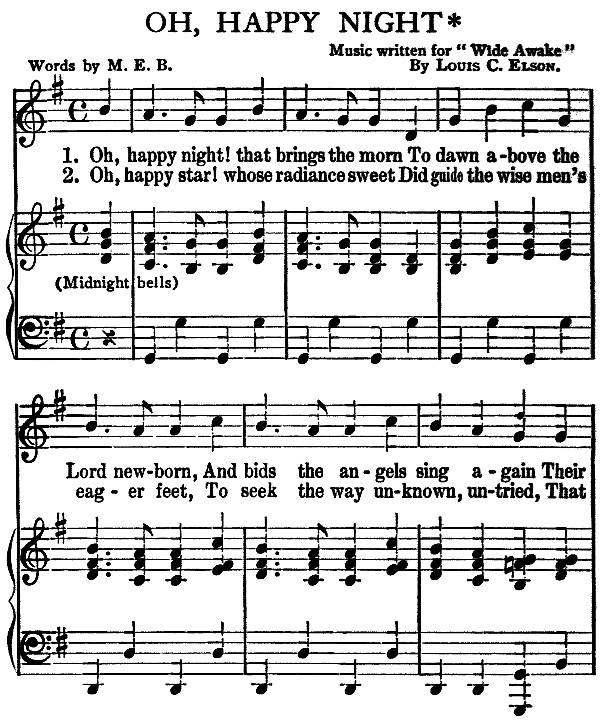
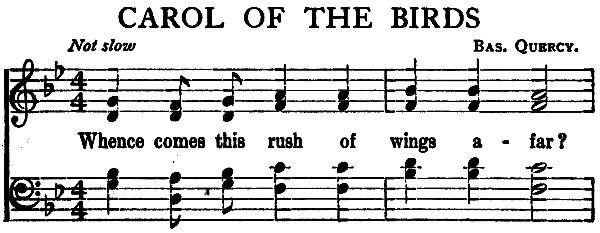
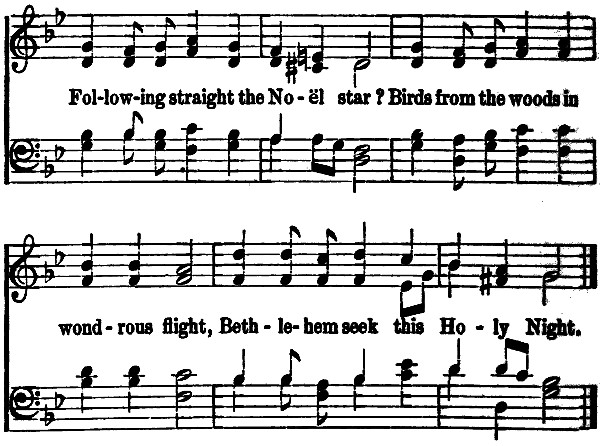
Choose songs which, through their quaintness, may be in keeping with
the atmosphere of the whole.
For the children:
"Waken, Christian children,"[28]
"The first Nowell the angel did say,"
or some other simple old carol.
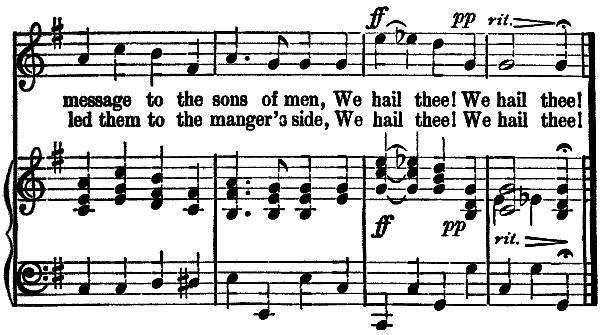
For the Waits:
"From far away we come to you."
These three carols are all to be found in "Christmas Carols New and
Old," Novello & Company. The last has been modernized and set to new
music more suitable for children's voices by Mr. W.W. Gilchrist,
and is to be found in a book containing many good carols for
children ("The First Nowell" among them), "The New Hosanna."[29] Mr.
Gilchrist's version omits the quaint refrains of the original—"The
snow in the street, and the wind on the door," and "Minstrels and
maids stand forth on the floor," and substitutes "Sing 'Glory to God'
again and again," and "Peace upon earth, good will to men." These
last words are necessary to the sense in two places, in the text
of the play. When the play was first given, the Waits used the old
refrains, and Mr. Gilchrist's, for alternate verses, thus gaining in
quaintness of effect and at the same time avoiding monotony. For the
midnight dance, use the Minuet from Mozart's "Don Giovanni."[30]
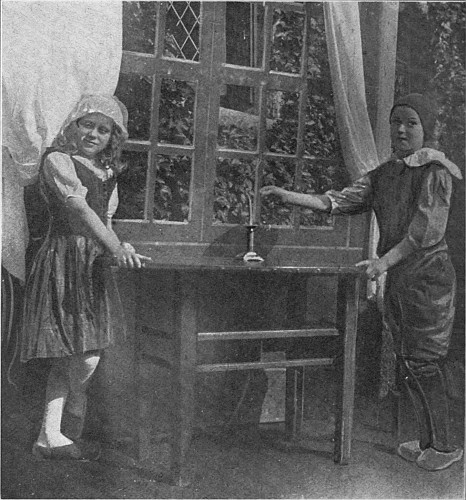
If the first scene, which requires little furniture,—the table, a
chair for Gillian, and low stools for the children,—can be set in
front of the second, much time will be saved in the changing. One
scene will serve for both acts, if the frames of the portraits can be
covered with hangings during the first act. Mission furniture may
be used, but if it is possible to obtain a carved chair and table,
and appropriate objects to hang upon the wall,—one or two pieces of
armor, a pair of antlers, etc.,—the effect can be much enhanced.
The secret door in the second act must be planned in accordance with
the possibilities of one's stage. If scenery is used, one section may
be opened wide enough for Rufus to pass through. Otherwise, arrange
hangings so that he may appear to go through a door behind them.