The Character of Jesus Doctrine and Deed The Minister as Prophet The New Crusade Quiet Hints to Growing Preachers Quiet Talks with Earnest People Things Fundamental My Father’s Business
Christmas Builders Faith and Life The Old Year and the New The World’s Christmas Tree
THOMAS Y. CROWELL & CO. New York
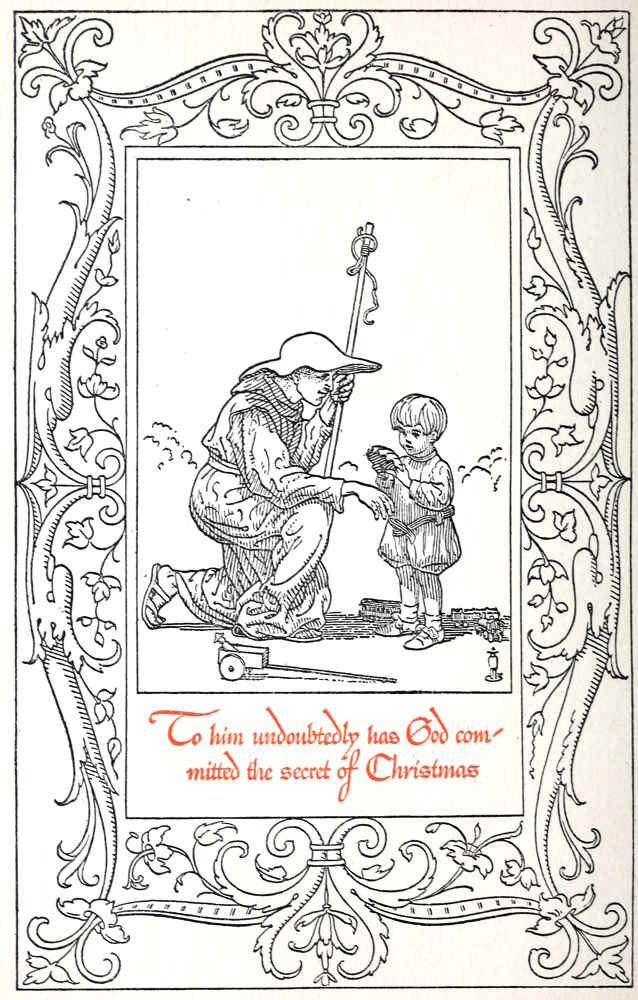
To him undoubtedly has God committed
the secret of Christmas
Christmas
Builders
BY
CHARLES EDWARD
JEFFERSON
New York Thomas Y. Crowell & Co.
Publishers
COPYRIGHT, 1909, BY THOMAS Y. CROWELL & CO.
PUBLISHED SEPTEMBER, 1909
D. B. UPDIKE, THE MERRYMOUNT PRESS, BOSTON
Christmas Builders
There was trouble in the land,
all on account of Christmas. Men
stood bewildered and women were distracted,
not knowing what to do. The
trouble was that Christmas had become
too small. Once there was room enough
in it and to spare. Only a few of the
inhabitants of the earth brought their
treasures into it. But little by little the
world learned of the beauty of Christmas
until everybody, almost, wanted
to get into it, and not only into it himself,
but he wanted to bring all his relatives
and friends, every one of them
laden with packages and bundles, until
at last Christmas became crowded
to suffocation. There was not room to
turn round. Everybody was so huddled
and jostled, and there was so much
scrambling and pushing, that some people
quite lost their temper, and even in
the palace of Christmas looked sour.
It seems strange that the world
should be embarrassed and really injured
by a desire of people to be loving
and to manifest their love by giving
gifts, and yet that is the very thing
which happened. Christmas became a
breeder and disseminator of dark and
ugly feelings. It is well enough when
only a few people make up their mind
to be affectionate and generous; but
when everybody decides to put on the
Christmas graces on the same day of
the year, the world cannot stand the
strain of so much goodness all at once
expressed, and the result is a tragedy
almost as deep and dark for many
hearts as if there were no Christmas
at all. For in their eagerness to keep
Christmas, men forgot the claims of
brotherhood. They were so zealous to
get into the enchanted palace themselves
that they forgot all about their
neighbors, who wanted to get in also.
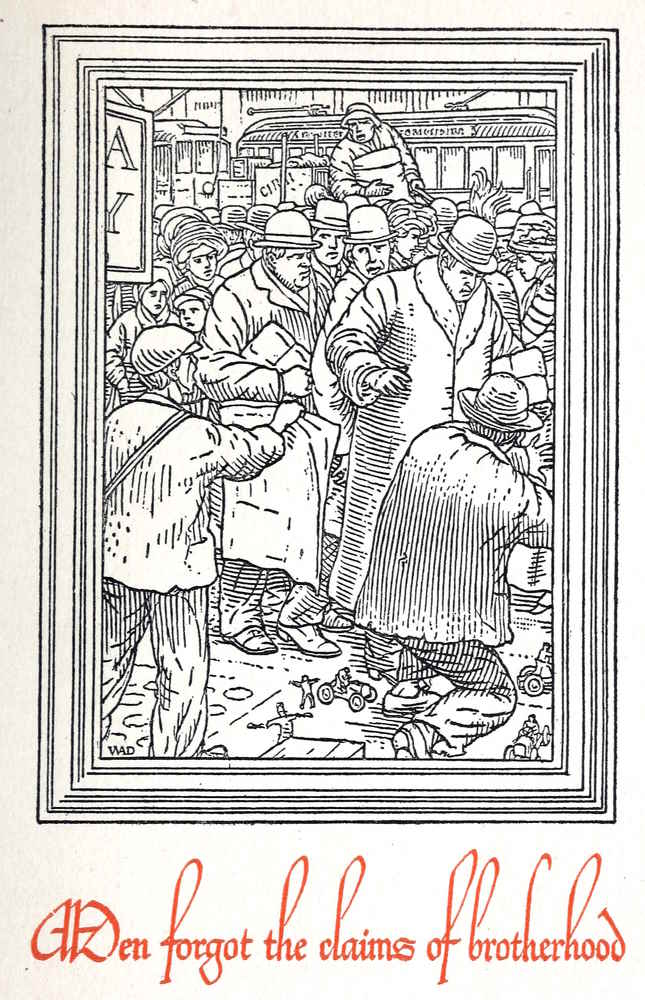
Men forgot the claims of brotherhood
One cannot very well manufacture
gifts himself, and therefore some one
else must make them. One cannot
carry gifts himself,—at least not all
of them,—and therefore some one
else must carry them. As Christmas
was just a day and as it came only
once a year, all the days preceding
Christmas became frenzied and feverish,
and men and women by the thousands
were compelled to work so fast
and through such long hours that they
were not able to reach the palace at
all. They had their faces in the direction
of it, but they were all so jaded
and out of breath that when the palace
came in sight they had not energy
sufficient to enjoy the beauty of it, and
could only look on half dazed and benumbed
at the more fortunate mortals
who had been able to get inside of its
golden doors.
Letter-carriers, knowing by experience
what Christmas really was, began
to lament long before the month
of December came, seeing in their imagination
the huge bundles of letters
and papers and packages which must
be carried up the crowded roadway
of the days which led to the Christmas
palace. Expressmen also never
spoke enthusiastically of Christmas,
but scowled at the mere mention of it,
as though it were a prison instead of a
palace, a sort of punishment which was
inexorably inflicted on them at the
end of every year. Dressmakers were
also sickened even by the thought of
Christmas, for just before that beautiful
day every woman wanted a new
coat or a new waist or a new skirt,
and everybody wanted it at once, so
that she would be ready for Christmas,
the result being that the dressmakers
and all the girls in their shops
were so driven and so roundly scolded
by impatient and sharp-tongued customers
that it was really difficult on
the twenty-fifth of December to feel
charitable and forgiving and kind to
all. Christmas Day was a palace filled
with beautiful sights and sounds, but
the fact is that many people never got
into it, but sat down fagged and despondent
at the door. Clerks in the big
stores had no good word for Christmas,
notwithstanding its beauty and its
hallowed associations. Some of them, I
fear, hated it, especially the young women
clerks, for the hours were so long
and the crowds in the store were so
big and the air was so bad, and so
many of the people were so unreasonable
and inconsiderate and crotchety,
and the cars at evening were so crowded
and the nights seemed so short,
that clerks were heard saying to one
another, “Won’t you be glad when
Christmas is over?”
Many children even grew to be
afraid of Christmas. They dreaded it
as though it were a huge goblin or
monster casting a shadow over the
days which preceded it. The little delivery
boys at the grocery stores became
so weary lugging good things
for Christmas dinners that they could
not laugh real heartily or enjoy their
own dinner when Christmas Day came.
It was so late the night before when
the last basket was delivered that the
boys fell into a sleep too deep even
for dreams. They lost the rare and
radiant pleasure which is the birthright
of boys,—the joy of dreaming of
what a good time is coming on Christmas.
And as for the little girls who
worked all day long tying up bundles
in the basements of the great stores,
they did their best to keep alive in their
hearts a genuine love of the birthday
of Jesus, but, alas, in many cases their
heroic efforts were in vain. “I just hate
Christmas!” said one little girl to another
at the end of a long and wearisome
day.
Things have indeed come to a tragic
pass when a thought of the one most
splendid and gorgeous day of the entire
year quenches the sparkle in a
child’s eyes and crushes every feeling
of ecstatic anticipation out of a child’s
heart. It was indeed a spectacle to
cause one to stop and ponder, this widespread
shrinking and shuddering at the
very thought of Christmas, this long-drawn
sigh of relief when Christmas
was really over.
And when I looked around and saw
how all the days immediately preceding
Christmas were thrown into tumult
and confusion in which thousands of men
and women and boys and girls were
wounded, and many of them hurt with
an injury that was deep; and when I
looked at the days succeeding Christmas
and saw them covered with the
wreckage which Christmas had created,
the holiday season resembling indeed a
great battlefield on which a terrific battle
had been fought, the maimed and
bleeding lying moaning, waiting for the
healing influences of a new year, I began
to ask myself, What is the cause
of this great tragedy, and how can humanity
be delivered from so great a
scourge?
It seemed unendurable that the
anniversary of the birthday of Jesus
should be permitted to wreck the happiness
of so many hearts and homes. If
Christmas stands for anything it stands
for joy. “Peace and good will”—this
is the heart of Christmas. The first
Christmas was ushered in by a burst
of song, and the last Christmas to be
celebrated on our planet will no doubt
dawn in the same heavenly way.
“Peace on earth, good will toward
men,” so the angels sang, and keep on
singing, and will continue to sing forever.
“Do not be afraid,” said the visitor
from the skies, “for I bring you
good tidings of great joy.” Fear was
banished when Jesus came, and so were
all the dark and dismal spectres of the
mind. The shepherds were glad, and
so were the aged saints in the temple,
and so were the scholars from the
East, and so was everybody—except
Herod—who came to know of the arrival
of the wonderful baby. Human
hearts began to sing when Jesus came,
and nothing must be allowed to reduce
the volume or the sweetness of the
music. What is wrong, I asked, with
Christmas that it has become a sort of
discord in the harmony of the year?
Why should the one most lustrous day
of all the months loom dark and terrible
before so many eyes? Why should
pain and sorrow flow like swollen and
dismal streams from a day created by
infinite love for making human hearts
rejoice?
On investigation I discovered that
Christmas had simply become too small
to accommodate the Christmas sentiment
of the world. The dimensions of
the palace were not sufficiently spacious
to allow all of us to get in without
treading on one another. One day was
not large enough for the celebration
of the birth of Jesus. Twenty-four
hours were not sufficient to allow
everybody to practise the precept of
Jesus, “It is more blessed to give than
to receive.” The Christmas heart had
outgrown the narrow limits of the
Christmas day, and the problem of the
world in the first decade of the twentieth
century was, How can Christmas
be enlarged?
The query raised a host of interesting
questions wherever it was propounded.
Men began to ask, Is it possible
to expand the limits of Christmas,
to extend the dimensions of its golden
rooms, to widen the area on which it
stands? For instance, would it be possible
to make Christmas cover two
days instead of one? How would it do
to say that Christmas is the 24th and
25th of December, or the 25th and
26th of December? At first glance one
would declare that this is quite impossible,
for the reason that Jesus was
born on the 25th of December and
therefore we have no right to include
in our Christmas celebration any other
day. But right here we face a curious
and puzzling fact. Nobody knows on
what particular day of December Jesus
of Nazareth was born.
The question has always been a
matter of dispute, even among those
who might presumably be best fitted
to know. He may have been born the
24th or the 26th, or even the 27th or
28th. Indeed, for all we know he may
have been born on any day of our
month of December, so that we have
a right to build the palace of Christmas
on any day of the month, for every
day is equally eligible for consecration,
and in order to be sure that we have
the right day, why not allow Christmas
to cover the entire month? The
ancients were so fearful of slighting one
of the gods that after they had erected
altars to all the gods whose names they
knew, they sometimes erected an altar
to the unknown god, in this way being
sure of not omitting from the scope of
their reverence any god who had a
right to be included. Why not make
sure of having the right day in December
by building the Christmas palace
upon them all? Thirty-one foundation
stones instead of one would support a
really royal structure, and surely a
palace filling the dimensions of a month
would be none too large for the commemoration
of the most stupendous
event in human history—the birth of
Jesus.
By thus expanding Christmas we
should not get into such a pet and
fury as some of us now do. We should
have time to think about the meaning
of this great event for which Christmas
stands, and we should also become
more accustomed to the exercise of the
Christmas virtues. As things now are
we have scarcely time enough to bring
the Christmas graces to fullest bloom.
One day is quite too short. To entertain
and nourish beautiful and charitable
thoughts, to kindle and foster kind
and forgiving feelings, to set the heart
singing and the spirit adoring, for all
this a single day is hardly long enough.
If we should think such thoughts every
day for a week and a month, our minds
would get accustomed to these high
altitudes and would not sink back so
readily to lower and unworthy levels
of mental and emotional conduct. If we
should go right on for a month forgiving
our enemies and breathing charity
for all, we might get so habituated to
these heavenly feelings as never again
to be willing to give them up. A month
is none too large as a foundation
on which to build a mansion spacious
enough fitly to commemorate the coming
of our Lord.
Not only would it be better for ourselves
if in some such way Christmas
might be expanded, but hosts of our
brothers and sisters would be gladdened
by the change. With an entire
month at one’s disposal in which to do
one’s Christmas shopping and to tie up
one’s Christmas packages and to plan
for one’s Christmas dinner, the burden
of preparation would not fall so suddenly
or with such crushing force upon
those who minister to us, and many
who are now unable to rejoice in the
Christmas celebration would be found
joyfully singing the Christmas song.
Much of the congestion and the crowding
of the present would be rendered
impossible, and Christmas would become
what it ought to be,—a time of
universal exultation, a season of world-wide
gratitude and love.
But when one gets thus far he discovers
that he must go farther. Why
confine Christmas, some one says, to
the month of December? No one can
be certain that Jesus was born in December.
The New Testament does not
say so, nor does the New Testament
contain any evidence by which any
particular month of the year can be
proved to be the month of Jesus’ birth.
Plausible arguments have been adduced
to prove that his birthday came in
September. October also has put in its
claim. There are only a few of the
twelve months which have not stood up
and demanded recognition and honor
as the month of the year in which the
King of Glory came. Months hitherto
silent will no doubt speak later on.
It is evidently not God’s will that we
should know in what season of the year
Jesus came. Not one of his apostles
felt inspired to give information upon
that interesting but unimportant point.
God has hidden the key to that secret,
and nobody knows where to find it.
This is the Lord’s doing, and it ought
to have a meaning for our eyes. If we
do not know the month of Jesus’ birth
and if God has so fixed things that
such knowledge is forever beyond our
reach, why not build the Christmas
palace upon the month of January as
well as upon the month of December?
A two months’ Christmas would be
better than a one month Christmas,
and as it is impossible to draw the line
at the end of January and say thus
far shall Christmas extend and no
farther, why not take in February,
March and April; yes, May, June
and July, also August, September, October
and November? Are we justified
in leaving out any of the months
of the year? Do we not call it the
year of our Lord? Why not then let
him have the whole of it as a suitable
memorial of his birth? A Christmas
a year long—that would not
be too protracted. Christmas all the
time—that would be ideal. Always
extending merry greetings, always
wishing others well, always generous
in our giving, always humming the
angels’ song, always seeking and
praising the King—is not that the sort
of Christmas which this world of ours
most needs?
Certainly it is the kind of Christmas
most pleasing to the heart of Christ. I
imagined I heard him saying, as he
beheld the Christmas which our civilization
had produced: “I hate your
Christmas, I am weary of it, because
so many of my children are fatigued.
It is an abomination unto me because
it has rolled a crushing weight on so
many hearts. Away with it. It is too
small. Build me a more spacious Christmas.
Extend the walls of it, until like
the New Jerusalem it shall lie four-square,
with three gates on each side,
so capacious and hospitable that the
populations of the earth can bring their
glory into it. Let the Christmas season
be coterminous with the limits of the
year.”
Now when I heard him say this I
asked myself the question, Who is sufficient
for this thing? Who can build
this stately Christmas ample enough to
fill a year? To make one day bright
and glorious—even this is sometimes
hard. We brush away our tears, we
crush down in our hearts the dark
and fearsome feelings, saying, “This
is Christmas Day. I must to-day be
cheery, to-day I must wear a smiling
face; but to-morrow I will pick up again
my burden, to-morrow I will cry again.
For the sake of the children I will pretend
that I am happy—only for a day.”
It is by no means easy to make an
ideal Christmas even one day long.
Many a time the Christmas crystal
palace has been shattered to fragments
by stones hurled by the hands of the
heart’s foes. To build a palace covering
the extensive area of a year, planting
a column on each one of the three
hundred and sixty-five pieces of that
strange mosaic which men call Time,
swinging over all a dome full of the
light and glory of God’s face—this is
an enterprise as difficult as it is stupendous,
but one from which no true
follower of Jesus ought to shrink.
When I saw that the old Christmas
had been really outgrown and realized
that a new Christmas must be speedily
constructed, I set out at once in search
of architects and builders competent
for so vast an undertaking. Who, I
said, can build a Christmas great enough
to satisfy and bless a world? Who can
take the walls of our little Christmas
and by some magic power extend them
until they reach around the borders of
a year? So I pondered and I was greatly
troubled, because I knew not where
to go. Where, I asked, shall wisdom
be found?
First of all I went to the learned
men, the men who know what the past
has been and what the present is. I
knocked at the doors of all the universities,
beginning with the oldest and
ending with the youngest, but in no
one of them could I find builders for
this new and gigantic work. I then
turned to the market-place where men
of practical genius are wont to congregate.
I mingled with the captains
of industry; I glanced down the lines
of merchants, bankers, manufacturers,
the men who are doing the largest
things in our day and generation, and
I said in a loud voice, “Can any of
you gentlemen build the world a
larger Christmas?” and not one voice
replied, “I can.”
Thereupon I went to the palaces
of kings, where live the great and
mighty of the earth, and when I noticed
the glitter of the crowns and the
gorgeousness of the sceptres I felt encouraged,
for I said: “Here is a royal
thing to be attempted, and surely royal
heads and hearts shall prove equal
to the task.” But, alas, at the door of
every royal palace the same word was
given: “No one here has skill or power
sufficient to build a larger Christmas.”
Not yet hopeless I turned to the
parliaments of the world and looked
into the august faces of lords and senators,
of generals and princes,—men
who have carved their names in the
body of the life of their time, and I said
pleadingly: “Can you, or any men you
know, come and erect for the world a
larger Christmas?” and my question
brought nothing but silence for an
answer.
I then stole into the study of the philosophers
and glided into the groves
where walk the poets; I passed from
court to court where learned judges
sit; I entered boldly into the camp
where army and navy leaders study
plans for the conquest of the world,
and everywhere I asked the same baffling
question: “Can you erect for
mankind a more spacious and more fitting
Christmas?” and in every place the
same answer was returned: “Strength
and wisdom equal to so great a task
do not dwell with us.”
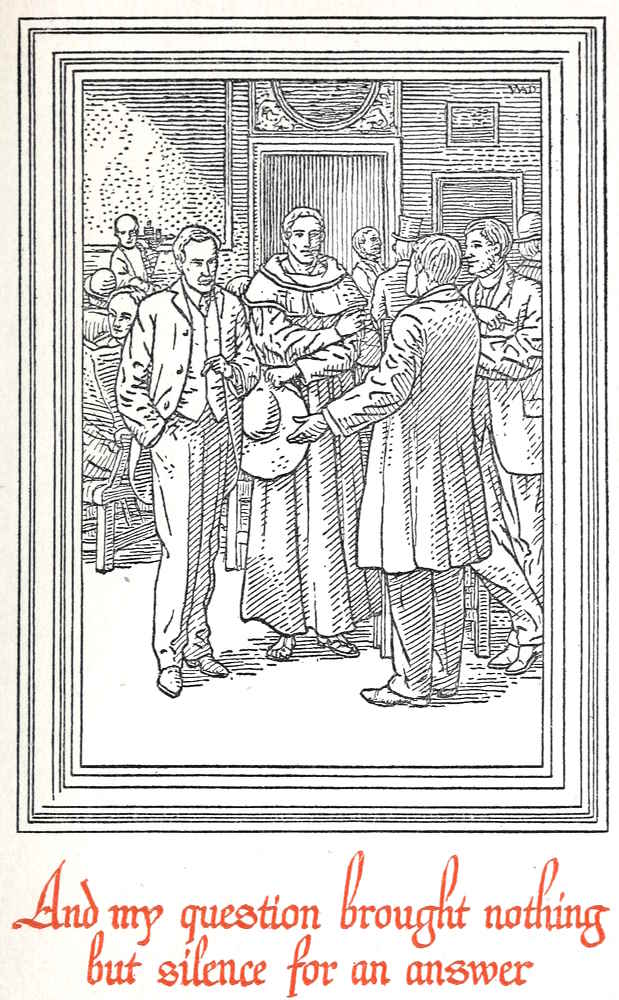
And my question brought nothing
but silence for on answer
And then I turned to the aged.
Wherever there was a gray head I
paused and put once more my question.
Wherever I could find a man of experience,
of achievement, of earthly wisdom,
of renowned skill, of acknowledged
genius, there I propounded my
interrogation, ever receiving the same
disappointing reply. And when I had
travelled round the world and could
find nowhere any man or woman, high
or low, rich or poor, great or humble,
mighty or feeble, who could give me
what I sought, all at once I remembered
that Christmas is the one celebration
of all the jubilees known in
human history which cannot be carried
on without the presence of children.
I began to reflect upon the fact
that Christmas is the one holiday which
cannot be separated from the brightness
of a child’s eyes or the music of
a child’s laughter.
I fell to pondering the fact that
when old folks think of Christmas
they think of the days when they
were young. When their children are
grown and have gone far away from
home, the parents refresh their hearts
by thinking of the time when there was
a Christmas tree in the nursery and the
glad shout of children exulting over
their treasures filled all the house. And
I remembered also that husbands and
wives who have no children find their
hearts going out toward other people’s
children at Christmas time. And when
I saw in my mind’s eye the whole world
gathered together for the celebration
of Christmas and beheld a little child
in the centre, I began to think of the
day when in Capernaum Jesus set a
child in the midst of twelve men, saying:
“Of such is the kingdom of
heaven.” And when this all flashed
upon me I started out at once in search
of a child. “To him undoubtedly,” I
said, “has God committed the secret
of Christmas. He can tell me where
the Christmas builders can be found.”
I went, I asked, and great was my
reward. Through a child’s eyes I
looked into the child heart, and there
standing radiant and beautiful were
seven angels,—the angels which are
the builders of Christmas. These are
their names: Wonder, Humility, Trust,
Simplicity, Purity, Joy, and Affection.
By these the first Christmas was constructed,
and without these no genuine
Christmas can be built. These are
strong angels, they dig deep and they
mount high. They can build a Christmas
covering the year.
Christmas is glorious because it is
the creation of a child. Man is not the
architect of it. It is not a creation of
human ingenuity or wisdom. It was
built in the first place by a baby, and
the glitter of it was simply the reflection
of the light of a baby’s eyes. The
kings of the earth have often taken
council together, but they have never
conceived anything so beautiful as
Christmas. For a marvel so stupendous
God fell back upon a child. Children
are the magicians of the earth.
Their wizardry surpasses that of
magic. The scope and power of their
necromancy, who can measure?
There was nothing in the world like
Christmas till Jesus came. On the day
of his birth God called the nations together
and set a little child in their
midst. From the beginning a full-grown
man had stood at the centre,
but the circle gathered round him had
never been joyous. Sometimes the central
man had been a general and sometimes
a king, occasionally he had been
a scholar and frequently a saint; but
no matter who he was the circle was
not enchanted and the heart refused to
sing. But as soon as a child was placed
at the centre, humanity began to organize
itself in unprecedented ways
and to move forward along original
lines. It began to sing a new song.
The world had for ages been despondent
and hopeless, and no potentate or
miracle-worker, however mighty, had
been able to lift it out of its dark
mood. But when God took a child and
set him in the midst, then was the
world’s mouth filled with laughter,
and all things became new.
This is the difference then between
the ancient world and the modern, the
first had an adult at the centre, the latter
has a child. Out of the child heart—and
the child heart is the Christ
heart—are coming the forces for the
rebuilding of the world. The problem
of existence is the task of keeping the
child in us alive, the heart that wonders,
trusts and loves.
Christmas is not a day, it is a mood.
It is independent of days. We celebrate
it on Friday, Saturday, Sunday,
any day of the week. Christmas is indifferent
to days. It has nothing to do
with the almanac. It has nothing to do
with place. It is as independent of geography
as it is of chronology. It has
no relation to human government or
even to race or blood. It is an institution
which can be set up on any soil
and under the folds of any flag. Christmas
is a spiritual creation and belongs
to the kingdom of the heart. It is constructed
by the angels of the heart of
a child. If it then be a mood, it can be
extended over a week, a month, a
year, a lifetime. It can be built upon
time, upon eternity. If you confine it
to a day, you miss the meaning of it.
If you try to cram it into twenty-four
hours, you crush it and lose the essence
of it. The Christmas spirit is the
only spirit by which men and women
really live. The Saviour of the world
has said: You cannot enter the kingdom
of heaven—and that is his name
for Christmas—except you become
“As a Little Child.”
In Terra Pax (Peace on Earth)
Hominibus Bonæ Voluntatis (Peace on Earth to people of good will)