It had been visible to Mrs. Brown from the first moment of her arrival
on the ground floor that “something was the matter,” if we may be
allowed to use such a phrase; and she felt all but convinced that this
something had reference to her. She fancied that the people of the hotel
were looking at her as she swallowed, or tried to swallow, her coffee.
When her husband was paying the bill there was something disagreeable in
the eye of the man who was taking the money. Her sufferings were very
great, and no one sympathized with her. Her husband was quite at his
ease, except that he was complaining of the cold. When she was anxious
to get him out into the carriage, he still stood there, leisurely
arranging shawl after shawl around his throat. “You can do that quite as
well in the omnibus,” she had just said to him, very crossly, when there
appeared upon the scene through a side door that very night porter whom
she dreaded with a soiled pocket-handkerchief in his hand.
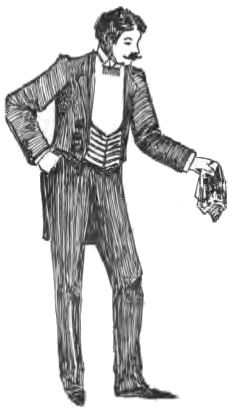
Even before the sound of her own name met her ears, Mrs. Brown knew it
all. She understood the full horror of her position from that man’s
hostile face, and from the little article which he held in his hand. If
during the watches of the night she had had money in her pocket, if she
had made a friend of this greedy fellow by well-timed liberality, all
might have been so different! But she reflected that she had allowed him
to go unfee’d after all his trouble, and she knew that he was her enemy.
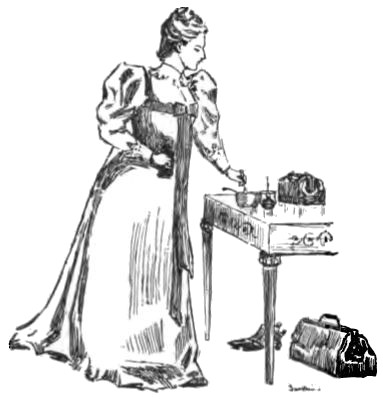
It was the handkerchief that she feared. She thought that she might have
brazened out anything but that. No one had seen her enter or leave that
strange man’s room. No one had seen her dip her hands in that jar. She
had, no doubt, been found wandering about the house while the slumberer
had been made to suffer so strangely, and there might have been
suspicion, and perhaps accusation. But she would have been ready with
frequent protestations to deny all charges made against her, and though
no one might have believed her, no one could have convicted her. Here,
however, was evidence against which she would be unable to stand for a
moment. At the first glance she acknowledged the potency of that damning
morsel of linen.
During all the horrors of the night she had never given a thought to the
handkerchief, and yet she ought to have known that the evidence it would
bring against her was palpable and certain. Her name, “M. Brown,” was
plainly written on the corner. What a fool she had been not to have
thought of this! Had she but remembered the plain marking which she, as
a careful, well-conducted British matron, had put upon all her clothes,
she would at any hazard have recovered the article. Oh that she had
waked the man, or bribed the porter, or even told her husband! But now
she was, as it were, friendless, without support, without a word that
she could say in her own defence, convicted of having committed this
assault upon a strange man as he slept in his own bedroom, and then of
having left him! The thing must be explained by the truth; but how to
explain such truth, how to tell such story in a way to satisfy injured
folk, and she with only barely time sufficient to catch the train! Then
it occurred to her that they could have no legal right to stop her
because the pocket-handkerchief had been found in a strange gentleman’s
bedroom. “Yes, it is mine,” she said, turning to her husband, as the
porter, with a loud voice, asked if she were not Madame Brown. “Take it,
Charles, and come on.” Mr. Brown naturally stood still in astonishment.
He did put out his hand, but the porter would not allow the evidence to
pass so readily out of his custody.
“What does it all mean?” asked Mr. Brown.
“A gentleman has been—eh—eh—Something has been done to a gentleman in
his bedroom,” said the clerk.
“Something done to a gentleman!” repeated Mr. Brown.
“Something very bad indeed,” said the porter. “Look here”; and he showed
the condition of the handkerchief.
“Charles, we shall lose the train,” said the affrighted wife.
“What the mischief does it all mean?” demanded the husband.
“Did madame go into the gentleman’s room?” asked the clerk. Then there
was an awful silence, and all eyes were fixed upon the lady.
“What does it all mean?” demanded the husband. “Did you go into
anybody’s room?”
“I did,” said Mrs. Brown with much dignity, looking round upon her
enemies as a stag at bay will look upon the hounds which are attacking
him. “Give me the handkerchief.” But the night porter quickly put it
behind his back. “Charles, we cannot allow ourselves to be delayed. You
shall write a letter to the keeper of the hotel explaining it all.” Then
she essayed to swim out through the front door into the courtyard, in
which the vehicle was waiting for them. But three or four men and women
interposed themselves, and even her husband did not seem quite ready to
continue his journey. “To-night is Christmas-eve,” said Mrs. Brown, “and
we shall not be at Thompson Hall. Think of my sister!”
“Why did you go into the man’s bedroom, my dear?” whispered Mr. Brown in
English.
But the porter heard the whisper, and understood the language—the
porter who had not been “tipped.” “Ye’es—vy?” asked the porter.
“It was a mistake, Charles; there is not a moment to lose. I can explain
it all to you in the carriage.” Then the clerk suggested that madame had
better postpone her journey a little. The gentleman up-stairs had
certainly been very badly treated, and had demanded to know why so great
an outrage had been perpetrated. The clerk said that he did not wish to
send for the police (here Mrs. Brown gasped terribly, and threw herself
on her husband’s shoulder), but he did not think he could allow the
party to go till the gentleman up-stairs had received some satisfaction.
It had now become clearly impossible that the journey could be made by
the early train. Even Mrs. Brown gave it up herself, and demanded of her
husband that she should be taken back to her bedroom.
“But what is to be said to the gentleman?” asked the porter.
Of course it was impossible that Mrs. Brown should be made to tell her
story there in the presence of them all. The clerk, when he found he had
succeeded in preventing her from leaving the house, was satisfied with a
promise from Mr. Brown that he would inquire from his wife what were
these mysterious circumstances, and would then come down to the office
and give some explanation. If it were necessary, he would see the
strange gentleman—whom he now ascertained to be a certain Mr. Jones,
returning from the east of Europe. He learned also that this Mr. Jones
had been most anxious to travel by that very morning train which he and
his wife had intended to use; that Mr. Jones had been most particular in
giving his orders accordingly; but that at the last moment he had
declared himself to be unable even to dress himself, because of the
injury which had been done him during the night. When Mr. Brown heard
this from the clerk just before he was allowed to take his wife
up-stairs, while she was sitting on a sofa in a corner with her face
hidden, a look of awful gloom came over his own countenance. What could
it be that his wife had done to the man, of so terrible a nature? “You
had better come up with me,” he said to her, with marital severity; and
the poor cowed woman went with him tamely as might have done some
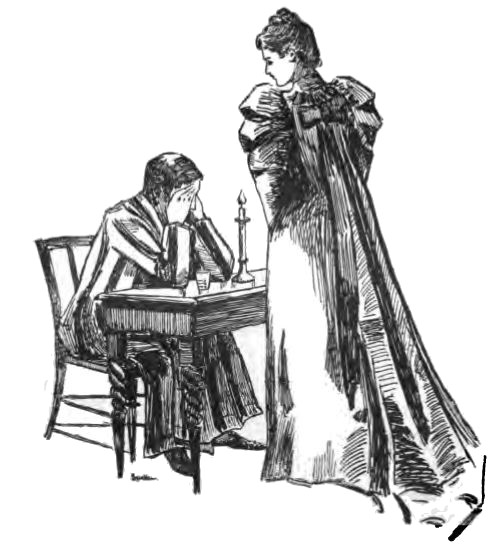
patient Grizel. Not a word was spoken till they were in the room and the
door was locked. “Now,” said he, “what does it all mean?”
It was not till nearly two hours had passed that Mr. Brown came down the
stairs very slowly, turning it all over in his mind. He had now
gradually heard the absolute and exact truth, and had very gradually
learned to believe it. It was first necessary that he should understand
that his wife had told him many fibs during the night; but, as she
constantly alleged to him when he complained of her conduct in this
respect, they had all been told on his behalf. Had she not struggled to
get the mustard for his comfort, and when she had secured the prize had
she not hurried to put it on—as she had fondly thought—his throat? And
though she had fibbed to him afterward, had she not done so in order
that he might not be troubled? “You are not angry with me because I was
in that man’s room?” she asked, looking full into his eyes, but not
quite without a sob. He paused a moment, and then declared, with
something of a true husband’s confidence in his tone, that he was not in
the least angry with her on that account. Then she kissed him, and bade
him remember that, after all, no one could really injure them. “What
harm has been done, Charles? The gentleman won’t die because he has had
a mustard plaster on his throat. The worst is about Uncle John and dear
Jane. They do think so much of Christmas-eve at Thompson Hall!”
Mr. Brown, when he again found himself in the clerk’s office, requested
that his card might be taken up to Mr. Jones. Mr. Jones had sent down
his own card, which was handed to Mr. Brown: “Mr. Barnaby Jones.” “And
how was it all, sir?” asked the clerk, in a whisper—a whisper which had
at the same time something of authoritative demand and something also of
submissive respect. The clerk, of course, was anxious to know the
mystery. It is hardly too much to say that every one in that vast hotel
was by this time anxious to have the mystery unravelled. But Mr. Brown
would tell nothing to any one. “It is merely a matter to be explained
between me and Mr. Jones,” he said. The card was taken up-stairs, and
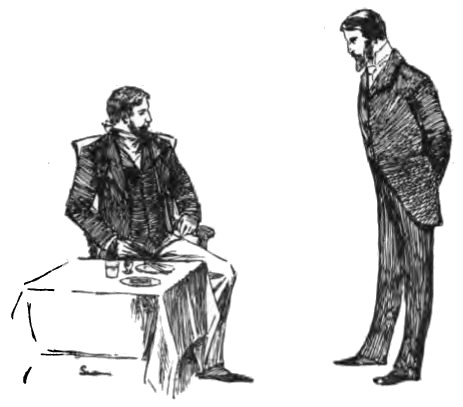
after a while he was ushered into Mr. Jones’s room. It was, of course,
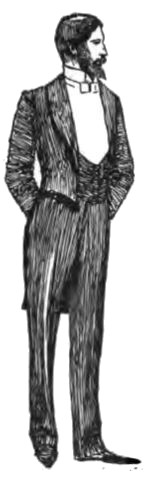
that very 353 with which the reader is already acquainted. There was a
fire burning, and the remains of Mr. Jones’s breakfast were on the
table. He was sitting in his dressing-gown and slippers, with his shirt
open in the front, and a silk handkerchief very loosely covering his
throat. Mr. Brown, as he entered the room, of course looked with
considerable anxiety at the gentleman of whose condition he had heard so
sad an account; but he could only observe some considerable stiffness
of movement and demeanor as Mr. Jones turned his head round to greet
him.
“This has been a very disagreeable accident, Mr. Jones,” said the
husband of the lady.
“Accident! I don’t know how it could have been an accident. It has been
a most—most-most—a most monstrous—er—er—I must say, interference
with a gentleman’s privacy and personal comfort.”
“Quite so, Mr. Jones, but—on the part of the lady, who is my wife—”
“So I understand. I myself am about to become a married man, and I can
understand what your feelings must be. I wish to say as little as
possible to harrow them.” Here Mr. Brown bowed. “But—there’s the fact.
She did do it.”
“She thought it was—me!”
“What!”
“I give you my word as a gentleman, Mr. Jones. When she was putting that
mess upon you, she thought it was me! She did indeed.”
Mr. Jones looked at his new acquaintance and shook his head. He did not
think it possible that any woman would make such a mistake as that.
“I had a very bad sore throat,” continued Mr. Brown, “and indeed you may
perceive it still”—in saying this he perhaps aggravated a little the
sign of his distemper—“and I asked Mrs. Brown to go down and get
one—just what she put on you.”
“I wish you’d had it,” said Mr. Jones, putting his hand up to his neck.
“I wish I had, for your sake as well as mine, and for hers, poor woman.
I don’t know when she will get over the shock.”
“I don’t know when I shall. And it has stopped me on my journey. I was
to have been to-night, this very night, this Christmas-eve, with the
young lady I am engaged to marry. Of course I couldn’t travel. The
extent of the injury done nobody can imagine at present.”
“It has been just as bad to me, sir. We were to have been with our
family this Christmas-eve. There were particular reasons—most
particular. We were only hindered from going by hearing of your
condition.”
“Why did she come into my room at all? I can’t understand that. A lady
always knows her own room at a hotel.”
“353—that’s yours; 333—that’s ours. Don’t you see how easy it was? She
had lost her way, and she was a little afraid lest the thing should fall
down.”
“I wish it had with all my heart.”
“That’s how it was. Now I’m sure, Mr. Jones, you’ll take a lady’s
apology. It was a most unfortunate mistake—most unfortunate; but what
more can be said?”
Mr. Jones gave himself up to reflection for a few moments before he
replied to this. He supposed that he was bound to believe the story as
far as it went. At any rate, he did not know how he could say that he
did not believe it. It seemed to him to be almost incredible, especially
incredible in regard to that personal mistake, for, except that they
both had long beards and brown beards, Mr. Jones thought that there was
no point of resemblance between himself and Mr. Brown. But still, even
that, he felt, must be accepted. But then why had he been left,
deserted, to undergo all those torments? “She found out her mistake at
last, I suppose?” he said.
“Oh, yes.”
“Why didn’t she wake a fellow and take it off again?”
“Ah!”
“She can’t have cared very much for a man’s comfort, when she went away
and left him like that.”
“Ah! there was the difficulty, Mr. Jones.”
“Difficulty! Who was it that had done it? To come to me in my bedroom in
the middle of the night and put that thing on me, and then leave it
there and say nothing about it! It seems to me deuced like a practical
joke.”
“No, Mr. Jones.”
“That’s the way I look at it,” said Mr. Jones, plucking up his courage.
“There isn’t a woman in all England or in all France less likely to do
such a thing than my wife. She’s as steady as a rock, Mr. Jones, and
would no more go into another gentleman’s bedroom in joke than—Oh dear
no! You’re going to be a married man yourself.”
“Unless all this makes a difference,” said Mr. Jones, almost in tears.
“I had sworn that I would be with her this Christmas-eve.”
“O Mr. Jones, I cannot believe that will interfere with your happiness.
How could you think that your wife, as is to be, would do such a thing
as that in joke?”
“She wouldn’t do it at all, joke or any way.”
“How can you tell what accident might happen to any one?”
“She’d have wakened the man, then, afterward. I’m sure she would. She
would never have left him to suffer in that way. Her heart is too soft.
Why didn’t she send you to wake me and explain it all? That’s what my
Jane would have done; and I should have gone and wakened him. But the
whole thing is impossible,” he said, shaking his head as he remembered
that he and his Jane were not in a condition as yet to undergo any such
mutual trouble. At last Mr. Jones was brought to acknowledge that
nothing more could be done. The lady had sent her apology and told her
story, and he must bear the trouble and inconvenience to which she had
subjected him. He still, however, had his own opinion about her conduct
generally, and could not be brought to give any sign of amity. He simply
bowed when Mr. Brown was hoping to induce him to shake hands, and sent
no word of pardon to the great offender.
The matter, however, was so far concluded that there was no further
question of police interference, nor any doubt but that the lady, with
her husband, was to be allowed to leave Paris by the night train. The
nature of the accident probably became known to all. Mr. Brown was
interrogated by many, and though he professed to declare that he would
answer no question, nevertheless he found it better to tell the clerk
something of the truth than to allow the matter to be shrouded in
mystery. It is to be feared that Mr. Jones, who did not once show
himself through the day, but who employed the hours in endeavoring to
assuage the injury done him, still lived in the conviction that the
lady had played a practical joke on him. But the subject of such a joke
never talks about it, and Mr. Jones could not be induced to speak even
by the friendly adherence of the night porter.
Mrs. Brown also clung to the seclusion of her own bedroom, never once
stirring from it till the time came in which she was to be taken down to
the omnibus. Up-stairs she ate her meals, and up-stairs she passed her
time in packing and unpacking, and in requesting that telegrams might be
sent repeatedly to Thompson Hall. In the course of the day two such
telegrams were sent, in the latter of which the Thompson family were
assured that the Browns would arrive probably in time for breakfast on
Christmas-day, certainly in time for church. She asked more than once
tenderly after Mr. Jones’s welfare, but could obtain no information. “He
was very cross, and that’s all I know about it,” said Mr. Brown. Then
she made a remark as to the gentleman’s Christian name, which appeared
on the card as “Barnaby.” “My sister’s husband’s name will be Burnaby,”
she said. “And this man’s Christian name is Barnaby; that’s all the
difference,” said her husband, with ill-timed jocularity.
We all know how people under a cloud are apt to fail in asserting their
personal dignity. On the former day a separate vehicle had been ordered
by Mr. Brown to take himself and his wife to the station, but now, after
his misfortunes, he contented himself with such provision as the people
at the hotel might make for him. At the appointed hour he brought his
wife down, thickly veiled. There were many strangers, as she passed
through the hall, ready to look at the lady who had done that wonderful
thing in the dead of night, but none could see a feature of her face as
she stepped across the hall and was hurried into the omnibus. And there
were many eyes also on Mr. Jones, who followed her very quickly, for he
also, in spite of his sufferings, was leaving Paris on the evening in
order that he might be with his English friends on Christmas-day. He, as
he went through the crowd, assumed an air of great dignity, to which,
perhaps, something was added by his endeavors as he walked to save his
poor throat from irritation. He, too, got into the same omnibus,
stumbling over the feet of his enemy in the dark. At the station they
got their tickets, one close after the other, and then were brought
into each other’s presence in the waiting-room. I think it must be
acknowledged that here Mr. Jones was conscious not only of her presence,
but of her consciousness of his presence, and that he assumed an
attitude as though he should have said, “Now do you think it possible
for me to believe that you mistook me for your husband?” She was
perfectly quiet, but sat through that quarter of an hour with her face
continually veiled. Mr. Brown made some little overture of conversation
to Mr. Jones, but Mr. Jones, though he did mutter some reply, showed
plainly enough that he had no desire for further intercourse. Then came
the accustomed stampede, the awful rush, the internecine struggle in
which seats had to be found. Seats, I fancy, are regularly found, even
by the most tardy, but it always appears that every British father and
every British husband is actuated at these stormy moments by a
conviction that unless he proves himself a very Hercules he and his
daughters and his wife will be left desolate in Paris. Mr. Brown was
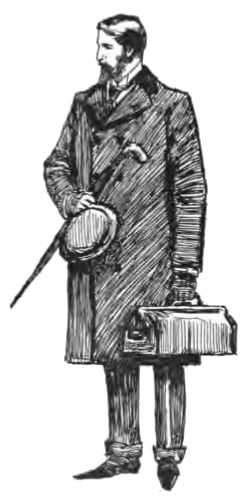
quite Herculean, carrying two bags and a hatbox in his own hands,
besides the cloaks, the coats, the rugs, the sticks, and the umbrellas.
But when he had got himself and his wife well seated, with their faces
to the engine, with a corner seat for her—there was Mr. Jones
immediately opposite to her. Mr. Jones, as soon as he perceived the
inconvenience of his position, made a scramble for another place, but he
was too late. In that contiguity the journey as far as Calais had to be
made. She, poor woman, never once took up her veil. There he sat,
without closing an eye, stiff as a ramrod, sometimes showing by little
uneasy gestures that the trouble at his neck was still there, but never
speaking a word, and hardly moving a limb.
Crossing from Calais to Dover the lady was, of course, separated from
her victim. The passage was very bad, and she more than once reminded
her husband how well it would have been with them now had they pursued
their journey as she had intended—as though they had been detained in
Paris by his fault! Mr. Jones, as he laid himself down on his back, gave
himself up to wondering whether any man before him had ever been made
subject to such absolute injustice. Now and again he put his hand up to
his own beard, and began to doubt whether it could have been moved, as
it must have been moved, without waking him. What if chloroform had
been used? Many such suspicions crossed his mind during the misery of
that passage.
They were again together in the same railway carriage from Dover to
London. They had now got used to the close neighborhood, and knew how to
endure each the presence of the other. But as yet Mr. Jones had never
seen the lady’s face. He longed to know what were the features of the
woman who had been so blind—if indeed that story were true. Or if it
were not true, of what like was the woman who would dare in the middle
of the night to play such a trick as that? But still she kept her veil
close over her face.
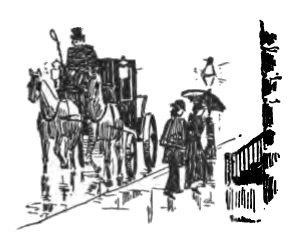
From Cannon Street the Browns took their departure in a cab for the
Liverpool Street Station, whence they would be conveyed by the Eastern
Counties Railway to Stratford. Now, at any rate, their troubles were
over. They would be in ample time not only for Christmas-day church, but
for Christmas-day breakfast. “It will be just the same as getting in
there last night,” said Mr. Brown, as he walked across the platform to
place his wife in the carriage for Stratford. She entered it the first,
and as she did so, there she saw Mr. Jones seated in the corner!
Hitherto she had borne his presence well, but now she could not restrain
herself from a little start and a little scream. He bowed his head very
slightly, as though acknowledging the compliment, and then down she
dropped her veil. When they arrived at Stratford, the journey being over
in a quarter of an hour, Jones was out of the carriage even before the
Browns.
“There is Uncle John’s carriage,” said Mrs. Brown, thinking that now, at
any rate, she would be able to free herself from the presence of this
terrible stranger. No doubt he was a handsome man to look at, but on no
face so sternly hostile had she ever before fixed her eyes. She did not,
perhaps, reflect that the owner of no other face had ever been so deeply
injured by herself.