THE HAN  DYNASTY, 206 B. C. TO 220 A. D.
TWO centuries of internecine strife between the great feudal
princes culminated in the destruction of the Chou dynasty
and the consolidation of the Chinese states under the
powerful Ch´in emperor Chêng. If this ambitious tyrant is famous
in history for beating back the Hiung–nu Turks, the wild nomads of
the north who had threatened to overrun the Chou states, and for
building the Great Wall of China as a rampart against these dreaded
invaders, he is far more infamous for the disastrous attempt to burn
all existing books and records, by which, in his overweening pride,
he hoped to wipe out past history and make good to posterity his
arrogant title of Shih Huang Ti or First Emperor. His reign,
however, was short, and his dynasty ended in 206 B. C. when his
grandson gave himself up to Liu Pang, of the house of Han, and
was assassinated within a few days of his surrender.
The Han dynasty, which began in 206 B. C. and continued till
220 A. D., united the states of China in a great and prosperous empire
with widely extended boundaries. During this period the Chinese,
who had already come into commercial contact with the kingdoms
of Western Asia, sent expeditions, some peaceful and others warlike,
to Turkestan, Fergana, Bactria, Sogdiana, and Parthia. They even
contemplated an embassy to Rome, but the envoys who reached
the Persian Gulf turned back in fear of the long sea journey round
Arabia, the length and danger of which seem to have been vividly
impressed upon them by persons interested, it is thought, in preventing
their farther progress.[13] A considerable trade, chiefly in
silks, had been opened up between China and the Roman provinces,
and the Parthians who acted as middlemen had no desire
to bring the two principals into direct communication.
Needless to say, China was not uninfluenced by this contact
with the West. The merchants brought back Syrian glass, the
celebrated envoy Chang Ch´ien in the second century B. C. introduced
the culture of the vine from Fergana and the pomegranate from
Parthia, and some years later an armed expedition to Fergana
returned with horses of the famous Nisæan breed. But from the
artistic standpoint the most important event was the official introduction
of Buddhism in 67 A. D. at the desire of the Emperor Ming
Ti and the arrival of two Indian monks with the sacred books and
images of Buddha at Lo–yang. The Buddhist art of India, which
had met and mingled with the Greek on the north–west frontiers
since Alexander's conquests, now obtained a foothold in China
and began to exert an influence which spread like a wave over
the empire and rolled on to Japan. But this influence had hardly
time to develop before the end of the Han period, and in the meanwhile
we must return to the conditions which existed in China at
the beginning of the dynasty.
The hieratic culture of the Chou, and the traditions of Chou
art with its rigid symbolism and formalised designs, had been
broken in the long struggles which terminated the dynasty and
banned by the iconoclastic aspirations of the tyrant Chêng, and
though partially revived by Han enthusiasts, they were essentially
modified by the new spirit of the age. Berthold Laufer,[14] in discussing
the jade ornaments of the Chou and Han periods, speaks
of the "impersonal and ethnical character of the art of that age"—viz.
the Chou. "It was," he continues, "general and communistic;
it applied to everybody in the community in the same form; it
did not spring up from an individual thought, but presented an
ethnical element, a national type. Sentiments move on manifold
lines, and pendulate between numerous degrees of variations. When
sentiment demanded its right and conquered its place in the art of
the Han, the natural consequence was that at the same time when
the individual keynote was sounded in the art motives, also variations
of motives sprang into existence in proportion to the variations of
sentiments. This implies the two new great factors which characterise
the spirit of the Han time—individualism and variability—in
poetry, in art, in culture, and life in general. The personal
spirit in taste gradually awakens; it was now possible for everyone
to choose a girdle ornament according to his liking. For the
first time we hear of names of artists under the Han—six painters
under the Western Han, and nine under the Eastern Han; also
of workers in bronze and other craftsmen.[15] The typical, traditional
objects of antiquity now received a tinge of personality, or even
gave way to new forms; these dissolved into numerous variations,
to express correspondingly numerous shades of sentiment and
to answer the demands of customers of various minds."
Religion has always exerted a powerful influence on art, especially
among primitive peoples, and the religions of China at the
beginning of the Han dynasty were headed by two great schools
of thought—Confucianism and Taoism. These had absorbed and,
to a great extent, already superseded the elements of primitive
nature worship, which never entirely disappear. Confucianism, however,
being rather a philosophy than a religion, and discouraging
belief in the mystic and supernatural, had comparatively little
influence on art. Taoism, on the other hand, with its worship of
Longevity and its constant questing for the secrets of Immortality,
supplied a host of legends and myths, spirits and demons, sages
and fairies which provided endless motives for poetry, painting
and the decorative arts. The Han emperor Wu Ti was a Taoist
adept, and the story of the visit which he received from Hsi Wang
Mu, the Queen Mother of the West, and of the expeditions which he
sent to find Mount P´êng Lai, one of the sea–girt hills of the Immortals,
have furnished numerous themes for artists and craftsmen.
It is not yet easy for people in this country to study the monuments
of Han art, but facilities are increasing, and a good impression
of one phase at least may be obtained from reproductions
of the stone carvings in Shantung, executed about the middle of
the Han dynasty, which have been published from rubbings by
Professor E. Chavannes.[16] On these monuments historical and
mythological subjects are portrayed in a curious mixture of
imagination and realism.
But these general considerations are leading us rather far afield,
and it remains to see how much or how little of them is reflected
in the pottery of the time.
As far as our present knowledge of the subject permits us to
see, there is nothing in the pre–Han pottery to attract the collector.
It will only interest him remotely and for antiquarian reasons, and
he will prefer to look at it in museum cases rather than allow it
to cumber his own cabinets. With the Han pottery it is otherwise.
The antiquarian interest, which is by no means to be underestimated,
is now supplemented by æsthetic attractions caught from
the general artistic impetus which stirred the arts of this period
of national greatness. Not that we must expect to find all the
refinements of Han art mirrored in the pottery of the time. Chinese
ceramic art was not yet capable of adequately expressing the refinements
of the painter, jade carver, and bronze worker. But even
with the somewhat coarse material at his disposal the Han potter
was able to show his appreciation of majestic forms and appropriate
ornament, and to translate, when called upon, even the
commonplace objects of daily use into shapes pleasant to the eye.
In a word, the ornamental possibilities of pottery were now realised,
and the elements of an exquisite art may be said to have made their
appearance. From a technical point of view, the most significant
advance was made in the use of glaze. Though supported by negative
evidence only, the theory that the Chinese first made use of glaze
in the Han period is exceedingly plausible.[17] In the scanty references
to earlier wares in ancient texts no mention of glaze appears, and,
indeed, the severe simplicity of the older pottery is so emphatically
urged that such an embellishment as glaze would seem to have
been almost undesirable. The idea of glazing earthenware, if not
evolved before, would now be naturally suggested to the Chinese
by the pottery of the Western peoples with whom they first made
contact about the beginning of the Han dynasty. Glazes had
been used from high antiquity in Egypt, they are found in the
Persian bricks at Susa and on the Parthian coffins, and they must
have been commonplace on the pottery of Western Asia two hundred
years before our era.
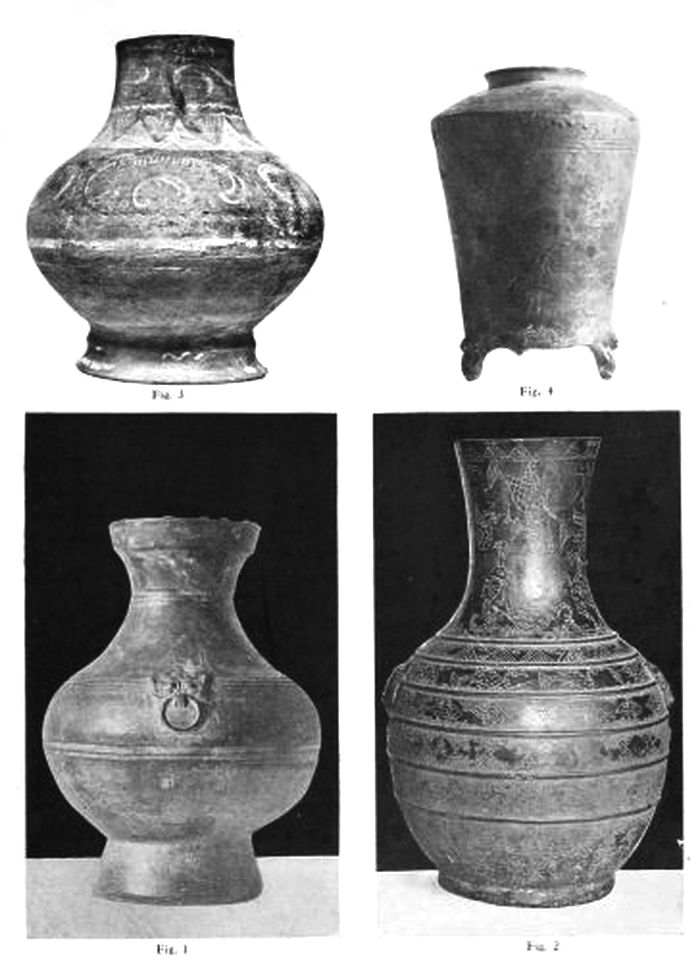
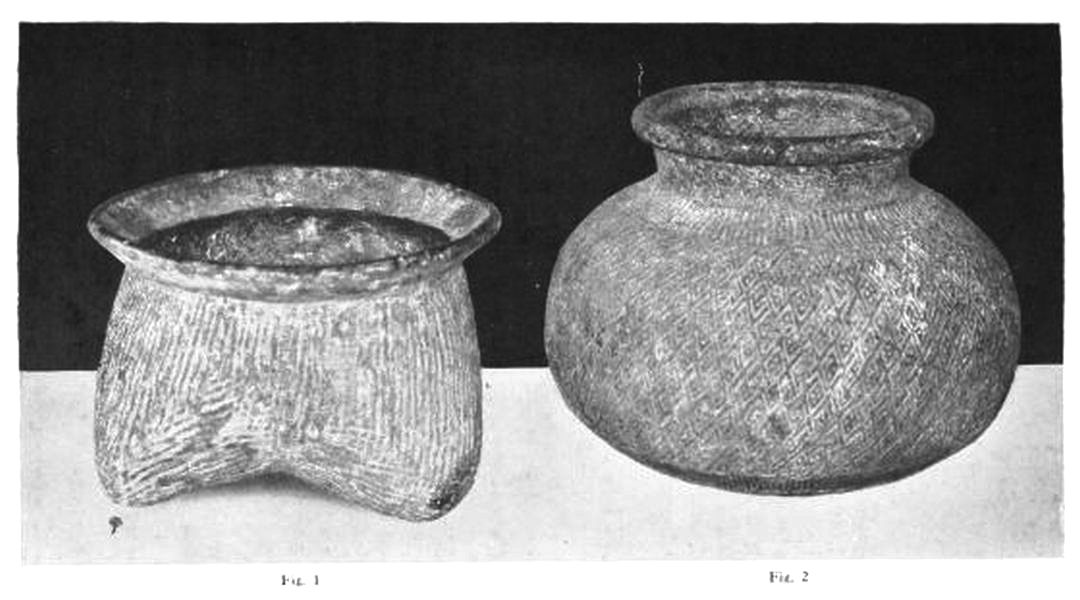
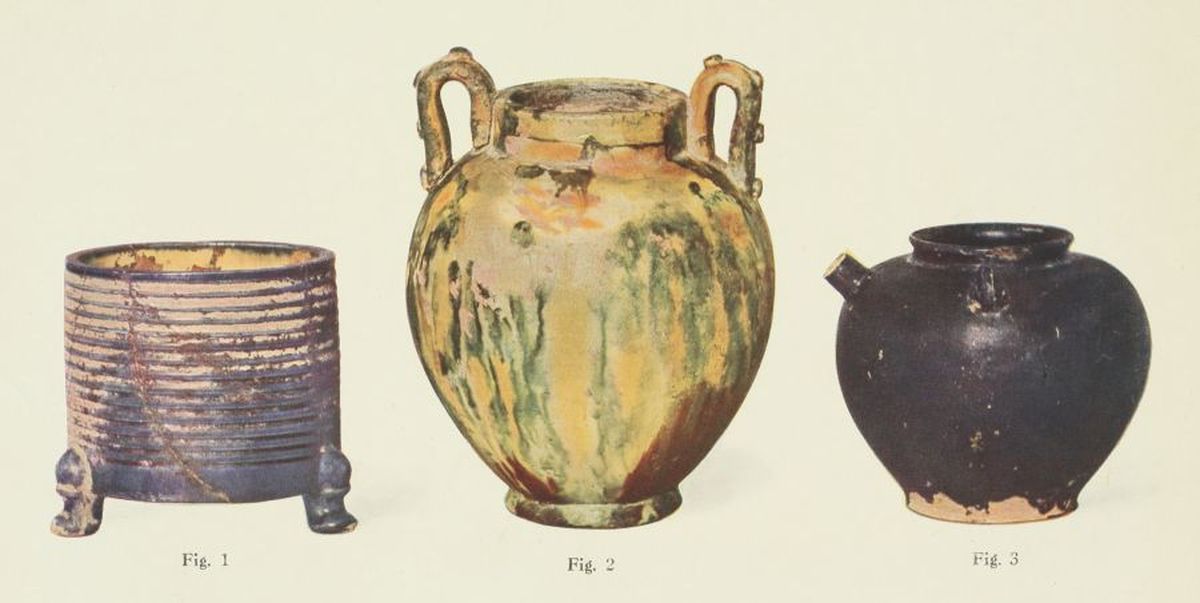
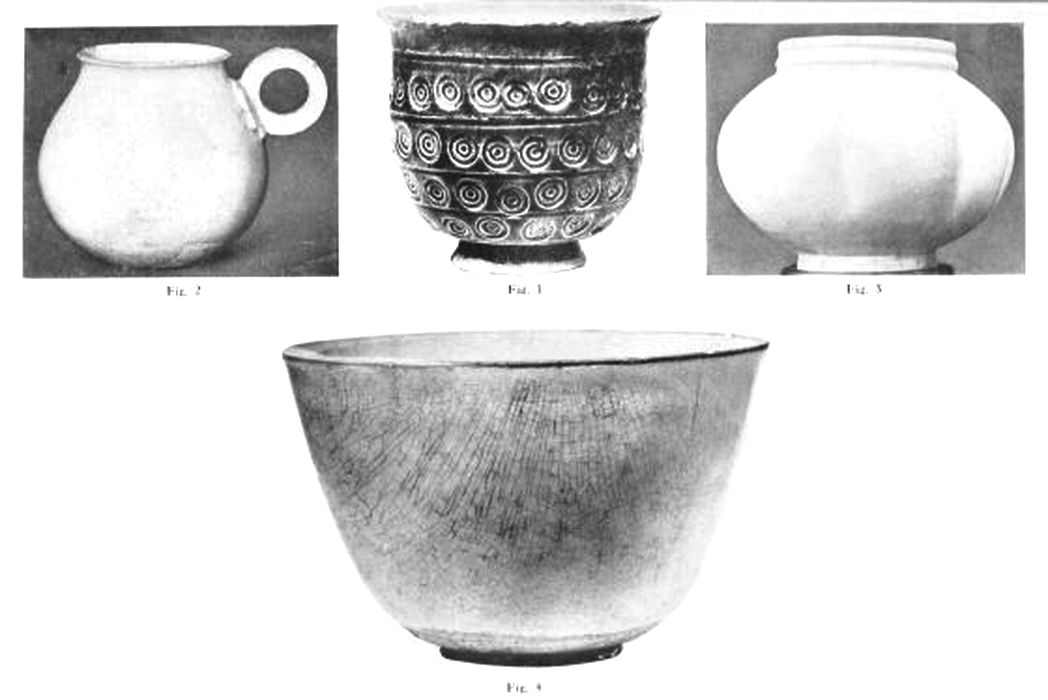
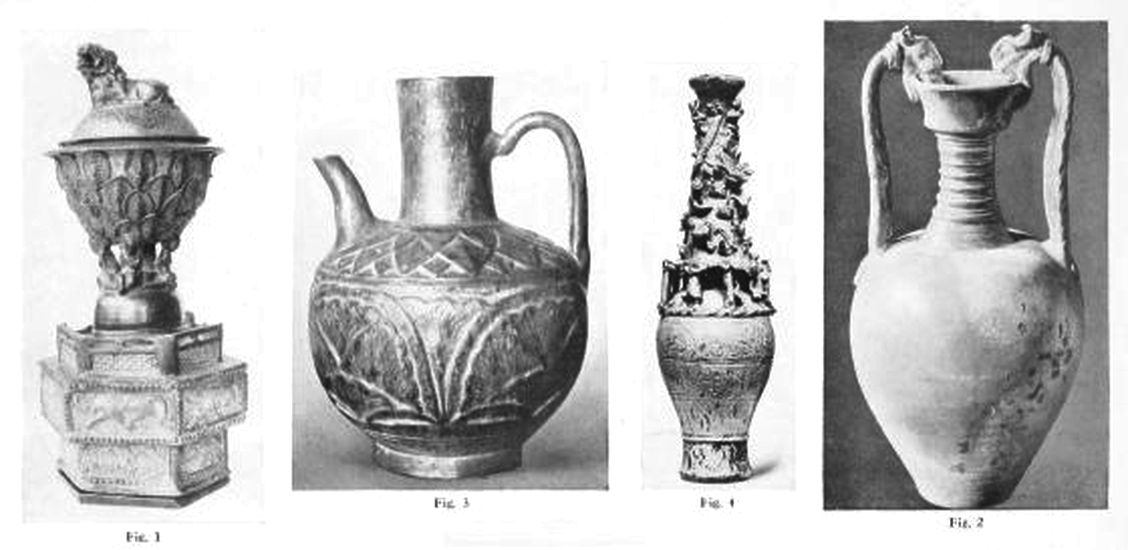
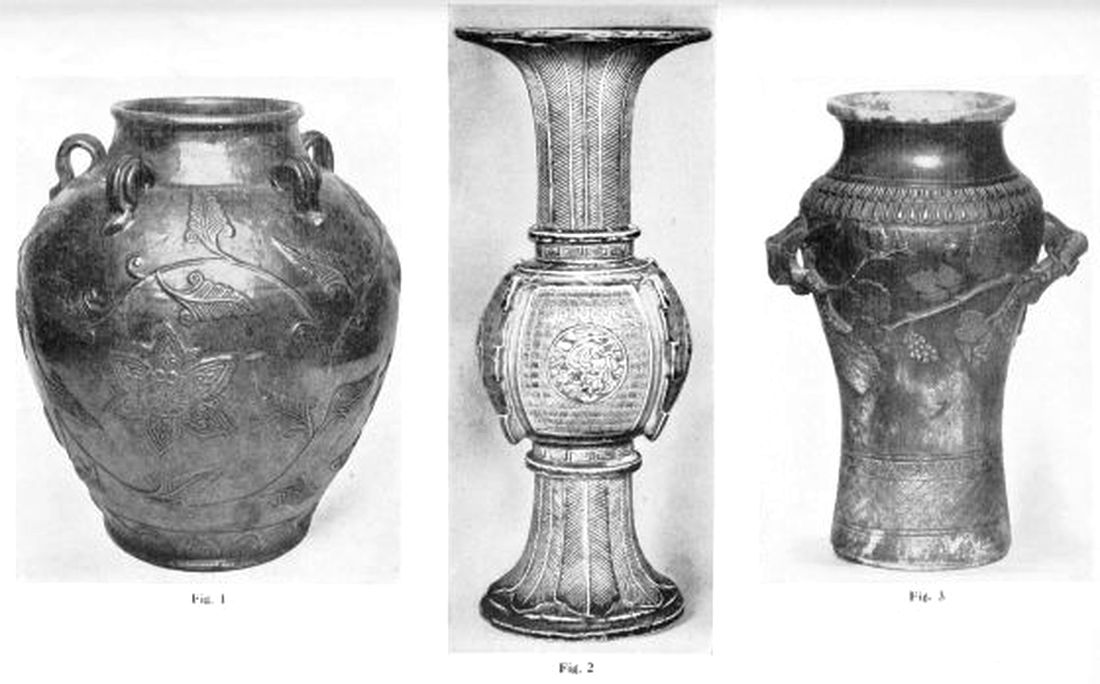
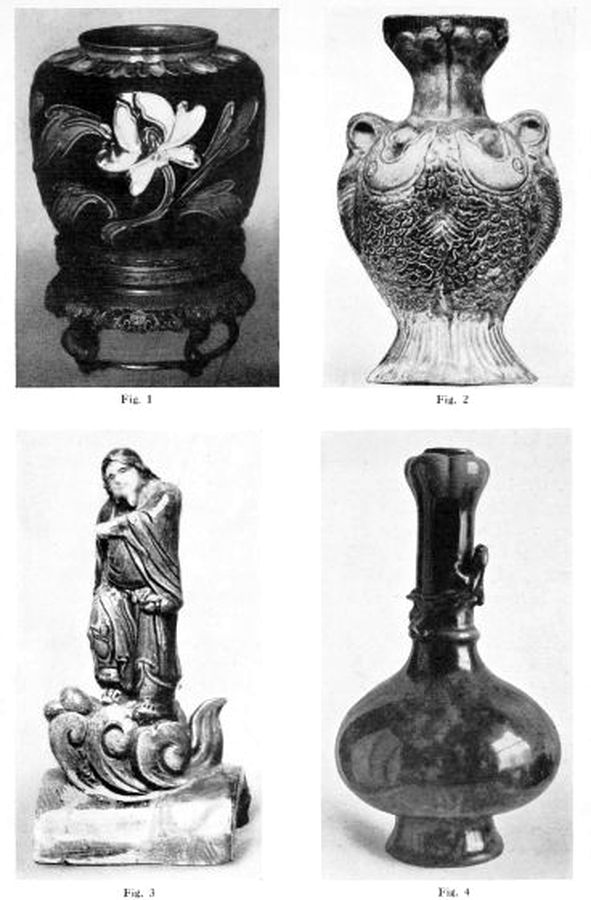
Plate 2.—Han Pottery.
Fig. 1.—Vase, green glazed. Height 14 inches. Boston Museum.
Fig. 2.—Vase with black
surface and incised designs. Height 16 inches. Eumorfopoulos Collection.
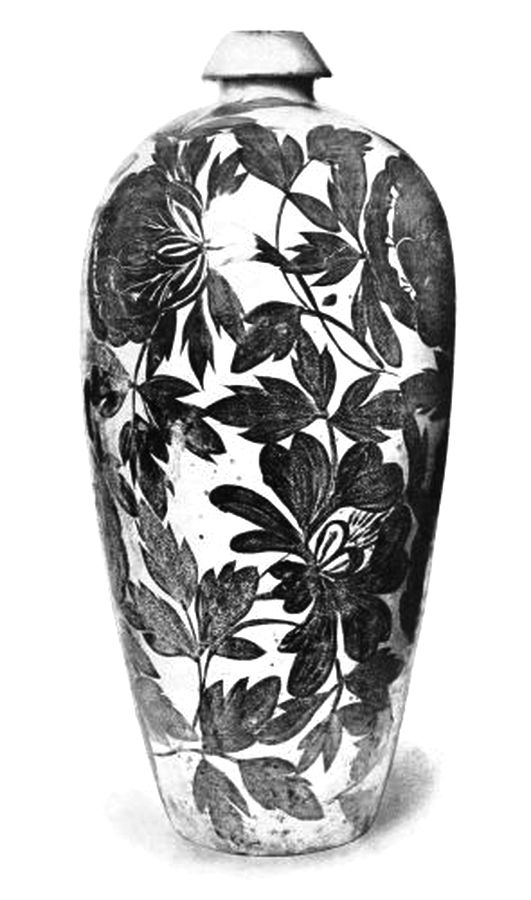
Fig. 3.—Vase with
designs in red, white and black pigments. Height 11 1/2 inches. British Museum.
Fig. 4.—"Granary
urn," green glazed. Height 12 inches. Peters Collection.
It is possible, of course, that evidence may yet be forthcoming
to carry back the use of glaze in China beyond the limits at present
prescribed, but all we can state with certainty to–day is that the
oldest known objects on which it appears are those which for full
and sufficient reasons can be assigned to the Han period. To
explain all these reasons would necessitate a long excursion into
archæology which would be out of place here. Many of them can
be found in Berthold Laufer's[18] excellent work on the subject, and
others will in due course be set out in the catalogue of the British
Museum collections. But it would be unfair to ask the reader
to take these conclusions entirely on trust, and some idea of the
evidence is certainly his due.
There are a few specimens of Han pottery inscribed with dates,
such as the vase (Plate 2, Fig. 1) from the Dana Collection, which
is now in the Boston Museum; but in almost every case the inscriptions
have proved to be posthumous and must be regarded at
best as recording the pious opinion of a subsequent owner. It
will be safer, then, to leave inscriptions out of consideration and to
rely on the close analogies which exist between the pottery and the
bronze vessels of the Han period and between the decorative designs
on the pottery and the Han stone sculptures, and, where possible,
on the circumstances in which the vessels have been found. Unfortunately,
the bulk of the Han pottery which has reached Europe in
recent years has passed through traders' hands, and no records have
been kept of its discovery. But there are exceptional cases in which
we have first–hand evidence of Han tombs explored by Europeans,
and in two instances their contents have been brought direct to the
British Museum. Both these hauls are from the rock–tombs in
Szechuan, the one made by the ill–fated Lieutenant Brooke, who
was murdered by the Lolos, the other by the Rev. Thomas Torrance,
to whom I shall refer again. The evidence of both finds
is mutually corroborative; it is supported by Han coins found
in the tombs, by inscriptions carved on their doorways, and by
the rare passages of decoration on the objects themselves, which
correspond closely to designs on stone carvings published by
Chavannes. In this way a whole chain of unassailable evidence
has been welded together until, in spite of the remoteness of the
period, we are able to speak with greater confidence about the Han
pottery than about the productions of far more recent times.
The Han pottery is usually of red or slaty grey colour, varying
in hardness from a soft earthenware to something approaching
stoneware, and in texture from that of a brick to the fineness of
delft. These variations are due to the nature of the clay in different
localities and to the degree of heat in which the ware was fired.
No chronological significance can be attached to the variations of
colour, and to place the grey ware earlier than the red is both, unscientific
and patently incorrect. Most of the Szechuan ware is
grey and comparatively soft, while of the specimens sent from
Northern China the majority seem to be of the red clay. Some of
the ware from both parts is unglazed, and in certain cases it has
been washed over with a white clay and even painted with unfired
pigment, chiefly red and black. The bulk of it, however, is glazed,
the typical Han glaze being a translucent greenish yellow, which,
over the red body, produces a colour varying from leaf green to
olive brown, according to the thickness of the glaze and the extent
to which the colour of the underlying body appears through it.
Age and burial have wonderfully affected this green glaze, and in
many cases the surface is encrusted in the process of decay with
iridescent layers of beautiful gold and silver lustre. In other cases
the decay has gone too far, and the glaze has scaled and flaked
off. Another feature which it shares with many of the later glazes
is a minute and almost imperceptible crackle. This feature is
almost universal on the softer Chinese pottery glazes, and has
nothing to do[19] with the deliberate and pronounced crackle of
later Chinese porcelain, being purely accidental in its formation.
The colour of the glaze shows considerable variations, being
sometimes brownish yellow, sometimes deep brown, and occasionally
mottled like that of our mediæval pottery. A passage in
the T´ao shuo[20] seems to imply the existence of a black glaze as
well, but it is a solitary literary reference, and it is not perfectly
clear whether a black earthenware or a black glaze is meant. It
was thought at one time that the fine white ware with pale straw–coloured
or greenish glaze, of which much of the T´ang mortuary
pottery is made, was in use as early as the Han period, but I am
now convinced that this is a later development, and cannot be
included in the ware of the Han dynasty.
Among the technical peculiarities of Han pottery, the marks—usually
three in number—of small, oblong rectangular kiln supports
will often be noticed under the base or on the mouth of the
wares. These so–called "spur–marks" were made by the supports
or rests on which the ware was placed when in the kiln. In many
cases, too, large drops of glaze have formed on the mouth of the
piece, proving that the vessel was fired in an inverted position,
which directed the down flow of the glaze as it melted towards the
mouth. This is by no means universal. Indeed, the glaze drops
on other pieces are found on the base even when the "spur–marks"
appear on the mouth. The explanation of these apparently contradictory
phenomena is that to economise space one piece was
sometimes placed on top of another in the kiln.
The ornamentation of Han pottery was accomplished in several
ways: by pressing the ware in moulds with incuse designs, which
produced a low relief on the surface of the pottery; by the use
of stamps or dies[21]; and more especially by applying strips of ornament
which had been separately formed in moulds. All these
ornaments were covered by the glaze when glaze was used. Laufer
has made an exhaustive study of Han decoration in his book, and
it will be sufficient here to give a few typical examples.
On Plate 2, Fig. 1 is a green–glazed vase of typical Han form
with two handles representing rings attached to tiger masks which
are borrowed, like the general form of the piece, from a contemporary
bronze. This vase, formerly in the Dana Collection and now in the
Fine Arts Museum at Boston, has a posthumous date[22] incised on the
neck corresponding to the year 133 B. C.
Fig. 2 is a rare specimen with reddish body and polished black
surface in which are incised designs of birds, dragons and fish, and
bands of vandykes, lozenges and pointed quatrefoil ornaments. It
has the usual mask handles, and stands 16 inches high.
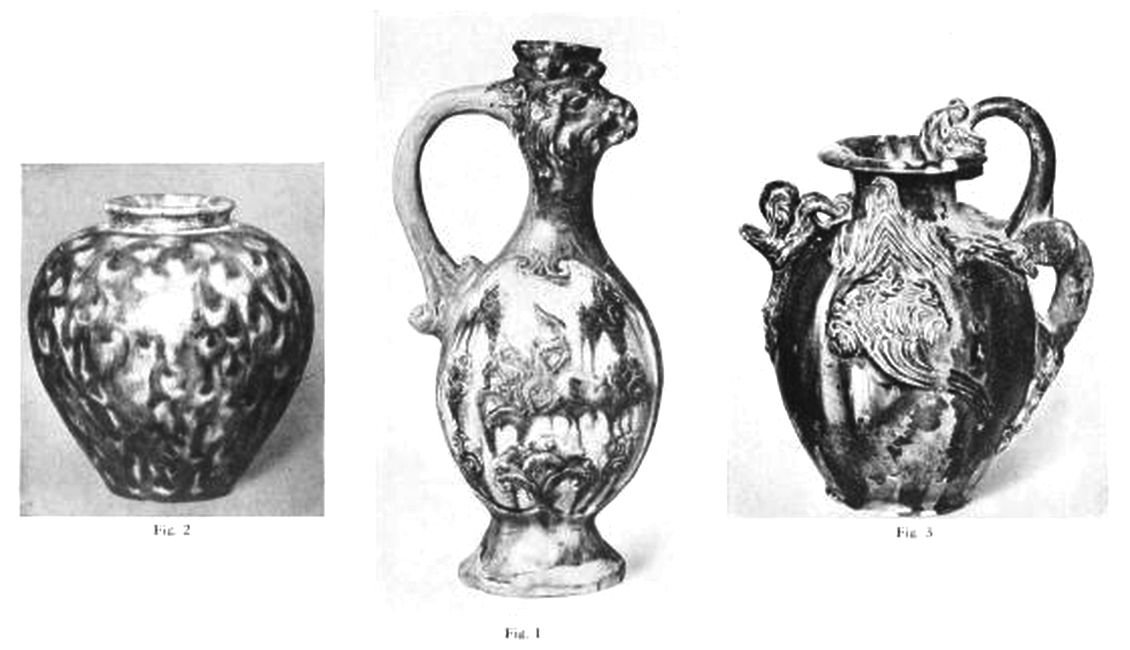
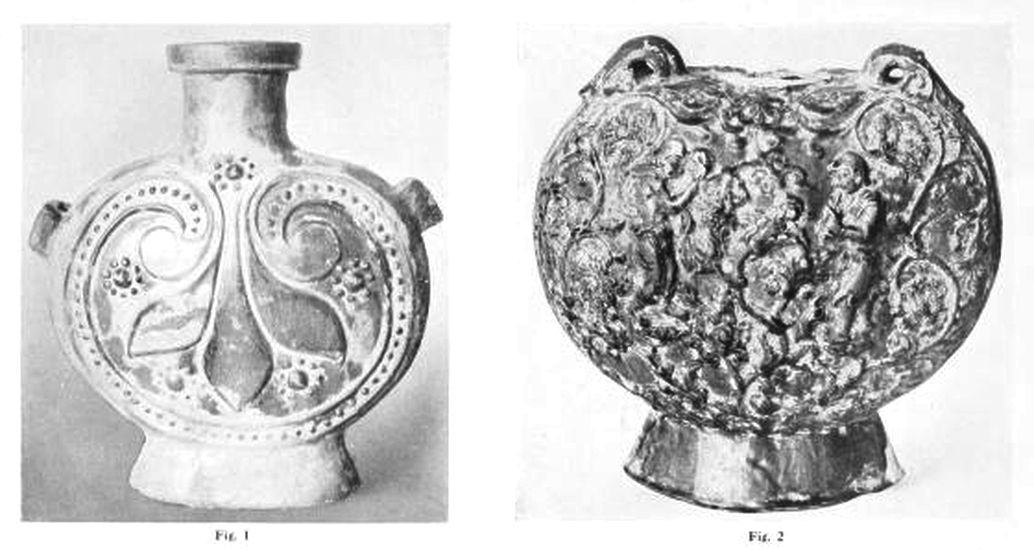
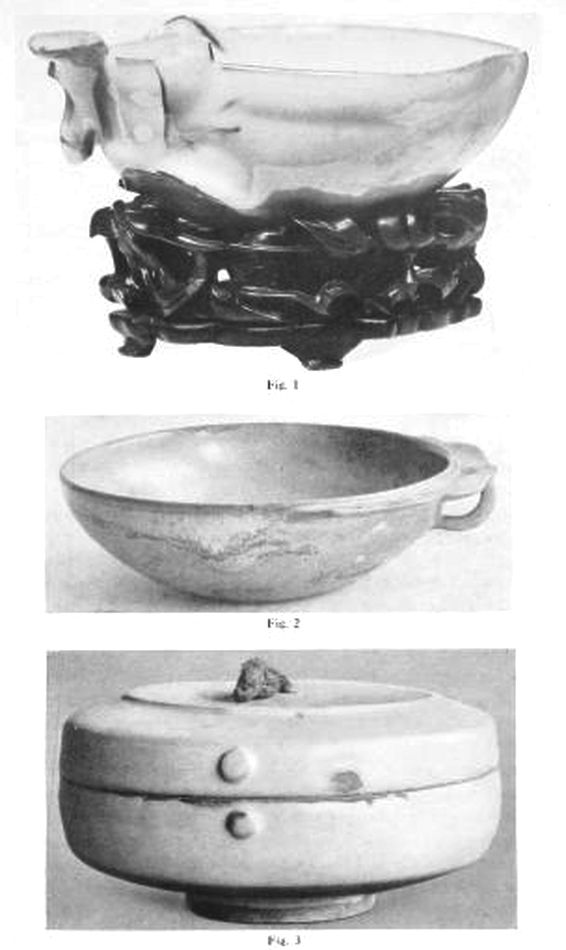
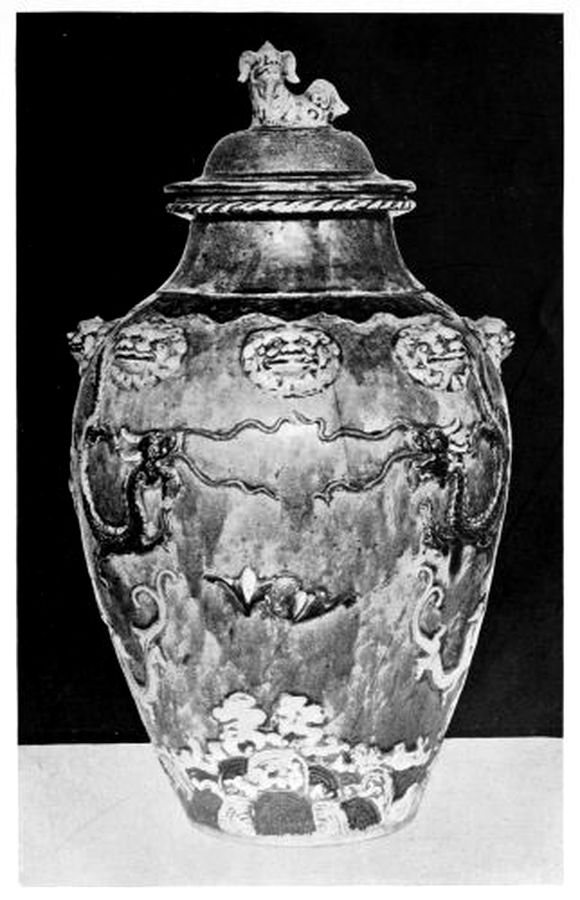
On Plate 3, Fig. 1, is a "hill jar" with brown glaze, standing
on three feet which are moulded with bear forms. On the side is a
frieze in strong relief with hunting scenes of animals, such as the
tiger, boar, monkey, deer, hydra and demon figures, spaced out by
conventional waves. This kind of frieze is frequently found ornamenting
the shoulders of vases such as Fig. 1 of Plate 2, and the animals
are usually represented in vigorous movement, often with fore and
hind legs outstretched in a "flying gallop." The cover is moulded
to suggest mountains rising from sea waves (the sea–girt isles of the
Taoist Immortals), peopled with animals.
Fig. 2 is a green–glazed box or covered bowl of elegant form, the
cover moulded in low relief with a quatrefoil design surrounded by
a frieze of animals.
Fig. 3 is an incense burner of rare form derived from a bronze.
It is a variation of the more usual "hill censer" (po shan lu) which
has the same body with a cover in the form of hills as on Fig. 1.
In this case the cover suggests a lotus flower in bud, and is surmounted
by a duck. The whole is coated with an iridescent green glaze.
A few choice specimens of green–glazed Han pottery in the
S.T. Peters Collection includes a well–modelled duck, a handsome
vase with mask handles and hexagonal base, and a good
example of the "granary urn." The last is a grain jar which
derives its form from a granary tower. In some instances the tiled
roof of the tower is represented by tile–mouldings on the shoulder;
but in this instance the form is entirely conventionalised into a
cylindrical vase supported by three bear–shaped feet. The bear,
an emblem of strength, is commonly employed in this capacity
in Han art. Another ornamental form borrowed from a homely
object is the model of a well–head, of cylindrical shape, with arched
superstructure, in the centre of which a pulley–wheel is represented.
The well bucket is usually added, resting on the edge of
the well.
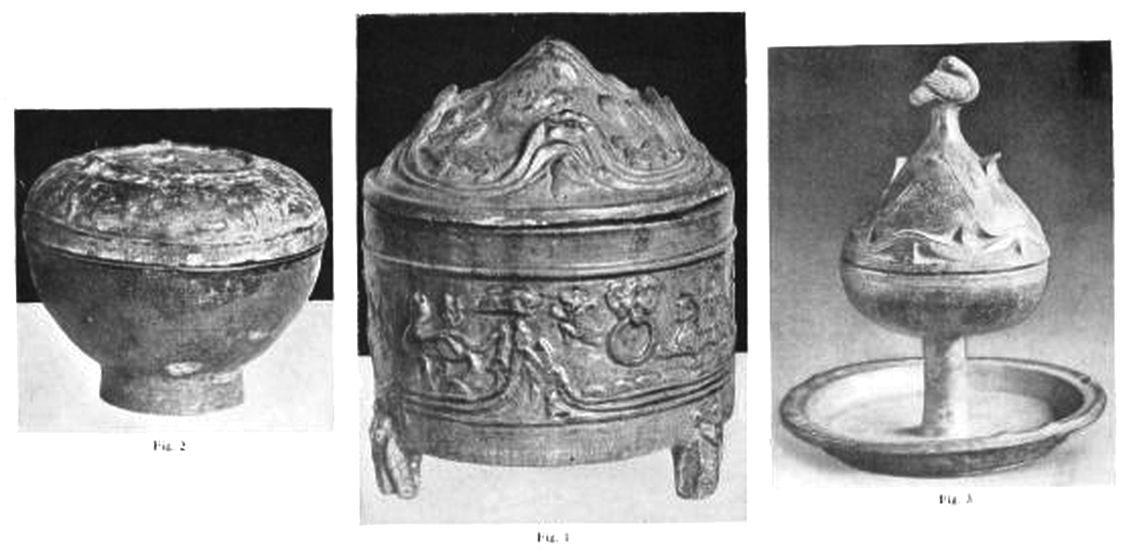
Plate 3.—Han Pottery.
Fig. 1.—"Hill Jar" with brown glaze. Height 9 1/2 inches inches. Eumorfopoulos Collection.
Fig. 2.—Box, green glazed. Height 5 1/2 inches inches. Eumorfopoulos
Collection.
Fig. 3.—"Lotus Censer" green glazed. Height 10 1/2 inches inches. Rothenstein Collection.
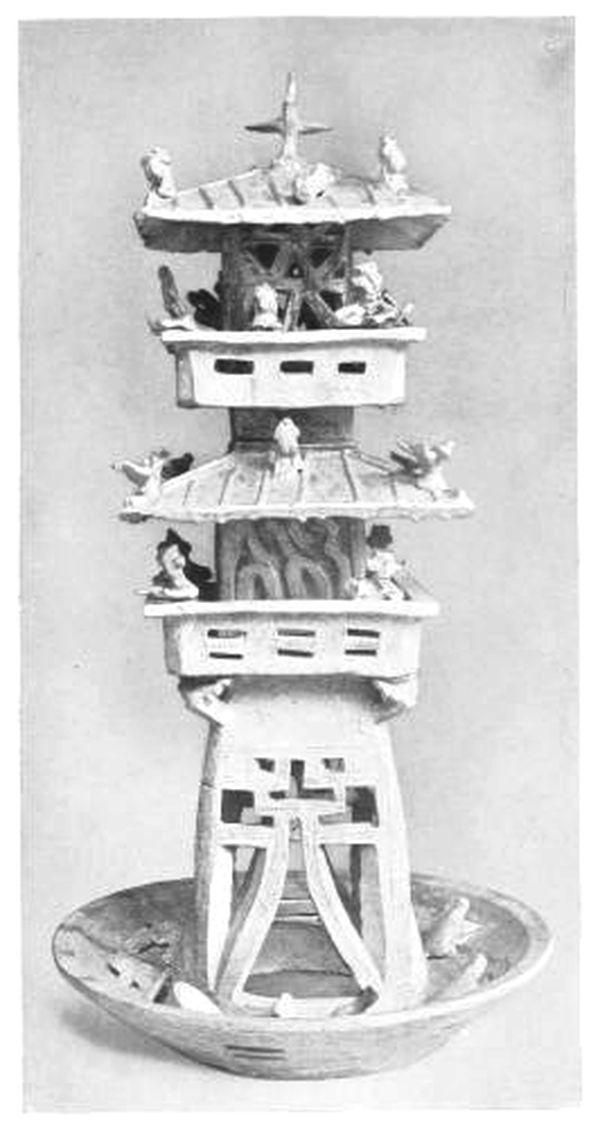
Plate 4.—Model of a "Fowling Tower."
Han pottery with iridescent green glaze. Height 30 inches.
Freer Collection.
Plate 4 illustrates a remarkable structure which seems to represent
a fowling tower. Models of houses and shrines have been found
frequently in Han tombs, showing most of the elements which are
combined in this complex ornament. The structure of wooden beams
and galleries and the roofs with their tubular tile–ridges, the formal
ox–heads supporting the angles of the lower gallery, the ornamentation
of combed lines, are all features which occur in architectural tomb
ornaments of the Han period. Here we have apparently a sporting
tower, with persons engaged in shooting with crossbows at the
pigeons which tamely perch on the roof. The dead birds have
fallen into the saucer–like stand below. This rare and curious
specimen is made of green–glazed pottery, and measures about 30
inches in height.
As already indicated, our knowledge of Han pottery is mainly
derived from the articles disinterred from the tombs of the period,
and this will explain the curious fact that Han pottery was almost
unknown until quite recent times, and that information on the
subject in Chinese ceramic literature is of the most meagre and
least satisfying description. The ancestor–worshipping Chinese have
always been averse to the systematic exploration of graves. Whatever
their practice may have been when the opportunity occurred
of rifling a grave unobserved, this at any rate has been the avowed
principle. The result is that though China must be honeycombed
with graves and tombs, they have not been overtly disturbed in
any numbers until recent years, when extensive railway cuttings
have opened up the ground. To the progress of railway engineering
the sudden appearance of considerable quantities of mortuary
pottery is chiefly due.
On the other hand, one of our most interesting finds was made
away from the railway in Szechuan. Here, in the neighbourhood
of Ch´êng–tu and along the banks of the Min, the soft sandstone hills
which line the river had in ancient times been extensively tunnelled
with elaborate chambers protected by small entrance doors. Whether
these were ever used as dwellings is uncertain, but they certainly
became eventually the tenements of the dead. The deposits of
ages have covered over the entrances to these tombs, but from
time to time torrential rain or some other cause exposed their
approaches to the country folk, who invariably pillaged them for
coins and smashed and scattered their less marketable contents.
The Rev. Thomas Torrance, when stationed at Ch´êng–tu, had the
opportunity of exploring some of these caverns, and even succeeded
in discovering some unrifled tombs, part of the contents
of which he brought over and presented to the British Museum.
The funeral furniture of these tombs varied according to the wealth
and status of the owner. In the poor man's tomb were unprotected
skeletons, small images in a niche, an iron cooking pot, and a few
coins. In the rich man's were terra cotta coffins, encased in ornamented
slabs, images apparently of the members of his household,
a quantity of crockery, and a perfect menagerie of domestic animals
and birds. To quote Mr. Torrance's own words:[23] "Standing with
your reflector in the midst of a large cave, it seems verily an imitation
Noah's Ark."
The practice of burying with the dead the objects which surrounded
him in life has never entirely ceased in any country. Among
primitive peoples it has taken the revolting form of immolating,
or even burying alive, the household of a dead chieftain. Instances
of this practice in China occur as late as the third century b.c.,
and voluntary acts of sacrifice at the tomb are recorded much later
in China as in India. When humaner counsels prevailed figures
of wood, straw and clay were substituted, straw images being suggested
for the purpose by Confucius himself. In the Han dynasty
the tomb of the well–to–do was furnished with models of his house,
his shrine, his farmyard, threshing floor, rice–pounder, his cattle,
sheep, dogs, and poultry, besides his retainers and certain half–human
creatures which may have been his guardian spirits; it
was provided with vases for wine and grain, models of the stove
and kitchen range with cooking pots and implements—the last
merely indicated in low relief on the kitchen range—besides the
more stately sacrificial vessels for wine and incense.[24] All these
were modelled in pottery, and must have fostered a flourishing
potter's trade, and given a tremendous impetus to the growth of
modelling and design. The underlying idea of all this was, no
doubt, to provide the spirit of the dead with the means of pursuing
the habits of his lifetime, and the modern practice of supplying
his needs by means of paper models which are transmitted to the
spirit world through the medium of fire serves the same purpose
in a more economical fashion. But a fuller note on the grave furniture
of the Han and T´ang periods will be given in the next chapter.
Little or nothing is at present known of the potteries in which
the Han wares were made, but we may fairly assume that the
manufacture was very general and that local potteries supplied
local demands. An incidental reference in the T´ao lu gives us
one solitary name, Nan Shan, where the potteries of the Emperor
Wu Ti (140–85 B. C.) were situated;[25] and there is a mention of
potteries in Kiangsi in the place which was afterwards the site
of the celebrated porcelain centre, Ching–tê Chên.
The interval between the Han and T´ang periods, from 221
to 618 A. D., is marked by a rapid succession of short–lived dynasties,
an age of conflict and division, in which China was again split up
into warring states. The conditions were not favourable to the
steady development of the ceramic industry, and little is known of
the pottery of this period. From the few references in Chinese
literature, however, we infer that new kinds of pottery appeared
from time to time, and it is certain that the evolution which
culminated in porcelain made sensible advances. This latter fact is
proved by the scientific analysis of some vases obtained by Dr. Laufer
near Hsi–an Fu in Shensi. There is a similar vase in the British
Museum with ovoid body strongly marked with wheel–ridges, short
neck and wide cup–shaped mouth, and loop handles on the shoulders.
The ware is in appearance a reddish stoneware, and the glaze which
covers the upper part is translucent greenish brown with signs of
crackle. Dr. Laufer's vases are in the Field Museum at Chicago,
where the body and glaze have been analysed by Mr. Nicholls, the
results showing that the body is composed of a kaolin–like
material (probably a kind of decomposed pegmatite) and is, in
fact, an incipient porcelain, lacking a sufficient grinding of the
material. The glaze is composed of the same material softened
with powdered limestone and coloured with iron oxide. An iron
cooking stove found with these vases has an inscription indicating
by its style a date in the Han dynasty or shortly after it; and the
nature of the pottery, in spite of its coarse grain and dark colour,
which is probably due in part to the presence of iron in the clay,
seems to show that the manufacture of porcelain was not far distant.
Meanwhile, there is little doubt that the Han traditions were kept
alive, and the discovery of green glazed ware of Han type in the ruins
of Bazaklik, in Turfan,[26] a site which from other indications appears to
belong to the T´ang civilisation, shows that this type, at any rate,
was long–lived. Two vases from a grave on the Black Rock Hill
in Fu Chou, and now in the British Museum, which are proved
to belong to a period anterior to the seventh century, seem to combine
Han and T´ang characteristics. They are of dark grey stoneware
with a mottled greenish brown glaze, ending considerably
above the base in a wavy line, which is a common feature of T´ang
wares.
It is highly probable that some of the tomb pottery discussed in
the next chapter belongs to the later part of this intermediate
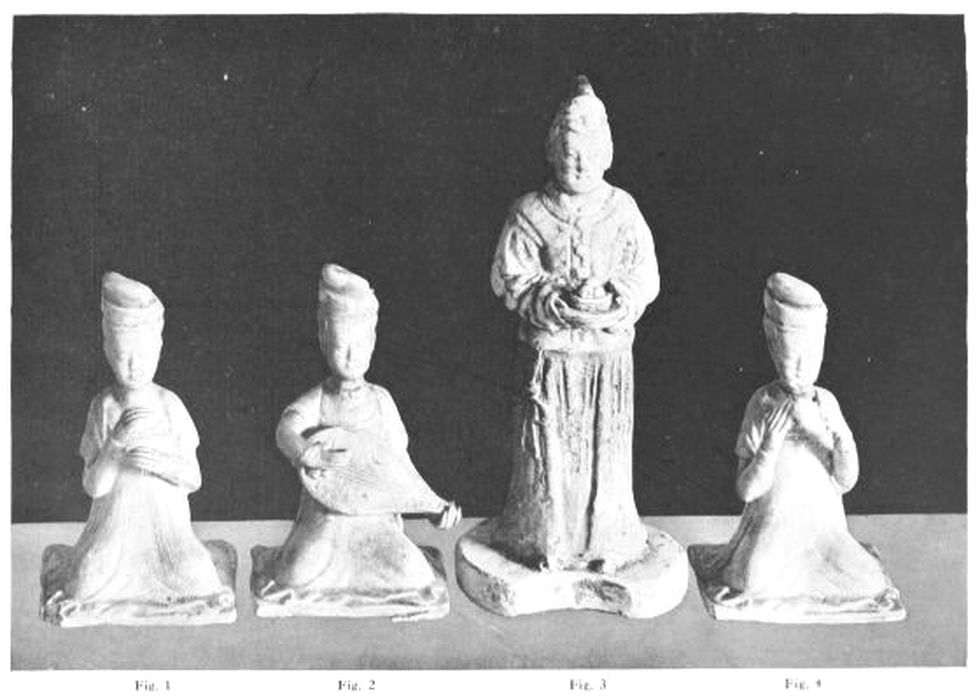
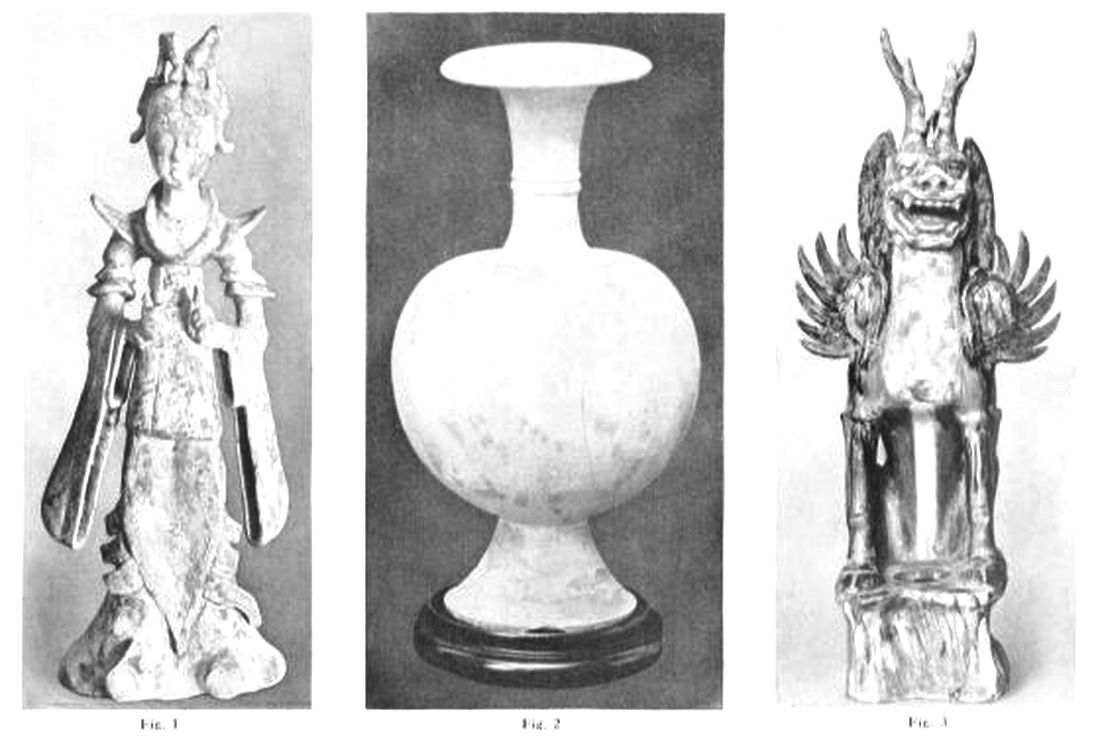
period. Indeed among the pottery figures of this class there are
specimens with slender, graceful bodies and elaborate details of
costume (see Plate 7) which closely resemble the stone statues of
the Northern Wei and the Sui dynasties; but with our present
imperfect information on the tomb finds, it will be more convenient
to treat these nearly related figures as one group.
Turning to Chinese literature, in default of other and more tangible
evidence, we read in the T´ao shuo[27] of pottery dishes and wine vessels
in the Wei dynasty (220–264 A. D.), and in the T´ao lu of pottery made
at Kuan Chung, in the district of Hsi–an Fu, and at Lo–yang for
Imperial use. The poet P´an Yo, of the Chin dynasty (265–419
A. D.), speaks of "cups of green ware." The actual words used are
p´iao tz´ŭ,[28] of which the former is elsewhere used to describe "the
bright tint of distant, well–wooded mountains," and as a synonym
for lü (green), though, like the common colour word ch´ing, it is
capable of meaning both blue and green. The ceramic glaze which
most closely corresponds to the description p´iao is the bluish green
celadon best known from Corean wares, but we have not yet sufficient
grounds for assuming the existence of this particular type at such an
early date.
Another poet[29] of the same period bids his countrymen, when
selecting cups for tea–drinking, to choose the ware of Eastern Ou, a
place in the Yüeh territory, and apparently in the neighbourhood
of, if not identical with, the Yüeh Chou, which was celebrated for
its wares in the T´ang dynasty. The period of the "Northern and
Southern Dynasties" provides but two references, to a kind of
wine vessel known as "crane cups" but otherwise unexplained,
and to chün–ch´ih of fine and coarse ware,[30] which appear to have
been Buddhist water vases for ceremonial washing, or Kundikâ,
which the Chinese have transcribed in the form Chün–ch´ih–ka.
Buddhism was making great strides in China at this time. It
was proclaimed the state religion of the Toba Tartars or Northern Wei,
who ruled the north from 386 to 549 A. D., and Buddhist thought
and the canons of Buddhist art were now firmly imposed upon the
Chinese. The rock sculptures of this period visited and photographed
by Chavannes show unmistakable traces of the Græco–Buddhist
art of Gandhara; and in one remarkable instance among
the figures which were sculptured round the entrance of a Buddhist
grotto were deities with a thyrsus like that of Dionysus and a
trident like Poseidon's.
In the annals of the brief Sui dynasty (581–617 A. D.), we find
that a man named Ho Ch´ou succeeded in exactly imitating a glassy
material called liu li by means of green ware. The exact meaning
of this interesting passage is discussed elsewhere (p. 144), but it is
difficult to imagine any but a porcellanous ware which could satisfy
the conditions implied. Under the circumstance it is not surprising
if theorists see in this green ware (lü tz´ŭ) something in the
nature of the later celadon porcelain.
NOTE ON THE EARLY CHINESE TOMB WARES
With reference to the figures of men and animals and the other
objects which were placed in the ancient tombs of China, much
information will be found in Dr. J.J.M. de Groot's Religious System
of China. The fundamental idea underlying these burial practices
seems to have been that the soul of the dead was the actual
tenant of the grave; but it is not clear in every case whether the
sepulchral furniture was provided in expectation of a bodily resurrection,
or in the belief that it would minister to the wants of the
dead in his spiritual existence. Both ideas appear to have obtained
in early times, though it is certain that the second alone explains
the more modern custom of burning either the objects themselves
or paper counterfeits of them at the tomb, and thus
transmitting them through the medium of fire direct to the spirit
world.
The older custom of burying with the dead all that was necessary
for the continuation of the pursuits of his lifetime, dates back
to the farthest limits of history, so that we read without surprise
that in the Chou dynasty (1122–255 B. C.) there were placed in
the tomb "three earthen pots with pickled meat, preserved meat,
and sliced food; two earthen jars with must and spirits,"[31] besides
"clothes, mirrors, weapons, jade and food pots." It became customary
to hold a preliminary exhibition of the funeral articles at the
dead man's house before removing them to the tomb, and this,
as we may well imagine in a country of ancestor–worshippers, led
to ostentation and extravagance which legislators of various periods
vainly endeavoured to curtail.
The magnificent burials of the Chin and early Han emperors,
the vast mausolea built by forced labour and stocked with costly
furniture and treasure, chariots and live animals, and even human
victims, must have been an intolerable burden to the community.
There is no lack of instances of the immolation, voluntary or otherwise,
of relatives and retainers at the tombs of great personages
in ancient China, though the practice never seems to have been
general, and was strongly reprobated by Confucius (551–479 B. C.).
The sage even went so far as to condemn the substitution of wooden
puppets, "for was there not a danger of their leading to the use
of living victims?"[32] Images of straw were all that he would
permit.
When humaner influences prevailed, the ladies of the harem,
and the military guards, instead of following their Imperial master
to the spirit world, were condemned to reside within the precincts
of the mausoleum; and doubtless the clay figures of women and
warriors placed in the graves of more enlightened times were intended
to relieve their human prototypes of this irksome duty.
The earliest recorded allusion[33] to clay substitutes appears to be
the words of Kuang Wu (in the first century A. D.), that "anciently,
at every burial of an emperor or king, human images of stoneware
(t´ao jên), implements of earthenware (wa ch´i), wooden cars, and
straw horses were used."
De Groot[34] quotes a long list of objects supplied for an Imperial
burial of the Later Han (25–220 A. D.), including "eight hampers
of various grains and pease; three earthen pots of three pints,
holding respectively pickled meat, preserved meat, and sliced food;
two earthen liquor jars of three pints, filled with must and spirits;
... one candlestick of earthenware; ... eight goblets, tureens,
pots, square baskets, wine jars; one wash–basin with a ewer; bells,
... musical instruments, ... arms; nine carriages, and thirty–six
straw images of men and horses; two cooking stoves, two kettles,
one rice strainer, and twelve caldrons of five pints, all of earthenware;
... ten rice dishes of earthenware, two wine pots of earthenware
holding five pints." The use of earthenware substitutes for
the actual belongings of the dead was due in part to the spirit of
economy preached by certain rulers at this time, and in part to the
feeling that graves containing valueless objects would be safe from
the desecration of the robber.
In addition to the general precepts of economy, we learn that
definite regulations were issued prescribing the number and even
the nature of the articles to be used by the various ranks of the
nobility and by the proletariat. Thus in 682 A. D. Kao Tsung
rebuked the competitive extravagance of the people in burial equipments,
which even the ravages of famine had failed to diminish;
and in the K´ai Yüan period an Imperial decree[35] of the year 741
A. D. reduced the number of implements allowed to the various ranks
in burial, officers of the first, second, and third classes of nobility
being allowed seventy, forty, and twenty implements in place of
ninety, seventy, and forty respectively; while for the common
people fifteen only were permitted. Moreover, all such implements
were to be of plain earthenware (ssŭ wa), wood, gold, silver, copper,
and tin being forbidden.
It is clear that at an early date wood was regarded as preferable
to pottery as a material for sepulchral furniture, for the Yin–yang
tsa tsu,[36] written in the eighth century, states that "houses
and sheds, cars and horses, male and female slaves, horned cattle,
and so forth, are made of wood." Indeed, the decree of 741 notwithstanding,
wood seems to have become the standard material
for grave implements from this time onward. Thus, Chu Hsi of
the Sung dynasty taught in his Ritual of Family Life "the custom
of burying the dead with a good many wooden servants, followers,
and female attendants, all holding in their hands articles for use
and food"; and the contents of the Ming graves included "a
furnace–kettle and a furnace, both of wood, saucer with stand, pot,
or vase, an earthen wine–pot, a spittoon, a water basin, an incense
burner, two candlesticks, an incense box, a tea–cup, a tea–saucer,
two chopsticks, two spoons, etc., two wooden bowls, twelve wooden
platters, various articles of furniture, including bed, screen, chest,
and couch, all of wood; sixteen musicians, twenty–four armed
lifeguards, six bearers, ten female attendants; the spirits known
as the Azure Dragon, the White Tiger, the Red Bird, and the Black
Warrior; the two Spirits of the Doorway and ten warriors—all
made of wood and one foot high." These were among the implements
permitted in the tombs of grandees; the regulations of 1372
allowed only one kind of implement in the tombs of the common
folk.
From the foregoing passages it may be inferred that wood superseded
pottery to a very great extent in the funeral furniture of
the Sung and Ming periods, and consequently that the tombs in
which a full pottery equipment has been found are most probably
not later than the first half of the T´ang dynasty. Needless
to say, the wooden paraphernalia rapidly perished under the
ground, and while the pottery implements have preserved their
original form and appearance, the wooden objects have mostly
disintegrated.
An amusing fragment of folklore, translated by de Groot[37] from
the Kuang i chi, "a work probably written in the tenth century,"
will form a fitting conclusion to this note, revealing as it does the
thought of the Chinese of this period with regard to the burial
customs which we have discussed:—
"During one of the last generations there lived a man, who
used to travel the country as an itinerant trader in the environs
of the place where his family was settled. Having been accompanied
on one of his excursions for several days by a certain man,
the latter unexpectedly said, 'I am a ghost. Every day and every
night I am obliged to fight and quarrel with the objects buried
in my tomb for the use of my manes, because they oppose my will.
I hope you will not refuse to speak a few words for me, to help
me out of this calamitous state of disorder. What will you do in
this case?' 'If a good result be attainable,' replied the trader,
'I dare undertake anything.' About twilight they came to a large
tomb, located on the left side of the road. Pointing to it, the
ghost said: 'This is my grave. Stand in front of it and exclaim,
"By Imperial Order, behead thy gold and silver subjects, and all
will be over." Hereupon the ghost entered the grave. The pedlar
shouted out the order, and during some moments he heard a noise
like that produced by an executioner's sword. After a while the
ghost came forth from the tomb, his hands filled with several decapitated
men and horses of gold and silver. 'Accept these things,'
he said; 'they will sufficiently ensure your felicity for the whole
of your life; take them as a reward for what you have done for
me.' When our pedlar reached the Western metropolis he was
denounced to the prefect of the district by a detective from Ch´ang–ngan
city, who held that such antique objects could only have
been obtained from a grave broken open. The man gave the prefect
a veracious account of what had happened, and this magistrate
reported the matter to the higher authorities, who sent it on
to the Throne. Some persons were dispatched to the grave with
the pedlar. They opened the grave, and found therein hundreds
of gold and silver images of men and horses with their heads severed
from their bodies."
In the present day[38] at important sacrifices to ancestors (and
presumably at the funeral itself), it is customary to burn counterfeits
of all kinds of furniture and objects which might be useful
in the spirit–world. In general these counterfeits take the form
of small square sheets of cheap paper adorned with pictures, stamped
with a rudely carved wooden die, and representing houses, chairs,
implements for cooking, writing and the toilette, carts and horses,
sedan chairs, attendants and servants, slaves (male and female),
cattle, etc. It is not clear when this custom first came into being,
but it evidently replaced an earlier practice of burning real furniture,
clothing, etc., at the tomb; and de Groot implies, at any
rate, that the two practices existed side by side in the eleventh
century. "Bonfires of genuine articles," he says,[39] "and valuables
continued for a long time to hold a place side by side with bonfires
of counterfeits. We read e.g. that at the demise of the Emperor
Shêng Tsung of the Liao dynasty (1030 A. D.) the departure of the
cortège of death from the palace was marked by a sacrifice, at which
they took clothes, bows and arrows, saddles, bridles, pictures of
horses, of camels, lifeguards, and similar things, which were all
committed to the flames." Marco Polo,[40] in describing the city of
Kinsai, relates that the inhabitants burnt their dead, and "threw
into the flames many pieces of cotton paper upon which were
painted representations of male and female servants, horses, camels,
silk wrought with gold, as well as gold and silver money."
 D
 D
 D


 W
 D
 W
 W
 . The topographical history of the province of
Kiangsi, revised edition in 180 books, published in 1882.
 . The encyclopædia
of the K´ang Hsi period, Section XXXII. Handicrafts (k´ao kung). Part 8
entitled T´ao kung pu hui k´ao, and Part 248 entitled Tz´ŭ ch´i pu hui k´ao.
 "Researches in Metal and Stone," by the Brothers Fêng. 1821.
 "A Storehouse of Artistic Rarities," by Chang Ying–wên,
published by his son in 1595.
 , "The Ceramic Records of Ching–tê Chên,"
in ten parts, by Lan P´u, published in 1815. Books VIII. and IX. are a corpus
of references to pottery and porcelain from Chinese literature.
 , "Porcelain of Ching–tê Chên," a volume of MS. written about
1850.
 , "Notes jotted down in the intervals of ploughing," a miscellany
on works of art in thirty books, by T´ao Tsung–i, published in 1368. The
section on pottery is practically a transcript of a note in the Yüan chai pi hêng, by
Yeh Chih, a thirteenth–century writer.
 , "Essential Discussion of the Criteria of Antiquities,"
by Tsao Ch´ao, published in 1387 in thirteen books; revised and enlarged edition
in 1459.
 , by Chang Chin–chien. 1877.
 , "A General Survey of Art Objects," by Ku Ying–t´ai,
published in the T´ien Ch´i period (1621–27).
 , "A Discussion of Pottery," by Chu Yen, in six parts, published in 1774.
See B
 (lit. pattern, bright colours), and they
seem to imply a knowledge of some means of colouring the ware. As
there is no evidence of the use of glaze before the Han period,
and enamelling in the ordinary ceramic sense is out of the question,
we may perhaps assume that some of the pottery of the Chou
period was painted with unfired pigments, a method certainly in
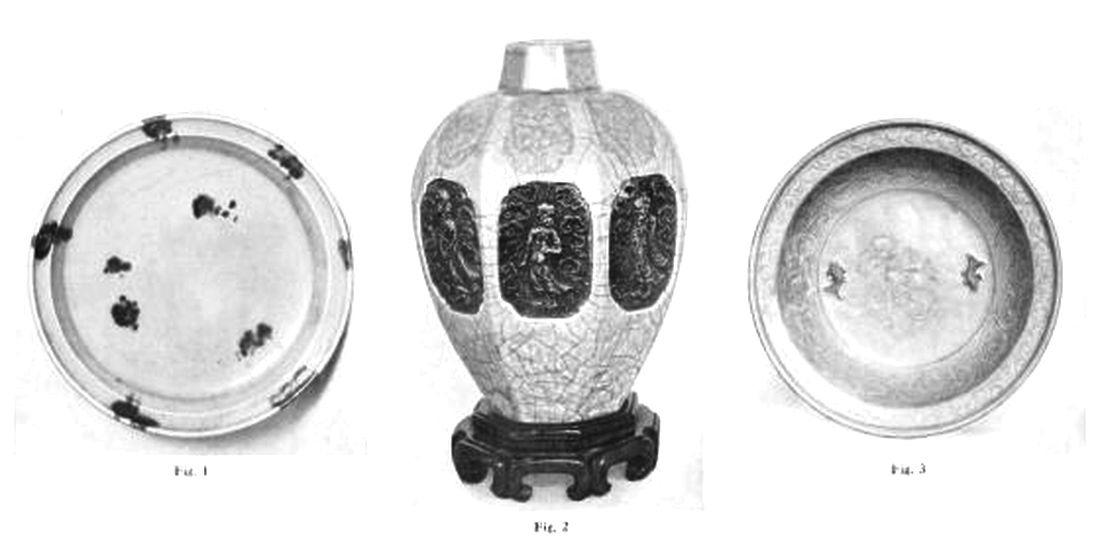
use in the Han dynasty. There is a vase in the British Museum
of unglazed ware with painted designs in black, red and white
pigments, which has been regarded as of Han period, but may
possibly be earlier (Plate 2, Fig. 3).
 DYNASTY, 618–906
 in the Hsi–an Fu,
 in the Chin–hua Fu, in Chêkiang; Yo Chou
 in
Hunan; Shou Chou
 in Kiangnan; and Hung Chou
 ,
the modern Nan–ch´ang Fu, in Kiangsi, the district in which is
Ching–tê Chên, afterwards the ceramic metropolis of China. Of
these wares we have only the meagre information that the Yo
Chou ware was of green (ch´ing) colour; the Shou Chou ware,
yellow; and that the Hung Chou ware was a brownish colour,


 in later
writers, which is very near in appearance to tung
 , a common form
used for the Tung ware (see p. 82); and we can safely leave it until
some clearer information is forthcoming. The second, according
to the T´ao lu,

 , who were potters of Lung–ch´üan
Hsien in the Ch´u–chou Fu, province of Chekiang, each having a
separate factory in the Liu–t´ien district. Most of the Chinese
authorities are content to give the date of these brothers as some
time in the Sung dynasty, but one account

 ."
 (pure) surrounded
by rays. It has a fine silver–gilt mount of English make.
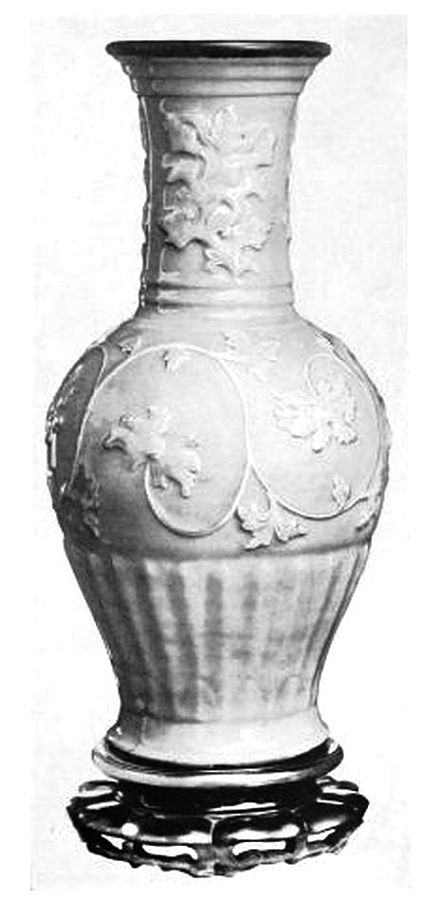

 ) was engraved in
seal characters on the stand. During the Japanese raids in the Chia
Ching period this vessel passed into the hands of one Chin Shang–pao,
who sold it to T´ang, the President of Sacrifices (t´ai ch´ang),
of P´i–ling. T´ang, whose residence bore the romantic but chilly
name of Ning–an (Frozen Hut), is the celebrated collector mentioned
in connection with another Ting vessel on p. 95. "Although
T´ang had many wonderful porcelains," the story runs, "when
this vessel arrived, they all, without exception, made way for it.
And so throughout the land when men discuss porcelains, they
give the first place to T´ang's white incense vase. T´ang, they say,
did not readily allow it to be seen." And in this respect, if all
accounts are true, T´ang was not unlike a good many Chinese
collectors of the present day.
 han hsing ("to contain
fragrance").
 . We are further informed by the
Chü chai tsa chi
 WARE
 ware
 ta (great). This is the view which, I believe, is usually
accepted in China, and Mr. Eumorfopoulos, who has an exceptional
series of these wares, has applied the test to all he has seen, and
has found the size theory to hold good in all but a few cases, for
which an explanation may yet be found.
 ).
 ).
 ).
 ).
 ),
with the addition of four kinds obtained from other sources.
 ).
 ).
 ).
 ).
 yao
 , as we have seen, was defined in the Han
dictionary as merely "pottery ware." Its modern definition is
a hard, fine–grained variety of t'ao, and if we add to this the quality
of resonance—i.e. of emitting a musical note when struck—we
have all the requirements of porcelain according to the Chinese
definition. The synonym
 , containing the radical
 shih (a
stone), which is also pronounced tz'ŭ, has come in the last two
centuries to be used interchangeably with the older word
 , in
spite of the protests of eighteenth–century purists.
 is a term even more comprehensive than our
word "china." In the Han dictionary it appeared in the form
 t'ao or yao (previously pronounced fou), composed of
 fou (earthenware)
and the radical
 pao (to wrap), and its meaning was kiln,
and by extension the products of the kiln. At that time the word
in its modern form was only used as a proper name.
 it occurs in the Han dictionary; another form is
 ,
which, according to a Sung writer,
 is current in modern dictionaries.
 , a connoisseur in pictures
and antiquities, succeeded in making it with green ware (lü tz'ŭ),
and that his imitations were not distinguishable from the original
substance.
 which he shows to be without doubt the kaolinic earth
used in the manufacture of porcelain, and which, like many other
strange materials, entered into Chinese medicinal prescriptions.
The first mention of this substance is taken from the writings of
T´ao Yin–chü, who died in 536
 DYNASTY, 1280–1367 A.D.
 WARES
 WARE
 who flourished in the Chêng Tê period (1506–1521). Though it
would appear that Kung Ch´un, while attending his master Wu
I–shan at the Chin–sha temple, surreptitiously learnt the secrets of
the priest, his fame completely eclipsed that of his teacher, and he
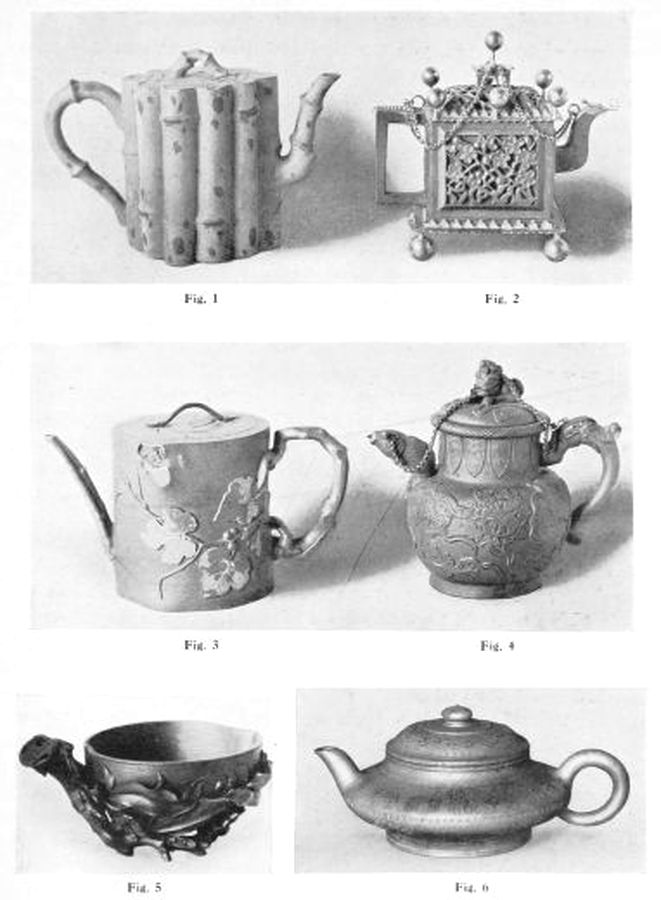
is usually venerated as the founder of the Yi–hsing potteries. His
pots are described as being "hand made, and in most of them
thumb–marks are faintly visible. Generally their colour is that
of a chestnut, and they have a subdued lustre like oxidised gold.
Their simplicity and accuracy of shape are inimitable; worthy to
be ascribed to divine revelations."
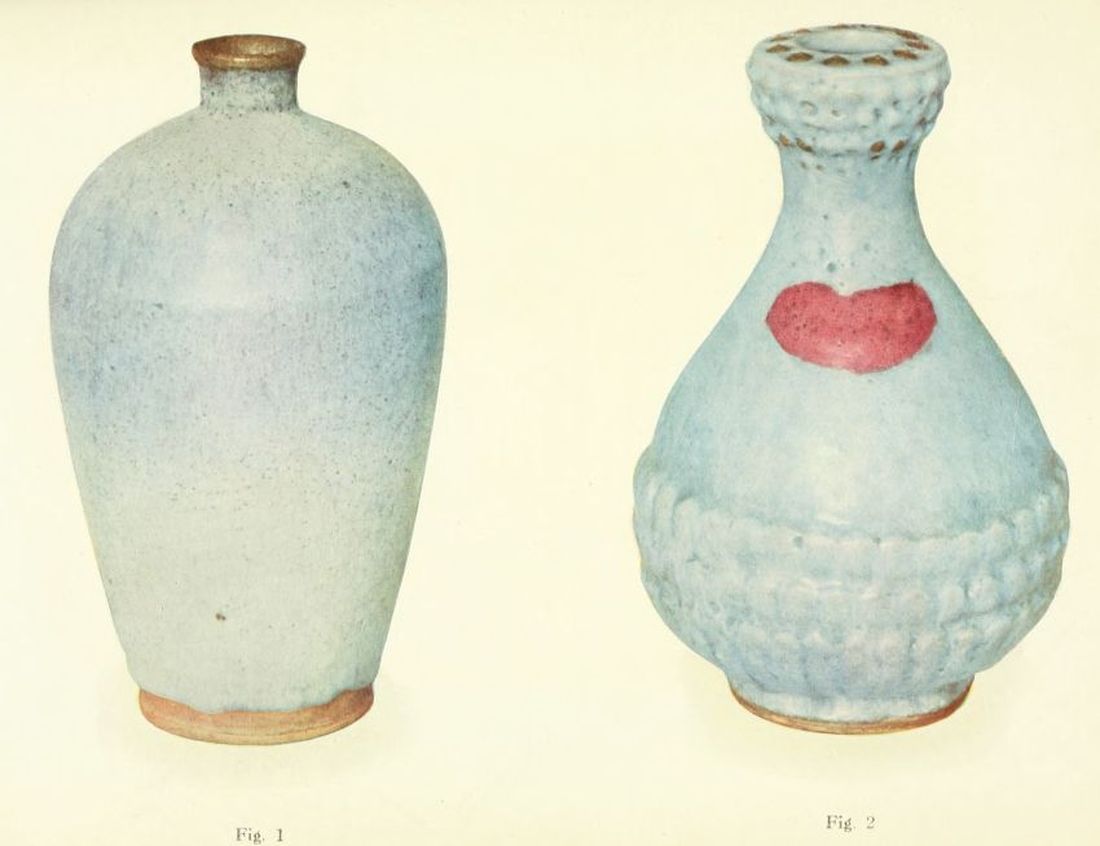
 gained a great reputation
for his glazes, which "copied the Ko ware in crackle and the
Kuan and Chün wares in colour."
 ,
which, according to the catalogue of the Paris Exhibition, was still
celebrated for its pottery in 1878. But the reputation of Su Chou
does not rest on its modern achievements. Its name occurs frequently
in the pottery section of the great encyclopædia (compiled
by order of the Emperor K´ang Hsi) as one of the prominent
pottery centres in the Ming dynasty. Tiles for the palaces and
temples of Nanking were made there, and vases and wine vessels
for the Imperial Court. The nature of these last can be guessed
from a hint given in one passage of the encyclopædia
 and Tsou
 were beautifully moulded, and
artistically carved and engraved, and the pots made by the Elder
and the Younger Hsiu
 , two daughters of Tsou, were the finest
of all. At this time fighting crickets was a favourite pastime,
and hundreds and thousands of cash were staked upon the event,
so that they did not grudge spending large sums upon the pots,
which were decorated in this elaborate way, and consequently far
surpassed the ordinary porcelain of the period."
 in the Ch´ing–chou Fu, in Shantung, were represented only by a
small exhibit at the Paris Exhibition of 1878, consisting of "a
bottle of glazed pottery, three tea jars in red ware, ten specimens
of glazed pottery, a brazier in terra cotta, and seven crucibles."
Laufer tells us that these potteries date back to Sung times, and
have preserved the old traditions of manufacture. The district
is also noted for its glass, enamels and glazing materials, but it
is situated inland, and not conveniently near any of the treaty
ports.
 , which was intermittently
active in the first half of the fifteenth century.
 and the hills of Shu (or Szech´uan) there are black and yellow
clays suitable for pottery; that the potters had their kilns in holes
in the mountains; and that they used the yellow clay for the body
of the ware and overlaid it with the black, making jars, drug pots,
cauldrons, pots, dishes, bowls, sacrificial vessels, and the like. They
also made one kind of ware which resembled that of Chün Chou.
 in the Chên–ting Fu,
in Chihli, are mentioned
 in the
Ch´ing–chou Fu are noticed
 in the Yang–chou Fu, in Kiangsu, there were
factories which supplied wine jars, etc., to the palace at Nanking
in the early years of the Ming dynasty; and in the seventh year
of Chia Ching (1528) supplies of similar vessels were sent from
Ning–kuo Fu
 in the south–west of Anhui.
 as producing a thin white ware made of "plastic clay"
in the Yüan and Ming periods. A verse of Wang Shih–chêng (1526–1593)
speaks of the "snow white porcelain of Hsüan Chou."
 , I–yang Hsien
 ,
Têng–fêng Hsien
 , and Shan Chou
 in Honan; at Yi Hsien
 and Tsou Hsien
 in Yen–chou Fu in Shantung; in the
Lung Shang
 district in Shensi, and at Hêng–fêng
 in
Kiangsi. The last–mentioned factory was established by a man
named Ch´ü Chih–kao from Ch´u–chou Fu in the early Ming period.
In the Chia Ching period (1522–1566) it was transferred to the
I–yang
 district to a place called Ma–k´êng, not many miles
south of Ching–tê Chên. Both the Lung–shang and Ma–k´êng
wares are described as very coarse.
 , the inhabitants were ordered to use tiles
on their houses in place of wood in order to lessen the risk of fire;
kilns were erected to provide the tiles, and those who were too
poor to carry out the alterations by themselves received State
help. A somewhat similar but more important edict was issued
in the twenty–seventh year of Hung Wu
 in the extreme west of Shantung; Su Chou
 in Kiangsu, on the east side of the lake T´ai–hu, and facing the
potteries of Yi–hsing, which supplied tiles for the palaces and temples
of Nanking; the neighbouring Ch´ang–chou Chên, and Yi–chên
and Kua Chou in the Yang–chou Fu of the same province; Wu–Ch´ing
Hsien
 , in the district of Peking, where the potters
asked for permission to make tiles for public use in 1574.


























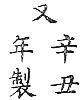
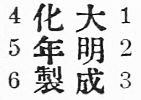
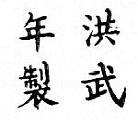
 (Imperial),
yü chih meaning made by Imperial command; and in place of chih
we sometimes find the word tsao
 or more rarely tso
 both of which
have the same meaning "made."


 H
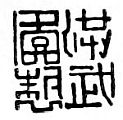 Same in seal
characters.
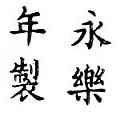 Y
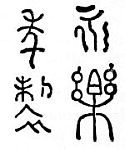 Same in archaic
characters.
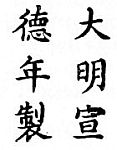 H
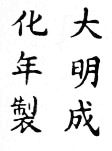
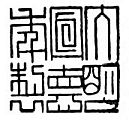 Same in seal
characters.
 C
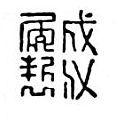 Same in seal characters (the first two
omitted).
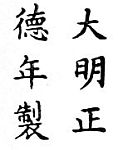
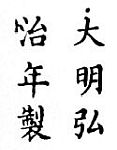 H
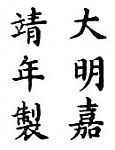
 C
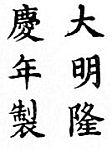
 C
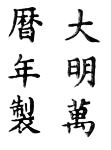
 L
 W
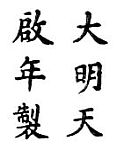 T´
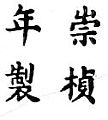 C
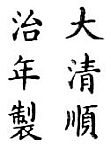 S
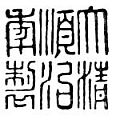 Same in seal characters.
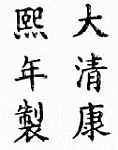 K´
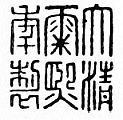 Same in seal
characters.
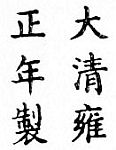 Y
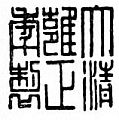 Same in seal
characters.
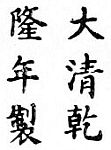 C
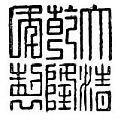 Same in seal
characters.
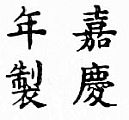 C
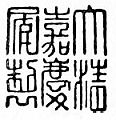 Same in seal characters.
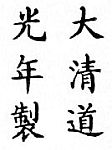 T
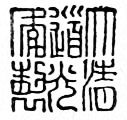 Same in seal
characters.
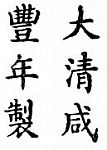 H
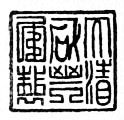 Same in seal
characters.
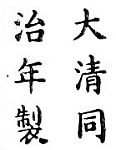 T´
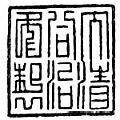 Same in seal
characters.
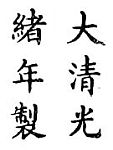 K
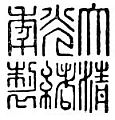 Same in seal
characters.
 (hall) or some equivalent such as chai
 (a study), t´ing
 (a pavilion), hsien or hsüan
 (a porch, balcony or pavilion), kuan
 (a residence or hostelry), fang
 (a room or house), chü
 (a
dwelling). The word t´ang as explained in Giles's Dictionary is
"a hall: especially a hall of justice or court; the ancestral hall;
an official title." T´ang ming is "the family hall name—a fancy
name usually consisting of two characters followed by t´ang (e.g.
wu tê t´ang chin = Chin of the military valour hall), and referring
to some event in family history. It is generally inscribed in one of
the principal rooms of the house, and is used in deeds, on graves,
boundary stones, etc."
 Lin yü t´ang chih may mean "made in the
Abundant–Jade Hall," or "for" the same, or by a man whose
studio name was Lin–yü t´ang.
 (Hotel of
Benevolence and Harmony). A similar mark similarly placed is
 jên ts´un t´ang (Hall of Benevolence), on a Tz´ŭ Chou jar
in the Eumorfopoulos Collection.
 yü t´ang chia ch´i, "beautiful vessel for the Jade Hall."
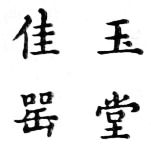 Yü t´ang chia ch´i = fine vessel for the jade hall (late Ming).
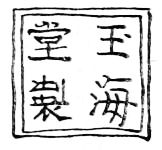 Yü hai t´ang chih = made for the Yü–hai (jade sea) hall (about 1700).
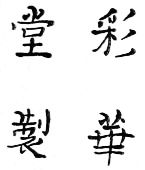 Ts´ai hua t´ang chih = made for
the hall of bright painting
(nineteenth century).
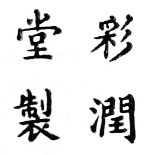 Ts´ai jun t´ang
chih = made for the hall of
bright colours
(nineteenth
century).
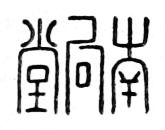 Nan hsiang t´ang = south aspect hall
(on eighteenth century pottery).
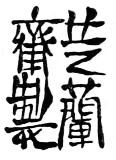 Chih lan chai chih = made for the
epidendrum hall (seventeenth century).
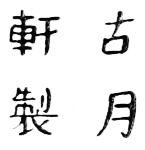 Ku yüeh hsüan chih = made by Ku–yüeh–hsüan. (See Vol. ii., p. 215.)
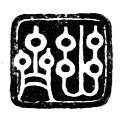 Yu ch´ai = quiet
pavilion—a studio
name of a painter.
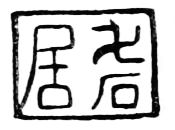 Wan shih chü = myriad rocks retreat;
studio name of a painter.
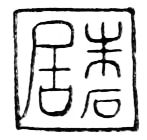 Chu shih chü = red
rocks retreat; studio name of a painter.
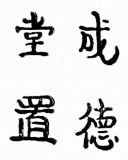 Ch´êng tê t´ang chih = ordered for the
Ch´êng–tê (complete virtue) hall.
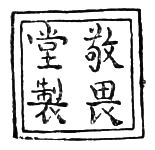 Ching wei t´ang chih = made for the
Ching–wei (reverent awe) hall.
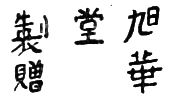 Hsü hua t´ang chih tsêng = made for
the Hsü–hua hall, for presentation.
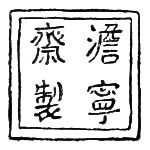 Tan ning chai chih = made for the
Tan–ning (peace and tranquillity) pavilion.
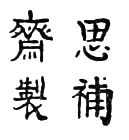 Ssŭ pu chai chih = made for the Ssŭ–pu
pavilion (i.e. pavilion for meditation for the correction of faults).
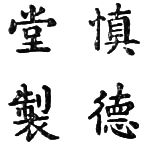 Shên tê t´ang chih = made for the Shên–tê
(cultivation of virtue) hall. (See Vol. ii., p. 264.)
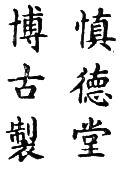 Shên tê t´ang po ku chih = antique
made for the Shên–tê hall.
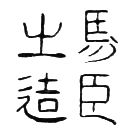 Ma chên shih tsao = made by ma ch´ên–shih
(on a T´ang vase).
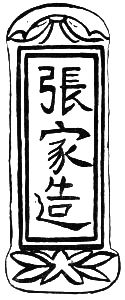 Chang chia tsao = made by the Chang family
(on Tz´ŭ Chou ware). (See Vol. i., p.
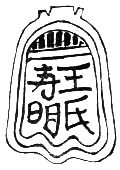 Wang shih ch´ih ming = Mr. Wang
Ch´ih–ming (on Tz´ŭ–Chou ware).
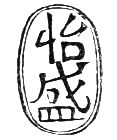 I shêng = harmonious prosperity.
Perhaps a potter's name (on Kuangtung ware).
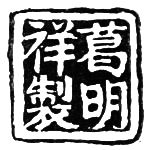 Ko ming–hsiang
chih = made
by Ko Ming–hsiang
(eighteenth
century).
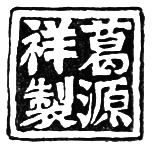 Ko yüan hsiang
chih = made by Ko Yüan–hsiang
(eighteenth
century).
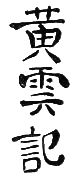 Huang yün chi =
mark of Huang–yün
(nineteenth century).
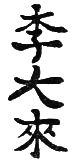 Li Ta–lai = potter's name.
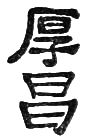 Hou–ch´ang = potter's name.
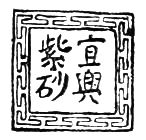 Yi hsing tzŭ sha = brown earth (lit.
sand) of Yi–hsing.
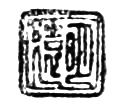 Ming–yüan = a late Ming potter at Yi–hsing.
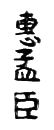 Hui mêng–chên = name of a late
Ming potter at Yi–hsing, copied on modern wares.
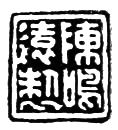 Ch´ên Ming Yüan chih = made by Ch´ên Ming–Yüan, Yi–hsing.
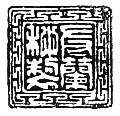 Yü lan pi chih = secretly made by Yü–lan;
Yi–hsing (nineteenth century).
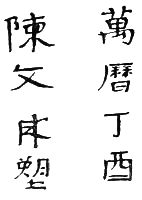 Wan li ting yu ch´ên wên ching su = Ch´ên Wên–ching
modelled it in the ting–yu year of Wan Li (i.e. 1597).
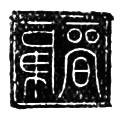 Chao–chin = a potter's name.
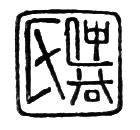 Chung t´un shih = Chung–t´un family.
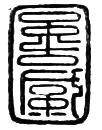 (?) Li–chih = a potter's name.
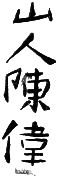 Shan jên ch´ên–wei = the hermit Ch´ên–wei.
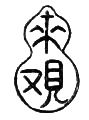 Lai–kuan = potter's name.
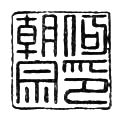 Chao tsung ho yin = seal of Ho Chao–tsung.
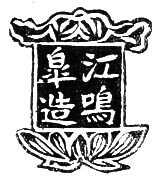 Chiang ming kao tsao = made by Chiang Ming–kao (about 1700).
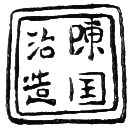 Ch´ên kuo chih tsao = made by Ch´ên
Kuo–chih (about 1700).
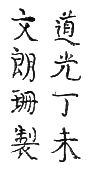 Tao kuang ting wei wên lang shan chih = made by
Wên Lang–shan in the ting–wei
year of Tao Kuang (i.e. 1847).
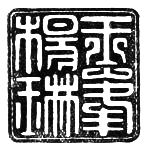 Yü fêng yang lin = Yang Lin of Yü–fêng. (See Vol. ii., p. 212.)
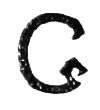 (?) Trader's mark on export porcelain. (See Vol. ii., p. 136.)
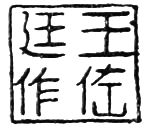 Wang tso t´ing tso = made by Wang Tso–t´ing (early
nineteenth century).
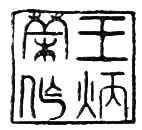 Wang ping jung tso = made by Wan Ping–jung (early
nineteenth century).
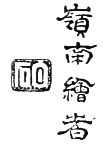 Ling nan hui chê = Ling–nan (Canton)
painting. Seal of Pai–shih
(white rock). (See Vol. ii., p. 211.)
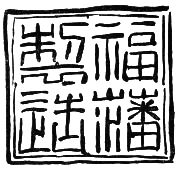 Fu fan chih tsao = made on the borders of Fukien. (See Vol. ii., p. 108.)
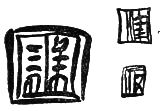 Three examples of "shop marks."
 (Imperial palace) which was inscribed on the Imperial
porcelain of the Yüan dynasty.
 t´an (altar) on the altar cups of the Hsüan Tê period;
 ch´a (tea),
 chiu (wine),
 tsao t´ang (decoction of jujubes), and
 chiang t´ang (decoction of ginger), which were inscribed inside
the altar cups of the Chia Ching period, besides
 chin lu (golden
seal),
 ta chiao (great sacrifice), and
 t´an yung (altar use), which were written beneath them; all indicating the offerings
and the altars for which the cups were destined.
 chi (good luck),
 ch´ing (prosperity), etc.
 yü (jade) to a sentence like ch´i shih
pao ting chih chên (a gem among precious vessels of rare stone).
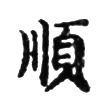 Shun = harmony.
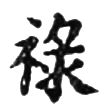 Lu = prosperity.
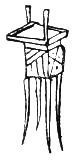
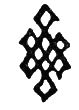
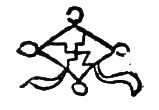
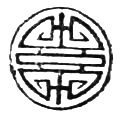 Shou = longevity
(seal form).
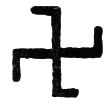
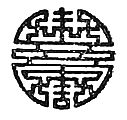 The same, with the
Swastika interwoven.
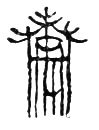 The "spider" mark, a
fanciful form of shou.
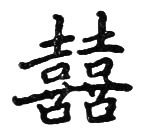 hsi (joy) repeated =
double joy, a wedding
symbol.
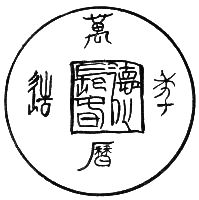
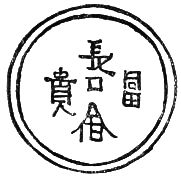
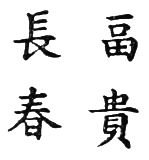 fu kuei ch'ang ch'un =
riches, honours, and enduring spring!
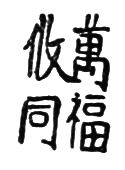 Wan fu yu t'ung = a myriad
happinesses embrace all (your affairs)!
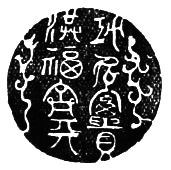 Kung ming fu
kuei Hung fu ch'i t'ien = a famous name, riches and honours,
vast happiness equalling heaven!
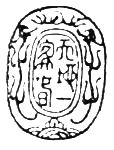 t'ien t'i yi
chia ch'un = spring time for the whole family of
heaven and earth.
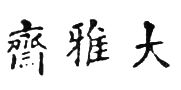 ta ya chai = pavilion of
grand culture. The Empress dowager's mark.
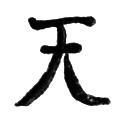 t´ien = heaven.
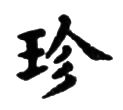 Chên = a gem.
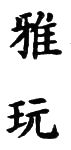 Ya wan = elegant trinket.
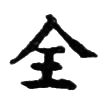 Ch´üan = complete.
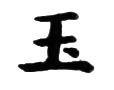 Yü = jade.
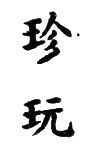 Chên wan = precious trinket.
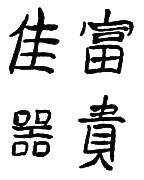 fu kuei chia ch´i =
fine vessel for the rich and honourable.
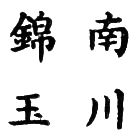 Nan ch´uan chin yü = embroidered jade
of Nan–ch´uan (i.e. Ching–tê Chên).
 Ch´i shih pao ting
chih chên = a gem among precious vessels of rare stone.
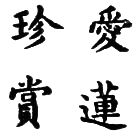 Ai lien chên shang = precious reward of
the lover of the lotus.
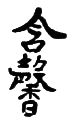 han hsing = to contain fragrance.
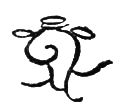

 . See also Bushell's translation of the T´ao shuo, pp. 97 and 98.
 for which Bushell has given the
free and rather misleading version, "Select cups of fine porcelain."
 .
 , sometimes written
 .
 ts´ui sê. Ts´ui is the colour of "a bird with blue–green feathers: a kingfisher"
(Giles), and it seems to have been used indifferently to express a bluish green
colour and greenish blue like turquoise. In Lu Kuei–mêng's poem it suggests the
colour of distant hills. A passage in a seventeenth–century work, the Ch´i sung t´ang
shih hsiao lu (quoted in the T´ao lu, bk. ix., fol. 8), seems to imply that there were
lustrous reflections in the glaze of some of the Yüeh wares. It runs, "Yüeh yao cups
with small feet are of the light green (ch´ing) of the chestnut husk; when turned sideways
they are the colour of emerald green jade (fei ts´ui)."

 in Chihli.
 , a coarse cloth or serge, used to suggest a brownish tint; cf. sê ho ju t´ung
= colour ho like copper.
 yü kuo t´ien ch´ing yün p´o ch´u chê. It will be observed that
the colour word used is ch´ing, which has the meaning of blue or green, indifferently.
 tan ch'ing, according to the Ko ku yao lun.
 luan pai; according to the Po wu yao lan. Of three specimens figured
in Hsiang's Album (op. cit., pp. 19, 22 and 34), two are described as yü lan (i.e. sky
blue), and fên ch'ing (pale blue or green), and the third is undescribed.

 ware,
after the Ta Kuan period.
 a phrase which is not very lucid. In fact, I suspect a confusion with
another tan
 , which means "egg," and would give the sense "egg white," like the
luan pai of the Ju yao.
 Ch´êng ni, lit. "pure, limpid, or clear clay," an expression which is explained
in the T´ao shuo (bk. i., fol. 4 verso) as "refined earth," the word ch´êng (or
ling) being equivalent to
 t´ao, which means to wash.
 jung ch´ê, lit. "brilliant penetrate, or brilliant right through."
 has the meaning "continuation," and if it be not a place–name
at present unidentified, it might conceivably be "the continuation or later Kuan
ware."
 hsieh chao wên, a debatable phrase, which seems best explained as a large
irregular crackle resembling the tangle of claws seen on the top of a basket of crabs.
 Yü tzŭ. A crackle of finer mesh, which French writers describe as truité,
or resembling the scales of a trout.
 pai chi sui, used by the author of the P´ai shih lei p´ien; see other references
in the T´ao shuo and the T´ao lu.
 mi sê fên ch´ing. Mi sê is rendered in Giles's Dictionary, "Straw
colour, the colour of yellow millet," and all Chinese authorities whom I have questioned
agree that it is a yellow colour. Bushell in much of his published work rendered it
"rice coloured," following Julien's couleur du riz, and others, including myself, have
been misled by this rendering. Bushell, however, in a note in Monkhouse's Chinese
Porcelain, p. 67, which is quoted at length in vol. ii., p. 220, pronounces in favour
of the rendering yellow. The difficulty of finding a true yellow among the Sung wares
to support the comparison with yellow millet has further complicated the question.
The vase in the Victoria and Albert Museum, which is figured in Monkhouse (fig. 22)
as a specimen of old mi sê, is probably a Yung Chêng reproduction of the Sung type.
It has a stone–coloured crackle glaze, overlaid with a brownish yellow enamel, a technique
which is foreign to the Sung wares. Possibly one type of Sung mi sê was illustrated
by the "shallow bowl with spout, of grey stoneware with opaque glaze of pale sulphur
yellow," which Mr. Alexander exhibited at the Burlington Fine Arts Club in 1910
(Cat. K. 18). Another kind is described by Bushell in the catalogue of the Morgan
collection (p. 38) as follows: "Shallow bowl (wan). Greenish yellow crackled glaze
of the Sung dynasty, leaving a bare ring at the bottom within. A specimen of ancient
mi sê or millet–coloured crackle from the Kiang–hsi potteries. Formerly the possession
of His Excellency Chang Yinhuan. D. 6 inches." Specimens of this type, with
greenish and brownish yellow crackle glaze, have been found in Borneo, where they
have been reputed to be of enormous age; there are several examples in the British
Museum. The Hirth collection in the Gotha Museum includes four high–footed
bowls of brownish yellow colour which seem to belong to this class.
 , where there were formerly the foundations of
Sung kilns. It used to be easy to find porcelain (tz´ŭ) fragments of old vessels and
waste pieces. The material was very thin, and the ware was evidently millet–coloured
(mi sê) and pale green (fên ch´ing)." The memoir of Chiang (1322) states that "the
ware was beautiful and lustrous, but not greatly prized at that time." See T´ao lu,
bk. viii., fol. 12, and bk. v., fol. 2. For Chi Chou ware, see p.

 See T´ao lu, vol. vi., fol. 3.
 A phrase which the author of the T´ao lu considers to be a mistake for
the homophone
 (tung yao or Eastern ware). He also quotes another misnomer
for the ware, viz.
 tung ch´ing ch´i (winter green ware). This Tung ware
is constantly alluded to in other works as tung ch´ing
 .
 lit. duplicated kingfisher green. Bushell, in his translation, renders it
literally "kingfisher feathers in layers," a metaphor from the well–known jewellery
with inlay of kingfisher feathers, which would suggest a turquoise tint. On the other
hand, we find in Giles's Dictionary the phrase
 Yüan shan t´ieh ts´ui, "the
distant hills rise in many green ranges" (the two forms of t´ieh being alternatives),
a phrase recalling the "green of a thousand hills," which is used in reference to early
green wares. See p.
 or
 . The word hua (lit. flowers) is used in the general sense of "ornament."
The attempts of certain translators to confine it to the literal sense "flowers"
has led to ridiculous results.
 tzŭ, "purple or dark red brown," is, like most Chinese colour–words, a somewhat
elastic term. The dictionary gives instances in which it is applied to "red sandal
wood," "brown sugar," the ruby, the violet, and the peony.
 T´ao lu, vol. vii., fol. 9 verso. See also bk. ix., fol. 9, where the Ch´ing
po tsa chih (1193
 T´ao lu, vol. vii., fol. 9 verso.
 T´ao lu, vol. vii., fol. 10 verso.
 yao.
 .


 yu, which means "black," or "invisible blue or green."
 T´ao lu, bk. vi., fol. 7 recto and verso.
 .
 is an alternative form of
 .
 . The shallow
saucers in which the deep flower pots stood are often included among the bulb
bowls. See Plates 37 and 40.
 of the word
 (t´u = hare), which refers the simile to the "dodder"; but the commoner
phrase, "hare's fur marking," is far more descriptive of a dappled surface.
Brinkley's explanation of the second phrase, huo yen ch´ing, as referring to the blue
centre of a tongue of flame, applying the simile to the passages of blue which sometimes
occur in the variegated Chün glazes, seems to meet the case. The flame–like effects
are mentioned in an interesting passage in the T´ang chien kung t´ao yeh t´u shuo (quoted
in the T´ao lu, bk. viii., fol. 13): "Men prize the Chün cups, tripods, and incense
burners with smoke and flame glaze (yen huan sê). Although only pottery, still they
combine the unexpected colours produced by the blowing tube (t´o yo)." The t´o yo
 seems to have been "a pipe for blowing up the furnace."
 , lit. "recently obtained from outside." Wai evidently
contrasts here with nei (the palace), which precedes the first five. Julien, however,
gives it the sense "émaux nouvellement inventés."
 "applied or added glaze." The significance of the epithet kua
lies in the fact that the bulk of the Yi–hsing ware was unglazed.
 t´u hao chan.

 wa ch'i yeh. The Shuo Wên was compiled by Hsü Shên and published
first in 120
 is compounded of the radical wa
 (a tile, earthenware),
and the phonetic tz'ŭ
 (second, inferior), and carries no inherent suggestion
of porcelain. If connoting a new material, it may be a name applied specially to
glazed pottery which seems to date from the Han period, or even to stoneware as
opposed to soft earthenware or brick.
 and
 are not interchangeable. The latter is a hard and
fine kind of t'ao. The material from which it is made is clay. The former
 , on
the other hand, is the name of a real stone which comes from the ancient Han–tan,
which is the modern Tz'ŭ Chou. This department has potteries in which they use
the tz'ŭ stone for the body of the ware. Hence the name Tz'ŭ ch'i (Tz'ŭ wares), not
that the ware from the potteries of this place is all porcelain. I hear that at Ching–tê
Chên the common usage is to employ the character
 for porcelain in writing and
speaking. I have consulted friends whom I meet, and many use the two terms interchangeably.
Truly this is altogether ridiculous. Tz'ŭ Chou is still making pottery
at the present day." For the Tz'ŭ Chou pottery, see ch. viii.
 See T'ao shuo, bk. iv., fol. 17 recto and verso.
 (Ch'ou i lü tz'ŭ wei chih
yü chên wu i). "Ch'ou took green ware and made it (liu–li) not different from the
real."
 Chin tai i pai tz´ŭ wei chih = "in recent generations with white
ware they make it."
 Ting chou pai tz´ŭ. For the Ting Chou ware, see ch. vii.
 nei wai t´ung jung ("inside and out throughout lustrous") are in themselves capable
of suggesting translucence, but the remaining features—the brown glaze and the great
thickness—are sufficient to preclude the idea of a translucent ware; and I imagine
that the quality of lustre or translucency here applies only to the glaze. The P´o–hai
appear to have been a subject state of Corea.
 t´ao yü. There are variant readings to this passage as given in the Chiang
hsi t´ung chih (bk. xciii., fol. 5 verso), which make t´ao yü the name of a man, the
passage being read "T´ao–yü forwarded as tribute false jade vessels." As pointed
out elsewhere, this expression "false jade" seems to imply a porcellanous ware.
The comparison of porcelain and even fine pottery to jade is a commonplace in China,
and it is not necessary to infer that any particular colour, green or otherwise, is indicated.
 chih wu = "established duty."
 mao k´ou chê, lit. "hair mouth things." Bushell renders "with unglazed
mouth." See Ko ku yao lun, bk. vii., fol. 24 verso, under the heading of "Old Jao
wares."
 hua ch´ing), and compared with Ting ware it was
little inferior."
 yin hua,
 hua hua, and
 tiao hua.
 fa yün, lit. "emit mist," perhaps in the sense of "clouded."
 Shua chio, lit. "sport corners."
 hsiu hua, lit. "embroidered ornament." See p.
 p´u ch´un, which literally means "rush (or matting) lips."
 lung hsien, lit. "play lute."
 . Bushell renders it "trumpet–shaped beakers."
 lit. "pivot palace"; i.e. Imperial palace.
 i yu ch´uang chin wu sê hua chê. The expression ch´uang
chin, which also occurs in the Ko ku yao lun, apparently carries the idea of gilding,
though its literal meaning ("originate gold") is very vague. Bushell renders the
phrase "pencilled with designs in gold," and Julien "rehaussée d'or."
 Hu–t´ien Shin and the pagoda are marked in the map of Ching–tê
Chên (T´ao lu, bk. i., fol. 1) on the south of the river and opposite to the Imperial
factories.
 . See T´ao lu, bk. vii., fol. 10 verso.
 .
 . Bushell (O.C.A., p. 186) renders "wide shallow bowls."
 . The handles may be either long stems or handles in the modern sense,
but both these types are found on far more ancient wares, e.g. the tazza or high
footed goblet in Chou pottery, and the small cups with round handles of the T'ang
dynasty.
 , lit. "exhort dishes." Bushell renders "rounded dishes." They were
probably flat–bottomed shallow bowls, used as saucers.
 t'ai p'an, lit. "terraced dishes."
 , by Liu Hsün, of the T´ang dynasty.
 in the Chao–ch´ing Fu in Kuangtung. It is, in fact, an imitation of the
Yang–tz´ŭ ware. Consequently, the Records of the Province state that the productions
of Yang–chiang in Kuangtung include 'porcelain wares' (tz´ŭ ch´i). I have seen
incense burners (lu), vases (p´ing), cups (chien), plates (t´ieh), bowls (wan), dishes (p´an),
pots (hu), and boxes (ho) of this manufacture. They are very ornamental and bright,
but in taste, fineness, elegance, and lustre they are not equal to porcelain wares. Nor
have they been able to avoid the occurrence of flaws exposing the body, which are
unsightly. Still they are imitated at T´ang's manufactory, the imitations being admirable
in their elegance and lustre, and excelling the Kuang yao. These, like the Tz´ŭ–Chou
and Hsü–Chou types of ware, are none of them made of porcelain clay." The
T´ao chêng chi shih states: "He (i.e. T´ang Ying) imitates singularly well the Kuang
yao glaze, being particularly successful with the spotted blue (ch´ing tien
 )
kind of glaze. Following this author, imitations were also made of the copies produced
at T´ang's factory." The greater part of this passage seems to contain a confusion
of ideas. Yang–tz´ŭ
 or "foreign porcelain" was the name given to the
painted Canton enamels which are described on the next page of the T´ao lu under
that heading. The passage beginning "I have seen" and ending "equal to porcelain
wares" is taken almost verbatim from the sections which deal with Canton enamels
and cloisonné enamels. The remark on "imitation of the Yang–tz´ŭ ware" could by no
stretch of imagination be applied to the mottled Kuang yao; but it does apply to
the large group of porcelain obtained in the white from Ching–tê Chên and painted
at Canton precisely in the style of the Canton enamels (see vol. ii., p. 243). This is no doubt
what the author had in his mind. The sentence about the unsightly flaws can apply
to either the enamels or the Kuang yao, but more particularly to the latter. For
the rest, "T´ang's factory" is the Imperial factory at Ching–tê Chên, which was under
the management of the celebrated T´ang Ying between 1728 and 1749.
 . Another name for Canton pottery is Shakwan ware, which is probably a
variant of Shih–wan.
 .
 ; (2) Li Chung–fang
 ;
(3) Hsü Yu–ch´üan
 ; (4) Ch´ên Chung–mei
 ; and (5) Ch´ên Chün–ch´ing
 .
 , Yi hsing kua yu.
The word kua, which means "suspended, applied," is probably inserted because the
Yi–hsing ware was usually unglazed.
 sung hsiang, rendered "turpentine" by Bushell, O.C.A., p. 264.
 wu ming i, "nameless rarity," the designation under which cobalt was
imported in the Sung dynasty. (See Bushell, O.C.A., p. 439.)
 and
 .
 ) of the holy men, to prevent their being broken and
injured."