CHAPTER I THE MING DYNASTY, 1368–1644 A.D. — Yung Lo (1403–1424)
CHINESE POTTERY AND PORCELAIN
As we have already discussed, so far as our imperfect knowledge
permits, the various potteries which are scattered over the length and
breadth of China, we can now concentrate our attention on the rising
importance of Ching-tê Chên. From the beginning of the Ming dynasty,
Ching-tê Chên may be said to have become the ceramic metropolis of the
empire, all the other potteries sinking to provincial status. So far
as Western collections, at any rate, are concerned, it is not too much
to say that 90 per cent. of the post-Yüan porcelains were made in this
great pottery town.
What happened there in the stormy years which saw the overthrow of
the Mongol dynasty and the rise of the native Ming is unknown to us,
and, indeed, it is scarcely likely to have been of much interest.
The Imperial factories were closed, and did not open till 1369, or,
according to some accounts, 1398.[1] If we follow the Ching-tê Chên
T’ao lu, which, as its name implies, should be well informed on
the history of the place, a factory was built in 1369 at the foot of
the Jewel Hill to supply Imperial porcelain (kuan tz’ŭ), and
in the reign of Hung Wu (1368–1398) there were at least twenty kilns
in various parts of the town working in the Imperial service. They
included kilns for the large dragon bowls, kilns for blue (or green)
ware (ch’ing yao), “wind and fire”[2] kilns, seggar kilns
for making the cases for the fine porcelain, and lan kuang
kilns, which Julien renders fours à flammes étendues. The last
expression implies that the heat was raised in these kilns by means of
a kind of bellows (kuang) which admitted air to the furnace,
and Bushell’s rendering, “blue and yellow enamel furnaces,” ignores an
essential part of both the characters[3] used in the original.
From this time onward there is no lack of information on the nature
of the Imperial wares made during the various reigns, but it must be
remembered that the Chinese descriptions are in almost every case
confined to the Imperial porcelains, and we are left to assume that
the productions of the numerous private kilns followed the same lines,
though in the earlier periods, at any rate, we are told that they were
inferior in quality and finish.
The Hung Wu  palace porcelain, as described in the T’ao
lu, was of fine, unctuous clay and potted thin. The ware was left
for a whole year to dry, then put upon the lathe and turned thin, and
then glazed and fired. If there was any fault in the glaze, the piece
was ground down on the lathe, reglazed and refired. “Consequently the
glaze was lustrous (jung) like massed lard.” These phrases
are now so trite that one is tempted to regard them as mere Chinese
conventionalities, but there is no doubt that the material used in
the Ming period (which, as we shall see presently, gave out in the
later reigns) was of peculiar excellence. The raw edge of the base rim
of early specimens does, in fact, reveal a beautiful white body of
exceedingly fine grain and smooth texture, so fat and unctuous that one
might almost expect to squeeze moisture out of it.
The best ware, we are told, was white, but other kinds are mentioned.
A short contemporary notice in the Ko ku yao lun,[4] written in
1387, says, “Of modern wares (made at Ching-tê Chên) the good examples
with white colour and lustrous are very highly valued. There are,
besides, ch’ing[5] (blue or green) and black (hei) wares
with gilding, including wine pots and wine cups of great charm.” Such
pieces may exist in Western collections, but they remain unidentified,
and though there are several specimens with the Hung Wu mark to be seen
in museums, few have the appearance of Ming porcelain at all. There is,
however, a dish in the British Museum which certainly belongs to the
Ming dynasty, even if it is a century later than the mark implies.
The body is refined and white, though the finish is rather rough, with
pits and raised spots here and there in the glaze and grit adhering
to the foot rim; but it is painted with a free touch in a bright
blue, recalling the Mohammedan blue in colour, the central subject a
landscape, and the sides and rim divided into panels of floral and
formal ornament. It must be allowed that the style of the painting is
advanced for this early period, including as it does white designs
reserved in blue ground as well as the ordinary blue painting on a
white ground.
The usual formulæ are employed by the T’ao lu in describing the
Imperial ware of this reign. It was made of plastic clay and refined
material, and though, as a rule, the porcelain was thick, there
were some exceedingly thin varieties known as t’o t’ai[6] or
“bodiless” porcelains. Besides the plain white specimens, there were
others engraved with a point[7] or coated with vivid red (hsien
hung). The Po wu yao lan,[8] reputed a high authority on
Ming porcelains and written in the third decade of the seventeenth
century, adds “blue and white” to the list and gives further details of
the wares. The passage is worth quoting in full, and runs as follows:
“In the reign of Yung Lo were made the cups which fit in the palm of
the hand,[9] with broad mouth, contracted waist, sandy (sha)
foot, and polished base. Inside were drawn two lions rolling balls.
Inside, too, in seal characters, was written Ta Ming Yung Lo nien
chih[10] in six characters, or sometimes in four[11] only, as fine
as grains of rice. These are the highest class. Those with mandarin
ducks, or floral decoration inside, are all second quality. The cups
are decorated outside with blue ornaments of a very deep colour,
and their shape and make are very refined and beautiful and in a
traditional style. Their price, too, is very high. As for the modern
imitations, they are coarse in style and make, with foot and base burnt
(brown), and though their form has some resemblance (to the old), they
are not worthy of admiration.”
As may be imagined, Yung Lo porcelain is not common to-day, and the
few specimens which exist in our collections are not enough to make
us realise the full import of these descriptions. There are, however,
several types which bear closely on the subject, some being actually
of the period and others in the Yung Lo style. A fair sample of the
ordinary body and glaze of the time is seen in the white porcelain
bricks of which the lower story of the famous Nanking pagoda was built.
Several of these are in the British Museum, and they show a white
compact body of close but granular fracture; the glazed face is a pure,
solid-looking white, and the unglazed sides show a smooth, fine-grained
ware which has assumed a pinkish red tinge in the firing. The coarser
porcelains of the period would, no doubt, have similar characteristics
in body and glaze. The finer wares are exemplified by the white bowls,
of wonderful thinness and transparency, with decoration engraved in
the body or traced in delicate white slip under the glaze and scarcely
visible except as a transparency. Considering the fragility of these
delicate wares and the distant date of the Yung Lo period, it is
surprising how many are to be seen in Western collections. Indeed, it
is hard to believe that more than a very few of these can be genuine
Yung Lo productions, and as we know that the fine white “egg shell”
porcelain was made throughout the Ming period and copied with great
skill in the earlier reigns of the last dynasty, it is not necessary
to assume that every bowl of the Yung Lo type dates back to the first
decades of the fifteenth century.
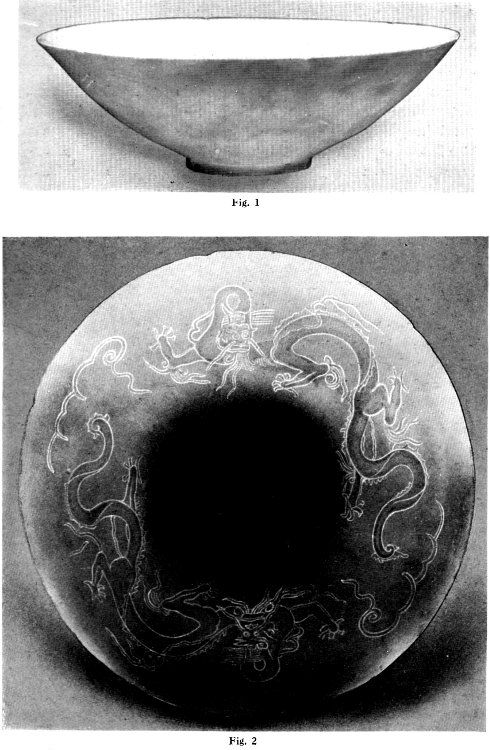
Plate 59.—White Eggshell Porcelain Bowl with Imperial
dragons faintly traced in white slip under the glaze.
Mark of the Yung Lo period (1403–1424) incised in the centre in
archaic characters. 1. Exterior. 2. Interior view.
Diameter 8¾ inches.
British Museum.
It is wellnigh impossible to reproduce adequately these white
porcelains, but Plate 59 illustrates the well-known example in the
Franks Collection, which has long been accepted as a genuine Yung Lo
specimen. It represents the ya shou pei in form, with wide mouth
and small foot—the contracted waist of the Po wu yao lan; the
foot rim is bare at the edge, but not otherwise sandy, and the base is
glazed over, which may be the sense in which the word “polished”[12] is
used in the Po wu yao lan. The ware is so thin and transparent
that it seems to consist of glaze alone, as though the body had
been pared away to vanishing point before the glaze was applied—in
short, it is t’o t’ai or “bodiless.” When held to the light
it has a greenish transparency and the colour of melting snow, and
there is revealed on the sides a delicate but exquisitely drawn design
of five-clawed Imperial dragons in white slip (not etched, as has
too often been stated), showing up like the water-mark in paper. On
the bottom inside is the date-mark of the period etched with a point
in four archaic characters (see vol. i, p. 213). A more refined and
delicate ceramic work could hardly be imagined.
Close to this bowl in the Franks Collection there are two smaller bowls
or, rather, cups which in many ways answer more nearly the description
of the ya shou pei,[13] though they are thick in substance
and of coarser make. They have straight spreading sides, wide at the
mouth, with foliate rim, and contracted at the foot. The foot rim is
bare of glaze, but the base is covered. They are of an impure white
ware with surface rather pitted, and inside is a lotus design traced
in white slip under the glaze and repeated in radiating compartments.
These are perhaps a product of the private factories. The same form is
observed among the blue and white porcelain in two small cups, which
are painted in blue with a landscape on the exterior and with bands
of curled scrolls inside and the Yung Lo mark in four characters. The
base is unglazed, and though they are undoubtedly intended to represent
a Yung Lo type, these not uncommon bowls can hardly be older than the
last dynasty. Another blue and white bowl in the Franks Collection has
the Yung Lo mark and the scroll decoration inside, and on the exterior
a long poem by Su Shih, covering most of the surface. It is painted in
a grey blue, and the ware, though coarse, has the appearance of Ming
manufacture, perhaps one of the late Ming copies which are mentioned
without honour in the Po wu yao lan. It is, however, of the
ordinary rounded form.[14]
Hsiang Yüan-p’ien illustrates in his Album one Yung Lo specimen, a low
cylindrical bowl of the “bodiless” kind, “thin as paper,” with a very
delicate dragon and phœnix design, which is seen when the bowl is
held to the light and carefully inspected. This style of ornament is
described as an hua (secret decoration), but it is not stated
whether, in this case, it was engraved in the paste or traced in white
slip.
The mention of “fresh red” (hsien hung), which seems to have
been used on the Yung Lo porcelain as well as in the succeeding Hsüan
Tê period, brings to mind a familiar type of small bowl with slight
designs in blue inside, often a figure of a boy at play, the exterior
being coated with a fine coral red, over which are lotus scrolls
in gold. There are several in the British Museum, and one, with a
sixteenth-century silver mount, was exhibited at the Burlington Fine
Arts Club in 1910.[15] The term hsien hung is certainly used
for an underglaze copper red on the Hsüan Tê porcelain, and it is
doubtful whether it can have been loosely applied to an overglaze
iron red on the earlier ware. For the bowls to which I refer have an
iron red decoration, though it is sometimes wonderfully translucent
and, being heavily fluxed, looks like a red glaze instead of merely
an overglaze enamel (see Plate 74). Several of these red
bowls have the Yung Lo mark, others have merely marks of commendation
or good wish. Their form is characteristic of the Ming period, and the
base is sometimes convex at the bottom, sometimes concave. They vary
considerably in quality, the red in some cases being a translucent
and rather pale coral tint, and in others a thick, opaque brick red.
Probably they vary in date as well, the former type being the earlier
and better. It is exemplified by an interesting specimen in the Franks
Collection marked tan kuei (red cassia), which indicates its
destination as a present to a literary aspirant, the red cassia being a
symbol of literary success. This piece has, moreover, a stamped leather
box of European—probably Venetian—make, which is not later than the
sixteenth century. This, if any of these bowls, belongs to the Yung Lo
period, but it will be seen presently that the iron red was used as an
inferior but more workable substitute for the underglaze red in the
later Ming reigns, and, it must be added, these bowls are strangely
numerous for a fifteenth-century porcelain. That they are a Yung Lo
type, however, there is little doubt, for this red and gold decoration
(kinrande of the Japanese) is the adopted style which won for
the clever Kioto potter, Zengoro Hozen, the art name Ei raku,
i.e. Yung Lo in Japanese.
CHAPTER II HSÜAN TÊ (1426–1435)
In this short reign, which Chinese writers regard as the most brilliant
period of their porcelain industry, the number of kilns occupied with
the Imperial orders had increased to fifty-eight, the majority of them
being outside the Imperial factory and distributed among the private
factories. According to the T’ao lu,[16] the clay used at this
time was red and the ware like cinnabar, a statement which is difficult
to reconcile with the glowing description of the jade-like white altar
cups and other exquisite objects for which the reign was celebrated.
It is, of course, possible that a dark coloured body was employed in
some of the wares, as was done at other periods, or it may be that the
words are hyperbolically used to describe a porcelain of which the
exposed parts of the body assumed a red colour in the firing. This
latter peculiarity is noticeable on specimens of later Ming porcelain,
particularly the blue and white of the Chia Ching period. But in any
case a red biscuit cannot have been invariable or even characteristic
of the period, for no mention is made of such a feature in the Po
wu yao lan, which gives by far the fullest account of the Hsüan Tê
porcelain.
The description in the Po wu yao lan,[17] which seems to
have been generally accepted, and certainly was largely borrowed by
subsequent Chinese works, may be freely rendered as follows:
“Among the wares of the Hsüan Tê period there are stem-cups[18]
decorated with red fish. For these they used a powder made of red
precious stones from the West to paint the fish forms, and from the
body there rose up in relief in the firing the precious brilliance of
the fresh red ravishing the eye. The brown and blackish colours which
resulted from imperfect firing of the red are inferior. There were
also blue decorated wares, such as stem-cups with dragon pine and plum
designs, wine stem-cups with figure subjects[19] and lotus designs,
small cinnabar pots and large bowls in colour red like the sun, but
with white mouth rim, pickle pots and small pots with basket covers and
handles in the form of bamboo joints, all of which things were unknown
in ancient times. Again, there were beautiful objects of a useful kind,
all small and cleverly made with finely and accurately drawn designs.
The incense vases, trays and dishes[20] were made in large numbers, and
belong to a common class. The flat-sided jars with basket covers, and
the ornamented round pots with flanged[21] mouth for preserving honey,
are very beautiful and mostly decorated in colours (wu ts’ai).
The white cups, which have the character t’an (altar) engraved
inside the bowl, are what are known as 'altar cups.’ The material of
these things is refined and the ware thick, and the form beautiful
enough to be used as elegant vases in the true scholar’s room. There
are besides white cups for tea with rounded body,[22] convex[23] base,
thread-like foot, bright and lustrous like jade, and with very finely
engraved[24] dragon and phœnix designs which are scarcely inferior to
the altar cups. At the bottom the characters ta ming hsüan tê nien
chih[25] are secretly engraved in the paste, and the texture of
the glaze is uneven, like orange peel.[26] How can even Ting porcelain
compare with these? Truly they are the most excellent porcelains of
this reign, and unfortunately there have not been many to be seen since
then. Again, there are the beautiful barrel-shaped seats, some with
openwork ground, the designs filled in with colours (wu ts’ai),
gorgeous as cloud brocades, others with solid ground filled in with
colours in engraved floral designs, so beautiful and brilliant as
to dazzle the eye; both sorts have a deep green (ch’ing)
background. Others have blue (lan) ground, filled in
with designs in colours (wu ts’ai), like ornament carved in
cobalt blue (shih ch’ing, lit. stone blue). There is also blue
decoration on a white ground and crackled grounds like ice. The form
and ornament of these various types do not seem to have been known
before this period.”
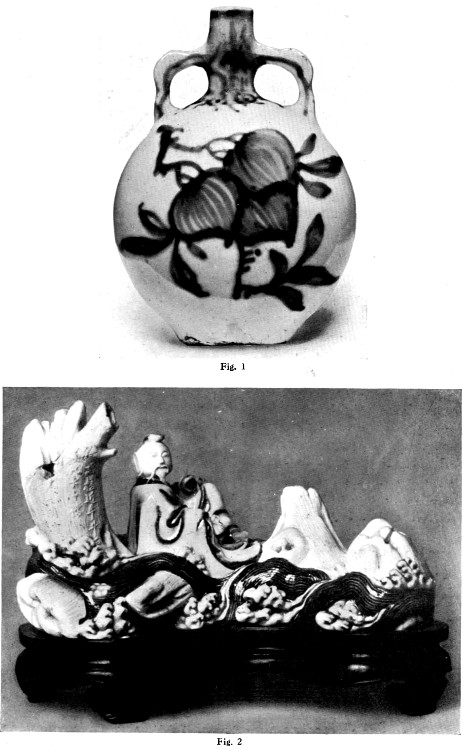
Plate 60.—Reputed Hsüan Tê Porcelain.
Fig. 1.—Flask with blue decoration, reputed to be Hsüan Tê period.
Height 3¼ inches. British Museum.
Fig. 2.—Brush Rest. (?) Chang Ch’ien on a log raft; partly biscuit.
Inscribed with a stanza of verse and the Hsüan Tê mark. Length 6 inches.
Grandidier Collection.
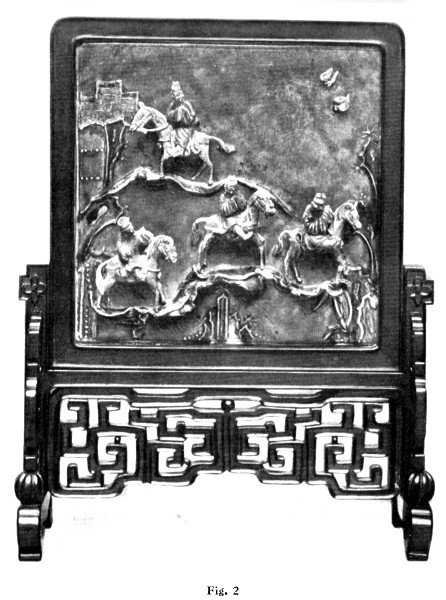
Plate 61.—Porcelain with san ts’ai glazes on the biscuit.
Fig. 1.—Wine Jar with pierced casing, the Taoist Immortals paying
court to the God of Longevity, turquoise blue ground. Fifteenth
century. Height 11½ inches. Eumorfopoulos Collection.
Fig. 2.—Screen with design in relief, horsemen on a mountain
path, dark blue ground. About 1500. Height 14 inches. Benson
Collection.
It will be seen from the above that the Hsüan Tê porcelains included
a fine white, blue and white and polychrome painted wares, underglaze
red painted wares, and crackle. The last mentioned is further specified
in the Ch’ing pi tsang as having “eel’s blood lines,”[27] and
almost rivalling the Kuan and Ju wares. The ware was thick and strong,
and the glaze had the peculiar undulating appearance (variously
compared to chicken skin, orange peel, millet grains, or a wind ruffled
surface) which was deliberately produced on the eighteenth century
porcelains.
Another surface peculiarity shared by the Hsüan Tê and Yung Lo wares
was “palm eye” (tsung yen) markings, which Bushell explains as
holes in the glaze due to air bubbles. It is hard to see how these can
have been other than a defect. Probably both these and the orange peel
effects were purely fortuitous at this time.
Of the various types which we have enumerated, the white wares need
little comment. The glaze was no doubt thick and lustrous like mutton
fat jade, and though Hsiang in his Album usually describes the white of
his examples as “white like driven snow,” it is worthy of note that in
good imitations of the ware particular care seems to have been given to
impart a distinct greenish tint to the glaze.
The honours of the period appear to have been shared by the “blue and
white” and red painted wares. Out of twenty examples illustrated in
Hsiang’s Album, no fewer than twelve are decorated chiefly in red,
either covering the whole or a large part of the surface or painted
in designs, among which three fishes occur with monotonous frequency.
The red in every case is called chi hung, and it is usually
qualified by the illuminating comparison with “ape’s blood,” and in one
case it is even redder than that!
The expression chi hung has evidently been handed down by oral
traditions, for there is no sort of agreement among Chinese writers on
the form of the first character. The T’ao lu uses the character
 , which means “sacrificial,” and Bushell[28] explains this “as
the colour of the sacrificial cups which were employed by the Emperor
in the worship of the Sun.” Hsiang uses the character
 which
means “massed, accumulated.” And others use the character
 which means “sky clearing,” and is also applied to blue in the sense
of the “blue of the sky after rain.” In the oft quoted list of the
Yung Chêng porcelains we find the item, “Imitations of Hsüan chi
hung wares, including two kinds, hsien hung (fresh red) and
pao shih hung (ruby red).” There can be little doubt that both
these were shades of underglaze red derived from copper oxide, a colour
with which we are quite familiar from the eighteenth century and later
examples.
For in another context we find the hsien hung contrasted with
fan hung, which is the usual term for overglaze iron red,
and the description already given of the application of pao shih
hung leaves no doubt whatever that it was an underglaze colour. The
two terms are probably fanciful names for two variations of the same
colour, or perhaps for two different applications of it, for we know
that it was used as a pigment for brushwork as well as in the form of a
ground colour incorporated in the glaze. The secret of the colour seems
to have been well kept, and the general impression prevailing outside
the factories was that its tint and brilliancy were due to powdered
rubies, the red precious stone from the West which gave the name to the
pao shih hung.[29] It is known that in some cases such stones
as cornelian (ma nao) have been incorporated in the porcelain
glazes in China to increase the limpidity of the glaze. This is reputed
to have happened in the case of the Ju yao, but neither cornelian nor
ruby could serve in any way as a colouring agent, as their colour would
be dissipated in the heat of the furnace. The real colouring agent of
the chi hung is protoxide of copper. If there were nothing else
to prove this, it would be clear from the fact hinted in the Po wu
yao lan that the failures came out a brownish or blackish tint.
This colour has always proved a difficult one to manage, and in the
early part of the last dynasty, when it was freely used after the
manner of the Hsüan Tê potters, the results were most unequal, varying
from a fine blood red to maroon and brown, and even to a blackish tint.
The peculiar merits of the Hsüan Tê red were probably due in some
measure to the clay of which the ware was composed, and which contained
some natural ingredient favourable to the development of the red. At
any rate, we are told[30] that in the Chia Ching period (1522–1566)
“the earth used for the hsien hung ran short.”
Among the favourite designs[31] expressed in the Hsüan Tê red were
three fishes, three fruits,[32] three funguses, and the character
fu (happiness) repeated five times.[33] All these are mentioned
among the Yung Chêng imitations. A good idea of the fish design is
given by a cylindrical vase in the Franks Collection, which is plain
except for two fishes in underglaze red of good colour, and rising in
slight relief in the glaze. The glaze itself is of that faint celadon
green which was apparently regarded as a necessary feature of the
Hsüan Tê copies, and which incidentally seems to be favourable to the
development of the copper red. The sang de bœuf red of the last
dynasty is avowedly a revival of the Hsüan Tê red in its use as a glaze
colour. Indeed, certain varieties of the sang de bœuf class
are still distinguished as chi hung. The large bowls, “red as
the sun and white at the mouth rim,” as mentioned in the Po wu yao
lan, have a counterpart in the large bowl of the last dynasty with
sang de bœuf glaze, which, flowing downwards, usually left a
colourless white band at the mouth.
The Hsüan Tê period extended only to ten years, and specimens of Hsüan
red are excessively rare to-day, even in China. It is doubtful if a
genuine specimen exists outside the Middle Kingdom, but with the help
of the old Chinese descriptions and the clever imitations of a later
date,[34] there is no difficulty in imagining the vivid splendours of
the “precious stone red” of this brilliant period.
Among the “blue and white” wares of all periods, the Hsüan Tê
porcelain is unanimously voted the first place by Chinese writers,
and its excellence is ascribed principally to the superior quality
of an imported mineral variously described as su-ni-p’o,
su-p’o-ni and su-ma-ni. These outlandish names are, no
doubt, attempts to render in Chinese the foreign name of the material,
which was itself probably the name of the place or people whence it
was exported. There is little doubt that this mysterious substance was
the same species as the Mohammedan blue (hui hui ch’ing) of
the following century. Indeed, this latter name is applied to it in
Hsiang’s Album. The Mohammedan blue was obtained from Arab traders, and
its use for painting on pottery had been familiar in the Near East,
in Persia and Syria for instance, at least as early as the twelfth
century.[35] The su-ni-p’o blue was no doubt imported in the
form of mineral cobalt, and though there was no lack of this mineral
in the neighbourhood of Ching-tê Chên, the foreign material was of
superior quality. It was, however, not only expensive but unsuited for
use in a pure state. If applied by itself, it had a tendency to run in
the firing, and it was necessary to blend it with proportions of the
native mineral varying from one in ten for the finest quality to four
in six for the medium quality. The native mineral used by itself tended
to be heavy and dull in tone, owing to its inability to stand the
intense heat of the kiln, and was only employed alone on the coarser
wares. The supply of Mohammedan blue was uncertain and spasmodic. It
ceased to arrive at the end of the Hsüan Tê period, and it was not
renewed till the next century (see p. 29). Its nature, too,
seems to have varied, for we are expressly told that the Hsüan Tê blue
was pale in tone while the Mohammedan blue of the sixteenth century
was dark. Possibly, however, this was not so much due to the nature
of the material as to the method of its application, for Chinese
writers are by no means unanimous about the paleness of the Hsüan Tê
blue. The Ch’ing pi ts’ang, for instance, states that “they
used su-p’o-ni blue and painted designs of dragons, phœnixes,
flowers, birds, insects, fish and similar forms, deep and thickly
heaped and piled and very lovely.”
Authentic specimens of Hsüan Tê blue and white are virtually unknown,
but the mark of the period is one of the commonest on Chinese porcelain
of relatively modern date. In most cases this spurious dating means
nothing more than that the period named was one of high repute; but
there is a type of blue and white, usually bearing the period mark of
Hsüan Tê, which is so mannered and characteristic that one feels the
certainty that this really represents one kind at least of the Hsüan
porcelain. It is usually decorated in close floral scrolls, and the
blue is light dappled with darker shades, which are often literally
“heaped and piled” (tui t’o) over the paler substratum.
I have seen examples of this style belonging to various periods, mostly
eighteenth century, but some certainly late Ming[36] (see Plate 67,
Fig. 4). Seven examples of Hsüan blue and white porcelain
are figured in Hsiang’s Album,[37] comprising an ink pallet, a vase
shaped like a section of bamboo, a goose-shaped wine jar, a vase with
an elephant on the cover, a tea cup, a sacrificial vessel, and a lamp
with four nozzles. In five of these the blue is confined to slight
pencilled borders, merely serving to set off the white ground, which
is compared to driven snow. The glaze is rich and thick, and of uneven
surface, rising in slight tubercles likened to “grains of millet.” This
is the “orange skin” glaze. The blue in each case is hui hu[38] ta
ch’ing (deep Mohammedan blue). Of the two remaining instances, one
is painted with a dragon in clouds, and the other with “dragon pines,”
and in the latter case the glaze is described as “lustrous like mutton
fat jade,” and the blue as “of intensity and brilliance to dazzle the
eye.”
The impression conveyed by all these examples is that they represent a
type quite different from that described as “heaped and piled,” a type
in which delicate pencilling was the desideratum, the designs being
slight and giving full play to the white porcelain ground. It is, in
fact, far closer in style to the delicately painted Japanese Hirado
porcelain than to the familiar Chinese blue and white of the K’ang Hsi
period.
Plate 60 illustrates a little flask-shaped vase in the
Franks Collection, which purports to be a specimen of Hsüan Tê blue and
white porcelain. It has a thick, “mutton fat” glaze of faint greenish
tinge, and is decorated with a freely drawn peach bough in underglaze
blue which has not developed uniformly in the firing. The colour in
places is deep, soft and brilliant, but elsewhere it has assumed too
dark a hue.[39] Its certificate is engraved in Chinese fashion on
the box into which it has been carefully fitted—hsüan tz’ŭ pao
yüeh p’ing, “precious moon vase of Hsüan porcelain”—attested by
the signature Tzŭ-ching, the studio name of none other than Hsiang
Yüan-p’ien, whose Album has been so often quoted. Without attaching
too much weight to this inscription, which is a matter easily arranged
by the Chinese, there is nothing in the appearance of this quite
unpretentious little vase which is inconsistent with an early Ming
origin.
On the same plate is a brush rest in form of a log raft, on which is a
seated figure, probably the celebrated Chang-Ch’ien, floating down the
Yellow River. The design recalls a rare silver cup of the Yüan dynasty,
which was illustrated in the Burlington Magazine (December,
1912). Here the material is porcelain biscuit with details glazed and
touched with blue, and the nien hao of Hsüan Tê is visible on
the upper part of the log beside two lines of poetry. Whether this
brush rest really belongs to the period indicated or not, it is a rare
and interesting specimen. Two other possible examples of Hsüan Tê blue
and white are described on p. 32.
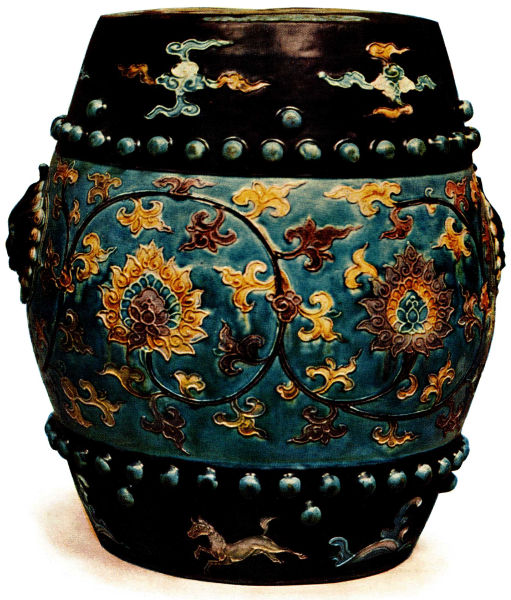
PLATE 62
Barrel shaped Garden Seat: porcelain with coloured glazes on the
biscuit, the designs outlined in slender fillets of clay. A lotus
scroll between an upper band of clouds and a lower band of horses in
flying gallop and sea waves. Lion mask handles. About 1500 A.D.
Height 14¼ inches.
British Museum.
As to the other types of Hsüan ware named in the Po wu yao lan,
with one exception I can find no exact counterpart of them in existing
specimens, though parts of the descriptions are illustrated by examples
of apparently later date. Thus the form of the white tea cups, “with
rounded body, convex base, and thread-like foot,” is seen in such bowls
as Fig. 1 of Plate 74, which is proved by its mount to be not later
than the sixteenth century. Other examples of these bowls will be
discussed later. They are characterised by a convexity in the centre
which cannot be shown in reproductions.
The secret decoration (an hua) consists of designs faintly
traced usually with a sharp-pointed instrument in the body and under
the glaze. There is an excellent example of this in a high-footed cup
in the Franks Collection which has the Hsüan Tê mark, the usual faintly
greenish glaze, beneath which is a delicately etched lotus scroll
so fine that it might easily be overlooked and is quite impossible
to reproduce by photographic methods. It is, no doubt, an early
eighteenth-century copy of Hsüan ware.
The one exception mentioned above is the type represented by the
“barrel-shaped seats.” The description of these leaves no room for
doubt that they belonged to a fairly familiar class of Ming ware, whose
strength and solidity has preserved it in considerable quantity where
the more delicate porcelains have disappeared. Plate 62 gives a good
idea of the Ming barrel-shaped garden seat, “with solid ground filled
in with colours in engraved floral designs.” The other kind, “with
openwork ground, the designs filled in with colours (wu ts’ai),
gorgeous as cloud brocades,” must have been in the style of Plate 61.
These styles of decoration are more familiar to us on potiche-shaped
wine jars and high-shouldered vases than on garden seats, but the type
is one and the same. Quite a series of these vessels was exhibited at
the Burlington Fine Arts Club in 1910, and they are fully described
in the catalogue. Some had an outer casing in openwork; others had
the designs outlined in raised threads of clay, which contained the
colours like the ribbons of cloisonné enamel[40]; in others, again,
the patterns were incised with a point. The common feature of all of
them was that the details of the pattern were defined by some emphatic
method of outlining which served at the same time to limit the flow
of the colours. The colours themselves consist of glazes containing a
considerable proportion of lead, and tinted in the usual fashion with
metallic oxides. They include a deep violet blue (sometimes varying to
black or brown), leaf green, turquoise, yellow,[41] and a colourless
glaze or a white slip which served as white colour, though at times the
white was represented merely by leaving the unglazed body or biscuit to
appear. These coloured glazes differ from the on-glaze painted enamels
in that they are applied direct to the body of the ware, and are fired
at a relatively high temperature in the cooler parts of the great
kiln, a circumstance expressed by the French in the concise phrase,
couleurs de demi-grand feu.[42]
The central ornament consisted chiefly of figures of sages or deities
in rocky landscape, or seated under pine trees amid clouds, dragons in
clouds, or beautiful lotus designs; and these were contained by various
borders, such as floral scrolls, gadroons, ju-i head patterns,
fungus scrolls, and symbols hanging in jewelled pendants. As a rule,
the larger areas of these vases are invested with a ground colour and
the design filled in with contrasting tints. Sometimes the scheme of
decoration includes several bands of ornament, and in this case—as on
Plate 62—more than one ground colour is used. The Po wu
yao lan speaks of green (ch’ing) and dark blue (lan)
grounds, and existing specimens indicate that the dark violet blue
was the commonest ground colour. Next to this, turquoise blue is the
most frequently seen; but besides these there is a dark variety of the
violet which is almost black, and another which is dark brown, both of
which colours are based on cobaltiferous oxide of manganese. It has
already been observed that this type of decoration was frequently used
on a pottery body as well as on porcelain.
The question of the antiquity of the above method of polychrome
decoration is complicated by the contradictory accounts which Dr.
Bushell has given of a very celebrated example, the statuette of
the goddess Kuan-yin in the temple named Pao kuo ssŭ at Peking. The
following reference to this image occurs in the T’ung ya,
published in the reign of Ch’ung Chêng (1625–1643): “The Chün Chou
transmutation wares (yao pien) are not uncommon to-day. The
Kuan-yin in the Pao kuo ssŭ is a yao pien.” Dr. Bushell,
who visited the temple several times, gives a minute description of
the image, which contains the following passage[43]: “The figure is
loosely wrapped in flowing drapery of purest and bluest turquoise
tint, with the wide sleeves of the robe bordered with black and turned
back in front to show the yellow lining; the upper part of the cloak
is extended up behind over the head in the form of a plaited hood,
which is also lined with canary yellow.” To the ordinary reader, such
a description would be conclusive. A fine example of Ming porcelain,
he would say, decorated with the typical coloured glazes on the
biscuit. Bushell’s comment, however, is that the “colours are of the
same type as those of the finest flower pots and saucers of the Chün
Chou porcelain of the Sung dynasty.” It should be said that the temple
bonzes insist that they can trace the origin of the image back to the
thirteenth century. If these are indeed the typical Chün Chou glazes,
then all our previous information on that factory, including Bushell’s
own contributions, is worthless. In another work,[44] however, the same
writer states that it (the image in question) is “really enamelled in
'five colours’—turquoise, yellow, crimson, red brown and black.” This
is precisely what we should have expected, and it can only be imagined
that Bushell in the other passage was influenced by the statement
in the T’ung ya that it was a furnace transmutation piece, a
statement probably based on the superstition that it was a miraculous
likeness of the goddess, who herself descended into the kiln and
moulded its features. As to the other temple tradition, that it was
made in the thirteenth century, it is not necessary to take that any
more seriously than the myth concerning its miraculous origin, which
derives from the same source.
It is hardly necessary to state that all the existing specimens of this
class (and they are fairly numerous) do not belong to the Hsüan Tê
period. Indeed, it is unlikely that more than a very small percentage
of them were made in this short reign. Whether the style survived the
Ming dynasty is an open question; but it is safe to assume that it was
largely used in the sixteenth century.
The discussion of this group of polychrome porcelain leads naturally
to the vexed question of the introduction of enamel painting over the
glaze. By the latter I mean the painting of designs on the finished
white glaze in vitrifiable enamels, which were subsequently fixed in
the gentle heat of the muffle kiln (lu)—couleurs de petit
feu, as the French have named them. No help can be got from the
phraseology of the Chinese, for they use wu ts’ai or wu
sê (lit. five colours) indifferently for all kinds of polychrome
decoration, regardless of the number of colours involved or the mode
of application. There is, however, no room for doubt that the delicate
enamel painting, for which the reign of Ch’êng Hua (1465–1487) was
celebrated, was executed with the brush over the fired glaze. It is
inconceivable that the small, eggshell wine cups with peony flowers and
a hen and chicken “instinct with life and movement” could have been
limned by any other method. If this is the case, then what could the
Chinese writers mean when they contrasted the wu ts’ai ornament
of the Hsüan Tê and Ch’êng Hua periods, but that the same process of
painting was in use in both reigns? The Ch’êng Hua colours were more
artistic because they were thin and delicately graded, while the Hsüan
Tê wu ts’ai were too thickly applied.[45] For this reason, if
for no other, we may rightly infer that painting in on-glaze enamels
was practised in the Hsüan Tê period, if, indeed, it had not been long
in use.[46]
There is another and an intermediate method of polychrome decoration in
which the low-fired enamels (de petit feu) are applied direct
to the biscuit, as in the case of the demi-grand feu colours,
but with the difference that they are fixed in the muffle kiln. This
method was much employed on the late Ming and early Ch’ing porcelains,
and it will be discussed later; but it is mentioned here because there
are several apparent examples of it in Hsiang’s Album, one[47] of which
is dated Hsüan Tê. The example in question is a model of the celebrated
Nanking pagoda, and it is described as wu ts’ai, the structure
being white, the roofs green, the rails red, and the doors yellow,
while the date is painted in blue. I have hesitated to assume that
this is intended to represent an on-glaze painted piece, though there
is much in the description to indicate such a conclusion; but it is
certainly either this or a member of the class under discussion, viz.
decorated in enamels of the muffle kiln applied to the biscuit.[48]
In either case it proves the knowledge of vitrifiable enamels at this
period to all who accept the evidence of Hsiang’s Album.
Examples of Hsüan Tê polychrome porcelain enumerated in the T’ao
shuo included wine pots in the form of peaches, pomegranates,
double gourds, a pair of mandarin ducks and geese; washing dishes (for
brushes) of “gong-shaped outline,” with moulded fish and water-weeds,
with sunflowers and with lizards; and lamp brackets, “rain-lamps,”
vessels for holding bird’s food, and cricket[49] pots (see vol. i, p.
188).
Specimens of on-glaze painted porcelain with the Hsüan Tê mark are
common enough, but I have not yet seen one which could be accepted
without reserve. Perhaps the nearest to the period is a specimen in the
Franks Collection, a box made of the lower part of a square vase which
had been broken and cut down. It was fitted with a finely designed
bronze cover in Japan, and it is strongly painted in underglaze blue
and the usual green, yellow, red and purple on-glaze enamels. The mark
is in a fine dark blue, and the porcelain has all the character of a
Ming specimen.
There is, in the same collection, a dish of a different type, but
with the Hsüan Tê mark in Mohammedan blue and other evidences of Ming
origin. The glaze is of a faintly greenish white and of considerable
thickness and lustre, and the design consists of lotus scrolls in gold.
Painting in gold in the Hsüan Tê period is mentioned in the T’ao
shuo[50] in connection with the pots for holding the fighting
crickets alluded to above.
CHAPTER III CH’ÊNG HUA (1465–1487) AND OTHER REIGNS — Chêng Tê (1506–1521)
The Ch’êng Hua porcelain shares with that of the Hsüan Tê period the
honours of the Ming dynasty, and Chinese writers are divided on the
relative merits of the two. Unfortunately, no material remains on
which we might base a verdict of our own, but we may safely accept
the summing up which the Po wu yao lan, the premier authority
on early Ming wares, gives as follows[51]: “In my opinion, the blue
and white porcelain of the Ch’êng Hua period does not equal that of
the Hsüan Tê, while the polychrome of the Hsüan period does not equal
that of the 'model[52] emperor’s’ reign. The reason is that the blue
of the Hsüan ware was su-ni-p’o[53] blue, whereas afterward
it was all exhausted, and in the Ch’êng Hua period only the ordinary
blue was used. On the other hand, the polychrome (wu ts’ai)
decoration on the Hsüan ware was deep and thick, heaped and piled, and
consequently not very beautiful; while on the polychrome wares of the
Ch’êng Hua period the colours used were thin and subdued,[54] and gave
the impression of a picture.”[55] Elsewhere we read that the Hsüan Tê
porcelain was thick, the Ch’êng Hua thin, and that the blue of the
Hsüan blue and white was pale, that of the Ch’êng Hua dark; but on this
latter point there are many differences of opinion, and among the wares
made at the Imperial factory in the Yung Chêng period we are told that
there were “copies of Ch’êng Hua porcelain with designs pencilled in
pale blue (tan ch’ing).”[56]
The only types of Ch’êng Hua porcelain considered worthy of mention
by Chinese writers are the polychrome, the blue and white, and the
red monochrome, though doubtless the other methods of previous reigns
were still used. Stress is laid on the excellence of the designs which
were supplied by artists in the palace,[57] and on the fine quality of
the colours used, and an interesting list of patterns is given in the
T’ao shuo,[58] which includes the following:
1. Stem-cups (pa pei), with high foot, flattened bowl, and
spreading mouth; decorated in colours with a grape-vine pattern.
“Among the highest class of Ch’êng Hua porcelain these are unsurpassed,
and in workmanship they far excel the Hsüan Tê cups.” Such is the
verdict of the Po wu yao lan, but they are only known to us by
later imitations.
A poor illustration of one of these is given in Hsiang’s Album,[59] and
we are told in the accompanying text that the glaze is fên pai,
“white like rice powder,” while the decoration, a band of oblique
vine clusters and tendrils, is merely described as wu ts’ai
(polychrome), but it is obviously too slight to be executed by any
other method than painting with enamels on the glaze. The price paid
for this cup is stated as one hundred taels (or ounces) of silver.
2. Chicken cups (chi kang), shaped like the flat-bottomed,
steep-sided, and wide-mouthed fish bowls (kang), and painted in
colours with a hen and chickens beneath a flowering plant.
A valuable commentary on Ch’êng Hua porcelains is given by a late
seventeenth-century writer in notes appended to various odes (e.g.
on a “chicken cup” and on a Chün Chou vase). The writer is Kao
Tan-jên, who also called himself Kao Chiang-ts’un, the name appended
to a long dissertation on a Yüan dynasty silver wine cup, which now
belongs to Sir Robert Biddulph and was figured in the Burlington
Magazine.[60] “Ch’êng Hua wine cups,” he tells us, “include a great
variety of sorts. All are of clever workmanship and decoration, and are
delicately coloured in dark and light shades. The porcelain is lustrous
and clear, but strong. The chicken cups are painted with a mu
tan peony, and below it a hen and chicken, which seem to live and
move.” Another writer[61] of the same period states that he frequented
the fair at the Tz’ŭ-iên temple in the capital, where porcelain
bowls were exhibited, and rich men came to buy. For Wan Li porcelain
the usual price was a few taels of silver; for Hsüan Tê and Ch’êng Hua
marked specimens two to five times that amount; but “chicken cups”
could not be bought for less than a hundred taels, and yet those who
had the means did not hesitate to buy, and porcelain realised higher
prices than jade.
An illustration in Hsiang’s Album[62] gives a poor idea of one of
these porcelain gems, which is described as having the sides thin as
a cicada’s wing, and so translucent that the fingernail could be seen
through them. The design, a hen and chicken beside a cock’s-comb plant
growing near a rock, is said to have been in the style of a celebrated
Sung artist. The painting is in “applied colours (fu sê), thick
and thin,” and apparently yellow, green, aubergine and brown. Like that
of the grape-vine cup, it is evidently in enamels on the glaze.
3. Ruby red bowls (pao shao wan)[63] and cinnabar red dishes
(chu sha p’an). These were, no doubt, the same as the “precious
stone red (pao shih hung) and cinnabar bowls red as the sun,”
described in the chapter on Hsüan Tê porcelain. Kao Chiang-ts’un
remarks on these that “among the Ch’êng wares are chicken cups, ruby
red bowls, and cinnabar dishes, very cleverly made, and fine, and more
costly than Sung porcelain.”
4. Wine cups with figure subjects and lotuses.
5. “Blue and white” (ch’ing hua) wine cups, thin as paper.
6. Small cups with plants and insects (ts’ao ch’ung).[64]
7. Shallow cups with the five sacrificial altar vessels (wu kung
yang).
8. Small plates for chopsticks, painted in colours.
9. Incense boxes.
10. All manner of small jars.
All these varieties are mentioned in the Po wu yao lan, which
gives the place of honour to the grape-vine stem-cups. The only kind
specifically described as blue and white is No. 5, and the inference is
that the other types were usually polychrome.
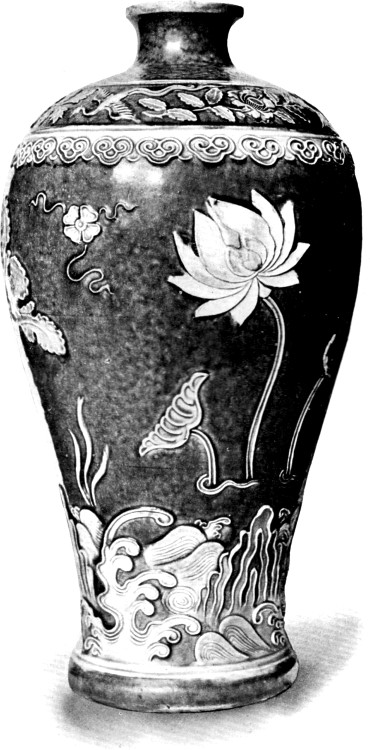
Plate 63.—Baluster Vase
With designs in raised outline, filled in with coloured glazes on the
biscuit; dark violet blue background. About 1500. Height 14¾ inches.
Grandidier Collection (Louvre).
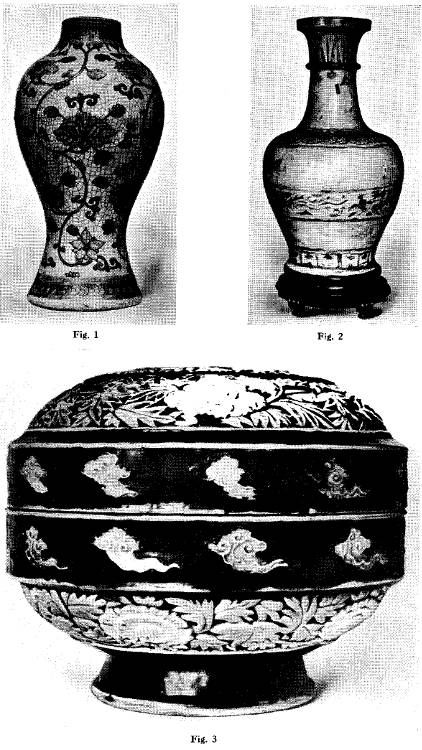
Plate 64.—Fifteenth-century Polychrome Porcelain.
Fig. 1.—Vase with grey crackle and peony scrolls in blue and enamels.
Ch’èng Hua mark. Height 16¼ inches. British Museum.
Fig. 2.—Vase with turquoise ground and bands of floral pattern and
winged dragons incised in outline and coloured green, yellow and
aubergine. Height 22 inches. S. E. Kennedy Collection.
Fig. 3.—Box with bands of ju-i clouds and pierced floral
scrolls; turquoise and yellow glazes in dark blue ground. Diameter 10
inches. Grandidier Collection.
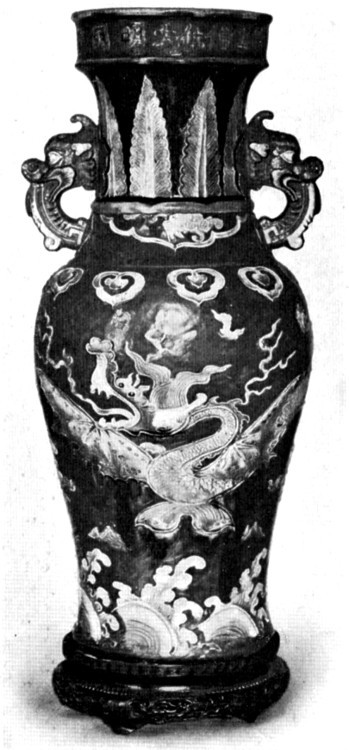
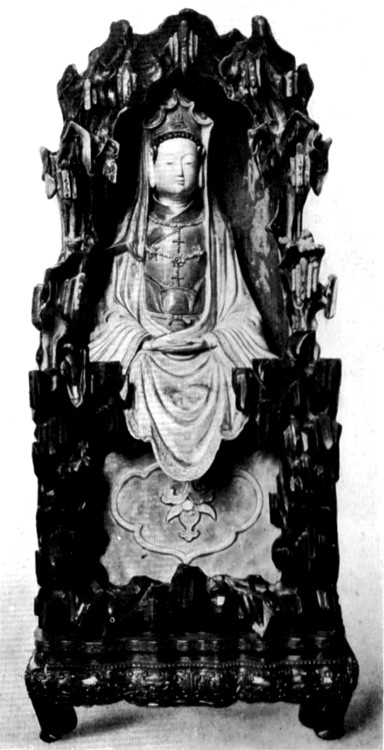
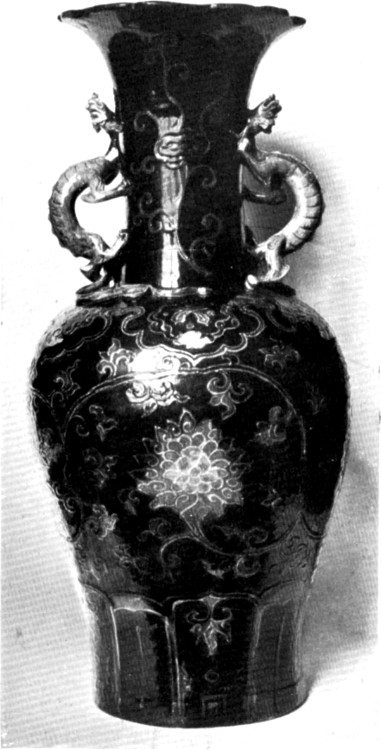
Plate 65.—Ming san ts’ai Porcelain.
Fig. 1.—Vase with winged dragons, san ts’ai glazes on the
biscuit, dark blue ground. Dedicatory inscription on the neck,
including the words “Ming dynasty.” Cloisonné handles. Height 22¼
inches. S. E. Kennedy Collection.
Fig. 2.—Figure of Kuan-yin, turquoise, green and aubergine glazes,
dark blue rockwork. Fifteenth century. Height 28 inches. Grandidier
Collection.
Fig. 3.—Vase with lotus scrolls, transparent glazes in three colours.
Late Ming. Height 20 inches. Grandidier Collection.
The following designs are enumerated and explained by Kao Chiang-ts’un
in the valuable commentary which has already been mentioned:—
11. Wine cups with the design known as “the high-flaming candle
lighting up red beauty,” explained as a beautiful damsel holding a
candle to light up hai-t’ang (cherry apple) blossoms.
12. Brocade heap pattern[65]; explained as “sprays of flowers and fruit
massed (tui) on all sides.”[66]
13. Cups with swings, with dragon boats, with famous scholars and with
children.
The swings, we are told, represent men and women[67] playing with
swings (ch’iu ch’ien): the dragon boats represent the dragon
boat races[68]; the famous scholar (kao shih) cups have on one
side Chou Mao-shu, lover of the lotus, and on the other T’ao Yüan-ming
sitting before a chrysanthemum plant; the children (wa wa)
consist of five small children playing together.[69]
14. Cups with grape-vines on a trellis, fragrant plants, fish and
weeds, gourds, aubergine fruit, the Eight Buddhist Emblems (pa chi
hsiang), yu po lo flowers, and Indian lotus (hsi fan
lien) designs.
None of these need explanation except the Buddhist Emblems, which
are described on p. 298, and the yu po lo, which is generally
explained as a transcription of the Sanskrit utpala, “the dark
blue lotus.”
Though the reader will probably not have the opportunity of identifying
these designs on Ch’êng Hua porcelain, they will help him in the
description of later wares on which these same motives not infrequently
occur. The nine illustrations[70] of Ch’êng Hua porcelain in Hsiang’s
Album, for the most part feebly drawn and badly coloured, form an
absurd commentary on the glowing descriptions in the text. Their chief
interest lies in their bearing on the question of polychrome painting.
In some cases the designs have all the appearance of on-glaze enamels;
in others they suggest transparent glazes or enamels on the biscuit.
The colours used are green, yellow and aubergine brown, the san
ts’ai or “three colours,” notwithstanding which the decoration is
classed under the general term wu ts’ai (lit. five colours), or
polychrome. The phrases used to describe the colouring include wu
ts’ai, fu sê, t’ien yu, of which fu sê[71]
means “applied colours,” which might equally suggest on-glaze enamels
or on-biscuit colours, and t’ien yu[72] decidedly suggests
on-biscuit colouring. On the other hand, in one case[73] we are
expressly told that the “colour of the glaze is lustrous white and the
painting upon it[74] consists of geese, etc.,” an unequivocal
description of on-glaze painting.
Though the Ch’êng Hua mark is one of the commonest on Chinese
porcelain, genuine examples of Ch’êng Hua porcelain are virtually
unknown in Western collections. The Imperial wares of the period were
rare and highly valued in China in the sixteenth century, and we can
hardly hope to obtain them in Europe to-day; but there must be many
survivors from the wares produced by the private kilns at the time,
and possibly some few examples are awaiting identification in our
collections. Unfortunately, the promiscuous use of the mark on later
wares, the confused accounts of the blue in the “blue and white,”
and the conflicting theories on the polychrome decoration, have all
helped to render identifications difficult to make and easy to dispute.
The covered cake box in the Bushell collection, figured by Cosmo
Monkhouse[75] as a Ch’êng Hua specimen, is closely paralleled in make
and style of decoration by a beaker-shaped brush pot in the Franks
Collection.[76] Both are delicately pencilled in pale blue; both have a
peculiar brown staining in parts of the glaze and a slight warp in the
foot rim. In the British Museum piece, however, the foot rim is grooved
at the sides to fit a wooden stand, a feature which was not usual
before the K’ang Hsi period, and something in the style of the drawing
is rather suggestive of Japanese work. There is, however, another
specimen in the Franks Collection[77] which is certainly Chinese of the
Ming dynasty, and possibly of the Ch’êng Hua period, of which it bears
the mark. It is a vase of baluster form, thick and strongly built, with
great weight of clay at the foot, and unfortunately, like so many of
the early polychrome vases which have come from China in recent years,
it is cut down at the neck. It has a greyish crackled glaze, painted
with a floral scroll design, outlined in brown black pigment and washed
in with leaf green, yellow, manganese purple and bluish green enamels,
which are supplemented by a little underglaze blue, and the mark is in
four characters in blue in a sunk panel under the base.
Though too clumsy to belong to any of the groups of Imperial wares
described in the Po wu yao lan, this vase is certainly an old
piece, and possibly the production of one of the private factories of
the Ch’êng Hua period. In the Eumorfopoulos and Benson Collections[78]
there are a few examples of these massive-footed vases, most of them
unfortunately incomplete above, decorated in polychrome glazes with
engraved or relief-edged designs, but not, as a rule, in on-glaze
enamels. These are clearly among our earliest examples of polychrome
porcelain, and we should expect to find here, if anywhere, specimens of
the coloured porcelain of the fifteenth century. See Plate 64.
Though the fifteenth century was distinguished by two brilliant
periods, there are considerable gaps in the ceramic annals of the time.
The reign of the Emperor Chêng T’ung,[79] who succeeded to the throne
in 1436, was troubled by wars, and in his first year the directorate of
the Imperial factory was abolished; and, as soldiers had to be levied,
relief was given by stopping the manufacture of porcelain for the
palace. In 1449 this emperor was actually taken captive by the Mongols,
and his brother, who took his place from 1450 to 1456 under the title
of Ching T’ai,[80] reduced the customary supplies of palace wares in
1454 by one third. The reign of Ching T’ai is celebrated for cloisonné
enamel on metal.
In 1457, when Chêng T’ung was released and returned to the throne under
the title of T’ien Shun[81] (1457–1464), the Imperial factory was
re-established, and the care of it again entrusted to a palace eunuch.
There are no records, however, of the wares made in these periods,
though we may assume that the private factories continued in operation
even when work at the Imperial pottery was suspended. The directorship
was again abolished in 1486, and porcelain is not mentioned in
the official records until the end of the reign of Hung Chih[82]
(1488–1505).
In Hsiang’s Album[83] we are told that the pale yellow of the Hung
Chih period was highly prized, and that the polychrome wares vied
with those of the reign of Ch’êng Hua. Four examples are given: an
incense burner, a cup moulded in sunflower design, and a spirit jar
(all yellow), besides a gourd-shaped wine pot with yellow ground and
accessories in green and brown, apparently coloured glazes or enamels
applied to the biscuit. The yellow glazes are described as pale yellow
(chiao[84] huang), and likened to the colour of steamed
chestnuts (chêng li[85]) or the sunflower (k’uei hua[86]).
The yellow colour is of old standing in Chinese ceramics. We have found
it on T’ang pottery, in the mi sê of the Sung period, in the
blackish yellow of the Yüan ware made at Hu-t’ien, and in the early
Ming porcelains. Peroxide of iron or antimony are the usual metallic
bases of the colour, and it was used either in high-fired glazes or
in enamels of the muffle stove. The yellow for which the Hung Chih
period was noted was a yellow glaze, applied direct to the biscuit, or
added as an overglaze to the ordinary white porcelain. When applied to
the biscuit it assumes a fuller and browner tint than when backed by
a white glaze. These yellow glazes often have a slightly mottled or
stippled look, the colour appearing as minute particles of yellow held
in suspension in the glaze.
Marked examples, purporting to be Hung Chih yellow, are occasionally
seen, but the most convincing specimen is a saucer dish in the Victoria
and Albert Museum, of good quality porcelain, with a soft rich yellow
glaze and the Hung Chih mark under the base in blue. Part of its
existence was spent in Persia, where it was inscribed in Arabic with
the date 1021 A.H., which corresponds to 1611 A.D.
A beautiful seated figure of the goddess Kuan-yin in the Pierpont
Morgan Collection, not unlike Plate 65, Fig. 2, but smaller, is
decorated with yellow, green and aubergine glazes on the biscuit, and
bears a date in the Hung Chih period which corresponds to 1502.
A dish of fine white porcelain with the Hung Chih mark is in the
British Museum, and examples of the blue and white of the period may
be seen in the celebrated Trenchard bowls. These last are the earliest
known arrivals in the way of Chinese porcelain in this country, and
they were given by Philip of Austria, King of Castile, to Sir Thomas
Trenchard in 1506. One of them is illustrated in Gulland’s Chinese
Porcelain,[87] with a description written by Mr. Winthrop after a
personal inspection. The decoration consists of floral scrolls outside
and a fish medallion surrounded by four fishes inside. The account of
the colour, however, is not very flattering: “One of the bowls bore
this decoration very distinctly traced in blackish cobalt, while the
other bowl had a very washed-out and faded appearance.” The ware itself
is described as “rather greyish.” Probably these bowls were made for
the export trade, and need not necessarily be regarded as typical of
the Hung Chih blue and white.
The reign of Chêng Tê, though not mentioned in the Po wu yao lan
and but briefly noticed in the T’ao shuo, must have been an
important period in the history of Chinese porcelain. The yü ch’i
ch’ang (Imperial ware factory) was rebuilt[88] and the direct
supervision of a palace eunuch renewed. The porcelain, we are told in
the T’ao lu, was chiefly blue painted and polychrome, the finest
being in the underglaze red known as chi hung. An important
factor in the blue decoration was the arrival of fresh supplies of the
Mohammedan blue.[89] The story is that the governor of Yunnan obtained
a supply of this hui ch’ing from a foreign country, and that it
was used at first melted down with stone for making imitation jewels.
It was worth twice its weight in gold. When, however, it was found
that it would endure the heat of the kiln, orders were given for its
use in porcelain decoration, and its colour was found to be “antique
and splendid.” Hence the great esteem in which the blue and white of
the period was held.[90] The merit of this new Mohammedan blue was its
deep colour, and the choicest kind was known as “Buddha’s head blue”
(Fo t’ou ch’ing). Its use at this period was not confined to the
Imperial factory, for we read that the workmen stole it and sold it to
the private manufacturers. In the following reign a method of weighing
the material was instituted, which put an end to this pilfering.
Some account has already been given[91] of this material and its use in
combination with the commoner native mineral blue. It was, no doubt,
the blue used on Persian, Syrian and Egyptian pottery of the period
exported by the Arab traders. One of the oldest routes[92] followed by
Western traders with China was by river (probably the Irrawady) from
the coast of Pegu, reaching Yung-ch’ang, in Yunnan, and so into China
proper. This will explain the opportunities enjoyed by the viceroy of
Yunnan. There were, of course, other lines of communication between
China and Western Asia by sea and land, and a considerable interchange
of ideas had passed between China and Persia for several centuries, so
that reflex influences are traceable in the pottery of both countries.
Painting in still black under a turquoise blue glaze is one of the
oldest Persian methods of ceramic decoration, and we have seen that it
was closely paralleled on the Tz’ŭ Chou wares (vol. i, p. 103).
It is related that a thousand Chinese artificers were transplanted
to Persia by Hulagu Khan (1253–1264), and it is probable that they
included potters. At any rate, the Chinese dragon and phœnix appear
on the Persian lustred tiles of the fourteenth century. At a later
date Shah Abbas (1585–1627) settled some Chinese potters in Ispahan.
Meanwhile, quantities of Chinese porcelain had been traded in the
Near East, where it was closely copied by the Persian, Syrian and
Egyptian potters in the sixteenth century. The Persian pottery and
soft porcelain of this time so closely imitates the Chinese blue and
white that in some cases a very minute inspection is required to
detect the difference, and nothing is commoner than to find Persian
ware of this type straying into collections of Chinese porcelain.[93]
Conversely, the Persian taste is strongly reflected in some of the
Chinese decorations, not only where it is directly studied on the
wares destined for export to Persia, but in the floral scrolls on the
Imperial wares of the Ming period. The expressions hui hui hua
(Mohammedan ornament or flowers) and hui hui wên (Mohammedan
designs) occur in the descriptions of the porcelain forwarded to
the palace, and there can be little doubt that they refer to floral
arabesque designs in a broad sense, though it would, of course, be
possible to narrow the meaning to the medallions of Arabic writing not
infrequently seen on Chinese porcelain, which was apparently made for
the use of some of the numerous Mohammedans in China.
An interesting series of this last-mentioned type is exhibited in the
British Museum along with a number of bronzes similarly ornamented.
Many of these are of early date, and five of the porcelains bear the
Chêng Tê mark and unquestionably belong to that period. These comprise
a pair of vases with spherical tops which are hollow and pierced
with five holes, in form resembling the peculiar Chinese hat stands;
the lower part of a cut-down vase, square in form; an ink slab with
cover, and a brush rest in the form of a conventional range of hills.
The body in each case is a beautiful white material, though thickly
constructed, and the glaze, which is thick and of a faint greenish
tinge, has in three of these five pieces been affected by some accident
of the firing, which has left its surface dull and shrivelled in places
like wrinkled skin.[94] The designs are similar throughout—medallions
with Arabic writing surrounded by formal lotus scrolls or cloud-scroll
designs, strongly outlined and filled in with thin uneven washes of a
beautiful soft Mohammedan blue. The glaze being thick and bubbly gives
the brush strokes a hazy outline, and the blue shows that tendency
to run in the firing which we are told was a peculiarity of the
Mohammedan blue if not sufficiently diluted with the native mineral
cobalt. The inscriptions are mainly pious Moslem texts, but on the
cover of the ink slab is the appropriate legend, “Strive for excellence
in penmanship, for it is one of the keys of livelihood,” and on the
brush rest is the Persian word Khāma-dān (pen rest). In the same
case are three cylindrical vases, apparently brush pots, decorated in
the same style but unmarked. One has dark Mohammedan blue and probably
belongs to the next reign. The other two, I venture to think, are
earlier. They are both of the same type of ware, a fine white material,
which takes a brownish red tinge in the exposed parts, and the glaze,
which is thick and of a soft greenish tint, has a tendency to scale off
at the edges. The bases are unglazed and show the marks of a circular
support. The larger piece is remarkably thick in the wall, and has a
light but vivid blue of the Mohammedan sort; the smaller piece is not
quite so stoutly proportioned, but the blue is peculiarly soft, deep,
and beautiful, though it has run badly into the glaze, and where it has
run it has changed to a dark indigo.[95] One would say that this is
the Mohammedan blue, almost pure; and if, as I have suggested, these
two specimens are earlier types, they can only belong to the Hsüan Tê
period.
Another blue and white example with Chêng Tê mark in the British Museum
is of thinner make and finer grain; but, as it is a saucer-dish, this
refinement was only to be expected. It is painted in a fine bold style,
worthy of the best Ming traditions, with dragons in lotus scrolls, but
the blue is duller and greyer in tone than on the pieces just described.
Two specimens of Chêng Tê ware are figured in Hsiang’s Album,[96] one
a tripod libation cup of bronze form and the other a lamp supported
by a tortoise, and the glaze of both is “deep yellow, like steamed
chestnuts.”
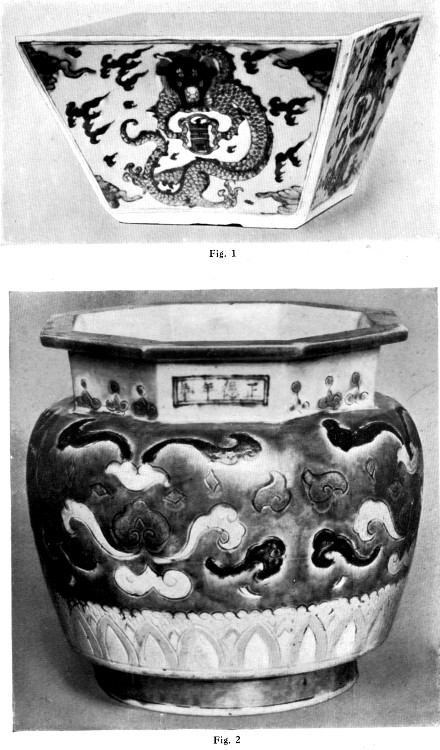
Plate 66.—Porcelain with Chêng Tê mark.
Fig. 1.—Slop Bowl with full-face dragons holding shou
characters, in underglaze blue in a yellow enamel ground. Height 3½
inches. British Museum.
Fig. 2.—Vase with engraved cloud designs in transparent coloured
glazes on the biscuit, green ground. Height 8⅛ inches. Charteris
Collection.
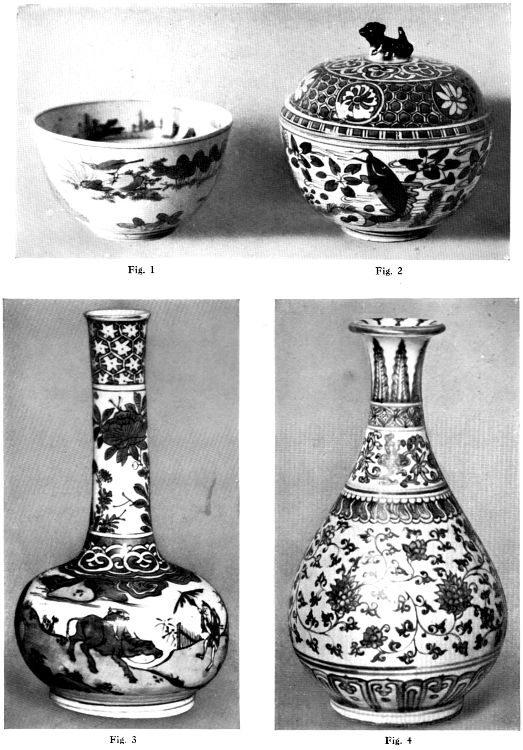
Plate 67.—Blue and White Porcelain. Sixteenth Century.
Fig. 1.—Bowl with Hsüan Tê mark. Diameter 4 inches. Dresden
Collection.
Fig. 2.—Covered Bowl with fish design. Dresden Collection.
Fig. 3.—Bottle, peasant on an ox. Height 8½ inches. Eumorfopoulos
Collection.
Fig. 4.—Bottle with lotus scrolls in mottled blue. Height 9 inches.
Alexander Collection.
The Chêng Tê mark is far from common, but it occurs persistently on
certain types of polychrome porcelain. One is a saucer-dish with carved
dragon designs under a white glaze, the depressions of the carving
and a few surrounding details being washed over with light green
enamel. The design consists of a circular medallion in the centre
enclosing a dragon among clouds, and two dragons on the outside, the
space between them faintly etched with sea waves. The ware is usually
thin and refined. These dishes are not uncommon, and it is difficult
to imagine that they can all belong to such an early period. On the
other hand, one also meets with copies of the same design with the
Ch’ien Lung mark (1736–1795), which display unmistakable difference in
quality. Another type has the same green dragon design with engraved
outlines set in a yellow ground, and in most cases its antiquity is
open to the same doubts. It is certain, however, that these pieces
represent a style which was in vogue in the Chêng Tê period. A small
vase of this kind was the only piece with the Chêng Tê mark in the
exhibition at the Burlington Fine Arts Club in 1910,[97] and it had
the appearance of a Ming specimen. A good example of this Chêng Tê
polychrome belonging to the Hon. Evan Charteris is illustrated in
Fig. 2 of Plate 66. It has the designs etched in outline,
filled in with transparent green, yellow and aubergine glazes, the
three colours or san ts’ai of the Chinese; and the Chêng
Tê mark is seen on the neck.[98] And a square bowl in the British
Museum, similar in body and glaze to the blue and white specimens
with Arabic inscriptions, is painted in fine blue on the exterior
with dragons holding Shou (longevity) characters in their
claws, the background filled in with a rich transparent yellow enamel.
This piece (Plate 66, Fig. 1) has the mark of Chêng Tê in
four characters painted in Mohammedan blue, and is clearly a genuine
specimen.
CHAPTER IV CHIA CHING (1522–1566) AND LUNG CH’ING (1567–1572) — Lung Ch’ing (1567–1572)
The Imperial potteries at Ching-tê Chên were busy in the long reign
of Chia Ching, grandson of Ch’êng Hua, under the supervision of one
of the prefects of the circuit who took charge in place of the palace
eunuch of previous reigns. Chinese accounts of the porcelain of this
important period, summarised in the T’ao shuo, include passages
from the late Ming and therefore almost contemporary works, the Shih
wu kan chu and the Po wu yao lan. In the former we are
told that the Mohammedan blue was largely used, but that the material
for the “fresh red” (hsien hung)[99] was exhausted, and that
the method of producing the red colour was no longer the same as of
old, the potters being capable only of making the overglaze iron red
called fan hung. The Po wu yao lan gives a more intimate
description of the ware, and the passage[100]—the last in that work on
the subject of porcelain—may be rendered as follows:—
“Chia Ching porcelain includes blue-decorated and polychrome wares of
every description; but unfortunately the clay brought to the place from
the neighbouring sources in Jao Chou gradually deteriorated, and when
we compare these two classes of porcelain with the similar productions
of the earlier periods of the dynasty the (Chia Ching) wares do not
equal the latter. There are small white bowls (ou) inscribed
inside with the character ch’a  (tea), the character
chiu
 (wine), or the characters tsao t’ang
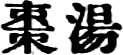 (decoction of dates), or chiang t’ang[101]
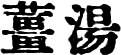 (decoction of ginger); these are the sacrificial altar vessels
regularly used by the Emperor Shih Tsung (i.e. Chia Ching), and they
are called white altar cups, though in form and material they are
far from equalling the Hsüan Tê vessels. The Chia Ching shallow wine
cups with rimmed mouth,[102] convex centre,[103] and foot with base
rim,[104] decorated outside in three colours with fish design, and the
small vermilion boxes, no bigger than a “cash,” are the gems of the
period. As for the small boxes beautifully painted with blue ornament,
I fear that the Imperial factories of after times will not be able to
produce the like. Those who have them prize them as gems.”
A few supplementary comments in the T’ao shuo further inform
us that the Mohammedan blue of the Chia Ching period was preferred
very dark (in contrast with the pale blue of the Hsüan Tê porcelain),
that it was very lovely, and that supplies of this blue arrived
providentially at the time when the “fresh red” failed[105]; and also
that the supplies of earth from Ma-ts’ang were daily diminishing till
they were nearly exhausted, and consequently the material of the ware
was far from equalling that of the Hsüan Tê period. The T’ao lu
adds practically nothing to the above statements.
Fortunately, there are still to be found a fair number of authentic
specimens of Chia Ching porcelain, but before considering these in
the light of the Chinese descriptions, it will be helpful as well
as extremely interesting to glance at the lists of actual porcelain
vessels supplied to the palace at this time. From the eighth year of
this reign, the annual accounts of the palace porcelains have been
preserved in the Annals of Fou-liang, from which they were copied in
the provincial topographies. Two of these lists (for the years 1546
and 1554) are quoted by Bushell,[106] and a general summary of them is
given in the T’ao shuo.[107] To quote them in full here would
take too much space, but the following notes may be useful to the
reader, who, with his knowledge of the later porcelains, should have
no difficulty in reconstructing for himself the general appearance of
the court wares of the time.
The actual objects[108] supplied consisted chiefly of fish bowls
(kang), covered and uncovered jars (kuan), of which
some were octagonal, bowls (wan), dinner bowls (shan
wan) of larger size, saucer dishes (tieh) and round dishes
(p’an), tea cups (ch’a chung), tea cups (ou),
wine cups (chiu chan), and libation cups (chüeh)
with hill-shaped saucers (shan p’an) to support their three
feet, various vases (p’ing), slender ovoid jars for wine
(t’an), ewers or wine pots (hu p’ing), and wine
seas (chiu hai) or large bowls. A large number of complete
dinner-table sets (cho ch’i) occur in one of the lists, and
we learn from the T’ao shuo that uniform sets with the same
pattern and colours throughout were an innovation of the Ming dynasty.
A set[109] comprised 27 pieces, including 5 fruit dishes (kuo
tieh), 5 food dishes (ts’ai tieh), 5 bowls (wan), 5
vegetable dishes (yün tieh), 3 tea cups (ch’a chung), 1
wine cup (chiu chan), 1 wine saucer (chiu tieh), 1 slop
receptacle (cha tou), and 1 vinegar cruse (ts’u chiu).
The slop receptacle appears to have been a square bowl used for the
remnants of food (see Plate 66, Fig. 1).
The sacrificial vessels of the period included tazza-shaped bowls and
dishes (pien tou p’an), large wine jars (t’ai tsun), with
swelling body and monster masks for handles, “rhinoceros” jars (hsi
tsun) in the form of a rhinoceros carrying a vase on its back,
besides various dishes, plates, cups, and bowls of undefined form.
The decorations are grouped in six headings:—
(1) Blue and white (ch’ing hua pai ti, blue ornament on a white
ground), which is by far the largest.
(2) Blue ware, which included blue bowls (ch’ing wan), sky-blue
bowls (t’ien ch’ing wan), and turquoise bowls (ts’ui ch’ing
wan). In some cases the ware is described as plain blue monochrome,
and in one item it is “best blue monochrome” (t’ou ch’ing su),
while in others there are designs engraved under the glaze (an
hua). In others, again, ornament such as dragons and sea waves is
mentioned without specifying how it was executed. Such ornament may
have been etched with a point in the blue surface,[110] or pencilled
in darker blue on a blue background or reserved in white in a blue
ground. Another kind is more fully described as “round dishes of
pure blue (shun ch’ing) with dragons and sea waves inside,
and on the exterior a background of dense cloud scrolls[111] with a
gilt[112] decoration of three lions and dragons.” Bushell[113] speaks
of the “beautiful mottled blue ground for which this reign is also
remarkable,” and which, he says, was produced by the usual blend of
Mohammedan and native blue suspended in water.
(3) Wares which were white inside and blue outside.
(4) White ware, plain[114] or with engraved designs under the glaze
(an hua, lit. secret ornament).
(5) Ware with brown glaze in two varieties, tzŭ chin (golden
brown), and chin huang (golden yellow), with dragon designs
engraved under the glaze. These are the well-known lustrous brown
glazes, the former of dark coffee brown shade, and the latter a light
golden brown.
(6) Ware with mixed colours (tsa sê), which included bowls and
dishes decorated in iron red[115] (fan hung) instead of the
“fresh red” (hsien hung); others with emerald green colour
(ts’ui lü sê); bowls with phœnixes and flowers of Paradise in
yellow in a blue ground; cups with blue cloud and dragon designs in a
yellow ground; boxes with dragon and phœnix designs engraved under a
yellow glaze; dishes with design of a pair of dragons and clouds in
yellow within a golden brown (tzŭ chin) ground; and globular
bowls with embossed[116] ornament in a single-coloured ground.
To these types Bushell adds from other similar lists crackled ware
(sui ch’i), tea cups of “greenish white porcelain” (ch’ing
pai tz’ŭ), which seems to be a pale celadon, and large fish bowls
with pea green (tou ch’ing) glaze.
The source of the designs of the porcelain is clearly indicated in the
following passage in the T’ao shuo[117]: “Porcelain enamelled
in colours was painted in imitation of the fashion of brocaded silks,
and we have consequently the names of blue ground, yellow ground, and
brown gold (tzŭ chin) ground. The designs used to decorate it
were also similar, and included dragons in motion (tsou lung),
clouds and phœnixes, ch’i-lin, lions, mandarin ducks, myriads of
gold pieces, dragon medallions (p’an lung, lit. coiled dragons),
pairs of phœnixes, peacocks, sacred storks, the fungus of longevity,
the large lion in his lair, wild geese in clouds with their double
nests, large crested waves, phœnixes in the clouds, the son-producing
lily, the hundred flowers, phœnixes flying through flowers, the band
of Eight Taoist Immortals, dragons pursuing pearls, lions playing with
embroidered balls, water weeds, and sporting fishes. These are the
names of ancient brocades, all of which the potters have reproduced
more or less accurately in the designs and colouring of their
porcelain.”
The following analysis of the designs named in the Chia Ching lists
will show that the blue and white painters of the period took their
inspiration from the same source:—
Floral Motives.
Celestial flowers (t’ien hua), supporting the characters shou
shan fu hai 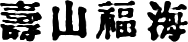 , “longevity of the hills and happiness
(inexhaustible as) the sea.”
Flowers of the four seasons (the tree peony for spring, lotus for
summer, chrysanthemum for autumn, and prunus for winter).
Flowering and other plants (hua ts’ao).
The myriad-flowering wistaria (wan hua t’êng).
The water chestnut (ling).
The pine, bamboo, and plum.
Floral medallions (t’uan hua).
Indian lotus (hsi fan lien).
Knots of lotus (chieh tzŭ lien[118]).
Interlacing sprays of lotus supporting the Eight Precious Symbols or
the Eight Buddhist Emblems.[119]
Branches of ling chih[120] fungus supporting the Eight Precious
Symbols.
Ling chih fungus and season flowers.
Lotus flowers, fishes, and water weeds.
Floral arabesques (hui hui hua).
Flowers of Paradise (pao hsiang hua) 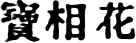 .
The celestial flowers and the flowers of Paradise are no doubt similar
designs of idealised flowers in scrolls or groups.[121] The pao
hsiang hua, which is given in Giles’s Dictionary as “the rose,” is
rendered by Bushell “flowers of Paradise” or “fairy flowers.” Judging
by the designs with this name in Chinese works, and also from the fact
that the rose is a very rare motive on Chinese wares before the Ch’ing
dynasty, whereas the pao hsiang hua is one of the commonest in
the Ming lists, Bushell’s rendering is probably correct in the present
context.
Animal Motives, mythical or otherwise.
Dragons, represented as pursuing jewels (kan chu); grasping
jewels (k’ung chu); in clouds; emerging from water; in bamboo
foliage and fungus plants; among water chestnut flowers; among scrolls
of Indian lotus; emerging from sea waves and holding up the Eight
Trigrams (pa kua); holding up the characters fu  (happiness) or shou
 (longevity), as on Fig. 1 of Plate 66.
Dragons of antique form. These are the lizard-like creatures
(ch’ih) with bifid tail which occur so often in old bronzes and
jades.
Dragon medallions (t’uan lung).
Nine dragons and flowers.
Dragons and phœnixes moving through flowers.
Dragon, and phœnixes with other birds.
Phœnixes flying through flowers.
A pair of phœnixes.
Lions[122] rolling balls of brocade.
Flying lions.
Hoary[123] lions and dragons.
Storks in clouds.
Peacocks (k’ung ch’iao) and mu-tan peonies.
Birds flying in clouds.
Fish and water weeds.
Four fishes.[124]
Human Motives.
Children (wa wa) playing.
Three divine beings (hsien) compounding the elixir of
Immortality.
Two or four Immortals.
The Eight Immortals (pa hsien) crossing the sea; or paying court
to the god of Longevity (p’êng shou), or congratulating him
(ch’ing shou).
A group of divine beings (hsien) paying court to the god of
Longevity.
Two designs of doubtful meaning may be added here:
(1) “Jars decorated with chiang hsia pa chün,”[125] a phrase
which means “the eight elegant (scholars) of Chiang-hsia (i.e. below
the river),” but has been translated by Bushell, using a variant
reading,[126] as “the eight horses of Mu Wang.” The latter rendering
ignores the presence of chiang hsia, and the former, though
a correct reading of the original, is not explained in any work of
reference to which I have had access.
(2) “Bowls with man ti ch’iao,” lit. “graceful (designs) filling
the ground.” The meaning of ch’iao is the difficulty, and
Bushell in one translation[127] has rendered it “graceful sprays of
flowers,” which sorts well with rest of the phrase, but in another[128]
he has assumed that it means “graceful beauties” in reference to the
well-known design of tall, slender girls, which the Dutch collectors
named lange lijsen (see Plate 92, Fig. 2). The latter rendering,
however, goes badly with man ti, “filling the ground,” which is
certainly more applicable to some close design, such as floral scroll
work. This is, however, a good example of the difficulty of translating
the Chinese texts, where so much is left to the imagination, and
consequently there is so much room for differences of opinion.
Plate 68.—Blue and White Porcelain. Sixteenth Century.
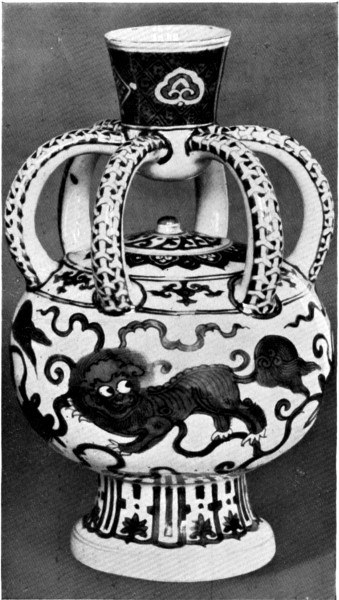
Fig. 1.—Perfume Vase, lions and balls of brocade. Height 8¾ inches.
V. & A. Museum.
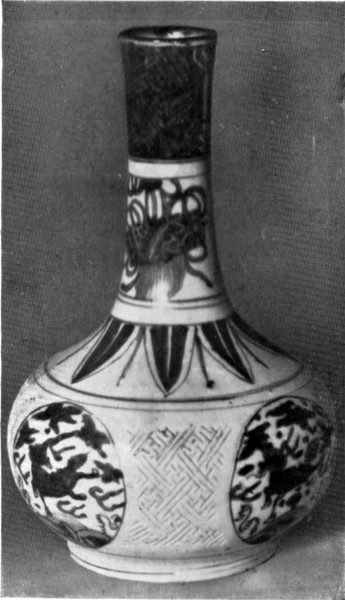
Fig. 2. Double Gourd Vase, square in the lower part. Eight Immortals
paying court to the God of Longevity, panels of children (wa
wa). Height 21 inches. Eumorfopoulos Collection.
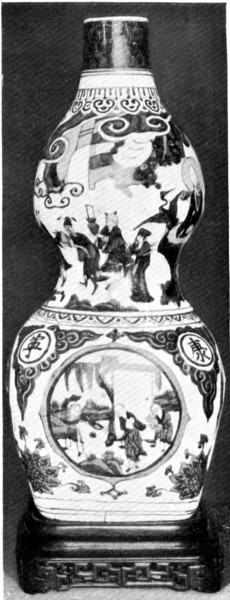
Fig. 3.—Bottle with medallions of ch’i-lin and incised
fret pattern between. Late Ming. Height 9 inches. Halsey
Collection.
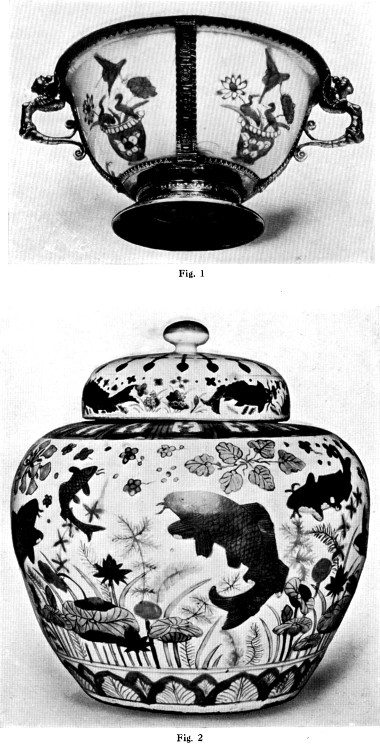
Plate 69.—Sixteenth Century Porcelain.
Fig. 1.—Bowl of blue and white porcelain with silver gilt mount of
Elizabethan period. Height 3¾ inches. British Museum.
Fig. 2.—Covered Jar, painted in dark underglaze blue with red, green
and yellow enamels; fishes and water plants. Chia Ching mark. Height 17
inches. S. E. Kennedy Collection.
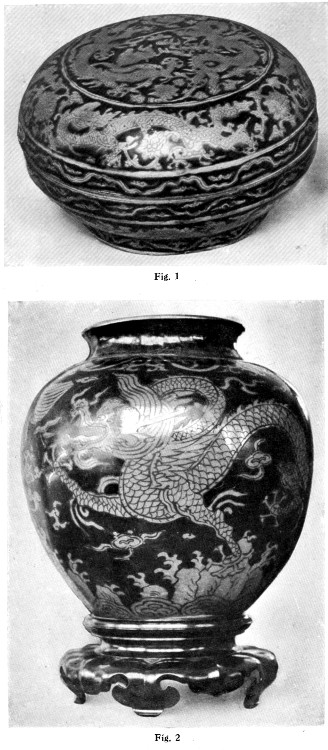
Plate 70.—Porcelain with Chia Ching mark.
Fig. 1.—Box with incised Imperial dragons and lotus scrolls; turquoise
and dark violet glazes on the biscuit. Diameter 9½ inches. V. & A.
Museum.
Fig. 2.—Vase with Imperial dragons in clouds, painted in yellow in an
iron red ground. Height 8½ inches. Cologne Museum.
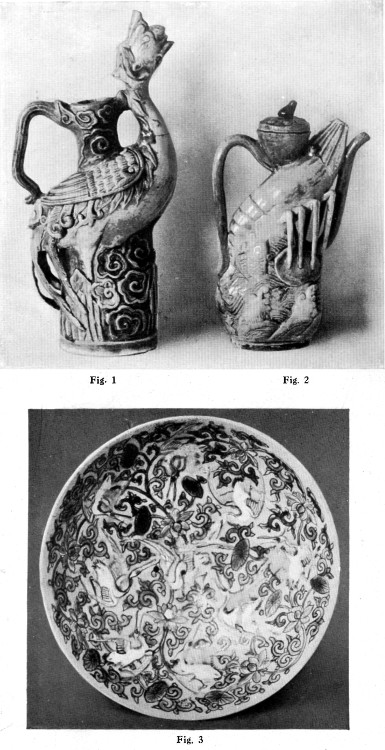
Plate 71.—Sixteenth Century Porcelain.
Figs. 1 and 2.—Two Ewers in the Dresden Collection, with transparent
green, aubergine and turquoise glazes on the biscuit, traces of
gilding. In form of a phœnix (height 11 inches), and of a crayfish
(height 8¼ inches).
Fig. 3.—Bowl with flight of storks in a lotus scroll, enamels on the
biscuit, green, aubergine and white in a yellow ground. Chia Ching
mark. Diameter 7 inches. Alexander Collection.
Emblematic Motives.
Heaven and Earth, and the six cardinal points (ch’ien k’un liu
ho[129]), or “emblems of the six cardinal points of the Universe.”
Ch’ien and k’un are the male and female principles which
are represented by Heaven and Earth, and together make up the Universe.
The identification of these emblems is obscure. They might simply be
the Eight Trigrams (pa kua), which are explained next, for two
of these are known as ch’ien and k’un, and together with
the remaining six they are arranged so as to make up eight points of
the compass. But in that case, why not simply say pa kua as
elsewhere?
On the other hand, we know that certain emblems were used in the Chou
dynasty[130] in the worship of the six points of the Universe, viz. a
round tablet with pierced centre (pi) of bluish jade for Heaven;
a yellow jade tube with square exterior (ts’ung) for Earth; a
green tablet (kuei), oblong with pointed top, for the East; a
red tablet (chang), oblong and knife-shaped, for the South; a
white tablet, in the shape of a tiger (hu), for the West; and
a black jade piece of flat semicircular form (huang) for the
North. All these objects are illustrated in Laufer’s Jade, but
as they have not, to my knowledge, appeared together in porcelain
decoration, the question must for the present be left open.
The pa-kua  or Eight Trigrams, supported by dragons
or by waves and flames.
These are eight combinations of triple lines. In the first the lines
are unbroken, and in the last they are all divided at the centre, the
intermediate figures consisting of different permutations of broken
and unbroken lines (see p. 290). These eight diagrams, by
which certain Chinese philosophers explained all the phenomena of
Nature, are supposed to have been constructed by the legendary Emperor
Fu Hsi (B.C. 2852) from a plan revealed to him on the back
of the “dragon horse” (lung ma) which rose from the Yellow
River.[131] Among other things, they are used to designate the points
of the compass, one arrangement making the first figure represent the
South (also designated ch’ien  or Heaven), and the last
figure the North (also designated k’un
 or Earth),
the remaining figures representing South-West, West, North-West,
North-East, East, and South-East.
The pa pao  , or Eight Precious Symbols, supported by
fungus sprays.
These are usually represented by (1) a sphere or jewel, which seems to
have originally been the sun disc; (2) a circle enclosing a square,
which suggests the copper coin called a “cash”; (3) an open lozenge,
symbol of victory or success; (4) a musical stone (ch’ing);
(5) a pair of books; (6) a pair of rhinoceros horns (cups); (7) a
lozenge-shaped picture (hua); (8) a leaf of the artemisia, a
plant of good omen, which dispels sickness. (See p. 299.)
The pa chi hsiang  , or Eight Buddhist Symbols,
supported on lotus scrolls.
These symbols, which appeared among the auspicious signs on the foot
of Buddha, comprise (1) the wheel (chakra), which is sometimes
replaced by the hanging bell; (2) the shell trumpet of Victory; (3)
the umbrella of state; (4) the canopy; (5) the lotus flower; (6) the
vase; (7) the pair of fish, emblems of fertility; (8) the angular knot
(representing the entrails), symbol of longevity. (See p. 298.)
The hundred forms of the character shou (longevity)—pai shou
tz’ŭ.
Ju-i sceptres and phœnix medallions.
The ju-i  (“as you wish”) sceptre brings fulfilment
of wishes, and is a symbol of longevity (see vol. i., p. 227). The head
of the ju-i, which has a strong resemblance to the conventional
form of the ling chih fungus, is often used in borders and
formal patterns variously described as “ju-i head patterns,”
“cloud-scroll patterns,” or “ju-i cloud patterns.”
Close ground patterns of propitious clouds (yung hsiang yün ti).
Cloud designs are propitious because they symbolise the fertilising
rain, and they are commonly represented by conventional scrolls as well
as by the more obvious cloud patterns.
Crested sea waves (chiang ya hai shui).
Chiang ya  (lit. ginger shoots) is rendered by
Bushell “crested waves,” the metaphor being apparently suggested by the
curling tops of the young plant.
Cups decorated[132] with the characters fu shou k’ang ning
 (happiness, long life, peace, and tranquillity).
A blue and white vase with these characters in medallions framed by
cloud scrolls on the shoulders is shown on Plate 68.
Miscellaneous Motives.
The waterfalls of Pa Shan  in the province of Szechuan.
Gold weighing-scales (ch’êng chin  ).
A design named san yang k’ai t’ai  , a phrase alluding
to the “revivifying power of spring,” and said by Bushell to be
symbolised by three rams. Cf. Fig. 2 of Plate 122.
The mark of the Chia Ching period, though not so freely used as
those of Hsüan Tê and Ch’êng Hua, has been a favourite with Japanese
copyists, whose imitations have often proved dangerously clever. Still,
there are enough genuine specimens in public and private collections in
England to provide a fair representation of the ware. In studying these
the blue and white will be found to vary widely, both in body material
and in the colour of the blue, according to the quality of the objects.
Plate 77 illustrates a remarkably good example of the dark but
vivid Mohammedan blue on a pure white ware of fine close grain with
clear glaze. The design, which consists of scenes from the life of a
sage, perhaps Confucius himself, is painted in typical Ming style, and
bordered by ju-i cloud scrolls and formal brocade patterns. The
Chia Ching blue is often darker[133] and heavier than here, resembling
thick patches of violet ink, to use Mr. Perzynski’s phrase. This
powerful blue is well shown in the large vase given by Mr. A. Burman to
the Victoria and Albert Museum (Plate 72), and by a fine ewer
in Case 22 in the same gallery. The latter has an accidentally crackled
glaze on the body with brownish tint, due, no doubt, to staining.
On the other hand, a large double-gourd vase in the British Museum,
heavily made (probably for export), is painted with the eighteen
Arhats, or Buddhist apostles, in a dull greyish blue, which would
certainly have been assigned to the Wan Li period were it not for the
Chia Ching mark. This is, no doubt, the native cobalt without any
admixture of Mohammedan blue.
The body material in these specimens varies scarcely less than the
blue. In the colour stand on Plate 77 the ware is a pure clean white,
both in body and glaze. On other specimens—particularly the large,
heavily built jars and vases made for export to India and Persia—the
ware is of coarser grain, and the glaze of grey or greenish tone. The
tendency of the Ming biscuit to assume a reddish tinge where exposed
to the fire is exaggerated on some of these large jars, so that the
exposed parts at the base and foot rim are sometimes a dark reddish
brown. Doubtless the clay from different mines varied considerably,
and the less pure materials would be used on these relatively coarse
productions. On the other hand, the better class of dish and bowl made
for service at the table is usually of clean white ware, potted thin
and neatly finished, and differing but little in refinement from the
choice porcelains of the eighteenth century. Such are the dragon dish
described on p. 32 and the polychrome saucers which will be mentioned
presently.
The export trade with Western Asia and Egypt, both by sea and land,
must have been of considerable dimensions in the middle of the
sixteenth century. Broken pieces of Chinese blue and white are found
on all the excavated sites in the Near East, and the influence of the
Chinese porcelain is clearly seen in the blue, or blue and brown,
painted faience made in Persia, Syria, and Egypt in the sixteenth
century. The reflex influence of Persia on the Chinese wares has
already been noted, and it is clear that Persian taste was studied
by the makers of the dishes, bottles, pipes, and other objects with
birds and animals in foliage and floral scrolls of decidedly Persian
flavour, which are still frequently found in the Near East. It was this
type of Chinese porcelain which inspired Italian maiolica potters in
their decoration alla porcellana, as well as the decorators of
the Medici or Florentine porcelain, the first European porcelain of
any note. Françesco Maria, the patron of the Medici porcelain, died
in 1587, and as little, if any, of the ware was made after his death,
the rare surviving examples may be safely taken as reflecting, where
any Chinese influence is apparent, the influence of the mid-sixteenth
century porcelains.
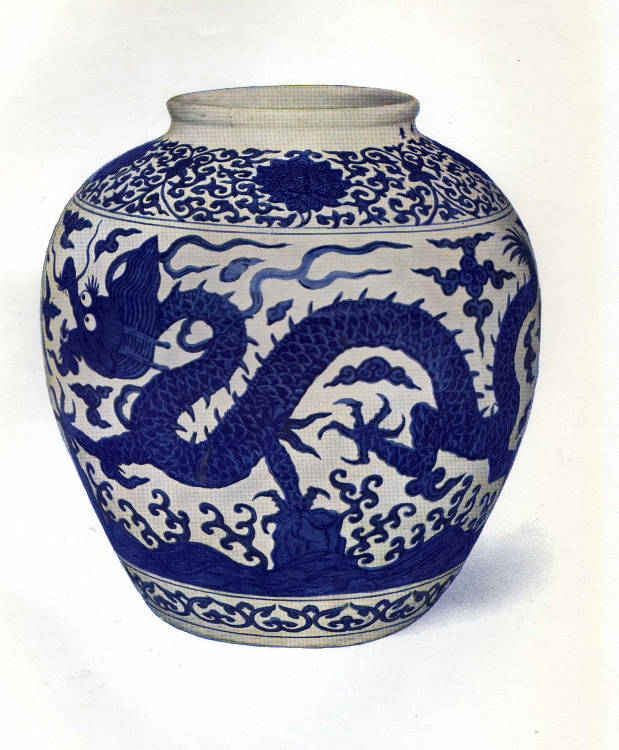
PLATE 72
Vase with Imperial five-clawed dragons in cloud scrolls over sea waves:
band of lotus scrolls on the shoulder. Painted in dark Mohammedan
blue. Mark on the neck, of the Chia Ching period (1522–1566) in six
characters.
Height 21 inches.
Victoria and Albert Museum.
An interesting series of Ming blue and white export wares collected
in India was lent to the Burlington Fine Arts Club in 1910 by
Mrs. Halsey. It included a few Chia Ching specimens, and among them a
melon-shaped jar with lotus scrolls in the dark blue of the period.
This melon form has been popular with the Chinese potters from T’ang
times, and it occurs fairly often in the Ming export porcelains. A
companion piece, for instance, at the same exhibition was decorated
with handsome pine, bamboo, and plum designs. Others, again, are
appropriately ornamented with a melon vine pattern, a gourd vine, or a
grape vine with a squirrel-like animal on the branches. The drawing of
these pieces is usually rough but vigorous, the form is good, and the
blue as a rule soft and pleasing; and though entirely wanting in the
superfine finish of the choice K’ang Hsi blue and white, they have a
decorative value which has been sadly underrated.
The polychrome porcelains of the Chia Ching period are rarer than
the blue and white, but still a fair number of types are represented
in English collections. Of the colours applied direct to the biscuit
the early glazes of the demi-grand feu—turquoise, aubergine
violet, green and yellow—were doubtless applied as in the previous
century to the large wine jars, vases and figures in the round. An
unusual specimen of this class is the marked Chia Ching cake box
in the Victoria and Albert Museum, illustrated on Plate 70. The
design—Imperial dragons among floral scrolls—is traced with a
point in the paste and covered with a delicate turquoise glaze, the
background being filled with violet aubergine. Similarly engraved
designs coloured by washes of transparent glazes in the three
colours—green, yellow and aubergine brown—are found with the Chia
Ching mark as with that of Chêng Tê, and Plate 73 illustrates two
singularly beautiful bowls with designs outlined in brown and washed
in with transparent glazes. The one has flowering branches of prunus,
peach and pomegranate in white, green and aubergine in a yellow ground,
and the other phœnixes and floral scrolls in yellow, green and white in
a ground of pale aubergine. Both have the Chia Ching mark. Fig. 2 of
Plate 71 is another member of the same group, with a beautiful design
of cranes and lotus scrolls in a yellow ground. There are, besides,
examples of these yellow and aubergine glazes in monochrome. A good
specimen of the latter with Chia Ching mark in the British Museum has
fine transparent aubergine glaze with iridescent surface, the colour
pleasantly graded, which contrasts with the uniform smooth glaze and
trim finish of a Ch’ien Lung example near to it.
Two interesting ewers in the Dresden collection (Figs. 1 and 2 of Plate
71) probably belong to this period, or at any rate to the sixteenth
century. They are fantastically shaped to represent a phœnix and a
lobster, and are decorated with green, yellow, aubergine and a little
turquoise applied direct to the biscuit. Parts of the surface have been
lightly coated with gilding, which has almost entirely disappeared.
These pieces are mentioned in an inventory of 1640, and a lobster
ewer precisely similar was included in the collection made by Philipp
Hainhofer in the early years of the seventeenth century.[134]
Among the examples of on-glaze enamels of this period are those in
which the coral red derived from iron oxide (fan hung) is
the most conspicuous colour. This red is often highly iridescent,
displaying soft ruby reflections like Persian lustre; at other
times it is richly fluxed, and has a peculiarly vitreous and almost
sticky appearance. The former effect is well seen in a small saucer
in the British Museum, which has a wide border of deep lustrous red
surrounding a medallion with lions and a brocade ball in green. The
latter is seen on a square, covered vase in the same case, decorated
on each side with full-faced dragons in red and the usual cloud
accessories in inconspicuous touches of green and yellow. The yellow
enamel of the period is often of an impure, brownish tint and rather
thickly applied, but these peculiarities of both yellow and red
continued in the Wan Li period.
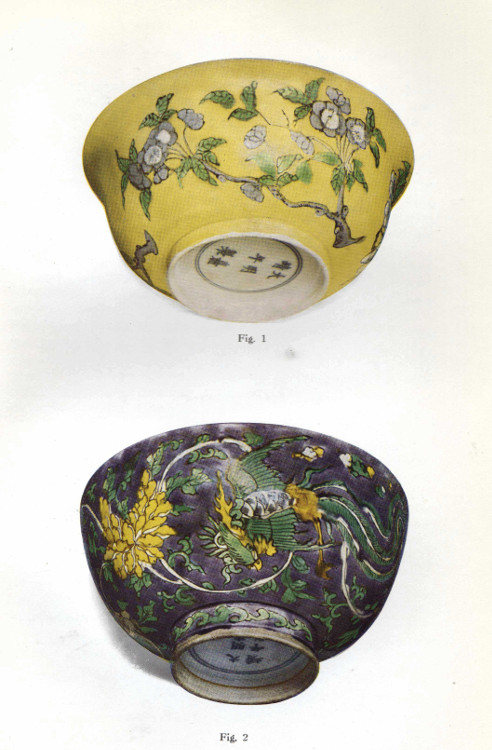
PLATE 73
Two Bowls with the Chia Ching mark (1522–1566), with designs outlined
in brown and washed in with colours in monochrome grounds.
Fig. 1 with peach sprays in a yellow ground. Diameter 8 inches.
Alexander Collection.
Fig. 2 with phœnixes (fêng-huang) flying among scrolls of
mu-tan peony. Diameter 7 inches. Cumberbatch Collection.
The combination of enamel colours with underglaze blue, which was so
largely used in the Wan Li period as to be generally known by the name
Wan li wu ts’ai (Wan Li polychrome), is not unknown on Chia
Ching wares. The wide-mouthed jar, for instance, from the collection of
Mr. S. E. Kennedy[135] (Plate 69, Fig. 2) is decorated with a design of
fish among water plants in deep Chia Ching blue combined with green,
yellow and iron red enamels; and a small bottle-shaped vase in the
British Museum has the same blue combined with on-glaze red, green,
yellow and aubergine, the design being fish, waves, and water plants.
The greens of this and the Wan Li period include various shades—bright
leaf green, pale emerald, and a bluish green[136] which seems to
be peculiar to the late Ming period.
A box in the collection of Dr. C. Seligmann has a dragon design
reserved in a blue ground and washed over with yellow enamel, on which
in turn are details traced in iron red; and another peculiar type of
Chia Ching polychrome in the Pierpont Morgan Collection (Cat. No. 882)
is a tea cup with blue Imperial dragons inside, “on the outside deep
yellow glaze with decoration in brownish red of intensely luminous
tone, derived from iron, lightly brushed on the yellow ground: the
decoration consists of a procession of boys carrying vases of flowers
round the sides of the cup with addition of a scroll of foliage
encircling the rim.” Both these specimens have the Chia Ching mark.
Allusion has already been made (p. 6) to a type of bowl which belongs
to the Ming period, though opinions differ as to the exact part of
that dynasty to which it should be assigned. The bowls vary slightly
in form, but the most usual kind is that shown on Plate 74 with
well rounded sides. A common feature, which does not appear in the
photograph, is a convex centre. Others, again, are shallow with concave
base, but no foot rim. The decoration of those in the British Museum
includes (1) a coral red exterior with gilt designs as described on
p. 6, combined with slight underglaze blue interior ornament, (2) a
beautiful pale emerald green exterior similarly gilt, with or without
blue ornament inside, and (3) a single specimen with white slip
traceries in faint relief under the glaze inside, the outside enamelled
with turquoise blue medallions and set with cabochon jewels in Persia
or India. There are similar bowls in the Dresden collection, with pale
sky blue glaze on the exterior. As already noted, one or two of the
red bowls have the Yung Lo mark, but, as a rule, they are marked with
phrases of commendation or good wish,[137] such as tan kuei
(red cassia, emblem of literary success), wan fu yu t’ung (may
infinite happiness embrace all your affairs!) Two of them are known to
have sixteenth-century European mounts, viz. the red bowl mentioned on
p. 6, and a green specimen in the British Museum.[138] Without denying
the possibility of some of the red examples dating back to the Yung
Lo period, the conclusion is almost irresistible that we have here in
one case the fan hung decoration which replaced the hsien
hung in the Chia Ching period, and in another the ts’ui lü
(emerald green), named among the colours of the Imperial Chia Ching
porcelains.
The Chia Ching monochromes already mentioned include white, blue, sky
blue, lustrous brown, turquoise, green, yellow, and aubergine, with or
without designs engraved in the paste (an hua). None of these
call for any further comment, unless it be the distinction between blue
and sky blue of the Imperial wares. The former, no doubt, resulted from
the Mohammedan blue (blended with native cobalt) mixed with the glaze,
and must have been a fine blue of slightly violet tone: the latter was
apparently the lavender-tinted blue which goes by the name of sky blue
on the more modern porcelains.
We read in more than one passage in the Chinese works that the
imitation of the classical porcelains of Hsüan Tê and Ch’êng Hua was
practised in the Chia Ching period, and the name of a private potter
who excelled in this kind of work has been preserved. A note on this
artist, given in the T’ao lu[139] under the heading Ts’ui
kung[140] yao, or Wares of Mr. Ts’ui, may be rendered as follows:—
“In the Chia Ching and Lung Ch’ing periods there lived a man who was
clever at making porcelain (t’ao). He was famed for imitations
of the wares in the traditional style and make of the Hsüan Tê and
Ch’êng Hua periods, and in his time he enjoyed the highest reputation.
The name given to his wares was Mr. Ts’ui’s porcelain (ts’ui kung
yao tz’ŭ), and they were eagerly sought in all parts of the empire.
As for the shape of his cups (ch’ien), when compared with the
Hsüan and Ch’êng specimens[141] they differed in size but displayed the
same skill and perfection of design. In the blue and polychrome wares
his colours were all like the originals. His were, in fact, the cream
of the porcelains made in the private factories (min t’ao).”
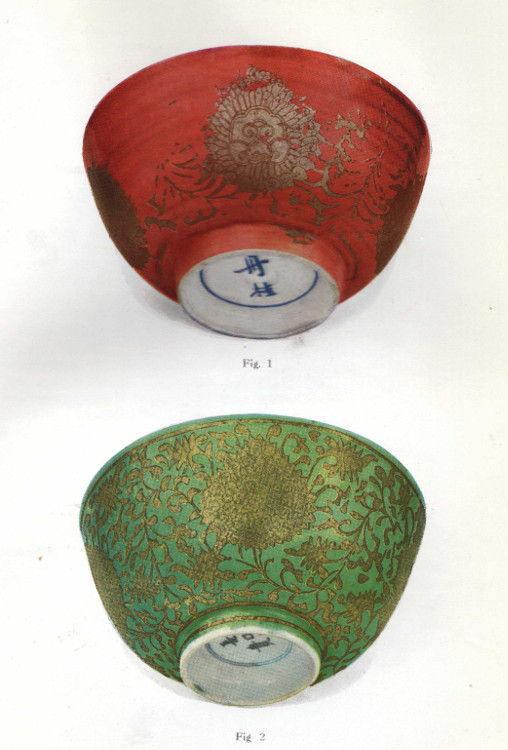
PLATE 74
Two Bowls in the British Museum with gilt designs on a monochrome
ground. Probably Chia Ching period (1522–1566)
Fig. 1 with lotus scroll with etched details on a ground of iron red
(fan hung) outside. Inside is figure of a man holding a branch
of cassia, a symbol of literary success, painted in underglaze blue.
Mark in blue, tan kuei (red cassia.) Diameter 4½ inches.
Fig. 2 with similar design on ground of emerald green enamel. Mark in
blue in the form of a coin or cash with the characters ch’ang
ming fu kuei (long life, riches and honours!). Diameter 4¾ inches.
It is interesting to note that the imitation of the early Ming
porcelains began as soon as this, and we may infer from the usual
Chinese procedure that the marks of the Hsüan Tê and Ch’êng Hua periods
were duly affixed to these clever copies.
We read in the T’ao shuo[142] that the Imperial factory was
re-established in the sixth year of this reign (1572), and placed under
the care of the assistant prefects of the district. This would seem to
imply that for the greater part of this brief period the Imperial works
had been in abeyance. Be this as it may, there was no falling off in
the quantity of porcelain commanded for the Court, and the extravagant
and burdensome demands evoked a protest from Hsü Ch’ih, the president
of the Censorate,[143] in 1571. It was urged among other things that
the secret of the copper red colour (hsien hung) had been lost,
and that the potters should be allowed to use the iron red (fan
hung) in its place: that the size and form of the large fish bowls
which were ordered made their manufacture almost impossible: that
the designs for the polychrome (wu ts’ai) painting were too
elaborate, and that square boxes made in three tiers were a novelty
difficult to construct. Fire and flood had devastated Ching-tê Chên,
and many of the workmen had fled, and he (the president) begged that a
large reduction should be made in the palace orders.
We are not told whether this memorial to the emperor had the desired
effect. In the case of the next emperor a similar protest resulted in
a large reduction of the demands. But the document discloses several
interesting facts, and among other things we learn that the designs for
some of the ware and for the coloured decoration were still sent from
the palace as in the days of Ch’êng Hua.
The official lists of porcelain actually supplied to the Court of Lung
Ch’ing have been briefly summarised in the T’ao shuo[144];
but they do not include any new forms, and the motives of decoration
were in the main similar to those recorded in the Chia Ching lists.
The following, however, may be added to the summary in the previous
chapter:—
The yü tsan hua, rendered in Giles’s Dictionary as the
“tuberose,” by Bushell as the “iris.”
Clumps of chrysanthemum flowers.
Interlacing scrolls of mu-tan peony.
Ch’ang ch’un (long spring) flowers, identified by Bushell with
the “jasmine.”
A “joyous meeting,” symbolised according to Bushell by a pair of
magpies.
The Tartar pheasant (chai chih).
The season flowers supporting the characters  ch’ien k’un
ch’ing t’ai, “Heaven and earth fair and fruitful!”
Monsters (shou) in sea waves.
Flying fish.
Historical scenes (ku shih), as well as genre subjects (jên
wu).
Children playing with branches of flowers.
This last design occurs both in the form of belts of foliage scrolls,
among which are semi-nude boys, and of medallions with a boy holding a
branch, on blue and white and polychrome wares of the late Ming period.
But it is a design of considerable antiquity, and it is found engraved
on the early Corean bowls which, no doubt, borrowed from Sung originals.
Though all these designs are given under the general heading of blue
and white, we may infer that the polychrome which is occasionally
mentioned was used in combination with the blue. Thus the mention of
“phœnixes in red clouds flying through flowers,” of “nine red dragons
in blue waves,” and of “a pair of dragons in red clouds,” recalls
actual specimens which I have seen of Lung Ch’ing and Wan Li boxes with
designs of blue dragons moving through clouds touched in with iron red.
Again, where the blue designs are supplemented with “curling waves
and plum blossoms in polychrome (wu ts’ai),” one thinks of the
well-known pattern of conventional waves on which blossom and symbols
are floating, as on Plate 79. Other types of decoration mentioned are
yellow grounds and white glaze, both with dragon designs engraved
under the glaze (an hua), peacocks and mu-tan peonies
in gilding, and moulded ornament. A specific example of the last are
the lions which served as knobs on the covers of the ovoid wine jars
(t’an).
The author of the T’ao shuo pays a handsome tribute to the skill
of the late Ming potters. “We find,” he says, “that the porcelain of
the Ming dynasty daily increased in excellence till we come to the
reigns of Lung Ch’ing and Wan Li, when there was nothing that could not
be made.” At the same time he finds fault with a particular kind of
decoration which was encouraged by the degraded and licentious tastes
of the Emperor Lung Ch’ing, and seems to have only too frequently
marred the porcelain of the period.[145]
The rare examples of marked Lung Ch’ing porcelain in our collections
do not call for special comment, and the unmarked specimens will
hardly be distinguished from the productions of the succeeding Wan
Li period. There are, however, two boxes in the British Museum which
may be regarded as characteristic specimens of the Imperial blue and
white porcelains. Both are strongly made with thick but fine-grained
body material and a glaze of slightly greenish tone; and the designs
are boldly sketched in strong outline and washed in with a dark indigo
blue. One is a square box with four compartments decorated with
five-clawed dragons in cloud scrolls, extended or coiled in medallions
according as space demanded; and the other is oblong and rectangular,
and painted on the sides (the cover is missing) with scenes of family
life (jên wu). In both cases the base is unglazed except for a
sunk medallion in which the six characters of the Lung Ch’ing mark are
finely painted in blue.
CHAPTER V WAN LI (1573–1619) AND OTHER REIGNS
The long reign of Wan Li, the last important period of the Ming
dynasty, is certainly the best represented in European collections, a
circumstance due to the ceramic activity of the time not less than to
its nearness to our own age. In the first year of the reign orders were
given that one of the sub-prefects of Jao-chou Fu should be permanently
stationed at Ching-tê Chên to supervise the Imperial factory. It
appears that he proved a stern taskmaster, and at the same time that
the potters were severely burdened by excessive demands from the
palace. The picture drawn by the censor in the previous reign of the
afflicted condition of the potters, and the story told elsewhere[146]
how they had made intercession daily in the temple of the god that the
Imperial orders might be merciful, are fitting preface to the tale of
the dragon bowls told as follows by T’ang Ying,[147] the director of
the factory in the first half of the eighteenth century.
“By the west wall of the Ancestral-tablet Hall of the spirit who
protects the potters is a dragon fish bowl (lung kang). It is
three feet in diameter and two feet high, with a fierce frieze of
dragons in blue and a wave pattern below. The sides and the mouth are
perfect, but the bottom is wanting. It was made in the Wan Li period of
the Ming. Previously these fish bowls had presented great difficulty in
the making, and had not succeeded, and the superintendent had increased
his severity. Thereupon the divine T’ung took pity on his fellow
potters, and served them by alone laying down his life. He plunged into
the fire, and the bowls came out perfect. This fish bowl was damaged
after it had been finished and selected (for palace use), and for a
long time it remained abandoned in a corner of the office. But when
I saw it I sent a double-yoked cart and men to lift it, and it was
brought to the side of the Ancestral-tablet Hall of the god, where it
adorns a high platform, and sacrifice is offered. The vessel’s perfect
glaze is the god’s fat and blood; the body material is the god’s body
and flesh; and the blue of the decoration, with the brilliant lustre of
gems, is the essence of the god’s pure spirit.”
The deification of T’ung was a simple matter to the Chinese, who
habitually worship before the tablets of their ancestors; but he seems
to have become the genius of the place, and in this capacity to have
superseded another canonised potter named Chao,[148] who had been
worshipped at Ching-tê Chên since 1425.
To add to the difficulties experienced by the potters in satisfactorily
fulfilling the Imperial demands, it had been reported in 1583 that
the supplies of earth from Ma-ts’ang were practically worked out, and
though good material was found at Wu-mên-t’o, which is also in the
district of Fu-liang, the distance for transport was greater, and as
the price was not correspondingly raised the supply from this source
was difficult to maintain. Consequently we are not surprised to learn
that in this same year another memorial was forwarded to the emperor by
one of the supervising censors, Wang Ching-min, asking for alleviation
of the palace orders, and protesting specifically against the demands
for candlesticks, screens, brush handles, and chess apparatus as
unnecessarily extravagant. It was urged at the same time that blue
decoration should be substituted for polychrome, and that pierced work
(ling lung) should not be required, the objection to both these
processes being that they were difficult to execute and meretricious in
effect.
It is stated in the T’ao lu[149] that the supply of Mohammedan
blue had ceased completely in the reign of Wan Li, and that on the
other hand the chi hung or underglaze copper red was made,
though it was not equal in quality to the hsien hung or pao
shih hung[150] of the earlier periods. Both these assertions are
based on the somewhat uncertain authority of the T’ang shih ssŭ
k’ao, and though the truth of the second is shown by existing
specimens, the first is only partially true, for there are marked
examples of Mohammedan blue in the British Museum and probably
elsewhere. Either there were supplies of the Mohammedan material in
hand at the beginning of the reign, or they continued to arrive for
part at least of the period.
The lists of porcelain supplied to the Court of Wan Li may be consulted
with advantage, and the extracts from those of the previous reigns may
be supplemented by the following, which, though not necessarily new
forms and designs, do not appear in the Chia Ching and Lung Ch’ing
records:—
Forms.
Trays for wine cups (pei p’an).[151]
Beaker-shaped[152] vases (hu p’ing  ).
Flat-backed wall vases in the form of a double gourd split vertically.
Chess boards (ch’i p’an).
Hanging oil lamps[2] (ch’ing t’ai  ).
Pricket candlesticks (chu t’ai). See Cat. B. F. A., 1910,
E 6: a pricket candlestick with cloud and dragon designs in blue and
the Wan Li mark.
Jars for candle snuff (chien chu kuan).
Screens (p’ing).
Brush handles (pi kuan).
Brush rests (pi chia).
Brush pots (pi ch’ung). Apparently the cylindrical jars usually
known as pi t’ung.
Fan cases (shan hsia).
Water droppers for the ink pallet (yen shui ti).
Betel-nut boxes (pin lang lu).
Handkerchief boxes (chin lu).
Hat boxes (kuan lu).
Cool seats (liang tun), for garden use in summer.
Motives for Painted Decoration.
Floral, etc.:
Lily flowers (hsüan hua).
Hibiscus (kuei) flowers on a brocade ground.
Round medallions of season flowers.
Flower designs broken by medallions of landscape.
Marsh plants.
Sections of water melons (hsi kua pan).
Foreign pomegranates; sometimes tied with fillets.
The sacred peach.
Medallions of peach boughs with the seal character shou
(longevity).
Apricot (hsing) foliage.
Pine pattern brocade.
Ginseng (hsien).
Hemp-leaved (ma yeh) Indian lotus.
Borders of bamboo foliage and branching prunus.
Grape-vine borders.
Animals, etc.:
Monsters: variously described as hai shou (sea monsters) and
i shou (strange monsters).
Nine blue monsters in red waves.
Strange monsters attending the celestial dragon.
Sea horses.
Full-faced dragons (chêng mien lung). See Plate 66.
Medallions of archaic dragons (ch’ih) and tigers.
Ascending and descending dragons.
Couchant, or squatting (tun) dragons.
Flying dragons.
The hundred dragons.
The hundred storks.
The hundred deer. (As in the “Hundred Shou Characters” and other
similar phrases, the “hundred” is merely an indefinite numerative
signifying a large number.)
Elephants with vases of jewels (of Buddhistic significance).
Water birds in lotus plants.
Six cranes, “symbolising the cardinal points of the universe” (liu
ho ch’ien k’un).
Phœnixes among the season flowers.
Bees hovering round plum blossom.
Human:
Men and women (shih nü).
Medallions with boys pulling down (branches of) cassia (p’an
kuei).
The picture of the Hundred Boys.
Fu, Lu, Shou (Happiness, Rank, and Longevity). It
is not stated whether the characters only are intended, or, as is more
probable, the three Taoist deities who distribute these blessings.
Emblematic Motives and Inscriptions.
The eight Buddhist emblems, bound with fillets (kuan t’ao).
Ju-i sceptres bound with fillets.
Ju-i cloud borders (ju i yün pien).
Midsummer holiday symbols (tuan yang chieh). Explained by
Bushell as sprigs of acorns and artemisia hung up on the fifth day of
the fifth moon.
Emblems of Longevity (shou tai), e.g. gourd, peach, fungus,
pine, bamboo, crane, deer.
The “monad symbol” (hun yüan), which is apparently another name
for the yin yang, and the Eight Trigrams. See p. 290.
Lozenge symbols of victory (fang shêng).
“The four lights worshipping the star of Longevity” (ssŭ yang p’êng
shou).
Spiral (hui  ) patterns.
Sanskrit invocations (chên yen tz’ŭ). See Plate 93.
Ancient writings found at Lo-yang (lo shu). Lo-yang (the modern
Honan Fu) was the capital of the Eastern Han (25–220 A.D.).
Inscriptions in antique seal characters (chuan).
Dragons holding up the characters  yung pao wan shou
(ever insuring endless longevity); and
 yung pao hung fu
ch’i t’ien (ever insuring great happiness equalling Heaven).
Borders inscribed  fu ju tung hai (happiness like the
eastern sea); and
 fêng t’iao yü shun t’ien hsia t’ai
p’ing (favouring winds and seasonable rain: great peace throughout
the empire).
“A symbolical head with hair dressed in four puffs”[153] bearing the
characters  yung pao ch’ang ch’un (ever insuring long
spring).
Taoist deities holding the characters  wan ku ch’ang
ch’un ssŭ hai lai ch’ao (through myriads of ages long spring;
tribute coming from the four seas); or the same sentiment with yung
pao (ever insuring) in place of wan ku.
Dragons in clouds holding the characters  shêng shou,
the emperor’s birthday.
Miscellaneous.
Representations of ancient coins (ku lao ch’ien).
Landscapes (shan shui).
Necklaces (ying lo  ).
Jewel mountains in the sea waves (pao shan hai shui). This
is, no doubt, the familiar border pattern of conventional waves with
conical rocks standing up at regular intervals.
Round medallions (ho tzŭ, lit. boxes) in brocade grounds.
Most of these designs are given under the heading of “blue and
white,” though, as in the Lung Ch’ing list, the blue is in many
cases supplemented by colour or by other forms of decoration such
as patterns engraved in the body (an hua), and “designs on a
blue ground,” the nature of them not explained, but no doubt similar
to those described on p. 61. The method of reserving the
decoration in white in a blue ground (ch’ing ti pai hua) is
specifically mentioned under the heading of “mixed decorations.” The
supplementary decoration consists of on-glaze enamels mixed with the
underglaze blue; bowls with coloured exterior and blue and white inside
or vice versa; yellow grounds with designs engraved under the glaze;
gilded fishes among polychrome water weeds, and other gilded patterns;
curling waves in polychrome and plum blossoms; red dragons in blue
waves, the red either under or over the glaze; relief designs (ting
chuang[154]) and pierced work (ling lung[155]).
The “mixed colours” included garden seats with lotus designs, etc.,
in polychrome (wu ts’ai) and with aubergine brown (tzŭ)
lotus decoration in a monochrome yellow ground; tea cups with dragons
in fairy flowers engraved under a yellow glaze; yellow ground with
polychrome (wu ts’ai) decoration; banquet dishes, white inside,
the outside decorated with dragons and clouds in red, green, yellow,
and aubergine.
The custom of minutely subdividing the work in the porcelain factories
so that even the decoration of a single piece was parcelled out among
several painters existed in the Ming dynasty, though perhaps not
carried so far as in the after periods. It is clear that under such
a system the individuality of the artists was completely lost, and
we never hear the name of any potter or painter who worked at the
Imperial factory. In the private factories probably the division of
labour was less rigorous, and it is certain that many of the specimens
were decorated by a single brush. But even so, signatures of potters
or painters are almost unknown; and only one or two private potters
of conspicuous merit at the end of the Ming period are mentioned by
name in the Chinese books. Mr. Ts’ui, for instance, has already been
mentioned in the chapter on the Chia Ching period, and three others
occur in the annals of the Wan Li period.
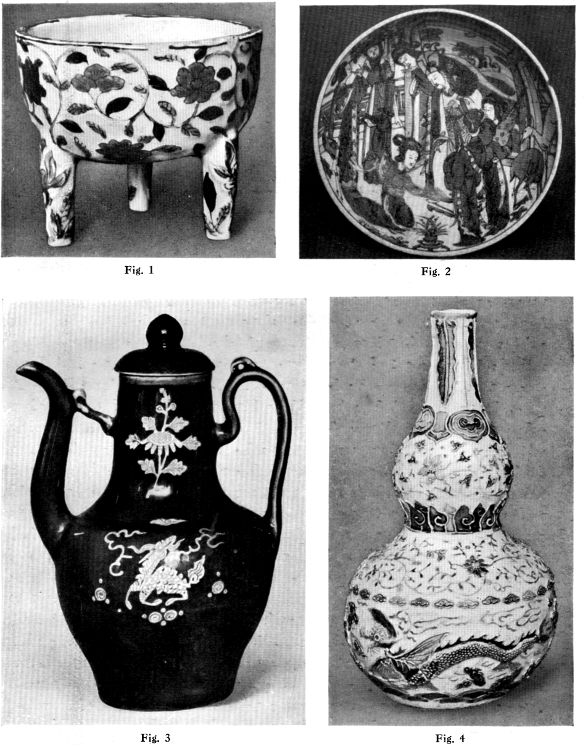
Plate 75.—Ming Porcelain.
Fig. 1.—Tripod Bowl with raised peony scrolls in enamel colours. Wan
Li mark. Height 5¾ inches. Eumorfopoulos Collection.
Fig. 2.—Blue and white Bowl, Chia Ching period. Mark, Wan ku ch’ang
ch’un (“A myriad antiquities and enduring spring!”). Height 3
inches. Kunstgewerbe Museum, Berlin.
Fig. 3.—Ewer with white slip ch’i-lin on a blue ground. Wan Li
period. Height 9 inches. Eumorfopoulos Collection.
Fig. 4.—Gourd-shaped Vase with winged dragons and fairy flowers,
raised outlines and coloured glazes on the biscuit. Sixteenth century.
Height 8¾ inches. Salting Collection.
Of these, the most interesting personality was Hao Shih-chiu,[156]
scholar, painter, poet, and potter, who signed his wares with the
fanciful name Hu yin tao jên[157] (Taoist hidden in a tea
pot), to show that he “put his soul” into the making of his pots. He
lived, we are told,[158] in exaggerated simplicity, in hut, with a mat
for a door and a broken jar for a window; but he was so celebrated
as a man of talent and culture that his hut was frequented by the
literati, who capped his verses and admired his wares. The
latter were of great refinement and exquisitely beautiful, and his
white “egg shell”[159] wine cups were so delicate as to weigh less
than a gramme.[160] No less famous were his red wine cups, bright as
vermilion, the colour floating in the glaze like red clouds. They
were named liu hsia chan[161] (lit. floating red cloud
cups), which has been poetically rendered by Bushell as “dawn-red wine
cups” and “liquid dawn cups,” and were evidently one of the reds of
the chi hung class produced by copper oxide in the glaze, like
the beautiful wine cups with clouded maroon red glaze of the early
eighteenth century. All these wares were eagerly sought by connoisseurs
throughout the Chinese empire. “There were also elegantly formed
pots (hu), in colour pale green, like Kuan and Ko wares, but without
the ice crackle, and golden brown[162] tea pots with reddish tinge,
imitating the contemporary wares of the Ch’ên family at Yi-hsing,
engraved underneath with the four characters, Hu yin tao jên.”
The “red cloud” cups are eulogised by the poet Li Jih-hua in a verse
addressed to their maker as fit to be “started from the orchid pavilion
to float down the nine-bend river.”[163]
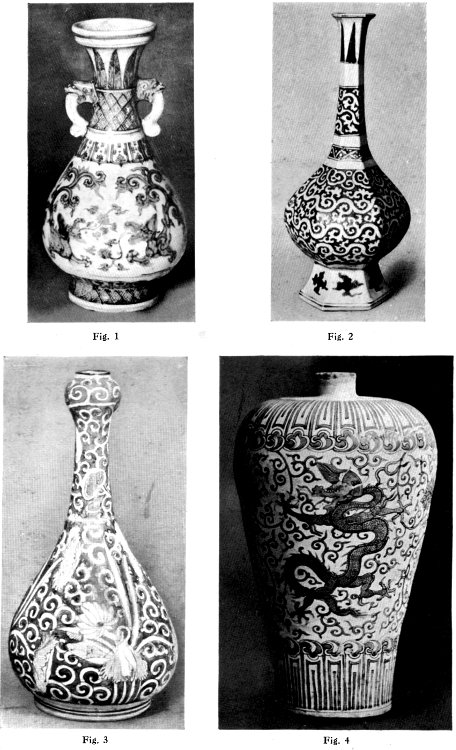
Plate 76.—Blue and White Porcelain. Sixteenth Century.
Fig. 1.—Vase with monster handles, archaic dragons. Height 10⅞ inches.
Halsey Collection.
Fig. 2.—Hexagonal Bottle, white in blue designs. Mark, a hare. Height
11½ inches. Alexander Collection.
Fig. 3.—Bottle with “garlic mouth,” stork and lotus scrolls, white in
blue. Height 11 inches. Salting Collection.
Fig. 4.—Vase (mei p’ing), Imperial dragon and scrolls. Wan Li
mark on the shoulder. Height 15 inches. Coltart Collection.
The two other potters of this period whose names have survived are
Ou of Yi-hsing fame (vol. i., p. 181) and Chou Tan-ch’üan, whose
wonderful imitations of Sung Ting ware have been described in vol.
i., p. 94. Many clever imitations of this latter porcelain were
made at Ching-tê Chên in the Wan Li period, and a special material,
ch’ing-t’ien[164] stone, was employed for the purpose; but the
followers of Ch’ou Tan-ch’üan were not so successful as their master,
and their wares are described as over-elaborate in decoration and quite
inferior to Ch’ou’s productions. There was one type, however, which
is specially mentioned, the oblong rectangular boxes made to hold
seal-vermilion. These are described in a sixteenth-century work[165] as
either pure white or painted in blue, and usually six or seven inches
long. They are accorded a paragraph in the T’ao shuo[166] under
the heading of fang ting or “imitation Ting ware,” and they were
probably of that soft-looking, creamy white crackled ware to which
Western collectors have given the misleading name of “soft paste.”[167]
Another private manufacture specially mentioned in the T’ao
lu[168] was located in a street called Hsiao nan  where, we are told,
“they made wares of small size only, like a
squatting frog, and called for that reason frog wares (ha ma[169]
yao). Though coarse, they were of correct form; the material was
yellowish, but the body of the ware was thin; and though small, the
vessels were strong. One kind of bowl was white in colour with a tinge
of blue (tai ch’ing), and decorated in blue with a single orchid
spray or bamboo leaves; and even those which had no painted design
had one or two rings of blue at the mouth. These were called “white
rice vessels” (pai fan ch’i). There were, besides, bowls with
wide mouths and flattened rims (p’ieh t’an)[170] but shallow,
and pure white, imitating the Sung bowls. All these wares had a great
vogue, both at the time and at the beginning of the present (i.e. the
Ch’ing) dynasty.”
Out of the comparatively large number of Wan Li porcelains in
European collections the majority are blue and white. This is only
to be expected, having regard to the preponderance of this style
of decoration in the Imperial lists, and also to the fact that it
was found easiest of all processes to execute. In fact, the censor
pleading on behalf of the potters in 1583 asks that this style may be
substituted for the more exacting polychrome and pierced work. It has
already been mentioned that the supplies of Mohammedan blue apparently
came to an end early in the reign, but there are enough examples of
this colour associated with the Wan Li mark to show that it was used
for part at least of the period. One of these is a well-potted bowl
of fine white porcelain, entirely covered with Sanskrit characters
(chên yen tz’ŭ), in the British Museum; and another piece* is a
dish moulded in the form of an open lotus flower with petals in relief,
and in the centre a single Sanskrit character. Both are painted in a
clear and vivid Mohammedan blue, and have the Wan Li mark under the
base. A dark violet blue, closely akin to the typical Chia Ching colour
but with a touch of indigo, occurs on two dishes,* decorated with a
pair of fishes among aquatic plants and bearing the four characters of
the Wan Li mark surrounding a cartouche, which contains the felicitous
legend, “Virtue, culture, and enduring spring” (see vol. i., p. 225).
An intense but more vivid violet blue, which betrays something of the
Mohammedan blend, is seen on a ewer* of Persian form, decorated with a
ch’i-lin reclining before a strangely Italian-looking fountain.
The ware of this piece, though thick, is of fine grain, and the glaze
has a faint greenish tinge, and its mark, a hare,[171] (see vol. i., p.
227) occurs on several other examples of varying quality, but all of
late Ming character.
Another group of marked Wan Li ware, comprising bowls and dishes
with trim neat finish and obviously destined for table use, has a
soft-looking glaze, often much worn, but, even in the less used parts,
with a peculiar smoothness of surface which is, no doubt, largely due
to age. There are three examples of this group in the British Museum,
all painted in the same soft, dark indigo-tinged blue. One is a bowl
with baskets of season flowers round the exterior, insects, and a
border of dragon and phœnix pattern; while inside is a blue medallion
with a full-face dragon reserved in white. The other two are dishes
with figure subjects and gourd vine borders, which are interesting
because the painting shows signs of a transition state, part being
in flat Ming washes, and part showing the marbled effect which was
afterwards characteristic of the K’ang Hsi blue and white.
In striking contrast with this smooth, soft-surfaced ware is a vase* of
square, beaker shape, and details which indicate a form derived from
bronze. Though evidently an Imperial piece, it is of strong, heavy
build, with a hard thick glaze of greenish tinge, so full of minute
bubbles as to spread in places a veritable fog over the blue decoration
beneath. The design, consisting of a dragon and phœnix among sprays of
(?) lily, with rock and wave borders, is repeated in all the spaces,
and below the lip in front is the Wan Li mark extended in a single
line. A similar vase,* but with polychrome decoration, illustrated
on Plate 81, will serve to show the form and design. Both are fine,
decorative objects, in a strong, rugged style, which takes no account
of small fire-flaws and slight imperfections in the glaze. The same
strong, hard body and glaze is seen again on three flat, narrow-rimmed
dishes,* which are conspicuous for unusual borders, two having a large
checker and the third a chevron pattern, in addition to a thin blue
line on either side of the edge. Sand adhering to the foot rim and
faint radiating lines scored in the base are indications of rough
finish, and they are clearly all the work of a private factory perhaps
catering for the export trade.
A variety of boxes figured in the Imperial lists, destined for holding
incense, vermilion, chess pieces, handkerchiefs, caps, sweetmeats,
cakes, etc. A fair number of these have survived and found their way
into Western collections. Round, square, oblong with rounded ends,
and sometimes furnished with interior compartments, they are usually
decorated with dragon designs in dark blue, occasionally tricked out
with touches of iron red; but miscellaneous subjects also occur in
their decoration, as in a fine example exhibited at the Burlington Fine
Arts Club in 1910,[172] which has figure subjects on the cover and a
landscape with waterfall, probably from a picture of the celebrated
mountain scenery in Szechuan. Sometimes the covers of these boxes are
perforated as though to allow some perfume to escape. Other interesting
late Ming porcelains in the same exhibition were a pricket candlestick
with cloud and dragon ornament and the Wan Li mark; a curious perfume
vase (Plate 68, Fig. 1), which illustrates the design of lions
sporting with balls of brocade, an unmarked piece which might even be
as early as Chia Ching; and a wide-mouthed vase lent by the Ashmolean
Museum, Oxford, with the familiar design of fantastic lions moving
among peonies and formal scrolls on the body and panels of flowers
separated by trellis diaper on the shoulder. The last is a type which
is not uncommon, but this particular example is interesting because it
belonged to one of the oldest collections in England, presented to the
Oxford Museum by John Tradescant, and mostly collected before 1627.
The export trade with Western Asia was in full swing in the reign of
Wan Li, and the Portuguese traders had already made their way to the
Far East and brought back Chinese porcelain for European use. That it
was, however, still a rare material in England seems to be indicated
by the sumptuous silver-gilt mounts in which stray specimens were
enshrined. Several of these mounted specimens still exist, and seven
of them were seen at the Burlington Fine Arts Exhibition, 1910,[173]
the date of the mounts being about 1580–1590. Taken, as they may
fairly be, as typical specimens, they show on the whole a porcelain
of indifferent quality, with all the defects and virtues of export
ware—the summary finish of skilful potters who worked with good
material but for an uncritical public, and rapid, bold draughtsmanship
in an ordinary quality of blue usually of greyish or indigo tint. The
most finished specimen was a bowl from the Pierpont Morgan Collection,
with a design of phœnixes and lotus scrolls finely drawn in blue of
good quality. Unlike the others, it had a reign mark (that of Wan Li),
and probably it was made at the Imperial factory. A bottle mounted
as a ewer from the same collection had a scale pattern on the neck,
flowering plants and birds on the body, and a saucer dish was painted
in the centre with a typical late Ming landscape, with mountains, pine
trees, pagoda, a pleasure boat, and sundry figures. The blue of this
last piece was of fair quality but rather dull, and it had a double
ring under the base void of mark. Another bowl had on the exterior
panel designs with deer in white reserved in a blue ground, in a
style somewhat similar to that of the bottle illustrated on Plate 76,
Fig. 3. There is a bowl in the British Museum, mounted with
silver-gilt foot and winged caryatid handles of about 1580 (Plate 69,
Fig. 1). The porcelain is of fine white material with thick
lustrous glaze of slightly bluish tint and “pinholed” here and there;
and the design painted in blue with a faint tinge of indigo consists
of a vase with a lotus flower and a lotus leaf and three egrets, in
a medallion inside and four times repeated on the exterior. This is
clearly an early Wan Li specimen, if, indeed, it is not actually as old
as Chia Ching.
The most remarkable collection of Chinese export porcelain is
illustrated by Professor Sarre[174] from a photograph which he was
able to make of the Chini-hane or porcelain house attached to
the mosque of Ardebil, in Persia. Ranged on the floor are some five
hundred specimens—jars, vases, ewers, and stacks of plates, bowls
and dishes, many of which had formerly occupied niches in the walls
of the building erected by Shah Abbas the Great[175] (1587–1628).
Unfortunately, the conditions were not favourable to photography, and
the picture, valuable as it is, only permits a clear view of the nearer
objects, the rest being out of focus and represented by mere shadows
of themselves. They are, we are told, mainly blue and white, but with
a sprinkling of coloured pieces, and it is clear from the picture that
they belong to various periods of the Ming dynasty, mostly to the later
part. They include, no doubt, presents from the Chinese Court,[176]
besides the porcelains which came in the ordinary way of trade, and
we recognise a large vase almost identical with the fine Chia Ching
specimen on Plate 72: a small-mouthed, baluster-shaped vase, similar in
form and decoration to a marked Wan Li specimen in the Pierpont Morgan
Collection[177]; a bowl with lotus scrolls in blotchy blue, recalling
the style of Plate 67, Fig. 4; a ewer with the curious fountain design
described on p. 67; besides a number of the ordinary late Ming export
types and some celadon jars and bulb bowls of a slightly earlier
period. Some of the pots, we are told, are almost a metre in height.
Among the tantalising forms in the indistinct background are some large
covered jars with a series of loop-handles on the shoulders, such as
are found in Borneo and the East Indies (see vol. i., p. 189).
One of the most attractive types of late Ming export porcelain, and at
the same time the most easily recognised, consists of ewers, bowls,
and dishes of thin, crisp porcelain with characteristic designs in
pale, pure blue of silvery tone; see Plate 77, Fig. 1. The ware is of
fine, white, unctuous material with a tendency (not very marked) to
turn brown at the foot rim and in parts where the glaze is wanting.
The glaze partakes of the faintly greenish tinge common to Ming wares,
but it is clear and of high lustre. Here, again, a little sand or grit
occasionally adhering to the foot rim and radiating lines lightly
scored in the base indicate a summary finish which detracts from
the artistic effect no more than the obviously rapid though skilful
brushwork of the decoration. Sharply moulded forms and crinkled
borders, admirably suited to this thin crisp material, give additional
play to the lustrous glaze, and the general feeling of the ware is well
expressed by Mr. F. Perzynski[178] in his excellent study of the late
Ming blue and white porcelains, in which he remarks that “the artists
of this group have used thin, brittle material more like flexible metal
than porcelain.”
The designs as shown in the illustration are typical of the ware.
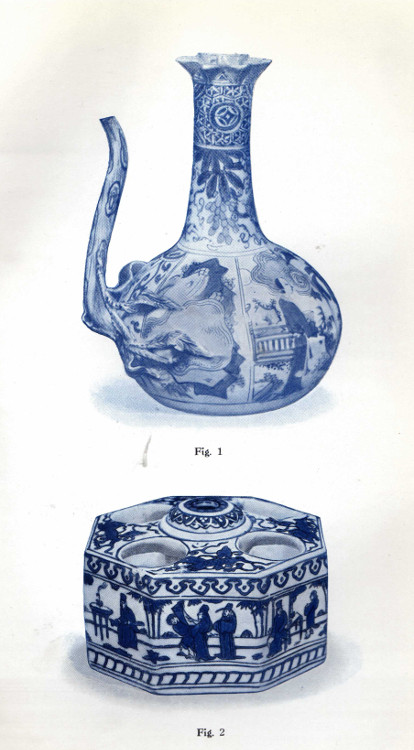
PLATE 77
Two examples of Ming Blue and White Porcelain in the British Museum
Fig. 1.—Ewer of thin, crisp porcelain with foliate mouth and rustic
spout with leaf attachments. Panels of figure subjects and landscapes
on the body: “rat and vine” pattern on the neck and a band of hexagon
diaper enclosing a cash symbol. Latter half of the sixteenth century.
Height 7 inches.
Fig. 2.—Octagonal stand perhaps for artist’s colours. On the sides
are scenes from the life of a sage; borders of ju-i pattern and
gadroons. On the top are lions sporting with brocade balls. Painted
in deep Mohammedan blue. Mark of the Chia Ching period (1522–1566).
Diameter 4¾ inches.
A freely drawn figure of a man or woman usually in garden surroundings,
standing before a fantastic rock or seated by a table and a
picture-screen often form the leading motive, though this is varied by
landscape, floral compositions, spirited drawings of birds (an eagle
on a rock, geese in a marsh, a singing bird on a bough), or a large
cicada on a stone among plants and grasses. The borders of dishes and
the exteriors of bowls are divided into radiating compartments (often
with the divisions lightly moulded) filled with figures, plant designs,
symbols, and the like, and separated by narrow bands with pendent
jewels and tasselled cords, which form perhaps the most constant
characteristics of the group. Small passages of brocade diapers with
swastika fret, hexagon and matting patterns, are used to fill up the
spaces. The finer examples of this group are of admirable delicacy both
in colour and design; but the type lasted well into the seventeenth
century and became coarse and vulgarised. It appears in a debased
form in the large dishes which were made in quantity for the Persian
and Indian markets, overloaded with crudely drawn brocade diapers and
painted in dull indigo blue, which is often badly fired and verges on
black. The central designs on these dishes, deer in a forest, birds in
marsh, etc., usually betray strong Persian influence.
I am not aware of any specimens of this group, either of the earlier
or the more debased kinds which bear date-marks, but still a clear
indication of the period is given by various circumstances. A bowl in
the National Museum at Munich is credibly stated to have belonged to
William V., Duke of Bavaria (1579–1597),[179] and a beautiful specimen,
also a bowl, with silver-gilt mount of about 1585, is illustrated
by Mr. Perzynski.[180] The characteristic designs of this ware are
commonplace on the Persian pottery of the early seventeenth century,
and a Persian blue and white ewer in the British Museum, which is dated
1616, clearly reflects the same style. The shallow dishes with moulded
sides are frequently reproduced in the still-life pictures by the Dutch
masters of the seventeenth century, from whose work many precious hints
may be taken by the student of ceramics. To give one instance only,
there are two such pictures[181] in the Dresden Gallery from the brush
of Frans Snyders (1579–1657).
We shall have occasion later on to discuss more fully another kind of
blue and white porcelain for which the Chinese and American collectors
show a marked partiality, and which has received the unfortunate
title, “soft paste,” from the latter. It has an opaque body, often
of earthy appearance, and a glaze which looks soft and is usually
crackled, and the ware is usually of small dimensions, such as the
Chinese literatus delighted to see in his study, and beautifully
painted with miniature-like touches, every stroke of the brush clear
and distinct. Ming marks—Hsüan Tê, Ch’êng Hua, etc.—are not uncommon
on this ware, and there is no doubt that it was in use from the early
reigns of the dynasty, but the style has been so faithfully preserved
by the potters of the eighteenth century that it is wellnigh impossible
to distinguish the different periods. A dainty specimen with the Wan Li
mark illustrated in Fig. 2 of Plate 93 will serve to show the
delicacy and refinement of this exquisite porcelain. At the same time
it should be mentioned that the imitation Ting wares described on p.
96, vol. i., when painted in blue, are included in this group.
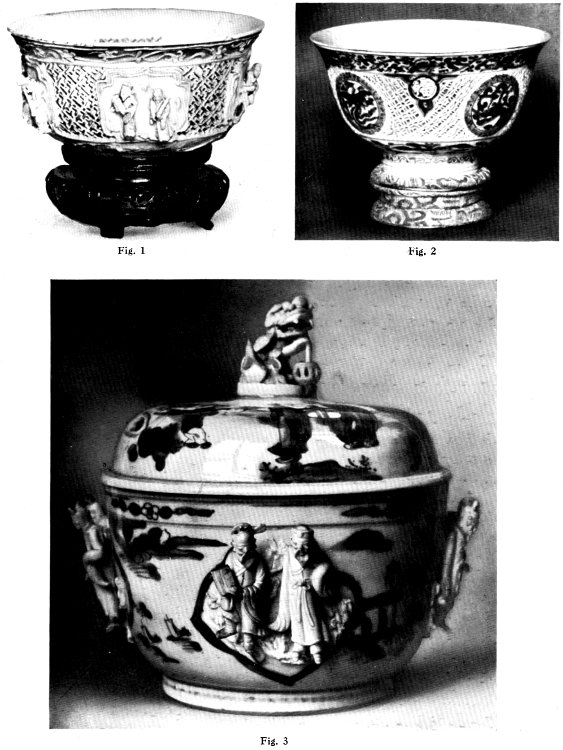
Plate 78.—Porcelain with pierced (ling lung)
designs and biscuit reliefs. Late Ming.
Fig. 1.—Bowl with Eight Immortals and pierced swastika fret. Diameter
3¾ inches. S. E. Kennedy Collection.
Fig. 2.—Bowl with blue phœnix medallions, pierced trellis work and
characters. Wan Li mark. Height 2¼ inches. Hippisley Collection.
Fig 3.—Covered Bowl with blue and white landscapes and biscuit reliefs
of Eight Immortals. Height 6½ inches. Grandidier Collection.
Two interesting kinds of decoration mentioned in the Wan Li list[182]
are frequently found in combination with blue and white; these are
relief (ting chuang or tui hua) and pierced work (ling
lung). Though both have been seen in various forms on the earlier
wares, they occur at this period in a fashion which challenges special
attention. I allude particularly to the small bowls with or without
covers, decorated on the sides with unglazed (or “biscuit”) figures
in detached relief, or with delicately perforated fretwork, or with
a combination of both. The catalogue[183] of the Pierpont Morgan
Collection illustrates two covered bowls of the first type with the
Eight Immortals in four pairs symmetrically arranged on the sides,
and a “biscuit” lion on the cover doing duty for a handle. A similar
bowl, formerly in the Nightingale Collection, had the same relief
decoration and painted designs in the typical grey blue of the Wan
Li period; and Fig. 3 of Plate 78 represents an excellent example
from the Grandidier collection. The Chinese were in the habit of
daubing these biscuit reliefs (just as they did the unglazed details
of statuettes) with a red pigment which served as a medium for oil
gilding, but as neither of these coatings was fired they have worn away
or been cleaned off in the majority of cases. In the Rijks Museum,
Amsterdam, is a picture[184] by Van Streeck (1632–1678), which shows
one of these covered bowls with the biscuit reliefs coloured red, and
Mr. Perzynski[185] alludes to another in a still-life by Willem Kalf
(1630–1693) in the Kaiser Frederick Museum, Berlin, with the figures
both coloured[186] and gilt. An excellent example of the second kind
of decoration is illustrated by Fig. 2 of Plate 78, one of a set of
four bowls in the Hippisley Collection, with phœnix medallions and
other decoration in a fine grey blue, the spaces filled with perforated
designs of the utmost delicacy, veritable “devil’s work,” to borrow a
Chinese term for workmanship which shows almost superhuman skill. The
small pierced medallions contain the characters fu, shou,
k’ang, ning[187] (happiness, longevity, peace, and
tranquillity), and under the base are the six characters of the Wan Li
mark. A line cut in the glaze (before firing) at the lip and on the
base-rim seems to have been designed to give a firm hold to a metal
mount, a use to which it has been actually put in one case; and in
another the glazing of the mark under the base has been omitted with
the result that it has come from the kiln black instead of blue. The
third kind which combines the reliefs and the pierced ornament is
illustrated by Fig. 1 of Plate 78. The reliefs of these medallions
are small and very delicately modelled, and the subjects are various,
including human and animal figures, birds and floral compositions; the
borders are often traced in liquid clay, which is left in unglazed
relief. An example in the British Museum has an interior lining
washed with blue to serve as a backing for the pierced work, and it
is painted inside with dragon designs in Wan Li grey blue. It bears
a mark which occurs on other late Ming porcelains, yü tang chia
ch’i (beautiful vessel for the Jade Hall).[188] Examples of this
same pierced and relief work in white, without the supplementary blue
designs, though rare, are yet to be seen in several collections. If
marked at all they usually bear the apocryphal date of Ch’êng Hua,
but an example in the Marsden Perry collection, Providence, U.S.A.,
has the T’ien Ch’i (1621–1627) date under the base, which no doubt
represents the true period of its manufacture. This intricate ling
lung work, which the Wan Li censor deprecated as too difficult and
elaborate, has been perpetuated, though it was probably never more
beautifully executed than in the late Ming period. The later examples
are mostly characterised by larger perforations, which were easier
to manage. There are several references to the pierced and relief
decorations in the lists of porcelain supplied to the Court of Wan
Li, e.g. “brush rests with sea waves and three dragons in relief over
pierced designs, and landscapes,” “landscape medallions among pierced
work,” and “sacred fungus carved in openwork, and figures of ancient
cash.” In the finer examples of pierced work the most frequent design
is the fret or key pattern often interwoven with the four-legged
symbol known as the swastika, which commonly serves in Chinese for
the character wan (ten thousand), carrying a suggested wish
for “long life,” as expressed in the phrase wan sui (Jap.
banzai), ten thousand years. The pierced patterns are carved out
of the porcelain body when the ware has been dried to a “leather-tough”
consistency, and the manipulative skill exercised in the cutting and
handling of the still plastic material is almost superhuman. Similar
tours de force distinguish the Japanese Hirado porcelain, and
Owen’s work in our own Worcester ware exhibits extraordinary skill, but
I doubt if anything finer in this style has ever been made than the
ling lung bowls of the late Ming potters.
Another form of decoration which, if not actually included in the
ling lung category, is at any rate closely allied to it, is
the fretwork cut deeply into the body of the ware without actually
perforating it, the hollows of the pattern being generally left without
glaze. This ornament is used in borders or to fill the spaces between
blue and white medallions after the manner of the pierced fretwork, and
it was evidently contemporaneous with the latter, viz. dating from the
late Ming period onwards (Plate 68, Fig. 3).
It will be convenient here to consider another type of decoration
which was probably in use in the early periods of the Ming dynasty,
certainly in the reign of Wan Li, and which has continued to modern
times. This is the decoration in white clay varying in thickness from
substantial reliefs to translucent brush work in thin slip or liquid
clay, which allows the colour of the background to appear through
it. The designs are painted or modelled in white against dark or
light-coloured grounds of various shades—lustrous coffee brown (tzŭ
chin), deep blue, slaty blue, lavender, celadon, plain white, and
crackled creamy white—and they are usually slight and artistically
executed. The process, which is the same in principle as in the modern
pâte sur pâte, consisted of first covering the ground with
colouring matter, then tracing the design in white slip (i.e. liquid
clay) or building it up with strips of clay modelled with a wet brush,
and finally covering it with a colourless glaze. In this case the
white design has a covering of glaze. When a celadon green ground is
used the design is applied direct to the biscuit and the celadon glaze
covers the whole, but being quite transparent it does not obscure the
white slip beneath. Sometimes, however, as in Fig. 3 of Plate 75, the
design is unglazed and stands out in a dry white “biscuit.” Elaborate
and beautiful examples of slip decoration were made in the K’ang Hsi
and later periods, and Pére d’Entrecolles, writing in 1722, describes
their manufacture, stating that steatite and gypsum were used to form
the white slip.[189] The Ming specimens are usually of heavier make
and less graceful form, and distinguished by simplicity and strength
of design, the backgrounds being usually lustrous brown or different
shades of blue. They consist commonly of bottles, jars, flower pots,
bulb bowls, dishes, and narghili bowls, and many of them were clearly
made for export to Persia and India, where they are still to be found.
On rare examples the slip decoration is combined with passages of blue
and white.
There is little to guide us to the dating of these wares, and marks
are exceptional.[190] There is, however, a flower pot in the British
Museum with white design of ch’i-lin on a brown ground which
has the late Ming mark yü t’ang chia ch’i[191]; and a specimen
with an Elizabethan metal mount was exhibited at the Burlington Fine
Arts Club in 1910.[192] These are, no doubt, of Ching-tê Chên make;
but there is a curious specimen in the British Museum which seems to
be of provincial manufacture. It is a dish with slaty blue ground and
plant designs with curious feathery foliage traced with considerable
delicacy. The border of running floral scroll has the flowers outlined
in dots, and the whole execution of the piece is as distinctive as
the strange coarse base which shows a brown-red biscuit and heavy
accretions of sand and grit at the foot rim. The same base and the same
peculiarities of design appeared on a similar dish with celadon glaze
exhibited by Mrs. Halsey at the Burlington Fine Arts Club in 1910,[193]
and in the British Museum there are other dishes clearly of the same
make, but with (1) crackled grey white glaze and coarsely painted blue
decoration, and (2) with greenish white glaze and enamelled designs
in iron red and the Ming blue green. It is clear that we have to deal
here with the productions of one factory, and though we have no direct
clue to its identity, it certainly catered for the export trade to
India and the islands; for the enamelled dishes of this type have been
found in Sumatra. Mrs. Halsey’s dish came from India, and fragments
of the blue and enamelled types were found in the ruins of the palace
at Bijapur,[194] which was destroyed by Aurungzebe in 1686. Probably
the factory was situated in Fukien or Kuangtung, where it would be
in direct touch with the southern export trade, and the style of
the existing specimens points to the late Ming as the period of its
activity.
The process of marbling or “graining” has been tried by potters all the
world over, and the Chinese were no exceptions. The effect is produced
either by slips of two or more coloured clays worked about on the
surface, or by blending layers of clays in two or more colours (usually
brown and white) in the actual body. Early examples of this marbling
occur among the T’ang wares, and Mr. Eumorfopoulos has examples of the
Ming and later periods. One of these, a figure with finely crackled
buff glaze and passages of brown and white marbling in front and on the
back, has an incised inscription, stating that it was modelled by Ch’ên
Wên-ching in the year 1597.[195]
The use of underglaze red in the Wan Li period has already been
mentioned (p. 59), and though Chinese writers classed it as chi
hung they would not admit it to an equality with the brilliant
reds of the fifteenth century.[196] Where red is named in the lists
of Imperial porcelains we are left in doubt as to its nature, whether
under or over the glaze; but there are two little shallow bowls in the
British Museum with a curious sponged blue associated with indifferent
underglaze red painting, which bear the late Ming mark yü t’ang
chia ch’i.[197] A bowl of lotus flower pattern, similar in form to
that described on p. 66, but deeper, and painted with similar designs
in pale underglaze red, though bearing the Ch’êng Hua mark, seems to
belong to the late Ming period.
The Wan Li polychromes will naturally include continuations of
the early Ming types, such as the large jars with decoration in
raised outline, pierced or carved and filled in with glazes of
the demi-grand feu—turquoise, violet purple, green and
yellow—wares with flat washes of the same turquoise and purple,
incised designs filled in with transparent glazes of the three
colours (san ts’ai), green, yellow and aubergine, and, what is
probably more truly characteristic of this period, combinations of
the first and last styles. A good example of the transparent colours
over incised designs is Fig. 1 of Plate 79, a vase of the form known
as mei p’ing with green Imperial dragons in a yellow ground
and the Wan Li mark. All three of the san ts’ai colours
were also used separately as monochromes with or without engraved
designs under the glaze, a striking example in the Pierpont Morgan
Collection being a vase with dragon handles and engraved designs
under a brilliant iridescent green glaze, “which appears like gold in
the sunlight.”[198] But though these types persisted, they would no
doubt be gradually superseded by simpler and more effective methods
of pictorial decoration in painted outline on the biscuit, filled in
with washes of transparent enamels in the same three colours. These
softer enamels, which contained a high proportion of lead and could be
fired at the relatively low temperature of the muffle kiln, must have
been used to a considerable extent in the late Ming period, though
their full development belongs to the reign of K’ang Hsi, and there
will always be a difficulty in separating the examples of these two
periods, whether the colours be laid on in broad undefined washes, as
on certain figures and on the “tiger skin” bowls and dishes, or brushed
over a design carefully outlined in brown or black pigment. There is
one species of the latter family with a ground of formal wave pattern
usually washed with green and studded with floating plum blossoms,
in which are galloping sea horses or symbols, or both, reserved and
washed with the remaining two colours, or with a faintly greenish flux,
almost colourless, which does duty for white. This species is almost
always described as Ming; and with some reason, for the sea wave and
plum blossom pattern is mentioned in the Wan Li lists as in polychrome
combined with blue decoration. But the danger of assuming a specimen to
be Ming because it exhibits a design which occurred on Ming porcelain
is shown by an ink pallet in the British Museum, which is dated in the
thirty-first year of K’ang Hsi, i.e. 1692. This important piece (Plate
94, Fig. 2) is decorated in enamels on the biscuit over black outlines
with the wave and plum blossom pattern, the same yellow trellis diaper
which appears on the base of the vase in Plate 97, and other diaper
patterns which occur on so many of the so-called Ming figures. This
piece is, in fact, a standing rebuke to those careless classifiers who
ascribe all on-biscuit enamel indiscriminately to the Ming period, and
I am strongly of opinion that most of the dishes,[199] bowls, ewers,
cups and saucers, and vases with the wave and plum blossom pattern and
horses, etc., in which a strong green enamel gives the dominating tint,
belong rather to the K’ang Hsi period. The same kind of decoration is
sometimes found applied to glazed porcelain, as on Fig. 3 of Plate 79,
a covered potiche-shaped vase in the British Museum with the design
of “jewel mountains and sea waves,” with floating blossoms, and pa
pao[200] symbols in green, yellow and white in an aubergine ground,
supplemented by a few plain rings in underglaze blue. The style of this
vase and the quality of the paste suggest that it really does belong to
the late Ming period.
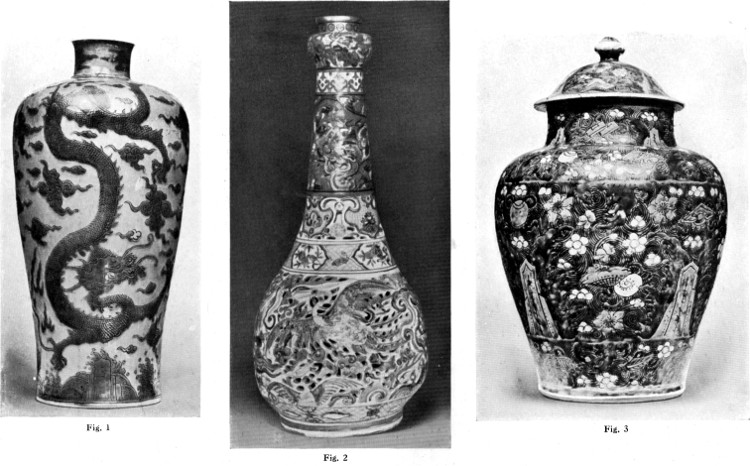
Plate 79.—Wan Li Polychrome Porcelain.
Fig. 1.—Vase (mei p’ing) with engraved design, green in a
yellow ground, Imperial dragons in clouds, rock and wave border. Wan Li
mark. Height 15 inches. British Museum.
Fig. 2.—Bottle with pierced casing, phœnix design, etc., painted in
underglaze blue and enamels; cloisonné enamel neck. Height 23 inches.
Eumorfopoulos Collection.
Fig. 3.—Covered Jar, plum blossoms and symbols in a wave pattern
ground, coloured enamels in an aubergine background. Height 15½ inches.
British Museum.
The use of enamels over the glaze was greatly extended in the Wan Li
period, though practically all the types in vogue at this time can
be paralleled in the Chia Ching porcelain, and, indeed, have been
discussed under that heading. There is the red family in which the
dominant colour is an iron red, either of curiously sticky appearance
and dark coral tint or with the surface dissolved in a lustrous
iridescence. Yellow, usually a dark impure colour, though sometimes
washed on extremely thin and consequently light and transparent,
and transparent greens, which vary from leaf tint to emerald and
bluish greens, occur in insignificant quantity. This red family is
well illustrated by a splendid covered jar in the Salting Collection
(Plate 80), and by three marked specimens in the British Museum, an
ink screen, a bowl, and a circular stand. It also occurs on another
significant piece in the latter collection, a dish admirably copying
the Ming style but marked Shên tê t’ang po ku chih[201]
(antique made for the Shên-tê Hall), a palace mark of the Tao Kuang
period (1821–1850). It should be added that this colour scheme[202] is
frequently seen on the coarsely made and roughly decorated jars and
dishes with designs of lions in peony scrolls, etc., no doubt made in
large quantities for export to India and Persia. They are not uncommon
to-day, and in spite of their obvious lack of finish they possess
certain decorative qualities, due chiefly to the mellow red, which are
not to be despised.
But the characteristic polychrome of the period, the Wan Li wu
ts’ai, combines enamelled decoration with underglaze blue, and
this again can be divided into two distinctive groups. One of these is
exemplified by Plate 81, an Imperial vase shaped after a bronze model
and of the same massive build as its fellow in blue and white, which
was described on p. 67. Here the underglaze blue is supplemented by the
green, the impure yellow and the sticky coral red of the period, and
the subject as on the blue and white example consists of dragons and
phœnixes among floral scrolls with borders of rock and wave pattern.
The object of the decorator seems to have been to distract the eye
from the underlying ware, as if he were conscious of its relative
inferiority, and the effect of this close design, evenly divided
between the blue and the enamels, is rather checkered when viewed from
a distance. But both form and decoration are characteristic of the
Wan Li Imperial vases, as is shown by kindred specimens, notably by a
tall vase in the Pierpont Morgan Collection, of which the design is
similar and the form even more metal-like, having on the lower part
the projecting dentate ribs seen on square bronze and cloisonné beakers
of the Ming dynasty. Two other marked examples of this colour scheme,
from which the absence of aubergine is noteworthy, are (1) a ewer
in the British Museum with full-face dragons on the neck supporting
the characters wan shou (endless longevity) and with floral
sprays on a lobed body, and (2) a straight-sided box with moulded
six-foil elevation, painted on each face with a screen before which
is a fantastic animal on a stand, and a monkey, dog and cat in garden
surroundings.
The second—and perhaps the more familiar—group of Wan Li wu
ts’ai is illustrated by Fig. 1 of Plate 82, on which all the
colours, including aubergine, are represented in company with the
underglaze blue. There is no longer the same patchy effect, because
the blue is more evenly balanced by broader washes of the enamel
colours, particularly the greens. The design of this particular example
is a figure subject taken from Chinese history (shih wu),
supplemented by a brocade band of floral scroll work on the shoulder
and formal patterns on the neck and above the base. The former and
the latter positions are commonly occupied in these vases by a band
of stiff leaves and a border of false gadroons, both alternately blue
and coloured. The stiff leaves in this instance are replaced by floral
sprays, and the coloured designs are outlined in a red brown pigment.
The mark under the base is the “hare,” which has already been noticed
on examples of late Ming blue and white.[203] Another late Ming mark,
yü t’ang chia ch’i,[204] occurs on a dish in the British Museum,
with design of the Eight Immortals paying court to the god of Longevity
(pa hsien p’êng shou), painted in the same style but with a
predominance of underglaze blue.
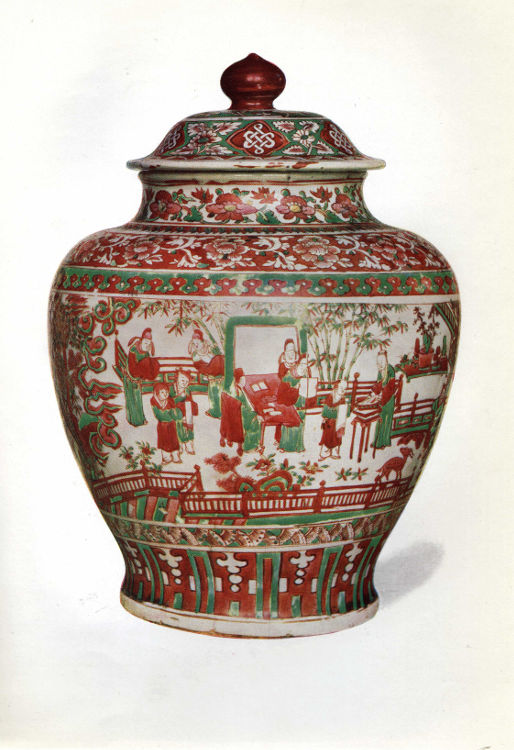
PLATE 80
Covered Jar or potiche. Painted in iron red and green enamels, with a
family scene in a garden, and brocade borders of ju-i pattern,
peony scrolls, etc. Sixteenth century.
Height 17½ inches.
Salting Collection (Victoria and Albert Museum).
But it is not necessary to multiply instances, for the type is well
known, and must have survived for a long period. Indeed, many competent
authorities assign the bulk of this kind of porcelain to the Yung
Chêng period (1723–1735); and it is undoubtedly true that imitations
of Wan Li polychrome were made at this time, for they are specifically
mentioned in the Yung Chêng list of Imperial wares.[205] But I am
inclined to think that the number of these late attributions has been
exaggerated, and that they do not take sufficiently into account the
interval of forty-two years between the reigns of Wan Li and K’ang
Hsi. It was a distracted time when the potters must have depended
largely upon their foreign trade in default of Imperial orders, and it
is probable that much of this ware, characterised by strong, rather
coarse make, greyish glaze and boldly executed decoration in the Wan Li
colour scheme, belongs to this intermediate period. The vases usually
have the flat unglazed base which characterises the blue and white of
this time.[206] Two handsome beakers, with figure subjects and borders
of the peach, pomegranate and citron, and a beautiful jar with phœnix
beside a rock and flowering shrubs, in the British Museum, seem to
belong to this period, but there are numerous other examples, many of
which are coarse and crude, and obviously made wholesale for the export
trade.
Among the various examples of Wan Li polychrome exhibited at the
Burlington Fine Arts Club in 1910, there was one which calls for
special mention, a box[207] with panels of floral designs surrounded
by fruit and diaper patterns in the usual colours of the wu
ts’ai, with the addition of an overglaze blue enamel. It is true
that this blue enamel was clearly of an experimental nature and far
from successful, but its presence on this marked and indubitable Wan Li
specimen is noteworthy. For it has long been an article of faith with
collectors that this blue enamel does not antedate the Ch’ing dynasty,
being, in fact, a characteristic feature of the K’ang Hsi famille
verte porcelain. The rule still remains an excellent one, and this
solitary exception only serves to emphasise its general truth, showing
as it does that so far the attempts at a blue enamel were a failure.
But at the same time the discovery is a warning against a too rigid
application of those useful rules of thumb, based on the generalisation
from what must, after all, be a limited number of instances.
Marked examples of Wan Li monochromes are rarely seen, but we may
assume that the glazes in use in the previous reigns continued to be
made—blue, lavender, turquoise, violet and aubergine brown, yellow in
various shades, leaf green, emerald green, apple green, celadon, coffee
brown, and golden brown—besides the more or less accidental effects
in the mottled and flambé glazes. The plain white bowls of the
period had a high reputation,[208] and a good specimen in the British
Museum, though far from equalling the Yung Lo bowl (Plate 59), is
nevertheless a thing of beauty. The white wares of the Ting type made
at this time have been already discussed.[209] The monochrome surfaces
were not infrequently relieved by carved or etched designs under the
glaze, but it must be confessed that monochromes are exceedingly
difficult to date. Particular colours and particular processes
continued in use for long periods, and the distinctions between the
productions of one reign and the next, or even between those of the
late Ming and the early Ch’ing dynasties, are often almost unseizable.
At best these differences consist in minute peculiarities of form and
potting, in the texture of the body and glaze, and the finish of the
base, which are only learnt by close study of actual specimens and
by training the eye to the general character of the wares until the
perception of the Ming style becomes instinctive. But something further
will be said on this subject in the chapter on Ming technique.
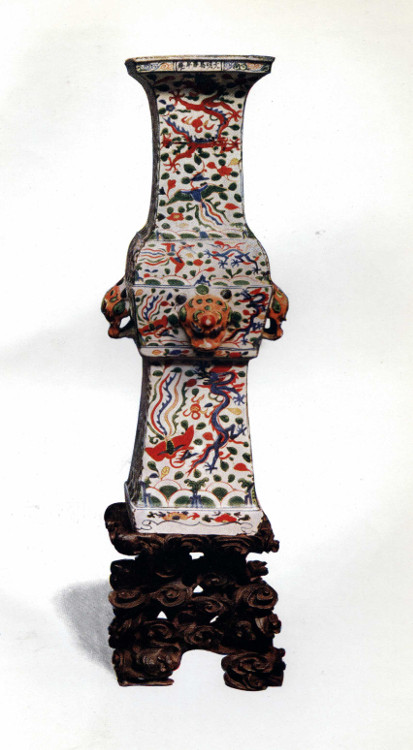
PLATE 81
Beaker-shaped Vase of bronze form, with dragon and phœnix designs
painted in underglaze blue, and red, green and yellow enamels:
background of fairy flowers (pao hsiang hua) and borders of
“rock and wave” pattern. Mark of the Wan Li period (1573–1619) in six
characters on the neck. An Imperial piece. Carved wood stand with cloud
pattern.
Height 18½ inches.
British Museum.
THE LAST OF THE MINGS
T’ai Ch’ang  (1620)
T’ien Ch’i  (1621–1627)
Ch’ung Chêng  (1628–1643)
Chinese ceramic history, based on the official records, is silent
on the subject of the three last Ming reigns, and we are left to
infer that during the death struggles of the old dynasty and the
establishment of the Manchu Tartars on the throne work at the Imperial
factory was virtually suspended. The few existing specimens which bear
the marks of T’ien Ch’i and Ch’ung Chêng (the T’ai Ch’ang mark is
apparently unrepresented) are of little merit. A barrel-shaped incense
vase with floral scrolls and a large bowl with four-clawed dragons
of the former date in the British Museum are painted the one in dull
greyish blue, and the other in a bright but rather garish tint of
the same colour; both have a coarse body material with blisters and
pitting in the glaze, and the painting of the designs is devoid of any
distinction. Similarly, a polychrome saucer dish with the same mark
and in the same collection, decorated with an engraved dragon design
filled in with purple glaze in a green ground, carries on the early
tradition of that type of Ming polychrome, but the ware is coarse,
the design crudely drawn, and the colours impure.[210] From the
same unflattering characteristics another dish in the British Museum,
with large patches of the three on-biscuit colours—green, yellow and
aubergine—may be recognised as of the T’ien Ch’i make. This is a
specimen of the so-called tiger skin ware, of which K’ang Hsi and later
examples are known—a ware which, even in the best-finished specimens
with underglaze engraved designs, is more curious than beautiful. On
the other hand, one of the delicate bowls with biscuit figures in high
relief, already described (p. 75), proves that the potters of the T’ien
Ch’i period were still capable of skilful work when occasion demanded.
A pair of wine cups in the British Museum, with freely drawn designs of
geese and rice plants in pale greyish blue under a greyish glaze, are
the solitary representatives of the Ch’ung Chêng mark.
In the absence of Imperial patronage, and with the inevitable trade
depression which followed in the wake of the fierce dynastic struggle,
it was fortunate for the Ching-tê Chên potters that a large trade with
European countries was developing. The Portuguese and Spanish had
already established trading connections with the Chinese, and the other
Continental nations—notably the Dutch—were now serious competitors.
The Dutch East India Company was an extensive importer of blue and
white porcelain, and we have already discussed one type of blue and
white which figures frequently in the Dutch pictures of the seventeenth
century.
There is another group of blue and white which can be definitely
assigned to this period of dynastic transition, between 1620–1662. A
comparative study of the various blue and white types had already led
to the placing of this ware in the middle of the seventeenth century,
and Mr. Perzynski, in those excellent articles[211] to which we have
already alluded, has set out the characteristics of this ware at some
length, with a series of illustrations which culminate in a dated
example. There will be no difficulty in finding a few specimens of
this type in any large collection of blue and white. It is recognised
by a bright blue of slightly violet tint under a glaze often hazy with
minute bubbles, which suggested to Mr. Perzynski the picturesque simile
of “violets in milk.” Other more tangible characteristics appear in
the designs, which commonly consist of a figure subject—a warrior or
sage and attendant—in a mountain scene bordered by a wall of rocks
with pine trees and swirling mist, drawn in a very mannered style and
probably from some stock pattern. Other common features are patches of
herbage rendered by pot-hook-like strokes, formal floral designs of a
peculiar kind, such as the tulip-like flower on the neck of Fig. 4 of
Plate 82; the band of floral scroll work on the shoulder of the same
piece is also characteristic. In many of the forms, such as cylindrical
vases and beakers, the base is flat and unglazed, and reveals a good
white body, and European influence is apparent in some of the shapes,
such as the jugs and tankards.
As for the dating of this group, an early example of the style of
painting in the Salting Collection[212] has a silver mount of the
early seventeenth century, and a tankard of typical German form in the
Hamburg Museum has a silver cover dated 1642.[213] There is, besides, a
curious piece in the British Museum, the decoration of which has strong
affinities to this group. It is a bottle with flattened circular body
and tall, tapering neck, with landscape and figures on one side and
on the other a European design copied from the reverse of a Spanish
dollar, and surrounded by a strap-work border. The dollar, from a
numismatic point of view, might have been made equally well for Philip
II. (1556–1598), Philip IV. (1621–1665), or Charles II. (1665–1700),
but there can be little doubt from the style of the ware that it
belonged to one of the two earlier reigns.
A comparison of the ware and the blue of this group leads to the
placing of the fairly familiar type illustrated by Figs. 3 and 5
of Plate 82 in the same intermediate period, and similarly certain
specimens of polychrome, with underglaze blue and the usual enamels,
display the characteristic body and blue painting, and even some of the
decorative mannerisms. These specimens, particularly when of beaker
form, are often finished off with a band of ornament engraved under the
glaze.
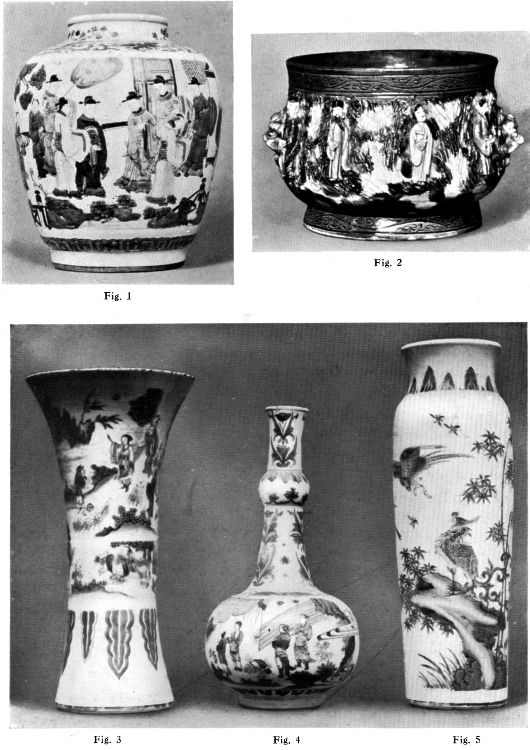
Plate 82.—Late Ming Porcelain.
Fig. 1—Jar of Wan Li period, enamelled. Mark, a hare. Height 9 inches.
British Museum. Fig. 2. Bowl with Eight Immortals in relief,
coloured glazes on the biscuit. Height 3¼ inches. Eumorfopoulos
Collection.
Figs. 3, 4 and 5.—Blue and white porcelain, early seventeenth century.
Height of Fig. 5, 17 inches. British Museum.
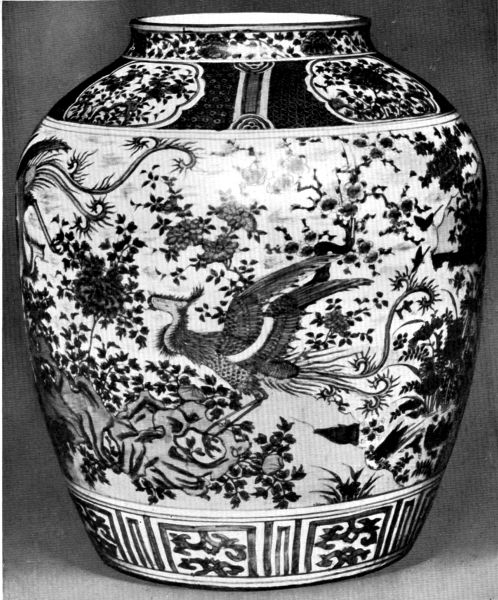
Plate 83.—Vase
With blue and white decoration of rockery, phœnixes, and flowering
shrubs. Found in India. Late Ming period. Height 22 inches. Halsey
Collection.
CHAPTER VI THE TECHNIQUE OF THE MING PORCELAIN
Although the processes involved in the various kinds of decoration and
in the different wares have been discussed in their several places, a
short summary of those employed in the manufacture of the Ching-tê Chên
porcelain during the Ming period will be found convenient. The bulk of
the materials required were found in the surrounding districts, if not
actually in the Fou-liang Hsien. The best kaolin (or porcelain earth)
was mined in the Ma-ts’ang mountains until the end of the sixteenth
century, when the supply was exhausted and recourse was had to another
deposit at Wu-mên-t’o. The quality of the Wu-mên-t’o kaolin was
first-rate, but as the cost of transport was greater and the manager
of the Imperial factory refused to pay a proportionately higher price,
very little was obtained. The material for the large dragon bowls, and
presumably for the other vessels of abnormal size, was obtained from
Yü-kan and Wu-yüan and mixed with powdered stone (shih mo) from
the Hu-t’ien district. Other kaolins, brought from Po-yang Hsien and
the surrounding parts, were used by the private potters, not being
sufficiently fine for the Imperial wares.
The porcelain stone, which combined with the kaolin to form the two
principal ingredients of true porcelain, came from the neighbourhoods
of Yü-kan and Wu-yüan, where it was pounded and purified in mills
worked by the water power of the mountains, arriving at Ching-tê Chên
in the form of briquettes. Hence the name petuntse,[214] which,
like kaolin, has passed into our own language, and the term shih
mo (powdered stone) used above.
The glaze earth (yu t’u) in various qualities was supplied from
different places. Thus the Ch’ang-ling material was used for the blue
or green (ch’ing) and the yellow glazes, the Yi-k’êng for the
pure white porcelain, and the T’ao-shu-mu for white porcelain and
for “blue and white.” This glazing material was softened with varying
quantities of ashes of lime burnt with ferns or other frondage. Neither
time nor toil was spared in the preparation of the Imperial porcelains,
and according to the T’ung-ya[215] the vessels were, at one time
at any rate, dried for a whole year after they had been shaped and
before finishing them off on the lathe. When finished off on the lathe
they were glazed and dried, and if there were any inequalities in the
covering they were glazed again. Furthermore, if any fault appeared
after firing they were put on the lathe, ground smooth, and reglazed
and refired.
It was not the usual custom with Chinese potters to harden the ware
with a slight preliminary firing before proceeding to decorate and
apply the glaze, and consequently such processes as underglaze painting
in blue, embossing, etc., were undergone while the body was still
relatively soft and required exceedingly careful handling. The glaze
was applied in several ways—by dipping in a tub of glazing liquid
(i.e. glaze material finely levigated and mixed with water), by
painting the glaze on with a brush, or by blowing it on from a bamboo
tube, the end of which was covered with a piece of tightly stretched
gauze. One of the last operations was the finishing off of the foot,
which was hollowed out and trimmed and the mark added (if it was to be
in blue, as was usually the case) and covered with a spray of glaze.
To the connoisseur the finish of the foot is full of meaning. It is
here he gets a glimpse of the body which emerges at the raw edge of
the rim, and by feeling it he can tell whether the material is finely
levigated or coarse-grained. The foot rim of the Ming porcelains is
plainly finished without the beading or grooves of the K’ang Hsi wares,
which were evidently designed to fit a stand[216]; and the raw edge
discloses a ware which is almost always of fine white texture and close
grain (often almost unctuous to the touch), though the actual surface
generally assumes a brownish tinge in the heat of the kiln. The base
is often unglazed in the case of large jars and vases, rarely in the
cups, bowls, dishes, or wine pots, except among the coarser types of
export porcelain. A little sand or grit adhering to the foot rim and
radiating lines under the base caused by a jerky movement of the lathe
are signs of hasty finish, which occur not infrequently on the export
wares. The importance of the foot in the eyes of the Chinese collector
may be judged from the following extract from the Shih ch’ing jih
cha[217]:—
“Distinguish porcelain by the vessel’s foot. The Yung Lo
'press-hand’ bowls have a glazed bottom but a sandy foot;
Hsüan ware altar cups have 'cauldron’[218] bottom (i.e. convex
beneath) and wire-like foot; Chia Ching ware flat cups decorated
with fish have a 'loaf’ centre[219] (i.e. convex inside) and
rounded foot. All porcelain vessels issue from the kiln with
bottoms and feet which can testify to the fashion of the firing.”
It is not always easy unaided by illustration to interpret the Chinese
metaphors, but it is a matter of observation that many of the Sung
bowls, for instance, have a conical finish under the base, and that the
same pointed finish appears on some of the early Ming types, such as
the red bowls with Yung Lo mark. The “loaf centre” of the Chia Ching
bowls seems to refer to the convexity described on p. 35. The blue and
white conical bowls with Yung Lo mark (see p. 6) have, as a rule, a
small glazed base and a relatively wide unglazed foot rim.
But this digression on the nether peculiarities of the different wares
has led us away from the subject of glaze. The proverbial thickness and
solidity of the early Ming glazes, which are likened to “massed lard,”
are due to the piling up of successive coatings of glaze to ensure a
perfect covering for the body, and the same process was responsible
for the undulating appearance of the surface, which rose up in small
rounded elevations “like grains of millet” and displayed corresponding
depressions.[220] This uneven effect, due to an excess of glaze, was
much prized by the Chinese connoisseurs, who gave it descriptive
names like “millet markings,” “chicken skin,” or “orange peel,” and
the potters of later periods imitated it freely and often to excess.
Porcelain glazes are rarely dead white, and, speaking generally, it
may be said that the qualifying tint in the Ming period was greenish.
Indeed, this is the prevailing tone of Chinese glazes, but it is
perhaps accentuated by the thickness of the Ming glaze. This greenish
tinge is most noticeable when the ware is ornamented with delicate
traceries in pure white clay or slip under the glaze.
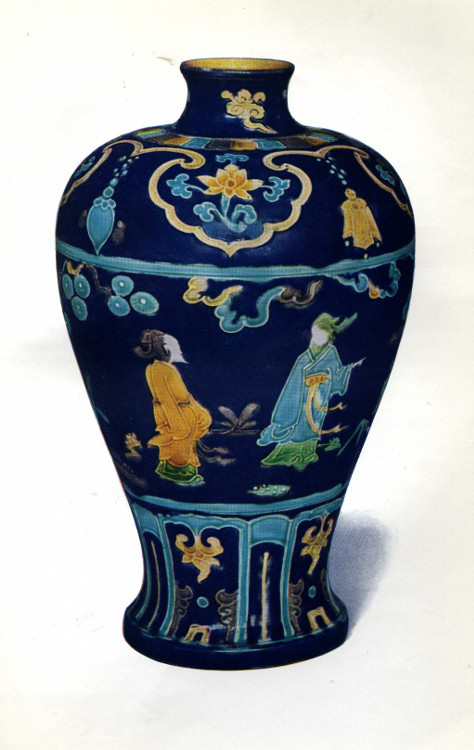
PLATE 84
Vase of baluster form with small mouth (mei p’ing). Porcelain
with coloured glazes on the biscuit, the designs outlined in slender
fillets of clay. A meeting of sages in a landscape beneath an ancient
pine tree, the design above their heads representing the mountain mist.
On the shoulders are large ju-i shaped lappets enclosing lotus
sprays, with pendent jewels between: fungus (ling chih) designs
on the neck. Yellow glaze under the base. A late example of this style
of ware, probably seventeenth century.
Height 11 inches.
Salting Collection (Victoria and Albert Museum).
As for the shape of the various Ming wares, much has already been
said in reference to the various lists of Imperial porcelains, more
particularly with regard to the household wares such as dishes,
bowls, wine pots, boxes, etc. No precise description, however, is
given in these lists of the actual forms of the vases, and we have to
look elsewhere for these. There are, however, extracts from books on
vases[221] and on the implements of the scholar’s table in the T’ao
shuo and the T’ao lu, in which a large number of shapes
are enumerated. Observation of actual specimens shows that bronze and
metal work supplied the models for the more elaborate forms which
would be made, partly or wholly, in moulds. These metallic forms,
so much affected by the Chinese literatus, though displaying
great cleverness in workmanship and elaboration of detail, are not
so pleasing to the unprejudiced Western eye as the simple wheel-made
forms of which the Chinese potter was a perfect master. Of the latter,
the most common in Ming porcelains are the potiche-shaped covered
jar (Plate 80) and the high-shouldered baluster vase with small neck
and narrow mouth (Plate 84), which was known as mei p’ing or
prunus jar from its suitability for holding a flowering branch of that
decorative flower. Next to these, the most familiar Ming forms are the
massive and often clumsy vases of double gourd shape, or with a square
body and gourd-shaped neck, bottles with tapering neck and globular
body, ovoid jars, melon-shaped pots with lobed sides, jars with rounded
body and short narrow neck, all of which occur in the export wares.
These are, as a rule, strongly built and of good white material, and
if the shoulders are contracted (as is nearly always the case)
they are made in two sections, or more in the case of the double forms,
with no pains taken to conceal the seam. Indeed, elaborate finish had
no part in the construction of these strong, rugged forms, which are
matched by the bold design and free drawing of the decoration. I may
add that sets of vases hardly come within the Ming period. They are
an un-Chinese idea, and evolved in response to European demands. The
mantelpiece sets of five (three covered jars and two beakers) are a
development of the mid-seventeenth century when the Dutch traders
commanded the market. The Chinese altar-set of five ritual utensils
is the nearest approach to a uniform set, consisting as it did of an
incense burner, two flower vases, and two pricket candlesticks, often
with the same decoration throughout.
The Ming bowls vary considerably in form, from the wide-mouthed,
small-footed bowl (p’ieh) of the early period to the rounded
forms, such as Fig. 1 of Plate 74. In some cases the sides are moulded
in compartments, and the rims sharply everted. Others again are very
shallow, with hollow base and no foot rim; others follow the shape of
the Buddhist alms bowl with rounded sides and contracted mouth; and
there are large bowls for gold-fish (yü kang), usually with
straight sides slightly expanding towards the upper part and broad
flat rims, cisterns, hot-water bowls with double bottom and plug hole
beneath, square bowls (Plate 66, Fig. 1) for scraps and slops, and
large vessels, probably of punch-bowl form, known as “wine seas.” The
commonest type of Chinese dish is saucer-shaped, but they had also
flat plates bounded by straight sides and a narrow rim, which has no
relation to the broad, canted rim of the European plate constructed to
carry salt and condiments.
The Chinese use porcelain plaques for inlaying in furniture and
screens, or mounting as pictures, and there are, besides, many objects
of purely native design, such as barrel-shaped garden seats for summer
use, cool pillows, and hat stands with spherical top and tall, slender
stems. But it was only natural that when they began to cater for the
foreign market many foreign forms should have crept in, such as the
Persian ewer with pear-shaped body, long elegant handle and spout, the
latter usually joined to the neck by an ornamental stay: the hookah
bowl: weights with wide base and ball-shaped tops for keeping down
Indian mats, etc., when: spread on the ground; and at the end of the
Ming period a few European shapes, such as jugs and tankards. In the
Ch’ing dynasty European forms were made wholesale.
In considering the colours used in the decoration, we naturally
take first the limited number which were developed in the full heat
of the porcelain furnace, the couleurs de grand feu of the
French classification. These were either incorporated in the glazing
material or painted on the porcelain body and protected by the glaze.
Chief among them was blue, which we have already discussed in its
various qualities. The Mohammedan blue—the su-ni-p’o of the
Hsüan Tê period and the hui hui ch’ing of the reigns of Chêng
Tê and Chia Ching—was an imported material of pre-eminent quality
but of uncertain supply. It was supplemented—and, indeed, usually
blended—with the native mineral[222] which was found in several
places. Thus the po-t’ang blue (so called from a place name)
was found in the district of Lo-p’ing Hsien in the Jao-chou Fu; but
the mines were closed after a riot in the Chia Ching period, and its
place was taken by a blue known as shih-tzŭ ch’ing (stone, or
mineral, blue) from the prefecture of Jui-chou in Kiangsi. According to
Bushell[223] the po-t’ang blue was very dark in colour, and it
was sometimes known as Fo t’ou ch’ing (Buddha’s head blue) from
the traditional colour of the hair of Buddha. Another material used
for painting porcelain was the hei chê shih (black red mineral)
from Hsin-chien in Lu-ling, which was also called wu ming tzŭ.
It was evidently a cobaltiferous ore of manganese and a blue-producing
mineral, doubtless the same as the wu ming i (nameless wonder),
which we have already found in use as a name for cobalt.
Much confusion exists, in Chinese works, on the subject of these
blues, and it is stated in one place that the “Buddha head blue” was a
variety of the wu ming i, which would make the po t’ang
blue and the wu ming i and the wu ming tzŭ one and the
same thing. In effect they were the same species of mineral, and the
local distinctions are of no account at the present day except in so
far as they explain the variety of tints in the Ming blue and white.
It is, however, interesting to learn from a note on Mohammedan blue
in the K’ang Hsi Encyclopædia that the native mineral, when carefully
prepared, was very like the Mohammedan blue in tint.
All these blues were used either for painting under the glaze or for
mixing with the glaze to form ground colours or monochromes, which
varied widely in tint, according to the quantity and quality of the
cobalt, from dark violet blue (chi ch’ing) through pale and
dark shades of the ordinary blue colour to slaty blue and lavender.
Some of them—notably the lavender and the dark violet blue—are
often associated with crackle, being used as an overglaze covering a
greyish white crackled porcelain. This treatment of the surface is
well illustrated by a small covered jar in the British Museum with a
dark violet blue apparently uncrackled but covering a crackled glaze.
Two lavender blue bowls in the Hippisley Collection with the Chêng Tê
mark are similarly crackled. Other Ming blue monochromes are a small
pot found in Borneo and now in the British Museum with a dark blue of
the ordinary tint used in painted wares, and a wine pot in the same
collection with dragon spout and handle of a peculiar slaty lavender
tint strewn with black specks, the colour evidently due to a strain of
manganese in the cobalt.
Next in importance to the blue is the underglaze red derived from
copper, which was discussed at length in connection with the Hsüan Tê
porcelains.[224] Its various tints, described as hsien hung
(fresh red), pao shih hung (ruby red), and cinnabar bowls “red
as the sun,” are, we may be sure, more or less accidental varieties of
the capricious copper red. The same mineral produced the sang de
bœuf, maroon and liver reds, and probably the peach bloom[225] of
the K’ang Hsi and later porcelains.
Other colours incorporated in the high-fired glaze in the Ming period
are the pea green (tou ch’ing) or celadon, and the lustrous
brown (tzŭ chin) which varied from coffee colour to that of
old gold. Both of these groups derived their tint from iron oxide,
carried in the medium of ferruginous earth. The use of two or more of
these coloured glazes on one piece is a type of polychrome which was
doubtless used on the Ming as on the later porcelains.
The glazes fired at a lower temperature, in the cooler parts of the
great kiln, and known for that reason as couleurs de demi-grand
feu, include turquoise (ts’ui sê), made from a preparation
of old copper (ku t’ung) and nitre; bright yellow (chin
huang), composed of 1⅕ oz. of antimony mixed with 16 oz. of
pulverised lead; bright green (chin lü), composed of 1⅖ oz. of
pulverised copper, 6 oz. of powdered quartz and 16 oz. of pulverised
lead; purple (tzŭ sê), composed of 1 oz. of cobaltiferous ore
of manganese, 6 oz. of powdered quartz and 16 oz. of pulverised lead.
These colours, melting as they did at a lower temperature than that
required to vitrify the porcelain body, had to be applied to an already
fired porcelain “biscuit.”[226]
The irregular construction of the Chinese kilns resulted in a great
variety of firing conditions, of which the Chinese potter made good
use; so that, by a judicious arrangement of the wares, glazes which
required a comparatively low temperature were fired in the same kiln
as those which needed the same heat as the porcelain body itself. The
glazes just enumerated are familiar from the large covered jars, vases,
garden seats, etc., with designs raised, carved, or pierced in outline,
many of which date from the fifteenth century.[227] Their manufacture
continued throughout the Ming period, both in porcelain and pottery,
and in the latter, at any rate, continued into the Ch’ing dynasty.
Another group of glazes applied likewise to the biscuit and fired
in the temperate parts of the kiln differs from the last mentioned
in its greater translucency.[228] These are the san ts’ai or
three colours, viz. green, yellow and aubergine, all of which contain
a considerable proportion of lead, and differ little in appearance
from the on-glaze enamels of the muffle kiln. They were used either as
monochromes, plain or covering incised designs, or in combination to
wash over the spaces between the outlines of a pattern which had been
incised or painted on the biscuit.
Finally, the enamels of the Wan li wu ts’ai,[229] overglaze
colours used in addition to underglaze blue, were composed of a
vitreous flux coloured with a minute quantity of metallic oxide. The
flux, being a glass containing a high percentage of lead, was fusible
at such a low temperature that it was not possible to fire them in the
large kiln. Consequently these enamels were painted on to the finished
glaze, a process which greatly increased the freedom of design, and
fired in a small “muffle” or enameller’s kiln, where the requisite heat
to melt the flux and fix the colours could be easily obtained.
Though the T’ao shuo, in the section dealing with Ming
technique, makes a general allusion to painting in colours on the
glaze, the only specific reference to any colour of the muffle kiln,
excepting gold, is to the red obtained from sulphate of iron (fan
hung sê). This, we are told, was made with 1 oz. of calcined
sulphate of iron (ch’ing fan) and 5 oz. of carbonate of lead,
mixed with Canton ox-glue to make it adhere to the porcelain before it
was fired. This is the iron red, the rouge de fer of the French,
which varies in tint from orange or coral to deep brick red, and in
texture from an impalpable film almost to the consistency of a glaze,
according to the quantity of lead flux used with it. On the older wares
it is often deeply iridescent and lustrous, owing to the decomposition
of the lead flux. This fan hung is the colour which the Chia
Ching potters were fain to substitute for the underglaze copper red
(chi hung) when the usual material for that highly prized colour
had come to an end, and difficulty was experienced in finding an
effective substitute.
The remaining colours of the on-glaze palette are more obviously
enamels; that is to say, glassy compounds; and as they were, in
accordance with Chinese custom, very lightly charged with colouring
matter, it was necessary to pile them on thickly where depth of colour
was required.
Hence the thickly encrusted appearance of much of the Chinese enamelled
porcelain. The Wan Li enamels consisted of transparent greens of
several shades (all derived from copper), including a very blue green
which seems to have been peculiar to the Ming palette, yellow (from
antimony) pale and clear or brownish and rather opaque, and transparent
aubergine, a colour derived from manganese and varying in tint from
purple to brown. Two thin dry pigments—one an iron red and the other
a brown black colour derived from manganese—were used for drawing
outlines; and the brown black was also used in masses with a coating of
transparent green to form a green black colour, the same which is so
highly prized on the famille noire porcelains of the K’ang Hsi
period. As for the blue enamel of the K’ang Hsi period, it can hardly
be said to have existed before the end of the Ming dynasty.[230]
Gilding, which was apparently in use throughout[231] the Ming period,
was applied to the finished porcelain and fired in the muffle kiln. The
gold leaf, combined with one-tenth by weight of carbonate of lead, was
mixed with gum and painted on with a brush. The effect, as seen on the
red and green bowls (Plate 74), was light and filmy, and though the
gold often has the unsubstantial appearance of size-gilding, in reality
it adheres firmly[232] and is not easily scratched.
Of the other processes described in the T’ao shuo,[233] embossed
(tui  ) decoration was effected by applying strips or
shavings of the body material and working them into form with a wet
brush. Some of the more delicate traceries, in scarcely perceptible
relief, are painted in white slip. Engraved (chui
 )
decoration was effected by carving with an iron graving-tool on the
body while it was still soft. And so, too, with the openwork (ling
lung), which has already been described.[234] All these processes
were in use in one form or another from the earliest reigns of the Ming
dynasty, and some of them, at any rate, have been encountered on the
Sung wares. High reliefs, such as the figures on the bowls described
on p. 74, would be separately modelled and “luted” on by means of
liquid clay; and, as already noted, these reliefs were often left in
the biscuit state, though at times we find them covered with coloured
glazes. It is hardly necessary to add that the same processes were
applied to pottery, and that the reliefs took many other forms besides
figures, e.g. dragon designs, foliage, scrollwork, symbols, etc.
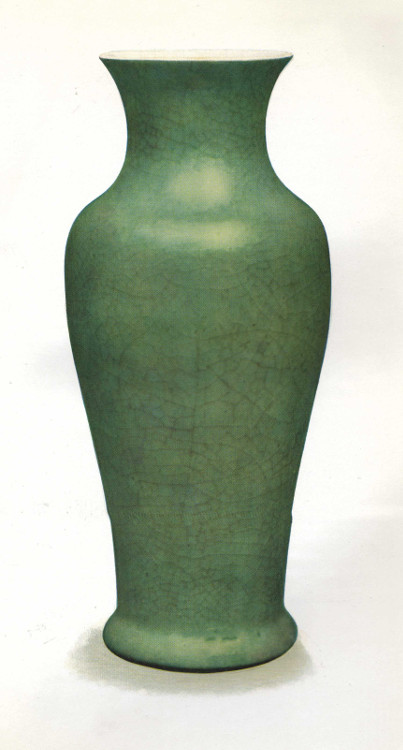
PLATE 85
Vase with crackled greenish grey glaze coated on the exterior with
transparent apple green enamel: the base unglazed. Probably sixteenth
century.
Height 14 inches.
British Museum.
The crackled glazes of the Sung period were still made, though the Ming
tendency was to substitute painted decoration for monochrome; and we
have already noted the crackled blue and lavender in which a second
glaze is added to a grey white crackle. This process is particularly
noticeable in the “apple green” monochromes (Plate 85), both of the
Ming and Ch’ing dynasties, in which a green overglaze itself uncrackled
is washed on to a crackled stone grey porcelain. The green is often
carried down over the slightly browned biscuit of the foot rim, forming
a band of brown. But this, so far from being a peculiarity of the
Ming technique, is much more conspicuous on the porcelains of the early
eighteenth century, when it was the constant practice to dress the foot
rim of the crackled wares with a brown ferruginous earth in imitation
of the “iron foot” of their Sung prototypes.
The work at the Imperial factory[235] was divided between twenty-three
departments, nine of which were occupied with accessories, such as
the making of ropes and barrels, general carpentry, and even boat
building. Five separate departments were employed in making the large
bowls, the wine cups, the plates, the large round dishes, and the tea
cups; another in preparing the “paste” or body material, and another in
making the “seggars” or fireclay cases in which the ware was packed in
the kiln. Five more were occupied in the details of decoration, viz.
the mark and seal department, the department for engraving designs, the
department for sketching designs, the department for writing, and the
department for colouring.
It does not appear that the work of decoration was so minutely
subdivided in the Ming period as in later times, when we are told that
a piece of porcelain might pass through more than seventy hands; but it
is clear, at least, that the outlining and filling in of the designs
were conducted in separate sheds. This is, indeed, self-apparent
from the Ming blue and white porcelains, the designs of which are
characterised by strong and clear outlines filled in with flat washes
of colour.
With regard to the actual designs, we are told that in the Ch’êng
Hua period they were drawn by the best artists at the Court, and
from another passage[236] it is clear that the practice of sending
the patterns from the palace continued in later reigns as well.
Such designs would no doubt accumulate, and probably they were
collected together from time to time and issued in the form of
pattern books.[237] Another method in which the painters of Ming
blue and white were served with patterns is related in the T’ao
shuo[238]:—“For painting in blue, the artists were collected each
day at dawn and at noon, and the colour for painting was distributed
among them. Two men of good character were first selected, the
larger pieces of porcelain being given to one, the smaller pieces
to the other; and when they had finished their painting, the amount
of the material used was calculated before the things were taken to
the furnace to be baked. If the results were satisfactory, then the
pieces were given as models to the other painters, and in the rest of
the pieces painted, the quantity of the colour used and the depth of
the tint was required to be in exact accordance with these models.”
There was little scope for originality or individual effort under
this system, where everything, even to the amount of material used,
was strictly prescribed. To translate their model with feeling and
accuracy was the best that could be expected from the rank and file.
But with the manual skill and patient industry for which the Chinese
are proverbial, and the good taste which prevailed in the direction
of the work, it was a system admirably suited to the task, and it
unquestionably led to excellent results.
As to the systems in use in the private factories we have no
information, but we may fairly assume that their processes were much
the same; and that, not having the benefit of the designs sent from
Court, they were more dependent upon the pattern books and stock
designs more or less remotely connected with the work of famous
painters.
CHAPTER VII MISCELLANEOUS PORCELAIN FACTORIES
Although from the Ming period onwards our interest is almost entirely
centred in Ching-tê Chên, there were other factories which cannot
be altogether ignored. A certain number have already been mentioned
at the end of the first volume, our scanty information being drawn
chiefly from the pottery section of the K’ang Hsi Encyclopædia. The
same monumental work includes in another part[239] a discourse on
porcelain (tz’ŭ ch’i), in which several additional factories
are named. The passage in question is prefaced by a quotation from the
Tien hung k’ai wu, a late-seventeenth century manual, in which
we are told that the white earth (o t’u[240]) necessary for the
manufacture of fine and elegant ware was found in China in five or six
places only[241]: viz. at Ting Chou, in the Chên-ting Fu in Chih-li, at
Hua-ting Chou in the Ping-liang Fu in Shensi, at P’ing-ting Chou in the
T’ai-yüan Fu in Shansi, and at Yü Chou in the K’ai-fêng Fu in Honan,
in the north; and at Tê-hua Hsien in the Ch’üan-chou Fu in Fukien, at
Wu-yüan Hsien and Ch’i-mên Hsien in the Hui-chou Fu, in Anhui, in the
south. As to the wares made in these localities, we are told that the
porcelains of the Chên-ting and K’ai-fêng districts were generally
yellow and dull and without the jewel-like brilliancy, and that all put
together were not equal to the Jao Chou ware. It would appear, then,
that the Ting Chou factories so noted in Sung times were still extant,
though they had lost their importance. For the rest, the Ch’i-mên
district supplied Ching-tê Chên with the raw material, the Tê-hua wares
will be discussed presently, and we have no information about the
productions (if any) of the other localities.
The province of Fukien apparently contained several factories
besides the important centre at Tê-hua. The Annals of Ch’üan-chou Fu
(celebrated as a trading port in the Middle Ages), for instance, are
quoted with reference to a porcelain (tz’ŭ ch’i) manufacture
at Tz’ŭ-tsao in the Chin-chiang Hsien, and three other places in the
district of An-ch’i are named as producers of white porcelain which was
inferior to that of Jao Chou. Similarly, the Annals of Shao-wu Fu, on
the north-east border of the province, allude to white porcelain made
at three places,[242] the factory at T’ai-ming in An-jen being the
best, but all were far from equalling the Jao Chou ware.
The district of Wên-chou Fu (formerly in the south of Fukien but now
transferred to northern Chekiang) was noted for pottery in the distant
days of the Chin dynasty (265–419 A.D.), and for the “bowls
of Eastern Ou.”[243] Of its subsequent ceramic history we have no
information, but there is an interesting specimen in the British Museum
which seems to bear on the question. It is an incense burner in the
form of a seated figure of the god of Longevity on a deer, skilfully
modelled in strong white porcelain and painted in a good blue in the
Ming style; and on the box in which it came was a note to the effect
that it is Wên-chou ware. If there is any truth in this legend (and it
would be quite pointless if untrue), then a blue and white porcelain in
the style of the better class of Ming export ware was made at Wên-chou.
Another interesting specimen in the same museum, which should also be
mentioned here, is a bottle with wide straight neck, of fine white ware
thickly potted, with soft, smooth-worn glaze painted in a greyish blue
with a medley of flowers, fruit, insects, and symbols, completed by
borders of ju-i heads and stiff leaves. It is marked under the
base in a fine violet blue, fu fan chih ts’ao, which, rendered
“made on the borders of Fukien,” might refer to the factories at
Shao-wu Fu or even Wên-chou Fu. This is another piece which has many
affinities with the late Ming export blue and white.
But the Fukien porcelain par excellence is a white ware of
distinctive character and great beauty which was and still is made at
Tê-hua Hsien, in the central part of the province.[244] This is the
blanc de Chine of the French writers and the modern Chien yao of
the Chinese, but to be carefully distinguished from the ancient Chien
yao with mottled black glaze which was made in the Sung dynasty at
Chien-yang in the north of the province.[245] The T’ao lu[246]
informs us that the porcelain industry at Tê-hua began in the Ming
dynasty, that the cups and bowls usually had a spreading rim, that
the ware was known as pai tz’ŭ (white porcelain), that it was
rich and lustrous but, as a rule, thick, and that the images of Buddha
were very beautiful. This condensed account is supplemented by a few
remarks in the K’ang Hsi Encyclopædia,[247] from which we gather that
the material for the ware was mined in the hills behind the Ch’êng
monastery and that it was very carefully prepared, but if the porcelain
was worked thin it was liable to lose shape in the kiln, and if it was
too thick it was liable to crack. At first it was very expensive, but
by the time of writing (about 1700) it was widely distributed and no
longer dear.
Tê-hua porcelain is, in fact, a fine white, highly vitrified material,
as a rule very translucent and covered with a soft-looking, mellow
glaze which blends so intimately with the body that they seem to be
part and parcel of one another. The glaze varies in tone from ivory or
cream white to the colour of skim milk, and its texture may be aptly
described by the homely comparison with blancmange. When the ivory
colour is suffused by a faint rosy tinge, it is specially prized; but
I can find no reason for supposing that the cream white and milk white
tints represent different periods of the ware. On the contrary, there
is good evidence to show that they were made concurrently.
As the ware is with few exceptions plain white or white decorated
with incised, impressed, moulded, or applied ornaments of a rather
formal and often archaic character, there will always be a difficulty
in determining the date of the finer specimens, viz. whether they
are Ming or early Ch’ing. The nature of the ware itself is a most
uncertain guide, for one of the most beautiful examples of the material
which I have seen is a figure of a European soldier which cannot be
older than 1650. I need hardly say that owners of Fukien porcelain,
particularly of the figures, habitually give themselves the benefit of
this ever present doubt, and that these pieces are usually listed in
sale catalogues as Ming or early Ming according to taste. This attitude
is fundamentally illogical, for the ware is still made at the present
day, and the Ming specimens in modern collections are likely to be the
exception, and not, as optimistic owners would lead one to suppose, the
rule. But in any case it will be more convenient to deal with the ware
as a whole in the present chapter than to attempt the difficult task of
treating its different periods separately, even though the bulk of our
examples belong to the Ch’ing dynasty.
Tê-hua porcelain can be conveniently studied in the British Museum,
where there is a fairly representative collection comprising more
than a hundred specimens. It includes a number of the figures for
which the factories were specially noted, of deities and sages such
as Kuan-yin, goddess of Mercy; Kuan-yü, god of War; Bodhidharma, the
Buddhist apostle; Manjusri, of the Buddhist Trinity; Hsi-wang-mu, the
Taoist queen of the west; the Taoist Immortals; besides small groups
representing romantic or mythological subjects such as Wang Chih
watching the two spirits of the pole stars playing chess. But the
favourite subject of the Tê-hua modeller was the beautiful and gracious
figure of Kuan-yin, represented in various poses as standing on a cloud
base with flowing robes, seated in contemplation on a rocky pedestal,
or enthroned between her two attributes, the dove—which often carries
a necklace of pearls—and the vase of nectar, while at her feet on
either side stand two diminutive figures representing[248] her follower
Lung Nü (the dragon maid), holding a pearl, and the devoted comrade
of her earthly adventures Chên Tsai. The Kuan-yin of this group is
reputed to have been the daughter of a legendary eastern King named
Miao-chuang, but other accounts make the deity a Chinese version of the
Buddhist Avalokitesvara, and it is certain that her representations
as the Kuan-yin with eleven heads and again with a “thousand” hands
reflect Indian traditions. In the latter manifestations the sex of the
deity is left in doubt, but there can be no question on that head when
she is represented with a babe in her arms as “Kuan-yin the Maternal,”
to whom childless women pray, a figure strangely resembling our images
of the Virgin and Child. Indeed, we are told[249] that the Japanese
converts to Christianity in the sixteenth century adopted the Kuan-yin
figure as a Madonna, and that there is in the Imperial Museum in the
Ueno Park, Tokio, a remarkable collection of these images among the
Christian relics. There is, however, another deity with whom this
Kuan-yin may easily be confounded, viz. the Japanese Kichimojin, also
“the Maternal,” the Sanskrit Hâriti, who was once the devourer of
infants but was converted by Sakyamuni and was afterwards worshipped as
the protector of children. This deity figures in Japanese pictorial art
as a “female holding a peach and nursing in her bosom an infant, whose
hands are folded in prayer. In front stand two nude children, one of
whom grasps a peach, the other a branch of bamboo.”[250]
Among the Tê-hua porcelains in the British Museum are no fewer than
nine specimens—groups, figures, or ornamental structures—with figures
in European costumes which date from the middle to the end of the
seventeenth century. One, a soldier apparently Dutch, about 1650,
is well modelled in deliciously mellow and translucent cream white
porcelain. Most of the others are more roughly designed, and vary in
tint from cream to milk white.
It is said that the natives of the Fukien province are among the most
superstitious of the Chinese, and Bushell[251] sees a reflection of
this religious temperament in the nature of the Tê-hua wares. If this
is so, they must have had exalted opinions of their European visitors,
whom they often furnish with the attributes of Chinese divinities,
representing them in positions and poses which seem to caricature
native deities and sages. There is, for instance, an ornament in form
of a mountain retreat with a shrine in which is seated a figure in a
three-cornered European hat and a Buddha-like attitude. Another group
consists of a European mounted on a ch’i-lin, posing as an
Arhat, and another of a European standing on a dragon’s head which
would symbolise to the Chinese the attainment of the highest literary
honours.
There are, besides, in the British Museum collection figures of animals
and birds, the Buddhist lion, the cock, the hawk, or the parrot,
mostly fitted with tubes to hold incense sticks; and there are a pair
of well modelled figures of Chou dogs.
As for the vessels of Tê-hua porcelain, they consist chiefly of incense
vases and incense burners, libation cups shaped after bronze or
rhinoceros horn models, brush pots, wine cups, water vessels for the
study table and the like (often beautifully modelled in the form of
lotus leaves or flowers), boxes, tea and wine pots, cups and bowls, and
more rarely vases.
An extensive trade was done with the European merchants, whose
influence is apparent in many of the wares, such as coffee cups with
handles, mugs of cylindrical form or globular with straight ribbed
necks in German style, and “barber-surgeons’ bowls” with flat pierced
handles copied from silver models. Indeed, the superficially European
appearance of some of these pieces has led serious students to mistake
them for early Meissen porcelain and even for that nebulous porcelain
supposed to have been made by John Dwight, of Fulham, at the end of the
seventeenth century. Père d’Entrecolles[252] incidentally mentions the
fact that some Ching-tê Chên potters had in the past removed to Fukien
in the hope of making profits out of the European traders at Amoy, and
that they had taken their plant and even their materials with them, but
that the enterprise was a failure.
Conversely, the influence of the Tê-hua wares is obvious in many of
the early European porcelains, such as those made at Meissen, St.
Cloud, Bow, and Chelsea, which were often closely modelled on the
Fukien white. There is, indeed, a striking similarity between the
creamy soft-paste porcelain of St. Cloud and the creamy variety of the
blanc de chine, both having the same mellow, melting appearance
in the glaze.
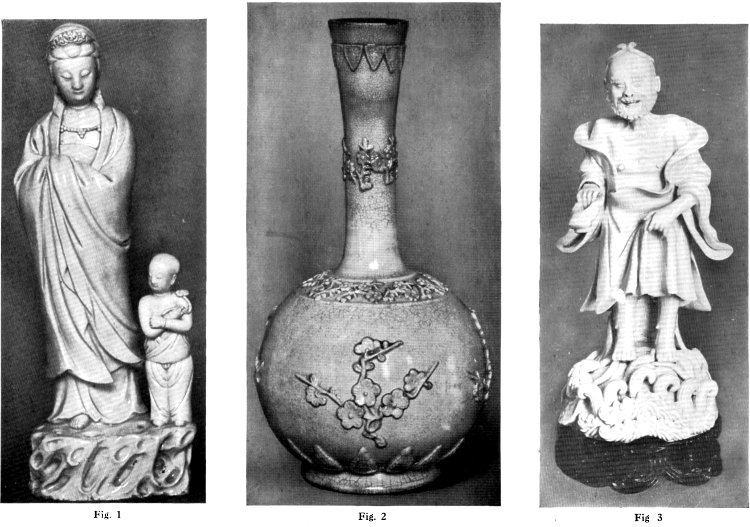
Plate 86.—Fukien Porcelain, Ming Dynasty.
Fig 1.—Figure of Kuan-yin with boy attendant. Ivory white. Height 10¼
inches. Eumorfopoulos Collection.
Fig. 2.—Bottle with prunus sprigs in relief, the glaze crackled all
over and stained a brownish tint. Height 9⅛ inches. Eumorfopoulos
Collection.
Fig. 3.—Figure of Bodhidharma crossing the Yangtze on a reed. Ivory
white. Height 7½ inches. Salting Collection (V. & A.
Museum).
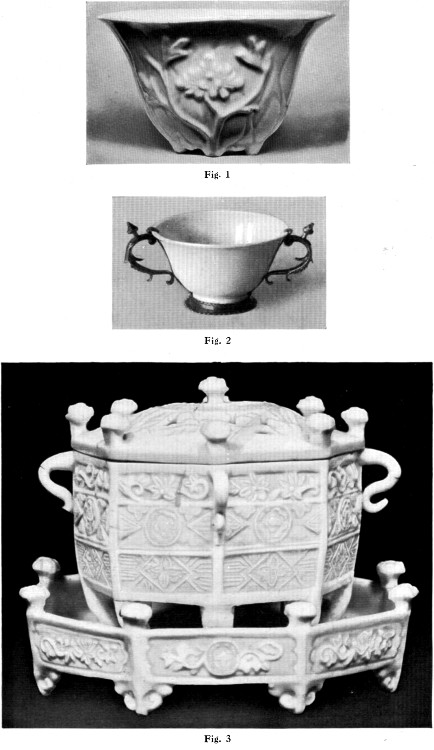
Plate 87.—Ivory White Fukien Porcelain.
Fig. 1.—Libation Cup. About 1700. Length 3⅞ inches. British
Museum.
Fig. 2.—Cup with sixteenth-century mount. Height 2 inches. Dresden
Collection.
Fig. 3.—Incense Vase and Stand. About 1700. Diameter 6¾ inches.
British Museum.
It would be possible to guess from these European copies, if we had no
other means, the character of the Tê-hua porcelain of the K’ang Hsi
period with its quaintly moulded forms, its relief decoration of prunus
sprigs, figures of Immortals, deer, etc., the only conspicuously absent
type being the incised[253] ornament which was unsuited to the European
ware. But there is no lack of actual specimens of the period of
active export which extended from about 1650–1750. Naturally they vary
greatly in quality, which depends on the purity and translucence of
the ware whether it be cream or milk white, and on the soft aspect
and rich lustre of the glaze. A large series, which may be taken as
representative of the K’ang Hsi period, was collected by Augustus
the Strong, and is still to be seen at the Johanneum at Dresden; or,
rather, part of it is still there, for much of that historic collection
was given away or pilfered from time to time, and many specimens with
the Dresden catalogue numbers engraved are now to be found in our own
museums. Many of the figures at Dresden have evidently been coated
with a kind of black paint, which probably served as a medium for oil
gilding, but this unfired colouring has worn away, and only traces now
remain.
Occasionally one finds among the Tê-hua wares a specimen with dry
appearance and crazed or discoloured glaze, defects due to faulty
firing or to burial in damp soil. Such pieces are surprising in a
ware with such apparent homogeneity of body and glaze, and the crazed
examples might be easily mistaken for one of the t’u ting (or
earthy Ting ware) types.
As to the history of the factories, it is expressly stated in the
T’ao lu that they were started in the Ming dynasty. No account
need be taken of the few legendary specimens to which tradition assigns
an earlier origin than this, such as the so-called flute of Yoshitsune,
a twelfth-century hero of Japan, and the incense burner in St. Mark’s,
Venice, which is reputed to have been brought from China by Marco Polo.
The latter is of the same model as Fig. 3 of Plate 87, perhaps from the
same mould, and I have seen at least half a dozen others in London. A
third piece which was long regarded as a document is the jewelled white
plate in the Dresden collection, supposed to have been brought back
from Syria by a Crusader in the twelfth century. The story is no doubt
apocryphal, but in any case it has no real bearing on the question,
for the plate is not Fukien ware but a specimen of white Ching-tê Chên
porcelain with a “shop mark” in underglaze blue. It has been set with
jewels in India or Persia, like a sixteenth-century bowl in the British
Museum, but the “Crusader plate” is probably a century later.
Brinkley[254] asserts, without giving any authority, that the Tê-hua
industry was virtually discontinued at the end of the eighteenth
century, and revived in recent years. The latter part of the
statement is unquestionably true, for we have the eye-witness of a
missionary[255] who visited the place about 1880 and describes the
manufactory as the most extensive of its kind in Fukien—“pottery,
pottery everywhere, in the fields, in the streets, in the shops. In
the open air children are painting the cups. Each artist paints with
his own colour and his own few strokes, whether a leaf, a tree, a
man’s dress or beard, and passes it over to his neighbour, who in
turn applies his brush to paint what is his share in the decoration.”
Unfortunately there is no reason to suppose that the writer made his
observations with an expert eye which would make a distinction between
pottery and porcelain, but in any case it is certain that he found a
vast ceramic industry in full blast at Tê-hua.
With reference to the modern ware Brinkley says[256]: “A considerable
number of specimens are now produced and palmed off upon unwary
collectors. But the amateur can easily avoid such deceptions if he
remembers that in genuine pieces of ivory white the ware is always
translucid when held up to the light, a property which, if not entirely
absent, is only possessed in a comparatively slight degree by the
modern product. The general quality of the glaze and the technique
of a piece should be sufficient guides, but if any doubt remains an
examination of the base of the specimens will probably dispel it. In
the old ware the bottom of a vase or bowl, though carefully finished,
is left uncovered, whereas the modern potter is fond of hiding his
inferior pâte by roughly overspreading it with a coat of glaze.”
Probably these observations are in the main correct, but experience
shows that relative opacity and glazed bases are by no means confined
to modern wares. Still, if the collector aims at acquiring pieces of
good colour, whether cream or milk white, with translucent body, pure
glaze and sharp modelling, he is not likely to go far astray.
The description quoted above of the painting of modern Fukien ware
is interesting in view of the common assertion that the Tê-hua white
porcelain was never painted. This assertion is probably based on a
passage in the first letter of Père d’Entrecolles: “Celle (i.e. la
porcelaine) de Fou-kien est d’un blanc de neige qui n’a nul éclat et
qui n’est point mélangé de couleurs.” On the other hand, a distinct
reference is made to the painting in colours in a modern Chinese
work.[257] Unfortunately, the question has been complicated by the
existence of many pieces of Fukien white which have been enamelled
in Europe. In the first half of the eighteenth century in Holland,
Germany, and elsewhere, there were decorators busy enamelling white
porcelain of whatever kind they could get, and the blanc de
chine offered a ready subject for this treatment. The decoration
thus added was usually in Oriental taste, and might be confused with
indifferent Chinese work. Many of these pieces are in the British
Museum. On the other hand, there are in the same collection two
cups with roughly painted floral designs in green and red which
are obviously Chinese, though they might well have been painted in
the mechanical method described by Mr. Dukes, which was probably
traditional. Mr. Eumorfopoulos possesses several good examples of this
painted Fukien ware, one of which may be described to show the style
of painting affected. It is executed in leaf green, lustrous red, and
the turquoise green which we associate with the Wan Li period, and
the form—a double-bottomed bowl—is likewise reminiscent of the Ming
dynasty.
The Japanese, whose traditions have often proved most misleading,
have frequently classed the Fukien white as Corean porcelain
(haku-gorai or white Corean), probably because specimens reached
them from the Corean ports. In the British Museum, for instance, there
is a beautiful white incense vase, formerly in the collection of Mr.
Ninagawa of Tokio, and labelled by him as “Corean porcelain, 500 years
old.” It has all the characteristics of the finest cream white Fukien
ware of late Ming or K’ang Hsi period, and if this piece is Corean,
then I do not believe that even the subtle perception of the Japanese
could find any difference between Corean and Fukien white. It is only
right to add that other Japanese experts have pronounced it Chinese.
Incidentally, I may mention that the base of this vase is glazed.
Marks were occasionally used by the Tê-hua potters, either incised or
stamped in seal form,[258] on the bottoms of cups and other vessels,
and on the backs of figures. Reign marks are rare, but apocryphal
dates of the Hsüan Tê period occasionally occur, as on a figure of Li
T’ieh-kuaì in the British Museum. Others consist of potters’ marks too
often illegible because the thick glaze has filled up the hollows of
the stamps, fanciful seal marks, frets, whorls, and occasionally the
swastika symbol. A few examples are given in vol. i., p. 222.
CHAPTER VIII THE CH’ING DYNASTY, 1644–1910
The reigns of the Manchu chieftains T’ien Ming, T’ien Tsung, and Ts’ung
Tê (1616–1643) are included in the chronology of the Ch’ing or Pure
Dynasty, but it is more usual to reckon that period from 1644, when
the Emperor Shun Chih  was firmly established on the throne
after the suicide of the last of the Mings. Little is known of the
ceramic history of the seventeen years during which Shun Chih occupied
the throne. The official records which deal only with the Imperial
factory are almost silent, and when they do speak it is merely to
chronicle failures. It is clear, however, that the Imperial factory
at Ching-tê Chên had again been opened; for orders were sent in 1654
for a supply of large “dragon bowls” for the palace gardens. They were
to be 2½ feet high, 3½ feet in diameter, 3 inches thick at the sides,
and 5 inches at the bottom. For four years the potters wrestled with
this difficult order without success. This time there was no “divine
T’ung” to purchase success by a holocaust of himself; and eventually
the Emperor was persuaded to withdraw the command. No better fortune
attended an order given in 1659 for oblong plaques (3 feet by 2½ feet,
and 3 inches thick) which were intended for veranda partitions.
Beyond these two negative items there is no information of the reign of
Shun Chih in the Chinese books, and the porcelain itself is scarcely
more illuminating, for authentic marked examples of this period are
virtually unknown. A figure already mentioned as bearing the date 1650
belongs rather to the pottery section, but it shows that the traditions
of the Ming glazes of the demi-grand feu were still kept alive.
The blue and white and the polychrome made in the private factories at
this time have been discussed with the transition wares (pp. 89 and
90), and for the rest we can only assume that the Shun Chih porcelains
are not to be distinguished from those of the last Ming reigns on the
one hand, and those of the early years of K’ang Hsi on the other.
Reflecting on the insignificance of the Shun Chih porcelains, one is
tempted to ask how it is that the celebrated Lang T’ing-tso, whose
name is usually associated with the beautiful Lang yao of the K’ang
Hsi period, did not succeed in raising the wares of this period to a
more conspicuous level. Lang T’ing-tso was governor of Kiangsi from
1654 and viceroy of Kiangsi and Kiangnan from 1656–1661 and again from
1665–1668. His name is mentioned (according to Bushell,[259] at any
rate, for I have not been able to verify the statement) in connection
with the efforts to make the dragon bowls for the palace in 1654; but
we shall return to this point in discussing the Lang yao.
Meanwhile, we pass to the reign of K’ang Hsi  (1662–1722),
the beginning of what is to most European collectors the greatest
period of Chinese porcelain, a period which may be roughly dated from
1662–1800. Chinese literary opinion gives the preference to the Sung
and Ming dynasties, but if monetary value is any indication the modern
Chinese collector appreciates the finer Ch’ing porcelains as highly
as the European connoisseur. These latter wares have, at any rate,
the advantage of being easily accessible to the Western student, and
they are not difficult to obtain provided one is ready to pay the high
price which their excellence commands. It will be no exaggeration to
say that three quarters of the best specimens of Chinese porcelain in
our collections belong to this prolific period, and they may be seen
in endless variety in the museums and private galleries of Europe and
America, nowhere perhaps better than in London itself.
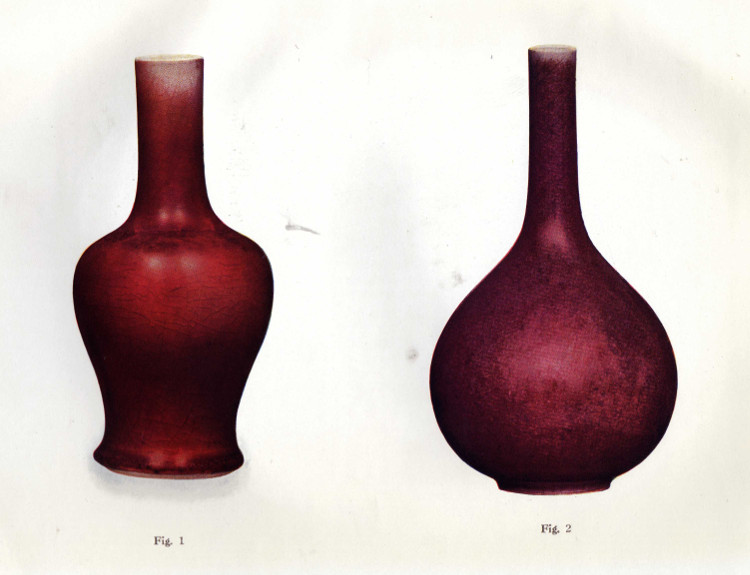
PLATE 88
Two examples of the underglaze red (chi hung) of the K’ang Hsi
period (1662–1722), sometimes called lang yao
Fig. 1.—Bottle-shaped Vase of dagoba form with minutely crackled
sang-de-bœuf glaze with passages of cherry red. The glaze ends
in an even roll short of the base rim, and that under the base is
stone-coloured and crackled. Height 8½ inches.
British Museum.
Fig. 2.—Bottle-shaped Vase with crackled underglaze red of deep
crushed strawberry tint. The glaze under the base is pale green,
crackled. Height 10¾ inches.
Alexander Collection.
With regard to the porcelains made in the early years of K’ang Hsi
there is very little information, and their special excellence has
been assumed mainly on the supposition that the Viceroy Lang T’ing-tso
exercised a beneficent influence on the wares of this period. He is
reputed to have been sponsor of the Lang yao, which in the ordinary
acceptation of the term[260] includes the beautiful sang de
bœuf red, an apple green crackle, and perhaps a cognate crackled
green glaze on which are painted designs in famille verte
enamels. The explanation of the term lang yao is far from clear,
and, as already hinted, the connection of the viceroy Lang T’ing-tso
with this or any other of the K’ang Hsi porcelains is by no means
established. Bushell[261] accepted the derivation of Lang yao from the
first part of the viceroy’s name as representing the best of several
Chinese theories, and on the supposition that “the ceramic production
of this time has retained the name of the viceroy, in the same way as
the names of Ts’ang Ying-hsüan, Nien Hsi-yao, and T’ang Ying, who were
in turn superintendents of the Imperial potteries, were afterwards
given to the Ts’ang yao, Nien yao, and T’ang yao.”
There are many objections to this reasoning. In the first place, Lang
T’ing-tso was viceroy of the two provinces of Kiangsi and Kiangnan for
three or four years only (1665–1668) during the reign of K’ang Hsi,
and it was only in his capacity as viceroy of Kiangsi that he would
have been concerned with Ching-tê Chên, even supposing that the man who
had charge of two large provinces could find time to devote himself to
the details of ceramic manufactures. Secondly, it is nowhere recorded
that Lang T’ing-tso was concerned in any way with the direction of
the potteries, so that there is in this respect no parallel between
him and the directors Ts’ang, Nien, and T’ang. Thirdly, the history
of Ch’ing-tê Chên as given in the T’ao lu, and the history of
Chinese porcelain as given in the T’ao shuo, make no mention
whatever of lang yao or of Lang T’ing-tso, while the former
takes special notice of the wares of Ts’ang, Nien, and T’ang, and the
latter discusses T’ang’s work at some length. Had so important a person
as the viceroy of two provinces been connected with the invention
or perfection of such celebrated wares as the lang yao, the
occurrence would hardly have escaped the notice of the Chinese
chronicler.
There are other attempts to explain the name lang yao. In the
catalogue of Mr. A. B. Mitford’s collection[262] it is stated that “the
Lang family were a family of famous potters who possessed the secret
of this peculiar glaze and paste. They became extinct about the year
1610.” Bushell[263] dismisses this with the comment that “the family is
apocryphal and the porcelain antedated,” and in the same passage gives
an alternative theory, viz. “this name has been derived by some Chinese
of less weight from that of Lang Shih-ning, an artist protégé of the
Jesuits,[264] who also lived in the reign of K’ang Hsi, and whose
pictures are still appreciated.”
The evidence for all these versions seems to be equally defective.
They are, in fact, mere assertions, and the reader can take his choice
of any of them, provided he does not insist on Mr. Mitford’s date
(anterior to 1610), for all authorities are now agreed that the lang
yao is a K’ang Hsi production. The fact is that the name has been
handed down without any explanation, and the current theories are of
comparatively modern construction. The secret of the lang yao
consisted in the first instance in the knowledge of means to produce
a brilliant red glaze from copper oxide. It was not a new discovery,
but merely a revival of the wonderful “precious stone” red of the
early Ming period.[265] The supplies of some essential ingredient
for this colour had failed in the Chia Ching period,[266] and the
secret of the true colour had been temporarily lost. This secret was
now recovered probably by a potter of the name of Lang, and that
name has been associated with it ever since. So far from the lang
yao being limited to the early part of the reign of K’ang Hsi or
to the few years when Lang T’ing-tso might have been concerned with
it, there can be little doubt that the sang de bœuf red or red
lang yao is the special colour described in detail by Père
d’Entrecolles in 1712, and again in 1722 under the significant name
of yu li hung, or “red in the glaze.” The reader can judge for
himself from the description given in the second letter[267]: “This
red inside the glaze is made with granulated red copper and the
powder of a certain stone or pebble of a reddish colour. A Christian
doctor told me that this stone was a kind of alum, used in medicine.
The whole is pounded in a mortar and mixed with a boy’s urine and
the ordinary porcelain glaze; but I have not been able to ascertain
the quantities of the ingredients, for those in possession of the
secret take good care not to divulge it. This mixture is applied to
the porcelain before it is fired and no other glaze is used; but care
has to be taken that the red colour does not run to the bottom of the
vase during the firing. They tell me that when they intend to apply
this red to porcelain they do not use porcelain stone (petuntse)
in the body, but they use in its place, mixed with the porcelain
earth (kaolin), a yellow clay prepared in the same manner as
the petuntse. Probably it is a kind of clay specially suited
to receive this colour.” Would that the worthy father had named the
possessors of the secret! Had it been a Jesuit family, is it likely
that he would not have said so? But here, at any rate, is not only such
an accurate description of the manufacture of the sang de bœuf
red that little need be added to it, but also a valuable commentary on
the obscure passages in which the allusion is made to the brilliant
red of the Hsüan Tê and other early Ming periods. For what is the
reddish stone or pebble but the “red precious stone from the West,”
which played a mysterious part in the pao shih hung of the Hsüan
Tê period? Chinese tradition has imagined this stone to have been the
ruby, on the impossible assumption that the red colour of the glaze
was derived from the red of the ruby. But it was, in all probability,
cornaline (the ma nao used in the Sung porcelain of Ju Chou) or
amethystine quartz, and its only function would have been to increase
the brilliancy and transparence of the glaze, the red colour being
entirely due to copper oxide. It is interesting, too, to note that the
composition of the porcelain body was varied to suit this red colour,
and that a yellow clay was substituted for the porcelain stone, in view
of the alleged difficulties in obtaining the proper “earth for the
fresh red (hsien hung)” in the Chia Ching period. In a similar
manner a more earthy composition was found to be more sympathetic than
the pure white porcelain to some of the other monochromes, as may be
observed in existing specimens of turquoise blue.
The lang yao, then, is the chi hung of the K’ang Hsi
period, the brilliant blood red commonly known by the French name
sang de bœuf, and to-day it is one of the most precious
monochromes. A choice example illustrated on Plate 88 shows the
changing tints from a brilliant cherry red below the shoulder to the
massed blood red where the fluescent glaze has formed thickly above
the base. The colour flowing down has left an even white band round
the mouth, and has settled in thick coagulations on the flat parts of
the shoulders and again above the base; but in spite of its apparent
fluidity the glaze has stopped in an even line without overrunning the
base. The glaze under the base is of pale buff tone and crackled, and a
careful examination of the surface generally shows that a faint crackle
extends over the whole piece. The glaze, moreover, is full of minute
bubbles and consequently much pinholed, and the red colour has the
appearance of lying on the body in a dust of minute particles which the
glaze has dragged downward in its flow and spread out in a continuous
mass, but where the colour and the glaze have run thick the particles
reappear in the form of a distinct mottling or dappling.
To obtain the best colour from the copper oxide in this glaze
it was necessary to regulate the firing to a nicety, the margin
between success and failure being exceedingly small. Naturally, too,
the results varied widely in quality and tone; but the permanent
characteristics of the K’ang Hsi sang de bœuf are (1) a
brilliant red varying in depth and sometimes entirely lost in
places,[268] but always red and without any of the grey or grey blue
streaks which emerge on the flambé red and the modern imitations
of the sang de bœuf; (2) the faint crackle of the glaze; (3)
the stopping of the glaze at the foot rim. The colour of the glaze
under the base and in the interior of vases varied from green or
buff crackle to plain white. The secret of this glaze, which Père
d’Entrecolles tells us was carefully guarded, seems to have been lost
altogether about the end of the K’ang Hsi period. Later attempts to
obtain the same effects, though often successful in producing large
areas of brilliant red, are usually more or less streaked with alien
tints such as grey or bluish grey, and are almost invariably marred by
the inability of the later potters to control the flow of the glaze
which overruns the foot rim and consequently has to be ground off. But
it is highly probable that the modern potter will yet surmount these
difficulties, and I have actually seen a large bowl of modern make
in which the ox-blood red was successfully achieved on the exterior
(the interior was relatively poor), and the flow of the glaze had been
stopped along the foot rim except in one or two small places where the
grinding was cleverly masked. So that it behoves the collector to be on
his guard.
Fig. 2 of Plate 88 shows another type of red, also classed as lang
yao, which has the same peculiarities of texture as the sang de
bœuf, but the colour is more of a crushed-strawberry tint, and has
in a more marked degree that thickly stippled appearance which suggests
that the colour mixture has been blown on to the ware through gauze.
This is probably the ch’ui hung or soufflé red mentioned
by Père d’Entrecolles in connection with the yu li hung. The
same glaze is often found on bowls, the colour varying much in depth
and the base being usually covered with a crackled green glaze beneath.
This crackled green is a very distinctive glaze, highly translucent
and full of bubbles, like the red lang yao, and it is sometimes
found covering the entire surface of a vase or bowl and serving as a
background for paintings in famille verte enamels. It seems, in
fact, to be the true green lang yao, and one is tempted to ask
if it was not in reality intended to be a sang de bœuf red glaze
from which a lack of oxygen or some other accident of the kiln has
dispelled all the red, leaving a green which is one of the many hues
produced by copper oxide under suitable conditions. These conditions
might well be present in such an enclosed space as the foot of a bowl;
and if they happened to affect the whole of the piece, what more
natural than to trick out the failure with a gay adornment of enamel
colours?
On the other hand, what is commonly known as green lang yao is
the brilliant emerald or apple green crackle which has already been
discussed on p. 102. But why this colour should be connected in any
way with the Lang or any particular family is a mystery. The method
of producing it is transparently obvious—a green enamel laid over a
stone-coloured crackle; and there are examples of all periods from
the Ming down to modern times. Indeed, the modern specimens are only
distinguished with the greatest difficulty from the old.
To return to the history of the period from which we digressed to
discuss the lang yao, the progress of the reviving industry
suffered a rude set-back between 1674–1678 when the Imperial factory
was destroyed during the rebellion of Wu San-kuei, viceroy of Yunnan.
It is improbable that up to this time any notable development had
taken place in the manufacture of porcelain, and those who think to
flatter a specimen by suggesting that it is “very early K’ang
Hsi” are likely to be paying a doubtful compliment. When, however,
peace was restored and the factory rebuilt, a veritable renaissance of
the porcelain industry began. In 1680[269] an official of the Imperial
household was sent to reside at the factory and to superintend the
work; and we are told in the T’ao shuo[270] that “previously
to this the first-class workmen had been levied from the different
districts of Jao Chou; but now all this forced labour was stopped,
and as each manufactory was started the artisans were collected and
materials provided, the expenses being defrayed from the Imperial
exchequer and the money paid when due, in accordance with the market
prices. Even the expenses for carriage were not required from the
different districts. None of the proper duties of the local officers
were interfered with; both the officials and the common people enjoyed
the benefit, and the processes of manufacture were all much improved.”
The success of this new movement was assured by the appointment in
1682 of Ts’ang Ying-hsüan  to the control of the Imperial
works. We are not told how long this distinguished person retained the
directorship, but his merits are clearly indicated in the encomiums
of a subsequent director, the celebrated T’ang Ying. In his “History
of the God of the Furnace Blast,” the latter states that when Ts’ang
was in charge of the factory the god laid his finger on the designs
and protected the porcelain in the kiln, so that it naturally came out
perfect. Unfortunately, the notice of Ts’ang’s work in the T’ao
lu[271] is in the conventional style, and extremely meagre.
The earth used, we are told, was unctuous, the material lustrous
and thin. Every kind of colour was made, but the snake-skin green
(shê p’i lü), the eel yellow (shan yü huang), the (?)
turquoise (
 chi ts’ui), and the “spotted yellow”
(
 huang pan tien) were the most beautiful. The
monochrome (chiao)[272] yellow, the monochrome brown or purple
(tzŭ), the monochrome green, the soufflé (ch’ui) red
and the soufflé blue, were also beautiful. The Imperial factory
under the administration of T’ang-ying imitated these glaze colours.
Most of these colours explain themselves. The soufflé red
is no doubt the same as the ch’ui hung described by Père
d’Entrecolles and discussed above with the so-called lang yao.
The soufflé blue will be no other than the familiar “powder
blue.” But the “spotted yellow” is an ambiguous term, for the Chinese
huang pan tien[273] might mean a yellow glaze spotted with some
other colour, a mottled yellow, or even a glaze with yellow spots like
that of a rare vase in the Eumorfopoulos Collection, which has a brown
black glaze flecked with greenish yellow spots.
Bushell identified the spotted yellow glaze with the “tiger skin,”
with its patches of green, yellow and aubergine glazes applied to
the biscuit, which in the finer specimens is etched with dragon
designs.[274]
This is practically all the direct information which the Chinese annals
supply on the K’ang Hsi period, but in contrast with this strange
reticence we have a delightful account of the industry at Ching-tê Chên
during this important time in the two oft-quoted letters[275] written
by the Jesuit father, d’Entrecolles, in 1712 and 1722. The worthy
father’s work lay among the potters themselves, and his information was
derived from first-hand observation and from the notes supplied by his
potter converts, with whatever help he was able to extract from the
Annals of Fou-liang and similar native books. No subsequent writer has
enjoyed such a favoured position, and as his observations have been
laid under heavy contribution ever since, no apology is necessary for
frequent reference to them in these pages.
CHAPTER IX K’ANG HSI BLUE AND WHITE
Western collectors have agreed to give the place of honour to the K’ang
Hsi blue and white. The Ming wares of the same kind, mainly from lack
of adequate representation, have not yet been fully appreciated; and in
the post-K’ang Hsi periods the blue and white took an inferior status,
owing to the growing popularity of enamelled wares. The peculiar
virtues of the K’ang Hsi blue and white are due to simple causes.
Blue was still regarded as the best medium for painted designs, and
the demand for it, both in China and abroad, was enormous. The body
material was formed of carefully selected clay and stone, thoroughly
levigated and freed from all impurities. No pains were spared in the
preparation of the blue, which was refined over and over again until
the very quintessence had been extracted from the cobaltiferous ore.
Naturally this process was costly, and the finest cobalt was never used
quite pure; even on the most expensive wares it was blended with a
proportion of the lower grades of the mineral, and this proportion was
increased according to the intended quality of the porcelain. But the
choicest blue and white of this period was unsurpassed in the purity
and perfection of the porcelain, in the depth and lustre of the blue,
and in the subtle harmony between the colour and the white porcelain
background; and the high standard thus established served to raise the
quality of the manufacture in general.
Vast quantities of this blue and white were shipped to Europe by the
Dutch and the other East India companies, who sent extensive orders
to Ching-tê Chên. It need hardly be said that this export porcelain
varied widely in quality, but it included at this time wares of the
highest class. Indeed, in looking through our large collections
there are surprisingly few examples of the choice K’ang Hsi blue and
white which cannot be included in the export class, as indicated by
the half-Europeanised forms of plates, jugs, tankards, and other
vessels, and by the fact that the vases are made in sets of five. But
considering that it was made to suit purchasers of such varied tastes
and means, it is surprising how little of this K’ang Hsi porcelain is
bad. Even the roughest specimens have a style and a quality not found
on later wares, and all have an unquestionable value as decoration.
It would be futile to attempt to describe exhaustively the different
kinds of K’ang Hsi blue and white and the innumerable patterns with
which they are decorated. We must confine our descriptions to a few
type specimens, but first it will be useful to give the points of a
choice example. Such a vessel, whatever its nature, will be potted with
perfect skill, its form well proportioned and true. The surface will
be smooth, because the material is thoroughly refined and the piece
has been carefully trimmed or finished on the lathe, and finally all
remaining inequalities have been smoothed away with a moist feather
brush before the glazing. The ware will be clean and white, and the
glaze[276] pure, limpid, and lustrous, but with that faint suspicion of
green which is rarely absent from Chinese porcelain. The general effect
of the body and glaze combined is a solid white like well set curds.
The base, to which the connoisseur looks for guidance, is deeply cut
and washed in the centre with glaze which reaches about half-way down
the sides of the foot rim. This patch of glaze is usually pinholed,
as though the nemesis of absolute perfection had to be placated by
a few flaws in this inconspicuous part. The rim itself is carefully
trimmed, and in many cases grooved or beaded, as though to fit a wooden
stand,[277] and the unglazed edge reveals a smooth, close-grained
biscuit whose fine white material is often superficially tinged with
brown in the heat of the furnace. The decoration is carefully painted
in a pure sapphire blue of great depth and fire, and singularly free
from any strain of red or purple—a quality of blue only obtained by
the most elaborate process of refining. The designs, as on the Ming
porcelains, are first drawn in outline; but, unlike the strong Ming
outlines, these are so faint as to be practically unobserved; and the
colour is filled in, not in flat washes, as on the Ming blue and white,
but in graded depths of pulsating blue. This procedure is clearly shown
by two interesting bowls in the British Museum. They are identical
in form and were intended to match in pattern; but in one the design
(the Eight Immortals of the Wine Cup) is completed, while on the other
it remains in outline only, giving us a wonderful illustration of
the beautiful firm touch with which the artists traced these faint
outlines. The work of decoration was systematically subdivided in the
Chinese factory, and Père d’Entrecolles tells us that “one workman is
solely occupied with the ring which one sees on the border of the ware;
another outlines the flowers, which a third paints; one does the water
and the mountains, another the birds and animals.”[278] Whatever the
advantages and disadvantages of this divided labour, the designs on the
blue and white were admirably chosen to show off the fine qualities
of the colour; and it is to the blue that the collector looks first.
The distinction between the various qualities of blue hardly admit
of verbal definition. It can only be learnt by comparing the actual
specimens, and by training the eye to distinguish the best from the
second best.
The patterns are not always blue on a white ground. Many of the most
beautiful results were obtained by reserving the design in white in a
blue ground, and both styles are often combined on the same piece. The
second is fairly common on the K’ang Hsi porcelains, being specially
suited to the lambrequins, arabesques, and formal patterns which were a
favourite decoration at this time. See Plates 89 and 91.
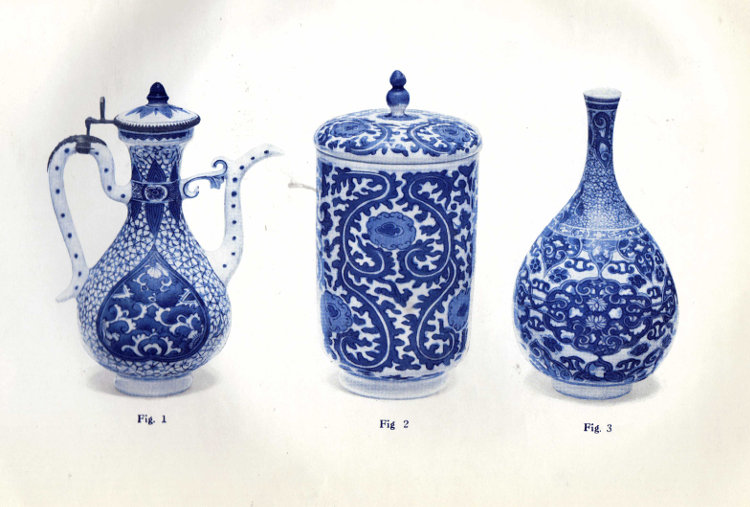
PLATE 89
Three examples of K’ang Hsi Blue and White Porcelain in the British
Museum
Fig. 1.—Ewer with leaf-shaped panels of floral arabesques, white in
blue, enclosed by a mosaic pattern in blue and white: stiff plantain
leaves on the neck and cover. Silver mount with thumb-piece. Height 7⅛
inches.
Fig. 2.—Deep bowl with cover, painted with “tiger-lily” scrolls. Mark,
a leaf. Height 7½ inches.
Fig. 3.—Sprinkler with panels of lotus arabesques, white in blue, and
ju-i shaped border patterns. A diaper of small blossoms on the
neck. Mark, a leaf. Height 7⅛ inches.
The choicest materials were lavished on the porcelains with these
formal designs, which consisted now of bands of ju-i shaped
lappets[279] filled with arabesque foliage, forming an upper and lower
border, between which are floral sprays, now of a belt of three or four
palmette-like designs, similarly ornamented, and linked together round
the centre of a vase or bottle; of large, stiff, leaf-shaped medallions
borrowed, like the patterns which fill them, from ancient bronzes,
and of ogre-head designs from a similar source; of successive belts of
arabesque scrolls and dragon designs covering cylindrical jars; of a
mosaic of small blossoms, or of network diapers recalling the pattern
of a crackled porcelain. The white on blue process is constant in a
well known decoration in which archaic dragons, floral arabesques,
roses or peonies are arranged in “admired disorder” over the whole
surface of a cylinder vase or a triple gourd, as on Plate 91. Sometimes
the roses occupy the greater part of the design, and among them are
small oval or round blank medallions, which have earned for the pattern
the name of “rose and ticket.”
This type of ware is represented in almost every variety in the Dresden
collection, and there are examples of the “rose and ticket” jars in
the Porzellan-zimmer of the Charlottenburg Palace. Both these
collections are mainly composed of the export porcelain sent from
China in the last decades of the seventeenth century, and the latter
is practically limited to the presents made by the English East India
Company to Queen Sophia Charlotte of Prussia (1688–1705). The white on
blue patterns are also freely used in combination with blue and white
to form borders and to fill in the ground between panels.
As for the blue on white designs, they are legion. There are the old
Ming favourites such as the Court scenes, historical and mythological
subjects, pictorial designs, such as ladies looking at the garden
flowers by candlelight.[280] There are landscapes after Sung and Ming
paintings, the usual dragon and phœnix patterns, animal, bird, and
fish designs, lions and mythical creatures, the familiar group of a
bird (either a phœnix or a golden pheasant) on a rock beside which
are peony, magnolia, and other flowering plants. Panel decoration,
too, is frequent, the panels sometimes petal-shaped and emphasised by
lightly moulded outlines, or again mirror-shaped, circular, fan-shaped,
leaf-shaped, oval, square, etc., and surrounded by diapers and “white
in blue” designs. The reserves are suitably filled with figure subjects
from romance, history, or family life, mythical subjects such as the
adventures of Taoist sages, the story of Wang Chi watching the game of
chess, Tung-fang So and his peaches, or, if numerical sequences are
needed, with the Four Accomplishments (painting, calligraphy, music and
chess), the flowers of the Four Seasons, the Eight Taoist Immortals,
the Eight Immortals of the Wine Cup, etc. Another favourite panel
design is a group of vases, furniture, and symbolical objects from the
comprehensive series known as the Hundred Antiques.[281] Sometimes
the whole surface of a vase is divided into rows of petal-shaped
compartments filled with floral designs, figure subjects, birds and
flowers or landscapes. Plate 91, Fig. 3, from a set of five, is one of
the large vases in the Dresden collection which, tradition says, were
obtained by Augustus the Strong from the King of Prussia in exchange
for a regiment of dragoons. It is decorated with panels illustrating
the stories of the Twenty-four Paragons of Filial Piety.
Some of the purely floral patterns strike perhaps a more distinctive
note. The “aster pattern,” for instance, is a design of stiff,
radiating, aster-like flowers usually in a dark tone of blue and
displayed on saucer dishes or deep covered bowls. Some of the specimens
of this class appear to be a little earlier than K’ang Hsi. The
so-called “tiger-lily” pattern illustrated by Fig. 2 of Plate 89 is
usually associated with deep cylindrical covered bowls of fine material
and painted in the choicest blue. A beaker (Plate 91, Fig. 2) shows a
characteristic treatment of the magnolia, parts of the blossoms being
lightly sculptured in relief and the white petals set off by a foil of
blue clouding. It evidently belongs to a set of five (three covered
jars and two beakers) made as a garniture de cheminée for the
European market.
The squat-bodied bottle (Plate 92, Fig. 1) illustrates a familiar
treatment of the lotus design, with a large blossom filling the front
of the body.
But perhaps the noblest of all Chinese blue and white patterns is the
prunus design (often miscalled hawthorn) illustrated by Plate 90, a
covered vase once in the Orrock Collection and now in the Victoria and
Albert Museum. The form is that of the well-known ginger jar, but these
lovely specimens were intended for no banal uses. They were filled with
fragrant tea or some other suitable gift, and sent, like the round cake
boxes, by the Chinese to their friends at the New Year, but it was not
intended that the jars or boxes should be kept by the recipients of the
compliment.
The New Year falls in China from three to seven weeks later than in our
calendar, and it was seasonable to decorate these jars with sprays and
petals of the flowering prunus fallen on the ice, which was already
cracked and about to dissolve. The design is symbolic of the passing of
winter and the coming of spring; and the vibrating depths of the pure
sapphire blue broken by a network of lines simulating ice cracks form
a lovely setting for the graceful prunus sprays reserved in the pure
curd-like white of the ware.
The prunus pattern has been applied to every conceivable form, whether
to cover the whole surface or to serve as secondary ornament in the
border of a design or on the rim of a plate, and the prunus jar
appears in all qualities of blue and on porcelain good and bad, old
and new. The graceful sprays have become stereotyped and the whole
design vulgarised in many instances; and in some cases the blossoms are
distributed symmetrically on a marbled blue ground as a mere pattern.
But nothing can stale the beauty of the choice K’ang Hsi originals, on
which the finest materials and the purest, deepest blue were lavished.
The amateur should find no difficulty in distinguishing these from
their decadent descendants. The freshness of the drawing, the pure
quality of the blue, and the excellence of body, glaze, and potting
are unmistakable. The old examples have the low rim round the mouth
unglazed where the rounded cap-shaped cover fitted, and the design on
the shoulders is finished off with a narrow border of dentate pattern.
The original covers are extremely rare, and in most cases have been
replaced with later substitutes in porcelain or carved wood.
There are, besides, a number of types specially prevalent among the
export porcelains, some purely Chinese in origin, others showing
European influence. Take, for example, the well-known saucer dish with
mounted figures of a man and a woman hunting a hare—a subject usually
known as the “love chase”—a free and spirited design, rather sketchily
painted in pale silvery blue. The porcelain itself is scarcely less
characteristic, a thin, crisp ware, often moulded on the sides with
petal-shaped compartments, and in many ways recalling the earlier type
described on p. 70. It is, however, distinguished from the latter class
by slight differences in tone and finish which can only be learnt by
comparison of actual specimens. It is, moreover, almost always marked
with a nien hao in six characters, whereas marks on the other
type are virtually unknown. The nien hao is usually that of
Ch’êng Hua, but an occasional example with the K’ang Hsi mark gives the
true date of the ware.
A quantity of this porcelain was brought up by divers from wrecks of
old East Indiamen in Table Bay, among which was the Haarlem,
lost in 1648,[282] though most of the ships were wrecked at later
dates. It is a thin and sharply moulded ware, often pure eggshell,
and the blue varies from the pale silvery tint to vivid sapphire. The
usual forms are of a utilitarian kind—plates, saucer dishes, cups and
saucers, small vases and bottles, jugs, tankards, and the like—and the
designs are not confined to the “love chase,” but include other figure
subjects (e.g. a warrior on horseback carrying off a lady,[283] and
various scenes from romance and family life), floral designs, deer,
phœnixes, fish, birds, etc., and perhaps most often the tall female
figures, standing beside flowering shrubs or pots of flowers, which are
vulgarly known as “long Elizas,” after the Dutch lange lijsen
(see Plate 92, Fig. 2).
Graceful ladies (mei jên) are familiar motives in Chinese
decoration, but this particular type, usually consisting of isolated
figures in small panels or separated from each other by a shrub or
flowerpot, and standing in a stereotyped pose, are, I think,[284]
peculiar to the export wares of the last half of the seventeenth
century.
This same type of thin, crisply moulded porcelain was also painted with
similar designs in famille verte enamels over the glaze. It has
a great variety of marks, the commonest being the apocryphal Ch’êng Hua
date-mark, while others are marks of commendation,[285] such as ch’i
chên ju yü (a rare gem like jade), yü (jade), ya
(elegant), and various hall-marks.
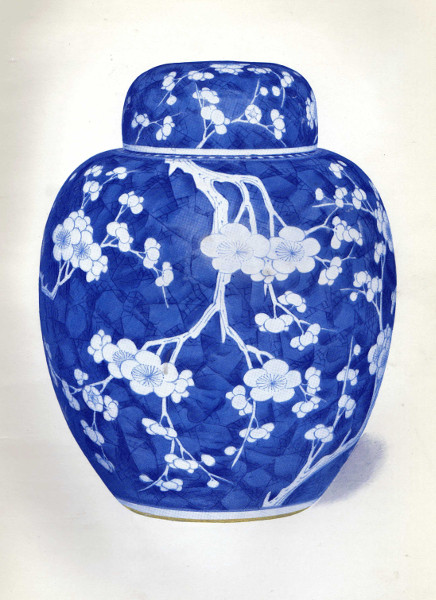
PLATE 90
Covered Jar for New Year gifts, with design of blossoming prunus
(mei hua) sprays in a ground of deep sapphire blue, which is
reticulated with lines suggesting ice cracks: dentate border on the
shoulders
Height 10 inches.
Victoria and Albert Museum.
Yet another group of superior quality is obviously connected with the
European trade by a peculiar mark (see vol. i., p. 228) resembling the
letter C or G. It is most commonly represented by pairs of bottles with
globular body and tall, tapering neck, decorated with flowing scrolls
of curious rosette-like flowers, a design stated with much probability
to have been copied from Dutch delft. As the Dutch design in question
had evidently been based on a Chinese original, the peculiar nature
of the flowers explains itself. There are other instances of patterns
bandied in this way between the Far East and the West. The same
peculiar floral scroll appears in famille verte associated with
the same mark; and the same G mark occurs on two rare bottles in the
collection of Mr. J. C. J. Drucker, which have blue and white painting
on the neck and famille verte designs in the finest enamels on
the body. A deep bowl in the Eumorfopoulos collection with famille
verte panels of symbols from the Hundred Antiques, and a ground
of green “prunus” pattern, bears the same mark. Neither of these last
examples can be even remotely connected with Dutch influence, so that
we may dismiss the suggestion that the letter in the mark is intended
to be a D, standing for D(elft), for this reason quite apart from the
fact that such a mark on Delft ware is non-existent. I imagine that the
true explanation is that this peculiar mark is a merchant’s sign placed
by order on the goods made for some particular trader.
A close copy of the “wing handles” of Venetian glass on certain blue
and white bottles (Plate 92, Fig. 3), the appearance of Prince of
Wales’s feathers in the border of a plate and of an heraldic eagle in
the well of a salt cellar, no less than many forms obviously Western
in origin, further emphasise the close relations between the Ching-tê
Chên potters and European traders.[286] An immense quantity of
indifferent blue and white was made for the European table services,
and summarily decorated with baskets of flowers, the usual flowering
plant designs, close patterns of small blossoms, floral scrolls with
large, meaningless flowers, ivy scrolls, passion flowers, and numerous
stereotyped designs, such as dragons in sea waves, prunus pattern
borders, pine tree and stork, a garden fence with rockery and flowering
shrubs, groups from the Hundred Antiques, a parrot on a tree stump,
etc. The blue of these pieces is usually rather dull and heavy, but
the ware has the characteristic appearance of K’ang Hsi porcelain, and
was evidently made for the most part about the year 1700. If marked
at all, the marks are usually symbols, such as the double fish, the
lozenge, the leaf, a tripod vase, and a strange form of the character
shou known as the “spider mark” (see vol. i., p. 225). The
plates are often edged with lustrous brown glaze to prevent that
chipping and scaling to which the Chinese glaze was specially liable on
projecting parts of the ware.[287]
Something has already been said[288] of another very distinctive class
of blue and white for which the misleading name of “soft paste” has
been widely adopted. The term is of American origin and has been too
readily accepted, for it is not only inaccurate as a description,
but is already current in Europe for a totally different ware, which
it describes with greater exactitude, viz. the artificial, glassy
porcelains made at Sèvres and Chelsea and other factories, chiefly in
France and England, in the middle of the eighteenth century. In actual
fact the Chinese ware to which the term “soft paste” is applied has
an intensely hard body. The glaze, however, which is softer than that
of the ordinary porcelain, contains a proportion of lead, and if not
actually crackled from the first becomes so in use, the crackle lines
being usually irregular and undecided.
A detailed description of the manufacture of this ware is given by
Père d’Entrecolles,[289] though he is probably at fault in supposing
that its chief ingredient was a recent discovery in 1722. It was
made, he says, with a mineral called hua shih (in place of
kaolin), a stone of glutinous and soapy nature, and almost certainly
corresponding to the steatite or “soapy rock” which was used by the
old English porcelain makers at Bristol, Worcester and Liverpool. “The
porcelain made with hua shih,” to quote Père d’Entrecolles,
“is rare and far more expensive than the other porcelain. It has an
extremely fine grain; and for purposes of painting, when compared with
ordinary porcelain, it is almost as vellum to paper. Moreover, this
ware is surprisingly light to anyone accustomed to handle the other
kinds; it is also far more fragile than the ordinary, and there is
difficulty in finding the exact temperature for its firing. Some of
the potters do not use hua shih for the body of the ware, but
content themselves with making a diluted slip into which they dip their
porcelain when dry, so as to give it a coating of soapstone before it
is painted and glazed. By this means it acquires a certain degree of
beauty.” The preparation of the hua shih is also described, but
it is much the same as that of the kaolin, and the composition of the
steatitic body is given as eight parts of hua shih to two of
porcelain stone (petuntse).
There are, then, two kinds of steatitic porcelain, one with the body
actually composed of hua shih and the other with a mere surface
dressing of this material. The former is light to handle, and opaque;
and the body has a dry, earthy appearance, though it is of fine grain
and unctuous to touch. It is variously named by the Chinese[290]
sha-t’ai (sand bodied) and chiang-t’ai (paste bodied),
and when the glaze is crackled it is further described as k’ai
pien (crackled).
The painting on the steatitic porcelain differs in style from that
of the ordinary blue and white of this period. It is executed with
delicate touches like miniature painting, and every stroke of the
brush tells, the effects being produced by fine lines rather than by
graded washes. The ware, being costly to make, is usually painted by
skilful artists and in the finest blue. Fig. 3, of Plate 93, is an
excellent example of the pure steatitic ware, an incense bowl in the
Franks collection, of which the base and a large part of the interior
is unglazed and affords a good opportunity for the study of the body
material. The glaze is thin and faintly crackled, and the design—Hsi
Wang Mu and the Taoist Immortals—is delicately drawn in light, clear
blue.
The second type, which has only a dressing of steatite over the
ordinary body, has neither the same lightness nor the opacity of the
true steatitic ware, but it has the same soft white surface, and is
painted in the same style of line drawing.
There are, besides, other opaque and crackled wares painted in
underglaze blue, which are also described as “soft paste,” and, indeed,
deserve the name far more than the steatitic porcelain. The creamy,
crackled copies of old Ting wares, for instance, made with ch’ing
tien stone,[291] are occasionally enriched with blue designs; and
the ordinary stone-coloured crackle with buff staining is also painted
at times with underglaze blue,[292] or with blue designs on pads of
white clay in a crackled ground.
On the other hand, there are numerous wares of the Yung Chêng and
Ch’ien Lung periods which are probably composed in part, at least, of
steatite. They are usually opaque, and the surface is sometimes dead
white, sometimes creamy and often undulating like orange peel, and in
addition to blue decoration, enamel painting is not infrequent on these
later types. The purely steatitic porcelains are generally of small
size, which was appropriate to the style of painting as well as to the
expensive nature of the material. The furniture of the scholar’s table,
with its tiny flower vases for a single blossom, its brush washers and
water vessels of fanciful forms, its pigment boxes, etc., were suitable
objects for the material, and many of these little crackled porcelains
are veritable gems. Snuff bottles are another appropriate article, and
a representative collection of snuff bottles will show better than
anything the great variety of these mixed wares and so-called “soft
pastes.”
It has been already observed that crackled blue and white porcelain
of the steatitic kind is found with the date marks of Ming Emperors,
and there can be little doubt that it was made from early Ming times,
but as the style of painting seems to have known no change it will be
always difficult to distinguish the early specimens. It is safe to
assume that almost all the specimens in Western collections belong to
the Ch’ing dynasty, a few to the K’ang Hsi period, but the bulk of the
better examples to the reigns of Yung Chêng and Ch’ien Lung. Modern
copies of the older wares also abound.
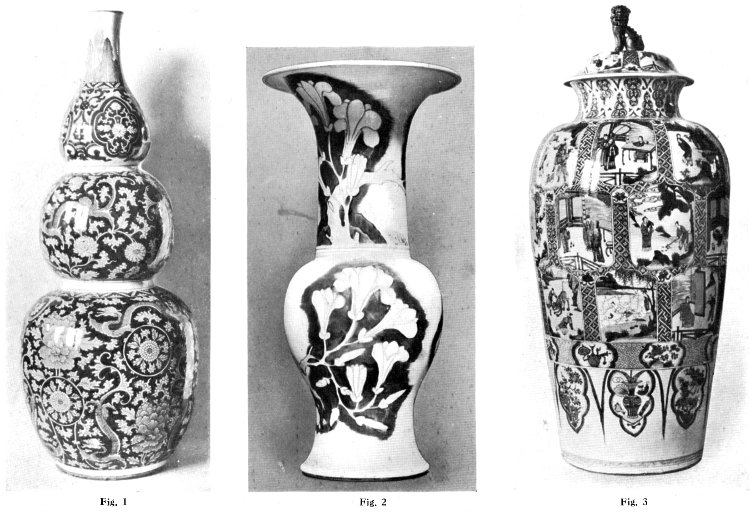
Plate 91.—Blue and White K’ang Hsi Porcelain.
Fig. 1.—Triple Gourd Vase, white in blue designs of archaic dragons
and scrolls of season flowers. Height 36½ inches. Dresden
Collection.
Fig. 2.—Beaker, white magnolia design slightly raised, with blue
background. Height 18 inches. British Museum.
Fig. 3.—“Grenadier Vase,” panels with the Paragons of Filial Piety.
Height 44 inches. Dresden Collection.
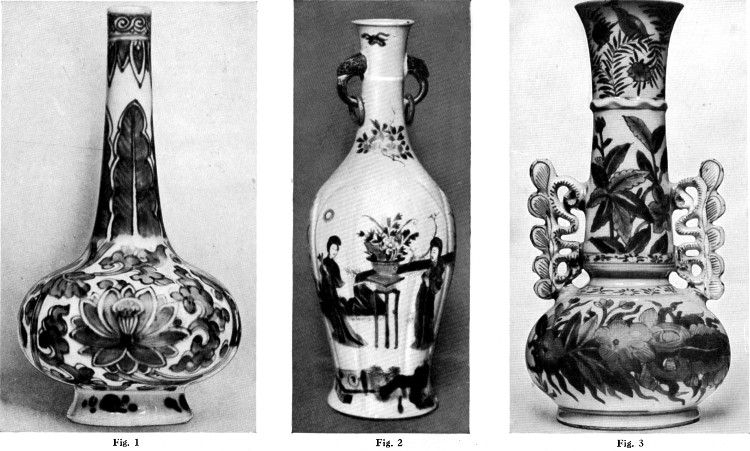
Plate 92.—Blue and White K’ang Hsi Porcelain.
Fig. 1.—Sprinkler with lotus design. Height 6¼ inches. British
Museum.
Fig. 2.—Bottle with biscuit handles, design of graceful ladies (mei
jen). Height 11 inches. Fitzwilliam Museum (formerly D. G.
Rosetti Collection).
Fig. 3.—Bottle with handles copied from Venetian glass. Height 6¼
inches. British Museum.
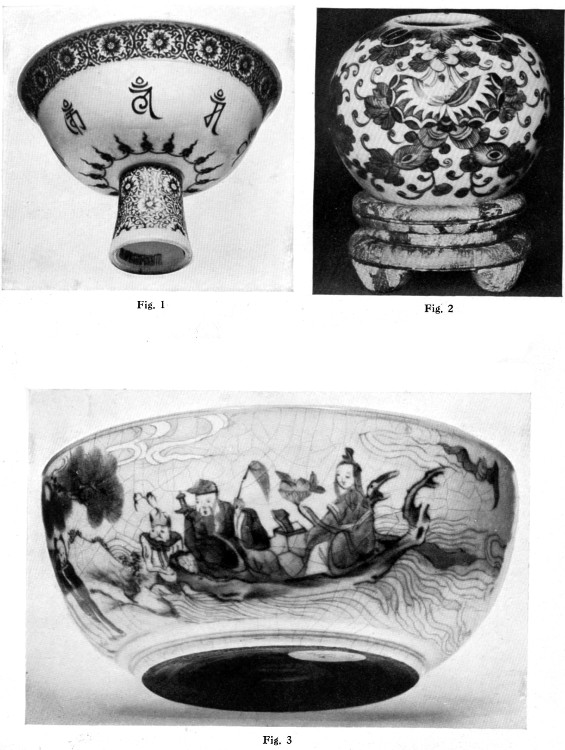
Plate 93.—Blue and White Porcelain.
Fig. 1.—Tazza with Sanskrit characters. Ch’ien Lung mark. Height 4¼
inches. British Museum.
Fig. 2.—Water Pot, butterfly and flowers, steatitic porcelain. Wan Li
mark. Height 1⅞ inches. Eumorfopoulos Collection.
Fig. 3.—Bowl, steatitic porcelain. Immortals on a log raft. K’ang Hsi
period. Diameter 5¾ inches. British Museum.
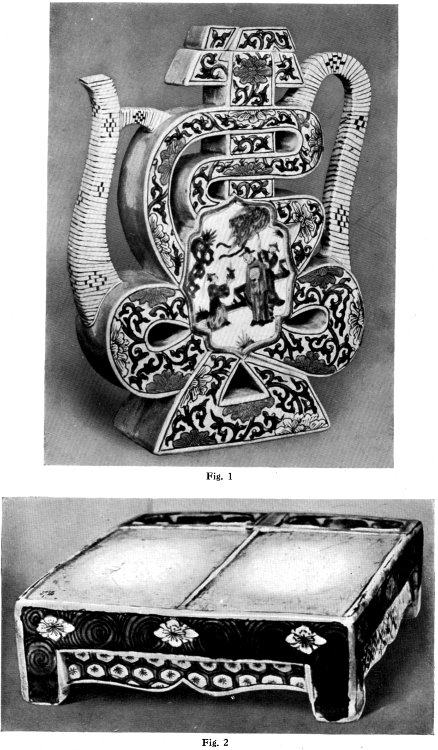
Plate 94.—Porcelain decorated in enamels on the biscuit.
Fig. 1.—Ewer in form of the character Shou (Longevity); blue
and white panel with figure designs. Early K’ang Hsi period. Height 8¾
inches. Salting Collection.
Fig. 2.—Ink Palette, dated 31st year of K’ang Hsi (1692
A.D.). Length 5¼ inches. British Museum.
An interesting passage in the first letter[293] of Père d’Entrecolles
describes a curious kind of porcelain, of which the secret had already
been lost. It was known as chia ch’ing or “blue put in press,”
and it was said that the blue designs on the cups so treated were
only visible when the vessel was filled with water. The method of
the manufacture is described as follows: “The porcelain to be so
decorated had to be very thin; when it was dry, a rather strong blue
was applied, not to the exterior in the usual manner, but on the
interior to the sides. The design usually consisted of fish, as being
specially appropriate to appear when the cup was filled with water.
When the colour was dry a light coating of slip, made with the body
material, was applied, and this coating enclosed the blue between
two layers of clay. When this coating was dry, glaze was sprinkled
inside the cup, and shortly afterwards the porcelain was placed on the
wheel. As the body had been strengthened on the interior, the potter
proceeded to pare it down outside as fine as possible without actually
penetrating to the colour. The exterior was then glazed by immersion.
When completely dry it was fired in the ordinary furnace. The work is
extremely delicate, and requires a dexterity which the Chinese seem no
longer to possess. Still, they try from time to time to recover the
secret of this magical painting, but without success. One of them told
me recently that he had made a fresh attempt, and had almost succeeded.”
No example of this mysterious porcelain is known to exist, and it is
probable that the whole story is based on some ill-grounded tradition.
It is true that water will bring out the faded design on certain old
potteries, but this is due to the action of the water in restoring
transparency to a soft decayed glaze. But how the water or any other
liquid could affect the transparency of a hard, impenetrable porcelain
glaze, still less influence the colour concealed beneath a layer of
clay and glaze, is far from clear. Indeed, the whole story savours of
the “tall tales” quoted in chap. x. of vol. i.
But perhaps it will not be inappropriate to mention here another
peculiar type of blue and white, which, if we may judge by the early
date mark usually placed upon it, throws back to some older model. The
design, usually a dragon, is delicately traced with a needle point on
the body of the ware, and a little cobalt blue is dusted into the
incisions.[294] The glaze is then applied, and when the piece is fired
and finished the dragon design appears faintly “tattooed” in pale blue.
The effect is light and delicate, but of small decorative value, and
the few examples which I have seen are redeemed from insignificance
by a peculiarly beautiful body of pure glassy porcelain. They bear an
apocryphal Ch’êng Hua mark, but evidently belong to the first half of
the eighteenth century, to the Yung Chêng, or perhaps the late K’ang
Hsi period.
CHAPTER X K’ANG HSI POLYCHROME PORCELAINS
Broadly speaking, the polychrome porcelains of the Ming and K’ang
Hsi periods are the same in principle, though they differ widely
in style and execution. The general types continued, and the first
to be considered is that in which all the colours are fired in the
high temperature of the large kiln, comprising underglaze blue and
underglaze red, and certain slips and coloured glazes. Conspicuous
among the last is a pale golden brown commonly known as Nanking
yellow, which is found in narrow bands or in broad washes, dividing
or surrounding blue designs, and is specially common on the bottles,
sprinklers, gourd-shaped vases, and small jars exported to Europe in
the last half of the seventeenth century. The golden brown also darkens
into coffee brown, and in some cases it alternates in bands with buff
crackle and pale celadon green.
A deep olive brown glaze is sometimes found as a background for
ornament in moulded reliefs which are touched with underglaze blue and
red. A fine vase of this type is in the Salting Collection, and a good
example was given by Mr. Andrew Burman to the British Museum. Both seem
to be designed after bronze models.
But the central colour of this group is undoubtedly the underglaze
red. Derived from copper it is closely akin to the red of the chi
hung glaze, and both were conspicuous on the Hsüan Tê porcelain,
both fell into disuse in the later Ming periods, and both were revived
in the reign of K’ang Hsi.
I have seen two examples of this colour in combination with underglaze
blue bearing the hall mark chung-ho-t’ang, and cyclical dates
corresponding to 1671 and 1672 respectively. In neither of these
pieces, however, was the red very successful, and probably the better
K’ang Hsi specimens belong to a later period of the reign. It was,
however, always a difficult colour to fire, and examples in which the
red is perfectly developed are rare. As a rule, it tends to assume a
maroon or dark reddish brown tint.
Nor is the method of its application always the same. Sometimes it is
painted on in clean, crisp brush strokes; at others it is piled up in
thick washes which flow in the firing and assume some of the qualities
and the colour of sang de bœuf red, even displaying occasional
crackle; on other pieces again a “peach bloom” tint is developed.[295]
On two of the best examples in the Franks Collection, where a deep
blood red is combined with a fine quality of blue, it is noteworthy
that the surface of the white glaze has a peculiar dull lustre. This,
I understand, is due to “sulphuring” in the kiln, a condition which,
whether accidental or intentional, is certainly favourable to the red
colour. It is also noticeable that the red is particularly successful
under a glaze which is faintly tinged with celadon green such as is
often used on imitations of Ming porcelains, and it was no doubt this
consideration which led to the frequent use of celadon green in this
group. The celadon is used either as a ground colour for the whole
piece or in parts only of the design, and the addition of white slip
further strengthened the palette. With these colours some exquisite
effects have been compassed in such designs as birds on prunus boughs
and storks among lotus plants, the main design being in blue, the
blossoms in white slip slightly raised and touched with red, and
the background plain white, celadon green (Plate 115), and
sometimes pale lavender blue. The celadon and pale lavender vases with
this decoration were favourites with the French in the eighteenth
century, and many sets of vases and beakers in this style have been
furnished with sumptuous ormolu mounts by the French goldsmiths.
The painting in underglaze red, which was revived in the K’ang Hsi
period, continued with success in the succeeding reigns of Yung Chêng
and Ch’ien Lung (indeed it has not ceased to this day), but the bulk
of the finer examples in our collections seem to belong to the late
K’ang Hsi and the Yung Chêng periods. The underglaze red is used alone
as well as in combination, and some of its most successful effects are
found on small objects like colour boxes and snuff bottles.
The black or brown pigment used for outlining designs under the
softer enamel colours such as green and yellow, though in one sense an
underglaze colour, does not belong to this group.
From this group of polychrome porcelain we pass to another in which the
colour is given by washes of various glazes. A few of the high-fired
glazes are employed for this purpose, especially blue in combination
with celadon green and white, and a few clay slips, of which the
commonest is a dressing of brown clay applied without any glaze and
producing an iron-coloured surface. The most familiar members of this
group are small Taoist figures of rough but vivacious modelling with
draperies glazed blue, celadon and white,[296] and the base unglazed
and slightly browned in the firing. Collectors are tempted to regard
these figures as late or modern productions, but examples in the
Dresden collection prove that this technique was employed in the K’ang
Hsi period. In the same collection there are numbers of small toy
figures, such as monkeys, oxen, grotesque human forms, etc., sometimes
serving as whistles or as water-droppers. They are made of coarse
porcelain or stoneware with a thin dressing of brown ferruginous clay,
and touches of high-fired glazes. The appearance of these, too, is so
modern that we realise with feelings of surprise that they formed part
of the collection of Augustus the Strong.
The polychrome porcelain coloured with glazes of the demi-grand
feu (i.e. glazes fired in the more temperate parts of the large
kiln) has been discussed in the chapters on the Ming period.[297]
The group characterised by green, turquoise and aubergine violet,
semi-opaque, and minutely crackled is not conspicuous among K’ang
Hsi porcelains; indeed it seems to have virtually ceased with the
Ming dynasty. The individual colours, however, were still used as
monochromes; in combination they are chiefly represented by aubergine
violet and turquoise in broad washes on such objects as peach-shaped
wine pots, Buddhist lions with joss-stick holders attached, parrots,
and similar ornaments.
The other three-colour group, composed of transparent green, yellow
and aubergine purple glazes, usually associated with designs finely
etched with a metal point on the body, were freely used in the K’ang
Hsi and Yung Chêng periods in imitation of Ming prototypes. Such
specimens are often characterised by extreme neatness of workmanship
and technical perfection of the ware. The best-known examples are thin,
beautifully potted rice bowls, with slightly everted rim, and a design
of five-clawed Imperial dragons traced with a point and filled in with
a colour contrasting with that of the ground, e.g. green on yellow, or
green on aubergine, all the possible changes being rung on the three
colours. Being Imperial wares these bowls are usually marked with the
nien hao of their period, but such is the trimness of their make
that collectors are tempted to regard them as specimens of a later
reign. But here again the Dresden collection gives important evidence,
for it contains a bowl of this class with dragons in a remarkable
purplish black colour (probably an accidental variety of the aubergine)
in a yellow ground. It bears the mark of the K’ang Hsi period.
The application of similar plumbo-alcaline glazes to a commoner type of
porcelain is described by Père d’Entrecolles[298]:—“There is a kind
of coloured porcelain which is sold at a lower rate than the enamelled
ware just described.... The material required for this work need not
be so fine. Vessels which have already been baked in the great furnace
without glaze, and consequently white and lustreless, are coloured by
immersion in a bowl filled with the colouring preparation if they are
intended to be monochrome. But if they are required to be polychrome
like the objects called hoam lou houan,[299] which are divided
into kinds of panels, one green, one yellow, etc., the colours are
laid on with a large brush. This is all that need be done to this
type of porcelain, except that after the firing a little vermilion
is applied to certain parts such as the beaks of birds, etc. This
vermilion, however, is not fired, as it would evaporate in the kiln,
and consequently it does not last. When the various colours have been
applied, the porcelain is refired in the great furnace with the other
wares which have not yet been baked; but care is taken to place it at
the bottom of the furnace and below the vent-hole where the fire is
less fierce; otherwise the great heat would destroy the colours.”
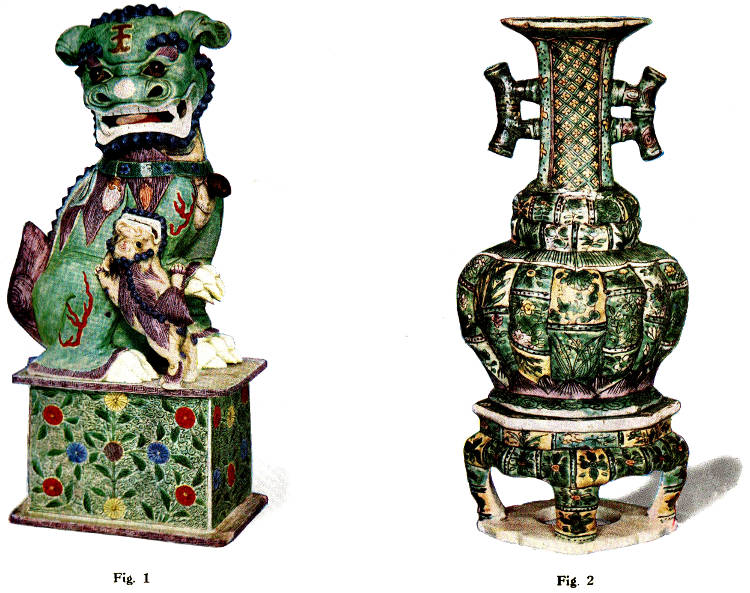
PLATE 95
Two examples of Porcelain painted with coloured enamels on the biscuit,
the details of the designs being first traced in brown. K’ang Hsi
period (1662–1722)
Fig. 1.—One of a pair of Buddhistic Lions, sometimes called Dogs of
Fo. This is apparently the lioness, with her cub: the lion has a ball
of brocade under his paw. On the head is the character wang
(prince) which is more usual on the tiger of Chinese art. Height 18
inches. S. E. Kennedy Collection.
Fig. 2.—Bottle-shaped Vase and Stand moulded in bamboo pattern and
decorated with floral brocade designs and diapers. Height 8¾ inches.
Cope Bequest (Victoria & Albert Museum).
In this interesting passage, written in 1722, we have a precise
account of the manufacture of one of the types of porcelain which
have been indiscriminately assigned to the Ming period. This on-biscuit
polychrome was undoubtedly made in the Ming dynasty, but in view of
d’Entrecolles’ description it will be safe to assume that, unless
there is some very good evidence to the contrary, the examples in our
collections are not older than K’ang Hsi. The type is easily identified
from the above quotation, and there is a little group of the wares in
the British Museum, mostly small figures and ornaments with washes
of green, brownish yellow and aubergine purple applied direct to the
biscuit, and on some of the unglazed details the unfired vermilion
still adheres. These coloured glazes are compounded with powdered
flint, lead, saltpetre, and colouring oxides, and the porcelain
belongs to the comprehensive group of san ts’ai or three-colour
ware, although the three colours—green, yellow and aubergine—are
supplemented by a black formed of brown black pigment under one of the
translucent glazes and a white which d’Entrecolles describes[300] as
composed of ⅖ ounce of powdered flint to every ounce of white lead.
This last forms the thin, iridescent film often of a faintly greenish
tinge, which serves as white on these three-colour porcelains. In rare
cases also a violet blue enamel is added to the colour scheme.
A characteristic of this particular type is the absence of any painted
outlines. The colours are merely broad washes bounded by the flow of
the glaze, and this style of polychrome is best suited to figures and
moulded ornamental pieces, in which the details of the design form
natural lines of demarcation for the glazes. On a flat surface this
method of coloration is only suited to such patchy patterns as the
so-called tiger skin and the tortoiseshell wares.
The Dresden collection is peculiarly rich in this kind of san
ts’ai, but though two or three of the specimens (Plate 71, Figs. 1
and 2) differing considerably from the rest, are clearly of the Ming
period, the great majority are undoubtedly contemporaneous with the
forming of the collection, viz. of the K’ang Hsi period. The latter
include numerous figures, human and animal, and ornaments such as the
junk on Plate 98, besides some complicated structures of rocks and
shrines and grottos, peopled with tiny images and human figures. To
this group belong such specimens as the “brinjal bowls,” with everted
rim and slight floral designs engraved in outline and filled in with
coloured glaze in a ground of aubergine (brinjal) purple. There are
similar specimens with green ground, and both types are frequently
classed with Ming wares. Some of them may indeed belong to the late
Ming period,[301] but those with finer finish are certainly K’ang Hsi.
They are usually marked with rough, undecipherable seal marks in blue,
which are commonly known as shop marks.
Some of the figures of deities, birds and animals, besides the
small ornamental objects such as brush-washers in the form of lotus
leaves and little water vessels for the writing table are of very
high quality, skilfully modelled and of material far finer than that
described by d’Entrecolles. Fig. 2, Plate 99, a statuette of Ho
Hsien-ku, one of the Eight Immortals, is an example. The flesh is in
white biscuit, showing the fine grain of the porcelain, white to-day,
though possibly it was originally coloured with unfired pigment and
gilt as was often the case. The glazes on this finer quality of ware,
especially the green and the aubergine, are peculiarly smooth and
sleek, and the yellow is fuller and browner than on the kindred ware,
enamelled on the biscuit, which we now proceed to investigate.
The French term, émaillé sur biscuit, is used somewhat broadly
to cover the coloured glazes just described, as well as the enamels
proper of the muffle kiln. We shall try to confine the expression,
“on-biscuit enamels,” to the softer, verifiable enamels which are fired
at a lower temperature and in a smaller kiln or muffle. These are, in
fact, the same enamels as are used in the ordinary famille verte
porcelain painted over the finished glaze, but when applied direct
to the biscuit they have a slightly darker and mellower tone, the
background of biscuit reflecting less light than the glittering white
glaze.
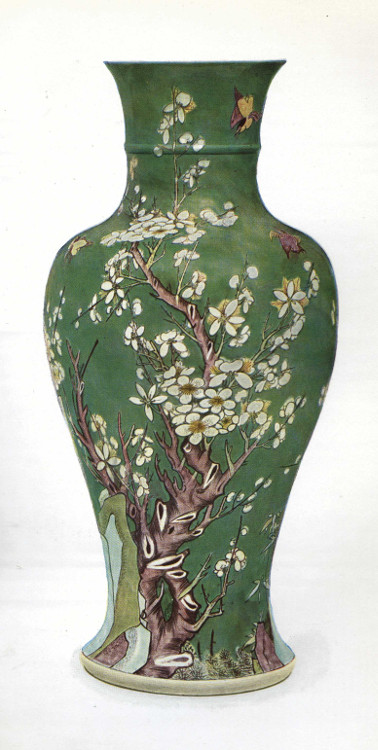
PLATE 96
Vase of baluster form painted in coloured enamels on the biscuit. The
design, which is outlined in brown, consists of a beautifully drawn
prunus (mei hua) tree in blossom and hovering birds, beside a
rockery and smaller plants of bamboo, etc., set in a ground of mottled
green. Ch’êng Hua mark but K’ang Hsi period (1662–1722)
Height 16¾ inches.
British Museum.
Though the colour scheme of this group is substantially the same as
that of the san ts’ai glazes, and though the enamels when used
in wide areas are not always easily distinguished from the glazes, the
former do, in fact, differ in containing more lead, being actually
softer and more liable to acquire crackle and iridescence, and in some
cases there are appreciable differences in tint. The yellow enamel,
for instance, is as a rule paler, and even when of a dark tint it has
a muddy tone wanting in the fullness and strength of the yellow glaze;
the green enamel varies widely in tone from the glaze, and includes,
besides, several fresh shades, among which is a soft apple green
of great beauty; and the aubergine is less claret coloured and often of
a decidedly pinkish tone.
But perhaps the most distinctive feature of this san ts’ai of
the muffle kiln is the careful tracing of the design in a brown black
pigment on the biscuit. The transparent enamels are washed on over
these black outlines, and give appropriate colours without obscuring
the design which is already complete in itself.[302] The same brown
black pigment[303] is also used over wide areas, laid on thickly and
washed with transparent green to form the fine green black which is so
highly prized. Like so much of the porcelain with coloured ornament
applied to the biscuit this large group has been indiscriminately
assigned to the Ming dynasty. The lack of documentary evidence has
made it difficult to combat this obvious fallacy, obvious because
the form and style of decoration of the finest specimens are purely
K’ang Hsi in taste and feeling; but, while fully recognising that the
scheme of decoration was not a new one, but had been in use in the
Ming porcelains, I would point a warning finger again[304] to the ink
slab in the British Museum with its design of aubergine plum blossoms
on conventional green waves, its borders of lozenge and hexagon
diaper, all enamelled on the biscuit, and in the characteristic style
habitually described as Ming in sale catalogues, but actually dated
1692. Another consideration is the quantity of these pieces in the
Dresden collection which consists mainly of K’ang Hsi wares, and the
presence of several examples (e.g. bamboo vases such as Fig. 2 of Plate
95) in the rooms of the Charlottenburg Palace, which were furnished
mainly with presents made by the British East India Company to Queen
Sophia Charlotte (1668–1705).
Marks are rare on this group, as a whole, though they occur fairly
frequently on the large vases, the commonest being the date mark of the
Ch’êng Hua period. No one would, however, seriously argue a fifteenth
century date from this mark which is far more common than any other on
K’ang Hsi porcelain; and I have actually seen the K’ang Hsi mark on
one or two specimens which appeared to be perfectly genuine. Curiously
enough the K’ang Hsi mark is more often a sign of a modern imitation,
but this in view of the perverse methods of marking Chinese porcelain
is in itself evidence that the modern copyist regards the reign of
K’ang Hsi as the best period of manufacture for this style of ware.
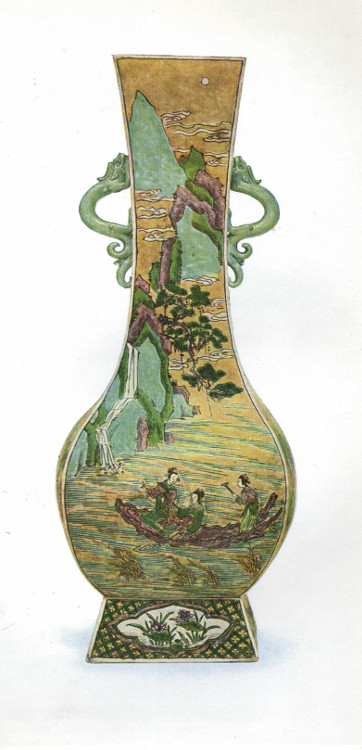
PLATE 97
Square Vase with pendulous body and high neck slightly expanding
towards the top: two handles in the form of archaic lizard-like dragons
(chih lung), and a pyramidal base. Porcelain painted with
coloured enamels on the biscuit, with scenes representing Immortals on
a log raft approaching Mount P’êng-lai in the Taoist Paradise. K’ang
Hsi period (1662–1722)
Height 20½ inches.
British Museum.
The noblest examples of this group, and perhaps the finest of all
Chinese polychromes, are the splendid vases with designs reserved
in grounds of green black, yellow or leaf green. Plates 96, 97 and
Frontispiece will serve to illustrate the colours and at the same
time some of the favourite forms[305] of these sumptuous pieces, the
baluster vase, and the square vase with pendulous body, pyramidal
base, and two handles usually of archaic dragon form. The favourite
design for the decoration of these forms is the flowering prunus tree,
beside a rockery with a few bright plumaged birds in the branches, one
of the most familiar and at the same time most beautiful of Chinese
patterns (see Plate 96). The flowers of the four seasons—peony, lotus,
chrysanthemum and prunus—form a beautiful decoration for the four
sides of another favourite form, a tall vase of square elevation with
sides lightly tapering downwards, rounded shoulders, arid circular
neck, slightly flaring at the mouth. The specimens illustrated are in
the British Museum, but there is a wonderful series of these lordly
vases in the Salting Collection, and in the Pierpont Morgan and Altmann
Collections in New York. To-day they are rare, and change hands at
enormous prices. Consequently all manner of imitations abound, European
and Oriental, the modern Chinese work in this style being often highly
successful. But the most insidious copies are the deliberate frauds
in which old K’ang Hsi vases are stripped of a relatively cheap
form of decoration, the glaze and colour being removed by grinding,
and furnished with a cleverly enamelled design in colours on the
biscuit. The actual colours are often excellent, and as the ware seen
at the base is the genuine K’ang Hsi porcelain even the experienced
connoisseur may be deceived at first, though probably his misgivings
will be aroused by something in the drawing which betrays the copyist,
and a searching examination of the surface will reveal some traces of
the sinister treatment to which it has been subjected or the tell-tale
marks, such as black specks or burns, left on the foot rim by the
process of refiring. There is much truth besides in the saying that
things “look their age,” and artificial signs of wear imparted by
friction and rubbing with sand or grit are not difficult for the
experienced eye to detect.
As already noted, the black of the precious black-ground vases, the
famille noire as they are sometimes called, is formed by
overlaying a dull black pigment with washes of transparent green
enamel. The result is a rich greenish black, the enamel imparting life
and fire to the dull pigment; and as the green is fluxed with lead it
tends to become iridescent, giving an additional green reflet
to the black surface. The modern potters have learnt to impart an
iridescence to their enamels, and one often sees a strong lustre on
specimens which are clearly “hot from the kiln”; but these enamels
have a sticky appearance differing widely from the mellow lustre which
partial decay has spread over the K’ang Hsi colours. It will be found,
besides, that the shapes of the modern copies are wanting in the grace
and feeling of the originals.
This type of porcelain enamelled on the biscuit is particularly well
suited to statuettes and ornamental objects of complex form. The
details of the biscuit remain sharp and clear, and there is no thick
white glaze to soften the projections and fill up the cavities, for the
washes of transparent enamel are too slight to obscure the modelling.
Consequently we find in this style of ware all the familiar Chinese
figures, the Buddhist and Taoist deities, demigods, and sages, which,
like our own madonnas and saints, mostly conform to well established
conventions, differing mainly in their size, the quality of their
finish, the form of their bases or pedestals, and the details of the
surface colouring. Of these the figures of Kuan-yin[306] are the most
frequent and the most attractive, the compassionate goddess with
sweet pensive face, mounted on a lotus pedestal or a rocky throne
and sometimes canopied with a cloak which serves as a hood and a
covering for her back and shoulders. She has moreover a long flowing
robe open at the neck, and displaying a jewelled necklace on her bare
bosom. There are, besides, the god of Longevity: the Eight Immortals:
Tung-fang So with his stolen peaches: the star-gods of Longevity, Rank,
and Happiness: the twin genii of Mirth and Harmony: Kuan-ti, the god
of War, on a throne or on horseback: Lao-tzŭ on his ox: the demon-like
Kuei Hsing, and the dignified Wên Ch’ang, gods of Literature; and all
the throng. There are a few animal forms such as the horse, the ox,
the elephant, the mythical ch’i-lin, and most common of all the
Buddhist lions (sometimes called the dogs of Fo), usually in pairs,
one with a cub, and the other playing with a ball of brocade, mounted
on an oblong base, to which is attached, in the smaller sizes at any
rate, a tube for holding incense sticks. Other familiar objects are
four-footed or tripod stands for manuscript rolls, boxes for brushes
colours, etc., ink screens, water pots of fanciful shape for the
writing table, picture plaques (Plate 100), supper sets
made up of a number of small trays which fit together in the form of a
lotus flower[307] or a rosette, perforated boxes and hanging vases for
fragrant flowers (Fig. 2 of Plate 98), “butterfly cages,” and “cricket
boxes.” Another well-known specimen represents the famous T’ang poet,
Li T’ai-po, the Horace of China, reclining in drunken stupor against a
half overturned wine jar, the whole serving as a water vessel for the
writing table.
Instances of the combination of on-glaze and on-biscuit enamels in the
same piece also occur. Thus on the splendid black-ground potiche in
the Franks Collection (Frontispiece) passages of white glaze have been
inserted to receive the coral red colour which apparently could not
be applied to the biscuit. And conversely in the ordinary famille
verte decoration on the glaze there are sometimes inserted small
areas of on-biscuit enamels on borders, handles, base ornaments,
etc. Such combinations give an excellent opportunity for observing
the contrast between the softer, fuller tints on the biscuit and the
brighter, more jewel-like enamels on the white glaze. In rare instances
we find passages of blue and white decoration associated with the
on-biscuit enamels as on the curious ewer illustrated by Fig. 1 of
Plate 94. Blue and white is similarly combined with decoration in
coloured glazes on the biscuit in a late Ming jar in the Victoria and
Albert Museum (Case 9, No. 4396–57).
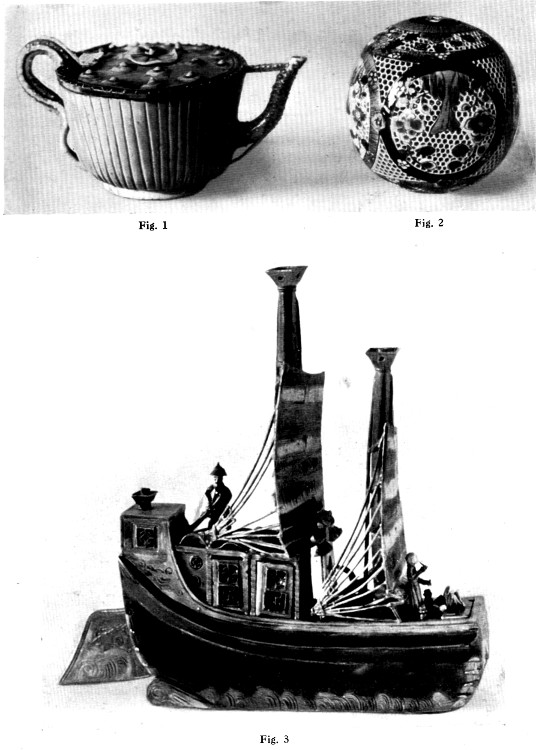
Plate 98.—K’ang Hsi Porcelain with on-biscuit decoration.
Dresden Collection.
Fig. 1.—Teapot in form of a lotus seed-pod, enamels on the biscuit.
Height 2¾ inches.
Fig. 2.—Hanging Perfume Vase, reticulated, enamels on the biscuit.
Height 3½ inches.
Fig. 3.—Ornament in form of a junk, transparent san ts’ai
glazes. Height 11½ inches.
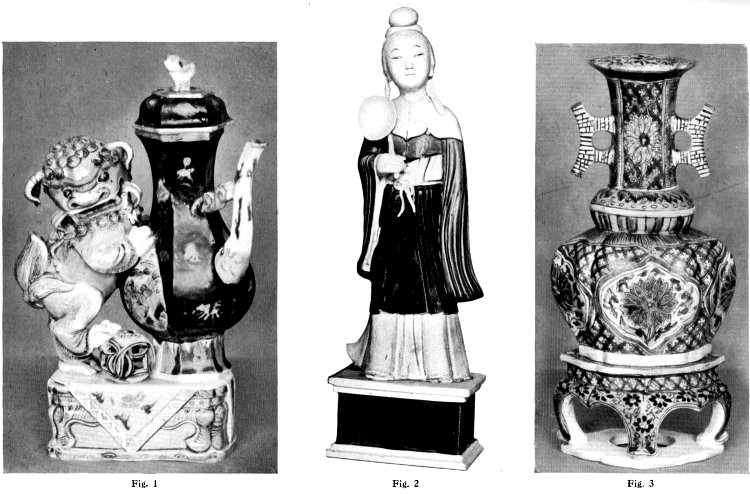
Plate 99.—K’ang Hsi Porcelain with on-biscuit decoration.
Fig. 1.—Ewer with black enamel ground, lion handle. Height 8¾ inches.
Cope Bequest (V. & A. Museum).
Fig. 2.—Figure of the Taoist Immortal, Ho Hsien Ku, transparent san
ts’ai glazes. Height 10⅛ inches. S. E. Kennedy Collection.
Fig. 3.—Vase and Stand, enamelled on the biscuit. Height 8¾ inches.
Cope Bequest.
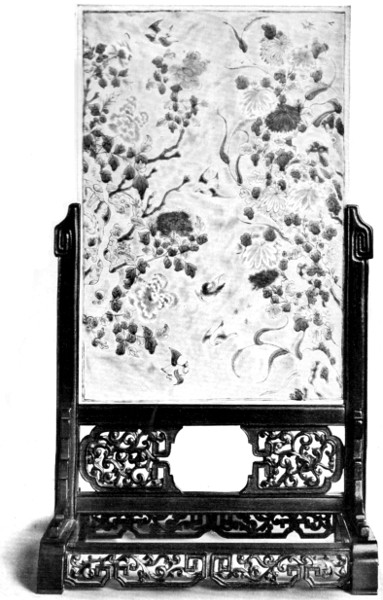
Plate 100.—Screen with Porcelain Plaque, painted in
enamels on the biscuit.
Light green background. K’ang Hsi period (1662–1722). Total height 22½
inches.
In the Collection of the Hon. E. Evan Charteris.
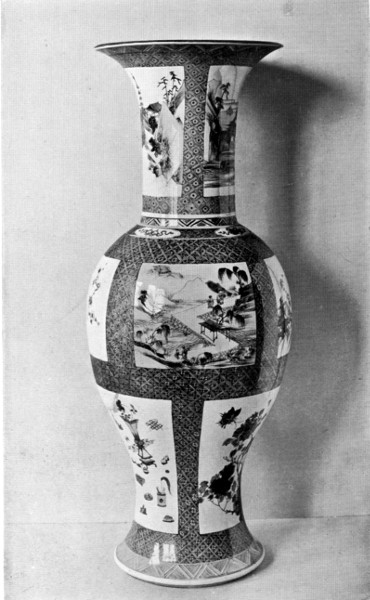
Plate 101.—Vase with panels of landscapes and po
ku symbols in famille verte enamels
In a ground of underglaze blue trellis pattern. K’ang Hsi period
(1662–1722). Height 32 inches. Dresden Collection.
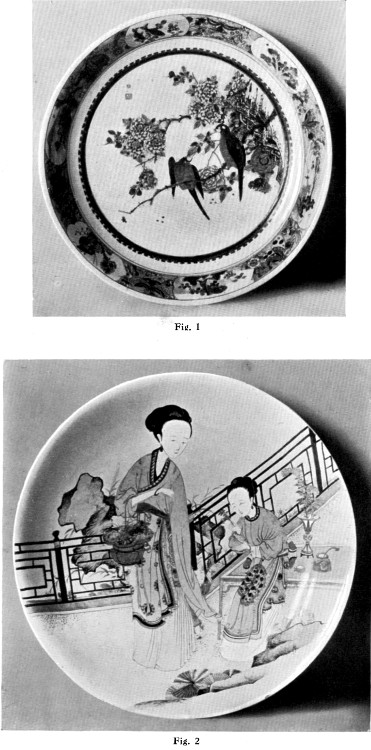
Plate 102.—Two Dishes of famille verte Porcelain
in the Dresden Collection. K’ang Hsi period (1662–1722).
Fig. 1.—With birds on a flowering branch, brocade borders. Artist’s
signature in the field. Diameter 16 inches.
Fig. 2.—With ladies on a garden terrace. Diameter 21 inches.
The familiar phrase, famille verte, was first used by Jacquemart
as a class name for the enamelled porcelains on which green plays
a leading part. According to this definition it should include the
Wan li wu ts’ai, the Ming enamelled porcelain, as well as much
of the on-biscuit enamelled wares, in addition to the typical K’ang
Hsi enamelled porcelain to which usage has specially consecrated the
term. A direct descendant of the Wan li wu ts’ai, the famille
verte includes the combinations of underglaze blue with the
translucent on-glaze enamels green, yellow, and aubergine, and the
coral red (derived from iron), the French rouge de fer, which
is so thin that it resembles a pigment rather than a vitreous
enamel. Add to these the brown black pigment, which is used to trace
the outlines of the design and with a covering of green to form the
green black, and we have one type of famille verte which differs
in no essential from the Wan Li prototype. It is, in fact, no easy
matter to find the line which divides the two groups. The nature of the
ware and the style of the painting are the best guides; and the study
of the K’ang Hsi blue and white will be a great help in this delicate
task.
But the real K’ang Hsi famille verte, which we might call the
K’ang hsi wu ts’ai, is distinguished by the addition of an
overglaze blue enamel which enhanced the brilliancy of the colour
scheme, and at the same time removed the necessity of using underglaze
and overglaze colours together.[308] It is not to be supposed, however,
that the underglaze blue disappeared entirely from the group. The old
types were always dear to the Chinese mind, and there were frequent
revivals of these in addition to the special wares,[309] such as the
“Chinese Imari,” in which this kind of blue was essential. There are
indeed examples of both blues on the same pieces.
The history of this overglaze blue enamel has already[310] been
partially discussed, and evidence has been given of its tentative
use in the Wan Li porcelain. A passage in the second letter of Père
d’Entrecolles[311] actually places its invention about the year 1700,
but the worthy father’s chronology (based no doubt chiefly on hearsay)
is often at fault. It is fairly certain, however, that the blue enamel
was not used to any extent before the Ch’ing dynasty, owing no doubt to
the fact that it had not been satisfactorily made until that date.
A beautiful enamel of violet blue tone, it is an important factor of
the famille verte decoration, and the merits of a vase or dish
are often decided on the purity and brilliance of this colour alone.
There is, however, something in the nature of the enamel which seems
to affect the surrounding glaze; at any rate, it is often ringed about
by a kind of halo of dull lustre, reflecting faint rainbow tints to a
distance of perhaps an inch from the edge of the blue. It is as though
an exhalation from the blue enamel deposited a thin film of lustre on
the glaze, and it is a very frequent occurrence, though not always in
the same conspicuous degree. Collectors who are ever looking for a sign
have been tempted to hail its presence as a sure proof of antiquity.
But it is by no means constant on the old famille verte, and it
has yet to be proved that the same enamel will not produce a similar
effect on the modern glaze.
In view of the appreciation of famille verte porcelain at the
present day a contemporary criticism will be of interest. D’Entrecolles
in his first letter,[312] referring to “porcelain painted with
landscapes in a medley of almost all the colours heightened with
gilding,” says: “They are very beautiful, if one pays a high price, but
the ordinary wares of this kind are not to be compared with blue and
white.” And again,[313] following an exact description of painting with
enamel colours on the finished glaze and of the subsequent refiring of
the ware, we read: “Sometimes the painting is intentionally reserved
for the second firing; at other times they only use the second firing
to conceal defects in the porcelain, applying the colours to the faulty
places. This porcelain, which is loaded with colour, is not to the
taste of a good many people. As a rule one can feel inequalities on the
surface of this kind of porcelain, whether due to the clumsiness of the
workmen, to the exigencies of light and shade in the painting, or to
the desire to conceal defects in the body of the ware.”
The tenor of these criticisms will not be endorsed by the modern
collector of K’ang Hsi porcelain. Famille verte porcelain is
enthusiastically sought, and even indifferent specimens command a
high price, while the really choice examples can only be purchased
by the wealthy. As to the inequalities on the surface, the second of
the three reasons hazarded by d’Entrecolles is nearest the truth. The
enamels used by the Chinese porcelain painter contain a remarkably
small percentage of colouring oxide, and one of the characteristics
of famille verte colours is their transparency. To obtain full
tones and the contrast between light and shade (even to the limited
extent to which the Chinese use this convention) it was necessary
to pile up the layers of colour at the risk of unduly thickening the
enamel. But the connoisseur of to-day finds nothing amiss in these
jewel-like incrustations of colour, so long as the enamels are pure and
bright, and have not scaled off or suffered too severely from the wear
to which their prominent surface is exposed.
It seems[314] that when the porcelain was destined to receive on-glaze
enamels (without any underglaze blue) a special glazing mixture was
used in which only one part of the softening element[315] was combined
with thirteen of the ordinary glazing fluid. This glaze was very white
and strong, and too opaque to do justice to an underglaze blue.
There is a reference in the first letter of Père d’Entrecolles to
a white colour which was used on the “porcelain painted in various
colours.” It was fluxed with lead like the other enamel colours, and
it was also used mixed with the latter to modify their tint. In fact
there can be little doubt that it was arsenical white, an opaque white
familiar on the Yung Chêng and Ch’ien Lung porcelains, and prominent in
the famille rose palette, but not usually suspected of such an
early appearance as 1712, the date of the letter in question.
The designs of the famille verte porcelain, like those on the
blue and white, are first traced in outline and then filled in with
washes of colour. The outlines are in a dry dull pigment of red or
brown black tint, inconspicuous in itself, but acquiring prominence
when covered with transparent enamel. M. Grandidier tried to formulate
certain rules for these outlines which, if reliable, would simplify
greatly the task of dating the porcelains. On Ming ware, he said, the
outlines were blue; on K’ang Hsi wares the face and body outlines were
red, those of the vestments and other objects black. Unfortunately
the first of these generalisations is wholly wrong, and the second
pointless, because only partly right.
Omitting the underglaze blue as foreign to this particular group of
famille verte under discussion, the colours consist of dark leaf
green often of a mottled appearance, a beautiful light apple green,
which is characteristic of the K’ang Hsi wares just as the blue green
is of the sixteenth century polychrome, an aubergine colour (derived
from manganese) which varies from purple brown to rosy purple, a yellow
of varying purity and usually of brownish tone, a green black formed
of the brown black pigment under washes of transparent green, a blue
enamel of violet tone, and the thin iron red. The blue enamel and the
red are sometimes omitted, leaving a soft harmony of green, aubergine
and yellow in which green plays the chief part. A little gilding is
often used to heighten parts of the design.
As for the shapes of the famille verte porcelain, they are
substantially the same as those of the blue and white and call for
no further comment. The designs, too, of the painted decoration are
clearly derived from the same sources as those in the blue and white,
viz. books of stock patterns, pictures, illustrations of history
and romance, and of such other subjects as happened to be specially
appropriate or of general interest.
To take a single instance of a pictorial design, the familiar rockery
and flowering plants (peony, magnolia, etc.) and a gay-plumaged
pheasant lends itself to effective treatment in enamel colours. It
is taken from a picture, probably Sung in origin, but there are many
repetitions of it in pictorial art, one of which by the Ming painter
Wang-yu is in the British Museum collection.[316] The original is said
to have been painted by the Emperor Hui Tsung in the beginning of the
twelfth century. Another familiar design—quails and millet—is reputed
to have been painted by the same Imperial artist.
A good instance of the kind of illustrated book which supplied the
porcelain decorator with designs is the Yü chih kêng chih t’u
(Album of Ploughing and Weaving, compiled by Imperial order),
which deals with the cultivation of rice and silk in some forty
illustrations. It was first issued in the reign of K’ang Hsi, and
there are copies of the original and of several later editions in the
British Museum. A specimen of famille rose porcelain in the
Franks Collection is decorated with a scene from this work, and in the
Andrew Burman Collection there are two famille verte dishes with
designs from the same source. In the Burdett Coutts Collection, again,
there is a polygonal bowl with subjects on each side representing
the various stages of cotton cultivation, evidently borrowed from an
analogous work.
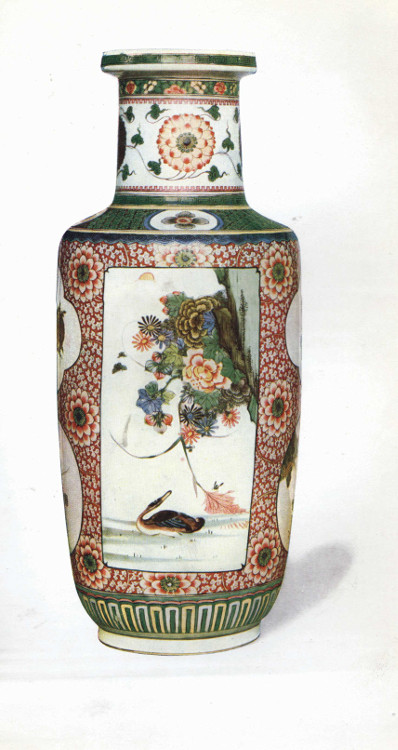
PLATE 103
Club-shaped (rouleau) Vase finely painted in famille
verte enamels with panel designs in a ground of chrysanthemum
scrolls in iron red; brocade borders. Last part of the K’ang Hsi period
(1662–1722)
Height 17 inches.
Salting Collection (Victoria and Albert Museum).
Signatures and seals of the artist usually attached to a stanza
of verse, or a few phrases which allude to the subject, are often
found in the field of the pictorial designs. Fig. 1 of Plate 102,
for instance, belongs to a series of beautiful dishes in the Dresden
collection, which display the same seal—apparently[317] wan
shih chü (myriad rocks retreat), the studio name not, I think, of
the porcelain painter but of the artist whose picture was copied on the
porcelain. There are numerous examples of similar seals in the field
of the design, and we shall return to the subject later in a place
where important issues turn on the solution of the problem which it
raises.[318]
The types of famille verte porcelain are extremely numerous,
almost as varied as those of the blue and white (p. 136).
Like the latter they include much that was obviously made for European
consumption, and most of the groups which were singled out from the
mass of blue and white for special description can be paralleled in the
famille verte. The thin, crisp, moulded ware with petal-shaped
panels and lobed borders, the group with the “G” mark, and many other
types are found with the same peculiarities of paste and glaze, and
even the same design painted in on-glaze enamels. As in the case of the
blue and white, the quality of this export ware varies widely, and the
individual specimens will be judged by the drawing of the designs and
the purity and fire of the enamels.
A few of the more striking types are illustrated on Plates 103 and 104.
Perhaps the most sumptuous effects of this colour scheme are displayed
in the vases decorated with panel designs surrounded by rich diapers
borrowed from silk brocades. A favourite brocade pattern consists of
single blossoms or floral sprays woven into a ground of transparent
green covering a powder of small brown dots. This dotted green ground
is commonly known as “frog’s spawn,” and another diaper of small
circles under a similar green enamel is easily recognised under the
name of “fish roe.” But the variety of these ground patterns is great,
and in spite of their prosaic nomenclature they render in a singularly
effective manner the soft splendour of the Chinese brocades.
In dating the famille verte porcelains the collector will
find his study of the blue and white of great assistance. There is,
for instance, the well-known type of export ware—sets of vases with
complex moulding, and dishes and plates, etc., with petal-shaped
lobes on the sides or borders. The central design of the decoration
commonly consists of ch’i lin, and phœnix, sea monsters (hai
shou), storks or ducks beside a flowering tree or some such
familiar pattern; and the surrounding petal-shaped panels are filled
each with a growing flower, or a vignette of bird and plant, plant and
insect, or even a small landscape. These bright but often perfunctorily
painted wares are paralleled in the early K’ang Hsi blue and white.
They are among the first Chinese polychrome porcelains to be copied by
the European potters. See Plate 107.
In the purely native wares the early Ch’ing famille verte is
distinguished by strong and rather emphatic colouring, the energy
of the drawing and the breadth of design which recall the late Ming
polychromes. The zenith of this style of decoration was reached about
1700, say between 1682 and 1710. This is the period of the magnificent
vases with panel designs in brocaded grounds, or with crowded figure
subjects, Court scenes, and the like, filling large areas of the
surface, such vases as may be seen in the splendid series of the
Salting Collection or in the Grandidier Collection in the Louvre. They
are probably children of the great renaissance which began under the
auspices of Ts’ang Ying-hsüan. Dated examples are extremely rare, and
consequently the square vase on Plate 104 assumes unusual importance
on account of the cyclical date which occurs in the long inscription,
“the 29th day of the 9th moon of the kuei mo year,” which we
can hardly doubt is 1703. Incidentally another side of this vase
illustrates the celebrated scene of the wine cups started from the
“orchid arbour to float down the nine-bend river.”[319]
Another example with a cyclical date (the year hsin mao, and
no doubt 1711) is a globular water bottle “of the highest quality and
technique, decorated with transparent luminous enamels of great beauty
and delicacy,” in the Pierpont Morgan Collection.[320] But in this case
the date is attached to a verse in the field of the decoration, and it
may belong to the design rather than to the porcelain.
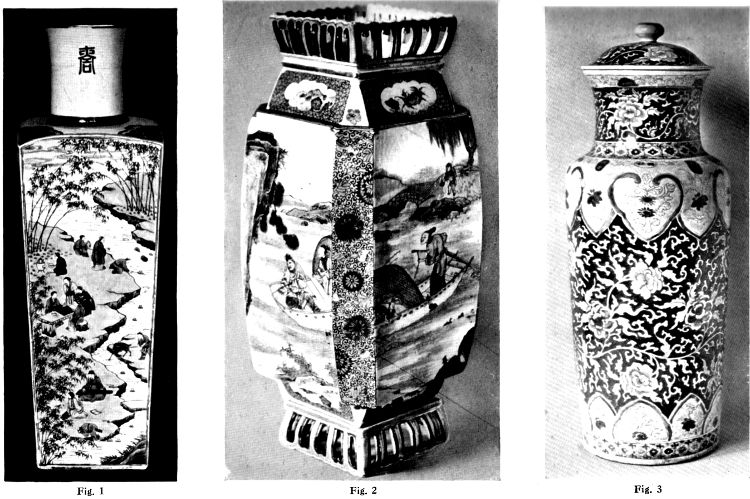
Plate 104.—Three Examples of K’ang Hsi famille
verte Porcelain.
Fig. 1.—Square Vase with scene of floating cups on the river;
inscription with cyclical date 1703 A.D.; shou characters on the
neck. Height 18⅜ inches. Hippisley Collection.
Fig. 2.—Lantern with river scenes. Height 13¾ inches. Dresden
Collection.
Fig. 3.—Covered Jar of rouleau shape, peony scrolls in iron red
ground, brocade borders. Height 22 inches. Dresden Collection.
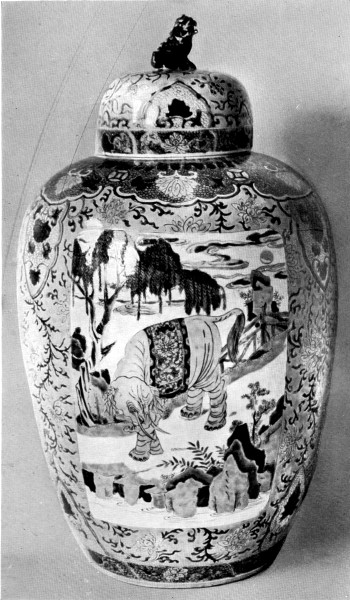
Plate 105.—Covered Jar painted in famille verte
enamels
With brocade ground and panel with an elephant (the symbol of Great
Peace). Lion on cover. K’ang Hsi period (1662–1722). Height 21¼ inches.
Dresden Collection.
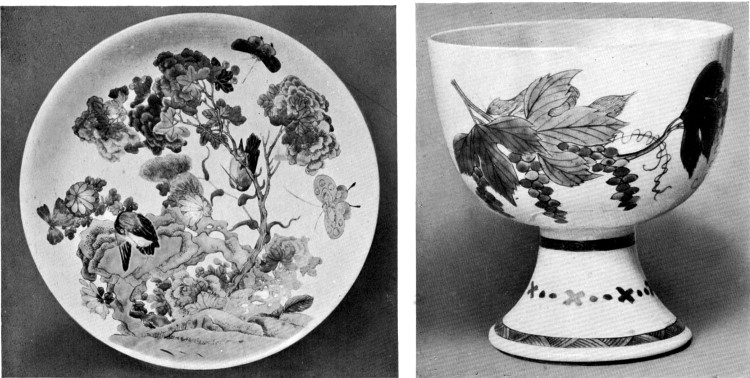
Plate 106.—K’ang Hsi famille verte Porcelain.
Alexander Collection.
Fig. 1.—Dish with rockery, peonies, etc., birds and insects. Diameter
16¼ inches.
Fig. 2.—“Stem Cup” with vine pattern. Height 5¾ inches.
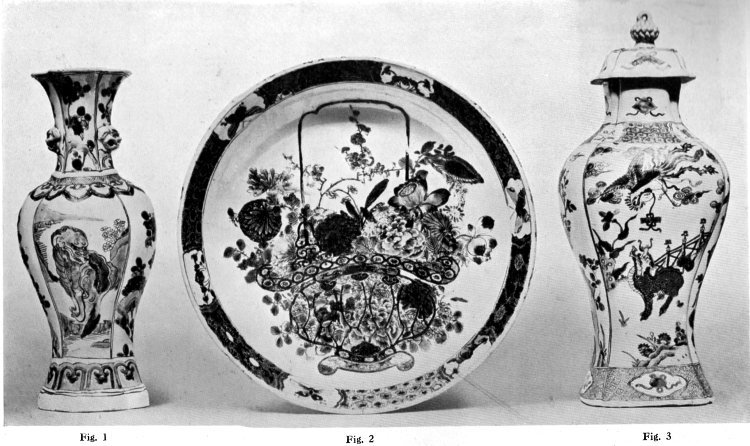
Plate 107.—Famille verte Porcelain made for
export to Europe. K’ang Hsi period (1662–1722). British Museum.
Fig. 1.—Vase with “sea monster” (hai shou).
Fig. 2.—Dish with basket of flowers. Mark, a leaf. Diameter 11 inches.
Fig. 3.—Covered Jar with ch’i-lin and fêng-huang
(phœnix).
The lateness of this latter date and the use of the word “delicacy”
in the description of the piece lead us naturally to that peculiarly
refined type of late famille verte in which the ware is of
eggshell thinness, the painting extremely dainty and delicate, and
the colours rather pale but of perfect purity. Such are the
well-known “birthday plates” with the reign mark of K’ang Hsi on the
back and the birthday salutation in seal characters on the border:
wan shou wu chiang—“a myriad longevities without ending!” They
are reputed to have been made for the Emperor’s sixtieth birthday which
fell in the year 1713, but the story is supported by no evidence of any
kind, and they would have been equally appropriate for any Imperial
birthday. The character of these wares is more suggestive of the Yung
Chêng period, and it is probable that they belong to the extreme limit
of the long reign of K’ang Hsi. To this period then we shall assign
these and the whole group of kindred porcelains, the plates with
designs similar to those of the “birthday plates,” but without the
inscribed border, the small eggshell plates with one or two figures
painted in the same delicate style, others with a single spray of some
flowering shrub almost Japanese in its daintiness, and occasional bowls
and vases with decoration of the same character. See Plate 113.
For extreme delicacy of treatment is by no means a feature of the K’ang
Hsi famille verte in general, in which the Ming spirit with its
boldness and vigour still breathed. It is rather a late development in
the decadence of the ware, heralding the more effeminate beauty of the
famille rose, and were it not for the evidence of the birthday
plates I believe many connoisseurs would be tempted to ascribe these
delicate porcelains to a much later reign.
Such, however, is the evolution of the famille verte during
the sixty years of the K’ang Hsi period, from the strong colours and
forceful Ming-like designs of the earlier specimens to the mature
perfection of the splendid wares made about 1700, and thence by a
process of ultra-refinement to the later types in which breadth of
treatment gives place to prettiness and the strong thick enamels to
thinner washes of clear, delicate tints. These thin transparent colours
continued in use; indeed, they are a feature of a special type of
enamelling which will be discussed with the Yung Chêng wares; but the
pure famille verte may be said to have come to an end with the
last years of the reign of K’ang Hsi. Later reproductions of course
exist, for no style of decoration is ever wholly extinct in Chinese
art, but they are merely revivals of an old style, which even before
the end of the K’ang Hsi period had reached the stage of transition to
another family. The opaque enamels of the famille rose palette
had already begun to assert themselves. Timid intruders at first—a
touch of opaque pink, a little opaque yellow and arsenical white
breaking in upon the old harmony of transparent tints—they gradually
thrust the famille verte enamels into a subsidiary position, and
in the succeeding reigns rose pinks entirely dominate the field.
A word must be said of the use of the famille verte painting
in combination with other types of decoration, in the subordinate
position of border patterns or more prominently in panel designs.
Exquisite effects are obtained by the latter in a ground of coral red,
or where a brilliant powder blue field is broken by shapely panels with
flowering plants and birds and other familiar vehicles for famille
verte colouring. Occasionally we find the enamels actually painted
over a powder blue or an ordinary blue glaze, but the combination
is more peculiar than attractive; for the underlying colour kills
the transparent enamels, and the enamels destroy the lustre of the
blue ground. Indeed, it is probable that in many cases these freak
decorations were intended to hide a faulty background.
A similar painting over the crackled green lang yao glaze has
already been described, and it occurs over the grey white crackles,
and rarely but with much distinction, over a pale celadon glaze. But
perhaps the most effective combination of this kind is that in which a
pale lustrous brown or Nanking yellow is the ground colour. The quiet
and refined effects of this union are well exhibited by a small group
of vases, bowls, and dishes in the Salting Collection.
Something has already been said of the use of underglaze blue in
combination with famille verte enamels. The blue is either an
integral part of the general design as in the Wan Li “five colour”
scheme, or it forms a distinct decoration by itself, apart from the
enamels, though sharing the same surface. The latter use is exemplified
by a pair of bottles in the Salting Collection which have blue patterns
on the neck and famille verte decoration on the body, consisting
of landscape panels surrounded by brocade patterns.[321] But the great
drawback to this union of underglaze and overglaze colours is usually
apparent. The blue was liable to suffer in the subsequent firings
necessitated by the enamels, even though those firings took place at
a relatively low temperature. Probably the potter would not expose
his finest blue to such risks, but at any rate the blue of this mixed
decoration is rarely of first-rate quality.
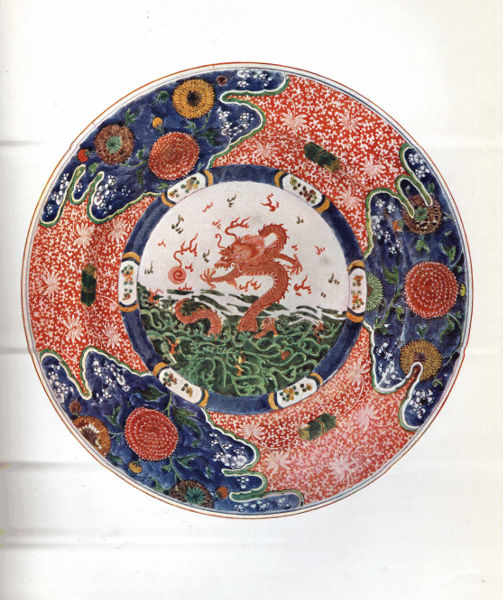
PLATE 108
Dish painted in underglaze blue and famille verte enamels. In
the centre, a five-clawed dragon rising from waves in pursuit of a
pearl. Deep border in “Imari” style with cloud-shaped compartments with
chrysanthemum and prunus designs in a blue ground, separated by close
lotus scrolls reserved in an iron red ground in which are three book
symbols. K’ang Hsi period (1662–1722)
Diameter 19½ inches.
Alexander Collection.
There is one group of porcelain which combines the underglaze blue
with on-glaze enamels, and which deserves special notice if only
because it has been recently favoured with particular attention by
collectors. This is what we are pleased to call “Chinese Imari.”
Our ceramic nomenclature has never been noted for its accuracy, and
like good conservatives we hold firmly to the old names which have
been handed down from days when geography was not studied, and from
ancestors who were satisfied with old Indian china, or Gombroon ware,
as names for Chinese porcelain. So Meissen porcelain is still Dresden,
the blue and white of Ching-tê Chên is Old Nanking, Chinese export
porcelain painted at Canton with pink roses is Lowestoft, and the ware
made at Arita, province of Hizen, in Japan, is Imari, because that is
the name of the seaport from which it was shipped. In fact, there are
many shops where you cannot make yourself understood in these matters
unless you call the wares by the wrong name.
The Arita porcelain in question, this so-called Imari, was made from
the middle of the seventeenth century onwards, and it must have
competed seriously with the export wares of Ching-tê Chên. At any
rate, it was brought to Europe in large consignments by the Dutch
traders, who enjoyed the privilege of a trading station on the island
of Deshima, after the less politic Portuguese had been driven out of
Nagasaki in 1632. For the moment we are specially concerned with two
types of Arita ware. The first is distinguished by slight but artistic
decoration in vivid enamels of the famille verte, supplemented
by gilding and occasionally by underglaze blue. Favourite designs are
a banded hedge, prunus tree, a Chinese boy and a tiger or phœnix; two
quails in millet beside a flowering prunus; simple flowering sprays
or branches coiled in circular medallions; or only a few scattered
blossoms. Whatever the nature of the design, it was artistically
displayed, and in such a manner as to enhance without concealing
the fine white porcelain. This is what the old catalogues call the
première qualité coloriée de Japon, and a very popular ware it
was in eighteenth century Europe, when it was closely copied on the
early productions of the St. Cloud, Chantilly, Meissen, Chelsea, and
other porcelain factories. To-day it is commonly known as Kakiemon
ware, because its very distinctive style of decoration is traditionally
supposed to have been started by a potter named Kakiemon, who, with
another man of Arita, learned the secret of enamelling on porcelain
from a Chinese merchant about the year 1646.
The second type was made entirely for the European trade, and it
is distinguished by large masses of dark, cloudy blue set off by
a soft Indian red (derived from oxide of iron) and gilding. These
colours are supplemented by touches of green, yellow, and aubergine
enamels, and occasionally by a brownish black. The ware itself is
heavy, coarse and greyish, but its rough aspect is well concealed by
irregular and confused designs of asymmetrical panels surrounded by
mixed brocade patterns. The panels often contain Chinese figures,
phœnixes, lions, floral designs of chrysanthemums, peony and prunus,
a basket of flowers, rough landscapes or garden views. They are
medleys of half-Chinese, half-Japanese motives, a riot of incoherent
patterns, but not without broad decorative effect thanks to the bold
masses of red, blue and gold. Such is the typical “Old Imari.” There
is, however, a finer and more Japanese variety of the same group
which is distinguished by free use of the chrysanthemum rosette, and
the Imperial kiri (paulonia imperialis), and by panels of diaper
pattern and floral designs alternating and counter-changed in colour,
the grounds now red, now blue, and now gold. The same colour scheme
prevailed in this sub-group, and the dark blue was usually netted over
with gold designs.
It was no doubt the success which these wares met in European commerce
that induced the Chinese to take a lesson from their pupils, and to
adopt the “Imari” style. At any rate, they did copy all these types,
sometimes very closely, sometimes only in part. Thus in some cases the
actual Japanese patterns as well as the colour scheme are carefully
reproduced, in others the Japanese colour scheme is employed on Chinese
patterns or vice versa, and, again, there are cases in which passages
of Japanese ornament are inserted in purely Chinese surroundings. But
whether pure or diluted the Japanese style is unmistakable to those who
have once learnt to know its peculiarities, of which masses of blue
covered with gilt patterns and the prominence of red and gold are the
most conspicuous.
There will, of course, always be a few specimens the nationality of
which will be difficult to decide, but to anyone familiar with Chinese
and Japanese porcelain the distinction between the Chinese “Imari”
and its island prototype is, as a rule, a simple matter. The Chinese
porcelain is thinner and crisper, its glaze has the smooth oily sheen
and faintly greenish tint which are peculiar to Chinese wares, and the
raw edge of the base rim is slightly browned. The Japanese porcelain,
on the other hand, is whiter in the Kakiemon ware, greyer and coarser
in the “Old Imari,” and the glaze in both cases has the peculiar
bubbled and “muslin-like” texture which is a Japanese characteristic.
The Japanese underglaze blue is dark and muddy in tone, the Chinese
bright, and purer, and the other colours differ, though not perhaps so
emphatically. The iron red of the Chinese, for instance, is thinner and
usually lighter in tone than the soft Indian red or thick sealing-wax
colour of the Japanese; and to those who are deeply versed in Oriental
art there is always the more subtle and less definable distinction, the
difference between the Chinese and Japanese touch and feeling.
Plate 108 is a fine specimen which shows the blend of Chinese motives
and the Japanese colouring.
The general character of the Chinese “Imari” is that of the K’ang Hsi
period, to which most of the existing specimens will be assigned; but
it is clear that the Chinese continued to use Japanese models in the
succeeding reign, for the last three items in the Imperial list of
porcelain made in the Yung Chêng period comprise wares “decorated in
gold and in silver in the style of the Japanese.”[322]
CHAPTER XI K’ANG HSI MONOCHROMES
In passing to the K’ang Hsi monochromes we enter a large field with
boundaries ill defined. Many of the colours are legacies from the
Ming potters, and most of them were handed on to after generations;
some indeed have enjoyed an unbroken descent to the present day.
Consequently there are few things more difficult in the study of
Chinese porcelain than the dating of single-colour wares.
In some cases the origin of a particular glaze has been recorded, and
within certain limits the style of the piece will guide us in assessing
its age; but how often must we be content with some such non-committal
phrase as “early eighteenth century,” which embraces the late K’ang
Hsi, the Yung Chêng and the early Ch’ien Lung periods? On the other
hand, the careful student observes certain points of style and finish,
certain slight peculiarities of form which are distinctive of the
different periods, and on these indefinite signs he is able to classify
the doubtful specimens. To the inexpert his methods may seem arbitrary
and mysterious, but his principles, though not easy to enunciate, are
sound nevertheless.
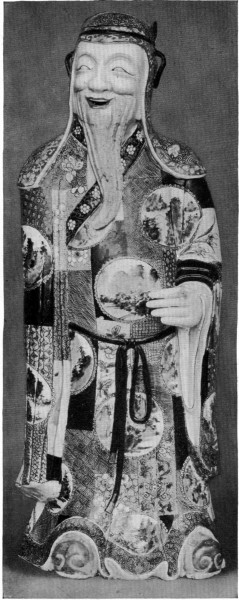
Plate 109.—Figure of Shou Lao, Taoist God of Longevity.
Porcelain painted with famille verte enamels. K’ang Hsi period
(1662–1722). Height 17¼ inches. Salting Collection (V. & A.
Museum).
We have already had occasion to discuss a few of the K’ang Hsi
monochromes in dealing with the question of lang yao. But
besides the sang de bœuf there is another rare and costly
red to which the Americans have given the expressive name of “peach
bloom.” Since their first acquaintance with this colour in the last
half of the nineteenth century,[323] American collectors have been
enamoured of it, and as they have never hesitated to pay vast sums for
good specimens, most of the fine “peach blooms” have found their way
to the United States, and choice examples are rare in England. “The
prevailing shade,” to quote from Bushell’s description, “is a pale
red, becoming pink in some parts, in others mottled with russet spots,
displayed upon a background of light green celadon tint. The last
colour occasionally comes out more prominently, and deepens into clouds
of bright apple green tint.” The Chinese, in comparing the colour, have
thought of the apple rather than the peach; it is p’in-kuo hung
(apple red), and the markings on it are p’in-kuo ch’ing (apple
green), and mei kuei tzŭ (rose crimson). Another Chinese name
for the colour is chiang-tou hung (bean red), in allusion to the
small Chinese kidney-bean with its variegated pink colour and brown
spots.
It is generally supposed that, like the sang de bœuf, the “peach
bloom” owes its hue to copper oxide, and that all the accessory tints,
the russet brown and apple green, are due to happy accidents befalling
the same colouring medium in the changeful atmosphere of the kiln.[324]
This precious glaze is usually found on small objects such as water
pots and brush washers for the writing table (see Plate 111[325]), and snuff bottles, and a few small elegantly formed flower
vases of bottle shape, with high shoulders and slender neck, the body
sometimes moulded in chrysanthemum petal design, or, again, on vases
of slender, graceful, ovoid form, with bodies tapering downwards, and
the mouth rim slightly flaring. In every case the bottom of the vessel
shows a fine white-glazed porcelain with unctuous paste, and the K’ang
Hsi mark in six blue characters written in a delicate but very mannered
calligraphy, which seems to be peculiar to this type of ware, and to a
few choice clair de lune and celadon vases of similar form and
make.
The colour in the peach bloom glaze, as in the sang de bœuf, is
sometimes fired out and fades into white or leaves a pale olive green
surface with only a few spots of brown or pink to bear witness to the
original intention of the potter. The glaze is sometimes crackled and
occasionally it runs down in a thick crystalline mass at the base of
the vessel.
Needless to say this costly porcelain has claimed the earnest attention
of the modern imitator. The first real success was achieved by a
Japanese potter at the end of the last century. He was able to make
admirable copies of the colour, but failed to reproduce adequately the
paste and glaze of the originals. I am told that he was persuaded to
transfer his secret to China, and with the Chinese body his imitations
were completely successful. The latter part of the story is based
on hearsay, and is given as such; but it is certain that there are
exceedingly clever modern copies of the old peach blooms in the market;
otherwise how could an inexpert collector in China bring home half a
dozen peach blooms bought at bargain prices?
The copper red used in painting underglaze designs[326] will sometimes
develop a peach bloom colour, and there is a vase in the British Museum
with parti-coloured glaze in large patches of blue, celadon, and a
copper red which has broken into the characteristic tints of the peach
bloom vases.
Another red of copper origin allied to the sang de bœuf and the
peach bloom, and at times verging on both, is the maroon red, which
ranges from crimson to a deep liver colour. There are wine cups of this
colour whose glaze clouded with deep crimson recalls the “dawn red”
of the wine cups made by Hao Shih-chiu.[327] Sometimes the red covers
part only of the surface, shading off into the white glaze. The finer
specimens have either a crimson or a pinkish tinge, but far more often
the glaze has issued from the kiln with a dull liver tint.
Naturally the value of the specimens varies widely with the beauty of
the colour. The pinker shades approach within measurable distance of
the pink of the peach bloom, and they are often classed with the latter
by their proud owners; but the colour is usually uniform, and lacks the
bursts of russet brown and green which variegate the true peach bloom,
and the basis of the maroon is a pure white glaze without the celadon
tints which seem to underlie the peach bloom. It may be added that the
maroon red glaze is usually uncrackled.
As to the overglaze red, which is known by the names of mo hung
(painted red) and ts’ai hung (enamel red), it is the colour
derived from iron, and it was used both as one of the enamels of the
famille verte palette and as a monochrome. In both capacities it
figured on Ming porcelain, and was fully discussed in that connection.
On K’ang Hsi wares it varied in tone from dark brick red to a light
orange, according to the density of the pigment, and in texture from
a thin dry film to a lustrous enamel, according to the quantity of
fluxing material[328] combined with it. Among the richly fluxed
varieties is a fine tomato colour of light, translucent tone. Sometimes
the iron red is found as sole medium for painted designs, as on a
rouleau vase in the Salting collection, but more commonly it serves as
a ground colour between panels of enamelled ornament (Plate 103), or in
border passages. In these last two positions it is usually of a light
orange shade, and broken by floral scrolls reserved in white. A dark
shade of the same pigment is also used in diapers of curled scrolls,
forming a groundwork for enamelled decoration. There are besides
beautiful examples of a pure red monochrome formed of this colour, but
I have only met with these among the later wares.
The blue monochromes include a large number of glazes varying in
depth and shade with the quality and quantity of the cobalt which is
mingled with the glazing material. These are chiao ch’ing (blue
monochrome glazes), and they are all high-fired colours. They include
the chi ch’ing[329] or deep sky blue, whose darker shades are
also named ta ch’ing (gros bleu), the slaty blue, the
pale clear blue,[330] the dark and light lavender shades, and the
faintly tinted clair de lune or “moon white” (yüeh pai),
in which the amount of cobalt used must have been infinitesimal. But
it would be useless to attempt to catalogue the innumerable shades of
blue, which must have varied with every fresh mixture of colour and
glaze and every fresh firing.
There is, however, another group materially different from the
ordinary blue glazes. In this the colour was applied direct to
the body, as in blue and white painting, and a colourless glaze
subsequently added, with the natural result that the blue seems to be
incorporated with the body of the ware rather than with the glaze.
There were several ways of applying the colour, each producing a
slightly different effect. The cobalt powder could be mixed with water,
and washed on smoothly with a brush, or dabbed on with a sponge to give
a marbled appearance, or it could be projected on to the moistened
surface in a dry powder, through gauze stretched across the end of a
bamboo tube.
The result of the last process was an infinity of minute specks of
blue, a massing of innumerable points of colour. This is the well-known
“powder blue,” the bleu soufflé, or blown blue described by Père
d’Entrecolles in his second letter[331]: “As for the soufflé
blue called tsoui tsim (ch’ui ch’ing), the finest blue,
prepared in the manner which I have described, is used. This is blown
on to the vase, and when it is dry the ordinary glaze is applied either
alone or mixed with tsoui yeou (sui yu), if crackle[332]
is required.” We are further told that as on the blue and white a glaze
softened with a considerable proportion of lime was necessary for the
perfection of the colour.
The “powder blue” seems to have been a new invention in the K’ang Hsi
period. Under the name of ch’ui ch’ing (blown blue) it figures
in the T’ao lu[333] among the triumphs of Ts’ang Ying-hsüan’s
directorate. It is certainly a singularly beautiful colour effect,
and worthy of the homage it has received from collectors and ceramic
historians. Though the blue used was as a rule of the finest quality,
it varied much in intensity and tone with the nature of the cobalt and
amount applied. Probably the majority of collectors would give the palm
to the darker shades, but tastes differ, and the lighter tones when
the blue is pure sapphire have found whole-hearted admirers. A notable
feature of the powder blue is its surprising brilliancy in artificial
light, when most other porcelain colours suffer eclipse.
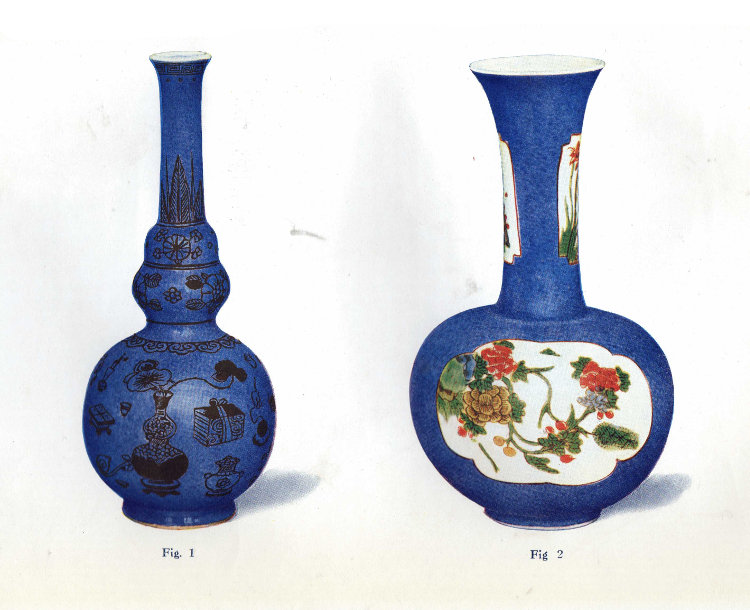
PLATE 110
Two examples of “Powder Blue” (ch’ui ch’ing) Porcelain of the
K’ang Hsi period (1662–1722), in the Victoria and Albert Museum
Fig. 1.—Bottle of gourd shape with slender neck: powder blue ground
with gilt designs from the Hundred Antiques (po ku) and borders
of ju-i pattern, formal flowers and plantain leaves. Height 7½
inches.
Fig. 2.—Bottle-shaped Vase with famille verte panels of
rockwork and flowers reserved in a powder blue ground. Height 7 inches.
Salting Collection.
It was used indifferently as a simple monochrome or as a ground
in which panel decoration was reserved, the panels painted in
famille verte enamels or in blue and white; and
in both cases the blue surface was usually embellished with light
traceries in gold. Plate 110 illustrates both types. Both are highly
prized by collectors, and change hands at high prices when of the good
quality which is usual on the K’ang Hsi specimens. We have already
noted[334] the occasional decoration of the powder blue ground with
designs in famille verte enamels, and Père d’Entrecolles[335]
records another process of ornamentation which was applied to all the
blue grounds of this group, viz. the washed, the sponged, and the
powder blues: “There are workmen who trace designs with the point of
a long needle on this blue whether soufflé or otherwise; the
needle removes as many little specks of dry blue as are necessary
to form the design; then the glaze is put on.” From this precise
description it is easy to recognise this simple but effective
decoration. There are two examples in the British Museum with dragon
designs etched in this fashion, the one in a washed blue, and the other
in a sponged blue ground. The pattern appears in white outline where
the blue has been removed by the needle and the porcelain body exposed.
Long usage has given sanction to the term “mazarine blue.” It was
applied to the dark blue ground colour of eighteenth century English
porcelain, and in the contemporary catalogues the name “mazareen” was
given to any kind of deep blue from the mottled violet of Chelsea to
the powdery gros bleu of Worcester. In reference to Chinese
porcelain it is used to-day with similar freedom for the ta
ch’ing or dark sky blue and for the powder blue. Assuming that
the phrase derives from the famous Cardinal Mazarin, it cannot in its
original sense have had any reference to powder blue, for the Cardinal
died in 1661, and, if he had a weakness for blue monochrome, it must
have been for some variety of the chiao ch’ing or blue glazes
proper which were current at the end of the Ming and the beginning of
the Ch’ing dynasties. At the present day it is impossible to guess the
true shade of mazarine blue, and we must be content to regard it as a
phrase connoting a deep blue monochrome the exact definition of which
has gone beyond recall.[336]
The K’ang Hsi mark is sometimes found on porcelain coated with a very
dark purplish blue glaze with soft looking surface and minute crackle.
It is apparently one of those glazes which are fired in the temperate
parts of the kiln, and its use is more frequent on porcelains of a
slightly later period.
Finally, the turquoise blue, variously named fei ts’ui
(kingfisher blue) and k’ung ch’iao lü (peacock green), was
freely used as a monochrome on figures and ornamental wares. It is a
colour which descends from Ming times, and whose use has continued
unchecked to the present day, so that it is often extremely difficult
to give a precise date to any particular specimen, especially if the
object happens to be of archaic form, a copy of an old bronze or the
like. Its nature has already been discussed[337] among the Ming glazes,
and one can only say that the K’ang Hsi pieces have all the virtues
of the K’ang Hsi manufacture—fine material, good potting, shapely
form, and beautiful quality of colour. The tint varies widely from the
soft turquoise blue of kingfisher feathers to a deep turquoise green,
and some of the most attractive specimens are mottled or spotted with
patches of greenish black. The glaze is always minutely crackled, and
has sufficient transparency to allow engraved or carved designs on the
body to be visible. It is a colour which develops well on an earthen
body, and the potters often mixed coarse clay with the ware which was
intended to receive the turquoise glaze; but this, I think, was mainly
practised after the K’ang Hsi period, and the K’ang Hsi specimens will,
as a rule, be found to have a pure white porcelain basis.
As in the Ming wares, the turquoise sometimes shares the field
with an aubergine purple of violet tone, both colours being of the
demi-grand feu. The purple is also used as a monochrome. There
are, in fact, two aubergine purple monochromes, the one a thick and
relatively opaque colour sometimes full of minute points as though it
had been blown on like the powder blue, the other a thin transparent
(and often iridescent) glaze of browner tone. Both are derived from
cobaltiferous ore of manganese, both have descended from the Ming
period, and have already been discussed as monochromes and as colours
applied to the biscuit.
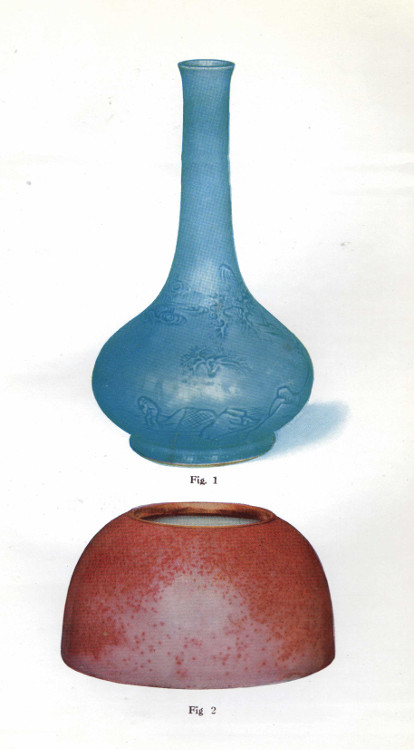
PLATE 111
Two examples of Single-colour Porcelain in the Salting Collection
(Victoria and Albert Museum)
Fig. 1.—Bottle-shaped Vase of Porcelain with landscape design lightly
engraved in relief under a turquoise blue glaze. Early eighteenth
century. Height 8½ inches.
Fig. 2.—Water Vessel for the Writing Table of the form known as
T’ai-po tsun after the poet Li T’ai-po. Porcelain with faintly
engraved dragon medallions under a peach bloom glaze; the neck cut down
and fitted with a metal collar. Mark in blue of the K’ang Hsi period
(1662–1722) in six characters. Height 2¾ inches.
The cobaltiferous ore of manganese is the same material which is used
to give a blue colour, but in this case the manganese is removed, and
the cobalt rendered as pure as possible. For the manganese if in excess
produces a purplish brown, and its presence in however small a
quantity gives the blue a purple or violet strain. By the simple method
of graduating the amount of manganese which was allowed to remain with
the cobalt the potters were able to obtain many intermediate shades
between dark blue and purple for their monochrome glazes.
The green monochromes are scarcely less numerous than the blue. There
are the transparent greens of apple or leaf green shades whether even
or mottled, which have been described among the glazes applied to the
biscuit and among the enamels of the famille verte. These were
used as monochromes and ground colours; and closely akin to them are
(1) the cucumber green (kua p’i lü), in which a yellowish leaf
green is heavily mottled with darker tints, and (2) the snake skin
green (shê p’i lü), a deep transparent green with iridescent
surface, one of the colours for which the directorate of Ts’ang
Ying-hsüan was celebrated. There are good examples of both in the
Salting Collection, but it would be useless to reproduce them except in
colour.
There are the apple and emerald green crackles (in both cases a
green glaze overlying a grey or stone-coloured crackle), but these
have already been discussed.[338] A somewhat similar technique
characterises the series of semi-opaque and crackled green glazes of
camelia leaf, myrtle, spinach, light and dark sage, dull emerald and
several intermediate tints. These are soft-looking glazes with small
but very regular crackle,[339] and their surface often has a “satiny”
sheen which recalls the Yi-hsing glazes. They are evidently glazes
of the demi-grand feu, and the colouring agent is doubtless
copper, though apparently modified with other ingredients. How far this
particular group was used in the K’ang Hsi period is hard to say. Most
of the specimens which I have seen give me the impression of a later
make, but as there are a few which might come within the K’ang Hsi
limits I have taken this opportunity to discuss them.
There is one specimen of a rare green in the British Museum to which I
cannot recall a parallel. It is a bowl with the ordinary white glaze,
but covered on the exterior with a very bright yellowish green, like
the young grass with the sun shining on it. It is, perhaps, rather in
the nature of an enamel than a glaze, but the ware has the appearance
of age and should belong to the early part of the K’ang Hsi period.
Most of the green glazes are low fired, melting in the temperature of
the demi-grand feu and the muffle kiln. The high-fired greens
are those of celadon class. There is the lang yao[340] green,
which has been discussed under that heading, a crackled glaze, in
colour intermediate between apple green and the sea green celadon, and
with a surface texture hazy with bubbles like the sang de bœuf,
to which it is a near relation. This soft and beautiful colour has been
described as a “copper celadon,” and though Dr. Bushell refuses his
blessing on the name it seems to me a particularly happy expression.
For the colour apparently results from the same copper medium which
under slightly different firing conditions produces the sang de
bœuf red and at the same time its tint approaches very nearly to
the typical celadon green.
The true celadon glaze was freely employed on the early Ch’ing
porcelains, especially on those of K’ang Hsi and Yung Chêng periods.
It is a beautiful pale olive or sea green colour, made light by the
pure white porcelain beneath which its transparent nature permits to
shine through. Compared with the Sung celadons as we know them,[341]
the Ch’ing dynasty ware is thinner in material and glaze, wanting in
the peculiar solidity of appearance of the ancient wares; the body
is whiter and finer, and the base is usually white with the ordinary
porcelain glaze. There is, moreover, no “brown mouth and iron foot,”
unless indeed this feature has been deliberately added by means of a
dressing of ferruginous clay, a make-up which is too obvious to deceive
the initiated. There were, however, some careful imitations of the
ancient celadons made at this time and got up with the appearance of
antiquity, but these were exceptional productions.[342]
Père d’Entrecolles, writing in 1722, alludes to the K’ang Hsi celadon
in the following terms[343]:—“I was shown this year for the first
time a kind of porcelain which is now in fashion; its colour verges
on olive and they call it long tsiven. I saw some which was
called tsim ko (ch’ing kuo), the name of a fruit which
closely resembles the olive.” The long tsiven is clearly a
transliteration of the characters which we write Lung-ch’üan,
the generic name of the old celadons; but it is odd that Père
d’Entrecolles should not have seen copies of this glaze before 1722,
for its use must have been continuous at Ching-tê Chên from very
early times, and we have found reference to it in various periods
of the Ming dynasty. It is evident, however, that the colour was
enjoying a fresh burst of popularity just at this time. D’Entrecolles
gives a few further notes which concern its composition. His recipe
is substantially the same as that given in Chinese works, viz. a
mixture of ferruginous earth, which would contribute a percentage of
iron oxide, with the ordinary glaze.[344] He also states that sui
yu (crackle glaze) was added if a crackled surface was required,
and there are numerous examples of this kind of ware to be seen. The
most familiar are the vases with crackled celadon or grey green glaze
interrupted by bands of biscuit carved with formal patterns and stained
to an iron colour with a dressing of ferruginous earth. Monster heads
with rings (loose or otherwise) serve as twin handles on these vases,
which are designed after bronze models. These crackled celadons are
evidently fashioned after an old model, but they have been largely
imitated in modern times, and almost every pawnbroker’s window displays
a set of execrable copies (often further decorated in underglaze blue)
which are invariably furnished with the Ch’êng Hua mark incised on a
square brown panel under the base.
The yellow monochromes of the K’ang Hsi period are mostly descendants
of the Ming yellows. There is the pale yellow applied over a white
glaze reproducing the yellow of “husked chestnuts,” for which the Hung
Chih (q.v.) porcelains were celebrated; and there is a fuller yellow,
usually of browner shade, applied direct to the biscuit. Yellow is
one of the Imperial colours, the usual tint being a full deep colour
like the yolk of a hen’s egg, and the Imperial wares are commonly
distinguished by five-clawed dragons engraved under the glaze. Other
glazes[345] used on the services made for the Emperor are the purplish
brown (aubergine) and the bright green of camelia leaf tint, which
with the yellow make up the san ts’ai or three colours. In fact
the precise shades of these colours are those used on finer types
of three-colour porcelain[346] with transparent glazes fired in the
temperate part of the great kiln. All these glazes tend to become
iridescent with age.
The colouring medium of the pale yellow is antimony combined with
a proportion of lead, and iron oxide is added to give the glaze an
orange or brown tinge.[347] It is noticeable that the yellow applied
to the biscuit is usually browner in tone. This is the nature, if we
may judge from the excellent coloured illustrations in the Walters
catalogue,[348] of the eel yellow (shan yü huang), a brownish
colour of clouded smoky appearance, and one of the few glazes named
in the T’ao lu as a speciality of the directorate of Ts’ang
Ying-hsüan. The other yellow associated with the name of Ts’ang is the
“spotted yellow” (huang pan t’ien), discussed on p. 127.
Its identification is uncertain, and Brinkley describes it as
“stoneware with a dark olive green glaze with yellow speckles,” while
Bushell (O. C. A., p. 317) regards it as a “tiger skin” glaze
with large patches of yellow and green enamel, the same as the huang
lü tien (yellow and green spotted), which he quotes from another
context.
All these varieties belong to the couleurs de demi-grand feu;
but there are besides several varieties of yellow enamels fired in
the muffle kiln. Of these the transparent yellow was used as a ground
colour in the K’ang Hsi period, but the opaque varieties, such as the
lemon yellow, etc., belong rather to a later period. Among the latter I
should include the crackled mustard yellow, though examples of it have
often been assigned to the K’ang Hsi and even earlier reigns. There is,
for instance, a bottle-shaped vase with two elephant handles in the
Victoria and Albert Museum, which Bushell[349] regarded as a specimen
of the old mi-sê (“millet colour”) glaze of the Sung dynasty. A
careful examination shows that this crackled brownish yellow is made in
much the same fashion as the apple green and the sage green crackles,
viz. a yellow glaze or enamel overlying a stone-coloured crackle. This
is not a Sung technique, but rather an imitative method belonging
perhaps to the Yung Chêng period, when old glazes and archaic shapes
were reproduced with wonderful skill and truth.
There is a solitary specimen of a high-fired glaze of pale buff yellow
colour in the British Museum, which perhaps should be ranked with the
yellow monochromes, though its appearance suggests an exceptional
effect of the pale tzŭ chin or “Nanking yellow” glaze. And a
rare vase in the Peters Collection has a minutely crackled brownish
yellow glaze clouded with dark olive in bold markings like those of
tortoiseshell.
Another Ming monochrome freely used in the K’ang Hsi period is the
lustrous brown (tzŭ chin), formed like the celadon by mixing
ferruginous earth called tzŭ chin shih with the ordinary glaze.
Presumably the quantity of this material was greater in the brown glaze
than in the celadon. Père d’Entrecolles describes this glaze in its
diverse shades of bronze, coffee and dead-leaf brown, but he makes the
curious error of proclaiming it a new invention in 1722.[350] He also
refers to its use on the exterior of white cups and as a ground colour
in which white panels were reserved. “On a cup or vase,” he tells us,
“which one wished to glaze with brown, a round or square of damped
paper was applied in one or two places; after the glaze had been laid
on, the paper was peeled off, and the unglazed space was painted in
red or blue. This dry, the usual glaze was applied to the reserve by
blowing or by some other method. Some of the potters fill the blank
spaces with a ground of blue or black, with a view to adding gilt
designs after the first firing.”
There were other methods of decorating these panels, and perhaps
the most familiar is that in which the early famille rose
enamels were employed. This combination of brown ground with panels
of floral designs in thick opaque rose red, yellow, white and green
was a favourite with the Dutch exporters. In fact this ware is still
called Batavian, the old catalogue name derived from the Dutch East
Indian settlement of Batavia, which was an entrepot for far-Eastern
merchandise. The date of the Batavian porcelain is clearly indicated by
the transition enamels as late K’ang Hsi.
The tzŭ chin brown was used as a monochrome in all its various
shades from dark coffee colour to pale golden brown, and the lighter
and more transparent shades were sometimes laid over engraved
decoration. In the British Museum there are two candlesticks, the
stems of which with dragon designs in full relief are in an intensely
dark tzŭ chin glaze, so dark, indeed, that the tops have been
exactly matched in the deep brown ware made by Böttger of Dresden about
1710, the latter polished on the lathe to simulate the lustrous surface
of the Chinese glaze. In the same collection are two saucer dishes
of dark tzŭ chin glaze of fine quality painted with slight
floral designs in silver.[351] This kind of decoration must have been
singularly effective in its original state, but the silver does not
stand the test of time, and though it still firmly adheres its surface
has turned black. An unusual effect is seen on a vase in the Peters
collection which has a lustrous coffee brown glaze passing into olive
and clouded with black; and a very rare specimen in the same collection
has a “leopard skin” glaze of translucent olive brown with large
mottling of opaque coffee brown. The latter piece bears the Wan Li mark.
The lightest shade of this colour is what has been described as Nanking
yellow.[352] It is used as a monochrome or as a ground colour with
panels usually of famille verte enamels, and sometimes with
enamelled decoration applied over the brown glaze itself. It is clear
that the sui yu or crackle glaze was sometimes mixed with the
tzŭ chin, for we find many examples of beautiful lustrous brown
crackle. They have, however, in many cases an adventitious tinge of
grey or green, for which the crackle glaze is perhaps responsible.
A near relation to the tzŭ chin (brown gold) glaze is the
wu chin (black gold), a lustrous black glaze obtained by
mixing a little impure cobaltiferous ore of manganese (or coarse blue
material[353]) with the tzŭ chin glaze. Like the latter the
black is an intensely hard glaze fired in the full heat of the great
kiln, and it has a lustrous metallic surface which earned for it the
name of “mirror black.”[354] This glaze seems to have really been a
K’ang Hsi innovation,[355] and possibly it was a confusion with this
fact which led d’Entrecolles into his erroneous statement about the
date of the lustrous brown.
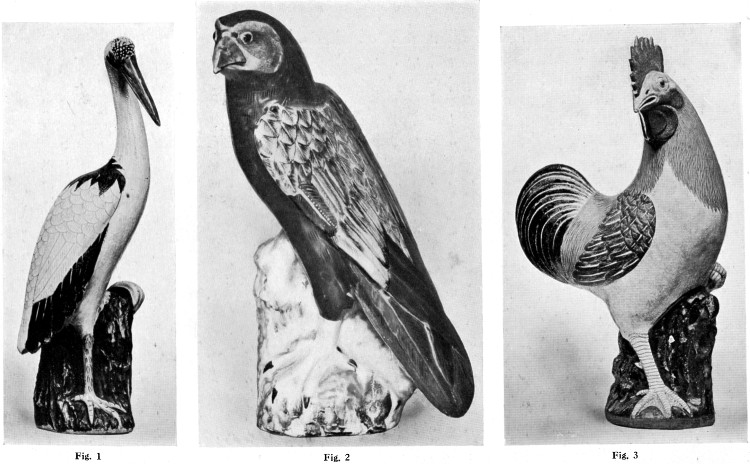
Plate 112.—Three figures of Birds, late K’ang Hsi
Porcelain, with coloured enamels on the biscuit.
Fig. 1.—Stork. Height 17¼ inches. British Museum.
Fig. 2.—Hawk. Height 10 inches. S. E. Kennedy Collection.
Fig. 3.—Cock. Height 13½ inches. British Museum.
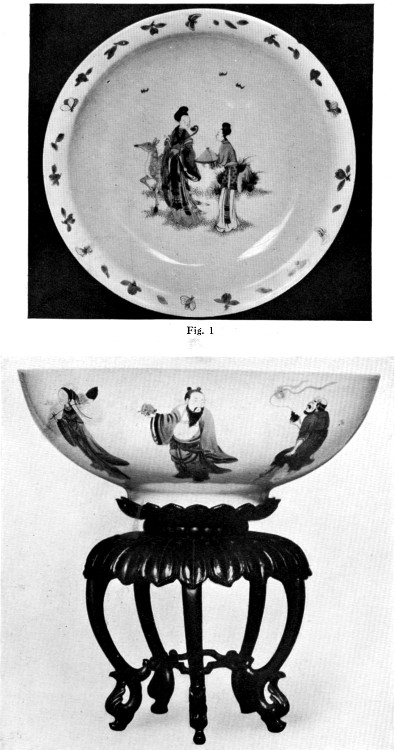
Plate 113.—Porcelain delicately painted in thin
famille verte enamels. About 1720.
Fig. 1.—Dish with figures of Hsi Wang Mu and attendant. Ch’êng Hua
mark. Diameter 6¾ inches. Hippisley Collection.
Fig. 2.—Bowl with the Eight Immortals. Diameter 8⅞ inches. S. E.
Kennedy Collection.
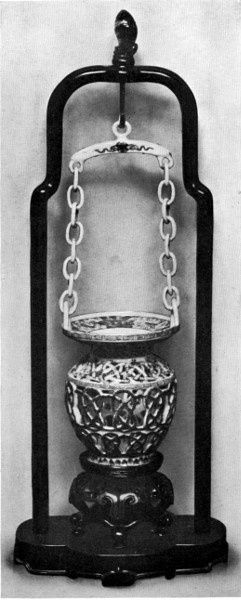
Plate 114.—Hanging Vase with openwork sides, for
perfumed flowers. Cumberbatch Collection.
Porcelain painted in late famille verte enamels. About 1720.
Blackwood frame. Total height 17 inches.
The mirror black is usually a monochrome tricked out with gilt
traceries, but as in the case of the powder blue the light Chinese
gilding is usually worn away, and often its quondam presence can now
only be detected by a faint oily film which appears when the porcelain
is held obliquely to the light. It is a common practice to have this
lost gilding replaced by modern work.
There are several large vases of triple-gourd form in the
Charlottenburg Palace with the upper and lower lobes coated with
gilt mirror black, and the central bulb enamelled with famille
verte colours; and another use of the glaze as panel decoration in
a lustrous brown ground has already been noted in an extract from Père
d’Entrecolles; it is also found on rare specimens as a background for
panels of famille verte enamelling. But its most effective use
is as a pure monochrome only relieved by faint gilding, and some of the
choicest K’ang Hsi specimens have soft brown reflexions in the lustre
of the surface. Another and probably a later type of mirror black is a
thick lacquer-like glaze with signs of minute crackle.
There is a type of glaze which, though variegated with many
tints, still belongs to the category of monochromes. This is the
flambé, to use the suggestive French term which implies a
surface shot with flame-like streaks of varying colour. This capricious
colouring, the result of some chance action of the fire upon copper
oxide in the glaze, had long been known to the Chinese potters. It
appeared on the Chün Chou wares of the Sung and Yüan dynasties, and it
must have occurred many times on the Ming copper monochromes; but up
to the end of the K’ang Hsi period it seems to have been still more
or less accidental on the Ching-tê Chên porcelain, if we can believe
the circumstantial account written by Père d’Entrecolles in the year
1722[356]:—“I have been shown one of the porcelains which are called
yao pien, or transmutation. This transmutation takes place in
the kiln, and results from defective or excessive firing, or perhaps
from other circumstances which are not easy to guess. This specimen
which, according to the workman’s idea, is a failure and the child of
pure chance, is none the less beautiful, and none the less valued.
The potter had set out to make vases of soufflé red. A hundred
pieces were entirely spoilt, and the specimen in question came from the
kiln with the appearance of a sort of agate. Were they but willing to
take the risk and the expense of successive experiments, the potters
would eventually discover the secret of making with certainty that
which chance has produced in this solitary case. This is the way they
learnt to make porcelain with the brilliant black glaze called ou
kim (wu chin); the caprice of the kiln determined this
research, and the result was successful.”
It is interesting to read how this specimen of flambé resulted
from the misfiring of a copper red glaze, no doubt a sang de
bœuf; for in the most common type of flambé red (see
Plate 123, Fig. 1) passages of rich sang de bœuf emerge from
the welter of mingled grey, blue and purple tints. The last part of
d’Entrecolles’ note was prophetic, for in the succeeding reigns the
potters were able to produce the flambé glaze at will.
There are, besides, many other strangely coloured glazes which can only
be explained as misfired monochromes of the grand feu, those
of mulberry colour, slaty purple, and the like, most of which were
probably intended for maroon or liver red, but were altered by some
caprice of the fire. But it would be useless to enumerate these erratic
tints, which are easily recognised by their divergence from the normal
ceramic colours.
The French have always been partial to monochrome porcelains. In the
eighteenth century they bought them eagerly to decorate their hotels
and châteaux, and enshrined them in costly metal mounts. But as the
style of the mounting, rococo in the early part of the century,
neo-classical in the latter part, was designed to match the furniture
of the period, the oriental shapes were often sacrificed to the
European fashion. Dark blue and celadon green were favourite colours,
if we may judge by surviving examples, and to-day enormous prices are
paid for Chinese monochromes fitted with French ormolu mounts by the
Court goldsmiths, such as Gouthière, Caffieri, and the rest.[357]
But these richly mounted pieces have more interest as furniture and
metal work, and the ceramophile regards them askance for their foreign
and incongruous trappings, which disturb the pure enjoyment of the
porcelain.[358]
It remains to consider the white porcelain, that is to say the
porcelain which was intended to remain white and undecorated with any
form of colouring. White was the colour used by the Court in times
of mourning, and large services of white porcelain were made for the
Emperor on these occasions. But it is not to be supposed that all the
beautiful white wares were made solely for this purpose.[359] They
have always been highly esteemed by the Chinese from the early Ming
times, when the Yung Lo bowls and the white altar cups of Hsüan Tê were
celebrated among porcelains, down to the present day. Many exquisite
whites were made in the early reigns of the Ch’ing dynasty, and as with
so many of the perennial monochromes their exact dating is full of
difficulty. We are not concerned here with the blanc de chine
or white porcelain of Tê-hua in Fukien, which has already been
discussed, but with the white of Ching-tê Chên, the glaze of which is
distinguished from the former by its harder appearance, and its bluish
or greenish tinge.
The latter was made to perfection in the K’ang Hsi period. Having no
colours to distract the eye from surface blemishes, nothing short of
absolute purity could satisfy the critic. In choice specimens the paste
was fine, white and unctuous, the glaze clear, flawless, and of oily
lustre,[360] the form was elegant and the potting true. Such pieces
without blemish or flaw are the very flower of porcelain, whether they
be of eggshell thinness (t’o t’ai), half eggshell (pan t’o
t’ai), or of the substance of ordinary wares.
But though innocent of colour the white porcelain was rarely without
decoration. The finest Imperial services were usually delicately etched
under the glaze with scarcely visible dragon designs. Other kinds have
the ornament strongly cut, such as the eggshell cups and saucers with
patterns of hibiscus, lotus, or chrysanthemum petals firmly outlined,
or the vases with full-bodied designs in low relief obtained by carving
away the ground surrounding the pattern.[361] Others have faint
traceries or thickly painted patterns in white slip, in steatite,[362]
or in fibrous gypsum under the glaze. A fuller relief was obtained by
pressing in deeply cut moulds or by applying strips and shavings of
the body clay, and working them into designs with a wet brush after
the manner of the modern pâte sur pâte. There are still higher
reliefs in K’ang Hsi porcelain, figures, and symbolical ornaments,
formed separately in moulds and “luted” on to the ware with liquid
clay, but these generally appeared on the enamelled wares, and are
themselves coloured. The applied reliefs on the white wares are usually
in unglazed biscuit, and there are, besides, pierced and channelled
patterns, but these processes have been fully described among the late
Ming wares,[363] and nothing further need be said of them, except that
they were employed with supreme skill and refinement by the K’ang Hsi
potters. Père d’Entrecolles[364] alludes to these perforated wares in
the following passage:—“They make here (i.e. at Ching-tê Chên) another
kind of porcelain which I have never yet seen. It is all pierced à
jour like fretwork, and inside is a cup to hold the liquid. The cup
and the fretwork are all in one piece.” Wares of various kinds with
solid inner lining and pierced outer casing are not uncommon in Chinese
porcelain and pottery. Sometimes, however, the cups are completed
without the inner shell, like Fig. 2, of Plate 78, which could be
fitted with a silver lining if required to hold liquid.
Objects entirely biscuit are exceptional. There are, however, two small
Buddhistic figures, and two lions of this class in the British Museum,
and curiously enough both are stamped with potter’s marks, which is
itself a rare occurrence on porcelain. The former bear the name of
Chang Ming-kao and the latter of Ch’ên Mu-chih (see vol. i., page 223).
Bushell[365] tells us that the Chinese call biscuit porcelain fan
tz’ŭ (turned porcelain), a quaint conception which implies that
the ware is turned inside out, as though the glaze were inside, and
the body out; and this illusion is occasionally kept up by applying a
touch of glaze inside the mouth of the unglazed vessel.
Biscuit porcelain is specially suitable for figure modelling, because
the sharpness of the details remains unobscured by glaze. It has been
largely employed in European porcelain factories for this purpose, but
the Chinese seem to have been prejudiced against this exclusive use of
the material. As a rule they reserve it for the fleshy parts of their
figures, giving the draperies a coating of glaze or of enamel or both.
A rare example of the use of biscuit is illustrated in the catalogue of
the Walters Collection (O. C. A., Plate XXIX.), a white bottle
with a dragon carved out of the glaze and left in biscuit.
The white wares so far described were made of the ordinary porcelain
body and glaze, but there is another group of whites which is ranked
with the so-called “soft pastes.” This is a creamy, opaque and often
earthy-looking ware, the glaze of which is almost always crackled.
It is in fact an imitation of the old Ting yao (q.v.), and its
soft-looking surface and warm creamy tone are seen to perfection in
small vases, snuff bottles, and ornamental wares. Indeed, the elegantly
shaped and finely potted vessels of this soft, ivory crackle are among
the gems of the period.
Crackle is a feature which is common to many of the monochromes, and
incidental mention has frequently been made of it in the preceding
pages. It is essentially a Chinese phenomenon, dating back to the Sung
dynasty, and there are various accounts of the methods employed to
produce it. We are speaking of the intentional crackle which is clearly
defined and usually accentuated by some colouring matter rubbed into
the cracks, as opposed to the accidental crazing which appears sooner
or later on most of the glazes of the demi grand feu, and on
many low-fired enamels. One crackling process used by the Sung potters
has been described on p. 99, vol. i. Another method is mentioned in the
K’ang Hsi Encyclopædia,[366] viz. to heat the unglazed ware as much as
possible in the sun, then plunge it into pure water. By this means a
crackle was produced on the ware after the firing.
But the normal process in the Ch’ing dynasty seems to have been to
mix a certain ingredient with the glaze which produced a crackle when
fired. There are constant references to this ingredient under the name
of sui yu (crackle glaze) in the letters of Père d’Entrecolles
in connection with various monochromes, and in the first letter,[367]
the following definite account appears:—“It is to be observed that
when no other glaze but that composed of white pebbles[368] is added
to the porcelain, the ware turns out to be of a special kind known as
tsoui ki (sui ch’i = crackled ware). It is marbled all
over and split up in every direction into a infinite number of veins.
At a distance it might be taken for broken porcelain, all the fragments
of which have remained in place. It is like mosaic work. The colour
produced by this glaze is a slightly ashen white.”
The effect of this ingredient of the glaze whatever its composition may
have been is easily understood. All porcelain and pottery undergoes a
considerable amount of contraction—from loss of moisture, etc.—in
the kiln, and to obtain a perfectly even glaze it is necessary that
the contraction of the glaze should be the same as that of the body.
Clearly this ingredient caused the glaze to contract to a greater
extent than the body, and so to split up into minute fissures. The
Chinese were able to control to a great extent the size and nature
of the crackle, as is shown by the appearance of alternate bands of
large and small crackle on the same piece. The methods of colouring
the crackle include rubbing red ochre, ink, and decoction of tea
leaves into the cracks before the ware was quite cool. Another method
is described by Bushell (O. C. A., p. 511) by which a white
crackled ware was stained pink or crimson. The vessel was held in the
fire in an iron cage until thoroughly heated, and then water mixed with
gold-pink colouring matter was blown on to it. This, however, is a
later process. Most of the monochrome glazes are occasionally crackled,
but the most characteristic colours of the crackle glazes are the
greyish white (the blanc un peu cendré of Père d’Entrecolles),
and light buff, which were probably intended to recall the ash colour
(hui sê) and the millet colour (mi sê) of the Sung Ko
yao. Some of the light buff or “oatmeal” crackles of the early
Ch’ing period are peculiarly refined and beautiful.
Though this has seemed a favourable opportunity for discussing crackle
glazes it is not to be supposed that they were a speciality of the
K’ang Hsi period. They are common to every age since the Sung dynasty,
and probably they were never made in such abundance and with such care
as in the Yung Chêng and early Ch’ien Lung periods.
CHAPTER XII YUNG CHÊNG PERIOD (1723–1735)
The Emperor, K’ang Hsi, was succeeded by his son, who reigned from
1723–1735 under the title Yung Chêng. The interest which the new ruler
had taken as a prince in ceramic manufactures is proved by a passage
in the first letter (written in 1712) of Père d’Entrecolles in which
he instances among remarkable examples of the potter’s skill a “great
porcelain lamp made in one piece, through which a torch gave light to
a whole room. This work was ordered seven or eight years ago by the
Crown Prince.” We are further told that the same prince had ordered the
manufacture of various musical instruments in porcelain. These could
not all be made, but the most successful were flutes and flageolets,
and a set of chimes made of nine small, round and slightly concave
plaques, which hung in a frame, and were played with drum-sticks.
Apparently the Emperor continued to take an intimate interest in the
industry after he had ascended the throne, for he commanded his brother
the prince of Yi to announce personally to T’ang Ying his appointment
at Ching-tê Chên in 1728.
At the beginning of the reign the direction of the Imperial factory was
in the hands of Nien Hsi-yao,[369] who, in his capacity of inspector
of customs at Huai-an Fu,[370] dispensed the funds for the Imperial
porcelain. A brief note in the T’ao lu,[371] under the heading
“Nien ware of the Yung Chêng period,” sums up in the usual compressed
style of Chinese ceramic writers the character of the porcelain made
at this time. The duty of Nien, inspector of customs at Huai-an Fu,
we read, was to select the materials, and to see that the porcelain
was furnished to the Imperial orders. The ware was extremely refined
and elegant. The coloured porcelains were sent twice monthly to
Nien at the Customs, and forwarded by him to the Emperor. Among the
vases (cho ch’i) many were of egg colour, and of rounded form,
lustrous and pure white like silver. They combined blue and coloured
decoration, and some had painted, engraved, etched, or pierced ornament
all ingeniously fashioned. Imitation of the antique and invention of
novelties, these were truly the established principles of Nien.
The interesting list of wares made at the Imperial factory which is
given in detail on pp. 223–226 supplies a full commentary on this
meagre notice, illustrating the types which are merely hinted in
the T’ao lu and specifying the particular kinds of antiques
which were reproduced and many of the new processes invented in this
reign. With regard to the last, however, it appears that the chief
credit was due to Nien’s gifted assistant, T’ang Ying. Most of the
actual processes, such as carving, engraving, piercing à jour,
embossing in high and low relief, blowing on of the glazes, painting
in enamels, in gold and in silver,[372] have already been described in
previous chapters. Indeed we may assume that all the science of the
K’ang Hsi potters was inherited by their successors in the Yung Chêng
period, and we need only concern ourselves with the novelties and the
specialities of the period.
A few words should be said first about the ware itself. Necessary
variations in the appearance of the Ching-tê Chên porcelain, which
were due to purely natural causes such as the use of clays of varying
qualities or those from different localities, have been noted from time
to time. These differences are generally quite obvious and they explain
themselves. But apart from these there are numerous instances in which
the potters have deliberately departed from the normal recipes in order
to obtain some special effect. Thus we saw that the ch’ing-tien
stone was introduced into the body in imitations of the opaque and
rather earthy-looking white Ting Chou ware; hua shih (steatite)
was used for another type of opaque porcelain which offered a
vellum-like surface to the blue painter; and coarse, impure clays were
found of great service in the imitation of the dark-coloured body of
the antique wares.
Many other modifications appear in the porcelain of the first half of
the eighteenth century. There is, for instance, a very dead white ware,
soft looking, but translucent, which occurs on some of the choicer
examples of armorial porcelain.[373] There are several specimens of
this in the British Museum, one of which bears the early date, 1702,
while others belong to the Yung Chêng period. Again there is the highly
vitreous ware evolved by T’ang Ying to imitate the opaque glass of
Ku-yüeh-hsüan; but that will be discussed later.[374] These
special bodies were mainly employed for articles of small size and
ornamental design, and they can be studied in all their varieties in
a representative collection of snuff bottles. The Chinese potters
lavished all their skill on these dainty little objects. Not only
do they include every kind of ware, crackled or plain, translucent
or opaque, but they illustrate in miniature every variety of
decoration—monochrome, painted, carved, moulded, incised, pierced and
embossed. Probably the choicest snuff bottles were made in the Yung
Chêng and Ch’ien Lung periods; but the Chinese have never ceased to
delight in them, and many beautiful examples were manufactured in the
nineteenth century, particularly in the Tao Kuang period.
The ordinary Yung Chêng porcelain differs but little from that of the
previous reign, though it tends to assume a whiter appearance, and
the green tinge of the glaze is less marked. Moreover, a change is
noticeable in the finish of the base rim of vases and bowls. Bevelling
of the edge is less common, and gives place to a rounded or angular
finish, the foot rim being often almost  shaped; while the
slight tinge of brown around the raw edge, which is usual on K’ang Hsi
wares, is often entirely absent. The actual potting of the porcelain
displays a wonderful degree of manipulative skill, and the forms,
though highly finished, are not lacking in vigour. They are, in fact,
a happy mean between the strong, free lines of the K’ang Hsi and the
meticulous finish of the later Ch’ien Lung porcelains. The verdict of
the T’ao lu, “extremely refined and elegant,” is fully justified
by the porcelain itself no less than by its decoration.
Not the least deserving of this praise, though mainly made for export,
is the important group discussed on page 209, viz. the saucer dishes,
plates, tea and coffee wares, etc., of delicate white porcelain,
painted, apparently at Canton, in the famille rose enamels. It
is an “eggshell” porcelain, white, thin, and beautifully finished,
and the dainty little conical or bell-shaped tea cups, though without
handles, are the perfection of table ware. This kind of “eggshell” is
easily distinguished from the Ming type, which is greener in tone and
has the appearance of melting snow by transmitted light.
The Yung Chêng period is not conspicuous for blue and white porcelain.
The perfection of the famille rose colours and the growing
demand for enamelled wares seem to have withdrawn the attention of the
potters from their old speciality. Marked examples of Yung Chêng blue
and white are so uncommon that it is difficult to estimate the merits
of the ware from them. A saucer dish in the British Museum shows the
familiar pattern of a prunus spray reserved in white in a marbled blue
ground; but though the ware itself preserves much of the K’ang Hsi
character, the blue is dull and grey, and wanting in the vivacity and
depth of the old models. One would say that little care had been spent
on the refining of the blue, and without the old perfection of material
the K’ang Hsi style, with its broad washes of colour, was doomed to
failure. Considerations of this sort may have led the painters to
abandon the washes in favour of pencilling in fine lines, a method
apparent on the armorial porcelain which can be dated to this period.
Such a treatment of the blue was admirably suited to small objects.
Indeed it was the usual style of decoration on the steatitic porcelain,
of which many excellent examples belonging to this time are to be found
among the snuff bottles, vermilion boxes, and the small, artistic
furniture of the writing table. On large specimens the effect is thin
and weak.
On the other hand the Yung Chêng potters, who excelled in reproducing
the antique, were most successful in their imitation of the old
Ming blue and whites. The Imperial list[375] includes such items as
“reproductions of the pale blue painted designs of Ch’êng Hua,” and
of the dark blue of Chia Ching. An interesting example of a Ming
reproduction is a bowl in the British Museum, which is painted on the
exterior with the old design of ladies walking in a garden by candle
light.[376] In spite of its Yung Chêng mark this piece is obviously a
copy of a Ming model. The porcelain is white and thick, and the glaze,
which is of greenish tint, has a peculiar soft-looking surface, while
the blue design inside is of characteristic Ming colour, though that of
the exterior is scarcely so successful.
Another type much copied at this period as well as in the succeeding
reign is that in which the blue is mottled and blotched with darker
spots, a type discussed among the early Ming wares.[377] And similarly
such specimens as Fig. 2 of Plate 116, which bears a Hsüan Tê mark,
doubtless belong to this period of imitative manufacture. It is of
thick, solid build with smooth, soft-looking glaze, whose bubbled
texture gives the blue a hazy appearance.
Painting in underglaze red alone, or in combination with underglaze
blue, was freely practised in the reign of Yung Chêng, and probably
most of the fine examples of this type in our collections belong to
this and the succeeding reign (Fig. 1, Plate 117). There is a good
example with the Yung Chêng mark in the British Museum, a vase of
“pilgrim-bottle” form with central design of the three emblematic
fruits—peach, pomegranate, and finger citron, symbols of the Three
Abundances of Years, Sons and Happiness. The fruits are in a soft
underglaze red, verging on the peach-bloom tint, and the foliage,
together with the borders and accessory designs, are pencilled in dark
blue.
The Imperial list alludes to this decoration under the heading of “red
in the glaze” (yu li hung), including (1) red used alone for
painted designs, and (2) red foliage combined with blue flowers.[378]
Examples of both these styles are frequent in large and small objects,
and especially in the decoration of snuff bottles, which often bear the
Yung Chêng mark. They are, however, by no means confined to the Yung
Chêng period, but have continued in uninterrupted use to the present
day.
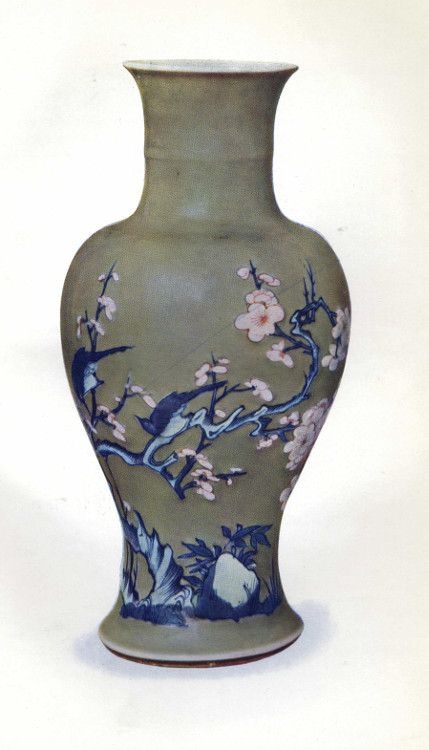
PLATE 115
Vase of baluster form with ornament in white slip and underglaze red
and blue in a celadon green ground: rockery and birds on a flowering
prunus tree. Yung Chêng period (1723–1735)
Height 15½ inches.
Alexander Collection.
Other references in the list[379] to underglaze red painting include
designs of three fishes,[380] three fruits, three funguses, and five
bats (for the five blessings) in the Hsüan Tê style, red in a white
ground; and the same red designs in a celadon green ground, the
latter combination being a novelty of the previous reign. Plate 115
is a choice example of the underglaze colours in a celadon ground;
and similar designs in a pale lavender blue ground, besides other
combinations of the same colours, coloured slips, and high-fired glazes
which form the polychrome decoration of the grand feu have
been already discussed on p. 146. They belong to the Yung
Chêng and Ch’ien Lung periods no less than to the K’ang Hsi.
Of the other kinds of polychrome, the porcelain with glazes of the
demi-grand feu, and enamels of the muffle kiln in the three
colours, green, yellow, and aubergine, was still made. It is hardly
likely that the manufacture[381] which Père d’Entrecolles describes
in 1722 ceased immediately, and we know that the finer types with
engraved designs and transparent glazes in the three colours were made
to perfection at the Imperial factory. Fig. 1 of Plate 116 illustrates
a bowl of this kind with the Yung Chêng mark and, to judge from its
exquisite quality, an Imperial piece. The ornament is in green, in a
full yellow ground. This type of decoration is a legacy from the Ming
dynasty, and doubtless many of the saucer dishes, bowls, etc., with
Chêng Tê marks, but with all the trimness and neatness of the Yung
Chêng wares, belong to the latter period. One variety is actually
specified in the Imperial list[382] viz. “reproductions of porcelain
with incised green decoration in a monochrome yellow ground.”
As for the on-glaze enamels of the muffle kiln the old famille
verte colour scheme was to a great and increasing extent supplanted
by the famille rose. It survived, however, in certain modified
forms—in the delicately painted wares, for example, usually of
eggshell thinness and decorated in thin, clear, transparent enamels,
such as were described in connection with the late K’ang Hsi “birthday
plates ” (see Plate 113). And again the same colours were
employed in a special type of decoration which seems to have originated
in the Yung Chêng period, though it was freely used in later reigns. In
this the design was carefully traced in pale blue outlines under the
glaze, and filled in with light uniform washes of transparent enamels
on the glaze. The effect is delicate and refined, though somewhat weak
in comparison with the full, iridescent colours and broad washes of the
older famille verte.
Possibly this style of decoration was intended to reproduce the
traditional refinement of the Ch’êng Hua cups. The Imperial list[383]
includes “reproductions of Ch’êng Hua polychrome (wu ts’ai),”
and four exquisite eggshell wine cups in the Hippisley Collection
which bear the Ch’êng Hua mark, are painted in this fashion.[384]
Similarly in the Bushell collection there are some beautiful
reproductions of the Ch’êng Hua “stem-cups,” with grape vine patterns,
etc., which are no doubt of the same origin. Larger work in the same
style is illustrated by a fine vase in the Victoria and Albert Museum
with a phœnix design which suggests an Imperial destination (Plate
117).
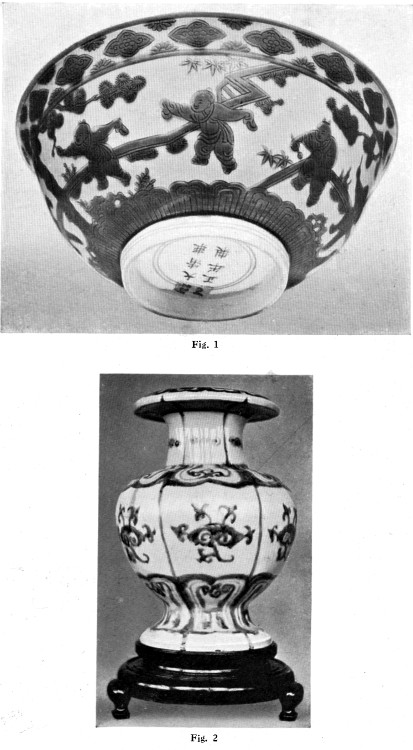
Plate 116.—Yung Chêng Porcelain.
Fig. 1.—Imperial Rice Bowl with design of playing children (wa
wa), engraved outlines filled in with green in a yellow ground,
transparent glazes on the biscuit. Yung Chêng mark. Diameter 6 inches.
British Museum.
Fig. 2.—Blue and white Vase with fungus (ling chih) designs in
Hsüan Tê style. Height 7½ inches. Cologne Museum.
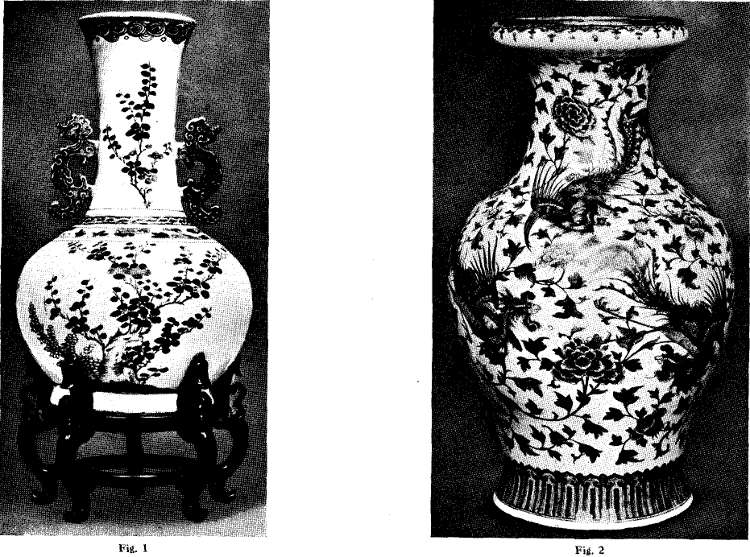
Plate 117.—Yung Chêng Porcelain.
Fig. 1.—Vase with prunus design in underglaze red and blue. Height 15
inches. C. H. Read Collection.
Fig. 2.—Imperial Vase with phœnix and peony design in pale famille
verte enamels over underglaze blue outlines. Height 25⅝ inches.
V. & A. Museum.
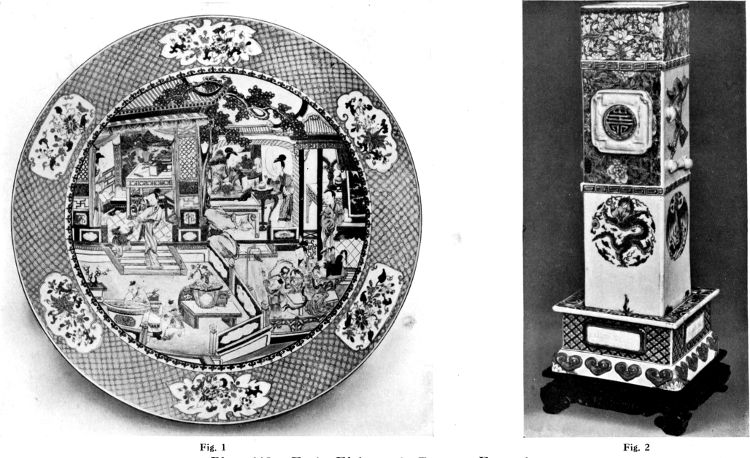
Plate 118.—Early Eighteenth Century Enamels.
Fig.1—Plate painted at Canton in famille rose enamels (yang
ts’ai, “foreign colouring”). Yung Chêng period. Diameter 21½
inches. S. E. Kennedy Collection.
Fig. 2.—Arrow Stand, painted in late famille verte enamels.
About 1720. Height 19¼ inches. V. & A. Museum.
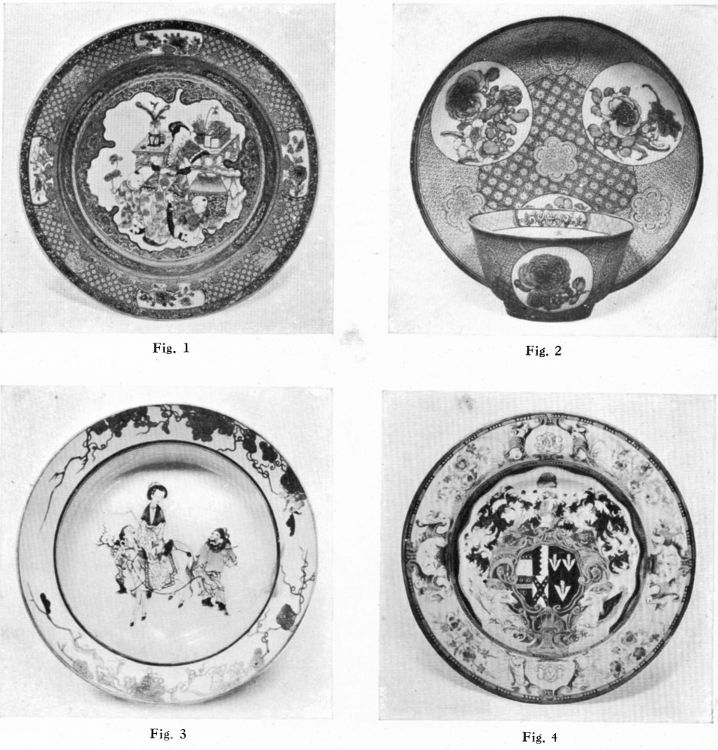
Plate 119.—Yung Chêng Porcelain, painted at Canton with
famille rose enamels. British Museum.
Fig. 1.—“Seven border” Plate. Diameter 8¼ inches.
Fig. 2.—Eggshell Cup and Saucer with painter’s marks (see p. 212).
Diameter of saucer, 4½ inches.
Fig. 3.—Eggshell Plate with vine border. Diameter 8¼ inches.
Fig. 4.—Armorial Plate with arms of Leake Okeover. Transition enamels,
about 1723. Diameter 8⅞ inches.
Thirdly, there are the reproductions of the enamelled porcelain of the
Chêng Tê and Wan Li periods[385] (q.v.), characterised, no
doubt, by the combination of underglaze blue and overglaze enamels.
We have already seen[386] from the note on Nien yao in the T’ao
lu that this combination was conspicuous at this period, and it is
probable that much of the “five colour” porcelain in late Ming style
should be dated no further back than the Yung Chêng revival. Other
types of Ming coloured wares reproduced at this time were “porcelain
with ornament in Hsüan Tê style in a yellow ground,”[387] which seems
to mean underglaze blue designs with the ground filled in with yellow
enamel—a not unfamiliar type—and porcelain with designs painted in
iron red (ts’ai hung) “reproduced from old pieces.”[388] But the
most prominent feature of the enamelled porcelains of this time is the
rapid development of the famille rose colours. We have already
noted the first signs of their coming in the thick rose pink and
opaque white, which made their appearance in the latter years of K’ang
Hsi. The group derives its name from its most conspicuous members, a
series of rose pinks graduating from pale rose to deep crimson, all
derived from gold, the use of which as a colouring agent for vitreous
enamel was only at this period mastered by the Chinese potters. It
includes besides a number of other colours distinguished from those
of the famille verte palette by their relative opacity. They
display, moreover, a far wider range of tints, owing to scientific
blending of the various enamels and to the judicious use of the opaque
white to modify the positive colours. Most of the opaque
colours have considerable body, and stand out on the porcelain like a
rich incrustation, and they are laid on not in broad washes, but with
careful brush strokes and miniature-like touches.
The famille rose colours are known to the Chinese as juan
ts’ai (“soft colours,” as opposed to the ying ts’ai, or
hard colours of the famille verte), fên ts’ai (pale
colours), or yang ts’ai (foreign colours). Their foreign
origin is generally admitted, and T’ang Ying in the seventeenth of
his descriptions of the processes of manufacture alludes to them
under the heading, “Decorating the round ware and vases with foreign
colouring.”[389] Painting the white porcelain in polychrome (wu
ts’ai) after the manner of the Europeans (hsi yang), he
tells us, is called foreign colouring, and he adds that the colours
employed are the same as those used for enamels on metal (fo
lang). Taking this statement with the note on “foreign coloured
wares” in the Imperial list,[390] where reference is made to painting
on enamels (fa lang) “landscapes and figure scenes, flowering
plants and birds,” it is evident that fa lang is used here not
in the usual sense of cloisonné enamel, but for the painted enamels
on copper which we distinguish as Canton enamels. These, we are told
elsewhere,[391] were first made in the kingdom of Ku-li, which is
washed by the Western sea. Ku-li is identified as Calicut, but it does
not necessarily follow that the Chinese associated the origin of the
painted enamels with India. The expression was probably used quite
vaguely in reference to European goods which came by way of India,
and does not really conflict with the other phrase, hsi yang
(Western foreigners), which is always rendered “Europeans.”
There is quite a number of references to the foreign or European
colours in the Imperial list,[392] e.g. “porcelain in yellow after the
European style,” which Bushell considers to be the lemon yellow which
originated in this reign; “porcelain in purple brown (tzŭ)
after the European style”; “European red-coloured wares,” i.e. rose
pink; “European green-coloured wares,” which Bushell explains as pale
bluish green or eau de nil enamel; and “European black (wu
chin) wares.” In fact the words, “foreign or European,” seem to be
practically synonymous with “opaque enamel.”[393]
The most complete display of the foreign colouring is given by a
special group of porcelain which is painted in a characteristic
and mannered style. It is best known as “eggshell” or “ruby-back”
porcelain, from the fact that it is usually very thin and translucent
and beautifully potted, and that the exterior of the dishes and plates
is often coated with a gold pink enamel varying from pale ruby pink to
deep crimson. It usually consists of saucer-shaped dishes, plates, and
tea and coffee wares, obviously intended for European use. Occasionally
there are vases and lanterns of exquisite lightness and translucency,
but the vase forms usually required a more substantial construction,
and such specimens as Plate 120, are strongly built, though decorated
in the same style as the eggshell wares.
The decoration of these porcelains is scarcely less distinctive than
their colouring. The central design usually consists of one of the
following: a Chinese interior with figures of ladies and children,
groups of vases and furniture, baskets of flowers and dishes of
fruit, a pheasant on a rock, two quails and growing flowers, a cock
and peonies, etc.; and these designs are enclosed by rich borders,
sometimes totalling as many as seven in number, composed of hexagon
and square, lozenge, trellis or matting diapers, in varying colours,
and broken by small irregular panels of flowers or archaic dragons.
There are, of course, many other kinds of decoration on these wares.
Sometimes the whole design is executed in opaque blue enamel, sometimes
it is black and gold. On some the borders are simpler, merely
delicately gilt patterns; on others they are ruby pink, plain or
broken by enamelled sprays. On the vase forms the ruby either covers
the entire ground or is broken, as in Plate 121, Fig. 3, by fan-shaped
or picture-shaped panels with polychrome designs. The painting is, as
a rule, very finely and carefully executed, but almost always in a
distinctive style which is closely paralleled by the Canton enamels.
Indeed, it is impossible to resist the conclusion that much of this
ware was actually decorated in the enamelling establishments at Canton,
the porcelain itself being sent in the white from Ching-tê Chên. The
same designs are found on both the porcelain and the enamels, and there
is one instance at least of an artist whose paintings were used on both
materials, as is testified by his signature. This is the painter whose
art-name is Pai shih shan jên (hermit of the white rock), or
in a shortened form, Pai-shih (see vol. i., p. 223). He was evidently
a Cantonese, for one of his designs on a saucer in the British Museum
is inscribed Ling nan hui chê (a Canton picture), the subject
being a vase of flowers and a basket of fruit. His signature is also
attached to a dish with cock and peonies in the Victoria and Albert
Museum,[394] and to a similar design figured by Jacquemart,[395] which
also bears the date corresponding to 1724. It occurs, besides, fairly
frequently on Canton enamels, though in this case usually attached to
landscape designs. In all these instances, however, it is placed in
the field of the design appended, as a rule, to a stanza of verse or a
descriptive sentence. This is a usual position for the signature of a
painter on silk or paper, and we can hardly be wrong in inferring that
Pai-shih was the artist whose designs were copied on the wares, perhaps
one who was specially employed to design for the enamellers, rather
than an actual pot-painter or enameller. The proper place for the
signature of the latter is underneath the ware, on the base; and here
we find on a cup and saucer in the British Museum the name apparently
of the real decorator whose painting is not to be distinguished from
that on the piece with the Pai-shih signature, just mentioned as in
the same collection. Under the saucer (Plate 119, Fig. 2) is the seal
Yü fêng yang lin, i.e. Yang Lin of Yü-fêng, an old name for
the town of K’un-shan; and under the cup is the seal Yu chai
(quiet pavilion), which is no doubt the studio name of Yang-lin.[396]
K’un-shan Hsien is situated between Su-chou and Shanghai, in the
province of Kiangsu, and we are to understand that Yang-lin was
either a native of K’un-shan or that he resided there—more probably
the former, for his work is typical of the Canton enamellers. It is,
however, probable enough that there were decorating establishments
working for the European markets in the neighbourhood of Shanghai as
well as at Canton, just as there are still decorating kilns not only at
Ching-tê Chên but “at the other towns on the river.”[397]
It is highly probable that the brushwork of the Canton enamellers, like
the enamels themselves, was copied at Ching-tê Chên, and even that
some of the enamellers migrated thither. A tankard among the armorial
porcelain in the British Museum, bearing the arms of Yorke and Cocks,
combines a few touches of underglaze blue with passages of famille
rose decoration in the Canton style. The blue can only have been
applied at the place of manufacture, and as no porcelain of this kind
was actually made at Canton, it is evident that the piece was made and
decorated elsewhere (which can only mean at Ching-tê Chên), unless we
assume the improbable alternative that the tankard travelled from the
factory, bare save for a faintly outlined shield with a saltire in
blue, to be finished off at Canton.
Needless to say there is much famille rose porcelain in which
the Cantonese style is not apparent, and this we assume without
hesitation to have been decorated at Ching-tê Chên.
It only remains to say a few words on the dating of the famille
rose wares and for this we must return to the ruby-back porcelains.
Dated pieces are rare, but the British Museum is fortunate in
possessing a few documentary specimens. The most interesting of these
is a bowl with pale ruby enamel covering the exterior, and a dainty
spray of flowers in famille rose enamels inside. It is marked
in blue under the glaze with the cyclical date “made in the hsin
chou year recurring” (see p. 213). The only year to which this
can be referred is 1721, when the hsin chou year came round
for the second time in the long reign of K’ang Hsi.[398] It is of
course possible that this bowl was not enamelled in the year of its
manufacture, but there are two other pieces in the same case, an
octagonal plate with ruby border and a dish, both with the mark of the
Dresden collection, and therefore not later than the early years of
Yung Chêng. A fourth document is a ruby-back saucer dish delicately
painted with a lady and boys, vases and furniture in typical style,
which has the mark of the Yung Chêng period.
Unfortunately it is no longer possible to regard the year 1724, to
which the signature Pai-shih is attached on the plate mentioned above,
as conclusive evidence of the date of decoration.[399] It is certainly
the date of the design, and it is probable enough that the porcelain
was painted within a few years of the original picture, but beyond
that no further inferences can be drawn.[400] The Yorke-Cocks tankard,
however, to which we have also alluded, must for heraldic reasons have
been painted between the years 1720 and 1733; and there is an eggshell
cup and saucer in the British Museum painted in rose pink and other
enamels of this type, with the arms of the Dutch East India Company and
the date 1728.
From this cumulative evidence it is clear that the manufacture of
eggshell dishes and services with famille rose enamels in the
Canton style and with “ruby backs” was in full swing in the Yung Chêng
period, and the general tendency to label them all Ch’ien Lung errs on
the side of excessive caution.
Passing from this particular group, which was affected by special
influences, the general character of the Yung Chêng enamelled
decoration is one of great refinement in design and execution. The
over-elaboration and the overcrowding which are observable on the later
Ch’ien Lung famille rose are absent at this period. The tendency
was on the contrary towards elegant and restrained effects, such as a
flowering spray thrown artistically across the field, birds on a bough
and other graceful designs which left plenty of scope for the fine
quality of the white background. It is this nicely balanced decoration
coupled with the delicacy of the painting and the beautiful finish of
the porcelain itself, which gives the Yung Chêng enamelled wares their
singular distinction and charm.
There are still a few special types of painted wares to be noticed
before passing to the monochromes. One of these is named in the
Imperial list,[401] under the heading “Porcelain painted in ink
(ts’ai shui mo),” a figurative expression, for Indian ink could
not stand the heat even of the enamelling kiln, and could never have
served as a true ceramic pigment. The material used was a dry black or
brown black pigment derived from manganese, and closely allied to the
pigment which had long served in a subordinate position for tracing
outlines. Evidently this material was now greatly improved, and could
be used for complete designs which resembled drawings in Indian ink or
in sepia. It is certain, however, that the Chinese, whose methods were
necessarily empirical, had first experimented with actual ink, for Père
d’Entrecolles wrote in 1722[402]—“an attempt made to paint in black
some vases with the finest Chinese ink met with no success. When the
porcelain had been fired, it turned out white. The particles of this
black had not sufficient body, and were dissipated by the action of the
fire; or rather they had not the strength to penetrate the layer of
glaze or to produce a colour differing from the plain glaze.” Between
that date and about 1730 when the Imperial list was drawn up, the
secret of the proper pigment seems to have been mastered, and we find
the black designs effectively used on Yung Chêng eggshell and other
wares, alone or brightened by a little gilding. Among other uses it was
found to be admirably suited for copying the effect of European prints
and line engravings, a tour de force in which the proverbial
patience and imitative skill of the Chinese are well exemplified.
Another effect sometimes mistaken for black painting is produced by
silvered designs which become rapidly discoloured; but it is generally
possible to see a slight metallic sheen even on the blackened silver if
the porcelain is held obliquely to the light.
Another refined and unobtrusive decoration was effected by pencilling
in pale iron red supplemented with gilding. There is a large series of
this red and gold porcelain in the Dresden collection, and it seems
to belong to the late K’ang Hsi or the Yung Chêng period. Another
telling combination, including black, red and gold, dates from this
time. The black and gold variety is well illustrated by an interesting
plate in the British Museum which represents European figures in
early eighteenth-century costume in a Chinese interior (Plate 131,
Fig. 1). The Imperial list[403] alludes to the use of silver and gold
both to cover the entire surface like a monochrome (mo yin
and mo chin), and in painted designs (miao yin and
miao chin).[404] Three of these decorations are said to have
been in Japanese style, but the precise significance of this is not
clear. Gilding was freely used in combination with red and blue, and
especially over the blue, on Arita porcelain, but the application of
it does not seem to differ from the ordinary Chinese gilding. The one
feature common to the Chinese and Japanese gilding is its lightness and
restraint as compared with the heavy gilding of European porcelains.
Plate 125 illustrates a peculiar ware which belongs in part to the
reign of Yung Chêng and in part to that of Ch’ien Lung. It attempts to
reproduce the soft colouring on the enamelled glass made by Hu,[405]
whose studio-name was Ku-yüeh-hsüan (“ancient moon pavilion”). A
small brush holder[406] of this glass is shown on Fig. 125, an opaque
white material, not unlike our old Bristol glass, delicately painted
in famille rose colours with groups of the Seven Worthies
of the Bamboo Grove. It is said that[407] the Emperor admired the
soft colouring on this ware, and expressed a wish to see the same
effect produced in porcelain. T’ang Ying thereupon set out to solve
the problem by making a highly vitreous body with glassy glaze on
which the enamels assumed the soft tints of the original model. This
type of porcelain, known as fang ku yüeh hsüan (“imitation of
Ku-yüeh-hsüan”), is greatly prized. Mr. A. E. Hippisley has described
a small group in the catalogue of his collection from which I have
been permitted to illustrate an example (Plate 125). Mr. Hippisley
states that the earlier specimens of the glass are marked with the
four characters ta ch’ing nien chih (made in the great Ch’ing
period), the reign name Yung Chêng being omitted; the later pieces, of
which the brush pot in our illustration is one, have the Ch’ien Lung
mark in four characters. Bushell[408] has figured a yellow glazed snuff
bottle with the actual mark Ku yüeh hsüan chih (see vol. i. p.
219).
The reigns of Yung Chêng and Ch’ien Lung were prolific in monochromes.
Never since the Sung dynasty had these wares been produced in such
quantity, and the tale of the glazes was swollen to an unprecedented
extent by the accumulated traditions of the past centuries, and by the
inventive genius of T’ang Ying. It is scarcely practicable to attempt
to distinguish very closely between the Yung Chêng monochromes and
those of the early years of Ch’ien Lung. The activities of T’ang-ying
extended from 1728–1749, and we are expressly told that many of the
types enumerated in the Imperial list were his inventions, besides
which there was nothing made by the potters of the past which he could
not reproduce. To enumerate all the colours now used would be merely
to repeat what has been said under the heading of monochrome porcelain
in the previous chapters. Moreover, the Imperial list given on page
223 serves to draw attention to the principal types, and it is only
necessary here to supplement it with a few comments.
A special feature of the time was the reproduction of the glazes made
in the classical periods of the Sung and Ming dynasties, and in many
cases these copies were based on originals lent to the factory from the
Imperial collections. Thus the Ju, Kuan, Ko, Lung-chüan, Tung-ch’ing,
Chün and Ting wares, all the specialities of the Sung dynasty, are
included in the list, and though one type of Kuan glaze is specifically
stated to have been laid on a white porcelain body, many of the others,
we read, were provided with special bodies imitating the copper-and
iron-coloured wares of antiquity. But experience shows that in the
majority of cases the potters were content to simulate the “brown
mouth and iron foot” of the dark-bodied Sung wares by dressing the
mouth and the exposed part of the base with ferruginous clay. This is
observable on the lavender crackles which imitate the Kuan, and the
stone grey crackles of the Ko type, by which the Sung originals were
until recent years represented in most Western collections.
In other cases coarse clays of impure colour, and even earthenware
bodies were used in the reproductions. The admirable imitations of the
mottled and flambé Chün glazes which were apparently a special
triumph of T’ang-ying appear both on a white porcelain which had to be
carefully concealed by the coloured glazes, and on a soft earthenware
body. Both these kinds are found with the Yung Chêng mark stamped in
the paste, and so correct are the glaze effects that even collectors of
considerable experience have been deceived by specimens from which the
mark in question has been ground away.
In addition to the copies of the high-fired Chün glazes, there was the
“Chün glaze of the muffle kiln” (lu chün yu) which is described
as something between the glaze applied to the Yi-hsing stoneware and
the Kuangtung glazes. The items immediately following this information
in the Imperial list[409] make it clear that the writer refers to the
glazes of Ou on the Yi-hsing pottery, and to the blue mottled glazes
of the Canton stoneware. The enamel which most closely answers to
the description of this Chün glaze of the muffle kiln[410] is that
illustrated in Fig. 4 of Plate 128, a vase with dark-coloured foot rim,
and an opaque greenish blue enamel flecked with dark ruby pink. This
enamel varies considerably in appearance according to the preponderance
of the red or the blue in the combination; but it is an enamel of the
muffle kiln and its markings recall the dappled Chün glazes. I have,
moreover, seen this glaze actually applied to a teapot of Yi-hsing red
stoneware. This glaze seems to belong to a type, which was largely
developed in the Ch’ien Lung period, of glazes resembling if not
actually imitating the mottled surface of certain birds’ eggs, e.g.
the robin, the lark, the sparrow, etc. In these instances one colour
seems to have been powdered or blown on to another, the commonest kind
having a powdering of ruby pink on pale blue or green. This glaze
differs from the Chün glaze, described above, only in the size of the
pink specks. It was probably in experimenting for the effect of the
flambé Chün glazes that T’ang Ying acquired the mastery of the
furnace transmutations (yao pien) which made it possible for him
and his successors to produce at will the variegated glazes. These had
been described by Père d’Entrecolles a few years earlier as accidental
effects in his time, but the French father already foresaw the day when
they would be brought under control.
Of the celebrated Ting Chou wares only the fine ivory white Ting
(fên ting) was copied at the Imperial factory; but this does
not preclude the reproduction of the other kind, the creamy crackled
t’u-ting, in the other potteries. There are, at any rate, many
lovely porcelains in both styles which appear to belong to the Yung
Chêng and early Ch’ien Lung periods. Coloured glazes with crackle and
crackled grey-white of the Ko type were made in great quantity, and
most of the choicer crackles in our collections, especially those of
antique appearance but on a white and neatly finished porcelain body,
date from this time.
The reproductions of Ming monochromes include the underglaze red and
the purplish blue as in the previous reign, and the eggshell and pure
white of the Yung Lo and Hsüan Tê periods. The purplish blue or chi
ch’ing of this time is illustrated by a large dish in the British
Museum which is further enriched with gilding. It is covered with a
splendid deep blue of slightly reddish tinge, varying depth and rather
stippled appearance, and it was found in Turkey, where this colour has
been much prized. Turquoise green, aubergine purple and yellow of the
demi-grand feu, and the lustrous brown (tzŭ chin) in two
shades, brown and yellow, are all mentioned in the Imperial list as
used with or without engraved and carved designs under the glaze.
As for the K’ang Hsi porcelains it may be assumed that practically all
their glaze colours were now reproduced. A few only are specified in
the list, eel yellow, snake-skin green, spotted yellow, soufflé
red, soufflé blue (powder blue) and mirror black (wu
chin). The term soufflé red may refer to the underglaze red
from copper or the overglaze iron red. The latter is further subdivided
into mo hung or ta hung, the deep red of Ming origin, and
the tsao’rh hung or jujube red, a softer and more vitreous[411]
variety of the same colour which Dr. Bushell considered to have
originated in the Yung Chêng period. On the soufflé red under
the glaze we may quote Bushell’s remarks[412]: “Two of the colours
especially characteristic of the Nien yao or 'Nien porcelain’ of this
epoch are the clair de lune or yüeh pai, and the bright
soufflé copper red.” The latter is further described on a vase
in the Walters collection “exhibiting the characteristic monochrome
glaze of bright ruby red tint, and stippled surface. The soufflé
glaze is applied over the whole surface with the exception of a panel
of irregular outline reserved on one side, where it is shaded off so
that the red fades gradually into a nearly white ground.” This panel
was afterwards filled in with a design in overglaze enamels. A tazza
in the British Museum has this same red covering three-quarters of
the exterior, and fading into the white ground. This red also occurs
in its beautiful translucent ruby tints on a pair of small wine cups
in the same collection, and on a set of larger cups belonging to Mr.
Eumorfopoulos. One would say it was the “liquid dawn” tint of the
celebrated wine cups of the late Ming potter, Hao Shih-chiu.
The clair de lune or moon white (yüeh pai), an exquisite
glaze of palest blue, is illustrated on Plate 130. It is often faintly
tinged with lavender which bears out its description in the Imperial
list[413]: “This colour somewhat resembles the Ta Kuan glaze, but the
body of the ware is white. The glaze is without crackle, and there are
two shades—pale and dark.” The Kuan glaze, it should be explained, was
characterised by a reddish tinge.
In addition to the foreign colours which were capable of being used
as monochromes as well as in painted designs, there are a few other
new glazes named in the Imperial list. The fa ch’ing (cloisonné
blue) which “resulted from recent experiments to match” the deep blue
of the enamellers on copper, is identified by Bushell with the dark
sapphire blue known as pao shih lan (precious stone blue). It
was, we are told, darker and bluer than the purplish chi ch’ing,
and it had not the orange peel and palm eye markings of the latter.
It has, however, a faint crackle, and is apparently a glaze of the
demi-grand feu. We learn elsewhere that this cloisonné blue was
one of T’ang-ying’s inventions.
Among the yellows are “porcelain with yellow after the European style”
which is identified by Bushell with the opaque lemon yellow enamel
introduced at this time, and there are two kinds of mi sê
(millet colour) glazes,[414] pale and dark, which we are told “differed
from the Sung mi sê.” Bushell’s explanation of the term mi
sê given in Monkhouse’s Chinese Porcelain,[415] traverses
his rendering of the terms as rice colour in other books: “The
Chinese term used here is mi sê, which Julien first translated
couleur du riz, and thereby misled us all. It really refers to
the colour (sê) of the yellow millet (huang mi), not of
rice (pai mi). Mi sê in Chinese silks is a full primrose
yellow; in Chinese ceramic glazes it often deepens from that tint to
a dull mustard colour when the materials are less pure. It has often
been wondered why the old “mustard crackle” of collectors is apparently
never alluded to in “L’Histoire des Porcelaines de King-tê-chin.” It
is necessary to substitute yellow for “rice coloured” in the text
generally, remembering always that a paler tone is indicated than that
of the Imperial yellow, which Mr. Monkhouse justly likens to the yolk
of an egg.”
In Giles’s Dictionary mi sê is rendered “straw colour, the
colour of yellow millet,” and all my inquiries among Chinese collectors
as to the tint of the mi sê glaze have led to the same
conclusion. One of the Chinese experts indicated a bowl with pale straw
yellow glaze of the K’ang Hsi period as an example of mi sê,
and this I take to be the mi sê which “differed from the Sung
colour,” being, in fact, an ordinary yellow glaze, following the type
made in the Ming dynasty, and entirely different in technique from the
Sung glazes.
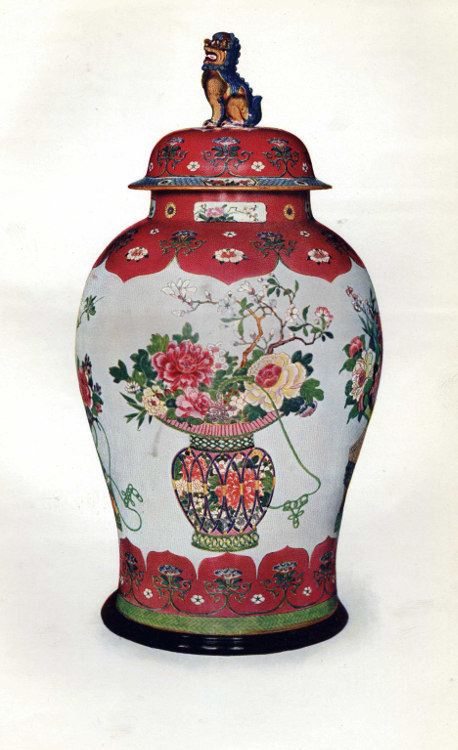
PLATE 120
Covered Jar or potiche painted in famille rose or
“foreign colours” (yang ts’ai) with baskets of flowers: deep
borders of ruby red enamel broken by small panels and floral designs.
On the cover is a lion coloured with enamels on the biscuit. From a set
of five vases and beakers in the collection of Lady Wantage. Late Yung
Chêng period (1723–1735)
Height 34 inches.
The precise nature of the Sung mi sê which is included among
the Ko yao, Chün yao and Hsiang-hu wares reproduced by the Yung
Chêng potters according to the Imperial list is a little doubtful.
Possibly one type was illustrated by the “shallow bowl with spout:
grey stoneware with opaque glaze of pale sulphur yellow,” which Mr.
Alexander exhibited at the Burlington Fine Arts Club in 1910.[416]
Another is indicated in the Pierpont Morgan collection[417] in a
“shallow bowl with greenish yellow crackled glaze,” apparently
of the type found occasionally in Borneo, where such wares are still
treasured by the Dyaks. The vase in the Victoria and Albert Museum
which is figured by Monkhouse (op. cit., Fig. 22) as a specimen of old
mi sê, appears for reasons already given[418] to be a Yung Chêng
reproduction of this type. The “mustard yellow” which Bushell included
under the description mi sê is an opaque crackled enamel which
can hardly have originated before the Yung Chêng period, and it is
possible that it resulted from an attempt to reproduce the old Sung
mi sê crackle.
The following list of the decorations used at the Imperial factory was
compiled by Hsieh Min, the governor of the province of Kiangsi from
1729 to 1734.[419] It was translated by Bushell in his Oriental
Ceramic Art; but reference has been made to it so often in these
pages, and its importance is so obvious, that no apology is necessary
for giving it in full. The following version is taken from the
Chiang hsi t’ung chih, bk. 93, fols. 11 to 13, and in most cases
Bushell’s rendering has been followed:—
1. Glazes of the Ta Kuan period (i.e. Sung Kuan yao) on an
“iron” body, including moon white (yüeh pai), pale blue
or green (fên ch’ing) and deep green (ta lü).**
2. Ko glaze on an “iron” body, including millet colour (mi
sê) and fên ch’ing.**
3. Ju glaze without crackle on a “copper” body: the glaze
colours copied from a cat’s food basin of the Sung dynasty, and
a dish for washing brushes moulded with a human face.
4. Ju glaze with fish-roe crackle on a “copper” body.**
5. White Ting glaze. Only the fên Ting was copied, and
not the t’u Ting.
6. Chün glazes. Nine varieties are given, of which five were
copied from old palace pieces and four from newly acquired
specimens; see p. 000.
7. Reproductions of the chi hung red of the Hsüan Té
period: including fresh red (hsien hung) and ruby red
(pao shih hung).
8. Reproductions of the deep violet blue (chi ch’ing) of
the Hsüan Tê period. This glaze is deep and reddish (nêng
hung), and has orange peel markings and palm eyes.
9. Reproductions of the glazes of the Imperial factory:
including eel yellow (shan yü huang), snake-skin green
(shê p’i lü), and spotted yellow (huang pan tien).
10. Lung-ch’üan glazes: including pale and dark shades.
11. Tung-ch’ing glazes: including pale and dark, shades.
12. Reproductions of the Sung millet-coloured (mi sê)
glaze: copied in form and colour from the fragmentary wares dug
up at Hsiang Hu (q.v.).
13. Sung pale green (fên ch’ing) glaze: copied from wares
found at the same time as the last.
14. Reproduction of “oil green” (yu lü) glaze: “copied
from an old transmutation (yao pien) ware like green
jade (pi yü), with brilliant colour broken by variegated
passages and of antique elegance.”
15. The Chün glaze of the muffle stove (lu chün). “The
colour is between that of the Kuangtung wares and the Yi-hsing
applied glaze[420]; and in the ornamental markings (hua
wên) and the transmutation tints of the flowing glaze it
surpasses them.”
16. Ou’s glazes, with red and blue markings.
17. Blue mottled (ch’ing tien) glazes: copied from old
Kuang yao.
18. Moon white (yüeh pai) glazes. “The colour somewhat
resembles the Ta Kuan glaze, but the body of the ware is white.
The glaze is without crackle, and there are two shades—pale and
dark.”
19. Reproductions of the ruby red (pao shao) of Hsüan Té:
in decoration consisting of (1) three fishes, (2) three fruits,
(3) three funguses, or (4) the five Happinesses (symbolised by
five bats).
20. Reproductions of the Lung-ch’üan glaze with ruby red
decoration of the types just enumerated. “This is a new style of
the reigning dynasty.”
21. Turquoise (fei ts’ui) glazes. Copying three sorts,
(1) pure turquoise, (2) blue flecked, and (3) gold flecked
(chin tien).[421]
22. Soufflé red (ch’ui hung) glaze.
23. Soufflé blue (ch’ui ch’ing) glaze.
24. Reproductions of Yung Lo porcelain: eggshell (t’o
t’ai), pure white with engraved (chui) or embossed
(kung) designs.
25. Copies of Wan Li and Chêng Tê enamelled (wu ts’ai)
porcelain.
26. Copies of Ch’èng Hua enamelled (wu ts’ai) porcelain.
27. Porcelain with ornament in Hsüan Tê style in a yellow ground.
28. Cloisonné blue (fa ch’ing) glaze.[422] “This glaze
is the result of recent attempts to match this colour (i.e. the
deep blue of the cloisonné enamels). As compared with the deep
and reddish chi ch’ing, it is darker and more vividly
blue (ts’ui), and it has no orange peel or palm eye
markings.”
29. Reproductions of European wares with lifelike designs carved
and engraved. “Sets of the five sacrificial utensils, dishes,
plates, vases, and boxes and the like are also decorated with
coloured pictures in European style.”
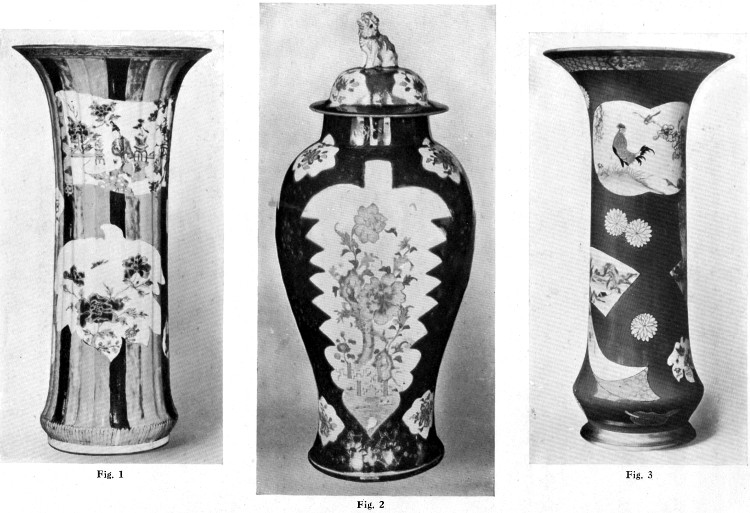
Plate 121.—Two Beakers and a Jar from sets of five,
famille rose enamels. Late Yung Chêng Porcelain.
Fig. 1.—Beaker with “harlequin” ground. Height 15¾ inches. S. E.
Kennedy Collection.
Fig. 2.—Jar with dark blue glaze gilt and leaf-shaped reserves. Height
21½ inches. Burdett-Coutts Collection.
Fig. 3.—Beaker with fan and picture-scroll panels, etc., in a deep
ruby pink ground. Height 14½ inches. Wantage Collection.
30. Reproductions of wares with incised green decoration in a
yellow glaze (chiao huang).
31. Reproductions of yellow-glazed wares: including plain and
with incised ornament.
32. Reproductions of purple brown (tzŭ) glazed wares:
including plain and with incised ornament.
33. Porcelain with engraved ornament: including all kinds of
glazes.
34. Porcelain with embossed (tui) ornament: including all
kinds of glazes.
35. Painted red (mo[423] hung): copying old specimens.
36. Red decoration (ts’ai hung): copying old specimens.
37. Porcelain in yellow after the European style.[424]
38. Porcelain in purple brown (tzŭ) after the European
style.
39. Silvered (mo yin) porcelain.
40. Porcelain painted in ink (shui mo): see p. 214.
41. Reproductions of the pure white (t’ien pai)[425]
porcelain of the Hsüan Tê period: including a variety of wares
thick and thin, large and small.
42. Reproductions of Chia Ching wares with blue designs.
43. Reproductions of Ch’êng Hua pale painted (tan miao)
blue designs.
44. Millet colour (mi sê) glazes. “Differing from the
Sung millet colour.” In two shades, dark and light.
45. Porcelain with red in the glaze (yu li hung):
including (1) painted designs exclusively in red, (2) the
combination of blue foliage and red flowers.[426]
46. Reproductions of lustrous brown (tzŭ chin) glaze:
including two varieties, brown and yellow.
47. Porcelains with yellow glaze (chiao huang) decorated
in enamels (wu ts’ai). “This is the result of recent
experiments.”
48. Reproductions of green-glazed porcelain: including that with
plain ground and with engraved ornament.
49. Wares with foreign colours (yang ts’ai). “In
the new copies of the Western style of painting in enamels
(fa-lang) the landscapes and figure scenes, the flowering
plants and birds are without exception of supernatural beauty
and finish.”[427]
50. Porcelain with embossed ornament (kung hua):
including all kinds of glazes.
51. Porcelain with European (hsi yang) red colour.
52. Reproductions of wu chin (mirror black) glazes:
including those with black ground and white designs and those
with black ground and gilding.
53. Porcelain with European green colour.
54. European wu chin (mirror black) wares.
55. Gilt (mo chin) porcelain: copying the Japanese.
56. Gilt (miao chin)[428] porcelain: copying the Japanese.
57. Silvered (miao yin) porcelain: copying the Japanese.
58. Large jars (ta kang) with Imperial factory (ch’ang
kuan) glazes. “Dimensions: diameter, at the mouth, 3 ft.
4 or 5 in. to 4 ft.; height, 1 ft. 7 or 8 in. to 2 ft. Glaze
colours, (1) eel yellow, (2) cucumber (kua p’i) green,
and (3) yellow and green mottled (huang lü tien).”
This last item, which is not included in Bushell’s list, appears to
be almost a repetition of No. 9, with slightly different phrasing.
Huang lü tien, which is used instead of the difficult phrase
huang pan tien, may perhaps be taken as a gloss on the latter,
indicating that the spots in the mottled yellow were green. In this
case it would appear that the “spotted yellow” was a sort of tiger skin
glaze, consisting of dabs of green and yellow (and perhaps aubergine as
well). Bushell interpreted it in this sense.
CHAPTER XIII CH’IEN LUNG (1736–1795)
The brief reign of Yung Chêng was followed by that of his son, who
ruled under the title of Ch’ien Lung for a full cycle of sixty years,
at the end of which he abdicated in accordance with his vow that he
would not outreign his grandfather, K’ang Hsi. Ch’ien Lung was a
devotee of the arts, and they flourished greatly under his long and
peaceful sway. He was himself a collector, and the catalogue of the
Imperial bronzes compiled under his orders is a classic work; but more
than that, he was personally skilful in the art of calligraphy, which
ranks in China as high as painting; and he was a voluminous poet. It
is no uncommon thing to find his compositions engraved or painted on
porcelain and other artistic materials. Bushell[429] quotes an example
from a snuff bottle in the Walters Collection; there is a bowl for
washing wine cups in the Eumorfopoulos Collection with a descriptive
verse engraved underneath, and entitled, “Imperial Poem of Ch’ien
Lung”; and a beautiful coral red bowl in the British Museum has a
similar effusion pencilled in gold in the interior.
His interest in the ceramic art is further proved by the command given
in 1743 to T’ang Ying to compose a description of the various processes
of manufacture as a commentary on twenty pictures of the industry which
belonged to the palace collections; and one of the earliest acts of his
reign was to appoint the same celebrated ceramist in 1736 to succeed
Nien Hsi-yao in the control of the customs at Huai-an Fu, a post which
involved the supreme control of the Imperial porcelain manufacture.
There is little doubt that T’ang Ying[430] was the most distinguished
of all the men who held this post. He is, at any rate, the one whose
achievements have been most fully recorded. He was himself a prolific
writer, and a volume of his collected works has been published with
a preface by Li Chü-lai. His autobiography is incorporated in the
Chiang hsi t’ung chih; his twenty descriptions of the processes
of porcelain manufacture are quoted in the T’ao shuo and the
T’ao lu, and in themselves form a valuable treatise on Chinese
porcelain; and before taking up his post at Huai-an Fu in 1736 he
collected together, for the benefit of his successors at Ching-tê Chên,
the accumulated notes and memoranda of eight years. This last work is
known as the T’ao ch’êng shih yu kao (“Draughts of Instructions
on the Manufacture of Porcelain”), and the preface[431] quoted in the
Annals of Fou-liang furnishes some interesting details concerning
Tang’s labours. We learn, for instance, that when he was appointed to
the factory at Ching-tê Chên in 1728, he was “unacquainted with the
finer details of the porcelain manufacture in the province of Kiangsi,”
having never been there before. He worked with heart and strength,
however, sleeping and eating with the workmen during a voluntary
apprenticeship of three years, until in 1731 “he had conquered his
ignorance of the materials and processes of firing, and although he
could not claim familiarity with all the laws of transformation, his
knowledge was much increased.”
The commissionership of the customs was transferred in 1739 from
Huai-an Fu to Kiu-kiang, which is close to the point of junction
between the Po-yang Lake and the Yangtze, and considerably nearer to
the Imperial factory at Ching-tê Chên, the control of which remained in
T’ang’s hands until 1749.
The Ching-tê Chên T’ao lu[432] is almost verbose on the subject
of T’ang’s achievements. He had a profound knowledge, it tells us, of
the properties of the different kinds of clay and of the action of
the fire upon them, and he took every care in the selection of proper
materials, so that his wares were all exquisite, lustrous, and of
perfect purity. In imitating the celebrated wares of antiquity he never
failed to make an exact copy, and in the imitation of all sorts of
famous glazes there were none which he could not cleverly reproduce.
There was, in fact, nothing that he could not successfully accomplish.
Furthermore, his novelties[433] included porcelains with the following
glazes and colours: foreign purple (yang tzŭ), cloisonné
blue (fa ch’ing), silvering (mo yin), painting in ink
black (ts’ai shui mo), foreign black (yang wu chin),
painting in the style of the enamels on copper (fa lang),
foreign colouring in a black ground (yang ts’ai wu chin), white
designs in a black ground (hei ti pai hua), gilding on a black
ground (hei ti miao chin), sky blue (t’ien lan), and
transmutation glazes (yao pien). The clay used was white, rich
(jang) and refined, and the body of the porcelain, whether thick
or thin, was always unctuous (ni). The Imperial wares attained
their greatest perfection at this time.
The preface to T’ang’s collected works, which is quoted in the same
passage, singles out as special triumphs of his genius the revival
of the manufacture of the old dragon fish bowls (lung kang)
and of the Chün yao, and the production of the turquoise and rose
(mei kuei) colours in “new tints and rare beauty.” It is obvious
from these passages that T’ang was responsible for many of the types
enumerated in Hsieh Min’s list in the preceding chapter, not only among
the reproductions of antiques but among the new inventions of the
period, such as the cloisonné blue, foreign purple, silvering, painting
in ink black, and foreign black. It follows, then, that these novelties
could not have been made much before 1730, for T’ang was still at that
time occupied chiefly with learning the potter’s art. It is equally
certain that he continued to make a specialty of imitating the older
wares during the reign of Ch’ien Lung, so that we may regard the best
period of these reproductions as extending from 1730–1750.
In reading the list of T’ang’s innovations the reader will perhaps be
puzzled by the varieties of black decoration which are included. Before
attempting to explain them it will be best to review the different
kinds of black found on Chinese porcelain of the Ch’ing dynasty. There
is the high-fired black glaze, with hard shining surface likened to
that of a mirror and usually enriched with gilt traceries. This is
the original wu chin described by Père d’Entrecolles.[434] The
other blacks are all low-fired colours of the muffle kiln applied over
the glaze and ranking with the enamel colours. They include at least
five varieties: (1) The dry black pigment, derived from cobaltiferous
ore of manganese, applied like the iron red without any glassy flux.
(2) The same pigment washed over with a transparent green enamel. This
is the iridescent greenish black of the famille verte, and it
continued in use along with the famille rose colours in the
Yung Chêng and Ch’ien Lung periods and onwards to modern times. (3) A
black enamel in which the same elements—manganese black and copper
green—are compounded together. This is the modern wu chin,
of which a sample in the Sèvres Museum (from the collection of M.
Itier) was described by Julien[435] as “noir mat; minerai de manganese
cobaltifère et oxyde de cuivre avec céruse.” It appears on modern
Chinese porcelain as a sticky greenish black enamel, inferior in depth
and softness to the old composite black of the famille verte;
but for all that, this is the yang wu chin (foreign black) of
the Yung Chêng and Ch’ien Lung periods. In the days of T’ang Ying it
was a far superior colour. (4) A mottled greenish black occurs as a
monochrome and as a ground colour with reserved discs enamelled with
famille rose colours on the exterior of two bowls in the British
Museum, both of which have the cyclical date, wu ch’ên, under
the base, indicating the year 1748 or 1808, probably the latter. (5)
An enamel of similar texture but of a purplish black colour is used on
a snuff bottle in the same collection to surround a figure design in
underglaze blue. This piece has the Yung Chêng mark in red, but from
its general character appears to be of later date.
In the list of T’ang’s innovations there is yang wu chin
(foreign black), which is doubtless the same as the hsi yang wu
chin (European black) of Hsieh Min’s list. It is clear that this
is something different from the old green black of the famille
verte porcelain, and we can hardly be wrong in identifying it with
the wu chin enamel described above in No. 3. Compared with the
original mirror black wu chin glaze this enamel has a dull
surface, and we can only infer that the term wu chin had already
lost its special sense of metallic black, and was now used merely as a
general term for black.
Assuming this inference to be correct, the term yang ts’ai wu
chin (foreign painting in a black ground) should mean simply
famille rose colours surrounded by a black enamel ground of the
type of either No. 2 or No. 3. It is, of course, possible that the
wu chin here is the old mirror black glaze on which enamelling
in famille rose colours would be perfectly feasible; but I do
not know of any example, whereas there is no lack of choice porcelains
answering to the alternative description.
The two remaining types, hei ti pai hua (white decoration in
a black ground) and hei ti miao chin (black ground gilt),
apparently leave the nature of the black undefined, but as the
expressions appear verbatim in the note attached to No. 52 of Hsieh
Min’s list, which is “reproductions of wu chin glaze,” we must
regard the black in this case, too, as of the wu chin type.
The black ground with gilding can hardly refer to anything but the
well-known mirror black glaze with gilt designs; and the white designs
in black ground is equally clearly identified with a somewhat rarer
type of porcelain in which the pattern is reserved in white in a ground
of black enamel of the type of No. 3. There are two snuff bottles in
the British Museum respectively decorated with “rat and vine,” and
figure subjects white with slight black shading and reserved in a
sticky black enamel ground. Both these are of the Tao Kuang period, but
there are earlier and larger examples elsewhere with a black ground of
finer quality. Such a decoration is scarcely possible with anything but
an enamel black, and though there is some inconsistency in the grouping
of an enamel and a glaze together in Hsieh Min’s list, they were
apparently both regarded as “reproductions” of the old mirror black
wu chin.
Out of the remaining innovations ascribed to T’ang’s directorate,
the fa ch’ing (cloisonné or enamel blue) and the fa long
hua fa (painting in the style of the enamels on copper) have
already been described in connection with Hsieh Min’s list. The latter
expression occurs verbatim in the note attached in the Annals of
Fou-liang[436] to No. 49 of the list, which is “porcelain with foreign
colouring,” and it clearly refers to the free painting on the Canton
enamels for reasons already given.[437] It is true that fa lang
(like fo lang, fu lang, and fa lan, all phrases
suggestive of foreign and Western origin) is commonly used in reference
to cloisonné enamel, but the idea of copying on porcelain “landscapes,
figure subjects, flowering plants, and birds” from cloisonné enamels is
preposterous to anyone who is familiar with the cramped and restricted
nature of work bounded by cloisons. It is a pity that Bushell has
confused the issue by rendering this particular passage “painting in
the style of cloisonné enamel” in his Oriental Ceramic Art.[438]
But, it will be objected, the painting in foreign colours has been
already shown to have been in full swing some years before T’ang’s
appointment at Ching-tê Chên. The inconsistency is only apparent,
however, for it is only claimed that T’ang introduced this style of
painting on the Imperial porcelain, and it may—and indeed must—have
been practised in the enamelling establishments at Canton and elsewhere
for some time before. Indeed, when one comes to consider the list of
T’ang innovations which we have discussed so far, they are mainly
concerned with the adaptation of various foreign colours and of
processes already in use in the previous reign.
Of those which remain, the t’ien lan or sky blue may perhaps
be identified with a light blue verging on the tint of turquoise, a
high-fired glaze found occasionally in the Ch’ien Lung monochromes.
But probably the greatest of T’ang’s achievements was the mastery of
the yao pien or furnace transmutation glazes, which were a
matter of chance as late as the end of the K’ang Hsi period. These are
the variegated or flambé glazes in which a deep red of sang
de bœuf tint is transformed into a mass of streaks and mottlings
in which blue, grey, crimson, brown and green seem to be struggling
together for pre-eminence. All these tints spring from one colouring
agent—copper oxide—and they are called into being by a sudden change
of the atmosphere of the kiln, caused by the admission of wood smoke
at the critical moment and the consequent consumption of the oxygen.
Without the transformation the glaze would be a sang de bœuf
red, and in many cases the change is only partial, and large areas
of the deep red remain. Fig. 1 of Plate 123 illustrates a small but
characteristic specimen of the Ch’ien Lung flambé. It will be
found that in contrast with the K’ang Hsi sang de bœuf these
later glazes are more fluescent, and the excess of glaze overrunning
the base has been removed by grinding.
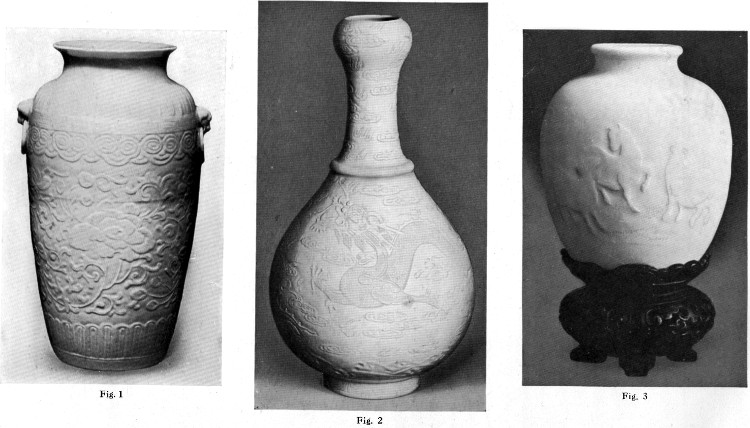
Plate 122.—White Porcelain with designs in low relief.
Fig. 1.—Vase, peony scroll, ju-i border, etc. Ch’ien Lung
period. Height 7 inches. O. Raphael Collection.
Fig. 2.—Bottle with “garlic mouth,” Imperial dragons in clouds. Creamy
crackled glaze imitating Ting ware. Early eighteenth century. Height 9½
inches. Salting Collection.
Fig. 3.—Vase with design of three rams, symbolising Spring. Ch’ien
Lung period. Height 3½ inches. W. Burton Collection.
Another development of the yao pien at this time is the use of a
separate “transmutation” glaze which could be added in large or small
patches over another glaze, and which assumed, when fired, the usual
flambé appearance. When judiciously applied the effect of this
superadded flambé was very effective, but it is often used in
a capricious fashion, with results rather curious than beautiful. There
are, for instance, examples of blue and white vases being wholly or
partially coated with flambé, which have little interest except
as evidence that the potters could now produce the variegated effect at
will and in more ways than one.
The use of double glazes to produce new and curious effects is
characteristic of the period. The second glaze was applied in various
ways by blowing, flecking, or painting it over the first. The Chün
glaze of the muffle kiln belongs to this type if it has, as I think,
been correctly identified with the blue green dappled with crimson on
Fig. 4 of Plate 128; and the bird’s egg glazes mentioned on p. 217
belong to the same class.[439] Others of a similar appearance, though
not necessarily of the same technique, are the tea dust (ch’a yeh
mo) and iron rust (t’ieh hsiu).
The tea dust glaze has a scum of dull tea green specks over an ochreous
brown or bronze green glaze, applied either to the biscuit or over an
ordinary white glazed porcelain; and it seems to have been a speciality
of the Ch’ien Lung period, though there are known specimens with the
Yung Chêng mark and many fine examples were made in later reigns. But
neither this glaze nor double glazes in general are inventions of
this time. It would be more correct to speak of them as revivals, for
the early Japanese tea jars, which are based on Chinese originals,
illustrate the principle of the double glaze, and there are specimens
of stoneware as old as the Sung if not the T’ang dynasty, with dark
olive glaze flecked with tea green, and scarcely distinguishable
from the Ch’ien Lung tea dust. It is stated on the authority of M.
Billequin (see Bushell, O. C. A., p. 518) that a “sumptuary law
was made restricting the use of the tea dust glaze to the Emperor, to
evade which collectors used to paint their specimens with imaginary
cracks,[440] and even to put in actual rivets to make them appear
broken.”
The iron rust is a dark lustrous brown glaze strewn with metallic
specks (due to excess of iron), and in the best examples clouded
with passages of deep red. But these are only two examples of skill
displayed by the Ch’ien Lung potters in imitating artistic effects in
other materials. Special success was attained in reproducing the many
tints of old bronze and its metallic surface. Bright-coloured patina
was suggested by touches of flambé, and the effects of gilding
or gold and silver inlay were rendered by the gilder’s brush. The
appearance of inlaid enamels was skilfully copied. “In fact,” to quote
from the T’ao shuo,[441] “among all the works of art in carved
gold, embossed silver, chiselled stone, lacquer, mother-of-pearl,
bamboo and wood, gourd and shell, there is not one that is not now[442]
produced in porcelain, a perfect copy of the original piece.” Nor is
this statement much exaggerated, for I have seen numerous examples in
which grained wood, red lacquer, green jade, bronze, and even mille
fiori glass have been so closely copied that their real nature was
not detected without close inspection.
Reverting to T’ang’s achievements, we find special mention made of
the reproductions of Chün yao which have been already discussed in
detail,[443] and of the revived manufacture of the large dragon fish
bowls. The latter are the great bowls which caused such distress
among the potters in the Wan Li period. They are described in the
T’ao lu[444] as being fired in specially constructed kilns, and
requiring no less than nineteen days to complete their baking. The
largest size is said to have measured 6 ft.[445] in height, with a
thickness of 5 in. in the wall, one of them occupying an entire kiln.
The old Ming dragon bowl found by T’ang Ying[446] at the factory was
one of the smaller sizes, and measured 3 ft. in diameter and 2 ft. in
height. They were intended for the palace gardens for keeping gold-fish
or growing water-lilies, and the usual decoration consisted of Imperial
dragons. They are variously described as lung kang (dragon
bowls), yü kang (fish bowls), and ta kang (great bowls).
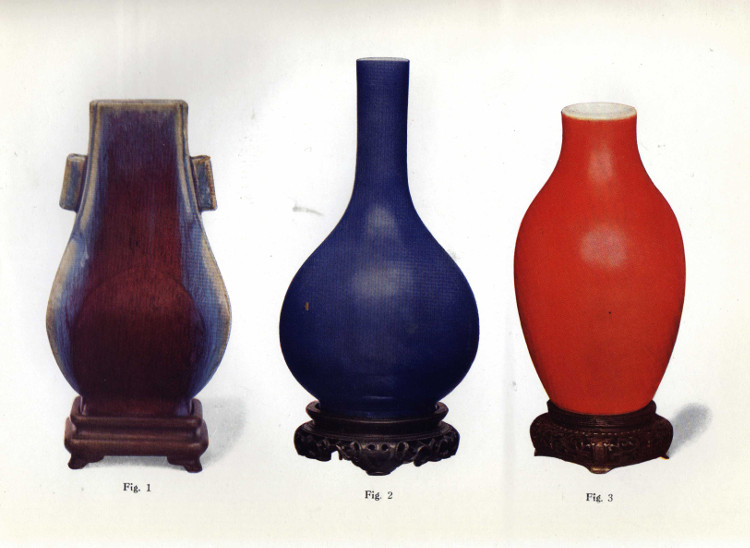
PLATE 123
Eighteenth Century Glazes
Fig. 1.—Square Vase with tubular handles, and apricot-shaped
medallions on front and back. Flambé red glaze. Ch’ien Lung
period (1736–1795). Height 6¾ inches.
British Museum.
Fig. 2.—Bottle-shaped Vase with deep blue (ta ch’ing) glaze:
unglazed base. Early eighteenth century. Height 15¾ inches.
British Museum.
Fig. 3.—Vase with fine iron red enamel (mo hung) on the
exterior. Ch’ien Lung period (1736–1795). Height 5 inches.
Salting Collection (V. & A. Museum).
Owing to the tremendous difficulty of firing these huge vessels the order
for their supply in the reign of Shun Chih was eventually cancelled,
and no attempt was made to resume their manufacture until T’ang’s
directorate. The usual fish bowl of the K’ang Hsi period is a much
smaller object, measuring about 20 in. (English) in diameter by 1
ft. in height; but from the note appended to Hsieh Min’s list in the
Chiang hsi t’ung chih on the Imperial ta kang, it appears
that already (about 1730) the manufacture had been resumed on the old
scale,[447] for the dimensions of those described are given as from 3
ft. 4 or 5 in. to 4 ft. in diameter at the mouth, and from 1 ft. 7 or
8 in. to 2 ft. in height. An example of intermediate size is given on
Plate 133, one of a pair in the Burdett-Coutts Collection measuring 26½
in. in diameter by 20 in. in height.
It remains to notice two glaze colours to which T’ang Ying appears to
have paid special attention: the fei ts’ui (turquoise) and the
mei kuei (rose colour). The former has already been dealt with
in connection with Ming, K’ang Hsi, and Yung Chêng porcelain, and it is
only necessary to add that it occurs in singularly beautiful quality
on the Ch’ien Lung porcelains, often on vases of antique bronze form,
but fashioned with the unmistakable “slickness” of the Ch’ien Lung
imitations. Occasionally this glaze covers a body of reddish colour
due to admixture of some coarser clay, which seems to have assisted
the development of the colour, and it is worthy of note that there
are modern imitations on an earthen body made at the tile works near
Peking which, thanks to the fine quality of their colour, are liable
to be passed off as old. I have noticed that Ch’ien Lung monochrome
vases—especially those which have colours of the demi-grand feu
like the turquoise—are often unglazed under the base. The foot is very
deeply cut, and the biscuit is bare or skinned over with a mere film of
vitreous matter, which seems to be an accidental deposit.
The mei kuei is the colour of the red rose (mei kuei
hua), and it is obviously to be identified with the rose carmines
derived from gold which were discussed in the last chapter. These tints
are found in considerable variety in the early Ch’ien Lung porcelains,
from deep crimson and scarlet or rouge red to pale pink, and they are
used as monochromes, ground colours, and in painted decoration. A
superb example of their use as ground colour was illustrated on the
border of Plate 120, which is probably a Yung Chêng piece. Among the
gold red monochromes of the the Ch’ien Lung period one of the most
striking is a dark ruby pink with uneven surface of the “orange peel”
type. Mr. S. E. Kennedy has a remarkable series of these monochromes in
his collection.
Speaking generally, the Ch’ien Lung monochromes repeat the types in
vogue in the previous reigns of the dynasty with greater or less
success. Among the greens, the opaque, crackled glazes of pea, apple,
sage, emerald, and camellia leaf tints described on p. 187 were a
speciality of the time, and the snake-skin and cucumber tints were also
made with success. There were, besides, beautiful celadon glazes of
the grand feu, and an opaque enamel of pale bluish green eau
de nil tint. Underglaze copper red was used both for monochromes
and painted wares, but with the exception of the liver or maroon
colour the former had not the distinction of the K’ang Hsi sang de
bœuf or the Yung Chêng soufflé red. There is a jug-shaped
ewer with pointed spout in the British Museum which has a fluescent
glaze of light liver red deepening into crimson, and known in Japan as
toko. It has the Hsüan Tê mark, but I have seen exactly similar
specimens with the mark of Ch’ien Lung, to which period this colour
evidently belongs. On the other hand, great improvement is observable
in the overglaze coral red monochrome derived from iron, whether it
be the thin lustrous film of the mo hung or the richly fluxed
“jujube” red which attains the depth and fullness of glaze. Fig. 3,
Plate 123, is a worthy example of the iron red monochrome of the
period. As a thick, even and opaque colour this enamel was used in
small pieces which wonderfully simulate the appearance of red cinnabar
lacquer.
An endless variety of blue glazes were used, the pure blue in dark and
light shades, soufflé or plain, the purplish blues and violets,
the lavenders and clair de lunes. These are mainly high-fired
glazes, but a favourite blue of this period is a deep purplish blue
of soft, fluescent appearance and minutely crackled texture which is
evidently a glaze of the demi-grand feu. The “temple of heaven”
blue is of this nature, though of a purer and more sapphire tint. It
is the colour of the ritual vessels used in the worship of heaven and
of the tiles with which the temple was roofed. Another variety of
this glaze has the same tint, but is harder and of a bubbly, pinholed
texture, apparently a high-fired colour. The t’ien ch’ing (sky
blue) has already been mentioned—a lighter colour between lavender
and turquoise. And among the blue enamels which were sometimes used as
monochromes at this time is an opaque deep blue of intense lapis lazuli
tone.
Among the yellows, in addition to the transparent glazes of the older
type, there are opaque enamels, including the lemon yellow with rough
granular texture, the waxen[448] sulphur yellow which often displays
lustrous patches, and the crackled mustard yellow.
Among the purples and browns there are few changes to note, though
much of the greenish brown crackle probably belongs to this time; and
there is little to be said about the white wares except that both the
true porcelain, whether eggshell or otherwise, and the opaque crackled
wares of the Ting yao type were still made with exquisite refinement
and finish. The uneven glaze surface, happily compared to “orange
peel,” was much affected on the Ch’ien Lung whites in common with many
other wares of the time. But there were many new enamel monochromes
formed by blending the famille rose colours, shades of opaque
pink, lavender, French grey, and green, which are sometimes delicately
engraved with close scroll patterns all over the surface, a type which
is known by the clumsy name of graviata. These enamel grounds
are often interrupted by medallions with underglaze blue or enamelled
designs, as on the vase illustrated in Plate 125, Fig. 4, and on the
so-called Peking bowls; or, again, they are broken by reserved floral
designs which are daintily coloured in famille rose enamels.
But we are already drifting from the monochromes into the painted
porcelains of the period, and we shall return to the Peking bowls
presently.
With regard to the Ch’ien Lung blue and white, little need be added
to what was said of this kind of ware in the last chapter. It was
still made in considerable quantity, and T’ang Ying, in his twenty
descriptions of the manufacture of porcelain, supplies a commentary to
three pictures[449] dealing with the “collection of the blue material,”
“the selection of the mineral,” and “the painting of the round ware
in blue.” From these we learn that large services were made in blue
and white, and the decoration was still rigidly subdivided, one set
of painters being reserved for the outlining of the designs and
another for filling them in, while the plain blue rings were put on
by the workman who finished the ware on the polishing wheel, and the
inscriptions, marks and seals were added by skilful calligraphers. The
blue material was now obtained in the province of Chêkiang, and close
attention was paid to the selection of the best mineral. There was one
kind of blue “called onion sprouts, which makes very clearly defined
strokes, and does not run in the fire, and this must be used for the
most delicate pieces.” This latter colour is to be looked for on the
small steatitic porcelains and the fine eggshell cups.
In common with the other Ch’ien Lung types, the blue and white vases
are often of archaic bronze form, and decorated with bronze patterns
such as borders of stiff leaves, dragon feet and ogre heads. Another
favourite ornament is a close pattern of floral scrolls studded with
lotus or peony flowers, often finely drawn but inclined to be small
and fussy. These scrolls are commonly executed in the blotchy blue
described on p. 13, and the darker shades are often thickly heaped up
in palpable relief with a marked tendency to run into drops. On the
other hand, one sometimes finds the individual brush strokes, as it
were, bitten into the porcelain body, and almost suggesting scratched
lines. Both peculiarities, the thick fluescent blue and the deep brush
strokes, are observable on a small vase of unusually glassy porcelain
in the Franks Collection. Two other pieces in the same collection may
be quoted. One is a tazza or high-footed bowl with a band of Sanskrit
characters and deep borders of close lotus scrolls, very delicately
drawn in a soft pure blue, to which a heavily bubbled glaze has given a
hazy appearance. This piece (Plate 93, Fig. 1) has the six characters
of the Ch’ien Lung seal-mark in a single line inside the foot. The
other is a jar which bears the cyclical date corresponding to 1784.
Like the last, it has a decoration of Buddhistic import, viz. the four
characters  t’ien chu ên po (propitious waves from
India), each enclosed by formal cloud devices. It is painted in a soft
but rather opaque blue, and the glaze is again of bubbly texture.
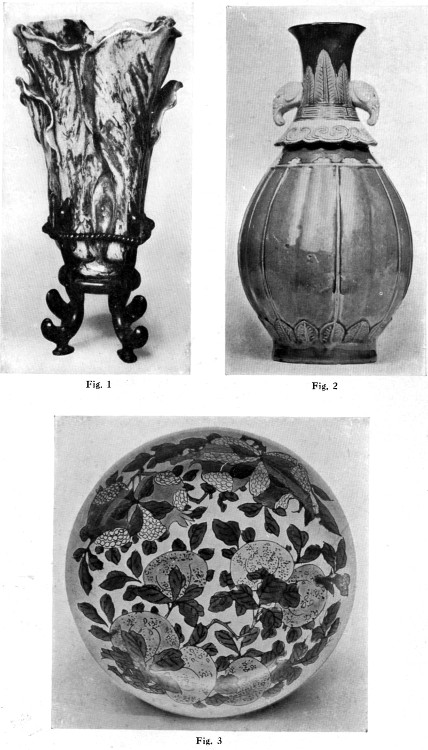
Plate 124.—Miscellaneous Porcelain.
Fig. 1.—Magnolia Vase with flambé glaze of crackled lavender
with red and blue streaks. Ch’ien Lung period. Height 7 inches.
Alexander Collection.
Fig. 2.—Bottle with elephant handles, yellow, purple, green and white
glazes on the biscuit. Ch’ien Lung period. Height 8¼ inches. British
Museum.
Fig. 3.—Dish with fruit design in lustrous transparent glazes on the
biscuit, covering a faintly etched dragon pattern. K’ang Hsi mark.
Diameter 9⅞ inches. British Museum.
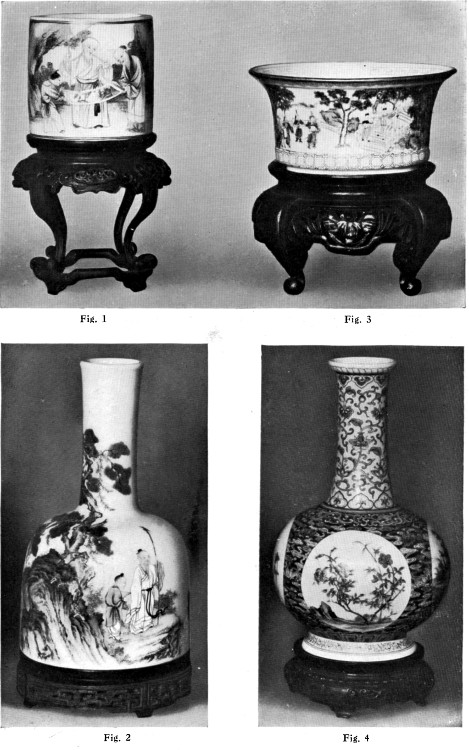
Plate 125.—Ch’ien Lung Wares. Hippisley Collection.
Fig. 1.—Brush Pot of enamelled Ku-yüeh-hsüan glass. Ch’ien Lung mark.
Height 2⅜ inches.
Fig. 2.—Bottle, porcelain painted in Ku-yüeh style, after a picture by
the Ch’ing artist Wang Shih-mei. Height 7 inches.
Fig. 3.—Imperial Presentation Cup marked hsü hua t’ang chih
tsêng. Height 2 inches.
Fig. 4.—Medallion Vase, brocade ground with bats in clouds, etc.
Ch’ien Lung mark. Height 7¼ inches.
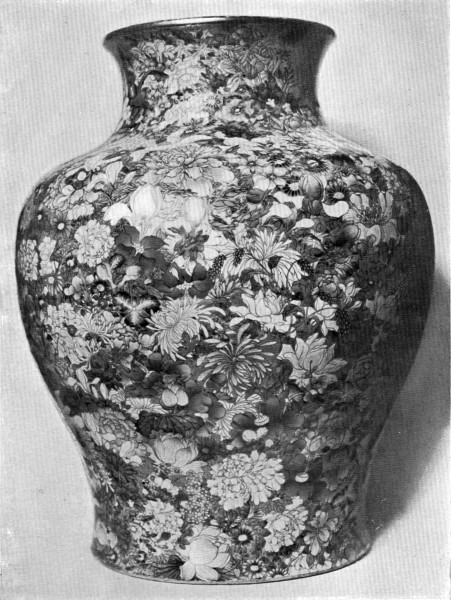
Plate 126.—Vase with “Hundred Flower” design in
famille rose enamels.
Ch’ien Lung period (1736–1795). Height 19¼ inches. Grandidier
Collection (The Louvre).
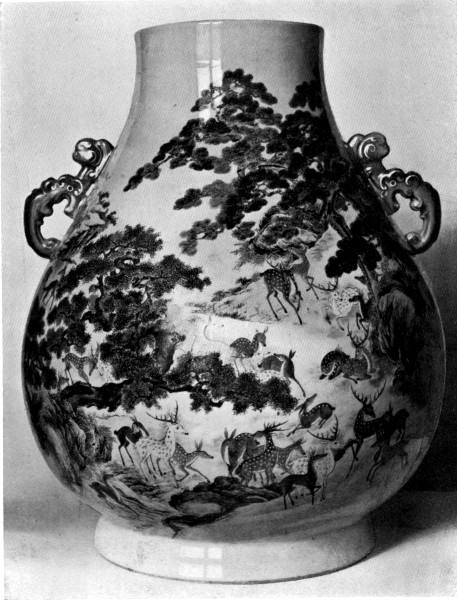
Plate 127.—Vase painted in mixed enamels. The Hundred
Deer. Grandidier Collection (Louvre).
Late Ch’ien Lung period. Height 18 inches.
In the commoner types of Ch’ien Lung blue and white, the blue is
usually of a dullish indigo tint, wanting in life and fire. There is,
in fact, none of the character of the K’ang Hsi ware; the broad washes,
the clear trembling sapphire, and the subtle harmony existing between
the glaze and blue, are all missing. Moreover, the decoration, with its
careful brushwork and neat finish, has none of the freedom and
breadth of the older types. On the whole, it is small wonder that the
collector finds little to arouse enthusiasm in the blue and white of
this period, if we except the steatitic[450] or “soft pastes,” which
are eagerly acquired.
Underglaze red painting, and the same in combination with blue or with
high-fired glazes and coloured slips, celadon, white, golden brown,
olive brown and coffee brown, were perpetuated from the previous
reigns; and underglaze blue designs are found accompanied by yellow
or coral red enamel grounds in old Ming style, and even by famille
rose painting.
Decoration in transparent glazes of three colours—green, yellow and
aubergine—applied direct to the biscuit is not common on Ch’ien Lung
porcelain, but when used it displays the characteristic neatness and
finish of the period. I suspect that many of the trim rice bowls with
neatly everted mouth rim and dragon designs etched in outline and
filled in with aubergine in a green ground, yellow in an aubergine,
or the other combinations of the three colours, belong to this reign,
in spite of the K’ang Hsi mark under the base. At any rate, the body,
glaze and form can be exactly paralleled in other bowls which have a
Ch’ien Lung mark.
This criticism applies equally to a striking group of porcelain of
which Fig. 3 of Plate 124 is an example. It consists of bowls and
dishes, so much alike in decoration that one might suppose all existing
examples to be parts of some large service. The body is delicately
engraved with five-clawed dragons pursuing pearls, and somewhat
inconsequently over these are painted large and boldly designed
flowering sprays (rose, peony, etc.) or fruiting pomegranate branches
with black outlines filled in with fine, transparent aubergine, full
yellow and green in light and dark shades. The remaining ground space
is coated with the thin greenish wash which does duty for white in this
colour scheme, but in these particular pieces it is unusually lustrous
and iridescent. In fact, on the back of a dish in the British Museum it
has developed patches of golden lustre of quite a metallic appearance
and similar to those noted on the sulphur yellow monochrome described
on p. 239. This lustrous appearance, however, is probably no
more than an exaggerated iridescence, for there is no reason to suppose
that the Chinese ever used metallic lustre of the Persian or European
kind.[451] This group of porcelain always bears the K’ang Hsi mark, but
a comparison with the bowls of later date, both in material and in the
general finish of the ware and the style of the colouring, irresistibly
argues a later period of manufacture, unless, indeed, we admit that the
Imperial bowls of the late K’ang Hsi and the Ch’ien Lung periods are
not to be differentiated. The finish of these wares, in fact, compares
more closely with that of the finer Tao Kuang bowls than with the
recognised types of K’ang Hsi porcelain.
Another kind of on-biscuit decoration of the Ch’ien Lung—and perhaps
the Yung Chêng—period is best described from a concrete example, viz.,
Fig. 2 of Plate 124, a pear-shaped bottle in the British Museum with
sides moulded in shallow lobes, an overlapping frill or collar with
scalloped outline on the neck, and above this two handles in shape of
elephants’ heads. The ground colour is a deep brownish yellow relieved
by borders of stiff leaves with incised outline filled in with smooth
emerald green; and the collar and handles are white with cloud scroll
borders of pale aubergine edged with blue. The general colouring, as
well as the form of this vase, is closely paralleled in fine pottery of
the same period.
It may be added that famille rose enamels are sometimes used
in on-biscuit polychrome decoration, but the effect is not specially
pleasing. Some of the opaque colours serving as monochromes are also
applied in this way, but here the absence of a white glaze beneath is
scarcely noticeable, owing to the thickness and opacity of the enamels.
But all the other forms of polychrome decoration at this period must
yield (numerically, at any rate) to the on-glaze painting in famille
rose enamels, or, as the Chinese have named them, “foreign
colours.” The nature of these has been fully discussed, but there is
no doubt that their application was widely extended in the Ch’ien Lung
period, and one point of difference, at least, is observable in their
technique, viz. the mixing of the tints in the actual design so as to
produce the European effect of shading. By this means the graded tints
in the petals of a flower, and the stratified surface of rocks and
mountains, are suggestively rendered.
It would be impossible to enumerate the endless varieties of design
employed in this large group. Contrasting the decoration of his own
time with that of the Ming porcelain, the author of the T’ao
shuo,[452] which was published in 1774, says: “Porcelain painted
in colours excelled in the Ming dynasty, the majority of the patterns
being derived from embroidery and brocaded satins, three or four only
out of each ten being from nature and copies of antiques. In modern
porcelain, out of ten designs you will get four of foreign colouring,
three taken from nature, two copies of antiques, one from embroidery or
satin brocade.”
In their ordinary acceptation the terms are not mutually exclusive, and
the last three types might be, and indeed are, all expressed in foreign
colouring; but presumably the writer refers especially to that kind of
“foreign colouring” which was directly based on the Canton enamels and
is illustrated in the ruby-back eggshell dishes.
The designs taken from nature would include figure subjects
representing personages and interiors, landscapes, growing flowers and
fruit, and the like, good examples of which are shown on Plates 126 and
127. The one represents the “Hundred Flowers,” the vase being, as it
were, one great bouquet and the flowers being drawn naturalistically
enough to be individually recognised. The other recalls the
celebrated picture of the “Hundred Deer” by the late Ming artist, Wên
Chêng-ming.[453]
The copies of antiques would comprise bronze patterns and designs
borrowed from old porcelain, examples of which are not uncommon. And
the brocade patterns, in spite of the low proportion assigned to them
in the T’ao shuo, occur in relatively large numbers in Western
collections. They mostly consist of flowers or close floral scrolls
in colour, and reserved in a monochrome ground of yellow, blue, pink,
etc. This is the characteristic Ch’ien Lung scroll work which is used
both in borders and over large areas such as the exterior of a bowl
or the body of a vase. The reserved pattern, highly coloured and
winding through a ground of solid opaque enamel, suggests analogy with
the scroll grounds of the contemporary cloisonné enamel; but this
incidental likeness has nothing to do with the question of “painting in
fa lang style,” which was discussed among T’ang’s innovations.
The finer Ch’ien Lung porcelains, and especially those enamelled with
brocade designs, are frequently finished off with a coating of opaque
bluish green enamel inside the mouth and under the base, a square panel
being reserved for the mark. Needless to say, with all this weight of
enamelling little or nothing is seen of the porcelain itself, the fine
quality of which is only indicated by the neatness of the form and the
elegance of the finish.
The green black which was discussed earlier in the chapter is used with
striking effect, both in company with famille rose colours (as
on Fig. 2 of Plate 131) and without them. An effective decoration of
the latter kind is shown on a beautiful bottle-shaped vase with wide,
spreading mouth in the Salting Collection, which is covered with close
floral scrolls reserved in a ground of black pigment, the whole surface
being washed over with transparent green. The result is a peculiarly
soft and rich decoration of green scrolls in a green black ground.
Nor was the iron red—a colour much employed in monochromes at this
time—neglected in the painted wares. Indeed, it occurs as the sole
pigment on many pieces, and on others it forms a solid brick red or
stippled soufflé ground for floral reserves, medallions and
panels of famille rose enamelling.
Among the opaque enamels a few shades of blue are similarly used, while
the others, as already mentioned, form plain or engraved backgrounds
for floral reserves and panel decoration as on Fig. 2 of Plate 125,
and on the Peking bowls. The latter are so named not because they
were made at Peking, but because the specimens acquired by Western
collectors have been chiefly obtained from that source. Many of them
have the Ch’ien Lung mark, and their ground colours comprise a variety
of pinks, yellow, green, French grey, dark blue, slaty blue, amaranth,
lavender, bluish green,[454] delicate greenish white and coral red.
The medallions on the bowls—usually four in number—are commonly
decorated with growing flowers, such as the flowers of the four seasons
in polychrome enamels, while others have figure subjects, frequently
European figures in landscape setting and with Chinese attributes, such
as a ju-i or ling-chih fungus. The finish of these bowls
is extremely fine, and they are well worthy of the Imperial use to
which they were mostly destined.
The mention of a delicate greenish white enamel on these medallion
bowls reminds us that this colour is used with exquisite effect for
borders of floral design, or even for the main decoration of tea
and coffee wares; and there is a little plate in the British Museum
with Ch’ien Lung mark on which it appears with a peculiar chilled or
shrivelled surface as a background for painted designs in iron red.
There is a large class of enamelled porcelain, doubtless made chiefly
for export, which found its way into our country houses in the last
half of the eighteenth century. It is painted with panels of figure
subjects in which rose pink and iron red are uncompromisingly blended,
and the space surrounding the panels is filled with composite designs
of blue and white with passages of pink scale diaper or feathery
gilt scrolls broken by small vignettes in which a bird on a bough,
insects, growing plants or fragments of landscape are painted in
camaieu pink, red or sepia. In some cases the panels are framed
with low, moulded reliefs, which extend into the border spaces, and the
groundwork in these parts is powdered with tiny raised dots. The wares
include large punch bowls, bottle-shaped ewers with their basins, and
sets of five vases, two of which are beakers and three covered jars
with lion knobs, ovoid or square, and sometimes of eggshell thinness.
Others again have their panels enclosed by wreaths of flowers and
foliage or “rat and vine pattern” in full relief, and many of them
have a glaze of lumpy, “orange peel” texture. The name “Mandarin” has
been given to these wares because the central figure subjects usually
contain personages in official dress; and the large punch bowls
brought back by the tea-merchants are included in this group, though
the mandarin figures in the panels are in this case often replaced by
European subjects.
Elaborately moulded and pierced ornament coloured in famille
rose enamels often appears on the table ware of this period, a
familiar example being the lotus services in which the motive of
the pink lotus flower is expressed partly by moulding and partly by
painting, the tendrils and buds being utilised for feet and handles;
and there are elegant famille rose teapots which have outer
casings with panels of prunus, bamboo and pine carved in openwork in
the style of the Yi-hsing pottery.
Gilding was, of course, freely employed, and, to a lesser extent,
silvering. Elaborate gilt patterns are found covering dark blue,
powder blue, lustrous black, bronze green, pale celadon, and iron red
monochrome grounds; and the finer enamelled vases and bowls are often
finished off with gilt edging, which does not seem to have been much
used before this period, though traces of gilding are sometimes seen on
the lustrous brown edges of the older plates and bowls.
The manual dexterity of the Ch’ien Lung potters is shown in openwork
carving and pierced designs on lanterns, perfume boxes, insect cages,
spill vases, etc., but more especially on the amazing vases with
free-working belts, revolving necks, or decorated inner linings which
can be turned round behind a pierced outer casing, chains with movable
links, and similar tours de force.
There are, beside, two types of ornament dating from this period which
demand no little manual skill. These are the lacework and rice grain.
In the former the design is deeply incised in the body and the whole
covered with a pale celadon green glaze, and it is usually applied to
small vases and tazza-shaped cups, the pattern consisting of close and
intricate Ch’ien Lung scrollwork. The resultant effect is of a very
delicate green lace pattern, which appears as a partial transparency
when held to the light (Plate 128, Fig. 2). The rice-grain ornament
carries the same idea a step farther, for the incised pattern is cut
right through the body, leaving small perforations to be filled up by
the transparent glaze. Only small incisions could be made, and these
generally took the lenticular form which the French have likened to
grains of rice (Plate 128, Fig. 1). The patterns made in this fashion
are naturally limited. Star-shaped designs or flowers with radiating
petals are the commonest, though occasionally the transparencies are
made to conform to the lines of painted decoration and even of dragon
patterns.
Both ordinary and steatitic porcelain are used for this treatment; and
the ware is either plain white or embellished with underglaze blue
borders and designs, and occasionally with enamels. The effect is light
and graceful, especially when transmitted light gives proper play to
the transparencies.
As to the antiquity of this decoration in China, I can find no evidence
of its existence before the eighteenth century, and I am inclined to
think it was even then a late development. There are two cups in the
Hippisley Collection with apocryphal Hsüan Tê dates, but the majority
of marked examples are Ch’ien Lung or later. Out of fourteen pieces in
the Franks Collection five have the Ch’ien Lung mark, two have palace
marks of the Tao Kuang period,[455] and one has a long inscription
stating that it was made by Wang Shêng-Kao in the fourth month of
1798.[456] The rest are unmarked. The manufacture continues to the
present day, and the same process has been freely used in Japan, where
it is called hotaru-de, or firefly decoration. In this type of
ornament the Chinese were long forestalled by the potters of Western
Asia, for the rice-grain transparencies were used with exquisite effect
in Persia and Syria in the twelfth century if not considerably earlier.
It remains to mention a species of decoration which is not strictly
ceramic. It consists of coating the porcelain biscuit with black
lacquer in which are inlaid designs in mother-of-pearl, the lac
burgauté of the French (Plate 128, Fig. 3). This porcelain is known
by the French name of porcelaine laquée burgautée, and it seems
to have been originally a product of the Ch’ien Lung period; at any
rate, I can find no evidence of its existence before the eighteenth
century.
In the Ch’ien Lung period Chinese porcelain reaches the high-water
mark of technical perfection. The mastery of the material is complete.
But for all that the art is already in its decline. By the middle of
the reign it is already overripe, and towards the end it shows sure
signs of decay. At its best the decoration is more ingenious than
original, and more pretty than artistic. At its worst it is cloying
and tiresome. The ware itself is perfectly refined and pure, but
colder than the K’ang Hsi porcelain. The famille rose painting
is unequalled at its best for daintiness and finish, but the broken
tints and miniature touches cannot compare in decorative value with the
stronger and broader effects of the Ming and K’ang Hsi brushwork. The
potting is almost perfect, but the forms are wanting in spontaneity;
and the endless imitation of bronze shapes becomes wearisome, partly
because the intricate forms of cast metal are not naturally suited to
the ceramic material, and partly because the elaborate finish of the
Ch’ien Lung wares makes the imitation of the antique unconvincing. In
detail the wares are marvels of neatness and finish, but the general
impression is of an artificial elegance from which the eye gladly
turns to the vigorous beauty of the earlier and less sophisticated
types.
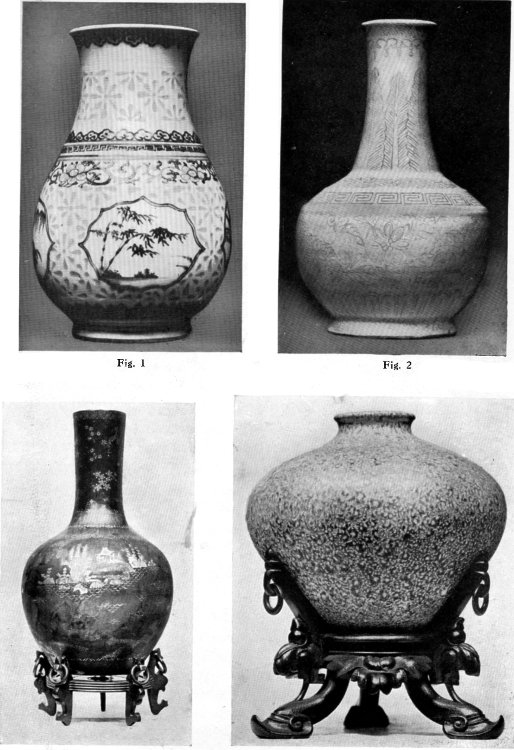
Plate 128.—Ch’ien Lung Porcelain. British Museum.
Fig. 1.—Vase with “rice grain” ground and blue and white design.
Height 7¾ inches.
Fig. 2.—Vase with “lacework” designs. Ch’ien Lung mark. Height 7¾
inches.
Fig. 3.—Vase with the Seven Worthies of the Bamboo Grove in lac
burgauté. Height 14½ inches.
Fig. 4.—Vase with “robin’s egg” glaze. Height 4⅛ inches.
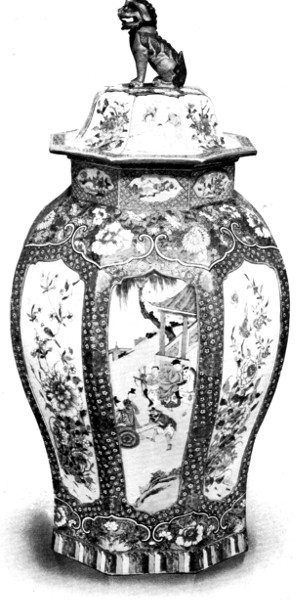
Plate 129.—Octagonal Vase and Cover, painted in
famille rose enamels. Ch’ien Lung period (1736–1795).
Height 35 inches. One of a pair in the Collection of Dr. A. E.
Cumberbatch.
As already mentioned, T’ang Ying was commanded by the Emperor in 1743
to arrange and explain twenty pictures of the manufacture of porcelain
which were sent to him from the palace. In twelve days he completed
the descriptions which have since been incorporated in various books
on porcelain, including the T’ao shuo and the T’ao lu.
They have been translated by Julien[457] and by Bushell,[458] and
as most of their facts have been embodied in the previous pages, it
would be superfluous to give a verbatim translation of them. The
following summary, however, will give the drift of them, and Bushell’s
translation of the T’ao shuo can be consulted for a full
rendering.
Illustration
| I.— |
Collection of the Stones and Fabrication of the Paste. |
|
The porcelain stone (petuntse) was obtained at this time
from Ch’i-mên, in the province of Kiangnan. “That of pure
colour and fine texture is used in the manufacture of bowls
and vases of eggshell (t’o-t’ai), pure white (t’ien
pai), and blue and white porcelain.” Other earths, including
kaolin, were mined within the limits of Jao-chou Fu. |
| II.— |
Washing and Purification of the Paste. |
| III.— |
Burning the Ashes and Preparing the Glaze. |
|
The ashes of burnt lime and ferns were mixed with
petuntse in varying proportions to form the glazing
material. |
| IV.— |
Manufacture of Seggars. |
|
The seggars, or fireclay cases, by which the porcelain was
protected in the kiln were made of a coarse clay from Li-ch’un,
near Ching-tê Chên, and we are told that the seggar-makers also
manufactured rough bowls for the use of the workmen from the
same material. |
| V.— |
Preparing the Moulds for the Round Ware. |
| VI.— |
Fashioning the Round Ware on the Wheel. |
| VII.— |
Fabrication of the Vases (cho ch’i). |
| VIII.— |
Collection of the Blue Colour. |
|
The mineral was obtained at this time from Shao-hsing and
Chin-hua in Chêkiang. |
| IX.— |
Selection of the Blue Material. |
| X.— |
Moulding the Paste and Grinding the Colours. |
| XI.— |
Painting the Round Ware in Blue. |
| XII.— |
Fabrication and Decoration of Vases. |
| XIII.— |
Dipping the Ware into the Glaze or Blowing the Glaze on to it. |
|
Three methods of glazing are described: the old method of
painting the glaze on with goat’s-hair brush; dipping the ware
into a large jar of glaze; and blowing on the glaze with a
bamboo tube covered at the end with gauze. |
| XIV.— |
Turning the Unbaked Ware and Hollowing out the Foot. |
|
This turning or polishing was done on a wheel. For convenience
of handling the foot of the vessel was left with a lump of clay
adhering until all the processes, except firing, were complete;
the foot was then trimmed and hollowed out, and the mark painted
underneath. |
| XV.— |
Putting the Finished Ware into the Kiln. |
| XVI.— |
Opening the Kiln when the Ware is Baked. |
| XVII.— |
Decorating the Round Ware and Vases in Foreign
Colouring. See p. 242. |
| XVIII.— |
The Open Stove and the Closed Stove. |
|
Two types of small kiln used to fire the on-glaze enamels. |
| XIX.— |
Wrapping in Straw and Packing in Casks. |
| XX.— |
Worshipping the God and Offering Sacrifice. |
There are a few illustrations appended to the T’ao lu which
cover much the same field, but they are roughly drawn. A much better
set of coloured pictures is exhibited in frames in the Franks
Collection in the British Museum, showing most of the processes
described by T’ang.
CHAPTER XIV EUROPEAN INFLUENCES IN THE CH’ING DYNASTY
Hitherto the references to European influence on Chinese porcelain
have been of an incidental nature. But the use of Western designs on
the porcelains of the Ch’ing dynasty, and especially in the eighteenth
century, attained such large proportions that it is necessary to
treat the wares so decorated as a class apart. A highly instructive
collection of this type of porcelain is exhibited in the British
Museum, where it has been subdivided in groups illustrating porcelain
painted in China with European armorial designs, porcelain painted in
China after pictures, engravings and other patterns of European origin,
European forms in Chinese porcelain, and, lastly, Chinese porcelain
decorated in Europe.
The un-Chinese nature of these decorations, which is apparent at the
first glance, justifies their segregation. Indeed, the foreign features
are in many cases so conspicuous that it is small wonder if in days
when little was known of Chinese ceramic history these wares were
often attributed to European manufacture. We now know so much of the
intercourse between China and Europe in the past, and of the enormous
trade carried on by the various East India companies, that no surprise
is felt at the idea of orders for table services sent out to China
with armorial and other designs for their decoration. Not that anyone
whose eye was really trained to appreciate the peculiarities of Chinese
porcelain could ever mistake the nature of these wares. The paste and
glaze are, with few exceptions, uncompromisingly Chinese, no matter
how closely the decorator with his proverbial genius for imitation may
have rendered the European design. And even here, if the Oriental touch
is not betrayed in some detail, the Chinese colours and gilding will
disclose themselves to the initiate.
It is hardly necessary here to allude to the absurd notion that any
of this group was made at the little English factory of Lowestoft. If
an error which has once had currency is ever completely dissipated,
Chaffers’s great blunder on the subject of Chinese armorial porcelain
should be forgotten by now. But it is high time that those who are
fully aware of the facts of the case should abandon the equally
stupid and wholly illogical expression, “Oriental Lowestoft,” not
for Lowestoft porcelain decorated in Chinese style, which would be
reasonable enough, but (save the mark!) for Chinese porcelain decorated
with European designs. As if, indeed, an insignificant Suffolk pottery,
which made no enamelled porcelain[459] until about 1770, had any
influence on the decoration of a Chinese ware which was distributed all
over Europe during the whole of the century.
The European style of flower painting and the European border patterns
were used by the Chinese decorators on this class of ware in the last
half of the century, but they were the patterns which originated at
Meissen and Sèvres, and which were adopted and developed at Chelsea,
Derby and Worcester. Any of these wares might have found their way to
China and served as models to the Canton decorators, but the likelihood
of Lowestoft porcelain exerting any appreciable influence in the Far
East is simply laughable.
But to return to the subject of this chapter, the actual European
shapes found in Chinese porcelain can be dismissed in a few words.
There are a few figures, such as the well known pair reputed to
represent Louis XIV. and his queen. These are of K’ang Hsi type, and
decorated with enamels on the biscuit. And there are numerous groups
or single figures of the same period in the white Fukien porcelain,
discussed on p. 111. A few vase forms, copied apparently from
Italian wares and belonging to a slightly later date, and a curious
pedestal in the British Museum, modelled in the form of a tree trunk
with two Cupids in full relief near the top, are purely Western.[460]
Needless to say, the bulk of the useful ware, being intended for
European consumption, was made after European models, which speak for
themselves.
Much might be written on the painted designs of this class if space
permitted, but we must be content with citing a few typical instances,
most of which may be seen in the Franks Collection. To the K’ang Hsi
period belong some curious imitations of Dutch Delft, in which even
the potter’s marks are copied, the designs having been, oddly enough,
borrowed in the first instance from Oriental wares by the Dutch
potters. There are the so-called “Keyser cups,” tall, covered cups with
saucers, painted in blue with kneeling figures surrounding a king and
queen, who probably represent St. Louis of France and his consort; and
in the border is the inscription, L’EMPIRE DE LA VERTU EST ESTABI
JUSQ’AU BOUT DE L’UNERS. Another cup has a design of a ship and a
syren, with legend, GARDES VOUS DE LA SYRENE; and there are
small plates with the siege of Rotterdam[461] copied in blue from a
Dutch engraving.
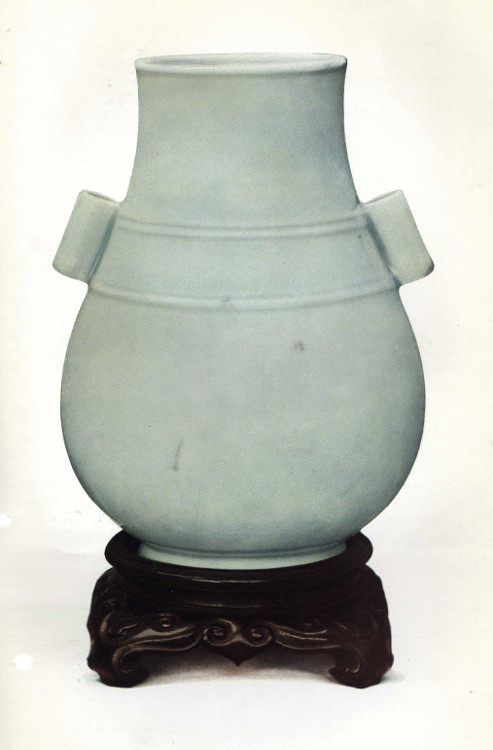
PLATE 130
Vase with pear-shaped body and wide mouth; tubular handles. Porcelain
with delicate clair de lune glaze recalling the pale blue tint
of some of the finer Sung celadons. About 1800
Height 7¾ inches.
British Museum.
But the group which probably commands the greatest interest is that
known as “Jesuit china,” decorated with subjects bearing on the
Christian religion. The earliest examples are painted in underglaze
blue, the Christian designs being accompanied by ordinary Chinese
ornaments. An early (to judge from the general style of the piece,
late Ming) example is a pear-shaped ewer, with elongated spout and
handle, in the Kunstgewerbe Museum, Berlin. On the side is the sacred
monogram IHS, surrounded by formal ornament, and it has been plausibly
suggested that the little vessel had been used for Communion purposes.
A bowl with fungus mark in the Franks Collection has a Crucifixion on
the exterior, framed in a pattern of cloud-scrolls, and inside with
truly Chinese tolerance is painted a Buddhist pearl symbol in flames
and clouds. A cup in the same series with the “jade” mark[462] has a
Crucifixion half lost among the surrounding arabesque scrolls. These
two are of the K’ang Hsi period, and were probably made with the pieces
to which Père d’Entrecolles[463] alludes, in his letter dated 1712, as
follows: “From the debris at a large emporium they brought me a little
plate which I treasure more than the finest porcelain made during the
last thousand years. In the centre of the plate is painted a crucifix
between the Virgin and St. John, and I am told that this kind
of porcelain was shipped sometimes to Japan, but that this commerce
came to an end sixteen or seventeen years ago. Apparently the Japanese
Christians took advantage of this manufacture at the time of the
persecution to obtain pictures of our mysteries, and these wares,
mingled with others in the crates, eluded the vigilance of the enemies
of our religion. This pious artifice was no doubt eventually discovered
and rendered useless by more stringent investigation, and that is why
the manufacture of this kind of ware has ceased at Ching-tê Chên.”
These early types, which are rare to-day, have a special interest
because they were decorated at Ching-tê Chên, and their general style
indicates that they were made for Oriental use.
After an interval of some years the Jesuit china reappeared in a
more sophisticated form, probably the work of Canton decorators. The
designs, various Biblical scenes, are copied in black and gold from
European engravings, and they occur on plates with rims, tea and coffee
services, and other articles of European use. The earliest may date
from the Yung Chêng period, but they are mostly Ch’ien Lung, and the
same designs are occasionally executed in enamel colours. In addition
to the Christian china there are plates and dishes decorated with rings
of Koranic inscriptions in Arabic, surrounding magic squares, and
destined for the Mussulman markets.
The Franks Collection includes, besides, numerous examples of
profane subjects[464] copied in black or in colours from European
engravings and designs. A striking instance of the patient skill of
the Chinese copyist is given by two large plates completely covered
with the designs—the Triumph of Mordecai and Achilles dipped in the
Styx—copied line for line, apparently, from Le Sueur’s engravings.
The effect of the fine lines and cross-hatching is perfectly rendered,
and one would say at first that they had been transfer-printed if
this process had ever been used by the Chinese. It is amusing, too,
to find English topical and political subjects rendered on Chinese
porcelain, mugs and punch bowls, with busts of the Duke of Cumberland,
Prince Charles Edward, and John Wilkes with appropriate inscriptions.
There are, too, satirical pictures in the style of Hogarth, and a few
popular but not overrefined subjects which gain an additional drollery
from the obviously Chinese rendering of the figures. Many large punch
bowls still survive decorated to suit their owner’s tastes, with a
full-rigged ship for the sea captain, a hunting scene for the master
of hounds, and agricultural designs for the farmer, often proudly
inscribed with the name of the destined possessor and the date of the
order. The Chinese touch is usually betrayed in these inscriptions,
which are obviously reproduced mechanically, and with no compunction
felt for a letter here and there inverted or misplaced.
These porcelains with European pictorial designs are, as a rule, more
curious than beautiful, but it cannot be denied that the next group
with European coats of arms emblazoned in the centre is often highly
decorative. This is particularly true of the earlier examples in
which the shields of arms are not disproportionately large, and are
surrounded with tasteful Chinese designs. The heraldry is carefully
copied and, as a rule, the tinctures are correct. In the older
specimens the blue is usually under the glaze, and from this, and from
the nature of the surrounding decoration in famille verte or
transition colours, one may assume that the pieces in question were
decorated at Ching-tê Chên. From the middle of the Yung Chêng period
onwards a large and constantly increasing proportion of the ware was
decorated at Canton, in the enamelling establishments which were in
close touch with the European merchants, and from this time European
designs begin to encroach on the field of the decoration. Finally,
in the last decades of the century the Chinese armorial porcelain is
decorated in purely European style. An important though belated witness
to the Canton origin of this decoration is a plate in the Franks
Collection with the arms of Chadwick in the centre, a band of Derby
blue, and a trefoil border on the rim, and on the reverse in black the
legend, Canton in China, 24th Jany, 1791.
Side by side with this armorial porcelain, and apparently also
decorated at Canton, there was painted a large quantity of table
ware for Western use with half-European designs in which small pink
rose-sprays are conspicuous. These are the cheaper kinds of useful ware
which are found everywhere in Europe, and must have formed a large
percentage of the export trade in the last half of the eighteenth
century. The decoration, though usually slight and perfunctory, is
quite inoffensive and suitable to the purpose of the ware.
But to return to the armorial porcelain: apart from its heraldic and
decorative value, it is often important to the student of Chinese
ceramics, because there are specimens which can be dated very
precisely from the armorial bearings and other internal evidence.
In the British Museum series there are some twenty pieces belonging
to the K’ang Hsi period, including an early underglaze blue painted
dish with arms of Talbot, and one or two specimens of pure famille
verte, including the plate dated 1702, which has already been
mentioned as being of a peculiar white and glassy-looking ware. There
are examples with underglaze blue and enamel decoration in the Chinese
Imari style, and there is a very distinctive group which can be dated
armorially[465] to the late K’ang Hsi and early Yung Chêng period.
These latter pieces are usually decorated with a shield of arms in the
centre in enamel colours, with or without underglaze blue; the sides
are filled with a band of close floral scrolls or brocade diaper in red
and gold, broken by small reserves containing flowers and symbols; on
the rim are similar groups of flowers and symbols and a narrow border
of red and gold scrolls; and on the reverse are a few floral sprays in
red. The enamels are of the transition kind, famille verte with
occasional touches of rose pink and opaque yellow. The porcelain is
the crisp, sonorous, well potted ware with shining oily glaze of K’ang
Hsi type, and the accessory ornament is of purely Chinese character.
A border of trefoil cusps, not unlike the strawberry leaves of the
heraldic crown, but traceable to a Chinese origin, makes its first
appearance on this group. It is a common feature of subsequent armorial
wares, like the narrow border of chain pattern which seems to have come
into use about 1730.
Dated specimens of Yung Chêng armorial, with painting in the “foreign
colours,” have been already described.[466] Other examples of this
period have the decoration in underglaze blue outlines washed with
thin transparent colours, in black pencilling and in black and gold.
The border patterns of lacework, vine scrolls, bamboos wreathed with
foliage and flowers, and fine floral scrolls, are often beautifully
executed in delicate gilding or in brown and gold.
In the Ch’ien Lung period there was an ever-increasing tendency to
displace the Chinese patterns in favour of European ornament. About
the middle of the century small bouquets and scattered floral sprays
in the well-known Meissen style of painting made their appearance, and
the gradual invasion of the border patterns by European motives is
apparent. It may be of interest to note a few of the latter as they
occur on dated specimens:
1. Light feathery scrolls, gilt or in colours: first half of Ch’ien
Lung period.
2. Rococo ornaments combined with floral patterns: first half of Ch’ien
Lung period.
3. Large shell-like ornaments and scroll edged frames of lattice work,
loosely strung together: early Ch’ien Lung period.
4. Similar motives with more elaborate framework, enclosing diapers,
and interrupted by four peacocks at regular intervals and generally
black and gold: about 1740 to 1760.
5. Black and brown hexagon diaper, edged with dragon arabesques in
gold: an early type of border, but lasting as late as 1780.
6. Composite borders with diapers, symbols, flowers, etc., and
sometimes including butterflies, half Chinese and half European: on
specimens ranging from 1765 to 1820.
This last border pattern was adopted at Coalport and in other English
factories to surround the willow pattern.[467]
In the last decades of the century, such purely European borders as the
swags of flowers used at Bow and Bristol, floral and laurel wreaths
and husk festoons; the pink scale patterns of Meissen; ribbons and
dotted lines winding through a floral band, feather scrolls, etc., of
Sèvres origin, and afterwards adopted at Worcester, Bristol, Lowestoft
and elsewhere in England; blue with gilt edges and gilt stars, as on
the Derby borders, which also derive from Sèvres; and the corn-flower
sprigs of the French hard-paste porcelains.
A conspicuous feature of the Ch’ien Lung export porcelain in general
is the use of a thin, washy pink in place of the thick carmine of
the early famille rose. This is a colour common to European
porcelain of the period, and it may have been suggested to the Chinese
by specimens of Western wares. We may, perhaps, note here a design
of Oriental figures (as on the Mandarin porcelain) in pink and red
surrounded by borders of pink scale diaper, broken by small panels of
ornament. It has no connection with the armorial group, but it has
apparently been bandied back and forward from East to West. Based on
a Chinese original, it was largely copied on English porcelain, such
as Worcester, Lowestoft, etc., and apparently services of the English
make found their way east and were copied again at some coast factory,
or even in Japan, for the export trade. Much of this hybrid ware is
found in Australia and on the east coast of Africa, and though the
material and the colours are obviously Oriental, the drawing of the
faces reflects a European touch. The porcelain is coarse and greyish,
and the decoration roughly executed, probably in the first decades of
the nineteenth century.
The trade in Chinese armorial porcelain seems to have gradually died
out in the nineteenth century, for reasons which are not far to seek.
As far as England was concerned, the improvements in the manufacture
both of porcelain and fine earthenware changed her position from that
of a consumer to that of a producer. In addition to which, a high
protective duty must have adversely affected the import trade, for we
read[468] in the notes of Enoch Wood, the Staffordshire potter, that
alarm was felt in 1803 in the potteries at the “proposed reduction of
£59 8s. 6d. per cent. from the duty on the importation of Oriental
porcelain, leaving it at 50 per cent.”
Not the least interesting part of the Franks Collection is the section
devoted to Chinese porcelain decorated in Europe. In the early years
of the eighteenth century a number of enamelling establishments
appeared in Holland and in other countries where glass and pottery were
decorated in the enamel colours which were then coming into play. As
the supply of home-made porcelain was as yet practically non-existent,
the enamellers had to look for this material in the Oriental market.
Chinese porcelains with slight decoration, plain white wares, or those
mainly decorated with incised and carved design under the glaze, and
white Fukien porcelain offered the most suitable surface; and these
we find treated by Dutch enamellers with the decoration then in vogue
among the Delft potters. In the British Museum there are plates with
portraits of Dutch celebrities, with designs satirising John Law’s
bubble, and even with Japanese and Chinese patterns, especially those
which the Delft potters were in the habit of copying from the “old
Imari.” Thus we find the curious phenomenon of Chinese porcelain
decorated in Europe with Oriental patterns, and, as may be imagined,
these pieces have caused much perplexity to collectors. They are,
however, to be recognised by the inferior quality of the enamels and
the stiff drawing of the copyists. In the case of the Fukien porcelain
with relief ornament, the decorators often confined themselves to
touching the raised pattern with colour.
As a rule, these added decorations are crude and unsightly, but there
were artists of great skill among the German chambrelans
(as these unattached enamellers were called), such men as Ignatius
Bottengruber and Preussler of Breslau,[469] who flourished about 1720
to 1730. Their designs of figures, mythical subjects, etc., enclosed by
baroque scrollwork, were skilfully executed in camaieu red or
black, heightened with gilding, and their work, which is very mannered
and distinctive, is highly prized at the present day. Occasionally
we find the handiwork of the Dutch lapidary on Chinese porcelains, a
design of birds and floral scrolls being cut through a dark blue or
brown glaze into the white biscuit.
About the middle of the eighteenth century a more legitimate material
was found for the European decorator in small quantities of Chinese
porcelain sent over “in the white.” Regular supplies in this state
must have been forwarded from Ching-tê Chên to Canton for the
enamellers there, and, no doubt, the European merchants were able to
secure a small amount of this. Thus it was that Chinese porcelain is
occasionally found with decoration by artists whose touch is recognised
on Chelsea and other wares. It is not necessary to assume that such
pieces were painted in the Chelsea factory. That may have been the
case, but we know of important enamelling establishments, such as
Duesbury’s in London, where Chelsea, Bow and Worcester porcelains
obtained in the white were decorated to order. It is probable that the
painters trained in this work afterwards passed into the porcelain
factories. There are rare examples of Chinese porcelain with transfer
prints executed at Battersea or even at Worcester, and apparently one
or two pieces have had inscriptions added at Lowestoft; but, after
all, this group of decorated Oriental is a very small one, and the
specimens painted in the style of any particular English factory
except Chelsea could be counted on one’s fingers. No doubt the same
proceedings were repeated in various parts of the Continent, and there
are certainly specimens decorated in the Meissen style, and in one
piece in the Franks Collection the Meissen mark has been added.
But besides this more or less legitimate treatment of Chinese
porcelain, there is a large group of hideously disfigured wares known
by the expressive name of “clobbered china.” On these pieces Chinese
underglaze decoration has been “improved” by the addition of green,
yellow, red, and other enamels and gilding, which fill up the white
spaces between the Chinese painting and even encroach on the blue
designs themselves. This malpractice dates from the early years of the
eighteenth century, and we find even choice specimens of K’ang Hsi blue
and white among the victims. Possibly there was a reaction at this time
against the Chinese blue and white with which the Dutch traders had
flooded the country, but it is pitiful to find nowadays a fine vase or
bottle of this ware plastered with meaningless daubs of inferior colour.
Strange to say, the clobberer became an established institution, and
he was at work in London in the last century, and maybe he is not yet
extinct; and, stranger still, his wretched handiwork has been actually
taken as a model for decoration in English potteries, even to the
ridiculous travesties of Oriental marks which he often added as the
last insult to the porcelain he had defaced. As a rule, the clobbered
decoration occurs on blue and white and follows more or less the lines
of the original, though it is at once betrayed by its clumsiness and
the wretched quality of the enamels used. Occasionally the clobberer
was more ambitious, as on a bottle in the British Museum decorated
with three spirited monsters in underglaze red. Into this admirably
spaced design the clobberer has inserted graceless trees and three
ridiculous figures in classical dress standing in Jack-the-giant-killer
attitudes with brandished swords over the Chinese creatures. The effect
is laughable, but it was vandal’s work to deal in this way with choice
K’ang Hsi porcelain.
CHAPTER XV NINETEENTH CENTURY PORCELAINS — Chia Ch’ing (1796–1820) — Tao Kuang (1821–1850) — Hsien Fêng (1851–1861) — T’ung Chih (1862–1873) — Kuang Hsü (1875–1909)
There is little to distinguish the porcelain of this reign from that of
Ch’ien Lung. The old traditions were followed and the high standard of
technical skill was maintained to a great extent, though in the absence
of original ideas the natural tendency was towards a gradual decline.
The blue and white is a mere echo of the Ch’ien Lung blue and white, as
is shown by a square jar in the Franks Collection, which bears the date
corresponding to 1819. Another dated specimen in the same collection
is a little bowl with design of the “Eight Ambassadors of the Tribes
of Man” mounted on strange beasts, painted in thin garish blue under a
bubbly glaze. There are well-finished monochromes of the Ch’ien Lung
type, conspicuous among which is an intense brick red (derived from
iron), which has all the depth and solidity of a glaze. The enamelled
wares are in no way inferior to their late Ch’ien Lung models, and the
medallion bowls with engraved enamel grounds are particularly choice.
Plate 132, a richly decorated vase belonging to the Lady Wantage,
illustrates a type common to both periods. The design of ladies of the
harem in an Imperial pleasure ground is carefully painted in mixed
colours and enclosed by rich borders of dark ruby pink enamel, brocaded
with polychrome floral scrolls. Another vase in the same collection
(marked Chia Ch’ing) has a movable inner lining and pierced outer shell
richly enamelled in the same style. The blue green enamel of the Ch’ien
Lung porcelain was freely used to finish off the base and mouth of the
vases of this time.
Bushell[470] describes as a speciality of the Chia Ch’ing period, vases
with elaborate scrollwork of various kinds in underglaze blue enhanced
by a richly gilded background; and the mark of this reign will be found
on many of the choicer snuff bottles, including those sumptuous little
vessels with richly carved and pierced outer casing as finely tooled as
Su Chou or Peking lacquer.
We have already seen that rice-grain decoration was effectively used at
this time, and no doubt many specimens of the kindred “lacework” were
also made. In fact in a general classification of Chinese porcelain it
would be almost superfluous to separate the Chia Ch’ing from the Ch’ien
Lung groups.
The reign of Tao Kuang is the last period of which collectors of
Chinese ceramics take any account. It is true that the general
deterioration which was already remarked in the previous reign became
more and more conspicuous towards the middle of the nineteenth century.
It seemed as though the wells of inspiration in China had dried up and
the bankrupt arts continued to exist only by virtue of their past.
Curiously enough the same wave of decadence was felt all the world over
at this period, and if we compare the porcelain of Tao Kuang with the
contemporary English and Continental productions we must confess that
the decadence of China was Augustan beside the early Victorian art.
The Tao Kuang porcelain in the main is saved from utter banality by
the high traditions on which it was grounded and by the innate skill
of the Chinese potters. Indeed there are not a few out of the numerous
specimens of this period in our collections which have a certain
individuality and distinction entitling them to a place beside the
eighteenth-century wares.
But, speaking generally, the porcelain is a weak edition of the Yung
Chêng types. The forms are correct but mechanical, the monochromes
are mere understudies of the fine old colours, and the enamels are of
exaggerated softness and weak in general effect.
There are numerous marked specimens of all varieties in the Franks
Collection. These include a blue and white vase with bronze designs of
ogre heads, etc., in the K’ang Hsi style, but painted in pale, lifeless
grey blue, and a bowl with lotus designs and symbols surrounding four
medallions with the characters shan kao shui ch’ang[471] neatly
painted in the same weak blue and signed by Wen Lang-shan in the year
1847. Among the monochromes is a dignified vase of bronze form with
deep turquoise glaze dated 1844, besides coffee brown bowls, full
yellow bowls, vases with curiously bubbled glaze of dark liver red, and
a coral red jar and cover. There is also a large bowl with “tiger skin”
glaze patched with yellow, green, aubergine and white. All of these
pieces are lacking in quality and distinction, though I have seen far
superior specimens of lemon yellow monochrome and tea dust glaze.
The enamelled wares are much more attractive, and many of the rice
bowls are prettily decorated in soft colours. The Peking or medallion
bowls, for instance, are little if anything below the standard of
previous reigns, and in addition to the medallions in engraved enamel
grounds of pink, green, grey, etc., outside, the interior is often
painted in underglaze blue. There are tasteful bowls with white bamboo
designs reserved in a ground of coral red, and there are dishes with
blackthorn boughs with pink blossom in a white ground. The Yung Chêng
style of underglaze blue outlines with washes of thin-transparent
enamels was also affected, but the most characteristic enamelling
of the period is executed in a mixture of transparent and opaque
enamels, a blend of famille verte and famille rose.
This colouring, soft and subdued, but often rather sickly in tone, is
frequently seen on bowls and tea wares with Taoist subjects, such as
the Eight Immortals, the fairy attendants of Hsi Wang Mu in boats, or
the goddess herself on a phœnix passing over the sea to the t’ien
t’ang or cloud-wrapt pavilions of Paradise, preceded by a stork
with a peach of longevity in its beak. The sea is usually rendered by
a conventional wave pattern delicately engraved in greenish white,
and sometimes the ground of the design is washed with the same thin,
lustrous, greenish white, which was remarked on a group of porcelains
described on page 151. The porcelain of these bowls has a
white, if rather chalky, body and a greenish white glaze of exaggerated
oily sheen, and of the minutely bubbled, “muslin-like” texture which
is common to Japanese porcelains. But the ordinary Tao Kuang wares are
of poor material, greyish in tone and coarser in grain, with the same
peculiarities in the texture of the glaze in an exaggerated degree.
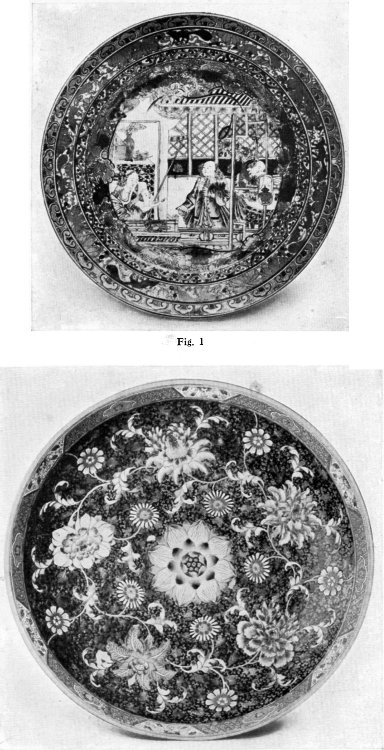
Plate 131.—Eighteenth Century Painted Porcelain.
Fig. 1.—Plate painted in black and gold, European figures in a Chinese
interior. Yung Chêng period. Diameter 9 inches. British Museum.
Fig. 2.—Dish with floral scrolls in famille rose enamels in a
ground of black enamel diapered with green foliage scrolls. Ch’ien Lung
period. Diameter 23¼ inches. Wantage Collection.
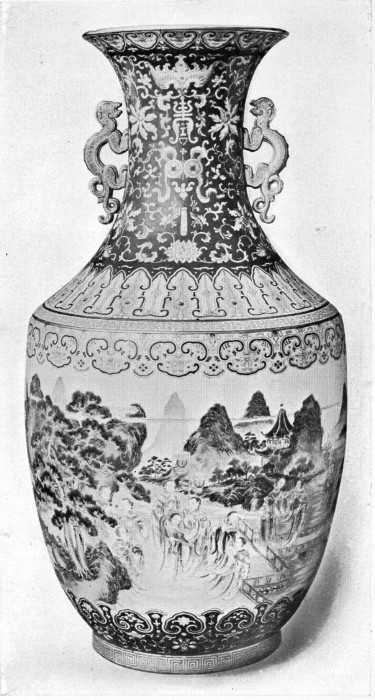
Plate 132.—Vase painted in mixed enamels, an Imperial
park and a bevy of ladies. Wantage Collection.
Deep ruby pink borders with coloured floral scrolls and symbols. Ch’ien
Lung mark. About 1790. Height 30 inches.
A typical example of the fine Tao Kuang rice bowl with Taoist design
in the Franks Collection, delicately painted in mixed colours, which
recall the Ku-yüeh-hsüan ware of the early Ch’ien Lung period, has the
palace mark, Shên tê t’ang,[472] in red under the base. A
specimen with this mark in the Hippisley Collection[473] is inscribed
with a poem by the Emperor Tao Kuang, definitely fixing the date of
this hall mark, which is found on choice porcelains made for Imperial
use. It occurs on a vase of fine workmanship in the British Museum,
decorated with polychrome five-clawed dragons in a lavender enamel
ground, of which the base and interior are coated with blue green
enamel; and we have already[474] commented on an interesting dish with
archaic designs in Ming red and green, which is explained in the mark
as an “imitation of the antique made for the Shên-tê Hall.”
It is worthy of note that most of the porcelain with hall and studio
marks in red belong to the nineteenth century, chiefly to the Tao
Kuang period. Several of these marks are figured and explained on p.
220 (vol. i.), but it may be useful if we describe here a few of the
specimens on which they occur. The hall mark, Ch’êng tê t’ang,
appears on a shallow bowl in the Franks Collection painted inside with
a coiled dragon in green and a border of bats in red, while outside is
a landscape carefully painted in mixed colours in a style similar to
Plate 125, Fig. 3. The latter has the Imperial hall mark, Hsü hua
t’ang, with addition of the word tsêng (for presentation),
and it has besides an inscription proclaiming that it is the “cup of
him who departed as General and returned as Grand Secretary” (ch’u
chiang ju hsiang chih pei). It is painted with a scene in the
palace grounds with the Emperor receiving a military officer.[475] A
pretty bowl in the Franks Collection with rockery, flowering plants,
fungus, etc., in colours has the palace mark, ssŭ pu t’ang; and
there are two saucer dishes with Buddhist decoration of palmettes in
cruciform arrangement, and a border of Sanskrit characters painted in
underglaze blue with washes of transparent enamels marked respectively
Ts’ai jun t’ang, and Ts’ai hua t’ang (hall of brilliant
colours and hall of brilliant decoration), which are probably
synonymous.
A distinctive group of porcelain, which seems to belong to the Tao
Kuang period, consists of small boxes and of vases with landscapes
and similar elaborate ornament deeply carved in the manner of red
lacquer. The surface is usually covered with an opaque green or yellow
monochrome enamel, but occasionally it is left in white biscuit. These
pieces have almost always a maker’s mark, such as Wang Ping-jung, Wang
Tso-t’ing (see vol. i., p. 223), and probably come from one factory.
Bushell[476] also alludes to white unglazed porcelain made at this
time, and recalling the English Parian ware. It is chiefly seen on
small objects for the writing table.
The collector will always be glad to secure specimens of the palace
porcelains of the Tao Kuang period, and of the smaller objects on
which the weakness of the colouring is not noticeable. There are, for
instance, many exquisite snuff bottles with the mark of this reign,
with carved, monochrome and enamelled ornament. On the other hand
quantities of these little objects coarsely manufactured and sketchily
decorated were made at this time, and among them the crude specimens
with a floral spray on one side, a line of verse in grass characters
on the other, and a granulated border coated with opaque yellowish or
bluish green enamel, whose supposed discovery in ancient Egyptian tombs
made a sensation some sixty years ago. It is not difficult to guess how
these objects traded among the Arabs found their way into the tombs
which were in course of excavation, but for a time they were believed
to prove the existence of Chinese porcelain in the second millennium
before Christ.[477]
Three other types of indifferent ware may be mentioned here in passing.
They belong to the middle of the nineteenth century, and in part
at least to the Tao Kuang period. One is painted with a large pink
peony and foliage in a bright green enamel ground; the second has cut
flowers, butterflies and insects in strong rose colours on a celadon
green glaze; and the third has rectangular panels with crowded figure
subjects in red and pink enclosed by a brocade pattern of flowers,
fruit and insects as in the second type. This third class is often
represented by large and rather clumsily shaped vases with two handles
of conventionalised dragon form, and the border patterns are sometimes
backed with gilding; but it also occurs in quite recent manufacture in
tea and toilet services made for the export trade. The porcelain in all
these cases is of a rough, coarse-grained make, and the reader might
have been spared a description of them were it not that in spite of
their inferior quality they are the subject of frequent inquiries.
In the third year of Hsien Fêng the T’ai p’ing rebels captured Ching-tê
Chên and burnt down the Imperial factory, which was not rebuilt till
1864. The potters themselves were killed or scattered; and, naturally,
marked examples of this reign are scarce. Such, however, as do exist
are of little account, and may be regarded as continuations of the Tao
Kuang manufacture. Bushell[478] mentions vases of good form painted
in soft colours with nine five-clawed dragons on a white background,
which is etched in the paste with scrolled waves, and a dinner service
of bowls, cups and saucer dishes painted in colours with processional
figures of the eighteen Lohan. And in the British Museum there is a
large globular bowl on a high foot painted with green dragon designs
and a bowl with medallions of lanterns and vases separated by lotus
ornament, neither of which are in any way different from the Tao Kuang
wares. No doubt a good deal of porcelain was made at the private
factories even during this troubled period, but the specimens which I
have seen are not worthy of description.
When the T’ai p’ing rebels had been expelled from the province of
Kiangsi by the celebrated viceroy, Li Hung-chang, in 1864, the Imperial
factory was rebuilt on the old lines by the new director, Ts’ai
Chin-ch’ing. In the same year a list of the porcelain forwarded to
the Emperor was drawn up, and it is published in the Chiang hsi
t’ung chih[479] immediately after Hsieh Min’s list. It consists
mainly of bowls, wine and tea cups, saucer dishes and plates classified
as yüan ch’i (round ware), and a few vases under the general
heading, cho ch’i; and though there is little originality in
the designs, lists of this kind are so rare and so instructive that I
have no hesitation in giving it in full below, following Bushell’s[480]
renderings in most cases.
Actual examples of T’ung Chih porcelain are not inspiring. Those in the
British Museum include a covered bowl with coloured sprays in a ground
of red diaper; a bowl with enamelled sprays on a pale brown (tzŭ
chin) glaze; a saucer with dragons etched under a transparent
green glaze, the exterior in unglazed biscuit painted in black; a
cup with red dragons in a ground of black enamel and the cyclical
date 1868; a low, octagonal bowl with the Eight Trigrams in relief
outside, the interior of this and of the preceding specimen as well
being coated with blue green enamel; and a basin enamelled with the
Eight Ambassadors of the Tribes of Man. The most favourable specimen
of the ware in the same collection is a carefully painted wedding bowl
with canary yellow ground and medallions of appropriate symbols, the
peach-and dragon-headed staff of longevity, the double fish symbol
of conjugal felicity, and the group of pencil brush, cake of ink and
ju-i sceptre forming the rebus pi ting ju i, “may things
be as you wish.”
List of Imperial Porcelains Supplied in the Third Year of T’ung
Chih (1864)
VASES (cho ch’i)
- Quadrangular vases with apricot medallions and two tubular
handles with Chün glaze. [For the shape see Plate 123, and for
the glaze see p. 1.]
- Vases of the same form with Ko glaze.
- Quadrangular vases with the Eight Trigrams (pa kua),
and Ko glaze. [The form is quadrangular body with round neck and
foot, moulded in relief with the trigrams; for the Ko glaze see
vol. i., p. 71.]
- Vases in form of jade ewers (yü hu ch’un) with chi
hung (or copper red) glaze.
- Vases of the same form, with blue and white decoration and
raised threads. [Bushell explains that the surface is divided
into patterns or sections by raised rings.]
- Vases of the same form, with blue and white decoration with
balcony (lan kan). [Bushell explains, “garden scenes
enclosed by railings.”]
- Paper-beater (chih ch’ui) vases with the t’ai
chi symbol and the glaze of the Imperial factory decorated
in colours. [The form is the club-shape or rouleau; and
the symbol is apparently the yin-yang, the Confucian
symbol for the Absolute.]
- Quadrangular vase with elephant symbol of great peace
(t’ai ping yu hsiang, a rebus meaning “augury of great
peace”). [These are apparently square vases with two handles in
form of elephant (hsiang) heads.]
ROUND WARES (yüan ch’i)
- Medium-sized bowls with dragons in purple brown (tzŭ).
- Medium-sized bowls with chi hung glaze.
- Large bowls (wan) with Indian lotus (hsi lien) in blue.
- Five-inch dishes (p’an), similarly decorated.
- Medium-sized bowls with storks and Eight Trigrams (pa kua).
- Wine cups with narcissus flowers (shui hsien hua) in enamels.
- Wine cups with spreading rim painted with dragons in red.
- Dishes (p’an) a foot in diameter decorated in blue
with a pair of dragons filling the surface.
- Soup bowls (t’ang wan) with incised dragons under a
dark yellow monochrome glaze. [These, according to Bushell, are
smaller and shallower than rice bowls.
- Medium-sized bowls, barrel shaped, with dragons engraved
under a yellow monochrome glaze.
- Yellow monochrome tea cups.
- Medium-sized bowls with dragons engraved under a yellow
monochrome glaze.
- Medium-sized bowls with the three fruits in groups
(pan tzŭ[481]) painted in blue. [The fruits are peach,
pomegranate and finger citron.]
- Soup bowls with expanding rim and dragons incised under
yellow monochrome glaze.
- Six-inch bowls with a pair of dragons in blue.
- One-foot dishes painted in blue with silkworm scrolls
(ts’an wên) and longevity characters.
- Tea cups decorated in blue with mu hsi flowers (a
small variety of the olea fragrans).
- Medium-sized bowls with precious lotus in enamel colours.
- Tea cups with white bamboo on a painted red ground.
- Six-inch dishes painted in blue with the “three friends”
(san yu) and figure subjects. [The three friends in
floral language are the pine, bamboo and prunus. It is also a
name given to the group of Confucius, Buddha, and Lao-tzŭ, who
are often represented examining a picture scroll or standing in
conversation.]
- Tea dishes (ch’a p’an) with a pair of dragons in
blue. [Bushell describes these as “little trays with upright
borders, of oblong, four-lobed, and fluted outline.” They must
in fact have closely resembled the old teapot stands of European
services.]
- Six-inch dishes with green dragons on a ground of engraved
water-pattern painted in colour.
- One-foot dishes painted in blue with archaic phœnixes
(k’uei fêng). [These designs are ornaments of bird form,
terminating in scrolls such as appear on ancient bronzes.]
- Nine-inch dishes with blue ground and dragons in clouds
painted in yellow.
- Medium-sized bowls with pure white glaze and ruby red
(pao shao) phœnix medallions.
- Tea cups with dragons and clouds painted in yellow in a blue ground.
- Six-inch dishes with chi hung (copper red) glaze.
- Medium-sized bowls with chi ch’ing (deep violet blue) glaze.
- Nine-inch dishes with chi hung glaze.
- Soup bowls, barrel shaped, with lustrous brown glaze.
- Medium-sized bowls with red phœnix medallions in a celadon
(tung ch’ing) glaze.
- Nine-inch dishes with silkworm scrolls and ju-i[482]
ornament in enamel colours.
- Tea cups enamelled in colours with mandarin ducks and lotus flowers.
- Tea bowls (ch’a wan) with chi ch’ing glaze.
- Tea bowls decorated in colours with the pa pao (eight
attributes of the Taoist Immortals; see p. 287).
- Large bowls with the Eight Immortals in blue on red
enamelled waves.
- Medium-sized bowls, blue and white inside, and with coloured
lotus flowers outside.
- Bowls with the Eight Buddhist symbols of happy augury (pa
chi hsiang).
- Porcelain bowls with green designs and peach yellow ground.
- Five-inch dishes with purple and green dragons in a yellow
monochrome ground.
- Three-inch platters with similar ornament.
- Soup bowls of the fourth size (ssŭ hao) with green
monochrome glaze.
- Five-inch dishes with phœnixes in clouds.
- Medium-sized bowls with dragons and phœnixes among flowers
in coloured enamels.
- Four-inch platters (tieh) with purple and green
dragons in yellow monochrome ground.
- Nine-inch dishes painted in colours with the eight Buddhist
symbols among flowers.
- Large bowls painted in colours with archaic phœnixes
(k’uei fêng) among flowers.
Marked examples of this modern ware in the Franks Collection include a
saucer with coloured sprays in a cloudy pink enamel ground; a covered
cup with spout decorated in red with cartouches of seal characters
accompanied by translations in the ordinary script, and a dish with
blackthorn bough and pink blossoms in Tao Kuang style. In every case
the ware is coarse-grained and rough to the touch, while the glaze is
of the lustrous surface and “musliny” texture, which is characteristic
of the nineteenth century porcelains; and the painting is mechanical
and devoid of any distinction. There are two little saucers of better
quality both in material and painting, with stork and lotus designs in
mixed enamels and marks[483] which show that they are palace pieces
made for the Empress Dowager.
But the collector’s interest in Kuang Hsü porcelain is of a negative
kind. When it is frankly marked he sees and avoids it. But the Chinese
potters towards the close of the century evidently recovered some part
of the skill which the ravages of the T’ai p’ing rebels seemed to have
effectually dissipated; for they succeeded in making many excellent
sang de bœuf reds and crackled emerald green monochromes which
have deceived collectors of experience. Even the best, however, of
these wares should be recognised by inferiority of form and material,
and in the case of red the fluescent glaze will be found in the modern
pieces to have overrun the foot rim, necessitating grinding of the base
rim. There are also fair imitations of the K’ang Hsi blue and white and
the enamelled vases of famille verte or on-biscuit colours, and
even of the fine black and green grounds. But here again the inferior
biscuit, the lack of grace in the form and the stiffness of the designs
will be at once observed by the trained eye. When marked most of these
imitations have the nien hao of K’ang Hsi, and this is almost
invariable on the modern blue and white.
There is, of course, a great quantity of modern porcelain, chiefly
enamelled and blue and white, made for the export trade and sold at
prices which compete successfully with those of the European wares.
It is chiefly in the style of the K’ang Hsi and Ch’ien Lung wares,
and is marked accordingly; but the ware is coarse-grained, and the
decorations summary, and there is no excuse for mistaking these obvious
reproductions for anything but what they are and, in fact, what they
pretend to be.
The brief reign of Hsüan T’ung 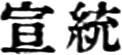 (1909–1911) is a blank so
far as ceramic history is concerned; and with the fall of the Ch’ing
dynasty in 1912 the Imperial works ceased its activity, and it remains
to be seen whether Ching-tê Chên will again have the advantage of a
state factory to set a standard for the industry in general.
CHAPTER XVI PORCELAIN SHAPES IN THE CH’ING DYNASTY
A considerable number of the forms which Chinese porcelain assumes have
been described in the chapters dealing with the Ming wares; but these
may be usefully supplemented by a rapid survey of those employed by
the potters of the Ch’ing dynasty. The latter will, of course, include
many of the former because the Chinese delight in reproducing the older
types.
The brief summary of the eighteenth-century porcelain forms given in
the opening pages of the T’ao shuo[484] begins in the correct
style with the reproductions of the ancient ritual vessels tsun,
lei, yi, ting, yu and chüo. These
are all bronze forms, tsun being applied to wine vessels,
lei to vases ornamented with the meander pattern known as
“cloud and thunder” scrolls,[485] yi to bowl-shaped vessels
without feet, ting to cauldrons with three or four legs and two
handles, yu to wine jars with covers, and large loop handles
for suspension, and chüo to libation cups of helmet and other
shapes. The bronze forms are commonly decorated with bronze patterns
such as the key-fret, archaic dragon and phœnix scrolls, cicada
pattern, ogre heads and bands of stiff (banana) leaves, either painted,
moulded, engraved, or carved in relief; and the complicated bronze
shapes are usually fashioned in moulds, and in many cases furnished
with ring handles attached to monster heads. Another ritual type
manufactured in porcelain as well as bronze is the altar set of five
pieces (wu kung), which consists of a ting or tripod
incense vase, two flower vases, and two pricket candlesticks. A humbler
altar set was composed of a single censer or a tazza-shaped cup (Plate
93, Fig. 1) for flowers, and a pair of lions on stands fitted with
tubes for holding sticks of incense. The bronze forms have always been
used by the Chinese potters, but they were specially affected in the
archaising period of Ch’ien Lung.
In the Western judgment, however, which is unbiased by the associations
of these antique forms, the true pottery shapes, made on the wheel,
will appear far more attractive; for nothing can surpass the simple
rounded forms which sprang to life beneath the deft fingers of the
Chinese thrower. Their simplicity, grace, and perfect suitability
for their intended uses have commended them as models to the Western
potter far more congenial than the cold perfection of the Greek
vases. Naturally they vary in quality with the skill and taste of the
individual, but a high level of manual skill ruled among the Chinese
potters, and their wheel-work rarely fails to please.
It would be useless to attempt to exhaust all the varieties of
wheel-made forms. Many of them are due to slight alterations of line
according to the caprice of the thrower. It will be enough to enumerate
the principal types and to note a few of the more significant changes
which came in at ascertained periods. By comparing the illustrations
in different parts of this book, and better still, by comparing the
specimens in some well classified collection, the reader will soon
learn to notice the periodical changes of shape. To take the familiar
bottle-shaped vases as an instance, there is probably no shape on
which more numerous changes have been rung, nor one which is more
susceptible to the individual touch; and yet the trained eye will
generally distinguish the K’ang Hsi bottle from the later forms, though
the distinction is often more subtle than that which separates the
typical K’ang Hsi form (Plate 123, Fig. 2) from that with
depressed body and straight wide neck (Plate 128, Fig. 3), which is
characteristic of the Ch’ien Lung period.
The K’ang Hsi bottles vary in themselves in length and slenderness
of neck, and in the form of the body, which may be globular, ovoid,
barrel shaped or pear shaped. Again they are often of double or even
triple gourd shape, or plain with a bulbous swelling on the upper part
of the neck or actually at the mouth. The last variety are called
“garlic-shaped” bottles by the Chinese. The normal types are used to
hold a single spray or a flowering branch, but there are others with
slender necks tapering to a point which are designed for sprinkling
perfumes and are generally known as sprinklers.
Of flower vases there are numerous varieties: egg-shaped vases;
baluster-shaped vases with spreading mouth; high-shouldered vases
with small mouth, the mei p’ing of the Ming period; beakers
(ku) with slender body, swelling belt in the middle and flaring
mouth; the so-called yen yen vase with ovoid body and high neck
with trumpet mouth,[486] which is used for some of the choicest K’ang
Hsi decorations (Plate 101); the Kuan yin[487] vase of ovoid
form with short neck and spreading mouth; the cylindrical vase with
short straight neck and spreading mouth (Plate 103), called by the
French rouleau and by the Chinese “paper-beater” (chih ch’ui
p’ing), whence our name “club-shaped.” A smaller form of the same
is known to the Chinese as yu ch’ui p’ing (oil-beater vase). .
There is besides the wide oval jar or potiche with dome-shaped
cover (tsun), and the more slender form known as t’an,
which often has a lion or ch’i-lin on the cover serving as
a knob; the tall cylinder to hold arrows and the low cylinder for
brushes, and numerous pots and jars for various uses.
Most of these rounded forms have counterparts among the square and
polygonal vases which are made in moulds or built up by the difficult
process of joining together flat bats of clay. The square vases made
by the latter method were a source of much trouble to the potters
owing to the danger of imperfect jointing or of warping in the kiln.
Fig. 1 of Plate 104 illustrates an effective type of the square
vase with gracefully tapering body, the four sides of which are so
often appropriately decorated with the flowers of the four seasons.
Occasionally the angles are flattened, giving an irregular octagonal
form. Another form selected for sumptuous decoration is the square vase
with pendulous body and two dragon handles figured on Plate 97; and
another is the arrow stand and square tube with deeply socketed stand
and railed border (Plate 118).
The pilgrim bottle supplies an effective model with a flattened
circular body, small neck and foot, and loops on the periphery to carry
a cord. These loops tended to disappear when the form had lost its
first significance and was only regarded as a vase.
The list of Imperial wares made in the reign of T’ung Chih includes
vases for divining rods of square form with low round neck and base,
ornamented with pa kua designs in relief; vases with apricot
medallions and tubular handles like Fig. 1 of Plate 123. Other familiar
types are the bag-shaped vases with the mouth tied with silk, melon
and gourd forms, and the vase shaped like a double fish erect on its
tail or a single fish rising from waves.
To quote a few of the types named in the T’ao shuo[488]:—“For
holding flowers there are vases from two or three inches to five or
six feet high, round like a hu, round and swelling below like a
gallbladder (tan), round and with spreading mouth and contracted
below like a tsun, with flat sides and full angles like a ku,
upright like bamboo joints, square like a corn measure (tou),
with contracted mouth and flattened sides, with square and round
flutings, and cut in halves with flat backs for hanging on walls.”
For pot-pourri and for fragrant flowers to perfume the rooms various
covered jars were provided, hanging vases with reticulated sides
(Plate 114), and boxes with perforated covers. For growing plants
there were deep flower pots and shallow bulb bowls, and the large and
small fish bowls were used for growing water-lilies as well as for
keeping gold-fish; and shallow bowls were apparently used as arenas for
fighting crickets.[489] As for the vessels in which the crickets were
kept, various suggestions have been made in reference to the “cricket
pots” mentioned in Chinese books, and the name is sometimes given to
reticulated vases and boxes; but we are told that the cricket prefers a
damp dwelling, and that their pots were consequently made as a rule of
absorbent earthenware. There is a snuff bottle decorated with crickets
in the British Museum, and one is represented perched on an overturned
pot from which he has apparently escaped, the lid having fallen off.
This pot is of ordinary ovoid jar form apparently ornamented with
incised fret pattern.
The apparatus of the library table is peculiarly Chinese; and
as calligraphy and painting were regarded as among the highest
accomplishments, so the potter lavished on the implements of the writer
his most ingenious fancies and his most beautiful workmanship. There
were porcelain handles for the pencil brush called pi kuan; a
brush rest (pi ko) of many fanciful forms (see Fig. 3 of Plate
60) of which a miniature range of hills was the commonest; a bed (pi
ch’uang) for it to lie down on, and a cylindrical jar (pi
t’ung) for it to stand up in; vessels called hsi to wash it
in, usually of shallow bowl form or shaped like crinkled lotus leaves
or in some such dainty design. There were rests for the writer’s wrist
and paper weights of fantastic form. For the ink (mo), there
is the pallet (mo yen) for rubbing (Plate 94, Fig. 2), and a
bed for the ink-cake (mo ch’uang), a screen (yen p’ing)
behind which it was rubbed, small water pots (shui ch’êng) in
innumerable shapes and served by a tiny ladle, and water droppers
(shui ti) of quaint and ingenious designs.[490] There were
rollers for picture scrolls (hua chou) with porcelain ends, and
stands for books in the form of small elegantly shaped tables with
three or four legs often beautifully painted in enamels on the biscuit.
With these is the incense-burning apparatus which consists of incense
box (hsiang ho), the vase to hold the tiny tongs and shovel used
for the charcoal and incense, and the urn or burner (shao hsiang
lu). The last appears in very varied shapes, of which the most
usual is the tripod cauldron (ting) with upright ear-handles.
Others take the purely fantastic form of figures of animals, birds and
even human beings with open mouth or nostrils to emit the smoke. Tiny
vases for a single flower are usually placed upon the writing table,
the furniture of which is completed by seals (yin), which are
commonly modelled after Han dynasty jades with handles in form of
camels, tortoises, dragons, tigers, etc., and small boxes to contain
the seal vermilion (yin sê ch’ih).
Other porcelain objects which combined use and ornament were
plaques (pan) for screens and slabs for inlaying in pillows,
beds, couches and verandah partitions; actual pillows of oblong or
semicircular shape with concave surface, the inside hollow and capable
of being filled with fragrant herbs; bowls, shaped like the Buddhist
alms bowl, for holding black and white chess pieces, and the other
requisites for chess (wei-ch’i) or gô.
With regard to the plaques, we learn that the Emperor Shun Chih gave
an order in 1659 for oblong plaques 3 feet by 2½ feet and 3 inches in
thickness, but these like the large fish bowls were beyond the powers
of the potters at that time. Indeed Père d’Entrecolles tells us that
in 1712, the date of his first letter,[491] the potters had much
difficulty in executing the orders given by the European merchants for
plaques for table tops, etc., and that the largest practicable size
was only about a foot square. No advantage was obtained by giving them
additional thickness to prevent the fatal warping in the kiln, and
it was found better to make the two faces in separate slabs united
by cross pieces. Bushell points out that these double plaques were
frequently sawn apart and mounted in screens, etc., as separate panels.
The complete plaque is usually decorated on one side with a figure
subject and on the other with flowers.
We should mention also among miscellaneous objects the beautiful
hanging lanterns of eggshell thinness or perforated in openwork
patterns; the barrel-shaped garden seats; the curious hat stands,
a sphere on top of a tall stem or a little box mounted on long
curved legs, the top in either case being hollow and perforated to
hold perfumes or ice or charcoal according to the season; boxes of
all kinds; small personal ornaments such as hair-pins, ear-rings,
girdle-clasps, rosary beads, thumb rings, fingernail covers, tubes for
mandarin feathers, buttons and pendants; the little bottles or flasks
originally intended for drugs but afterwards consecrated to snuff when
the Spaniards or Portuguese had introduced the tobacco plant into China
at the end of the sixteenth century; and finally the ornamental heads
of opium pipes made chiefly in pottery.
For household use the T’ao shuo enumerates rice spoons,
tea spoons (ch’a shih), sets of chop sticks, vessels for
holding candle snuffs, wax pots, vinegar droppers, washing basins
(tsao p’ên), pricket candle sticks (têng ting),
pillows (chên), square and round, tubs (p’ên ang),
jars (wêng) with small mouth, alms bowls (po) with
globular body and contracted mouth, plates (tieh), and bowls
(wan); and for tea and wine parties and dinner services, tea
pots, wine vessels, bowls, and dishes of every sort.
Bowls (wan) are found in many sizes and shapes, the commonest being
the small rice bowl; the shallower type was used for soup (t’ang
wan). There are deep bowls with covers which might almost be
described as jars, and there are tea bowls with covers used for
infusing tea in the absence of a tea pot. In drinking from these it
was usual to tilt the cover very slightly so as to leave only a narrow
egress for the tea and to prevent the leaves accompanying it.
When a tea pot was used, the liquid was served in a tea cup (ch’a
chung) of tall upright form without handle[492] or cover. The
Chinese cup is not furnished with a saucer in European style, but
there are straight-edged trays which serve a similar purpose, holding
one or more cups, and the old tea bowls and wine cups used to be
provided with a circular stand with hollow ring in which the base of
the cup could be inserted. The tea pot itself does not seem to be older
than the Ming dynasty, and before that time tea bowls only had been
used, the vessels with spouts and handles being reserved for wine and
other liquids.
A tiny bowl is the usual form of wine cup, but beside these there are
goblets with deep bowl, and the shallow-bowled tazze with high
stems, like the early Ming “stem cups.” For ceremonial purposes, the
wedding cups and libation cups were shaped after bronze ritual vessels
or rhinoceros horn cups; and wine cups for ordinary use sometimes
take the ornamental form of a lotus leaf or a flower. The commonest
form of wine ewer is the Persian type with pear-shaped body, long
graceful handle and spout. Others take fanciful forms like that of a
peach or aubergine fruit, a gourd or melon. The peach-shaped ewer with
opening under the base is the original of our Cadogan tea pot, and we
need be surprised at nothing in Chinese art when we find this same
principle and practically the same form in a ewer of T’ang date in the
Eumorfopoulos collection. The tall cylindrical ewers with body jointed
like a bamboo, and the front shaped at the top like a tiara, are used
for sweet syrups.
The Chinese dish is for the most part saucer-shaped. When over half
a foot in diameter it is called p’an, the smaller dishes or
platters being named tieh. There are large dishes for fragrant
fruits to perfume the room, and lotus-leaf shaped dishes for sweetmeats
and various small trays of fanciful form for the dinner table;
and there are the “supper sets” consisting of a varying number of
ornamental trays which can be used separately, or joined together to
form a pattern suggesting a lotus or some other many-petalled flower.
In addition to the native Chinese forms there is a host of specialised
objects made for export and designed in foreign taste; such as the deep
bowls with pagoda covers for Siam; weights to hold down the corners of
a mat for India, in form like a door knob mounted on a circular base;
narghili bowls and ewers for Persia, besides the bottle-shaped pipes
with mammiform mouthpieces, which sometimes take animal or bird forms
such as those of the elephant or phœnix; round covered dishes for
Turkey; and all the familiar objects to meet European requirements. The
sets of five vases (three covered jars and two beakers) are a purely
European garniture intended for the mantelpiece or the sideboard.
There are, besides, all manner of figures—human, animal, or
mythical—but they belong rather to the chapter on ornamental motives.
CHAPTER XVII MOTIVES OF THE DECORATION
Chinese decoration, its motives and its meaning, might form the subject
for a substantial and very interesting volume. But it can only be
treated here in a summary fashion by enumerating a few of the motives
which occur most frequently in porcelain. The designs on the earlier
wares have already been discussed in the chapters dealing with the
Ming and the preceding periods, but in view of the conservatism of the
Chinese artists a certain amount of repetition will be inevitable in
discussing the ornament of the Ch’ing dynasty porcelain.
If we except some of the hybrid designs on the export wares which were
made for people unfamiliar with Chinese thought, we may assume that
there is a meaning in all Chinese decoration apart from its ornamental
intention; and this applies not only to the central motives but also
as a rule to the subsidiary ornament such as borders and formal
patterns. Consequently it is clear that a study of this inner meaning
is a necessary condition for the full appreciation of the decorated
porcelain.
Figure subjects and symbolical ornaments probably require the most
explanation for the Western student; but unfortunately the former are
often so difficult to identify that we have to be content with general
headings such as court scenes, military scenes, dramatic subjects,
illustrations of romance, etc. Possibly to the unusually well-read
native most of these scenes would recall some known story, but the
European can only hope to identify one here and there by a lucky
chance. He can, of course, take a book of Chinese legends and by the
exercise of a little imagination find a story for every scene; but such
methods are not to be recommended, and it is infinitely preferable to
give the design no label at all unless the identification is fully
established. That at least leaves the question open.
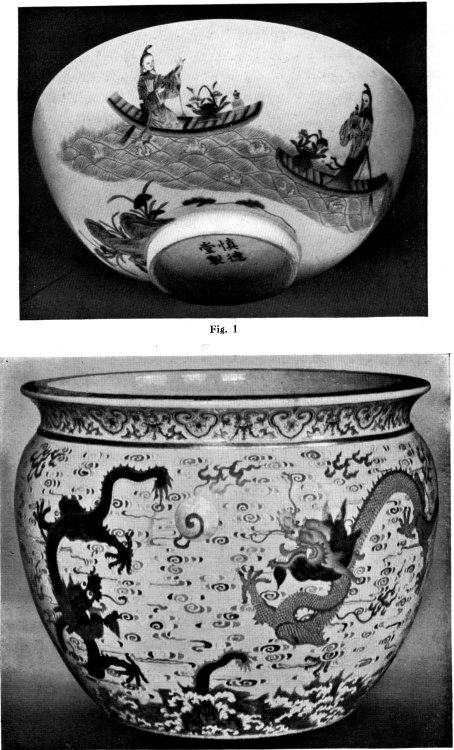
Plate 133.—Late famille rose Enamels.
Fig. 1.—Bowl painted in soft enamels, attendants of Hsi Wang Mu in
boats. Mark, Shên tè t’ang chih. Tao Kuang period. Diameter 6⅞
inches. British Museum.
Fig. 2.—Imperial Fish Bowl with five dragons ascending and descending,
borders of wave pattern, ju-i pattern, etc., famille rose
enamels. Late eighteenth century. Height 20 inches. Burdett-Coutts
Collection.
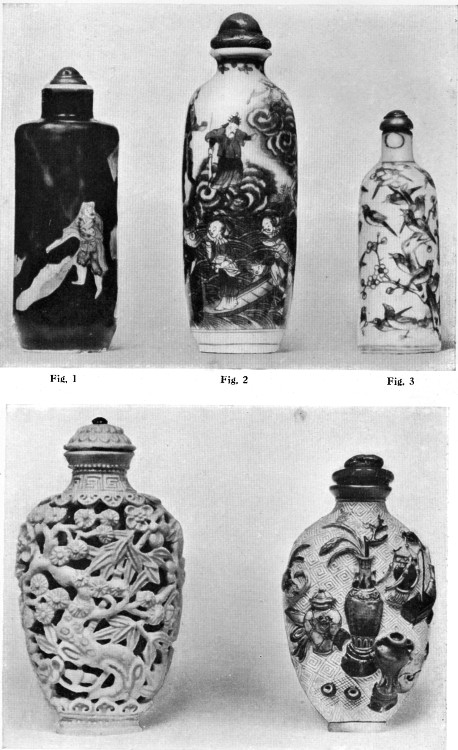
Plate 134.—Porcelain Snuff Bottles. Eighteenth Century.
British Museum.
Fig. 1.—Subject from the drama, black ground. Yung Chêng mark. Height
2¾ inches.
Fig. 2.—Battle of demons, underglaze blue and red. Mark, Yung-lo
t’ang. Height 3¾ inches.
Fig. 3.—Blue and white “steatitic” ware. Height 2½ inches.
Fig. 4.—Crackled cream white ting glaze, pierced casing with
pine, bamboo and prunus. Height 3¼ inches.
Fig. 5.—“Steatitic” ware with Hundred Antiques design in coloured
relief. Chia Ch’ing mark. Height 2½ inches.
These scenes from history and romance were favourite subjects with
the K’ang Hsi decorators of blue and white and famille verte
porcelains. To instance a few types: the scene of the half-legendary
Yao with his cavalcade coming to greet the Emperor Shun who is engaged,
like the Roman Cincinnatus, in ploughing; the episodes of the three
heroes of the Han dynasty, Chang Liang, Ch’ên P’ing and Han Hsin[493];
the heroes of the romantic period of the Three Kingdoms (221–265
A.D.) whose stories may be compared with those of our knights
of the Round Table; the stories of brigands in the reign of Hui Tsung
of the Sung dynasty.[494] The story of Su Wu, the faithful minister of
Han Wu Ti, tending cattle in captivity among the Hiung-nu, is depicted
on a bowl in the British Museum, and a dish in the same collection
shows an emperor (perhaps Kao Tsu, the first of the T’ang dynasty)
surrounded by his captains.
Processional scenes and subjects illustrating the life and customs of
the times, peaceful domestic scenes with interiors of house or garden
peopled by women and children, are more common in the famille
rose period when the warlike tastes of the Manchus had already been
softened by a long period of peace. A civil procession and a military
procession sometimes balance each other on two vases, the one being
the wên p’ing (civil vase), and the other the wu p’ing
(military vase). A mock dragon-procession formed by children at play is
a not uncommon motive. Indeed playing children (wa wa) have been
from the earliest times a subject frequently and most sympathetically
depicted on Chinese porcelain. A historical child-scene is that in
which the boy Ssŭ-ma Kuang broke the huge fish bowl with a stone to let
out the water and save his drowning companion.
There are many motives intended to appeal to the Chinese literatus,
and specially suited to ornament the furniture of the writing table.
Symposia of literary personages, for instance, make an appropriate
design for a brush pot, or again, the meeting of the celebrated
coteries, the Seven Worthies of the Bamboo Grove who lived in the
third century, and the worthies of the Orchid Pavilion, including the
famous calligrapher, Wang Hsi-chih, who met in the fourth century to
drink wine, cap verses, and set their cups floating down the “nine-bend
river” (see Plate 104, Fig. 1). The Horace of China, Li T’ai-po, the
great T’ang poet, is represented in drunken slumber leaning against an
overturned wine jar or receiving the ministrations of the Emperor and
his court. He also figures among the Eight Immortals of the Wine Cup, a
suitable subject for an octagonal bowl. Poets, painters, and sages are
often seen in mountain landscapes contemplating the beauties of Nature;
two sages meeting on a mountain side is a frequent subject and is known
as the “happy meeting,” or again, it is a single sage, with attendant
carrying a bowl, book, and fan, or sometimes bringing an offering of a
goose. In rare instances these figures can be identified with Chinese
worthies such as Chiang Tzŭ-ya, who sits fishing on a river bank, or
Chu Mai-ch’ên, the wood-cutter, reading as he walks with his faggots on
his back.
The stories of the Twenty-four Paragons of Filial Piety provide
a complete series of popular subjects, which may be seen in the panels
of Plate 91, Fig. 3. Women are represented by the Virtuous Heroines;
by celebrated beauties such as Yang Kuei-fei, consort of the T’ang
ruler Ming Huang,[495] and Hsi Shih, the Chinese Delilah who was the
undoing of Fu Ch’ai, prince of Wu, in the fifth century B.C.;
by the poetess Tan Hui-pan, and by a hundred nameless figures which
occur in genre designs, and by the idealised beauties, mei jên
(graceful ladies), which the Dutch ungallantly dubbed with the name of
lange lijsen or long Elizas. The domestic occupations of a lady
form another series of subjects for polygonal vessels; and women are
sometimes seen engaged in the Four Subjects of Study—Poetry, Rites,
History, and Music—or in the Four Liberal Accomplishments—Writing,
Painting, Music, and Checkers—but the groups who make up these scenes
are more often composed of men. The game of checkers or gô,
which is so often loosely rendered chess,[496] is wei ch’i the
“surrounding game,” a favourite Chinese amusement, which figures in two
well-known subjects of porcelain decoration. One of these is the legend
of Wang Chih, the Taoist patriarch, watching the game played by two old
men, the spirits of the Pole Stars, in a mountain retreat; the other is
the story of the general Hsieh An, who refused to allow the news of an
important victory to disturb his game.
Ladies of the court picking lotus flowers from boats on an ornamental
lake in the presence of the Emperor and Empress represent the annual
Lotus Fête at Peking, and there are numerous scenes in the Imperial
pleasure grounds in which bevies of ladies from the harem are depicted.
The Eight Ambassadors of the Tribes of Man, the barbarian nations from
the eight points of the compass, form a processional subject suitable
for the exterior of bowls and cups. The ambassadors are grotesquely
drawn figures, sometimes mounted on strange beasts, and carrying gifts
as tribute to the Emperor. Dreams and visions are depicted in the
usual Oriental manner by a cloud issuing from the dreamer’s head and
expanding into a scene which represents the subject of the dream. Thus
the youthful scholar is seen asleep with a vision of his future dignity
floating above his head. Divine apparitions are differentiated by the
presence of clouds around or below the main figures.
Deities and deified mortals are favourite subjects for porcelain
decoration as well as for figures and groups modelled in the round.
The three principal Chinese religions—Confucianism, Buddhism, and
Taoism—exist side by side with perfect mutual toleration. Indeed the
principles of the one are in many cases incorporated in the others.
Buddhist and Taoist emblems are freely mingled in decorative art,
and the three founders—Confucius, Buddha, and Lao-tzŭ—are grouped
together in friendly conversation or examining a scroll on which is
drawn the Yin-yang symbol of the duality of Nature.[497]
Confucianism is the religious or rather philosophical system officially
recognised in China, but its adherents are chiefly among the literati.
Though it inculcates ancestor-worship, it is not in itself concerned
with an after life, and it contains few romantic superstitions
calculated to fire the popular imagination or to suggest motives for
decorative art. Confucius himself is frequently represented both in
painting and sculpture, and his meeting with Lao-tzŭ is familiar in
pictorial art. Confucianism recognises certain canonised mortals, the
logical outcome of ancestor-worship, and among these the best known
in art is Kuan Yü, a warrior famous at the end of the Han dynasty,
who was not, however, canonised until the Sung period, and only in
1594 raised to the rank of a god (of War) under the title of Kuan
Ti. It is reasonable to suppose that most of the numerous statuettes
of this popular deity were made after the latter date. He is usually
represented as a dignified personage with flowing beard seated in
full armour with right hand raised in a speaking attitude; but he
figures also on horseback or beside his charger, and with his faithful
squires—Chou Ts’ang, who carries a halberd, and Kuan P’ing, his own
son. Occasionally he is seen seated with a book in his hand, in which
case he is regarded as a literary rather than a military power.
The gods of Literature have a very large following in China, where
scholarship has been the key to office for upwards of two thousand
years, the chief deity of the cult being Wên Ch’ang, or in full, Wên
Ch’ang ti chün. He is the star god who resides in one of the groups of
the Great Bear, a dignified bearded figure in mandarin dress seated
with folded hands or mounted on a mule. A lesser but more popular
divinity is the demon-faced K’uei Hsing, who was canonised in the
fourteenth century. Originally a scholar, who though successful in the
examinations was refused office on the ground of his preternatural
ugliness, he threw himself in despair into the Yangtze and was carried
up to heaven on a fish-dragon. He is easily recognised as a demon-like
person, poised with one foot on the head of a fish-dragon (yü
lung) which is emerging from waves. He brandishes triumphantly in
his hands a pencil brush and a cake of ink.[498] The fish-dragon is
itself a symbol of literary aspiration, from the legend that when the
salmon come every year up the river to the famous falls of Lung-mên
(the dragon gate), those which succeed in leaping up the falls are
transformed into fish-dragons. This metamorphosis of the fish as it
emerges from the water into the dragon is a favourite motive for
porcelain decoration.
Buddhism, which was officially recognised in China by the Emperor
Ming Ti in 67 A.D., had a far-reaching influence over the
arts of sculpture and painting, and the revolution which it worked in
the greater arts was naturally reflected in the lesser handicrafts.
Buddhistic motives appear early in the Chinese pottery, and in the
period with which we are at present concerned, the Buddhist religion
supplied a great number of motives for the porcelain painter and the
figure modeller. Sakyamuni himself is depicted or sculptured in various
poses: (1) As an infant standing on the lotus and proclaiming his
birth; (2) as an ascetic returning from his fast in the mountains;
(3) seated cross-legged on a lotus throne with right hand raised in
teaching attitude, the most frequent representation; (4) recumbent on
a lotus pillow, in Nirvana; (5) in the Buddhist Trinity holding the
alms bowl or patra between the Bodhisattvas Manjusri and Samantabhadra.
These two last when represented singly are usually mounted, Manjusri on
a lion, and Samantabhadra on an elephant.
But by far the most popular figure of the Buddhist theogony in China
is Kuan-yin, the Compassionate, and Kuan-yin, the Maternal; in the
latter capacity she holds a child in her arms and displays a wonderful
likeness to our images of the Virgin. But a full account of her has
been given on p. 110, and need not be repeated. Next in popularity
perhaps is the jolly monk with the hempen bag, Pu-tai Ho-shang, a
semi-nude, corpulent person, with smiling face, and a large bag full
of the “precious things.” He is also a great favourite in Japan, where
he is known as Hotei, and worshipped as the god of Contentment. By the
Chinese he is also regarded as Mi-lo Fo, the Maitreya or coming Buddha,
and he has been added by them to the list of Arhats or apostles of
Buddha. He is often represented surrounded by playful children to whom
he is devoted.
The Arhats, or Lohan, are all known by their several attributes, but
in porcelain decoration they usually appear in groups consisting of
the whole or a large part of their number, which, originally sixteen,
was increased in China to eighteen by the inclusion of Ho-shang and
Dharmatrata. The latter is a long-haired individual who carries a vase
and a fly whisk in his hands and a bundle of books on his back while he
sits gazing at a small image of Buddha.
He is not to be confused with Tamo, the Indian Bodhidharma, the
first Chinese patriarch, who came to Lo-yang and remained there in
contemplation for nine years. The legend is that after his death (about
530 A.D.) he was seen returning to India wrapped in his shroud
and carrying one shoe in his hand, the other having been left behind
in his tomb. This is the guise in which he frequently appears in art
(Plate 86), and he is often depicted crossing the Yangtze on a reed.
Many of the symbolical ornaments on porcelain have a Buddhistic
significance, such as the eight emblems (see p. 298), the crossed
dorjes or thunderbolts of Vajrapani,[499] the Buddhist jewel in a
leaf-shaped halo of flames; and Sanskrit characters of sacred import
are used as decoration for bowls and dishes, made no doubt for the use
of the faithful. The principal animals associated with Buddhist designs
are the elephant, who carries the jewel vase on his back, the white
horse (pai ma), who brought the Buddhist scriptures across the
desert from India, the hare, who offered himself as food to Buddha, and
the Chinese lion who, under the name of the “dog of Fo” (Buddha), acts
as guardian of Buddhist temples and images.
But the religion which has taken the greatest hold on Chinese
imagination and which consequently has supplied the largest number of
motives for their decorative art is undoubtedly Taoism. As originally
taught by Lao-tzŭ, a contemporary of Confucius, in the sixth century
B.C., the doctrine of Tao (the Way) pointed to abstraction
from worldly cares and freedom from mental perturbation as the highest
good. But just as the later but closely analogous doctrine of Epicurus
degenerated into the cult of pleasure, so the true teaching of Lao-tzŭ
was afterwards lost among the adventitious beliefs and superstitions
which were grafted on to it by his followers. The secret of transmuting
metals into gold and of compounding the elixir of life became the
chief preoccupations of the Taoist sages, the latter quest appealing
particularly to the Chinese with their proverbial worship of longevity;
and a host of legends grew up concerning mortals who won immortality
by discovering the elixir, about fairies and the denizens of the Shou
Shan or Hills of Longevity, about the Isles of the Blessed and the
palace of Hsi Wang Mu in the K’un-lun mountains. It is this later and
more popular phase of Taoism which figures so largely in porcelain
decoration.
Lao-tzŭ is represented as a venerable old man with bald, protuberant
forehead, who rides upon an ox, the same in features as the god of
Longevity, Shou Lao, who is in fact regarded as his disembodied spirit.
Shou Lao, however, is more commonly shown enthroned upon a rocky
platform in the Hills of Longevity, holding in one hand a curious
knotted staff, to which are attached rolls of writing, and in the
other a peach, and surrounded by his special attributes, the spotted
deer, the stork, and the ling chih fungus. Thus seated he
receives homage from the Eight Immortals and the other Taoist genii or
hsien, who are as numerous as the fairies of our countryside.
Other designs represent Shou Lao riding on a deer or flying on the
back of a stork, or simply standing with his staff and peach, his
robes embroidered with seal forms of the character shou
(longevity). In this last posture he is often grouped with two other
popular deities, one in mandarin robes and official hat holding a
ju-i sceptre, which fulfils every wish, and the other also in
official robes but holding a babe who reaches out for a peach in his
other hand. Together they form the Taoist triad, Shou-hsing, Lu-hsing,
and Fu-hsing, star-gods (hsing) of Longevity, Preferment, and
Happiness. Fu-hsing in addition has sometimes two boy attendants
carrying respectively a lotus and a hand-organ.
The Eight Taoist Immortals (pa hsien) are:—
1. Chung-li Ch’üan, also known as Han Chung-li, represented as a fat
man, half-draped, who holds a ling chih fungus in one hand and a
fly-whisk or fan in the other.
2. Lü Tung-pin, a figure of martial aspect armed with a sword to slay
dragons and evil spirits. He is the patron of barbers.
3. Li T’ieh-kuai, Li with the iron crutch, a lame beggar with a crutch
and pilgrim’s gourd from which issue clouds and apparitions. He is
patron of astrologers and magicians.
4. Ts’ao Kuo-ch’iu, in official robes, wearing a winged hat, and
carrying a pair of castanets. He is patron of mummers and actors.
5. Lan Ts’ai-ho, of uncertain sex, carrying a hoe and a basket of
flowers. Patron of gardeners and florists.
6. Chang Kuo Lao, the necromancer with the magic mule, of which he kept
a picture folded up in his wallet. He would make the beast materialise
from the picture by spurting water on to it; and at other times he
would conjure it out of a gourd. His attribute is a musical instrument
consisting of a drum and a pair of rods. He is patron of artists and
calligraphers, and ranks as one of the gods of Literature.
7. Han Hsiang Tzŭ, who gained admission to the Taoist paradise and
climbed the peach-tree of Immortality. He is shown as a young man
playing on a flute, and is specially worshipped by musicians.
8. Ho Hsien Ku, a maiden who wears a cloak of mug-wort leaves and
carries a lotus. She is patroness of housewives.
The Immortals are commonly represented in a group paying court to Shou
Lao, or crossing the sea on the backs of various strange creatures or
other supernatural conveyances on their way to the Islands of Paradise.
Grouped in pairs they lend themselves to the decoration of quadrangular
objects.
Other frequenters of the Shou Shan are the twin genii[500] of Union
and Harmony (ho ho êrh hsien), an inseparable pair, depicted as
ragged mendicants with staff and broom, or as smiling boyish figures,
the one with a lotus and the other holding a Pandora box of blessings,
from which a cloud is seen to rise; Tung-fang So, who stole the peaches
of Hsi Wang Mu and acquired thereby a longevity of nine thousand
years, is represented as a smiling bearded old man, not unlike Shou
Lao himself, carrying an enormous peach, or as a boy with a peach to
recall his youthful exploit. Liu Han, with his familiar three-legged
toad, a wild-looking person, who waves a string of cash in the air, and
very closely resembles the Japanese Gama Sennin (the Hou Hsien Shêng
of China); Wang Tzŭ-ch’iao, who rides on a crane playing a flute, and
Huang An, the hermit, whose steed is a tortoise. The god of Alchemy is
figured, according to the identification of a statuette in the Musée
Guimet, as a tall, draped person with beard and moustaches flowing down
in five long wisps, a leaf-shaped fan in his left hand, and beside
him a small figure of a devotee who holds up a book with questioning
gesture.
The Queen of the Genii is Hsi Wang Mu (Queen Mother of the West). Her
home is in the K’un-lun mountains, and the peach tree of Longevity
grows in her gardens. In the tenth century B.C., the Emperor
Mu Wang is reputed to have visited her palace, and the reception forms
a pleasing subject for the artist, as does also her return visit paid
to the Emperor Wu Ti of the Han dynasty. She also figures frequently on
porcelain with her fair attendants crossing the sea on a raft, flying
on the back of a phœnix or standing with a female attendant who carries
a dish of peaches. Her messengers are blue-winged birds like the doves
of Venus, who carry the fruit of longevity to favoured beings. With
her attendant phœnix she presents a strong analogy with Juno and her
peacock; and her Western habitat has favoured the theories which would
connect her with Græco-Roman mythology, though her consort Hsi Wang
Fu (King Father of the West and a personage obviously invented ad
hoc) is quite insignificant and has nothing in common with the
cloud-compelling Jove.
There is a female figure which is scarcely distinguishable from one of
the attendants of Hsi Wang Mu on the one hand and from Lan Ts’ai-ho on
the other. This is the Flower Fairy (Hua hsien) who carries a
basket of flowers suspended from a hoe. And there are besides numerous
magicians of more or less repute, such as Chang Chiu-ko, who is seen
transforming pieces cut from his scanty garments into butterflies; and
a host of nameless hsien of local fame who figure in mountain
retreats, such as the Ssŭ hao or four hoary hermits.[501]
The animals connected with Taoist lore include the eight fabulous
horses of Mu Wang which brought him to the palace of Hsi Wang Mu. They
are usually seen at pasture frisking about in wild gambols. The deer,
the familiar of Shou Lao, is depicted usually with a ling chih
fungus in his mouth; the toad and hare live in the moon where they
pound the elixir of immortality; and the tortoise develops a long bushy
tail after a thousand years of existence. All these are suggestive of
longevity, as is also the crane and a number of flowers, fruits and
trees such as the pine, bamboo and prunus (the three friends), the
chrysanthemum, the willow, the peach, the gourd, and more especially
the ling chih fungus, the polyporus lucidus, which was
originally an emblem of good luck, but afterwards of longevity.
The head of the ling chih closely resembles[502] that of the
familiar ju-i sceptre which grants every wish, an auspicious
object commonly seen in the hands of Taoist genii; and the same form
occurs in a decorative border (see Plate 77, Fig. 2) which is variously
known as the ju-i head border, the ju-i cloud border, or
the cloud-scroll border, the conventional cloud being commonly rolled
up in this form. It will also be found that formal ornaments, pendants
and lambrequins often take the form of the ju-i head in Chinese
decoration.
The attributes of the Eight Immortals occur among the many symbols
used in porcelain ornament; and among the landscapes will be found
the gardens of Hsi Wang Mu and Mount P’êng-lai,[503] one of the three
islands of the blessed, situated in the ocean east of China. Here the
fountain of life flows in a perpetual stream: “the pine, the bamboo,
the plum, the peach, and the fungus of longevity grow for ever on its
shores; and the long-haired tortoise disports in its rocky inlets,
and the white crane builds her nest on the limbs of its everlasting
pines.”[504] Presumably, too, the Shou Shan is situated on this
delectable island; and perhaps also the heavenly pavilion (t’ien
t’ang), which appears among clouds as the goal to which a crane
is often seen guiding some of the Taoist genii. Possibly, too, the
conventional border of swirling waves punctuated by conical rocks
carries a suggestion of the rocky islands of paradise rising from the
sea.
Fig. 1.—The Yin-yang and Pa-kua
There are besides many primitive beliefs traceable for the most part
to Nature-worship, which prevailed in China long before the days of
Confucius, Lao-tzŭ or Buddha. Some of these have been incorporated
in the later religious systems, especially in that of Taoism, which
was ready to adopt any form of demonology. The oldest system is that
expounded by the legendary Fu Hsi, in which the phenomena of Nature
were explained by reference to the mystic diagrams revealed to him on
the back of a dragon horse (lung ma) which rose from the Yellow
River. These are the pa-kua or eight trigrams formed by the
permutations of three lines, broken and unbroken, as in Fig. 1. A more
common arrangement of them is according to the points of the compass,
and enclosing another ancient device, the Yin-yang, a circle bisected
by a wavy line, which symbolises the duality of Nature, yin
being the female and yang the male element.
Demons abound in Chinese superstitions, and the demon face appears
early in art on the ancient bronzes, from which it was sometimes
borrowed by the porcelain decorator. This is the face of the t’ao
t’ieh (the gluttonous ogre) supposed originally to have represented
the demon of the storm, and as such appropriately appearing against a
background of “cloud and thunder” pattern, as the key-fret is called
by the Chinese. Afterwards the t’ao t’ieh seems to have been
regarded, on homœopathic principles, as a warning against greed. Demons
also appear in complete form in certain battle scenes and conflicts,
such as the combat of the demons of the water and of air which proceeds
in front of a group of Chinese dignitaries seated in the Kin-shan
temple on the Yangtze river (see Plate 134, Fig. 2).
The sky and the stars of course contribute their quota of divinities.
Beside the Taoist star-gods of Longevity, Honours and Happiness, there
is the Jade Emperor or supreme lord of the universe, Yü wang shang ti,
who is represented in mandarin dress holding a ju-i sceptre and
closely resembling Lu Hsing, the star-god of Honours. There is, too,
the goddess of the Moon with a butterfly ornamenting the front of her
robes, and a mirror in her right hand, besides the other denizens of
the moon—Liu Han, the moon-hare and the moon-toad. A cassia tree also
grows in the moon, and the “cassia of the moon” is a symbol of literary
success.
The Sun is represented as a disc on which is a three-legged bird; and
it is probable that the sun-disc is represented also in the so-called
“pearl”[505] which is pursued or grasped by dragons; but this idea
of the power of the storm threatening the sun was lost sight of in
later art, and “a dragon pursuing a pearl” was considered a sufficient
description of the motive. A curious scene depicting a mandarin
shooting arrows at a dog in the sky alludes to the dog who devours the
sun and so causes the eclipse.
The zodiacal animals are named on p. 211 (vol. i), and the four points
of the compass are symbolised by the azure dragon for the East, the
white tiger for the West, the black tortoise for the North, and the red
bird for the South. The romance of two stars is embodied in the story
of the Spinning Maiden (Chih Nü) and her lover, the Cowherd
(Ch’ien Niu), who are separated for all the year save
on one night when the “magpies fill up the Milky Way and enable the
Spinning Damsel to cross over.”
Chang Ch’ien, the celebrated minister of Han Wu-ti, was one of the
first great travellers of China, and among the legends which grew
around his exploits is one which makes him ascend the Milky Way and
meet the Spinning Damsel herself. This story arose because he was
reputed to have discovered the source of the Yellow River, which had
hitherto been supposed to rise in heaven, being in fact a continuation
of the Milky Way. Chang Ch’ien is sometimes represented in Chinese art
as floating on a log-raft on the Yellow River, and carrying in his hand
a shuttle given to him by the Spinning Maiden.[506] The poet Li T’ai-po
is also figured in the same kind of craft, but he is distinguished by a
book in place of the shuttle.
Motives borrowed from the animal world are frequent on porcelain,
though they represent to a large extent mythical creatures, first and
foremost of which is the dragon. We need not enter into the conflicting
theories as to the origin of the Chinese dragon. Whether he sprang
from some prehistoric monster whose remains had come to light, or was
evolved from the crocodile, he appears in any case to have belonged to
Nature-worship as the power of the storm and the bringer of fertilising
rain. There, are, however, various kinds of dragons—those of the air,
the sea, the earth—and the monster takes many different forms in
Chinese art. The archaic types borrowed by the porcelain decorators
from ancient bronzes and jades are the k’uei lung 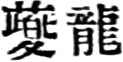 or
one-legged dragon, and the ch’ih lung
 , the former
a tapir-like creature which is said to have been, like the t’ao
t’ieh, a warning against greed,[507] the latter a smooth, hornless
reptile of lizard-like form with divided tail, who is also described as
a mang.
But the dragon (lung) par excellence is a formidable
monster with “bearded, scowling head, straight horns, a scaly,
serpentine body, with four feet armed with claws, a line of bristling
dorsal spines, and flames proceeding from the hips and shoulders.”
Such is the creature painted by the great master of dragon painting,
Chang Sêng-yu, of the sixth century, and as such he is the emblem of
Imperial power and the device of the Emperor. The Imperial dragon in
the art of the last two dynasties has been distinguished by five claws
on each of his four feet[508]; the four-clawed dragon was painted on
wares destined for personages of lesser rank. The dragons are usually
depicted flying in clouds, and pursuing the disc or pearl, which was
discussed above, or rising from waves. Nine dragons form a decoration
specially reserved for the Emperor; and on the palace porcelain the
dragon and the phœnix (fêng) frequently appear together as
emblems of the Emperor and Empress.
The fêng-huang,[509] a phœnix-like bird, is usually shown with
the “head of a pheasant and the beak of a swallow, a long flexible
neck, plumage of many gorgeous colours, a flowing tail between that
of an argus pheasant and a peacock, and long claws pointed backward
as it flies.” It is the special emblem of the Empress. In archaic
designs there is a k’uei fêng or one-legged phœnix, a bird-like
creature terminating in scrolls, which, like the corresponding
k’uei lung, occasionally appears in porcelain designs. Another
bird-like creature scarcely distinguishable from the fêng is
the luan; the former being based, as it is said, on the peacock
of India, and the latter on the argus pheasant. Another creature of
dual nature is the ch’i lin, commonly called the kylin, which
consists of the male (ch’i) and the female (lin). It
is in itself a composite animal with the “body of a deer, with the
slender legs and divided hoofs; the head resembles that of a dragon,
the tail is curled and bushy, like that of the conventional lion, and
the shoulders are adorned with the flame-like attributes of its divine
nature. It is said to attain the age of a thousand years, to be the
noblest form of animal creation, and the emblem of perfect good; and
to tread so lightly as to leave no footprints, and so carefully as to
crush no living creature.” Its appearance was the sign of the coming
of a virtuous ruler. It is important to note that the ch’i lin
is quite distinct from the Chinese lion, and is also to be carefully
separated from the other chimera-like creatures known in Chinese art
under the general title hai shou or sea monsters.
The lion in Chinese art (shih or shih tzŭ, the
Japanese shishi), though of qualified ferocity in appearance,
is in reality a peaceful, docile creature who expends his energy on a
ball of silk brocade, the streamers from which he holds in his massive
jaws. In general aspect (Plate 95), in his tufts of hair and his bushy
tail, he closely resembles the Peking spaniel, who is in fact called
after him the lion dog (shih tzŭ kou). He is usually represented
in pairs, the one with one foot on a ball of brocade, and the other,
presumably the lioness, with a cub. The larger lion figures are placed
as guardians by the gates of Buddhist temples, from which function the
lion has earned the name of “dog of Fo” (i.e. Buddha); the smaller
sizes, usually mounted on an oblong base with a tube attached to hold
an incense-stick, have a place on the domestic altar. Another mythical
creature not unlike the lion is the pi hsieh of archaic art
which is supposed to ward off evil spirits.[510]
The king of beasts in China is the tiger (hu), whose forehead is
marked by Nature with the character wang  (prince). He
is the solar animal, the lord of the mountains, and the chief of all
quadrupeds. The white tiger represents the western quadrant and the
autumn; and images of tigers in ancient times served many purposes,
such as guarding the graves of the dead and summoning the living to
battle.
In addition to the sea monsters there are sea horses, who speed at a
flying gallop over waves; and there are the pai ma and lung
ma and the eight horses of Mu Wang, already described, to represent
the horse in art. The deer is a Taoist emblem of longevity, and also in
its name lu suggests the auspicious word lu (preferment);
and there is a fabulous one-horned creature distinct from the ch’i
lin, and known as the t’ien lu or deer of heaven. Rams are
sometimes represented as personifying the revivifying powers of spring;
and the monkey occasionally figures in decoration, his name hou
suggesting another word hou, which means to expect (office), and
providing an appropriate design for presentation to a candidate in the
State examinations. Another motive suitable for the same purpose is the
fish leaping from waves, which has been already explained; and fish
in general are cleverly depicted by the porcelain decorators swimming
among water plants. The fish has always been a favourite motive in
China, and in ancient art it appears to have symbolised power and rank.
The double fish is one of the Buddhist emblems, and also symbolises
conjugal felicity. The tortoise has already been mentioned among the
emblems of longevity.
Birds are drawn with wonderful skill and spirit by Chinese artists,
and they provide a frequent motive both for the painter and figure
modeller. The crane is the companion of Shou Lao and a symbol of long
life; a pair of mandarin ducks suggest conjugal affection; egrets among
lotus plants, geese, and wild duck in marshy landscapes also pleased
the Chinese fancy. The magpie is an emblem of happiness, and two
magpies foretell a happy meeting; the cock is the bird of fame, and he
is often associated with the peony, which is the fu kuei flower,
to suggest the phrase kung ming (fame), fu kuei (riches
and honours!). There are other birds which are associated with special
trees and flowers; the pheasant is often seen perched on a rock beside
the peony and magnolia; partridges and quails go with millet; swallows
with the willow; sparrows on the prunus, and so on. A comprehensive
group represents the “hundred birds” paying court to the phœnix.
The bat is a symbol of happiness from its name fu having the
same sound as fu (happiness). Among insects, the cicada (at
one time regarded as a symbol of life renewed after death) is a very
ancient motive; and the praying mantis who catches the cicada is
an emblem of courage and perseverance.[511] Fighting crickets are
the fighting cocks of China, and supply a sporting motive for the
decorator; and butterflies frequently occur with floral designs or
in the decoration known as the Hundred Butterflies, which covers the
entire surface of the vessel with butterflies and insects.
Flower painting is another forte of the Chinese decorator, and some of
the most beautiful porcelain designs are floral. Conventional flowers
appear in scrolls, and running designs, especially the lotus and peony
scrolls and the scrolls of “fairy flowers,” the pao hsiang hua
of the Ming blue and white. But the most attractive designs are the
more naturalistic pictures of flowering plants and shrubs, or of floral
bouquets in baskets or vases. The flowers on Chinese porcelain are
supple, free, and graceful; and, though true enough to nature to be
easily identified, are never of the stiff copy-book order which the
European porcelain painter affected at one unhappy period. A long list
of the Chinese porcelain flowers given by Bushell includes the orchid
(lan), rose, jasmine, olea fragrans, pyrus japonica, gardenia,
syringa, several kinds of peony, magnolia (yü lan), iris,
hydrangea, hibiscus, begonia, pink and water fairy flower (narcissus
tazetta). Many more no doubt can be identified, for the Chinese
are great cultivators as they are great lovers of flowers. In fact,
the word hua  flowery is synonymous with Chinese, and
chung hua
 is China. Plate 126 is an example of the
Hundred Flower design, known by the French name mille fleurs, in
which the ground of the vase is a mass of naturalistic flowers so that
the porcelain looks like a bouquet.
There are special flowers for the months[512]:—(1) Peach (t’ao)
for February, (2) Tree Peony (mu tan) for March, (3) Double
Cherry (ying t’ao) for April, (4) Magnolia (yü lan)
for May, (5) Pomegranate (shih liu) for June, (6) Lotus
(lien hua) for July, (7) Pear (hai t’ang) for August,
(8) Mallow (ch’iu k’uei) for September, (9) Chrysanthemum
(chü) for October, (10) Gardenia (chih hua) for November,
(11) Poppy (ying su) for December, (12) Prunus (mei
hua) for January. From these are selected four to represent
the seasons—mu-tan peony for spring, lotus for summer,
chrysanthemum for autumn, and prunus for winter—which supply charming
motives for panel decoration or for the sides of quadrangular vases.
The chrysanthemum besides is associated with its admirer T’ao
Yüan-ming, and the lotus with Chou Mao-shu and the poet Li T’ai-po. But
as a rule the floral designs carry some hidden meaning, the flowers
being grouped so as to suggest some felicitous phrase by a play on
their names.[513] The peony we have seen to be the fu kuei
(riches and honours) flower; the chrysanthemum, as Dr. Laufer has
suggested, being the flower of the ninth (chiu) month, may
connote longevity through the word chiu (long-enduring); the
prunus (mei hua) carries the obvious suggestion of mei
(beautiful), and instances might easily be multiplied.
Among the trees, the cassia suggests literary honours, the willow
longevity, as also the pine, bamboo and plum, who are called the “three
friends,”[514] faithful even in the “winter of our discontent.” Among
the fruits the gourd is an emblem both of long life and of fertility,
and the three fruits (san kuo)—peach, pomegranate and finger
citron—symbolise the Three Abundances of Years, Sons and Happiness.
The orange is a symbol of good luck, and no doubt the others which
occur less frequently contain similar suggestions.
Landscape (shan shui) is one of the four main divisions of
Chinese pictorial art, and it is well represented in porcelain
decoration. The Sung and Ming masters provided designs which were
freely copied, and views of the beauty spots of China and of the
celebrated parks and pleasure grounds were frequently used. It is one
of these landscapes which the English potters borrowed for the familiar
“willow pattern” design, and the sentimental tale which some fanciful
writer has attached to the pattern is a mere afterthought. Figure
subjects and landscapes are combined in many designs, such as the
meeting of sages, romantic incidents, besides the more homely motives
of field work, fishing, rustics returning from the plough mounted on
their oxen, and the like. The four seasons, too, are represented in
landscape with appropriate accessories, such as blossoming peach trees
in a mountain scene for spring, a lake scene with lotus gatherers for
summer, a swollen river and autumn tints for autumn, and a snowstorm
for winter.
A great variety of symbols and emblematical devices appear in the
porcelain decoration of all periods, whether interwoven with the
designs, grouped in panels, or placed under the base in lieu of a mark.
Bushell[515] classifies the most familiar of them under the following
headings:—
1. Symbols of Ancient Chinese Lore: Pa-kua and Yin-yang
(see p. 290); Pa yin (eight musical instruments); Shih êrh
chang (twelve ornaments embroidered upon sacrificial robes).
2. Buddhist symbols: Pa chi hsiang (eight emblems of
happy augury). Ch’i pao (seven paraphernalia of the
chakravartin or universal sovereign).
3. Taoist symbols: Pa an hsien (attributes of the Eight
Immortals).
4. The Hundred Antiques (Po ku). Pa pao (the Eight
Precious Objects).
The pa-kua (eight trigrams) and the Yin-yang symbol
of the duality of Nature have been described. The eight musical
instruments are: (1) Ch’ing, the sounding stone, a sort of gong
usually in form of a mason’s square. It forms a rebus for ch’ing
(good luck). (2) Chung, the bell. (3) Ch’in, the lute.
(4) Ti, the flute. (5) Chu, the box, with a metal hammer
inside. (6) Ku, the drum. (7) Shêng, the reed organ. (8)
Hsüan, the ocarina, a cone with six holes.
The twelve chang or ancient embroidery ornaments are: (1)
Jih, the Sun, a disc in which is a three-legged bird, and
sometimes, the character jih  . (2) Yüeh,
the moon; a disc with hare, toad and cassia tree, and sometimes
the character yüeh
 . (3) Hsing ch’ên, the
stars: represented by three stars connected by straight lines.
(4) Shan, mountains. (5) Lung, dragons. (6) Hua
ch’ung, the “flowery creature,” the pheasant. (7) Tsung yi,
the temple vessels: one with a tiger design and the other with a
monkey. (8) Tsao, aquatic grass. (9) Huo, fire. (10)
Fên mi, grains of rice. (11) Fu, an axe. (12) Fu,
a symbol of distinction[516] (see vol. i., p. 227).
The Eight Happy Omens (pa chi hsiang) were among the signs
on the sole of Buddha’s foot. They are usually drawn with flowing
fillets attached (Fig. 2), and they are as follows: (1) Lun,
the wheel or chakra, sometimes replaced by the bell (chung).
(2) Lo, the shell. (3) San, the State umbrella. (4)
Kai, the canopy. (5) Hua, the (lotus) flower. (6)
P’ing, the vase. (7) Yü, the fish; a pair of them.[517]
(8) Ch’ang, the angular knot representing the entrails; an
emblem of longevity.[518]
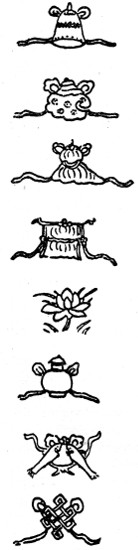
Fig. 2.—The Pa chi hsiang
The Seven Gems (ch’i pao) are: (1) Chin lun, the golden
wheel. (2) Yü nü, the jade-like girl. (3) Ma, the horse.
(4) Hsiang, the elephant. (5) Chu ts’ang shên, divine
guardian of the treasury. (6) Chu ping ch’ên, general in command
of the army. (7) Ju i chu the jewels which fulfil every wish; a
bundle of jewelled wands bound round with a cord.
The Pa an hsien, Attributes of the Eight Immortals, as detailed
above (p. 287), are: (1) Shan, the fan of Chung-li Ch’üan. (2)
Chien, the sword of Lü Tung-pin. (3) Hu lu, the gourd
of Li T’ieh-kuai. (4) Pan, the castanets of Ts’ao Kuo-chiu.
(5) Hua lan, the basket of flowers of Lan Ts’ai-ho. (6) Yu
ku, the bamboo tube and rods of Chang Kuo Lao. (7) Ti, the
flute of Han Hsiang Tzŭ. (8) Lien hua, the lotus flower of Ho
Hsien Ku.
The Po ku, or Hundred Antiques, is, as its name implies, a
comprehensive group including all manner of symbols and symbolical
ornaments, which were frequently grouped together in panel decoration.
Bushell[519] describes two typical panels on specimens in the Walters
collection. One contained the apparatus of the scholar and painter,
viz. books on tables, brushes in vases, water pots and scroll
pictures, all enveloped with waving fillets mingled with tasselled
wands and double diamonds, which are symbols of literary success. The
other contained a tall vase with peonies; a low vase with peacock
feather, an emblem of high rank; a lion-shaped censer on a four-legged
stand, the incense smoke from which rises in form of a pair of storks;
a set of incense-burning implements, a bundle of scroll pictures, a
ju-i sceptre, a musical stone, a sword, and a paper weight.
A favourite set of Po-ku emblems is the Pa pao (Fig. 3)
or Eight Precious Objects: (1) Chu, the pearl, which grants
every wish. (2) Ch’ien, the “cash,” a copper coin used to
symbolise wealth. (3) Lozenge, or picture (hua). (4) Fang
shêng, the open lozenge, symbol of victory.[520] (5) Ch’ing,
the musical stone. (6) Shu, a pair of books. (7) Chüeh,
a pair of horn-like objects. (8) Ai yeh, the leaf of the
artemisia, fragrant plant of good omen and a preventative of disease.
A branch of coral, a silver ingot, a pencil brush and cake of ink are
common emblems; and the swastika occurs both by itself (vol. i., p.
227) or interwoven with the character shou (vol. i., p. 227), or
even as a fret or diaper pattern. The swastika is a world-wide symbol;
in China it is called wan, and used as a synonym for wan
(ten thousand), and as such it is regarded as a symbol of wan
shou (endless longevity). A lyre wrapped in an embroidered case,
a chess-or gô-board with round boxes for the white and black
pieces, a pair of books, and a pair of scroll pictures symbolise the
“four elegant accomplishments,” ch’in, ch’i, shu,
hua (music, chess, writing and painting).
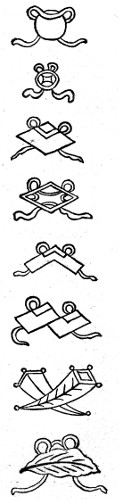
Fig. 3.—The Pa pao
The figurative aspect of Chinese decoration has been repeatedly
noticed, and occasional examples of direct play upon words or rebus
devices have been given incidentally. The Chinese language is
peculiarly suited for punning allusions, one sound having to do duty
for many characters; but it is obvious that a fair knowledge of the
characters is required for reading these rebus designs. There is,
however, a certain number of stock allusions with which the collector
can easily make himself familiar. The commonest of these is perhaps the
bat (fu) which symbolises happiness (also pronounced fu
in Chinese). The Five Blessings (wu fu), which consist of
longevity, riches, peacefulness and serenity, love of virtue and an
end crowning the life, are suggested by five bats; and a further rebus
is formed of red bats among cloud scrolls, reading hung fu ch’i
t’ien, “great happiness equally heaven” (t’ien); hung
being the sound of the character for “great, vast,” as well as for red,
and red being, so to speak, the colour of happiness in Chinese eyes.
Other common rebus designs are suggested by such words as lu
(deer), lu (preferment); yü (fish), yü
(abundance); ch’ing (sounding stone), ch’ing (good
luck); ch’ang (the intestinal knot), ch’ang (long);
and the composition of the rebus phrase often includes such ideas
as lien (lotus), lien (connect, combine); tieh
(butterfly), tieh (to double). But almost every sound in the
Chinese spoken language represents a considerable number of characters,
and it would be possible with a little ingenuity to extract several
rebus sentences out of any complicated decoration. It is well to
remember, however, that most of the ordinary allusions have reference
to some good wish or felicitous phrase bearing on the five blessings,
on the three abundances or on literary success.
To quote a few further instances: the design of nine (chiu)
lions (shih) sporting with balls (chü) of brocade has been
read[521] chiu shih t’ung chü, “a family of nine sons living
together.” An elephant (hsiang) carrying a vase (p’ing)
on its back (pei) is read[522] hsiang pei tai p’ing,
“Peace (p’ing) rules in the north (pei).” A tub full of green
wheat is read[523] i t’ung ta ch’ing, “the whole empire (owns)
the great Ch’ing dynasty.” Three crabs holding reeds is read[524]
san p’ang hsieh ch’uan lu, “three generations gaining the first
class at the metropolitan examinations.” Two pigeons perched on a
willow tree is read[525] êrh pa (k’o) t’eng t’ê,
“at eighteen to be successful in examinations.”
A group of three objects consisting of a pencil brush (pi), a
cake of ink (ting) and a ju-i sceptre crossed one over
the other (Fig. 4), occurs both in the field of the decoration and
as a mark under the base. It is a pure rebus, reading pi ting ju
i, may things be fixed (ting) as you wish (ju i,
lit. according to your idea). Another obvious rebus which occurs as a
mark (Fig. 5) consists of two peaches and a bat (double longevity and
happiness), and floral designs are very commonly arranged so as to
suggest rebus phrases.
Fig. 4
Fig. 5
But the Chinese decorator did not always express himself in riddles.
Inscriptions are frequent on all forms of decorative work, as is
only natural in a country where calligraphy ranks among the highest
branches of art. To the foreign eye Chinese writing will not perhaps
appear so ornamental as the beautiful Neshky characters which were
freely used for decorative purposes on Persian wares; but for all
that, its decorative qualities are undeniable, and to the Chinese
who worship the written character it is a most attractive kind of
ornament. Sometimes the surface of a vessel is almost entirely occupied
by a long inscription treating of the ware or of the decoration which
occupies the remaining part; but more often the writing is limited to
an epigram or a few lines of verse. The characters as a rule are ranged
in columns and read from top to bottom, the columns being taken from
left to right; and rhyming verse is written in lines of three, five
or seven characters each. The inscriptions are often attested by the
name or the seal of the author. The Emperor Ch’ien Lung, a prolific
writer of verses, indited many short poems on the motives of porcelain
decoration, and these have been copied on subsequent pieces.
As for the style of writing, the ordinary script is the k’ai
shu, which dates from the Chin dynasty (265–419 A.D.),
but there are besides many inscriptions in which the archaic seal
characters chuan tzŭ are employed, or at least hybrid modern
forms of them; and there is the cursive script, known as ts’ao
shu or grass characters, which is said to have been invented in the
first century B.C. The seal and the grass characters are often
extremely difficult to translate, and require a special study, which
even highly educated Chinese do not profess to have mastered.
Single characters and phrases of auspicious meaning in both seal
form and in the ordinary script occur in the decoration and also
in the place of the mark. Many instances have already been noted in
the chapters dealing with Ming porcelains, such as fu kuei k’ang
ning (riches, honours, peace and serenity), ch’ang ming fu
kuei (long life, riches and honours), etc., see vol. i., p. 225.
The most frequent of these characters is shou (longevity),
which is written in a great variety of fanciful forms, mostly of
the seal type. The “hundred forms of shou” sometimes constitute the
sole decoration of a vase; and as already observed[526] the swastika
(wan) is sometimes combined with the circular form of the
seal character shou to make the wan shou symbol of ten
thousand longevities. Fu (happiness) and lu
(preferment) also occur, though less frequently.
Buddhistic inscriptions are usually in Sanskrit characters, but we
find occasional phrases such as Tien chu en po  (propitious waves from India) and Fo ming ch’ang jih
 (the ever bright Buddha) in ordinary script or seal, one character
in each of four medallions; and the sacred name of O mi t’o fo
 , Amida Buddha, similarly applied, would serve as a charm
against evil.
In addition to the central designs, there is a number of secondary
ornaments which round off the decoration of a piece of porcelain.
Chief of these are the border patterns, of which a few favourites
may be exemplified. At the head of the list comes the Greek key-fret
or meander (see Plate 12, Fig. 1), which, like the swastika, is of
world-wide use. On the ancient bronze this pattern was freely used both
in borders and as a diaper background, and it is described by Chinese
archæologists as the “cloud and thunder pattern.” It is sometimes
varied by the inclusion of the swastika, in which case it is known
as the swastika fret. Another bronze pattern freely borrowed by the
porcelain decoration is the border of stiff plantain leaves which
appears appropriately on the neck or stem of an upright vase (see Plate
89, Fig. 1).
The border of small “S” shaped scrolls is apparently derived from
silkworm cocoons; but the curled scrolls and another scroll pattern
with more elaborate curves are intended to suggest clouds. A further
development of the cloud pattern is scarcely distinguishable from the
ju-i head border (see Plate 77, Fig. 2). Indeed the terms,
“connected cloud” pattern, ju-i cloud pattern, and ju-i
head pattern, are used almost interchangeably by Chinese archæologists.
Conventional waves are represented by a kind of shaded scale pattern
or a diaper of spiral coils, and the more naturalistic “crested wave”
border, punctuated by conical rocks, has already been mentioned. There
are besides narrow borders of zig-zag pattern with diagonal hatching,
and the ordinary diaper designs, in addition to the familiar gadroons
and arcaded borders.
The wider borders are usually borrowed from brocade patterns with
geometrical or floral ornament, broken by three or four oblong panels
containing symbols or sprays of flowers; and when a similar scheme is
followed in some of the narrow edgings, the flowers are unhesitatingly
cut in half, as though the pattern were just a thin strip taken from a
piece of brocade.
A few special borders have been described on the pages dealing with
armorial porcelain,[527] among which were the well-known “rat and vine”
or “vine and squirrel” pattern (see Plate 119, Fig. 3), reputed to have
first appeared on a picture by the Sung artist, Ming Yüan-chang.[528] A
rare border formed of red bats side by side occurs on a few plates of
fine porcelain which are usually assigned to the K’ang Hsi period, but
are probably much later.
On the whole, the Chinese border patterns are comparatively few in
number, being in fact a small selection of well-tried designs admirably
suited to fill the spaces required and to occupy the positions assigned
to them on the different porcelain forms.
As to the sources from which these and the other designs described in
this chapter were borrowed by the porcelain decorator, we can only
speak in general terms. Ancient bronze vessels, metal mirrors, carved
jades, stamped cakes of ink, embroideries, brocades, handkerchiefs,
and illustrated books no doubt provided the greater part of them. The
purely pictorial subjects would be based on the paintings in silk and
paper which the Chinese arrange in four chief categories: (1) figures
(jên wu),(2) landscape (shan shui),(3) nature subjects
(hua niao, lit. flowers and birds), and (4) miscellaneous
designs (tsa hua). Selections of desirable designs from various
sources were no doubt arranged in pattern books, and issued to the
porcelain painters.
CHAPTER XVIII FORGERIES AND IMITATIONS
With their intense veneration for the antique, it is only natural
that the Chinese should excel in imitative work, and a great deal
of ingenuity has been quite legitimately exercised by them in this
direction. The amateur will sometimes have difficulty in distinguishing
the clever copies from the originals, but in most cases the material
and the finish of the work frankly belong to a later period, and
sometimes all doubt is removed at once by a mark indicating the true
period of manufacture. But the collector has to be on his guard against
a very different kind of article, the spurious antique and the old
piece which has been “improved” by the addition of more elaborate
decoration or by an inscription which, if genuine, would give it
historic importance. The latter kind of embellishment is specially
common on the early potteries of the Han and T’ang periods. Genuine
specimens taken from excavated tombs have often been furnished with
dates and dedicatory legends cut into the body of the ware and then
doctored, to give the appearance of contemporary incisions. But a
careful examination of the edges of the channelled lines will show
that they have been cut subsequently to the firing of the ware, when
the clay was already hard. Had the inscription been cut when the pot
was made, it would have been incised in a soft unfired substance,
like the writing of a stylus in wax, and the edges of the lines would
be forced up and slightly bulging; and if the ware is glazed, some
of the glaze will be found in the hollows of the inscription. There
are, besides, minor frauds in the nature of repairs. Pieces of old
pottery, for instance, are fitted into a broken Han jar; the lost heads
and limbs of T’ang figures are replaced from other broken specimens,
and defective parts are made up in plaster. Such additions are often
carefully concealed by daubs of clay similar to that with which the
buried specimen had become encrusted. Further than this, Han and T’ang
figures have been recently manufactured in their entirety, and mention
has already been made (Vol. I., p. 27) of a factory at Honan Fu, where
figures and vases with streaked and mottled glazes, fantastic ewers
with phœnix-spouts and wing-like excrescences, and the like, are made
with indifferent skill.
The collector of Sung and Yüan wares, too, has many difficulties to
surmount. The fine imitations made from the Yung Chêng period onwards,
both in pottery and porcelain, fortunately are often marked; but
sometimes the mark has been carefully removed by grinding, and the scar
made up to look like the natural surface. The imitative wares made in
Kuangtung, at Yi-hsing, and in various Japanese factories have been
already discussed in the sections concerned; and there is pottery with
lavender blue, “old turquoise” and splashed glazes resembling the Chün
types, but made at the present day in Honan and elsewhere, which is
likely to deceive the beginner. The commonest kind has a buff earthen
body which is usually washed with a dull brown clay on the exposed
parts. But such obstacles as these add zest to the collector’s sport,
and they are not really hard to surmount if a careful study be made of
the character of authentic specimens. The eye can be easily trained to
the peculiarities both of the originals and of the various imitative
types, and no one who is prepared to take a little trouble need be
afraid of attacking this fascinating part of Chinese ceramics.
The T’ao lu[529] quotes an interesting note on the repairing of
antique wares: “In the Chu ming yao it is stated with regard
to old porcelain (tz’ŭ), such as (incense-) vessels which
are wanting in handles or feet, and vases damaged at the mouth and
edge, that men take old porcelain to patch the old, adding a glazing
preparation, and giving the piece one firing. When finished it is like
an old piece, and all uniform, except that the patched part is dull in
colour. But still people prefer these specimens to modern wares. If the
process of blowing the glaze on to (the joint of the repair) is used
in patching old wares, the patch is still more difficult to trace. As
for specimens with flaws (mao), I am told that on the Tiger Hill
in Su-chou there are menders who have earned the name of chin
(close-fitters).” The collector knows only too well that there are
“close-fitters” in Europe as well as in China.
Apart from the numerous instances in which early Ming marks[530]
have been indiscriminately added to later wares, the careful copies
and imitations of true Ming types are comparatively few. Among the
imitative triumphs of the Yung Chêng potters a few specialties are
named, such as blue and white of the Hsüan Tê and the Chia Ching
periods, and the enamelled decoration of the Ch’êng Hua and Wan Li, but
reference has already been made to these in their respective chapters.
The modern Chinese potters make indifferent reproductions of Ming
types; and the most dangerous are those of the Japanese, who from the
eighteenth century onward seem to have taken the sixteenth century
Chinese porcelains as their model. The Chia Ching and Wan Li marks are
common on these reproductions, which often catch the tone and spirit
of the Ming ware with disquieting exactitude. A well-trained eye and
a knowledge of the peculiarities of Japanese workmanship are the only
protection against this type of imitation.
The high esteem in which the K’ang Hsi porcelains are now held has
naturally invited imitation and fraud. The ordinary modern specimen
with a spurious K’ang Hsi mark is, as a rule, feeble and harmless, and
even the better class of Chinese and Japanese imitations of the blue
and white and enamelled porcelains of this period are, as a rule, so
wide of the mark as to deceive only the inexperienced. Many frauds,
however, have been perpetrated with French copies of famille
verte, of famille rose “ruby-back” dishes, and of vases
with armorial decoration. These are cleverly made, but the expert will
see at once that the colours and the drawing lack the true Oriental
quality, and that the ware itself is too white and cold. Clever copies
of Oriental porcelain, especially of the famille rose, have
also been made at Herend, in Hungary. But perhaps the most dangerous
Continental copies are some of the French-made monochromes of dark
blue and lavender colours, with or without crackle, fitted with ormolu
mounts in eighteenth century style, which conceal the tell-tale base.
Monochromes are, as a rule, the most difficult porcelains to date, and
the well-made modern Chinese and Japanese sang de bœuf, apple
green, and peach bloom are liable to cause trouble, especially when the
surface has been carefully rubbed and given the appearance of wear and
usage. The expert looks to the truth of the form, the finish of the
base, and the character of the clay exposed at the foot rim, and judges
if in these points the piece comes up to the proper standard.
But without doubt the most insidious of all the fraudulent wares are
those which have been redecorated. I do not refer to the clobbered[531]
and retouched polychromes or to the powder blue and mirror black on
which the gilding has been renewed, but to the devilish ingenuity
which takes a piece of lightly decorated K’ang Hsi porcelain, removes
the enamelling, and even the whole glaze if the original ornament
has been in underglaze blue, and then proceeds to clothe the denuded
surface in a new and resplendent garb of rich enamel. Naturally, it
is the most sumptuous style of decoration which is affected in these
frauds, such as the prunus tree and birds in a ground of black,
green, or yellow enamel on the biscuit; and the drawing, execution
and colours are often surprisingly good. The enormous value of this
type of vase, if successful, repays the expense and trouble involved
in the truquage; and the connoisseur who looks at the base for
guidance is disarmed because that critical part has been undisturbed,
and has all the points of a thoroughbred K’ang Hsi piece. If, however,
his suspicion has been aroused by something unconvincing in the design
or draughtsmanship, he will probably find upon minute examination some
indication of the fraud, some trace of the grinding off of the glaze
which the enamels have failed to cover, suspicious passages at the edge
of the lip where the old and new surfaces join, or traces of blackening
here and there which are rarely absent from a refired piece. But if the
work is really successful, and no ingenuity or skill is spared to make
it so, his suspicions may not be aroused until too late. Frauds of this
kind belong to the most costly types, and concern the wealthy buyers.
The poorer collectors have to deal with small deceits, the adding
of a famille verte border to a bowl or dish, the retouching
of defective ornament, the rubbing of modern surfaces to give them
fictitious signs of wear, the staining of new wares with tobacco juice,
and other devices easily detected by those who are forewarned. Against
all these dangers, whether they be from wilful frauds or from innocent
imitations, I can only repeat that the collector’s sole defence is
experience and a well-trained eye.
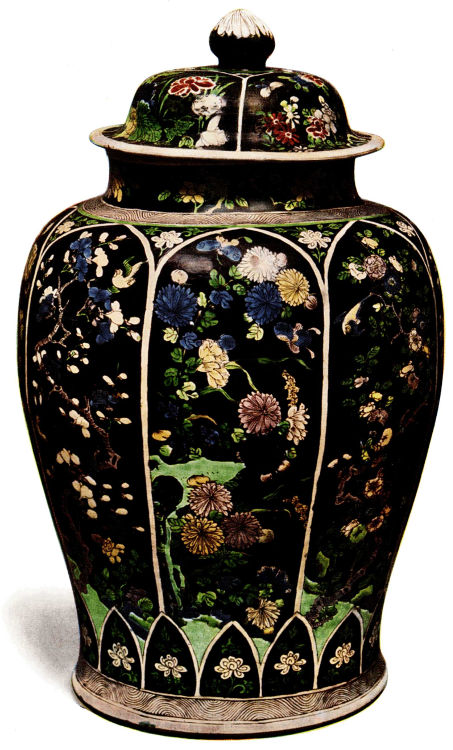

 (1426–1435)
 (1465–1487)
 (1522–1566)
 (1567–1572)
 (1573–1619)


 (1736–1795)
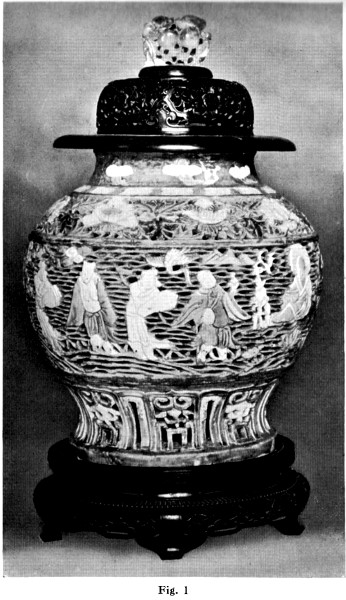
 lan kuang, lit. “burn tube.” Omitting
the radical
 (huo, fire) in both cases, Bushell takes
the characters as lan (blue) and huang (yellow). Possibly
Bushell’s edition had variant readings.
 lit. “omit body.” A slightly thicker porcelain
is known as pan t’o t’ai, or “half bodiless.”
 ts’ai chui. These words seem to have
been taken to mean “decorated with an awl”; but they are better
translated separately to mean “bright coloured” and “(engraved with)
an awl,” the suggestion being that ts’ai refers to enamelled
porcelain.
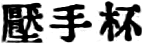 Ya shou pei, lit. “press hand cups.”
 pai (white), which seems to be an error for
 ssŭ
(four): taken as it stands, it would mean written in white slip.
 hua, lit. “slippery.” The meanings
include “polished, smooth, ground,” etc., from which it will be seen
that the word could equally refer to a glazed surface or an unglazed
surface which had been polished on the wheel.
 hui hui ch’ing (Mohammedan blue).” See W. P.
Groeneveldt, Verhandelingen van het Bataviaasch Genootschap van
Kunsten en Wetenschappen, vol. xxxix., p. 92. These envoys arrived
in 1426, 1430, 1433, 1434, and for the last time in 1486. Sumatra was
a meeting-place of the traders from East and West, and no doubt the
Mohammedan blue was brought thither by Arab merchants. Possibly some
of the mineral was brought back by the celebrated eunuch Chêng Ho, who
led an expedition to Sumatra in the Yung Lo period. See also p.
 hsien. The emperor Ch’êng Hua was
canonised as Hsien Tsung.
 ch’ien tan. The T’ao shuo,
quoting this passage, uses a variant reading, ch’ien shên
 , which Bushell renders “whether light or dark.”
 ts’ao ch’ung can equally well mean
“plants and insects” or “grass insects,” i.e. grasshoppers. In fact,
Julien translated the phrase in the latter sense.
 Bushell has translated it “diffused colours,”
but fu is also used for “applying externally” in the medicinal
sense, which seems specially appropriate here.
 , lit. “fill up (with) glaze,” the colour of
the glaze being specified in each case. Cf. lan ti t’ien hua wu
ts’ai (blue ground filled up with polychrome painting), a phrase
used to describe the decoration of the barrel-shaped garden seats of
the Hsüan Tê period. See p.
 ch’i shang.


 .
 .
 , delicate, beautiful.
 .
 .
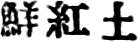 hsien hung t’u, lit. “the earth for
the fresh red,” an expression which would naturally refer to the
clay used in making ware of this particular colour, though
Bushell has preferred to take it in reference to the mineral
used to produce the colour itself. See p.
 chin lu (golden seal),
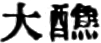 ta chiao (great
sacrifice),
 t’an yung (altar use).
 t’ieh chin, lit. stuck-on gold.
 t’ien pai, a phrase frequently used
in this sense, though it is not quite obvious how it derives this
meaning from its literal sense of “sweet white.”
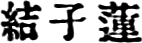 .
 ling chih, a species of agaric, at
first regarded as an emblem of good luck, and afterwards as a Taoist
emblem of immortality.
 shih tzŭ. The mythical lion is a
fantastic animal with the playful qualities of the Pekingese spaniel,
which it resembles in features. In fact the latter is called the lion
dog (shih tzŭ k’ou), and the former is often loosely named the
“dog of Fo (Buddha),” because he is the usual guardian of Buddhist
temples and images.
 ts’ang, azure or hoary.
 .
 chün, a fleet horse.
 .
 . Bushell (T’ao shuo, p.
146) has rendered this with “flowers and inscriptions, etc.” In many
cases in these lists it is almost impossible to say whether the word
hua has the sense of flowers or merely decoration.
The present passage fu shou k’ang ning hua chung seems to demand
the second interpretation.
 . Ts’ui is a fairly common name. It
occurs as a mark on a small figure of an infant in creamy white ware of
Ting type in the Eumorfopoulos Collection; but it is highly improbable
that this piece has anything to do with the Mr. Ts’ui here in question.
 ssŭ hsŭ t’ou, a phrase which would
more usually refer to the beard than the hair of the head. The above
rendering is Bushell’s.
 .
 .
 .
 . There is an allusion in this name to the
story of Hu Kung, a magician of the third and fourth centuries, who was
credited with marvellous healing powers. Every night he disappeared,
and it was found at length that he was in the habit of retiring into
a hollow gourd which hung from the door post. See A. E. Hippisley,
Catalogue of a Collection of Chinese Porcelains, Smithsonian
Institute, Washington, 1900. Hao’s porcelain is also known as Hu
kung yao (the ware of Mr. Pots).
 luan mu, “the curtain inside the
egg,” which conveys the idea of extreme tenuity better than the most
usual expression, “egg shell” porcelain.
 .
 .
 , apparently referring to the size of the
vessels and not necessarily implying that they were shaped like a frog.
On the other hand, small water vessels in the form of a frog have been
made in China from the Sung period onwards.
 .
 pai tun tzŭ white blocks.

 lit. watered. This word has been rendered
by some translators as “pale”; but probably it has merely the sense of
“mixed with the (glaze) water,” i.e. a monochrome glaze. The recipe
given in the T’ao lu (see Julien) is incomplete, only mentioning
“crystals of saltpetre and ferruginous earth (fer ologiste
terreux).” Another chiao which signifies “beautiful,
delicate,” is applied to the Hung Chih yellow in Hsiang’s Album. See
vol. ii., p.
 . Another name of this official, Yen
kung, is mentioned in the T’ao lu, bk. v., fol. 11 verso.
 into its component parts ku
 and yüeh
 .
 , lit. hanging,
suspended or applied glaze. The Yi-hsing stoneware was not usually
glazed; hence the force of the epithet kua applied.
 mo, lit. “rubbed.” Bushell (O. C. A.,
p. 383) explains the term mo hung as “applied to the process of
painting the coral red monochrome derived from iron over the glaze with
an ordinary brush.”
 yu t’ung yung hung yu hui hua chê, yu
ch’ing yeh hung hua chê. Bushell (O. C. A., p. 386) gives a
slightly different application of this passage, but the meaning seems
to be obviously that given above.

 , yu hsin shih, lit. “also he newly
made.” This is undoubtedly the sense given by the Chinese original,
and Julien renders it “il avait nouvellement mis en œuvre.” Bushell,
on the other hand, translates: “He also made porcelain decorated with
the various coloured glazes newly invented,” a reading which
makes the word chih do duty twice over, and leaves it doubtful
whether T’ang was the inventor of these types of decoration or merely
the user of them. Both the grammar and the balance of the sentences in
the original are against this colourless rendering.
 means “as you
wish” or “according (ju) to your idea (i),” and the
sceptre, which is made in all manner of materials such as wood,
porcelain, lacquer, cloisonné enamel, etc., is a suitable gift for
wedding or birthday. Its form is a slightly curved staff about 12 to 15
inches long, with a fungus-shaped head bent over like a hook. On the
origin of the ju-i, see Laufer, Jade, p. 335.