EXPLANATION OF PLATES
(Numbers preceded by 4- and 16- are University of California Museum of Anthropology specimen-catalogue numbers.)
Plate 1
Chincha doll (4-4116) dressed in scrap of plain-weave
material. Height overall, 7 inches. Head, a knob wrapped
with fiber; black human hair folded over top and drawn in
at neck with fiber string. Body composed of 2 tortoras
separated to form legs; all elements wrapped with fiber
and with one extra "toe" applied to each foot. Arms of
wrapped tortora with fingers (3) applied at ends.
Garment of plain cotton material torn crosswise; fold
at one side; lapped seam held with coarse stitches at opposite
side; seam across shoulders; no openings for
arms. Tatters at bottom edge turned to outside and secured
with running stitches. Length 5¼ inches; breadth
7¼ inches.
Plate 2
Loomstring ends of Chincha fabrics, a, b, detail of
ends of two webs (16-1304b, 16-1270) to show heading
strip (1) and weaving proper (2) comparable in texture;
(3) section between them, the join, more loosely woven.
Width of sections shown, 3.5 inches.
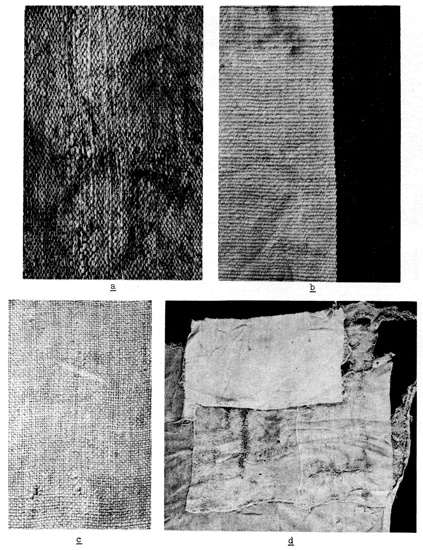
Plate 3
a, b, c, examples of medium-coarse Chincha fabrics
(16-1282, 16-1217, 16-1252), fair to good qualities of
weaving; d, worn material reinforced by patches held
down by running stitches (16-1222). Dark section of b,
1.25 inches wide; a and c in proportion; upper patch of
d, 9 inches by 6 inches.
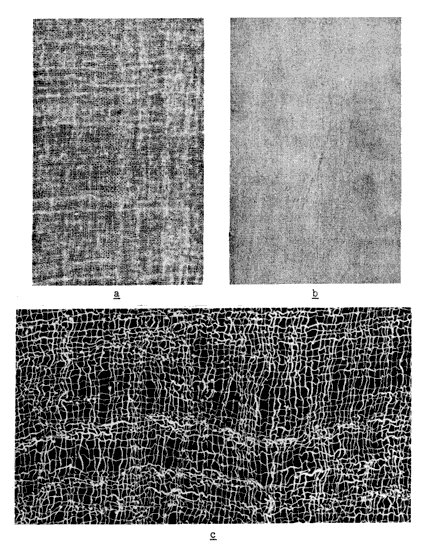
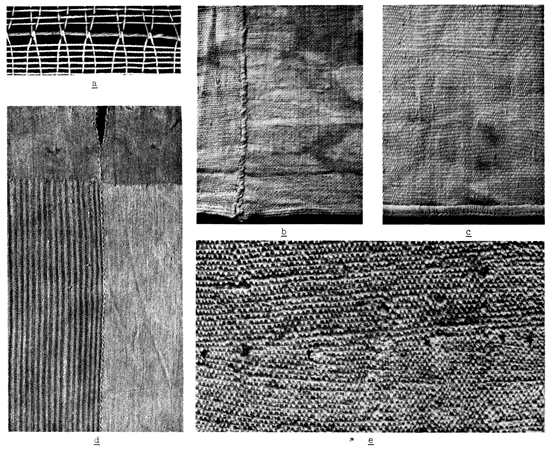
Plate 4
Textures of fine fabrics. a, comparable to modern
cheesecloth (4-4058b); b, canvaslike (16-1255a); c, open
plain weave showing high twist of single-ply yarns
(4-3883b).
Plate 5
a, reconstruction of end-to-end warp locking, shown
in d, by methods which make possible the change from
monochrome to stripes; b, close-texture, semibasket
weave with three heavy loomstring wefts at end selvage,
whipped seam (16-1292); c, end selvage reinforced
with needleknitting (16-1217) (cf. pl. 8,f, g); d, fine cotton
garment material with stripes below monochrome
section (16-1225), right-hand striped section faded;
e, section of textile (×2) with turn of fill-in straightening
wefts indicated by black threads (4-4056) (cf. pl. 8,a).
Width of b and c, 3 inches.
Plate 6
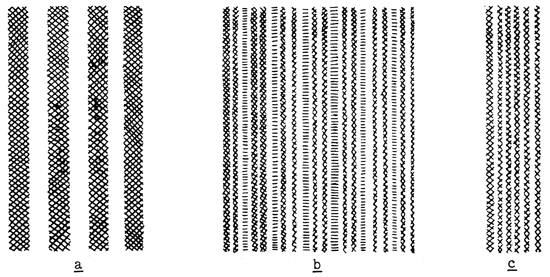
a-e, border stripes on Chincha cloths (16-1268,
16-1277, 16-1214, 16-1251, 16-1255a), colors, brown and
blue; f, section of plaid with border stripe (4-3973d). Selvages
at left. Width of narrowest border stripe, one-fourth
inch; others in proportion.
Plate 7
a, reconstruction of border stripes of fabric in
plate 6,e; b, reconstruction of stripe found on several specimens;
c, section of fabric (×2) showing variations in
plain weave and amount of twist given to weaving elements
(16-1240); d, section of fabric (×2) showing two-and-two
basket weave varied in appearance by arrangement
of colored yarns (4-3962).
Plate 8
Reconstructions, a, fill-in weft to straighten working
edge (cf. pl. 5,e); b, plain running stitch; c, double running
stitch shown in two colors for clarity; d, seam in
saddler's or baseball stitch, also called antique seam;
e, seam in whipping stitch: f, g, top and side view of
needleknitting type found on Chincha edge (pl. 5,c), alternate
stitches plain whipping stitches; h, i, two views
of reinforced selvage showing strand of twining through
tops of whipping stitches.
Plate 9
Weaving and sewing equipment: a-g, undressed
thorns, 3.5 to 6 inches long (4-3653); h-o, bunch of fine
wooden needles (n shows eye) 4.5 inches long, black and
pale color wood (4-3651); p, copper needle (4-4094);
q, headed and pointed stick, possibly a warp-lifter
(4-3865f); r-w, sticks, some of cane including pointed
and headed tools (4-3865a-e, g, h): s, u, weaving swords;
t, loom bar; x, weaving sword, 18 inches long.
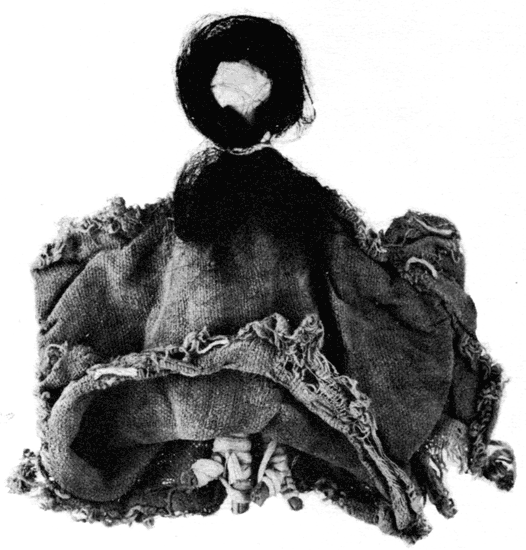
Plate 1. Chincha Doll
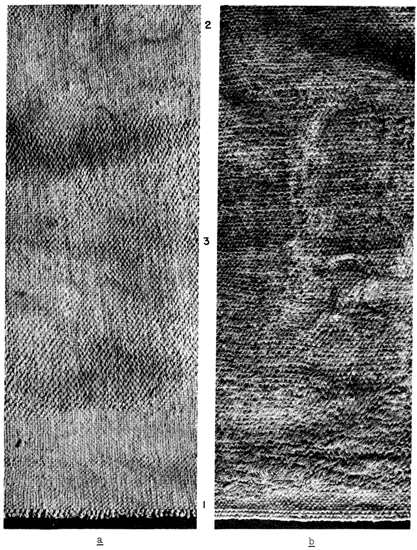
Plate 2. Loomstring Ends
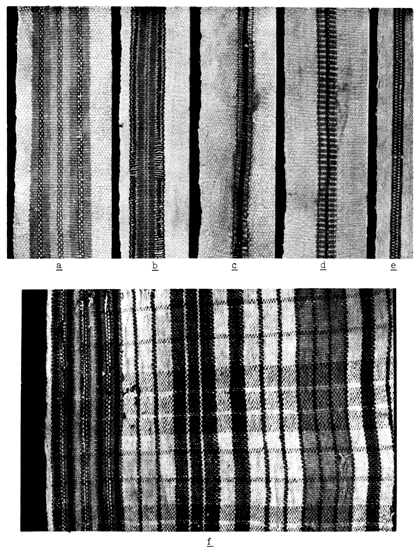
Plate 6. Pattern: Stripes and Plaids
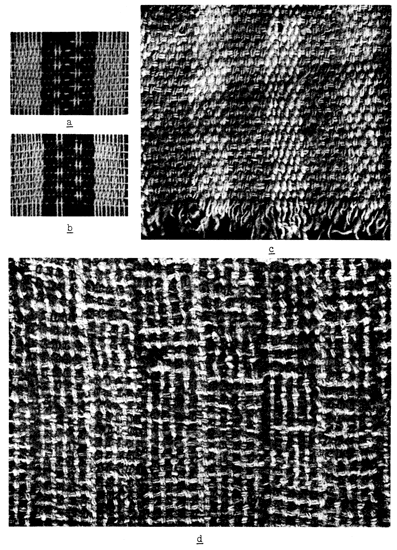
Plate 7. Pattern: Stripes and Variations in Plain Weaves
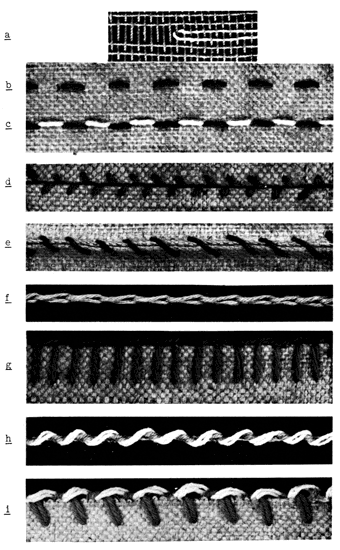
Plate 8. Reconstructions of Stitches
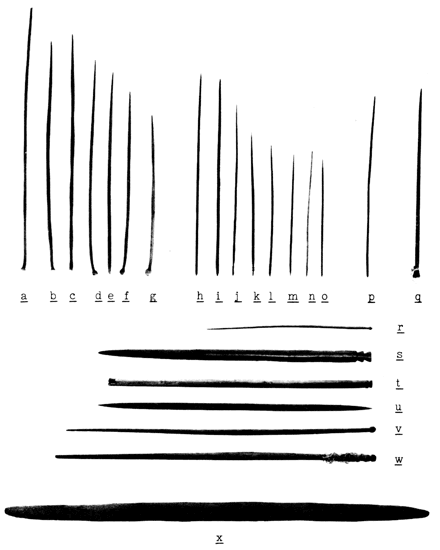
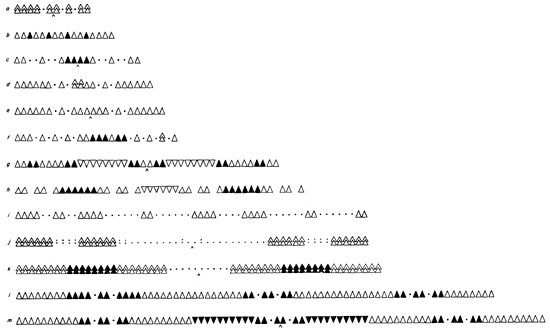
Plate 9. Weaving and Sewing Equipment
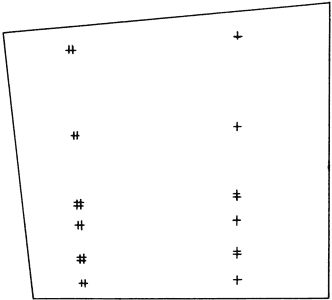
 , one-by-one;
  , one-by-two;
  , two-by-one;
and
, two-by-one;
and  , two-by-two (27 in. × 26 in. over all).