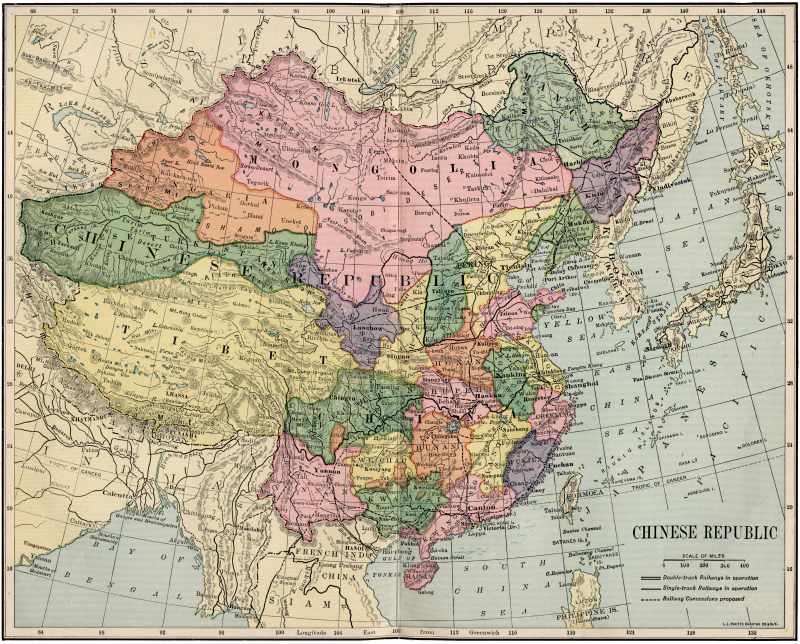
A republic in place of the oldest monarchy! Preposterous.
It would involve making a yellow man think as a white man,
and that had never occurred, not even in the case of the
prodigy, Japan. It would involve free intercourse with the
whole wide world, and China had opposed such an innovation
stubbornly for 400 years. It meant that the proudest
and most self-contained nation should treat others as equals
and interchange with them. It involved throwing 4,000
years of continuous history and agglomerated pride and
precedent to the winds, and humbly beginning anew as a tyro
for a while. It meant the dealing with 400,000,000 kings,
instead of one, and asking: “My lord, what is your will?”
An educational system 2,000 years old to be forgotten at
once! A religion 5,000 years old at least, whereby every
man had his own god (his father), to be made as cheap as the
paltry sacrifices of wine, rice and the painted stick of Confucianism
were in reality! The taking up of individual and
national responsibility for 400,000,000 people, and entrance
upon a wide path of world-influence, with its divided shame
and fame! The taking and giving of blows for wrong and
right! The giving up of the triple eternal Nirvana of father,
self and son, in exchange for an exciting rôle limited to fifty-five
crowded years in the individual! The scale of action!
A land as large as all Europe, and a people as numerous as
the Caucasic race! The thunderous knock on the long-locked
doors of science and medicine by 400,000,000 people who
had bowed to idol and charm alone! It shook the world. It
was pregnant with paradisal possibilities for mankind, because
of the vastness of the movement and the depth of its
well-spring. The launching of this new leviathan ship of
state could not but raise a wave that would lift the already
floating hulks of Europe and America, and give them added
impetus, though temporary alarm. The rearrangement of
commerce, manufacture, labor, finance, taxation, learning,
agriculture, art and possibly religion for the whole world.
The adding of the most difficult language to the tongues and
pens of men, and the call on the English speech to rise once
more greater than the mighty stranger, or die. The challenge
to Palestine’s Bible to conquer by truth, or retreat with
half a world lost. The uprising again of the yellow ghosts
of Kublai Khan, Batu, Timurlane, and the Khans of the
Golden Horde. What would be the Caucasian’s answer to
Emperor William’s question: “The Yellow Peril”? It will
be remembered that the kaiser once painted a picture showing
the nations of Europe gathering to defend the cross and
civilization against an incendiary Buddha lowering in the
eastern sky. Would the stranger within the gates be protected
even while republican and imperialist fought out their
argument? Would leadership arise, and would the great
Mongolian mass be intellectualized now that it was energized?
Since the vast body was suddenly displaced, would
it henceforward move by mere gravity, or sympathetic volition?
Could it collectivize and not disintegrate? What
would be the effect on the scores of trembling thrones, where
Rominoff, Hapsburg, Savoy, Hohenzollern, Ottoman, Mikado,
Billiken, etc., said they ruled by “divine right”, which
is quite a different thing from noble England’s “constitutional
right”? Sun Yat Sen and the Chinese republicans sent
out this challenge: “Tien ming wu chang” (the divine right
lasts not forever).
All these questions presented themselves when the reformers
startled the world with the announcement that
there was to be a republic in China. It was to be a republic—not
a monarchy—said even those Chinese who had been
educated in Japan, where lately a Japanese editor educated
in America and ten others had been tried and executed
in secret, the papers sealed, and the press censored. They
wanted pitiless publicity in the new republican China. Had
there been no abatement of the opium habit through America’s
leadership of sentiment, and Britain’s sacrifice of revenue
from 1909 to 1911, there could have been no rebellion
in 1911. The reform cleared the befogged heads of the
nation, added a million men to agitation, and furnished a
hundred million dollars directly and indirectly toward the
independence of the agitators. How great a stone America
and Britain set rolling in that Opium Conference of 1909
at Shanghai!
The great revolution of October, 1911, did not drop as a
bolt from a clear sky. The clouds had been gathering,
though many at home and abroad did not, or would not see
them. In September, 1911, the imperial viceroy of Canton,
Chang Ming Chi, sent spies along the new Canton-Hongkong
railway to apprehend smugglers of arms. In
the same month troops under the command of Marshal
Lung Chai Kwong, suddenly surrounded the office of the
Shat Pat Po newspaper, at Canton, and arrested several
reformers. General Luk Wing Ting, of Kwangsi province,
came down the Si Kiang (West River) in September, 1911,
in the gunboat Po Pik to Canton and took back with
him from the Canton arsenal, machine guns and ammunition
to attack the “anarchists”, as the Manchus persistently
called all reformers. In the month previous, the Ministry
of Posts and Communications at Peking stopped the use of
private codes, so as to censor messages to the reformers.
Several viceroys, in secret sympathy with the reformers,
had as early as August, 1911, wired for gunboats, so as to
disperse the fleet from the Yangtze basin, where the revolution
was to strike, and the largest cruiser, the splendid Hai Chi,
well-known in New York, these viceroys suggested
should be sent to King George’s coronation review at Spithead.
Even as far back as July, 1907, the Chinese government
approached the powers, requesting that they make
espionage on arms consigned to South China. Rather to
our amusement, they used to arrive at Hongkong as boxed
pipes, condensers, bar iron, crockery, etc.—anything but
guns, but that was the humor of the freight classification
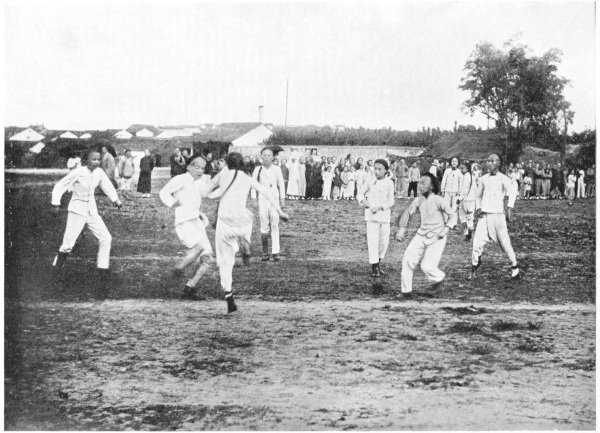
which the shippers used! In December, 1906, the scholars
of the middle class in Wuchow, Kwangsi province, at the
head of navigation on the West River, decided to cut off
their queues, and adopted khaki uniform, military drill and
track races. They were independently preparing for strenuous
times five years before the outbreak, and these boys
were found in the first line of the attack in October, 1911,
up at Hankau, led by the Chinese Colonel Wen, who had
graduated from West Point Military Academy, in America,
in 1909. In August, 1911, the Hongkong and Shanghai
Banking Corporation reported that a large part of its $9,000,000
gold note issue was being held, instead of circulated
by the Chinese of Kwangtung and other southern provinces.
This hoarding of safe securities always indicates lack of
faith as to the business and political future.
The celebrated Manchu, Tuan Fang, director-general of
railways, was ordered by the Ministry of Communications
to proceed to Canton and Kung Yik, the new town of the
Americanized Chinese, in August, 1911, to “pacify the people”.
Tuan replied that he would not go, and gave as his
excuse: “Canton is infested with anarchism”. In the same
month the regent, Prince Chun, asked Prince Ching to
recommend an energetic general to be sent to quell disturbances
in Kwangtung province, and the Tartar general,
Fung Shan, was sent. Spying was not uncommon, impersonators
going to a province ahead of new appointees and
reciting a record at the yamen which seemed to identify
them. In August, 1911, the cabinet at Peking decided to
send photographs of new officials in a sealed envelope, so
as to prevent this impersonating.
As an indication of the new spirit which was moving
among the Chinese of Canton for better things at this
time, take the inception of the model town of Heungchow.
Chinese returned from America, Singapore and Hongkong
could not bear the municipal restraint of the old
city. They chose a site ten miles up the inner harbor of
Macao. Dredging and a breakwater were begun for a
harbor. Broad streets, drains, fine stores, temples, police
and fire stations and equipment, water-works, libraries,
parks, reforestation, chamber of commerce, tramways,
electricity and gas, hospitals, schools, theaters, detached
homes with gardens, launch and steamer lines, and a free
port,—all were in the scheme. When a government permits
monopoly of food, and riots result because of justice
ineffectually exerted, history shows that the government
is about to fall. I instance the fierce Hangchow rice
riots of July, 1906, under the leadership of the Hung Pang
(Red Association), and the Changsha rice riots of 1910,
when Yale College, in China, was barely saved from the
conflagration in the very district which in 1911 was swept
by the high tide of the revolution. In 1906 text-books were
issued to the modern schools (Hok Tongs) which contained
a caricature of China, not as the “Middle Kingdom” of old,
but as a morsel from which all the nations took a bite. The
intent, of course, was to arouse resentful patriotism in place
of the old inert pride. Many of these schoolboys enlisted
in the two bravest corps of the republicans, the “Dare to
Die” band, and the “Bomb Throwers” regiment. In April,
1911, the rebels, under two of Sun Yat Sen’s lieutenants,
Hu Wai Sang and Wu Sum, operating in Kwangtung province,
issued to the world almost the identical manifesto that
President Sun and Foreign Secretary Wu Ting Fang issued
in January, 1912, covering the following points:
1. Ousting the Manchu.
2. Friendly intercourse with foreigners and protection
of foreign property and person.
3. All foreign treaties now in force to be allowed to run
their course.
4. Foreign loans and indemnities contracted by Manchus
to date to be paid.
5. Concessions contracted to date to be binding.
Desperate fighting took place, and had the rebels been
sufficiently supplied with money and arms, the republic
would have been declared at Canton in April instead of at
Wuchang and Nanking in November. The United States
gunboat Wilmington and British gunboats were rushed
to Shameen Island, Canton, to protect foreigners. Admiral
Li, who was killed in the October revolution, was barely
able to conquer this April revolution in Kwangtung and
Fukien provinces. For centuries the Chinese women would
not associate with the Manchus, whom they called “tent
women”. All through Turkestan the Chinese walled off
their section of the city from the Mongolian settlements,
though after the conquest the Manchu troops displaced the
Chinese.
Nearly all the missions were informed by students and
friends many months previous to the revolution that serious
and continued disturbances would occur. The Chinese saw
that individualism had arisen in America and England and
was battling with the privileged. Individualism arose at last
in China and resented in this rebellion the quietism taught
by the superstition of Taoism, the resignation of Buddhism
and the obedience of Confucianism. “I am not a clan; I
am a man,” said the ambitious Chinese as he saw the new
ray of hope. American diplomacy was not altogether uninformed
or unprepared. The American fleet was made
the largest foreign fleet in Chinese waters in the first month
of the revolution, Admiral Murdock having the cruisers
Saratoga (the converted New York of Spanish War
fame), Albany, New Orleans, Wilmington; the gunboats
Helena, El Cano, Villalobos, Samar; the monitor Monterey;
and the destroyers Barry and Decatur.
As far back as June 3, 1910, a year and four months
before the revolution, the Shanghai News printed the
following article: “All the legations and consuls have received
anonymous letters from friendly revolutionaries in
Shanghai containing the warning that an extensive anti-dynastic
uprising is imminent. If they do not assist the
Manchus, foreigners are not to be harmed.” In August,
1911, a rebellion broke out at Sining, in far western Kansu
province. The stores were raided for every bolt of foreign
cotton to make uniforms. A boy of fifteen was named
leader and he was given the significantly fanciful name of
“Savior of his country” (Chiu Shih Wang). Rich men
cornered the rice supply in the flooded Yangtze valley, and
food riots broke out all along the river in August, 1911. On
August 23, 1911, rebels boarded a Chinese gunboat on the
romantic Si Kiang (West River) near Canton, shooting the
commander and seizing the arms and ammunition. On September
first the Navy Department strengthened the patrol
of Kwangtung province waters so as to stop the smuggling
of arms, and the army board required miners to get permits
to import dynamite, as they feared that the “anarchists”
were importing the explosive. The awful floods and
famines of 1910–11 in the basins of the Yangtze River, the
Hwei River and Grand Canal had created much criticism of
the government, which failed to alleviate suffering; and the
famine-stricken were willing to fight, because an army has
a commissariat, at least. “Every one that was in distress,
and every one that was in debt, and every one that was discontented,
escaped to the cave of Adullam.” Newspapers,
such as the oldest reform journal, the Shen Pao, of
Shanghai, related horrible illegal tortures of the “third degree”
used by Manchuized officials, which I have quoted in
the chapter on “Legal Practise.”
Tin was largely financing the propaganda, the 400,000
Chinese tin merchants and miners of Singapore and Penang
in the Straits Settlements being the largest contributors.
Following them came the 100,000 American Chinese and
the 50,000 Australian Chinese. Even in 1898, Li Hung
Chang was known to declare, at Canton, that it was not impossible
that the spread of the proposed new education of
the foreigners would overturn the Manchu dynasty, of
which he, a Chinese from Hofei, in Nganhwei province,
had been the strongest prop among the viceroys for forty-five
years. Superstition was not inactive. Halley’s comet
flared in the sky. It had shone when Cæsar fell; when
Jerusalem fell; when Italy fell before Attila; when English
Harold fell before William the Conqueror; when Rome
fell in England; when Quebec fell before Wolfe; and now
its awful flame must surely prophesy the fall of the Manchu
dynasty. Omens were recited that red snow (snow and
loess) had fallen in Honan province, and that the Hangchow
tidal bore had risen twenty feet, broke over the bank
and poured water into the first gallery of the Haining
pagoda. This always meant the fall of the dynasty, for
had it not happened on the night the beloved Mings fell,
and when the scholarly Sungs fell?
As with civil servants in some other countries, the Manchuized
civil service (mandarins) acted as though they were
the governors and not the servants of the people by
allotting to themselves high salaries and peculations. The
year before the revolution the land tax yielded about
$150,000,000. Only $30,000,000 reached the government
exchequer. The Chinese held the Manchus responsible
for this criminal neglect of audit, for at least $100,000,000
should have reached the imperial and provincial exchequers.
That would have allowed $50,000,000 for the
expected peculation of that kind of office holders who
believe that “public office is a private graft”. In September,
1911, the month preceding the great revolution, the
Chi Feng Po, a native paper of Peking, reported that
all wages were in arrears and that even the tea coolies had
humorously pasted an anonymous sheet on the imperial controller’s
door: “Not even a shadow of our wages yet;
WHY! WHY!” Taxes were increased on long-suffering
Kwangtung province in the south, the brick kilns of
Kochau, the silk sheds of Namhoi, the tea houses, and even
the temple keepers being assessed “all the taxed would
bear”. I shall instance a representative revolt. On September
6, 1911, the bonze at Shek Lung, near Canton, organized
a revolt among the worshipers at his temple. The mob
demolished the municipal yamen, the police station, the
government distilleries, abattoir and fish market. As far
back as 1898 the emperor, Kwang Hsu, by edict declared
that the lottery at Canton should pay one-third of the upkeep
of the far-away Peking University. I have related in
the chapter on “Chinese Daily Life” the incident of a unique
statue of a kneeling figure erected in the Kwan clan temple
at San Wui, near Canton, in August, 1911, which is
whipped by the worshipers to commemorate the defection
of a member to the government’s railway and tax program.
There was always ill feeling between Peking and
Kwangtung provinces, the Manchu and Manchuized viceroys
joking at Peking when they were ordered to assume charge
at the yamen at Canton: “Well, I’m off to boss Miaotszes
(barbarians),” which the refined and commercial Cantonese
certainly were not. This superciliousness was deeply
resented.
Repeated complaint had been made that an unrepresentative
Manchu government gave away concessions right and
left to foreigners, and that when these concessions were recalled
or bought out, owing to outraged patriotic feeling in
the southern and central provinces, the foreigner in instances
charged immense sums for good will and franchise
in addition to his outlay and interest. I shall not recite instances,
as it is the system that I am denouncing, not the
persons. The Chinese rightly said, if we look at the matter
with his eyes, that he was not going to pay vast sums
for the retrocession of his own franchise, which was in
some instances coerced from, or wheedled out of, an effete,
governing, unrepresentative clique, the members of which
never consulted the provinces that were concerned. “Taxation
without representation” again. It was not like the
repudiation of the bonds of the southern states, for no
money had been paid. “Compensation” and “indemnity”
are two words the Chinese have learned to hate, and some
day they mean to build an immense navy and equip a large
army to interpret these words in the way the Occident interprets
them, when they are synonymous with injustice
and “grab”. Bitter complaint has continually been made
since 1898 that Germany monopolized the mining and railway
franchises of the rich province of Shangtung.
On the subject of railways, concessions, etc., the following
remarks will be recalled in the American General J. H.
Wilson’s book, China (1887): “The Chinese will build railroads,
open mines, etc., whenever they can be shown that this
can be done with their own money, obtained at first by private
subscription, and by their own labor, under the direction
of foreign experts who will treat them fairly and honestly.
They will not for the present grant concessions or subsidies
to foreigners. They will not even take money from any
syndicate by mortgage.” Complaint was also made that the
Ming dynasty, 268 years ago, left as a heritage to the Manchu
dynasty, a land full of public works, bridges, roads,
temples, pagodas, canals, and that while the Manchu collected
large taxes, he seldom or never repaired a temple,
canal or road, so that China is now desolate. Objection
was also made that the government shipyards, like the
Kiangnan, at Shanghai, were building luxurious ocean
steam yachts for Prince Tsui and others of the imperial
clan, an expense which the nation could not afford.
Two years before the famous revolution of October 10,
1911, the author, in his book, The Chinese, picked out
five men as the leaders of changing China: Sun Yat Sen,
as the anti-Manchu rebel, who would take up arms in the
endeavor to establish a republic; Kang Yu Wei, who would
go almost as far in reform, but would retain the Manchu
dynasty under a strict constitutional monarchy; Liang Chi
Chao, as the translator of reform books and a probable
secretary of a reformed state; Wu Ting Fang, as a secret
reformer at heart, “who would bear sympathetic watching”,
and Yuan Shih Kai, to a degree an Occidentalized opportunist
of great ability, who was most favored by the Peking
and Tientsin foreigners, though distrusted by the Chinese
and foreigners in the south and Yangtze valley of China.
The revolution was in full sway by November, 1911, with
Sun Yat Sen named as probable president of a Chinese republic
(Republic of Han); Kang in the exact place prophesied;
Liang as secretary of justice of Yuan’s first trial cabinet
of a constitutional monarchy; Wu Ting Fang as foreign
minister of a provisional republic at Shanghai; and
Yuan called from his two years’ exile at Chang Te in Honan
province to be the first minister of the reformed constitutional
monarchy.
This most wonderful of revolutions seemed to break as a
bolt from a clear sky on October 10, 1911, at Wuchang on
the Yangtze River, in the center of the land, under the
very guns of the United States gunboats Helena and Villalobos
which were steaming by. It was, as I have attempted
to show, rather a carefully planned matter, the propaganda
going on abroad and at home under bands and leaders, all
of whose views did not stop at the same place, but whose
opinions had one source in patriotic reform. Kang, the
oldest and first of the reformers, commenced in 1897 by
winning with his book, Japan’s Reform, the emotional
Manchu emperor, Kwang Hsu. But when the emperor fell
in 1898 before the reactionary dowager, Tse Hsi, Kang,
the Cantonese with a Hongkong education, was driven
to British Singapore and Penang, from which places he has
planned his travels and propaganda of the “Pao Huang
Hwei” (Empire Reform Association), which contemplated
a revolution of reform, but the retention of the Manchu
dynasty as constitutional monarchs for the time being.
This association was quite different from the Kao-lao-hwei,
“Ko Ming” and “Sia Hwei” (reform associations)
of Sun Yat Sen, which aimed at a republic. In other
words Kang was a Taft “standpatter” medium reformer,
and Sun a thorough-going advanced reformer of the Roosevelt
type. Kang’s associations grew up in China, America
and England, and Kang visited them, recommending the
drilling of companies to attack the troops of the reactionary
literati of the Hanlin academy.
Liang Chi Chao, the writer and translator, went first to
the Straits Settlements and then to Kobe and Yokohama,
Japan, where he edited the reform Chinese papers, the
Hsi Pao (Western paper), and the Ming Pao, and
flooded his country with translations of parts of the great
books of British and American liberty. Liang, too, tolerated
the retention of the Manchu monarchs for the time
being. Doctor Macklin, an American missionary of Nanking
had translated Henry George’s Progress and Poverty
into Chinese, and this book was in the hands of the reformers,
and particularly appreciated by Sun Yat Sen. Chang
Yuan Chi’s Commercial Press of Honan Road, Shanghai,
had, since 1898, been translating a million dollars a year of
Western text-books for Chinese schools. The American
Presbyterian Press at Suchow, and at 18 Peking Road,
Shanghai, the American Episcopal Press, the presses of the
other American and British missions and Bible societies,
had for years been issuing telling books of truth in Chinese.
Rich compradores of foreign houses at Hongkong, like Ma
Ying Pui, presented $1,000 to patriotic lecturing societies
like the “Wan Yung.” Hæmon’s argument with his father,
King Creon, in Sophocles’ Antigone, brilliantly denouncing
absolute rule as only fitted for the monarch of a desert, was
recited by the foreign-trained students.
Yuan Shih Kai was deposed by the regent, Prince Chun,
in 1909, but from his exile at Chang Te in Honan province,
he kept in dignified touch with the formation of the new
forces of opinion and arms, and with his backers, the northern
foreigners. Yuan is a mighty man, quite on the style
of Li Hung Chang, his preceptor, whom we of the West
knew so well. At Tientsin, the foreigners assisted Yuan,
previous to 1909, with instruction in Occidental organization,
and the best troops of the empire, as well as the best
schools, and almost the best mills, were organized by Yuan.
The reformers who dare the most, however, look upon
Yuan by his past, as a temporizer, opportunist and dictator
largely under foreign influence; too much Occidentalized,
and out of touch with the spirit of “China for the Chinese”,
and the “Sia Hwei” (reform associations). They look
upon him as, in the past, a Manchuized Chinese who fears
to work for himself as a republican, but must have an employer
like a Manchu emperor or some other head; great
as a Richelieu is great, but not as a Washington is great.
They say that while he is thorough of mind, he is not yet
vehemently sincere in heart. They fear that Yuan, if left
to himself, would concede too much to foreign concession
seekers. They bitterly recall that but for Yuan, the reformers
of 1897–8 would have swept the kingdom peacefully.
Yuan is the most popular Chinese with foreigners at Peking,
Tientsin, Chifu, Newchwang, Tsingtau and other ports of
the north. He is not so much in touch with the heart of the
reform spirit in Western, Central or Southern China, nor
with the foreigners of the great educational treaty ports of
those sections, and of the brilliant British colony of Hongkong
in South China, which, with British and American
Shanghai, has done most for a reformed China. Yuan’s
only experience outside of China proper was when as a
youth he served twelve years with the army in Korea.
Yuan’s temperament is cold. A noted southern statesman,
referring to him, said: “What can you expect of a man
who is so cold that he has to carry three braziers up his
sleeve?” In the Korean campaign of 1884 against Japan,
Yuan is said to have objected to Red Cross operations, jesting
that the surgeons didn’t need to take the trouble, for
“while they had remade the man, they hadn’t remade the
soldier”. Yuan was a ruthless decapitator in that and other
campaigns. However, “to err is human, and to forgive,
divine”, and if Yuan serves a united republican China with
full heart in the future, the mistakes of the past will be forgotten
in the joys of the glorious deeds that are possible.
Doctor Sun Yat Sen (let us Latinize him as Sunyacius) is
a Hongkong product, and has been a revolutionist and a republican
from the beginning. As a boy he was fed on thrilling
stories of the Taiping rebellion by his uncle, who had
served as an officer in that rebellion. He was born at Fatshan,
seven miles west of Canton, in 1866. From 1884–87
he was assisted by Doctor Kerr, of the Anglo-American
Mission, Canton, in whose office he studied medicine and
English. He studied medicine and surgery under Doctor
Cantlie at Hongkong, of which colony he became a citizen
(that is, a British citizen), though of course, he has now
returned to his Chinese citizenship. Doctor Cantlie was
then teaching in the Hongkong School of Medicine, which
is now a part of the Hongkong University. In 1892 Sun
became the first Chinese practising physician at Macao,
and met with great opposition from the Portuguese doctors,
who, in 1894, drove him to Canton. His father
was a Chinese Christian evangelist, a Congregationalist
(London Mission) by denomination, and Sunyacius looks
upon the study of the Christian Bible as the greatest
necessity in China’s education. Even two years before
Kang’s work at Peking, Doctor Sunyacius, in 1895,
smuggled arms into Canton, got his revolutionary forces
at work, and received his first baptism of fire, in which
he showed, as on subsequent occasions, absolute fearlessness
regarding his life. Sunyacius also lived for a while
with his brother and sympathizers in Honolulu, and his
studies in Hawaii and in America committed him to the republican
form of government. Owing to the Swatow men
not meeting the Hongkong men at Canton, Sunyacius’
plans collapsed in 1895. By the advice of Mr. Dennis, a
prominent solicitor of Hongkong, Sunyacius fled to Kobe,
Japan; to Honolulu and to San Francisco. This incisive,
good-looking little man of about five feet five inches in
height, who dresses and looks like an American or a Briton,
has for years been traveling incognito in America, England
and Japan, organizing drill, educational and contributing
corps of the “Kao Lao Hwei” (reform associations), the
money and men going to Canton, Shanghai and Wuchang,
where the main revolution broke out on that memorable day,
October 10, 1911. General Hwang Hing was Sunyacius’
representative in China in receiving this aid. All of Sunyacius’
helpers proved loyal to their trust in handling this
money, except one, and of him Sunyacius himself writes:
“He will meet with his due reward.”
Sunyacius’ head carried a price (the modern blacklist)
and only his insistence on British citizenship saved him
from being kidnapped as a lunatic (no less) by the yellow
and white detectives of the Manchus, to have his ankles
crushed under the hammer and his body cut into a thousand
pieces (lin chee) slowly at Peking. He was seized
on Portland Street in London, in 1896, and hurried to the
Chinese Legation. Sunyacius’ rescue came about in this
dramatic way: His Hongkong teacher, Doctor Cantlie, was
then practising in London. Sunyacius gave to a British
secretary in the Chinese Legation a note addressed to Doctor
Cantlie, to whom it was fortunately delivered in the
British spirit of fair play and through the pleas of a woman,
the Briton’s wife counseling her husband to deliver the letter
in “noble scorn of consequence”. The heroic Doctor
Cantlie at once took it to Lord Salisbury and the British
Foreign Office, which intervened, surrounding the Chinese
Legation with officers (a new siege of Peking). Sunyacius
was reluctantly given his freedom by the Manchuized Chinese.
Only for Britain, therefore, Sunyacius would never
have lived to strike the tocsin of a republican revolution.
But then, Britain has been the mother and teacher of reformers
since Cromwell’s day.
Sunyacius’ headquarters have been at British Singapore
and at Hongkong, but he is as well known at San Francisco,
Chicago, New York, London, Vancouver and Yokohama.
He has walked into dormitories of Columbia College, New
York, and talked revolution and reform with some of the
students under the unconscious eye of so prominent a conservative
as President Butler. One of his student protégés
was Wellington Koo, now the Chinese secretary to Yuan
Shih Kai. Sunyacius is a thorough-going scholar, propagandist,
organizer and republican, like the book he carried,
a man of “Progress and Poverty”. The world’s great
bankers, especially two London firms long connected with
Chinese progress, knew him, his disguises as a salesman,
etc., and his careful plans of government and finance, and
he has not been timid in America, or in London, Hongkong
and the Straits Settlements in asking for loans for his
propaganda and revolution. He has handled a million
dollars honestly, and lived most frugally. The greatest
luxury he ever allowed himself was a “Prince Albert”
coat and a rose-bouttonière, but that was so that he
might appear acceptably before an audience of Occidentals!
When in Singapore, Doctor Sun had his picture
taken in white ducks and a topey hat, so that he is a modern
in tonsorial as well as other matters! “This conference
must be secret and our correspondence must be anonymous,
and upon receipt, burned,” said Sun to the bankers. “Why?”
they asked. “Because I am shadowed night and day. Look
across the way when I suddenly lift the curtain.” He raised
the curtain, and the bankers saw two “sleuths” in the cowardly
shadow, one of them a Chinese, lurking in a recess of
a money capital of the Occident, many thousand miles from
the Manchu cabal in Peking, who had Oriental and Occidental
detective agencies in their blacklisting pay.
Dr. Sun is a brilliant and enthusiastic speaker in Chinese
and in English. His speeches to the Chinese often extend
into hours. His small copper-plate handwriting in English
is better than his Chinese chirography. He is a polished
writer, having published in 1904 in London a book on “The
Chinese Question”. The Manchus have kept Doctor Sun
out of China, and he is therefore not yet thoroughly known
to the Hupeh and Hunan province guilds, who fired the
first successful shot, but he is the pick of the southern and
the alien Chinese, who are the best educated of their race,
and have largely financed reform: the Chinese of Canton,
Singapore, Penang, noble Hongkong, Macao, America,
England, Japan, Australia, and brilliant Shanghai. He
has never held office under the Manchus at home or abroad,
and is therefore not well known to foreigners in the salons
of diplomats, in the capitals of the Caucasic race, or to
the masses of the Chinese in the north and west provinces,
but he is a coming man, and perhaps the most consistent
and steady of the reformers, as he is certainly the most
promising, intellectual and coolly daring. Sun Yat Sen’s
name may some day be Latinized into Sunyacius, just as
Kung Fut Tse’s name became popular as Confucius. Why
not also Latinize Yuan Shih Kai’s name into the more popular
Yuanshius? The following incident will throw a light on
Sun’s character: On February 22nd his elder brother, Sun
Mei, a man ordinary in equipment, was almost elected governor
of the great province of Kwangtung as a popular
tribute to Sun Yat Sen. The latter wired from Nanking,
disapproving of the choice for the province’s good, and
urging “brother Mei” to confine himself to business, for
which he was more fitted. Such frankness in family relations
when public preferment is at stake, is scarcely common.
Wu Ting Fang, a Cantonese trained at Hongkong, London
and Washington, blossomed out suddenly at Shanghai
in November, 1911, as foreign minister of the provisional
Chinese republican government of the fourteen central,
eastern and southern rebel provinces. The western world
stopped its breath in tremendous astonishment. Wu! the
brilliant, fashionable and evasive Chinese minister at
Washington, who would put you off on politics to discuss
vegetarianism, a rebel! He was secretive beyond parallel,
and had never talked revolution. The writer tried to
get him to talk reform in 1909 in connection with
the reform prophecies in his book, The Chinese, and
though Wu had then fully decided on the part he would
take in the coming revolution, he would only repeat
what the writer said, and would express absolutely no
opinion of his own. I have known writers who have flayed
him for this abrupt evasion, calling him a “rice Christian” of
yore, a temporizer, etc., but I admire him for his calmness,
fixed resolves, and patience in waiting for the prodigious hour
to strike. Wu knew what was coming, and was heartily,
though secretly, in favor of it. He was the first of the rebels
to insist on foreign acknowledgment of the rebel government,
and he formulated the most brilliant move of the revolution—the
announcement that if foreigners advanced money to the
imperialists, and the republicans won, the latter
would repudiate such loans. This really won the revolution,
for numbers of the foreign syndicates, especially the
Russian, were at first heartily in favor of the Manchu status
quo. Wu has already codified the reform and penal laws of
China, and is prepared to enter upon that difficult question,
extraterritoriality. Watch Wu; he is not afraid to take the
side of “China for the Chinese”, although he is the most
polished in western culture of all Chinese officials. He aims
to interpret the East to the West. Wu risked vast preferment,
and therefore he is a more sincere man than doughty
Yuan, and he will grow in power with the masses of the
Chinese nation. His brother-in-law is the exceedingly able
Doctor Ho Kai, Commander of the Order of Michael and
George, the Chinese member of the Legislative Council of
the royal colony of Hongkong Island, a thorough legislator,
a lovable and brilliant man. Wu is a member of a worthy
Canton family. He is a graduate of the Middle Temple,
London; has practised before the Hongkong bar; and he
served Li Hung Chang for many years as legal adviser at
Tientsin and Peking, in drawing up foreign treaties, etc.
There were other reformers in China and abroad at work
from 1898 to 1911, although the western press gave no attention
to the really astonishing matter. The bitter Hunanese
republican rebel, the irrepressible Hwang Hing, was
also exiled by the empress dowager, Tse Hsi, in 1898. He
fled to Japan, with a price on his head also, and could hardly
be restrained from calling the psychic moment for a revolution
into immediate declaration. He was a fast organizer,
and being nearer the ground, was in close enough touch with
the Chinese of the central provinces to be at Wuchang in
October, 1911, shortly after the first blow was struck. He
had much to do with the gentry of the Hupeh and Hunan
province guilds, who largely financed and precipitated the
main revolution. Hwang is considered by the extremists of
his party as presidential timber. He is a fervent talker, and
like Sun, the last man in the world to be an opportunist,
which is the great Yuan’s one fault in the minds of many of
the Chinese people. Hwang Hing is the one reformer who
has some Japanese sympathies, on account of his education
in Japan. He was born at Changsha in Hunan, where Yale
College has a branch.
In America the editors of the Chung Sai Yat Po,
the Chinese World, and Free Press in San Francisco; the
Chinese Students’ Club in New York (225 East Thirty-first
Street), which publishes a journal, and the Chinese Reform
News in New York, often visited by Sun Yat Sen’s American
representative, Wong Man Su, ably took up the propaganda,
which was carried on in their own way by a thousand
newspapers which arose throughout China from
1906 onward, first in the treaty ports, and later in Chinese
cities, especially Canton, Hankau and Shanghai. Much
reference was made to the fact that while China, the largest
Oriental country, was without a real parliament, other Oriental
countries had successfully overthrown despotism and
oligarchism, and had popular assemblies, which granted
some representation in return for the privilege of taxation.
Japan had a Diet; even black Russia had a Duma; the Filipinos
had an Assembly; Turkey had an Assembly; little
Persia had a representative Mejliss; native members had at
last been admitted into the Viceroy’s Council in India; and
Hongkong, with its 500,000 Chinese had long had two
Chinese as brilliant members of the Legislative Council.
Viceroy Seu Ki Yu’s essay of 1866, praising Washington
and republicanism as ideal, was reissued and distributed,
and had great influence. By 1909 and 1910 the reformers
had compelled the Manchus to heed the howling of
the wind, and see the shadow of a cloud, at least as big as a
man’s hand, on the horizon of internal politics. The dowager
empress, Tse Hsi, and later, Prince Ching, and the
regent, Prince Chun—all Manchus—granted provincial and
national assemblies; but they were called and considered
only “Tsecheng Yuan” (advice boards), and not legislative
bodies in the free and full sense of the word. The pensions
of the Manchus and bannermen in the various Chinese cities
were decreased, and land was offered them so that they
might enter the industrial body. Many Manchus rebelled,
as at Chingtu City in September, 1911. Argument increased.
The cloud on the horizon grew larger. Objection was made
to the court’s monopoly of the rich copper mines of Yunnan
province, and complaint was reiterated that while the
southern provinces mainly supported the imperial authority
in taxes paid, these provinces were the least consulted, and
the weakest in representation in any governmental consultations
that were held at Peking. The government developed
the armies and schools of the three northern provinces of
Pechili, Shangtung and Shansi with taxes collected mainly
in the southern provinces, where the government neglected
schools, police and army divisions. It was hard to get the
Stuart kings to call Parliaments, and when at a belated date
they did, complaint was louder than ever, for there was
something to complain of, and at last a constitutional place
to complain in.
These Chinese assemblies gave little representation directly
to the masses, a high property or high tax qualification
debarring them as in Japan; but the gentry of the
guilds, in many cases, espoused the reform sentiment of
the masses, exactly as the Stuart Parliaments did to the disgust
of the Stuarts who hoped for monarchic support, and
as the barons of the “Magna Charta” did at Runnymede to
the disgust of Plantagenet John. One provincial assembly
president we must note at this point. He is Tang Hua
Lung, of the Hupeh Assembly. When Hankau was taken
on October 10, 1911, Tang jumped to the front as organizer
of the first rebel provincial government; the “province of
Hupeh of the Republic of Han”, with headquarters at Wuchang
on the Yangtze River, the ancient viceregal capital of
the illustrious Chang Chih Tung. With Tang Hua, Sun Yu,
brother of Sun Yat Sen, came into prominence. In the mother
province of reform, the most progressive province politically
of all the twenty-one, Kwangtung, Wu Hon Man agitated
in his assembly for reform, and when the imperial viceroy,
Chang Ming Chi, fled to Hongkong, because he could find
no other refuge, Wu Hon Man rushed into the yamen at
Canton with the rebelling Sixteenth, and other regiments,
and took charge of that great province for the republican
rebels. In its nationalization-of-railways scheme, the Manchus
confiscated the Kwangtung railways, promising to pay
the owners only sixty per cent. of their investment. Title
deeds of mines in Kwangtung and other provinces were
also confiscated by the tyrannical Manchu government.
China’s army was a territorial one. Troops raised in this
way are hard to control in local emergencies, but they are
easier to recruit, mobilize, drill and discipline at the beginning
than mixed corps. Among the Generals of Divisions,
transferred from the Navy Department, was Li Yuan Heng,
on whom the revolutionaries largely fixed their hopes as the
man trained and true for the real deeds of deadly arms,
which make new governments possible. Propaganda and
patience are all right in their places, but powder needs a
special man of a stern mold, fit to deal with merciless and
terrible enemies. General Li was one of these men, and
General Hwang, Sun Yat Sen’s special representative at the
Hankau and Hanyang battles, was another. General Ling,
on the rebels’ right wing and the republican commander-in-chief,
General Hsu Shao Ching, at Shanghai, were others.
General Li’s proclamation of the “Republic of Han”, with
military headquarters at Wuchang, covered the following
points:
- 1. Expulsion of the Manchu dynasty.
- PROHIBITED ON PAIN OF DEATH
- 2. Injuring foreigners.
- 3. Injuring business by taking advantage of war.
- 4. Rapine, arson and adultery.
- 5. Mobbing.
- 6. Preventing recruiting.
- 7. Withstanding commissariat.
- TO BE REWARDED HIGHLY
- 8. Supplying commissariat.
- 9. Supplying ammunition.
- 10. Protecting foreign concessions.
- 11. Protecting foreign missions.
- 12. Spreading republican and reform (Sia Hwei) propaganda.
- 13. Facilitating restoration of business and commerce.
General Li, a Hupeh man, was the Marlborough of the
revolution, a young, dashing, Christian soldier, used to
courts, fine-looking, full of humor, traveled, approachable.
General Hsu, as the successful siege of Nanking was later
to prove, was the Grant of the revolution, steady, reasonable,
persistent, a spender of men, a strategist and a pounder.
General Li was educated at the Pei Yang naval colleges at
Tientsin and Chifu, and at Japanese military and naval
schools at Tokio, Kure and Yokosuka, where the name of
China’s one naval hero of the China-Japan War, Admiral
Ting, of the famous battleships Chen Yuen and Ting Yuen,
is held in considerable respect. Li passed through the terrific
fire of the naval engagements of the Yalu and Wei Hai
Wei in 1894. He is a Protestant Episcopalian. He traveled
round the world with Li Hung Chang in 1896, so that America
and Britain were then entertaining unawares one of the
Washingtons of republican China.
As general of the Twentieth Division of the northern army,
camped at Lanchow, just east of Peking, was General Chang
Shao Tsen (we shall call him Chang the First to distinguish
him from two other generals Chang of the Manchu camp at
Nanking and elsewhere in the northeastern provinces).
Chang the First was well trained by the revolutionists in
their doctrines of liberty, and was told to watch two camps,
the so-called People’s National Assembly at Peking and the
Manchu Court at Peking. Chang the First was trained in
war by Yuan Shih Kai and the Manchu general-in-chief,
Yin Tchang, both of whom were effective men, the former
schooled by Tientsin and Peking foreigners, the latter well
trained in the Austrian ranks and before the line of guards
at Berlin. In old Canton, the mighty stanch Wu Hon Man
was president of the provincial assembly of Kwangtung
province. He, too, was ready to declare for rebellion, despite
the imperial viceroy, Chang Ming, and the loyal Tartar
general, who were quartered on his province. In the north,
Governor Sun Hao Chi, of classic old Shangtung province
(the home of Confucius), was ready to go over. In the province
where Shanghai is located, the president of the assembly,
Chang Chien, who proposes to visit American chambers
of commerce, and who is well known as the host in China
of visiting Pacific coast chambers of commerce, was more
than ready to declare for reform. He, with Wu Ting Fang,
was insistent on the abdication of the Manchu dynasty and
the declaration of a republic.
At Lhasa, in far-away Tibet, was an imperial resident
who had been trained in reform at Shanghai and in law at
Yale College, in America. He was the eminent Wen Tsung
Yao, destined to be the assistant foreign minister of the
first rebel government, and whose son (a West Point graduate)
was slated to lead the most daring charges at Hankau
and Nanking. Even in the home of the Manchus, at Mukden,
Wu Yun Lien, a Chinese immigrant, president of the
Manchuria Assembly, was filled with the doctrine and ready
to declare for reform. Great viceroys, who had served
China long in official positions under the Manchus, were
ready to go over, but for the most part the radical reformers
were new men, unknown to the world, as the Manchus had
naturally never given office to them.
Many causes, all important, helped to precipitate the crisis.
Sheng Kung Pao and others at Peking, Tientsin and Hankau,
both Chinese and Manchus whom foreigners know
well, had, partly under foreign advice and Japan’s example,
planned to compel the provinces and the gentry of the guilds
to sell out their many little railroads, a number of which were
paying well, to the central government, which intended to
nationalize the railroads quickly under immense loans from
the banking nations of the Occident and Japan. These loans
meant to the local gentry the extinction of distributed small
fortunes and opportunities; concessions of mines to foreigners,
such as the immense gifts of franchises to the British
“Peking Syndicate” in Shansi province, to the London and
China syndicate in Hupeh province, to Belgian, German,
French, Italian and other syndicates; heavy interest; continuation
of the unscientific Likin system of customs as a
security, and payment of obnoxious bonuses, as when Hupeh
province, under Chang Chih Tung, in 1904, had to pay a bonus
to buy back a Chinese railway concession; and in 1911,
when China had to buy the bonds which represented by an
excess payment of $3,750,000 a Chinese railroad which
existed only on paper; and as Professor Ross points out in
The Changing Chinese, when Shansi province had to pay a
syndicate over two millions to relinquish an undeveloped
concession in China which cost them almost nothing. The
bitter complaint, written in blood, of the Hunanese of
Changsha City on this subject is quoted in the New York
Railway-Age Gazette of October 13, 1911, and includes this
sentence: “When a piece of meat is in the traitorous railway
thief’s mouth, it is hard to take it out.” All may not
agree with the Chinese position, but all should duly consider
the Chinese side of the question as expressed in
their words. “Peking has betrayed Wuchang,” cried the
Hupeh men.
There were many more instances from the Sungari to
the Yangtze basins, yea, to the Mekong basin, through
2,500 miles of mine and men, traffic and trade, of the hard
bargain driven by the foreign lender, generally under bad
foreign advice.
No foreign house should ever send a representative
to China unless it is willing to send an enlightened and
humane man, who intellectually appreciates the able
Chinese as much as he appreciates the foreigner, and
whose sympathies are equally divided between Cathay and
his own nation. Only such a man can deal fairly and
give impartial advice, which alone in the end will win for
the foreigner what properly is his of the profit and prestige.
“Why should we, with the richest mines on earth; the richest
passenger, freight and labor field; with lands plethoric
of water power and grain; and the lowest debt, if unjust
coerced indemnities were wiped out, pay foreigners such immense
bonuses, interest and concessions, discounts and
profits to go out of our country”; rang the cry, not only
in Hupeh, Hunan, Szechuen, Shansi and Kwangtung provinces,
but even in native papers printed under the shadow
of the foreign banks on the bund at Tientsin in the north.
There was one large meeting of protest held by the
Chinese of British Hongkong in the Chui Yin Hotel on
September 3, 1911, delegates attending even from distant
Szechuen province. Viceroy Liu Ming Chuan’s memorial
was recalled: “The wealth of the country is being monopolized
by foreigners”. The Railroad Protective Association,
of Chingtu City, in August, 1911, issued a famous placard
in which the four banking nations in caricature were made
to say: “The wealth of the four provinces of Szechuen,
Kwangtung, Hunan and Hupeh, all is given to us four foreign
nations to swallow down at one gulp”. Chinese men,
women and children, bound together before the ancestral
graves, are made to say: “Bound helplessly; it is unbearable.
We are bound in one bunch to be given to foreigners.
Come quickly, friends of the Railroad Protective Association,
and deliver us.” The loot, lying ready for the syndicates
of the four nations to take away, is pictured as cash
money, bullion sycee, bank bills, and books of China’s
Confucian classics and history. Other caricatures were prepared
so as to inflame patriotism in the breasts of the new
students, the foreigner being made to say cynically: “The
venal students only want their up-keep, purchased diplomas,
political office, four chair bearers, free theatricals and they’ll
hush up. The mask may be brave as a dragon’s head, but
the tail is cowardly as a crawling snake.”
Remembering that Russia and Japan, in 1896, etc., first
sought for railway control and then practically occupied the
three Manchurian provinces, we can understand the patriot’s
side of the following article objecting to the three nations’
railway loan, published in Chinese in a Hankau
paper: “The merchants of Hupeh urge the people to take
shares in the Szechuen, Canton and Hankau railways. The
people of China are in a sad plight. Why is China so poor
that every foreigner is eager to come to her aid? You
Chinese say you have plenty of money, but you are unwilling
to loan it. Why do you not use your money to construct
these railway lines? If you do not, the foreigners will
come under false pretenses, destroy your nationality, and
cut off your supplies. England has used this diabolical
system to obliterate Egypt; otherwise how could she have
got it?” Even if a foreign banker, statesman or merchant
does not fully agree with the local feeling of the Chinese,
it is wise to look frankly at their side of the argument in
making educational, financial and political plans in the
future.
There was much complaint also of the private hoards
of the Manchu princes, both in strong-boxes and in
foreign banks. The taxes levied in the southern provinces
mainly supported the empire, and these taxes were
increased. Something then was brewing, especially in
the southern and central provinces. The word went
forth, “We are not Boxer murderers if we cry China for the
Chinese, and it is not fair to put a stone around China’s
neck with indemnities just because you are ahead of us in
possessing fleets. We love the American and British peoples,
and their glorious books on Liberty, even if we do not
love some of your unregulated trusts any more than you
and your Supreme Court’s decisions do! We are willing
to pay a fair rate of interest. Not a hair of a foreigner is
to be touched. We appreciate the education and lovable
alienation of the missionaries, and especially the miracle of
Occidental medicine and surgery.”
Here is the guarantee of the “Sia Hwei” (reform association),
of Fuchau, to the Methodist and other missionaries
of Fukien province. “We have just heard that the
missionaries, on account of the uprising of the New
China revolutionary associations, with their just cause,
have been requested by your foreign consuls to go to
the provincial capital, Fuchau, to be protected. The
Chinese people have become very much enlightened and
their old customs have changed. The Chinese people
and the missionaries’ church are at peace, because your
church has opened schools, hospitals, orphanages and similar
good institutions. Not one of these but is held deep
in the hearts of the Chinese people. Although we are a
humble folk, still we have seen and appreciated these things.
This reform association requests that you missionaries remain
at your posts throughout the province. Should anything
unforeseen occur, we should, of course, exert ourselves
to protect you and your property. We are quite sure that we
can afford efficient protection from mobs and imperialists.”
These Fukien people were as good as their word, for besides
sending levies to the revolution, the “hsiang lao”
(head men) of the villages organized home guards for the
protection of both foreigners and natives. When the revolution
broke out at Wuchang, the soldiers of the thirtieth
regiment escorted the American missionaries out of the line
of fire from Serpent Hill. The American Episcopal missionaries
crowded aboard the German freighter Belgravia,
bound for Shanghai, the American gunboat Helena, Commander
Knepper, standing by. The revolutionary soldiers
of Generals Li and Hwang shouted a peace message:
“American republicans are brothers of ours; good-by!”
A cry went through the vast nation that the Manchu
dynasty of usurpers was signing away the land with hardly
a struggle: Tonquin to France; Formosa and vast Korea
to Japan; rich Manchuria, and possibly Jungaria, to Russia;
Kiaochou to Germany; and so on, even little Portugal
wanting more of Heungshan Peninsula; the effete nations of
Europe, with only paper ships, “bluffing” like the monster nations,
all demanding “your provinces or your life”, and getting
the provinces. The articles in the independent press in
America were translated in many instances into Chinese,
and the spirit of protest in America, Britain and Germany
was emulated in awakened China. The minority Manchus
could not be trusted to control the Chinese, and “pack”
boards (Pus), ministries, and even assemblies, to suit
themselves. Government by “privileged minority” was being
called in question throughout the earth as unconstitutional;
why not in China? There must be true popular government,
which the Manchus postponed from month to
month with “standpat” doctrines, and while a deliberative
body was formed at Peking, the ministries, boards and the
majority of the National Assembly were appointed in “machine”
style by the Manchus from their set, which, of course,
included many of the Manchuized Chinese, as well as Manchus
and Mongols. The Chinese officials—the old literati—are
the viceroys, ministers and members of the governing
boards, whom we foreigners best know. Many of them are
very able, and some of them love reform, but few of them
dared anything for the revolution except Wu Ting Fang.
Give him that credit as often as possible.
The heavy indemnities, amounting to the awful sum of
$250,000,000, for the massacres of 1900, which the “Boxer”
empress dowager, Tse Hsi, a Manchu, approved, have been
a heavy load upon the Chinese people of the southern and
central provinces, who had nothing to do with the persecution
of foreigners. The Chinese of the taxed south greatly
appreciated, therefore, American and British action in returning
part of their indemnities. But other nations should
do likewise. The Westminster Gazette, of London, now
supports this position.
Histories of peoples, not dynasties and oligarchies, such
as John Richard Green’s History of the English People;
books which helped to bring about the American revolution;
the American missionary, Doctor Macklin’s, Chinese translation
of Henry George’s Progress and Poverty; great pæans
of liberty and political pain the world over; editorials from
the progressive American press; chapters from American
and English books which sympathized with the Chinese,
were translated and read. The notable book Service was re-read.
It was written in 1897 by Tan Sze Tung, the son of
a governor of Hupeh province. Tan was one of the martyrs
of 1898 who were beheaded by the dowager, Tse Hsi.
Tan’s book criticized absolute monarchy and recommended
reform in politics and commerce. Sin Chin Nan, by translating
parts of Dickens, had shown the Chinese people that
the common man endured wrongs that should be righted.
Thomas Paine’s The Crisis, which was read before the
American regiments of 1776, was translated to be read to
revolutionary societies like Sun Yat Sen’s “Ka Ming Tang”
and the “Sia Hwei.” Special note was taken of the establishment
of a Duma even in oligarchic Russia; the success of
the Young Turk party in even such a terrific oligarchy as
Turkey; the successful revolt in Mexico, where a practical
oligarchy gave lands to favorites and would not grant real
popular government; and the representation of the Oriental
race in the legislative bodies of Hongkong, India, Straits
Settlements and the Philippines.
The preliminary dance was opened in September, 1911,
by far western Szechuen province, Peking issuing this edict
in the yellow Peking Gazette: “Whoever shall serve us by
killing rebels or by capturing and binding members of the
rebellion party, shall be rewarded regardless of rules.” The
Peking government had practically confiscated the railways
of the Szechuenese, as the paper which they were given in
exchange bore no guarantee of interest, and no reliance was
put upon the value of the security by the provincial gentry,
bankers and farmers. When provinces and states lose confidence
in the sincerity of a fixed central government that
is not run by parties, that government totters to its fall. A
national anthem was given to the nation to sing:
“May China be preserved!
In this time of the Manchu dynasty,
We are fortunate to see real splendor;
May the heavens protect the imperial family.”
The south only sang it in parodies. The railway board
(Yuchuan Pu) was putting through its nationalization-of-railways
scheme, in accordance with the $50,000,000 gold
loan from the syndicates of four of the banking nations.
To back up arguments, troops were increased under the various
generals, Tartar and Manchuized Chinese. Some of
these troops were from the federal army, northern divisions,
and had been trained by Yuan and General Yin Tchang.
Some were provincial viceroys’ troops, trained both under
foreign and native systems, like the splendid army of the
Yunnan viceroy, Li Chin Hsi. The small railway owners,
the small mine owners, the contractors of man-transportation,
the noted farmers and river men of Szechuen province,
were ordered to consent to the new scheme of a national railway
to break across Szechuen province from Ichang to
Chingtu, and for other railways in the province. The terms
of the foreign loan, the price at which the bankrupt federal
government would pretend to buy out the provincial gentry
and guilds, the heavy new taxes on the west and south, were
all partly explained, and the men of Szechuen (by blood
largely Hupeh and Hunan provinces’ emigrants) rebelled
and “fired the shot that was heard around the world”.
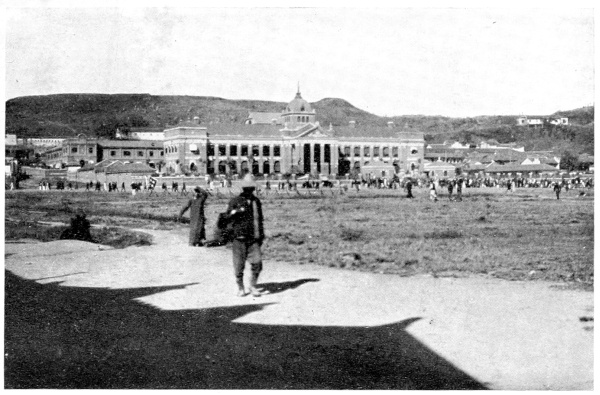
Copyright, American Episcopal Church, Foreign Board, N. Y.
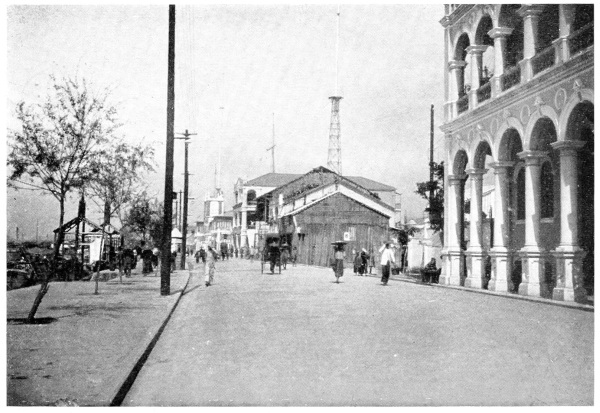
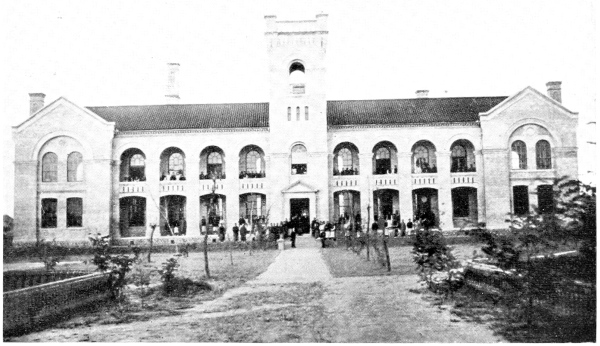
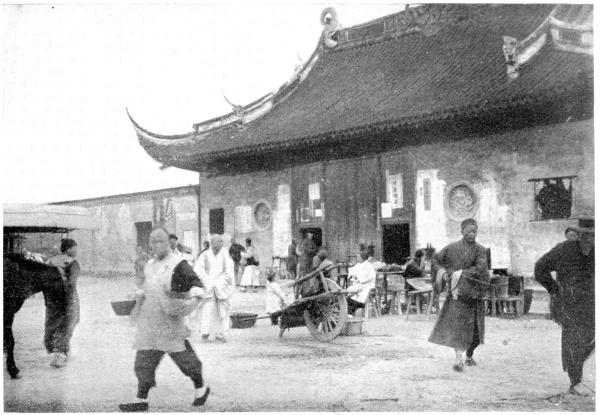
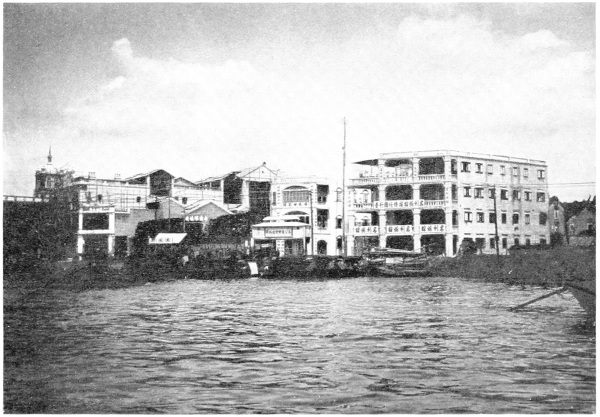
The Assembly Hall at Wuchang, where the Eighth Hupeh Division
under General Li Yuan Heng fired the volley that was heard round
the world, and ushered in republican China. In the background is
Serpent Hill.
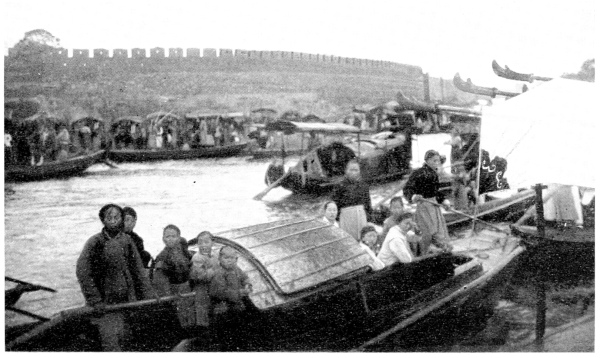
Copyright, 1913, The Bobbs-Merrill Company.
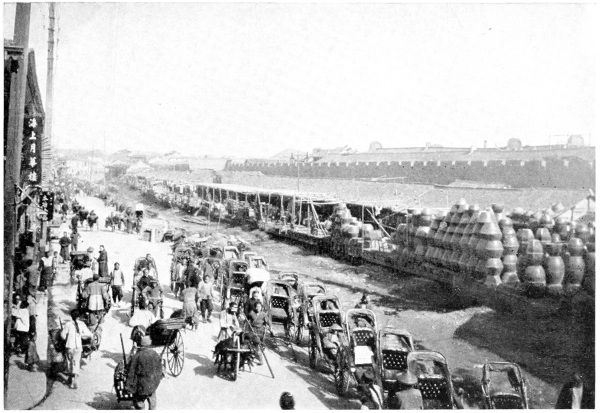
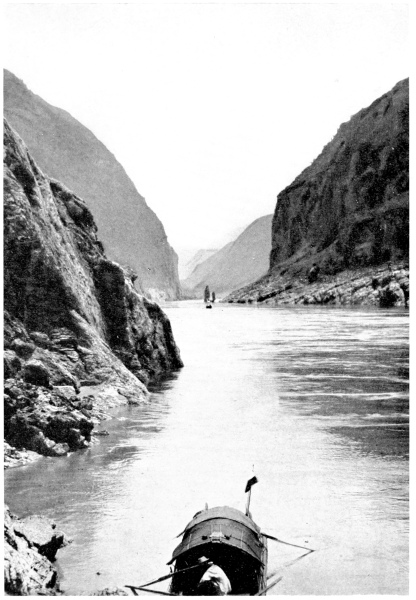
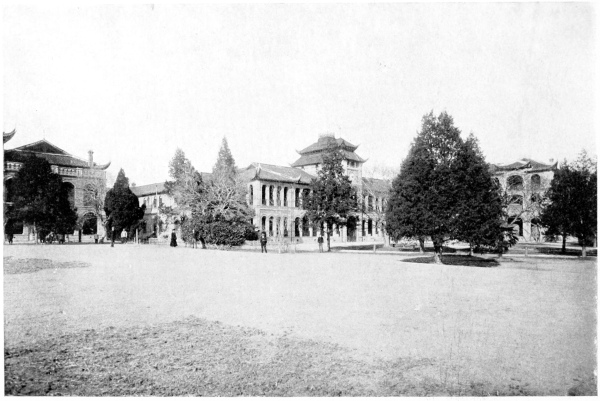
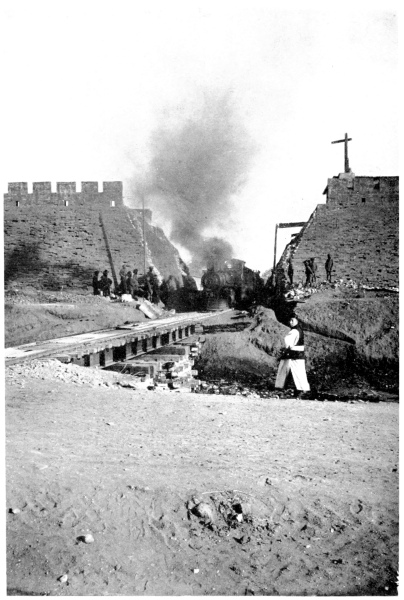
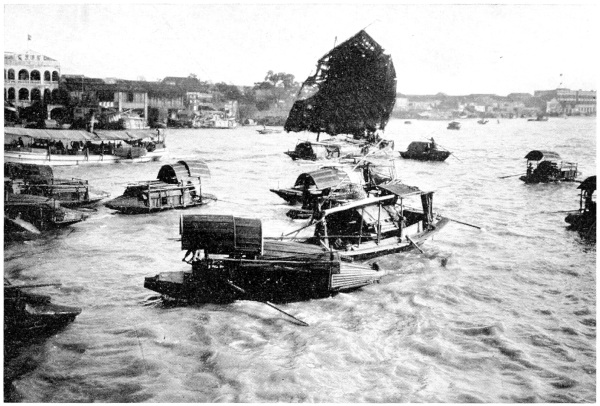
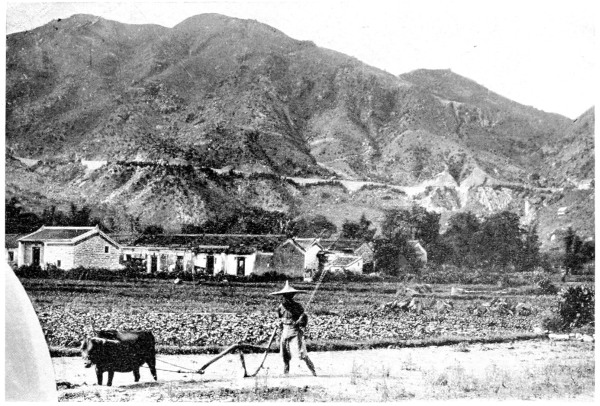
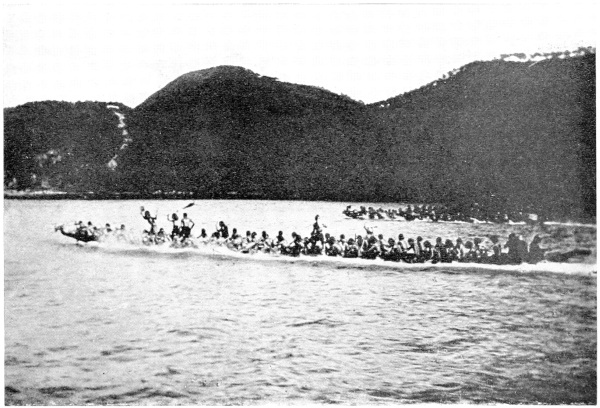
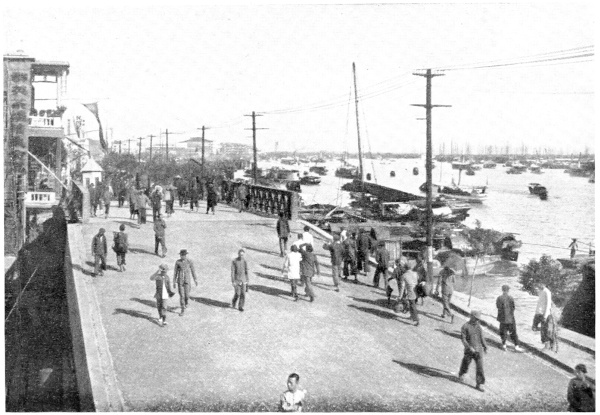
The high tide of the revolution; Nanking’s walls; the crowded boat life
of China.
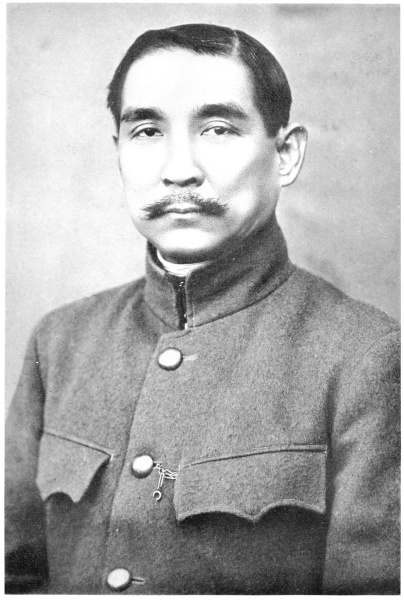
Copyright, 1913, The Bobbs-Merrill Company.
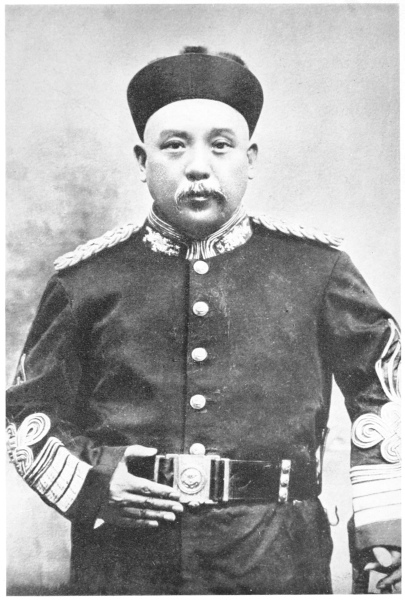
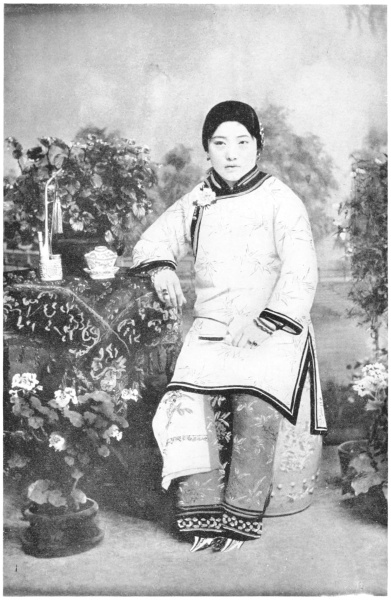
The Honorable Doctor Sun Yat Sen, founder of the Chinese republic,
Director-General of the National Railway development; leader of
the Tung Men Hwai, the advanced party in China. By birth, a
Southern Chinese (Kwangtung province), the type best known to
foreigners.
A noted, partially loyal Chinese general was shortly put
in command of the imperial troops in the ancient capital,
Chingtu. His name was General Chao Ehr Feng, the
famous commander who did the astonishing thing, both
from a religious and military point of view, in 1910, of driving
the Dalai Lama out of Lhasa and Tibet into Darjeeling,
in India, and thus putting Buddhism and its pope at the feet
of Confucian China. China also brought up her bloodiest
general, Tsen Chun Hsuan, infamous for putting
out the last terrific Mohammedan rebellion in mountainous
Yunnan province of the clouds, in unnecessary rivers of
blood. Foreigners scowled at the employment of this man,
and Manchu China was a little uncertain. Promises meant
nothing to Tsen. He was a man-eating tiger, the bloodiest
man in the world, who pretended and looked to be nothing
else, and was descended from as bloody generals. Peking
meant business, and the railway policy, which was as much
a war policy, seemed to be going through.
It was not long, however, before General Chao’s forces
were cooped up in Chingtu, which was besieged by the
rebelling province of Szechuen under the leadership
of the president of assembly, Pu Tien Chun, and
in the engagements General Chao was captured and
decapitated. The strategic importance of the railways
already built then appeared like the flash of a
saber at the bare neck of the victim. Modern troops were
hurried down to Hankau by rail in twenty-four hours and
up the river to Ichang by steamer, in the rear and on the
flank of the besiegers. Then something like thunder happened
among the divisions which had been mobilized at the
triple cities of Wuchang, Hanyang and Hankau. The
Eighth Division, under General Li Yuan Heng, territorial
troops of the modern army, hoisted the rebel tri-color sun
flag of red, white and blue over the yellow dragon of the
Manchus, put white bands on their arms and rebelled for
the new-born republic of Han. They captured the leading
arsenal, steel and coal plant at Hanyang, the populous commercial
city of Hankau, and the luxurious viceregal capital
of Wuchang on October 13, 1911. This put a high standard
on the rebellion, for Li was a young well-trained general
of the new school, a diplomat, a sturdy man in the field, a
patriot who could not be bought and who was organizer
enough to see that his men were not bought. Admiral Sah,
with a fleet of gunboats and small cruisers, aided the imperial
divisions under the bloody general, Chang Piao Tuan,
which tried to retake the native city of Hankau. Li’s troops,
especially his “Dare to Die” (Pu Pa Tsze) Brigade of
shaven round-heads, fought bravely, although their artillery
was only equipped with percussion shells, as compared with
the time-fuse shells brought down from Peking, Tientsin
and Kiaochou to supply the imperial troops. When ammunition
ran out, the rebel troops used the bayonet charge with
reckless daring. It was a new era in fighting in China when
yellow men would charge, with only cold steel, across an
area swept by machine guns. On October 21st, Generals Li
and Hwang, with 15,000 ill-equipped rebels, won the battle
of Kwang Shili in Hupeh against General Yin Tchang, the
Manchu minister of war and commander-in-chief, with
20,000 finely equipped loyalists. Part of General Li’s force
was a section of an army division which had gone over.
Others of his new troops were recruited from the most famous
boatmen of the world, the Szechuen trackers of the
wild rapids and sublime gorges of the glorious Yangtze
River, and from the indefatigable, cheerful mountain coolies
of Hupeh province, who are as agile as a chamois.
The propaganda of the rebels now bore fruit in rapid succession.
On October 22nd the rebels, under the leadership
of Tan Yen Kai, president of the Hunan Assembly, took
Changsha, the capital of Hunan province. Yale College
has a branch in this long forbidden city. Hunan has always
been notable for honest, sturdy, independent men. It is the
proudest province and the sternest in China. “What way
Hunan goes, that way goes China.” It was the last province
to permit missionary activity. Nanchang, the capital
of Kiangsi province, the land of pottery, was taken on the
same day, completing the occupation of the four adjoining
central Yangtze provinces, which was all that Sun (Sunyacius)
first planned to do, as a beginning and a basis on
which to solicit foreign loans. It was rebellion indeed, and
not a riot. The Tartars, Manchus and loyalists fled. New
provincial governments were set up, each with a popular
assembly. Peking was desperate, for China was almost
split in half by the political earthquake. Peking felt sure
that she held the north, however, with a well-equipped army
of about twenty divisions. The reformers, however, had
breathed into the ear of the troops, and pay was overdue in
the impoverished condition of the central government.
On October 24th, ancient Singan, the capital of the north-western
province of Shensi, the original capital of China,
where the empress dowager, Tse Hsi, fled in 1900, went
over to the rebels, despite the threats of the bloody Mongol
governor, General Sheng Yun. This really meant a fifth seceding
province, as far as the populace was concerned. On the
same day, Kowkiang on the Yangtze went over. Then Kweilin,
the capital of Kwangsi province, went over on October
25th. This was the first of the southern provinces to join
the movement openly. On October 25th noble Fuchau, the
famous seaport capital of old Fukien province, went over,
and we have already quoted a wonderful message to the
white man from their “Sia Hwei” (reform association).
On October 26th, Ngan-king, capital of Nganhwei province,
declared for the rebels, and on the same day General Li was
suggested as provisional president of the forming republic
of Han, with six of China’s twenty-one provinces already
seceding. Reform was as hot as a prairie fire, and almost
as hard to manage.
On October 29th a remarkable thing occurred among
the divisions being massed for an attack on the rebels’ capital
at Wuchang. The Twentieth Division was at Lanchow
camp, east of Peking, under General Chang Shao
Teng. They formed the famous Army League, and made
reform demands on the packed National Assembly at
Peking, just as Cæsar’s immortal Thirteenth Legion, before
the rebellion, sent demands to the Roman Senate, whose
orders they were supposed to take. In consternation, the
packed National Assembly granted the Nineteen Constitutional
Articles, and the Manchu regent, Prince Chun,
an able and traveled man (he went to Germany in 1901)
daily issued edicts and yellow Peking Gazettes, full of
tearful promises, in which, however, the central and southern
rebellious provinces had no confidence. They said:
“Edicts are like the wings of day and night; it all depends
on which side the sun is.” This action of the
Twentieth Division halted the government’s war measures,
and plans were laid to get loyal divisions near
the Lanchow camp, and get rid of General Chang
the First. This general was not strong enough to attack
Peking on his own account, for there were imperial divisions
between him and Generals Li and Hwang of the revolutionists.
But he was strong enough to be stubborn, and
not move forward. Peking was largely in panic. The railroad
station was piled high with household goods, and excursion
trains for the flight of the Manchus were running
to Tientsin as fast as they could be switched. The streets
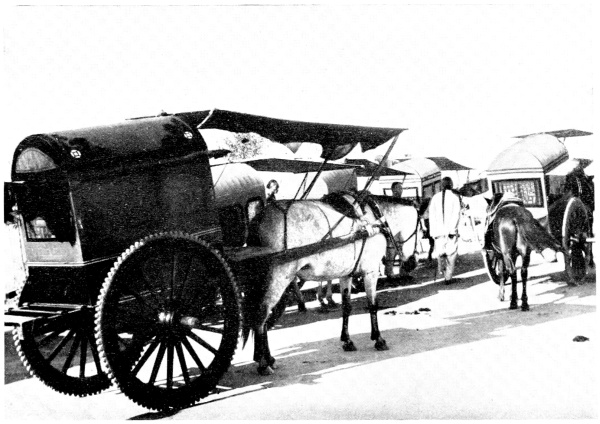
of Peking were crowded with mule carts, bearing bullion
sycee and coins to be stored in the vaults of foreign banks
in the legation quarter. No one half guessed before the
wealth which the pensioned and privileged Manchus had in
cache. Proud princes of the blood were even willing to
stand up all the way to Tientsin in open coal cars. Foreigners,
legations, railways and banks were popular as never before
in the north, as a very present refuge in time of trouble!
Marvelous treasures of vases, tapestries, and jade were
entrusted to foreigners for safe-keeping, and the treasures
of the Mukden and Peking palaces were sacrificed, foreign
agents taking advantage of the opportunity. Where could
a Manchu take them: to Jehol, to Kalgan where the Russ
waited, to Mukden where the Japanese waited? That was
only like running from the door to be caught on the roof.
Before long, treasures next in wonder to those looted at
Peking in 1900 will find their way into the palaces, mansions
and museums of the Occident, and artistic China will be
robbed bare as a bone; for Peking has long been robbing
China of art. The hotels and khans of Peking were crowded
to the roofs, and the refugees overflowed into the cellars and
stables and moats. Merchantmen were chartered, and held
with steam up at Tientsin, ready to afford a refuge for panic-stricken
Manchu princes, or disgraced Chinese officials like
Sheng. Missionaries in the outskirts trusted the promises
of the “Sia Hwei”, and stayed at their posts. Alarmed consuls
arrested them in order to bring them into the capital,
and the Chinese forgot the dignity due to their arms and
laughed at the humorously incongruous situation!
On November 3rd, the Imperial Third Division under
General Wong Chou Yuen, with the assistance of Admiral
Sah’s fleet, attacked the rebels in native Hankau City. The
vast flat city is not adapted for defense, and the loyalists
were infinitely better equipped. General Li was short of ammunition.
His troops, however, put up a brave fight, time
and again charging hopelessly with cold steel against machine
guns, and eliciting the unqualified admiration of the
foreigners. On that day the Imperial Third Division made
a bloody name for itself in the respect of massacre of non-combatants
and arson. A prosperous city of nearly a
million was reduced to the appearance of nearly a wrecked
village. Both rebels and loyalists saved the foreign quarter
along the Yangtze Bund, with its palatial consulates and
business houses, and the American Episcopal St. Paul’s
cathedral and St. Peter’s church, which were turned into
hospitals by Doctors Glenton and MacWillie, and nurse
Miss Clark of the Red Cross. Across the river at Wuchang,
the buildings of the American Episcopal Boone
University were turned into a hospital by Doctors Merrins,
Paterson and others of the brave. Heroic missionaries
held up their hands against the Third Division, and pleaded
the rules of the Red Cross, but the Manchus, especially
Prince Tsai Tao and others of the Tsai princes, desired
by a massacre to induce the rebels to massacre the first
time they had a victory, and thus bring on foreign intervention
to save the dynasty. A dynasty that can not stand
without foreign intervention will never stand, for true
strength is in the hearts of the people alone. It was the
old Boxer trick of the dowager empress, Tse Hsi, in 1900.
The rebels, however, meant to keep their heads, even
under such terrific provocation as that bloody Race Track
field of Hankau, over which the machine guns of the Imperial
Third Division swept, and those bloody streets,
maloos and walls where non-combatants were butchered if
they wore a piece of white, or had their queues severed, both
of which were hated rebel signs. To and fro the tide of war
surged. On November 3rd, a great change occurred, for on
that day the rebels’ great misfortune in having no fleet, was
to a large degree nullified. Shanghai arsenal, which supplied
Admiral Sah’s fleet, and Shanghai’s native walled city,
went over to the revolutionists. This was the second great
step forward. The rebels secured the well-known Wu Ting
Fang as foreign minister of the republic of Han, and their
organization spread and strengthened in everything except
money and a modern equipped force.
On the same day, the far southwestern capital and
province, Yunnan, with its splendid army and police, declared
for the red, white and blue sun flag of the republic.
Two days after, on November 5th, the famous bore-city,
Hangchow, the center of culture, and capital of the coast
province of Chekiang, was captured by assault, the Manchu
general putting up a strong defense in the Tartar
walled section of the city. Ningpo, in the same province,
and Suchow, another ancient capital of culture in Kiangsu
province, went over on the same day.
On November 6th, Admiral Sah’s sailors handed part of
the imperial fleet over to the rebels at Shanghai, and the
rebels were now able to reform their center line. This also
gave the republicans their first nucleus of a navy. Admiral
Sah Chen Ping received his baptism of fire in the battle of
the Yalu, under the brave Admiral Ting and Commander
Teng. He commanded in suppressing riots at Changsha in
1910, when Yale College branch was barely saved, and he is
well known as the host of Admiral Emery’s American fleet
at Amoy, when the white squadron was girdling the world
under the surprised eyes of Japan, whose mixed-school and
emigration “bluffs” were called by President Roosevelt in
this significant but quiet way. It was most important to win
Kiangsu province, and Chinkiang City was therefore talked
over on November 6th. The same day, in the far north, the
coaling city and naval base of Chifu in Shangtung province,
declared for reform.
Up to this time the cultured old Ming capital of Nanking,
the most beloved city in China, had held out under a concentrated
force of 12,000 imperialists, who were unusually well
equipped. After Wuchang, Hanyang and Shanghai, it
was next in importance to capture Nanking on the right
wing of the rebels. The imperialists knew that to hold
Nanking was worth an army of 200,000 men, and General
Chang Hsun (we will call him Chang the Second) was in
equipment and temper a man to their minds. His second
in command was General Chao, and it was rumored that
bloody General Chang Piao was within the walls. The civil
viceroy of Nanking was the well known Chang Jen Chung,
who instituted the first Chinese industrial exhibition at
Nanking in 1910. On the northeast of the walled city are
the peaks of Purple Mountain, 1,400 feet high, dominating
with its huge Armstrong and Krupp guns the north gate, Ta
Ping Men, and the east gate, Chao Yang Men, and the great
capital, around which the mighty Yangtze flows, yellow
flooded to the brim. This hill, and the Tartar section of the
city, Chang the Second fortified, so that it would take a hundred
to one to drive him out. On November 8th, the dauntless
rebels, led by General Ling, under the protection of fire
from the Canton artillery, took the armory, arsenal and
powder mills outside the south wall, rushed the outworks,
and held part of the southern city with insufficient force.
One of the cannon balls went crashing through the “North
Pole” pagoda in the Tartar City. On November 9th, the
imperialists at the strong south fort (Nan Men) hoisted a
white flag of apparent surrender, and as the republicans
came up, “near enough to see the white of their eyes,” they
opened a treacherous fire upon them. The Manchu troops,
under General Tieh Liang, looted their own fine military
school in the city. There let us leave the rebel lines and
pickets for a few days, while General Li and General
Hwang on the far left wing were being appealed to for men,
and above all, for siege and machine guns and ammunition.
On November 9th, Fuchau had to be stormed again, for
the imperialists had been reinforced. On that same day,
Canton, always stanch for a modern China, and mother of
nearly all the reformers, went over to the rebels under President
of Assembly Wu Hon Man, General Chan Kwang
Ming, and Wong Ching Wai, and drove the imperial viceroy
to Hongkong near by, where the British government
pleaded with the great Chinese body to spare their unwelcome
hostage, who had fled in Chinese custom “to a city of
refuge”. All over China, as in the Palestine of the Bible,
are towers of refuge for this very purpose. The American
cruiser New Orleans, Captain Miller, had steamed up to
Nanking and taken on board hundreds of foreigners, including
seventy-five Americans, and records. On November
10th, bloody Chang the Second gave orders, in
the old “Boxer” trick plan, for the awful massacre
of Nanking. The aim was first to incite the imperial
soldiery with the sight of blood, as tigers baited. On
the lovely bright afternoon, the prison was opened and 200
prisoners were sent into the yamen courtyard, “to their
freedom,” as they thought. There they were made to kneel
in a row, while their necks were stretched out by the queue.
An executioner, with a mercury weighted Taifo shortsword,
hurried along the long line, using only one practised blow
to sever each head. The heads were elevated on bamboo
poles. The Manchu troops then tasted the blood in the belief
that human blood would make them brave and invulnerable.
They even dipped their coarse biscuits in the gory
pools. They were then ready for anything that was merciless.
In force, Chang’s trained troops, with machine guns,
swept down from Purple Mountain, Tiger fort, Lion fort
and the Tartar section of the city, on the small force of republicans,
and the innocent population of Nanking the Refined.
Shame on the Ninth Division of Shangtung territorial
troops and the old-style turbaned “braves”. Every man who
had no queue; every woman who had the rebel sign of white
in her apparel or hair; every man, woman or child who was
a Nankingese was slaughtered without opposition, and the
odious Ninth Division waded back to Tiger, Lion and Purple
Hills through the bloody shambles. This was not war;
not even hell; this was an insane massacre of the innocents.
The few republican troops under the indomitable General
Ling fought until their ammunition was spent, and then
with cold steel set, they awaited the rain of bullets from machine
guns across the lead swept spaces of the immense,
half-built-up city. It availed nothing. Peking breathed with
hope. Chang the Second was a general after the “Boxer”
Manchu heart. Manchu princes—yea, even those who had
visited America and England, like the dashing Prince Tsai
Tao and Prince Tsai Chun, and who should have known better—had
been urging massacres, and Chang the Second had
apparently understood them. General Chang the Second
was heartily backed up by the merciless Tartar general,
Tieh Liang.
On November 11th, Amoy, the famous port of Fukien
province, where American officers have been so often entertained
by Admiral Sah and other Chinese admirals, was
taken, the American cruiser Saratoga (the old New York of
Santiago fame) and the American gunboat Quiros steaming
out of the harbor so as to be non-combatants in fact and in
influence. The American monitor Monterey, so as to protect
foreigners, later steamed into the harbor, where she was
often struck by stray bullets. On November 13th, the most
remarkable thing thus far in the revolution occurred, though
the impulse was not permanently fixed. Mukden, the home
capital of the Manchu race, the mausoleum of their founder,
and of many of their dead emperors, under the influence of
Chinese immigrants, declared its independence under General
Wuh Hsiang Chen, and the reform speaker of the
Mukden Assembly, Wu Lun Lien. During all this turmoil,
Pechili, Shansi, and Honan provinces were strongly held by
Manchu and Mongol “banner” troops, but Foreign Minister
Wu Ting Fang of the republicans got a note through to the
American minister at Peking, asking him to deliver it to the
Manchu regent, Prince Chun. The note requested the
Court to abdicate, and retire to Jehol, 200 miles northeast of
Peking, where they were promised positive protection, and
liberal pensions. In the meantime Yuan Shih Kai returned
from exile at Chang Te in Honan province to Peking, and
took up the reins of power as provisional premier of a limited
Manchu monarchy; began treating with the republicans,
solidifying the Manchu army, and soliciting foreign loans, as
the empress dowager’s strong-box no longer furnished
funds. Only three out of twenty-one provinces, and three
territories, were now remitting to Peking, but Peking had
the mighty northern army.
On November 17th, the revolutionists under Generals Li
and Hwang attacked the imperial lines at Hankau, and despite
their poor equipment in machine guns and artillery, led
by a regiment of Roundheads called “Dare to Die” (Pu Pa
Tsze) men, commanded by Colonel Wen, who graduated
from West Point in 1909, they took three of the four parallels
by cold steel charges, sapper work and bomb throwing.
One of the rebel shells from Wuchang punched a hole in
a 2,000,000-gallon tank of oil in Hankau, and the streets
were flooded two feet deep with kerosene. It was the first
time that Chinese had met Chinese in scientific modern war,
and it marked the entrance of China into the modern arena,
where Might strikes for Right, instead of only arguing for
it. China had begun to find herself. Meanwhile there was
distress in Singan in the north, which city had declared for
reform on October 24th. The Manchus had retaken the suburbs
of the city, for it was in their sphere of control, and
had begun, with their mobs, to massacre missionaries, as was
expected. The China Inland Mission outside the city was
attacked, and the English Baptist, Scandinavian and American
missions throughout the province were struck at.
Blame was put on the Mohammedans wherever possible.
Let us go down to Nanking for a moment, to see how the
war is progressing. To keep Nanking and Shanghai in
touch, the Americans had brought up their beautiful cruisers
New Orleans and Albany, for the American Vice-consul
Gilbert and the intrepid American missionaries, Doctor
Macklin, President Bowen, Mr. Blackstone, Mr. Garrett
and others were in the city. General Hsu of the imperialists,
with the Thirty-fifth Regiment of Infantry,
on November 21st, hoisted the red, white and blue
flag and left the strong lines of Purple Mountain and
the Tartar city to join the rebel ranks, which were
being reinforced from Canton and other directions
also. Bloody General Chang the Second, the imperial commander,
immediately had all General Hsu’s relatives in
Nanking murdered in revenge.
In far-away London, Doctor Sun Yat Sen, with an American
adviser and friend, “General” Homer Lea, set sail for
Shanghai on the same day. He first went to Paris, and then
took the liner Martha at Marseilles for Hongkong, from
which place he planned safely to reach Shanghai to complete
the rebel government. On November 22nd, when the imperialists
with all their foreign friendships were unable to
consummate their loans, the rebels at Shanghai opened a
Republic of Han Central Bank, with a capital of 5,000,000
taels. The title of the bank was the “Chung Hua”, and the
first notes were dated in the 4609th year of Huang Ti (august
sovereign), he being the mythical first emperor of
China, and the inventor of the Chinese ideograph. The
notes were printed in English on one side and entitled “The
Republican China Military Bank Note”. Other notes were
issued by the provincial rebels and read as follows in English
and Chinese: “The Chinese Revolutionary Government
promises to pay the bearer —— dollars after one year of
its establishment in China on demand at the Treasury of
the said government in Canton, or its agents abroad. 1st
January, 1911. For President (sd.) Sun Wen.” It will be
noted that the Christian calendar had now come into effect.
The shops immediately took the notes at a premium, something
unique in China, the land of financial discounts and
chaotic exchange. Enthusiasm grew. For the first time in
the history of modern China, a company of women took up
arms and advanced with the lines. There were also many
Red Cross corps of women, from Canton, Fuchau, Wuchang,
Shanghai, etc.
We shall return to Nanking. On November 25th, by
hard scraping at Canton, the rebels under General Ling
brought up twelve field guns for six hours and fired on the
imperial position on Tiger Hill and Lion Hill on the northwest,
near the famous Ming tombs, which are outside the
walls of Nanking (not to be confounded with the remainder
of the Ming dynasty tombs which are at Nankou, northwest
of Peking). Then 1,500 troops, led as usual by companies
of queueless “Dare to Die” boys, many of whom were students
in Nanking Protestant University (American),
charged, and drove twice their number of imperialists from
the strong lines, which were supplied with heavy Armstrong
and Krupp four-point-seven and six-inch guns. Unfortunately,
many shots struck the gate of the tombs, behind which
the imperialists had also fortified themselves. The rebel
navy now came nearer, despite the fire of Lion Hill, and
prepared for the attack, as the rebel infantry drew their
lines closer around the largest walled city of China. Guns
were immediately brought up to breach the heavy walls and
high gates and train on the Lion Hill and Tiger forts, which
were within the Tartar city, and keeping the navy back.
On the left wing at Hankau the rebels were gaining successes.
At an armistice, on November 24th, Yuan Shih Kai’s
representatives told General Li (whom they met at the
British consulate on the bund) that he had better trust the
Manchus, as they could secure the hated Russian or Japanese
intervention as in the old notorious days of 1896 and
1900. Li replied that the republicans had no trust any more
in Manchu promises of reform or real permanent constitutionalism;
that the usual relapse of the “Boxer sickness”
would come! At Manila, Hongkong and Singapore, the
Americans and British were preparing troops to be ready,
as in 1900, to rush them to Tientsin to save the Peking legations
and missionaries, if the Manchus, or Hunghutz, or
Mongol brigands brought on a massacre to secure foreign
intervention. Though America and Britain emphatically
stand for non-intervention and non-partition of China,
both these nations feared Russia and other powers which
were hard to restrain. Britain’s action at this time in restraining
ambitious Japan (greedy with the taste of Formosa,
Korea and South Manchuria) can not be praised too
highly. Wu Ting Fang, Doctor Sun and General Li of the
republicans, from Shanghai, London and Wuchang respectively,
issued proclamations that foreigners and missionaries
were to be respected highly as the best friends of New
China. In Shansi province the republicans, separated from
their base, were having a hard time against the Imperial
Sixth Division under General Sheng Yun, which had every
advantage of succor by railway from Peking and the junction
at Ching Ting. The imperialists bribed soldiers to assassinate
General Wu of the republican forces operating in
these northwest provinces. This was a terrible blow to
reform.
On November 26th, the rebels, under General Ling
Chang, attacked the strong hill forts above Nanking with
determination. There was much firing of heavy guns from
the river also, as the new navy of fifteen small vessels came
up. Dogged charges were made across the open and up the
zigzag of Purple Hill. The rebel losses were tremendous,
and Chang the Second, of the imperialists, proved himself
as grim a defense fighter as he was a ruthless leader of
massacre. The rebel attack under General Ling Chang was
brilliant and reckless. Who will sing the feats of the new
Chinese arms,—yes, the Chinese, who the world said would
never make soldiers, even if they had a great cause at heart.
The fighting was not as magnificently solid and desperate
as Pickett’s gray charge at Gettysburg, the Cuirassiers’ wild
ride into the valley of death at Waterloo, Linievitch’s grim
defense of Putiloff Hill, the shouting sweep of Oku’s dwarf
Japanese up Nanshan Heights, or the silent plunge of Oyama’s
ranks into the Liaoyang valley, or against the black
Mukden lines. It was as determined, daring and brilliant,
however, as any land engagement in the South African or
Spanish-American Wars, and far braver and stronger than
the theatrical engagements, with air-ship accessories, of the
Italy-Tripoli War. The world’s critics must now change
their criterions. A strong cause WILL make a strong battle
anywhere the world over, no matter what the color of
the soldier, or the cut or tint of his battle flag. The fighting
now closed in on Nanking, the old capital of the Mings, the
high-water city of the Taiping rebellion, and the rebels had
a great deal to avenge, and a great deal to gain. To fail in
the attack on Nanking meant a tremendous setback to the
rebellion. Few reinforcements could come, for the fighting
was in half a dozen provinces, and along a broken front extending
from Chingtu to Hankau and Nanking, 1,000 miles,
with railway transport service, foreign ammunition, money
and sympathy, favoring the imperialists; and sea and river
transport, and the sympathy of the British and American
peoples favoring the rebels, who, of course, had no navy
worth counting as yet.
The alarmed Manchu regent, Prince Chun, at Peking,
now gave out his oath, in the name of the child emperor,
Pu Yi (throne name, Hsuan Tung), sworn before the open
heaven to God (Tien), before the Confucian ancestral tablets,
and before Buddha’s image, as follows: “My policy
and choice of officials have not been wise; hence the recent
troubles. Fearing the fall of the sacred Manchu dynasty,
I accept the advice of the National Assembly. I swear to uphold
the Nineteen Constitutional Articles (demanded by the
20th Army Division at Lanchow) and organize a parliament,
excluding the Manchu and Mongol nobles from administrative
posts. The heavenly spirits of your forefathers will see
and understand.” They understood! The educated Chinese
of the central and southern provinces laughed; they had
heard the like before, and besides, this oath was taken under
compulsion of the Army League. The new rebel government
in Kwangtung province, under Wu Hon Man, its
president, was as yet unable to police the notorious pirate
waters of the Si Kiang (West River), running far up country
from Canton, and the large British tonnage, though
armed, suffered. Chief Officer Nicholson, of the steamer
Shui On, was killed in a private attack at Junction Creek
on November 30th, which infuriated British Hongkong,
which was holding its gunboats in leash. The large Chinese
tonnage in fear tied up to the wharves and bund of
Canton and the riverine ports. A trick of the West River
pirates was to anchor a deserted stoneboat across the channel,
and as the steamer slowed up, the snake boats and
motor launches of the pirates dashed alongside from the
creeks and cane-brakes. The most daring of these brigand
chiefs was the notorious Luk, from whom we shall hear
later. Everywhere else, however, as we have shown, for
instance at Fuchau, the republicans were splendidly protecting
foreign traders and missionaries.
I have said that the revolutionists’ line was too long to
defend, with two principal sieges taking place three hundred
miles apart. Peking understood this, and while the rebels
reinforced their attack on the right flank at Nanking, the
imperialists brought down reinforcements by railway to
General Feng Kwo Chang, at Hankau, who at once attacked
the rebel left flank in force, aiming to cripple the rebels by
taking back the essential Hanyang arsenal. Hei Shan,
Meit Zu and Tortoise forts were taken by machine and field
gun fire and charges, and General Li’s rebel ranks fell back
under severe loss. The retreating ranks didn’t carry their
bird cages with them as the gentlemen soldiers of Chifu
did in the China-Japan War of 1894! General Feng’s and
General Wong’s imperialist troops, after breaking through
the Tung Chi (East Messenger) gate and looting, now put
the torch to the rest of Hankau, destroying the homes of a
million people, and burning a hundred million dollars’ worth
of property. Such an uncalled for, accursed outrage, such
an unjustifiable act of wholesale arson against non-combatants
has never been known. What would history have said
had the Germans burned Paris, the British, Pretoria or the
Americans, Manila? What should be said when the Manchu
imperialists burned Hankau? Why didn’t they rather
sell its tiles, its silk, its oils, its mountains of tea? They
admitted that they needed money. At least there would
have been no world’s loss of property. Hankau belonged
to the world as much as to China. The Manchu must yet
answer for this arson, for arson and murder are unjustifiable
world crimes. Arson makes it harder and costlier for
an American, a Briton, a German, a Frenchman, to live,
as the wave of cost rolls on, as much as it makes it harder
for the Chinese to live. In these days of world conservation,
no nation should be allowed to put the firebrand to
property because men are fighting or arguing over an idea.
Shame on the sack and burning of Hankau by the Manchus.
The British, Americans, volunteers and jackies, and other
foreigners on the long bund, heaped up breastworks of even
rice bags, and swept the riverside and race track on either
flank in defense of the palatial foreign concessions. Here a
blue-jacket, there a marine, and between an ununiformed
volunteer clerk, the boys shouldered their Springfields, Lee-Enfields
and Mausers, and held brave guard at the thinnest
part of the long-stretched line of the white man’s empire of
influence and trade.
On the same day the rebels were doing better on the right
flank at Nanking, despite their long front of fifteen miles
wide. The Ta Ping Men (North) gate of the city, and
Tiger Hill fort within the walls were bombarded, and General
Ling brought up the rebel guns to bombard General
Chang the Second, who had contracted his lines to Purple,
Lion, Tiger and Pei Che Kao forts in the northeast of the
city, as far away as possible from the rebel fleet, part of
which had to be recalled to Wuchang to assist General Li
in his extremity. The imperialists held the strong Nan
Men gate in the south of the city, and the Chao Yang fort
at the east gate, which was fortified with two six-inch, two
four-point-seven, and two three-inch guns, as well as Maxims,
surely a deadly armament. In wise patience America
and Britain still held their troops at Manila and Hongkong,
respectively, but Japan was allowed, on the 26th of November,
to rush 1,000 more legation and railway guards to
Tientsin, and the railway guards along the Japanese railways
in Manchuria were reinforced far beyond international
conventions. Captain Sowerby, with the newly organized
Foreign Frontier Guards, started from Peking to help the
harassed missionaries who were being murdered in Singan
and Taiyuen in the north. This astonishing expedition was
remarkable for its intrepidity and its success. Within a
month and a half Captain Sowerby’s men had gone from
Taiyuen to Singan, gathered together forty missionaries,
and following the course of the Wei and Yellow Rivers
through the famous Tongkwan pass, brought his charges
safely to Honan City on the Honan railway, from which
place they could easily reach Tientsin. Lies began to spread
like wildfire. Pirates committed atrocities along the West
River section of Kwangtung province, and the Manchus and
their sympathizers blamed it on the ineffective rebel organization
of Canton. In the north, Hunghutz, Mongol and
Boxer brigands murdered missionaries, rebels and non-combatants,
and the republican sympathizers blamed it on the ineffective
Manchu government. This is certain: the rebels
desperately disliked foreign intervention, and only pleaded
for time to win and organize, while the Manchus saw that,
if driven to the last wall, massacre and lawlessness would
help the retention of the dynasty by causing foreign interventions;
and the Manchus were willing to lose all Manchuria
to Japan and all Mongolia and Turkestan to Russia,
to bring this about. The reader will note that none of
the many old generals has appeared on the imperial
side, as the battles narrowed down to engagements
with modern weapons of precision and power, requiring
generals trained in modern war. Generals
Li and Hwang, of the rebels, opposed Generals Feng
and Wong at Hankau, and Generals Ling and Hsu
opposed Generals Chang and Tieh of the imperialists at
Nanking. More foreign officers, especially Japanese and
Germans incognito, served in the loyalist ranks than in the
rebel ranks, and German ammunition and guns were freely
served to the imperialists. After the battle of Hanyang,
two Germans were found among the imperialists’ dead, and
two of the imperialists’ wounded were Germans, one of
them a colonel in the German army. The Japanese trusts,
the princes of the Choshiu and Satsuma clans, who control
the House of Peers and the Genro Council, and thus run
the government by veto, did not want a republic in China.
They feared it would bring about the control of the budget
by the House of Representatives and real popular government
in Japan, which country is now absolutely controlled
by the aristocracy; for the Japanese Diet is no more representative
of the overtaxed people than is the Russian
Duma. They feared also that if the Chinese pope-emperor
could fall, so could the Japanese pope-emperor who was
no more holy. The German syndicates were also anxious
to maintain their confiscatory privileges in Shangtung province,
which were obtained from the Manchus. Dictator
Yuan always preferred German instructors in his Pechili,
Honan and Shangtung armies.
On November 27th, Yuan Shih Kai, the premier-dictator
at Peking, had poured out the treasures of the Manchu empress
dowager’s private chest, and well paid and well armed
troops were rushed to Hankau. Generals Feng and Wong
Chou Yuen had 30,000 modern drilled and equipped men,
and the divisions were heavily supplied with precise artillery.
Hankau City and Hanyang arsenal across the river
were bombarded mercilessly, and the imperialists of Wong’s
bloody third division, under cover of this artillery practise,
crossed the Han River thirty miles up and flanked the left
wing of the rebels, whose old Armstrong artillery, using percussion
shells, was no match for the modern three and four-inch
guns of the imperialists, who had the arsenals of the
north and the Germans at Kiaochou to draw on. Neither
was the rebel infantry equal, as half of their regiments had
been drawn back to Nanking, 400 miles away, by river. The
best the rebels could do was to oppose 15,000 men, with
weak artillery, to 30,000 excellently equipped imperialists.
The result was that the all-important Hanyang arsenal and
world-wide known iron works were lost, and Generals Li
and Hwang Hing had to retreat to Wuchang, the rebel capital
across the Yangtze River, which is a difficult place to defend,
as its flanks and rear are vulnerable. The result of
this great reverse was that the lukewarm viceroys in the
northern provinces, who had gone over to the rebels’ cause
in the first flush of success, began to declare again for the
Manchus. Shangtung province went back, and Yuan Shih
Kai by the telegraph on this day got his own province of
Honan to return to the imperial fold. Both of these are
northern provinces. Premier Yuan now began rushing reinforcements
down the Grand Canal and railway to Yangchow
and Pukow, nearly opposite Nanking, so as to succor
redoubtable General Chang the Second at Nanking, and enable
him to again occupy Tiger fort. General Feng came
over from Hankau to advise Chang. The plan was, by taking
back the Hankau cities and Nanking, to turn both the
left and right flanks of the revolutionists, rush their capital
of Wuchang, and crumple up the rebellion in Shanghai.
Everything in equipment, transportation, foreign men,
money and artillery favored the imperialists. Everything
in daring and enthusiasm favored the rebels, whose American-trained
students recited the dictum of Herodotus on
republicanism: “The Athenians, when governed by tyrants,
were superior in war to none of their neighbors, but when
freed from tyrants, became by far the first. This then shows
that as long as they were oppressed they purposely acted
as cowards, as laboring for a master, but when they were
free every man was zealous to labor for the State.”
There was one thing the rebels were weak or uncertain in.
If they destroyed China’s religion of aristocracy and king
worship, what would they give in its place? Would they
give Christianity (their leaders, Doctor Sun and General Li,
being Christians), and a permanent satisfaction with the
rule of a native president and congress over twenty-one provincial
presidents and assemblies? It was a mighty task,—the
greatest the world has known,—and few of the old viceroys
and Manchuized Chinese literati of the Hanlin were at
heart prepared for its radical solution. True, the rebels
could staff the twenty-one provinces with advanced Kwangtung,
Szechuen, Hupeh, Hunan and Kiangsu province men,
but that was not republican home rule.
The aim and difficulty of the rebels was to maintain
the new ideas against reverses in the provinces,
which had developed few modern thinkers among
the officials, who, like the troops, were looking for salary
first and country afterward. Yuan, the premier-dictator,
who had weighed it all up in Honan, said to himself, according
to some southern critics: “Give me money enough for
100,000 splendid, modern-drilled northern men, and give
me trunk railways. I’ll find men who will fight for whichever
side pays their wages; we must have order, which is
civilization’s first law.” Yuan was a believer in that truism
that the radical reformers do all the work, and bear all the
risk of reform, and that the “standpatters”, the moderate
progressives and reactionaries, enjoy all the fruit and political
offices. Differently from Sun, Yuan wanted office first and
influence afterward. He was now active in soliciting foreign
loans, securing $1,000,000 from Russia and Belgium, and the
promise of $30,000,000 from Russia, Belgium and Japan,
these being the pro-Manchu powers, while America and
Britain represented pro-Chinese sympathies. The rebels were
just as active in soliciting private subscriptions in America
and the Straits Settlements, and 70 per cent. of the Chinese
abroad sent a quarter of their fortunes to Sun Yat Sen and
Wu Ting Fang at Shanghai for the republican cause.
However, it must be admitted that when the Manchus recruited
Yuan Shih Kai, the Honanese, they secured a tower
of strength, another Li Hung Chang, to a large degree a dictator,
a believer in money, troops, quick trial by drumhead,
and decapitation, a good servant of any master who would
steadily employ him; a believer in dynasties more than peoples,
a modern progressive but not an idealist or natural
republican, a man who hated the words “turbulent liberty”,
but who loved the word “order”; a statesman more like
Diaz, Bismarck or Richelieu than like Washington or Lincoln.
He had never traveled abroad like thousands of other
Chinese officials. He could not speak or read English, and
so knew little of the great documents of liberty and idealism
in their first fire of the original. He knew that he was
smashing rapid progress for the second time, just as he had
gone against the reform Manchu emperor, Kwang Hsu, and
the palace reformers from Canton: Kang Yu Wei, Liang
Chi Choa, etc., in 1898, and joined the reactionary “Boxer”
dowager empress, Tse Hsi. He feared the rebel sympathizers
might assassinate him, and he rode as dictator about
Peking with a cavalry escort. His headquarters were in the
modern Wai Wu Pu Building, which is fitted with steam
heat, elevators, electric light, etc. There he gave regular interviews
to the foreign press representatives, in emulation
of the methods long practised by Sunyacius and Wu Ting
Fang at Shanghai. He made the Manchus weak, too, for
he matched their troops at Peking with his old Shangtung
and Honan territorial troops, man for man. He also sent
the turbulent, stubborn twentieth division, shorn of its commander,
Chang, far to the eastward. The majority of the
National Assembly had fled, and the Manchu princes would
not come out of their bedrooms. If the rebels were to win
now, they must produce even a stronger man than Yuan.
Who was that man; where was he in the making?
It is quite orthodox not to despair ever of immemorial
China, and to expect a great man to arise when politics is at
its worst, for Confucius arose from the rivalry of sixteen
states, and he formulated his political philosophy when he
was a persecuted exile from his own state of Lu. When the
republicans were most dejected, that great republican, the
American Methodist bishop, J. W. Bashford, of Shanghai,
in season and out of season, unofficially beseeched them to
quit themselves like men. So large-hearted a man could
not stand by and see men who were fighting for liberty
droop at their guns. He cheered them; he talked to their
students; he gave megaphone interviews to the world press
and supported the discouraged propaganda, fearing naught
the criticism which arose. He was a missionary, but more
than that, he was a man, and an American. Some British
missionaries, too, came in for criticism because they could
not refrain from whispering in the ear of liberty the Cromwellian
encouragement: “Be of good cheer.”
By November 29th the lack of money was thinning the
lines of the rebel forces, and Dictator Yuan, at Peking, was
growing in strength with small foreign loans and arms from
Russia, Japan and Germany. The rebels, at Wu Ting
Fang’s suggestion, in desperation, threatened to boycott the
commerce of any nation making loans to the Manchu government,
and a German compradore was shot down at
Hankau as he was in the act of delivering arms over to the
imperialists. The Manchu Tsai princes sold their art treasures
for arms. The rebels melted the idols of the nation to
make coin. In accord with the protocol of 1901, America
now formally offered the Peking government 2,500 troops
to assist in keeping the railway from Peking to Tientsin
open to the sea. The Japanese had already landed their
quota of this foreign force. Naturally the rebels looked
on this landing of foreign troops in the Manchu section of
the country as, to a degree, foreign aid to the Manchus, as
it increased their prestige and sources of advice in the north.
More subtle forces than those of arms began to work now
on some of the rebel leaders, and the cause lapsed into
darker days because of the lack of money. Dictator Yuan,
in Peking, was exultant, and said to one member of the legations:
“I give the rebellion eight more days to live; I expect
to have 100,000 modern troops and a railway.” Professor
E. H. Parker, the eminent sinologue, now of Manchester
University, England, when a British consul in
Korea, wrote of “Yuan’s Machiavellian character” in his
book, John Chinaman. Even some of the Manchus agreed
in the cry of the rebels: “Yuan is making himself dictator;
he may seek the throne; he may split off Northern China;
Peking is too near Russian Siberia.” He had sent the Manchu
troops away from Peking, and gathered his old divisions
(like Cæsar with his Thirteenth Legion) of Shangtung
and Honan troops around him.
Yuan appealed to the provinces to send delegates to
Peking to discuss a constitution, but the rebel provinces
replied: “No National Assembly can discuss
constitutional government with freedom while your
troops, pounding their rifle stocks, stand at the
door; remember the Parliaments of King Charles.” The
rebels cried: “If Yuan and the Manchus win now, it is
foreign money that does it. Why can’t we get foreign
money; we’re the overwhelming majority of the people.”
Some of the foreign governments replied: “We are only
interested in trade and order; we can’t wait for you to fight
this out, and possibly kill some of our missionaries; you
must win quickly or we’ll stand by the powers that be.” The
rebels replied: “Cromwell and Washington, Thiers and
Grant didn’t win quickly, and if you let us lose now, we’ll
fight it out again. You can’t withstand the constitutional
rights of 400 million people for the sake of a dynasty of
raiders, who seized and entrenched their throne with five
million subsidized cavalrymen, who have now grown effete
by subsidy. We are opposed to entrenched privilege just as
much as you are. In Roosevelt’s words: ‘The land has
got to be as good for all of us as it is for some of us.’
These minority Manchus must cease to usurp office, pensions,
privileges and concession granting. We of the south
are taxed without representation. If America could go to
war with this as a cause, why can’t we?”
Yuan, under certain foreign advice, planned to throw
a bridge across the Yangtze River at Hankau, and
get his railway down into the heart of the southern
rebel provinces. He believed in quick facilities for
throwing his modern troops against uprisings, for
his railway from Peking to Hankau had won him the
present turn in the tide of affairs by enabling him to flank
the long rebel lines. Oh! at this time, some cried, for an
emperor warrior of the real Chinese, a descendant of the
Mings; a descendant of the house of Confucius (the Duke
Kungs); or a Washington-like president of a Chinese republic,
who could get foreign loans. This was the cry that
was arising against the return of the Manchu ghost, and the
ominous shadow of a dictator. However, something had
been won. The agitation and the battles had taught the
sweet themes of deathless liberty and a new Chinese nationalism
to thousands who had been supine, provincial, or
anarchistic in their despair. It was recalled that Tau Sze
Tung, the reformer and son of a Hupeh governor, who was
beheaded in 1898, said on his way to the place of execution:
“Martyrdom must always precede revolution; shall I not
be the first martyr?” Liberty is never defeated, for each
time she falls she makes her conqueror concede something,
for she only falls to her knees and rises again. The reactionary
empress dowager, Tse Hsi, after her victory in
1898, conceded reforms from 1900 to 1908, and it would
be so with her successors, perhaps, after this lesson of protest.
A plan was laid by some foreign bankers, and some
Chinese, that if the republican government was not a success,
a direct descendant of Confucius, one Kung, an American
Presbyterian Christian of Shangtung province, would
be backed for the throne in the hope that the Chinese race
would flock to his banner.
On November 28th, 29th and 30th, the rebels, under Generals
Hsu and Ling, made a master effort on their right
wing, for which purpose they had weakened their left wing,
allowing the two Hankau cities to go. The Canton bomb
throwing levies and artillerymen went into battle singing
this new hymn to Liberty, which is certainly rugged poetry
of merit:
“Freedom will work on this earth,
Great as a giant rising to the skies,
Come, Liberty, because of the black hell of our slavery,
Come enlighten us with a ray of thy sun.
“Behold the woes of our fatherland.
Other men are becoming all kings.
Can we forget what our people are suffering?
China the Great is as an immense desert.
“We are working to open a new age in China;
All real men are calling for a new heaven and a new earth.
May the soul of the people rise as high as Kwangtung’s highest peak (Nan Mountain);
Spirit of Freedom, lead, protect us.”
Nanking was attached in force. The American navy withdrew,
while the small rebel navy of fifteen vessels, under
the protection of captured forts holding back free play of
the Lion fort guns, moved up within range to support the
wide rebel attack of fifteen miles frontage. It will be remembered
that General Chang the Second, of the imperialists,
held some of the peaks of Purple Hill outside the northeast
walls, and Yuwatei fort on the south, and nearly all the
city. The rebels took the Tiger Hill fort and four of the
northwest gates and forts, after bombardment by the
Cantonese, sapping, and a spirited rush. Then Purple
Hill and Yuwatei forts were bombarded and rushed
after a terrific engagement, the imperialists, under Generals
Chang and Tieh, making a last stubborn stand behind
the ninety-foot high and thirty-foot thick walls
of the vast city. The scene was terrible to view.
Clouds of cannon smoke, lighted by terrific flashes
of gun fire, made the night of November 30th memorable.
The revolutionists, practising Wolfe’s strategy before
Quebec was taken, by a secret path, rushed up a peak of
Purple Mountain, above the imperial position, and shelled
the imperial park of guns. Then in the night a charge,
led by Colonel Wen, was made by the “Dare to Die” picked
brigade, who carried hand bombs and swords. A wild retreat
followed down the mountain. Even boys fought with
the greatest bravery. The dying down of the terrific cannonade
in the south meant that the republicans had rushed
the Nan Men fort, and an explosion showed that they had
successfully blown it up. Just as daylight broke, the strong
Chao Yang, Tiger and Lion forts were again rushed and
taken. The rebels were bitter, and there was great slaughter
of the imperialists in revenge for General Chang’s merciless
massacre of innocents when he declared a state of war at the
beginning of the month. Great lawlessness overspread the
land, the rebels as well as the imperialists being unable to
establish a police force, while they fought out the reform
questions. Even in British Hongkong, where 500,000 Chinese
are ruled by 5,000 British, the authorities had to institute
the public whipping of offenders, so as to keep disorder
on the part of the lawless intimidated. Complaint increased
along the Yangtze valley that the Germans were supplying
arms to the imperialists at Hankau, as well as in the northern
provinces, from their colony base of Kiaochou. Bitter
complaint was also made that Baron Cottu was the go-between
in asking Russia, France and Belgium for a $30,000,000
loan for the Manchus and Yuan Shih Kai, which would
give the Russo-Asiatique Bank the same intrusive excuses
that Russia availed of in 1898. The rebels were weak in
Shensi province, and American missionaries were killed by
the mob in Singan. Dictator Yuan threw the Sixth Division
from Honan into Shensi to take the province back.
On Saturday, December 2nd, at ten o’clock, a memorable
scene occurred at Nanking. General Chang the Second
escaped across the Yangtze River through the Ta Ping gate
on the morning of December 1st to Pukow, the northern
railway terminus, after planting a mine under the Tartar
General’s yamen, which was to be blown when the rebel
General Hsu was caught in the trap at the capitulation. He
also secreted eighteen other mines in the Tartar city, which
had therefore to be burned so as to make the explosion safe.
General Chao succeeded in command of the imperialists.
The investiture was complete, and the situation was now
hopeless for the defenders. Twelve brave Americans had
remained on the scene, the great missionaries, Doctor Macklin,
Mr. Garrett, Doctor Blackstone, President A. J. Bowen,
of Nanking University, and others, and the vice-consul, Mr.
Gilbert, who dramatically, with field glasses, watched the
bombardment from a high graveyard within the city. They
believed in saving blood (“Chiu Ming,” as the Chinese
say), much provocation for revenge as there was on the
side of General Hsu’s victorious men. They pleaded with
Hsu for the first humanitarian surrender in Chinese civil
war, as a thrilling example for all time that Chinese revolutionists,
like George Washington’s and Oliver Cromwell’s
men, were patriots and gentlemen at heart, and not mere
feudists fighting under the name of a great cause.
General Hsu, with the advice of Generals Ling, Li and
Hwang, and Foreign Minister Wu Ting Fang, rose to the
high level. He agreed to a surrender with honors, even
guaranteeing the life of the notorious murderer of
non-combatants, General Chang the Second. The
negotiations took place under the guns of historic Purple
Hill, while the panting troops held enthusiasm
in control. Behind the walls the imperialists breathed
hard, and the great populace of shopkeepers eagerly
waited and watched the republican sun flags on Purple
Mountain. Hurrah! a shout went up that lives would be
guaranteed (“Chiu Ming”); yes, honor, too! Fling open
the pounded, riddled iron “Great Peace” gate! The
steel muzzles of the hot Armstrongs, the deadly four-point-sevens,
the spitting Rexer rapid fire and three-inch
Krupp guns on Purple, Lion and Tiger Hills, held
their smoky breath like good hounds in leash, but
straining. The generals and captains marked time;
the troops craned their heads; the Cantonese artillery
hitched up the limbers to the gun carriages. The
American missionaries thanked God and led on the way of
peace for a China that would never forget the moving scene,
where forgiveness towered over revenge. Here they come,
General Chao riding ahead of the doughty Shangtung territorials
with their yellow dragon flags flying for the last
time, and the bloody turbaned men of escaped Chang’s
army. Ground arms and mark time! The victorious rebels
kept their places, and under the fluttering red, white and
blue sun flags of the new republic, looked on at the impressive
acts. The great column of imperialists deployed with
music playing, saluted and piled their arms before the feet
of the victors, General Hsu sitting on horseback where the
pacificators stood. Sun flags and white flags fluttered everywhere
as the sign of rebel dominance. Who are these who
now come up with reversed arms? They do not wear the
German peaked caps, and the khaki uniform of modern
troops, but the old turban and slovenly blue uniform of the
ancient troops of China. They are Chang’s bloody old-style
warriors, 1,000 of them, wearing white bands in deep
contrition and as a seal of their lives from massacre. They,
too, salute Hsu, the giver of their lives, some of them giving
the unmilitary kotow instead of the modern salute. A
cheer went up, the bands playing with greater spirit. Hold
open the “Great Peace” gate! Victorious Generals Hsu
and Ling, and their men, they of a hundred cold steel
and bomb charges, blowing hot the trumpets of victory, and
led by the shaven heroes, the “Dare to Die” regiment of
immortal night charges, are on the ringing, clanging march
for the ancient Ming city, which they have conquered, Nanking
the cultured; Nanking the proud capital of capitals;
Nanking where was the yamen of the illustrious Viceroy
Liu Kun Yih; Nanking of the Taipings, and Nanking of
the world’s widest republic! A friendly hand had touched
off the mine under the Tartar general’s yamen, and the
eighteen other dastardly mines, so that the victors should
not be blown up treacherously in the crowning hour of their
rejoicing. White flags flutter everywhere. Once the sign
of death in China, they are now the sign of peace in China,
as well as in the rest of the world. A shout of welcome
goes up from the populace, who from the beginning, like all
the rest of the central and southern provinces, have been in
sympathy with the revolution. Generals Hsu, Ling and
Hwang at Nanking then have indeed balanced for the rebels
the imperialist victory at Hanyang won by General Feng.
The rebels lost their left wing, which was turned. The
imperialists have also now lost their left wing, which has
been thus crumpled up at Nanking. New moves must now
be made on the checker-board by Dictator Yuan at Peking.
Governor Chan Kwang Ming and President Wu Hon
Man, of the Canton Assembly, sent out their torpedo-destroyers
Wu Ying and Wupang, and with the British gunboats
Robin, Sandpiper and Moorhen from Hongkong,
and the American gunboat Callao, attacked the West River
pirates, and patrolled that romantic river as far as the
shadow of Wuchow Pagoda, 220 miles of varied temples,
islands, gorges, reaches and river peaks. Mercantile vessels
steamed up two by two, their wheel-houses sheathed
with steel, their gun racks full, the barred hatches, which
let air in but no smuggled pirates out, nailed down on the
’tween decks, a guard at each hatch and over each port, and
double quartermasters manning the wheel. Commerce had
gone back to medieval conditions, and it was exciting. Rich
compradores of Hongkong, like Chan Kang Yu, of Douglas,
Lapraik and Company, contributed 2,000 uniforms and
outfits to equip a regiment of President Wu’s provincial
troops. Part of the rebel navy now made a four-hundred-mile
dash at forced draught to Wuchang and Hanyang,
from Shanghai, to try to keep the successful right wing of
the imperialists from crossing to the rebels’ temporary capital.
If the gunboats could keep the loyalists engaged at
Hanyang, it was not impossible that the rebels, if greatly
reinforced from Canton, could turn the flank and strike the
loyalists’ supply railway in the rear.
On December 5, 1911, new moves were made at Peking.
Prince Chun, the regent father of the baby Emperor Pu
Yi (his real and not his throne name), resigned in favor of
two co-regents, one a Manchu, Prince Tsai Su, and the
other a Chinese, Hsu Shao Ching. This was a buffer move
to save the throne from the republican demands. For the
first time in the three hundred years’ history of the Manchu
dynasty, a Chinese was thus brought to share the regent’s
power. Prince Tsai Su had been a grand councilor in the
old days; and when a national assembly was granted he was
put in as its president by Manchu power. Later he was
president of the Navy Board, and president of the Wai Wu
Pu (Foreign Board). He is a moderate progressive, a
Manchu of the Manchus and related to the emperor. Hsu
Shao Ching, a Pechili Chinese, is well known as a former
minister to Russia and Germany, and the first president of
the Chinese Eastern Railway. He was a grand councilor
in the old days, a viceroy of Manchuria, and president of
the Railway Board (Yu Chuan Pu) in charge of loans.
He has visited America. The appointment of this republican
general-in-chief was, of course, mere flattery, and
he did not serve.
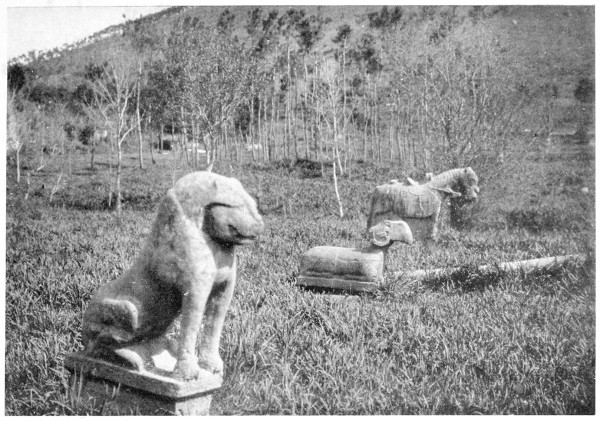
Copyright, 1913, The Bobbs-Merrill Company.
Mortuary statues near tombs of the last native Chinese dynasty, the
Ming, near Nanking. The crowning battle of the revolution swept
over this hillside.
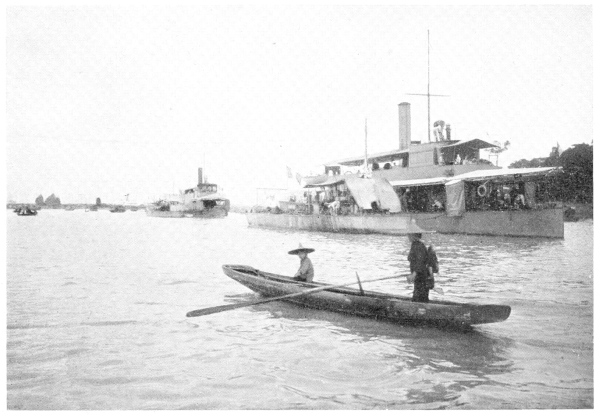
Copyright, 1913, The Bobbs-Merrill Company.
American, French and British gunboats protecting foreigners at Shameen
Island, Canton, during revolution, 1911–12. In foreground, wupan,
or boat of “five boards.” Note wide awnings required on gunboats.
The awnings on second gunboat (British) were riddled by bullets of
contesting forces.
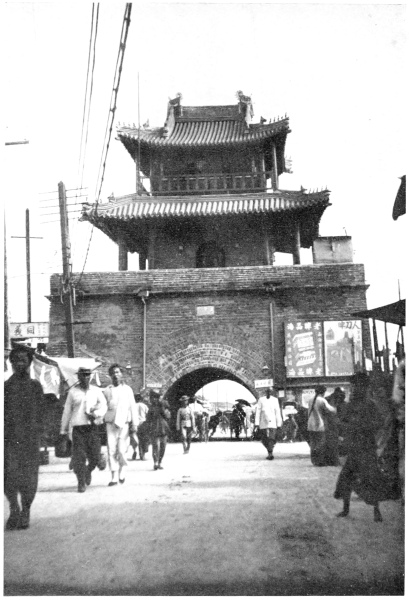
Copyright, 1913, The Bobbs-Merrill Company.
The famous gate giving entrance to the native city, Tientsin. Reform
in schools, industries and army really started in this city under the
viceroyships of Li Hung Chang and Yuan Shih Kai, and the taotaiship
of Tang Shao Yi.
These moves on the recommendation of Dictator Yuan,
who was an old enemy of Regent Chun, who exiled him, did
not satisfy the rebels, who named Nanking as their permanent
capital, called for delegates from all the rebel provinces,
and pressed on the war. “The name is changed at Peking,
but it is the same old game,” they said. A republican loan
of ten million taels, bearing twelve per cent. interest, and
sold at about eighty per cent. of face value, was sought at
Shanghai, Wu Ting Fang seeking American subscriptions
especially, for he kept reminding Americans: “You are the
mother of republics; the greatest republic, as we will be the
largest republic.” Wu also wired prominent American and
British financiers and their governments, pleading that loans
should not be made to the Manchu government, and respectfully
warning that: “The republican rebels would remember
if loans were made to fight their cause.” This really
had a deterrent influence, for Americans and Britons were
able to influence France to suspend financial action for a
while. The American-educated Tang Shao Yi, Dictator
Yuan’s chief assistant, now went to the rebel headquarters
at Wuchang and Shanghai to interview General Li, Minister
Wu and General Hsu regarding peace, and the rebels held
sessions of delegates from the Yangtze, southern and western
provinces. Kwangtung province began its republican
organization, and sent up another quota of 3,000 modern
troops from Canton, added to 10,000 previously sent, to reinforce
General Li, who stood marking time at Wuchang
against General Feng of the imperialists at Hanyang.
By this time the fine Tyne-built, gray Chinese cruiser
Hai Chi, which sailed from New York in October, arrived
at Shanghai, and amid wild rejoicing, such as only the
southern Chinese can express, ran down the triangular yellow
dragon and hoisted the square tri-color sun flag of the
republican revolution. She was at once ordered to report at
the arsenal with her heavy load of ammunition, which was
a godsend to the revolutionists. This cruiser was the best
known abroad of Chinese war vessels, and at once became
the flagship of the rebel navy. She is armed with two eight-inch,
and ten four-point-seven guns. On December 14th,
Doctor Sun Yat Sen (Sunyacius), with the American,
Homer Lea, arrived safely at Penang, Straits Settlements,
a hotbed of Chinese reform, which has from time to time
sheltered all the reformers like Sun, Kang, etc., since the
coup d’état in 1898. The rich foreignized Cantonese owners
of tin mines have been loyal to reform from the beginning.
When Sun arrived at Singapore on December 16th, a band
of Chinese girls met him, each waving the tri-color of the
revolution and of the emancipation of Chinese womanhood,
and singing the Chinese Marseillaise, Chung Kwan. The
Chinese wore no queues, and the caricatures which they distributed
showed the pig, the dog, the monkey and the Manchu
as all belonging to the races which wear queues! Who
will say that the Chinese are not distinguished for humor! I
have for years been trying to point out this quality in them.
The first wave of the revolution, which had died down
somewhat by the Hankau defeat, had rolled on even into
far mountainous Tibet, and Gyangze, a walled and fortified
town on the trade route between Lhasa and Darjeeling, fell
before the revolutionists on December 14th. Gyangze will
be remembered for the stand it made against Sir Francis
Younghusband’s brilliant campaign in 1904 to open up the
way from India to Lhasa, and also for the operations in its
neighborhood by General Chao Ehr Feng, who drove the
sacred plotting Dalai Lama for the first time out of China
into India in the startling campaign of 1910.
During this week the Yangtze River for six hundred
miles presented a remarkable scene, as Tang Shao Yi, the
emissary of Dictator Yuan, sailed down to Shanghai to discuss
peace terms with the revolutionists at the Town Hall at
Shanghai, which was guarded by British, Sikh and other
troops of the international settlement. At Hankau the
last yellow dragon flag of the imperialists was seen,
as the imperial legates, Tang Shao Yi, Yen Shih Si
and Yang Shih Chih, on the steamer Tung Ting,
sailed between the new navy of the rebels on patrol of
the great river, which was now their six hundred
miles of front. The fine cruiser Hai Chi, with New York
Chinese among the crew, the companion cruisers Hai Yung
and Hai Sun, the gunboats Kwang Kang, Kwang Poa, On
Nam, etc., headed the republican fleet, which flew the red,
white and blue sun flag. The armistice was not kept in Shansi
or Shensi provinces by the imperialist general, Sheng Yun.
When the pourparler opened, the six powers, at America’s
suggestion, informed Wu and Tang that they would appreciate
a settlement, because neither side seemed to be able to
keep down piracy, it being as bad along the Liao River in the
north as along the Si valley in the distant south. It will be
recalled that the Manchus of Shansi province early in the
campaign assassinated the great rebel general, Wu Lu
Cheng. It was now rumored that the Chinese had induced
Tuan Fang’s troops in the same province to murder that
noble Manchu, who was the greatest friend the foreigners
had among the Manchu officials in the dark “Boxer” days
of 1900. Tuan had been governor of Pechili and Szechuen
provinces, head of the railway development in the Yangtze
basin, and above all head of the famous constitutional committee
(Hsien Cheng Pien Cha Kuan), which, in 1906,
went abroad to study foreign parliaments and congresses.
He was the noblest of the Manchus, a repetition in character
of Prince Kung of Victorian days, and he died like a
modern hero. “Kneel and be decapitated,” his troops demanded.
“You’ll shoot or cut me down where I stand,” he
declared. Individual virtue does not belong exclusively to
any organization.
The rebels went on with their work in calling up troops
from Premier Wu Hon Man at Canton, and in equipping
aeroplanes, run by Americanized Chinese, for a possible air
attack on Peking, if the peace conference should break up in
failure, and Hankau could be won back. The missionaries
agreed to flee to the Methodist compound which adjoined
the legation quarter in the Tartar city of Peking, on a signal
being given by rocket. The foreigners in the northern
provinces were dubious that a republican government could
be established, but it must be remembered that many of
these foreigners were more surprised than the rest of the
world that the reformers ever shouldered arms for reform
and declared for a republic on October 10, 1911. The foreigners
of the northern provinces were accordingly at first
largely in sympathy with the retention of the Manchu, under
a limited monarchy system, and the election of Yuan as
premier. Many of the foreigners of Peking and Tientsin
tried to impose their views upon the foreigners of Shanghai
and Hongkong, who naturally knew more about the reform
and republican movement in China, for the initial reformers
of China all came from Canton, Penang, Manila
and Shanghai, where they were influenced by British Hongkong,
Singapore and America. The income of the imperial
authority had been levied mainly on the southern provinces,
which had least representation on the Peking Boards
(Pus) since the coup d’état of 1898. Taxation again without
representation! The doubt in the minds of the reformers
was that if the Manchu was retained, he might revert to
his old faults of by turns oppressing China, and by turns
looting it, for certain foreign concessionaires. True, said
some, peace could be fixed up now, and matters fought out
again, if faith was not kept. But, said others, by that time
certain foreigners will have given Yuan Shih Kai an army
of forty divisions with a fortified base at Peking in touch
with the Russian railway, a navy of battleships, 2,500 miles
of new flanking railways down into the south, and a full
exchequer box, while the new parliaments may be without a
Cromwell, a Pym, a Hampden, a Jefferson, a Franklin, a
Lincoln. It was a great question, the largest any nation has
ever handled, and the one answer was: “Well, then, develop
your Cromwells, Pyms, Hampdens, Jeffersons, Franklins,
Lincolns, out of such timber as you have in Sun, Wu,
Kang, Li, etc., and let us have peace.”
There are two things that the writer believes and prays
for, viz.: that China will remain a republic, and will become
a republic based on the worship of Christ and the
study of the Christian’s Bible. Such a wonderful nation
of four hundred millions, preserved from the
immemorial past as one people, must have been preserved
for some providential purpose, to put irresistible
might behind certain altruistic world ideas. Are those ideas
the giving of a truer republicanism, and a more unselfish
Christianity than we have exemplified, to mankind? Japan
made one irremediable and lamentable mistake; she has ignored
the fact that the strength of the West is not in fleets,
but in Bible knowledge, certain trusts and occasional wars
notwithstanding. It will be remembered that the secretary
of the Board of Rites, Wang Chao, recommended to the reform
emperor, Kwang Hsu, in 1898, that Christianity
should be named as the state religion. President Sun and
General Li of the republicans are, as I have said before, a
Congregationalist and an Episcopalian.
As the friendly note from the six powers to the imperialists
and revolutionists at Shanghai was, at America’s
and Britain’s suggestion, identical, it was virtually a tentative
recognition by the powers of the belligerents, which
happy result the latter had been trying to obtain at Minister
Wu’s urgency for over two months. Yuan threatened to
fight if a republic was insisted on, and he seized a great part
of the Manchu hoards at Peking and Tientsin, under the
name of a forced loan. He needed two million dollars a
month to pay the Manchu and northern bannermen. Four
of the powers were in favor of lending Yuan money, but the
rebels said, if you don’t also lend us money, we will boycott
your trade in the central and southern provinces, and you
know that most of the foreign trade emanates from Southern
China, that is, your tea and silk come from that section,
and your exports go there in exchange. If you want to
know what a trade boycott by us means, ask the Japanese,
who will recall the “Tatsu Maru” incident. The rebels also
threatened that if loans were made by foreigners to the imperialists,
and the rebels were successful, the latter would
repudiate these loans. This was the most brilliant move to
date of the republican diplomacy. The rebels now made a
surprising and broad-minded move. They wanted to save
bloodshed. They knew that a Paul converted had been
made out of a stubborn Saul unconverted; that some reformers
were in their day stanch “standpat machine” men!
They offered Yuan the presidency of a republic, with Sunyacius
as vice-president possibly, and Wu as a possible
foreign minister, until real elective assemblies could form
parties, and elect their nominees. Yuan’s emissary at the
Shanghai Conference, Tang Shao Yi, was impressed with
the fact that Yuan and others in North China had no idea
how strongly the republican idea had seized on the rebel
provinces. Tang, it will be remembered, is a graduate of
an American university, and he is even more progressive
than his patron, Yuan. In making overtures to Yuan, Sunyacius
and Wu of the rebels were showing that they were
strong and calm diplomats, who could waive a detail to win
a general cause. Recent Occidental politics exhibit no such
example of the suppression of factiousness. Wu, however,
did not hesitate a minute to tell the six powers that if they
loaned money to the north, or interfered, they would only
prolong the war indefinitely.
On December 21, 1911, the line-up was as follows. Yuan,
three of the powers and some of the world’s financial syndicates,
in favor of a monarchy or war, with a loan to the
north, arrayed against the republicans. Wu, ever persistent
in demanding a republic, or renewing the war, with a trade
boycott in the southern and central provinces, against any
foreign nation that loaned the north money. Some of the
American journals, surprisingly, opposed the republic. For
instance, on the very day that Doctor Sunyacius was named
president, the New York Outlook (December 30, 1911),
with snap judgment, stated that a Chinese republic could,
would and should not be set up at present, and further that
“Americans would do well to throw all their influence on the
side of a constitutional monarchy”. Nine-tenths of the Outlook’s
readers doubtless thought that if Homer could sometimes
nod, such surprising retrogressive words as these
might be forgiven the generally progressive Outlook. Similarly
in England, the large London house of Montagu,
which has been prominent in very profitable railway loans to
China under the Manchu régime, issued a circular stating
its “satisfaction” when the republicans lost Hankau to General
Feng, under atrocious circumstances of unforgivable
massacre and unnecessary arson. Memoria longa, lingua
brevis! Some of Britain’s diplomatic force, arguing like
the reactionaries of George the Third’s day, said that they
favored a monarchy because India might want a greater
share in self-government than she had, forgetting that a
wide-awake and fully developed India meant greater trade
for Britain. Three monarchical nations said that they would
favor destroying the American doctrine of the “non-partition
of China” and splitting the four dependencies and the
eight provinces north of the Yellow River from the rebel
provinces.
Now, if ever, was the time for America to act, to give
the largest and oldest nation on earth true freedom, and
stop massacre and the sowing of eternal hate between
the yellow and the white races. If the republican idea was
decapitated by three of the monarchical nations willingly,
and two of the constitutional nations unwillingly, revulsion
would sweep through the camp of the republicans, and foreigners
and missionaries would be slain by the mobs, who
always act before they think the important second time.
This was just what the plotting Manchus had been endeavoring
to bring about since October 10, 1911. “Make the republicans,
or the mob in their provinces, massacre; that will
bring in foreign interference, which will save the Manchu
dynasty.” In return, the Manchus promised certain foreign
interests almost any concessions which they might ask for.
They could loot China, the mineral Eldorado of the ages,
and exploit the labor host of a new Goshen. Perfide! ye
who are retroactive at this late day after all the lessons of
the crowded past, and who love Money more than Man.
Hail! American republic, the mother of republics, and hail,
too, the germinating Chinese republic! Even Count Okuma,
the most liberal of the Japanese, the founder of the enlightened
Waseda University, of whom most sympathy was expected
with China’s effort for freedom, came out with a
pessimistic article at this time, prophesying the “failure of
the republic, years of degeneration, and an inevitable new
dynasty”. Did he mean that Japan would supply one, after
first absorbing two provinces of Manchuria?
Yuan, the dictator, began moving his divisions, the Twentieth,
now rid of its reform general, Chang Shao Tsen,
being sent from the Lanchow camp to a point north of Tientsin,
to split the republicans of the three provinces of
Manchuria from joining the republicans of Shangtung.
Sunyacius, with Premier Wu Hon Man, of Canton, now
left Hongkong for Shanghai, and the world stood back
and waited for the lightning to come out of the clouds. The
half million Chinese of British Hongkong gave them a
rousing send-off, which was at heart approved by the five
thousand British merchants and troops of Hongkong, for
Hongkong knew what a trade boycott in the southern provinces
meant. Canton had now struck a swinging pace, and
Premier Wu had sent bodies of troops, particularly his fine
artillery and bomb-throwers, to strengthen the two wings
of the rebels under Generals Li, Ling and Hsu at Wuchang
and Nanking, respectively. Among these troops were one
thousand students recruited by the Fong Yuen College at
Canton. God send great things to earth! God save liberty
for China, and keep progress from slipping back a thousand
years!
So far, the strongest move in the rebellion was the declaration
of Foreign Minister Wu Ting Fang that if Britain
joined the three monarchical powers in loaning Yuan
money, a trade boycott would be instituted in the southern
and central provinces against foreign trade, of which Britain
held the largest share. This won Hongkong, and Hongkong
was able to hold British diplomacy on Downing
Street, London, and indirectly on Legation Street, Peking.
It was a master move, as brilliantly effective as Napoleon’s
Berlin Decree of November 21, 1806, blockading British
commerce, and only for it the rebellion would have been
swamped by four of the six nations arming and provisioning
Yuan, the Manchu and the north. Whatever comes in
the next few years, this cry surely is forever in the heart of
Lincoln’s and Washington’s America: “Long live the republican
idea of distributed wealth and distributed liberty in
good old China, America’s yellow brother across the narrowing
purple Pacific.” On Christmas day, 1911, the steamship
Cleveland, from New York and San Francisco, with
five hundred American world tourists, arrived at Hongkong.
The republican army immediately invited them to Canton to
see their barracks at the Five Hundred Genii Temple and
elsewhere, the resolution saying: “as America was the first
country to become a republic.” Auspiciously on December
26th, Sun Yat Sen arrived at Shanghai, two war-ships escorting
his launch up the river from the Wusung bar. He
immediately took an automobile at the bund wharf and
proceeded to Wu’s residence, where conferences were held,
and Nanking decided on as the provisional capital of the
fighting republic. The republican Chinese were delighted
that the Americans had eleven war-ships at Shanghai.
On December 26th, Yuan and the Manchu princes wired
Tang Shao Yi from Peking that they would leave the decision
as to a form of government to a national convention
of the twenty-one provinces, the delegates to meet as soon
as possible. The harmony which prevailed in the conferences
at Shanghai between Sun, Wu and Li’s representatives
was delightful to those interested in Chinese progress.
The harmony which prevailed between the missionaries and
the revolutionists was also inspiring. In a village of Hupeh
province (Taiping) the people insisted that Mr. Landahl,
of the Netherlands Mission, should head the local Safety
League which was maintaining order, and they pushed that
astonished gentleman to the head in the successful pursuit
of notorious pirates who were injuring the causes of both
revolutionists and imperialists. One notorious brigand of
Honan province, named Wang, collected a band of 2,000
robbers, and at Harbin in Manchuria a band of Hunghutz
captured an imperial treasure train with half a million of
money. Vast preparations should now have been made to
protect Chinese and foreigners in the north from massacre,
if the National Assembly should on convening declare for a
republic. There could not but be bitterness when only 17
million Manchus abdicated the rule of 400 millions Chinese,
and the widest and most absolute throne the earth has known,
wider than Pharaoh’s, Alexander’s, Xerxes’, Cæsar’s, Charlemagne’s,
Baber Mogul’s, or Tsar’s. The problem of ruling
17 million Manchu discontents was a greater one than the
long dominion which the subsidized Manchus had enjoyed
over 400 millions of disunited and supine Chinese. The republic
of China has mighty problems before it. Let all the
world help her; above all, let education, hope and creature
comforts be bestowed as quickly as possible. There is glorious
altruistic work ahead of everybody for the whole of
one’s life.
As the republicans solidified their government about Nanking,
the enemies of China—the land-grabbing nations—who
forgot their old antipathies and quarrels and acted in
accord in their scheme of aggrandizement, prepared to strip
her of her vast dependencies, Russia towering over Turkestan,
Mongolia and Northern Manchuria, and Japan gathering
about Lower Manchuria, a secret treaty between the
two having been effected. No place was to be reserved for the
great Chinese people to accommodate their emigration, as
the size of farms should be necessarily increased throughout
the land. The American and British doctrine of the “non-partition
of China” was to be struck down. America, Britain
and China will remember, for a Chinese republic can yet
gather an army of millions to take these provinces back, and
American and British naval forces, as a world’s altruistic
police, can, if necessary, stand at the doors of the Baltic and
Black Seas and remind Russia of her broken promises and
greed. What a conflict there will yet be, won either by a
swamping emigration, or by an engulfing army, as Russia,
Japan and China come nearer together in the old Chinese dependencies
of Turkestan, Mongolia and Manchuria. Mongolia,
with her capital at Urga, and Turkestan, with her capital
at Kashgar, practically seceded on December 29th under
Russian intrigue. Religious Khans and Lamas, named by
Russia, drove the Chinese ambans out and took charge, a
Russian railway policy to break across country and control
Peking being at once planned. The Manchu dynasty, with
a following of from ten to seventeen million Manchus, sheltered
in either Mongolia, Pechili province, Shangtung or
Manchuria, under the egis of either Russia, Japan, or other
nations, will always be a covert weapon for intrigue, which
the bureaucrats of those nations can use against a Chinese
republic.
On December 29th, the military convention at Nanking—one
vote to a province—voted unanimously for Sun Yat Sen
as the first president of the provisional republic, until elective
assemblies could meet. The civil delegates from fourteen
of the provinces, meeting at Shanghai, also agreed on
Sun Yat Sen as provisional president. The armistice was
now extended, President Sun calling upon the imperialists
to respect the neutral zone between the opposing armies.
The rise of President Sun was astounding and his task immense.
From an impoverished propagandist and exile,
wandering over the earth for a whole lifetime, with the
Bible in one hand and Progress and Poverty in the other,
he suddenly became the head of the largest nation upon the
earth, and the government of that nation he was expected
to change from being the most absolute monarchy into the
freest of republics. His career is the most inspiring example
that was ever presented to reformers in the world’s history.
They say of typhoons and of troubles, that when
things are at their worst, only a change for the better can be
looked for, and so it has been with President Sun’s career.
At the peace conferences at Shanghai, the imperialists
pressed for some northern city as the venue of the convention
of provincial delegates, and the republicans pressed as
strongly for Shanghai, because in distinction from Peking,
it was removed from Russian influence. Yuan refused to
disband his army and gave notice that if the republicans
advanced, he would order an attack. The imperialists then
tried to get the republicans to agree to pay the northern
troops a sum of money in return for laying down their arms,
but the republicans wisely refused to provision the imperialists
in this way for a continuance of the fighting. They did,
however, offer to pay for the surrender of artillery and ammunition.
Yuan held many fruitless conferences with the
Manchu princes and dowager, offering to continue the war
if they would give up their hoards, but of the hundreds of
millions of dollars of their wealth, all he could get was a
subscription of $100,000 from the old lion, Prince Ching,
who has been the mentor of the Manchus since Prince Kung
died in the 60’s. The whole of the south, in emulation of
the Christian president, Doctor Sun (Sunyacius), began
cutting off their queues and wearing khaki, as a sign that
servility to the Manchus was ended. Committees of persuasion,
the members of which carried shears, operated even in
Yaumati and Kowloon (mainland sections of Hongkong
colony). The Chinese were approached and asked to go to
the barbers. If they refused, shears were drawn and the
ancient badge of servitude to the Manchu, the queue, was
severed. The Chinese of Bangkok, Siam, were humorous
in their methods. The republican tri-color was hoisted to
the peak, and two hundred sheared queues were hoisted
under it, up the flagpole! Doctor Sun, president, named
the following as his provisional cabinet:
Vice-President, General Li Yuen Heng, commander of
the republican left wing;
Premier, Hwang Hing, organizer in Japan of the rebellion;
Minister of Justice, Wu Ting Fang, formerly Minister to
the United States, and reformer of the Chinese penal code;
Minister of Communications, Posts and Commerce, Wen
Tsung Yao, American educated, formerly Amban in Tibet,
unusually able official;
Colonial Secretary, Fung Chi Yueh, represented Sun in
the United States;
Secretary of State, Wu Hon Man, President Canton Assembly;
Ministers of Finance, Chin Tao Chen, and M. Y. Sung,
Manager Chung Hua rebel bank. I know both well.
Minister of Navy and Marine, General Hwang Hing,
second in command at Hankau, and Sun’s personal representative
while he was absent in America and England;
Foreign Minister, Wang Chung Wei, American educated;
Chief of Staff, General Hsu, the victor of Nanking.
The subject of adopting the Christian calendar was discussed
and decided on, though it was decided to please Chinese
pride by letting the republican bank-notes, issued in
December, stand. These notes went back to mythological
times, and named 1911 as the 4609th year since the first
Emperor Huang Ti! The custom of dating the year with
each Manchu emperor’s succession was of course at once
discarded in fourteen of the rebelling provinces. President
Sun assumed charge at Nanking and immediately collected
a strong garrison in the old capital of China. In his former
work, The Chinese, the author strongly recommended the
change of the capital of China farther south so as to be
nearer the center of China, closer in touch with the majority
of the people who popularly desire the change, and safely
removed from Russian influence and possibility of attack
by Mongolian railway. Preparations were at once made to
bring finance, education, army, navy and a federal government
under the control of the coming parliament, the provincial
parliaments already being in tentative operation in
half of the provinces. We have already quoted the text of
notes issued by the republican government of Kwangtung
province. Dictator Yuan, at Peking, in a temporary huff,
wired that he would not recognize Tang Shao Yi as his representative
any more at the Shanghai and Nanking conferences,
and that he would only confer by telegram. He demanded
that Peking, and not Nanking, should be named as
the meeting place of the proposed national assembly, which
was to select the form of government. This really broke up
the peace conferences, and Wu Ting Fang so informed the
foreign governments.
Yuan then called upon the Manchu princes and
royalty for money, saying that if they would draw two
millions a month for six months from their foreign banks,
he could carry on the war. Fearing that the republicans
would send an army by sea from Shanghai to Chin
Wang Tao (where the Great Wall and Peking railway
meet the sea, and the only ice free port in the north) to
break Manchuria from the north, and march on Peking,
Yuan sent an army to Chin Wang Tao, but several of the
Chinese regiments rebelled. The republicans had arranged
for such a transport service, as they had seized the ships of
the government steamship line, the China Merchants’ Steamship
Company. At the Lanchow camp east of Peking, several
Chinese regiments also rebelled, and there was much
bloodshed in putting down the riots. Yuan had five strong
northern armies, one under General Feng at Hanyang, one
under Chang the Second north of Nanking on the railway,
one under Sheng Yun operating in Shensi and Shansi provinces,
and an army in both Shangtung and Honan provinces.
It looked as though the war would continue, the republican
strength being mainly in that they threatened, if
successful, to repudiate any loans made after January 1,
1912, by foreigners to the Manchus. Hongkong now sent
the One Hundred and Twenty-sixth Indian Regiment of
Baluchis, a battalion of the Yorkshires and a battery of
English garrison artillery to Shameen Island, Canton, to
protect the famous foreign settlement and assist President
Wu, of Canton, in maintaining order. The island was
fortified with sand-bags and barbed wire entanglements.
The Hongkong Chinese were enthusiastic for a republic,
and the British government did not prohibit their rejoicing.
Their processions included the use of automobiles and brass
bands. What a changed Hongkong, which used to hide its
head in a monster dragon and parade the streets!
President Sun now informed foreigners that while he
could employ them in all the remainder of China’s development,
he could not do so in the republican army, as the republicans
desired to be free of suspicion, and did not want
to create foreign entanglements or embarrassments. The
foreign nations divided up the Tientsin-Peking railway, and
foreign men of war, independent of the republican navy,
patrolled the whole rebel front from Shanghai to Hankau.
Germany despatched another full regiment to Tsingtau in
addition to the large garrison already there, America alone
up to January 7, 1912, had held her troops at Manila. When
the imperialists were evacuating Hanyang on January 4th,
a regiment broke parole, necessitating an attack by General
Li’s republicans, which attack was promptly and effectively
sent in. On the right wing the republicans advanced up
the Nanking-Tientsin railway, forcing General Chang the
Second to withdraw to the north. President Sun was now
active in appeals to the foreigners for recognition of the republic,
his manifesto of January 5th, reading as follows:
1. Treaties of Manchus up to October 13, 1911, will be
observed.
2. Concessions granted by Manchus up to October 13,
1911, will be respected.
3. Foreign loans and indemnities incurred by Manchus
up to October 13, 1911, will be recognized.
4. Foreigners and their property will be protected by the
republic.
5. Manchus and their property will be protected by the
republic.
6. We will remodel laws; revise civic, criminal, commercial
and mining codes; reform finances; abolish restrictions
on trade and commerce; insure religious toleration; and cultivate
better relations with foreign peoples and governments.
It will be noted that President Sun does not here take up
that difficult question, the nationalization of railways, the
premature forcing of which by the five banking nations on
the Manchus largely precipitated the preliminary revolution
in Szechuen province in September, 1911. When the republican
finances will permit just compensation of provincial
owners of railways, the nationalization of trunk railways
will be a proper and opportune project, but confiscation
of railways by a promissory note at sixty per cent. of
investment, as was offered by the Manchus to the Kwangtung
province owners, can only bring revolt. By the end of
the first week in January, 1912, certain of the banking
groups and powers, fearing that there would be a long civil
strife, attacked the American doctrine of the “non-partition
of China” and canvassed for two Chinas, the northern section
to be retained by the Manchu monarchy, or a republic
with Yuan at the head. Even this would bring its difficulties.
To mention one of a thousand, where would the dividing
line be, the Yellow River or the Yangtze River? The
feeling of the republicans on this division can be gaged by
asking what was the feeling of the Americans on the subject
of secession. On January 8th the republicans approved a
heavy bond issue, based on internal revenue (the customs
being already pledged by the Manchus for foreign loans
made before October 13, 1911, which loans the republicans
recognized), and bearing eight per cent. It was also decided
to put the currency on a gold basis, and though one-dollar,
fifty-cent and subsidiary silver coins would be issued, they
were to be only tokens, and their face value was to be secured
by a gold reserve, as in the case of America’s and
Japan’s silver coinage, which is only a token system.
On January 12, 1912, Major-General Franklin Bell despatched
on the transport Logan from Manila the First Battalion
of the Fifteenth Infantry, under Major Arrasmith, to
take care of that part of the Peking-to-the-coast railway allotted
to the Americans. This was a confession of two things:
first, that the Manchus might not be able to restrain the
“Boxer” mobs in the north, and second, that it was expected
that the republicans would be able to come north with their
three old and two new armies when hostilities should be
opened. Part of General Bell’s thrilling and characteristic
American speech to the troops should be quoted: “The Chinese
are worthy of a square deal. Treat them in a worthy
way.” The expedition was a trying one, and was provided
with cords of fire-wood. The enervated troops left the hot
humid climate of Manila for the cold windy climate of
North China. The news that came from the Lanchow camp
at this time was most distressing, to the effect that Yuan’s
imperialists were massacring and torturing republicans by
the fiendish lin chee (cutting into a thousand pieces, the victim
being placed in a cage). Men who had adopted the republican
badge of the New China by cutting off their queues
were being slain. Even the Red Cross attendants were attacked.
Clearly the Manchu troops at Lanchow had gone
out of hand and become a mob. The American Bishop
Bashford now telegraphed from Shanghai to Dictator
Yuan, urging the Manchus to abdicate for humanity’s sake.
General Hwang Hing, minister of war, was now arranging
for five republican armies to march north and converge
on Peking. These armies were:
General Li, with the left wing, from Hankau to Peking,
through Honan province.
Generals Hsu and Ling, with the right wing, from Nanking,
through Kiangsu and Shangtung provinces, along the
railway.
A new army, by transport and cruisers, from Shanghai
to Chifu, or some northern port.
A new army of Canton and Hupeh troops to march north
in General Li’s rear.
The combined republican forces of Shensi and Shansi
provinces to march northeast.
The Chinese are exceedingly excitable when aroused from
their usually placid state. This is because their experience
is limited, and they have not yet learned to adapt themselves
rapidly to new conditions. They therefore commit
suicide in surprising numbers under the sudden pressure of
anger, shame, poverty, trouble, uncertainty and fear. At
this time of revolution, especially in the northern provinces
of Shensi and Shansi where the republicans were strongly
opposed, many officials, widows of soldiers and the poor,
jumped into wells, swallowed balls of opium, or begged
their friends to strangle them.
On January 15th, the republicans sent three cruisers and
three transports, with three battalions, machine and mountain
guns, from Shanghai to Chifu, in preparation for a converging
attack on Peking, America sent in the cruiser
Cincinnati, and the Japanese sent in two cruisers to watch
proceedings and protect the foreign colony, which, however,
was not menaced. On January 19th, Foreign Minister Wang
Chung Wei sent a despatch to the powers, requesting recognition
of the republic “to avoid a disastrous interregnum”.
On the same day the republic from Shanghai sent the following
drastic demand to Yuan and the Manchus:
1. Abdicate.
2. No Manchu to participate in the provisional government
until the country is quiet.
3. The provisional capital can not be Peking.
4. Yuan can not participate in the provisional government
until the republic has been recognized.
President Sun gave the Associated Press this statement:
1. I have taken an oath to oust the Manchu rulers and
restore peace to the country before resigning.
2. I have taken an oath to establish a republic in China,
and if I consented to the proposal laid down by Yuan (to
resign and put him in charge) I would be foresworn. I am
convinced that a republic is not only practicable, but that it
would be the best thing for China. Those (monarchical
nations and syndicates) asserting otherwise know nothing
about the Chinese. This republic is now an established fact.
Nothing can swerve me from what I consider my duty to
my fellow countrymen. Undoubtedly the best thought
unanimously supports the republic.
3. China can not allow outsiders to dictate as to her form
of government.
4. There is no question of North and South China; it
must be One China.
5. We are confident of the righteousness of our cause
and the superiority of the military strength of the republicans.
If Yuan Shih Kai persists in obstructing, our armies
will be instructed to march northward.
On January 21st the Manchus persisted in not abdicating,
and contemplated appointing the minister of war, Yin
Tchang, and the president of the War Board, Tieh Liang,
both Manchus of the ultra type, as dictators over Yuan.
This was in contravention of the agreement of Nineteen
Constitutional Articles between the Manchus and the old
National Assembly, pressed by the soldiers of the Lanchow
camp in October, 1911, that no Manchus were to be placed
in authority until a constitutional government was established.
While the world was watching the camps of war, where
the men stamped eager for blood, two million women and
children, in three other parts of the land were starving from
flood, famine and the absence of their bread providers. Look
on the map at the old bed of the Yellow River across the
middle of Kiangsu province; the valley of the Hwei River
across northern Nganhwei province, emptying into Lake
Hangsu; and Wuhu, on the Yangtze, where the flooded
river tried to break east across the flat country to Shanghai,
instead of arching north to Nanking. Not since 1906 have
crops or homes been long above water in these crowded districts.
What the missionaries mainly, and others (native
and foreign) of the Central China Relief Committee, with
headquarters at Shanghai, have done, a library of books
could not adequately tell. Part of the story would be the
relief trains of gift flour which left Minneapolis and was
transported free across the Pacific by the United States army
transport Buford; and more of the story would be the work
of the American Red Cross; the grand missionary periodicals
of America; and the Pacific Coast Chambers of Commerce,
which put business aside for philanthropy. Their altruism,
their manly effectiveness, their human kindness that has
been so deeply Christian and Confucian (as you look at it
from both an Occidental and an Oriental standpoint) has
been moving beyond words, and it is largely owing to this
action on the part of America that the hand of the war-inflamed
Chinese was stayed against foreigners in this campaign.
Their women said: “Don’t strike the white physicians
and bread-givers; the men who speak in mercy and are
clothed in altruism.” The soldiers of the Eighth Division of
Hupeh men, under General Li, at Wuchang, in bidding the
American Episcopal missionaries good-by, cheered them with
these words: “Americans are our brothers.” Never had
such a scene of suppressed emotion and earnestness occurred
in China. I have already recited General Li’s manifesto
to his men concerning the treatment of missionaries. None
was more surprised than the good missionaries themselves.
From their experience in the “Boxer” campaign of 1900,
the missionaries expected unflinching loyalty from their
converts, but they did not look for the highest Geneva Convention
amenities from the new levies of the revolutionary
soldiers. It was really astonishingly delightful. But on
second thought, it might have been seen that it was only
the first fruits of the seed sown long ago by the missionaries
themselves, and now being garnered after many days when
the sowing had been almost forgotten.
Reports came from Peking that the boy emperor, Pu Yi,
was utterly unconscious of trouble and the tottering of the
oldest and widest throne on earth, in all this ebb and flow
of war and intrigue. Deserted by his guardians, parent and
tutors, he was left most of the time in the Forbidden City
with eunuchs, who humored his every whim, with the result
that his temper took on true Manchu characteristics.
When opposed, he threw the first thing at hand at those
near him. When the food displeased him, he cracked the
dishes over the heads of his kneeling servitors. The Break-Up
of China indeed, but by another author than Lord
Charles Beresford!
On January 26, 1912, the armies got in motion again,
one corps leaving Tsinan, the capital of Shangtung province,
to checkmate the republican expedition which had landed at
Chifu. Up the Nanking-Tientsin railway, General Chang
the Second, of the imperialists, and General Hsu met in
an engagement at Kucheng, in northern Nganhwei province,
and the former was defeated. At Wuchang, General Li’s
Hupeh forces, reinforced with Cantonese troops, got in motion
to meet General Feng’s imperialists up the Peking-Hankau
railway. Large consignments of Mauser and
Krag rifles and ammunition for Krupp guns, ordered from
German firms for the imperialists, on this day passed
through St. Petersburg on their way to Peking by the Siberian
railway. On January 28th, the provisional republican
Senate of forty-two members (three each from fourteen
rebel provinces) convened at Nanking in foreign
clothing and without queues. A remarkably enthusiastic
scene occurred at the close of President Sun’s address,
which address urged unity. The members all rose and
cheered for the republic, while a modern band played martial
music. The republicans for the first time in modern
history instituted the use of a remarkable regiment of
bomb-throwers. They went to the front with large canvas
bags of dynamite bombs hanging from their shoulders. It
required exceptional bravery to enlist in such a corps, as
when a bag was hit by an imperialist’s bullet, the explosion
not only shattered the bomb-thrower, but detonated the
bags of his fellows if they were near. This corps was uniformed
in the British military peaked cap, and they wore
tunics and puttees, and had no queues.
By February 3, 1912, the Manchus had fully discussed
abdication. It was proposed that the sacerdotal succession
should be maintained, thus continuing the famous Chou and
Confucian sacrifices and ancestor worship among the Manchus.
This would reduce the Manchu emperor to a Confucian
pope, similar to the Mikado before he conquered the
Shoguns, and similar to the Taoist pope at Lung Hu Mountain,
in Kiangsi province, and the Buddhist popes at Urga,
in Mongolia, and Lhasa, in Tibet. The Manchus also
stipulated that their hereditary titles should remain. This
was a foolish move, as it removed them more than ever
from participation and influence in the social body, just as
the private retention of titles keeps the descendants of the
old French nobility hopelessly divorced from power in republican
France. The republicans again offered Yuan Shih
Kai the presidency, with Sun Yat Sen as premier, this being
a union of the democratic principles in the American
and British systems. Yuan was inclined to insist on a dual
republic, but the Nanking republicans insisted that Yuan
should come to Nanking. The republicans under Generals
Hsu and Ling now advanced their right wing, striking General
Chung Fung of the imperialists, at Siuchow, in northern
Kiangsu province, and winning a great victory.
I have said that the most brilliant diplomatic move of the
republicans was that by Wu Ting Fang, who announced in
December, 1911, that if any foreign syndicate or nation made
loans to the Manchus, the republicans, if successful, would
repudiate those loans. The most brilliant strategic move
of the republicans was made in November, 1911, when
General Li induced Admiral Sah’s navy to join the republican
cause. This enabled the republicans to hold the large
commercial fleet of the China Merchants’ Steamship Company,
and it was on this latter fleet that the republicans were
able to raise a loan in February, 1912, from Hongkong
and Shanghai Banking Corporation, when they were at their
wits’ end where to find money to balance the subscriptions
which the Manchus had made from their hoards, and the
money which they were drawing from the cash tills of the
rich imperial railways of North China. The Nippon Yusen
Kaisha tried to buy out the China Merchants’ Steamship
Company so as to give Japan dominance in the China
coastal trade, but Britain interposed. The republicans had
only one little railway from Shanghai to Hangchow, 104
miles, whose surplus earnings could help them, as compared
with the 4,000 miles of successful railway in the territory
controlled by the Manchus.
As neither Manchu nor Yuan could hold Manchuria,
Japan now advanced a battalion to Mukden, a measure
pregnant with precedents and controversy in the future.
America maintained her reputation for altruism, Secretary
Knox, on February 3rd, addressing the German ambassador
a note to the effect that America’s idea was that all the powers
should restrain their nationals from interfering with
loans as much as with arms in China. The powers which
were inclined to break leash were Japan, Russia and Belgium.
The southern republican navy found the international
forces and legations a bar in the way of the capture
of Peking. The navy was off Chin-wang-tao, the only open
port on the Liaotung Gulf, in February, 1912, and was
ready to transfer the fifth republican army from Chifu. As
long as Peking was dignified with the legation staffs of
foreigners, the prestige of the foreigner supported to that
extent the cause, or rather the integrity of the imperial
north, and the rebels hesitated to send their attack home on
account of international complications. Again and again
the republicans asked for recognition and the transfer of the
legations to Nanking. America only gave any attention
to this request, sending Doctor Tenny, of the Peking legation
staff, to pay an unofficial call on and make unofficial
inspection of the republican government at Nanking. Japan
and Russia closed their fists tighter on South and North
Manchuria, respectively, lending money right and left to
industrials and mines and thus establishing a mortgage and
excuse for remaining in case of a break-up.
Wherever the capital is to be, whichever faction is to
control, whatever style of government is to win, it does not
seem impossible that the free China of the future will have
fewer internecine conflicts and rows than the England,
America or France of history. Liberty goes through about
the same birth pangs whether she is born white, brown,
black or yellow! On February 11, 1912, (probably at
Yuan’s private suggestion), forty-eight generals of the
imperial army wired Yuan that they would fight no
more for the Manchus, so that the seed of the Lanchow
camp had finally spread into a whole forest. The
official birth of the Chinese republic came on Lincoln’s
birthday (think of it, America!), February 12, 1912, the
abdication decree of the Manchus including the following
sentence: “Let Yuan organize to the full the powers of
the provisional republican government, forming a great republic
with the union of Manchus, Chinese, Mongols, Mohammedans
and Tibetans.” President Sun Yat Sen telegraphed
Canton in particular to accept Yuan, and another
telegram instructed all Chinese consuls abroad to adopt
foreign dress. The United States at once arranged to recognize
unofficially both the northern and southern provisional
Chinese republics under Presidents Yuan and Sun
respectively, until a national assembly could form a united
government.
On February 15th, the Christian Chinese provisional
president, Sun Yat Sen, performed a remarkable act of
self-sacrifice to win the north for republicanism and induce
Yuan to join the great cause. He also was able to induce
the vehement south to accept the former reactionary Yuan.
Doctor Sun resigned as provisional president in favor of
Yuan. The National Assembly at Nanking paid him this
tribute: “Such an example of purity of purpose is unparalleled
in history. It was solely due to your magnanimity
and modesty, Doctor Sun, that northern China was won
over to republicanism.” Here was the man who had
achieved republicanism, laying by all its honors in favor of
the man who had longest and most powerfully withstood
republicanism. Yet Sun was happy. China was happy.
Yuan and his aide Tang were happy. The Chinese republican
navy at Chifu, Shanghai and Nanking saluted the republic
with a broadside, and the Chinese legations throughout
the world hoisted the new sun flag. With the least
bloodshed ever known, Sun and his cabinet had achieved the
greatest revolution ever known, and had established a republic
of twenty-one republics, four times the population of
America. They will be managed by a combination of the
British and American systems, as their bulk is too great for
the strong centralization which is now becoming popular in
America to correct certain corporation evils. The provincial
republics will develop largely as units, until the individual is
educated sufficiently for greater cohesion. Sun Yat Sen will
go down to history as the greatest dreamer, prophet, organizer,
altruist and political philosopher the modern world
has known, not that he is brainier than the white man, but
being a yellow man, he has been able to accomplish more
than any white man. His reception, certainly the reception
of his cause, by the hearts of men should be enthusiastic.
He stands not alone. The scores of idealists and fighters
of his cabinet made the way for the constructive men who
will now take hold. Above all, he converted Yuan by his
self-obliteration, and Yuan converted the obstructionist
north. What if the Honanese Yuan is at the head of affairs
for a while instead of the Kwangtungese Sun? They are
both Chinese and both republicans. China now has the center
of the world’s stage, and America has built the Panama
canal to reach quickly a front seat at the stage. The actors
will have long and strenuous parts, and the house is filling
up rapidly to hear, and see, and applaud, if all is done well,
as it should be. Doctor Sun has done the most for a republic.
Long years ago he planned it, and he has been persecuted
most by the Manchus for opinion’s sake. When the
assemblies succeed each other, his turn as president or
premier will doubtless come.
Kang Wu Wei had dropped into astonishing silence during
all these strenuous days, but on February 18, 1912, he
suddenly and insanely (allow the emphasis) burst out in
rebellion against the republic in Manchuria. Yuan he opposed;
Sun he opposed. Did he, and the rebelling governor,
Chao Ehr Sun, plot then for the Manchus or the
Japanese in Manchuria? Why did not this first reformer
Kang repress himself? Why did not Yuan and Sun repress
themselves somewhat and win him? A bas, personal jealousies,
antipathies or overleaping ambitions! Surely there
is room for all in twenty-one republics, which are to be
bound as one commonwealth. The Chinese are intense
in feeling and clannish in spirit, and they often turn vehemently
on one another; their Tong wars in New York
and San Francisco for instance. Thus Yuan might hate
Kang, and Kang have none of Yuan, whereas, according to
Macaulay, “both should serve the state”. It is this repression
of individual resentment and ambition which has made
England and America so governable, and it is something
China will learn as the years of stress surge about the ship
of state. The title of captain or president amounts to very
little in the light of patriotism; all are equal when it comes
to manning the pumps and shortening or letting out sail
according to the winds that blow. Parties will arise; provincial
feeling will be assertive; leaders and their followings
will clash, but the Chinese must learn, as we all have
to learn, that the striving must be one way o’ the rope and
not a tug against each other because of personal greed, low
ambition or unruliness. In hundreds of documents issued
during the rebellion, the republicans held up two men,
Washington and Napoleon, as representing successful protest
against tyrant kings. But Washington laid the sword
by the minute statesmanship could win. Napoleon used his
sword to advance himself and crush every will except his
own; the way of an egotist. If China needs a foreign model
to look at occasionally, let it be that of Washington, with his
moderation, his unselfishness, his charity, his honor, his
true republicanism, which sees in every citizen (man or
woman) a king equal to himself, for the ballot and tax
receipt have made all men equal kings!
I have pointed out the inconsistencies of character in
Yuan and Kang. They may develop in other leaders from
whom we expect much. It will be recalled that the great
Empress Tse Hsi alternated “Boxer” and reform edicts;
the lopping off of heads, and unbinding of women’s feet;
the composing of poems on gentleness, and teaching her
sleeve dogs to run at foreigners. The greatest viceroy of
Wuchang, Chang Chih Tung, wrote books recommending
modern gun foundries and steel mills one day, and the compulsory
enthronement of worn-out Confucianism the next
day, in the land which had always declared that any man
could perform all religious rites. The genial Manchu Tsai
princes who were the most affable of men when the Army,
Navy and Constitutional Commissions visited England and
America in recent years, were the irreconcilable Ruperts
who insisted on the slaughter of foreigners and non-combatants
in the northern provinces during the rebellion. The
venerable and cultured viceroy of Nanking, Chang, who
was the first official to open a modern exposition in China,
was the very man who helped to hurl that awful slaughter
on the innocents, with the ruthless division of Shangtung
troops on November 10, 1911, at Nanking. The reform
emperor, Kwang Hsu, the father of the immortal progressive
edicts of 1898 in the Peking Gazette, the possessor of
the sweetest face that ever graced a Chinese, was known to
beat his waiters over the head with dishes, and his aunt, the
Empress Dowager Tse Hsi, whose private ambition was to
be the best painter of plum blossoms in the land, was known,
according to Ching Shan, the comptroller of her household,
to dance in rage that was awful to behold, and which left
its wake in broken crockery and clocks. They have not as
yet “lunacy commissions of three” in China, whose infallible
tests are walking the chalk-line without a corkscrew motion,
record of screaming and throwing vases, talking to
one’s self and having wigglety eyes at times, or men of
tawny color might have been incarcerated long before fame
came to them! In the same inconsistent way the Japanese
Prince Ito was a constitutionalist when a student in England,
and a red imperialist as a statesman in Japan and
Korea. With the Oriental it often is, “who pays for my
ration, his is the flag I fly”. The larger sentimentality and
altruism of republicanism will doubtless equip the new
Chinese with deeper conviction and more enduring sentiment
and devotion to ideals. We call a man who is not a
good republican out of office, or a good Liberal on the left
side of the speaker’s desk at Westminster, not much of a
patriot in America or England, and China and Japan must
learn the Pauline admonition to Timothy regarding manliness:
“Be instant in season and out of season.”
Owing to deferred pay, some of General Li’s republican
troops at Wuchang, and General Wu’s republican troops at
Canton mutinied in the middle of February, and on February
29, 1912, regiments of the notorious Third Division of
Yuan’s northern troops mutinied at Peking, partly for the
same reason, partly because they did not want Yuan to go
to Nanking; but mainly all this was a recrudescence of the
tricks of the Manchus to bring in foreign interference. The
Manchus had received part of their pension from the foreign
loans and were illegally using it to stir up sedition. The mutineers
burned a mile of houses, stretching from the Manchu’s
Forbidden City to the new Wai Wu Pu Building,
which is Yuan’s headquarters, and millions of dollars of
treasures were destroyed, including the historic Wu Men
gate leading to the imperial purple and yellow city. Many
shopkeepers hung out signs, “Already looted; now empty”
in an effort to save their buildings. The houses occupied
by Mr. Straight, the representative of the Morgan Syndicate,
and by Mr. Menocal, of the American International
Bank, were looted, as were other foreign houses, but personal
affront was not offered to foreigners. The quarters
occupied by the delegates from the Union Assemblies of the
south, who came from Nanking, were fired. The reactionary
troops of Yuan showed their hate of the southerners on
every possible occasion. This was his punishment for raising
an army mainly in the two Manchu provinces, instead
of generally enrolling it throughout the country. These
troops wanted to support the rule of the nation by an unconstitutional
Privileged Minority. It would be folly to
agree with their politics, and it would mean terrible bloodshed
to disagree with them.
The question they have raised is far from settled. One
shell was dropped into the American legation compound.
For strategic purposes, American soldiers took possession
of the Chien Men gate and pagoda tower, and the German
troops occupied the Hatamen gate and pagoda tower, both
of which overlooked the legation and Methodist Mission
quarters. One thousand more foreign troops were brought
up from Tientsin to guard the legations. During the burning
the Manchu eunuchs, who had witnessed the 1900 siege,
could be seen in the moonlight gathered on the glistening
yellow roofs of the imperial palaces. It will be recalled
that this Imperial Third Division under General Feng,
committed the uncalled-for and awful arson of Hankau
in November, 1911. The Muse of History will in vain
turn the pages of her index to find a record in her volumes
of incendiaries who surpass the reactionary Third Division,
whom Yuan now locked up in their barracks. He
then called upon the old-style Chang Ku turbaned troops
to defend the city. Yuan was continually showing distrust
and fear of his troops; neither would he permit the southern
delegates to bring up southern troops to defend the constitution
and their liberty, nor would he permit the empress
dowager and the emperor to retire from the imperial city
to the summer palace, some twelve miles distant, or to
Jehol:—he said he feared to arouse the northern troops.
The southern delegates replied: “It is too bad that we deferred
thoroughly whipping these northerners while we
were at it.”
On February 29, 1912, the first partial recognition of the
republican government was made by the American House
of Representatives, unanimously passing the Sulzer resolution
congratulating the “people” of China on assuming the
responsibilities of self-government. All throughout Pechili,
at Paoting, where the Anglican missionary, Mr. F. Day,
was killed by a mob which was looting with the Sixth Division,
at Tientsin, and throughout Shangtung province, the
revolt spread, as a recrudescence of the Manchuized anti-foreign
or “Boxer” movement. Native Christians were
assassinated or had their eyes put out. Doctor Sun, at Nanking
was distressed, and promised to stand by Yuan and
republicanism. He sent telegrams to all the assemblies requesting
them to be steady, and generously saying that Yuan
had rendered a service by inducing the Manchus to abdicate.
The situation reminded one of Burke’s description of the
French revolution: “The National Assembly is surrounded
by an army not raised either by the authority of their crown
or by their command, and which, if they should order to
dissolve itself, would instantly dissolve them.” The new
Tientsin mint was looted. Doctor Schreyer, an eminent German
physician of Tientsin, was assassinated. The American
legation guard got through to Peking to the delight of the
foreigners. Foolishly none of the foreign guards brought
artillery, and the legations were therefore at the mercy of
any artillery attack that the northern troops might direct
against them. At Fengtai, the British Somerset regiment
was on guard when 1,500 Chinese modern soldiers stopped
the eastbound train. The Somersets, with the traditional
bravery of the British, gave the Chinese troops one hour to
clear out. By that time the 700 British Inniskilling
Fusiliers, under command of the soldierly Colonel Hancock,
were brought west, detrained quickly, and with the Somersets,
marched at once on the positions of the obstructionist
Chinese troops, who found discretion to be the better part of
valor. Then the freed train started for Tientsin. There
were now 3,000 foreign troops in Peking, and on March 3rd
the Fifteenth American Infantry, under Major Arrasmith,
led a grand march of the quarter to show Yuan’s rebelling
troops that order at last could be sustained, and Japan was
called upon, as in 1900, for 5,000 troops. Hongkong and
Manila were also wired to send reinforcements. The troops
of the north who had fought against the republic for four
months, were now showing themselves to be a disgusting
set of “Boxer” looters, incendiaries, murderers and “agents
provocateurs” for intervention. The outcome of the whole
matter might be the bringing of the remobilized southern
forces north and the immediate unification of nationalism
at Peking under Sun, Yuan and General Li; although the
south at heart desires Nanking to be the capital, as it is removed
from Russian influence and northern sectionalism.
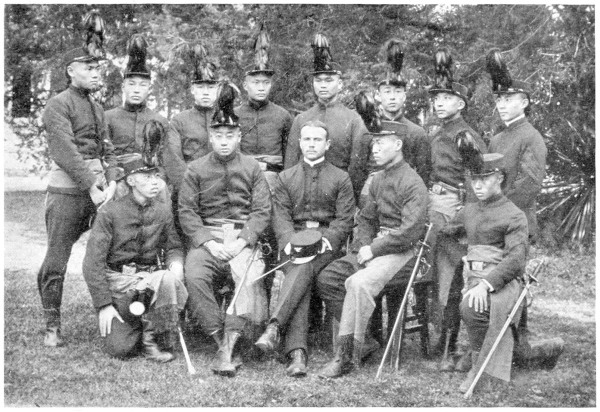
Copyright, American Episcopal Church, Foreign Board, N. Y.
Military company of St. John’s American Episcopal University, Shanghai.
Numbers of these young men took part in the revolution, and they
are leaders in the New China.
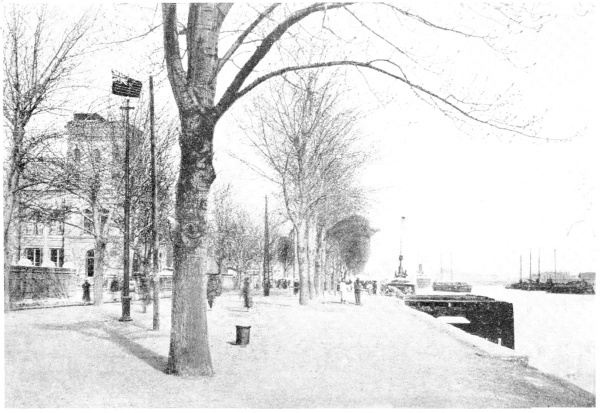
Copyright, 1913, The Bobbs-Merrill Company.
The bund, Tientsin, where the Legation Guards disembarked during the
revolution of 1911–12.
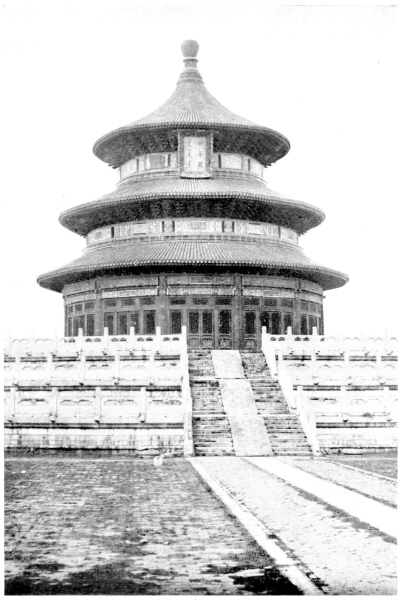
Copyright, 1913, The Bobbs-Merrill Company.
The heart of religious China, the only reservation made by the abdicating
Manchu emperor; the chaste, blue-roofed Temple of Heaven, Peking.
The beautiful proportions of this building have been widely praised
by foreigners. The three galleries are of marble.
Amid all the disturbance, another cloud, the size of a man’s
hand, loomed up on the horizon. The Marquis Chu Cheng
Yu, a lineal descendant of the Chinese Ming kings, began to
canvass the rioting army for adherents. Two hundred
American marines were rushed from Shanghai to Tientsin
on the collier Abarenda, and the American fleet left the
southern ports for Taku. The transport Warren sailed
from Manila with another battalion of the Fifteenth Infantry
and marines. The four-nation bankers, with the approval
of six powers, came to Yuan’s help with $1,000,000
loans on nine months’ warrants, to aid him in putting down
mobbing and mutiny by paying off soldiers, who, however,
used the money as fuel for more mutiny. It was decided to
loan the dual republican governments at Peking and Nanking
about $5,000,000 a month. Some of the old-style
troops were more loyal to Yuan than were the notorious
Third Division at Peking, the Sixth Division at Paoting, in
Pechili province, the Second Division in Honan, and the
Fifth Division, in Shangtung province, which were loyal to
no cause or person. At the same time the preliminary contract
of February twenty-first, by which the Russo-Asiatic
Bank independently was to advance Sun and the Nanking
republican organization $7,000,000, was canceled, and the
four banking powers advanced Sun, at Nanking, $1,500,000
to pay off Cantonese troops and hire police. The rebellion
of Yuan’s troops made many confess that the southern
republicans had probably made a mistake in not following
Chang the Second’s imperial forces of northern troops
north in January, 1912, and giving the northern army several
sound thrashings until the organization was broken up.
On March 9, 1912, the irreconcilable imperial governor
of Shansi and Shensi provinces, General Sheng Yun, a
Mongol by blood, still had 15,000 troops (many of them
Mohammedans) fomenting Manchu propaganda and slaying
everywhere, while General Yin Tchang, at Japanese
Dalny, Governor Chao Ehr Hsun, at Mukden, and Prince
Su, at Jehol and Kalgan, were doing the same thing.
What a confused state of affairs existed in the mutinous
army, of the north, which was divided into five corps.
General Sheng’s Mohammedans were setting Shansi and
Shensi provinces on fire. The corps of Imperial Guards
and Manchu divisions at Peking were at heart of course
for the deposed Manchu dynasty. The Mongol divisions
in northern Pechili looted and decapitated and laughed
at President Yuan’s orders. The old-style turbaned
troops of Yuan’s were loyal one day and disloyal another,
and the same thing was true of divisions of territorial
Shangtung, Pechili and Honan troops of Yuan’s modern
army. In the southern provinces the republicans had a
little more cohesion in the five armies of their recruited
corps and their two territorial armies. In Yunnan province
an entirely isolated army was marking time and had done
nothing for either southern or northern cause of late. Oh!
for a strong hand to weave and hold all these cords in one
cable of some strength.
On March 10th, amid the crashing of walls and institutions,
a pathetic but inspiring scene occurred in the modern
Wai Wu Pu (Foreign Office) at Peking. Yuan Shih Kai,
dressed in military uniform, was formally inaugurated provisional
president of the republic of China, in the presence
of the Nanking assembly delegates, military and naval officers,
provincial envoys, and many foreigners. Of course,
legation staffs and missionary bodies did not attend officially.
Yuan read a declaration promising progress, to observe
the constitution, and retire when the National Assembly appointed
a permanent president for the decided term, if he
himself was not chosen. Two yellow robed Lamas from
the Buddhist temple stepped up, presented Yuan with two
honorary scarfs and called him, in Pekingese, “Da Dsoong
Toong” (in Cantonese, Ta Tsung Tung),—the great president.
It was a businesslike military scene, there being very
little of Oriental display or the gorgeous robes of old. Tang
Shao Yi was named premier. President Yuan signalized his
assumption of office by pardoning all prisoners, except murderers
and robbers, remitting all overdue land taxes and
announcing that for the present the old laws would stand,
except where they were obviously contrary to the spirit of
republicanism.
The new constitution provided that the supreme power
was in the hands of the National Assembly; that all acts of
the president required the approval of the assembly, that the
cabinet was answerable to the assembly; and that the assembly
was to elect the president and vice-president, and
have power to pass laws over the executive veto. This was
vastly different from Japan’s stultified parliamentarism,
and was a union of the American system of the lower house
being supreme, and of the British executive efficiency obtainable
from a small cabinet. Doctor Sun promised to turn
over the great seal of his office. Disorder ruled throughout
the armed north, where a republic was unpopular with the
mercenary troops. Republican flags were torn down wherever
the merchants of Peking put them up. The rebelling
troops decapitated the crowd by thousands at Peking, Tientsin,
Kalgan, Paoting, and throughout Shansi, Shensi
and Pechili provinces. So many heads and bodies lay on
the street that the donkeys and mules refused to pass the
heaps. Yuan himself had to add the head of the headtaker
to the pile. He sent the tall, venerable General Chiang Kwei
Tai with old-style turbaned Nganhwei troops, who mowed
off heads right and left through the streets of old Peking.
The famous Tongkwan pass, at the heel of the Yellow
River, commanding Shensi and Honan provinces, was
seized by the reactionary troops of General Sheng Yun,
who compelled the merchant guilds to pay blackmail or
have their stores looted. Clearly Pechili province, with
its hosts of irreconcilable mercenary troops, was the rock
on which the ship of republicanism was now stranded. Yuan
had to change his body-guard from day to day, one day old-style
troops, another day Manchu troops, and again the
champion looters of the Third Division, but the real hand
which afforded what little steadiness there was, was the
magnificent body of foreign troops which amounted to
3,000 picked men.
On March 12th, Provincial President Wu Hon Man and
Governor Chan Kwang Ming, at Canton, were harassed by
the notorious pirate chief, Luk, who was remarkably successful.
Luk, through the mutiny of the soldiers, gained
the historic Bogue, Yuchu, Whampoa and Fumen forts, and
the arsenal and admiralty buildings. All the foreign navies,
led by the United States gunboat Wilmington and the British
fleet under Commander Eyres, anchored off Shameen
Island, cleared for action, and the passenger steamers, on
which probably every world tourist has probably been, the
Fatshan and Honan, sailed from Canton for Hongkong
with two thousand passengers each. The famous old shallow
draft British gunboat Moorhen, the hero of a thousand
pirate chases in intricate Kwangtung province waters, had
her awnings and spars torn by bullets during the night, as
she protected the electric station, so that the pirates could
not strike Canton into midnight, and in the dark massacre
along the narrow streets, the maloos and the bund. Eight
hundred British and French troops patrolled the little foreign
island of Shameen.
Before the days of direct primary nominations in America
we suffered from the machine system, which advanced
the incompetent and debarred the eminent and efficient
from service in the state. A saloon-keeper who brought
2,000 votes would demand, for instance, the position
of secretary of state. “But you’re not fitted for it;
you’re a hoodlum.” The ward-heeler would answer: “I
must have it; I have to pay my 2,000 brigands the ‘graft’
which we claim is ours; otherwise, remember our revenge
next election.” One Shek Kam Chuen, a young stone-cutter
and human hair hawker of Canton, was very successful
in smuggling arms for the revolution, and on the
declaration of independence, he led a following of 2,000
nondescript men, who did effective work in fighting. They
were men who loved a fight more than liberty, not liberty
more than life. When the republic was victorious and his
troops, after being paid, were disbanded, Shek was unsatisfied.
He, a hawker, wanted high office, when even
President Sun turned his brother down from politics to
business in Canton because he was not eminent for political
ability. Shek made demands for his men that the state
could not consistently grant. He smuggled arms to take
up piracy in reprisal on the harassed state. The way the
governor of Canton treated Shek and his legal adviser,
Chang Han Hing, was, under the constitutional pressure of
public opinion, to capture them at their headquarters, and
under military law, or the application of the popular “recall”,
have them both shot, to the great rejoicing of good
citizens and taxpayers. That ended one instance of heelerism,
bossism, packed primary, professional office holding,
“public office a private graft”, piracy, or whatever you like
to call it, in modern China! The “Popular Recall” was a
success, despite the cynicism of the standpatters in Canton,
and one of those standpatters was Shek’s lawyer, Chang,
who shared his client’s fate, much to his disgusted surprise.
I am sorry William Dean Howells was not in Canton at
that time to write A Modern Instance!
General Wu Sum, with 2,000 republican provincial troops,
left Canton for Swatow to put down pirates operating
around that noted old city, and the famous General Ling,
and General Ho came down from Nanking to assist. On
March 14th the irreconcilable “Boxer” Manchu leader,
Prince Tuan, exiled in Kansu province, raised the standard
of revolt, with his son Ku Kwei, as a pretender to the
throne. He had not the moral support of all of the imperial
clan, because he had in 1900 plotted to displace Prince
Chun’s emperor son, “Pu Yi”. Tuan is a shrewd, able and
persistent leader. If he had not been a reactionary in 1900,
he might have preserved to the Manchus a longer lease of
power.
The battles of the international financiers still went on at
Peking, Premier Tang Shao Yi’s action in raising $5,000,000
from a Russian-Belgian syndicate on the Chinese-built
Peking-Kalgan railway, incensing the international
group. Tang gave a laconic interview, merely saying:
“China need not necessarily put herself forever in the hands
of four nations; we can deal with independents where we
are able to find any. The loan was first offered to American
bankers, but those American bankers who are now in the Far
East would not act independently of the four nations.”
Russian, Japanese and Belgian bankers seemed to fall in with
Russia’s plans, as in 1896, to put China under a financial
thraldom. Russia did not want a loan given to China for her
army, as Russia and Japan both desire a weak army in China.
The four-nation bankers now offered China $300,000,000,
of which $60,000,000 was to be for army purposes. If Japan
joins in this loan, it will be because she does not want to be
shut out of a share in controlling China’s finances, and an
apportionment of the concessions. The National Review of
Shanghai published at this time a caricature, showing Russia
pushing old China, and “Foreign Grafter” pushing New
China, out of the way, while North China, a clam, had shut
its shell on the beak of South China, a heron. The Chinese
fable of the bird and the shellfish was quoted as follows: “A
bird attacked an open shellfish on the beach; but the shellfish
closed his shell with a snap, and the bird was caught. Both
were then helpless, and fell an easy prey to some covetous
fishermen.” Nearly all the Japanese papers, including the
influential Tokio Nichi and Jiji, and the Osaka Mainichi,
came out attacking Yuan, and endeavoring to stir up
differences between North and South China. If Japan
could prove that Chinese conditions were unstable, there
evidently would be more plausibility for Japan’s possible intervention
in Manchuria! On March 16th, Premier Tang
Shao Yi announced a provisional northern cabinet as follows,
until the National Assembly of seven delegates to a
province could meet. None of the appointees is a Manchu.
President, Yuan Shih Kai, a Honan man.
Premier, Tang Shao Yi, Cantonese, educated at Yale
University, America.
Army, General Tuan Chi Jui, Nganhwei man, once viceroy
of Hunan, active in revolution.
Navy, Admiral Lin Kwan Hsung, a man of considerable
experience in the old and new navies, at Canton, along the
Yangtze, etc.
Foreign Affairs, Lou Tseng Tsiang, Minister to Russia,
Netherlands, etc. In this appointment Yuan shows how
natural it is for him to favor Russia, whom he fears.
Interior, Cheo Ping Chun, a native of Hunan.
Education, Tsai Yuan Pei.
Railways, Posts, etc., Liang Ju Hao, Cantonese.
Commerce and Labor, Chen Chi Mei.
Agriculture, Sung Chiao Fen.
Justice, Wong Chun Hui, American educated, very able.
Finance, Hsiung Hsi Ling, Hunan man, once in Exterior
Department of Hupeh province.
Most of these are southern men, some of whom replied
that they did not see how they could come without a southern
army to protect their lives from the loosely-held northern
troops, who had no idea what constitutional honor or
promises meant. The whole of the American Pacific Navy,
including the fine cruisers California, South Dakota and
Colorado, left Honolulu for the Far East, and the United
States steamer Monterey, on the same day, landed one hundred
men at Swatow to preserve order and the tanks of
the Standard Oil Company. On March 19th the republican
troops at Canton and Swatow gained back after severe
engagements the forts that the mutinous troops and pirates
had taken. The government at Canton bought up all the
food in the shops so as to starve out Luk’s pirates. Amid
all the conflict of accusation and denial, it is fitting
that Yuan Shih Kai should speak for himself, and therefore
I quote parts from his long address to the old conservatives
and to the provincial governors shortly after the abdication
of the dynasty, which abdication he adroitly and successfully
urged when, to use his own words, “it was well
nigh impossible to make stand against the republicans.”
“From the time when I again led the troops and later
when I came to court, I was animated with the purpose of
establishing a constitutional monarchy, but the state of the
country changed. The National Assembly and the provincial
assemblies all fathered the policy of not using military
force to put down the disturbances. When Hankau was
regained, the naval forces were lost. The moment Hanyang
was reconquered, Nanking fell. The power of the
government over the waterways and the sea was gone, and
the sources of revenue were cut off. Although in various
ways I encouraged the military to greater effort, secured the
revocation of Shangtung’s declaration of independence, subdued
the capitals of Shansi and Manchuria, and did all in
my power to prop up the North, yet the tide was too strong
and swept every locality. Revolutionary societies among
the people were scattered everywhere. At this time there
was international intervention and it was requested that in
the interests of humanity a truce be declared and negotiations
undertaken. Foreigners continually uttered reproof
on the scores of commercial interests and the indemnity.
Because the country was in such a chaotic state politically,
it was difficult to restore order. Within there was ruin;
without there was furnished the possibility of foreign intervention.
The revolutionary forces were coming by various
routes to attack the North. The spirit of the army was
shaken. Had the strife been continued, in a very short time
the revolutionary army would have come north, and in that
case it would have been impossible either to fight or to negotiate
for peace. What of the imperial family and the livelihood
of the bannermen? Recently the ministers of foreign
nations, the commercial associations at the ports, the different
conferences, the various troops and the provincial viceroys
and governors have sent telegrams, all stating that the
will of the people is bent on a republic, and that it would be
well-nigh impossible to make stand against it. Should the
enemy arrive at the walls of the capital, the disasters resulting
would be unimaginable. How much better for the
throne, of its own grace, to proclaim the republic at an early
date. There was condemnation of the policy of staking the
fate of their imperial majesties and the lives and property
of the North on a single throw, trusting to luck in a single
battle. An edict was issued by her Imperial Majesty directing
me first to settle with the revolutionary army regarding
the especial consideration to be accorded the imperial family
and the treatment of the Manchus, Mongolians, Mohammedans,
and Tibetans. If an agreement could be reached
by the two sides, then the imperial family might enjoy
glory, and the hereditary nobility among the Manchus, Mongols,
Mohammedans, and Tibetans, as well as the allowances
of the bannermen, might continue without interruption.
An agreement was made, resulting in the present state
of affairs.”
Neither Yuan nor the north has yet explained to the
world the reason why the nobility of the Manchus, Mongols,
Tibetans, etc., expect titles and pensions, unless it
be the argument that is now wearing out over the world, in
nation after nation, that it is constitutional to maintain rule
by a Privileged Minority over a taxed majority! Yuan
says: “An agreement was made resulting in the present
state of affairs,” but the “present state of affairs” is not entirely
satisfactory. At times, it seems in China that Confucius
has abdicated to Confusion. The solution lies in three
things: railways, education, and a real republican congress,
none of the three to be interfered with by either a riotous
or office-greedy army, but rather dutifully served by a patriotic
army. There can be no doubt that the action of the
ninety generals of the northern army in forcing the National
Assembly at Peking, in July, 1912, at the sword’s
point, to accept against their will the second cabinet which
Yuan Shih Kai had selected, and some of his foreign-advised
measures, was inimical to the vitality of constitutionalism
in China. The result was the forming of a
constitutional party in the Yangtze and southern provinces
by Doctor Sun Yat Sen and his friends, called the Tung
Men Hwei (Sworn Brother Society), some of whose
measures were the supervision of Chinese finances, and railway
and industrial development, largely by Chinese, and the
discharge of more regiments of northern troops. The
National Assembly and cabinet have recently put in Sunyacius’
charge the formation of a central railway board to
arrange for the extension of railways.