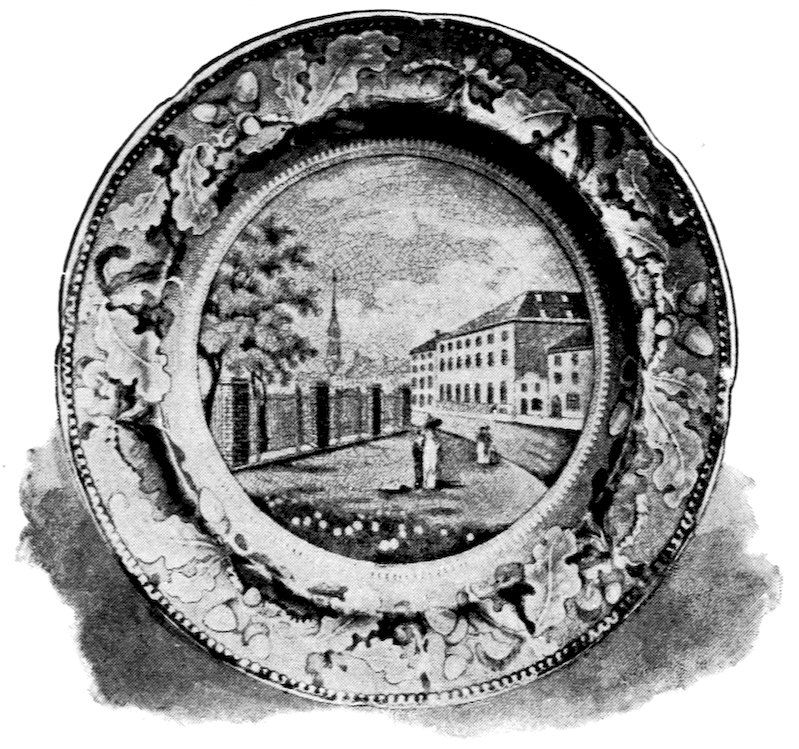
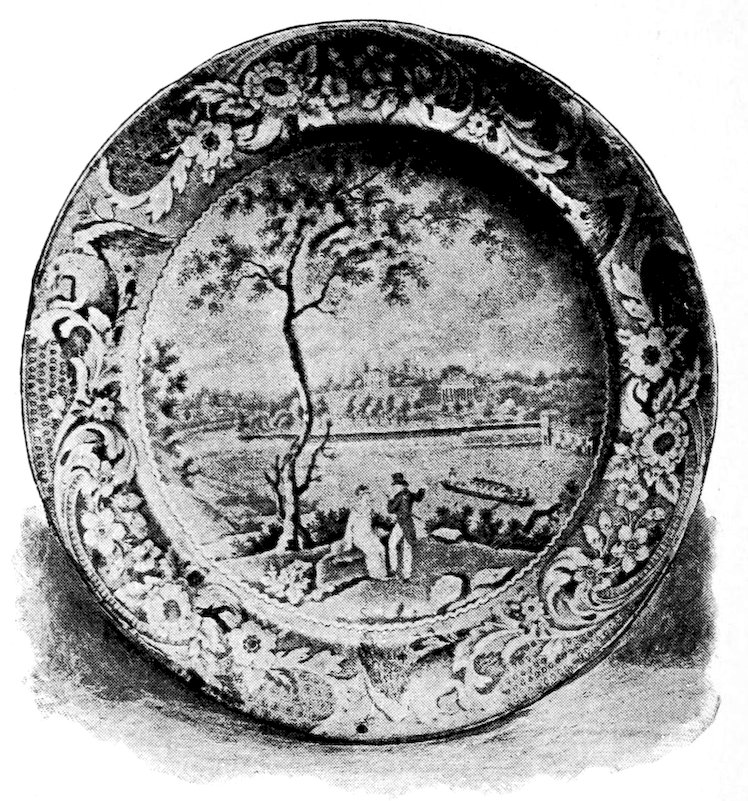
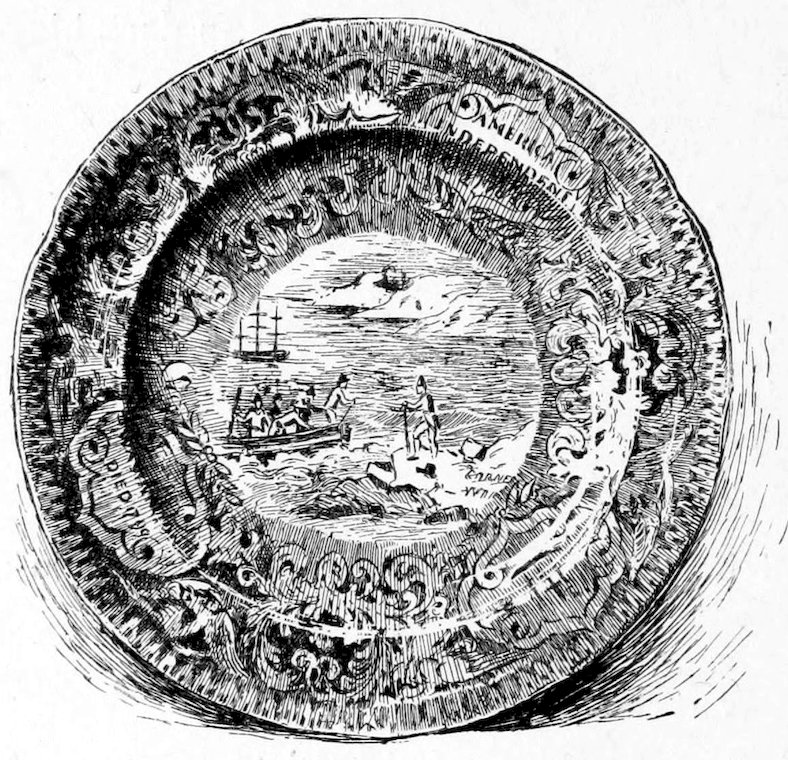
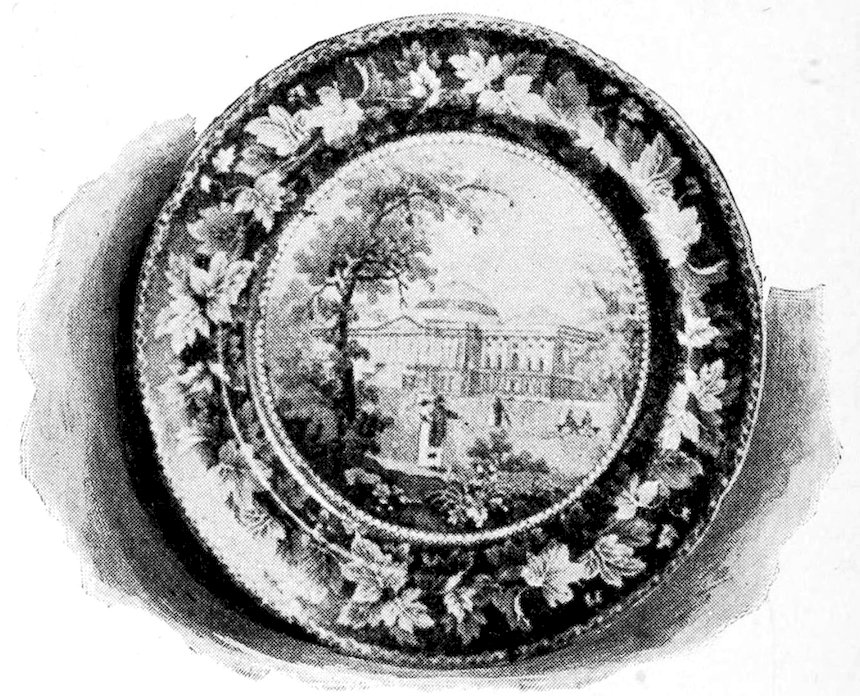
My dearly loved friend, Charles Lamb,
wrote, in his “Essays of Elia,” “I have
an almost feminine partiality for old
china. When I go to see any great
house, I inquire first for the china-closet,
and next for the picture-gallery. I have no repugnance
for those little lawless azure-tinted grotesques that, under
the notion of men and women, float about uncircumscribed
by any element, in that world before perspective—a
china teacup.” In that partiality for old china I
humbly join, and it is of the search through New England
for such dear old china loves, and of the gathered
treasures of those happy china hunts, that I write.
China hunting is a true “midsummer madness.”
When grass grows green and “daffodils begin to peer”
2my fancy lightly turns to thoughts of china. Hot
waxes the fever as crawls up the summer sun; fierce
and fiercer rages the passion and the hunt, till autumn
touches with her cold though glorious hand the trees
and fields. Then doth my madness wane, and chase
grow dull, and icy winter finds me sane and calm, till
charming spring returns to witch me to “mine old
lunes” once again. Thus is every china captive of that
mad summer chase aglow to me with summer suns and
beauty—not a dull lifeless clod of moulded painted clay,
but a glorious idealized token of long warm halcyon
days too quickly passed, of “yesterdays that look backward
with a smile.”
Were the possession of old or valuable specimens of
porcelain and pottery, or even of happy memories of
“days of joyance,” the only good things which came
from the long hours of country ranging and farm-house
searching spent in our china quests, Philistines might
perhaps scoff at the waste of time and energy; but much
else that is good have I found. Insight into human
nature, love of my native country, knowledge of her
natural beauties, acquaintance with her old landmarks
and historical localities, familiarity with her history,
admiration of her noble military and naval heroes, and
study of the ancient manners, customs, and traditions of
her early inhabitants have all been fostered, strengthened,
and indeed almost brought into existence by the
search after and study of old china. How vague and
dull were my school-day history-lesson memories of
Perry, of Lawrence, of Decatur, until I saw their likenesses
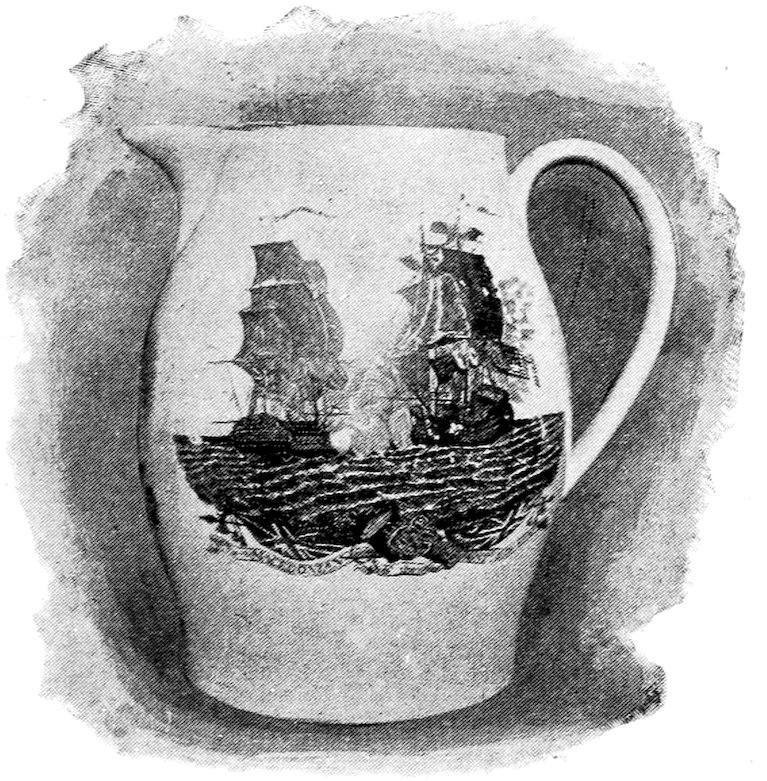
3on some hideous Liverpool pitchers! then I read
eagerly every word of history, every old song and ballad
about them. How small was my knowledge of old “table
manners” and table furnishings until I discovered,
through my china studies, how our ancestors ate and
served their daily meals! How little I knew of the shy
romance and the deep-lying though sombre sentiment
in New England country life, until it was revealed to me
in the tradition of many a piece of old china. How entirely
powerless was I to discover the story of human
nature as told in the countenance until my inquiries after
old china made me a second Lavater in regarding the
possibilities of successful purchase in case the questioned
one chanced to own any old porcelain heirlooms! How
few of our noble wood and valley roads had I seen until
I drove through them searching for old farm-houses that
might contain some salvage of teacups or teapots! And
not only do we learn of America through our china
hunts, but of England as well; for nearly all of our old
table-ware was English, and the history of the production
of English china can be traced as easily in New
England as in old England. Few of the more costly
pieces came here, but humbler specimens show equally
well the general progress of the manufacture.
Let me be just and honest in my tale; though all is
ideal happiness in the hours of the china chase, the
counting of the spoils is sometimes vastly disappointing.
“As high as we have mounted in delight
In our dejection do we sink as low.”
4There is no hobby of so uncertain gait, none other
fancy in the pursuit of which one meets with so many
rebuffs as in china collecting. I mean in real china collecting
by individual search and pursuit, not in china
buying at high prices at a fashionable china-shop. For
such Crœsus buyers, who know not the sweet nor the
bitter of true china hunting, these pages are not written.
Sad, sad failures does your china hunter often make,
but there is a blessed delight and pride when a long
search is at last successful which rewards him and makes
him, or rather her, forget the cruel blows of the past,
and makes hope spring eternal in her breast, undying,
and undimmed. Disappointments were few in early
china-collecting days in America; friendly farm-wives
then gladly brought out their precious and plentiful
stores, and eagerly sold them for silver to buy a new
cotton gown or a shell-comb, and attics and pantries
were ransacked and depleted with delight. Now can
the china hunter drive for days through the country,
asking for old crockery at every house which is surmounted
by a gambrel roof, has a great square chimney,
or an old well-sweep, without even hearing of one old
teapot; and yet such is the power of china-love, she
will start out again the next week, cheerful, hopeful,
and undaunted, “to fresh woods and pastures new.”
Nor will it always prove clear sailing should she discover
the home of the sought-for treasure. She may
learn from friendly and loquacious neighbors that “old
Miss Halsey” or “John Slade’s widder” has stores of
old crockery in barrels in the attic, or on the top shelf of
5the pantry, or even “up over the wood-shed,” but she
cannot obtain one glimpse of the hidden hoards—far less
can she purchase them.
We have visited again and again one gray old farm-house
in Massachusetts, a farm-house with moss-covered
“lean-to,” which we know contains enough old English
pottery and porcelain to found a museum; but cajoleries,
flatteries, persuasions, open demands, elaborate explanations,
and assumptions of indignant and hurt astonishment
at refusals—one and all are in vain; not even
one old plate have we ever seen. The farmer’s wife
greets us most cordially, gives us doughnuts and milk in
summer, and apples and cider in the winter, maple-sugar
in the spring, and hickory-nuts and butter-nuts in the
fall, but in aggressively modern pitchers and dishes; and
when we leave she urges us hospitably and warmly to
“come again.” We know well where her precious china
is hidden. High up on either side of the great mantelpieces
in “living-room” and “best room” are cupboards,
so high that one would have to climb upon a chair to
see into them; and from the good wife’s frequent and
furtive glances—speaking though silent—at her locked
cupboard doors, we know well what treasures are stored
therein.
At that china-hiding abode we often have concocted
for us an old-time country drink, composed of water
flavored with molasses and ginger, which was in Revolutionary
times called “beveridge.” Gallons of that vile
fluid have I drunk with the hostess, hoping that the
joys of the flowing bowl might loosen her tongue and
6unlock her cupboard doors, but I have risked my digestion
in vain. Still I sit “smiling with millions of mischief
in the heart,” for life is short, and I am waiting,
wickedly waiting; the farmer and his wife are old, very
old, and when they depart from this life they cannot
take their keys and crockery with them.
More complete and mortifying routs sometimes,
though rarely, have befallen us. We were driving quietly
along one day on the outskirts of the town, when
we saw at the door of a shabby modern house, a vinegar
faced woman, who sat energetically mixing chicken-dough
in one of the most beautiful old blue and white
Nankin bowls that ever was seen. As each blow of the
heavy iron spoon came down on the precious antique, it
struck an echoing and keener blow to our china-loving
hearts, and we hastened to ask the owner of the bowl to
sell it ere it was broken. Sell it? not she. She didn’t
know where it came from, nor who had owned it—and
she didn’t care, but she wouldn’t sell it for any money;
and if a tin pan was just as good to mix the meal in, she
would use this “old crockery thing” if she wanted to;
and she walked into the shabby house, and “slammed”
the door before our abashed and sad faces. The thought
of that bowl at the mercy of that fierce iron spoon has
made us very unhappy; scores of times have we driven
past the house glancing furtively in, at the wood-shed,
the hen-house, the kitchen door, ready almost to steal
the poor prisoner if we found it unguarded; but we do
not dare attempt an honest rescue lest we suffer a still
more ignominious and mortifying defeat.
7Strange answers are sometimes made to our inquiries
and requests; strange objects presented to our china-searching
eyes. In farm-houses, presided over by deaf
old housewives we have had shown to us crackers for
crockery, pitchforks for teapots, tubs for cups, and once,
by some strange and incomprehensible twist of the poor
deaf ears, or our own dull tongues, were cheerfully offered
buckwheat flour when we asked to see a Washington
pitcher. We also drove several miles at the sea-shore,
in high spirits and with great expectations, to see some
very old teapots, “all kinder basket-work,” and were
confronted by a strange machine of seafaring appearance,
which proved to be an eel-pot, and was truly an ancient
one. Other kindly country souls, knowing well what
we want, offer us as far more desirable and artistic treasures,
faded samplers, worsted flowers, crocheted tidies,
preserved wreaths, wax fruit, hair jewelry, and Parian
busts, and look at us with commiseration when we
cling to our strange idiosyncrasy—our preference for old
china. Sometimes the kindly intention to guide and
help us to our goal is evident and powerful enough, the
desire to inform us is rampant, but power of expression
is lacking, or even a modicum of memory; the narrow
limits of country vocabulary are painful to witness and
the expressions of its poverty are painful to hear, and
suggestions only lead the speaker farther astray in his
attempted descriptions. He is also color-blind, and has
vague remembrance of size and nomenclature. He can’t
describe the china, he can’t date it, he can’t name it,
sometimes—though he vaguely remembers that he has
8seen it—he can’t place it, he simply knows that somewhere
he has seen something that he fancies may be
somewhat like what we want; and too often when we
try to follow his vague and jejune clue, we go upon a
“thankless arrant.”
We once addressed to an old Yankee farmer, who had
brought a load of apples into town, the stereotyped inquiry
which we have asked, ah! how many hundred
times, and received this drawling answer, “No-o I donow
as I know anyone as has got any old furnitoor or chayner
she wants ter part with. My wife haint got any anyway.
My Aunt Rebecca’s got one curous old plate
and I guess she’d sell it—she’d sell her teeth if any-body’d
buy ’em an’ pay enough ter suit her.” We finally
extracted from him (after much parrying of our direct
questions) that, “she got it in Washington more’n
fifty year ago,” that “the folks set great store by it,
and said it came from Mount Vernon and belonged to
Marthy Washington,” that it had the names of the States
around it, “it was blue and perhaps green too, and it
had stars sure and he guessed they were gilt.” Now we
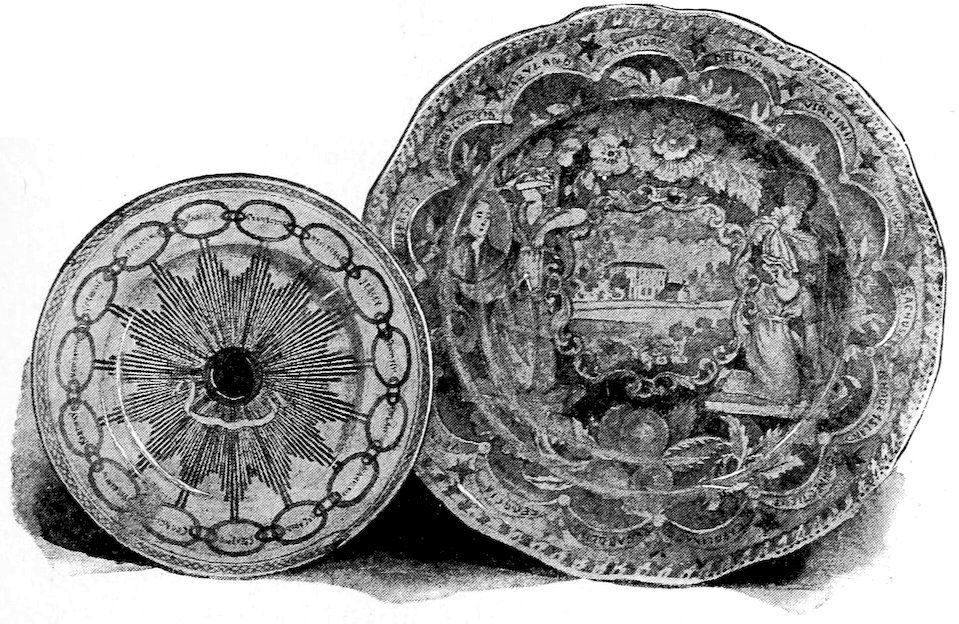
had seen pieces of the Martha Washington tea-set, and
we knew that it was decorated in blue and green with
the names of the States in the links of a chain, and the
initials M. W. in the centre in a great gilt star. We
knew at once that Aunt Rebecca’s plate must be one of
that set. What a discovery!
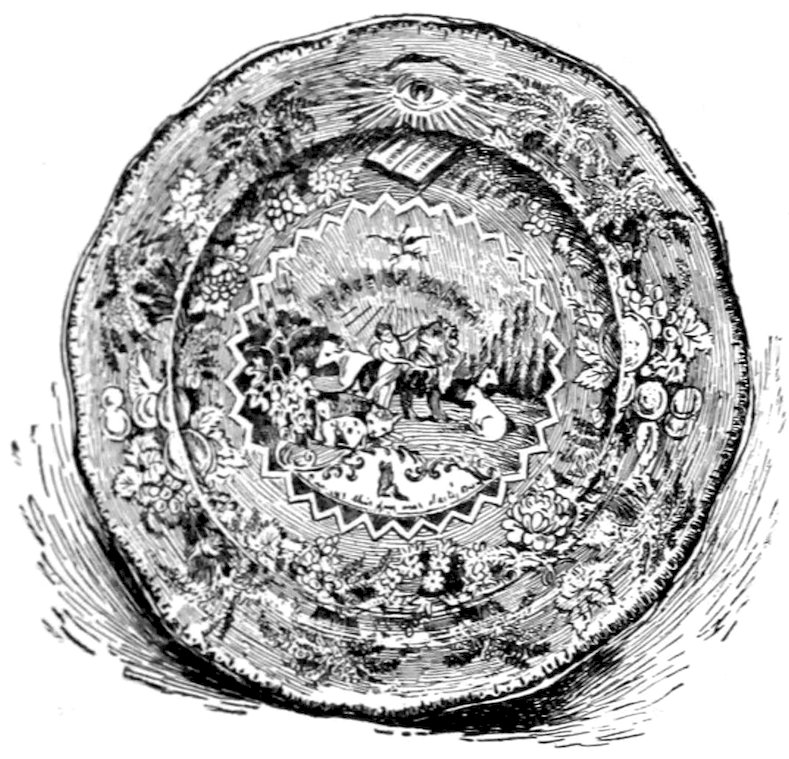
9
The Plate we Hoped to Find and the Plate we Found.
To the benighted and narrow-lived souls who have
never hunted for old china it may seem strange that we
knew at once that it was one of those rare plates; but I
am sure every china hunter, whose path is always illumined
by the brilliant possibilities which form such an
encouragement in the pleasures of the china chase, will
fully comprehend our confidence and anticipation. We
figured our plate in all the loan collections, marked
with our names in large letters as joint owners; we
planned a velvet silver-bound box to safely hold our
“heavenly jewel” after we had caught it; we even
hesitatingly thought that we might make our joint will
and leave it to the Mount
Vernon Association—and
then we drove
eighteen miles to
secure it. I shall never forget the sickening disappointment
I felt when I saw the Martha Washington plate.
There were the names of the States; and stars there
were, but not a gilt one. And where were the touches
of verdant color? All was blue—deeply, darkly, vilely
10blue. At any other time we should have hailed the fine
“States” plate which was shown us with keen delight,
but now we could hardly speak or bear to look at it. At
last, in sullen disparagement, we offered a dollar for it,
had our offer accepted, carelessly took it, threw it on the
carriage-seat and drove away. I reviled the farmer and
his villainous memory and vocabulary, and would not
look at the deep-dyed “States” impostor for a month,
but when I heard that a collector had paid twenty dollars
for a similar plate in New York, I unwrapped it and
hung it on my dining-room wall, where it now shines a
glowing bit of dark color, a joy forever.
Warned by many such dreary mistakes I am very shy
of having china sent to me through any interest awakened
by its description, and am equally shy of buying by
proxy.
“Let every eye negotiate for itself,
And trust no agent.”
I have learned also to listen with attention, not placing
the slightest confidence in what I hear, and yet always to
investigate with cheerfulness and alacrity. It is not, however,
from elaborately detailed and willingly told stories
that I have had knowledge of my richest “finds.” I
have learned to “take a hint”—a maxim which should
be eternally impressed on every china hunter. Learn to
“grasp the skirt of happy chance;” let your motto be,
“Semper paratus.” Let no suggestion of old people or
old house-furnishings, no glimpse of blue color or sprigged
surface, even on a broken sherd of crockery by the wayside,
11no hint of distant and out-of-the-way farms, no
prospect of country sales, of “New England dinners,” no
news of refurnishing old houses, no accounts of the death
of old inhabitants fall on unheeding eye or ear. For
myself, I never hear the words “old china” but my
heart is moved, more than “with sound of a trumpet.”
I breathe the battle afar and hurry to the fray, to return
at times victorious with dainty trophies of war, and
sometimes, alas, empty-handed, with the hanging head
of sore disappointment and defeat. Sometimes the
scent is poor and broken and you must ferret out the
way to the lair; even with much trouble and diligence
you cannot always learn at once and definitely
the lurking-place of the porcelain treasures; you meet
with reserve and a disinclination to reveal. Then comes
stratagem to the fore. Learn to wheedle, to hint, to interrogate
slyly, to blandly let the conversation drift—“muster
all wiles with blandished parleys, feminine assaults,
tongue batteries”—in short, vulg. dict., to “pump”—and
work that pump with judgment, with craft, and
with thoroughness. Moments of quickly repented expansiveness
come to all mortals in country and in town,
and in those rare moments of telling all they know, even
reticent and secretive country people will give you many
a china clue to follow.
I have not found, as did the members of the China
Hunters’ Club, that country housekeepers would, as a
rule, rather have money than china; my country people
will not sell their china willingly—they prefer china
to silver. Times have changed since 1876; a fancied
12knowledge, an exaggerated estimate of the value of old
“crockery” now fills many a country soul, and a high
monetary value is also placed on family relics, on
“storied urns” and on the power of association. I will
confess that, as a last resort in times of direst stress,
when you really cannot go without that Pilgrim plate,
when you positively need it—if you take your money
out and lay it on the table in full sight of the plate-owner,
you wield a powerful lever to work the transfer;
nor do I consider such a statement at all derogatory to
the character of my New England neighbors, nor is the
trait peculiar to them.
But do not make too aggressively prominent the
money part of the transaction. Be courteous and careful
even to extremes in addressing your country people
for purposes of china purchase. Never ask them to sell
their china—sell is a most offensive and brutal word—ask
them if they are “willing to part with it.” Never hint, by
word or deed, that you fancy they really need the money.
Never disparage the desired articles, the shrewd country
wives would see through your pretence at once—“Why,
if it be so commonplace, do you wish it?” A base and
deceitful, though clever, china hunter of my acquaintance
declares that she has found it invariably to her
advantage to say that the coveted article matched exactly,
either in shape or decoration, something which she
had at home. The staid country mind, liking to see
things in “sets,” always appeared to be most immoderately
and unaccountably influenced to sell by this disingenuous
assertion.
13We have many times during the past five years crossed
the trail of a collector who appears to have wholly depleted
of china the old farm-houses of the Connecticut
Valley. We have found, through comparing the accounts
of his visits, that he has a little slyness too. He always
desires to purchase his particular bit of china simply to
form a link in a chain. He either has a specimen of the
entire succession of production of a factory except the
very piece the farm-wife has, or he has a perfect list of
historical plates except the very plate she owns, or he
has a choice bit of every known color of lustre except
her special pitcher. The satisfaction of supplying the
long missing link, and the value that link will give to a
history the purchaser is going to write of such china,
seem to prove a powerful lever to effect the transfer to
his catenulate collection.
The men are, as a rule, always willing to sell china—when
did man ever reverence the vessels of his household
gods? I always delight to ask a Yankee farmer, in
field or road, whether he has any old crockery that he
would be willing to part with. How he will skurry
home “cross-lots,” over the ploughed fields, or through
the rows of growing corn, eager to pull out and sell his
wife’s pantry treasures! Not that he can sell them if
“Mother” isn’t willing—in her realm she reigns supreme.
Even in the midst of my sore disappointment I have
thrilled with malicious satisfaction and delight to see
the calm and authoritative way in which “Father” is
turned out of the “butt’ry” when he tries to pull down
from the shelf an old blue bowl or plate to sell. “Mother”
14has kept her cinnamon-sticks and nutmegs for her
apple-pies in that “Blue Dragon” bowl for forty years,
and she isn’t going to sell it now to please anyone. To
hail the farmer in advance with china questions is not,
therefore, so underhanded and despicable a proceeding as
might be thought, nor so dangerous to the family peace;
he really is a poor, uninfluential, unpowered vassal in
kitchen and pantry, his advice is not asked, his word is
not heeded, nor if he attempt to be at all bumptious will
his presence be tolerated. I have found it to be an unvarying
rule that the farmer is always willing and eager to sell
his wife’s mother’s china, while the wife is always openly
disparaging, and cares little for his mother’s china; and
when once the source of inheritance is discovered, the
rule of action and plan of attack are plainly defined.
It may be argued that it is neither very courteous nor
very kind to walk into a stranger’s house and ask him to
sell you his household goods and chattels. To such argument
may be offered the reply that one can hardly
judge a farm home by the same rule as one does a city
home. The visit of a stranger is regarded with widely
different eyes; it is a pleasure, a treat, to most farm-wives
to receive such a visit, and the farmer will come plodding
home from the distant fields, in order not to lose the
chat with the stranger and the pleasant diversion. Who
would attempt to enter and to lodge over night in a
stranger’s house in the city? A police-station or a lunatic
asylum would probably quickly shelter your intruding
head. There is hardly a farm-house where such
a suggestion would be unwelcome or resented, provided
15you look not like a bandit or horse-thief. Then, too,
farmers and even farm-wives do not generally regard
their old furniture and furnishings with quite the same
feeling that we do ours. The old blue Staffordshire
ware they consider almost worthless, and are often glad
to sell it for ready cash; but their lilac-sprigged china,
a wedding gift or a purchase with their few hard-earned
dollars, they often value and cherish as we do Sèvres. A
farmer handles very little money—his wife still less, and
ofttimes the money paid by china hunters is a godsend
in country homes. Much good is done, much comfort
conferred by exchanging money for crockery. Carpers
say: “But you do not pay city prices.” Sometimes,
alas, we do, fired by our china mania, “the insane root
that takes the reason prisoner,” though we never should.
The farmer does not pay city rents, he has not the risk
and expense of transfer to the city, he pays no salesman.
If he could sell all his farm products as easily, profitably,
and safely as he sells his china, lucky would he be.
Sometimes the discovery that the “old blue pie-plates”
are of any value is a delight and a surprise to him, but
he sees at once that when they are worth so much he
cannot afford to keep them. Hence he is far from being
offended at the easy means of sale offered to him.
One piece of advice I give to china hunters—advice,
the wisdom and advantage of which I have learned at
the cost of much unpleasant and disappointing experience.
Do not hurry prospective china sellers: bustling
city ways annoy them, fluster them, and worry them, and
in sheer bewilderment they say “No” to get rid of you.
16Be tentative and gentle in your approach. Do not—as
we did—rush in upon a deaf and timid old lady and
frighten her, by the bouncing and bustling inquiries we
made, into vehement denials of china-possession and
simultaneous refusals to sell anything. This dear old
“Aunt Dolly” lived in the sole new house in a village
of old colonial dwellings, and we rather contemptuously
thought to pass by the brand-new French roofed intruder,
but decided “just to ask”—and “just to ask”
and receive a frightened negative answer was all we
did do, and we left with self-important assurance, to
hunt elsewhere. A tin-peddler (a “china runner” perhaps
in disguise), with quieter voice and more truly
well-bred manners, carried off her rare treasures about a
week later—a canopy-topped mirror with Washington
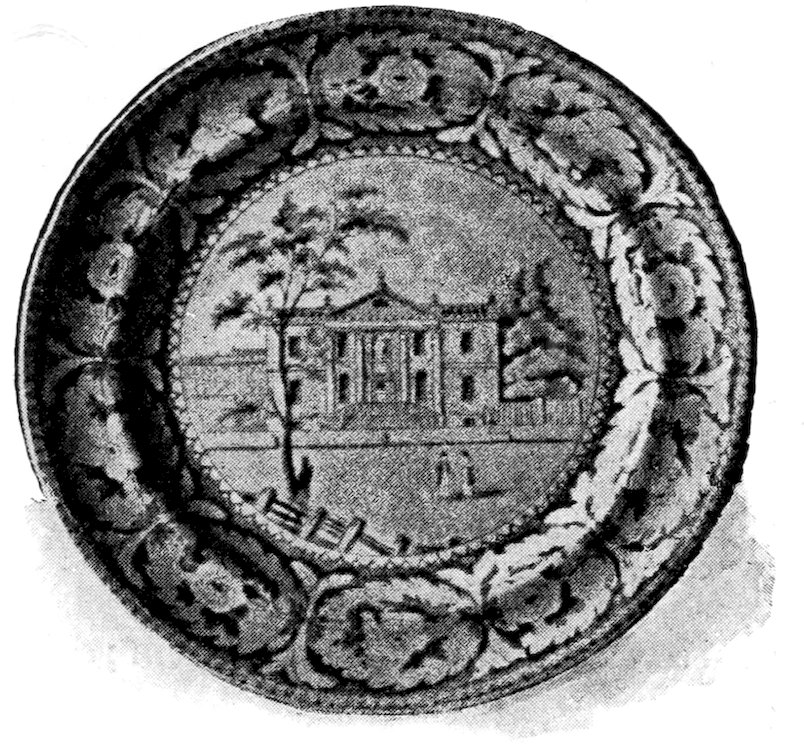
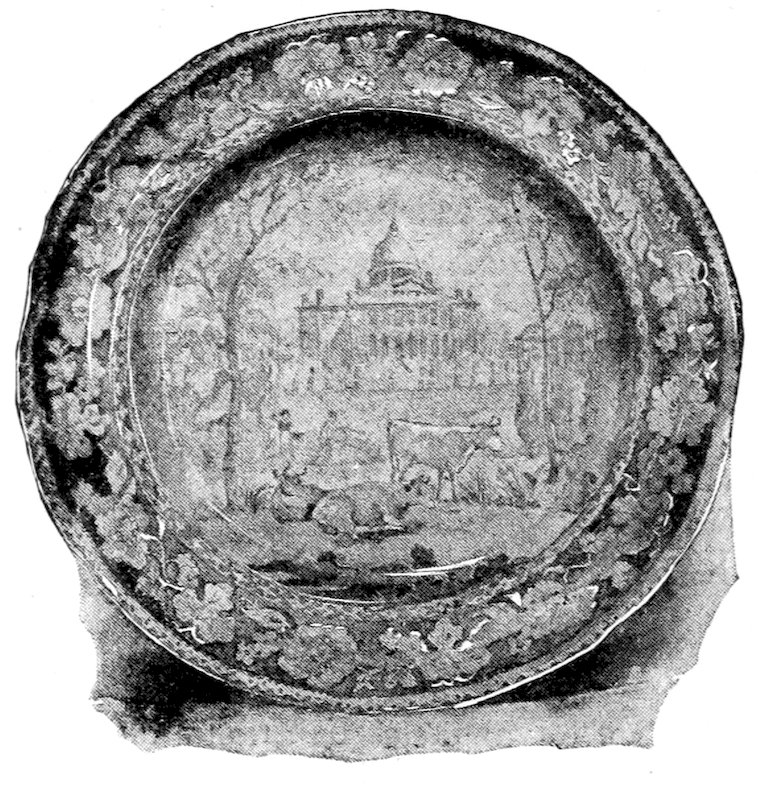
and Franklin mirror-knobs, a “Boston State-House”
pitcher, four “Valentine” plates having Wilkie’s design,
half a dozen Staffordshire plates with the “cottage” pattern,
and two Wedgwood teapots; and Aunt Dolly took
as payment two shining new tin milk-pans and a cheap
wringing-machine that wouldn’t wring. We knew her
well in after years when it was too late, and she confessed
to us that at our first meeting we talked so fast,
and talked together, and “hollered so she couldn’t
hear,” and that she did not understand what we meant
or what we wanted, and said “No” to obtain peace.
And oh! what an enviable advantage the ubiquitous
tin-peddler, that “licensed vagrom,” has over every convention-trammelled
china hunter! What a delight,
what a dream it would be to go a-china hunting with a
17tin-peddler’s cart; what lonely out-of-the-way roads and
by-lanes I would take, careless where I went, since
wherever I wandered I should be welcome. How I
would sit on my lofty seat and view the lovely country
o’er, in the “sessions of sweet, silent thought,” with my
strong and willing and safe horse to pull me up hill and
down dale; with my stock of shining tin-ware, my
brooms and notions and gaily painted pails, all ready
for advantageous exchange; with my big, red, roomy
wagon, in whose mysterious cavernous interior I could
store in safety unwieldy china treasures, such as tureens
and bowls and pitchers; with my air of ready assurance,
of intimate familiarity with the family, my jovial
raillery, my opportunities of kitchen and pantry investigation,
my anxious health inquiries and profound medical
advice, backed up by bottles of patent medicines
which I should sell at half-price to curry favor and
china; or, better still, exchange, giving a bottle of liniment
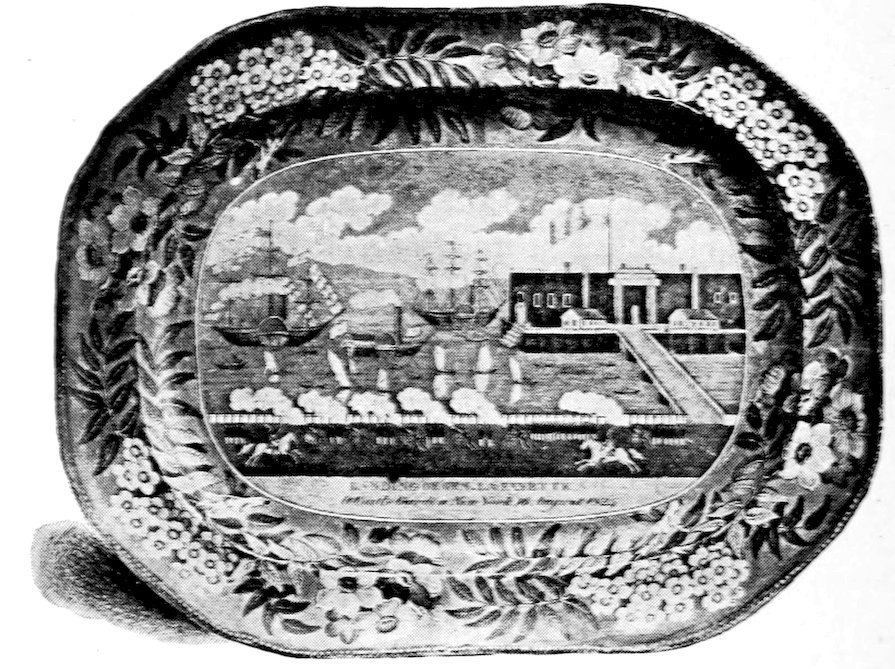
for a “Landing of Lafayette,” or a box of pills
for a Pilgrim plate—oh! next to being a gipsy living
under the greenwood tree, who would not be a Yankee
tin-peddler a-china hunting? But perhaps the
farm-wife might wish me to take in exchange for my
wares, eggs, or butter, or rolls of wool—what should
I do with a pail of butter in summer-time on a tin-peddler’s
cart? Or, worse still, old rags—just fancy it—instead
of old china! I should then answer her with
an air of deep and sombre mystery: “Madam, I would
gladly take your readily exchangeable merchandise an’
I could; the old rags are particularly desirable and attractive,
18but I have sworn a vow—I have a secret which
I cannot now divulge—it must be crockery or naught,
especially dark blue crockery with American designs,
else I and my glittering and uncommonly cheap wares
must pass wearily on, homeless, chinaless, a wanderer on
the face of the earth.” Alack-a-day! such happy peaceful
joys are forbidden to me, not because of lack of
inclination or capacity, but—thrice bitter thought—because
I am a woman. Tin-peddlering is not for me, it
is not “woman’s sphere.” Perhaps when I am old, too
old to clamber up and proudly sit on that exalted
driver’s seat (though never too old to go china hunting),
perhaps when women have crowded into every other
profession, calling, and business in the land, some happy,
bold feminine soul will taste the pleasures of “advanced
life for women,” the pleasures forbidden to me, and dare
to go tin-peddlering, though there will then be no old
china left in the country to buy.
Though I have never been china hunting with a tin-peddler
I have been on the trail with a Yankee china
dealer, and his unique method of management was delightful.
He worked upon the most secretive, the most
furtive plan. He never would have shared with us his
coverts nor taken us to his haunts, save for this reason:
he had run down a noble prey, an entire set of fine old
English ware, and to his dismay the owner refused to let
him enter the house. Again and again had he essayed
to come to some terms, even to see the china, but without
success. He felt sure, however, that if any woman
asked she would not plead in vain, hence his divulgement
19as a favor to us. We made several stops at farm-houses
on the road to our goal, and his way of carrying
on his business of china buying deserves to be told as
a matter of interest and instruction to amateur china
hunters, for he was a professional, a star. He never, by
any chance, told the truth about himself, and above all
never gave his correct name and place of residence, nor
drove away from the house in the way he really intended
to go. He represented himself as an adopted son, this
seeming to be more mysterious than ordinary family conditions;
never gave twice alike the name of his adopted
father, but had a series of noble parents, the most prominent
and influential men in the country around. The
reasons he assigned for wishing to buy the china were so
ingenious and so novel that we listened to him in delight
and amazement, and with keen anticipation as to
what he would next invent; the glamour of romance was
added to the delightful madness of china hunting. He
was at one farm-house a tender-hearted, indulgent husband,
whose delicate invalid of a wife had expressed a
wish for a set of old china and he was willing to spend
days of search in order to satisfy her whim. It is needless
to add that he was a bachelor. At another time his
adopted father was losing his mind and would eat off
nothing but old-fashioned china; hence he was hunting
to find a set to carry dutifully home. Again he was fitting
out a missionary-box for the Western wilds, and
wanted to buy a little old-fashioned crockery to send out
to the minister to remind him of his New England home.
At the next door he assumed an air of solemnity and dignity
20and announced that he was founding a museum, and
was forming a collection of old New England house-furnishings
as a nucleus. At another place he swelled with
paternal kindliness, and wanted to get a few plates to
give to his three little children to show them the kind of
crockery he used to eat from at his grandfather’s. Once
he boldly announced that he was a china-manufacturer
and was dissatisfied with the quality of his ware and
wanted some old china to grind up and thus learn the
correct ingredients. Then he was collecting china for the
Columbian Exhibition. At another door his wife turned
into an accomplished china-painter who wanted these
plates for patterns. He curried warm favor and won
much china at one house by stating that his mother’s
china set had been badly broken by her daughter-in-law
and he wished to replace the broken pieces. An aged
couple who were living with their son and his wife were
easy victims to this specious invention. He bargained
for hay, for potatoes, for a whole farm; we seemed at
one time in imminent danger of being forced to buy a
cow and to depart leading her behind the wagon. Let
me be just to this inventive soul; his dishonesty lay in
words only. He paid good prices for all the china he
bought, neither undervalued nor disparaged it; and
showed a thoughtful kindliness toward the dwellers in
every house he visited. After a prolonged stay within
one shabby kitchen he appeared with two little copper-lustre
saucers which he rather shamefacedly acknowledged
having paid two dollars for. We extracted from
him that he had found a bed-ridden old woman alone,
21shivering, thirsty; that he had built a fire for her,
pumped water, and paid for her only pieces of old china
double their value because he pitied her so.
We suggested at one house that he should say plainly
that he was a dealer and wanted to buy the china
to sell. He scorned our dull, commonplace suggestion,
and said it wouldn’t be any fun, and that they wouldn’t
let him within their doors. “Half the places I go to
anyway they look out the window afore they answer
me to see if I aint got a sewing-machine in the wagon,
and if they don’t see any, then they think I must have
a cyclopedy.” China hunting was to him the romance
of his life, his tournament, his battle-field. He told
us of several narrow escapes he had had from detection,
and exposure of his fables. In addition to vending
old china, he sold old junk and farming tools; and
thrice farmers of whom he had bought china recognized
him within his own doors. But with the active imagination
of a Dumas, he had an instant explanation. He
had either just gone into the business, or else they were
mistaken: he had a twin brother who had been adopted,
etc. He developed to us a plan of action which we
were to pursue at the special farm-house that contained
the set of china. He would stop at the foot of the hill
and lurk out of sight while we climbed to the door.
Then we were to represent ourselves as relatives of the
Republican candidate for Governor, as it was within a
week of election and the farmer was a Republican. We
were to tell little anecdotes of the candidate’s private
life, to hint that it was to please the Governor-elect that
22we wished this china, and that it would be used in the
gubernatorial mansion in Boston. He told us exactly
how we were to work up the conversation and lead up
to the purchase, what to pay and what to offer at first.
All was well and carefully arranged when a dire suspicion
seized him that Farmer Rice was a Democrat after
all. This depressed him much, and he decided to sound
a neighbor on this important point ere we committed
ourselves within doors. His conversation with the guileless
neighbor held us spellbound, he represented himself
as a political census taker and hinted darkly that we
were to be the candidates for high offices on the Woman’s
Rights ticket at the next election. He found that
farmer Rice was a bitter Democrat. This was a sharp
blow, for neither he nor we knew one thing about the
private life of the Democratic candidate—not even where
he lived, nor indeed on our part one thing about politics
anyway. Nothing daunted, he searched a newspaper
which he chanced to have, and invented an imaginary
home for the Democratic Governor, which would doubtless
have answered every purpose, with the strong points
on Free Trade and Protection which he drilled into us.
We very prosaically, however, preferred our old honest
plan, and whether because of our suspicious appearance
on foot at such a great distance from any village, or
because we made an extremely inauspicious entrance,
awakening a very deaf old lady from a very sound nap,
we could not buy the china either, but we saw it, a
whole chest full, and the sight was well worth the long
journey.
23Thus it maybe seen that china hunting, like many another
hobby, is not a wholly ennobling pursuit. Strange
and petty meannesses develop in you, envious longings,
you have “an itching palm,” you learn to be secretive
and dissembling, “to smile and smile and be a villain.”
You learn to hide your trail, to refuse to give information
to other sportsmen, to conceal the location of your
hunting-grounds, to employ any wile to gain attention
and entrance. Two worthy young men, without a fault,
save an overweening and idolatrous love for old china,
can attribute their fall from the paths of honesty and
truthfulness to china hunting. Searching one day in a
country town, one of these china hunters descended from
the carriage and pounded the knocker of a fine but somewhat
dilapidated country mansion. A pompous and repelling
old gentleman of extreme deafness and reticence
opened the door. What was the amazement and mortification
of the waiting friend in the carriage to hear the
bold intruder roar in his loudest and most persuasive
voice, “I have come to see whether you have any old
china, or know of anyone who has old china to sell,” and
as the door was about to be slammed, he added, “My
friend, the late Judge V——, of Worcester, told me that
if anyone in the country knew of old china and relics it
was you.”
24
Millennium Plate.
The way that proud and shy old man rose to that
transparent bait was wonderful to behold. He ushered
in the young deceiver, with Chesterfieldian bows of welcome.
The “late Judge V——” had been a man well
known and honored throughout the county, though he
knew so little and thought so little of china that he
might have dined off pewter and never known it—but
he was dead, and could never be brought up as a refuting
witness, which was a great point. The lonely watcher
in the carriage sat shamefacedly waiting, cringing at the
thought of his companion’s wickedness. He listened to
the loud roars into the deaf old ears as the twain walked
from room to room
while “glozed the
tempter,” and the
specious sounds
were wafted out on
the summer air; he
thought of possible
treasures within, he
listened and wondered
and yielded—such
is the contamination
of
wicked example—walked
into the
house, and added to the lie tenfold. As a result of their
duplicity, and since the flattered one was a widower with
no woman to say nay, they captured and brought away
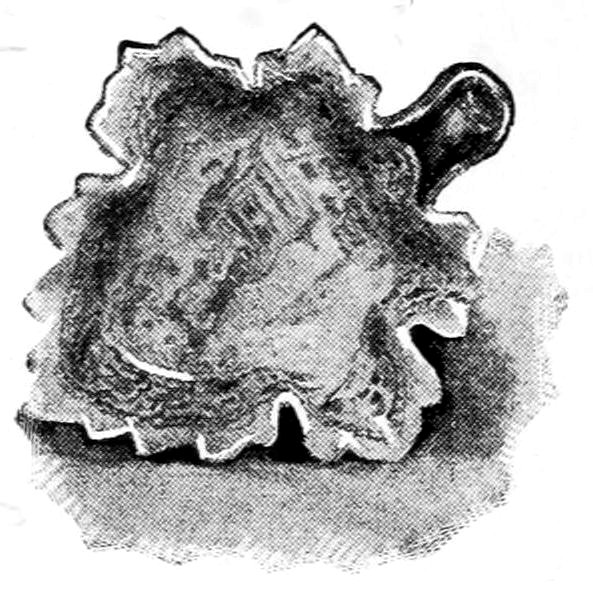
four Millennium plates, two Wedgwood pickle leaves, a
silver-lustre teapot, and a glorious great flip-mug. But
“things ill-got had ever bad success;” as they lifted the
large and knobby newspaper parcel from the carriage, it
slipped from their contaminating grasp, and all the pieces
were broken save the flip-mug, which, being specially protected,
25escaped. Though warned by this plain rebuke,
they persevere; and so hardened are they now become
in their base habits of deception, that they have worked
that “late Judge V——” scheme, with some slight
variations, in a score of country homes. They always
tell that abominable falsehood whenever they have a
man to deal with, not only adding deception to deceit,
but showing a most despicable lack of originality—a
“most damnable iteration.”
They cringingly allege their intention to change the
name of the imaginary recommender as soon as any one
of sufficient note and widespread fame in the county
dies, and thus through his death becomes eligible to the
position in the fable. I only wish the wraith of the late
Judge V——, a man of portentous ugliness in real life,
such abnormal ugliness that the thought of the sight of
his dematerialized ghost is really appalling—I only wish
his indignant wraith would appear before them at the
lintel of the door, at the portal of some china-besieged
house, and demand, in the loud roars which characterized
him in his lifetime, the meaning of this unwarrantable
and presumptuous use of his name.
In the meantime, unchecked and undiscovered, this
simple and transparent scheme invariably works to a
charm—how proud the man always is to learn that the
late Judge V—— recommended him as a connoisseur of
anything! he hastens to sell his china, if his wife be willing
and have any to sell, and he manages to think of
someone else who will probably sell, should he chance to
have none himself. The flip-mug has been filled many a
26time to the old-time toast, “Success to Trade”—and
yet the base china hunters are really honest fellows
enough in every-day life. Alas! that greed for things
so beautiful should so deform the soul!
Such duplicity is, however, rare. I tell of it only to
express my abhorrence, my condemnation. Dissimulation
is seldom necessary. You are sometimes falsely
accused of it when your motives are as open as the
light of day. After telling with exact truth precisely
what I intended to do with some pieces of china, I was
answered, with an angry toss of the head, “Why didn’t
ye tell me first-off ye didn’t want me to know.”
We are sometimes, in our china hunts, brought into
close contact with baser crimes than falsehood and duplicity.
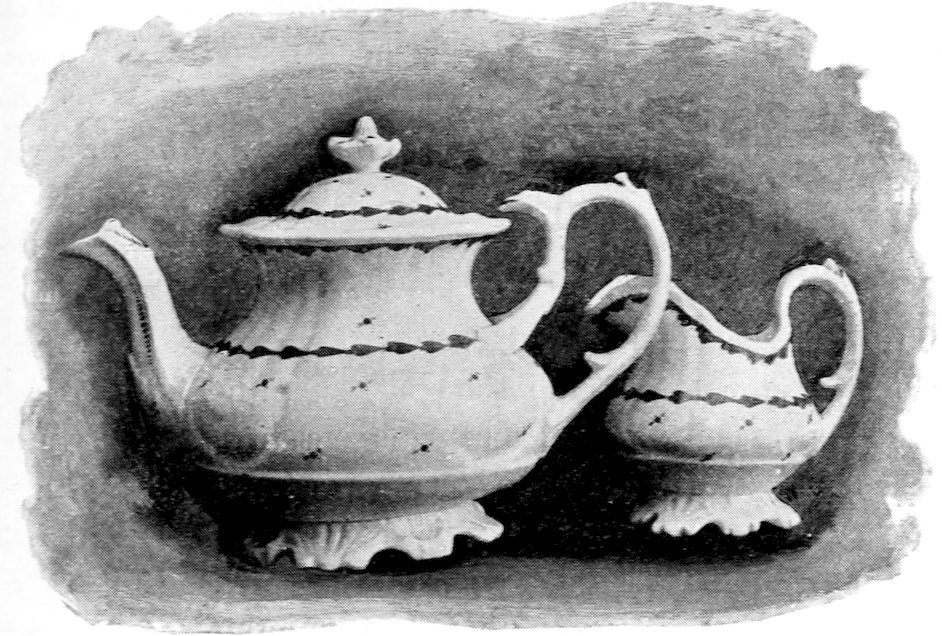
We have a number of daintily-shaped pieces
of sprigged china, with a graceful ribbon border, which
are known to us by the name of “Beach ware,” but
which would be generally and more correctly called
“cottage china.” These six-legged teapots and creamjugs
of “Beach ware” received their descriptive and
pretty title from the simple folk of whom they were
bought, not from the name of their maker nor from
their place of manufacture. “Beach ware” was found
in crates or boxes along the beach on the shores of
Barnegat Bay at the beginning of this century. It was
part of the cargo of a great English ship laden with
china, which was lured to destruction and robbed by
a notorious family of Barnegat “wreckers,” one of whose
members died not many years ago at the age of ninety
years, having served in his youth a well-deserved term
27of twenty years’ imprisonment in State Prison, the sentence
received at his trial for cruel robbery and murder
through “wrecking.”
“Beach Ware.”
At that time, though vessels and their cargoes were insured,
the underwriters frequently did not make their appearance
down the coast at the scene of the wreck for
many days and even weeks after the ship broke up or
came ashore. And when the tardy officials did arrive,
Barnegat natives, even from far inland—honest men and
knavish rogues alike—had always managed to capture
everything of value that came ashore or could be taken
from the vessel. In order to conceal their stolen salvage,
indestructible merchandise or articles that were not
affected by the action of the soil and water were frequently
buried until after the baffled insurance company
28and the ship’s owners had left the scene. The arrest and
sentence of the leader of this gang of wreckers caused
much apprehension and excitement in every Barnegat
home, and much fine china was pounded up or thrown
into the water, as well as buried, lest its presence seem
proof of complicity in the convict’s guilt. Our pieces of
“Beach ware” remained under ground for years—it is said
until the wicked old convict served out his term in prison,
since he alone could find the spot where he had buried
it. The green-ribboned and pink-sprigged teapots and
teacups look too innocent to have known aught of such
wickedness and violence, but bear no more guileless face
than did the patriarchal old wrecker in the peaceful prosperous
days of his later years when he unblushingly and
unwincingly sold to us this “Beach ware,” of which his
gossiping neighbors had told to us the tale.
Shall I have the dire name of “fence” applied to
me when it is told that I am the receiver of stolen
goods?
The best piece of Wedgwood jasper ware that I own
was bought from an old Englishman of mild appearance
and junk proclivities. A second visit to his den found
it closed. A friendly plumber in the adjacent shop explained
with effusion that the junk-man was a wretched
old thief, and no one but thieves sold to him or bought
of him (I winced at the accusation); that “he broke
into a museyum in England and stole a lot of china and
brought it over here to sell, and had kep’ stealin’ ever
sense,” and he (the plumber) was “glad the perlice had
chased him out, for he was a disgrace to the neighborhood.”
29Was not my pretty Flaxman-designed piece of
Wedgwood stolen from that English collection?
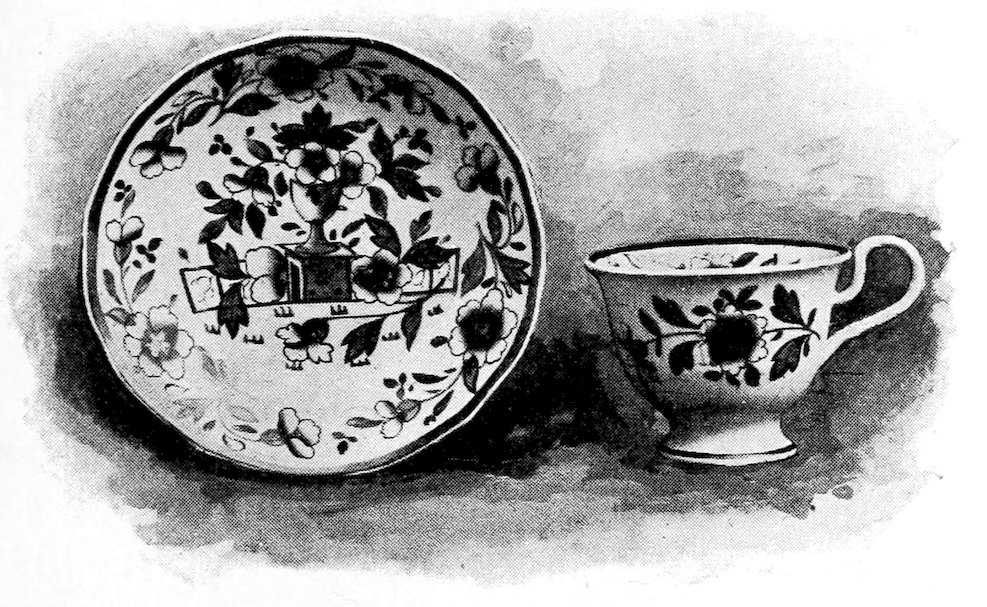
Old Worcester in “Japan Taste.”
A beautiful cup and saucer of old Worcester in the
“Japan taste,” rich without and within in red and gold
and blue, has long been regarded by me with intense
suspicion of my honest and legal right to its possession.
It was sold to me with the assurance that it had belonged
to Lucien Bonaparte; I did not doubt that part of the
story, for I had seen its sister in the possession of a
family who I knew inherited it through a gift of that
Bonaparte. But how should my cup and saucer have
been offered for sale to anyone? By a curious chain of
circumstances, too tedious to repeat, I discovered that
the pretty cup and saucer had been stolen by a servant,
and sold long ago to an old merchant in New York, who
should have and doubtless did know better, but who
30loved old china. Shall I tell his name? Shall I hunt
up the lawful heir and owner of my Worcester teacup?
Only one possibility mars the pleasure of a day’s
china hunt—the necessity of obtaining a midday meal
“upon the road,” in any chance farm-house you may be
within at high noon. The old hunter fights shy of such
repasts by carrying her lunch with her, but when a drive
of several days is taken this course is not very attractive
or possible. She must then succumb to fate, accept the
hospitality which is invariably and cordially offered to
her, and eat, or, at least, try to eat. I think June is the
most trying month for such ventures. Spring vegetables
are unknown in the land of their supposed birth.
Fruits and berries are not ripe. You are given a mysterious
repast, flavored throughout with sour milk and
smelling of sour milk, which reaches its highest and
sourest point in the bread. I always plead dyspepsia
and cling to a milk diet, thus eliciting much sympathy,
and hygienic and medical advice. Doubtless in late
fall or in winter, country fare might be more endurable,
but, with keen and most vivid fancy, I cannot imagine
going china hunting in the country in the winter time.
Even glorious sleighing or the promise of vast treasure
trove could not englamour it with an enticing charm.
Think of shivering over snow-blocked roads under leaden
skies, through dreary, wind-wailing, naked woods, struggling
up icy, snow-swept, and blast-beaten hills to that
lonely hill-top home, a New England farm-house!
Hope would perish on the road. Think of entering
that drear abode; of sitting, while you unfolded your
31wishes and went through the stereotyped china questions
with the stereotyped china smile, with bursting
veins and flushed face, in a stuffy, torrid, unaired room,
in front of a red-hot, air-tight stove, for there are no
glorious open wood fires nowadays in the great chimneys
of country houses in New England. Think of
going from that super-heated, stifling atmosphere to a
frigid pantry or icy best room to look at china! How
the congealed plates would clatter in your trembling
stiffened fingers; how you would hurry through the repelling
ordeal; never, as in summer, climbing upon
chairs to peer on upper shelves, never exploring in old
window-seats, never lingering to examine separately
and lovingly each plate in a great pile. Above all,
think of ransacking a farm-house garret, “in cobwebbed
corners, dusty and dim,” with the thermometer below
zero—it is beyond my power of fancy to fathom such
a scene. A fellow china hunter tells me a tale of a
lonely drive and Arctic exploration, and of riding gayly
home therefrom in the winter twilight, warming the
cockles of her heart with four Baltimore & Ohio plates
pressed closely to her side, with two Lafayette pepper-boxes
and half a dozen Lowestoft custard-cups packed
snugly in her muff, and with a Pennsylvania Hospital
platter in the fur robe at her feet. I never believed her;
it could not be true. China does not grow in winter,
’tis a fair summer flower, and must be gathered under
summer suns.
But to what out-of-the-way, simple, rustic scenes has
our china hunting led us through the long summer days,
32scenes to be painted by Miss Wilkins or Mrs. Slosson.
To country auctions—not the ill-ventilated, Hebrew-jostled,
bawling arenas of city life, but auctions in country
villages, on old farms, where the auctioneer, if the day
be warm, stands outside the house on a door taken from
its hinges and laid across two barrels on the green, or
among the beds of flowering phlox and marigolds; where
the lots for sale, unnumbered, uncatalogued, and unclassified
are handed out, a heterogeneous company, to the
presiding seller through the open windows behind him;
where every small parcel of value is neatly tied up and
labelled with the names of past owners—Aunt Hepsy,
Mrs. Catey Doten, Old Job Greening; where every
queer-gowned and queer-coated neighbor for miles around
has driven over in every kind of vehicle to look at, if not
to buy, the scattering house treasures. At these country
auctions, china and ancient underclothes, or pewter porringers
with feather pillows, may form a single “lot,” and
you must buy all or none. If you purchase you pay your
money at once to the auctioneer, with much friendly
change-making by hard-fisted old farmers on either hand;
the china is delivered to your eager hands, the underclothes
are thrown to you or at you by the auctioneer
over the heads of the audience; the hay-rakes, or churns,
or quilting-frames, or whatever addenda may have been
tacked to your porcelain, are brought around and piled
in a little heap by the side of your chair, or if you have
“backed up” your country wagon, are placed therein.
I once bought six large bundles of neatly labelled pieces
of woollen cloth, pieces of all the old petticoats and
33breeches and greatcoats that had been worn in that house
for forty years, just to get one India china plate. A rugmaking—or
I should say, “mat-braiding”—dame at my
left, seeing my dismay at my unsought treasures and
noting my love of china, offered to give me a modern
match-box for the tidy bundle of pieces, which kindly
exchange I gladly accepted as being less cumbersome, if
not more beautiful.
Surely the summer sunlight never flickered down on a
more typical New England scene than a country auction.
Sad are the faces around, quiet reigns; no one smiles, no
one jests as the hoarse-voiced auctioneer holds up, explains,
and extols some very mirth-provoking “lots.”
This breaking up and disbanding of a home has no droll
side to country minds. The last country auction I attended
was at an old house in Rutland. At it were sold
the effects of an ancient lady of ninety years, who had just
died. Her nephew, a lively lad of eighty, carried away
by the excitement of the sale, or by the sight of so much
ready money, recklessly handed out to the auctioneer, as
he stood under the dusty lilac bushes, a large number of
articles of furniture and table-ware which had been temporarily
stored in the house by the old lady’s housekeeper,
an equally ancient matron. The unconscious
theft was discovered late in the afternoon, just as we were
about to drive off, and the old man, overcome with horror
at his unwitting crime, or dread of the results of its
discovery, tearfully forced us to disgorge half a dozen
McDonough’s Victory plates and several mugs and pitchers
which we had eagerly purchased and gleefully packed
34away. He “comforted us with apples,” however, pressing
upon us a peck of red-streaked, spicy Sapsons to console
us for our evident disappointment—and our sorrow that
we had not sensibly and cannily departed at an earlier hour.
But do not fancy that every gathering of country
wagons in country door-yards, every row of patient
horses hitched at barn doors and along the fence, denotes
an auction within the doors of the farm-house. Draw
no such rash conclusion, and make no hasty and unheralded
entrance within, else you may find yourself, with
china smiles on your lips and china inquiries on your
tongue, an impetuous and mortified intruder at the saddest
of all sad scenes, a country funeral. I cannot resist
telling that, after one such impertinent intrusion on that
solemn function, we returned in a few hours, when on
our way home, to apologize and explain our infelicitous
and uninvited entrance at so unfitting a time. When
we stated that we were hunting for old-fashioned china,
a gleam of comprehension entered the faces of the two
elderly women who sat rocking by the fireside in the
lonely kitchen, and as a result a china-closet was raided,
and we bought a number of pieces of unusually fine
Canton and Lowestoft china. At the time of purchase,
we innocently fancied that we gained this treasure honestly
from the new-made heirs, but have since then had
harassing suspicions that the china was sold to us by
temporary care-takers who remained to “redd the house,”
while the mourning relatives had driven to the country
graveyard, and who thus snatched from the jaws of
death a most dishonest penny.
35Nor can you be over-confident that all auctions held
in the country are true country auctions. The ways of
“antique men” are past finding out. A sale of the
household furnishings of an old farm-house in the heart
of the White Mountains, attracted a vast number of summer
travellers, and brought forth purchase sums that bewildered
the farm residents for miles around. Ere the
sun went down on the day of the sale, a thrifty dealer
who happened to be present had had a conference with
the farm-wife, and as a result it was announced that she
had a reserve stock of furniture and china in her garret,
which would be sold the following week. Back to town
sped the dealer, packed up a vast collection of unsalable
débris which he chanced to have on hand, and an “assorted
lot” of modern willow-pattern ware, freshly imported
Canton china, new copper-lustre and painted tea-sets,
with a sparse sprinkling of old pieces. He sent the
entire lot by rail to the New Hampshire town; conveyed
it by dead of night to the farm-house; placed the crockery
in the cupboards, the brand-new brass candlesticks
on the mantels, and the flimsy new andirons in the old
fireplaces, arranged all the furniture in judicious shadow,
and had a successful auction of “rare old colonial furniture
and family china.”
A famous starting-point, or rather rallying-point, on a
china hunt is the district school. Driving along the
quiet country road, you chance, in some barren and unlovely
spot, often at some lonely cross-roads, upon a
small unshaded, single-storied building, whose general
ugliness and the beaten earth of whose door-yard tell to
36you its purpose and character without the proof of the
high-pitched and precise chorus of monotonous three-syllabled
words that vibrates shrilly out through the
open window. Hitch your steed to a tree, a fence, by
the roadside, and enter one of the twin portals of the
abode of learning, passing by the low-hanging rows of
ragged straw hats, gingham sun-bonnets, and chip “Shakers,”
over the “warping floor,” in front of the “battered
seats, with jack-knife’s carved initial.” “Teacher”
is glad to see you, the children are gladder still. She
sends a grinning barefooted boy out to draw a pail of
fresh well-water. You are asked, as a distinguished visitor,
to address the scholars. If you are a man, and
thus of course an orator, you do so with fluent tongue.
If you are a woman, and thus tongue-tied in public,
you can ask for “recess” to be given, and make your
address informally to each little freckled face. You
are, of course, anxious to refurnish a house like the one
in which you lived when you attended the village school
in the days of your youth. Do the children know of
any old blue china plates with trees and houses on
them? Have their mothers or grandmothers any pitchers
with pictures of soldiers, or sailors, or ships? Of
course the children know; they know everything—far
more than grown people. You soon have an exact
ceramic report from every house in town whose little
sons and daughters are in the school, and of the homes
of all their neighbors too. You have extracted an unbiassed
account from a set of little ready-tongued and
keen-eyed spies, whose penetration is acute, and whose
37memory is active. If you can draw you can quickly
show the children with chalk and blackboard the kind of
china you wish, and can depart with a long list of houses
which will repay you to visit.
But why do I longer tell the story of the chase, or
vainly try to give advice and rules for china-finding? I
can only “pay you my penny of observation,” knowing
well that “Gutta fortunæ præ dolio sapientiæ.” Nor
can I fitly paint the pleasures, nor tell the pains of
the search, more than I could mould and shape the
treasures it has brought to my home. Nor can I hope
to fire in other veins the fever that burns in mine; I
must be content to say with Olivia, “’Tis a most extracting
frenzy of mine own.”
II. TRENCHER TREEN AND PEWTER BRIGHT
38
The history of the use of china as table-ware in
America would be incomplete and ill-comprehended,
without some reference to the preceding
forms of table furnishings used by the earliest colonists,
the dishes of wood and pewter, which so long influenced
the form and even the decoration of their china successors.
As in the “Life of Josiah Wedgwood” we are given
an account of the pottery and porcelain of all times, so in
my story of china in America I tell of the humble predecessors
that graced the frugal boards of our ancestors.
In a curious book, Newbery’s “Dives Pragmaticus,”
written in 1563, a catalogue of English cooking utensils
and table-ware is thus given by a chapman:
“I have basins, ewers of tin, pewter, and glass,
Great vessels of copper, fine latten, and brass,
Both pots, pans, and kettles such as never was.
I have platters, dishes, saucers, and candlesticks,
Chafers, lavers, towels, and fine tricks;
Posnets, frying pans, and fine pudding pricks;
Fine pans for milk, trim tubs for souse.”
These were practically the table and kitchen furnishings
brought by the Pilgrims to New England, and for
39similar furnishings they sent to old England for many
years.
The time when America was settled was the era when
pewter ware had begun to take the place of wooden ware
for table use, just as the time of the Revolutionary War
marked the victory of porcelain over pewter. Governor
Bradford found the Indians using “wooden bowls, trays,
and dishes,” and “hand baskets made of crab shells
wrought together.” Both colonists and Indians used
clam-shells for plates, and smaller shells set in split
sticks as spoons and ladles.
The Indians made in great quantities for their white
neighbors, even in the earliest days, bowls from the knots
of maple-trees that went by the name of “Indian bowls,”
and were much sought after and used. One large
bowl taken from the wigwam of King Philip is now in
the collection of the Massachusetts Historical Society.
The settlers also established factories for dish-turning.
One thrifty New England parson eked out his scanty and
ill-paid salary by making wooden bowls and plates for his
parishioners. Wooden “noggins,” low bowls with handles,
are often mentioned in early inventories, and Mary
Ring, of Plymouth, thought in 1633 that a “wodden
cupp” was quite valuable enough to leave “as a token of
friendship.”
In Vermont bowls and plates of poplar wood were
used until Revolutionary times, and fair white dishes
did that clean hard wood make. Sometimes the wooden
plates used by the poor planters were only square blocks
slightly hollowed out by hand—whittled, without doubt.
40Wooden trenchers, also made by hand, were used on the
table by the colonists for more than a century. I find
them advertised for sale with pewter and china in the
Connecticut Courant of May, 1775. These trenchers
were either square or oblong. From an oblong trencher
two persons, relatives or intimate friends, sometimes ate
in common, just as they had done in old England. Two
children frequently ate from the same trencher, thus
economizing table furnishings. In earlier times man and
wife ate from a single trencher or plate. Walpole relates
that the aged Duke and Duchess of Hamilton, in
the middle of the last century, sat upon a dais together
at the head of their table and ate from the same plate—a
tender tribute to unreturnable youth, a clinging regard
for past customs, and a token of present affection and
unity in old age.
A story is told of a Connecticut planter, that having
settled in a quickly-growing town and having proved
himself to be a pious God-fearing man, his name was offered
to his church for election or ordination as a deacon.
Objection was made to him, on the ground that he had
shown undue pride and luxury of living in allowing his
children each to use and eat from a single plate at the
table, instead of doing as his neighbors did—have two
children eat from one trencher. He apologized for his
seemingly vain manner of living, and gave in excuse the
fact that previous to his settlement near New Haven he
had been a dish-turner, so it had not then been extravagant
for the members of his family to have a dish apiece;
and having grown accustomed to that manner of “feeding,”
41he found it more peaceable and comfortable; but he
was willing to change his ways if they considered it desirable
and proper, as he did not wish to put on more
airs than his neighbors.
But wooden trenchers, even in the first half of the
first New England century, gave place to pewter, and
the great number of pieces of pewter table-ware still
found in New England country homes would alone
prove to how recent a date pewter utensils were universally
used. The number would doubtless be much
larger if it were not deemed by metal-workers that
new pewter is of much better substance if the metals
composing it are combined with a certain amount of old
pewter. Hence old pewter always has commanded a
good price, and many fine old specimens have been
melted up to mould over again for the more modern uses
for which pewter is employed by printers and lapidaries.
The trade of pewterer was for two centuries a very respectable
and influential one. The Guild of Pewterers
in London was a very large and powerful body, and
English pewterers, men of worth, came with other tradesmen
at once to the Colonies. Richard Graves was a
pewterer of Salem in 1639, and Henry Shrimpton, an
influential merchant who died in Boston in 1666, made
large quantities of pewter ware for the Massachusetts
colonists. The pewterers rapidly increased in numbers
in America, until the War of Independence, when, of
course, the increasing importation of Oriental and English
china and stone-ware, and the beauty and interest of
the new table-ware, destroyed forever the pewterer’s
42trade. Advertisements of pewter table furnishings appear
frequently, however, in American newspapers until
well into this century.
Nor was it different in England at the same date.
Englishmen and Englishwomen clung long to pewter.
In a poem written in 1828 by J. Ward, of Stoke-upon-Trent,
upon the Potter’s Art, he says:
“The housewife, prim in days we know ourselves,
Display’d her polished pewter on her shelves;
Reserv’d to honour most the annual feast,
Where ev’ry kinsman proved a welcome guest.
No earthen plates or dishes then were known,
Save at the humble board as coarse as stone,
And there the trencher commonly was seen,
With its attendant ample platter treen.” (Wooden.)
It is a curious fact that in the inventory of the household
possessions of Thomas Wedgwood, the potter, made
at Burslem in 1775, we find that he had forty-four pewter
plates worth seven pence half penny each, and
twenty-four pewter dishes worth two shillings each,
though the inventory of the goods at his factory at that
time included two hundred and ninety-five dozen table
plates of best white ware.
At a very early date all well-to-do colonists had plenty
of “latten ware,” which was brass, as well as pewter.
All kinds of household utensils were made, however, of
the latter metal; even “pewter bottles, pints, and
quarts,” were upon a list of goods to be sent from England
to the Massachusetts Colony in 1629. I have
never seen an old pewter bottle, even in a collection or
43museum, and they must soon have been superseded by
glass.
In the Boston Evening Post of July 26, 1756, appeared
this advertisement: “London pewter dishes, plates,
basons, porringers, breakfast bowls, table spoons, pint and
quart pots, cans, tankards, butter cups, newest fashion
teapots, table salts, sucking bottles, plates & dish
covers, cullenders, soop kettles, new fashion roased
plates, communion beakers and flagons, & measures.”
A vast number of names of other articles might be added
from other lists of sales of pewter at that time—“quart
& pint jacks,” “bottle crains,” “ink pots,” “ink chests,”
“ink horns,” “ink standishes,” and “ink jugs.”
Pewter “cans for beer, cyder, and metheglin,” were in
every household; pewter mugs and pewter “dram-cups
with funnels,” pewter “basons,” cisterns, and ewers
graced the “parlour,” which contained also the best
state bed, with its “harrateen” or “cheney” curtains.
Pewter candlesticks held the home-made, pale-green candles
of tallow and spicy bayberry wax. “Savealls,” too,
were of pewter and iron. “Savealls” were the little
round frames with wire points which held up the last
short ends of dying candles for our frugal ancestors.
Salt-cellars and spoons were of pewter, while extremely
elegant people had spoons of alchymy, or
occonny, alcaney, alcamy, occomy, ackamy, and accamy,
as I have seen it spelt, a metal composed of pan brass
and arsenicum. Forks were almost unknown, and fingers
played an important part in serving and eating at
the table. A lady traveller, in 1704, spoke with much
44scorn of Connecticut people, because they allowed their
negro slaves to sit and eat at the same table with themselves,
saying that
“into the great dish
goes the black hoof
as freely as the
white hand.”
“The porringers that in a row Hung high and made a glittering show.”
Pewter porringers,
or “pottingers,”
of every size were
much prized. One
family, in 1660, had
seven porringers,
while another
housewife was
proud of owning
nine, and one silver
queen porringer.
The smaller porringers
were called
posnets, a word now
obsolete. Posnet
was derived from a
Welsh word, posned,
a little round dish.
In these posnets
posset was served,
and they were also
used as pap-bowls for infants. Posnets and porringers,
when not in use, were hung by their handles on the
45edge of the dresser shelf. The porringers with flat
pierced handles are of English or American make, while
the “fish-tail” handles are seldom found in New England,
being distinctly Dutch.
Plates and platters were much valued. Governor
Bradford, of Massachusetts, left to his heirs fourteen
pewter dishes and thirteen platters, three large plates
and three small ones, one pewter candlestick and one
pewter bottle—a most luxurious and elaborate household
outfit. Governor Benedict Arnold, of Jamestown,
R. I., and Mr. Pyncheon, of Springfield, Mass., bequeathed
their pewter plates and dishes in the same list,
and with as much minuteness of description, as the silver
tankards and bowls, and the humble pewter was as
elaborately lettered and marked with armorial devices
as was the silver. Miles Standish left to his heirs sixteen
pewter dishes and twelve wooden trenchers.
Pewter was not thought to be too base a metal to use
for communion services. In 1729, the First Church of
Hanover, Mass., bought and used for years a full communion
service and christening basin of pewter; and
the bill of purchase and the old pieces are still preserved
by the church as relics. The pewter communion service
of the Marblehead Church is now in the rooms of the
Essex Institute, and until this century advertisements of
“Pewter Communion Flagons” appeared in New England
newspapers.
These pewter dishes and plates were a source of great
pride to every colonial housekeeper, and much time and
labor was devoted to polishing them with “horsetails”
46(equisetum), or “scouring rush,” till they shone like fine
silver; and dingy pewter was fairly counted a disgrace.
The most accomplished gentleman in Virginia, of his
time, gave it as a positive rule, in 1728, that “pewter
bright” was the sign of a good housewife.
In some old country homes, either lack of money,
the power of habit, or the strong love of ancient articles
and associations, caused the preservation of the old
pewter utensils, and they now form the cherished ornaments
of the kitchen and dining-room. In the lovely
old town of Shrewsbury, which stands so high on Massachusetts
hills that the railroad has never approached its
lonely beauty, there stands on the edge of the “Common”
a house, in which everything that is good and
old has been preserved, and appears as when the house
was built, in the year 1779.
The old fireplaces have cranes and iron “dogs,” are
festooned with ears of yellow seed-corn, and are surmounted
by the old fire-arms, while by the chimney
sides are hung old-fashioned brooms of peeled birch.
These brooms are made of birch splints, carefully split
and peeled, and tied in place with hempen twine on the
strong handle; and many a farmer’s boy, years ago,
earned his first spending-money by making them, for six
cents apiece, for the country stores. Old settles, chairs,
and tables stand on the white-scoured floors; and in the
“living-room” is a piece of furniture seldom seen in New
England, though common enough in Pennsylvania, New
York, and New Jersey in olden times—a “slaw bank.”
The word is a corruption of sloap bancke, or sleeping
47bench, and the slaw bank was the great-grandfather of
our modern cabinet folding-bed. At one end of the
room are doors apparently belonging to cupboards,
which, upon being swung wide open, disclose the oblong
frame of a bed with a network of ropes to serve as
springs. This bed-frame is fastened at one end to the
wall with heavy hinges, and was hooked up against the
wall in the day-time, and at night was lowered to a
horizontal position and supported on heavy wooden
turned legs, which fitted into sockets in the frame;
and it was thus ready for use. This bed is still kept
made up as of old, with hand-spun linen sheets, hand-woven
“flannel sheets,” a “rising-sun” patchwork quilt,
and blue and white woollen bedspread.
But in the dining-room and kitchen of this old Shrewsbury
homestead are the greatest treasures—corner cupboards
and shallow dressers full of pewter dishes, which
greet their owner with “shining morning faces” at
breakfast, and reflect in a hundred silvery disks the
goodly cheer on his table at midday and night. Round
plates and platters are there of every size, up to the
great round shield on which was placed of old the
enormous Thanksgiving turkey. All are round, for oval
platters seem to have been then unknown.
The deep bowls, in which vegetables were served,
stand there in “nests” of various sizes. Teapots, too,
and cream-pitchers and sugar-bowls, or sugar-boxes,
but no pewter teacups. I believe the little handleless
teacups were among the earliest pieces of porcelain imported
from China, and were often used when the rest
48of the “tea equipage” was of pewter. Pewter salt-cellars,
mustard-pots, flip-mugs, and syrup-cups are interspersed
among the larger pieces on the dresser.
Some of these articles are marked with initials and
dates, not engraved, but stamped, as with a die, J. S.
and B. K., 1769. Doubtless these were wedding gifts,
and I doubt not that a set of shining pewter plates and
platters was as graceful and welcome a gift to Betsey
Sumner in 1769, as is a set of Royal Worcester porcelain
to her great-granddaughter Bessie, in 1892.
Some of the teapots are really beautiful in shape, and
are decorated with a quaint engraved design of leaves
and round flowers. These were undoubtedly of Dutch
manufacture, and are identical in shape and ornamentation
with teapots authentically known to have been imported
from Holland. These teapots were probably
used for company “tea drinkings” and such state occasions,
and thus the engraving on the soft metal was
not worn by daily use.
Pewter spoons, too, are there in every size, though
Betsey Sumner surely had silver teaspoons, for were
they not inherited from her by her son, the old parson?
As these pewter spoons were liable to be quickly bent,
worn, or broken, every thrifty household had its various
sized spoon moulds of heavy metal, into which the
melted pewter was poured and came out as good as new,
or, according to the apparent law of pewter, better than
new. Button moulds, too, were common enough, containing
deep holes to form half a dozen buttons at once.
And perhaps Betsey Sumner turned her old spoons into
49buttons to adorn John’s coat, and polished them till
they shone like the silver and cut-steel buttons of the
French Court.
Many of the pewter articles in this homestead have
had recently engraved upon the underside various commemorative
dates, and the names of past owners, and
the outlines of any eventful story connected with the
dish, if story there fortunately be remembered to tell.
And every owner of pewter plate or porringer, who
knows by tradition the story of his old relic, should
have the statement engraved now upon the back of
the piece, for even in one generation these facts are
forgotten, and the article is rendered valueless as an
historic record.
In the kitchen of the great colonial house at Morristown,
N. J., now owned and occupied by the Washington
Association of New Jersey, may be seen a
fine collection of old pewter table and cooking utensils;
while at Indian Hill, at Newburyport, still is shining in
cupboard and dresser the rare pewter collected by Ben
Perley Poore.
To a day well within the remembrance of many now
living, round pewter meat platters were used in farm-houses,
long after the other pewter dishes had vanished;
for it does not dull a carving-knife to cut upon pewter
as it does upon porcelain or crockery, and old farmers
cling stubbornly to usages and articles that they are acquainted
with; and no “boiled dinner” ever could
taste quite the same to them unless all heaped together
on a great shining pewter platter.
50Another pewter piece often found, and often still used,
is the hot-water jug with its wicker-covered handle.
This was brought every night, in colonial and Revolutionary
times, well filled with boiling water, to the master
of the house, for him to mix the hot apple-toddy or sangaree
for the members of his household, who drank their
share out of pewter cups or heavy greenish glasses. I
know of two of these pewter jugs which have been in
daily use for certainly forty years (though in the more
temperate vocation of hot-water jugs to carry shaving-water
to the bedrooms), and still retain, sound and
firm, the old wicker coverings on the handles, which
may have been woven upon them a hundred years ago.
Truly, our grandfathers made things for use, not for sale.
Strange hiding-places have these old forsaken and
forgotten pewter dishes. They lurk in tall and narrow
cupboards by the side of old chimneys, or in short and
deep cupboards over the mantel. They lie in disused
fireplaces, hidden from view by gaudy modern fireboards.
They are at the bottom of deep boxes under
wide window-seats, and are shoved under the dusty
eaves of dark attic-lofts. On the highest pantry shelves,
under cellar stairs, in old painted sea-chests, in the
woodhouse, are they found. From the floor of henhouses
have they been rescued, where they have been
long ignominiously trodden under foot by high-stepping
and imperious fowl.
Let us take them from these obscure corners, and preserve
them with care, for though they have no intrinsic
value like silver, no brilliancy like glass, no beauty of
51color or design like china, they are still worth our interest
and attention, for they were the first table-ware
used by our ancestors. We are a young nation of few
years and few relics, let us then reverently preserve the
old pewter plates and platters, remembering that these
simple dishes of inexpensive metal illustrate the frugal
home-life of the men and women who were the founders
of the Republic.
III. EARLY USE AND IMPORTATION OF CHINA IN AMERICA
52
The knowledge and use of porcelain in England did
not long antedate the departure of the Pilgrims
for the New World. As early as 1506, one exceptional
importation of Chinese porcelain bowls is spoken
of; but even in 1567—half a century later—one of
Queen Elizabeth’s valued gifts was a “poringer of white
porselyn and a cup of green porselyn,” and the notice
paid such intrinsically valueless and small articles by
their mention proves their rarity. Great ignorance of
the processes of porcelain manufacture existed; even that
learned, that marvellously well-informed man, Lord Bacon,
wrote of “mines of porcelain,” and had the queer
idea that china was developed in the earth, out of the
common clay, by some strange and mysterious process of
purification. Another universal belief was, that porcelain
was a sovereign detector of poison, that it instantly
showed the presence of poison in any draught that came
in contact with it. Shakespeare speaks once of china, in
his “Measure for Measure,” “a dish of some three-pence,
your honors have seen such dishes, they are not china
dishes, but very good dishes.” Ben Jonson refers more
frequently to porcelain.
53“Broker. ’Tis but earth
Fit to make bricks and tiles of.
Shunfield. ’Tis but for pots or pipkins at the best
If it would keep us in good tobacco pipes—
Titus. Or in porc’lane dishes.”
Again he says:
“The earth of my bottles which I dig
Turn up and steep, and work, and neal, myself,
To a degree of porc’lane.”
By the time of Pope and Dryden, china had become
more widely known in England, and these writers and
their contemporaries frequently refer to it. It is not
probable that much china came to England until 1650,
when the English East India Trading Company was
established, though the Dutch had even then a large
trade with China. Doubtless tea and china became
plentiful in Europe together.
Addison wrote in 1713, “China vessels are playthings
for women of all ages.... I myself remember
when there were few china vessels to be seen that held
more than a dish of tea; but their size is so greatly enlarged
that there are many capable of holding half a
hogshead.”
It is asserted that pieces of Delft ware were brought to
America by the first English and Dutch settlers. It
had been manufactured since the fifteenth century; but
when our Pilgrim Fathers made their night-trip through
Delft, no plebeian persons had Delft ware on their tables;
hence the Pilgrims could have brought few pieces to
54New England on the Mayflower. Nor is it probable
that those frugal souls owned any India china. The
earliest Dutch settlers of New Netherlands were not
likely either to have brought to the new land any pieces
of the aristocratic Delft ware, though I have seen many
Delft plates and teapots that bore the reputation of
such ownership.
“Blew & white ware” is however not an infrequent
item on early inventories of the last half of the century.
John Betts, of Cambridge, Mass., had before his death,
in 1662, “Som duth earthen platters & Som other
Earthen ware,” valued at 6s. 8d. A citizen of Salem
had in 1664 “17 pieces of blew & white earthen ware”
worth 8s. 6d. John Cross, of Ipswich, left behind him in
1650 his “Holland jugs.” All these were doubtless
Delft or the early imitations of Delft.
The oldest and most authentic piece of stone-ware in
the country is the fine jug preserved in the collection
of the American Antiquarian Society, at Worcester. It
was the property of Governor Winthrop, who died in
1649, and was given to the Society by a descendant,
Adam Winthrop. It stands eight inches in height
and is apparently of German Gres-ware, and is richly
mounted in silver. The lid is engraved with a quaint
design of Adam and Eve with the tempting serpent
in the apple-tree. Estienne Perlin, writing in Paris in
1558, says, “The English drink beer not out of glass
but from earthen pots, the cover and handles being
made of silver for the rich. The middle classes mount
them with tin.” Another writer, in 1579, spoke of the
55English custom of drinking from “pots of earth of sundry
colors and moulds, whereof many are garnished with
silver or at leastwise with pewter.” Such is this “beer
mug” or tankard of
Governor Winthrop’s,
which is certainly
three hundred
years old. Other
Massachusetts colonists
had similar beer-mugs.
Jacob Leager,
of Boston, left in 1662
a “stone judg tipt
with silver;” Henry
Dunster had a “tipt
jugg” in 1655; and
Thomas Rix had in
1678 “3 fflanders
jugs.”
Winthrop Jug.
Lisbon ware, which
was earthen ware, was
left by will in Massachusetts
in 1650; and
Spanish platters and
painted platters are mentioned in an inventory in 1656.
Peter Bulkeley, of Concord, Mass., had in 1659 “ten
paynted earthen dishes” valued at ten shillings. In the
lists and inventories of the town of Stamford, from 1650
to 1676, only two shillings worth of earthen ware is entered,
and Stamford planters were far from poor. In
56the Boston News Letter of February 9, 1712, six hogsheads
of earthen ware, including teapots, were advertised
for sale. These early teapots are said to have been of
black earthen ware.
One of the earliest mentions of china in America is
in the inventory made in 1641, of the property of
Thomas Knocker, of Boston, “1 Chaynie Dish.” In 1648,
in the estate of President Davenport, of Harvard College,
was, “Cheyney, £4.” This was doubtless India china.
Governor Theophilus Eaton had a “cheny basen.” In
the list made in 1647, of the possessions of Martha Coteymore,
a rich widow (who afterward married Governor
Winthrop), is seen this item, “One parcel cheyney
plates and saucers, £1.” Katherine Coteymore had “3
boxes East India dishes,” valued at £3. As early as
October, 1699, John Higginson wrote to his brother with
regard to importations from India, that “china and
lacker-ware will sell if in small quantity,” and without
doubt some small importations from India were
made.
After the first decade of the century many rich Bostonians,
such as Elizur Holyoke, had china. Isaac Caillowell’s
estate in 1718 contained “Five China Dishes, One
Doz. China Plates, Two China Muggs, a China Teapott,
Two China Slopp Basons, Six China Saucers, Four
China Cupps, and One China Spoon Dish.”
The earliest mention of the sale of china table-ware
which I have seen is not in 1732, as given by Mr. Felt
in his “New England Customs.” There are several
notices of sales of china of earlier dates. In the New
57England Weekly Journal of April 15th of the year 1728,
were advertised for sale, at the Sun Tavern in Boston,
“Chainey Bowles Dishes Cups Saucers and Teapots;”
and “china cups & saucers” on June 17th. This “chainey”
was probably all India china. In 1729, William
Welsteed, a Boston merchant, had a large number of
plates and “pickle caucers” for sale. In 1731, Andrew
Faneuil announced that he had for sale at his warehouse
“All sorts of Dutch Stone and Delf ware just imported
from Holland.” In 1730 John Buining and Mrs. Hannah
Wilson both advertised in the Boston News Letter,
that they had “several sorts of china for sale;” and another
Boston shopkeeper announced at the same time
that he was going to sell out everything he owned, including
china ware, and that his fellow-townsmen had
better flock to his shop, for “buyers have reason to Expect
good Bargains for this will be the Packing Penny,”
which I suppose was the colonial slang expression for
“bottom price.” At a later date the “Packing Penny”
became “to buy the pennyworth.” It was not till 1737
that china ware was sold by “Publick Vandoo or Outcry,”
or by “Inch of Candle,” in Boston, thus showing
that it was being imported in larger quantities. In September
of that year there was sold on Scarlett’s Wharf,
with spices and silks and negro slaves,
“A Rich Sortment of China Ware. A Parcel of fine large
Enamel’d Dishes. Ditto of divers Sizes of Bowles burnt &
Enamel’d. Ditto of all Sorts of Plates. Sundry Complete Setts
of Furniture for the Tea-Table. Blue & White Bowles; Blue
& White Cups & Sawcers. Several sorts of small Baskets, &c.”
58By this time Boston milliners and mantua makers, and
fan mounters, and lace menders, had all begun to announce
the sale of “chayney” in their show-rooms and
shops. Fair Boston dames picked their way along the
narrow streets, or were carried in stately sedan chairs, to
“Mistress Alise Quick’s, over against the Old Brick Meeting
House on Cornhill, at the sign of the Three Kings,”
or to “Widow Mehetable Kneeland’s,” to see her “London
baby drest in the latest fashioned Hooped Coat
and lac’d Petty Coat with ppetuna hood;” or to “Mrs.
Hannah Teatts, Mantua Maker, at the head of Summer
Street, Boston,” who charged five shillings for showing
her “Baby drest after the Newest Fashion of Mantues
and Night Gowns and everything belonging to a Dress,
latilly brought over on Captain White’s ship from London”—these
bedizened doll-babies being the quaint colonial
substitutes for fashion plates. These modish New-English
dames first pulled over and tried on the “rayls
and roquilos and cardinals,” and admired the ivory and
cocoa paddle stick-fans; and peeped at their own patched
faces and powdered hair in the lacquered looking-glasses;
and then, perhaps, selected some flower seeds for their
prim little gardens—their pleasaunces, “blew and yellow
lewpin, double larkin-spur, sweet feabus, Love lies bleeding,
Queen Margrets, Brompton flock, and sweet-scented
pease;” and then they turned, unwearied and unsated,
to the “Choise Sortment of Delph, Stone, Glassware,
and China, viz., Bowles of Divers Sizes, Plates of all
Sorts, and Dishes, Teapots, Cups & Saucers, Strayners,
Mugs of Divers Sorts and Colors, Creampots pearl’d &
59plain, Bird Fountains, Tankards,” and they held up the
tiny china teacups to the light and examined the painting,
and perhaps sipped a little of the mantua maker’s
Orange Pekoe or Bohea. And I doubt not many a china
teapot or teacup stood cheek by jowl with quoyfs and
ciffers on colonial milliners’ bills, and many a feathered
“Kitty Fisher Bonnet,” or silver shape, or peaked Ranelagh
cap was sent home to the daughters of the Puritans,
packed with “catgut,” and “robins,” and “none-so-prettys,”
in an India china punch-bowl.
Of the prices paid for these colonial ceramic luxuries
we know but little. The enterprising outcrier, who cried
out and vandooed at the “Blew Boar, at the South End
of Boston,” announced in February, 1749, in the Boston
Independent Advertiser, that he had “Fine blue & white
and Quilted China Plates at Eleven Pounds the Dozen,
or Six Pounds the Half Dozen.” So the shades of our
ancestors can hardly cry out to us for extravagance.
These quilted china plates were, I think, from subsequent
references to them, plates impressed in the paste
with a basket design, as we often see now on Chinese
porcelain; or possibly with a larger, a truly quilted design,
such as I have seen on rare old Oriental porcelain.
In the inventory of the estate of John Jekyll, of Boston
(made in 1732), we learn that “2 Burnt China Bowls
were worth £2, 6 Chocolate Bowls £2, 1 Pr China
Candlesticks Tipt with Silver £4, 12 Coffe cups with
handles £1 7s.” In many inventories such a number of
pieces are “crackt” or “mendid,” and so little hint of
quality or decoration is given, that it is impossible to
60compare justly the values assigned with those of the
present day. John Jekyll also had a “sett of burnt
china.” The first mentioned sale of a “set” of china is
in the New England Weekly Journal of April 19, 1737—“A
Fine Double Sett of Burnt China for sale, Enquire
of the Printer.” Until then the precious porcelain had
been sold only in single pieces, or in small numbers.
The wills and inventories of the times speak of no sets
of china, though the lists of the possessions of all persons
of wealth, the advertisements of sales of estates,
contain many items of china ware. Governor Burnet,
who died in 1729, owned much china—three hundred
pieces—as became a man who had £1,100 spent on his
funeral; and his friend and neighbor, Peter Faneuil, had
a bountiful supply of china and glass, as he had of other
luxuries.
There are far more frequent mentions and advertisements
of china in old New England newspapers than in
other American papers of the same years. The southern
publications of colonial times that I have seen contained
no announcements of the sale of china. None
appeared bearing date until after the Revolutionary War.
And it is plain, from the evidence of inventories, “enroulments,”
wills, and newspapers of the eighteenth century,
that porcelain was far more plentiful in New England
than elsewhere in America at the same date. Mr.
Prime says, “Few of the people of Revolutionary times
had seen porcelain;” but when it had been advertised
in every New England newspaper; had been sold in
grocers’, milliners’, chemists’, dry-goods, saddlers’, and
61hardware shops; had been displayed at the printers’ and
book-shops and writing-schools in every town of any size
throughout New England; and sold in considerable quantities
by all the little Boston shopkeepers—the Amorys,
Waldos, Brimmers, Adamses, Sheaffes, and Boylstons,
I fancy all New England good wives must have owned
a few pretty pieces.
Doubtless the wealthiest Virginians of colonial times
also had some china. It is not, however, named in Baltimore
inventories until after the year 1700. Nor was it
plentiful in New York; one of the earliest mentions of
china in New York is in the list of the possessions of
wealthy Cornelius Stienwerck, “Ten pieces of china
dishes or porcelain £4.” In August, 1748, the New
York Weekly Journal contained its first announcement
of the sale of china—“A choice parcel of China Ware
just imported to be sold at Wholesale. Enquire of the
Printer.” Now, the “Printer” at that date was a woman,
the Widow Zenger, wife of the former owner of the
newspaper, and with her assumption of the printing and
editing business came various feminine advertisements
such as this of china ware, others of mantuas and hair-powder,
and of “bonnet-papers,” which she cut and
made and sold in large numbers; but this china sale was
certainly exceptional in New York at that date.
China did not abound in New York, either in Dutch or
English families, until after the Revolutionary War. Nor
did advertisements of it frequently appear in ante-Revolutionary
New York newspapers. In an inventory made
at that time of the contents of a house on the Neutral
62Ground in Westchester County, there were such wealth-evincing
items as twenty-six horses, thirty-six table-cloths,
rich and abundant furniture, bed-linen, and clothing, large
quantities of fine silver; and of pewter, “1 Coffee Kettle,
1 Teapot, 27 Dishes, 12 Plates, 12 Soup-Plates, 6 Butter
Plates, 3 Mugs, 2 salons, 5 basons, 6 Spoons, 3 Measures;”
and not one piece of china. This list of household
belongings is not exceptional. China is seldom
mentioned. But few pieces of porcelain or pottery are
named in the inventories of the possessions of the New
Jersey farmers whose houses were burned, and whose
household goods were either destroyed or stolen by the
soldiers in the Revolutionary War, and who expected to
receive indemnity from the Government for their losses.
We discover therein that each family seldom owned
more than three or four china cups and saucers. These
records are extremely valuable for reference, as they are
true and faithful lists of the entire household belongings
of well-to-do people at that time; they indicate that
china was far from plentiful in New Jersey at that date.
Watson says in his “Annals,” “When china was first introduced
into America, it was in the form of tea-sets; it
was quite a business to take in broken china to mend. It
was done by cement in most cases, but generally large
pieces, like punch-bowls, were done with silver rivets or
wire.” An advertisement in the Boston Evening Post in
1755 reads: “This is to give Notice to all Them that have
any Broken China, at the Lion and Bell on Marlboro
Street, Boston, they may have it mended by Riveting it
together with a Silver & Brass Rivets it is first put together
63with a Cement that will stand boiling Water and
then Riveted.”
China appears to have been more plentiful in Philadelphia
than in New York. Benjamin Lay, the “Singular
Pythagorean Cynical Christian Philosopher,” to show his
hatred of the use of tea, brought in 1742 all his wife’s
china into the market-place at Philadelphia, and began
to break it piece by piece with a hammer; “but the populace,
unwilling to lose what might profit them, overset
him, scrambled for the china, and bore it off whole.”
As the “Singular Pythagorean Philosopher’s” wife was
dead, this wanton destruction of her dear china was not
so cruel as at first appears. An old lady wrote in 1830,
about things as they were before the War of Independence—“Pewter
plates and dishes were in general
use. China on dinner tables was a great rarity. Glass
tumblers were scarcely seen. Punch, the most common
beverage, was drunk from a silver tankard. China teacups
and saucers were half their present size, and china
teapots and coffee-pots with silver nozzles were a mark
of superior finery. Where we now use earthen ware they
then used Delft ware imported from England, and instead
of queen’s ware (then unknown) pewter platters
and porringers made to shine along a dresser were universal.
Some, especially country people, ate their meals
from wooden trenchers.”
That frugal and plain-living man, Benjamin Franklin,
though he constantly impressed upon his wife, as well as
upon the public, the wisdom and necessity of great
economy, and the propriety and good taste of simplicity
64in all modes of living, still could find time and money to
pick out for her, when he was in England, and to send to
her many a piece of china for her beaufet in Philadelphia.
He writes thus from London, in February, 1758,
to his Deborah: “I send you by Captain Budden a large
case and a small box containing some English china, viz:
melons and leaves for a dessert of fruit and cream or the
like; a bowl remarkable for the neatness of the figures,
made at Bow, near this city; some coffee-cups of the
same; and a Worcester bowl, ordinary. To show the
difference of workmanship, there is something from all
the china workers in England; and one old true china
basin mended; of an odd color.... I also forgot
among the china to mention a large, fine jug for beer, to
stand in the cooler. I fell in love with it at first sight,
for I thought it looked like a fat, jolly dame, clean and
tidy, with a neat blue and white gown on, good-natured
and lovely, and put me in mind of—somebody.
Look at the figures on the china bowl and coffee-cups
with your spectacles on, they will bear examining.”
This was certainly a very tender attention on the part
of Franklin, and one particularly grateful, doubtless, to
his good dame, if she loved china as do others of her
sex. In 1765 she wrote to her “dear child” (of over
three score years) while he was in France, and thus describes
a room that she had been furnishing: “The blue
room has a set of tea china I bought since you went from
home, a very handsome mahogany stand for the teakettle
to stand on, and the ornamental china.” This latter
clause refers doubtless to the fine English pieces which
65he had sent her eight years previously. In spite of all
this fine array, Mrs. Bache wrote thus to her father, on
October 30, 1773: “We have no plates or dishes fit
to set before your friends, and the queen’s ware is
thought very elegant here, particularly the spriged. I
just mention this, as it would be much cheaper for you
to bring them than to get them here.” Let us hope her
father took this broad hint and brought the “spriged”
dishes to his daughter; and as there still exist among
her descendants, pieces of
a set of china bearing little
sprigs, I choose to
think that they are parts
of this very set.
Province House Pitcher.
A very interesting pitcher
of English ware of yellowish
paste, with a raised
design of vine leaves in
vari-colored lustres, is
known to us by the name of the Province House Pitcher,
because it was found, with two tall pewter drinking-cups,
hidden behind a panel in the wainscoting of the historic
old Province House in Boston. I fear it is not old
enough to have been held by the fair hands of gentle
Agnes Surriage, but I doubt not some romance attended
its imprisonment.
By Revolutionary times a change appeared in the
character and quality of the china that was imported to
America. In the Connecticut Courant of September,
1773, we read in the advertisement of the “Staffordshire
66and Liverpool Warehouse,” on King Street, Boston, that
they have “for little more than sterling cost, a fine sortment
of Crockery Ware, consisting of almost every kind
of China, Glass & Delph: Cream color, white, blue &
white, black, brown, agot, tortoise, melon, pineapple fruit
pattern, enaml’d, and many other kinds of Stoneware.
A few complete table services of very elegant printed and
painted and guilt ware;” and at a later date “Cream
Color Pyramids, Candlesticks, Inkstands, & Chamber
Lamps.” The advertisements of this importing house are
found in the files of New England papers for many years.
Every notice of “English goods” arrived from England
for Jolley Allen, for Hopestill Capen, for Cotton
Barrell, three thrifty Boston shopkeepers, contained items
of English and of India china. “Large & Neat Sortment
of India China Dishes of Various forms & sizes,
viz: Pudding, Soup, Mackrel, round, oval, Octagon,
ribb’d, scallop’d. Also a variety of table & Butter Plates;
Patty Pans, Bowls & Sauceboats.” Even in war times
there still was china in many shops outside of poor besieged,
war-swept Boston, though often only “a few crates
well Sortid considering the Scarsity.” By 1778 china
began to pour into other ports than Boston. In New
Haven were sold in August of that year (and strange to
tell, were advertised to be sold at the very highest price)
“Oval Dishes of Several Different Sizes, small Cream
coloured Plates, Punchbowles, cream colour’d Teapots,
Red ditto, Blue ditto, Colliflower ditto, Cream colour’d
coffee-cups & sausers, Tortoise-shell bowles, enamel’d flat
bottom cups.” The cream-colored wares of Wedgwood
67and of Liverpool make, were evidently just beginning to
be fashionable, though the latter had been named in
the Boston Gazette as early as 1749. In 1780 we first
see the advertisement of Queen’s ware in the Providence
Gazette, the Connecticut Courant, the Boston newspapers.
In October, 1783, “An Assortment of Yellow
ware such as cups, saucers, mugs,” was advertised in the
Providence Gazette, and again “Yellow ware both flat
and hollow,” meaning plates and pitchers. Yellow ware
was Liverpool ware, and is still so called by country people
on the sea-coast. In 1783 there came into Baltimore,
on the ship Brothers, from Liverpool, “Queen’s ware &
Liverpool ware,” and on the ship Yungfrau Magretha,
from Copenhagen, more Queen’s ware; and on the ship
Pacifique, from France, “boxes and barrels of china
ware;” and on the ship Candidus, from Amsterdam,
“Delph ware”—and these vessels with their cargoes were
all advertised at the same date, bewildering Baltimore
housewives with the array of “richness.” Then came
announcements of “burnt china”—as if it were not all
burnt! In May, 1785, “Beautiful Pencil Chinney Tile,”
and then frequent announcements of “Pencil China,”
“Pencil ware,” “Pensil’d Yellow ware,” all of which were
one and the same—Liverpool ware printed with engraved
designs. “Enameled ware” doubtless meant glazed ware,
and was so called to distinguish it from the unglazed
wares of Wedgwood. The “Amiled Milk Pots” in the
Boston Evening Post of 1749 were doubtless also enamelled.
In 1784 and 1785, in all American newspapers of
note appeared announcements of sales of Nottingham
68ware, a favorite importation before the war. Soon, with
the growth of ship-building and Oriental trade, came the
vast influx of Oriental porcelain direct from China, and
advertisements of Canton china crowded the columns
of every American newspaper.
It is interesting to note the various shapes of china and
the names of the pieces that were imported in colonial
and Revolutionary times, as well as the variety of wares.
In the Boston News Letter of 1742 I find “china boats
for spoons.” In the Boston Evening Post in 1749, “china
mugs, pitchers, and Turk caps,” which latter mysterious
articles were, I am sure, china also. What are “Mint
Stands in delph,” or rather what were they in 1751? In
1753 they had “custard-dishes” for sale; and did they
have “terines” or “terreens” before 1760? I do not find
them named at an earlier date. A year later came “sallade
bowls” and the first “china handle coffee-cups,”
though John Jekyll had had handles on his cups in 1732.
Not until 1772 do I find “Enamel’d Tea cups & Saucers,
with handles to the cups.” In 1763 china patch-boxes
and china sweetmeat boxes came to New England.
China stoves were advertised, but I think they were rare.
“China tumblers, with covers,” seem strange to us.
What were the “yellow klinckers and Red glaz’d pantils”
advertised in the South Carolina State Gazette in 1787?
China “sweetmeat and pickle saucers” came in 1773, and
“half pint blue & white enameled Basons with Sawsers.”
China milk-jugs, milk-pots, milk-cups, milk-ewers, and
creamers, all antedated the milk-pitcher. We had sugar-boxes,
sugar-basons, sugar-pots, and sugar-dishes before
69we had sugar-bowls. “Twifflers” were of porcelain also—pudding-dishes
we call them now.
“China voiders” also are advertised for sale. These
colonial ceramic articles of nomenclature most unpleasing
in sound to modern ears, were really only an ancient type
of what are known to dealers nowadays as “crumb-trays.”
Into a voider fragments of food remaining on the table—bones
and the like—were gathered after a meal by a voiding-knife.
Pewter voiders abounded, and “china baskets
and voiders” appear in newspaper lists in 1740.
Doubtless many of these voiders and Turk caps,
twifflers, and mint stands have descended to us, but are
known now by the uniform and uninteresting name of
dishes.
IV. EARLY FICTILE ART IN AMERICA
70
In all our wanderings and searchings we have never
found any specimens of old American china, for one
author says that, like the snakes in Iceland, there
are none. The history of the early manufacture of porcelain
in this country is so meagre that it is quickly
written, and records of early pottery works are not plentiful,
and specimens are comparatively unobtainable, and
frequently far from beautiful or instructive. Still I believe
that America deserves a fuller ceramic history, and
has had a larger manufacture of pottery and porcelain
than is generally known.
One class of pottery relics should not be neglected by
collectors—those of the North American Indians. When
our Pilgrim Fathers landed on the bleak shores of New
England they found the red man using rough bowls and
pans of coarse earthen ware as cooking utensils. Gookin
wrote of them thus: “The pots they seethe their food
in are made of clay and earth almost in the form of an
egg with the top broken off.” Bradford wrote that the
colonists also found great pottery vessels buried in the
earth, containing stores of maize. Perfect specimens of
the work of New England savages are rare, and are usually
71in a simple bowl shape. In the fragments found in
the Connecticut Valley mica is mingled with the clay, as
in the old Celtic wares of Ireland. Wherever the white
man landed, to whatever spot he penetrated, he found
Indians, and he also found the Indians using coarse pottery
vessels, “akeeks,” of their own manufacture. The
early accounts of the country—Spanish, Portuguese,
French, and English—all tell of the use and manufacture
of pottery among the Indians. In the “Brevis Narratio”
of Le Moyne de Morgues, written in the sixteenth
century, we are given illustrations purporting to be of
some forms of pottery used by the Florida Indians at
that time. Father Hennepin, writing about 1680, asserts
that before the arrival of Europeans in North America,
“both the Northern and Southern Salvages made use
of, and do to this day use, Earthen Pots, especially such
as have no Commerce with the Europeans from whom
they may procure Kettels and other Moveables.” It is
the fashion among antiquaries to place no confidence in
Father Hennepin, but I think we may believe this statement
of his, since we have so much additional evidence,
both through past writers and present discoveries.
In Hariot’s “Virginia,” of the date 1590, we learn
that the Virginian Indians “cooked their meate in
earthen pottes. Thier women know how to make
earthen vessels with special Cunninge, and that so large
and fine that our potters with thoye wheles can make no
better; and they Remoue them from place to place as
easeleye as we can doe our brassen kettles.”
The Cherokee Indians, having fine clays of various
72colors to work with, made a good class of pottery, far
better than any made by northern Indians, some of the
vessels being of large size. Lieutenant Timberlake, who
visited them in 1765, says he saw one at a “physic-dance”
that would hold twenty gallons. Adair, writing in 1775,
says that they made “earthen pots of very different
sizes, so as to contain from two to ten gallons, large
pitchers to carry water, bowls, platters, dishes, basons,
and a prodigious number of other vessels of such antiquated
forms as would be tedious to describe and impossible
to name. Their method of glazing them is, they
place them over a large pit of smoky pitch pine which
makes them smooth, black, and firm. Their lands
abound with proper clay and even with porcelain, as has
been proved by experiment.” A description of the vessels
of “antiquated forms” would, of course, have made
his account of far more use and interest to us nowadays.
William Bartram, that intelligent observer, writing
in 1773, confirms the accounts of other travellers
among the Indians in South Carolina and Georgia, and
tells of the discovery of a very interesting earthen
pot found in an Indian mound on Colonel’s Island, in
Liberty County, Ga. He says “it was wrought all
over the outside representing basket-work, and was undoubtedly
esteemed a very ingenious performance by
the people at the age of its construction.” This burial
urn (for such the pot proved to be) was indeed a very
good piece of work for an Indian potter, and is still preserved.
It is about fifteen inches in height and ten in
its greatest diameter, of graceful outline, and is covered
73with an impressed design of fine basket-work. It was
made with an admixture of gravel and powdered shell,
which rendered it strong enough to resist the disintegrating
influences of the soil by which it was surrounded. It
was enclosed in two outer vessels of ruder workmanship,
which crumbled into fragments upon exposure to the air.
Within the inner vessel were the bones of a young child.
Too young to own any earthly possessions to be buried
with him, this little Indian baby was interred in the tumulus
of shell and clay, in his earthen coffin alone.
In the burial mounds of grown persons vast amounts
of broken vessels and ashes of other burnt property
are discovered. All peoples have at some period of
their history had the custom of burying articles of use
or value with their dead, or of burning these possessions
at the time of the burial of the dead owner. To
this custom, which existed among the North American
Indians, we owe the preservation of nearly all the specimens
of their poorly baked, fragile cooking utensils and
burial urns that we now possess. Many filled with food
and drink were whole when placed in the mound, but
were quickly destroyed and crushed by the sinking
earth, or disintegrated by the moisture. Many also remain,
and sherds of Indian pottery are constantly being
brought to light by our civilized ploughshares. It has
been erroneously thought by some students that Indian
pottery was only sun-dried; had it been so, no specimens
would have withstood for so many years the action of
the soil and elements, but would have returned ere this
to their old clayey consistency.
74In examining this Indian pottery it is easy to see
the natural way in which the earliest forms were developed.
The gourd, the shell, the basket, the square
box of bark—all these primitive shapes of vessels were
copied in the pottery. The ornamentation, too, was
compassed in a simple fashion; the vessel was sometimes
modelled within a rush basket or frame of reeds—thus
the impressed design remained upon it. Rude dyes
were applied. One indented design is said to have been
formed by the finger-nail of the Indian potter; other
designs have been impressed by twisted thongs. All
these methods and forms of ornamentation were also
used by the Celtic potters. Little pieces of mica or shell
were inserted in the wet clay pot, and were fired in as a
further ornament.
The earthen vessel was either baked in a rude kiln or
inverted over coals of burning wood. We have several
very good descriptions of the methods of manufacturing
and firing of Indian potters at a later date. Dumont
writes in 1848, of the Louisiana Indians: “After having
amassed the proper kind of clay and carefully cleaned it,
the Indian women take shells which they pound and
reduce to a fine powder; they mix this powder with the
clay, and having poured some water on the mass, they
knead it with their hands and feet and make it into a
paste of which they form rolls six or seven feet long, and
of a thickness suitable to their purpose. If they intend
to fashion a plate or a vase, they take hold of one of
these rolls by the end, and fixing here with the thumb
of the left hand the centre of the vessel they are about
75to make, they turn the roll with astonishing quickness
around this centre, describing a spiral line; now and
then they dip their fingers into water and smooth with
the right hand the inner and outer surface of the vase
they intend to fashion, which would become ruffled or
undulated without that manipulation. In this manner
they make all sorts of earthen vessels, plates, dishes,
bowls, pots, and jars, some of which hold from forty to
fifty pints.”
This is a prettier and more domestic picture of the
Indian wife than many we have of the draggled, overworked
squaw digging in the fields, or carrying the tent-poles
on her back like a pack-horse. The whirling coil
of clay, the growing earthen jar, the deftly-shaping
hand, are certainly picturesque and homely. The Indian
women were potters in all the tribes, it being deemed
unmanly work for a lordly brave.
The Indians of the Mohawk Valley, the Iroquois,
made much and varied pottery. In the fine collection
of Indian relics owned by A. G. Richmond, Esq., of
Canajoharie, N. Y., are some very interesting pieces of
pottery which have been taken from Indian mounds—among
them two jars of so delicate and friable a character
that one wonders how they have ever escaped disintegration
and destruction; also a rare fragment wrought
with a representation of the human figure.
Another form of Indian pottery must not be forgotten,
for the significance of the pipe in the early history of our
country cannot be over-rated. The calumet was a moral,
religious, and political influence; on its manufacture and
76ornamentation the Indian expended all his skill and his
best labor; and to its suited and significant use he gave
his deepest thought. The use of the pipe was a devotional
service—the Great Spirit smoked His pipe, and his followers
did likewise in His honor; it was a political signal—no
war was declared, no treaty of peace was signed
without the accompaniment and symbolical use of the
pipe. Lieutenant Timberlake says that the Cherokees
made pipes “of the same earth they made their pots with,
but beautifully diversified,” and he pathetically records
that he was forced to smoke so many pipes of peace with
them that he was made very unpleasantly sick thereby.
This special tribe of Indians had such fine blue clay, and
knew so well how to mix and prepare it, that they made
better pipes than their neighbors, and thus pipes became
a medium of exchange—Indian money. The strong clay
pipes of the English settlers were, as soon as imported,
eagerly sought for and quickly purchased by the Indians.
Fine and varied specimens of the pottery vessels and
pipes of the various Indian nations may be found in the
cabinets of the Smithsonian Institution, in the rooms of
the various State historical societies, in the buildings of
our colleges and natural history associations, and may be
studied to advantage by the student of ceramics. A full
or worthy history of the fictile art of the North American
Indians has yet to be written.
I doubt if the colonists ever used the Indian pottery,
for at an early date they began to manufacture bricks and
earthen ware, and having wheels to help them in shaping
their pots, could far outdo the Indians. They made
77laws to protect such manufacture. The General Court
of Massachusetts ordered, as early as 1646, that “tyle
earth to make sale ware shall be digged before the first
of 9 mo and turned over in the last or first before it be
wrought.” John Pride, of Salem, was registered as a
potter in 1641. He may have helped to establish a
pottery in Danvers, then a suburb of Salem, for the
manufacture of earthen ware in that town was coeval
with the existence of the settlement; and the Danvers
pot-works were, I believe, the first to be established in
America by any of the colonies. Higginson, writing
from Salem in 1629, said, “It is thought here is good
clay to make bricks & tyles and earthen pot as may
be. At this instant we are setting a bricke kill to worke
to make brickes and tyles for the building of our houses.”
William Osborne was the first Danvers potter, and his
descendants carried on the business in that immediate
vicinity for about two centuries. Mr. Joseph Reed then
took charge as the successor of the house of Osborne.
At the end of the eighteenth century the production of
“Danvers ware” was extensive. Morse’s Gazetteer of
1797 says, “Large quantities of brick and coarse earthen
ware are manufactured here.” A resident of the town
wrote thus in 1848, “Table-ware of Danvers China
brought a high price during the late war.” To call the
common red pottery “china” is certainly flattering, but
may be pardoned on account of the local pride of the
writer.
At the “time of the late war”—the war of 1812—there
were no less than twenty-six of these pottery
78works where now there is only one. The situation of
the residence and pot-works of William Osborne is still
known, and the manufacture of earthen ware has gone
on in the same place without interruption ever since.
Simple forms only have been made—often lead-glazed—bean-pots,
jugs, pitchers, milk-pans, jars, etc. We must
except, of course, the table-ware of war times. This
Osborne kiln is situated in what is called Peabody, but
in the town of North Danvers there was discovered
a few years ago the foundation of an old forgotten kiln,
which had been owned by a potter named Porter.
There is no finer quality of clay than is still found in
large quantities within a quarter of a mile of this old
Porter kiln. This clay is, however, carried to Boston
and elsewhere instead of being manufactured where it is
dug. Potters make good citizens. Staffordshire men say,
“working in earth makes men easy-minded,” and a community
of potters is always orderly, law-abiding, thrifty,
and industrious. A larger and constantly increasing manufacture
of Danvers ware should have been encouraged.
An enthusiastic local minstrel sings thus of Danvers
pottery and patriots:
“Here plastic clay the potter turned
To pitcher, dish, jug, pot, or pan,
As in his kiln the ware was burned,
So burned the patriot in the man,
Into persistent shape, which no
Turning could change back to dough.
It might be broken, ground to dust,
But ne’er made ductile as at first.”
79The Quakers kept up with the Puritans in the attempt
to establish home manufactures and home industries.
Father Pastorius wrote in 1684, “Of brick kilns and tile
ovens, we have the necessary number.” Gabriel Thomas
found in Pennsylvania, in 1696, both brick kilns and pot-works.
He writes thus to encourage emigration from
England, and to show the high wages in the new land.
“Brick-makers have twenty shillings per thousand for
their bricks at the kilns, and potters have sixteenpence
for an earthenware pot that may be bought in England
for fourpence.”
In New Jersey, at Burlington, Governor Coxe, of
“West Jersey,” established in 1690 a pottery of considerable
size and pretension. The Virginians kept pace
with the Quakers and Puritans. As early as 1649 there
were several pot-works in Virginia.
Potteries were also established on Long Island in the
eighteenth century. On March 31, 1735, “The widow
of Thomas Parmynter offers for sale her farm at Whitestone,
opposite Frogs Point. It has twenty acres of clay
ground fit for making tobacco pipes. For sale also two
negroes, with utensils and other conveniences for carrying
on that business.” On July 3, 1738, the same farm,
with its “beds of pipe-making clay,” was again sold.
On May 13, 1751, this advertisement appeared: “Any
persons desirous may be supplied with vases, urns, flower-pots
to adorn gardens and tops of houses, or any other
ornament made of clay, by Edward Annely at Whitestone,
he having set up the potter’s business by means of
a German family that he bought (?), who are supposed
80by their work to be the most ingenious that arrived in
America. He has clay capable of making eight different
kinds of ware.” This was evidently quite a pretentious
start in the pottery manufacture, and with the assistance
of the ingenious family of German potters, and the advantages
of convenient beds of clay, Edward Annely
should have succeeded; but no record remains to indicate
either his success or failure.
Upon the old farm of John Lefferts, in Flatbush, Long
Island, there exists a large pond called by the apparently
incongruous name of Steenbakkery. This pond was
formed by the removal of clay for use in a steenbakkery
or pottery upon the place, and from the size of the excavation
vast numbers of bricks and coarse stone-ware
must have been made. The ruins of the racks for the
bricks remained standing within the memory of persons
now living. This pond having, of course, no outlet
through its clay bottom, has in our present age of sanitary
drainage been ordered to be filled in. In New
York City, near “Fresh Water Pond,” back of the City
Hall, a German potter named Remmey established
works, but his descendants were crowded out by the
growing city, and removed to South Amboy.
In 1748 the State of Massachusetts offered bounties to
encourage the manufacture of earthen ware, and many
new pot-works were established. “Mangness” for the
use of potters was offered for sale in the newspapers, and
the would-be purchaser was to inquire of the printer,
who in colonial days seemed literally to have a finger in
every pie. One of the oldest of these colonial potteries
81was started previous to the year 1765, by a man whose
descendants of the same name still conduct the pottery
works known as the factory of A. H. Hews & Co., in
North Cambridge, Mass. The record of this family
firm is so remarkable for America that it should be told
at some length. Not only has the company continued
in the same business in an uninterrupted line of the
same firm name, but it possesses a record of a century
and a third of unspotted integrity in business dealings.
It has passed through times of foreign and civil wars,
through business crises and depressions, in an even
career of honor and fair-dealing, and now has earned a
deserved and independent position, having the largest
manufactory of flower-pots in the world—making many
millions yearly—as well as a large and varied line of art
pottery. When Abraham Hews was pottering around
in his little pottery in Weston, in 1765, making milk-pans
and bean-pots, and jugs and teapots, and exchanging
them for general merchandise, in which New
England rum and molasses took no inferior part, he
little foresaw the vast business enterprise that would
be carried out by his great-grandson in 1891. The clay
used by him in Weston was brought from Watertown,
and later from Cambridge, and the firm did not move
their works to Cambridge until 1870. Abraham Hews,
second, lived to be eighty-eight years old (being postmaster
for fifty-one years), and his son lived to be
eighty-one years old, dying in 1891—the good old Puritan
stock showing in long life as well as in honest life.
Thus does a chain of only three lives reach to ante-Revolutionary
82times, and an ante-Revolutionary pottery.
In the Norwich Gazette of September 15, 1796, we
find this advertisement of a pottery: “C. Potts & Son
inform the Public that they have lately established a
Manufactory of Earthen ware at the shop formerly improved
by Mr. Charles Lathrop, where all kinds of said
Ware is made and sold either in large or small quantities,
and warranted good.” This pottery was on Bean Hill.
It is referred to in Miss Caulkin’s “History of Norwich,”
Dr. Peters’s “History of Connecticut,” and in Morse’s
Gazetteer.
At the commencement of the Revolutionary war a
man named Upton came from Nantucket to East Greenwich,
R. I., and there manufactured earthen ware.
The pottery when made was baked in a kiln which
stood at the corner of King and Marlboro Streets. He
made pans, bowls, plates, cups, and saucers of common
red clay, a little finer than that now used in the manufacture
of flower-pots. As little porcelain was imported
from Europe during the War, people used willingly,
and even eagerly, the coarse plates, and drank their
“Liberty Tea” from the coarse cups and saucers. The
clay came from Goold’s Mount, now owned by Mr.
Henry Waterman, of Quidneset. After the war was
ended Potter Upton went back to his safety-assured
home on Nantucket, and the Greenwich pottery was
closed.
In 1793 there was a flourishing pottery in Quasset,
Windham County, Conn., and the pottery carts of
83Thomas Bugbee, the proprietor, were well known
throughout the county. He made inkstands, bean-pots,
jugs, jars, and many other common shapes, and the demand
for milk-pans alone always kept his kiln running
all summer. There was at this time another similar
pottery in Stonington, owned by Adam States, who
made gray jugs and pots and jars with salt-glaze. Another
firm at Norwalk manufactured red ware with a
lead glaze. There is a specimen in the Trumbull-Prime
collection. Mr. Prime says they manufactured mugs,
teapots, jars, and milk-pans at this Norwalk pottery. In
1794 a Mr. Fenton, of New Haven, set up in Lynn Street,
Boston, a pottery where “all manner of stone vessels
were made after the manner of imported Liverpool ware
and sold at a lower rate.” The clay for this manufacture
was brought from Perth Amboy, N. J.
An article in the American Museum in 1791, on the
existing state of American manufactures, said, “Coarse
tiles and bricks of an excellent quality, potters’ wares,
all in quantities beyond the home consumption, a few
ordinary vessels of stone mixed with clay, some mustard
and snuff bottles, a few flasks or flagons, a small quantity
of sheet glass, and of vessels for family use, generally of
inferior kinds, are now made.” Dr. Dwight, in 1822, gave
among his list of Connecticut factories and manufactures,
“potteries twelve,” “value of earthen and stone-ware
$30,940;” and for Massachusetts, “earthen ware, $18,700.”
Though nothing but coarse earthen ware was made in
America in these colonial days, the new land played no
84unimportant part in the first steps toward porcelain
manufacture in England in the middle of the eighteenth
century. It was the custom, when English vessels had
discharged their freights in southern American ports, for
them to take samples of the alluvial deposits of North
and South Carolina, of Georgia and Florida, to carry
back to England for English potters and chemists to experiment
upon. The Bow china-works began to manufacture
porcelain about the year 1744. In that year a
sample of china-clay being brought from America, a
patent was taken out by Thomas Frye, of West Ham,
Essex, and Edward Heylyn, of Bow, for the production
of porcelain, of which one of the ingredients was “an
earth, the product of the Cherokee nation in America,
called by the natives ‘unaker.’” When this patent was
renewed in 1794, no mention was made of “unaker.”
In Plymouth a shrewd old Quaker, William Cookworthy,
also had his eye upon the American china-clay.
He wrote to Mr. Hingston on May 30, 1745, saying
that kaolin and petuntse had been discovered in America,
and that he had seen specimens said to have been
manufactured from the American materials. One letter
of his on the subject runs thus: “I had lately with me
the person who hath discovered the china-earth. He
had with him several samples of the china ware of their
making which I think were equal to the Asiatic. ’Twas
found on the back of Virginia, where he was in quest of
mines, and having read Du Halde, he discovered both
the petuntse and the kaolin. ’Twas this latter earth
which he says is essential to the success of the manufacture.
85He is going for a cargo of it, having bought from
the Indians the whole country where it rises. They can
import it for £13 per ton, and by that means afford their
china as cheap as common stone-ware. The man is a
Quaker by profession, but seems to be as thorough a
Deist as I ever met with.” In 1768 Cookworthy established
the Plymouth china-works, but no further mention
is made of the deistical Quaker and his promised
cargo of china-earth.
In 1655 a box of “porcelain-earth from the internal
parts of the Cherokee nation, four hundred miles from
hence (Charleston) on mountains scarcely accessible,”
was consigned to another English potter, Richard Champion,
who founded the Bristol china-works. This box
of clay was sent by Champion’s brother-in-law, Mr.
Caleb Lloyd, of Charleston, to be forwarded to the Worcester
china-works to be used there in experiments.
At the same time another box was sent to Champion
for a relative of his, the Earl of Hyndford, who desired
Champion to open it and make experiments with
it, or to give it to Mr. Goldney, “who is a very curious
gentleman.” The curious Mr. Goldney declined using
the clay, and Champion experimented unsuccessfully
“on the principle of Chinese porcelain,” and then decided
to use clay from Cornwall, which was “not so fine
as the Cherokee; however, there can be no chance of introducing
the latter as a manufacture when it can be so
easily procured from Cornwall.”
In 1766 the English Society for the Encouragement of
Arts, Manufactures, and Commerce gave a gold medal
86to Mr. Samuel Bowen, with the inscription that it was
given to him “for his useful observations in china and
industrious application of them in Georgia.” It was
doubtless the industrious Mr. Bowen’s china that was referred
to in Felix Farley’s Bristol Journal, in the issue
of November 24, 1764. “This week some pieces of porcelain
manufactured in Georgia was imported; the materials
appear to be good, but the workmanship is far
from being admired.” Though this china venture was of
enough importance to be-medal its projector, all traces
of its location, progress, and fate have been lost.
Other and more pretentious pot-works were brought
into life by the Massachusetts bounties. In the Boston
Evening Post of October 30, 1769, we read, “Wanted
immediately at the new Factory in New Boston, four
Boys for Apprentices to learn the Art of making Tortoise-shell
Cream and Green Colour Plates, Dishes, Coffee
and Tea Pots, Cups and Saucers and other Articles in
the Potter’s Business, equal to any imported from England.
Any Persons inclined to Bind out such Lads to
the aforesaid Business is desired to apply immediately at
the said Factory or at Leigh’s Intelligence Office.”
It is very evident, from many advertisements at about
this date, that a strenuous and well-directed effort was
made to establish and maintain pot-works in Boston.
Thus on May 12, 1769, there appeared in the Boston
Evening Post this notice: “Wanted Samples of different
clays and fine White Sand. Any Person or Persons
that will send about 5 lbs. of Clay and a Pint of fine
white Sand to Leigh’s Intelligence Office, in Merchants’
87Row, Boston, if it is the sort wanted the Proprietors
will have advantage of Proposals made to them to supply
a quantity.” Good wages, too, for the times, were
offered to workmen, practised potters. “Twenty Dollars
per Month with Victuals Drink Washing and Lodging
given to any persons Skill’d in Making Glazing and
Burning common Earthen ware who can be well recommended.
Enquire of the Printer.”
All this applying and experimenting and establishing,
and the fact that a Quaker named Bartlam, an unsuccessful
English master-potter, had started a pottery in
Camden, S. C., in the very heart of the clay supply—all
this seriously alarmed that far-seeing and shrewd
business man, Josiah Wedgwood. He had once before
lost his foreman, Mr. Podmore, who left him with the
intention of establishing pot-works in America. Mr.
Chaffers, a Liverpool manufacturer, had caught the intending
emigrant during his pre-embarking stay in Liverpool,
and finding that Podmore showed so much intelligence
and practical knowledge of the business, had made
him sufficiently liberal offers to induce him to remain in
England. English potters had also emigrated in large
numbers.
Wedgwood wrote thus at that time to his patron, Sir
W. Meredith: “Permit me, Sir, to mention a circumstance
of a more public nature, which greatly alarms us
in this neighborhood. The bulk of our particular manufactures
are, you know, exported to foreign markets, for
our home consumption is very trifling in comparison to
what is sent abroad; and the principal of these markets
88are the Continent and Islands of North America. To
the continent we send an amazing quantity of white
stone-ware and some of the finer kinds, but for the islands
we cannot make anything too rich and costly.
This trade to our colonies we are apprehensive of losing
in a few years, as they set on foot some pot-works there
already, and are at this time amongst us hiring a number
of our hands for establishing new pot-works in South
Carolina, having got one of our insolvent master-potters
there to conduct them. They have every material there,
equal if not superior to our own, for carrying on that
manufacture; and as the necessaries of life and consequently
the prices of labour amongst us are daily advancing,
it is highly probable that more will follow them
and join their brother artists and manufacturers of all
classes who are from all quarters taking a rapid flight indeed
the same way.”
Wedgwood did not intend to be left out or left behind
in the “flight” into the benefits and resources of the New
World; Pensacola clay was brought to him in 1766; and
in 1767, from Ayoree (or Hyoree as he spelt it), other
clays were fetched, and the canny potter at once attempted
to secure a patent right to the exclusive use of
them. A man named Griffiths, who had owned in South
Carolina a one-third share in three thousand acres of land,
where he had “attempted the manufacture of maple-sugar
after the manner of the Indians,” now became Wedgwood’s
agent in America, under heavy bonds. Griffiths,
the owner of the ill-situated maple grove and sugar factory,
went to the Cherokee country and sent home clay to
89Wedgwood to experiment upon. The growing and free
use of the Cornish clays, however, rendered the importation
of American clays as superfluous as it was expensive
and inconvenient; and the interference of the Revolutionary
war destroyed all fear of American competition
in the manufacture of pottery. The vicinity near
Camden, S. C. (where the Bartlam pottery had been
established), was particularly devastated, many fierce
battles being fought around it.
In 1784, Richard Champion, who was always an enthusiastic
lover of America, and who had unsuccessfully
experimented in England with the Cherokee clays, left
Bristol and came to live on a plantation named Rockybranch,
near Camden. Wedgwood must have felt many
apprehensions and fears when Champion took this step,
for he knew well the energy and determination of the
emigrant to America, who had in previous years completely
routed him in a long-contested and bitter lawsuit
over the use of certain English clays in the manufacture
of china. Wedgwood knew, too, Champion’s
ability and capacity as a potter, and without doubt
dreaded lest the man who had done such good work at
Bristol should do more and better still when in the land
of the Cherokee clay, at Camden. His fears (if they existed)
were destined never to be realized, for Champion
became a planter, filled several public offices in the State,
died in 1793, on the seventh anniversary of the day he
left England, and was buried near Camden.
In the year 1770 china-works were in operation in
Philadelphia. They were established by Gousse Bonnin
90and George Anthony Morris. On December 20, 1769, an
advertisement was printed in a Philadelphia newspaper,
which read thus: “New China Works. Notwithstanding
the various difficulties and disadvantages which usually
attend the introduction of any important manufacture
into a new country, the proprietors of the China
Works now erecting in Southwark have the pleasure to
acquaint the public that they have proved to a certainty
that the clays of America are as productive of good Porcelain
as any heretofore manufactured at the famous
factory in Bow, near London.” Later Messrs. Bonnin
and Morris advertised for “broken flint-glass and whole
flint-stone,” and also for “shank-bones” to be delivered
at the china factory in Southwark. In April, 1772,
they advertised for “several apprentices to the painting
branch,” and encouragement was offered to “china painters
either in blue or enamel,” which latter notice shows
that their china products were decorated. They also
offered a reward for the production of zaffre, a compound
of cobalt.
This china venture failed, the real estate of the company
was sold, and the proprietors returned to England
asking public attention and charity for their poor workmen.
Thus forlornly ended the first porcelain factory
in America; and thus tamely subsided the rivalry between
English and American china materials. When
we consider the vast natural resources in America for
the china-maker to draw from—the inexhaustible supply
of raw materials—the unlimited beds of rich kaolin, the
vast stores of pipe, potter’s, ball, and fire clay—the endless
91mines of quartz and felspar, the tinted earths of Alabama,
the colored kaolin of Illinois, the mines of lithomarge
in Tennessee—to say nothing of the boundless
wealth of supplies in the far West—it seems to us that
America was very slow—indeed is still very slow in taking
advantage of the hints given by Cookworthy, by
Champion, and by Wedgwood in the eighteenth century.
This quickly-ended china factory of Bonnin and Morris
is the one referred to in the Edinburgh Weekly Magazine
of January, 1771, which says: “By a letter from
Philadelphia we are informed that a large china manufactory
is established there, and that better china cups
and saucers are made there than at Bow or Stratford.”
Benjamin Franklin, writing to his wife from London in
January, 1772, after thanking her for the cranberries and
apples and various American home reminders that she
had sent to him, adds, “I thank you for the sauce-boats,
and am pleased to see so good a progress made in the
china manufactory. I wish it success most heartily.”
But writing to an English potter in November, 1773, he
says, “I understand the china-works in Philadelphia is
declined by the first owners; whether any others will
take it up and continue it, I know not.”
Mr. Prime, in his book, gives the information that
there were “some undoubted specimens of the work
deposited in the Franklin Institute on exhibition.” I do
not know where those specimens now are. A pair of
vases at the H. L. D. Lewis sale in Philadelphia, in
December, 1890, were catalogued as having been made at
this first porcelain manufactory. There is no existing
92record of the fact that they were produced there, and no
stamp or mark to prove it, and I do not know why
they were thus assigned. They were purchased by the
Mount Vernon Association for eighteen dollars each,
and can now be seen in Washington’s old home. They
stand ten inches in height, are flat in shape, about six
inches in diameter, have gilded griffin handles and polished
gilt faces, and are decorated with highly colored
views of naval battles. They have an interest to all collectors
as being specimens of the first china factory in
America, as well as from the fact that they were early
ornaments of Mount Vernon.
Philadelphia seems to have taken and kept the lead in
the manufacture of porcelain in America, or else we are
more fortunate in having the records of Philadelphia pot-works
preserved for us. The Pennsylvania Society for
the Encouragement of Manufactures offered in 1787, a
“plate of gold to the value of twenty dollars,” as a prize
for the “best specimen of Pennsylvania-made earthen
ware approaching the nearest in quality to the delft
white stone or queen’s ware,” and an equal prize for the
best salt-glazed ware; and in 1792 a prize of $50 for
similar ware. In 1808 Alexander Trotter exhibited at
Peale’s Museum, in Philadelphia, some of the articles
manufactured at his Columbian Pottery, which was situated
on South Street, between Twelfth and Thirteenth
Streets, in that city, while the warehouse was at No. 66
North Second Street. This business continued until
1813. The proprietor advertised “tea and coffee-pots,
pitchers, jugs, wine-coolers, basins, ewers, and baking
93dishes;” and it was also stated that an “elegant jug and
goblets from the queen’s ware manufactory” were used
at the Republican dinner on July 4, 1808, at Philadelphia.
This ware was similar to the Staffordshire stone
wares. In the same year a firm named Binney & Ronaldson
made in South Street, in Philadelphia, red and
yellow teapots, coffee-pots, and sugar-boxes. At the beginning
of the century D. Freytag advertised that, at
192 South 5th Street, Philadelphia, he would decorate
piece china with gold and silver; hence he must have
had a kiln for firing. In the year 1800 a pottery, called
the “Washington Pottery,” was established by John
Mullawney on the north side of Market Street, near
Schuylkill South, in the same city. The productions
were called “Washington ware,” and consisted of
pitchers, coffee-pots, teapots, cream-pots, sugar-boxes,
wash-basins, bowls, etc. It was carried on by the same
proprietor until 1816, and was in operation for many
years after. In 1813 the Northern Liberty Pottery was
founded by Thomas Haig on the corner of Front and
Market Streets, and the manufacture of earthen ware
is still continued by one of his descendants. David G.
Seixas had a similar manufactory at about the same time,
from 1817 to 1822, at Market Street near Schuylkill 6th.
In 1817 George Bruorton announced through the Philadelphia
press, that he would enamel and gild arms,
crests, ciphers, borders, or any device on china, or
queen’s ware as good as any imported. Also “china
mended by burning in and warranted as sound for use as
ever.” In 1826 Joseph Keen also decorated china in
94Market Street, near Eleventh Street. So we can plainly
see how much the question of china decoration and
china-works was thought of in that town.
In the year 1828, William Ellis Tucker had a china
store at 86 Arcade, in Philadelphia. He thus advertised:
“American china of a quality equal in strength and
beauty to any that can be imported, and upon the most
reasonable terms. Initials or fancy work to suit the
taste of individuals will be executed agreeably to order
in the neatest style.”
In the year 1868 Miss Peters presented to the Historical
Society of Pennsylvania a porcelain pitcher
which had been made at the establishment of Messrs.
Tucker & Hemphill. At the request of the Society,
Mr. Thomas Tucker prepared the following paper on
the manufacture of porcelain in the United States.
Philadelphia, May 13, 1868.
To the Historical Society of Pennsylvania:
Gentlemen: Herewith please find a small account of the
manufacture of porcelain in the United States.
William Ellis Tucker, my brother, was the first to make porcelain
in the United States. My father, Benjamin Tucker, had a
china store in Market Street, in the city of Philadelphia, in the
year 1816. He built a kiln for William in the back-yard of the
store, where he painted in the white china and burned it on in
the kiln, which gave him a taste for that kind of work. After that
he commenced experimenting with the different kinds of clays, to
see if he could not make the ware. He succeeded in making a
very good kind of ware called queen’s ware. He then commenced
experimenting with felspar and kaolin to make porcelain, and,
after much labor he succeeded in making a few small articles of
95very good porcelain. He then obtained the old water-works at
the northwest corner of Schuylkill, Front, and Chestnut, where
he erected a large glazing kiln, enamelling kiln, mills, etc. He
burned kiln after kiln with very poor success. The glazing would
crack and the body would blister; and, besides, we discovered
that we had a man who placed the ware in the kiln who was employed
by some interested parties in England to impede our
success.
Most of the handles were found in the seggars after the kiln
was burned. We could not account for it until a deaf and dumb
man in our employment detected him running his knife around
each handle as he placed them in the kiln.
At another time every piece of china had to be broken before
it could be taken out of the seggar. We always washed the round
Os, the article in which the china was placed in the kiln, with
silex; but this man had washed them with felspar, which of
course melted, and fastened with every article to the bottom.
But William discharged him, and we soon got over that difficulty.
In the year 1827 my brother received a silver medal from the
Franklin Institute of Pennsylvania, and in 1831 received one from
the Institute in New York. In 1828 I commenced to learn the
different branches of the business. On August 22, 1832, my
brother William died. Some time before he connected himself
with the late Judge Hemphill. They purchased the property at
the southwest corner of Schuylkill, Sixth, and Chestnut Streets,
where they built a large store-house or factory, which they filled
with porcelain. After the death of my brother, Judge Hemphill
and myself continued the making of porcelain for some years, until
he sold out his interest to a company of Eastern gentlemen;
but being unfortunate in their other operations, they were not
able to give the porcelain attention. In the year 1837 I undertook
to carry it alone, and did so for about one year, making a
large quantity of very fine porcelain, many pieces of which I still
have. The gilding and painting is now as perfect as when first
done.
96I herewith present you with a pitcher which I made thirty-one
years ago. You will notice the glazing and transparency of this
specimen is equal to the best imported china; but the gilding,
having been in use so many years, is somewhat injured. I would
like to give you a larger article, but I have but few pieces left.
Very respectfully yours, etc.,
Thomas Tucker.
I cannot understand why Thomas Tucker should have
fancied that his brother was the first to make porcelain
in the United States. Could he not have known of the
ante-Revolutionary china-works of Bonnin & Morris?
There are in the Trumbull-Prime Collection several
specimens of Tucker’s “natural porcelain.” The paste
and glaze are excellent, but the forms are commonplace,
and the decorations indicate want of experience and
taste, gold being profusely used.
At an early date, certainly in the eighteenth century,
pot-works were established in Allentown, Pa., and in
Pittsburg, where decorated pottery was made which
resembled German manufactures, and which was often
ornamented with mottoes and legends in slip decoration.
From 1793 to 1800 John and William Norton made
red ware in Bennington, Vt.; since then stone-ware has
been made in the same works. In 1847 Messrs. Lyman
& Fenton started a pottery in Bennington, in which
they made both pottery and soft-paste porcelain. These
works continued for about twelve years. Specimens of
their tortoise-shell wares are in the Trumbull-Prime
Collection. One in the shape of a lion is here shown.
97They also made figures of men and animals in Parian
wares, the first, doubtless, produced in America. The
impressed circular mark on some of the enamelled pottery
was “Lyman Fenton & Co. Fenton’s Enamel,
patented 1849, Bennington, Vt.”
Bennington Ware.
In the year 1837 by far the most important enterprise
in the manufacture of pottery and porcelain that
had ever been organized in America was started under the
supervision of Mr. James Clews, who had been a potter
in Cobridge, England, from the years 1819 to 1829, and
who was the largest manufacturer of dark blue Staffordshire
wares at that date. An account of many pieces of
98his production in his English pottery, and of the stamps
and marks used by him, is given in Chapter XVII.
He emigrated to America, and went to what was then
the Far West—to Indiana; and with capitalists from
Louisville, Ky.—Reuben Bates, Samuel Cassiday, William
Bell, James Anderson, Jr., Edward Bainbridge,
Perly Chamberlin, William Gerwin, John B. Bland,
Willis Ranney, and James Lewis—incorporated a company,
under the name of The Indiana Pottery Company,
with a capital of $100,000 and power to increase to
$200,000. A special act of January 7, 1837 (see Indiana
Local Laws, Twenty-first Session, p. 7), states that
these parties had “heretofore associated themselves together
for the purpose of manufacturing earthenware and
china in the State of Indiana, under the name and style
of The Lewis Pottery Company.”
The Indiana Pottery Company built its works in
Troy, Perry County, thus having means of easy transportation
by the Ohio River to New Orleans and other
important points.
Mr. Clews had amassed much wealth in his Cobridge
works, but he quickly lost it in this new enterprise in
the new land, which proved far from successful. The
chief difficulty lay in the hiring of proper workmen.
The English potters proved wholly unreliable in this
country, and the expense of importing fresh relays of
workmen was too great to be endured. Nearly three
hundred potters were brought over from England.
The founders also found it impossible to make white
ware with the clay in the vicinity of Troy, and of the
99vast beds of fine kaolin which exist in Indiana they were
doubtless ignorant. The dark blue ware which they
manufactured proved far from satisfactory, and though
so brilliantly started by practical and wealthy men, this
pottery was quickly closed, after making a considerable
quantity of yellow and Rockingham ware. In 1851 a
firm named Sanders & Wilson leased the buildings,
which were burned in 1854, but were rebuilt. There
are now two potteries in Troy.
In the early part of this century, probably in 1827, a
china factory was established in Jersey City, N. J., which
made hard-paste porcelain. Specimens of pure white
with gilded vines are in the Trumbull-Prime Collection.
In 1829 the works became known as the American Pottery
Company, and pieces of their manufacture at that
date bear that mark. This pottery is still in existence,
though known by another name. They made from the
year 1830 the embossed brown pottery pitcher with
“hound handle,” which was also such a favorite with
English potters from the time it was manufactured at Fulham.
The design for these American hound-handled
pitchers was made by Daniel Greatbach, a prominent English
modeller, who came to this country many years ago.
A specimen which I possess is of mottled tortoise-shell,
green, brown, and yellow, and bears the design of a hunt
around the body and grape-leaves on the top, but more
frequently the pitchers are simply colored brown. Some
have a mask of Bacchus on and under the nose, and one
I own has the nose formed by an American “spread
eagle.” They were a favorite hot-water jug in the early
100years of their manufacture, their size, strength, and shape
making them particularly suitable for such a purpose.
They were sometimes
fitted with
metal covers fastened
to holes
drilled through
the pottery. I
have seen them
twenty inches in
height, and at
least three feet in
circumference.
In some parts of
the country they
are known as
“tavern pitchers,”
perhaps from
power of association.
Such is the one herewith shown, now owned by
Robert T. Van Deusen, esq., of Albany. Some were
doubtless from English potteries, but many are American.
Glazed brown “tobys” with the circular impressed
mark “D. & J. Henderson, Jersey City,” were also
made, but the exact age of such pieces is unknown.
Hound-handled Pitcher.
Of the later porcelain factories which have been established
in America I will not speak—the factories of
Trenton, Baltimore, East Liverpool, Long Island City—which
now number over five hundred. Their story will
doubtless be written ere long by some historian of the
101ceramic art in America, but hardly comes within the
bounds of this work. Specimens of their manufacture,
especially of the truly artistic productions of the Baltimore
China Works, should, however, be secured by every
china collector, though they do not appeal so strongly
to the china hunter, to whom the pleasures of the chase
often exceed the delight in the spoils, and to whom old
china, like old wine, is better than new.
V. EARLIEST POTTERY WARES
102
The first rare pieces of porcelain owned by the
American colonists were India china; but Delft
ware, salt-glazed ware, and the tortoise-shell or
“combed” wares were the earliest forms of pottery that
were imported to any great extent.
Many pieces of heavy blue and white Delft have been
found in New England, some being Dutch, some English.
The shapes, decorations, and pastes are so similar
that it is impossible for even the most careful observer
definitely to judge of the place of manufacture, and there
are seldom guiding and aiding marks. In Connecticut
much Delft is found, sometimes with Dutch words
and inscriptions. Doubtless the Connecticut planters
bargained and traded with the New York Dutch, who
perhaps took onions and notions from the canny Connecticut
men in exchange for Delft. In New York,
along the Hudson River to Albany, much fine Delft is
still preserved in old Dutch families, especially in the
old Dutch farm-houses and manor-houses. At the
Albany Bi-centennial Loan Collection, in 1886, a fine
showing was made of old Delft by representatives of the
families of the old patroons—of the Ten Eycks, Ten
Broecks, Bleeckers, and Van Rensselaers.
A few stray Delft wanderers may be found in Massachusetts
103and New Hampshire—meat dishes and plates,
pale and ugly, as if the journey inland had faded them
out. On Long Island, Delft is still kept and used in
Dutch families—it is not the oldest Delft, however, nor
is it much prized. The typical Delft vases, decorated in
blue, yellow, and white, once graced the high mantel or
beaufet of many a low, comfortable Dutch farm-house
in Flatbush, New Utrecht, and Gravesend, and occasionally
one can still be found. A fine set is in the old
“pirates’ house” at Flatlands. The Dutch made many
teapots, we are told, but I have never found an old Delft
one in America. I have seen a few dull blue and white
Delft flower-pots—possibly one hundred years old—clumsy,
ugly things, whether old or new. I wish I
could drive through the old Dutch settlements on Long
Island—New Utrecht, and Flatlands, and New Lots, and
Gravesend—and ransack the great, spacious garret of
every concave-roofed story and a half farm-house I
passed. I know I could bring many a piece of Delft to
light—forgotten and unheeded by its stolid owners.
That Delft was not very highly prized by the Dutch
settlers, nor by their descendants, may be proved by
many inventories and lists, such as this, of the estate of
John Lefferts, of Flatbush, made in 1792:
£
s.
25
Pewter plates (1s. each)
1
5
37
Earthen plates
10
9
Pewter dishes
1
15
8
Earthen dishes
1
6
Sets china cups and saucers
3
27
Delft plates
13
104Pewter was plainly much more valued than Delft, and
India china was still more highly prized.
Delft Tea-caddy.
Old Delft tea-caddies are both curious and pretty.
Here is one shown, marked with the names “Aalta
Evert and Gerrit Egben” and the date, 1793. It was
doubtless a wedding
or betrothal
gift. In this
piece the dark blue
decoration
is under the
glaze, and the
red and black
quaint Dutch-dressed
figures
and the inscription
are over the
glaze, and were
doubtless painted
to order and
fired when the piece was purchased for a gift or token.
This labor-saving device was brought to perfection by
a Dutch potter named Zachary Dextra, though the cunning
Chinese and Japanese had employed it when they
held supremacy over the Dutch market. If a skilled
painter painted under the glaze, an inferior workman
could easily do the finishing touches over the glaze.
The Delft apothecary jars are the rarest and most
curious pieces seen, and form a charming posy-holder.
They are eight or ten inches in height, and are lettered
105with the abbreviated names of drugs. “Succ: E. Spin:
C.,” “U. Althae,” and “C: Rosar: E.” are on three of
my jars. They frequently have a spout on one side,
and are then usually globose in shape, with a spreading
base. Some have handles. When the Dutch used
these jars, a century or more ago, they covered the open
top with tightly-tied oil-skin and poured the medicinal
or chemical contents from the spout, which, at other
times, was kept carefully corked. These jars are identical
in shape with the old “sirroop-pots” of Dutch
museums; for instance, the one made by Haarles, the
eminent plateelbakker, in 1795, as a “proof of his skill,”
and now preserved in the archives at Delft.
The most familiar and universal decoration on Delft
plates and meat dishes is the conventionalized “peacock”
design. It sometimes takes rather a ludicrous
appearance, often forming a comical caricature of a ballet-dancer.
A coarsely-drawn basket of flowers is also
common. I have also seen in America specimens of the
“musical plates” of Delft. These bear designs of musical
instruments, scores of song or dance music, or simply
a staff with a few notes, a motif, accompanied usually
by inscriptions, mottoes, or couplets, sometimes in
Dutch, sometimes in French, the latter showing usually
so decided a touch of extreme opera-bouffe équivoque that
such “musical plates” would scarcely be in demand for
family use, and make us turn to the Dutch-lettered
pieces as being more desirable simply because the language
of their decoration is less widely known and
comprehended. Even these cannot be positively classed
106as Dutch, for the early English potters copied servilely
the Dutch designs. The vases often have figures of men
and animals and Dutch landscapes.
A fine collection of Delft
plates and placques and vases may
be seen in the Trumbull-Prime
Collection.
Delft Vase.
“Fine Holland Tile” was advertised
in the Boston News Letter
of June 11, 1716—the first announcement
of the sale of Delft
in America, though not in the
form of table-ware—and in the
same paper, under date of August
10, 1719, we find a notice of
“Dutch Tile for Chimney.” From
that date, all through the century,
in the various newspapers, we find
constantly recurring advertisements
of Delft chimney tiles on the arrival of every
foreign ship. They must have been imported in vast
numbers, and were not expensive; “9 dozen Dutch tiles,
£1 10s., 10 dozen Dutch tiles, £2 10s.,” were the values
assigned. In spite of these facts I have found them very
rare in New England—they have wholly disappeared. In
historical rooms, in museums, they may be seen, but
seldom in old houses. The Robinson House in old Narraganset
has a fine set; in a few old houses in the Connecticut
valley I have seen sets of the coarsely painted
“scripture tiles” so disparaged by Benjamin Franklin,
107but they are rare. Even on Long Island and on the
banks of the Hudson they are now seldom found. Storytellers
of New England life usually place blue and white
tiles around their Yankee fireplaces, but they are more
plentiful in the imagination of such narrators than in reality.
With the various changes in the manner of heating
New England dwellings, the chimney tiles have all
vanished, even when the houses still stand, and nearly
all the old city houses have been entirely removed to
make way for more modern business structures. English
potters made tiles in such close imitation of the
Dutch that it is impossible to distinguish between them.
Doubtless many of the “blue and white chimney tile”
so largely advertised were English manufactures imported
under the name of Dutch tiles, while still others
were not chimney, but roof tiles.
There have been found in New England, in numbers
which seem rather surprising when we consider their age,
ale-jugs of gray and blue stone-ware which are universally
known as Fulham jugs. They resemble in quality
and coloring the German stone-ware or our common
crocks, being of the same gray ware with a lead glaze.
They are decorated with rich blue like the German
wares, and have an incised design of leaves and scrolls,
circles or simple flowers. I have seen a number which
bore in the front an oval medallion with the incised initials
G. R., sometimes also a crown. These are said to
refer to Georgius Rex, the first of the English Georges.
I know of one G. R. mug which has an additional interest
in the form of a bullet of the Revolution imbedded
108in its tough and uncracked side. Some of these Fulham
jugs have apparently had silver or pewter lids attached
to them. They are what are known as bottle-shaped,
round and protuberant,
narrowing
to a small neck
and base; others
are more slender,
almost cylindrical.
There are no
marks to prove
them to be Fulham
jugs, but as such
they are known.
Other Fulham
jugs are found of
brownish mottled
stone-ware with
hound handle and
raised decoration in the body of figures of the chase, and
with mask of Bacchus forming the nose. These have
been frequently reproduced in American potteries and
when unmarked, it is difficult to determine which are
English.
Fulham G. R. Jug.
Pieces of salt-glazed ware have been found in country
homes by many china hunters, and are among the most
pleasing articles to be obtained. The date of their
manufacture was from 1680 to 1780. An interesting
story is told of the discovery of the process of glazing
this ware. A servant maid having, in the year 1680,
109allowed a pot of brine to boil over, the dull earthen pot
containing the brine became red hot, and when cold was
covered with a bright glaze. A sharp potter perceiving
it, at once utilized the hint. The story is pretty, but
it can scarcely be true, for such a glaze could not be
formed in an open place. But salt-glaze there is, and
in America too, of the very earliest manufacture—Crouch-ware,
or, as it is incorrectly and inappropriately
called, Elizabethan-ware. Crouch is the name neither
of a person nor of a place, but of the white Derbyshire
clay. The paste made from this clay is very dense, and
is of a greenish tint. The Elers-ware of buff ground
with simple raised scrolls and rosettes of white are also
of early date.
Some of the salt-glazed pieces were shaped by pressing
the moist paste into metal moulds, other pieces were
“cast” in moulds of plaster of Paris, the slip or liquid
paste being introduced to line the mould, and allowed
to set, and this operation being repeated until the piece
was of required thickness. As the taste for light delicate
wares increased, some were made as light and thin
as paper. If the piece were “cast” the handles, nose,
and feet (if it possessed any) were moulded and placed
on separately. The moulds used were frequently the
worn-out moulds that had been used for casting silverware;
hence pieces of salt-glazed ware usually resemble
in shape the pieces of silver of the same date.
The characteristic feature of salt-glazed ware—the
quality from which it derives its name—is its glaze.
This is easily recognized. It does not run and spread
110like other glazes, but seems to form into minute coagulated
drops or granulations resembling somewhat the
surface of orange-peel. The glaze is often unequal, being
higher on some portions of the piece than others, the
vapor of soda (through which the glaze was made) not
penetrating with equal power to every point. Thus one
side of a piece may be dull and the other highly glazed.
The largest and finest example of salt-glazed ware
which I have seen in America is the exact duplicate of
the best specimen in the Museum of Practical Geology,
in Jermyn Street, London, numbered G. 111. It
is thus described in the catalogue of that museum:
“Large oval soup-tureen, cover, and stand. Height, ten
inches; greatest diameter, fourteen and one-half inches.
Body decorated with pressed ornaments, including scroll-work
and diaper and basket pattern; the tureen mounted
on three lion’s claws with masks.” This tureen is dated
1763. The beautiful and delicate specimen found in
America is absolutely perfect. It bore the difficult process
of making and firing (specially difficult in so large
a piece), crossed the water to the new land of Virginia,
passed through generations of use and the devastations
of the Revolutionary and civil wars, was gathered in
by a travelling dealer, brought in safety by rail to New
York, and ignominiously sold for a dollar and a half to
its present proud possessor. It was doubtless cast in
the same mould as the one in the museum. Another
similar piece is in the well-known English collection of
Lady Charlotte Schreiber.
A large number of smaller pieces of salt-glazed ware
111have been found, including salt-boxes, creamers, and one
beautiful teapot which is so graceful and unique in design
that it has been
honored by being borrowed
by a prominent
china-manufacturer in
England to reproduce
in his modern ware.
Thus this frail waif
from the middle of the
last century has thrice
crossed the ocean in
safety.
Sportive Innocence Pitcher.
Farmer Pitcher.
The pitchers shown are of salt-glazed ware and may
be Crouch-ware, though they are apparently of rather
later date. The first bears
in a heart-shaped medallion
a design of high-colored
children at awkward play,
and is labelled “Sportive
Innocence.” Similar ones
are frequently found in
America. I know of at
least a dozen. Some bear
on the reverse side a different
design with the same
children entitled “Mischievous
Sport.” In this
the boy is frightening the little girl with an ugly mask.
Other pitchers of precisely the same shape and borderdecorations
112in orange, green, and blue have different designs
in the medallion, a peacock being frequently seen.
The farmer’s pitcher has the motto “Success to Trade,”
and is surely older as well as gayer in color than the
“Sportive Innocence” pitcher.
There were imported to America in great quantities, as
is shown by many eighteenth-century advertisements,
“tortoise-shell” and “combed pattern” wares, also the
pretty cauliflower, melon, and pineapple wares that have
been reproduced in our own day. These were manufactured
chiefly at Little Fenton by Thomas Whieldon,
a man who influenced much the potters’ art in England
from the year 1740 to 1780, during five of which years
he was a partner with Wedgwood. There are only two
specimens of these wares in the Museum of Practical
Geology, and Mr. Jewitt wrote in 1873: “These wares are
now very scarce and are highly and deservedly prized by
collectors.” At the time he wrote he could have gathered
in America scores, even hundreds, of pieces of the
Whieldon wares for English collections. Dr. Irving
Lyon, of Hartford, has a fine collection of them which
he picked up in the cottages of the Connecticut Valley—a
collection which any English china-lover would envy.
Whieldon was a man of great energy, with a practical
knowledge of his art, and he spent much time in his
works perfecting his patterns and processes. He compounded
the bright green glaze so admirable in his ware,
shown so beautifully in the cauliflower and melon patterns,
through the contrast with the cream color. He
also was a modeller, and from the imitation of leaves,
113and fruits, and vegetables derived his best-known and
most successful patterns, and the novelty and ingenuity
of many of them charm us even in the present day. The
bird and animal shapes being grotesque rather than useful,
seldom came to America. I have seen here, however,
several tortoise-shell cows and one combed bird.
The tail of the cow forms the handle of the pitcher, the
liquid being poured from the nose. Reproductions of
these are now made at Jeffords Pottery in Philadelphia.
Little cradles and posy-holders, too, are found, sometimes
with dates. Whieldon’s two-handled “parting-cups,”
ornamented with raised grapes, leaves, and tendrils and a
head of Bacchus, are much more scarce than the melon
and cauliflower teapots, mugs, and dishes; and his perforated
ware I have never seen in America. Some of the
pieces of his manufacture are stamped and afterward
shaped somewhat by hand, others are cast, others pressed
in moulds. The “cast” pieces are considered to be of
earlier date, and may be known by their being thinner
and more delicate than the moulded ones. The mottled
browns, greens, and yellows of the tortoise-shell and
combed wares, like all of Whieldon’s decorations, are
under the glaze, and are very rich in tone, forming a delightful
bit of color in cupboard or cabinet. Occasionally
a purple mottle is seen. The colors were sponged,
floured, or blown on, painting and printing on pottery
being then unknown. These pieces of Whieldon’s are all
unmarked, and doubtless many specimens in America
came from the Wedgwood factory, for similar wares were
made there.
114I hardly know how to account for the fact that I have
found so few, comparatively few, pieces of undoubted
Wedgwood ware in old houses in New England. That
vast quantities came to America we cannot doubt.
Wedgwood says so himself in his letter quoted on page
88. In other letters he refers again and again to consignments
made to the American market, “the green and
white wares,” “the Queen’s wares,” “the cream wares,”
etc. That these consignments were sent largely to the
various points supplied from the Charleston and Philadelphia
markets is known, and in those regions the
black basalts-ware, at least, is more plentiful than in
New England. Much Wedgwood ware must have come
also to the ports of Boston, Newport, and New Haven.
These wares may have been plentiful in the Connecticut
Valley, but I have seen little in other parts of New England.
A good opportunity of studying the various productions
of the Wedgwood factory is given through the
specimens in the Trumbull-Prime Collection. There
are at least one hundred “lots” of Wedgwood there
shown, and the cameos and intaglios, the jasper-wares,
the basalts, the queensware, the painted wares are all
illustrated by choice and varied pieces.
The story of Wedgwood’s life I will not even give
briefly, though the beauty and lesson of it make one
long to tell it till every American china-manufacturer
learns to read between the lines the story of personal
supervision, patient trial, unwearied labor, honest ambition,
and liberal broadness that made his life a success
and his productions a delight. Miss Meteyard and Mr.
115Jewitt have given it in careful detail, and every word is
of keenest interest and importance to the china collector.
From these books, and from the beautiful volumes of
engravings and photographs of Wedgwood ware preserved
in English collections, the American china hunter
can learn, if not from the specimens themselves.
A few of the Wedgwood cameo medallions are found in
America. Wedgwood sent as a gift to Thomas Jefferson
three exquisite medallions; two were oval and one oblong
in shape. They were in blue and white jasper, with
mythological designs. The largest was twelve inches
long and six inches wide, and bore the lovely design
of Cupid and Psyche with troops of attending loves.
Jefferson had them set in the front of a mantel in a room
at Monticello, and one of them dropped out and was destroyed
before the family sold the house. The others
were picked or cut out and stolen. Mrs. Ellen Harrison,
the oldest living descendant of Jefferson, tells me that
during a visit to Monticello, some years before the present
owner took possession, she found on the floor a tiny
bit of blue jasper showing the foot and leg of one of the
loves. Thus did this English cherub cast from his feet
the dust of an inartistic and relic-hunting nation of vandals.
Oh, the pity that things so beautiful could be so
wantonly destroyed! Would that everything that Wedgwood
made had been endowed with qualities of immortality
and indestructibility to live forever as lessons and
examples for future generations of potters.
Occasionally a jasper medallion is found here with
Wedgwood’s famous anti-slavery design, a kneeling
116slave with fetters falling from his hands, and the motto,
“Am I not a Man and a Brother?” Dr. Darwin says
that “Wedgwood distributed many hundreds of these to
excite the humane to attend to and assist in the abolition
of the detestable traffic in human creatures.”
“Whether, O friend of art, the gem you mould
Rich with new taste, with ancient virtue bold,
Or the poor tortur’d slave on bended knee,
From Britain’s sons imploring to be free.”
Many found their way to America and a few are still
preserved.
Occasionally also a rich dessert-service of old Wedgwood
ware is seen. Two superb ones were brought across
the water by a sea-captain at the beginning of this
century and landed at Hudson, N. Y. A fair young
bride saw and coveted one of these china treasures, but
stern and frugal parents were horrified at the thought of
spending seventy dollars for such an unnecessary luxury.
The bridegroom, Silas E. Burraws, at a later date the
starter of the monument to the mother of Washington,
more extravagant and more indulgent, bought it as a
wedding gift. It is “queen’s ware” of the rich blue, red,
and gold design which is known among American dealers
as “Queen Charlotte’s pattern.” The fruit dishes and
comports are of the unique and perfect shapes often found
in Wedgwood ware. I have seen a single plate of this
pattern in a shop labelled with the price “thirty dollars.”
The price given for a similar one in the South Kensington
Museum was four pounds. I know also of one or two
117dinner services of yellow Wedgwood ware, with the vine
and grape border in white, early works of Wedgwood,
clear and firm in outline and beautiful in quality.
The frail fluted bowl, the graceful pitcher with twisted
handle, and the fragile creamer of queen’s ware shown
on page 1 are all Wedgwood of lovely shape and so
thin and delicate a paste, that it is wonderful that they
have been safely preserved for a hundred years outside
a collector’s cabinet, and stranger still, have been used
upon the tea-table of a country home.
Castleford Teapot.
A pottery was founded at Castleford in 1770, and
black basalt ware, much like Wedgwood’s, was made,
and white stone-ware which must have been imported
to this country in vast quantity, for specimens are not
rare. A teapot commonly seen is here shown. It is
118found both in black basalt, a curious brown ware, and
salt-glazed cream ware. Special raised work designs of
the figure of Liberty and the American eagle were used,
and the sugar-bowls, creamers, and teapots bearing such
designs were doubtless made entirely for this market.
The white surface of Castleford ware was frequently divided
into compartments by raised lines which were
colored blue or green. Teapots were made with lids
hinged on metal pins, or with sliding lids, and were exceedingly
pretty and convenient. They are often called
Wedgwood, as are also pieces of Castleford black ware.
VI. ENGLISH PORCELAINS IN AMERICA
119
As soon as porcelain was manufactured to any extent
in England it was exported to America. The
Boston Evening Post of November, 1754, advertised “a
variety of Bow China Cups and Saucers and Bowls,”
and other sales of Bow china were made, and special
pieces also brought across the ocean to wealthy Americans.
Specimens of Plymouth and Bow china may still
be occasionally found in America, but any such that
have been preserved and gathered into private collections
can be positively identified only by comparison with authenticated
and marked pieces in public collections. It
would be impossible to give any definite Bow marks.
The stamp or design of the anchor and dagger is popularly
considered proof that the piece thus marked is
Bow. The triangle, formerly regarded as a positive Bow
mark, now appears to have a rather shaky reputation, and
is as frequently assigned to Chelsea. The character and
shape of the ware, and the style of the decoration are
better grounds to base identification upon than any
marks. Excavations made upon the site of the old Bow
china-works revealed much débris of broken pieces of
china, and these specimens afford the most positive means
120of identifying the paste and ornamentation. An account
of these discoveries was given in the Art Journal of 1869.
All the fragments found were of porcelain, milky-white
in color, and relatively heavy for the thickness; some
were ornamented in relief, with the May flower or hawthorn;
with a little sprig of two roses and a leaf on a
stalk; with the basket pattern; or with vertical bands
overlaid with scrolls. Some were painted in blue under
the glaze with Chinese landscapes, flowers, and figures.
All were hand-painted, none were printed. These hints
may serve as guides in the detection and identification
of Bow china.
I have seen in America cups and saucers painted with
the partridge pattern, which I believe are Bow, though
the same pattern is found on Worcester and Plymouth
china. The well-known and exceedingly valuable goat
milk-jugs that, after forming for years the immovable
standard from which streamed defiantly the flag of Bow,
are now calmly turned over to Chelsea. These creamjugs
are ornamented with two white goats in relief at
the base, and a bee is modelled on the front under the
nose. The handle is rustic with raised flowers. These
jugs often have the triangle mark. Some are painted
with flowers, others are plain white porcelain. Mr.
Jewitt says they were sometimes made without the
raised bee, but I have never seen such an one. Two of
these Bow jugs were in the Strawberry Hill collection.
A very excitable young woman came rushing home
one cold winter day, in New York, with a demand
for the “china books.” She had seen in an antique
121shop, such a funny and pretty little pitcher, with a raised
bee on it, and she was sure that there was a picture of it
somewhere in the books—and she found it in Mr. Prime’s
book on pottery and porcelain—a Bow goat cream-jug.
Well, it snowed, and was cold, and was late in the afternoon,
and the confident young collector deferred a purchasing
visit till the following morning. Alas! such a
sickening disappointment—some miserable despoiler had
chanced to “drop in” on his way up-town and had carried
off the treasure. Worse still, the small boy who
had sold it did not know the purchaser’s name.
Plymouth Salt-cellar. Bow “Goat Cream-Jug.”
Deeply did she mourn her ignorance, her indecision,
her indolence, her carelessness. The opportunity of a
lifetime had thus been lost, to have a goat cream-jug such
as was sold at the Cother sale in London, in 1876, for
twenty-five pounds, to have such a jug offered for the
paltry sum of one dollar, and to refuse it—not to know
122enough to grasp such a treasure. The bitterness of regret
and of self-reproach nerved her to action, and with
the friendly and actively interested aid of the antique-shop-boy,
the jug-buyer was waylaid within a month’s
time and cajoled into reselling his purchase, which he
did willingly enough. He had bought it to keep his
shaving brush in, because his father used to keep his
shaving brush in a similar one in England. With flecks
of dried shaving soap clinging to the goat’s horns, and
mottling the bee’s wings, she triumphantly brought her
treasure home. It varies slightly in height and by the
turn of a leaf and twig from my Bow goat cream-jug,
which came from the Cavendish-Bentinck sale in London.
The porcelain of the New York captive of the chase is not
so pure and clear and it may be of Chelsea manufacture.
Another dainty piece of Bow found by a friend is a
creamer or sauce-boat of the overlapping leaf pattern.
The handle is formed by a leaf stem; raised flowers are
at the base of the handle, and on the leaves flowers are
delicately painted. This is like Number “H. 12” in the
Museum of Practical Geology.
The beautiful tall coffee-pot here shown is Plymouth
with embossed surface and Chinese style of decoration
in blue. Its cover was destroyed, alas! by
some careless Newburyport housewife. The salt-cellar
of pure unpainted porcelain on page 121 is undoubtedly
Plymouth also, being clearly marked. The design of
vine leaves and grapes is very delicate and perfect. The
piece came from an old home in Baltimore.
Though Bristol china was manufactured only from the
123year 1768 to 1781, and though pieces are rare and high-priced
in England, it is possible to obtain specimens in
America. Perhaps some invoices of the ware of the
short-lived factory were sent to the new land by Richard
Champion, the founder of the Bristol Works, for he was
an enthusiastic lover and admirer of America. In the
Trumbull-Prime Collection are a large number of pieces
classed as Bristol because they have the Bristol cross,
but not assigned definitely to that factory.
Plymouth Coffee-pot.
The few Bristol pieces I have seen in American homes
are portions of tea-services, teapots being more plentiful
than other forms. Some have an imperfect or blistered
glaze, but occasionally fine specimens are found. It is
impossible to state the value of Bristol china. In the
124Governor Lyon sale there were two lovely Bristol cups
and saucers decorated with a heavy gold rim and oriental
landscape in dark blue, that sold for four dollars
each. A plate with the same decoration brought only a
dollar and a half.
The most beautiful and interesting piece of Bristol
porcelain in existence is in America. It is owned by
Mrs. James M. Davis, of Camden, South Carolina. She
is a great-granddaughter of Richard Champion and inherited
it from him. This lovely piece is a funerary
design—a mourning female figure leaning against a pedestal
bearing a funeral urn. In one hand she holds a
wreath. The beauty of the figure, the grace of the
attitude, and the elegance of the drapery combine to
make this statue exceedingly exquisite. It was made
by the English potter as a memorial for his daughter,
Eliza Champion, who died in early youth—a memorial
such as was tenderly though crudely suggested by the
carefully made burial urn of the Indian mother. The
inscription is so simple and so touching, and is couched
in such quaint old-time diction that I copy it in full.
ELIZA CHAMPION
Ob. XIII Octob. MDCCLXIX
AEtat XIV
Nat. XXI Mart. MDCCLXVI
On the cornice of the pedestal are the words:
“Ostendent Terris Hanc Tantvm Fata Nec Vltra esse Sinent.”
125
Bristol Memorial Figure.
127On the dado this inscription:
“We loved you, my dear Eliza, whilst you were with us. We lament
you now you are departed. The Almighty God is just
and merciful, and we must submit to His will with the Resignation
and Reverence becoming human frailty. He has removed
you, Eliza, from the trouble which has been our Lot,
and does not suffer you to behold the Scenes of horror and
distress in which these devoted Kingdoms must be involved.
It is difficult to part with our beloved Child, though but for a
season. Yet our Interest shall not be put into competition with
her felicity, and we will even bear her Loss with Chearfulness.
Happy in each other, we were happy in you, Eliza, and will
with contented minds cherish your memory till the period
arrives, when we shall all again meet and Pain and Sorrow
shall be thought of no more. R.C.—I.C.”
On the plinth lines altered from Book I., Ode XXIV.,
of Horace are printed thus:
(Qvis desiderio sit pvdor avt modvs
Tam chari capitis?—
—Cvi pvdor, et jvstitiae soror
Incorrvpta fides, nvdaqve veritas
Qvando vllam invenient parem?
Dvrvm! sed laevius fit patientia,
Qvicqvid corrigere est nefas.)
On the base:
“This tribute to the memory of an amiable girl was
inscribed on her coffin the 16th of October, 1779,
by a Father who loved her.”
Who could read, even after a century’s time, this beautiful
and tender tribute to the gentle young girl, who
died so many years ago, without feeling deep sympathy
128with the bereaved father, “who loved her?” The unsuccessful
worker and the patriot speak plainly also in
the lines:
“He has removed you from the trouble which has been our Lot
and does not suffer you to behold the scenes of horror and
distress in which these devoted Kingdoms must be involved.”
Mrs. Davis also possessed some of the beautiful
Bristol figures of Spring, Summer, and Winter, and she
patriotically sent them for exhibition at the Centennial
Exposition in Philadelphia, in 1876. Like many another
rare and beautiful article sent confidingly there
at that time, they were never returned to their owner.
This loss must have been hard to endure with patience,
not only from the historical and hereditary value and
interest of the pieces, but also because the previous year
duplicate pieces of Bristol were sold in London for £54
each.
One of the most beautiful of Richard Champion’s
productions in England or America is the medallion
plaque of Franklin, described in Chapter XIV.
Mr. Owen’s description of Bristol china is very clear
and concise. “The pieces are graceful in form and well
moulded, the flowers brilliant in colour and skilfully
painted; and the gilding, bright though unburnished, is
of that particularly rich and solid character that always
distinguished the manufacture. Though it often bears
Dresden marks, and is moulded in Dresden shapes, the
quality of the paste is so different that it is easily distinguished
from the Dresden. The glaze is rich and
129creamy white, while the Dresden has a cold, glassy surface.”
Crown Derby Covered Dish.
Crown Derby is seldom picked up by the china hunter—never
I believe in country homes in New
England. Near New York a few rare pieces have been
found. Miss Henrietta D. Lyon, of Staten Island, has
part of an exceedingly rich and elegant Crown Derby
dinner service painted in delicate colors and gold, one
130covered dish of which is here shown. The gilding and
painting upon these pieces is in the highest style of artistic
beauty and dexterity. They bear the mark used
at the Derby factory from 1784 to 1796.
The most common piece offered to the china hunter
in New England is what is known as the willow-pattern
ware. It was made first by Thomas Turner, at Caughley,
in 1780. He manufactured both pottery and porcelain.
I often have wished that he had never invented
that willow-pattern. I have had it thrust in my face
for purchase until I could scarcely bear to look at it. I
have had visions of dainty Bow, Bristol, and Plymouth
china brought before me through vivid but uncertain
description, only to come face to face with more
printed willow-pattern. I should imagine that a large
proportion of all that ever was made was sent to America.
And it has been made in vast quantities, too, for
it has been certainly the most popular pattern ever
printed anywhere on stone-ware or porcelain. Mr. Jewitt
says: “Early examples bearing the Caughley mark—the
cups without handles and ribbed and finished precisely
like the Oriental, are rare.” Of course they are,
in England, but not in America; as the prices prove
at the Governor Lyon sale. Old willow-pattern plates
sold there for one dollar each.
Pieces of willow-pattern ware are often of astounding
age and fabulous value. Forty dollars is the favorite
price that knowing country owners assert they can get
in the city for their willow-pattern platters. I have a
favorite formula which I always use in answer to these
131aspiring traders—my “willow-pattern answer.” I reply,
gravely, “Yes, that pattern is priceless.” It does
not mean anything and it pleases them, and if you
told them that the platter was worth about two or three
dollars they would look upon you as a swindler. Modern
willow-pattern ware is also offered at fancy valuations.
I have never been able to decide whether an old
farmer who brought two willow-ware plates about a year
old to sell to me, assuring me (though they bore the visible
mark and stamp of modern production) that “this
old crockery had been in his fam’ly more’n a hundred
year”—I have never decided whether that ingenuous
bucolic were a deep-dyed swindler or the innocent tool
of some crafty sharper. I answered him soberly with
my patent “willow-pattern answer”—“That pattern is
priceless,” and he went away hugging his antiques with
delight. I have seen within a year at a well-known
dealer’s in New York, a modern willow-pattern platter
upon which was pasted this printed inscription: “This
platter belonged to Miles Standish, and was often used
by him, and is therefore very rare and of great historical
value.” This was an auction label cut from the catalogue
of a sale, and the dealer let it remain as a joke
for the knowing ones, and possibly as a bait for the unsophisticated.
“The Broseley Blue Dragon” and the “Broseley
Blue Canton” pieces and their imitations are frequently
found. These patterns were also made at the Caughley
or Salopian Works. The “cabbage leaf jugs” came
from that manufactory.
132I have never been able to understand why the willow-pattern
should have been so much more popular than
the Blue Dragon. The latter is certainly very handsome
and consistent, or rather congruous throughout,
while the willow-pattern is neither “fish nor fowl nor
good red herring”—it is not English, and it is certainly
not wholly Oriental. The color is good, as was all blue
at that time.
At a later date than the reign of Lowestoft on “company”
dinner tables in New England, the fine “best tea
china” of well-to-do people was English porcelain of copper-lustre
and pink and green decoration. Many of
these pretty lustre sets are still preserved and can be
bought of country owners. A terrible blow has been
dealt, however, to the desire to purchase such wares by
the fact that modern reproductions showing equal beauty
of color and similar designs have appeared in large
numbers within the past two years. Pitchers of pottery,
“prankt in faded antique dress” of light brown or pinkish
purple lustres are now manufactured. They bear no
marks and cannot be distinguished from the old ones—and
are just as good, perhaps, for every one but a china
hunter. The solid lustre teapots, sugar-boxes, and
pitchers—copper-colored, brownish lustre or silver on a
pottery ground, have not, so far as I know, been reproduced.
On many pieces the lustre is diversified by a
pretty design in white, sometimes in relief or by painted
flowers. The finest old pitcher of this ware that I have
ever seen bore a graceful embossed design which was
decorated upon the highest reliefs in pink, green, and
133gold lustre. This was positively affirmed to be part
of the Mayflower cargo. Most of these lustre pieces
are unmarked, hence it is impossible to assign them
to any factory. A few of them, the clearest and purest
in paste, and most delicate in decoration are New Hall,
for I have plates so marked. The stamp is a cursive
New Hall not enclosed in a ring. This stamp is not
given in English books of stamps and marks. Mr. Jewitt
says such pieces are rare in England. They certainly
have not been rare in New England. Some of the lustre
pieces may be assigned to Newcastle. The Woods also
manufactured them, while at Shelton were made pieces
with lustre borders and black printed designs signed
“Bentley, Weare and Bourne, Engravers and Printers,
Shelton, Staffordshire.”
I have never seen a dinner set of lustre ware—only tea-sets,
comprising usually a teapot, sugar-box, creamer,
bowl, a dozen tea-plates (often of different design and
paste), two cake-plates, a dozen cups and saucers, and
sometimes a dozen little cup-plates. Salt-cellars, pepper-boxes,
and mustard-pots of similar lustre are seen, and
sometimes wine-glasses, or rather wine-cups—but never
any of the pieces of dinner services. Pitchers appear in
various sizes. The china is usually clear and fine in
quality, but the design is often confused. A few punch-bowls
of copper-lustre on coarse pottery have also been
found in New England, but are curious rather than
beautiful.
I have never been able to add to my collection,
through china hunting, but one piece of Worcester porcelain,
134the one shown on page 29, nor have I ever
seen in a country home a piece of Chelsea, Coalport,
Pinxton, or Nantgawr porcelain, and but one set of
Spode, which was seized from an English vessel by a
Yankee privateersman in the war of 1812, and brought
triumphantly into Salem Harbor. Nor, may I add, have
I ever seen a piece of pottery or porcelain of Continental
manufacture, save Delft. For any porcelain save
that made in China and England, American collectors
must turn to china dealers.
VII. LIVERPOOL AND OTHER PRINTED WARE
135
At the end of the past and beginning of the present
century, great numbers of cream-colored pottery
pitchers and mugs were printed in England with
various designs and were sent to the United States for
sale. These pieces were advertised in early Federal
days, and are known as “yellow ware” and Liverpool
ware, and are found in seaport towns on the Atlantic
coast, especially in New England. Many bore mottoes,
inscriptions, likenesses, and views relating to America
and the celebrated Americans of the time, and thus
form interesting mementos of the wars of the Revolution
and of 1812. I have never seen a Liverpool pitcher
in an inland country home, nor have I ever had one offered
to me for sale in an inland town, either in a private
home or an antique shop. The reasons for this are
very simple: many of them were brought to America
by Yankee sailors and sailing-masters who lived, as a
rule, in seaport towns, and importations of these pitchers
were not transported inland in ante-railroad days with
the facility and safety that we find possible nowadays;
and, best reason of all, nine-tenths of them with their
ornamentation of ships and brigs and ropes and anchors
were made to tickle the fancy of a seafaring man, and
136did not appeal to the sentiment of a land-lubber of a
farmer.
It is always a great delight to the inland-dwelling
and novelty-seeking china hunter when she enters a
low, single-storied seaside home, and spies on the mantelpiece
a creamy Naval or Sailor pitcher flanked by
a carved Indian idol and an elaborate model of the
“Nimble Nine-pence,” the “Belisarius,” or the “Three
Wives” (named by one stanch old widower after he
was married to wife number four). Her joy is, as a rule,
quickly turned to lamentation, for the housewife who
values her Liverpool pitcher enough to place it on her
parlor mantel, will never be “willing to part with it.”
And here let me render my thanks to the American
merchant service. Blessings on those dead and gone
old seafaring Yankees who risked their lives on the
stormy seas and brought home “behind their wooden
walls” the variety and wealth of china and crockery
that have descended to us, a pathetic reminder of the
weary watch on deck and the homesick hours in cabin
or forecastle.
A few Liverpool plates with Masonic designs are
found, and some teapots, but the majority of Liverpool
ware that was imported to this country was in the form
of mugs and what are known as “watermelon” pitchers.
I know of one great yellow ware cheese-dish in Newport—a
curious stand or frame in which a whole cheese two
feet in diameter could be placed upright on its edge and
thus served and cut on the table; but such pieces are
exceptional.
137I am impressed when looking over the lists of sales
and the catalogues of existing collections in England,
that china collectors find in America more, cheaper, and
more varied specimens of Liverpool wares, especially
those bearing transfer prints, than can be found in England.
They abound in American antique shops. Even
the rarest and most interesting of all—prints on tiles,
pitchers, and teapots bearing the mark of Sadler—are
often discovered here. A whole set of Sadler’s tiles was
taken from an old colonial house in Newport.
Previous to the Revolutionary War no porcelain or
pottery was made specially for America, or, at any rate,
none with special designs; but after we became a separate
nation the English potters made much china and
crockery for the American market, and made patterns
for individual purchasers as well. Washington and
Franklin were the American names best known in England
previous to the year 1800; and I have never seen
Liverpool pieces that could be assigned to an earlier
date of manufacture than 1800 that bore the names even
of any other Revolutionary heroes or statesmen, except,
possibly, two pitchers decorated with battle-scenes,
which are entitled respectively, “Death of Warren” and
“Death of Montgomery;” a pitcher with a portrait of
Adams, and one mug printed with the name and portrait
of John Hancock. Englishmen had vague ideas of
the names of our States as well, for Boston and “Tenasee”
often appear on these wares in the list of the thirteen
States.
The number of stars depicted upon the American
138flag or shield on these and Staffordshire pieces is often
held up as ample testimony to the date of the piece.
Such reasoning is, of course, absurd. English engravers
and potters were as ignorant about the number of States
as they were about the names of the States, and might
easily have given fifteen stars when there were only
thirteen States, or clung to the number thirteen long
after we had twenty States. I have seen several designs
with the United States flag bearing twelve and even
nine stars.
Many of these pitchers are decorated with designs relating
to the character, life, and death of Washington,
and such are known as Washington pitchers. A list
of the prints upon these pitchers is given in Chapter
XIII., devoted to the china commemorative of Washington.
These pitchers bear portraits and sentiments,
verses or inscriptions eulogizing the virtues and bravery
of the “glorious American,” or indicative of our national
loss, and grief at his death. The lines, “Deafness to the
ear that will patiently hear, and dumbness to the tongue
that will utter a calumny against the immortal Washington,”
were much favored and printed by English potters,
and were placed on pitchers and mugs of many sizes and
shapes. The legend fails to tell, however, the awful fate
which should fall on the hand which limned the senile,
feeble, forlorn caricatures of the face of Washington
which usually appear in company with the lines, and
make us suspect intentional malice in the British artist.
These absurd likenesses vary as much as did the canvas
portraits of the Father of His Country at the recent
139Centennial Loan Collection at the Metropolitan Opera
House in New York, and in some cases bear no resemblance
whatever to the well-known benign countenance,
and are evidently a portrait of some English general
falsely labelled Washington.
An English Notion of Washington.
There is a print found on cream-colored teapots and
plates and jugs that look like Liverpool ware, which is
sometimes called “Washington and Martha Drinking
Tea,” by American dealers who assert that the two figures
in the out-of-doors tea-party are intended for the
140General and his “lady,” as he called her. The man in
this print certainly bears a marked though somewhat
mincing likeness to our first President, while the fact
that the servant who approaches with a teakettle is a
negro, is offered as conclusive proof that the scene is
laid in America; and indeed, I have seen one teapot
upon which was pasted a paper label with the words,
“Scene at Mount Vernon, George and Martha Washington
Drinking Tea.” Of course every china student,
and indeed every person of art education, knows that
the figures of negro servants appear in many English
tea-party prints of that date, in such, for instance, as the
watch-back of Battersea enamel engraved by Richard
Hancock, of the Worcester China Works, and in the
transfer prints by the same artist, shown on page 235,
Vol. I., of Jewitt’s “Ceramic Art in Great Britain.” The
pieces bearing this “George Washington” print that I
have seen, bore no stamp to show the place of manufacture;
but there is a tea-canister numbered G 252 in
the Museum of Practical Geology, printed with this
scene, which has the impressed mark “Wedgwood.”
It also has on the other side of the canister the same
group of shepherds and sheep that I have seen on
many pieces in America. I am afraid we cannot claim
this as a Washington print. It was engraved when
Washington was a struggling surveyor, when no Englishmen,
and few Americans, even knew his name. Miss
Meteyard says that this group is from one of Jenssen’s
printed enamels, and she gives an illustration of
it on page 64, Vol. II., of her “Life of Wedgwood.”
141I only mention this among the Liverpool prints, and
as possibly eligible to the Washington list, in order to
prove (to make an Irish bull) that it is certainly not
the one and probably not the other. It is quite as interesting,
however, to the china collector (if not to the
historical student or the relic hunter) as an example of
Hancock’s designs for transfer-printing; and when one
of these teapots is offered for $1.50 (as I have had one
in a New York shop within a year), it is well for any
collector to buy it.
I will say here that these cream-ware pitchers are not
from Liverpool factories alone, they are from various Staffordshire
potteries, but all cream-colored printed pitchers
are generally known in America by the name of Liverpool
ware. Some, of course, are unmistakably so, for
they bear the various marks of the Herculaneum Pottery,
or the figure of the bird which was the crest of the
arms of Liverpool—the liver or lever. A special design
or mark of the American eagle with the words “Herculaneum
Pottery, Liverpool,” seems to have been made
for pieces intended for the American market, and often
appears upon them.
The heroes and victories of the American navy form
frequent decorations of the specimens of this printed
pottery that are found in America. The first Naval
pitchers bore the design of a ship or a frigate under
full sail, with the American flag and the words, “Success
to the Infant Navy of America.” These were
printed to commemorate Truxton’s capture of the
French frigates Insurgente and La Vengeance while
142he was commander of the Constellation during our little
marine war with France in 1799. This capture was
honored in a popular song called “Truxton’s Victory,”
and was as great a source of delight to Englishmen as
to Americans. Truxton received from England many
tokens of esteem, including a service of silver plate
worth over $3,000. Long and bitterly during the constant
naval defeats of the English in the War of 1812
must those British merchants have regretted that silver
token of encouragement to the American Navy. A gold
medal was ordered by Congress to be struck in honor of
this victory, as was also done in honor of each of the
naval heroes of the war of 1812. And many pitchers
and mugs were decorated with their portraits and names
in order to commemorate their victories.
It seems odd that English potters should have made
so many pitchers bearing testimony to the victories of
their late enemies, unless they were ordered by American
dealers specially for the American market; but I
have never seen anything to prove that such orders were
given.
Many pieces bear the portrait of Perry and the words
of his famous dispatch, “We have met the enemy and
they are ours.” I never look at a Perry pitcher without
thinking with interest and pleasure of this brave young
captain, who was only twenty-seven years old when he
achieved his famous victory. He fought the fierce
naval battle clad in his sailor’s suit, but changed at
the last to his full-dress uniform in order to receive the
surrendering English officer with full dignity. Nor do I
143ever see the jolly round face of Hull on pitcher or mug
without thinking of his comical appearance during the
naval battle between the Constitution and the Guerrière,
in which he won such deserved honors. Hull was very
fat, and being somewhat dandified wore very tight
breeches. When, in that fierce contest, he gave his first
roar of command to the gunners, “Now, boys, pour into
them—Free Trade and Seamen’s Rights!” he bent over
twice in his intense excitement and split his tight
breeches from waistband to knee. He was more of a
soldier than a dandy, however, for he finished the battle
and captured the English ship in that “undress uniform.”
Of course the pitchers decorated with American subjects
are most interesting to Americans, but there are
many other Liverpool pitchers found in New England,
which bear, instead of American heroes and battles, such
lines as these:
“Dear Tom this brown jug
Which now foams with new ale,
Out of which I will drink
To sweet Nan of the Vale.”
Another has the jovial inscription, “One Pot more—and
then—why then—Another Pot of course.”
And this sharp warning is given to those who would
wish to drink and not to pay:
“Customers came and I did trust ’em,
So I lost my money and my custom,
And to lose both it grieves me sore,
So I am resolved to trust no more.”
144A few pieces bear less decorous and elegant verses, such
as the mug deriding the Established Church, labelled,
“Tythe in Kind or the Sow’s Revenge.” A clergyman
bent on collecting tithes is being attacked by a sow in a
pigsty. The farmer’s family are laughing while the
parson is crying out:
“The fattest pig it is my due;
Oh! save me from the wicked sow.”
Another pitcher has a fling at the Romish Church, for
it bears a likeness of his Satanic Majesty and of a priest,
with the words,
“When Pope absolves
The Devil smiles.”
I have seen in America a number of drinking-mugs of
cream-colored ware, which may properly be spoken of
here, though it is doubtful whether many of them were
made in Liverpool. They have the raised figure of a
toad or frog placed inside, with the pleasingly jocose intention
of surprising and scaring the drinker, who would
fancy as the ugly head rose out of the decreasing liquor
that it was a real batrachian climbing up the side to
jump down his throat. One of these mugs had the
frog tinted a dull green and brown, entirely too natural
and life-like in color to prove pleasant or appetizing.
Another two-handled Frog mug was of coarse white
ware, unpainted, and had an exceedingly modern look.
This was probably Newcastle ware. The price asked
for these in “antique shops” is usually three or four dollars
145apiece. I have seen none with mottoes as has the
one numbered S 17, in the Museum of Practical Geology.
“Though malt and venom
Seem united,
Don’t break my pot
Nor be affrighted.”
These Frog mugs are usually large in diameter, and
are sometimes decorated externally with designs of
ships or naval heroes. The frog’s appearance in sight
would then prove more effectually terrifying than if the
drinker were warned by an instructive motto of the
figured reptile within.
Another agreeable old English practical joke is in the
shape of puzzle jugs, specimens of which exist in England,
but have been rarely found in America. They
were made in Liverpool and Staffordshire in the seventeenth
and eighteenth century, and in salt-glazed stone-ware
at Nottingham in the eighteenth and nineteenth
centuries. They were so constructed that when lifted
to the lips they emptied by secret passages their liquid
contents over the face and breast of the drinker. Sometimes
there were three spouts from the rim. If the
drinker covered two of the spouts with his fingers, he
could drink from the third. This motto is on a puzzle
jug of earthenware, of Liverpool make, in the collection
of George M. Wales, Esq., of Boston:
“Here, gentlemen, come try yr skill;
Ill hold a wager, if you will,
That you don’t drink this liqr all
Without you spill or let some fall.”
146Another rhyming inscription reads:
“From mother earth I took my birth,
Then form’d a Jug by Man,
And now I stand here filled with good cheer—
Taste of me if you can.”
Another short invitation reads:
“This ale is good, taste.”
And when you tasted, in good faith, you received a beery
shower-bath, which was no doubt considered very funny
by eighteenth-century Englishmen.
On another is written:
“Mathew the V 16.”
—not a very appropriate text-reference.
Still another rhyming challenge reads thus:
“A Crown Ile bet
That None can get
The ale that’s in this Jug,
Nor drink his fill
Without he spill
And shall not use a plug.”
A puzzle jug in the possession of the Vintners’ Company
is in the shape of a milkmaid bearing a pail. The
pail is set on a swivel, and when the drinker tries to
swallow the liquor, the pail sends its contents over his
chest.
147
Masonic Pitcher.
Cream-ware pitchers bearing Masonic emblems are frequently
found, usually having also the name of the person
by whom they were ordered, or for whom they were
made. These rather egotistical lines were prime favorites
among these pitcher-buying Masons:
“The world is in pain
Our Secret to gain,
But still let them wonder & gaze on,
For they ne’er can divine
The word nor the sign
Of a Free and Accepted Mason.”
Another much-used set of Masonic verses runs thus:
“We help the poor in time of need
The naked cloath, the Hungry feed;
148’Tis our Foundation stone.
We build upon the noblest plan,
Where Friendship rivets man to man
And makes us all as one.”
And a third:
“To judge with candour and to speak no wrong,
The feeble to support against the strong,
To soothe the wretched and the poor to feed,
Will cover many an idle, foolish deed.”
Some of these Masonic pitchers are of enormous size,
as if the buyers wished as much of a pitcher as possible
for their money. Many of them were printed at the
Worcester factory. I have also seen some fine designs
that had been drawn with a pen by hand in mineral
colors and then fired in. Pitchers and mugs of Chinese
porcelain are also seen with decorations of Masonic emblems
and mottoes.
Sailor pitchers are found in comparatively large numbers,
with touching prints of a sailor bidding an affectionate
farewell to his lass, under a flag and over an anchor,
accompanied by such appropriate verses as the following:
“When this you see
Pray think of me
And keep me in your mind;
Let all the world
Say what they will,
Think of me as you find.”
Or this legend, a misquotation from Charles Dibdin’s
song:
“D’ye see a cherub sits smiling aloft
To keep watch o’er the life of poor Jack.”
149This is often accompanied by the figure of a fat little
cherub perched in the rigging of a ship. These Sailor
pitchers were brought home frequently at the end of a
voyage as gifts for a sweetheart or a wife, as is plainly
seen by these verses printed with a picture called “The
Sailor’s Return”:
“I now the joys of Life renew
From care and trouble free,
And find a wife who’s kind and true
To drive life’s cares away.”
And also this tender sentiment:
“The troubled main, the wind & rain,
My ardent passion prove
Lashed to the helm, should seas o’erwhelm
I’ll think on thee, my love.”
Or these lines:
“Kindly take this gift of mine,
The gift and giver I hope is thine,
And tho’ the value is but small
A loving heart is worth it all.”
It is a curious fact that feminine owners are exceptionally
unwilling “to part with” these Sailor pitchers.
A halo of past romance, of sentimental fancy,
surrounds the yellow ware love token that “Uncle Eben
brought from Injy to Aunt Hannah,” or “my grandpa
got painted in Chiny for my grandma when he was
courtin’ her” (for even these staidly sombre English
pitchers are gloriously Oriental in country owners’ eyes).
This latent longing for sentiment, this tender sympathy
150with youthful love and affection, lies hidden deep in
every woman’s heart, no matter what her age; and, in
the dull, repressed life of many New England homes,
finds expression in a stolid clinging to the only visible
token of a love and lovers long since dead. One stout
old woman, with calm face but suspiciously shaky voice
and hands, brought out for our admiring view, in company
with a crimson silk crêpe shawl, a pair of small
Liverpool pitchers printed with a spirited marine view
of a full-rigged ship, the names John Daggett and Eliza
Maxom, and this doggerel rhyme:
“No more I’ll roam,
I’ll stay at home,
To sail no more
From shore to shore,
But with my wife
Lead a happy, peaceful life.”
“Who gave you them pretty picture pitchers, Grandma?”
said the little child who was clinging to her skirts.
“John Daggett ordered ’em painted for him an’ me in
Liverpool on the last trip he ever went on. He was the
han’somest man ye ever see! He died on the v’yage
home, an’ yer Granpa, he was a-seafarin’ then, he stopped
an’ got ’em on the way back, an’ brought ’em home ter
me.” Alas! poor John Daggett! your thoughtful gifts
of love furnished forth another wedding-feast with the
considerate sailor-companion as groom and comforter.
But though passed to “a happy, peaceful life” on a far-distant
shore, you are not forgotten, but through the
reminiscent power of your last gift, live a tender idealized
151memory, a dream of eternal unchanging youth and
beauty, in your dear lass’s thoughts. Your two Liverpool
pitchers have never been thoughtlessly or carelessly
used in your shipmate’s, in “Grandpa’s,” home; they
have lain for half a century unscratched, unnicked, unbroken,
true cinerary urns of vanished hopes and promises,
wrapped in the crimson crêpe shawl in the deep
drawer of a high chest in your old sweetheart’s “spare-room.”
In this case we encountered a sentiment which we
have met more than once—a willingness on the part of
the owner, when she found we admired the piece, to let
us have it, since we would cherish it safe and unharmed,
rather than to give it or leave it to relatives who had
openly derided it or called it a worthless old thing. As
this New England sentimentalist expressed it, while she
slowly folded the shawl around the beloved pitchers,
“I’d almost ruther let ye have ’em, ye seem to set such
store by ’em, than ter leave ’em ter Asa’s wife, she aint
brought up the children extry careful, an’ I know they’d
smash ’em in no time, or put ’em in hot water or knock
the nose off. Come again next year an’ I’ll think it
over, I hate ter part with ’em just yet after I’ve kep’ ’em
fer fifty-two year an’ three months, but I’ll see.”
Various prints that are of more interest to Englishmen
than to Americans are seen on these Liverpool pitchers;
such is the view on the large mug owned by an old
Newport resident, which bears the inscription, “An East
View of Liverpool Lighthouse and Signals on Bilston
Hill, 1788.” In the centre of the design is a lighthouse
152with forty-four signals around it. Each signal is numbered,
and below is a key with the names of the vessels
and their owners. This print also occurs on plates. In
the days before the telegraph Liverpool merchants were
wont to go down to the riverside, about two or three
hours before high tide, to see whether there were any
flags hoisted on the lighthouse poles, as was always
done when a vessel came in sight. Thus were owners
notified a few hours in advance of the approach of their
craft to port.
Another mug owned by the same gentleman has a
map with a caricature of Napoleon Bonaparte standing
with one foot on Germany. The other foot, having
been placed on England, has been cut off by John Bull,
who says, “I ax pardon, Master Boney, but, as we say,
Pares of Pompey, we keep this spot to ourselves. You
must not dance here, Master Boney.” Napoleon is saying,
“You tam John Bull, you have spoil my dance,
you have ruin my projects.” A second Bonaparte
mug has a red print of John Bull sitting upon a pedestal,
inscribed “The British Constitution.” He looks
across the Channel at Napoleon, who is weeping and
crying out, “O! my poor Crazy Gun Boats, why did I
venture so far from home,” while John Bull says, “I
told you they would all be swamp’d, but you would be
so Damned Obstinate.” The inscription is “Patience
on a Monument smiling at Grief,” with this distich:
“The Mighty Chief with fifty thousand Men
Marched to the Coast and March’d back again.
Ha! Ha! Ha!”
153A third Bonaparte mug is thus described in Notes
and Queries:
“Under a trophy of arms are figures of John Bull and Napoleon.
John Bull is in the act of striking his opponent with his right
fist a severe blow on the nose; the nether end of Napoleon is
at the same time in collision with sturdy John Bull’s left boot.
Inscription, ‘See here John Bull drubbing Bonaparte!’ On
either side of the picture we have,
‘What! to conquer all England how dares he pretend,
This ambitious but vain undertaker,
When he knows to his cost that where Britons defend,
He’s unable to conquer one Acre!’
‘If your beggarly soldiers come among us, they’ll soon have
enough of it; and, damn me, if any ten of you shall have
my person or property—so be off!’ ‘Damn ye! you black-hearted,
treacherous Corsican! if you were not such a little
bit of a fellow in spite of your large cocked hat, I’d crack
your skull in an instant with my fist.’”
Another bears these short and pointed lines:
“May England’s oak
Produce the bark
To tan the hide
Of Bonaparte,”
which, though shaky in rhyme, are certainly more effective
than the illiterate, profane, and overlong inscriptions
on other Bonaparte mugs.
A well-engraved and well-designed Liverpool print is
that of “The Farmers’ Arms,” with armorial design ingeniously
formed of hay-rakes, scythes, flails, ploughs,
154churns, sickles, etc., the mottoes being “In God we
Trust,” and “Industry produceth Wealth.” On the
other side are these verses:
“May the mighty and great
Roll in splendor and state,
I envy them not, I declare it,
I eat my own Lamb,
My own chicken and ham,
I shear my own sheep and I wear it.
I have lawns, I have Bowers,
I have Fruits, I have Flowers,
The Lark is my morning Alarmer;
So you Jolly Dogs now,
Here’s God bless the plow—
Long life and content to the Farmer.”
One of these really artistic Farmer pitchers with this
inscription and design sold at an auction in New York
for only seven dollars and a half, in spite of the catalogue’s
alluring description of its “having once belonged
to Robert Burns.” A similar one, numbered S 32, is in
the Museum of Practical Geology in London, and is
also described in Mayer’s “Art of Pottery and History
of its Progress in Liverpool.”
Besides the design of the “Farmers’ Arms” is found
that of the “Blacksmiths’ Arms,” with the motto “By
Hammer and Hand all Arts do Stand;” the “Bucks’
Arms,” with stag and huntsmen, and the motto “Freedom
with Innocence;” the “Bakers’ Arms,” and the
motto, “Praise God for All;” the “Hatters’ Arms,” with
the motto, “We Assist Each Other in Time of Need.”
155Many of these Liverpool pitchers have an individual
interest connected with their original manufacture.
They were the favorite expression of respect of ships
crews to their commanders, of workmen to their employers.
Such is the beautiful pitcher owned by A. M.
Prentiss, Esq., bearing the motto, “Success to Henry
Prentiss and his Employ, 1789.” Henry Prentiss was
a Revolutionary hero, a member of the Tea Party, a
wealthy Boston merchant, a large cotton manufacturer,
a successful horticulturist, a man whose name brings to
old residents of Boston and Cambridge the memory of
many a story of his shrewdness and intelligence.
S. Yendell, great-grandfather of the present Governor
of Massachusetts, was similarly honored by a mammoth
presentation pitcher, which is owned by Mrs. Russel, of
Cambridge. It bears a print of the Columbia, on which
ship Mr. Yendell sailed on the famous voyage when the
Columbia River was discovered, in 1791. That does
not seem very long ago! Mr. Yendell lived till 1867.
To be sure, he was then the oldest man in Boston,
ninety-seven years of age.
The art of transfer-printing on pottery and porcelain,
by which all these pieces are decorated, has completely
revolutionized the business of china decoration in England,
and cheapened the price of decorated crockery, as
did the invention of types and printing cheapen and
multiply books. John Sadler, who invented the process
of transfer-printing, was originally an engraver.
He had his attention first called to the possibility and
desirability of china-printing by a very trifling incident—by
156seeing some children when playing “doll’s house”
paste on broken pieces of crockery, pictures cut from
waste-paper prints which he had thrown away.
For years he and his partner, Guy Green, managed to
keep his invention enough of a secret, so that he printed
not only for Liverpool works, but for many others.
Much of the Wedgwood Queens-ware was stamped by
him, being made at the Wedgwood factory, carried in
wagons over bad roads to Liverpool, and, after being
printed, returned in the same manner to Burslem to be
fired. In spite of all this manipulation and transportation
it could be sold cheaply, for Sadler’s tariff of prices
for transfer-printing was very low. “For printing a
table and tea-service of two hundred and fifty pieces for
David Garrick, £8 6s. 1½d. Twenty-five dozen half-tiles
printing and colouring, £1 5s.” These printed half-tiles
were sold for 2s. 6d. a dozen, while the black printed
whole tiles brought only 5s. a dozen.
Sadler’s process was very simple. He printed on
paper with an ordinary copper or steel plate, then laid
the print while wet on the glazed piece of pottery.
Then, upon pressing it, the ink was transferred to the
pottery piece, and afterward burnt in. Nearly all these
wares were printed in black, but some have the prints in
blue, and some in vermilion. Others, printed in black
outlines, are filled in by hand with various colors, sometimes
with very good effect.
Hancock and Holdship followed quickly in Sadler’s
wake, in printing on pottery and porcelain in Worcester,
and there bat-printing was introduced at a later date.
157In this process linseed-oil was used instead of ink, and
the oil design was printed on a “bat,” or sheet of prepared
glue and treacle, which, being pliable, adapted
itself readily to the shape of the pottery article to be
printed, and transferred to it the oil lines of the design.
Powdered color was dusted on these oil lines, the superfluous
color being removed by cotton wool, and then
fired in. Engravings for bat-printing were usually in
stipple work, and the prints can readily be recognized
and distinguished from those of transfer-printing.
It is interesting to us to know that an American who
seemed to have a hand in every invention of his day,
had also his little share in the suggestion, if not in
the discovery, of printing upon pottery and porcelain.
Benjamin Franklin wrote thus from London, November
3, 1773, to some unknown person:
“I was much pleased with the specimens you so
kindly sent me of your new art of engraving. That on
the china is admirable. No one would suppose it anything
but painting. I hope you meet with all the encouragement
you merit, and that the invention will be
what inventions seldom are, profitable to the inventor.
Now, we are speaking of inventions, I know not who pretends
to that of copper-plate engraving for earthen ware,
and I am not disposed to contest the honor with anybody,
as the improvement in taking impressions not directly
from the plate, but from printed paper, applicable
by that means to other than flat forms, is far beyond my
first idea. But I have reason to apprehend that I might
have given the hint on which that improvement was
158made; for, more than twenty years since, I wrote to Dr.
Mitchell from America proposing to him the printing of
square tiles for ornamenting chimneys, from copper-plates,
describing the manner in which I thought it
might be done, and advising the borrowing from the
booksellers the plates that had been used in a thin folio
called ‘Moral Virtue Delineated,’ for that purpose.
The Dutch Delft-ware tiles were much used in America,
which are only or chiefly Scripture histories wretchedly
scrawled. I wished to have those moral prints, which
were originally taken from Horace’s poetical figures, introduced
in tiles, which, being about our chimneys are
constantly in the eyes of the children when by the fireside,
might give parents an opportunity in explaining
them to express moral sentiments, and I gave expectations
of great demands for them if executed. Dr. Mitchell
wrote me in answer that he had communicated my
scheme to several of the artists in the earthen way about
London, who rejected it as impracticable; and it was
not till some years after that I first saw an enamelled
snuff-box, which I was sure was from a copper-plate,
though the curvature of the form made me wonder how
the impression was taken.”
Sadly and deprecatingly must “Poor Richard” have
examined the printed tiles of John Sadler, for no “moral
virtues delineated” thereon are depicted. He found,
instead, the representation of such trivial and unmoral
pastimes as dancing, beer-drinking, pipe-smoking, fortune-telling—the
latter design being of an astrologer
seated at a table telling the fortunes of two young women.
159One fair maid smiles with delighted anticipation as
she receives a paper of prophecy inscribed “A brisk
husband and son,” while the other poor creature is departing,
shedding bitter tears of disappointment, with a
similar paper bearing the depressing words, “Never to
be married.” American children doubtless lost much desirable
and laudable parental instruction when Franklin’s
worthy scheme failed in execution, but they were also
spared many a fireside lecture and nagging. How they
would have come to hate the sight of those moral lesson
tiles!
And while I am speaking of transfer-printing, let me
call attention to some pretty little ceramic relics of a
quaint old-time fashion, that are sometimes overlooked by
collectors—“mirror-knobs”—“Lookeing Glasse Nobs”
I find them called in ante-Revolutionary advertisements.
These knobs consisted usually of a painted or printed
medallion, frequently enamelled on the metal, or on little
oval porcelain placques or discs, which were then fastened
in brass, gilt or silvered frames, and mounted on a
long and strong screw or spike. Two of these knobs
were screwed into the wall about a foot apart, so that the
oval-framed medallions stood out two or three inches
from the wall. The lower edge of a mirror or picture
frame was allowed to rest on the iron screws behind
these two ornamental heads. These mirror-knobs were
also used to fasten back window curtains. The head of
the mirror-knob was usually decorated by the process of
transfer-printing; sentimental views of shepherds and
shepherdesses, mincing heads of powdered French dames,
160and unintentionally funny likenesses of many of our
Revolutionary heroes and statesmen. The portrait of
Washington which was employed was fairly good; of
Franklin in the fur-cap, quite well drawn; but the others
that I have seen vied with one another in comical ugliness,
save that of John Jay, always too fine in feature to
be caricatured. In the Huntington collection in the
Metropolitan Museum of Art, in New York, may be
seen a few of these mirror-knobs with portraits of Franklin,
John Jay, C. Thompson, W. H. Drayton, John Dickinson,
S. Huntington, Major-General Gaines, and an exceptionally
ugly one of H. Laurens, with a phenomenally
attenuated neck, a mere bone of a neck. Often
these little printed miniatures are in black and white,
but more frequently they are printed in outline, and
faintly and delicately colored. I wish I knew where
they were made, and who ordered them and imported
and sold them, and who drew them. I think that they
were made in Worcester, not in Liverpool. Aged country
people tantalizingly tell me of mirror-knobs made
of discs with white raised heads and figures on blue
grounds—Wedgwood medallions, were they not? But
they have all vanished from my ken, even the printed
knobs are now seldom seen. I know one drawer of an
old dressing-case in quiet Hadley town that holds fifteen
beautiful mirror-knobs, all whole, uncracked, unscratched;
but you will never see them nor buy them.
You might steal them, perhaps, if you only knew which
elm-shaded house contained them—you might steal the
whole dressing-case, indeed, if you were only quiet about
161it, and you might walk the entire mile and a half of the
beautiful main street with the stolen furniture on your
back and meet not a soul to question or wonder.
Of the same class and decoration and of the same
materials were many dainty snuff-boxes and patch-boxes
that were made and used in England and imported to
America. The latter pretty trinkets were tiny oval or
round boxes about an inch and a half or two inches in
diameter, frequently made of fine Battersea enamel, or
of china medallions set in silver or gilt frames. Within
the lid was always found a little mirror, usually of polished
steel, in which the fair owner might peep to freshly
set or rearrange her coquettish patches. One patch-box
I have bears this motto on the top:
“Have Communion with few,
Be familiar with one,
Deal Justly with all,
Speak evil of None.”
Another has a more frivolous verse:
“Within this Beauty views her face
And with the patch gives added grace.”
Still another:
“Love and Beauty conquer all,
Love to Beauty.”
Sometimes, as with the mirror-knobs, a little painting
of shepherds and shepherdesses is set in the lid, and,
with the jewelled and enamelled border, form a trifle
dainty enough to rival any modern bonbonnières. These
162patch-boxes and “Gum Patches,” or “Patches for
ladies,” or “Face Patches,” were advertised freely in
American newspapers for many years previous to the
Revolution—as early, surely, as 1750 in the Boston Evening
Post; and patches were universally worn by American
beauties, as Whitefield and other pious travellers
sadly deplored. “China Snuff Boxes” were offered for
sale in the Boston Evening Post of April 16, 1773, were
bought and filled with Kippen’s snuff, were lost on Boston
streets, were advertised for reward in Boston papers,
and no doubt proudly and ostentatiously carried by Boston
beaux, as well as by Charleston macaronis. A few
snuff-boxes of Battersea enamel still remain to show
us how lovely they were, but the frail china ones have
nearly all been destroyed, and when still existing are
usually sadly cracked and disfigured. China and Battersea
enamel “tooth-pick cases” were also imported and
carried by Boston beaux.
But we must leave these dainty quaint trinkets and
go back to the far less beautiful Liverpool pitchers.
Though they have no great charm of color, shape, or
design, and are, in fact, the least graceful and beautiful
of all the old English wares commonly found in America,
all the historical pitchers must certainly be of great
interest to students of American history, as records and
relics of the early days of the United States. As new
pieces bearing hitherto unknown designs are constantly
being found, they will form, in fact do now form, with
the old blue Staffordshire plates, a valuable and lasting
ceramic record of the early days of our nation.
163Let us hope that they will be carefully preserved by all
who are fortunate enough to own them; and, if they are
not placed in the safe keeping of museums or cabinet
collections, at least be kept from the debasing uses and
positions in which I have seen them in country homes.
My patriotic heart has thrilled with wounded indignation
to see mugs and pitchers bearing such honored and
venerated names and faces, battered, nicked, and handleless,
despitefully used to hold herb-teas, soft-soap, horse-liniment,
or tooth-brushes. I saw one Washington
pitcher, noseless and fairly crenated with nicks, shamefully
degraded to use as a jug to carry to the hen-house
the hot water with which to prepare the chicken-food;
while another contained a villainous-looking purple-black
liquid compound which the owner explained was
“Pa’s hair-restorer.” In spite of careless use, however,
many specimens still exist, for “antique” dealers find
them for their shops. In one Newport bric-a-brac shop
I saw, in the summer of 1891, at least fifteen Liverpool
pitchers varying in price from five dollars for a small
Sailor pitcher to thirty-five dollars for a fine perfect
Apotheosis Pitcher.
Fortunate is the household, and happy and proud
should be its members, that possesses one of these historic
relics. I know of no better way to impress upon a
child, or to recall to a grown person, the lesson of bravery,
courage, and love of country, than by showing him
the likenesses of Perry, Decatur, and Lawrence on mug
or pitcher, and telling to him their story, and reading or
reciting the old ballads and songs written about them.
164Nor do I know of any more noble example of Christian
piety than that of the brave Macdonough, whose name
is so often seen on these pieces of old English ware.
Before the battle of Lake Champlain, when the deck of
the Saratoga was cleared for action, he knelt upon the
deck with his officers and men around him, asked Almighty
God for aid, and committed the issue of the
contest into His hands. Let us echo the toast which
was given to him at a large dinner in Plattsburg, shortly
after his victory. “The pious and brave Macdonough,
the professor of the religion of the Redeemer—preparing
for action, he called on God, who forsook him not in the
hour of danger. May he not be forgotten by his country.”
Let our respect and affection for our ancestors’ adored
heroes save to our descendants the Liverpool pitchers
bearing such honored historical names.
VIII. ORIENTAL CHINA
165
In that delightful and much-quoted book, “The
China Hunters’ Club,” the final chapter is devoted
to a most humorous description of the disbandment
and ignominious extinction of the club through a fierce
quarrel over a disputed piece of china—whether it were
Chinese or Lowestoft. Could I, as did Charlie Baker
in that story, label both my china of like character and
this chapter “Canton-Lowestoft,” it would fitly express
my feelings when I attempt to judge and write upon
the old pieces of hard-paste porcelain, so common in
America, called Oriental, Canton, India, or Lowestoft,
according to the belief or traditions of each individual
owner. I cannot give any positive rules by which to
classify this china, nor any by which to judge of independent
specimens. If I followed my own convictions
and my own researches on this puzzling subject, I should
in ninety-nine cases out of a hundred firmly state the
disputed piece of porcelain to be Chinese, and I could
quote in support of my views such an authority as
Franks, the great china collector, who says that,
“India china (that is, china made for the East India
Company for European trade—what Jacquemart calls
porcelaine des Indes) has on one hand been attributed to
166Japan, and on the other, by a still more singular hallucination
been ascribed to Lowestoft.”
He also says, “There can be no doubt that there was
a considerable manufactory of porcelain at Lowestoft,
but this was of the usual English soft-paste. The evidence
of hard-paste having been made there is of the
most slender kind.”
Mr. Owens, in his “Two Centuries of Ceramic Art in
Bristol,” says, with decision:
“There cannot be any doubt that hard porcelain, vitrified
and translucent, was never manufactured from the
raw materials, native kaolin and petunste, at any other
locality in England than Plymouth and Bristol. The
tradition that such ware was made at Lowestoft in 1775
rests upon evidence too slight to be worthy of argument.
The East India Company imported into England large
quantities of porcelain for sale; and in the provincial
journals of the last century advertisements of sales by
auction of East India china occur frequently. This particular
ware, which is very plentiful, even at the present
day, and which has of late acquired the reputation of
having been made at Lowestoft, was simply, in form and
ornamentation, only a reproduction by the Chinese of
English earthenware models. The Chinese do not use
saucers, butter-boats, and numbers of other articles after
the European fashion, and the agents in China were
compelled to furnish a model for every piece of ware ordered.
These models the Asiatic workmen have copied
only too faithfully. The ill-drawn roses, the coarsely painted
baskets of flowers, the rude borders of lines and
167dots are literally copied from the inartistic painting on
the English earthenware of by-gone days.”
He also says, “It is painful to see in public and private
collections examples of Oriental ware labelled
Lowestoft, simply because, though hard porcelain, they
bear English armorial coats and initials. Many porcelain
punch-bowls are to be found in seaport towns with
names and portraits of ships and very early dates.
Those bowls are often attributed to the works at Liverpool
and Lowestoft. The officers of the East India
Company’s ships were accustomed to take out English
Delft bowls and get them reproduced in common porcelain
in China for their merchant friends, and many a
relic now prized as of home manufacture was procured in
this manner.”
Mr. Prime writes more cautiously, after describing the
pieces:
“These are supposed to have been made on special
patterns furnished to the Oriental factories by the East
India Company. They resemble European work in the
decoration, and many of the Lowestoft paintings seem
to be imitations of these. It is, therefore, necessary
to be very cautious in classifying wares as of Lowestoft
fabric.”
And again he says, “The presence of a single decoration
like a flower or sprig of flowers in European style
on porcelain is not a sufficient reason for classing the
porcelain as European. Many such pieces were printed
in Japan and in China. And others are possibly the
work of decorators in Holland.”
168Mr. Elliott says of Lowestoft in America:
“It seems certain that this kind of decoration was
done at Lowestoft; it is equally certain that it was also
done in China, from designs sent out there. I have myself
seen pieces so decorated which were imported direct
from China to New Haven about the end of the last
century.”
On the other hand, that standard authority, Mr. Chaffers,
author of “Marks and Monograms,” says that “the
question about hard-paste porcelain having been made
at Lowestoft is placed beyond dispute upon the best
authority. It was introduced about 1773,” and he offers
a mass of testimony to prove his statements.
Mr. Owens fancies that sailing-masters took out English
Delft bowls to be reproduced in China; Mr. Marryatt
and Mr. Franks, that Chinese porcelain was imported
to Holland and painted in Delft; another
collector believes that Chinese kaolin and clay were
brought to Lowestoft, and there mixed, shaped, fired
and painted; and still another, that Lowestoft porcelain
was taken out to China to be decorated. The Catalogue
of the Museum of Practical Geology in London
very shrewdly and non-responsibly says of its Lowestoft
specimens: “It should be understood that several of
the following pieces are exhibited as ‘Lowestoft china’
simply in deference to the opinions of certain collectors
and not as authenticated specimens.”
To show the doubtful eyes with which the Lowestoft
aspirants are regarded by authorities in England, I will
state that in this last-mentioned catalogue but twelve
169lots of Lowestoft porcelain and pottery are named—a
small proportion—and a sharp lesson to American collectors
with their reckless and sweeping Lowestoft classifications.
None of the twelve bear any distinguishing
Lowestoft marks or names. The descriptions of some
of these are not at all like our American Lowestoft
wares. One reads: “Two plates ornamented with borders
in brown and gold, and with views of a Suffolk
village and river painted in sepia in a circular panel in
centre of each plate.”
From these few extracts which I have taken from
various authorities, it is plainly seen that no decision,
no judgment can be given in this Lowestoft case, that
each seeker after china and truth must judge for himself.
The history of the production of hard-paste china at
Lowestoft is exceedingly curious as an example and
proof of the suddenness with which recent facts and
circumstances may be forgotten. It seems fairly incredible
that the true particulars of the manufacture of this
ware (which it is alleged was produced in such great
quantities from the year 1775 to 1803) should be entirely
lost and forgotten in half a century’s time. The descriptions
and history of Lowestoft china in Mr. Llewellyn
Jewitt’s article in the July number of the London
Art Journal in 1863, were the first to call attention
to Lowestoft china, and I still consider him the best and
most trustworthy authority on the subject. Previous to
that time, in the catalogues of English Loan Collections
and Museums, the name even of Lowestoft does not appear,
though the ware was seen everywhere labelled
170vaguely “Foreign,” or “Oriental.” At a later date Mr.
Chaffers’s book appeared with a warm endorsement and
enthusiastic setting-forth of the Lowestoft factory and
its wares, so warm and embracing in its description that
Mr. Jewitt in his later book, “Ceramic Art in Great
Britain,” fairly has to protest against such broad sweeping
into the Lowestoft net; and he must feel that he
“builded better than he knew” when he “wrote up”
the Lowestoft factory. He says: “Let me utter a word
or two of caution to collectors against placing too implicit
a reliance upon what has been written concerning
Lowestoft china, and against taking for granted that all
which is nowadays called Lowestoft china is really the
production of that manufactory. If all that is ascribed
to Lowestoft was ever made there the works must have
been the most extensive, and—if all the varieties of
wares that are now said to have been produced there
were made it is asserted simultaneously—the most extraordinary
on record. The great bulk of the specimens
now unblushingly ascribed to Lowestoft I believe never
were in that town, much less ever made there.”
When Mr. Jewitt wrote thus he knew nothing about
the vast additional stock of Lowestoft in America,
enough additional weight to swamp forever the Lowestoft
pretensions. Mr. Jewitt also resented with proper
indignation some criticisms which Mr. Chaffers dared to
make upon his Art Journal paper, saying, with truth,
that he (Chaffers) was indebted to him for nearly every
scrap of information about the Lowestoft factory that he
has embodied in his work. He might say for every
171scrap of any importance. The three accounts form a
typical example of the controversies in private life, of
the minor disputes that always arise among china collectors,
not only over the claims of the Lowestoft factory,
but over even a single piece of Lowestoft hard-paste
porcelain.
The specimens of what are called Lowestoft ware
that are most frequently seen in America, are parts of
tea-services, punch-bowls and pitchers, coffee-pots and
mugs. The pieces often bear crests, coats of arms, or
initials. Shields supported with birds, and escutcheons
in dark blue are also frequent. The initials are usually
very gracefully interlaced. Sometimes the tea-caddy
will bear the crest or coat of arms with the initials, while
the remainder of the tea-service will have the initials
only.
On many of the pieces the border is of clear cobalt
blue (often in rich enamel), varied with gold stars or a
meander pattern in gold. Some unreasoning collectors
take their stand upon this blue and gold-starred border
as being the only positive indication and proof to their
minds that the piece thus decorated is truly Lowestoft;
but I have seen many pieces that were positively imported
directly from China to America that bore this
Lowestoft border. A red trellis-border and a peculiar
russet-brown or chocolate border also abound on these
disputed pieces, and the scale pattern in purplish pink.
A raised border of vine leaves, grapes, flowers and squirrels
is seen on the beakers; I have found both this form
and decoration rare in America.
172When a flower pattern appears on Lowestoft china
the rose predominates. Chaffers says that the reason
for this use of the rose is twofold; the arms of the
English borough in which the china is said to have
been manufactured or painted, is the Tudor, or full-blown
rose surmounted by an open crown; and the
cleverest painter of Lowestoft ware was Thomas Rose,
and he thus commemorated his name. He was a French
refugee, and it is to his French taste we owe the delicate
style of whatever flower ornamentation appears on this
china. It is sad to read that he became blind and spent
the last days of his life as a water-vender, plying his
trade with two donkeys that had been given him by the
town. The pieces alleged to have been painted by him,
and indeed all the Lowestoft pieces, were seldom profuse
in decoration. Roses without foliage or stems, little
bouquets, or narrow festoons of tiny roses with green
leaves, were his favorite designs. Often a piece bore
only a single rose.
The mugs and tea and coffee-pots usually have twisted
or double handles crossed and fastened to the main
body of the piece with raised leaves or flowers. The
large pieces, such as punch-bowls and pitchers and the
helmet creamers, sometimes have an irregular surface,
as if, when in the paste, they had been patted into shape
by the hands. I have often seen this appearance also
on blue and white undoubted Chinese ware. The mugs
are both cylindrical and barrel-shaped; the cups are
handleless, as are usually the cups of all Oriental china
manufactured at that date.
173Mr. Chaffers says that occasionally the smaller pieces
of Lowestoft will be seen embossed with the rice-pattern
or basket-work. I have never seen a piece thus embossed
but was as plainly and unmistakably Oriental as
a Chinaman’s pigtail and his almond eyes.
The oval teapot shown on page 208 is a typical
Lowestoft piece, though not a choice one; and by many
ignorant collectors all teapots of that particular shape,
with twisted handles held to the body with embossed
leaves, no matter with what other decoration, are firmly
assigned to the Lowestoft factory. Many unmistakably
Chinese pieces, however, are seen in this exact shape;
for instance, a beautiful rice-pattern teapot in the Avery
Collection, in the Metropolitan Museum of Art. This
piece is rich in gold and blue, but has the knobs, twisted
handles, and embossed leaves of the Lowestoft pattern.
Perhaps, in spite of its Chinese rice-pattern, and the
quality of the paste, Chaffers would class it as Lowestoft.
There are found in America certain Oriental vases of
typical Lowestoft decoration which are usually in one or
the other of two shapes, cylindrical with suddenly flaring
top (or rarely an ovoid cylinder with similar top), or a
vase with small base, sharply bulging out at half its
height, and as suddenly contracting to a small neck.
These vases, in sets or garnitures of three or five pieces,
the two end vases always alike, graced the mantel of
many a “parlour” a century ago, and were frequently
decorated with initials or coats of arms. Such are the
beautifully-shaped vases with exquisite blue, brown, and
174gold decoration, given by Lafayette to Cadwallader
Jones of Petersburg, Va., one of which is here shown.
These vases exhibit the impressed basket-work design;
they are in perfect preservation,
and have recently
come by gift into the possession
of the Washington
Association of New Jersey.
Lowestoft Vase.
There are in English collections
a few specimens of
the early soft-paste Lowestoft
manufactures, which
were always decorated in
blue, which bear Lowestoft
names or distinguishing
dates. Indeed, these blue
and white pieces are the
only ones that do have designating
Lowestoft marks, or bear dates, which seems to
me a very significant fact. I have never found any of
these blue and white Lowestoft pieces in America, either
marked or unmarked, nor do I know of any marked Lowestoft
pieces in any American collection. There are none
in the Trumbull-Prime Collection. I have seen a few
rather coarse blue and white Delft-ware pieces which I
suspect might be classed as Lowestoft.
I fear that in this attempt to throw light, or rather
borrow light, on the Lowestoft question, I have not succeeded
very well, and have perhaps cast a deeper shadow.
There is one other condition which has influenced and
175helped me to form my condition of mind about Lowestoft
china, and that is the situation of the town. It is
the absolute “Land’s end,” the extreme eastern point of
England; the sand and some of the clay necessary to
make all this porcelain would have had to be transported
from the extreme western “Land’s end” of Cornwall,
and the great supply of coal to burn in the kilns,
from the extreme northern coast of Northumberland
and Durham—two most inconvenient and expensive
contingencies. It was, however, near to Holland, that
great producer of Delft-ware, and had an extensive
trade with that country, and Dutch vessels constantly
entered the Lowestoft port. And the first productions—the
only marked and dated ones—are all blue and
white and resemble Delft-ware: none are of porcelain.
The Dutch also were great importers of Oriental china.
Of course we must believe that some china also came
out of Lowestoft, but these are some of the very bewildering
accompanying conditions that we cannot crowd
out of our minds.
It is difficult to assign prices or values to pieces of
Lowestoft china, for, as in other wares, the quality of
the decoration, of course, influences the price. Teapots
similar to the one shown on page 208 are often
offered for from four to eight dollars—one sold in the
Governor Lyon sale in 1876 for $5. At that same sale
Lowestoft plates of ordinary design, with single rose
decoration, brought $1.50 each; cups and saucers of
similar design, the same price. A pretty dish of gold
and buff, with brownish bird in the centre, brought $3.
176A helmet creamer, with decoration of grapes and vines
in gold and brown, brought $4; this is a decoration and
shape frequently seen in America. One bearing the
Morse coat of arms
is here shown. One
very curious piece, a
custard-cup belonging
to a “marriage
set,” sold for $6.50.
This cup was decorated
with festoons
and bunches of roses,
and on one side was
a hand holding two
medallions, with initials,
tied together
with a lovers’ knot
of ribbon, with the motto “Unit.” On the other side
were two coats of arms held and supported in the same
manner. It is said that this idea of a marriage set was
in high fashion a hundred years ago. At the S. L.
M. Barlow sale in New York, in February, 1890, the
prices of Lowestoft pieces were higher—partly because
the specimens were better. A sugar-box with blue and
gold ribbon decoration sold for $5, teapots for $8 and $10.
Helmet Creamer.
A device found on Lowestoft pieces is very common
in America—or at any rate, in New England—and is
frequently and erroneously supposed to be an armorial
bearing. It is a monogram or cipher written within an
oval or an escutcheon, backed by an ermine mantle, surmounted
177by a wreath on which are perched a pair of
doves. This device was doubtless sent to China to be
painted on a service as a wedding gift, and proving popular
was often repeated. I have seen it on many pieces
in many families, in gold and various colors, the monogram
or initial only being different. A letter is in existence,
written by a gentleman in China in 1810, to a
fair bride in Hartford, saying that he sends to her as a
wedding gift a set of porcelain with this decoration.
Portions of the set are still owned by the bride’s descendants.
This of course proves the device to have
been painted in China. Perhaps it was painted in England
also, but I doubt it.
There is a very pretty Lowestoft design which I have
seen upon dinner- and tea-sets belonging to several families
in New England, which may have been made specially
for the American market, or at any rate must have
been sent here in large quantities. It consists of the
American shield and eagle in shades of brown touched
with gold, with a pretty delicate border of the same
colors, and tiny dots of vermilion. I speak specially of
this design because it is often offered for sale as “George
Washington’s China,” on the slight foundation, I suppose,
of having upon it an American shield and eagle;
and not only offered but sold, and no doubt exhibited
with pride by collectors of Washingtoniana. One
lucky dog of a relic hunter recently secured in New
York a “Washington” teapot with this design for the
sum of $75—a paltry amount, as he considered it.
There are a number of pieces bearing this decoration in
178the Trumbull-Prime Collection, a portion of a set belonging
to a member of Mr. Prime’s family. A coffee-pot
of the set is here shown. This service was purchased
in England in
1804. The gilt
lettering on it, as
on others that I
have seen, is much
worn, while the
decoration is in
perfect condition.
“Washington” Coffee-pot.
As an indication
of the vast amount
of Lowestoft wares
to be found in
America, let me
state that in the
Governor Lyon sale there were forty-nine lots labelled
Lowestoft, and many more among the historical pieces,
while there were only six of Delft, three of Bristol, five
of Chelsea, etc. As Governor Lyon collected nearly all
his pieces of English porcelain in America this might be
thought to be a fair means of judging of the proportionate
prevalence of china called Lowestoft, but I think
the number is hardly high enough. In the Trumbull-Prime
Collection are at least a hundred and fifty pieces
of Lowestoft, to which, however, Mr. Prime does not
definitely assign that title, but explains the doubts and
questions as to the ware. There are no rice-pattern or
basket-work pieces among them.
179In New England seaport towns, where there has been
during past years a large direct trade with China, vast
quantities of Lowestoft ware are found. It would, of
course, be argued from this fact that such porcelain is
Chinese, and in truth it is Chinese in nine cases out of
ten. And I presume the reason that I am so incredulous
about Lowestoft china, is that I have really seen so little,
my Lowestoft studies having probably all been in
Chinese porcelain. Then, too, the Lowestoft factory,
had it sent all its wares direct to America, could never
have furnished our vast supply, from which we still
have plenty of specimens to dispute and quarrel over.
And is it not strange that we have no record of this
vast trade in English porcelain? Who ever knew of a
vessel arriving in an American port from Lowestoft?
Who ever saw an advertisement of Lowestoft china in an
old American newspaper? On the other hand, we know
well how Chinese porcelain could have been brought—nay,
was brought—in vast quantities to New England;
for though New York took the lead in sending a
single ship direct to Canton in 1784, the question of the
China trade had been agitating Salem for a year previously,
and in Connecticut, state aid had been asked
to further direct commerce with the Orient. This aid
had been at once refused by the prudent home-staying
farmers in the Legislature. Providence, Newport, and
Boston quickly awakened to the rich possibilities of the
new commercial opening with the Orient, but Elias Haskett
Derby, of Salem, known as the “Father of the East
India Trade,” crowded his great vessels across the ocean
180to Canton and brought home rich stores of Oriental
products. His fine Grand Turk sailed from Salem
in 1785, and the return cargo doubled the money invested;
and in the rooms of the East India Marine
Company at Salem is a great Lowestoft bowl bearing
paintings of the Grand Turk and the date, Canton,
1786, which proves that that piece positively was
neither made at Lowestoft, painted at Lowestoft, brought
to Lowestoft, nor exported from Lowestoft. From that
year to 1799, of the hundred and seventy-five voyages
made by Derby’s stanch ships, forty-five were to India
and China. He had four ships at one time at Canton.
In 1793 three Indiamen brought into New England
ports $14,600 worth of “China-ware;” one of these
ships, the Rising Sun, landed at Providence. And Billy
Gray, of Salem, the largest ship-owner in the world at
that date, sold many a hogshead of chinaware from the
cargoes of his great ships, the Light Horse, the Three
Friends, the Lotus, the Black Warrior.
Though Connecticut farmers and law-givers looked
with timid and unfavoring eyes on the possibilities and
dangers of Oriental commerce, Connecticut merchants
were not to be left behind in the race for the golden
prizes of India. A great ship was fitted out in New
Haven, and the story of her first voyage in 1799 and of
its rich results reads like the wonder-tales of the East.
The ship was manned by thirty-five Connecticut men,
sons of respectable and well-to-do families; many of them
were graduates of Yale. In its provisioning and furnishing
merchants of New Haven, Hartford, Weathersfield,
181Farmington, Stamford, and other neighboring towns
joined or “ventured.” The ship took no cargo. She
sailed to the Falkland Islands. The crew killed 80,000
seals, packed away the skins in the ship’s hold, and
then sailed to Canton. The Neptune was the first New
Haven ship that furrowed the waves of the Pacific. The
sealskins were sold to Canton merchants for $3.75 each.
With $280,000 of the profits the Connecticut boys laid
in a rich store of Oriental goods, tea, silks, and 467 boxes
of fine china. These goods were sold in New Haven at
enormous profits. The ship paid to the Government, on
the results of that single voyage, import duties which
amounted to $20,000 more than the entire State tax for
the year. Mr. Townsend, the builder of the ship,
cleared $100,000 as his share of the profits; the super-cargo,
that useful and obsolete officer, took $50,000,
and the thirty-five Yankee sailors and the Yankee merchants
all tasted the sweets of this phenomenal venture.
Thirty-six other Connecticut merchants joined at
once in a venture in another ship, and the Cowles Brothers,
of Farmington, fitted out three vessels for Canton,
and vast amounts of Lowestoft porcelain were brought
back by them to New Haven.
It is only recently, and even now only among china collectors
and what a Newburyport dame called “city folks
and Yorkers” (that is Bostonians and New
Yorkers—or city people in general), that the pieces
spoken of in the last few pages would be called Lowestoft.
In country homes all are still Chinese or India
porcelain. It is the favorite tradition told of nearly
182every piece, even of undisputed English wares of the
last century, that “my grandfather brought that bowl
to us from Hong Kong,” and even when you point out
the Caughley or Staffordshire marks, the owners are unconvinced
and openly indignant. Chinese porcelain
evidently denoted much higher aristocracy than English
ware in early Federal days, and the sentiment lingers
still among simple folk. Crests, arms, and initials are
very common, “put on for us in China,” and the
“China” or “India” tradition, must in such cases never
be openly doubted.
Much specially decorated porcelain did come to us
from China; there is plenty of proof in old letters,
bills, diaries, and shipping receipts, that persons in both
America and England ordered services of porcelain such
as we now call Lowestoft, to be made and decorated
for them in China. These orders were sometimes filled
in a manner which was vastly disappointing. Miss Leslie,
the sister of the eminent painter, related that she ordered
a dinner service to be made and painted for her in
China. She directed that a coat of arms should be
placed in the centre of each plate, and made a careful
drawing of the desired coat of arms and pasted it in the
centre of a specimen plate, and wrote under it, “Put this
in the middle.” What was her dismay when, on the arrival
of the china, she found on every piece not only the
coat of arms, but the words, indelibly burnt in, “Put
this in the middle.”
Another person ordering porcelain in China sent out
a book-plate as a guide for outline in decoration, and
183was much disgusted when the service arrived to find it
painted by the literal-minded Chinese artist in lines of
funereal black like the book-plate, instead of the gay
colors the china-buyer had desired, and which were then
so fashionable.
But I feel that in all this about the questionable Lowestoft
I am neither quite fair nor quite liberal to the
claims of the far Orient. We do not regard with doubt
or with question of English co-operation all the contributions
of China to our early table furnishings. About
the pieces just described, many collectors are reckless in
judging and naming, and too often unjust to our Asiatic
ceramic purveyors; but much porcelain came to America
which is known and acknowledged to be Chinese,
and which has never for a moment had the shadow of
suspicion of Occidental manipulation cast over it—I mean
“blue Canton china.” A hand whose clear and perfect
touch made beautiful, yet rendered truthfully everything
she described, wrote thus of such porcelain:
“The china here, as in all genuine Salem cupboards,
was chiefly of the honest old blue Canton ware. There
were shining piles of these plates, which while they are
rather heavy to handle, always surprise one by being so
thin at the edges. There were generous teacups like small
bowls, squat pitchers with big noses, and a tureen whose
cover had the head of a boar for a handle. And in all
this the blue was dull and deep in tint, with a certain ill-defined
vaporous quality at the edges of the lines, and the
white of the cool greenish tinge of a duck’s egg. You can
buy blue Canton to-day, but it is not old blue Canton.”
184The stanch ships of Elias Haskett Derby, of William
Gray, of Joseph Peabody, brought to Salem hogsheads
and boxes and crates of this old blue Canton china; it
still lingers close-hidden and high-shelved in Salem cupboards;
it has been crushed grievously under foot in
Salem attics; has been sold ignominiously to Salem
junkmen, and also proudly and eagerly bought by Salem
collectors.
Many a “venture” was sent out by New England
dames to “far Cathay” in these East India trading-ships,
and many a pretty blue Canton teapot and cups
and saucers, or great ringing punch-bowl came home
from China in return for the hoarded egg-money, the
inherited Spanish dollars, or the proceeds of the year’s
spinning and weaving. Do you know what a “venture”
was a hundred years ago? It was a gentle commercial
speculation in which all Puritan womankind longed to
join, just as all New England ministers legally and
soberly gambled and revelled in the hopes and disappointments
of lottery tickets. An adventurer in those
days was as different from an adventurer of to-day as
was an undertaker of 1792 from an undertaker of 1892.
When a ship sailed out to China in the years following
the Revolutionary War, the ship’s owner did not own
all the cargo (if cargo of ginseng it bore), nor send out all
the contents of the bags of solid specie that were to be
invested in the rich and luxurious products of the far
land. There were no giant monopolies in those days.
All his friends and neighbors were kindly and sociably
allowed to join with the wealthy shipmaster in his risks
185and profits, to put in a little money on speculation—in
short, to send out a sum large or small on a “venture.”
Sometimes orders were given that this “venture” should
be invested in special forms of merchandise; sometimes
it was only placed in the supercargo’s hands to share in
its proportion the general profit. Complicated books
must Elias Haskett Derby have had to keep through all
these petty “ventures,” but good profits did that honest
man render, though he left at his death the largest fortune
of any American in that century. Women, fired
by these alluring profits and assailed by a gambling obsession,
sold their strings of gold beads, their spring
lambs, their knitted stockings, and eagerly sent out the
accumulated sum by the ship’s purser, and received in
return tea, spices, rock-candy, crapes, china, anything
they coveted for their own use or fancied they could sell
at a profit. Men, too, sent out a “venture” as a gift to
their new-born children, or to fill their own pockets; fair
maids bought through a “venture” their bridal finery.
From Bristol one young miss sent in to a ship-owner
her gold earrings to “venture” for “a sprigged and bordered
India muslin gown of best make,” and she got it
too, thin and sheer, close-sprigged and deep bordered,
just as well selected and carefully conveyed as if she had
“ventured a hundred pound.”
The newspapers of the times abounded in advertisements
of blue Canton china, such as this from the Columbia
Centinel of December 19, 1792:
“Superfine Nankin blue enamelled landscape and
fancy pattern China-ware direct from China: among
186other articles are complete dinner setts, tea coffee &
breakfast do; Teacups & saucers & Teapots separately
do; dinner breakfast & dessert flat & Deep Plates;
Punchbowles Mugs & Pitchers.”
Frequently the china was sold direct from the vessel,
or from the wharf alongside. How truly Oriental
that old Canton china must have been to Boston and
Providence and Salem dames when they had tiptoed
down on the rough old wharf in wooden clogs or velvet-tipped
golo-shoes, their fair faces covered with black
velvet masks if the weather waxed cold or the wind
blew east; when they had seen the great weather-beaten
ship, with its stained sails and blackened ropes and
cables—the ship that had brought the fragile porcelain
cargo to port—the Lively Prudence, the Lively Peggy,
the Lively Sally, the Lively Molly, or any of the dozen
great ships named by Yankee shipmasters and ship-owners
for the lively young women of their acquaintance.
They had been on board the Indiaman, perhaps,
and smelt its bilge-water and its travelled stale ship-smells;
had watched the strange picturesque foreign
sailors, barefooted and earringed, as they brought the
packages and spread out the boxes on deck, or carried
in their brawny arms the great crates on Scarlett’s or
Rowe’s Wharf, and with their bronzed tattooed hands
took out the precious porcelain from its rice-straw packing
and rice-paper wrapping. How that old blue Canton
must have savored forever to the fair buyers of the
“bloom raisins,” the cinnamon, the ginger, palm-oil,
gum-copal, and ivory, the tea, the otto-of-roses, that had
187been fellow-travellers for months in the good ship’s
hold; and have spoken, too, of far-away lands and
foreign sights, and of “the magic and mystery of the
sea.” Truly, we of to-day have lost all the romance,
the sentiment, that brightened and idealized colonial
shopping, when we know not the ship, nor scarcely the
country from whence come our stores.
In Newport, in Bristol, in Providence, in Boston—wherever
ships could sail from port, and wherever favoring
winds wafted them back again, vast stores of this
old blue Canton ware have been and can now be found;
“tall coffee-pots, with straight spouts, looking like lighthouses
with bowsprits; short, clumsy teapots with
twisted handles and lids that always fall off;” jugs, tureens,
helmet pitchers, and sauce-boats. At the recent
disbandment of the family and selling of the home of
one of the old presidents of Brown University, a score
of old Canton platters were found behind trunks and old
furniture under the eaves in the garret. Too heavy,
too cumbersome to be used on our modern tables, they
were banished to the garret rafters, and there prisoned,
were forgotten. In past years when roast-pig and giant
turkeys were served on that hospitable board, these
great platters proudly held their steaming trophies; but
now we have changed all that—the turkey is cut up
surreptitiously in some unseen corner, and the blue Canton
platters, dusty and cobwebbed, lie forgotten in the
garret.
These vast stores of blue Canton were doubtless part
of the cargo of the Ann and Hope, the beautiful and
188stanch ship that in 1799 bore into Providence “one
hundred and thirty boxes of chinaware in tea and dinner sets.”
In 1800 she again brought into port three
hundred and sixty-two boxes and one hundred and
twenty-four rolls of chinaware, together with such other
delightful Oriental importations as two bales of gauze
ribbons, seven boxes of lacquered ware, five hundred
Chinese umbrellas, sixty bundles of cassia and five boxes
of sweetmeats, forty jars of rock-candy, and twenty tubs
of sugar-candy. In 1802 came on the Ann and Hope
one thousand and forty-eight boxes of chinaware, but,
alas! no sugar-candy, or sweetmeats for Providence lads
and lasses, but instead forty disappointing boxes of rhubarb.
Hot-water plates of Canton china did every well-regulated
and substantial New England family own, deep
hollow vessels, with their strong heavy bottoms and little
open ears. Not very practical nor convenient of use
were they—or, at least, so it seems to us nowadays.
And another and common form of coarse blue and white
Chinese ware which our grandmothers had by the score
need not be despised by china collectors—the old, high-shouldered
ginger-jars that fifty and seventy-five years
ago were so good in color. Some are mammoth jars
holding nearly a gallon, that are decorated with a chrysanthemum
pattern in clear dark blue, and when set on
the top of a corner cupboard need not fear even the proximity
of a cabinet specimen of costly old hawthorn. A
few members of the aristocracy of ginger-jars exist, not
in common plebeian blue and white, but with a greenish
189ground covered with red and yellow enamelled flowers.
These were never sold in China, but were used as presentation
jars, being usually given by some Chinese grandee
or trader to some Yankee sea-captain, or sent to
America as a token of respect to some American merchant
or ship-owner. They sell readily for $5 each in
an out-of-the-way antique shop, for thirty in a fashionable
one. Six shockingly dirty specimens were found
in a hen-house on an inland farm on Long Island, and
after being pumped upon for a long season at the horse-pump,
and swept off vigorously with a birch-broom, they
revealed their original glories of color, and after a thorough
cleansing and disinfecting now grace teak-wood
cabinets in New York homes.
A very dainty form of Oriental china was seen in
many hospitable homes in the beginning of this century,
a form now obsolete. I mean a “toddy strainer.” It
was a shallow, circular saucer or disk of fine Oriental
ware, blue Canton or Nankin, or white and gold Oriental
porcelain, and was pierced with tiny holes. It was about
four or five inches in diameter and bore two little projecting
ears or handles, which were fastened to the body
of the strainer by embossed leaves. On the edge of a
flip-mug or a toddy glass the ears of the toddy strainer
rested when used, and when the toddy was poured from
the great punch pitcher into the glass, the strainer prevented
the lemon- and orange-seeds from entering the
glass below. These toddy strainers are no longer imported
in our temperance-ruled and invention-filled days,
and being of frail china, have seldom outlived the years
190when they were in such constant, jovial, and hospitable
use. Nor have I seen them elsewhere than in the seaport
towns of Narraganset Bay. I fancy some luxury-loving,
toddy-drinking, money-spending old Newport
merchant invented, explained to the Chinese, and imported
to America
these pretty porcelain
toddy strainers.
Chinese Ewer.
Sometimes a single
odd or beautiful piece
of Oriental china was
brought to America
in the olden times by
those far-roving and
home-bringing old
sea-captains, and the
single specimen still
exists—a stranger in
a strange land. Such
is the graceful little
ewer here shown, a
piece of Persian
shape, but of pure Chinese paste, and “with antick
shapes in China’s azure dyed.” This design, with its
“little lawless azure-tinted grotesques,” forms a piece
curious enough to be worthy a place in any cabinet.
Such also is a dull green enamelled and crackled bowl
which I own, and a Chinese dish of antique earthenware,
which has been mended and riveted by some
Oriental china-mender with gold wire. A great blue
191and white tall jar with red lacquered cover is unique
in size as it is in its contents—long strings of sugar-coated
Chinese sweetmeats, sweetmeats so unpleasant
and outlandish in flavor and so mysterious in appearance
that they were regarded with keen disfavor by
simple stay-at-home New Englanders, who invested
the innocent sweets with alarming attributes, and laid
them under suspicion of concealing within their sugary
surfaces bits of all the heathenish edibles—sharks’ fins,
birds’ nests, puppies’ tails, and other unchristian foods
that had been seen and even tasted in foreign lands by
bold travelled mariners. Hence there still lie at the
bottom of the great jar a few silken strings of shrivelled,
unwholesome-looking black knobs like some strange
Oriental beads; despised by generations of sweet-toothed
children of the Puritans, and now too adamantine in
consistency to be tasted or nibbled even by the boldest
gourmand or curiosity-seeker of to-day.
“Posy-holders” are found of India china with a rich
decoration of red, blue, and gold, with little flecks of
green, the cover pierced with holes to keep the stems of
the flowers in place; “bowpots” also of similar porcelain
and ornamentation.
I have not found in my china hunting any old blue
hawthorn jars, nor any fragile pieces of “grains-of-rice”
porcelain, nor sets of covered saki-cups in scarlet and
gold, nor dainty translucent cups that seem naught but
glaze, though I have been shown them in other collections
as country treasure trove. I have seen a few tall
green crackle vases and jars, of age and dignity enough
192to chill unspoken within our lips any inquiry regarding
or suggesting purchase.
Persian Vase.
A few stray polychrome Chinese bowls of the description
known as “real Indian” I have found, and I hear
that whole dinner services
of
such wares were
imported. General
Gage had
one in Boston,
and a few of its
beautiful plates
escaped destruction
at the “looting”
of the Province
House. But
the old services
of Oriental china
that I have seen
have all been
blue Canton or
Lowestoft. The
graceful blue and
white vase here
shown I at first
sight fancied to be Chinese, but now believe to be Persian.
As the country owner of this oddly-shaped and
rather curiously-decorated vase knew nothing of how
it had been acquired by the members of her family, nor
how long it had been possessed by them, nor whence it
193came, nor indeed anything, save that it had stood for
many years on her grandmother’s best room mantel-shelf,
it may be a comparatively modern piece of ware.
I have woven about it and haloed around it an Arabian
Nights romance of astonishing plot and fancy, in which
a gallant Yankee sailor, a hideous Arabian merchant, and
a black-eyed, gauze-robed houri fill the leading parts;
and perhaps my imaginative story of the presence of the
Persian outcast in a staid New England farm-house is
just as satisfactory as many of the wondrous china tales
we hear.
An everlasting interest rests in all Oriental china in
attempting to translate the meaning of the Oriental
stamps and marks. I have never deciphered any save a
few of the hundred forms of Show—the Chinese greeting,
“May you live forever,” and the marks on one old
Chinese bowl, which signified wan, a symbol used only
on articles made for talented literary persons; Pŏ koo
chin wan “for the learned in antiquities and old curiosities,”
and the mark of the instruments used by authors—the
stone for grinding ink, the brushes for writing, and
the roll of paper. I was highly delighted, and indeed
very proud, when I discovered the meaning of these
Chinese letters. I tried to fancy that it was a significant
coincidence—a friendly message from the old world to
the new—that pointed out that I too belonged to what
is in China the ruling class, the literati. But the more
closely I examined my literary tickets, the more depressed
I became. I found, alas, that these flattering
marks were never placed on my bowl by the Orientals;
194they were skilfully painted over the glaze in oil colors
by the base, jesting Occidental who gave the piece of
old porcelain to me.
The china called Lowestoft was, without doubt, the
kind most desired and most fashionable in early Federal
times throughout both North and South. Such was
the dinner service of the Carrolls of Carrollton, with
bands of rich brown and gold and a pretty letter C.
Such was the family china of William Morris; of John
Rutledge, with the initials J. R. and the shield and
eagle; and the tea-service of John Dickinson, with blue
and gold bands and his initials. Of Lowestoft china
was one of the beautiful services of General Knox—his
“best china” that was used on state occasions. It was
banded with delicate lines of pale gray, black, and gold,
and the rich coloring of red, blue, and gold was confined
to the decoration in the centre of the plate. This was
an eagle with extended wings, bearing on his breast the
seal of the Society of the Cincinnati, a round shield with
a group of appropriate figures surrounded by the motto,
“Omnia relinquit servare rempublicam,” a motto certainly
very significant of General Knox’s patriotism.
The eagle was surmounted by a wreath of palm or laurel
leaves tied with a knot of blue ribbon. Beneath the
eagle were delicately formed initials about half an inch
in height—L. F. and H. K.—the H. and K. intertwined
just as General Knox always wrote them. This beautiful
service was a gift to Mrs. Knox from her rich grandfather,
General Waldo; a wedding gift, it is often asserted,
though I had hardly supposed that her relatives,
195being so bitterly opposed to the mésalliance of the
“belle of Massachusetts” with the young clerk in a bookshop,
had given her any such rich tokens of approval.
Then, too, the runaway match was made at the beginning
of the Revolutionary War, and Mrs. Knox, following
her husband from battle-field to battle-field, would
hardly have needed or thought of such fine china. The
fact that it bears the decoration of the seal of the Cincinnati,
points to a date after the establishment of that society.
Lowestoft, too, was the china table-ware of John Hancock,
the table-ware that he ordered to be thrust one side
and replaced by old-fashioned pewter. And when he lay
in his bedroom groaning with the gout and heard the rattle
of a china plate on the table in the dining-room below,
he ordered his servant to throw the precious but noise-making
dish out of the window, and the thrifty black
man saved the dainty Lowestoft by throwing it on the
grass.
But the every-day china, the common table-ware, of
all these good American citizens and patriots—Knox,
Hancock, Paul Revere, the Otises, Quincys, and a score
that might be named—the plates and dishes of china
from which they ate their daily bread, were not of Lowestoft,
but of honest old blue Canton.
IX. THE COSEY TEAPOT
196
It is small wonder that the craze for the gathering together
and hoarding of teapots has assailed many a
feminine china hunter in many a land, and that
many a noble collection has been made. Teapots are
so friendly and appealing, one cannot resist them. No
china-loving woman can pass them by, they are so domestic
as well as beautiful; a steam of simple cheer and
homeliness ascends forever (though invisible) from their
upturned spouts, and a gentle genie of cosiness and welcome
dwells therein.
And then their forms are so varied! Plates, from their
nature, necessarily show a prosaic flatness and similarity
of outline; cups and saucers are limited in their capabilities
of diversification; but teapots! you may find a new
shape for every day in the year.
In America we have an extra incentive and provoker
of interest in the extraordinary great age assigned to
teapots. You can hardly find one of any pretension to
antiquity in America that is asserted to be less than two
hundred years old; and two centuries and a half are as
naught to teapot-owners. Sophisticated possessors are
a little shy about assigning their old teapots to the Mayflower
invoice, since we have heard so many incredulous
197and bantering jibes about the size and tonnage of that
capacious ship; but country owners are troubled by no
such fears of ridicule, and boldly assert the familiar tradition;
while the pages of our catalogues of loan collections
containing entry after entry of “teapots brought
over in 1620,” “teapots three hundred years old,” show
the secret faith and belief of even more travelled and
studied teapot-owners.
1630—1640—1650! It would seem, could we trust tradition,
that teapots just swarmed in America in those
years. There were none then in England or Holland or
China, and no tea even in England; but it is proudly
boasted that we had teapots and, of course, tea also in
America. I wonder we do not claim the teapot as a
Yankee invention! The Chinese knew naught of any
such “conveniencys” at that time; they stupidly
steeped their tea in a cup or dish or bowl; indeed, they
do so still in the great shops, and tea-gardens, and yaamens
of China, and would doubtless have conservatively
clung to the same simple and primitive fashion in all
their houses to this day, had not the opened traffic with
the western world shown them the restless craze for
change common to nearly all Europeans and awakened
in them a desire for novelty and improvement.
The first mention of English teapots which I have
chanced to see is in the private memorandum book of
John Dwight, of Fulham, potter. The date of the entry
is previous to 1695. It is a receipt for “the fine
white clay for Dishes or Teapots to endure boiling water.”
Under date of November, 1695, he says: “The little furnace
198where the last Red Teapots was burnt I take to be
a convenient one for this vse.” An entry dated 1691
tells of a “strong Hardy Clay fit for Teapots;” and
again of a “dark colour’d Cley for marbled Dishes and
teapots to endure boiling water.” In Houghton’s Collections
of 1695 we read: “Of teapots in 1694 there
came but ten, and those from Holland, but to our credit
be it spoken, we have about Fauxhall made a great
many, and I cannot gainsay but they are as good as any
came from abroad.” The first successful experiment of
Bottcher in the manufacture of porcelain took the form
of a teapot; and potters of succeeding years have spent
much time and thought in inventing new shapes and decorations
for tea-drawing vessels. Would it not be interesting
to have a cabinet with a chronological and also a
cubical succession of teapots, from the tiny ones of Elers-ware
used in the time of Queen Anne, when tea was sold
in ounce packages at the apothecaries, down to the great
three-quart teapot used by Dr. Johnson and sold at the
sale of Mrs. Piozzi’s effects? There would I stop and
never admit as a teapot the ugly great spouted earthen
casks made in Japan, to satisfy abnormal-minded and
craving collectors. Into one of these hideous monstrosities
in the possession of a well-known collector, two
men were able to crawl, seat themselves, and have the
cover placed over them—a sight to make the judicious
china-lover grieve.
In still another china-succession might we write the
history of the teapot in America, from the simple plebeian
undecorated earthenware pot in which was sparingly
199placed the precious pinch, through the gayly-colored and
larger teapot, earthen still, through Wedgwood’s varied
wares in which our patriotic grandmothers drank their
wretched “Liberty Tea,” to the fine porcelain treasures
of Worcester, Minton, Derby, Sèvres, and Dresden of
to-day—a story of the growth of our nation in luxury
and elegance.
The earliest known mention of the use of tea by Englishmen
is in a letter written in 1615 by one wanderer
in China to another fellow-soldier, asking for a “pot of
the best sort of chaw” and also for “three silver porringers
to drink chaw in.” By 1664 it appears to have
been sold in England in some considerable quantity, in
spite of Pepys’s oft-quoted entry in his diary in the year
1665 about tasting “thea a China drink” that he never
had drunk before. Pepys was far from rich at that time,
and tea may have been in frequent use for some years
among persons of wealth and quality without his ever
having tasted it. It quickly grew in favor in the court,
the first importations all coming from the Continent,
from Holland, and soon was plentiful and comparatively
cheap. Among the common people and conservative
country folk, however, beer still held its own at breakfast
and supper until Swift’s time.
New England dames followed the fashions, fancies, and
tastes of their sisters in Old England as soon as their
growing prosperity allowed. When in 1666 the fragrant
herb cost sixty shillings a pound in England, I hardly
think our frugal Pilgrim Fathers imported much tea. The
first mention of tea which I have found shows that in
2001690 Benjamin Harris and Daniel Vernon were licensed
to sell “in publique,” in Boston, “Coffee Tee & Chucaletto.”
The following year two other tea-houses were
licensed. Dr. Benjamin Orman had a “Tinn Teapott”
in Boston previous to his death in 1695, an article of
novelty and luxury that probably few of his neighbors
possessed. Though Felt, in his “New England Customs,”
and Weeden, in his “Social and Economic History
of New England,” both say that green tea was first
advertised for sale in Boston in 1714, I find in the Boston
News Letter of March, 1712, “green and ordinary
teas,” advertised for sale at “Zabdiel Boyltons (or Boylstons)
Apothecary Shop,” and in the same year teapots
and tea-tables were sold at the Swing Bridge by “Publick
Outcry.” In 1713 Zabdiel Boylston had Bohea tea;
in 1714 “very fine green tea, the best for color and
taste,” was advertised; and in 1715 tea was sold at the
Coffee House, thus showing that it was being imported
in larger quantities. The taste quickly spread, and
wherever there was tea there was also a teapot. Weeden
says that it is strange that Judge Sewall, with all his
fussing about wine, and “chokolet,” and “cyder,” and
“pyes,” and cakes, and “almonds and reasons,” and
oranges and figs, says naught of tea. He does speak of
it; he drank at a “great and Thursday” lecture, at
Madam Winthrop’s house in the year 1709, “Ale Tea &
Beer,” and he does not especially note it as a rarity. I
do not believe, however, though he lived until 1730,
when it was sold in every Boston dry-goods, grocers’,
hardware, millinery, and apothecary shop, and advertised
201in every Boston newspaper, that he often drank the
“cup that cheers but not inebriates.” He may have regarded
it as did Henry Saville, who wrote deploringly
of tea-drinking in 1678 as a “base and unworthy Indian
practice,” saying sadly, “the truth is, all nations are
growing so wicked.”
In 1719 Bohea tea was worth twenty-four shillings a
pound in Philadelphia. In 1721 it had risen six shillings
higher in price, while by 1757 it cost only seven shillings
a pound. In 1725 they had both green and Bohea tea in
Virginia and the Carolinas, as is shown by the writings
of the times; while, though I have not found it advertised
till 1728 in New York, the “tea-water pump” showed
its large use in that town. When tea was first introduced
into Salem it was boiled in an iron kettle, and
after the liquor was strained off, it was then drank without
milk or sugar, while the leaves of the herb were
placed in a dish, buttered and salted and eaten.
A letter printed in “Holmes’s Annals,” and written in
1740, thus complains: “Almost every little tradesman’s
wife must sit sipping tea for an hour or more in the
morning, and maybe again in the afternoon, if they can
get it, and nothing will please them to sip it out of but
chinaware. They talk of bestowing of thirty or forty
shillings on a tea equipage, as they call it. There is
the silver spoons, the silver tongs, and many other
trinkets that I cannot name.” Bennett, in his Travels,
told the same tale of Boston women. Each woman
then carried her own tiny teapot when she made one of
those much-deprecated tea-drinking visits, and often her
202own teacup also, else she might have to drink from a
pewter cup. And she frequently brought her own precious
thimbleful of tea, especially if she chanced to have
a decided fancy in the variety of the herb that she used.
In the latter half of the eighteenth century tea and
teapots were common enough in America, and the
“China herb” played a part in our national history that
would have immortalized it had it no other claims to
our love and consideration. In December, 1773, Boston
Harbor was made one great “tea-drawing,” and after that
memorable event many American dames gave up from a
sense of duty their favorite beverage, but they did not
destroy their tea-sets. Here is the lament of one matron
over her empty urn:
“Farewell the tea-board with its gaudy equipage
Of cups and saucers, Cream-bucket, Sugar-tongs,
The pretty tea-chest, also lately stored
With Hyson, Congo and best Double Fine.
Full many a joyous moment have I sat by ye
Hearing the girls tattle, the old maids talk scandal
Though now detestable.
Because I am taught and I believe it true
Its use will fasten Slavish chains upon my Country
To reign triumphant in America.”
There is in New Bedford one very interesting old teapot
which lays a very definite, decided, and special claim
to having been brought over in the Mayflower. It is
said to have been the property of Elder Brewster, and
is known as the “Elder Brewster Teapot.” It is a
pretty little cylindrical vessel with fluted bands, and is
203decorated with gilt lines and dark red flowers and border.
Scoffers, of course, will bring up to you all the oft-enumerated
points—that the Pilgrims had no china, that
tea was not known in England, and probably not known
in Holland in 1620; that teapots are a comparatively
modern invention—but still we feel an interest in this
“Elder Brewster Teapot.” It brought at the sale of
Governor Lyon’s effects only $45, which low price was,
I fear, an indication that the belief of the scoffers prevailed
among the buyers there assembled. The firm of
Richard Briggs & Co., of Boston, caused to be manufactured
in 1874 a number of reproductions of this teapot.
Before taking the original to Messrs. Wedgwood,
at Etruria, they were careful to obtain the opinion of a
china expert, Mr. Townsend, of the South Kensington
Museum, who pronounced the “Elder Brewster Teapot”
old Delft, and showed to Mr. Briggs several specimens
similarly decorated. Whatever it may be—old Delft,
old Meissen, old Staffordshire, or even comparatively
modern ware—the reproduction is certainly a pretty little
teapot, even if the Mayflower episode in the career of
the original be said to be fabulous. The story of the acquisition
of this teapot by Governor Lyon is very interesting.
He bought it from an old lady in Vermont, but
only after repeated visits, much cajolery, many rebuffs,
and a very stiff purchase sum.
There is in Morristown, in the beautiful old colonial
mansion known as Washington’s Headquarters, a tall
teapot which is dissimilar in shape to the Elder Brewster
teapot, but which is exactly like it in paste, in decoration
204of dull vermilion and maroon, and as a further resemblance,
it has the same rather curiously modelled flower
as a knob on the cover. This teapot is labelled “Old
English ware,” and old English Delft it apparently is.
It certainly looks like a sister of the Elder Brewster teapot.
At this home of the Washington Association may be
seen many other curious and interesting teapots—old
Spode, Staffordshire, and Wedgwood. Black basalts
and cream-ware specimens of good design are found in
the well-kept and well-arranged cases. All have a story
or a history of past owners to make them interesting,
aside from the longing we feel for them as “specimens.”
I would we could pour out from their spouts in old-time
words the stream of Continental tattle that has been
poured into them; we could write therefrom a social
and economic history of our country that would excel
in point of detail Boswell’s Johnson, Pepys’s Diary, and
Horace Walpole’s Letters all rolled into one.
A famous and curious teapot was the shape known as
the Cadogan. They were also used for coffee, and were
formed from a model of Indian green-ware brought from
abroad by the Marchioness of Rockingham, or the Hon.
Mrs. Cadogan, and from her received the name. They
were made at the Rockingham works; and George IV.,
then Prince Regent, a connoisseur in tea, chancing to see
one and to praise the tea that came from it, the Cadogan
teapots sprang at once into high fashion. Mortlock, the
dealer, ordered for one season’s supply, £900 worth.
This teapot was all in one piece; it had no cover. It
205was filled through a hole in the bottom. A slightly
spiral tube ran up from this hole nearly to the top of
the teapot. It can plainly be seen that when it was
filled with an infusion of tea and inverted, that the liquid
could only escape through the spout. The teapots
were decorated on the outside with raised leaves and
flowers. Some of these Cadogan teapots of course came
to America, and are now found in collections. I have
also seen Japanese “puzzle teapots” fashioned in the
same manner, to be filled at the bottom. Another Japanese
“puzzle-teapot” looks like a gray earthen doughnut
with a handle and spout, the tea being poured into
it through the hollow handle.
George IV. was a connoisseur in teapots not only
from a gastronomic point of view, but he was a collector
of them as well, and had at the Pavilion at Brighton
great pyramids formed of a vast variety of teapots.
Many collections of them have been made in England.
Mrs. Hawes left to her daughter three hundred choice
teapots which were arranged in a room built specially
for them. A number that had belonged to Queen Charlotte
were in this gathering. Such a collection is interesting
and instructive, the pieces being from various factories
and lands. Even more instructive still, because
gathered with a definite purpose and forming a serial
guide to the perfect knowledge of the ceramic productions
of a single country, is such a collection of teapots
as that in the unrivalled Morse Collection in the Boston
Museum of Art. But collections of modern Japanese
teapots, gathered simply for the sake of seeing how many
206different kinds and what grotesque shapes one can get,
do not appeal to me. Such is said to be the modern
“assorted lot” of Madame de Struve, the wife of the
minister to Japan, who gathered together nine hundred
and seventy-five Japanese teapots. Such a collection
can be formed in a week by any person having money
enough to pay for them and interest enough to order
the cratefuls sent home; while a collection of good old
teapots of Oriental, English, French, and German wares
is a matter of a lifetime, especially if historical interest
is a desideratum, and good taste as well.
I have not seen in America, as may be found in boudoirs
and dining-rooms in France and England, any
friezes “three row deep” of teapots round the top of the
room; but one fair New York china-maniac, who says
with the vehement exaggeration so typical of American
women, “I love my teapots and my tea as I love my
life,” has a narrow shelf quite round the wall-top, about
a foot below the ceiling, filled closely with a gay procession
of vari-colored, vari-formed teapots. It is a
unique and striking decoration—in good taste, since the
frieze teapots are none of them gems, but simply gay and
effective bits of Oriental color and grotesque shape. In
a cabinet, glass-covered and screened, are all the old teapots
which she owns, a rare and dainty company of ancients
and honorables.
At Stockbridge, in the possession of Mrs. Plumb, may
be seen, arranged on shallow shelves, a large and good
collection of teapots, gathered chiefly from farm-houses
in the country around. Over one hundred old English
207pieces are among the number, some of them being very
beautiful and rare.
Mottoes, names, and inscriptions are often found on
ancient teapots found in America. One of Leeds-ware
bears on one side the words:
“May all loving friends
Be happy and free
In drinking a Cup
Of Harmless Tea.”
Another bears these verses:
“My Lad is far upon the Sea
His absence makes me mourn
The bark that bears him off from me
I hope will safe return
And from his earnings I’ll save up
If lucky he should be
And then when old with me he’ll stop
And go no more to sea”
Another friendly teapot has the lines:
“Kindly take this gift of mine
Full of love for thee & thine. 1769.”
A fourth this good advice:
“Drink only tea
& Sober keep.”
Many of the sailor mottoes found on Liverpool pitchers
are also seen on teapots of Liverpool ware, as if made to
some sailor’s order for a gift.
208
Lowestoft Teapot.
Perhaps the
teapots most
commonly used
by our grandmothers
are
the types here
shown; one a
cylindrical
Canton china
teapot known
now as Lowestoft,
and one a
gayly painted
Bristol pottery teapot. Specimens of the latter and
Staffordshire pottery teapots differed much in shape, an
hexagonal form being frequent, and the swan or dolphin
knob being seen on many of the varied shapes. The
black Jackfield
teapots
with raised
designs, looking
like black
glass, are
sometimes
found, silver
mounted and
quaint.
Bristol Pottery Teapot.
For the perfection,
the
idealization of
209the teapot we must turn to the productions of Josiah
Wedgwood. Appropriate and convenient in shape, elegant
in decoration, perfect in manufacture, they have
handles adjusted in precisely the best possible balancing
place, spouts shaped to empty the contents in the most
perfect and thorough manner, covers that slide or fit with
ease and yet with exactitude, bases that are perfectly
proportioned and levelled—in a Wedgwood teapot we
find elegance and fitness equally combined, it obeys and
satisfies every artistic, economic, and mathematical rule;
“built by that only law—that use be suggestive of
beauty.” Our modern tastes do not run now to the
black basalts, the blue jasper, the cream-ware of Wedgwood;
we fancy a glazed, painted porcelain for every-day
use, but the fact remains the same—the Wedgwood teapots
are the best, the most perfect ever made; even in
China and Japan, the acknowledged home of teapots,
where the little vessels are not only used to hold tea,
but as an omniparient cistern of every other liquid, even
in those countries can be found no more perfect teapots
than those of Wedgwood. They deserve the appellation
of De Quincey, “an eternal teapot.”
X. PUNCH-BOWLS AND PUNCHES
210
There is no individual piece of china around which
shines such a glowing halo of warm hospitality, of
good-fellowship, of good cheer, as around the
jolly punch-bowl. A plate, a mug, a pitcher, is absolutely
devoid of any interest or sentiment save what may
come from knowledge of past ownership, or from beauty
or quaintness of decoration; a teapot conveys a sense
of cosiness and homeliness; but a punch-bowl, even a
common, ugly, cracked crockery punch-bowl—visions of
good company and good companions rise at the very
sight, even at the very name.
What tales of colonial and continental times an old
American punch-bowl could tell if it only could and
would repeat half that it has heard; what gay drinking-songs,
what stirring patriotic speeches, what sharp legal
wit, what sober and circumspect clerical jokes, what
kindly eleemosynary plans would echo cheerfully out of
its great sounding bell could it, like the phonograph,
give forth what has rung into it in the past! What
scenes of rollicking mirth, of dancing feet and dicing-games
have been photographed on its insensitive and
unchanging glaze! In what scene of cheerfulness and of
seriousness alike did not the colonial punch-bowl take
211its part? It encouraged the soldier on eve of battle, it
bade the sailor God-speed. The heavy Delft bowl stood
filled and refilled to the brim at the husking-party, the
apple-bee, the wood-spell, the timber-rolling, the muster,
the house-raising, the lottery-drawing, the election;
while the big India china bowl stood even on the church
steps at an ordination or a church dedication. It held
the water to christen the baby; it made cheerful the
wedding-feast; and even in times of sadness it was not
banished, but side by side with the funeral baked meats
the omnipresent punch-bowl stood to greet and cheer
every sad comer.
Indeed, at a funeral the punch-bowl specially shone.
Great pains were taken and no expense spared to properly
concoct and serve the sombre funeral-punches. “Rum,
lemons, a loaf of sugar, and spices,” sometimes also
“Malligo raisins and rose-water,” were items on every
reputable and à la mode, as they called it, undertakers’
bills. A sober, responsible, and above all, an experienced
committee was appointed to carefully mix and
flavor the last libation that could ever be offered to the
dead friend. Small wonder with such good cheer that
even sober Judge Sewall openly called a funeral a “treat.”
And we can understand why a very worthy old gentleman,
a lover of the olden times, complained with much
bitterness in the early part of this century that “temperance
had done for funerals.” The gayly-flowered and
gilded punch-bowl was not sadly draped in trappings of
woe, nor set one side in seclusion, but standing cheerfully
in a prominent position with its spicy welcome,
212made even sad mourners feel that life was still worth
living.
The punch-bowl certainly flourished proudly in America
through the eighteenth century, just as it reigned in
honor in England at the same time. Previous to that
date the English prototype of the punch-bowl had been
the posset-pot, and that primitive form still exists, and
indeed is made and used in Derbyshire and the neighboring
English counties to the present day. A few posset-pots
have made their way to America with Derbyshire
emigrants and have been gathered in by rapacious
collectors. On Christmas eve in olden times the great
vessel, which sometimes held two gallons, was filled
with the “good drink,” and a silver coin and a wedding-ring
were dropped in when the guests assembled;
each partaker in turn dipped out a great spoonful or
ladleful of the drink, and whoever was lucky enough
to fish up the coin was certain of good luck during the
ensuing year, while the ring-finder would be happily
and speedily married. Posset was a very good mixture—a
“very pretty drink”—not so good as punch, of
course, but to us invested with a reflected glory. Hath
not Shakespeare oft spoke to us of posset? In my
little “Queen’s Closet Opened,” a book of culinary,
medical, and potatory recipes collected by and for
Queen Henrietta Maria, I find half a dozen rules for the
brewing of “sack-posset.” “To make a Sack-Posset
without Milk or Cream: Take eighteen Egs, whites and
all, taking out the Treads, let them be beaten very well,
take a pint of Sack, and a quart of Ale boyl’d, and scum
213it, then put in three-quarters of a pound of suger and a
little Nutmeg, let it boyl a few wames together, then
take it off the fire stirring the Egs still, put into them
two or three Ladlefuls of drink, then mingle all together,
and set it on the fire, and keep it stirring til you find it
thick then serve it up”—and not drink it, but cut it up
and eat it, one might fancy. There is no recipe for
punch in my “Queen’s Closet.” I fear Queen Henrietta
did not know about that new drink, punch, in 1676,
when this quaint old book was published. Had she
done so, she had not needed so many nostrums for insomnia.
Englishmen in India knew of it; “spiced punch
in bowls the Indians quaff,” wrote one in 1665, and in
1697 Tryer spoke of it and basely libelled it as “an enervating
liquor.” The punchless Queen knew, however,
how to make hypocras, metheglin, mead, caudle, cordial-water,
aqua-cœlestis, aqua-mirabilis, clary-water, gillyflower-wine,
usquebarb, and, best and delectablest of all,
she knew how to make a Damnable Hum, and I doubt
not she served it in a punch-bowl as was befitting so
noble a drink.
The posset-pot had some cousins in England—the
goddard, the wassail-bowl, the gossip-bowl, the caudle-cup—poor
relations, however, and feeble ancestors of
the glorious punch-bowl. To the Orientals, not to the
English, we owe our punch-bowls and our punches.
Punch or “pauch” was an Indian drink, and the word
meant five, and was named from the five ingredients
used in its composition—arrack, tea, sugar, water, and
lemon-juice. A “pauch” was also a conclave of five
214men, a “pauch-pillav” a medicine of five ingredients,
and so on.
The English people took very readily to the new
Oriental drink and the new vessel to hold it, as it did
to everything else in India. We read in the old ballad
of “Jock-o’-the-Side,” “They hae gard fill up a punch-bowl,”
and when a ballad adopts a word, then it is the
people’s. As the potter’s art advanced in England, great
bowls were made to hold punch at taverns and halls,
often for the special use of the potters themselves.
Cheerful mottoes did these potters’ punch-bowls sometimes
bear. For simplicity and terseness this excels,
“One Bowie more, and then”—does it not speak a
never-ending welcome? A blue and white potter’s bowl
ten inches in diameter has this descriptive motto:
“John Udy of Luxillion
his tin was so fine
it glidered this punch-bowl
and made it to shine,
pray fill it with punch
let the tinners sitt round
they never will budge
till the bottom they sound.”
Glider meant to glaze, not to gild, and the verses refer
to the stanniferous opaque white glaze formed by the
use of Cornish tin.
Another bowl has these sententious lines:
“What art can with the potter’s art compare?
For of what we are ourselves of such we make our wares.”
215More serious rhymes still are found. At North Hylton,
in England, were made many punch-bowls of lustre
ware, and the proprietor, Mr. Phillips, must have been a
very serious-minded and inconsequential man, or he never
would have put these lines on so worldly a vessel:
“The loss of gold is great,
The loss of health is more,
But losing Christ is such a loss
As no man can restore.”
This bowl may, however, have been for a parson. On
another specimen of the Hylton pottery gayly decorated
with a print of a ship, a public house, and a hat-and-feathered
young woman with an umbrella and small dog,
are these sober and comically incongruous verses:
“There is a land of peaceful rest
To mourning wanderers given,
There’s a tear for souls distrest,
A balm for every wounded breast,
’Tis found above in Heaven!”
Were it not for the public house, and the hat and
feathers, we should know that this punch-bowl was
surely made purposely to use at funerals.
One of the finest punch-bowls ever figulated is twenty
inches and a half in diameter. It is of Liverpool Delft,
painted in blue with ships and a landscape, and the inscription,
“Success to the Africa Trade, George Dickinson.”
When we remember of what the “Africa Trade”
consisted—the slave-traffic—we wonder the punch did
not poison the drinkers. I have often seen this bowl referred
216to by authors as of extraordinary and unique size.
It is not as large as the grand blue and white punch-bowl
used by the first Continental Congress, a bowl which
is now at Morristown, at Washington’s Headquarters. I
do not know whether this mammoth Congressional bowl
is Canton china or English delft, for, since it stands in a
cupboard, one cannot examine it closely. The color and
design are good, and the size impressive, and altogether
it is a noble relic, for this courage-giver of those troubled
and anxious Federal days may have played no unimportant
part in the affairs and history of our nation; I
regard it with grateful awe and veneration, and also
with a rather unworthy pride and satisfaction in its great
size.
There were hosts of punch-bowls at that date in
America. Watson wrote in 1830, of old colonial Philadelphia:
“A corner was occupied by a beaufet, which
was a corner closet with a glass door, in which all the
china and plate were intended to be displayed for ornament
as well as for use. A conspicuous article was
always a great china punch-bowl.” And they needed a
punch-bowl, and a large one too, if we can trust the
local annals of the time. William Black recorded in his
diary in 1744, that he was given in Philadelphia cider
and punch for lunch, rum and brandy before dinner,
punch, Madeira, port, and sherry at dinner, bounce and
liqueurs with the ladies, and wine and spirits and punch
until bedtime. Well might he say that in Philadelphia
“they were as liberal with wine as an apple-tree with its
fruit on a windy day.”
217A clergyman named Acrelius gives us the most abundant
proof why Philadelphians and their neighbors always
should need a punch-bowl. In 1759 there was
printed in Stockholm a detailed account of Pennsylvania
or New Sweden, written by this Parson Acrelius. He
fairly revels in his descriptions of the appetizing drinks
to be had in the new land, and he unctuously explains
how to concoct the “mixed drinks” in the most approved
fashion. Here is the list of American drinks
that he sent back to Sweden to encourage emigration.
French Wine, Frontenac, Pontac, Port-a-port, Lisbon
Wine, Phial Wine, Sherry, Madeira Wine, Sangaree,
Mulled Wine, Currant Wine, Cherry Wine, Raspberry
Wine, Apple Wine or Cider, Cider Royal, Mulled Cider,
Rum “which is like French Brandy, only with no unpleasant
odor,” Raw-dram, Egg-dram, Egg-nogg, Cherry-dram,
Cherry Bounce, Billberry Bounce, Punch, Mamm,
Manathann (made of small beer, rum and sugar), Hotchpot
(also of beer, curd and rum), Sampson (of warm cider
and rum). More familiar and modern names appear
also: Tiff, Flip, Hot Rum, Mulled Rum, Grog, Sling;
then come Long-sup, Mint-water, Egg-punch, Milk-punch,
Sillabub, Still Liquor (which was peach brandy),
Anise Cordial, Cinnamon Cordial—in all a list of fifty
drinks with an added finish of liqueurs, “drops almost
without end,” meads, metheglins, and beers. Now, do
you wonder that they had great and many punch-bowls
in Philadelphia? What a list to make a toper wish
that he had lived in Pennsylvania in colonial days.
Sober Boston was not one whit behind its Quaker
218neighbor. As early as 1686 John Dunton had more
than one “noble bowl of punch” in that Puritan town.
Bennett, a visitor in Boston, in 1740, wrote, “As to
drink they have no good beer. Madeira wines and rum-punch
are the liquors they drink in common.” Boston
people of fashion served a great punch-bowl of flip or
punch before dinner. If the bowl were not too large
it was passed from hand to hand, and all drank from
it without the ceremony of intervening glasses. I doubt
not it was a test of high fashion to handle well and
gracefully the punch-bowl.
Various and strange were the names of the contents of
these punch-bowls—names not on Parson Acrelius’s list.
Madam Knights wrote in 1704, that “the Bare-legged
Punch had so awfull or rather awkerd a name that we
would not drink.” Berkeley wrote that the strong drink
of Virginia in 1710 was “Mobby Punch, made either of
rum from the Caribbee Islands, or Brandy distill’d from
their Apples and Peaches.” Another Virginian traveller
wrote in 1744, “Our liquor was sorry rum mixed with
water and sugar, which bore the heathenish name of
Gumbo punch.” “Pupello punch” was made from cider
brandy. “Sangry punch” was probably an accented
sangaree. “Rack punch” was made from arrack; while
“Jincy punch” I leave to the philologists, antiquaries, or
expert bartenders to define or analyze.
Where are all those great punch-bowls now that we
read of in history? I wish I could see the punch-bowl
used by the Newburyport ministers in their frequent
social meetings, the punch-bowl in the picture painted
219over Parson Lowell’s mantel, the picture with its great
bowl, the parsons all smoking, and the cheerful motto,
“In Essentials, Unity; in Non-essentials, Liberty; in
All Things, Charity.”
I should like to see the bowl which played such an important
part in the transfer of the four hundred acres of
land which formed the birthplace of Thomas Jefferson.
Old Peter Jefferson made a very canny trade when he
acquired the deed of that large tract in exchange for
“Henry Weatherbourne’s biggest punch-bowl full of
arrack punch.” Golden should have been that bowl,
and vast its size, to justify its purchase-power.
I would I could see the great punch-bowls used by
the rollicking, hunting, drunken clergy of Virginia in
ante-Revolutionary times, at their “Monthly Meetings,”
the tale of whose disgraceful revelry has been told us by
Mr. Parton in his “Life of Jefferson.” Where is the
punch-bowl used at the Wolfes Head Tavern in Newburyport,
on September 26, 1765, “at the greate uneasyness
and Tumult on acasion of the Stamp Act;” the
bowl from which the alarmed citizens of Newburytown
drank fifty-seven pounds worth of “double and thribble
bowles” of punch, and in company with which they had
two pounds worth of supper and coffee. Well might
we say, “O monstrous! But one penny worth of bread
to this intolerable deal of Sack!” “Greate uneasyness,”
no doubt, they felt.
One of the oldest punch-bowls—indeed, one of the
oldest pieces of china in the country—is the beautiful
India or Chinese bowl now owned by Edmund Randolph
220Robinson, Esq., of New York. It is eighteen
inches in diameter, of rich red and gold decoration, and
is mounted upon a black wood stand upon which is a
silver plate bearing the noble historical names of its past
owners, so far back as known. It is supposed to have
been brought to America by William Randolph, as his
son, Sir John Randolph, is known to have long possessed
it. This gentleman was one of the early Governors of
Virginia, and Attorney-General in the first part of the
eighteenth century. His son Peyton was president of
the first Continental Congress in 1774, and Attorney-General
of Virginia. From him it passed to Edmund
Randolph—also Governor and Attorney-General of Virginia—aide-de-camp
to Washington, and first Attorney-General
and second Secretary of State of the United
States. He was the great-grandfather of the present
owner. This beautiful relic has passed through good
service as a christening-bowl for many generations of
Governors and Attorney-Generals, as well as enduring a
vast amount of use on less solemn occasions.
How many punch-bowls did George Washington own?
The great India china bowl with a picture of a frigate;
the “rose china” bowl now at Mount Vernon; the fine
great bowl now in the National Museum; the china
bowl given by him to William Fitzhugh. He gave a
beautiful punch-bowl to his friend and aide-de-camp,
Colonel Benjamin Eyre; another to Tobias Lear, and
another to Mrs. Allen Jones, of Newberne, N. C. And
still less can we number the punch-bowls out of which
he once drank. We all have one in the possession of
221some member of our family—I wonder, with all his
punch-drinking, that the father of his country was ever
sober.
Bowl Given to Mrs. Allen Jones.
This beautiful great bowl, eighteen inches in diameter,
was given by Washington to Mrs. Allen Jones, and has
had sad usage. It was buried in the ground to hide it
from Tarleton’s men, and is grievously cracked and
broken. It is of richest decoration of red, blue, and gold
on an India china ground. It is now owned by the
Washington Association of New Jersey.
Washington’s India china punch-bowl, which was at
Arlington House in 1840, is thus described by Mr. Lossing.
“The great porcelain punch-bowl has a deep blue
border on the rim spangled with gilt dots. It was made
expressly for Washington, but when, where, and by whom
is not known. In the bottom is the picture of a frigate
222and on the side are the initials ‘G. W.’ in gold upon a
shield, with ornamental surroundings. It is supposed to
have been presented to Washington by the French naval
officers.”
And the “rose china” bowl at Mount Vernon! That
was purchased by the Mount Vernon Association in
1891 from the Lewis estate, for $250—and it is
broken too. It is sixteen inches across and five and a
half in depth. On the rim, both inside and outside
the bowl, is an odd pink and yellow band. Scattered
over it are flowers of various colors, in which pink predominates.
The beautiful Chinese bowl given to Colonel Benjamin
Eyre, the Revolutionary patriot, by Washington,
is now in the possession of Colonel Eyre’s great-grandson,
Benjamin Eyre Valentine, Esq., of Brooklyn. It is
about fifteen inches in diameter and five and a half
inches high, of fine Canton china, and bears around
the outside of the bowl a scene in a Chinese town, and
at regular intervals flaunting flags of all the known nations
which were then engaged in maritime pursuits, our
new flag—the stars and stripes—being conspicuous
among them. This bowl thus possesses an additional
historical interest, in that it is the oldest known piece of
Chinese porcelain bearing the decoration of the American
flag. It is a counterpart in size and shape to the Washington
bowl now in the Smithsonian Institution, but the
latter is decorated with Chinese landscapes and figures.
It came into the possession of the Government through
the sale of Washington relics by the Lewis family.
223
Cincinnati Bowl.
The most curious Continental punch-bowl that I have
ever seen is the great bowl which is here shown. It is
now owned by the Washington Association of New
Jersey, and once belonged to Colonel Richard Varick,
aide to Washington. It is a beautifully-proportioned
vessel of Lowestoft or Canton china, about eighteen
inches in diameter. It has a dark blue border with
festoons of gilt, and bears on the side, in well-chosen
colors, all the words and design of the full certificate of
membership of the Society of the Cincinnati. The
winged figure of Fame, and the other symbolical figures
are carefully painted, and all the lettering, including
the fine text of the Latin mottoes on seal and crest, is
clear and exact. Doubtless a certificate of membership
was sent to be copied when the bowl was ordered by
Colonel Varick. It is in perfect condition, and is one
224of the finest historical relics of early Federal times that
I have ever seen. It plainly shows the pride and delight
of Revolutionary heroes in their new country and
new associations. There are in the same building—Washington’s
Headquarters—half a dozen other punch-bowls,
all of historical interest, and all large enough to
show the vastly hospitable intent of the new-made citizens
of the new Republic.
How pleased good, plain American Republicans were
with that Society of the Cincinnati, and how it tickled
their pride to wear the Order! Adams and Franklin
were seriously alarmed at the powerful hold and influence
the decoration seemed to have, and used argument
and ridicule against it. One patriotic and vain citizen
had his portrait painted in the bottom of his punch-bowl,
with the Order proudly displayed around his neck.
Around him encircled that favorite emblem, the thirteen-linked
chain; great black links these were, with the
name of a State in each. On the side of the bowl the
Order was again displayed in larger size.
There is a gallant ten-gallon bowl in Upper Faneuil
Hall, which belongs to the Ancient and Honorable Artillery
of Boston. Captain Ephraim Prescott, when in
China in 1795, procured this great bowl as a suitable
present for his companions at arms. The generous captain
died during the voyage home, and on its arrival in
port the punch-bowl fell into strange hands. Thirty
years later Hon. Jonathan Hunnewell heard of its existence,
bought it for $15, and gave it to the military
company for whom it was originally purchased. Curious
225old orders and entries exist about the purchase
of wine, rum, sugar, and “sourings” for the manufacture
of the ancient and honorable punches. “But if sowrings
be scarce & dear, wine & rum only.” You might
make a punch without lemons, on a squeeze, but not
without wine and rum.
“Sourings” ought to have been cheap enough. Even
as early as 1741 lemons were plentiful and not at all
dear. In the Salem Gazette in 1741, is this notice:
“Extraordinary good and very fresh Orange Juice,
which some of the very best Punch Tasters prefer to
Lemmons, at one dollar per gallon. Also very good
Lime Juice and Shrub to put into Punch, at the Basket
of Lemmons. J. Crosby.” So there was with all the
punch-bowls, a regular profession of punch-tasting; just
fancy it.
Occasionally there is some definite means of tracing
the age of one of these pieces. Thus the fine, perfect
punch-bowl owned by William C. Townsend, of Newport,
is said to have been brought out by Captain Jacob Smith,
of the Semiramis, a ship that, returning home in 1804
after an absence of three years, was lost on Nantucket
Shoals. Of her cargo, valued at three hundred thousand
dollars, but little was saved; but, strange to say, this
great punch-bowl, twenty-two inches in diameter, holding
eight gallons, was brought off in safety. It has the
typical Lowestoft border of blue enamel with gold stars,
and on the sides are large medallions so European in appearance
that at first they seem to stamp the bowl as
English. Examination, however, shows that the figures
226have the almond eyes of the Chinese, as well as other
Oriental characteristics, and were undoubtedly copied
from French or English prints sent to Canton.
A modern writer thus sadly deplores the “good old
times:”
“Fifty years ago the punch-bowl was no mere ornament
for the side-board and the china-cabinet; it was a
thing to be brought forth and filled with a fragrant mixture
of rum, brandy and curacoa, lemon, hot water, sugar,
grated nutmeg, cloves, and cinnamon. The preparation of
the bowl was as much a labor of love as that of a claret-cup,
its degenerate successor. The ladles were beautiful
works of art in silver—where are those ladles now, and
what purpose do they serve?” Yes, it is true, the days
of universal use for the punch-bowl are over—ornamental
and curious they now are, and nothing more. Lucky it
is for us china collectors, that dinners and everything else
à la russe did not obtain with our hospitable ancestors.
No great tureens, no generous pitchers, no vast platters,
and no noble punch-bowls should we now have to admire
and gloat over, and place in our cabinets as monuments
of ceramic art. Had they lived as we do, not a single
punch-bowl should we have to glory in and grow sentimental
over. An ignorant butler would have carelessly
and prosaically mixed the drink in his pantry in any kind
of a pot or a pan, and then ignominiously bottled it, and
brought it in when required in driblets, in stingy little
glasses that say plainly: “Drink this, and no more.”
Indeed, I doubt we ever would have had punch, for
in the gustatory and potatory laws of cause and effect,
227I know the punch-bowl evoked or generated punch
instead of being made to hold punch. I would not go
back to the rollicking, roaring, drunken ways of the olden
time, but on the whole I am glad our grandfathers had
those ways and bequeathed to us the glorious, great,
ringing punch-bowls, in which they brewed and mixed
and concocted, and from which they drank that “most
insinuating drink” with which so often they got sadly,
hopelessly “lusky, bosky, buffy, boozy, cocky, fuddled,
balmy, pickled, screwed, funny, foggy, hazy, groggy,
slewed, ruddled, dagged, jagged, comed, elevated, muddled,
tight, primed, mainbrace well spliced, gilded”—or
whatever elegant, chaste, colonial appellation our synonym-lacking
language afforded to express being drunk.
One worthy tribute to an old punch-bowl has been
written by one of our best-loved poets. I would his
bowl had been like my theme, china instead of silver—ah,
no! I do not, for had it been of “tenderest porcelane”
it might have been broken a century ago, and we
should have known neither his punch-bowl nor his perfect
poem. How true the opening verses!
“This ancient silver bowl of mine, it tells of good old times,
Of joyous days, and jolly nights, and merry Christmas chimes;
They were a free and jovial race, but honest, brave, and true,
That dipped their ladle in the punch when this old bowl was new.”
And can I end better than with the concluding verses?
“I tell you there was generous warmth in good old English cheer,
I tell you ’twas a pleasant thought to bring its symbol here;
228’Tis but the fool that loves excess—hast thou a drunken soul?
Thy bane is in thy shallow skull, not in my silver bowl!
“I love the memory of the past, its pressed yet fragrant flowers,
The moss that clothes its broken walls, the ivy on its towers—
Nay, this poor bauble it bequeathed—my eyes grow moist and dim,
To think of all the vanished joys that danced around its brim.
“Then fill a fair and honest cup and bear it straight to me,
The goblet hallows all it holds whate’er the liquid be,
And may the cherubs on its face protect me from the sin,
That dooms one to those dreadful words, ‘My dear, where have you been?’”
XI. GEORGE AND MARTHA WASHINGTON’S CHINA
229
In the long and apparently extravagant orders which
George Washington sent to England previous to
the Revolutionary War, for the purchase and exportation
to him of dress goods and house and table
furnishings of various descriptions, I find no mention of
table china. In 1759 he wrote for “four Fashionable
China Branches or Stands for Candles,” and for “Busts
of Alexander the Great, Charles XII. of Sweden, Julius
Cæsar, and King of Prussia, fifteen inches high and ten
wide. Others smaller of Prince Eugene & Duke of
Marlborough. Two wild Beasts twelve inches high and
eighteen inches long, and Sundry Small Ornaments for
the chimney piece.” As these were to be “finished neat
and bronzed with copper,” or to be gilt, they were
doubtless all of plaster or some similar composition. A
portion of the items in the order were sent to him, the
wild beasts being “Two Lyons.” These two plaster
“lyons,” shorn of their golden lustre and painted ignominiously
black, stood for years over a doorway at
Mount Vernon, were inherited by Lawrence Washington,
and sold in Philadelphia on April 22, 1891, for thirty
dollars.
230I can find no hint of any china possessions of Washington
until the War of the Revolution was gloriously
ended. He had plenty of pewter—dinner dishes of that
humble metal with his initials and crest are still preserved.
His camp-service of forty pieces was entirely of
pewter, and I doubt not the greater part also of his
home table furnishings in his early married life.
In his directions for remodelling and refurnishing his
house at Mount Vernon, after the expiration of his terms
as President, he ordered that a small room be appropriated
for “the Sèvres china and other things of that sort
which are not in common use.” Mr. Lossing says:
“He undoubtedly referred to the sets of china which
had been presented, one to himself, and the other to Mrs.
Washington, by the officers of the French Army. The
former was dull white in color, with heavy and confused
scroll and leaf ornaments in bandeaux of deep blue, and
having upon the sides of the cups and tureens, and in
the bottoms of the plates, saucers, and meat dishes, the
Order of the Cincinnati held by Fame personated by a
winged woman with a trumpet. These designs were
skilfully painted in delicate colors.”
231
Cincinnati China.
While this description of Mr. Lossing’s is accurate as
to the decoration of the china, if not as to the quality
of the decoration, a china collector would at once discover
that the “Cincinnati set” was not Sèvres, but was
plainly Chinese. It is the well-known dull white, hard
paste of Canton manufacture, with a border of commonplace
Oriental design in deep blue under the glaze. Some
of the pieces have (all, perhaps, had originally) a narrow
rim of gilt on the
outer edge, and a
narrow line of gilt
within the border.
The rather insignificant
and undersized
figure of
Fame has bright
brown wings and
trumpet, a robe of
light green, a scarf of bright pink, while the bow-knot
sustaining the colored Order of the Cincinnati is light
blue. This design is not painted at all skilfully but quite
crudely over the glaze. Some of the covered dishes
bear upon the
cover the order
without the figure
of Fame.
In a note made
by Governor
Lyon he states
that this service
was “made in
Canton in 1784,
the design being
furnished by
General Miranda.”
Though
the design be insignificant
and
232the execution crude, much interest is added to the Cincinnati
china to know that the “most gentlemanlike
of filibusters” made the drawing for the decoration.
That plausible and brilliant man who “talked so like
an angel” that Americans, Russians, and Englishmen
vied in endeavors to assist him in his visionary schemes;
who helped to establish independence in America, to
give freedom to France, to liberate his native land, Venezuela;
who aided in freeing thousands of others, died
himself in a Spanish dungeon a slave, a most miserable
captive, in chains, with an iron collar around his
neck.
No one was apparently better fitted to give information
on the subject of the Cincinnati china than Governor
Lyon, for he was a frequent visitor at Mount Vernon
and Arlington House in the middle of this century; he
was also collecting facts and details with a view to writing
a “History of the Ceramic Relics of the Revolution.”
Unfortunately he relied much on his memory,
and hence left few notes.
Much ignorance about this Cincinnati china is displayed,
even by writers upon pottery and porcelain.
The author of “The Ceramic Art” calls it Sèvres, and
places the most Chinese-looking illustration of it alongside
the print of equally Frenchy Sèvres vases. That
careful observer and exact recorder, the author of “The
China Hunters’ Club,” falls into no such error, and
though unable to examine specimens closely, says “they
looked like so-called Lowestoft, and may have been
Chinese, English, or of some French factory.” Another
233well-known writer says that this set was given to Washington
in 1780. As neither the Society of the Cincinnati,
nor its badge, existed until 1783, this statement is
palpably false.
The authorities at the National Museum, and all the
owners of pieces of the set, consider that it was presented
to General Washington by the entire Society of the
Cincinnati, and not by the French officers alone, as Mr.
Lossing states. It would seem probable that had the
French officers made the gift, it would have been of
French china of some elegance, instead of such commonplace
Chinese porcelain. Hon. Hamilton Fish, the
President of the Society of the Cincinnati, tells me that
the general society, and, as far as known, the individual
State societies, have no records of the gift of this china
to Washington; nor have I seen any letters, any entries,
any notes of the time, to prove, or even hint, that this
china was the gift of the Society of the Cincinnati.
Though Martha Washington mentions the set in her
will, she does not specify it as a gift, as she does the
“set given me by Mr. Van Braam.”
While I have never seen any statements to prove that
this set of china was the gift of the Society of the Cincinnati,
there is in the possession of Ferdinand J. Dreer,
Esq., of Philadelphia, a letter which would seem to indicate
that Washington may have bought the china
himself, or, at any rate, it proves that china with the
decoration of the badge of the Cincinnati was ordered
for the general American market. The letter, which
is very characteristic of Washington’s thrift and prudence,
234is addressed to Colonel Tench Tilghman and runs
thus:
Mt Vernon 17th Augst 1785.
Dear Sir: The Baltimore Advertiser of the 12th inst announces
the arrival of the ship at that Port immediately from China, and
by an advertisement in the same paper I perceive that the Cargo
is to be sold by public Vendue on the first of Octo. next.
At what prices the enumerated articles will sell on the terms
proposed can only be known from the experiment, but if the quantity
at market is great, and they should sell as goods have sold at
vendue bargains may be expected.—I therefore take the liberty
of requesting the favor of you, in that case, to purchase the several
things contained in the enclosed list.
You will readily perceive my dear sir, my purchasing or not depends
entirely upon the prices—If great bargains are to be had,
I would supply myself agreeably to the list. If the prices do not
fall below a cheap retail sale, I would decline them altogether or
take such articles only (if cheaper than common) as are marked
in the margin of the Invoice.
Before October, if none of these goods are previously sold, and
if they are, the matter will be ascertained thereby, you will be
able to form a judgment of the prices they will command by Vendue—upon
information of which, I will deposit the money in your
hands to comply with the terms of the Sale.
Since I began this letter I have been informed that good India
Nankeens are selling at Dumfries (not far from me) at 7/6 a pc
this Curr F——. But if my memory has not failed me, I used to import
them before the war for about 5S sterl. If so, though 50 per
cent is a small advance upon India Goods through a British channel
(and the duties and accumulated charges thereon) yet quaere?
would not 7/6 be a high price for Nankeens brought immediately
from India, exempted from such duties and charges? If this is a
conjecture founded in fairness, it will give my ideas of the prices
of the articles from that country and be a government for your
235conduct therein, at or before the day appointed for the public
Vendue.
With the highest esteem and regard
I am Dr Sir,
Yr affect friend and Obedt Serv’t
G. Washington.
Invoice of Goods to be purchased by Tench Tilghman Esqr on
account of Geo Washington agreeable to the letter accompanying
this of equal date.
18 ps of the second quality or coursest kind for servants.
G. Washington.
17th Augst 1785.
1. With the badge of the society of the Cincinnati if to be had.
The sentimental and high-flown announcement in the
Baltimore Advertiser of the arrival of the vessel referred
to by Washington reads thus:
“On Tuesday evening last arrived here, directly from
China, the ship Pallas commanded by its owner Capt.
O’Donnell. She has on board a most valuable Cargo
236consisting of an extensive Variety of Teas, China, Silks,
Satins, Nankeens, &c., &c. We are extremely happy to
find the Commercial Reputation of this Town so far increased
as to attract the attention of Gentlemen who are
engaged in carrying on this distant but beneficial Trade.
It is no unpleasing Sight to see the Crew of this Ship,
Chinese, Malays, Japanese and Moors with a few Europeans,
all habited according to the different Countries to
which they belong, and employed together as Brethren;
it is thus Commerce binds and unites all the Nations of
the Globe with a golden Chain.”
The advertisement of the auction sale is also given:
“To be sold at Public Vendue at Baltimore on the 1st
of October next in Lots The Following Goods Just Imported
in the Ship Pallas, direct from China: Hyson
Teas, of the first Quality in Quarter-Chests and Canisters
of about 2¼ lb each; Hyson Tea of the second sort
in Chests; Singlo, Confee, Hyson-Skin, and Gunpowder
Teas of the first Quality in Chests; and a large Quantity
of excellent Bohea Tea; Table-Sets of the best Nankin
blue and white Stone China; white stone and painted
China of the second Quality in Sets; Dishes of blue and
white Stone China 5 and 3 in a Set; Stone China flat
and Soup-Plates; Breakfast Cups and Saucers of the
best blue and white Stone China in Sets; Evening blue
and white Stone China Cups and Saucers; Ditto
painted; Ditto with the Arms of the Order of Cincinnati;
Bowls—best blue and white Stone China in Sets;
blue and white Stone China Pint Sneakers; Mugs—best
Stone China in Sets; small Tureens with Covers;
237Wash Hand Guglets and Basons; brown Nankeen of
the first and second Quality; plain, flowered and spotted
Lustrings of all Colours; Satins, the Greatest Part
Black; Peelongs of different Colours, in whole and half
Pieces; Sarsnet of different Colours; embroidered
Waistcoat Pieces of Silks and Satins; Silk Handkerchiefs,
very fine, and 20 in a piece; spotted and flowered
Velvets; painted Gauzes; Bengal Piece-Goods and
Muslins, plain flowered and corded; Silk Umbrellas of all
Sizes; elegant Paper-Hangings; japanned Tea-Chests;
Ditto Fish and Counter Boxes; Sago; Cinnamon and
Cinnamon Flowers; Rhubarb; Opium; Gamboge;
Borax; very old Battavia Arrack in Leagures; with
Sundry other Articles; the enumeration of which would
take up too much Room in a Public Paper.”
Then follow the terms and methods of the sale.
Though this inventory is of special interest to us on
account of the specification of the china with the Arms
of the Order of Cincinnati, the other items also merit
attention as showing the goods and merchandise imported
at that date to America. And the strange, obsolete
names of the china articles excite our curiosity. A
“guglet” is a juglet or little jug; and the word “sneaker”
is not a low Baltimorean Americanism, but good
old Addisonian English; for we read in The Freeholder,
No. 22, these lines: “After supper he asked me if I
was an admirer of punch, and immediately called for a
sneaker.” A sneaker was originally a smaller drinking
mug or beaker than was ordinarily used, and was drunk
from by a “sneak-cup,” that contemptible creature who
238wished to shrink from his convivial duties by “balking
his drink,” or, to speak plainly, who wished to drink less
than his companions fancied he ought to. It came gradually
to be used as the name of a small mug, and as such
frequently appears in the inventories of china made and
sold at Worcester. Washington was no “sneak-cup,”
he boldly and liberally ordered large mugs instead of pint
sneakers.
We can well imagine the pride of Washington as he
read this announcement of the arrival of the ship direct
from China with its load of rich goods, his pride in the
prosperity and increasing commerce of the new Federal
nation. The Pallas was the second ship only to arrive
in the United States direct from Canton—for Canton
was at that date the only Chinese port open to European
and American vessels.
Watson, the author of the “Annals of Philadelphia,”
states that the first ship to bring porcelain direct to
America from China was commanded by Captain John
Green, and sailed patriotically from New York on February
22d, Washington’s birthday, 1784, and landed in
return on May 11, 1785. He says: “I have now a plate of
the china brought by him—the last remaining of a whole
set.” This ship was the Empress of China, and one
of her officers was Captain Samuel Shaw, a brave Revolutionary
officer who had been one of the original and
active founders of the Society of the Cincinnati; in fact,
one of the framers of the constitution of the society.
Thus it is easy to see the means and manner by which
the pattern of the figure Fame bearing the Cincinnati
239badge, which had been drawn by General Miranda, was
conveyed to China. It is possible, of course, that Captain
Shaw brought home with him in the Empress of
China the “Cincinnati set,” as a gift for General Washington;
but General Knox had a similar set. It remained
in his great china-closet at his beautiful home
in Thomaston, Me., until the year 1840. A two-handled
cup of this set, bearing General Knox’s initials as well as
the Order of the Cincinnati, sold for twenty-one dollars
at the Governor Lyon sale in 1876. Two of the plates
that had belonged to General Washington’s set sold at
the same time for one hundred dollars each. Though I
have had two of these Cincinnati plates offered to me by
dealers, within a year, for a smaller sum, one with an authentic
history cannot now be purchased for less than
three hundred dollars. A plate and bowl were sold by
Sypher in 1890 for six hundred dollars. At the Loan
Collection held at the Metropolitan Opera House in
New York, in 1889, on the occasion of the centennial
celebration of the inauguration of George Washington
as President of the United States, there were shown several
pieces of the Cincinnati china that had belonged to
Washington, one plate belonging to Luther Kountze,
Esq., of New York; a plate and saucer belonging to
Edmund Law Rogers, Esq., of Baltimore, who is a grandson
of Eliza Parke Custis, the granddaughter of Martha
Washington. Mrs. Caleb Lyon also exhibited two plates,
a tray, and teapot. These pieces, with a pickle leaf and
“small terreen,” are now in the possession of Miss Lyon,
of Staten Island, and from them the illustrations on
240page 231 were taken. There are no fewer than forty
pieces of this set in the National Museum in Washington;
most of these were purchased by the Government
from the Lewis family in 1878.
There are also in the National Museum several pieces
of the china known as the Martha Washington set. The
smaller of the plates shown on page 9 is one of this set.
Of this china Lossing writes:
“The set of china presented at the same time by the
French officers to Mrs. Washington was of similar material,
but more delicate in color than the General’s. The
ornamentation was also far more delicate, excepting the
delineation of the figure and Cincinnati Order on the
former. Around the outside of each tureen and the inside
of each plate and saucer is painted in delicate colors
a chain of thirteen large and thirteen small elliptical links.
Within each large link is the name of one of the original
thirteen States. On the sides of the cups and tureens,
and in the bottom of each plate and saucer, is the interlaced
monogram of Martha Washington—M. W.—enclosed
in a beautiful green wreath composed of the leaves
of the laurel and olive. Beneath this is a ribbon upon
which is inscribed, in delicately-traced letters, ‘Decus et
tutam enabillo.’ From the wreath are rays of gold which
give a brilliant appearance to the pieces. There is also
a delicately colored stripe around the edges of the cups
and saucers and plates.”
This description conveys an excellent idea of the set
to a careless observer, but is not wholly correct. The
“delicately colored stripe” is a blue and gold snake with
241his tail in his mouth—a significant emblem. There are
fifteen long and fifteen short links instead of thirteen,
Kentucky and Vermont having at that time been added
to the thirteen original States. And the motto upon
the pink ribbon scroll to me appears to be, “Decus et
tutamen ab illo.” Mr. Lossing also says: “At that time
the china like that presented by the French officers was
only made at the Sèvres manufactory, the art of decorating
porcelain or china ware with enamel colors and gold
being then not generally known.” This, of course, is an
incorrect statement, since it was at the time of the greatest
splendor in the English factories. The decoration of
china with gold was forbidden for some time in France
except in the Sèvres factory, but this Martha Washington
set is not Sèvres. It is apparently Chinese. Mr.
Lossing wrote me a long letter on this subject. In
it he says that the French officers would not have sent
as a gift to Washington china from any factory save
Sèvres; but it seems now to be very doubtful whether
this set was the gift of the French officers. In the
National Museum at the Smithsonian Institution are
pieces labelled, “Presented to Martha Washington by
LaFayette.” There is no authority for the ascription
to Lafayette of the gift of this china. The only reason
given at the National Museum for thus labelling it is a
good one—that the ticket was on the china when it was
in the Patent Office in 1871, and so it will still be kept
on it until some good evidence is brought that such a
label is incorrect. The pieces exhibited at the Loan
Collection in 1889, by individual owners—Edmund Law
242Rogers being one—were marked as the gift of Mr. Van
Braam. Mrs. Beverly Kennon, of Washington, D. C.,
is the niece of George Washington Parke Custis, and
owns a cup and saucer of this set. She tells me that the
“Martha Washington china was presented (so said my
mother and uncle—both grandchildren of Mrs. Washington—who
certainly ought to have known) by General
Washington’s early friend, a Hollander named Van
Braam. It was made in China and painted in England.”
Mr. Custis thought that Mr. Van Braam was a merchant
in China; the Dutch at that time had the closest business
connections with that country. Miss Lyon also says
that Mr. Custis told her that the set in question was the
gift of Mr. Van Braam. In addition to all this testimony
in favor of Mr. Van Braam, may be given the clause
from Martha Washington’s will, referring to the “sett
of china given me by Mr. Van Braam.” Captain Van
Braam was a friend of Washington’s youth and taught
the future President the art of fencing. The gay fencing-master
cut but a sorry figure at a later date, being
more than suspected of treason and unsoldierly behavior.
Though neither of these sets were of Sèvres porcelain,
Washington is said to have owned two sets of Sèvres.
In the National Museum are twenty pieces of a service
called Sèvres that belonged to him, and which he used
both while he was President and at Mount Vernon. At
the Governor Lyon sale a white Sèvres plate, catalogued
as having belonged to Washington, brought twelve dollars.
Miss Lyon still owns a custard-cup of the set. It
243has a pretty gold “dontil” rim and a gilt cherry as a
knob on the cover. It bears the Sèvres mark.
Another white and gold breakfast service, marked
“Nast”—a well-known French china-maker—also belonged
to Washington. Miss Mary E. M. Powel, of
Newport, has a coffee-cup and saucer of the set. It was
presented to Colonel John Hare Powel, of Powelton,
by Mrs. Custis, in 1812. The butter-dish of this service
is illustrated in “Mount Vernon and its Associations.”
Another white and gold set of Canton china still has
existing pieces to show its character. This was probably
a dessert-service. A berry-dish and two dessert-plates
were sold in Philadelphia, in 1890, for H. L. D. Lewis
(one of the Washington heirs), for fifty dollars. They
were purchased by the Washington Association of New
Jersey (and can be seen at their building in Morristown),
with a cup of white porcelain with maroon ribbon and
wreath decoration, which also came from Mount Vernon.
Still other pieces of Washington china were sold in Philadelphia
in 1891, among them portions of a set of Crown
Derby with tiny sprigs and flowered border. Pieces of
this set were owned by the late William Henry Harrison,
Esq., of New York.
A very interesting plate is in the possession of Doctor
Allan McLane Hamilton, of New York. It was given
as a keepsake to Mrs. Alexander Hamilton by Mrs.
George Washington. It descended from Mrs. Hamilton
to Philip Hamilton, the father of the present owner. It
is of French porcelain, twelve and a half inches in diameter,
with slightly crenated edges. On the left rim it is
244decorated with a festoon of oak leaves with gold acorns;
on the right with a border of laurel or myrtle. Above
is a lyre with a garland—both in gold. In the centre of
the plate is an eagle, perched upon a bundle of thunderbolts,
while on his head are the thirteen stars, all in
gold; beneath, in script, are the letters G. & M. W., surrounded
by a wreath of roses and forget-me-nots. This
plate is unique, the remainder of the service being either
lost or destroyed.
In the diary of Baron Von Closen, under the date of
July 19, 1792, this entry is found: “On my arrival Mrs.
Washington requested me to invite Count de Custine—who
was then at Colchester—with all the officers of his
regiment, to dinner for the next day. The Count accepted
the invitation with ten officers of the regiment,
and sent Mr. Bellegarde before him with a very valuable
present, a set of china coming from his own manufactory
at Niederweiler, near Pfalzburg, in Lorraine. It was
ornamented with a coat of arms and initials of General
Washington, surmounted by a laurel wreath, and was received
by Mrs. Washington with most hearty thanks.”
I can well believe the latter statement, for this Niederweiler
china was by far the most beautiful in quality,
decoration, and shape that Washington ever possessed.
The pieces were all slightly different, the only universal
decoration being a beautiful cipher of Washington’s
initials surrounded by a golden brown cloud background,
and surmounted by a tiny rose-wreath. The
other decorations were of festoons or interlaced wreaths.
A saucer of this set, owned by J. Chester Lyman, Esq.,
245is now at the Metropolitan Museum of Art. It was
given to Timothy Dwight, Mr. Lyman’s ancestor, by
Mrs. Custis. The design on this piece consists of festoons
of very delicate leaves in various shades of gold.
Another piece has
wreaths of tiny
roses around the
edge. A sugar-box
and bowl, owned by
Mrs. Beverley Kennon,
of Washington,
bear still different
designs. A
covered jug of the
set is here shown.
The mark on this
china was the interlaced
Cs, the stamp
used by Count Custine,
and it also is
numbered “No.
29.” Martha Washington
divided this set among her three granddaughters
during her lifetime, which is the reason it is not mentioned
in her will.
Washington’s Niederweiler China.
At Mount Vernon are two beautiful dishes which were
presented to the Association by Mr. Corcoran, and are
said to have been George Washington’s. One is a salad
or berry-dish, seven and a half inches square and an inch
and a half deep; the edges are irregularly and gracefully
246scalloped. There is a narrow rim of gold around the
edge; within, a wide band of blue broken by a chain of
circular rings in gold, each enclosing a gold dot; within
this a narrow band of gold; and a delicate gold beading
forms the inside edge of the border. Little bunches and
sprigs of flowers are scattered over the centre, having gold
stems and leaves and blue blossoms. The plate has the
same decoration. Both have the small blue S of the
Salopian or Caughley works on the base. Mrs. Russel,
of Cambridge, Mass., has a plate of this set, which
was given to her by Mr. Corcoran. These three pieces
are evidently part of a dessert-service—but where are the
other pieces?
The “blue and white china in common use,” referred
to in Martha Washington’s will, was of a kind familiar to
us all, “old blue Canton.” Several pieces of it are now
in the National Museum. Miss Lyon has two dishes
of rather better quality that came from Mount Vernon,
Nankin china apparently. Others have recently been
sold at auction in Philadelphia in 1891. Washington
used this cheerful, substantial Canton china “for common
use” on his every-day table, just as did every other
good and wealthy American citizen of his day and time.
Besides the pieces of blue and white Canton china which
he ordered of Colonel Tilghman in 1785, Washington
also wrote to General Robert Ridgway, on September
12, 1783, a long and carefully expressed letter ordering
wine and beer glasses, and decanters and china. “If a
neat and complete set of Blue & white Table China
could be had upon easy terms, be pleased to inform me
247of it, and the price—not less than six or eight doz.,
however, and proportionable number of deep and other
Plates, Butter-Boats, Dishes & Tureens will suffice.
These things sometimes come in complete Setts ready
packed; should this be the case and the number of
Pieces greater than what is here mentioned, I should
have no objection to a case on that acc’t.”
Washington had very decided opinions and tastes about
table furnishings, as he had about dress. When wine was
served to him and his visitors in some very ugly cups at
Princeton, and he was told that the cups were made by
a man who had since turned Quaker, he replied, with his
cumbersome and rare humor, that it was a pity the man
had not turned Quaker before he made the cups.
The china of Mary Washington did not go to her
illustrious son. By her will, made in 1788, she left to
her grandson, Fielding Lewis, “half my crockery ware,
half my pewter, and my blue and white tea china,” and
to her granddaughter, Betty Carter, the other half of the
crockery and pewter, and “my red and white china.”
Perhaps she fancied the General had enough china, as
he apparently did.
Washington progressed in mantel decoration somewhat
beyond the plaster “Lyons” and busts that decorated
the home of his early married life. The mantel vases
described by Mr. Lossing, and shown in an illustration in
his book, were sold in Philadelphia, in February, 1891,
for four hundred and fifty dollars each. They stood
about eighteen inches high, were decorated with butterflies
and flowers on a dark blue ground, and had covers
248surmounted by the Dog Fo. Other vases which once
graced the chimney-pieces of Mount Vernon are still
owned by members of the Custis family. The profuse
mantel decoration of to-day was, however, undreamt of
by him.
There are many other pieces of table china now in existence,
and proudly shown, that are said to have belonged
to Washington. Doubtless their owners consider
that they have sufficient proof of the authenticity of their
relics, but as I know not the value of their proofs I will
not mention their china. I think, with the great number
of punch-bowls that once belonged to Washington,
and that are mentioned in another chapter, with the
vast assortment of rich glass-ware that once was owned
by Washington, and that is now in the National Museum,
in other public and in many private collections,
that the amount of china already named will quite swell
up a value far beyond the item in the sworn inventory
of the executors of George Washington’s will—“Glass &
China in the China Closet, & that up-stairs, & that in
the cellar, $800.” What would be a relic-lover’s estimate
of the value of that glass and china to-day?
XII. PRESIDENTIAL CHINA
249
The sets of china used by other Presidents than
Washington, while their various owners were living
in the Executive Mansion, deserve to be mentioned
and described on account of historic interest, though not
always for their value as ceramics, and because specimens
of them are within the possibility of possession by
a china collector. I think the true china-lover will, however,
care little to own any piece of porcelain simply
because it is said to have belonged to or was eaten from
by some great man—if that be its only virtue; and I am
sure will care little for much of the china that has graced
the table at the White House.
Jefferson was, without doubt, as profusely hospitable
a President as ever dwelt in the Executive Mansion of
the United States. For this lavish hospitality he may
have had a double reason—not only to gratify his well-known
liberal disposition and his love of good company
as well, but to prove his shrewd suspicion, or rather his
firm conviction, that a well-cooked dinner was often a
potent factor in accomplishing his desired end when his
smooth and persuasive argument or his apparent candor
would have failed. A good illustration of his crafty,
worldly wisdom is shown in the result of the historically
250renowned dinner given by him, when Secretary of State,
in 1789, at Philadelphia, to President Washington and the
prominent leaders of both parties of the House and Senate.
A fierce dispute between the Northern and Southern
members of Congress had risen over the location of
the national capital. The Southerners insisted that the
banks of either the Delaware or Potomac should be chosen
as a site; the Northerners were equally determined
upon the borders of the Susquehanna. An amicable and
peaceful settlement followed this famous dinner, and
shrewd Jefferson had his own way—the seat of government
was placed at Washington, on the Potomac. This
lavish hospitality, both in the Executive Mansion and in
private life, doubtless had much to do with Jefferson’s
subsequent financial embarrassments. Very few of the
pieces of table-ware used and owned by Jefferson, either
in public or private life, are now to be found. His married
life was short, and his housekeeping, both when
Secretary of State and President, was entirely in the
hands of servants, a condition never favorable to the
preservation of china. The dispersion of his household
effects caused the disappearance from sight and knowledge
of what few pieces remained. Though his silver is
carefully preserved by his descendants, they own no
china.
An octagonal plate of Rockingham ware, used by
Jefferson when President, is now in Washington. It bears
the stamp “BRAMELD.” It is of the dark blue shade
frequently used in the Chinese designs on that ware,
a blue so rich and deep that it gives a character and tone
251rarely found on pottery, and makes the plate as glorious
in tint as a block of choicest lapis lazuli. The glaze
is “crazed” on the entire surface of this particular plate,
both glaze and color being splintered in places from the
brownish pottery body. The plate has evidently been
frequently and severely heated in an oven. I have seen
other pieces of the same shape, bearing the same design,
which had not, however, the honorable distinction of
having been owned by Jefferson.
An exceedingly beautiful plate was sold at auction in
New York, about fifteen years ago, that was catalogued
as having been the property of Jefferson and used on his
dinner-table. It was apparently of Chinese manufacture
of the type known as Lowestoft. The rim and inner
border were diapered in dark blue, relieved by dainty
lines of gold. In the centre was the letter “J,” in gold,
enclosed in a shield outlined in blue enamel adorned
with thirteen stars. Above the shield was a blue and
gold helmet with closed visor. This plate brought $40,
being of ceramic value as well as of historic interest.
There was sold at the same time, for $2.50, a custard-cup
of French porcelain painted with detached bachelor’s buttons,
which was also said to have been Jefferson’s.
Of the china used by either President Adams I have
no definite knowledge, though I have seen several pieces
of Oriental china that bore the reputation of having
been used by these Presidents during their terms of office.
The china used by Madison was a set of finely painted
252Lowestoft. Portions of it are owned by descendants in
Virginia. He also owned a set of fine French china with
his initials.
The next White House china-service of which I have
seen authentic pieces is the one known as the Monroe
set—Madison’s official china having been destroyed at
the burning of the Executive Mansion by the British in
1814. This Monroe set is of French china of good quality.
It has around the edge a half-inch band of pale
coffee color or brownish buff, edged with a burnished gilt
line on either side. It has a small and pretty coffee-cup
with extraordinarily flat saucer.
The Andrew Jackson set was of heavy and rather
coarse bluish porcelain, apparently of Chinese manufacture,
with bands of ugly dull blue and coarsely applied
gold, and a conventional and clumsy shield in the centre.
It was not very tasteful nor beautiful, any more than
was its Presidential owner, and very fitly furnished forth
his dining-table.
In Franklin Pierce’s time what is now known as “the
red-edged set” was bought, the border being of dark red
and gilt, with an inner circle of gilt. It was of French
china of fair quality. The cups of this set were very
large, while the saucers were exceedingly diminutive;
though people of fashion, even at that date, had not
wholly given up drinking tea from their saucers. A
lady at whose home Judge Story and Daniel Webster
were frequent visitors, tells me that those two representative
men of their day always drank their cooled tea
from their saucers.
253The Buchanan set was of very commonplace ware,
with a stiff, meagre, and ill-painted spray of flowers in the
centre of each plate and on the side of each dish. Ugly
as they are, the plates are now valued at forty dollars
each. The saucers of this set were disproportionately
large, holding much more than the cups. A few pieces
of this Buchanan set still remain in Washington, though
none are preserved at the White House.
Lincoln China.
A very full set of Presidential china was bought in
Abraham Lincoln’s time. It is of finest French porcelain,
with a border of crimson purple or plum color, with
delicate lines and dots of gold, and the plates, platters,
and saucers have slightly scalloped edges. In the centre
of the plates and on the sides of the dishes and small
pieces is a very spirited version of the coat of arms of the
United States, with the motto “E Pluribus Unum” upon
254a clouded background of gold. A plate and cup of this
set, now in the possession of Miss Henrietta D. Lyon,
of Staten Island, is here shown. This design is very
dignified and appropriate, and, with the substitution of
a blue border with gilt ears of Indian corn, has been reproduced
for the present mistress of the White House.
Plates of this Abraham Lincoln set sold at the Governor
Lyon sale for
$4.25 each, and
little covered custard-
or egg-cups
for $1.50 each. I
have recently had
some of these
plates offered to
me for $25 apiece.
Portions
of this set still
remain and are
used at the White
House.
Grant China.
The General Grant set is well known, and is very
handsome. The border is of buff and gold, broken once
by a small United States shield in high colors. In the
centre is a well-painted spray or bunch of flowers, many
being the wild flowers of the United States. The coffee-cups
of this set were ordered to use at the wedding of
the President’s daughter, and were known as the “Nellie
Grant cups.” A plate said to have been ordered for
the White House in General Grant’s time is here shown.
255Of the beautiful and costly set ordered by Mrs. Hayes
too much is known, and too many cheaper copies have
been sold, and may be seen in any large china-shop, to
make it worth while to give any detailed description
here. It was made at Limoges by the Havilands, as
was also the “Grant set.” It makes a fine room decoration
when the various pieces are arranged in the beautiful
buffet that President Arthur had made for it, and is
more satisfactory in that position than when in use on
the table.
It may be asked how all these pieces of Presidential
china come to be found in private collections, and
offered for sale, and so generally distributed over the
country. A very reprehensible custom existed until recent
years (and indeed may still be possible) of selling
at auction at the end of each Presidential term, or in
the middle if thought necessary, whatever household
effects the house steward and house occupants chose
to consider of no further use. These Presidential sales
were, of course, eagerly attended by relic-hunters. At
such a sale in President Grant’s day a lot of “old truck,”
as it was irreverently called, valued at $500, brought
$2,760. As there must be, of course, much breakage
of china in the pantry and dining-room of the White
House, and as it was considered for many years necessary
to have full “sets” of china table-ware, enough
to serve an entire dinner, the odd plates, cups and
saucers, and dishes were ruthlessly “cleared out” whenever
an appropriation was made by the Government, or
the President desired to buy a new set. It seems a pity
256that a few pieces of each of these “state sets” should
not have been preserved in a cabinet at the White House
to show us the kind of china from which our early rulers
ate their daily meals and served their state dinners, as
well as to show our varying and halting progress in
luxury, refinement, and taste.
XIII. DESIGNS RELATING TO WASHINGTON
257
One scarcely knows where to begin or end this list
when one considers the vast number of pieces of
pottery and porcelain that bear the name and
ostensibly bear the portrait of Washington—more and
more varied even than the Lord Nelson prints in England.
Often Washington’s portrait is found with that
of Franklin or Lafayette; in such cases I have given the
subject of the most prominent or the named design the
honor of determining the place on the list. The largest
number of these Washington designs occur upon Liverpool
mugs and pitchers in black prints. Some few are in
blue upon Staffordshire earthenware. In the Huntington
Collection at the Metropolitan Museum of Art, in
New York, may be seen a vast number of ceramic likenesses
of the great American. Many of these are single
specimens painted by hand—both by artists and amateurs,
apparently. One set of four plaques has copies
of the Savage, Trumbull, Peale, and Stuart portraits of
Washington. Such I have not attempted to describe or
classify. One specially comical portrait plaque, painted
in China, shows an almond-eyed Washington with his
hair à la chinoise, with feminine hair ornaments, while
on his republican shoulders rests the dark blue sack
258garment familiar to us as the festival garb of our Chinese
washermen. There are in the Trumbull-Prime
Collection a large number of Washington pitchers, from
which some of the entries on this list are described.
One Liverpool print deserves special mention, for a
very interesting story is attached to it, and is told in detail
by Benson J. Lossing in his “Mount Vernon and
Its Associations.” A dealer in Philadelphia imported a
number of pitchers of various sizes, each bearing a portrait
of Washington, the design for which had been
taken from Gilbert Stuart’s picture painted for the Marquis
of Lansdowne. Nutter had engraved this portrait
for Hunter’s edition of Lavater, and a copy of the engraving
was printed upon the pitchers. Mr. Dorsey, a
sugar-dealer of Philadelphia, purchased several of these
pitchers, and after a number of unsuccessful attempts to
separate the part bearing the portrait from the rest of
the pitcher, managed at last, by using the broad-faced
hammer of a shoemaker, to break out the picture unharmed
with a single sharp blow. The pottery fragment
bearing the portrait was handsomely framed by Mr.
James R. Smith, of Philadelphia, and sent to Judge
Washington at Mount Vernon, where it was hung and
was known as the pitcher portrait. A copy of it is here
shown.
259
Pitcher Portrait.
Mr. Smith owned a crayon portrait of Washington, a
copy made by Sharpless himself of his original picture of
Washington. On the back of this Sharpless portrait was
a long eulogy of Washington, written by an English
gentleman. Mr. Smith copied a portion of this eulogy
on the back of the pitcher portrait—as much of the inscription,
in fact, as there was room to write. It ran thus,
as given in “Alden’s Collections of American Epitaphs
and Inscriptions:” “Washington the Defender of his
Country, the Founder of Liberty and the Friend of Man.
History and Tradition are explored in vain for a parallel
to his character. In the annals of modern greatness
he stands alone, and the noblest names of antiquity lose
their lustre in his presence. Born the Benefactor of
260Mankind he united all the qualities necessary to an illustrious
career. Nature made him great, he made himself
virtuous. Called by his country to the defense of
her liberties, he triumphantly vindicated the rights of
humanity and, on the pillars of National Independence,
laid the foundations of a Great Republick. Twice invested
with supreme magistracy, by the unanimous vote
of a free people, he surpassed in the cabinet the glories
of the field; and voluntarily resigning the sword and the
sceptre, retired to the shades of private life. A spectacle
so new and so sublime was contemplated with the profoundest
admiration, and the name of Washington, adding
new lustre to humanity, resounded to the remotest
regions of the earth. Magnanimous in youth, glorious
through life, great in death, his highest ambition the
happiness of mankind, his noblest victory the conquest
of himself. Bequeathing to posterity the inheritance
of his fame, and building his monument in the hearts
of his countrymen he lived—the ornament of the eighteenth
century, he died—regretted by the mourning
world.”
The centre portion of this inscription has been within
a few years cut out of the back of the frame by some
vandal hands. The entire eulogy, as written on the back
of the Sharpless portrait, can be seen in Lossing’s
“Mount Vernon and Its Associations,” and in Sparks’s
“Writings of Washington,” and as a masterpiece of flattery—and
honest flattery, too—it knows no equal.
This pitcher portrait descended to Lawrence Washington,
Esq. It was exhibited at the Philadelphia State-House
261in 1876, and was sold at auction April 22, 1891,
at Philadelphia, for $75.
Liverpool pitchers bearing the design like that of the
pitcher portrait are rare in America, but are found in a
few private collections; and oval plaques are also found
bearing the same portrait. These latter have a swelling
surface, as if cut from the side of a pitcher. There are
specimens with this print in the Trumbull-Prime Collection.
Some years ago a framed pitcher portrait was
found in the attic of an old house in Washington
Street, Newport, and is now in the possession of Benjamin
Smith, Esq., of Philadelphia.
Some very interesting ceramic portraits of Washington
were made in China, early in this century, on four porcelain
toddy-jugs, by order of Mr. B. C. Willcocks, of Philadelphia.
It is said that the portraits were copied from
one of these pitcher portraits, but the head on the toddy-jugs
is longer and narrower, and the neck is much longer.
This elongating may have been done by the Chinese artist,
but it looks more like the other Stuart portrait, the
one with lawn ruffles; the pitcher portrait has a lace
ruffle. One of this quartette of covered toddy-jugs was
kept by Mr. Willcocks, and the other three he presented
to three life-long friends who met frequently and regularly
to play whist with him. One of these Washington
toddy-jugs is now in a Washington collection in Newport.
It is a foot in height and seven inches in diameter,
of white Chinese hard porcelain. It has foliated
handles, heavy rim, and “chimera” knob on the cover,
all of gilt. On one side is the portrait of Washington,
262but by reason of the bluish shade of the hard porcelain
it lacks the softness of the print on the Liverpool ware.
The portrait is banded with a heavy gold edge, and in a
similar gilt oval on the opposite side of the pitcher is a
pretty cipher, B. C. W.
Washington Monument Pitcher.
To this pitcher-portrait design, since so much honor
has been paid to
it, I will assign
the first place on
my Washington
list.
1. Washington.
Head from
Stuart’s Portrait.
Liverpool.
On oval plaques
and pitchers.
Described on
pages 258et
seq., and shown
on page 259.
2. Washington. Head from Stuart’s portrait. Canton.
On Chinese toddy-jug. Described on preceding page.
3. Washington. Medallion head on monument. Liverpool.
This oval design is printed on pitchers of three sizes. In the
centre is a monument bearing a poor medallion portrait of
Washington, surmounted by a laurel wreath and urn, and
bearing the words “George Washington Born Feb 22, 1732
263Died Decr. 17, 1799.” Below the coat of arms of the Washington
family, a shield bearing five bars in chief three mullets.
A weeping female figure leans against the monument,
and a very sad eagle droops in the foreground, with two
equally drooping willows on either side. Above the design
are the words, “Washington in Glory,” below, “America
in Tears.” A pitcher bearing this design is here shown.
4. Washington. Medallion head. Liverpool.
Similar design to No. 3, but more coarsely engraved, while the
inscriptions are within the oval line of the print.
5. Washington. Medallion. Liverpool.
This is printed in black on mugs and pitchers of various sizes.
One is shown on page 139. The portrait is mean and poor to
the last degree. On the right stands America with the words,
“Deafness to the ear that will patiently hear, and dumbness
to the tongue that will utter a calumny against the immortal
Washington.” On the left Liberty says, “My favorite Son.”
Below, the inscription, “Long Live the President of the
United States.” This, of course, was made previous to 1799,
the date of Washington’s death.
6. Washington. Portrait. Staffordshire.
Printed in black. Marked F. Morris, Shelton. Liberty holds
a wreath over the head of Washington. The inscription
reads, “Washington Crowned with Laurels by Liberty.”
This is surrounded by a chain with fifteen large links inclosing
the names of fifteen States.
7. Washington. Monument.
A plate of cream-colored ware printed in dull reddish brown.
Within a ring dotted with fifteen stars is the figure of the
Goddess of Liberty, with a shield and olive branch. Behind
her stands a pyramidal monument bearing a portrait of
Washington and inscribed, “Sacred to the Memory of
264Washington.” On one side is seen the ocean with a ship,
and at the foot of Liberty is an eagle and a scroll with the
words, “E Pluribus Unum.” Around the edge of the plate
are long oval medallions of stripes and stars.
8. Washington. Portrait. Liverpool.
Printed in black or red. A poor portrait of Washington, over
which a cherub holds a wreath inclosing the word “Washington.”
Justice and Liberty on either side of portrait, and
Victory at base. A ribbon scroll has the names of fifteen
States and incloses fifteen stars.
9. Washington. Apotheosis. Liverpool.
Oval print, with a label at the base, the word Apotheosis. A
tomb with seated figures of Liberty and an Indian in the foreground.
Time is lifting Washington, clothed in a shroud,
from the tomb, while an angel holds the patriot’s hand and
points up to rays of glory. On the tomb the words, “Sacred
to the memory of Washington ob 17 Dec. A.D. 1799. Ae 68.”
Outside the oval are winged cherub heads. Often under the
nose of the pitcher is seen the motto, “A Man without Example,
A Patriot without Reproach.” Pitchers bearing this
specially hideous print seem to be eagerly sought after by
all china collectors. It is a reduced copy of a large engraving
three feet long and two wide, which was issued by Simon
Chandron and John J. Barradet, in Philadelphia, in January,
1802. This engraving is still frequently seen in old Philadelphia
homes, and was common enough in the middle of the
century. In the large engraving many funny details can be
seen which are lost or blurred in the pitcher print. For instance,
the various decorations owned by Washington, including
the Order of the Cincinnati, are proudly displayed,
hanging over the stone of the open tomb. Sometimes the
print is seen without the word Apotheosis. One of these
pitchers is here shown.
265
Apotheosis Pitcher.
10. Washington. Monument. Liverpool.
This design is printed in a scalloped oval. In a landscape with
water, ships, and a church, is a monument with a medallion
portrait of Washington and the words: “First in War,
First in Peace, First in Fame, First in Victory.” Fame
stands on the right, and a naval officer on the left. In
front is an American flag, cannon, swords, etc. Around the
edge of the oval are the names of thirteen States. I have
several times had a pitcher with this design offered to me for
purchase for $8, $10, or $15, according to the size and
condition; but I saw one in a jeweller’s shop in New
York during the Centennial celebration in 1889, marked $150,
and it was asserted that it was sold at that price. The revival
of interest at that time in anything and everything
that related to Washington, of course afforded the explanation
of this enormous and absurd price.
A poor full-face portrait, not resembling Washington, with same
legend as No. 5. It is marked F. Morris, Shelton.
12. Washington. Profile Portrait. Liverpool.
This is printed in black on small pitchers. Over the portrait
the legend, “He is in Glory, America in Tears.”
13. Washington. On Horseback. Liverpool.
This design appears upon a gallon bowl in the collection of the
Connecticut Historical Society, and also upon one in a collection
in Newport. Pitchers also have been seen with it.
Washington appears mounted, on a battle-field, with the
accompanying inscription: “His Excellency General George
Washington, Marshal of France, and Commander in Chief of
the North American Continental Forces.”
Though this inscription dubs Washington a marshal of France,
it seems uncertain whether the title was correctly applied.
It is said that when Colonel Laurens was special ambassador
to France, a discussion arose as to the command of the
united armies in America. Of course Laurens insisted
firmly that Washington must have absolute control; but
Count de Rochambeau, an old lieutenant-general, could
be commanded only by the king or a maréchal de France.
Laurens with ready wit solved the difficulty by suggesting
that Washington be made a maréchal. This suggestion was
carried out, and the French at Yorktown addressed Washington
as Monsieur le Maréchal. On the other hand, when
Lamont, in his volume of poems, addressed Washington by
his French title of maréchal, Washington wrote to him in
1785, saying: “I am not a marshal of France, nor do I hold
any commission or fill any office whatever under that government.”
This letter would appear to be conclusive evidence.
The bowl also bears a fur-cap portrait of Franklin, the print
of the soldier and the British lion described in No. 106,
267with the legend, “By virtue and valor we have freed our
country,” and also the “spatch-cock” American eagle and
shield.
14. Washington. On Horseback. Liverpool.
This print is similar to No. 13, but is apparently of earlier
manufacture.
The mounted figure has the right arm raised. One is upon an
octagonal Liverpool plate in the Huntington Collection, and
has the inscription, “His Excellency George Washington.”
15. Washington. Portrait. Liverpool.
Small portrait of Washington in black print on Liverpool pitcher,
with a design of Liberty cap and flags, and the verses:
“As he tills your rich glebe your old peasant shall tell,
While his bosom with Liberty glows,
How your Warren expired, how Montgomery fell,
And how Washington humbled your foes.”
16. Washington. Medallion. Liverpool.
A background of weeping willows. In the foreground a monument
surmounted by an urn and bearing a medallion portrait
of Washington. Beneath this the arms of the Washington
family, and crossed swords with palm or laurel
branches. Above the entire design the words, “Washington
in Glory.” This design resembles No. 3, but is smaller. On
the reverse of the pitcher, a design of Ceres and Pomona
at either side of a cannon, and a spread eagle with the
words, “Peace, Plenty, and Independence.”
17. Washington. Map of United States. Staffordshire.
Printed in black on bowls, plates, and pitchers. It is thus wittily
described by George Champlin Mason in his book on
old Newport: “Washington and Franklin are inspecting a
map of the United States, which shows thirteen States.
Liberty and History look smilingly upon the pair, while
268Fame blows a trumpet and flourishes her heels in dangerous
proximity to Washington’s head, who is the more prominent
of the two, Franklin being screened in part by the
pine-tree flag.” On
this map Louisiana
is called the Country
of Mines, and
stretches up to Lake
Superior. The
pitcher is marked
F. Morris, Shelton.
There are three
slightly varying
prints of this design,
one having
reference numbers
and a key with the
names of the figures.
A bowl twelve
inches in diameter
bearing this print
can be seen in the
Huntington Collection at the Metropolitan Museum of Art.
There is also one in the Trumbull-Prime Collection. One in
Newport bears the date 1796. A pitcher from the Trumbull-Prime
Collection with this print is here shown.
“Map” Pitcher.
18. Washington. Portrait. Liverpool.
A full-face portrait of Washington, with inscription “His Excellency
Genl Washington,” and the fur-cap portrait of
Franklin, on the outside of a bowl which has on the inside a
design of a full-rigged frigate, the Insurgente, and the same
legend as No. 101. It also has the motto:
“My love is fixed,
I cannot range;
269I like my choice
Too well to change.”
19. Washington. Cameo. Wedgwood.
Made in white on colored grounds and in pure white. Mentioned
in Wedgwood’s Catalogue of 1787.
20. Washington. Intaglio. Wedgwood.
In highly polished black ware for use as a seal. Though so
small a head, the likeness is good. In Wedgwood’s Catalogue
of 1787. A specimen may be seen in Huntington Collection.
21. Washington. Medallion. Wedgwood.
Made both in black basalt and blue and white jasper. This
head is very fine, and an excellent copy may be seen in the
Huntington Collection.
22. Washington. Bust. Wedgwood.
This bust is in black basalt. The height is thirteen inches. A
fine engraving of it may be seen in Miss Meteyard’s “Wedgwood
and his Works,” numbered Plate XVIII. One is
owned by a collector in Chicago.
23. Washington. Medallion. Neale & Co.
An oval medallion in pottery with the head of Washington in
high relief.
24. Washington. Statuette. Enoch Wood.
This statuette is fifteen inches high, and is identical in dress
and figure with the statuette of Franklin, No. 46, save that
the head of Washington is covered with white powdered hair
or a white wig, instead of the dark natural locks that grace
the Franklin statuette. The head and face only are colored,
though the buttons, buckles, and coat ornaments or frogs are
gilded. It seems rather unjust in Enoch Wood to put the
head of Washington on Franklin’s extremely rotund body.
In the right hand of the figure is a scroll with vague lettering,
270and under the left arm a cocked hat. I know of but
one of these statuettes with the Washington head; it is in
the Huntington Collection.
25. Washington. Statuette. Badin Frères.
This French statuette is about ten inches in height. Washington
is dressed in a yellow coat and blue waistcoat, and carries
a scroll marked “Patria.” By his side is an American eagle
crowing over a broken tablet painted with a picture of the
British lion. On the pedestal in gilt letters, “Badin Frères,
D’leurs, à Paris.” Specimen in the Huntington Collection.
26. Washington. Statuette. Badin Frères.
Statuette of glazed pottery. Washington has his foot on a
thoroughly subdued British lion and the British flag. He
carries in his hand a scroll with word “Independence.”
Specimen in the Huntington Collection. The face of this
statuette (as well as that of the preceding one, No. 25) bears
more of a likeness to the Rembrandt Peale portrait of Washington
than to any other.
27. Washington. Parian Pitcher.
An embossed full figure of Washington on a Parian pitcher in
the Huntington Collection. Also designs of flags and spread
eagles.
28. Washington. Bust. Ralph Wood.
Number G. 367, in the Catalogue of the Museum of Practical
Geology in London. It is thus described:
“Bust of Washington, 10 inches high, in plain cream-colored
ware, with impressed mark Ra. Wood, Burslem.” Ralph
Wood, whose name is stamped on this piece, was the father
of Aaron Wood and grandfather of Enoch Wood.
29. Washington. Relief Portrait. Dresden.
Profile portrait of Washington in relief, gilded, on bleu de roi
ground. On other side similar relief portrait of Franklin.
271In front an American eagle. Dresden mark. One may be
seen in the Trumbull-Prime Collection.
30. Washington. Medallion. Dresden.
Dresden china cup and saucer, gilded without and within. On
the cup a blue oval medallion with exquisite head in white
relief of profile portrait of George Washington. This beautiful
piece is owned by Mrs. Nealy, of Washington, D. C.
31. Washington. Bust.
A bust of Washington in cream-colored oily pottery. It is about
four inches in height and is one of a set comprising busts of
Clay, Webster, Calhoun, Lafayette, Franklin, etc. I think
the date of manufacture was about 1850. They are common
in America. Specimens may be seen in the Huntington Collection.
32. Washington. Mirror Knob.
A portrait of head of Washington, in a cocked hat, on a porcelain
mirror-knob. A transfer print in black; sometimes
being printed in outline and filled in with pale colors. For
description of mirror-knobs see page 159et seq.
33. Washington. Tomb. Wood.
This dark blue design represents a bewigged man with knee-breeches
at the tomb of Washington. In his hand he carries
a scroll. This print is usually known as “Lafayette at the
tomb of Washington.” The face does not resemble Lafayette,
and when Lafayette visited Washington’s tomb he wore
trousers, knee-breeches being out of date. It has been suggested
that the solitary figure is intended for Jefferson. In
the background is a view of a town and water, with shipping.
The print is usually indistinct and poor, though the color is
good. It is seen on all the pieces of tea and toilet services.
Impressed mark, Wood.
27234. Washington. Funeral Urn. Canton.
The pieces bearing this design are extremely beautiful in shape,
quality, and decoration, every detail being perfect. The
owner called it Lowestoft, but it is plainly Oriental in manufacture,
being of very hard-paste, and the character of the
design (showing that it was executed after the death of Washington)
would hardly point to the Lowestoft manufactory as
its place of birth. The platters and plates have an open-work
basket-design border lined with delicate threads of golden
brown and gold. At each intersection of the interlaced
border is a tiny embossed rosette colored in gilt or bronze,
with a darker centre. The delicacy and beauty of this dainty
border can hardly be described. In the centre of each piece,
in various shades of gold—both dull and polished gold being
combined—is a design of a funeral mound and an urn bearing
the word “Washington,” overhung by a weeping-willow. The
leaves and branches of this tree are models of the gilder’s art.
On each piece are in gold the gracefully intertwined initials
J. R. L., probably the initials of the person for whom the set
was made. For beauty of design and workmanship these
pieces excel any others I have ever seen bearing any so-called
Washington design.
35. Washington Memorial.
This plate, with irregularly scalloped edge, is green in the centre,
with red border. The decoration is a scene with a
seated classical figure writing upon a tablet, and with a
Greek temple in the background. The border contains four
medallions of funeral urns and weeping willows. On the
back is stamped in red a funeral urn with the word “Washington,”
and the initials E. H. Y. S. The printing of this
design is very clear and the lines very delicate, and the drawing
is good.
36. Washington. Medallion.
A bowl of clear white china with plain band of gilt on the edge.
273On one side, in blue, a medallion of Washington between two
flags, surmounted by a spread eagle. Unmarked.
37. Washington. Funeral Urn.
Plate with pink flower border, centre in green. A statue of
Washington and a cinerary urn with the word “Washington.”
38. Washington. Portrait.
A portrait of Washington printed in black on a white stone-ware
pitcher—apparently modern. Crossed flags painted in
colors. This pitcher may have been made to use in a hotel
or on a steamboat.
Washington. Portrait.
On “Emblem of America” Pitcher. See No. 98.
Washington. Views of Mount Vernon.
See No. 195 et seq.
Washington. Portrait. Erie Canal.
See No. 166.
Washington. Portrait. Erie Canal.
See No. 170.
Washington. Inscription. Proscribed Patriots.
See No. 86.
Washington. Medallion. Staffordshire.
See No. 251.
XIV. DESIGNS RELATING TO FRANKLIN
274
The great popularity and long residence of Benjamin
Franklin abroad would account for the many
and varied ceramic relics relating to him that
were manufactured in England and France during his
lifetime, and that are still in existence, more varied in
quality and shape even than those relating to Washington.
Nor after his death did the production cease. I
will place at the head of the list the most beautiful of
them all.
39. Group of Louis XVI. and Benjamin Franklin.
Niderviller.
275
Neiderweiler Statuette.
This lovely statuette is of purest white porcelain bisque, and is
about twelve inches in height, and ten inches in length. The
face of the figure of Franklin is exceedingly fine, and is, in a
degree, unlike any other portrait of him that I have seen. It
has all the benignancy and sweetness of expression with
which we are familiar, and an added nobility and intelligence
which is more marked and more impressive than in any
other likeness. It is an ideal portrait of Franklin, which
must be regarded with pleasure and interest by every historical
student. The figure of the King is also extremely fine
and imposing. The face is beautiful, the carriage manly,
and the half suit of armor, with the long royal cloak of ermine,
form an impressive contrast with the simple fur-trimmed
garment of Franklin, whose figure is slightly bent, but still
277impressive. The King holds in his hand a parchment book
or scroll bearing on one leaf in golden letters the words,
“Indépendance de l’Amérique,” and on another leaf, “Liberté
des Mers.” This group was made to commemorate our
treaty with France in 1788. It is beautifully modelled and of
highest artistic merit, and must take rank as the most important
relic of our country that has yet been figulated. It
bears the stamp “Niderviller,” and was made at that factory
while it was owned by Count Custine. He had fought with
Lafayette in the war for American Independence, and doubtless
knew Franklin. The statue was evidently modelled from
life. Count Custine also gave to Washington the beautiful
tea-service described on page 244et seq. Three only of these
portrait groups of Franklin and Louis XVI. are known to
exist; the only perfect one is owned by William C. Prime,
Esq., of New York, and will form part of the Trumbull-Prime
Collection at Princeton; from it the illustration here given
was taken. Another imperfect one is in the possession of
William A. Hoppin, Esq., of Providence; and a third and
mutilated specimen is in the Huntington Collection at the
Metropolitan Museum of Art.
40. Franklin. Medallions. Nini.
Some very good medallions of Benjamin Franklin were manufactured
by Jean Baptiste Nini, who in 1760 entered the employ
of M. Leray, or M. de Chaumont, at Chaumont. Nini
was a glass engraver of rare merit, and his work on these medallions
was very beautiful. The fine copper moulds for his
medallions that he employed were melted down into ingots in
1820. His work may be known by the mark engraved in the
soft-paste of “Nini,” or “J. B. Nini F.”—sometimes with the
date. He made at least six different sizes of medallions of
Franklin, some of which bear the date in relief.
Franklin, writing from Passy in 1779 to his daughter, Mrs.
Sarah Bache, speaks thus of these Nini medallions: “The
278clay medallion of me you say you gave Mr. Hopkinson was
the first of the kind made in France. A variety of others
have been made since of various sizes; some to be set in the
lids of snuff-boxes, and some so small as to be worn in rings;
and the numbers sold are incredible. These, with the pictures
and prints (of which copies upon copies are spread everywhere),
have made your father’s face as well known as that
of the moon, so that he durst not do anything that would
oblige him to run away, as his phiz would discover him whereever
he should venture to show it. It is said by learned etymologists
that the name of doll for the image children play
with is derived from the word idol. From the number of dolls
now made of him he may be truly said, in that sense, to be
idolized in this country.”
In several other published letters Franklin speaks of making
gifts of these medallions to his friends, and states that they
were made at Chaumont. Madame de Campan says that
they were sold at the palace of Versailles, and bore this
motto, “Eripuit cœlo fulmen, sceptrumque tyrannis.”
There are in the Huntington Collection several specimens of
these Nini medallions, that collection containing in all eleven
medallions of Franklin, many of which being unmarked it is
futile to attempt to classify. A Nini medallion having a fine
fur-cap portrait sold in the Governor Lyon sale for ten dollars.
Mr. Huntington wrote thus to Hon. John Bigelow, of
Nini and his medallions: “He must have had a certain
vogue in his time, medallions of folks of the superior classes
from his hand still turning up at sales and in curiosity shops.
He did two Franklins—both at the Metropolitan Museum—dated
and signed. The smaller one, with the cap, ‘1777 B.
Franklin, Américain,’ was among the earliest of the Franklin
idols made here, and has been numerously reproduced by
French, English, and other engravers. The larger, which is
of the more usual size of Nini’s work, is much rarer, has never
been engraved from, as far as I know, and is to my notion
279one of the most finely characterized of all the Franklin portraits—1799
(and in some copies MDCCLXXIX.; you will find
specimens of both in the museum), with Turgot’s lines for the
legend. In his letter to his daughter, Passy, 3d of June, B.
F. writes: ‘The clay medallion of me you say you gave Mr.
Hopkinson was the first of the kind made in France.’ This
must be the one with the cap. If the Ven. F. is correct in his
statement, it would curiously seem that his friend Chaumont
set Nini at him as soon as he caught the artist, to start (we
should now say inaugurate) his furnace at Chaumont with the
likeness of his friend.”
41. Franklin. Medallion. Wedgwood.
This appears in Wedgwood’s Catalogue of 1787 under the head
of “Illustrious Moderns.” It was made in black basalt and
blue and white jasper. There appear to have been two of
these portraits; for at the sale of the collection of Dr. Gibson,
in London, March, 1877, a blue jasper medallion of Dr.
Franklin, by Wedgwood & Bentley, was sold for £12 12s.,
while one with the fur-cap by Wedgwood sold for £11. Specimens
can be seen in the Huntington Collection at the Metropolitan
Museum of Art, and in the Trumbull-Prime Collection
at Princeton.
42. Franklin. Cameo. Wedgwood.
In Wedgwood’s Catalogue of 1787. Made in white on colored
grounds, and in pure white.
43. Franklin. Intaglio. Wedgwood.
This is named in Wedgwood’s Catalogue of 1787. It was
smaller, to be used as a seal, and was of black ware highly
polished. One may be seen in the Trumbull-Prime Collection.
44. Franklin. Oval Plaque. Bristol.
This medallion of Franklin is upon one of Richard Champion’s
exquisite flower-plaques. This plaque is considered by
280Owen to be “the most important” of Champion’s work.
Champion was an ardent admirer of America and Americans,
and his special veneration for Franklin evidently impelled him
to produce this elaborate work. It is eight and a half inches
in length, and seven and a half in width, the portrait bust being
surrounded immediately by a laurel wreath tied with a bow-knot,
and outside the laurel wreath by a rich wreath of roses
and lilies in highly raised and most delicate work. Another
specimen of the same medallion is known to exist upon a plain
ground plaque, and has often been attributed to the Sèvres
manufactory. One of these flower-plaques with the bust of
Franklin was exhibited at the Loan Collection in New York,
in 1889, by Dr. Caspar Wister Hodge, of Princeton, N. J.
Rev. Dr. Hodge was the grandson of William Bache, the
grandson of Franklin. Dr. Hodge’s mother was born in
Franklin’s house in Philadelphia, and her account of the
flower-plaque was that it was made at the Sèvres manufactory
and was the gift of Louis XVI. to Benjamin Franklin; that it
had been sent to America by private hands, in connection
with a similar one of George Washington, which was surmounted
by a gilt crown; and that the messenger, in officious
democratic zeal, picked off the crown with his penknife before
delivering the medallion.
Dr. Hodge said it was a complete surprise to him, and it
could not have been a very pleasant one, when he offered the
plaque for exhibition in New York, to be told that it was
Bristol china, and was not unique. Of course these latter
facts might be so without destroying the other part of the family
tradition—that it was a royal gift; but it is far more probable
that Richard Champion presented this choice specimen
of his work to Franklin, for in a letter to Champion, written
from Paris, January 2, 1778, the unknown writer speaks of a
visit to Franklin, and says: “He begs his compliments and
is much obliged for your present, which arrived in perfect
safety. He says that there is a good likeness with Wedgwood
281& Bentley’s, only with this difference, that he wears his hair,
which is rather straight and long, instead of a wig, and is very
high in his forehead.”
In the Lewis sale of Washington relics, held in Philadelphia, in
December, 1890, there was sold an “oval porcelain plaque
with a bust of Benjamin Franklin in a wreath of china roses
and lilies, 8½ inches by 7½ inches.” This I believe to have
been the one which tradition in the Hodge family says came
over to Washington. Some of the Bristol flower-plaques had
a crown above the medallion; one in Mr. Edkin’s Collection
is illustrated in Owen’s “Two Centuries of Ceramic Art in
Bristol.” The Franklin plaque sold in Philadelphia for
ninety dollars—a price to make an English collector groan
with envy—while the one in Mr. Edkin’s Collection (from
which is taken the engraving in Mr. Owen’s book) sold in
England in 1874 for £150. Dr. Hodge had an insurance of
one thousand dollars offered to him on his Franklin plaque
when it was in New York.
45. Franklin. Medallion. Neale & Co.
The head of Dr. Franklin in pottery, by Neale & Co., Hanley.
It is an oval medallion.
Franklin. Relief Portrait. Dresden.
See No. 29.
46. Franklin. Statuette. Wood.
This pottery statue is fifteen inches in height, and is neither
very impressive nor well modelled. One in the Huntington
Collection is colored, Poor Richard being gayly attired in gray
coat, yellow waistcoat, and pink breeches. He carries his hat
under his left arm, and a scroll in his left hand. Another in
the same collection is precisely like it, save that the head
only is colored. It is labelled, in gold letters, “General
Washington.” This mistake easily arose, for the statuette of
Washington, described in No. 24, is exactly like this Franklin
282statuette except the head, which in the latter has flowing
natural hair. A number of these Franklin statuettes
bear the name of Washington, and it does not matter much,
for they do not closely resemble either of the great Americans.
This statuette is attributed to Ralph Wood or Enoch
Wood, of Burslem. There are three of these figures in the
Trumbull-Prime Collection, dressed in vari-colored garments,
one being much smaller, about thirteen inches in height. But
for the right arm being more extended, it would appear that
the original mould had become worn and a new one cast,
which in shrinking made this reduction in the size of this figure.
One of these statuettes of Franklin in the S. L. M.
Barlow Collection was sold in 1890 for forty-two dollars.
47. Franklin. Statuette.
In the Catalogue of the Museum of Practical Geology, Number
G. 374, is described thus: “Statuette of Dr. Franklin painted
in colors. Height, 13¼ inches. Mounted on square marbled
pedestal with oval yellow medallions in relief; unmarked.
This may be a Salopian figure.” One of these statuettes is in
the Huntington Collection; the medallions being in blue and
white. Dr. Franklin wears in this case white breeches, blue
waistcoat, scarlet coat, a blue ribbon with an order, and a long
ermine cloak. This statuette is rather funny, though at first
glance it is quite impressive. The Doctor, comparatively devoid
of pendulous chin, stands erect and beautiful, with his
head thrown back with a most imperious and even imperial
air, to which the ermine cloak gives added weight and zest.
He is so erect and so slender that we hardly know him. But
when we glance at his feet, the impression of youthfulness
and beauty vanishes. With feet several sizes too large for his
figure, and gaudy light green slippers several sizes too large
even for those feet, we turn away to our familiar good old
dewlapped man with the fur-cap, and like him better than
this splay-footed, ermine-cloaked plantigrade.
28348. Franklin. Statuette.
Parian figure about seven inches in height. The likeness is
good, though the feet are abnormally narrow and pointed;
unmarked. A copy may be seen in the Huntington Collection.
49. Franklin. Statuette.
Pottery figure about seven inches in height, leaning on a pink
pedestal decorated with raised white eagles. The coat is
black, breeches yellow, and waistcoat pink. This gayly
garbed slim young fellow does not at all resemble our own
Franklin. The statuette is unmarked. A specimen may be
seen in the Huntington Collection.
50. Franklin. Statuette.
This pottery figure is fifteen inches in height, and is in feature
and figure and dress like No. 46, and was evidently modelled
by the same hand. It is a poor thing, and bears but little
resemblance to Franklin. A dilapidated specimen is in the
Huntington Collection.
51. Franklin. Mirror Knob.
Print of Franklin in black on oval porcelain plaque in a mirror
knob. For description of these knobs see page 159et seq.
52. Franklin. Fur-cap Portrait.
Round plate with fluted border, with splashes of purple and yellow
like No. 81. In the centre a good rendering of the fur-cap
portrait of Franklin. In the Huntington Collection.
53. Franklin. Fur-cap Portrait.
Plate with pierced border like No. 82. Well-painted portrait
in centre. In the Huntington Collection.
54. Franklin. Portrait. Dresden.
A Dresden plate with flower border and good portrait of Franklin.
In Huntington Collection.
28455. Franklin. Bust.
Small bust of Franklin in bisque, mounted on a yellow and gold
pedestal. Marked “Francklin.” In Huntington Collection.
56. Franklin. Bust.
A bust of Franklin in what appears to be modern majolica. In
Huntington Collection.
57. Franklin. Bust.
White pottery bust glazed, about ten inches in height. Around
the base a wreath of laurel. In Huntington Collection.
58. Franklin. Bust.
White porcelain bisque bust, five inches in height, mounted on
dark blue and gold stand. In Huntington Collection.
59. Franklin. Portrait. Dresden.
A portrait of Franklin on a great cylindrical covered jar, twenty
inches in height and eight inches in diameter. The portrait
is good, though the mouth is exaggeratedly small and the chin
exaggeratedly remultiplied. It is surrounded by a well-painted
wreath of flowers.
Franklin. Figure on Pitcher.
See No. 17.
Franklin. Fur-cap Portrait.
See No. 13.
Franklin. Emblem of America Pitcher.
See No. 98.
60. Franklin. Tomb.
This design was printed in dark blue on dinner, breakfast, tea,
and toilet services in vast numbers. In such large numbers,
in fact, that the pieces with this design are cheaper than any
others bearing the names of any historical personages. I
285have bought a large teapot for a dollar, cups and saucers for
a dollar, etc. This might be classed among the Lafayette
prints, but as we are not sure that the seated figure is intended
for Lafayette, and Franklin cannot escape the formal
witness of his inscribed tomb, we place it in this place in the
list. A teapot bearing this print is here shown.
Tomb of Franklin Teapot.
61. Franklin. Print. Fur-cap Portrait.
This print is in black on pitchers and bowls. It is the fur-cap
portrait with the glasses. The legend reads: “Benjn Franklin
Esq. LL.D. and F.R.S., the brave defender of the country
against the oppression of taxation without representation—author
of the greatest discovery in Natural Philosophy since
those of Sir Isaac Newton, viz.: that lightning is the same with
the electric fire.” See No. 18.
28662. Franklin. Portrait.
A full-length print of Franklin on mug, with various maxims of
Poor Richard’s.
63. Franklin. Portrait.
A light blue print of Franklin found on toilet services. The
philosopher is seen flying his famous kite.
64. Dr. Franklin’s Maxims.
Plate of cream ware with relief border of scrolls and scallops
intertwined, with words in ornamental capitals, “Fear God:
Honour your Parents.” In the centre is a green print of a
view of the inside and outside of a shop, with figures. Those
within are working, those without are idle. Above, the words,
“Dr. Franklin’s Maxims.” Below, the maxims, “Keep thy
shop and thy shop will keep thee,” “If you would have your
business done, go; if not, send.” This plate is in the possession
of Mrs. Nealy, of Washington, D. C.
65. Franklin’s Morals. Staffordshire.
Dark blue plate with waving edge, and dainty border of fruit,
shells, and flowers. In the centre a man carrying a large
key. Houses and a bridge in the background. On the back
of the plate the words, “Franklin’s Morals, ‘The used key
is always bright.’”
66. Franklin. House at Passy.
Upon a beautiful Sèvres vase at the Executive Mansion in
Washington is seen a view of Franklin’s house at Passy.
67. Franklin. Portrait Plaque.
Oval plaque of Italian majolica marked with inscription, “Cortoni
Fab Alari. Beniamino Franklin, C. Brunacci Depinse.”
In the Huntington Collection. There are also three other
majolica plates and plaques in this collection bearing portraits
of Franklin.
287I may say, in conclusion, what I have already shown in
detail, that there can be no better opportunity of studying
the face of Franklin, as shown in pottery and porcelain,
than in the Huntington Collection. There are
eleven relief medallions, eleven enamels, nine busts, six
statues, and a large number of plates and plaques.
You can also compare these ceramic portraits with innumerable
bronzes, engravings, art gems, cameos, gold and
silver and pewter work bearing the same serene, benignant
face, and with some very funny though unintentional
caricatures of Franklin by Japanese and Chinese
artists, in some of which the well-known fur-cap has
been transformed into a close crop of short woolly curls.
XV. DESIGNS RELATING TO LAFAYETTE
288
I have never seen in America any pieces of English
pottery or porcelain bearing the name, portrait of
Lafayette, or any reference to him that could be assigned
to an earlier date of manufacture than 1824, the
time of Lafayette’s last visit to America. It is worthy of
note, however, that the Lafayette pieces of crockery that
were printed to commemorate and illustrate that memorable
visit and that triumphal journey are, as a rule, in a
much better state of preservation, freer from marks of
fierce assaulting knives, barer of nicks and cracks, than
other American historical pieces of the same date. The
great veneration and affection felt by all Americans for
the noble character of Lafayette, and their gratitude for
his assistance in times of war, were doubtless the cause
of the careful preservation of the pieces relating to him
and printed in his honor. The fine platter shown on
page 294, which is the clearest, darkest, “Landing” print
I have ever seen, was always kept carefully wrapped in
an ancient hand-woven “flannel sheet,” and laid away in
an upper drawer of a high chest, a “high-boy,” in a New England
farm-house, until it was ruthlessly removed from
289its honored seclusion of half a century, and hung on the
wall of my dining-room.
During the triumphal journey of Lafayette through
this country in 1824, ladies, in honor of him, wore sashes
and belt-ribbons printed with his name and likeness,
gloves with his portrait stamped upon the back, and medallions
with laudatory inscriptions relating to him fastened
upon their neck-ribbons and necklaces; while men
and boys wore Lafayette medals, medallions, and buttons.
Of all these tokens few now remain; but the various
Lafayette plates and pitchers form lasting mementos of
the visit of the “Nation’s Guest.” Few families in New
England appear to have had more than two or three of
the Lafayette pieces, but in the vicinity of New York
persons purchased whole dinner services, especially of the
“Landing” pattern. Mrs. Roebling owns the remains
of an entire set purchased by her father, General Warren.
Mr. William C. Prime also owns an entire service.
La Grange, the home of Lafayette, was a familiar
scene to Americans, for many transparencies and paintings
of the château were exhibited during Lafayette’s
tour in 1824, and two views of it appear on plates and
platters. With these I continue the list of historical designs
and subjects.
68. Lafayette. La Grange. Enoch Wood & Sons.
This is a dingy and poorly printed view of the gloomy entrance
to the château, with its great fir-trees, an engraving of which
is seen in Cloquet’s “Recollections of Lafayette.” The blue
is good in tint, though the print is indistinct. It has a poor,
confused shell border. On the back the stamp of Enoch
290Wood & Sons, and the mark “La Grange, the Home of
Lafayette.” A plate with this design is here shown.
La Grange Plate.
69. Lafayette. La
Grange 2. Wood.
The superb platters with
this print bear on the
back, in a wreath of laurel,
the stamp “Southwest
view of Lagrange,
the residence of Marquis
La Fayette,” also
the impressed stamp of
Wood. The color is of
the richest dark blue
tint, a true “lapis to
delight the world.”
Across the top of the
platter the border is formed in a graceful design of grapes and
vine leaves. On the left the border is composed of finely drawn
stalks of hollyhocks. On the right a tree and foliage form the
border. On the lower rim is a design of fleur-de-lis and roses.
The view of the château is different from No. 68, the whole
front of the house being shown. A broad expanse of lawn
fills the foreground, across which two dogs are running. Up
a path on the left walk a man, woman, and child. I have
never seen but two pieces bearing this design, both large platters
twenty-three inches long. I purchased one for $12,
which large price was unwillingly paid; but as I had never
seen nor heard of any pieces bearing such a design, I could
not bear to lose it when I believed it to be unique. Within a
week after this purchase I saw the second and better platter
and bought it for $1.50, and now I expect to find many
another piece with this “Southwest view of Lagrange.” I
give these prices to show the impossibility of assigning a definite
291value to those “old blue” Staffordshire pieces. One of
these platters was obtained through the sale of the old dining-room
furnishings of Barnum’s Hotel, in Baltimore.
70. Lafayette. Medallion.
This design is the head of Lafayette in blue on a white porcelain
plate, with the surrounding words, “Welcome, Lafayette, the
Nation’s Guest and our Country’s Glory.” The plate has an
embossed border similar in design to that upon some New
Hall plates in my possession. It is unmarked. The portrait
is exceedingly ugly and mean.
71. Lafayette. Portrait.
A pitcher of stone-ware printed in blue, with a portrait of
Lafayette on one side, with this legend, “In commemoration
of the visit of Lafayette to the United States of America in
1824,” and a wreath entwined with these words, “Lafayette,
the Nation’s Guest.” On the other side a head of Washington.
Beneath the nose of the pitcher a spread eagle, and the
terse sentence, “Republicans are not always ungrateful.”
One may be seen in the Trumbull-Prime Collection. I have
also seen several for sale in city “antique shops.”
72. Lafayette. Medallion.
Medallion portrait of Lafayette and similar one of Washington
on common white stone-ware mug. Some of these mugs also
have the date 1824, not the year of manufacture apparently,
but the date simply of Lafayette’s visit to America.
73. Lafayette. Medallion.
A pitcher ten inches in height, bearing on both sides a good
portrait of Lafayette, with this legend, “General Lafayette
was born at Auvergne, in France. At 19 he arrived in America
in a war-ship furnished at his own cost in 1777, & volunteered
in our army as Major General. At Brandywine he was
wounded but refused to quit the field; he assisted the army
with £10,000 from his own purse, and kept in service until
292our independence was sealed and country free; in 1784 he
returned to France loaded with honors and the gratitude of
the American people; in 1824 the Congress unanimously offered
a ship for his return, he declined the honor, but landed
from the Cadmus at New York, August 24th, 1824, amid the
acclamations of 60,000 freemen.” In front of the pitcher is
another portrait of Lafayette in vignette, with this legend
above it, “General Lafayette, welcome to the land of Liberty,”
and below, “He was born at Auvergne in France, 1757,
joined the American struggle in 1777, and in 1824 returned to
repose in the bosom of the land whose liberty he in part gave
birth to.” This pitcher is globose in shape, is in a good shade
of blue, and is unmarked.
Cadmus Plate.
74. Lafayette. Cadmus. Enoch Wood & Sons.
This was the name of the ship which brought Lafayette to America
in 1824. The stamp “Cadmus” appears on a few only
of the plates, and the
others must be classified
by the knowledge of, and
comparison with, the
marked ones, or with the
illustration here shown.
This is an exceedingly
beautiful plate; the graceful
shell border is so rich
and dark a blue, and the
centre expanse of water
and full-sailed ship and
sloop are so distinct and
bright, that it gives one
the impression of looking
out from a dark cave upon the sunny ocean. Every plate that
I have seen bearing this design has been of the finest color,
clearest print, most brilliant glaze, and in good preservation.
293They have the stamp “Enoch Wood & Sons.” The Cadmus
was built for Mr. William Whitlock, and belonged to the
Havre line of packet-ships organized and managed by William
Whitlock, Jr., & Co., of 46 South Street. When this eminent
shipping-house learned that Lafayette had declined the offer
of a national vessel, the members at once put the Cadmus at
his service, declining to receive any remuneration therefor.
No other passengers were allowed on board save the General
and his suite, and the ship took no cargo. Captain Allyn
was the commander. Lafayette fully appreciated this initial
act of American friendship and hospitality, and the first private
house at which he dined after arriving was at Mr. Whitlock’s.
The ship became in later years a whaling vessel.
The Long Island Historical Society have a portion of the
wood-work of the berths from the state-room occupied by Lafayette.
75. Landing of Lafayette. Clews.
Pieces bearing this print are perhaps more eagerly sought after
by collectors, patriots, and historical students than are those
bearing any other design. The prints are all in dark blue of
good tint (except a few rare polychrome prints of which I shall
speak), but vary in clearness and distinctness. It is said that
whole dinner services and tea-services were printed with it,
but I have never seen either teapots or creamers. I have
found four sizes of plates, including the tiny cup-plates; large
soup-plates, pitchers, platters, bowls, and vegetable-dishes,
and lovely little pepper-pots and salt-cellars. And I have
also seen an imposing toilet service proudly bearing in richest
blue the “Landing of Lafayette.” The border is a handsome
design of what I think is intended for laurel leaves (but which
more resemble ash), clusters of flowers which are perhaps
laurel blossoms, and larger flowers which may be wild roses,
but look like jonquils. In the centre of the plates and on the
sides of the larger dishes is a spirited design bearing at the
294base, in dark blue letters, the words, “Landing of Lafayette.
At Castle Garden, New York, August 24th, 1824.” In the foreground
of this view are marshals or sentinels on horseback,
then comes a row of six smoking cannon, then the bay covered
with beflagged shipping and small sail-boats, and two
clumsy, strangely shaped steamers, the Robert Fulton and
Chancellor Livingston, with their side-wheels quite up out of
the water. At the right, a small bridge over the water leads
to an inclosed fort, over which floats the flag of the United
States. Over all is a sky of strongly defined clouds. On the
back is the impressed stamp, “Warranted Clews Staffordshire.”
A platter with this design is here shown. Plates of
this pattern sell for from four to ten dollars, according to clearness,
condition, and size. This design has been seen in polychrome.
A few years ago there stood in a barroom in New
York an enormous punch-bowl capable of holding many gallons.
It bore printed or painted in high and varied colors
the “Landing of Lafayette.” Plates and platters also have
been offered for sale in New York with the design in many
colors. Sometimes this design is found upon pitchers with a
poor portrait of Lafayette.
Lafayette Landing Platter.
295Lafayette arrived in the Cadmus at Staten Island on Sunday,
but postponed by request his entrance into New York until
the following day. The landing at the Battery must have
been a magnificent sight. The steamship Robert Fulton,
manned by two hundred sailors from the Constitution, and
her companion ship the Chancellor Livingston, “led in triumph
rather than towed the Cadmus to the place of landing.”
Two hundred thousand persons welcomed the General with
shouts, cannon thundered from the shore, the forts, the vessels.
Flags, triumphal arches, decorations of various kinds
adorned the streets and buildings. For those who, when they
glance at their “Landing” plates, wish to find the image of
the General there present, I will add that he was then sixty-eight
years of age, was conceded by all to be far from a beautiful
or heroic figure, with his small head, staring eyes, retreating
forehead, and bad complexion, and he wore on that occasion
“nankeen pantaloons, buff vest, and plain blue coat with
covered buttons.”
76. Lafayette. Faïence Patriotique. Nevers.
A plate of coarse pottery, with border of blue and yellow
leaves. At the top two blue and yellow flags, and in the centre
of the plate this legend in hand-painted, irregular letters
of blue:
(“Cadet Rousette a des plats bleus
Qui sont beaux, qui n’vont pas au feu;
Si vous voulez en faire emplette,
Adressez-vous à La Fayette.
Ah! Ah! Ah! mais vraiment,
Cadet Rousette est bon enfant.”
1792.)
296This is a good specimen of the “Faïences Patriotiques.”
These revolutionary emblems were made at the Nevers Pottery,
in France, in large numbers, at the time of the French
Revolution. They were coarsely painted with patriotic,
though frequently ill-spelled, designs and mottoes, and were
designed to appeal to and influence the French peasantry.
The great heat used in the firing prevented the potters from
using red paint (since that color was destroyed by the high
temperature), so in direct violation of all “rules of revolutionary
iconology,” the liberty cap was rendered in blue or yellow.
It was in honor of the “Fayence of Nevers” that the poem of
Defraney was written that begins,
(“Chantons, Fille du Ciel, l’honneur de la Fayence!
Quel Art! dans l’Italie il reçut la naissance
Et vint, passant les monts, s’établir dans Nevers.
Ses ouvrages charmans vont au delà des mers.”)
This Nevers plate is in the Huntington Collection at the Metropolitan
Museum of Art.
77. Lafayette. Faïence Patriotique. Nevers.
Plate of coarse Nevers pottery with hideous profile portrait of
Lafayette in yellow and blue, and date 1794. Border of blue
leaves. Also in the Huntington Collection.
78. Lafayette. Faïence Patriotique. Nevers.
Plate of coarse Nevers pottery with scroll border of green, yellow,
and blue. A full-face portrait of Lafayette in bright yellow,
with purple hair. In the Huntington Collection.
79. Lafayette. Faïence Patriotique. Nevers.
Large plate of Nevers pottery, fourteen inches in diameter, with
slightly scalloped edge. In the centre a design of a long-legged
bird with man’s head, saying, “La Fayette, Je tends
mes filets.” The bird tramples under foot, or under claw, a
head marked “le Roi Soliveau,” and is addressing his remarks
297to a head on a pole with a flag marked “Loi Martiale.”
There is also a network or fence inclosing frogs. Above all,
the inscription, “Les grenouilles qui demandent un Roi, ou
le Roi Soliveau.”
80. Lafayette. Portrait. Sèvres.
A Sèvres plate with an exquisitely painted portrait of Lafayette
in full uniform. A rich border of red, blue, and gold. In
the Huntington Collection.
81. Lafayette. Portrait.
Square plate with fluted border, with splashes of purple and
yellow, like No. 52. A spray of flowers in each corner. In
the centre a fine profile portrait of Lafayette in full uniform.
In the Huntington Collection.
82. Lafayette. Portrait.
Plate with pierced border like No. 53. In the centre the same
portrait as in No. 81. In the Huntington Collection.
83. Lafayette. Bust.
Bust four inches in height. One of same set described in No.
31. One can be seen in Huntington Collection.
84. Lafayette. Medallion.
White porcelain profile medallion about two inches and a half
in diameter. No mark.
Lafayette. At the Tomb of Franklin.
Were we sure that the figure in this design is Lafayette, it
would properly be placed here, but it is very uncertain
whether the seated mourner is Lafayette, or merely some
sombre-minded, non-historical, though patriotic citizen; so a
description and illustration of this design will be found among
the Franklin Prints, No. 60.
298Lafayette. At the Tomb of Washington.
See No. 33. The figure in this design may not be that of
Lafayette.
Lafayette. Portrait. Erie Canal.
See No. 166. The presence of Lafayette at the formal opening
of the Erie Canal was naturally felt to be a great honor,
hence the appearance of his name on many of the plates;
but as the other design is more prominent it is classed
under that name.
There are many modern Parian busts of poor likeness
and indifferent artistic merit, and occasional hand-painted
plaques of Lafayette, but they hardly come
within the intentions and purpose of this list.
XVI. PATRIOTIC AND POLITICAL DESIGNS
299
The heroes and the naval battles of the War of 1812
furnished manifold subjects for the designs printed
on a vast number of mugs and pitchers. They
were made and printed at the Liverpool and Staffordshire
pot-works to supply the American trade, and were
imported in great numbers to this country. English
potters appeared to have none of that form of patriotic
pride and independence that would prevent them from
celebrating and perpetuating the virtues and victories
of their late enemies, or hinder them from printing inscriptions
and verses insulting to their native land and
their fellow-countrymen; they were plainly and unsentimentally
mercenary. These portraits, mottoes, and battle-scenes
appear in various combinations of subjects,
sometimes in juxtaposition with Washington designs.
Occasionally a mammoth pitcher is found—a dozen
pitchers rolled into one—decorated with a dozen different
but generic prints. Such is the great heroic vessel
known as the “Historical Pitcher of the War of 1812.”
It was made by Enoch Wood & Sons of Burslem,
Staffordshire, England, about 1824, by the order of
Horace Jones, Esq., of Troy, N. Y. It is now owned
300by his grandson, Horace Jones Richards, Esq., of the
same city. It stands twenty inches in height, and
measures twenty inches from the end of the spout to
the extreme point of the handle. The body is eighteen
inches in diameter—a foot and a half, and it holds
eleven and a half gallons. It has an embossed border
around the top, and is decorated with a coarse design
in copper-lustre and green. On the front of the pitcher
is the name of the purchaser, Horace Jones, and around
the body are various prints that are often seen singly
on other and smaller pitchers. In front, about five
inches above the base of the pitcher, is a small projection
or knob. This served as a second handle by
which to carry the pitcher (for it is a great weight
when filled—if it ever is filled), and it formed also a
support to rest on the edge of a smaller vessel when
pouring from the pitcher. On either side of this small
handle are portraits of Washington and Adams. There
are on one side of the great pitcher-body portraits
of Captain Jones, of the Macedonian, Major-General
Brown, of the Niagara campaign, Commodore Bainbridge,
of the Constitution. Below these portraits a
circle of prints representing the Constitution escaping
from the British fleet; Commodore Macdonough’s victory
on Lake Champlain, and a large American eagle
with the motto, “E Pluribus Unum.” On the other side
of the pitcher are the portraits of Commodore Decatur,
Commodore Perry, and Captain Hull, of the Constitution;
below are the engagements between the Chesapeake
and Shannon off Boston Harbor, June 1, 1813,
301and Commodore Perry’s victory on Lake Erie. Below
the large handle on the right are two views of the manufactory
and the names of the makers, and on the left a
naval monument with flags and motto, “We have met
the enemy and they are ours.”
This pitcher arrived in Troy a short time before
Lafayette made his visit to that city in 1824, and was
first publicly used at the reception given to him September
18, 1824. Since then it has been used on many
notable occasions. A bill was introduced to the State
Legislature in Albany, in the spring of 1891, for the purchase
of this pitcher and its preservation in the State
Library. The purchase sum required was three hundred
and fifty dollars. The bill did not pass. It is a pity it
cannot be in the possession of the National Museum at
Washington, since the State of New York did not care
to preserve it as a relic.
There are some designs of the American eagle and
flag, and a few relating to men of Revolutionary times,
which may be assigned, though without any positiveness,
to the period between the War of the Revolution
and the War of 1812. With these prints I resume the
list of American subjects.
85. John Adams. Portrait.
A pitcher, eight inches in height, printed in black, with a very
good, though coarse, portrait of Adams, and the inscription,
“John Adams, President of the United States.” Underneath
is a design of two fat cherubs tying up a parcel and bundles—possibly
an idealization of emigration. The print is signed
“F. Morris, Shelton, Staffordshire.” Strange to say, this
pitcher was purchased in Chester, England.
30286. Proscribed Patriots. Liverpool.
A design printed in black on pitchers, and here shown. On
the side a medallion with a willow-tree and monument. On
the monument the
inscription, “G. W.
Sacred to the memory
of G. Washington,
who emancipated
America from slavery
and founded a republic
upon such just and
equitable principles
that it will” (remainder
illegible). Around
this medallion the legend,
“The Memory
of Washington and
the Proscribed Patriots
of America. Liberty,
Virtue, Peace,
Justice, and Equity to
all Mankind.” Under this, “Columbia’s Sons inspired by
Freedom’s Flame Live in the Annals of Immortal Fame.”
Under the monument are portraits of Samuel Adams and John
Hancock, and the letters S. A. and J. H.; and under these a
beehive and cornucopia. On the front of the pitcher is the
American eagle and shield, with inscription, “Peace, Commerce,
and Honest Friendship with all Nations, Entangling
Alliances with none. Jefferson. Anno Domini 1804.” Under
the handle, “Fame,” in clouds.
Proscribed Patriots Pitcher.
87. William Franklin. Medallion. Wedgwood.
Two blue and white jasper medallions of the son of Benjamin
Franklin. These medallions appear in Wedgwood’s “List of
Illustrious Moderns.” William Temple Franklin was the last
303Royalist governor of New Jersey, but his claim to fame rests
only on his being the son of his father. Two of these medallions
are in the Huntington Collection.
Samuel Adams. Portrait. Liverpool.
On Proscribed Patriots Pitcher. See No. 86.
88. Jefferson. Name in Inscription.
On a pitcher bearing a portrait of the American eagle, with
motto, “E Pluribus Unum,” are these stanzas:
“Sound, Sound the trump of Fame,
Let Jefferson’s great name
Ring through the world with loud applause
As the firm friend of Freedom’s cause.
“Let every clime to freedom dear
Now listen with a joyfull ear.
With honest pride and manly grace
He fills the Presidential place.
“The Constitution for his guide,
And Truth and Justice by his side,
When hope was sinking in dismay,
When gloom obscured Columbia’s day,
He mourn’d his country’s threaten’d fate
And sav’d it ere it was too late.”
Jefferson. Quotation. Liverpool.
See No. 127.
Jefferson. At Tomb. Staffordshire.
See No. 33.
Jefferson. Portrait. Staffordshire.
See No. 166.
89. John Hancock. Portrait. Liverpool.
A black print on a mug. On a ribbon scroll the inscription,
“The Honorable John Hancock.”
304John Hancock. Portrait. Liverpool.
On Proscribed Patriots Pitcher. See No. 86.
John Hancock. House.
See No. 157.
90. Montgomery. Battle-Scene. Liverpool.
Black print on a pitcher of a battle-scene entitled “The Death
of Montgomery.” One may be seen in the Trumbull-Prime
Collection.
91. Warren. Battle-Scene. Liverpool.
Black print on a Liverpool pitcher of a battle-scene, with name
“The Death of Warren.” One may be seen in the Trumbull-Prime
Collection.
92. American Eagle. Sailor Pitcher. Liverpool.
A Liverpool pitcher with an American spread eagle over the
words “Herculaneum Pottery, Liverpool.” On one side
waves and a full-rigged ship bearing American flag; sometimes
printed in black, and often coarsely colored by hand.
This print is often seen on sailor pitchers with other prints of
different designs. On the other side, a sailor’s ballad surrounded
by wreath of flowers, with engraver’s signature, “Joh
Johnson, Liverpool.”
93. American Eagle. Masonic Pitcher. Liverpool.
A Liverpool pitcher with American eagle and shield. On the
other side, Masonic emblems. There were a vast number of
these Masonic designs, one is shown on page 147, and as they
were not specially American, though doubtless made largely
for Americans, it is useless to specify them.
94. Ship Alligator.
A pitcher with view of the ship Alligator on one side. On the
reverse a spread eagle, with a scroll border in gilt containing
the names of fifteen States.
30595. Mug. Union to the People.
A mug of Liverpool ware printed with a group of three men
clasping hands. They are supposed to be Hamilton, Madison,
and Jay, but may be any other American statesmen.
Above the group, a liberty cap with the words “Union to
the People.” Below are branches with leaves and the legend,
“Civil and Religious Liberty to all Mankind.”
96. Salem Ship-building. Liverpool.
Two prints representing scenes of timber-rolling and ship-building,
intended to commemorate the era of great prosperity in
Salem ship-yards. They are accompanied with these verses:
“Our mountains are covered with Imperial Oak
Whose Roots like our Liberties Ages have Nourish’d;
But long e’er our Nation submits to the Yoke
Not a Tree shall be left on the Field where it flourish’d.
“Should invasion impend, Every Tree would Descend
From the Hilltops they shaded Our Shores to defend;
For ne’er shall the Sons of Columbia be slaves
While the Earth bears a Plant, or the Sea rolls its waves.”
The finest specimen of Liverpool ware bearing these prints and
verses is a great punch-bowl, eighteen inches in diameter, in
the rooms of the East India Marine Society in Salem. It also
bears on the inside of the bowl, in large letters, the name of
the Society and other inscriptions, and the date 1800. Pitchers
also are found with these prints, and also with the spread
eagle with the mark “Herculaneum Pottery, Liverpool.”
One may be seen in the rooms of the Bostonian Society in
the old State-House, Boston. These prints are perhaps the
most pretentious of any made for commercial interests in this
country, and are usually very clear and good.
97. Plan of City of Washington. Liverpool.
A Liverpool pitcher with black print of a map between two female
306figures. Inscription, “Plan of the City of Washington.”
On reverse is Washington design No. 13.
98. Emblem of America. Liverpool.
A Liverpool pitcher with a coarse black print of a female figure
holding the American flag, and facing two clumsily-drawn,
stumpy Indians. In the background a group of oval portraits
labelled Raleigh, Columbus, Franklin, Washington, etc. The
legend “An Emblem of America.” On the reverse a Washington
design.
99. Crooked Town of Boston. Liverpool.
A Liverpool pitcher printed in black, red, or green, with inscription,
“Success to the Crooked but Interesting Town of
Boston.” On the other side a long ballad, varying on different
pitchers.
100. Liberty. Liverpool.
A Liverpool pitcher with black print. Design, a seated figure
of Liberty with the legend, “May Columbia Flourish.”
101. Infant Navy. Naval Pitcher.
This design is found on Liverpool pitchers of at least four sizes.
Under the nose of the pitcher is in large letters the inscription,
“Success to the Infant Navy of the United States.” On
the side of the pitcher sometimes was seen a black transfer
print of a full-rigged ship, sometimes the American flag and
eagle, sometimes a large print of a naval battle with this
printed motto, “L’Insurgente French Frigate of 44 guns and
411 Men striking her Colours to the American Frigate Constitution,
Commodore Truxton, of 40 guns, after an action of an
hour and a half in which the former had 75 Men killed &
wounded & the latter one killed & three wounded, Feb. 20th,
1799.” A very good pitcher with the latter design may be
seen at Washington’s Headquarters, at Morristown. See also
No. 18, and pages 141et seq.
307102. American Flag.
This print is found on pitchers and mugs, sometimes colored
over the print. It is found on pieces with various other Washington
and Sailor prints.
103. For America. Liverpool.
A Liverpool pitcher with the Farmers Arms, described on pages
153et seq. Legend, “For America.”
104. Peace and Prosperity to America. No. 1.
Liverpool pitcher printed in red, with scrolls of pink lustre.
The design is a shield supported by two female figures; the
word “New York” on the top of the shield in large letters,
and the names of twelve other States, including Boston, on a
ribbon scroll. Legend, “Peace, Plenty and Independence.”
On the other side a shield supported by an eagle and an
Indian. Legend, “Success to the United States of America,
E Pluribus Unum.” In front of pitcher the motto, “Peace
and Prosperity to America.”
105. Peace and Prosperity to America. No. 2.
A Liverpool pitcher with a wreath of ribbons and stars bearing
names of eleven States, two of them being “Boston” and
“Tenassee.” In centre of wreath the words, “Peace, Plenty,
and Independence.” This wreath forms a medallion or shield
supported by two female figures, each with a cornucopia.
Above the medallion an eagle and flag. On the front of the
pitcher, the motto, “Peace and Prosperity to America.”
This much resembles No. 104.
106. United States Soldier.
Liverpool pitchers and bowls with black or red print of United
States soldier standing with his foot on the head of a British
Lion. Legend, “By Virtue and Valor we have freed our
Country, extended our Commerce, and laid the foundation of
308a Great Empire.” In the background stand four Continental
soldiers.
107. Liberty. Naval Pitcher.
A black print of ribbon scroll with names of sixteen States, enclosing
verses beginning,
“Oh Liberty! thou goddess
Heavenly bright,
Profuse of bliss,
And pregnant with delight.”
On the reverse, a print of a ship with American flag.
108. People of America.
A Liverpool pitcher with a print of three men holding hands and
elevating a liberty cap on a pole. Underneath, “People of
America” on a scroll, and the words, “Civil and Religious
Liberty to All Mankind.” On the reverse, Liberty seated,
and a soldier standing with a harp between the two figures.
Beneath, the words “Tun’d to Freedom for our Country.”
Pitcher printed in copper-lustre. On one side a full-rigged ship
surrounded by a chain of elliptical links containing the names,
Hull, Jones, Lawrence, Macdonough, Porter, Blakey, Beatry,
Stuart, Washington, Perry, Rogers, Bainbridge, Decatur.
Above are two clasped hands holding the chain. On the
other side is the American eagle with “E Pluribus Unum,”
and a similar enclosing chain with clasped hands and the
names Brown, McComb, Ripley, Pike, Porter, Miller, Bainbridge,
Izard, Van Rensallaer, Adair, Lewis, Gaines, Scott,
Jardson. This pitcher is globose in shape, and of fine quality
of ware.
309111. Naval Pitcher. Liverpool.
This print of two men-of-war in a close engagement, appears
with various names. A pitcher is here shown with the words
Macedonian and
the United States.
Naval Pitcher.
112. Perry. Portrait.
A white pottery
plate with a black
print of the portrait
of Commodore
Perry, surrounded
by a
design of flags,
cannon, and a
frigate; above
the name “Perry.”
The edge is
scalloped, with
a black border.
Impressed mark, “Davenport.” This design appears on
pitcher described in No. 115.
113. Perry. Portrait.
A white pottery plate with a black print. In the centre, a full-length
portrait of Commodore Perry surrounded by a design
of flags, powder-kegs, cannon, and a full-rigged frigate.
Above the name “Perry.” The plate has a scalloped edge
with a black border.
114. Perry. Portrait.
A portrait of Commodore Perry with the name O. H. Perry, Esq.
On a ribbon scroll, the legend, “We have met the enemy and
they are ours,” the words of Perry’s famous despatch. Under
310this, the words, “Hero of the Lake.” See page 142 for description
of Perry at this battle.
115. Jackson. Portrait.
A large globose pitcher with a portrait of Jackson, and the
words “Major General Andrew Jackson.” On the other side
same portrait of Perry as No. 112. This print is also seen
upon plates.
116. Decatur. Portrait.
A portrait of Decatur on a mug. Above, the words “Commodore
Decatur;” below, on a ribbon, the famous war-motto,
“Free Trade Sailors Rights.” The old ballad says,
“Then quickly met our nation’s eyes
The noblest sight in Nature,
A first-class frigate as a prize
Brought back by brave Decatur.”
117. Lawrence. Portrait. Newcastle.
A portrait of Lawrence in copper-lustre on cream-ware pitcher,
with motto, “Don’t surrender the ship.” His dying words,
“Don’t give up the ship,” have become a national watchword.
On the other side of pitcher, a portrait of Decatur, with his
name.
118. Bainbridge. Portrait.
A mug with a portrait of Bainbridge, with words, “Commodore
Bainbridge,” and his characteristic words, “Avast, boys, she’s
struck!” Commodore Bainbridge commanded the Constitution—Old
Ironsides.
“On Brazil’s coast She ruled the roost
When Bainbridge was her Captain.”
119. Hull. Portrait.
A pitcher bearing portrait of Captain Hull, and the words,
“Captain Hull, of the Constitution.” On the other side, a
portrait with the words, “Captain Jones, of the Macedonian.”
311120. Pike. Portrait.
A pitcher with the portrait of General Z. M. Pike; above it the
word “Pike;” below, his noble words, “Be always ready to
die for your country.” On the other side, a portrait and
name, “Captain Jones, of the Macedonian.” A specimen can
be seen in the collection of the Bostonian Society in the old
State-House in Boston.
121. Pike. Portrait.
Same portrait of Pike and same legend as No. 120. On the
other side, portrait of Hull and legend, “Captain Hull, of the
Constitution.”
122. Jones. Portrait.
Plate with a portrait of Captain Jones printed in blue in the
centre, with a ship on the left and flags on the right. Black
shell border. Impressed mark, “Davenport.” This description
was given me by Mr. Prime.
Jones. Portrait.
See No. 120.
123. Preble. Portrait.
A pitcher with a good portrait of Preble, signed “D,” with a
figure of Fame on one side and the American flag on the
other, and the name “Commodore Preble.” On the other
side of the pitcher, a well-drawn oval print of ships attacking
fortifications. Above, the inscription “Commodore Preble’s
Squadron Attacking the City of Tripoli Aug 3. 1804. The
American Squadron under Commodore Preble consisting of
the Constitution 44 guns 2 Brigs & 3 Schooners 2 bombs & 4
Gunboats Attacking the City and Harbour of Tripoli Aug 3,
1804. the city was defended by Batteries Mounting 115
Pieces of heavy Cannon & the Harbour was defended by 19
Gunboats 2 Brigs 2 Schooners 2 Gallies and a Zebeck. the
city Received Great Damage Several of the Tripolitan Vessels
312were sunk 3 of their Gunboats taken & a Great Number
of Men Killed.” On the front of the pitcher is the American
spread eagle and the words, “Herculaneum Pottery, Liverpool.”
124. Trophy.
Pitchers printed in lustre and purple with a trophy of arms and
the verses,
“United & Steady in Liberties Cause,
We’ll ever defend our Countries Laws.”
Under the nose the legend,
“May the tree of Liberty ever flourish.”
125. Macdonough. Bombardment of Stonington.
A pitcher of cream ware with a black print entitled “The Gallant
Defense of Stonington Aug 9th 1814.” It represents that
famous defence when the inhabitants of the town, with one
gun successfully resisted the attack of the British force of several
vessels, sinking one ship and driving off the others.
Underneath, the legend, “Stonington is free whilst her heroes
have one gun left.” On the other side is the print of a ship
with the words, “United States Frigate Guerriere, Com.
MacDonough bound to Russia July 1818.” Mr. Prime says
that a citizen of Stonington who went to Russia on public service
in the Guerriere ordered these pitchers in Liverpool. He
may have made the drawing of the battle for the engraver.
Macdonough. Victory on Lake Champlain.
Dark blue print on Staffordshire ware. See No. 188.
126. Naval Battle.
A globose pitcher printed in vermillion with a design of a naval
battle. Underneath, the words “The Wasp and The Reindeer.”
127. Militia. Liverpool.
A Liverpool pitcher, twelve inches in height, bearing an oval
313medallion with design of cannon, flags, etc., with a man in full
militia uniform. Above, this legend, “America! whose Militia
is better than Standing Armies.” At base, within the
medallion, “May its Citizens emulate Soldiers, its Soldiers
Heroes.” Below all, the lines:
“While Justice is the throne to which we are bound to bend
Our Countries Rights and Laws we ever will defend.”
Under the nose of the pitcher is the spread eagle, with this
legend, “Peace Commerce and honest Friendship with All
Nations Entangling Alliances with None; Jefferson.” This
pitcher is printed in black and is painted in colors. It was
made in 1808, in Liverpool, for a Narragansett sea-captain.
DeWitt Clinton. Portrait. Erie Canal.
See No. 166.
DeWitt Clinton. Monogram.
See No. 172.
DeWitt Clinton. Eulogy.
See No. 168.
128. Steamship.
Printed in red on a cream-ware tea-service. On the large
pieces are two views, one a steamship at sea, with land and
a fort in distance. The ship floats American flag, and has
the smoke-stack nearly as tall as the mast. The other view, a
ship flying American flag over the British, approaching a shore
upon which lies an anchor. An American eagle on the shore
holds a laurel branch among the stars. The scroll border is
in purple lustre. This is apparently Newcastle ware. Specimens
can be seen at the rooms of the Essex Institute, in Salem.
129. Liberty Medallion. Head.
Embossed head of Liberty on Castleford teapots. The same
head used on gold coins of United States of 1795.
314130. Liberty Medallion. Figure.
Embossed figure of Liberty seated. Found on Castleford wares.
131. American Eagle. Medallion.
Embossed eagle and shield on Castleford wares. Same as die
on United States gold coin of 1797.
132. Harrison. Pitcher. American Pottery Co.
This pitcher is the most interesting piece of American pottery
bearing an historical design that I have ever seen. The
dealer who offered it to me asserted that only six were ever
manufactured. He also said that he could easily procure
dozens of Washington pitchers that were two hundred years
old, but that I would find it hard to get a colonial pitcher
with a picture of Harrison on it. To this latter assertion I
warmly agreed. It was six-sided, bulging in the middle to a
diameter of about nine inches, about eleven inches in height,
and with a foliated handle and scalloped lip. It was of
coarse-grained brownish pottery, darker in shade than Liverpool
ware. On four of its sides the pitcher bore a view of a
small log-cabin above a good portrait of Harrison, with the
words, “The Ohio Farmer W. H. Harrison.” Below all, a
spread eagle. On the bottom of the pitcher was printed in
black, “Am. Pottery Manfy Co., Jersey City.” It is the
only piece of American ware with printed decorations similar
to Liverpool ware that I have ever seen.
133. Columbian Star. Jno. Ridgway.
This plate, which is printed in light blue, is popularly known as
the “Log-cabin” plate. In the centre is a domestic scene
of a log-cabin with open door, and a woman and child are
seated outside watching a man who is ploughing a field in
the foreground. A “lean-to” joins the house, beneath which
stands the cider barrel of “hard cider.” A man in the background
is chopping stumps. A small river bears a canoe
with a single figure. Across the stream is a flagstaff with an
315American flag. Pine-trees are grouped near the cabin, and
abundant smoke rises from the chimney. The border is
composed of large stars set in a firmament of small ones.
The inscription is, “Columbian Star. Oct. 20, 1840. Jno.
Ridgway.” It will be remembered that William Henry Harrison
was elected President in the fall of 1840. This plate is
owned by Mrs. Nealy, of Washington, D. C.
XVII. STAFFORDSHIRE WARES
316
No ceramic specimens are of more interest to the
American china collector than the pieces of
dark blue Staffordshire crockery that were manufactured
in such vast variety of design, and were imported
in such great numbers to America in the early years
of this century. Their beauty of color—the color called
by the Chinese “the light of heaven,” a blue like the
lapis the Bishop wished for his tomb at St. Praxed’s, a
tint unexcelled and hardly equalled in modern wares—makes
them a never-ceasing delight to the eye; and the
historical character of the decoration frequently adds to
their interest and value. Mr. Prime wrote in 1876 of
these pieces of crockery, “they have ceased to be common,
are indeed becoming rare, and collectors will do
well to secure good specimens.” Since that year specimens
have become rarer and more valuable still. The
Staffordshire pieces that date from the year 1830 to
1850, though still printed with American views, are lighter
and duller in tint of blue, and are more frequently
stamped in green, pink, sepia, chocolate, black, or plum
color. The designs, as well as the colors, are weaker, as
if fading gradually and dying into the vast expanse of
dead-white crockery and china which spread its uninteresting
317level over the tables of country folk for the quarter
of a century that elapsed before the Centennial Exhibition
of 1876, that turning-point in household art
decoration in America.
Pickle Leaf.
The shapes of the pieces of table-ware also became degraded,
and were not so graceful as the Staffordshire tea
and dinner sets of the first quarter of this century. One
specially pretty piece that came with many dark blue
dinner sets of the latter-named
date was the low fruit-dish with
its tray, both with pierced basket-work
borders. The pickle leaves
also were gracefully shaped. The
pitchers, both of the table and toilet
sets, were graceful, and “poured”
well, that most important, and ofttimes
lacking, attribute of pitchers.
Both basins and pitchers of toilet sets were, however, inconveniently
small. There was also not the monotony of
design which we find nowadays on sets of china. I mean
that all the pieces of a set were not stamped with the same
design. I am convinced that the tea-sets, such as the
familiar Tomb of Washington and Tomb of Franklin design,
seldom were furnished with a set of plates bearing
the same decoration, but consisted only of teapot, water-pot,
creamer, slop-bowl, sugar-bowl, and occasionally two
cake-plates. The copper-lustre china tea-sets of the
early part of the century seldom had tea-plates like the
318rest of the sets.
319
Philadelphia Library Plate.
It was only the most popular and universally widespread
designs, such as that of the Landing of Lafayette
or the Pilgrim, or the Boston State-House, that were
found on all the pieces of dinner services and sold together.
Sets were formed, usually having the same border,
with different designs on the different-sized plates.
We found in the summer of 1891, under the eaves of an
old farm-house in Worcester County, a painted blue sea-chest
which contained a sight to make a china hunter
both smile and weep. The dust of years covered the
chest, the floor, the ladder-like stairs that led to the
attic. Every step of the staircase had to be cleared for
our climbing entrance of the accumulated and forgotten
autumn stores of what had been ears of seed-corn, but
were now only rat-nibbled cobs, bunches of cobwebbed
herbs, broken chairs, dried and withered gourds and
pumpkins. The house-mistress frankly acknowledged
that she hadn’t “been up garret for years,” she had been
“so poorly and tissicky.” We smiled when we opened
the lid of the chest and saw the familiar and much-loved
color, the color of our guiding star in our search, the
rich, dark blue. But we grieved as we lifted the pieces
out, for fully half of them were broken. There was an
entire dinner service of the “Beauties of America,” set
of J. & W. Ridgway. All had the same medallion
border that is here shown on the Philadelphia Library
plate. As the chief beauties of America in those days
were not fair maids, but almshouses, all the larger dishes
and tureens bore monotonously ugly views of square and
many-windowed almshouses. The views on the gravy
tureens, with their little accompanying platters, were all
of the Exchange at Charleston; the large platters were
of the Capitol at Washington; the smaller, of the Boston
Hospital.
The twelve dinner plates
bore a
view of New York
City Hall; the
breakfast-plates
were of the Philadelphia
Library;
the soup-plates all
bore the view of
the Boston Octagon
Church; little
plates six inches
and a half in diameter
had a view
of the Boston Insane Hospital; the pickle leaves and
handleless bowls of the ladles were still different, bearing
a small, unnamed house with the same border. Tumbled
in a crushed heap in the corner of the chest was the saddest
sight of all, a superb old Worcester cream-pitcher,
four pieces of Plymouth porcelain, an India china tea-set,
three Pilgrim plates, all broken, surmounted by two
heavy tankards which the owner thought were pewter,
but which were solid silver. They are all there still, huddled
in sad fragments in the old blue chest; and the Staffordshire
dinner set also, for the owner, though ignorant
of the value of the crockery and china, of their number
even, and their condition, still “couldn’t spare them”
320when we asked to buy the whole pieces and thus rescue
them from the sad fate of their brothers. The wife was
deaf and poor and sick, and the husband looked sicker
and poorer still, but both were stubborn, good-temperedly
stubborn, in their assertion that they “couldn’t spare
them.” We sat down in the dust of the floor and
begged; we raised our offer to city prices; we offered to
send another dinner set of French china to replace the
Staffordshire one, but all in vain; we drove away and returned
again to use fresh entreaties; the owner did not
care for the “old crockery;” scorned the assertion that
the tankards were silver, and threw them carelessly back
into the chest; had no association with the pieces, no
sentiment against selling them; but he “couldn’t spare
them.”
It is difficult to find a full dinner set of the old Staffordshire
dark blue ware. The scattering of families and
consequent division of property, the destruction through
every-day careless use, have seldom left so full a set as
the one just described. The Ridgways issued another set
of views of the various colleges and buildings of English
universities. The stamp on the back was in blue,
a pointed oval, about three inches long, with words,
“Opaque China, J. & W. Ridgway;” in the centre of
the mark was the individual name of the building in
the design.
A great number of these pieces appeared in the antique shops
in the winter of 1890, through the sale of the
dining-room furnishings of an old hotel in Baltimore,
which must have consisted largely of this set of college
321views. The owners sold all the old blue and white
table crockery, the old substantial and beautiful Sheffield
plated trays and tea-sets, and bought nice new American
“hotel ware” and shining electro-plated silver.
The name Cambridge on many of these University
plates enabled some unscrupulous or ignorant dealers to
palm off the college views of that University to a few
thoughtless buyers, at high prices, as views of Harvard
College, in Cambridge, Mass. Views of private residences
in London are frequently found in America with
the same border as the University pieces, a wreath of
convolvulus broken by pretty cameo-like medallions of
boys playing with goats.
All these English views are exceedingly useful for wall
decorations, especially for high shelves, or as a background
for lighter-colored bits of china, where it is not necessary
that the design of the decoration should be carefully distinguished;
and their vast variety makes them a constantly
interesting subject for investigation and purchase.
I have seen one collection of over two hundred Staffordshire
plates bearing each a different English view, and I
have seen many scores—perhaps hundreds—still different.
Some of the richest pieces of color are the dark blue
plates printed with the “Wilkie Designs,” such as the
well-known Letter of Introduction, and the much sought
after Valentine design. The Don Quixote series is also
good. Equally glorious and resplendent in color are
pieces bearing the Dr. Syntax designs. I have seen only
plates and tureens with the latter. These Syntax plates
322have an additional source of interest in the wit of the
humorous scenes that they represent. “Dr. Syntax’s Noble
Hunting Party,” “Dr. Syntax Upsets the Beehive,”
“Dr. Syntax Painting the Portrait of his Landlady,”
“Dr. Syntax Star-Gazing,” “Dr. Syntax Reading his
Tour.” These I have seen, and there are doubtless many
others. They were printed from a set of pictures drawn
by Thomas Rowlandson, one of the most celebrated designers
of his day of humorous and amusing subjects.
They were drawn to illustrate a book published by William
Combe, in 1812, called “Dr. Syntax’s Tour in Search
of the Picturesque.” A second tour, “In Search of Consolation,”
appeared in 1820. This was also illustrated
by Rowlandson. A third tour, “In Search of a Wife,”
was printed the following year. These books had an
immense and deserved popularity. Not only did these
Staffordshire plates appear, but a whole set of Derby
figures were modelled—“Dr. Syntax Walking”—“In a
Greenroom”—“At York”—“Going to Bed”—“Tied
to a Tree”—“Scolding the Landlady”—“Playing the
Violin”—“Attacked by a Bull”—“Mounted on Horseback”—and
were sold in large numbers. The Staffordshire
plates have survived in greater variety in this country.
Doubtless they were imported in larger quantities
than were the Derby figures.
Strangely enough, no Biblical scenes are represented
on these Staffordshire plates, save one with a print of
the Flight into Egypt.
Other interesting forms of ware manufactured in
Staffordshire were the old drinking-mugs known as
323“Tobys.” They were seated figures of rummy, old, red-nosed
fellows with drinking-mugs in their hands. They
wore usually cocked hats, the hat forming the lip of the
mug. They were gayly dressed in high colors, and were
sometimes twelve and even fourteen inches in height.
A terrible damper has been put, within a few years, on
the joy of collecting these “Tobys,” by the fact of their
reproduction in vast numbers after precisely the old
models, and in precisely the same colors. Of course, the
modern Tobys are very shining and new, and upon examination
are easily distinguished from the old ones; but
when a closet-door in an antique shop suddenly and
most unadvisedly swung open, the sight of a row of
twenty or thirty Tobys, all precisely alike, did not seem
to enhance the value of the asserted-to-be-unique specimen
on the shop shelf, nor make me very warm about
purchasing further specimens, were they old or new.
It is impossible to obtain any information in England
about this dark blue earthenware, or “semi-china,” which
was made for so many years in such vast quantities for
the American market. The Staffordshire pottery works
have all changed owners; the plates from which these
wares were printed have all been lost or destroyed; the
present owners of the works are ignorant of the existence
even of these printed American pieces. There are
almost no specimens to be seen in English collections, not
even of pieces bearing English views; none for sale in
English shops; and even in so exhaustive, extended, and
careful a treatise on the ceramic art of Great Britain as
that of Mr. Jewitt, he does not speak of them, and evidently
324is ignorant of the wares, the stamps, and marks.
A careful search throughout the Staffordshire region developed
absolutely not one fact about these “American
historical pieces;” and I may add that a collection of
Staffordshire ware bearing both American and English
views is now being gathered in America for presentation
to the Museum at Burslem, and consequent enlightenment
of English collectors and manufacturers. Hence it
is plain that each American collector must be a law to
himself with regard to marks; or rather, American collectors
must unite and form a new table of marks of
“American pieces.” I will specify a few that I find on
my Staffordshire pieces.
A circular impression about an inch in diameter, with
an inclosed circle having in the centre the word “Warranted,”
and a spread eagle bearing a thunderbolt and
laurel leaf. In the quarter-inch ring inclosing this inner
disk are the words, in capital letters, “T. Mayer. Stone.
Staffordshire.” Accompanying this impressed stamp is
always found (on my pieces) a very spirited rendering
in dark blue of the American eagle, bearing a laurel
branch in his right claw, and a bunch of arrow-like
thunderbolts in his left. He measures two and three-quarters
inches from tip to tip of wings, has an American
shield on his breast, and a ribbon bearing the words
“E Pluribus Unum” in his mouth. The lighter,
clouded background has thirteen white stars. This
mark is the richest in color and best in drawing of any
that I have seen. This T. Mayer was, I judge, the
Thomas Mayer who had the Dale Hall Staffordshire
325works from 1829, and of whom Shaw speaks as having
made the best specimen of solid earthenware ever produced
at that time—a vast table. This stamp and mark
are given by neither Chaffers nor Jewitt, nor Phillips
and Hooper. The marks E. Mayer, and E. Mayer &
Son, are frequently seen. These firms were in existence
from 1770 to 1830 in Hanley.
A distinct circular impression an inch in diameter; in
the centre appears a spread eagle with shield on his
breast, and below him the words “Semi China;” surrounding
all the words “E. Wood & Sons, Burslem.
Warranted.” In conjunction with this impressed stamp
appears often a dull blue mark, an oblong panel an inch
and a half long and about three-eighths of an inch wide,
inclosing the name of the view on the face of the plate.
On this panel stands an eagle with laurel branch in his
right claw, and in his beak a written scroll attached to
a small United States shield, and bearing the words
“E Pluribus Unum”—the whole on a clouded background.
Many of the pieces bearing both of these
marks are confused in outline, as if the dies or plates
from which they were printed were worn out. And
they also have the poorly drawn, ugly shell border.
This stamp and mark are not given by Chaffers or Jewitt.
The ware also varies greatly, the earlier plates
being of much lighter weight. The impressed circular
mark appears alone on some very richly colored, clearly
printed, and beautifully drawn pieces decorated with
spirited marine views and clear and graceful shell borders.
These were evidently made for the American
326market, for on all of them appears prominently a full-rigged
ship bearing the American flag; yet they cannot
be classed as “American views.” The names given
to some of these views are “A Ship of the Line on
the Downs,” “In a Full Breeze,” “Christianeburg,”
“Danish Settlement on the Gold Coast, Africa,” “York
Minster.”
The name “Wood,” alone, appears impressed, and
often accompanied by an impressed crescent. The date
of this mark is apparently about 1818, when the firm was
no longer Wood & Caldwell, and Enoch Wood’s sons
had not been taken into partnership. All the pieces
with this stamp are rich in color and clear in outline, as
if the dies or plates were fresh and new.
The mark “E. W. & S.” on lighter-blue pieces I have
also fancied stood for E. Wood & Sons.
A circular stamp, impressed, of a crown, surrounded by
words “A. Stevenson, Warranted Staffordshire.” This
stamp appears with a mark printed in blue of an eagle
holding a tablet, with the name of the view on the face
of the plate; or sometimes with a blue printed mark
of an urn festooned with drapery, on which is printed
the name of the view, which is usually of an English
scene. The Cobridge Works were erected in 1808, were
owned for a few years by Bucknall & Stevenson, and
afterward by A. Stevenson alone. The works were
closed in 1819, hence pieces bearing this mark can have
the date quite definitely assigned. The circular mark is
given by Chaffers as appearing once on a painted faïence
plate. The impressed mark of name Stevenson in capital
327letters is found on many “American historical pieces,”
usually on plates with a beautiful vine-leaf border and
white impressed edge.
A circular stamp of concentric rings, impressed, about
one inch in diameter. In the centre a crown, and in
surrounding ring the words “Clews Warranted Staffordshire.”
After 1819 the Cobridge works passed into the
hands of Mr. James Clews, who continued them until
1829, when they were again closed and remained so until
1836, when they were opened under another firm name.
Mr. Clews came to America, and an account of his enterprise
here is given on page 97et seq. This mark is not
given by Chaffers, who calls the firm J. & R. Clews, and
says they made “pale cream-colored ware.” During the
ten years that Mr. Clews owned these Cobridge Works
some of the richest pieces of dark blue color that were
ever made by any potter took the form of pieces bearing
American historical designs, and bear the last-mentioned
stamp.
The mark of an open crown surmounting the words
“Clews Warranted Staffordshire” appears on a set,
“Picturesque Scenery.” Upon the back of each piece
appears also the colored stamp which was placed by the
manufacturers to designate this set, all of which were
printed with American views. It is a little landscape of
pines and a sheet of water with a sloop. This scene is
crossed diagonally with an oblong stamp bearing the
words “Picturesque Views,” and the name of the special
view printed on the face of the piece; for instance,
“Penitentiary in Allegheny nr Pittsburgh Pa.” This set
328of views of “Picturesque Scenery” was of much later
date than the rich dark blue pieces, being printed in
sepia, green, chocolate, or plum color, thus showing the
degraded taste of the second quarter of the century.
An impressed mark of Rogers appears sometimes in
conjunction with an eagle stamped in blue. Occasionally,
also, the eagle is seen without the Rogers mark.
Sometimes the chemical sign for iron is found with these
marks. The firm of Rogers was in existence in Burslem
until 1849.
A circular impressed mark, one inch in diameter, with
a star in the centre, surrounded by words “Joseph
Stubbs Longport.” This mark is not given by Chaffers,
nor the name of the manufacturer or manufactory. Jewitt,
who gives no marks, says that he was a successful
potter at Dale Hall from 1790 to 1829, preceding T.
Mayer at his pottery, and thus proving that pieces with
the Stubbs mark are the earlier of the two. The circular
mark of “Stubbs & Kent, Longport,” also unknown
in England, appears on many pieces; for instance, the
dark blue basket and rose, and the milkmaid designs so
common on toilet and dinner services. Still another impressed
mark of “Stubbs” alone, in capital letters, appears
on many American historical pieces, particularly
on the ones with what is known as the eagle, rose, and
scroll border.
A large number of pieces were printed, with views of
public buildings in America, by the firm of J. & W.
Ridgway. These pieces bore on the back an oblong
stamp inclosing the name of the building and its location,
329as, for instance, “City Hall, New York;” above
this the words “Beauties of America,” below, J. & W.
Ridgway. One of the set is shown on page 319. The
pieces bearing this stamp are only medium blue in tint,
though the color is good and some of the shading is
dark. These pieces are disfigured by the border, which
has the effect of oval medallions inclosing alternately a
single stiff rose and a six-petalled flower—a myrtle
blossom, perhaps. This border is poorly shaded and
far from graceful in designing. I cannot definitely assign
the date of these pieces; the firm succeeded Job
Ridgway & Sons in 1814, and was in existence in 1829.
This mark is not given by Chaffers. Another Ridgway
mark is an oval medallion with the initials J. R. under
a crown, and with the names of the pattern in a scroll.
Still another has the initials J. W. R., another Jno.
Ridgway, and another W. Ridgway.
A large number of very beautiful English views, printed
in dark blue, are found on dinner services of Staffordshire
ware, bearing the mark in blue of a spray of rose-leaves
with a double scroll and name “Riley,” and name also
of the view—for instance, “Goggerdan, Cardiganshire.”
The firm of John & Richard Riley rebuilt in 1814 the
Hill Works, that had formerly been owned by Ralph
Wood, and ran them until 1839. The prints of this
firm are clear and distinct, and really artistic in drawing,
the borders being specially graceful. The only mark
given by Chaffers is “Riley Semi-China” on blue willow-pattern
ware. This I have also found, the words appearing
within a circular belt. The impress Riley also is seen.
330R. Hall’s wares were imported to America in large
quantities, especially his “Select Views.” I do not
know whether this is R. Hall who ran the “Sytch Pottery”
in Burslem until 1830, or whether he was Ralph
Hall who owned the Swan Banks Works, Tunstall, during
the first quarter of the century. Chaffers does not
mention either Hall, and Jewitt gives no marks. The
stamp most frequently seen is an oval ring in blue; at
the top, “R. Hall’s Select Views;” below, a sprig of
flowers and the words “Stone China.” The ring inclosed
the name of the view, Biddulph Castle, Staffordshire,
and Pains Hill, Surrey, being the most frequent.
I have seen hundreds of Pains Hill plates in New England,
fully half the country houses that I have entered
had a few on cupboard or pantry shelves.
Still another Hall mark is a crown-shaped blue stamp
with “Hall” and the name of the set—for instance,
“Quadrupeds.” Another, a blue stamp in an irregular
shield, at top and bottom “R. Halls Picturesque Scenery,”
in the middle the name—for instance, “Fulham
Church Middlesex.” Another is an irregular shield, with
scrolls with words “Oriental Scenery, I. (or J.) Hall &
Sons;” and also “Italian Scenery, I. Hall & Sons;”
and “Indian Scenery, I. Hall & Sons.” The views, of
course, on these pieces are indicative, respectively, of the
marks on the back.
The views of Oriental scenery were taken from the
illustrations of Buckingham’s Travels in Mesopotamia,
of the date 1828.
A very interesting mark is a wreath of blue flowers
331inclosing the words “Bristol Flowers,” and accompanied
either by impressed initials in capitals, E. & G. P., or
an impressed cross like the Bristol stamp. This mark
has been seen only on pure white “semi-china,” decorated
in clear blue, with a design of fruit and flowers in
which the passion-flower predominates.
Still another blue mark, on pieces a trifle lighter in
tint, is a fine spread eagle; above, the word “Ironstone;”
below, “Sydenham J. Clementson.” Chaffers
does not mention this name or mark. Jewitt gives no
marks, but says Clementson became proprietor of the
Sydenham works about 1832, and manufactured for the
American market.
The impressed mark of “Adams Warranted Staffordshire”
appears in a circle around an American eagle.
And the initials R. S. W., in a graceful scroll with a
branch of leaves, appear on many beautiful American
views. I have been told that this was the stamp of R.
S. Warburton, but can give no proof nor further information.
It may be the stamp of some member of the
Wood family, so many of whom were potters.
When we examine all these special American marks
on English pottery, it seems odd to read Mr. Jewitt’s
statement, that marks were frequently omitted on the
English china sent to America, “on account of the jealous
dislike of the Americans of that day to anything
emanating from the mother country.”
With the pieces of Staffordshire wares bearing American
designs, and a few pieces which cannot be classed
elsewhere, I conclude my list.
332134. Albany.
View of city of Albany printed in black on plate. Date of view
apparently about 1840.
135. Albany.
View of Albany in bright dark blue. E. Wood & Sons.
Marked on back, “City of Albany State of New York,” and
spread eagle with E Pluribus Unum. In centre the Capitol
Hill with old Capitol. On the river a steamboat and sailing
vessels. Cows grazing in foreground. Shell border.
Albany. Capitol.
See No. 166.
Albany. Theatre.
See No. 170.
Albany. Canal.
See No. 171.
Alleghany.
See No. 241.
136. Anti-Slavery Plate.
This design is printed in a purplish and rather light blue on
various pieces of dinner and tea-services. The plates are
most frequently found. One is here shown. They have
slightly scalloped edges and a scroll border dotted with stars.
Four American eagles and shields are in the border, and four
medallions. The upper one contains the figure of Liberty
standing beside a printing-press, while a negro kneels at her
feet. Around the design are the words, “The Tyrants Foe—The
People’s Friend.” In the lower medallion is the design
of the scales of Justice. In the medallion to the right are
the words, “Of One Blood are All Nations of Men.” In the
medallion to the left, “We hold that all men are created
equal.” In the centre of the plate, against the background
333of a sun-burst, are these words: “Congress shall make no
law respecting an establishment of religion, or prohibiting the
free exercise thereof; or abridging the freedom of speech, or
of the press, or the right of the people peaceably to assemble
and to petition the government for a redress of grievances.
Constitution U. S.” On some of the pieces—pitchers and
teapots, for example—there also is seen this inscription,
“Lovejoy—the First Martyr to American Liberty. Alton,
Nov. 7th, 1837.” It is asserted that the pieces bearing this
design were the gift of the English Anti-Slavery Society to
the American Abolitionists, shortly after the death of Lovejoy;
that they were sold at auction in New York, and the proceeds
devoted to the objects of the Society of Abolitionists.
If this account is true, these plates are certainly among the
most interesting relics of those interesting days.
Anti-Slavery Plate.
334Battery. New York.
See No. 217.
137. Baltimore. Battle Monument.
A plate printed in black, dark brown, or green, with border of
flowers. In the centre a view of the city of Baltimore with a
monument in the foreground. Name on the back, “Battle
Monument Baltimore.” This monument, which stands in
Battle Square at the intersection of Calvert and Fayette
Streets, is commemorative of those who fell defending the
city when it was attacked by the British in 1814. It has a
square base twenty feet high, with a pedestal ornamented at
the four corners with sculptured griffins. On each front is an
Egyptian door with bas-reliefs and inscriptions. A column
eighteen feet high rises above the base and is surrounded by
bands inscribed with the names of those who fell in battle.
The column is surmounted by a marble figure typical of the
city of Baltimore.
138. Baltimore. Exchange.
View of Exchange building, in dark blue. This plate is very
rare.
139. Baltimore. Court-House.
A dark blue plate with a rose and fruit border. In the exact
centre of the plate is the Court-House in an open square.
Pedestrians are walking to and fro. The design of this plate
is very stiff and ugly. The mark on the back is a scroll of
blue, with words “Baltimore Court-House;” also a circular
impressed mark, smaller than the Clews mark, with words
“Warranted Staffordshire.”
140. Baltimore & Ohio Railroad. Wood.
Plates printed in dark blue with rich shell border, with a train
of little cars like stage-coaches, and the stumpy little locomotive
which it is said was designed by Peter Cooper, and which
335was originally intended to have sails like a boat to help propel
it along. The corner-stone of this railroad was laid in
Baltimore, July 4, 1828, by Charles Carroll of Carrollton, the
last surviving signer of the Declaration of Independence.
This event was considered of so great importance that it was
celebrated by a great trades-procession in Baltimore, during
which the cordwainers made a fine pair of satin shoes which
were at once sent to the idolized Lafayette, and were placed in
the museum at La Grange.
In 1830 the first locomotive was placed on the road. Peter
Cooper thus describes it:
“The engine was a very small and insignificant affair. It was
made at a time when I had become the owner of all the land
now belonging to the Canton Company, the value of which, I
believe, depended almost entirely upon the success of the
Baltimore & Ohio Railroad. When I had completed the
engine I invited the directors to witness an experiment.
Some thirty-six persons entered one of the passenger cars, and
four rode on the locomotive, which carried its own fuel and
water; and made the first passage of thirteen miles over an
average ascending grade of eighteen feet to the mile, in one
hour and twelve minutes. We made the return trip in fifty-seven
minutes.”
The locomotive on these blue plates is not like the Tom Thumb
locomotive in an old print which I possess; it is more like
the “Stourbridge Lion,” the first engine made in England
for America, which arrived in New York in 1829. Marks on
plate both E. Wood and Wood.
141. Baltimore & Ohio Railroad. Down Hill.
This plate is in dark blue with a shell border. It has a stationary
engine at the top of a hill, with a number of small freight
cars running down a very steep grade, with the cars at a
very singular angle. Both Baltimore & Ohio plates are here
shown.
336There were several of these down-hill tram-roads built at an
early date in America. One on the western slope of Beacon
Hill, in Boston, was constructed in the year 1807. It was used
for transporting gravel from the top of the hill down to Charles
Street, which was being graded and filled. The descent of
the heavy gravel-loaded train drew up the empty cars—thus
the machinery was worked without horse-power. In 1810 a
similar one was built in Ridley, Pa., for transporting stone.
In 1825 a third road was built, in Nashua, N. H., to carry
down earth from a hill to fill up a factory location on a grade
below. In 1826 a road three miles long at Quincy, Mass.,
carried in the same manner granite to the Neponset River.
In 1828 the coal-mines at Mauch Chunk, Pa., had a road nine
miles long to the Lehigh River. The empty cars were drawn
up by mules. In 1828 the Delaware & Hudson Canal Company,
and the Bunker Hill Monument Company, had similar
tram-ways or roads.
Baltimore & Ohio Railroad Plates.
Other views of early railroads and locomotives appear, and are
often sold as of the Baltimore & Ohio Railroad. They are
probably views of English railways.
337142. Boston. Almshouse. J. & W. Ridgway.
This view is upon the cover of an enormous soup-tureen, described
in No. 178. The set medallion border is shown on
page 319, and is found on all pieces of this “American
Beauties” set. Stamp on back in oblong disk, “Beauties
of America. J. & W. Ridgway. Almshouse, Boston.”
143. Boston. Common.
Comparatively modern print in black of a view on Boston Common.
144. Boston. Hospital. Stevenson.
Dinner set printed in dark blue with view of the Hospital.
Trees in foreground, and a smart chaise with man and woman
driving. Border of vine leaves on dark blue. White impressed
or fluted edge on some specimens. Mark in blue on
back, “Hospital, Boston.” Impressed mark, “Stevenson.”
There is said to be another view of this hospital with a canal
in the foreground.
145. Boston. Insane Hospital. J. & W. Ridgway.
Printed in dark blue on various pieces of a dinner service.
Small building in centre with high fence in foreground. Same
medallion border as shown on page 319. Stamp on back
in blue, “Beauties of America. Insane Hospital, Boston. J.
& W. Ridgway.”
146. Boston. Octagon Church. J. & W. Ridgway.
A plate printed in dark blue, with view of the church and of
other buildings. In the foreground a curious covered coach
or carriage with two horses, one carrying a postilion. The
same medallion border as shown on page 319. Stamp on
back, “Beauties of America. Octagon Church, Boston. J.
& W. Ridgway.” This Octagon Church was often known as
the New North Church, and was built in 1815. A description
of it is given in Drake’s “History of Boston,” page 552.
338
State-House Plate.
147. Boston. State-House.
Print in dark blue, on dinner and toilet services, of a view of the
State-House and surrounding buildings, including the John
Hancock house. Trees and the Common in foreground, and
a group of grazing cattle. Three poplar-trees appear at the
right; also a man with a wheelbarrow. The border is a
pretty design of roses and forget-me-nots. The mark on
the back is different
from any stamp I
have seen—simply the
American “spatch-cock”
eagle in blue.
This State-House
plate is popularly
known as “the one
with John Hancock’s
cows.” One is here
shown. The “New
State-House” was
built on a portion of
John Hancock’s field,
where not only his
cows, but those of
many of his fellow-townsmen,
found pasturage. During the memorable visit of
D’Estaing and his officers to Hancock, the latter’s servants
milked all the cows on the Common to obtain milk enough to
supply the visitors. This pasturing of cows on the Common
in front of the State-House continued until the year 1830,
when accidents from bovine assaults upon citizens became so
frequent that the cows were exiled from their old feeding-ground.
The pitchers printed with this view are very handsome,
often having an extended view of Boston in the vicinity
of the State-House encircling the body of the pitcher. I have
339seen one with the initials R. S. W. on the base, though I have
always attributed this view to Rogers.
148. Boston. State-House.
Print in rather light blue of a view of the State-House. Surrounding
buildings do not show in this design. In the foreground
is a horse and chaise with driver. No maker’s stamp.
Border of roses.
149. Boston. State-House. Jackson.
View of State-House with group of persons in foreground.
Printed in pink. Mark, “Jackson.”
150. Boston. St. Paul’s Church.
Blue and white plate with view of St. Paul’s Church.
151. Boston. Athenæum. J. & W. Ridgway.
This dark blue design is on plates of different sizes, and possibly
on other pieces of dinner services. It has the set medallion
border shown on page 319. Mark on the back, “Boston
Athenæum. Beauties of America. J. & W. Ridgway.” In
the present Athenæum building may be seen one of these
plates with this note: “This building stood in Pearl St., and
one-half was given by Mr. James Perkins, the other half
bought of Mr. Cochran in 1822, and the whole occupied by
the Athenæum until 1849.”
152. Boston Court-House. J. & W. Ridgway.
This design is on platters, plates, and dishes in dark blue. It
has the set medallion border shown on page 319, and in the
centre a view of the Court-House. Mark on the back, “Boston
Court-House. Beauties of America. J. & W. Ridgway.”
153. Boston. Lawrence Mansion.
Though all the plates, pitchers, and basins which bear this
beautiful dark blue design are unstamped and unmarked, it
is well known that it is a view of Mr. Lawrence’s handsome
house, which stood on Winter Street, Boston. It is a view of
340a large three-storied double mansion, surmounted by a steeple
which at first sight seems a part of the house, but which is
intended for the steeple of the Park Street Church in the
background. A garden is on one side of the house. It has a
clear vine-leaf border.
154. Boston. Warehouse. Adams.
This is a rich plate printed in clear dark blue, with a design
showing Boston streets and buildings. A large warehouse
stands at the right, on the left a block of buildings, and in the
background the wharves and harbor with shipping. The
beautiful border is formed on the top and sides by a design
of trees with foliage. On the back is the stamp, in blue,
“Mitchell & Freemans China and Glass Warehouse Chatham
St. Boston Mass.;” also the impressed mark, “Adams.”
No doubt these plates were made at the order of the Boston
firm whose name they bear. I have known of but four
pieces with this design. A plate may be seen at the rooms
of the Bostonian Society, in the old State-House in Boston.
155. Boston. Almshouse.
A view printed in dark blue of the old Almshouse on Leverett
Street. The border is the beautiful design of vine leaves
like that on No. 144, and the plates and platters have a
white edge. Mark on back, “Almshouse Boston.”
156. Boston Mails.
Plate printed in brown or black. The border contains the figures
of four steamships with these names severally printed
under them—Acadia, Columbia, Caledonia, Britannia. In
the centre is a view labelled “Gentlemen’s Cabin.” Mark on
the back, “Boston Mails.” These plates were doubtless
printed to commemorate the opening of the first line of steamships
between Liverpool and Boston. I have seen the date of
the first trip given as July, 1840, when the Britannia arrived
in Boston.
341
John Hancock’s House.
157. Boston. John Hancock’s House.
This print is seen in red, blue, or green on cups and saucers, or
on slightly scalloped plates. One of the latter is here shown.
This historic house is not now in existence. It was the intention
of Governor Hancock to present the handsome and substantial
mansion, with its elegant furniture, by bequest, to the
Commonwealth of Massachusetts, to be preserved as a memorial
of great historical events, and to be used, if necessary, by
the Governor of the State during his residence in Boston
through his term of office. Hancock died without signing this
bequest, and his heirs then offered it to the Government for a
modest purchase sum. After many years of indecision, half-acceptance,
and final refusal on the part of the State, this fine
old house was in 1863 pulled down. In it Washington, Lafayette,
342and scores of other distinguished men were visitors.
There D’Estaing made his home in 1778, and with forty of his
officers dined with hospitable welcome every day for many
weeks. It was during this visit that the event occurred of
which Madame Hancock complained—that D’Estaing went to
bed overcome with Hancock’s good wine, and tore her best
satin bedspread in pieces with his spurs, which he had been
too drunk to remove.
158. Brandywine Creek.
View of Gilpin’s Mills on Brandywine Creek. Dark blue. Mark
on back of scroll, eagle and E Pluribus Unum.
Brooklyn. View from.
See No. 208.
Bunker Hill Monument.
See No. 164.
159. Burlington. Richard Jordan’s House. J. S. &
Co.
View of a commonplace frame house and outbuildings, and an
inclosed door-yard, with a broad-brimmed Quaker and a cow
in foreground. Mark, “Richard Jordan’s House. J. S. &
Co.” This house was in Burlington, N. J. The design is
printed in pink or black on tea-services, and appears to have
been a popular one in New Jersey and Pennsylvania.
Cadmus.
See No. 74.
Cambridge. Harvard College.
See No. 179 et seq.
Capitol at Washington.
See No. 259 et seq.
160. Catskills. Pine Orchard House.
This is a pretty landscape in dark blue, with hotel in the distance,
343and a man on horseback in the foreground. Mark on
back, “Pine Orchard House, Catskills.” It is doubtless
made by E. Wood & Sons.
161. Catskills.
Print in rich dark blue of a mountain-scene with cliffs, peaks,
and pines, and a solitary figure. A confused shell border.
Mark on the back, of eagle with E Pluribus Unum, and an oblong
stamp with the words, “In the Catskills;” also a confused
impressed stamp, probably E. Wood & Sons.
162. Centennial.
Various pieces of ornamental and useful nature were made of a
clear white china for the Centennial of 1876. The stamp on
the bottom was, “Manufactured solely for J. H. Shaw & Co.,
New York. Trade Mark, Philadelphia, 1876.” Each piece
bore the words, “A Memorial of the Centennial, 1876;” also
in high colors a medallion with portrait of Washington and
two United States flags surmounted by an eagle. These modern
pieces deserve mention among the historical china, since
a single piece is usually desired by collectors. Views also
were made of the different buildings at the Centennial Exhibition
of 1876, on porcelain plates, with ugly purple and brown
border.
163. Charleston. Exchange. J. & W. Ridgway.
This is one of the few Southern views. Dark blue print, with
medallion border shown on page 319. Stamp on back, “Exchange,
Charleston. J. & W. Ridgway. Beauties of America.”
This historical building was erected in 1767, at a cost of
£60,000. It was used as a “provost” during the occupation
of Charleston by the British during the Revolution. Prisoners
were confined in the cellars. Colonel Isaac Haynes, an
American officer, spent, in 1781, the last few months of his life
in confinement within its walls, and from thence he was taken
to his execution amid the protests of the entire populace.
344His death so enraged the officers of the American army that
they joined in a memorial to General Greene, proposing
measures of retaliation on captive British soldiers and officers,
thus subjecting themselves to a certainty of like death in case
they were captured by the enemy. After the Revolution the
Exchange was used as a Custom-House and Post-Office, and
is now used in the latter capacity. It is still standing. The
cupola has been removed.
164. Charlestown, Mass.
A view in black of Bunker Hill Monument at Charlestown, Mass.
Chief Justice Marshall. Steamboat.
See No. 185.
City Hall. New York.
See No. 211 et seq.
City Hotel. New York.
See No. 218.
Columbus. Landing of.
See No. 186.
Constitution of United States.
See No. 136.
165. Conway. New Hampshire.
A pink or red print. In the centre a view of dwellings, including
a log-cabin with sheds; mountains, highway, pine-trees,
and people. Marked on the back “View near Conway N.
Hampshire.” A plate bearing this design is usually considered
to be worth about a dollar and a half.
Deaf and Dumb Asylum.
See No. 178.
166. Erie Canal. A. Stevenson.
This print is in dark blue on plates. In the centre of the plate
345is a view of buildings, among them a church with a high fence.
These are said to be intended to represent the Capitol grounds
and surroundings at Albany. The border is of oak leaves
and acorns, broken by five designs, four being the portraits
of Jefferson, Washington, Lafayette, and Governor Clinton,
with their respective legends, “Jefferson,” “President Washington,”
“Welcome Lafayette The Nations Guest,” and
“Governor Clinton.” The fifth design, at the bottom of the
plate, is the picture of an aqueduct with the words, “View of
the Aqueduct Bridge at Rochester.” Mark, impressed, “A.
Stevenson warranted Staffordshire,” in circle, with crown in
centre. Another mark printed in blue is of an urn, wreath,
and the words “Faulkner Ware.” This plate is in the possession
of A. G. Richmond, Esq., of Canajoharie.
167. Erie Canal. Utica.
The plate bearing this design is usually known as the “Utica
Plate.” In the centre is printed these words, “Utica, a village
in the State of New York, thirty years since a wilderness,
now (1824) inferior to none in the western section of the
state in population, wealth, commercial enterprise, active industry,
and civil improvement.” This inscription is inclosed
in a laurel wreath. The border of this plate has two views of
a canal lock and aqueduct, and two of a canal-boat. The
print is also seen on pitchers.
168. Erie Canal.
Same border, with designs of canal-boats and locks as No.
167. In the centre the words, “The Grand Erie Canal, a
splendid monument of the enterprise and resources of the
State of New York. Indebted for its early commencement
and rapid completion to the active energies, pre-eminent talents,
and enlightened policy of DeWitt Clinton, Late Governor
of the State.” I have seen pitchers bearing this design
and the design described in No. 167.
346169. Erie Canal at Buffalo, N. Y.
This print is in black upon a plate marked “R. S.” (Robert
Stevenson.)
Erie Canal.
This entry might properly come under the head of either No.
166 or No. 167, since it describes a pitcher which had both of
those decorations in blue, and also an American eagle with
the words “E Pluribus Unum.”
170. Erie Canal.
Black print upon a pitcher. On the right of the handle is a
large view of an aqueduct, river, hills, and buildings, and the
words, “View of the Aqueduct Bridge at Little Falls.” At
the left of the handle a building, with the words “Albany
Theatre 1824.” Below the spout a front view of the head of
Washington, and words, “President Washington.” This
piece is not marked with maker’s name.
171. Erie Canal. Clews.
Entrance of the Erie Canal into the Hudson at Albany. Marked
“Clews.” It is a pretty view of a canal lock with boats, and
with high-wooded hill in the background. In foreground,
groups of men fishing. This design is seen on dinner and toilet
services. The border is of roses. The color is rich and
dark.
172. Erie Canal.
Oval platter of Oriental china of greenish tint, decorated in gay
colors, with a gold edge, and the monogram D. W. M. C.
(DeWitt and Maria Clinton). In the centre a landscape with
the Erie Canal. This odd and interesting piece sold at the
Governor Lyon sale for $10.
Fairmount Park.
See No. 227 et seq.
347173. Fishkill.
This is one of the sets of Clews Picturesque Views. Marks are
described on page 327. Printed in red, green, black, and
brown. The name on back, “Nr Fishkill Hudson River.”
This is a pretty view of an old Dutch house and kitchen on a
high bank. In the background, poplar-trees and a manor-house.
By the side of the water fishermen are stretching
nets.
Fort Gansevoort, New York.
See No. 215.
Gilpin’s Mills.
See No. 158.
Girard’s Bank.
See No. 231.
174. Harper’s Ferry. W. Ridgway.
Print of landscape view in black or sepia. Mark on back,
“Harper’s Ferry from the Potomac side. W. Ridgway.”
175. Hartford, Conn. State-House.
Print in dark blue of the old State-House, with two stiff poplar-trees
on either side.
176. Hartford, Conn. Mount Video.
Print in dark blue of Mount Video, now known as Wadsworth
Tower.
177. Hartford, Conn. Mount Video. Jackson.
Print in black of view similar to No. 176. Mark, “Jackson
Ware.”
178. Hartford, Conn. Asylum. J. & W. Ridgway.
Print in dark blue on enormous soup-tureen and other pieces of
a dinner service, of a view of the Deaf and Dumb Asylum at
Hartford which was established by Dr. Gallaudet. Same
medallion border as shown on page 319. Mark on back,
348“Deaf and Dumb Asylum, Hartford. J. & W. Ridgway.
Beauties of America.”
179. Harvard College. R. S. W.
A very finely printed plate in dark blue of the College buildings.
Only three halls are shown. The trees in foreground are unusually
well drawn. The clear border of oak leaves and
acorns is on a stippled background. Mark on back, in scroll
with rose branch, “Harvard College,” and some specimens
also R. S. W. A plate is here shown.
Harvard College Plate.
180. Harvard College. E. Wood & Sons.
Black print with flower border marked “E. Wood & Sons.”
181. Harvard College. E. W. S.
A clear and beautiful print in medium shade of blue on white
ground. The edge has a white beading. The border is a
most artistic design of flowers and fruit, with a pretty spray of
blackberries. In the centre a well-drawn view of four college
buildings. A pond is in the foreground, with tree at right and
349left. By tradition this platter once formed part of the table-furnishing
of the College dining-hall. Mark on back, “Harvard
College. E. W. S.”
182. Hoboken. New Jersey.
A view of the old Stevens mansion, marked on the back “View
at Hoboken New Jersey.”
183. Hudson, N. Y. Clews.
View of the town of Hudson as it looked in 1823, printed in
black, with rose and vine border. On the back or underside
of this dish are views of Stockport, a few miles above Hudson.
It is said that engravings were sent abroad by Hudson residents,
from which these views were copied.
184. Hudson River. Baker’s Falls.
Black print of view of Baker’s Falls.
Hudson River, near Fishkill.
See No. 173.
Independence of Texas.
See No. 254.
Jordan, House of Richard.
See No. 159.
185. Hudson River. Steamboat. E. Wood & Sons.
This is a view in dark blue of a steamboat on the Hudson River
taking passengers from the shore in a small boat attached to
a rope which is wound around the steamer’s wheel. Accidents
became so frequent from this means of transfer that the
method was quickly abandoned. There are two of these sets
of plates, precisely alike, save that on one on the wheel-house
of the boat is the name “Chief Justice Marshal Troy,” and
on the other the words “Union Line.” On another flag, which
is seen on both plates, are the words “Troy Line.” They
350are marked “E. Wood & Sons.” I have seen three sizes of
plates bearing these designs. One is here shown.
Steamboat Plate.
186. Landing of Columbus.
Adams.
A plate stamped in
pink or black with a
pretty design of the
landing of Columbus.
He stands
with his two captains
dressed in
Spanish costume;
Indians peer out
from behind the
trees; the three
Spanish ships lie
anchored off the
shore. A scroll and
flower border inclosing
four medallions of quadrupeds. The stamp is “Adams.”
The name “Columbus” is on an anchor.
Landing of the Fathers.
See No. 240.
Landing of Mayflower.
See No. 240.
187. Lake George.
A beautiful view printed in dark blue on platters and plates,
with shell border. Mark on back “Lake George, State of
N. Y.” This is doubtless by E. Wood & Sons.
188. Lake Champlain. Macdonough’s Victory. Wood.
This is a rather confused view of a naval encounter representing
the battle of Lake Champlain. It has the clear, beautiful
351shell border, and the color is invariably rich and dark. It appears
on all the pieces of tea and dinner services, and must
have been sent to America in large numbers. On a rock in
the foreground are the words “Commodore MacDonough’s
Victory.” On the
back, the impress
mark “Wood.” A
plate is here shown.
MacDonough’s Victory Plate.
Lawrence Mansion.
See No. 153.
189. Lexington.
Transylvania University.
E. Wood
& Sons.
A plate with a view
of Transylvania
University in the
centre. On either
side are rows of stiff poplar-trees, and in the foreground a
man and woman walking. The print is in a good shade of
dark blue, and has the poor shell border. It is marked on
the back with an eagle, shield, and “E Pluribus Unum,”
and words “Transylvania University Lexington.” Also the
impressed mark of E. Wood & Sons. I have rarely seen this
plate—one lot of three only, and all three were rather indistinctly
and poorly printed; still they may be plentiful in the
South or in the neighborhood of the University.
190. Lexington. Transylvania University.
Transylvania University. A print in black or light blue of a
smaller representation of the University and grounds. Apparently
quite modern.
Little Falls. Erie Canal.
See No. 170.
352191. Louisville. Marine Hospital.
A rich dark blue plate with shell border. Stamp on back,
“Marine Hospital, Louisville, Kentucky.” This is doubtless
by E. Wood & Sons.
Macdonough Victory.
See No. 188.
Marine Hospital. Louisville.
See No. 191.
192. Maryland. Arms of State. T. Mayer.
A large oval soup-tureen and plates, printed in dark blue, with a
handsome and spirited version of the arms of the State of
Maryland. The stamp of T. Mayer and the blue mark of an
eagle that appear on these pieces are fully described on page
324. The border is a beautiful design of trumpet flowers and
roses, while the extreme edge of the plates is ornamented with
a conventionalized laurel wreath broken at intervals of about
six inches with a star.
Mayflower. Landing of The.
See No. 240.
193. Mendenhall Ferry. Stubbs.
A print in clear dark blue of a landscape with cattle in the foreground
and a comfortable house, a story and a half high, a
Lombardy poplar and an elm-tree, and a narrow river. In
the background, on the opposite side of the river, hills with
several dwelling-houses. The main point is the ferry—a
cable stretching across the river, and by which boats were
taken from side to side. The ferry-boat is shown. The border
is a scroll, with eagles with half-spread wings and flowers,
such as is shown on page 354. Though these pieces have
no maker’s stamp, the impressed mark on pieces bearing the
same border is “Stubbs.” The only mark on this piece is
the name Mendenhall Ferry in an oval medallion. Mendenhall
353is an old Pennsylvania name, but I do not know where the
ferry was located. Joseph Mendenhall owned a farm of a
thousand acres on the Brandywine, below Shadd’s Ford, in
Chester County, and it is very probable that the ferry was
there.
Merchants’ Exchange. New York.
See No. 204.
194. Millennium.
A plate printed in blue, plum, green, black, and pink. In the
centre a design of a lion led by a child, while lions and lambs
lie peacefully at their feet. Above, the words, “Peace on
Earth,” surmounted by a dove with olive branch. Below, the
words, “Give us this day our daily Bread.” The border is a
design of wheat sheaves and fruit, broken at the top of the
plate by an eye and a Bible open at Isaiah. Mark on back,
“Millennium.” One is shown on page 24.
Mitchell & Freeman’s Warehouse.
See No. 154.
195. Mount Vernon.
This view of Mount Vernon is in black on a cup and saucer of
white china. It is the front view of the house, and in the foreground
a negro is leading a prancing white horse. At the top
is this inscription, “Mount Vernon, Seat of the late Gen’l
Washington.” Inside the cup is a dotted border. It has no
stamp or mark of maker. I have also seen this print upon a
cup and saucer of cream-colored Liverpool ware.
196. Mount Vernon.
Landscape in dark blue. Marked “Mount Vernon nr Washington.
J. & W. Ridgway.”
197. Mount Vernon.
Dark blue plate with Mount Vernon in foreground and city of
Washington in background. Mark, “View of Washington
354from Mt. Vernon.” Geographical and topographical laws
were naught to English potters.
198. Mount Vernon.
Stamped in pink. In the centre a group of visitors at a monument;
the border a good floral design. On the back of plate
the mark, “Virginia.”
Mount Video.
See No. 176 et seq.
199. Nahant. No. 1. Stubbs.
Nahant Plate.
This plate is ten inches in diameter, of a rich dark blue color,
and is very handsome—as are all the plates with its border, a
scroll containing alternate
eagles and
roses. In the centre
is a view of the Nahant
Hotel, with the
ocean and rocks in
the foreground. On
one rock are a dog,
and a man firing a
gun; on a second, two
women fishing; on a
third, a man and woman
walking. On the
right of the foreground
is an old-fashioned
curricle with two
horses harnessed tandem.
On the back
of the plate is an oval blue stamp with the words, “Nahant
Hotel near Boston.” One of these plates is here
shown. This hotel was built of stone in the year 1818, by the
Hon. Edward H. Robbins, at a cost of sixty thousand dollars.
355It was enlarged by a wooden addition until it contained three
hundred rooms. It was burnt on September 12, 1861, and has
never been rebuilt. The view on the plate shows only the old
stone part of the hotel. It has been suggested that these
plates were decorated for and used in the hotel. There is no
evidence to prove this, nor is it probable. I have never seen
any pieces save plates with this design.
200. Nahant. No. 2. R. S. W.
Same view of the hotel at Nahant, with a large tree in the foreground
at the left, and no curricle. The border is the oak
leaf and acorn design, shown on page 361; the stamp on the
back, “Nahant Hotel nr Boston R. S. W.” The plates bearing
this design are about an inch less in diameter than the
ones described in No. 199.
201. Natural Bridge. Virginia.
A poor and small view of the Natural Bridge, printed in light blue
or pink in the centre of a white plate. Sometimes the
plate has a weakly drawn flower border.
202. Newburgh, on the Hudson River. W. R.
This is a black print on a white china plate twelve inches in
diameter. On the back an impressed shield and eagle, and
an oblong stamp surmounted by an eagle and having a pendent
festoon of flowers. The name “View from Ruggles House in
Newburgh Hudson River,” and the initials W. R., are on the
stamp. There is no border. In the centre of the plate is a
pretty view of the Hudson River with the familiar mountains
in the background. The water is dotted with sloops and little
boats, and a large tree is at the left of the foreground.
203. Newburgh, on the Hudson River.
Black print on dinner set of a view of Washington’s Headquarters
at Newburgh. Confused rose border.
356204. New York Fire, or Ruins of Merchants’ Exchange.
This plate is ten inches in diameter, in a brown or dull blue
print. A view of the ruins of the Merchants’ Exchange, with
the front still standing, is in the centre of the plate. A safe
and books and papers, and a group of persons, are in the foreground,
also a squad of four soldiers with an officer. Sentries
patrol in front of the Exchange; groups of lookers-on are on
either side; and flames and smoke in the background. The
border is divided by eight scrolls bearing alternately the
words “Great Fire” and “City of New York.” The spaces
contain alternate subjects; one a group of old fire-implements,
a fire-engine, fireman’s hat and trumpet, and underneath
the date, 1833; the other space contains a phœnix with
flames behind, against a background of old city buildings, and
underneath the date, December 16th. On the back of the
plate, the same phœnix over the stamp “Ruins Merchants
Exchange,” and in fine letters the mark “Stone-Ware.”
This plate was printed to commemorate the terrible fire which
devastated the business portion of New York in 1833, burning
over thirteen acres in extent and causing a loss of seventeen
million dollars. The fire extended from Coffee House Slip
along South Street to Coenties Slip, thence to Broad Street,
along William Street to Wall Street, burning down the south
side to the East River, with the exception of the buildings
from Number 51 to 61. The Merchants’ Exchange was one of
the last buildings to yield to the flames.
This beautiful marble building had a front of one hundred and
fifteen feet on Wall Street, was three stories high above the
basement, and was considered at the time the handsomest
building in the United States except the New York City
Hall. The Post-Office had been established in its basement
in 1827. The letters and mails were removed to a place of
safety, but the noble marble statue of Alexander Hamilton,
which stood in the Rotunda, was crushed by the falling sidewalls.
357The Seventh Regiment (then called the National
Guard) kept guard over the ruins, and the funny fur-capped
sentries shown on the plate are doubtless of this regiment. A
fine view of the front and rear of the ruins of the Merchants’
Exchange is shown in William L. Stone’s “History of New
York;” but the old stone-ware plates form an equally faithful,
and much more curious and interesting, memorial of the
great conflagration.
205. New York. Arms of State. T. Mayer.
The arms of New York with seated figures, instead of standing
figures as in the present coat of arms; also the motto “Excelsior”
and name New York. On the back is printed in blue
the American eagle, with motto “E Pluribus Unum,” also the
impressed mark of “T. Mayer, Stone, Staffordshire.” Both
marks are described on page 324. There were doubtless dinner services
with the arms of all the existing States of the
Union, but I have seen only the plates and platters with arms
of New York, Rhode Island, Pennsylvania, and South Carolina,
and the soup-tureen with the arms of the State of Maryland.
206. New York. Arms of State.
I have seen in many collections, the Trumbull-Prime Collection
being one of the number, pieces of Lowestoft china bearing a
poor and crude rendering of the Arms of State of New York.
These must have been decorated in China in large numbers,
to be so widespread and numerous.
207. New York Bay. Clews.
This view of the Bay is taken from Castle Garden. In the centre
is the fort on Governor’s Island. A side-wheel steamer and
frigate are among the shipping. The stamp on back is “View
of New York Bay.”
208. New York. Stevenson.
A dark blue print of a view of New York from Brooklyn
358Heights. In the foreground is a pretty old Dutch homestead
view, low sheds, a well, and a man on horseback. On the river
is some shipping and a small steamboat. In the background
the lower portion of New York, showing Trinity Church spire.
The border is a rose pattern. On the back is the mark
“View of New York from Brooklyn Heights by (or for), Wm.
C. Wall Esq.” Also the impressed mark of “Stevenson
Warranted.” A plate with this print is in the rooms of the
Long Island Historical Society, in Brooklyn.
209. New York. Jackson.
A view of Castle Garden, with a tree to the right, printed in
brown. Marked “Jackson’s Ware.”
210. New York. Scudder’s Museum. Richard Stevenson
(?).
A dark blue plate with a design in the centre of the plate of a
house with the sign “American Museum,” and a garden in
front. The border is a pretty design of oak leaves. On the
back, in a scroll, the mark “Scudder’s American Museum
R. S.” This museum stood in a garden on the corner of
Broadway, where now is the great New York Herald building.
It was a famous place of amusement in its day, and afterward
passed into the possession of P. T. Barnum; there he laid the
foundation of his fame and fortune.
211. New York. City Hall. Jackson.
This is a black or brown print with a flower border. In the centre
is the City Hall with flag flying from the staff on the roof;
in the foreground a horse and wagon, men and boys. Stamped
on the back “City Hall New York;” and “Jackson Warranted.”
212. New York. City Hall. J. & W. Ridgway.
A plate printed in dark blue with a view of the New York City
Hall. In the foreground are large trees and a wondrouslyattired
359man, woman, and child standing facing the building, to
which the man points with his cane. The border is the ugly
set medallion border of flowers shown on page 319. Mark in
blue on the back, “City Hall New York. Beauties of America.
J. & W. Ridgway.” The corner-stone of this building
was laid in 1803, and the edifice was completed in 1812. It
stood with the bridewell on the west, the almshouse behind it,
and the jail on the other side. It cost half a million dollars—a
most reasonable expenditure when compared with the twelve
million dollars for its neighbor the Court-House—and was at
that time the handsomest structure in the United States. The
“three fronts,” as they were called, are of Stockbridge marble.
It is still standing, a good example of pure design and
style. A very simple way of dating the various City Hall
prints is found in the presence in the design of the clock in
the cupola; this was placed in its position in 1830. Some
prints show the dial very distinctly.
City Hall Pitcher.
213. New York. City Hall. Stubbs.
Same view of City Hall as No. 212, but the park in the foreground
360is intersected with paths and the trees are different.
The border is of scrolls, roses, and eagles, shown on page 354.
Color, dark blue. Mark on back, “City Hall New York.”
This view is taken, I think, from a drawing by W. G. Wall,
which was published December 20, 1826.
214. New York. City Hall.
Same view of City Hall as No. 213, with no trees in the foreground.
Oak leaf border with outer edge of white. Color
dark blue. Probably by Stevenson. A pitcher bearing this
view is here shown.
215. New York. Fort Gansevoort.
Printed in dark blue on various pieces of a dinner service. A
view of the fort with water and sloop in foreground. A confused
leaf border. The pieces I have seen bore no maker’s
mark.
216. New York. Almshouse. J. &
A view printed in dark blue of the ugly Almshouse on Blackwell’s
Island. One of the Beauties of America set, with same
marks and border as shown on page 319.
217. New York. Battery.
A view of the Battery in common black print.
218. New York. City Hotel. R. S. W.
A plate printed in dark blue, with a view looking down Broadway,
and including Trinity Church. In the foreground, in the
middle of Broadway, in front of a hotel, a man is sawing wood
on an old-fashioned saw-buck. The clear oak leaf and acorn
border, and scroll mark on back, with R. S. W., as in No. 219.
219. New York. Park Theatre. R. S. W.
361
Park Theatre Plate.
A view of the Park Theatre, including the lower end of City Hall
Park with its ancient brick posts, where now stands the Post-office.
In the distance the spire of the Old Brick Church,
where Dr. Spring preached. A clear oak leaf and acorn
border, and scroll and leaf mark, with initials R. S. W. A
plate is here shown. The first Park Theatre was built in
1797. It stood in Park Row, about two hundred feet from
Ann Street. It was opened on January 29, 1798, the first play
being “As You Like It;” $1,232 were taken in at the first
performance. In May, 1820, it was burned to the ground. In
1821 it was rebuilt, and opened with “Wives as they Were
and Maids as they Are.” It was burnt on December 16, 1848.
An original water-color drawing of the interior is in the rooms
of the New York Historical Society, with a key to the members
of the audience, for the figures are portraits. Many of
the men are sitting with their hats on. In this theatre
appeared Thomas A. Cooper, Charles Mathews, the Keans,
Charles and Fanny Kemble, Malibran, Celeste, Fanny Ellsler,
Madame Vestris, Clara Fisher, Julia Wheatley, Master
362Burke, the Ravels, Mr. and Mrs. Wood, Charlotte Watson,
Charlotte Cushman, Ellen Tree, Taglioni—what prettier
memento of the old New York stage can there be than the old
Park Theatre plate?
220. Niagara.
A view of Niagara Falls in a pink print on small plate.
221. Niagara.
Print in medium shade of blue. A large house and trees in
foreground and diminutive semi-circular waterfall in background.
On back the stamp “Niagara.”
222. Niagara. Table Rock.
This beautiful dark blue plate has the rich shell border of Wood,
though it does not bear his impressed mark, and has only the
stamp with eagle and motto “E Pluribus Unum” and words
“Table Rock Niagara.” The view is taken from the foot of
Table Rock looking upward, and is very artistic. Entire dinner
services bearing this design were exported to America.
Park Theatre. New York.
See No. 219.
Passaic Falls. Trenton.
See No. 256.
223. Peace and Plenty. Clews.
A medium blue plate decorated with border of fruit and flowers.
In centre, a Roman husbandman crowned with grain and
surrounded by sheaves of wheat; in his right hand a sickle,
and in his left a basket of fruit; by his side a shield with the
American eagle and the motto “Peace and Plenty.” Made
by Clews. Two plates bearing this design sold at the Governor
Lyon sale for three dollars each.
Penn, Wm. Treaty with Indians.
See No. 267.
363224. Pennsylvania. Arms of. T. Mayer.
A very spirited and beautiful rendering of the arms of this State,
printed in dark blue on platters and plates, with border and
marks like No. 190. Marks fully described on page.
225. Pennsylvania Hospital. J. & W. Ridgway.
In dark blue, marked “J. & W. Ridgway. Beauties of America.”
Border shown on page 319.
226. Philadelphia. View.
This print is in dark blue upon a plate six inches in diameter.
The border is a confused scroll with roses. The spires of two
churches are seen, and in the foreground is a wharf with a
derrick, and a sloop alongside. Some of the plates have upon
the back the stamp “View of the city of Philadelphia.” Also
the impressed stamp of a star like the Worcester mark.
227. Philadelphia. Fairmount Park. Stubbs.
A view of Fairmount, with a large tree in the foreground, and a
man and woman in the dress of the early part of the century.
On the opposite and further shore of the lake are two of the
handsome dwelling-houses which stood there at that time.
The border is the handsome design of scroll, roses, and eagles.
The medallion stamp on back “Fairmount near Philadelphia.”
Impressed mark, Stubbs. A plate with this design is
here shown.
228. Philadelphia. Upper Bridge. Stubbs.
This is one of the four Fairmount Park views. It bears on the
back the impress and the oval blue stamp “Upper Bridge
over River Schuylkill.” The border is the same as shown on
page 364. On the left of the foreground of the view is a
large tree, and under it is a group of persons, one of whom is
sketching. At the left is an old covered Pennsylvania wagon
with six horses. The view of the ferry bridge is clear and
364good, and the color is a good blue, though not rich and dark.
Impressed stamp on some specimens, Stubbs.
Fairmount Park Plate.
229. Philadelphia. Library. J. & W. Ridgway.
Plate printed in dark blue with set medallion border. In the
centre a view of the Library at Philadelphia. Mark on the
back, “Philadelphia Library. Beauties of America. J. &
W. Ridgway.” One of these plates is shown on page 319.
230. Philadelphia. Stoughton Church. J. & W. Ridgway.
Plate printed in dark blue with set medallion border shown on
page 319. In the centre a view of the old church which stood
on Filbert Street above Eighth. The church looks like an
old Grecian building. Mark on the back, “Stoughton Church.
J. & W. Ridgway, Beauties of America.”
365231. Philadelphia. Girard’s Bank. Jackson.
A view, printed in pink or black, of Girard’s Bank. Mark on
back, “Jacksons Warranted.”
232. Philadelphia. United States Hotel.
A view of the hotel in rich dark blue, with a border composed
chiefly of the foliage of two trees standing at the right and
left and meeting overhead.
233. Philadelphia. Woodlands. Stubbs.
View of a low building like a lodge and landscape in dark blue.
Scroll, eagle, and rose border shown on page 364. Stamp
on back, “Woodlands near Philadelphia.”
234. Philadelphia. Washington Church.
235. Philadelphia. Race Street Bridge. Jackson.
Print in black, brown, or pink, marked on back with name of
view and “Jacksons Warranted.”
236. Philadelphia. Race Street Bridge. Stubbs.
Eagle, rose, and scroll border like No. 225. Impressed mark,
“Stubbs.”
237. Philadelphia. Waterworks. R. S. W.
Low building with dome in centre of the plate, fountain at
right, and trees, fence, and an old-time covered emigrant
wagon in foreground. Distinct oak leaf and acorn border,
like No. 180. Clear dark blue in color. Mark on back in
scroll with leaves, “Philadelphia Waterworks. R. S. W.”
238. Philadelphia. Waterworks. Jackson.
Same view as No. 237, but smaller, and printed in black.
Mark on back, “Jacksons Warranted.”
239. Philadelphia. Bank of the United States. Stubbs.
A plate in dark blue with street and buildings in the centre.
Eagle, rose, and scroll border shown on page 364. This is
366the bank which was in 1833 forced into bankruptcy by President
Andrew Jackson.
240. Pilgrims. Enoch Wood & Sons.
Pilgrim Plate.
This Plymouth Rock decoration is found on plates and pitchers,
and the pieces are perhaps more highly prized than any other
historical Staffordshire wares, especially by all descendants
from and lovers of the Pilgrims. The print is clear and good,
though the blue color is not very dark. In the centre of the
plate is a print representing
a “rock-bound
coast” with
the Mayflower and a
small boat overfilled
with Pilgrim Fathers
landing on Plymouth
Rock, upon which are
inscribed the names
Carver, Bradford,
Winslow, Brewster,
Standish. Two
Indians are also
perched on the rock.
Above this print is
the small-lettered inscription “The Landing of the Fathers at
Plymouth, Dec. 22, 1620.” The border consists of a handsome
design of eagles and scrolls, broken by four medallions
or shields. The upper one contains the words “America
Independent, July 4, 1776;” the lower the words,
“Washington born 1732, died 1799;” on the right a little
view of two full-rigged ships with names Enterprise and
Boxer (?); on the left a part of the print on No. 128—a
steamer, rock, and eagle. On the back is the blue stamp
“Enoch Wood & Sons Burslem.” One of these plates is here
shown. In spite of the presence of the steamship, the name
367of Washington, and the date 1799, I have been gravely informed
by country owners that these plates were two hundred
years old, and once even that they “came over in the Mayflower.”
We have often been told that the plates were “made
for the dinner at the laying of the corner-stone of Bunker Hill
Monument, in 1824, when Daniel Webster spoke.” This account
was obviously improbable, since nothing in the design
on the plate bore reference to that occasion, and the
probability seemed equally clear that the celebration was instead
the bicentennial celebration of the Landing of the Pilgrims,
which was held in Plymouth in 1820, and at which
Webster, clad in silk gown and satin small-clothes, made the
address which laid the foundation of his reputation as an orator.
I was glad to receive confirmation of my belief from Mr.
T. B. Drew, Librarian of Plymouth Hall, at Plymouth. He
says, “The Pilgrim plates you refer to were made in England
by order of John Blaney Bates, a well-known contractor
and builder of his day, who in 1820 was building the Plymouth
County Court-House. He had it so nearly completed that the
dinner of the celebration was provided in that building. It
was, as you say, the bicentennial of the Landing of the Pilgrims,
but often termed by us the Webster celebration, on
account of Daniel Webster being the orator of the day.
There were two sizes of pitchers and two of plates, and one of
the plates has on the rock the names as you describe. After
the dinner the wares were sold either at auction or private
sale, and the different pieces became distributed quite widely
through New England. I know of no publication that gives
any account of what I have been telling you, but the facts
were well known and have been told by aged people who remember
the circumstances.” To this information I can add
in one respect. There are six sizes of plates, one being deep
like a soup-plate. An old lady still living in Plymouth, asserts
that while the plates were furnished by Mr. Bates, her
husband, seeing their popularity and ready sale, ordered the
368pitchers, as she remembers, from Holland. As the print on
the pitchers varies from that on the plates, being encircled
also by a narrow ribbon scroll with the words “The Landing
of the Fathers,” and as the former do not bear the stamp of
Enoch Wood of Burslem, this reminiscence is probably correct,
except possibly the point that the pitchers came from
Holland. These plates are usually found one in a family, but
from one household, near Worcester, Mass., were purchased
by a china hunter eight tea-plates, and from another family
two soup-plates, four tea-plates, seven saucers, and ten “cup-plates.”
By cup-plates I mean the little flat saucers in which
our grandmothers set their teacups when they poured the tea
in the deep saucers to cool.
Pine Orchard House.
See No. 160.
241. Pittsburg Penitentiary.
This is upon large and small platters and plates in purplish pink,
blue, brown, and black prints. The ware is stone-ware
of good quality. The border is a pretty scroll-work design
with roses and other flowers and eagles. The edges are
slightly scalloped. This Pittsburg plate has a clear unperspectived
drawing of the Penitentiary, with high hills at
the background. Stiff little houses and trees are scattered
around. In the foreground a man in knee-breeches is holding
a horse which is harnessed to a chaise. The building in this
print is the Western Penitentiary of Pennsylvania, at Alleghany
City. It is an enormous stone building of ancient
Norman style of architecture, that was built in 1827.
242. Pittsburg.
Print in pale blue, brown, or black of a view of Pittsburg, with
the Iron Mountain in the background and two large steamers,
named respectively “Home” and “Pennsylvania” in the
369foreground. Mark on the back, “Picturesque Views, Pittsburg.”
243. Pittsfield. Clews.
A winter view of the town common at Pittsfield, Mass., with the
church and other public buildings. In the foreground an
elliptical enclosure with a skeleton elm-tree, intended to represent
the famous great Pittsfield Elm. The author of “The
China Hunters’ Club” quotes from a newspaper of 1864, that
the trunk of this tree was made into bowls and other relics, and
that “about 1825 Mr. Allen, a merchant of Pittsfield, had a
view of the elm and park, as they then appeared, taken and
sent to England, where it was reproduced on blue crockery
ware.” As the fence which appears in the view on the plate
was not placed around the elm until 1825, this date is
probably correct. Before that the tree had been entirely unprotected;
it was sadly nibbled by the farm horses that were
frequently hitched to the iron staples that were driven into
its trunk. When the elm fell in 1861, a great number of these
staples were found imbedded in the wood. The design of the
church appears in four medallions in the border of the plate.
It is marked “Clews” and the name “Winter View of
Pittsfield Mass.” I have also seen this same view with a
vine-leaf border.
Plymouth Landing.
See No. 240.
244. Quebec.
Dark blue print of view of the heights at Quebec. Mark on
back in blue scroll “Quebec,” also the impressed stamp of a
Greek cross.
245. Quebec. Falls of Montmorency.
Dark blue view of the Falls, with a shell border. Stamp on the
back “Falls of Montmorenci near Quebec.” This and the
previous number are the only views of Canadian scenery that
370I have ever seen on old Staffordshire plates. Persons who
have gathered china in Canada tell me that they have found
no other views there.
246. Rhode Island. Arms of State. T. Mayer.
Dark blue print marked “T. Mayer Stone Staffordshire.” Same
border as No. 192. Marks fully described on page 324.
247. Richmond, Va. College.
View of college printed in light blue.
248. Savannah. Bank. J. & W. Ridgway.
View of the Bank at Savannah. It has the same set medallion
border shown on page 319. Mark on back “Bank, Savannah,
Beauties of America. J. & W. Ridgway.”
Scudder’s Museum. New York.
See No. 210.
249. South Carolina.
A plate with a palmetto-tree in the centre, and a ship in the distance,
on either side a flag. A shield with the date July 4th
and the motto of the State of South Carolina. Flower border
like plates of E. Wood & Sons.
250. South Carolina. Arms of State. T. Mayer.
Dark blue plate. Marked “Stone Staffordshire T. Mayer.”
Same marks and border as No. 192, and a very clear rendering
of the State arms.
251. States. Clews.
This design is the larger plate shown on page 9. It is found on
all the pieces of a dinner service, but I have never seen a
tea-set. The dinner plates are exceptionally large. The print
is in a rich shade of dark blue. In the centre is a medallion
of what is said to be the White House, at Washington, with
sheep or cattle grazing in foreground. It is supported on one
side by a kneeling figure with plumed helmet and bearing a
371liberty cap—labelled Independence. On the other side the
figure of a woman kneeling on her ankles with the bandage of
justice on her eyes, and Masonic emblem on her apron. She
holds a portrait medallion labelled Washington. On the pedestal
at her ankles, the word “America.” The border is of
flowers and a scroll with names of fifteen States, and with fifteen
stars. On some pieces these stars are simply crosses.
Impressed stamp “Clews Warranted Staffordshire.” On the
larger pieces, such as tureens, the centre view is often of an
English castle—the White House view not being large enough,
apparently, to fill the space. Some of the platters have in the
centre a view of a two-story house, while in the foreground are
two men and a sheet of water with a sloop. This is sometimes
called the Washington Masonic Plate.
252. Steamship.
A dark blue print of a side-wheel steamship, bark rigged, under
full sail, and flying the American flag. Impressed mark of
“E. Woods & Sons.” This may commemorate the Savannah,
the first steamer to cross the Atlantic, in 1819.
Stevens Mansion.
See No. 182.
Stoughton Church.
See No. 228.
Table Rock. Niagara.
See No. 222.
253. Temperance Plate.
This curious and finely printed plate is very rare. It is made
of a soft yellowish paste, and the decoration is printed in
black. The edges are slightly scalloped and have a little line
of black. In the centre of the plate is a shield supported by
the figures of a man and woman; the man bearing a banner
inscribed with the word “Sobriety,” and the woman a similar
372banner with the words “Domestic Comfort.” By the side of
the man is a small figure of a boy seated reading; on the opposite
side that of a girl sewing. The shield is surmounted
by a crest—an oak-tree—and above that a scroll containing
the motto “Firm as an Oak.” Below the shield are clouds and
two shelves of vases and jars of antique shapes; and beneath
all a scroll with the motto “Temperance, Sobriety.” The
shield is divided by perpendicular lines and transverse bars.
In the spaces thus formed are designs. That of a beehive
has on the bar beneath it the word “Industry;” that of a
farmer working in a field, the word “Health;” that of a
sailor, the word “Freedom;” that of a pile of money, the
word “Wealth;” that of a cornucopia, the word “Plenty;”
that of a snake, the word “Wisdom;” in the lower space are
an open Bible and the letters I.H.S. There is no stamp or
mark on the back. It is probably a Masonic design, but is
called the “Temperance Plate.”
254. Texas. J. B.
English stone-ware with blue or pink prints. Trophies of war
in the corners, and on the sides symbolical figures of Peace
and Plenty. In the centre, a fight between Texans and Mexicans,
marked “Gen. Taylor in Texas.” It was doubtless
printed to commemorate the Independence of Texas.
Marked on the back with initials J. B. A large platter bearing
this design sold in the Governor Lyon sale, in 1876, for
$7.50.
255. Texan Campaign.
Plates with a small, poor print in sepia green, red, or black, of a
scene with troop of soldiers with mounted commander. Border,
a scroll with trophies of arms and flags. Stamp on the
back “Texan Campaign.”
Transylvania University.
See No. 189 et seq.
373256. Trenton Falls.
This plate is eight inches in diameter, of a rich dark blue. The
handsome shell border indicates it to be one of Clews manufacture
(as Mr. Prime asserts); the impressed stamp on the
back cannot be deciphered. The view in the centre of the
plate is a pretty group of pine-trees with the Passaic Falls in
the middle. On the back is a blue stamp of an eagle with the
scroll and the words “E Pluribus Unum,” and the name
“View of Trenton Falls.”
257. Troy. Clews.
A view of Troy, N. Y., from Mount Ida, marked Clews.
Union Line. Steamboat.
See No. 184.
United States Bank.
See No. 239.
United States Hotel.
See No. 232.
Utica.
See No. 167.
Virginia. Natural Bridge.
See No. 201.
Virginia.
See No. 198.
258. Virginia. J. W. Ridgway.
Print in black or brown with floral border. In centre a landscape
view. Mark on back “Virginia. J. W. Ridgway.”
The house bears a close resemblance to Arlington House.
Wadsworth Tower.
See No. 176.
Washington’s Headquarters.
See No. 203.
374Washington, D. C. View of.
See No. 197.
259. Washington, D. C. Capitol. J. & W. Ridgway.
A view of the Capitol in dark blue with man and woman on
horseback in the foreground. Medallion border shown on
page 319. Marked “J. & W. Ridgway. Beauties of America.
Capitol Washington.” This appears usually on large platters.
260. Washington, D. C. Capitol. R. S. & W.
Capitol Plate.
A very beautiful dark blue plate with slightly scalloped edge,
with view of the Capitol, large tree in foreground. A vine-leaf
border. Mark on back in shield “Capitol Washington.
R. S. &. W.” One is shown here.
261. Washington, D. C. Capitol. Stevenson.
Dark blue print of same view. Vine-leaf border and white
fluted edge. Impressed mark, Stevenson.
262. Washington, D. C. Capitol. E. Wood & Sons.
Dark blue plate with view of the Capitol. Confused shell border.
Mark “E. Wood Warranted Staffordshire.”
375263. Washington, D. C. White House. Jackson.
This is a view of the Executive Mansion at Washington, with
garden to the left and a group of figures to the right. It is
printed in black and marked “Jackson.”
264. Washington, D. C. White House.
Another view printed in black of the White House. Scalloped
edges and wide ornate border. Marked on the back “White
House Washington.”
265. Washington, D. C. White House. Jackson.
Pink and white printed plate marked on the back “Presidents
House Washington,” and mark “Jacksons Warranted.”
Same border as No. .
White House. Washington. States.
See No. 251.
266. West Point. Clews.
View of West Point, with river and steamboat and row-boat.
Mark on back “Picturesque Views. West Point Hudson
River,” also impressed mark “Warranted Clews Staffordshire.”
267. William Penn. Treaty with Indians. Jackson.
Print in black or brown on dinner service of a view with
William Penn, in Quaker garb, talking with an Indian chief.
At their feet a box of treasure, including a string of beads
which an Indian woman is examining. Border a stencil
design.
Woodlands.
See No. 233.
XVIII. CHINA MEMORIES
376
What fancies we weave, what dreams we dream
over a piece of homely old china! Every cup,
every jar in our china ingatherings, has the
charm of fantasy, visions of past life and beauty, though
only imagined. I like to think that the china I love
has been warmly loved before—has been made a cherished
companion, been tenderly handled ere I took it to be my
companion and to care for it. It is much the same
friendly affection that I feel for an old well-read, half-worn
book; the unknown hands through which it has
passed, the unseen eyes that have gazed on it, have
endeared it to me. This imagined charm exists in china
if it be old, though we know not a word of its past, save
that it has a past and is not fresh from the potter’s wheel
and the kiln. The very haze of uncertainty is favorable
to the fancies of a dreamer; I summon past owners from
that shadowy hiding-place; weave romances out of that
cloud; build past dwelling-houses more quaint, more romantic
than any in whose windows I have gazed, whose
threshold I have trodden in my real china hunting.
Victor Cousin says: “If beauty absent and dreamed of
does not affect you more than beauty present, you may
have a thousand other gifts, but not that of imagination.”
377If you have no imagination you may have none of these
china dreams—these “children of an idle brain,” but you
still may have china memories. Fair country sights
does my old china bring to my eyes; soft country sounds
does it bring to my ears, the sound of buzzing bees, of
rustling branches, “the liquid lapse of murmuring
streams,” of rippling brooks where we dipped the old
blue crockery mugs and cups the day we found them,
and drank the pure but sun-warmed water. When I
look at this queen’s-ware creamer, I hear the sweet, clear,
ear-thrilling notes of the meadow-lark, “in notes by
distance made more sweet”—who sang outside of the
farm-house where I first saw the dainty shell of china.
Sweet scents, too, does the old china bear. When I
found that old yellow Wedgwood dish in the country
tavern, it was filled with tiny fragrant wild strawberries—I
smell, nay, I taste them still. That flaring-topped
vase was full of sweet white honeysuckle when I espied
it in a farm-house window—I carried away the scent
of the honeysuckle when I bought the vase. This old
mottled stone-ware jug, with the hound handle, stood
in the deep shade of a stone wall by the side of a sunny
hay-field when first it met my view. It was filled with
honest home-brewed beer for the hay-makers. We sat
fuming and sizzling in the hot sun, watching them
spread and turn the fragrant hay until the beer had all
been drunk (and we did not have to wait long), and we
bore the jug off in triumph, breathing to us forever the
scent of new-mown hay with, to speak truthfully, a
slight tinge of stale beer.
378A halo of “sweet Sabean odors” fairly envelops all
family china. In those blue and white Canton sugar-bowls,
and in that great jar with the red lacquered cover,
my grandmother kept her fragrant spiced rose-leaves—there
are rose-leaves in them now. In that tall pitcher
she always placed the first lilac and cherry blooms—and
lo! as I look at the poor cracked thing, “sweet is the air
with budding haws and white with blossoming cherry-trees.”
More prosaic and homely, but equally memory-sweet,
what a penetrating aroma of strong green tea rises
out of that copper-lustre teapot! What a burnt and bitter,
but wholly good-smelling steam arises from that old
flip-mug, the steam from many a quart of flip brewed
from New England rum, and home-made beer, stirred
with the red-hot iron loggerhead.
379
Crown Derby Plate.
Like Charles Lamb, I was born china-loving. “I am
not conscious of a time when china jars and saucers were
introduced into my imagination.” When I was a little
child the dearest treasures of my doll’s house were a
small cup-plate of purest porcelain, delicately bordered
with a diagonal design of tiny berries and spike-shaped
bachelor’s buttons and fine lines of gold, and a nicked
India china tea-caddy, cork-stoppered, and filled with
precious rose-water—rose-water of my grandmother’s
own make, distilled in the old rose-water still that
stood, when unused, a cumbrous and mysterious machine
under the dusty eaves of the garret. I suspect
that still had been employed in early colonial days
to manufacture a less innocuous liquid than rose-water,
but now only the petals of the Queen of the Prairie, the
sweet-brier, the cinnamon roses, went into its innocent
limbec; and its sweet-scented product was intensified by
the contents of one of the long, thin, gilt glass bottles
of ottar of roses that my great-uncle, Captain Royal, who
“followed the sea,” brought home in such vast numbers
from China. One day there poured out from the door
of my doll’s house a penetrating fragrance of roses; I
peered within—the keen anguish of that moment fills
me even now; the tea-caddy had fallen—nay, had been
knocked on my precious little plate, and both were
broken. There on her back, drenched with my cherished
rose-water, lay the iconoclast, my miserable maltese kitten,
in mischief still, pulling down with her sharp,
wicked claws my proudest masterpiece, a miniature
380chandelier of wire and glass beads over which I had
spent many a weary hour. I burst into a loud wail of
hopeless despair; the bedraggled kitten rushed frightened
from my side, shedding odors of Araby as she
bounded away,
“An amber scent of odorous perfume
Her harbinger.”
Ah! never again, even at sight of housemaids’ broken
spoils, have I felt such heart-breaking grief. To this
day, when I look back at the plate here shown and the
little coffee-cans of the blue Tournay sprigged set which
I now know to be Crown Derby, and to have been
bought by Uncle Royal in a sudden streak of extravagance
(perhaps he, too, was china-mad); to this day I
grieve for their companion, the little broken cup-plate,
and again I smell the sweet, cloying fragrance of rose-water.
These old dark blue plates also tell a tale. They
are known to us as “the doctor’s pie-plates,” not from
the comical figure of Dr. Syntax with which they are
decorated, but so called in derision. An old New
England physician, a pie-hater, stole, one Thanksgiving
eve, twenty-eight carefully made pies that his patient
wife and daughters had provided for his Thanksgiving
guests. He rose stealthily in the dead of night, threw
lemon and apple, quince and cranberry, mince and
“Marlborough” pies to the pigs, and hid the blue pie-plates
in an old rat-nibbled, cobweb-filled, musty, dusty
coach that had stood for half a century in his carriagehouse,
381and in which his English grandmother had journeyed
in state throughout New England. Thirty years
later, after his death, at the destruction of the old coach,
these hidden pie-plates were found by his descendants.
They are therefore not simply “good pieces of blue,”
they are ceramic monuments of the household tyranny
of man.
Shall I ever forget my first view of my largest and
choicest Washington pitcher? It stood filled with dried
grasses and pressed and varnished autumn leaves, and
painfully covered with an ignominious shell of decalcomanie
and scrap-book pictures, on a table in a lonely
lighthouse. Only by its shape did we know it, the old
watermelon shape of Liverpool ware. Not a vestige of
its early decoration could be seen, but we bought it as a
hazard of fortune. Oh, the delight I felt when I reached
home and scraped off Pauline Hall’s smirking and high-colored
countenance, and saw with a thrill of friendly
recognition the black-lined face of my own solemn and
immaculate Washington surmounting her full-blown,
rosy shoulders and scarlet and gold bodice. Never do I
look at my fully restored pitcher but I see him again, as
then, with his dignified head turned very much aside,
as if sadly shocked at the position and dress he found
himself in.
The clear blue letters on these old Delft apothecary
jars speak not to me of the drugs and syrups, of the lohocks
and electuaries that were contained within them
in olden times; they are abbreviations of various Biblical
proverbs, such as “Every fool will be meddling,”
382and “Let him that thinketh he standeth take heed lest
he fall.” The little, ill-drawn blue cherubs that decorate
these jars seem always to wink
and smirk maliciously at me,
and to hold their fat sides as
though they were thinking of the
first time they gazed at me and
jeered at me out of the window
of the gray old farm-house in
Narragansett, as I stood entrapped
by the sudden crushing
in of a peaked-roofed hen-house
upon which I had climbed to
peer within a window at the
hidden Delft treasures. There I
stood on broken eggs and piercing
splinters for one hour, with
only distracted hens and scarcely
less distracted thoughts for
company, until the owner of hen-house
and Delft jars returned
and kindly chopped me out of
my absurd and well-deserved
stocks. Severe and unceasing
monitors are my old apothecary
jars.
Delft Apothecary Jars.
When I stick gillyflowers and
clove-pinks in the pierced tops
of these three-legged India china “posy-holders,” I
am, like Marjorie Fleming, “all primmed up with Majestick
383Pride”—the honest pride of a successful china-finder
who has snatched her prize from before the
very face of a dozen other collectors. These “posy-holders”
stood for forty years on the high-towering mantel-tree
of a country parlor, a parlor that was viewed
yearly by scores of inquisitive and curiosity-seeking summer
visitors, visitors too dull-visioned to recognize these
china treasures. Perhaps the high-shelved station of the
china, a foot only from the ceiling, helped to hide them.
Perhaps the gruesome row of oval silvered disks that
stood in their company, tarnished coffin-plates bearing
the names of past and dead dwellers in that home, may
have chilled and repelled investigation. Perhaps the
scarlet, blue, and gold dragons and shrimps on the posy-holders
were dulled by the greater glories of their surroundings,
for this parlor shone resplendent with glowing
color. The walls had been painted by a travelling
artist in the early part of this century, and lavish was his
fancy and his sense of color. Above the high black
mantel-shelf a yellow ochre sun threw his rays over vermillion
and purple clouds. These rays of light were
gilded and curved in various directions, and gave Phœbus
the appearance of a good-tempered, smiling octopus,
withal somewhat intoxicated. At either side of the fireplace
sprung a great palm-tree that bore at the base of a
spreading cluster of leaves luscious bunches of great
hanging pineapples. Around one tree a frightful serpent
coiled, his striped folds most beautifully diversified with
gilded spots. Behind the other tree lurked a crouching
tiger. On the plastered wall were painted two portraits
384with fine simulated gold frames, apparently held in place
by heavy cord and tassels; one was of George Washington,
the other the past owner of all these glories. It
was curious to see the marked and comic likeness a fair
young daughter of the house, the village school-mistress,
bore to the hard-faced, non-perspectived old daub of a
grandfather on the wall; had you dressed her in a brass-buttoned
blue coat and a high stock, she would have
been far more like the portrait than most portraits are
like their originals. One large space was decorated with
a full-passengered coach with four prancing horses; the
other bore a marine view—fierce waves, and a strangely
rigged brig, with gilded cannon, and fine flags and pennants
all blowing stiffly against the wind that filled the
sails. A steamboat, too, sailed these waters blue—the
greatest triumph of the painter’s art. Robert Fulton’s
invention was in its infancy when this steamboat was
evolved, and it was plainly constructed from the artist’s
imagination. The cranky hull bore two brick chimneys;
it rested on crossbars like a wagon, and had four great
wheels that sat well up out of the water. The floor of
this room was painted a dull drab color, and in brilliant
yellow was displayed a diagram of the solar system,
planets, moons, and orbits, sadly worn and defaced, however,
by the footsteps of three generations of New Englanders.
Do you wonder that the china posy-holders were
overlooked in all this blaze of glory? I recount the
gaudy decorations with grateful praise. Through them
my treasures stood, ever “eye-sweet and fair,” but unnoticed,
385for years, humbly awaiting my china-loving and
china-spying vision.
These dainty egg-shell cups and saucers have also
their memory, their lesson—a word softly spoken but
clear; they were once owned by two silver-haired “antient
maides” of Chippendale elegance and Pilgrim
blood, who lived under the moss-covered, decaying rooftree
of a pallid, gaunt, old colonial home in New England.
These “last leaves on the tree” kept their dainty,
shallow, apse-shaped china closets in a state of snowy
purity, of precise and unvarying order, of unspotted contamination,
which might be taken as an emblem of their
narrow, pure, and monotonous lives. No thick, substantial
modern wares, no gayly painted crockery, no vessels
of common clay, stood on their well-ordered and softly
shining shelves, just as no modern notions, no knowledge
of the common, the evil things of life, had ever entered
their simple minds, had ever shocked their fair souls.
Fragile, graceful, antiquated, pale in decoration, were
their weakly sprigged, lavender-bordered, delicately fluted
cups; looking like their own softly wrinkled faces,
their meagre, bent figures, their slender hands. Worn
was the gilt on the china, faded was the furniture of
their rooms, as ill-health had worn their gentle spirits.
Rather scantily filled were their china shelves, as were
thin and few their garments, as was sparsely filled their
larder. Deep green shadows fell on the glass doors and
white shelves of their china closets from the thick-branched
old lilacs that close-screened each small-paned
window, from the dark century-old cedars that overhung
386their home; death and loneliness and scanty means had
shadowed their lives. My pure, dignified, and silent old
cousins, no sweetly-perfumed, softly-tinted, strong-growing
blossoms of New England life were you, but rather
the sad, white, scentless “life everlasting” that waved
like summer snow-drifts over your own sterile, rock-filled
fields. These fragile porcelain emblems of your colorless
life shall not be carelessly handled and rudely gazed at
in their new home, but, close-hidden away in an old apple-wood
beaufet which once stood beside your virginal
china closets, shall forever teach to me the lesson of contentment,
simplicity, and resignation which you showed
in your gentle lives, the lesson which through your old
china still lives—the lesson of peace and rest.
387
Copper-Lustre Pitcher.
A halo of mysterious ghost-seeing, an eternal radiance
of poesy, surrounds this copper-lustre pitcher. We found
this irradiated pitcher when we went a-spinet-hunting.
We found the ghost also, a tall, pale, terrifying apparition,
who stealthily entered our room at midnight as we slept
in the old Pardon tavern, who mysteriously and quietly
carried off our gowns, but who proved in the cold disillusionizing
daylight to be our landlady’s daughter, an
amateur dressmaker of unbounded ambition and few resources.
And our poet! we found him also, a unique
and untutored son of the gods, a rare product of New
England soil. We prosaically hired this Yankee Walt
Whitman to drive us to the Maybee farm—the house
which we had been assured held both china and spinet.
Our dearly-remembered poet was a tall, wiry New Englander,
whose only visible attire was a moth-eaten fur
hat, a woollen shirt, a pair of heavy boots, and faded
overalls, held in place by a single suspender. He looked
too thinly clad for the raw spring weather, but seemed
perfectly comfortable
and contented in his
light clothing. Poet-like,
his hair was long.
Four little wintry
curls blew out from
under the old hat.
We had been warned
that he did not call
himself a farmer, but
proudly avowed and
named himself a poet;
and it was hinted that
he was a little “luny.”
He had begun his
rhyming career with the composition of epitaphs for all
the village inhabitants, both living and dead; and from
thence had advanced to the constant use of rhymes in
every-day life and hence had acquired the name of
“Rhyming Darius.” He “lisped in numbers for the
numbers came;” and proudly did he display his God-given
talent to us prosy city folks. He also combined
with his vocation as poet the additional talent of employing
intensely legal forms of speech; for he had at
an early period of his life been a witness in some country
trespass case, and had since then always spent a day “in
court,” whenever the rare days of idleness of a New
388England farmer would permit. As a result, he always
cross-questioned everyone with whom he had any conversation,
and adopted, as far as he could remember, a
lawyer’s phraseology and legal terms. He had a wily
manner of evading questions, and seldom gave a direct
answer; so between questions and answers we held “open
court” all the way to the Maybee farm.
Our poet also made a strange introduction of the letter
“u” into words—which use he evidently regarded as
something extremely eloquent and scholarly, but which
produced some very astonishing variations in our vernacular
speech. He was much excited at the nocturnal
abstraction of our gowns and he poured forth a perfect
volley of rhymed questions upon the subject to us as he
drove, seated sidewise, fixing us “with his glittering
eye:”
“Why didn’t she apply to ye purs-u-nal
An’ ask ye fur the garment?
Did she retain the artucle
Long enough to bring a warrant?
Did she take it with malice of forethought
Or unpre-med-ure-tated?
Did she terrure-fy ye very bad
A-purloinin’ as ye stated?
What air ye goin’ to do?
Did her mother know it too?
Why didn’t ye holler out?
An’ ask her what’s she’s about?”
At last, to stop his flood of inquiry, we began to question
him, to draw him out about the spinet and china.
“Do you know the Maybees well?”
389“Wall—I may perhaps assert
And assure-vure-rate I do;
At any rate I know him
And I s’pose I know her too.”
“Is it an old farm, and an old house?”
“It ain’t so old as some,
And it’s a little older ’n others.
The farm ’s older ’n the house;
It used to be my brother’s.”
“How long have you known them?”
“Oh—quite an in-ture-val,
But I ain’t known ’m all my life;
I’ve known him sence I was two year old,
And a leetle longer his wife.”
“Do you know whether they have an old spinet?”
“I’ll tell you in a minute
If you’ll tell me what’s a spinet?”
“It is like a little old-fashioned piano. Have they
got such a one? Is it old? Is it small? Describe it
to us.”
“They ‘ve the funniest thing you ever see;
It’s just as cur-u-ous as it can be;
How to dure-scribe it just beats me;
Spinet’s the name for it down to a T.
It ain’t so big as some pianures,
And it ain’t so small as othures;
’Tain’t so old as some you’d see,
And ’tain’t so new as it might be;
390That is all that I can say.
I heard old Maybee tell one day
He’d a mus-ure-cal com-bure-nation
He’d be glad to sell for a very small sum;
’Twas as old and mean
As any he’d seen,
And he’d like to sell it, he says,
Before it drops to pieces.”
We looked at each other in amazement at this strange
specimen of Yankee humanity—that is, we did it whenever
his gaze was averted long enough to give us any
chance to look at each other. We sank back in despair
of ever receiving a definite description of the spinet, and
above all of any china—that most indescribable of country
possessions. We feebly tried to parry him with some
of the skill which he himself displayed, but failed ignominiously
under the scathing sharpness of this “lawyer”
of thirty years’ experience. We finally answered his
rhyming questions with as much directness and truth as
the chief witness in a murder trial. As we alighted
from the wagon and were about to enter the Maybee
door, Darius pulled me back by the sleeve and whispered:
“Ye mustn’t mind Miss Maybee
If ye find her a leetle cross;
She ain’t at all e-lab-ure-ate,
Any more than my old horse.
She won’t show any man-ures
When you ask to see her pianure.”
A sharp-featured young woman advanced to meet us.
Her hair bore two partings, an inch apart, and the middle
391lock was strained painfully back. Her face was
curiously mottled with yellow patches which showed
plainly that dyspepsia and biliousness had marked her
for their own. She looked so sour, so sharp, so devoid of
“man-ures” that we quailed visibly before her keen black
eye. What new specimen of humanity had we here?
Into what world was our China and spinet-hunting carrying
us?
We began the conversation very mildly by saying that
we had heard that Mrs. Maybee had some china that
she wished to sell.
“Then you’ve heard a lie,” the acrid voice broke in.
“But surely we have heard that you have a piano to
sell?”
“Well, I ain’t. I’ve got a musical combination, but
I ain’t so awful anxious to sell it.”
For minutes we stood there, facing this resentful
being, who showed no desire to have us seat ourselves,
while we pleaded, we praised, we cajoled, we apologized,
and we questioned, until, at last, she allowed us to see
her precious spinet. We entered the gloomy “best
room” where it stood, gave one glance at it, and sank on
the haircloth sofa. It was a melodeon—a forlorn, broken-down,
old melodeon—to which some farm-tinker had
added an oblong frame strung with catgut and wire
strings, in the apparent hope of forming some instrument
of the nature of an Æolian-harp.
Tears of disappointment fairly sprang to our eyes;
but the contrast, the revulsion of feeling, the sense of
the ludicrous, was so keen, that we gave way to hysterical
392laughter; we could not suppress it. Where, alas!
were our “manners?” I was the first to recover my
self-possession. I turned to Mrs. Maybee, who stood
before us speechless with angry astonishment, and said
pacifically: “You were very good to let us see it. It is
not quite what we expected to find. It is so much
newer than an old spinet! I fear my sister could not
afford to buy it, as she has one piano already. It is very
curious and very ingenious, and no doubt you will sell it
to someone.” We were walking slowly toward the open
door in the hope of immediate escape; but we were not
to escape so easily, not without punishment for our adventurous
raid. As we drew back, Mrs. Maybee advanced;
and it seemed for a while that we should be
obliged to buy the old melodeon and take it off with us.
But I seized upon a diversion, a godsend, in the shape
of a row of window-plants in the kitchen. One fine geranium
flourished in this “copper-lustre” pitcher, which
had had a hole knocked in the bottom, to permit the
water to drain out. I immediately began to admire that
geranium, and offered Mrs. Maybee a dollar for the
pitcher and plant. This diverted her mind from the unfortunate
“spinet;” and after much sharp talk and bargaining
we paid her one dollar and seventy-five cents for
the geranium and pitcher, rushed from her inhospitable
door, and drove away with our poet. “The True Story
of the Life, Temper, and Adventures of Orvilla Maybee,”
related to us in legal verse by “Rhyming Darius”
on our homeward drive, made us wonder that we escaped
unharmed from that New England vixen.
393So our broken lustre pitcher was all that we had to
carry home with us from our “spinet hunt.” And I will
close this little tale of New England experience with a
simple statement of the cost of the pitcher and the geranium
(which died when transplanted).
Two fares to Pardon and return
$4 00
Bill for supper, bed, and breakfast for two
1 50
Wagon, poetry, and legal advice
1 00
Paid Mrs. Maybee for pitcher
1 75
Total cost of pitcher
$8 25
As I have since seen a fac-simile of our pitcher (only
whole and unbroken) in a bric-a-brac shop, ticketed
$2, we cannot consider the trip financially successful;
though, truth to tell, it was far more so than many another
expedition we have made. But a golden lustre,
the memory of our legal poet, englamours forever in our
eyes our copper pitcher. When we look at it we hear
again the strident voice, the bizarre pronunciation, the
voluble rhymes of our poet of the soil, our Darius, as
he exclaimed in amazement:
“Ye don’t hang ’em on the wall,
Them cracked old kitchen dishes!
An’ keep a frac-tured pitcher
As if ’t was act-ure-ly precious!
They say that city folks
Is mighty extrav-ure-gant,
But with such test-ure-mony
I’m willin’ to swear they ain’t.
There ain’t a party in this town
So stingy an’ such a non-com
394As to hang that pitcher on the wall,
Lookin’ ’s if ’t was jest goin’ ter fall,
An’ the hole showin’ in the botturm.”
Many ghosts has our china hunting revealed to us;
the ghosts of the past, the visions and dreams that never
become realities, the inexorable fate, the sad kismet of
New England life. Such was the story of the house of
Hartington, a story sadly typical of many New England
homes; a story which the sight of these little lettered
and escutcheoned cups always retells to us.
A description had been given to us of an old town
with old houses and old people and old china, and after
a gloomy night in a hideous country hotel we started out
to find some townsman of whom we could hire a horse
and carriage of some or any sort to carry us to Rindge
and Anthony Hartington’s house—the oldest house
of all.
A thin, auburn-haired, freckle-faced Yankee, about
twenty-one years old, answered our questions with the
greatest interest, and finally offered us the use of his own
horse and open wagon for the whole day for two dollars.
“And I’ll drive fer ye, too,” he added, with enthusiasm.
“Ye’d never find old Hartington’s if ye took the hoss
yerself, an’ I do’ ‘now as I can neither, without some
pretty tall huntin’ and questionin’.”
So off we started on the back seat of an open country
“express wagon” to find “old Hartington’s farm.”
The warm October sun streamed down upon us, the
great red and russet rock-broken fields stretched off into
the beautiful lonely purple mountain, “heeding his sky
395affairs,” the dying brakes and weeds sent forth their
sweet nutty autumn fragrance, the soft yellow and
brown leaves fluttered down on us, and the ripe chestnutburrs
fell rustling by our side as we rode through the
narrow wood-roads. The hard New England landscape
was softened and Orientalized by the yellow autumn
tints. The half-sad stillness of dying nature and the
warmth of the Indian summer inclined us to ride quietly
and thoughtfully along the country roads, but that
neither Mr. Simmons, nor his new wagon, nor Jenny, his
steed, would for a moment permit. She had the unpleasant
habit, so common among country horses, of “slacking-up”
suddenly at the foot of every hill. The wagon
was a “jump-seat,” so the back seat was not fastened in
securely. At every hill (and the New England hills are
countless) we and the seat were pitched forward on Mr.
Simmons’s back. He seemed to expect this assault and
rather enjoy it. To quite counterbalance this sudden
stoppage of progression, Jenny would spring forward
with much and instantaneous speed whenever she caught
sight of Mr. Simmons’s short whip. This whip he used
as a pointer in his many and diffuse explanations, so
whenever our attention was called to an old house, or a
poor “run-out” farm, or “the barn old White hung
himself in,” Jenny emphasized the explanation with a
twitch of our necks that brought into active play muscles
little used before.
At last the long hill leading to the Hartington house
was reached, the longest and steepest yet seen. The
road was almost unused, a mere track, and spoke to our
396china hunting instincts most favorably of the little intercourse
held by the Hartingtons with the rest of the
world. Slowly plodded Jenny over the fringed gentians,
for here the road was full of them, as open and blue as
the October sky over our heads. We had never seen this
lovely delicate flower growing elsewhere than sparsely
by a brookside or in damp ground, but here, on this
rocky hill-side, in this poor soil, it opened its blue eyes in
such luxuriance that the road was as full of its azure
bloom as in September the fields are yellow with goldenrod,
or in June white with daisies. As we turned in
from the main country road we passed an elderly man
with bowed head, ragged clothes, slouching gait, and a
general appearance of extreme depression and sadness
more marked even than is usual in the carriage of the
New England farmer. As he did not lift his head to
look at us, nor nod with the cordial common country
form of recognition, we did not speak to him, and he
slowly followed us up the hill.
The Hartington house was a mansion, a brick manor-house.
We were met at the great door by a young untidy
woman, whose clear pink-and-white complexion
and curly hair could not, however, compensate for her
lack of good teeth, several front teeth being missing and
the others discolored. This poor care and poor condition
of the teeth is most common among New England
women in the country. Nearly every woman over
thirty years of age will show when speaking two rows
of blue-white porcelain disks so evidently false that they
hardly seem like teeth, but look like a “card” of cheap
397buttons. We thought her the daughter of the house;
she proved to be its mistress, the wife of Anthony Hartington.
A more desolate, unhappy, hopeless home I
have never seen. The elderly gloomy man, who now
entered, proved to be Anthony himself. He spoke but
little, and from the young wife, who seemed in a feverish
state of excitement at our visit, we learned the forlorn
and desolate story of the household.
Anthony had married early in life and had had nine
children, all of whom, with his wife, had died of that fell
curse of New England—consumption. The last child,
a daughter, Luriella, had died in June. This young
wife had been her school friend and had married the
forlorn old man two years ago, in order to come to live
there and nurse her friend through her last illness, thus
giving a touching example of the life-sacrifices and self-abnegations
so sadly frequent in New England country
homes. “We didn’t think she’d live through the
winter,” she said, “but she did, and died in June. I
was glad she lived till it was warm. It is so cold here
in winter,” she added apologetically.
A heavy gloom settled on us as we walked from room
to room, and I was additionally overwhelmed by the uncanny,
unreasoning sense that I had been there before,
had lived there. It was all so familiar to me, so
strangely well known, that I could scarcely speak, but
walked bewildered and frightened through the rooms I
had known a hundred years ago. I have never felt at
any other time that sense of pre-existence, but I know
that nothing about that old house was new to me.
398The upper part of the windows were of small panes of
greenish “bull’s-eye” glass, rarely found in the country
now; the lower panes of cheap, modern glass, some being
broken and pasted over with dirty bits of calico and
paper, and all as opaque with dirt as the ancient upper
panes. Outside the windows lay an unkempt tangle of
lilac bushes, shrubs, weeds, straggling withered flowers,
box borders, and thistles, that once had been a lovely,
well-kept garden, but had evidently been unentered and
unheeded for years. It stretched down the hill-side to
the well-tenanted family graveyard with its moss-grown
and chipped slate headstones with their winged cherubs’
heads and crossbones. I had often gathered flowers in
that garden; I remembered it well, and had walked and
played among the gravestones.
Inside the four great parlors hung cobwebs and dust—and
wasps! the floors were sprinkled with them;
thousands lay dead in the two-feet-wide window-seats,
while swarms of live ones buzzed loudly at the dingy
windows. “They won’t touch you,” she said, as we
drew back. “He thinks there must be a nest somewhere.”
A nest! A colony of nests rather—a hundred
nests, the accumulated nests of years.
The parlors had few pieces of furniture, and all were
broken except a modern marble-topped table and a
“what-not.” “I bought these,” she said, “when I was
married, to please Luriella; I didn’t want to spend
much, for fear she would need medicine. But she didn’t
take much at last; she thought it didn’t do any good.”
A set of painted book-shelves in a corner held a few
399books, two or three china dogs, some common seashells,
a large ginger-jar, and a number of really beautiful
pewter porringers with handles. My companion
had already conveyed to “him” our wish “to buy any
old pieces of furniture or china you may wish to part
with,” and though we had not heard a word nor seen a
gesture of assent, the wife told us that “he” was willing
to sell. Yet, when we said we would like to buy the
little handled porringers, he walked out of the room
without a word.
All the wood-work in these parlors—the wainscoting,
the high mantels, the panels of the doors, the heavy
window-frames—were ornamented with a curious design,
a row of half-pillars joined at the top in a series of
pointed arches, with carved sunbursts in the spandrels.
It was most graceful and odd—I have never seen it elsewhere—yet
it was perfectly familiar to me; I could almost
remember, yes, I could remember, counting the
number of pillars in the room.
The two kitchens were enormous rooms. One, entirely
closed away and disused, disclosed a horror of
dirt and rubbish, old pots and pans, and tubs, and
wheels, thrown, a shapeless mass, into the fireplace, and
scattered over the floor. In the smaller kitchen the
chimney-nook, the great fireplace, had been boarded
over, and a small rusty kitchen stove placed for daily
use. I seemed to remember when I sat by this ingleside,
and great logs lay on this broad hearth, and the
roaring flames surged up the great chimney and threw
their cheerful light into the now desolate room.
400Through this kitchen there wailed a moaning noise
from the empty chimney, which made even my cheerful
companion look solemn and depressed. She “didn’t
like to hear it, either,” our guide said, quietly.
Two bedrooms and a “living-room” completed the
number of apartments on the ground floor. But the
living-room was not lived in; the two bedrooms were
the only apartments that bore signs of occupation.
There was not a carpeted floor in the house, but to
these two rooms, braided rag rugs and strips of homespun
carpet gave an appearance of comparative comfort.
The “rising-sun” and “twin-sister” patchwork quilts on
the untidy beds added to the effect.
The most incongruous, most inadequate apartment on
this floor was the pantry, a little dark box of a closet, to
which one small greenish glass window dispensed a
dingy light. We had intended to ask for our dinner,
since it was then “high noon,” but a sight of this
cooking sanctum dispelled all thought or wish for dinner.
It was so cobwebby, so dusty, so poor-looking,
that we could not wish to eat any dinner that could issue
from its dark shadows. We found afterward, beyond
the disused kitchen, a large square room which, in
the early days of the prosperity and good cheer of this
house, had doubtless been a pantry, but was now filled
with broken grindstones, crushed Dutch ovens, fragments
of crockery, pails and pans, “peels” and “slices,”
yarn-winders, and part of an old rose still. Indeed,
through this entire house, nothing could ever have been
wholly destroyed or carried away, but was thrown, in
401its broken, grimy desuetude, into some neglected closet
or room to gather years of dust and dirt, as if the owner,
too poor to buy new furniture, still clung to the shattered
remnants of past plenty.
We rescued from the dingy little pantry, from among
the litter of broken cups and plates and knives, bunches
of dried herbs, empty spice-boxes, cracked woodenware,
and greasy pans, a few treasures which we spread
out on the kitchen table—half a dozen “Pain’s Hill”
plates (a favorite pattern throughout New England),
two open-work bordered Leeds platters, a dear little
boat-shaped queen’s-ware creamer with dainty twisted
handles, two helmet pitchers, two teacups, and half a
dozen plates of a set of old Lowestoft china bearing
a pretty armorial device and initials. We hardly dared
ask to buy the latter pieces until we saw the evident
contempt the farm-wife had for them. Nothing so
American as a Lafayette or Pilgrim plate was to be
seen.
One large dresser in the kitchen was found to be
literally filled with battered and broken brass and pewter
candlesticks, glass whale-oil lamps, snuffers, pewter
savealls, extinguishers, and trays, and brass chimney
hooks for shovel and tongs. We rescued from this
medley several candlesticks, two curious Dutch hanging-lamps,
and a really beautiful but broken candelabra
of Sheffield plate. These we placed with the china on
the kitchen table. I wished to add the pewter porringers
found in the parlor, but the wife softly drawled
in her nasal voice: “He won’t sell ’em—they were hers—she
402used to make mud-pies in ’em when she was little.”
And pretty playthings they must have been—fifteen
dear little shallow pewter posnets and porringers with
flat pierced handles, varying in size from one large
enough to hold a pint to a true doll’s or a “’prentice”
porringer an inch and a half in diameter. They were
full of little, common, colored pebbles and shells, dried
seeds, and old purple glass beads, perhaps just as “she”
had last played with them. Other and more distant
memories, too, may have clung to the old porringers—of
days when the old man was a boy and took his “little
porringer” and ate his supper of bread and milk from it;
and perhaps, in the far years when the old man was a
baby, his mother had had served to her in one of these
old porringers her “dish of caudle,” that rich mixture
of eggs, spices, bread, milk, and wine which was thought
years ago to be the proper diet for a sick person.
Then we mounted the spiral staircase to the second
floor, the chambers. Through this dreary expanse we
walked slowly—the dusty half-furnishings growing
shabbier and shabbier—still stumbling over broken furniture
on the uneven floors, until we entered a south
room that was such a blaze of cheerful, yellow, tropical
light that we exclaimed with delight. Walls and ceilings
were hung solid with long yellow ears of corn, left
to dry for use in the winter. Even the old cherry fourpost
bedstead was draped with them. Such a color!
Such a glory! “She used to like to see them too,” the
low voice murmured.
A third story, a gambrel-roofed attic, was too dusty
403and repelling to enter, but in one of the deserted bedrooms
we found, whole, though black with dust, a dressing-table
which had been the lower portion of a high
chest of drawers. As is common now in New England
farm-houses, the top drawers had been lifted from this
table portion and set upon the floor to use as a bureau;
not half so tidy and cleanly a fashion of furniture as
when it stood on its high legs and let a broom or brush
sweep freely every portion of the floor under it. The
upper portion of this high chest was seen afterward in
the outer wood-shed full of strips of leather, broken
harness, nails, and pieces of iron. It had been gnawed
by rats and whittled by knives till it was valueless.
The lower or table portion was whole. It had three
shallow “jewel drawers,” three deep drawers with brass
handles and carved “sunbursts.” It proved, when dusted,
to be of curled maple; and after long discussion
with Mr. Simmons we decided to take it with us. Its
bowed legs ended in claw-and-ball feet that would just
set within the carriage sides. “If one on ye don’t mind
settin’ in front with me, the other can set in the back
seat with the table in front of her,” he said.
This young wife had not once shown the usual country
curiosity about us, but as she turned away to find
some newspapers to wrap around the plates, I said to
her, “There is much here we should like to buy and take
away with us, but it would cost so much to move the
pieces so far, and they are so out of repair.” Then we
told her who we were, whence we came, what we should
do with the china, and that we should often think and
404speak of her when we looked at the plates this coming
winter. “I can’t bear to think of the winter without
her,” she answered, softly.
Jenny had been fed and watered and “hitched up,”
and we prepared to start. I clambered into the back
seat of the wagon, then the dressing-table was lifted in
and placed in front of me. Luckily its legs were long
enough, so the weight did not rest on my legs, else I
could never have taken it. Our laps were filled with the
frail china; the candlesticks, lamps, and two warming-pans
were placed on the floor of the wagon, and we
started, leaving the two dreary figures and the dreary
house behind us. All the way down the steep hills I
had to hold the table to keep it off the occupants of the
front seat, and all the way up the steep hills it lay heavily
in my lap; but at last we reached the country station
and packed our china and brass in two market-baskets
which Mr. Simmons brought us from his “store.” We
could hear the sallies of country wit from the loafers at
the station at Mr. Simmons and his strange load, and
his indignant and most offensively personal and profane
answers in return. Then we received a baggage-check
for the dressing-table, and finally entered the train rather
conscious that two warming-pans and two newspaper-covered
market-baskets are hardly ordinary or desirable
travelling luggage.
A few days later, when cleaning the inside of the
dressing-table, the following letter was found. It had
been caught and held by a splinter of wood under the
top of the table, and had evidently lain untouched for
405years. It was folded in the old-fashioned way, dated
May 12, 1810, and addressed to Madam Janet Hartington.
It read thus:
Dr and Respected Mother The letter which I wrote you
some three months ago on the s’bj’ct of my proposed marriage
was answered by you, and the answer duly recd by me.
The two letters I wrote you since on the same s’bj’ct have recd
no answer.
And now it is too late to receive any further advice on the matter,
for I wish to most Respectfully inform you that I married the
object of my choice a week past to-day in Kings Chapel in Boston.
There were but few present, as was Oriana’s wish.
The plans you wrote me, most Respected Mother, for the advancement
and future prospects of our family, interested me much,
and I quite concur in them all.
And no one could be more fully fitted to assist me in my career
than my Oriana. Her graceful and ladylike deportment fit her to
adorn any circle no matter how exalted.
She is quite ready to become a most dutifull and obedient daughter
to you and I trust, my Dr Mother, the fact of her being an orphan
will open your heart to her; and then the wish you have always
had, viz, to have a daughter, may thus find its fullfillment.
I know not from what source you obtained the strange advice
that her Father did amass his fortune in the African Slave Trade.
I have never wounded her tender heart by inquiry as to the source
of her Fathers wealth (tho’ ’tis a calling & trade has been followed
by many citizens apparently much respected). But the thought of
his “ill-gotten gold” need no further trouble you. Thro’ ill advice
and knavery, her fortune has dwindled to a thousand dollars,
and now her wealth is only in her beauty and her amiable disposition.
She has however much good furniture and china which will
grace well our home.
I regret much to hear that my bills and debts in College have
406cost you so much, and that the Farm is so run behindhand. This,
with the debts my Father left behind him, make it most advisable
for me to give up my intention to practice as a lawyer, and have
decided me to return to manage your Farm.
It is quite opportune and most Providential that your Farmer is
dead, since he managed so ill.
With your wise instructions and counsels, we can no doubt retrieve
the money that has been lost, and carry out my Grandfathers
plans to make our house and name one of the most powerful
in the State.
Thus shall I assume the position in town and county that you
always wished me to take.
We shall leave by coach for Ringe in a week, our household
goods and furnishings to follow us in waggons.
I know, Dr Mother, that you will admire and praise my Oriana,
as who could do otherwise?
I have talked much to her of your aspirations and ambitions, and
she hopes most Respectfully to help to carry out any plans you
may have.
With most affectionate greeting from Oriana and myself, I am
Your Loving and Honoured Son
George Hartington.
In due time the table was scraped, cleaned, and polished,
and with its cheerful mottled golden color and
shining brass handles, was most thoroughly attractive
and satisfying. The pretty Lowestoft china cups were
set on it and used for petty toilet purposes. An old canopied
mirror was hung over it, and every night after I
had lighted the candles in the repaired and resilvered
candelabra, I sat there looking at the china, thinking of
the blue-fringed gentians, the old house, of the lonely
empty rooms, the poverty, the dreariness; then of the
407high hopes and ideas of George Hartington, and ambitions
of his mother, and, above all, the strange familiarity
I had had with my old home.
At last I wrote to the wife at the farm, telling her of
the old letter; asking of the career of George Hartington,
his success, his life, his fate. I thought he must
be Anthony’s grandfather or granduncle. The answer
came, written in a stiff, uneven hand, but showing more
intelligence than her conversation: “George and Oriana
Hartington were my husband’s father and mother. My
husband is seventy-five years old, and was their only
child. George Hartington died three years after he was
married. My husband remembers his mother as a feeble,
sickly woman who didn’t have much to say on the
farm, and seemed always afraid of Madam Hartington.
She died of consumption when he was twelve years old.
That was her china you bought with the O on it. His
grandmother lived to be ninety-two years old. He is
not very well this winter, he has a bad cough. If you
know of any good cough medicine, I could buy it with
the money you gave us for the table and china,” etc.
And this is the end of all Madam Hartington’s ambitions—a
broken-down, broken-hearted, childless old
man. It is the New England kismet.
Sad often are many of the memories, sad are the pictures,
brought to my mind by my old china. It speaks
to me too often of deserted farms, of unthrifty farmers;
of shabby homes, the homes of drunken fathers and
sickly mothers; of rasping young Philistines, haters of
old things and old ways; of miserly old women and extravagant
408young ones; of gloomy widowers and miserable
bachelors; of the hopeless round of toil of New
England farm-wives, those human beasts of burden,
bending grievously under the heavy load of loneliness
and labor; it speaks sadly to me of the pinched ways
and poor living, the res angusta domi too frequently to
be seen, alas! in my beloved New England. All these
shadows, however, are softened and lessened by the lapse
of time, just as in my memory the days of my china hunts
have all been sunshiny and bright; it never
rained, nor was it cold nor windy, nor was it ever sultry
or dusty when I have been a china hunting; all china
days were Emerson’s
“... charmed days
When the genius of God doth flow.
The wind may alter twenty ways,
A tempest cannot blow;
It may blow north, it still is warm;
Or south, it still is clear;
Or east, it smells like a clover-farm;
Or west, no thunder fear.”
XIX. CHINA COLLECTIONS
409
In past years any stray china-lover who wished to see
and to learn had to search well to find any public
collections, or even specimens of old china, in America.
In town-halls, in the curiosity shops of eccentric
old women, or in the “museums” of land-stranded old
sailors, a few pieces might be seen—not saved nor shown
because they were china, but because “Parson Boardman,
who preached forty-nine years in this town, owned
this tea-set;” or “this china was taken out of the cabin
of an English frigate in 1813;” or “these mugs were
used when George Washington passed through the
town.” In this class of discursive and disjointed collections,
though of course in a superior and highly honored
way, might be placed the china of the Museum of the East
India Marine Company in Salem, of whose arrangement
Eleanor Putnam wrote, “it was as if each sea-captain
had lounged in and hustled down his contribution in any
convenient vacant space.” In that old museum, as I remember
it a decade ago, elaborate models of Chinese
junks and American merchant vessels bore on their miniature
bowsprits strange additions to their rigging, and
shadowed by their dusty hulls queer and varied trophies,
queerer then than now—sharks’ teeth, Turkish pipes,
410sandal-wood beads, Italian crucifixes, Peruvian pottery,
and South Sea shells and savage weapons. Teak-wood
furniture and miniature palanquins and pagodas sheltered
many curious china treasures which I vaguely recall,
queer in name and shape—nests of egg-shell saki-cups
and saki-bowls galore; ink-stones of green celadon
with their accompanying water-bottles and little cakes
of gilded India-ink; perfume flasks of painted Japanese
wares; bottles of purest porcelain for Oriental hair-oil,
or, rather, hair-glue; pottery jars full of unpleasant-looking
mouldy mysteries, which might be preserved fruit or
might be mummies; “plaster boxes” lettered in Chinese;
strange triangular bits of blue and white Persian porcelain
“to clean out shoes with;” old Liverpool mugs taken
from a wreck and wildly labelled “from Ceylon;” and,
chief of all, two vast soup-tureens of purest white Canton
porcelain, duck-shaped, six feet in length from beak to
tail by memory’s measurement. In the cold light of recent
and more mature inspection these two great East
India birds of good cheer, like many another remembered
object of the good old times, shrank to about half their
ancient size; but are still impressive relics of the great
days and great dinners of the old East India Marine
Company, the dinners where, filled to the wings with
some hot, well-peppered Indian broth, the twin tureens
graced the board around which gathered all these old
treasure-bringing and treasure-giving Salem mariners.
A recent visit to my dearly loved and warmly-remembered
old museum grieved my heart; its charm was gone.
Great, light, airy rooms have been added to the old
411building; an arranger, a labeller, and a model cataloguer
have ruthlessly invaded the dusty cases and weeded out
the boxes of dried-up and shrivelled fruits, the skins of
moth-eaten birds, and of seedy and disreputable fishes.
The Chinese paper-fans and woven baskets, once rare
enough to be carefully treasured in a museum, now seen
in every dry-goods shop in the land, seem wholly to have
disappeared. The iconoclasts have prosaically separated
each old sea-captain’s relics into parcels and placed them
in wonderfully well-arranged and classified cases, labelled
Madagascar, Alaska, Sumatra, or whatever the land of
their early home may be. I suppose the shoe-cleaners
and hair-oil bottles are there somewhere in their properly
assigned places, but I did not search for them. I glanced
at my old friends, the punch-bowls, and the great duck-tureens,
but the old-time glamour, the “unstudied grace”
of the museum was gone.
In many public buildings at the present day, among
treasured colonial relics, may be seen fine specimens of
old china. A neighbor of the East India Marine Company,
the Essex Institute, has a small but interesting
and well-labelled collection of old Salem china.
The Bostonian Society displays in its rooms in the old
State-House in Boston a number of old Liverpool pitchers
and about twenty Staffordshire plates and platters with
American designs, as well as some pieces of the china of
John Hancock and a few other good Boston citizens.
In the rooms of the Historical Society of Pennsylvania,
in Locust Street, Philadelphia, may be seen a
number of interesting pieces, including a set of Dresden
412cups and saucers, presented to Benjamin Franklin by
Madame Helvétius, of Auteuil, that extraordinary friend
of Franklin’s whose behavior so shocked Mrs. Adams.
By the side of this Dresden set are the beautiful coffee-cups,
teacups, saucers, teapot, creamer, bowl, and chocolate-pot
presented to Mrs. Robert Morris, wife of the
United States Minister of Finance, by Luzerne, the
French Minister; a cup and saucer said to have been
used at the wedding of George Washington; a punch-bowl
made for the Society of the Cincinnati by order
of Colonel Hampden; several Washington pitchers; a
Perry pitcher, and an Erie Canal pitcher.
In the Deerfield Memorial Hall, in the rooms of the
Connecticut Historical Society, of the various societies
of antiquity, and local associations throughout New
England, may be seen good pieces of old pottery and
porcelain, often with an interesting and doubtless authentic
story attached, but too frequently wildly and
amazingly labelled as to place of manufacture and date.
Many rich private collections exist. Vast stores of old
colonial treasures are preserved in private houses in our
Eastern States. The Washington pieces of pottery and
porcelain in the Huntington Collection are far outdone
in beauty and in rarity by many private collections,
such, for instance, as that of Miss Powel, in Newport; of
Mrs. Russell, in Cambridge; while the varied collection
of old china at the house of the Washington Association
of New Jersey, with the exception of the historical interest
which attaches to it through the story of various
past owners of renown, and excepting, of course, the
413rare and beautiful punch-bowls, is equalled and excelled
in many a New England home. In Hartford the collections
of Mr. Trumbull, of Dr. Lyon, would make envious
any English china-buyer. In Albany, in Philadelphia,
in Worcester and Providence, in New Haven and Washington,
in New York and Brooklyn, many a closet and
room full of well-preserved colonial china show the
good taste and careful judgment of loving owners. In
Boston the collection of Mr. Wales is of unbounded interest
and value.
There is but one public collection in America which I
have seen that is of positive and unfailing worth to the
American china collector—the Trumbull-Prime Collection.
I mean for the china collector for whom these
pages are written, the gatherer of household wares of
colonial times and of the early part of this century. It
is much deplored by residents of New York that this
beautiful and instructive collection has not found a
home on shelves neighboring the Avery Collection of
Oriental porcelains in the Metropolitan Museum of Art.
But it has been placed where it will serve a nobler purpose
than contributing to the pleasure or profit even of
china-lover or china collector—where it will instruct the
china-maker. In the spacious cabinets of the beautiful
art building of Princeton College, it is near the great
china factories of Trenton; and may the owners of
those factories soon learn the lesson of beauty and variety
of form, color, and paste, that is so plainly shown in
the china treasures gathered by Mr. and Mrs. Prime.
It has been easy for anyone, for everyone, who had
414any idea or knowledge of old china, to form a collection
of china in America. Of course, the value of the accretion
was variable, not so much resulting from the length
of the purse of the gatherer as from his judgment and
care in buying. It is still possible to obtain such a collection.
The old china is not yet all discovered and
culled from country towns. One china hunter found in
Northampton, that besearched city, in a summer week
in 1891—found and bought and bore away in triumph—a
large States pitcher, a Boston State-House pitcher, a
Trenton Falls plate, a Capitol plate, two State-House
plates, several pieces bearing the design of McDonough’s
victory, a dozen or more plates with English views, two
helmet-pitchers, several pepper-pots, and, in addition to
the “treasures of clay,” a tall clock and four harp-backed
chairs that once were Jonathan Edwards’s, a Chippendale
table, and various trophies of pewter and brass. Dealers
might have visited these Northampton folk in vain,
but this beguiling china hunter bore away his cart-load
of old furniture and crockery for a sum total as small as
in days of yore.
It is for such slow and careful collectors that these
pages are written, for the collectors who having read and
studied all the foreign text-books and histories and manuals
of pottery and porcelain still know very little of
the china within their gates, the china to be gathered
in America. The number of such china hunters is steadily
crescent. In Chicago, St. Louis, Cincinnati, china
collections are being formed; and many of the finest
specimens of American historical china that have been
415offered for sale in New York and Boston “antique shops”
during the past year have been purchased and sent to
California.
A Beaufet.
417It is a matter of course that this old china should
show to its best advantage in an old-fashioned house, or
in a new house built in “American colonial” style of
architecture. But whatever the house may be in which
all these loved china waifs are assembled and cherished,
it should not conceal them, as in Charles Lamb’s “great
house,” in a china-closet. A suitable resting-place for
the old pieces is in the sheltering home in which it
passed its early days—in a corner cupboard. This was
in olden times called a “beaufatt,” or “bofet,” or
“beaufet,” or “bofate,” or as Cowper wrote of it—
“This china that decks the alcove
Which here people call a buffet,
But what the gods call it above
Has ne’er been revealed to us yet.”
A corner cupboard seems to be, like all old-fashioned
furniture, well adapted for the express purpose for
which it was made. It is not a modern pattern combination
china-closet, washstand, and refrigerator all in one,
but for the simple purpose of china-holding and china-showing
it is perfect. The old china never looks prettier
(except when on the table) than in its wonted home—a
corner cupboard or beaufet. The narrow scalloped
or crenated shelves with their wider rounded projections
at the extreme back seem expressly shaped to show each
piece to its best advantage. Even the Gothic small-paned
418glass door, when present, does not hide the dainty
pieces. The apse-shaped, shell-fluted top with its pillared
frame and carved sunbursts, and its surmounting brass
eagles or balls, seems a fitting roof to shelter the fragile
ingatherings.
The old china seems always to look better and more
at home in an old-time setting. On page 44 is shown
a shallow dresser, an adaptation of an old kitchen fashion,
with narrow ledges of shelves hung with old pewter
porringers, which proves also a delightful way to
show to plain view the rows of blue and white plates,
especially the dainty gems of “cup-plates,” which are so
treasured and loved by the china hunter that there
never seems to be any spot altogether worthy to hold
and display them quite as they ought to be shown. Of
course, large articles—what were called in olden times
“hollow-ware”—cannot be placed on a dresser; tiny
pepper-pots, salt-cellars, tea-caddies, very small creamers,
and plates and platters set on edge must form the dresser’s
only burden.
419
China Steps.
Another old-fashioned resting-place for china may be
adopted in modern times for the sustentation of any
broken-nosed, handleless, nicked, cracked, or scorched
treasure, “the broken teacups wisely kept for show,”
which no true china hunter will despise, but which
will not bear the too close examination of scoffers, and
to which distance lends a haze of enchantment and veil
of perfection. I mean a “crown of steps,” or “shelf of
steps,” or “china steps,” as they were variously called.
One is here shown, but as they are so rare nowadays
421perhaps the term needs some explanation. On top
of a high chest of drawers, a “high-boy,” was placed
in olden times a three-tiered, graduated platform of
“steps” to hold and display china. The lower tier of
the platform was about eight or ten inches shorter and
five inches shallower than the top of the “high-boy.”
This left free a shelf of about five inches wide upon the
sides and front of the top; the tier was four or five
inches high. The second tier, or step, was made shorter
and narrower in the same proportion, thus leaving a
second ridge or shelf. The top tier, or platform, was
smaller still. Thus when the china was arranged around
the three sides of the “crown of steps” it made a pretty
pyramid of pitchers and teapots and jars, and each piece
could be plainly seen. Rather high up in the air they
were, perhaps, for purposes of close examination or for
freeing from dust, but safe from danger of breaking.
Very rarely an old “high-boy” will now be seen with a
fixed or permanent “crown of steps,” but usually this
set of china shelves was separate, and frequently was
only made of stained wood. Such were probably the
“Steps for China Ware” of Abraham Blish, of Boston,
in 1735, which were worth only two shillings. Such
also were “the steps & some small China thereon” of
John Proctor in 1756, since they were worth only five
shillings and fourpence. Another inventory has this
item: “1 Japan Chest Draws and Steps for China.”
On such a “shelf of steps” the china is “out of the
way;” and for the same virtue I like to hang china on
the wall—pitcher, jugs, cups, as well as plates—they are
422so safe and yet so plainly visible in that position. Then
you can do away with “the dozen little teetery tables”
that litter and obstruct our rooms and make man’s life
a burden. There is a certain restfulness in the spacious
parlors of some old houses that I know, a sense of room
in which to move, of liberal elegance, of substantial good
taste, that is owing largely to the absence of small littering
chairs and tables. Everything is upon the walls that
can be hung or placed there; decoration is profuse, but
not in the way. I would rather keep china anywhere
than upon a table. Perhaps the upsetting of a tea-table,
with its burden of eighteen teapots, and the utter annihilation
of teapots and depression of spirits that resulted,
may have conduced to this feeling. For the purpose of
hanging plates upon the wall come various little wire
frames or holders; but when you have fifty or one hundred
plates in your dining-room, even these cheap holders
are quite an expense. Mr. Prime gives in his book
an illustration and the details of the manner of making a
wire frame or holder by which to hang plates on the
wall. This invention of his is very ingenious and very
good; many a one have I in my home; but it requires
for its manufacture a wire-workman or a tinker, either
amateur or professional, and tools of various kinds, and a
neatly made spiral cylinder of wire. This places the
possibility of manufacturing Mr. Prime’s holder quite
out of the reach of the average woman. I, too, have
invented a holder, and it can be made by any woman,
since she need employ but one tool—her own distinctive
instrument—a pair of scissors. The materials, too, are
423peculiarly feminine—picture-wire or strong twine, and
dress-hooks. I will say for the benefit of the masculine
china hunter who may read these pages that both white
and black dress-hooks can be purchased for a few cents a
dozen, and of various sizes, from the heavy cloak hooks,
which are strong enough to hold a thick Delft plaque, to
the tiny hooks that are sufficient to sustain a fragile
saucer. And the process of manufacture of my plate-holder
is so simple! You use your tool but once—to
cut off the length of wire. Then place four of the dress-hooks
at equal distances around the rim of the plate,
slipping them firmly over the edge. String your wire on
the back of the plate through the two loops at the end
of each of the four hooks and draw it tight. Twist the
ends of the wire firmly and neatly together, make a little
wire loop by which to hang it, and your plate-holder is
done. A man may use a pair of “cut-nippers” to cut
the wire, and a pair of pincers to twist it if he so will;
but a pair of scissors is all that is really necessary, and
will answer every purpose, though the usage is not thoroughly
conducive to the welfare of the scissors. I will
not say that this holder is better than Mr. Prime’s, though
I point with pride to the facility and simplicity of its
construction; but I think I can boast that it is cheaper.
The dark blue Staffordshire plates especially should
be thus hung on the wall, where they form so rich a point
of color that they put to shame all the thin water-colors
and pale French china in their vicinity, and make us
fully appreciate Oscar Wilde’s sigh of “trying to live up
to his blue and white china.”
424But let me no longer dwell on the charms of our
widely gathered possessions, lest it be said of me as was
of Horace Walpole—
“China’s the passion of his soul,
A cup, a plate, a dish, a bowl
Can kindle wishes in his breast,
Inflame with joy or break his rest;”
but end with the assurance that I fully concur in the
words of a well-known English collector: “China-collecting
is not a mere fancy—it is a complete education.”