The peasant cultivator of China
spends a life of intermittent industry.
In the north there is but
one annual crop, but in the south
two crops are grown. The principal
cultivation being rice, he is
perforce constrained to the system
of co-operation, as, there being no
fences, all the rice crop of a large
flat area, sometimes minutely subdivided,
must be reaped at the
same time, so that when the crop
has been removed the cattle and
buffaloes may roam over the flat
for what pasturage they can pick up before the
flooding of the land and preparation for the next
crop.
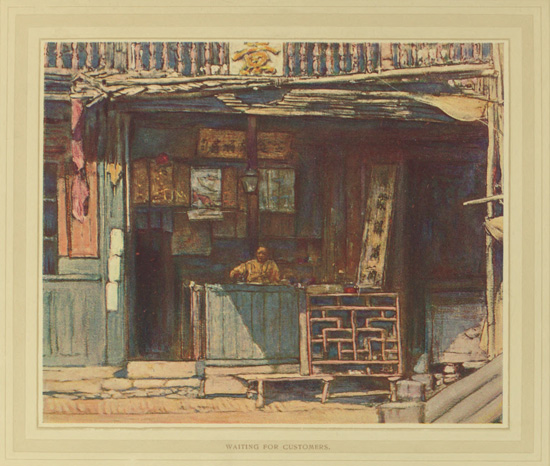
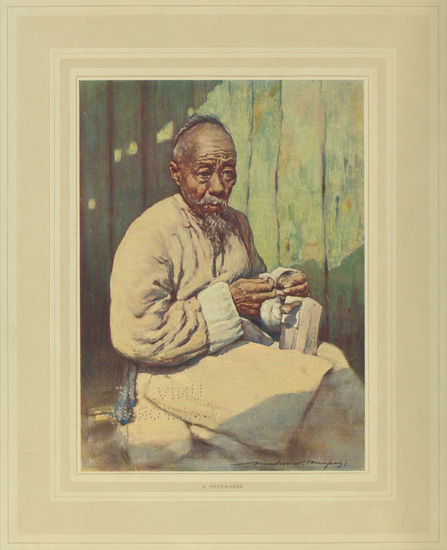
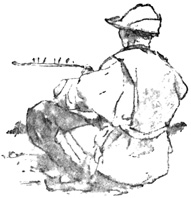
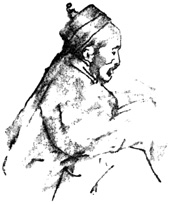
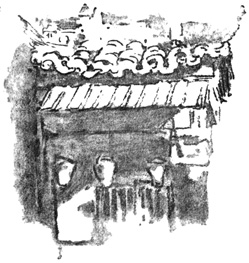
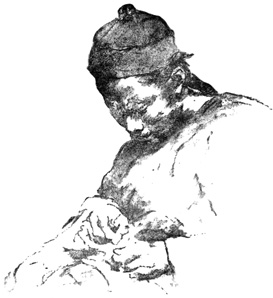
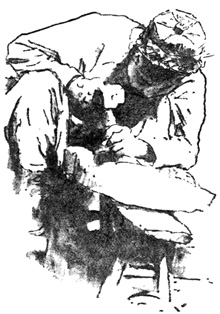
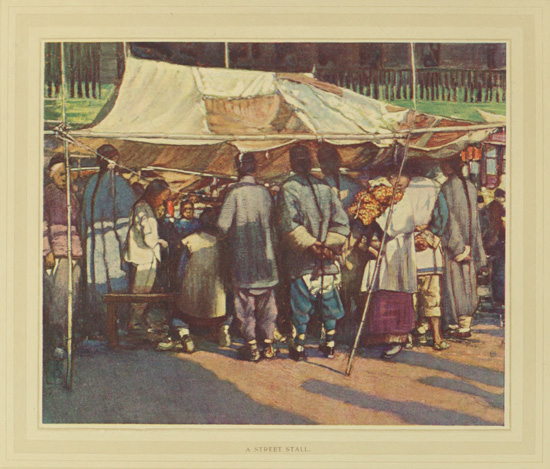
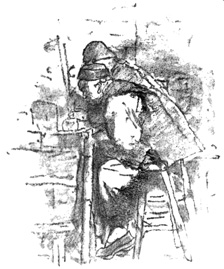
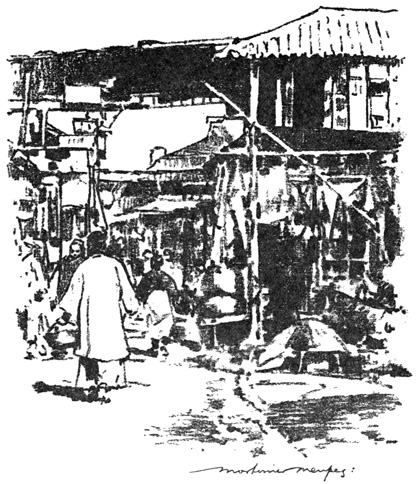
WAITING FOR CUSTOMERS.
In the event of any farmer being late with his
sowing, he must procure seed of a more rapidly
growing kind, some kinds of rice showing a
difference of a month or more in the time that
elapses from sowing to reaping. But even when
the crop is down and growing, no grass that may
be found on the edges of the paths or canals
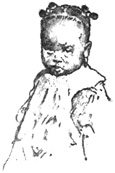
is allowed to go to waste. Small children
may then be seen seated sideways on the
broad backs of the buffaloes while the
beasts graze upon the skirting pasture,
the children preventing them from injuring
the growing crops.
The first crop is sown about April and reaped
early in July, the second late in July and reaped
at the end of September. After the rice, which has
generally been sown very thickly in a nursery, has
been transplanted to the flooded fields and taken
root, the ground is gone over and the mud heaped
with the feet around each plant. The ground is
manured when the rice is about a foot high with
pig manure, mixed with lime and earth, and
scattered by hand at a time when the water is
low. If the crop looks poor the manure is carefully
applied round each plant, and sometimes if it is still
very backward, when the water is around it, the
manure is poured over it in a liquid state. The
water is kept on the rice field until a very short time
before reaping, and after the crop is in full ear the
Chinese like to have three days' rain, which they say
improves the yield very materially.
When the rice is six or eight inches over the
water, which is then about three inches deep, large
flocks of ducks and geese may be seen feeding on the
frogs, etc., to be found in the paddy fields (paddy
is the term for rice before it has been husked),
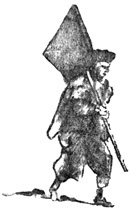
attended by a man or boy, who carries a long
bamboo pole with a bunch of bamboo leaves tied
at the top. When the evening comes a shake of his
pole brings all the flock, sometimes numbering
hundreds, out of the field, and as they emerge on the
path the last duck or goose receives a whack of
the bunch of leaves. It is amusing to see how this
is realized by the birds, who waddle along at top
speed to avoid being last. Once on the path the
herd goes in front, and, placing his pole against
the base of a bank, all the flock jump over it, being
counted as they go. Ducks are reared in amazing
numbers in Southern China, the eggs being hatched
in fermenting paddy husks. Every country shop has
displayed a number of dried ducks, the fowl being
cut in half and spread out under pressure. But as
articles of food nothing comes amiss; rats are dried
in the same way and sold, though the house rat is
not usually eaten, the rat of commerce being the
rodent found in the rice fields. Besides rice, the
farmer grows crops of rape, fruit, and a large
quantity of vegetables. Mulberry trees are the main
crop in the silk regions, and in the provinces
bordering the Yangtze tea is produced, while to
the westward the cultivation of the poppy assumes
large proportions. In the economy of the Chinese
farmer the pig plays as prominent a part as in
Ireland, for the pig is a save-all, to which all scraps
are welcome. The Chinese pig is usually black. It
has a peculiarly hollow back, the belly almost
trailing on the ground, and it fattens easily. A
roast sucking-pig is always a pièce de resistance
at a feast.
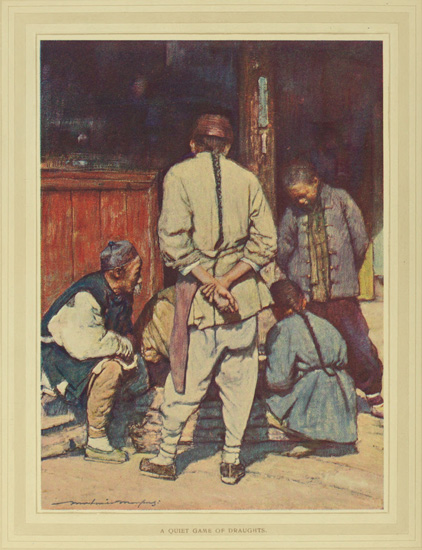
The Chinese farmer is thrifty, but he has his
distractions in card-playing and gambling in various
ways that could only be devised by Chinese
ingenuity. He loves a quail fight or a cricket fight,
the latter being an amusement that sometimes brings
a concourse of thousands together. A large mat-shed
is erected and in this is placed the cricket pit. The
real arena of the fight is a circular bowl with a flat
bottom about seven inches in diameter. Two crickets
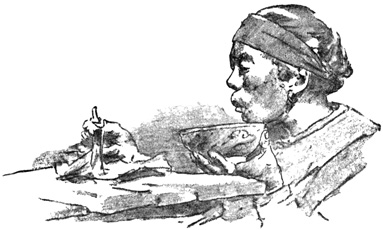
being placed in it are excited to fury by having
their backs tickled by a rat's bristle inserted in the
end of a small stick, such as a pen handle. The rival
crickets fight with great fury until one turns tail and
is beaten. Many thousands of dollars are wagered at
times upon these contests, and the most intense
excitement prevails. When a man has been fortunate
enough to capture a good fighting cricket he
feeds it on special meal. Such a known cricket
sometimes changes hands for a considerable sum.
After all, the value of a cricket, like a race-horse, is
what it may be able to win. As the initial expense
of a cricket is only the trouble of catching it, this is a
form of excitement within reach of the poorest, and
the villager may have in gambling for a cash (the
tenth part of a cent) as much excitement as the
richer town-dweller who wagers in dollars.
The farmer's house is not luxurious in its furniture,
but it is sufficient for his wants. With the exception
of the table almost everything is made of bamboo,
which, with the aid of fire and water, can be bent to
any shape, but there is great diversity in the lamp of
pottery or pewter or brass, the latter being somewhat
similar in shape to the ancient Roman lamp. The
bed is simply a flat board, over which a grass or palm
leaf mat is laid. The pillow is a half round piece of
pottery about ten inches long and four inches high.
A common form is that of a figure on hands and
knees, the back forming the pillow. The careful
housewife places her needlework inside the pillow,
which makes an effective workbasket. In winter the
pottery pillow is replaced by one of lacquer
and leather, which is not so cold. Over his
door will be found a beehive, made of a drum
of bamboo two feet long by twelve inches in
diameter and covered with dried clay, while
his implements of husbandry—consisting of a
wooden plough of the same shape as may be
seen on Egyptian ancient monuments, and
which with the harness he carries on his
shoulder to the field, a hoe, and a wooden "rake" of
plain board to smooth the mud on which the rice will
be sown—can be accommodated in the corner. He is
not very clean and has a lofty contempt for vermin;
but sometimes he will indulge in the luxury of a flea-trap,
made of a joint of bamboo three inches in
diameter, the sides cut out, leaving only enough wood
to preserve the shape. This he carries in his sleeve,
but what he inserts as a trap I have not been
able to discover.
Apart from his gambling his distractions are a visit
to the temple before or after crop time, a marriage, a
funeral, a procession, or a pilgrimage to one of the
seven holy mountains of China. He has not often
more than one wife, who, being entirely at his mercy,
rules him with a rod of iron, and to whom as a rule
he leaves the emotional part of the religion of the
family. To her falls all the anxious care of the
children, and horrible fears assail her lest the evil
spirits, against whose machinations all the ingenuity
of her religious superstitions is exerted, should get
possession of any of her boys. To this end she will
dress the boys as girls, and indulge in make-believes
that would not puzzle the silliest devil that ever
tormented a Chinese mother. Nor does she neglect
religious duties, for she will be seen in the temple
praying devoutly, and then taking up the two kidney-shaped
pieces of wood, flat on one side and round on
the other, that are found on the altar before the god,
she will place the flat sides together between her
palms and flinging them up observe the position in
which they fall. If both flat sides come up, it is good;
if the round, then it is evil; if one of each, there is no
answer. This she repeats three times; or going to a
bamboo in which are a number of canes, each bearing
a number, she shakes it, as Nestor shook the helmet of
Agamemnon, until one falls out, when she looks for
the corresponding number among a quantity of yellow
sheets of paper hung upon the wall where she reads
the mystic answer to her prayer.
It is not easy for the casual inquirer to understand
the religious beliefs of the Chinese. In many
ways intensely materialistic, the people have a
living faith, at least in reincarnation or recurring
life; and while their spiritual attitude is rather a
fear of evil demons than a belief in a merciful
God, yet there is among them a spirit of reverence
and of thankfulness for favours received. One
day at Chekwan Temple—a very fine and richly
ornamented temple on the Pearl River—I saw a
fisherman and his family enter with a basket of
fish and some fruits, which he laid upon the altar.
Then, first striking the drum to call the attention of
the god, the family prayed devoutly, while the father
poured a libation seven times upon the altar. I
asked the priest what it meant, and he answered that
the man had had a good take of fish the previous
night and was returning thanks. Sometimes when a
member of the family is ill they will go to the
temple and have a prayer written, then burning the
paper, they take home the ashes, and administer them
as a medicine. Again, in a temple in Canton one
pillar is covered with paper figures of men, which
are tied to the pillar upside down. Asking the
meaning I was told that these were tied on by the
light-o'-loves of young Chinese who, having taken a
wife, had put an end to the temporary arrangements
as common in a Chinese city as in the centres of
Western civilization. The abandoned ones vainly
hoped that by timely incantations and tying on of
the figures their protectors might be induced to
return to them. But the great annual excitement
to the peasant under normal conditions is the
theatrical performance that takes place in every
district. The company brings its own theatre, an
enormous mat-shed erection capable of accommodating
an audience of a thousand people. This is
erected in a few days, and for a week or more
historical or social plays are performed. The actors
make up and dress upon the stage, on which the
more prominent members of the audience are
sometimes accommodated. All the actors are men,
as women are not allowed to perform; but the men
who take women's parts could not be distinguished
from females, and some are very highly
paid. The dresses are very gorgeous.
In historical plays all the actors wear long
beards and moustaches which completely
cover the mouth. The bad character of
the play is always distinguished by
having the face darkened and with a
white patch on the nose. The play is
in the form of an opera in which the
singers intone their parts in a simple
recurring time, being accompanied in
unison by a couple of stringed instruments
of curious form; but when an
important entry is made or one of the oft-recurring
combats take place, large cymbals
clash with deafening noise. This is never
done while the singing dialogue is proceeding.
The properties are in a large box on the stage.
If an actor is going over a bridge the attendants,
who are moving about, place a table with a
chair at either side, put over it a cloth, and
the bridge is complete. The actor walks over and
the table is removed. Should he mount a horse,
or get into a chair, conventional movements convey
the fact to the audience. In the combats one man is
always slain. Then the attendant walks forward and
drops a roll of white paper or cloth before him,
when the slain man gets up and walks out. In
Japan matters are somewhat differently done.
There are always two attendants in black with wide
flowing sleeves, who are supposed to be invisible.
When a character is slain one stands in front, spreads
his arms, and the defunct walks off, the invisible
attendant moving after him, keeping between him
and the audience.
In social plays the actors are no longer in gorgeous
historic costumes, but are clad in modern dress.
When a very poor man came on he indicated his
poverty by making the movements of cracking
vermin on his clothes between his nails.
It is singular how little one misses the scenery, and
the audience takes the keenest interest in the plays,
sometimes being moved to tears at the tragic parts.
The position of the actor is very low in the
Chinese scale, no actor or child of an actor being
permitted to present himself for public examination;
the brotherhood of the sock and buskin is a very
large community.
When the play is finished, if there are wealthy
men present servants come in laden with strings
of copper cash, which are laid upon the stage.
But these are the incidents of country life in
normal times. When rains are short and rivers
run low, and the rice crop fails, then gaunt famine
stalks over the arid land, and discontent and misery
are apt to lead to grave local troubles, the people
looking upon such a visitation as a direct intimation
that the Emperor, as represented by the local
officials, had incurred the displeasure of heaven and
lost the confidence of the gods. This feeling makes
for rebellion, and rebellion in China, when it is faced
by Government, is dealt with in a manner so
ruthless as to make one shudder.
In 1903 a famine with the usual concomitants
developed in the province of Kwangsi, and harrowing
descriptions of the condition of affairs came to
Hong Kong, where a relief committee was formed
at once. An official was sent up on behalf of the
committee to inquire and report, and on his return
he gave an account of what he had seen. A troublesome
rebellion had broken out, and in the course of
its suppression many prisoners had been taken.
These wretches, with large numbers of criminals,
were being executed, a general gaol delivery being
thus effected, the magistrate holding that as there
was not enough food for honest people none could be
spared for criminals. The starving population had
been reduced to such extremity that they were
eating the bodies. At the same time the authorities
and the gentry were doing everything in their power
to relieve the suffering of the people; but all were
miserably poor, and no taxes were being collected.
The Hong Kong Relief Committee's representative,
who had taken a first consignment of rice with him,
was offered every facility by the magistrate, who not
alone gave him a guard, but sent a launch to tow
the rice junk up the river, sending a guard with it.
The state of brutality to which the community had
been reduced was shown by the following occurrence
related to the representative by one of his guards,
who told the story with an evident feeling that
the incident redounded to the credit of the "party
of order." A short time before, information having
reached the local authority of the whereabouts of
a "robber family," a party, including the narrator,
went to the village and seized the entire family.
The man they cut open, took out the entrails,
cooked and ate them in the presence of the dying
wretch. They cut the breasts off the woman, cooked
and ate them in the same way. The woman he
described as sobbing during the operation. The
two were then killed. As the "soldiers" did not
care to kill the children themselves, they handed
knives to a number of surrounding children, who
hacked the little ones to death.
This is a lurid story, but the sequel shows that
even in China danger lurks in too ferocious exercise
of despotic power, however well intended. The
magistrate was unceasing in his efforts to cope with
the famine, with the added troubles of a rebellion, in
fighting which the advantage was not always with
his troops. Rice was being poured into the famine
districts by committees established in Hong
Kong and Canton, and every assistance that
could be given was afforded to them by the
magistrate, who was an educated gentleman
and apparently full of pity for the famishing
people. His unvarying civility to the
working members of the Hong Kong committee who
were engaged in the distribution was at the close of
their proceedings duly and gratefully acknowledged;
but the warm thanks of the committee never reached
him. A new viceroy had been appointed to Canton,
who, on proceeding to the famine district to make
personal inquiry, found that the magistrate had not
been just, but had executed as criminals innocent
people, among them being a secret agent sent up by
the viceroy in advance to inquire into the real state of
affairs. On finding this he degraded the magistrate,
who thereupon committed suicide. When one reads
of the reckless ferocity with which life was taken it is
astonishing that he was not put an end to by poison
long before the interference of the viceroy; for
poisoning is not unknown, the plant named in China
muk-tong being used. It is inodorous and tasteless,
but if boiled in water used for tea it is almost
certain death.
The life of the coast cities where East meets West
is full of interest. Every treaty port has its foreign
concession, where the consuls reign supreme, and a
Western system of police and municipal arrangements
is adopted. Tientsin, Shanghai, Ningpo, Fuchow,
Amoy, and Canton, as well as the Yangtze ports,
all have on their borders large areas over which the
Chinese Government has abandoned its territorial
rights, and all offences or disputes are dealt with in
European magistrates' or consular courts with the
exception of Shanghai, where for certain offences the
cases are tried in a mixed court, under the jurisdiction
of a Chinese and a European magistrate. The
sudden contrast from the foreign concession at
Shanghai to the Chinese city is most striking; on
the one side a splendid bund along the river bank,
well kept public gardens, an excellent police force
(mounted and foot), broad streets in which are fine
shops displaying the newest European patterns, well
appointed gharries standing on their appointed
ranks for hire at moderate fares, and for the
poorer Chinese the ubiquitous Chinese wheelbarrow—mentioned
by Milton—that is palpably the
one-wheeled progenitor of the Irish jaunting-car.
The axle of the barrow is in the centre, the large
wheel working in a high well on either side of which
are two seats. There is no weight on the handles
when the legs are lifted; the barrow coolie has therefore
only to preserve the balance and push. These
barrows are used everywhere in the Yangtze region,
and are suitable for carrying heavy loads over interior
tracks too narrow for two wheels. In Shanghai they
are not alone used for transport of heavy burdens, but
form the usual means of locomotion for the Chinese
of the labouring class who prefer the luxury of driving
to walking. In the morning, as in the evening, when
going to work or coming from it, as many as six
people may be seen sitting three a side and being
pushed along by one coolie with apparent ease, or
now and again one or two men on one side are
balanced by a large pig tied on the other.
Along the river front, where the bund is prolonged
into Chinese territory, the Western influence is seen
in the police arrangements, Chinese police, or
"lukongs," being similarly attired as their Chinese
brethren in the "Settlements." But inside the walls
the scene changes, and the Chinese city is found,
simple but not pure, as Shanghai city is among the
very dirtiest in all China. Yet it has its picturesque
and somewhat imposing spots near the great temples.
Outside the city bounds is the usual burial-place, on
the border of the flat plain that surrounds Shanghai.
Here the custom is to deposit the coffins on the
ground, the tombs being sometimes built of brick,
or the coffin being covered with thatch, while in some
cases the coffins are simply left upon the ground
without any covering. It must be
explained that the Chinese coffin
is a peculiarly solid case, built in a
peculiar manner with very thick slabs of wood
In every direction are peach orchards, which
when in blossom present as beautiful a sight
as the famed cherry blossom of Japan. All
around the plain is intersected with deep
drains, the muddy bottoms of which the
sporting members of the Shanghai Hunt
Club now and again make involuntary
acquaintance. The position of Shanghai,
situated as it is near the mouth of the Yangtze,
marks it out as the future emporium of the commerce
of Central China, through which must ebb
and flow the ever-growing trade of nine of the
eighteen provinces of the Middle Kingdom. The
social intercourse between the foreign and the
Chinese communities is very restricted, a restriction
that cannot be laid entirely at the door of either side;
but until the division becomes less clearly and
sharply marked there can be no well grounded
prospect of such community of feeling as will make
trade relations comfortable, when the now blinking
eyes of the sleeping giant have fully opened and
he realizes his strength and power to command
attention to his demand for reciprocal rights among
the great nations of the earth.
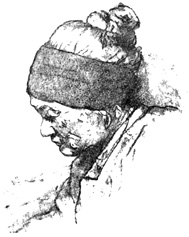
To a foreigner the most impressive city in China
is Canton, with its teeming population and intense
activity. The foreign settlement of Shameen lies
along the bank of the Pearl River, and on the
land side is surrounded by a canal, the only entrance
to the settlement being over two carefully guarded
bridges. Here everything is purely Western—Western
architecture, Western lawns, Western
games; the flags of all the foreign nations fly over
their respective consulates; and but for the Chinese
domestics that one sees here and there, one might, if
he turned his gaze from the river, with its maze
of junks and boats of every kind, forget that he
was not walking in the wealthy residential suburb
of a European town. But once over the bridge and
past the solid rows of stores—once the godowns of
the European hongs—every trace of European
influence is gone, and we enter through the city
walls into a scene such as has existed in Chinese
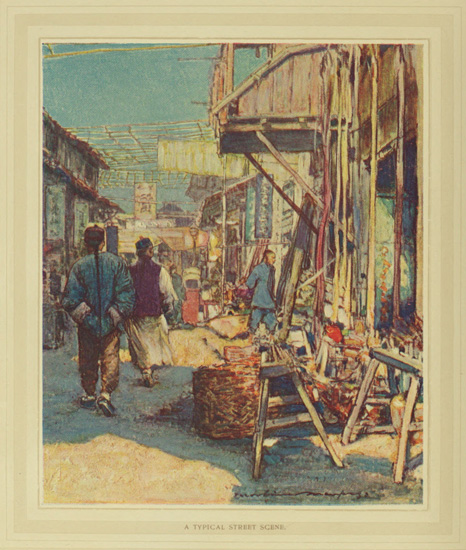
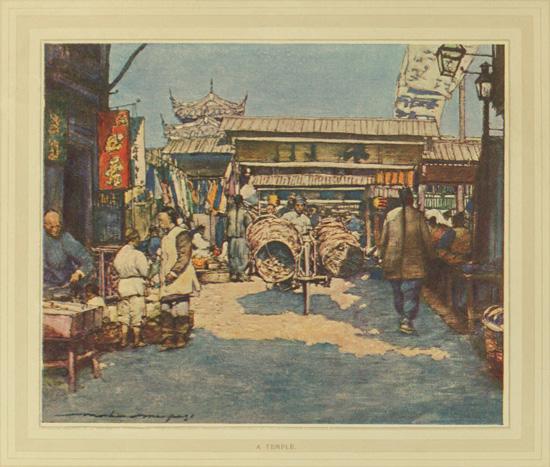
cities for centuries. The streets vary in width from
six to ten feet, and are all flagged with granite slabs,
and in these narrow streets is a dense mass of blue-robed
Chinese, all intent upon business except when
a foreigner enters into a shop to make a purchase,
which always attracts a curious and observing crowd.
Narrow as are the streets, the effect is still more
contracted by the hanging sign-boards, painted in
brilliant colours and sometimes gilt letters, that hang
outside each shop. These sign-boards are sometimes
ten to twelve feet long, and each trade has
its own particular colouring and shape. The
effect of the sign-boards, the colour of the open
shops, and the gay lanterns that hang at almost
every door, is very fine, and gives an idea of wealth
and artistic sentiment. Every shop removes its
shutters in the morning, and as there are usually
no windows, the effect is that of moving through an
immense bazaar, in which every known trade is
being carried on, while the wares are being sold
at an adjoining counter. In one shop will be found
the most expensive silks and other stuffs, or rather in
a row of shops, for each particular business affects
certain parts of the street. Thus at one end may be
a succession of shops with the most delicate and
beautiful commodities, while the continuation is
devoted to butchers' stalls, or fishmongers', the
sudden transition being proclaimed to every sense,
and outraging our feeling of the fitness of things.
In the shops will be seen men at work upon the
beautiful fans for which Canton is famed; in another
the shoemaker or the hatter ply their more homely
trade. Tailors, stocking-makers, carpenters, blacksmiths,
all are diligently at work, while here and there,
poring carefully over a piece of jewellery or brass or
silver work, may be seen the feather-worker attaching
the delicate patterns made with the brilliant feathers
of the kingfisher, the work being so minute that
young men and boys only can do it, and so trying
that their eyesight can only stand it for about two
years. At the corners of the streets are seen tea-houses,
the entire front being elaborately carved
from ground to roof and glittering with brilliant
gilding. Ivory-cutters carry on their trade, and jade
and porcelain are displayed. A great feature in
many of the streets is the bird shops, filled with
singing birds or birds of brilliant plumage, of which
the Chinese are very fond, wealthy Chinese gentlemen
giving sometimes large sums for ivory cages for
their favourites. In places the streets are covered
for short distances. These gay shops are not
usually found in the side streets, where the rougher
trades—the butcher, the fishmonger, and the greengrocer—predominate.
In these particular streets the
smells are to European sense simply abominable,
but appreciation or otherwise of smells is possibly
a racial as well as an individual peculiarity.
Among us musk is the delight
of some and the horror of others.
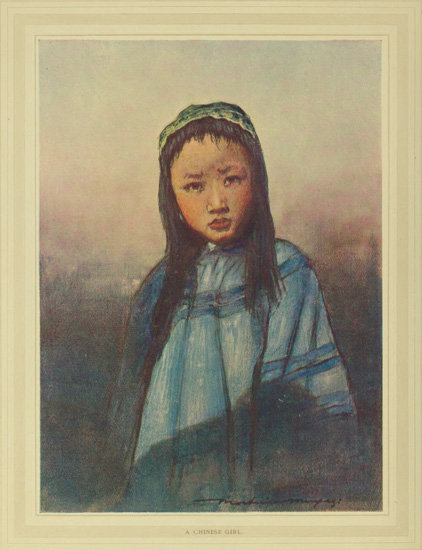
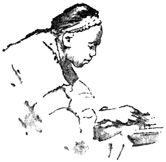
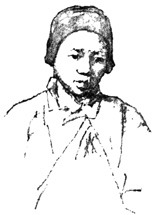
A CHINESE GIRL.
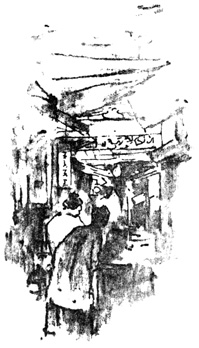
Although too narrow for wheeled traffic,
the noise of the streets is considerable, as
coolies, carrying great baskets of goods
or perhaps vegetables, shout panting warnings
to the crowd, and all must make way
for the laden coolie. Now and again a
mandarin rides past, attended by his
servants, or is carried in his official chair,
when everybody makes way for him with
the most surprising alacrity. It is easy to see
that the people recognize the all but despotic
power that always notes the officials of a
practically democratic community. The
general idea that strikes a stranger when
going for the first time through these narrow streets
with their dense crowds is one of awe, feeling as if
enmeshed in the labyrinths of a human ant-hill, from
which there could be no hope of escape if the crowd
made any hostile movement. But the interests of
Canton are not exhausted in her crowded streets, with
the marvellous absence of any jostling—the chair
coolies never touching anybody with their chairs, even
though they fill up half the width of the streets—for
there are the various temples that have been described
ad nauseam; the water clock that has been going for
over six centuries; the mint, where the Government
produces from time to time coins of not always
clearly determined fineness; and the City of the
Dead, where for a moderate payment an apartment
may be engaged, in which a deceased member of a
family can be accommodated until such time as
the geomancer can find an auspicious position for the
grave. Some of these apartments, which are all
kept admirably clean, have tables on which are left
the pipe of the inmate, while paper figures stand by
to hand him, if necessary, the spiritual aroma of his
favourite food when alive.
The guild-houses of Canton are well built and
richly ornamented structures. These guild-houses
are the club-houses of various provinces, or the local
club of the members of different trades. Even the
beggars have their guild in Canton, where strange
members of that ancient and honourable profession
may obtain accommodation, and permission to ply
their occupation as mendicants on payment of a fee.
Every beggar so licensed carries a badge, bearing
which he has the right to enter a shop and demand
alms. Among the procession of mandarins with
their brilliant entourage who assembled to meet Liu
Kun Yi, the viceroy at Nanking, on his return from
Peking, in 1900, was the mandarin head of the
beggars. He was arrayed in the correct and rich
robes of his rank, and had his place in the procession
exactly as the other mandarins, who were each surrounded
or followed by their staff and their troops.
The mandarin of the beggars' guild was carried in
his official chair, and around him and following him
was the most extraordinary and motley crowd of
beggars, all in their workaday rags and tatters.
Had they but arms of any sort they might have given
points to Falstaff's ragged regiment. Every shopkeeper
is visited at least once daily by a member of
the fraternity, and whether by law or by custom he
must contribute some small amount. The system is
possibly a form of outdoor relief, and if one but
knew its inner working it would probably be found to
be a fairly satisfactory solution of a difficulty that is
exercising the wits of anxious social investigators
in England.
If the shopkeeper refuses to submit to the
customary demand he may find a beggar, afflicted
with some loathsome disease, seated at the door of
his shop, where he will remain until the honour of
the guild has been satisfied by a suitable donation,
for there will be no stern policeman to order the
persistent beggar to move on. One of the most
painful sights that I have ever seen was a collection
of lepers who had been allowed to take possession of
a small dry patch in the middle of a deep swamp in
the new territory of Kowloon. The only entrance
was by a narrow path roughly raised over the swamp
level. Here they had constructed huts from pieces
of boxes, through which the rain entered freely.
Each morning the miserable creatures dragged themselves
to the neighbouring villages, the inhabitants of
which charitably placed rice for them before their
doors. I have never seen a more miserable collection
of human beings. I had proper huts erected for
them on neighbouring high ground, where at least
they were free from the danger of being flooded out,
and had shelter from rain and wind. There is a
regular leper hospital in Canton.
It must not be assumed that Canton is entirely a
town of retail shops, for there are many important
factories there, some of the houses of business
covering large areas, where hundreds of men are
employed in the various manufactures. Crowded as
is the business part of the city, one wonders that it is
not devastated by fire; but over every shop vessels
of water are kept upon the roof, ready for instant
service. The value of land is very great, the average
value being fourteen dollars a square foot, which is
roughly about sixty thousand pounds per acre. But
the narrow streets of Canton can be very imposing
when a high foreign official is paying a visit of
ceremony to the viceroy. On one side of the street
is a continuous line of soldiers—the streets are too
narrow for a double line—each company with its
banner, while the other side is occupied by a dense
crowd that fills the shops and stands silently to see
the procession of official chairs go by. The streets are
not alone swept, but carefully washed, so that they
are perfectly clean. At each ward-gate is stationed
half a dozen men with long trumpets, like those upon
which Fra Angelico's angels blew their notes of
praise, and from these trumpets two long notes are
sounded—one high, the other low. In the courtyard
of the viceroy's yamen is stationed a special guard of
about one hundred and fifty men, richly dressed and
carrying such arms as one sees in very old Chinese
pictures—great curved blades on long poles, tridents,
etc.—while thirty or forty men stand with banners of
purple, yellow, blue, or red silk, each some twelve
feet square, mounted on poles at least twenty feet
long. The effect is singularly picturesque. The
viceroy's yamen is situated more than a mile from
the river, so that a large number of troops are required
to line the streets. The yamen is surrounded by an
extensive park, in which is some good timber.
Another fine park surrounds the building once
occupied by the British Consul, but now used by the
cadets of the Straits Settlements and Hong Kong,
who on appointment to the Colonies are sent for
two years to Canton, there to study Chinese.
However busy the high official in China may be,
his daily life is passed in quiet, if not in peace.
With him there are no distracting sounds of street
traffic, no hoot of motor-cars, no roar and rumble of
motor-omnibuses, no earthquake tremors from heavy
cart traffic. The streets are too narrow for this, and
the yamen and the office are separated from any
possible interference with business by street noises.
The business of the yamen is, however, rarely done
in solitude, for the yamen "runners," as the crowd of
lictors and messengers are called, overrun the entire
place, and the most important conversations are
carried on in the presence of pipe-bearers and other
personal attendants, to say nothing of curious
outsiders, that almost precludes the possibility of
inviolable secrecy. It is possible that where
foreigners are not mixed up in the matter there
may not be so many anxious listeners, but there are
few things about a yamen that are not known by
those whose interest it is to know them.
The official proceeds with his work upon lines that
have been deeply grooved by custom, and however
energetic he may be, he is careful not to make
violent changes, nor will he hastily leave the beaten
track. As a rule, no community becomes violently
agitated by inaction on the part of a government or
of an official, however much it may be deprecated.
In China the only fear in such a case would be
from the action of the censors, who are appointed in
various parts of the empire, and who have proved by
their denunciation of even the highest officials for
sins of omission, as well as commission, that China
possesses among her officials men whose fearlessness
and independence are equal to that of men of other
races, whose honoured names have come down to us
in song and story.
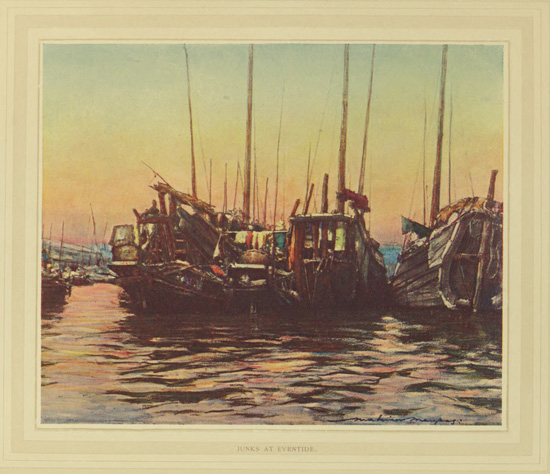
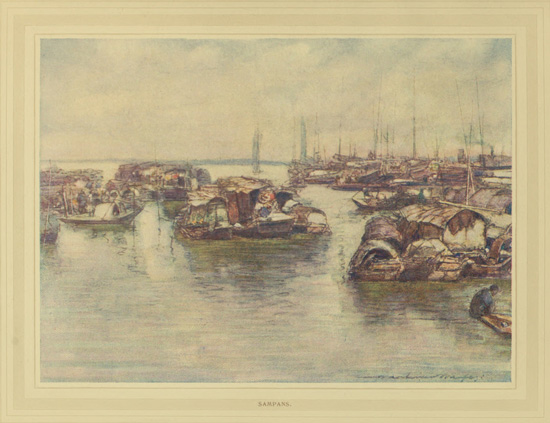
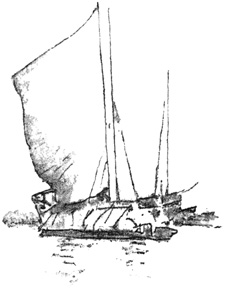
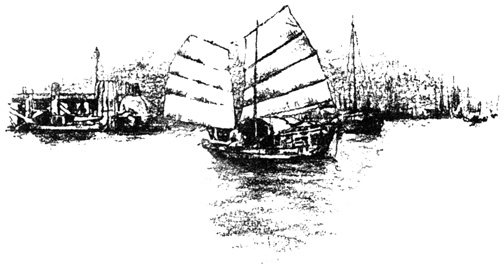
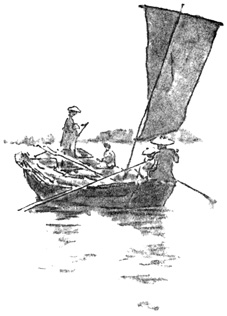
JUNKS AT EVENTIDE.
The rigid etiquette of China preserves a dignity in
the conduct of all public business, and it is against
the first principles of an educated Chinaman to use
rough or harsh terms that would be considered
vulgar. The written language is so capable of
different interpretations that in treaties with China,
which are generally written in three languages—Chinese,
French or English—and the language
of the contracting countries, it is always
stipulated that in construing the terms of the
treaty one of the two languages, not the
Chinese, is to be taken as interpreting its
true meaning. This does not necessarily
infer dishonest intentions on the part of
the Chinese; but the fact is that as
each one of the many thousands of Chinese
characters may mean more than one thing, the
real meaning has sometimes to be inferred from
the context, so that there are peculiar difficulties
attending the close and accurate interpretation of a
treaty or dispatch. It is popularly supposed that Sir
Robert Hart and Sir J. McLeavy Brown are the
only foreigners who have complete mastery of the
art of writing Chinese so as to ensure the accurate
expression of the meaning to be conveyed. The
yamen of a high official, with his residence, covers
a large area, as no house is built more than one story
high. Such a building might by its dominating
height interfere disastrously with the fung sui of
even a city, and is always bitterly resented. The
steeples of churches have something to answer for in
this way in keeping alive the spirit of antagonism
fostered by the daily maledictions of the Chinese,
who bear patiently with submission rather than
acquiescence the presence of a dominant foreign
influence that, if they have any living superstition on
the subject, must convey to them an impression of
evil. The yamen usually consists of a series of
courtyards, off which are built the apartments for the
numerous staff as well as the private apartments of
the family, and in one of these, when the business of
the day is concluded, the official receives the visits of
his friends and smokes the calumet of peace, or plays
one of those complicated games of Chinese chess to
whose intricate rules and moves our game of chess
is simplicity itself. Sometimes after his work he
indulges in his pipe of opium, after the manner of our
own three-bottle men of the last century. The late
Liu Kun Yi, the able Viceroy of Nanking, who with
Chang Chi Tung, his neighbouring viceroy, kept the
Yangtze provinces quiet through the Boxer troubles
was a confirmed opium-smoker. But one thing he
never does—he never hurries. Haste is to him
undignified, and he eschews it. In his official dealings
he will adopt methods that would not pass
muster in our courts; but from the Emperor to the
coolie those methods are understood and accepted.
Much might be written on the ethics of what we call
official corruption; but let the facts be what they
may, the people understand the system, the Government
understand it, and there is no popular demonstration
against it. Nor must we forget that official
"irregularity" is not unknown outside China.
The social side of the life of a Chinese mandarin is
not confined to his own yamen. He is fond of
visiting his friends and engaging in intellectual
conversation over a friendly cup of tea—and such
tea! We have no idea in Europe of the exquisite
delicacy of the best Chinese tea as prepared by a
Chinese host. The tea is made by himself, the
leaves being only allowed to remain in the freshly
boiled water for four or five minutes. It is then
poured into cups of delicate porcelain, about the size
of a liqueur glass, and sipped without the addition of
milk or sugar. After the tea has been drunk, the
aroma of the cup is enjoyed. The perfume is
delicious.